Article

Integrated Sustainability Assessment of Brownfield Regeneration: The Vieux-Charmont Park Case (France)


by
Patricio Iván Cano
1,*,
Humberto Castillo González
2,
Michel Chalot
3 and
Germán Cavero
1
1
Blue Synergy, Calle Maudes 51, 8º Planta, 28003 Madrid, Spain
2
Unité Mixte de Recherche (UMR) 6249, Laboratoire Chrono-Environnement, Université Marie et Louis Pasteur, 4 Place Tharradin, 25200 Montbéliard, France
3
Chrono-Environnement (Unité Mixte de Recherche—UMR—6249), Université Marie et Louis Pasteur, CNRS, 25200 Montbéliard, France
*
Author to whom correspondence should be addressed.
Sustainability 2026, 18(14), 7056; https://doi.org/10.3390/su18147056
Submission received: 8 May 2026 / Revised: 18 June 2026 / Accepted: 30 June 2026 / Published: 10 July 2026
(This article belongs to the Section Soil Conservation and Sustainability)

Abstract

Brownfield redevelopment increasingly requires sustainability-oriented frameworks integrating Life Cycle Assessment (LCA), Life Cycle Costing (LCC), Net Present Value (NPV), Social Life Cycle Assessment (S-LCA), and Social Return on Investment (SROI) to evaluate conventional remediation benchmarks and nature-based solutions (NBS) for the restoration of the Vieux-Charmont brownfield (France) into a public ecological park. Eight remediation scenarios were assessed, including combinations of excavation, soil treatment, landfill disposal, soil reuse, and phyto-management. The results demonstrated substantial differences among restoration pathways. The conventional landfill-oriented benchmark generated the highest environmental burdens, whereas the best-performing phyto-management scenario achieved the lowest impacts, reducing climate change and land use impacts by 91.6% and 75.6%, respectively. Scenarios integrating reduced excavation intensity and treated soil reuse consistently improved environmental performance and long-term economic viability. The best-performing phyto-management configuration also achieved the highest NPV after 20 years (1.38 million Euros, 2026). The social assessment results indicated improved socio-economic performance for phyto-management systems within the adopted S-LCA and SROI framework. Overall, the findings demonstrated that remediation strategies should not be evaluated solely according to contaminant removal efficiency or direct operational costs. Instead, integrated sustainability frameworks combining environmental, economic, and social dimensions provide a more robust basis for supporting sustainable brownfield restoration and circular land management strategies.

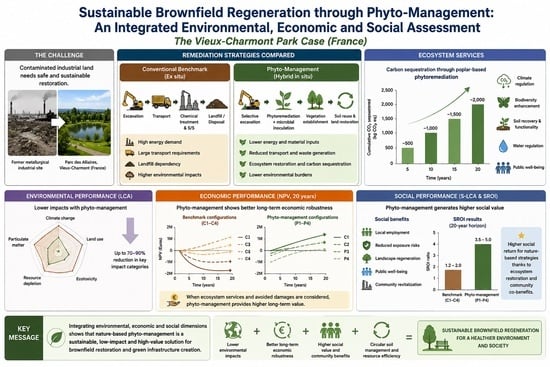
Graphical Abstract

1. Introduction

Brownfield sites are previously developed land areas affected by legacy contamination from industrial or commercial activities, often constraining safe reuse and redevelopment. Across Europe, an estimated 2.8 million sites are potentially contaminated, largely due to historical industrial emissions, with heavy metals and petroleum-derived hydrocarbons among the most prevalent pollutants [1,2,3]. This widespread contamination represents both an environmental risk and a barrier to sustainable land management [2].
Brownfield regeneration therefore constitutes both a remediation necessity and an opportunity for sustainable urban development. The transformation of contaminated land into green infrastructure or public spaces can (i) reduce land take, (ii) limit soil sealing, and (iii) enhance ecosystem services such as carbon sequestration, stormwater regulation, and urban climate mitigation [4,5,6]. Within this context, NBS-based phyto-management systems, particularly microbe-assisted phytoremediation, have emerged as promising approaches for the management of metal-contaminated soils. Phytoremediation exploits plant uptake and stabilization mechanisms, while associated microbial consortia enhance metal bioavailability, chelation, and plant tolerance, improving overall remediation performance [7].
Beyond contaminant attenuation, NBS-based phyto-management approaches contribute to ecological restoration and are generally well accepted by local communities due to their visible landscape improvement and gradual risk reduction [8]. However, despite their perceived environmental benefits, remediation strategies are still predominantly evaluated based on technical efficiency and regulatory compliance, without fully capturing broader environmental implications. In particular, phyto-management systems may require long operational times, maintenance inputs, and resource use that generate indirect environmental burdens not accounted for in site-specific assessments [9,10].
The real case of Parc des Alliaires in Vieux-Charmont (eastern France) illustrates this transition from contaminated industrial land to multifunctional green infrastructure. Formerly impacted by metallurgical and automotive activities, the site exhibited heterogeneous contamination [11,12]. More specifically, detailed site investigations have identified heterogeneous contamination associated with historical metallurgical and industrial activities, characterized by elevated concentrations of potentially toxic elements, including lead, zinc, cadmium, and arsenic, together with the presence of polycyclic aromatic hydrocarbons [11,12]. Maximum concentrations of approximately 4100 mg kg−1 lead, 7300 mg kg−1 zinc, 3.7 mg kg−1 cadmium, and 49 mg kg−1 arsenic were reported in contaminated soils [13]. The contamination was spatially heterogeneous across the site, with pollutant hotspots associated with former industrial operating areas and higher contaminant concentrations generally observed within the upper soil layers. This vertical and horizontal variability constituted a key factor in the development of the remediation scenarios, which evaluated alternative excavation depths ranging from 0.25 to 1.0 m to represent different levels of contaminated soil removal and site restoration intensity. Although PAHs were detected in specific areas, potentially toxic elements represented the principal contaminants driving remediation decisions. Groundwater investigations indicated that soil contamination constituted the primary environmental concern at the site; therefore, the present sustainability assessment focused on alternative soil remediation and land restoration pathways [14,15,16]. Supported by initiatives such as the BIOSYSMO project, phyto-management strategies combining vegetation establishment and microbial enhancement have progressively restored the site, which is now open as a public park. This transformation provides a unique real-world case to evaluate how NBS-based phyto-management remediation can support sustainable brownfield regeneration and safe land reuse [17].
Despite increasing interest in such approaches, limited quantitative evidence exists on the overall sustainable performance of brownfield-to-park transformations when assessed from a life cycle perspective. While phyto-management is often considered environmentally preferable, its full environmental profile remains insufficiently characterized [18]. Consequently, there is a need for robust methodologies capable of capturing sustainable trade-offs associated with both remediation and land use transition.
Specifically, LCA provides a standardized framework to quantify environmental impacts across the entire life cycle of systems, from resource extraction to end-of-life, following ISO 14040 and 14044 principles [19,20]. By identifying environmental hotspots and trade-offs, LCA has been increasingly applied in contaminated land management to support the comparison of remediation alternatives and the integration of sustainability criteria beyond site-specific risk reduction [21]. In this regard, it is widely recognized that LCA alone is insufficient to capture the full spectrum of sustainability implications, and therefore should be complemented by economic and social assessment frameworks to support more holistic decision-making in contaminated land management [22].
Although LCA has become increasingly adopted for evaluating contaminated land remediation technologies, most studies remain focused on environmental performance and frequently assess only selected indicators such as greenhouse gas emissions, energy consumption, or resource use [23]. Economic and social dimensions are often addressed separately through cost/benefit analyses, LCC, or qualitative stakeholder evaluations, resulting in fragmented decision-making frameworks [23,24]. Consequently, remediation strategies continue to be predominantly selected according to contaminant removal efficiency, regulatory compliance, and direct implementation costs, while broader sustainability implications associated with land use recovery, ecosystem services, long-term economic viability, and societal value creation remain insufficiently addressed [23,25]. This limitation is particularly relevant for brownfield regeneration projects, where environmental, economic, and social outcomes are intrinsically interconnected. Life Cycle Sustainability Assessment has therefore emerged as a promising framework for integrating multiple sustainability dimensions within a common decision support approach [23]. Nevertheless, applications simultaneously combining LCA, LCC, NPV, S-LCA, and SROI under real full-scale remediation conditions remain scarce in the contaminated land literature, highlighting the need for integrated methodologies capable of evaluating sustainability trade-offs associated with alternative brownfield restoration pathways [26,27].
Within this context, the present study aims to assess the overall sustainability performance of the brownfield-to-park transformation in Vieux-Charmont. By evaluating a real-world implementation of NBS-based phyto-management strategies in comparison with conventional approaches, this work provides evidence-based insights to support sustainable contaminated land management and urban regeneration strategies.
To the best of the authors’ knowledge, studies simultaneously integrating LCA, LCC, NPV, S-LCA, and SROI within a single framework for the comparative evaluation of alternative brownfield restoration pathways under real full-scale remediation conditions remain very limited in the scientific literature. This study therefore contributes to addressing an important methodological gap by providing an integrated sustainability assessment of a real-world brownfield-to-park restoration project.

2. Methodology

2.1. Goal and Scope Definition

This study applies a comparative LCA, NPV and S-LCA to evaluate the environmental implications of restoring the former industrial brownfield of Vieux-Charmont (Bourgogne-Franche-Comté, France) into a public ecological park (Parc des Alliaires). The assessment compared remediation strategies delivering the same function: safe redevelopment of the site for recreational and ecological use under French regulatory requirements [28].
Within this goal, the first strategy represented a conventional ex situ benchmark based on the excavation of contaminated soil, followed by physico-chemical treatment (including chemical washing and S/S applications) and the disposal of contaminated material in an authorized landfill, in full compliance with applicable French legislation [28]. Alternatively, the second strategy embodied a hybrid NBS-based phyto-management remediation approach, combining in situ phyto-management assisted by microbial inoculation with targeted ex situ treatment of highly contaminated hotspots, in accordance with applicable French legislation [28].

2.2. Functional Unit

The Functional Unit (FU) was defined as the full restoration of the former industrial site at Vieux-Charmont (approximately 6 hectares), enabling its safe conversion into a public ecological park (Parc des Alliaires). All material, energy, transport, treatment, and waste management flows are therefore reported for the complete restoration of the site [2]. The site area (approximately 6 hectares) is reported to facilitate interpretation of the results, and selected findings are additionally discussed in relation to restoration intensity and land occupation.

2.3. System Boundaries

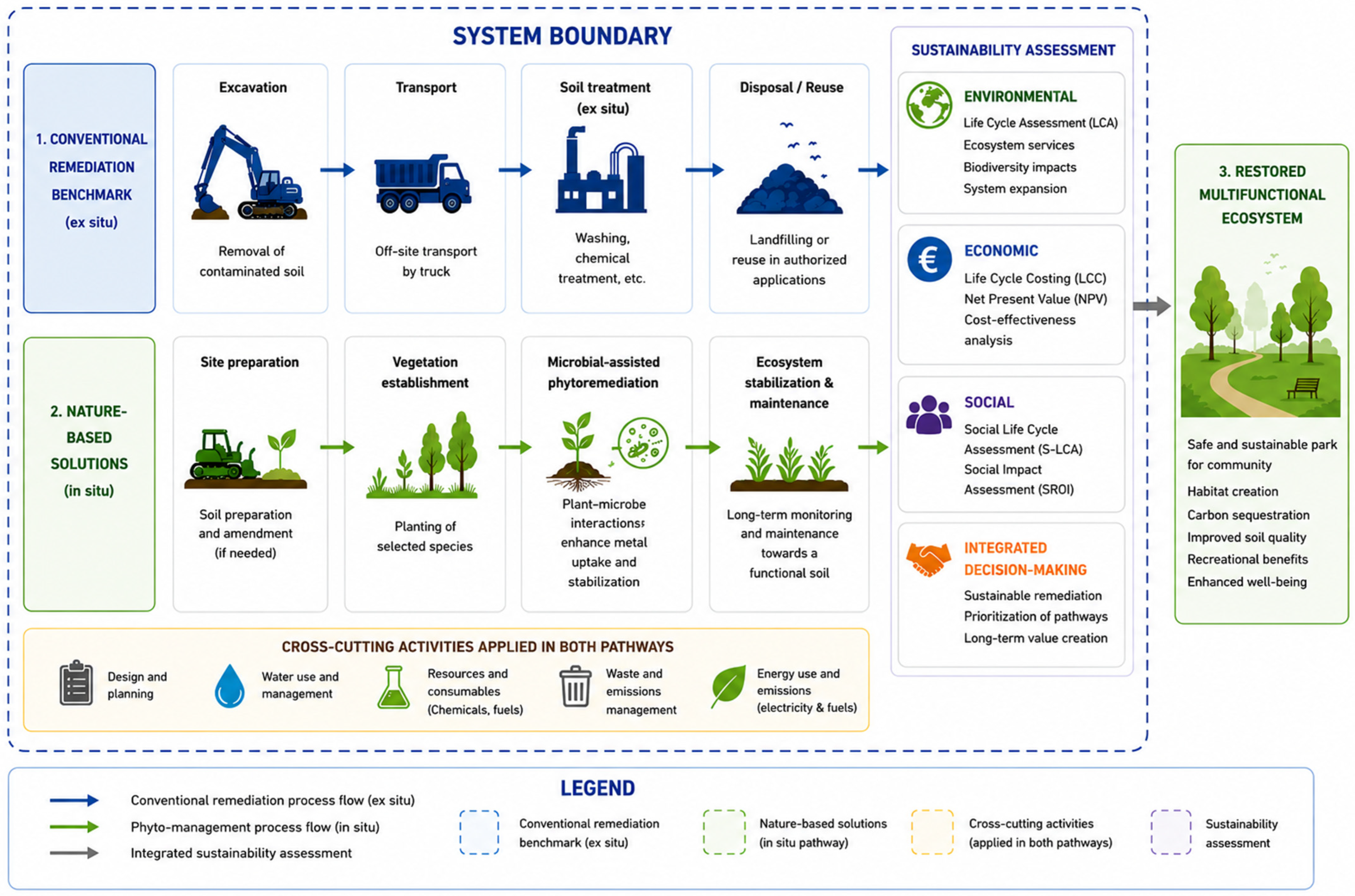
The system boundaries (Figure 1) include all processes required to deliver the FU, consistently with the system definition adopted in the site restoration for further recreational use as a park.
In accordance with the defined FU and the intended ecological restoration objective, the system boundaries encompassed all remediation and restoration activities required for site implementation and management, including vegetation establishment, microbial inoculation, irrigation, environmental monitoring, maintenance, and biomass management. The inclusion of these processes was considered necessary to ensure a representative assessment of the environmental, economic, and social performance of the phyto-management scenarios throughout the restoration period.
For the conventional benchmark, the system included: (i) soil excavation, (ii) transport to treatment facilities, (iii) chemical washing (when required), (iv) S/S (when required), and (v) final disposal in an authorized landfill (when required).
For the hybrid phyto-management strategy, the system included (i) selective excavation of contaminated hotspots, (ii) outbound transport of excavated soil for treatment, (iii) chemical washing of excavated soil (when required), (iv) S/S of excavated soil (when required), (v) landfill disposal of treated residues in an authorized landfill (when required), (vi) land preparation for phytoremediation, (vii) phytoremediation application and (viii) microbial inoculum preparation and application.
Importantly, soil valorization, together with the associated inbound transport for reuse as backfilling material, was not a standard feature of the system and was included only in selected scenarios as part of a sensitivity analysis exploring circular soil management approaches.
The evaluated scenarios (Table 1) were selected to represent realistic remediation alternatives applicable to the contamination conditions and redevelopment objectives of the Vieux-Charmont brownfield. Conventional remediation systems were included as benchmarks because they reflect established engineering practices currently used in contaminated land management, whereas phyto-management scenarios were developed to evaluate the potential sustainability advantages associated with reduced excavation intensity, ecosystem service provision, and circular soil management strategies. The selected excavation depths were derived from site-specific contamination conditions and restoration requirements identified during the redevelopment planning process, allowing the assessment to reflect technically feasible remediation pathways rather than hypothetical configurations.
The assessment included all activities directly associated with remediation and site restoration. Activities considered identical among scenarios or beyond the decision context of the remediation project were excluded. These exclusions included future park redevelopment activities, end-of-life management of recreational infrastructure, and long-term municipal management activities unrelated to remediation performance. Repeated microbial inoculation, vegetation replacement and large-scale irrigation after vegetation establishment were also excluded due to the absence of site-specific evidence supporting their implementation.
Biomass management was considered within the system boundaries as part of the phyto-management strategy. Consistent with site-restoration objectives, biomass generated during vegetation establishment and management was assumed to be handled according to site management requirements and was not considered a marketable co-product or valorized output within the assessed system.

2.4. Life Cycle Inventory

The Life Cycle Inventory (LCI) was developed for the full restoration of the Vieux-Charmont brownfield into a public ecological park (Parc des Alliaires). The LCI was built as a foreground, process-based dataset, with all flows reported per FU.
Two groups of scenarios were considered, as specified in the Table 2. The first group corresponded to the hybrid phyto-management strategy, where in situ phytoremediation assisted by microbial inoculation was combined with targeted ex situ treatment of contaminated hotspots. The second group was based on the physico-chemical benchmark, where the remediation process was limited to excavation, chemical washing, S/S, and final soil management. In both groups, additional scenarios were included to assess the influence of excavation depth and soil valorization.
The evaluated remediation scenarios were developed in accordance with the French risk-based contaminated land management framework [28], which promotes site-specific remediation objectives based on future land use, risk assessment, contaminant distribution, and exposure pathways rather than uniform soil quality thresholds. The excavation depths evaluated in this study were derived from contamination investigations conducted at the Vieux-Charmont site and reflect technically feasible remediation options for the safe redevelopment of the area as a public ecological park. Landfill disposal and soil reuse assumptions were defined in accordance with applicable French requirements for contaminated soil management and excavated material traceability [28,29,30].
As mentioned above, soil valorization was not considered as a default assumption. It was modeled only in the reuse scenarios (C2, C4, P2 and P4 scenarios in Table 2), where treated soil suitable for backfilling was transported back and reused within the restoration system, while the non-reusable fraction was still stabilized and sent to an authorized landfill in accordance with applicable French legislation [28].
The LCI (Table 3) was primarily constructed using operational data generated during the restoration of the Vieux-Charmont brownfield into Parc des Alliaires, including (i) site dimensions, (ii) contaminated soil volumes, (iii) excavation depths, (iv) transport requirements, (v) remediation activities, (vi) restoration operations, and (vii) microbial inoculation activities. These foreground data were provided by Université Marie et Louis Pasteur and derived directly from restoration activities implemented at the site. Where direct site-specific information was unavailable, literature LCI data, including material and energy requirements associated with soil washing, S/S treatment, machinery operation, and auxiliary processes, were obtained from the peer-reviewed literature, recognized LCA databases, and engineering calculations [28,29,30,31,32,33,34,35,36,37,38,39,40,41,42,43,44,45,46,47,48,49,50,51,52,53]. Consequently, the LCI (Table 3) combines primary foreground data with secondary literature sources and engineering estimates, consistent with hybrid inventory development approaches commonly applied in LCAs of contaminated land remediation systems. This approach ensured consistency between the evaluated scenarios while maintaining the representativeness of a real brownfield restoration project rather than a purely theoretical remediation exercise [54]. The LCI data and system boundaries were harmonized across all scenarios to ensure consistent comparison of remediation alternatives, with differences arising exclusively from remediation intensity, excavation depth, soil management strategy, and the implementation of phyto-management measures [55].
Specifically, the complete foreground life cycle inventory developed for all evaluated remediation scenarios is presented below in Table 3.
Given the comparative nature of the assessment, consistent methodological assumptions, system boundaries, background datasets, and modeling procedures were applied across all scenarios in accordance with established principles for comparative LCA [56]. Although certain LCI parameters were derived from engineering calculations and literature sources where site-specific information was unavailable, these assumptions were harmonized to ensure that differences among scenarios were attributable to variations in (i) remediation strategy, (ii) excavation intensity, and (iii) soil management practices rather than methodological inconsistencies. Consequently, the results should be interpreted as comparative indicators of the relative sustainability performance of the evaluated remediation alternatives, rather than as absolute predictions of future environmental, economic, or social outcomes [56].

2.5. Environmental Impact Assessment and Selection of Environmental Categories

For each scenario defined in Table 2, environmental impacts were quantified using SimaPro 10.2.0.2 (PRé Sustainability B.V., Amersfoort, The Netherlands) in accordance with ISO 14040/14044 guidelines [19,20]. Life Cycle Impact Assessment was performed using the ReCiPe 2016 Midpoint method with the Hierarchist perspective (ReCiPe 2016 Midpoint H), which was selected because it provides a harmonized cause/effect framework for translating LCI flows into midpoint impact indicators while reducing the uncertainty associated with endpoint modeling [57]. ReCiPe 2016 includes midpoint and endpoint indicators and distinguishes three cultural perspectives: Individualist, Hierarchist, and Egalitarian; the Hierarchist perspective is commonly applied as the default consensus-based perspective in LCA studies [57].
The impact categories were selected according to their relevance for contaminated land remediation, brownfield regeneration, and NBS-based phyto-management restoration systems. The main categories reported in this study were (i) climate change, (ii) terrestrial acidification, (iii) freshwater eutrophication, (iv) terrestrial ecotoxicity, (v) land use, (vi) mineral resource scarcity, (vii) fossil resource scarcity, and (viii) water consumption [58]. These indicators capture the most relevant environmental pressures associated with excavation, transport, chemical washing, Portland cement and activated carbon use, S/S, landfill management, and treated soil reuse [59]. Given the contaminated soil context, toxicity-related categories were explicitly retained in the interpretation, particularly terrestrial ecotoxicity and freshwater ecotoxicity, because they reflect potential ecological pressures associated with emissions and contaminant management processes. Additional categories calculated in SimaPro, including human toxicity and particulate matter formation, were included in the supplementary results to improve transparency while keeping the main manuscript focused on the most decision-relevant indicators [60].
To complement ReCiPe 2016, the Ecological Scarcity 2021 method was also applied as a policy-oriented weighting approach. This method expresses environmental burdens as eco-points based on the distance between current environmental flows and policy-based environmental targets, allowing a complementary interpretation of ecological pressure, biodiversity relevance, and ecosystem service protection [61,62]. The combined use of ReCiPe 2016 Midpoint H and Ecological Scarcity 2021 therefore enabled the assessment of both conventional life cycle burdens and broader ecological implications associated with the restoration of the Vieux-Charmont brownfield [54].

2.6. Carbon Sequestration Assessment

To complement the environmental impact assessment, the carbon sequestration potential associated with the phytoremediation scenarios was estimated as an additional indicator of climate regulation ecosystem services. The assessment focused on poplar (Populus spp.) plantations established within the restored site, given their high biomass productivity, rapid growth rates, and widespread application in phytoremediation and ecological restoration of contaminated land [45,63].
Carbon sequestration was estimated from literature-derived biomass accumulation data for poplar plantations under European conditions. Biomass production was converted into carbon stocks assuming a carbon content of 50% of dry biomass, following the default values recommended by the IPCC Guidelines for National Greenhouse Gas Inventories [64]. Carbon stocks were subsequently expressed as CO2 equivalents using the molecular weight conversion factor of 44/12. A 100% survival rate of established poplar plantations was assumed throughout the assessment period due to the absence of site-specific mortality data. Biomass harvesting was not considered during the assessment horizon. Consequently, the reported values represent theoretical carbon storage potential under stable vegetation establishment conditions rather than verified long-term carbon sequestration.
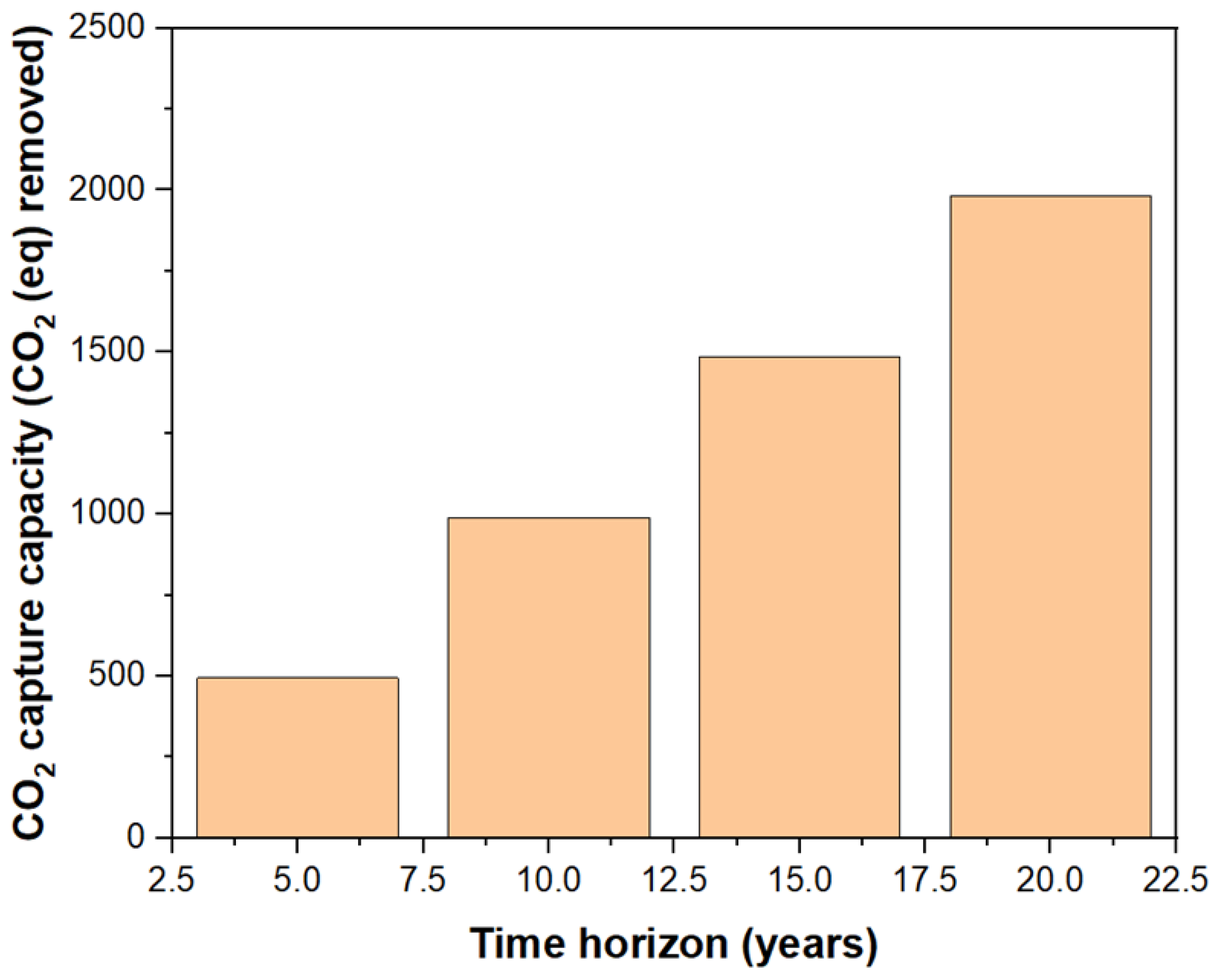
The assessment was performed for 5-, 10-, 15-, and 20-year time horizons to reflect the progressive accumulation of biomass during site restoration. The resulting values represent the cumulative CO2 sequestration potential associated with vegetation establishment and maintenance within the restored brownfield and were evaluated separately from the life cycle impact assessment. Similar approaches have been applied to quantify carbon storage and climate regulation benefits provided by poplar-based restoration systems and phytoremediation projects [45,63].
Moreover, carbon sequestration values were reported separately from the life cycle impact assessment results and were not incorporated as direct offsets to the quantified environmental impacts. Accordingly, the reported values represent estimates of the carbon storage potential associated with vegetation establishment under the evaluated phyto-management scenarios. The interpretation of these results should take into consideration uncertainties associated with biomass accumulation dynamics and the long-term permanence of biogenic carbon storage.

2.7. Software and Database Suitability

The life cycle modeling was carried out using SimaPro 10.2.0.2 supported by the Ecoinvent 3.10 database (Ecoinvent Association, Zürich, Switzerland) as the primary background data source. In this connection, SimaPro provided an integrated environment for process-based life cycle modeling and includes a wide range of environmental impact assessment methods, allowing transparent coupling between LCI data and characterization models [65]. In parallel, the Ecoinvent database offers internationally recognized, quality-controlled LCI data, including (i) detailed emissions to soil, water, and air, (ii) energy inputs, and (iii) land use exchanges, which are essential for evaluating environmental impact on biodiversity and ecosystem services [66,67]. The Ecoinvent system model structure ensures (i) consistent allocation procedures, (ii) regionalization, and (iii) documentation, which enhances reproducibility in studies addressing land use change and ecosystem integrity [66,68]. In addition, Ecoinvent’s rigorous metadata and versioning protocols support transparent sensitivity to spatial context and methodological choices. In a nutshell, the coupled use of SimaPro 10.2.0.2 and Ecoinvent 3.10 supports robust quantification of both anthropogenic pressure indicators and ecological state indicators across alternative remediation systems [69].

2.8. Economic Assessment

The economic performance of the remediation alternatives was evaluated through the combined application of LCC and NPV analyses. The LCC approach quantified all costs incurred throughout the remediation life cycle, including: (i) site preparation and excavation activities, (ii) transport of contaminated materials, (iii) implementation and operation of remediation technologies, (iv) consumption of materials, energy and auxiliary resources, (v) environmental monitoring and sampling campaigns, (vi) maintenance requirements, (vii) waste management and disposal activities, and (viii) final site restoration and redevelopment activities. Costs were classified into capital expenditures (CAPEX) and operational expenditures (OPEX) following established environmental life cycle costing methodologies [70].
Economic inventories were primarily derived from operational information associated with the restoration of the Vieux-Charmont brownfield, complemented where necessary by peer-reviewed research and engineering estimates [28,29,30,31,32,33,34,35,36,37,38,39,40,41,42,43,44,45,46,47,48,49,50,51,52,53].
Specifically, the NPV was calculated as follows.
N P V = t = 0 T C F t 1 + r t
where:
  • CFt represents the net cash flow at year t.
  • r is the discount rate (defined as 5%).
  • T is the project lifetime (defined as 20 years).
All monetary values were expressed in constant 2026 Euros. At this point, prices variations arising from inflation and currency exchange were calculated by data provided by INE and the European Central Bank [71,72].
Within the Vieux-Charmont case study framework, this monetization included environmental benefits associated with avoided CO2 (eq) using a reference carbon price of 100 Euros (2022) tonne−1 CO2 (eq), together with social and health-related benefits identified through S-LCA, thereby supporting more robust and policy-relevant decision-making processes [73].

2.9. Integration of Economic and Social Assessment Through System Expansion

To ensure a comprehensive and holistic sustainability assessment of remediation pathways, this study adopted a system expansion approach integrating economic and social dimensions alongside environmental performance. Within this framework, LCC, NPV, S-LCA, and SROI were combined within a unified analytical structure. System expansion enabled the inclusion of additional functions and benefits associated with site restoration, such as land value recovery, ecosystem service provision, and avoided environmental and health impacts, thereby avoiding truncation of system boundaries.
The social dimension was assessed through S-LCA using the Social Hotspot Database (SHDB) (New Earth B, Utrecht, The Netherlands) implemented in SimaPro, enabling the identification of potential social risks associated with (i) labor conditions, (ii) health and safety, (iii) governance, and (iv) community well-being along the remediation supply chain. Following the UNEP Guidelines for Social Life Cycle Assessment, the assessment considered five stakeholder categories: (i) Labor Rights and Decent Work, (ii) Health and Safety, (iii) Society, (iv) Governance, and (v) Community. Social risks were quantified using characterization factors embedded within SHDB and aggregated into Medium Risk Hours equivalent (MRH (eq)), which represent the estimated labor hours exposed to social risks across the supply chain after considering country-specific and sector-specific risk levels [74].
Negative values reported for the phyto-management scenario do not represent negative social impacts. Instead, they reflect net social benefits obtained through the system expansion approach, whereby societal benefits associated with ecological restoration, recreational accessibility, landscape regeneration, ecosystem service provision, and improved urban well-being exceeded the social risk burdens generated by remediation activities [75].
Detailed S-LCA modeling was performed for scenarios C1 and P1, which represent the reference conventional remediation benchmark and the baseline phyto-management configuration, respectively. These scenarios were selected because they represent the baseline configurations of the conventional remediation and phyto-management families, respectively. The remaining scenarios differ primarily in excavation depth and soil management practices while maintaining the same technological structure and supply chain configuration.
The SROI assessment monetized selected environmental and social outcomes associated with site restoration, including avoided greenhouse gas emissions, carbon sequestration, ecosystem service provision, recreational land use, land value recovery, and social benefits identified through S-LCA. The valuation framework was applied over the same 20-year assessment horizon adopted for the NPV analysis, ensuring methodological consistency across the economic and social evaluations.
Moreover, although the integrated sustainability framework incorporated monetized environmental and social benefits, a dedicated sensitivity analysis of SROI parameters was beyond the scope of the present study. Parameters such as carbon price, ecosystem service valuation factors, discount rate, and land value recovery assumptions should therefore be considered sources of uncertainty requiring further investigation in future research.

2.10. Use of Artificial Intelligence Tools

OpenAI ChatGPT (GPT-5.5, Professional version, OpenAI, San Francisco, United States of America) was used to support the development of conceptual figures (particularly Figure 1 and Figure 2). The tool was not used for data generation, calculations, modeling, interpretation of results, or scientific decision-making. All methodological choices, analyses, results, and conclusions were developed, verified, and approved by the authors.

3. Results and Discussion

3.1. Comparative Environmental Performance of Restoration Strategies

The comparative assessment demonstrated substantial differences between the evaluated remediation pathways, particularly regarding: (i) global warming potential, (ii) land use intensity, (iii) resource consumption, and (iv) long-term sustainability performance. As summarized in Table 4, the conventional physico-chemical benchmark scenarios (C1–C4) consistently generated higher environmental burdens than the hybrid phyto-management systems (P1–P4), despite both remediation groups achieving the same functional objective of restoring the site for safe recreational use.
Among all evaluated scenarios, C1 generated the highest environmental burdens, reaching 1,254,204.73 kg CO2 (eq) and 65,362.49 m2a crop (eq), mainly driven by (i) extensive excavation, (ii) high transport demand, (iii) elevated Portland cement consumption during S/S application, and (iv) downstream landfill disposal. In contrast, P4 exhibited the lowest environmental burdens, with 105,708.40 kg CO2 (eq) and 15,942.58 m2a crop (eq), respectively. This improved performance was associated with reduced excavation depth, selective hotspot treatment, phyto-management, and treated soil valorization. The analysis of LCI (Table 3) and the results (Table 4) further demonstrated that environmental burdens increased proportionally with excavation intensity. Scenarios incorporating circular soil management practices (C2, C4, P2 and P4) consistently reduced impacts through lower landfill dependency and avoided virgin material demand.
Quantitative comparison of the evaluated remediation pathways further highlighted the benefits of combining phyto-management, reduced excavation intensity, and soil valorization. Relative to the conventional landfill-oriented benchmark (C1), the optimized phyto-management configuration (P4) reduced climate change impacts by 91.6% and land use impacts by 75.6%. Similarly, the optimized benchmark scenario incorporating reduced excavation and treated soil reuse (C4) achieved an 83.4% reduction in climate change impacts relative to C1. Within the phyto-management configurations, the transition from P1 to P4 reduced climate change impacts by 72.1%, demonstrating the importance of excavation minimization and circular soil management practices for improving environmental performance. These findings indicate that the combined implementation of reduced excavation depth, soil valorization, and phyto-management can substantially decrease LCA burdens associated with contaminated land remediation, consistent with previous studies highlighting the sustainability advantages of minimizing soil excavation, promoting material reuse, and implementing NBS remediation strategies [56,76].
The results indicated that environmental burdens increased proportionally with excavation intensity. This trend was particularly evident when comparing C1 versus C3 and P1 versus P3, where lower excavation depths significantly reduced outbound transport, chemical consumption, cement demand, and landfill dependency.
The results further demonstrated that landfill-oriented remediation systems were structurally dominated by downstream waste management impacts. In particular, scenarios relying on full S/S application and disposal of treated soil generated substantial environmental burdens associated with (i) Portland cement production, (ii) transport operations, and (iii) landfill occupation. These findings have been consistent with previous studies identifying excavation and disposal activities as major hotspots in contaminated land remediation systems [24,25,77,78]. By contrast, soil valorization scenarios substantially reduced burdens through avoided virgin material demand and reduced landfill dependency.
Overall, the comparative analysis confirmed that hybrid phyto-management systems provided a substantially improved environmental profile compared with conventional ex situ remediation pathways, particularly when combined with reduced excavation strategies and circular soil reuse approaches.

3.2. Ecological Performance of Phyto-Management Strategies

As presented above in Table 4, the hybrid phyto-management scenarios (P1–P4) demonstrated significantly improved environmental performance compared with the benchmark configurations, particularly in categories directly associated with ecosystem functionality and land occupation. These systems combined targeted hotspot excavation within in situ phyto-management assisted by microbial inoculation, thereby reducing physical soil disturbance and preserving part of the original ecological structure of the site.
The environmental advantages of phyto-management were primarily associated with reduced excavation intensity and lower dependence on external waste management infrastructure. Unlike fully ex situ remediation systems, phyto-management maintained a substantial fraction of the soil matrix in place, limiting ecosystem disruption and preserving soil functionality during the restoration process. This translated into substantially lower land use impacts, especially in scenario P4, which exhibited the lowest land occupation burden among all evaluated systems.
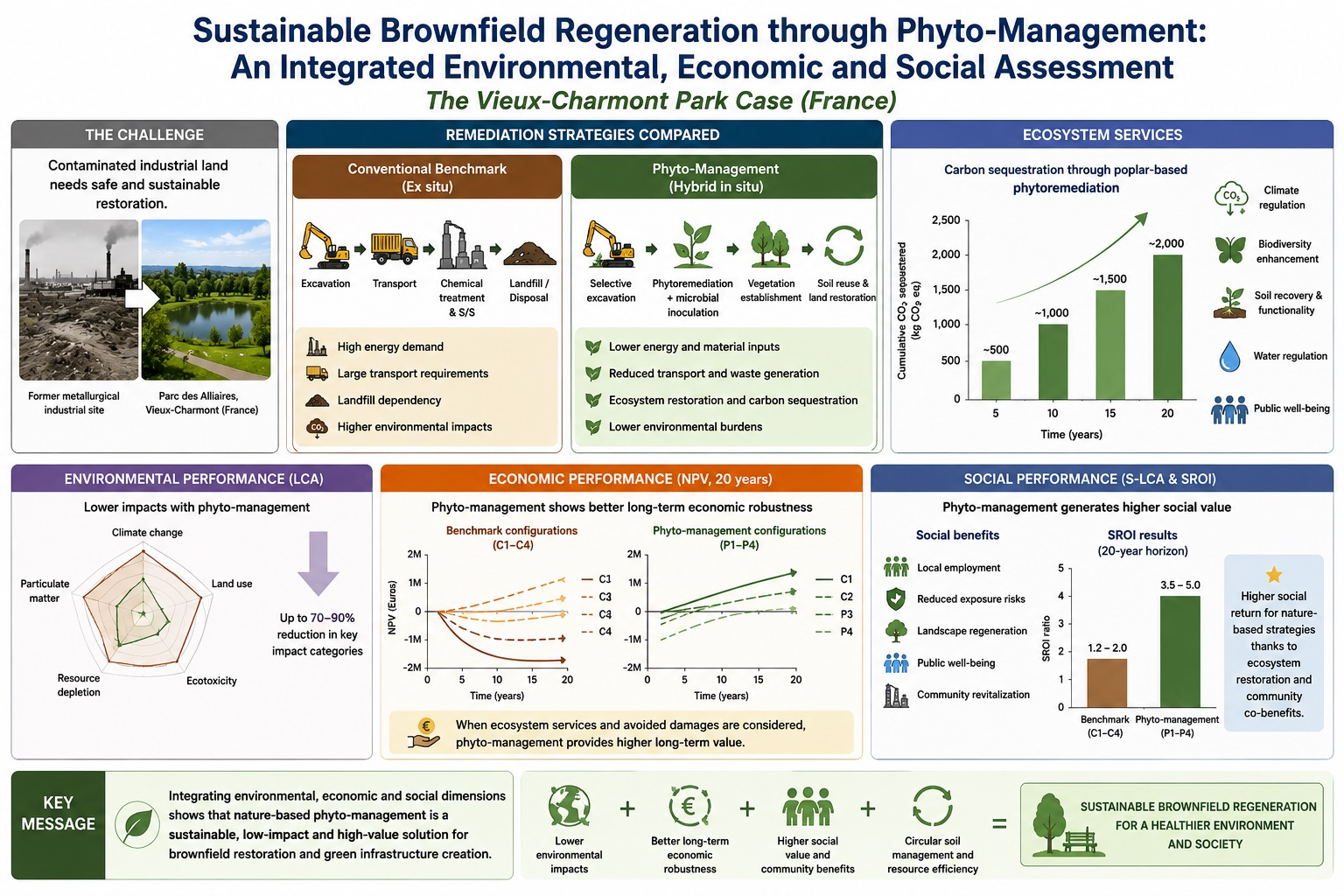
From an ecosystem services perspective, these findings were particularly relevant. The preservation of soil structure and the gradual re-establishment of vegetation contribute to (i) ecological continuity, (ii) erosion control, (iii) soil stabilization, and (iv) improvement of habitat functionality within the restored site [79]. In addition, phytoremediation contributed to progressive carbon sequestration through biomass accumulation and long-term vegetation establishment as shown in Figure 3. Carbon sequestration as an ecosystem service of poplar-based phytoremediation under different time horizons demonstrated that CO2 capture capacity progressively increased from approximately 500 kg CO2 (eq) after 5 years to nearly 2000 kg CO2 (eq) after 20 years. These results confirmed that phyto-management systems contributed not only to contaminant attenuation but also to climate change mitigation and ecosystem service recovery.
The implementation of phytoremediation and microbial-assisted restoration additionally supported rhizosphere regeneration and long-term ecological rehabilitation within the restored brownfield. Consequently, the reduced land use burdens observed in the phyto-management systems should not be interpreted solely as lower occupation intensity, but also as indicators of improved ecological recovery potential and reduced ecosystem degradation [80].
Although phyto-management required additional operational inputs associated with microbial cultivation, irrigation, and maintenance, these contributions remained comparatively small relative to the avoided impacts from excavation, transport, and cement-intensive S/S treatment. The environmental trade-off therefore strongly favored the hybrid remediation systems, particularly under reduced excavation conditions and soil reuse configurations.
The results support the growing recognition of NBS-based remediation systems as environmentally preferable alternatives for brownfield regeneration, particularly when ecological restoration and ecosystem service recovery are considered alongside contaminant management objectives.

3.3. Socio-Economic Assessment via S-LCA, NPV and SROI

The integration of economic and social indicators through system expansion enabled a broader sustainability interpretation of the evaluated remediation pathways beyond purely environmental criteria. The combined application of NPV, S-LCA, and SROI provided additional insight into the long-term socio-economic implications of brownfield regeneration strategies.
First, the environmental improvements associated with phyto-management systems were also reflected in their long-term economic performance. As summarized in Table 5, substantial differences were observed among the evaluated remediation pathways. Conventional excavation-intensive scenarios, particularly C1, exhibited strongly negative economic performance due to high CAPEX and OPEX requirements associated with (i) excavation, (ii) transport, (iii) cement consumption, (iv) treatment infrastructure, and (v) landfill disposal. By contrast, the phyto-management scenarios progressively improved economic feasibility, particularly when combined with reduced excavation intensity and treated soil valorization.
As shown in Table 5, the optimized phyto-management configuration (P4) achieved the highest final NPV after 20 years (1.38 million Euros, 2026), followed closely by the reduced excavation benchmark with treated soil reuse (C4) (1.36 million Euros, 2026). These results demonstrate that reducing excavation intensity and promoting treated soil valorization substantially improve the long-term economic viability of contaminated land restoration projects through lower operational costs, reduced landfill dependency, and increased resource efficiency.
Conversely, Table 5 highlights the substantially lower economic performance associated with excavation-intensive benchmark systems. The landfill-oriented benchmark configuration remained strongly negative throughout the 20-year assessment period because of elevated (i) excavation, (ii) transport, (iii) cement demand, and (iv) disposal costs.
The incorporation of treated soil valorization (C2, C4, P2 and P4) progressively improved long-term economic performance, particularly under reduced excavation configurations as illustrated in Table 5.
From a social perspective, the S-LCA results (Table 6) highlighted important differences between the conventional benchmark configuration (C1) and the hybrid phyto-management strategy (P1). As shown in Table 6, the benchmark configuration generated positive social risk values across all stakeholder categories, whereas the phyto-management strategy resulted in negative net values, reflecting the incorporation of societal benefits associated with ecological restoration and recreational land reuse. In both systems, the application of S/S technology represented the main contributor to social impacts due to the material and energy intensity associated with (i) cement production, (ii) transport activities, and (iii) landfill-oriented management. However, the incorporation of phyto-management and recreational land reuse generated substantial societal benefits across all evaluated social categories. In particular, the creation of the public ecological park produced significant reductions in social risk intensity, reflecting the positive contribution of landscape restoration, improved recreational accessibility, and enhanced urban well-being. Overall, the results suggest that hybrid phyto-management systems can provide broader long-term societal benefits than conventional excavation-intensive remediation approaches.
The SROI assessment demonstrated that the hybrid phyto-management strategy generated substantially higher long-term societal value compared with the conventional remediation configuration, reaching values above 2, which indicates that more than 2 € of societal value could be generated per € invested. This enhanced performance was mainly associated with the inclusion of ecosystem restoration and recreational land reuse functions, enabling the capture of broader socio-economic benefits related to improved (i) public health, (ii) ecosystem service recovery, (iii) climate regulation, (iv) enhanced urban well-being, and (v) increased land usability. In this context, the phyto-management approach contributed positively to local value creation by transforming a previously contaminated area into a multifunctional ecological space with potential long-term environmental and social benefits for surrounding communities. NBS-based phyto-management scenarios have been increasingly recognized as multifunctional remediation approaches capable of simultaneously supporting environmental restoration, ecosystem service recovery, climate change mitigation, social acceptance, and regional socio-economic development through the integration of ecological and sustainability-oriented land management practices [81]. Furthermore, the integration of SROI with LCA, NPV, and S-LCA enabled a more comprehensive assessment of remediation performance by monetizing selected environmental and societal outcomes alongside conventional economic indicators. Within the Vieux-Charmont case study framework, this monetization included environmental benefits associated with avoided CO2 (eq), a reference carbon price of 100 Euros (2022) tonne−1 CO2 (eq), and social and health-related benefits identified through S-LCA, thereby supporting more robust and policy-relevant decision-making processes [73].
Overall, the integration of environmental, economic, and social indicators supports the use of multi-dimensional sustainability frameworks for contaminated land management and demonstrates the importance of evaluating remediation strategies beyond technical contaminant removal efficiency alone.

3.4. Interpretation in the Context of Brownfield Regeneration

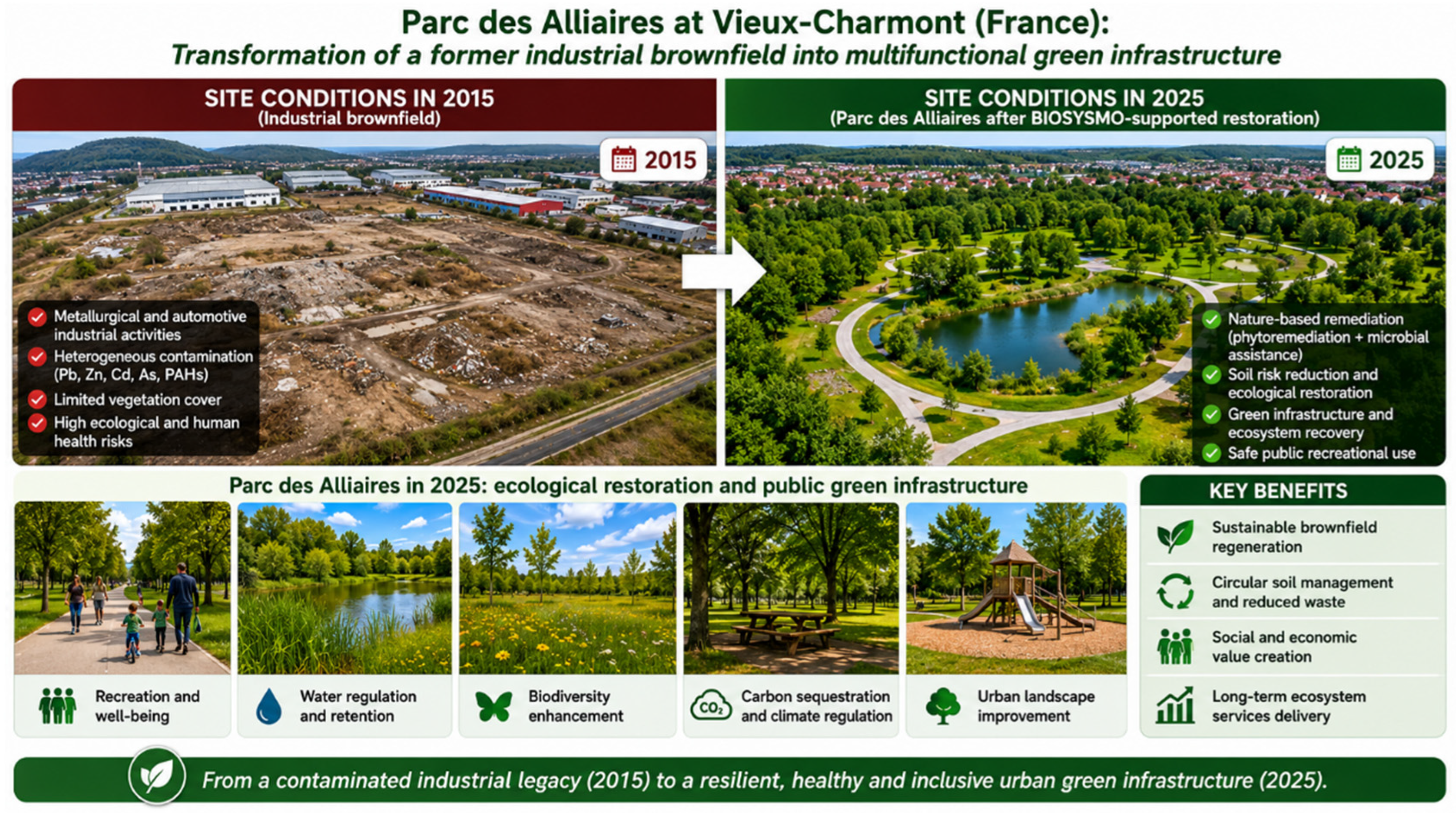
The Vieux-Charmont case study provides important evidence regarding the role of NBS-based phyto-management systems in supporting sustainable brownfield restoration and urban redevelopment. The completed transformation of the former industrial area into Parc des Alliaires demonstrates how contaminated land can be progressively converted into multifunctional green infrastructure while simultaneously reducing life cycle environmental burdens. This transition is illustrated in Figure 2.
Figure 2 is a conceptual graphical illustration developed from project information, field observations, and site documentation to represent the transformation of the Vieux-Charmont brownfield into a public ecological park. The figure is intended for illustrative purposes and should not be interpreted as a direct photographic comparison of identical site locations at different time periods.
From a territorial perspective, brownfield regeneration contributes directly to sustainable land management by limiting urban sprawl, reducing pressure on undeveloped land, and restoring ecological and social functionality within already-anthropized environments. In this context, the phyto-management systems evaluated in this study demonstrated the capacity to combine contaminant management with ecosystem restoration and urban landscape rehabilitation.
Importantly, the results indicate that remediation performance should not be evaluated exclusively in terms of contaminant immobilization or removal efficiency. Conventional remediation systems may provide rapid technical intervention, but often generate substantial environmental burdens due to excavation, transport, material consumption, and landfill dependency. By contrast, hybrid NBS-based phyto-management systems promote progressive ecological restoration while minimizing soil disturbance and supporting long-term ecosystem recovery.
The findings also highlight the importance of integrating circular economy principles into brownfield redevelopment strategies. Scenarios incorporating treated soil valorization consistently reduced environmental burdens and improved economic performance by avoiding unnecessary waste generation and reducing dependence on virgin construction materials. This demonstrates the relevance of circular soil management approaches within sustainable remediation frameworks.
Furthermore, the incorporation of ecosystem service considerations into the assessment framework provides additional insight into the broader value of NBS-based phyto-management brownfield restoration. Beyond contaminant management, restored sites can deliver climate regulation functions, biodiversity support, recreational services, landscape enhancement, and improved urban resilience.
Overall, this study demonstrates that brownfield restoration and redevelopment strategies integrating phyto-management, reduced excavation intensity, and circular soil reuse can substantially improve sustainability performance compared with conventional ex situ remediation systems. These findings support the integration of life cycle thinking and ecosystem service perspectives into future contaminated land management and urban regeneration policies.
The present study remains subject to uncertainties associated with long-term phytoremediation performance, ecosystem service monetization, and future land use evolution. In addition, some foreground LCI data relied on engineering assumptions and literature-derived parameters due to limited availability of full-scale operational datasets. The results should therefore be interpreted as comparative sustainability indicators intended to support decision-making rather than absolute predictive values. Future research should further integrate dynamic ecosystem service modeling, biodiversity indicators, and long-term field monitoring to strengthen sustainability assessment frameworks for brownfield restoration.

4. Conclusions

This study applied an integrated sustainability assessment framework combining LCA, LCC, NPV, S-LCA, and SROI to evaluate alternative remediation pathways for the restoration of the Vieux-Charmont brownfield into a public ecological park.
Relative to the conventional benchmark (C1), the optimized phyto-management configuration (P4) reduced climate change impacts by 91.6% and land use impacts by 75.6%, while simultaneously achieving the highest economic performance with a final NPV of 1.38 million Euros after 20 years.
The results further demonstrated that excavation intensity, Portland cement consumption, transport requirements, and landfill dependency constituted the principal environmental hotspots across the evaluated remediation pathways. In contrast, reduced excavation depth and treated soil valorization consistently improved environmental and economic performance by decreasing material consumption, transport requirements, and disposal needs. These findings highlight the importance of integrating circular soil management principles into contaminated land remediation and brownfield redevelopment projects.
From an economic perspective, scenarios combining reduced excavation and soil reuse achieved the most favorable long-term performance. The optimized phyto-management configuration (P4) generated the highest NPV after 20 years (1.38 million Euros, 2026), demonstrating the potential economic viability of sustainability-oriented remediation approaches when broader restoration benefits are considered.
The integrated social assessment additionally indicated that phyto-management strategies may generate broader societal value through ecological restoration, recreational land reuse, and improved urban functionality. However, these outcomes should be interpreted as modeled benefits derived from the adopted S-LCA and SROI framework rather than directly measured social impacts.
Overall, this study demonstrates that remediation strategies should not be evaluated solely according to contaminant removal efficiency or direct implementation costs. Instead, integrated sustainability frameworks combining environmental, economic, and social dimensions provide a more robust basis for supporting sustainable brownfield restoration and long-term land management decision-making.
Nevertheless, the assessment remains subject to uncertainties associated with long-term phyto-management performance, ecosystem service monetization, SROI assumptions, and literature-derived inventory parameters. Consequently, the results should be interpreted as comparative sustainability indicators intended to support decision-making rather than absolute predictions of future environmental, economic, or social outcomes. Future research should further integrate long-term monitoring data, biodiversity indicators, dynamic ecosystem service modeling, and uncertainty analysis to strengthen sustainability assessment frameworks for contaminated land restoration.

Author Contributions

Conceptualization, P.I.C. and G.C.; Methodology, P.I.C.; Software, P.I.C.; Validation, P.I.C.; Formal analysis, P.I.C. and G.C.; Investigation, P.I.C.; Resources, H.C.G., P.I.C. and M.C.; Data curation, H.C.G., P.I.C. and M.C.; Writing—original draft, P.I.C.; Writing—review and editing, P.I.C. and G.C.; Visualization, P.I.C.; Supervision, P.I.C. and G.C.; Project administration, G.C.; Funding acquisition, M.C. and G.C. All authors have read and agreed to the published version of the manuscript.

Funding

This research was funded by European Commission grant number 101060211. The European Commission provided financial support to carry out the research work through the project BIOSYSMO—BIOremediation systems exploiting SYnergieS for improved removal of Mixed pOllutants (101060211).

Institutional Review Board Statement

Not applicable.

Informed Consent Statement

Not applicable.

Data Availability Statement

The original contributions presented in this study are included in the article. Further inquiries can be directed to the corresponding author.

Acknowledgments

Artificial intelligence-assisted graphical tools (in particular, OpenAI ChatGPT—GPT-5.5, Professional version) were used to support the development and visualization of the conceptual illustrations presented in Figure 1 and Figure 2. These tools were employed with a focus on graphical design purposes.

Conflicts of Interest

Authors Patricio Iván Cano and Germán Cavero were employed by the company Blue Synergy. The remaining authors declare that the research was conducted in the absence of any commercial or financial relationships that could be construed as a potential conflict of interest.

References

  1. European Environment Agency. Progress in the Management of Contaminated Sites (Indicator). 2024. Available online: https://www.eea.europa.eu/en/european-zero-pollution-dashboards/indicators/progress-in-the-management-of-contaminated-sites?activeTab=265e2bee-7de3-46e8-b6ee-76005f3f434f (accessed on 26 February 2026).
  2. Panagos, P.; Van Liedekerke, M.; Yigini, Y.; Montanarella, L. Contaminated Sites in Europe: Review of the Current Situation Based on Data Collected through a European Network. J. Environ. Public Health 2013, 2013, 158764. [Google Scholar] [CrossRef] [PubMed]
  3. Binner, H.; Sullivan, T.; Jansen, M.A.K.; McNamara, M.E. Metals in Urban Soils of Europe: A Systematic Review. Sci. Total Environ. 2023, 854, 158734. [Google Scholar] [CrossRef] [PubMed]
  4. Kabisch, N.; Haase, D. Green Justice or Just Green? Provision of Urban Green Spaces in Berlin, Germany. Landsc. Urban Plan. 2014, 122, 129–139. [Google Scholar] [CrossRef]
  5. Chung, J.; Sung, K. Effects on Heat Mitigation, Energy Use, and Carbon Savings in Urban-Scale Implementations of Nature-Based Solutions. Geogr. Sustain. 2025, 6, 100362. [Google Scholar] [CrossRef]
  6. Pizzol, L.; Zabeo, A.; Klusáček, P.; Giubilato, E.; Critto, A.; Frantál, B.; Martinát, S.; Kunc, J.; Osman, R.; Bartke, S. Timbre Brownfield Prioritization Tool to Support Effective Brownfield Regeneration. J. Environ. Manag. 2016, 166, 178–192. [Google Scholar] [CrossRef] [PubMed]
  7. Sarwar, N.; Imran, M.; Shaheen, M.R.; Ishaque, W.; Kamran, M.A.; Matloob, A.; Rehim, A.; Hussain, S. Phytoremediation Strategies for Soils Contaminated with Heavy Metals: Modifications and Future Perspectives. Chemosphere 2017, 171, 710–721. [Google Scholar] [CrossRef] [PubMed]
  8. Kumar, V.; Saxena, G. Microbe-Assisted Phytoremediation of Environmental Pollutants; A K Peters: Natick, MA, USA; CRC Press: Boca Raton, FL, USA, 2020. [Google Scholar]
  9. Salt, D.E.; Smith, R.D.; Raskin, I. Phytoremediation. Annu. Rev. Plant Physiol. Plant Mol. Biol. 1998, 49, 643–668. [Google Scholar] [CrossRef] [PubMed]
  10. Tariq, A.; Farhat, F. Insights into Microbe Assisted Remediation in Plants: A Brief Account on Mechanisms and Multi-Omic Strategies against Heavy Metal Toxicity. Stress Biol. 2025, 5, 4. [Google Scholar] [CrossRef]
  11. Kuhn, C.M. Chalot Synthèse Des Rendez-Vous de l’ADU; ECOPOLIS Parc Des Alliaires: Trogues, France, 2024. [Google Scholar]
  12. Pays de Montbeliard-Tourisme. Parc Des Alliaires. Available online: https://www.paysdemontbeliard-tourisme.com/nature/decibelles/detail/pcubfc000v53as9a/parc-des-alliaires (accessed on 26 February 2026).
  13. Collot, J.; Binet, P.; Malabad, A.M.; Pauget, B.; Toussaint, M.-L.; Chalot, M. Floristic Survey, Trace Element Transfers between Soil and Vegetation and Human Health Risk at an Urban Industrial Wasteland. J. Hazard. Mater. 2023, 459, 132169. [Google Scholar] [CrossRef] [PubMed]
  14. Wang, Q.-Z.; Zhang, Y.-Q.; Wang, L.; Liang, Y.-X. Pollution and Health Risk Evaluation at an Abandoned Industrial Site. Toxics 2025, 14, 49. [Google Scholar] [CrossRef] [PubMed]
  15. Swartjes, F.A. Introduction to Contaminated Site Management. In Dealing with Contaminated Sites; Springer Netherlands: Dordrecht, The Netherlands, 2011; pp. 3–89. [Google Scholar]
  16. Banque des Territoires. France 2030: Inauguration Du Parc Des Alliaires à Vieux-Charmon. 2023. Available online: https://www.caue-observatoire.fr/wp-content/uploads/2025/06/dp-living-lab-vdef_vsgpi.pdf (accessed on 8 June 2026).
  17. BIOSYSMO Project. Available online: https://www.Biosysmo.Eu/ (accessed on 8 June 2026).
  18. Aryal, M. Phytoremediation Strategies for Mitigating Environmental Toxicants. Heliyon 2024, 10, e38683. [Google Scholar] [CrossRef] [PubMed]
  19. ISO 14040:2006; Environmental Management—Life Cycle Assessment—Principles and Framework. International Standard Organization: Geneva, Switzerland, 2006.
  20. ISO 14044:2006; Environmental Management—Life Cycle Assessment—Requirements and Guidelines. International Standard Organization: Geneva, Switzerland, 2006.
  21. Lemming, G.; Hauschild, M.Z.; Bjerg, P.L. Life Cycle Assessment of Soil and Groundwater Remediation Technologies: Literature Review. Int. J. Life Cycle Assess. 2010, 15, 115–127. [Google Scholar] [CrossRef]
  22. Trentin, A.W.d.S.; Reddy, K.R.; Kumar, G.; Chetri, J.K.; Thomé, A. Quantitative Assessment of Life Cycle Sustainability (QUALICS): Framework and Its Application to Assess Electrokinetic Remediation. Chemosphere 2019, 230, 92–106. [Google Scholar] [CrossRef] [PubMed]
  23. Li, Y.; Chen, R.; Yang, X.; Liu, X.; Zhu, G.; Hu, Q. A Quantitative Sustainability Assessment Framework for Contaminated Site Remediation: Integrating LCA, Economic Analysis, and Social Big Data. Water 2025, 17, 3416. [Google Scholar] [CrossRef]
  24. Hou, D.; Al-Tabbaa, A. Sustainability: A New Imperative in Contaminated Land Remediation. Environ. Sci. Policy 2014, 39, 25–34. [Google Scholar] [CrossRef]
  25. Lee, H.; Sam, K.; Coulon, F.; De Gisi, S.; Notarnicola, M.; Labianca, C. Recent Developments and Prospects of Sustainable Remediation Treatments for Major Contaminants in Soil: A Review. Sci. Total Environ. 2024, 912, 168769. [Google Scholar] [CrossRef] [PubMed]
  26. Harclerode, M.; Ridsdale, D.R.; Darmendrail, D.; Bardos, P.; Alexandrescu, F.; Nathanail, P.; Pizzol, L.; Rizzo, E. Integrating the Social Dimension in Remediation Decision-Making: State of the Practice and Way Forward. Remediat. J. 2015, 26, 11–42. [Google Scholar] [CrossRef]
  27. Bruno, A.; Menichini, T.; Silvestri, L. Life Cycle Sustainability Assessment (LCSA): A Comprehensive Overview of Existing Integrated Approaches to LCA, S-LCA, and LCC. Eur. J. Sustain. Dev. 2025, 14, 13. [Google Scholar] [CrossRef]
  28. French Republic. Sites et Sols Pollués. 2025. Available online: https://www.ecologie.gouv.fr/politiques-publiques/sites-sols-pollues (accessed on 25 February 2026).
  29. Ministères Transition Écologique Aménagement du Territoire Transports Ville et Logement. Traçabilité Des Déchets, Terres Excavées et Sédiments. Available online: https://www.ecologie.gouv.fr/politiques-publiques/tracabilite-dechets-terres-excavees-sediments (accessed on 11 April 2026).
  30. Coussy, S.; Hulot, C.; Billard, A. Guide de Valorisation Hors Site Des Terres Excavées Issues de Sites et Sols Potentiellement Pollués Dans Des Projets d’aménagement. Ministère d’Environnement, d’Énergie et de la Mer. 2024. Available online: https://www.ecologie.gouv.fr/sites/default/files/documents/Guide%20de%20valorisation%20hors%20site%20des%20terres%20excav%C3%A9es%20issues%20de%20sites%20et%20sols%20potentiellement%20pollu%C3%A9s%20dans%20des%20projets%20d%27am%C3%A9nagement.pdf (accessed on 8 June 2026).
  31. Voglar, G.E.; Leštan, D. Efficiency Modeling of Solidification/Stabilization of Multi-Metal Contaminated Industrial Soil Using Cement and Additives. J. Hazard. Mater. 2011, 192, 753–762. [Google Scholar] [CrossRef] [PubMed]
  32. Rai, R.K.; Singh, V.P.; Upadhyay, A. Soil Analysis. In Planning and Evaluation of Irrigation Projects; Elsevier: Amsterdam, The Netherlands, 2017; pp. 505–523. [Google Scholar]
  33. Servadio, P.; Bergonzoli, S.; Beni, C. Soil Tillage Systems and Wheat Yield under Climate Change Scenarios. Agronomy 2016, 6, 43. [Google Scholar] [CrossRef]
  34. Wolff, M.; Haase, D.; Priess, J.; Hoffmann, T.L. The Role of Brownfields and Their Revitalisation for the Functional Connectivity of the Urban Tree System in a Regrowing City. Land 2023, 12, 333. [Google Scholar] [CrossRef]
  35. Pradel, M. Life Cycle Inventory Data of Agricultural Tractors. Data Brief 2023, 48, 109174. [Google Scholar] [CrossRef] [PubMed]
  36. Peurifoy, R.L.; Schexnayder, C.J.; Schmitt, R.; Shapira, A. Construction Planning, Equipment, and Methods, 9th ed.; McGraw-Hill Education: New York, NY, USA, 2018. [Google Scholar]
  37. Tata Steel. Technical Information Sheet. Available online: https://www.google.com/url?sa=t&source=web&rct=j&opi=89978449&url=https://www.tatasteeluk.com/sites/default/files/pimcore_doc/tis-0012-axle-weights-and-load-distribution.pdf&ved=2ahUKEwizjd3Iv4mVAxVw0AIHHb9XCp4QFnoECBgQAQ&usg=AOvVaw1DStQMrs_vGsEluO0LNvQM (accessed on 11 April 2026).
  38. Samuelsson, I.; Spross, J.; Larsson, S. Integrating Life-Cycle Environmental Impact and Costs into Geotechnical Design. In Proceedings of the Institution of Civil Engineers—Engineering Sustainability; Emerald Publishing Limited: Leeds, UK, 2024; Volume 177, pp. 19–30. [Google Scholar] [CrossRef]
  39. European Commission. Speed Limits. Available online: https://road-safety.transport.ec.europa.eu/eu-road-safety-policy/priorities/safe-road-use/safe-speed/archive/speeding/speed-limits_en (accessed on 11 April 2026).
  40. Drawer, C.; Rödl, A.; Kaltschmitt, M. Life Cycle Assessment of Construction and Driving Operation of a Hydrogen-Powered Truck Built from a Used Diesel Truck. Transp. Res. Interdiscip. Perspect. 2024, 24, 101020. [Google Scholar] [CrossRef]
  41. Voglar, G.E.; Leštan, D. Solidification/Stabilisation of Metals Contaminated Industrial Soil from Former Zn Smelter in Celje, Slovenia, Using Cement as a Hydraulic Binder. J. Hazard. Mater. 2010, 178, 926–933. [Google Scholar] [CrossRef] [PubMed]
  42. Moutsatsou, A.; Gregou, M.; Matsas, D.; Protonotarios, V. Washing as a Remediation Technology Applicable in Soils Heavily Polluted by Mining–Metallurgical Activities. Chemosphere 2006, 63, 1632–1640. [Google Scholar] [CrossRef] [PubMed]
  43. Zhai, X.; Li, Z.; Huang, B.; Luo, N.; Huang, M.; Zhang, Q.; Zeng, G. Remediation of Multiple Heavy Metal-Contaminated Soil through the Combination of Soil Washing and in Situ Immobilization. Sci. Total Environ. 2018, 635, 92–99. [Google Scholar] [CrossRef] [PubMed]
  44. Sörengård, M.; Kleja, D.B.; Ahrens, L. Stabilization and Solidification Remediation of Soil Contaminated with Poly- and Perfluoroalkyl Substances (PFASs). J. Hazard. Mater. 2019, 367, 639–646. [Google Scholar] [CrossRef] [PubMed]
  45. Fuertes, A.; Oliveira, N.; Cañellas, I.; Sixto, H.; Rodríguez-Soalleiro, R.; Hanewinkel, M.; Sperlich, D. Assessing the Potential of Poplar Short Rotation Plantations to Contribute to a Low-Carbon Bioeconomy under Water-Limited Conditions. J. Environ. Manag. 2023, 347, 119062. [Google Scholar] [CrossRef] [PubMed]
  46. Kim, D.-H.; Hwang, B.-R.; Moon, D.-H.; Kim, Y.-S.; Baek, K. Environmental Assessment on a Soil Washing Process of a Pb-Contaminated Shooting Range Site: A Case Study. Environ. Sci. Pollut. Res. 2013, 20, 8417–8424. [Google Scholar] [CrossRef] [PubMed]
  47. Al-Kindi, G. Evaluation the Solidification/Stabilization of Heavy Metals by Portland Cement. J. Ecol. Eng. 2019, 20, 91–100. [Google Scholar] [CrossRef]
  48. United States of America Environmental Protection Agency. Treatment Technologies for Site Cleanup: Annual Status Report, 12th ed.; United States of America Environmental Protection Agency: Washington, DC, USA, 2007. [Google Scholar]
  49. Elyamany, A. CB 524—Methods and Equipment for Construction 2—Equipment Cycle Time. Available online: https://drahmedelyamany.weebly.com/uploads/7/0/1/0/7010103/3-_equipment_production.pdf (accessed on 11 April 2026).
  50. Kermeli, K.; Worrell, E.; Masanet, E. Energy Efficiency Improvement and Cost Saving Opportunities for the Concrete Industry—An ENERGY STAR® Guide for Energy and Plant Managers. 2011. Available online: https://www.osti.gov/servlets/purl/1062106 (accessed on 11 April 2026).
  51. United States Environmental Protection Agency. Redline Version of EPA’s Final Regulations for Rescission of the Greenhouse Gas Endangerment Finding and Motor Vehicle Greenhouse Gas Emission Standards Under the Clean Air Ac. Available online: https://www.epa.gov/system/files/documents/2026-02/endangerment-rescission-ghg-redline-memo-2026-0206b.pdf (accessed on 21 April 2026).
  52. United States Department of Energy. Average On-Road Fuel Economy for Medium/Heavy Trucks Ranged from 4.0 Mpg to 10.1 Mpg in 2021. Available online: https://www.energy.gov/cmei/vehicles/articles/fotw-1342-may-13-2024-average-road-fuel-economy-mediumheavy-trucks-ranged-40 (accessed on 21 April 2026).
  53. National Ready Mixed Concrete Association. Concrete in Practice What, Why & How? Available online: https://kniferiversd.com/wp-content/uploads/2020/11/CIP31.pdf (accessed on 21 April 2026).
  54. Favaretto, L.; Rugani, B.; Calfapietra, C.; Labra, M.; Guidi Nissim, W. Modelling the Environmental Implications of Phytoremediation in Urban Settings: A Review of the Integration of Life Cycle Assessment and Ecosystem Services Approaches. Urban For. Urban Green. 2025, 107, 128788. [Google Scholar] [CrossRef]
  55. Volchko, Y.; Norrman, J.; Rosén, L.; Bergknut, M.; Josefsson, S.; Söderqvist, T.; Norberg, T.; Wiberg, K.; Tysklind, M. Using Soil Function Evaluation in Multi-Criteria Decision Analysis for Sustainability Appraisal of Remediation Alternatives. Sci. Total Environ. 2014, 485–486, 785–791. [Google Scholar] [CrossRef] [PubMed]
  56. Hou, D.; Al-Tabbaa, A.; O’Connor, D.; Hu, Q.; Zhu, Y.-G.; Wang, L.; Kirkwood, N.; Ok, Y.S.; Tsang, D.C.W.; Bolan, N.S.; et al. Sustainable Remediation and Redevelopment of Brownfield Sites. Nat. Rev. Earth Environ. 2023, 4, 271–286. [Google Scholar] [CrossRef]
  57. Huijbregts, M.A.J.; Steinmann, Z.J.N.; Elshout, P.M.F.; Stam, G.; Verones, F.; Vieira, M.D.M.; Hollander, A.; Zijp, M.; van Zelm, R. ReCiPe2016: A harmonised life cycle impact assessment method at midpoint and endpoint level. Int. J. Life Cycle Assess. 2016, 22, 138–147. [Google Scholar] [CrossRef]
  58. Chairat, S.; Gheewala, S.H. The Conceptual Quantitative Assessment Framework for Nature-Based Solutions (NbS). Nat.-Based Solut. 2024, 6, 100152. [Google Scholar] [CrossRef]
  59. Song, Y.; Kirkwood, N.; Maksimović, Č.; Zheng, X.; O’Connor, D.; Jin, Y.; Hou, D. Nature Based Solutions for Contaminated Land Remediation and Brownfield Redevelopment in Cities: A Review. Sci. Total Environ. 2019, 663, 568–579. [Google Scholar] [CrossRef] [PubMed]
  60. Larrey-Lassalle, P.; Armand Decker, S.; Perfido, D.; Naneci, S.; Rugani, B. Life Cycle Assessment Applied to Nature-Based Solutions: Learnings, Methodological Challenges, and Perspectives from a Critical Analysis of the Literature. Land 2022, 11, 649. [Google Scholar] [CrossRef]
  61. Heijungs, R. Deconstructing and Reconstructing the Theoretical Basis of the Ecological Scarcity Method. Sustainability 2023, 15, 16515. [Google Scholar] [CrossRef]
  62. Swiss Federal Office for the Environment. Swiss Eco-Factors 2021. According to the Ecological Scarcity Method—Methodological Fundamentals and Their Application in Switzerland. 2021. Available online: https://www.bafu.admin.ch/bafu/en/home/topics/economy-consumption/economy-and-consumption-publications/publications-economy-and-consumption/eco-factors-switzerland.html (accessed on 15 October 2025).
  63. Verlinden, M.S.; Broeckx, L.S.; Ceulemans, R. First vs. Second Rotation of a Poplar Short Rotation Coppice: Above-Ground Biomass Productivity and Shoot Dynamics. Biomass Bioenergy 2015, 73, 174–185. [Google Scholar] [CrossRef]
  64. Eggleston, H.S. 2006 IPCC Guidelines for National Greenhouse Gas Inventories; Institute for Global Environmental Strategies: Hayama, Japan, 2006. [Google Scholar]
  65. Database & Support Team at PRé Sustainability. SimaPro Craft—Precision in Every Detail. Available online: https://simapro.com/wp-content/uploads/2022/07/DatabaseManualMethods.pdf (accessed on 15 October 2025).
  66. Ecoinvent Team. Version 3.10 Is Now Available. Available online: https://ecoinvent.org/blog/version-3-10-is-now-available/ (accessed on 15 October 2025).
  67. Wernet, G.; Bauer, C.; Steubing, B.; Reinhard, J.; Moreno-Ruiz, E.; Weidema, B. The Ecoinvent Database Version 3 (Part I): Overview and Methodology. Int. J. Life Cycle Assess. 2016, 21, 1218–1230. [Google Scholar] [CrossRef]
  68. Winter, L.; Lehmann, A.; Finogenova, N.; Finkbeiner, M. Including Biodiversity in Life Cycle Assessment—State of the Art, Gaps and Research Needs. Environ. Impact Assess. Rev. 2017, 67, 88–100. [Google Scholar] [CrossRef]
  69. SimaPro. Ecoinvent LCI Database. Available online: https://simapro.com/products/ecoinvent/ (accessed on 7 May 2026).
  70. Swarr, T.E.; Hunkeler, D.; Klöpffer, W.; Pesonen, H.-L.; Ciroth, A.; Brent, A.C.; Pagan, R. Environmental Life-Cycle Costing: A Code of Practice. Int. J. Life Cycle Assess. 2011, 16, 389–391. [Google Scholar] [CrossRef]
  71. INE—Spanish Statistical Office. How Much Has the CPI Varied Since…? Available online: https://www.ine.es/varipc/index.do;jsessionid=50B23F7A1C24FEAF4DD6500E2B742AF0.varipc02?L=1 (accessed on 8 June 2026).
  72. European Central Bank. Currency Converter. Available online: https://data.ecb.europa.eu/currency-converter (accessed on 22 April 2026).
  73. OECD. Pricing Greenhouse Gas Emissions—Turning Climate Targets Into Climate Action. 2022. Available online: https://www.oecd.org/content/dam/oecd/en/publications/reports/2022/11/pricing-greenhouse-gas-emissions_9d34083c/e9778969-en.pdf (accessed on 8 June 2026).
  74. Life Cycle Initiative (Ed.) Guideliness for Social Life Cycle Assessment of Products and Organizations 2020; United Nations Environment Programme: Nairobi, Kenya, 2020. [Google Scholar]
  75. Menezes da Silva, C.E.; Vasconcelos Bezerra, A.C.; Cruz Neto, C.C. Associations between the Perception of Ecosystem Services and Well-Being in Urban Parks. Urban Ecosyst. 2023, 26, 1615–1627. [Google Scholar] [CrossRef]
  76. Song, Y.; Hou, D.; Zhang, J.; O’Connor, D.; Li, G.; Gu, Q.; Li, S.; Liu, P. Environmental and Socio-Economic Sustainability Appraisal of Contaminated Land Remediation Strategies: A Case Study at a Mega-Site in China. Sci. Total Environ. 2018, 610–611, 391–401. [Google Scholar] [CrossRef] [PubMed]
  77. Harbottle, M.J.; Al-Tabbaa, A.; Evans, C.W. A Comparison of the Technical Sustainability of in Situ Stabilisation/Solidification with Disposal to Landfill. J. Hazard. Mater. 2007, 141, 430–440. [Google Scholar] [CrossRef] [PubMed]
  78. Rađenović, D.; Kerkez, Đ.; Pilipović, D.T.; Dubovina, M.; Grba, N.; Krčmar, D.; Dalmacija, B. Long-Term Application of Stabilization/Solidification Technique on Highly Contaminated Sediments with Environment Risk Assessment. Sci. Total Environ. 2019, 684, 186–195. [Google Scholar] [CrossRef] [PubMed]
  79. Mastervich, B.; Garbach, K.; Harwell, M.C. Enhancing Multiple Benefits of Brownfield Cleanups by Applying Ecosystem Services Concepts. Front. Ecol. Evol. 2024, 12, 1286150. [Google Scholar] [CrossRef] [PubMed]
  80. Drenning, P.; Norrman, J.; Chowdhury, S.; Rosén, L.; Volchko, Y.; Andersson-Sköld, Y. Enhancing Ecosystem Services at Urban Brownfield Sites—What Value Does Contaminated Soil Have in the Built Environment? IOP Conf. Ser. Earth Environ. Sci. 2020, 588, 052008. [Google Scholar] [CrossRef]
  81. Castellar, J.A.C.; Popartan, L.A.; Pueyo-Ros, J.; Atanasova, N.; Langergraber, G.; Säumel, I.; Corominas, L.; Comas, J.; Acuña, V. Nature-Based Solutions in the Urban Context: Terminology, Classification and Scoring for Urban Challenges and Ecosystem Services. Sci. Total Environ. 2021, 779, 146237. [Google Scholar] [CrossRef] [PubMed]
Figure 1. Integrated remediation pathways for sustainable brownfield restoration at Vieux-Charmont.
Sustainability 18 07056 g001
Figure 2. Parc des Alliaires at Vieux-Charmont: transformation of a former industrial brownfield into multifunctional green infrastructure.
Sustainability 18 07056 g002
Figure 3. Carbon sequestration as an ecosystem service of poplar-based phytoremediation under different time horizons.
Sustainability 18 07056 g003
Table 1. Activities included in the foreground inventory.
ActivityIncludedScenario Applicability
ExcavationYesRelevant scenarios
Soil transportYesRelevant scenarios
Soil treatmentYesRelevant scenarios
Landfill disposalYesRelevant scenarios
Vegetation establishmentYesNBS-based phyto-management scenarios
Microbial inoculationYesNBS-based phyto-management scenarios
IrrigationYesNBS-based phyto-management scenarios
MonitoringYesNBS-based phyto-management scenarios
Biomass managementYesNBS-based phyto-management scenarios
Park infrastructureNoAll scenarios
End-of-life park facilitiesNoAll scenarios
Table 2. Scenarios defined for assessment.
ScenarioRemediation StrategyExcavation DepthSoil Management
C1Physico-chemical ex situ benchmark1.00 mS/S blocks to authorized landfill in full alignment with French legislation
C2Physico-chemical ex situ benchmark1.00 mPartial S/S blocks to authorized landfill in full alignment with French legislation + treated soil reused as backfill
C3Physico-chemical ex situ benchmark0.50 mS/S blocks to authorized landfill in full alignment with French legislation
C4Physico-chemical ex situ benchmark0.50 mPartial S/S blocks to authorized landfill in full alignment with French legislation + treated soil reused as backfill
P1Hybrid phyto-management + ex situ treatment0.30 mS/S blocks to authorized landfill in full alignment with French legislation
P2Hybrid phyto-management + ex situ treatment0.30 mPartial S/S blocks to authorized landfill in full alignment with French legislation + treated soil reused as backfill
P3Hybrid phyto-management + ex situ treatment0.25 mS/S blocks to authorized landfill in full alignment with French legislation
P4Hybrid phyto-management + ex situ treatment0.25 mPartial S/S blocks to authorized landfill in full alignment with French legislation + treated soil reused as backfill
Table 3. LCI values per FU for the assessment conducted in France.
PhaseFlowUnitC1C2C3C4P1P2P3P4
Phase 1—ExcavationExcavation dieselkg665.00665.00332.50332.50199.50199.50166.25166.25
Excavation machinery allocation% lifetime1.22%1.22%0.61%0.61%0.36%0.36%0.30%0.30%
Phase 2—Soil contaminated outbound transportOutbound transportt·km896,000.00896,000.00448,000.00448,000.00272,000.00272,000.00224,000.00224,000.00
Truck allocation, outbound% lifetime1.681.680.840.840.51%0.51%0.42%0.42%
Phase 3—Chemical washing applicationWashing waterkg11,200,000.0011,200,000.005,600,000.005,600,000.003,360,000.003,360,000.002,800,000.002,800,000.00
HClkg81,670.4081,670.4040,835.2040,835.2024,501.1224,501.1220,417.6020,417.60
NaOHkg89,600.0089,600.0044,800.0044,800.0026,880.0026,880.0022,400.0022,400.00
Pumping electricitykWh22,400.0022,400.0011,200.0011,200.006720.006720.005600.005600.00
Mixing electricitykWh16,800.0016,800.008400.008400.005040.005040.004200.004200.00
Control electricitykWh11,200.0011,200.005600.005600.003360.003360.002800.002800.00
Phase 4—Application of S-S technology in compliance with applicable French legislationPortland cementkg840,000.0033,600.00420,000.0016,800.00252,000.0010,080.00210,000.008400.00
Activated carbonkg16,800.00672.008400.00336.005040.00201.604200.00168.00
S/S process waterkg378,000.0015,120.00189,000.007560.00113,400.004536.0094,500.003780.00
Concrete truck dieselkg2296.0091.841148.0045.92688.8027.55574.0022.96
Concrete truck useTruckloads2.030.081.020.040.610.030.480.03
Stabilized blocks to landfillkg6,834,800.005,649,392.003,417,400.002,824,696.002,050,440.001,694,817.601,708,700.001,412,348.00
Phase 5—Land preparation for phytoremediation applicationLand-preparation dieselkgNot applicableNot applicableNot applicableNot applicable18.0018.0024.0024.00
Land-preparation machinery% lifetimeNot applicableNot applicableNot applicableNot applicable0.020.020.020.02
Phase 6—Phytoremediation application at Vieux CharmontIrrigation water for plantingLNot applicableNot applicableNot applicableNot applicable200.00200.00200.00200.00
Irrigation water for maintenanceLNot applicableNot applicableNot applicableNot applicable2500.002500.002500.002500.00
Phase 7—Microbial inoculation for dosing in the soil to promote the phytoremediation processCulture mediumLNot applicableNot applicableNot applicableNot applicable30.8330.8330.8330.83
Autoclaving electricitykWhNot applicableNot applicableNot applicableNot applicable115.63115.63115.63115.63
Petri dishesUnitsNot applicableNot applicableNot applicableNot applicable1157.001157.001157.001157.00
Incubation electricitykWhNot applicableNot applicableNot applicableNot applicable1541.671541.671541.671541.67
Saline solutionLNot applicableNot applicableNot applicableNot applicable46.2546.2546.2546.25
Microbial preservation electricitykWhNot applicableNot applicableNot applicableNot applicable6166.676166.676166.676166.67
Phase 8—Treated soil inbound transport for further reuseInbound transport for soil reuset·kmNot applicable869,120.00Not applicable434,560.00Not applicable261,920.00Not applicable217,280.00
Truck allocation, inbound% lifetimeNot applicable1.68Not applicable0.84Not applicable0.51Not applicable0.42
Phase 9—Treated soil for reuse as a backfilling materialTreated soil reused as backfillkgNot applicable5,376,000.00Not applicable2,688,000.00Not applicable1,612,800.00Not applicable1,344,000.00
Table 4. Summary of environmental hotspots and sustainability performance for the evaluated remediation scenarios at Vieux-Charmont.
ScenarioMain Remediation ConfigurationDominant Environmental HotspotsGlobal Warming Total (kg CO2 (eq))Land Use Total (m2a Crop (eq))NPV Trend After 20 YearsMain Sustainability Interpretation
C1Conventional ex situ physico-chemical remediationS/S application and landfill disposal1,254,204.7365,362.49NegativeHighest environmental and economic burdens due to extensive excavation and disposal
C2Conventional ex situ physico-chemical remediation with treated soil reuseTransport and chemical washing414,923.3962,989.80PositiveReduced impacts through soil valorization and avoided virgin material demand
C3Reduced intensity ex situ physico-chemical remediationTransport and S/S application627,983.0732,751.63Moderately positiveLower impacts than C1 through reduced operational intensity
C4Reduced excavation + treated soil reuseChemical washing and transport for treatment and reuse208,018.3131,554.35Best overall performance within benchmark configurationsBest benchmark configuration through circular soil management and reduced landfill dependency
P1Excavation + chemical washing + S/S + phyto-managementS/S application and chemical washing in compliance with French legislation379,465.4019,783.52Moderately positiveHigh impacts associated with cement demand, transport intensity, and landfill dependency
P2Hybrid remediation with treated soil reuseTransport and chemical washing359,451.0720,654.28PositiveSoil valorization reduced environmental burdens through avoided disposal
P3Reduced excavation depth + phyto-managementS/S application312,424.0316,346.70PositiveReduced excavation depth improved environmental and economic performance
P4Reduced excavation + treated soil valorizationTransport and chemical washing105,708.4015,942.58Best overall performanceBest combined environmental and economic performance among phyto-management systems
Table 5. Economic performance of remediation scenarios under a 20-year assessment horizon (discount rate = 5%).
ScenarioRemediation StrategyInitial Investment (Euros, 2026)Break-Even YearFinal NPV After 20 Years (Euros, 2026)Economic Interpretation
C1Conventional ex situ benchmark1,090,868Not achieved−3,671,583Economically unfavorable
C2Conventional benchmark + soil reuse57,028Year 31,130,098Positive long-term performance
C3Reduced excavation benchmark548,101Not achieved−550,608Reduced losses but negative NPV
C4Reduced excavation + soil reuse28,514Year 11,356,066Best benchmark configuration
P1Hybrid phyto-management327,839Year 9326,636Positive long-term performance
P2Hybrid phyto-management + soil reuse20,376Year 1532,730Improved profitability
P3Reduced excavation phyto-management178,075Year 4846,392Strong positive performance
P4Reduced excavation + soil reuse phyto-management19,615Year 11,382,587Best overall economic performance
Table 6. S-LCA impacts—data reported to FU (full restoration of the former contaminated site from car industry).
Impact CategoryUnitC1P1
Labor Rights and Decent WorkMRH (eq)539,095.89−65,835.36
Health and SafetyMRH (eq)856,053.81−100,751.45
SocietyMRH (eq)416,336.28−28,473.66
GovernanceMRH (eq)526,984.21−85,951.12
CommunityMRH (eq)453,090.86−37,876.50
Disclaimer/Publisher’s Note: The statements, opinions and data contained in all publications are solely those of the individual author(s) and contributor(s) and not of MDPI and/or the editor(s). MDPI and/or the editor(s) disclaim responsibility for any injury to people or property resulting from any ideas, methods, instructions or products referred to in the content.