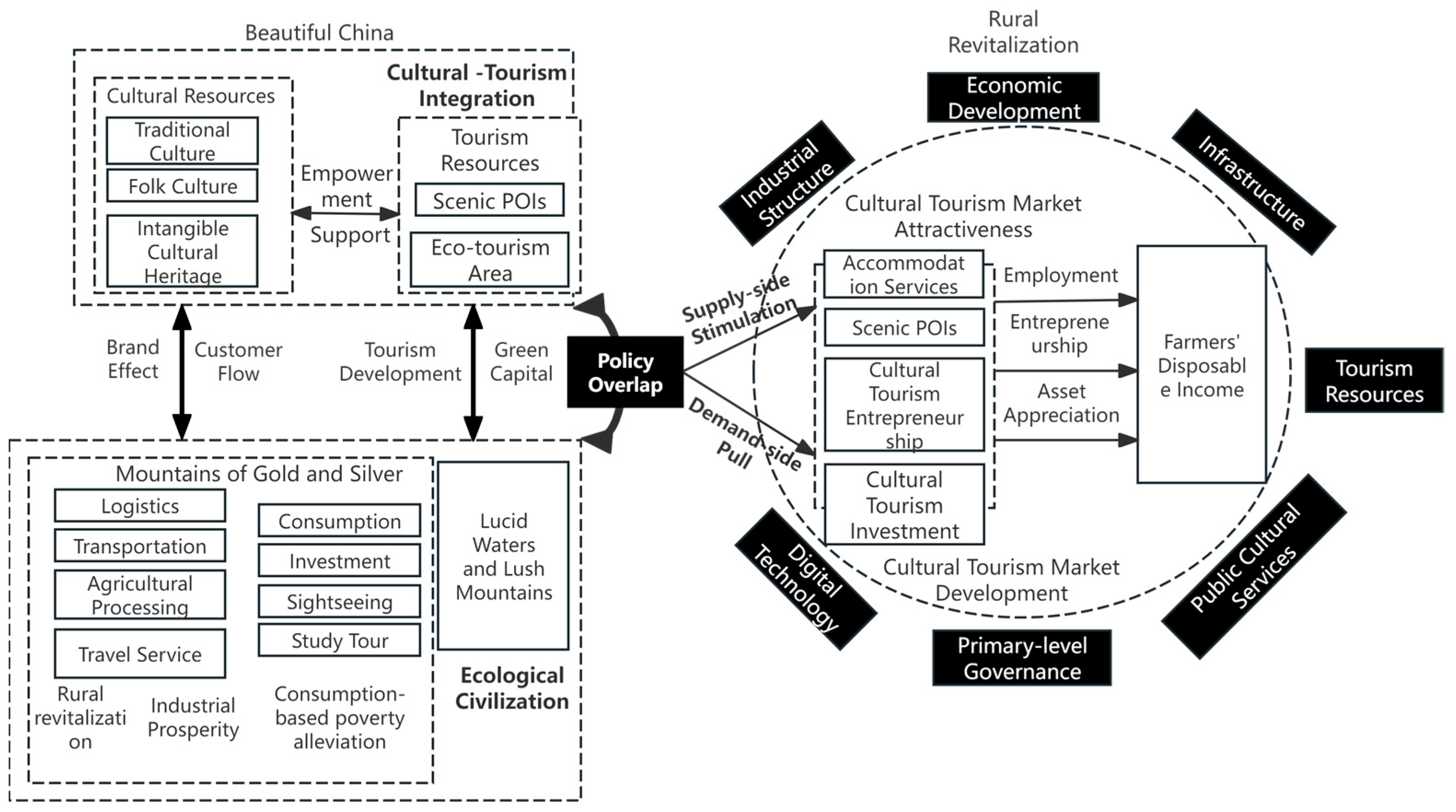
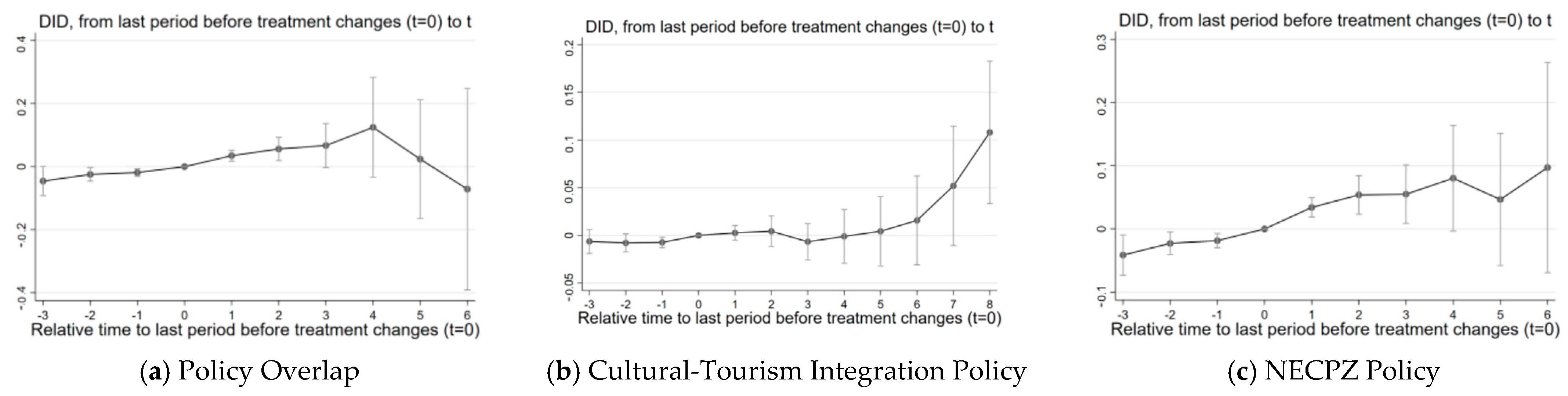
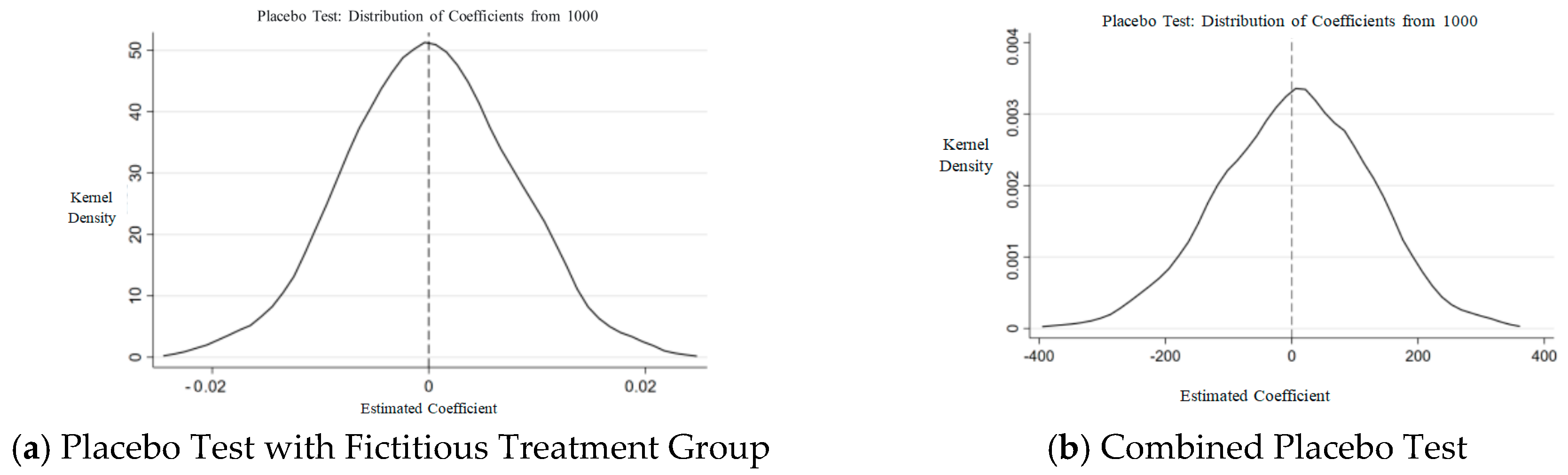
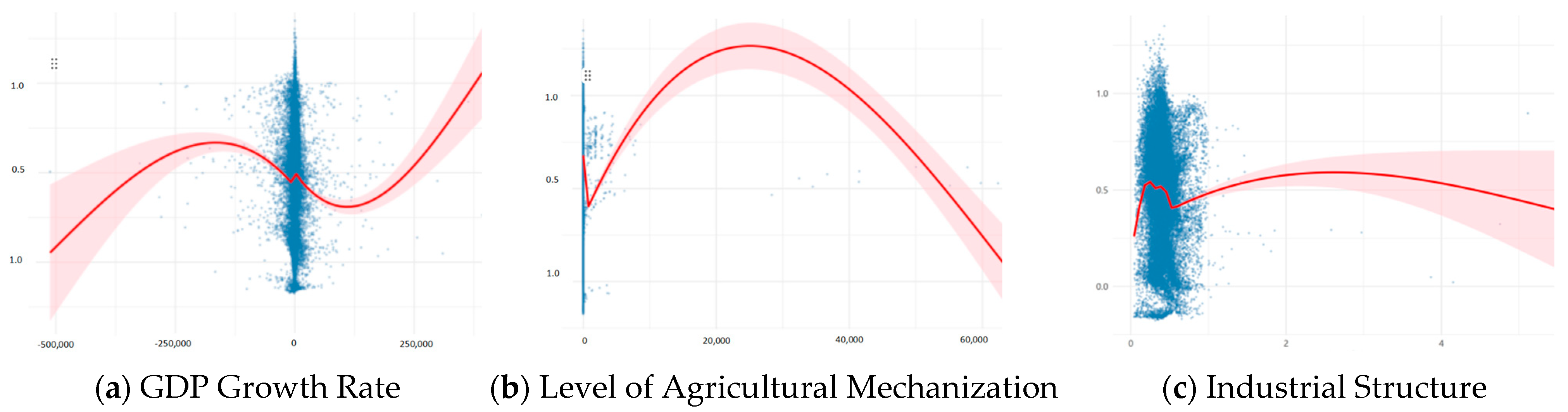
Policy Implementation of Cultural-Tourism and the National Ecological Civilization Pilot Zone, Developing the Market, and Increasing Farmers’ Income


Abstract
1. Introduction
2. Literature Review
2.1. The Impact of National Ecological Civilization Pilot Zone (NECPZ) on Farmers’ Income
2.2. The Impact of Cultural-Tourism Integration Policy (CTP) on Farmers’ Income
2.3. The Impact of the Policy Synergy on Farmers’ Income Growth
3. Theoretical Analysis and Hypothesis
3.1. The Direct Impact of Combined Implementation of CTP and the NECPZ Policies on Increasing Farmers’ Income
3.2. The Mechanism of Combined Implementation of CTP and NECPZ Policies in Increasing Farmers’ Income
3.2.1. The Mediating Role of Cultural-Tourism Market Attractiveness
3.2.2. The Mediating Role of Cultural-Tourism Market Development
4. Model Construction and Variable Design
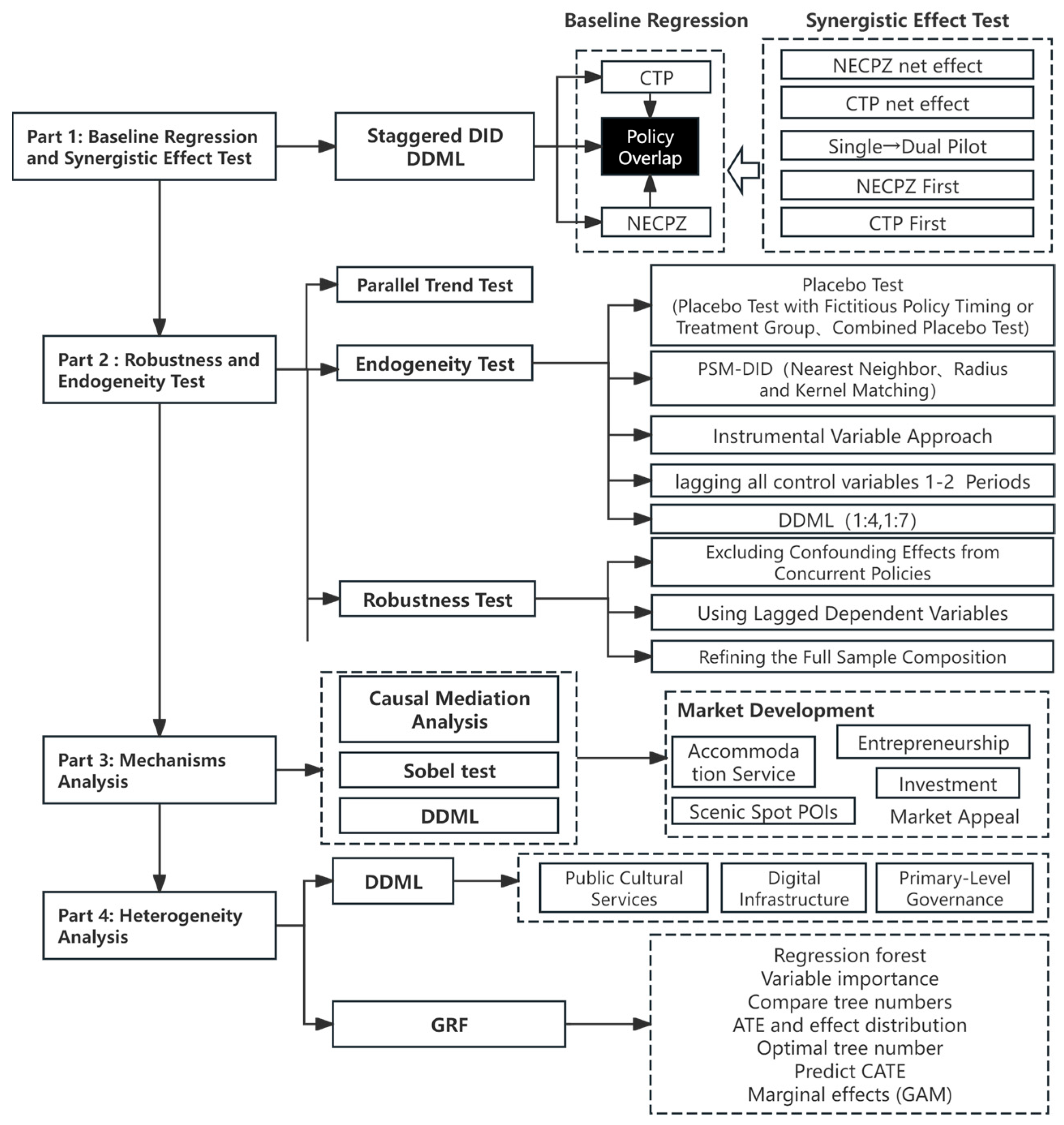
4.1. Empirical Procedure
4.2. Model Construction
- -
- i denotes the county, and t denotes the year.
- -
- is the dependent variable, measuring farmers disposable income.
- -
- is a dummy variable capturing the joint implementation of the cultural-tourism integration and the NECPZ policy. It is defined as .
- -
- is a dummy variable that equals 1 if a county is covered by the cultural-tourism integration policy, and 0 otherwise. follows the same logic for the NECPZ initiative.
- -
- is a dummy variable that equals 1 for all years after the implementation of the cultural-tourism integration policy, and 0 for years prior to implementation. is defined analogously for the NECPZ initiative.
- -
- denotes a vector of time-varying county-level control variables.
- -
- represents year fixed effects, represents county fixed effects, and is the stochastic disturbance term.
- -
- The coefficient captures the net causal effect of the simultaneous implementation of the cultural-tourism integration policy and the NECPZ initiative on farmers disposable income.
4.3. Data Sources and Pre-Processing
4.3.1. Variable Definition and Data Sources
4.3.2. Data Preprocessing and Pre-Treatment Covariate Balance
4.3.3. Construction of Mechanism Variables
- (1)
- The Number of Scenic Spot POIs (NSS) and the Number of Star-rated Hotels (NSH): Points of Interest (POIs) are GIS locations representing discrete entities, such as scenic spots, restrooms, and other service facilities; their regional count is a recognized proxy for ecosystem service value [28]. To construct county-level longitudinal datasets on NSS, this study integrates APIs from Amap and Baidu Maps with targeted web crawling. After deduplication and coordinate calibration, we compiled annual scenic-spot counts for each county. For accommodation POIs, an initial screening retained entries tagged as hotel and star-rated hotel. The annual count of star-rated hotels for each county were then aggregated across the study period to form a consistent time-series dataset.
- (2)
- Number of Newly Registered Cultural-Tourism Enterprises and Registered Capital: Following the methodological framework established by Lin Song et al. (2023) [12], this study collected a dataset of approximately 280 million enterprise registration records covering mainland China from 1949 to 2023 via the Tianyancha database. To scientifically identify enterprises related to eco–culture–tourism integration, this paper adopts a two-step screening method combined with word frequency analysis to determine the final set of keywords, ensuring both coverage and accuracy.
- -
- Step 1 Broad initial screening: Drawing on common business scope descriptions of culture–tourism integration, a set of basic keywords (see the first row of Table 3) is chosen. All enterprises whose business scope includes at least one of these basic keywords are placed in a candidate sample. This step yields over 600,000 preliminarily relevant enterprises.
- -
- Step 2 Word frequency analysis and extraction of core keywords: Word frequency analysis is conducted on the business scopes of the more than 600,000 candidate enterprises. Keywords that are highly relevant to the eco–culture–tourism integration are retained to form the final keyword list. The extracted core keywords are listed in Table 3.
- -
- Step 3 Precise screening: Based on the extracted core keyword list, over 700,000 enterprises were precisely screened, yielding 372,654 enterprises. A firm was retained if its business scope contained any core keywords: Table 3 reports the keyword frequencies. Among the screened cultural-tourism enterprises, the basic keywords “tourism” (335,000 occurrences), “culture” (91,000), and “sightseeing” (155,000) had the highest frequencies, effectively capturing the fundamental scope of cultural-tourism integration. The core keywords fall into four categories: eco-tourism, cultural-tourism integration, agro-cultural-tourism integration, and leisure and sightseeing agriculture. Notably, “leisure agriculture” (249,000) and “rural tourism” (257,000) are the most frequent, pointing directly to the county-level cultural-tourism market of interest. Core terms such as “eco-tourism” (26,000) and “cultural-tourism” (22,000) show median frequencies. To ensure sample coverage, this study also retained some low-frequency keywords, including “intangible cultural heritage tourism” (3) and “eco-study tours” (3). All keywords correspond to actual business scopes, with no irrelevant noise.
5. Empirical Results and Analysis
5.1. Parallel Trend Test
5.2. Baseline Regression Results
5.3. Testing the Synergistic Effect of Policy Overlap
5.4. Endogeneity Tests
5.4.1. Instrumental Variable Approach
5.4.2. PSM-DID
5.4.3. DDML
5.5. Robustness Tests
5.5.1. Placebo Test
5.5.2. Bacon Decomposition and Heterogeneity-Robust Estimation
5.5.3. Additional Robustness Tests
- (1)
- Excluding Confounding Effects from Concurrent Policies: Considering that farmers’ income may be influenced not only by the policy overlap between CTP and the NECPZ policy, but also by parallel policies such as the New-type Urbanization Pilot Policy and the Urban-Rural Integrated Development Pilot Policy, this study incorporates dummy variables for these two Concurrent programs as control variables in the baseline model to conduct robustness testing. The empirical results demonstrate that the coefficient of the core explanatory variable remains significantly positive at the 1% level across all three specifications: the model with the New-type Urbanization Pilot Policy dummy, the model with the Urban-Rural Integrated Development Pilot Policy dummy, and the model including both dummies. This confirms that the baseline regression results remain statistically robust even after controlling for potential confounding effects from these parallel policies.
- (2)
- Using Lagged Dependent Variables: To further mitigate endogeneity arising from potential reverse causality between the dependent variable and the core explanatory variable, this study re-estimates the baseline model including one- and two- period lags of the dependent variable. In both specifications, the coefficient of the key explanatory variable remains significantly positive at the 1% level, confirming the robustness of the baseline regression results.
- (3)
- Refining the Full Sample Composition: Administrative division adjustments, including county-to-district and county-to-city conversions, can substantially reshape local fiscal resource allocation and the foundations of agricultural development, thereby exerting non-negligible impacts on farmers’ disposable income. To isolate the true effect of the core explanatory variable from such policy shocks, this study first excludes all observations that underwent administrative division adjustments during the sample period and re-estimate the baseline regression using this refined sample. The results confirm that the coefficient of the core explanatory variable remains positive and statistically significant at the 1% level, fully consistent with the initial baseline findings. (Complete regression outputs are omitted for brevity but available on request).
6. Analysis of Impact Mechanisms
6.1. Analysis of the Mediating Effect of the Number of Scenic Spot POIs (NSS)
6.2. Mediation Effect Analysis of the Number of Star-Rated Hotels (NSH)
6.3. Analysis of the Mediating Effect of New Registrations of Cultural and Tourism Enterprises (NCTEs)
6.4. Analysis of the Mediating Effect of Newly Registered Capital of Cultural and Tourism Enterprises (RCNCTEs)
7. Heterogeneity Analysis
7.1. Heterogeneity Analysis Based on DDML
7.1.1. Heterogeneity Test Based on Different Levels of Public Cultural Services
7.1.2. Heterogeneity Test Based on Different Levels of Primary-Level Governance
7.1.3. Heterogeneity Test Based on Different Levels of Digital Infrastructure
7.2. Policy Effect Analysis Based on Generalized Random Forest Model (GRF)
7.2.1. Analysis of the Average Treatment Effect of Overlapping Policies
7.2.2. Marginal Effect Analysis of Key Covariates
8. Conclusions and Discussion
8.1. Research Conclusions
8.2. Theoretical Implications
8.2.1. Extending the “The Two Mountains” Concept from Advocacy to Practice: Revealing the Crucial Role of Institutional Synergy in Ecological Value Transformation
8.2.2. Revealing the Transmission Pathways Through Which Policy Overlap Promotes Farmers’ Income Growth, Providing Empirical Evidence for the Realization Path of the “Two Mountains” Concept
8.2.3. Revealing the Conditional Nature and Nonlinear Characteristics of Policy Effects, Moving Away from the Notion That “More Policies Are Better”, and Identifying the Conditional Boundaries of Policy Synergy in Practice
8.3. Practical Implications
8.3.1. Breaking Down Departmental and Hierarchical Barriers for Cross-Level, Cross-Sectoral Policy Synergy
8.3.2. Smoothing Transmission Pathways on Both the Demand and Supply Sides to Fully Realize Policy Synergy
8.3.3. Adapting Measures to Local Conditions: Identifying Applicable Contexts and Tailoring Policies Accordingly
8.4. Research Limitations and Outlook
Author Contributions
Funding
Institutional Review Board Statement
Informed Consent Statement
Data Availability Statement
Acknowledgments
Conflicts of Interest
Abbreviations
| CTP | Cultural-Tourism Integration Policy |
| NECPZ | National Ecological Civilization Pilot Zone |
| DDML | Double/Debiased Machine Learning |
| POI | Point of Interest |
| NSS | Number of Scenic Spot POIs |
| NSH | Number of Star-rated Hotels |
| NCTEs | Number of Newly Registered Cultural-Tourism Enterprises |
| RCNCTEs | Registered Capital of Newly Registered Cultural-Tourism Enterprises (in CNY 100 million) |
| ACME | Average Causal Mediation Effect |
| CATE | Conditional Average Treatment Effect |
| ATE | Average Treatment Effect |
| GRF | Generalized Random Forest |
| GAM | Generalized Additive Model |
| LADC | Leisure Agriculture Demonstration County |
| OPN | Openness to the outside world |
| FP | Fiscal Pressure |
| IS | Industrial Structure (share of tertiary industry value added) |
| AML | Level of agricultural mechanization (proportion of mechanically harvested area) |
| PP | Rural Population (permanent resident population in rural areas, in ten thousand persons) |
| GDP | Gross Regional Product (in CNY hundred million) |
| TFAI | Total Fixed Asset Investment (in CNY hundred million) |
References
- Shen, J.; Chou, R.-J. Rural revitalization of Xiamei: The development experiences of integrating tea tourism with ancient village preservation. J. Rural. Stud. 2022, 90, 42–52. [Google Scholar] [CrossRef]
- Zhang, Y.; Xu, T. Can whole—region ecotourism construction help the region to obtain “clear waters and green mountains”and “gold and silver mountains” at the same time?—Case study of Fujian. J. Arid. Land Resour. Environ. 2023, 37, 185–193. [Google Scholar] [CrossRef]
- Li, Z.; Han, N.; Zhao, D. Lucid Waters and Lush Mountains Are Invaluable Assets: The Effect of National Ecological Civilization Demonstration Zone Construction on Farmers’ Income Growth. J. Financ. Econ. 2025, 51, 77–91. [Google Scholar] [CrossRef]
- Zhang, Z. Cultural and Tourism Integration: Research on the High-quality Development of Rural Tourism. Nanjing J. Soc. Sci. 2021, 7, 157–164. [Google Scholar]
- Liu, Y.; Xu, J.; Liu, Y. Research on the Coupling and Coordination Relationship between Ecological Environment and Cultural Tourism Industry in the Yellow River Basin. Econ. Probl. 2024, 2, 105–112. [Google Scholar] [CrossRef]
- Yu, Y.; Jiang, X. Unlocking the Integration Mechanism: How Digital Village Construction Promotes Agro-Cultural-Tourism Development through Rural E-Commerce. Res. Sq. 2026. [Google Scholar] [CrossRef] [PubMed]
- Zhong, L.; Zeng, Y. Ecotourism research of China in the past forty years: Progress and future development. Tour. Trib. 2026, 41, 158–174. [Google Scholar] [CrossRef]
- Zhao, Y.; Han, Z.; Zhang, R.; Zhong, J. Mechanism of Cultural Ecosystem Services on Cultural and Tourism Integration and Its Regional Practice: Taking Lyushunkou District of Dalian City as An Example. Econ. Geogr. 2024, 44, 211–221. [Google Scholar] [CrossRef]
- Xu, H.; Liu, J. Implications of “two mountains” theory on China’s green development. Chin. J. Urban Environ. Stud. 2019, 7, 1975008. [Google Scholar] [CrossRef]
- Zhang, Y.; Wang, C.A.; Liu, X.; Zhang, X.; Dagestani, A.A. Does the national ecological civilization pilot zone achieve a “win-win” circumstance for the environment and the economy: Empirical evidence from China. Appl. Econ. 2025, 57, 10771–10787. [Google Scholar] [CrossRef]
- Du, J.; Wei, Q.; Zhang, Z.; Gu, Q. Pilot Policy Overlap, Emerging Business Models, and Agricultural Development Resilience: A Quasi-Natural Experiment Based on a Staggered DID Model. Chin. J. Agric. Resour. Reg. Plan. 2026, 1–19. [Google Scholar] [CrossRef]
- Lin, S.; Gu, Y.; Si, X.; Yan, Y. County-level Entrepreneurship, Farmers’ Income Increase and Common Prosperity: An Empirical Study Based on Chinese County-level Data. Econ. Res. J. 2023, 58, 40–58. [Google Scholar]
- Chang, X.; Cheng, W.; Wang, H.; Chen, X.; Yang, Y.; Zhang, L. The Impact of National Ecological Civilization Pilot Zone Policy on Rural Residents’ Income—Evidence from Chinese Counties. Sustainability 2026, 18, 449. [Google Scholar] [CrossRef]
- Hu, H.; Yin, Y.; Xie, Y.; Cai, J.; Wang, C.; Zhang, W. Thematic Evolution and Transmission Mechanisms of China’s Rural Tourism Policy: A Multi-Level Governance Framework for Sustainable Development. Sustainability 2025, 17, 9187. [Google Scholar] [CrossRef]
- Zhao, X.; Xie, C.; Huang, L.; Wang, Y.; Han, T. How digitalization promotes the sustainable integration of culture and tourism for economic recovery. Econ. Anal. Policy 2023, 77, 988–1000. [Google Scholar] [CrossRef]
- Tang, M.; Xu, H. Cultural integration and rural tourism development: A scoping literature review. Tour. Hosp. 2023, 4, 75–90. [Google Scholar] [CrossRef]
- Lu, M.; Duan, Y.; Wu, X. Evaluation of the coupling and coordination degree of eco-cultural tourism system in the Jiangsu-Zhejiang-Shanghai-Anhui region. Ecol. Indic. 2023, 156, 111180. [Google Scholar] [CrossRef]
- Harfst, J.; Syrbe, R.U.; Kern, C.; Wirth, P.; Sandriester, J.; Pstrocka-Rak, M.; Dolzblasz, S. Cultural tourism and governance in peripheral regions. Int. J. Tour. Res. 2024, 26, e2733. [Google Scholar] [CrossRef]
- Qin, M. Optimization research on the integration development path of agricultural, cultural and tourism industries in Yijun County based on data analysis. J. Comb. Math. Comb. Comput. 2025, 127, 8169–8187. [Google Scholar]
- Zhao, Y.; Lu, Y.; Zhan, Q. Research on the Coupling Coordination and Obstacles Analysis of Cultural-Tourism Economy and Ecological Environment in the Middle Reach of the Yellow River Basin, China. Res. Sq. 2024. [Google Scholar] [CrossRef] [PubMed]
- Qiu, M.; Wang, Z.; Chen, Q.; Wang, J. Enhancing tourism carbon emission efficiency through cultural and tourism industry integration in china: Empirical evidence from industrial structure upgrading. Environ. Dev. Sustain. 2025, 1–29. [Google Scholar] [CrossRef]
- Cawley, M.; Gillmor, D.A. ‘Culture Economy’,‘Integrated Tourism’and ‘Sustainable Rural Development’: Evidence from Western Ireland. In Sustainable Rural Systems; Routledge: Abingdon, UK, 2016; pp. 145–159. [Google Scholar]
- Shi, L.; Liao, X. From poverty to common prosperity: An evaluation of agricultural-cultural-tourism integration and its impact on economic growth. Front. Sustain. Food Syst. 2025, 9, 1600264. [Google Scholar] [CrossRef]
- Qi, Y.; Ni, Q.; Zhang, J.; Han, J.; Ren, H. User-centric innovation strategies for cultural creative products in China’s rural tourism. PLoS ONE 2025, 20, e0319474. [Google Scholar] [CrossRef] [PubMed]
- Zhou, C.; Qin, L.; Wei, M. The Integration Policy of Culture and Tourism and the Development of the Tourism Industry: Effect Evaluation and Mechanism Testing. Tour. Trib. 2025, 1–23. [Google Scholar]
- Weaver, D.B. Peripheries of the periphery: Tourism in Tobago and Barbuda. Ann. Tour. Res. 1998, 25, 292–313. [Google Scholar] [CrossRef]
- Jamal, T.B.; Getz, D. Collaboration theory and community tourism planning. Ann. Tour. Res. 1995, 22, 186–204. [Google Scholar] [CrossRef]
- Zhang, J.; Zuo, L.; Liu, H.; Ma, R. Research on the evaluation of cultural ecosystem services value of desert tourism scenic area based on tourist perception: Taking tukai desert tourism scenic area as an example. Acta Ecol. Sin. 2025, 45, 5710–5722. [Google Scholar]
- Jacobson, L.S.; LaLonde, R.J.; Sullivan, D.G. Earnings losses of displaced workers. Am. Econ. Rev. 1993, 83, 685–709. [Google Scholar]
- Chernozhukov, V.; Chetverikov, D.; Demirer, M.; Duflo, E.; Hansen, C.; Newey, W.; Robins, J. Double/debiased machine learning for treatment and structural parameters. Econom. J. 2018, 21, C1–C68. [Google Scholar] [CrossRef]
- Fan, Z.; Li, Z. The Role of East and West Cooperation in Promoting County Economy’s High-quality Development from the Perspective of Balance: A Case Study of Pairing Assistance During the Poverty Alleviation Period. J. Nanjing Agric. Univ. (Soc. Sci. Ed.) 2023, 23, 77–90. [Google Scholar] [CrossRef]
- Topalova, P. Factor immobility and regional impacts of trade liberalization: Evidence on poverty from India. Am. Econ. J. Appl. Econ. 2010, 2, 1–41. [Google Scholar] [CrossRef]
- Cai, X.; Lu, Y.; Wu, M.; Yu, L. Does environmental regulation drive away inbound foreign direct investment? Evidence from a quasi-natural experiment in China. J. Dev. Econ. 2016, 123, 73–85. [Google Scholar] [CrossRef]
- de Chaisemartin, C.; D’Haultfoeuille, X. Two-way fixed effects estimators with heterogeneous treatment effects. Am. Econ. Rev. 2020, 110, 2964–2996. [Google Scholar] [CrossRef]
- Wooldridge, J.M. Two-way fixed effects, the two-way mundlak regression, and difference-in-differences estimators. Empir. Econ. 2025, 69, 2545–2587. [Google Scholar] [CrossRef]
- Callaway, B.; Sant’Anna, P.H. Difference-in-differences with multiple time periods. J. Econom. 2021, 225, 200–230. [Google Scholar] [CrossRef]
- Imai, K.; Keele, L.; Tingley, D. A general approach to causal mediation analysis. Psychol. Methods 2010, 15, 309. [Google Scholar] [CrossRef] [PubMed]
- Hicks, R.; Tingley, D. Causal mediation analysis. Stata J. 2011, 11, 605–619. [Google Scholar] [CrossRef]
- Sobel, M.E. Asymptotic confidence intervals for indirect effects in structural equation models. Sociol. Methodol. 1982, 13, 290–312. [Google Scholar] [CrossRef]
- Athey, S.; Tibshirani, J.; Wager, S. Generalized random forests. Ann. Statist. 2019, 47, 1148–1178. [Google Scholar] [CrossRef]
- Wager, S.; Athey, S. Estimation and inference of heterogeneous treatment effects using random forests. J. Am. Stat. Assoc. 2018, 113, 1228–1242. [Google Scholar] [CrossRef]
- Tibshirani, J.; Athey, S.; Sverdrup, E.; Wager, S. grf: Generalized Random Forests. R Package Version 2.0. 2. R Foundation for Statistical Computing. 2021. Available online: https://CRAN.R-project.org/package (accessed on 18 June 2026).




| Type | Abbreviation | Data Name | Unit | Definition | Data Sources |
|---|---|---|---|---|---|
| Dependent Variable | Income | Rural Resident Income | CNY 10,000 | Per capita disposable income of rural residents, reflecting their living standards and welfare after deductions. | Inferred from China County Statistical Yearbook (https://www.stats.gov.cn/sj/, accessed on 12 July 2025); China Economic Information Network (https://www.cei.cn/#qypd, accessed on 12 July 2025) |
| Independent Variable | DID | Policy Overlap Dummy | - | Dummy variable = 1 if a county is covered by both the Cultural-Tourism Integration Policy (CTP) and the National Ecological Civilization Pilot Zone (NECPZ) policy in a given year; =0 otherwise. | Constructed from CTP and NECPZ policy data |
| CTP | Cultural-Tourism Integration Policy | - | Dummy variable = 1 for the year a county’s administering prefecture-level city first introduced the CTP policy and thereafter; =0 otherwise. | Manually collected from prefecture-level city policy documents (following Zhou Chunbo et al., 2025) [25] | |
| NECPZ | National Ecological Civilization Pilot Zone/County Policy | - | Dummy variable = 1 for the year a county was officially designated as a NECPZ and thereafter; =0 otherwise. | Manually collected from official lists from the Ministry of Ecology and Environment (https://www.mee.gov.cn/, accessed on 12 July 2025) | |
| Control Variable | GDP | Gross Regional Product | CNY 100 million | Proxy for county-level economic development. The second-differenced form is used in analysis. | Inferred from China County Statistical Yearbook (https://www.stats.gov.cn/sj/, accessed on 12 July 2025); China Economic Information Network (https://www.cei.cn/#qypd, accessed on 12 July 2025) |
| OPN | Openness to the Outside World | USD | Degree of regional openness, measured as the logarithmic form of county-level actually utilized foreign investment. | ||
| FP | Fiscal Pressure | % | Ratio of local general budgetary expenditures to revenues. The logarithmic form of the ratio is used, and the first difference is applied in analysis. | ||
| IS | Industrial Structure | % | Share of the tertiary industry’s added value in regional GDP, reflecting industrial structure optimization. | ||
| TFAI | Investment Scale (Total Fixed Asset Investment) | CNY 100 million | Total fixed asset investment at the county level, indicating capital formation and infrastructure capacity. | ||
| AML | Level of Agricultural Mechanization | % | Proportion of mechanically harvested area to total cultivated area, representing agricultural development level. | ||
| PP | Rural Population | 10,000 persons | Permanent resident population in rural areas. The natural logarithmic form is used in analysis. | ||
| Mechanism Variable | NSS | Number of Scenic Spot POIs | Count | Annual count of Points of Interest (POIs) related to scenic spots, serving as a proxy for ecosystem service value. | Integrated from Amap (https://lbs.amap.com/, accessed on 12 July 2025) and Baidu Maps APIs (http://lbsyun.baidu.com, accessed on 12 July 2025) via web crawling |
| NSHs | Number of Star-rated Hotels | Count | Annual count of POIs tagged as “star-rated hotels”, reflecting accommodation infrastructure. | ||
| NCTEs | Number of Newly Registered Cultural-Tourism Enterprises | Count | Annual count of newly registered enterprises identified as related to eco–culture–tourism integration using keyword screening. | Tianyancha database (https://www.tianyancha.com, accessed on 12 July 2025) | |
| RCNCTEs | Registered Capital of New Cultural-Tourism Enterprises | CNY | Total registered capital of newly registered enterprises identified as related to eco–culture–tourism integration. |
| Variable Name | Treatment Mean | Control Mean | Difference | p-Value |
|---|---|---|---|---|
| OPN | 0.0074141 | 0.0496452 | 0.0422312 | 0.3434 |
| IS | 0.4036264 | 0.4078146 | 0.0041882 | 0.5991 |
| AML | 3.167055 | 2.03534 | −1.131715 | 0.7293 |
| PP | 3.183473 | 3.215966 | 0.0324929 | 0.6129 |
| FP | 0.1287712 | −0.3273033 | −0.4560745 | 0.7687 |
| GDP | 6.18292 | −1.43444 | −7.617361 | 0.3151 |
| TFAI | 1.031896 | 1.027904 | −0.003992 | 0.917 |
| Type | Key Words and Word Frequency | |
|---|---|---|
| Basic Keywords | Performance (12,386); Intangible Cultural Heritage (126); Historic Site (18); Tourist (2020); Cultural-Tourism (307); Scenic Spot (2412); Cultural and Creative Products (3918); Sightseeing (155,260); Tourism (335,582); Scenery (42); Tour Guide (320); Ticket (578); Experience (18,541); Folk Custom (6058); Culture (90,780) | |
| Core Keywords | Eco-tourism | Eco-tourism (26,384); Forest Tourism (866); Wetland Tourism (26); Grassland Tourism (36); Desert Tourism (43); Eco-sightseeing (9855); Eco-vacation (25); Forest Health and Wellness (464); Eco-study Tour (3); Nature Education (54); Green Tourism (22); Eco-cultural-Tourism (5) |
| Cultural -tourism | Cultural-Tourism (22,467); Folk Tourism (3638); Intangible Cultural Heritage Tourism (3); Red Tourism (295); Cultural Performance (92); Cultural Experience (686); Ancient Town Tourism (17); Ancient Village Tourism (10); Cultural-Tourism Integration (3); Cultural-Tourism Experience (2) | |
| Agro-cultural-tourism | Leisure Agriculture (249,356); Rural Tourism (257,077); Farming Culture (813); Rural Complex (1316); Agricultural Study Tour (21) | |
| Leisure sightseeing agriculture | Sightseeing Agriculture (12,721); Agricultural Park (28); Flower Sightseeing (44); Fruit and Vegetable Picking (20,681); Agricultural Experience (233); Leisure Agriculture Park (12); Leisure Sightseeing Agriculture (2901) | |
| Type | Variable | Obs | Mean | Std. Dev | Min | Max |
|---|---|---|---|---|---|---|
| Dependent Variable | INCOME | 31,094 | 1.313279 | 0.7403334 | 0.2905 | 3.803 |
| Control Variable | OPN | 31,094 | 0.0048127 | 0.0118354 | 1.00 × 10⁻⁶ | 0.092 |
| IS | 31,094 | 0.4071166 | 0.1387928 | 0.1194944 | 0.8657485 | |
| AML | 31,093 | 2.189571 | 10.45395 | 0.0047073 | 96.21739 | |
| PP | 30,993 | 3.222349 | 1.0299 | 0 | 4.942521 | |
| FP | 31,094 | 0.0606734 | 1.709019 | −7.419873 | 8.136872 | |
| TFAI | 31,094 | 1.005604 | 0.6575662 | 0.0768135 | 3.889916 | |
| GDP | 31,094 | −0.1812678 | 5.298841 | −155.7546 | 158.4782 | |
| Mediating Variables | NSS | 31,094 | 69.69127 | 101.7551 | 1 | 609 |
| NSH | 29,757 | 9.033606 | 16.80087 | 0 | 102 | |
| NCTEs | 31,094 | 7.188622 | 13.91275 | 0 | 89 | |
| RCNCTEs | 28,989 | 7.813532 | 2.014009 | 2.079442 | 12.21305 |
| Variable | (1) | (2) | (3) | (4) | (5) | (6) |
|---|---|---|---|---|---|---|
| DDL | DDML | |||||
| Policy Overlap | CTP | NECPZ | Policy Overlap | CTP | NECPZ | |
| DID | 0.0955 *** (0.0111) | 0.0179 *** (0.0051) | 0.0919 *** (0.0098) | 0.0717 ** (0.02606) | 0.0359 *** (0.00785) | 0.08147 *** (0.021) |
| Obs | 30,988 | 30,988 | 30,988 | 30,992 | 30,992 | 30,992 |
| Control Variables | YES | YES | YES | YES | YES | YES |
| Quadratic Terms of Control Variables | NO | NO | NO | YES | YES | YES |
| County Fixed Effects | YES | YES | YES | YES | YES | YES |
| Year Fixed Effects | YES | YES | YES | YES | YES | YES |
| Adjusted R2 | 0.8877 | 0.8875 | 0.8878 | — | — | — |
| Variable | (1) | (2) | (3) | (4) | (5) |
|---|---|---|---|---|---|
| NECPZ | 0.0762 *** (0.0145) | — | — | — | — |
| CTP | — | 0.0175 *** (0.00500) | — | — | — |
| Policy Overlap | — | — | 0.268 *** (0.043) | 0.010 (0.028) | 0.104 *** (0.102) |
| Control Variables | YES | YES | YES | YES | YES |
| County Fixed Effects | YES | YES | YES | YES | YES |
| Year Fixed Effects | YES | YES | YES | YES | YES |
| Obs | 21,008 | 29,995 | 642 | 1515 | 25,714 |
| Adjusted R2 | 0.901 | 0.889 | 0.9733 | 0.9316 | 0.8919 |
| Variable | (1) | (2) | (3) | (4) |
|---|---|---|---|---|
| Lagged One Period | Lagged Two Period | First Stage | Second Stage | |
| DID | 0.074 *** (0.012) | 0.099 *** (0.011) | — | 1.015 ** (0.172) |
| IV1 | — | — | 0.059 *** (0.005) | — |
| Control Variables | YES | YES | YES | YES |
| County Fixed Effects | YES | YES | YES | YES |
| Year Fixed Effects | YES | YES | YES | YES |
| F-value | — | F (1, 28,493) = 146.80 | ||
| Anderson canon. corr. LM statistic | 158.84 *** | |||
| Cragg-Donald Wald F | 146.80 | |||
| Endogeneity test | 38.719 *** | |||
| Variable | (1) | (2) | (3) | (4) | (5) | (6) | (7) |
|---|---|---|---|---|---|---|---|
| PSM-DID | DDML | ||||||
| Nearest Neighbor | Radius Matching | Kernel Matching | Lasso Regression | Elastic Net | Random Forest | Ridge Regression | |
| DID | 0.096 ** (0.047) | 0.195 *** (0.022) | 0.054 *** (0.016) | — | — | — | — |
| Sample Split (1:4) | — | — | — | 0.0955 *** (0.01823) | 0.09553 *** (0.01824) | 0.0717 ** (0.02606) | 0.3662 *** (0.02899) |
| Sample Split (1:7) | — | — | — | 0.1003 *** (0.018024) | 0.1004 *** (0.01825) | 0.0667 ** (0.02579) | 0.3639 *** (0.02917) |
| Control Variables | YES | YES | YES | YES | YES | YES | YES |
| Quadratic Terms of Control Variables | NO | NO | NO | YES | YES | YES | YES |
| County Fixed Effects | YES | YES | YES | YES | YES | YES | YES |
| Year Fixed Effects | YES | YES | YES | YES | YES | YES | YES |
| Obs | 1971 | 30,750 | 30,907 | 30,992 | 30,992 | 30,992 | 30,992 |
| Adjusted R2 | 0.98 | 0.4235 | 0.9831 | — | — | — | — |
| Part 1 Bacon Decomposition | ||
|---|---|---|
| 2 × 2 DID Control Group Type | Average Treatment Effect | Weight |
| Using “Later-Treated Group” as Control | 3.2% | −0.0272 |
| Using “Earlier-Treated Group” as Control | 0.59% | 0.0329 |
| Using “Never-Treated Group” as Control | 96.21% | 0.0426 |
| Part 2 Heterogeneity-Robust Estimation | ||
| Method | Coefficient | Standard Error |
| de Chaisemartin and D’Haultfoeuille (2020) [34] | 0.05053 ** | 0.01776 |
| Wooldridge (2025) [35] | 0.152 *** | 0.041 |
| Callaway and Sant’Anna (2021) [36] | 0.109 *** | 0.017 |
| Variables | (1) | (2) | (3) | (4) | |
|---|---|---|---|---|---|
| NSS | PSH | NCTEs | RCNCTEs | ||
| DDL | ACME | 0.02494 *** | 0.1966 *** | 0.0786 *** | 0.1092 *** |
| Direct Effect | 0.9132 *** | 0.5733 *** | 0.6905 *** | 0.6599 *** | |
| Total Effect | 0.9382 *** | 0.7699 *** | 0.7691 *** | 0.7692 *** | |
| Obs | 29,663 | 30,992 | 30,992 | 30,992 | |
| Control Variables | YES | YES | YES | YES | |
| DDML | DID | 48.9451 *** (5.2791) | 1.2895 ** (0.5227) | 11.3064 *** (1.1673) | 0.4512 *** (0.06499) |
| Obs | 30,992 | 30,992 | 30,992 | 30,992 | |
| Control Variables | YES | YES | YES | YES | |
| Quadratic Terms of Control Variables | YES | YES | YES | YES | |
| County Fixed Effects | YES | YES | YES | YES | |
| Year Fixed Effects | YES | YES | YES | YES | |
| Sobel Test | The mediating effect is significant | The mediating effect is significant | The mediating effect is significant | The mediating effect is significant | |
| (1) | (2) | (3) | (4) | (5) | (6) | |
|---|---|---|---|---|---|---|
| Variables | Public Cultural Services | Primary-Level Governance | Digital Infrastructure | |||
| High | Low | High | Low | High | Low | |
| DID | 0.1052 ** (0.04342) | 0.03088 (0.0317) | 0.2742 *** (0.06976) | 0.03698 (0.02898) | 0.16173 *** (0.048) | −0.01565 (0.0298) |
| Obs | 6043 | 24,949 | 7199 | 23,793 | 10,446 | 20,648 |
| Control Variables | YES | YES | YES | YES | YES | YES |
| Quadratic Terms of Control Variables | YES | YES | YES | YES | YES | YES |
| County Fixed Effects | YES | YES | YES | YES | YES | YES |
| Year Fixed Effects | YES | YES | YES | YES | YES | YES |
| INCOME | INCOME | INCOME | INCOME | |
|---|---|---|---|---|
| Treatment Effect | 0.4903 | 0.4883 | 0.4912 | 0.492 |
| Clustering | YES | YES | YES | YES |
| Control Variables | YES | YES | YES | YES |
| Number of Trees | 1000 | 2000 | 4000 | 8000 |
| Method | Causal Forest | Causal Forest | Causal Forest | Causal Forest |
Disclaimer/Publisher’s Note: The statements, opinions and data contained in all publications are solely those of the individual author(s) and contributor(s) and not of MDPI and/or the editor(s). MDPI and/or the editor(s) disclaim responsibility for any injury to people or property resulting from any ideas, methods, instructions or products referred to in the content. |
© 2026 by the authors. Licensee MDPI, Basel, Switzerland. This article is an open access article distributed under the terms and conditions of the Creative Commons Attribution (CC BY) license.
Share and Cite
Jiang, M.; Fu, Y. Policy Implementation of Cultural-Tourism and the National Ecological Civilization Pilot Zone, Developing the Market, and Increasing Farmers’ Income. Sustainability 2026, 18, 7040. https://doi.org/10.3390/su18147040
Jiang M, Fu Y. Policy Implementation of Cultural-Tourism and the National Ecological Civilization Pilot Zone, Developing the Market, and Increasing Farmers’ Income. Sustainability. 2026; 18(14):7040. https://doi.org/10.3390/su18147040
Chicago/Turabian StyleJiang, Mingqiu, and Yunpeng Fu. 2026. "Policy Implementation of Cultural-Tourism and the National Ecological Civilization Pilot Zone, Developing the Market, and Increasing Farmers’ Income" Sustainability 18, no. 14: 7040. https://doi.org/10.3390/su18147040
APA StyleJiang, M., & Fu, Y. (2026). Policy Implementation of Cultural-Tourism and the National Ecological Civilization Pilot Zone, Developing the Market, and Increasing Farmers’ Income. Sustainability, 18(14), 7040. https://doi.org/10.3390/su18147040