1. Introduction
Today, energy sustainability has become one of the essential principles for addressing environmental degradation and natural resource depletion [
1]. ESG (environmental, social, and governance) factors are becoming increasingly vital for assessing sustainability impacts, especially in high-impact industries such as the energy sector [
2]. Sustainability implies that the management of resources, social inclusivity, and well-being across generations should be encouraged [
2]. Over the last several decades, the world has witnessed a steady rise in global energy consumption due to economic growth and population growth. The Kingdom of Thailand, being one of the dynamically growing economies of Southeast Asia, was no exception, as its electricity consumption had been rising and was directly related to GDP growth. Thus, there was a need to change the situation and switch to renewable energy sources.
Currently, electricity consumption in Thailand averages 3032 kWh per person per year (in 2025), of which 6.6% is renewable energy [
3]. This is explained by the Kingdom’s continued growth driven by economic development, urbanization, data centers, and electric vehicles. To meet this increased demand, the new Power Development Plan sets a target of 51% renewable energy use by 2037 [
4].
Based on projections, Thailand’s demand is expected to surpass 430,000 GWh in 2037, almost doubling its current consumption [
4]. However, Thailand faces an energy mix problem, as natural gas and oil account for approximately 60% of its power generation in 2023 [
3]. In addition, the resource limitations and environmental consequences of burning fossil fuels make energy security and decarbonization national priorities for Thailand [
5].
To overcome those limitations, Thailand introduced an alternative energy development plan (AEDP), which aims to increase the use of renewable energy sources, especially solar energy [
6]. Solar energy is especially promising due to abundant sunlight, rapid technological development, and decreasing installation costs [
7,
8]. The government initiated a residential rooftop solar project in 2018, targeting an installed capacity of 10,000 MW within 20 years.
Later, in 2026, personal income tax deductions were provided to those who had solar panels installed in their homes, along with streamlined permitting and building-modification exemption policies [
9]. Despite these policies, the adoption rate remains low. Some of the key challenges include a lack of public awareness, a complicated bureaucracy, vague regulations, and installation costs [
10]. Furthermore, recent studies conducted in Thailand have revealed an important issue known as the “economic expectation gap”. It states that Thai people generally expect a payback period of 3–5 years, but in reality, it lies between 8 and 12 years—this creates an adoption disincentive [
11].
There have been studies conducted in various national settings on the factors influencing solar energy adoption. For instance, a study conducted in the European Union by Bódis et al. [
5] shows that solar roof photovoltaics help in reducing household electricity consumption. In addition, Hai et al. [
7] found that Finnish households held positive attitudes towards solar energy after seeing evidence of its advantages. In another study conducted in India, Kapoor & Dwivedi [
8] identified attitudes and compatibility as significant determinants of the adoption of solar innovations. These results may not necessarily apply to the Thai situation, owing to the many differences that exist.
However, studies from neighboring countries such as Malaysia [
9] in 2017 and Pakistan [
10] offer relevant insights, although they, too, have limitations regarding grid structures, government policies, and consumer behavior. Thus, there is a need for context-specific research to identify the behavioral drivers of rooftop solar adoption in Thailand. Importantly, the economic expectation gap identified by Leewiraphan et al. [
11], which refers to the mismatch between consumers’ expectations and reality regarding payback time, has not been examined as a moderator of the attitude-intention relationship.
Research into the application of solar energy within Thailand is sparse. Recent research by Huansuriya and Ariyabuddhiphongs [
12], using TPB, investigated the attitudes of Thai consumers towards installing solar energy systems in their homes. Attitudes and subjective norms were identified as important predictors in their study. It should be noted, however, that the concept of perceived usefulness, which is integral to TAM and which represents the cost–benefit aspect of energy choices, was not included in their analysis [
13].
Another Thai study analyzed the efficiency of policies or the feasibility of solar energy use, without focusing on the behavioral aspects that influence its adoption [
14].
To address these gaps, this study explores the direct, indirect, and total effects of subjective norms, perceived usefulness, and attitude on households’ intention to use rooftop solar energy in Thailand. In other words, by combining the Theory of Planned Behavior (TPB) [
15] and the Technology Acceptance Model (TAM) [
16], this study proposes a holistic model that incorporates both social influences and individual perception. This study has three major contributions to the literature:
The first contribution of this study is empirical support for the TPB-TAM framework, specifically for Thailand. Although these two frameworks have been extensively utilized independently in renewable energy research, their combined application in the Southeast Asian context, particularly in Thailand, has been under-researched. Prior research in Thailand has used TPB independently or has studied other groups rather than households [
12].
The second contribution of this study is the identification of the mediating role of attitude in the impact of perceived usefulness and intention to use solar rooftop energy. Although the mediation effect is well recognized [
17,
18], its empirical analysis in the Thai solar adoption context remains to be explored.
Third, by addressing the expectation gap in economics noted by Leewiraphan et al. [
11], this research provides specific policy suggestions to close the gap between consumer expectations and financial performance, thereby increasing the efficiency of the government’s promotional policies.
Fourth, the study offers useful lessons for policy-makers, energy suppliers, and other interested parties by highlighting important behavioral determinants that could be leveraged through economic and regulatory incentives and public information campaigns.
The rest of this paper is structured as follows.
Section 2 discusses the theoretical background and formulates the research hypotheses.
Section 3 explains the research methodology, including questionnaire design, data collection, and data analysis.
Section 4 discusses the research findings and tests the research hypotheses. The discussion of the results in relation to the existing literature is provided in
Section 5. Finally,
Section 6 concludes the research.
2. Theoretical Framework and Hypotheses Development
To investigate households’ intentions to adopt rooftop solar energy, this paper uses two basic behavioral theories: TPB and TAM [
16].
The TPB states that behavioral intention is influenced by three factors: attitude towards the behavior, subjective norms, and perceived behavioral control (PBC). Attitude involves the positive or negative perception of the behavior’s performance; subjective norm relates to social pressure from significant others, while PBC involves the perceived ease or difficulty of performing the behavior [
15]. The TPB has been used extensively in the field of renewable energy adoption, such as solar energy [
12,
19], energy-saving behaviors [
10], and green consumption in India [
20].
The one created by Davis [
16] addresses the adoption and use of technology. The two key concepts in this model are perceived usefulness (a measure of the extent to which someone believes that using a technology will improve their effectiveness) and perceived ease of use.
Though the two theories have been used independently in earlier research, increasing attention is being paid to combining them to understand both the social-psychological (TPB) [
15] and technology-specific factors (TAM) behind the adoption process [
8,
17]. Three reasons make the combined TPB-TAM model relevant for our analysis of solar rooftop adoption:
First, the choice to implement the technology is influenced by both social variables (subjective norm) and cost–benefit analysis (perceived usefulness). The households have to decide whether it is worthwhile to invest in the product and what the benefits and costs of implementation would be, which can be evaluated more directly using TAM.
Second, for Thai households, the main inhibitors are not issues related to actual behavior control—installing solar panels is an easy and common task—but rather attitudinal and normative issues. Perceived usefulness (TAM) would describe the reasons better than PBC.
Third, prior empirical studies in Southeast Asia [
9,
10,
18] have demonstrated that integrated TPB-TAM models explain more variance in renewable energy adoption intentions than either model alone.
Therefore, the integrated model developed by the authors consists of three constructs: subjective norms (TPB construct), perceived usefulness (TAM construct), and attitude (common to both models), which influence the intention to use. Below is the description of each construct, an explanation of its relevance, and the development of hypotheses.
2.1. Subjective Norms
Existing literature has shown that subjective norms positively influence attitudes and behavioral intentions across a variety of sustainability contexts. Ali et al. [
10] found that subjective norms positively affected consumers’ attitudes toward energy-saving household products in Pakistan. Similarly, Fornara et al. [
19] reported that normative influence, including expectations from close social networks and the wider community, significantly predicted household intentions to adopt energy-efficient practices. Sreen et al. [
20] likewise demonstrated that subjective norms positively influenced attitudes toward green products in the Indian context [
21].
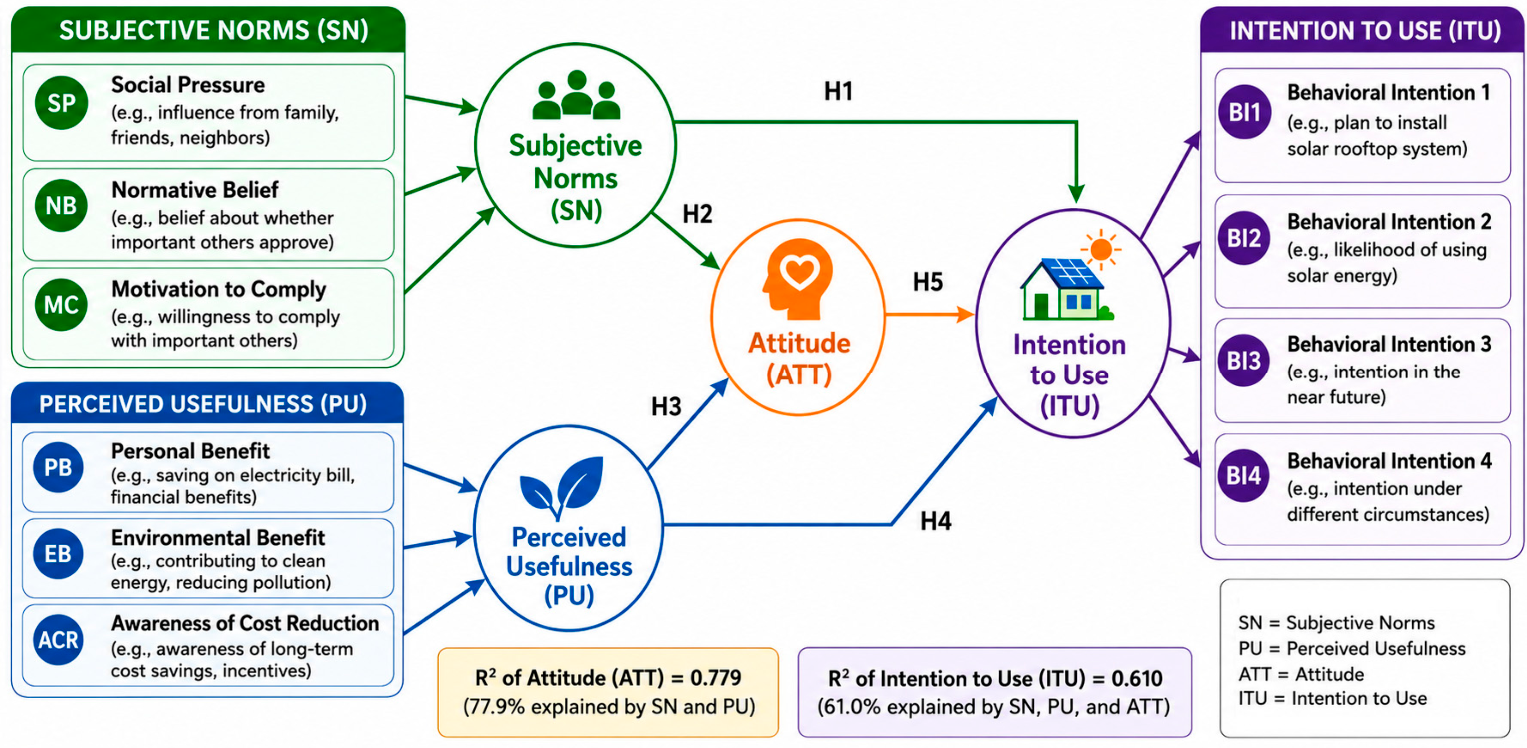
Based on the Theory of Planned Behavior (TPB), subjective norms are commonly conceptualized as a multidimensional construct comprising several interrelated components. Normative beliefs refer to a household’s perception that significant others believe they should install solar rooftop energy systems [
22,
23]. The influence of these beliefs may be particularly pronounced in collectivist societies such as Thailand, where social expectations often play an important role in shaping individual decision-making [
24]. Nevertheless, household technology adoption is also influenced by individual evaluations of costs and benefits, suggesting that subjective norms operate alongside other behavioral determinants [
25].
Subjective norms further encompass social pressure, defined as the influence exerted by family members, friends, neighbors, and other important reference groups on household decisions [
26,
27]. In addition, motivation to comply reflects the household’s willingness to conform to the expectations and recommendations of these influential groups [
28,
29].
Based on the theoretical and empirical literature, the following hypotheses are proposed:
H1. Subjective norms directly and positively influence the intention to use solar rooftop energy.
H2. Subjective norms directly and positively influence attitude toward using solar rooftop energy.
2.2. Perceived Usefulness
Perceived usefulness, an essential concept in the TAM, is defined as the level to which one perceives that their performance will be positively influenced by using the specific technology [
16]. Regarding a family’s uptake of solar rooftops, perceived usefulness refers to the benefits the family perceives in adopting solar power technology [
30,
31].
Earlier studies have found perceived usefulness to be a significant motivator of technology adoption. Perceived usefulness had a significant influence on pre-service teachers’ adoption of technology, which in turn was shaped by personal attitudes and beliefs [
32]. The study by Wang et al. [
33] found that perceived usefulness mediated the relationship between consumer knowledge and the intention to adopt electric vehicles. In solar energy studies, Ali et al. [
34] concluded that perceived usefulness and perceived convenience were important considerations for rooftop solar installations. In a similar vein, Aziz et al. [
9] found that perceived policy support, environmental concern, and perceived usefulness motivated consumers’ intentions to buy solar panels.
Notably, in the Thai environment, the presence of an economic expectation gap identified by Leewiraphan et al. [
11] indicates that although the households believe that solar energy is useful, their expectation that solar energy would be paid back within 3 to 5 years, compared to the 8 to 12 years that it actually takes, leads to the emergence of a gap between perceived usefulness and behavioral intention. Using TAM, perceived usefulness is operationalized as a second-order construct of the following three constructs:
Personal benefits: The convenience and quality-of-life improvements that households expect to gain from using solar rooftop energy [
30,
32,
34].
Environmental benefits: The perception that solar energy reduces pollution and contributes to a cleaner environment [
29,
30,
32].
Awareness of cost reduction: The household’s perception of reduced electricity costs compared with not installing a solar rooftop system [
29,
30,
32].
Based on the theoretical and empirical literature, we propose the following hypotheses:
H3. Perceived usefulness directly and positively influences attitude toward using solar rooftop energy.
H4. Perceived usefulness directly and positively influences the intention to use solar rooftop energy.
2.3. Attitude
Attitude is defined as the global judgment of an individual about the behavior, which can be either positive or negative [
15,
21]. As regards rooftop solar installation, an attitude can be viewed as the positive or negative judgment of the family about their installation and usage of the solar panels [
35,
36].
Attitude is an important construct in both theories, emerging as one of the strongest predictors of behavioral intention across a variety of scenarios [
37]. As stated by Zander et al. [
38], Australians’ motivation to adopt solar technology depends on individual attitudes, perceived cost, and perceived usefulness. Engelken et al. [
17] stated that attitude is a predictor of the intention to adopt renewable energy systems, making it an important motivational factor. According to the results of the study by Aziz et al. [
9], Malaysian consumers’ attitudes toward adopting solar panels mediate the relationship between their environmental concern and their purchase intention.
It is vital to note that attitude plays an important role in Thailand, given the strong emotional and cognitive evaluations people engage in when considering the adoption of solar energy. The work by Leewiraphan et al. [
11] showed that consumers in Thailand value solar energy for monetary gains, social status, environmental concerns, and quality of life.
Based on the tri-component approach to attitudes [
35,
38], attitude is viewed as a second-order construct and comprises the following three components:
Cognitive component: The knowledge, beliefs, and cognitive reasoning that households use to assess solar rooftop energy, such as cost–benefit analysis, reliability, and future implications [
34,
37,
39,
40].
Affective component: The emotions, such as interest, pride, or worries, that households have about solar rooftop energy [
38,
41,
42].
Behavioral component: The inclination to behave in a certain way towards solar rooftop energy [
9,
35,
41].
Hypothesis based on existing literature:
H5. Attitude directly and positively influences the intention to use solar rooftop energy.
2.4. Intention to Use
Intention to use is defined as an individual’s conscious intention to behave in a certain way in the future [
43,
44,
45]. In TPB and TAM models, intention is the closest antecedent to behavior and reflects the factors that motivate individuals to act in a certain way [
15,
16].
As noted in prior literature, intention has been established as the primary dependent variable in studies of renewable energy technology adoption. For example, Kim et al. [
18] found that system quality, perceived usefulness, and reliability were important determinants of South Korean households’ intention to adopt solar energy technology. Fornara et al. [
19] observed that moral factors and normative influences affected households’ energy-efficiency intentions. Kottala et al. [
46] showed that consumers’ intention to adopt electric vehicles was influenced by perceived value.
In the Malaysian context, Raman et al. [
47] investigated multiple factors influencing SMEs’ intention to adopt solar energy technology (SET). Their study examined four categories of determinants: (i) technical and economic factors (perceived usefulness, perceived ease of use, perceived level of competition pressure, and perceived price); (ii) dispositional factors (perceived relative advantage); (iii) organizational factors (entrepreneur’s awareness, entrepreneur’s technology readiness, and SMEs’ readiness); and (iv) environmental factors (government’s support and initiative).
Notably, two major mediations were found in the study, which include mediation of perceived usefulness in the relation between relative advantage and intention to adopt the technology and mediation of perceived ease of use in the relation between technology readiness and intention to adopt the technology. The implications from the above are that perceived usefulness and perceived ease of use play very important mediating roles in the process of translation of entrepreneurs’ perceptions and readiness into intention to adopt the technology.
Following the conceptualization of intention in TPB and TAM, we operationalize intention to use as a unidimensional construct, captured by behavioral intention—the household’s self-reported likelihood of installing and using rooftop solar energy in the future [
43,
44,
47].
2.5. Conceptual Framework
Considering the theoretical framework and hypotheses developed above, we present the conceptual model in
Figure 1. In addition, the model defines the relationships among the three predictor variables (subjective norm, perceived usefulness, and attitude) and the outcome variable (intention to use). It should be noted that the dimensional structure of each latent variable was taken into account when developing the model.
3. Materials and Methods
This study adopted a quantitative approach. The literature review involved secondary data collection from books, peer-reviewed journals, government publications, and other relevant sources on the adoption of solar energy and residential energy consumption in Thailand. The literature sources were obtained by searching for relevant keywords, including ‘solar energy adoption’, ‘residential solar power’, ‘renewable energy policy’, and ‘household energy consumption’, in academic databases such as Google Scholar, ScienceDirect, and Scopus, as well as official documents from relevant public/private organizations.
The questionnaire was used to gather data from homeowners and household members living in Thailand (excluding flats/condominiums). The set of questionnaires gathered data from 255 respondents.
3.1. Questionnaire Design
The questionnaires were constructed such that the measures would be easy to obtain in accordance with the conceptual framework; hence, a seven-point Likert scale was employed [
48] (Please see
Appendix A). Five experts in solar energy scrutinized the comprehensiveness and extent of the content, as well as the language, to ensure that respondents would be able to understand the relevant content clearly. These experts were selected for their expertise and careers in solar energy in Thailand, including university professors, regulators, and businesspeople involved in rooftop solar projects.
The index of item-objective congruence (IOC) was then used to select items with IOC ≥ 0.50 for use. Thirty sets of questionnaires were administered to homeowners and residents as a pretest to assess the tool’s reliability using Cronbach’s alpha. Questionnaires with observed variables that have a reliability score greater than 0.70 are considered highly reliable [
49]. It was found that Cronbach’s alpha was 0.95, which is greater than 0.70, thus indicating very high reliability. Additional items related to government policy were included for exploratory purposes but were not part of the main hypothesis testing.
3.2. Data Collection
In the current study, the population consists of owners or occupants of houses constructed of cement and brick in areas with sunlight. Apartments or condominiums have been excluded because occupants cannot install solar panels. In the study, the sample size is determined at 20 samples for each observed variable.
Various studies contend that a structural equation model (SEM) requires a larger sample size than other models to provide accurate estimates and a more accurate representation of the population [
50]. In the study, the model was used along with the normal distribution curve. There were thirteen observed variables in the study. Thus, the total expected sample size is 260 households [
51]. The final sample comprised 255 respondents, including 237 household respondents and 18 experts and public sector executives. The inclusion of these respondents did not substantively alter the key findings, and they were retained to maximize statistical power. The participants were chosen from different gender groups, age ranges, regions, and occupations.
3.2.1. Criteria for Selection
The respondents had to fulfill the following criteria: (1) house owners or family members who are above 18 years old; (2) living in detached houses, duplex houses, town houses or row houses (excluding flats and condominiums); (3) location that received enough sunlight to place solar panels on rooftops; and (4) person(s) who made decisions regarding energy in their household.
3.2.2. Methods of Recruiting Participants
Purposive sampling was used for recruiting participants from all four regions of Thailand (Central, North, Northeast, South). The sources of recruiting participants were as follows: (1) community leaders and offices of local government that helped find eligible participants; (2) community centers, markets and other events organized in selected districts; and (3) local community Facebook pages. Stratified sampling was used to ensure representation of genders, age, region and occupation.
3.2.3. Distribution of Geographic Areas
Data collection was performed in all four regions of Thailand in the following provinces: Bangkok and surrounding provinces (Central region), Chiang Mai (North), Khon Kaen (Northeast), and Songkhla (South) (
Table 1).
3.3. Data Analysis
In order to conduct the analysis, the following was performed:
Descriptive statistics, mean, and standard deviation (SD), as well as the Kaiser-Meyer-Olkin (KMO) test, were used in order to assess the fitness of the data for the goodness of fit (GF). The higher the KMO index (approaching 1), the more appropriate it is to use the factor analysis technique on the provided data. For KMO < 0.5, factor analysis cannot be applied to the provided data.
Assuming that the hypotheses are accepted, it can be concluded that there is no interdependence between the factors [
51]. In the structural equation modeling (SEM), the statistical significance level or the accepted level of errors (α) in the study was set at 0.05 (α = 0.05). C.R. (critical ratio or t-value) ≥ 1.96 and
p-value < 0.05 were considered in the SEM and used to analyze the relationship between the variables in the conceptual model, both directly and indirectly.
AMOS was also used in the confirmatory factor analysis (CFA) to investigate the scale accuracy [
52]. The purpose was to investigate hypotheses regarding the relationships among the latent and manifest variables and between exogenous and endogenous latent variables, based on maximum likelihood (ML) parameter estimation (
Table 2).
4. Results and Analysis
A total of 260 questionnaires were distributed. Of these, 255 responses were returned, yielding a response rate of 98.08%.
4.1. Sociodemographic Profile of Respondents
The sociodemographic profile of the final household sample is presented in
Table 3.
4.2. Descriptive Statistics
Table 4 presents the descriptive statistics for all observed variables in the study. Among the subjective norms dimensions, normative belief had the highest mean (M = 4.35, SD = 1.41), followed by social pressure (M = 4.11, SD = 1.43) and motivation to comply with the referent (M = 4.09, SD = 1.42). For attitude, the cognitive component recorded the highest mean (M = 5.38, SD = 1.33), followed by the affective component (M = 5.30, SD = 1.37) and the behavioral component (M = 5.15, SD = 1.50). Regarding perceived usefulness, environmental benefit had the highest mean (M = 5.61, SD = 1.25), followed by awareness of cost reduction (M = 4.98, SD = 1.41) and personal benefit (M = 4.94, SD = 1.40). The overall intention to use had a mean of 4.03 (SD = 1.62), with individual behavioral intention items ranging from 3.52 (BI4) to 4.59 (BI2). Notably, the mean scores for attitude (M = 5.28) and perceived usefulness (M = 5.18) were substantially higher than the mean for intention to use (M = 4.03), suggesting a gap between positive perceptions and actual adoption intentions—a pattern consistent with the economic expectation gap documented in Thai solar adoption research [
11].
The value of Bartlett’s test of sphericity (
Table 5) was 2843.903, df = 78 (
p = 0.000). This implies that the correlation matrix was different from the identity matrix, with a statistical significance of 0.01, conforming to the KMO analysis, in which the value was close to 1 (KMO = 0.912), implying that the observed variables were suitable for the goodness-of-fit examination.
4.3. Structural Equation Model Analysis
In regard to the SEM analysis, the combination of multivariate analysis and multiple regression was used for the purpose of establishing the connection between the variables. As a result of the research, the following findings were obtained: Chi-square (χ
2) = 40.210, df = 41, *
p* = 0.506, χ
2/df = 0.981, GFI = 0.976, CFI = 1.000, AGFI = 0.946, and RMSEA = 0.000. The goodness-of-fit of the model and empirical data had a significance level of 0.05 (
Table 6).
The model contained 52 free parameters, with 13 observed variables and 41 degrees of freedom. The CFI = 1.000 and RMSEA = 0.000 values indicate a just-identified model where the specified structure closely matches the data. These values should be interpreted with caution, alongside other fit measures (GFI = 0.976, AGFI = 0.946), all of which indicate good fit.
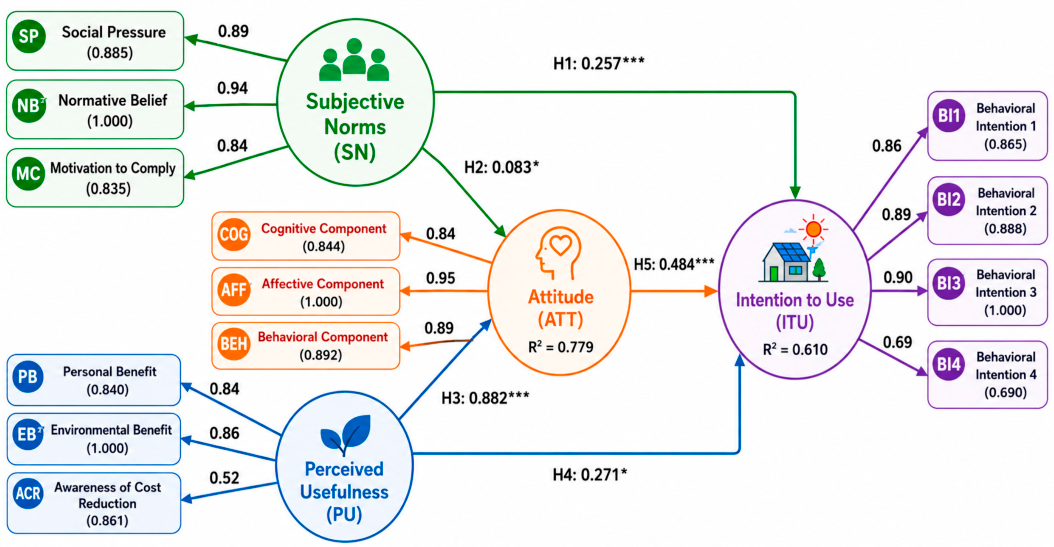
The standard regression weights and squared multiple correlation (R
2) were relatively high and statistically significant, indicating that the measurement model is appropriately specified. For the intention-to-use construct, standardized regression weights ranged from 0.69 to 0.90, with R
2 from 0.48 to 0.82. As for attitude, the standardized regression weights ranged from 0.84 to 0.95, while R
2 ranged from 0.71 to 0.894. For perceived usefulness, standardized regression weights ranged from 0.72 to 0.86, and R
2 ranged from 0.52 to 0.74. Finally, subjective norms have weights ranging from 0.84 to 0.94, with R
2 varying from 0.70 to 0.88. All factor loadings are above 0.60 [
51], meaning convergent validity. High R
2 values also indicate that the measures of latent constructs are reliable. Consequently, the researchers’ model fits well with empirical data [
53,
54]. The results of both the measurement and structural models are presented in
Table 7, while
Figure 2 shows the final model with standardized path coefficients.
Although discriminant validity was supported for most construct pairs, both the Fornell-Larcker criterion and the HTMT ratio indicated insufficient discriminant validity between Perceived Usefulness and Attitude (HTMT = 1.218). This limitation is acknowledged and should be considered when interpreting the structural relationships between these constructs.
4.4. Measurement Model Results
In order to check the reliability and convergent validity of the measurement model, Composite Reliability (CR) and Average Variance Extracted (AVE) were calculated for each latent variable. As can be seen from
Table 8, all CR scores were higher than 0.70, which indicates that the level of internal consistency reliability is acceptable [
51]. Moreover, all AVE values were higher than 0.50, which means that convergent validity was also acceptable, i.e., each latent variable explains at least 50% of the variance of its indicators [
55].
Discriminant validity was generally supported across the measurement model (
Table 9). However, both the Fornell-Larcker criterion and the Heterotrait–Monotrait (HTMT) ratio indicated insufficient discriminant validity between the Perceived Usefulness and Attitude constructs (HTMT = 1.218), suggesting limited empirical distinction between these measures. Although these constructs are theoretically closely related within the Technology Acceptance Model [
16], this finding represents a limitation of the measurement model and should be considered when interpreting the structural relationships involving these constructs.
4.5. Structural Model Results
According to the analysis, the model could be developed as follows:
According to the equation, the intention to use was positively and significantly affected by subjective norm, attitude, and perceived usefulness. The variance in the intention to use could be explained by the three factors (61%), with the remainder explained by other factors.
4.6. Hypothesis Testing Results
The test was performed, and the standardized coefficients were computed based on the C.R. (
t-test) and the
p-value. The results of the hypothesis tests showed that there was statistical significance in the standardized coefficient of each direction in the relationship based on the hypotheses because the C.R. is greater than 1.96 (
p < 0.05). Therefore, it can be seen that the results of the analysis confirmed all the hypotheses. The impacts of the factors are shown in
Table 10.
Subjective norms significantly affect intention to use; the hypothesis test result shows that the standardized coefficient = 0.26. Consequently, H1 was accepted and found statistically significant.
Subjective norms significantly affect attitude; the hypothesis test result shows that the standardized coefficient = 0.08. Consequently, H2 was accepted and found statistically significant.
Perceived usefulness significantly affects attitude; the hypothesis test result shows that the standardized coefficient = 0.882. Consequently, H3 was accepted and found statistically significant.
Perceived usefulness significantly affects intention to use; the hypothesis test result shows that the standardized coefficient = 0.27. Consequently, H4 was accepted and found statistically significant.
Attitude significantly affects intention to use; the hypothesis test result shows that the standardized coefficient = 0.48. Consequently, H5 was accepted and found statistically significant.
5. Discussion
A quantitative research method was adopted in this study to determine the factors influencing Thai households’ intention to adopt rooftop solar energy. Data for the analysis were collected from 255 households from all four regions of Thailand, and the integrated TPB-TAM model was tested using SEM. All proposed hypotheses were accepted because the model explained 61% of the variance in intention to use (R2 = 0.61). It was found that attitude is the strongest predictor, followed by usefulness and subjective norms.
5.1. Attitude as the Strongest Predictor (H5)
The observation that attitude is the main predictor of intention to use (β = 0.48,
p < 0.001) is consistent with prior findings from the TPB and TAM perspectives [
56]. Engelken et al. [
17] established that attitude is a predictor of the intention to purchase renewable energy systems. In contrast, Zander et al. [
38] noted that attitude, together with cost and perceived usefulness, significantly influenced the motivation to install solar systems among Australian consumers. In Southeast Asia, Aziz et al. [
9] also found that attitude mediates the effect of environmental concern on the intention to purchase solar panels in Malaysia.
The high impact of attitude in Thailand could be explained by several factors [
57]. First, Thai people assess solar energy not only from the perspective of financial gains but also from social status, environmental considerations, and quality of life—factors that shape attitudes towards the technology [
58,
59]. Secondly, the three-part model of attitude used in this research—cognitive, affective, and behavioral dimensions—takes into account the multivariate nature of household decision-making. As for the affective (β = 0.95) and behavioral (β = 0.89) dimensions, they are the most influential parts of the total attitude measure [
60].
Theory Implication
The high level of attitude’s impact underscores the important role of attitude in both models—TPB and TAM. On the other hand, the results of this study indicate that, under Thai family conditions, attitude could play an even more significant role than in Western cultures due to collectivistic cultural values, as individual evaluation is based on both personal and social factors [
24,
57].
5.2. Perceived Usefulness and the Mediation Pathway (H3, H4, and Indirect Effect)
The perceived usefulness construct had a direct impact on intention to use (H4: β = 0.27,
p < 0.05) [
61], as well as an indirect one through attitude (indirect effect = 0.43; total effect = 0.70). This pathway has theoretical significance, indicating that households assess the usefulness of solar energy not only directly but also indirectly through the attitude construct, meaning that perceptions of usefulness determine overall attitude, which then influences behavioral intention.
This finding is consistent with the theory of TAM, where it has been suggested that perceived usefulness influences behavioral intention either directly or indirectly through attitude [
16]. Earlier studies have confirmed this finding. According to Kim et al. [
18], the perceived usefulness of solar energy technology positively affected the intention to use it among South Korean households. On the other hand, Wang et al. [
33] found the mediation effect of perceived usefulness between knowledge and intention for electric vehicles.
Nevertheless, the expectation gap between perceived economic expectations and reality, as identified by Leewiraphan et al. [
11], might act as an intervening factor. On average, Thai consumers expect paybacks within 3–5 years, whereas in reality, the period spans 8–12 years. This gap would reduce the influence of perceived usefulness on intentions to adopt solar energy, as consumers might consider this energy source potentially useful yet economically unrealistic. Policy implication: To strengthen the influence of perceived usefulness, policymakers should find ways to bridge the gap through financial tools, such as subsidized loans, solar leasing schemes, or guaranteed feed-in tariffs that reduce the payback period.
Practical implication: Since perceived usefulness has a strong indirect influence through attitude, campaigns aimed at raising awareness of the benefits of solar energy should not focus solely on the practical advantages of this source but also seek to build positive attitudes towards adopting it.
5.3. Subjective Norms (H1 and H2)
Subjective norms have had a significant, albeit comparatively weaker, impact on intention to use (H1: β = 0.26,
p < 0.001) and attitude (H2: β = 0.08,
p < 0.05). The result that subjective norms affect both attitudes and intention is in accordance with TPB [
12,
15] as well as empirical research by Ali et al. [
10], which indicated that subjective norms positively affect Pakistani consumers’ attitudes towards energy-saving products, and Sreen et al. [
20], which showed a similar relationship between subjective norms and green purchase intentions in India.
The relatively low impact of subjective norms compared with attitude and perceived usefulness is remarkable. Social influence should be particularly high in collectivist societies such as Thailand [
24]. However, our results show that, for decision-making regarding the use of solar energy in households, which requires significant monetary and long-term investments, personal cost–benefit assessments (perceived usefulness) and individual evaluations (attitude) override social influence.
Possible explanations:
Practical implication: The lower impact of subjective norms indicates that policymakers need to consider ways to increase social influence and social proof, such as demonstrations of successful projects.
5.4. The Intention–Behavior Gap and Social Desirability Bias
One of the significant findings of the current research is the discrepancy between the high values of the attitude (M = 5.28) and perceived usefulness (M = 5.18) variables and the relatively low value of the intention to use variable (M = 4.03). There are two explanations for such a result.
First, it may be explained by social desirability bias—participants stated positive attitudes toward solar energy (it is a socially desirable position), but intention values were more realistic [
6,
37]. In survey studies related to environmentally responsible actions, participants tend to exaggerate their positive attitudes and intentions under the influence of social norms [
19]. We agree that it is a potential drawback of our study and advise future researchers to use indirect measures or behavioral monitoring.
Another reason for this discrepancy might be the intention-behavior gap found in the context of renewable energy [
7,
62]. Although households may have positive attitudes towards solar power generation, adoption will still be hindered by financial constraints, the complexity of the process, and uncertainties about future gains [
35,
63]. This interpretation follows the economic expectation gap mentioned above [
11].
Limitation: Our research, being cross-sectional in nature, was only able to measure intention, not actual behavior. Further studies will need to use a longitudinal approach to measure behavior change.
5.5. Comparison with Conflicting Literature
Although our results largely align with previous studies, other studies have reported different results. For instance, Engelken et al. [
17] showed that PBC had a greater impact on the decision to adopt renewable energy than attitude did (
Table 11). The reduced importance of subjective norms compared to other studies may be linked to the fact that, in collectivist societies, social influence is much more pronounced [
24].
Possible reasons for these differences:
Theoretical implication: The above differences show the importance of conducting research in the specific context. Even though TPB and TAM are general frameworks, the relative importance of the different elements varies depending on culture, economy, and policies. In the context of households in Thailand, our results show that attitude is the main determinant of intention to adopt.
5.6. Cross-Country Implications
The results obtained from this study can be referenced by other Southeast Asian countries that face the same problems, including dependence on fossil fuels, high import costs, and rising power consumption. There are other countries, such as Indonesia, Vietnam, Malaysia, and the Philippines, that have also adopted renewable energy policies.
Relevance to other countries:
Attitude-based interventions: Because attitude proved to be the strongest predictor variable, public campaigns must take into account not just informational components but also the need to create a favorable attitude towards solar energy, viewing it as being modern, desirable, and eco-friendly.
Bridging the economic expectation gap: This expectation gap may arise in other developing nations having a similar economic environment. This factor must be taken into consideration when designing appropriate financial solutions, such as low-interest financing or leasing schemes.
Visibility through social proof: Considering the weak effect of subjective norms on adoption, there must be ways to use the normative route to adoption through demonstrations and visibility of solar power installations.
Simplification of administrative procedures: In accordance with the experience described for the Thai case, complicated permitting requirements and confusing regulations prevent implementation. A simplified, clear process is a key factor in increasing the adoption of solar power.
It is necessary to acknowledge that there will be variations in the context of the grid systems, subsidies, regulations, and culture between countries. For instance, although the TPB-TAM model appears relevant, the significance of each element will depend on the specific country’s energy policy and economic development, as well as its culture [
24].
5.7. Limitations and Future Research
This study has several limitations that should be acknowledged.
First, the sample included only owners of detached houses and excluded owners of apartments or condominiums. Thus, the results of this study cannot be generalized to other population groups living in different types of housing in Thailand. Future research should consider a wider range of housing types and their ownership.
Second, the design of this study was cross-sectional and quantitative, and it measured participants’ perceptions only during a specific period. Thus, people’s behavior could change, and future research should consider a longitudinal or mixed approach, including interviews or focus groups.
Third, the data were collected before the COVID-19 pandemic (2019–2020). Although this is interesting data on the intention to use renewable energy sources before the pandemic, the situation after the pandemic could affect households in many ways, and the results may differ now. Thus, the recent increase in government incentives (tax deductions until 2026, a simplified permitting process) means adoption patterns have changed since then.
Fourth, the study focused primarily on behavioral aspects and did not analyze other variables such as trust in government, financial literacy, and respondents’ income levels. Further studies can examine these economic and policy-oriented variables to gain a more holistic perspective on rooftop solar energy adoption.
Fifth, both the Fornell-Larcker criterion and the Heterotrait–Monotrait (HTMT) ratio indicated insufficient discriminant validity between the Perceived Usefulness and Attitude constructs (HTMT = 1.218), suggesting limited empirical distinction between these measures. This finding may reflect the close theoretical relationship between perceived usefulness and attitude proposed in the Technology Acceptance Model [
16], in which perceived usefulness is a primary antecedent of attitude.
However, theoretical relatedness does not eliminate the observed lack of discriminant validity, and the strong association between these constructs should therefore be considered when interpreting the structural path from perceived usefulness to attitude (H3: β = 0.882) and the associated mediation pathway. Future research should refine the operationalization of these constructs and further evaluate discriminant validity using revised measurement items and complementary validation approaches.
Sixth, the relatively high mean scores observed across several constructs may indicate the presence of a ceiling effect, consistent with the potential influence of social desirability bias discussed in
Section 5.4. Bootstrap confidence intervals for the indirect effect were not available in the present analysis; therefore, future studies should evaluate mediation using bootstrap procedures to obtain more robust estimates of indirect effects.
Seventh, a formal sensitivity analysis comparing the full sample (n = 255) with a household-only sub-sample (n = 237) could not be conducted because the original dataset and AMOS output files are no longer accessible to the authors. The data were collected in 2019–2020 and the lead author has since graduated. Future research should replicate this study using an exclusively household sample to confirm the stability of the findings.
6. Conclusions
This study found that attitude was the strongest predictor of household intention to use solar rooftop energy in Thailand (β = 0.48, p < 0.001), followed by perceived usefulness (β = 0.27, p < 0.05) and subjective norms (β = 0.26, p < 0.001). The integrated TPB-TAM model explained 61% of the variance in intention to use (R2 = 0.61). These findings confirm that household adoption decisions are shaped primarily by cognitive and emotional evaluations of solar energy, rather than social pressure alone.
6.1. Summary of Key Findings
This study contributes to the literature on solar rooftop adoption in Thailand in several ways.
First, the significant impact of attitude underscores the importance of cognitive evaluations and affective reactions in the decision-making process. Household decisions appear to involve not only rational cost–benefit considerations but also emotional and attitudinal evaluations; rather, their decisions are influenced by emotions, social perspectives, and personal attitudes towards the desirability of solar energy. The cognitive (knowledge/reasoning) and affective (emotion) dimensions were most prominent predictors of attitude, implying that any public campaign needs to appeal to reason as well as emotions.
Second, the indirect effect of attitude between perceived usefulness and intention to use (indirect effect = 0.43) suggests that perceived usefulness may operate both directly and indirectly through attitudinal evaluation. This suggests that fostering a positive attitude towards solar energy may be as important as providing information about its benefits. However, this finding is preliminary and should be confirmed with formal bootstrap mediation testing in future research.
Third, the lower impact of subjective norms suggests that in high-involvement financial decisions (e.g., installing solar panels), personal evaluations prevail over social pressures. This issue is critically important for policy implications.
6.2. Theoretical Contributions
Second, this paper provides suggestive empirical evidence for the mediating role of attitude in the perceived usefulness-intention relationship. As suggested by Margraf et al. [
64], perceived usefulness is a key factor in users cultivating a favorable attitude toward technology [
65]. The point estimate of the indirect effect (IE = 0.43) is consistent with this theoretical expectation. However, due to the absence of bootstrap confidence intervals and the observed discriminant validity overlap between perceived usefulness and attitude, this mediation finding should be interpreted as an exploratory observation requiring confirmation in future research. Formal bootstrap procedures with a minimum of 2000 resamples are recommended to establish the statistical significance of the indirect effect.
6.3. Practical and Policy Implications
Based on the findings, we propose the following actionable policy recommendations.
6.3.1. Intervention Strategies Based on Attitude
Since attitude turned out to be the key factor influencing intention, government interventions are recommended to focus on creating a positive attitude towards solar energy:
Creating campaigns that would portray solar energy as a modern, fashionable, and socially responsible technology, taking into account both cognitive (financial and ecological benefits) and affective (pride, social status) aspects.
Demonstration projects in local communities where people could have a firsthand experience of using the solar energy technology.
Personal testimonies from early adopters.
6.3.2. Narrowing the Economic Expectation Discrepancy
There is likely a negative effect on the usefulness-intention correlation due to an expectation-reality discrepancy between the expected payback period (3 to 5 years) and the actual (8 to 12 years). Some ways to narrow such an expectation discrepancy include the following:
Creating a loan scheme based on a low interest rate (for instance, under 3% per annum);
Leveraging the idea of solar leasing, where residents can use solar technology without initial expenditure at all, repaying the costs through monthly payments based on saved electricity expenses;
Supplying people with the guaranteed feed-in tariffs or net-metering policies to compensate them appropriately for the extra energy they produce;
Tax deduction (in particular, personal income tax deduction in 2026) and other subsidies.
6.3.3. Enhancing the Normative Route
Subjective norms played a less significant role; however, this route cannot be overlooked by policymakers. In order to enhance social influence:
Enhance the visibility of solar panels installed on publicly owned buildings, community centers, and schools to normalize solar adoption.
Form community-based initiatives that promote adoption at the neighborhood level, leveraging social ties to create peer pressure.
Involve community leaders who can serve as solar champions.
6.3.4. Streamlining of Administrative Procedures
Complicated permitting processes and unclear regulations hamper the use of solar power systems. Therefore, governments should:
Make the permit application process as simple as possible, reducing costs and delays;
Develop one-stop services for applications to install solar systems;
Allow residents not to make changes to their buildings unnecessarily (as has been started since 2026).
6.3.5. Energy Security and Sustainability
In addition to the individual advantages of using solar panels, rooftop solar systems provide national energy security benefits by reducing reliance on imported fossil fuels and contributing to Thailand’s carbon reduction targets under the Alternative Energy Development Plan (AEDP). Policymakers must view the use of solar energy systems as a national priority, not just an individual decision.





 male
male