Article

Sustainable Acoustic Bio-Nanocomposites from Recycled HDPE and Modified Rice Straw Nanofillers: Performance and Biodegradability


1
Department of Physics, Faculty of Science, Cairo University, Giza 12613, Egypt
2
Department of Acoustics, Mass and Force Metrology Division, National Institute of Standards, El-Sadat Street, Giza 12211, Egypt
3
Materials Testing and Surface Chemical Analysis Laboratory, National Institute of Standards, El-Sadat Street, Giza 12211, Egypt
*
Author to whom correspondence should be addressed.
Sustainability 2026, 18(14), 7005; https://doi.org/10.3390/su18147005
Submission received: 11 June 2026 / Revised: 6 July 2026 / Accepted: 7 July 2026 / Published: 9 July 2026

Abstract

The valorization of agricultural residues and post-consumer plastics is critical for achieving a circular economy. This study presents a sustainable pathway to fabricate eco-friendly acoustic panels by melt-blending recycled high-density polyethylene (rHDPE) with 10–50 wt% rice straw waste-derived nanofillers. Multi-stage chemical refinement (10% NaOH mercerization and H2O2 bleaching) before ball milling isolated nanofibrils under 50 nm. XRD analysis showed a crystallinity index increase from 37.0% (untreated) to 67.2% (bleached), confirming amorphous phase removal. FTIR and SEM verified successful delignification and excellent interfacial wetting. Consequently, the 50 wt% bleached cellulose composite exhibited the highest reinforcement, increasing flexural strength by 126% and flexural modulus by 132.6% over neat rHDPE. The hydrophilic framework enhanced environmental biodegradability, yielding a 15.18% maximum weight loss after a 90-day soil burial test, providing a viable end-of-life alternative to persistent synthetics. To optimize acoustic utility, a 1.76% geometric micro-perforation ratio was engineered into the panels. Backed by a 6 cm air cavity, the 50 wt% untreated composite achieved an outstanding peak sound absorption coefficient of 0.98 at a low frequency of 400 Hz. These findings establish these high-filler bio-nanocomposites as high-performance, low-carbon alternatives for noise control in construction and automotive infrastructure.

1. Introduction

In recent years, environmental sustainability has emerged as a key factor in the selection of materials for new product development, driven by heightened global ecological awareness and the implementation of stringent regulations. The creation of innovative bio-composites, consisting of recycled materials where post-consumer polymers serve as matrices and agro-waste fibers act as reinforcing agents, promises to expand the potential of these materials [1,2]. A deeper understanding of fiber–matrix interactions will further improve their properties and broaden their applications. This approach not only minimizes environmental impact but also contributes to carbon cycle closure, promoting the production of greener composites. Natural fiber-reinforced thermoplastic composites are increasingly being utilized in industries such as furniture, architecture, construction, and automotive manufacturing [3,4,5]. The global plastic consumption rose from 2 million tons in 1950 to 400.3 million tons by 2022, with annual production hitting 412 million metric tons. Synthetic fibers exceed 60 to 70 million tons annually [6,7]. Sector consumption is led by packaging (38%), building/construction (21%), automotives (7%) and other sectors like medicine and leisure (28%). Conventional disposal leaves 79% of accumulated plastic in landfills or ecosystems, with 8 to 10 million tons entering oceans annually. This causes a 1% to 5% reduction in marine ecosystem services, translating to roughly 2500 billion in annual economic losses. Mitigating these losses requires circular, multi-tiered valorization, including chemical recycling (pyrolysis/gasification) and biological degradation via microorganisms or invertebrates [7,8].
The use of recycled high-density polyethylene (rHDPE) has gained considerable attention due to its significant environmental and economic advantages. Environmentally, rHDPE offers a sustainable solution by reducing plastic waste, thus minimizing pollution and the consumption of natural resources. Recycling HDPE also requires less energy than the production of virgin plastic [9], resulting in lower greenhouse gas emissions and contributing to resource conservation, particularly of fossil fuels. Economically, rHDPE presents a cost-effective alternative to virgin HDPE, lowering production costs for manufacturers while increasing market value [10], as products made from recycled materials appeal to environmentally conscious consumers. Additionally, incorporating rHDPE into the supply chain stabilizes plastic material availability, reducing reliance on raw materials and mitigating price volatility. Beyond these benefits, rHDPE maintains its strength, durability, and versatility, making it applicable across diverse industries, including construction, packaging, and consumer goods. Furthermore, its ability to be recycled multiple times supports the principles of a circular economy. As such, the adoption of rHDPE in various sectors not only promotes sustainability but also provides a resilient and flexible material choice.
Rice straw, an abundant agricultural byproduct, presents a promising opportunity for repurposing as a filler material in various industrial applications. Its utilization offers multiple environmental benefits [11,12], including the reduction of landfill waste and promotion of sustainability as a renewable resource. Additionally, incorporating rice straw in products can contribute to carbon sequestration, aiding in offsetting carbon emissions [13]. Economically, rice straw is a cost-effective alternative to traditional fillers, and its use can provide farmers with an additional revenue stream. Performance-wise, rice straw’s lightweight nature, insulating properties [14], and absorption capacity make it well suited for applications in sectors such as packaging, construction, and filtration. Its versatility extends to composite material production, where it can be combined with other substances to create durable materials for the construction, packaging, and automotive industries. Furthermore, rice straw serves as a valuable component in animal feed and can be converted into biofuels such as ethanol and biogas, further contributing to sustainable energy solutions. As such, the integration of rice straw into industrial processes not only supports environmental sustainability and economic viability but also encourages the development of circular economy practices that reduce reliance on non-renewable resources.
Enhancing recycled high-density polyethylene (rHDPE) with fillers presents a strategic approach to improving its material properties [15], particularly in sound insulation applications. The integration of fillers into rHDPE not only improves its mechanical properties but also significantly enhances its acoustic insulation capabilities [16], making it ideal for noise reduction in building and automotive sectors. This composite structure effectively absorbs and dampens sound, thereby contributing to a quieter and more comfortable environment. Environmentally, the addition of fillers, especially from natural or recycled sources such as agricultural byproducts, further reduces the environmental footprint by minimizing the reliance on virgin raw materials and lowering the overall weight of products. Economically, these fillers offer a cost-effective means of improving the performance of rHDPE [17], lowering the need for expensive soundproof alternatives. From a performance standpoint, fillers contribute to enhanced thermal and acoustic insulation, increased strength [18], and improved durability. Additionally, the use of lightweight fillers can lead to more energy-efficient transportation and installation processes. Overall, incorporating fillers into rHDPE for sound insulation applications supports the creation of high-performance, eco-friendly materials that align with both sustainability goals and the growing demand for energy-efficient, acoustically optimized solutions.
Recent advances have focused on improving the mechanical and acoustic properties of recycled polymer composites reinforced with agricultural residues. For example, Sharma et al. [19] successfully developed short-fiber composites from paddy straw and recycled polymers, highlighting the potential of agro-waste for eco-friendly materials. Similarly, Xu et al. [20] analyzed acoustic emission behaviors in waste-fiber-reinforced recycled HDPE, demonstrating improved toughness but limited insights into sound absorption mechanisms. Reviews by Namakka et al. [21] further emphasize that while biocomposites from agricultural residues offer strong potential for sustainable acoustic applications, studies focusing on fiber–matrix interaction and energy dissipation remain scarce. Although earlier works have examined the mechanical and thermal behavior of rice straw/HDPE composites, such as Wang et al. [22], the optimization of acoustic insulation in rHDPE/rice straw composites has received minimal attention.
Despite these advancements, maximizing the degradable volume fraction via high loadings (up to 50 wt%) of lignocellulosic fillers traditionally causes severe mechanical deterioration [23]. This is rooted in the thermodynamic incompatibility between the highly polar, hydrophilic natural fibers and the non-polar, hydrophobic rHDPE matrix, which triggers poor interfacial wetting and delamination under load [24]. To circumvent this, ultra-fine mechanical nanogrinding was implemented; reducing the filler to nanoscale dimensions drastically multiplies the specific surface area, promoting enhanced mechanical interlocking and uniform dispersion to counteract property drop-offs at high weight fractions. Furthermore, achieving high-efficiency acoustic absorption at low-frequency regimes remains a challenge. While dense biocomposites dampen high frequencies (>1000 Hz) passively, the 200–500 Hz band encompassing the fundamental energy of human speech is notoriously difficult to attenuate without unviably increasing panel thickness [25]. This work addresses these convergent gaps by evaluating how sequential chemical purification and mechanical nanogrinding tune polar fiber surfaces for strong adhesion with non-polar rHDPE, while simultaneously combining these dense matrices with engineered micro-perforations and air cavities to selectively capture low-frequency noise.
To address the dual challenges of agro-industrial waste accumulation and post-consumer plastic pollution, this study aims to develop high-performance, eco-friendly bio-nanocomposites by melt-blending recycled high-density polyethylene (rHDPE) with high loading levels (10 to 50 wt%) of rice straw-derived nanofillers. The resulting materials were fabricated into 4 mm thick functional insulation panels using a cleaner compression molding technique. This work systematically investigates the synergistic effects of chemical purification stages, agricultural filler loading, and engineered micro-perforation geometries on low-frequency acoustic absorption performance (200–1600 Hz) to establish their viability as sustainable indoor noise-attenuation alternatives. Furthermore, to validate their circular economy credentials and establish their long-term environmental behavior, the panels’ mechanical and thermal stability were rigorously evaluated alongside comprehensive water absorption kinetics and soil biodegradation characteristics.

2. Materials and Methods

2.1. Materials

Recycled high-density polyethylene (rHDPE) is obtained from waste recycling centers in Egypt. The rice straw was collected from rice farms in Egypt. Toluene, ethanol, sodium hydroxide, and hydrogen peroxide were purchased from Alfa Aesar, Karlsruhe, Germany.

2.2. Treatment of Rice Straw

The purification of rice straw was conducted through a multi-stage chemical process to isolate pure cellulose, followed by mechanical disintegration. Initially, the raw rice straw underwent a dewaxing pre-treatment using a mixture of toluene and ethanol to remove surface waxes and extractives. The dewaxed fibers were then treated with a 10% sodium hydroxide (NaOH) aqueous solution at 70 °C for 120 min. This step was designed to promote hemicellulose hydrolysis and lignin depolymerization, thereby exposing the cellulose structure for further refinement. To achieve high-purity cellulose, residual lignin was removed via oxidative bleaching using hydrogen peroxide (H2O2, 10%). To investigate the influence of the treatment stages on material properties, three distinct types of samples were prepared for mechanical processing: untreated rice straw (URS), alkali-treated rice straw (ARS), and bleached cellulose (BC). All three samples were subjected to high-energy ball milling using a FRITSCH Pulverisette Planetary Ball Mill (Idar-Oberstein, Germany) to reduce the fiber dimensions to the nanoscale, resulting in the isolation of various forms of nano-fibrillated cellulose. The milling process was performed at a rotational speed of 400 rpm with a ball-to-powder weight ratio of 10:1, utilizing zirconia balls for a total effective treatment time of 2 h (conducted in cycles of 15 min of milling followed by 5 min of cooling to prevent thermal degradation).

2.3. Fabrication of the Nanocomposites

The fabrication of the nanocomposites was carried out by melt-blending rHDPE with three distinct groups of rice straw-derived nanomaterials. The mixing was performed using a Brabender Plastic-Corder (Type 2100, Brabender GmbH & Co. KG, Duisburg, Germany) internal mixer. rHDPE was first introduced into the preheated mixing chamber at 170 °C with a rotor speed of 20 rpm. After an initial melting period of 5 min, the specific nanomaterial (URS, ARS, and BC) was added at various loading levels (0, 10, 20, 30, and 50%), as shown in Table 1. The blending process continued for an additional 5 min to ensure a homogeneous distribution and optimal compatibility between the polymer matrix and the nano-fillers. Following the mixing stage, the resulting rHDPE/untreated rice straw (RPU), rHDPE/alkaline-treated rice straw (RPA), and rHDPE/bleaching (RPB) nanocomposites were fabricated into panels using a compression molding technique. The material was placed in an electrically heated press and processed under the conditions of 180 °C and a pressure of 150 kg/cm2 for 10 min. Panel dimensions of 10 cm × 10 cm × 0.4 cm were obtained. Finally, the molded panels were cut into specific test specimens in accordance with the dimensions required by the relevant international standards for each characterization test.

2.4. Morphological Analysis

For morphological confirmation of the nanoscale filler dimensions, transmission electron microscopy (TEM) utilizing a JEM series instrument (JEOL, Akishima, Japan) was deployed to map internal morphology and isolate the precise particle boundaries of the untreated rice straw (URS), alkali-treated rice straw (ARS), and bleached cellulose (BC). Sample preparation involved ultrasonic de-agglomeration of a small quantity of the tested fillers in an analytical-grade isopropanol carrier fluid for 10 min within an ultrasonic bath before placing two drops of the homogeneous suspension onto a standard 3 mm carbon-coated copper support grid, which was then imaged at a set accelerating voltage of 80 kV without any chemical staining or external contrast agents. The particle size and size distribution of the prepared nanoparticles were determined via dynamic light scattering (DLS) using a Malvern Zetasizer Nano ZS instrument (Malvern Panalytical, Malvern, UK). Prior to measurement, the aqueous suspensions were diluted to a fixed concentration of 0.1 wt% and subsequently sonicated for 10 min to ensure uniform dispersion and eliminate macro-aggregates. Concurrently, the surface topography and interfacial cross-sectional morphology of the final compiled panels were analyzed via scanning electron microscopy (SEM) directly on the fresh tensile fracture cross-sections using a JSM-100CX instrument (Shimadzu Company, Kyoto, Japan) operating at an acceleration voltage of 15 kV, relying on the high-magnification electron beam interaction with specimen surface atoms to generate high-resolution topographical imagery without external contrast modification. To quantify the crystalline transformations and phase architecture, X-ray diffraction (XRD) profiles were recorded on a Shimadzu XRD 6000 diffractometer (Tokyo, Japan) based on the principles of Bragg’s Law (nλ = 2d sinϴ), utilizing a constructive interference network of monochromatic Cu Kα radiation (λ = 0.1546 nm) generated at a setting of 40 kV and 40 mA. The XRD diffraction patterns were acquired at room temperature across a comprehensive 2ϴ scanning range of 5° to 60° with a continuous step scan rate of 2°/min. Lastly, the chemical tracking of delignification, hemicellulose extraction, and structural chemical purity of the functional filler surfaces was mapped via infrared absorption spectra using a fully automated LUMOS Fourier-transform infrared (FTIR) microscope (Bruker Company, Ettlingen, Germany) operating across a spectral range of 4000 to 600 cm−1 with a spectral resolution of less than 0.8 cm−1, utilizing an internal validation wheel for automated calibration to ensure high spectral reproducibility directly on the rice straw variants at room temperature.

2.5. Thermogravimetric Analyses

Thermogravimetric analyses (TGA) of the prepared nanocomposites were performed, heating from room temperature to 600 °C at a rate of 10 °C/min (Shimadzu TG50H thermal analyzer, Microanalytical Center, Cairo University, Egypt).

2.6. Mechanical Properties

The mechanical properties of rHDPE nanocomposites were evaluated using a Zwick Universal Testing Machine (Model Z010, Ulm, Germany) equipped with a 1 kN load cell. For all tests, five specimens were measured for each formulation, and the average values were recorded. Tensile strength (TS), elastic modulus, and elongation at break (Eb) were determined according to ASTM D638. The specimens were cut into Type V dumbbell shapes with specific dimensions (length: 63.5 mm, width of narrow section: 3.18 mm and thickness: 4 mm) and a crosshead speed of 10 mm/min. The flexural strength and modulus were measured using the three-point bending mode according to ASTM D790. The specimens were prepared as rectangular bars with specific dimensions (length: 80 mm, width: 16 mm, thickness: 4 mm) and a support span of 64 mm. The crosshead speed was 1.3 mm/min.
To evaluate the individual and combined effects of the independent processing variables on the mechanical performance of the fabricated nanocomposites, a two-way analysis of variance (ANOVA) was executed. The two independent factors investigated were the filler content, evaluated at five levels (10, 20, 30, 40, and 50 wt%), and the chemical modification. The dependent variable responses analyzed included tensile strength, elongation at break, elastic modulus, flexural strength, and flexural modulus. The statistical model evaluated the main effect of filler loading, the main effect of chemical treatment, and the two-factor interaction effect (filler content × modification type). Analytical significance was strictly assessed using a threshold of α = 0.05. All calculations, including the determination of Fisher’s variance ratios (F-values) and probability values (p-values), were performed using the Excel software (Version 2021), and the results were tabulated to validate the structural and mechanical changes observed experimentally.

2.7. Sound Absorption Coefficient Measurements

The acoustic absorption performance of the prepared nanocomposites was evaluated using a Brüel and Kjaer two-microphone impedance tube (Type: 4206, Brüel & Kjær, Nærum, Denmark) following the international standards ASTM E1050. The large impedance tube kit used consists of a circle of 100 mm diameter tubes for the low-to-mid frequency range. The sound wave was measured from 50 to 1600 Hz at 25 °C, and the sound absorption coefficient (SAC) for various samples was tested. In this measurement, cylindrical samples measuring 100 mm in diameter and 4 mm in thickness were used. The acoustic board depends on compound impedance, which is influenced by the material thickness and the depth of the air cavity. In this research, micro-perforations were created using a bench drill attached to a CNC machine built in the ultrasonic laboratory. The sound absorption characteristics, including factors such as the thickness of the perforated material, the diameter of the perforations, the spacing between the perforations, and the depth of the air cavity (the space behind the sample), were investigated in this study. The depth of the air cavity was as much as 6 cm. Before the cutting process, samples were designed using the AUTOCAD software (Version 2023). In the perforation process, circular samples (Figure 1) with hole spacing and diameters of 1 mm and 1.5 mm, respectively, were utilized, resulting in a perforation ratio of approximately 1.76%, an optimal percentage for sound absorption.

2.8. Biodegradation Properties

The biodegradation of the rHDPE nanocomposites was evaluated via a soil burial test conducted over a 90-day period in accordance with the ASTM G160 standard. The burial medium consisted of a simulated soil mixture containing equal parts of fertile soil, sand, and animal manure with a pH of approximately 7.5, maintained in containers at a depth of 6 cm. Specimens with dimensions of 25 × 25 × 4 mm were initially weighed (W0), buried at a depth of 1 cm, and covered with moistened thick filter paper to ensure a consistent environment for microbial activity. At two-week intervals, the samples were retrieved, thoroughly cleaned of soil debris, rinsed with distilled water, and dried in a circulating air oven at 70 °C for 8 h until a constant weight was reached. The degree of biodegradation was quantified by calculating the percentage of weight loss (WL%) using the equation
W L = W 0 W t W 0 × 100
where Wt represents the weight of the specimen after the specific burial duration and drying.

3. Results and Discussion

3.1. Characterization

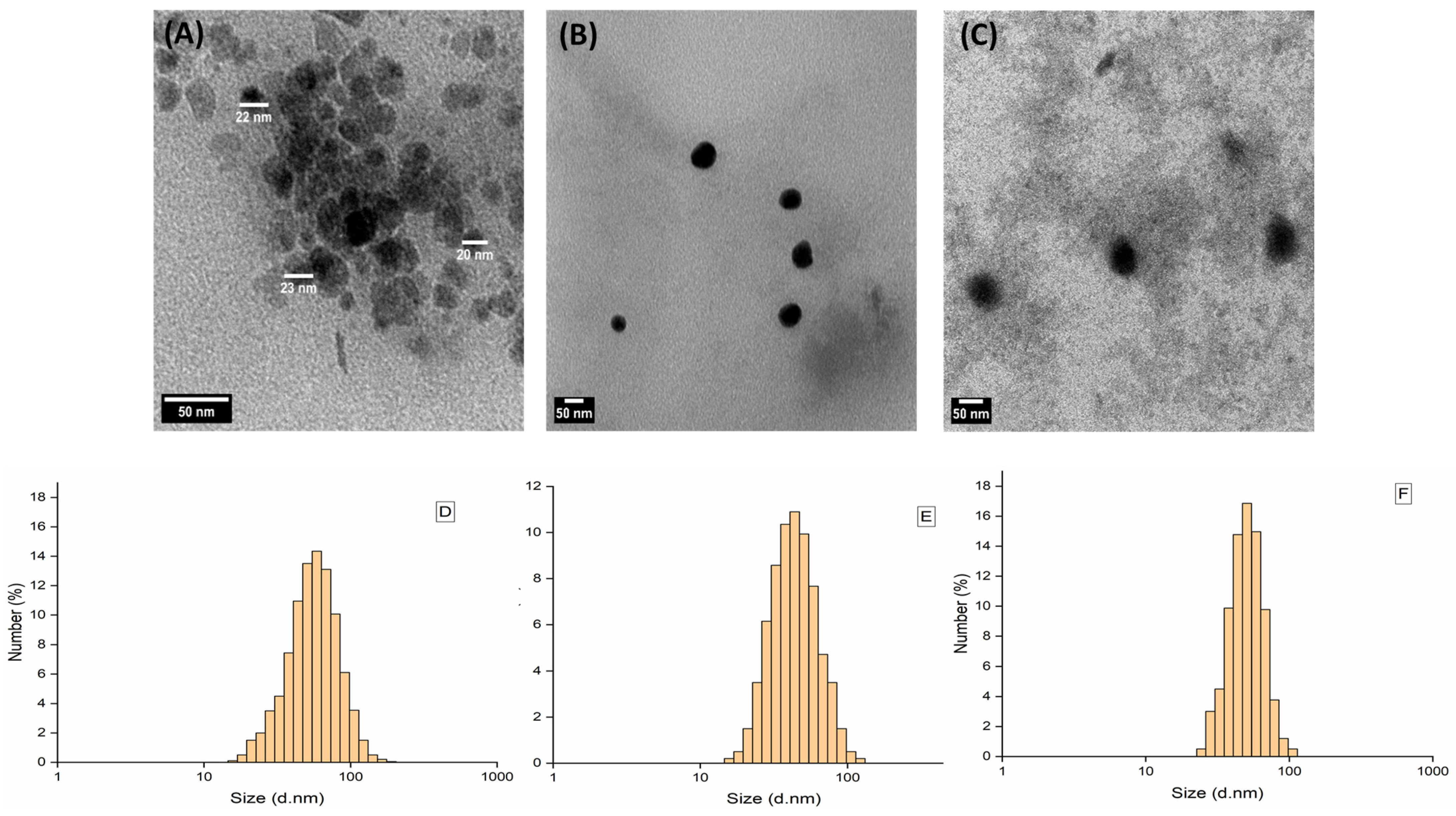
The morphological evolution of rice straw from raw agricultural residue to nanofillers was investigated using TEM. Figure 2A–C show TEM images of the untreated rice straw (URS), the alkaline-treated rice straw (ARS), and the bleached cellulose (BC) of the rice straw, respectively. It is clear that the particle size of the three samples of rice straw is less than 50 nm. Figure 2A shows the morphology of URS after grinding; the untreated sample exhibits relatively large, irregular aggregates. The cellulose microfibrils remain tightly bound within a complex matrix of lignin and hemicellulose. These amorphous components act as a protective sheath, preventing efficient fibrillation and resulting in a coarse morphology with a low aspect ratio. Figure 2B,C show the morphology of ARS and BC, where the alkaline-treated and bleached samples show a significant reduction in particle size and the initiation of fibrillation [26]. The 10% NaOH treatment effectively removed the majority of hemicellulose and partially solubilized the lignin. This “unmasking” of the fibers allowed the mechanical grinding process to break down the bundles into smaller, more distinct fragments compared to the untreated sample. The oxidative bleaching process successfully eliminated residual lignin, removing the final interfibrillar adhesives. Consequently, mechanical grinding was able to separate the cellulose into individual fibrils with diameters in the nanometer range, forming a sophisticated reinforcing network.
The colloidal particle size distribution in suspension was quantified via dynamic light scattering (DLS) analysis (Figure 2D–F). The untreated sample (URS, Figure 2D) exhibited a broad distribution, confirming that the tightly bound lignin matrix limits uniform dispersion and induces irregular aggregation. The chemical modifications systematically narrowed and shifted the size profiles downward. The alkaline-treated sample (ARS, Figure 2E) showed decreased dimensions as the partial removal of non-cellulosic components disrupted macro-bundles. The bleached cellulose (BC, Figure 2F) achieved the narrowest, most symmetrical distribution. It can be seen that all three samples peaked below 100 nm. Notably, the DLS hydrodynamic diameters appear slightly larger than the solid-state TEM dimensions (Figure 2A–C); this variation occurs because TEM measures the dry solid core under vacuum, whereas DLS measures the solvated, hydrated sphere of the fibrils in suspension [27].
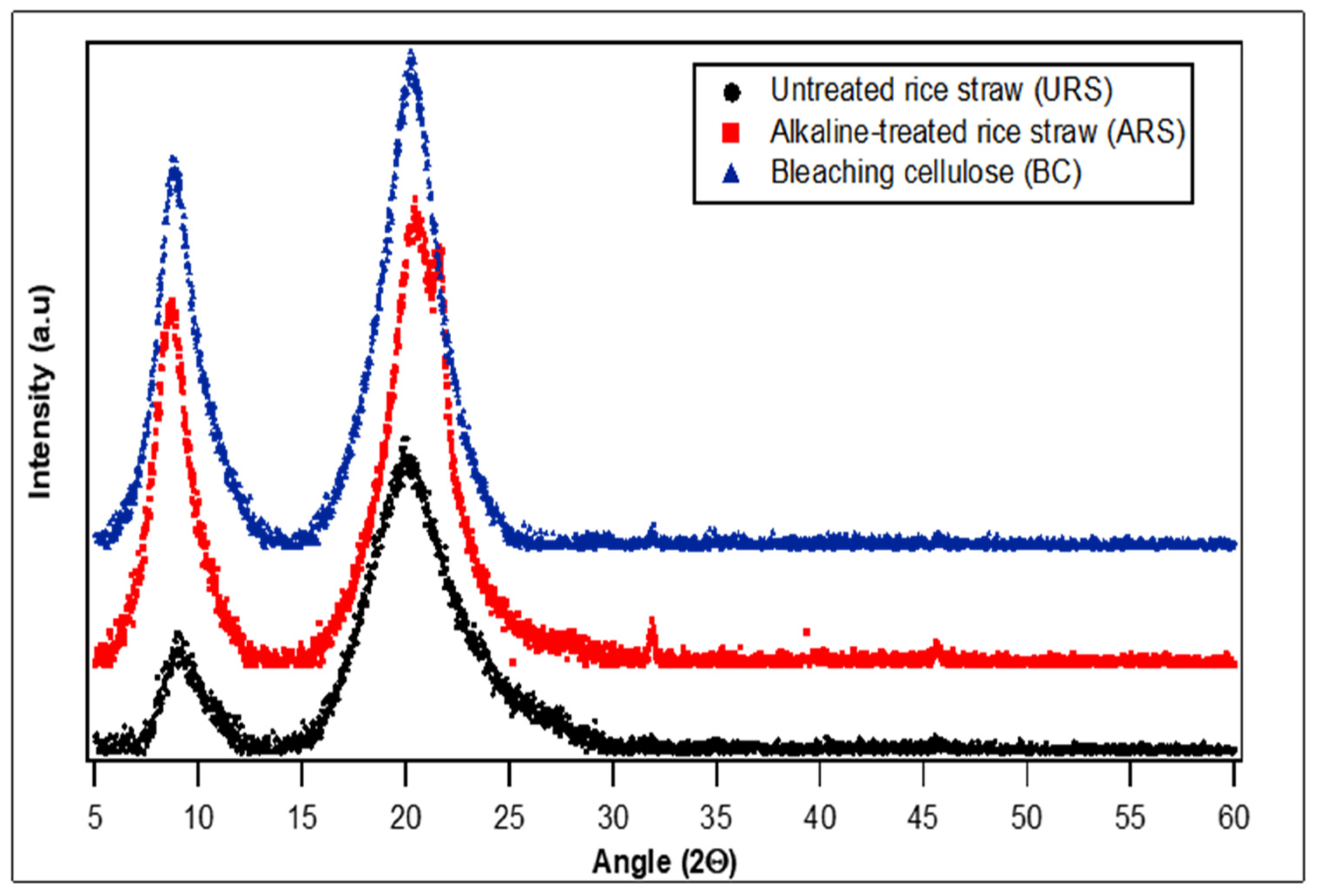
Figure 3 shows XRD patterns of URS, ARS, and BC. The structural changes in the rice straw fibers following chemical treatments were quantified using the crystallinity index (CrI) calculated via the Segal method [28]. The numerical values—37.0% for nano-untreated rice straw (URS), 58.1% for alkali-treated rice straw (ARS), and 67.2% for bleached cellulose (BC)—provide a clear indication of the purification efficiency. The relatively low crystallinity of URS is expected, as the crystalline cellulose domains are heavily shielded by an amorphous matrix of lignin and hemicellulose. A significant increase of approximately 21% in crystallinity highlights the successful removal of hemicellulose and partial delignification. As these amorphous substances are solubilized and removed, the cellulose microfibrils become more exposed and can realign, leading to sharper diffraction peaks and a higher I200 relative to the trough. The final bleaching stage with H2O2 achieves the highest crystallinity. By eliminating residual lignin, the process isolates pure cellulose fibrils. This high CrI is a critical indicator of the material’s potential as a reinforcing agent; more crystalline fillers typically possess higher stiffness and thermal stability, which directly translates to improved tensile and flexural moduli in the rHDPE nanocomposites [29,30]. Ball-milling raw rice straw has no effect on the morphology of the ground sample. Meanwhile, the rice straw showed an increase in its crystallinity index with the alkali treatment, as shown in Figure 3.
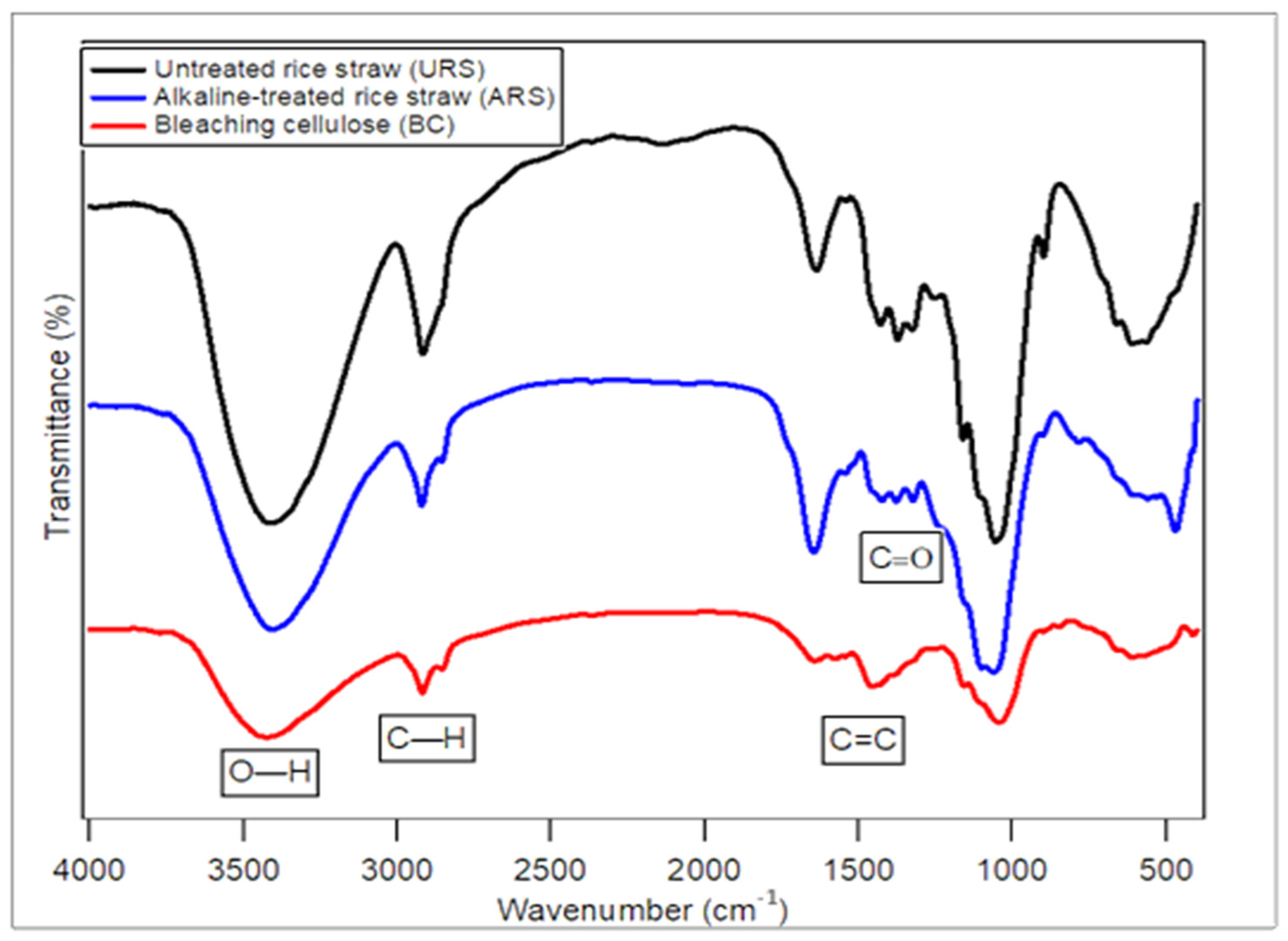
Fourier-transform infrared (FTIR) spectroscopy was utilized to monitor the structural transitions, component extraction efficiency, and functional group variations occurring across the progressive chemical treatments, from untreated rice straw (URS) to alkaline-treated rice straw (ARS) and ultimately bleached cellulose (BC), as shown in Figure 4. The gathered spectra demonstrate distinct variations in chemical composition that match the typical pathways documented for isolating highly purified cellulose from complex lignocellulosic agricultural residues. All three samples exhibit a broad, intense absorption band in the region of 3200–3600 cm−1, universally assigned to the stretching vibrations of hydrogen-bonded hydroxyl (-OH) groups inherent to the polysaccharide framework of cellulose and hemicellulose, as well as the phenolic structures within lignin [31]. Interestingly, tracking the profile from URS to ARS and then to BC reveals that this (-OH) peak becomes less sharp (more broadened); this behavior is attributed to the successful destruction of the rigid hydrogen-bonded networks within the macro-biomass, exposing a higher density of free hydroxyl groups on the nanofiber surfaces alongside the alteration of the amorphous fractions [32]. Adjacent to this region, the absorption band at ~2900 cm−1 represents the aliphatic C-H stretching vibrations of CH2 and CH3 groups, and its consistent persistence across all stages confirms that the principal hydrocarbon skeleton of the glucan rings remained fully intact and suffered no detrimental backbone degradation during the alkaline pulping or bleaching stages. Critical evidence confirming the successful removal of matrix components is found in the carbonyl and aromatic fingerprint regions. Specifically, in the URS profile, a prominent peak or shoulder is clearly discernible at approximately 1730 cm−1 assigned to the characteristic C=O stretching vibrations of acetyl and uronic ester groups that structurally anchor hemicellulose within the cell wall, which flattens out entirely following the alkaline mercerization phase (ARS) and subsequent bleaching (BC), serving as direct spectroscopic validation that the alkaline treatment successfully de-acetylated the biomass and solubilized the hemicellulose fraction [33]. Concurrently, the skeletal stretching vibrations of the C=C aromatic rings belonging to lignin, which are prominently active in the URS baseline at 1600 cm−1 and 1515 cm−1, are heavily suppressed or eliminated by the bleaching stage (BC), indicating that the oxidative bleaching agent effectively shattered the complex phenolic networks of the lignin macromolecule [31]. Finally, the carbohydrate backbone fingerprint region is accentuated within the range of 1160–1030 cm−1, where the sharp, highly intense peak dominant at approximately 1050 cm−1 corresponds directly to the C-O-C pyranose ring skeletal vibrations and the ꞵ-glucosidic linkages that connect individual glucose units. Overall, the FTIR analysis reveals that alkaline treatment partially removes hemicellulose and lignin, while bleaching effectively eliminates most of the lignin, resulting in a more purified cellulose structure.
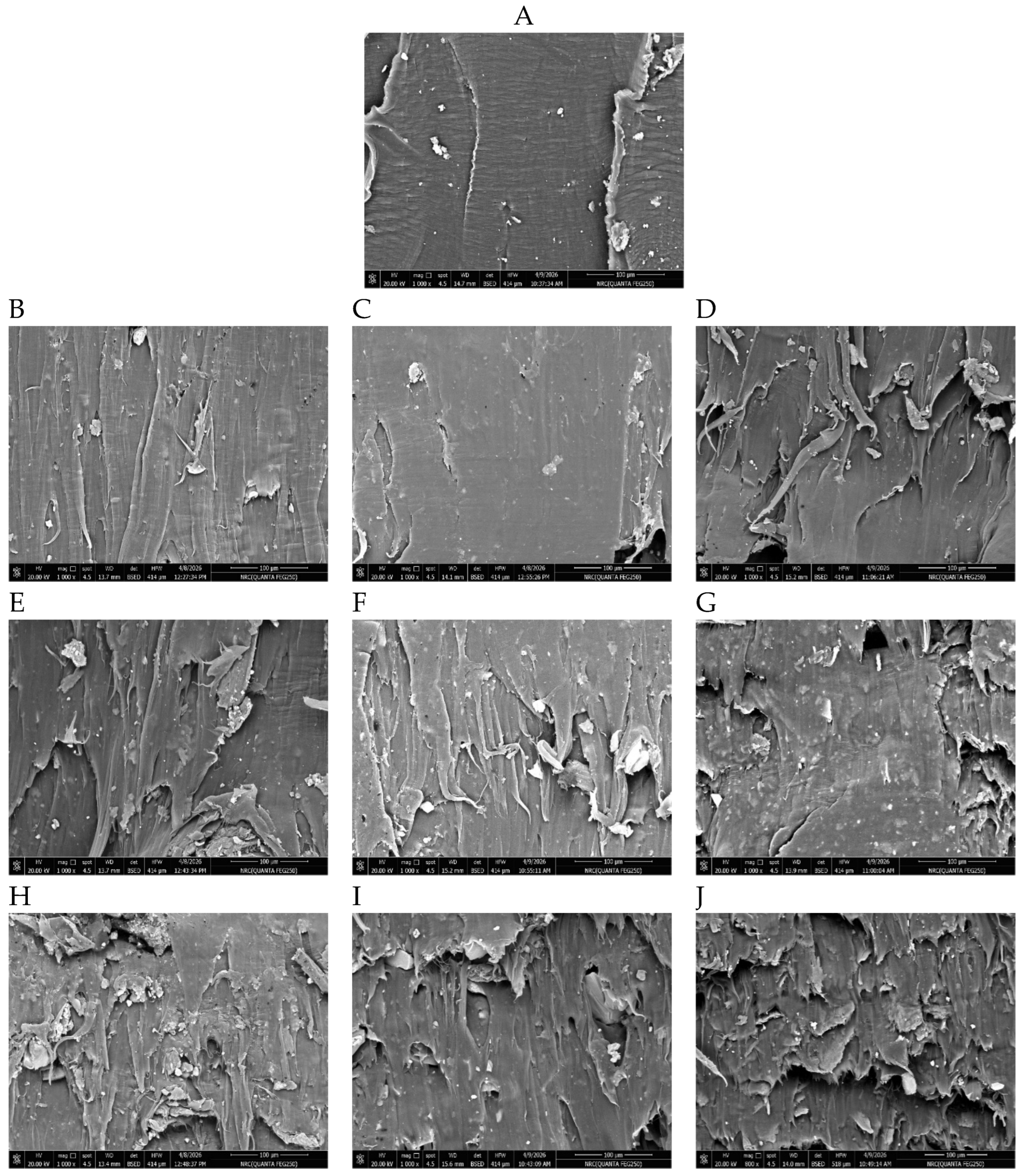
The scanning electron microscopy (SEM) micrographs presented in Figure 5A–I illustrate the fracture surface morphology of recycled polyethylene (rPE) nanocomposites as a function of rice straw nanoparticle concentration and chemical treatment type. The fracture surface of the neat RP (recycled polyethylene) typically serves as the baseline for comparison, characterized by a smooth and uniform fracture surface. RPU represents the untreated rice straw/rPE composites, which exhibit a flat, smooth fracture profile characterized by distinct micro-voids and clean nanoparticle pull-outs; this confirms poor interfacial wetting and a lack of adhesion due to the incompatible nature of the hydrophobic rPE matrix and the hydrophilic, wax-coated straw surface, as shown in Figure 5B–D [34]. In contrast, the middle row (RPA) shows the effect of the alkali treatment, where the removal of surface hemicellulose and lignin induces surface roughness and fibrillation, thereby enhancing mechanical interlocking and reducing interfacial gaps, as indicated by the enhanced compatibility shown in Figure 5E–G [35]. The bottom row (RPB) demonstrates the most pronounced reinforcement effect via bleached rice straw, where the isolated cellulose nanofibers establish an exceptionally strong interface with the rPE matrix. This strong bonding forces the crack propagation path to become highly tortuous, resulting in substantial plastic deformation and severe matrix tearing rather than simple particle debonding [34]. Across all series, increasing the nanofiller percentage increases the structural density and roughness of the fractured surface, though optimal stress transfer is most clearly sustained in the highly integrated network of the RPB samples even at the high filler loading of 50 wt%.

3.2. Thermal Part

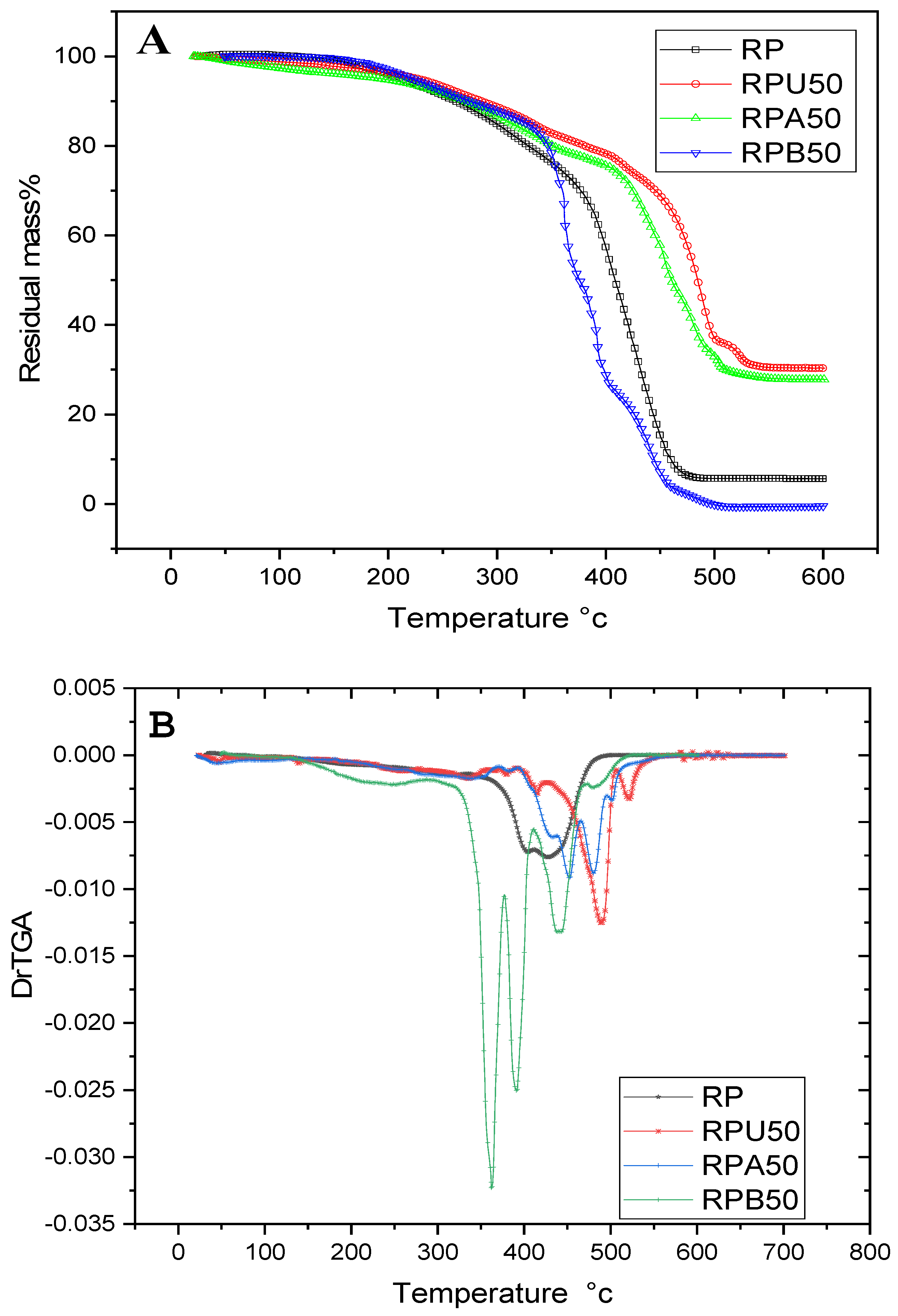
Thermogravimetric analysis (TGA) was employed to investigate the thermal degradation and stability behavior of various materials and also to help evaluate the temperature at which the material can be used. TGA thermograms of rHDPE containing various concentrations of untreated (RPU) and treated (RPA and RPB) rice straw nanocomposites under a nitrogen atmosphere are represented in Figure 6A. The characteristic thermal parameters, including the initial decomposition temperature (Ti) and temperatures at 20%, 50%, and 70% mass loss—T20, T50, and T70, respectively—are shown. Also, temperatures of maximum mass loss rates—Tmax1, Tmax2, and Tmax3—and residual weight at 600 °C are all tabulated in Table 2. The thermogravimetric analysis (TGA) data demonstrates that the inclusion and subsequent chemical modification of rice straw nanoparticles fundamentally alter the thermal degradation kinetics of the recycled polyethylene (RP) matrix. Neat RP displays a characteristic single-stage degradation with an initial onset driven entirely by polyolefin chain scission. In contrast, the nanocomposites undergo complex, multi-stage degradation processes (Tmax1, 2, and 3) corresponding to the sequential volatilization of the distinct lignocellulosic components alongside the polymer matrix [36]. Untreated rice straw (RPU50) shifts the initial decomposition onset to 438.8 °C and retains the highest char residue (31.4% at 600 °C); this high thermal stability is attributed to the intact, highly cross-linked aromatic framework of lignin, which decomposes over a broad range (160 °C to 900 °C) via condensation reactions, as well as protective inorganic silica, which together form a robust insulation barrier that delays matrix volatilization [37]. Alkaline modification (RPA50) effectively solubilizes and removes the amorphous, low-molecular-weight hemicellulose fraction, which typically degrades easily between 160 °C and 315 °C due to its lack of crystallinity, while partially stripping the lignin matrix; this structural unbundling lowers the onset temperature to 422.2 °C and yields a moderate residual weight of 18.1% [38]. Finally, the bleached composite (RPB50) exhibits an early onset (Ti = 359.2 °C) and leaves 0% residue at 600 °C, confirming that severe chemical bleaching strips away the char-forming lignin and silica to isolate pure, high-purity cellulose nanoparticles, which decompose rapidly via unzipping and depolymerization mechanisms without leaving a carbonaceous skeleton [39]. The derivative thermogravimetric (DTG) curves presented in Figure 6B illustrate the mass loss rates as a function of temperature, visually confirming the multi-stage degradation peaks previously detailed in the TGA numerical data. The neat RP curve shows a single, broad degradation peak at 427.1 °C, typical of the uniform thermal cracking of polyethylene carbon–carbon chains. When 50% untreated rice straw is added (RPU50), the composite degradation splits into three stages with degradation peaks at 415 °C, 489.2 °C and 521 °C. For the alkali-treated sample (RPA50, blue line), the removal of hemicellulose and partial extraction of lignin cause a structural shift, displaying distinct intermediate degradation transitions and a slightly lower maximum shifting potential than RPU50, with three degradation peaks at 432.8 °C, 450.8 °C and 480.1 °C. Most notably, the bleached sample (RPB50) drastically alters the degradation profile, displaying two very sharp, deep, and accelerated mass loss peaks shifted down to lower temperatures between 362.1 °C and 437.9 °C. This intense, low-temperature doublet signifies the rapid, unzipped depolymerization of high-purity cellulose nanoparticles completely isolated from their protective lignin and silica shielding, showing why the RPB50 sample drops to 0% residual weight at 600 °C while shifting its primary thermal decomposition stages forward [40].

3.3. Mechanical Properties

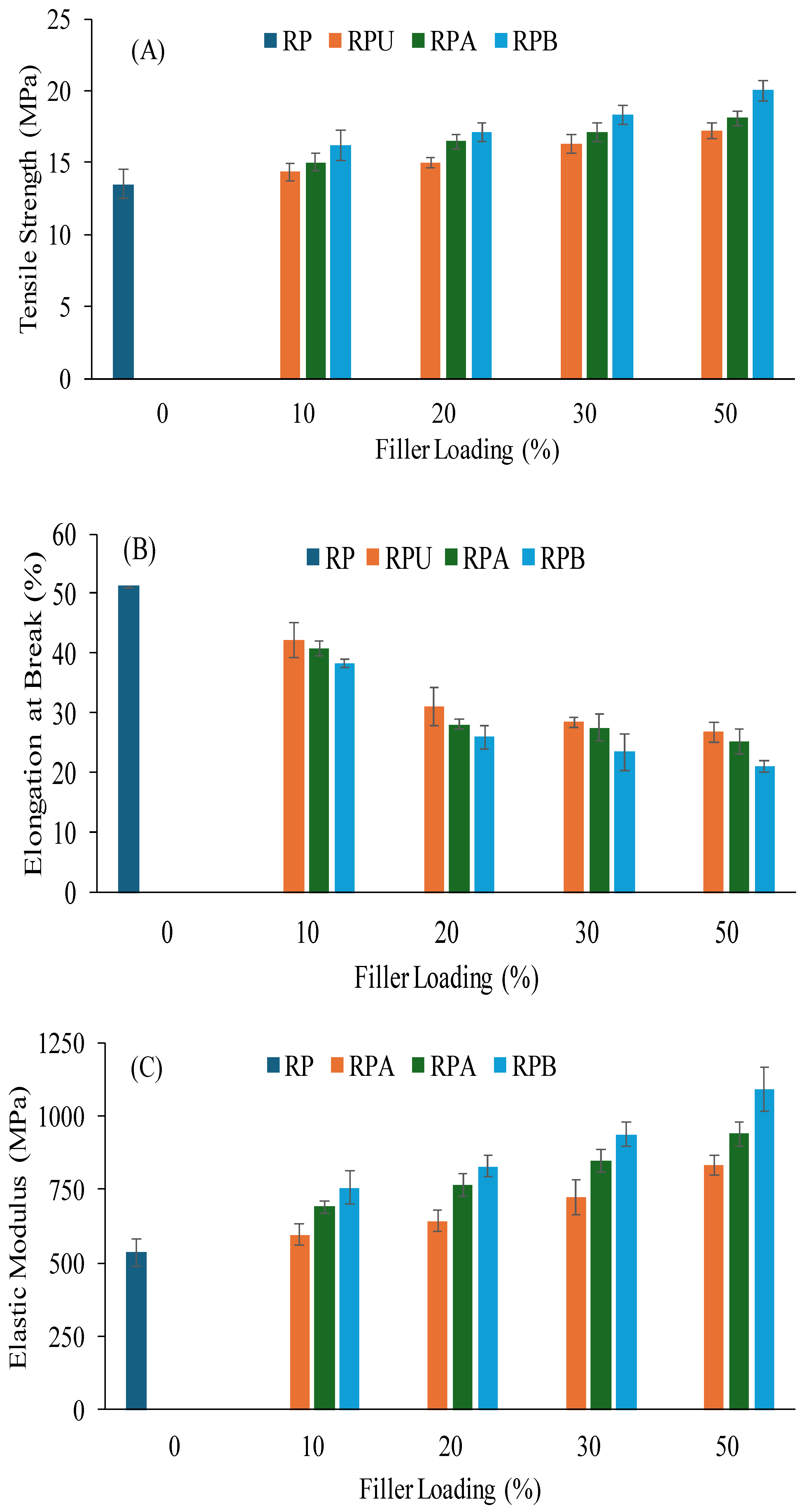
Figure 7A–C illustrate the tensile properties for the rHDPE/untreated rice straw (RPU), rHDPE/alkaline-treated rice straw (RPA), and rHDPE/bleached rice straw (RPB) nanocomposites with varying rice straw content (0, 10, 20, 30, and 50%). Figure 7A specifically shows the effect of rice straw content and different treatments on the tensile strength of the composites. The tensile strength of RPB nanocomposites improved by 19.9%, 26.6%, 35.6%, and 48.2% for composites containing 10%, 20%, 30%, and 50% bleached rice straw, respectively, compared to the control sample (0% rice straw, RP). Similarly, RPA nanocomposites exhibited improvements of 11.2%, 21.7%, 26.7%, and 33% for nanocomposites containing 10%, 20%, 30%, and 50% alkaline-treated rice straw, respectively, compared to RP. Additionally, RPU composites showed improvements of 6.3%, 11%, 20.8%, and 27.4% for nanocomposites containing 10%, 20%, 30%, and 50% untreated rice straw, respectively, compared to the control sample. Both the bleaching and alkaline treatments significantly improved the bonding between rice straw fibers and the rHDPE matrix. This strong interfacial adhesion is crucial for effective stress transfer and contributes to the higher tensile strength observed in the treated nanocomposites. Importantly, the excellent mechanical performance observed in these rice-straw-reinforced composites is deeply rooted in the intrinsic macromolecular resilience of cellulose under environmental conditions. At nanoscale dimensions, cellulose constituents form dense networks governed by robust intra- and inter-molecular hydrogen bonds. Advanced nanoscale characterization indicates that these crystalline domains maintain high local mechanical integrity and stable elastic moduli under varying atmospheric humidity, as low-to-moderate ambient moisture exposure does not destabilize the rigid cellulose core [41]. Furthermore, the choice of rice straw serves as an exceptional alternative to other highly lignified agro-residues for sustainable composite design. While high lignin content in plant fibers can often act as a barrier to efficient extraction, inducing severe structural heterogeneity and variable mechanical properties [42], the progressive removal of amorphous hemicellulose and lignin via alkaline and bleaching treatments in this study uncovers a highly ordered, moisture-stable cellulose skeleton. This structural configuration optimizes stress distribution across the interface, maximizing the reinforcement capability of the fillers within the hydrophobic rHDPE matrix.
Figure 7B indicates that the elongation at break of all the nanocomposites decreased significantly with the increase in rice straw content. Rice straw, being a natural fiber, is more rigid and less flexible than a polymer matrix. Consequently, increasing the rice straw content enables efficient load transfer between the polymer matrix and rice straw fibers, thereby delaying failure under applied stress [43].
Figure 7C illustrates the change in the elastic modulus of the prepared nanocomposites as a function of rice straw content (0, 10, 20, 30, and 50%) and the different treatments applied to the rice straw. The elastic modulus of RPU composites improved by 11%, 20%, 34.9%, and 55.5% for composites containing 10%, 20%, 30%, and 50% untreated rice straw, respectively, compared to the control sample. For RPA composites, the elastic modulus improved by 29%, 42.9%, 58%, and 75.3% for composites containing 10%, 20%, 30%, and 50% alkaline-treated rice straw, respectively, compared to the control sample (RP). Additionally, RPB composites showed improvements of 41.4%, 54.8%, 75.1%, and 103% for composites containing 10%, 20%, 30%, and 50% bleached rice straw, respectively, compared to the control sample. The increase in the elastic modulus is attributed to enhanced interfacial bonding and mechanical interlocking between the rice straw fibers and the rHDPE matrix, which improves stress transfer efficiency and increases composite stiffness [44,45].
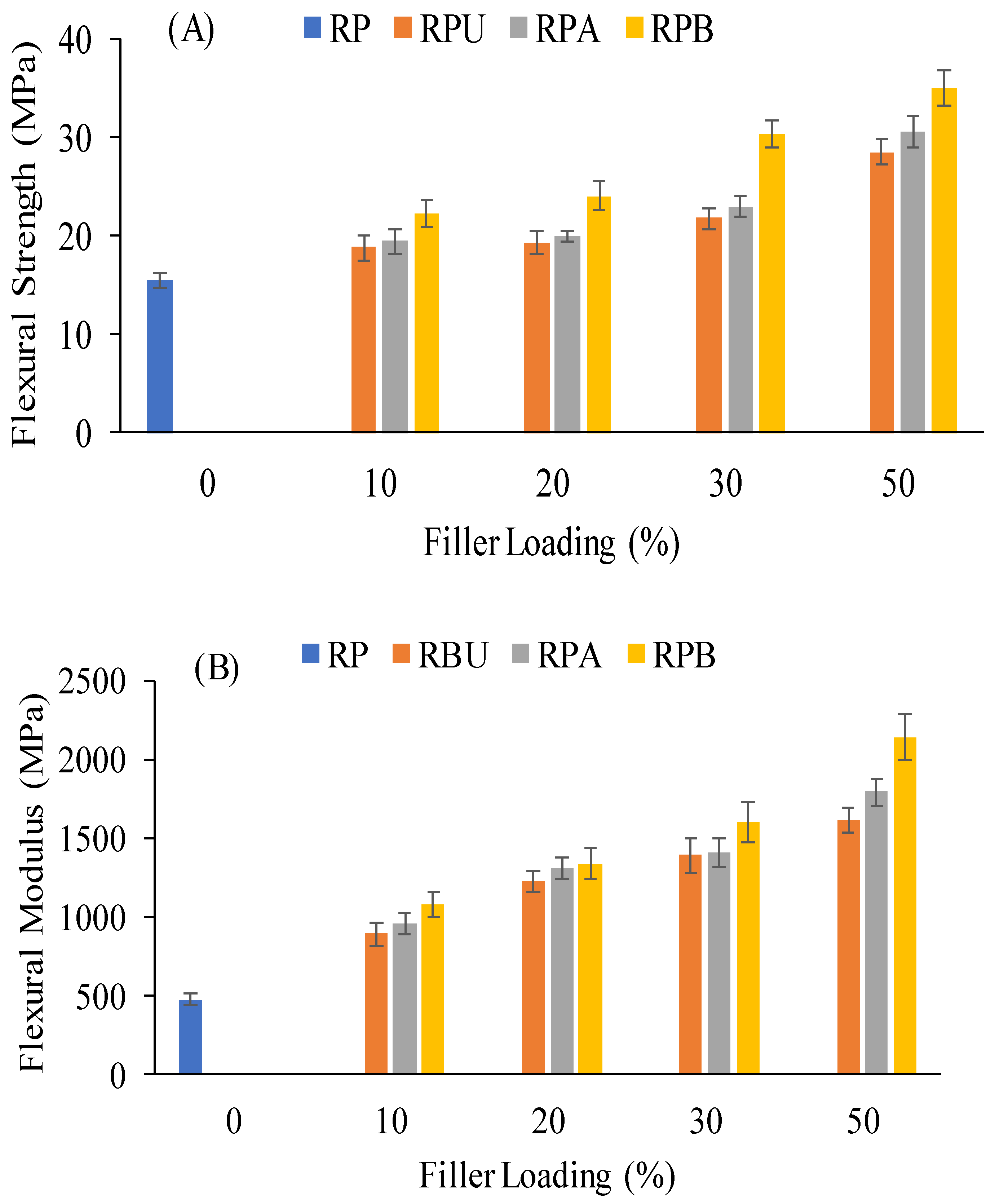
Figure 8A shows the effect of rice straw content and different treatments on the flexural strength of the nanocomposites. For the RPU, RPA, and RPB composites, both the flexural strength and flexural modulus increased with the rise in rice straw content. Specifically, the flexural strength of the rHDPE/untreated rice straw nanocomposites (RPU) increased by 21.6%, 24.7%, 40.6%, and 84% for composites containing 10%, 20%, 30%, and 50% pure untreated rice straw, respectively, compared to the corresponding control sample. This improvement continued for RPA composites, with flexural strength increases of 25.9%, 29.4%, 48.3%, and 97.4% for the composites containing 10%, 20%, 30%, and 50% alkaline-treated rice straw, respectively, compared to the control sample. The RPB composites showed even greater improvements in flexural strength, with increases of 43.7%, 55.6%, 95.9%, and 126% for composites containing 10%, 20%, 30%, and 50% bleached rice straw, respectively, compared to the control sample. As shown in Figure 8B, the flexural modulus exhibited similar behavior with the increase in rice straw content. All RPB composites displayed higher values of flexural strength and flexural modulus compared to the RPU and RPA composites. Specifically, the RPB composite containing 50% bleached rice straw showed a flexural strength of 43.96 MPa and a flexural modulus of 2142 MPa, reflecting improvements of 14.5% and 19.2%, respectively, compared to RPA composites, and 22.7% and 32.6%, respectively, compared to RPU composites containing pure rice straw. This improvement may be attributed to enhanced interfacial bonding and better dispersion of the bleached rice straw fibers within the polymer matrix [46].
The statistical findings in the two-way ANOVA table (Table 3) validate that filler concentration and chemical modification systematically affected the mechanical properties of the rHDPE nanocomposites. Both variables act as highly significant standalone factors (p ˂ 0.05), driven by exceptionally high F-values, particularly filler content for elongation at break (F = 189.94), flexural strength (F = 223.36), and flexural modulus (F = 226.07), alongside substantial modification F-values for flexural strength (F = 109.80) and tensile strength (F = 52.99) [47]. Crucially, the interaction effect (filler content x modification) is statistically insignificant for uniaxial tensile strength (p = 0.32, F = 1.21) and elongation at break (p = 0.78, F = 0.54), proving that chemical modification influences basic tensile traits uniformly across all weight loadings. Conversely, a highly significant interaction effect governs elastic modulus (p = 2.83 × 10⁻⁷, F = 10.23), flexural strength (p = 0.0009, F = 4.34), and flexural modulus (p = 0.0002, F = 5.41). This demonstrates that the mechanical benefits of chemical refinement become exponentially pronounced at higher loading regimes, establishing an integrated interface that successfully overcomes structural delamination to yield maximum flexural reinforcement at 50 wt% loading.

3.4. Water Absorption

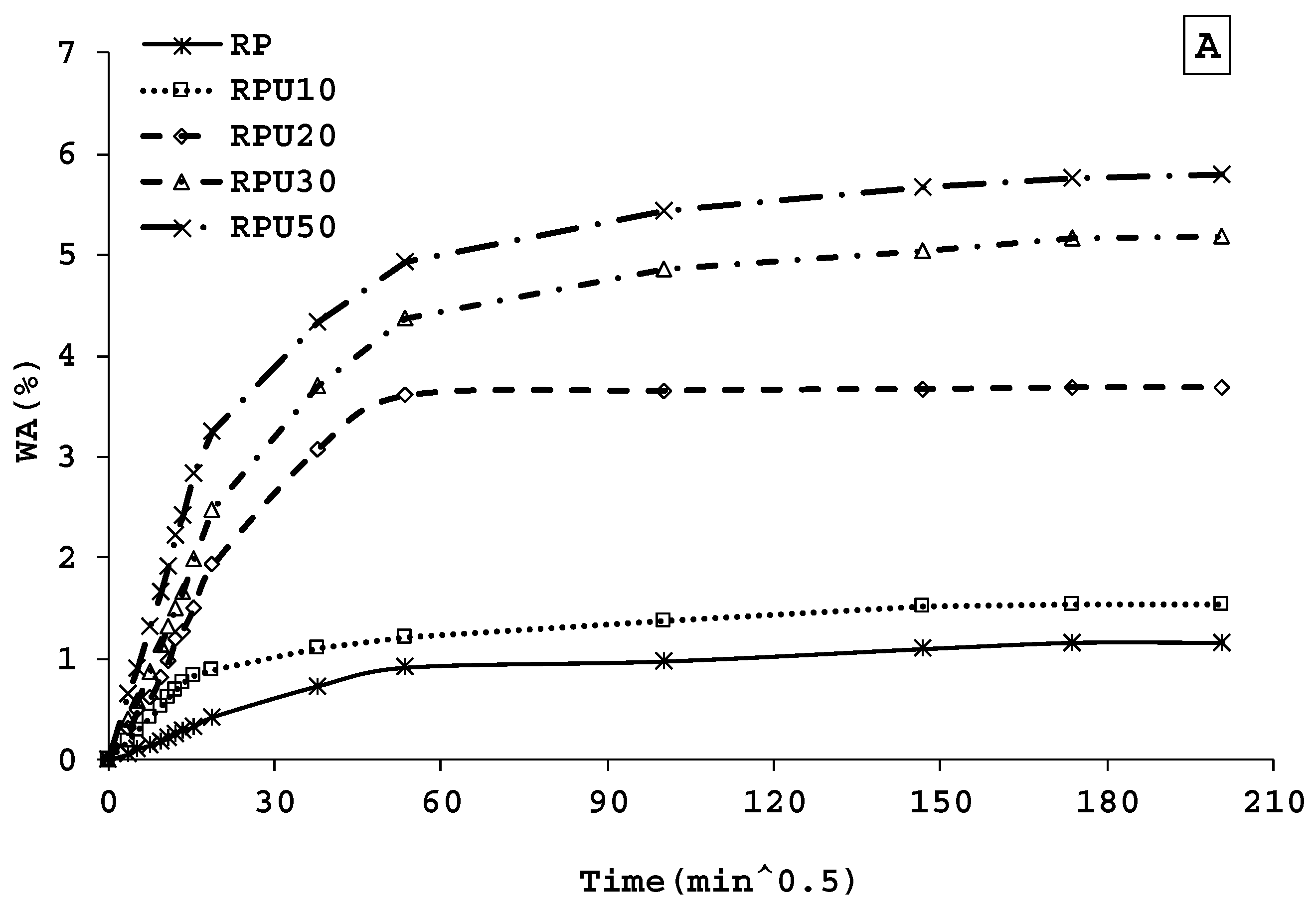
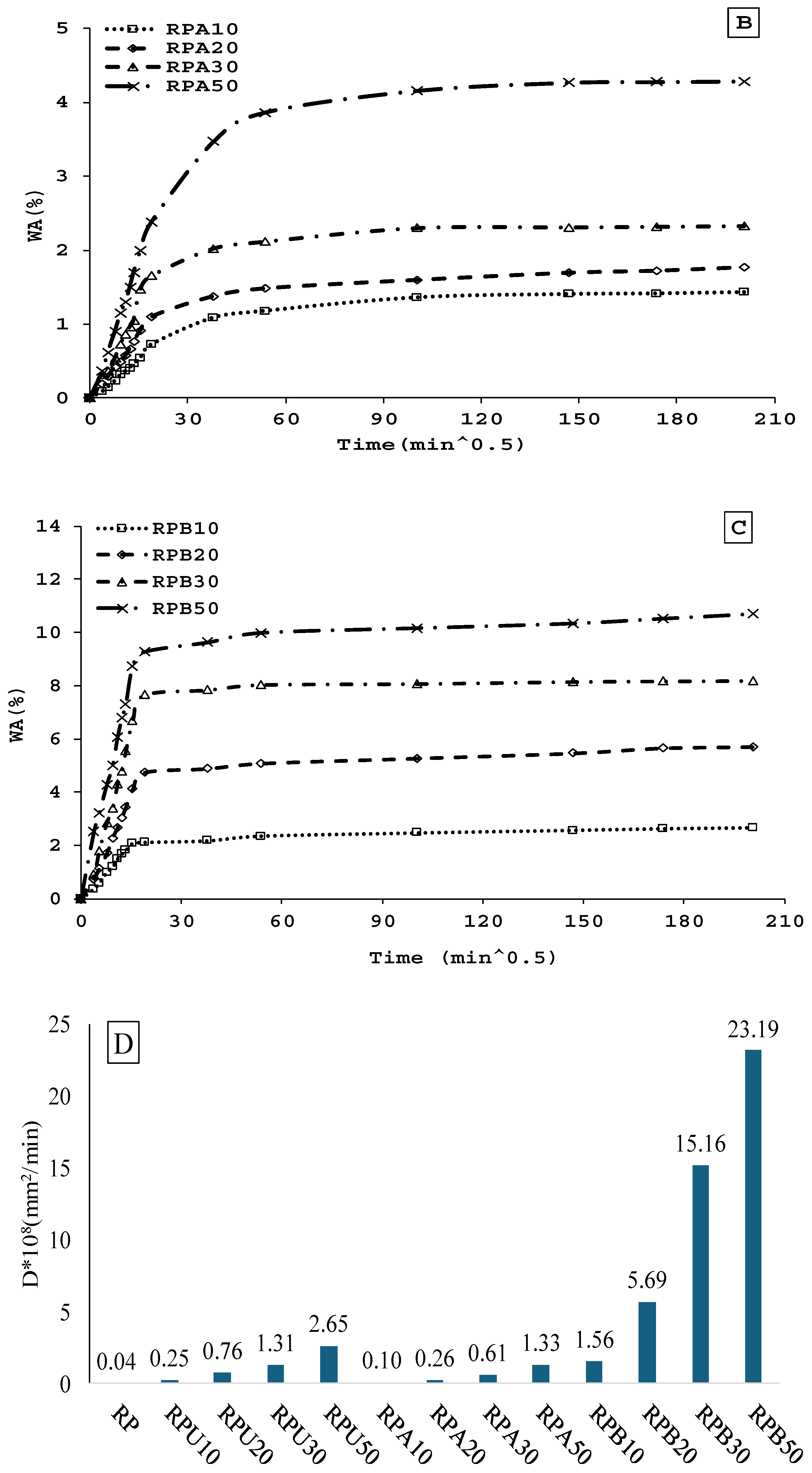
Natural fibers such as rice straw exhibit poor resistance to water absorption, which adversely affects the dimensional stability and mechanical performance of the composites containing them. Therefore, it is essential to study the water absorption behavior of rice straw/HDPE composites, as presented in Figure 9A–C. The water absorption curves show that the amount of absorbed water increases rapidly during the initial period of immersion and reaches saturation after approximately 24 h, beyond which no significant increase is observed. This behavior indicates that the diffusion of water molecules through the composite follows Fickian behavior. The neat rHDPE sample (RP) absorbed only a small amount of water due to its hydrophobic nature. By comparing the results for the RPU, RPA, and RPB composites, it can be concluded that the incorporation of rice straw fibers increased the amount of absorbed water, and the increase became more pronounced with higher fiber loading. For the RPU composites, the water absorption ranged from approximately 1.5% for RPU10 to about 5.8% for RPU50. This increase may be attributed to the presence of hydrophilic hydroxyl groups in the rice straw and the higher void content at the fiber–matrix interface, which facilitates the diffusion of water molecules [48]. In contrast, the RPA composites exhibited lower water absorption values (1.4–4.8%) compared to the untreated ones. This improvement in water resistance can be attributed to better interfacial adhesion between the treated fibers and rHDPE matrix, which reduced the number of accessible polar sites and hindered the diffusion of water molecules. In addition, this can be directly attributed to the efficient chemical dissolution of the highly amorphous and highly hygroscopic hemicellulose fraction during the initial sodium hydroxide (NaOH) mercerization stage [33]. On the other hand, the RPB composites showed the highest water absorption (2.7–10.7%) among all samples, particularly at higher fiber loadings. This trend is directly due to the fact that the complete elimination of the hydrophobic aromatic lignin network during oxidative bleaching exposes the highly hydrophilic pure cellulosic framework, resulting in the absorption of a greater amount of water. Despite the high filler loading up to 50 wt%, the water uptake of our composite remains highly competitive with, or superior to, standard lignocellulosic/HDPE formulations in the literature. Adhikary et al. [49] evaluated Pinus radiata sawdust/HDPE composites and reported a high water absorption value of 23.5% for a similar 50/50 wt% formulation. Abd Rashid et al. [50] reported a 16% water absorption for a lower-loaded (40%) durian skin fiber/HDPE composite after 70 days of immersion. Our values align with or improve upon these thresholds, demonstrating that our multi-stage chemical refinement and nanogrinding process effectively restricts the physical pathways available for rapid water diffusion by eliminating micro-voids and maximizing matrix–filler interfacial adhesion.
The diffusion coefficient (D) values of the studied nanocomposites, illustrated in Figure 9D, support the above observations. The neat rHDPE sample (RP) showed the lowest diffusion coefficient (0.04 × 10⁻⁸ mm2/min), whereas the D values increased with increasing fiber loading for all series. The RPA composites exhibited smaller D values compared to the untreated ones, confirming that surface treatment effectively reduced water diffusivity. The highest D value was obtained for RPB50 (23.19 × 10⁻⁸ mm2/min), indicating that this sample was the least resistant to water uptake [51]. These findings suggest that the hydrophobic rHDPE matrix limited water penetration, but the incorporation of untreated or poorly bonded rice straw fibers facilitated the diffusion of water through the composite structure. The surface modification of the fibers improved their compatibility with rHDPE, decreased porosity, and consequently enhanced the water resistance of the rHDPE/rice straw composites.

3.5. Biodegradation

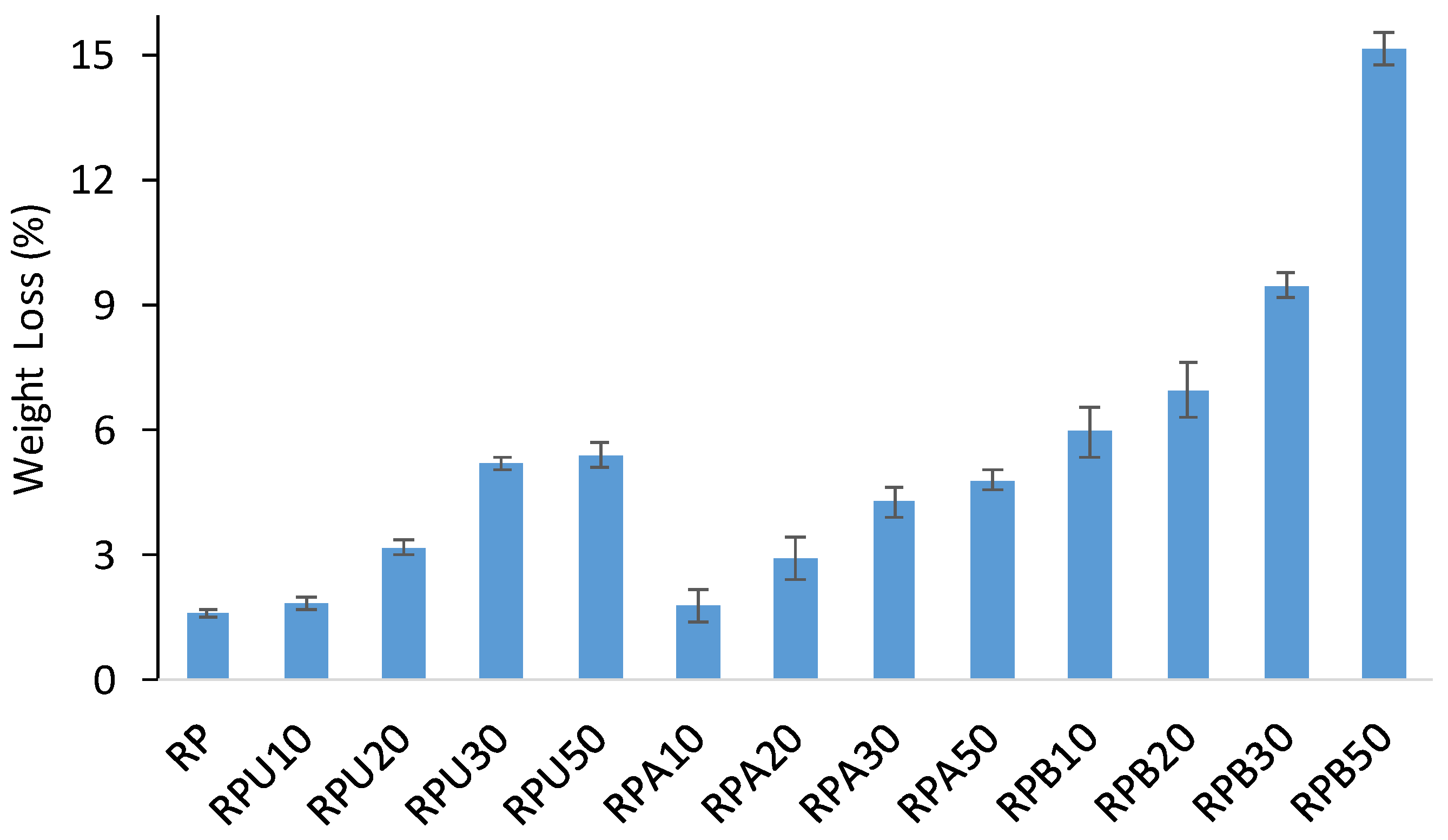
The biodegradation behavior of the rHDPE/rice straw composites was evaluated through soil burial tests for 90 days, as shown in Figure 10. The results revealed a steady increase in overall weight loss with increasing fiber loading across all composite series. It must be emphasized that this mass reduction is entirely governed by the selective microbial decomposition of the biodegradable carbohydrate components (cellulose, hemicellulose, and open-structure lignin) within the rice straw fillers, rather than the synthetic matrix. The neat rHDPE sample (RP) exhibited minimal weight loss, confirming its high resistance to microbial and enzymatic degradation due to its chemically inert and hydrophobic structure [52]. For the RPU series, the weight loss values increased gradually with fiber content, ranging from approximately 1.83% at low fiber loading to 5.4% at the highest loading. This increase reflects the natural tendency of lignocellulosic fibers to degrade in the presence of microorganisms, as cellulose and hemicellulose components are hydrolyzed by enzymes such as cellulase and hemicellulose [53,54]. The RPA composites showed lower weight loss values (1.82–4.82%) than RPU, suggesting that the modification used in this group enhanced the fiber–matrix adhesion. Improved interfacial bonding reduces the number of voids, limits water diffusion, and restricts microbial access, thereby lowering biodegradation rates [55]. Conversely, the RPB composites exhibited the highest biodegradation values, especially at higher fiber loadings (up to ≈ 5.97–15.18% after 90 days). This indicates that their structural condition or surface modification increased moisture and microorganism penetration through the matrix, accelerating degradation. Overall, the biodegradation resistance followed the order RP (lowest) < RPA < RPU < RPB (highest). This demonstrates that while the inclusion of rice straw fibers promotes biodegradation, enhanced interfacial adhesion and reduced porosity can effectively delay the degradation process. Similar behavior was observed in sisal fiber/natural rubber composites, where surface coating by a hydrophobic polymer reduced microbial degradation by protecting the fibers and limiting moisture absorption [26]. The observed maximum weight loss of 15.18% after 90 days occurs under aggressive soil burial conditions featuring continuous moisture and active microbial populations. Crucially, this proves that the material undergoes a controlled, slow end-of-life degradation rather than a rapid collapse when compared to typical biodegradable systems. Zighed et al. [56] investigated HDPE containing starch and linen fibers, showing a peak weight loss of less than 10% after 217 days in soil. Siakeng et al. [57] recorded 18.6% weight loss after 150 days for a pineapple leaf fiber/coir fiber/PLA biocomposite at a lower 30 wt% loading. Because our non-polar rHDPE matrix encapsulates ultra-fine cellulose fibrils, it acts as a hydrophobic barrier shield that completely prevents sudden degradation in normal industrial service environments (lacking soil microbes and saturated moisture), thereby ensuring exceptional long-term functional durability.

3.6. Sound Absorption

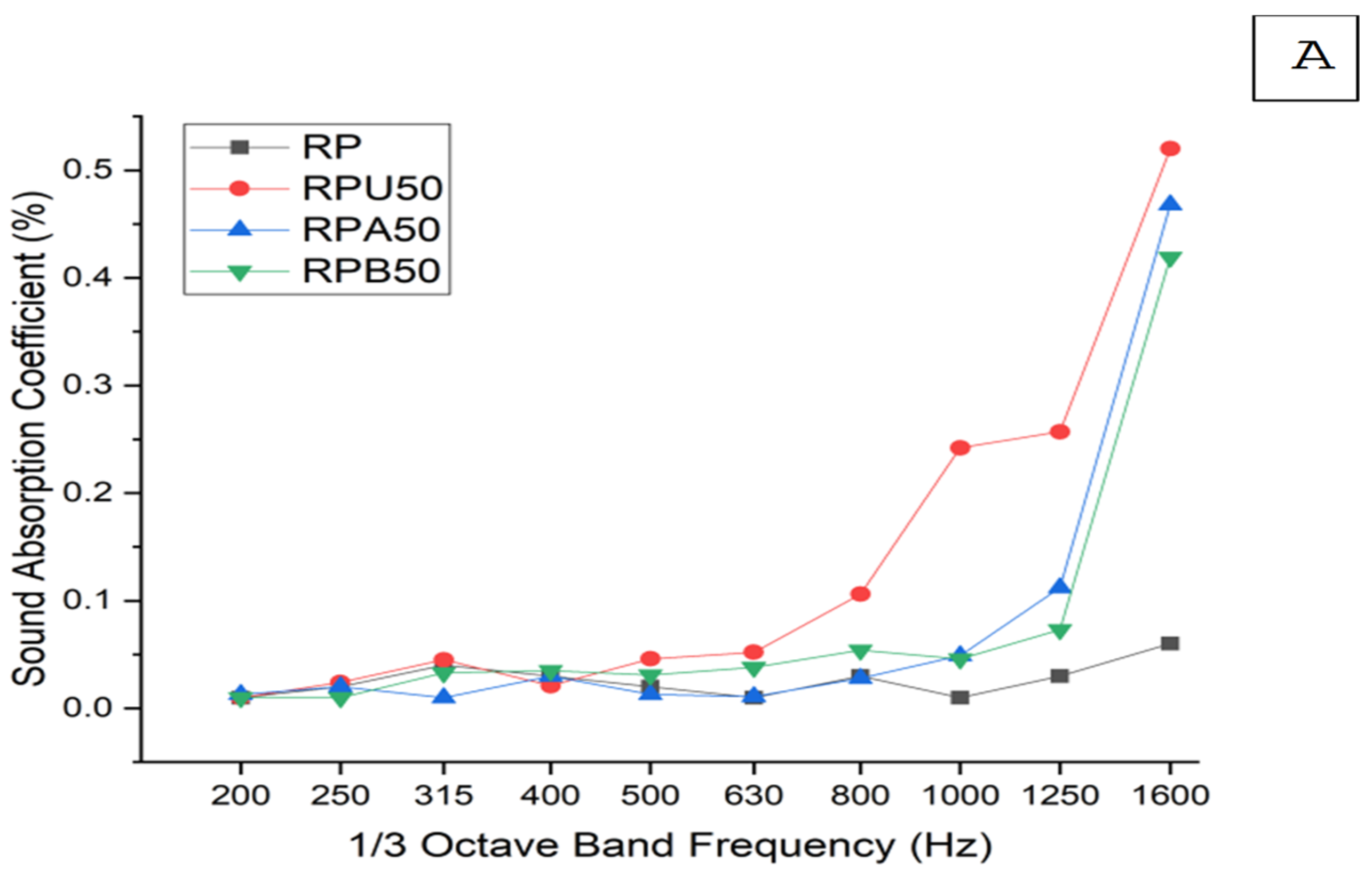
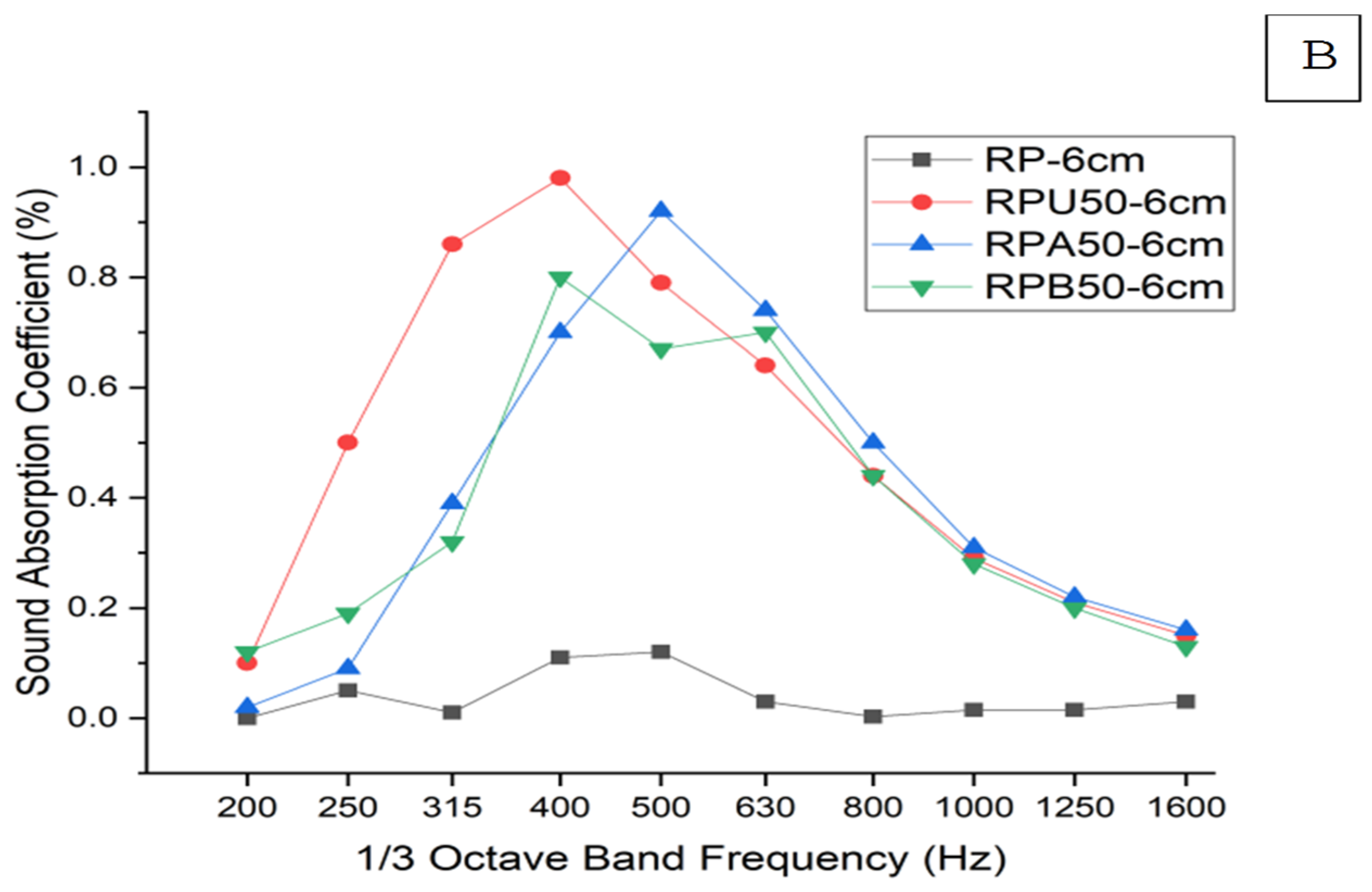
Figure 11A,B present the variations in the sound absorption coefficient (SAC) for RP and its nanocomposite samples before and after perforation, using a 6 cm backing air gap within the frequency range of 200–1600 Hz. For the non-perforated samples (Figure 11A), the neat RP sample exhibited weak sound absorption behavior across the investigated frequencies, where the SAC values remained relatively low. This behavior can be attributed to the dense structure of recycled HDPE, which restricts the penetration of sound waves and reduces their dissipation within the material. In comparison, the incorporation of fillers led to a noticeable improvement in the acoustic response, particularly at higher frequencies. Among the non-perforated samples, RPU50 exhibited the highest SAC value, reaching approximately 0.52 at 1600 Hz, followed by RPA50 and RPB50. This enhancement is associated with the increased internal friction and improved energy dissipation caused by the presence of fillers inside the polymer matrix. Figure 11B showed that the nanocomposite with the 6 cm air cavity had enhanced sound absorption. The perforated structures displayed distinct absorption peaks within the medium-frequency region, indicating more effective dissipation of acoustic energy. The RPU50-6cm sample has the highest SAC value, approaching 0.98 at 400 Hz, whereas RPA50-6cm and RPB50-6cm reached maximum values of nearly 0.92 and 0.80, respectively. The perforated RP sample still has lower absorption efficiency compared with the perforated composite samples. The significant improvement observed after perforation can be explained by the combined influence of the perforated structure and the backing air cavity. The perforations facilitate the entry of incident sound waves into the material, increasing viscous and thermal losses inside the perforated channels [58]. Moreover, the air gap of 6 cm acts as an acoustic resonant cavity that enhances sound attenuation, especially within the medium-frequency range [59]. Therefore, the combined effects of filler addition, perforation treatment, and the backing air gap produced a substantial enhancement in the acoustic absorption properties of the recycled HDPE-based composites, highlighting their suitability as sustainable materials for acoustic insulation applications [60].
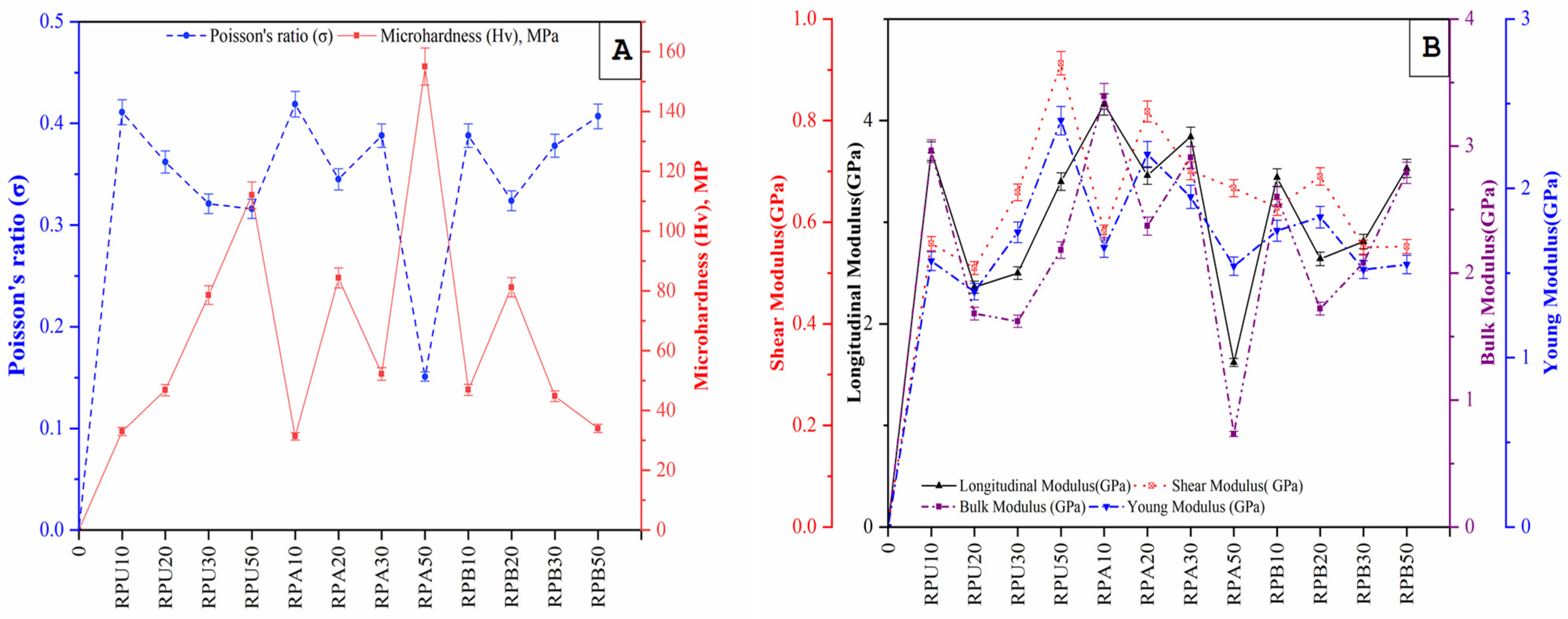
Figure 12A,B describe the influence of filler composition and loading level on the Poisson’s ratio, microhardness, and ultrasonic elastic moduli of the nanocomposites. Filler type and concentration significantly affected the mechanical and elastic behavior of the prepared composites. The Poisson’s ratio values show variations between the investigated samples, indicating the influence of filler distribution and interfacial interaction on the deformation behavior of the composite matrix. A decrease in Poisson’s ratio was observed for the RPA50 sample, where the value decreased to 0.15. This behavior may be attributed to the increase in composite rigidity and restriction of molecular mobility at higher filler loading. The microhardness values exhibited variation depending on filler composition. RPA50 showed the highest hardness value, reaching approximately 155 MPa, indicating the formation of a more rigid surface structure. This enhancement may be related to improved filler dispersion and stronger interfacial adhesion between the filler particles and the polymer matrix; lower hardness values observed for samples such as RPA10 and RPU10 may be associated with non-uniform stress distribution and weaker filler interaction within the composite structure.
Figure 12B shows the variations in longitudinal, shear, bulk, and Young’s moduli for the nanocomposite samples. The elastic moduli varied according to filler composition and loading level. Higher longitudinal and bulk modulus values were observed for the RPA10 sample, while RPU50 exhibited higher shear and Young’s modulus values, indicating improved stiffness and stress transfer efficiency, and the RPA50 sample showed a decrease in elastic modulus values compared with the other samples. This behavior may be attributed to filler agglomeration and reduced interfacial efficiency at high filler loading, which negatively affected the elastic response of the composite structure. The obtained results confirm that the elastic behavior of the developed composites strongly depends on filler distribution and the degree of interfacial adhesion within the polymer matrix.

3.7. Environmental Metrics and Material Sustainability

When analyzing the lifecycle metrics of the isolation process, it must be emphasized that alkaline treatment serves as a primary foundational baseline across the standard nanocellulose isolation literature to disrupt biomass recalcitrance. It is widely recognized in conventional biorefinery protocols that the isolation of nanocellulose typically involves an initial alkaline pre-treatment to remove hemicellulose, followed by oxidative bleaching to extract residual lignin. This is conventionally followed by highly intensive chemical treatments—such as strong acid hydrolysis, ionic liquid dissolution, or deep eutectic solvent (DES) processing—in combination with high-energy mechanical disintegration. Many of these conventional final pathways utilize high-cost, hazardous, and corrosive reagents that pose severe environmental and processing challenges [26,33]. While the fully developed bio-nanocomposites successfully advance the principles of the circular economy by repurposing postconsumer rHDPE and agricultural residues, a comprehensive sustainability assessment requires acknowledging the environmental burdens associated with their full refining. While the ultra-fine mechanical ball milling step introduces high specific energy consumption. However, a qualitative cost–benefit analysis reveals that this processing penalty serves as a critical structural enabler for a substantial net environmental gain. By eliminating amorphous binder phases and reducing the filler to nanoscale dimensions, these treatments multiply the specific surface area and eliminate the traditional thermodynamic compatibility bottlenecks between polar and non-polar phases [26]. This structural refinement uniquely allows the composite to accommodate extreme agricultural residue loadings of up to 50 wt% without sacrificing mechanical integrity, meaning that half of the petroleum-derived plastic volume fraction is replaced with a carbon-sequestering, renewable byproduct. Furthermore, the resulting improvement in tensile and flexural properties dramatically extends the operational lifespan of the panels in demanding structural construction and automotive applications, mitigating premature replacement cycles. To address potential environmental processing penalties transparently and offer a lower-energy alternative, this study intentionally details the performance of an untreated rice straw (URS) composite series. However, the experimental results reveal that the untreated 50 wt% composite yields moderate mechanical integrity while delivering an exceptional low frequency peak sound absorption coefficient of 0.98 at 400 Hz. Consequently, this untreated formulation represents a fully green, low-energy, and chemical-free material pathway within our framework. By evaluating the complete transition from raw biomass to highly refined nanofibrils, this work provides a practical engineering framework that allows manufacturers to choose between a completely green, chemically passive sound absorber (URS) and a chemically optimized, high-strength structural bio-nanocomposite depending on the targeted industrial application, while future iterations will focus on incorporating closed-loop reagent recycling and green organic acid extractions.
Beyond chemical and energy consumption, transitioning these formulations to an industrial scale introduces specific processing and engineering challenges, particularly regarding the high viscosity and melt rheology associated with the optimized 50 wt% filler loading. At such elevated concentrations, lignocellulosic fillers typically induce significant melt resistance, which accelerates tool wear, demands higher extrusion torque, and complicates processing repeatability during large-scale manufacturing. However, it is worth noting that the multi-stage chemical refinement employed in this study partially counteracts these limitations; by stripping away the bulky, highly irregular amorphous lignin and hemicellulose fractions, the resulting ultra-fine nanofibrils achieve tighter packing and more uniform distribution within the rHDPE matrix compared to raw, unrefined fibers [61]. While the high melt viscosity at 50 wt% remains a practical constraint for conventional high-speed injection molding, it is highly manageable for specialized profile extrusion and industrial compression molding systems, the precise techniques standardly utilized to manufacture heavy-duty acoustic panels and automotive structural components. To facilitate seamless large-scale adoption, ongoing investigations are focusing on the introduction of non-toxic, bio-based processing aids and lubricants to further reduce melt viscosity, lower processing energy demands, and minimize machinery tool wear [62].

4. Conclusions

The developed eco-friendly acoustic bio-nanocomposites successfully demonstrate the viability of repurposing agricultural residues and post-consumer plastics into high-performance materials for noise control. Crucially, this study demonstrates that chemical modification and filler loading do not always affect all composite properties uniformly, introducing distinct engineering trade-offs. Mechanical nanogrinding to the nanoscale proved to be a critical structural enabler, allowing the polymer matrix to accommodate extreme filler concentrations (up to 50 wt%) without the characteristic drop in mechanical performance typical of macro-scale biocomposites while simultaneously enhancing sound absorption behavior. While structural purification through alkali extraction and oxidative bleaching substantially elevated the filler crystallinity to 67.2%, translating into exceptional mechanical improvements, such as a 126% increase in flexural strength, it also critically governed the material’s environmental durability. Remarkably, the chemically modified, thoroughly bleached cellulose (RPB) series recorded the highest overall mechanical properties while maintaining robust acoustic efficiency, yielding a notable peak sound absorption coefficient (SAC) of 0.8 at 400 Hz. Water absorption testing followed Fickian diffusion kinetics, revealing that while alkali-treated variants preserved their superior structural water resistance due to improved interfacial compatibility, the thoroughly bleached cellulose (RPB) series exhibited the highest hygroscopic swelling, reaching a water uptake of 10.7%. This exposure of the hydrophilic, pure cellulose framework simultaneously accelerated environmental soil biodegradation, resulting in a maximum weight loss of 15.18% after a 90-day soil burial test, thereby establishing a direct link between chemical filler refinement and tailored polymer degradability. When these dense matrices were transformed into highly efficient sound attenuators through a 1.76% geometric micro-perforation ratio and a 6 cm resonant air cavity, the untreated nanofiller composite achieved a peak sound absorption coefficient of 0.98 at 400 Hz. Ultimately, these results provide a comprehensive framework for balancing chemical pre-treatments to tune moisture sensitivity and biodegradability alongside geometric engineering to design sustainable, mechanically robust insulation panels for the construction and automotive sectors. To build upon these outcomes, future research avenues will focus on evaluating the thermal insulation performance of these panels to assess their energy-saving capabilities alongside their acoustic properties. Furthermore, measuring the dynamic mechanical properties (DMA) across a broad temperature spectrum will be critical to understanding the viscoelastic behavior, glass transition temperatures, and damping characteristics of the composites under cyclic loading. Finally, optimizing compounding parameters to mitigate processing challenges at maximum filler loadings and exploring industrial scale-up feasibility will be essential next steps to transition these prototypes into commercial building and automotive applications.

Author Contributions

All authors contributed significantly to this research. The conceptualization, methodology, and experimental design were jointly executed by all authors. Materials synthesis, characterization, and testing were performed equally by the research team. The manuscript was written and reviewed collectively, and all authors approved the final text for submission. All authors have read and agreed to the published version of the manuscript.

Funding

This research received no external funding.

Institutional Review Board Statement

Not applicable.

Informed Consent Statement

Not applicable.

Data Availability Statement

The data that support the findings of this study are available from the corresponding author upon reasonable request.

Conflicts of Interest

The authors declare no conflicts of interest.

References

  1. Bharadwaj, A.; Yadav, D.; Varshney, S. Non-biodegradable waste–its impact & safe disposal. Int. J. Adv. Technol. Eng. Sci. 2015, 3, 184–191. [Google Scholar]
  2. Lima, D.C.; de Melo, R.R.; Pimenta, A.S.; Pedrosa, T.D.; de Souza, M.J.C.; de Souza, E.C. Physical–mechanical properties of wood panel composites produced with Qualea sp. sawdust and recycled polypropylene. Environ. Sci. Pollut. Res. 2020, 27, 4858–4865. [Google Scholar]
  3. Kamarudin, S.H.; Basri, M.S.M.; Rayung, M.; Abu, F.; Ahmad, S.; Norizan, M.N.; Osman, S.; Sarifuddin, N.; Desa, M.S.Z.M.; Abdullah, U.H.; et al. A review on natural fiber reinforced polymer composites (NFRPC) for sustainable industrial applications. Polymers 2022, 14, 3698. [Google Scholar] [CrossRef] [Scilit] [PubMed]
  4. Chauhan, V.; Kärki, T.; Varis, J. Review of natural fiber-reinforced engineering plastic composites, their applications in the transportation sector and processing techniques. J. Thermoplast. Compos. Mater. 2022, 35, 1169–1209. [Google Scholar]
  5. Asim, M.; Saba, N.; Jawaid, M.; Nasir, M. Potential of natural fiber/biomass filler-reinforced polymer composites in aerospace applications. In Sustainable Composites for Aerospace Applications; Elsevier: Amsterdam, The Netherlands, 2018; pp. 253–268. [Google Scholar]
  6. Rafey, A.; Siddiqui, F.Z. A review of plastic waste management in India–challenges and opportunities. Int. J. Environ. Anal. Chem. 2023, 103, 3971–3987. [Google Scholar]
  7. Pilapitiya, P.N.T.; Ratnayake, A.S. The world of plastic waste: A review. Clean. Mater. 2024, 11, 100220. [Google Scholar] [CrossRef] [Scilit]
  8. Ugoeze, K.; Amogu, E.O.; Oluigbo, K.E.; Nwachukwu, N. Environmental and public health impacts of plastic wastes due to healthcare and food products packages: A Review. J. Environ. Sci. Public Health 2021, 5, 1–31. [Google Scholar] [CrossRef] [Scilit]
  9. Simões, C.L.; Pinto, L.M.C.; Bernardo, C. Environmental and economic assessment of a road safety product made with virgin and recycled HDPE: A comparative study. J. Environ. Manag. 2013, 114, 209–215. [Google Scholar] [CrossRef] [Scilit]
  10. Yousaf, A.; Al Rashid, A.; Polat, R.; Koç, M. Potential and challenges of recycled polymer plastics and natural waste materials for additive manufacturing. Sustain. Mater. Technol. 2024, 41, e01103. [Google Scholar] [CrossRef] [Scilit]
  11. Kadam, K.L.; Forrest, L.H.; Jacobson, W.A. Rice straw as a lignocellulosic resource: Collection, processing, transportation, and environmental aspects. Biomass Bioenergy 2000, 18, 369–389. [Google Scholar] [CrossRef] [Scilit]
  12. Feng, F.; Song, G.; Shen, L.; Xiao, J. Environmental benefits analysis based on life cycle assessment of rice straw-based synthetic natural gas in China. Energy 2017, 139, 341–349. [Google Scholar] [CrossRef] [Scilit]
  13. Shen, J.; Tang, H.; Liu, J.; Wang, C.; Li, Y.; Ge, T.; Jones, D.L.; Wu, J. Contrasting effects of straw and straw-derived biochar amendments on greenhouse gas emissions within double rice cropping systems. Agric. Ecosyst. Environ. 2014, 188, 264–274. [Google Scholar] [CrossRef] [Scilit]
  14. Wei, K.; Lv, C.; Chen, M.; Zhou, X.; Dai, Z.; Shen, D. Development and performance evaluation of a new thermal insulation material from rice straw using high frequency hot-pressing. Energy Build. 2015, 87, 116–122. [Google Scholar] [CrossRef] [Scilit]
  15. Cao, X.V.; Ismail, H.; Rashid, A.A.; Takeichi, T. Kenaf powder filled recycled high density polyethylene/natural rubber biocomposites: The effect of filler content. Int. J. Integr. Eng. 2012, 4, 22–25. [Google Scholar]
  16. Tran, D.T.; Nguyen, S.T.; Do, N.D.; Thai, N.N.T.; Thai, Q.B.; Huynh, H.K.P.; Nguyen, V.T.T.; Phan, A.N. Green aerogels from rice straw for thermal, acoustic insulation and oil spill cleaning applications. Mater. Chem. Phys. 2020, 253, 123363. [Google Scholar] [CrossRef] [Scilit]
  17. Taha, M.; Fouly, A.; Abdo, H.S.; Alnaser, I.A.; Abouzeid, R.; Nabhan, A. Unveiling the potential of rice straw nanofiber-reinforced HDPE for biomedical applications: Investigating mechanical and tribological characteristics. J. Funct. Biomater. 2023, 14, 366. [Google Scholar] [CrossRef] [Scilit] [PubMed]
  18. Chen, G.H.; Wang, D.D. Mechanical properties of rice straw particle/HDPE composites. Appl. Mech. Mater. 2014, 457, 227–230. [Google Scholar]
  19. Sharma, S.; Pappu, A.; Asolekar, S.R. Sustainable recycling of paddy straw through development of short-fiber-reinforced composites: Exploring gainful utilization of agricultural waste. Clean Technol. Environ. Policy 2024, 26, 109–127. [Google Scholar]
  20. Xu, R.; Wang, C.; Xu, K.; Liu, G.; Wang, H.; Zhu, S.; Chen, Y.; Guo, Y. Acoustic emission characteristics of waste fiber-reinforced recycled high-density polyethylene composites under damage conditions. Polym. Compos. 2024, 45, 2712–2724. [Google Scholar] [CrossRef] [Scilit]
  21. Namakka, M.; Rahman, R.; Bin Bakri, M.K.; Karuppasamy, B.D.; Ahmmad, M.S.; James, A.A.; Rahman, I.M.M. Advancements in acoustic properties of natural waste biocomposites: Current trends, applications, and future perspectives. Adv. Compos. Hybrid Mater. 2025, 8, 386. [Google Scholar] [CrossRef] [Scilit]
  22. Wang, H.; Lin, F.; Qiu, P.; Liu, T. Effects of extractives on dimensional stability, dynamic mechanical properties, creep, and stress relaxation of rice straw/high-density polyethylene composites. Polymers 2018, 10, 1176. [Google Scholar] [CrossRef] [Scilit] [PubMed]
  23. Ahmad, S.R.B.; Aziz, M.I.A.B.A.; Alzahari, M.R.B. Polypropylene composites reinforced by natural and recycled fibers for bumper application: Effects of fiber loading on the tensile properties. In Progress in Engineering Technology V; Springer: Singapore, 2023; pp. 1–7. [Google Scholar]
  24. Abdel-Hakim, A.; Mourad, R.M. Mechanical, water uptake properties, and biodegradability of polystyrene-coated sisal fiber-reinforced high-density polyethylene. Polym. Compos. 2020, 41, 1435–1446. [Google Scholar]
  25. Abdel-Hakim, A.; El-Basheer, T.M.; El-Aziz, A.M.A.; Afifi, M. Acoustic, ultrasonic, mechanical properties and biodegradability of sawdust/recycled expanded polystyrene eco-friendly composites. Polym. Test. 2021, 99, 107215. [Google Scholar] [CrossRef] [Scilit]
  26. Abdel-Hakim, A.; Mourad, R. Nanocellulose and its polymer composites: Preparation, characterization, and applications. Russ. Chem. Rev. 2023, 92, RCR5076. [Google Scholar] [CrossRef] [Scilit]
  27. Yeap, S.P.; Lim, J.; Ngang, H.P.; Ooi, B.S.; Ahmad, A.L. Role of particle–particle interaction towards effective interpretation of Z-average and particle size distributions from dynamic light scattering (DLS) analysis. J. Nanosci. Nanotechnol. 2018, 18, 6957–6964. [Google Scholar] [CrossRef] [Scilit] [PubMed]
  28. Segal, L.; Creely, J.J.; Martin, A.E., Jr.; Conrad, C.M. An empirical method for estimating the degree of crystallinity of native cellulose using the X-ray diffractometer. Text. Res. J. 1959, 29, 786–794. [Google Scholar] [CrossRef] [Scilit]
  29. Qiao, X.; Wang, Z.; Sun, K. Renewable rice straw cellulose nanofibril reinforced poly (ε-caprolactone) composite films. Mater. Chem. Phys. 2022, 292, 126879. [Google Scholar] [CrossRef] [Scilit]
  30. Wang, Z.; Qiao, X.; Sun, K. Rice straw cellulose nanofibrils reinforced poly (vinyl alcohol) composite films. Carbohydr. Polym. 2018, 197, 442–450. [Google Scholar] [CrossRef] [Scilit] [PubMed]
  31. Abdel-Hakim, A.; Baheg, N.M.; El-Wakil, A.E.-A.A.; Mekewi, M.; Halim, S. Molar ratio-controlled surface functionalization of nanocellulose via glutamic/citric acid DES: From Carboxylated adsorbents to Aminated bio-nanomaterials. J. Mol. Liq. 2026, 456, 129624. [Google Scholar] [CrossRef] [Scilit]
  32. Baheg, N.M.; Abdel-Hakim, A.; El-Wakil, A.E.-A.A.; Mekewi, M.; Halim, S. Development of novel natural deep eutectic solvent for cellulose nanofibrillation of orange peel via new surface functionalization. ACS Sustain. Chem. Eng. 2023, 11, 14793–14806. [Google Scholar] [CrossRef] [Scilit]
  33. Abdel-Hakim, A.; El Mogy, S.A.; Awad, E.H. Properties and Characterization of Nile Rose Nanocellulose for Biodegradable Polyvinyl Alcohol Nanocomposites. Sustainability 2026, 18, 4947. [Google Scholar] [CrossRef] [Scilit]
  34. Kumar, S.; Choudhary, V.; Kumar, R. Study on the compatibility of unbleached and bleached bamboo-fiber with LLDPE matrix. J. Therm. Anal. Calorim. 2010, 102, 751–761. [Google Scholar] [CrossRef] [Scilit]
  35. Sharma, N.; Allardyce, B.J.; Rajkhowa, R.; Agrawal, R. Rice straw-derived cellulose: A comparative study of various pre-treatment technologies and its conversion to nanofibres. Sci. Rep. 2023, 13, 16327. [Google Scholar] [CrossRef] [Scilit] [PubMed]
  36. Nurazzi, N.M.; Asyraf, M.R.M.; Rayung, M.; Norrrahim, M.N.F.; Shazleen, S.S.; Rani, M.S.A.; Shafi, A.R.; Aisyah, H.A.; Radzi, M.H.M.; Sabaruddin, F.A.; et al. Thermogravimetric analysis properties of cellulosic natural fiber polymer composites: A review on influence of chemical treatments. Polymers 2021, 13, 2710. [Google Scholar] [CrossRef] [Scilit] [PubMed]
  37. Vu, A.N.; Nguyen, N.-U.T.; Nguyen, T.-L.T.; Nguyen, V.-A.T. Effect of bleaching process on the allomorph, crystalline index, morphology, and thermal stability of cellulose nanocrystals derived from rice straw. RSC Adv. 2026, 16, 16344–16357. [Google Scholar] [CrossRef] [Scilit] [PubMed]
  38. Tsamba, A.J.; Yang, W.; Blasiak, W. Pyrolysis characteristics and global kinetics of coconut and cashew nut shells. Fuel Process. Technol. 2006, 87, 523–530. [Google Scholar] [CrossRef] [Scilit]
  39. Yang, H.; Yan, R.; Chen, H.; Zheng, C.; Lee, D.H.; Liang, D.T. In-depth investigation of biomass pyrolysis based on three major components: Hemicellulose, cellulose and lignin. Energy Fuels 2006, 20, 388–393. [Google Scholar]
  40. Abdel-Hakim, A.; El-Mogy, S.; El-Zayat, M. Radiation crosslinking of acrylic rubber/styrene butadiene rubber blends containing polyfunctional monomers. Radiat. Phys. Chem. 2019, 157, 91–96. [Google Scholar] [CrossRef] [Scilit]
  41. Marcuello, C.; Foulon, L.; Chabbert, B.; Aguié-Béghin, V.; Molinari, M. Atomic force microscopy reveals how relative humidity impacts the Young’s modulus of lignocellulosic polymers and their adhesion with cellulose nanocrystals at the nanoscale. Int. J. Biol. Macromol. 2020, 147, 1064–1075. [Google Scholar] [CrossRef] [Scilit] [PubMed]
  42. El Moussi, Y.; Clerc, L.; Benezet, J.-C. Experimental investigation on the influence of rice straw characteristics on the hygric, thermal and mechanical properties of straw-lime concretes. Constr. Build. Mater. 2025, 478, 141379. [Google Scholar] [CrossRef] [Scilit]
  43. Peddini, S.; Bosnyak, C.; Henderson, N.; Ellison, C.; Paul, D. Nanocomposites from styrene–butadiene rubber (SBR) and multiwall carbon nanotubes (MWCNT) part 2: Mechanical properties. Polymer 2015, 56, 443–451. [Google Scholar] [CrossRef] [Scilit]
  44. Eng, C.C.; Ibrahim, N.A.; Zainuddin, N.; Ariffin, H.; Yunus, W.M.Z.W.; Then, Y.Y. Enhancement of mechanical and dynamic mechanical properties of hydrophilic nanoclay reinforced polylactic acid/polycaprolactone/oil palm mesocarp fiber hybrid composites. Int. J. Polym. Sci. 2014, 2014, 715801. [Google Scholar] [CrossRef] [Scilit]
  45. Lei, Y.; Wu, Q.; Yao, F.; Xu, Y. Preparation and properties of recycled HDPE/natural fiber composites. Compos. Part A Appl. Sci. Manuf. 2007, 38, 1664–1674. [Google Scholar] [CrossRef] [Scilit]
  46. Motaleb, K.A.; Milašius, R.; Ahad, A. Influence of gamma radiation on mechanical properties of jute fabric-reinforced polymer composites. Fibers 2020, 8, 58. [Google Scholar] [CrossRef] [Scilit]
  47. Adamu, M.; Rahman, R.; Bin Bakri, M.K.; Yusof, F.A.B.M.; Khan, A. Characterization and optimization of mechanical properties of bamboo/nanoclay/polyvinyl alcohol/styrene nanocomposites using response surface methodology. J. Vinyl Addit. Technol. 2021, 27, 147–160. [Google Scholar]
  48. Sampathkumar, D.; Punyamurth, R.; Venkateshappa, S.C.; Bennehalli, B. Effect of chemical treatment on water absorption of areca fiber. J. Appl. Sci. Res. 2012, 8, 5298–5305. [Google Scholar]
  49. Adhikary, K.B.; Pang, S.; Staiger, M.P. Long-term moisture absorption and thickness swelling behaviour of recycled thermoplastics reinforced with Pinus radiata sawdust. Chem. Eng. J. 2008, 142, 190–198. [Google Scholar] [CrossRef] [Scilit]
  50. Rashid, S.M.S.A.; Anuar, H.; Apandi, S.N.E.M.; Buys, Y.F. Effect of UV Radiation on Degradation of Durian Skin Fibre Composite. Int. J. Eng. Mater. Manuf. 2018, 3, 105–112. [Google Scholar] [CrossRef] [Scilit]
  51. Abdel-Hakim, A.; El Mogy, S.A.; Mourad, R.M. Impact of fiber coating with hydrophobic nanoparticles polymer on the physicomechanical properties of Pisum sativum L. fibers/styrene butadiene rubber ecofriendly composites. Ind. Crops Prod. 2024, 209, 118054. [Google Scholar] [CrossRef] [Scilit]
  52. Shah, A.A.; Hasan, F.; Hameed, A.; Ahmed, S. Biological degradation of plastics: A comprehensive review. Biotechnol. Adv. 2008, 26, 246–265. [Google Scholar] [CrossRef] [Scilit] [PubMed]
  53. Hayashi, T. Biodegradable polymers for biomedical uses. Prog. Polym. Sci. 1994, 19, 663–702. [Google Scholar] [CrossRef] [Scilit]
  54. Lucas, N.; Bienaime, C.; Belloy, C.; Queneudec, M.; Silvestre, F.; Nava-Saucedo, J.-E. Polymer biodegradation: Mechanisms and estimation techniques–A review. Chemosphere 2008, 73, 429–442. [Google Scholar] [CrossRef] [Scilit] [PubMed]
  55. Kale, G.; Kijchavengkul, T.; Auras, R.; Rubino, M.; Selke, S.E.; Singh, S.P. Compostability of bioplastic packaging materials: An overview. Macromol. Biosci. 2007, 7, 255–277. [Google Scholar] [CrossRef] [Scilit] [PubMed]
  56. Zighed, M.; Benotmane, B.; Ferkous, H.; Ramdane, N.; Boublia, A.; Ahmed, M.; Bourbia, A.; Lemboub, S.; Yadav, K.K.; Benguerba, Y. Biodegradability assessment of HDPE-based biocomposites: Influence of starch and fiber composition. Mater. Today Commun. 2024, 40, 109786. [Google Scholar] [CrossRef] [Scilit]
  57. Siakeng, R.; Jawaid, M.; Asim, M.; Siengchin, S. Accelerated weathering and soil burial effect on biodegradability, colour and textureof coir/pineapple leaf fibres/PLA biocomposites. Polymers 2020, 12, 458. [Google Scholar] [CrossRef] [Scilit] [PubMed]
  58. Gliścińska, E.; Michalak, M. Composite acoustic system for low-frequency sound absorption. Sci. Rep. 2025, 15, 4790. [Google Scholar] [CrossRef] [Scilit] [PubMed]
  59. Tayong-Boumda, R. On the Use of Micro-Perforated Panels for Sound Absorption; IntechOpen: London, UK, 2025. [Google Scholar]
  60. Yang, W.; Bai, X.; Zhu, W.; Kiran, R.; An, J.; Chua, C.K.; Zhou, K. 3D printing of polymeric multi-layer micro-perforated panels for tunable wideband sound absorption. Polymers 2020, 12, 360. [Google Scholar] [CrossRef] [Scilit] [PubMed]
  61. Taheri, H.; Samyn, P. Rheological properties and processing of polymer blends with micro-and nanofibrillated cellulose. In Agricultural Biomass Based Potential Materials; Springer: Cham, Switzerland, 2015; pp. 259–291. [Google Scholar]
  62. Jose, S.A.; Cowan, N.; Davidson, M.; Godina, G.; Smith, I.; Xin, J.; Menezes, P.L. A comprehensive review on cellulose nanofibers, nanomaterials, and composites: Manufacturing, properties, and applications. Nanomaterials 2025, 15, 356. [Google Scholar] [CrossRef] [Scilit]
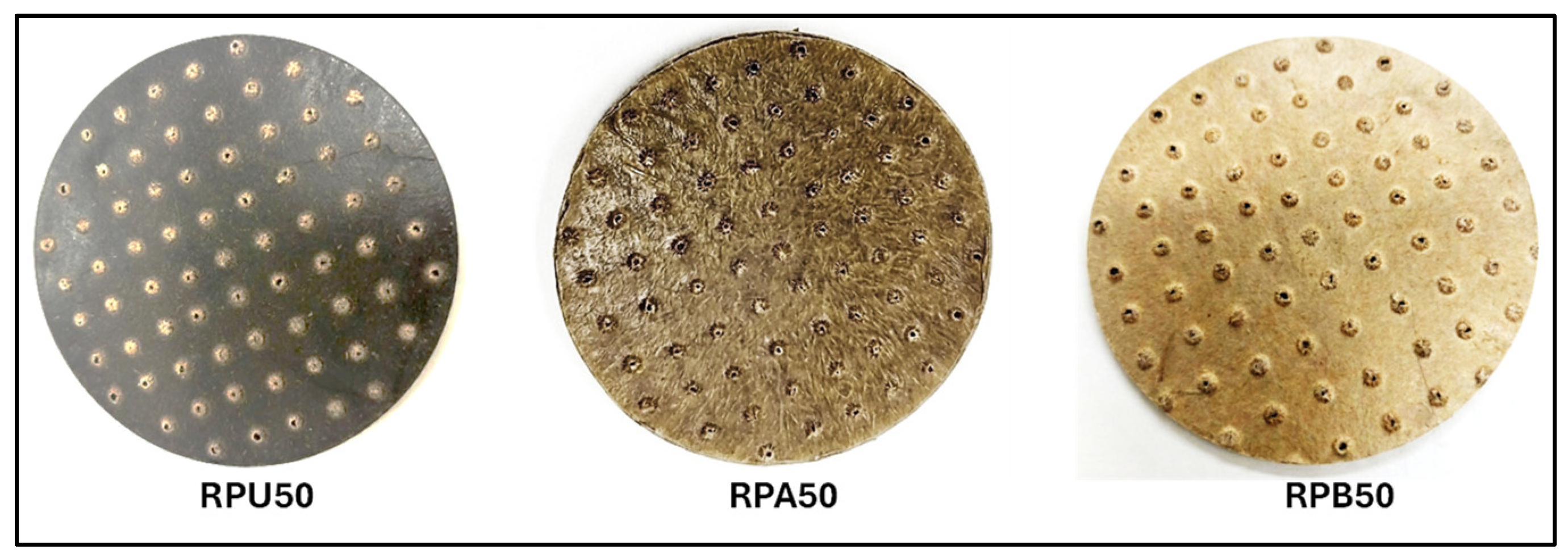
Figure 1. Physical images of perforated panels used in acoustic absorption experiment: RPU50; RPA50; and RPB50.
Sustainability 18 07005 g001
Figure 2. TEM images of (A) URS, (B) ARS, and (C) BC from rice straw, along with their respective size distribution histograms: (D) URS, (E) ARS, and (F) BC.
Sustainability 18 07005 g002
Figure 3. XRD patterns for untreated rice straw (URS), alkaline-treated rice straw (ARS), and the bleached cellulose (BC) of the rice straw.
Sustainability 18 07005 g003
Figure 4. FTIR spectra patterns for untreated rice straw (URS), alkaline-treated rice straw (ARS), and bleached cellulose (BC).
Sustainability 18 07005 g004
Figure 5. Micrographs of (A) RP; (B) RPU10; (C) RPA10; (D) RPB10; (E) RPU30; (F) RPA30; (G) RPB30; (H) RPU50; (I) RPA50; and (J) RPB50 nanocomposites.
Sustainability 18 07005 g005
Figure 6. (A) TGA and (B) DTGA of RP, RPU50, RPA50, and RPB50 samples.
Sustainability 18 07005 g006
Figure 7. Effect of rice straw content and different treatments of rHDPE nanocomposites on: (A) tensile strength, (B) elongation at break and (C) elastic modulus.
Sustainability 18 07005 g007
Figure 8. Effect of rice straw content and different treatments on (A) flexural strength and (B) flexural modulus of rHDPE/rice straw nanocomposites.
Sustainability 18 07005 g008
Figure 9. Swelling behavior of: (A) RP, RPU10, RPU20 RPU30 and RPU50; (B) RPA10, RPA20, RPA30 and RPA50; and (C) RPB10, RPB20, RPB30 and RPB50. (D) The diffusion coefficient of the prepared samples.
Sustainability 18 07005 g009aSustainability 18 07005 g009b
Figure 10. The biodegradation of rice straw/rHDPE composites.
Sustainability 18 07005 g010
Figure 11. SAC versus 1/3 octave band frequency for (A) non-perforated and (B) perforated samples.
Sustainability 18 07005 g011aSustainability 18 07005 g011b
Figure 12. (A) Micro-hardness and Poisson’s ratio measured using ultrasonic technique. (B) Variations in ultrasonic longitudinal, shear, bulk, and Young’s moduli with filler content.
Sustainability 18 07005 g012
Table 1. The recipe for the prepared nanocomposites.
Nanocomposites
Code
rHDPE
(%)
URS
(%)
ARS
(%)
BC
(%)
RP100000
RPU10901000
RPU20802000
RPU30703000
RPU50505000
RPA10900100
RPA20800200
RPA30700300
RPA50500500
RPB10900010
RPB20800020
RPB30700030
RPB50500050
Table 2. Thermogravimetric parameters of rHDPE nanocomposites.
SampleTiT20T50T70Tmax1Tmax2Tmax3Residual Weight at 600°
RP352.9326.2408.01431.4427.1------5.5
RPU50′438.8381.4484.5---415.0489.252131.4
RPA50′422.2352.5460.8511.6432.8450.8480.118.1
RPB50359.2347.2375.5398.2362.1391.6437.900
Table 3. F-values and p-values obtained from the two-way ANOVA evaluating the effects of filler content, modification type, and their interactions on the mechanical properties of the composites.
StatisticSource of VariationTensile StrengthElongation at BreakElastic ModulusFlexural StrengthFlexural Modulus
p-ValueFiller content7.14 × 10−171.26 × 10−263.15 × 10−243.44 × 10−282.63 × 10⁻²⁸
Modification7.1 × 10−172.1 × 10−93.21 × 10−151.23 × 10−188.59 × 10⁻¹¹
Interaction0.320.782.83 × 10−70.00090.0002
F-ValueFiller content64.57189.94147.57223.36226.07
Modification52.9931.1872.41109.8039.04
Interaction1.210.5410.234.345.41
Disclaimer/Publisher’s Note: The statements, opinions and data contained in all publications are solely those of the individual author(s) and contributor(s) and not of MDPI and/or the editor(s). MDPI and/or the editor(s) disclaim responsibility for any injury to people or property resulting from any ideas, methods, instructions or products referred to in the content.