Data-Enabled Sales Communication and Sustainable Performance: The Roles of Analytics Capability, Customer-Centric Culture, and Employee Digital Competence
 ,
,  ,
,
Abstract
1. Introduction
2. Theoretical Foundation and Hypotheses Development
2.1. Theoretical Foundation
2.1.1. Resource-Based View (RBV)
2.1.2. Dynamic Capabilities Theory (DCT)
2.1.3. Service-Dominant Logic (SDL)
2.1.4. An Integrated Theoretical Framework
2.2. Hypotheses Development
2.2.1. SFA and BDACs
2.2.2. SFA and SP
2.2.3. BDACs and SP
2.2.4. CCC and SP
2.2.5. CCC and SFA
2.2.6. BDACs and SFA as Mediators
2.2.7. EDC as a Moderator
3. Methodology
3.1. Sampling and Data Collection
3.2. Variable Measurements
4. Results
4.1. The Measurement Model Evaluation
4.2. Discriminant Validity
4.3. Robustness and Common Method Bias Checks
4.4. The Structural Model Results
5. Discussion, Contributions, and Conclusions
5.1. Discussion
5.2. Theoretical Contributions
5.3. Practical Contributions
5.4. Conclusions
6. Limitations and Further Research
Author Contributions
Funding
Institutional Review Board Statement
Informed Consent Statement
Data Availability Statement
Acknowledgments
Conflicts of Interest
Abbreviations
| SFA | Sales Force Automation |
| SP | Sustainable Performance |
| BDACs | Big Data Analytics Capabilities |
| EDC | Employee Digital Competence |
| CCC | Customer Centric Culture |
| SDL | Service dominant logic |
| DCT | Dynamic Capabilities Theory |
| RBV | Resource Based View |
| CRM | Customer Relationship Management |
| ICT | Information and Communication Technology |
Appendix A

| Construct | Items |
|---|---|
| Sales Force Automation (SFA) | SFA1: The SFA system automates routine sales tasks efficiently. |
| SFA2: SFA helps capture detailed customer interaction and transaction data. | |
| SFA3: Sales personnel frequently use SFA tools for managing customer relationships. | |
| SFA4: SFA improves the accuracy and accessibility of sales data. | |
| SFA5: The implementation of SFA has enhanced sales team productivity. | |
| SFA6: Training provided on SFA systems was adequate to enable effective use. | |
| Big Data Analytics Capabilities (BDAC) | BDAC1: Our hotel effectively collects large volumes of diverse data relevant to sales and customer interactions. |
| BDAC2: We have robust processes for integrating data from different sources for analytics. | |
| BDAC3: The hotel staff possesses strong skills in analyzing complex datasets. | |
| BDAC4: Big data analytics insights are regularly used in strategic decision-making. | |
| BDAC5: Our analytics capabilities contribute to identifying new market trends and customer preferences. | |
| Sustainable Performance (SP) | SP1: Our hotel achieves high levels of customer satisfaction consistently. |
| SP2: Operational processes in our hotel are optimized for efficiency and resource conservation. | |
| SP3: The hotel implements environmentally sustainable practices successfully. | |
| SP4: Sustainable initiatives have positively impacted our financial performance. | |
| SP5: Employee engagement in sustainability efforts is strong. | |
| SP6: Our hotel’s innovation practices contribute to long-term competitive advantage. | |
| Customer-Centric Culture (CCC) | CCC1: Our hotel prioritizes deep understanding of guest preferences and needs. |
| CCC2: Employees are empowered to make decisions that enhance guest satisfaction. | |
| CCC3: Cross-functional collaboration exists to address customer requirements effectively. | |
| CCC4: Advanced technologies (e.g., CRM and analytics) are integrated to support customer-focused strategies. | |
| CCC5: Leadership actively promotes a customer-oriented mindset throughout the organization. | |
| Employee Digital Competence (EDC) | EDC1: I can use CRM, booking, and property management systems efficiently in my role. |
| EDC2: I can extract, clean, and interpret data (e.g., analytics dashboards) to inform decisions. | |
| EDC3: I can effectively collaborate via digital platforms (e.g., shared documents or remote communication tools). | |
| EDC4: I feel confident learning new digital tools on my own and exploring new features. | |
| EDC5: I am careful with data privacy, cybersecurity best practices, and ethical handling of guest data. |
References
- Davari, D.; Vayghan, S.; Jang, S.; Erdem, M. Hotel experiences during the COVID-19 pandemic: High-touch versus high-tech. Int. J. Contemp. Hosp. Manag. 2022, 34, 1312–1330. [Google Scholar] [CrossRef]
- Elnagar, A.K.; Derbali, A. The importance of tourism contributions in Egyptian economy. Int. J. Hosp. Tour. Stud. 2020, 1, 45–52. [Google Scholar] [CrossRef]
- Elshaer, I.A.; Azazz, A.M.S.; Elsaadany, H.A.S.; Elnagar, A.K. Social CRM Strategies: A Key Driver of Strategic Information Exchange Capabilities and Relationship Quality. Information 2024, 15, 329. [Google Scholar] [CrossRef]
- Verhoef, P.C.; Broekhuizen, T.; Bart, Y.; Bhattacharya, A.; Dong, J.Q.; Fabian, N.; Haenlein, M. Digital transformation: A multidisciplinary reflection and research agenda. J. Bus. Res. 2021, 122, 889–901. [Google Scholar] [CrossRef]
- Warner, K.S.R.; Wäger, M. Building dynamic capabilities for digital transformation: An ongoing process of strategic renewal. Long Range Plan. 2019, 52, 326–349. [Google Scholar] [CrossRef]
- Mikalef, P.; Boura, M.; Lekakos, G.; Krogstie, J. Big Data Analytics Capabilities and Innovation: The Mediating Role of Dynamic Capabilities and Moderating Effect of the Environment. Br. J. Manag. 2019, 30, 272–298. [Google Scholar] [CrossRef]
- Boujena, O.; Johnston, W.J.; Merunka, D.R. The Benefits of Sales Force Automation: A Customer’s Perspective. J. Pers. Sell. Sales Manag. 2009, 29, 137–150. [Google Scholar] [CrossRef]
- Buhalis, D.; Leung, R. Smart hospitality—Interconnectivity and interoperability towards an ecosystem. Int. J. Hosp. Manag. 2018, 71, 41–50. [Google Scholar] [CrossRef]
- Chatterjee, S.; Chaudhuri, R.; Vrontis, D. Big data analytics in strategic sales performance: Mediating role of CRM capability and moderating role of leadership support. EuroMed J. Bus. 2022, 17, 295–311. [Google Scholar] [CrossRef]
- Rivers, L.M.; Dart, J. Sales Technology Applications: The Acquisition and Use of Sales Force Automation by Mid-Sized Manufacturers. J. Pers. Sell. Sales Manag. 1999, 19, 59–73. [Google Scholar] [CrossRef]
- Babu, D.E.; Kaur, A.; Rajendran, C. Sustainability practices in tourism supply chain. Benchmarking Int. J. 2018, 25, 1148–1170. [Google Scholar] [CrossRef]
- Bahrami, M.; Shokouhyar, S.; Seifian, A. Big data analytics capability and supply chain performance: The mediating roles of supply chain resilience and innovation. Mod. Supply Chain Res. Appl. 2022, 4, 62–84. [Google Scholar] [CrossRef]
- Mithas, S.; Lee, M.R.; Earley, S.; Murugesan, S.; Djavanshir, R. Leveraging Big Data and Business Analytics [Guest editors’ introduction]. IT Prof. 2013, 15, 18–20. [Google Scholar] [CrossRef]
- Abou-Shouk, M.A.; Khalifa, G.S. The influence of website quality dimensions on e-purchasing behaviour and e-loyalty: A comparative study of Egyptian travel agents and hotels. J. Travel Tour. Mark. 2017, 34, 608–623. [Google Scholar] [CrossRef]
- Ferraris, A.; Mazzoleni, A.; Devalle, A.; Couturier, J. Big data analytics capabilities and knowledge management: Impact on firm performance. Manag. Decis. 2019, 57, 1923–1936. [Google Scholar] [CrossRef]
- Rahimi, R. Customer relationship management (people, process and technology) and organisational culture in hotels: Which traits matter? Int. J. Contemp. Hosp. Manag. 2017, 29, 1380–1402. [Google Scholar] [CrossRef]
- Ullah, A.; Iqbal, S.; Shams, S.M.R. Impact of CRM adoption on organizational performance: Moderating role of technological turbulence. Compet. Rev. Int. Bus. J. 2020, 30, 59–77. [Google Scholar] [CrossRef]
- Behl, A. Antecedents to firm performance and competitiveness using the lens of big data analytics: A cross-cultural study. Manag. Decis. 2022, 60, 368–398. [Google Scholar] [CrossRef]
- Bruhn, M.; Schnebelen, S. Integrated marketing communication—From an instrumental to a customer-centric perspective. Eur. J. Mark. 2017, 51, 464–489. [Google Scholar] [CrossRef]
- Reilly, P. Building customer centricity in the hospitality sector: The role of talent management. Worldw. Hosp. Tour. Themes 2018, 10, 42–56. [Google Scholar] [CrossRef]
- Teece, D.J. Explicating dynamic capabilities: The nature and microfoundations of (sustainable) enterprise performance. Strateg. Manag. J. 2007, 28, 1319–1350. [Google Scholar] [CrossRef]
- Dubey, R.; Gunasekaran, A.; Childe, S.J.; Blome, C.; Papadopoulos, T. Big Data and Predictive Analytics and Manufacturing Performance: Integrating Institutional Theory, Resource-Based View and Big Data Culture. Br. J. Manag. 2019, 30, 341–361. [Google Scholar] [CrossRef]
- Buttle, F.; Ang, L.; Iriana, R. Sales force automation: Review, critique, research agenda. Int. J. Manag. Rev. 2006, 8, 213–231. [Google Scholar] [CrossRef]
- Erffmeyer, R.C.; Johnson, D.A. An Exploratory Study of Sales Force Automation Practices: Expectations and Realities. J. Pers. Sell. Sales Manag. 2001, 21, 167–175. [Google Scholar] [CrossRef]
- Mishra, D.; Luo, Z.; Hazen, B.; Hassini, E.; Foropon, C. Organizational capabilities that enable big data and predictive analytics diffusion and organizational performance: A resource-based perspective. Manag. Decis. 2019, 57, 1734–1755. [Google Scholar] [CrossRef]
- Müller, O.; Fay, M.; Vom Brocke, J. The Effect of Big Data and Analytics on Firm Performance: An Econometric Analysis Considering Industry Characteristics. J. Manag. Inf. Syst. 2018, 35, 488–509. [Google Scholar] [CrossRef]
- Wamba, S.F.; Gunasekaran, A.; Akter, S.; Ren SJfan Dubey, R.; Childe, S.J. Big data analytics and firm performance: Effects of dynamic capabilities. J. Bus. Res. 2017, 70, 356–365. [Google Scholar] [CrossRef]
- Mikalef, P.; Krogstie, J. Examining the interplay between big data analytics and contextual factors in driving process innovation capabilities. Eur. J. Inf. Syst. 2020, 29, 260–287. [Google Scholar] [CrossRef]
- Gunasekaran, A.; Papadopoulos, T.; Dubey, R.; Wamba, S.F.; Childe, S.J.; Hazen, B.; Akter, S. Big data and predictive analytics for supply chain and organizational performance. J. Bus. Res. 2017, 70, 308–317. [Google Scholar] [CrossRef]
- Jiang, Y.; Wen, J. Effects of COVID-19 on hotel marketing and management: A perspective article. Int. J. Contemp. Hosp. Manag. 2020, 32, 2563–2573. [Google Scholar] [CrossRef]
- Grover, V.; Chiang, R.H.L.; Liang, T.P.; Zhang, D. Creating Strategic Business Value from Big Data Analytics: A Research Framework. J. Manag. Inf. Syst. 2018, 35, 388–423. [Google Scholar] [CrossRef]
- Helfat, C.E. Stylized facts, empirical research and theory development in management. Strateg. Organ. 2007, 5, 185–192. [Google Scholar] [CrossRef]
- Day, G.S.; Shea, G. Changing the Work of Innovation: A Systems Approach. Calif. Manag. Rev. 2020, 63, 41–60. [Google Scholar] [CrossRef]
- Homburg, C.; Jozić, D.; Kuehnl, C. Customer experience management: Toward implementing an evolving marketing concept. J. Acad. Mark. Sci. 2017, 45, 377–401. [Google Scholar] [CrossRef]
- Shah, D.; Rust, R.T.; Parasuraman, A.; Staelin, R.; Day, G.S. The Path to Customer Centricity. J. Serv. Res. 2006, 9, 113–124. [Google Scholar] [CrossRef]
- Morgan, N.A.; Feng, H.; Whitler, K.A. Marketing Capabilities in International Marketing. J. Int. Mark. 2018, 26, 61–95. [Google Scholar] [CrossRef]
- Lusch, R.F.; Vargo, S.L. Service-dominant logic: Reactions, reflections and refinements. Mark. Theory 2006, 6, 281–288. [Google Scholar] [CrossRef]
- Kuei, C.; Madu, C.N. Customer-centric six sigma quality and reliability management. Int. J. Qual. Reliab. Manag. 2003, 20, 954–964. [Google Scholar] [CrossRef]
- Prasad, K.D.V.; Vaidya, R.; Rani, R. Remote working and occupational stress: Effects on IT-enabled industry employees in Hyderabad Metro, India. Front. Psychol. 2023, 14, 1069402. [Google Scholar] [CrossRef] [PubMed]
- Johnson, D.S. Digitization of Selling Activity and Sales Force Performance: An Empirical Investigation. J. Acad. Mark. Sci. 2005, 33, 3–18. [Google Scholar] [CrossRef]
- Yallop, A.; Seraphin, H. Big data and analytics in tourism and hospitality: Opportunities and risks. J. Tour. Futur. 2020, 6, 257–262. [Google Scholar] [CrossRef]
- Zhang, J.J.; Joglekar, N.; Verma, R. Pushing the frontier of sustainable service operations management: Evidence from US hospitality industry. J. Serv. Manag. 2012, 23, 377–399. [Google Scholar] [CrossRef]
- Osei, B.A.; Ragavan, N.A.; Mensah, H.K. Prospects of the fourth industrial revolution for the hospitality industry: A literature review. J. Hosp. Tour. Technol. 2020, 11, 479–494. [Google Scholar] [CrossRef]
- Chawla, V.; Lyngdoh, T.; Guda, S.; Purani, K. Systematic review of determinants of sales performance: Verbeke et al.’s (2011) classification extended. J. Bus. Ind. Mark. 2020, 35, 1359–1383. [Google Scholar] [CrossRef]
- Khalil, M.L.; Aziz, N.A.; Long, F.; Zhang, H. What factors affect firm performance in the hotel industry post-Covid-19 pandemic? Examining the impacts of big data analytics capability, organizational agility and innovation. J. Open Innov. Technol. Mark. Complex. 2023, 9, 100081. [Google Scholar] [CrossRef]
- Blanco-Moreno, S.; Aydemir-Dev, M.; Santos, C.R.; Bayram-Arlı, N. Emerging sustainability themes in the hospitality sector: A bibliometric analysis. Eur. Res. Manag. Bus. Econ. 2025, 31, 100272. [Google Scholar] [CrossRef]
- Elnagar, A.K.; Aljuwaiber, A. The nexus of green intellectual capital and sustainable performance: Leadership commitment and knowledge sharing as influences. J. Intellect. Cap. 2026, 27, 110–138. [Google Scholar] [CrossRef]
- Khalifa, G.S.A.; Elshaer, A.M.; Hussain, K.; Elnagar, A.K. What drives customers’ participation behaviour? Unveiling the drivers of affective satisfaction and its impacts in the restaurant industry. J. Hosp. Tour. Insights 2025, 8, 612–636. [Google Scholar] [CrossRef]
- Gupta, M.; George, J.F. Toward the development of a big data analytics capability. Inf. Manag. 2016, 53, 1049–1064. [Google Scholar] [CrossRef]
- Bharadwaj, A.; El Sawy, O.A.; Pavlou, P.A.; Venkatraman, N. Digital Business Strategy: Toward a Next Generation of Insights. MIS Q. 2013, 37, 471–482. [Google Scholar] [CrossRef]
- Riggs, R.; Felipe, C.M.; Roldán, J.L.; Real, J.C. Deepening big data sustainable value creation: Insights using IPMA, NCA, and cIPMA. J. Mark. Anal. 2025, 13, 1000–1019. [Google Scholar] [CrossRef]
- Jaworski, B.J.; Kohli, A.K.; Sarin, S. Driving markets: A typology and a seven-step approach. Ind. Mark. Manag. 2020, 91, 142–151. [Google Scholar] [CrossRef]
- Kumar, V.; Aksoy, L.; Donkers, B.; Venkatesan, R.; Wiesel, T.; Tillmanns, S. Undervalued or Overvalued Customers: Capturing Total Customer Engagement Value. J. Serv. Res. 2010, 13, 297–310. [Google Scholar] [CrossRef]
- Sheth, J.N.; Parvatiyar, A. Sustainable Marketing: Market-Driving, Not Market-Driven. J. Macromark. 2021, 41, 150–165. [Google Scholar] [CrossRef]
- Bush, A.J.; Moore, J.B.; Rocco, R. Understanding sales force automation outcomes: A managerial perspective. Ind. Mark. Manag. 2005, 34, 369–377. [Google Scholar] [CrossRef]
- Holloway, B.B.; Deitz, G.D.; Hansen, J.D. The Benefits of Sales Force Automation (SFA): An Empirical Examination of SFA Usage on Relationship Quality and Performance. J. Relatsh. Mark. 2013, 12, 223–242. [Google Scholar] [CrossRef]
- Alharthey, B.K. Impact of E-marketing Capabilities and E-marketing Orientation on Sustainable Firm Performance of SME in KSA Through E-relationship Management. Int. J. Mark. Stud. 2023, 15, 71. [Google Scholar] [CrossRef]
- Hughes, D.E.; Ogilvie, J.L. When Sales Becomes Service: The Evolution of the Professional Selling Role and an Organic Model of Frontline Ambidexterity. J. Serv. Res. 2020, 23, 22–32. [Google Scholar] [CrossRef]
- Nguyen, T.H.; Dinh, V.H.; Nguyen, H.M.; Do, H.M.H.; Luong, M.D.; Nguyen, H.H.A. AI-analytics capabilities and knowledge assimilation: Driving innovation in SMEs. Int. J. Innov. Sci. 2026, 1–25. [Google Scholar] [CrossRef]
- Trinh, N.; Nguyen, M.; Cao, V.Q.; To, L.M.T. From Hosts and Peers to Customer-Centric Outcomes: The Role of Business Interactions in Livestream Shopping. Australas. Mark. J. 2026, 14413582261417709. [Google Scholar] [CrossRef]
- Chatterjee, S.; Chaudhuri, R.; Vrontis, D. Does data-driven culture impact innovation and performance of a firm? An empirical examination. Ann. Oper. Res. 2024, 333, 601–626. [Google Scholar] [CrossRef]
- Wasiq, M. Data Driven Culture and Firm Performance: The Mediating Role of Customer Centric Innovation and Customer Loyalty. Int. Rev. Manag. Mark. 2025, 16, 226–237. [Google Scholar] [CrossRef]
- Jelinek, R.; Ahearne, M.; Mathieu, J.; Schillewaert, N. A Longitudinal Examination of Individual, Organizational, and Contextual Factors on Sales Technology Adoption and Job Performance. J. Mark. Theory Pract. 2006, 14, 7–23. [Google Scholar] [CrossRef]
- Syardiansah, S.; Latief, A.; Daud, M.N.; Windi, W.; Suharyanto, A. The Effect of Job Satisfaction and Organizational Culture on Employee Performance of the Royal Hotel in East Aceh District. Bp. Int. Res. Crit. Inst. 2020, 3, 849–857. [Google Scholar] [CrossRef]
- Prakash, S.; Sharma, V.P.; Singh, R.; Vijayvargy, L.; Nilaish. Adopting green and sustainable practices in the hotel industry operations- an analysis of critical performance indicators for improved environmental quality. Manag. Environ. Qual. 2023, 34, 1057–1076. [Google Scholar] [CrossRef]
- Yang, M.; Talha, M.; Zhang, S.; Zhang, Y. Exploring the Mechanisms Linking Digital Leadership to Employee Creativity: A Moderated Mediation Model. Behav. Sci. 2025, 15, 1024. [Google Scholar] [CrossRef] [PubMed]
- Hair, J.F.; Hult, G.T.M.; Ringle, C.M.; Sarstedt, M.; Danks, N.P.; Ray, S. An Introduction to Structural Equation Modeling. In Partial Least Squares Structural Equation Modeling (PLS-SEM) Using R; Classroom Companion: Business; Springer International Publishing: Cham, Switzerland, 2021; pp. 1–29. Available online: https://link.springer.com/10.1007/978-3-030-80519-7_1 (accessed on 18 January 2025).
- Sekaran, U.; Bougie, R. Research Methods for Business: A Skill-Building Approach, 7th ed.; Wiley: Hoboken, NJ, USA, 2016. [Google Scholar]
- Etikan, I. Comparison of Convenience Sampling and Purposive Sampling. Am. J. Theor. Appl. Stat. 2016, 5, 1–4. [Google Scholar] [CrossRef]
- Iriqat, R.A.; Shkairat, R.; Herzallah, A.M.; Elnagar, A.K. Enhancing corporate sustainability in SMEs through smart technologies: Supply chain flexibility and agility as mediator. Ind. Manag. Data Syst. 2025, 125, 2155–2177. [Google Scholar] [CrossRef]
- Zaki, K.; Elnagar, A.K. Unpacking talent management: A moderated mediation analysis of team dynamics and competitive performance in luxury hotels. Empl. Relat. 2025, 47, 48–77. [Google Scholar] [CrossRef]
- Sarstedt, M.; Ringle, C.M. Structural Equation Models: From Paths to Networks (Westland 2019). Psychometrika 2020, 85, 841–844. [Google Scholar] [CrossRef]
- Jones, E.; Sundaram, S.; Chin, W. Factors Leading to Sales Force Automation Use: A Longitudinal Analysis. J. Pers. Sell. Sales Manag. 2002, 22, 145–156. [Google Scholar] [CrossRef]
- Alaei, A.R.; Becken, S.; Stantic, B. Sentiment Analysis in Tourism: Capitalizing on Big Data. J. Travel Res. 2019, 58, 175–191. [Google Scholar] [CrossRef]
- Su, X.; Zeng, W.; Zheng, M.; Jiang, X.; Lin, W.; Xu, A. Big data analytics capabilities and organizational performance: The mediating effect of dual innovations. Eur. J. Innov. Manag. 2022, 25, 1142–1160. [Google Scholar] [CrossRef]
- Xiang, Z.; Schwartz, Z.; Gerdes, J.H.; Uysal, M. What can big data and text analytics tell us about hotel guest experience and satisfaction? Int. J. Hosp. Manag. 2015, 44, 120–130. [Google Scholar] [CrossRef]
- Zhao, Y.; Xu, X.; Wang, M. Predicting overall customer satisfaction: Big data evidence from hotel online textual reviews. Int. J. Hosp. Manag. 2019, 76, 111–121. [Google Scholar] [CrossRef]
- Elkington, J. Cannibals with Forks: The Triple Bottom Line of 21st Century Business; Capstone Publishing: Oxford, UK, 1997. [Google Scholar]
- Audrin, B.; Audrin, C.; Salamin, X. Digital skills at work—Conceptual development and empirical validation of a measurement scale. Technol. Forecast. Soc. Change 2024, 202, 123279. [Google Scholar] [CrossRef]
- Schwarz, S.; Bieg, T.; Svecnik, E.; Schmölz, A.; Geppert, C.; Gerdenitsch, C. Digital Competence Scale (DCS): A Short Self-Assessment Instrument for Measuring Digital Competences. Nord. J. Digit. Lit. 2024, 19, 126–143. [Google Scholar] [CrossRef]
- Elnagar, A.K.; Khalifa, G.S.A.; Herzallah, A.; Derbali, A.M.; Elgabrony, S.A.; Iriqat, R.A. Exploring the Link between Self-Leadership and Innovative Work Behaviours in Luxury Hotels: Validating a Moderated Mediation Model. Afr. J. Hosp. Tour. Leis. 2025, 14, 63–73. [Google Scholar]
- Henseler, J.; Ringle, C.M.; Sarstedt, M. A new criterion for assessing discriminant validity in variance-based structural equation modeling. J. Acad. Mark. Sci. 2015, 43, 115–135. [Google Scholar] [CrossRef]
- Khalifa, G.S.A.; Derbali, A.M.S.; Herzallah, A.M.; Elshaer, A.M.; Elnagar, A.K. Greening Strategies: Interweaving Strategic Vigilance, Digital Transformation, and Corporate Strategic Foresight for Green Innovative Performance. Int. J. Hosp. Tour. Adm. 2025, 1–36. [Google Scholar] [CrossRef]
- Hossain, M.S.; Sambasivan, M.; Abuelhassan, A.E.; Khalifa, G.S.A. Factors influencing customer citizenship behaviour in the hospitality industry. Ann. Leis. Res. 2023, 26, 65–88. [Google Scholar] [CrossRef]
- Buesing, E.; Haug, M.; Mukhopadhyay, S.; Raabe, J.; Lai, V. Where Is Customer Care in 2024? McKinsey & Company. 2024. Available online: https://www.mckinsey.com/capabilities/operations/our-insights/where-is-customer-care-in-2024? (accessed on 18 January 2025).
- Aziz, N.A.; Al Mamun, A.; Reza, M.N.H.; Naznen, F. The impact of big data analytics on innovation capability and sustainability performance of hotels: Evidence from an emerging economy. J. Enterp. Inf. Manag. 2024, 37, 1044–1068. [Google Scholar] [CrossRef]
- Inversini, A.; De Carlo, M.; Masiero, L. The effects of customer-centricity in hospitality. Int. J. Hosp. Manag. 2020, 86, 102436. [Google Scholar] [CrossRef]
- Hat, N.D.; Tan, K.L.; Ngoc Vi, N.L.; Phu, N.A.; Ting, H. The Influence of Customer Relationship Management in Enhancing Hospitality Business Performance: The Conditional Mediation of Digital Marketing Capabilities. Int. J. Hosp. Tour. Adm. 2025, 26, 520–546. [Google Scholar] [CrossRef]
- Garrido-Moreno, A.; García-Morales, V.J.; Martín-Rojas, R. Going beyond the curve: Strategic measures to recover hotel activity in times of COVID-19. Int. J. Hosp. Manag. 2021, 96, 102928. [Google Scholar] [CrossRef] [PubMed]
- Minor, K.; McLoughlin, E.; Carlisle, S. The Digital Skills Gap—Is it Time to Rethink the Needs of Tourism and Hospitality Organizations in the UK? J. Hosp. Tour. Educ. 2025, 37, 301–312. [Google Scholar] [CrossRef]
- Stylianou, C.; Pericleous, K. Reviewing the digital skills and readiness of hospitality and tourism graduates: A way of success. Worldw. Hosp. Tour. Themes 2025, 17, 11–21. [Google Scholar] [CrossRef]
- Elnagar, A.K.; Zaki, K.; Salama, W.M.E.; Suliman, M.A. Customer Incivility Spillover into Kitchen Staff Deviance and Withdrawal in Multigenerational Workplaces: The Moderating Function of Moral Disengagement. Adm. Sci. 2026, 16, 253. [Google Scholar] [CrossRef]
- Ahmed, H.A.M.; Zaki, K.; Abdelghani, A.A.A.; Abdelfadel, T.A.; Abusalim, E.; Elnagar, A.K. Leveraging corporate social responsibility for sustainable performance: The mediating roles of green organizational culture and employee engagement under regulatory pressure. Geoj. Tour. Geosites 2025, 62, 1950–1970. [Google Scholar] [CrossRef]
- Herzallah, A.M.; Iriqat, R.A.M.; Hamed, M.H.; Zaki, K.; Elnagar, A.K. Green synergy in hospitality: Unveiling the nexus between environmentally sustainable practices and hotel green performance. Int. J. Hosp. Manag. 2025, 131, 104301. [Google Scholar] [CrossRef]
- Zaki, K.; Abdelghani, A.A.A.; Ahmed, H.A.M.; Abdelfadel, T.; Abusalim, E.; Ahmed, K.; Abuzaid, A.E.; Elnagar, A.K. Work decently: AI-driven marketing strategies for a competitive edge in tourism. Res. J. Adv. Humanit. 2025, 6, 64. [Google Scholar]
- Hossain, M.S.; Khalifa, G.S.A.; Abu Horaira, M. Value-Based Fairness in Malaysian Five-Star Resorts: Measuring the Roles of Service-Related Attributes and Guest Behavioral Loyalty. Asia-Pac. J. Innov. Hosp. Tour. 2019, 8, 227–254. [Google Scholar]


| Theory | Core Mechanism | Role in the Model | Supported Hypotheses |
|---|---|---|---|
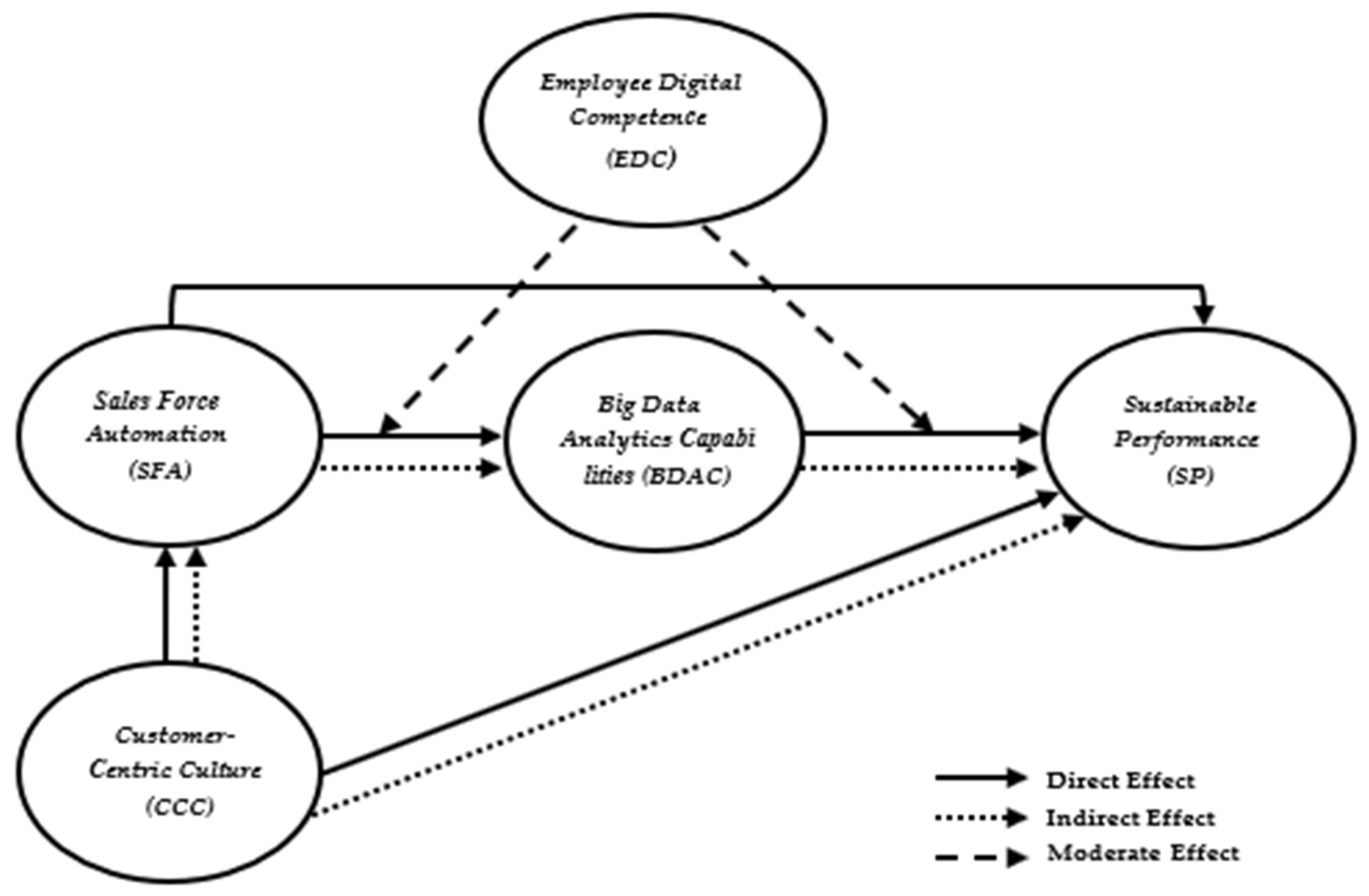
| Resource-Based View (RBV) | Tangible vs. intangible resources; VRIN logic | SFA = valuable but imitable data generator; BDAC = VRIN capability that converts data into sustainable advantage. Explains why BDACs mediate SFA → SP. | H6a (SFA → BDACs → SP) |
| Dynamic Capabilities Theory (DCT) | Sensing–seizing–transforming | CCC + SFA = sensing customer needs; BDACs = seizing opportunities from data; SP = transforming operations for sustainability. Explains the full serial chain. | H6d (CCC → SFA → BDACs → SP); also, H1, H2, H3 |
| Service-Dominant Logic (SDL) | Value co-creation with customers | CCC ensures that technology (SFA and BDACs) serves customer-oriented, service-dominant purposes, not control and justifies the direct effects of CCC on SFA and SP. | H4, H5 |
| Integration of All Three | Absorptive capacity + ethical data use + VRIN utilization | EDC moderates SFA–BDACs and BDAsC–SP by improving employees’ ability to extract, interpret, and act on data, while maintaining service-dominant ethics. | H7a, H7b |
| Symbol | Quantity | Freq. | % |
|---|---|---|---|
| Gender | Male | 182 | 57.8% |
| Female | 133 | 42.2% | |
| Age Group | Under 25 | 38 | 12.1% |
| 25–34 | 142 | 45.1% | |
| 35–44 | 95 | 30.2% | |
| 45–54 | 32 | 10.2% | |
| 55 and above | 8 | 2.5% | |
| Position Level | Frontline staff | 68 | 21.6% |
| Supervisory/team leader | 97 | 30.8% | |
| Middle management | 102 | 32.4% | |
| Senior management/director | 48 | 15.2% | |
| Department | Sales and marketing | 89 | 28.3% |
| Operations/front office | 76 | 24.1% | |
| Human resources | 32 | 10.2% | |
| Finance/accounting | 28 | 8.9% | |
| IT/digital services | 35 | 11.1% | |
| Sustainability/CSR | 25 | 7.9% | |
| Other | 30 | 9.5% | |
| Tenure in Current Role | Less than 1 year | 52 | 16.5% |
| 1–3 years | 105 | 33.3% | |
| 4–6 years | 88 | 27.9% | |
| 7+ years | 70 | 22.2% |
| Construct | Code | L | α | CR | AVE | VIF |
|---|---|---|---|---|---|---|
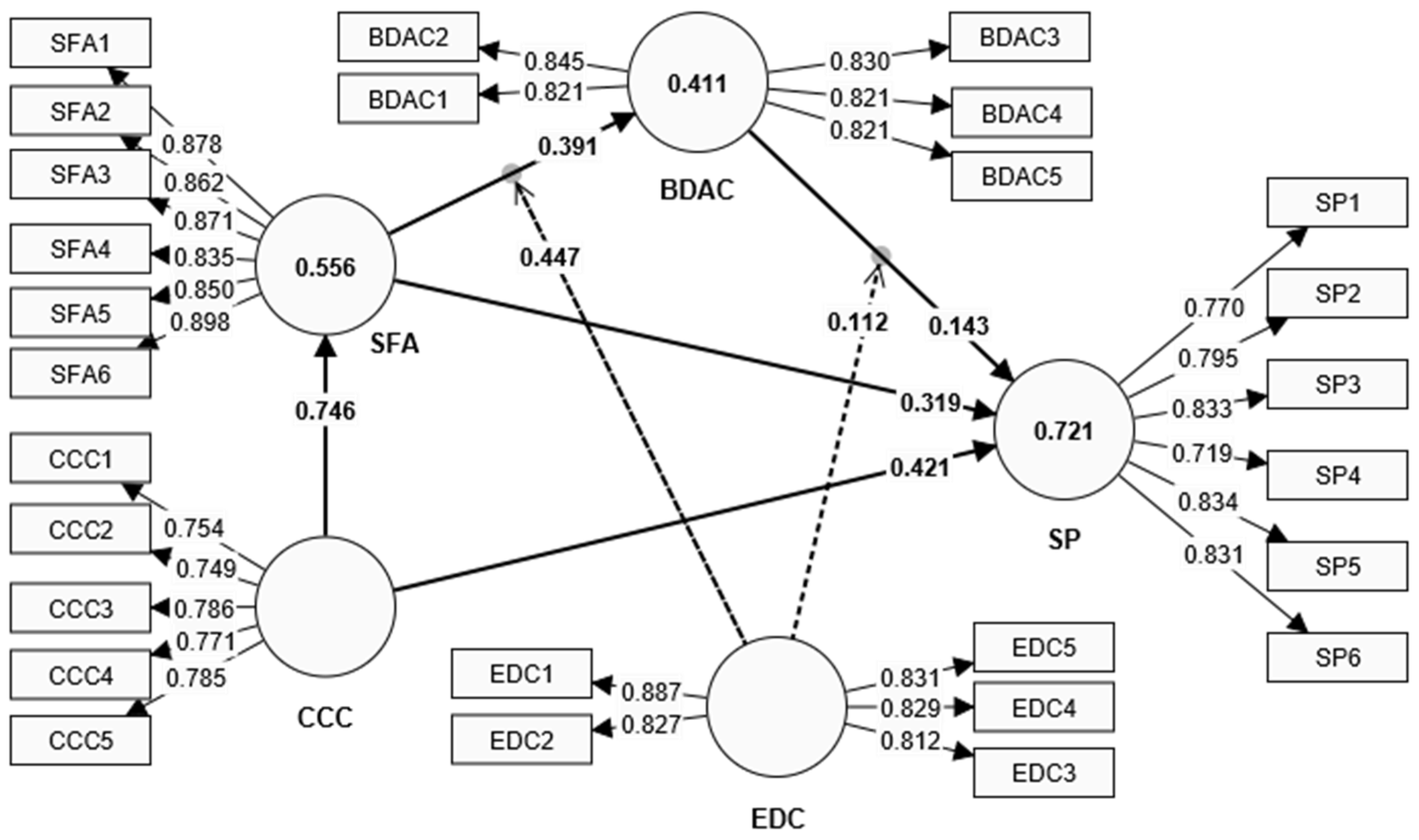
| Big Data Analytics Capabilities (BDACs) | BDAC1 | 0.821 | 0.885 | 0.887 | 0.685 | 2.125 |
| BDAC2 | 0.845 | 2.233 | ||||
| BDAC3 | 0.830 | 2.090 | ||||
| BDAC4 | 0.821 | 2.058 | ||||
| BDAC5 | 0.821 | 2.015 | ||||
| BDAC6 | Deleted | |||||
| Customer-Centric Culture (CCC) | CCC1 | 0.754 | 0.830 | 0.834 | 0.591 | 2.384 |
| CCC2 | 0.749 | 2.290 | ||||
| CCC3 | 0.786 | 2.027 | ||||
| CCC4 | 0.771 | 2.048 | ||||
| CCC5 | 0.785 | 2.140 | ||||
| CCC6 | Deleted | |||||
| Employee Digital Competence (EDC) | EDC1 | 0.887 | 0.893 | 0.894 | 0.702 | 2.969 |
| EDC2 | 0.827 | 2.108 | ||||
| EDC3 | 0.812 | 1.980 | ||||
| EDC4 | 0.829 | 2.162 | ||||
| EDC5 | 0.831 | 2.190 | ||||
| Sales Force Automation (SFA) | SFA1 | 0.878 | 0.933 | 0.934 | 0.750 | 3.029 |
| SFA2 | 0.862 | 2.756 | ||||
| SFA3 | 0.871 | 2.935 | ||||
| SFA4 | 0.835 | 2.406 | ||||
| SFA5 | 0.850 | 2.581 | ||||
| SFA6 | 0.898 | 3.559 | ||||
| Sustainable Performance (SP) | SP1 | 0.770 | 0.886 | 0.888 | 0.637 | 2.067 |
| SP2 | 0.795 | 2.194 | ||||
| SP3 | 0.833 | 2.364 | ||||
| SP4 | 0.719 | 2.360 | ||||
| SP5 | 0.834 | 2.452 | ||||
| SP6 | 0.831 | 2.461 |
| Fornell–Larcker Criterion | |||||
|---|---|---|---|---|---|
| BDAC | CCC | EDC | SFA | SP | |
| BDAC | 0.828 | ||||
| CCC | 0.489 | 0.769 | |||
| EDC | 0.298 | 0.421 | 0.838 | ||
| SFA | 0.444 | 0.746 | 0.624 | 0.866 | |
| SP | 0.516 | 0.719 | 0.448 | 0.658 | 0.825 |
| Heterotrait–monotrait ratio (HTMT)—Matrix | |||||
| BDAC | |||||
| CCC | 0.556 | ||||
| EDC | 0.335 | 0.489 | |||
| SFA | 0.488 | 0.843 | 0.683 | ||
| SP | 0.580 | 0.479 | 0.490 | 0.714 | |
| H | Relationship | β | SD | t-Value | p-Values | R2 | F2 | Q2 | Result |
|---|---|---|---|---|---|---|---|---|---|
| H1 | SFA → BDAC | 0.391 | 0.049 | 7.969 | <0.001 | 0.411 | 0.158 | 0.230 | ✓ |
| H2 | SFA → SP | 0.319 | 0.054 | 5.914 | 0.721 | 0.106 | 0.442 | ✓ | |
| H3 | BDACs → SP | 0.143 | 0.036 | 3.946 | 0.053 | ✓ | |||
| H4 | CCC → SP | 0.421 | 0.040 | 10.473 | 0.228 | ✓ | |||
| H5 | CCC → SFA | 0.746 | 0.024 | 31.383 | 0.556 | 0.751 | 0.414 | ✓ | |
| H6a | SFA → BDACs → SP | 0.056 | 0.015 | 3.653 | ✓ | ||||
| H6b | CCC → SFA → SP | 0.238 | 0.042 | 5.599 | ✓ | ||||
| H6c | CCC → SFA → BDACs | 0.292 | 0.040 | 7.333 | ✓ | ||||
| H6d | CCC → SFA → BDACs → SP | 0.042 | 0.012 | 3.585 | ✓ | ||||
| H7a | EDC × SFA → BDACs | 0.447 | 0.031 | 14.545 | ✓ | ||||
| H7b | EDC × BDACs → SP | 0.112 | 0.026 | 4.285 | ✓ |
Disclaimer/Publisher’s Note: The statements, opinions and data contained in all publications are solely those of the individual author(s) and contributor(s) and not of MDPI and/or the editor(s). MDPI and/or the editor(s) disclaim responsibility for any injury to people or property resulting from any ideas, methods, instructions or products referred to in the content. |
© 2026 by the authors. Licensee MDPI, Basel, Switzerland. This article is an open access article distributed under the terms and conditions of the Creative Commons Attribution (CC BY) license.
Share and Cite
Elnagar, A.K.; Khalifa, G.S.A.; Alogaily, R.S.; Salama, A.F. Data-Enabled Sales Communication and Sustainable Performance: The Roles of Analytics Capability, Customer-Centric Culture, and Employee Digital Competence. Sustainability 2026, 18, 6989. https://doi.org/10.3390/su18146989
Elnagar AK, Khalifa GSA, Alogaily RS, Salama AF. Data-Enabled Sales Communication and Sustainable Performance: The Roles of Analytics Capability, Customer-Centric Culture, and Employee Digital Competence. Sustainability. 2026; 18(14):6989. https://doi.org/10.3390/su18146989
Chicago/Turabian StyleElnagar, Ahmed K., Gamal S. A. Khalifa, Rana Sulaiman Alogaily, and Alfatma Fathallah Salama. 2026. "Data-Enabled Sales Communication and Sustainable Performance: The Roles of Analytics Capability, Customer-Centric Culture, and Employee Digital Competence" Sustainability 18, no. 14: 6989. https://doi.org/10.3390/su18146989
APA StyleElnagar, A. K., Khalifa, G. S. A., Alogaily, R. S., & Salama, A. F. (2026). Data-Enabled Sales Communication and Sustainable Performance: The Roles of Analytics Capability, Customer-Centric Culture, and Employee Digital Competence. Sustainability, 18(14), 6989. https://doi.org/10.3390/su18146989