1. Introduction
Companies increasingly need to transform to remain competitive in a rapidly changing business environment. Ongoing social, economic, and technological changes generate a turbulent environment that significantly affects the functioning of organizations. Competitive advantage increasingly depends on innovative processes and the effective use of advanced technologies. The implementation of organizational and technical solutions is therefore essential for enhancing flexibility, responding rapidly and effectively to customer needs, and maintaining competitiveness [
1]. The most technologically advanced solutions currently available are associated with the Industry 5.0 concept. This concept offers a broad range of implementation options; however, selecting the most appropriate ones requires enterprises to define their objectives at the strategic level.
Industry 5.0 has emerged as one of the most influential concepts shaping current discussions on industrial transformation in both academia and practice. Industry 5.0 is commonly viewed as the next stage of industrial development. Unlike Industry 4.0, which mainly emphasizes automation and efficiency, Industry 5.0 highlights human–technology collaboration, sustainability, and resilience. It also places greater emphasis on product individualization, human-centred technological processes, and social and environmental sustainability [
2,
3,
4].
Business models are currently understood as complementary to organizational strategy, while the organization itself is analyzed holistically, considering strategic objectives, processes, stakeholders, and performance outcomes [
5]. The proposed maturity model is based on the integration of intelligent technologies with human capabilities. It also considers changes in production processes that improve manufacturing efficiency and support greater production flexibility. Industry 5.0 is concerned not only with improving productivity and output, but also with addressing major global challenges related to sustainability and environmental protection. Consequently, the maturity model refers not only to technology, but also to new forms of work organization and the changing role of humans in industry.
Maturity models were developed in the mid-twentieth century to support the systematic improvement of organizational performance, ensure consistency, and meet customer expectations [
6]. Maturity models are assessment tools that determine an organization’s level of advancement in areas such as management, technology, and business processes. They help identify strengths, weaknesses, development objectives, and improvement priorities. A maturity model enables organizations to gain an in-depth understanding of their current position and to identify areas requiring improvement or investment. As a result, organizations can recognize gaps and weaknesses, develop improvement strategies, and undertake actions aimed at enhancing their effectiveness. Such models support the assessment of readiness for smart production implementation based on pillars such as sustainability, resilience, and human-centricity, thereby facilitating the transition towards Industry 5.0 practices. Moreover, combining maturity models related to sustainability with digitalization factors helps define strategic improvement areas for enterprises moving towards green and digital technologies [
7].
The dynamic nature of contemporary business, characterized by rapid digital transformation, requires robust management systems that make use of advanced technologies such as artificial intelligence (AI), robotics, and big data analytics. These technologies are crucial for enhancing efficiency and innovation, enabling organizations to maintain their competitiveness [
6]. Industry 5.0 creates numerous challenges for organizations seeking to adapt to the new industrial reality and exploit its potential. In this context, maturity models provide a valuable tool for assessing organizational capabilities, identifying development gaps, and supporting the systematic planning of transformation towards Industry 5.0 [
8].
Based on the literature analyses, the authors found that organizational maturity for implementing Industry 5.0 through maturity models has been examined only to a limited extent in the logistics sector. This enabled the identification of a research gap concerning the use of such models in logistics enterprises. Accordingly, the authors propose a maturity model that allows companies to assess their current level of implementation and plan further improvement activities. The model supports a systematic evaluation of readiness to adopt Industry 5.0 and helps enterprises implement innovative, customer-oriented, and sustainable logistics processes.
This study represents an initial stage of a broader research programme devoted to assessing the readiness of logistics enterprises to implement the assumptions of Industry 5.0. The main objective of the paper is to develop a comprehensive maturity model for the implementation of the Industry 5.0 concept in enterprises operating in the logistics sector. This objective was achieved through a systematic literature review and an analysis of existing maturity models. These activities enabled the identification of a research gap concerning the lack of diagnostic tools tailored to logistics organizations. An additional objective of the study is to provide a preliminary empirical verification of the usefulness of the proposed model based on a pilot study conducted in a logistics enterprise. The pilot study was used to assess whether the model structure, modules, and criteria were understandable and applicable in practice. It also helped identify refinements needed before large-scale validation.
2. Research Methodology
The research work aimed at developing a maturity model for the implementation of the Industry 5.0 concept in logistics enterprises was conducted in four stages. The research procedure comprised a systematic literature review, an analysis of existing maturity models, the development of a conceptual model, and its preliminary validation.
The first stage of the study involved a systematic literature review. Its purpose was to identify the current state of knowledge on Industry 5.0, Logistics 5.0, and maturity models used to assess organizational readiness for technological and organizational transformation. The review was conducted to identify and synthesize existing knowledge in a structured and transparent way, following established systematic review principles commonly applied in management research [
9,
10].
The literature review followed the approach commonly recommended in management and quality sciences and was conducted in accordance with established guidelines for systematic literature reviews [
9]. It consisted of four stages: publication identification, screening, eligibility assessment, and data synthesis.
Relevant publications were retrieved from three widely recognized scientific databases: Web of Science, Scopus, and ScienceDirect. These databases were selected because of their extensive journal coverage and their widespread use in research on digital transformation, logistics management, and organizational maturity. The search strategy employed a set of keywords related to three main research areas: Industry 5.0, Logistics 5.0, and maturity models.
Following the screening and selection process, which included only peer-reviewed studies, 89 scientific publications were qualified for detailed analysis. These publications were then examined in depth to identify the main dimensions of Industry 5.0 implementation, the methods used to assess organizational maturity, and the specific requirements faced by logistics enterprises.
Following the systematic literature review, a qualitative content analysis of the selected publications and existing maturity models was conducted. The objective of this analysis was to identify the most frequently reported dimensions, organizational capabilities, technological enablers, and managerial practices associated with the implementation of the Industry 5.0 and Logistics 5.0 concepts. The identified elements were subsequently grouped according to their thematic similarity, resulting in the definition of nine assessment modules. Based on this classification, detailed assessment criteria were developed for each module to reflect the key organizational, technological, logistics, sustainability, and resilience-related requirements identified in the literature. During the model development process, overlapping elements were consolidated and redundant criteria were eliminated to ensure conceptual consistency while maintaining the comprehensive nature of the assessment framework. Consequently, the final set of 112 assessment criteria represents a synthesis of the principal factors identified in the systematic literature review.
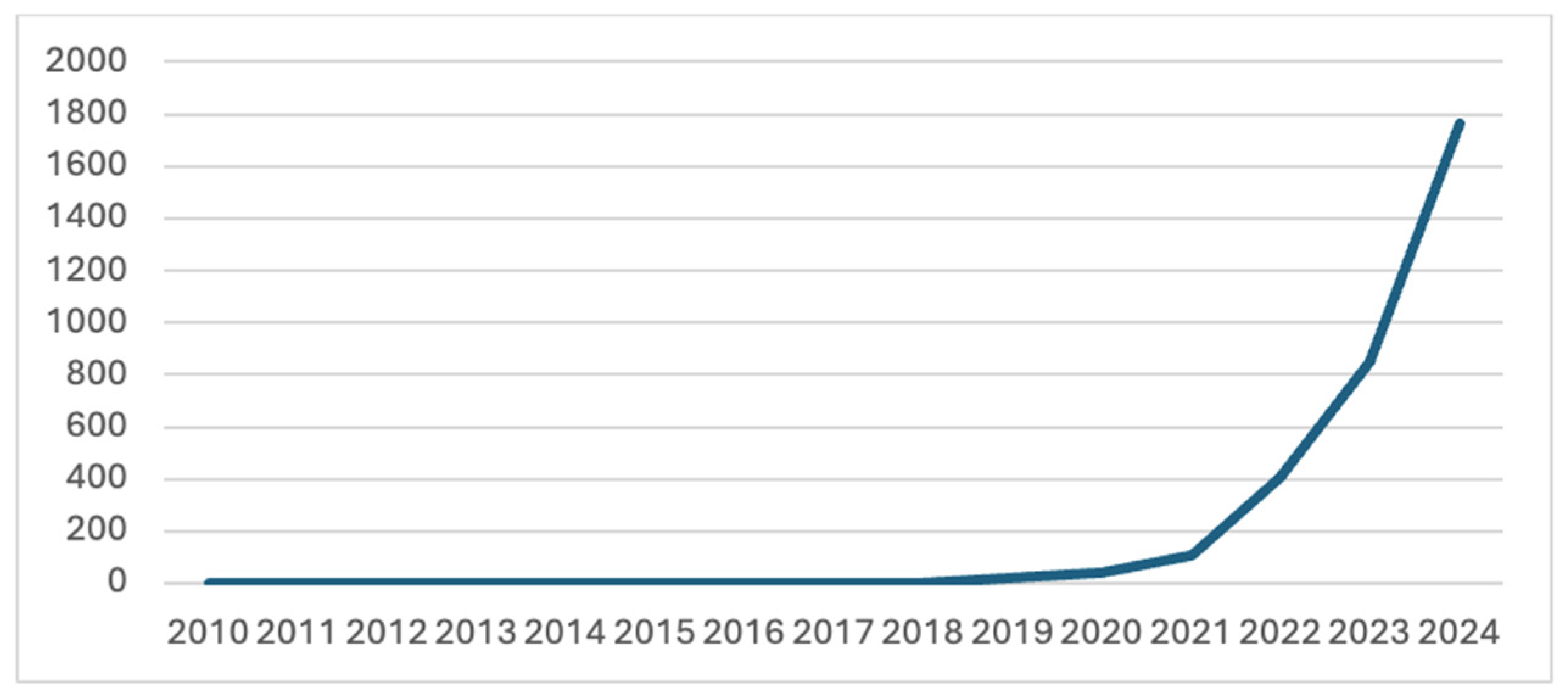
The literature review revealed a substantial increase in Industry 5.0 research after 2020, as reflected in the growing number of publications indexed in major scientific databases.
Figure 1 presents the number of publications related to Industry 5.0 over time.
Initially, the level of interest was relatively low, with only a small number of publications. Since 2018, however, a marked increase in the number of publications has been observed, indicating the growing prominence of this topic in recent years. The most pronounced growth occurred between 2021 and 2024, when the number of publications doubled, suggesting increasing scholarly interest and the rapid development of research related to Industry 5.0. At the same time, the analysis showed that most previous studies have focused on manufacturing enterprises, whereas the implementation of Industry 5.0 in logistics enterprises remains relatively underexplored.
A detailed analysis of the publications enabled the identification of three main areas forming the foundation of the proposed model. The first area concerns the core assumptions of Industry 5.0, including human-centricity, organizational resilience, and sustainability. The second area is Logistics 5.0, whose key components include smart warehouses, real-time process monitoring, autonomous transport systems, and digital supply chain management. The third area comprises organizational maturity models used to assess the level of advancement of enterprises in organizational improvement and digital transformation processes.
The literature review enabled the identification of a significant research gap. Despite the growing number of studies on Industry 5.0 and organizational maturity models, comprehensive assessment tools for logistics enterprises remain limited. Existing models do not adequately assess organizational readiness for implementing Industry 5.0 principles. Insufficient attention has been paid to the specific characteristics of logistics processes, such as supply chain resilience, real-time flow visibility, warehouse automation, and human collaboration with intelligent logistics systems.
The identified research gap demonstrates the need for a dedicated maturity model tailored to logistics enterprises operating in an Industry 5.0 environment.
3. Analysis of Existing Maturity Models
Maturity models are commonly defined as tools for assessing an organization’s level of development in specific areas and for systematically supporting organizational improvement [
11]. They also help identify improvement actions required to achieve higher levels of maturity. They are widely used to evaluate management systems, digital transformation, process management, quality improvement, and the implementation of modern technologies [
11]. The findings provided the basis for developing an original maturity model dedicated to logistics enterprises operating in accordance with the assumptions of Industry 5.0.
Maturity models are commonly defined as tools for assessing an organization’s level of development in specific areas. They also help identify improvement actions required to achieve higher levels of maturity. They are used, among other purposes, to evaluate management systems, digital transformation, process management, quality improvement, and the implementation of modern technologies.
For the purposes of this study, three groups of models were analyzed. The first group comprised universal models of organizational excellence, the second included models related to digital transformation and the Industry 4.0 concept, while the third consisted of models directly referring to the assumptions of Industry 5.0.
Within the group of organizational excellence models, the analysis focused on the EFQM 2020 model and the organizational self-assessment model based on ISO 9004:2018 [
12] guidelines. These models are among the most frequently used approaches for assessing the level of organizational development and identifying areas requiring improvement.
The EFQM 2020 model assumes that organizations create sustainable value for stakeholders through integrated management. Its comprehensive nature is emphasized, as it covers all aspects of organizational activity. The core concepts of the model focus on customer orientation, sustainability, and innovation. The EFQM model serves both as a self-assessment tool and as a framework for organizational management. It links the organization’s mission and vision with strategy, key success factors, performance measurement, and business results within the sustainability paradigm [
13]. The EFQM Excellence Model is applied by organizations worldwide for self-assessment, the exchange of best practices, and the evaluation of organizations for national business excellence and quality awards [
14]. It is a practical tool that indicates the position of companies and other organizations on the path towards excellence, helping them identify shortcomings and encouraging the adoption of appropriate improvement measures [
15]. Although the EFQM 2020 model provides a comprehensive framework for organizational excellence and continuous improvement, it was not designed specifically to assess the implementation of Industry 5.0 or Logistics 5.0. Its universal character limits its ability to evaluate logistics-specific capabilities such as real-time supply chain visibility, intelligent warehouse management, autonomous logistics systems, or the integration of advanced digital technologies within logistics processes. Consequently, although the EFQM model provides valuable inspiration for the strategic and organizational dimensions of the proposed maturity model, it does not constitute a sufficient assessment framework for logistics enterprises undergoing Industry 5.0 transformation. The second solution analyzed was the organizational self-assessment model based on ISO 9004. This model uses a five-level maturity scale that enables the assessment of organizational development in individual management areas. Its main advantage lies in its universality and applicability regardless of organizational size or sector. Consequently, the maturity levels adopted in the standard were used as a reference point when designing the assessment scale in the proposed model. ISO 9004 provides a valuable maturity structure; however, it focuses primarily on quality management and does not explicitly address digital transformation, human–AI collaboration or logistics-specific capabilities required by Industry 5.0.
The second group of analyzed solutions comprised models related to digital transformation and the implementation of the Industry 4.0 concept. In this area, the IMPULS Industry 4.0 Readiness model, the Acatech Industry 4.0 Maturity Index, and the Smart Industry Readiness Index (SIRI) were examined in detail.
The IMPULS model focuses on assessing enterprises’ readiness to implement Industry 4.0 solutions through the analysis of six key areas: strategy, smart operations, smart products, information technologies, organization, and employees. Its advantage lies in its transparent structure and the possibility of conducting a relatively rapid enterprise self-assessment.
The Acatech Industry 4.0 Maturity Index represents a more advanced approach to assessing digital transformation. It assumes that organizations progress through successive development stages, from process computerization, through digitization and integration, to the achievement of full organizational adaptability. The model places particular emphasis on the development of information systems, data integration, and the organization’s capacity for autonomous decision-making. Although the Acatech model offers a sophisticated digital maturity framework, its primary orientation towards manufacturing environments limits its applicability in logistics organizations operating within complex supply networks.
The Smart Industry Readiness Index was developed as a practical tool supporting enterprises in planning digital transformation. The model comprises three main dimensions: processes, technologies, and organization. Its important advantage is the ability to identify areas that require priority development actions. SIRI provides practical guidance for digital transformation but pays limited attention to sustainability, resilience and human-centricity, which constitute the core principles of Industry 5.0.
The final group of analyzed solutions consisted of models directly related to the Industry 5.0 concept. The literature review indicates that only a limited number of Industry 5.0 maturity models have been proposed. This is largely because the concept is relatively new and its theoretical foundations are still evolving.
The analysis of available studies showed that most proposed models focus on identifying the general assumptions of Industry 5.0, such as human-centricity, organizational resilience, and sustainability. Models that include detailed assessment criteria, measurement procedures, and mechanisms enabling practical application in enterprises are much less common.
The authors concur with the findings and analyses of other researchers addressing organizational maturity. One of the key problems is the insufficient alignment of classical maturity models with the requirements of sustainability. These models do not always fully incorporate environmental, social, and governance factors, which creates the need for their modification and adaptation to new regulatory realities. The integration of sustainability principles with the operational activities of organizations also remains an important challenge [
16]. Another challenge concerns the framework nature of these models, which—although they offer a comprehensive approach to management—do not provide detailed operational guidelines. Models such as EFQM indicate directions for action but do not prescribe specific solutions, leaving organizations with considerable interpretative freedom. As a result, model implementation requires a high level of managerial competence and the ability to independently design management systems [
16].
Implementing such models in organizational practice remains a significant challenge. Despite their extensive structures and assessment criteria, models such as EFQM remain framework-oriented and do not provide detailed guidance on how individual solutions should be implemented. Consequently, organizations often have to design their management systems independently. This increases the risk of implementation errors and results in substantial differences in implementation maturity [
17]. Issues related to performance measurement and data management also represent an important area of challenge. Maturity models require the collection and analysis of extensive datasets concerning employee perceptions and organizational results. In practice, however, problems arise regarding the adequacy of the data scope, data reliability, and the possibility of segmentation and comparison over time [
17].
The analysis identified several important limitations of existing maturity models. First, most available solutions were developed for manufacturing enterprises, which limits their direct applicability in the logistics sector. Second, the dominant approach focuses primarily on the technological aspects of transformation, whereas logistics processes are treated only marginally. Third, few models consider the specific requirements of contemporary supply chains related to operational resilience, real-time process monitoring, warehouse process automation, and human collaboration with intelligent logistics systems. The comparison clearly indicates that none of the analyzed models simultaneously integrates logistics-specific capabilities with the core principles of Industry 5.0, thereby confirming the identified research gap. The results are presented in
Table 1.
In the second step of the analysis, it was also found that examining existing maturity models applicable to Industry 4.0 was justified. The literature includes numerous examples of maturity models for both business processes and Industry 4.0 [
18]. In addition, several models directly addressing the implementation of the Industry 5.0 concept were identified. The usefulness of maturity models is highly valued by enterprises operating in both local and global markets. This is confirmed by the study conducted by D. Dikhanbayeva, S. Shaikholla, Z. Suleiman, and A. Turkyilmaz, who carried out a detailed analysis of terminology related to maturity models in Industry 4.0 [
19]. The researchers also distinguished models referring to the Industry 5.0 concept and provided a comprehensive synthesis, as presented in
Table 2.
The comparison also demonstrates that existing Industry 5.0 maturity models remain predominantly conceptual and rarely provide operational assessment criteria suitable for practical application in logistics enterprises. The models presented above were subjected to a detailed qualitative analysis. Three categories of gaps were identified in these models, which may be interpreted as limitations in their comprehensiveness for supporting the implementation of Industry 5.0. The first gap concerns the considerable theoretical orientation of the models and their relatively low practical applicability. According to the analysis, most maturity models are based on strictly theoretical factors that offer limited practical usefulness for companies seeking to develop their processes in line with the Industry 5.0 concept. Another weakness of the analyzed models is the limited number of logistics-oriented models and the lack of full access to them, particularly regarding development methodologies and research questionnaires. This creates an additional accessibility gap for this group of models, which is associated with financial costs and the need to purchase licences.
The results of the analysis therefore indicate the existence of a research gap concerning tools that enable a comprehensive assessment of the readiness of logistics enterprises to implement solutions consistent with the assumptions of Industry 5.0. Existing models do not sufficiently integrate technological, organizational, social, and logistics-related aspects, which constitute the basis for the functioning of modern enterprises. Despite the growing number of studies on the digital transformation of enterprises and the operation of collaboration networks based on digital platforms, tools for assessing the readiness of logistics enterprises to operate in a Logistics 5.0 environment are still lacking. The research by Zhang et al. [
23] highlights the increasing importance of digital organizational integration and the creation of virtual collaboration networks; however, it does not address the assessment of enterprise maturity in implementing these solutions. This indicates a research gap related to measuring the preparedness of logistics organizations to operate within digital economic ecosystems. The identified research gap justifies the need to develop a maturity model dedicated to logistics enterprises and incorporating the assumptions of Industry 5.0.
The comparative analysis demonstrates that the reviewed maturity models provide valuable assessment frameworks; however, each of them addresses only selected aspects of organizational transformation. Organizational excellence models focus primarily on management systems, whereas Industry 4.0 models emphasize technological readiness and manufacturing automation. Existing Industry 5.0 models mainly present conceptual frameworks but rarely provide operational assessment criteria dedicated to logistics enterprises. None of the analyzed models simultaneously integrates human-centricity, sustainability, organizational resilience, digital logistics, intelligent supply chain management and business performance within a single assessment framework. These limitations constitute the principal rationale for developing the proposed maturity model.
4. Dimensions of the Model
This subsection presents the design of an original maturity model for implementing the Industry 5.0 concept in logistics enterprises. The model was developed based on the findings of the literature review, the analysis of existing maturity models, and the identified research gaps. These analyses highlighted the need for a maturity assessment framework tailored to logistics organizations implementing Industry 5.0 principles.
The first module of the model is strategy and leadership. It assesses the extent to which the assumptions of Industry 5.0 have been integrated with the mission, vision, strategic objectives, and management system of a logistics enterprise.
The second module concerns people and organizational culture, corresponding to the human-centricity dimension. The analysis presented in the preceding sections indicates that this area is crucial for the transition from automation-oriented processes to human–technology collaboration. Accordingly, the model should assess not only employees’ digital competences, but also their engagement, readiness to learn, occupational safety, ergonomics, participation in change design, and the quality of collaboration with intelligent logistics systems. In line with the principles of Industry 5.0, the proposed maturity model adopts a human-centred perspective on digital transformation. Artificial intelligence is regarded as a decision-support technology rather than a substitute for human judgement. Consequently, organizations should ensure that AI-based solutions are trustworthy, transparent, explainable, and ethically governed. Human decision-makers retain responsibility for critical operational and strategic decisions, while AI provides analytical support, predictive capabilities, and process optimization. The model therefore emphasizes human–AI collaboration, employee participation in decision-making, competence development, and the continuous evaluation of ethical implications associated with AI deployment in logistics operations.
The third module covers operational processes, which in a logistics enterprise refers to activities related to preparation, picking, warehousing, order handling, flow quality control, and the coordination of operational work. The aim of this module is to assess the level of digitization, automation, standardization, and improvement of organizational processes. Importance is attached to solutions that support real-time work, error reduction, bottleneck identification, and increased operational flexibility, while preserving the role of humans as both participants in and supervisors of processes.
The fourth and most extensive module comprises logistics processes directly related to the concepts of Logistics 5.0 and Industry 5.0. This module assesses the maturity of digital supply chain management, integration with suppliers and customers, real-time flow monitoring, smart warehousing, resource planning, transport automation, and the use of data in decision-making.
The fifth module focuses on digital technologies and infrastructure. It assesses the implementation of key Industry 5.0 technologies, including IoT, WMS, TMS, ERP systems, artificial intelligence, cloud computing, digital twins, robotics, collaborative robots, automatic identification systems, and cybersecurity solutions. Technologies are not treated as an end in themselves, but as instruments supporting efficiency, safety, human–system collaboration, and operational resilience.
The sixth module is sustainability. The maturity assessment should include, among other aspects, the reduction in energy and resource consumption, the reduction in emissions in transport and warehousing, circular economy practices, responsible waste management, employee safety and well-being, and the alignment of organizational activities with environmental and social objectives. As a result, the model is not limited to digitization but also enables the assessment of the impact of logistics transformation on environmental and social performance.
The seventh module is organizational resilience. The model should assess an enterprise’s ability to identify risks, respond to disruptions, maintain business continuity, diversify suppliers and transport modes, protect data, and rapidly restore process performance after failures, crises, or demand fluctuations. In logistics enterprises, resilience is of particular importance because disruptions in material and information flows directly affect customer service levels and the stability of the entire supply chain.
The eighth module covers logistics products and services. In the case of logistics enterprises, the assessment should not focus solely on tangible products, but primarily on the scope, quality, innovativeness, and digitization of the services offered. This module should consider service personalization, digital customer service, shipment tracking, data integration with business partners, flexible delivery models, and solutions that increase service transparency and reliability.
The ninth module concerns business results, encompassing financial, operational, environmental, social, and digital dimensions. It includes indicators such as delivery timeliness, customer service level, inventory turnover, logistics costs, productivity, process reliability, emission reduction, occupational safety, employee satisfaction, and the use of data in decision-making. This module completes the model logic by linking strategic, technological, organizational, and logistics-related activities with enterprise outcomes.
When defining the individual maturity levels, the general descriptions from the organizational maturity model based on ISO 9004 were used. This model is applied to evaluate quality management systems in enterprises and consists of five progressive levels: (1) no formal approach, (2) a reactive approach, (3) a stable and formalized system approach, (4) an emphasis on continual improvement, and (5) best-in-class performance. According to the authors, this model can be used to measure continual improvement in enterprises, which is undoubtedly an element of innovation implementation. Therefore, the above scale provides a sound basis for assessing maturity in the implementation of the Industry 5.0 concept.
The model structure is based on nine assessment modules, to which a total of 112 detailed criteria were assigned. The modular structure also enables independent assessment of individual organizational areas while maintaining an integrated evaluation of the enterprise. The number of criteria differs across modules and reflects both the scope of a given area and its relevance for assessing the maturity of a logistics enterprise. The most extensive area is logistics processes, comprising 17 criteria, as these constitute the core assessment domain in a model dedicated to the logistics sector. The largest number of criteria was also assigned to business results, which include 18 criteria and enable the assessment of the effects of Industry 5.0 implementation in financial, operational, environmental, social, and digital dimensions. Each criterion evaluates both the existence of a specific solution and its level of formalization, integration and continuous improvement in the organization. To ensure practical applicability, the model translates logistics-specific capabilities into dedicated assessment criteria and interview questions. These capabilities include real-time supply chain visibility, intelligent route planning, warehouse automation, autonomous logistics, last-mile delivery, and supply chain resilience. In accordance with the principles of Industry 5.0, the proposed model extends the assessment beyond digital competencies by considering human-centered decision-making, collaboration between employees and intelligent systems, and the responsible use of artificial intelligence. The assessment therefore includes criteria related to human–AI collaboration, employee participation in decision-making, organizational trust in AI-supported processes, and the transparency of digital solutions. These aspects aim to ensure that technological development supports human capabilities, ethical decision-making, and sustainable organizational performance rather than replacing human expertise.
Table 3 provides an illustrative example of how maturity levels are assigned to an individual respondent during the assessment process. The evaluator assigns the appropriate maturity level by comparing the respondent’s answers with the predefined level descriptions; for instance, if no formal strategy is identified, the criterion is classified as Level 1. Representative examples of assessment criteria and descriptions of maturity levels are presented in
Table 3.
Table 4 shows the proposed maturity model for the implementation of the Industry 5.0 concept and the number of criteria assigned to each module.
The proposed maturity model differs from existing Industry 4.0, Industry 5.0, and organizational maturity models in several important aspects. First, it was developed specifically for logistics enterprises, whereas most existing maturity models have been designed primarily for manufacturing organizations or general organizational assessment. Second, the proposed framework integrates the fundamental principles of Industry 5.0, including human-centricity, sustainability, and organizational resilience, with logistics-specific capabilities such as real-time supply chain visibility, intelligent warehousing, autonomous logistics systems, and digital ecosystem integration. Third, unlike existing conceptual Industry 5.0 models, the proposed framework provides a comprehensive operational assessment tool consisting of nine assessment modules, 112 evaluation criteria, and a structured research questionnaire supporting practical organizational self-assessment. Consequently, the proposed model extends existing maturity assessment approaches by combining strategic, organizational, technological, logistics, environmental, and business performance dimensions within a single integrated assessment framework.
5. Pilot Application and Preliminary Assessment of the Model
The empirical study should be regarded as a pilot application rather than a full empirical validation of the proposed maturity model. As such, its primary objective was to assess the applicability of the proposed model structure, including its assessment modules and criteria, in the context of a logistics enterprise. Attention was paid to evaluating the comprehensibility, logical consistency, and practical usability of the assessment framework prior to its application in large-scale empirical research involving multiple logistics organizations. Consequently, the findings should be interpreted as preliminary evidence supporting the feasibility and practical applicability of the proposed model, rather than as conclusive evidence of its empirical validity.
The selection of the enterprise for the pilot preliminary assessment of the model was based on five criteria. The first was the sectoral criterion, which required the selection of an entity operating in the logistics sector, while the second concerned the type of organization, allowing the assessment of the technical and organizational advancement of processes relevant to the implementation of Industry 5.0. The third criterion was location, understood not only as geographical location but also as the enterprise’s participation in an international network of logistics flows. The next criterion concerned the scale and complexity of logistics processes, including warehousing, distribution, transport, and order-picking operations. The final criterion was integration with the supply chain, which enabled the assessment of cooperation with suppliers, customers, and business partners, as well as the level of data exchange, flow coordination, and supply chain visibility.
Based on the developed criteria, an enterprise was selected for the pilot validation of the model. The selected organization operates in the logistics industry and serves as distribution centre supplying goods to a network of clothing stores. It is part of a large transnational corporation with operations in nine countries across three continents, namely North America, Europe, and Australia. The corporation employs more than 270,000 people. On average, the company reports USD 39 billion in revenue, USD 4.17 billion in operating income, and USD 3 million in net profit. It ranks 85th among the 500 largest companies worldwide by revenue and maintains sales relationships with more than 21,000 multi-brand retailers in over 100 countries. Owing to the confidential nature of the information and the need to protect trade secrets, all names and proprietary information related to the enterprise under study were anonymized.
The primary research method applied in this study was the in-depth interview. This method was selected because of the complexity of both the phenomenon under investigation and the proposed maturity model. The model comprises numerous assessment modules, criteria, and interrelationships that require detailed examination. The in-depth interview allowed for open discussion with respondents and helped collect detailed information on the applicability of the proposed model in the selected logistics enterprise. Moreover, this research method enabled a more comprehensive understanding of the investigated phenomena and helped identify potential challenges associated with the practical implementation of the model.
The in-depth interview method was supplemented with a dedicated research questionnaire. The introductory part of the questionnaire contained a short respondent and organization profile, intended to capture basic information about the object of study and the respondent, including the respondent’s position within the organizational structure, the size of the enterprise, and the type of functional structure. The next part comprised a table whose structure corresponded to the maturity model for implementing Industry 5.0 developed by the authors. Due to the high complexity of the phenomenon under study and the need to obtain precise responses, two types of questions were used. The first type consisted of open-ended questions, allowing respondents to define the relevant phenomena or tools more accurately and to provide comprehensive and detailed answers. The possibility of adding additional comments during the interview was also included. The second type consisted of closed-ended questions using a Likert scale to assess the maturity of individual factors included in the model developed by the authors. The maturity assessment scale was five-level and reflected the adopted maturity stages. The research questionnaire consisted of nine sections corresponding to the maturity model modules, together with the respondent and organization profile. Individual sections were divided into subsections specifying the model criteria in greater detail. Each assessment criterion included in the maturity model is evaluated independently using a five-level maturity scale ranging from no formal approach (Level 1) to best-in-class performance (Level 5). During the assessment, respondents answer open-ended questions as part of an in-depth interview, while the evaluator assigns a maturity level based on predefined assessment criteria and the evidence collected during the assessment. All criteria are assessed using the same five-point scale and are assigned equal weight to ensure the transparency, consistency, and comparability of the assessment results. The scores obtained for individual criteria are subsequently aggregated within each module to determine the maturity level of the respective assessment area. The module-level results are then integrated to establish the overall organizational maturity level, reflecting the organization’s readiness to implement the Industry 5.0 concept. To facilitate the interpretation of the results, an overall assessment system was developed in which the aggregated maturity score is expressed as a percentage and subsequently assigned to the corresponding maturity level according to the adopted five-level maturity scale. This approach provides a clear and consistent interpretation of the assessment results while facilitating comparisons of maturity levels across different organizations. The framework enables both an overall maturity assessment and the identification of strengths and improvement priorities within individual modules. This supports the planning of continuous improvement activities. Although some technological concepts, such as artificial intelligence, data analytics, digital twins, and information systems, appear in more than one assessment module, they are evaluated from different functional perspectives. For example, artificial intelligence is assessed separately as a technological capability, as a component of logistics process management, and as a factor supporting human–AI collaboration. Consequently, each criterion examines a distinct organizational aspect, thereby avoiding duplicate assessment of the same organizational capability while preserving the comprehensive character of the maturity model.
Two meetings were conducted in the form of partially structured in-depth interviews supported by the research questionnaire. The respondents were two employees representing different levels of enterprise management: senior management at the director level and lower-level management at the managerial level. This approach introduced a triangulation mechanism, which made it possible to diagnose the analyzed phenomena at different levels of the organizational structure.
6. Conclusions and Recommendations for Further Research
The analysis of the responses obtained during the pilot study indicates that the respondent generally assessed the structure of the model and the scope of the areas included in it positively. Appreciation was expressed for the comprehensive approach, which integrates technological, organizational, social, environmental, and economic aspects. In the respondent’s view, the model adequately reflects contemporary directions in logistics development and incorporates the key assumptions of the Industry 5.0 concept.
The pilot assessment demonstrated that the proposed maturity model could differentiate the maturity levels of individual organizational areas within the analysed logistics enterprise. The assessment indicated relatively higher maturity in the areas of logistics processes, operational performance, and strategic management, reflecting the organization’s advanced level of digital transformation and process integration. In contrast, lower maturity levels were identified in sustainability, organizational resilience, and selected human-centric aspects of Industry 5.0, indicating the need for further organizational development in these areas.
The overall maturity score obtained in the pilot assessment corresponded to 53%, placing the organization at Level 3 (Developing). This indicates that the organization has implemented several Industry 5.0 practices, particularly in areas related to digital transformation, while further improvement is still required in sustainability and organizational resilience.
The pilot results indicate that the proposed model is capable of identifying organizational strengths and improvement priorities. At the same time, several elements requiring improvement before the model can be applied more broadly in business practice were identified. The most frequently reported concern was the excessive number of assessment criteria, which extends the duration of the study and increases the burden on respondents. According to the respondents, this may hinder the practical use of the model.
The respondents also pointed to the presence of overlapping criteria across different model modules. This primarily concerns issues related to artificial intelligence, data analytics, digital twins, and the integration of information systems. In the opinion of the study participants, some of these elements are assessed repeatedly in different areas, which may lead to an overestimation or distortion of the result. Another frequently raised problem was the lack of precise descriptions of maturity levels for individual criteria. To improve inter-rater consistency, future versions of the model will include detailed operational descriptions and practical examples for each maturity level associated with every assessment criterion. These guidelines are expected to reduce subjective interpretation and increase the reliability and repeatability of assessments conducted by different evaluators.
The respondents indicated that the current scale leaves considerable room for interpretation, meaning that two individuals may assess the same level of organizational development differently. During the interviews, suggestions were also made regarding the adaptation of the model to the specific characteristics of different types of logistics enterprises. The respondents emphasized that different types of logistics organizations operate under different conditions. Consequently, a single set of assessment criteria may not accurately reflect the maturity level of every organization. The respondents also recommended extending the model by incorporating benchmarking mechanisms that would enable the comparison of an enterprise’s results with those of other organizations operating in the same industry. In their view, assessing the maturity level alone is insufficient if the enterprise’s position relative to competitors cannot be determined. Such a solution would increase the practical value of the model and could provide an additional incentive for implementing improvement activities.
The pilot study provides preliminary evidence that the proposed maturity model is understandable and applicable in a logistics context. However, the findings cannot be interpreted as a full empirical validation due to the limited sample consisting of a single organization and two respondents. Future studies should validate the model using a larger sample of logistics enterprises representing different sectors, organizational sizes, and levels of Industry 5.0 maturity. Further development should focus on several areas. These include preparing a simplified version with only the most important diagnostic criteria, eliminating redundant elements, developing sector-specific variants of the model, and introducing additional modules for selected segments of the logistics market. Benchmarking and digital functionalities should also be developed to support the assessment process. These improvements are expected to increase both the reliability of the assessment results and the practical usefulness of the model for logistics enterprises.
This paper proposes an original maturity model for implementing the Industry 5.0 concept in logistics enterprises, based on nine modules covering strategic, organizational, technological, logistics-related, environmental, resilience-related, and performance-oriented aspects. The developed model addresses the identified research gap concerning the lack of comprehensive tools for assessing the readiness of logistics enterprises to operate within digital, sustainable, and resilient supply chains. The results of the pilot empirical validation indicate that the model may serve as a useful diagnostic tool. However, further refinement is required. In particular, the number of criteria should be reduced, repetitions should be eliminated, maturity level descriptions should be clarified, and the model should be adapted to different types of logistics enterprises. Further research should focus on broader validation of the model in business practice, the development of sector-specific variants, and the expansion of benchmarking mechanisms. Although the comprehensive version of the model consists of 112 assessment criteria, its primary purpose is to ensure completeness during the initial development stage. Future research will focus on identifying the most discriminative criteria through statistical analyses and expert evaluation, enabling the development of a simplified version suitable for rapid organizational self-assessment. Such a reduced version would significantly improve the practical usability of the model while preserving its diagnostic capability. The proposed framework may also serve as a benchmarking tool for comparing maturity levels across logistics organizations and supporting continuous organizational improvement.
From a practical perspective, the proposed maturity model may support logistics enterprises in systematically assessing their readiness for Industry 5.0 implementation, identifying organizational strengths and weaknesses, and prioritizing improvement initiatives. The model may also facilitate strategic decision-making related to digital transformation, sustainability, human-centered innovation, and organizational resilience. Furthermore, the assessment results can provide managers with a structured basis for planning transformation roadmaps, monitoring implementation progress, and allocating resources to areas requiring the greatest improvement.