


Abstract
Digital transformation (DT) reshapes supply chain ecosystems and promotes inter-firm synergistic development. Using a sample of 2417 focal firm–partner dyads of Chinese A-share listed firms from 2013 to 2023, we employ regressions with industry and year fixed effects and mediation analysis to examine how focal firms’ DT affects partners’ internal control (IC) quality. We find that focal firms’ DT enhances partners’ IC quality, robust to various tests (e.g., IV, PSM). Mechanism analysis reveals two distinct pathways: transformation contagion (focal firms’ DT drives partners’ synchronized DT) and management spillover (focal firms’ DT-driven control activities exported to partners). Heterogeneity analysis shows that the positive transmission effect is stronger in geographically distant or low-concentration supply chain relationships, as well as for focal firms with greater market power. This study extends research on IC determinants beyond firm boundaries and shifts DT externality research from operational to governance outcomes, providing a governance-level synergistic pathway to supply chain sustainability.
1. Introduction
Corporate internal control (IC), a critical mechanism for ensuring reliable financial reporting, operational efficiency, and regulatory compliance, directly influences corporate sustainable development. However, the IC quality of Chinese companies remains to be improved. As indicated by DIB’s corporate IC index, approximately 1% of Chinese listed companies have been rated at “A” or above from 2019 to 2022 and only in 2022 did the overall index reach the passing line. The rapid development of digital technologies brings new opportunities for improving IC quality. China’s 14th Five-Year Plan for Digital Economy Development calls for accelerating firm digital transformation (DT) to enhance operational efficiency and cross-industry collaboration. A firm’s strategic choice of DT not only creates its own competitive advantages but also generates transmission effects across the supply chain [1]. Prior studies have shown that DT can improve a firm’s own IC quality [2,3]. However, less is known about whether and how focal firms’ DT affects the IC quality of their upstream and downstream enterprises (hereafter, supply chain partners).
A sustainable supply chain requires not only environmental and operational efficiency but also robust cross-firm governance synergy, which enhances supply chain resilience and improves sustainability performance [4]. Poor IC quality from partners may increase transaction costs, lead to information asymmetry, and cause operational disruptions in the supply chain. Without transparent and consistent governance across partners, it may ultimately undermine supply chain resilience and long-term systemic sustainability. Therefore, we view the chain transmission effect of DT on IC as a manifestation of such cross-firm governance synergy and explore whether and through what mechanisms a focal firm’s DT affects the IC quality of its supply chain partners.
The existing literature has explored the determinants of IC quality, yet most remain confined to firm-internal factors. Early research focused on firm characteristics [5]. Subsequent studies shifted attention to executive characteristics [6,7] and corporate governance structure [8]. Although some studies have considered the external environment [9], few have extended the analysis to the vertical supply chain perspective. Research on DT has also focused on the direct effects on the firm itself, such as innovation [10], efficiency [11], and firm performance [12]. Recently, some studies have examined the externalities of a firm’s DT, but they primarily address operational outcomes (e.g., innovation and efficiency) [13,14], while the governance dimension, particularly IC quality, has been largely overlooked. To address this gap, this study draws on social network theory, signaling theory and institutional isomorphism theory to examine whether focal firms’ DT affects the IC quality of their supply chain partners, as well as the underlying mechanisms through which synergistic development emerges.
Given the pressing need to improve IC quality among Chinese firms, the new driver provided by DT, and the availability of reliable IC disclosure data for listed companies, China’s market offers an appropriate empirical context. Using a sample of Chinese A-share listed companies, we find that focal firms’ DT significantly enhances the IC quality of their supply chain partners. Mechanism analysis reveals two pathways: a transformation contagion effect (i.e., the focal firms’ digital initiatives drive synchronized DT in partners) and a management spillover effect (i.e., the focal firms export their own DT-driven control activities to partners). Heterogeneity analysis shows that the chain transmission effect of DT on IC is stronger when the focal firm has greater market power, a larger size, a manufacturing status, or non-state ownership; when the partners are manufacturers, located in highly marketized environments, or in eastern areas; and when supply chain relationships involve greater geographic distance, a downstream position, or lower concentration.
This paper makes three contributions. First, it reveals the chain transmission effect of DT on IC from a supply chain perspective, extending IC determinants from firm-internal to cross-firm factors and offering a new external perspective for improving firm IC quality. Second, it shifts the DT externality research from operational outcomes to governance processes (specifically IC quality), providing empirical evidence for how DT fosters cross-firm governance, thereby generating synergistic development and contributing to supply chain sustainability. It also identifies two cross-firm mechanisms (transformation contagion and management spillover) that advance the understanding of how synergistic development emerges across supply chains. Third, through heterogeneity analysis, it delineates the boundary of the chain transmission effect, offering insights for policymakers in policy and resource allocation, as well as for focal firms in leveraging their driving role for supply chain governance.
2. Literature Review
2.1. Corporate IC
Extensive research has been conducted on the determinants of IC quality. Early studies focused on firm characteristics and consistently found that company age, size, and financial status are associated with IC quality. Firms with longer listing histories and stronger financial positions are less likely to report IC deficiencies, while those with greater organizational complexity face higher deficiency risks [5]. Similarly, material weaknesses are positively associated with business complexity and negatively associated with firm size and profitability [15]. These findings are largely consistent across studies.
Subsequent studies shifted attention to executive characteristics. CFO professional competence and board chair qualifications reduce IC deficiencies [7,16], while more entrenched or younger CEOs weaken firm IC [6]. CEO power matters for audit committee effectiveness [17]. In contrast, CEO–CFO career co-experience enhances IC quality [18]. These findings highlight the importance of individual actors in shaping firm IC. While most studies focus on single characteristics, some recent research has begun to explore how different executive attributes combine to affect IC.
Governance factors also play a role. Firms with larger audit committees, greater board independence, and more financial expertise are more likely to remediate IC weaknesses [8,19]. Independent internal audit enhances IC [20,21]. Ownership structure matters as well: family firms are more prone to IC failures [22], while the presence of QFIIs improves IC quality [23]. It is widely recognized that the completeness of governance structures and the execution of their functions play important roles in shaping IC. However, the effects of incentives on IC are not uniform: management equity incentives may lead to concealment of IC deficiencies [24], whereas non-management employee equity incentives improve IC [25].
The above studies are largely confined to factors internal to the firm. Although some research has considered external factors such as inspections [9], investor protection [26], national culture [27], and social trust [28], these remain general environmental perspectives rather than relational or network-based ones. Few studies have adopted a vertical supply chain perspective, even though supply chain relationships provide a natural conduit for cross-firm governance transmission. Thus, this perspective remains an underexplored but promising direction for understanding how external forces shape corporate IC quality.
2.2. DT and Its Transmission Effects
Digital transformation is an organizational change driven by digital technologies [29]. It is widely recognized as a strategic imperative for firms to enhance efficiency, reduce costs, and adapt to technological changes [11]. Regarding its consequences for firms themselves, DT improves production behaviors and management models [30], reduces cost stickiness [31], enhances innovation [10] and firm performance [12], strengthens ESG fulfillment [32], increases risk-taking [33], and also improves a firm’s own IC quality [2,3]. These studies collectively confirm that DT serves as a powerful driver of internal firm performance and governance.
In recent years, some studies have begun to examine the externalities of DT from a vertical supply chain perspective. They find that, through improved information transmission, cost control, supply-demand relationships, credit management, and knowledge spillover, focal firms’ DT has a positive impact on their supply chain partners’ innovation [13,34], green management [35], supply and demand management [36,37], labor employment [38,39], operational efficiency [40], and risk control [41]. These findings suggest that the benefits of DT extend beyond firm boundaries through supply chain transmission.
However, existing research on the transmission effects of DT predominantly addresses operational or environmental outcomes, with limited attention paid to governance processes—specifically IC quality. In other words, while prior studies have shown that DT can improve a firm’s own IC and can spill over to affect partners’ operational performance, little is known about whether and how a focal firm’s DT affects the IC quality of its supply chain partners. This governance-based transmission effect is the central focus of our study.
3. Theory and Hypothesis Development
3.1. Conceptual Framework and Theoretical Foundations
3.1.1. Conceptual Framework
Synergetics posits that systems evolve from disorder to order through synergistic interactions among subsystems, generating a “1 + 1 > 2” holistic effect [42]. This theory has been widely applied to supply chain management [43]. Supply chain synergy development is a process that requires partner firms to engage in information sharing, coordinated decision-making, and close cooperation to maximize overall supply chain value. Information technology serves as a key enabler of supply chain synergy [44]. The cross-firm transmission of DT is a concrete application of information technology in supply chain synergy, enabling a focal firm’s DT to drive synergistic development along the supply chain. Notably, governance is an important dimension of supply chain synergy. Because IC serves as a core corporate governance mechanism, the chain transmission effect of a focal firm’s DT on its partners’ IC quality is a manifestation of governance-level synergy within the supply chain.
Supply chain synergy is closely related to sustainability. First, supply chain sustainability traditionally follows the triple bottom line framework [45], encompassing the economic, environmental, and social dimensions of sustainability, each with its own measurement indicators (e.g., carbon emissions, organizational resilience). Within this framework, scholars have found that supply chain synergy is an important driver of supply chain sustainability. For example, it enhances supply chain resilience and improves sustainability performance [4]. Synergistic practices such as information sharing, communication, and knowledge co-creation increase visibility, speed, and flexibility, thereby strengthening resilience [46]; similarly, information sharing and risk sharing directly improve sustainability performance [47].
In this context, scholars have increasingly emphasized the governance dimension of supply chain synergy for economic sustainability. Consistency among supply chain initiatives generates positive sustainability returns [48]. However, empirical research on this governance aspect remains limited. Building on this, we position cross-firm IC quality improvement as a governance foundation for supply chain sustainability. The rationale is that effective firm IC reduces information asymmetry, lowers transaction costs, and enhances supply chain coordination efficiency and resilience, thereby providing necessary conditions for long-term sustainable operations [49,50]. Thus, the governance-level synergy identified in this study, i.e., the chain transmission effect of DT on IC quality, serves as a governance foundation for supply chain sustainability.
3.1.2. Theoretical Foundations
Social network theory posits that economic activities are embedded in social relationships [51]. Network positions affect firms’ access to information advantages and resources [52], and network relationships facilitate trust, cooperation, and collective action [53]. A supply chain is a complex social network composed of suppliers, manufacturers, customers, and other actors. Information, knowledge, technologies, and practices flow and diffuse across firms through this network. As a core node in the network, the focal firm’s DT transmits to supply chain partners through channels such as business transactions, system integration, and personnel exchanges. Moreover, interdependencies within the network reinforce the transmission effect. When the focal firm improves its efficiency through digitalization, its requirements for supply chain synergy also increase, prompting partners to adjust their own practices to maintain cooperative relationships. Social network theory provides a “channel foundation” explanation for understanding the cross-firm transmission of DT.
Signaling theory explains how, under information asymmetry, signalers convey their quality or value to receivers through signals [54]. In organizational research, signaling theory comprises three core elements: the signaler, the receiver, and the signal itself [55]. The effectiveness of a signal depends on its cost, visibility, and the credibility of the signaler. The focal firm’s DT can be regarded as a positive signal sent to their partners. This signal incurs high costs and encompasses a wide range of business activities. Upon receiving this signal, supply chain partners may learn from the focal firm’s advanced practices to maintain cooperation and reduce uncertainty. Alternatively, they may adjust their expectations, foreseeing that the focal firm will set higher requirements for quality control and compliance management, and subsequently take actions in line with the focal firm. Signaling theory offers theoretical support for comprehending the “triggering conditions” of supply chain transmission effects.
Institutional isomorphism theory, proposed by DiMaggio and Powell [56], argues that organizations face three types of isomorphic pressures, i.e., coercive, mimetic, and normative. These pressures drive organizations to adopt similar structures and behaviors, ultimately leading to organizational convergence. In the supply chain context, the focal firm’s DT may generate multiple pressures on their partners. Coercive isomorphism stems from power asymmetry. The focal firm may impose technical or managerial requirements on partner firms. Mimetic isomorphism arises from environmental uncertainty. Facing the complexity of DT, partners tend to imitate the focal firm’s digital practices and management models to reduce technological and return uncertainties. Normative isomorphism originates from the diffusion of professionalization. As the DT process deepens, digital management standards and IC norms spread through supply chains via daily transactions and personnel exchanges, gradually forming a shared consensus. These three pressures intertwine to provide a “response mechanism” explanation for the core hypotheses of this study.
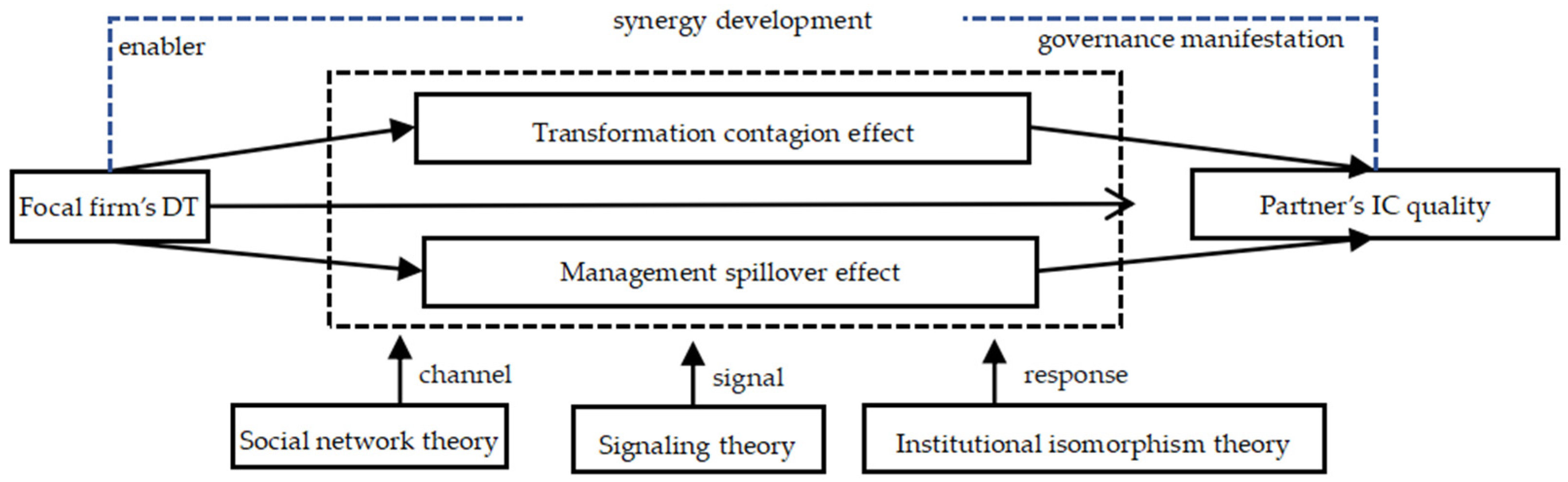
These three theories form a progressive chain of “channel → signal → response.” Social network theory explains the transmission channel, signaling theory explains the trigger for partners, and institutional isomorphism theory explains response mechanism. Together, they provide systematic theoretical support for our hypotheses. Figure 1 illustrates this integrated theoretical framework.
Figure 1.
Theoretical framework.
3.2. The DT of Focal Firms and IC Quality of Supply Chain Partners
A firm’s DT extends beyond its own boundaries. It can transmit vertically to supply chain partners and prompt adaptive responses among these partners. Corporate IC, as a core governance mechanism, constitutes a key dimension of such responses. Therefore, a transmission effect may exist from the focal firm’s DT to its partners’ IC.
Social network theory explains the channel for this transmission. According to this theory, economic behavior is embedded in social networks. The supply chain is a network of vertically linked firms, and inter-firm relationships have shifted from purely transactional interactions to ecologically symbiotic interdependence [57]. Supply chain network serves as a natural conduit for the cross-firm transmission of DT, facilitating the flow and diffusion of information, knowledge, technology, and practices among firms via their network ties. As a result, the technological changes initiated by the focal firm propagate along the vertical linkages and generate externalities [1]. Prior research has documented these spillovers in technology diffusion and production efficiency [1,40]. We extend this logic to corporate governance, specifically firm IC. When focal firms digitally upgrade their IC operation, supply chain synergy demands increase, particularly in terms of systems and management synergy. These demands propagate through supply chain network to partners, compelling them to align their own IC practices accordingly.
Signaling theory and institutional isomorphism theory further explain the triggering condition and response mechanism. The focal firm’s DT serves as a high-cost, high-visibility signal that conveys its strategic direction and upgraded management capabilities to supply chain partners. Upon receiving this signal, partners are motivated to respond—to maintain long-term cooperative relationships, reduce uncertainty, and align their practices with the focal firm’s standards [58]. This response is further shaped by isomorphic pressures, i.e., coercive, mimetic, and normative. In the supply chain context, these pressures arise from power asymmetry (focal firms may impose requirements on partners), environmental uncertainty (partners tend to imitate successful practices), and the diffusion of professional standards (norms spread through daily interactions). Together, these pressures drive partners to adopt similar practices, leading to improved IC quality. Therefore, we propose the following hypothesis:
H1.
The DT of focal firms enhances the IC quality of their supply chain partners.
3.3. The Mediating Role of Transformation Contagion Effect
Within vertical supply chain relationships, the focal firm’s DT can propagate to upstream and downstream partners, driving synchronized transformation among them. This synchronized transformation, in turn, enhances partners’ IC quality by improving their information communication, process control, and risk early-warning capabilities [2,3]. Thus, we argue that focal firms’ DT indirectly enhances partners’ IC quality by driving synchronized DT among partners, i.e., a transformation contagion effect.
The propagation from focal firms to partners operates through three potential pathways. First, mimetic isomorphism arises from environmental uncertainty. Facing the complexity of DT, supply chain partners often encounter uncertainties regarding technological paths and returns on investment. To reduce these risks and maintain coordination with focal firms, partners tend to imitate the focal firm’s existing digital practices. Organizations typically learn from high-status, high-performing entities in their environment [59]. Close supply chain linkages provide natural channels for knowledge transfer and experiential learning [57]. When focal firms succeed in DT, their advanced practices create a demonstration effect [1] and can be observed and adopted by partners through business interactions, personnel exchanges, and information systems. Moreover, through DT, focal firms accumulate extensive technological resources and managerial expertise. These digital solutions can be transmitted to partners, lowering their imitation barriers and further accelerating their digital progression. Second, coercive isomorphism stems from power asymmetry. Firms under external pressure tend to adopt similar strategic behaviors, leading to convergence [60]. When focal firms adopt digital systems for procurement, production, and sales management, they may require suppliers to integrate into their digital platforms or require clients to adopt compatible information systems [61]. Such coercive pressures compel partners to expedite their own DT to meet synergy demands. External pressure thus serves as a critical driver of corporate DT [62].
Together, these isomorphic pressures drive synchronized DT among partners, which in turn enhances partners’ IC quality. Therefore, we propose the following hypothesis:
H2.
The DT of focal firms enhances the IC quality of their supply chain partners through a transformation contagion effect.
3.4. The Mediating Role of Managing Spillover Effect
DT not only upgrades technological tools but also reshapes management philosophy and control models. When focal firms improve their IC through digital means, their advanced control activities will also spill over to their supply chain partners, thereby enhancing partners’ IC quality. Thus, the focal firms’ DT indirectly enhances the partners’ IC quality by improving and exporting their own control activities to partners, i.e., a management spillover effect.
This spillover process operates through two potential pathways. First, normative isomorphism originates from the diffusion of professionalization. As focal firms digitally redesign their IC procedures, they generate standardized control requirements and institutional norms. These requirements and norms spread through supply chains via routine contractual, payment, logistical, and documentary interactions. For example, partners internalize the focal firm’s management standards through qualification criteria or joint research and development activities, in which control practices are naturally embedded. Through such interactions, partners implicitly absorb the focal firm’s advanced management expertise [63], thereby improving their own IC quality. Second, coercive isomorphism stems from power asymmetry. Transaction cost theory suggests that stable supply chain operations require compatible management standards [64]. During the process of DT, focal firms encourage partners to adopt such standards to reduce transaction costs [36]. For example, through contractual terms, focal firms may require suppliers to establish IC procedures aligned with their own to ensure product quality and delivery reliability. Similarly, they may require customers to adopt uniform order management norms to improve demand forecasting and order response accuracy. Such coercive pressures compel partners to adopt compatible standards, thereby reducing transaction costs and enhancing coordination efficiency.
Through normative and coercive isomorphism, advanced control activities spill over from the focal firm to its supply chain partners, thereby enhancing partners’ IC quality. Therefore, we propose the following hypothesis:
H3.
The DT of focal firms enhances the IC quality of their supply chain partners through a management spillover effect.
4. Research Design
4.1. Data Source and Sample Selection
This study selects Chinese A-share listed companies in the Shanghai and Shenzhen markets from 2013 to 2023 as the initial research sample. This period covers the years during which China’s digital economy experienced rapid growth, DT-related policies were intensively introduced, and IC regulations were fully implemented for most listed firms, while also ensuring data availability.
Supply chain relationship data are derived from the CSMAR database, specifically the information on the top five suppliers and customers of listed companies. Given the difficulty of obtaining complete data for non-listed firms, the sample is restricted to observations in which the supply chain partner is a listed company. Subsequently, following Chu et al. [65], we construct a focal firm—supplier/customer—year dataset.
DT data are obtained through textual analysis of companies’ annual reports by extracting the frequency of DT-related keywords, following the approach of Wu et al. [66]. Corporate IC data are sourced from the DIB database, and other control variables are obtained from the CSMAR database.
The final sample consists of 2417 focal firm—supplier/customer—year observations, which is consistent with the sample sizes reported in the prior literature [1,57]. To mitigate the influence of outliers, all continuous control variables are winsorized at the 1st and 99th percentiles. All statistical analyses were performed using Stata 18.0.
4.2. Variable Definition
4.2.1. Dependent Variable
IC quality of supply chain partners: Following Cheng et al. [3], we measure the IC quality of supply chain partners (denoted as ICQ) using the IC Information Disclosure Index from the DIB database. According to the Basic Standards for Enterprise Internal Control issued by the Ministry of Finance, IC is a process implemented by a company’s board of directors, board of supervisors, management, and all employees to achieve control objectives (e.g., reporting reliability, compliance), and effective IC should encompass five components: internal environment, risk assessment, control activities, information and communication, and monitoring. Based on this framework, the IC Information Disclosure Index systematically evaluates the design and operation of these five components of IC, thereby capturing the intrinsic quality of IC systems. Given that IC provides only reasonable assurance for achieving objectives, this process-oriented index is more appropriate for evaluating IC quality because it reflects the very essence of IC as defined in the above Basic Standards [67].
4.2.2. Independent Variable
DT of focal firms: We measure the DT extent of focal firms (denoted as DT_focal) using textual analysis following the approach of Wu et al. [66]. Specifically, we search and match each focal firm’s annual report against a predefined set of keywords across five dimensions: artificial intelligence, blockchain, cloud computing, big data, and digital technology application. The frequencies of these keywords are summed, and the total is transformed using the natural logarithm after adding one. Higher values indicate a greater extent of DT.
4.2.3. Mediating Variable
Transformation contagion effect: It refers to the process by which focal firms’ DT drive synchronized DT among their supply chain partners, thereby indirectly enhancing partners’ IC quality. To test this mediating pathway, we use the DT of supply chain partners (denoted as DT_partner) as a proxy. Specifically, we measure DT_partner using the same approach as used for focal firms and then examine its mediating role between the focal firms’ DT and their partners’ IC quality.
Management spillover effect: It refers to the process by which a focal firm, through its DT, improves and exports its own control activities to supply chain partners, thereby enhancing partners’ IC quality. To test this mediating pathway, we use the control activity index of focal firms (denoted as CtrlAct_focal) as a proxy for this pathway. Specifically, this index is a sub-index of the IC Information Disclosure Index from the DIB database. It captures various control activities, such as segregation of incompatible duties, approval controls, and accounting system controls [68]. Higher values reflect more standardized and comprehensive control activities of the focal firm.
4.2.4. Control Variables
This study select several control variables following the relevant literature [28,69], including firm size (Size), leverage (Lev), return on assets (ROA), sales growth (Growth), board independence (Indep), duality of board chairman and CEO positions (Dual), equity concentration (Top1), firm age (FirmAge), and audit quality (Big4), all of which are measured at the supply chain partner level. We further control for year and industry fixed effects. Definition and measurement of all variables are displayed in Table 1.
Table 1.
Definition and measurement of variables.
4.3. Models
4.3.1. Basic Model
We use multiple regression to test Hypothesis H1, and specify the following baseline model:
where DT_focal represents the DT level of the focal firm, and ICQ denotes the IC quality of the focal firm’s supply chain partners. If the coefficient of DT_focal is significantly positive, it indicates that focal firms’ DT can enhance the IC quality of their supply chain partners, supporting H1. Control represents a series of control variables, all of which pertain to the supply chain partner. To control for industry heterogeneity and common time trends, thereby reducing omitted variable bias, following Geng et al. [1] and Wei et al. [13], we include industry and year fixed effects, denoted as Ind and Year, respectively. Given that the independent variable varies at the focal firm level and observations of the same focal firm may be correlated, following Zeng et al. [70], we cluster standard errors at the focal firm level to mitigate potential autocorrelation and heteroscedasticity.
4.3.2. Mediation Effects Model
To test the two mediating mechanisms (H2 and H3), we employ both the three-step procedure (specified by Equations (2) and (3)) and a bootstrap method to ensure robustness.
Here, M represents the mediating variable. Specifically, when testing the transformation contagion effect (H2), M is the DT extent of supply chain partner (DT_partner); when testing the management spillover effect (H3), M is the focal firm’s control activity level (CtrlAct_focal).
Following the three-step procedure, we first estimate the baseline effect of DT_focal on ICQ (Equation (1)). Second, we estimate the effect of DT_focal on the mediator (Equation (2)). A significantly positive coefficient suggests that DT_focal enhances DT_partner (H2) or CtrlAct_focal (H3). Third, we include both DT_focal and the mediator in Equation (3). If both (coefficient of the mediator) and (coefficient of DT_focal) are significantly positive, this suggests partial mediation; if is significantly positive while becomes non-significant, this suggests full mediation.
To further validate the mediation effects, we simultaneously employ a bootstrap procedure (1000 resamples) and use bias-corrected 95% confidence intervals to assess the presence and type of mediation. Based on the bootstrap results, a mediation effect is established if the confidence interval for the indirect effect excludes zero. Furthermore, if the confidence interval for the direct effect also excludes zero, it indicates partial mediation; if the confidence interval for the direct effect includes zero, it indicates full mediation.
5. Empirical Results
5.1. Descriptive Statistics
Table 2 reports the descriptive statistics for the main variables. For the dependent variable, the IC quality of supply chain partners (ICQ) has a mean of 38.549, with a minimum of 21.330 and a maximum of 49.665, indicating substantial variation across sample firms. For the independent variable, the DT extent of focal firms (DT_focal) has a mean of 1.547, ranging from 0 to 5.118, suggesting heterogeneity among focal firms. All control variables fall within reasonable ranges.
Table 2.
Descriptive statistics for main variables.
5.2. Correlation Analysis
Table 3 presents the Pearson correlation coefficients among the main variables. Regarding the core variables, the correlation between DT_focal and ICQ is 0.134 and is significantly positive at the 1% level. This preliminarily suggests that a higher degree of DT in focal firms is associated with better IC quality of their supply chain partners, consistent with the direction in H1. The variance inflation factor (VIF) test shows that all VIF values are below 10, indicating no severe multicollinearity among the variables.
Table 3.
Correlations and VIF statistics.
5.3. Baseline Analysis
Table 4 reports the baseline regression results. Column (1) includes only the independent variable. Column (2) adds control variables, and Column (3) further incorporates industry and year fixed effects. Across all specifications, the coefficient of DT_focal remains positive. The positive coefficient provides preliminary evidence that the focal firm’s DT enhances its partners’ IC quality, which is consistent with H1.
Table 4.
Results of baseline regressions.
From an economic perspective, a one-standard-deviation increase in the focal firm’s DT (1.459) is associated with a 0.245 unit increase in the partner’s IC quality (0.168 × 1.459 ≈ 0.245), which corresponds to a standardized coefficient of 0.044 (0.245/5.62 ≈ 0.044). This effect size is comparable to those reported in prior supply chain spillover studies [40,71]. Given the cross-firm transmission setting, this modest effect is economically plausible and retains practical relevance for supporting governance-level synergistic development in supply chains.
5.4. Mechanism Analysis
We employ mediation models to test the two proposed mediating mechanisms: the transformation contagion effect (H2) and the management spillover effect (H3), respectively.
5.4.1. Transformation Contagion Effect
Columns (1) and (2) of Table 5 present the results for this mechanism. Column (1) shows that the coefficient of DT_focal is significantly positive, indicating that focal firms’ DT drives that of their supply chain partners. Column (2) includes both DT_focal and DT_partner in the model. The coefficient of DT_partner is significantly positive, while that of DT_focal becomes insignificant relative to the baseline regression. These findings suggest a mediating effect. To formally test the indirect effect, we conducted a bootstrap procedure (1000 resamples). The bias-corrected 95% confidence interval for the indirect effect was [0.053, 0.140], excluding zero, while the confidence interval for the direct effect was [−0.116, 0.247], including zero. These results indicate a full mediating role of DT_partner, as the bootstrap confidence interval for the indirect effect excludes zero, while that for the direct effect includes zero. Thus, by driving synchronized DT among partners, the focal firms’ DT enhances their partners’ IC quality. This supports H2.
Table 5.
Analysis of mediating effects.
5.4.2. Management Spillover Effect
Columns (3) and (4) of Table 5 report the results for the management spillover effect. Column (3) shows a significantly positive coefficient of DT_focal, indicating that focal firms’ DT effectively improves their own control activities. Column (4) includes both DT_focal and CtrlAct_focal in the model. The coefficients of them are both positive. We further performed a bootstrap test (1000 resamples). The bias-corrected 95% confidence interval for the indirect effect was [0.0012, 0.0185], excluding zero, and the confidence interval for the direct effect was [0.0629, 0.2743], also excluding zero. This indicates a partial mediating role of focal firms’ control activities in the relationship between focal firms’ DT and partners’ IC. Thus, H3 is supported. These results support the existence of a management spillover effect at the aggregate level, with control activities potentially spilling over through contractual terms, routine operational interactions, and the diffusion of management standards (i.e., normative and coercive isomorphism). However, other unobserved mechanisms may exist, and future research using detailed survey or case data could further unpack the specific inter-firm transmission underlying this effect.
Additionally, we include both mediators simultaneously in the baseline regression to examine the stability of the mediation effects. This result is reported in Column (5) of Table 5. When both mediators are entered together, DT_partner remains significantly positive, while CtrlAct_focal is also positive. The coefficients are very close to those obtained in the separate models (0.405 vs. 0.400 for DT_partner; 0.071 vs. 0.065 for CtrlAct_focal). We also calculate the Pearson correlation between the two mediators, which is 0.1158, indicating an extremely weak correlation (|r| < 0.3). These results suggest that the two mechanisms are distinct and operate largely as independent parallel pathways.
5.5. Robustness Tests
To mitigate potential endogeneity arising from measurement error, omitted variables, reverse causality, and selection bias, we conduct a series of robustness checks, including alternative variable measures, additional fixed effect, instrumental variable (IV) approach, lagged explanatory variables, the Heckman two-stage model, and propensity score matching (PSM).
5.5.1. Replacing the Independent Variable
To address concerns regarding the measurement error, we employ the alternative measure of DT proposed by Zhao et al. [72] to replace the original independent variable (DT_focal). Column (1) of Table 6 shows that the coefficient of DT_focal remains positive, indicating that the main findings are robust. Moreover, considering that keyword-based measures of DT may capture disclosure intensity rather than actual implementation, following Liu et al. [73], we re-estimated the baseline model using an input-based proxy: the ratio of a firm’s investment in artificial intelligence software to its total investment (SoftInvRatio), obtained from the CSMAR database. Column (2) of Table 6 reports the results. The coefficient of SoftInvRatio remains positive, indicating that our results are robust to alternative measures of DT.
Table 6.
Robustness analysis (1–3).
5.5.2. Replacing the Dependent Variable
To address potential measurement bias in the proxy of IC quality, we replace the dependent variable with the number of IC deficiencies (DefNum), where a larger value indicates poorer IC quality. Accordingly, the coefficient of DT_focal is expected to be negative. Column (3) of Table 6 reports a significantly negative coefficient, consistent with expectations, suggesting the robustness of the main findings.
5.5.3. Additional Fixed Effect
Institutional environments, marketization levels, and digital infrastructure vary across regions and may affect firms’ IC quality. To control for the impact of unobservable factors at the regional level, we further include province fixed effects in the baseline regression. Column (4) of Table 6 shows that the coefficient of DT_focal remains significantly positive, suggesting that the primary results are robust.
5.5.4. Instrumental Variable (IV) Approach
To address potential endogeneity arising from reverse causality, we employ an IV approach using two-stage least squares (2SLS) regression. Following Fan et al. [71], we use the annual average DT level of the focal firm’s industry (DT_mean_Ind) and that of its province (DT_mean_Pro) as instruments. Digital transformation is a complex process, and firms often refer to peer practices in the same industry or province to reduce decision uncertainty. Therefore, a focal firm’s own DT is positively influenced by the industry or province average DT levels [74,75]. Meanwhile, these aggregate measures are constructed based on peers of the focal firm (same industry and province); thus, they primarily affect the focal firm’s own DT and are unlikely to have a direct impact on their partners’ IC quality. Moreover, such aggregate measures are determined by many firms and are not driven by any single firm’s specific shock. In addition, our model includes industry and year fixed effects, which absorb industry-wide governance trends and common time shocks. Therefore, from a theoretical perspective, the instruments satisfy the relevance and exogeneity conditions. This is further supported by the empirical results.
The first-stage results are reported in Column (1) of Table 7. The coefficients of DT_mean_Ind and DT_mean_Pro are both significantly positive. The F-statistic (98.163) exceeds 10, satisfying the relevance condition. The overidentification test yields a p-value greater than 0.05, supporting the exogeneity of the instruments. The second-stage results in Column (2) show that the positive coefficient of DT_focal remains, suggesting the robustness of our main findings.
Table 7.
Robustness analysis (4–7).
5.5.5. Lag Effects
To account for the potential time lag in the chain transmission effect of DT on IC and the fact that the partners’ current IC quality is unlikely to affect the past digitalization decisions of the focal firm, we lag the core explanatory variable by one period (DT_focal_lag1) and re-estimate the baseline model to further address reverse causality. Column (3) of Table 7 shows that the coefficient of DT_focal_lag1 is significantly positive, supporting the robustness of our main findings.
5.5.6. Heckman Two-Stage Regression
To address potential sample selection bias arising from the fact that not all listed firms voluntarily disclose their upstream and downstream relationships, we employ the Heckman two-stage model. Specifically, following Yu et al. [40], in the first stage, we estimate the inverse Mills ratio (IMR) using a Probit model. In this model, the dependent variable (isDis) is an indicator that equals one if a firm discloses its suppliers and customers (zero otherwise), and the explanatory variables include firm size, leverage, return on total assets, growth rate, firm age, and industry and year dummies. The first-stage results are reported in Appendix A Table A1. In the second stage, we add the IMR to the baseline regression. Column (4) of Table 7 shows that the coefficient of DT_focal remains significantly positive, and the coefficient of IMR is significantly negative, suggesting the presence of selection bias. Nevertheless, after controlling for this bias, the positive impact of focal firms’ DT on their partners’ IC quality remains robust.
5.5.7. PSM Test
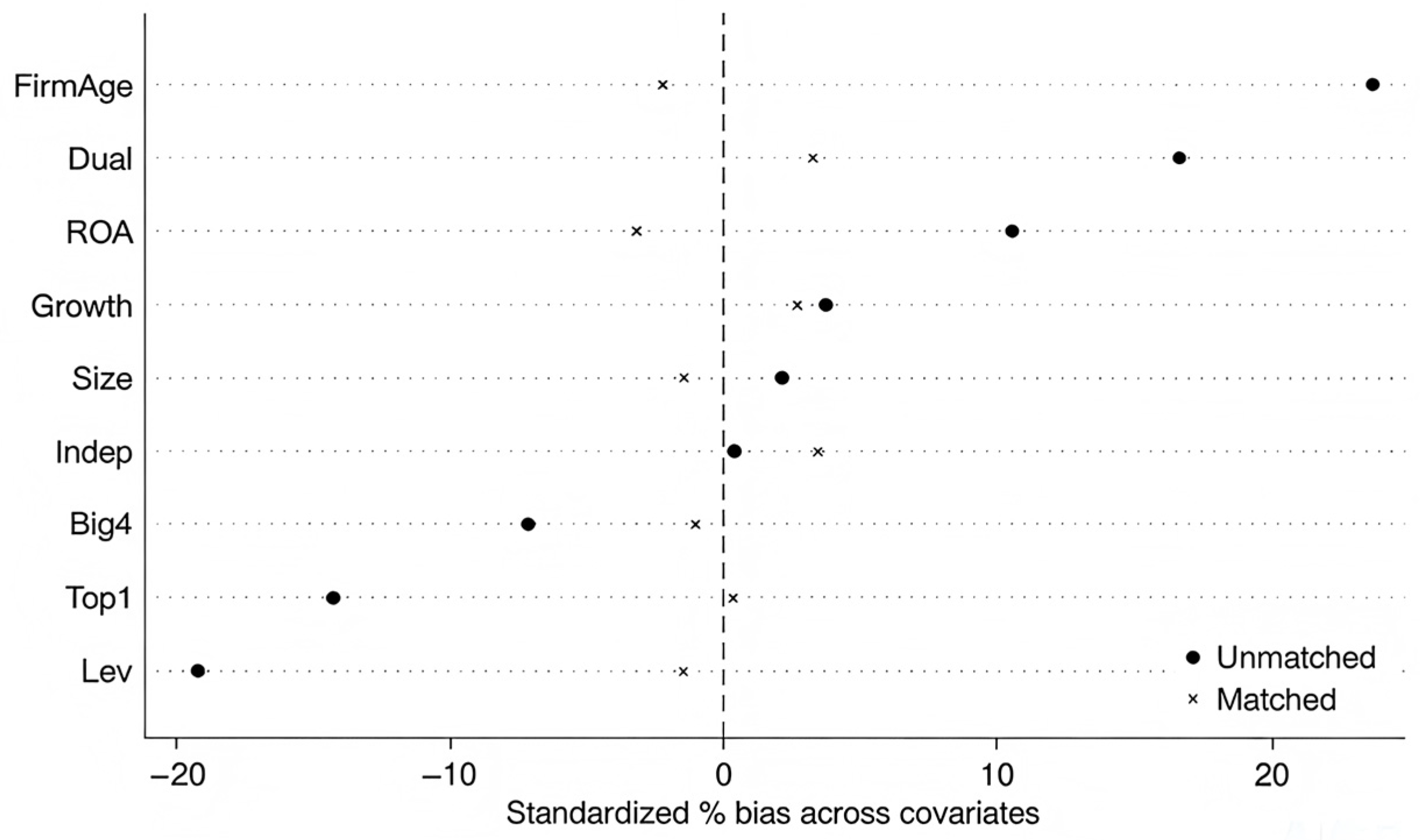
We employ a PSM method to further address endogeneity arising from self-selection. First, we classify focal firms into a treatment group (those with a DT level greater than zero) and a control group (those with a DT level equal to zero). Second, we estimate propensity scores using a Probit model that includes focal firms’ firm size, leverage, ROA, sales growth, board independence, duality of board chairman and CEO positions, top1 shareholding, firm age, and Big4 auditor as covariates. Third, we apply 1:3 nearest neighbor matching to pair treated firms with control firms. Detailed results of the Probit estimation and treatment effects are reported in Appendix A Table A2, the balancing tests in Appendix A Table A3, and the balance plot in Appendix A Figure A1. The balancing tests show that after matching, all covariates are well balanced (standardized bias < 5%, t-tests not significant). The average treatment effect on the treated (ATT) is positive and significant (t = 3.47). Moreover, we re-estimate the baseline regression using the matched sample. Column (5) of Table 7 shows that the coefficient of DT_focal remains significantly positive. Thus, the main findings are robust.
5.6. Heterogeneity Analysis
The positive chain transmission effect of DT on IC may vary with the characteristics of the focal firm, supply chain partners, and their relationships. We conduct a heterogeneity analysis across these three dimensions.
5.6.1. Focal Firm Heterogeneity
Focal firms with different characteristics may have varying influence, thereby affecting the chain transmission effect. We examine this heterogeneity from four dimensions: market power, firm size, manufacturing attribute, and ownership nature. Table 8 reports the results.
Table 8.
Focal firm heterogeneity analysis.
Market power. Firms with greater market power typically possess stronger supply chain authority, enabling them to prompt upstream and downstream enterprises to respond to their strategic actions [76,77]. Using the Lerner index as a proxy for market power, we split the sample into high-power (BI = 1) and low-power (BI = 0) groups based on the annual industry median. Columns (1) and (2) of Table 8 show that the coefficient of DT_focal is significantly positive in the high-power group but insignificant in the low-power group, indicating that stronger market power facilitates the positive transmission effect of DT on IC along the supply chain.
Firm size. Larger firms generally possess more mature management and greater influence, making their DT more likely to generate demonstration effects. We divide the sample into large-size (SIZE = 1) and small-size (SIZE = 0) groups based on the annual industry median. Columns (3) and (4) of Table 8 show that the coefficient of DT_focal is significantly positive in the large-size group but insignificant in the small-size group, suggesting that the DT of larger focal firms has a stronger chain transmission effect on their partners’ IC.
Manufacturing attribute. Manufacturing firms have longer industrial chains and closer collaboration with their upstream and downstream firms, which may strengthen the chain transmission effect. The sample is split into manufacturing (Manu = 1) and non-manufacturing (Manu = 0) groups. Columns (5) and (6) of Table 8 show that the coefficient of DT_focal is significantly positive in the manufacturing group but insignificant in the non-manufacturing group, indicating that the chain transmission effect is more pronounced in manufacturing industries.
Ownership nature. State-owned enterprises (SOEs) and non-SOEs differ in institutional management, resource constraints, and market responsiveness [78]. We split the sample into SOE and non-SOE groups. Columns (7) and (8) of Table 8 show that the coefficient of DT_focal is significantly positive in the non-SOE group but insignificant in the SOE group. A possible explanation is that non-SOEs are more market-sensitive and face stronger competitive pressure, having greater incentives to enhance supply chain synergy through DT, and thus generating more pronounced chain transmission effect on partners’ IC.
5.6.2. Supply Chain Partner Heterogeneity
Supply chain partners with different characteristics may have differential absorptive capacities and responses to focal firms’ DT. We examine this heterogeneity from three dimensions: manufacturing attributes, marketization level, and regional location. Table 9 reports the results.
Table 9.
Supply chain partner heterogeneity analysis.
Manufacturing attribute. Given the tighter production linkages, manufacturing partners are more responsive to focal firms’ DT. We split the partners into manufacturing (Manu = 1) and non-manufacturing (Manu = 0) groups. Columns (1) and (2) of Table 9 show that the coefficient of DT_focal is significantly positive in the manufacturing group but insignificant in the non-manufacturing group, indicating that due to higher industrial connectivity and stronger collaborative needs, manufacturing partners’ IC quality is more likely to benefit from their focal firms’ DT.
Marketization level. A higher marketization environment typically indicates stronger institutional support, developed factor markets, and active information flows. We measure marketization using the index developed by Fan Gang et al. [79]. Since the index is available only up to 2019, we follow Xie and Zhu [80] and use its historical average growth rate to estimate values for 2020–2023. Then, we split the partners into high-marketization (Mar = 1) and low-marketization (Mar = 0) groups based on the annual median. Columns (3) and (4) of Table 9 show that the coefficient of DT_focal is significantly positive in the high-marketization group but insignificant in the low-marketization group, suggesting that a favorable marketization environment provides better support for supply chain partners to absorb focal firms’ advanced practices, thereby enhancing the chain transmission effect of DT on IC quality.
Regional location. Significant disparities exist between China’s eastern and mid-western regions in economic development and digital infrastructure. We split the partners into eastern (East) and mid-western (Midwest) groups. Columns (5) and (6) of Table 9 show that the coefficient of DT_focal is significantly positive in the eastern group but insignificant in the mid-western group, suggesting that firms in the eastern region, benefiting from a more open external environment, can more effectively absorb the advanced practices transmitted by focal firms’ DT.
5.6.3. Relational Heterogeneity
Geographic distance, supply chain position, and supply chain concentration reflect the interaction frequency, mode, information transmission, and interdependence between focal firms and their partners, which may also affect the overall transmission effect. Table 10 reports the heterogeneity results for these three dimensions.
Table 10.
Relational heterogeneity analysis.
Geographic distance. Geographic proximity is often thought to facilitate business cooperation [81]. However, digital technologies transcend physical boundaries, enabling efficient information exchange and knowledge spillovers even over long distances. We classify the distance between focal firms and their partners into near-distance (within 100 km) and far-distance (beyond 100 km) groups. Columns (1) and (2) of Table 10 show that the coefficient of DT_focal is significantly positive in the far-distance group but insignificant in the near-distance group. A possible explanation is that digital technology is a key enabler of supply chain synergy, which can reduce information asymmetry and coordination costs across geographic distances [44]. It is especially critical for communication when partners are far apart. This is consistent with the finding that the transmission effect is stronger in distant relationships [71]. Thus, the positive transmission effect is not constrained by distance; it is actually stronger in distant relationships.
Supply chain position. The transmission effect may differ between downstream customers and upstream suppliers due to the distinct direction of business activities. We split the sample into downstream (down) and upstream (up) groups. Columns (3) and (4) of Table 10 show that the coefficient of DT_focal is significantly positive in the downstream group but not significant in the upstream group. This result is consistent with the study of Fan et al. [71], which found that the DT of the supply chain is characterized as downstream-driven. A possible explanation is that focal firms’ DT is oriented toward serving downstream customers, with products and services serving as the natural linkage. This customer-oriented relationship fosters closer digital integration, making downstream partners more responsive to the focal firm’s digital initiatives and control practices. Thus, the chain transmission effect of DT on IC is more pronounced in customer relationships.
Supply chain concentration. Supply chain concentration reflects a firm’s dependence on its upstream and downstream partners [65]. In high-concentration relationships, focal firms form deep ties with a few partners. In contrast, low-concentration relationships involve a more diverse set of suppliers and customers. We split the sample into high-concentration (highConc) and low-concentration (lowConc) groups based on the annual medians. Columns (5) and (6) of Table 10 show that the coefficient of DT_focal is significantly positive in the low-concentration group but insignificant in the high-concentration group. This indicates that the chain transmission effect of DT on IC is stronger in a more dispersed supply chain. A possible explanation is that, in dispersed relationships, focal firms face greater pressure for standardization and information flow. This prompts them to drive their partners’ synchronized DT and encourage partners to adopt equally advanced management standards, resulting in a more pronounced chain transmission effect on partners’ IC.
6. Discussion
6.1. Theoretical Implications
The theoretical implications of this study can be summarized as follows. First, we identify an important pathway for improving IC quality in the digital context, i.e., the transmission effect of DT on IC. This extends the boundaries of IC research from firm-internal factors to an external supply chain perspective. It also enriches the literature on DT externalities by shifting the research boundary from operational outcomes (e.g., innovation, efficiency) to governance processes. Moreover, it expands the application of social network theory, signaling theory, and institutional isomorphism theory in the intersection of DT and IC. More importantly, as a key manifestation of supply chain synergy, the chain transmission of DT on IC provides a governance foundation for supply chain sustainability, thereby enriching the understanding of sustainability, particularly its economic dimension. Second, we identify and test two differentiated mediation pathways, i.e., transformation contagion and management spillover, thereby revealing how digital capabilities diffuse along the supply chain through coercive, mimetic, and normative isomorphic pressures. These findings advance the understanding of inter-firm interactions in the digital context and how synergistic development emerges across supply chains. Third, we delineate the boundary conditions of the transmission effect from multiple dimensions. Notably, the effect is stronger in geographically distant or low-concentration relationships. This suggests that digital tools may overcome traditional spatial and relational constraints, enabling effective governance transmission even without physical proximity or deep relational ties. This finding contradicts the “proximity-based spillover” logic and highlights a new feature of supply chain governance in the digital era.
6.2. Practical Implications
Based on the findings, the following practical implications can be drawn. (1) For focal firms, those with strong market power, large size, or manufacturing status should actively act as “chain leaders” by sharing their digital management standards and control practices [82]. They can achieve this by opening digital platform interfaces, sharing experiences, and embedding synergy clauses in contracts. The findings also suggest that focusing on geographically distant or low-concentration partners can be equally effective, thanks to digital tools. Thus, they should not limit their governance improvement efforts to close or concentrated relationships. (2) For supply chain partners, especially those in less developed regions or non-manufacturing sectors, they need to improve their absorptive capacity by proactively connecting to the focal firm’s digital systems, participating in joint training, and learning from the focal firm’s management practices to reap the benefits of governance spillovers. (3) For policymakers, governments should identify and support “chain leader” firms (e.g., those with strong transmission capability) through targeted subsidies and tax incentives [83]. Investment in digital infrastructure should be directed to less developed and less marketized regions to narrow the digital divide. Policies should also encourage the flow of digital talent and data across regions.
6.3. Limitations and Future Research
Several limitations should be acknowledged. First, our sample is restricted to listed firms and their listed supply chain partners, excluding many unlisted participants. This design is driven by data availability and may affect generalizability. Future research could extend the analysis to unlisted samples using survey or alternative data sources to test external validity. Second, the keyword-based measure of DT may reflect disclosure intensity rather than actual implementation. We addressed this by showing that results hold with an input-based measure in robustness tests. However, both measures capture only the overall level of DT and cannot distinguish different types of digital initiatives (e.g., AI, cloud computing, platforms) and reveal how specific technology affects cross-firm transmission. Future research using more granular survey data or case studies is needed to explore these heterogeneous mechanisms. Third, the management spillover effect exists at the aggregate level, but other unobserved pathways may also exist beyond those we proposed. Future studies (using detailed control activity data) could further unpack the specific inter-firm interactions underlying this spillover effect. Moreover, there may be some potential risks that need to be discussed. The transmission effect may strengthen the focal firm’s dominance, generate technology lock-in, raise data security concerns, or even increase systemic risk if that focal firm encounters problems. Finally, our study focuses on the cross-firm transmission process of DT on IC quality, which itself is synergistic development and serves as a governance foundation for supply chain sustainability. Future research can extend it by examining how such governance-level synergies translate into specific sustainability outcomes, such as resilience metrics, thereby connecting the governance synergy mechanism with downstream sustainability performance and forming a more complete analytical chain from process to outcome.
7. Conclusions
This study examines whether and how a focal firm’s DT affects the IC quality of its supply chain partners. Using a sample of Chinese A-share listed firms from 2013 to 2023, we find that focal firms’ DT enhances their partners’ IC quality. Two mediation pathways operate: transformation contagion (partners’ synchronized DT) fully mediates the effect, while management spillover (export of focal firms’ DT-driven control activities) partially mediates it. The positive transmission effect is stronger when the focal firm has greater market power, larger size, manufacturing status, or non-state ownership; when partners are manufacturers or located in highly marketized environment or eastern regions; and when relationships involve greater geographic distance, a downstream position, or lower concentration. These findings broaden the research perspective of IC determinants and the study of DT externalities, revealing a governance-level synergistic pathway to supply chain sustainability. Practically, the study offers guidance for focal firms to act as “chain leaders,” for partners to improve absorptive capacity, and for governments to support digital infrastructure and targeted incentives. Limitations and future research directions are also discussed.
Author Contributions
Conceptualization, L.L. and Z.L.; methodology, L.L. and Z.L.; software, L.L.; validation, Z.L. and X.L.; formal analysis, L.L. and Z.L.; data curation, L.L.; writing—original draft preparation, L.L.; writing—review and editing, Z.L. and X.L. All authors have read and agreed to the published version of the manuscript.
Funding
This research received no external funding.
Institutional Review Board Statement
Not applicable.
Informed Consent Statement
Not applicable.
Data Availability Statement
The original contributions presented in this study are included in the article. Further inquiries can be directed to the corresponding author.
Conflicts of Interest
The authors declare no conflicts of interest.
Appendix A
Table A1.
Heckman first-stage Probit model.
Table A2.
Propensity score estimation and treatment effects.
Table A3.
PSM balancing test.
Figure A1.
PSM balance plot.
References
- Geng, Y.; Xiang, X.; Zhang, G.; Li, X. Digital transformation along the supply chain: Spillover effects from vertical partnerships. J. Bus. Res. 2024, 183, 114842. [Google Scholar] [CrossRef] [Scilit]
- Zhao, T.; Yan, N.; Ji, L. Digital transformation, life cycle and internal control effectiveness: Evidence from china. Financ. Res. Lett. 2023, 58, 104223. [Google Scholar] [CrossRef] [Scilit]
- Cheng, W.; Li, C.; Zhao, T. The stages of enterprise digital transformation and its impact on internal control: Evidence from china. Int. Rev. Financ. Anal. 2024, 92, 103079. [Google Scholar] [CrossRef] [Scilit]
- Chen, L.; Zhao, X.; Tang, O.; Price, L.; Zhang, S.; Zhu, W. Supply chain collaboration for sustainability: A literature review and future research agenda. Int. J. Prod. Econ. 2017, 194, 73–87. [Google Scholar] [CrossRef] [Scilit]
- Doyle, J.; Ge, W.; Mcvay, S. Determinants of weaknesses in internal control over financial reporting. J. Account. Econ. 2007, 44, 193–223. [Google Scholar] [CrossRef] [Scilit]
- Lin, Y.; Wang, Y.; Chiou, J.; Huang, H. Ceo characteristics and internal control quality. Corp. Gov. 2014, 22, 24–42. [Google Scholar] [CrossRef] [Scilit]
- Lu, Y.; Cao, Y. The individual characteristics of board members and internal control weakness: Evidence from china. Pac.-Basin Financ. J. 2018, 51, 75–94. [Google Scholar] [CrossRef] [Scilit]
- Goh, B.W. Audit committees, boards of directors, and remediation of material weaknesses in internal control. Contemp. Account. Res. 2009, 26, 549. [Google Scholar] [CrossRef] [Scilit]
- Defond, M.L.; Lennox, C.S. Do pcaob inspections improve the quality of internal control audits? J. Account. Res. 2017, 55, 591–627. [Google Scholar] [CrossRef] [Scilit]
- Zhuo, C.; Chen, J. Can digital transformation overcome the enterprise innovation dilemma: Effect, mechanism and effective boundary. Technol. Forecast. Soc. Chang. 2023, 190, 122378. [Google Scholar] [CrossRef] [Scilit]
- Omrani, N.; Rejeb, N.; Maalaoui, A.; Dabic, M.; Kraus, S. Drivers of digital transformation in smes. IEEE Trans. Eng. Manag. 2024, 71, 5030–5043. [Google Scholar] [CrossRef] [Scilit]
- Peng, Y.; Tao, C. Can digital transformation promote enterprise performance?-From the perspective of public policy and innovation. J. Innov. Knowl. 2022, 7, 100198. [Google Scholar] [CrossRef] [Scilit]
- Wei, J.; Zhang, X.; Tamamine, T. Digital transformation in supply chains: Assessing the spillover effects on midstream firm innovation. J. Innov. Knowl. 2024, 9, 100483. [Google Scholar] [CrossRef] [Scilit]
- Wang, T.; Wang, J. Information spillover effects of corporate digital transformation. Econ. Anal. Policy 2026, 89, 274–286. [Google Scholar] [CrossRef] [Scilit]
- Ge, W.; Mcvay, S. The disclosure of material weaknesses in internal control after the sarbanes-oxley act. Account. Horiz. 2005, 19, 137–158. [Google Scholar] [CrossRef] [Scilit]
- Li, C.; Sun, L.; Ettredge, M. Financial executive qualifications, financial executive turnover, and adverse sox 404 opinions. J. Account. Econ. 2010, 50, 93–110. [Google Scholar] [CrossRef] [Scilit]
- Lisic, L.L.; Neal, T.L.; Zhang, I.X.; Zhang, Y. Ceo power, internal control quality, and audit committee effectiveness in substance versus in form. Contemp. Account. Res. 2016, 33, 1199–1237. [Google Scholar] [CrossRef] [Scilit]
- Campbell, S.; Li, Y.; Yu, J.; Zhang, Z. The impact of occupational community on the quality of internal control. J. Bus. Ethics 2016, 139, 271–285. [Google Scholar] [CrossRef] [Scilit]
- Hoitash, U.; Hoitash, R.; Bedard, J.C. Corporate governance and internal control over financial reporting: A comparison of regulatory regimes. Account. Rev. 2009, 84, 839–867. [Google Scholar] [CrossRef] [Scilit]
- Prawitt, D.F.; Sharp, N.Y.; Wood, D.A. Internal audit outsourcing and the risk of misleading or fraudulent financial reporting: Did sarbanes-oxley get it wrong? Contemp. Account. Res. 2012, 29, 1109. [Google Scholar] [CrossRef]
- Lin, S.; Pizzini, M.; Vargus, M.; Bardhan, I.R. The role of the internal audit function in the disclosure of material weaknesses. Account. Rev. 2011, 86, 287–323. [Google Scholar] [CrossRef] [Scilit]
- Chen, X.; Feng, M.; Li, C. Family entrenchment and internal control: Evidence from s&p 1500 firms. Rev. Account. Stud. 2020, 25, 246–278. [Google Scholar] [CrossRef] [Scilit]
- Li, Z.; Wang, B.; Wu, T.; Zhou, D. The influence of qualified foreign institutional investors on internal control quality: Evidence from china. Int. Rev. Financ. Anal. 2021, 78, 101916. [Google Scholar] [CrossRef] [Scilit]
- Balsam, S.; Jiang, W.; Lu, B. Equity incentives and internal control weaknesses. Contemp. Account. Res. 2014, 31, 178–201. [Google Scholar] [CrossRef] [Scilit]
- Zhang, D.; Zhang, T.; Ma, G. Can non-executive equity incentives reduce internal control ineffectiveness? Evidence from china. Account. Financ. 2020, 60, 4467–4496. [Google Scholar] [CrossRef] [Scilit]
- Gong, G.; Ke, B.; Yu, Y. Home country investor protection, ownership structure and cross-listed firms’ compliance with sox-mandated internal control deficiency disclosures. Contemp. Account. Res. 2013, 30, 1490–1523. [Google Scholar] [CrossRef] [Scilit]
- Hooghiemstra, R.; Hermes, N.; Emanuels, J. National culture and internal control disclosures: A cross-country analysis. Corp. Gov. 2015, 23, 357–376. [Google Scholar] [CrossRef] [Scilit]
- Shu, W.; Chen, Y.; Lin, B.; Chen, Y. Does corporate integrity improve the quality of internal control? China J. Account. Res. 2018, 11, 407–427. [Google Scholar] [CrossRef] [Scilit]
- Sebastian, I.M.; Ross, J.W.; Beath, C.; Mocker, M.; Moloney, K.G.; Fonstad, N.O. How big old companies navigate digital transformation. MIS Q. Exec. 2017, 16, 197–213. [Google Scholar]
- Kraus, S.; Durst, S.; Ferreira, J.J.; Veiga, P.; Kailer, N.; Weinmann, A. Digital transformation in business and management research: An overview of the current status quo. Int. J. Inf. Manag. 2022, 63, 102466. [Google Scholar] [CrossRef] [Scilit]
- Chen, Y.; Xu, J. Digital transformation and firm cost stickiness: Evidence from china. Financ. Res. Lett. 2023, 52, 103510. [Google Scholar] [CrossRef] [Scilit]
- Wang, H.; Jiao, S.; Bu, K.; Wang, Y.; Wang, Y. Digital transformation and manufacturing companies’ esg responsibility performance. Financ. Res. Lett. 2023, 58, 104370. [Google Scholar] [CrossRef] [Scilit]
- Tian, G.; Li, B.; Cheng, Y. Does digital transformation matter for corporate risk-taking? Financ. Res. Lett. 2022, 49, 103107. [Google Scholar] [CrossRef] [Scilit]
- Li, P.; Guo, X.; Wang, F.; Zhang, Q. Digital transformation and corporate innovation boundaries: Role of supply chain concentration and transparency. Int. Rev. Financ. Anal. 2025, 98, 103922. [Google Scholar] [CrossRef] [Scilit]
- Liu, Y.; Hu, S.; Wang, C. The green innovation spillover effect of enterprise digital transformation: Based on supply chain perspective. Econ. Anal. Policy 2024, 84, 1381–1393. [Google Scholar] [CrossRef] [Scilit]
- Cai, J.; Sharkawi, I.; Taasim, S.I. How does digital transformation promote supply chain diversification? From the perspective of supply chain transaction costs. Financ. Res. Lett. 2024, 63, 105399. [Google Scholar] [CrossRef] [Scilit]
- Ge, R.; Bao, H. Digital transformation and resilience of supply chain in manufacture listed firms: A backward spillover effects in the vertical supply chain relationship. Financ. Res. Lett. 2024, 65, 105516. [Google Scholar] [CrossRef] [Scilit]
- Wang, H.; Wang, C.; Wang, Q.; Bao, R. Employment effects of digital transformation: From the perspective of backward spillovers in the industrial chain. Manag. Decis. Econ. 2026; Early View. [CrossRef] [Scilit]
- Shahnazi, R. Do information and communications technology spillovers affect labor productivity? Struct. Change Econ. Dyn. 2021, 59, 342–359. [Google Scholar] [CrossRef] [Scilit]
- Yu, S.; Yu, X.; Wang, Z. Supply chain governance of the “chain master” and enterprises’ tfp in chain. Bus. Manag. J. 2023, 45, 22–40. [Google Scholar] [CrossRef]
- Ding, Y.; Sun, Y.; Zhang, X. Customer digital transformation and enterprise risk-taking: Evidence from chinese supply chains. China Econ. Rev. 2025, 91, 102418. [Google Scholar] [CrossRef] [Scilit]
- Haken, H. Synergetics—An overview. Rep. Prog. Phys. 1989, 52, 515–553. [Google Scholar] [CrossRef] [Scilit]
- Beske, P.; Seuring, S. Putting sustainability into supply chain management. Supply Chain Manag. 2014, 19, 322–331. [Google Scholar] [CrossRef] [Scilit]
- Fawcett, S.E.; Wallin, C.; Allred, C.; Fawcett, A.M.; Magnan, G.M. Information technology as an enabler of supply chain collaboration: A dynamic-capabilities perspective. J. Supply Chain Manag. 2011, 47, 38–59. [Google Scholar] [CrossRef] [Scilit]
- Mensah, J. Sustainable development: Meaning, history, principles, pillars, and implications for human action: Literature review. Cogent Soc. Sci. 2019, 5, 1653531. [Google Scholar] [CrossRef] [Scilit]
- Scholten, K.; Schilder, S. The role of collaboration in supply chain resilience. Supply Chain Manag. 2015, 20, 471–484. [Google Scholar] [CrossRef] [Scilit]
- Sudusinghe, J.I.; Seuring, S. Supply chain collaboration and sustainability performance in circular economy: A systematic literature review. Int. J. Prod. Econ. 2022, 245, 108402. [Google Scholar] [CrossRef] [Scilit]
- Blome, C.; Paulraj, A.; Schuetz, K. Supply chain collaboration and sustainability: A profile deviation analysis. Int. J. Oper. Prod. Manag. 2014, 34, 639–663. [Google Scholar] [CrossRef] [Scilit]
- Liu, J. An internal control system that includes corporate social responsibility for social sustainability in the new era. Sustainability 2018, 10, 3382. [Google Scholar] [CrossRef] [Scilit]
- Su, W.; Zhang, L.; Ge, C.; Chen, S. Association between internal control and sustainability: A literature review based on the sox act framework. Sustainability 2022, 14, 9706. [Google Scholar] [CrossRef] [Scilit]
- Granovetter, M. Economic-action and social-structure—The problem of embeddedness. Am. J. Sociol. 1985, 91, 481–510. [Google Scholar] [CrossRef] [Scilit]
- Burt, R.S. The social-structure of competition. In Networks and Organizations: Structure, Form, and Action; Harvard Business School Press: Boston, MA, USA, 1992; pp. 57–91. [Google Scholar]
- Coleman, J.S. Social capital in the creation of human-capital. Am. J. Sociol. 1988, 94S, S95–S120. [Google Scholar] [CrossRef] [Scilit] [PubMed]
- Spence, M. Job market signaling. Q. J. Econ. 1973, 87, 355–374. [Google Scholar] [CrossRef] [Scilit]
- Connelly, B.L.; Certo, S.T.; Ireland, R.D.; Reutzel, C.R. Signaling theory: A review and assessment. J. Manag. 2011, 37, 39–67. [Google Scholar] [CrossRef] [Scilit]
- Dimaggio, P.J.; Powell, W.W. The iron cage revisited—Institutional isomorphism and collective rationality in organizational fields. Am. Sociol. Rev. 1983, 48, 147–160. [Google Scholar] [CrossRef] [Scilit]
- Wang, L.; Li, M.; Wang, W.; Gong, Y.; Xiong, Y. Green innovation output in the supply chain network with environmental information disclosure: An empirical analysis of chinese listed firms. Int. J. Prod. Econ. 2023, 256, 108745. [Google Scholar] [CrossRef] [Scilit]
- Liu, S.; Gu, X. Strategic analysis of digital transformation for manufacturers considering innovation and digital technology spillover in a competitive environment. J. Innov. Knowl. 2026, 13, 100946. [Google Scholar] [CrossRef] [Scilit]
- Leary, M.T.; Roberts, M.R. Do peer firms affect corporate financial policy? J. Financ. 2014, 69, 139–178. [Google Scholar] [CrossRef] [Scilit]
- Favoretto, C.; Mendes, G.H.S.; Oliveira, M.G.; Cauchick-Miguel, P.A.; Coreynen, W. From servitization to digital servitization: How digitalization transforms companies’ transition towards services. Ind. Mark. Manag. 2022, 102, 104–121. [Google Scholar] [CrossRef] [Scilit]
- Sklyar, A.; Kowalkowski, C.; Tronvoll, B.; Sorhammar, D. Organizing for digital servitization: A service ecosystem perspective. J. Bus. Res. 2019, 104, 450–460. [Google Scholar] [CrossRef] [Scilit]
- Tangi, L.; Janssen, M.; Benedetti, M.; Noci, G. Barriers and drivers of digital transformation in public organizations: Results from a survey in the netherlands. In Electronic Government (EGOV 2020); Springer: Berlin/Heidelberg, Germany, 2020; pp. 42–56. [Google Scholar] [CrossRef] [Scilit]
- Isaksson, O.H.D.; Simeth, M.; Seifert, R.W. Knowledge spillovers in the supply chain: Evidence from the high tech sectors. Res. Policy 2016, 45, 699–706. [Google Scholar] [CrossRef] [Scilit]
- Arshinder, S.; Kanda, A.; Deshmukh, S.G. Supply chain coordination: Perspectives, empirical studies and research directions. Int. J. Prod. Econ. 2008, 115, 316–335. [Google Scholar] [CrossRef] [Scilit]
- Chu, Y.; Tian, X.; Wang, W. Corporate innovation along the supply chain. Manag. Sci. 2019, 65, 2445–2466. [Google Scholar] [CrossRef] [Scilit]
- Wu, F.; Hu, H.; Lin, H.; Ren, X. Enterprise digital transformation and capital market performance: Empirical evidence from stock liquidity. J. Manag. World 2021, 37, 130–144. [Google Scholar] [CrossRef]
- Chen, H.; Dong, W.; Han, H.; Zhou, N. A comprehensive and quantitative internal control index: Construction, validation, and impact. Rev. Quant. Financ. Account. 2017, 49, 337–377. [Google Scholar] [CrossRef] [Scilit]
- Lin, B.; Lin, D.; Xie, F.; Hu, W.; Yang, Y. Research of internal control index based on information disclosure. Account. Res. 2016, 12, 12–20. [Google Scholar] [CrossRef]
- Liu, C.; Lin, B.; Shu, W. Employee quality, monitoring environment and internal control. China J. Account. Res. 2017, 10, 51–70. [Google Scholar] [CrossRef] [Scilit]
- Zeng, Y.; Zhou, X.; Feng, C. Tax cut incentives, supply chain spillover effect and employment stabilization. J. Manag. World 2023, 39, 19–29. [Google Scholar] [CrossRef]
- Fan, H.; Wu, T.; He, S. Research on the industrial chain linkage effect of enterprise digitalization. China Ind. Econ. 2023, 3, 115–132. [Google Scholar] [CrossRef]
- Zhao, C.; Wang, W.; Li, X. How does digital transformation affect the total factor productivity of enterprises? Financ. Trade Econ. 2021, 42, 114–129. [Google Scholar] [CrossRef]
- Liu, D.; Wang, X.; Chen, S. Digitization of inputs and comparability of accounting information: A u-shaped relationship. Emerg. Mark. Financ. Trade 2025, 61, 4527–4544. [Google Scholar] [CrossRef] [Scilit]
- Piccoli, G.; Grover, V.; Rodriguez, J. Digital transformation requires digital resource primacy: Clarification and future research directions. J. Strateg. Inf. Syst. 2024, 33, 101835. [Google Scholar] [CrossRef] [Scilit]
- Bai, F.; Shang, M.; Huang, Y.; Liu, D. Digital investment, intellectual capital and enterprise value: Evidence from China. J. Intellect. Cap. 2024, 25, 210–232. [Google Scholar] [CrossRef] [Scilit]
- Hu, Y.; Li, Q.; Ma, B.; Lan, T.; Geng, W.; Li, B. Peer effects in corporate digital transformation within supply chain networks. Teh. Vjesn. 2024, 31, 1464–1477. [Google Scholar] [CrossRef] [Scilit]
- Chen, X.; Wang, X.; Zhou, M. Firms’ green r&d cooperation behaviour in a supply chain: Technological spillover, power and coordination. Int. J. Prod. Econ. 2019, 218, 118–134. [Google Scholar] [CrossRef] [Scilit]
- Zou, M.; Hao, G.; Zhang, X. The spillover of digital transformation in supply chain innovation. Systems 2025, 14, 41. [Google Scholar] [CrossRef] [Scilit]
- Fan, G.; Wang, X.; Ma, G. Contribution of marketization to china’s economic growth. Econ. Res. J. 2011, 46, 4–16. [Google Scholar]
- Xie, X.; Zhu, Q. How can green innovation solve the dilemmas of “harmonious coexistence”? J. Manag. World 2021, 37, 128–149. [Google Scholar] [CrossRef]
- Xie, G.; Hou, X.; Chu, P. Green spillover effects of corporate digital transformation: Evidence from a supply chain perspective. Emerg. Mark. Financ. Trade 2025, 62, 2624–2645. [Google Scholar] [CrossRef] [Scilit]
- Lu, Y.; Ma, Z. Digital transformation of chain masters and local total factor productivity. Emerg. Mark. Financ. Trade 2026, in press. [Google Scholar] [CrossRef] [Scilit]
- Wang, S.; Li, X.; Li, Z.; Ye, Y. The effects of government support on enterprises’ digital transformation: Evidence from China. Manag. Decis. Econ. 2023, 44, 2520–2539. [Google Scholar] [CrossRef] [Scilit]

Disclaimer/Publisher’s Note: The statements, opinions and data contained in all publications are solely those of the individual author(s) and contributor(s) and not of MDPI and/or the editor(s). MDPI and/or the editor(s) disclaim responsibility for any injury to people or property resulting from any ideas, methods, instructions or products referred to in the content. |
© 2026 by the authors. Licensee MDPI, Basel, Switzerland. This article is an open access article distributed under the terms and conditions of the Creative Commons Attribution (CC BY) license.