


Abstract
Standardized drought indices such as the Standardized Precipitation Index (SPI) are widely used in both monitoring and climate-change impact assessments. However, SPI values are not uniquely defined unless the reference climatology used for standardization is explicitly stated and justified−a methodological issue that becomes critical under non-stationary climate conditions. Here, we present a methodological assessment of how reference-climatology strategy affects SPI-based drought projections under climate change, using Türkiye’s 26 major basins as a hydroclimatically diverse testbed. These assessments inform sustainable water resources planning, agricultural adaptation, and climate-resilient infrastructure design under non-stationary climate. Daily precipitation projections from 56 GCM-RCM pairs (EURO-CORDEX EUR-11, 0.11° (approximately 12 km at the mid-latitudes of the study domain); CMIP5 RCP8.5) were bias-corrected against ERA5-Land and aggregated to basin means. We computed SPI-9 and compared two commonly used reference strategies: (i) a fixed historical baseline (1970–2005), applied consistently to both historical and future periods (fixed-baseline SPI); and (ii) a period-specific baseline (period-specific SPI; future SPI values are standardized to the climatology of the future evaluation period itself). Using the same climate simulations, the two strategies yield markedly different drought projections. At the country scale, end-of-century drought time reaches 458 months under the fixed-baseline strategy, whereas the period-specific strategy indicates 393 drought months. Corresponding severity summaries are likewise stronger under fixed-baseline standardization. The contrast is even stronger in several Mediterranean basins, where fixed-baseline standardization produces persistently severe drought conditions. These results show that SPI-based drought projections are substantially sensitive to the choice of reference-climatology strategy, and that the same climate ensemble can support materially different drought narratives depending on how anomalies are standardized. Because the two strategies differ in both reference-timing and calibration-window length (36 versus 95 years), the headline contrast should be interpreted as a combined effect rather than as a pure baseline-timing result. In the present implementation, the period-specific strategy uses a single future calibration period (2006–2100), so the comparison should be interpreted as a stress test of reference framing under non-stationary climate rather than as an equal-length baseline experiment. An equal-length late-baseline sensitivity check (1970–2005 versus 2065–2100; both spanning 36 years) shows that the fixed-to-late-baseline contrast is larger than the fixed-to-period-specific contrast in 25 of 27 spatial units, including a 3.0-fold amplification at the national scale, indicating that the reference-timing effect persists when calibration-window length is held constant. Because the analysis is based on a CMIP5-driven RCP8.5 ensemble, the numerical projections should be interpreted as a high-end stress-test envelope rather than as the most likely outcome. We therefore recommend that drought projection studies explicitly report the reference-climatology strategy, justify the calibration window, and distinguish between analyses designed to quantify change relative to a historical climate and analyses designed to describe anomalies relative to an evolving future climate. These methodological choices have direct implications for sustainable water resources management and drought-risk preparedness in water-stressed Mediterranean systems, and contribute to broader sustainability targets such as Sustainable Development Goal 6 (Clean Water and Sanitation), SDG 13 (Climate Action), and SDG 15 (Life on Land).
1. Introduction
Reliable drought projections are central to sustainable water resources planning, agricultural adaptation, and the management of climate-sensitive ecosystems, particularly in semi-arid Mediterranean regions where water availability constrains socio-economic resilience and underpins multiple Sustainable Development Goals.
Droughts arise from precipitation shortfalls but are often intensified by higher temperatures, reduced humidity, and elevated atmospheric water demand [1,2,3,4]. As warming continues, many regions are expected to experience more frequent and more severe drought events, with the Mediterranean identified as a particular hotspot [5,6,7,8,9,10]. These changes matter for agriculture, energy, ecosystems, public health, and water management, and they motivate the need for systematic drought monitoring and projection frameworks [11,12,13,14].
The Mediterranean is widely recognized as a climate-change hotspot in which precipitation is projected to decline while temperatures continue to rise. Tuel and Eltahir [15] report winter rainfall reductions reaching up to 40% locally, and Driouech et al. [16] document a drying signal across the northwestern MENA region together with moistening in the northeast. For Türkiye specifically, Yilmaz [17] finds that the warming rate has accelerated from 0.30 to 0.82 °C/decade between 1951–2020 and 1981–2020. Consistent with these patterns, Gumus et al. [18] project end-of-century maximum-temperature increases of 0.40–0.79 °C per decade over land under the SSP2-4.5 and SSP5-8.5 scenarios.
Although several studies have examined how calibration or reference-period choices affect drought indices [19,20,21] and regional drought analysis (e.g., [22]) a systematic multi-basin assessment using a large regional climate-model ensemble remains limited. Recent studies also show that drought behavior varies across hydroclimatic conditions and forcing assumptions [23,24,25,26,27,28]. Under non-stationary climate conditions, this issue becomes particularly important since drought indices are defined relative to a chosen climatological baseline. If the reference climatology changes, the same precipitation sample can yield a different standardized drought value. Therefore, there is a clear need to assess how reference-period selection influences the projected drought characteristics across hydroclimatically diverse regions using a large ensemble of regional climate simulations.
It is important to recognize that SPI is a relative anomaly index: values are defined with respect to a selected reference distribution and are therefore not absolute measures of drought severity. Under stationary climate, this distinction is mainly methodological because the reference distribution is assumed to be approximately stable. Under non-stationary climate, however, the reference period becomes part of the result itself, since the same precipitation series can yield different SPI values depending on the reference climatology used for standardization. This study specifically focuses on how this reference dependence shapes the projected drought characteristics.
The primary novel contribution of this study is the methodology: we quantify how SPI-based drought characteristics depend on the choice of reference climatology under climate change and show how two standardization strategies can produce divergent drought narratives from the same climate simulations. Specifically, we compare (i) a fixed historical baseline that measures future anomalies relative to past climate conditions and (ii) a period-specific baseline that measures anomalies relative to the climatology of the evaluation period itself. Türkiye’s 26 major basins are used here not only as a regional application domain but as a hydroclimatically diverse testbed for evaluating how strongly this reference dependence varies across contrasting precipitation regimes. In doing so, we aim to clarify what different SPI standardization strategies actually represent and to improve the interpretability of cross-period drought comparisons under non-stationary climate conditions.
2. Materials and Methods
Drought indices are essential tools in monitoring and forecasting drought conditions, providing valuable information on key characteristics such as duration, frequency, severity, and spatial distribution. These indices vary in complexity and the parameters they use to characterize drought [21,29,30]. The most widely used indices are the Palmer Drought Severity Index (PDSI), the Standardized Precipitation Index (SPI), and the Standardized Precipitation–Evapotranspiration Index (SPEI) [31,32,33]. These indices are favored for their relatively simple implementation and effectiveness in capturing the spatial and temporal variability of droughts [34].
SPI stands out for its objectivity in monitoring drought by quantifying deviations from long-term precipitation averages [32]. The World Meteorological Organization (WMO) guidance has identified SPI as a core meteorological drought index for operational monitoring [35]. Three advantages make SPI attractive for the present study: straightforward calculation, applicability across timescales, and reliance solely on precipitation data [36]. Although SPEI incorporates temperature-driven evapotranspiration, SPI was selected here to isolate the precipitation signal and avoid adding substantial uncertainty from alternative potential evapotranspiration formulations [36,37,38,39].
Given its simplicity and comparability across timescales, SPI is widely used in both drought monitoring and future climate assessments [40,41,42,43]. It is also embedded in major drought-monitoring practice, including the National Drought Mitigation Center [44] and the European Drought Observatory [21].
In this study, SPI-9 values were calculated over Türkiye and the country’s 26 basins separately using 56 regional climate-model (RCM) simulations from the EURO-CORDEX domain for the historical (1970–2005) and future (2006–2100) periods. Two reference-climatology strategies were compared: (i) fixed-baseline (1970–2005) standardization applied consistently across historical and future periods, and (ii) period-specific standardization in which future SPI values are referenced to the future climatology.
Rather than treating Türkiye solely as the endpoint of a national drought-impact assessment, we use its 26 basins as a structured test domain for comparing SPI reference-climatology strategies across diverse hydroclimatic regimes.
2.1. Study Area
Türkiye is located in a transitional region of Mediterranean, Black Sea, and continental climatic zones. It is bounded by the Aegean Sea in the west, the Mediterranean Sea in the south, and the Black Sea in the north. The country covers approximately 783,562 km2 and shows substantial hydroclimatic variability due to strong elevation gradients, complex topography, and contrasting maritime and continental influences. This diversity makes Türkiye a suitable test domain for evaluating methodological sensitivity across diverse precipitation regimes.
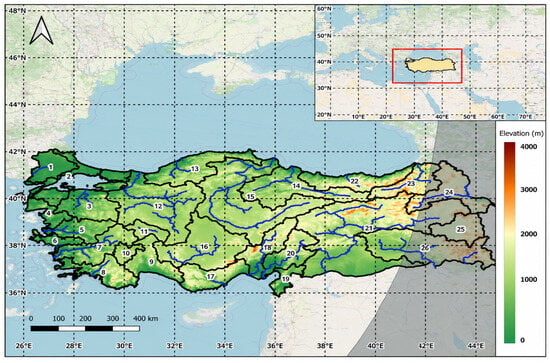
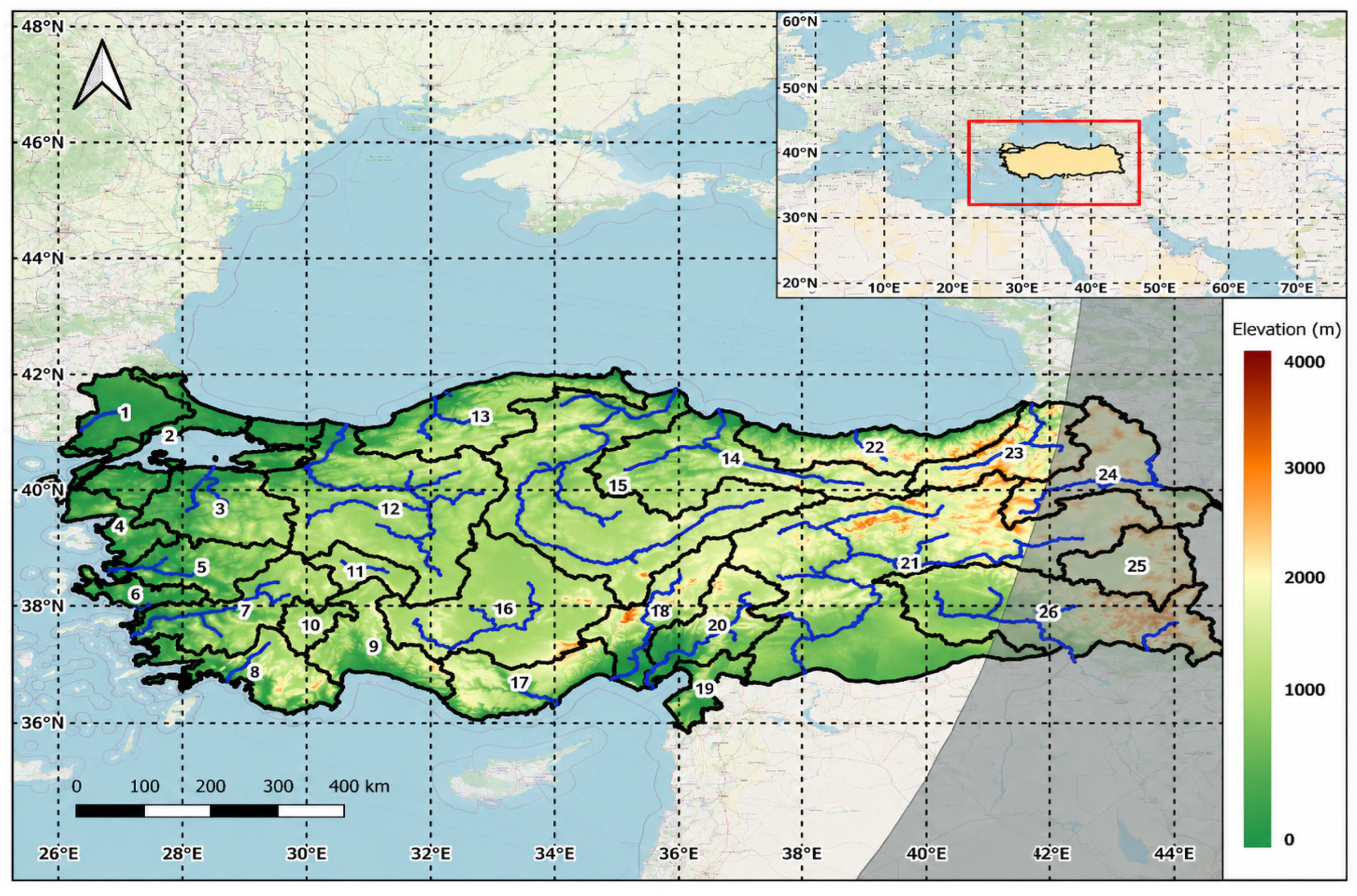
Precipitation and temperature patterns in Türkiye vary significantly by region. The eastern Black Sea coast receives the most precipitation, exceeding 2200 mm per year, while central Anatolia receives about 400 mm per year. The Mediterranean and Aegean coasts, as well as the southern and southeastern regions, experience higher temperatures year-round compared to other areas. For the 1991–2020 period, Türkiye’s annual average temperature was 13.9 °C, and annual total precipitation was 573.4 mm [45]. The stream network forming the hydrologic basins also has a complicated structure across the country; therefore, Türkiye is divided into 26 basins. The list of basins and the study area with the border of the EUR-11 Domain are provided in Table 1 and Figure 1. In this study, the drought characteristics of the 26 basins and the entire Türkiye were investigated.
Table 1.
List of basins.
Figure 1.
Study area and EUR-11 domain. The Türkiye national polygon and the 26 basin polygons are shown with contrasting outlines; the inset marks the EUR-11 domain used for the regional climate-model simulations. The grey area is outside the EUR-11 domain.
Table 1 defines the basin framework used throughout the study and provides the spatial units on which all subsequent drought metrics are reported. This basin-level structure is essential because the methodological sensitivity of SPI standardization is evaluated not only at the national scale but also across contrasting hydroclimatic regions.
Figure 1 shows the 26 basins within both the national hydrological setting and the EUR-11 model domain. The highlighted Türkiye polygon and basin outlines show the analysis domain, while the inset clarifies the regional-climate-model domain used for the simulations. This spatial framing is important for assessing whether the sensitivity to reference climatology is consistent across different hydroclimatic regimes.
2.2. Datasets
2.2.1. Climate-Model Projections (GCM-RCM)
The evaluation of the impact of climate change on future drought characteristics requires an integrated approach that involves adjusting climatology. Particularly in highly vulnerable regions, which are anticipated to undergo significant warming and drying, these changes could result in more severe and frequent extreme drought events. Therefore, the impact of climate change on drought characteristics must be investigated using a high-resolution multi-model ensemble approach with a large number of models.
General circulation models (GCMs) simulate the climate of the entire globe at coarse grids (0.75–2.50°), and RCMs dynamically downscale these global outputs to considerably finer grids (0.10–0.50°) over limited domains. Within the Coordinated Regional Climate Downscaling Experiment (CORDEX) [46], built on Coupled Model Intercomparison Project Phase 5 (CMIP5) experiments released from 2007 onward under different greenhouse-gas emission scenarios, high-resolution RCM simulations are now offered for more than 14 domains through over 100 GCM–RCM combinations.
GCMs using representative concentration pathway (RCP) scenarios are commonly applied to assess the impact of climate change on drought events [47]. The literature frequently references RCP4.5 and RCP8.5. RCP4.5 represents an intermediate stabilization scenario with radiative forcing of about 4.5 W m−2 by 2100, while RCP8.5 projects radiative forcing exceeding 8.5 W m−2 by 2100 [48]. Recent studies [49,50,51] indicate that cumulative CO2 emissions through 2020 most closely followed the RCP8.5 trajectory. However, IPCC [52] notes that RCP8.5/SSP5-8.5 represents a high-end, low-likelihood scenario rather than a central projection, and related work on high-sensitivity model behavior similarly cautions against treating such scenarios as central expectations [53]. RCP8.5 is therefore used here as a stress-test pathway for upper-bound drought risk rather than as the most likely future emissions trajectory.
This study evaluated four CORDEX domains (EUR-11, MENA-22, AFR-22, and CAS) based on data availability, resolution, and spatial coverage. EUR-11 was selected due to its finer spatial resolution of 0.11° (approximately 12 km at the study domain’s mid-latitudes) and its larger set of simulations. All EUR-11 datasets were downloaded from ESGF nodes following the instructions on the CORDEX official webpage [46].
Overall, daily precipitation data from 56 GCM-RCM model pairs driven by the CMIP5 RCP8.5 scenario were analyzed for 1950–2005 (historical simulations) and 2006–2100 (scenario simulations). Daily data was first accumulated to monthly totals, and all subsequent analyses used monthly precipitation. CMIP5-driven EUR-11 simulations were retained because they currently provide the largest high-resolution multi-model ensemble available for this reference-climatology experiment over the study domain. This large ensemble improves coverage of structural model uncertainty, although it should not be interpreted as eliminating uncertainty in projected drought extremes.
The period 2006–2100 corresponds to the scenario-based projection phase defined by the IPCC and used in CMIP5/6 and CORDEX RCM simulations. This division allows consistent comparison between historical and future conditions and supports climate impact assessments that depend on both observed trends and long-term projections under standardized socioeconomic pathways. The period 1970–2005 was adopted as the historical baseline. This interval overlaps with the modern observational and reanalysis era, establishing a stable foundation for model evaluation and bias correction.
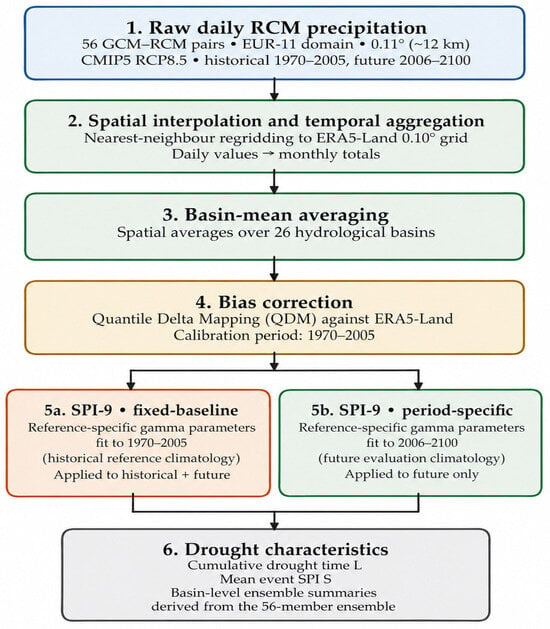
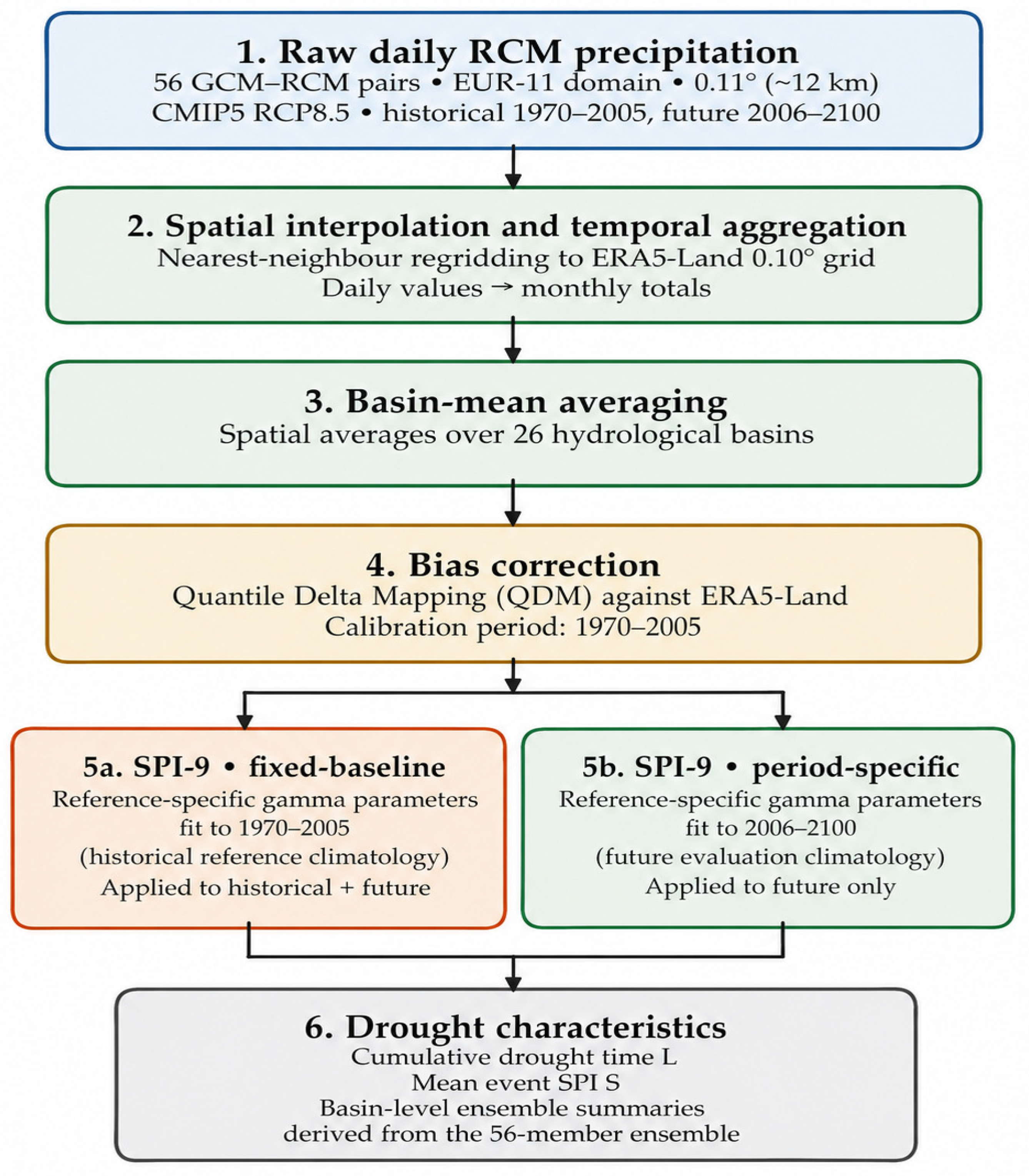
The model pairs used in this study have been listed in Table 2. Although CORDEX provides bias-corrected precipitation datasets, the number of such GCM-RCM pairs is limited, and local (i.e., over Türkiye using station observations collected in Türkiye) or regional (e.g., over entire Europe similar correction factors) correction procedures are unclear. Accordingly, non-corrected precipitation simulations were used. The multiplicative formulation of Quantile Delta Mapping (QDM) [54] was applied month-by-month to each basin series. An earlier reference to a simpler multiplicative factor [55] refers to a related rescaling approach; however, in the present study, the full QDM algorithm was used. The processing workflow was implemented as follows: (1) daily RCM precipitation was spatially interpolated from 0.11° to the 0.10° ERA5-Land grid using nearest-neighbor interpolation; (2) daily values were aggregated to monthly totals; (3) monthly gridded values were spatially averaged over each of the 26 hydrological basins. While applying bias correction prior to spatial aggregation preserves pixel-level non-linear extremes, basin-averaged bias correction using the Quantile Delta Mapping (QDM) method was applied here to strictly evaluate the shift in integrated basin-scale water volumes, explicitly removing intra-basin spatial noise. Figure 2 demonstrates the general methodology workflow.
Table 2.
GCM-RCM pair matrix.
Figure 2.
Methodology workflow.
2.2.2. Reference Dataset: ERA5-Land
Regional climate-model (RCM) datasets may exhibit systematic biases relative to observational or reanalysis datasets. Therefore, bias correction or model-output-statistics procedures are often required before climate simulations can be used in hydrological or drought-impact studies [54,56]. Here, 56 regional climate-model simulations were bias-corrected using ERA5-Land datasets.
The European Centre for Medium-Range Weather Forecasts’ (ECMWF) numerical weather forecasts related to precipitation show the highest correlation over the study area [57,58]. ERA5, the fifth-generation global atmospheric reanalysis produced by the Copernicus Climate Change Service (C3S) at ECMWF, spans January 1950 to the present [59]. Its land component, ERA5-Land, tracks the hourly evolution of land-surface variables in a physically consistent way on a high-resolution 0.1° grid [60]. We note that ERA5-Land is a model-based reanalysis product rather than a direct gauge observation dataset; its precipitation fields may contain biases, particularly over complex terrain. A limitation of this study is that no cross-validation against independent gauge-based products (e.g., CPC, GPCC) or station observations were performed. Basin-level validation metrics such as bias, RMSE, and quantile skill scores would strengthen confidence in the bias correction chain and are recommended for future work.
2.2.3. Bias Correction and Basin Aggregation
Prior to their use in the calculation of drought indices, all raw regional climate-model (RCM) outputs underwent a series of preprocessing steps. These steps were designed to ensure consistency between datasets and to address known model limitations. First, the native RCM outputs were spatially interpolated to align with the grid structure of the ERA5-Land reanalysis dataset. Nearest neighbor interpolation was used for spatial alignment, a standard approach in climate data processing. The original 0.11° RCM outputs were resampled to the 0.10° ERA5-Land grid, harmonizing both datasets spatially. The final domain spanned 25–45° E longitude and 35–43° N latitude, with 81 × 201 grid points.
Following the spatial harmonization, gridded precipitation values were aggregated at the basin level by calculating spatial averages over each hydrological basin. This resulted in time series of basin-averaged precipitation for each RCM ensemble member. Given the inherent biases typically present in climate-model outputs when compared to observed data, these basin-level time series were subsequently corrected for systematic errors.
Systematic biases were corrected using Quantile Delta Mapping (QDM). The method retains the climate-change signal embedded in the model projections while reshaping the simulated precipitation distribution to match observational quantiles, including the tails.
where is the precipitation value in the projected model time series at time t, Fm,p is the empirical cumulative distribution function (CDF) of the projected model time series, and τ(t) is the non-exceedance probability of the projected model time series at time t.
After calculating the non-exceedance probability, the relative change between the quantiles (Δ(t)) of the simulation (future) and historical periods of RCMs can be calculated as:
where and are the inverse empirical CDFs of the simulation (future) and historical periods.
Finally, the bias-corrected precipitation can be obtained by multiplying the observed value with the relative change Δ(t) at the same quantile:
where is the inverse empirical CDF estimated from the ERA5-Land reanalysis (1970–2005).
In these equations, the subscripts m, o, p, and h denote the climate model (GCM-RCM pair), the observational/reanalysis reference (ERA5-Land), the future projection period, and the historical calibration period, respectively.
Given its advantages in trend preservation, distribution correction, and applicability to a large ensemble of climate models, QDM was deemed the most suitable method for this study [54,61]. It has also been successfully applied in similar climate regions [18], further supporting its selection for bias correction in this analysis.
The bias-correction workflow was implemented using the R package MBC, available from CRAN (R 4.2.2: R Foundation, Vienna, Austria) at https://cran.r-project.org/web/packages/MBC/index.html (accessed on 6 July 2025).
2.3. Standardized Precipitation Index (SPI) and Drought Metrics
The SPI values, which can be calculated using precipitation data measured at stations, can also be calculated for gridded precipitation datasets (for example, satellite, radar, or climate-model precipitation products). Owing to the widespread availability and computational ease of such datasets, the WMO recommended SPI as a core meteorological drought index for operational monitoring [35]. SPI was computed here by fitting a two-parameter gamma distribution to accumulated precipitation and then transforming cumulative probabilities to the standard normal space using the inverse normal CDF [32,33,62]:
where G(x) is the CDF of the gamma distribution, and α and β are the shape and scale parameters fitted to detectable accumulated precipitation. Following Stagge et al. [62], accumulated precipitation values at or below 0.01 mm were treated as zero events within the mixed distribution used to derive cumulative probabilities.
Then, SPI values can be estimated through the inverse CDF of the standard normal distribution:
where is the inverse CDF of the standard normal distribution.
SPI values above zero correspond to wetter-than-average conditions, while values below zero indicate precipitation deficits. Because the index is standardized, anomalies from wet and dry climates can be compared on a common scale. The recommended threshold values for SPI commonly used in the literature are listed in Table 3.
Table 3.
SPI categories (adapted from Ref. [32]).
The drought type captured by SPI depends on the chosen accumulation window (1–48 months). Long windows trace slowly developing deficits whose adverse impacts persist, whereas short windows capture dry spells that emerge and dissipate within brief periods; SPI-12, for instance, is typically linked to hydrological or agricultural drought, and SPI-1 to meteorological drought.
SPI-12 is widely used to investigate slowly accumulating hydrological and agricultural drought events, whereas SPI-6 reflects relatively faster developing events. Among the commonly used accumulation periods, SPI-6 emphasizes faster meteorological-to-soil-moisture coupling, SPI-12 captures slower hydrological and reservoir-storage responses, and SPI-9 represents an intermediate timescale, capturing growing-season-aligned drought persistence in temperate-Mediterranean settings [63,64]. For the present reference-climatology comparison, SPI-9 was selected because (i) it is long enough to ensure a stable gamma fit over a 36-year window [62], and (ii) it is short enough to retain interannual-to-seasonal sensitivity, which is the timescale at which differences between standardization strategies are most diagnostic. Furthermore, SPI-9 aligns with observed hydrological responses in Türkiye [64,65,66], and it is used here as a representative medium-term accumulation scale for comparing fixed-baseline and period-specific standardization strategies.
Following the selection of SPI-9 as the representative accumulation period, drought characteristics were quantified from SPI-9 ensemble summaries. For each basin and evaluation period, cumulative drought time (L) was calculated as the total number of months classified as drought months in the ensemble level SPI series, and S was calculated as the corresponding mean SPI severity over drought-classified months. The values reported in Table 4 should therefore be interpreted as basin-level ensemble drought-characteristic summaries derived from the 56-member bias-corrected EURO-CORDEX ensemble, rather than as individual model-member event statistics. The same drought classification convention was applied consistently to both reference-climatology strategies.
Table 4.
Cumulative drought time (L) and mean event SPI (S) for the historical and future periods under the two reference-climatology strategies. Values are reported as basin-level ensemble summaries.
2.4. Reference-Climatology Strategies (Fixed-Baseline vs. Period-Specific SPI)
In order to evaluate the influence of reference period on SPI-based drought assessment, two standardization approaches were compared. For clarity, we refer to the approach that applies a single historical reference period (1970–2005) to standardize both historical and future SPI values as the fixed-baseline (reference-aligned) strategy. We refer to the approach that re-estimates the reference climatology for the future period and standardizes future SPI values to the climatology of the future evaluation period itself as the period-specific strategy (period-specific SPI; future SPI values are standardized to the climatology of the future evaluation period itself). Both are mathematically valid; however, their key difference is interpretability when comparing past and future conditions. An important caveat is that the two strategies also differ in calibration-window length: the fixed baseline covers 36 years (1970–2005), whereas the period-specific baseline spans 95 years (2006–2100). Consequently, the comparison conflates two factors, including the temporal location of the reference period and the length of the calibration window, and any observed differences cannot be attributed solely to baseline timing. To account for the different calibration-window lengths used in these two strategies, an equal-length sensitivity check was also performed. In this test, the historical fixed baseline (1970–2005; 36 years) was compared with a late-century future baseline of the same length (2065–2100; 36 years). This late-baseline test was not used to replace the main fixed-baseline and period-specific comparison, but to assess whether the reference-framing signal persists when calibration-window length is held constant.
While drought periods are almost universally understood as intervals receiving less precipitation than the climatological mean, no comparable consensus exists on the baseline climatology itself. The same region can therefore display different drought characteristics depending on the period chosen to fit the gamma-distribution parameters. To illustrate: a year receiving 700 mm of precipitation appears severely dry against a 30-year mean of 1000 mm/year, yet the same 700 mm would mark a distinctly wet year if the corresponding mean were only 500 mm/year. Wet and dry designations are thus inherently tied to the selected reference timeframe rather than to any unique definition. Here we use two different time periods to estimate the parameters of the gamma distribution (1970–2005 and 2006–2100) and compare the sensitivity of the projected drought characteristics to the baseline climate.
Reference-climatology alignment is essential for ensuring consistency in drought frequency and severity estimates across historical and future periods. Moreover, historical baselines may no longer be representative under ongoing climate change [67]. Previous studies have shown that baseline climatic data can substantially influence climate-forecast uncertainty and the interpretation of climate-change impacts [68,69]. Therefore, in this study, baseline alignment was tested across all 26 hydrological basins for both historical and future periods. The two strategies were implemented through reference-period-specific gamma-parameter estimation rather than through a post hoc additive SPI adjustment.
2.5. Use of Generative AI Tools
Generative AI tools were used in the preparation of this manuscript for editorial and presentational purposes. ChatGPT-GPT-4 family (OpenAI, San Francisco, CA, USA), Grammarly (Grammarly, Inc., San Francisco, CA, USA), and QuillBot (Learneo, Inc., San Francisco, CA, USA) were used for language editing, grammar correction, and readability improvement of selected passages. Claude-Opus 4.x models (Anthropic, San Francisco, CA, USA) was used for debugging of analysis and figure code. No generative AI tool was used in the study design, data acquisition, bias correction, SPI computation, statistical analysis, interpretation of results, or formulation of conclusions; all quantitative results were generated by the authors’ own analysis workflows. The authors critically reviewed, verified, and edited all AI-assisted output and take full responsibility for the entire content of this publication.
3. Results
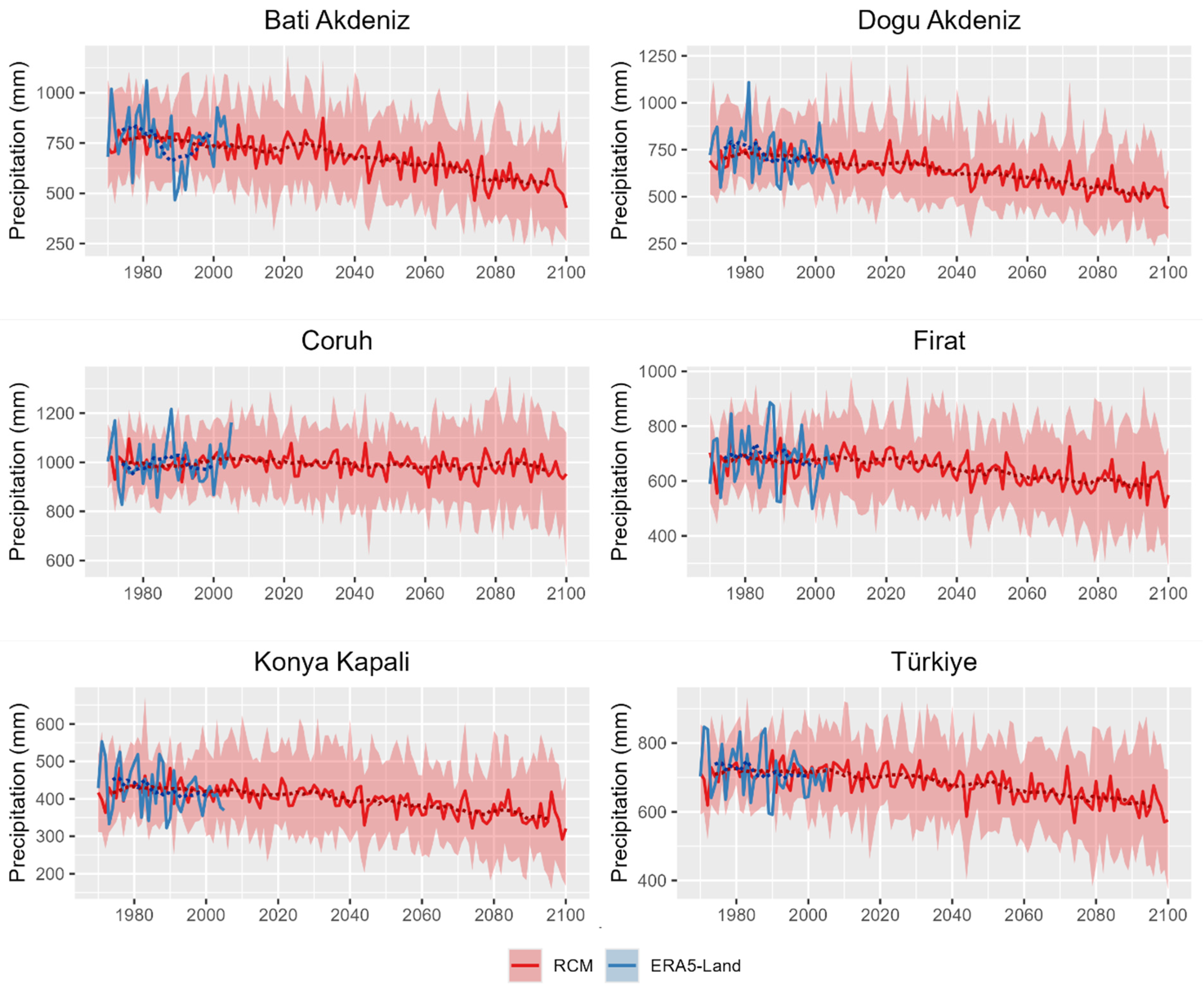
Based on the analysis of the annually averaged precipitation time series for the five representative basins (Batı Akdeniz and Doğu Akdeniz, representing the Mediterranean climate zone with the strongest drying signal; Çoruh, representing the Black Sea region with high elevation and snowmelt influence; Fırat, the largest basin by area with transitional climate; and Konya, a semi-arid interior basin with groundwater dependence) and the entire Türkiye from 1970 to 2100, notable changes in precipitation patterns are expected across the country, with varying regional impacts (Figure 3).
Figure 3.
Annually averaged precipitation time series over the five selected basins and entire Türkiye from 1970 to 2100. Blue line shows the ERA5-Land reanalysis and the red line shows the ensemble median of the 56 RCMs. The shaded red area shows the 5% and 95% percentiles of the ensemble.
Historical ERA5-Land precipitation and the ensemble median of the bias-corrected RCMs show substantial interannual variability across all selected basins. The largest late-century declines in the ensemble-median precipitation occur in the Mediterranean basins, particularly Batı Akdeniz and Doğu Akdeniz, whereas the northeastern and high-elevation basins show weaker changes. Figure 3 is presented here to provide the precipitation background against which the SPI reference-strategy comparison is interpreted. However, the figure alone does not diagnose the physical circulation mechanisms driving these trends.
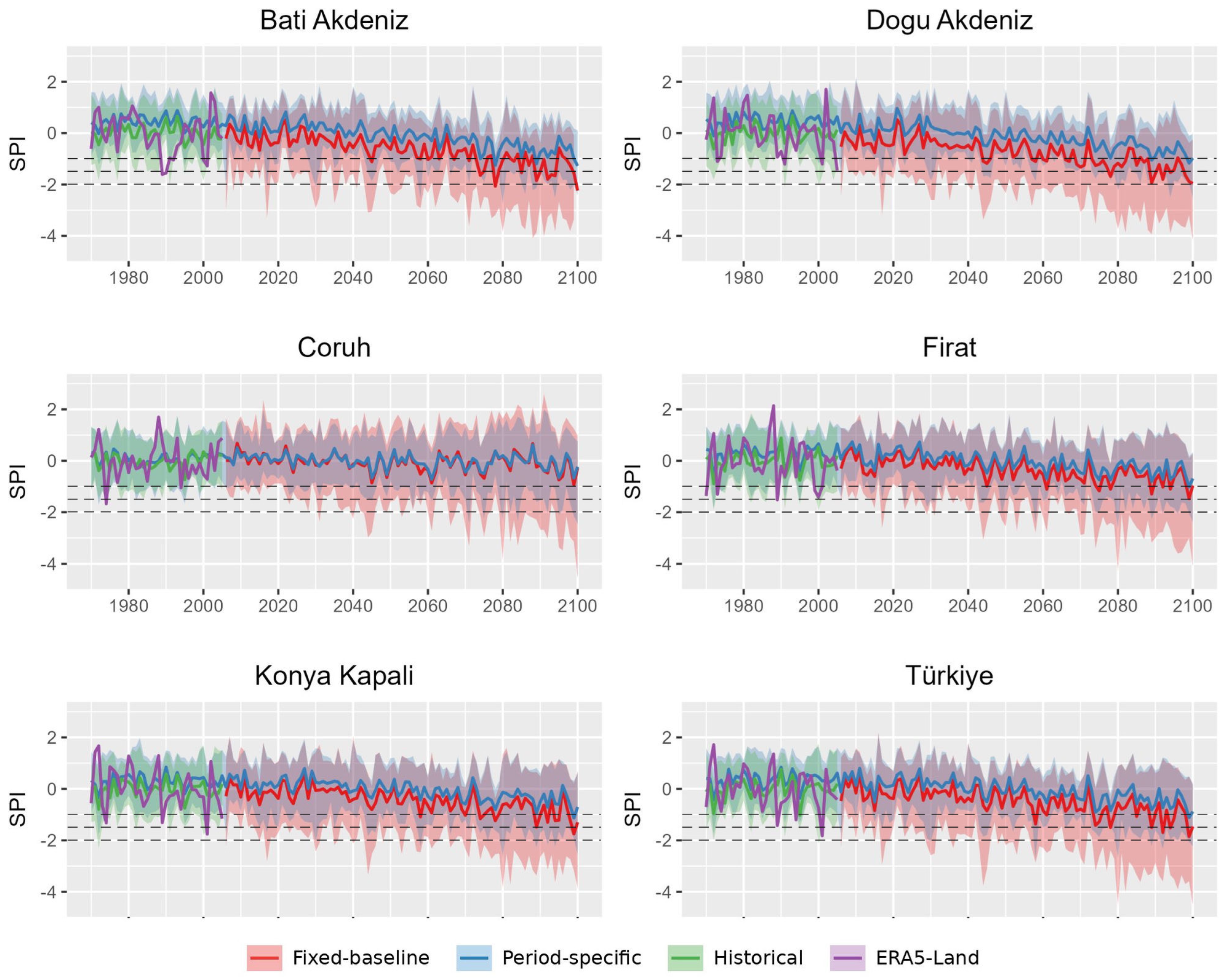
Figure 4 compares the annual mean SPI trajectories under the two reference-climatology strategies. The key difference is methodological: because both SPI series are derived from the same bias-corrected precipitation projections, any divergence between the two series reflects the effect of reference framing rather than differences in climate input data.
Figure 4.
Annually averaged SPI time series over the five selected basins and entire Türkiye from 1970 to 2100. Shaded horizontal reference bands indicate the McKee et al. [32] drought-severity categories: moderate drought (−1.0 to −1.5), severe drought (−1.5 to −2.0), and extreme drought (≤−2.0).
The red line shows the ensemble median of the 56 RCMs under the fixed-baseline strategy (SPI standardized to the 1970–2005 reference climatology; labeled fixed-baseline in the legend), whereas the blue line shows the period-specific strategy (SPI standardized to the reference climatology of the evaluation period; labeled period-specific). Shaded red areas show the 5% and 95% percentiles of the ensemble. The horizontal shaded bands provide a visual reference for the McKee et al. [32] moderate, severe, and extreme drought categories.
The two strategies produce materially different SPI trajectories despite using the same precipitation inputs. Under fixed-baseline standardization, late-century drying is expressed relative to the historical climate and several Mediterranean basins shift into persistently negative SPI values. Under period-specific standardization, anomalies are measured relative to the future climate state, yielding a more moderate trajectory. The contrast therefore reflects the reference-climatology strategy rather than a change in the underlying climate simulations.
Table 4 summarizes cumulative drought time (L) and the mean event SPI (S) for the historical and future periods under the two reference strategies.
Across the 26 basins, drought time increases from the historical period to both future periods, with the strongest increase occurring under fixed-baseline standardization in 2061–2100. This pattern indicates that the reference strategy affects not only the magnitude of projected drought time but also the apparent timing of drought emergence across basins; however, it should be interpreted in light of the 36-year versus 95-year calibration-window contrast described in Section 2.4.
To provide a basic statistical assessment of the difference between the two reference strategies, we applied two-sided paired Wilcoxon signed-rank tests across the 26 basin-level ensemble summary values reported in Table 4 (Türkiye aggregate excluded). For cumulative drought time (L), fixed-baseline and period-specific estimates differ significantly in both 2020–2060 (median paired difference = 122.5 months, W = 11.0, p = 1.64 × 10⁻⁶) and 2061–2100 (median paired difference = 69.0 months, W = 9.0, p = 2.35 × 10⁻⁵). For mean event SPI (S), the fixed-baseline strategy also produces significantly more negative severity summaries in 2020–2060 (median paired difference = −0.135, W = 60.5, p = 0.0035) and 2061–2100 (median paired difference = −0.54, W = 5.0, p = 1.49 × 10⁻⁵). These are basin-level paired tests of the reported ensemble-summary values, rather than model-member-level tests of the full 56-member distributions.
To evaluate whether the strategy contrast is mainly an artefact of the unequal calibration-window lengths, we further conducted an equal-length sensitivity check using a 36-year late-century baseline (2065–2100) and compared it with the 36-year historical baseline (1970–2005). The sensitivity check confirms that the reference-timing effect persists when window length is held constant. Across 25 of 27 spatial units, the fixed-to-late-baseline difference in cumulative drought time was larger than the fixed-to-period-specific difference. At the national scale, the fixed-to-period-specific difference was 67 months, whereas the fixed-to-late-baseline difference was 223 months, approximately 3.0 times larger. The same amplification was especially clear in the Mediterranean basins, including Doğu Akdeniz, Burdur, Batı Akdeniz, and Antalya, where the fixed-to-late-baseline contrast was 3.7 to 5.0 times larger than the fixed-to-period-specific contrast. These results indicate that the main conclusion is not weakened by the unequal-window caveat; rather, a late-century equal-length reference period strengthens the evidence that baseline timing strongly controls SPI-based drought characterization.
Three Mediterranean basins, Batı Akdeniz, Doğu Akdeniz, and Antalya, show mean event SPI values close to or below −3.0 in 2061–2100 under the fixed-baseline strategy (Table 4), with L values exceeding 465 of 480 months. These values should not be read as isolated monthly extremes; rather, they express persistent late-century precipitation deficits after transformation relative to the historical reference climatology. The corresponding period-specific values are substantially less negative because the future drier distribution is used as the reference climatology. Thus, the contrast between the two framings quantifies how much of the late-century Mediterranean drying signal is expressed as emergence relative to the historical climate, rather than as variability within the future climate state itself.
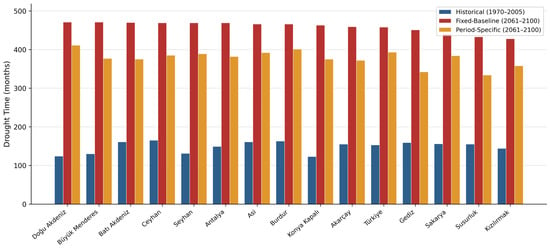
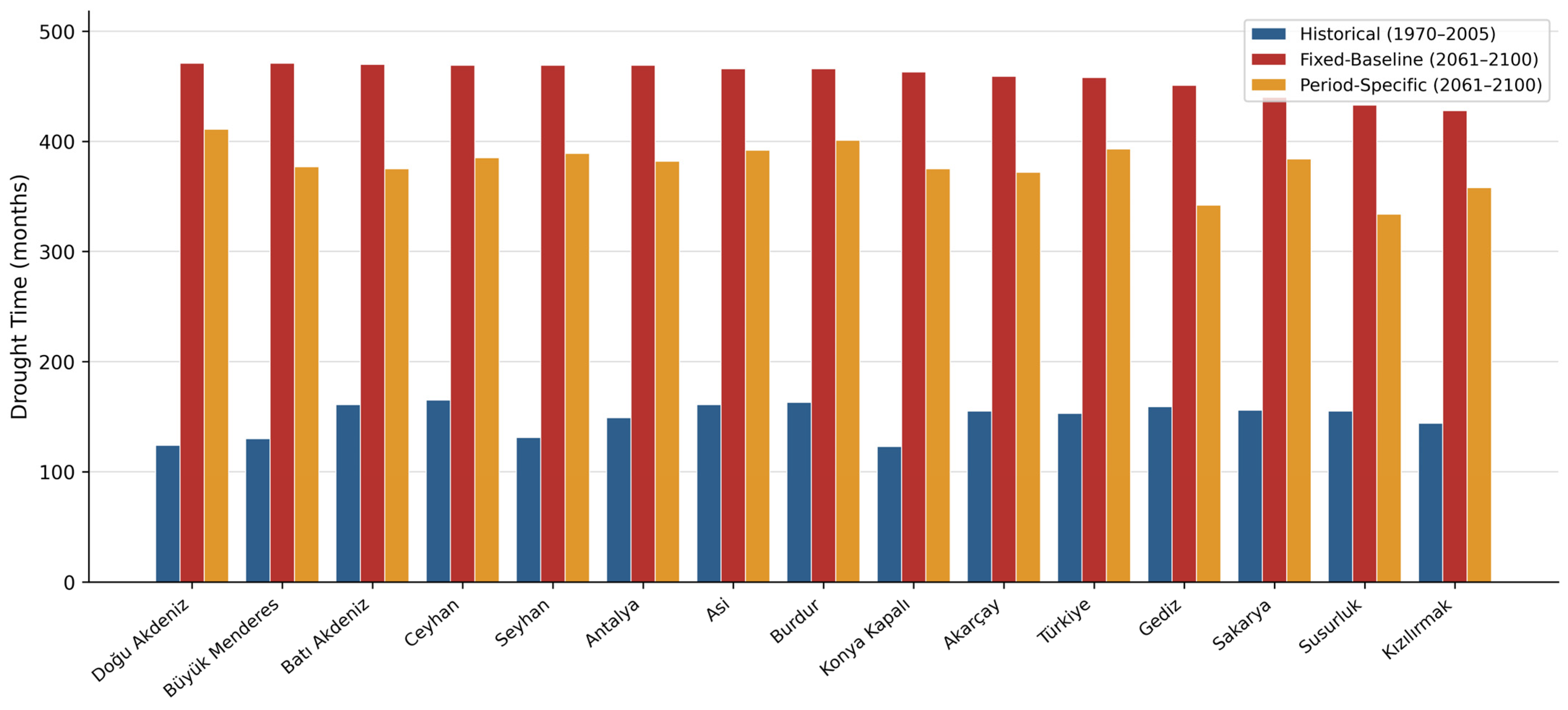
Figure 5 highlights how strongly basin ranking depends on the reference strategy used to standardize SPI. Although the same basins remain among the most drought-prone in the late-century period, the fixed-baseline strategy produces a much stronger separation from historical conditions, whereas the period-specific strategy compresses those differences by evaluating drought relative to the future climatology. This comparison therefore reinforces the central methodological result that reference framing affects not only the magnitude of projected drought time but also the apparent ordering of the most affected basins.
Figure 5.
Expected evolution of drought duration across severely affected basins. The differences between the historical baseline and two future strategies (fixed-baseline vs. period-specific) for the 15 basins with the highest fixed-baseline drought time (L) in 2061–2100 are illustrated.
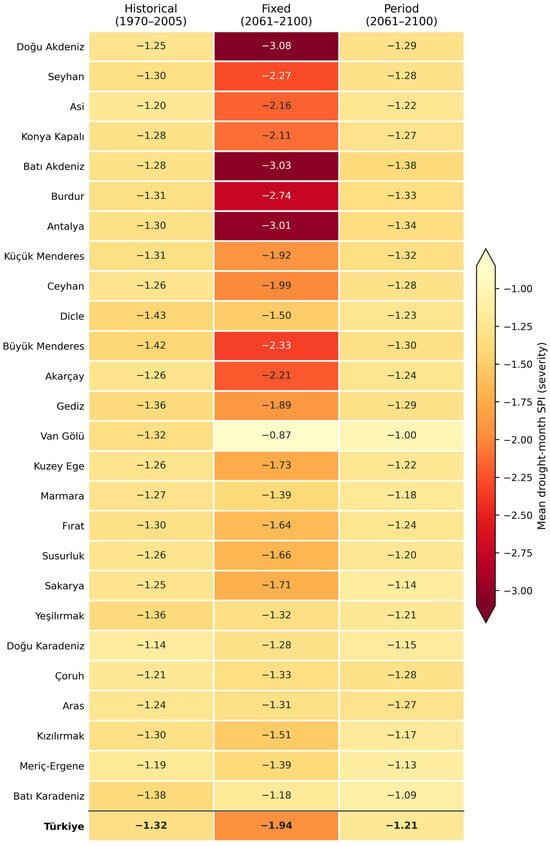
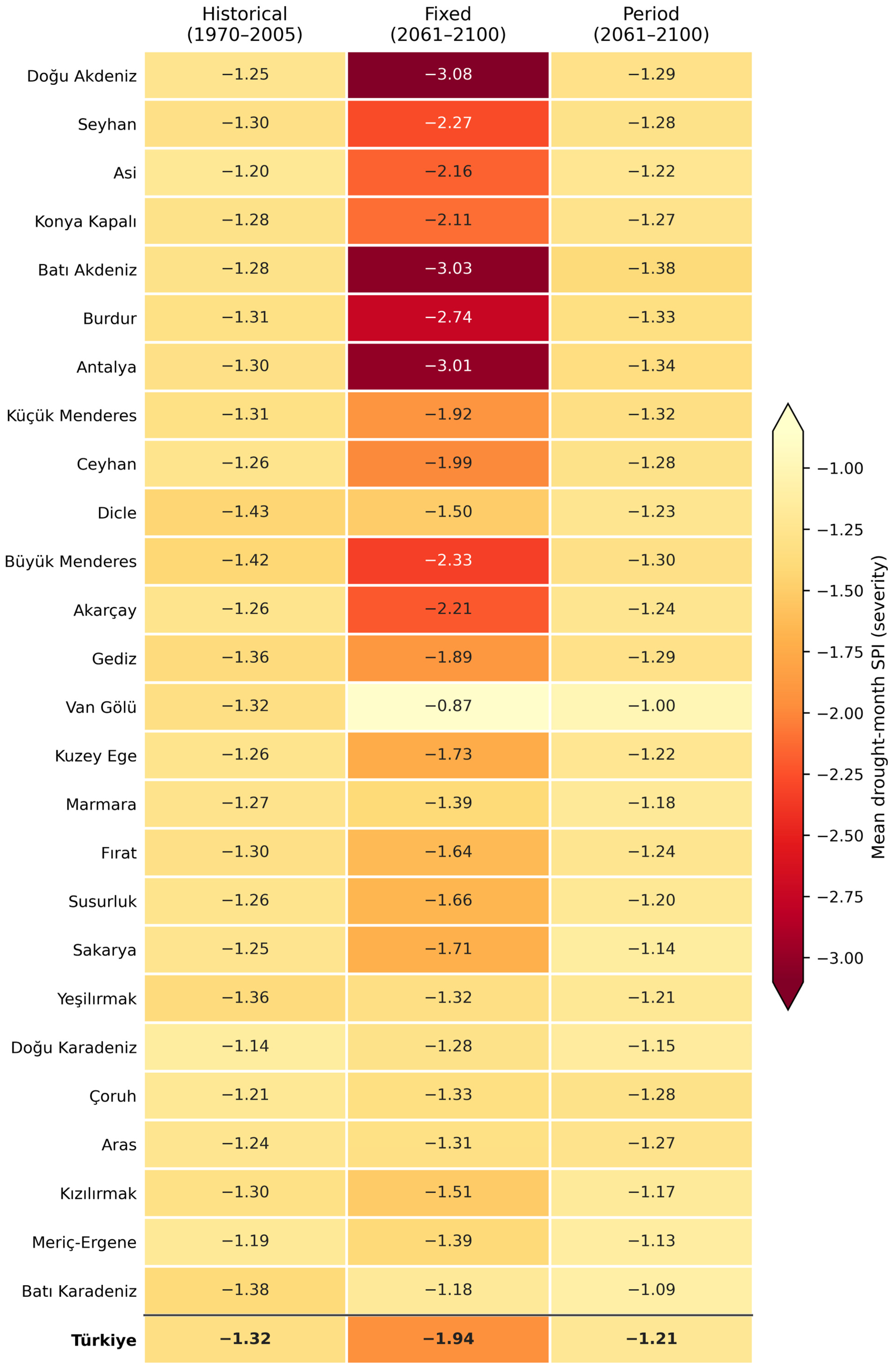
Together, Table 4 and Figure 6 show that the fixed-baseline strategy yields systematically stronger late-century drought signals than the period-specific strategy across many basins. This contrast is most pronounced in Mediterranean basins, where future precipitation deficits remain severe when evaluated against historical climate conditions, but a similar pattern also occurs at the national scale. The period-specific strategy produces milder anomalies because future precipitation is standardized relative to an evolving future climatology rather than the historical baseline.
Figure 6.
Mean SPI across basins and reference strategies; darker = more severe drought.
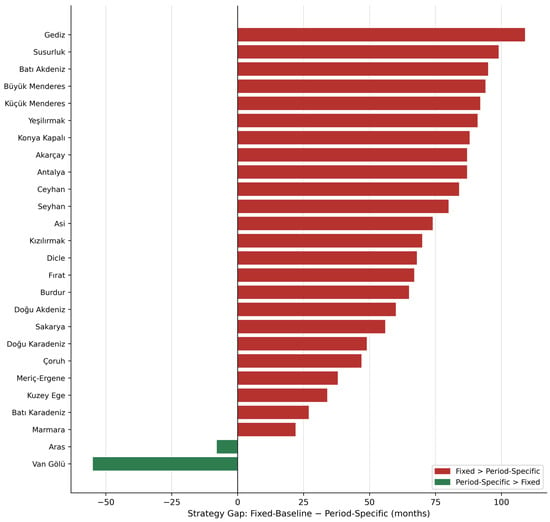
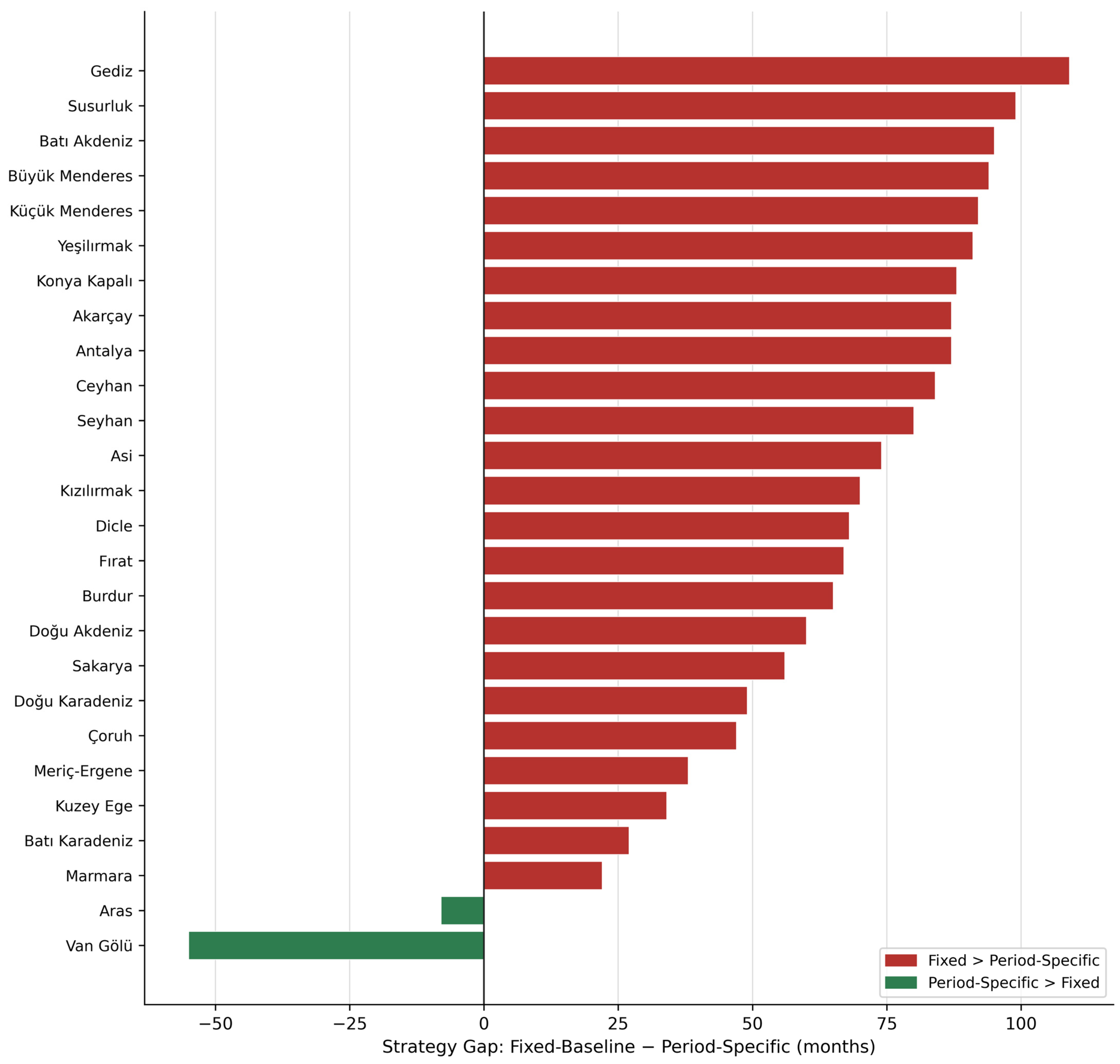
Figure 7 provides a direct basin-by-basin visualization of the methodological gap between the two SPI strategies in 2061–2100. The predominantly positive differences indicate that fixed-baseline standardization generally produces longer projected drought time than period-specific standardization, with the largest contrasts concentrated in basins already exposed to strong drying signals. The figure therefore summarizes the sensitivity of projected drought time to the choice of reference climatology in a single metric.
Figure 7.
Difference between standardization strategies (2061–2100).
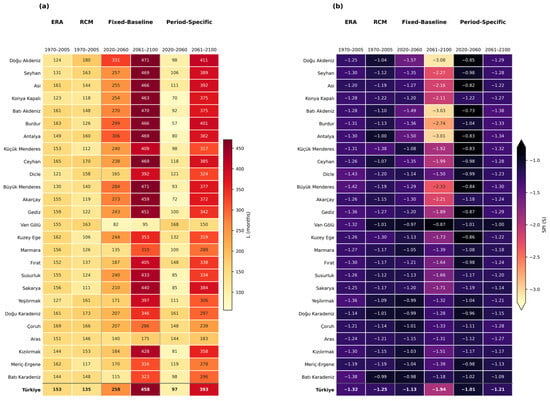
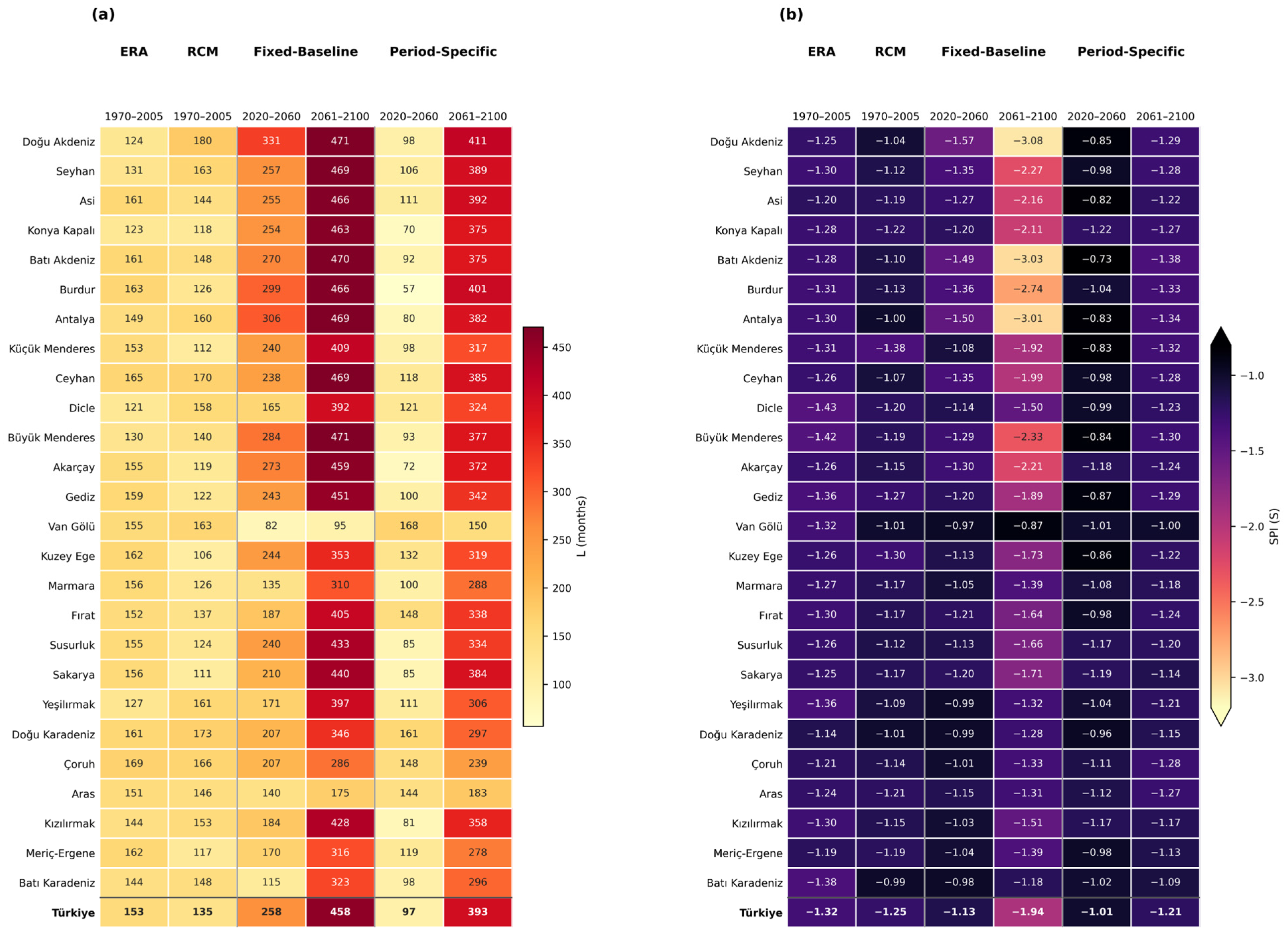
Figure 8 presents the full basin-level matrix of drought characteristics and shows that the methodological sensitivity identified at the national scale is also visible across individual basins. In particular, the difference between fixed-baseline and period-specific standardization is evident in both drought time (L) and the mean event SPI (S), although the magnitude of the difference varies substantially across hydroclimatic settings. This figure therefore helps to distinguish national-scale tendencies from basin-specific responses.
Figure 8.
Drought characteristics across all basins. (a) drought duration L (months) and (b) mean drought-month SPI severity S, for the historical baselines (1970–2005) and the fixed-baseline and period-specific standardizations (2020–2060 and 2061–2100).
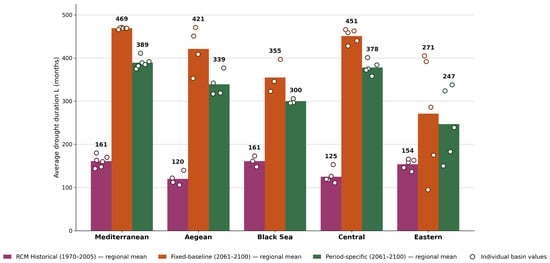
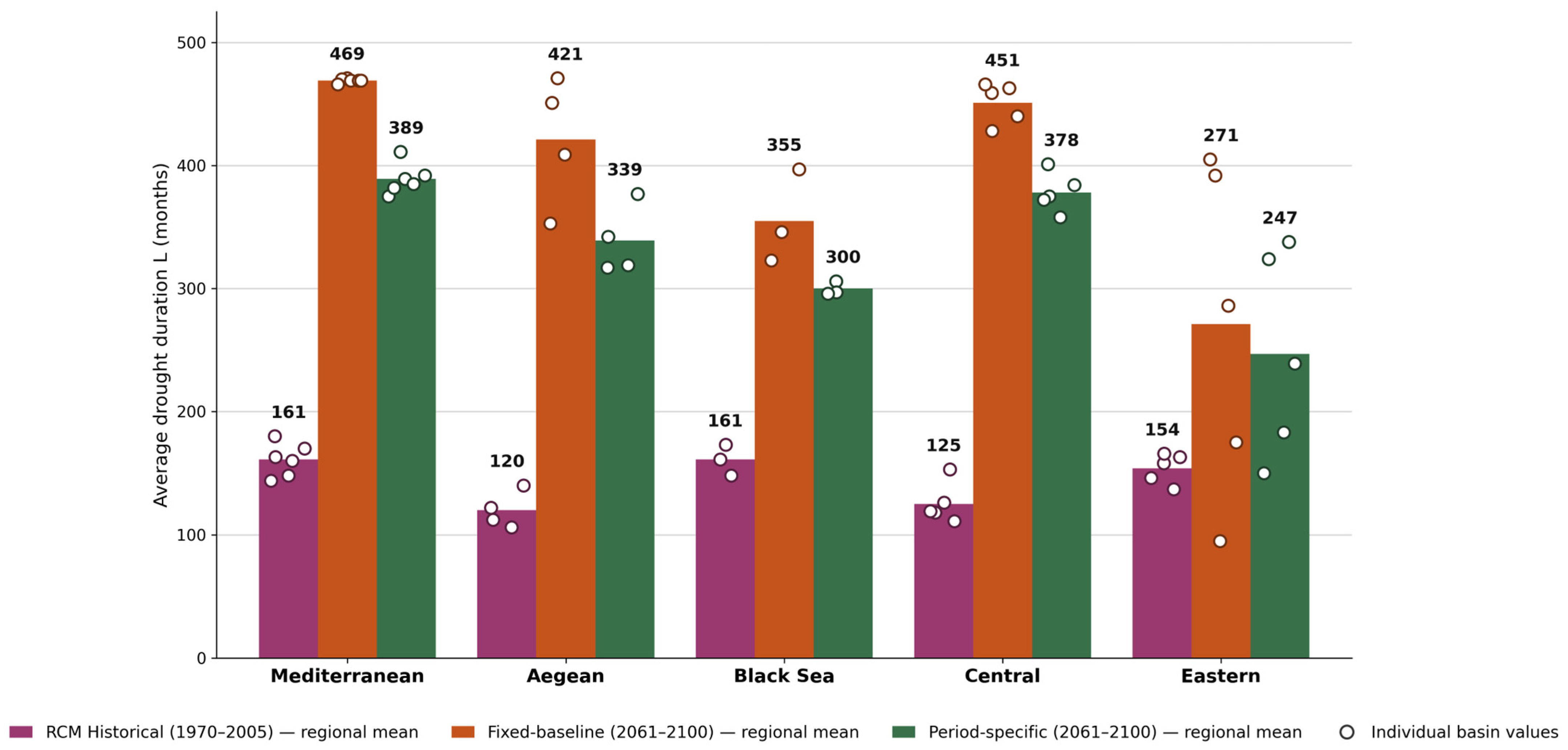
Figure 9 shows that sensitivity to reference strategy has a clear regional structure rather than being randomly distributed across the study area. Mediterranean and interior basins exhibit the strongest divergence between the two approaches, whereas wetter or more weakly drying regions show smaller contrasts. This regional grouping supports the interpretation that sensitivity to reference-climatology becomes most pronounced where the future climate conditions diverge most strongly from the historical baseline.
Figure 9.
Regional comparisons of drought duration across climate zones. Filled bars show regional means; open circles show individual basin values within each region.
4. Discussion
The main contribution of this study lies in its methodological framework rather than solely regional findings. Our results show that SPI-based drought projections are substantially sensitive to the reference-climatology strategy, and the same bias-corrected climate ensemble can yield materially different drought narratives depending on whether future anomalies are standardized against a fixed historical baseline or an evolving future climatology. The importance of this finding extends beyond Türkiye itself, as the country’s 26 basins serve here as a hydroclimatically diverse case domain for demonstrating this methodological sensitivity across Mediterranean, Black Sea, interior, and semi-arid climate regimes. In this sense, the present study should be interpreted not only as a basin-scale drought assessment for Türkiye, but also as a broader evaluation of how reference framing influences the interpretation of standardized drought projections under climate change.
The two strategies are not interchangeable: fixed-baseline SPI quantifies emergence relative to historical climate, whereas period-specific SPI describes anomalies within the future climate state. Selection should follow the scientific question rather than be treated as a single universal drought definition. This also means that SPI values reported under non-stationary climate should be read as anomaly statements relative to a specified reference climatology rather than as absolute drought severities independent of methodological framing. The distinction is especially visible in the Mediterranean basins: the same bias corrected precipitation can yield mean event SPI values of approximately −3.0 under fixed baseline standardization and approximately −1.4 under period-specific standardization, placing the selected reference frame at the center of any drought-emergence assessment (Table 5).
Table 5.
Recommended use of the two reference-climatology strategies. The two strategies are mathematically valid but answer different questions; the choice should follow the scientific question rather than be treated as a single universal drought definition.
These methodological differences also have practical implications for adaptation planning in Türkiye. Because SPI is a precipitation-only index, the present results should be interpreted as a meteorological drought signal rather than as a direct measure of agricultural, hydrological, or water-supply impacts. Translating SPI projections into sector-relevant impact estimates requires coupling with complementary indicators and models, including crop-yield sensitivity, runoff, soil moisture, reservoir storage, and water-demand information. Even so, basins that show persistent late-century drying under the fixed-baseline strategy—particularly in Mediterranean and semi-arid regions—merit closer follow-up using such impact-oriented frameworks.
Related literature suggests that CMIP6 ensembles often yield stronger Mediterranean warming and drying signals than CMIP5-based ensembles [70,71]. However, because the present analysis uses a CMIP5-driven EURO-CORDEX ensemble, those differences are noted here only as context; they are not used to modify the core interpretation of the results.
Future work should replicate the same reference-climatology experiment using sufficiently large CMIP6-driven regional ensembles as they become available. Such an extension would allow comparison across model generations and would also support explicit sensitivity tests for model weighting and climate-sensitivity screening. The present results should therefore be interpreted as a legacy-ensemble methodological assessment based on the largest currently available CMIP5-driven EUR-11 dataset for this application.
5. Conclusions
This study provides a methodological evaluation of reference-climatology dependence in SPI-based drought projections under climate change, using Türkiye’s 26 major basins as a hydroclimatically diverse testbed. Across the same set of 56 EURO-CORDEX GCM-RCM simulations, the choice of reference-climatology strategy substantially altered the projected drought time and the apparent severity of late-century drying. Cumulative drought time reached 458 months in 2061–2100 at national scale under fixed-baseline standardization, compared with 393 months under period-specific standardization. These differences show that projected SPI drought characteristics are conditional not only on the climate-model ensemble and forcing scenario, but also on how the reference climatology is defined; in the present implementation, they also reflect a 36-year versus 95-year calibration-window contrast.
The magnitude of the fixed-baseline/period-specific contrast should not be interpreted as a pure baseline-timing effect. Rather, it represents the combined influence of reference-period timing and calibration-window length, while still demonstrating that reference framing materially affects SPI-based drought narratives under non-stationary climate.
An equal-length sensitivity check using a 2065–2100 late-century baseline showed that the fixed-to-late-baseline contrast was larger than the fixed-to-period-specific contrast in 25 of 27 spatial units, including a 3.0-fold amplification at the national scale. Thus, although the main comparison involves unequal calibration-window lengths, controlling for window length does not remove the reference-climatology effect; it reinforces the conclusion that baseline timing strongly shapes SPI-based drought narratives.
Future drought studies should therefore report the reference period, calibration-window design, and standardization strategy explicitly and should align the choice of strategy with the scientific question being asked.
From an application perspective, basin-scale adaptation analyses should state explicitly whether risk is being benchmarked against historical climate conditions or against an evolving future baseline, where those two framings support different planning questions.
6. Limitations and Future Recommendations
This study has several limitations. First, the comparison between fixed-baseline and period-specific SPI does not isolate baseline timing alone, because the two strategies also use calibration windows of different lengths. Second, SPI is a precipitation-only index and does not represent temperature-driven evapotranspiration or direct agricultural/hydrological impacts. Third, the analysis relies on CMIP5-driven RCM outputs because a comparably large CMIP6-driven ensemble was not yet available for this application. Since RCP8.5/SSP5-8.5 is best interpreted as a high-end, low-likelihood stress-test scenario rather than as a central projection [52,53], the projected drought intensities reported here should be interpreted as an upper-envelope estimate rather than the most likely outcome. Fourth, bias correction and the use of ERA5-Land as a reanalysis reference introduce additional uncertainty. Fifth, the ~0.11° spatial resolution may smooth fine-scale topographic effects, especially over complex terrain.
Complex terrain substantially increases uncertainty in RCM simulations; although EUR-11 provides 0.11° resolution, orographic precipitation and convective extremes remain difficult to represent. Previous evaluations over Türkiye show that high-resolution regional simulations reproduce broad spatial patterns reasonably well but still exhibit larger uncertainty in eastern highlands and some coastal zones [72]. Large EURO-CORDEX assessments similarly show that added mountain detail does not eliminate systematic winter and summer biases in all regions [73].
Implications for sustainability and adaptation planning. The choice of reference climatology has direct consequences for sustainable water resources management, drought-risk preparedness, and climate-adaptation planning. Decisions about reservoir operation, irrigation allocation, agricultural drought-relief programs, and long-term water-supply infrastructure all depend on how drought severity and persistence are quantified relative to a chosen reference state. Inconsistent reference-period choices across studies can therefore produce divergent recommendations even when the underlying climate projections are identical, with downstream consequences for evidence-based policy aligned with Sustainable Development Goal 6 (Clean Water and Sanitation), SDG 13 (Climate Action), and SDG 15 (Life on Land). We therefore advocate that drought projection studies adopt transparent reporting of reference-climatology choices and that adaptation-planning frameworks explicitly distinguish between change relative to a historical baseline and anomalies within an evolving future climate.
Future work should therefore combine the present reference-climatology experiment with multi-index and impact-oriented drought frameworks, equal-length and rolling baseline tests, CMIP6-era regional ensembles, and additional validation against runoff, soil-moisture, and sectoral impact data. A parallel RCP 4.5 and, where available, CMIP6-driven SSP2-4.5 ensemble assessment under the same reference-climatology framework is recommended for future work to bracket the present RCP8.5 stress-test envelope with a more central pathway.
Author Contributions
Conceptualization, S.O. and M.T.Y.; formal analysis, N.E.E., B.G. and A.U.G.S.; methodology, M.T.Y., I.Y. and S.O.; supervision, M.T.Y., I.Y. and S.O.; visualization, B.G., S.O. and A.U.G.S.; writing, original draft, N.E.E., S.O., B.G., A.U.G.S. and M.Y.; writing, review and editing, M.T.Y., I.Y., N.E.E., S.O., B.G., A.U.G.S. and M.Y. All authors have read and agreed to the published version of the manuscript.
Funding
This research received no external funding.
Institutional Review Board Statement
Not applicable.
Informed Consent Statement
Not applicable.
Data Availability Statement
The raw data supporting the conclusions of this article will be made available by the authors on request.
Acknowledgments
During the preparation of this work, the authors used ChatGPT (OpenAI, GPT-4 family), Grammarly and Quillbot (Quillbot Inc.) for the purposes of language editing, grammar correction, and readability improvement of selected passages and Claude (Opus 4.8) for the purpose of code fixing. The authors have reviewed and edited the output and take full responsibility for the content of this publication.
Conflicts of Interest
The authors declare no conflict of interest.
References
- Amrit, K.; Pandey, R.; Mishra, S.; Daradur, M. Relationship of drought frequency and severity with range of annual temperature variation. Nat. Hazards 2018, 92, 1199–1210. [Google Scholar] [CrossRef] [Scilit]
- Chiang, F.; Mazdiyasni, O.; Aghakouchak, A. Amplified warming of droughts in southern United States in observations and model simulations. Sci. Adv. 2018, 4, eaat2380. [Google Scholar] [CrossRef] [Scilit] [PubMed]
- Naumann, G.; Cammalleri, C.; Mentaschi, L.; Feyen, L. Increased economic drought impacts in Europe with anthropogenic warming. Nat. Clim. Change 2021, 11, 485–491. [Google Scholar] [CrossRef] [Scilit]
- Qiu, J.; Shen, Z.; Xie, H. Drought impacts on hydrology and water quality under climate change. Sci. Total Environ. 2023, 858, 159854. [Google Scholar] [CrossRef] [Scilit] [PubMed]
- IPCC. IPCC Climate Change 2014: Synthesis Report. Contribution of Working Groups I, II and III to the Fifth Assessment Report of the Intergovernmental Panel on Climate Change; Cambridge University Press: Cambridge, UK; New York, NY, USA, 2014. [Google Scholar]
- IPCC. IPCC Climate Change 2021: The Physical Science Basis Contribution of Working Group I to the Sixth Assessment Report of the Intergovernmental Panel on Climate Change; Cambridge University Press: Cambridge, UK; New York, NY, USA, 2021. [Google Scholar]
- Osuch, M.; Romanowicz, R.J.; Lawrence, D.; Wong, W.K. Trends in projections of standardized precipitation indices in a future climate in Poland. Hydrol. Earth Syst. Sci. 2016, 20, 1947–1969. [Google Scholar] [CrossRef] [Scilit]
- Tramblay, Y.; Koutroulis, A.; Samaniego, L.; Vicente-Serrano, S.; Volaire, F.; Boone, A.; Page, M.; Llasat, M.; Albergel, C.; Burak, S.; et al. Challenges for drought assessment in the Mediterranean region under future climate scenarios. Earth-Sci. Rev. 2020, 210, 103348. [Google Scholar] [CrossRef] [Scilit]
- Ghazi, B.; Dutt, S.; Torabi Haghighi, A. Projection of Future Meteorological Droughts in Lake Urmia Basin, Iran. Water 2023, 15, 1558. [Google Scholar] [CrossRef] [Scilit]
- Wilhite, D. Integrated drought management: Moving from managing disasters to managing risk in the Mediterranean region. Euro-Mediterr. J. Environ. Integr. 2019, 4, 42. [Google Scholar] [CrossRef] [Scilit]
- Jenkins, K.; Warren, R. Quantifying the impact of climate change on drought regimes using the standardised Precipitation Index. Theor. Appl. Climatol. 2015, 120, 41–54. [Google Scholar] [CrossRef] [Scilit]
- Coscarelli, R.; Caloiero, T.; Filice, E.; Marsico, L.; Rotundo, R. Meteorological Drought Characterization in the Calabria Region (Southern Italy). Climate 2023, 11, 160. [Google Scholar] [CrossRef] [Scilit]
- Libanda, B.; Zheng, M.; Ngonga, C. Spatial and temporal patterns of drought in Zambia. J. Arid Land 2019, 11, 180–191. [Google Scholar] [CrossRef] [Scilit]
- Fuentes, I.; Padarian, J.; Vervoort, R.W. Spatial and Temporal Global Patterns of Drought Propagation. Front. Environ. Sci. 2022, 10, 788248. [Google Scholar] [CrossRef] [Scilit]
- Tuel, A.; Eltahir, E.A.B. Why Is the Mediterranean a Climate Change Hot Spot? J. Clim. 2020, 33, 5829–5843. [Google Scholar]
- Driouech, F.; ElRhaz, K.; Moufouma-Okia, W.; Arjdal, K.; Balhane, S. Assessing Future Changes of Climate Extreme Events in the CORDEX-MENA Region Using Regional Climate Model ALADIN-Climate. Earth Syst. Environ. 2020, 4, 477–492. [Google Scholar] [CrossRef] [Scilit]
- Yilmaz, M. Accuracy assessment of temperature trends from ERA5 and ERA5-Land. Sci. Total Environ. 2023, 856, 159182. [Google Scholar] [PubMed]
- Gumus, B.; Oruc, S.; Yucel, I.; Yilmaz, M.T. Impacts of Climate Change on Extreme Climate Indices in Türkiye Driven by High-Resolution Downscaled CMIP6 Climate Models. Sustainability 2023, 15, 7202. [Google Scholar] [CrossRef] [Scilit]
- Um, M.-J.; Kim, Y.; Park, D.; Kim, J. Effects of different reference periods on drought index (SPEI) estimations from 1901 to 2014. Hydrol. Earth Syst. Sci. 2017, 21, 4989–5007. [Google Scholar] [CrossRef] [Scilit]
- Kwon, M.; Sung, J.H. Changes in Future Drought with HadGEM2-AO Projections. Water 2019, 11, 312. [Google Scholar] [CrossRef] [Scilit]
- Laimighofer, J.; Laaha, G. How standard are standardized drought indices? Uncertainty components for the SPI & SPEI case. J. Hydrol. 2022, 613, 128385. [Google Scholar] [CrossRef] [Scilit]
- Tuğrul, T.; Oruç, S.; Hall, J.L.; Şenocak, A.U.G.; Hınıs, M.A. Hybrid Wavelet–ML models for regional drought forecasting in Norway. Sci. Rep. 2025, 15, 38573. [Google Scholar] [CrossRef] [Scilit] [PubMed]
- Dai, A. Drought under global warming: A review. WIREs Clim. Change 2011, 2, 45–65. [Google Scholar] [CrossRef] [Scilit]
- Spinoni, J.; Barbosa, P.; Bucchignani, E.; Cassano, J.; Cavazos, T.; Christensen, J.H.; Christensen, O.B.; Coppola, E.; Evans, J.; Geyer, B.; et al. Future global meteorological drought hot spots: A study based on CORDEX data. J. Clim. 2020, 33, 3635–3661. [Google Scholar] [CrossRef] [Scilit]
- King, A.; Pitman, A.; Henley, B.; Ukkola, A.; Brown, J.R. The role of climate variability in Australian drought. Nat. Clim. Change 2020, 10, 177–179. [Google Scholar] [CrossRef] [Scilit]
- Khan, M.I.; Zhu, X.; Jiang, X.; Saddique, Q.; Saifullah, M.; Niaz, Y.; Sajid, M. Projection of future drought characteristics under multiple drought indices. Water 2021, 13, 1238. [Google Scholar] [CrossRef] [Scilit]
- Su, L.; Cao, Q.; Xiao, M.; Mocko, D.; Barlage, M.; Li, D.; Peters-Lidard, C.; Lettenmaier, D. Drought variability over the conterminous United States for the past century. J. Hydrometeorol. 2021, 22, 1153–1168. [Google Scholar] [CrossRef] [Scilit]
- Zhao, T.; Dai, A. CMIP6 Model-projected Hydroclimatic and Drought Changes and Their Causes in the 21st Century. J. Clim. 2022, 35, 897–921. [Google Scholar] [CrossRef] [Scilit]
- Mishra, A.K.; Singh, V.P. A review of drought concepts. J. Hydrol. 2010, 391, 202–216. [Google Scholar] [CrossRef] [Scilit]
- Ersoy, N.E. Impact of Climate Change over the Variability of Drought Characteristics over 25 Basins of Turkey. Master’s Thesis, Middle East Technical University, Ankara, Türkiye, 2022. Available online: https://open.metu.edu.tr/handle/11511/96769 (accessed on 1 January 2024).
- Palmer, W.C. Meteorological Drought; US Department of Commerce, Weather Bureau: Washington, DC, USA, 1965; Volume 30.
- McKee, T.B.; Doesken, N.J.; Kleist, J. The Relationship of Drought Frequency and Duration to Time Scales. Eighth Conf. Appl. Climatol. 1993, 17, 179–184. [Google Scholar]
- Vicente-Serrano, S.M.; Beguería, S.; López-Moreno, J.I.; Angulo, M.; El Kenawy, A. A new global 0.5 gridded dataset (1901–2006) of a multiscalar drought index: Comparison with current drought index datasets based on the Palmer Drought Severity Index. J. Hydrometeorol. 2010, 11, 1033–1043. [Google Scholar]
- Afshar, M.H.; Bulut, B.; Duzenli, E.; Amjad, M.; Yilmaz, M.T. Global Spatiotemporal Consistency Between Meteorological and Soil Moisture Drought Indices. Agric. For. Meteorol. 2022, 316, 108848. [Google Scholar] [CrossRef] [Scilit]
- Hayes, M.; Svoboda, M.; Wall, N.; Widhalm, M. The Lincoln declaration on drought indices: Universal meteorological drought index recommended. Bull. Am. Meteorol. Soc. 2011, 92, 485–488. [Google Scholar] [CrossRef] [Scilit]
- Balbo, F.; Wulandari, R.A.; Nugraha, M.R.R.; Dwiandani, A.; Syahputra, M.R.; Suwarman, R. The evaluation of drought indices: Standard precipitation index, standard precipitation evapotranspiration index, and palmer drought severity index in cilacap-central java. In IOP Conference Series: Earth and Environmental Science; IOP Publishing: Bristol, UK, 2019; Volume 303, p. 012012. [Google Scholar]
- Marcinkowski, P.; Eini, M.; Venegas-Cordero, N.; Jefimow, M.; Piniewski, M. Diverging projections of future droughts in high-end climate scenarios for different potential evapotranspiration methods: A national-scale assessment for Poland. Int. J. Climatol. 2024, 44, 5902–5917. [Google Scholar] [CrossRef] [Scilit]
- Lee, S.; Moriasi, D.; Danandeh Mehr, A.; Mirchi, A. Sensitivity of Standardized Precipitation and Evapotranspiration Index (SPEI) to the choice of SPEI probability distribution and evapotranspiration method. J. Hydrol. Reg. Stud. 2024, 53, 101761. [Google Scholar] [CrossRef] [Scilit]
- Zarei, A.; Mahmoudi, M. Assessment of the effect of PET calculation method on the Standardized Precipitation Evapotranspiration Index (SPEI). Arab. J. Geosci. 2020, 13, 182. [Google Scholar] [CrossRef] [Scilit]
- Spinoni, J.; Naumann, G.; Vogt, J.V. Pan-European seasonal trends and recent changes of drought frequency and severity. Glob. Planet. Change 2016, 148, 113–130. [Google Scholar] [CrossRef] [Scilit]
- Bachmair, S.; Kohn, I.; Stahl, K. Exploring the link between drought indicators and impacts. Nat. Hazards Earth Syst. Sci. 2015, 15, 1381–1397. [Google Scholar] [CrossRef] [Scilit]
- Lloyd-Hughes, B.; Saunders, M.A. A drought climatology for Europe. Int. J. Climatol. 2002, 22, 1571–1592. [Google Scholar] [CrossRef] [Scilit]
- Hannaford, J.; Lloyd-Hughes, B.; Keef, C.; Parry, S.; Prudhomme, C. Examining the large-scale spatial coherence of European drought using regional indicators of precipitation and streamflow deficit. Hydrol. Process. 2011, 25, 1146–1162. [Google Scholar] [CrossRef] [Scilit]
- Svoboda, M.; Lecomte, D.; Hayes, M.; Heim, R.; Gleason, K.; Angel, J.; Rippey, B.; Tinker, R.; Palecki, M.; Stooksbury, D.; et al. Drought Monitor. Bull. Am. Meteorol. Soc. 2002, 83, 1181–1190. [Google Scholar] [CrossRef] [Scilit]
- MGM (Meteoroloji Genel Müdürlüğü). Türkiye 2021 İklim Raporu. 2021. Available online: https://www.mgm.gov.tr/FILES/iklim/yillikiklim/2021-iklim-raporu.pdf (accessed on 21 March 2024).
- Climate Information. What is CMIP and CORDEX? 2021. Available online: https://climateinformation.org/knowledge-base/models-and-methods/ (accessed on 21 March 2025).
- Giorgetta, M.A.; Jungclaus, J.; Reick, C.H.; Legutke, S.; Bader, J.; Böttinger, M.; Brovkin, V.; Crueger, T.; Esch, M.; Fieg, K.; et al. Climate and carbon cycle changes from 1850 to 2100 in MPI-ESM simulations for the Coupled Model Intercomparison Project phase 5. J. Adv. Model. Earth Syst. 2013, 5, 572–597. [Google Scholar] [CrossRef] [Scilit]
- IPCC Data Distribution Centre. Definition of Terms Used Within the DDC Pages. 2021. Available online: https://ipcc-data.org/guidelines/pages/glossary/glossary_r.html (accessed on 1 April 2025).
- Barredo, J.I.; Caudullo, G.; Mauri, A. Mediterranean habitat loss under RCP4.5 and RCP8.5 climate change projections. In European Commission; JRC Technical Reports; Publications Office of the European Union: Luxembourg, 2017. [Google Scholar]
- Christensen, P.; Gillingham, K.; Nordhaus, W. Uncertainty in forecasts of long-run economic growth. Proc. Natl. Acad. Sci. USA 2018, 115, 5409–5414. [Google Scholar] [CrossRef] [Scilit] [PubMed]
- Schwalm, C.R.; Glendon, S.; Duffy, P.B. RCP8.5 tracks cumulative CO2 emissions. Proc. Natl. Acad. Sci. USA 2020, 117, 19656–19657. [Google Scholar] [CrossRef] [Scilit] [PubMed]
- Shukla, P.R.; Skea, J.; Slade, R.; Al Khourdajie, A.; van Diemen, R.; McCollum, D.; Pathak, M.; Some, S.; Vyas, P.; Fradera, R.; et al. Climate Change 2022: Mitigation of Climate Change. Contribution of Working Group III to the Sixth Assessment Report of the Intergovernmental Panel on Climate Change; Cambridge University Press: Cambridge, UK, 2022. [Google Scholar] [CrossRef] [Scilit]
- Hausfather, Z.; Marvel, K.; Schmidt, G.A.; Nielsen-Gammon, J.W.; Zelinka, M. Climate simulations: Recognize the ‘hot model’ problem. Nature 2022, 605, 26–29. [Google Scholar] [CrossRef] [Scilit] [PubMed]
- Cannon, A.J.; Sobie, S.R.; Murdock, T.Q. Bias Correction of RCM Precipitation by Quantile Mapping: How Well Do Methods Preserve Changes in Quantiles and Extremes? J. Clim. 2015, 28, 6938–6959. [Google Scholar] [CrossRef] [Scilit]
- Afshar, M.H.; Yilmaz, M.T. The added utility of nonlinear methods compared to linear methods in rescaling soil moisture products. Remote Sens. Environ. 2017, 196, 224–237. [Google Scholar] [CrossRef] [Scilit]
- Teutschbein, C.; Seibert, J. Bias correction of regional climate model simulations for hydrological climate-change impact studies: Review and evaluation of different methods. J. Hydrol. 2012, 456, 12–29. [Google Scholar] [CrossRef] [Scilit]
- Senocak, A.U.G.; Yilmaz, M.T.; Kalkan, S.; Yucel, I.; Amjad, M. An Explainable Two-Stage Machine Learning Approach for Precipitation Forecast. J. Hydrol. 2023, 627, 130375. [Google Scholar] [CrossRef] [Scilit]
- Senocak, A.U.G. Explainable and Context-Aware Machine Learning for Common and Imbalanced Atmospheric Forecasting. Doctoral Dissertation, Middle East Technical University, Ankara, Turkey, 2024. [Google Scholar]
- Muñoz-Sabater, J.; Dutra, E.; Agustí-Panareda, A.; Albergel, C.; Arduini, G.; Balsamo, G.; Boussetta, S.; Choulga, M.; Harrigan, S.; Hersbach, H.; et al. ERA5-Land: A state-of-the-art global reanalysis dataset for land applications. Earth Syst. Sci. Data 2021, 13, 4349–4383. [Google Scholar] [CrossRef] [Scilit]
- ECMWF. ERA5-Land Monthly Averaged Data from 1950 to Present; Copernicus Climate Change Service (C3S) Climate Data Store (CDS): Bologna, Italy, 2022. [Google Scholar] [CrossRef]
- Tong, Y.; Gao, X.; Han, Z.; Xu, Y.; Xu, Y.; Giorgi, F. Bias correction of temperature and precipitation over China for RCM simulations using the QM and QDM methods. Clim. Dyn. 2021, 57, 1425–1443. [Google Scholar] [CrossRef] [Scilit]
- Stagge, J.H.; Tallaksen, L.M.; Gudmundsson, L.; Van Loon, A.F.; Stahl, K. Candidate Distributions for Climatological Drought Indices (SPI and SPEI). Int. J. Climatol. 2015, 35, 4027–4040. [Google Scholar] [CrossRef] [Scilit]
- Lorenzo-Lacruz, J.; Vicente-Serrano, S.; Hidalgo, J.; López-Moreno, J.; Cortesi, N. Hydrological drought response to meteorological drought in the iberian peninsula. Clim. Res. 2013, 58, 117–131. [Google Scholar] [CrossRef] [Scilit]
- Apurv, T.; Sivapalan, M.; Cai, X. Understanding the role of climate characteristics in drought propagation. Water Resour. Res. 2017, 53, 9304–9329. [Google Scholar] [CrossRef] [Scilit]
- Deger, I.; Yüce, M.; Eşit, M. An investigation of hydrological drought characteristics in Kızılırmak Basin, Türkiye: Impacts and trends. Bitlis Eren Üniversitesi Fen Bilim. Derg. 2023, 12, 126–139. [Google Scholar] [CrossRef] [Scilit]
- Sutanto, S.J.; Syaehuddin, W.A.; de Graaf, I. Hydrological drought forecasts using precipitation data depend on catchment properties and human activities. Commun. Earth Environ. 2024, 5, 118. [Google Scholar] [CrossRef] [Scilit]
- Hirsch, S. Anticipatory practices: Shifting baselines and environmental imaginaries of ecological restoration in the columbia river basin. Environ. Plan. E Nat. Space 2019, 3, 40–57. [Google Scholar] [CrossRef] [Scilit]
- Baker, D.; Hartley, A.; Butchart, S.; Willis, S. Choice of baseline climate data impacts projected species’ responses to climate change. Glob. Change Biol. 2016, 22, 2392–2404. [Google Scholar] [CrossRef] [Scilit] [PubMed]
- Hobday, A. Sliding baselines and shuffling species: Implications of climate change for marine conservation. Mar. Ecol. 2011, 32, 392–403. [Google Scholar] [CrossRef] [Scilit]
- Cos, J.; Doblas-Reyes, F.; Jury, M.; Marcos, R.; Bretonnière, P.-A.; Samsó, M. The Mediterranean climate change hotspot in the CMIP5 and CMIP6 projections. Earth Syst. Dynam. 2022, 13, 321–340. [Google Scholar] [CrossRef] [Scilit]
- Essa, Y.; Hirschi, M.; Thiery, W.; El-Kenawy, A.; Yang, C. Drought characteristics in Mediterranean under future climate change. npj Clim. Atmos. Sci. 2023, 6, 133. [Google Scholar] [CrossRef] [Scilit]
- Bağçaci, S.; Yucel, I.; Duzenli, E.; Yilmaz, M. Intercomparison of the expected change in the temperature and the precipitation retrieved from CMIP6 and CMIP5 climate projections: A Mediterranean hot spot case, Turkey. Atmos. Res. 2021, 256, 105576. [Google Scholar] [CrossRef] [Scilit]
- Coppola, E.; Nogherotto, R.; Ciarlo, J.; Giorgi, F.; Meijgaard, E.; Kadygrov, N.; Iles, C.; Corre, L.; Sandstad, M.; Somot, S.; et al. Assessment of the European Climate Projections as Simulated by the Large EURO-CORDEX Regional and Global Climate Model Ensemble. J. Geophys. Res. Atmos. 2020, 126, e2019JD032356. [Google Scholar] [CrossRef] [Scilit]

Disclaimer/Publisher’s Note: The statements, opinions and data contained in all publications are solely those of the individual author(s) and contributor(s) and not of MDPI and/or the editor(s). MDPI and/or the editor(s) disclaim responsibility for any injury to people or property resulting from any ideas, methods, instructions or products referred to in the content. |
© 2026 by the authors. Licensee MDPI, Basel, Switzerland. This article is an open access article distributed under the terms and conditions of the Creative Commons Attribution (CC BY) license.