


Abstract
Understanding vegetation sustainability is crucial for ensuring ecological security in dryland interior river systems. Focusing on the Manas River Basin in Xinjiang, our research extracted Landsat time-series data from 2000 to 2024 via Google Earth Engine, employing statistical approaches alongside Geodetector modeling to quantitatively evaluate the spatiotemporal dynamics of vegetation sustainability and its influencing factors. Our findings reveal that the basin’s Normalized Difference Vegetation Index (NDVI) displayed a significant upward trajectory (Sen’s slope = 0.010/yr, R2 = 0.95, p < 0.01), with distinct temporal phases: the period 2000–2013 was characterized by rapid oasis expansion driven by cultivated land, while the period 2014–2024 was characterized by systematic vegetation improvement with a stabilizing land use pattern. Spatially, areas exhibiting extremely significant improvement accounted for 56.24% of the total basin area (concentrated mainly in artificial oases and the mid-mountain zone), and non-significant degradation accounted for only 1.89%. Land use type and soil texture were identified as the dominant spatial differentiation factors, followed by annual precipitation, with all pairwise factor interactions exhibiting enhancement effects. By identifying the optimal thresholds for vegetation growth (annual average temperature of 0.82–3.96 °C, elevation of 1826–2598 m, and loamy sand), this study defines the boundaries for sustainable vegetation development. These findings deliver a theoretical foundation for zonation management and habitat rehabilitation planning, supplying decision-making support for safeguarding regional ecological security and fostering sustainable development of oasis systems in arid Central Asia.
1. Introduction
Vegetation sustainability, defined as the capacity of plant communities to maintain their structure and function over time under environmental stress, is the cornerstone of ecological security in arid regions [1,2,3]. The Normalized Difference Vegetation Index (NDVI) serves as a key parameter for quantifying vegetation growth conditions. Its maximum value can effectively characterize the optimal physiological state during the growth cycle of vegetation and is closely related to aboveground biomass [4,5,6]. Therefore, it is widely used in long-term dynamic monitoring of vegetation and ecological quality evaluation in arid areas [1,2,4]. In recent years, the massive data parallel processing capability of the Google Earth Engine platform has effectively overcome the inconsistency of long-term and cross-sensor remote sensing data, and the platform has been extensively utilized in studies of vegetation dynamics in arid watersheds [5,6]. Under the dual forces of global climate change and frequent human activities, the hydrothermal conditions of typical ecologically fragile zones such as arid inland river basins have changed significantly, and the dynamic evolution of vegetation shows a high degree of complexity and nonlinear characteristics.
At present, the academic community has conducted extensive research on the effects of temperature, precipitation, and human activities [7,8,9,10,11,12,13,14,15,16,17], and confirmed the role of ecological restoration projects in improving the quality of local habitats [4,18,19]. However, the areas that have been empirically studied have mostly been concentrated in typical basins such as the Aksu River Basin [1], the Heihe River Basin [7,20], and the Yellow River source area [21]; thus, systematic research on the Manas River Basin is relatively scarce. Some scholars have reported an overall increase in vegetation across the basin and identified the driving effect of cultivated land expansion [22], while others have conducted research from the perspective of land use transformation [23]; however, most existing studies depend upon conventional statistical approaches including Pearson correlation analysis or the Theil–Sen Median-MK test [22,24]. Such linear methods are limited in their ability to characterize the nonlinear interactions among factors in complex habitats and cannot accurately quantify the optimal threshold at which factors promote vegetation growth. Secondly, the data used in existing studies of NDVI dynamics in the Manas River Basin generally extend only to 2017–2020 [22,24], and few studies integrate ecological policy nodes into time-series analysis for segmented evaluation, making it difficult to quantify the ecological restoration benefits of policy interventions.
Thus, this research strives to foster an integration between vegetation dynamics and sustainability science. Taking the Manas River Basin as a case study, we utilized the Geodetector model to quantify the influence of natural factors on vegetation sustainability. Specifically, we identified the optimal threshold ranges for temperature, precipitation, and topographic factors that support sustainable vegetation growth. While clarifying the basin’s ecological pattern, this study provides a quantitative benchmark regarding zonal ecological stewardship and restoration strategies, thereby contributing to the sustainable development of the mountain–oasis–desert ecosystem.
2. Study Area
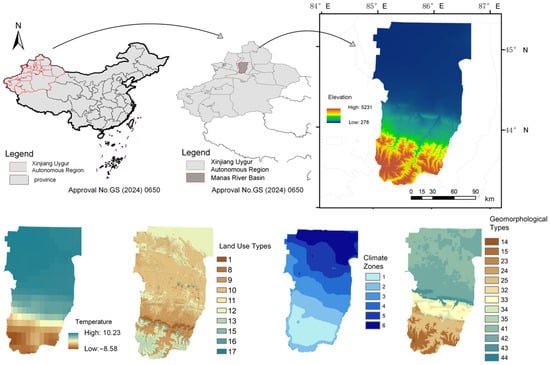
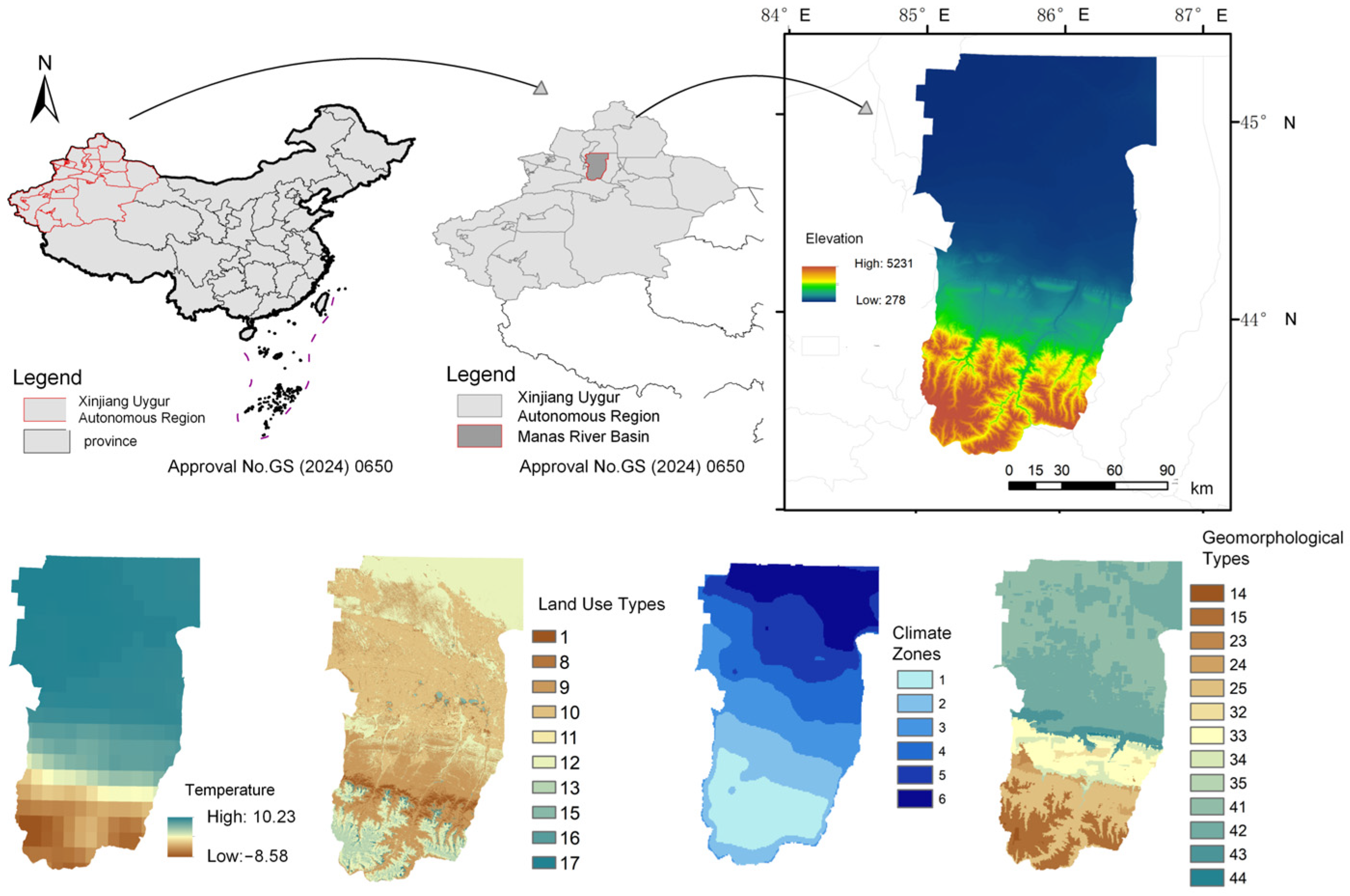
The Manas River Basin is located at the intersection of the northern foot of the Tianshan Mountains in Xinjiang and the southern margin of the Junggar Basin (43°27′–45°21′ N, 85°01′–86°32′ E). It is the “mountain–oasis–desert” ecotone with the largest runoff and the widest irrigation area in the northern foot of the Tianshan Mountains. The terrain of the basin is high in the south and low in the north. From south to north, alpine glacier zone, mid-mountain forest zone, low-mountain grassland zone, alluvial plain oasis zone and northern desert Gobi zone are successively developed, and the spatial distribution heterogeneity of vegetation is significant (Figure 1). Under the influence of a temperate continental dry climate, annual precipitation within the region is highly scarce, averaging only 110–200 mm. Meanwhile, intense evaporation renders the local ecosystem exceptionally fragile and sensitive. In recent years, with the construction of Manas National Wetland Park, the damaged wetland vegetation in the basin has been gradually restored. The wetland park was approved in March 2011 and officially named in August 2016. During this period, the wetland area was restored from 9 mu to 170,000 mu (as of 2021 statistics) through ecological restoration measures such as returning farmland to wetland, replanting riparian vegetation, wetland ecological water replenishment and grazing prohibition grassland restoration. The habitat quality of the middle and lower reaches of the plains and deserts has been significantly improved. In view of the above policy implementation span (2011–2016), this study takes the central axis year 2013 as the segmentation node to ensure that the time length of the two subsequences is relatively balanced, so as to ensure the statistical reliability of the trend comparison analysis and the calculation results of Geodetector. The above unique geographical conditions and policy intervention background make the Manas River Basin a typical case area for this study.
Figure 1.
Location map of the study area.
3. Research Data and Methods
3.1. Data Source and Preprocessing
The remote sensing, topography, meteorology, soil, and land use data (Table 1) used in this study were obtained and processed using the Google Earth Engine platform (Google LLC, Mountain View, CA, USA; https://earthengine.google.com/). The NDVI data were derived from the Landsat 5, 7, 8, and 9 series of surface reflectance products. High-quality pixels with cloud cover less than 10% in the growing season (June–September) were uniformly extracted, and the time-series dataset was reconstructed via the maximum-value composite technique. Following the classification framework of Ma Chenglong et al. [25], the NDVI was classified into 5 levels (<0.2, 0.2–0.4, 0.4–0.6, 0.6–0.8, and >0.8), which were used to quantitatively characterize vegetation changes for subsequent transfer matrix analysis, as well as the spatial distribution traits of vegetative cover within the Manas watershed. The terrain data were derived from ASTER GDEM V3 data, mainly covering major geomorphic units such as extremely high mountains, high mountains, medium-relief mountains, plains, terraces, and hills (Table 2). The meteorological data were derived from the ERA5 global reanalysis dataset, which is divided into six climatic zones 1–6 based on the dryness index (X2) during the wet-to-dry transition (Figure 1); soil texture data came from the Open Land Map global soil texture dataset [26]. Land use datasets were obtained from MODIS MCD12Q1 and classified into the following categories: evergreen coniferous forest, Dorrin savannah, savannah, grassland, permanent wetland, cultivated land or farmland, urban and construction land, ice and snow, bare land or Gobi, and water body (Figure 1). The administrative boundary of the river basin, along with the vector datasets for the Manas hydrographic network, were collected via the National Geographic Information Public Service Platform.
Table 1.
Data sources.
Table 2.
Detailed explanation of landform types.
3.2. Research Methods
3.2.1. Trend Detection and Statistical Significance Testing
With the aim of quantitatively identifying the dynamic evolution tendency and significance of long-term NDVI and q-statistic values, this study used the Theil–Sen Median estimator to quantify the trend amplitude, supplemented by the Mann–Kendall (M-K) model for significance testing [28]. The Theil–Sen Median estimator characterizes the change trend by calculating the median of the slope between any two points in a time-series dataset. As a non-parametric statistical method, it has strong robustness to outliers and is suitable for analyzing long-term remote sensing data with noise in arid areas. The calculation formula is as follows:
where β denotes the trend magnitude; when β > 0, the vegetation shows an increasing trend, and vice versa. The M-K test is not limited by the prior distribution of the data. To assess the statistical significance of the trajectory, the calculated standardized |Z| score is employed to classify the dynamics of vegetation change into nine distinct grades (Table 3).
Table 3.
Classification criteria for vegetation change trends.
3.2.2. NDVI Class Transition Matrix and Spatial Conversion Characteristics
The transition matrix quantitatively describes the flow direction and area converted among vegetation cover grades over different periods, revealing the spatial pattern and magnitude of vegetation grade transitions. Based on the five-grade cover classification standard, this study constructed transition probability matrices for each stage during 2000–2024, expressed as
where Sij denotes the area converted from grade-i vegetation in the initial period to grade-j vegetation in the final period.
3.2.3. Analysis of NDVI Driving Mechanisms Based on Geodetector
Geodetector is an important spatial statistical method for detecting spatial heterogeneity and revealing explanatory factors [29,30,31]. To deeply analyze the driving mechanism of the ecological quality evolution in the Manas River Basin, each continuous index was discretized via the Equal Quantile method, which is suitable for the unevenly distributed climate and terrain factor data in this study. The slope aspect was categorized into eight distinct orientations: N, S, E, W, NE, SE, SW, and NW, according to geographical orientation; the slope was divided into 5 grades according to the general landform classification standard; the categorical factors (landform type, land use type, and soil texture) directly followed the original classification system without additional discretization (Table 4). This study introduces the following four detection modules:
- (1)
- Factor detector. The F-test is used to check the significance of the q value. By comparing the within-stratum variance with the total variance, the influence of the factor is judged to be true and significant. In this study, the significance level of the F-test was uniformly set to α = 0.05:
- (2)
- Interaction detector. This module aims to scrutinize the interplay between environmental variables and anthropogenic activities, thereby assessing the concurrent effects of dual-factor combinations driving the interpretation of NDVI pattern evolution. By comparing the single-factor q(X1), q(X2), and their interaction, the evolution logic of interaction types under the synergistic effect of policy intervention and natural conditions is determined.
- (3)
- Risk detector. This is used to determine whether there is a significant difference in the attribute means between different sub-regions, and is tested with the t statistic:
denotes the average NDVI computed for stratum h, while nh signifies the corresponding sample count. The significance level of the t-test in the risk detector was uniformly set to α = 0.05. This detector was used to identify the optimal suitable areas for ecological restoration and the sensitive areas for policy implementation within the basin.
- (4)
- Ecological detector. This module utilizes an F-test to determine whether the explanatory powers of any two factors differ significantly regarding the spatial heterogeneity of NDVI. In this study, the significance level of the F-test was uniformly set to α = 0.05. If p < 0.05, it indicates that there is a significant statistical difference in the effect of the two factors on the spatial distribution of vegetation (denoted “Y” in the result matrix); otherwise, there is no significant difference (denoted “N”):
Table 4.
Driving factor index system.
This module helps to distinguish whether the core driving force dominating ecological restoration has undergone a statistically significant change among different driving factors.
4. Results
4.1. Spatiotemporal Variation Characteristics of NDVI
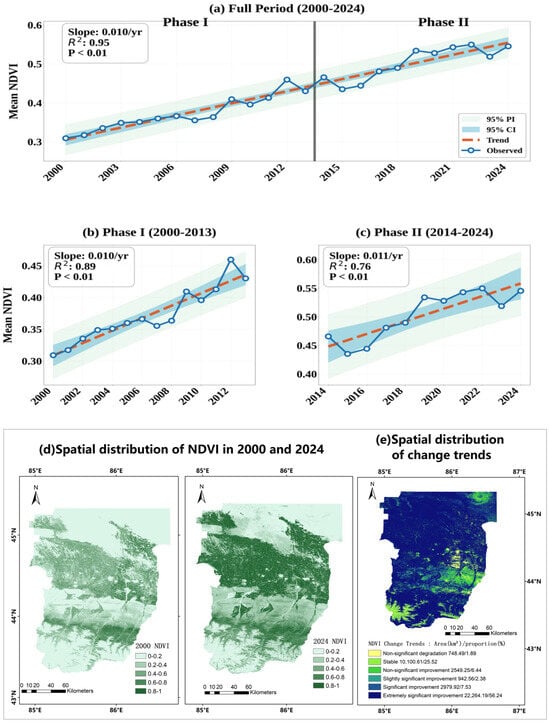
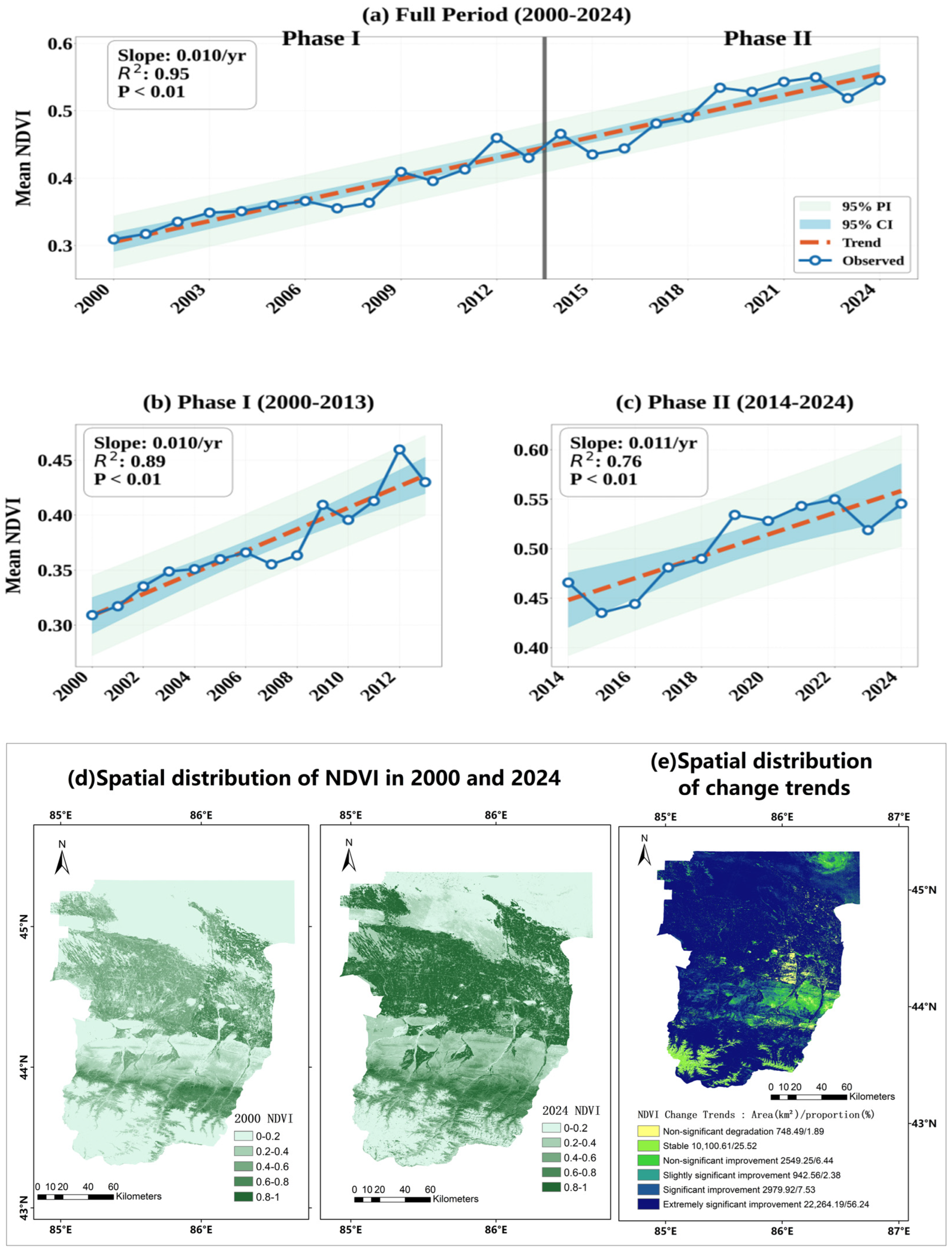
In 2000 and 2024, the low, medium-low, and medium vegetation coverage areas accounted for 62.28%, 16.59%, and 14.58%, and 45.58%, 17.62%, and 8.85% of the basin area, respectively. The period from 2000 to 2024 witnessed an increase in medium-high and high vegetation coverage from 6.55% to 27.95%, reflecting that the vegetation coverage of the basin tended to be better, and the high vegetation area increased significantly (Table 5). The spatial configuration of NDVI within the basin underwent substantial reconfiguration over the past 25 years: the low-value areas (NDVI 0.8) have increased by 8082.04 km2, with an increase of 18.59%. The overall growth slope of the average NDVI in the whole region was 0.010/yr, R2 = 0.95, p < 0.01, and the cumulative increase was about 0.23 (Figure 2a). The average NDVI increased from 0.32 in 2000 to 0.58 in 2024, reflecting a positive trend in the regional ecological status.
Table 5.
Spatiotemporal evolution of NDVI within the Manas River Basin.
Figure 2.
Spatiotemporal variation in NDVI and breakpoint comparison in the Manas River Basin, 2000–2024.
Throughout the 2000–2024 period, the geographic patterns of NDVI exhibited marked variations. On the whole, NDVI levels within the middle-high mountain forest zone and the alluvial plain oasis zone in the south were high, while the NDVI values of the alpine glacier zone, the low mountain steppe zone, and the northern desert Gobi zone were low (Figure 2d). From the spatial distribution of change trends, improved areas accounted for 72.59%, of which the most significant improvement covered 22,264.19 km2 (56.24%), while significant, slightly significant, and insignificant improvement areas (proportions) covered 2979.92 km2 (7.53%), 942.56 km2 (2.38%), and 2549.25 km2 (6.44%), respectively. The area that remained basically unchanged covered 10,100.61 km2 (25.52%), while the area of non-significant degradation covered 748.49 km2 (1.89%), mainly distributed in urban areas such as Shihezi, Manas, and Shawan (Figure 2e).
4.2. Changes in NDVI Before and After the Policy Breakpoint
In order to explore the response characteristics of vegetation before and after the implementation of the ecological protection policy, this study introduced the construction of Manas National Wetland Park (2013) as a node, divided the research time-series into two stages, 2000–2013 and 2014–2024, and compared the dynamic differences before and after the policy on the evolution of vegetation coverage. NDVI values across the investigated domain displayed a marked upward trajectory in both stages. Before the node, the NDVI increased from about 0.31 to about 0.45; the growth slope was 0.010/yr, R2 = 0.89, p < 0.01, and the interannual fluctuation was small (Figure 2b); after the node, the NDVI increased from about 0.45 to about 0.54, and the growth slope was 0.011/yr, R2 = 0.76, p < 0.01. The vegetation coverage showed continuous improvement characteristics, and the post-node growth rate was slightly accelerated (Figure 2c).
4.3. Analysis of the Influence of the Investigated Factors
4.3.1. Temporal Variation in the Influence of Factors
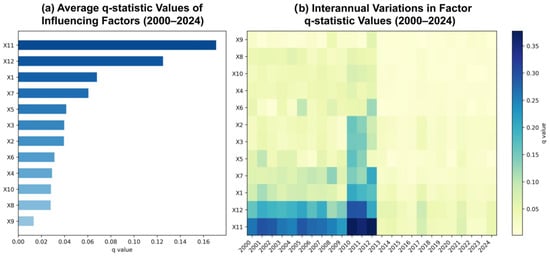
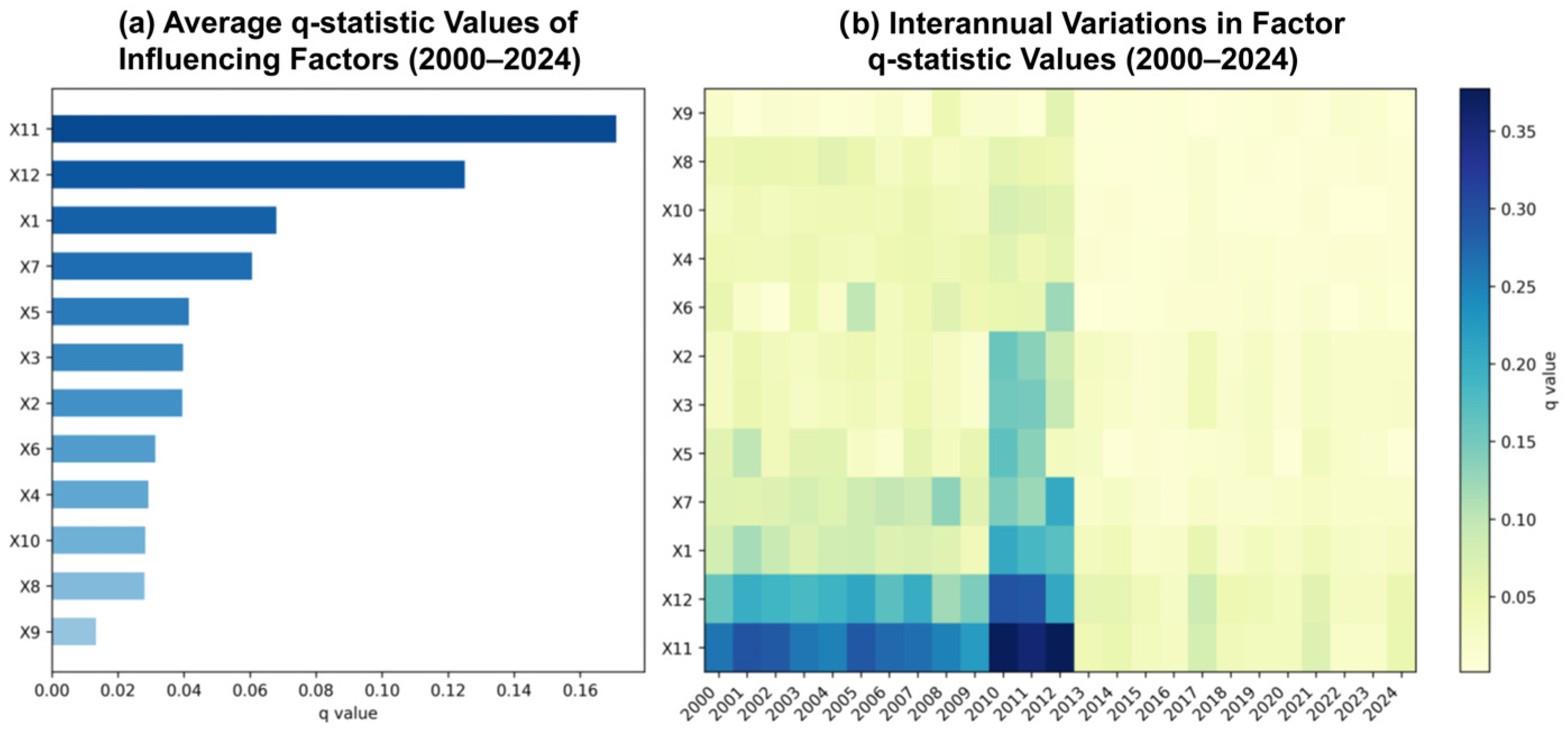
Ranking the explanatory power of factors on NDVI during the 2000–2024 period yields the following sequence: land use type > soil texture > annual precipitation > landform type > annual average temperature > humidity > dryness > total radiation > potential evapotranspiration > aspect > elevation > slope. The average q value of land use type and soil texture remained above 12% over 25 years (Figure 3a), and the annual average q value of land use type was stable at about 30% before 2013 (Figure 3b), highlighting their role as the primary determinants of vegetation spatial patterns.
Figure 3.
Mean q values and annual variation from 2000 to 2024.
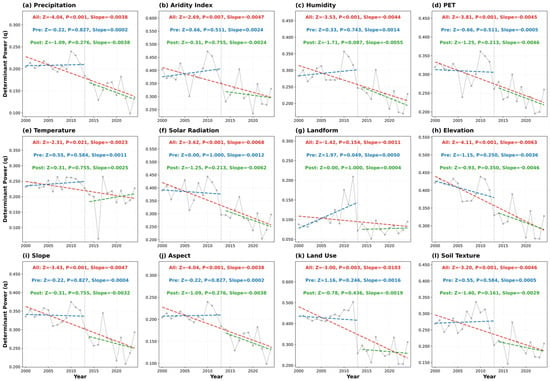
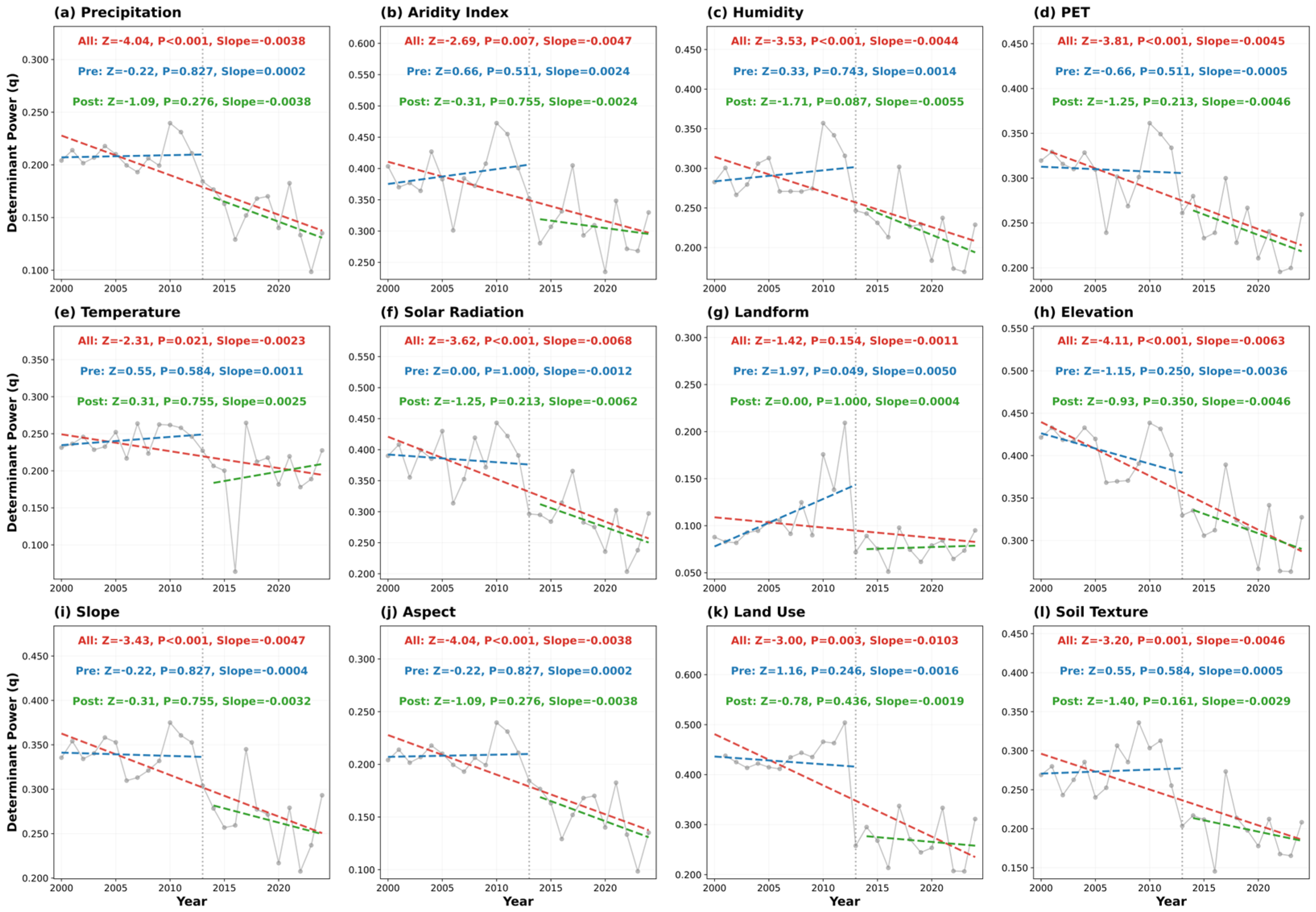
From 2000 to 2024, the q values of all 12 factors showed a declining trend (Figure 4). The test results indicate the following: (1) Overall, landform type (X7) was not statistically significant, whereas the time-series q values of the other 11 factors exhibited a clearly significant decreasing trend, all satisfying the trend test criterion of p < 0.05 (|Z| > 1.96). (2) Before and after the node, each index of the two stages did not pass the significance test, and the q value of land use type decreased from 40.0% in the previous period to about 10.0%, with a relative decrease of 75.0%. That is, the explanatory power of each factor has shifted from high to low before and after the policy node.
Figure 4.
The changes in natural factors from 2000 to 2024.
4.3.2. Analysis of Differences Among Factors
- (1)
- Differences in landform types (Figure 5). The q values of each factor in the 14, 15, 21, 23, 31, 33 and 41 partitions were lower than 0.025, and the explanatory power was weak. Land use type (q = 0.450, 0.465) and soil texture (q = 0.343, 0.388) were the dominant factors in the plain oasis (24 partitions) and Zhongshan forest (34 partitions), and the explanatory power exceeded 34%, showing that human disturbance and hydrothermal gradient under the two types of landforms jointly strengthened the spatial differentiation of vegetation.
- (2)
- Elevation difference (Figure 6). The explanatory power of each factor above 1000 m was less than 0.034; the explanatory power of land use type, soil texture, and geomorphic type in the <1000 m partition reached 0.534, 0.342 and 0.251, respectively, indicating that human intervention in the low-altitude area contributes the most to the spatial differentiation in the NDVI.
- (3)
- Differences in soil texture (Figure 7). The silt content of silty loessial soil is high, which enhances the regulation of topography on water and heat redistribution. The explanatory power of slope aspect and landform type was 0.281 and 0.272, respectively. The sand soil has poor water and fertilizer conservation and limits vegetation growth. The explanatory power of the corresponding partition (6–9) factors was generally low.
- (4)
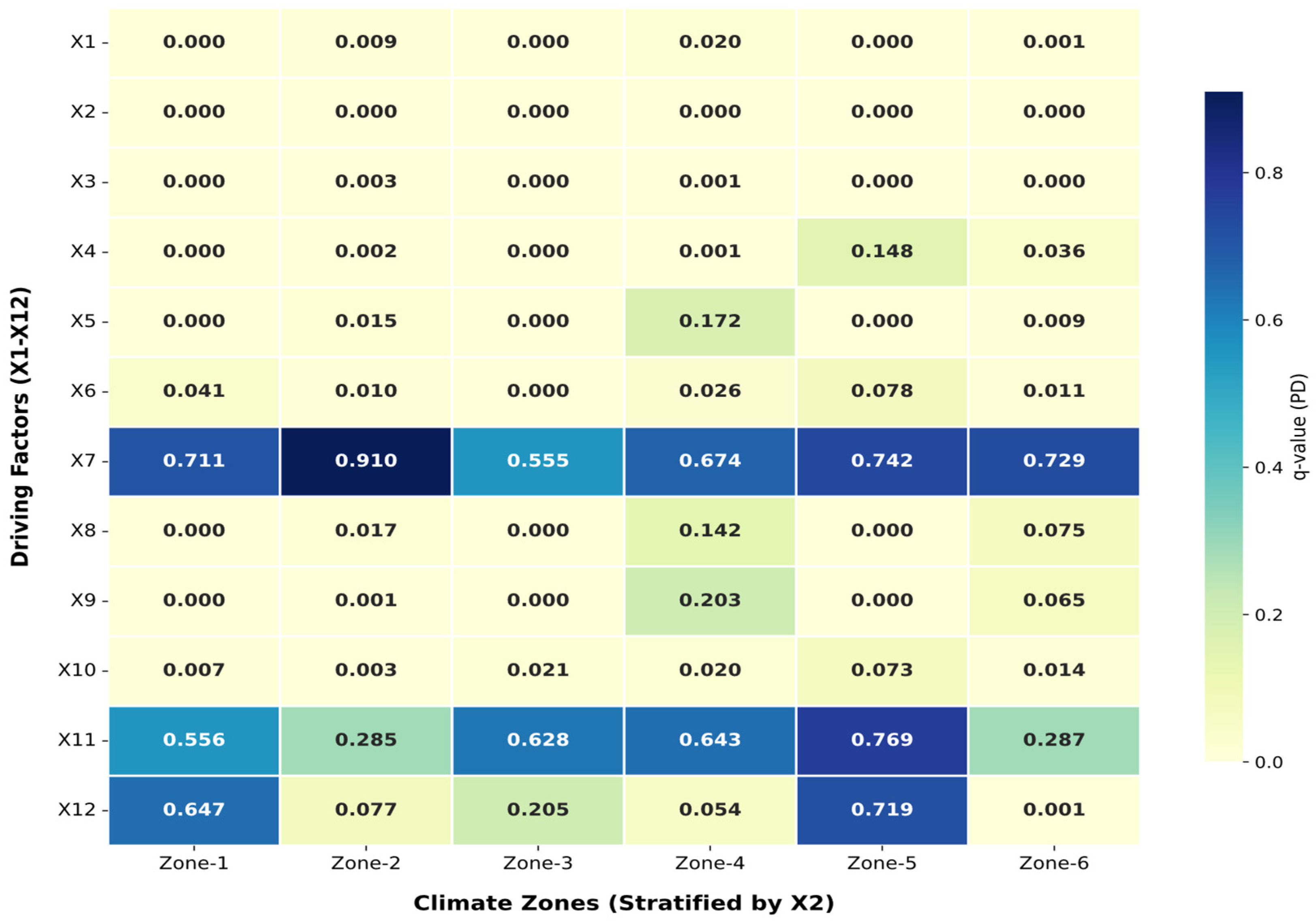
- Climatic zone difference (Figure 8). The explanatory power of X7, X12, and X11 in Zone-1 and Zone-2 was more than 0.55, and the explanatory power of the landform in Zone-2 was as high as 0.910, which reflects the influence of high altitude and complex terrain on the vertical band spectrum of vegetation. The explanatory power of X7 and X11 in Zone-3 and Zone-4 was maintained at 0.55–0.67; the explanatory power of X11, X7, and X12 of Zone-5 reached 0.769, 0.742, and 0.719, respectively, indicating that the land cover attributes of the desert–oasis transition zone have a strong influence on the distribution of vegetation. On the whole, X7 and X11 have strong explanatory power in all climatic regions of the whole basin, while X12 has significant explanatory power in humid mountainous areas and arid desert areas. Consequently, against the backdrop of a temperate continental climate, environmental variables display a pronounced north–south geographic divergence in their capacity to account for NDVI variations throughout the watershed.
Figure 5.
The PD values of natural factors under different landform types.
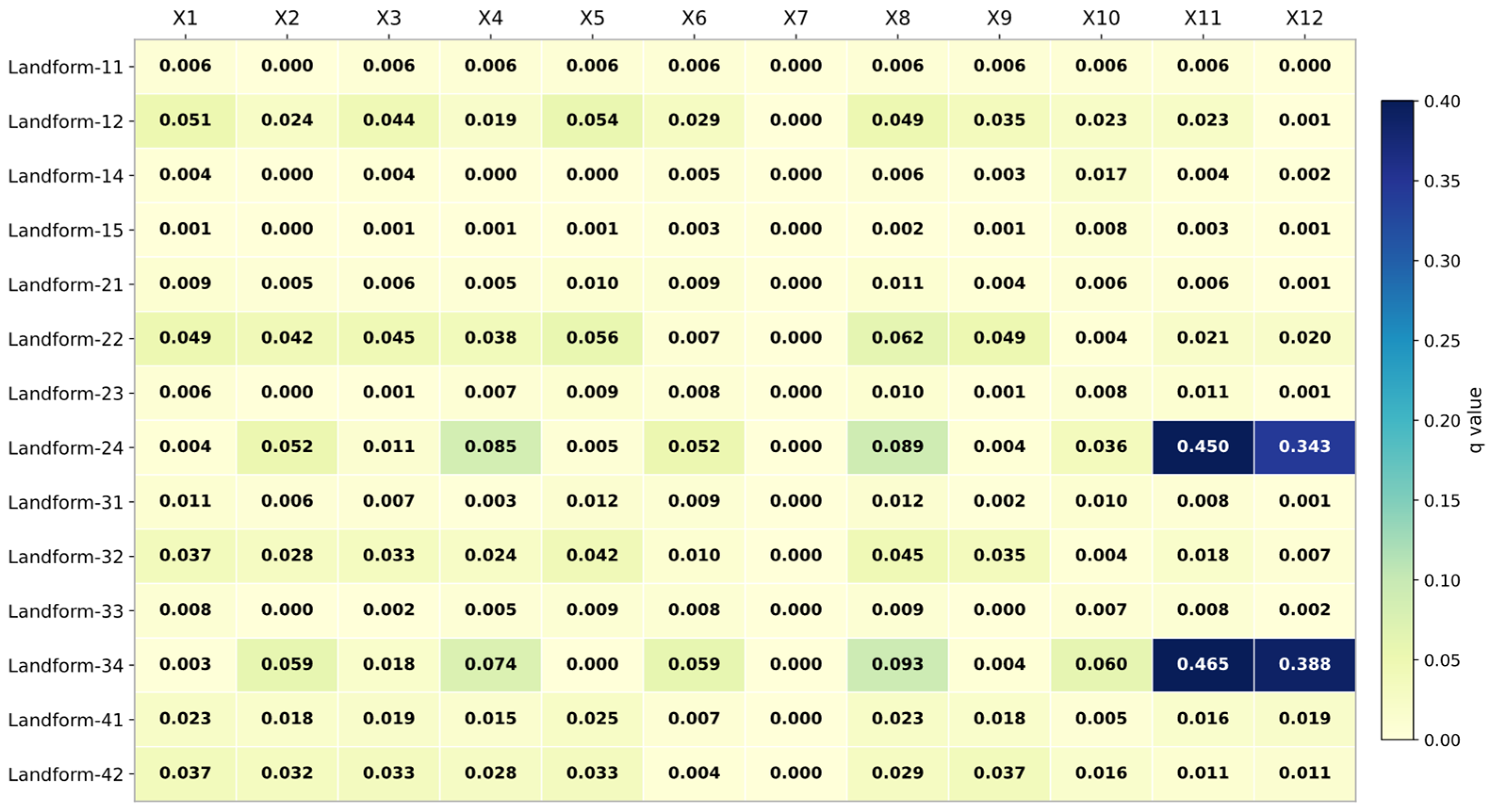
Figure 6.
The q values of natural factors at different elevations.
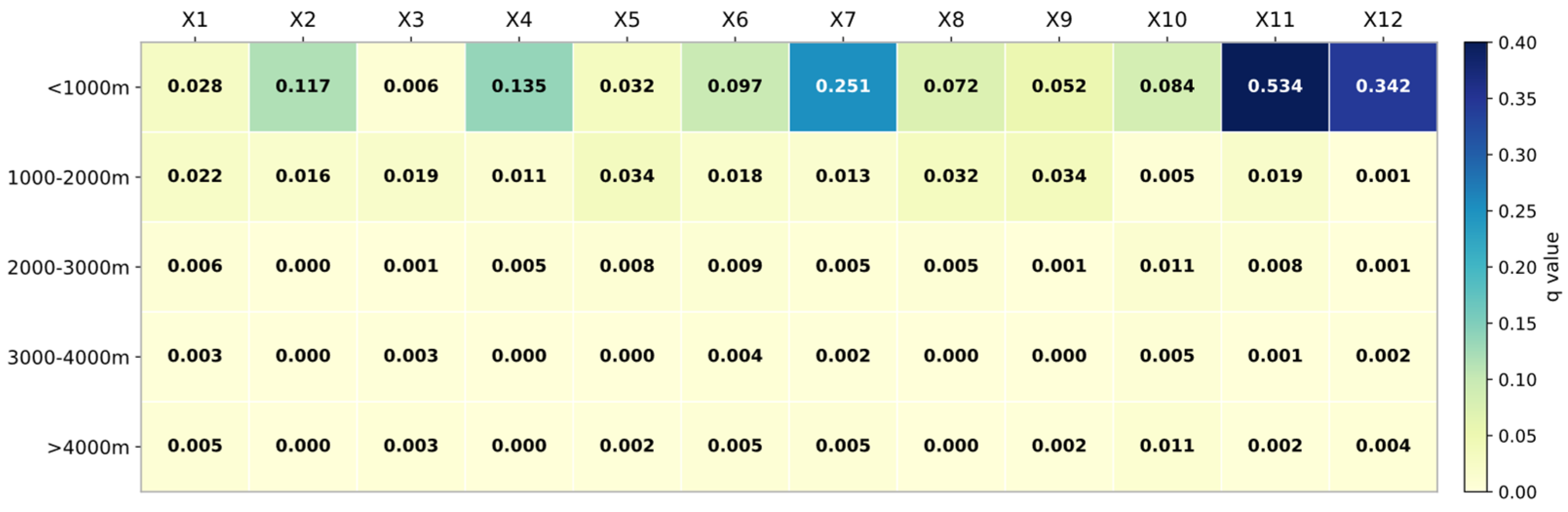
Figure 7.
The q values of natural factors across different soil textures.
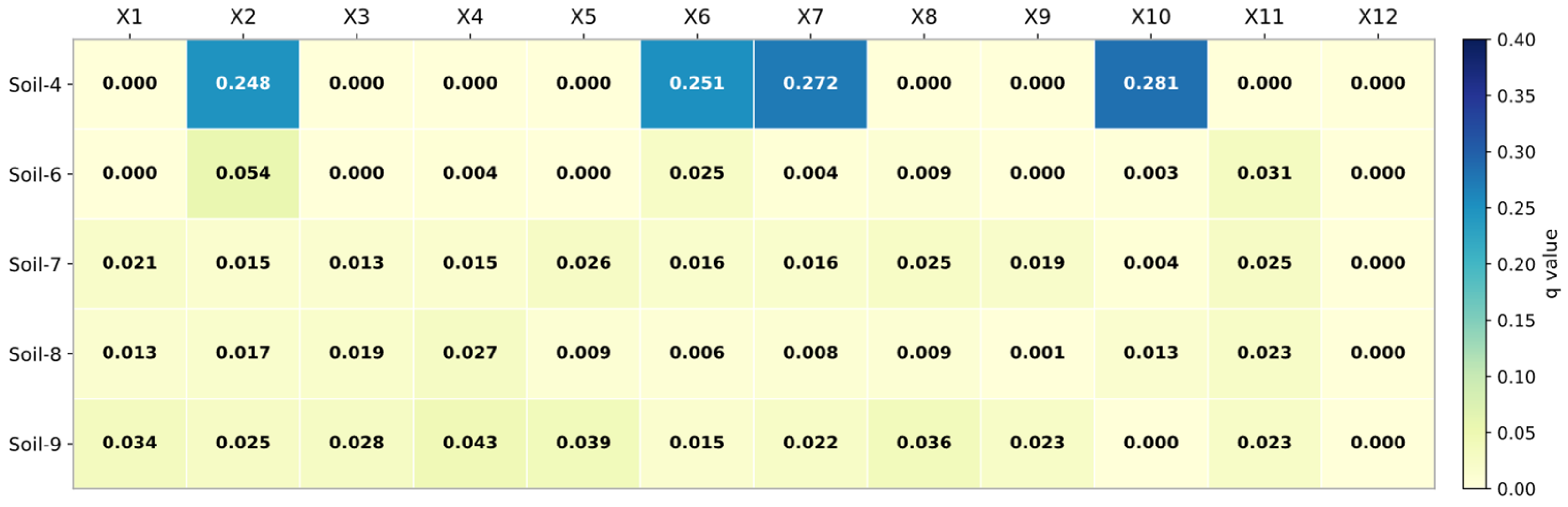
Figure 8.
The q values of natural factors in different climatic regions.
4.3.3. Comparative Analysis of Significant Factor Differences
No significant difference was observed among the impacts of potential evapotranspiration, mean annual rainfall, and the dryness index on NDVI’s spatial patterns, but there was a significant difference between potential evapotranspiration and the humidity index, average annual temperature, solar radiation, landform type, elevation, slope, aspect, land use, and soil type (Table 6). The average annual precipitation was also not significantly different from the dryness index and potential evapotranspiration, but it was significantly correlated with temperature, solar radiation, landform type, elevation, slope, aspect, land use, and soil type. Elevation showed significant correlations with all factors except for slope and aspect. The ecological effect of land use on the NDVI was significantly controlled by the combined environmental constraints of factors such as climate, topography (elevation, slope, and aspect), and soil type, but had no significant relationship with precipitation, dryness, humidity, and potential evapotranspiration. The spatial pattern of NDVI associated with soil type was distinct from that for all the other factors.
Table 6.
Statistical significance of the detection factor (95% confidence level).
4.3.4. Analysis of the Indicative Role of Factors (Risk Detection)
In order to eliminate extreme pixel noise, this module introduces the median NDVI to evaluate vegetation growth and explore the most suitable range of vegetation spatial pattern in arid areas. The results show that the water condition plays a dominant part in explaining the spatial heterogeneity of vegetation dynamics (Table 7). The median NDVI in the range of 0.00–59.83 mm annual precipitation was only 0.295, reflecting the constraint of vegetation under the condition of water shortage. In the partitions with suitable dryness (5.23–7.68) and relatively low temperature (−3.69–0.34 °C), the potential evapotranspiration was weak and the hydrothermal conditions were relatively suitable, and the NDVI medians in the corresponding regions increased to 0.372 and 0.475, respectively. The landform 32 area (0.447) and the soil 8 area (0.490) showed good suitability indicators, while the median NDVI of the land use 5 area was as high as 0.720. In addition, the spatial differentiation of topographic features well explains the vertical distribution of vegetation. The local climate in the mid-mountain zone with an elevation of 1826.67–2598.50 m is relatively suitable, and the NDVI in this interval reaches 0.513. The NDVI of the 6.00–12.00° slope and northwest slope was 0.305 and 0.407, respectively. The statistical results after eliminating the extreme value interference quantify the spatial correlation characteristics of micro-topography and vegetation growth, and further confirm the vertical zonality of vegetation in inland river basins in arid areas.
Table 7.
Optimal ranges or types of factors.
4.3.5. Analysis of Interactions Among Factors
Interactive detection analyzes the explanatory power of dependent variables by identifying the interaction of different factors on NDVI changes. Using the interactive detector to detect the relationships between the driving factors in the Manas River Basin (Table 8), the influence of multiple factors on NDVI was found to be not independent of each other, and there were extensive interactions. The interactions between factors showed a two-factor enhancement or nonlinear enhancement relationship, indicating that the combined driving of various factors significantly enhanced the explanatory capacity regarding NDVI spatial heterogeneity. The q values of most factors in these interactions were greater than the q values of any single factor. The interaction effects between land use type and other factors were the most significant, showing a strong enhancement relationship. For example, X11 ∩ X5 > X11 ∩ X8 > X11 ∩ X1 = X11 ∩ X6; that is, the interactions between land use and annual average temperature, elevation, annual precipitation, and total radiation significantly drive vegetation distribution. Meanwhile, the interactive impacts between soil texture and each factor were also more prominent, with X12 ∩ X11 > X12 ∩ X8 > X12 ∩ X5, which further confirms that the underlying surface properties have a significant two-factor enhancement effect on vegetation growth under the synergistic effect of hydrothermal factors. In addition, there were interactions between terrain factors, with X8 ∩ X2 > X8 ∩ X7 > X8 ∩ X6; that is, the coupling effect of elevation, aridity, landform type, and total radiation synergistically restricts the spatial pattern of vegetation by changing the redistribution of local water and heat. Overall, the spatial variability of NDVI within the basin is largely attributed to the combined effects of various interacting factors, and the influence mechanism manifests as dual or nonlinear enhancements among variables, rather than simple linear accumulation.
Table 8.
Interaction detection of factors.
5. Discussion
5.1. Human Activities and Policy Effects
Land use type is the key factor with the highest explanatory power in the spatial differentiation of NDVI in the Manas Basin, which is consistent with Ding et al. [1] and ZHU et al. [20] that the spatial distribution of human activities is the most important explanatory variable in land use change in arid areas. In the main stream of the Tarim River [32] and the Aksu River Basin [33], the contribution of human disturbances (land use conversion, oasis irrigation) in explaining the spatial and temporal evolution of vegetation coverage was found to be significantly higher than that of climate factors such as temperature and precipitation. A study on the Heihe River Basin [34] also showed that after the implementation of ecological comprehensive management in 2000, the spatial explanatory power of human activities on NDVI changes dominated. The above comparison shows the common characteristics that the surface cover of inland river basins in arid areas is strongly interfered with by human activities. The NDVI of natural vegetation types such as evergreen coniferous forest and artificial oasis was significantly higher than that of desert and bare land types (Table S1), indicating that artificial vegetation and irrigated agriculture play an important role in maintaining oasis vegetation coverage. Zhu et al. [21] pointed out that a considerable proportion of the observed vegetation greening comes from farmland expansion. In arid areas with limited water resources, farmland expansion is often at the expense of squeezing natural vegetation water. Therefore, the increase in NDVI in oasis farmland reflects the expansion of productivity of irrigated agriculture to a considerable extent, which cannot be simply explained as the improvement of natural ecological quality.
In this study, 2013 was taken as the node, and it was found that the overall growth slope of NDVI after the node (0.011/yr) was slightly higher than that before the node (0.010/yr). With the advancement of mountain–oasis–desert, the main factors influencing the NDVI changed from natural factors to human activities represented by land use, and the explanatory power (q value) of natural factors generally decreased (Figure 4). There is an alternative explanation for the decrease in q value: with the evolution of the basin over many years, the variance of the overall NDVI is decreasing, as the spatial distribution of natural elements tends to become homogeneous, which leads to the weakening of spatial stratification heterogeneity. However, combined with the actual control background of the Manas River Basin, policy intervention is still the most reasonable factor to explain this statistical phenomenon. The planned area of Manas Wetland Park is 111.75 km2, accounting for only 0.25% of the entire study area, and the increase in NDVI in the whole basin is relatively limited on the spatial scale. However, from the policy perspective, the implementation of the policy represents a holistic turning point in ecological management at the basin scale. This high-intensity human intervention and redistribution of water resources decouple the dependence of vegetation on natural factors such as local precipitation and temperature, thereby reducing the explanatory power of each factor on the spatial pattern of vegetation. When evaluating the effectiveness of ecological policies in a balanced way in the future, the contribution of NDVI changes to agricultural vegetation and natural vegetation can be further distinguished, and comprehensive indicators such as water consumption can be introduced.
5.2. Regulation of Terrain and Soil Factors
Soil texture regulates vegetation by affecting water holding capacity, air permeability, and nutrient supply. Due to its moderate water holding capacity and good aeration, loamy sand provides a balanced water and air condition for roots, and the NDVI reaches the highest value of 0.683 (Table S3). The water and fertilizer leakage characteristics of pure sand limit the growth of vegetation in this area, which is consistent with the findings of Zhang et al. [35] and Chen et al. [27]. The vertical zonality of vegetation is affected by landform type, elevation, and slope aspect. The middle undulating mountains in the classification system are mainly characterized by snowy spruce forests, with sufficient precipitation interception and small evaporation pressure, and the highest NDVI is 0.596 (Table S5). Due to the regulation of solar radiation reception, the NDVI of the northern slope is 0.587, which is significantly greater than that of the southern slope of 0.289 (Table S11), which confirms the conclusion of Alia et al. [36] that geomorphological features restrict the upper limit of vegetation growth. Although the q values of single factors such as elevation, slope, and aspect are relatively low (Figure 3), their interaction with soil texture and land use significantly increases the explanatory power to 0.20–0.46 (Table S2). This indicates that the synergistic amplification of topographic factors driven by water and heat is a key mechanism for further understanding the vegetation pattern in arid areas.
5.3. Nonlinear Water–Heat Coupling Mechanism of Meteorological Factors
Precipitation, temperature, humidity, and dryness constitute the meteorological background of the spatial differentiation of ecosystems in arid areas. This study confirms that the influence of meteorological factors on NDVI is not a simple linear superposition. Annual precipitation constitutes an important factor affecting the evolution of vegetation in arid areas [2,11]. The appropriate moisture range supports medium-high coverage vegetation, while the extremely humid area has an abnormally low NDVI value (0.103, Table S7), which may be related to soil salinization caused by excessive local water [27]. In addition, when the dryness index is in the range of 3.46–7.80, the dominant vegetation reaches the optimal hydrothermal conditions, and the NDVI reaches a peak of 0.641; when it exceeds 11.48, the ecosystem enters a state of water stress (Table S8), and natural vegetation is difficult to maintain high coverage, which is consistent with the conclusion of Xiaolong Song et al. [37]. The annual average temperature also showed a significant nonlinear response to NDVI. The water and heat balance is optimal in the low-temperature zone (−2.31 °C to 0.82 °C), and the NDVI reaches the peak value of 0.574 (Table S6). As temperature increases, evaporation intensifies, resulting in a decrease in greenness [14,16]. It should be noted that in areas with extremely low precipitation or high-temperature areas, the NDVI mean value rebounds (Tables S4 and S6). Despite a climate that is not naturally suitable, these areas correspond to the agricultural irrigation area of the oasis. Artificial irrigation makes up for the deficiency of natural precipitation and decouples the natural response relationship between high-temperature evapotranspiration and vegetation degradation [9]. Against the background of climate warming, the precipitation in northern Xinjiang shows an increasing trend [38]. It is necessary to distinguish the real response of natural vegetation to climate from human intervention in agricultural areas.
5.4. Research Limitations
There are some limitations to this study. At the data level, due to the saturation effect of NDVI in high-coverage areas, scale errors in multi-source data resampling exist, along with high correlations between some driving indicators. Due to the limitation of the spatial resolution of ERA5 meteorological products (about 11 km), its downscaling processing may introduce a certain spatial autocorrelation error, which will affect the estimation of the q statistic of Geodetector. In the future, sensitivity analysis can be considered under the original resolution for further evaluation. At the methodological level, geographical detectors are sensitive to factor discretization schemes, potential autocorrelation interference in long-term M-K tests may overestimate significance, and such spatial statistical analysis can only reveal the correlation between variables, and there are still limitations in clearly identifying causal mechanisms. Therefore, the relevant conclusions need to be interpreted carefully, and the index system and discrete scheme need to be optimized in the future and further verified via scenario simulation.
6. Conclusions
- (1)
- Over the 25-year study period, the vegetation ecology across the Manas River Basin demonstrated a steady tendency of optimization, and its dynamic succession process was characterized by temporal stages and imbalance. In the first stage (2000–2013, Phase I), the vegetation growth in the whole basin showed a clear agglomeration, mainly manifested in the outward linear reclamation and expansion of artificial oasis in the plain area. In the second stage (2014–2024, Phase II), the basin showed systematic, comprehensive, and steady recovery, and the range of vegetation improvement spread to the edge of the southern mountainous area and the northern desert ecotone. On the whole, the extremely significantly improved areas are highly concentrated in the plain oasis and the mid-mountain zone, while the significantly degraded areas are few and strictly limited to the marginal heterogeneous areas of urbanization expansion.
- (2)
- Spatial differentiation detection showed that land use type and soil texture dominated the early expansion stage of the basin, and continued to constitute the core control factors of vegetation’s geographic heterogeneity throughout the entire study duration. Annual precipitation and humidity, serving as key water and heat indicators, were also found to have significant explanatory power. The pairwise interaction of all factors showed either two-factor enhancement or nonlinear enhancement, indicating that the spatial pattern of vegetation in the basin was driven by multi-factor nonlinear coupling.
- (3)
- Risk detection clearly identified the optimal threshold boundaries of the dominant environmental factors that promote the growth of vegetation in the whole basin, including the elevation range of the mid-mountain zone with a low annual average temperature, loamy sand background, and reasonable farmland water management conditions. In particular, it should be noted that the above thresholds are derived based on spatial statistical correlation analysis, which reflects the spatial statistical laws under specific observation conditions during the study period, rather than the inevitable causal relationship in physics or ecology.
- (4)
- The watershed showed a stable ecological pattern at the macro spatial level; that is, the southern mountainous area showed the water conservation effect of high coverage of forest and meadow, the central plain area showed the optimization pattern of artificial oasis quality, and the northern area showed the effect of windbreak and sand fixation at the boundary of the desert–oasis ecotone. Thus, based on the stable macro-ecological pattern of the basin, it is recommended to implement differentiated zoning control: The water conservation area in the southern mountainous area needs to maintain high coverage of forest and grass, and the evolution of water and heat under climate warming needs to be monitored to ensure the safety of core water production. The efficiency of water-saving irrigation should be improved in the artificial oasis area in the central plains, strictly controlling the disorderly expansion of cultivated land and preventing soil secondary salinization. The northern desert–oasis ecotone needs to strictly prohibit the excessive use of water resources and stabilize the ecological boundary to build a strong windbreak and sand-fixing barrier. In addition, due to the limitations of spatial statistics and correlation analysis methods, the independent causal contribution of a single ecological policy cannot be accurately determined. The above conclusions mainly provide objective quantitative boundaries and statistical reference for spatially refined governance of the basin.
Supplementary Materials
The following supporting information can be downloaded at https://www.mdpi.com/article/10.3390/su18136640/s1, Table S1: Mean vegetation NDVI and pairwise statistical significance among land-use classes; Table S2: Interactions between natural factors affecting vegetation NDVI change; Table S3: Mean vegetation NDVI and pairwise statistical significance among soil-texture classes; Table S4: Mean vegetation NDVI and pairwise statistical significance among annual-precipitation zones; Table S5: Mean vegetation NDVI and pairwise statistical significance among geomorphological types; Table S6: Mean vegetation NDVI and pairwise statistical significance among annual mean temperature classes; Table S7: Mean vegetation NDVI and pairwise statistical significance among wetness-degree classes; Table S8: Mean vegetation NDVI and pairwise statistical significance among dryness-index classes; Table S9: Mean vegetation NDVI and pairwise statistical significance among total-radiation classes; Table S10: Mean vegetation NDVI and pairwise statistical significance among potential evapotranspiration classes; Table S11: Mean vegetation NDVI and pairwise statistical significance among slope-aspect classes; Table S12: Mean vegetation NDVI and pairwise statistical significance among elevation classes; Table S13: Mean vegetation NDVI and pairwise statistical significance among slope classes.
Author Contributions
X.H.: Conceptualization, methodology, software, formal analysis, investigation, resources, data curation, writing—original draft preparation, and writing—review and editing. H.L.: Investigation and writing—review and editing. L.C.: Investigation, writing—review and editing, supervision, project administration, and funding. S.Y.: Investigation and writing—review and editing. Y.L.: Investigation and writing—review and editing. L.W.: Investigation, writing—review and editing, and funding. X.L. (Xiangqian Li) and X.L. (Xiaohang Li): Investigation, writing—review and editing, and funding. M.P.: Investigation, writing—review and editing, and funding. Y.O.: Investigation and writing—review and editing. All authors have read and agreed to the published version of the manuscript.
Funding
This research was funded by the Tianchi Talent Program of Xinjiang Uygur Autonomous Region (Grant Nos. CZ001332, CZ001333, CZ001331, and CZ001329), the Research Foundation for Talented Scholars of Shihezi University (Grant Nos. RCZK202516, RCZK202513, RCZK202514, RCZK202515, and KX6396).
Institutional Review Board Statement
Not applicable.
Informed Consent Statement
Not applicable.
Data Availability Statement
Data will be made available upon request.
Conflicts of Interest
The authors declare no conflicts of interest.
References
- Ding, Y.; Feng, Y.; Chen, K.; Zhang, X. Analysis of spatial and temporal changes in vegetation cover and its drivers in the Aksu River Basin, China. Sci. Rep. 2024, 14, 10567. [Google Scholar] [CrossRef] [Scilit] [PubMed]
- Ke, H.C.; Liang, L.; Tian, M.H. Assessing vegetation dynamics and influencing factors in Northwest China’s arid regions: A spatiotemporal analysis using NDVI (2000–2020). Acta Geophys. 2025, 73, 3405–3424. [Google Scholar] [CrossRef] [Scilit]
- Gao, C.; Ren, X.; Fan, L. Assessing the vegetation dynamics and its influencing factors in Central Asia from 2001 to 2020. Remote Sens. 2023, 15, 4670. [Google Scholar] [CrossRef] [Scilit]
- Lu, Y.; Yu, Y.; Sun, L. NDVI-based vegetation dynamics and responses to climate change and human activities in Xinjiang from 2001 to 2020. Sci. Rep. 2025, 15, 25848. [Google Scholar] [CrossRef] [Scilit] [PubMed]
- Xue, J.; Wang, Y.; Teng, H.; Wang, N.; Li, D.; Peng, J.; Biswas, A.; Shi, Z. Dynamics of vegetation greenness and its response to climate change in Xinjiang over the past two decades. Remote Sens. 2021, 13, 4063. [Google Scholar] [CrossRef] [Scilit]
- He, Y.; Xiong, J.; Cheng, W.; Ye, C.; He, W.; Yong, Z.; Tian, J. Spatiotemporal pattern and driving force analysis of vegetation variation in Altay Prefecture based on Google Earth Engine. J. Resour. Ecol. 2021, 12, 729–742. [Google Scholar] [CrossRef] [Scilit]
- Wang, H.; Wang, F.; Lv, H. Analysis of spatiotemporal variations and driving forces of NDVI based on random forest and Geodetector: A case study of the Heihe River Basin in China. Ecol. Indic. 2026, 184, 114710. [Google Scholar] [CrossRef] [Scilit]
- Li, L.; Xia, R.; Dou, M. Integrating Landsat NDVI data with climate and anthropogenic factors reveals drivers of vegetation dynamics in the semi-arid basin of Western China. Sci. Rep. 2025, 15, 18831. [Google Scholar] [CrossRef] [Scilit] [PubMed]
- Yao, B.; Gong, X.; Li, Y. Spatiotemporal variation and GeoDetector analysis of NDVI at the northern foothills of the Yinshan Mountains in Inner Mongolia over the past 40 years. Heliyon 2024, 10, e39309. [Google Scholar] [CrossRef] [Scilit] [PubMed]
- Yuan, W.; Shou, S.; Dong, L. Spatial–temporal variations of NDVI and its response to climate in China from 2001 to 2020. Int. J. Digit. Earth 2022, 15, 1460–1482. [Google Scholar] [CrossRef] [Scilit]
- Zhuo, M.; Yuan, J.; Li, J. Spatio-temporal heterogeneity of vegetation coverage and its driving mechanisms in the agro-pastoral ecotone of Gansu Province: Insights from multi-source remote sensing and Geodetector. Atmosphere 2025, 16, 501. [Google Scholar] [CrossRef] [Scilit]
- Rina, W.; Yan, W.; Buyun, L. Spatial-temporal changes of NDVI in the three northeast provinces and its dual response to climate change and human activities. Front. Environ. Sci. 2022, 10, 974988. [Google Scholar] [CrossRef] [Scilit]
- Wang, X.; Li, Y.; Fang, S. Decoupling anthropogenic and climate impacts on vegetation dynamics in China’s Huaihe River Basin using geodetector. Sci. Rep. 2025, 15, 40561. [Google Scholar] [CrossRef] [Scilit] [PubMed]
- Yuan, L.; Cheng, W.; En, W. Trends and controlling factors of vegetation change in different regions of China. Chin. Geogr. Sci. 2025, 35, 1269–1282. [Google Scholar] [CrossRef] [Scilit]
- Zhang, Y.; Zhang, L.; Wang, J.; Dong, G.; Wei, Y. Quantitative analysis of NDVI driving factors based on the geographical detector model in the Chengdu-Chongqing region, China. Ecol. Indic. 2023, 155, 110978. [Google Scholar] [CrossRef] [Scilit]
- He, L.; Guo, J.; Yang, W.; Jiang, Q.; Chen, L.; Tang, K. Multifaceted responses of vegetation to average and extreme climate change over global drylands. Sci. Total Environ. 2022, 858, 159942. [Google Scholar] [CrossRef] [Scilit] [PubMed]
- Zhang, Y.; Gentine, P.; Luo, X.; Lian, X.; Liu, Y.; Zhou, S.; Michalak, A.M.; Sun, W.; Fisher, J.B.; Piao, S.; et al. Increasing sensitivity of dryland vegetation greenness to precipitation due to rising atmospheric CO2. Nat. Commun. 2022, 13, 4875. [Google Scholar] [CrossRef] [Scilit] [PubMed]
- Higgins, S.I.; Conradi, T.; Muhoko, E. Shifts in vegetation activity of terrestrial ecosystems attributable to climate trends. Nat. Geosci. 2023, 16, 147–154. [Google Scholar] [CrossRef] [Scilit]
- Amantai, N.; Meng, Y.; Wang, J.; Ge, X.; Tang, Z. Climate overtakes vegetation greening in regulating spatiotemporal patterns of soil moisture in arid Central Asia in recent 35 years. GIScience Remote Sens. 2024, 61, 2286744. [Google Scholar]
- Zhu, L.; Meng, J.; Zhu, L. Applying Geodetector to disentangle the contributions of natural and anthropogenic factors to NDVI variations in the middle reaches of the Heihe River Basin. Ecol. Indic. 2020, 117, 106545. [Google Scholar] [CrossRef] [Scilit]
- Yu, K.; Yang, C.; Wu, T. Analysis of vegetation coverage changes and driving forces in the source region of the Yellow River. Sci. Rep. 2025, 15, 22569. [Google Scholar] [CrossRef] [Scilit] [PubMed]
- Xuan, J.W.; Sheng, J.D. Analysis on the spatial-temporal variation of NDVI in the Manas River watershed of Xinjiang from 2001 to 2017. For. Resour. Manag. 2018, 30–37. (In Chinese) [Google Scholar] [CrossRef]
- Gao, Z.; Ye, J.M. Eco-environmental effects and differentiation mechanism of land use transition in the Manas River Basin: A perspective based on the dominant function identification of production–living–ecological space. Arid Land Geogr. 2024, 47, 1947–1956. (In Chinese) [Google Scholar]
- Wang, D.M.; Yin, X.J.; Wang, J.J.; Gou, Z.Z.; Ma, A.Q.; Wu, P.J. Spatiotemporal evolution and attribution analysis of ecosystem health of the mountain-basin system on the northern slope of the Tianshan Mountains. Geogr. Res. 2025, 44, 515–537. (In Chinese) [Google Scholar]
- Ma, C.L.; Ji, T.; He, G.X.; Xu, H.G.; Li, Y.L.; Yang, Z.L.; Wang, Y.J.; Qi, H.; Liu, X.N. Spatiotemporal variation of vegetation coverage and topographic differentiation in Minxian County from 2000 to 2020. Acta Agrestia Sin. 2024, 32, 3567–3578. (In Chinese) [Google Scholar]
- Hengl, T.; Wheeler, I. Soil Texture Classes (USDA System) at 6 Standard Depths (0, 10, 30, 60, 100 and 200 cm) at 250 m Resolution (v1.0); OpenLandMap: Wageningen, The Netherlands, 2018. [Google Scholar]
- Chen, K.; Yang, C.C.; Bailiga. Impact of natural and anthropogenic factors on vegetation NDVI changes in Inner Mongolia based on Geodetector. Acta Ecol. Sin. 2021, 41, 4963–4975. (In Chinese) [Google Scholar]
- Yuan, G.P. Spatiotemporal changes of vegetation coverage in Baihe Forestry Bureau based on Sen-Theil trend analysis, Mann-Kendall test and Geodetector. J. Cent. South Univ. For. Technol. 2024, 44, 125–133, 166. (In Chinese) [Google Scholar]
- Wang, J.F.; Haining, R.; Zhang, T.L. Statistical modeling of spatially stratified heterogeneous data. Ann. Am. Assoc. Geogr. 2024, 114, 499–519. [Google Scholar] [CrossRef] [Scilit]
- Wang, J.F.; Li, X.H.; Christakos, G.; Liao, Y.L.; Zhang, T.; Gu, X.; Zheng, X.Y. Geographical detectors-based health risk assessment and its application in the neural tube defects study of the Heshun Region, China. Int. J. Geogr. Inf. Sci. 2010, 24, 107–127. [Google Scholar] [CrossRef] [Scilit]
- Wang, J.F.; Zhang, T.L.; Fu, B.J. A measure of spatial stratified heterogeneity. Ecol. Indic. 2016, 67, 250–256. [Google Scholar] [CrossRef] [Scilit]
- Wang, X.; Huo, A.D.; Lyu, J.Q. Dynamic changes of vegetation coverage and analysis of its driving factors in the main stream of the Tarim River. Trans. Chin. Soc. Agric. Eng. 2023, 39, 284–292. (In Chinese) [Google Scholar]
- Xu, L.; Yue, S.R.; Hu, X.F. Vegetation dynamics and driving mechanisms in the Aksu River Basin from 2000 to 2020. Bull. Soil Water Conserv. 2024, 44, 326–334. (In Chinese) [Google Scholar]
- Han, Z.Y.; Meng, J.J.; Zou, Y. Dynamics of vegetation index in the Heihe River Basin from 1982 to 2017 and its response to climate change and ecological construction projects. J. Desert Res. 2023, 43, 96–106. (In Chinese) [Google Scholar]
- Wu, W.M.; Liu, T.; Chen, X. Seasonal changes of NDVI in the arid and semi-arid regions of Northwest China and its influencing factors. Arid Land Geogr. 2023, 40, 1969–1981. (In Chinese) [Google Scholar]
- Xu, Z.; Liu, W.; Li, H. Vegetation variations and driving mechanisms in northern China based on kNDVI. Sci. Rep. 2025, 15, 30094. [Google Scholar] [CrossRef] [Scilit] [PubMed]
- Song, X.L.; Li, L.T.; Ren, J.; Wu, Y.; Wang, P.; Mi, W.B.; Ma, M.D. Spatio-temporal variation characteristics and driving factors of NDVI in the arid and semi-arid region of Northwest China. Arid Land Geogr. 2025, 48, 951–962. (In Chinese) [Google Scholar]
- Liu, Y.T.; Zhang, Q.F.; Liu, J.S. Spatiotemporal characteristics of vegetation coverage and its response to climatic factors in southern Xinjiang over the past 20 years: A case study of Taxkorgan Tajik Autonomous County. Arid Land Geogr. 2022, 45, 1481–1489. (In Chinese) [Google Scholar]

Disclaimer/Publisher’s Note: The statements, opinions and data contained in all publications are solely those of the individual author(s) and contributor(s) and not of MDPI and/or the editor(s). MDPI and/or the editor(s) disclaim responsibility for any injury to people or property resulting from any ideas, methods, instructions or products referred to in the content. |
© 2026 by the authors. Licensee MDPI, Basel, Switzerland. This article is an open access article distributed under the terms and conditions of the Creative Commons Attribution (CC BY) license.