Driving Sustainable Consumption and Word of Mouth Through AI Fitness Apps: The Role of Customer Engagement



Abstract
1. Introduction
2. Literature Review
2.1. AI and Information Systems Success (ISS) Model
2.1.1. AI Fitness App Service Quality
2.1.2. AI Fitness App System Quality
2.1.3. AI Fitness App Information Quality
2.2. Health Consciousness
2.3. Perceived Anthropomorphism
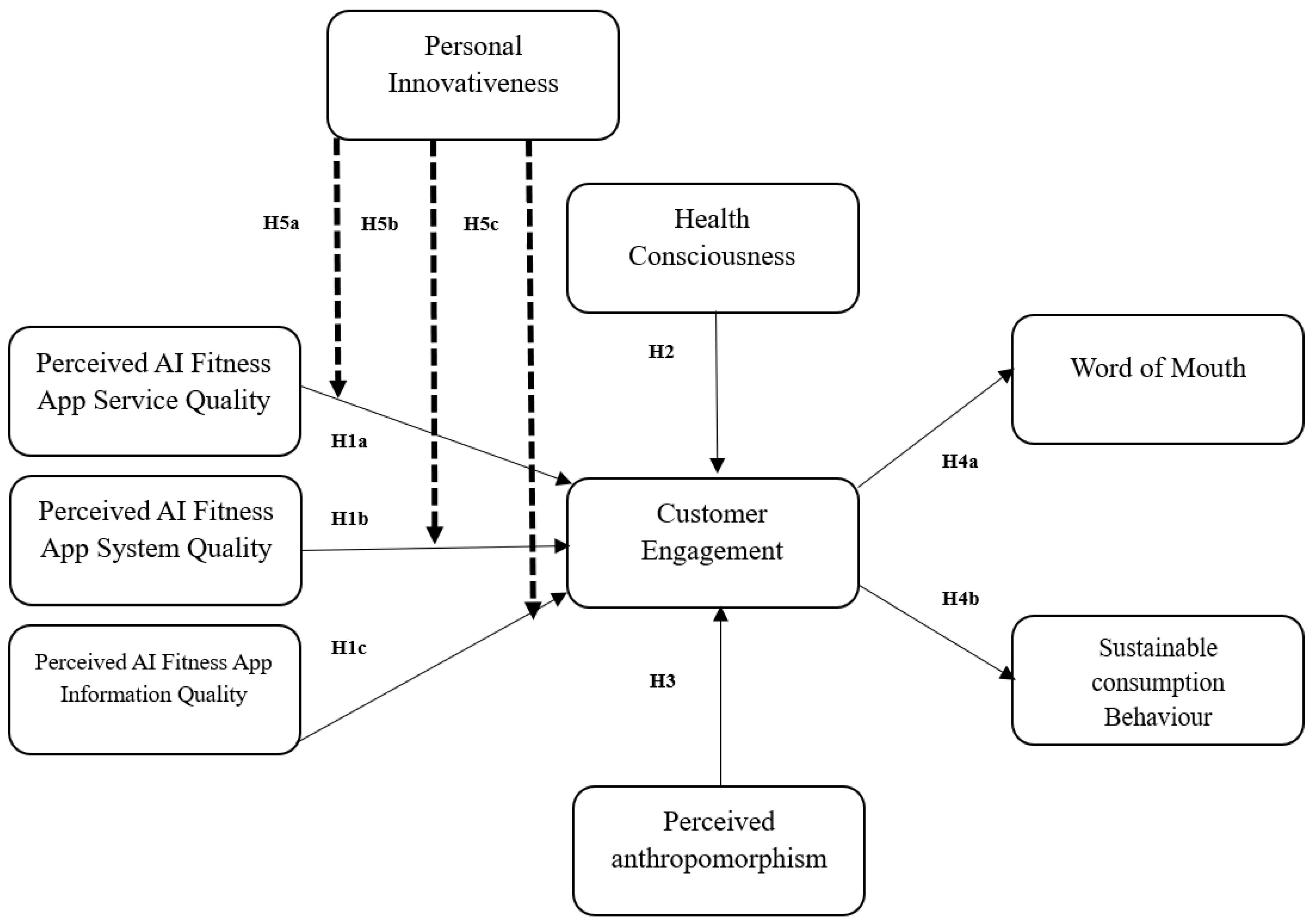
2.4. Customer Engagement
2.5. Moderating Role of Personal Innovativeness
3. Methodology
3.1. Research Design
3.2. Study Context
3.3. Population and Sampling Procedure
3.4. Survey Instrument and Language
3.5. Data Collection Process
4. Data Analysis
4.1. Results and Analysis
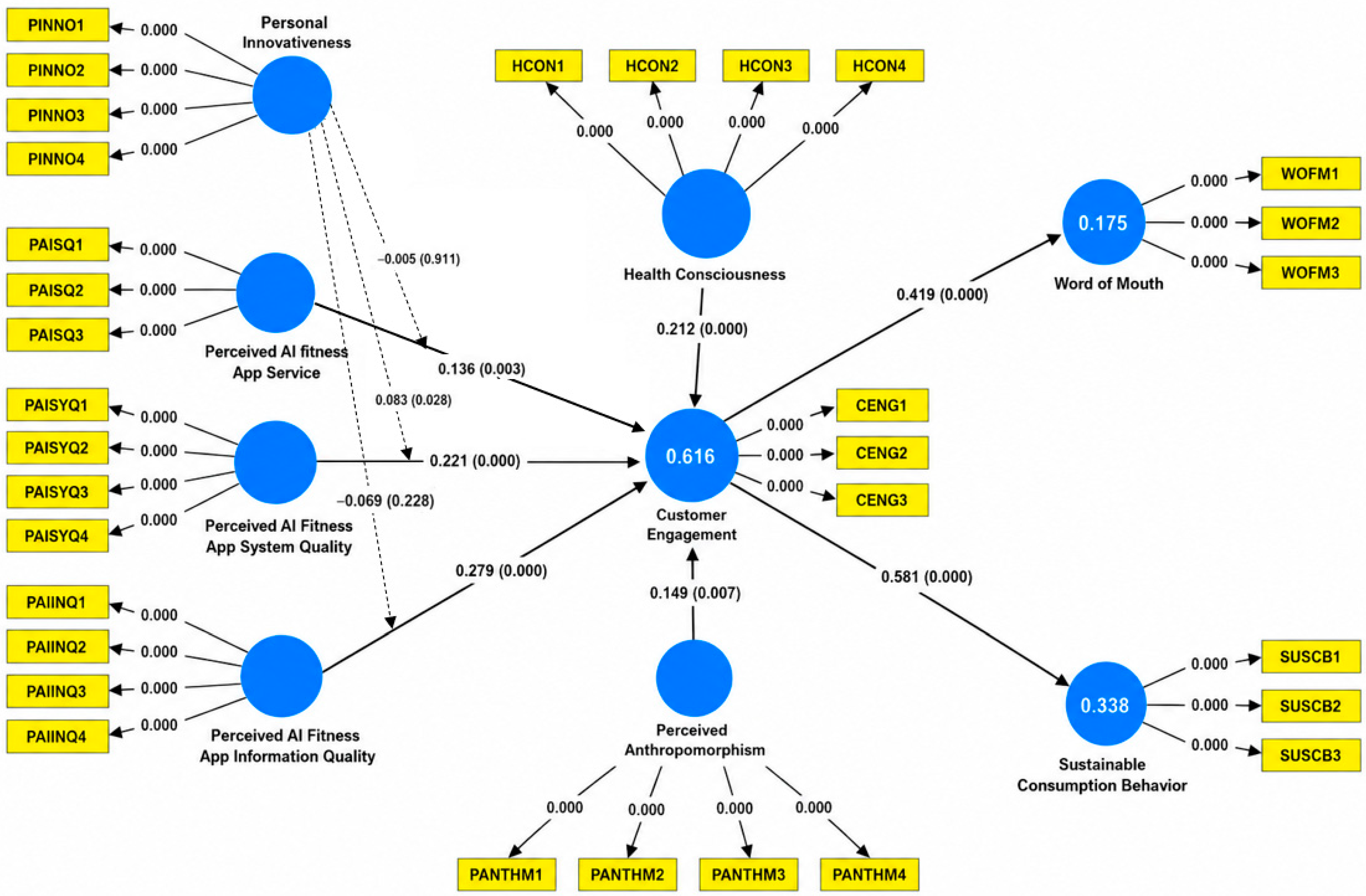
4.2. Structural Model Results and Hypotheses Testing
5. Discussion
5.1. Theoretical Implications
5.2. Practical Implications
6. Conclusions
7. Limitations and Future Directions
Author Contributions
Funding
Institutional Review Board Statement
Informed Consent Statement
Data Availability Statement
Conflicts of Interest
Appendix A. Questionnaire
- AI Fitness App Service Quality
- The app provides prompt support when I need help.
- The app responds quickly to my requests.
- The app provides personalized fitness support.
- AI Fitness App System Quality
- The app is easy to use.
- The app works smoothly without errors.
- The app loads quickly.
- The app has a user-friendly interface.
- AI Fitness App Information Quality
- The app provides accurate fitness information.
- The information provided is clear and understandable.
- Health Consciousness
- I am concerned about my health.
- I actively try to stay healthy.
- I pay attention to my physical well-being.
- I regularly think about improving my health.
- Perceived Anthropomorphism
- The app feels like it has human-like qualities.
- The app interacts with me like a real person.
- The app seems to understand me.
- The app feels personal in its communication.
- Customer Engagement
- I actively use the app regularly.
- I feel interested when using the app.
- I feel connected to the app.
- Personal Innovativeness
- I like trying new technologies.
- I am usually among the first to try new apps.
- I enjoy experimenting with new digital tools.
- I am open to using advanced technologies.
- Word of Mouth
- I would recommend this app to others.
- I often say positive things about this app.
- I encourage others to use this app.
- I share my experience of this app with others.
- Sustainable Consumption Behavior
- I use the app to support a healthy lifestyle.
- The app encourages me to make better health choices.
- I try to follow sustainable fitness habits using the app.
- The app helps me maintain long-term healthy behavior.
References
- Huang, J.; Kaewunruen, S.; Ning, J. AI-based quantification of fitness activities using smartphones. Sustainability 2022, 14, 690. [Google Scholar] [CrossRef]
- Ahmed, A.; Aziz, S.; Qidwai, U.; Farooq, F.; Shan, J.; Subramanian, M.; Chouchane, L.; EINatour, R.; Abd-Alrazaq, A.; Pandas, S. Wearable artificial intelligence for assessing physical activity in high school children. Sustainability 2022, 15, 638. [Google Scholar] [CrossRef]
- Seng, K.P.; Ang, L.-M.; Peter, E.; Mmonyi, A. Machine learning and AI technologies for smart wearables. Electronics 2023, 12, 1509. [Google Scholar] [CrossRef]
- Perez-Pozuelo, I.; Spathis, D.; Clifton, E.A.; Mascolo, C. Wearables, smartphones, and artificial intelligence for digital phenotyping and health. In Digital Health; Elsevier: Amsterdam, The Netherlands, 2021; pp. 33–54. [Google Scholar]
- Holdack, E.; Lurie-Stoyanov, K.; Fromme, H.F. The role of perceived enjoyment and perceived informativeness in assessing the acceptance of AR wearables. J. Retail. Consum. Serv. 2022, 65, 102259. [Google Scholar] [CrossRef]
- Ahmad, K.; Iqbal, W.; El-Hassan, A.; Qadir, J.; Benhaddou, D.; Ayyash, M.; Al-Fuqaha, A. Data-driven artificial intelligence in education: A comprehensive review. IEEE Trans. Learn. Technol. 2023, 17, 12–31. [Google Scholar] [CrossRef]
- Lee, J.-C.; Lin, R. The continuous usage of artificial intelligence (AI)-powered mobile fitness applications: The goal-setting theory perspective. Ind. Manag. Data Syst. 2023, 123, 1840–1860. [Google Scholar] [CrossRef]
- Jang, S.-B.; Kim, M. Digital fitness revolution: User perspectives on Fitbit’s role in health management. Behav. Sci. 2025, 15, 231. [Google Scholar] [CrossRef] [PubMed]
- Barricelli, B.R.; Casiraghi, E.; Gliozzo, J.; Petrini, A.; Valtolina, S. Human digital twin for fitness management. IEEE Access 2020, 8, 26637–26664. [Google Scholar] [CrossRef]
- Wang, X.; Butt, A.H.; Zhang, Q.; Shafique, M.N.; Ahmad, H.; Nawaz, Z. Gaming Avatar Can Influence Sustainable Healthy Lifestyle: Be like an Avatar. Sustainability 2020, 12, 1998. [Google Scholar] [CrossRef]
- Elsotouhy, M.M.; Ghonim, M.A.; Alasker, T.H.; Khashan, M.A. Investigating health and fitness app users’ stickiness, WOM, and continuance intention using SOR model: The moderating role of health consciousness. Int. J. Hum. Comput. Interact. 2024, 40, 1235–1250. [Google Scholar] [CrossRef]
- Laukkanen, T.; Xi, N.; Hallikainen, H.; Ruusunen, N.; Hamari, J. Virtual technologies in supporting sustainable consumption: From a single-sensory stimulus to a multi-sensory experience. Int. J. Inf. Manag. 2022, 63, 102455. [Google Scholar] [CrossRef]
- Hidayat-ur-Rehman, I.; Ahmad, A.; Akhter, F.; Ziaur Rehman, M. Examining consumers’ adoption of smart wearable payments. Sage Open 2022, 12, 21582440221117796. [Google Scholar] [CrossRef]
- Tseng, H.-T.; Lo, C.-L.; Chen, C.-C. The moderation role of AI-enabled service quality on the attitude toward fitness apps. J. Glob. Inf. Manag. 2023, 31, 1–20. [Google Scholar] [CrossRef]
- Li, Y.; Shang, H. Service quality, perceived value, and citizens’ continuous-use intention regarding e-government: Empirical evidence from China. Inf. Manag. 2020, 57, 103197. [Google Scholar] [CrossRef]
- Vorm, E.S.; Combs, D.J. Integrating transparency, trust, and acceptance: The intelligent systems technology acceptance model (ISTAM). Int. J. Hum. Comput. Interact. 2022, 38, 1828–1845. [Google Scholar] [CrossRef]
- Almaiah, M.A.; Al-Otaibi, S.; Lutfi, A.; Almomani, O.; Awajan, A.; Alsaaidah, A.; Alrawad, M.; Awad, A.B. Employing the TAM model to investigate the readiness of M-learning system usage using SEM technique. Electronics 2022, 11, 1259. [Google Scholar] [CrossRef]
- Fang, W.; Na, M.; Alam, S.S. Usage intention of AI among academic librarians in China: Extension of UTAUT model. Sustainability 2025, 17, 2833. [Google Scholar] [CrossRef]
- Kim, J.-H.; Kang, E. An empirical research: Incorporation of user innovativeness into TAM and UTAUT in adopting a golf app. Sustainability 2023, 15, 8309. [Google Scholar] [CrossRef]
- Bazi, S.; Filieri, R.; Gorton, M. Social media content aesthetic quality and customer engagement: The mediating role of entertainment and impacts on brand love and loyalty. J. Bus. Res. 2023, 160, 113778. [Google Scholar] [CrossRef]
- Jessen, A.; Hilken, T.; Chylinski, M.; Mahr, D.; Heller, J.; Keeling, D.I.; de Ruyter, K. The playground effect: How augmented reality drives creative customer engagement. J. Bus. Res. 2020, 116, 85–98. [Google Scholar] [CrossRef]
- Alotaibi, N.S. The significance of digital learning for sustainable development in the post-COVID19 world in Saudi Arabia’s higher education institutions. Sustainability 2022, 14, 16219. [Google Scholar] [CrossRef]
- Karimova, G.Z.; Goby, V.P. The adaptation of anthropomorphism and archetypes for marketing artificial intelligence. J. Consum. Mark. 2020, 38, 229–238. [Google Scholar] [CrossRef]
- Sun, Y.; Chen, J.; Sundar, S.S. Chatbot ads with a human touch: A test of anthropomorphism, interactivity, and narrativity. J. Bus. Res. 2024, 172, 114403. [Google Scholar] [CrossRef]
- Balakrishnan, J.; Abed, S.S.; Jones, P. The role of meta-UTAUT factors, perceived anthropomorphism, perceived intelligence, and social self-efficacy in chatbot-based services? Technol. Forecast. Soc. Change 2022, 180, 121692. [Google Scholar] [CrossRef]
- Ahn, R.J.; Cho, S.Y.; Sunny Tsai, W. Demystifying computer-generated imagery (CGI) influencers: The effect of perceived anthropomorphism and social presence on brand outcomes. J. Interact. Advert. 2022, 22, 327–335. [Google Scholar] [CrossRef]
- Chan, T.J.; Lim, S.H.; Mohan, M.Y.; Huam, H.T.; Mohd Suki, N.; Kasim, M.A. Does health consciousness matter? Factors influencing consumer buying behavior of organic food products through an extended theory of planned behavior. Br. Food J. 2025, 127, 3723–3743. [Google Scholar] [CrossRef]
- Kuru, H. Identifying behavior change techniques in an artificial intelligence-based fitness app: A content analysis. Health Educ. Behav. 2024, 51, 636–647. [Google Scholar] [PubMed]
- Senali, M.G.; Iranmanesh, M.; Ismail, F.N.; Rahim, N.F.A.; Khoshkam, M.; Mirzaei, M. Determinants of intention to use e-wallet: Personal innovativeness and propensity to trust as moderators. Int. J. Hum. Comput. Interact. 2023, 39, 2361–2373. [Google Scholar]
- Abubakre, M.; Zhou, Y.; Zhou, Z. The impact of information technology culture and personal innovativeness in information technology on digital entrepreneurship success. Inf. Technol. People 2022, 35, 204–231. [Google Scholar]
- Duan, Y.; Edwards, J.S.; Dwivedi, Y.K. Artificial intelligence for decision making in the era of Big Data—Evolution, challenges and research agenda. Int. J. Inf. Manag. 2019, 48, 63–71. [Google Scholar] [CrossRef]
- Butt, A.H.; Ahmad, H. AI-driven unmanned convenience stores: Transforming retail with innovation and experiential quality. Technol. Soc. 2025, 84, 103133. [Google Scholar] [CrossRef]
- Asante, D.; Tang, C.; Kwamega, M.; Asante, E.A. In pursuit of service encounter quality: Will service-oriented high-performance work systems benefit high-contact service industries? J. Retail. Consum. Serv. 2022, 68, 103037. [Google Scholar] [CrossRef]
- Kim, S.Y.; Kim, J. The impact of AI recommendation quality on service satisfaction: The moderating roles of standardization and customization. J. Serv. Mark. 2025, 39, 365–386. [Google Scholar] [CrossRef]
- Zhong, J.; Chen, T. Antecedents of mobile payment loyalty: An extended perspective of perceived value and information system success model. J. Retail. Consum. Serv. 2023, 72, 103267. [Google Scholar] [CrossRef]
- Chiu, C.L.; Ho, H.-C.; Yu, T.; Liu, Y.; Mo, Y. Exploring information technology success of Augmented Reality Retail Applications in retail food chain. J. Retail. Consum. Serv. 2021, 61, 102561. [Google Scholar] [CrossRef]
- DeLone, W.H.; McLean, E.R. Information systems success measurement. Found. Trends Inf. Syst. 2016, 2, 1–116. [Google Scholar] [CrossRef]
- Freeze, R.D.; Alshare, K.A.; Lane, P.L.; Wen, H.J. IS success model in e-learning context based on students’ perceptions. J. Inf. Syst. Educ. 2019, 21, 4. [Google Scholar]
- Hussain, A.; Li, M.; Kanwel, S.; Asif, M.; Jameel, A.; Hwang, J. Impact of tourism satisfaction and service quality on destination loyalty: A structural equation modeling approach concerning China resort hotels. Sustainability 2023, 15, 7713. [Google Scholar] [CrossRef]
- Hui, Z.; Khan, A.N.; Chenglong, Z.; Khan, N.A. When service quality is enhanced by human–artificial intelligence interaction: An examination of anthropomorphism, responsiveness from the perspectives of employees and customers. Int. J. Hum. Comput. Interact. 2024, 40, 7546–7561. [Google Scholar]
- Demir, A.; Maroof, L.; Sabbah Khan, N.U.; Ali, B.J. The role of E-service quality in shaping online meeting platforms: A case study from higher education sector. J. Appl. Res. High. Educ. 2021, 13, 1436–1463. [Google Scholar]
- Shi, S.; Gong, Y.; Gursoy, D. Antecedents of trust and adoption intention toward artificially intelligent recommendation systems in travel planning: A heuristic–systematic model. J. Travel Res. 2021, 60, 1714–1734. [Google Scholar]
- Tian, Y.; Chan, T.J.; Suki, N.M.; Kasim, M.A. Moderating Role of Perceived Trust and Perceived Service Quality on Consumers’ Use Behavior of Alipay e-wallet System: The Perspectives of Technology Acceptance Model and Theory of Planned Behavior. Hum. Behav. Emerg. Technol. 2023, 2023, 5276406. [Google Scholar] [CrossRef]
- Chiu, M.-C.; Tu, Y.-L.; Kao, M.-C. Applying deep learning image recognition technology to promote environmentally sustainable behavior. Sustain. Prod. Consum. 2022, 31, 736–749. [Google Scholar] [CrossRef]
- Kumari, A.; Tanwar, S.; Tyagi, S.; Kumar, N. Fog computing for Healthcare 4.0 environment: Opportunities and challenges. Comput. Electr. Eng. 2018, 72, 1–13. [Google Scholar] [CrossRef]
- Abdulmalek, S.; Nasir, A.; Jabbar, W.A.; Almuhaya, M.A.; Bairagi, A.K.; Khan, M.A.-M.; Kee, S.-H. IoT-based healthcare-monitoring system towards improving quality of life: A review. Healthcare 2022, 10, 1993. [Google Scholar] [CrossRef] [PubMed]
- Kush, J.C. Integrating sensor technologies with conversational AI: Enhancing context-sensitive interaction through real-time data fusion. Sensors 2025, 25, 249. [Google Scholar] [CrossRef] [PubMed]
- Asimakopoulos, S.; Asimakopoulos, G.; Spillers, F. Motivation and user engagement in fitness tracking: Heuristics for mobile healthcare wearables. Informatics 2017, 4, 5. [Google Scholar] [CrossRef]
- Yaiprasert, C.; Hidayanto, A.N. AI-powered in the digital age: Ensemble innovation personalizes the food recommendations. J. Open Innov. Technol. Mark. Complex. 2024, 10, 100261. [Google Scholar] [CrossRef]
- Qin, Y.; Omar, B.; Musetti, A. The addiction behavior of short-form video app TikTok: The information quality and system quality perspective. Front. Psychol. 2022, 13, 932805. [Google Scholar] [CrossRef] [PubMed]
- Chen, P.-T.; Lin, C.-L.; Wu, W.-N. Big data management in healthcare: Adoption challenges and implications. Int. J. Inf. Manag. 2020, 53, 102078. [Google Scholar] [CrossRef]
- Li, J.; Dada, A.; Puladi, B.; Kleesiek, J.; Egger, J. ChatGPT in healthcare: A taxonomy and systematic review. Comput. Methods Programs Biomed. 2024, 245, 108013. [Google Scholar] [CrossRef] [PubMed]
- Sakib, M.N.; Zolfagharian, M.; Yazdanparast, A. Does parasocial interaction with weight loss vloggers affect compliance? The role of vlogger characteristics, consumer readiness, and health consciousness. J. Retail. Consum. Serv. 2020, 52, 101733. [Google Scholar] [CrossRef]
- Gupta, M.; Nagar, K. Is S (He) My Friend or Servant: Exploring Customers’ Attitudes Toward Anthropomorphic Voice Assistants. Serv. Mark. Q. 2024, 45, 513–540. [Google Scholar] [CrossRef]
- Feng, Y.; Meng, J.; Cheah, J.H. From virtual trainers to companions? Examining how digital agency types, anthropomorphism, and support shape para-social relationships in online fitness. Psychol. Mark. 2025, 42, 842–865. [Google Scholar]
- Butt, A.H.; Ahmad, H.; Goraya, M.A.S.; Akram, M.S.; Shafique, M.N. Let’s play: Me and my AI-powered avatar as one team. Psychol. Mark. 2021, 38, 1014–1025. [Google Scholar] [CrossRef]
- Wang, L.; Touré-Tillery, M.; McGill, A.L. The effect of disease anthropomorphism on compliance with health recommendations. J. Acad. Mark. Sci. 2023, 51, 266–285. [Google Scholar] [PubMed]
- Li, Q.; Luximon, Y.; Zhang, J. The influence of anthropomorphic cues on patients’ perceived anthropomorphism, social presence, trust building, and acceptance of health care conversational agents: Within-subject web-based experiment. J. Med. Internet Res. 2023, 25, e44479. [Google Scholar] [CrossRef] [PubMed]
- Mehmood, K.; Kautish, P.; Shah, T.R. Embracing digital companions: Unveiling customer engagement with anthropomorphic AI service robots in cross-cultural context. J. Retail. Consum. Serv. 2024, 79, 103825. [Google Scholar] [CrossRef]
- Kang, H.; Lou, C. AI agency vs. human agency: Understanding human–AI interactions on TikTok and their implications for user engagement. J. Comput. Mediat. Commun. 2022, 27, zmac014. [Google Scholar] [CrossRef]
- Butt, A.; Ahmad, H.; Ali, F.; Muzaffar, A.; Shafique, M.N. Engaging the customer with augmented reality and employee services to enhance equity and loyalty. Int. J. Retail. Distrib. Manag. 2023, 51, 629–652. [Google Scholar] [CrossRef]
- Li, M.-W.; Teng, H.-Y.; Chen, C.-Y. Unlocking the customer engagement-brand loyalty relationship in tourism social media: The roles of brand attachment and customer trust. J. Hosp. Tour. Manag. 2020, 44, 184–192. [Google Scholar] [CrossRef]
- McLean, G.; Wilson, A. Shopping in the digital world: Examining customer engagement through augmented reality mobile applications. Comput. Hum. Behav. 2019, 101, 210–224. [Google Scholar] [CrossRef]
- Ivanov, R.; Velkova, V. Analyzing visitor behavior to enhance personalized experiences in smart museums: A systematic literature review. Computers 2025, 14, 191. [Google Scholar] [CrossRef]
- Arfi, W.B.; Nasr, I.B.; Khvatova, T.; Zaied, Y.B. Understanding acceptance of eHealthcare by IoT natives and IoT immigrants: An integrated model of UTAUT, perceived risk, and financial cost. Technol. Forecast. Soc. Change 2021, 163, 120437. [Google Scholar] [CrossRef]
- Aboobaker, N.; Renjini, D.; Zakkariya, K.A. Fostering entrepreneurial mindsets: The impact of learning motivation, personal innovativeness, technological self-efficacy, and human capital on entrepreneurial intention. J. Int. Educ. Bus. 2023, 16, 312–333. [Google Scholar] [CrossRef]
- Hur, H.J.; Lee, H.K.; Choo, H.J. Understanding usage intention in innovative mobile app service: Comparison between millennial and mature consumers. Comput. Hum. Behav. 2017, 73, 353–361. [Google Scholar] [CrossRef]
- Lehrer, C.; Wieneke, A.; Vom Brocke, J.A.N.; Jung, R.; Seidel, S. How big data analytics enables service innovation: Materiality, affordance, and the individualization of service. J. Manag. Inf. Syst. 2018, 35, 424–460. [Google Scholar] [CrossRef]
- Moussawi, S.; Koufaris, M.; Benbunan-Fich, R. How perceptions of intelligence and anthropomorphism affect adoption of personal intelligent agents. Electron. Mark. 2021, 31, 343–364. [Google Scholar]
- Hair, J.F.; Risher, J.J.; Sarstedt, M.; Ringle, C.M. When to use and how to report the results of PLS-SEM. Eur. Bus. Rev. 2019, 31, 2–24. [Google Scholar] [CrossRef]
- Alamoudi, A.K.; Abidoye, R.B.; Lam, T.Y.M. The impact of citizens’ participation level on smart sustainable cities outcomes: Evidence from Saudi Arabia. Buildings 2023, 13, 343. [Google Scholar] [CrossRef]
- Jamel, L. The relation between tourism and economic growth: A case of Saudi Arabia as an emerging tourism destination. Virtual Econ. 2020, 3, 29–47. [Google Scholar] [CrossRef]
- Asem, A.; Mohammad, A.A.; Ziyad, I.A. Navigating Digital Transformation in Alignment with Vision 2030: A Review of Organizational Strategies, Innovations, and Implications in Saudi Arabia. J. Knowl. Learn. Sci. Technol. 2024, 3, 21–29. [Google Scholar] [CrossRef]
- Mohiuddin, K.; Nasr, O.A.; Miladi, M.N.; Fatima, H.; Shahwar, S.; Naveed, Q.N. Potentialities and priorities for higher educational development in Saudi Arabia for the next decade: Critical reflections of the vision 2030 framework. Heliyon 2023, 9, e16368. [Google Scholar] [CrossRef] [PubMed]
- Butt, A.; Ahmad, H.; Muzaffar, A.; Ali, F.; Shafique, N. WOW, the make-up AR app is impressive: A comparative study between China and South Korea. J. Serv. Mark. 2021, 36, 73–88. [Google Scholar] [CrossRef]
- Parashar, S.; Singh, S.; Sood, G. Examining the role of health consciousness, environmental awareness and intention on purchase of organic food: A moderated model of attitude. J. Clean. Prod. 2023, 386, 135553. [Google Scholar] [CrossRef]
- Lin, K.-Y.; Huang, T.K. Shopping in the digital world: How augmented reality mobile applications trigger customer engagement. Technol. Soc. 2024, 77, 102540. [Google Scholar] [CrossRef]
- Kim, J.J.; Kim, I.; Hwang, J. A change of perceived innovativeness for contactless food delivery services using drones after the outbreak of COVID-19. Int. J. Hosp. Manag. 2021, 93, 102758. [Google Scholar] [CrossRef] [PubMed]
- Huang, M.; Mohamad Saleh, M.S.; Zolkepli, I.A. The Moderating Effect of Green Advertising on the Relationship between Gamification and Sustainable Consumption Behavior: A Case Study of the Ant Forest Social Media App. Sustainability 2023, 15, 2883. [Google Scholar] [CrossRef]
- Pang, H.; Qiao, Y.; Zhang, K. Modeling pathway linking mobile social media intensity to attitude towards electronic word-of-mouth and engagement: The significant role of social trust and perceived homophily. Technol. Forecast. Soc. Change 2024, 198, 123023. [Google Scholar] [CrossRef]
- Hair, J.F., Jr.; Hult, G.T.M.; Ringle, C.M.; Sarstedt, M.; Danks, N.P.; Ray, S. Partial Least Squares Structural Equation Modeling (PLS-SEM) Using R: A Workbook; Springer Nature: Cham, Switzerland, 2021. [Google Scholar]
- Henseler, J.; Hubona, G.; Ray, P.A. Using PLS path modeling in new technology research: Updated guidelines. Ind. Manag. Data Syst. 2016, 116, 2–20. [Google Scholar] [CrossRef]
- Hair, J.F. A Primer on Partial Least Squares Structural Equation Modeling (PLS-SEM); SAGE: Thousand Oaks, CA, USA, 2014. [Google Scholar]
- Fornell, C.; Larcker, D.F. Evaluating structural equation models with unobservable variables and measurement error. J. Mark. Res. 1981, 18, 39–50. [Google Scholar] [CrossRef]
- Henseler, J.; Ringle, C.M.; Sarstedt, M. A new criterion for assessing discriminant validity in variance-based structural equation modeling. J. Acad. Mark. Sci. 2015, 43, 115–135. [Google Scholar]
- David, A.; Senn, W.D.; Peak, D.A.; Prybutok, V.R.; Blankson, C. The value of visual quality and service quality to augmented reality enabled mobile shopping experience. Qual. Manag. J. 2021, 28, 116–127. [Google Scholar] [CrossRef]
- Payal, R.; Sharma, N.; Dwivedi, Y.K. Unlocking the impact of brand engagement in the metaverse on Real-World purchase intentions: Analyzing Pre-Adoption behavior in a futuristic technology platform. Electron. Commer. Res. Appl. 2024, 65, 101381. [Google Scholar] [CrossRef]
- Hoang, D.; Kousi, S.; Martinez, L.F.; Kumar, S. Revisiting a model of customer engagement cycle: A systematic review. Serv. Ind. J. 2023, 43, 579–617. [Google Scholar] [CrossRef]
- Grewal, D.; Roggeveen, A.L.; Sisodia, R.; Nordfält, J. Enhancing customer engagement through consciousness. J. Retail. 2017, 93, 55–64. [Google Scholar] [CrossRef]
- Papa, A.; Mital, M.; Pisano, P.; Del Giudice, M. E-health and wellbeing monitoring using smart healthcare devices: An empirical investigation. Technol. Forecast. Soc. Change 2020, 153, 119226. [Google Scholar] [CrossRef]
- Moriuchi, E. An empirical study on anthropomorphism and engagement with disembodied AIs and consumers’ re-use behavior. Psychol. Mark. 2021, 38, 21–42. [Google Scholar] [CrossRef]
- Wu, L.; Dodoo, N.A.; Choi, C.-W. Brand anthropomorphism on Twitter: Communication strategies and consumer engagement. J. Prod. Brand Manag. 2023, 32, 799–811. [Google Scholar] [CrossRef]
- Hsieh, S.H.; Lee, C.T. The AI humanness: How perceived personality builds trust and continuous usage intention. J. Prod. Brand Manag. 2024, 33, 618–632. [Google Scholar] [CrossRef]
- Fernandes, T.; Esteves, F. Customer engagement and loyalty: A comparative study between service contexts. Serv. Mark. Q. 2016, 37, 125–139. [Google Scholar] [CrossRef]
- Pansari, A.; Kumar, V. Customer engagement: The construct, antecedents, and consequences. J. Acad. Mark. Sci. 2017, 45, 294–311. [Google Scholar]
- Ferraro, G.; Passaro, R.; Quinto, I.; Thomas, A. The process supporting the emergence of the environmental innovation capabilities within small businesses: An empirical investigation. Bus. Strategy Environ. 2025, 34, 1027–1042. [Google Scholar]
- Wang, Q.; Sun, T.; Li, R. Does artificial intelligence promote green innovation? An assessment based on direct, indirect, spillover, and heterogeneity effects. Energy Environ. 2025, 36, 1005–1037. [Google Scholar]
- Kim, M.J.; Hall, C.M.; Chung, N.; Kim, M.; Sohn, K. Does using public transport affect tourist subject well-being and behaviour relevant to sustainability? Value-attitude-behaviour theory and artificial intelligence benefits. Curr. Issues Tour. 2024, 27, 1666–1682. [Google Scholar] [CrossRef]
- Suraña-Sánchez, C.; Aramendia-Muneta, M.E. Impact of artificial intelligence on customer engagement and advertising engagement: A review and future research agenda. Int. J. Consum. Stud. 2024, 48, e13027. [Google Scholar] [CrossRef]
- Siala, H.; Wang, Y. SHIFTing artificial intelligence to be responsible in healthcare: A systematic review. Soc. Sci. Med. 2022, 296, 114782. [Google Scholar] [CrossRef] [PubMed]
- Alboqami, H. Trust me, I’m an influencer!—Causal recipes for customer trust in artificial intelligence influencers in the retail industry. J. Retail. Consum. Serv. 2023, 72, 103242. [Google Scholar] [CrossRef]
- Ahmad, H.; Butt, A.; Muzaffar, A. Travel before you actually travel with augmented reality–role of augmented reality in future destination. Curr. Issues Tour. 2022, 26, 2845–2862. [Google Scholar] [CrossRef]
- Butt, A.H.; Ahmad, H.; Muzaffar, A. Augmented reality is the new digital banking–AR brand experience impact on brand loyalty. Int. J. Bank Mark. 2024, 42, 156–182. [Google Scholar] [CrossRef]



| Variable | Category | Frequency (n) | Percentage (%) |
|---|---|---|---|
| Gender | Male | 270 | 59.5 |
| Female | 184 | 40.5 | |
| Age | 18–25 | 120 | 26.4 |
| 26–35 | 200 | 44.1 | |
| 36–45 | 90 | 19.8 | |
| 46+ | 44 | 9.7 | |
| Education | High school or below | 80 | 17.6 |
| Bachelor’s degree | 290 | 63.9 | |
| Postgraduate degree | 84 | 18.5 | |
| Occupation | Student | 90 | 19.8 |
| Employed | 280 | 61.7 | |
| Self-employed/Other | 84 | 18.5 | |
| Income (SAR) | Less than 5000 | 120 | 26.4 |
| 5000–10,000 | 200 | 44.1 | |
| 10,001–15,000 | 90 | 19.8 | |
| Above 15,000 | 44 | 9.7 |
| Items | Factor Loadings | VIF |
|---|---|---|
| CENG1 | 0.879 | 2.465 |
| CENG2 | 0.877 | 2.461 |
| CENG3 | 0.741 | 1.262 |
| HCON1 | 0.828 | 2.466 |
| HCON2 | 0.841 | 3.054 |
| HCON3 | 0.806 | 2.336 |
| HCON4 | 0.694 | 1.142 |
| PAIINQ1 | 0.924 | 3.678 |
| PAIINQ2 | 0.914 | 3.057 |
| PAIINQ3 | 0.908 | 3.353 |
| PAIINQ4 | 0.615 | 1.362 |
| PAISQ1 | 0.785 | 1.210 |
| PAISQ2 | 0.782 | 1.781 |
| PAISQ3 | 0.831 | 1.887 |
| PAISYQ1 | 0.930 | 3.848 |
| PAISYQ2 | 0.926 | 3.471 |
| PAISYQ3 | 0.918 | 3.328 |
| PAISYQ4 | 0.771 | 1.986 |
| PANTHM1 | 0.705 | 1.515 |
| PANTHM2 | 0.824 | 1.765 |
| PANTHM3 | 0.832 | 2.140 |
| PANTHM4 | 0.825 | 2.105 |
| PINNO1 | 0.826 | 2.276 |
| PINNO2 | 0.818 | 2.007 |
| PINNO3 | 0.687 | 3.066 |
| PINNO4 | 0.748 | 3.422 |
| SUSCB1 | 0.793 | 1.597 |
| SUSCB2 | 0.875 | 1.912 |
| SUSCB3 | 0.890 | 2.220 |
| WOFM1 | 0.916 | 2.282 |
| WOFM2 | 0.924 | 2.531 |
| WOFM3 | 0.699 | 1.494 |
| Constructs | α | CR | AVE | 1 | 2 | 3 | 4 | 5 | 6 | 7 | 8 | 9 |
|---|---|---|---|---|---|---|---|---|---|---|---|---|
| Customer Engagement | 0.778 | 0.873 | 0.697 | |||||||||
| Health Consciousness | 0.809 | 0.872 | 0.631 | 0.708 | ||||||||
| Perceived AI Fitness App Information Quality | 0.867 | 0.911 | 0.723 | 0.718 | 0.515 | |||||||
| Perceived AI Fitness App System Quality | 0.913 | 0.937 | 0.790 | 0.532 | 0.310 | 0.347 | ||||||
| Perceived Ai fitness App Service Quality | 0.725 | 0.842 | 0.640 | 0.633 | 0.502 | 0.369 | 0.353 | |||||
| Perceived Anthropomorphism | 0.809 | 0.875 | 0.637 | 0.725 | 0.570 | 0.518 | 0.399 | 0.587 | ||||
| Personal Innovativeness | 0.782 | 0.854 | 0.596 | 0.612 | 0.613 | 0.407 | 0.413 | 0.403 | 0.633 | |||
| Sustainable Consumption Behavior | 0.814 | 0.889 | 0.729 | 0.723 | 0.582 | 0.586 | 0.398 | 0.516 | 0.611 | 0.573 | ||
| Word of Mouth | 0.819 | 0.887 | 0.727 | 0.487 | 0.753 | 0.413 | 0.293 | 0.372 | 0.494 | 0.345 | 0.487 |
| β | SD | t | p Values | Decision | ||
|---|---|---|---|---|---|---|
| H1a: | Perceived AI Fitness App Service Quality → Customer Engagement | 0.136 | 0.045 | 2.999 | 0.003 | Supported |
| H1b: | Perceived AI Fitness App System Quality → Customer Engagement | 0.221 | 0.056 | 3.976 | 0.000 | Supported |
| H1c: | Perceived AI Fitness App Information Quality → Customer Engagement | 0.279 | 0.056 | 4.973 | 0.000 | Supported |
| H2: | Health Consciousness → Customer Engagement | 0.212 | 0.052 | 4.064 | 0.000 | Supported |
| H3: | Perceived Anthropomorphism → Customer Engagement | 0.149 | 0.055 | 2.698 | 0.007 | Supported |
| H4a: | Customer Engagement → Word of Mouth | 0.419 | 0.061 | 6.814 | 0.000 | Supported |
| H4b: | Customer Engagement → Sustainable Consumption Behavior | 0.581 | 0.063 | 9.279 | 0.000 | Supported |
| H5a: | Personal Innovativeness x Perceived AI fitness App Service Quality → Customer Engagement | −0.005 | 0.047 | 0.111 | 0.911 | Not Supported |
| H5b: | Personal Innovativeness x Perceived AI Fitness App System Quality → Customer Engagement | 0.083 | 0.038 | 2.197 | 0.028 | Supported |
| H5c: | Personal Innovativeness x Perceived AI Fitness App Information Quality → Customer Engagement | −0.069 | 0.057 | 1.206 | 0.228 | Not Supported |
| Constructs | R-Square | R-Square Adjusted |
|---|---|---|
| Customer Engagement | 0.615 | 0.607 |
| Sustainable Consumption Behavior | 0.337 | 0.335 |
| Word of Mouth | 0.174 | 0.172 |
Disclaimer/Publisher’s Note: The statements, opinions and data contained in all publications are solely those of the individual author(s) and contributor(s) and not of MDPI and/or the editor(s). MDPI and/or the editor(s) disclaim responsibility for any injury to people or property resulting from any ideas, methods, instructions or products referred to in the content. |
© 2026 by the authors. Licensee MDPI, Basel, Switzerland. This article is an open access article distributed under the terms and conditions of the Creative Commons Attribution (CC BY) license.
Share and Cite
Butt, A.H.; Rashid, A.; Mohd Yusof, S.A.; Adeel, U. Driving Sustainable Consumption and Word of Mouth Through AI Fitness Apps: The Role of Customer Engagement. Sustainability 2026, 18, 6420. https://doi.org/10.3390/su18136420
Butt AH, Rashid A, Mohd Yusof SA, Adeel U. Driving Sustainable Consumption and Word of Mouth Through AI Fitness Apps: The Role of Customer Engagement. Sustainability. 2026; 18(13):6420. https://doi.org/10.3390/su18136420
Chicago/Turabian StyleButt, Asad Hassan, Ammar Rashid, Shafiz Affendi Mohd Yusof, and Umar Adeel. 2026. "Driving Sustainable Consumption and Word of Mouth Through AI Fitness Apps: The Role of Customer Engagement" Sustainability 18, no. 13: 6420. https://doi.org/10.3390/su18136420
APA StyleButt, A. H., Rashid, A., Mohd Yusof, S. A., & Adeel, U. (2026). Driving Sustainable Consumption and Word of Mouth Through AI Fitness Apps: The Role of Customer Engagement. Sustainability, 18(13), 6420. https://doi.org/10.3390/su18136420