Article

Life Cycle Assessment of Innovative Magnetic Harvesting and Particle Detachment for Sustainable Chlorella vulgaris Recovery


1
LEPABE—Laboratory for Process Engineering, Environment, Biotechnology and Energy, ALiCE—Associate Laboratory in Chemical Engineering, Faculty of Engineering, University of Porto, Rua Dr. Roberto Frias, 4200-465 Porto, Portugal
2
Instituto de Biología Molecular y Celular del Cáncer, CSIC—Consejo Superior de Investigaciones Cientificas/Universidad de Salamanca (GIR Citómica), 37007 Salamanca, Spain
3
CEADIR—Centro de Estudios Ambientales y Dinamización Rural, Avenida Filiberto Villalobos, 119, 37007 Salamanca, Spain
4
LAETA—Associated Laboratory for Energy, Transports and Aerospace, INEGI—Institute of Science and Innovation in Mechanical and Industrial Engineering, Rua Dr. Roberto Frias 400, 4200-465 Porto, Portugal
5
CBQF—Center for Biotechnology and Fine Chemistry—Associated Laboratory, School of Biotechnology, Portuguese Catholic University, Rua Diogo Botelho 1327, 4169-005 Porto, Portugal
*
Authors to whom correspondence should be addressed.
Sustainability 2026, 18(12), 6376; https://doi.org/10.3390/su18126376 (registering DOI)
Submission received: 14 May 2026 / Revised: 16 June 2026 / Accepted: 17 June 2026 / Published: 22 June 2026
(This article belongs to the Section Bioeconomy of Sustainability)

Abstract

Harvesting remains one of the main bottlenecks in microalgae-based technologies. Although microalgae hold great promise for industrial biotechnology, their growth in dilute suspensions makes biomass recovery challenging. Conventional harvesting methods are often energy-intensive and costly, limiting large-scale implementation. This study applies a life cycle assessment (LCA) to evaluate the environmental performance of a laboratory-scale magnetic harvesting process of Chlorella vulgaris (C. vulgaris) using Fe3O4 microparticles in combination with polyaluminum chloride (PAC) and polyacrylamide (PAM), followed by magnetic oscillation for particle detachment and subsequent reuse. Electricity consumption was identified as the dominant environmental hotspot across most impact categories, with the detachment step accounting for nearly two-thirds of the total energy demand, a step often overlooked in previous LCA studies. The global warming potential (GWP) is consistent with typical laboratory-scale assessments and is mainly driven by energy inefficiencies associated with small processing volumes. The values obtained and the scale-up literature indicate that further optimization and future industrial-scale production will decrease these values into a realistic and competitive range. Sensitivity analysis showed that replacing grid electricity with photovoltaic power significantly reduces environmental impacts. The use of NaOH as a reagent also contributed substantially to environmental impacts. Reusing magnetic particles (4 cycles) reduced material resource depletion by up to fourfold, which is a very relevant result bearing in mind the principles of sustainability and circularity.

1. Introduction

Microalgae are photosynthetic microorganisms that have attracted increasing attention as a versatile biotechnological resource for sustainable solutions across multiple sectors, including renewable energy, environmental remediation, and the production of high-value bioproducts, particularly in the food and health industries. Their capacity to fix atmospheric CO2, grow rapidly on non-arable land, and utilize nutrients from wastewater to synthesize valuable compounds such as lipids and amino acids makes them highly attractive for industrial applications [1]. Despite this potential, large-scale implementation remains constrained by technical and economic challenges, with biomass harvesting and dewatering identified as key bottlenecks [2,3].
Microalgae processing typically comprises four main stages: cultivation, harvesting (also referred to as dewatering), drying, and subsequent downstream processing. Harvesting involves the separation of microalgal cells from the cultivation medium. In some classifications, drying is grouped with harvesting, as both involve removing water from algal cells [4]. The inherently dilute nature of microalgal cultures, combined with the small cell size, low density contrast with water, and surface characteristics, such as negative zeta potential and the presence of extracellular polymeric substances (EPS) that promote colloidal stability, renders harvesting the most time-consuming, energy-intensive, and least scalable stage of biomass production [5,6,7]. Indeed, harvesting accounts for 20–30% of the total biomass production cost, while approximately 90% of the initial investment in an open-pond facility is allocated to harvesting and dewatering equipment [8].
Currently, microalgae harvesting methods can be broadly classified into three categories: (1) physical or mechanical methods, including sedimentation, filtration, and centrifugation, which often require high energy input; (2) chemical methods, such as coagulation and flocculation, which involve the addition of coagulants like metal salts or synthetic polymers to promote cell aggregation; and (3) biological methods, which employ natural agents, such as bioflocculants or co-cultivation with flocculant microorganisms [2,5]. Each approach presents advantages and limitations in terms of efficiency, cost, scalability, and impact on biomass quality. In particular, chemical additives and heavy metals may compromise downstream applications or limit reuse of the culture medium, highlighting the need for alternative, low-energy and low-impact solutions [6,9,10,11].
Regardless of the method, microalgae harvesting should be cost-effective in terms of both capital and operational expenditures. It should also be versatile, applicable to different microalgal strains and growth media, while avoiding contamination or toxicity to the biomass. For example, heavy metals used as flocculants or released from electrodes in electroflocculation, as well as certain synthetic polymers employed as coagulants, can limit downstream processes and restrict the final applications of the biomass, particularly in the food and pharmaceutical industries. Contamination may also compromise the reusability of the culture medium, increasing overall production costs. Consequently, the choice of harvesting strategy depends on the intended application and specific product requirements, such as the preservation of cell integrity, residual salt and chemical concentrations, and moisture content [6,9,10,11]. These limitations have stimulated growing interest in alternative, low-energy approaches, including magnetic harvesting, wherein magnetic particles adsorb onto microalgae surfaces, promoting aggregation and facilitating recovery via a magnetic field [3,12].
Magnetic harvesting has emerged as a promising alternative, employing magnetic particles (MPs) typically based on iron oxides such as magnetite (Fe3O4). These particles can be applied either in their naked form (without coatings) or functionalized with cationic groups, which promote binding to microalgal cells and enable their subsequent recovery using an external magnetic field. Attachment between the magnetic particles and microalgae occurs through mechanisms analogous to those involved in chemical flocculation. For naked magnetite particles, interactions are primarily driven by electrostatic attraction, charge neutralization, and electrostatic patching, which are influenced by surface charge and pH conditions. When MPs are used in combination with coagulants and flocculants, such as polyaluminum chloride (PAC) and polyacrylamide (PAM), additional mechanisms, including polymer bridging and sweeping via metal hydroxide networks, contribute to aggregation [12,13]. Collectively, these processes enable the rapid formation of magnetic complexes and promote strong binding between the particles and microalgal cells. Once formed, these complexes can be efficiently separated from the culture medium using an external magnetic field, enabling fast and selective biomass recovery [14]. Originally developed for mineral processing and primarily applied in biomedical fields, magnetic separation has recently gained increasing attention in microalgal biotechnology [15,16].
Magnetic harvesting can achieve efficiencies exceeding 90% in optimized systems [17,18,19]. Key factors influencing performance include the particle-to-algae ratio, pH, ionic strength, applied magnetic field, microalgal species, and growth stage. Among these, the zeta potential of both microalgae and magnetic particles is particularly critical, as electrostatic interactions drive coagulation [19]. Functionalization of MPs can enhance their positive surface charge, improving harvesting efficiency and reducing the need for chemical coagulants [20,21,22,23]. Process parameters such as particle dosage, stirring speed, and temperature also play a significant role, with optimal ranges required to maximize adsorption and aggregation while preventing floc destabilization or shear-induced breakage [23,24].
Compared to conventional harvesting methods, magnetic harvesting represents a promising low-cost alternative. It requires less energy than physical techniques such as centrifugation, allows for selective binding to target microalgal species, which is particularly advantageous in mixed cultures, and enables the potential reuse of magnetic particles, thereby reducing both material costs and waste [25]. Furthermore, magnetic harvesting minimizes or eliminates the need for chemical additives, enhancing environmental sustainability, while its relatively simple operation supports efficient and scalable implementation [3,18,25].
To improve separation efficiency and reduce costs, it is common to combine two or more harvesting techniques, for example, pairing flocculation and sedimentation with centrifugation [2]. In this study, magnetic harvesting was integrated with chemical flocculation. Alongside the magnetic particles, chemical flocculants are added to promote cell aggregation, enhancing the binding between microalgae and the particles. This synergistic combination enables faster, easier, and more effective separation under an external magnetic field, while simultaneously reducing the amount of chemicals required compared to using chemical flocculation alone. Notably, the flocculants employed in this study are commonly used in wastewater treatment, highlighting the environmental relevance and sustainability of the approach. C. vulgaris was cultivated in artificial wastewater to simulate conditions typical of wastewater treatment systems [18].
Following harvesting, it is essential to fully detach magnetic particles from the biomass to enable their recovery and reuse in subsequent harvesting cycles, thereby reducing overall process costs. For biomass intended for human or animal nutrition, residual inorganic particles must be avoided, not only due to potential toxic effects, but primarily because they can alter the desired product characteristics. Nonetheless, magnetite and maghemite formulations have been recognized as biocompatible and have received approval by the U.S. Food and Drug Administration for the treatment of anemia related to kidney disease and for magnetic resonance imaging [26]. In certain biodiesel production processes, harvested microalgae can be co-processed with separated magnetic residues, as magnetite exhibits relatively low reactivity under transesterification or pyrolysis conditions. However, if biodiesel undergoes catalytic desulfurization, the presence of iron acts as a contaminant, reducing catalyst efficiency. Therefore, the extraction of magnetic particles is crucial both to preserve desulfurization performance and to allow their reuse in subsequent harvesting cycles [3]. For wastewater treatment applications, particle detachment is less critical, since magnetic particles are generally considered inert, non-toxic to animal cells at typical dosages and pose minimal risk to aquatic environments. Nevertheless, detachment remains important to facilitate particle reuse [27].
Most particle detachment methods rely on increasing the pH, which enhances the negative surface charge of magnetic particles and promotes electrostatic repulsion with microalgae, thereby facilitating separation. Detachment efficiency (DE) improves substantially with pH; for instance, it can increase from 35% at pH 4 to 90% at pH 7 [28]. Following pH adjustment, mechanical mixing or vortexing is typically applied. Additional strategies, including ultrasound or organic solvents, have also been employed to further enhance detachment [12,21,25,29,30,31,32,33].
After detachment, MPs can generally be washed, dried, and reused. However, their harvesting efficiency (HE) often declines over successive cycles, primarily due to physical degradation, alterations in surface charge, and loss of functionalization, particularly under harsh conditions such as high pH or ultrasonication. To mitigate this decline, Hena et al. [31] demonstrated that regenerating MPs with HCl prior to reuse effectively restored the surface charge, thereby reducing HE loss.
None of the currently available detachment techniques can be considered universally superior. Ultrasound-based methods, while effective at the laboratory scale, face significant scalability challenges due to high energy requirements and the need for heat management systems, which increase operational costs. Similarly, the application of strong alkaline conditions or organic solvents may compromise the overall sustainability of the process [21,24,34].
Therefore, the development of a simple, cost-effective, and scalable detachment method that minimizes chemical use and energy consumption is essential for the broader application of MPs in microalgae harvesting. Silva et al. [18] compared three detachment approaches: ultrasonication, application of an intense magnetic force, and an alternating magnetic field. The alternating magnetic field method operates by periodically reversing the direction of the magnetic field, generating oscillating forces that specifically agitate the magnetic particles and disrupt their bonds with microalgal flocs. This approach achieved detachment efficiencies of up to 99% at pH 12 after a maximum of 10 min, with MPs demonstrating good reusability over at least five cycles and minimal loss in harvesting efficiency, which remained above 90%. The method also appeared to preserve overall cell integrity, although no quantitative assessment was performed. Due to its simplicity and high efficiency, this innovative detachment method was employed in the present study.
Much of the research on microalgae magnetic harvesting has focused primarily on technical feasibility, improving HE, or testing and optimizing different particle types and microalgal species, with comparatively less attention given to the environmental impacts of these systems. LCA (Life Cycle Assessment) is a standardized and widely accepted methodology for evaluating the environmental impacts of products and processes across their entire life cycle. It provides a systematic framework for quantifying inputs, outputs, and emissions during production, operation, and end-of-life stages. Moreover, LCA allows for the identification of environmental hotspots, such as energy-intensive process steps, and facilitates comparisons between alternative strategies, thereby guiding improvements in material reuse and energy efficiency while complementing conventional economic and technical assessments [35,36].
When different harvesting strategies exhibit comparable costs and applicability, their environmental impacts often become the key criterion for selecting the optimal approach. To the authors’ knowledge, most existing LCA studies consider cradle-to-gate systems, encompassing cultivation, harvesting, and drying stages, while only a limited number focus exclusively on the harvesting step. Even fewer studies address magnetic harvesting, particularly including particle detachment and/or reuse. Notably, the detachment stage has not been explicitly evaluated in previous LCA studies and is therefore examined in the present work. A summary of previous LCA studies performed and presented in the literature is provided in Table S1 in the Supplementary Materials. However, comparisons should be interpreted with caution, as the complex interdependencies between energy consumption, environmental impacts, and economic feasibility in the context of LCA lead to considerable variability across studies. This variability largely arises from differences in system boundaries, cultivation conditions, biomass composition, production scale, end-use applications, geographical context, database selection, and software tools employed. Nevertheless, dewatering consistently emerges as one of the most energy- and emission-intensive stages in microalgae harvesting. Furthermore, the diversity of functional units considered, often tailored to specific application areas, complicates direct comparisons between studies [5].
This study presents an LCA on a laboratory-scale magnetic harvesting and particle detachment for C. vulgaris biomass recovery, focusing on material and energy requirements and their associated environmental impacts. The approach shows promising and sustainable features, including particle reuse and compatibility with renewable energy sources.
Magnetic harvesting was integrated with chemical flocculation, while particle detachment was achieved through a combination of pH shift and an alternating magnetic field. Both approaches were previously optimized as described in Silva et al. [18], although certain methodological improvements were implemented, as discussed below. Experimental data were collected at the laboratory scale, and two electricity supply scenarios were considered: the Portuguese electricity grid and a 100% photovoltaic source. The results identified key environmental hotspots and provided insights for further improving the sustainability of this harvesting and detachment methodology.

2. Materials and Methods

Following the guidelines established by ISO 14040 and ISO 14044 [35,36], the LCA methodology was structured into four main phases:
(i)
Goal and Scope Definition
(ii)
Life Cycle Inventory (LCI) Analysis
(iii)
Life Cycle Impact Assessment (LCIA)
(iv)
Interpretation.
The sections below detail the considerations applied throughout the LCA for concentrated microalgae biomass production, with particular emphasis on energy and material requirements across the process.

2.1. Goal and Scope Definition

2.1.1. Study Goal and Initial Methodology

The primary objective of this LCA study is to evaluate the environmental impacts associated with the production of concentrated microalgal biomass, using a magnetic harvesting and detachment approach. The study aims to identify key environmental hotspots and potential areas for improvement, particularly in reducing reagent-related impacts, mineral depletion and energy consumption, as well as assessing the potential benefits of integrating renewable energy sources and improving circularity through the recovery and reuse of the magnetic particles.
This work focuses on laboratory-scale experiments designed to assess the environmental performance of an emerging harvesting and detachment strategy under controlled conditions. As such, it also provides a baseline assessment by identifying process advantages, limitations, and critical factors that should be addressed in future scale-up studies.
An attributional cradle-to-gate LCA approach was adopted, focusing exclusively on the stages related to microalgal biomass concentration. This approach quantifies environmental impacts directly associated with the experimental process, while excluding broader system dynamics such as market effects, large-scale implementation, or technological evolution. Given the exploratory and laboratory-scale nature of the experiments, this methodology is appropriate for benchmarking the environmental performance of the proposed magnetic harvesting systems.

2.1.2. Study Scope

Functional Unit
The functional unit (FU) selected for this study is the recovery of 1 mg of concentrated microalgal biomass. This choice reflects the laboratory-scale nature of the process and enables the assessment of environmental impacts at the experimental scale. The use of a small functional unit allows for detailed assessment of material and energy inputs under controlled conditions and provides a consistent basis for comparison. For broader evaluation, results can be scaled to larger production levels, such as kilograms or tonnes of dry biomass, facilitating comparison with values reported in the literature.
System Boundary Definition
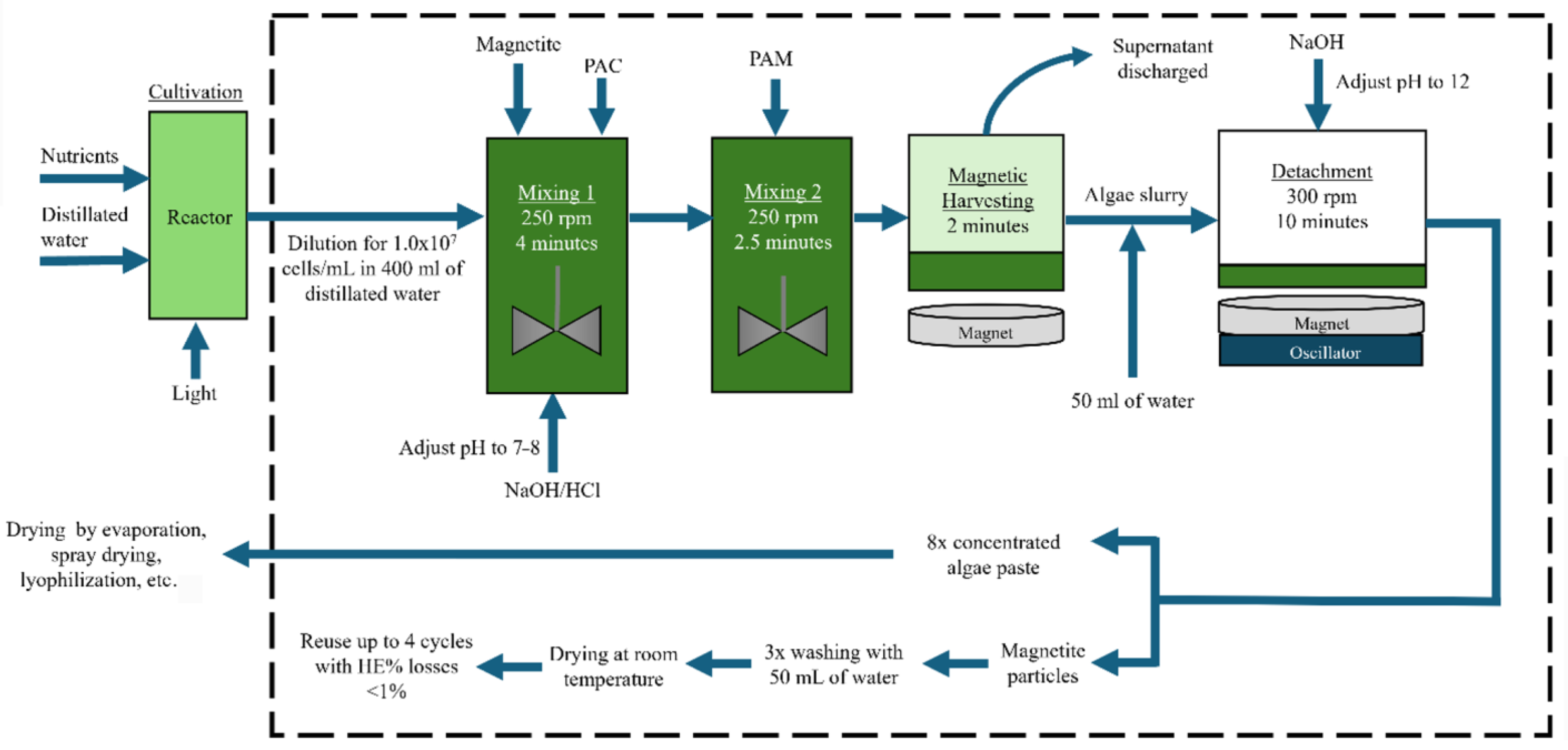
The production of concentrated microalgal biomass followed the optimized methodology described in Silva et al. [18], as schematized in Figure 1. The system boundaries, also illustrated in Figure 1, exclude both the cultivation of microalgae and the final drying of the concentrated biomass, focusing exclusively on the dewatering stage, since it is the main bottleneck of the harvesting procedure. Additional downstream processes, such as extraction and cell disruption, are similarly excluded. This approach allows for a focused assessment of the harvesting and detachment stages without interference from upstream or downstream processes that have been extensively studied in the literature. Since magnetic particles (MP’s) are reused within the process, their drying at ambient conditions is included in the system boundaries. However, this step contributes negligibly to the overall environmental impact due to the minimal energy requirements associated with natural air drying.
The microalga C. vulgaris AGF002, supplied by AllMicroalgae S.A, Pataias, Portugal, was maintained on solid OECD medium [37] containing 15 g/L agar at 4 °C in the dark. Liquid pre-inoculum was prepared by transferring cells from the agar plates into 50 mL of OECD medium in 100 mL Erlenmeyer flasks. These cultures were incubated at ambient temperature (~25 °C) on an orbital shaker at 80 rpm under continuous fluorescent light (4000–4200 K) with an intensity of 3700 lux until the desired biomass concentration was reached. The pre-inoculum was then centrifuged at 4000× g for 10 min and resuspended prior to use.
Cultivations for harvesting were performed in 1 L Erlenmeyer flasks containing 0.5 L of culture, as well as in 1 L and 2 L Schott bottles filled to 80% of their volume under the same conditions. Growth was assumed to be comparable across all setups, as the objective was high biomass production, and similar concentrations were observed after equivalent cultivation times. Cultures were maintained under sterile, static conditions with filtered airflow at 9.2 L/min for 7–10 days.
Magnetic harvesting assays were conducted in beakers containing 400 mL of microalgal suspension at a concentration of 1.0 × 10⁷ cells/mL. The water used to dilute the culture from its initial concentration to the experimental level was not included in the inventory, as previous assessments indicated that the method remains effective across a concentration range of 1–6 × 10⁷ cells/mL, consistent with typical values reported in the literature [38].
Polyaluminum chloride (PAC) (RMN Group, Landim, Portugal) was added at 0.625 mmol Al/L (RMN Group, Portugal) and magnetite (RMN Group, Landim, Portugal) at 1.0 g/L, and the suspension was stirred at 250 rpm for 4 min (Mixing 1) using a Hei-TORQUE® Core (Heidolph Instruments, Schwabach, Germany), while the pH was adjusted to 7–8 with 1 M HCl or NaOH. Subsequently, polyacrylamide (PAM) was added at 1.0 mg/L, followed by stirring for 2.5 min (Mixing 2). Then, stirring was stopped, and the formed microalgae-magnetic particle agglomerates sedimented for 2 min inside a proprietary magnetic system configuration (patent pending) with an approximate total volume of 0.6 dm3. The system presented magnetic field inductions as high as 250 mT within the operating volume, reaching gradients of up to 10 T/m. After magnetic exposure, the aggregates were separated from the supernatant by magnetic separation.
For detachment, the collected aggregates were resuspended in 50 mL of distilled water, and the pH was adjusted to 12 using NaOH with manual mixing. This volume was reduced compared to the methodology of Silva et al. [18] (originally 400 mL) to allow a theoretical eight-fold concentration, assuming negligible losses. The suspension was then placed on an orbital shaker (ELMI DOS-20M digital orbital shaker, ELMI SIA, Riga, Latvia) operating at 300 rpm under oscillating magnetic fields. The proprietary system (patent pending) generated oscillating magnetic field inductions between 0 and 400 mT within the operating volume of 0.1 dm3, reaching gradients up to 15 T/m and enabling efficient detachment of the magnetic particles from microalgal biomass. After 10 min, the resuspended biomass was collected and set aside for drying, while the remaining slurry was washed 3–5 times with 50 mL of distilled water and subjected to localized magnetic oscillation at lower magnetic field intensities to remove any residual biomass and recover all remaining magnetic particles. The recovered particles were dried and compared with the initial mass to assess recovery performance.
As previously indicated, cultivation and final drying stages were excluded from the system boundaries to enable a focused assessment of the harvesting and detachment process, which are widely recognized as major energy and cost bottlenecks in microalgae production. Including these stages would reduce the ability to isolate the specific contribution of the methodology under study. In addition, these stages have been extensively evaluated in previous LCA studies, allowing this work to adopt a targeted perspective. After the detachment step, the NaOH-containing solution was neutralized prior to disposal in accordance with standard laboratory procedures. At larger scales, the recovery or recirculation of this alkaline stream should be considered to reduce environmental impacts and improve process efficiency.

2.2. Life Cycle Inventory: Data and Assumptions

The life cycle inventory (LCI) quantifies all material, energy, and resource inputs required to produce the concentrated microalgal biomass, based on the defined functional unit. Primary data on material and energy consumption were collected from four consecutive harvesting and detachment cycles, in which the same MPs were reused while fresh biomass was processed. Each cycle was performed in triplicate to ensure reproducibility and to enable estimation of experimental variability.
Inventory values were normalized to the functional unit by dividing the total material and energy inputs per harvesting cycle by the experimentally measured dry amount of concentrated biomass recovered in each cycle. Biomass quantification was based on experimental measurements, and results are reported as mean values ± standard deviation obtained from triplicate experiments conducted over four consecutive cycles. Absolute energy consumption per cycle reflects fixed equipment operation and is independent of the amount of biomass processed. However, all values used in the LCA were expressed per functional unit through normalization by the recovered biomass, ensuring consistency across inventory data and impact assessment. Table 1 summarizes the material and energy inputs and the corresponding Ecoinvent v3.11 datasets used for each inventory item. Whenever possible, Portuguese datasets were selected; otherwise, European or global datasets were applied.
For background processes (including raw material extraction/production and transportation), Ecoinvent v3.11 datasets were used. The following assumptions were considered: (1) NaOH, PAC, and PAM were assumed to be locally produced and transported by truck within a maximum distance of 50 km from Porto; (2) magnetite was assumed to originate from the Kiruna mine (Sweden), transported 170 km by train to the port of Narvik, followed by a maritime journey of 3933 km to the port of Leixões, Portugal [39].
Electricity consumption was modeled using the Portuguese low-voltage electricity mix, reflecting local energy characteristics. As electricity was identified as the main contributor to global warming potential, additional details regarding its calculation and conversion factors (kWh to CO2-eq) are provided in the Supplementary Materials.
Magnetite (Fe3O4) particles used in the experiments were prepared according to Silva et al. [18]. In more detail, these particles were obtained by co-precipitation and grinding natural Fe3O4 particles to a size range of 25–63 μm. The particles exhibit irregular morphology and a composition primarily consisting of Fe (67.83%), O (30.87%), and minor carbon content (1.3%) [18].

2.3. Life Cycle Impact Assessment

The ReCiPe 2016 Midpoint (E) method was applied to assess the environmental impacts of the process system. This method provides 18 midpoint impact indicators, summarized in Table 2, each representing a specific environmental impact and accounting for all relevant impact pathways. The Equalitarian (E) perspective adopts a long-term, precautionary approach, aiming to protect the welfare of both present and future generations by considering uncertain or slow-developing environmental effects [40].
ReCiPe 2016 Midpoint (E) is particularly suitable for the system under study, as the selected impact categories effectively capture the dominant environmental burdens associated with the manufacturing and processing steps described in previous sections. All calculations were performed using the LCA software SimaPro v10.1.

3. Results and Discussion

3.1. Life Cycle Inventory

For the base case considered, all material and energy inputs were quantified across four consecutive magnetic harvesting and detachment cycles, in which the same MPs were reused. The results per cycle and per FU are summarized in Table 3 and organized according to the main process steps. Inventory values were converted to FU-based results by normalizing total material and energy consumption per cycle to the experimentally measured dry biomass recovered at the end of each cycle. This approach ensures consistency between absolute process inputs and their corresponding environmental impact per unit of biomass.
All results are reported as mean ± standard deviation (n = 3 per cycle). The observed variability reflects experimental uncertainty associated with reagent dosing, biomass recovery, and energy measurements. Consistent with the LCA framework adopted, no inferential statistical analysis was performed, as the objective is to quantify environmental impacts rather than to compare biological treatments. Energy consumption per cycle corresponds to fixed equipment operation, and is independent of the amount of biomass processed (this is the main cause for energy inefficiency before an optimization, as the same amount of energy consumption is applied to different amounts of dry biomass). However, differences in biomass recovery across cycles result in variability in FU-normalized values, propagating uncertainty in the reported impacts. Based on the ratio between absolute values per cycle and FU-normalized results, the average biomass recovered per cycle was approximately 50 mg. This confirms the small processing scale of the experimental system and helps explain the relatively high energy intensity per functional unit.
To ensure consistency with the Ecoinvent datasets, experimental units were converted to the required formats for each inventory input. For analysis purposes, the process was divided into the following steps: Mixing 1, Mixing 2, Harvesting and Resuspension, Detachment, and MP Washing.
In terms of reagent use by mass, magnetite is the most consumed (7.476 mg/FU), as it is essential for enabling magnetic separation and must be present in sufficient quantities to ensure effective interaction with the microalgal biomass. In contrast, PAM, a high-molecular-weight polymer, is effective at much lower doses (0.007 mg/FU) due to its large molecular size and strong flocculating properties. The second-highest reagent consumption corresponds to NaOH used for pH adjustment to 12 during detachment (3.631 mg/FU), reflecting the highly alkaline conditions required to promote particle release.
Regarding deionized water, the largest input is associated with magnetite washing (2.816 mL/FU), approximately three times the volume used for resuspension (0.934 mL/FU). Both volumes are necessary for cleaning the MPs and preparing the aggregates for detachment, respectively. Particle cleaning was performed manually by agitating the beaker under the magnetic field of a small point-source magnet. As confirmed and further discussed below, the environmental impact of water use on the overall process is negligible; therefore, no further optimization of this volume was undertaken. In practice, less than 150 mL of water could be sufficient for particle cleaning. However, this volume was chosen as the minimum required to first resuspend the particles (50 mL) and then perform three washing steps. These steps were selected because, visually, no microalgae cells remained attached to the magnetite, a result further verified by UV-Vis spectroscopy against a water background.
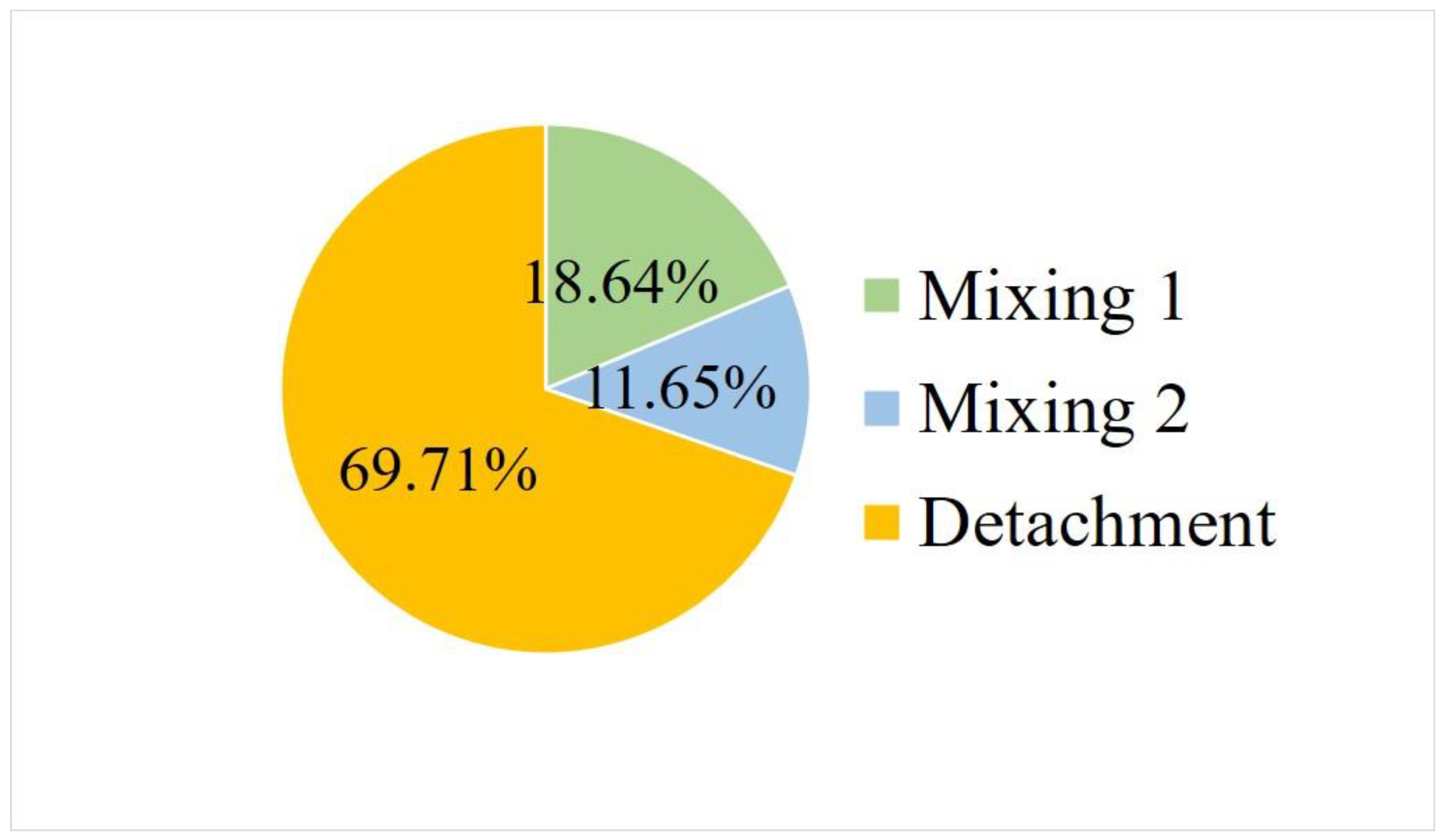
In terms of energy consumption, the total energy demand of the magnetic harvesting and detachment process was 3.76 × 10⁻³ kWh per cycle (Table 3). Magnetic field oscillation during the detachment step accounted for the largest share of energy use (2.62 × 10⁻³ kWh), representing approximately 69.71% of the total demand, followed by Mixing 1 (7.00 × 10⁻⁴ kWh, ~18.64%) and Mixing 2 (4.40 × 10⁻⁴ kWh, ~11.65%). As illustrated in Figure 2, energy consumption is therefore dominated by the detachment step, which combines reagent addition with intensive agitation to promote effective particle–biomass separation.

3.2. Environmental Impact Assessment

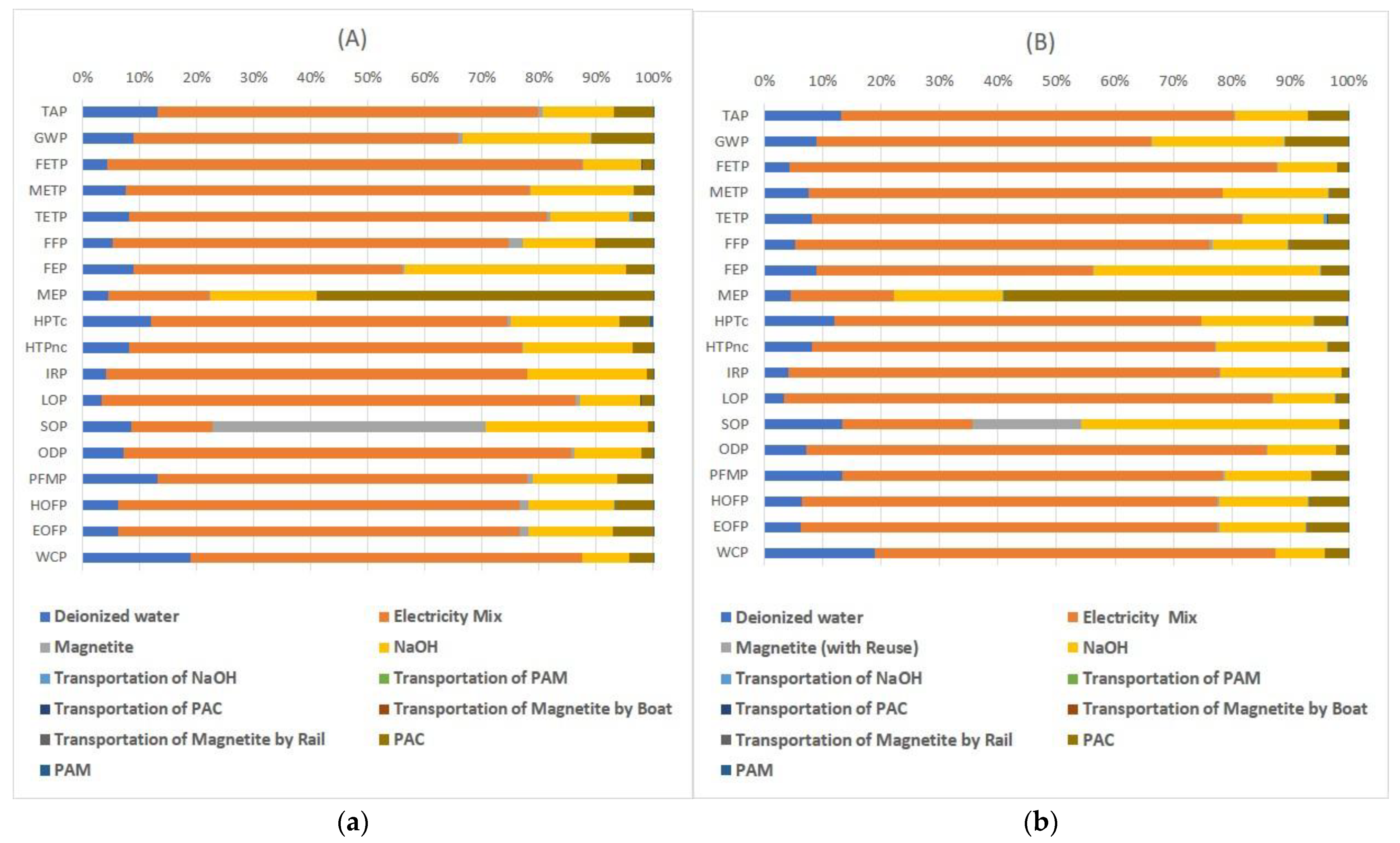
To quantify the potential environmental impacts associated with each system input, the life cycle inventory was combined with background process data and characterized using the emission factors implemented in SimaPro. LCI data was multiplied by the corresponding characterization factors to calculate impact indicators, enabling the determination of the relative contribution (%) of each inventory item to the selected impact categories, as presented in Figure 3.
The results indicate that electricity consumption constitutes the main environmental hotspot across most impact categories. In particular, electricity accounts for 83,20% of the Land Use Potential (LOP), 83.22% of the Freshwater Ecotoxicity Potential (FETP), and 78.41% of the Stratospheric Ozone Depletion Potential (ODP). This dominant contribution reflects the high reliance on grid electricity, particularly in the magnetic detachment step, as well as the associated upstream associated with the Portuguese electricity mix. This result also reflects the biomass recovery per cycle (~50 mg), which amplifies energy consumption when expressed per functional unit.
Sodium hydroxide (NaOH) also emerges as a relevant contributor in specific categories, representing 28.34% of the Mineral Resource Scarcity Potential (SOP), 38.81% of the Freshwater Eutrophication Potential (FEP), and 22.42% of the Global Warming Potential (GWP). These contributions are primarily linked to the energy-intensive chlor-alkali process used for NaOH production, which relies on brine electrolysis. When fossil-based electricity is involved, this process leads to substantial emissions of CO2, SO2, and NOx, thereby influencing climate change, acidification, and toxicity-related impact categories [41].
In the Marine Eutrophication Potential (MEP) category, the most significant contributions are from polyaluminum chloride (PAC) and NaOH, accounting for 58.97% and 18.67%, respectively. Although PAC is widely applied to control eutrophication in water treatment systems, its production has been associated with emissions of nitrogen and sulfur oxides, which may interfere with microbial nitrogen cycling and contribute to eutrophication-related impacts [42].
Deionized water contributes to all impact categories with an average share of approximately 8%, becoming more relevant for water consumption potential (WCP, 18.93%). This reflects the water requirements associated with the deionization process. Emissions related to transport along all supply routes have a negligible influence across all impact categories, including the long-distance transport of magnetite from Sweden to Portugal. This is primarily due to the very small quantities of materials involved. A similar effect is observed for PAM, whose contribution is also marginal. Consequently, these inputs are barely distinguishable in Figure 3.
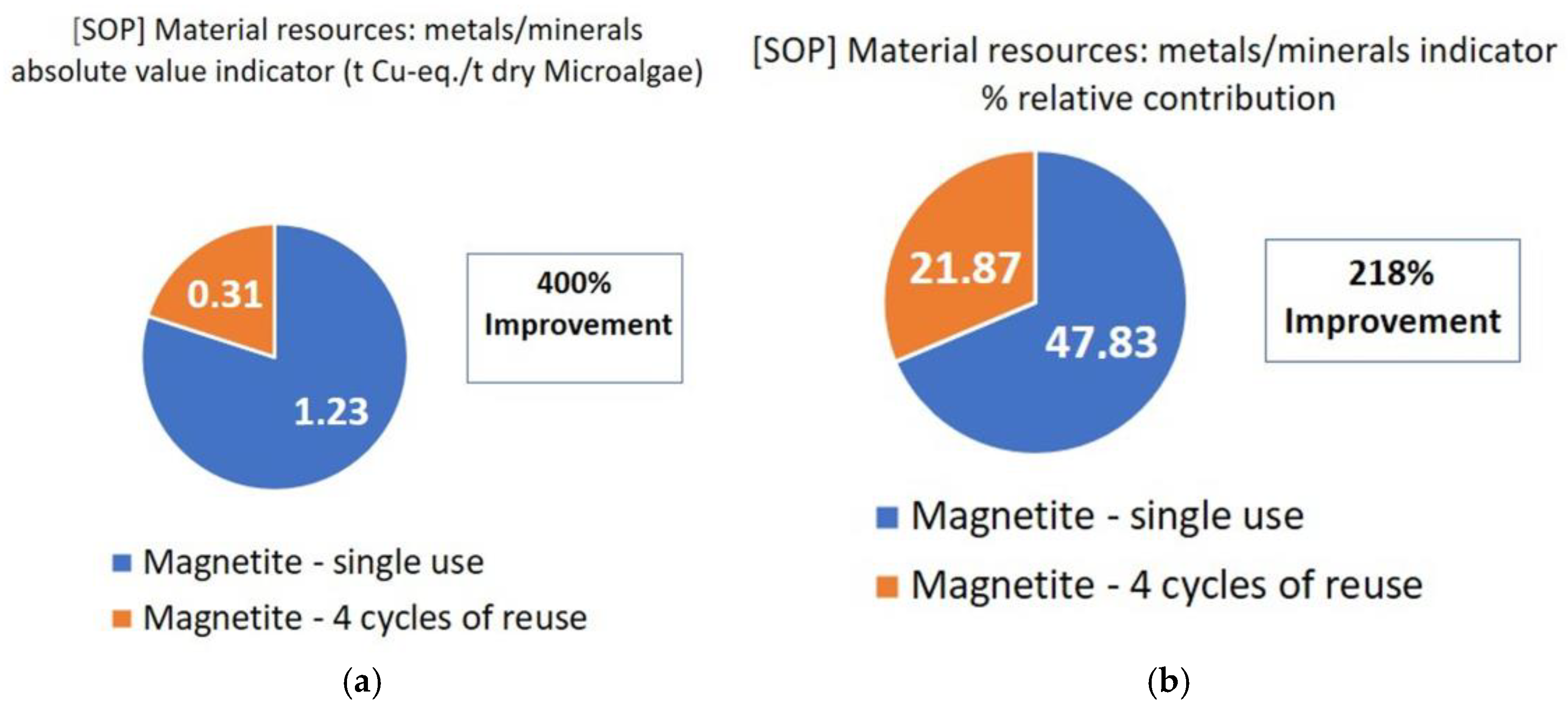
Figure 3a presents the results obtained without magnetite reutilization. Under these conditions, magnetite shows a substantial contribution mainly to mineral resource scarcity (SOP, 33.99%), as this category directly reflects the depletion of material resources. However, experimental results [18] demonstrate that magnetic particles can be reused for up to four consecutive cycles, with negligible impact on harvesting efficiency (<1%) and minor particle mass losses (<3.5%) per cycle. Particle recovery was qualitatively confirmed through visual inspection and UV–Vis analysis, indicating effective particle separation and reuse under the studied conditions. This stability in harvesting efficiency across cycles, despite minor particle losses, is a key finding as it enables a substantial reduction in materbial resource depletion (one of the main objectives of implementing reuse strategies) [18]. As a result, the contribution of magnetite to this impact category decreases from 47.83% (main contributor) to 18.64% (third contributor)—as illustrated in Figure 3b and Figure 4. Overall, magnetite reuse leads to an approximately fourfold reduction in absolute contribution to environmental impacts. Nevertheless, a dedicated cost analysis should be performed in the future, as magnetic particles and their production routes may involve significant costs depending on particle characteristics (e.g., size, morphology, etc.) and synthesis methods [19,43,44].
Despite these promising features, including particle reuse and compatibility with renewable energy sources, the global warming potential (GWP) for the worst scenario was estimated at approximately 14 t CO2-eq per tonne of dry biomass. This value is consistent with typical laboratory-scale LCA studies, where energy consumption per functional unit is inherently higher due to small working volumes and fixed equipment energy demand (only very few LCA on lab-scale techniques for microalgae harvesting have been published, but the obtained value is lower than, for example, the one presented for microalgae harvesting by centrifugation [45]). The elevated GWP is primarily attributed to the use of laboratory-scale equipment (e.g., the Hei-TORQUE® Core mixer), which operates with fixed power ratings under low-volume conditions (≈50 mL), resulting in inefficient energy use and increased kWh per unit of biomass processed. In addition, the use of a small functional unit (1 mg) and its extrapolation to tonne-scale values (109 factor) amplifies the effect of small deviations and experimental uncertainties.
These limitations are characteristic of early-stage, laboratory-scale assessments. As shown in previous studies [46], scaling up the process and optimizing operational conditions are expected to significantly improve energy efficiency and reduce environmental impacts, potentially achieving values below 1 t CO2-eq per tonne of dry biomass.

3.2.1. Main Environmental Impacts by Process Step

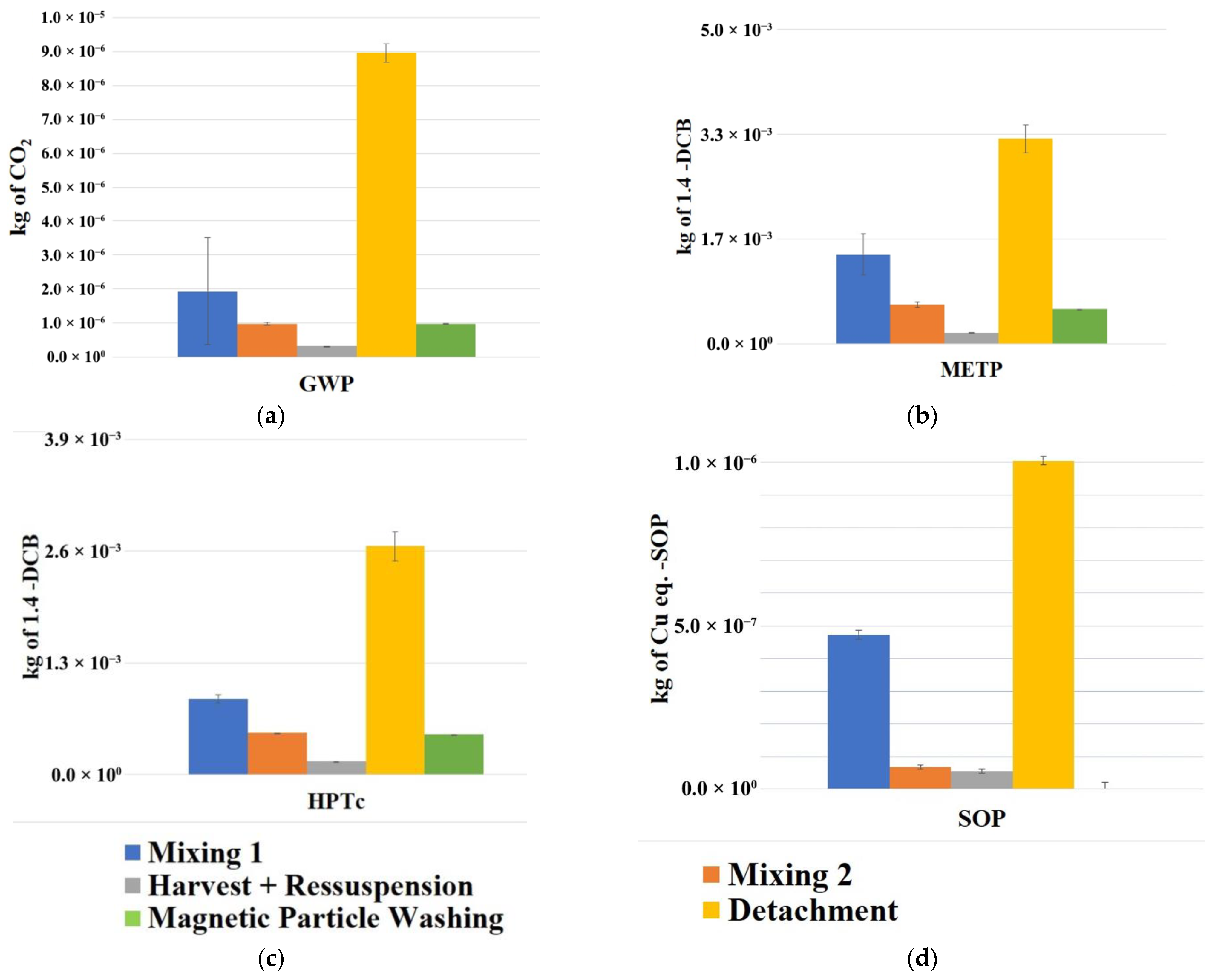
It is important to evaluate the contribution of each step of the magnetic harvesting process in the overall environmental performance, especially for the four key impact categories—global warming potential (GWP), marine ecotoxicity potential (METP), human carcinogenic toxicity potential (HTPc) and material resource scarcity (SOP) as presented in Figure 5.
At first glance, one might expect the relative contributions of each process step to remain consistent across impact categories, since the same inventory inputs are considered and only their scaling differs. However, this is not observed: each impact category has distinct characterization factors, which translate identical material quantities into different environmental impacts; consequently, an input that dominates one impact category (e.g., electricity in most categories) may have a significantly lower contribution in others. This explains the differences in the contribution patterns observed across the impact categories in Figure 3.
As shown in Figure 5, the detachment step exhibits the highest environmental impact across all categories. This result is expected, as this step involves both NaOH addition and intensive stirring, accounting for about two-thirds of the total energy consumption, as well as a significant contribution to mineral resources depletion. It is also important to highlight that the application of oscillating magnetic fields reduces the amount of NaOH required for effective detachment. In the absence of this mechanism, NaOH would likely become the dominant contributor across several impact categories. The high energy consumption associated with this step is primarily due to the use of laboratory-scale equipment operating at very small volumes (≈50 mL), which leads to inefficient energy use per unit of biomass processed. Therefore, significant reductions in energy demand are expected at larger scales through process optimization and improved operational efficiency. In addition, NaOH is expected to be recycled or recirculated under industrial-scale conditions, which would further reduce its contribution to the environmental impacts.
In fact, in the current lab-scale system, after detachment, the NaOH-containing solution was neutralized prior to disposal following standard laboratory procedures, and at an industrial scale, recovery or recirculation of the alkaline solution will be considered to reduce both environmental impacts and operational costs, representing a relevant opportunity for process optimization.
The Mixing 1 step is the second most relevant contributor to the key environmental indicators, due to the combined effects of reagent addition and mechanical stirring. On the other hand, the harvesting step contributes minimally to energy-related impacts, as the magnet acquisition represents an initial capital expenditure (CAPEX) rather than ongoing energy use. Similarly, Resuspension involves only the addition of deionized water and manual mixing, with water being the main source of impact. In comparison, Particle Washing shows roughly three times higher impact, reflecting the higher volume of distilled water used in this step. These results are specific to laboratory-scale conditions and may differ at larger scales, where process configurations and mixing strategies are expected to be significantly optimized.

3.2.2. Sensitivity Analysis

A sensitivity analysis was performed to assess the influence of the energy source on the environmental performance of the process, considering two scenarios: (1) grid electricity and (2) on-site renewable generation via photovoltaic (PV) systems. For the grid electricity scenario, the Portuguese low-voltage electricity mix described previously, which includes fossil fuel contributions, was applied. For the PV scenario, the corresponding Ecoinvent v3.11 dataset (Electricity production, photovoltaic, 3 kWp slanted-roof installation, multi-Si, panel, mounted) was used to capture the associated environmental impacts accurately.
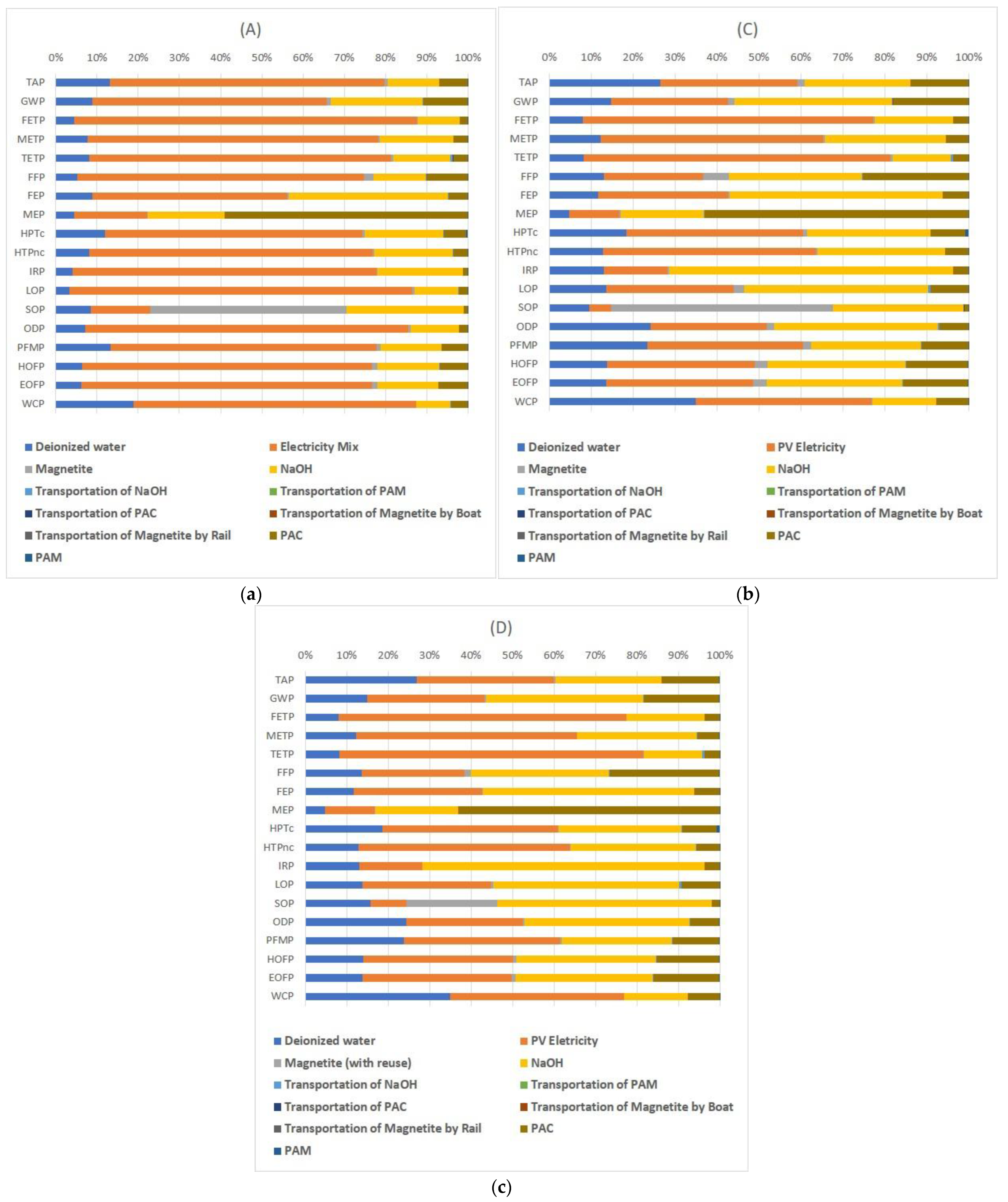
As shown in Figure 6, replacing grid electricity with on-site PV generation reduces the overall contribution of electricity, shifting the relative importance toward other inputs such as NaOH, PAC, and deionized water. A noticeable increase in the relative contribution of magnetite is also observed, particularly in the SOP and FFP categories. This impact is reduced by a relevant magnitude when 4 cycles of reuse are considered for the magnetite (Figure 6c). With these changes, in several impact categories, electricity decreases its impact considerably, being even surpassed by the NaOH contribution.
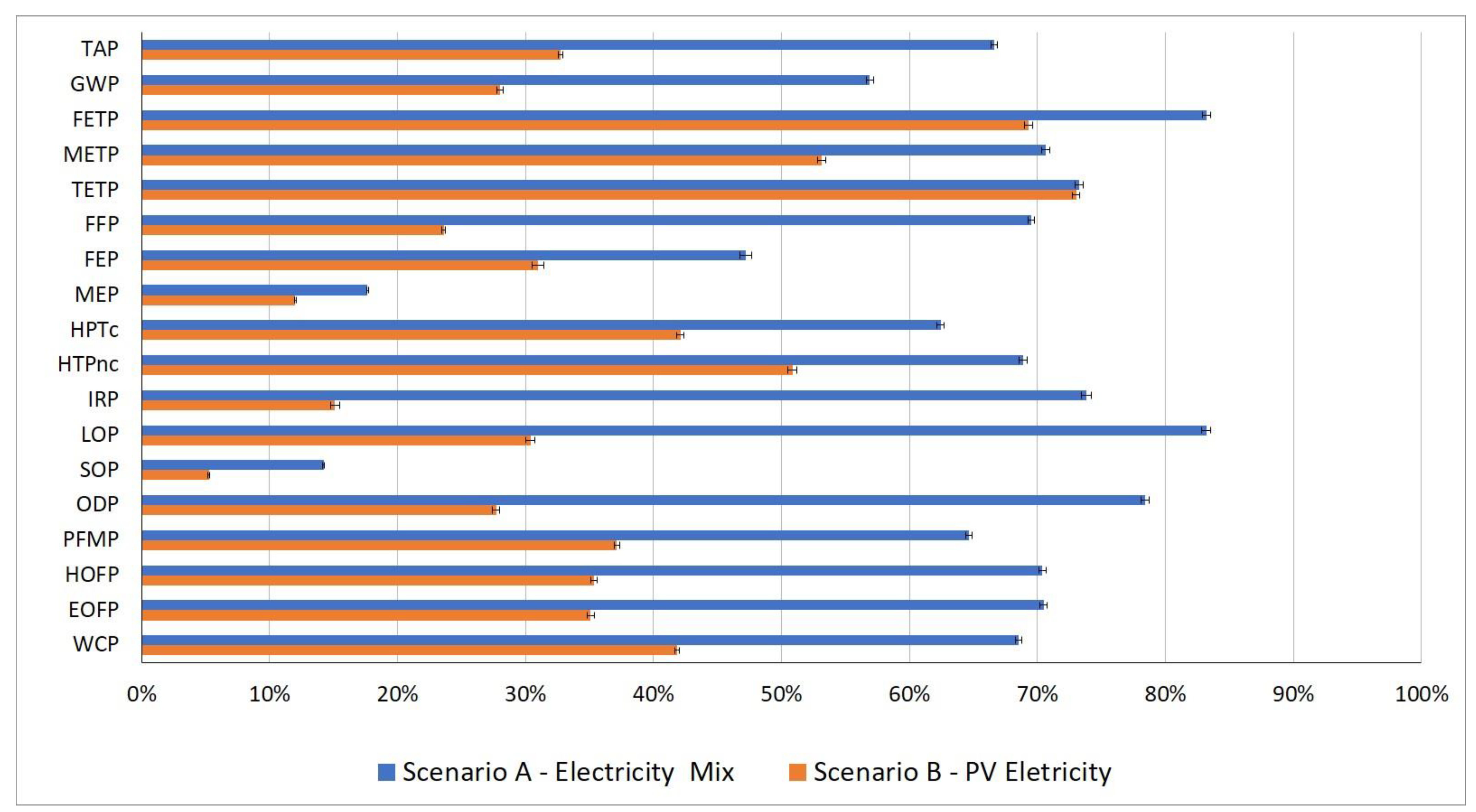
It is also important to consider absolute impact values, as relative contributions alone do not fully reflect the real magnitude of improvements achieved under each scenario. Figure 7 shows that, for most impact categories, the environmental burden decreases when PV energy is used, which is generally a cleaner energy source, with reductions in some cases reaching more than 50% (from about 83% into 30%).
However, in two impact categories, MEP and TETP, impacts slightly increase under PV (1.24% and 3.15%, respectively), mainly due to the environmental burdens of solar panel production. End-of-life recycling may also involve processes that generate or release toxic substances, posing potential risks to terrestrial and marine ecosystems that are accounted for by those categories [47].
Compared with the conventional energy mix, PV offers additional benefits, such as the potential for fully local generation, for example, via rooftop panels at algae production facilities. These factors should also be considered in a comprehensive cost–benefit analysis.
Substituting grid electricity with photovoltaic (PV) energy reduces GWP to 8.7 t CO2-eq/t dry microalgae, corresponding to a reduction of 59.1%. When magnetite reuse is also considered, besides the important reduction in materials depletion (as seen before), the reduction in GWP reaches about 1%, highlighting the importance of both renewable energy integration and particle recycling in mitigating environmental burdens. In agreement with Gerulová et al. [48], the reuse of magnetic particles represents a promising strategy to reduce impacts associated with mineral resource depletion and potential toxicity, while also contributing to improvements in other environmental indicators.
As previously discussed, these results are strongly influenced by the laboratory scale nature of the experiments, where energy inputs are high relative to the small quantities of biomass processed, resulting in inefficient energy use per functional unit. At larger scales, improvements in process efficiency, optimized mixing conditions, and reduced relative energy demand are expected to significantly lower environmental impacts. Therefore, future work should include scale-up modelling, optimization of larger-scale processes, and comprehensive techno-economic assessments to more accurately evaluate the feasibility and sustainability of this methodology at a larger scale.

4. Conclusions

This study evaluated the environmental performance of a laboratory-scale magnetic harvesting and detachment process for C. vulgaris. The results identified electricity consumption as the main environmental hotspot across many of the impact categories when a mix-based electricity grid is used as a source, highlighting the critical influence of the energy source on the overall process sustainability. Among the different process steps, the Detachment step exhibited the highest impact, primarily due to the combined contribution of reagent use and energy consumption during stirring.
Across the full process, sodium hydroxide (NaOH) was identified as the second most significant contributor after electricity, reflecting the energy-intensive nature of its production and its associated environmental burdens.
In contrast, the recovery and reuse of magnetite (tested over four consecutive cycles) demonstrated clear benefits in terms of circularity and sustainability, leading to a substantial reduction in impacts related to mineral resource scarcity (SOP) when compared to a single use of magnetite. The stability of magnetic particle performance under repeated use was confirmed through magnetic separation, visual inspection, and UV–Vis analysis, indicating minimal losses and consistent efficiency.
The sensitivity analysis demonstrated that replacing grid electricity with photovoltaic (PV) energy significantly reduces environmental impacts overall environmental impacts (up to 50% in some indicators). Minor increases in certain toxicity-related indicators were observed due to the environmental burdens associated with PV production and end-of-life processes. These results highlight the potential of renewable energy integration as an effective strategy to improve environmental performance.
The estimated global warming potential (~14.6 t CO2-eq per tonne of dry biomass using the grid mix, and ~8.7 t CO2-eq with PV and magnetite reuse) is consistent with existing laboratory-scale LCA studies. Indeed, and although this work also accounts as novelty for the inclusion of the detachment step in the overall LCA analysis, the comparison with the (scarce) LCA studies published for laboratory-scale microalgae harvesting demonstrates that the values obtained are below more energy-intensive competitor technologies (such as centrifugation). Anyway, it is also important to notice that the values obtained in this work are still mainly driven by inefficient energy use under small-scale conditions, where fixed equipment energy demand is distributed over very small quantities of processed biomass (e.g., using low volumes under high stirrings, using diluted solutions) and amplified when results are extrapolated to tonne-scale.
At larger scales, significant improvements in energy efficiency, optimized operating conditions, and process integration are expected to substantially reduce environmental impacts, as occurred in similar works.
Overall, future work should focus on LCA analysis on a large-scale setup and optimization of the process, especially considering the enhancement of energy efficiency, optimization of process conditions (e.g., mixing and magnetic separation), maximization of magnetite reuse, and reduction or recirculation of NaOH.

Supplementary Materials

The following supporting information can be downloaded at: https://www.mdpi.com/article/10.3390/su18126376/s1. Table S1: Summary of representative LCAs of microalgae systems, including cradle-to-gate and harvesting-focused studies. Refs. [49,50,51,52,53,54,55,56] are cited in the Supplementary Materials.

Author Contributions

Conceptualization, T.C.G.; methodology, T.C.G., T.M.M. and A.A.M.; software, J.B., T.M.M. and A.A.M.; validation, T.M.M. and A.A.M.; formal analysis, T.C.G., T.M.M. and A.A.M.; investigation, J.B., T.C.G. and P.A.A.; resources, T.C.G. and P.A.A.; data curation, J.B., T.M.M., A.A.M. and P.A.A.; writing—original draft preparation, J.B., T.C.G., T.M.M. and A.A.M.; writing—review and editing, M.S., P.A.A. and T.C.G.; visualization, T.C.G., P.A.A. and M.S.; supervision, T.C.G., M.S. and P.A.A.; project administration, T.C.G.; funding acquisition, D.B., P.A.A. and M.S. All authors have read and agreed to the published version of the manuscript.

Funding

This work was financially supported by base funding from the following projects: FCT/MECI: LEPABE, UID/00511/2025 (https://doi.org/10.54499/UID/00511/2025) and UID/PRR/00511/2025 (https://doi.org/10.54499/UID/PRR/00511/2025) and ALiCE, LA/P/0045/2020 (https://doi.org/10.54499/LA/P/0045/2020); and project 18.R0.09 (funded by European Union and USAL) (Paulo A. Augusto) and Contract 2021 02188 CEECIND—Portuguese Foundation for Science and Technology (Teresa Castelo-Grande) and contract 2023.15056.TENURE.038—Portuguese Foundation for Science and Technology and the Recovery and Resilience Plan of the Portuguese Republic (António Martins). Additional support was provided by LAETA (UIDB/50022/2020, DOI: 10.54499/UID/50022/2025), UID/50016/2025, and CBQF (LA/P/0076/2020, DOI: 10.54499/LA/P/0076/2020), funded by national funds through FCT/MCTES (PIDDAC).

Institutional Review Board Statement

Not applicable.

Informed Consent Statement

Not applicable.

Data Availability Statement

The data presented in this study is available on request from the corresponding author.

Conflicts of Interest

The authors declare no conflicts of interest.

References

  1. Richmond, A.; Hu, Q. (Eds.) Handbook of Microalgal Culture: Biotechnology and Applied Phycology, 2nd ed.; Wiley Blackwell: Hoboken, NJ, USA, 2013. [Google Scholar]
  2. Barros, A.I.; Gonçalves, A.L.; Simões, M.; Pires, J.C.M. Harvesting techniques applied to microalgae: A review. Renew. Sustain. Energy Rev. 2015, 41, 1489–1500. [Google Scholar] [CrossRef]
  3. Wang, S.K.; Stiles, A.R.; Guo, C.; Liu, C.Z. Harvesting microalgae by magnetic separation: A review. Algal Res. 2015, 9, 178–185. [Google Scholar] [CrossRef]
  4. Koyande, A.K.; Show, P.-L. Microalgae Harvest Technology. In Handbook of Biorefinery Research and Technology: Production of Biofuels and Biochemicals; Springer: Berlin/Heidelberg, Germany, 2024; pp. 705–730. [Google Scholar] [CrossRef]
  5. Roy, M.; Mohanty, K. A comprehensive review on microalgal harvesting strategies: Current status and future prospects. Algal Res. 2019, 44, 101683. [Google Scholar] [CrossRef]
  6. Yin, Z.; Zhu, L.; Li, S.; Hu, T.; Chu, R.; Mo, F.; Hu, D.; Liu, C.; Li, B. A comprehensive review on cultivation and harvesting of microalgae for biodiesel production: Environmental pollution control and future directions. Bioresour. Technol. 2020, 301, 122804. [Google Scholar] [CrossRef] [PubMed]
  7. Kucmanová, A.; Gerulová, K. Microalgae Harvesting: A Review. Res. Pap. Fac. Mater. Sci. Technol. Slovak Univ. Technol. 2019, 27, 129–143. [Google Scholar] [CrossRef]
  8. Barsanti, L.; Gualtieri, P. Is exploitation of microalgae economically and energetically sustainable? Algal Res. 2018, 31, 107–115. [Google Scholar] [CrossRef]
  9. Milledge, J.J.; Heaven, S. A review of the harvesting of micro-algae for biofuel production. Rev. Environ. Sci. Biotechnol. 2013, 12, 165–178. [Google Scholar] [CrossRef]
  10. Qin, S.; Wang, K.; Gao, F.; Ge, B.; Cui, H.; Li, W. Biotechnologies for bulk production of microalgal biomass: From mass cultivation to dried biomass acquisition. Biotechnol. Biofuels Bioprod. 2023, 16, 1–25. [Google Scholar] [CrossRef] [PubMed]
  11. Deconinck, N.; Muylaert, K.; Ivens, W.; Vandamme, D. Innovative harvesting processes for microalgae biomass production: A perspective from patent literature. Algal Res. 2018, 31, 469–477. [Google Scholar] [CrossRef]
  12. de Lima Barizão, A.C.; de Oliveira, J.P.; Gonçalves, R.F.; Cassini, S.T. Nanomagnetic approach applied to microalgae biomass harvesting: Advances, gaps, and perspectives. Environ. Sci. Pollut. Res. 2021, 28, 44795–44811. [Google Scholar] [CrossRef] [PubMed]
  13. Visigalli, S.; Barberis, M.G.; Turolla, A.; Canziani, R.; Berden Zrimec, M.; Reinhardt, R.; Ficara, E. Electrocoagulation–flotation (ECF) for microalgae harvesting—A review. Sep. Purif. Technol. 2021, 271, 118684. [Google Scholar] [CrossRef]
  14. Zhu, J.; Wakisaka, M.; Omura, T.; Yang, Z.; Yin, Y.; Fang, W. Advances in industrial harvesting techniques for edible microalgae: Recent insights into sustainable, efficient methods and future directions. J. Clean. Prod. 2024, 436, 140626. [Google Scholar] [CrossRef]
  15. Pacheco, A.R.F.; Cardoso, B.D.; Pires, A.; Pereira, A.M.; Araújo, J.P.; Carvalho, V.M.; Rodrigues, R.O.; Coutinho, P.J.G.; Castelo-Grande, T.; Augusto, P.A.; et al. Development of pH-Sensitive Magnetoliposomes Containing Shape Anisotropic Nanoparticles for Potential Application in Combined Cancer Therapy. Nanomaterials 2023, 13, 1051. [Google Scholar] [CrossRef] [PubMed]
  16. Castelo-Grande, T.; Augusto, P.A.; Gomes, L.; Lopes, A.R.C.; Araújo, J.P.; Barbosa, D. Economic and Accessible Portable Homemade Magnetic Hyperthermia System: Influence of the Shape, Characteristics and Type of Nanoparticles in Its Effectiveness. Materials 2024, 17, 2279. [Google Scholar] [CrossRef] [PubMed]
  17. Hu, Y.-R.; Guo, C.; Xu, L.; Wang, F.; Wang, S.-K.; Hu, Z.; Liu, C.-Z. A magnetic separator for efficient microalgae harvesting. Bioresour. Technol. 2014, 158, 388–391. [Google Scholar] [CrossRef] [PubMed]
  18. Silva, P.M.; Gonçalves, P.; Grande, T.C.; Augusto, P.A.; Barbosa, D.; Simões, M. Innovative and high efficiency harvesting process of Chlorella vulgaris by magnetic harvesting. Environ. Res. 2025, 284, 122249. [Google Scholar] [CrossRef] [PubMed]
  19. Schobesberger, M.; Helmhagen, S.; Mende, S.; Berensmeier, S.; Fraga-García, P. From Micro to Nano: Grinding Natural Magnetite Ore for Microalgae Harvesting. Magnetochemistry 2023, 9, 149. [Google Scholar] [CrossRef]
  20. Seo, J.Y.; Lee, K.; Lee, S.Y.; Jeon, S.G.; Na, J.-G.; Oh, Y.-K.; Bin Park, S. Effect of barium ferrite particle size on detachment efficiency in magnetophoretic harvesting of oleaginous Chlorella sp. Bioresour. Technol. 2014, 152, 562–566. [Google Scholar] [CrossRef] [PubMed]
  21. Wang, T.; Yang, W.L.; Hong, Y.; Hou, Y.L. Magnetic nanoparticles grafted with amino-riched dendrimer as magnetic flocculant for efficient harvesting of oleaginous microalgae. Chem. Eng. J. 2016, 297, 304–314. [Google Scholar] [CrossRef]
  22. Zhang, B.; Mao, B. Efficient magnetic flocculation for microalgae harvesting using a novel composite flocculant of Fe3O4-based starch-grafted-cationic polyacrylamide. J. Water Process Eng. 2023, 55, 104121. [Google Scholar] [CrossRef]
  23. Hu, Y.R.; Guo, C.; Wang, F.; Wang, S.K.; Pan, F.; Liu, C.Z. Improvement of microalgae harvesting by magnetic nanocomposites coated with polyethylenimine. Chem. Eng. J. 2014, 242, 341–347. [Google Scholar] [CrossRef]
  24. Xu, L.; Guo, C.; Wang, F.; Zheng, S.; Liu, C.Z. A simple and rapid harvesting method for microalgae by in situ magnetic separation. Bioresour. Technol. 2011, 102, 10047–10051. [Google Scholar] [CrossRef] [PubMed]
  25. Markeb, A.A.; Llimós-Turet, J.; Ferrer, I.; Blánquez, P.; Alonso, A.; Sánchez, A.; Moral-Vico, J.; Font, X. The use of magnetic iron oxide based nanoparticles to improve microalgae harvesting in real wastewater. Water Res. 2019, 159, 490–500. [Google Scholar] [CrossRef] [PubMed]
  26. Nguyen, M.D.; Tran, H.V.; Xu, S.; Lee, T.R. Fe3O4 Nanoparticles: Structures, Synthesis, Magnetic Properties, Surface Functionalization, and Emerging Applications. Appl. Sci. 2021, 11, 11301. [Google Scholar] [CrossRef] [PubMed]
  27. Guillén, A.; Ardila, Y.; Noguera, M.J.; Campaña, A.L.; Bejarano, M.; Akle, V.; Osma, J.F. Toxicity of Modified Magnetite-Based Nanocomposites Used for Wastewater Treatment and Evaluated on Zebrafish (Danio rerio) Model. Nanomaterials 2022, 12, 489. [Google Scholar] [CrossRef] [PubMed]
  28. Prochazkova, G.; Podolova, N.; Safarik, I.; Zachleder, V.; Branyik, T. Physicochemical approach to freshwater microalgae harvesting with magnetic particles. Colloids Surf. B Biointerfaces 2013, 112, 213–218. [Google Scholar] [CrossRef] [PubMed]
  29. Almomani, F. Algal cells harvesting using cost-effective magnetic nano-particles. Sci. Total Environ. 2020, 720, 137621. [Google Scholar] [CrossRef] [PubMed]
  30. Chu, F.J.; Wan, T.J.; Chen, H.; Wu, C.H.; Kao, P.M. Magnetophoretic Harvesting of Nannochloropsis oculata Using Iron Oxide Immobilized Beads. Water 2020, 12, 236. [Google Scholar] [CrossRef]
  31. Hena, S.; Fatihah, N.; Tabassum, S.; Lalung, J.; Jing, S.Y. Magnetophoretic harvesting of freshwater microalgae using polypyrrole/Fe3O4 nanocomposite and its reusability. J. Appl. Phycol. 2016, 28, 1597–1609. [Google Scholar] [CrossRef]
  32. Wang, X.; Zhao, Y.; Jiang, X.; Liu, L.; Li, X.; Li, H.; Liang, W. In-situ self-assembly of plant polyphenol-coated Fe3O4 particles for oleaginous microalgae harvesting. J. Environ. Manag. 2018, 214, 335–345. [Google Scholar] [CrossRef] [PubMed]
  33. Fu, Y.; Hu, F.; Li, H.; Cui, L.; Qian, G.; Zhang, D.; Xu, Y. Application and mechanisms of microalgae harvesting by magnetic nanoparticles (MNPs). Sep. Purif. Technol. 2021, 265, 118519. [Google Scholar] [CrossRef]
  34. Egesa, D.; Chuck, C.J.; Plucinski, P. Multifunctional Role of Magnetic Nanoparticles in Efficient Microalgae Separation and Catalytic Hydrothermal Liquefaction. ACS Sustain. Chem. Eng. 2017, 6, 991–999. [Google Scholar] [CrossRef]
  35. ISO 14040:2006; Environmental Management—Life Cycle Assessment—Principles and Framework. Available online: https://www.iso.org/standard/37456.html (accessed on 13 May 2026).
  36. ISO 14044:2006; Environmental Management—Life Cycle Assessment—Requirements and Guidelines. Available online: https://www.iso.org/standard/38498.html (accessed on 13 May 2026).
  37. OECD. Freshwater Alga and Cyanobacteria, Growth Inhibition Test. In OECD Guidelines for the Testing of Chemicals, Section 2; No. 201; OECD: Paris, France, 2011. [Google Scholar]
  38. Bumbak, F.; Cook, S.; Zachleder, V.; Hauser, S.; Kovar, K. Best practices in heterotrophic high-cell-density microalgal processes: Achievements, potential and possible limitations. Appl. Microbiol. Biotechnol. 2011, 91, 31–46. [Google Scholar] [CrossRef] [PubMed]
  39. From Mine to Port—LKAB. Available online: https://lkab.com/en/what-we-do/from-mine-to-port/ (accessed on 13 May 2026).
  40. Huijbregts, M.A.J.; Steinmann, Z.J.N.; Elshout, P.M.F.; Stam, G.; Verones, F.; Vieira, M.; Zijp, M.; Hollander, A.; van Zelm, R. ReCiPe2016: A harmonised life cycle impact assessment method at midpoint and endpoint level. Int. J. Life Cycle Assess. 2017, 22, 138–147. [Google Scholar] [CrossRef]
  41. Vyawahare, P.; Sun, P.; Young, B.; Bafana, A.; Kim, T.; Hawkins, T.R.; Elgowainy, A. Life Cycle Greenhouse Gas Emissions Analysis of the Chlor-Alkali Process and By-Product Hydrogen in the United States. Hydrogen 2025, 6, 12. [Google Scholar] [CrossRef]
  42. Sharaai, A.H.; Mahmood, N.Z.; Sulaima, A.H. Life Cycle Impact Assessment (LCIA) Using TRACI Methodology: An Analysis of Potential Impact on Potable Water Production. Aust. J. Basic Appl. Sci. 2010, 4, 4313–4322. [Google Scholar]
  43. Augusto, P.A.; Castelo-Grande, T.; Vargas, D.; Pascual, A.; Hernández, L.; Estevez, A.M.; Barbosa, D. Upscale Design, Process Development, and Economic Analysis of Industrial Plants for Nanomagnetic Particle Production for Environmental and Biomedical Use. Materials 2020, 13, 2477. [Google Scholar] [CrossRef] [PubMed]
  44. Xu, Y.; Fu, Y.; Zhang, D. Cost-effectiveness Analysis on Magnetic Harvesting of Algal Cells. Mater. Today Proc. 2017, 4, 50–56. [Google Scholar] [CrossRef]
  45. Lardon, L.; Hélias, A.; Sialve, B.; Steyer, J.-P.; Bernard, O. Life-Cycle Assessment of Biodiesel Production from Microalgae. Environ. Sci. Technol. 2009, 43, 6475–6481. [Google Scholar] [CrossRef] [PubMed]
  46. Soomro, R.R.; Ndikubwimana, T.; Zeng, X.; Lu, Y.; Lin, L.; Danquah, M.K. Development of a Two-Stage Microalgae Dewatering Process—A Life Cycle Assessment Approach. Front. Plant Sci. 2016, 7, 113. [Google Scholar] [CrossRef] [PubMed]
  47. Bošnjaković, M.; Santa, R.; Crnac, Z.; Bošnjaković, T. Environmental Impact of PV Power Systems. Sustain. 2023, 15, 11888. [Google Scholar] [CrossRef]
  48. Gerulová, K.; Kucmanová, A.; Sanny, Z.; Garaiová, Z.; Seiler, E.; Čaplovičová, M.; Čaplovič, Ľ.; Palcut, M. Fe3O4-PEI Nanocomposites for Magnetic Harvesting of Chlorella vulgaris, Chlorella ellipsoidea, Microcystis aeruginosa, and Auxenochlorella protothecoides. Nanomaterials 2022, 12, 1786. [Google Scholar] [CrossRef] [PubMed] [PubMed Central]
  49. Sander, K.; Murthy, G.S. Life cycle analysis of algae biodiesel. Int. J. Life Cycle Assess. 2010, 15, 704–714. [Google Scholar] [CrossRef]
  50. O’Connell, D.; Savelski, M.; Slater, C.S. Life cycle assessment of dewatering routes for algae derived biodiesel processes. Clean Technol. Environ. Policy 2013, 15, 567–577. [Google Scholar] [CrossRef]
  51. Zaimes, G.G.; Khanna, V. Microalgal biomass production pathways: Evaluation of life cycle environmental impacts. Biotechnol. Biofuels 2013, 6, 1–11. [Google Scholar] [CrossRef]
  52. Collotta, M.; Champagne, P.; Mabee, W.; Tomasoni, G.; Leite, G.B.; Busi, L.; Alberti, M. Comparative LCA of Flocculation for the Harvesting of Microalgae for Biofuels Production. Procedia CIRP 2017, 61, 756–760. [Google Scholar] [CrossRef]
  53. Soudagar, M.E.; Kiong, T.S.; Jathar, L.; Ghazali, N.N.; Ramesh, S.; Awasarmol, U.; Ong, H.C. Perspectives on cultivation and harvesting technologies of microalgae, towards environmental sustainability and life cycle analysis. Chemosphere 2024, 353, 141540. [Google Scholar] [CrossRef] [PubMed]
  54. Wei, C.; Huang, Y.; Xia, A.; Zhu, X.; Zhu, X.; Liao, Q. Performance and feasibility analysis of an integrated airlift microalgae photobioreactor for cultivation and pre-harvesting. J. Environ. Manag. 2025, 375, 124244. [Google Scholar] [CrossRef] [PubMed]
  55. Available online: www.nowtricity.com (accessed on 5 June 2026).
  56. Fator de Emissão da Eletricidade—2025; Agencia Portuguesa de Ambiente: Lisbon, Portugal, 2025.
Figure 1. Process flow diagram illustrates magnetic harvesting and particle detachment for C. vulgaris. The system boundaries considered in the LCA are indicated by the dashed line.
Sustainability 18 06376 g001
Figure 2. Percentage distribution of energy consumption across the different steps of the magnetic harvesting and detachment process.
Sustainability 18 06376 g002
Figure 3. Relative contribution (%) of each inventory item to the potential environmental impacts per functional unit (FU) for the associated grid electricity scenarios, considering: (a) (Scenario A) no magnetite reutilization and (b) (Scenario B) with magnetite reutilization. Note: all the inventory items are present in the bar charts (thus the corresponding colors) but in some cases their contribution is very small and thus almost imperceptible.
Sustainability 18 06376 g003
Figure 4. Contribution of magnetite to the impact on material resources: metals/minerals indicator (SOP): (a) absolute value indicator (t Cu-eq./t dry Microalgae), (b) % relative contribution.
Sustainability 18 06376 g004
Figure 5. Contribution of each step of the magnetic harvesting process for four key impact categories (from left to right and from top to bottom): (a) global warming potential (GWP), (b) marine ecotoxicity potential (METP), (c) human carcinogenic toxicity potential (HTPc), and (d) material resource scarcity: metals/minerals (SOP). Error bars represent standard deviation (n = 3).
Sustainability 18 06376 g005
Figure 6. Relative contribution (%) of each inventory item to the potential environmental impacts per functional unit (FU) for two electricity scenarios and reuse: (a) (Scenario A) grid electricity; (b) (Scenario C) PV electricity and (c) (Scenario D) PV electricity and magnetite reutilization.
Sustainability 18 06376 g006
Figure 7. Energy-related environmental impacts (% of total) for each impact category under scenarios A (grid electricity) and B (PV electricity).
Sustainability 18 06376 g007
Table 1. LCI of all materials and energy inputs used in this study, including the corresponding Ecoinvent v3.11 datasets and regions considered.
Inventory ItemDataset from Ecoinvent v3.11Region Considered
Raw materials
MagnetiteMarket for magnetiteGlobal
PACMarket for polyaluminum chlorideGlobal
NaOHMarket for sodium hydroxide, without water, in 50% solutionEurope
PAMMarket for polyacrylamideGlobal
Deionized waterMarket for water, deionizedEuropean Union
Energy
Electricity (grid mix)Market for electricity, low voltagePortugal
Background processes
Truck transportationMarket for transport, freight, lorry, >32 t, diesel, EURO 6Europe
Sea transportationTransport, freight, sea, bulk carrier for dry goods, heavy fuel oilGlobal
Rail transportationTransport, freight, train, electricEuropean Union
Table 2. Environmental impact categories, abbreviations, and units considered in the LCA using the ReCiPe 2016 Midpoint (Equalitarian) method.
AbbreviationImpact CategoryUnit
GWPGlobal warming potentialkg CO2 eq
ODPStratospheric ozone depletion potentialkg CFC-11 eq
IRPIonizing radiation potentialkBq Co-60 eq
HOFPOzone formation, human health potentialkg NOx eq
PMFPFine particulate matter formation potentialkg PM2.5 eq
EOFPOzone formation, terrestrial ecosystem potentialkg NOx eq
TAPTerrestrial acidification potentialkg SO2 eq
FEPFreshwater eutrophication potentialkg P eq
MEPMarine eutrophication potentialkg N eq
TETPTerrestrial ecotoxicity potentialkg 1.4-DCB
FETPFreshwater ecotoxicity potentialkg 1.4-DCB
METPMarine ecotoxicity potentialkg 1.4-DCB
HTPcHuman carcinogenic toxicity potentialkg 1.4-DCB
HTPncHuman non-carcinogenic toxicity potentialkg 1.4-DCB eq
LOPLand use potentialm2a crop eq
SOPMineral resource scarcity potentialkg Cu eq
FFPFossil resource scarcity potentialkg oil eq
WCPWater consumption potentialm3
Table 3. Life cycle inventory (LCI) per harvesting cycle and per functional unit (FU) for the magnetic harvesting and detachment process. Values are reported as mean ± standard deviation (n = 3) and organized by process step.
Process StepParameterValue per CycleValue per Cycle per FUUnit
Mixing 1Magnetite400.2 ± 4 × 10−17.5 ± 3 × 10⁻¹mg
PAC25.4 ± 1 × 10−14.8 × 10−1 ± 2 × 10⁻²mg
NaOH addition—pH adjustment to 710 ± 21.93 × 10⁻¹ ± 1 × 10⁻³mg
Energy for Mixing 17.00 × 10−41.31 × 10−5 ± 1.68 × 10⁻⁹kWh
Mixing 2PAM4.002 × 10−1 ± 4 × 10−47.5 × 10−3 ± 3 × 10⁻⁴mg
Energy for Mixing 24.4 × 10⁻⁴ ± 4 × 10−88.17 × 10−6 ± 8.42 × 10⁻¹⁰kWh
Recovery and resuspensionNaOH addition—pH adjustment to 12194 ± 433.631 ± 1 × 10⁻³mg
Resuspension deionized water50.0 ± 0.5 × 10−19.34 × 10−1 ± 1 × 10⁻³mL
DetachmentEnergy for oscillation of magnetic field2.62 × 10−34.89 × 10⁻⁵ ± 9.62 × 10⁻¹⁰kWh
MP WashingDeionized water for MP washing150 ± 5 × 10−12.816 ± 1 × 10⁻³mL
Disclaimer/Publisher’s Note: The statements, opinions and data contained in all publications are solely those of the individual author(s) and contributor(s) and not of MDPI and/or the editor(s). MDPI and/or the editor(s) disclaim responsibility for any injury to people or property resulting from any ideas, methods, instructions or products referred to in the content.