1. Introduction
Against the background of the dual-carbon goal and the broader green development strategy, improving total factor productivity (TFP) and accelerating low-carbon transformation have become core imperatives for the high-quality development of the civil aviation sector. Yet existing research predominantly measures TFP at the industry level, characterizing efficiency trends through sector-wide averages. While this macro-level perspective facilitates the identification of broad patterns, it embeds a strong assumption of firm homogeneity within the industry and neglects the substantial heterogeneity across airlines in terms of factor endowments, strategic orientations, operational models, and carbon emission intensities. In fact, firms constitute the fundamental micro-level agents of emission reduction and efficiency improvement, and the transmission mechanisms through which the same external policy shock operates may differ fundamentally across firms. Confining the analysis to the industry level not only conceals the loss of key information arising from individual heterogeneity but also obscures the deep roots of efficiency differentiation—thereby weakening the precision and effectiveness of policy formulation. It is therefore necessary to shift the unit of analysis to the firm level and systematically investigate the heterogeneous evolution of TFP and its influencing factors across airlines under carbon constraints.
As the core backbone of China’s civil aviation transport system, Air China, China Eastern Airlines, and China Southern Airlines provide ideal subjects for firm-level analysis. By the end of 2023, the three airlines together accounted for more than 40% of the industry’s total fleet and 67.2% of total transport turnover, representing an absolute majority of China’s civil aviation industry. More importantly, the three airlines exhibit significant divergence in strategic positioning: Air China focuses on internationalization and premium service delivery, with its international route share having reached 42.3%; China Southern Airlines adheres to a domestic-market-led strategy, with prominent advantages in domestic route coverage and destination breadth; China Eastern Airlines is positioned as the regional leader anchored in the Yangtze River Delta, with its international operations concentrated primarily on short-haul routes in Southeast and Northeast Asia. These structural differences directly shape the heterogeneity of the three airlines in production efficiency, resource allocation capacity, and resilience under environmental constraints and constitute the micro-level foundation for understanding the overall efficiency differentiation within China’s civil aviation industry.
As a comprehensive indicator of productive efficiency levels given factor inputs, TFP measurement methodology has evolved from parametric to non-parametric approaches, from static to dynamic specifications, and from ignoring environmental factors to incorporating undesirable outputs. Early studies relied primarily on the Solow residual method. Yi et al. [
1] established the theoretical foundation of TFP as a composite indicator encompassing technological, managerial, and institutional effects, after which stochastic frontier analysis (SFA) and data envelopment analysis (DEA) subsequently became mainstream. Tu [
2] and Jeon and Sickles [
3] confirmed the driving role of frontier technological progress in TFP growth. Traditional methods, however, exhibit clear limitations in handling environmental constraints: while Vasigh and Fleming [
4] and Wang et al. [
5] began incorporating carbon emissions into TFP accounting, static models remained inadequate for capturing cross-period efficiency changes. Oh [
6] addressed this bottleneck through the Global Malmquist–Luenberger (GML) index, which resolves the problem of cross-period incomparability. Assaf [
7] applied DEA methods to identify load factor and scale efficiency as key drivers of airline efficiency, while Zhang et al. [
8] and Russell [
9] emphasized the importance of controlling for environmental disturbances and cross-period global benchmarking. Sang and Gao [
10] and Liu et al. [
11] further noted the shift toward multi-dimensional comprehensive evaluation frameworks.
In recent years, the GML index has been widely applied to green performance evaluation in the aviation and transportation sectors. Song et al. [
12] found that environmental factors including regional GDP and degree of openness exert heterogeneous influences on aviation operational efficiency, while Kim and Son [
13] revealed, from an international comparative perspective, the universality of cross-firm heterogeneity in aviation environmental performance. Chen et al. [
14] demonstrated from the transportation sector that structural endowments of individual entities remain the fundamental driver of efficiency divergence even under a unified policy environment. Liu and Gao [
15] and Wang et al. [
16] applied the GML index to the civil aviation and transportation industries, accumulating further empirical evidence on the negative effects of factor market distortions and spatial heterogeneity in technical efficiency. Jin [
17] explored TFP measurement techniques for cases involving negative values at the airline level, extending the GML framework’s applicability to micro-level entities. However, these studies share a common limitation: the GML index has consistently been used to characterize the efficiency trajectory of the “average firm,” rather than to interrogate why different firms operating under the same carbon constraints evolve along fundamentally divergent paths—a gap that has directly constrained the translation of policy recommendations from industry-wide prescriptions to firm-specific precision guidance.
At the level of factor identification, existing research exhibits analogous limitations. Technological innovation is generally regarded as the core driving force for TFP growth, but Xu and Zhao [
18] pointed out that the emission reduction effects of technological progress are often offset by scale expansion. Market competitiveness influences TFP through the optimization of resource allocation, and Liu [
19] confirmed that market-oriented reform has significantly improved operational indicators in China’s civil aviation industry. With respect to human capital, Chen et al. [
20] found that it not only directly affects TFP but also indirectly drives efficiency by influencing technological progress. Regarding environmental regulation, An et al. [
21] found that environmental constraints can enhance green operational efficiency, and Cao et al. [
22] further demonstrated that heterogeneous environmental regulation influences TFP through the mediating pathway of technological innovation, with fundamental differences between command-and-control and market-incentive regulatory transmission mechanisms. The core deficiency of existing research lies in its predominant focus on industry-level identification of influencing factors, with insufficient analysis of differentiated inter-firm transmission mechanisms and, in particular, a failure to distinguish between short-run cost effects and long-run cumulative effects.
Drawing on Solow growth theory, the theory of environmental production, and endogenous growth theory, this study employs the GML index to measure TFP for the three major airlines under carbon constraints and constructs a static-dynamic regression framework to address three core questions: (1) the dynamic evolution of TFP among China’s three major airlines under carbon constraints; (2) the short-run and long-run mechanisms through which various influencing factors operate; and (3) the heterogeneity of these mechanisms across airlines of different strategic archetypes.
Compared with existing studies employing the GML index for TFP analysis, the novelty of this study manifests across three dimensions. First, with respect to the unit of analysis, existing GML-based TFP studies adopt the industry or provincial level as the analytical unit, treating the civil aviation sector as a homogeneous entity. This study shifts the unit of analysis to the individual firm level, treating Air China, China Eastern Airlines, and China Southern Airlines as independent research subjects and conducting directly comparable efficiency measurements under a common global production frontier—an advance that existing GML studies in the civil aviation domain have yet to achieve. Second, with respect to heterogeneity identification, existing studies typically confine themselves to describing industry-average trends or conducting inter-provincial spatial comparisons after computing TFP. This study goes further by constructing a static-dynamic two-tier regression framework to systematically identify the differentiated transmission pathways through which the same determinant operates across firms with distinct strategic orientations, while explicitly distinguishing between short-run adjustment cost effects and long-run cumulative effects—thereby revealing the fundamental divergence in TFP driving mechanisms across three heterogeneous strategic archetypes: the market-led type, the scale-expansion type, and the regional-deepening type. Third, with respect to policy application, the policy recommendations of existing GML studies tend to remain at the industry level. This study, drawing on firm-level heterogeneity findings, constructs a differentiated “one firm, one policy” framework that provides more targeted guidance for efficiency improvement pathways for airlines of different strategic types operating under carbon constraints.
2. Analysis of the Current Development Status of the Three Major Airlines
Based on the recent operational practices of the three major airlines, this section systematically reviews their development status across two dimensions—business structure and strategic positioning, and factor input and output structure—providing an empirical basis for the subsequent TFP measurement and firm-level heterogeneity analysis.
2.1. Business Structure and Strategic Differences in the Three Major Airlines
The business structures of the three major airlines are significantly differentiated owing to their divergent strategic positioning, as summarized in
Table 1.
Air China pursues internationalization and premium service delivery as its core strategy. Its business structure is characterized by an international route share of 42.3% in 2019—the highest among the three airlines—and a wide-body aircraft share of 27.3%, with the fleet configuration oriented toward long-haul operations and premium passenger segments. This strategic positioning means that Air China’s network is more heavily dependent on international markets and long-haul route development.
China Southern Airlines, in contrast, pursues a domestic-market-led strategy. Its domestic route share increased from 71.2% in 2019 to 76.8% in 2023, and it maintains the most extensive coverage among the three airlines, particularly in second- and third-tier cities. This structural characteristic orients its strategic focus firmly toward domestic passenger demand and regional connectivity.
China Eastern Airlines pursues a strategy that balances regional leadership and peripheral international expansion. Its operations are rooted in the Yangtze River Delta region, with international routes concentrated primarily on short-haul markets such as Southeast Asia rather than long-haul destinations in Europe or the Americas. This strategic configuration allows the airline to moderately expand short-haul regional international network while maintaining a dominant position in the regional market, positioning it between Air China’s globalization-oriented model and China Southern Airlines’ domestic-market-led approach.
Overall, the strategic differences among the three airlines originate from divergent resource endowments, locational advantages, and historical path dependencies. Air China fulfills the functions of national opening-up and premium aviation services; China Southern Airlines leverages its South China location to serve the domestic mass market at scale; and China Eastern Airlines aligns with the Yangtze River Delta integration strategy to strengthen its regional core competitiveness. These structural differences will profoundly shape each airline’s production efficiency trajectory and low-carbon transition pathway under carbon constraints.
2.2. Factor Input and Output Structure of the Three Major Airlines
The three major airlines exhibit marked differences in the scale, allocation structure, and utilization efficiency of key production factors—including capital, labor, and energy. These differences are closely linked to their respective strategic choices and operational models, and provide the empirical basis for the subsequent heterogeneity analysis of green productivity.
In terms of capital input, China Eastern Airlines has been relatively aggressive in capital expenditure, with substantial investments in fleet renewal and information technology, while Air China places greater emphasis on capital allocation efficiency and maintains a comparatively prudent investment scale. However, from the perspective of fixed asset turnover, the decline of China Eastern Airlines is the most pronounced, indicating that its large-scale capital investment has not yet been effectively converted into output efficiency and that capacity utilization remains insufficient. China Southern Airlines records the highest turnover rate among the three, reflecting the asset utilization advantage conferred by its scale-expansion strategy.
In terms of human capital, the growth rate of personnel scale has generally decelerated across the industry. Air China improves its staff-to-aircraft ratio through service outsourcing and digital transformation, achieving relatively high human resource utilization efficiency. China Southern Airlines maintains the largest employee base and faces relatively prominent challenges in personnel integration and structural optimization. China Eastern Airlines steadily recalibrates its human resource structure through organizational restructuring. In terms of per capita output, China Southern Airlines achieved positive growth, while Air China and China Eastern Airlines recorded declines, reflecting the influence of divergent market structures on labor efficiency.
In terms of energy input, China Southern Airlines records the lowest energy consumption per unit of turnover, owing to its young fleet and domestic short- and medium-haul route structure. Air China achieved a substantial reduction in energy consumption through the introduction of new-generation wide-body aircraft. Nevertheless, the adoption of sustainable aviation fuel remains at the pilot stage across all three airlines, and they face considerable pressure for green transformation under the dual-carbon goal.
From the output structure perspective, China Southern Airlines exhibits the strongest growth in transport volume, followed by China Eastern Airlines, with Air China lagging behind. The growth of operating revenue and profit is, however, generally slower than that of transport volume across all three airlines, reflecting the dual constraints of declining unit revenue and cost rigidity. Air China is disproportionately affected by its dependence on international routes and the premium market segment; China Southern Airlines, benefiting from cost and structural advantages, records the smallest losses; and China Eastern Airlines occupies an intermediate position.
In summary, the three airlines have formed differentiated operational patterns: China Southern Airlines is characterized by scale leadership, cost controllability, and efficiency stability; Air China by premium positioning, international route dependence, and pronounced volatility; and China Eastern Airlines by regional market focus, structural optimization, and high adaptability. These differentiated patterns of factor input and output efficiency will directly determine the total factor productivity and green productivity levels of each airline, and constitute an important empirical foundation for the subsequent firm-level heterogeneity analysis.
3. Indicator Selection and Model Construction
3.1. TFP Indicator System
Production efficiency in civil aviation transport is a critical issue for the development of China’s air transport enterprises and the industry as a whole, underpinning the strategic transition from a large civil aviation country to a strong one. Total factor productivity (TFP) serves as an effective indicator for measuring the production efficiency in the civil aviation transport industry. Drawing on Solow’s growth theory and the production theory framework of environmental economics, and taking into account data availability and a review of the related literature, this study constructs an evaluation system comprising three input indicators, two desirable output indicators, and one undesirable output indicator. The specific indicators are shown in
Table 2.
3.2. GML Index Model
The Global Malmquist–Luenberger (GML) index model was employed to measure the TFP of Air China, China Eastern Airlines, and China Southern Airlines. By resolving the intertemporal incomparability inherent in the traditional ML index and adopting a global technology benchmark, this model is well suited to the long time-series analysis covering 2005–2023, and can simultaneously accommodate desirable outputs (transport turnover and operating revenue) and undesirable outputs (carbon emissions adjusted by a correction coefficient). This provides a reliable methodological foundation for comparing TFP heterogeneity, identifying influencing factors, and formulating differentiated policies.
The core principles and methodological advantages of the GML index are reflected in the following three aspects.
First, the adoption of a global benchmark ensures intertemporal comparability and measurement stability. The GML index employs the unified production frontier of the entire sample period (2005–2023) as a common benchmark, rather than the current-period or adjacent-period frontier used by the traditional ML index. This fundamentally resolves the problems associated with traditional productivity indices—including infeasibility in linear programming, intertemporal incomparability, and temporal discontinuity—ensuring that the measurement results for Air China, China Eastern Airlines, and China Southern Airlines are fully comparable across all years and can reliably capture long-term dynamic evolution trends.
Second, the GML index accommodates undesirable outputs, thereby meeting the requirements of green development evaluation in civil aviation. Constructed on the basis of the directional distance function, the GML index can simultaneously handle the expansion of desirable outputs and the reduction in undesirable outputs within a unified model framework—balancing the growth of desirable outputs such as total transport turnover and operating revenue against the reduction in undesirable outputs such as CO2 emissions. This fully aligns with the core requirements of green efficiency evaluation in civil aviation under the dual-carbon goal, rendering the measurement results more consistent with actual operations and environmental constraints.
Third, the GML index enables heterogeneity comparisons under a unified technology frontier. By placing all three airlines on the same global production frontier, it effectively eliminates measurement biases arising from differences in technology benchmarks across periods. The traditional ML index relies on current-period or adjacent-period frontiers, each composed of a different combination of firms, such that efficiency comparisons are confounded by shifting technology benchmarks. By contrast, the GML index adopts the unified 2005–2023 frontier as a common reference, ensuring that the measurement results for Air China, China Eastern Airlines, and China Southern Airlines are fully comparable across all years and can reliably reflect long-term dynamic evolution trends and genuine inter-firm differences.
In summary, the GML index offers significant methodological advantages for evaluating the efficiency of aviation enterprises characterized by long time series, multiple inputs and outputs, and undesirable outputs. Its high compatibility with the research objectives, data structure, and analytical approach of this study makes it the most appropriate method for examining the dynamic evolution and heterogeneity of total factor productivity among the three major airlines under carbon constraints.
The global directional distance function serves as the foundation for constructing the GML index model. Built on the production possibility set and the directional distance function, the GML model can effectively circumvent the issue of infeasibility in linear programming. Let the input set be denoted as
the set of desirable outputs as
, and the undesirable output as
. The production possibility set can be defined as follows: there exists a weight vector
such that
where k represents the weight assigned to each cross-sectional observation, and
indicates that the production technology is assumed to exhibit constant returns to scale.
Based on the production possibility set defined above, the global directional distance function can be expressed as follows:
where
is the direction vector;
is the distance function value at period t when the desirable outputs are maximized, and the undesirable outputs are minimized.
represents the matrix of desirable outputs, including route mileage, total transport turnover, and operating revenue;
represents the matrix of undesirable outputs, namely carbon emissions from civil aviation operations; and
represents the matrix of inputs, including the number of employees, fixed investment, and energy consumption.
Based on the global directional distance function defined above, the GML index can be constructed as Equation (3).
When GML > 1, productivity has improved from period t to period t + 1; when GML < 1, productivity has declined. The global nature of this index ensures the transitivity and cross-period comparability of measurement results. The measurement of the GML index for China’s three major airlines followed the steps outlined below.
- (1)
Data integration. Input indicators (labor: number of employees; capital: fixed investment; energy: energy consumption), desirable output indicators (total transport turnover, operating revenue), and undesirable output indicators (carbon emissions) for Air China, China Eastern Airlines, and China Southern Airlines over 2005–2023 were collected separately, forming individual time-series datasets for each airline.
- (2)
Direction vector setting. Following the principle of maximizing desirable outputs while minimizing undesirable outputs, the direction vector was set as , based on current output levels and oriented toward the optimization of the output side.
- (3)
Distance function calculation. For each airline and each year t, the directional distance function value
relative to the global production frontier over 2005–2023 was calculated by solving a linear programming problem.
- (4)
GML index calculation. Based on the distance function values of two adjacent periods, the GML index for each airline in each year was calculated according to Equation (3), yielding the TFP change values of the three major airlines under carbon constraints. The TFP values measured by the GML index model not only accurately reflect each airline’s production efficiency under carbon constraints, but also, through cross-firm and cross-period comparisons, clearly reveal the heterogeneity characteristics of the three airlines—providing a core empirical basis for the subsequent analysis of differentiated determinant mechanisms and the formulation of targeted policies. The interpretation of TFP values measured in this study is summarized in
Table 3.
3.3. Indicator System for Influencing Factors
The selection of influencing factors was aimed at accurately identifying the core driving and inhibiting forces of total factor productivity (TFP) among the three major airlines and further exploring the differentiated performance of their TFP and the underlying transmission mechanisms. As explanatory variables for TFP changes, these factors were not directly involved in the TFP measurement process but were used to analyze the underlying causes of TFP variation across airlines. To clarify the internal logic of TFP changes under carbon constraints, the measured TFP series for each airline was taken as the dependent variable, and time-series regression models were constructed to systematically compare and analyze differences in the influence mechanisms across the three airlines.
This study takes GML-based TFP as the dependent variable, with each explanatory variable selected on the basis of its theoretical transmission mechanism to productivity. Unit fuel consumption (FUEL) proxies technological progress: fuel efficiency improvements advance the production frontier, but transition-period learning costs generate a J-curve pattern of short-run suppression followed by long-run enhancement. Aircraft daily utilization (UTIL) measures capital use intensity: higher utilization increases output per unit of capital input and is expected to exert a positive effect on TFP, though reduced maintenance intervals may partially offset this. Labor productivity (PGDP) reflects human capital quality, promoting TFP through operational efficiency gains and technology absorption capacity; however, skill–job mismatches arising from inadequate organizational absorptive capacity may reverse this effect—a conditional prediction that generates testable heterogeneity across the three airlines. Passenger load factor (LOAD) measures capacity utilization: higher load factors directly improve TFP, with the effect amplified for airlines possessing market pricing power. International route revenue share (INT) carries competing predictions: technology spillovers from international operations promote productivity, while structural adjustment costs impose a short-run burden, and the net effect varies with each airline’s accumulated international operational experience, generating firm-level heterogeneity. The influencing factors of TFP are detailed in
Table 4.
3.4. Static–Dynamic Model
To systematically identify the influencing factors of TFP among China’s three major airlines, a dual analytical framework combining static and dynamic regression models was constructed using time-series data of Air China, China Eastern Airlines, and China Southern Airlines over 2005–2023. This framework was employed to reveal the transmission mechanisms, dynamic evolution characteristics, and inter-firm differences in the effects of each influencing factor on TFP. The sample period fully encompasses the rapid expansion phase, the structural adjustment phase, and the COVID-19 pandemic shock phase of China’s civil aviation industry, enabling comprehensive capture of the differentiation in influence mechanisms across development stages and providing empirical evidence of both representativeness and practical value for subsequent targeted policy formulation.
Given that the data for this study comprise pure time series for each of the three airlines and does not satisfy the conditions for panel data methods, ordinary least squares (OLS) is used to estimate the static models, and an autoregressive distributed lag (ARDL) model is used to estimate the dynamic models. The static model is specified as Equation (4).
where
denotes the intercept,
denote the coefficients of the explanatory variables, and
denotes the random error term.
In addition, a logarithmic regression model and a first-difference model were constructed as supplementary robustness checks.
As a typical capital-intensive industry, the civil aviation industry exhibits a pronounced time-lag between capital investment and output efficiency. The production efficiency of all three major airlines displays significant time-series correlation and historical path dependence. The dynamic model can effectively capture the long-run cumulative effects of factors such as technology diffusion, human capital accumulation, and improvements in management practices on production efficiency, while accurately characterizing inter-firm differences in time-lag effects and dynamic adjustment speed. Analyzing long-run effects through the dynamic model is therefore central to revealing the roots of TFP heterogeneity among the three major airlines. The dynamic time-series regression model is specified as Equation (5).
where
denotes the intercept,
denote the elasticity coefficients of the explanatory variables, and
denotes the coefficient of the lagged dependent variable.
4. TFP Measurement and Comparison of the Three Major Airlines
4.1. Analysis of TFP Results of the Three Major Airlines
This study measures the total factor productivity (TFP) of Air China, China Eastern Airlines, and China Southern Airlines over 2006–2023, retaining a core indicator system comprising three inputs, two desirable outputs, and one undesirable output, with minor adjustments made according to the availability of firm-level data. The analysis proceeds across three dimensions—statistical characteristics of TFP results, time-series evolution trends, and underlying causes of TFP divergence—to reveal the heterogeneous TFP patterns of the three airlines under carbon emission constraints, thereby providing an empirical basis for subsequent factor identification and differentiated policy design. The statistical characteristics of the GML indices for the three major airlines over 2006–2023 are presented in
Table 5.
The three airlines exhibit broadly similar long-run trends in productivity growth. The mean value for China Southern Airlines is 1.0059, while those for Air China and China Eastern Airlines are 1.0014 and 1.0018, respectively. However, a marked divergence is observed in terms of volatility. The standard deviation for China Southern Airlines is only 0.0250, compared with 0.0537 for Air China and 0.0769 for China Eastern Airlines. The coefficient of variation follows the same increasing order—China Southern Airlines (0.0249), Air China (0.0536), and China Eastern Airlines (0.0768)—indicating that the relative volatility of China Southern Airlines is less than one-third that of China Eastern Airlines. The contrast in extreme values is even more pronounced: the ranges for China Eastern Airlines, Air China, and China Southern Airlines are 0.3272, 0.2625, and 0.0919, respectively, reflecting an approximately threefold difference between the highest and lowest values.
In terms of efficiency level, China Southern Airlines records the highest mean TFP, Air China has the lowest, and China Eastern Airlines lies in between. This ranking is consistent with China Southern Airlines having sustained comparative advantages in resource allocation efficiency, fuel use efficiency, and low-carbon operation capability, with its long-term productivity growth broadly leading that of the other two airlines. Regarding operational stability, the heterogeneity among the three airlines is particularly pronounced. China Southern Airlines records the smallest standard deviation, coefficient of variation, and range among the three, reflecting the lowest fluctuation amplitude and the most stable operational performance. Air China exhibits a moderate level of volatility, with its production efficiency being more susceptible to shifts in the international market and external shocks. China Eastern Airlines records the largest standard deviation and range, indicating the highest sensitivity to changes in the market environment and crisis impacts.
Synthesizing the efficiency level and volatility characteristics, China Southern Airlines exhibits a “high-efficiency, low-volatility” development pattern, Air China shows a “medium-efficiency, medium-volatility” pattern, and China Eastern Airlines a “medium-efficiency, high-volatility” pattern.
4.2. Time-Series Evolution Trend Analysis
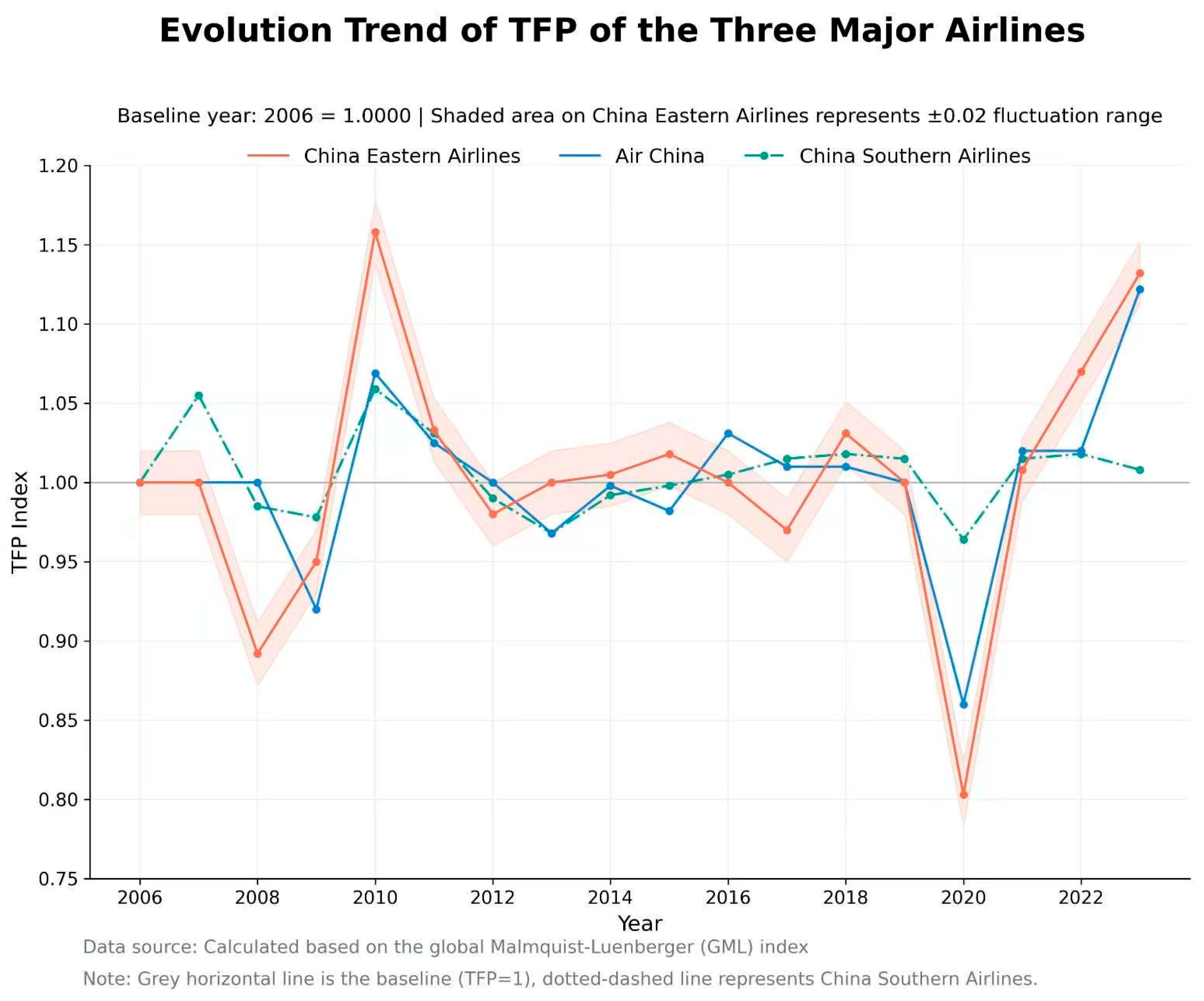
In terms of temporal evolution, the TFP of the three major airlines follows an overall pattern of synchronized volatility accompanied by differentiated recovery, with phase-specific variations closely corresponding to each airline’s strategic positioning and market structure characteristics.
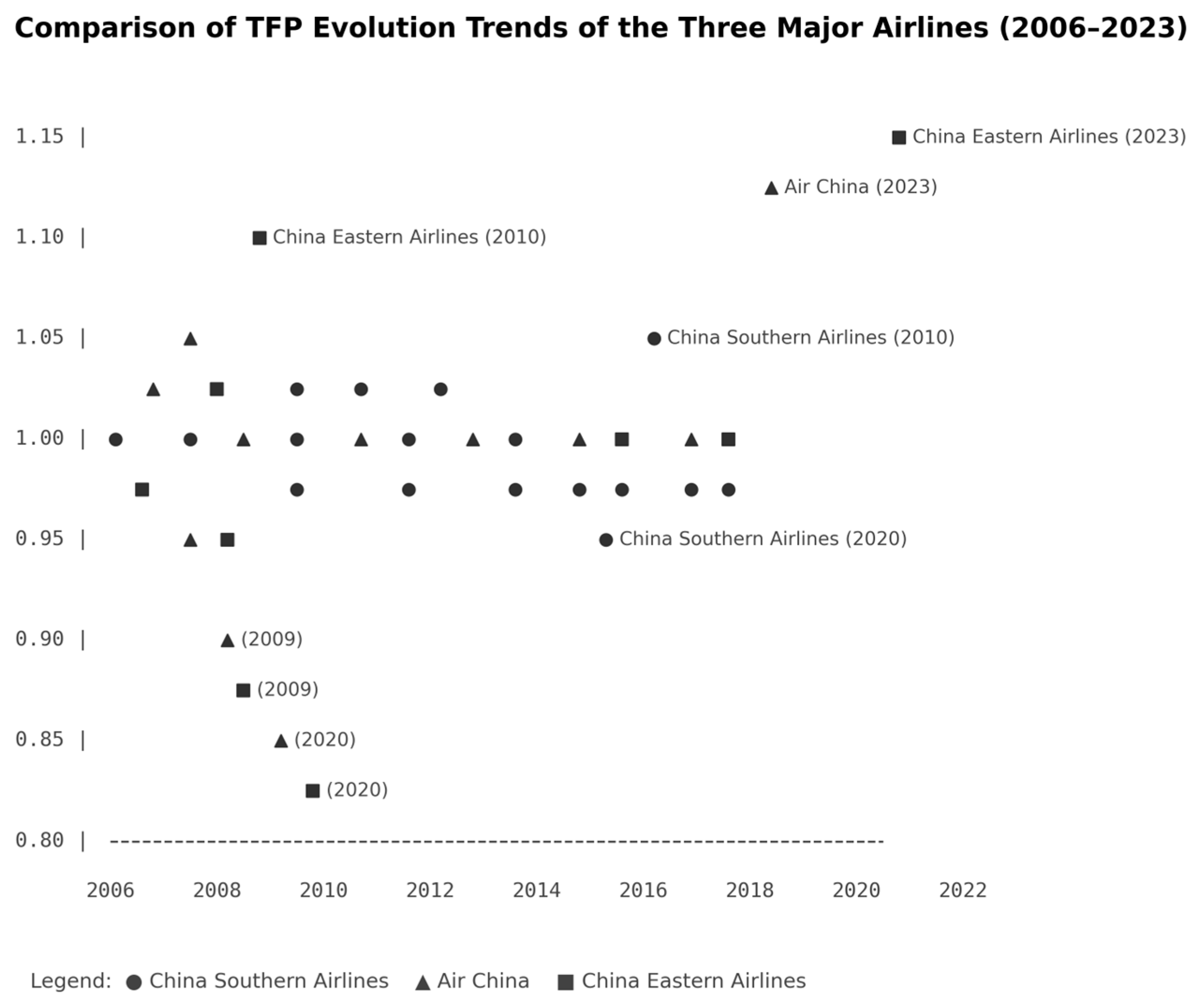
Figure 1 presents the TFP trajectories of the three major airlines over 2006–2023, with the distribution of data points clearly revealing the heterogeneous performance of each airline at key time points.
During the 2006–2010 financial crisis shock and recovery period, all three airlines experienced TFP declines in 2008–2009, though the magnitudes differed considerably. China Eastern Airlines recorded the deepest decline while China Southern Airlines showed the smallest. The rebound phase in 2010 exhibited asymmetric adjustment characteristics: China Eastern Airlines recovered strongly to a peak of 1.1542, driven in part by the release of scale economies following its merger with Shanghai Airlines that year, while Air China and China Southern Airlines recovered more moderately, rising to 1.0682 and 1.0553, respectively. This phase corroborates the cyclical regularity whereby airlines subject to more severe shocks tend to rebound more strongly during the recovery period.
During the 2011–2015 structural transformation period, productivity growth across all three airlines remained under pressure, with TFP fluctuating marginally around the technological frontier in most years. The three trajectories intersected and oscillated over 2011–2015, converging to the 0.97–1.00 interval in 2013. This convergence should not be interpreted as a signal of technological stagnation, but rather as an inevitable consequence of a shift in growth model: the scale effects generated by the earlier rapid expansion phase were progressively exhausted, intensifying market competition compressed profit margins, and airlines pivoted toward refined operational management and stock-based adjustment.
During the 2016–2019 steady growth period, productivity across all three airlines remained relatively stable, with values in the vast majority of years maintained within the 0.98–1.02 interval. The markedly narrower range of fluctuation signaled the industry’s entry into a phase of mature development.
During the 2020–2023 COVID-19 pandemic shock and recovery period, the three airlines once again exhibited a divergent pattern. All three TFP trajectories declined sharply in 2020, though with markedly different depths of decline. To more clearly illustrate the heterogeneity among airlines at key time points,
Figure 2 presents the numerical distributions in the form of scatter plots.
As shown in
Figure 2, the TFP declines in 2020 for China Eastern Airlines, Air China, and China Southern Airlines were 19.48%, 14.11%, and 4.91%, respectively—a difference of nearly fourfold. This degree of divergence substantially exceeds that observed during the financial crisis, reflecting a stronger capacity for risk resistance. During the recovery process, all three airlines achieved gradual restoration in 2021–2022, but a clear divergence emerged in 2023. The scatter positions in the upper-right portion of the figure show that China Eastern Airlines and Air China rebounded strongly to 1.1324 and 1.1214, respectively, while China Southern Airlines only rose to 1.0064—a difference in recovery magnitude exceeding ten percentage points. China Eastern Airlines and Air China benefited from faster recovery in domestic trunk and business travel routes, whereas China Southern Airlines, whose network planning is more heavily oriented toward international routes such as those to Southeast Asia, recovered relatively more slowly following the shock.
Taken together,
Figure 1 and
Figure 2 allow the differentiated characteristics of the three airlines to be clearly identified. China Southern Airlines is characterized by low volatility and steady growth, with the vast majority of time points over the 18-year period remaining within the 0.96–1.06 interval—a pattern attributable to its more balanced domestic-international route structure, more prudent fleet expansion strategy, and more conservative financial management. China Eastern Airlines, in contrast, exhibits a high-volatility, strong-rebound pattern: it suffered the largest decline during the crisis period but the strongest rebound during recovery, reaching peak values in both 2010 and 2023—reflecting its more aggressive operating style and higher sensitivity to market cycle changes. Air China occupies an intermediate position, maintaining a degree of growth elasticity while avoiding excessive volatility. This differentiated pattern is closely tied to the business structures and strategic choices of the three major airlines, and provides the foundation for the subsequent analysis of strategic divergence under extreme shocks.
4.3. Underlying Causes of the Evolution
The COVID-19 pandemic substantially amplified the strategic differences accumulated by the three major airlines over their long-term development. The divergence in their TFP trajectories was not accidental, but rooted in a path dependence shaped jointly by business structure, asset allocation, and institutional constraints. The share of international business became the most direct source of vulnerability. China Eastern Airlines and Air China had higher international exposure than China Southern Airlines, and the large-scale grounding of international routes during the crisis placed them under considerably greater pressure. However, the fact that Air China—which had the highest international share—did not experience the largest TFP decline indicates that a single indicator cannot fully explain the divergence. A deeper explanation lies in the composite nature of asset structure: China Eastern Airlines’ relatively high proportion of wide-body aircraft rendered these specific assets a sunk cost during the international route freeze, while its persistently high debt-to-asset ratio magnified debt-servicing pressure through financial leverage when revenues collapsed. By contrast, China Southern Airlines’ network strategy, focused on second- and third-tier cities, yielded only modest returns in normal times but conferred a structural advantage for risk diversification during the crisis, as domestic routes in smaller cities recovered significantly faster than international or first-tier trunk routes. The ability of TFP to withstand shocks is thus shaped not solely by the degree of internationalization, but by the interplay of asset specificity, financial leverage, and market distribution.
The recovery phase reveals the deep mechanism by which crises drive reform. The more severely an airline was affected, the stronger its subsequent growth momentum: in 2021, China Eastern Airlines rebounded by 25.04%, Air China by 18.65%, and China Southern Airlines by only 5.44%. By 2023, China Eastern Airlines and Air China had surged to 1.1324 and 1.1214, respectively, while China Southern Airlines reached only 1.0064—a slight decline from 2022. The root cause of this contrast lies in the fact that more severely affected airlines were compelled to undertake deep-seated transformation: China Eastern Airlines completed an organizational flattening reform, accelerated digital transformation, and significantly increased its cargo revenue share during the pandemic, all of which translated into competitive advantages as the crisis eased. China Southern Airlines, having suffered less damage, maintained operational continuity but lacked the urgency for structural reform, and its recovery momentum was consequently constrained by the inertia of its existing model. This demonstrates a positive nonlinear relationship between the severity of an external shock and the subsequent magnitude of efficiency improvement—a “crisis-induced transformation” mechanism that is central to understanding the divergent TFP trajectories of the three airlines.
Over their long-term development, the three airlines have formed three heterogeneous strategic archetypes, and the differences in their TFP evolution are a natural outcome of path dependence. China Southern Airlines represents the domestic-market-led type: its extensive network in second- and third-tier cities and domestic routes accounting for over 70% of total operations confer a resilience advantage against external shocks, though its relatively limited internationalization constrains its position in the global value chain and its long-run growth potential remains bounded by domestic market size. China Eastern Airlines represents the internationally aggressive type: its high share of international business and wide-body-dominated fleet generate premium returns on international routes in normal times, but expose it to considerable vulnerability during global crises—with the mandatory post-crisis adjustments subsequently transformed into a source of leapfrog efficiency improvement. Air China represents the hub-concentrated type: anchored at the dual hubs of Beijing and Chengdu, it maintains a relatively balanced mix of domestic trunk and key international routes, with its international exposure concentrated in relatively stable markets such as Asia-Pacific and North America and underpinned by a comparatively solid financial structure—a configuration that enables a dynamic balance between risk-bearing capacity and growth potential.
This typological divergence is not the product of autonomous strategic choice, but a path dependence shaped by initial conditions and institutional constraints. As the national flagship airline, Air China fulfills broader political functions, with its international route configuration subject to national strategic imperatives rather than pure commercial logic, and slot scarcity at Beijing Capital International Airport reinforcing its hub-concentrated strategy. China Eastern Airlines, rooted in Shanghai as the nation’s economic center, has benefited from local government support for internationalization and the openness of Pudong Airport, which provided the institutional space for aggressive expansion; the administrative merger with Shanghai Airlines in 2010 further consolidated its leading position in the Yangtze River Delta. China Southern Airlines, based in South China and radiating nationwide, has had its domestic-international balance shaped by the freight demand of the Pearl River Delta manufacturing cluster and its geographical proximity to Southeast Asia.
The coexistence of these pluralistic strategic archetypes provides a risk-hedging mechanism for the industry as a whole. When international markets experience severe turbulence, the stable performance of the domestic-market-led airline helps sustain industry-level stability; when the domestic market enters a mature phase of slowing growth, the breakthroughs of internationally oriented airlines inject renewed momentum into the industry. This complementarity constitutes an important micro-level foundation for the overall stability of China’s civil aviation industry during its transition period, and explains the aggregation effect whereby individual airlines exhibit marked efficiency volatility while the industry as a whole displays relatively smooth fluctuations.
In summary, the underlying causes of TFP evolution among the three major airlines can be distilled into three observations. First, strategic path dependence determines each airline’s vulnerability pattern and recovery elasticity in the face of shocks. Second, crises reshape efficiency trajectories through a mandatory reform mechanism. Third, the complementary coexistence of different strategic archetypes provides a systemic risk-hedging function. Together, these factors underpin the dynamic stability of the industry as a whole.
5. Empirical Analysis of Influencing Factors of TFP of the Three Major Airlines
Due to the limited sample size (19 annual observations at the industry level and 18 for each airline), the degrees of freedom in the time-series analysis are significantly constrained, potentially affecting the statistical power and stability of the parameter estimates. Nevertheless, the time-series diagnostics confirm the existence of long-run equilibrium relationships among the variables and the appropriateness of the model specification: Across all three airlines, ADF unit root tests confirm that the TFP series are stationary at levels [I (0)], while the explanatory variables exhibit a mix of I (0) and I (1) integration orders, satisfying the prerequisite conditions for the ARDL bounds-testing framework. Engle–Granger cointegration tests confirm the presence of long-run equilibrium relationships. The following regression results should therefore be interpreted as exploratory rather than confirmatory. The findings suggest certain patterns—for example, the positive association between market competitiveness and TFP, the short-run cost effect of technological innovation investment, and the differentiated impact of human capital accumulation across airlines—patterns that warrant further investigation with larger samples. At the same time, the results exhibit a high degree of consistency across static and dynamic model specifications and across industry and firm levels, providing preliminary credibility to the observed relationships.
5.1. Air China: Market-Led Type
As a benchmark airline in China’s civil aviation industry, Air China exhibits a typical market-led operational pattern in which productivity improvement is highly dependent on market demand expansion and the realization of scale economies. The negative effect of technological innovation is relatively pronounced, yet human capital accumulation can be effectively translated into productivity improvement, and the airline possesses strong mean-reversion characteristics and dynamic adjustment capacity. The mean TFP of Air China is 1.0014, with a standard deviation of 0.0538, indicating moderate volatility consistent with overall operational stability. The technological innovation input variable (FUEL) declined by 47.62% year-on-year during the pandemic and subsequently increased by 125.92% year-on-year during the recovery phase, with these two extreme values clearly mapping the dynamic process of pandemic-induced contraction followed by accelerated catch-up. The detailed statistical characteristics of each variable are presented in
Table 6.
Before estimating the static OLS and dynamic ARDL models, all variables were subjected to time-series diagnostic tests comprising: (1) Augmented Dickey–Fuller (ADF) unit root tests to determine the order of integration of each series, and (2) the Engle–Granger (EG) two-step cointegration test to examine whether a long-run equilibrium relationship exists between TFP and the full set of explanatory variables.
The ADF statistic for Air China’s TFP series is −3.6596 (p < 0.05), confirming stationarity at levels, i.e., I (0). This finding is consistent with the ratio-based construction of the GML index, which fluctuates around unity by design and thus precludes spurious regression concerns. Among the explanatory variables, UTIL and PGDP are stationary at levels [I (0)], while FUEL and LOAD become stationary after first differencing [I (1), p < 0.01]. The ADF statistic for INT falls marginally short of the 10% critical value and is conservatively treated as I (1) given its ratio-type nature and the well-documented power loss of unit root tests in small samples. The mixed integration orders across the regressors satisfy the prerequisite conditions for the ARDL bounds-testing framework. The EG residual-based ADF statistic is −3.5438, exceeding the 10% critical value of −3.36 and confirming the presence of a long-run equilibrium relationship between Air China’s TFP and the five explanatory variables. Given the relatively small sample size (T = 18), a finding significant at the 10% level nevertheless constitutes meaningful evidence in support of the long-run relationship and corroborates the methodological appropriateness of the ARDL dynamic framework.
The static model achieved an adjusted R
2 of 0.6341, indicating a relatively high goodness-of-fit and suggesting that productivity variation is driven to a considerable extent by the selected quantitative factors, with Air China’s operational mechanism being relatively standardized and transparent. The coefficient of market competitiveness (LOAD) is 0.0009 (
p < 0.01), the strongest association with TFP among all selected variables, consistent with Air China’s premium business passenger base and hub network advantages and indicating that demand expansion is fully translated into productivity improvement. The coefficient of technological innovation input (FUEL) is −0.0938 (
p < 0.05), reflecting the learning-curve costs and system compatibility friction arising from new aircraft introductions and digital system upgrades in the short run. The regression results of the static model are presented in
Table 7.
To further identify the temporal characteristics of each influencing factor, a dynamic regression model was constructed by introducing a lagged TFP term into the static model. The coefficient of the lagged TFP term is −0.3197 (
p < 0.10), with an absolute magnitude exceeding the industry average, consistent with Air China’s strong mean-reversion and self-recovery capabilities. Labor productivity (PGDP) turns positively significant (coefficient 0.0033,
p < 0.10), suggesting that human capital accumulation promotes efficiency improvement through channels such as knowledge spillovers and service quality enhancement. The regression results of the dynamic model are presented in
Table 8.
To verify the robustness of the baseline regression results, three alternative model specifications were applied: heteroscedasticity-consistent (HC1) standard errors applied to the static OLS model, HC1 standard errors applied to the dynamic ARDL model, a logarithmic linear model, and a first-difference model. The signs of the core variables are highly consistent across all four specifications. The negative coefficient of FUEL is stable across all specifications (ranging from −0.104 to −0.156), reaching significance at the 10% level under the static OLS-HC1 specification and the 5% level under the first-difference specification. The positive coefficient of PGDP is confirmed across all specifications, with significance under the static OLS-HC1 and first-difference specifications and marginal significance under the dynamic ARDL-HC1 and log-linear specifications. The negative coefficient of INT is stable in sign across all specifications, achieving significance under the static OLS-HC1 and first-difference specifications. The first-difference specification produces an adjusted R2 of 0.6052 with a joint F-statistic of 53.41 (p < 0.001), further validating the overall model specification. These results confirm the robustness of the baseline conclusions for Air China.
In summary, the influencing factor structure of Air China exhibits typical market-led enterprise characteristics: productivity improvement is highly dependent on market demand expansion and the realization of scale economies; technological innovation investment suppresses efficiency in the short run and requires a longer absorption period before its gains are fully realized; human capital accumulation can be effectively converted into productivity improvement within a dynamic framework; and the airline possesses strong mean-reversion characteristics and dynamic adjustment capacity, enabling relatively rapid recovery to a long-run equilibrium state following external shocks.
Air China’s near-oligopolistic position in the premium business travel segment—sustained by dominant slot resources at the Beijing and Chengdu hub airports—generates relatively inelastic demand, enabling revenue gains from market expansion to more than offset incremental cost increases and producing a strong market-led TFP growth mechanism consistent with the positive efficiency incentive of market power theorized in industrial organization. The short-run negative effect of technological innovation is explicable through the transitional efficiency losses inherent in Schumpeterian creative destruction: new aircraft introductions, digital system upgrades, and operational process reengineering constitute fundamental perturbations to the existing production function, inevitably incurring retraining, workflow restructuring, and system compatibility costs in the short run, with efficiency gains fully realizable only once the new technologies are thoroughly embedded in the production system—generating a J-curve pattern of short-run suppression followed by long-run enhancement.
Regarding the temporal dimension of the J-curve, the initial efficiency dip is estimated to persist for approximately one to three years following new aircraft introductions or major system upgrades, based on typical fleet renewal cycles in China’s civil aviation industry. This period corresponds to the peak phase of staff retraining and system integration costs. The static model FUEL coefficient (−0.0938, p < 0.05) corroborates the presence of a significant contemporaneous adjustment cost, while the persistence of a negative sign in the dynamic model (−0.1204) confirms that this cost is not confined to the contemporaneous period but extends across subsequent periods. The shift toward positive efficiency improvement is expected to materialize once three conditions are jointly satisfied: the penetration rate of new aircraft types exceeds a critical threshold relative to total fleet size (typically around 30–50%, based on aviation industry experience); complementary staff training and maintenance systems have been systematically restructured; and unit energy consumption reductions from scaled-up operations are fully realized. Due to the time-resolution constraints of annual data, precise econometric identification of the inflection point remains a direction for future research.
5.2. China Southern Airlines: Scale-Expansion Type
China Southern Airlines holds significant advantages in fleet size and domestic route coverage, and its development model exhibits typical scale-expansion characteristics: the mere pursuit of fleet and route network expansion does not automatically translate into productivity improvement; technological innovation investment emerges as the most important inhibiting factor for TFP; and labor productivity exerts a uniquely negative effect, reflecting a structural mismatch between aggressive talent upgrading and organizational capacity building. Based on time-series data over 2006–2023, the minimum TFP for China Southern Airlines occurred during the 2020 pandemic shock, while the maximum reached 1.0553 in 2010. Relative to Air China, the standard deviation of TFP is smaller and volatility more moderate, reflecting stronger operational stability. Among the explanatory variables, the volatility of the technological innovation input variable is significantly lower than that of Air China, and fleet size growth is more stable, with a maximum annual growth rate of 18.39%. Labor productivity, by contrast, achieved rapid growth from a low starting point—rising from 23.89% in 2005 to 60.22% in 2023, an increase of 152%, substantially exceeding Air China’s 99% increase—reflecting China Southern Airlines’ aggressive talent development strategy. The detailed statistical characteristics of each variable are presented in
Table 9.
The ADF statistic for China Southern Airlines’ TFP series is −4.0396 (p < 0.01), the strongest evidence of stationarity among the three airlines, consistent with its characteristically low volatility (standard deviation of 0.0250). Among the explanatory variables, FUEL (−4.2221, p < 0.01), INT (−2.7401, p < 0.10), and PGDP are stationary at levels [I (0)]; UTIL and LOAD become stationary after first differencing [I (1), p < 0.01]. The predominance of I (0) variables reflects a more stable diagnostic structure relative to Air China and China Eastern Airlines. The EG residual-based ADF statistic is −4.3882, exceeding the 5% critical value of −3.74 and confirming a robust long-run equilibrium relationship between China Southern Airlines’ TFP and the five explanatory variables.
The static model achieved an adjusted R
2 of only 0.0892—substantially lower than that of Air China and the industry average—indicating that the selected quantitative variables have limited explanatory power for TFP variation, and that productivity changes are more heavily influenced by hard-to-quantify soft factors such as internal management efficiency and organizational innovation. The coefficient of market competitiveness (LOAD) is 0.0003 but statistically insignificant, in stark contrast to the results for Air China and China Eastern Airlines. This suggests that despite possessing the largest fleet and most extensive route network, China Southern Airlines has failed to effectively translate business volume growth into productivity improvement, with the realization of scale economies remaining constrained—plausibly because fleet expansion has not been matched by commensurate improvements in route quality, while rising costs erode efficiency gains in parallel. The regression results of the static model are presented in
Table 10.
In the dynamic model, the coefficient of technological innovation input is −0.0956 (
p < 0.01), making it the most important inhibiting factor for TFP. After controlling for the time-dependence structure, the negative effect of technology investment becomes fully apparent, with the difficulty of integrating new and legacy systems amplifying adjustment costs. Labor productivity exerts a significantly negative effect (−0.0028,
p < 0.05), despite a 152% increase in labor productivity over the sample period—far exceeding Air China’s 99% increase. This is consistent with a structural mismatch between aggressive credential upgrading and organizational capacity building: difficulties in integrating new and experienced employees, misalignment between skills and job requirements, and an organizational culture yet to adapt to a highly educated workforce collectively cause human capital investment to suppress rather than enhance efficiency in the short run. The long-run multiplier of 0.8156—higher than that of Air China—indicates relatively weaker dynamic adjustment capacity. The regression results of the dynamic model are presented in
Table 11.
Three alternative specifications were similarly applied to verify the robustness of the baseline results for China Southern Airlines. The low adjusted R2 observed under the static OLS-HC1, dynamic ARDL-HC1, and log-linear specifications is consistent with the baseline finding that hard-to-quantify soft factors primarily drive TFP variation. Importantly, the first-difference specification yields an adjusted R2 of 0.6219 with a highly significant joint F-statistic of 14.77 (p < 0.001), and the FUEL coefficient is significantly negative (−0.279, p < 0.05), confirming that changes in fuel efficiency exert a meaningful short-run impact on TFP dynamics. The negative sign of PGDP remains stable across all four specifications, consistent with the baseline finding of a structural mismatch between aggressive talent upgrading and organizational absorptive capacity. These results confirm the robustness of the baseline conclusions for China Southern Airlines.
In summary, the influencing factor structure of China Southern Airlines highlights the core dilemmas facing scale-expansion enterprises: fleet and route network expansion alone cannot automatically translate into productivity improvement; technological innovation investment, when unsupported by adequate complementary management capabilities, becomes a drag on efficiency as the integration costs of new and legacy systems continuously erode productive performance; rapid human capital investment, if not accompanied by commensurate organizational capacity building, suppresses productivity in the short run rather than enhancing it; and the airline exhibits insufficient dynamic adjustment flexibility, resulting in a relatively weak capacity to adapt to external shocks.
China Southern Airlines’ predicament is essentially the compounded effect of diminishing returns to scale and organizational friction costs. Production theory predicts that when factor inputs exceed the optimal scale, diseconomies of scale emerge—a pattern clearly evidenced in China Southern Airlines’ sustained fleet expansion without commensurate gains in efficiency per unit of output. At a deeper level, the negative effect of labor productivity reflects an “overeducation” trap: the rapid infusion of highly educated employees raises the stock of human capital, but absent simultaneous adjustments in organizational structure, incentive mechanisms, and job design, skilled workers’ marginal output falls below their marginal cost, generating an efficiency drain on human capital investment. This mechanism is well-documented in the development economics literature and is particularly prevalent in the context of state-owned enterprise reform, constituting the deep institutional root of the negative labor productivity effect observed for China Southern Airlines.
The fundamental divergence in human capital effects between China Southern Airlines and Air China—two state-owned full-service airlines that nonetheless exhibit diametrically opposite directions of human capital impact on TFP—further illuminates the systematic structural differences between the two airlines. With respect to workforce composition and person-job fit, Air China has concentrated human resources in high-value-added roles such as flight operations, maintenance, and premium cabin services through outsourcing and digital transformation, creating strong structural alignment between talent upgrading and job requirements; China Southern Airlines’ far more diverse occupational base, encompassing a substantial share of standardized lower-skill positions, imposes a structural constraint on the effective marginal conversion of human capital substantially greater than at Air China. With respect to organizational absorptive capacity, Air China’s relatively streamlined business lines provide a more compatible environment for talent integration, enabling knowledge spillovers and complementarity effects to be effectively released; China Southern Airlines’ multilayered operational network generates significant absorptive friction due to organizational complexity, impeding these same effects. With respect to the coordination between strategic pace and talent investment, Air China’s talent upgrading has proceeded in calibrated alignment with business restructuring, enabling the dynamic model PGDP coefficient to turn positively significant (0.0033, p < 0.10); China Southern Airlines has pursued intensive credential upgrading concurrently with rapid scale expansion, with human capital stock growth (152%) substantially outpacing organizational absorptive capacity and causing marginal output to fall persistently below marginal cost. The fundamental divergence in human capital effects between the two airlines is rooted in systematic differences in strategic positioning, occupational structure, and organizational absorptive capacity—providing important micro-level evidence for the necessity of differentiated human capital investment strategies among large state-owned airlines.
5.3. China Eastern Airlines: Regional-Deepening Type
China Eastern Airlines is rooted in the Yangtze River Delta and deeply cultivates the regional market. Its operational model exhibits typical regional-deepening characteristics: market competitiveness exerts the strongest and most stable positive effect on TFP; the negative effect of technological innovation is relatively mild; the moderate degree of internationalization avoids excessive exposure to external shocks; and efficiency improvement exhibits a positive inertia accumulation effect. The mean TFP is 1.0018, with a standard deviation of 0.0769, placing its volatility between those of Air China and China Southern Airlines. The mean value of the technological innovation input variable (FUEL) is 3.0747, close to the levels of the other two airlines. Labor productivity increased from 17.13% in 2005 to 55.25% in 2023, a rise of 222%—the highest among the three airlines—reflecting rapid advancement in talent development. The mean international route revenue share is 26.13%, and it declined to a historical low of 2.45% during the pandemic, fully reflecting the vulnerability of international route business and confirming the airline’s region-oriented strategic positioning. The detailed statistical characteristics of each variable are presented in
Table 12.
The ADF statistic for China Eastern Airlines’ TFP series is −3.1873 (p < 0.05), confirming stationarity at levels, i.e., I (0). Although China Eastern Airlines exhibits the largest TFP volatility among the three airlines (standard deviation of 0.0769), the unit root test confirms that this variability reflects mean-reverting operational fluctuations rather than a deterministic trend. FUEL and LOAD are classified as I (1), each rejecting the unit root null at the 1% level after first differencing; the first-differenced statistics for UTIL, PGDP, and INT approach but do not strictly exceed the 10% critical value, and are conservatively treated as I (1) given the limited power of unit root tests in small samples. The resulting mix of I (0) and I (1) regressors satisfies the conditions for the ARDL bounds-testing framework. The EG residual-based ADF statistic is −5.3089, exceeding the 1% critical value of −4.58—the strongest cointegration result across all three airlines—indicating a highly robust long-run equilibrium relationship between China Eastern Airlines’ TFP and the explanatory variables.
The static model achieved an adjusted R
2 of 0.7324, indicating a good fit, with the F-statistic significant at the 1% level, confirming that the quantitative factors have relatively strong explanatory power for TFP variation. The coefficient of market competitiveness (LOAD) is 0.0021 (
p < 0.01), the highest among the three airlines, corresponding to an elasticity relationship in which a one-percentage-point increase in load factor is associated with approximately a 0.21-percentage-point increase in TFP. This may be attributable to China Eastern Airlines’ strategic focus on the Yangtze River Delta, where a developed economy and robust business demand enable market demand growth to be more rapidly and fully translated into operational efficiency improvement. The coefficient of technological innovation input (FUEL) is −0.0412 but statistically insignificant, in contrast to the stronger negative effect observed for Air China, reflecting a more measured technology investment strategy that effectively controls short-run transformation costs. The regression results of the static model are presented in
Table 13.
The goodness-of-fit of the dynamic model improves further to an adjusted R
2 of 0.8336. The coefficient of the lagged TFP term is positive (0.0523, not statistically significant), in stark contrast to the negative values for Air China and China Southern Airlines, suggesting a positive inertia accumulation effect in efficiency improvement. The labor productivity coefficient is positive but statistically insignificant, indicating that the positive effect of human capital accumulation is beginning to emerge but has not yet been fully realized. The international openness variable carries a non-significant negative coefficient, consistent with the finding that a moderate degree of internationalization avoids excessive exposure to external shocks and keeps structural adjustment costs relatively contained. The regression results of the dynamic model are presented in
Table 14.
Three alternative specifications were likewise applied to China Eastern Airlines, yielding the strongest robustness results among the three airlines. PGDP remains positively significant under the static OLS-HC1 specification (p < 0.05) and the dynamic ARDL-HC1 specification (p < 0.10), and INT maintains a significant negative coefficient under the static OLS-HC1, dynamic ARDL-HC1, and first-difference specifications (ranging from −1.14 to −1.26). The joint F-statistic is significant at the 5% level under the static OLS-HC1 specification (F = 3.25, p = 0.044) and at the 1% level under the first-difference specification (F = 7.45, p = 0.003). FUEL is uniformly negative across all specifications, and LOAD is consistently positive. These results confirm that the baseline findings for China Eastern Airlines are highly robust to alternative model specifications.
In summary, the influencing factor structure of China Eastern Airlines exhibits typical regional-deepening enterprise characteristics. Market competitiveness exerts the strongest and most stable positive effect on TFP, primarily driven by the high-quality demand of the Yangtze River Delta market. The negative effect of technological innovation input is relatively mild, reflecting a measured technology transformation strategy that effectively controls short-run adjustment costs. Although labor productivity does not reach statistical significance, its positive sign indicates that the efficiency-enhancing effect of human capital accumulation is beginning to emerge. The international openness variable carries a consistently negative but insignificant coefficient, and the moderate degree of internationalization avoids excessive exposure to external shocks. The positive lagged TFP coefficient further distinguishes China Eastern Airlines from Air China and China Southern Airlines, suggesting a positive inertia accumulation dynamic in efficiency improvement that is fundamentally distinct from the mean-reversion pattern of the other two airlines.
China Eastern Airlines’ regional-deepening strategy is essentially a path of comparative advantage reinforcement grounded in geographic specialization. The high-density business activity and economic hinterland of the Yangtze River Delta provide sustained, high-quality demand externalities, creating a virtuous cycle between market expansion and efficiency improvement—a dual reinforcement of economies of scale and learning effects. The positive inertia implied by the positive TFP lag coefficient corresponds theoretically to the “learning by doing” mechanism in endogenous growth models: efficiency gains already realized accumulate through knowledge building, process optimization, and organizational memory to form the efficiency baseline for the subsequent period, generating path-dependent positive dynamics. This is fundamentally distinct from the mean-reversion pattern of Air China and China Southern Airlines—which reflects passive adjustment toward long-run equilibrium following exogenous shocks—whereas China Eastern Airlines’ positive inertia represents an active convergence driven by endogenous accumulation, conferring greater long-run sustainability.
5.4. Heterogeneity Characteristics of Influencing Factors Across the Three Airlines
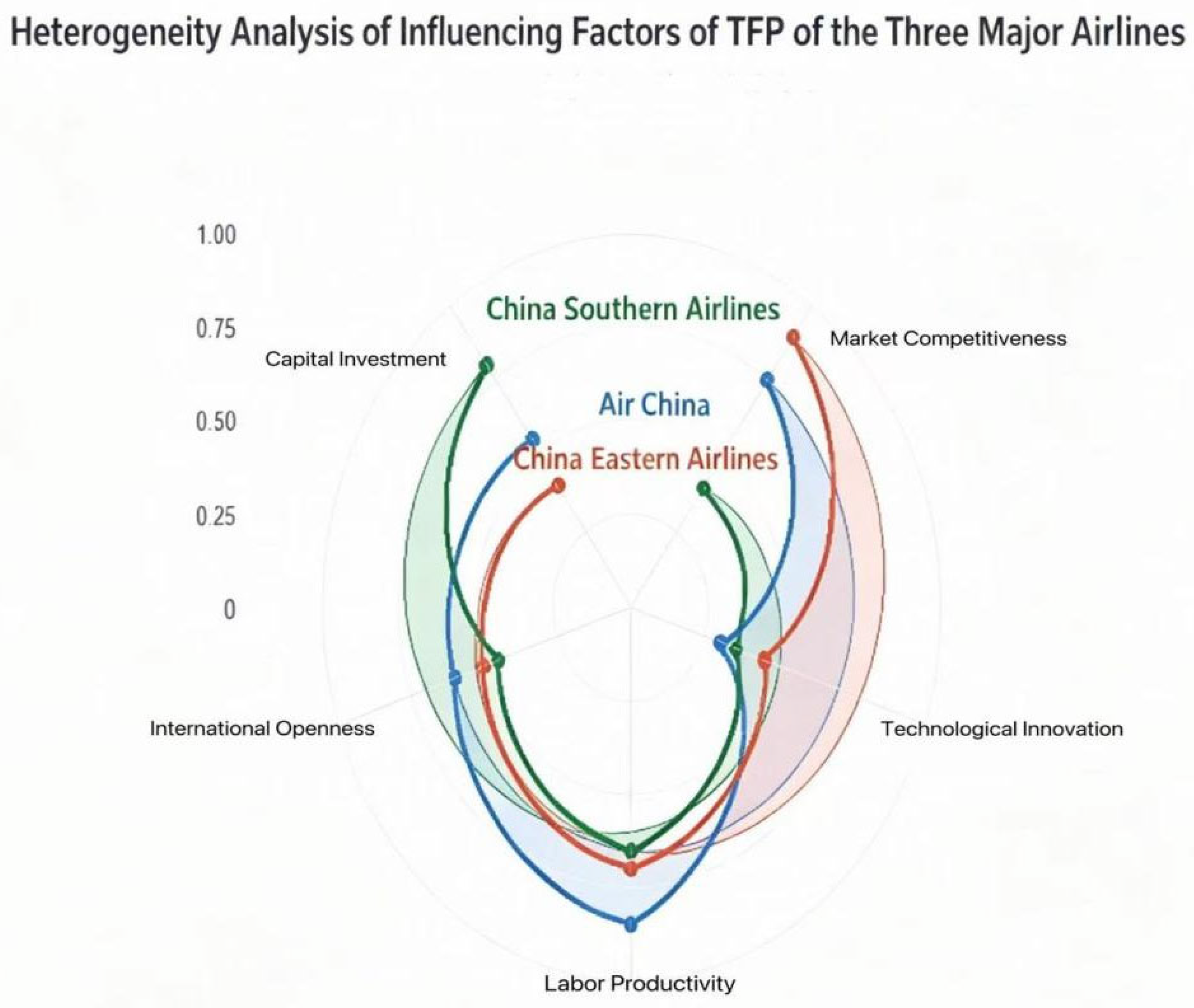
Through a systematic analysis of Air China, China Eastern Airlines, and China Southern Airlines, the firm-level heterogeneity characteristics within China’s civil aviation industry can be clearly identified. To intuitively present the differentiated performance of the three airlines with respect to each core influencing factor,
Figure 3 presents, in the form of a radar chart, the standardized enterprise regression results, with values normalized to the 0–1 range to reflect the relative differences in the impact intensity of each factor on TFP across the three airlines.
Regarding market competitiveness, both Air China and China Eastern Airlines exhibit strong positive effects on TFP. The coefficient for China Eastern Airlines ranges from 0.0021 to 0.0023, numerically stronger than that of Air China (0.0009–0.0010), which may be attributable to the high-quality demand advantages of the Yangtze River Delta market. The coefficient for China Southern Airlines is 0.0003 but statistically insignificant, indicating that scale economies remain constrained and that business volume growth has not been effectively translated into efficiency improvement.
Regarding technological innovation investment, Air China exhibits a significant negative effect, with a static model coefficient of −0.0938 that strengthens to −0.1204 in the dynamic model. China Southern Airlines reaches −0.0956 in the dynamic model, also displaying a relatively pronounced negative effect. China Eastern Airlines’ negative effect is comparatively mild and statistically insignificant, with coefficients of −0.0412 in the static model and −0.0589 in the dynamic model, reflecting a more measured technology transformation strategy.
Regarding labor productivity, the three airlines exhibit diametrically different directions of effect. China Southern Airlines records a significantly negative coefficient in the dynamic model (−0.0028, p < 0.05), attributable to the skill-job mismatch arising from aggressive credential upgrading. Air China records a positively significant coefficient (0.0033, p < 0.10), indicating that human capital accumulation has begun to exert a positive influence on TFP.
Regarding international openness, the coefficients are negative and either statistically insignificant or only weakly significant across all three airlines—Air China (−0.0019), China Eastern Airlines (−0.0018), and China Southern Airlines (−0.0003) are all non-significant—indicating that the adjustment costs associated with international openness are universally present at the firm level, though their impact is relatively contained for leading airlines owing to accumulated international operational experience.
These heterogeneous patterns help illuminate several regularities at the industry level. The positive effect of market competitiveness at the industry level is driven primarily by Air China and China Eastern Airlines, with a limited contribution from China Southern Airlines. The negative effect of technological innovation at the industry level is confirmed for Air China and China Southern Airlines, while China Eastern Airlines’ mild result suggests the existence of differentiated technology transition pathways. The overall non-significance of labor productivity at the industry level reflects a mutual offsetting between the negative effect for China Southern Airlines and the positive effect for Air China.
Synthesizing the heterogeneous characteristics across the three airlines, the direction and magnitude of influencing factor effects on TFP are fundamentally determined by the factor allocation structure and market interaction patterns shaped by each airline’s initial strategic positioning. Market-led airlines (Air China), possessing pricing power, can fully translate demand expansion into efficiency gains. Scale-expansion airlines (China Southern Airlines) face dual constraints of factor over-accumulation and organizational friction, resulting in systematically lower marginal efficiency of the same input factors relative to market-led airlines. Regional-deepening airlines (China Eastern Airlines) capture externality rents through geographic specialization, enabling the co-reinforcement of demand quality and operational efficiency. These three path-dependent efficiency evolution patterns correspond precisely to the general regularity of productivity divergence across firms under different market structures theorized in industrial organization, providing a robust theoretical foundation for understanding efficiency differentiation among major airlines under carbon constraints.
6. Conclusions and Policy Recommendations
6.1. Research Conclusions
This study systematically addresses the heterogeneous evolution and differentiated mechanisms of total factor productivity among China’s three major airlines, proceeding across three levels—TFP measurement, factor identification, and policy application—to resolve three core issues. First, at the measurement level, the GML index is used to construct a common global production frontier, achieving unified cross-period and cross-firm comparability and precisely capturing the micro-level efficiency divergence of the three airlines under carbon constraints. Second, at the theoretical mechanism level, three heterogeneous strategic archetypes are identified—market-led, scale-expansion, and regional-deepening—and the differentiated influence of initial strategic characteristics on each airline’s rebound speed and transformation potential under environmental constraints and external shocks is systematically demonstrated. Third, at the policy application level, a differentiated “one firm, one policy” framework is constructed on the basis of firm-level heterogeneity findings, transcending the limitations of the industry-average policy approach.
Regarding TFP evolution, the three airlines exhibit similar long-run mean growth rates but diverge substantially in volatility and stability. China Southern Airlines is the most operationally stable, recording the highest efficiency level and the smallest fluctuations. China Eastern Airlines is the most sensitive to market cycles and external shocks, recording the deepest declines during crises but the strongest rebounds during recovery. Air China occupies an intermediate position, combining a degree of growth elasticity with operational stability. The near-fourfold differential in TFP declines during the COVID-19 pandemic profoundly illustrates the decisive influence of business structure, financial leverage, and market positioning on each airline’s risk resilience. The asymmetric divergence in the recovery phase further demonstrates that airlines most severely affected were compelled to undertake deeper structural reforms in the aftermath of the crisis, ultimately generating stronger growth momentum during the recovery period—a nonlinear “crisis-induced transformation” mechanism that is central to understanding the divergence in efficiency trajectories among the three airlines.
Regarding factor heterogeneity, the empirical results reveal pronounced firm-level differentiation. Air China represents the market-led archetype: productivity improvement is highly dependent on market demand expansion and the realization of scale economies; technological innovation exerts a short-run negative effect; human capital accumulation can be effectively converted into productivity improvement; and the airline exhibits strong mean-reversion capacity and dynamic adjustment ability. China Southern Airlines represents the scale-expansion archetype: quantitative factors have limited overall explanatory power; business volume growth has not been effectively translated into efficiency improvement; technological innovation investment has become the most important suppressor of TFP; and labor productivity exerts a uniquely significant negative influence, reflecting a structural mismatch between aggressive talent upgrading and organizational absorptive capacity, with soft factors such as internal management efficiency constituting the primary driver of TFP variation. China Eastern Airlines represents the regional-deepening archetype: market competitiveness exerts the strongest positive effect on TFP among the three airlines; the negative effect of technological innovation is mild; a moderate degree of internationalization avoids excessive exposure to external shocks; and efficiency improvement exhibits a positive inertia accumulation dynamic, making it the only airline among the three to display an efficiency self-reinforcing mechanism.
Regarding theoretical contributions, this study verifies, within an environmental constraint framework, the existence of a nonlinear transmission pathway for the effect of technological innovation on TFP—characterized by short-run suppression followed by long-run enhancement—further enriching the theoretical understanding of TFP influencing factors in the civil aviation industry of developing countries. Notably, the applicability of the Porter Hypothesis diverges significantly across the three airlines: its validity is highly contingent on the factor allocation structure shaped by each airline’s strategic positioning, rather than holding universally across all airline types—a finding that provides new micro-level empirical support for the conditional applicability of the Porter Hypothesis in the transportation sector. By extending industry-level regularities to the firm level, this study fills the gap in the existing GML literature, which characterizes efficiency through industry-wide averages and struggles to explain inter-firm divergence, and offers a systematic theoretical framework for understanding productivity trajectory divergence among large airlines under carbon constraints.
It should be noted that, given the limited time series of only 18 annual observations per airline, the above conclusions are exploratory in nature and await further validation through research with larger samples. The conclusions nonetheless exhibit a high degree of cross-specification consistency across static and dynamic models and between baseline and robustness check specifications, providing preliminary credibility for the observed patterns.
6.2. Research Limitations and Future Directions
This study is subject to several limitations that warrant further investigation in future research.
Regarding data availability, certain input and output indicators—such as disaggregated energy consumption data and carbon emission factors for specific aircraft types—were estimated indirectly or replaced by industry averages due to constraints on airline information disclosure, which may affect measurement precision to some degree. The study period (2005–2023) spans multiple extreme shocks, including the global financial crisis, industry structural adjustments, and the COVID-19 pandemic. Although the use of a global frontier approach has partially mitigated the influence of extreme values, these shocks may still introduce some disturbance to the stability of the production frontier.
Regarding sample coverage, this study focuses on three state-owned full-service airlines—Air China, China Eastern Airlines, and China Southern Airlines—and does not encompass airlines with substantially different ownership structures or business models, such as Hainan Airlines, Xiamen Airlines, or Spring Airlines. The strategic paths of the three sample airlines are shaped, to a degree, by state-ownership constraints, administratively allocated slot mechanisms, and national strategic orientations, which constitute the specific institutional premises of the “one firm, one policy” framework. Caution should therefore be exercised in generalizing the findings to other airline types, including low-cost airlines (LCCs) and privately owned airlines. Nevertheless, the core logic of the framework—identifying differentiated transmission mechanisms of influencing factors based on firm-level strategic positioning—retains broad methodological applicability across institutional environments, provided that appropriate adjustments are made when applying it to markets with distinct characteristics. In more privatized aviation markets, such as those dominated by major European and North American airlines, corporate strategic decisions follow commercial logic more fully, labor market flexibility is higher, and organizational friction costs associated with human capital upgrading are correspondingly lower. The negative human capital effect identified for scale-expansion airlines in this study may accordingly be attenuated by more agile job redesign and incentive adjustment mechanisms, while the positive transmission of market competitiveness to TFP is expected to hold and may operate with even greater directness. In differentially regulated markets—such as Southeast Asian markets dominated by LCCs or government-led aviation markets in the Middle East—structural differences in regulatory intensity, route access restrictions, and carbon emission constraints will systematically affect the adjustment cost boundaries of technology investment and the transmission efficiency of market competitiveness to TFP, such that the relative weighting of influencing factors within the framework may shift accordingly. In these settings, the application of the “one firm, one policy” framework should be reoriented toward identifying the dominant influencing factors within the local institutional environment, rather than directly adopting the factor-weight structure derived from this study.
Future research may be extended along three directions. First, building on an expanded sample, institutional variables such as ownership structure, regulatory type, and carbon market development could be incorporated into panel data models to test the robustness of the heterogeneity findings across institutional contexts and to specify the adaptation pathways of the “one firm, one policy” framework for different airline types, including low-cost and privately owned airlines. Second, specific policy variables such as carbon pricing and the promotion of sustainable aviation fuels could be introduced to identify the differentiated effects of various policy instruments on the efficiency of market-led, scale-expansion, and regional-deepening airlines, thereby providing more granular empirical evidence for targeted policy design. Third, cross-country comparative studies could systematically compare the efficiency evolution trajectories of China’s three major airlines with those of comparable airlines in privatized European and North American markets, low-cost-dominated Southeast Asian markets, and government-led Middle Eastern markets—analyzing common patterns and institutional differences in green efficiency evolution across regulatory and ownership contexts, and further testing the cross-contextual applicability of the framework’s core logic.
6.3. Policy Recommendations
Based on the empirical analysis of the strategic positioning, factor input structures, and differentiated TFP mechanisms of the three major airlines, this section proposes differentiated and actionable recommendations for efficiency improvement and low-carbon transition corresponding to the three strategic archetypes—market-led, scale-expansion, and regional-deepening—in order to achieve the “one firm, one policy” guidance objective. It should be noted that the following policy recommendations are premised on the institutional environment of Chinese state-owned full-service airlines; when applying the relevant framework to global aviation markets characterized by higher degrees of privatization or substantially different regulatory structures, the specific policy instruments should be appropriately adapted to reflect local ownership arrangements, competitive market configurations, and carbon emission regulatory mechanisms.
- (1)
Market-led airlines: Consolidate competitive advantages and manage technology transition costs
Air China is characterized by internationalization, premium positioning, and hub concentration, with TFP growth highly dependent on market demand expansion and business travel support, and strong mean-reversion capacity. The empirical results show that market competitiveness, measured by LOAD, exerts the strongest positive effect on Air China’s TFP, with a coefficient of 0.0009–0.0010 significant at the 1% level; premium business demand and hub network advantages constitute its core competitiveness. The short-run negative effect of technological innovation, with a FUEL coefficient of −0.0938 significant at the 5% level, and the dynamic positive effect of human capital, with a PGDP coefficient of 0.0033 significant at the 10% level, together constitute the principal structural features of Air China’s efficiency driving mechanism.
To this end, Air China should continue to consolidate its Beijing–Chengdu dual-hub strategy, optimize the balance between international and domestic route structures, and prudently calibrate the deployment pace of wide-body aircraft capacity against the backdrop of the steady recovery of international routes, thereby reducing idle capacity rates and unit carbon emissions. It should also fully leverage its strong dynamic adjustment capacity to rapidly reallocate resources following external shocks and seize opportunities in trunk and premium market segments. Regarding technological innovation, given the short-run cost effects of new technology adoption, Air China should strengthen the coordination between technology investment and operational management, prioritize mature technologies such as fuel-efficient aircraft types and low-carbon operations, shorten the transition period, and accelerate the crossing of the J-curve inflection point to convert technology investment into sustained improvements in fuel and environmental efficiency. Regarding human capital, Air China should continuously refine its talent development systems for flight, technical, and management personnel, strengthen incentive mechanisms, and convert human capital advantages into service quality and operational efficiency gains, further consolidating its core competitiveness as a premium airline.
- (2)
Scale-expansion airlines: Advance strategic transformation and rebuild person-job fit
China Southern Airlines is characterized by the largest fleet and the most extensive domestic route coverage, yet the empirical results indicate that scale expansion alone cannot sustainably improve TFP: the market competitiveness driving effect is not statistically significant; technological innovation investment has become the most important suppressor of TFP, with a dynamic model FUEL coefficient of −0.0956 significant at the 1% level; labor productivity exerts a significantly negative influence, with a PGDP coefficient of −0.0028 significant at the 5% level; and quantitative factors have limited overall explanatory power, with a static adjusted R2 of only 0.0892, implying that soft factors such as internal management efficiency are the primary drivers of TFP variation. This diagnosis points directly to the need for China Southern Airlines to simultaneously advance deep-seated transformation across three dimensions: strategic positioning, technology pathways, and human resource management.
At the strategic level, China Southern Airlines should pivot from scale expansion toward quality improvement: optimizing the domestic route network, phasing out inefficient and low-yield routes, enhancing hub concentration and profitability per unit of turnover, and leveraging its young fleet advantage to convert scale advantages into green efficiency gains through improved fuel efficiency and low-carbon operations. At the technology level, it should moderate the pace of technology investment, strengthen technology assessment and absorption capacity, prioritize operationally compatible technologies that yield rapid efficiency returns, and ensure that technology upgrades are genuinely embedded in the production system rather than incurring heavy investment with light integration. At the human resource level, the most prominent structural problem is the overeducation mismatch: labor productivity has increased by 152% yet its TFP effect is negative. It is recommended that the focus shift from pursuing educational credential ratios toward emphasizing person–job fit, with improved internal training, job rotation, and talent pipeline development to reduce organizational friction costs and make human resources a genuine driver of efficiency growth.
- (3)
Regional-deepening airlines: Deepen regional advantages and maintain a measured internationalization pace
China Eastern Airlines is anchored in the Yangtze River Delta, with the regional market as its strategic foundation and peripheral short-haul international routes as a complement. It is the airline for which market competitiveness exerts the strongest TFP driving effect among the three, with a LOAD coefficient of 0.0021–0.0023 significant at the 1% level, and the only airline to exhibit a positive TFP momentum effect, with a lagged TFP coefficient of 0.0523, corresponding to the learning-by-doing mechanism in endogenous growth theory. This characteristic implies that China Eastern Airlines’ efficiency improvement possesses endogenous sustainability, with the key lying in continuously deepening the strategic elements that sustain its positive feedback cycle.
China Eastern Airlines should continue to deepen its regional hub advantages, advance airspace coordination, air-rail intermodal integration, and ground service unification in the Yangtze River Delta, enhance regional market share and customer stickiness, and convert locational advantages into self-reinforcing efficiency competitiveness. Regarding technological innovation, the mild and statistically insignificant negative effect reflects a measured technology transition pace; the airline should continue to adhere to a pragmatic technology investment strategy, prioritizing mature applications such as fuel saving, low-carbon operations, and digital management, maintaining a dynamic balance between technology upgrading and operational profitability, and avoiding excessive capital expenditure that could disrupt the existing positive momentum accumulation. Regarding international openness, the consistently negative coefficient across robustness checks indicates that a moderate degree of internationalization constitutes a structural safeguard against external shocks; China Eastern Airlines should therefore maintain a prudent internationalization strategy, focusing on peripheral short-haul international routes, exercising restraint in long-haul capacity deployment, and preserving structural balance between the domestic trunk market and international regional markets. Regarding talent development, although the labor productivity coefficient does not reach statistical significance, its positive sign indicates that human capital effects are beginning to emerge; the airline should continue to deepen talent cultivation efforts to allow human capital accumulation to be fully realized and integrated into its existing positive dynamic cycle.