Article

Internal Cognition or External Monitoring? The Contingent Mechanism of Patient Capital Driving Corporate Green Innovation: Empirical Evidence Based on ESG Performance

1
Business School, Guilin University of Technology, Guilin 541004, China
2
Guangxi Resources and Environmental Science and Technology Innovation and Green Low-Carbon Development Research Think Tank, Guilin 541004, China
*
Author to whom correspondence should be addressed.
Sustainability 2026, 18(12), 6342; https://doi.org/10.3390/su18126342 (registering DOI)
Submission received: 13 May 2026 / Revised: 17 June 2026 / Accepted: 19 June 2026 / Published: 21 June 2026
(This article belongs to the Section Economic and Business Aspects of Sustainability)

Abstract

Patient capital is widely regarded as a key source of funding for corporate green technological innovation. However, existing research lacks systematic comparisons of its mechanisms, transmission pathways, and contingency characteristics across internal and external contexts. This study therefore examines how patient capital influences green technological innovation and how this influence varies across capital types, ESG channels, and internal versus external environments. The results reveal a robust positive correlation between patient capital and green innovation. Mechanism tests indicate that patient capital indirectly affects green innovation through three pathways: enhancing overall ESG (Environmental, Social, and Governance) performance and synergistically strengthening the environmental, social, and governance sub-dimensions. Stable equity exerts a stronger influence on the governance dimension than relationship-based debt. Contingency analysis further shows that managerial green cognition generally amplifies the effect of patient capital, whereas media attention primarily affects equity capital, reflecting a pattern where “managerial green cognition universally amplifies the effect, while media attention specifically targets equity capital.” This study provides empirical evidence on how patient capital drives green innovation. Future policies should promote precise alignment between capital attributes and firms’ internal and external contexts, thereby shifting green innovation from isolated efforts toward systemic synergy.

1. Introduction

With the “Dual Carbon” goals becoming ever more pressing, green technological innovation has become the core driver for enterprises to achieve low-carbon transformation and build sustainable competitive advantages [1]. Green technological innovation is characterized by long cycles, high risks, substantial investment, and significant positive externalities [2]. Its R&D activities typically require a lengthy journey from technological breakthrough to commercial application, while facing the dual challenges of technological pathway uncertainty and market acceptance risks. These characteristics impose specific demands on corporate financing structures and capital attributes. Traditional transactional capital, which pursues short-term financial returns and liquidity, struggles to align with the long-term investment needs of green innovation [3]. In contrast, “patient capital”—defined by its long-term orientation and risk tolerance—can span the input-output cycle of green innovation and absorb the uncertainties inherent in green technology breakthroughs [4]. Reconciling “patience” with “green” in innovation activities has thus become key for enterprises seeking to seize low-carbon opportunities and respond to environmental regulations.
The concept of “patient capital” originates from comparative political economy. Deeg et al. define it as equity or debt aimed at capturing long-term value that does not easily exit even under short-term market pressures [5]. Existing research indicates that patient capital can effectively promote corporate innovation output, alleviate information asymmetry, and optimize corporate governance, with even stronger governance effects when empowered by the digital economy [6]. However, the literature on patient capital has primarily focused on general innovation activities, paying insufficient attention to its applicability and mechanisms in the specific context of green technological innovation. Green technological innovation not only shares the common features of technological innovation but also bears the unique mission of internalizing environmental externalities. Its investment returns are distinctly long-term and social in nature, a feature that aligns naturally with the value investment logic of patient capital [7]. Therefore, extending the research framework of patient capital to the field of green technological innovation—to explore its driving effects and underlying mechanisms—holds significant theoretical value and practical relevance.
From the perspective of capital attributes, patient capital can be decomposed into two dimensions: relationship-based debt and stable equity [8]. Relationship-based debt alleviates financing constraints on corporate green R&D investments through long-term, stable financial support [9], whereas stable equity exerts governance effects and resource-empowering roles through the community of interests formed by long-term shareholding [10]. However, existing research lacks a systematic comparison of these two types of patient capital in the context of green innovation, particularly overlooking their heterogeneity in ESG transmission pathways and contextual moderating mechanisms. Furthermore, the effective allocation of patient capital depends not only on capital attributes but also on the contingency effects arising from internal corporate governance contexts and external monitoring environments [11]. Managerial green cognition, as an internal “push,” determines a firm’s sensitivity to identifying green innovation opportunities and its resource allocation priorities [12]; media attention, as an external “pull,” reinforces patient capital’s green governance motives through reputational constraints [13]. Existing literature has yet to reveal the boundary conditions and contingency mechanisms through which patient capital enables green innovation from the dual perspective of “internal cognition—external monitoring.” Based on the above analysis, this study aims to systematically examine the impact of patient capital on corporate green technological innovation and how this impact varies across capital types, ESG transmission channels, and internal versus external contextual factors. Centering on this core question, the study addresses three specific sub-questions: (1) Do both relationship-based debt and stable equity promote corporate green technological innovation? What are the differences in the magnitude of their effects and their mechanisms? (2) Does overall ESG performance, together with its environmental, social, and governance sub-dimensions, mediate the relationship between patient capital and green innovation? Are there differences in the mediation pathways for the two types of capital? (3) How do managerial green cognition and media attention differentially moderate the effects of the two types of patient capital on green innovation?
This study integrates corporate ESG performance, green technological innovation, and institutional investor behavior into a unified analytical framework for patient capital. It systematically compares the differentiated transmission mechanisms and context-dependent characteristics of relationship-based debt and stable equity in green innovation, thereby extending existing research. Specifically: First, it applies patient capital theory to green technological innovation by distinguishing between debt and equity capital, revealing differences in their effect magnitudes and governance pathways. Second, we decompose ESG performance into its environmental, social, and governance sub-dimensions and identify their specific transmission pathways between patient capital and green innovation, uncovering the unique advantages of stable equity in the governance dimension. Third, we construct a contingency analysis framework from the dual perspective of “internal cognition—external monitoring” to reveal the differential moderating effects of managerial green cognition and media attention on the green innovation effects of the two types of patient capital. Through policy simulation, we quantify the differences in the marginal effects of internal cognition and external monitoring, providing empirical evidence for the design of differentiated green finance policies.
The remainder of this paper is structured as follows. Section 2 presents the theoretical analysis and research hypotheses. Section 3 outlines the research design. Section 4 analyzes the empirical results. Section 5 concludes with policy recommendations.

2. Theoretical Analysis and Research Hypotheses

2.1. Patient Capital and Corporate Green Technological Innovation

Against the backdrop of the increasingly urgent “dual carbon” goals, green technological innovation—due to its long cycles, high risks, and substantial investment requirements—places greater demands on the “patience” of capital [14]. Unlike traditional transactional capital, patient capital is distinguished by its long-term orientation and risk tolerance. These characteristics not only align with the extended input-output cycle of green innovation but also help mitigate the multiple uncertainties inherent in green technology breakthroughs [15].
To clarify the theoretical implications of “patient capital,” it is necessary to distinguish it from related concepts such as long-term debt, institutional ownership, and green finance. First, regarding relationship-based debt and long-term debt: long-term debt focuses solely on the duration of the debt, whereas relationship-based debt emphasizes the implicit contractual relationship formed between creditors and enterprises based on long-term trust, informational advantages, and informal supervision [16]. The latter not only provides long-term capital but also alleviates financing constraints through regular cash flow commitments—something that cannot be achieved by merely extending the debt maturity. Second, regarding stable equity and institutional ownership: general institutional ownership merely reflects the quantity of shares held without distinguishing investment motives, whereas stable equity focuses on institutional investors with a long-term holding intention and active participation in governance [17]; such investors are more inclined to support green innovation activities characterized by long cycles and high risks. Third, regarding patient capital and green finance: green finance emphasizes the “green” use of funds, while patient capital focuses on the “long-term” and “relational” attributes of capital. The two concepts are orthogonal and complementary. In summary, patient capital offers a unique perspective whose core lies in the temporal and relational dimensions of capital, rather than merely the superficial characteristics of financing structures.
From the perspective of capital attributes, this paper follows existing research by deconstructing patient capital into two dimensions: relationship-based debt and stable equity. Relationship-based debt refers to debt capital provided by creditors in a stable, low-friction manner, based on long-term understanding and trust in the enterprise; stable equity is a form of equity capital capable of long-term shareholding, governance oversight, and risk-sharing. For green technological innovation, relationship-based debt can effectively alleviate financing constraints on corporate green R&D investments and reduce maturity mismatch risks through long-term, stable financial support [18]; stable equity, on the other hand, aligns investors with the benefits of the enterprise’s green transition through the community of interests formed by long-term shareholding, thereby exerting governance effects and enabling resource allocation [19]. Notably, while both relationship-based debt and stable equity fall under patient capital, their mechanisms of action differ fundamentally. Relationship-based debt primarily alleviates corporate financing constraints and reduces maturity mismatch risks through long-term, stable financial support, with its governance effects relying on contractual constraints and informational advantages [20]; in contrast, stable equity, in addition to providing financial support, has access to formal governance channels such as voting rights and board seats, enabling it to intervene more directly in corporate strategic decisions on green issues [21]. Consequently, stable equity may offer stronger marginal contributions in the governance dimension, while relationship-based debt may play a more prominent role in the promotion of environmental and social dimensions [22]. Based on this, the subsequent analysis will examine the differences in the main effects, mediating pathways, and moderating effects of these two types of capital.
Green technological innovation is essentially a process of internalizing environmental externalities. Its investment returns are characterized by long-term horizons and positive externalities, which align closely with the value investment logic of patient capital [23]. On the one hand, the long-term holding nature of patient capital enables it to withstand the cyclical fluctuations inherent in the journey from R&D to commercial application of green technologies [24]; on the other hand, its risk-tolerant attributes provide enterprises with the flexibility to pursue high-risk, high-value disruptive green technologies [25]. Based on this, the following research hypothesis is proposed:
Hypothesis 1 (H1).
Patient capital is positively correlated with corporate green technological innovation, and this positive association is stronger for stable equity than for relationship-based debt.

2.2. Patient Capital and Corporate ESG Performance

The positive relationship between patient capital and corporate green technological innovation is not merely a matter of injecting funds; rather, it operates through the mediating channel of improved corporate ESG performance. ESG performance is a comprehensive measure of a firm’s sustainable development capabilities, encompassing three interrelated yet distinct dimensions: environmental (E), social (S), and governance (G) [26].
From the environmental dimension (E), the long-term orientation of patient capital encourages firms to move beyond short-term profit maximization and allocate more resources to environmentally friendly activities—such as energy conservation, emissions reduction, clean production, and green technology R&D—thereby laying the environmental foundation for green technological innovation [27]. From the social dimension (S), the long-term partnerships established between patient capital and enterprises help shape corporate social responsibility cognition and green reputation. Through signaling effects, these partnerships convey credible commitments to green development to the market, thereby enhancing stakeholders’ acceptance of green products [28]. From the governance dimension (G), stable equity investors, leveraging their high ownership stakes and long-term holding commitment, can effectively influence board decisions, driving the establishment of green performance evaluation mechanisms and the improvement of environmental risk management systems [29]. Relationship-based debt, meanwhile, curbs managerial short-termism through regular cash flow constraints and the informational advantages accumulated through long-term business dealings. Notably, compared with relationship-based debt, stable equity enjoys formal governance channels such as voting rights and board seats, resulting in significantly greater depth of involvement and influence in the governance dimension [30].
Based on the above analysis, the overall improvement in ESG performance and the synergistic enhancement of its three sub-dimensions represent a key mediating pathway through which patient capital drives corporate green technological innovation. Via the transmission chain of “capital investment → ESG improvement → green innovation,” patient capital converts the advantages of long-term capital into corporate green innovation capabilities. Accordingly, the following research hypothesis is proposed:
Hypothesis 2 (H2).
Patient capital indirectly promotes corporate green technological innovation by improving overall ESG performance and its environmental (E), social (S), and governance (G) sub-dimensions.

2.3. The Contingent Mechanism of Internal Cognition and External Monitoring

The green innovation effects of patient capital are not uniformly distributed but are contingently moderated by the firm’s internal governance context and external monitoring environment. This study adopts the dual perspective of “internal cognition—external monitoring” to reveal the contextual conditions under which patient capital effectively empowers green innovation.
Managerial green cognition reflects the strategic importance that firm decision-makers attach to sustainable development and generally enhances the efficiency with which patient capital is allocated to green innovation. Managers with high green cognition can more accurately identify the market prospects and policy benefits of green technologies, effectively aligning the long-term advantages of patient capital with green innovation strategies to avoid capital misallocation [31]. At the same time, such managers are better equipped to build the cross-departmental collaboration networks required for green innovation, organically integrating the financial advantages of patient capital with innovation factors such as R&D capabilities and talent reserves. Furthermore, they possess a deeper understanding of the strategic necessity of green transformation and are more willing to utilize the risk tolerance offered by patient capital to undertake exploratory green R&D [32]. From the perspective of capital type differences, managerial green cognition exerts a positive moderating effect on both relationship-based debt and stable equity: for relationship-based debt, it helps improve the efficiency of green information communication between the firm and its creditors, enhancing creditors’ confidence in the feasibility of green projects [33]; for stable equity, it provides a cognitive foundation for equity investors to participate in green governance, facilitating the formation of strategic consensus between the two parties [34].
Media attention exerts external pressure on corporate behavior through information dissemination and reputational constraints, yet its moderating effects differ significantly across capital types [35]. For stable equity, media coverage directly influences the information content of stock prices and investor expectations. Investors have a stronger incentive to promote green innovation through governance channels in order to preserve the long-term value of their holdings, while the media provides them with additional information sources and oversight tools, thereby reducing the information costs of green governance [36]. For relationship-based debt, supervision relies primarily on contractual terms and private communication rather than public opinion. Furthermore, the fixed-income nature of debt makes creditors less sensitive to corporate reputational risks, resulting in a relatively limited moderating effect of media attention [37]. Based on this, the following research hypothesis is proposed:
Hypothesis 3 (H3).
Managerial green cognition positively moderates the impact of both types of patient capital on green innovation, while media attention positively moderates the impact of stable equity only; together, they form a complementary contingency mechanism.

2.4. Heterogeneity of the Green Innovation Effects of Patient Capital

The green innovation effects of patient capital are also subject to boundary constraints imposed by characteristics such as corporate ownership structure, industry pollution intensity, and firm size. State-owned enterprises, leveraging their inherent ties to the government and stronger resource integration capabilities, are better positioned to secure long-term capital support and exhibit a clear orientation toward green transformation, thereby converting patient capital more effectively into green innovation outcomes [38]. Highly polluting enterprises face stricter environmental regulations and public scrutiny, creating a more urgent need for green innovation; investments in patient capital can generate greater compliance benefits and transformation momentum [39]. Large-scale enterprises possess stronger organizational coordination capabilities and more robust governance mechanisms. With ample resource reserves and a high degree of business diversification, they can mitigate the uncertainty associated with green technology breakthroughs, tolerate interim failures during the R&D cycle, and effectively convert patient capital into systemic innovation outcomes [40]. In contrast, small-scale enterprises, owing to weak governance and tighter financing constraints, find it difficult for patient capital to play its expected role [41]. Based on this, the following research hypothesis is proposed:
Hypothesis 4 (H4).
The positive correlation between patient capital and corporate green technological innovation is more pronounced in state-owned enterprises, heavily polluting enterprises, and large-scale enterprises.
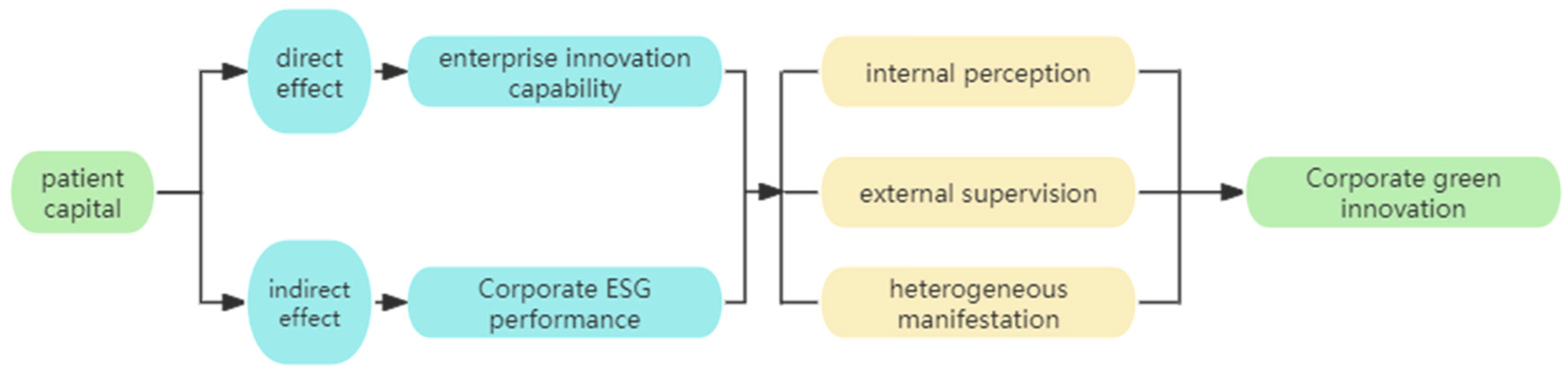
Based on the above theoretical analysis, this paper proposes a theoretical framework for patient capital and corporate green innovation, as illustrated in Figure 1.

3. Research Design

3.1. Model Specification

To examine the direct impact of patient capital on corporate green technological innovation, this study constructs the following model:
LnGreen _ Grant i , t   =   α 0   +   α 1   ×   RelationalDebt i , t / Equity i , t + β k controls i , t   + λ t   +   μ i   +   ε i , t
where the dependent variable is corporate green technological innovation (LnGreen_Grant), the explanatory variable is patient capital (RelationalDebt/Equity), Controls represents a series of control variables, λ t and μ i denote year and industry fixed effects, respectively, and ε i , t is the random disturbance term in the model.

3.2. Variable Selection

To examine the contingency mechanisms through which patient capital drives corporate green innovation, this study draws on established methods from the existing literature to define and measure the relevant variables as follows (Table 1).

3.2.1. Dependent Variable: Green Innovation (LnGreen_Grant)

Existing literature on the measurement of corporate green innovation has primarily followed two approaches: R&D investment and patent counts. R&D investment captures only innovation inputs and cannot effectively measure innovation outcomes or the performance of actual outputs. In contrast, patent indicators are widely adopted because their objectivity and quantifiability enable them to fully reflect a firm’s innovation outcomes. Following the measurement framework for corporate green innovation proposed by Qi et al. [42], this study adopts the total number of authorized green patents (including invention and utility model patents) as the core measure of green innovation output. To address the right-skewed distribution of the data, this figure is first added by 1 and then transformed using the natural logarithm.

3.2.2. Explanatory Variable

The explanatory variable is the proportion of patient capital. This study measures it from two perspectives.
Relationship-based Debt (RelationalDebt). Drawing on the measurement approach for patient capital proposed by Wu et al. [43], this study uses the proportion of a firm’s long-term liabilities (long-term loans, bonds payable, long-term accounts payable, etc.) to total liabilities to characterize the level of relationship-based debt. A higher ratio indicates a larger share of long-term, stable relationship-based debt in the firm’s debt structure, better reflecting the debt dimension of patient capital. This metric captures the extent to which a firm’s debt structure relies on long-term, stable funding. Its rationale is threefold. First, long-term liabilities have extended repayment periods, giving creditors a stronger incentive and greater capacity to establish long-term trust relationships with the firm and exercise ongoing oversight. Second, this metric focuses on the maturity structure of liabilities rather than merely capital structure or leverage levels, enabling a distinction between “patient debt” and “short-term transactional debt.” Third, this measurement method has been adopted in numerous studies in the field of patient capital, demonstrating a solid literature foundation.
Stable Equity. Drawing on the research by Jiang et al. [44], this paper uses the shareholding ratio of strategic institutional investors to represent this: First, we calculate the total holding duration T s , i of institutional investor S for each firm I during the sample period, where N s is the total number of firms invested in by institutional investor S during the sample period. Next, the average holding duration of institutional investors is calculated as: T s ¯ = ( 1 / n s ) i = 1 n s T s , i . If T s , i is greater than or equal to T s ¯ —meaning that institutional investor S holds shares of company I for a duration exceeding its average holding duration—then institutional investor S is considered a strategic investor of listed company I. Finally, the total shareholding ratio of all strategic institutional investors in listed company I is calculated. The core of this metric lies in capturing the “long-term” and “stable” nature of institutional investors’ holdings, rather than simply the volume of their holdings. Compared to general institutional ownership ratios, this metric excludes short-term arbitrage-oriented institutional investors and better reflects the essential characteristics of patient capital: “long-term holding and active participation in governance.”

3.2.3. Control Variables

To avoid omitted variable bias, this study selects a series of firm-level variables that influence green innovation, drawing on existing literature. These variables include: Return on Equity (ROE), measured as net income divided by average shareholders’ equity; the Equity Multiplier (EquityMulti), calculated as total assets divided by shareholders’ equity; firm age (FirmAge), expressed as the natural logarithm of the number of years since the firm’s establishment; the current ratio (CurrentRatio), defined as current assets divided by current liabilities; the total asset growth rate (AssetGrowth), computed as the increase in total assets in the current year divided by total assets at the end of the previous year; the proportion of independent directors (IndepRatio), measured as the number of independent directors divided by the total number of board members; and the management shareholding ratio (MgtHold), defined as the proportion of total shares held by management relative to the company’s total issued shares. In addition, the regression model includes industry and year fixed effects to account for time-invariant industry heterogeneity and the impact of macroeconomic shocks.

3.2.4. Intermediary Variables

Huazheng ESG Score (ESG_Score). This study uses the Huazheng ESG Score to measure corporate sustainability performance. The Huazheng ESG rating system systematically evaluates A-share listed companies on a quarterly basis, providing an overall ESG score along with scores for its three sub-dimensions: Environment (E), Social (S), and Governance (G). Both the overall score and the sub-dimension scores are continuous variables ranging from 0 to 100, with higher values indicating better ESG performance.

3.2.5. Moderating Variables

Managerial Green Cognition (green_cog). This study employs text analysis to examine the “Managerial Discussion and Analysis” (MD&A) section of listed companies’ annual reports. A dictionary of keywords related to green cognition was constructed based on three dimensions: cognition of green competitive advantages, cognition of corporate social responsibility, and perception of external environmental pressures. Specifically, the dictionary includes 20 keywords: energy conservation and emissions reduction, environmental protection strategy, environmental protection philosophy, environmental management organizations, environmental education, environmental training, environmental technology development, environmental auditing, energy conservation and environmental protection, environmental policies, environmental protection departments, environmental protection inspections, low-carbon environmental protection, environmental protection work, environmental governance, environmental protection and environmental governance, environmental protection facilities, environmental protection-related laws and regulations, and environmental pollution control. The total frequency of these keywords in the MD&A section was calculated, and the natural logarithm was taken after adding 1 to mitigate the right-skewed distribution of the data. A higher value of this indicator reflects a higher level of green development cognition among the executive team.
Media Attention (Media_Press). This study measures media attention as the total number of times a company was reported in print media during the year. Data are sourced from the China Financial News Database (CFND) within the China Research Data Services Platform (CNRDS ) database, which compiles news reports from mainstream domestic newspapers and periodicals. Multiple reports on the same event are not deduplicated in order to capture the overall intensity of media exposure for the company. Since the raw count of reports exhibits a right-skewed distribution, this study adds 1 to the count and then takes the natural logarithm.

3.2.6. Sample and Data Sources

This paper uses data from Shanghai and Shenzhen A-share listed companies from 2014 to 2024 as the research sample. Samples with missing key variables, financial and insurance enterprises, and firms marked as ST or *ST (indicating abnormal operations) are excluded. Continuous variables are winsorized at the 1st and 99th percentiles. The detailed sample selection process is shown in Table 2. The final sample comprises 28,538 firm-year observations. The data are primarily sourced from the China Stock Market & Accounting Research Database (CSMAR ) database, the CNRDS database, and the Wind (Wind Information Co., Ltd.) database. Descriptive statistics for the main variables are presented in Table 3. Among the core variables, the mean of green patent grants (LnGreen_Grant) is 0.874 with a standard deviation of 1.146, indicating substantial heterogeneity in green innovation output across firms. The mean of relationship-based debt (RelationalDebt) is 0.143, and the mean of stable equity (Equity) is 0.361, suggesting that the patient capital structure of the sample enterprises is dominated by equity. The distributions of the remaining financial and governance variables are reasonable, meeting the requirements for subsequent econometric analysis.

4. Empirical Results

4.1. Results of the Baseline Regression

According to the results of the baseline regression, regardless of whether control variables and fixed effects for industry and year are included, the estimated coefficients for the core explanatory variables—relationship-based debt (RelationalDebt) and stable equity (Equity)—are both significantly positive at the 1% level. In terms of coefficient magnitude, after including control variables, the coefficient for relationship-based debt is approximately 0.3785, while that for stable equity is approximately 0.4209, indicating that the driving effect of stable equity is slightly stronger than that of relationship-based debt (Table 4). This indicates that patient capital, whether in the form of debt or equity, is significantly positively correlated with corporate green innovation, providing preliminary support for research hypothesis H1 in this study.

4.2. Robustness Tests

4.2.1. Replacing the Dependent Variable

To further test the robustness of the baseline regression results, this study excludes the number of green utility model patents granted and replaces the dependent variable with the number of green invention patents granted—a measure that better reflects firms’ levels of green innovation—and performs the regression again after taking the natural logarithm of the data. The results in Table 5 show that, regardless of whether control variables and industry and year fixed effects are included, the estimated coefficients for relationship-based debt and stable equity are both significantly positive at the 1% level, and the direction of the coefficients is consistent with that of the baseline regression. This suggests that the positive correlation between patient capital and corporate green innovation is not driven by utility model patents; it remains robust even when measured by the dimension of invention patents, which are of higher innovative quality.

4.2.2. Replacing Key Explanatory Variables

To avoid selection bias in proxy variables and verify the robustness of the baseline findings, this study employs alternative indicators to re-measure relationship-based debt and stable equity.
Alternative indicator for relationship-based debt (RelDebt_alt): Long-term debt/(short-term debt + long-term debt) is used to replace the original indicator (long-term debt/total debt). This indicator focuses on the maturity structure of bank loans, better reflecting the long-term credit relationship and trust between banks and enterprises, while eliminating the confounding effects of non-relationship-based long-term liabilities such as bonds payable.
Alternative measure for stable equity (StableInstOwn): This study modifies the original measurement method by using a new measure: the proportion of shares held by stable institutional investors. Specifically, institutional investors are divided into three groups—high, medium, and low—based on average turnover rates; the lower the turnover rate, the more stable the institutional investor. The proportion of shares held by stable institutional investors in each stock is then calculated accordingly. This indicator is directly based on the stability of institutional investors’ holding periods and thus better reflects the “patient” nature of equity capital.
Table 6 reports the regression results after replacing the core explanatory variables. Columns (1) and (2) present the results for the relationship-based debt proxy. Regardless of whether control variables are included, the estimated coefficient of RelDebt_alt is significantly positive at the 1% level. Columns (3) and (4) present the results for the stable equity proxy; the coefficient of StableInstOwn is also significantly positive at the 1% level. The signs, significance levels, and model fit of the control variables are largely consistent with those in the baseline regression. These findings indicate that, irrespective of the measurement method used, both relationship-based debt and stable equity can drive corporate green innovation, and the baseline conclusions exhibit good robustness.

4.2.3. Adjusting for Firm-Level Effects

To control for firm-level heterogeneity that does not change over time, this study replaces the industry fixed effects in the baseline regression with firm fixed effects. Because firm fixed effects require firms to have at least two observations during the sample period, firms with only one year of data are automatically excluded. Consequently, the sample size decreases from 28,538 to 28,304—a reduction of approximately 0.8%—which has a limited impact on the overall conclusions. The results in Table 7 show that the coefficients for relationship-based debt and stable equity remain significantly positive, and their magnitudes are similar to those in the baseline regression. This indicates that the positive effect of patient capital on green innovation is not dependent on specific model specifications; the original regression results remain robust after controlling for firm-level fixed characteristics.

4.2.4. Lagged Explanatory Variables

To mitigate endogeneity issues caused by potential reverse causality, this study reintroduces the core explanatory variables (relationship-based debt and stable equity) into the model with a one-period lag for regression analysis. The results in Table 8 show that the estimated coefficients for L_RelationalDebt and L_Equity are both significantly positive at the 1% level, and there are no substantial changes in the signs or significance of the control variables. This indicates that, after excluding current-period reverse interference, the positive relationship between patient capital and green innovation remains significant, and the baseline conclusions remain robust.

4.2.5. Excluding the Pandemic Years

To rule out the potential impact of the COVID-19 pandemic (2020–2022) on macroeconomic conditions and corporate innovation activities, this study excluded the data from those three years and reran the regression analysis. The results in Table 9 show that the estimated coefficients for relationship-based debt and stable equity are both significantly positive at the 1% level, consistent with the baseline regression. This indicates that the positive relationship between patient capital and green innovation is not driven by special factors during the pandemic period, and the baseline conclusions are robust.

4.2.6. Propensity Score Matching (PSM)

To mitigate endogeneity issues potentially caused by sample selection bias, this study employs propensity score matching (PSM) to match the treatment group with the control group and then performs a new regression analysis. After matching, the sample sizes for relationship-based debt and stable equity are 21,025 and 18,894, respectively, both of which are smaller than the original sample size of 28,538. This reduction is due to the exclusion of unmatched observations during the matching process. The differing sample sizes for the two variables stem from distributional differences between their respective treatment and control groups, which is a normal occurrence in PSM. After matching, no significant differences in the covariates between the two groups remain, satisfying the balance assumption and indicating that the matching was effective. The results in Table 10 show that the estimated coefficients for relationship-based debt and stable equity are both significantly positive at the 1% level, consistent with the baseline findings. The signs and significance levels of the other control variables have not changed substantially, indicating that the positive relationship between patient capital and green innovation is not driven by sample selection bias.

4.2.7. Placebo Test

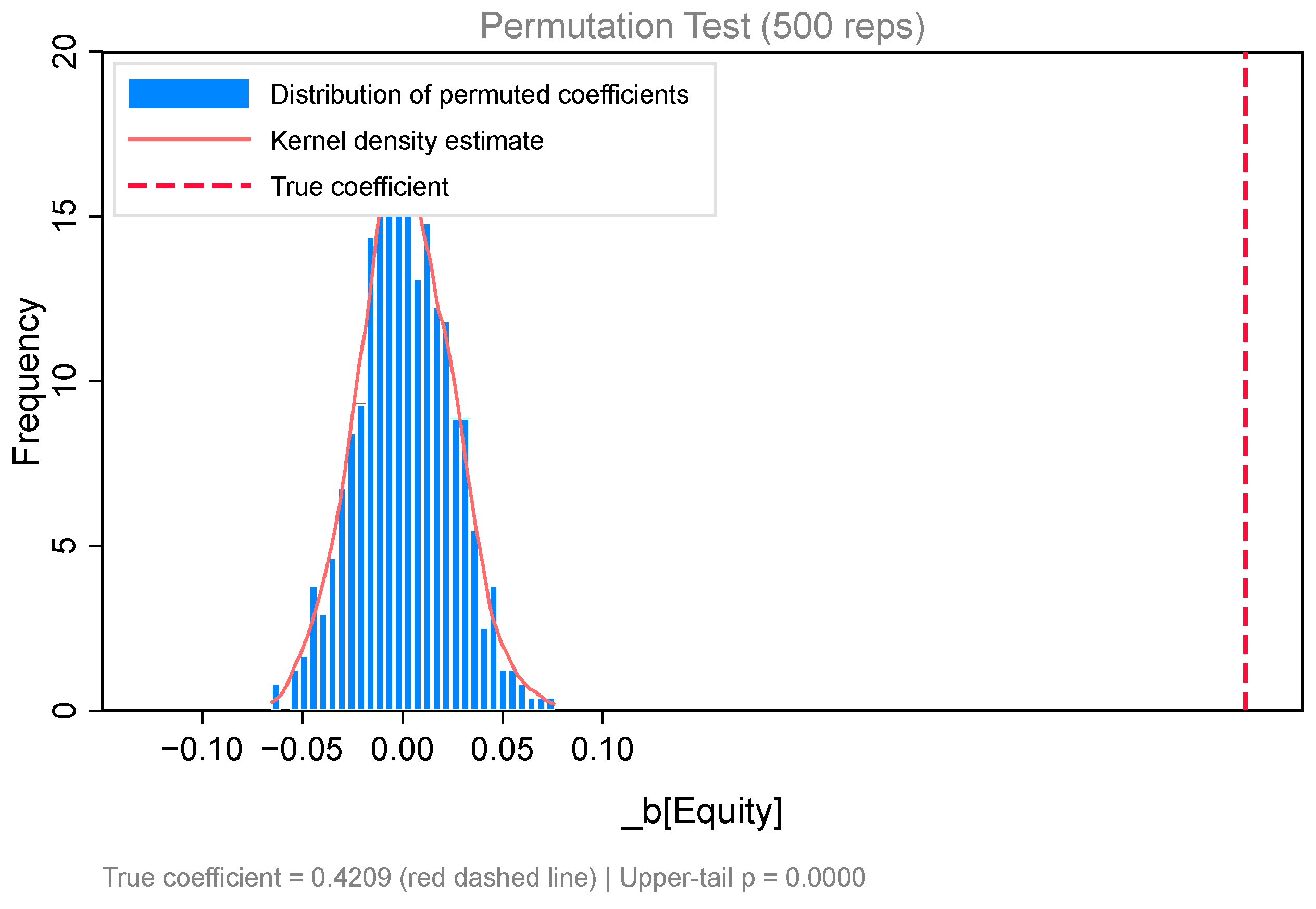
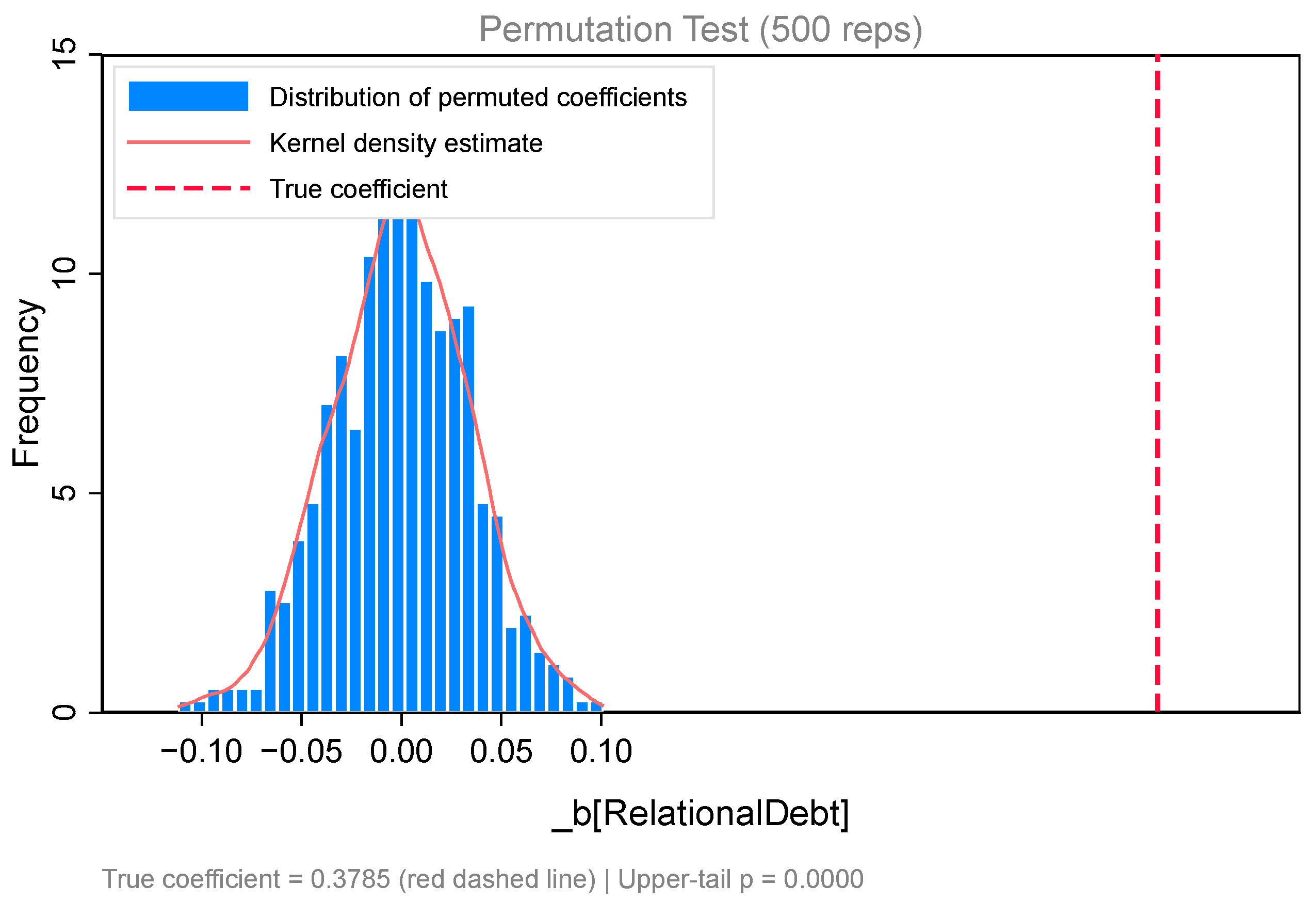
To rule out potential interference from unobservable factors on the baseline conclusions, this study employs a placebo test by randomly permuting the core explanatory variables. Specifically, relationship-based debt and stable equity were randomly permuted 500 times and re-regressed to obtain the distribution of spurious estimated coefficients. The results show that the true estimated coefficients for relationship-based debt and stable equity are 0.3785 and 0.4209, respectively (Figure 2 and Figure 3). The placebo test reveals that after randomly shuffling the core explanatory variables 500 times, the distributions of the spurious coefficients are centered at zero, while the true coefficients are located at the far right end of the random distribution, with upper-tail p-values of 0.000 in both cases. Therefore, the benchmark effect is not driven by unobservable factors by chance, and the conclusions are robust.

4.2.8. Instrumental Variables Method

To address endogeneity concerns, this study employs the instrumental variables (IV) method for estimation. For relationship-based debt, the mean proportion of fixed assets among other firms in the same industry and the one-period lagged value of relationship-based debt are used as instruments. For stable equity, the mean stable equity among other firms in the same industry and the one-period lagged value of stable equity are used (Table 11). Diagnostic statistics indicate that the Kleibergen–Paap rk LM test rejects the null of under-identification (p < 0.001). The Kleibergen–Paap rk Wald F-statistics are 6368.96 and 19,202.65, respectively—far exceeding the Stock–Yogo 10% critical value of 16.38. Moreover, the p-values for the Hansen J over-identification test are 0.369 and 0.201, respectively, confirming the validity of the instruments. The 2SLS estimation results show that the coefficients for relationship-based debt and stable equity are 0.4880 and 0.5061, respectively, both significantly positive at the 1% level and larger than the OLS (Ordinary Least Squares) estimates from the baseline regression (0.3785 and 0.4209). The coefficients of the core explanatory variables remain significantly positive, implying that the positive relationship between patient capital and green innovation persists even after addressing endogeneity issues such as reverse causality.
To test the exclusionary constraints, this paper directly regresses the instrumental variables on green innovation; the results are presented in Table 12. In the relationship-based debt model, the coefficient of the industry-mean instrument (IV_Rel_FixedRatio) is −0.403 (p = 0.297), which is not significant. In the stable equity model, the coefficient of the industry-level instrument (IV_Equity_IndMean) is 0.384 (p = 0.232), also insignificant. This suggests that industry-level instruments do not directly drive firm-level green innovation; their effects must be transmitted through firm-level patient capital. The coefficients for the one-period lagged instruments are all significantly positive, as expected—they capture the correlation between historical patient capital and current green innovation. However, this correlation is absorbed in the second stage of 2SLS by controlling for current patient capital. Combined with the Hansen J over-identification test, the exclusionary constraints are supported.

5. The Mediating Effect of ESG Performance

To test the mechanism through which corporate ESG performance exerts its influence, this paper constructs the following mediating effect model based on the baseline model:
ESG _ Score i , t   =   δ 0 +   δ 1   ×   RelationalDebt i , t / Equity i , t + θ k controls i , t   +   λ t   +   μ j + ε i , t
LnGreen _ Grant i , t = α 0 + α 1   ×   RelationalDebt i , t / Equity i , t + α 2 ESG _ Score i , t + β k controls i , t + λ t + μ j + ε i , t
Table 13 reports the mediation effect test results using the total ESG score as the mediating variable. The results indicate that there is a significant positive correlation between Relational Debt and Equity and a firm’s ESG performance. Furthermore, after incorporating the ESG score into the regression, the direct effects of both types of patient capital on green innovation decrease, and the coefficient for the ESG score is significantly positive. The confidence intervals for the bootstrap indirect effects do not include zero. This indicates that ESG performance serves as a key mediating channel, and this mediating effect is stronger for stable equity than for relationship-based debt.
Although the preceding analysis has confirmed that overall ESG performance mediates the relationship between patient capital and green innovation, ESG itself is a multidimensional construct comprising three distinct sub-dimensions: environmental (E), social (S), and governance (G). The mechanisms through which improvements in these dimensions drive green innovation may differ. More importantly, relationship-based debt and stable equity impose different levels of constraints and incentives on corporate behavior across these dimensions. Therefore, it is necessary to decompose ESG into three parallel mediators—E, S, and G—and employ a multiple mediation model to examine the relative contributions and path-specific effects of each dimension, thereby revealing the “contingent mechanism” through which patient capital operates.
Tests of multiple mediation effects indicate that the environmental (E), social (S), and governance (G) dimensions all play significant mediating roles in both patient capital pathways, with the environmental dimension contributing the most, followed by the social dimension, and the governance dimension also exhibiting a significant effect (Table 14, Table 15 and Table 16). Notably, the driving effect of stable equity on the governance dimension is significantly stronger than that of relationship-based debt, suggesting that equity capital is more effective at promoting green innovation through the optimization of corporate governance. This result reveals the contingency mechanism underlying the influence of patient capital on green innovation: both types of capital generate transmission effects via the ESG sub-dimensions, but stable equity provides a stronger marginal contribution along the governance pathway. These findings preliminarily validate Hypothesis H2 of this study.

6. Heterogeneity Analysis

6.1. Nature of Ownership

State-owned enterprises differ significantly from private enterprises in terms of resource access, policy support, and long-term strategic orientation, which may influence the effectiveness of patient capital in promoting green technological innovation. In this study, the sample was divided into two groups for regression analysis based on the nature of ownership: a value of 1 was assigned to state-owned enterprises, and 0 to private enterprises. The results in Table 17 indicate that the positive relationship between patient capital and green technological innovation is more pronounced in state-owned enterprises. This is because state-owned enterprises, leveraging their inherent ties to the government and stronger resource integration capabilities, are better positioned to secure long-term capital support and possess a clearer orientation toward green transformation, thereby converting patient capital into green innovation outcomes more effectively.

6.2. Heavily Polluting Industries

Heavily polluting industries differ significantly from non-heavily polluting industries in terms of environmental regulatory pressure, the need for green transition, and financing constraints, which may affect the effectiveness of patient capital in promoting green technological innovation. High-pollution enterprises face stricter environmental regulations and public scrutiny, making their need for green innovation more urgent; however, they also face higher transition costs and financing barriers. In this study, based on industry characteristics, firms in heavily polluting industries were assigned a value of 1, while those in other industries were assigned a value of 0, and the sample was divided into two groups for regression analysis. The regression results in Table 18 indicate that, compared to non-high-pollution enterprises, the coefficient for patient capital is more significant in high-pollution enterprises and passes the test for between-group coefficient differences. This suggests that the impact of patient capital on green technological innovation is primarily evident in heavily polluting industries. The reason lies in the fact that high-pollution enterprises are subject to stronger external pressures and greater incentives for transformation, enabling the investment of patient capital to generate a larger marginal contribution and thereby more effectively drive their green technological upgrades.

6.3. Firm Size

The number of employees in a firm often reflects its size, and firm size is a key factor influencing a firm’s financing capacity and governance efficiency. Large firms typically exhibit greater information transparency, more ample collateral assets, and more robust governance mechanisms, whereas small firms face tighter financing constraints and greater agency problems. Therefore, this study divides the sample into large-scale and small-scale groups based on the median of the natural logarithm of employee count (LnEmpNum) for regression analysis [45]. The results in Table 19 indicate that relationship-based debt significantly promotes green technological innovation only in large-scale enterprises, while it is not significant in small-scale enterprises; stable equity has a significantly positive effect in large-scale enterprises, but is not significant in small-scale enterprises, and the tests for differences in coefficients between groups are all highly significant. This suggests that large-scale enterprises, leveraging their stronger resource integration capabilities and standardized governance structures, can effectively convert patient capital into green innovation outcomes; whereas in small-scale enterprises, due to weak governance, patient capital struggles to fulfill its expected role.

7. Further Analysis: Contingency Mechanisms of Internal Cognition and External Monitoring

The effective allocation of patient capital depends not only on the attributes of the capital itself but is also influenced by internal corporate cognition and the external monitoring environment. Managerial green cognition reflects the strategic importance the firm places on sustainable development and constitutes an internal governance mechanism; media attention, meanwhile, serves as a form of external monitoring through information dissemination and reputational constraints. These two factors may exert differential moderating effects on the green innovation impact of patient capital.
LnGreen _ Grant i , t = α 0 + α 1 X i , t + α 2 Mod i , t + α 3 ( X i , t × Mod i , t ) + controls + FE + ε
In this paper, we measure two types of moderating variables using the logarithm of the frequency of managerial green cognition keywords in listed companies’ annual reports and the logarithm of the number of media reports, respectively. We divide the sample into high and low groups based on the median of the full sample and conduct group-specific regressions, further constructing interaction terms to test the full model. The results indicate that in the high-green-cognition group, both relationship-based debt and stable equity have a significantly stronger positive impact on green innovation than in the low-scoring group; whereas in the high-media-coverage group, only stable equity exhibits a significantly stronger effect than in the low-media-coverage group. The equity effect is not significant in the low-media group, and the moderating effect of media coverage on relationship-based debt remains consistently weak. This suggests that internal cognition generally enhances the efficiency of patient capital allocation toward green innovation, whereas external monitoring primarily acts as a catalyst for equity capital, constituting a key condition for its effective functioning. These findings remain robust in a full model that simultaneously controls for both types of moderating variables, revealing the differentiated and contingent pathways through which internal cognition and external monitoring drive green innovation via patient capital: internal cognition serves as a universal enhancer, while external monitoring acts as a catalyst specific to equity capital (Table 20, Table 21, Table 22 and Table 23).
To further quantify the moderating effects of internal cognition and external monitoring, this study conducts a policy simulation. Specifically, the sample is divided into low and high groups based on the annual median, and the resulting changes in the coefficients of the core explanatory variables are compared. The simulation results show that when managerial green cognition is raised from below the median to above it, the coefficient for relationship-based debt increases from 0.1632 to 0.5485, an absolute difference of 0.3853; the coefficient for stable equity increases from 0.2953 to 0.4955, an absolute difference of 0.2002. When media attention is raised from low to high, the coefficient for stable equity jumps from 0.0443 to 0.5362, an absolute difference of 0.4919, indicating that the green innovation effect of stable equity is significantly enhanced under high media attention. In contrast, the coefficient for relationship-based debt changes from 0.2723 to 0.3137, showing no significant difference (Table 24). These results suggest that enhancing internal cognition primarily strengthens the green innovation efficiency of debt capital, whereas strengthening external monitoring serves as an effective policy lever for equity capital. It should be noted that the coefficient for stable equity in the low-media group is close to zero; therefore, the relative change for the high-media group (1111.1%) is largely driven by the low baseline, and attention should be focused on the economic significance of the absolute difference.

8. Conclusions and Recommendations

8.1. Research Findings

This study uses A-share listed companies on the Shanghai and Shenzhen stock exchanges from 2014 to 2024 as its sample. By measuring patient capital from both debt and equity perspectives, it systematically examines the driving effect of patient capital on corporate green innovation and its contingency mechanisms. The main conclusions are as follows:
1. Patient capital is significantly positively correlated with green technological innovation, and the marginal effect of stable equity is significantly larger than that of relationship-based debt. This indicates that equity capital, owing to its dual functions of financial support and governance participation, holds a distinct advantage in promoting green innovation.
2. ESG performance serves as a key transmission channel through which patient capital influences green innovation. The environmental dimension contributes the most, while stable equity possesses unique advantages in the governance dimension.
3. The innovation effects of patient capital exhibit significant heterogeneity, being particularly pronounced in state-owned enterprises, heavily polluting enterprises, and large-scale enterprises.
4. Managerial green cognition exerts a positive moderating effect on both types of patient capital, whereas media attention primarily reinforces the effect of stable equity, forming a contingency framework in which “internal cognition benefits all, while external monitoring is specific to equity.”

8.2. Policy Recommendations

Based on the above conclusions, this paper proposes the following policy recommendations:
1. Given that stable equity primarily exerts its influence through governance mechanisms, institutional investors should be encouraged to leverage their voting rights and board seats to push portfolio companies to establish ESG committees and link executive compensation to environmental performance. At the same time, regulators should consider incorporating institutional investors’ “green governance engagement” into their own ESG ratings. Furthermore, large institutional investors should be required to disclose annually how they engage with investee companies on green issues and exercise their voting rights, thereby fostering a virtuous cycle of “investment-governance-innovation.”
2. In light of the finding that media attention plays differing regulatory roles for the two types of capital, the media should be encouraged to track and analyze the green strategies, board resolutions, and environmental violations of listed companies—particularly those heavily held by institutional investors—rather than merely reposting general news. This would provide institutional investors with additional “governance intelligence” and reputational constraints. Regulatory authorities could periodically compile in-depth media reports on the green governance of listed companies to serve as reference information for investors, especially long-term institutional investors, during their decision-making, thereby amplifying the governance-signaling role of media oversight.
3. Given that small-scale enterprises benefit less from patient capital due to weak governance and information asymmetry, local governments or industry associations should take the lead in providing “green management” services to small and medium-sized enterprises (SMEs) that are willing to undergo green transformation but lack governance capacity. These services should help SMEs establish basic environmental management systems and green project evaluation frameworks, enabling them to connect with patient capital and use funds effectively. To address the challenges that small enterprises face—such as limited assets and difficulty securing collateral—platforms should conduct preliminary screening of promising green projects, provide governance guidance, and offer joint credit enhancement to lower the entry barriers and risk-identification costs for patient capital. Banks should be encouraged to include technical assistance or management consulting modules when providing green credit to SMEs, or to link loan interest rates to corporate environmental performance and governance improvements. For equity investors, the establishment of “green governance funds” could be explored to provide board-level support for green strategies alongside investment.
4. In light of the findings that managerial green cognition universally reinforces the effects of both types of patient capital, green training and environmental performance evaluations should be incorporated as soft criteria for applying for green credit or receiving green industry subsidies, thereby aligning external financial support with internal strategic consensus.

9. Limitations and Future Directions

This study has the following limitations. First, the sample consists solely of A-share listed companies, which generally have relatively stable financial foundations and face lower financing constraints. Therefore, caution is warranted when generalizing the findings to startups or unlisted companies. Patient capital may play an even more critical role for unlisted firms facing tighter financing constraints; future research could be extended to companies listed on the National Equities Exchange and Quotations (NEEQ) or the STAR Market. Second, to mitigate this limitation, this paper employs alternative indicators (the proportion of long-term debt and the shareholding ratio of stable institutional investors) in robustness tests for cross-validation, and the results support the core conclusions. Future research could develop a more refined measurement system for patient capital, incorporating long-term funding sources from multiple dimensions. Third, the measurement of managerial green cognition relies on annual report text analysis, which may be subject to measurement bias resulting from “exaggeration” or “greenwashing.” Fourth, although the mediation analysis employs the bootstrap method, a bidirectional causal relationship between ESG and green innovation may still exist. The transmission mechanism findings in this paper should therefore be interpreted as “evidence of association” rather than strict causal inference. Future research could further incorporate quasi-experimental designs (e.g., green finance reform pilot zones and carbon emissions trading pilot programs) to enhance the credibility of causal identification, and explore the moderating effects of additional contextual factors on the efficacy of patient capital.


Author Contributions

Conceptualization, Y.Z.; Methodology, C.L.; Validation, Y.Z., C.L.; Formal analysis, C.L.; Resources, Y.Z.; Data curation, C.L.; Writing—original draft, C.L.; Writing—review and editing, Y.Z., C.L. and X.L.; Funding acquisition, Y.Z. All authors have read and agreed to the published version of the manuscript.

Funding

This work was supported by the Guangxi Higher Education Institutions Thousand Young and Middle-aged Backbone Teachers Cultivation Program (Guijiao Jiaoshi [2020] No. 58) from Education Department of Guangxi Zhuang Autonomous Region, and Natural Science Foundation of Guangxi Zhuang Autonomous Region (Grant No. 2024GXNSFAA010001) from Science and Technology Department of Guangxi Zhuang Autonomous Region.

Institutional Review Board Statement

Not applicable.

Informed Consent Statement

Not applicable.

Data Availability Statement

The raw data supporting the conclusions of this article will be made available by the authors on request.

Conflicts of Interest

The authors declare no conflicts of interest.

Abbreviations

The following abbreviations are used in this manuscript:
2SLSTwo-Stage Least Squares
CFNDChina Financial News Database
CNRDSChina Research Data Services Platform
CSMARChina Stock Market & Accounting Research Database
ESGEnvironmental, Social, and Governance
IVInstrumental Variables
MD&AManagement’s Discussion and Analysis
NEEQNational Equities Exchange and Quotations
OLSOrdinary Least Squares
PSMPropensity Score Matching
ROEReturn on Equity
SMESmall and Medium-sized Enterprises
STSpecial Treatment
WINDWind Information Co., Ltd.

References

  1. Cheng, M.; Wang, J.; Yang, S.; Li, Q. The driving effect of technological innovation on green development: From the perspective of efficiency. Energy Policy 2024, 188, 114089. [Google Scholar] [CrossRef]
  2. Xue, L.; Ai, S. The Impact of Patient Capital on Corporate Green Technology Innovation: The Mediation Effect Based on ESG Performance. Sci. Technol. Prog. Policy 2025, 42, 79–90. [Google Scholar]
  3. Nguyen, Q.M.N.; Do, T.K. Do financial constraints hinder or spur green innovation? Econ. Lett. 2025, 257, 112688. [Google Scholar] [CrossRef]
  4. Zheng, Y.; Abdullah, M.; Md Rahin, N. Environmental, Social, and Governance (ESG) Performance and New Quality Productivity in China: The Mediating Role of Patient Capital. Sage Open 2025, 15, 21582440251394582. [Google Scholar] [CrossRef]
  5. Deeg, R.; Hardie, I. What is patient capital and who supplies it? Socio-Econ. Rev. 2016, 14, 627–645. [Google Scholar] [CrossRef]
  6. Zhang, H.; Zhang, W.; Yi, X. Patient capital and corporate digital transformation: Evidence from Chinese A-share listed firms. Pac.-Basin Financ. J. 2025, 95, 102977. [Google Scholar] [CrossRef]
  7. Suo, W.; Qiao, P. Patient capital, green innovation bubble, and corporate ESG performance. Financ. Res. Lett. 2025, 86, 108803. [Google Scholar] [CrossRef]
  8. Wang, X.; Cheng, Y.; Li, B. Patient capital and firms’ new quality productivity: A dynamic capabilities perspective. Financ. Res. Lett. 2025, 86, 108787. [Google Scholar] [CrossRef]
  9. Liu, L.; Chui, M.; Ma, L. Financial Support for Sustainability under Environmental Regulation: The Role of Patient Capital. Financ. Res. Lett. 2025, 91, 109414. [Google Scholar] [CrossRef]
  10. Luo, K.; Wang, X. Green investor entry and corporate green transformation: Evidence from Chinese resource-based industry. Resour. Policy 2025, 109, 105717. [Google Scholar] [CrossRef]
  11. Ding, G.; Sun, T.; Li, J. The Role of CEO Power Intensity and Patient Capital Investment Strategies in Enhancing Corporate Green Innovation Performance—An Empirical Test and Policy Implications Based on Heterogeneity Analysis. Financ. Res. Lett. 2025, 85, 108014. [Google Scholar] [CrossRef]
  12. Wang, Z.; Ma, J.; Yao, Y.; Wu, N. Executive environmental concerns, patient capital, and corporate green innovation performance. Int. Rev. Financ. Anal. 2025, 108, 104702. [Google Scholar] [CrossRef]
  13. Chen, L.; Zhang, K.; Duan, L. Media Environmental Coverage and Corporate Green Innovation: A Dual-Mechanism Test Based on Incurred Regulatory Pressure and Institutional Investors’ Green Attention. Financ. Res. Lett. 2026, 92, 109581. [Google Scholar] [CrossRef]
  14. Sun, Q.; Zhang, C.; Yao, Y. Patient Capital and Firm Green Low-Carbon Cycle Innovation. Financ. Res. Lett. 2025, 91, 109439. [Google Scholar] [CrossRef]
  15. Li, H.; Lu, M. Implementation of the new environmental protection law, patient capital, and corporate sustainable development. Financ. Res. Lett. 2025, 86, 108365. [Google Scholar] [CrossRef]
  16. Thakor, A.V. Fintech and banking: What do we know? J. Financ. Intermed. 2020, 41, 100833. [Google Scholar] [CrossRef]
  17. Appel, I.R.; Gormley, T.A.; Keim, D.B. Passive investors, not passive owners. J. Financ. Econ. 2016, 121, 111–141. [Google Scholar] [CrossRef]
  18. Liu, M.; Yaacob, M.H.; Ma, Q.; Ding, S. Green Finance and Corporate Green Innovation: A Systematic Literature Review. Sage Open 2025, 15, 21582440251370800. [Google Scholar] [CrossRef]
  19. Yang, Z.; Su, D.; Xu, S.; Han, X. Institutional investors and corporate green innovation: Evidence from China. Pac. Econ. Rev. 2024, 29, 230–266. [Google Scholar] [CrossRef]
  20. Geelen, T.; Morellec, E.; Rostova, N. Relationship capital and financing decisions. Manag. Sci. 2025, 71, 10308–10324. [Google Scholar] [CrossRef]
  21. Edmans, A. Blockholders and corporate governance. Annu. Rev. Financ. Econ. 2014, 6, 23–50. [Google Scholar] [CrossRef]
  22. Zhu, Y.; Liu, Y.; Chen, Y. Patient Capital and ESG Performance in the Pharmaceutical Sector: A Pathway to Sustainable Development. Sustainability 2026, 18, 709. [Google Scholar] [CrossRef]
  23. Nordhaus, W. The challenge of green innovation. In Handbook of Innovation and Intellectual Property Rights; Edward Elgar Publishing: Cheltenham, UK, 2024; pp. 374–395. [Google Scholar]
  24. Qiu, Q.; Chen, Y. Institutional Investor Horizon and Corporate Green Innovation: Evidence from Chinese Listed Companies. Sustainability 2025, 17, 10402. [Google Scholar] [CrossRef]
  25. Yong, J.; Yichen, G.; Dongshu, L. The Mechanism of Patient Capital Enhancing Enterprise Innovation Resilience: An Inverted U-shaped Relationship. Sci. Technol. Prog. Policy 2026, 43, 25–36. [Google Scholar]
  26. Dauerer, A. A systematic literature review of performance measurement systems and the integration of ESG factors. Environ. Sustain. Indic. 2025, 27, 100746. [Google Scholar] [CrossRef]
  27. Li, Y.; Huang, X.; Luo, H. Patient capital and green total factor productivity: Evidence from Chinese listed companies. PLoS ONE 2025, 20, e0331262. [Google Scholar] [CrossRef] [PubMed]
  28. Liu, R.; Deng, C.; Chen, K.; Deng, H. Managerial Green Preferences and the Allocation of Patient Capital. Financ. Res. Lett. 2025, 91, 109174. [Google Scholar] [CrossRef]
  29. Sul, H.K.; Chung, C.Y.; Shakri, I.H. Long-Term-Oriented Institutional Directors and Corporate Environmental Engagement. Corp. Soc. Responsib. Environ. Manag. 2025, 32, 7553–7570. [Google Scholar] [CrossRef]
  30. Velte, P. Institutional ownership and board governance. A structured literature review on the heterogeneous monitoring role of institu-tional investors. Corp. Gov. Int. J. Bus. Soc. 2024, 24, 225–263. [Google Scholar]
  31. Ji, D.; Jing, L.; Kong, L. Executives’ environmental awareness and corporate green technology innovation: Evidence from textual analysis. Emerg. Mark. Financ. Trade 2026, 62, 1000–1022. [Google Scholar]
  32. Liu, C.; Zhang, Z.; Zhao, M. Does CEO’s entrepreneurial experience promote corporate green innovation? Evidence from private-owned listed enterprises in China. Econ. Anal. Policy 2025, 87, 2592–2606. [Google Scholar] [CrossRef]
  33. Cattafi, G.; Del Pozzo, A.; Naciti, V. The Signaling Effect of Green Innovation in Accessing Bank Credit. Evid. Ital. Entrep. Ventur. Bus. Strategy Dev. 2025, 8, e70247. [Google Scholar] [CrossRef]
  34. Su, W.; Zhao, X. The impact of common institutional ownership on green innovation of China’s energy firms. Humanit. Soc. Sci. Commun. 2025, 12, 1387. [Google Scholar] [CrossRef]
  35. Jin, C.; Monfort, A.; Chen, F.; Xia, N.; Wu, B. Institutional investor ESG activism and corporate green innovation against climate change: Exploring differences between digital and non-digital firms. Technol. Forecast. Soc. Change 2024, 200, 123129. [Google Scholar] [CrossRef]
  36. Gao, X.; Zhang, G. Media coverage and corporate green innovation. Financ. Res. Lett. 2025, 74, 106740. [Google Scholar] [CrossRef]
  37. Di Giuli, A.; Laux, P.A. The effect of media-linked directors on financing and external governance. J. Financ. Econ. 2022, 145, 103–131. [Google Scholar] [CrossRef]
  38. Zeng, Q.; Tong, Y.; Yang, Y. Can green finance promote green technology innovation in enterprises: Empirical evidence from China. Environ. Sci. Pollut. Res. 2023, 30, 87628–87644. [Google Scholar] [CrossRef] [PubMed]
  39. Xu, Z.; Wang, Y.; Shi, X.; Qiu, Y.; Su, C.; He, D. The impact of environmental subsidies and enforcement on green innovation: Evidence from heavy-polluting enterprises in China. Sustainability 2025, 17, 1280. [Google Scholar] [CrossRef]
  40. Yujia, L.; Ligang, L.; Jianbing, S. Organizational Slack, Risk-taking Capability and Green Innovation Strategy: Evidence from Listed Enterprises of the Heavily-polluting Industries. Sci. Technol. Prog. Policy 2023, 40, 66–77. [Google Scholar]
  41. Johannes, P.; Lefebvre, V. Higher agency costs in smaller firms? The role of size and reporting requirements in agency conflicts. Eur. Manag. Rev. 2025, 22, 352–378. [Google Scholar]
  42. Qi, S.; Lin, S.; Cui, J. Can Environmental Rights Trading Market Induce Green Innovation?—Evidence from Green Patent Data of Listed Companies in China. Econ. Res. J. 2018, 53, 129–143. [Google Scholar]
  43. Wu, M.; Zhang, P.; Zhao, Z. The Impact of Patient Capital and Innovation Investment on Corporate Performance: Based on the Data of Small and Medium-sized Board Listed Companies. Sci. Decis. Mak. 2022, 9, 55–72. [Google Scholar]
  44. Jiang, Z.; Wu, F. Patient Capital, Digital Economy and Innovation Efficiency: Empirical Evidence Based on A-Share Listed Companies in Manufacturing Industry. J. Hohai Univ. (Philos. Soc. Sci.) 2024, 26, 121–133. [Google Scholar]
  45. Yi, D.; Hu, J.; Yang, J. Climate policy uncertainty, environmental regulation, and corporate green innovation. Front. Environ. Sci. 2025, 13, 1570848. [Google Scholar] [CrossRef]
Figure 1. Theoretical Framework.
Sustainability 18 06342 g001
Figure 2. Placebo Test for Stable Equity.
Sustainability 18 06342 g002
Figure 3. Placebo Test for Relational Debt.
Sustainability 18 06342 g003
Table 1. Variable Definitions and Measures.
Variable TypeVariable NameSymbol Definition and Measurement
Dependent VariableGreen InnovationLnGreen_GrantNatural logarithm of the total number of granted green patents for inventions and utility models plus 1
Key Independent VariablesRelationship-based DebtRelationalDebtLong-term debt/Total debt
Stable EquityEquityShareholding ratio of strategic institutional investors
Mediating VariableESG Performance ESG_ScoreHuazheng ESG Composite Score (annual)
Environmental Dimension Score E_ScoreHuazheng ESG Environmental Sub-dimension Score
Social Dimension ScoreS_ScoreHuazheng ESG Social Sub-dimension Score
Governance Dimension ScoreG_ScoreHuazheng ESG Governance Sub-dimension Score
Moderating Variables Managerial Green Cognitiongreen_cogNatural logarithm of the frequency of green keywords in the MD&A section of the annual report plus 1
Media AttentionLnMedia_PressNatural logarithm of the number of newspaper and media reports plus 1
Control VariablesReturn on EquityROENet Income/Average Equity
Equity MultiplierEquityMultiTotal Assets/Shareholders’ Equity
Firm AgeFirmAgeNatural logarithm of years since establishment
Current RatioCurrentRatioCurrent Assets/Current Liabilities
Total Asset Growth RateAssetGrowth(Current Year Total Assets—Previous Year Total Assets)/Previous Year Total Assets
Proportion of Independent Directors IndepRatioNumber of Independent Directors/Total Number of Board Members
Management Shareholding RatioMgtHoldTotal management shareholdings/Total issued shares
Heterogeneity Grouping VariablesOwnership TypeSOEState-owned enterprises = 1, non-state-owned enterprises = 0
Heavily Polluting IndustriesPolluteHeavily polluting industries = 1, non-heavily polluting industries = 0
Firm SizeLnEmpNumNatural logarithm of the number of employees; classified as large-scale or small-scale based on the annual median
Table 2. Sample selection process.
StepCriterionObservations ExcludedObservations Remaining
1Initial sample (A-share listed firms, 2014–2024)59,302
2Exclude financial and insurance firms15,48143,821
3Exclude ST/*ST firms781836,003
4Exclude observations with missing key variables746528,538
5Winsorize continuous variables at 1% and 99%28,538
Note: “ST” refers to Special Treatment firms, and “*ST” refers to firms under special treatment with higher delisting risk—both are excluded to ensure the sample reflects normal operating entities.
Table 3. Descriptive statistical results of main variables.
VariableObsMeanStd. Dev.MinMax
LnGreen Grant28,5380.8741.14607.052
RelationalDebt28,5380.1430.16900.687
Equity28,5380.3610.24700.884
ROE28,5380.0530.122−0.6170.302
EquityMulti28,5381.9640.9741.0646.923
FirmAge28,5383.0190.2942.1973.638
CurrentRatio28,5382.4882.2620.37114.182
AssetGrowth28,5380.1260.235−0.2541.386
IndepRatio28,5380.3790.0540.3330.571
MgtHold28,5380.1530.19600.681
Table 4. Baseline Regression Results.
(1)(2)(3)(4)
RelationalDebt0.7472 ***0.3785 ***
(0.08)(0.08)
Equity 0.7496 ***0.4209 ***
(0.06)(0.08)
ROE 1.1171 *** 0.9857 ***
(0.10) (0.10)
EquityMulti 0.1981 *** 0.2055 ***
(0.02) (0.02)
FirmAge 0.0570 0.0934 *
(0.05) (0.05)
CurrentRatio −0.0488 *** −0.0521 ***
(0.00) (0.00)
AssetGrowth −0.1108 *** −0.0841 ***
(0.03) (0.03)
IndepRatio 0.4799 * 0.5391 **
(0.26) (0.26)
MgtHold −0.7076 *** −0.3846 ***
(0.07) (0.08)
_cons0.7675 ***0.26210.6033 ***−0.0204
(0.02)(0.18)(0.02)(0.19)
N28,53828,53828,53828,538
Adj. R20.23230.29340.24570.2953
Note: ***, **, * indicate significance at the 1%, 5%, and 10% levels respectively; robust standard errors are in parentheses; the same applies below.
Table 5. Regression Results with Replaced Dependent Variable.
(1)(2)(3)(4)
RelationalDebt0.3727 ***0.1716 ***
(6.45)(3.05)
Equity 0.5196 ***0.3288 ***
(11.03)(5.86)
Controls YESYESYESYES
Industry/Year FEYESYESYESYES
_cons0.3448 ***−0.06800.2103 ***−0.2977 **
(28.43)(−0.49)(13.76)(−2.05)
N28,53828,53828,53828,538
Adj. R20.14570.18940.16310.1936
Note: ***, ** indicate significance at the 1%, 5% levels respectively; robust standard errors are in parentheses.
Table 6. Regression results with alternative core explanatory variables.
(1)(2)(3)(4)
RelDebt_alt0.6266 ***0.4308 ***
(0.05)(0.04)
StableInstOwn 1.0491 ***0.6557 ***
(0.25)(0.23)
Controls YESYESYESYES
Industry/Year FEYESYESYESYES
_cons0.7159 ***0.20370.8570 ***0.2873
(0.01)(0.18)(0.02)(0.18)
N28,53828,53828,53828,538
Adj. R20.24910.30290.22690.2926
Note: *** indicates significance at the 1% level; robust standard errors are in parentheses.
Table 7. Adjust for Fixed Effects.
(1)(2)(3)(4)
RelationalDebt0.2218 ***0.2143 ***
(0.05)(0.05)
Equity 0.2331 ***0.2999 ***
(0.08)(0.08)
Controls YESYESYESYES
Firm/Year FEYESYESYESYES
_cons0.8441 ***0.37980.7917 ***−0.0387
(0.01)(0.56)(0.03)(0.57)
N28,30428,30428,30428,304
Adj. R20.75920.75950.75910.7595
Note: *** indicates significance at the 1% level; robust standard errors are in parentheses.
Table 8. Robustness Check of One-Period Lagged Explanatory Variables.
(1)(2)(3)(4)
L_RelationalDebt0.7633 ***0.3686 ***
(8.85)(4.45)
L_Equity 0.7634 ***0.4457 ***
(11.27)(5.65)
Controls YESYESYESYES
Industry/Year FEYESYESYESYES
_cons0.8163 ***0.32730.6457 ***0.0422
(45.92)(1.58)(25.98)(0.20)
N24,35824,35824,35824,358
Adj. R20.23710.29490.25040.2975
Note: *** indicates significance at the 1% level; robust standard errors are in parentheses. The sample size decreased from 28,538 to 24,358 after one lag period. This is due to the automatic exclusion of the first-year observations for each firm during the sample period (which had no lagged terms) and the removal of firms with data for only one period. The remaining sample remains a large-scale panel dataset and does not affect the reliability of the regression results.
Table 9. Robustness Check Excluding Samples During the Pandemic.
(1)(2)(3)(4)
RelationalDebt0.7755 ***0.4030 ***
(9.60)(5.21)
Equity 0.7148 ***0.3979 ***
(11.52)(5.41)
Controls YESYESYESYES
Industry/Year FEYESYESYESYES
_cons0.7047 ***0.26470.5541 ***0.0000
(43.06)(1.46)(24.43)(0.00)
N19,50719,50719,50719,507
Adj. R20.23010.28800.24150.2893
Note: *** indicates significance at the 1% level; robust standard errors are in parentheses. After excluding the samples from 2020–2022, the time window was shortened to 8 years, and the sample size decreased from 28,538 to 19,507. The remaining sample still constitutes a large-scale panel dataset, which does not affect the robustness of the regression results.
Table 10. PSM Propensity Score Matching.
(1)(2)
RelationalDebtEquity
RelationalDebt0.4632 ***
(5.16)
Equity 0.6264 ***
(7.13)
Controls YESYES
Industry/Year FEYESYES
_cons0.1850−0.2489
(0.72)(−0.81)
N21,02518,894
Adj. R20.29030.2995
Note: *** indicates significance at the 1% level; robust standard errors are in parentheses.
Table 11. Instrumental Variable Regression Results.
(1)(2)(3)(4)
Rel First StageRel Second StageEqu First StageEqu Second Stage
IV_Rel_FixedRatio−0.1186 **
(0.0483)
IV_Rel_L10.7588 ***
(0.0068)
RelationalDebt 0.4880 ***
(0.1088)
IV_Equity_IndMean −0.0385 *
(0.0212)
IV_Equity_L1 0.8790 ***
(0.0045)
Equity 0.5061 ***
(0.0894)
Controls YESYESYESYES
Industry/Year FEYESYESYESYES
_cons0.0408 ***−0.4383 *0.0499 ***−0.6663 ***
(0.0141)(0.2289)(0.0108)(0.2275)
N24,30124,30124,30124,301
Adj. R20.67240.29450.91070.2983
RelationalDebt Model: KP F = 6368.95982750341, Hansen J p = 0.3687193429275658; Equity Model: KP F = 19,202.64709165315, Hansen J p = 0.2011130621288915. Robust standard errors clustered at the firm level are in parentheses. * p < 0.1, ** p < 0.05, *** p < 0.01. Note: The sample size for the instrumental variables regression was reduced to 24,301 due to the loss of first-year observations resulting from a one-period lag in operations, as well as the inability to calculate the “average for other firms” for certain firms in specific industries. This sample loss mechanism is unrelated to the core variables and does not affect the validity of the instrumental variables or the consistency of the estimates.
Table 12. Exclusion restriction test for instrumental variables.
Variable(1) Relationship-Based Debt Instrument Variable(2) Stable Equity Instrument Variable
IV_Rel_FixedRatio−0.403
(0.386)
IV_Rel_L10.368 ***
(0.083)
IV_Equity_IndMean 0.384
(0.321)
IV_Equity_L1 0.451 ***
(0.079)
Controls YESYES
Industry/Year FEYESYES
_cons0.416 *−0.096
(0.223)(0.248)
N24,30124,301
Adj. R20.29460.2972
Note: ***, * indicate significance at the 1% and 10% levels respectively; robust standard errors are in parentheses.
Table 13. Mediation Effect Test of ESG Overall Dimension.
(1)(2)(3)(4)
X→M (Rel)X + M→Y (Rel)X→M (Equity)X + M→Y (Equity)
RelationalDebt1.8636 ***0.3093 ***
(0.3182)(0.0740)
Equity 3.7110 ***0.2863 ***
(0.2938)(0.0717)
ESG_Score 0.0371 *** 0.0363 ***
(0.0021) (0.0021)
Controls YESYESYESYES
Industry/Year FEYESYESYESYES
_cons70.6980 ***−2.3618 ***68.1001 ***−2.4902 ***
(0.7149)(0.2374)(0.7498)(0.2431)
N28,53828,53828,53828,538
Adj. R20.10720.31900.12000.3194
Note: *** indicates significance at the 1% level; robust standard errors are in parentheses.
Table 14. Test of Multiple Mediation Effects (RelationalDebt).
(1)(2)(3)(4)
X→EX→SX→GX + E+S + G→Y
RelationalDebt2.6859 ***1.6629 ***1.0379 ***0.2865 ***
(0.4295)(0.4439)(0.3437)(0.0734)
E_Score 0.0261 ***
(0.0017)
S_Score 0.0075 ***
(0.0013)
G_Score 0.0092 ***
(0.0017)
Controls YESYESYESYES
Industry/Year FEYESYESYESYES
_cons59.4755 ***75.6010 ***74.9581 ***−2.5425 ***
(1.0166)(1.0232)(0.7625)(0.2544)
N28,53828,53828,53828,538
Adj. R20.16840.20850.18290.3267
Note: *** indicates significance at the 1% level; robust standard errors are in parentheses.
Table 15. Test of Multiple Mediation Effects (Equity).
(1)(2)(3)(4)
X→EX→SX→GX + E+S + G→Y
Equity2.7669 ***1.6251 ***4.3984 ***0.3016 ***
(0.4141)(0.3995)(0.3214)(0.0704)
E_Score 0.0260 ***
(0.0017)
S_Score 0.0075 ***
(0.0013)
G_Score 0.0080 ***
(0.0017)
Controls YESYESYESYES
Industry/Year FEYESYESYESYES
_cons57.6325 ***74.5248 ***71.7941 ***−2.6512 ***
(1.0762)(1.0720)(0.7952)(0.2586)
N28,53828,53828,53828,538
Adj. R20.17010.20890.19920.3275
Note: *** indicates significance at the 1% level; robust standard errors are in parentheses.
Table 16. Bootstrap Test.
PathIndirect EffectBootstrap SEz-Valuep-Value95% CI (Percentile)
RelationalDebt → E_Score → Green0.07000.00739.640.000[0.0565, 0.0846]
RelationalDebt → S_Score → Green0.01240.00264.840.000[0.0080, 0.0178]
RelationalDebt → G_Score → Green0.00950.00224.270.000[0.0054, 0.0143]
Total Indirect Effect (Rel)0.09200.008810.460.000[0.0761, 0.1098]
Equity → E_Score → Green0.07190.006311.400.000[0.0604, 0.0850]
Equity → S_Score → Green0.01220.00235.220.000[0.0080, 0.0169]
Equity → G_Score → Green0.03520.00497.210.000[0.0257, 0.0452]
Total Indirect Effect (Equ)0.11930.008713.790.000[0.1026, 0.1360]
Table 17. Heterogeneity Analysis Based on Property Rights Nature.
(1)(2)(3)(4)
SOE (Rel)Non-SOE (Rel)SOE (Equity)Non-SOE (Equity)
RelationalDebt0.6811 ***0.2836 ***
(0.1573)(0.0813)
Equity 1.2013 ***−0.0592
(0.1645)(0.0766)
Controls YESYESYESYES
Industry/Year FEYESYESYESYES
_cons0.43340.5356 ***−0.57760.5855 ***
(0.4279)(0.1936)(0.4351)(0.2091)
N837220,166837220,166
Adj. R20.39610.26600.40950.2646
Group Coefficientchi2(1) = 5.04chi2(1) = 48.27
Difference TestProb > chi2 = 0.025Prob > chi2 = 0.000
Note: *** indicates significance at the 1% level; robust standard errors are in parentheses.
Table 18. Heterogeneity Analysis Based on Heavily Polluting Industries.
(1)(2)(3)(4)
Heavy Pollution (Rel)Non-Heavy Pollution (Rel)Heavy Pollution (Equity)Non-Heavy Pollution (Equity)
RelationalDebt0.9238 ***0.2048 **
(0.1596)(0.0872)
Equity 0.8353 ***0.3034 ***
(0.1580)(0.0848)
Controls YESYESYESYES
Industry/Year FEYESYESYESYES
_cons0.10770.2970−0.49790.0944
(0.3936)(0.2067)(0.4181)(0.2162)
N623722,301623722,301
Adj. R20.27490.30050.27730.3020
Group Coefficientchi2(1) = 15.63chi2(1) = 8.80
Difference TestProb > chi2 = 0.000Prob > chi2 = 0.003
Note: ***, ** indicate significance at the 1%, 5% levels respectively; robust standard errors are in parentheses.
Table 19. Heterogeneity Analysis Based on Firm Size.
(1)(2)(3)(4)
Small Size (Rel)Large Size (Rel)Small Size (Equity)Large Size (Equity)
RelationalDebt0.07010.4917 ***
(0.0680)(0.1289)
Equity −0.01070.5330 ***
(0.0656)(0.1205)
Controls YESYESYESYES
Industry/Year FEYESYESYESYES
_cons0.8208 ***0.38440.8295 ***0.0405
(0.1673)(0.2977)(0.1730)(0.3113)
N14,26914,26514,26914,265
Adj. R20.22370.35800.22350.3601
Group Coefficientchi2(1) = 8.35chi2(1) = 15.68
Difference TestProb > chi2 = 0.004Prob > chi2 = 0.000
Note: *** indicates significance at the 1% level; robust standard errors are in parentheses.
Table 20. Baseline Regression and Individual Moderating Effects.
(1)(2)(3)(4)(5)
BenchmarkCognition × RDCognition × EQMedia × RDMedia × EQ
L_RelationalDebt0.351 ***0.323 *** 0.237 ***
(0.082)(0.082) (0.078)
L_Equity0.410 *** 0.387 *** 0.195 ***
(0.081) (0.080) (0.074)
L_green_cog 0.158 ***0.156 ***
(0.017)(0.016)
RD_cog 0.238 ***
(0.080)
EQ_cog 0.271 ***
(0.058)
L_LnMedia_Press 0.205 ***0.197 ***
(0.014)(0.013)
RD_media 0.005
(0.063)
EQ_media 0.112 **
(0.045)
N24,21324,21324,21324,21324,213
Adj. R20.30450.31280.31610.34860.3498
Standard errors in parentheses. All models control for industry fixed effects, year fixed effects, and lagged one-period control variables; robust standard errors clustered at the firm level are in parentheses. ** p < 0.05, *** p < 0.01. Note: The moderating effect model uses all variables lagged by one period; therefore, the sample size is smaller than that of the baseline regression. The remaining 24,213 observations still constitute unbalanced panel data, which is sufficient to support robust statistical inference. The same applies below.
Table 21. Controlling for Cognitive and Media Moderating Effects Simultaneously.
(1)
LnGreen_Grant
L_RelationalDebt0.207 ***
(0.077)
L_Equity0.170 **
(0.072)
L_green_cog0.141 ***
(0.016)
L_LnMedia_Press0.192 ***
(0.013)
RD_cog0.178 **
(0.077)
EQ_cog0.254 ***
(0.056)
RD_media−0.022
(0.063)
EQ_media0.119 ***
(0.045)
N24,213
Adj. R20.3626
Note: ***, ** indicate significance at the 1%, 5% levels respectively; robust standard errors are in parentheses.
Table 22. Regressions Grouped by Median of Green Cognition/Media Coverage (RelationalDebt).
(1)(2)(3)(4)
Low CognitionHigh CognitionLow MediaHigh Media
L_RelationalDebt0.187 *0.443 ***0.282 ***0.318 ***
(0.098)(0.110)(0.090)(0.115)
Controls YESYESYESYES
Industry/Year FEYESYESYESYES
_cons0.384 *0.3510.853 ***0.017
(0.219)(0.259)(0.215)(0.268)
N10,28313,92912,12012,091
Adj. R20.27260.30700.24380.3819
Note: ***, * indicate significance at the 1%, 10% levels respectively; robust standard errors are in parentheses.
Table 23. Regressions Grouped by Median of Green Cognition/Media Coverage (Equity).
(1)(2)(3)(4)
Low CognitionHigh CognitionLow MediaHigh Media
L_Equity0.207 **0.511 ***0.0580.539 ***
(0.092)(0.104)(0.085)(0.115)
Controls YESYESYESYES
Industry/Year FEYESYESYESYES
_cons0.2450.0100.809 ***−0.325
(0.227)(0.268)(0.223)(0.279)
N10,28313,92912,12012,091
Adj. R20.27320.30950.24240.3857
Note: ***, ** indicate significance at the 1%, 5% levels respectively; robust standard errors are in parentheses.
Table 24. Policy Simulation Results (Based on Annual Median Groups).
Policy InterventionCapital TypeLow Group Coef.High Group Coef.Coef. Diff.Relative Changet-Valuep-Value
Increase Green CognitionRelational Debt0.16320.5485 ***0.3583+236.1%2.440.015
Increase Green CognitionStable Equity0.2953 ***0.4955 ***0.2003+67.8%1.370.172
Increase Media AttentionRelational Debt0.2723 ***0.3137 ***0.0414+15.2%0.280.778
Increase Media AttentionStable Equity0.04430.5362 ***0.4919+1111.1%3.440.001
Note: *** indicates significance at the 1% level; robust standard errors are in parentheses.
Disclaimer/Publisher’s Note: The statements, opinions and data contained in all publications are solely those of the individual author(s) and contributor(s) and not of MDPI and/or the editor(s). MDPI and/or the editor(s) disclaim responsibility for any injury to people or property resulting from any ideas, methods, instructions or products referred to in the content.