Article

Labor Mobility and the Coupling Coordination of Economic and Ecological Welfare in Northeast China’s State-Owned Forest Regions

School of Economics and Management, Northeast Forestry University, Harbin 150040, China
*
Author to whom correspondence should be addressed.
Sustainability 2026, 18(12), 6317; https://doi.org/10.3390/su18126317 (registering DOI)
Submission received: 7 May 2026 / Revised: 2 June 2026 / Accepted: 10 June 2026 / Published: 19 June 2026
(This article belongs to the Section Environmental Sustainability and Applications)

Abstract

Under the concurrent advancement of ecological civilization and resource-dependent region transformation, key state-owned forest areas in northeast China have shifted from timber supply to ecosystem protection. However, while the Natural Forest Protection Program has restored forest resources and increased coverage, it has also led to the contraction of traditional industries, reduced employment, population outflow, and a structural tension between weak economic growth and enhanced ecological functions. This study aims to investigate how labor mobility affects the coordinated development of economic and ecological welfare in these regions. To achieve this, we construct economic and ecological welfare indices using entropy weighting and calculate their coupling coordination degree based on panel data from the China Forestry Statistical Yearbook (2000–2017) and the China Forestry and Grassland Statistical Yearbook (2018–2025). Our key scientific contributions are as follows: (1) we reveal a nonlinear and significantly negative impact of labor mobility on coupling coordination; (2) we identify industrial structure as a partial mediating channel; and (3) we uncover significant regional and developmental stage heterogeneity. Methodologically, we employ fixed-effects, mediation, threshold, and spatial panel models to ensure robustness. The findings provide novel insights into labor–environment trade-offs in forest-dependent regions and offer policy implications for optimizing labor allocation, strengthening ecological compensation and industrial synergy, and improving regional governance to achieve coordinated economic–ecological development.

1. Introduction

Against the macroeconomic backdrop of intensified global climate change constraints and the continuous deepening of green development concepts, the development path of resource-based regions is transitioning from a traditional factor-driven model to one that prioritizes both ecological conservation and efficiency. As a key practitioner in forest resource protection and ecological civilization construction, China has undergone significant adjustments in its forestry production methods since launching the Natural Forest Protection Program in the early 21st century. According to statistics from the National Forestry and Grassland Administration, the national forest coverage rate rose to approximately 24.02% in 2023, with forest stock volume exceeding 19.4 billion cubic meters, and the value of ecosystem services continues to grow. However, accompanying resource constraints and developmental challenges have not been alleviated simultaneously. The Northeast Key State-Owned Forest Region, as China’s largest concentration area of state-owned forests, developed an economy centered on resource extraction under its long-standing role in timber supply. The regional GDP growth rate exhibited notable fluctuations around 2015, with employee income growth rates at some forest industry enterprises lagging behind the national average by approximately 2–3 percentage points, highlighting structural bottlenecks in economic welfare improvement. Meanwhile, enhanced ecological protection efforts have significantly improved ecological benefits in the region; however, the mechanism for translating ecological gains into resident welfare remains incomplete, reflecting a phased imbalance in the synergy between economic and ecological development. During this institutional transformation process, labor mobility has emerged as a pivotal intermediary variable linking the economic system and the ecosystem.
Research on labor issues in northeast China’s state-owned forest areas began after the implementation of the Natural Forest Protection Program (NFPP) and has gained increasing attention following the complete ban on commercial logging in 2014. Based on the “Monitoring of Key State-Owned Forest Area Reforms”, several scholars have systematically analyzed the barriers to the transfer employment of surplus labor [1] and the issue of labor employment singularity [2]. Their results indicate that labor transfer in these areas is primarily constrained by labor-related, industrial, and institutional factors. With respect to the economic and ecological impacts of labor mobility, most studies have been conducted at the national level. Li Huishang (2021) argues that the productivity mediation effect is a key channel for understanding the impact of labor mobility [3]. Research shows that over the four decades of reform and opening-up, labor input effects, transfer effects, and labor productivity effects have all been important drivers of China’s economic growth. Moreover, significant regional heterogeneity exists: labor transfer has significantly inhibited agricultural productivity in central and western regions [4]. Provincial-level studies also confirm that labor mobility positively contributes to economic development and promotes industrial structure upgrading [5]. Regarding ecological impacts, most studies adopt a provincial perspective, and the general consensus is that the coupled and coordinated development of labor transfer and the ecological environment has not yet reached an optimal state. Du Ruyu (2019) argues that the coupled and coordinated development of rural labor transfer, farmland scale management, and agricultural ecological environment is far from optimal, and the ecological situation remains severe [6], calling for an optimized mechanism for rural labor transfer [7]. Furthermore, the intensity of labor transfer differentially affects the effectiveness of ecological restoration [8].
Despite these advances, several limitations remain. First, there is a lack of an integrated analytical framework linking labor mobility with economic and ecological welfare. Existing studies have largely failed to incorporate labor mobility into a unified framework of “economic welfare” and “ecological welfare”. Most research focuses either on the economic impacts of labor mobility (e.g., employment, income), making it difficult to clarify the role of labor mobility in the economic–ecological system—whether it exacerbates the conflict between the two or could serve as a bridge for coordinated development. Second, most existing studies assume a linear impact of labor mobility. Whether there exists a threshold effect of labor mobility on the economic and ecological outcomes in northeast China’s state-owned forest areas remains unexplored. Third, the neglect of spatial effects represents another important limitation. Although labor mobility is inherently a cross-regional phenomenon, most existing studies adopt a single-region analytical perspective.
Therefore, this study is the first to incorporate labor mobility into an analytical framework of economic–ecological coupling coordination. Focusing on the specific region of northeast China’s state-owned forest areas, first systematically reviews the characteristics and evolutionary trends of labor mobility under policy shocks. Based on theoretical analysis, a comprehensive evaluation index system for economic–ecological coordination is then established to measure economic welfare, ecological welfare, and their coupling coordination degree. Finally, mediation effect models and threshold effect models are employed to empirically analyze the impact of labor mobility on the coordinated development of the economy–ecology coupling. We systematically examine the linear and nonlinear effects of labor mobility on coupling coordination, as well as its spatial spillover effects and underlying mechanisms, thereby providing new empirical evidence for understanding labor allocation in the transformation of resource-dependent regions.

2. Overview of the Study Area and Institutional Background

2.1. Overview of Development in Key State-Owned Forest Areas in Northeast China

The key state-owned forest areas in northeast China are primarily located in Heilongjiang, Jilin, and northeastern Inner Mongolia, notes to Table 1, with the China Longjiang Forestry Industry Group, Jilin Forestry Industry Group, and Inner Mongolia Forestry Industry Group serving as the core entities. These areas form the largest and most concentrated region for state-owned forestry production and ecological conservation in China, managing over 100 million hectares of forest land—a significant proportion of the nation’s total state-owned forest areas.
The forest resources are predominantly coniferous and mixed coniferous-and-deciduous forests, with ecological functions including water conservation, biodiversity protection, and carbon sequestration.
For a long time, the region’s economic development has been dominated by timber harvesting and primary processing, featuring a single industrial structure and high resource dependence. The urban system and industrial layout were centered around forestry production, showing typical characteristics of a resource-based economy.
With the continuous implementation of the Natural Forest Protection Program and the 2015 policy banning commercial logging of natural forests, the economic development model has undergone a remarkable transformation. The share of traditional forestry output has steadily declined, while forest-based economies, ecotourism, and green industries have gradually emerged.
However, their overall scale remains limited, leading to insufficient growth momentum for the region and a reduced employment absorption capacity.

2.2. Policy Evolution and Institutional Shock Analysis

2.2.1. Implementation Phase of the First Stage of the Natural Forest Protection Project (2000–2010)

After the launch of Phase I of the Natural Forest Protection Project in 2000, the key state-owned forest regions in northeast China entered an initial transformation phase centered on resource conservation. Policy priorities shifted from timber production to logging restrictions, yield reduction, and ecological restoration.
During this period, the state provided substantial fiscal transfer payments to support enterprises and the resettlement of employees in the forest regions. According to statistics, central government funding for the Natural Forest Protection Project exceeded 100 billion yuan during the 10th Five-Year Plan period. Timber production in the northeast forest regions declined from approximately 100 million cubic meters around 1998 to less than 50 million cubic meters around 2010, indicating a significant reduction in logging intensity.
The tightening resource constraints directly compressed the scale of traditional forestry production, leading to a phased slowdown in regional economic growth. The main business revenues of some forestry enterprises fell by more than 20%, and the momentum for regional economic growth weakened.
Meanwhile, the labor structure began to undergo adjustments, with the number of employed workers continuously declining. The workforce in the forestry sector of China’s northeastern state-owned forest regions decreased from approximately 1.2 million around 2000 to about 900,000 by 2010. Some employees were reassigned internally to roles such as forest tending and public welfare forest management, while a significant proportion moved to seek employment in other cities.
Labor mobility alleviated pressure on resource exploitation while positively contributing to ecological restoration. Forest stock volume increased from around 11 billion cubic meters to over 13 billion cubic meters during this period, and forest coverage steadily rose. However, ecological benefits had not yet been effectively translated into residents’ incomes, resulting in a pronounced structural divergence between economic welfare and ecological welfare.

2.2.2. Implementation Phase of the Second Stage of the Natural Forest Protection Project (2011–2014)

Upon entering the second phase, the policy objectives shifted from solely protecting resources to giving equal emphasis to enhancing ecological functions and promoting industrial transformation. The government continued to increase fiscal investment. From 2011 to 2014, the cumulative spending exceeded 200 billion yuan, which was allocated for forest management, infrastructure development, and the cultivation of alternative industries.
Timber production remained at low levels. In the northeast forest region, the annual average commercial timber output stabilized below 40 million cubic meters. The area under ecological protection continued to expand, which significantly improved forest quality and ecological service functions.
Meanwhile, forest regions gradually explored emerging industries such as forest-based economies and forest tourism. In some areas, the share of the tertiary sector rose from less than 30% to approximately 40%, marking an initial adjustment in the industrial structure.
Labor mobility during this phase features the characteristic of “coexisting outflow and internal transfer.” The number of employed workers further declines to approximately 700,000, maintaining an average annual reduction rate of around 3%. However, some laborers have transitioned to service and ecological management positions through skills training, resulting in a gradually diversified employment structure.
Income levels remain relatively stable, supported by fiscal subsidies and transfer payments. The average annual growth rate of per capita disposable income ranges from 6% to 8%, though it is still below the national average.
Ecological welfare continues to improve, with forest coverage approaching 22% and ecosystem stability enhanced. The gap between economic and ecological welfare has narrowed, though their coupling remains at a low level of coordination.

2.2.3. Implementation Phase of the Comprehensive Logging Ban Policy (2015–2020)

Following the complete cessation of commercial logging in natural forests in 2015, the state-owned forest regions in northeast China entered a phase of profound transformation. The timber production function was largely phased out, and the regional economic structure faced restructuring pressures.
During this period, commercial timber output plummeted to less than 10 million cubic meters. Traditional revenue sources for forestry enterprises shrank significantly; some forest industry groups experienced revenue declines exceeding 30%, and economic growth exhibited notable volatility.
Concurrently, the government intensified ecological compensation efforts, allocating an average annual subsidy of over 100 billion yuan to offset economic losses caused by the logging ban and maintain basic employee income levels.
Labor mobility intensified further during this phase. The number of employed workers declined to below approximately 600,000. The employee turnover rate in some forestry enterprises exceeded 4%. A substantial workforce shifted to urban service and manufacturing sectors, resulting in a pronounced net population outflow from the region.
The reduction in the labor force, while lowering resource exploitation intensity, facilitated rapid ecosystem recovery. By around 2020, forest stock volume reached around 17.5 billion cubic meters, forest coverage surpassed 23%, and ecological benefits significantly improved.
However, due to insufficient industrial substitution capacity and limited employment absorption capacity, household income growth remained constrained, creating an asymmetric pattern where ecological benefits led while economic benefits lagged.

2.2.4. Routine Ecological Protection Phase (2021–Present)

Since 2021, the Natural Forest Protection Program has entered a phase of sustained implementation. The policy focus has shifted from phased compensation to long-term mechanisms, and ecological conservation, carbon sequestration capacity, and green development have gradually become core objectives.
With the establishment of the “dual carbon” goals, the status of state-owned forest regions in northeast China within the national carbon sink system has significantly improved. In 2023, China’s total forest carbon stock exceeded 9 billion tons. The northeast forest region contributed a substantial share, and its ecological service value continues to grow.
Industrial development in these forest regions has become more green-oriented. Sectors such as ecotourism, forest-based wellness, and forest understory economies are expanding steadily. In some areas, the share of the tertiary industry has risen to over 45%.
In terms of labor allocation, the number of employed workers has stabilized between 500,000 and 600,000, and the rate of labor outflow has slowed somewhat. However, structural shortages, particularly a shortage of highly skilled and service-oriented labor, are becoming increasingly apparent.
Driven by ecological compensation and industrial transformation, income levels have risen steadily. The per capita disposable income of forest area residents has been growing at an average annual rate of around 7%, indicating a trend of recovery in economic welfare.
Meanwhile, ecosystem stability has continued to improve, with forest quality indicators and biodiversity levels steadily increasing. The relationship between economic and ecological welfare is gradually shifting from imbalance to coordination. However, the overall degree of coordination remains constrained by the industrial foundation and population mobility, necessitating further optimization of factor allocation and development pathways.

2.3. Characteristics and Evolution Trends of Labor Mobility

Labor mobility in northeast China’s key state-owned forest regions exhibits a dual pattern of shrinking scale and predominant outflow, a trend closely linked to intensified resource constraints and industrial restructuring.
Since the implementation of the Natural Forest Protection Program, the number of employed workers has steadily declined. It dropped from approximately 1.2 million around 2000 to fewer than 600,000 by 2020, representing an average annual reduction of 3–4%. The decline accelerated significantly after the full implementation of the logging ban policy in 2015.
Most labor outflows are directed towards cities outside the region, particularly to economically vibrant areas beyond northeast China. The workforce involved in these outflows predominantly consists of young and middle-aged workers. This shift has contributed to the gradual population aging in the forest regions.
Concurrently, internal mobility remains notable. Some workers are transitioning from traditional logging roles to forest conservation, ecological restoration, and public service sectors. However, the limited absorption capacity of these sectors fails to fully offset the scale of outward migration.
From the perspective of structural evolution, labor mobility has gradually shifted from passive adjustment to selective migration. Its driving mechanisms have evolved from being solely driven by employment pressure to a comprehensive consideration of income expectations, living conditions, and development opportunities.
Although the per capita disposable income of forest area residents increased from approximately 12,000 CNY around 2010 to about 28,000 CNY in 2023, it still lags behind the national average, creating sustained economic incentives for population outflow.
Meanwhile, the reduction in the labor force has objectively lowered the intensity of forest resource exploitation. It has significantly reduced logging pressure per unit of forest land and accelerated ecosystem recovery, as evidenced by the continuous growth in forest stock volume and enhanced ecological functions.


3. Construction of the Indicator System and Research Methods

3.1. Variable Selection and Definition

As shown in Table 2, the explained variables in this study include the coupling coordination degree (CCD), economic welfare index (EWI), and ecological welfare index (ECI); The coupling coordination degree (CCD) reflects the level of coordinated development between economic welfare and ecological welfare. It is calculated based on the economic welfare index and the ecological welfare index using the coupling coordination degree model. The economic welfare index (EWI) measures the comprehensive contribution of regional economic development to residents’ welfare. Weighted values of indicators such as income, employment, and consumption are calculated using the entropy weighting method. The ecological welfare index (ECI) measures the capacity of the ecosystem to support residents’ welfare. Similarly, weighted values of indicators such as forest resources and environmental quality are calculated using the entropy weighting method [9,10,11].
The core explanatory variable of this study is labor mobility, which is measured using three indicators: The number of employees on duty (LAB) reflects changes in the size of the labor force in the forest area, represented by the total number of employees working in the forest area. The employee growth rate (LABG) reflects the trend in changes in labor force size. The labor outflow rate (OUTFLOW) measures the extent of labor outflow, estimated as the ratio of the number of outflows to the total number of laborers [12].
Two mediating variables are selected in this study: The level of industrial structure upgrading (IND) reflects the degree of industrial structure transformation from primary to advanced levels, measured by the share of tertiary sector value added in GDP. The residents’ income level (INC) measures the foundation of residents’ economic welfare, represented by per capita disposable income [13,14,15].
To eliminate the interference of other factors, the following control variables are selected: The regional economic level (GDP) measures the overall economic development level of the region, represented by regional GDP with a logarithmic transformation applied to reduce heteroscedasticity. The population size (POP) reflects changes in regional population size, represented by the number of permanent residents with a logarithmic transformation applied. The intensity of fiscal expenditure (FISC) measures the level of government support, represented by the ratio of fiscal expenditure to GDP. The forest resource level (FOREST) reflects ecological baseline conditions, measured by the forest coverage rate or forest stock volume [16]. The policy dummy variable (POLICY) captures the effects of different policy stages, with stage dummy variables set at 2000, 2011, 2015, and 2021, corresponding to key policy milestones including the implementation of the Natural Forest Protection Program, the full logging ban, and state-owned forest area reforms.

3.2. Data Sources

This study comprises a total of 156 sample observations, covering the major forest industry administration entities within the state-owned forest region of northeast China. Specifically, the sample includes the following five core units: the Inner Mongolia Forest Industry Group, the Longjiang Forest Industry Group, the Jilin Forest Industry Group, the Greater Khingan Range Forestry Group, and the Mudanjiang Forest Administration Bureau. In terms of temporal dimension, this study employs panel data spanning from 2000 to 2025, representing a time horizon of 25 years. Data sources are primarily twofold: first, the China Forestry Statistical Yearbook across various years, and second, internal statistical materials from each forest industry group. This sample structure comprehensively captures the organizational composition and administrative hierarchy of the northeast state-owned forest region across cross-sectional units, while covering critical periods of policy adjustment and institutional transformation in the time series. Moreover, the combination of authoritative public statistics and targeted internal data ensures a robust and reliable data foundation for subsequent empirical analyses.

3.3. Measurement of the Comprehensive Index of Economic Welfare and Ecological Welfare

To quantitatively assess both economic and ecological benefits in key state-owned forest areas of northeast China, this study establishes a multidimensional indicator system and employs the entropy weighting method for objective scoring, thereby minimizing the influence of subjective weight assignments on the results [17,18,19,20]. First, the original indicators undergo dimensionless transformation. For positive indicators, the range normalization method is applied:
x i j = x i j m i n ( x j ) m a x ( x j ) m i n ( x j )
For reverse indicators, the following method is used:
x i j = m a x ( x j ) x i j m a x ( x j ) m i n ( x j )
Here, x i j represents the original value of the j-th indicator in the i-th region, while x i j is the standardized value. After standardization, the weight of each indicator in the sample is calculated:
p i j = x i j i = 1 n x i j
Based on this, calculate the information entropy:
e j = k i = 1 n p i j ln ( p i j ) , k = 1 l n   n
And based on this, the coefficient of variation is obtained:
d j = 1 e j
Further calculate the weights for each indicator:
w j = d j j = 1 m d j
Finally, the economic welfare index and ecological welfare index are obtained through weighted summation:
E W I i = j = 1 m w j x i j , E C I i = j = 1 m w j x i j
In selecting specific indicators, the Economic Welfare Index is constructed around three dimensions: income level, employment status, and public services, encompassing metrics such as per capita disposable income, employment rate, and fiscal expenditure levels; the Ecological Welfare Index, on the other hand, is measured through three aspects—resource endowment, environmental quality, and ecological functions—and includes indicators like forest coverage rate, forest stock volume, and environmental governance investment.

3.4. Construction of the Coupling Coordination Model

3.4.1. Coupling Model Settings

To quantify the interaction strength between the economic welfare system and the ecological welfare system, this paper adopts the construction method of E W I E C I coupling coefficients from physics to develop a dual-system coupling degree model. Let the economic welfare index be defined as E W I , and the ecological welfare index as E C I ; the coupling degree between them is defined as:
C = 2 E W I × E C I E W I + E C I
This formula measures the degree of interdependence between two systems through E W I   a n d   E C I the ratio of geometric mean to arithmetic mean. When these values are close, the coupling degree approaches 1, indicating strong coordination between the systems; when their differences are significant, the coupling degree decreases, reflecting an imbalance in development. It should be noted that the coupling degree only reflects the intensity of interactions between systems and cannot directly indicate the level of development; therefore, a coordination degree model must be incorporated for comprehensive evaluation.

3.4.2. Coordination Model Specification

Building upon the concept of coupling degree, this paper establishes a coupling coordination index model to comprehensively reflect the overall development level and coordination status of economic and ecological welfare. First, the comprehensive development index is defined:
T = αEWI + βECI
Here, α and β are weight coefficients, typically set to α = β = 0.5, indicating that economic and ecological welfare are equally important. Based on this, the coupling coordination degree is defined as:
D = C × T
This indicator simultaneously accounts for the coupling relationships and development levels among systems. A higher D value indicates not only a close interaction between economic and ecological welfare but also a higher overall development level. To facilitate result interpretation, D is typically categorized into distinct tiers—such as low-level imbalance, moderate coordination, and high-level coordination—to reveal the phased characteristics of regional development.

3.4.3. Type Classification and Discrimination Criteria

As shown in Table 3, to facilitate intuitive interpretation of coupling coordination index results D D D , this study categorizes the coordinated development status of economic and ecological welfare systems based on the value range of the coupling coordination index. Following a logical progression from imbalance to coordination, the classification divides system states into three major categories—imbalanced, transitional, and coordinated—with further subcategories reflecting distinct characteristics of economic–ecological relationships at different developmental stages. Generally, lower values indicate stronger mismatch between the economy and ecosystems, reflecting pronounced developmental imbalance; as values increase, the system gradually enters a coordinated development state where economic growth and ecological improvement become aligned. This classification standard demonstrates strong comparability in regional development research, aiding in identifying the phased characteristics and spatial variations among different forestry groups during their transformation processes.

3.5. Measurement Model Settings

To investigate the mechanism through which labor mobility influences the coordinated development of economic welfare and ecological welfare coupling, this D i t study constructs a multi-level econometric model system. The benchmark model employs a two-way fixed-effects panel model, with coupling coordination degree as the dependent variable and labor mobility indicators as the core explanatory variables, while controlling for regional individual effects and time effects. The basic model structure is as follows:
D i t = α 0 + α 1 L A B i t + α 2 X i t + μ i + λ t + ε i t
Here, i denotes the Forest Industry Group, t denotes the year, L A B i t represents the labor mobility variable (e.g., the number of employed workers or the outflow rate), X i t denotes the control variable vector, and μ i and λ t denote the individual fixed effect and time fixed effect, respectively. Considering that labor mobility may exert a nonlinear impact on the coupling coordination degree, a quadratic term is introduced to construct the extended model:
D i t = α 0 + α 1 L A B i t + α 2 L A B i t 2 + α 3 X i t + μ i + λ t + ε i t
By examining α 2 the signs and significance of the results, one can determine whether labor mobility exhibits an inverted U-shaped or U-shaped marginal effect pattern.
To further elucidate the mechanism of action, a mediating effect model was constructed M i t , using industrial structure or income level as mediating variables. The model is specified as follows:
M i t = β 0 + β 1 L A B i t + β 2 X i t + μ i + λ t + ε i t D i t = γ 0 + γ 1 L A B i t + γ 2 M i t + γ 3 X i t + μ i + λ t + ε i t
If β 1 γ 2 is statistically significant, then it indicates that labor mobility indirectly influences the degree of coupling coordination through intermediary variables. Given that the underlying mechanisms may exhibit structural differences across different developmental stages, a threshold regression model is introduced:
D i t = δ 0 + δ 1 L A B i t I ( q i t θ ) + δ 2 L A B i t I ( q i t > θ ) + δ 3 X i t + μ i + λ t + ε i t
Among these, q i t is the threshold variable, θ is the estimated threshold value, and I ( · ) is an indicator function used to distinguish the differences in marginal effects across different regimes (or intervals).
In scenarios where spatial correlation may exist, a spatial panel model is further developed to examine spatial spillover effects among forest industry groups, employing the Spatial Durbin Model (SDM):
D i t = ρ W D i t + η 1 L A B i t + η 2 W L A B i t + η 3 X i t + η 4 W X i t + μ i + λ t + ε i t
Here, W is the spatial weight matrix, and ρ represents the spatial lag coefficient, which reflects the impact of coupling coordination between adjacent regions on the current region. Additionally, W X i t and W L A B i t represent the spatial lag terms of the explanatory variables, respectively. This model enables the separation of direct and indirect effects, thereby revealing the pathways through which labor mobility spreads across regions.

4. Measurement and Coupling Coordination Analysis of Economic Welfare and Ecological Welfare

4.1. Analysis of the Economic Welfare Index Calculation Results

As shown in Table 4, the economic welfare index of key state-owned forest areas in northeast China demonstrated a steady upward trend from 2000 to 2025, rising from 0.312 to 0.502—a significant improvement—with notable variations across different dimensions. The income dimension index increased steadily from 0.285 to 0.487, reflecting gradual improvements in residents’ income levels driven by fiscal subsidies and industrial transformation. The public service dimension showed an even more pronounced rise, climbing from 0.315 to 0.563, indicating enhanced government efforts in social security and public investment. In contrast, the employment dimension index declined from 0.381 to 0.305 after reaching a peak in 2010, reflecting a clear contraction trend closely linked to reduced job opportunities following the nationwide logging ban. Overall, improvements in economic welfare primarily stemmed from advancements in income and public services, while insufficient employment absorption capacity remained a major constraint on further progress, highlighting persistent structural challenges in regional development.

4.2. Analysis of the Ecological Welfare Index Calculation Results

As shown in Table 5, the ecological welfare index of key state-owned forest areas in northeast China exhibited a sustained upward trend from 2000 to 2025, rising from 0.428 to 0.742—a significant overall increase with distinct phased characteristics. The resource endowment index grew from 0.452 to 0.768, reflecting steady improvements in forest coverage and timber stock volume under long-term conservation policies. The environmental quality index increased from 0.401 to 0.703, indicating that reduced pollution emission intensity and increased ecological governance investments have continuously improved environmental conditions. The ecosystem service index rose from 0.431 to 0.755, demonstrating enhanced contributions of ecosystems to water conservation and carbon sequestration. Notably, following the implementation of the comprehensive logging ban policy in 2015, the growth rate of the ecological welfare index accelerated markedly, with an increase exceeding 0.07 between 2015 and 2020, highlighting the significant promoting effect of reduced resource exploitation intensity on ecosystem restoration.

4.3. Analysis of Evolutionary Characteristics of Coupling Coordination

4.3.1. Time Evolution Characteristics

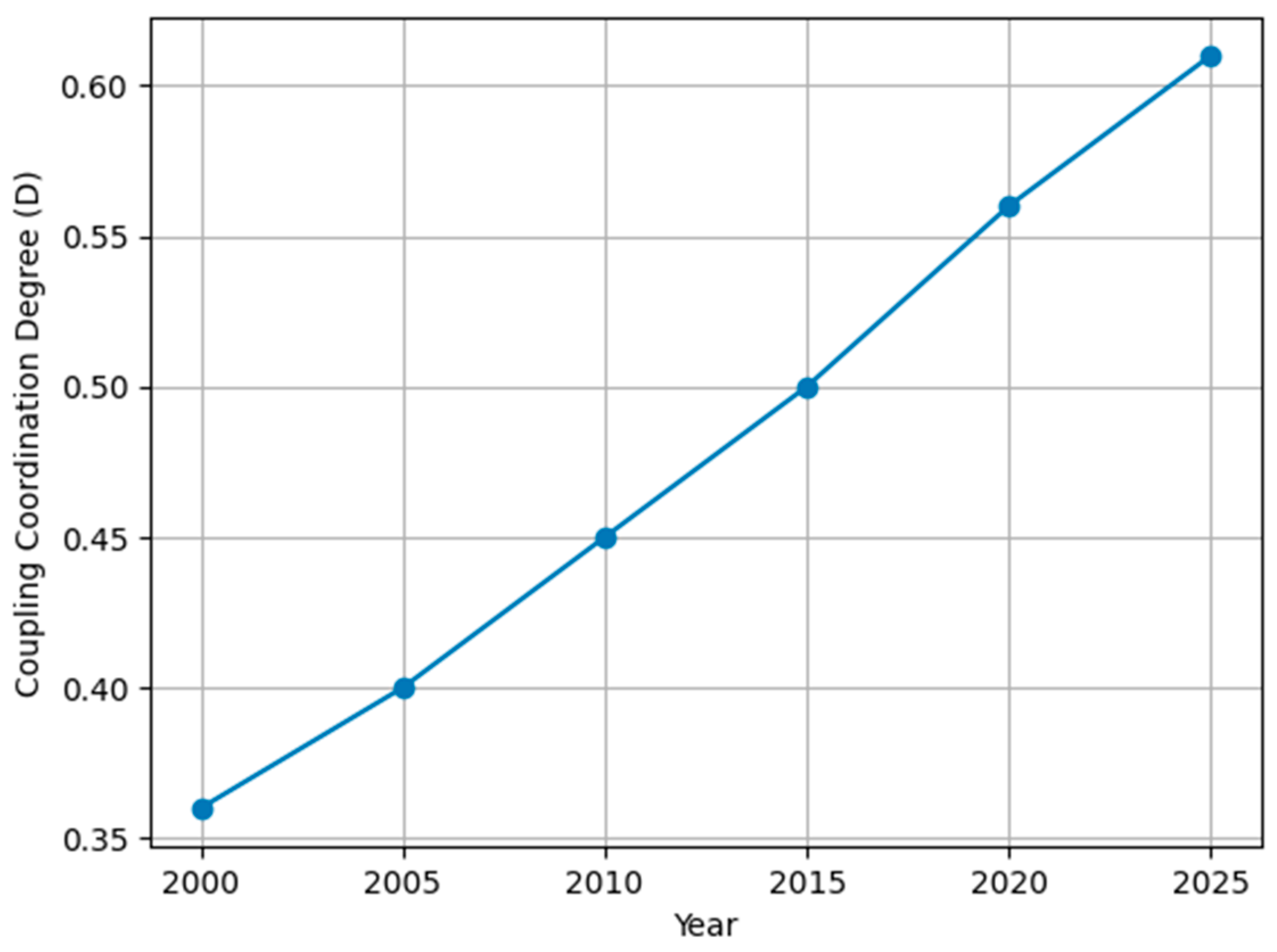
As shown in Figure 1, From a temporal perspective, the coupling coordination between economic and ecological benefits in northeast China’s key state-owned forest regions showed a phased evolutionary trajectory from low-level imbalance to moderate coordination between 2000 and 2025.
Specifically, the coordination index was approximately 0.36 in 2000, indicating moderate imbalance. It rose to around 0.45 by 2010, marking a transition to mild imbalance. Despite brief fluctuations due to the comprehensive logging ban policy in 2015, the index continued to climb to about 0.50, approaching the critical coordination threshold.
Subsequently, driven by ecological compensation measures and industrial restructuring, the index reached 0.56 by 2020, entering the near-coordination zone, and further increased to approximately 0.61 by 2025, achieving initial coordination.
This evolutionary pattern reveals a significant initial misalignment between economic and ecological benefits. As ecological protection intensified and economic structures gradually adjusted, their alignment improved. However, the coordinated progress mainly occurred in the later stages, and the overall levels remained within the low-to-moderate range, which reflects the inherent lag in the economic system’s response to ecological improvements.

4.3.2. Spatial Distribution Characteristics

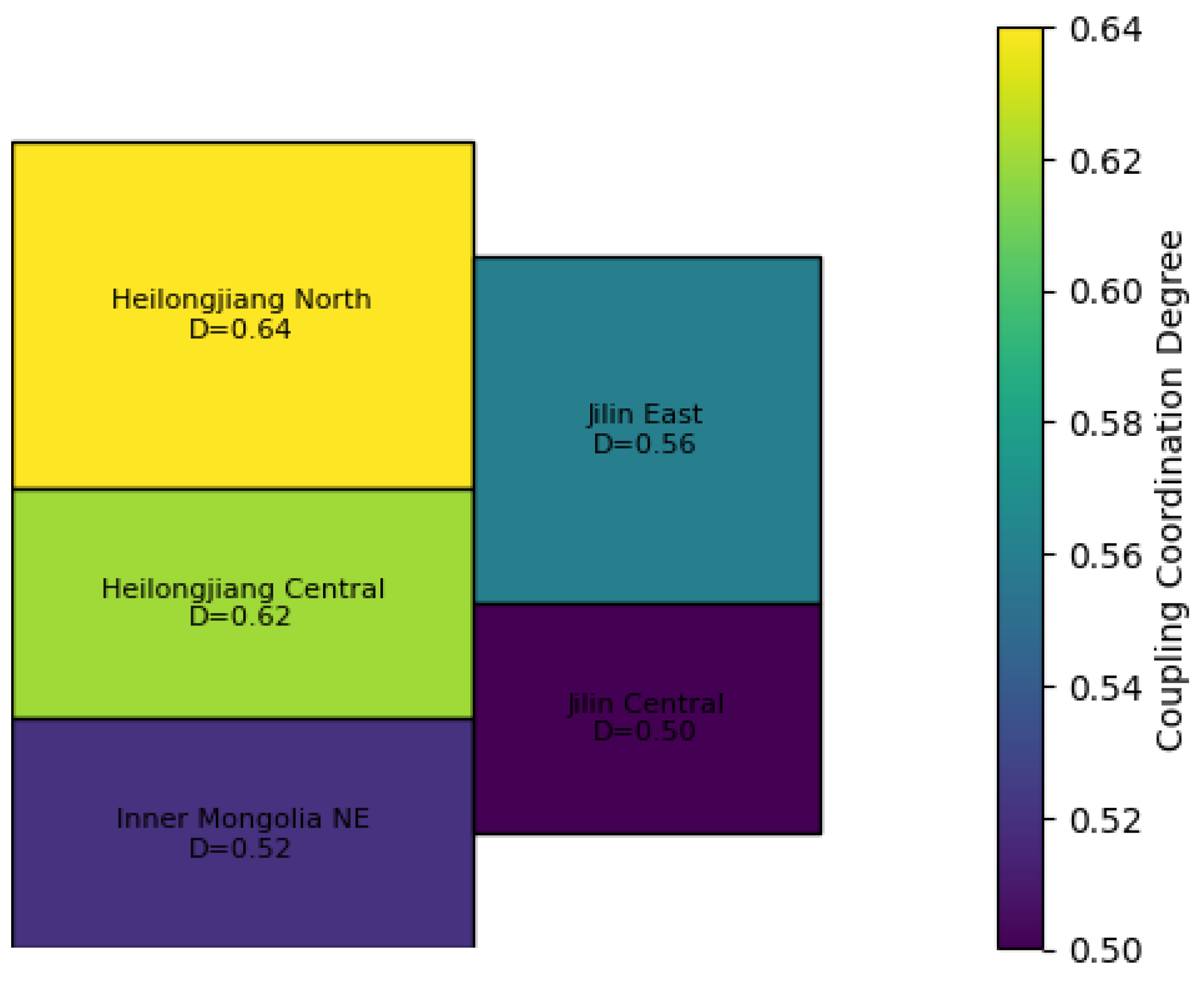
As shown in Figure 2, From a spatial perspective, the coupling coordination levels among forest industry groups in northeast China’s key state-owned forest regions exhibit distinct regional variations and a gradient distribution pattern. Data from the 2025 sample period indicate that forest industry groups located in central and northern Heilongjiang—characterized by superior resource endowment and robust ecological protection foundations—generally maintain coordination levels between 0.60 and 0.65, indicating that they have entered the primary coordination phase.
In contrast, regions in eastern Jilin and parts of Inner Mongolia show coordination levels primarily ranging from 0.52 to 0.58, remaining in a transitional state toward coordination.
Conversely, areas with higher historical logging intensities and slower industrial transformation processes demonstrate coordination levels fluctuating between 0.48 and 0.52, reflecting a shift from mild imbalance to a transitional phase.
Geographically, high coordination values are concentrated in forest regions with abundant resources and rapid ecological recovery, while low values prevail in areas with limited industrial substitution capacity and significant labor outflow, reflecting an overall spatial structure of “higher coordination in northern regions with superior resource advantages.”

4.3.3. Analysis of Phased Changes Under Institutional Shock

The institutional influence has exerted a distinct phased segmentation effect on the coupled and coordinated evolution of economic and ecological welfare over the time series. During the initial phase of the Natural Forest Protection Program (2000–2010), resource constraints initially intensified, resulting in a sharp decline in timber output. The economic welfare index ascended from 0.312 to 0.396, mainly propelled by fiscal subsidies and public investments. Simultaneously, the ecological welfare index increased steadily from 0.428 to 0.521, while the coupling coordination degree rose from 0.36 to 0.45, remaining within an unbalanced scope.
In the second phase (2011–2014), ecological restoration and industrial substitution advanced in tandem, accelerating the enhancement of ecological welfare to approximately 0.58 by around 2014. Nevertheless, the growth of economic welfare remained relatively sluggish; although the coupling coordination degree continued to climb to about 0.48, structural discrepancies persisted within the system, presenting as a non-synchronous pattern where ecological improvement outpaced economic adjustment.
The complete halt of commercial logging in natural forests in 2015 signified a significant institutional turning point, directly affecting the economic system. In certain years, the growth rate of the economic welfare index dropped below 3%, and employment-related indicators declined, causing the coupling coordination index to fluctuate between 0.48 and 0.52 in the short term. With the refinement of ecological compensation mechanisms and the gradual development of green industries, the ecological welfare index rapidly rose above 0.68 between 2016 and 2020, and the coupling coordination index recovered to 0.56, entering a near-coordinated phase.
After 2021, the region entered a normalized ecological protection stage, with institutional priorities shifting from temporary compensation measures to long-term mechanism construction. Supported by increased incomes and public services, economic welfare rebounded, reaching 0.502 for the economic welfare index, 0.742 for the ecological welfare index, and 0.61 for the coupling coordination index by 2025, indicating the system’s gradual transition into a primary coordination phase. Overall, institutional shocks have driven an evolutionary trajectory across different stages— “lagging economic adjustment → leading ecological improvement → gradual convergence” —through alterations in resource utilization patterns and employment structures.

5. Empirical Analysis of Labor Mobility on Coupled and Coordinated Development

5.1. Descriptive Statistical Analysis

As shown in Table 6, the variables exhibit distinct characteristics throughout the sample period. The average coupling coordination index stands at 0.512 with a standard deviation of 0.083, indicating an overall transition from imbalance to coordination, albeit with fluctuations across regions and years. The ecological welfare index (0.583) exceeds the economic welfare index (0.406), suggesting that ecological improvement outpaces economic progress, reflecting a structural disparity between the two domains. Regarding labor variables: the average number of employed workers is 783,600 with a large standard deviation (21.45), highlighting significant differences in workforce size among forest industry groups; the labor growth rate averages negative (−0.021), indicating a sustained contraction trend, with a minimum value of −0.085 reflecting notable personnel attrition during certain periods; the labor outflow rate averages 3.1% but peaks at nearly 5.8%, indicating substantial outflow pressures in specific regions. For control variables, both industrial structure upgrading and household income levels demonstrate variability, underscoring persistent regional development disparities.

5.2. Panel Data Testing

As presented in Table 7, the majority of variables have passed the unit root test at the original series level. Specifically, the coupling coordination index, economic welfare index, and ecological welfare index all reject the unit root hypothesis at the 1% significance level, which implies that their series possess strong stationarity. The growth rate and outflow rate of the labor force also exhibit significant stationarity, suggesting that their fluctuations mainly center around the mean value. In contrast, the number of employed workers, residents’ income levels, and regional economic levels failed the significance test, indicating non-stationary characteristics that are consistent with their long-term upward or downward trends. For non-stationary variables, difference transformation or cointegration tests should be utilized to further confirm their long-term relationships and avoid spurious regression problems.
The first differences in the three non-stationary variables—resident income level (INC), regional economic level (GDP), and the number of employed staff and workers (LAB)—were tested for stationarity. As shown in Table 8, the LLC test statistics for all three differenced variables are significant at the 1% or 5% level, leading to the rejection of the null hypothesis of a unit root. This indicates that the first-differenced series have achieved stationarity.
Since all three variables are integrated of the same order, further investigation is warranted to determine whether a long-run equilibrium relationship exists among them. This study employs the Kao panel cointegration test, with the null hypothesis of “no cointegration,” i.e., no long-run stable relationship among the variables. The test results are presented in Table 9. The p-values of all test statistics are less than 0.01 (reported as 0.0000, indicating p < 0.0001), leading to a strong rejection of the null hypothesis of no cointegration at the 1% significance level. This finding demonstrates that a long-run stable equilibrium relationship exists among resident income level (INC), regional economic level (GDP), and the number of employed staff and workers (LAB). Although these three variables may deviate from the equilibrium state in the short run, they tend to be mutually pulled toward and gradually return to the equilibrium path over the long term.

5.3. Benchmark Regression Analysis

As shown in Table 10, the labor force size exhibits a significant negative correlation with coupling coordination in the benchmark model, indicating that larger workforce sizes correlate with lower coordination between economic and ecological welfare. This finding aligns with the reality where resource-dependent production methods still account for a considerable share. Upon introducing the quadratic term, the LAB2 coefficient becomes positive and statistically significant, demonstrating a nonlinear effect of labor mobility on coupling coordination: as labor force size decreases, the pressure on ecosystems gradually diminishes, leading to a marginal improvement in coordination that follows a “U-shaped” trajectory. Meanwhile, both industrial structure upgrading and household income variables show significant positive impacts, suggesting that tertiary industry development and income growth can mitigate structural contradictions between economic and ecological systems to some extent. The model’s goodness-of-fit improved from 0.642 to 0.701, indicating enhanced explanatory power through the nonlinear specification.

5.4. Analysis of the Mediating Effect

As shown in Table 11, the labor force size exerts a significant negative impact on industrial structure variables, indicating that labor outflow partially drives the transition of industries from traditional forestry to services. After incorporating intermediary variables, the industrial structure demonstrates a significant positive effect on coupling coordination, while the absolute value of the labor force coefficient decreases markedly from −0.182 to −0.119, suggesting that the industrial structure plays a partial mediating role between labor mobility and coupling coordination. The resident income variable maintains a significant positive influence across all models, highlighting its consistent promoting effect on economic–ecological coordination. Overall, labor mobility indirectly affects the balance between economic and ecological welfare through industrial structure adjustment, validating the transmission pathway of “factor mobility → structural adjustment → coordinated evolution.”

5.5. Threshold Effect Analysis

As presented in Table 12, the influence of labor mobility on coupling coordination manifests a distinct threshold effect. When the level of industrial structure upgrading is below 0.40, the coefficient of LAB is −0.238 and statistically significant, which indicates that in a relatively homogeneous phase of industrial structure, the labor scale strongly supports resource-dependent production, thus exerting substantial pressure on the ecosystem. As the industrial structure advances to the range of 0.40–0.48, the negative impact attenuates; when IND exceeds 0.48, the coefficient of LAB becomes non-significant, suggesting that in a more optimized phase of industrial structure, the constraining effect of the labor scale on coupling coordination weakens significantly. The household income variable exhibits a positive influence across all intervals, with its coefficient increasing as the threshold ascends, highlighting an increasing role of income improvement in promoting coordinated development.

5.6. Heterogeneity Analysis

Table 13 demonstrates notable heterogeneity across different forest region types. In forest regions with abundant resources, the negative impact of the labor force scale on coupling coordination is more prominent, signifying a higher degree of reliance on resource exploitation and a more direct transmission effect of labor force changes on ecosystem pressure. Conversely, in transformational forest regions, the absolute values of the LAB coefficient are relatively smaller, implying that industrial restructuring has partly mitigated the constraints imposed by the labor force scale on coordinated development. Simultaneously, the positive influence of industrial structure variables is more evident in these regions, underscoring the more significant role of industrial upgrading in facilitating economic–ecological coordination.

5.7. Conservative Test

Table 14 reveals that subsequent to the application of diverse robustness testing approaches, such as substitution variables (labor force growth rate), lagged terms, and outlier elimination, the coefficients of labor-related variables retain consistent signs and significance levels. All of them display a significant negative influence, suggesting a high degree of robustness in the baseline regression results. Simultaneously, the variables of industrial structure and household income consistently demonstrate positive and significant effects across all models, validating the stability of their positive contributions to the coupling coordination degree.

6. Conclusions and Recommendations

6.1. Research Conclusions

The research findings indicate that between 2000 and 2025, the economic and ecological welfare in key state-owned forest regions of northeast China exhibited an evolutionary trend transitioning from imbalance to initial coordination. The improvement rate of ecological welfare generally outpaced that of economic welfare, forming a phased asymmetric pattern. Labor mobility significantly influences coupling coordination, exerting a negative constraining effect with a “U-shaped” nonlinear characteristic: during periods of high resource dependence, expanded labor force intensifies ecological pressure; however, as labor contraction and structural adjustments advance, ecological improvement effects gradually emerge. Mediation effect tests reveal that industrial structure partially mediates the relationship between labor mobility and coupling coordination, reflecting a pathway of “factor changes → structural restructuring → welfare coordination.” Threshold effect and heterogeneity analyses further demonstrate that this relationship is constrained by industrial structure levels and regional development stages—negative effects of labor mobility markedly weaken in regions with advanced industrial upgrading or rapid transformation. Spatial analysis reveals spatial correlations among forest industry groups, with highly coordinated regions predominantly concentrated in areas with superior resource endowments and stronger ecological restoration foundations. Overall, labor mobility exerts sustained and complex influences on the coordination between economic and ecological welfare through changes in production scale and resource utilization patterns, exhibiting distinct phases and structural characteristics in its operational mechanisms.

6.2. Recommendation

6.2.1. Optimization of Labor Allocation and Structural Transformation Guidance Mechanism

In the context of continuous labor outflow and structural shortages, enhancing factor utilization efficiency necessitates classified guidance and precise resource allocation. Specifically, the Forest Industry Group should establish job requirement inventories and workforce skill registries to dynamically match positions in forest conservation, ecological restoration, forest-based economies, and ecotourism, with a priority on deploying the existing labor force in ecological services and the tertiary sectors.
Simultaneously, targeted vocational training programs should be implemented via local colleges and corporate training platforms. These programs, covering areas such as forest management, wellness services, and e-commerce operations, are expected to enhance workers’ cross-sector mobility.
For returnee laborers, a dual-pronged approach integrating “return incentives and local employment” should be adopted. This approach, which includes entrepreneurial subsidies, microcredit support, and housing guarantees, aims to encourage skilled or experienced workers to contribute to emerging industries in forest regions.
Regarding employment mechanisms, flexible and seasonal employment arrangements should be promoted to align with the cyclical nature of ecological restoration and tourism, thereby optimizing job utilization. At the informational level, a regional labor mobility monitoring platform should regularly publish employment demand and mobility trends, offering data-driven support for government policies and corporate hiring decisions. Through these measures, labor structure optimization can be achieved, effectively aligning with regional development needs without intensifying overall employment pressures.

6.2.2. Establish a Synergistic Mechanism for Ecological Compensation and Industrial Development

In the context of continuously strengthening ecological protection efforts, ecological compensation should be integrated with industrial development to tackle the practical issue of “the difficulty in converting ecological benefits into residents’ income.” Specifically, on the basis of the existing central government fiscal transfers, a dynamic compensation mechanism associated with forest carbon sequestration capacity and ecological service values should be established. This mechanism directly links compensation funds with the ecological performance of forest regions to improve the efficiency of fund allocation. Moreover, a portion of the compensation funds should be used to support projects in forest-based economies, forest wellness tourism, and eco-tourism, generating a multiplier effect of “compensation funds → industrial investment → income growth.”
At the implementation stage, specialized development funds can be set up to attract private capital into green industries. Tax incentives and loan interest subsidies should be provided to the participating enterprises to enhance sustainability. Additionally, the mechanisms for realizing the value of ecological products should be promoted, such as exploring carbon trading, ecological certification, and green branding, to transform ecological advantages into market competitiveness. This approach broadens revenue sources without increasing the intensity of resource exploitation, achieving simultaneous improvements in both ecological conservation and economic returns.

6.2.3. Improving Regional Collaborative Governance and Spatial Spillover Regulation Mechanisms

Given the significant disparities among forest industry groups in terms of resource endowments and transformation processes, regional coordination mechanisms should be established to mitigate development inequalities.
Specifically, cross-regional collaborative platforms can be created to foster specialized partnerships among forest regions in industrial planning, labor allocation, and ecological conservation. For example, resource-rich areas should prioritize ecological restoration and carbon sequestration industries, while regions with stronger transformation foundations should enhance tourism and service sectors, thereby avoiding homogeneous competition.
At the institutional level, unified ecological protection standards and information-sharing mechanisms should be implemented to ensure seamless integration of monitoring data, employment information, and industrial development data, reducing regional information asymmetry.
Additionally, targeted fiscal transfers and special funds should support less coordinated regions, focusing on infrastructure improvement and industrial development to strengthen their capacity to absorb labor and foster new economic models.
In spatial governance, differentiated regulatory strategies should be adopted for regions with high labor outflows and low coordination levels based on spatial econometric analysis, such as enhancing employment absorption capacity or increasing ecological compensation intensity, to generate positive spillover effects and elevate overall regional coordination.

Author Contributions

Conceptualization, Q.S. and H.L.; methodology, Q.S.; software, Q.S.; validation, Q.S.; formal analysis, Q.S.; investigation, Q.S.; resources, Q.S.; data curation, Q.S.; writing—original draft preparation, Q.S.; writing—review and editing, H.L.; visualization, H.L.; supervision, H.L.; project administration, H.L. All authors have read and agreed to the published version of the manuscript.

Funding

This research received no external funding.

Institutional Review Board Statement

Not applicable.

Informed Consent Statement

Not applicable.

Data Availability Statement

The raw data supporting the conclusions of this article will be made available by the authors on request.

Conflicts of Interest

The authors declare no conflicts of interest.

References

  1. Lin, H.; Fu, Q.M. Barriers and Breakthroughs in the Transfer Employment of Surplus Labor in Northeast China’s State-Owned Forest Areas. Issues For. Econ. 2021, 41, 561–568. [Google Scholar]
  2. Zhu, H.G.; Fu, Y.Z.; Zhang, S.P. Labor Employment and Its Household Welfare Effects in Key State-Owned Forest Areas. J. Agro-For. Econ. Manag. 2020, 19, 190–199. [Google Scholar]
  3. Li, H.S.; Hu, C.P.; Ji, Y.; Li, M.Q. Agricultural Labor Transfer, Productivity Improvement, and Macroeconomic Growth: An International Comparison Based on 55 Global Economies. Issues Agric. Econ. 2021, 7, 117–129. [Google Scholar]
  4. Wang, F.J.; Yang, H.L. The Impact of Labor Transfer on Agricultural Productivity: Based on Panel Data from 2001 to 2020. J. Mudanjiang Univ. 2025, 33, 11–20. [Google Scholar]
  5. Wang, Y.C. A Study on the Impact of Rural Labor Mobility on the Economy of Anhui Province. J. Technol. Entrep. 2023, 36, 26–29. [Google Scholar]
  6. Du, R.Y.; Fan, Y.; Li, Y.C.; Li, M.H.; Qu, M.H. Coupling Coordination of Rural Labor Transfer, Farmland Scale Management, and Agro-Ecological Environment in Henan Province. J. Henan Agric. Univ. 2019, 53, 480–487. [Google Scholar]
  7. Yuan, C.G.; Yang, J.B.; Song, F.Q.; Wen, J.P.; Wang, C.Q. Coupling Coordination of Rural Labor Transfer, Land Transfer, and Agro-Ecological Environment in Henan Province. Henan Sci. 2026, 44, 228–236. [Google Scholar] [CrossRef]
  8. Zhang, Y.S.; Zhou, H.; Liu, X.H.; Xiang, D.Y. Impacts of Rural Labor Transfer on Ecological Restoration in Karst Areas and Their Regional Differences: Based on Household Survey Data from Youyang and Yanhe. Acta Ecol. Sin. 2023, 43, 5395–5405. [Google Scholar] [CrossRef]
  9. Chen, L. Labor mobility patterns, macroeconomic fluctuations, and social welfare: Based on the NK-DSGE model incorporating formal and informal employment. Econ. Manag. Rev. 2017, 33, 18–28,111. [Google Scholar]
  10. Zhang, Y. Research on the Impact of Labor Mobility on the Welfare of Farmers in Underdeveloped Regions. Master’s Thesis, Nanjing Audit University, Nanjing, China, 2019. [Google Scholar]
  11. Shi, T. Coupling Coordination Degree and Spatial Network Effect of Ecological Protection and High-Quality Economic Development in the Yellow River Basin. Reg. Econ. Rev. 2020, 25–34. [Google Scholar]
  12. Liu, C. Research on the Impact of Rural Labor Mobility on Intergenerational Support and Welfare of Left-behind Elderly. Master’s Thesis, Anhui Agricultural University, Hefei, China, 2016. [Google Scholar]
  13. Guo, J.; Xu, Y.; Bai, J. Housing, Convenience Facilities, and Heterogeneous Labor Mobility: Micro-level Mechanisms and Welfare Effects. Financ. Res. 2022, 7, 135–153. [Google Scholar]
  14. Bao, K. Research on the Impact of Labor Mobility in China on Regional Economic Growth. Master’s Thesis, Jilin University, Changchun, China, 2015. [Google Scholar]
  15. Zhao, J.; Tian, L.; Li, S.; Bai, Y.; Li, P. Research on the Coordinated Development of Energy, Environment, Economy and Ecology Coupling in the Yellow River Basin. People’s Yellow River 2022, 44, 13–19. [Google Scholar]
  16. Tan, D.; Wu, D.; Han, B.; Zhang, C. Research on the Evaluation of Urban-Rural Economic and Social and Ecological Coupling Development—Taking the Guangdong-Hong Kong-Macao Greater Bay Area as an Example. Ecol. Econ. 2023, 39, 156–164. [Google Scholar]
  17. Chen, S. The Impact of Digital Transformation on Industrial Structure Upgrading and Spatial Association Mechanism: An Empirical Analysis Based on Dynamic Spatial Panel Model. J. Xuchang Univ. 2025, 44, 141–146. [Google Scholar]
  18. Qiu, M.; Zhu, L. Digital Economy Empowering the Development of New Quality Productivity: An Empirical Analysis Based on Spatial Spillover Effect and Threshold Effect. J. Beibu Gulf Univ. 2026, 41, 85–97. [Google Scholar]
  19. Chen, C.; Qiao, Z.H.; Sun, H.T. The Coupling Coordination Degree Measurement of Society-Economy-Ecosystem of Regional National Forest Park in Heilongjiang Province. Teh. Vjesn.-Tech. Gaz. 2021, 28, 779–785. [Google Scholar] [CrossRef] [PubMed]
  20. Ao, G.Y.; Xu, Q.Q.; Liu, Q.; Xiong, L.C.; Wang, F.T.; Wu, W.G. The Influence of Nontimber Forest Products Development on the Economic-Ecological Coordination-Evidence from Lin’an District, Zhejiang Province, China. Sustainability 2021, 13, 904. [Google Scholar] [CrossRef]
Figure 1. Time evolution trend of economic–ecological welfare coupling coordination degree in key state-owned forest areas of northeast China (2000–2025).
Sustainability 18 06317 g001
Figure 2. Spatial distribution characteristics of economic–ecological welfare coupling coordination degree in key state-owned forest areas of northeast China (2025).
Sustainability 18 06317 g002
Table 1. Operational area and geographic coordinates of key state-owned forest areas in northeast China, by province.
ProvinceOperational Area Main Mountain Ranges/Forest Areas CoveredNotes
Heilongjiang~6.60Greater Khingan Range (partial), Lesser Khingan Range, Wandashan Mountains, Zhangguangcai Range, Laoye RangeIncludes the Longjiang Forest Industry Group (6.5856 million ha) and the Heilongjiang portion of the Greater Khingan Range forest area (approximately 77.8% of the total Greater Khingan Range forest area)
Inner Mongolia~10.67Greater Khingan Range (main body), eastern Hulunbuir grasslandIncludes Inner Mongolia Forest Industry Group (10.67 million ha) and the Inner Mongolia portion of the Greater Khingan Range forest area (approximately 22.2%)
Jilin~1.00Changbai MountainsIncludes forestry bureaus under Jilin Forest Industry Group (e.g., Hongshi Forestry Bureau, Songjianghe Forestry Bureau)
Table 2. Variable Selection and Definition Explanation Table.
Type of VariableDimension DivisionVariable NameVariable SymbolVariable DefinitionCalculation Method or Explanation
Explained VariableCoupling CoordinationCoupling Coordination DegreeCCDReflect the level of coordinated development between economic welfare and ecological welfareCalculation of the Coupling Coordination Degree Based on the Economic Welfare Index and the Ecological Welfare Index
Explained VariableEconomic WelfareEconomic Welfare IndexEWIMeasuring the comprehensive contribution of regional economic development to residents’ welfareThe entropy weighting method is used to calculate weighted values for indicators such as income, employment, and consumption
Explained VariableEcological WelfareEcological Welfare IndexECIMeasuring the ecosystem’s capacity to support residents’ welfareThe entropy weighting method was employed to calculate weighted values for indicators such as forest resources and environmental quality
Core Explanatory VariableLabor MobilityNumber of Employees on DutyLABReflecting changes in the size of the labor force in the forest areaThe total number of employees working in the forest area
Core Explanatory VariableLabor MobilityEmployee Growth RateLABGReflect the trend in changes in the labor force size(Number of employees in the current period-Number of employees in the previous period) ÷ Number of employees in the previous period
Core Explanatory VariableLabor MobilityLabor Outflow RateOUTFLOWMeasuring the extent of labor outflowEstimated by (Number of people leaving ÷ Total number of laborers)
MetavariableIndustrial StructureLevel of Industrial Structure UpgradingINDReflect the degree of transformation of the industrial structure from primary to advanced levelsThe proportion of the value added by the tertiary sector in GDP
MetavariableLevel of IncomeResidents’ Income LevelINCMeasuring the foundation of residents’ economic welfareper capita disposable income
Controlled VariableEconomic DevelopmentRegional Economic LevelGDPMeasuring the overall economic development level of the regionRegional Gross Domestic Product (logarithmic transformation)
Controlled VariablePopulation StructurePopulation SizePOPReflect changes in the regional population sizeNumber of permanent residents (logarithmic transformation)
Controlled VariableFinancial SupportIntensity of Fiscal ExpenditureFISCMeasuring the level of government supportThe proportion of fiscal expenditure to GDP
Controlled VariableResource EndowmentLevel of Forest ResourcesFORESTReflecting the ecological baseline conditionsForest coverage rate or forest stock volume
Controlled VariablePolicy FactorsPolicy Virtual VariablePOLICYRepresenting the impacts of different policy stagesSet stage dummy variables for 2000,2011,2015, and 2021
Table 3. Classification and Discrimination Criteria of Coupling Coordination Types.
Coupling Coordination Degree D IntervalType ClassificationSpecific Stage
0.00 < D 0.30 Severe Disturbance CategoryMajor Maladjustment
0.30 < D 0.40 Dysregulation CategoryModerate Dysregulation
0.40 < D 0.50 Mild Dysregulatory DisordersMild Dysregulation
0.50 < D 0.60 Transition CategoryLingmin Coordination
0.60 < D 0.70 Primary Coordination CategoryPrimary Coordination
0.70 < D 0.80 Intermediate Coordination CategoryIntermediate Coordination
0.80 < D 0.90 Good Coordination CategoryGood coordination
0.90 < D 1.00 Highly Coordinated CategoryHighly Coordinated
Table 4. Calculation Results of the Economic Welfare Index for Key State-Owned Forest Areas in Northeast China (2000–2025).
Particular YearEconomic Welfare Index (EWI)Income Dimension Index
20000.3120.285
20050.3480.321
20100.3960.372
20150.4210.405
20200.4580.442
20250.5020.487
Table 5. Calculation Results of the Ecological Welfare Index for Key State-Owned Forest Areas in Northeast China (2000–2025).
Particular YearEcological Welfare Index (ECI)Resource Endowment Dimension Index
20000.4280.452
20050.4630.487
20100.5210.548
20150.6030.632
20200.6810.712
20250.7420.768
Table 6. Descriptive statistical results of major variables.
Variable NameSymbolObserved Value (N)MeanStandard DeviationLeast ValueCrest Value
Coupling Coordination DegreeCCD1560.5120.0830.3560.642
Economic Welfare IndexEWI1560.4060.0720.2850.502
Ecological Welfare IndexECI1560.5830.0950.4280.742
Number of Employees in Service (thousands)LAB15678.3621.4552.1120.35
Labor Force Growth RateLABG156−0.0210.035−0.0850.042
Labor Outflow RateOUTFLOW1560.0310.0120.010.058
Level of Industrial Structure UpgradingIND1560.4120.0670.2850.538
Resident Income Level (ten thousand yuan)INC1562.130.681.023.15
Regional Economic Level (lnGDP)GDP1569.870.548.6510.92
Table 7. Panel data stationarity test results (unit root test).
Variable NameSymbolLLC StatisticsIPS StatisticsADF StatisticsPP StatisticsStability Conclusion
Coupling Coordination DegreeCCD−3.842 ***−2.915 ***−4.126 ***−4.387 ***steady
Economic Welfare IndexEWI−2.756 ***−2.103 **−3.285 ***−3.462 ***steady
Ecological Welfare IndexECI−2.984 ***−2.256 **−3.547 ***−3.689 ***steady
Number of Employees on DutyLAB−1.428−0.963−1.275−1.336non-stationary
Labor Force Growth RateLABG−4.216 ***−3.587 ***−4.732 ***−4.865 ***steady
Labor Outflow RateOUTFLOW−3.105 ***−2.674 ***−3.821 ***−3.947 ***steady
Level of Industrial Structure UpgradingIND−2.334 **−1.985 **−2.876 ***−2.945 ***steady
Residents’ Income LevelINC−1.562−1.214−1.438−1.502non-stationary
Regional Economic LevelGDP−1.487−1.092−1.365−1.428non-stationary
Note: ** p < 0.05; *** p < 0.01.
Table 8. Results of LLC panel unit root tests for the first-differenced variables.
Variable NameSymbolAdjusted t p-ValueConclusion
First difference in resident income leveldINC−6.94460.0000Stationary
First difference in regional economic leveldGDP−2.82000.0024Stationary
First difference in number of employed staff and workersdLAB−2.90060.0019Stationary
Table 9. Kao panel cointegration test results.
StatisticStatistic Valuep-Value
Modified Dickey–Fuller t−7.90420.0000
Dickey–Fuller t−8.54720.0000
Augmented Dickey–Fuller t−5.30860.0000
Unadjusted Modified Dickey–Fuller t−16.42950.0000
Unadjusted Dickey–Fuller t−10.24140.0000
Table 10. Benchmark Regression Results (Fixed-Effect Model).
Variable NameModel (1) CCDModel (2) CCD (Including a Quadratic Term)
Number of employees on duty (LAB)−0.182 *** (0.051)−0.264 *** (0.073)
Number of employees on duty 2 (LAB 2)0.137 ** (0.058)
Industrial structure (IND)0.215 ** (0.093)0.198 ** (0.089)
Resident income (INC)0.174 *** (0.048)0.162 *** (0.046)
Constant term0.312 *** (0.067)0.285 *** (0.072)
Individual effectcontrolcontrol
Time effectcontrolcontrol
R20.6420.701
Sample size156156
Note: ** p < 0.05; *** p < 0.01.LAB; 2 represents the squared value of LAB.
Table 11. Results of the Mediation Effect Test.
Variable NameModel (1) INDModel (2) CCDModel (3) CCD (Including Intermediaries)
Number of employees on duty (LAB)−0.148 ** (0.062)−0.182 *** (0.051)−0.119 ** (0.057)
Industrial structure (IND)0.206 ** (0.091)
Resident income (INC)0.231 *** (0.073)0.174 *** (0.048)0.152 *** (0.046)
Constant term0.287 *** (0.081)0.312 *** (0.067)0.295 *** (0.069)
Individual effectcontrolcontrolcontrol
Time effectcontrolcontrolcontrol
R20.5330.6420.688
Note: ** p < 0.05; *** p < 0.01.
Table 12. Threshold Effect Test Results (Using Industrial Structure IND as the Threshold Variable).
Variable NameIND ≤ 0.400.40 < IND ≤ 0.48IND > 0.48
Number of employees on duty (LAB)−0.238 *** (0.068)−0.162 ** (0.057)−0.081 (0.049)
Resident income (INC)0.143 ** (0.061)0.167 *** (0.052)0.185 *** (0.047)
Constant term0.276 *** (0.074)0.301 *** (0.069)0.328 *** (0.065)
Threshold value0.40.48
R20.6580.6920.713
Note: ** p < 0.05; *** p < 0.01.
Table 13. Heterogeneity analysis results (classified by region type).
Variable NameResource-Based Forest RegionsA Forest Area Undergoing Transformation and Development
Number of employees on duty (LAB)−0.205 *** (0.061)−0.118 ** (0.053)
Industrial structure (IND)0.172 ** (0.078)0.238 *** (0.082)
Resident income (INC)0.151 *** (0.049)0.183 *** (0.052)
Constant term0.295 *** (0.071)0.318 *** (0.069)
R20.6670.704
Note: ** p < 0.05; *** p < 0.01.
Table 14. Robustness Test Results.
Variable NameReplacement Variable Model (LABG)Lagging Phase Model (L.LAB)Model Excluding Extreme Values
Labor Force Variable−0.156 ** (0.067)−0.173 *** (0.059)−0.168 *** (0.055)
Industrial Structure (IND)0.201 ** (0.085)0.194 ** (0.081)0.207 ** (0.083)
Resident Income (INC)0.162 *** (0.048)0.158 *** (0.046)0.165 *** (0.047)
Constant Term0.289 *** (0.072)0.298 *** (0.069)0.305 *** (0.071)
R20.6760.6890.694
Note: ** p < 0.05; *** p < 0.01.
Disclaimer/Publisher’s Note: The statements, opinions and data contained in all publications are solely those of the individual author(s) and contributor(s) and not of MDPI and/or the editor(s). MDPI and/or the editor(s) disclaim responsibility for any injury to people or property resulting from any ideas, methods, instructions or products referred to in the content.