2.1. Overview of Development in Key State-Owned Forest Areas in Northeast China
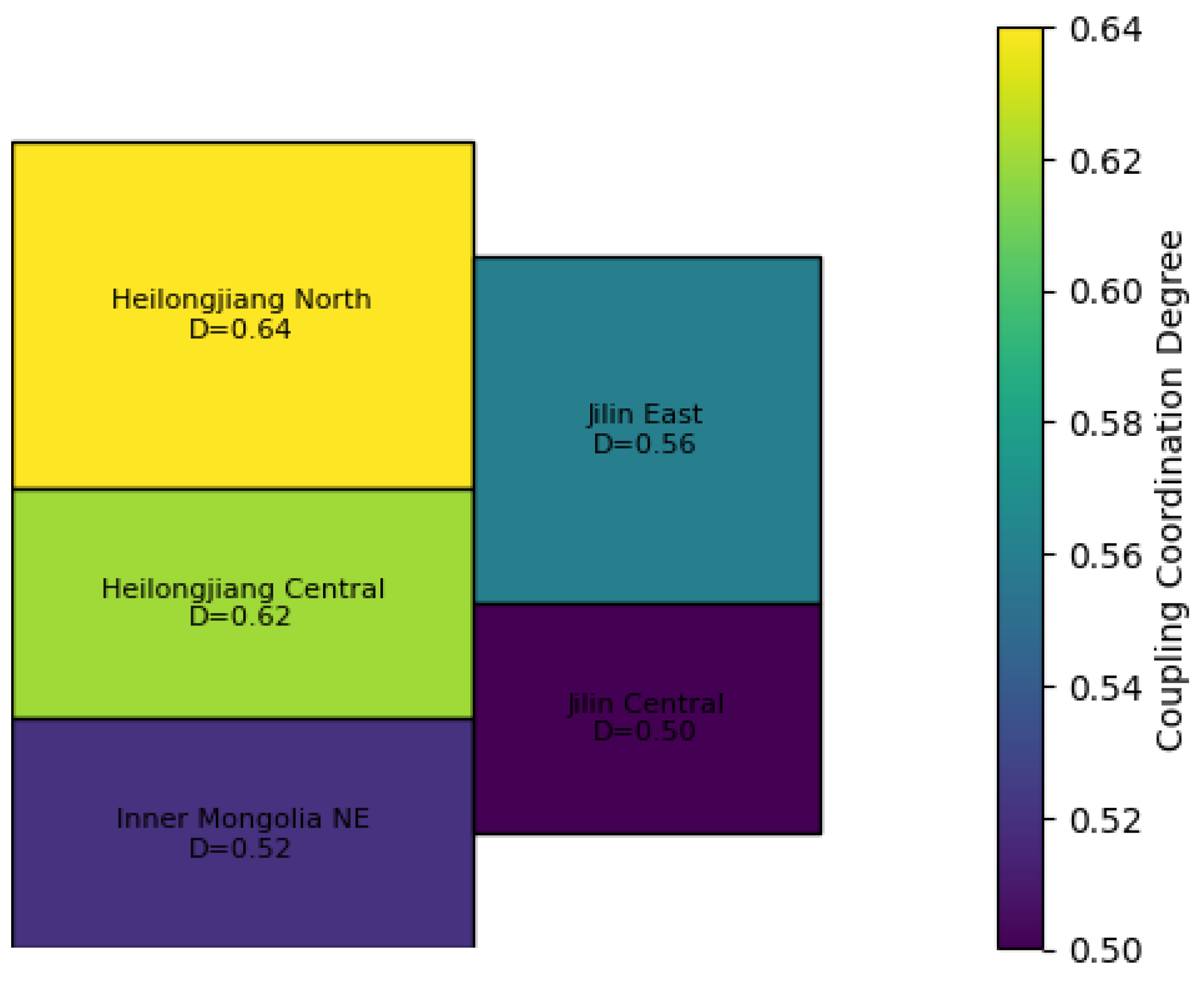
The key state-owned forest areas in northeast China are primarily located in Heilongjiang, Jilin, and northeastern Inner Mongolia, notes to
Table 1, with the China Longjiang Forestry Industry Group, Jilin Forestry Industry Group, and Inner Mongolia Forestry Industry Group serving as the core entities. These areas form the largest and most concentrated region for state-owned forestry production and ecological conservation in China, managing over 100 million hectares of forest land—a significant proportion of the nation’s total state-owned forest areas.
The forest resources are predominantly coniferous and mixed coniferous-and-deciduous forests, with ecological functions including water conservation, biodiversity protection, and carbon sequestration.
For a long time, the region’s economic development has been dominated by timber harvesting and primary processing, featuring a single industrial structure and high resource dependence. The urban system and industrial layout were centered around forestry production, showing typical characteristics of a resource-based economy.
With the continuous implementation of the Natural Forest Protection Program and the 2015 policy banning commercial logging of natural forests, the economic development model has undergone a remarkable transformation. The share of traditional forestry output has steadily declined, while forest-based economies, ecotourism, and green industries have gradually emerged.
However, their overall scale remains limited, leading to insufficient growth momentum for the region and a reduced employment absorption capacity.
2.2. Policy Evolution and Institutional Shock Analysis
2.2.1. Implementation Phase of the First Stage of the Natural Forest Protection Project (2000–2010)
After the launch of Phase I of the Natural Forest Protection Project in 2000, the key state-owned forest regions in northeast China entered an initial transformation phase centered on resource conservation. Policy priorities shifted from timber production to logging restrictions, yield reduction, and ecological restoration.
During this period, the state provided substantial fiscal transfer payments to support enterprises and the resettlement of employees in the forest regions. According to statistics, central government funding for the Natural Forest Protection Project exceeded 100 billion yuan during the 10th Five-Year Plan period. Timber production in the northeast forest regions declined from approximately 100 million cubic meters around 1998 to less than 50 million cubic meters around 2010, indicating a significant reduction in logging intensity.
The tightening resource constraints directly compressed the scale of traditional forestry production, leading to a phased slowdown in regional economic growth. The main business revenues of some forestry enterprises fell by more than 20%, and the momentum for regional economic growth weakened.
Meanwhile, the labor structure began to undergo adjustments, with the number of employed workers continuously declining. The workforce in the forestry sector of China’s northeastern state-owned forest regions decreased from approximately 1.2 million around 2000 to about 900,000 by 2010. Some employees were reassigned internally to roles such as forest tending and public welfare forest management, while a significant proportion moved to seek employment in other cities.
Labor mobility alleviated pressure on resource exploitation while positively contributing to ecological restoration. Forest stock volume increased from around 11 billion cubic meters to over 13 billion cubic meters during this period, and forest coverage steadily rose. However, ecological benefits had not yet been effectively translated into residents’ incomes, resulting in a pronounced structural divergence between economic welfare and ecological welfare.
2.2.2. Implementation Phase of the Second Stage of the Natural Forest Protection Project (2011–2014)
Upon entering the second phase, the policy objectives shifted from solely protecting resources to giving equal emphasis to enhancing ecological functions and promoting industrial transformation. The government continued to increase fiscal investment. From 2011 to 2014, the cumulative spending exceeded 200 billion yuan, which was allocated for forest management, infrastructure development, and the cultivation of alternative industries.
Timber production remained at low levels. In the northeast forest region, the annual average commercial timber output stabilized below 40 million cubic meters. The area under ecological protection continued to expand, which significantly improved forest quality and ecological service functions.
Meanwhile, forest regions gradually explored emerging industries such as forest-based economies and forest tourism. In some areas, the share of the tertiary sector rose from less than 30% to approximately 40%, marking an initial adjustment in the industrial structure.
Labor mobility during this phase features the characteristic of “coexisting outflow and internal transfer.” The number of employed workers further declines to approximately 700,000, maintaining an average annual reduction rate of around 3%. However, some laborers have transitioned to service and ecological management positions through skills training, resulting in a gradually diversified employment structure.
Income levels remain relatively stable, supported by fiscal subsidies and transfer payments. The average annual growth rate of per capita disposable income ranges from 6% to 8%, though it is still below the national average.
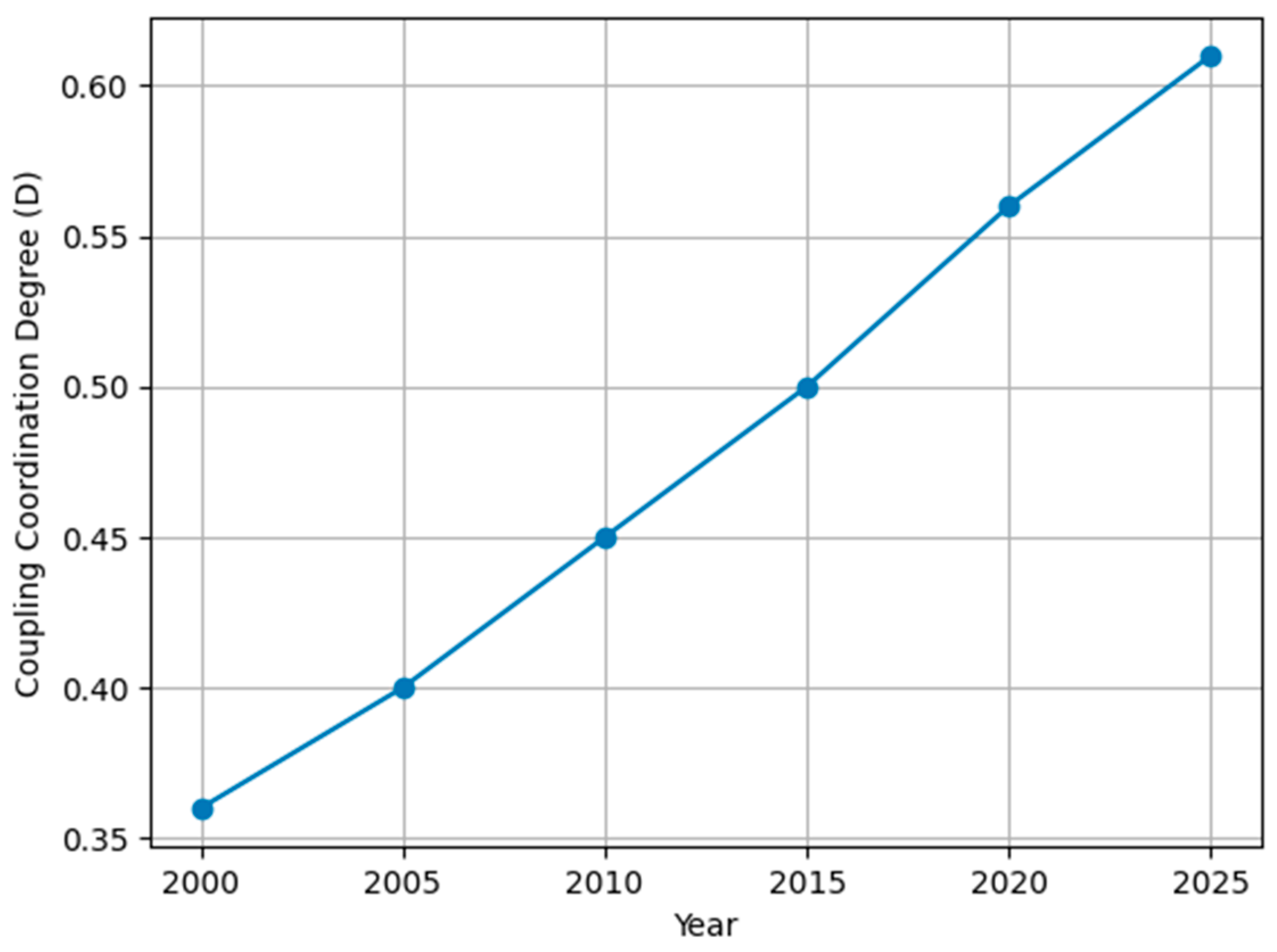
Ecological welfare continues to improve, with forest coverage approaching 22% and ecosystem stability enhanced. The gap between economic and ecological welfare has narrowed, though their coupling remains at a low level of coordination.
2.2.3. Implementation Phase of the Comprehensive Logging Ban Policy (2015–2020)
Following the complete cessation of commercial logging in natural forests in 2015, the state-owned forest regions in northeast China entered a phase of profound transformation. The timber production function was largely phased out, and the regional economic structure faced restructuring pressures.
During this period, commercial timber output plummeted to less than 10 million cubic meters. Traditional revenue sources for forestry enterprises shrank significantly; some forest industry groups experienced revenue declines exceeding 30%, and economic growth exhibited notable volatility.
Concurrently, the government intensified ecological compensation efforts, allocating an average annual subsidy of over 100 billion yuan to offset economic losses caused by the logging ban and maintain basic employee income levels.
Labor mobility intensified further during this phase. The number of employed workers declined to below approximately 600,000. The employee turnover rate in some forestry enterprises exceeded 4%. A substantial workforce shifted to urban service and manufacturing sectors, resulting in a pronounced net population outflow from the region.
The reduction in the labor force, while lowering resource exploitation intensity, facilitated rapid ecosystem recovery. By around 2020, forest stock volume reached around 17.5 billion cubic meters, forest coverage surpassed 23%, and ecological benefits significantly improved.
However, due to insufficient industrial substitution capacity and limited employment absorption capacity, household income growth remained constrained, creating an asymmetric pattern where ecological benefits led while economic benefits lagged.
2.2.4. Routine Ecological Protection Phase (2021–Present)
Since 2021, the Natural Forest Protection Program has entered a phase of sustained implementation. The policy focus has shifted from phased compensation to long-term mechanisms, and ecological conservation, carbon sequestration capacity, and green development have gradually become core objectives.
With the establishment of the “dual carbon” goals, the status of state-owned forest regions in northeast China within the national carbon sink system has significantly improved. In 2023, China’s total forest carbon stock exceeded 9 billion tons. The northeast forest region contributed a substantial share, and its ecological service value continues to grow.
Industrial development in these forest regions has become more green-oriented. Sectors such as ecotourism, forest-based wellness, and forest understory economies are expanding steadily. In some areas, the share of the tertiary industry has risen to over 45%.
In terms of labor allocation, the number of employed workers has stabilized between 500,000 and 600,000, and the rate of labor outflow has slowed somewhat. However, structural shortages, particularly a shortage of highly skilled and service-oriented labor, are becoming increasingly apparent.
Driven by ecological compensation and industrial transformation, income levels have risen steadily. The per capita disposable income of forest area residents has been growing at an average annual rate of around 7%, indicating a trend of recovery in economic welfare.
Meanwhile, ecosystem stability has continued to improve, with forest quality indicators and biodiversity levels steadily increasing. The relationship between economic and ecological welfare is gradually shifting from imbalance to coordination. However, the overall degree of coordination remains constrained by the industrial foundation and population mobility, necessitating further optimization of factor allocation and development pathways.
2.3. Characteristics and Evolution Trends of Labor Mobility
Labor mobility in northeast China’s key state-owned forest regions exhibits a dual pattern of shrinking scale and predominant outflow, a trend closely linked to intensified resource constraints and industrial restructuring.
Since the implementation of the Natural Forest Protection Program, the number of employed workers has steadily declined. It dropped from approximately 1.2 million around 2000 to fewer than 600,000 by 2020, representing an average annual reduction of 3–4%. The decline accelerated significantly after the full implementation of the logging ban policy in 2015.
Most labor outflows are directed towards cities outside the region, particularly to economically vibrant areas beyond northeast China. The workforce involved in these outflows predominantly consists of young and middle-aged workers. This shift has contributed to the gradual population aging in the forest regions.
Concurrently, internal mobility remains notable. Some workers are transitioning from traditional logging roles to forest conservation, ecological restoration, and public service sectors. However, the limited absorption capacity of these sectors fails to fully offset the scale of outward migration.
From the perspective of structural evolution, labor mobility has gradually shifted from passive adjustment to selective migration. Its driving mechanisms have evolved from being solely driven by employment pressure to a comprehensive consideration of income expectations, living conditions, and development opportunities.
Although the per capita disposable income of forest area residents increased from approximately 12,000 CNY around 2010 to about 28,000 CNY in 2023, it still lags behind the national average, creating sustained economic incentives for population outflow.
Meanwhile, the reduction in the labor force has objectively lowered the intensity of forest resource exploitation. It has significantly reduced logging pressure per unit of forest land and accelerated ecosystem recovery, as evidenced by the continuous growth in forest stock volume and enhanced ecological functions.