1. Introduction
The 21st century is widely recognized as the “Ocean Century”. Advancing China’s maritime power strategy, marine tourism development and ecological civilization construction constitute indispensable components of the country’s high-quality development [
1,
2]. Endowed with abundant marine natural resources, cultural assets, spatial resources and ecological endowments, coastal provinces and municipalities have evolved into core carriers for agglomeration, transformation and upgrading of the tourism industry [
3,
4]. Marine resources lay unique resource endowment foundations and expand development space for the tourism sector; in return, the tourism industry facilitates the revitalized utilization of marine resources, inheritance of marine culture and materialization of ecological values, forming an inherently symbiotic and coupled nexus between the two subsystems [
5,
6].
In recent decades, alongside intensified intensive exploitation of coastal marine resources and the high-quality, diversified upgrading of the tourism industry, continuous interactions have taken place between the marine resource subsystem and the tourism industry subsystem in terms of factor matching, functional complementarity and value conversion [
7,
8]. Nevertheless, remarkable bottlenecks still hamper their coordinated development. From the perspective of marine resource exploitation, excessive exploitation at the expense of conservation prevails in certain coastal regions, accompanied by prominent problems including overloaded nearshore aquaculture and imbalanced sea area utilization structure. Such issues trigger aggravated ecological disturbances, occupation of coastal shoreline space and accelerated resource depletion, eroding the resource base for sustainable tourism development [
9,
10]. From the tourism industrial dimension, insufficient excavation of local marine culture, shortage of specialized professionals and inadequate industrial feedback capacity hinder effective marine resource conservation and rational exploitation. From the external institutional environment, imperfect policy matching systems, market supervision frameworks and cross-regional coordination mechanisms further impede the coordinated advancement of the two systems [
11]. Moreover, marine resources feature quasi-public-good attributes, ecological externalities and ambiguous property rights. The costs arising from resource depletion and ecological degradation can hardly be fully internalized, leading to widespread mismatches between resource protectors and benefit gainers as well as incongruence of costs and revenues, which obstruct the transition from extensive loose linkage to high-quality coordinated development between marine resources and the tourism industry [
12].
Existing literature has delivered insightful explorations covering marine tourism development, resource and environmental constraints, coupling-coordination measurement and ecological compensation mechanism formulation [
13,
14,
15]. However, compared with practical demands for high-quality coordinated development of the marine resource–tourism industry nexus, three major research gaps remain. First, most extant studies construct evaluation frameworks centering on general tourism systems, marine economic systems or eco-environmental systems, while few specifically target the dual system of marine resources and the tourism industry; characteristic marine tourism indicators such as marine cultural resources, island resources and biodiversity are insufficiently incorporated into evaluation systems. Second, prior scholarship predominantly focuses on static coupling-coordination measurement or single-subsystem deficiencies, with inadequate elaboration on long-term temporal evolution, spatial neighborhood spillover effects, regional differentiation and phased shifts of restrictive obstacles underlying the coupled systems. Third, current ecological compensation research mostly concentrates on general ecological preservation or damage indemnification, lacking quantifiable criteria and implementable pathways for compensation mechanisms tailored to marine cultural tourism that integrate resource restoration, spatial regulation, tourism revenue feedback and community benefit sharing.
To fill the aforementioned research gaps, this paper addresses three core research questions: (1) What spatiotemporal differentiation patterns and evolutionary trajectories characterize the coupling-coordination level of marine resources and the tourism industry from 2008 to 2024? (2) What are the internal restrictive obstacles and external driving determinants affecting their coupled coordination, and do such factors feature evident regional heterogeneity? (3) How can a targeted marine resource compensation mechanism adapted to marine cultural tourism scenarios be formulated based on empirical findings? To answer these questions, this study selects 11 Chinese coastal provincial-level regions as research samples and establishes a specialized evaluation index system for the marine resource–tourism industry coupling coordination. By adopting a multi-model empirical framework consisting of the coupling coordination degree model, spatial Markov chain, obstacle degree model, fixed-effect model and geographically and temporally weighted regression (GTWR) model, this paper systematically identifies spatiotemporal disparities, restrictive constraints and driving mechanisms of the dual-system coupling and further proposes a differentiated and synergistic marine resource compensation mechanism.
Three-fold marginal contributions are expected from this research. In terms of research scope, this study unifies marine resources and the tourism industry within a consistent analytical framework and develops a customized dual-system evaluation index system oriented toward marine tourism realities, filling the research gap of insufficient attention to unique marine resource indicators in conventional marine economy or tourism-related studies. Methodologically, the combined application of coupling coordination assessment, spatial Markov chain analysis, obstacle diagnosis, fixed-effect estimation and GTWR enables multi-dimensional identification of coupling mechanisms from temporal evolution, spatial transition, internal constraint and external driving perspectives. From a policy design perspective, the proposed marine resource compensation mechanism rooted in quantified obstacle and driver identification specifies measurable compensation benchmarks, financing modes, interregional resource allocation, concrete compensation approaches and institutional safeguards, delivering actionable policy implications for coordinated sustainable development of marine resource conservation and high-quality coastal tourism.
2. Literature Review
Extant literature has accumulated abundant research findings concerning marine resources and tourism industrial development. Relevant studies are theoretically underpinned by synergy theory, system theory, spatial economics and public goods theory. Synergy theory highlights the coordinated evolution of diverse subsystems via factor flow, functional complementarity and structural adjustment; system theory focuses on holistic correlations among resource, industrial, ecological and social elements; spatial economics provides analytical perspectives for interpreting spatial differentiation, neighborhood effects and regional development lock-in of coupling coordination across coastal zones; public goods and externality theories lay theoretical foundations for marine resource conservation, tourism revenue feedback and compensation mechanism formulation [
16]. From the above theoretical perspectives, the nexus between marine resources and the tourism industry goes far beyond a simplistic relationship of resource provision and industrial exploitation; instead, it constitutes a compound systematic linkage covering resource carrying capacity, spatial allocation, ecological constraints, industrial transformation and benefit distribution [
17]. Accordingly, it is essential to conduct research within a dual-system analytical framework.
First, in terms of coupling coordination measurement, existing research mostly constructs indicator systems from resource, ecological, industrial and social dimensions and adopts coupling coordination models alongside spatial econometric approaches to explore the spatiotemporal evolution, influencing factors and spatial heterogeneity of tourism systems. Such studies verify that resource endowment, economic development level, transportation infrastructure and policy environment are core determinants shaping the coordinated development of regional tourism [
18,
19]. From the perspectives of coastal tourism, blue economy, marine ecosystem service, marine spatial planning and sustainable tourism governance, numerous scholars have elaborated the ecological constraints and spatial coordination between marine resource exploitation and tourism development. Nevertheless, most existing literature focuses on coupling analyses of general tourism systems, marine economic systems or eco-environmental systems, while targeted quantitative evaluation focusing exclusively on the dual system of “marine resources–tourism industry” remains insufficient. In particular, characteristic indicators with unique marine tourism attributes, including biodiversity, marine folk customs, marine cultural heritage and island resources, are inadequately incorporated into evaluation frameworks. Consequently, most established indicator systems lean toward generalized resource assessment and fail to precisely reflect the actual dependence and transformation demands of the tourism industry on marine resources [
20,
21,
22].
Second, regarding the identification of obstacle factors, prior studies generally discuss restrictive conditions including institutional arrangement, industrial scale, product supply, public infrastructure and ecological depletion [
23,
24]. Several papers analyze internal bottlenecks of marine tourism from the resilience and sustainable development perspective, confirming that resource utilization efficiency, industrial format innovation, auxiliary public services and ecological carrying capacity serve as pivotal constraints hindering systematic optimization [
6,
16]. However, relevant research is largely confined to obstacle identification for a single subsystem or static description of developmental drawbacks, with scarce discussions on structural discrepancies, phased evolution and regional divergence of obstacles across the marine resource and tourism dual system. Given substantial interregional gaps in coastal resource exploitation modes, marine space utilization and tourism industrial foundations, identifying constraints only from a single subsystem cannot accurately capture core restrictive factors during coupled coordination, nor can it deliver targeted evidence for differentiated compensation mechanism design.
Third, concerning the dissection of driving mechanisms, previous literature has acknowledged the impacts of economic growth, industrial composition, transportation facilities, financial support, digital infrastructure and policy regulation on marine tourism expansion [
25]. Still, most empirical works estimate average effects and insufficiently explain differentiated influences of driving factors across disparate regions, developmental stages and spatial neighborhoods. Noticeably, coastal China features striking discrepancies among the Bohai Rim, Yangtze River Delta and Southeast Coastal regions in resource exploitation patterns, industrial structure, marketization level and ecological governance efficiency [
26], making uniform econometric models incompetent to interpret heterogeneous driving paths across regions. Therefore, exploring spatial heterogeneity of driving forces by combining fixed-effect models, spatial transition features and geographically and temporally weighted regression (
GTWR) remains a promising research frontier requiring further refinement.
Fourth, on ecological compensation and benefit coordination mechanisms, grounded in theories of public goods, externality, property right and benefit sharing, existing studies investigate ecological compensation, cultural compensation and trans-regional horizontal ecological compensation [
27,
28,
29]. Some scholars propose frameworks for cross-administrative horizontal marine ecological compensation to mitigate ecological externality and mismatches between costs and benefits [
30]; other attempts link ecological compensation with tourism gains to build a closed-loop “conservation-benefit acquisition” mechanism. Even so, prevailing compensation research concentrates predominantly on conventional ecological preservation, with inadequate attention paid to an integrated mechanism tailored for marine tourism scenarios that integrates resource restoration, spatial governance, community benefit sharing, tourism revenue feedback and market-oriented financing. Specifically, operable schemes matching empirical outcomes are still lacking in terms of quantified compensation criteria, diversified financing channels, transboundary benefit allocation, supervision assessment and long-term benefit-sharing systems [
3,
4,
7].
In summary, existing literature provides a solid theoretical basis for understanding the interactive relationship between marine resources and the tourism industry yet contains four prominent research deficiencies. First, current coupling coordination indicator systems lack pertinence for marine tourism, neglecting core characteristic variables such as marine cultural resources, biodiversity and island resources. Second, obstacle diagnosis is dominated by static or single-system analyses, failing to reveal inter-system structural gaps, phased evolution and regional differentiation of restrictive factors, which restricts evidence-based formulation of differentiated compensation policies. Third, studies on driving mechanisms pay insufficient attention to regional and spatiotemporal heterogeneity and cannot explain divergent developmental trajectories among coastal provinces. Fourth, existing compensation frameworks center on general ecological compensation, without quantifiable standards, financing design, horizontal benefit distribution and supervisory rules customized for marine tourism contexts. Against such research gaps, this paper constructs an integrated analytical framework of “coupling measurement—spatiotemporal heterogeneity—obstacle diagnosis—driving mechanism—exclusive marine compensation” and advances relevant research by improving indicator system suitability, dynamically identifying obstacle factors, unpacking the spatial heterogeneity of driving forces and operationalizing marine resource compensation targeting tourist destinations.
3. Methodology
3.1. Construction of Indicator System
This study focuses on the coupled and coordinated development of the marine resource system and the tourism industry system. Following the principles of scientificity, systematicness, quantifiability and data availability and drawing on the research findings of relevant scholars [
5,
15,
17], this paper constructs an evaluation index system for the coupling coordination of the two major systems, as detailed in
Table 1. The marine resource subsystem is built upon four dimensions: natural resources, cultural resources, spatial resources and ecological resources. Natural marine resources depict the resource endowment and exploitation foundation of islands, marine minerals and fishery resources, which provide material prerequisites for the tourism industry to develop differentiated tourism products. Cultural marine resources cover marine cultural heritage, folk customs and cultural exhibition carriers and constitute a vital source of cultural connotation and experiential value for marine tourism. Spatial marine resources reflect sea area exploitation, coastline occupation and spatial carrying capacity, representing a fundamental spatial support for tourism development. Ecological marine resources embody marine environmental quality, biodiversity and ecological bearing capacity and serve as the ecological baseline underpinning sustainable marine tourism. The tourism industry subsystem is composed of three dimensions: industrial foundation, human capital and market benefit. Industrial foundation characterizes tourism supply capacity and reception infrastructure, consisting of travel agencies, star-rated hotels and A-grade scenic spots. Human capital stands for tourism service capability and industrial specialization level, supported by tourism practitioners and specialized service talents. Market benefit measures industrial scale, economic gains and market transformation capacity, mainly proxied by inbound tourist receptions and total tourism revenue. This study avoids subjective assignment of indicator weights; all weights are objectively computed with the entropy weight method based on the dispersion degree of original data.
On this basis, eight external influencing factors are further selected, namely the level of opening up, marketization index, economic strength, industrial structure, infrastructure, fixed asset investment, enterprise loan balance and digital infrastructure. From the perspectives of institutional environment, economic development, infrastructure construction and financial support, this paper fully reveals the mechanism of macro conditions affecting the coupled and coordinated development of the two systems.
3.2. Data Sources
This study takes 11 coastal provinces and municipalities in China as the research samples, including Liaoning, Hebei, Shandong, Jiangsu, Zhejiang, Fujian, Shanghai, Guangdong, Guangxi, Hainan and Tianjin. The research period spans from 2008 to 2024, forming a panel dataset with a total of 187 observed values. The original data are mainly derived from the China Statistical Yearbook, China Marine Statistical Yearbook, China Tourism Statistical Yearbook, provincial and municipal statistical yearbooks, national economic and social development statistical communiques and the official website of the National Bureau of Statistics of China.
Specifically, data from 2008 to 2023 are official figures released in published statistical yearbooks and statistical communiqués. As complete official statistical yearbooks for 2024 have not yet been fully published, the 2024 data are primarily derived from the 2024 provincial/municipal economic and social development communiqués and annual preliminary statistical bulletins issued by the National Bureau of Statistics and competent administrative authorities. For a small number of 2024 indicators lacking finalized official statistics, values are supplemented via trend extrapolation based on adjacent-year data or preliminary official bulletins, with consistent statistical criteria maintained throughout data collation.
Indicators concerning marine cultural heritage parks and marine folk custom museums are compiled with reference to the research of Montenero et al. [
18]. Relevant data are sorted retrospectively from annual museum directories issued by the National Cultural Heritage Administration, publicly announced documents on archaeological site parks and cultural and tourism archives of coastal provinces and cross-verified against successive editions of the China Marine Culture Development Report.
Linear interpolation is applied to fill sporadic missing values to guarantee the continuity of panel data. In detail, missing early-year data of cultural-resource indicators including the number of marine cultural heritage parks and marine folk custom museums across certain provinces are supplemented through linear interpolation using adjacent-year observations. Missing values caused by adjustments of provincial statistical standards for individual cultural indicators in specific years are also imputed in line with the annual variation trend of the same indicator within the corresponding province.
3.3. Research Methods
To systematically reveal the temporal-spatial evolution law, driving mechanism and heterogeneous characteristics of the coupling coordination between marine resources and the tourism industry, this paper comprehensively adopts five methods: the coupling coordination degree model, spatial Markov chain, fixed-effect model, obstacle degree model, and geographically and temporally weighted regression model (GTWR). The specific methods are described as follows.
3.3.1. Coupling Coordination Degree Model
The coupling coordination degree model is applied to measure the coupling level and coordinated development degree of the two systems. By combining coupling degree and coordination degree, this model overcomes the limitation that a single coupling degree cannot distinguish low-level coupling from high-level coordination and accurately characterizes the dynamic evolution process of the marine resource system and tourism industry system from disorder to order. Coupling degree reflects the interaction intensity between two systems. For the coupling of two systems, the calculation formula of coupling degree
C is presented as follows [
31]:
where
U1 denotes the comprehensive development index of the marine resource system, and
U2 represents the comprehensive development index of the tourism industry system; both are within the range of [0, 1].
C refers to the coupling degree with a value range of [0, 1]. A larger value of
C indicates stronger interaction and higher coupling degree between the two systems, and vice versa.
The formula for coupling coordination degree is as follows:
where
D is the coupling coordination degree ranging from 0 to 1; a higher
D value means a better coordinated development level of the two systems.
T is the comprehensive coordination index reflecting the overall development level of the two systems.
α and
β are undetermined coefficients. Given that the marine resource system and tourism industry system occupy an equal position in coupled development, this paper sets
α =
β = 0.5.
3.3.2. Spatial Markov Chain
To identify the spatiotemporal transition characteristics of coupling coordination degree between marine resources and the tourism industry, this study adopts the spatial Markov chain model and incorporates a spatial lag term to quantify the neighborhood spillover impacts from adjacent regions on local state transitions [
16]. Distinct from the conventional Markov chain that only estimates intra-regional state transition probabilities, the spatial Markov chain classifies transition probabilities conditional on regional neighborhood contexts to reveal spatial spillover effects and regional convergence patterns of coupled coordination across coastal provinces.
For the specification of spatial weight matrix, a geographic contiguity matrix is employed. Specifically,
wij = 1 if two provincial-level regions share a common land border or are geographically adjacent along the coastline; otherwise
wij = 0. Row normalization is implemented for the weight matrix to eliminate scale bias and ensure comparability of spatial impacts across regions. The spatial lag term is defined as the weighted average of coupling coordination values of neighboring regions, expressed as follows:
where
Li denotes the spatial lag value of region
i,
wij refers to the row-normalized spatial weight and
Dj represents the coupling coordination degree of adjacent region
j. All regions are grouped by the tier of their corresponding spatial lag values to form differentiated neighborhood environments. Subsequent calculations of tier transition probabilities enable identification of leapfrogging, lock-in and convergence features of coupling coordination under varied spatial surroundings.
3.3.3. Obstacle Degree Model
To further identify the core restricting factors and key bottlenecks affecting the coupled and coordinated development of marine resources and the tourism industry and clarify the main constraints on the systematic collaborative evolution in different provinces, municipalities and years, this paper constructs an obstacle degree model for quantitative analysis. The model is set as follows:
Firstly, the standardized indicator data of marine resources and the tourism industry are processed by the extremum method to calculate the indicator deviation degree
I, which reflects the gap between the actual indicator value and the ideal value of coupling coordinated development. The formula is as follows:
where
Xij represents the standardized matrix data within the range of [0, 1], and
I is also between 0 and 1. A larger
I value implies a stronger hindrance effect of the indicator on coupling coordinated development.
On this basis, the indicator obstacle degree model is established to quantitatively measure the obstacle contribution of each indicator:
where
Hij denotes the obstacle degree of the
j-th indicator in the
i-th year, ranging from 0 to 1; a higher
Hij indicates a more significant hindrance effect.
Wj denotes the weight of the
j-th indicator (derived from the entropy weight method);
Iij is the deviation degree of the
j-th indicator in the
i-th year;
n is the total number of indicators.
The obstacle degree of upper-level indicators is obtained by weighted summation of the obstacle degrees of subordinate indicators. On this basis, the main obstacle factors under the marine resource system, tourism industry system and each primary dimension are traced layer by layer, providing a quantitative basis for targeted policy formulation.
3.3.4. Fixed-Effect Model
The fixed-effect model is used for benchmark regression analysis. By controlling individual regional effects and adopting cluster robust standard errors at the regional level, this model effectively solves the problems of omitted variables and heteroscedasticity. It empirically tests the overall average impact of opening-up, marketization index, financial support and other factors on coupling coordination degree to ensure the robustness and reliability of empirical results.
3.3.5. Geographically and Temporally Weighted Regression Model (GTWR)
Based on the benchmark regression, the core variables with the strongest explanatory power and highest significance are selected to construct the geographically and temporally weighted regression (
GTWR) model. Incorporating both temporal and spatial effects into the analytical framework, the
GTWR model captures the spatial-temporal heterogeneity of influencing factors across different regions and years and reveals the temporal-spatial evolution characteristics of driving factors. It makes up for the deficiency of global regression in reflecting local differences and improves the pertinence and practical explanatory power of research conclusions [
32].
6. Marine Compensation Mechanism in Tourism Destinations
6.1. Basis for Constructing Marine Compensation
The coupled and coordinated development of marine resource and tourism industry subsystems is highly dependent on the ecological authenticity of marine ecosystems, the spatial integrity of coastlines, seawater environmental quality, and the sustainability of island resources and biodiversity [
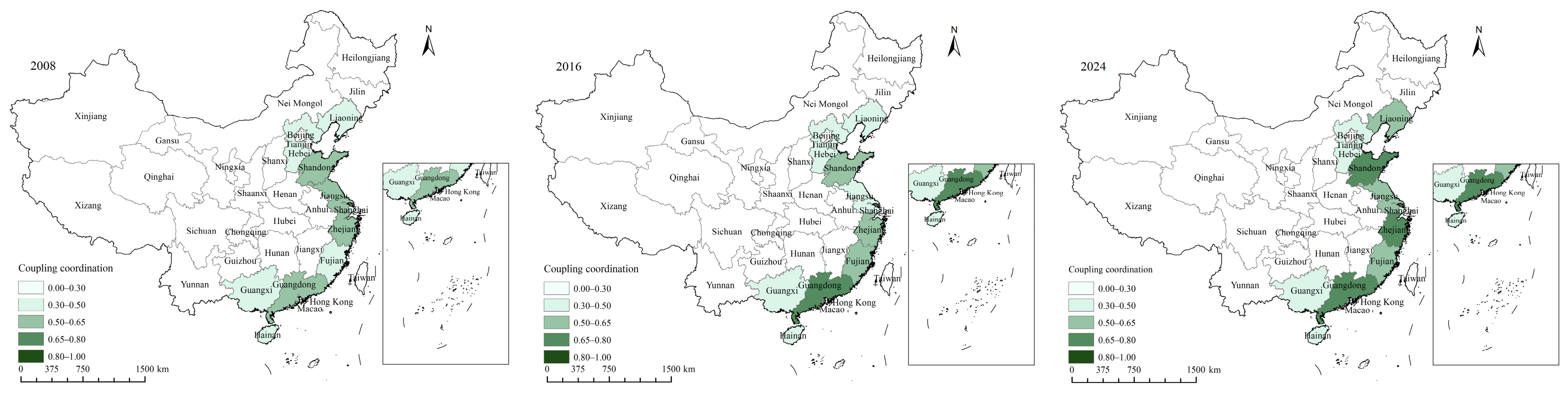
22]. The empirical results of this study indicate that excessive marine mineral exploitation, high sea area utilization rates, insufficient island resource endowments and shortages of tourism human capital constitute the core long-term obstacles restricting the coordinated improvement of the two subsystems. Meanwhile, the coupling coordination degree across coastal China presents a spatially heterogeneous pattern of “higher levels in the south and lower levels in the north with three-tier hierarchical differentiation”, with significant disparities in obstacle structures, driving mechanisms and coordination levels among the Bohai Rim, Yangtze River Delta and southeast coastal regions. Due to the quasi-public-good attributes and strong ecological externalities of marine resources, ecological degradation, spatial occupation and restoration costs induced by tourism development cannot be automatically internalized through market mechanisms, resulting in widespread misalignment between resource protectors and benefit recipients, as well as mismatches between development gains and ecological costs. Accordingly, based on the empirically identified obstacle factors and regional heterogeneity characteristics, the establishment of a quantifiable, implementable and supervisable marine resource compensation mechanism is essential to address regional development bottlenecks and promote the transformation of the two subsystems from extensive linkage to high-quality coupled coordination.
6.2. Division of Rights and Responsibilities for Marine Compensation
Marine tourism development is accompanied by prominent ecological externalities and imbalanced benefit distribution, necessitating the construction of a long-term, stable marine compensation framework with clear rights, responsibilities and multi-stakeholder participation. This study adheres to the fundamental principles of “responsibility for sea utilization, compensation for benefits, and rewards for ecological protection” [
24], forming a multi-dimensional collaborative governance pattern featuring government overall planning, market entity accountability and public participation. Tourism enterprises and various marine business operators bear primary compensation responsibilities for directly exploiting and utilizing marine ecology, coastline and landscape resources. Governments at all levels undertake institutional design, fund coordination and interregional balance regulation to provide overall guarantee support. Tourists, as direct beneficiaries of marine tourism, participate in compensation through ecological fees and special funds. Compensation targets focus on marine ecological environments, resource-damaged areas and coastal communities and business entities that incur costs for marine ecological protection, with priority given to groups suffering interest losses due to coastline regulation, aquaculture withdrawal and development restrictions [
29]. This design effectively enhances grassroots protection enthusiasm and facilitates the transformation of marine resource and tourism development from one-way exploitation to two-way coordinated and sustainable development.
6.3. Methods and Paths of Marine Compensation
The quantitative design of compensation standards is directly based on the diagnostic results of the obstacle degree model. The model quantifies the restrictive intensity of each indicator within the marine resource subsystem on coupled coordinated development, clarifying regional compensation priority and targeted obstacle mitigation needs. Given that the obstacle degree analysis is conducted at the refined indicator level, the quantitative compensation standards are formulated targeting empirically identified core obstacle factors. To balance the empirical pertinence and general applicability of the model, a generalized compensation demand intensity model is constructed as follows:
where
denotes the theoretical compensation demand intensity of region
;
represents the obstacle degree of the
-th core marine resource obstacle factor in region
; and
refers to the policy adjustment weight corresponding to each obstacle factor, determined by policy priorities, expert weighting or equal weighting methods. This formula is applicable to the selection of core obstacle factors across different regions and years.
where
,
,
,
and
represent the obstacle degrees of marine mineral output, sea area utilization rate, island quantity, mariculture output and number of marine cultural heritage parks in region
, respectively;
,
,
,
and
are the corresponding policy adjustment weights. The model indicates that regions with higher obstacle degrees of core marine resource factors possess stronger theoretical compensation demand. Different from equal compensation distributed by administrative divisions, the proposed standards are determined by the contribution of specific regional obstacle factors, realizing the transformation from “average compensation” to “obstacle-oriented targeted compensation”.
From a dimensional perspective, the refined obstacle factors correspond to distinct types of marine resource constraints. O1 island quantity, O2 marine mineral output and O3 mariculture output reflect constraints on natural marine resources, requiring compensation prioritizing resource loss restoration, island resource protection, and carrying capacity improvement. O8 sea area utilization rate represents spatial marine resource constraints, with compensation focusing on coastline protection, low-efficiency sea-use withdrawal and marine spatial governance. O5 number of marine cultural heritage parks indicates insufficient marine cultural resource endowments, including inadequate heritage protection, exhibition carriers and cultural tourism transformation capacity, necessitating compensation for heritage maintenance, park construction, cultural space optimization and cultural tourism resource activation.
Furthermore, regional compensation priorities are determined by theoretical compensation demand intensity. Regions with high values are prioritized for compensation funding based on their specific obstacle structure. Regions with moderate overall obstacle degrees but prominent single core obstacles adopt special targeted compensation to address specific developmental shortcomings. Regions with continuously declining obstacle degrees and improving coupling coordination levels receive reduced basic compensation and increased performance rewards and market-oriented compensation proportions. This design enables dynamic adjustment of compensation standards across regions, obstacle types and developmental stages.
6.4. Compensation Fundraising and Regional Allocation
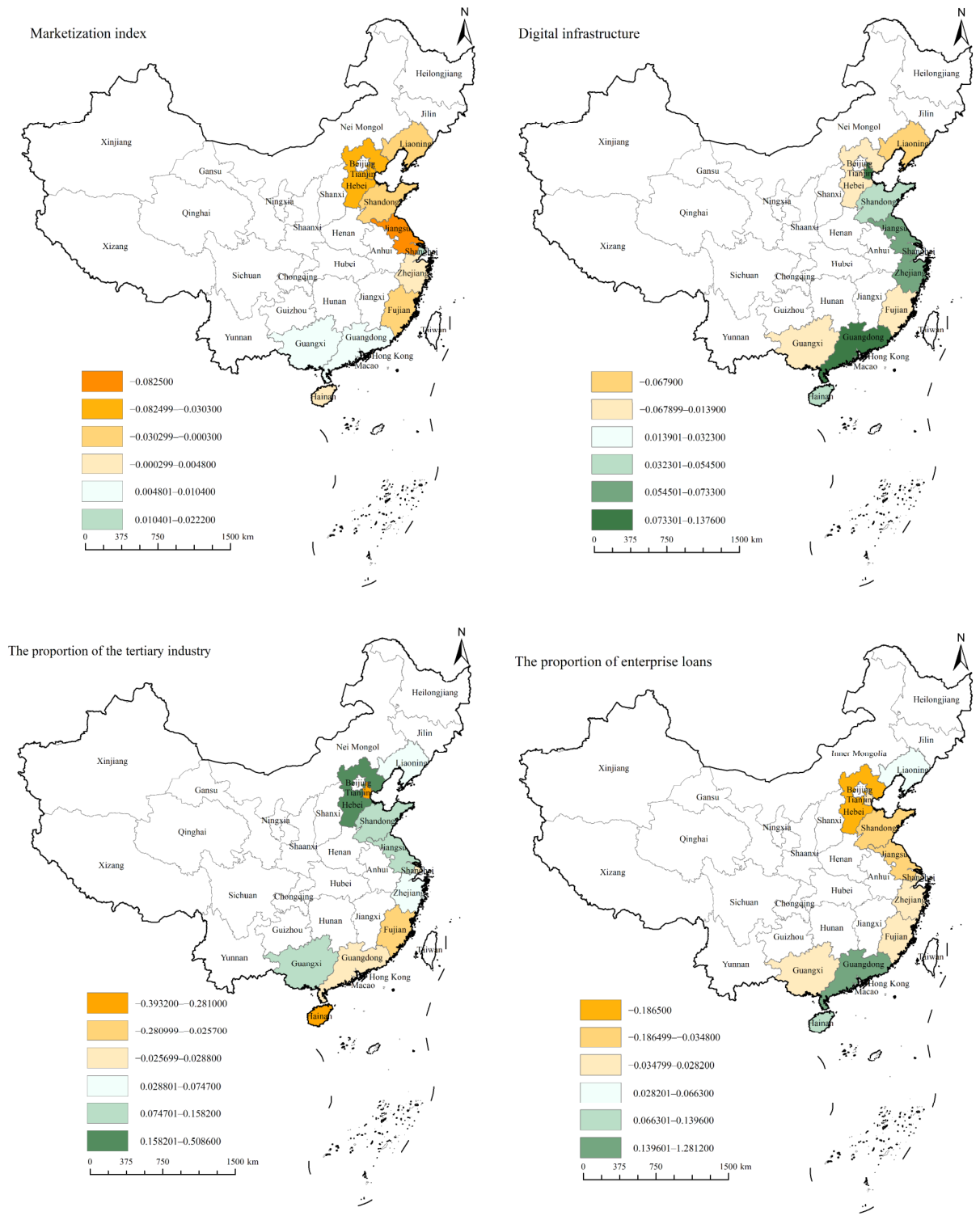
The fixed-effect model and GTWR regression results guide the optimization of compensation tools, fundraising modes and regional allocation pathways. Empirical findings reveal that tertiary industry proportion, digital infrastructure and corporate loan balances positively promote coupled coordination, while marketization and opening-up levels exert restrictive effects in partial regions. Significant regional heterogeneity is observed in driving mechanisms. The Bohai Rim benefits from tertiary industry development but suffers from insufficient marketization, financial support and opening-up dividends, coupled with severe spatial pressure and resource exploitation constraints, making government fiscal appropriation, special ecological funds and operator payment the dominant financing modes. The Yangtze River Delta features sound market conditions, mature tertiary industries and advanced digital infrastructure, supporting tourism revenue feedback and digital governance-based financing. The southeast coastal regions possess superior tourism benefits, financial resources and market vitality, suitable for market-oriented financing tools such as green finance and blue carbon trading. Therefore, differentiated financing mechanisms are formulated to adapt to regional heterogeneous driving effects rather than adopting a unified financing model.
The total compensation fund pool is defined as follows:
where
denotes the total compensation fund pool;
represents government fiscal funds;
represents corporate contribution funds;
represents funds extracted from tourism revenue;
represents green finance funds;
represents market-oriented funds including blue carbon trading and ecological product value realization; and
represents ecological fees paid by tourists and the public. Regions adjust the proportion of each funding source according to the positive and negative effects of local external driving factors.
Based on regional differences in external driving forces, targeted funding sources and allocation priorities are clarified for differentiated operational arrangements, translating empirical driving heterogeneity into actionable regional financing strategies, as shown in
Table 6.
In terms of horizontal fund allocation, a linkage mechanism of “theoretical demand—fund constraint—actual distribution” is established. The
calculated in
Section 6.3 reflects the theoretical compensation demand intensity driven by core regional obstacles, while the total fund pool
represents the actual available funds raised through multiple channels. Considering that fund supply is constrained by fiscal capacity, corporate willingness, market financing conditions and public participation, actual allocated funds often deviate from theoretical demand. Therefore, a horizontal allocation rule is formulated to determine the actual compensation quota
for each region:
where
Ai denotes the actual compensation funds obtained by region
i,
Ci refers to the theoretical compensation demand intensity of region
i,
∑iCi is the sum of the theoretical compensation demand intensity across all regions and F represents the total amount of the compensation fund pool. Under limited fund supply, this rule distributes compensation funds proportionally corresponding to demand intensity toward regions with prominent obstacle factors, heavy resource conservation pressure and strict development restrictions. When
F ≥
∑iCi, residual funds after covering basic compensation demands can be put into performance rewards, long-term ecological funds or market-oriented compensation projects.
6.5. Implementation Paths of Marine Compensation
On the basis of fundraising and regional allocation, targeted fund utilization and implementation paths are defined to address core developmental shortcomings. Consistent with obstacle diagnosis results, major constraints of the marine resource system focus on resource exploitation loss, marine spatial occupation, insufficient island resource supply and excessive inshore aquaculture pressure. Accordingly, compensation strategies are designed around five dimensions: resource restoration, spatial governance, aquaculture regulation, island protection and community sharing, transforming general investment into targeted governance tools [
25].
First, resource restoration-oriented compensation: Targeting resource depletion caused by excessive marine mineral exploitation (reflected by the persistent high obstacle degree of O2), this path focuses on ecological restoration. Compensation funds are dedicated to seabed landform remediation, inshore water quality improvement, habitat restoration, coastline ecological rehabilitation and long-term ecological monitoring. Entities causing ecological disturbances through marine mineral exploitation, port construction and marine engineering projects are required to pay compensation fees based on resource utilization intensity and ecological impact, with all revenues incorporated into unified marine ecological restoration project management.
Second, spatial governance-oriented compensation: To alleviate marine spatial scarcity induced by the rising obstacle degree of O8 sea area utilization rate, this path implements opportunity cost compensation for spatial ecological protection. Compensation is provided to regions undertaking ecological redline protection, natural coastline conservation, low-efficiency sea-use withdrawal, inshore aquaculture reduction and tourism ecological space maintenance. Especially in the high-intensity development areas such as the Bohai Rim, compensation supports coastline renovation, subsidies for inefficient sea-use withdrawal, tourism ecological space replacement and marine spatial control to mitigate spatial competition among ports, industry, aquaculture and tourism sectors.
Third, aquaculture regulation-oriented compensation: Addressing the ecological and spatial pressure from excessive inshore aquaculture (reflected by the rising obstacle degree of O3 mariculture output), this path promotes the ecological transformation of aquaculture industries. Though categorized as a natural resource indicator, excessive mariculture severely impairs ecological environments and coastal tourism development. Compensation funds are used for traditional aquaculture withdrawal subsidies, ecological facility upgrading, tailwater treatment, aquaculture capacity control and ecological industrial transformation support.
Fourth, island resource protection-oriented compensation: Targeting the persistent constraint of insufficient island resource supply and carrying capacity (reflected by the high obstacle degree of O1 island quantity), this path focuses on island ecological protection and public service improvement. Funds support island ecological restoration, tourism public service facility construction, transportation connection, garbage and sewage treatment, emergency rescue systems and tourist capacity regulation. For regions with rapid island tourism growth but inadequate public services, island ecological funds, tourist ecological surcharges and tourism revenue feedback mechanisms are adopted to enhance island resource protection and tourism carrying capacity.
Fifth, community sharing-oriented compensation: Marine resource protection and tourism development rely on extensive community participation. A proportion of compensation funds is allocated to ecological management posts, fisherman vocational training, marine cultural interpretation, community homestay operation, recreational fishery transformation and tourism service capacity improvement. This design enables coastal residents to benefit from compensation while participating in resource protection and tourism development. Benefit distribution, employment placement, public service optimization and community co-governance mechanisms effectively resolve the misalignment between protectors and beneficiaries and mobilize grassroots enthusiasm for marine ecological protection.
The above five paths precisely target core problems including resource depletion, spatial occupation, ecological pressure, insufficient island carrying capacity and benefit mismatch, ensuring that compensation funds are accurately invested in empirically identified developmental shortcomings.
6.6. Operational Guarantee Mechanisms for Marine Compensation
To ensure the long-term and effective operation of the marine compensation mechanism, a full-process supervision, evaluation and dynamic adjustment system is established to avoid one-time investment and procedural formalism. Based on the logical framework of “standard quantification—fund allocation—implementation paths”, the operational guarantee system covers five key links: dynamic monitoring and accounting, fund supervision, performance evaluation, information disclosure and real-time feedback, forming a closed-loop governance mechanism from demand identification to effect assessment.
First, dynamic monitoring and accounting mechanism: Integrating multi-department data from natural resources, ecological environment, culture and tourism and marine fisheries sectors, this mechanism continuously monitors marine mineral exploitation, sea area utilization, aquaculture pressure, island resource utilization, marine cultural heritage protection and tourism revenue changes, aligning with the established obstacle indicator system. Annual monitoring updates the ranking of core obstacle factors and dynamically calculates regional compensation demand intensity, providing scientific evidence for compensation standard adjustment and fund optimization.
Second, fund supervision mechanism: Classified management is implemented for all types of compensation funds, clarifying funding sources, scopes of expenditure and responsible entities. Special account management and project-based utilization are enforced for all compensation funds, with priority given to resource restoration, spatial governance, aquaculture regulation, island protection, cultural resource conservation and community sharing. Strict supervision prevents fund embezzlement, inefficient utilization and off-target investment.
Third, performance evaluation mechanism: Fund utilization performance is linked to core improvements in obstacle mitigation, coupling coordination promotion, ecological quality optimization, cultural resource protection and community benefit growth. The evaluation system covers five dimensions: resource restoration performance, spatial governance performance, ecological transformation performance, cultural protection performance and community sharing performance. Specifically, resource restoration performance assesses inshore water quality improvement, habitat recovery and ecological monitoring; spatial governance performance evaluates low-efficiency sea-use withdrawal, coastline protection and tourism ecological space maintenance; cultural protection performance focuses on heritage park operation, cultural space construction and cultural tourism activation; community sharing performance targets resident employment, vocational training, benefit distribution and public service upgrading [
21].
Fourth, information disclosure and third-party supervision mechanism: Detailed information on fund sources, regional allocation, investment projects, implementation progress and performance results is regularly disclosed to accept public, community and institutional supervision. Independent evaluations conducted by universities, research institutions, audit departments and professional assessment agencies enhance the transparency, impartiality and credibility of the compensation system.
Fifth, dynamic adjustment mechanism: Compensation standards, fund allocation schemes and implementation paths are dynamically optimized according to changes in obstacle factors, regional development stages and performance outcomes. Regions with continuously rising obstacles in sea area utilization, marine mineral exploitation and mariculture scale receive increased investment in spatial governance, resource restoration and aquaculture ecological transformation. Regions with declining obstacle degrees and improved coupling coordination are granted higher proportions of performance rewards, market-oriented compensation and long-term ecological funds. The dynamic adjustment mechanism transforms the static fund allocation model into a sustainable, iterative governance tool for high-quality marine tourism development.
7. Conclusions and Discussions
This paper selects 11 coastal provincial-level regions of China from 2008 to 2024 as research samples and establishes an evaluation index system for the coupled coordination between the marine resource subsystem and the tourism industry subsystem. By comprehensively adopting the coupling coordination degree model, spatial Markov chain, obstacle degree model, fixed-effect model and geographically and temporally weighted regression (GTWR) model, this study systematically identifies the spatiotemporal differentiation, internal obstacle factors, external driving mechanisms and spatial heterogeneity of the coupled coordination of the two systems and further proposes a marine resource compensation mechanism for tourist destinations. The main conclusions are summarized as follows.
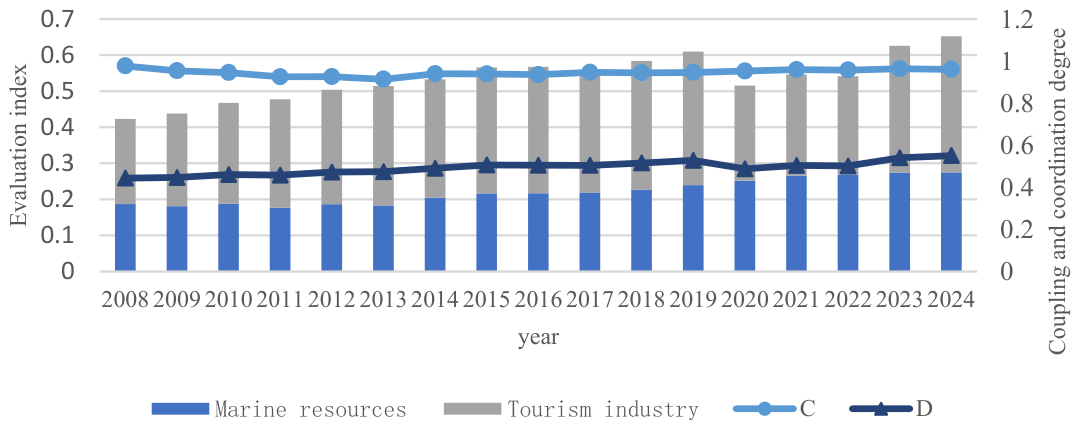
First, from the perspective of temporal evolution, the coupling coordination degree between marine resources and the tourism industry keeps rising steadily during 2008–2024 and can be divided into three phases. The initial development stage spans 2008–2013, in which the tourism industry grows far faster than marine resources and forms a development pattern of “tourism leading and marine resources following up”. Driven by the Maritime Power Strategy, both sectors achieve synchronous growth in the rapid improvement stage (2014–2019), and the coupling coordination degree enters the primary coordination interval. The shock and recovery stage covers 2020–2024; the COVID-19 pandemic triggers a temporary downturn of the tourism sector and a mild drop of coordination degree, which rebounds gradually after 2023 and proves strong systemic resilience.
Second, in terms of spatial pattern, the coupling coordination presents a stable hierarchical layout with “higher coordination in southern coast and lower coordination in northern coast featuring three-tier differentiation”. The Yangtze River Delta and southeast coastal areas stay at high and stable coordination levels, whereas the Bohai Rim remains relatively backward with remarkable interregional gaps. Results of the spatial Markov chain reveal obvious path dependence and club convergence of coordination grades; cross-grade transitions only occur between adjacent tiers. High-level neighboring regions generate significant positive spatial spillover effects, while low-level adjacent areas are prone to development lock-in.
Third, regarding internal restrictive obstacles, the marine resource subsystem is mainly constrained by excessive marine mineral exploitation, over-high sea area utilization and insufficient island reserves. Spatial restrictions become increasingly prominent in the Bohai Rim, and aquaculture expansion constitutes a prominent constraint for the Yangtze River Delta. The core bottleneck of the tourism industry subsystem shifts from insufficient market scale in the early stage to inadequate human capital supply, and the shortage of professional tourism talents turns into a universal restriction nationwide and across the three coastal zones. Deficient supporting infrastructure and underdeveloped marine cultural resources further widen regional disparities.
Fourth, for external driving factors, the proportion of tertiary industry, outstanding corporate loans and digital infrastructure serve as core positive drivers. By contrast, marketization index and opening-up level impose significantly negative constraints overall, implying severe factor mismatch and capital crowding-out effect. Economic aggregate and traditional fixed-asset investment exert no statistically significant influences. GTWR outcomes verify evident spatial heterogeneity across drivers: industrial upgrading and digital empowerment dominate growth in the Yangtze River Delta; the southeast coastal regions benefit from sound financial support and mature marketization; the Bohai Rim features divergent growth momentum and is heavily restricted by distorted market allocation.
Fifth, in terms of institutional design, targeted at the quasi-public-good attributes, ecological externalities and cost-benefit mismatch of marine resources, this paper constructs a tourist-oriented marine resource compensation mechanism covering quantified compensation criteria, fundraising, regional fund allocation, diversified compensation modes and operational safeguards. The mechanism takes obstacle degree estimation as the benchmark for compensation demand calculation and designs differentiated financing channels and regional allocation schemes grounded in fixed-effect and GTWR regression results, providing institutional solutions to resolve the mismatch between marine conservation costs and tourism benefits.
Threefold theoretical contributions are highlighted in this research. Firstly, this paper builds an integrated dual-system analytical framework for marine resource–tourism industry coupling and incorporates characteristic indicators including natural, spatial, cultural and ecological marine resources into the evaluation system, improving the indicator suitability compared with conventional marine economy or tourism research. Secondly, it identifies the phased transition law of restrictive obstacles: the marine resource subsystem is persistently hampered by overexploitation and improper spatial utilization, while the dominant constraint of the tourism industry evolves from market size limitation to insufficient human capital. Thirdly, this study empirically verifies spatially heterogeneous impacts of tertiary industry development, digital infrastructure and financial support on coupled coordination, confirming no universal development pathway for coastal marine tourism integration but regionally differentiated driving patterns.
Corresponding policy implications are put forward based on the above findings. First, the Bohai Rim should prioritize mitigating conflicts in sea space utilization and excessive resource exploitation and consolidate fiscal appropriation, special ecological restoration funds and mandatory contributions from marine-related enterprises to facilitate withdrawal of inefficient sea use, coastline conservation and construction of tourism ecological space. Second, relying on mature service sectors and digital infrastructure, the Yangtze River Delta shall promote tourism revenue feedback, digital supervision and ecological product value realization, alongside strengthened aquaculture regulation and environmental governance to curb inshore breeding pressure. Third, the southeast coastal regions can leverage superior financial resources, marketization and digital facilities to introduce diversified financing approaches including green finance, blue carbon trading, corporate contribution and tourism revenue deduction, with funds prioritized for island conservation, ecological restoration and community benefit sharing. Fourth, in view of multi-stakeholder accountability, governments are responsible for institutional formulation, fiscal underwriting and whole-process supervision and assessment; marine and tourism enterprises bear compensation obligations proportional to resource consumption intensity, ecological damage and operational tourism gains; coastal residents share benefits via ecological management, tourism service provision and marine cultural inheritance; tourists participate in compensation through eco-ticket fees and additional island protection surcharges.
Several limitations remain in this study. Restricted by data availability, the empirical analysis is conducted on provincial panel data, failing to capture fine-grained disparities at smaller scales such as individual islands, coastal cities, scenic spots and local communities. Three directions are proposed for future research: first, integrate multi-source big data including remote sensing monitoring, tourist mobility trajectories, online consumer reviews, enterprise operational statistics and marine ecological monitoring data to refine the accuracy of coupling assessment; second, incorporate carbon emission, blue carbon value and ecosystem service value into the analytical framework to explore coupling evolution under carbon constraints and blue low-carbon transition; third, carry out numerical simulation on compensation standard quantification and policy scenario assessment to test implementation effectiveness of marine resource compensation under alternative funding sources, allocation rules and performance constraints.