Ecosystem Health Assessment of the Liaohe Estuary Suaeda heteroptera Wetland Based on a Coupled PSR–Entropy Weight–PLSR Model

 , and
, and
Abstract
1. Introduction
2. Materials and Methods
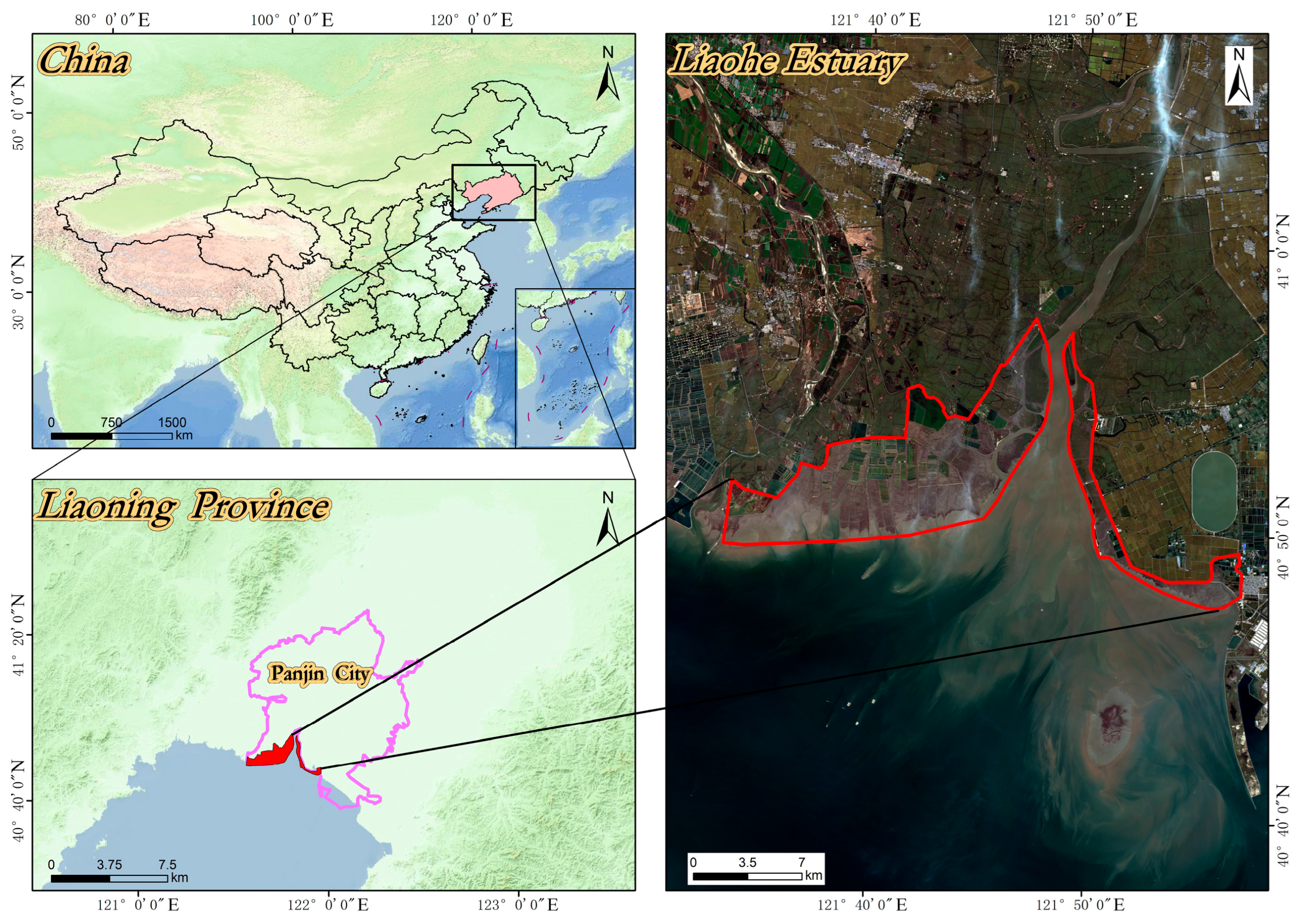
2.1. Study Area
2.2. Data Collection and Processing
2.2.1. Data Collection and Preprocessing
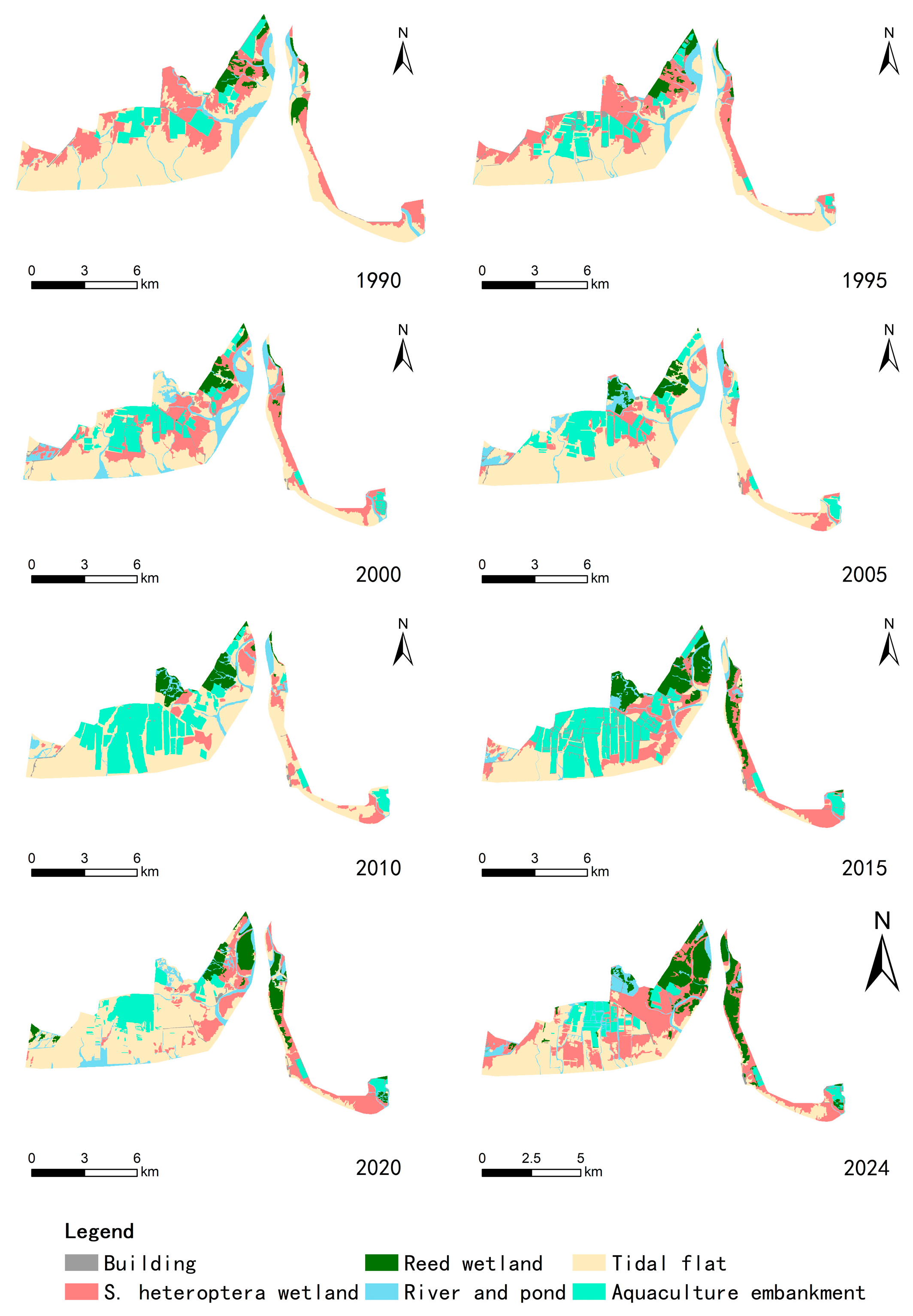
2.2.2. Land Cover Information Extraction Based on an Object-Oriented Classification Method
2.2.3. Extraction of Landscape Pattern Indices and Carbon Storage Estimation of the Suaeda heteroptera Wetland
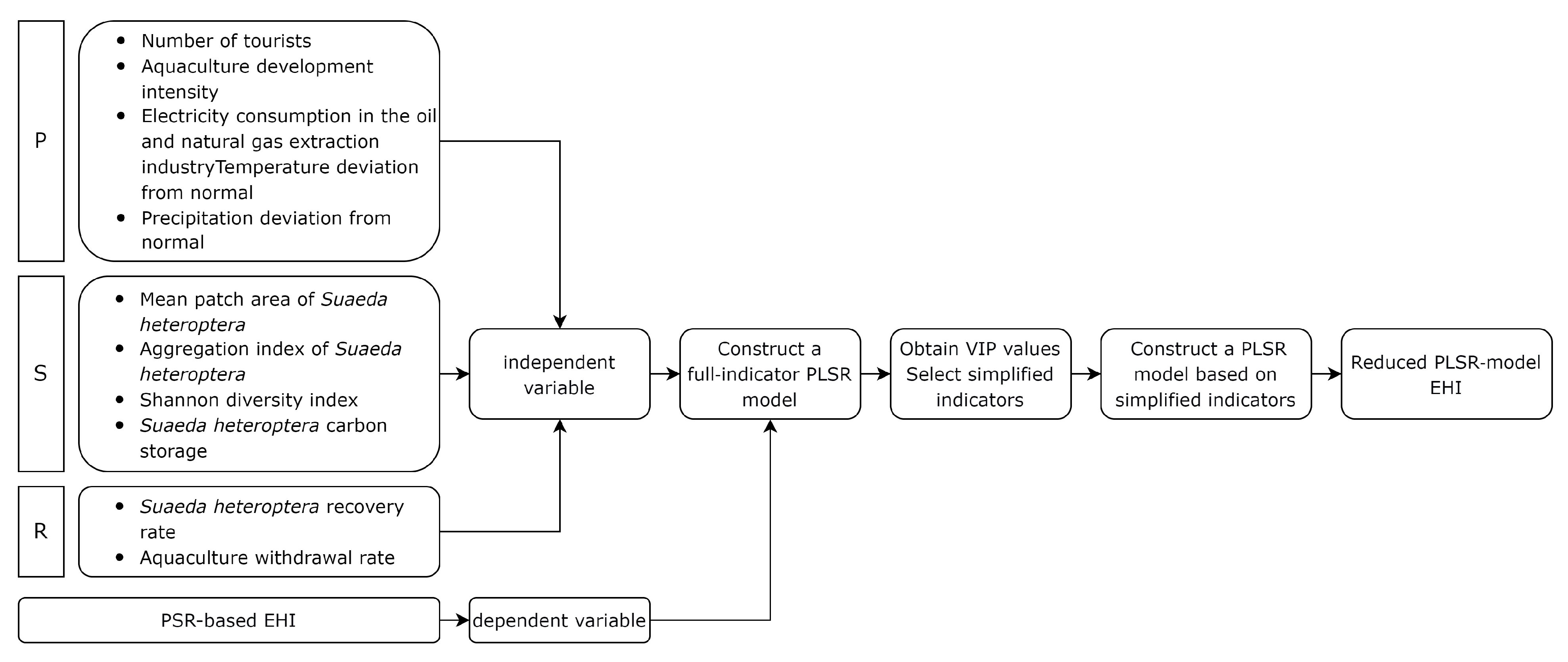
2.3. Development of an Ecosystem Health Assessment Indicator System
2.3.1. Principles and Construction of the Evaluation Indicator System
2.3.2. Classification of Ecosystem Health Levels
2.4. Calculation of the PSR–Entropy Health Index
2.4.1. Standardization of Evaluation Metrics
2.4.2. Calculation of Evaluation Indicator Weights
2.4.3. Calculation of the Ecosystem Health Index
2.5. Calculation of the PLSR-Based Health Index
2.5.1. Construction of the Full-Indicator PLSR Model
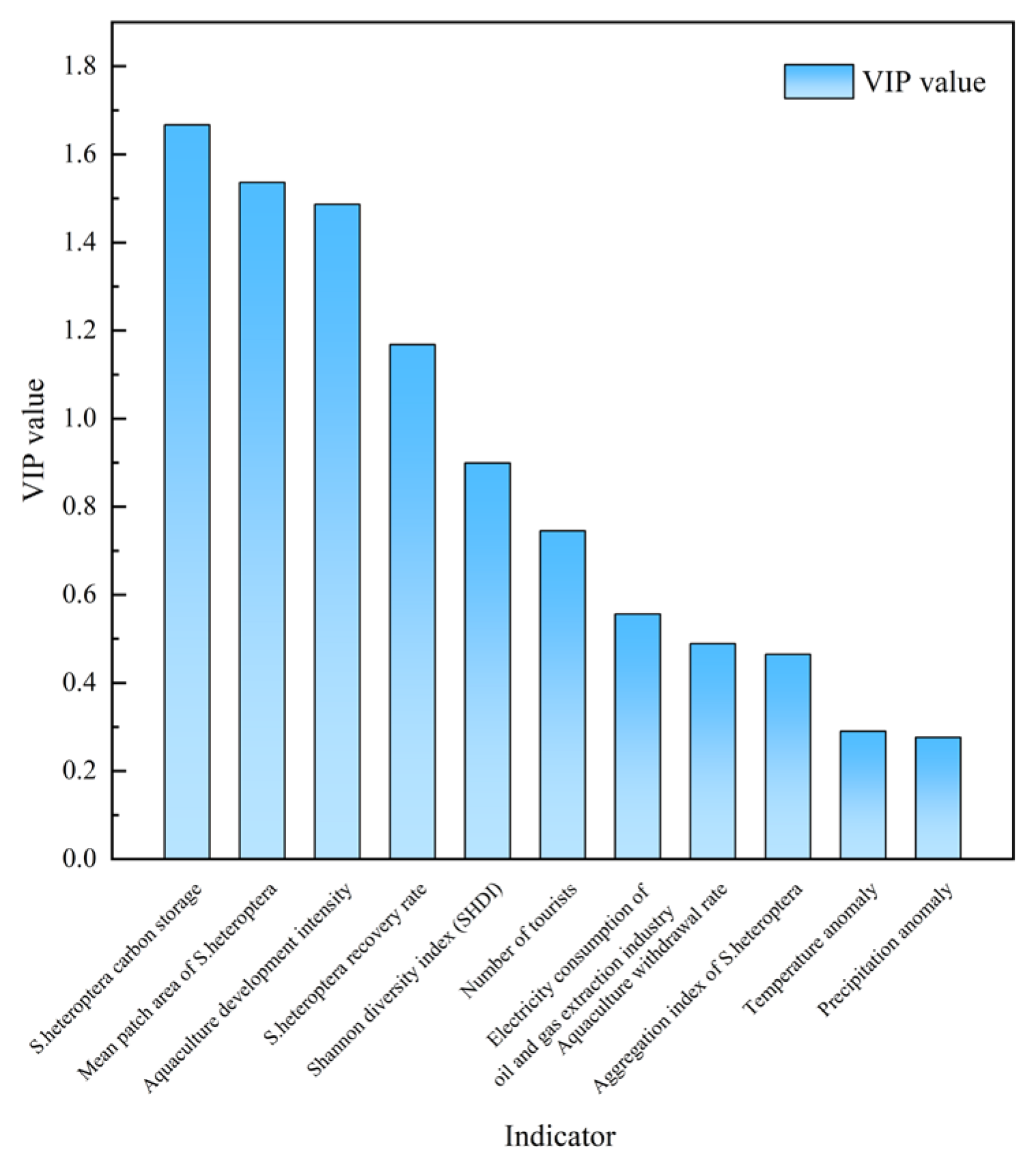
2.5.2. Identification of Key Indicators
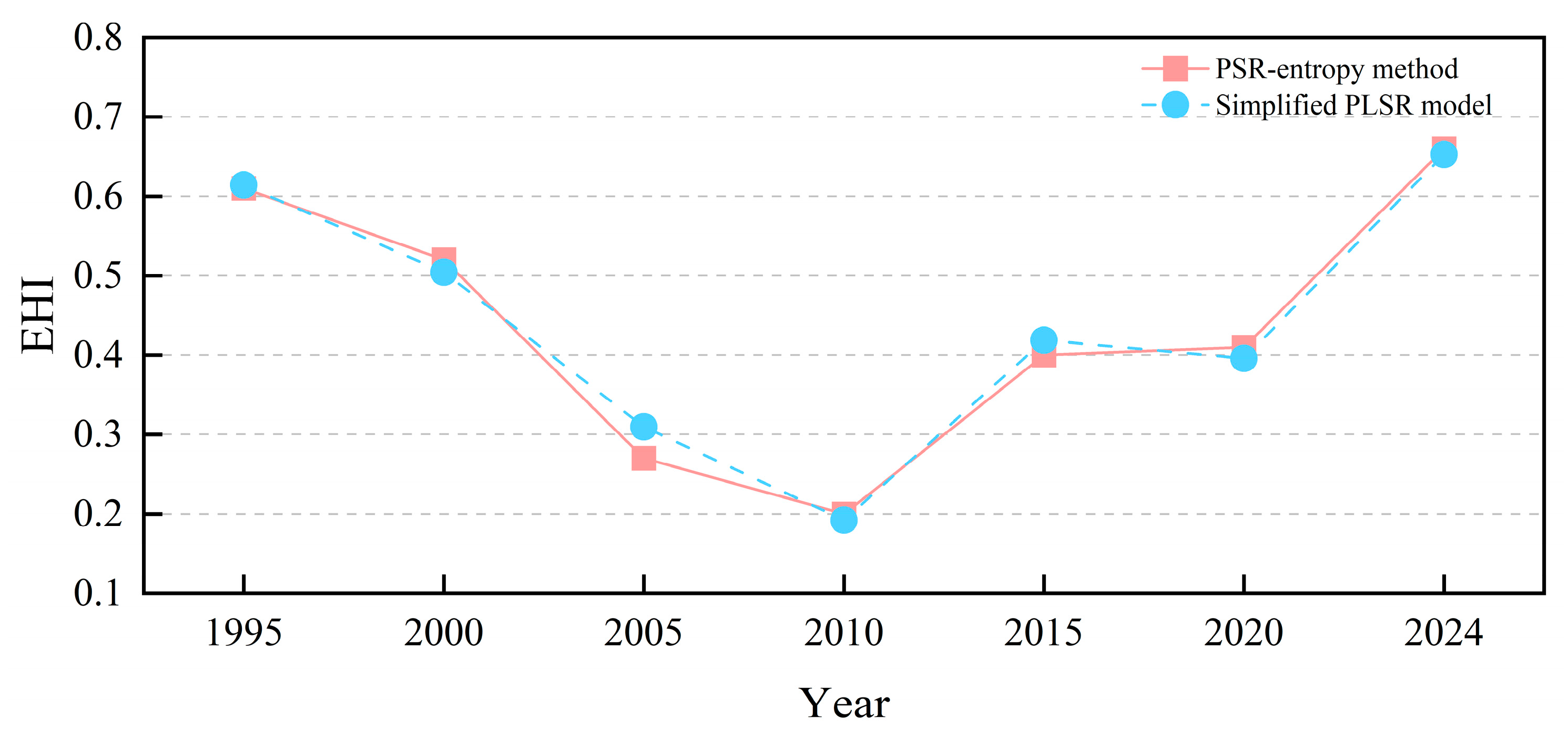
2.5.3. Construction of the Simplified-Indicator PLSR Model
3. Results
3.1. Results of the Health Assessment of the Suaeda heteroptera Wetland Ecosystem at the Liao River Estuary
3.2. Analysis of Evaluation Results
3.2.1. Analysis of Ecosystem Health Trend
- (1)
- 1995–2010: Period of Declining Ecosystem Health
- (2)
- 2010: The Lowest Point in Ecosystem Health
- (3)
- 2010–2024: Period of Ecosystem Health Recovery
3.2.2. Analysis of Determinants of Health Changes
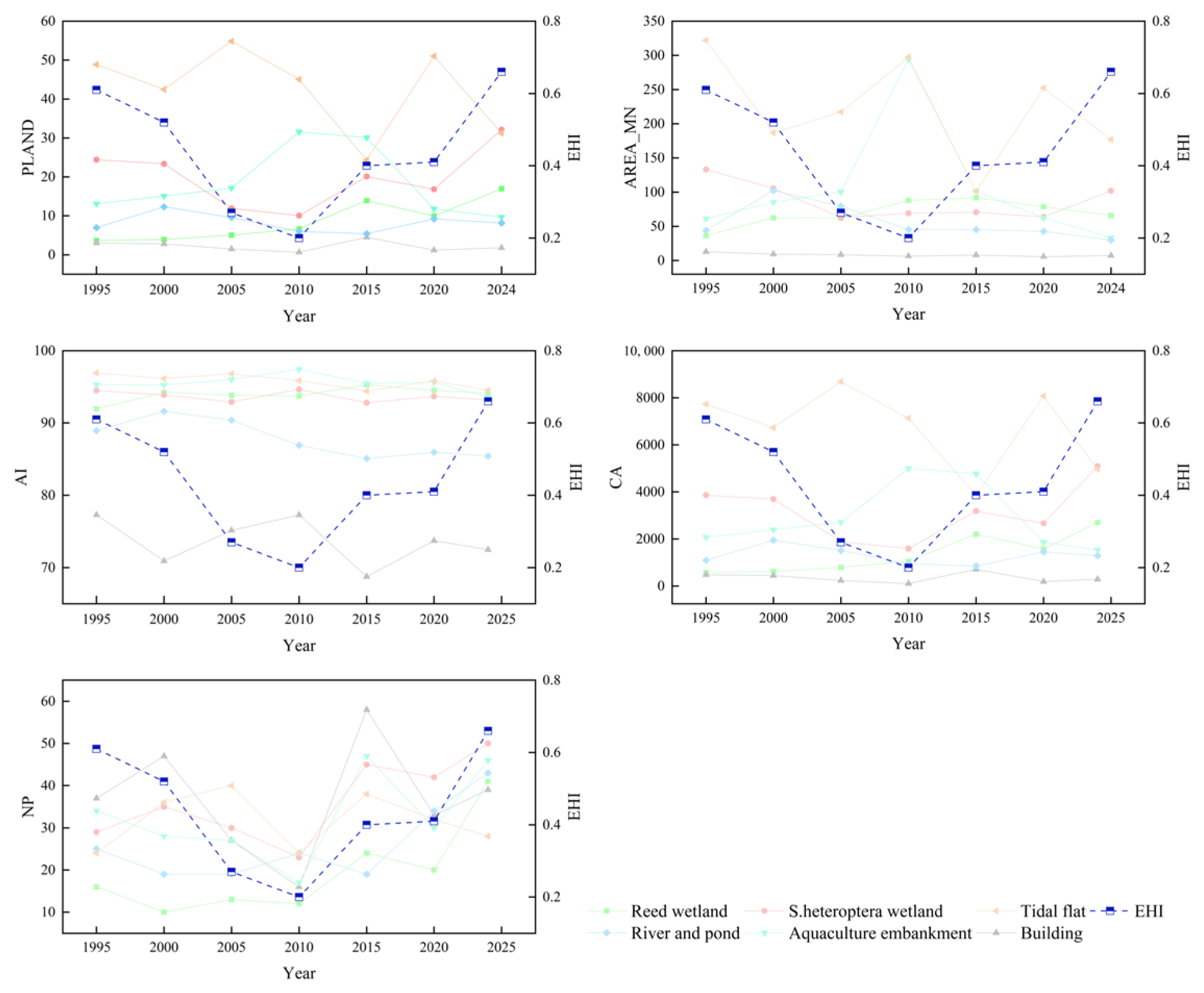
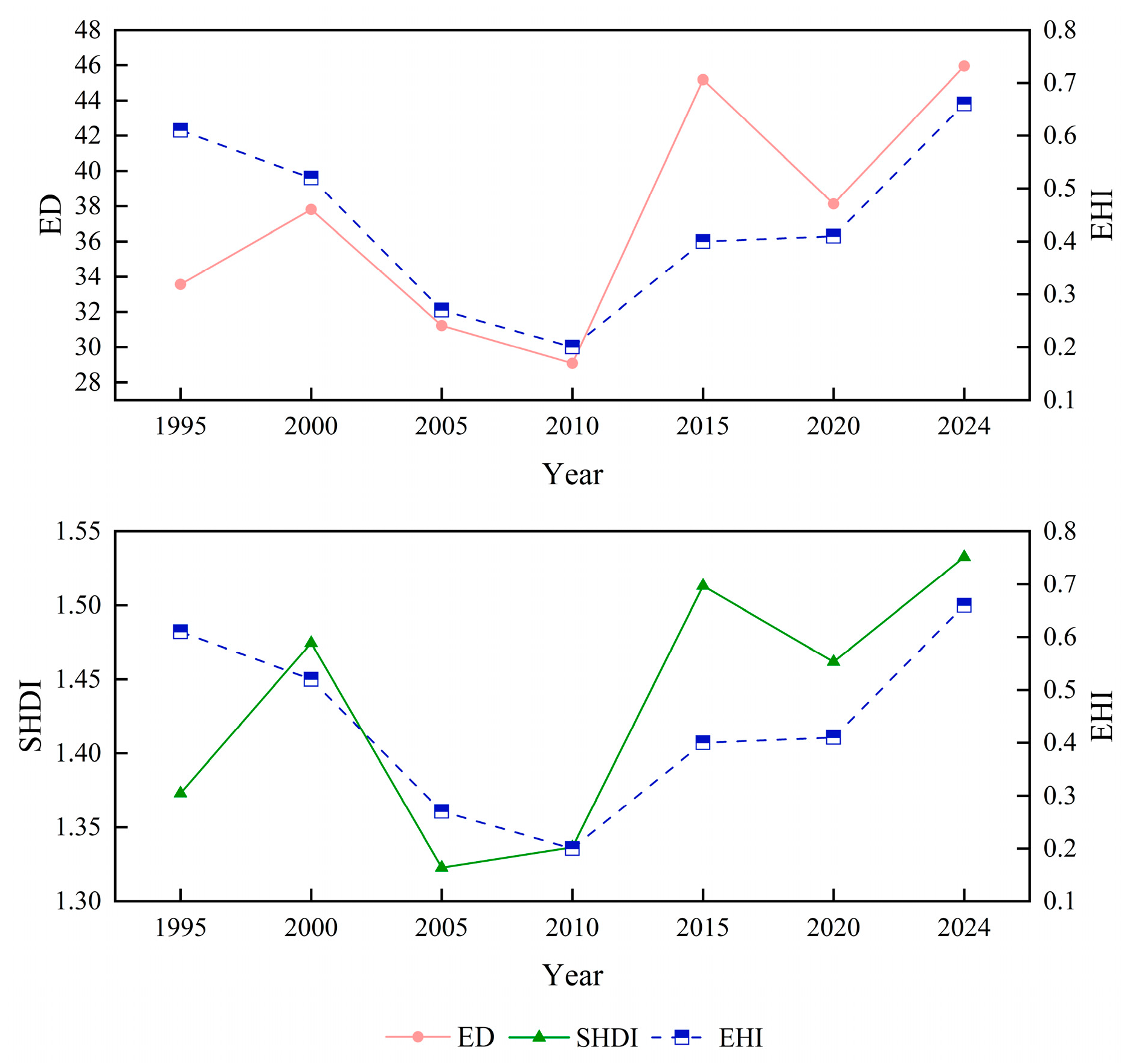
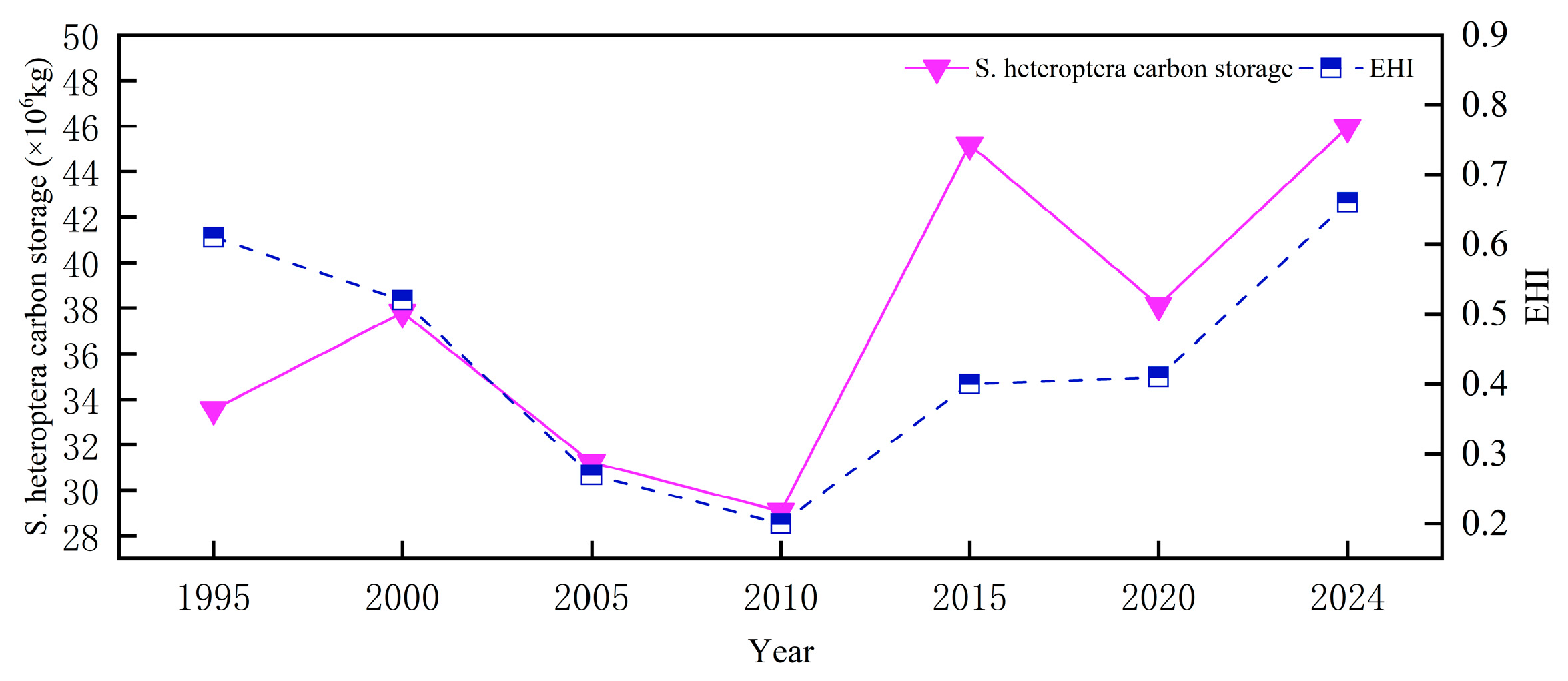
3.2.3. The Relationship Between Landscape Pattern, Suaeda heteroptera Carbon Storages, and Ecosystem Health
- (1)
- The Relationship Between Changes in Landscape Diversity and Ecosystem Health Indices.
- (2)
- Correlation between structural changes in Suaeda heteroptera patches and ecosystem health indices.
- (3)
- Correlation between Changes in Areas of Human Disturbance and Ecosystem Health Indices.
- (4)
- Correspondence between changes in Suaeda heteroptera carbon storages and the Ecosystem Health Index.
4. Discussion
5. Conclusions
Author Contributions
Funding
Institutional Review Board Statement
Informed Consent Statement
Data Availability Statement
Conflicts of Interest
References
- Chen, F.; Su, S.C.; Chen, Y.; Li, N.; Wang, R.; You, W.; He, D. Ecosystem health assessment of coastal wetlands in eastern Fujian based on the PSR model. Wetl. Sci. Manag. 2020, 16, 25–29. [Google Scholar] [CrossRef]
- Yadav, A.; Kansal, M.L.; Singh, A. Ecosystem health assessment based on the V-O-R-S framework for the Upper Ganga Riverine Wetland in India. Environ. Sustain. Indic. 2025, 25, 100580. [Google Scholar] [CrossRef]
- Qiu, J.; Ding, T.C.; Niam, Y.K.; Liu, J.; Jiang, Z.; Lu, Y. Ecosystem health assessment of the Setiu coastal wetland in Malaysia. Shanxi Archit. 2023, 49, 6–11. [Google Scholar] [CrossRef]
- Wu, J.F.; Sui, M.F.; Liu, L. Ecological health assessment and prediction of coastal wetlands based on landscape evolution. Water Resour. Power 2022, 40, 57–60. [Google Scholar]
- Gayen, J.; Datta, D. Application of pressure–state–response approach for developing criteria and indicators of ecological health assessment of wetlands: A multi-temporal study in Ichhamati floodplains, India. Ecol. Process. 2023, 12, 34. [Google Scholar] [CrossRef]
- Wang, G.Z.; Fan, Y.S.; Dou, S.T.; Yu, S.; Zhang, S. Ecosystem health assessment of the Yellow River Estuary and adjacent sea areas based on DPSIR. Yellow River 2023, 45, 92–97. [Google Scholar] [CrossRef]
- Carrascal, L.M.; Galván, I.; Gordo, O. Partial least squares regression as an alternative to current regression methods used in ecology. Oikos 2009, 118, 681–690. [Google Scholar] [CrossRef]
- Ke, L.; Lei, N.; Zhang, S.; Yin, C.; Lu, Y.; Wang, L.; Tan, Q.; Zhao, Y.; Wang, Q. Estimation of blue carbon stock in the Liaohe Estuary wetland based on soil thickness and multi-scenario modeling. Ecol. Indic. 2025, 171, 113201. [Google Scholar] [CrossRef]
- Zhi, L.; Gou, M.; Li, X.; Bai, J.; Cui, B.; Zhang, Q.; Wang, G.; Bilal, H.; Abdullahi, U. Effects of sea level rise on land use and ecosystem services in the Liaohe Delta. Water 2022, 14, 841. [Google Scholar] [CrossRef]
- National Forestry and Grassland Administration; Ministry of Natural Resources. National Wetland Conservation Plan (2022–2030); Government Report; National Forestry and Grassland Administration: Beijing, China; Ministry of Natural Resources: Beijing, China, 2022. Available online: https://english.www.gov.cn/statecouncil/ministries/202210/20/content_WS6350875dc6d0a757729e1728.html (accessed on 8 March 2026).
- Peng, J.; Liu, S.; Lu, W.; Liu, M.; Feng, S.; Cong, P. Continuous change mapping to understand wetland quantity and quality evolution and driving forces: A case study in the Liao River Estuary from 1986 to 2018. Remote Sens. 2021, 13, 4900. [Google Scholar] [CrossRef]
- Chi, G.; Liu, B.; Hu, K.; Yang, J.; He, B. Geochemical composition of sediments in the Liao River Estuary and implications for provenance and weathering. Reg. Stud. Mar. Sci. 2021, 45, 101833. [Google Scholar] [CrossRef]
- Panjin Municipal Bureau of Statistics. Statistical Bulletin on National Economic and Social Development of Panjin City in 2024; Official Statistical Report; Panjin Municipal Bureau of Statistics: Panjin, China, 2025. Available online: https://tjj.panjin.gov.cn/2025_04/02_13/content-515228.html (accessed on 8 March 2026).
- Chen, X.; Zhang, M.; Zhang, W. Landscape pattern changes and its drivers inferred from salt marsh plant variations in the coastal wetlands of the Liao River Estuary, China. Ecol. Indic. 2022, 145, 109719. [Google Scholar] [CrossRef]
- Ramsar Convention Secretariat. Convention on Wetlands of International Importance Especially as Waterfowl Habitat; UNESCO: Ramsar, Iran, 1971; Available online: https://www.ramsar.org/sites/default/files/documents/library/current_convention_text_e.pdf (accessed on 15 June 2026).
- GB/T 24708-2009; Wetland Classification. China Standard Press: Beijing, China, 2009.
- TD/T 1055-2019; Technical Specification for the Third National Land Survey. Geological Publishing House: Beijing, China, 2019.
- GB/T 21010-2017; Current Land Use Classification. China Standard Press: Beijing, China, 2017.
- Wetland Protection Law of the People’s Republic of China; Standing Committee of the National People’s Congress: Beijing, China, 2021.
- Song, X.; Li, W.; Liu, H.Y.; Jia, Y.P.; Chen, G.B.; Tao, W.; Liu, C.F. Allocation pattern and allometric growth model of aboveground and belowground biomass of Suaeda heteroptera in the Shuangtaizi Estuary. Wetl. Sci. 2018, 16, 771–775. [Google Scholar] [CrossRef]
- Chen, G.B. Remote Sensing Assessment of Annual Carbon Storage of Suaeda heteroptera Community in the Liaohe Coastal Wetland. Master’s Thesis, Dalian Ocean University, Dalian, China, 2018. [Google Scholar]
- Mou, M. Study on Inversion Model of Suaeda heteroptera Biomass Based on Hyperspectral Remote Sensing. Master’s Thesis, Dalian Ocean University, Dalian, China, 2016. [Google Scholar]
- Li, W.; Mou, M.; Chen, G.B.; Liu, W.B.; Liu, Y.; Liu, C.F. Research on remote sensing inversion of Suaeda heteroptera biomass based on TSAVI for OLI band simulation. Spectrosc. Spectr. Anal. 2016, 36, 1418–1422. Available online: https://www.gpxygpfx.com/EN/Y2016/V36/I05/1418 (accessed on 15 June 2026). [CrossRef]
- Logan, M.; Hu, Z.; Brinkman, R.; Sun, S.; Sun, X.; Schaffelke, B. Ecosystem health report cards: An overview of frameworks and analytical methodologies. Ecol. Indic. 2020, 113, 105834. [Google Scholar] [CrossRef]
- Li, H.; Li, L.; Su, F.; Wang, T.; Gao, P. Ecological stability evaluation of tidal flat in coastal estuary: A case study of Liaohe estuary wetland, China. Ecol. Indic. 2021, 130, 108032. [Google Scholar] [CrossRef]
- Abbaszadeh Tehrani, N.; Janalipour, M.; Hosseini, S.B. Monitoring the urban ecosystem health by introducing a spatial model based on pressure-state-impact-response framework (study area: Sanandaj city). Int. J. Environ. Sci. Technol. 2025, 22, 1751–1768. [Google Scholar] [CrossRef]
- Luo, L.; Wang, X.; Wang, Z. Identifying variations in ecosystem health of wetlands in the Western Songnen Plain (2000–2020). Water 2025, 17, 3175. [Google Scholar] [CrossRef]
- Ji, M.; Li, J.; Li, L.; Zhang, L.; Wang, K. Ecosystem health in the Yellow River Estuary based on the DPSIR model: A case study in China. Sci. Rep. 2026, 16, 43259. [Google Scholar] [CrossRef] [PubMed]
- Sun, R.; Yao, P.; Wang, W.; Yue, B.; Liu, G. Assessment of wetland ecosystem health in the Yangtze and Amazon River Basins. ISPRS Int. J. Geo-Inf. 2017, 6, 81. [Google Scholar] [CrossRef]
- Zhu, X.; Jiao, L.; Wu, X.; Li, H.; Li, B.; Cui, B. Ecosystem health assessment and comparison of natural and constructed wetlands in the arid zone of northwest China. Ecol. Indic. 2023, 154, 110576. [Google Scholar] [CrossRef]
- Erbey, A.; Fidan, Ü.; Gündüz, C. A robust hybrid weighting scheme based on IQRBOW and entropy for MCDM: Stability and advantage criteria in the VIKOR framework. Entropy 2025, 27, 867. [Google Scholar] [CrossRef] [PubMed]
- Hu, C.; Wang, Y.; Xia, G.; Han, Y.; Ma, X.; Liu, X. Health assessment method of cave murals based on entropy-weighted AHP-cloud model. npj Herit. Sci. 2025, 13, 279. [Google Scholar] [CrossRef]
- Sarra, A.; Nissi, E.; Evangelista, A.; Di Battista, T. A functional approach for constructing dynamic Composite Indicators. Stat. Methods Appl. 2024, 33, 173–204. [Google Scholar] [CrossRef]
- Cao, D.; Tang, T.; Wang, S.; Hu, S.; Gen, S.; Wu, S.; Lin, Z. Analysis of the Coupled Assessment of Ecosystem Health and Its Spatial and Temporal Evolution in Fujian China. Preprints 2023. [Google Scholar] [CrossRef]
- Zhu, T.; Zhang, S.; Wang, Y.; Wang, C.; Wang, H. Integrated assessment and restoration pathways for holistic ecosystem health in Anxi County, China. Sustainability 2023, 15, 15932. [Google Scholar] [CrossRef]
- Zhang, Q.W.; Wu, F.H.; Song, J.R.; Wang, J.H.; Zhang, Y.B.; Liu, M.Y.; Li, M.Q.; Li, C.J.; Hao, Y.F.; Man, W.D. Modeling and prediction of soil total nitrogen content in coastal wetlands based on spectral transformation. Soils 2023, 55, 880–886. [Google Scholar] [CrossRef]
- Yan, Q.Y.; Yan, F.; Ding, Z.; Tang, X.; Yao, L. Dynamic assessment of ecological security in the Yangtze River Economic Belt based on three-dimensional ecological footprint. Prog. Geogr. 2024, 43, 1184–1202. [Google Scholar] [CrossRef]
- Ali, A.M.; Darvishzadeh, R.; Shahi, K.R.; Skidmore, A. Validating the Predictive Power of Statistical Models in Retrieving Leaf Dry Matter Content of a Coastal Wetland from a Sentinel-2 Image. Remote Sens. 2019, 11, 1936. [Google Scholar] [CrossRef]
- Jonsson, M.; Burrows, R.M.; Lidman, J.; Fältström, E.; Laudon, H.; Sponseller, R.A. Land use influences macroinvertebrate community composition in boreal headwaters through altered stream conditions. Ambio 2017, 46, 311–323. [Google Scholar] [CrossRef] [PubMed]
- Yao, H.; Fu, B.; Sun, W.; Yu, J.; Wang, H.; Wang, T. Quantifying key indicators of essential biodiversity variables for mangrove species in response to hydro-meteorological factors. Int. J. Appl. Earth Obs. Geoinf. 2025, 139, 104535. [Google Scholar] [CrossRef]
- Yang, J.; Xiao, X.; Doughty, R.; Zhao, M.; Zhang, Y.; Köhler, P.; Wu, X.; Frankenberg, C.; Dong, J. TROPOMI SIF reveals large uncertainty in estimating the end of plant growing season from vegetation indices data in the Tibetan Plateau. Remote Sens. Environ. 2022, 280, 113209. [Google Scholar] [CrossRef]
- Dias, R.A.; Marcon, A.P.; Kappes, B.B.; Azpiroz, A.B.; Barbosa, F.G.; Bencke, G.A.; Clay, R.; Di Giacomo, A.S.; Fontana, C.S.; Repenning, M.; et al. A new analytical framework for Maxent species distribution models unveils complex spatiotemporal suitability patterns for two migratory seedeaters (Aves: Sporophila) of conservation concern. Ecol. Inform. 2023, 77, 102189. [Google Scholar] [CrossRef]




| Satellite | Sensor | Imaging Date | Spatial Resolution (m) | Orbit Number (Path/Row) |
|---|---|---|---|---|
| Landsat 5 | TM | 15 October 1990 | 30 | 120/032 |
| Landsat 5 | TM | 26 August 1995 | 30 | 120/032 |
| Landsat 5 | TM | 6 September 2000 | 30 | 120/032 |
| Landsat 5 | TM | 6 September 2005 | 30 | 120/032 |
| Landsat 5 | TM | 6 October 2010 | 30 | 120/032 |
| Landsat 8 | OLI | 2 September 2015 | 30 | 120/032 |
| Landsat 8 | OLI | 14 August 2020 | 30 | 120/032 |
| Landsat 9 | OLI | 2 September 2024 | 30 | 120/032 |
| Year | Overall Accuracy (%) | Kappa Coefficient (%) |
|---|---|---|
| 1990 | 80.56 | 78.52 |
| 1995 | 83.53 | 80.16 |
| 2000 | 85.32 | 82.36 |
| 2005 | 82.13 | 78.25 |
| 2010 | 81.06 | 77.32 |
| 2015 | 85.23 | 80.25 |
| 2020 | 86.68 | 82.35 |
| 2024 | 87.43 | 83.16 |
| Feature Type | Feature Name | Number of Features |
|---|---|---|
| Spectral Characteristics | Mean B, Mean G, Mean R, Mean SWIR 1, Mean SWIR 2 Standard deviation B, Standard deviation G, Standard deviation R, Standard deviation SWIR 1, Standard deviation SWIR 2 | 10 |
| Geometric Characteristics | Length/Width, Roundness, Shapeindex | 3 |
| Vegetation Index | NDVI, SAVI | 2 |
| Building Index | NDBI | 1 |
| Water Index | NDWI | 1 |
| PSR Category | Code | Indicator Name | Unit | Indicator Direction |
|---|---|---|---|---|
| Pressure (P) | P1 | Number of tourists | thousands of visitors | Negative (−) |
| P2 | Aquaculture development intensity | km2 | Negative (−) | |
| P3 | Electricity consumption in the oil and natural gas extraction industry | 10,000 kWh | Negative (−) | |
| P4 | Temperature deviation from normal | °C | Negative (−) | |
| P5 | Precipitation deviation from normal | mm | Negative (−) | |
| Status (S) | S1 | Mean patch area of Suaeda heteroptera | hm2 | Positive (+) |
| S2 | Aggregation index of Suaeda heteroptera | % | Positive (+) | |
| S3 | Shannon diversity index | -- | Positive (+) | |
| S4 | Suaeda heteroptera carbon storage | ×106 kg | Positive (+) | |
| Response (R) | R1 | Suaeda heteroptera recovery rate | % | Positive (+) |
| R2 | Aquaculture withdrawal rate | km2/a | Positive (+) |
| Grade | Health Assessment Index | Wetland Ecological Health Status |
|---|---|---|
| Unhealthy | EHI ≤ 0.2 | The natural state of the wetland ecosystem has been severely disrupted; the system exhibits low vitality and significant structural imbalance, making it difficult for its ecological functions to operate normally. The Suaeda heteroptera wetland habitat has deteriorated markedly, with severe landscape fragmentation, poor system stability, high sensitivity to external disturbances, and insufficient resilience. Under the continuous influence of human disturbance and other pressures, ecological abnormalities are particularly pronounced, and the ecosystem is in a state of marked or severe degradation. |
| Generally Unhealthy | 0.2 < EHI ≤ 0.4 | The natural state of the wetland ecosystem has been significantly disrupted; its vitality is low, the integrity of its structural organization has declined, and its ability to perform ecological functions is limited. The quality of the Suaeda heteroptera wetland habitat has deteriorated, the landscape pattern has become increasingly fragmented, and the ecosystem’s resilience to external pressures and capacity for recovery are weak. The impacts of human disturbance and environmental stressors are pronounced, ecological anomalies are on the rise, and the ecosystem is already showing signs of degradation. |
| Fairly Healthy | 0.4 < EHI ≤ 0.6 | The natural state of the wetland ecosystem has been somewhat affected, resulting in periodic fluctuations in its structure and function, and a decline in stability. The landscape pattern of the Suaeda heteroptera wetland has undergone certain changes; in some areas, habitat contraction, increased fragmentation, or uneven recovery processes may be observed. The impacts of human disturbance and environmental fluctuations are relatively pronounced; while the system can still maintain its basic ecological functions, its sensitivity has increased and its resilience has relatively weakened. |
| Healthy | 0.6 < EHI ≤ 0.8 | The wetland ecosystem is generally in good natural condition, with high levels of system vitality and organizational structure, and its primary ecological functions are performed relatively stably. The wetland landscape pattern is generally well-structured, the Suaeda heteroptera habitat is well-maintained, and the system exhibits a certain degree of resilience and recovery capacity. External pressures are minimal or manageable; while localized changes exist, overall stability is good, and the ecosystem is generally in a stable state. |
| Very Healthy | 0.8 < EHI ≤ 1.0 | The wetland ecosystem as a whole remains in a relatively good natural state, exhibiting strong vitality, a relatively intact structural organization, and stable ecological functions. The Suaeda heteroptera wetland habitat is well-preserved, with a reasonably balanced landscape pattern, and the system demonstrates a strong capacity to adapt to and recover from external disturbances. Human disturbance is relatively minimal, ecological anomalies are not evident, and the ecosystem is generally in a stable and sustainable condition. |
| PSR Category | Code | Metric Name | Layer Weight | Total Weight | Rank |
|---|---|---|---|---|---|
| Pressure (P) | P1 | Number of tourists | 0.04551 | 0.30642 | 11 |
| P2 | Aquaculture development intensity | 0.07730 | 5 | ||
| P3 | Electricity consumption in the oil and natural gas extraction industry | 0.05603 | 10 | ||
| P4 | Temperature deviation from normal | 0.06577 | 7 | ||
| P5 | Precipitation deviation from normal | 0.06181 | 9 | ||
| Status (S) | S1 | Mean patch area of Suaeda heteroptera | 0.15882 | 0.43046 | 2 |
| S2 | Aggregation index of Suaeda heteroptera | 0.10121 | 3 | ||
| S3 | Shannon diversity index | 0.09411 | 4 | ||
| S4 | Suaeda heteroptera carbon storage | 0.07632 | 6 | ||
| Response (R) | R1 | Suaeda heteroptera recovery rate | 0.20026 | 0.26312 | 1 |
| R2 | Aquaculture withdrawal rate | 0.06286 | 8 |
| Number of Latent Variables | RMSE | MAE | R2 |
|---|---|---|---|
| 1 | 0.1432 | 0.1246 | 0.1685 |
| 2 | 0.1103 | 0.0875 | 0.5071 |
| 3 | 0.102 | 0.0766 | 0.5779 |
| 4 | 0.1019 | 0.076 | 0.5787 |
| 5 | 0.1043 | 0.0772 | 0.5588 |
| 6 | 0.1043 | 0.0772 | 0.5588 |
| Rank | Metric Name | VIP Value |
|---|---|---|
| 1 | Suaeda heteroptera carbon storage | 1.6669 |
| 2 | Mean patch area of Suaeda heteroptera | 1.5359 |
| 3 | Aquaculture development intensity | 1.4868 |
| 4 | Suaeda heteroptera recovery rate | 1.1677 |
| 5 | Shannon diversity index | 0.8991 |
| 6 | Number of tourists | 0.745 |
| 7 | Electricity consumption in the oil and gas extraction industry | 0.5563 |
| 8 | Aquaculture withdrawal rate | 0.4888 |
| 9 | Aggregation index of Suaeda heteroptera | 0.4648 |
| 10 | Temperature anomaly | 0.2903 |
| 11 | Precipitation anomaly | 0.2761 |
| Number of Latent Variables | RMSE | MAE | R2 |
|---|---|---|---|
| 1 | 0.0635 | 0.0532 | 0.8365 |
| 2 | 0.0303 | 0.0273 | 0.9627 |
| 3 | 0.0285 | 0.0224 | 0.967 |
| 4 | 0.0587 | 0.0507 | 0.8603 |
| 5 | 0.1706 | 0.1402 | −0.1794 |
| Variable | Regression Coefficient |
|---|---|
| Constant terms | 0.4386 |
| Suaeda heteroptera carbon storage | 0.05213 |
| Average Suaeda heteroptera patch area | 0.002584 |
| Aquaculture development intensity | −0.00421 |
| Suaeda heteroptera recovery rate | 0.003107 |
| Shannon diversity index | 0.178093 |
| Evaluation Methods | RMSE | MAE | R2 |
|---|---|---|---|
| Full-sample fitting | 0.0131 | 0.0104 | 0.993 |
| Leave-one-out cross-validation | 0.0285 | 0.0224 | 0.967 |
| Year | PSR EHI | PLSR EHI |
|---|---|---|
| 1995 | 0.61 | 0.6142 |
| 2000 | 0.52 | 0.5044 |
| 2005 | 0.27 | 0.3098 |
| 2010 | 0.20 | 0.1923 |
| 2015 | 0.40 | 0.4187 |
| 2020 | 0.41 | 0.3960 |
| 2024 | 0.66 | 0.6528 |
| Year | 1995 | 2000 | 2005 | 2010 | 2015 | 2020 | 2024 |
|---|---|---|---|---|---|---|---|
| EHI Score | 0.61 | 0.52 | 0.27 | 0.20 | 0.40 | 0.41 | 0.66 |
| Health Rating | Healthy | Fairly Healthy | Generally Unhealthy | Unhealthy | Generally Unhealthy | Fairly Healthy | Healthy |
| Metric | PSR Level | Entropy-Based Weighting | Weighting Order | PLSR VIP Value | Function Direction | Description of Primary Function |
|---|---|---|---|---|---|---|
| Number of tourists | P | 0.04551 | 11 | 0.745 | Negative | Reflects the intensity of visitor activity and has a certain impact on local habitat disturbance and management pressures. |
| Aquaculture development intensity | P | 0.0773 | 5 | 1.4868 | Negative | Characterizing the impact of the expansion of coastal aquaculture on wetland habitats and ecological processes is a key stressor during the decline phase. |
| Electricity consumption in the oil and gas extraction industry | P | 0.05603 | 10 | 0.5563 | Negative | Reflects the intensity of regional energy development activities and exerts a certain degree of disturbance on ecosystems. |
| Temperature deviation from normal | P | 0.06577 | 7 | 0.2903 | Negative | Characterizes abnormal climate fluctuations and exerts a background influence on wetland ecological processes. |
| Precipitation deviation from normal | P | 0.06181 | 9 | 0.2761 | Negative | Reflecting abnormal changes in precipitation, which indirectly affect moisture conditions and vegetation growth in wetlands. |
| Mean patch area of Suaeda heteroptera (AREA_MN) | S | 0.15882 | 2 | 1.5359 | Forward | It reflects the extent and integrity of dominant vegetation habitats and serves as a key indicator of changes in wetland structure. |
| Suaeda heteroptera aggregation index (AI) | S | 0.10121 | 3 | 0.4648 | Forward | Reflects the connectivity and aggregation of vegetation patches, serving as a complementary indicator of health changes. |
| Shannon diversity index (SHDI) | S | 0.09411 | 4 | 0.8991 | Forward | Reflects the balance of landscape composition and spatial heterogeneity, and provides some insight into changes in health. |
| Suaeda heteroptera carbon storage | S | 0.07632 | 6 | 1.6669 | Forward | It reflects the ecological functions of wetlands and the level of material accumulation, serving as a key functional indicator of changes in wetland health. |
| Suaeda heteroptera recovery rate | R | 0.20026 | 1 | 1.1677 | Forward | Characterizing the ecological restoration response process is a key positive factor in promoting the recovery of ecosystem health. |
| Rate of aquaculture conversion | R | 0.06286 | 8 | 0.4888 | Forward | Reflecting the process of returning land to wetlands plays a role in promoting ecological recovery. |
Disclaimer/Publisher’s Note: The statements, opinions and data contained in all publications are solely those of the individual author(s) and contributor(s) and not of MDPI and/or the editor(s). MDPI and/or the editor(s) disclaim responsibility for any injury to people or property resulting from any ideas, methods, instructions or products referred to in the content. |
© 2026 by the authors. Licensee MDPI, Basel, Switzerland. This article is an open access article distributed under the terms and conditions of the Creative Commons Attribution (CC BY) license.
Share and Cite
Lv, S.; Sun, H.; Qi, W.; Lv, J.; Zhang, X.; Zhang, Z.; Liu, M.; Zhang, Y.; Liu, Q.; Yan, R. Ecosystem Health Assessment of the Liaohe Estuary Suaeda heteroptera Wetland Based on a Coupled PSR–Entropy Weight–PLSR Model. Sustainability 2026, 18, 6308. https://doi.org/10.3390/su18126308
Lv S, Sun H, Qi W, Lv J, Zhang X, Zhang Z, Liu M, Zhang Y, Liu Q, Yan R. Ecosystem Health Assessment of the Liaohe Estuary Suaeda heteroptera Wetland Based on a Coupled PSR–Entropy Weight–PLSR Model. Sustainability. 2026; 18(12):6308. https://doi.org/10.3390/su18126308
Chicago/Turabian StyleLv, Shupan, Haixia Sun, Wenbo Qi, Jiawei Lv, Xinzhu Zhang, Zihao Zhang, Ming Liu, Yan Zhang, Quan Liu, and Rui Yan. 2026. "Ecosystem Health Assessment of the Liaohe Estuary Suaeda heteroptera Wetland Based on a Coupled PSR–Entropy Weight–PLSR Model" Sustainability 18, no. 12: 6308. https://doi.org/10.3390/su18126308
APA StyleLv, S., Sun, H., Qi, W., Lv, J., Zhang, X., Zhang, Z., Liu, M., Zhang, Y., Liu, Q., & Yan, R. (2026). Ecosystem Health Assessment of the Liaohe Estuary Suaeda heteroptera Wetland Based on a Coupled PSR–Entropy Weight–PLSR Model. Sustainability, 18(12), 6308. https://doi.org/10.3390/su18126308