Article

Intensification and Technical Efficiency in Dairy Farming: Evidence from the Baltic States and Poland


by
Rūta Savickienė
* and
Virginia Namiotko
Institute of Economics and Rural Development, Lithuanian Centre for Social Sciences, A. Vivulskio Str. 4A-13, 03220 Vilnius, Lithuania
*
Author to whom correspondence should be addressed.
Sustainability 2026, 18(12), 6300; https://doi.org/10.3390/su18126300 (registering DOI)
Submission received: 27 April 2026 / Revised: 1 June 2026 / Accepted: 15 June 2026 / Published: 18 June 2026
(This article belongs to the Section Economic and Business Aspects of Sustainability)

Abstract

The European Union’s Common Agricultural Policy promotes extensive farming to achieve sustainability goals, yet dairy production in the Baltic states and Poland has continued to intensify, particularly after the abolition of milk quotas in 2015. This study assesses the technical efficiency of intensive and extensive dairy farms in Lithuania, Latvia, Estonia, and Poland over the period 2015–2022, using Data Envelopment Analysis (DEA) combined with a meta-frontier framework that explicitly accounts for technological heterogeneity across production systems. Farms are classified as intensive or extensive based on stocking density relative to forage area, applying the threshold of one livestock unit per hectare. Results show that in all Baltic countries intensive farms exhibit higher meta-frontier technical efficiency than extensive farms, with the gap increasing over time, especially in Lithuania. Technology Gap Ratio results indicate convergence between production systems in Estonia and Latvia, while in Lithuania intensive farms became technologically closer to the national frontier after 2020. In contrast, Poland shows a different pattern: intensive farms operated closer to the meta-frontier but achieved lower efficiency, suggesting managerial constraints. Regression analysis confirmed that production intensity is a positive and statistically significant determinant of meta-frontier technical efficiency in all Baltic countries. These findings suggest that current economic conditions favour intensification and that extensification policies can only be effective if they adequately compensate for the efficiency disadvantage faced by extensive farms.

1. Introduction

European Union agricultural policy is increasingly oriented towards the sustainable use of natural resources, the conservation of biodiversity, and the promotion of higher animal welfare standards. This direction is enshrined in the Farm to Fork Strategy and the EU Biodiversity Strategy [1,2], and further reinforced by the 2023–2027 Common Agricultural Policy (CAP), which places explicit emphasis on strengthening the sustainability, competitiveness, and resilience of agriculture. Among the key instruments for achieving these objectives is the promotion of extensive farming: eco-schemes, support for organic agriculture, and extensive grazing practices all aim to reduce the environmental pressure exerted by agricultural production. However, CAP instruments also continue to promote productivity enhancement and structural competitiveness, resulting in potentially mixed incentives regarding production intensity. Extensive dairy farming is generally characterised by low livestock density and a greater reliance on on-farm produced feed, which is associated with reduced environmental pollution and higher biodiversity outcomes [3,4,5].
Despite these policy objectives, a consistent trend towards intensification is observed across the European dairy sector [6,7,8]. This process accelerated markedly following the abolition of EU milk quotas in 2015, when market liberalisation gave farms the freedom to expand output [9,10]. Eurostat data indicate that between 2010 and 2020 the number of dairy farms in the EU fell by almost half, while the average number of cows per farm nearly doubled from 12.6 to 25.3 [11]. In order to remain competitive in global markets, farms are increasing production volumes, expanding herds, and investing in more productive technologies [12,13,14]. This process generates significant environmental challenges, including biodiversity loss, water pollution, and rising greenhouse gas emissions [4]. A fundamental tension thus emerges between the extensification goals of agricultural policy and the economic logic driving farms towards intensive production—a tension that requires rigorous empirical economic analysis to understand.
In assessing the economic performance of different production systems, one of the most important indicators is technical efficiency (TE), which captures how effectively a farm utilises its available production inputs. Following the classical definition of Farrell (1957) [15], a farm is considered technically efficient if it produces the maximum feasible output from a given set of inputs and technology. TE analysis enables the identification of unrealised production potential, the assessment of farm competitiveness, and the provision of an empirical basis for policy decisions.
In dairy farming, two principal production systems are conventionally distinguished—intensive and extensive—differing in input intensity, productivity, and environmental impact [5,16,17,18]. This technological heterogeneity poses an important methodological challenge for efficiency analysis: classical frontier models that apply a single common production frontier to all farms inadequately reflect the technological differences between production systems and may yield biased efficiency estimates [19,20]. To address this, the literature proposes two main approaches: stratifying farms into more homogeneous groups based on technological characteristics, or applying models capable of identifying latent heterogeneity [3,4,5]. This study adopts the first approach—stratifying farms by production intensity—combined with a meta-frontier model that enables comparison of efficiency across groups relative to a common production frontier.
TE in this study is estimated using Data Envelopment Analysis (DEA) combined with the meta-frontier method. The meta-frontier model developed by Battesse et al. in 2004 [21] and O’Donnell et al. in 2008 [22] allows not only the estimation of each group’s efficiency relative to its own group frontier, but also the calculation of the Technology Gap Ratio (TGR), which measures how far the group frontier lies from the common national meta-frontier. This yields a comprehensive three-level efficiency structure: group-level technical efficiency (TE_group), scale efficiency (SE), and meta-frontier technical efficiency (TE_meta). Farms are classified into two technological groups—intensive and extensive—based on stocking density (livestock units per hectare of forage area), an indicator widely used in the literature to characterise production intensity [3,5,23].
Although TE in the dairy sector has been extensively studied in the academic literature, several important gaps remain. First, the majority of existing studies focus on Western European countries—France, Ireland, Germany, or the Netherlands—while the Baltic states and Poland, which underwent substantial structural transformation following the abolition of milk quotas in 2015, remain underrepresented. These countries are characterised by an export-oriented dairy sector, distinct production structures and post-Soviet transition institutional environments that may generate efficiency dynamics markedly different from those in Western Europe. Second, comparative cross-country analysis that explicitly accounts for technological heterogeneity between intensive and extensive systems in Central and Eastern Europe remains limited. Third, the post-quota period (2015–2022) represents an important empirical window for assessing intensification trends, yet evidence on whether intensification translates into genuine efficiency gains—or merely reflects input expansion—is scarce for this region and period.
The aim of this study is to assess and compare the TE of intensive and extensive dairy farms in the Baltic states (Lithuania, Latvia, and Estonia) and Poland over the period 2015–2022, applying a DEA meta-frontier approach to FADN data. More specifically, the study seeks to: (1) estimate group-level technical efficiency within each production system; (2) calculate the TGR and assess its dynamics over time; and (3) determine whether production intensity is a statistically significant determinant of meta-frontier technical efficiency. The study contributes to the literature on technological heterogeneity in the dairy sector and provides empirically grounded arguments relevant to the debate on the economic viability of policies aimed at promoting extensive farming.
The remainder of the paper is structured as follows. Section 2 reviews the literature on dairy farm performance and structural characteristics in the Baltic States and Poland, as well as on technological heterogeneity and production intensity in dairy farming. Section 3 describes the data and empirical methodology, including the farm classification approach, the DEA meta-frontier model specification. Section 4 provides the main characteristics of dairy farms and technical efficiency results, discusses the findings in relation to the existing literature and derives policy implications. The final section presents the conclusions of the study.

2. Literature Review

2.1. Dairy Farm Performance and Structural Heterogeneity in the Baltic States and Poland

The structure of dairy farming differs substantially across the Baltic States and Poland. Lithuania, Latvia, and Poland are characterised by relatively small dairy farms and below-average milk yields per cow—in 2022, the average dairy herd size in specialised dairy farms in these three countries remained below 25 cows per farm, and average milk yields ranged from 6834 to 7502 kg per cow, both below the EU average [24]. Estonia, by contrast, represents one of the most concentrated and technologically advanced dairy sectors in the European Union, with an average herd size of approximately 144 cows per farm and milk productivity of 10,370 kg per cow—among the highest in the EU. More broadly, Central and Eastern European (CEE) dairy sectors are characterised by a dual farm structure, reflecting the coexistence of numerous small family farms and a smaller number of large commercial enterprises (Poczta et al., 2020 [13]). Despite these structural differences, the dairy sectors of all four countries remain strongly export-oriented, with milk self-sufficiency rates ranging from approximately 153% to 255% [24].
Previous studies have reported mixed evidence regarding the relative performance of dairy farms in the Baltic States and Poland within the broader EU context. Trnková and Žáková Kroupová (2020) [25] applied a four-component stochastic frontier model to FADN data covering 27 EU member states over 2004–2017, decomposing overall technical efficiency for the period 2004–2017, decomposing overall TE (mean: 68%) into persistent (mean: 77%) and transient (mean: 89%) components. Their country-level results revealed that Poland’s overall TE exceeded the EU average, whereas the Baltic States remained below it. In terms of transient efficiency, Poland ranked alongside the United Kingdom and Germany among the larger EU dairy producers, indicating a relatively strong ability to adapt to changing production and market conditions. Náglová and Rudinskaya (2021) [26] applied stochastic frontier analysis to FADN data for 2004–2019 across EU member states, grouping farms by physical and economic size. Latvia, Lithuania, and Poland were clustered among the smallest farm groups, reflecting the distinct structural characteristics of dairy farming in these countries. Their results showed that Poland and Estonia achieved above-average TE scores (Poland—0.921; Estonia—0.906), while Latvia and Lithuania recorded below-average values (Latvia—0.891; Lithuania—0.881). Recent evidence also suggests that dairy sectors in the Baltic States and Poland have experienced notable productivity improvements in the post-quota period. Using FADN data for 25 EU member states during 2015–2021, Novaković et al. (2025) [27] reported positive total factor productivity (TFP) growth in all four countries, with Lithuania recording the highest increase (TFP = 1.049), followed by Poland (1.041), Latvia (1.039), and Estonia (1.038). The observed growth was driven by both improvements in TE and technological progress, with technological change playing a particularly important role in Lithuania and Poland (TC = 1.026). Taken together, these studies suggest that Poland and Estonia generally outperform the regional average in terms of technical efficiency, whereas Lithuania and Latvia have historically lagged behind, despite experiencing substantial productivity growth in recent years.
Empirical evidence focusing specifically on dairy farms in Central and Eastern Europe remains relatively limited compared with the extensive literature on Western European dairy systems. For Poland, Wilczyński et al. (2020) [28] applied DEA to FADN data for 2008–2017 and found that TE averaged 69–76% under constant returns to scale and 82–86% under variable returns to scale. Their results also demonstrated a positive relationship between herd size, milk yield, and both technical and scale efficiency, with farms exceeding 30 cows and producing more than 8000 litres of milk per cow consistently outperforming smaller and less productive farms.
For Lithuania, Baležentis and Sun (2020) [29] reported relatively high efficiency levels, with average overall TE reaching 0.92 and total factor productivity increasing by approximately 2% annually during 2004–2016. The authors identified technological progress and scale effects as the primary drivers of productivity growth.
Previous metafrontier studies in the Baltic region have further highlighted the importance of technological heterogeneity. Using a DEA metafrontier framework, Rudminas and Baležentis (2020) [30] analysed productivity differences among Estonia, Latvia, and Lithuania during 2000–2016 and found that Estonia consistently defined the regional metafrontier, exhibiting the highest average TE (0.961) and the TGR equal to 1.000. Lithuania operated relatively close to the metafrontier (mean TGR = 0.935), whereas Latvia exhibited a considerably larger technological gap (mean TGR = 0.801). These findings suggest ongoing technological convergence within the Baltic region, although substantial differences in production technologies remain.
However, existing studies have primarily focused on cross-country comparisons, farm size effects, or aggregate productivity dynamics. Evidence on technological heterogeneity between intensive and extensive dairy production systems remains limited, particularly in the context of post-quota structural transformation in the Baltic States and Poland. This gap is especially important given the growing policy interest in production extensification and sustainable dairy farming systems.

2.2. Technical Efficiency, Production Intensity and Technological Heterogeneity

TE remains a cornerstone of agricultural economics, representing the ability of a farm to produce the maximum possible output from a given set of inputs [15]. In the dairy sector, where global competition and environmental regulations are intensifying [2,31], understanding the drivers of TE is critical for farm survival and sustainability. Dairy farming is characterised by a high degree of diversity in production systems, ranging from low-input grazing systems to high-input confinement operations [3,13,32,33]. This diversity in production structures implies that farms do not operate under identical technological conditions. As a consequence, the assumption of a single homogeneous production frontier—commonly used in early frontier efficiency models—may lead to biased efficiency estimates when technological heterogeneity is present [21,22].
Historically, frontier efficiency models such as Stochastic Frontier Analysis (SFA) and DEA have relied on the assumption of a single, homogeneous production frontier for all farms included in the dataset. This assumption implies that all farms have access to the same technology and operate according to an identical production function. In practice, however, farm operating conditions often differ. Farms located in different regions face unequal production environments, and the technologies applied may vary due to differences in resource availability, organizational arrangements, or production structures. Incorporating technological heterogeneity into efficiency analysis therefore helps reduce potential biases in farm performance assessments and provides more reliable efficiency estimates [20,22]. For this reason, farm samples are often stratified into more homogeneous groups reflecting potential technological differences [4,34,35]. Efficiency analysis conducted within groups of technologically similar farms yields comparisons that are considered methodologically more robust.
European Union agricultural policy aimed at reducing the intensity of farming and its environmental impacts has increased interest in evaluating farm performance with respect to the intensity of the applied production technology. Production intensification is typically associated with higher livestock density (more dairy cows per hectare), the use of genetically more productive breeds (higher milk yield per cow and per hectare), and a greater share of concentrate feeds in the diet [3,36]. Higher livestock density generally indicates more intensive production systems characterized by greater input use and higher pressure on land resources, whereas lower livestock density is associated with more extensive systems relying primarily on on-farm forage [3,32,33,36].
In addition to livestock density, the academic literature often employs various resource-use indicators to assess farm production intensity. For example, Ahikiriza et al. (2021) [19] and Ojo et al. (2020) [18] differentiated farm technologies according to the intensity of external input use, distinguishing between low-input and high-input technology groups and evaluating efficiency within these groups. Labour and capital indicators have also been incorporated into efficiency models [23,34,35]. In a recent study, Latruffe et al. (2023) [5] complemented livestock density with indicators of resource dependency, specifically the ratio of fodder area to utilised agricultural area (UAA) and the share of rented land in total UAA, in order to distinguish between intensive and extensive farms.
Previous studies analysing dairy farm performance have frequently used livestock density as one of the key indicators for identifying different production systems and their interaction with environmental impacts [5,37,38]. Livestock density is widely regarded as a suitable proxy for production intensity, with higher stocking densities typically indicating more intensive production systems characterised by greater use of external inputs and higher pressure on land resources, whereas lower densities are associated with more extensive systems relying primarily on on-farm feed resources [37,39].
Following this approach, farms in the present study are classified according to livestock density relative to forage area into extensive systems (≤1 LU/ha) and intensive systems (>1 LU/ha). The threshold of 1 LU/ha was selected because it corresponds closely to the average grazing livestock density observed in the European Union, which amounted to approximately 0.9 LU per hectare of fodder area in 2020 [40]. However, substantial regional differences exist. In the Baltic States, grazing livestock density averaged approximately 0.47 LU per hectare of fodder area, while in Poland it reached approximately 1.16 LU per hectare. By comparison, leading Western European dairy-producing countries operated at considerably higher stocking densities, averaging approximately 1.57 LU per hectare.
Given these differences, the threshold of 1 LU/ha provides a transparent and regionally relevant benchmark for distinguishing relatively extensive and intensive dairy production systems within the Central and Eastern European context. Such classification allows potential technological differences between production systems of varying intensity to be taken into account and provides the basis for applying the meta-frontier approach, which enables the assessment of both within-group efficiency and technological differences between production systems.

3. Materials and Methods

In the empirical literature on agricultural productivity and performance, two main approaches are commonly applied to evaluate farm TE: SFA [3,4,5,20,34,35,41,42,43] and DEA [19,28,44,45,46,47,48,49,50,51].
SFA is a parametric approach that estimates a production frontier while explicitly accounting for statistical noise. In this framework, deviations from the frontier are decomposed into two components: a random error term capturing stochastic shocks (e.g., weather variability, disease outbreaks), and an inefficiency term representing managerial or technological shortcomings [51,52]. However, the application of SFA requires the specification of a functional form for the production function as well as distributional assumptions for the error components.
In contrast, DEA is a non-parametric linear programming method used to evaluate the relative efficiency of decision-making units (DMUs) without imposing a priori assumptions about the functional form of the production technology [53]. DEA constructs an empirical production frontier based on the observed combinations of inputs and outputs, with efficient units forming a piecewise linear frontier that envelops the data.
In this study, DEA was selected as the main method for evaluating TE due to its flexibility and its independence from a pre-specified functional form of the production function. Since the objective of this study is to evaluate the TE of farms operating under different technological conditions, the efficiency measurement approach is combined with an analysis of farm heterogeneity. Several approaches have been proposed to address heterogeneity in efficiency analysis. Among the most commonly used are latent class models and meta-frontier approaches [19,34,47]. Latent class models allow the sample to be divided into several homogeneous groups and enable the simultaneous estimation of TE for each group. In this framework, farms are assigned to specific classes based on estimated membership probabilities and predefined classification criteria. However, latent class models are typically applied within parametric frontier frameworks and are less compatible with non-parametric approaches such as DEA.
Therefore, this study adopts a meta-frontier analysis, which can be effectively integrated with DEA models and allows efficiency comparisons across farms operating under different technological environments. The meta-frontier framework makes it possible to estimate group-specific efficiency as well as overall efficiency relative to a common production frontier [22].
The combination of DEA with a meta-frontier framework provides a two-stage analytical structure. In the first stage, DMUs (farms) are divided into technology groups representing different production conditions. Efficiency is then estimated relative to group-specific frontiers, capturing the best practice within each technological group. In the second stage, a meta-frontier is constructed as an envelope of all group-specific frontiers, allowing comparison of farms operating under different technological conditions. While group frontiers measure efficiency within homogeneous technology sets, the meta-frontier enables the assessment of overall efficiency across the entire sample.
The meta-frontier concept assumes the existence of a hypothetical best-practice production frontier that represents the maximum attainable output given the available inputs, regardless of technological constraints [21]. Comparing group frontiers with the meta-frontier allows the estimation of the TGR, which measures the distance between a group-specific frontier and the potential best-practice technology [22].
Prior to the DEA meta-frontier analysis, farms were classified into two technological groups based on livestock density, expressed as livestock units per hectare of forage area. Accordingly, farms in the present study were divided into two groups: extensive systems (≤1 LU/ha) and intensive systems (>1 LU/ha). This classification allows potential technological differences between production systems of varying intensity to be explicitly incorporated into the efficiency analysis.
TE was estimated using an input-oriented DEA model, which evaluates the extent to which farms can proportionally reduce input use while maintaining a given level of output. The analysis was conducted under both constant returns to scale (CRS) and variable returns to scale (VRS) assumptions. Following Battese et al. (2004) [21] and O’Donnell et al. (2008) [22], group-specific frontiers were first estimated for intensive and extensive dairy farms, after which a common meta-frontier was constructed using the pooled sample. Detailed mathematical formulations of the DEA and meta-frontier models are available in Battese et al. (2004) [21] and O’Donnell et al. (2008) [22].
Efficiency scores were calculated under both constant returns to scale ( T E C R S ) and variable returns to scale ( T E V R S ) assumptions. Scale efficiency (SE) was then computed as:
S E k =   T E C R S k T E V R S k
A value of S E = 1 indicates that the farm operates at the optimal production scale (where k is decision-making unit belonging to group g ).
To allow comparisons across technological groups, a meta-frontier was constructed using the entire sample of farms. The meta-frontier encompasses the production possibility sets of all groups and envelops the group-specific frontiers, such that T E M k T E g k for all k and g . This implies that farms evaluated against the meta-frontier cannot be technically more efficient than when evaluated against their own group-specific frontier.
The relationship between group efficiency and meta-frontier efficiency is expressed through the technology gap ratio (TGR):
T G R k =   T E M k T E g k
where T E M k —technical efficiency relative to the meta frontier; T E g k —technical efficiency relative to the group frontier.
The TGR takes values between 0 and 1. A value close to 1 indicates that the group-specific technology is close to the meta-frontier technology, while lower values indicate a larger technological gap.
Furthermore, meta-frontier efficiency can be decomposed such:
T E M k =   T E g k   ×   T G R k
This decomposition shows that overall efficiency relative to the meta-frontier depends both on efficiency within the technological group and on the technological distance between the group frontier and the meta-frontier.
The DEA model include one output variable and five input variables representing the main production factors used in dairy farming. The output variable is—total farm output value (Y)—measured in euros. The input variables are:
  • Utilised agricultural area (UAA, x 1 )—total owned and rented agricultural land in hectares;
  • Labour ( x 2 )—total labour input measured in working hours, including both family and hired labour;
  • Livestock units ( x 3 )—herd size expressed in livestock units (LU);
  • Intermediate consumption ( x 4 )—production expenses including feed, fertilisers, crop protection products, veterinary services, and other operating costs;
  • Capital ( x 5 )—value of agricultural machinery and buildings at the beginning of the year, excluding land and livestock values in order to avoid double counting.
These variables capture the main production inputs used in dairy farming and are commonly applied in farm efficiency analyses based on the Farm Accountancy Data Network (FADN) data of specialised dairy farms (farm type TF45; specialist milk). Farm indicators, expressed in monetary terms, are deflated according to the respective country’s indices, taking 2015 as the reference year.
To assess the sensitivity of the results to the definition of production intensity, additional analyses were performed using alternative livestock density thresholds of 0.9 and 1.1 LU/ha. These alternative classifications were compared with the baseline specification of 1.0 LU/ha in order to evaluate whether the main TE and TGR results were robust to reasonable variations in the intensity criterion.
Because DEA estimators are sensitive to extreme observations, an additional robustness analysis was conducted. The main specification used throughout the paper applies IQR-based filtering to livestock density, which serves as the criterion for classifying farms into intensive and extensive production systems. As a robustness check, a more restrictive outlier detection procedure was implemented by applying the IQR rule to all DEA input and output variables (land, labour, livestock units, capital, intermediate consumption, and total output). In addition, efficiency estimates were calculated using the full sample without any outlier removal. The resulting TE_meta and TGR estimates were compared across specifications to assess the stability of the main findings.
Regression analysis was employed to examine the relationship between production intensity and both TE_meta and the TGR. The main explanatory variable is a binary indicator distinguishing intensive and extensive farms. To reduce potential omitted-variable bias, the models additionally include several farm-level control variables, namely herd size, milk yield, subsidy, and feed self-sufficiency. Year fixed effects are incorporated to account for common time-specific shocks affecting dairy farms during the study period, including changes in market conditions and input prices. The models are estimated using weighted ordinary least squares (OLS), applying FADN sampling weights, with heteroskedasticity-robust (HC1) standard errors.

4. Results and Discussion

4.1. Characteristics of Dairy Farms

This section presents the structural and economic characteristics of the dairy farms included in the FADN sample across Poland, Estonia, Latvia, and Lithuania over the period 2015–2022. Farms are classified into two groups based on stocking density relative to forage utilised agricultural area: extensive systems (≤1 LU/ha) and intensive systems (>1 LU/ha).
Following the abolition of EU milk quotas in April 2015, dairy producers gained the freedom to expand output, yet the structural response varied considerably across the four countries. Over the study period, Poland and Estonia expanded milk production by 18.3% and 9.5%, respectively, while Latvia recorded only marginal growth of 1%. Lithuania was the only country in which total milk output declined, falling by approximately 6% between 2015 and 2022 [11].
The starting positions of farms at the onset of market liberalisation differed substantially. Estonian farms were the largest on average, selling approximately 1129 tonnes of milk per farm in the final quota year (2014/2015). Latvian and Polish farms were broadly comparable in size, averaging 84 and 81 tonnes sold per farm, respectively. Lithuanian farms were the smallest, with average sales of around 43 tonnes per farm [54]. It is worth noting that Lithuania and Latvia did not exhaust their national quota allocations, whereas Poland and Estonia exceeded their quotas and incurred levy payments.
Across all four countries, structural consolidation was the dominant trend over the observation period. According to Eurostat farm structure survey data, between 2013 and 2020 the number of dairy farms declined by 49%, while the total number of dairy cows fell by 8%. Average herd size per farm increased by 81%, indicating a marked concentration of production in larger farms [11].
Poland is characterised by a predominantly intensive production system: in 2022, intensive farms accounted for 88% of all farms in the sample, controlled 90.2% of the total utilised agricultural area (UAA), managed 95.7% of livestock units, and generated 96.5% of total milk output. Over the study period, intensive farms expanded faster than extensive farms: average UAA increased by 13% in intensive farms compared to 5% in extensive farms, and livestock numbers grew by 26% versus 3%, respectively. Milk yield per cow increased by approximately 13% in intensive farms and by only 1% in extensive farms.
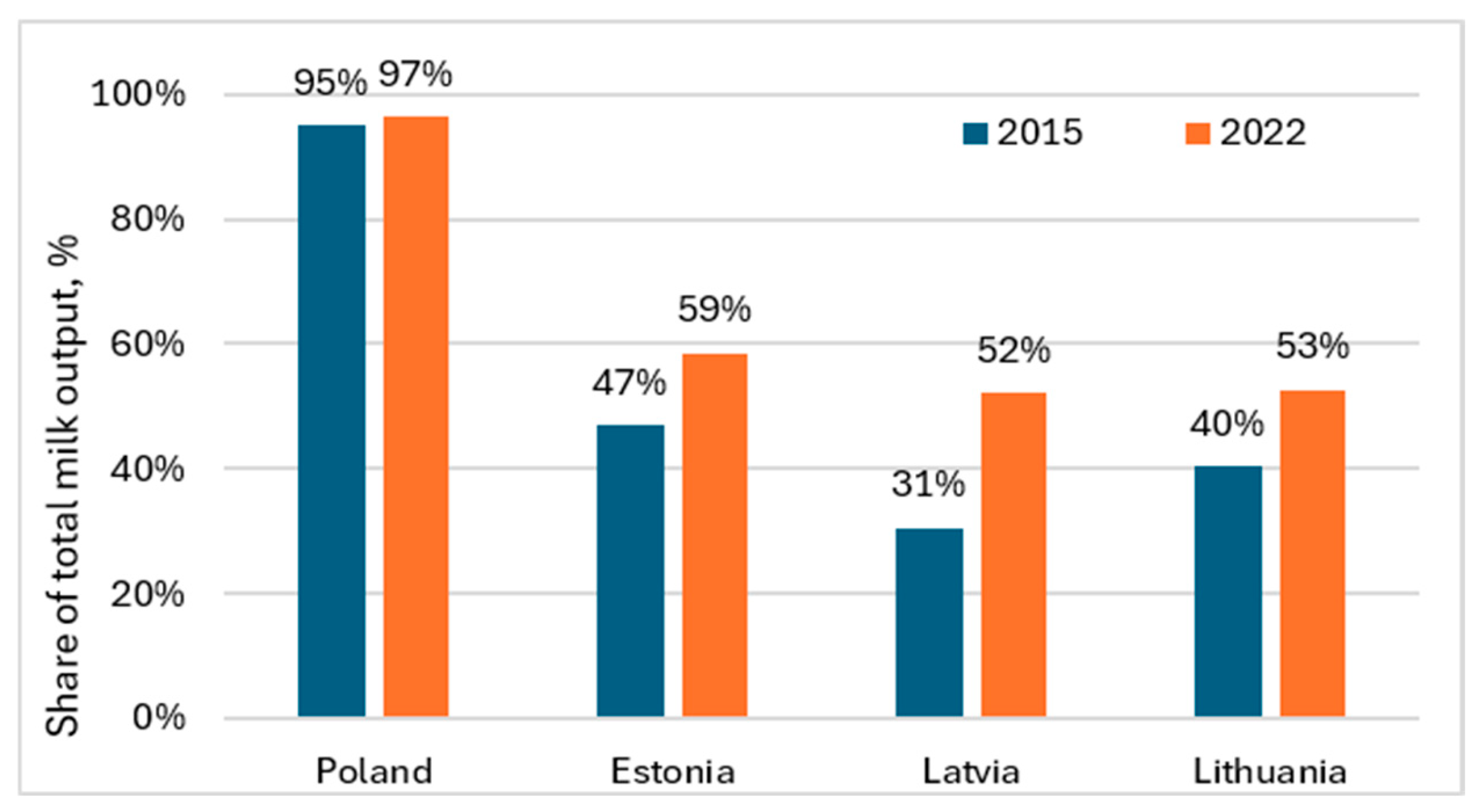
In the Baltic states, extensive production remains the dominant system, though the share of intensive farms has been rising. In Estonia, the proportion of intensive farms increased from 28% in 2015 to 36% in 2022; their share of total milk output grew from 47.1% to 58.5%. In Latvia, intensive farms represented only 9% of the sample in 2015, rising to 15% by 2022, yet their share of total milk production increased markedly from 30.5% to 52.2%, reflecting the rapid expansion of this group. In Lithuania, the share of extensive farms remained stable at approximately 77–79% of the sample, yet their contribution to total milk output declined from 59.7% to 47.3%, as intensive farms grew substantially: UAA increased by 60%, livestock numbers by 72%, and milk yield per cow by 28%.
Figure 1 illustrates the shift in the share of total milk output produced by intensive farms between 2015 and 2022. In the Baltic states, where extensive systems dominated in 2015, the reallocation of production towards intensive farms was substantial—most pronounced in Latvia (+21.7 pp) and Lithuania (+12.4 pp). Poland, already intensive-dominated in 2015, showed only marginal further concentration (+1.5 pp).
Table 1 presents selected key structural, production, and economic characteristics of the dairy farm sample in 2022; full descriptive statistics for both 2015 and 2022 are provided in Table A1 (Appendix A).
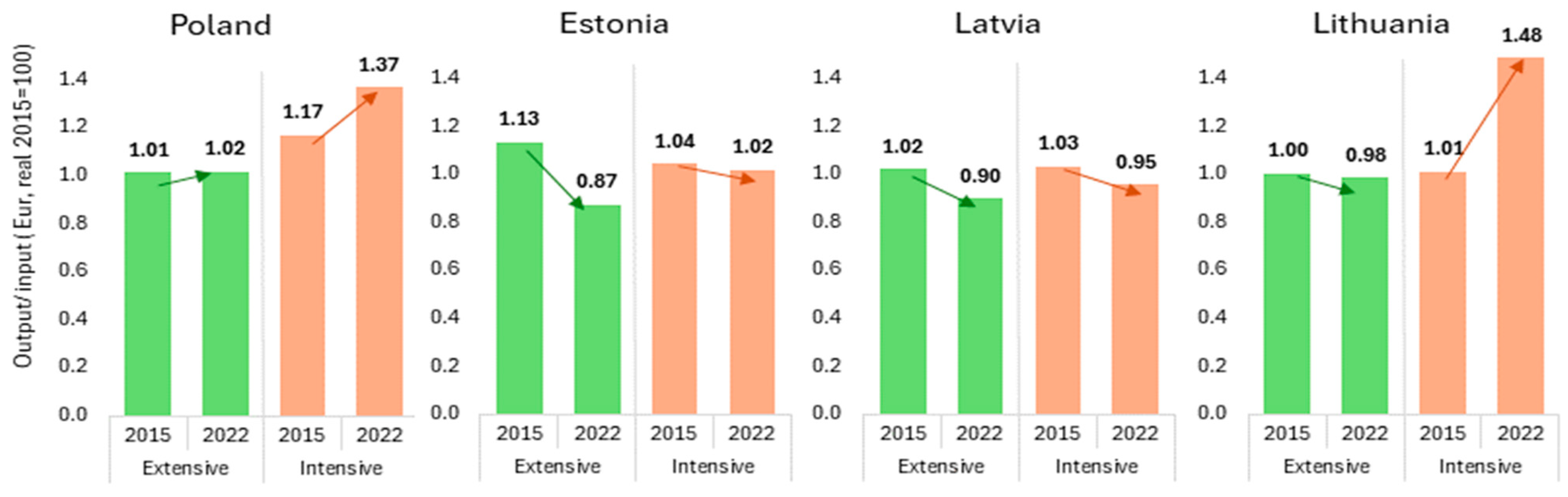
The ratio of total output to total input—a summary indicator of overall farm economic productivity—showed the highest values in intensive Lithuanian farms and across Polish farms in general, suggesting a more favourable input-output structure in these systems (Figure 2). In Lithuania, the gap between intensive and extensive farms widened considerably over the study period, while in Latvia the two groups exhibited broadly similar ratios, indicating lower system-level differentiation.
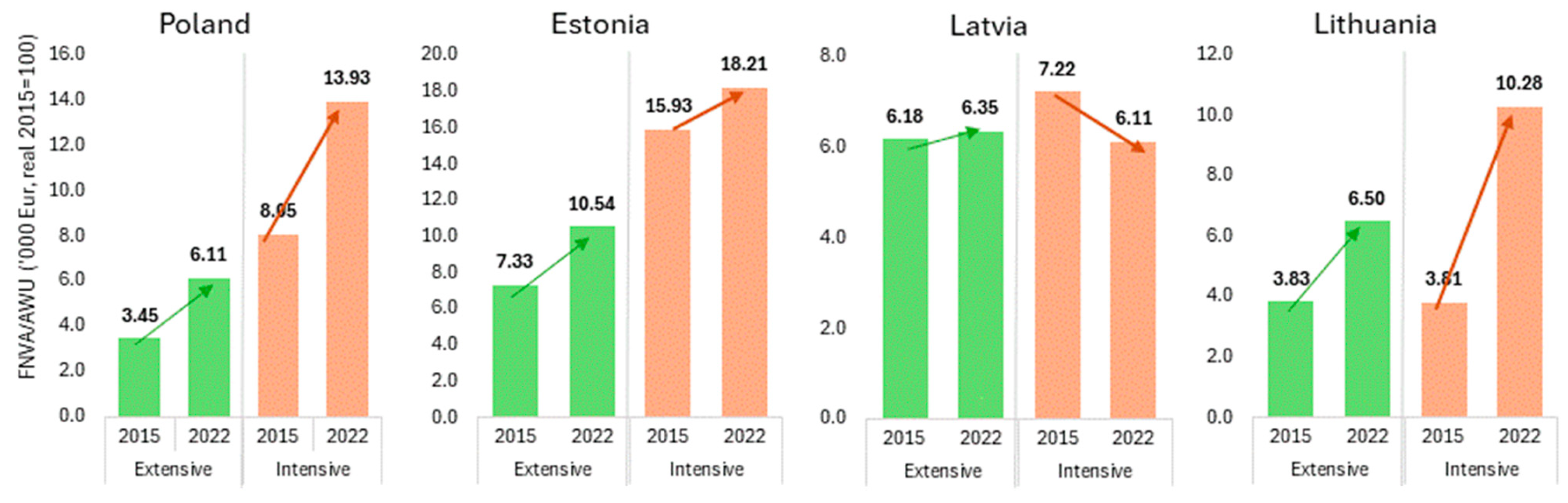
Farm Net Value Added per Annual Work Unit (FNVA/AWU), which standardises economic returns to labour irrespective of whether it is family or hired, increased in real terms in all countries except Latvia over 2015–2022, reflecting rising labour productivity and structural adjustment (Figure 3). The largest absolute increase was observed in Lithuania, where the gap between intensive and extensive farms also widened the most. Across all countries, intensive farms consistently generated higher value added per worker, suggesting that higher stocking density is associated with a more favourable output-to-input ratio.
The increasing gap in FNVA/AWU between intensive and extensive farms indicates a growing structural differentiation within the dairy sector, in which extensive farms face increasing competitiveness challenges and are forced to choose between exiting the sector, pursuing niche specialization, or gradually intensifying their production.

4.2. Evaluation of Technical Efficiency

This section presents TE estimates obtained using the DEA meta-frontier framework. Results are reported at four levels: TE(VRS)_group, TE(CRS)_group, scale efficiency (SE), TGR, and TE_meta. Regression analysis is subsequently used to assess the statistical significance of the relationship between production system intensity and efficiency outcomes, controlling for year fixed effects.

4.2.1. Group-Level Technical Efficiency and Scale Efficiency

Table 2 reports TE (VRS)_group, TE (CRS)_group, SE, TGR, and TE_meta estimates for extensive and intensive dairy farms in each country over the period 2015–2022.
Group-level technical efficiency results indicate that, in all countries except Poland, intensive farms achieved substantially higher TE(VRS)_group scores than extensive farms over the study period. In Estonia, intensive farms recorded an average TE(VRS)_group of 0.934, compared to 0.831 for extensive farms. In Latvia, the corresponding averages were 0.937 and 0.778, and in Lithuania, 0.860 and 0.741. It should be noted, however, that TE(VRS)_group scores are not directly comparable across groups, as each is measured relative to its own production frontier. Consequently, a higher TE(VRS)_group score may partly reflect differences in the position and shape of the group-specific frontier rather than superior managerial performance alone. Cross-group comparisons are therefore based on TE_meta and TGR measures, which evaluate performance relative to the common metafrontier and explicitly account for technological heterogeneity between production systems.
The comparison between TE(VRS)- and TE(CRS)-based efficiency estimates indicated that the main relative efficiency patterns between intensive and extensive farms remained broadly consistent across specifications. Although TE(CRS) assumptions produced moderately lower efficiency scores, the overall ranking of farm groups did not substantially change, suggesting that the main findings are robust to alternative returns-to-scale assumptions.
Scale efficiency results reinforce this pattern. In all four countries, intensive farms recorded higher SE scores than extensive farms, indicating that intensive farms operated at a scale closer to their technically optimal size. A decline in the scale efficiency (SE) of extensive farms was also observed in all four countries over the study period. The largest difference in SE between extensive and intensive farms was observed in Poland (0.895 for intensive farms compared to 0.790 for extensive farms), suggesting that extensive Polish farms operated at the greatest distance from their optimal scale.
Poland presents a notable exception to the general pattern. Contrary to the Baltic countries, extensive farms in Poland outperformed intensive farms on both TE(VRS)_group (average 0.704 vs. 0.548) and TE_meta (0.572 vs. 0.521). This reversal suggests that while intensive Polish farms operate closer to the national technological frontier (as reflected in their higher TGR), they fail to translate this technological proximity into proportionally higher efficiency. Given that the present analysis does not directly observe the mechanisms underlying this divergence, the reasons for the Polish pattern remain an open question and warrant further investigation in future research.

4.2.2. Meta-Frontier Technical Efficiency

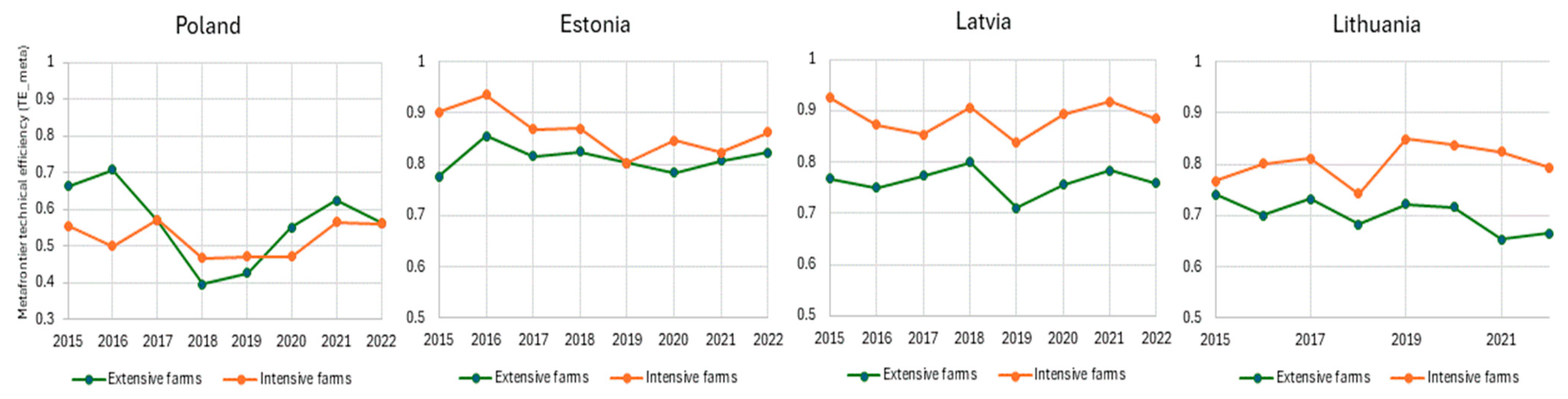
TE_meta measures farm performance relative to the common national frontier, accounting for differences in technology across groups. Figure 4 plots TE_meta for extensive and intensive farms in each country over the study period.
Across all three Baltic countries, intensive farms demonstrated higher TE_meta than extensive farms throughout the study period. The gap was most pronounced and widening in Lithuania, where the TE_meta differential grew from approximately 4 percentage points in 2015 to 19 percentage points in 2022. In Latvia, the TE_meta advantage of intensive farms was stable and consistent throughout the period, ranging between 11 and 21 percentage points. In Estonia, the differential was the smallest among the Baltic countries, with intensive farms averaging approximately 7 percentage points above extensive farms, and the two series tracking closely over time.
Poland presents a structurally different pattern. As shown in Figure 4, extensive farms recorded higher TE_meta values than intensive farms, with both series exhibiting pronounced volatility—particularly in 2018–2020, years characterised by significant input price shocks. This reversal reinforces the conclusion that production intensity in Poland is not systematically associated with superior meta-frontier efficiency.
The finding that intensive dairy farms outperform extensive farms in terms of meta-frontier technical efficiency in Estonia, Latvia, and Lithuania is consistent with a substantial body of evidence from European dairy research. Latruffe et al. (2023) [5] also found that intensive farms demonstrate better economic performance of intensive farms, compared to extensive farms. Alvarez and Del Corral (2010) [3], using a latent class model for Spanish dairy farms, found that intensive farms operate closer to the best-practice frontier (TE of 0.971 compared to 0.931 for extensive farms), which they attributed to lower managerial complexity in high-input systems. In contrast, Ojo et al. (2020) [18] showed that higher external input use does not necessarily translate into greater cost efficiency, as low-input systems can perform equally well depending on farm size and regional conditions. Together, these findings suggest that while intensification may improve TE, it does not automatically ensure superior economic performance. The present results extend these findings to the Central and Eastern European context, where post-quota liberalisation has created particularly strong incentives for structural adjustment.
The SE results corroborate this interpretation. Intensive farms in all four countries recorded higher SE scores, indicating that they operated closer to their technically optimal scale. These results are consistent with those of Kelly et al. (2013) [56], who found that economies of scale tend to be greater on farms with higher livestock density. The study also suggests that greater farm specialization is associated with stronger scale economies. Evidence from latent class models further indicates that more intensive production systems tend to exhibit higher TE, suggesting that both production intensity and structural characteristics, including scale, play an important role in shaping efficiency outcomes, as shown by Garcia-Covarrubias et al. in 2023 [35]. In the Baltic context, where farm structures were historically constrained by land fragmentation and smallholder dominance, the post-quota period appears to have enabled intensive farms to reach more productive scales, as evidenced by the marked increases in UAA, livestock units, and milk yield per cow documented in the descriptive statistics.
The magnitude of the TE_meta advantage varies across the Baltic states in a manner consistent with the pace of structural change. Lithuania, which experienced the most pronounced intensive farm expansion over 2015–2022, also recorded the largest and most rapidly widening efficiency gap—growing from 4 percentage points in 2015 to 19 percentage points in 2022. Latvia showed a stable but consistently large differential throughout the period. Estonia, where structural change was more gradual and farm sizes were already larger at the outset, exhibited the smallest gap. Our findings extend this evidence by suggesting that, in the Baltic states, convergence has progressed further within intensive production systems in the post-quota period. Baležentis and Karagiannis in 2021 [44] documented increasing efficiency in Lithuanian dairy farming over time, reflecting ongoing structural developments in the sector.
These results are in line with the findings of Náglová and Rudinskaya (2021) [26], who analysed TE determinants across EU dairy farms using FADN data and found that Latvia, Lithuania, and Poland were characterised by relatively small farm structures with scope for improvement. The present study shows that, within the Baltic states, the intensive farm segment has successfully exploited this potential over the post-quota period, whereas extensive farms have not experienced comparable efficiency gains. This divergence has important implications for understanding within-country structural heterogeneity that aggregate country-level analyses cannot capture.

4.2.3. Technology Gap Ratio

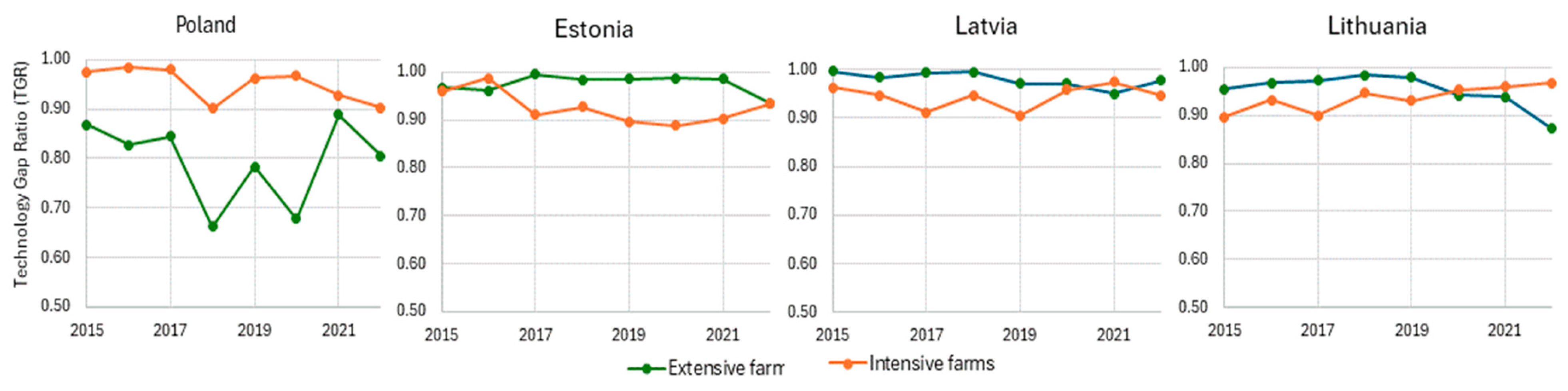
The TGR measures the proximity of each group’s production frontier to the national meta-frontier. Figure 5 illustrates TGR dynamics for extensive and intensive farms over the study period.
In Estonia and Latvia, extensive farms recorded consistently higher TGR values than intensive farms throughout the period, indicating that extensive systems operated closer to the national best-practice frontier. In Estonia, a gradual convergence between the two series has been visible from 2016 onwards, suggesting that the technological distance between intensive and extensive systems has been diminishing. A similar convergence pattern has been observed in Latvia, where the gap between the two groups narrowed by the end of the period.
Lithuania presents the most striking dynamic. As shown in Figure 5, extensive farms held a clear TGR advantage in 2015 (0.956 vs. 0.897 for intensive farms), but the two series crossed around 2020, after which intensive farms recorded higher TGR values. By 2022, intensive farm TGR reached 0.967 compared to 0.873 for extensive farms. This reversal indicates that intensive Lithuanian farms progressively approached the national technological frontier, while extensive farms lost their earlier technological proximity advantage.
In Poland, the pattern is the reverse of that observed in the Baltic countries: intensive farms recorded substantially higher TGR than extensive farms throughout the period (average 0.951 vs. 0.795). This confirms that intensive Polish farms operated technologically much closer to the national frontier—yet, as established above, this technological proximity did not translate into higher meta-frontier efficiency, pointing to binding managerial and organisational constraints.
The TGR results offer a complementary and theoretically nuanced perspective on technological heterogeneity. In Estonia and Latvia, extensive farms recorded higher TGR values throughout the study period, indicating that their production technology was closer to the national best-practice frontier—even though their TE (VRS)_group and TE_meta scores were lower. This apparent paradox is consistent with the meta-frontier framework proposed by Battese et al. in 2004 [21], which shows that a group may operate efficiently relative to its own frontier, while that frontier remains below the meta-frontier, reflecting technological gaps across groups.
Nevertheless, the gradual TGR convergence observed in Estonia and Latvia—where the gap between intensive and extensive farms narrowed progressively over time—suggests a process of technological catch-up among intensive farms. This interpretation is consistent with Renner et al. (2021) [20], who showed that accounting for technological heterogeneity significantly affects farm performance assessments. Skevas in 2024 [57] similarly demonstrated that persistent inefficiency is partly driven by technological differences across farms. Čechura et al. in 2021 [58] further documented that the abolition of milk quotas stimulated productivity and efficiency improvements across EU dairy sectors, with scale efficiency identified as an important driver, potentially supporting technological convergence among expanding intensive farms.
Lithuania presents a particularly pronounced case. The complete reversal of the TGR advantage—from extensive farms leading in 2015 to intensive farms leading from 2020 onwards—represents a structural shift in the technological landscape of Lithuanian dairy farming with no direct parallel in the existing Baltic or Polish literature. This reversal coincides with the period of most rapid intensive farm expansion: intensive Lithuanian farms increased their UAA by 60%, livestock numbers by 72%, and milk yield per cow by 28% over the study period, while simultaneously reducing labour hours per livestock unit by 14%. The TGR reversal suggests that this expansion was not merely a scaling-up of existing practices but was accompanied by genuine technological upgrading. Baležentis and Sun in 2020 [29], analysing Lithuanian dairy farms with a semiparametric approach over 2004–2015, documented significant total factor productivity growth driven by technological change, providing a relevant backdrop for the TGR dynamics observed here. The present study extends their analysis into the post-quota period and reveals that the technological trajectory they identified has not only continued but has produced a structural reordering of intensive and extensive farm technologies relative to the national frontier.
Poland presents a theoretically important counterexample that enriches the interpretation of the Baltic results. Despite intensive Polish farms recording substantially higher TGR values (average 0.951 vs. 0.795 for extensive farms), their TE_group and TE_meta scores were consistently lower. This structural contradiction—high technological proximity to the frontier combined with low actual efficiency—suggests that managerial and organisational constraints, rather than technological limitations, are the binding factor for Polish intensive farms.
The sensitivity analysis indicates that the principal findings are robust to alternative definitions of production intensity. Although the number of farms assigned to intensive and extensive groups changes when the threshold is adjusted from 0.9 to 1.1 LU/ha, the overall ranking of production systems and the relative differences in TE_meta and TGR remain qualitatively unchanged (see Table A2, Appendix A). Intensive farms continue to exhibit higher technical efficiency in the Baltic States, whereas the Polish pattern remains distinct. These results suggest that the conclusions are not driven by the specific choice of the 1 LU/ha threshold.
The robustness analysis confirms that the principal findings are not driven by a small number of extreme observations (see Table A3, Appendix A). Applying the IQR rule to all DEA input and output variables resulted in substantially more observations being removed than in the baseline specification. Depending on the country, the proportion of excluded farms increased from approximately 4% under the main model to 12–18% under the stricter input–output filtering procedure. Nevertheless, the qualitative pattern of results remained unchanged.
For TE_meta, intensive farms continued to outperform extensive farms in all three Baltic States, whereas the opposite pattern persisted in Poland. Similarly, the TGR results remained stable across all specifications, with intensive farms exhibiting lower TGR values than extensive farms in the Baltic States but higher TGR values in Poland. Although the magnitude of some efficiency gaps changed slightly, the direction and overall interpretation of the results were unaffected. These findings indicate that the reported efficiency differences are robust to alternative outlier treatment procedures and are not driven by a limited number of extreme observations.
This finding resonates with Alvarez et al. (2008) [36], who showed that the relationship between intensification and economic efficiency is not straightforward and depends on farm-specific factors. Similarly, Wilczyński et al. (2020) [28], in a study of Polish dairy farms using DEA, identified significant efficiency variation across farm types, suggesting that structural and organisational differences may influence resource use efficiency. The present results indicate that this dynamic may be particularly pronounced among intensive Polish farms, where increasing scale and complexity may place greater demands on managerial capacity. This interpretation is consistent with Bravo-Ureta et al. (2007) [59], who highlighted that efficiency outcomes vary systematically with structural conditions.

4.2.4. Regression Analysis

To further examine the relationship between production intensity and efficiency performance, OLS regressions with heteroskedasticity-robust (HC1) standard errors were estimated separately for each country, with TE_meta and TGR as dependent variables. To address potential endogeneity concerns and avoid circularity between the first-stage DEA estimation and the second-stage regression, four contextual control variables are included that were not used in the DEA model: herd size (number of dairy cows), milk yield per cow, the share of own feed in total feed consumption, and subsidies (total subsidies, excluding on investment). Year fixed effects (2015 as the reference year) are included throughout. Results are reported in Table 3; full regression output including all control variables is presented in Table A4 (Appendix A).
The regression results are broadly consistent with the descriptive findings and indicate that the observed relationships remain statistically significant after controlling for herd size, milk productivity, subsidisation level, feed self-sufficiency, and year effects. In all three Baltic countries, the intensive farm indicator is positive and statistically significant in the TE_meta regression, indicating that intensive farms achieved systematically higher metafrontier efficiency than extensive farms. The effect is largest in Latvia (β ≈ +0.114, p < 0.001), followed by Lithuania (β ≈ +0.079, p < 0.001) and Estonia (β ≈ +0.059, p < 0.001). In Poland, the coefficient is negative (β ≈ −0.130, p < 0.001), consistent with the reversed pattern observed in the descriptive analysis, whereby extensive farms outperform intensive farms in terms of metafrontier efficiency.
Notably, the intensive farm coefficient remains statistically significant and qualitatively unchanged after the inclusion of farm-level controls. This suggests that the observed efficiency differences are not fully explained by variations in herd size, milk productivity, subsidies, or feed self-sufficiency and remain associated with production system type.
Among the control variables, herd size is positive and statistically significant in all four countries, suggesting that larger herds tend to be associated with higher metafrontier efficiency. This finding is consistent with the scale-efficiency patterns identified in the DEA analysis. Milk yield exhibits heterogeneous effects across countries, being negative in Estonia, positive in Latvia and Poland, and statistically insignificant in Lithuania, indicating that the efficiency implications of milk productivity depend on the specific structural context.
Feed self-sufficiency exhibits heterogeneous effects across countries. The coefficient is negative and statistically significant in Estonia, positive and significant in Poland, weakly positive in Latvia, and statistically insignificant in Lithuania. A possible explanation is that farms relying more heavily on purchased feed may benefit from greater flexibility in feed allocation; however, this interpretation should be treated with caution because feed management practices are not directly observed in the dataset. Subsidies are negatively associated with TE_meta in Lithuania, Latvia and Poland, while the relationship is not statistically significant in Estonia. This finding is consistent with previous studies suggesting that CAP support may weaken efficiency incentives under certain conditions, although the estimated relationship should not be interpreted as causal [26,60].
The TGR regression results reveal a structurally distinct pattern. In all three Baltic countries, the intensive farm coefficient is negative and statistically significant (Estonia: −0.042, p < 0.001; Latvia: −0.034, p < 0.001; Lithuania: −0.021, p < 0.05), indicating that intensive farms, despite achieving higher TE_meta, remain further from the common metafrontier than extensive farms. In other words, intensive farms appear to exploit their group-specific technology more efficiently, while exhibiting lower technological proximity to the national best-practice frontier. In Poland, the TGR coefficient is positive and substantial (+0.141, p < 0.001), indicating that intensive farms are technologically closer to the national metafrontier. However, this technological advantage is not accompanied by higher metafrontier efficiency, suggesting that factors other than technological proximity contribute to the lower TE_meta observed among intensive Polish farms.
Regarding the question of whether the intensity–efficiency relationship changed over time, the year fixed effects provide additional insight. In the Baltic-country TE_meta regressions, most year coefficients are statistically insignificant, suggesting that a substantial share of the observed efficiency differences is associated with structural characteristics rather than short-term annual fluctuations (Table A4, Appendix A). Nevertheless, several noteworthy temporal effects emerge. In Lithuania, the 2022 year dummy is negative and statistically significant (β ≈ −0.067, p < 0.05), while the 2021 coefficient approaches significance (β ≈ −0.057, p = 0.054), reflecting the documented sensitivity of Lithuanian dairy farms to the 2022 input price shock. In Latvia, several year coefficients are negative and significant in the TGR regression, particularly during the later years of the sample period, suggesting a gradual deterioration in technological proximity relative to the national metafrontier. In Poland, multiple year coefficients are statistically significant, especially during 2018–2020, indicating that efficiency outcomes were influenced by time-varying sector-wide factors in addition to the structural differences associated with production intensity.
The year dummy patterns therefore support a more nuanced interpretation than the original formulation. While a substantial share of the observed efficiency differences across production systems appears to be associated with structural characteristics rather than annual fluctuations, year-specific shocks, particularly the 2022 input price crisis and earlier market disruptions, had measurable temporary effects on efficiency levels, especially in Lithuania and Poland. These shocks affected the overall level of TE_meta in specific years but did not alter the direction or statistical significance of the intensity–efficiency relationship, which remained broadly stable across model specifications.
It should also be noted that, in the Baltic states, extensive farms account for approximately 75–95% of observations depending on the year, whereas in Poland intensive farms account for around 87% of the sample. Because the metafrontier is estimated from the pooled sample, numerically dominant groups may exert greater influence on the shape of the frontier; consequently, part of the observed TGR differences may reflect a frontier-composition effect. Nevertheless, the persistence of statistically significant intensity coefficients after controlling for farm-level characteristics and year effects suggests that the observed differences are unlikely to be explained solely by temporal shocks or observable structural characteristics and are consistent with the presence of technological heterogeneity across production systems.
The findings of this study carry important implications for EU agricultural and environmental policy. The Farm to Fork Strategy and the broader Green Deal framework explicitly aim to reduce the environmental footprint of European agriculture by promoting extensification—reducing livestock densities, cutting synthetic input use, and expanding nature-friendly farming practices. The implicit assumption underlying these objectives is that a shift towards extensive production systems is compatible with maintaining farm economic viability and competitiveness.
The present results indicate that the compatibility between extensification objectives and farm-level economic efficiency may be more limited than often assumed. In all three Baltic states, intensive farms systematically outperformed extensive farms in terms of meta-frontier technical efficiency, and this advantage widened over time. This pattern is consistent with the broader post-quota market environment, where increased price exposure and market orientation strengthened incentives for productivity-enhancing adjustments [61] (Jongeneel & Gonzalez-Martinez, 2022). At the farm level, more intensive and specialised production systems tend to achieve higher productivity and efficiency due to better utilisation of capital, improved herd management, and economies of scale [36,44]. From an economic standpoint, this creates a strong incentive structure favouring intensification, reflected in higher labour productivity (FNVA/AWU), greater output per unit of input, and stronger asset accumulation. By contrast, extensive farms exhibited stagnating or declining economic performance in analysed countries. This trajectory is consistent with the structural adjustment patterns documented by Čechura et al. (2021) [58] across EU dairy sectors following quota abolition, where productivity growth and scale efficiency played a central role in sectoral restructuring.
There is a growing tension between environmental policy objectives and farm-level economic rationality in the European dairy sector. Policy support, particularly in the form of subsidies and agri-environmental measures, is intended to promote environmentally sustainable practices; however, its effects on farm economic performance remain ambiguous. Latruffe et al. (2017) [60] show that the relationship between subsidies and TE in EU dairy farming is heterogeneous, with effects that may be positive, negative, or insignificant depending on the country, and which tend to weaken following decoupling reforms. In contrast, Marzec and Pisulewski (2017) [62] find that CAP subsidies are associated with lower TE in Polish dairy farms, suggesting that support payments may weaken efficiency incentives under certain conditions. Similarly, Dakpo et al. (2022) [4] show that participation in agri-environmental schemes can be associated with lower efficiency levels, particularly when input use is constrained. At the same time, Stetter et al. (2023) [48] demonstrate that more intensive dairy farms tend to be more emission-efficient per unit of output, complicating the assumption that extensification proportionally reduces environmental impacts.
The results suggest that, if policymakers seek to encourage extensive production systems, appropriate compensation mechanisms may be necessary to offset potential economic disadvantages associated with lower efficiency levels. Possible approaches include targeted agri-environmental payments or other mechanisms designed to reward environmental public goods. The diverging TGR and TE_meta trajectories observed in this study suggest increasing challenges for maintaining the competitiveness of extensive dairy farms in the Baltic States, particularly where technological differences between production systems persist over time.
Several limitations of this study should be acknowledged. First, although the DEA meta-frontier approach is well suited to cross-group comparisons, it remains sensitive to the definition of the empirical frontier and to the presence of extreme observations. To assess this issue, an additional robustness analysis was conducted using IQR-based filtering of DEA input and output variables. The resulting efficiency estimates remained qualitatively similar to the main specification, suggesting that the principal findings are not driven by a small number of extreme observations. Nevertheless, DEA efficiency scores remain conditional on the observed sample and assume that the best-performing farms adequately represent the underlying production frontier.
Second, the study period encompasses the substantial input price shock of 2022, which introduced volatility into dairy farm performance and may have temporarily affected efficiency estimates. Although year fixed effects were included in the regression analysis to account for common temporal shocks, some short-term adjustments and heterogeneous responses across farms may not be fully captured.
Third, the regression analysis identifies statistical associations rather than causal relationships. Production intensity and technical efficiency may be jointly determined, and unobserved factors such as managerial ability, entrepreneurial skills, or farm-specific strategic decisions could influence both variables simultaneously. Consequently, the estimated coefficients should not be interpreted as evidence of a causal effect of production intensity on efficiency. The relatively modest R2 values observed in several specifications further suggest that a substantial share of efficiency variation is explained by factors not captured in the available dataset.
Fourth, the FADN database does not contain detailed information on feed composition, nutritional management, animal diets, or other biological production characteristics. As a result, potentially important determinants of efficiency, including feeding strategies, herd management practices, and feed conversion performance, could not be incorporated into the analysis.
Finally, higher technical efficiency should not automatically be interpreted as higher sustainability. The present study evaluates economic performance and technological efficiency but does not include direct environmental or animal welfare indicators. Therefore, the results should not be interpreted as evidence that more efficient production systems are necessarily environmentally superior or more sustainable overall.

5. Conclusions

In this study, TE of intensive and extensive farms was analyzed using the DEA meta-frontier method. Dairy farms in Lithuania, Latvia, Estonia, and Poland were analyzed for the period of 2015–2022 using homogeneous EU-FADN data. Dairy farms were classified as intensive or extensive using the stocking density indicator: extensive systems (≤1 LU/ha) and intensive systems (>1 LU/ha).
The analysis showed that intensive dairy farms in all three Baltic countries consistently exhibited higher TE_meta than extensive farms. The largest and fastest-growing efficiency gap was found in Lithuania, where the TE_meta gap increased from 4 percentage points in 2015 to 19 percentage points in 2022, reflecting the rapid structural growth of intensive farms during the period under review. In Latvia, the gap remained stable but consistently high, while in Estonia it was smaller. Regression analysis showed that production intensity remained positively and statistically significantly associated with meta-frontier technical efficiency across all three Baltic countries after controlling for herd size, milk productivity, subsidies, feed self-sufficiency, and year effects. The persistence of this relationship suggests that the observed efficiency differences are not fully explained by observable farm characteristics.
The results of the TGR revealed important dynamics of technological convergence. In Estonia and Latvia, the TGR gap between extensive and intensive farms narrowed over time, indicating that intensive farms, by investing in and adopting new technologies, approached the national best-practice threshold. Lithuania stands out as the most striking case: around 2020, a complete reversal of the TGR advantage occurred, after which intensive farms began to exhibit higher TGR values than extensive farms for the first time. This indicates that, following the abolition of quotas, Lithuania’s intensive farms not only increased production scale but also genuinely modernized their technologies.
Poland constitutes a theoretically significant exception to the trend observed in the Baltic countries. Although intensive farms were technologically closer to the national meta-frontier, as evidenced by their higher TGR values, their group and meta-frontier technical efficiency remained lower than that of extensive farms. This finding suggests that technological proximity alone is insufficient to explain efficiency outcomes and highlights the importance of distinguishing between technological heterogeneity and technical efficiency when evaluating the performance of alternative production systems.
The findings indicate that extensive dairy farming systems may face economic efficiency disadvantages under prevailing market conditions despite additional policy support or compensation mechanisms are present. In the Baltic countries, intensive farms consistently demonstrated greater TE, higher labour productivity, and faster capital accumulation than extensive farms, and this advantage grew precisely during the period when market liberalization encouraged intensification. Extensive farms face a deteriorating competitive position that market mechanisms alone are unable to correct, and the support provided does not compensate for the economic efficiency gap they face. Therefore, policy measures designed to promote extensification, such as organic schemes or agri-environmental payments, may require adequate compensation mechanisms to offset potential economic disadvantages associated with lower technical efficiency. At the same time, extensive dairy farms can provide environmental and societal benefits that are not captured by the efficiency measures used in this study, including biodiversity conservation, landscape management, lower stocking pressures, and the provision of other environmental public goods. Consequently, policy evaluation should consider both economic performance and broader sustainability objectives when assessing the role of extensive production systems.
This study contributes to the literature on technological diversity in European dairy farms and presents a systematic meta-frontier DEA comparison of intensive and extensive dairy production systems in the Baltic countries and Poland. In future research, this analysis should be expanded using stochastic meta-frontier methods, which would allow for a more flexible treatment of unobserved heterogeneity and the integration of environmental performance indicators, thereby enabling a broader assessment of the trade-offs between economic efficiency and environmental outcomes across different production systems.

Author Contributions

Conceptualization, R.S.; methodology, R.S.; software, R.S.; validation, R.S. and V.N.; formal analysis, R.S. and V.N.; investigation, R.S.; resources, R.S. and V.N.; data curation, R.S. and V.N.; writing—original draft preparation, R.S.; writing—review and editing, R.S. and V.N.; visualization, R.S. All authors have read and agreed to the published version of the manuscript.

Funding

This research received no external funding.

Institutional Review Board Statement

Not applicable.

Informed Consent Statement

Not applicable.

Data Availability Statement

The data used in this study were derived from the Farm Accountancy Data Network (FADN) database. The datasets used and/or analyzed during the current study are not available.

Conflicts of Interest

The authors declare no conflicts of interest.

Appendix A

Table A1. Descriptive statistics of dairy farms by production system, 2015 and 2022.
IndicatorPolandEstoniaLatviaLithuania
ExtensiveIntensiveTotalExtensiveIntensiveTotalExtensiveIntensiveTotalExtensiveIntensiveTotal
201520222015202220152022201520222015202220152022201520222015202220152022201520222015202220152022
SAMPLE
Farms number1941442479194626732090975638311358728022656543362801941538692280245
Representative (‘000)12.510.579.775.692.286.10.750.500.130.120.880.635.924.830.590.896.525.7113.798.054.202.3417.9910.39
FARM STRUCTURE
UAA (ha)202123272326193218553721245317534481865550273229472835
Livestock units12123037273491112441518141192232280892832131526451622
Cow number881924182256682813308812015145155182181017301015
Stock density (LU/ha)0.720.652.282.542.072.310.570.501.721.370.730.670.480.562.651.880.680.760.560.522.081.560.910.75
MILK PRODUCTION
Milk yield/cow (kg)384838844836546647025273569667077831866360027091490955575182662049345722479250284346555646885147
Milk per ha (kg)212118477266901065668134205323128897775330323382164521908755817922913110191219186805638030542925
FEED STRUCTURE
Share of own feed0.760.760.570.610.600.630.770.630.610.480.750.600.770.700.710.450.770.660.830.800.710.710.800.78
Forage crops in UAA0.780.810.610.640.630.660.810.900.630.740.780.870.880.870.720.770.860.850.830.890.610.720.780.85
LABOUR
Labour (hours)3804319542734425420942748340713227182313641103711895372831267197705740433735327929254063488034623366
Labour (hours)/LU54460620819525424540128312989362245289311280192288292536405436377513399
Output/work hour (€)3.35.08.712.48.011.512.221.833.337.315.324.97.27.412.413.37.68.34.75.65.510.24.96.6
INPUTS and CAPITAL
Total output (‘000 €)13.018.138.863.135.357.6225.9253.31031.01650.4341.1527.935.227.7135.9178.644.351.117.720.841.585.923.335.5
Interm. consump. (‘000 €)9.011.423.936.021.833.0176.5217.2810.41222.9267.2414.829.522.3106.9129.436.538.912.612.329.149.316.520.6
Capital (‘000 €)138.9137.5234.2245.7221.2232.5368.4468.61947.22257.4594.4820.265.559.6236.6285.181.094.552.544.171.4123.556.962.0
Capital per LU (‘000 €)15.3318.108.407.779.349.036.916.095.143.036.655.493.153.202.762.873.113.157.783.732.542.626.563.48
Output/Input1.011.021.171.371.151.321.130.871.041.021.120.901.020.901.030.951.020.911.000.981.011.481.001.10
ECONOMIC PERFORMANCE
FNVA/AWU (‘000 €)3.456.118.0513.937.4212.977.3310.5415.9318.218.5612.056.186.357.226.116.286.323.836.503.8110.283.827.36
GFI per LU (€)794111971992972995211457388858121108752736832488562714790984964508944873959
Subsidies/LU (€)526796313310342370604593338313566538594671310263568607689619308299600547
Total livestock output/LU (€)928833101810991006106711641096135715971192119475595285211057649769148307421080874886
Sp. livestock costs/LU (€)329497341506339505708680939837741711517442494552515459509430417440488432
Note: Extensive = stocking density ≤ 1 LU/ha; Intensive = stocking density > 1 LU/ha. Full descriptive statistics for 2015 and 2022 are provided in Table A1 (Appendix A). UAA = utilised agricultural area; FNVA = farm net value added; AWU = annual work unit; GFI = gross farm income; LU = livestock unit. Data source: EU-FADN—European Commission, authors’ calculations.
Table A2. Sensitivity analysis: DEA efficiency estimates under alternative classification thresholds—n-weighted period averages, 2015–2022.
ThresholdExtensive FarmsIntensive FarmsDifference
(Int-Ext) (pp)
(LU/ha)Farms (avg)Represent. farms (avg)TE_metaTGRFarms (avg)Represent. farms (avg)TE_metaTGRΔTE_metaΔTGR
Poland0.9126100050.6040.8062251747010.5190.949−0.0850.143
1.0181127280.5720.7952196719780.5210.951−0.0510.156
1.1249155410.5560.7922128691650.5230.949−0.0330.156
Estonia0.9635530.8100.963421640.8550.9430.045−0.021
1.0766030.8110.975301140.8650.9270.054−0.048
1.1846360.8150.98621810.8590.9110.044−0.074
Latvia0.923151060.7610.976567160.8630.9410.103−0.035
1.024853060.7620.981405170.8860.9440.124−0.037
1.125954340.7640.985293880.8970.9420.133−0.042
Lithuania0.915994440.6990.93410531640.7990.9490.1000.015
1.0184103500.7070.9558022580.8040.9350.096−0.021
1.1203109760.7080.9686116330.8320.9330.124−0.036
Notes: Farms are classified as extensive (≤threshold LU/ha) or intensive (>threshold). Baseline threshold (1.0 LU/ha) in bold. Based on the main model specification (SE120 IQR filtering). ΔTE_meta = intensive minus extensive (pp); ΔTGR = intensive minus extensive (pp). Source: authors’ calculations.
Table A3. Model robustness: comparison of DEA efficiency estimates across outlier treatment approaches—n-weighted period averages, 2015–2022.
(A) Outlier Removal Summary by Approach and Country
CountryMain Model (SE120 Filtering)Robustness (IO Filtering)Full Sample
N AfterRemoved (n)Removed (%)N AfterRemoved (n)Removed (%)N TotalN (vs. Main)
Lithuania2113914.1%184336116.4%2204+270
Estonia846313.5%76211513.1%877+84
Latvia22991134.7%199142117.5%2412+308
Poland19,0137683.9%17,343243812.3%19,781+1670
(B) TE_meta and TGR Estimates Across Outlier Treatment Specifications (n-Weighted Period Averages, 2015–2022)
TE_meta Comparison Across Specifications:
CountryMain ModelRobustness (IO)Full Sample
Ext.Int.Gap (pp)Ext.Int.Gap (pp)Ext.Int.Gap (pp)
TE_metaTE_metaInt.−Ext.TE_metaTE_metaInt.−Ext.TE_metaTE_metaInt.−Ext.
Lithuania0.70700.8035+9.650.70430.8146+11.030.69790.8071+10.92
Estonia0.81150.8652+5.370.81330.8742+6.100.80920.8648+5.56
Latvia0.76230.8859+12.360.76600.9103+14.420.75480.8907+13.59
Poland0.57180.5211−5.070.61780.5629−5.490.56950.5170−5.25
TGR comparison across specifications:
CountryMain ModelRobustness (IO)Full Sample
Ext. TGRInt. TGRGap (pp)Ext. TGRInt. TGRGap (pp)Ext. TGRInt. TGRGap (pp)
Lithuania0.95540.9346−2.080.95150.9373−1.420.94480.9443−0.05
Estonia0.97520.9271−4.820.96680.9394−2.740.97210.9395−3.26
Latvia0.98090.9442−3.670.97720.9470−3.010.97190.9501−2.18
Poland0.79460.9507+15.610.84520.9526+10.740.79190.9527+16.08
Notes: Three specifications compared: Main model (baseline): IQR outlier filtering applied to stocking density only—this is the primary specification used throughout the paper. Robustness: IQR filtering applied to all DEA input/output variables (total output, UAA, AWU, LU, intermediate consumption, capital). Full sample: no outlier removal. All estimates are n-weighted period averages (2015–2022) using FADN expansion factors. Gap = intensive minus extensive (pp). Source: authors’ calculations.
Table A4. Full regression results for TE_meta and TGR with farm-level controls and year fixed effects.
PolandEstoniaLatviaLithuania
VariableTE_meta Coef.
(SE)
TGR Coef.
(SE)
TE_meta Coef.
(SE)
TGR Coef.
(SE)
TE_meta Coef.
(SE)
TGR Coef.
(SE)
TE_meta Coef.
(SE)
TGR Coef.
(SE)
Main variable
Intensive (dummy)−0.1297 ***
(−0.0304)
0.1406 ***
(−0.0161)
0.0590 ***
(−0.0134)
−0.0420 ***
(−0.0087)
0.1139 ***
(−0.0170)
−0.0339 ***
(−0.0093)
0.0786 ***
(−0.0186)
−0.0212 **
(−0.0102)
Control variables
 Herd size 0.0036 ***
(−0.0004)
0.0012 ***
(−0.0002)
0.0001 ***
(0.0000)
0.0000 *
(0.0000)
0.0008 ***
(−0.0002)
0.0001
(−0.0001)
0.0028 ***
(−0.0006)
0.0002
(−0.0001)
 Milk yield/cow 0.0000 ***
(0.0000)
0.0000 (0.0000)−0.0000 ***
(0.0000)
−0.0000 ***
(0.0000)
0.0000 ***
(0.0000)
0.0000 (0.0000)0.0000 (0.0000)0.0000 (0.0000)
 Own feed share0.0814 ***
(−0.0237)
−0.0117
(−0.01 21)
−0.1362 ***
(−0.0499)
0.0131
(−0.0151)
0.0621 *
(−0.0324)
0.0073
(−0.0071)
0.0131
(−0.0491)
−0.0183
(−0.0169)
 Subsidies −0.0000 ***
(0.0000)
−0.0000 ***
(0.0000)
0.0000
(0.0000)
0.0000
(0.0000)
−0.0000 ***
(0.0000)
0.0000
(0.0000)
−0.0000 ***
(0.0000)
0.0000
(0.0000)
Year fixed effects (Ref. 2015)
year 2016−0.031
(0.031)
0.003
(0.014)
0.076 *
(0.043)
−0.002
(0.010)
−0.023
(0.025)
−0.013 ***
(0.004)
−0.022
(0.032)
0.016
(0.012)
year 2017−0.005
(0.012)
0.001
(0.006)
0.034
(0.045)
0.019 ***
(0.007)
−0.010
(0.025)
−0.008 ***
(0.002)
−0.003
(0.032)
0.014
(0.011)
year 2018−0.126 ***
(0.017)
−0.096 ***
(0.009)
0.038
(0.043)
0.014 *
(0.007)
0.022
(0.025)
−0.003
(0.003)
−0.055*
(0.030)
0.032 ***
(0.009)
year 2019−0.120 ***
(0.016)
−0.026 ***
(0.007)
0.006
(0.046)
0.009
(0.009)
−0.065 **
(0.029)
−0.030 **
(0.012)
−0.006
(0.032)
0.025 ***
(0.009)
year 2020−0.105 ***
(0.017)
−0.038 ***
(0.009)
0.009
(0.047)
0.009
(0.008)
−0.025
(0.026)
−0.024 ***
(0.004)
0.000
(0.031)
−0.001
(0.013)
year 2021−0.032 *
(0.018)
−0.040 ***
(0.009)
0.024
(0.046)
0.011
(0.009)
−0.004
(0.025)
−0.041 ***
(0.009)
−0.057 *
(0.030)
−0.002
(0.011)
year 2022−0.039 **
(0.017)
−0.074 ***
(0.012)
0.037
(0.045)
−0.022 **
(0.011)
−0.031
(0.025)
−0.020 ***
(0.004)
−0.067 **
(0.031)
−0.055 ***
(0.015)
Observations19,01284622992113
R20.2590.3170.1130.1870.1230.0970.0720.098
Constant0.4274 ***
(−0.0271)
0.8298 ***
(−0.0175)
1.0188 ***
(−0.0747)
0.9844 ***
(−0.0189)
0.5636 ***
(−0.048)
0.9815 ***
(−0.0102)
0.6911 ***
(−0.0665)
0.9653 ***
(−0.0216)
Notes: Weighted OLS estimates with HC1 robust standard errors in parentheses. Dependent variables are TE_meta and TGR. Intensive = 1 for farms with stocking density > 1 LU/ha of forage area. Year fixed effects included (2015 = reference year). Control variables comprise herd size, milk yield per cow, total subsidies, and feed self-sufficiency. *** p < 0.01, ** p < 0.05, * p < 0.10.). Source: authors’ calculations.

References

  1. European Commission. EU Farm to Fork Strategy for a Fair, Healthy and Environmentally-Friendly Food System. 2020. Available online: https://food.ec.europa.eu/system/files/2020-05/f2f_action-plan_2020_strategy-info_en.pdf (accessed on 19 November 2025).
  2. European Commission. EU Biodiversity Strategy for 2030. Bringing Nature Back into Our Lives. 2020. Available online: https://eur-lex.europa.eu/legal-content/EN/TXT/?uri=CELEX:52020DC0380 (accessed on 19 November 2025).
  3. Alvarez, A.; Del Corral, J. Identifying different technologies using a latent class model: Extensive versus intensive dairy farms. Eur. Rev. Agric. Econ. 2010, 37, 231–250. [Google Scholar] [CrossRef]
  4. Dakpo, K.H.; Latruffe, L.; Desjeux, Y.; Jeanneaux, P. Modeling heterogeneous technologies in the presence of sample selection: The case of dairy farms and the adoption of agri-environmental schemes in France. Agric. Econ. 2022, 53, 422–438. [Google Scholar]
  5. Latruffe, L.; Niedermayr, A.; Desjeux, Y.; Dakpo, K.H.; Ayouba, K.; Schaller, L.; Kantelhardt, J.; Jin, Y.; Kilcline, K.; Ryan, M.; et al. Identifying and assessing intensive and extensive technologies in European dairy farming. Eur. Rev. Agric. Econ. 2023, 50, 1482–1519. [Google Scholar] [CrossRef]
  6. Clay, N.; Garnett, T.; Lorimer, J. Dairy intensification: Drivers, impacts and alternatives. Ambio 2020, 49, 35–48. [Google Scholar] [PubMed]
  7. European Commission. EU Dairy Farms Report Based on 2018 FADN Data. 2021. Available online: https://agriculture.ec.europa.eu/document/download/0acd10d3-db2c-446f-a6df-f4e6ee05da2e_en?filename=eu-farm-econ-overview-2018_en.pdf (accessed on 23 September 2025).
  8. Samson, G.S.; Gardebroek, C.; Jongeneel, R.A. Explaining production expansion decisions of Dutch dairy farmers. NJAS—Wagening. J. Life Sci. 2016, 76, 87–98. [Google Scholar] [CrossRef]
  9. Jongeneel, R.; Gonzalez-martinez, A.; Donnellan, T.; Thorne, F.; Dillon, E.; Loughrey, J. Research for AGRI Committee—Development of Milk Production in the EU After the End of Milk Quotas. 2023. Available online: https://www.europarl.europa.eu/RegData/etudes/STUD/2023/747268/IPOL_STU(2023)747268_EN.pdf (accessed on 12 September 2025).
  10. Läpple, D.; Carter, C.A.; Buckley, C. EU milk quota abolition, dairy expansion, and greenhouse gas emissions. Agric. Econ. 2022, 53, 125–142. [Google Scholar]
  11. Eurostat. Agricultural Holdings with Livestock. 2026. Available online: https://ec.europa.eu/eurostat/databrowser/view/tag00124/default/table?lang=en&category=t_agr.t_ef (accessed on 3 March 2026).
  12. Cele, L.P.; Hennessy, T.; Thorne, F. Evaluating farm and export competitiveness of the Irish dairy industry: Post-quota analysis. Compet. Rev. 2022, 32, 1–20. [Google Scholar]
  13. Poczta, W.; Średzińska, J.; Chenczke, M. Economic situation of dairy farms in identified clusters of European Union countries. Agriculture 2020, 10, 92. [Google Scholar] [CrossRef]
  14. Requena-i-Mora, M.; Barbeta-Viñas, M. The agrarian question in dairy farms: An analysis of dairy farms in the European Union countries. Agric. Hum. Values 2023, 41, 459–474. [Google Scholar] [CrossRef]
  15. Farrell, M.J. The measurement of productive efficiency. J. R. Stat. Soc. Ser. A Gen. 1957, 120, 253–290. [Google Scholar] [CrossRef] [PubMed][Green Version]
  16. Läpple, D.; Thorne, F. The Role of Innovation in Farm Economic Sustainability: Generalised Propensity Score Evidence from Irish Dairy Farms. J. Agric. Econ. 2019, 70, 178–197. [Google Scholar]
  17. Meul, M.; Van Passel, S.; Fremaut, D. Higher sustainability performance of intensive grazing versus zero-grazing dairy systems. Agron. Sustain. Dev. 2012, 32, 629–638. [Google Scholar] [CrossRef]
  18. Ojo, O.M.; Adenuga, A.H.; Lauwers, L.; Van Meensel, J. Unraveling the impact of variable external input use on the cost efficiency of dairy farms in Europe. Environ. Sustain. Indic. 2020, 8, 100076. [Google Scholar] [CrossRef]
  19. Ahikiriza, E.; Van Meensel, J.; Gellynck, X.; Lauwers, L. Heterogeneity in frontier analysis: Does it matter for benchmarking farms? J. Product. Anal. 2021, 56, 69–84. [Google Scholar] [CrossRef]
  20. Renner, S.; Sauer, J.; El Benni, N. Why considering technological heterogeneity is important for evaluating farm performance? Eur. Rev. Agric. Econ. 2021, 48, 415–445. [Google Scholar] [CrossRef]
  21. Battese, G.E.; Prasada Rao, D.S.; O’Donnell, C.J. A metafrontier production function for estimation of technical efficiencies and technology gaps for firms operating under different technologies. J. Product. Anal. 2004, 21, 91–103. [Google Scholar] [CrossRef]
  22. O’Donnell, C.J.; Rao, D.S.P.; Battese, G.E. Metafrontier frameworks for the study of firm-level efficiencies and technology ratios. Empir. Econ. 2008, 34, 231–255. [Google Scholar] [CrossRef] [PubMed][Green Version]
  23. Gonzalez-Mejia, A.; Styles, D.; Wilson, P.; Gibbons, J. Metrics and methods for characterizing dairy farm intensification using farm survey data. PLoS ONE 2018, 13, e0195286. [Google Scholar] [CrossRef] [PubMed]
  24. European Commission. Agridata/EU Milk Specialised Farms; European Commission: Brussels, Belgium, 2024. [Google Scholar]
  25. Trnková, G.; Kroupová, Z.Ž. Determinants of persistent and transient technical efficiency of milk production in EU. EM Ekon. A Manag. 2020, 23, 39–54. [Google Scholar] [CrossRef]
  26. Náglová, Z.; Rudinskaya, T. Factors influencing technical efficiency in the EU dairy farms. Agriculture 2021, 11, 1114. [Google Scholar] [CrossRef]
  27. Novaković, T.; Đokić, D.; Tatić, M.; Matkovski, B.; Đurić, I. Decomposition of Total Factor Productivity in the dairy sector: Comparative analysis of Serbia vs European Union. Strateg. Manag. 2025, 89. [Google Scholar] [CrossRef]
  28. Wilczyński, A.; Kołoszycz, E.; Świtłyk, M. Technical Efficiency of Dairy Farms: An Empirical Study of Producers in Poland. Eur. Res. Stud. J. 2020, XXIII, 117–127. [Google Scholar] [CrossRef]
  29. Baležentis, T.; Sun, K. Measurement of technical inefficiency and total factor productivity growth: A semiparametric stochastic input distance frontier approach and the case of Lithuanian dairy farms. Eur. J. Oper. Res. 2020, 285, 1174–1188. [Google Scholar] [CrossRef]
  30. Rudminas, L.; Baležentis, T. (Non-)convex production metafrontier for the baltic states. Econ. Sociol. 2020, 13, 228–244. [Google Scholar] [CrossRef]
  31. European Commission. The European Green Deal. 2019. Available online: https://eur-lex.europa.eu/legal-content/EN/TXT/?uri=celex:52019DC0640 (accessed on 19 November 2025).
  32. Ma, W.; Bicknell, K.; Renwick, A. Feed use intensification and technical efficiency of dairy farms in New Zealand. Aust. J. Agric. Resour. Econ. 2019, 63, 20–38. [Google Scholar]
  33. Skevas, I. A Hierarchical Stochastic Frontier Model for Efficiency Measurement Under Technology Heterogeneity. J. Quant. Econ. 2019, 17, 513–524. [Google Scholar]
  34. Dakpo, K.H.; Latruffe, L.; Desjeux, Y.; Jeanneaux, P. Latent Class Modelling for a Robust Assessment of Productivity: Application to French Grazing Livestock Farms. J. Agric. Econ. 2021, 72, 760–781. [Google Scholar] [CrossRef]
  35. Garcia-Covarrubias, L.; Läpple, D.; Dillon, E.; Thorne, F. Automation and efficiency: A latent class analysis of Irish dairy farms. Q Open 2023, 3, qoad015. [Google Scholar] [CrossRef]
  36. Alvarez, A.; Del Corral, J.; Solís, D.; Pérez, J.A. Does intensification improve the economic efficiency of dairy farms? J. Dairy Sci. 2008, 91, 3693–3698. [Google Scholar] [CrossRef] [PubMed]
  37. Pavanello, C.; Franchini, M.; Bovolenta, S.; Marraccini, E.; Corazzin, M. Sustainability Indicators for Dairy Cattle Farms in European Union Countries: A Systematic Literature Review. Sustainability 2024, 16, 4214. [Google Scholar] [CrossRef]
  38. Robling, H.; Abu Hatab, A.; Säll, S.; Hansson, H. Measuring sustainability at farm level—A critical view on data and indicators. Environ. Sustain. Indic. 2023, 18, 100258. [Google Scholar] [CrossRef]
  39. Karlsson, J.O.; Robling, H.; Cederberg, C.; Spörndly, R.; Lindberg, M.; Martiin, C.; Ardfors, E.; Tidåker, P. What can we learn from the past? Tracking sustainability indicators for the Swedish dairy sector over 30 years. Agric. Syst. 2023, 212, 103779. [Google Scholar] [CrossRef]
  40. Eurostat. Agri-Environmental Indicator—Livestock Patterns; European Commission: Brussels, Belgium, 2023. [Google Scholar]
  41. Alem, H.; Lien, G.; Hardaker, J.B.; Guttormsen, A. Regional differences in technical efficiency and technological gap of the Norwegian dairy farms: A stochastic meta-frontier model. Appl. Econ. 2019, 51, 409–421. [Google Scholar]
  42. Alvarez, A.; Arias, C. Effects of switching between production systems in dairy farming. Bio-Based Appl. Econ. 2015, 4, 1–16. [Google Scholar] [CrossRef]
  43. Kumbhakar, S.C.; Tsionas, E.G.; Sipiläinen, T. Joint estimation of technology choice and technical efficiency: An application to organic and conventional dairy farming. J. Product. Anal. 2009, 31, 151–161. [Google Scholar]
  44. Baležentis, T.; Karagiannis, G. Aggregate Efficiency Dynamics in Lithuanian Dairy Farms. Ger. J. Agric. Econ. 2021, 70, 251–264. [Google Scholar] [CrossRef]
  45. Kelly, E.; Shalloo, L.; Geary, U.; Kinsella, A.; Wallace, M. Application of data envelopment analysis to measure technical efficiency on a sample of Irish dairy farms. Ir. J. Agric. Food Res. 2012, 51, 63–77. [Google Scholar]
  46. Madau, F.A.; Furesi, R.; Pulina, P. Technical efficiency and total factor productivity changes in European dairy farm sectors. Agric. Food Econ. 2017, 5, 17. [Google Scholar] [CrossRef]
  47. Mohsenirad, S.; Triantis, K. Testing for heterogeneity in data envelopment analysis. Ann. Oper. Res. 2025, 351, 1537–1558. [Google Scholar] [CrossRef]
  48. Stetter, C.; Wimmer, S.; Sauer, J. Are Intensive Farms More Emission Efficient? Evidence from German Dairy Farms. J. Agric. Resour. Econ. 2023, 48, 136–157. [Google Scholar] [CrossRef] [PubMed]
  49. Gadanakis, Y.; Bennett, R.; Park, J.; Areal, F.J. Evaluating the Sustainable Intensification of arable farms. J. Environ. Manag. 2015, 150, 288–298. [Google Scholar] [CrossRef] [PubMed]
  50. Gadanakis, Y.; Areal, F.J. Accounting for rainfall and the length of growing season in technical efficiency analysis. Oper. Res. 2020, 20, 2583–2608. [Google Scholar]
  51. Kumbhakar, S.C.; Wang, H.-J. Estimation of Technical Inefficiency in Production Frontier Models Using Cross-Sectional Data. Indian Econ. Rev. 2015, 45, 7–77. [Google Scholar]
  52. Battese, G.E.; Coelli, T.J. A Model for Technical Inefficiency Effects in a Stochastic Frontier Production Function for Panel Data. Empir. Econ. 1995, 20, 325–332. [Google Scholar] [CrossRef]
  53. Charnes, A.; Cooper, W.W.; Rhodes, E. Measuring the efficiency of decision making units. Eur. J. Oper. Res. 1978, 2, 429–444. [Google Scholar] [CrossRef]
  54. European Commission. Milk Quotas 2014/2015. 2015. Available online: https://agriculture.ec.europa.eu/document/download/46cfefb2-baa8-43f0-b198-903c0a52d1e1_en?filename=eu-milk-quota-figures_en.pdf (accessed on 19 September 2025).
  55. European Commission. Farm Accountancy Data Network (FADN); European Commission: Brussels, Belgium, 2025. [Google Scholar]
  56. Kelly, E.; Shalloo, L.; Geary, U.; Kinsella, A.; Thorne, F.; Wallace, M. An analysis of the factors associated with technical and scale efficiency of Irish dairy farms. Int. J. Agric. Manag. 2013, 2, 149. [Google Scholar] [CrossRef]
  57. Skevas, I. Accounting for technology heterogeneity in the measurement of persistent and transient inefficiency. Econ. Model. 2024, 137, 106776. [Google Scholar] [CrossRef]
  58. Čechura, L.; Kroupová, Z.Ž.; Benešová, I. Productivity and efficiency in European milk production: Can we observe the effects of abolishing milk quotas? Agriculture 2021, 11, 835. [Google Scholar] [CrossRef]
  59. Bravo-Ureta, B.E.; Solís, D.; Moreira López, V.H.; Maripani, J.F.; Thiam, A.; Rivas, T. Technical efficiency in farming: A meta-regression analysis. J. Product. Anal. 2007, 27, 57–72. [Google Scholar]
  60. Latruffe, L.; Bravo-Ureta, B.E.; Carpentier, A.; Desjeux, Y.; Moreira, V.H. Subsidies and technical efficiency in agriculture: Evidence from European dairy farms. Am. J. Agric. Econ. 2017, 99, 783–799. [Google Scholar]
  61. Jongeneel, R.; Gonzalez-Martinez, A.R. The role of market drivers in explaining the EU milk supply after the milk quota abolition. Econ. Anal. Policy 2022, 73, 194–209. [Google Scholar] [CrossRef]
  62. Marzec, J.; Pisulewski, A. The Effect of CAP Subsidies on the Technical Efficiency of Polish Dairy Farms. Cent. Eur. J. Econ. Model. Econom. 2017, 9, 243–273. [Google Scholar]
Figure 1. Intensive farms’ share of total milk output, 2015 and 2022. Data source: EU-FADN—European Commission, authors’ calculations.
Sustainability 18 06300 g001
Figure 2. Total output/Total input in Euros by production system, 2015 and 2022. Data source: EU-FADN—European Commission, authors’ calculations.
Sustainability 18 06300 g002
Figure 3. Farm Net value added per annual work unit (FNVA/AWU) by production system, 2015 and 2022. Data source: EU-FADN—European Commission, authors’ calculations.
Sustainability 18 06300 g003
Figure 4. Meta-frontier technical efficiency (TE_meta) of dairy farms by production system, 2015–2022. Source: authors’ calculations.
Sustainability 18 06300 g004
Figure 5. Technology gap ratio (TGR) of dairy farms by production system, 2015–2022. Source: authors’ calculations.
Sustainability 18 06300 g005
Table 1. Descriptive statistics of dairy farms by production system in 2022.
IndicatorPolandEstoniaLatviaLithuania
ExtensiveIntensiveTotalExtensiveIntensiveTotalExtensiveIntensiveTotalExtensiveIntensiveTotal
    Sample
Farms number144194620905631872265428015392245
Representative (‘000)10.5475.5986.120.500.120.634.830.895.718.052.3410.39
    Farm structure
UAA (ha)212726218721317448650324735
Livestock units123734112518192228932154522
Cow number8242268330120145521103015
Stock density (LU/ha)0.652.542.310.501.370.670.561.880.760.521.560.75
    Milk production
Milk yield/cow (kg)388454665273670786637091555766205722502855565147
Milk per ha (kg)184790108134231277533382219081793110191863802925
Share of own feed0.760.610.630.630.480.600.700.450.660.800.710.78
    Economic performance
FNVA/AWU (‘000 €)6.113.913.010.518.212.06.46.16.36.510.37.4
Output/Input, Eur1.021.371.320.871.020.900.900.950.910.981.481.10
GFI per LU (€)1119929952738812752832562790964944959
Subsidies/LU (€)796310370593313538671263607619299547
Note: Extensive = stocking density ≤ 1 LU/ha; Intensive = stocking density > 1 LU/ha. Full descriptive statistics for 2015 and 2022 are provided in Table A1 (Appendix A). UAA = utilised agricultural area; FNVA = farm net value added; AWU = annual work unit; GFI = gross farm income; LU = livestock unit. Source: EU-FADN—European Commission [55], authors’ calculations.
Table 2. Technical efficiency results for dairy farms, 2015–2022.
Share of Extensive FarmsTE(VRS)_groupTE(CRS)_groupSETGRTE_meta
ExtensiveIntensiveExtensiveIntensiveExtensiveIntensiveExtensiveIntensiveExtensiveIntensive
Poland
20150.1420.7500.5700.5960.5020.8160.8890.8680.9750.6640.556
20160.2060.8180.5080.5940.4630.7600.9200.8270.9850.7070.500
20170.1210.6680.5840.5770.5360.8890.9230.8450.9810.5690.572
20180.1560.6020.5160.4270.4400.7800.8670.6630.9010.3960.467
20190.1440.5430.4900.4350.4530.8580.9320.7840.9620.4270.471
20200.1520.7710.4880.6230.4010.8360.8280.6780.9680.5520.472
20210.1460.6960.6070.4580.5420.7290.9030.8880.9270.6260.565
20220.1290.7130.6160.4180.5470.6700.8940.8060.9030.5640.561
Average0.1540.7040.5480.5210.4860.7900.8950.7950.9510.5720.521
Estonia
20150.8730.8000.9390.7570.9140.9470.9730.9670.9600.7760.902
20160.8530.8880.9470.7700.8680.8760.9200.9610.9870.8550.935
20170.8620.8200.9530.6880.9070.8530.9520.9950.9110.8160.868
20180.8340.8360.9360.6980.8950.8510.9560.9840.9280.8240.870
20190.8170.8150.8990.7150.7960.8890.8910.9860.8970.8030.803
20200.8290.7920.9550.7130.8850.9170.9290.9870.8880.7830.846
20210.8190.8180.9120.7030.8680.8750.9550.9860.9020.8070.823
20220.8090.8760.9270.7630.8900.8790.9610.9360.9340.8230.863
Average0.8410.8310.9340.7270.8780.8870.9420.9750.9270.8110.865
Latvia
20150.9380.7690.9580.7060.8820.9210.9230.9970.9640.7670.925
20160.9520.7630.9190.6680.8410.8840.9180.9840.9470.7500.873
20170.9190.7780.9350.6990.8440.9080.9070.9930.9120.7730.854
20180.9080.8040.9520.7180.8790.9080.9240.9960.9460.8000.906
20190.8920.7350.9250.6400.7480.8810.8190.9700.9050.7110.837
20200.8860.7780.9300.7290.8670.9400.9330.9710.9590.7550.893
20210.8840.8230.9410.7330.8950.8920.9500.9500.9750.7830.918
20220.8980.7750.9330.7020.8860.9120.9490.9780.9470.7580.884
Average0.9120.7780.9370.6990.8550.9060.9150.9810.9440.7620.886
Lithuania
20150.8630.7770.8550.6690.7580.8810.8870.9560.8970.7410.768
20160.8240.7280.8590.6000.7320.8400.8590.9680.9330.7000.800
20170.8280.7530.8990.6310.6860.8580.7740.9720.8990.7330.811
20180.8290.6930.7810.6110.7610.8930.9730.9850.9470.6830.742
20190.8640.7370.9140.6390.8370.8640.9210.9800.9300.7220.849
20200.7800.7590.8810.7050.7670.9250.8810.9430.9540.7160.837
20210.7520.6970.8570.6110.7630.8810.9000.9390.9600.6540.825
20220.7960.7560.8230.6130.7030.8260.8700.8730.9670.6650.794
Average0.8220.7410.8600.6340.7440.8680.8740.9550.9350.7070.804
Notes: TE_group—group-level technical efficiency; SE—scale efficiency; TGR—technology gap ratio; TE_meta—meta-frontier technical efficiency. Ext. = extensive farms (≤1 LU/ha); Int. = intensive farms (>1 LU/ha). Source: authors’ calculations.
Table 3. Regression results: determinants of TE_meta and TGR.
PolandEstoniaLatviaLithuania
VariableTE_meta Coef.
(SE)
TGR Coef.
(SE)
TE_meta Coef.
(SE)
TGR Coef.
(SE)
TE_meta Coef.
(SE)
TGR Coef.
(SE)
TE_meta Coef.
(SE)
TGR Coef.
(SE)
Main variable
Intensive (dummy)−0.1297 ***
(−0.0304)
0.1406 ***
(−0.0161)
0.0590 ***
(−0.0134)
−0.0420 ***
(−0.0087)
0.1139 ***
(−0.0170)
−0.0339 ***
(−0.0093)
0.0786 ***
(−0.0186)
−0.0212 **
(−0.0102)
Control variables
 Herd size 0.0036 ***
(−0.0004)
0.0012 ***
(−0.0002)
0.0001 ***
(0.0000)
0.0000 *
(0.0000)
0.0008 ***
(−0.0002)
0.0001
(−0.0001)
0.0028 ***
(−0.0006)
0.0002
(−0.0001)
 Milk yield/cow0.0000 ***
(0.0000)
0.0000 (0.0000)−0.0000 ***
(0.0000)
−0.0000 ***
(0.0000)
0.0000 ***
(0.0000)
0.0000 (0.0000)0.0000 (0.0000)0.0000 (0.0000)
 Own feed share0.0814 ***
(−0.0237)
−0.0117
(−0.0121)
−0.1362 ***
(−0.0499)
0.0131
(−0.0151)
0.0621 *
(−0.0324)
0.0073
(−0.0071)
0.0131
(−0.0491)
−0.0183
(−0.0169)
 Subsidies−0.0000 ***
(0.0000)
−0.0000 ***
(0.0000)
0.0000
(0.0000)
0.0000
(0.0000)
−0.0000 ***
(0.0000)
0.0000
(0.0000)
−0.0000 ***
(0.0000)
0.0000
(0.0000)
Year FEYesYesYesYes
Observations19,01284622992113
R20.2590.3170.1130.1870.1230.0970.0720.098
Constant0.4274 ***
(−0.0271)
0.8298 ***
(−0.0175)
1.0188 ***
(−0.0747)
0.9844 ***
(−0.0189)
0.5636 ***
(−0.048)
0.9815 ***
(−0.0102)
0.6911 ***
(−0.0665)
0.9653 ***
(−0.0216)
Notes: HC1 robust standard errors in parentheses. *** p < 0.01, ** p < 0.05, * p < 0.10. Intensive = binary indicator (=1 for farms with stocking density > 1 LU/ha forage area). Control variables are contextual (not used in DEA): herd size (dairy cows); milk yield per cow (kg); total subsidies (EUR); share of own feed in total feed. Full results: Table A4 (Appendix A). Source: authors’ calculations.
Disclaimer/Publisher’s Note: The statements, opinions and data contained in all publications are solely those of the individual author(s) and contributor(s) and not of MDPI and/or the editor(s). MDPI and/or the editor(s) disclaim responsibility for any injury to people or property resulting from any ideas, methods, instructions or products referred to in the content.