Article

A Stochastic SBM Model for Green Supplier Selection Considering Risks and Digital Twins
School of Management, Shanghai University, 99 Shangda Road BaoShan District, Shanghai 200444, China
*
Author to whom correspondence should be addressed.
Sustainability 2026, 18(12), 6280; https://doi.org/10.3390/su18126280
Submission received: 30 April 2026 / Revised: 30 May 2026 / Accepted: 31 May 2026 / Published: 18 June 2026

Abstract

In light of the growing prominence of environmental issues, the frequent occurrence of unexpected incidents, and the dynamic challenges of a changing market environment, suppliers must possess comprehensive capabilities that encompass both green and sustainable development as well as resilience to risks. Consequently, green supplier selection has emerged as a critical research topic. By integrating virtual and physical systems, digital twin technology enhances supply chain transparency and efficiency—a capability that plays a significant role in advancing sustainable supply chain development. In view of this, this study incorporates risk factors into the green supplier evaluation system, introduces indicators related to digital twin technology, and proposes a stochastic slack-based measure data envelopment analysis method, namely SSBM, for evaluating green suppliers. This approach expands and refines the existing evaluation criteria and the decision-making model. Finally, a numerical case study is conducted to validate the feasibility of the proposed method. This research provides more systematic and scientific decision support for green supplier selection, enriching the theoretical and practical applications in the fields of green supply chain and multi-criteria decision-making.

1. Introduction

In response to intensifying global market competition, enterprises seeking to consolidate market leadership increasingly prioritize the timely delivery of high-quality, low-cost products [1]. As the core front-end link in the supply chain, upstream suppliers play an irreplaceable role. A scientifically sound selection process can not only reduce product costs and enhance marginal profits but also ensure product quality and on-time delivery, thereby improving customer satisfaction [2].
However, alongside the rapid development of the market economy and enterprises’ pursuit of economic growth and scale expansion, environmental pollution caused by production and operational activities has become increasingly severe. Phenomena such as ecological degradation and resource wastage have intensified, drawing widespread attention and concern from government regulators and the public [3]. With the general awakening of environmental awareness and the deepening popularization of sustainable development concepts, consumers are increasingly focusing on the environmental attributes of products in their purchasing decisions, showing a growing preference for green, low-carbon, recyclable, and environmentally friendly goods and services [4]. Against this backdrop, scholars have begun to explore the integration of environmental considerations into supply chain management practices [5,6], leading to the emergence of the concept of green supply chain management. By establishing a green supply chain and selecting green suppliers upstream, companies can not only achieve cost reduction and efficiency gains through optimized resource utilization, reduced energy consumption, and minimized waste and pollutant emissions, but also enhance their brand image and social recognition, thereby attaining sustained and stable competitive advantages [7,8].
Furthermore, the deepening integration of globalization and the proliferation of outsourcing have rendered enterprises increasingly dependent on external partners. These trends—coupled with heightened volatility in market demand, progressively shortening product life cycles, and substantial reductions in safety stock undertaken to curb costs—have collectively exerted significant pressure on supply chain stability [9]. In addition to the pressures stemming from internal market dynamics, supply chains are constantly exposed to multiple external risks. These encompass unpredictable natural disasters such as floods, earthquakes, hurricanes, and fires, as well as man-made and geopolitical risks, including cyberattacks, international sanctions, and policy shifts [10]. Therefore, it is imperative for companies to consider risk factors during the supplier selection phase to enhance supply chain adaptability and responsiveness, ensuring operational stability and continuity.
The rapid advancement of information technologies such as big data, the Internet of Things (IoT), cloud computing, machine learning, and Artificial Intelligence (AI) has provided the core foundation for Digital Twin (DT) technology, leading to explosive growth in its adoption across numerous industries [11]. To proactively identify and anticipate potential risks, dynamically optimize scheduling and response strategies [12], bolster supply chain resilience [13], and ensure stable business operations [14], many companies are now actively integrating cutting-edge innovations like DT. These technologies enhance real-time visibility, traceability, and predictive capabilities in production and operational processes [15]. Moreover, DT can facilitate the conservation of raw materials and energy while reducing emissions and waste at the source of the supply chain [16]. They hold broad application prospects for building green, low-carbon, and highly resilient enterprise operational systems [17] (pp. 309–332). Consequently, the use of DT technology can provide enterprises with significant competitive advantages in both risk management and environmental stewardship.
Supplier selection inherently involves the consideration of multiple factors, such as product quality, cost, and delivery time. Thus, it fundamentally constitutes a Multi-Criteria Decision-Making (MCDM) problem [2,18]. In existing research, scholars have employed various MCDM methods, including the Analytic Hierarchy Process (AHP), Analytic Network Process (ANP), Technique for Order Preference by Similarity to Ideal Solution (TOPSIS), VlseKriterijumska Optimizacija I Kompromisno Resenje (VIKOR), and the DEMATEL method. Data Envelopment Analysis (DEA), a non-parametric method for evaluating relative efficiency, has also been widely applied to supplier selection and performance evaluation problems [19]. Since the introduction of the first DEA model, the methodology has been extensively developed and applied to assess the performance of complex systems with multiple inputs and multiple outputs [20]. Given the complexity inherent in green supplier selection, the application of the DEA method is particularly apt.
In view of this, this paper addresses the problem of green supplier selection by incorporating both technological and risk factors. It quantitatively integrates characteristics related to DT and risks into the multi-supplier selection process. An improved non-radial DEA model considering a stochastic factor is employed to evaluate green suppliers, aiding enterprises in identifying those that best align with their developmental needs. This approach aims to further enhance supply chain operational efficiency and market competitiveness while fostering long-term, stable, mutually beneficial partnerships with suppliers.
The remainder of this paper is structured as follows: Section 2 provides a systematic review of the relevant literature, synthesizes existing research findings, identifies gaps in current studies, and clarifies the innovative contributions of this work. Section 3 establishes a green supplier evaluation index system and elaborates on the proposed Stochastic Slacks-Based Measure (SSBM) method. Section 4 presents a case study conducted with an enterprise to validate the applicability of the proposed method. Section 5 performs a sensitivity analysis to offer additional references for future decision-making. Finally, Section 6 concludes the paper and discusses directions for future research.

2. Literature Review

This section reviews the literature related to green supplier selection. It primarily discusses the commonly used evaluation criteria and various methods employed in green supplier selection, with a particular focus on the application of DEA in this domain. Finally, it summarizes the limitations of current research and clarifies the innovative contributions of this study to the field of green supplier selection.

2.1. Supplier Selection Criteria System

To effectively evaluate suppliers, manufacturers must first establish their evaluation criteria. In a review of supplier criteria literature published between 1967 and 1990, Weber et al. ranked the importance of commonly used indicators and identified product cost, product quality, and delivery quality as the most critical factors [21]. With the global advancement of green development concepts, industries have increasingly prioritized green supply chain management, prompting scholars to conduct targeted research on constructing evaluation index systems for green suppliers. Green criteria are primarily used to assess the extent of a company’s impact on environmental elements such as air, water resources, and soil quality, as well as whether the company has adopted corresponding environmental protection measures [22]. Govindan et al. reviewed studies on green supplier evaluation criteria from 1997 to 2011 and identified environmental performance, public green image, environmental certification, and green technology as common indicators [23]. Addressing the pollution issues of small and medium-sized enterprises, Gupta and Barua designed a criteria system encompassing collaboration and cooperation, environmental investment and economic benefits, environmental management initiatives, and green procurement capabilities, providing a systematic and comprehensive evaluation basis for selecting suppliers based on their green innovation capabilities [24]. Shidpour et al. focused on Corporate Social Responsibility (CSR), constructing an exceptionally detailed CSR criteria system that comprehensively considers six dimensions: society, environment, employees, customers, suppliers, and shareholders [25].
In addition, incorporating risk factors into supply chain considerations can protect buyers from disruptions. Consequently, many studies emphasize the inclusion of risk-related factors in green supplier selection to ensure suppliers can effectively respond to both internal and external risky elements. Risk indicators often include flexibility, responsiveness, supply chain visibility and speed, backup suppliers, agility, collaboration, and risk management [26]. Recognizing the new demands of supply chain management in the digital era, Mohammed et al. proposed a comprehensive “Digitalized Econogresilience (DEGR)” framework that simultaneously considers four pillars: Digitalization, Economic, Green, and Resilience [27]. Eghbali-Zarch et al., through an extensive literature survey, constructed a green and resilient supplier selection framework [28]. Zhang et al. explored a practical and important green-resilient supplier selection problem, incorporating novel evaluation criteria aimed at enhancing supply chain resilience, such as robustness, risk awareness, agility, and restorative capacity [29].
Overall, supplier evaluation criteria have evolved from basic economic and quality indicators to a multi-dimensional system integrating green performance, social responsibility, risk resistance and digital capabilities, keeping pace with the changing requirements of modern supply chain management. However, existing research still falls short in exploring the impacts at the technical level, especially when it comes to emerging technologies. Table 1 summarizes the evaluation criteria for green supplier selection found in the literature.

2.2. Supplier Selection Methods

As mentioned above, the problem of green supplier selection is a typical MCDM problem. Consequently, numerous MCDM methods, such as the AHP, Best–Worst Method (BWM), VIKOR and TOPSIS, have been proposed and widely used by researchers. Shang et al., aiming to effectively evaluate sustainable suppliers for a Chinese forklift manufacturer, employed a combination of different MCDM methods, including BWM and MULTIMOORA, to determine the final ranking of selected suppliers [36]. Hasan et al. utilized a fuzzy TOPSIS method based on triangular fuzzy numbers to identify resilient suppliers in a Logistics 4.0 environment [37]. Çalık integrated AHP and TOPSIS, first determining the weights of green supplier evaluation criteria from an Industry 4.0 perspective using interval-valued Pythagorean Fuzzy AHP (PFAHP), and then ranking suppliers based on their distance from the ideal solution using Pythagorean Fuzzy TOPSIS (PFTOPSIS) [38]. Bayanati et al. constructed a hybrid decision-making framework combining the BWM and VIKOR methods for risk assessment and ranking of five active companies in the tire industry [39]. Buyuk and Temur proposed a selection model for food waste treatment options, employing Spherical Fuzzy AHP (SFAHP) and the SWAM operator to aggregate scores for four treatment methods—composting, landfilling, anaerobic digestion, and incineration—and rank them [40]. Giri et al. developed a Pythagorean fuzzy DEMATEL method to assess the importance of various sustainability criteria [41]. Hajiaghaei-Keshteli et al. built a green supplier selection model, using TOPSIS as the core evaluation method, combined with linguistic evaluations from three experts to assess and rank five carton suppliers in the food industry [42]. Zhao et al. integrated prospect theory with the TOPSIS method for supplier ranking [43]. Awasthi et al. employed AHP and VIKOR methods to rank international suppliers under a fuzzy environment [44]. Leong et al. applied Gray Relational Analysis (GRA), BWM, and TOPSIS methods to evaluate resilient suppliers [31]. Nevertheless, most of these mainstream approaches rely heavily on expert scoring and subjective judgment, which introduces certain subjectivity into the final evaluation results.
Among the various MCDM methods, DEA is particularly notable as it does not require pre-set weights or a specific functional form, allowing for an objective assessment of the “relative efficiency” of Decision-making Units (DMUs) with multiple inputs and outputs. Consequently, it is also frequently used for ranking alternatives. Yan et al. proposed a novel DEA-based approach that effectively addresses multi-criteria decision-making problems in supplier selection and evaluates the performance of a set of homogeneous DMUs [19]. Davoudabadi et al. presented an integrated framework combining Principal Component Analysis (PCA), DEA, and mathematical programming to evaluate resilient suppliers [45]. Dobos and Vörösmarty, addressing the challenge of integrating inventory-related costs with traditional management and green criteria in green supplier selection, extended the classic CCR model by proposing a DEA method that handles dynamic input parameters to comprehensively evaluate supplier efficiency and optimize selection decisions [46]. Torres-Ruiz and Ravindran constructed a dynamic DEA model using interval data, aggregating environmental and economic supplier performance criteria into an eco-efficiency indicator and pre-qualifying suppliers based on this indicator [47]. Tavassoli and Saen proposed a novel super-efficiency stochastic DEA model, combined with Discriminant Analysis (DA), to classify suppliers into efficient and inefficient groups in the presence of both stochastic and zero data, and developed a two-stage stochastic Mixed Integer Programming (MIP) model to predict the group membership of new suppliers [48]. Chen et al. combined non-radial DEA with TOPSIS techniques to screen potential suppliers [49]. Kaur and Singh, using evaluation criteria relevant to the Industry 4.0 environment, first employed DEA to screen technologically efficient suppliers, reducing the number of alternatives, and then used fuzzy AHP and TOPSIS for further prioritization [50]. Paramanik et al., addressing the limitation of traditional DEA models in effectively distinguishing between efficient and inefficient DMUs, optimized a non-radial DEA model to enhance the accuracy of supplier efficiency evaluation, providing a more reliable basis for ranking [51]. Beinabadi et al. used a non-radial range-adjusted measure model to quantify supplier performance across economic, social, and environmental dimensions, and combined this with the BWM to rank the suppliers pre-screened by DEA [52]. Sabouhi et al., based on possibility theory, proposed a DEA method incorporating triangular fuzzy numbers to evaluate the efficiency of potential suppliers, serving as the basis for supplier selection in a subsequent optimization model [53]. Alikhani et al., comprehensively considering sustainability and risk factors, ranked supplier risks using the VIKOR method to generate a comprehensive supplier risk index and proposed an extended super-efficiency DEA model for supplier evaluation [54]. Tavassoli et al. proposed a Stochastic Fuzzy DEA (SFDEA) model combined with a super-efficiency model to address the inability of traditional DEA to differentiate efficient units effectively [55]. Tavana et al. proposed a Z-number DEA model applied to medical equipment supplier selection, enhancing evaluation accuracy by considering information reliability, thus addressing the shortcoming of traditional DEA, which ignores information credibility [56]. Sharafi et al. developed an improved cross-efficiency DEA model, followed by a fuzzy Combinative Distance-based Assessment (CODAS) method to achieve a comprehensive supplier ranking, supporting enterprises in improving the environmental and economic performance of their green supply chain management [57]. Nazari-Shirkouhi et al., based on the DEA-CCR model, developed a Z-DEA model that calculates supplier efficiency considering inputs (e.g., price, delivery) and outputs (e.g., quality, risk awareness), and subsequently ranks the suppliers [33]. Sarkar et al. developed a decision-making framework based on a Z-Number Slacks-Based Measure (ZN-SBM) DEA model for sustainable supplier selection in imprecise information environments [58]. Huang and Wang, addressing the Heterogeneous Multi-Attribute Group Decision-Making (HMAGDM) problem, proposed a novel method based on a fuzzy DEA cross-efficiency model to scientifically evaluate the efficiency of DMUs, aggregate opinions from multiple decision-makers, and ultimately achieve a stable ranking of DMUs [59]. DEA does not require manual weight setting in the evaluation process, offering a significant advantage in objectivity. However, this method still has shortcomings when dealing with uncertain data, and there remains considerable room for exploration regarding data randomness.

2.3. Literature Review Summary

This section summarizes the limitations identified in previous research and highlights the distinctions of this study. The shortcomings of prior studies are summarized as follows:
(1)
In the domain of green supplier selection, existing research has predominantly focused on economic and environmental dimensions, with relatively insufficient attention paid to risk factors and the impact of technology. However, with the increasing frequency of various emergencies and disasters, the risks borne by supply chains continue to rise. Concurrently, emerging technologies like DT play a crucial role in enhancing supply chain risk resistance and promoting green development. Therefore, incorporating risk and technological elements into the comprehensive evaluation of green suppliers holds significant practical importance, yet this perspective remains inadequately addressed and systematically explored in the current relevant literature.
(2)
Among studies utilizing DEA for supplier selection, the majority have employed radial DEA models. These models assume that all inputs and outputs can be adjusted proportionally to maximize efficiency. An alternative improvement is the non-radial approach, which introduces slack variables to measure the shortfalls in inputs and outputs of DMUs and conducts efficiency evaluation based on these measures. Research on DEA based on slack measures is relatively scarce in existing studies.
(3)
Traditional DEA models assume that the input and output data for each DMU can be measured precisely, thus constituting deterministic DEA methods. However, in practical applications, due to factors such as measurement errors and data noise, the evaluation indicator data for DMUs are often difficult to determine with precision. They frequently behave as random variables, following a certain probability distribution. Within the existing literature, research that considers stochasticity based on non-radial DEA models is limited.
Based on the aforementioned deficiencies, the main innovations of this paper are as follows:
(1)
By systematically incorporating supply chain risk factors and emerging technological dimensions such as digital twin into the evaluation framework, this study addresses the insufficiency of existing research in risk management and technology-enabled empowerment, thereby constructing a comprehensive evaluation system tailored to the resilient development needs of green supply chains.
(2)
This study employs the SBM model to evaluate supplier efficiency and, by comparing the ranking differences in efficiency between radial and non-radial models, confirms that the slack measure offers higher discriminatory power and explanatory capability, thereby enriching the methodological landscape of supplier efficiency evaluation.
(3)
To address the limitations of determined DEA models in uncertain environments, this study improves the SBM model by introducing risk levels to characterize decision-makers’ tolerance for different risk preferences and incorporating chance-constrained programming. This enhancement improves the model’s adaptability in practical applications, enabling robust estimation of green supplier efficiency values even with heterogeneous data quality or stochastic disturbances, thereby providing more reliable efficiency evaluation outcomes.

3. Methodology

3.1. Establishment of Evaluation Criteria

This paper identifies the most representative evaluation indicators under each dimension through a systematic literature review. Product and service quality are assessed based on product price, product qualification rate, production capacity, and timely delivery rate. The green level is composed of financial investment, energy consumption level, and carbon emissions. Risk resistance capability is measured by the number of backup suppliers, inventory level, and reserve funds.
DT refers to a dynamic virtual representation of a physical object or system. It can assimilate rich data and environmental information to simulate the physical world, and integrates machine learning models with data analysis to achieve understanding, learning, and reasoning, thereby enabling monitoring, simulation, predictive analysis, and optimization [11,60]. Its architecture primarily consists of three fundamental layers [61]: First, the physical layer, which encompasses all real-world information, such as various data, decisions, and actual actions; second, the communication layer, responsible for providing data transmission tools, capable of converting real-world information into machine-readable content and translating machine information back; finally, the digital layer, which primarily employs computing and simulation technologies to perform information processing, analysis, computation, and prediction. Based on these three foundations, DT technology enables seamless integration and mapping of supply chain processes, thereby significantly enhancing operational efficiency, risk mitigation strategies, sustainability, and customer satisfaction within the supply chain [62]. Therefore, in terms of risk control, DT technology can predict potential risks, thereby mitigating the impact of unexpected events. In green supply chain management, by simulating supply chain operations under different environmental conditions, DT can help enterprises optimize resource allocation, reduce energy waste, and promote the implementation of environmental protection strategies. However, existing literature lacks specific evaluation criteria for DT technology. Consequently, this study measures Digital Twin capability through three dimensions based on the implementation characteristics of Digital Twin systems: technology financial investment, technology completeness, and technology accuracy.
This study conducts a comprehensive evaluation of suppliers based on four aspects: product and service quality, green level, risk resistance capability, and DT. The final established evaluation criteria are presented in Table 2.

3.2. Establishment of SSBM Model

3.2.1. Radial Model—DEA Model

In the DEA model, the inputs consumed or resources utilized in a production process are referred to as “inputs,” while the products (or outcomes) generated from these inputs or consumption are termed “outputs.” The Decision Making Unit (DMU) serves as the evaluation object and must exhibit the characteristic of input–output conversion. The efficiency calculated by the DEA model refers to the efficiency of this input–output transformation for a specific DMU within the production system; that is, the efficiency of converting inputs into outputs for a given DMU relative to other DMUs.
Assume that the efficiency of n decision-making units (DMUs) is to be measured, denoted as D M U j ( j = 1 , 2 , , n ) . Each DMU has m types of inputs, denoted as x i ( i = 1 , 2 , , m ) , with the corresponding input weights represented by v i ( i = 1 , 2 , , m ) . Additionally, each DMU has q types of outputs, denoted as y r ( r = 1 , 2 , , q ) , with the corresponding output weights represented by u r ( r = 1 , 2 , , q ) . The specific DMU under evaluation is denoted as D M U k .
In 1978, Charnes et al. [63] first proposed the classic DEA model, known as the CCR model, which marked the formation of the DEA theoretical framework. The CCR model assumes that the output of a production system is not affected by returns to scale, implying constant returns to scale. The original fractional programming formulation of the CCR model is as follows:
max θ k = r = 1 q u r y r k i = 1 m v i x i k s.t. r = 1 q u r y r j i = 1 m v i x i j 1 , j = 1 , 2 , , n v i 0 , i = 1 , 2 , , m u r 0 , r = 1 , 2 , , q
Through the Charnes–Cooper transformation, the fractional programming model can be equivalently converted into a linear programming model:
max r = 1 q μ r y r k s.t. r = 1 q μ r y r j i = 1 m ν i x i j 0 , j = 1 , 2 , , n i = 1 m ν i x i k = 1 ν i 0 , i = 1 , 2 , , m μ r 0 , r = 1 , 2 , , q
The dual linear programming model of Model (2) is:
min θ s.t. j = 1 n λ j x i j θ x i k , i = 1 , 2 , , m j = 1 n λ j y r j y r k , r = 1 , 2 , , q λ j 0 , j = 1 , 2 , , n

3.2.2. Non-Radial Model—SBM Model

The CCR model improves inefficient DMUs by proportionally reducing all inputs or increasing all outputs. This type of model is referred to as a radial DEA model. In radial DEA models, the measurement of inefficiency includes the portion by which all inputs (outputs) are proportionally reduced (increased). For an inefficient DMU, besides the proportional improvement part, the gap between the current state and the strongly efficient target also includes slack improvements. This slack improvement portion is not reflected in the measurement of efficiency value. Tone [64] proposed the non-radial SBM (Slacks-Based Measure) model, which addresses the issue that radial DEA models fail to incorporate slack improvements.
min ρ = 1 1 m i = 1 m s i / x i k 1 + 1 q r = 1 q s r + / y r k s.t. j = 1 n λ j x i j + s i = x i k , i = 1 , 2 , , m j = 1 n λ j y r j s r + = y r k , r = 1 , 2 , , q λ j 0 , s i 0 , s r + 0
Model (4) is nonlinear. Let t = 1 1 + 1 q r = 1 q s r + / y r k , and the model is transformed into:
min ρ = t 1 m i = 1 m t s i / x i k s.t. j = 1 n λ j x i j t + s i t = x i k t j = 1 n λ j y r j t s r + t = y r k t t = 1 1 + 1 q r = 1 q s r + / y r k λ j 0 , s i 0 , s r + 0
Due to the presence of t s in the above model, it remains nonlinear. Let S = s i t ; S + = t s r + ; Λ = t λ , and further transform into:
min ρ = t 1 m i = 1 m S i / x i k s.t. j = 1 n Λ j x i j + S i x i k t = 0 , i = 1 , 2 , , m j = 1 n Λ j y r j S r + y r k t = 0 , r = 1 , 2 , , q t + 1 q r = 1 q S r + / y r k = 1 Λ j 0 , S i 0 , S r + 0 , t 0
The dual form of (6) is:
min ϑ s.t. i = 1 m v i x i j + r = 1 q u r y r j 0 , j = 1 , 2 , , n i = 1 m v i x i k r = 1 q u r y r k + ϑ 1 v i x i k 1 m 0 , i = 1 , 2 , , m u r y r k ϑ q 0 , r = 1 , 2 , , q
v i and u r can be regarded as virtual costs and prices for inputs and outputs. The objective of the model can be interpreted as seeking the optimal virtual inputs and outputs to minimize i = 1 m v i x i k r = 1 q u r y r k , which is equivalent to maximizing ϑ .

3.2.3. Non-Radial Model—SSBM Model

In practical production activities, inputs and outputs are often subject to random disturbances, exhibiting a certain stochastic distribution. Using deterministic DEA models to address such problems can lead to inaccuracies. Therefore, this study incorporates stochastic factors into the SBM model to construct an SSBM model.
min ϑ k s.t. P i = 1 m v i x i j + r = 1 q u r y r j 0 1 α P i = 1 m v i x i k r = 1 q u r y r k + ϑ 1 1 α P v i x i k 1 m 0 1 α P u r y r k ϑ k q 0 1 α
In Model (8), ϑ k represents the efficiency value of decision-making unit D M U k , v i and u r denote the weight coefficients for each decision-making unit, P represents probability, α ( 0 α 1 ) denotes the risk level, and 1 α represents the confidence level. When ϑ k is closer to 1, it indicates that decision-making unit D M U k is more efficient at the confidence level 1 α ; when ϑ k is smaller, it indicates that D M U k is less efficient at the confidence level 1 α .
Due to the probabilistic constraints, solving the linear programming model directly is challenging. Therefore, it is necessary to transform the stochastic DEA (SDEA) model into a deterministic DEA model to obtain the corresponding efficiency values [55]. Assuming that both inputs and outputs follow normal distributions, for decision-making unit D M U j , the mean of the i -th input is x ¯ i j and the standard deviation is σ i j ; the mean of the r -th output is y ¯ r j and the standard deviation is σ r j .
For the first constraint, let b = i = 1 m v i x i j + r = 1 q u r y r j . The mean and variance of the random variable b can be described as follows:
E ( b ) = i = 1 m v i x ¯ i j + r = 1 q u r y ¯ r j μ b
V a r ( b ) = i = 1 m v i 2 σ i j 2 + r = 1 q u r 2 σ r j 2 + 2 c o v ( x i j , y r j ) σ b 2
Since x i j and y r j are normally distributed, define a variable z that follows a standard normal distribution:
z = b μ b σ b
Then:
P i = 1 m v i x i j + r = 1 q u r y r j 0 = P b 0 = P z μ b σ b = Φ μ b σ b
Φ μ b σ b 1 α μ b σ b Φ 1 ( 1 α )
Here, Φ 1 ( 1 α ) can be obtained from the standard normal distribution table.
μ b Φ 1 ( 1 α ) σ b
i = 1 m v i x ¯ i j r = 1 q u r y ¯ r j Φ 1 ( 1 α ) i = 1 m v i 2 σ i j 2 + r = 1 q u r 2 σ r j 2 + 2 c o v ( x i j , y r j )
Based on this, the model can be transformed into the following deterministic linear programming form:
max ϑ k s.t. i = 1 m v i x ¯ i j r = 1 q u r y ¯ r j Φ 1 ( 1 α ) i = 1 m v i 2 σ i j 2 + r = 1 q u r 2 σ r j 2 + 2 c o v ( x i j , y r j ) i = 1 m v i x ¯ i k + r = 1 q u r y ¯ r k ϑ k + 1 Φ 1 ( 1 α ) i = 1 m v i 2 σ i k 2 + r = 1 q u r 2 σ r k 2 + 2 c o v ( x i k , y r k ) v i x ¯ i k 1 m Φ 1 ( 1 α ) i = 1 m v i 2 σ i k 2 u r y ¯ r k ϑ k q Φ 1 ( 1 α ) r = 1 q u r 2 σ r k 2

4. Numerical Experiment

4.1. Description and Relevant Parameters

This paper utilizes a numerical experiment to verify the operability and effectiveness of the proposed model and solution procedure. Assume that Company Z has long held a significant position in a certain industry. However, with increasingly stringent environmental regulations and intensifying market competition, Company Z is facing growing environmental pressures and supply chain risk management challenges. To ensure production efficiency while reducing environmental pollution, Company Z decides to strengthen the digital construction of its supply chain. Particularly in supplier selection, the company aims to seek suppliers with strong risk resistance capabilities and advanced digitalization levels. Considering that DT technology can play a significant role in environmental protection and risk management—by not only monitoring pollutant emissions and resource consumption in real-time during the production process but also helping the company predict potential supply chain risks and enhance the overall risk resistance of the supply chain—Company Z hopes to leverage this digital technology to improve supply chain transparency and flexibility, while simultaneously gaining a significant competitive advantage in environmental protection and risk management. Therefore, Company Z first screened suppliers equipped with DT technology. After preliminary screening, ten companies met the basic requirements of Company Z. The basic parameters are provided in Table 3 and Table 4.

4.2. Obtaining Supplier Rankings via the SSBM Model

Subsequently, using the SSBM model—in which indicators such as product cost, energy consumption are input-type indicators (where a smaller value is preferable) and indicators such as product qualification rate, product capacity are output-type indicators (where a larger value is preferable) in Table 2—the efficiency values of the suppliers were obtained as Table 5. According to Company Z’s requirements, Suppliers 5, 7, and 8 were ultimately selected as the primary raw material suppliers. Considering the impact of risk factors, Suppliers 1, Suppliers 4, and Suppliers 6 were chosen as backup suppliers.

5. Sensitivity Analysis

5.1. Sensitivity Analysis of Risk Level and the Number of Suppliers

This section investigates the impact of the α value on supplier efficiency values, along with the ranking variation characteristics and stability of suppliers under changing α values, using results from 10 decision-making units (Suppliers 1–10) across seven α values (0.01, 0.05, 0.09, 0.13, 0.17, 0.21, 0.25). The findings provide data support for model parameter optimization, supplier performance evaluation, and subsequent decision-making.

5.1.1. Impact of Risk Level on Supplier Efficiency Scores

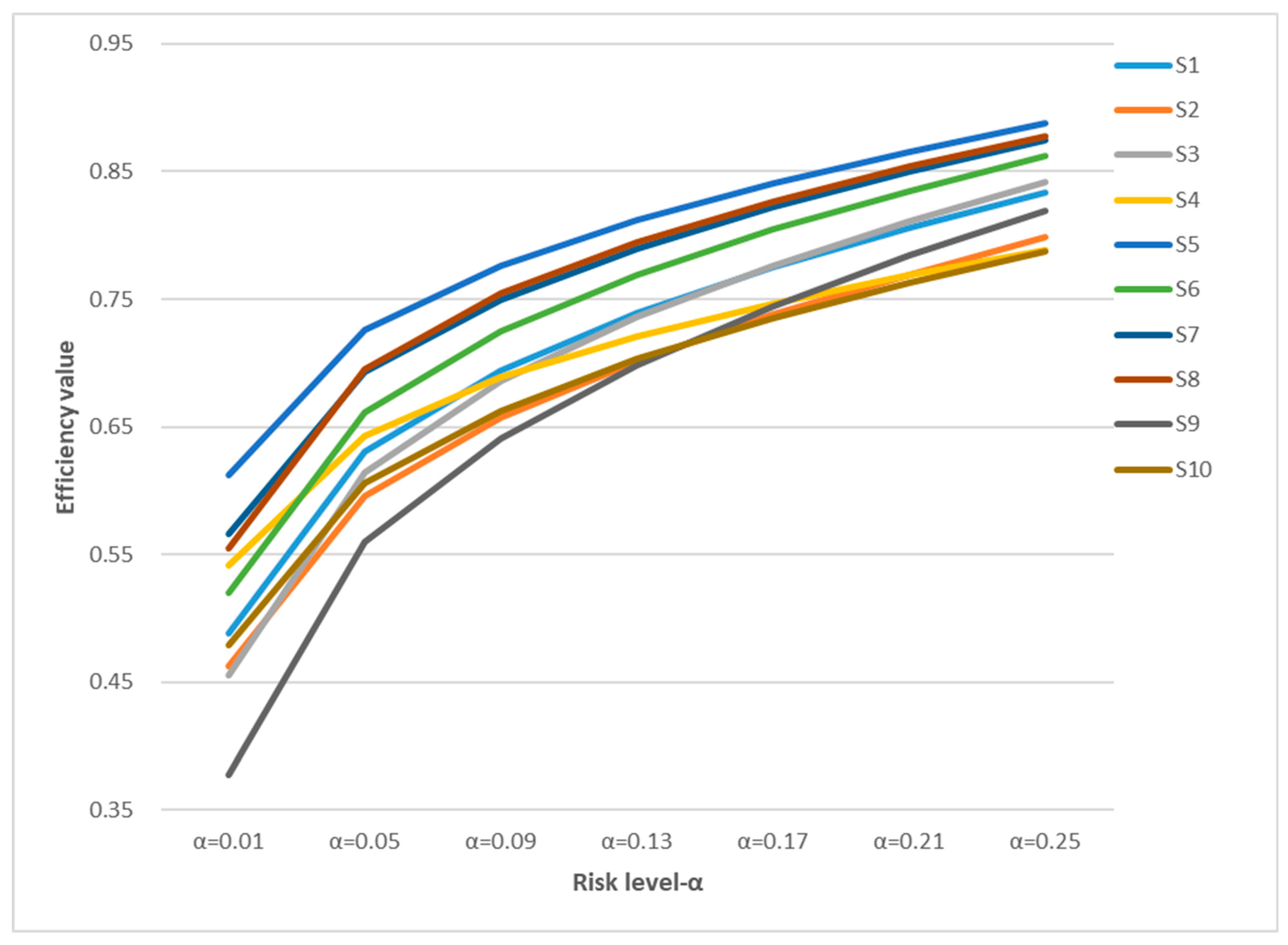
Based on the overall trend of the supplier efficiency results shown in Table 6: as the α value gradually increases from 0.01 to 0.25, the efficiency scores of all suppliers exhibit an increasing trend, with no reverse fluctuations or abnormal changes. This indicates a positive correlation between the α value and the supplier results—the larger the α value, the higher the supplier efficiency score, as shown in Figure 1.
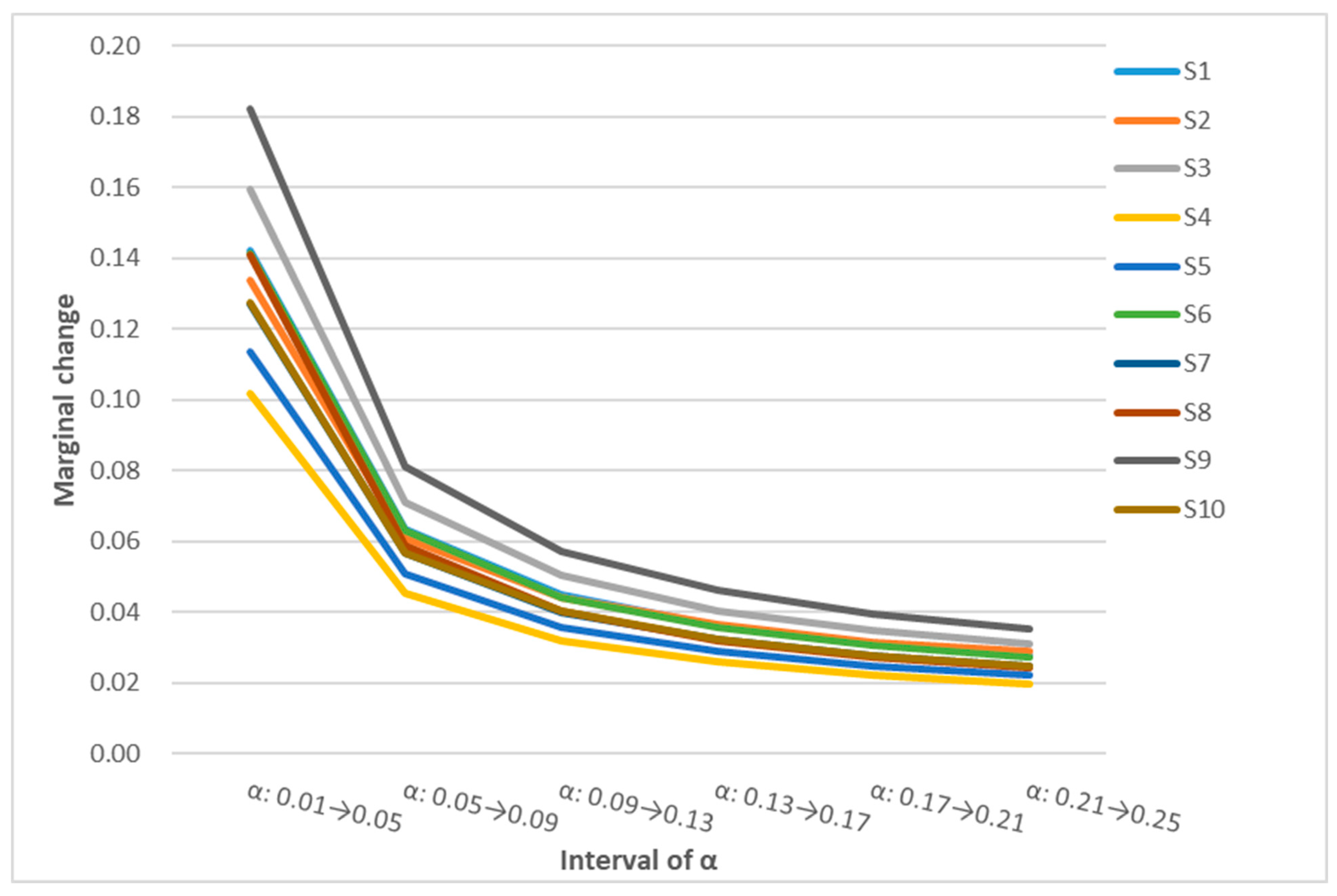
The increase in the α value not only elevates the absolute efficiency scores of all suppliers but also narrows the efficiency differences among different suppliers, gradually stabilizing the variation in efficiency scores across suppliers, as shown in Figure 2. The results for all suppliers show a progressive increase with a gradually diminishing slope. Based on the variation pattern, the trend can be broadly divided into two intervals: the low- α interval (0.01 → 0.13), where the efficiency scores of suppliers exhibit relatively larger fluctuations, representing the range where the α value has the most significant impact on the results; and the high- α interval (0.13 → 0.25), where the efficiency scores of suppliers show smaller fluctuations, indicating a diminishing marginal effect of the α value on the results. Therefore, if decision-makers seek relatively stable efficiency scores, they may select values within the high- α region; if they require greater differentiation among supplier efficiency scores, they may opt for values within the low- α region.

5.1.2. Analysis of the Ranking Variation of Suppliers Under Changing Risk Level

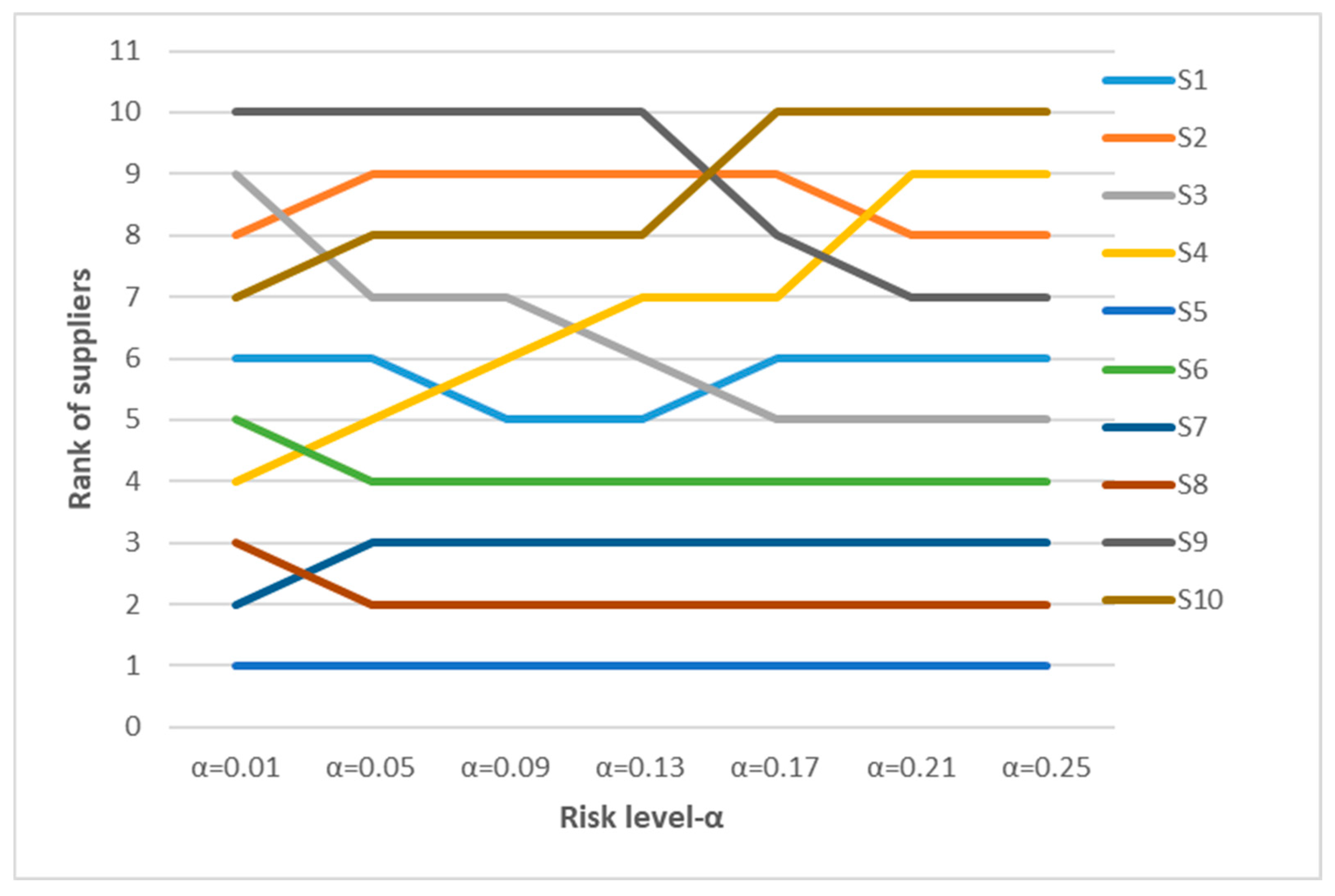
Table 7 presents the complete ranking results of suppliers under each α value. Based on the rankings and their stability, the 10 Suppliers can be broadly divided into three major tiers, as detailed below:
(1)
High-Efficiency Tier: Supplier 5, Supplier 7, Supplier 8
As can be seen in Figure 3, Supplier 5 consistently holds the 1st rank across the entire range, being the optimal Supplier in all intervals. Its efficiency value remains the highest among all suppliers, and changes in the α value have a minimal impact on its results. Supplier 7 and Supplier 8 rank 2nd and 3rd, respectively, at α = 0.01. After a single rank exchange between them (at α = 0.05), their positions become fixed and subsequently remain unchanged. The α value has a limited effect on these two Suppliers; their rankings are relatively stable after minor adjustments.
Overall, the ranking within the high-efficiency tier is stable. The α value triggers only one internal rank exchange, occurring solely in the low- α interval, with subsequent rankings stabilizing. The α value has virtually no impact on the ranking of this tier.
(2)
Medium-Efficiency Tier: Supplier 1, Supplier 3, Supplier 4, Supplier 6
The ranking of Supplier 1 is stable at 5th–6th, and Supplier 6 is stable at 4th–5th, with only minor fluctuations; both are only slightly affected by α . Supplier 3 performs poorly when α is small but gradually rises to 5th place as α increases, showing improvement with α . Supplier 4 performs relatively well when α is small, but declines to 9th place as α increases, showing deterioration with α .
Supplier 1, Supplier 3, Supplier 4, and Supplier 6 are generally ranked relatively high, though with noticeable internal variations; they are therefore classified into the medium-efficiency group. The main variations are the improvement of Supplier 3 and the decline of Supplier 4. Thus, when α is small, Supplier 4 outperforms Supplier 3; when α is large, Supplier 3 outperforms Supplier 4.
(3)
Low-Efficiency Tier: Supplier 2, Supplier 9, Supplier 10
Supplier 2 remains generally stable between the 2nd-last and 3rd-last positions, with little variation. Supplier 9 ranks 10th for α ≤ 0.13, and rises to 7th–8th for α ≥ 0.17, showing improvement with α . In contrast, Supplier 10 ranks 7th–8th for α ≤ 0.13, and drops to last place for α ≥ 0.17, showing deterioration with α .
Supplier 2, Supplier 9, and Supplier 10 are generally ranked relatively low, with notable internal variations; they are therefore classified into the low-efficiency group.
Therefore, decision-makers can use the scoring performance and fluctuation characteristics of the above-mentioned supplier tiers under different α values as a reference for supplier selection. Among them, the three suppliers in the high tier have stable overall scores and can be considered core preferred cooperation targets; the medium tier suppliers perform at a moderate level overall, but exhibit noticeable individual differentiation and indicator volatility, and can be used as routine supplementary and alternative cooperation resources as needed. Based on the pattern of parameter changes, Supplier 3 and Supplier 9 perform relatively weakly in the low- α range, while the risks of Supplier 4 and Supplier 10 gradually emerge in the high- α range. Given this feature, decision-makers can formulate cooperation strategies according to their own risk preferences and risk tolerance.

5.1.3. Impact of the Number of Suppliers on Efficiency Values and Rankings

In the study of supplier efficiency evaluation, the number of suppliers is an important factor affecting the evaluation results. To examine the impact of this variable on efficiency values and rankings, this section conducts evaluations based on two datasets containing five and seven suppliers, respectively, and compares the changes in efficiency values and rankings under different sample sizes, thereby providing a reference for decision-making.
The efficiency values of the reduced supplier set are shown in Table 8 and Table 9. Based on supplier rankings, they are similarly divided into tiers, as presented in Table 10. When the number of suppliers is reduced from 10 to 7, the composition of the medium-efficiency and low-efficiency tiers undergoes a notable adjustment. Specifically, Supplier 10 improves its performance, moving from the low-efficiency tier to the medium-efficiency tier, while Supplier 4 experiences a relative decline, shifting from the medium-efficiency tier to the low-efficiency tier. When the number of suppliers is further reduced to five, the medium- and low-efficiency tiers also adjust, albeit to a lesser extent.
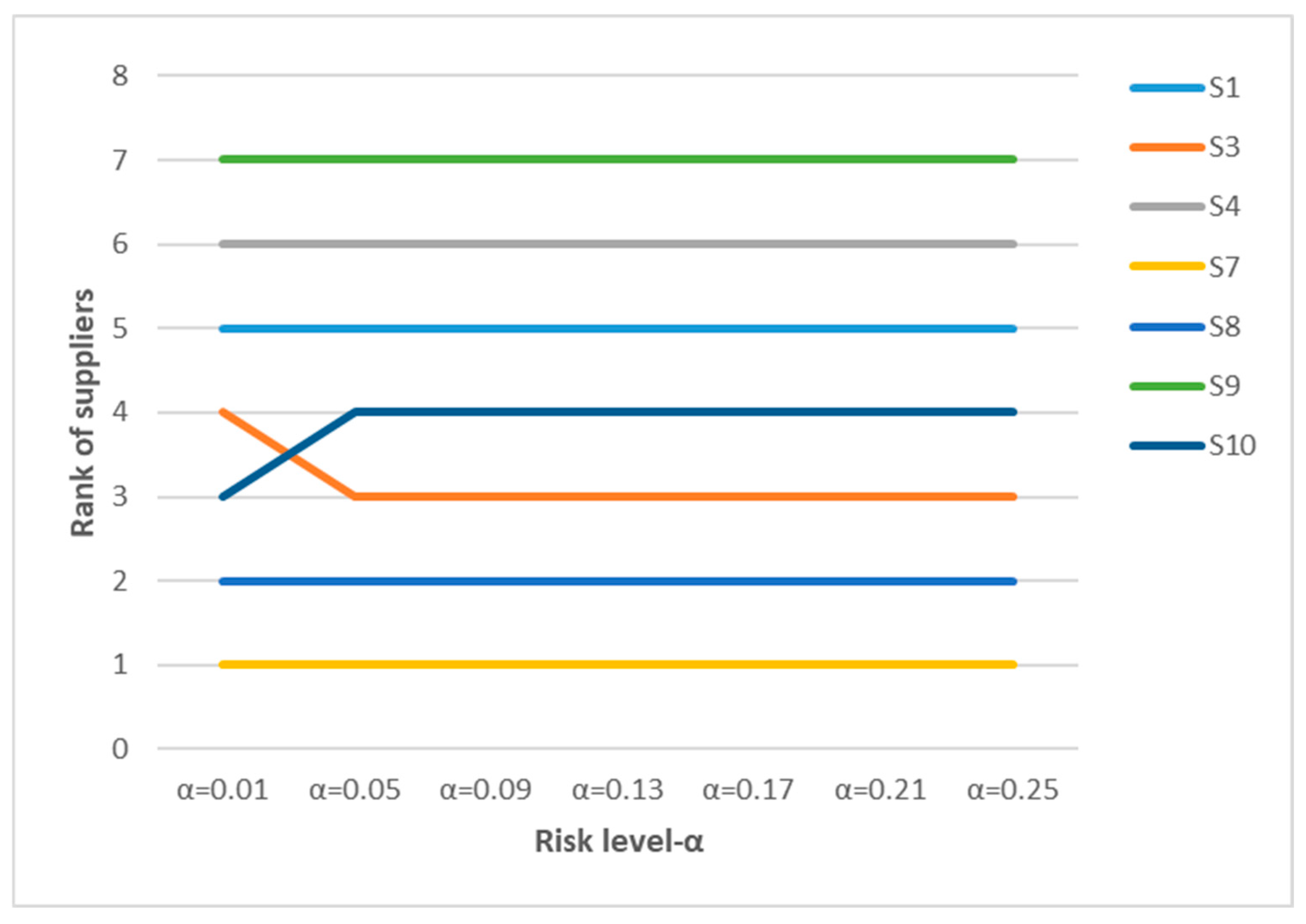
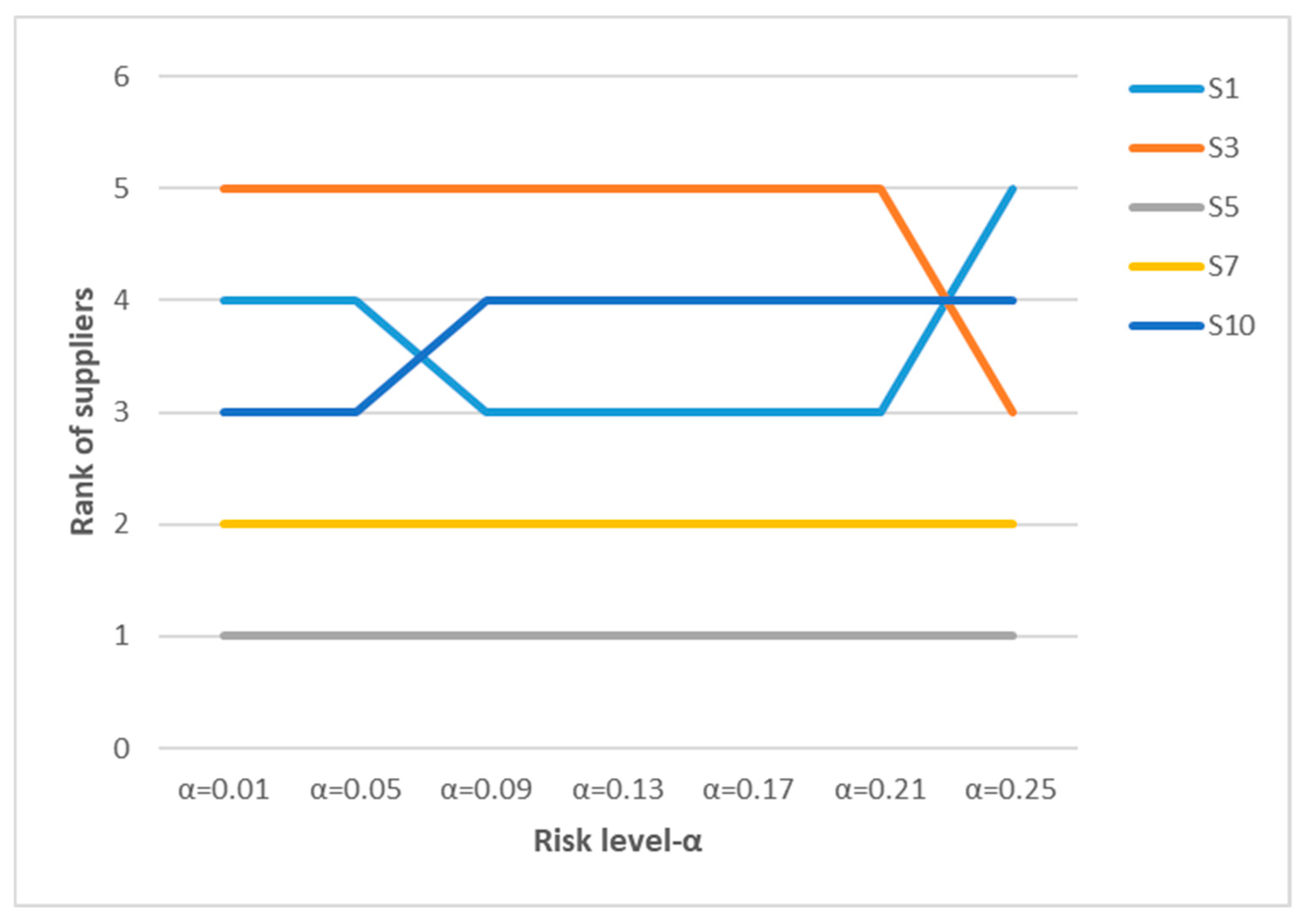
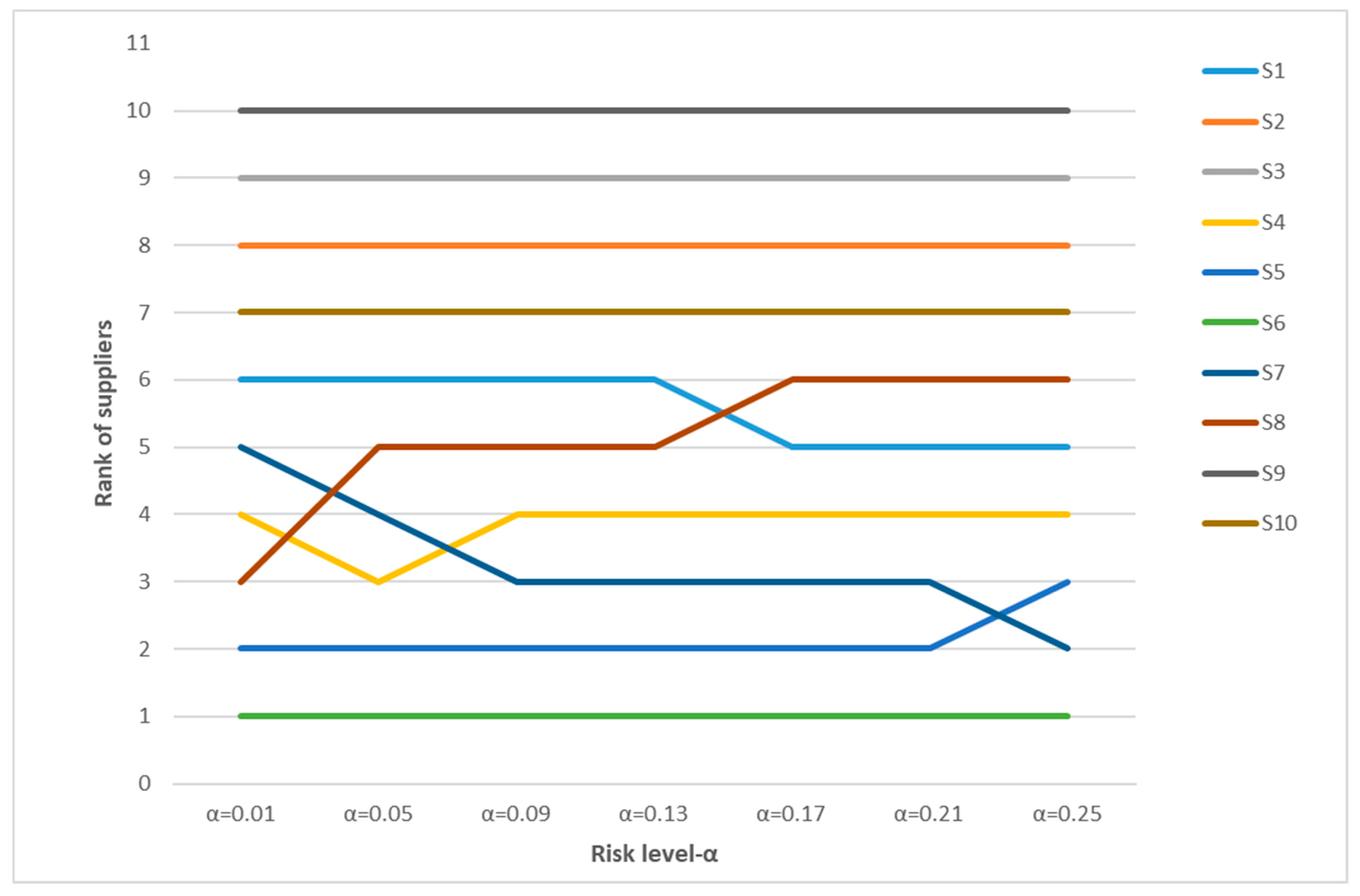
To further analyze the impact of the number of suppliers on ranking stability, Figure 4 and Figure 5 illustrate how supplier rankings vary with the risk parameter α under different supplier set sizes. As can be seen from the figures, when seven suppliers are retained, the rankings exhibit very high stability. Across the entire range of α values, only a minor ranking swap occurs at α = 0.05; for all other α values, the relative order of suppliers remains largely unchanged, indicating that the ranking under the seven-supplier scenario is insensitive to changes in the risk parameter. In contrast, when the number of suppliers is further reduced to five, the rankings show more noticeable variation.
Therefore, the number of suppliers does affect ranking stability. However, it is worth noting that stability does not change monotonically with the number of suppliers: when there are too many suppliers, rankings fluctuate frequently with α ; when there are too few suppliers, certain α values can also trigger substantial ranking adjustments.
The reason for these dynamic changes is that the SSBM model evaluates relative efficiency. In this model, efficiency scores are calculated by constructing virtual reference points based on a given set of decision-making units. Therefore, when some suppliers are removed from the set, frontier points change, leading to a recalculation of the efficiency scores for the remaining suppliers and potentially resulting in a reclassification of efficiency tiers. A more detailed analysis will be presented in the next section.

5.2. Comparative Analysis of the SDEA Model and the SSBM Model

5.2.1. Comparison of Results from the SDEA Model and the SSBM Model

The CCR model of DEA, as a classic non-parametric efficiency evaluation method, is widely applied in supplier performance assessment. Improved SDEA models, which account for random disturbance terms, are also utilized to measure the relative efficiency of suppliers. To evaluate the effectiveness of the SSBM model, this subsection compares and analyzes the results obtained from the SDEA model and the SSBM model. A simple numerical experiment is conducted to further analyze the differences between the SSBM model and the SDEA model.
By incorporating stochastic factors into the DEA model, the SDEA model is constructed as follows:
min θ s.t. P j = 1 n λ j x i j θ x i k 1 α P j = 1 n λ j y r j y r k 1 α
Following the transformation procedures outlined in Formulas (9) through (13), the SDEA model is ultimately formulated as follows:
min θ s.t. j = 1 n λ j x ¯ i j + θ x ¯ i k Φ 1 ( 1 α ) j = 1 n λ j 2 σ i j 2 + ( λ j θ ) 2 σ i k 2 j = 1 n λ j y ¯ r j y ¯ r k Φ 1 ( 1 α ) i = 1 m λ j 2 σ r j 2 + λ j 2 σ r k 2
Using the SDEA model to rank the suppliers, the resulting efficiency values and rankings under different α values are presented in the Table 11.
The variation in ranking results with the α value is illustrated in Figure 6. Based on the rankings and their stability, the results obtained from the SDEA model can likewise be divided into three tiers.
Under the SDEA model, the tail tier of supplier rankings exhibits extremely high stability, while changes in the α value mainly affect the internal order of the middle tier and the high-efficiency tier. As shown in Table 12, the two models are completely consistent in their judgments of the tier memberships for several suppliers: Supplier 5 and Supplier 7 are consistently identified as high-efficiency tier, Supplier 1 and Supplier 4 are classified as medium-efficiency tier, and Supplier 2 and Supplier 9 are judged as low-efficiency tier. This indicates that the two models have good consistency in tier identification. However, there are some differences in the tier membership of certain suppliers. Supplier 6 is in the medium-efficiency tier under the SSBM model but rises to the high-efficiency tier under the SDEA model; Supplier 8 shows the opposite pattern. This suggests that the two models differ somewhat in their evaluation of suppliers near the “boundary” of tiers.
In summary, the SDEA model and SSBM model exhibit strong consistency in the classification of supplier efficiency tiers. Therefore, in practical evaluation, the supplier classification results based on these two stochastic frontier methods can be considered relatively reliable and stable.

5.2.2. Comparison Between the SDEA Model and the SSBM Model

To more intuitively demonstrate the differences between the two models and explain the reason for the adjacent tier changes of decision-making units in the previous subsection, this subsection employs simplified data processing and visualizes the improvement principles of both models to illustrate the discrepancies in the results mentioned above. The simplified data used and the results of different models are shown in Table 13.
The data indicates that the efficiency values obtained for DMUs under the SDEA model are generally higher. The efficiency values of originally high-efficiency decision-making units exceed 1, while those obtained under the SSBM model are generally lower, with the efficiency values of originally high-efficiency units being less than 1.
In the DEA model, θ represents the maximum extent to which the inputs of the evaluated D M U k can be reduced without decreasing outputs, given the current technology level. A larger θ implies a smaller possible reduction in inputs. Here, j = 1 n λ j x i j and j = 1 n λ j y r j can be seen as the inputs and outputs of a virtual optimal DMU, respectively. Therefore, the virtual DMU’s inputs are not higher than those of D M U k , and its outputs are not lower than those of D M U k . These virtual DMUs collectively construct a frontier that determines the improvement direction for other DMUs. In the improved stochastic DEA model, the inputs of the virtual DMU increase, and its outputs decrease; the original frontier shifts backward. For originally inefficient DMUs, the potential for input reduction diminishes, causing the θ value to increase.
In the SBM model, v i and u r can be viewed as virtual inputs and outputs. The model’s objective, θ, can be interpreted as seeking the optimal virtual inputs and outputs to minimize i = 1 m v i x i k r = 1 q u r y r k . A smaller θ indicates a larger difference between virtual inputs and outputs. The improved stochastic SBM model adds a stochastic term, which effectively increases the original i = 1 m v i x i k r = 1 q u r y r k value, causing the original frontier to shift forward. For originally inefficient DMUs, this leads to a larger potential for improvement, thus reducing the θ value.
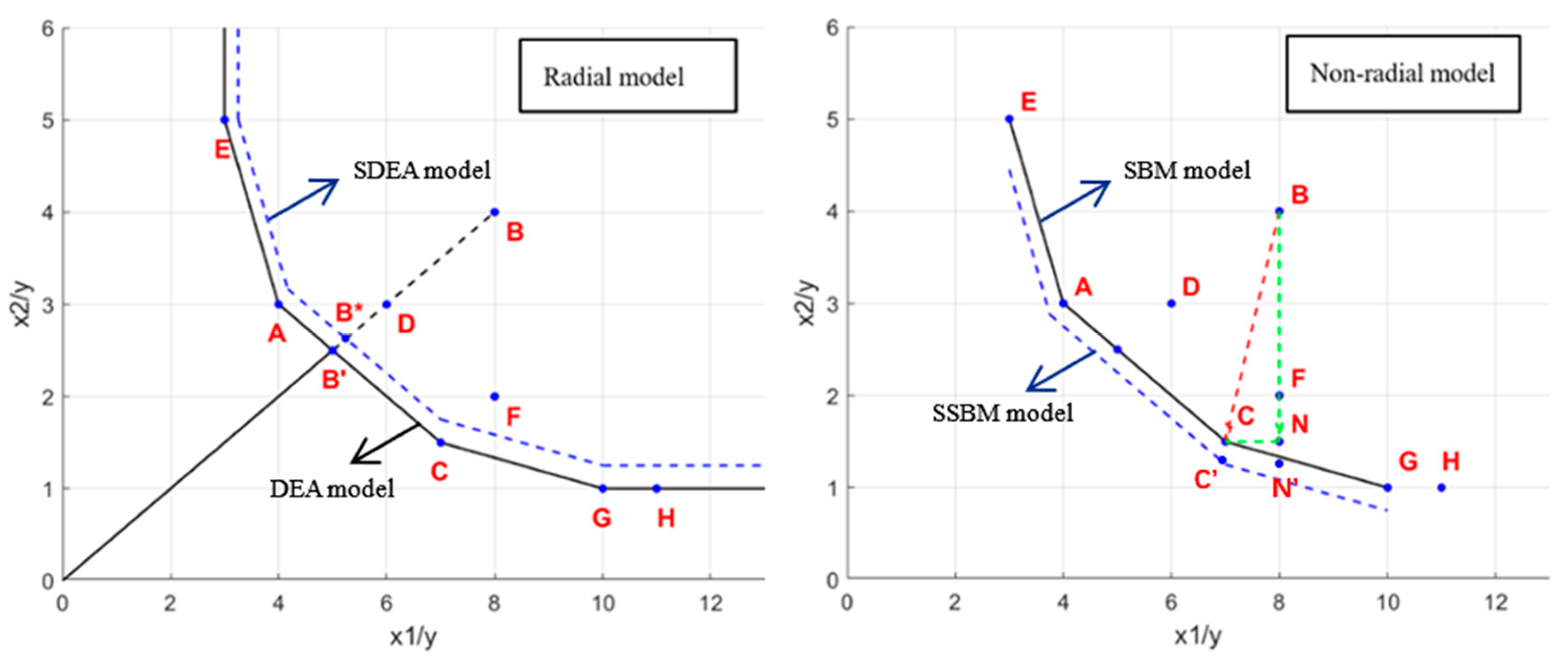
The rankings of DMUs differ between the two methods, primarily due to their different improvement approaches. The left side of Figure 7 shows the radial model, where the solid line represents the projection of the DEA model onto a two-dimensional plane, and the dashed line is a schematic representation of the SDEA model. The right side shows the non-radial model, where the solid line represents the projection of the SBM model onto a two-dimensional plane, and the dashed line is a schematic representation of the SSBM model. For the DEA model, inefficient DMUs aim to improve towards the frontier surface. Taking point B as an example, its projection onto the efficiency frontier is denoted as B′, as presented in Figure 7, and BB′ requires improvement. For the SBM model, inefficient DMUs aim to improve towards frontier points. Thus, for the SBM model, the target point of B on the frontier is C, and BN and CN require improvement. Although efficiency values change, it remains possible to classify high-efficiency and low-efficiency DMUs into two tiers based on these values.
However, after the improvement in the SDEA model, the frontier lies between efficient and inefficient DMUs. For inefficient DMUs, being closer to the frontier is better, while for efficient DMUs, being farther from the stochastic frontier is better. In Figure 7, the projection of B moves to the upper right to B*, meaning that the room for improvement is reduced. For the improved SBM model, DMUs aim to be as close as possible to the frontier point. In the SSBM model, for point B, the frontier point may become C′, requiring improvements in BN′ and C′N′, but it is hard to recognize whether the room for improvement has decreased or increased. Nevertheless, for results obtained from the SDEA model, where efficiency values can be both greater than and less than 1, different ranking rules are needed. Therefore, the SBM model also holds an advantage in terms of ranking.
As mentioned earlier, the objective of the SBM model is to find the maximum efficiency value, meaning the smaller the gap between inputs and outputs, the better. Its improvement direction is determined by frontier points, which are actual efficient DMUs, not virtual DMUs determined by a frontier surface as in the DEA model. In this sense, the SSBM model aligns more closely with the concept of relative efficiency.
Regarding the ranking results, compared to the SDEA model, the SSBM model can effectively differentiate supplier efficiency values to complete the supplier ranking. Built upon non-radial and non-oriented concepts, the SSBM model can more accurately handle input–output slack issues, effectively overcoming the bias inherent in traditional radial models for efficiency evaluation. This allows for a clear distinction between the efficiency values of different suppliers, thus enabling the completion of supplier ranking.

6. Conclusions

Against the backdrop of frequent unexpected events, increasingly stringent environmental regulations, and the continuous growth of e-commerce demand, suppliers must simultaneously possess digital capabilities, resilience, and green development characteristics to effectively cope with various challenges. Therefore, it is urgent to construct an integrated decision-making method that helps decision-makers establish a supplier selection system balancing digitalization, greening, and resilience. This study employs a stochastic data envelopment analysis method for supplier evaluation and introduces DT technology within the green supply chain management framework, expanding the traditional evaluation index system and further enriching the theoretical research and academic discussion in the field of supplier decision-making.
Based on the SSBM model, this paper evaluates ten suppliers and identifies Supplier 5, Supplier 7 and Supplier 8 as the optimal choices. The model not only considers traditional input–output efficiency but also integrates multiple dimensions, including product quality, digital twin capabilities, green environmental performance, and risk resilience. Specifically, Supplier 5 leads in product quality, digital twin integrity and technology investment, green investment, and production capacity; Supplier 7 shows clear advantages in product quality, procurement cost, gas emissions, and digital twin accuracy; Supplier 8 excels in digital twin technology investment, energy consumption control, and risk buffering. Since the SSBM model incorporates stochastic factors, the stability of indicators is crucial for efficiency evaluation. The analysis shows that these three suppliers exhibit low variance across all indicators, indicating good stability, which likely explains why they are closer to the efficiency frontier points. In contrast, although some other suppliers perform well in certain mean indicators, their high variance and significant fluctuations lead to lower SSBM efficiency scores, disqualifying them from selection. In summary, Suppliers 5, 7, and 8 achieve an optimal balance under the SSBM framework.
Although the method proposed in this paper can provide relatively scientific decision support for supplier selection, certain limitations remain. On one hand, this study only evaluates quantifiable indicators, neglecting the potential fuzzy information that may exist during the evaluation process. On the other hand, while DT technology plays a significant supporting role in supply chain management, its evaluation index system is not yet mature, and existing standards struggle to fully capture its practical application effects.
Therefore, regarding fuzzy information, future research may explore the integration of semantic evaluations or interval data into the evaluation framework, for example, by employing evidential reasoning, rough sets, or qualitative-quantitative hybrid decision-making methods to effectively characterize information uncertainty without relying entirely on subjective weighting. In terms of digital twins, future research can further validate the digital twin indicators proposed in this paper in real-world supply chain environments. For example, by conducting field studies in collaboration with enterprises, researchers could collect annual expenditure data on digital-twin-related projects to quantify the proportion of investment; select typical manufacturing or logistics processes to compare the predictive outputs of digital twin models with actual operational data, and so on. On this basis, future research may also propose other complementary indicators, such as data latency and update frequency of digital twin systems, the generalization and transferability of models across different supply chain scenarios, human–machine collaboration efficiency, or system cybersecurity protection levels. These additional indicators would provide a more comprehensive characterization of the application maturity and overall value of DT technology in complex supply chain environments.

Author Contributions

Conceptualization, W.Z. and Y.W.; methodology, Y.W.; validation, W.Z. and Y.W.; data curation, Y.W.; writing—original draft preparation, W.Z. and Y.W.; writing—review and editing, Y.W.; visualization, Y.W.; supervision, W.Z. All authors have read and agreed to the published version of the manuscript.

Funding

This research received no external funding.

Institutional Review Board Statement

Not applicable.

Informed Consent Statement

Not applicable.

Data Availability Statement

The original contributions presented in this study are included in the article. Further inquiries can be directed to the corresponding author.

Conflicts of Interest

The authors declare no conflict of interest.

References

  1. Jin, F.; Zhao, Y.; Zheng, X.; Zhou, L. Supplier selection through interval type-2 trapezoidal fuzzy multi-attribute group decision-making method with logarithmic information measures. Eng. Appl. Artif. Intell. 2023, 126, 107006. [Google Scholar]
  2. Taherdoost, H.; Brard, A. Analyzing the process of supplier selection criteria and methods. Procedia Manuf. 2019, 32, 1024–1034. [Google Scholar] [CrossRef]
  3. Ulutaş, A.; Topal, A.; Ecer, F. Green-resilient supplier selection via a new integrated rough multi-criteria framework. J. Ind. Inf. Integr. 2025, 47, 100913. [Google Scholar] [CrossRef]
  4. Wang, Z.; Cai, Q.; Wei, G. Modified todim method based on cumulative prospect theory with type-2 neutrosophic number for green supplier selection. Eng. Appl. Artif. Intell. 2023, 126, 106843. [Google Scholar] [CrossRef]
  5. Zhu, C.; Zhu, N.; Zheng, S.; Zou, L.; Wang, X. Analyzing critical success factors for green supplier selection: A combined dematel-ism approach and convolutional neural network based consensus model. Appl. Soft Comput. 2025, 171, 112760. [Google Scholar] [CrossRef]
  6. Kara, K.; Acar, A.Z.; Polat, M.; Önden, İ.; Yalçın, G.C. Developing a hybrid methodology for green-based supplier selection: Application in the automotive industry. Expert Syst. Appl. 2024, 249, 123668. [Google Scholar] [CrossRef]
  7. Liu, Z.; Wang, D.; Deveci, M.; Letchmunan, S. Interval-valued pythagorean fuzzy distance-based extended inferior ratio method for multiattribute decision-making: Application to green supplier selection in manufacturing industry. Appl. Soft Comput. 2025, 185, 113935. [Google Scholar] [CrossRef]
  8. Blome, C.; Hollos, D.; Paulraj, A. Green procurement and green supplier development: Antecedents and effects on supplier performance. Int. J. Prod. Res. 2014, 52, 32–49. [Google Scholar] [CrossRef]
  9. Goodarzi, F.; Abdollahzadeh, V.; Zeinalnezhad, M. An integrated multi-criteria decision-making and multi-objective optimization framework for green supplier evaluation and optimal order allocation under uncertainty. Decis. Anal. J. 2022, 4, 100087. [Google Scholar] [CrossRef]
  10. Yang, Y.; Zhu, X.; Xu, X. A Global Resilient Supply Chain Network Design Model Considering Risks and Carbon Emissions. Comput. Chem. Eng. 2026, 211, 109673. [Google Scholar] [CrossRef]
  11. Bakhshi, S.; Ghaffarianhoseini, A.; Najafi, M.; Rahimian, F.; Park, C.; Lee, D. Digital twin applications for overcoming construction supply chain challenges. Autom. Constr. 2024, 167, 105679. [Google Scholar] [CrossRef]
  12. Mirza, J. Supporting strategic management decisions: The application of digital twin systems. Strateg. Dir. 2021, 37, 7–9. [Google Scholar] [CrossRef]
  13. Cavalcante, I.M.; Frazzon, E.M.; Forcellini, F.A.; Ivanov, D. A supervised machine learning approach to data-driven simulation of resilient supplier selection in digital manufacturing. Int. J. Inf. Manag. 2019, 49, 86–97. [Google Scholar] [CrossRef]
  14. Tao, F.; Zhang, Y.; Cheng, Y.; Ren, J.; Wang, D.; Qi, Q.; Li, P. Digital twin and blockchain enhanced smart manufacturing service collaboration and management. J. Manuf. Syst. 2022, 62, 903–914. [Google Scholar] [CrossRef]
  15. Monteiro, J.; Barata, J. Digital twin-enabled regional food supply chain: A review and research agenda. J. Ind. Inf. Integr. 2025, 45, 100851. [Google Scholar] [CrossRef]
  16. Spieske, A.; Birkel, H. Improving supply chain resilience through industry 4.0: A systematic literature review under the impressions of the COVID-19 pandemic. Comput. Ind. Eng. 2021, 158, 107452. [Google Scholar] [CrossRef] [PubMed]
  17. Ivanov, D.; Dolgui, A.; Das, A.; Sokolov, B. Digital Supply Chain Twins: Managing the Ripple Effect, Resilience, and Disruption Risks by Data-Driven Optimization, Simulation, and Visibility. In Handbook of Ripple Effects in the Supply Chain; Springer: Cham, Switzerland, 2019; pp. 309–332. [Google Scholar]
  18. Naqvi, M.A.; Amin, S.H. Supplier selection and order allocation: A literature review. J. Data Inf. Manag. 2021, 3, 125–139. [Google Scholar] [CrossRef]
  19. Yan, X.; Bao, X.; Zhao, R.; Li, F. Performance measurement for green supplier selection based on data envelopment analysis. Environ. Sci. Pollut. Res. 2022, 29, 45960–45970. [Google Scholar] [CrossRef]
  20. An, Q.; Tao, X.; Xiong, B. Benchmarking with data envelopment analysis: An agency perspective. Omega 2021, 101, 102235. [Google Scholar] [CrossRef]
  21. Weber, C.A.; Current, J.R.; Benton, W.C. Vendor selection criteria and methods. Eur. J. Oper. Res. 1991, 50, 2–18. [Google Scholar] [CrossRef]
  22. Mirzaee, H.; Samarghandi, H.; Willoughby, K. A robust optimization model for green supplier selection and order allocation in a closed-loop supply chain considering cap-and-trade mechanism. Expert Syst. Appl. 2023, 228, 120423. [Google Scholar] [CrossRef]
  23. Govindan, K.; Rajendran, S.; Sarkis, J.; Murugesan, P. Multi criteria decision making approaches for green supplier evaluation and selection: A literature review. J. Clean. Prod. 2015, 98, 66–83. [Google Scholar] [CrossRef]
  24. Gupta, H.; Barua, M.K. Supplier selection among smes on the basis of their green innovation ability using bwm and fuzzy topsis. J. Clean. Prod. 2017, 152, 242–258. [Google Scholar] [CrossRef]
  25. Shidpour, H.; Shidpour, M.; Tirkolaee, E.B. A multi-phase decision-making approach for supplier selection and order allocation with corporate social responsibility. Appl. Soft Comput. 2023, 149, 110946. [Google Scholar] [CrossRef]
  26. Mohammed, A. Towards ‘gresilient’ supply chain management: A quantitative study. Resour. Conserv. Recycl. 2020, 155, 104641. [Google Scholar] [CrossRef]
  27. Mohammed, A.; de Sousa Jabbour, A.B.L.; Koh, L.; Hubbard, N.; Jabbour, C.J.C.; Al Ahmed, T. The sourcing decision-making process in the era of digitalization: A new quantitative methodology. Transp. Res. Part E Logist. Transp. Rev. 2022, 168, 102948. [Google Scholar] [CrossRef]
  28. Eghbali-Zarch, M.; Zabihi, S.Z.; Masoud, S. A novel fuzzy seca model based on fuzzy standard deviation and correlation coefficients for resilient-sustainable supplier selection. Expert Syst. Appl. 2023, 231, 120653. [Google Scholar] [CrossRef]
  29. Zhang, X.; Goh, M.; Bai, S.; Wang, Q. Green, resilient, and inclusive supplier selection using enhanced bwm-topsis with scenario-varying z-numbers and reversed pagerank. Inf. Sci. 2024, 674, 120728. [Google Scholar] [CrossRef]
  30. Nirmal, D.D.; Reddy, K.N.; Singh, S.K. Application of fuzzy methods in green and sustainable supply chains: Critical insights from a systematic review and bibliometric analysis. Benchmarking Int. J. 2024, 31, 1700–1748. [Google Scholar] [CrossRef]
  31. Leong, W.Y.; Wong, K.Y.; Wong, W.P. A new integrated multi-criteria decision-making model for resilient supplier selection. Appl. Syst. Innov. 2022, 5, 8. [Google Scholar] [CrossRef]
  32. Ali, H.; Zhang, J. A fuzzy multi-objective decision-making model for global green supplier selection and order allocation under quantity discounts. Expert Syst. Appl. 2023, 225, 120119. [Google Scholar] [CrossRef]
  33. Nazari-Shirkouhi, S.; Tavakoli, M.; Govindan, K.; Mousakhani, S. A hybrid approach using z-number dea model and artificial neural network for resilient supplier selection. Expert Syst. Appl. 2023, 222, 119746. [Google Scholar] [CrossRef]
  34. Song, S.; Tappia, E.; Song, G.; Shi, X.; Cheng, T.C.E. Fostering supply chain resilience for omni-channel retailers: A two-phase approach for supplier selection and demand allocation under disruption risks. Expert Syst. Appl. 2024, 239, 122368. [Google Scholar] [CrossRef]
  35. Nayeri, S.; Khoei, M.A.; Rouhani-Tazangi, M.R.; GhanavatiNejad, M.; Rahmani, M.; Tirkolaee, E.B. A data-driven model for sustainable and resilient supplier selection and order allocation problem in a responsive supply chain: A case study of healthcare system. Eng. Appl. Artif. Intell. 2023, 124, 106511. [Google Scholar] [CrossRef]
  36. Shang, Z.; Yang, X.; Barnes, D.; Wu, C. Supplier selection in sustainable supply chains: Using the integrated bwm, fuzzy shannon entropy, and fuzzy multimoora methods. Expert Syst. Appl. 2022, 195, 116567. [Google Scholar] [CrossRef]
  37. Hasan, M.M.; Jiang, D.; Ullah, A.M.M.S.; Noor-E-Alam, M. Resilient supplier selection in logistics 4.0 with heterogeneous information. Expert Syst. Appl. 2020, 139, 112799. [Google Scholar] [CrossRef]
  38. Çalık, A. A novel pythagorean fuzzy ahp and fuzzy topsis methodology for green supplier selection in the industry 4.0 era. Soft Comput. 2021, 25, 2253–2265. [Google Scholar] [CrossRef]
  39. Bayanati, M.; Peivandizadeh, A.; Heidari, M.R.; Foroutan Mofrad, S.; Sasouli, M.R.; Pourghader Chobar, A. Prioritize strategies to address the sustainable supply chain innovation using multicriteria decision-making methods. Complexity 2022, 2022, 1501470. [Google Scholar] [CrossRef]
  40. Buyuk, A.M.; Temur, G.T. Food waste treatment option selection through spherical fuzzy ahp. J. Intell. Fuzzy Syst. 2021, 42, 97–107. [Google Scholar] [CrossRef]
  41. Giri, B.C.; Molla, M.U.; Biswas, P. Pythagorean fuzzy dematel method for supplier selection in sustainable supply chain management. Expert Syst. Appl. 2022, 193, 116396. [Google Scholar] [CrossRef]
  42. Hajiaghaei-Keshteli, M.; Cenk, Z.; Erdebilli, B.; Özdemir, Y.S.; Gholian-Jouybari, F. Pythagorean fuzzy topsis method for green supplier selection in the food industry. Expert Syst. Appl. 2023, 224, 120036. [Google Scholar] [CrossRef]
  43. Zhao, H.; Lu, C.; Wang, S. An integrated decision-making model for green supplier selection based on aiowa-critic and cpt-topsis: A case study of china. Kybernetes 2025, 54, 7868–7903. [Google Scholar] [CrossRef]
  44. Awasthi, A.; Govindan, K.; Gold, S. Multi-tier sustainable global supplier selection using a fuzzy ahp-vikor based approach. Int. J. Prod. Econ. 2018, 195, 106–117. [Google Scholar] [CrossRef]
  45. Davoudabadi, R.; Mousavi, S.M.; Sharifi, E. An integrated weighting and ranking model based on entropy, dea and pca considering two aggregation approaches for resilient supplier selection problem. J. Comput. Sci. 2020, 40, 101074. [Google Scholar] [CrossRef]
  46. Dobos, I.; Vörösmarty, G. Inventory-related costs in green supplier selection problems with data envelopment analysis (dea). Int. J. Prod. Econ. 2019, 209, 374–380. [Google Scholar] [CrossRef]
  47. Torres-Ruiz, A.; Ravindran, A.R. Use of interval data envelopment analysis, goal programming and dynamic eco-efficiency assessment for sustainable supplier management. Comput. Ind. Eng. 2019, 131, 211–226. [Google Scholar] [CrossRef]
  48. Tavassoli, M.; Saen, R.F. Predicting group membership of sustainable suppliers via data envelopment analysis and discriminant analysis. Sustain. Prod. Consum. 2019, 18, 41–52. [Google Scholar] [CrossRef]
  49. Chen, J.; Xu, Z.; Gou, X.; Huang, D.; Zhang, J. Automobile components procurement using a dea-topsis-fmip approach with all-unit quantity discount and fuzzy factors. Technol. Econ. Dev. Econ. 2021, 27, 311–352. [Google Scholar] [CrossRef]
  50. Kaur, H.; Singh, S.P. Multi-stage hybrid model for supplier selection and order allocation considering disruption risks and disruptive technologies. Int. J. Prod. Econ. 2021, 231, 107830. [Google Scholar] [CrossRef]
  51. Paramanik, A.R.; Sarkar, S.; Sarkar, B. A two-stage improved base point slacks-based measure of super-efficiency for negative data handling. Comput. Oper. Res. 2023, 150, 106057. [Google Scholar] [CrossRef]
  52. Beinabadi, H.Z.; Baradaran, V.; Komijan, A.R. Sustainable supply chain decision-making in the automotive industry: A data-driven approach. Socio-Econ. Plan. Sci. 2024, 95, 101908. [Google Scholar] [CrossRef]
  53. Sabouhi, F.; Pishvaee, M.S.; Jabalameli, M.S. Resilient supply chain design under operational and disruption risks considering quantity discount: A case study of pharmaceutical supply chain. Comput. Ind. Eng. 2018, 126, 657–672. [Google Scholar] [CrossRef]
  54. Alikhani, R.; Torabi, S.A.; Altay, N. Strategic supplier selection under sustainability and risk criteria. Int. J. Prod. Econ. 2019, 208, 69–82. [Google Scholar] [CrossRef]
  55. Tavassoli, M.; Saen, R.F.; Zanjirani, D.M. Assessing sustainability of suppliers: A novel stochastic-fuzzy dea model. Sustain. Prod. Consum. 2020, 21, 78–91. [Google Scholar] [CrossRef]
  56. Tavana, M.; Nazari-Shirkouhi, S.; Kholghabad, H.F. An integrated quality and resilience engineering framework in healthcare with z-number data envelopment analysis. Health Care Manag. Sci. 2021, 24, 768–785. [Google Scholar] [CrossRef] [PubMed]
  57. Sharafi, H.; Soltanifar, M.; Lotfi, F.H. Selecting a green supplier utilizing the new fuzzy voting model and the fuzzy combinative distance-based assessment method. EURO J. Decis. Process. 2022, 10, 100010. [Google Scholar] [CrossRef]
  58. Sarkar, S.; Paramanik, A.R.; Mahanty, B. A z-number slacks-based measure dea model-based framework for sustainable supplier selection with imprecise information. J. Clean. Prod. 2024, 436, 140563. [Google Scholar] [CrossRef]
  59. Huang, Y.; Wang, M. Heterogeneous multi-attribute group decision making based on a fuzzy data envelopment analysis cross-efficiency model. Expert Syst. Appl. 2024, 238, 121914. [Google Scholar] [CrossRef]
  60. Tyagi, M.; Tyagi, K. Industry 5.0 readiness factors for implementing digital twins in sustainable supply chains: A pathway to circularity. J. Clean. Prod. 2025, 529, 146795. [Google Scholar] [CrossRef]
  61. Le, T.V.; Fan, R. Digital twins for logistics and supply chain systems: Literature review, conceptual framework, research potential, and practical challenges. Comput. Ind. Eng. 2024, 187, 109768. [Google Scholar] [CrossRef]
  62. Singh, G.; Singh, S.; Daultani, Y.; Chouhan, M. Measuring the influence of digital twins on the sustainability of manufacturing supply chain: A mediating role of supply chain resilience and performance. Comput. Ind. Eng. 2023, 186, 109711. [Google Scholar] [CrossRef]
  63. Charnes, A.; Cooper, W.W.; Rhodes, E. Measuring the efficiency of decision making units. Eur. J. Oper. Res. 1978, 2, 429–444. [Google Scholar] [CrossRef]
  64. Tone, K. A slacks-based measure of efficiency in data envelopment analysis. Eur. J. Oper. Res. 2001, 130, 498–509. [Google Scholar] [CrossRef]
Figure 1. The impact of α values on supplier efficiency values.
Sustainability 18 06280 g001
Figure 2. The marginal rate of change in supplier efficiency values.
Sustainability 18 06280 g002
Figure 3. Supplier rankings under different α values based on SSBM.
Sustainability 18 06280 g003
Figure 4. Supplier rankings under different α values with 7 suppliers.
Sustainability 18 06280 g004
Figure 5. Supplier rankings under different α values with 5 suppliers.
Sustainability 18 06280 g005
Figure 6. The impact of α values on supplier efficiency values SDEA.
Sustainability 18 06280 g006
Figure 7. Comparison between radial and non-radial models (schematic).
Sustainability 18 06280 g007
Table 1. Relevant evaluation criteria.
CriteriaResearch
Tradition
Cost, Quality, Delivery[3,28,29,30]
Quality, Lead time, Cost[31]
Product quality, Production cost, Delivery punctuality[7]
Product quality management, Corporate social responsibility, Resource consumption, Product cost[5]
Product cost, Logistics cost, Tariffs and taxes, Rejection rate, Process capability, Quality assurance, On-time delivery, Lead time[32]
Costs, Quality, Delivery Reliability, Performance history, Turnover, Lead Time, Operating capacity[27]
Delivery, Quality, Price, Technology level[33]
Green
Pollution control, Green Research and Development, Environmental costs, Green product, Environmental competencies, Environmental management system, Green design capability[9]
Pollution control, System for environmental management, Supplier sustainability, Waste management, Air pollution[3]
Renewable energy usage, Material recycling rate, Waste reduction practices, Carbon emissions, Environmental certifications[7]
Green product innovation, Green technology capability, Environmental pollution of production, Environmental management system, Use of environmentally friendly materials[5]
Eco-design, Environmental management, CO2 emissions, Pollution control[29]
Eco-design, Carbon emissions, Environmental management system[32]
Environment management systems, Waste management, Environment-related certificate[27]
Risk
Visibility, Technological capabilities, Flexibility, Agility, Vulnerability, Risk management culture, Adaptability[9]
Trust, Robustness, Responsiveness, Reliability[3]
Surplus inventory, Responsiveness[28]
Flexibility, Visibility, Responsiveness, Financial stability[31]
Robustness, Risk awareness, Agility, Restorative capacity[29]
Exchange rate, Political stability and foreign policies, Geographical location[32]
Robustness, Agility, Leanness, Flexibility, Visibility[27]
Diversified logistics network, Back-up suppliers, Redundancy stock, Multiple transportation modes, Back-up funds, Risk management culture[34]
Risk awareness, Adaptive capability, Vulnerability, Responsiveness[33]
Surplus inventory, Extra capacity, Backup supplier[35]
Table 2. Evaluation indicator system for green supplier selection.
Primary IndicatorSecondary IndicatorIndicator ExplanationType
Product and service qualityProduct costThe amount of money required to purchase the product, an important factor affecting product competitivenessInput
Product qualification rateThe proportion of products that pass quality inspection out of the total products produced, used to measure product qualityOutput
Production capacityThe maximum quantity of products a supplier can produce within a certain period, reflecting the production potential of the enterpriseOutput
On-time delivery rateThe proportion of orders delivered on time out of the total orders, reflecting the supplier’s delivery performanceOutput
Green levelFinancial investmentInvestment in pollution control, environmental monitoring, introduction of environmental protection technologies, etc., reflecting the enterprise’s emphasis on environmental protectionOutput
Energy consumptionConsumption of raw materials, electricity, water, fuel, and other energy sources, related to environmental sustainabilityInput
Carbon emissionsThe amount of carbon dioxide and other greenhouse gases released into the atmosphere during production and transportation, reflecting the enterprise’s environmental pollution levelInput
Risk resistance capabilityBackup suppliersSuppliers that can provide substitutes when the main supplier is unable to deliver goods or services on time, ensuring supply chain stabilityOutput
Inventory quantityThe quantity of key products in stock, ensuring smooth sales operationsOutput
Reserve fundsFunds reserved by the enterprise to deal with emergencies or urgent needs, ensuring operational stabilityOutput
Digital twin technologyTechnology investmentInvestment in implementing digital twin technology, subsequent technical maintenance, personnel training, etc.Output
Technology completenessThe degree of matching between digital twin technology and real-world systems, covering the proportion of key equipment, processes, and business linksOutput
Technology accuracyThe accuracy of digital twin technology in monitoring, simulating, and predicting manufacturing processes, measuring the effectiveness of the technologyOutput
Table 3. Average data of each indicator for the 10 suppliers.
IndicatorS1S2S3S4S5S6S7S8S9S10
Product cost9.409.209.309.209.209.909.109.909.709.90
Carbon emissions2.505.002.004.503.003.502.505.002.005.00
Energy consumption3.502.503.503.503.503.503.503.002.502.50
Product quality rate0.950.980.930.980.970.970.980.980.930.94
Production capacity50007000500010,00010,00070007000700050008000
On-time delivery0.990.970.920.960.930.920.920.950.950.92
Invest43.036.042.031.049.048.031.048.046.041.0
Backup suppliers2.002.003.002.003.004.002.004.002.002.00
Inventory quantity700500700600700500800500500500
Reserve funds13.017.010.010.017.013.012.019.015.012.0
Tech investment89.088.092.082.097.092.091.097.096.084.0
Tech completeness94.092.096.089.097.093.091.088.093.097.0
Tech accuracy91.099.094.094.096.099.097.094.099.096.0
Table 4. Variance data of each indicator for the 10 suppliers.
IndicatorS1S2S3S4S5S6S7S8S9S10
Product cost1.24 1.33 1.19 1.21 0.83 0.86 0.78 0.85 1.36 1.33
Carbon emissions0.32 0.36 0.33 0.32 0.31 0.33 0.29 0.30 0.36 0.36
Energy consumption0.33 0.35 0.33 0.33 0.23 0.32 0.29 0.30 0.36 0.36
Product quality rate0.13 0.13 0.12 0.12 0.10 0.12 0.11 0.11 0.13 0.13
Production capacity16.60 19.60 16.50 18.60 15.20 19.60 16.46 16.10 21.78 19.80
On-time delivery0.12 0.14 0.12 0.13 0.11 0.12 0.11 0.11 0.13 0.13
Invest1.48 1.62 1.48 1.52 1.32 1.48 1.33 1.38 1.62 1.61
Backup suppliers0.33 0.37 0.33 0.32 0.23 0.32 0.23 0.30 0.36 0.36
Inventory quantity9.50 10.67 9.60 9.70 8.70 9.60 8.46 8.82 11.00 10.78
Reserve funds1.21 1.37 1.24 1.23 1.09 1.20 1.09 1.08 1.38 1.35
Tech investment1.88 1.72 1.90 1.60 1.42 1.78 1.51 1.37 1.74 1.82
Tech completeness1.60 1.92 1.96 1.80 1.52 1.58 1.65 1.46 1.97 1.89
Tech accuracy1.62 1.88 1.84 1.50 1.51 1.68 1.56 1.46 1.95 1.91
Table 5. Supplier efficiency evaluation results.
SuppliersEfficiency ValueRank
S10.6306 6
S20.5963 9
S30.6146 7
S40.6432 5
S50.7255 1
S60.6619 4
S70.6931 3
S80.6956 2
S90.5601 10
S100.6059 8
Table 6. Supplier efficiency values under different risk levels.
DMU α = 0.01 α = 0.05 α = 0.09 α = 0.13 α = 0.17 α = 0.21 α = 0.25
S10.4883 0.6306 0.6942 0.7391 0.7752 0.8062 0.8339
S20.4624 0.5963 0.6574 0.7015 0.7378 0.7694 0.7982
S30.4550 0.6146 0.6858 0.7361 0.7764 0.8110 0.8419
S40.5414 0.6432 0.6887 0.7207 0.7465 0.7686 0.7884
S50.6118 0.7255 0.7763 0.8120 0.8408 0.8654 0.8874
S60.5204 0.6619 0.7247 0.7689 0.8044 0.8348 0.8619
S70.5659 0.6931 0.7498 0.7898 0.8219 0.8495 0.8741
S80.5544 0.6956 0.7544 0.7947 0.8266 0.8537 0.8778
S90.3778 0.5601 0.6414 0.6987 0.7448 0.7843 0.8196
S100.4786 0.6059 0.6628 0.7029 0.7352 0.7629 0.7876
Table 7. Supplier rankings under different α levels.
DMU α = 0.01 α = 0.05 α = 0.09 α = 0.13 α = 0.17 α = 0.21 α = 0.25
S16655666
S28999988
S39776555
S44567799
S51111111
S65444444
S72333333
S83222222
S910101010877
S107888101010
Table 8. Efficiency values under different α with 7 suppliers.
DMU α = 0.01 α = 0.05 α = 0.09 α = 0.13 α = 0.17 α = 0.21 α = 0.25
S10.4936 0.6402 0.7060 0.7526 0.7901 0.8235 0.8537
S30.5286 0.6710 0.7318 0.7747 0.8092 0.8387 0.8651
S40.4551 0.6147 0.6859 0.7361 0.7765 0.8111 0.8420
S70.6292 0.7378 0.7863 0.8204 0.8479 0.8714 0.8925
S80.5842 0.7108 0.7658 0.8041 0.8346 0.8606 0.8837
S90.3779 0.5601 0.6415 0.6988 0.7448 0.7843 0.8196
S100.5322 0.6682 0.7289 0.7717 0.8061 0.8356 0.8621
Table 9. Efficiency values under different α with 5 suppliers.
DMU α = 0.01 α = 0.05 α = 0.09 α = 0.13 α = 0.17 α = 0.21 α = 0.25
S10.5126 0.6497 0.7106 0.7536 0.7881 0.8178 0.8443
S30.4675 0.6235 0.6931 0.7421 0.7816 0.8154 0.8456
S50.6118 0.7255 0.7763 0.8120 0.8408 0.8654 0.8874
S70.5659 0.6931 0.7498 0.7898 0.8219 0.8495 0.8741
S100.5293 0.6546 0.7105 0.7499 0.7850 0.8166 0.8453
Table 10. Efficiency classification results under different sample sizes.
Efficiency Level10 Suppliers7 Suppliers5 Suppliers
High EfficiencySupplier 5, Supplier 7, Supplier 8Supplier 7, Supplier 8Supplier 5, Supplier 7,
Medium EfficiencySupplier 1, Supplier 3, Supplier 4, Supplier 6Supplier 1, Supplier 3, Supplier 10Supplier 1, Supplier 10
Low EfficiencySupplier 2, Supplier 9, Supplier 10Supplier 4, Supplier 9Supplier 3
Table 11. Supplier efficiency values and rankings under different α levels.
DMUEfficiencyRank
0.010.050.090.130.170.210.250.010.050.090.130.170.210.25
S12.5635 1.9159 1.6972 1.5623 1.4635 1.3848 1.3190 6666555
S22.9301 2.1991 1.9257 1.7455 1.6100 1.5026 1.4147 8888888
S33.3805 2.4442 2.1296 1.9278 1.7712 1.6332 1.5156 9999999
S42.2923 1.7892 1.6176 1.5090 1.4265 1.3579 1.2981 4344444
S52.0063 1.6500 1.5299 1.4501 1.3873 1.3336 1.2851 2222223
S61.9939 1.6451 1.5104 1.4225 1.3567 1.3022 1.2545 1111111
S72.3929 1.8022 1.6057 1.4895 1.4059 1.3397 1.2840 5433332
S82.2612 1.8364 1.6706 1.5591 1.4738 1.4027 1.3399 3555666
S93.6639 2.5397 2.2002 1.9916 1.8373 1.7103 1.5975 10101010101010
S102.8229 2.1083 1.8484 1.6762 1.5468 1.4444 1.3591 7777777
Table 12. Efficiency classification results under different models.
Efficiency LevelSSBMSDEA
High EfficiencySupplier 5, Supplier 7, Supplier 8Supplier 5, Supplier 6, Supplier 7
Medium EfficiencySupplier 1, Supplier 3, Supplier 4, Supplier 6Supplier 1, Supplier 4, Supplier 8, Supplier 10
Low EfficiencySupplier 2, Supplier 9, Supplier 10Supplier 2, Supplier 3, Supplier 9
Note: The suppliers in bold are in the same tier in both models.
Table 13. Supplier efficiency comparison under different models.
DMUInputOutputRadial ModelNon-Radial ModelRank
x1x2yDEASDEASBMSSBM
A4311.00001.15221.00000.80613
B8410.62500.69270.62500.49578
C71.511.00001.14141.00000.81822
D6310.83330.92350.83330.67036
E3511.00001.13221.00000.80604
F8210.83330.93830.81250.64657
G10111.00001.15091.00000.84461
H11111.00001.15230.95460.74875
Disclaimer/Publisher’s Note: The statements, opinions and data contained in all publications are solely those of the individual author(s) and contributor(s) and not of MDPI and/or the editor(s). MDPI and/or the editor(s) disclaim responsibility for any injury to people or property resulting from any ideas, methods, instructions or products referred to in the content.