


Abstract
Logistics performance measurement is shifting from perception-based country rankings toward operational indicators that capture connectivity, movement speed, and delay conditions. This study examines how the transition from the legacy Logistics Performance Index to the World Bank’s Logistics Performance Indicators 2.0 changes logistics performance assessment and its economic and environmental interpretation in 19 Arab and European economies. The analysis uses a three-stage design. First, it examines the legacy LPI panel for 2007–2023 to provide a historical logistics-performance baseline. Second, it uses 2023–2024 LPI 2.0 indicators to benchmark operational performance through maritime, aviation and postal connectivity, import dwell time, port turnaround time, transshipment time, and postal delivery time. Third, it links these indicators to GDP per capita growth and CO2 emissions through exploratory cross-sectional models. The results suggest that operational logistics indicators reveal performance differences that are partly hidden by perception-based aggregate scores. Connectivity is positively associated with economic performance, while longer dwell time and port turnaround are associated with weaker economic outcomes and higher emissions. The environmental results are conditional: stronger connectivity is associated with higher emissions where logistics growth remains energy-intensive, while smoother operations are associated with lower congestion-related emissions. The study contributes by positioning LPI 2.0 as an operational dashboard rather than a replacement ranking system and by showing how connectivity, time performance, and regional structure shape logistics and sustainability outcomes. The findings are interpreted as exploratory associations because LPI 2.0 currently provides limited time coverage.
1. Introduction
Logistics performance is no longer measured only through expert perceptions of customs, infrastructure, shipment arrangements, service quality, tracking and timeliness. The World Bank Logistics Performance Indicators 2.0 mark a shift toward operational, shipment-level and tracking-based information. LPI 2.0 measures connectivity and time performance across maritime, aviation and postal logistics. Unlike the legacy survey-based LPI, it does not produce a single country ranking. It compares countries through specific indicators such as maritime connectivity, aviation connectivity, postal connectivity, import dwell time, port turnaround, transshipment time, and postal delivery time [1,2].
The efficiency and reliability of transport and logistics systems have become central to national competitiveness and global trade integration [3,4,5]. Yet, the literature still relies heavily on the legacy LPI and its six perception-based components. This creates three gaps. First, limited empirical work has incorporated the operational structure of LPI 2.0. Second, aggregate scores hide the separate effects of connectivity, dwell time, delay dispersion, and port-level bottlenecks. Third, few studies compare Arab and European economies through a framework that considers logistics maturity, institutional quality, and environmental pressure.
This study addresses these gaps by combining the historical LPI framework with LPI 2.0 operational indicators. It does not treat LPI 2.0 as a replacement ranking system. Instead, it uses LPI 2.0 as an operational dashboard that separates network access, movement speed, and delay conditions across logistics modes. This framing is important because the same logistics system can perform well on connectivity while still facing costly delays, port congestion, or carbon-intensive logistics growth [1,2].
The Arab–European comparison provides a theoretically useful setting because logistics indicators are not expected to translate into economic and environmental outcomes uniformly across institutional contexts. Trade cost and market access theory suggests that connectivity generates stronger gains when transport networks are supported by regulatory coordination, interoperable infrastructure, and predictable border procedures. Transaction cost logic further suggests that the economic cost of dwell time and port delay is higher where firms face weaker coordination, fragmented clearance systems, or limited hinterland connectivity. Environmental efficiency theory adds a third condition: logistics improvements may reduce congestion-related emissions, but they may also increase total emissions when expanded connectivity operates within carbon-intensive energy systems. Therefore, regional context is not treated as a simple geographic distinction. It is used as a proxy for differences in logistics maturity, institutional coordination, market integration, and energy structure that may condition the strength and direction of logistics–performance associations.
In practical terms, European logistics systems often benefit from dense multimodal networks and harmonized regulatory frameworks, while Arab economies include both advanced hub systems and economies with higher institutional fragmentation. This variation strengthens the logic of examining both regional context and logistics maturity as possible conditioning factors.
This study addresses four research questions:
- (1)
- How does the shift from the legacy LPI to LPI 2.0 change the measurement of logistics performance?
- (2)
- How are LPI 2.0 connectivity indicators associated with economic performance in Arab and European economies?
- (3)
- How are dwell time, transshipment time, and port turnaround time associated with economic and environmental outcomes?
- (4)
- Does regional context condition the association between operational logistics indicators, GDP per capita growth, and CO2 emissions?
Economic performance is measured mainly through GDP per capita growth. Environmental performance is assessed through CO2 emissions and energy–structure indicators. The term sustainable logistics outcome is used only when economic improvement is interpreted alongside lower emissions or reduced congestion-related environmental pressure. The paper contributes by aligning each measurement system with its proper inference level: the legacy LPI supports historical panel analysis, while LPI 2.0 supports operational benchmarking and exploratory association testing.
2. Literature Review and Conceptual Development
2.1. Theoretical Foundation: Trade Costs, Market Access, and Logistics Efficiency
This study is grounded in three complementary theoretical perspectives. First, trade cost and gravity-based logic explains why logistics connectivity matters for economic performance. In gravity models of trade, distance, border frictions, transport time and administrative barriers reduce trade intensity. Logistics systems reduce these frictions by improving network access, shipment reliability, and cross-border coordination [4,5,6]. From this view, connectivity does not create economic performance by itself. It improves market access by reducing spatial and procedural frictions that limit trade participation.
Second, transaction cost economics explains why time-based logistics indicators matter. Long dwell time, slow port turnaround, and uncertain delivery time increase search, monitoring, coordination, inventory and delay costs. These costs are often hidden in national-level logistics indicators, yet they shape firm competitiveness and supply chain reliability [5,6]. LPI 2.0 is useful because it captures operational frictions that are closer to actual transaction cost pressure than perception-based scores.
Third, the environmental logic of logistics performance depends on two competing mechanisms. The efficiency mechanism suggests that smoother logistics operations reduce idle time, congestion, fuel waste, and avoidable emissions. The scale mechanism suggests that stronger connectivity may increase transport activity, trade volume, and emissions when logistics growth relies on carbon-intensive energy systems [7]. This creates a conditional relationship between logistics performance and CO2 emissions. Efficient operations may reduce emissions per shipment, while expanded connectivity may increase total emissions if energy systems remain fossil fuel-dependent.
Together, these perspectives justify the paper’s focus on operational indicators rather than a single aggregate logistics score. They also explain why connectivity, dwell time, turnaround time, transshipment time, and postal delivery time should be examined separately. The theoretical contribution of this study lies in linking LPI 2.0 indicators to market access, transaction cost reduction and efficiency-versus-scale environmental mechanisms.
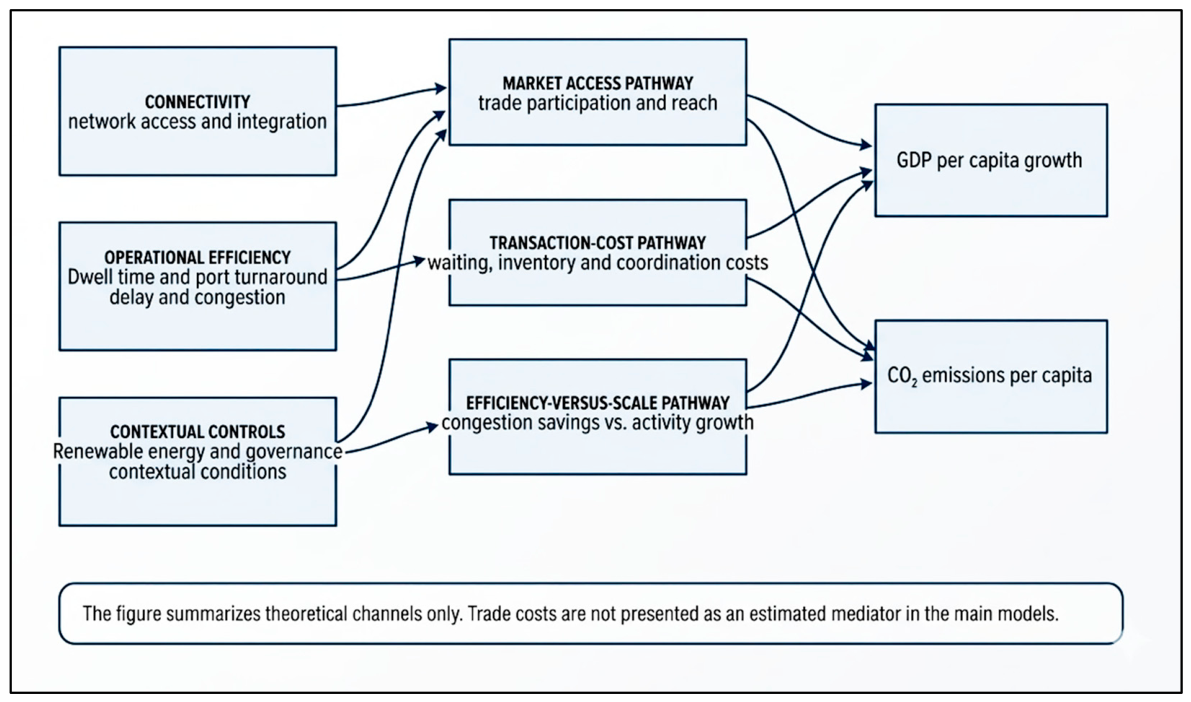
It is important to clarify the inference level of these mechanisms. Market access, trade cost reduction, and transaction cost pressure are used as theoretical explanations for why connectivity and time-based indicators may be associated with economic performance. They are not estimated as separate mediating variables in the empirical model because comparable cross-country trade cost measures are not consistently available for the LPI 2.0 sample. The empirical analysis therefore tests direct associations between operational logistics indicators and outcome variables, while using trade cost and transaction cost theories to interpret the expected direction of these associations.
2.2. From Legacy LPI to Logistics Performance Indicators 2.0
The Logistics Performance Index has been widely used as a global benchmark for national logistics systems. The legacy LPI evaluates six core dimensions: customs efficiency, infrastructure quality, international shipment performance, logistics competence, tracking and tracing, and timeliness [1,3]. These dimensions have been applied in empirical research on trade facilitation, economic growth, and supply chain efficiency.
Despite its wide use, the legacy LPI has methodological and conceptual limits. It relies on perception-based survey data from logistics professionals. Expert judgment offers valuable insight, but it introduces subjectivity and can reduce comparability across countries and years. The index also lacks operational granularity. It does not directly capture port congestion, dwell time, transshipment delays or corridor-level throughput dynamics. Its intermittent publication also limits the analysis of rapid operational changes.
LPI 2.0 should not be interpreted as a simple continuation of the legacy LPI. The legacy LPI is a perception-based benchmarking tool, while LPI 2.0 provides operational indicators based on connectivity and time-performance data [1,2]. The distinction is important because the two systems measure different aspects of logistics performance. The legacy LPI is useful for long-term benchmarking, but it may mask operational bottlenecks. LPI 2.0 offers finer operational detail, but its short time coverage limits causal inference and long-term modeling.
Both measurement systems therefore have value and limits. The present study does not merge the two datasets into one index. It uses the legacy LPI for historical panel analysis and LPI 2.0 for exploratory operational benchmarking. This avoids treating perception-based and operational indicators as equivalent measures.
2.3. Logistics Connectivity, Operational Bottlenecks and Economic Performance
Logistics connectivity refers to the degree of integration across transport networks, ports, corridors and information systems. Strong connectivity supports market access by reducing spatial and procedural frictions. It improves the ability of firms to participate in regional and global value chains and can increase export competitiveness [4,5]. Yet, connectivity alone does not guarantee economic gains. Benefits depend on whether connected systems also provide predictable and timely movement.
Dwell time, port turnaround, and transshipment time capture operational bottlenecks. Dwell time measures how long cargo remains at ports or terminals before clearance or onward movement. High dwell time reflects congestion, procedural complexity, and weak coordination. Port turnaround and transshipment delays indicate flow interruptions that reduce asset utilization and increase hidden logistics costs [8,9]. These measures are valuable because they reveal constraints that aggregate country scores may hide.
2.4. Logistics Performance and Environmental Sustainability
The link between logistics performance and environmental outcomes is not unidirectional. Efficient logistics systems can reduce fuel consumption by cutting idle time, improving load factors, smoothing port flows and supporting modal coordination [10,11]. Digital visibility and predictive scheduling can further reduce avoidable trips and congestion. In this sense, operational efficiency can support emission reduction.
At the same time, stronger logistics connectivity can raise emissions through trade scale effects. Better network access can increase transport activity, shipment frequency, and trade volumes. If the energy system remains carbon-intensive, the increase in logistics activity can offset some efficiency gains [12,13]. This study therefore treats the environmental effect of LPI 2.0 indicators as conditional. It separates time-based inefficiency from connectivity-driven activity growth.
2.5. Structural Differences Between Arab and European Logistics Systems
European logistics systems are characterized by dense multimodal networks, regulatory harmonization and high levels of institutional coordination [9]. These features can help convert logistics improvements into economic gains. Arab logistics systems are more heterogeneous. Gulf countries such as the United Arab Emirates, Saudi Arabia, and Qatar have invested heavily in ports, logistics infrastructure and digital systems. Other Arab economies face stronger constraints linked to infrastructure gaps, procedural delays, and institutional fragmentation.
This heterogeneity means that a simple regional dummy may not fully represent substantive logistics maturity. Some Arab economies perform at or above the level of several European economies on selected LPI 2.0 indicators. Some European economies also show middle-level logistics performance. The revised analysis therefore retains the Arab–European comparison but adds robustness checks based on logistics maturity and an alternative European sample that excludes Bulgaria, Romania, and Greece [14,15,16,17,18].
2.6. Integrated Conceptual Framework
The conceptual framework treats logistics performance as a system of observable operational conditions. It does not model LPI 2.0 as a higher-order causal construct. Instead, LPI 2.0 is treated as an operational dashboard that separates connectivity, time performance and bottleneck indicators [16]. This avoids treating LPI 2.0 as a variable that explains its own components.
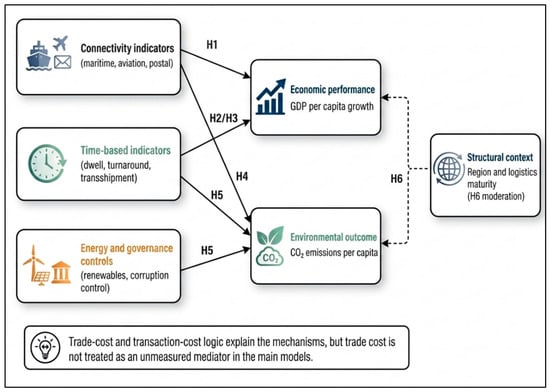
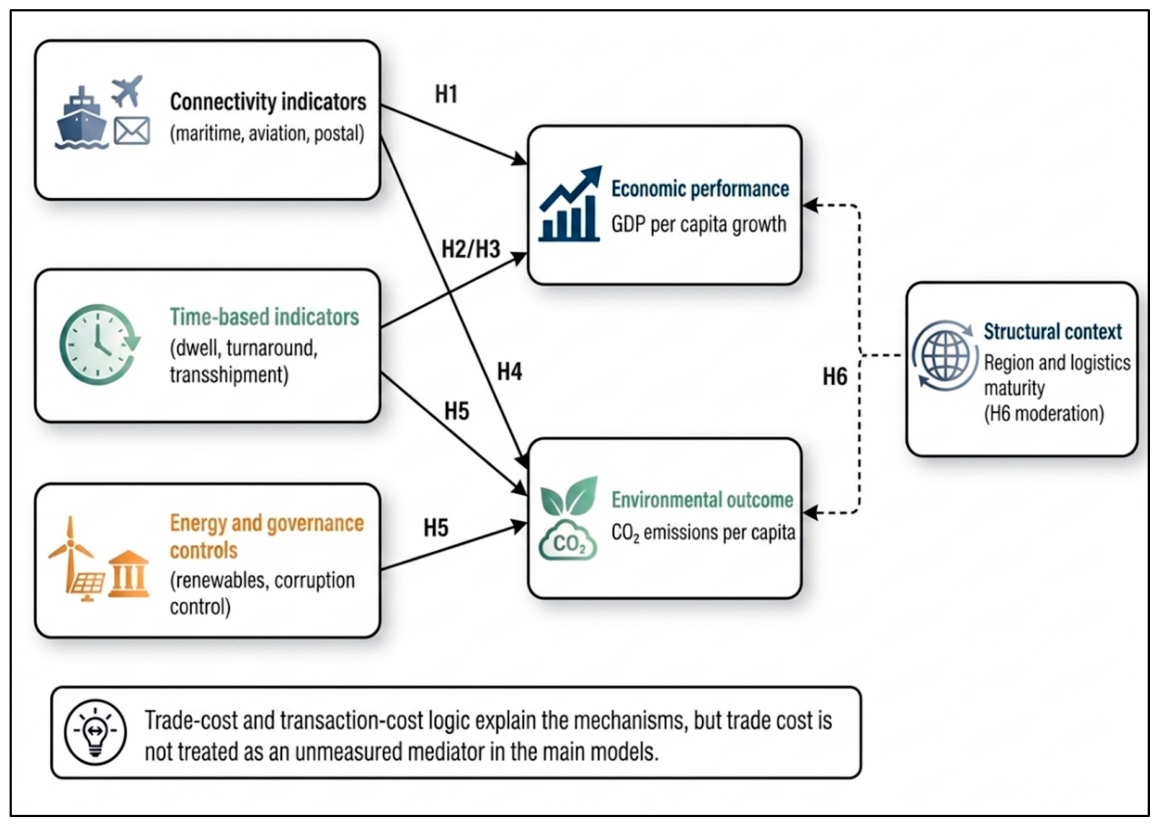
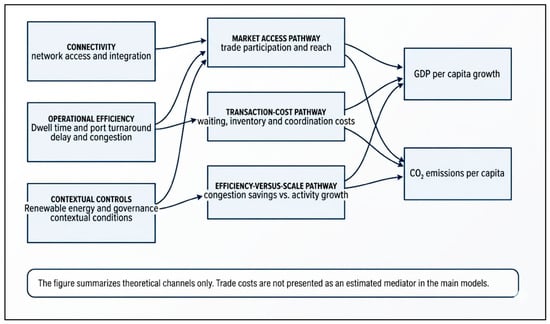
Figure 1 presents the framework focuses on direct associations between specific operational logistics indicators and two outcome domains. The first domain is economic performance, measured through GDP per capita growth. The second domain is environmental performance, measured through CO2 emissions per capita. Connectivity reflects market access and network integration. Dwell time, port turnaround and transshipment time reflect operational bottlenecks and transaction cost pressure. Renewable energy and governance are treated as contextual controls rather than components of LPI 2.0.
Figure 1.
The hypothesis path framework for LPI 2.0 operational indicators. Source: The authors using Google Gemini (3.1 Pro) for visual layout support and verified by the authors based on the conceptual framework developed in this study.
Regional context is retained as an exploratory moderation argument. Arab and European economies differ in logistics maturity, institutional coordination, energy structure and market integration [14,18,19,20]. These differences may condition the strength and direction of the association between operational logistics indicators and economic and environmental outcomes.
2.7. Research Gaps and Comparative Insights
The literature reveals four connected gaps in measurement, theory, empirical design and regional analysis [20,21,22,23,24,25]. Table 1 summarizes how the revised study addresses each gap. The table also clarifies that the contribution lies in operationalizing LPI 2.0 as a dashboard rather than a new aggregate score.
Table 1.
Comparative analysis of the logistics performance literature and revised research gaps.
2.8. Hypothesis Development
The revised hypotheses are aligned with the operational structure of LPI 2.0 and the empirical models estimated in this study. LPI 2.0 is not treated as an aggregate causal construct. Its indicators are examined separately as observable measures of connectivity, time performance, and bottleneck conditions [1,2]. Trade cost reduction, market access, and transaction cost pressure are retained as theoretical mechanisms, but they are not estimated as mediators in the empirical model [4,5,6].
H1.
Logistics connectivity is positively associated with economic performance. Connectivity indicators reflect the ability of a logistics system to link domestic markets with international transport networks. Higher maritime, aviation, and postal connectivity can improve market access, reduce coordination frictions, and support participation in regional and global trade networks [1,2,4,5,6].
H2.
Longer import dwell time is negatively associated with economic performance. Import dwell time reflects how long cargo remains in ports or terminals before clearance or onward movement. Longer dwell time increases storage costs, delays delivery, reduces asset utilization, and weakens supply chain reliability [5,6,8,9].
H3.
Longer port turnaround and transshipment time are negatively associated with economic performance. Turnaround and transshipment delays capture operational bottlenecks in maritime logistics. These delays increase transaction cost pressure, reduce flow reliability, and weaken the economic benefits of logistics connectivity [5,6,8,9].
H4.
Logistics connectivity is associated with CO2 emissions, but the direction depends on the balance between efficiency and scale effects. Connectivity may improve routing and reduce avoidable delays, but it may also increase transport activity and emissions where logistics growth remains carbon-intensive [7,12,13].
H5.
Longer dwell time and port turnaround are positively associated with CO2 emissions. Time-based inefficiencies increase emissions through congestion, idling, fuel waste, repeated handling, and inefficient asset utilization [7,9,12,13].
H6.
Regional context moderates the association between operational logistics indicators and economic and environmental outcomes. This moderation is expected because Arab and European systems differ in logistics maturity, infrastructure integration, institutional coordination, energy structure, and market access [25,26,27,28,29,30].
3. Data and Methodology
3.1. Research Design
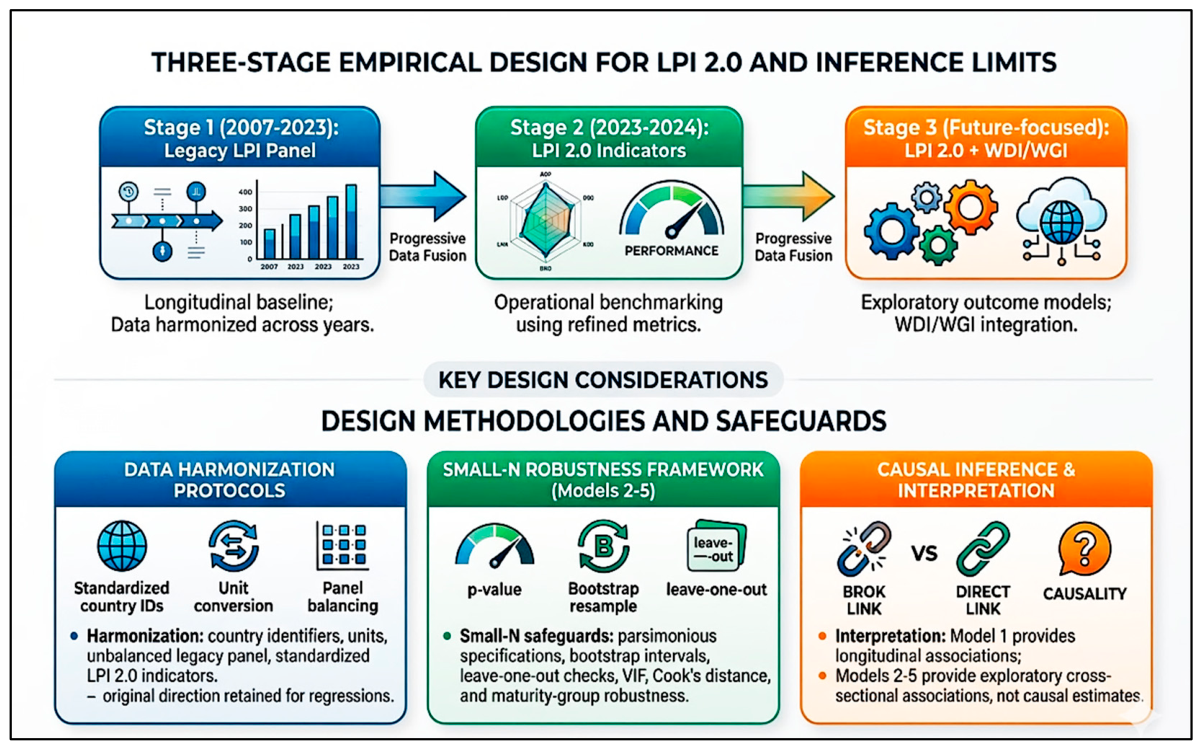
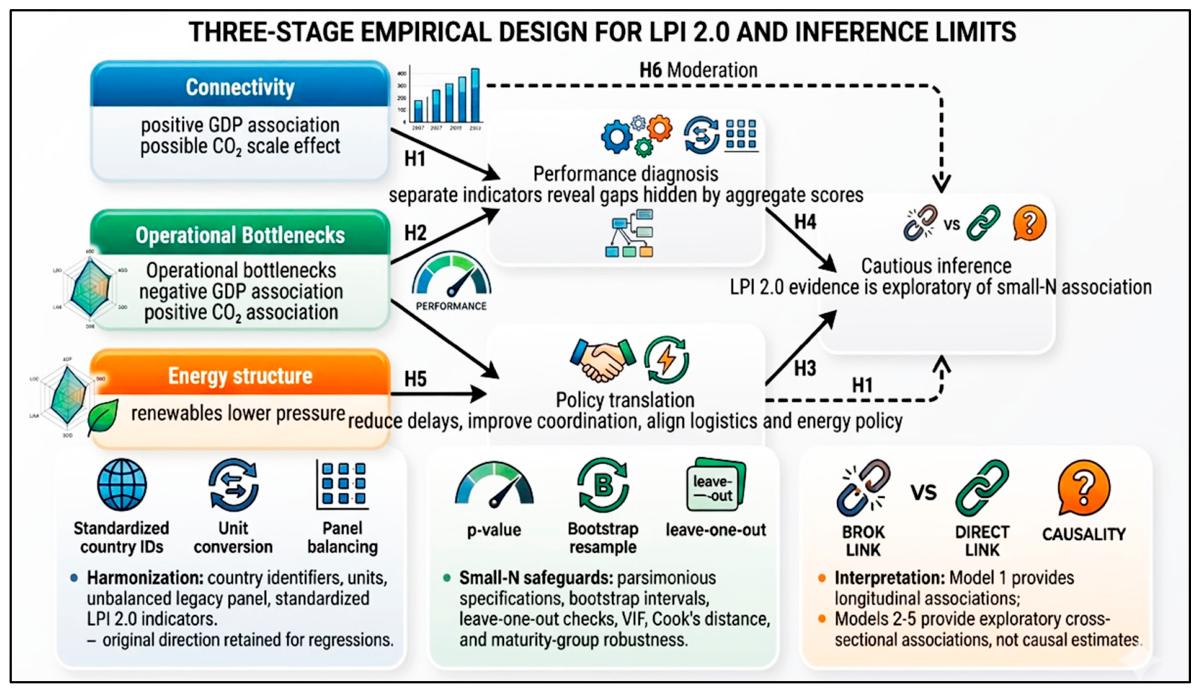
This study adopts a three-stage empirical design. Stage 1 uses the legacy LPI panel for 2007–2023 to establish the historical relationship between perception-based logistics performance and economic outcomes. Stage 2 uses LPI 2.0 indicators for 2023–2024 to describe operational differences in connectivity and time performance. Stage 3 links LPI 2.0 operational indicators with economic and environmental outcomes through exploratory cross-sectional models.
This staged design is necessary because the legacy LPI and LPI 2.0 are conceptually different measurement systems and should not be merged into a single longitudinal index [1,2,29]. The legacy LPI captures expert perceptions of national logistics systems. LPI 2.0 relies on operational and tracking-based indicators. The analysis therefore interprets each dataset within its proper temporal and conceptual scope. Table 2 presents the three-stage research design and data structure.
Table 2.
Three-stage research design and data structure.
3.2. Country Selection and Study Sample
The empirical sample includes 19 countries divided into Arab and European groups. The Arab group includes the United Arab Emirates, Saudi Arabia, Qatar, Bahrain, Oman, Egypt, Morocco, Jordan, Tunisia and Algeria. The European group includes Germany, the Netherlands, Finland, Denmark, Spain, Italy, Greece, Romania and Bulgaria.
Countries were selected using four criteria. First, each country had sufficient data availability across the legacy LPI, LPI 2.0, World Development Indicators and Worldwide Governance Indicators. Second, the sample included advanced logistics hubs and middle-performing logistics systems. Third, it included Arab and European economies with different institutional, energy and trade structures. Fourth, countries were retained only when the core variables required for the empirical models were available.
Logistics maturity refers to the combined strength of logistics infrastructure, connectivity, operational efficiency, institutional coordination and integration into international trade networks. It is operationalized through legacy LPI performance, LPI 2.0 connectivity indicators, time-performance indicators and governance controls [30]. The revised analysis therefore interprets the regional comparison cautiously and uses logistics maturity as a complementary sensitivity criterion.
3.3. Data Sources and Preprocessing
The study integrates public secondary data from four sources. Legacy LPI data for 2007–2023 were obtained from the World Bank LPI database. LPI 2.0 indicators for 2023–2024 were obtained from the World Bank LPI 2.0 dataset. Macroeconomic and environmental data were extracted from the World Development Indicators. Governance data were extracted from the Worldwide Governance Indicators [1,31].
All datasets were harmonized at the country-year level before estimation. Country names and ISO identifiers were standardized across data sources. Variables with different scales were converted into comparable units. For the legacy LPI panel, missing values were not interpolated because the LPI is not reported annually. The panel was therefore treated as an unbalanced country–year dataset. For the LPI 2.0 stage, only countries with available operational indicators and corresponding macroeconomic and environmental variables were retained.
All empirical tables and figures were prepared by the authors. Tables reporting descriptive statistics and regression results are based on authors’ calculations using publicly available datasets from the World Bank LPI, LPI 2.0, WDI, and WGI. No table, chart, figure, photograph, map or diagram has been reproduced from a third-party publication [32].
3.4. Variables and Measurement
Table 3 reports the revised measurement framework. Trade cost is retained as a theoretical mechanism but is not used as a main dependent variable or mediator in the core empirical model. This avoids claiming mediation where the empirical analysis estimates direct associations.
Table 3.
Variables and measurement framework.
3.5. Construction of LPI 2.0 Operational Dimensions
Composite indicators were constructed using standardized indicators. Connectivity measures were standardized so that higher values indicate stronger network integration. Time-based indicators were retained in their original direction for regression analysis, where higher values indicate longer delays. When used in composite performance measures, time-based indicators were reverse-coded so that higher composite values represent stronger operational performance [32,33].
Equal-weighted composites were used in the main analysis because of the small LPI 2.0 sample and the operational nature of the indicators. The study does not treat the LPI 2.0 indicators as latent survey items. Therefore, PCA loadings were not used to construct or validate a causal higher-order LPI 2.0 construct. Instead, the analysis applies transparent directional harmonization before index construction. Connectivity indicators were retained in their original direction, while time-based indicators were reverse-coded only when used in composite performance measures. Table 4 presents the coding logic for the LPI 2.0 operational dimensions [32,33,34].
Table 4.
Coding and interpretation of LPI 2.0 operational dimensions.
3.6. Construct Validity and Measurement Validation
To strengthen construct validity, the revised analysis adds explicit measurement validation for the constructed LPI 2.0 operational dimensions. The validation follows four steps consistent with composite indicator construction, multivariate analysis, and exploratory index validation guidance [16,17,35]. First, indicator directionality was checked to ensure conceptual consistency. Connectivity indicators were retained in their original direction because higher values indicate stronger network integration. Time-based indicators, including dwell time, port turnaround, transshipment time, and postal delivery time, were interpreted as inverse performance measures because higher values indicate longer delays. These variables were reverse-coded only when used in composite performance measures.
Second, convergent consistency was assessed by examining whether indicators assigned to the same operational dimension showed the expected correlation pattern. Connectivity indicators were expected to correlate positively with each other, while delay indicators were expected to cluster together after directional harmonization. Third, principal component analysis was used as a measurement robustness check to examine whether the indicators cluster in a manner consistent with the proposed connectivity, time performance, and bottleneck dimensions. Fourth, equal-weighted and PCA-weighted composite scores were compared to assess whether the substantive interpretation depends on the weighting approach. Summary PCA results are reported in Table 5, while dimension-level PCA loading ranges are reported in Appendix A, Table A1 to address construct validity concerns directly.
Table 5.
Construct validity and measurement validation of LPI 2.0 operational dimensions.
This validation strategy is appropriate because the LPI 2.0 indicators are operational and partly formative rather than reflective survey items. Therefore, internal consistency statistics such as Cronbach’s alpha are reported cautiously. They are used as descriptive evidence of indicator coherence, not as the sole criterion for retaining or rejecting an operational index [15,16,33,35]. Table 5 summarizes the directional treatment, dimensional coherence, PCA-based measurement check, and reliability evidence used to validate the LPI 2.0 operational dimensions.
The validation results provide empirical evidence that the constructed operational dimensions show acceptable directional consistency, dimensional coherence, and descriptive reliability. PCA is therefore reported as a measurement robustness check rather than as a basis for treating LPI 2.0 as a reflective latent construct.
3.7. Model Specification
The empirical analysis estimates five model families. Models 2–5 are presented as exploratory cross-sectional specifications because LPI 2.0 currently provides limited time coverage and the sample includes 19 countries. These models are not used to make causal claims [35]. Table 6 presents the model structure and inference level.
Table 6.
Model structure and inference level.
3.8. Estimation Strategy
The estimation strategy follows the structure of the data and avoids treating legacy LPI and LPI 2.0 as identical measures. Model 1 estimates panel data models using the legacy LPI dataset for 2007–2023. The Hausman test favored the fixed-effects specification for Model 1, χ2(4) = 18.62, p = 0.001, supporting the use of country fixed effects in the legacy LPI panel model. Robust standard errors are used to address heteroskedasticity. Year effects control for common global shocks affecting logistics, trade, and economic activity [10,36].
Models 2–5 follow a small-N estimation logic. The primary specifications include only theoretically essential predictors. Additional controls are introduced in sensitivity models. Because the LPI 2.0 sample includes 19 countries, the results are interpreted as exploratory evidence of association rather than confirmatory causal estimates.
3.9. Diagnostic and Robustness Tests
The revised analysis reports six diagnostic and robustness procedures, as presented in Table 7. First, multicollinearity is assessed using variance inflation factors. Second, bootstrapped confidence intervals are used for the LPI 2.0 cross-sectional models. Third, leave-one-out checks assess whether the results are driven by a single influential country. Fourth, Cook’s distance and leverage diagnostics are reported for Models 2–5. Fifth, the regional moderation result is tested under two alternative specifications, i.e., one excluding Bulgaria, Romania and Greece from the European group and one replacing the regional dummy with a logistics maturity grouping [15,16,35].
Table 7.
Diagnostic and robustness protocol.
These checks do not eliminate the limitations of a 19-country cross-section. They are included to improve transparency and to prevent overinterpretation. The LPI 2.0 models are therefore framed as diagnostic and exploratory rather than definitive causal tests, as shown in Table 7.
3.10. Methodological Positioning
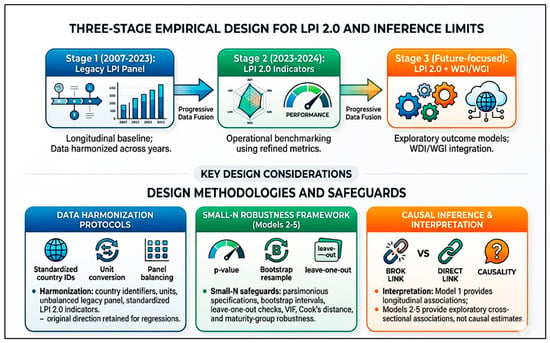
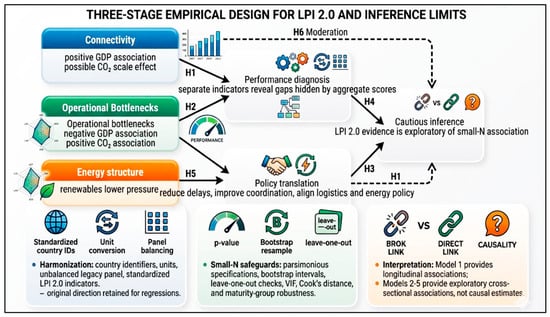
The methodological contribution is measurement-oriented rather than causal. This paper shows how legacy LPI and LPI 2.0 can be used together without merging them into a single incompatible index. The legacy LPI supports historical benchmarking, while LPI 2.0 supports operational benchmarking. The main contribution therefore lies in aligning each dataset with its appropriate inference level and in separating connectivity, time performance, and bottleneck indicators [1,2,3,15,16]. Figure 2 illustrates the three-stage research methodology framework.
Figure 2.
Three-stage research methodology framework. Source: The authors based on the research design and data structure developed in this study.
4. Results and Discussion
The results are interpreted according to the inference level of each model. The legacy LPI panel model provides longitudinal association evidence over 2007–2023. In contrast, the LPI 2.0 models are based on 19 cross-sectional country observations for 2023–2024. These models are therefore treated as exploratory operational evidence. They assess whether the direction and pattern of associations are consistent with the theoretical framework, not whether logistics indicators cause economic or environmental outcomes [36,37,38,39].
The descriptive comparison shows both between-region and within-region variation. European countries maintain higher and more stable logistics performance across most indicators. Arab economies display greater variability, with some high-performing hub countries and other economies facing stronger delay and coordination constraints. This pattern supports the need for robustness checks based on logistics maturity rather than geography alone. Table 8 presents the descriptive statistics and regional comparison.
Table 8.
Descriptive statistics and regional comparison.
Table 9 presents the main regression results. The table retains the original empirical structure but revises the interpretation. Models 2–5 should be read as exploratory small-N associations. Standard errors are reported in parentheses, and the robustness checks in Table 10 qualify the interpretation of the LPI 2.0 stage.
Table 9.
Regression results for logistics performance models.
Table 10.
Small-sample sensitivity assessment for Models 2–5.
Model 1 is estimated using fixed-effects panel regression for 2007–2023. Models 2–5 are cross-sectional OLS specifications for LPI 2.0 indicators and are interpreted as exploratory evidence because n = 19. In addition, Table 10 presents a small-sample sensitivity assessment for Models 2–5, focusing on coefficient direction, approximate uncertainty intervals, and influential-case sensitivity.
Table 10, Table 11 and Table 12 jointly qualify the interpretation of the exploratory LPI 2.0 models. Table 10 reports coefficient uncertainty and leave-one-out sign stability, Table 11 reports numerical diagnostics, and Table 12 reports robustness and sensitivity estimations. These checks do not convert the cross-sectional LPI 2.0 models into causal estimates. They are used as transparency devices to qualify the direction and stability of the exploratory associations. The interaction term is the most sensitive result, so the regional moderation finding is interpreted as suggestive rather than conclusive [40].
Table 11.
Numerical diagnostic assessment for exploratory LPI 2.0 models.
Table 12.
Robustness and sensitivity estimations for exploratory LPI 2.0 models.
All reported diagnostic statistics are based on the same country sample, variable transformations, and estimation specifications used in the main LPI 2.0 models.
All reported robustness and sensitivity statistics are based on the same country sample, variable transformations, and estimation specifications used in the main LPI 2.0 models.
The numerical diagnostics provide a more transparent basis for interpreting the exploratory LPI 2.0 models. The maximum VIF values remain below the conventional threshold of 5, indicating that multicollinearity is not severe in the retained specifications. Cook’s distance values remain below 1, suggesting that no single country dominates the estimated associations. Leverage values identify some higher-influence observations, which is expected in a 19-country cross-section, but leave-one-out checks show that the main coefficient directions are generally retained. The moderation result is less stable than the direct connectivity and delay results, especially under restricted regional specifications. Therefore, the regional moderation finding is interpreted as suggestive rather than conclusive.
The results provide partial and exploratory support for the revised hypotheses. Connectivity is positively associated with GDP per capita growth, which is consistent with H1. Longer dwell time and port turnaround are negatively associated with GDP per capita growth, which is consistent with H2 and H3. The environmental model suggests that connectivity has a weak positive association with CO2 emissions, while dwell time and port turnaround are positively associated with emissions. This pattern supports the interpretation that logistics connectivity may generate scale-related environmental pressure, while operational delays increase congestion-related emissions. Renewable energy share is negatively associated with CO2 emissions, which is consistent with H5. The interaction result suggests that regional context may condition the logistics–performance relationship, but this result should be interpreted cautiously because the LPI 2.0 model is cross-sectional and based on 19 observations.
The results no longer claim that trade costs mediate the tested relationships. Trade cost logic remains a theoretical mechanism in the literature review, but trade cost is not presented as an estimated mediator in the main models. This correction aligns the hypotheses, variables, model specification, and results narrative.
Figure 3 illustrates the exploratory operational channels linking LPI 2.0 indicators to economic and environmental outcomes. Table 13 then summarizes the environmental interpretation of the logistics performance results.
Figure 3.
Exploratory operational channels linking LPI 2.0 indicators to economic and environmental outcomes. Source: The authors based on the theoretical framework and empirical model structure developed in this study.
Table 13.
Logistics performance and environmental interpretation.
The environmental findings should not be read as evidence that logistics performance is automatically sustainable. The results point to two competing mechanisms. Operational efficiency can reduce congestion-related emissions, while stronger connectivity may increase total emissions when trade growth depends on carbon-intensive transport and energy systems. This distinction clarifies why the environmental effect of LPI 2.0 indicators is conditional rather than uniformly positive [41].
Overall, the results suggest that logistics performance is better interpreted as a set of operational conditions rather than as a single aggregate score. Connectivity, dwell time, turnaround time, transshipment time, and energy structure capture different parts of the logistics–economy–environment relationship. The findings are consistent with the theoretical expectation that connectivity supports market access, while delays represent transaction cost pressure and congestion-related inefficiency. However, because the LPI 2.0 models are cross-sectional and based on a small sample, the results should be interpreted as exploratory associations rather than causal estimates. Figure 4 presents the integrated interpretation of logistics performance, economic outcomes, and environmental outcomes.
Figure 4.
Integrated interpretation of logistics performance, economic outcomes and environmental outcomes. Source: The authors based on the synthesis of study findings.
5. Conclusions and Implications
5.1. Conclusions
This study examined how the transition from the legacy LPI to LPI 2.0 changes logistics performance analysis in 19 Arab and European economies. The findings answer the four research questions as follows. First, the shift from legacy LPI to LPI 2.0 changes measurement by moving attention from perception-based aggregate scores to operational indicators of connectivity, dwell time, turnaround, transshipment, and delivery performance. Second, connectivity indicators show positive exploratory associations with economic performance, suggesting that market access and network integration remain important for logistics-enabled growth [24,40].
Third, time-based indicators such as dwell time and port turnaround are associated with weaker economic performance and higher CO2 emissions. This indicates that operational bottlenecks matter for both competitiveness and environmental pressure. Fourth, the Arab–European comparison shows that regional differences exist, but robustness checks are needed because within-region heterogeneity is substantial.
The study therefore supports a cautious interpretation of LPI 2.0. Its main value is not that it provides a new aggregate ranking. Its value lies in helping researchers and policymakers to diagnose specific logistics constraints. The evidence suggests that connectivity, delay reduction, and operational reliability should be examined separately when assessing logistics performance and sustainability outcomes [33,40]. Table 14 presents the summary of empirical findings and implications.
Table 14.
Summary of empirical findings and implications.
5.2. Conceptual Implications
The study contributes to logistics performance research by shifting the interpretation of LPI 2.0 from a single-score ranking logic to an operational dashboard logic. It clarifies that connectivity, time performance and environmental outcomes should not be collapsed into one untested causal construct. It also links logistics indicators to market access theory, transaction cost logic and efficiency-versus-scale environmental mechanisms. This integrated framing strengthens the theoretical foundation while keeping the empirical claims aligned with the available data [8,9,11,12,22,23].
5.3. Policy Implications
The policy implications are tied to the empirical results and should be interpreted within the limits of the exploratory LPI 2.0 models. First, because dwell time and port turnaround are negatively associated with economic performance, port and customs reforms may prioritize delay reduction where dwell time and turnaround indicators reveal persistent operational bottlenecks. Second, because connectivity is positively associated with GDP per capita growth, governments may use LPI 2.0 connectivity indicators to identify where multimodal and international network integration require further policy attention. Third, because connectivity may increase emissions where logistics growth remains energy-intensive, logistics expansion should be aligned with clean energy, fleet modernization, and modal shift policies. Fourth, because regional labels hide within-group variation, policymakers should benchmark countries by logistics maturity and operational bottlenecks rather than geography alone [1,42].
5.4. Managerial Implications
For firms, the results imply that logistics competitiveness depends on reliability and delay reduction as much as physical access. Firms should use digital visibility systems, predictive scheduling, and inventory coordination to reduce the hidden costs of logistics uncertainty. Logistics managers should also monitor emissions exposure linked to route choices, waiting time, and energy structure, since operational efficiency and environmental performance are increasingly connected [43].
5.5. Methodological Implications
The study demonstrates a method for using legacy LPI and LPI 2.0 together without forcing them into one incompatible dataset. It also shows how to align each model with its proper inference level. The legacy LPI supports longitudinal benchmarking, while LPI 2.0 supports operational diagnosis. This distinction is important for future studies that use new logistics datasets with short time coverage [44].
5.6. Limitations and Future Research
This study has five limitations. First, LPI 2.0 currently provides limited temporal coverage, which restricts the ability to estimate dynamic effects. Second, Models 2–5 are based on 19 cross-sectional country observations. This limits statistical power and increases sensitivity to influential cases. For this reason, the LPI 2.0 results are interpreted as exploratory associations rather than causal evidence. Third, country-level indicators may hide sector-level and corridor-level variation.
Fourth, although trade-cost theory and transaction-cost logic inform the conceptual framework, these mechanisms are not directly estimated as mediating variables. The empirical models test direct associations between operational logistics indicators and outcome variables. Future research should incorporate direct trade cost, freight rate, customs clearance, corridor-level, and firm-level logistics cost measures when comparable data become available. Fifth, the Arab–European comparison may hide important within-region variation. Future research should compare countries by logistics maturity, institutional quality, port specialization, and energy structure [45,46,47].
5.7. Final Conclusions
In conclusion, the study shows that the transition from legacy LPI to LPI 2.0 changes how logistics performance should be studied. Rather than treating logistics performance as a single perception-based ranking, LPI 2.0 enables researchers and policymakers to examine operational dimensions such as connectivity, dwell time, port turnaround, transshipment time, postal delivery performance, and energy context. The evidence suggests that stronger connectivity is associated with better economic performance, while longer operational delays are associated with weaker economic outcomes and higher emissions. However, these findings should be interpreted cautiously because the LPI 2.0 analysis is exploratory, cross-sectional, and based on a limited country sample. The main contribution is therefore measurement-oriented: the paper demonstrates how legacy LPI and LPI 2.0 can be used together while preserving their different inference levels.
Author Contributions
Conceptualization, K.S. and I.E.-N.; methodology, K.S. and I.E.-N.; validation, K.S. and I.E.-N.; formal analysis, K.S.; investigation, K.S. and I.E.-N.; resources, K.S. and I.E.-N.; data curation, K.S.; writing—original draft preparation, K.S. and I.E.-N.; writing—review and editing, K.S. and I.E.-N.; visualization, K.S. and I.E.-N.; supervision, I.E.-N. All authors have read and agreed to the published version of the manuscript.
Funding
This research received no external funding.
Institutional Review Board Statement
Not applicable.
Informed Consent Statement
Not applicable.
Data Availability Statement
The data supporting the findings of this study are publicly available from the World Bank Logistics Performance Index database, the World Bank Logistics Performance Indicators 2.0 dataset, the World Development Indicators, and the Worldwide Governance Indicators. The datasets can be accessed through the corresponding public World Bank databases: https://lpi.worldbank.org/, https://data360.worldbank.org/en/dataset/WB_LPI_20, (30 April 2026) and https://databank.worldbank.org/source/world-development-indicators (30 April 2026). The authors did not generate private or restricted primary data for this study.
Acknowledgments
The authors used Google Gemini 3.1 pro to support the visual layout of selected original figures and Grammarly (grammarly.com) to support language editing and proofreading. The authors reviewed, edited, and verified all AI-assisted outputs to ensure accuracy and consistency with the study framework, methodology, and empirical interpretation. All figures, tables, and graphical elements in this manuscript were drafted by the authors and are original. No third-party copyrighted figure, photograph, map, diagram, chart, or table was reproduced. Empirical tables were prepared from publicly available World Bank datasets cited in the Data Availability Statement. The authors take full responsibility for the content of the manuscript.
Conflicts of Interest
The authors declare no conflicts of interest.
Appendix A
Table A1.
PCA loading summary for LPI 2.0 operational indicators.
References
- World Bank. Logistics Performance Indicators 2.0: Methodology. Available online: https://lpi.worldbank.org/en/about/methodology (accessed on 5 June 2026).
- World Bank. Logistics Performance Indicators 2.0 Dataset. Available online: https://data360.worldbank.org/en/dataset/WB_LPI_20 (accessed on 1 May 2026).
- Arvis, J.-F.; Dappe, M.H.; Ulybina, D.; Wiederer, C. Connecting to Compete 2025: The New Logistics Performance Indicators 2.0; World Bank: Washington, DC, USA, 2026; Available online: https://documents.worldbank.org/en/publication/documents-reports/documentdetail/099042226142014971 (accessed on 1 May 2026).
- Sergi, B.S.; D’Aleo, V.; Konecka, S.; Szopik-Depczyńska, K.; Dembińska, I.; Ioppolo, G. Competitiveness and the Logistics Performance Index: The ANOVA method application for Africa, Asia, and the EU regions. Sustain. Cities Soc. 2021, 69, 102845. [Google Scholar] [CrossRef] [Scilit]
- Ozekenci, E.K. Assessment of the Logistics Performance Index of OPEC countries with entropy, CRITIC and LOPCOW-based EDAS methods. J. Transp. Logist. 2024, 9, 260–279. [Google Scholar] [CrossRef] [Scilit]
- Arvis, J.-F.; Wiederer, C.; Shepherd, B.; Raj, A.; Dairabayeva, K.; Kiiski, T. Connecting to Compete 2018: Trade Logistics in the Global Economy—The Logistics Performance Index and Its Indicators; World Bank: Washington, DC, USA, 2018. [Google Scholar] [CrossRef] [Scilit]
- Arvis, J.-F.; Ojala, L.; Shepherd, B.; Ulybina, D.; Wiederer, C. Connecting to Compete 2023: Trade Logistics in an Uncertain Global Economy—The Logistics Performance Index and Its Indicators; World Bank: Washington, DC, USA, 2023. [Google Scholar] [CrossRef] [Scilit]
- Portugal-Perez, A.; Wilson, J.S. Export performance and trade facilitation reform: Hard and soft infrastructure. World Dev. 2012, 40, 1295–1307. [Google Scholar] [CrossRef] [Scilit]
- Hausman, W.H.; Lee, H.L.; Subramanian, U. The impact of logistics performance on trade. Prod. Oper. Manag. 2013, 22, 236–252. [Google Scholar] [CrossRef] [Scilit]
- UNCTAD. Review of Maritime Transport 2022; United Nations: Geneva, Switzerland, 2022; Available online: https://unctad.org/publication/review-maritime-transport-2022 (accessed on 1 May 2026).
- Hummels, D.L.; Schaur, G. Time as a trade barrier. Am. Econ. Rev. 2013, 103, 2935–2959. [Google Scholar] [CrossRef] [Scilit]
- McKinnon, A. Decarbonizing Logistics: Distributing Goods in a Low Carbon World; Kogan Page: London, UK, 2018. [Google Scholar]
- El-Nakib, I.; Elzarka, S. An enhanced composite green logistics performance index for MENA: Methodology, drivers and hybrid forecasting to 2030. Logistics 2026, 10, 56. [Google Scholar] [CrossRef] [Scilit]
- European Commission. EU Transport in Figures: Statistical Pocketbook 2022; Publications Office of the European Union: Luxembourg, 2022; Available online: https://transport.ec.europa.eu/facts-funding/studies-data/eu-transport-figures-statistical-pocketbook_en (accessed on 1 May 2026).
- Hair, J.F.; Black, W.C.; Babin, B.J.; Anderson, R.E. Multivariate Data Analysis, 8th ed.; Cengage: Andover, UK, 2019. [Google Scholar]
- Wooldridge, J.M. Econometric Analysis of Cross Section and Panel Data, 2nd ed.; MIT Press: Cambridge, MA, USA, 2010. [Google Scholar]
- Jayathilaka, R.; Jayawardhana, C.; Embogama, N.; Jayasooriya, S.; Karunarathna, N.; Gamage, T.; Kuruppu, N. Gross domestic product and logistics performance index drive world trade: A study based on all continents. PLoS ONE 2022, 17, e0264474. [Google Scholar] [CrossRef] [Scilit] [PubMed]
- Jonasikova, D.; Konecny, V. Research of individual Logistics Performance Index indicators in European Union countries. Ekon.-Manaz. Spektrum 2024, 18, 121–133. [Google Scholar] [CrossRef] [Scilit]
- Elzarka, S.; El-Nakib, I. Supply chain management research in the MENA region (2000–2025): A PRISMA-guided systematic review of theories, themes, and research gaps. Logistics 2026, 10, 105. [Google Scholar] [CrossRef] [Scilit]
- Çıray, D.; Özdemir, Ü.; Mete, S. An evaluation of the Logistics Performance Index using the entropy-based ORESTE method. J. Transp. Logist. 2024, 9, 68–82. [Google Scholar] [CrossRef] [Scilit]
- Ju, M.; Mirovic, I.; Petrovic, V.; Erceg, Z.; Stevic, Z. A novel approach for the assessment of Logistics Performance Index of EU countries. Economics 2024, 18, 20220074. [Google Scholar] [CrossRef] [Scilit]
- Larson, P.D. Relationships between logistics performance and aspects of sustainability: A cross-country analysis. Sustainability 2021, 13, 623. [Google Scholar] [CrossRef] [Scilit]
- Wan, B.; Wan, W.; Hanif, N.; Ahmed, Z. Logistics performance and environmental sustainability: Do green innovation, renewable energy, and economic globalization matter? Front. Environ. Sci. 2022, 10, 996341. [Google Scholar] [CrossRef] [Scilit]
- Aboul-Dahab, K.M.; Ibrahim, M.A. Logistics Performance Index (LPI) and insights on the logistics performance improvement in the Arabian Region. Int. J. Bus. Manag. Technol. 2020, 4, 1–15. Available online: https://ssrn.com/abstract=3589279 (accessed on 1 May 2026).
- Ben Haj Ahmed, R.; Bouzir, A.; Benhadj Mbarek, M.H.; Benammou, S. The impact of Logistics Performance Index on port infrastructure quality: Comparative study Tunisia–Morocco. Arch. Transp. 2023, 67, 71–89. [Google Scholar] [CrossRef] [Scilit]
- Alkhatib, S.F. Competitiveness, logistics performance, and GDP: Evidence from global data and Arab countries. J. Logist. Inform. Serv. Sci. 2024, 11, 115–138. [Google Scholar] [CrossRef] [Scilit]
- Arvis, J.-F.; Saslavsky, D.; Ojala, L.; Shepherd, B.; Busch, C.; Raj, A. Connecting to Compete 2014: Trade Logistics in the Global Economy—The Logistics Performance Index and Its Indicators; World Bank: Washington, DC, USA, 2014. [Google Scholar] [CrossRef] [Scilit]
- Çelebi, U. The impact of Logistics Performance Index upon gross domestic product: Mediating roles of foreign direct investment and patents. J. Glob. Strateg. Manag. 2021, 15, 29–45. [Google Scholar] [CrossRef] [Scilit]
- Cheng, H.; Chaudhry, H.R.; Kazi, I.; Umar, M. Unlocking greener supply chains: A global innovative perspective on the role of logistics performance in reducing ecological footprints. J. Innov. Knowl. 2024, 9, 100612. [Google Scholar] [CrossRef] [Scilit]
- Hadzikadunic, A.; Stevic, Z.; Yazdani, M.; Hernandez, V.D. Comparative analysis of the Logistics Performance Index of European Union countries: 2007–2023. J. Organ. Technol. Entrep. 2023, 1, 1–11. [Google Scholar] [CrossRef]
- Magazzino, C.; Alola, A.A.; Schneider, N. The trilemma of innovation, logistics performance, and environmental quality in 25 topmost logistics countries: A quantile regression evidence. J. Clean. Prod. 2021, 322, 129050. [Google Scholar] [CrossRef] [Scilit] [PubMed]
- Mangır, F.; Mezde, A.; Ortakarpuz, M. The effects of developments in logistics performance on international trade: EU–TR example. Prem. e-J. Soc. Sci. 2024, 8, 1805–1815. [Google Scholar] [CrossRef]
- Martí, L.; Martín, J.C.; Puertas, R. A DEA-logistics performance index. J. Appl. Econ. 2017, 20, 169–192. [Google Scholar] [CrossRef] [Scilit]
- Ozekenci, E.K. Comparative analysis of the Logistics Performance Index of Central and Eastern European countries: A hybrid LOPCOW–RAWEC model. Cent. Eur. Bus. Rev. 2026, 15, 89–109. [Google Scholar] [CrossRef] [Scilit]
- Pan, W.T.; Jiang, B.; Wang, Y.; Cai, Y.; Ji, X. Comparison and suggestions of Logistics Performance Index of main countries of Belt and Road Strategy based on bootstrap DEA model. Comput. Intell. Neurosci. 2022, 2022, 2159578. [Google Scholar] [CrossRef] [Scilit] [PubMed]
- Rahman, M.H.; Baldacci, R. Trade, economic growth, and transportation sustainability perspectives of the Gulf-Europe corridor in the GCC countries. Discov. Sustain. 2025, 6, 459. [Google Scholar] [CrossRef] [Scilit]
- Raimbekov, Z.; Syzdykbayeva, B.; Rakhmetulina, A.; Rakhmetulina, Z.; Kinasheva, Z. Assessment of the impact of international trade intensity on logistics efficiency: A case study of the EAEU countries. J. Logist. Inform. Serv. Sci. 2024, 11, 163–180. [Google Scholar] [CrossRef] [Scilit]
- Saini, M.; Hrušecká, D. Comparative impact of Logistics Performance Index, ease of doing business and logistics cost on economic development: A fuzzy QCA analysis. J. Bus. Econ. Manag. 2021, 22, 1577–1592. [Google Scholar] [CrossRef] [Scilit]
- Salem, M.A.; Alshawtari, F.A.; Shatila, A. Sustainable development in GCC: Do logistics indicators matter? J. Law Sustain. Dev. 2023, 11, e683. [Google Scholar] [CrossRef] [Scilit]
- Salem, M.A.; Alshawtari, F.A.; Shatila, A.M. The impacts of logistics performance indicators on the competitiveness of GCC countries. Asian J. Middle East. Islam. Stud. 2025, 18, 393–409. [Google Scholar] [CrossRef] [Scilit]
- Stevic, Z.; Ersoy, N.; Basar, E.E.; Baydas, M. Addressing the global Logistics Performance Index rankings with methodological insights and an innovative decision support framework. Appl. Sci. 2024, 14, 10334. [Google Scholar] [CrossRef] [Scilit]
- Tongur, Ü.; Ozcelik, S.E. Logistics performance and environmental degradation: The case of MENA countries. Ekonomi-tek 2024, 13, 198–229. [Google Scholar]
- Wiegmans, B.; van der Laan, F. Port performance measurement in the context of port choice: An MCDA approach. Manag. Decis. 2019, 57, 369–417. [Google Scholar] [CrossRef] [Scilit]
- World Bank. Logistics Performance Index Database. Available online: https://lpi.worldbank.org/ (accessed on 1 May 2026).
- World Bank. World Development Indicators. Available online: https://databank.worldbank.org/source/world-development-indicators (accessed on 1 May 2026).
- Yangailo, T. The impact of logistics performance on trade efficiency and economic growth: A global comparative study. Econ. Aziend. Online 2024, 15, 733–756. [Google Scholar] [CrossRef] [Scilit]
- Zakia, M.; Hanene, B.; Samir, A.; Soumeia, D. The impact of logistics performance on export market penetration: An econometric study using GMM. Financ. Mark. Inst. Risks 2024, 8, 51–63. [Google Scholar] [CrossRef] [Scilit]

Disclaimer/Publisher’s Note: The statements, opinions and data contained in all publications are solely those of the individual author(s) and contributor(s) and not of MDPI and/or the editor(s). MDPI and/or the editor(s) disclaim responsibility for any injury to people or property resulting from any ideas, methods, instructions or products referred to in the content. |
© 2026 by the authors. Licensee MDPI, Basel, Switzerland. This article is an open access article distributed under the terms and conditions of the Creative Commons Attribution (CC BY) license.