Systematic Review

Tourist Evaluation and Reliance on AI-Generated Content for Sustainable Digital Tourism: A Process-Oriented Systematic Review

by
Yaxin Su
* and
Nor Hidayati Binti Zakaria
Azman Hashim International Business School (AHIBS), Universiti Teknologi Malaysia (UTM), Jalan Sultan Yahya Petra, Kuala Lumpur 54100, Malaysia
*
Author to whom correspondence should be addressed.
Sustainability 2026, 18(12), 6149; https://doi.org/10.3390/su18126149
Submission received: 6 May 2026 / Revised: 31 May 2026 / Accepted: 11 June 2026 / Published: 15 June 2026

Abstract

This study addresses the fragmented understanding of tourist responses to AI-generated content (AIGC) in tourism and hospitality by developing a process-oriented systematic review. While prior studies have examined AIGC-related trust, authenticity, credibility, and adoption, these constructs have often been treated separately, limiting theoretical understanding of how tourists evaluate and rely on AI-generated tourism content. Based on a systematic review of 98 peer-reviewed journal articles retrieved from Scopus and the Web of Science Core Collection and published between January 2023 and March 2026, this study synthesizes the literature around four connected stages: perceived AIGC attributes, evaluative judgments, trust calibration, and behavioral responses. The findings show that tourist responses to AIGC are not direct reactions to technological exposure, but emerge through a layered process in which tourists assess content quality, credibility, authenticity, and contextual appropriateness before deciding whether and how far to rely on AI-generated outputs. The review contributes by reconceptualizing trust as a dynamic calibration mechanism, distinguishing authenticity from credibility and trust, and identifying reliance as a key bridge between evaluation and behavior. The study offers a process-oriented framework and a future research agenda for advancing more theoretically integrated and context-sensitive research on AIGC in sustainable digital tourism. By clarifying how tourists evaluate, trust, verify, and rely on AI-generated tourism content, the review contributes to sustainable tourism development by highlighting the conditions under which AIGC can support more responsible, transparent, and human-centered tourism communication. These insights are relevant to destination sustainability because trustworthy and context-sensitive AIGC can improve information quality, reduce misleading representations, and support more informed tourist decision-making.

1. Introduction

1.1. The Rise of AIGC in Tourism

The rapid diffusion of generative artificial intelligence (GenAI) is reshaping how tourism information is created, communicated, and consumed in digital environments. In tourism and hospitality, AI-generated content (AIGC) increasingly appears in consumer-facing forms such as destination narratives, travel itineraries, chatbot-based advice, AI-generated images and videos, review summaries, and recommendation-oriented outputs embedded in digital platforms and marketing interfaces [1,2,3,4,5,6,7,8,9,10].
Compared with user-generated or professionally generated tourism content, AIGC is distinguished by algorithmic authorship, scalable personalization, and increasingly humanlike communicative fluency, thereby changing how tourists encounter and interpret tourism information [1,3,11].
This development is especially significant because tourism is highly dependent on mediated representation. Tourists usually evaluate destinations, services, and experiences before consumption, relying on digital descriptions, visuals, and recommendations to imagine future travel and reduce uncertainty. In this setting, AIGC does not function merely as a back-end technological tool, but as an increasingly visible component of the tourism information environment. Existing studies suggest that AIGC can enhance efficiency, inspiration, personalization, and destination storytelling, while also creating concerns related to source ambiguity, representational distortion, hallucination, and the authenticity of algorithmically generated narratives and visuals [4,12,13,14].
The rise of AIGC has consequently attracted growing scholarly attention in tourism and hospitality research. Recent studies have examined AI-generated tourism videos, destination marketing materials, travel planning support, AI-generated photos, hospitality communication, recommendation systems, and real-time travel assistance [1,2,3,4,12]. Collectively, this literature suggests that AIGC has moved from a peripheral novelty to an increasingly consequential component of tourism communication and decision support. However, the speed of this development has outpaced the consolidation of a clear understanding of how tourists evaluate and respond to such content, making a systematic review both timely and necessary. From a sustainability perspective, the evaluation of AIGC in tourism is important because digital tourism communication increasingly shapes how destinations are represented, how tourists make decisions, and how information quality is maintained in platform-mediated environments. Responsible use of AIGC can support sustainable digital tourism by improving access to travel information, encouraging more informed decision-making, and reducing the risks of misleading, exaggerated, or culturally insensitive destination representations. Therefore, understanding tourist evaluation and reliance on AIGC is not only a technology adoption issue, but also a sustainability-related issue concerning transparency, responsible communication, and trustworthy digital tourism development.

1.2. Why Tourist Evaluation Matters

Tourist evaluation matters because tourism decisions are typically made under conditions of uncertainty, limited pre-consumption verification, and strong dependence on mediated information. Unlike many routine purchases, tourism products are intangible before use and often involve financial, temporal, and emotional commitment. As a result, tourists rely heavily on digital representations when assessing destinations, services, and travel options. In this context, the central issue is not simply whether AIGC is available, but how tourists evaluate its credibility, usefulness, authenticity, and appropriateness for reliance.
This issue is especially important because AIGC may both support and complicate tourism decision-making. On the one hand, AI-generated content can provide efficient, personalized, and engaging support for information search, route planning, recommendation use, and destination exploration [1,15]. On the other hand, the same features that make AIGC attractive, such as fluency, vividness, and personalization, may also produce misplaced confidence, insufficient scrutiny, or overreliance when the generated content is inaccurate, unverifiable, or overly synthetic [13,16,17]. Recent tourism studies therefore indicate that tourist responses to AIGC are shaped not only by perceived usefulness, but also by trust, transparency, information quality, and recommendation credibility [15,16,17].
Tourist evaluation is also central because tourism information is both informational and symbolic. Tourists do not assess content solely in terms of factual correctness; they also judge whether it feels believable, experientially fitting, and appropriate to the kind of place or experience being represented. This makes authenticity especially important in tourism AIGC contexts, particularly where generated visuals, narratives, or recommendations shape destination image, expectation formation, and visit intention [4,12]. At the same time, trust in tourism AIGC is unlikely to operate as a simple yes-or-no judgment. Rather, it is better understood as a dynamic process through which tourists decide whether, when, and how far to rely on AI-generated content across different stages of the travel journey [15,16,17]. For these reasons, tourist evaluation provides a necessary lens for understanding the role of AIGC in tourism. It helps explain why the same AI-generated output may be accepted in one setting, questioned in another, and selectively relied upon depending on task risk, platform environment, recommendation context, and prior expectations [15,16]. A review of this literature must therefore focus not only on applications of AIGC but also on the evaluative mechanisms through which tourists interpret, trust, and use AI-generated tourism content. This raises a broader theoretical question: how do tourists evaluate, interpret, and rely on AI-generated content as both information and representation in tourism contexts?

1.3. Research Gaps

Despite the rapid growth of research on AI-generated content (AIGC) in tourism and hospitality, the existing literature remains conceptually fragmented and theoretically underdeveloped. Specifically, three major gaps can be identified.
First, prior studies tend to examine constructs such as trust, authenticity, credibility, and evaluation in isolation, without offering an integrated understanding of how tourists process and interpret AI-generated content across decision stages. This fragmentation limits the ability to explain how initial perceptions of AIGC translate into behavioral outcomes.
Second, existing research largely treats trust as a static outcome variable, often measured in terms of acceptance or intention. Such an approach overlooks the dynamic and conditional nature of trust formation in AIGC contexts, where tourists may simultaneously accept, question, and selectively rely on AI-generated outputs.
Third, while behavioral outcomes such as adoption, engagement, and intention have been widely studied, the concept of reliance remains underexplored. In particular, little attention has been paid to how tourists decide the extent to which they depend on AIGC in real decision-making situations, and how this reliance mediates the relationship between evaluation and behavior.
Overall, these gaps indicate the need for a systematic and process-oriented synthesis that integrates fragmented constructs and explains tourist responses to AIGC as a dynamic, multi-stage process rather than a set of isolated relationships.
These limitations are reflected across several strands of the literature. For example, a substantial body of work focuses on specific attributes of AIGC, such as content quality, anthropomorphism, personalization, and transparency, primarily treating them as antecedents of user perception or system evaluation [1,11]. In parallel, another stream emphasizes trust, credibility, and reliability in AI-mediated travel planning and recommendation contexts [16], while a separate line of research focuses on authenticity, representational fit, and realism in AI-generated tourism imagery and narratives [12]. In addition, a growing number of studies examine adoption-related outcomes, including recommendation effectiveness, behavioral intention, and acceptance [15,17].
While these streams provide valuable insights, they are rarely integrated. As a result, the literature offers a limited explanation of how tourists move from perceiving AIGC attributes to forming evaluative judgments, calibrating trust, and ultimately deciding whether and how to rely on AI-generated outputs in tourism contexts. This lack of integration reinforces the need for a process-oriented perspective that connects these elements into a coherent explanatory framework.
In addition, conceptual boundaries remain insufficiently specified. Existing studies use overlapping terms such as ChatGPT, generative AI, AI-generated text, AI-generated images, and recommendation systems without consistently distinguishing consumer-facing generated content from broader AI-enabled systems. This ambiguity makes it difficult to determine whether reported effects are specific to AIGC as a communicative output or reflect more general responses to AI technologies in tourism. A similar lack of conceptual clarity appears across tourism contexts, as prior research spans destination promotion, travel planning, hospitality communication, and recommendation environments without systematically linking these settings through a shared framework of tourist evaluation [1,2,3,4].
Furthermore, although trust and authenticity are increasingly prominent themes, their relationship remains insufficiently theorized. Trust is often treated as an outcome variable associated with adoption or favorable attitudes, whereas authenticity is addressed either as a separate construct or implicitly through concerns about realism, representational fit, and source legitimacy. Consequently, limited attention has been paid to how trust and authenticity jointly shape calibrated reliance on AIGC, particularly in tourism contexts where symbolic representation, experiential expectations, and decision risk are closely intertwined [12,16,17].
Finally, existing review-based studies have largely focused on mapping AI applications in tourism or providing broad overviews of technological developments [18,19,20]. Although these reviews offer valuable descriptive insights, they place less emphasis on synthesizing how tourists evaluate, interpret, and rely on consumer-facing AIGC. In particular, there remains a lack of integrative reviews that organize the literature around the evaluative processes linking AIGC attributes, judgment formation, trust calibration, and reliance.
These gaps justify a review that not only maps existing AIGC tourism studies but also clarifies how tourists move from initial content perception to evaluation, trust calibration, reliance, and behavioral response.

1.4. Research Objective and Question

In response to the gaps identified above, this study aims to develop a process-oriented understanding of how tourists evaluate and respond to consumer-facing AIGC in tourism and hospitality. Rather than treating key constructs in isolation, the review seeks to integrate existing research into a coherent framework that explains how perceived AIGC attributes, evaluative judgments, trust calibration, and reliance are analytically connected.
Accordingly, the review is guided by the following research question:
RQ. How can tourist evaluation of consumer-facing AIGC in tourism and hospitality be conceptualized as a process linking perceived attributes, evaluative judgments, trust calibration, and reliance?
To address this question, the review first provides a structured overview of the main AIGC applications, contexts, and constructs examined in prior research. It then synthesizes how existing studies explain tourist evaluation, with particular attention to trust, authenticity, and reliance. Based on this synthesis, the study develops a process-oriented framework that explains how perceived AIGC attributes, evaluative judgments, trust calibration, and reliance are sequentially connected. By doing so, the review contributes to the tourism AIGC literature by integrating fragmented constructs into a process-oriented synthesis, clarifying trust as a calibration mechanism, and positioning reliance as an important link between tourist evaluation and behavioral response. In addition, the review strengthens the sustainability relevance of AIGC research by explaining how transparent, trustworthy, and context-sensitive AI-generated tourism content can support more responsible digital communication and sustainable tourism decision-making.

1.5. Structure of the Paper

The remainder of the paper is organized as follows. Section 2 reviews the conceptual background by defining AIGC in the context of tourism and outlining the evaluative dimensions most relevant to tourist responses. Section 3 presents the review methodology, including the search strategy, selection criteria, screening process, and coding framework. Section 4 reports the review findings by first providing a descriptive overview of the final sample and then synthesizing the main themes related to perceived AIGC attributes, evaluative judgments, trust and reliance calibration, behavioral responses, and contextual moderators. Section 5 discusses the main theoretical implications, practical implications, limitations, and future research directions. The paper concludes by summarizing the key contributions of the review.

2. Literature Review

2.1. Defining AIGC in Tourism

In this review, AI-generated content (AIGC) refers to consumer-visible outputs that are created, assembled, or substantially shaped by generative artificial intelligence systems, including large language models, conversational agents, image generators, video-generation tools, and multimodal applications. In tourism and hospitality settings, such outputs may take the form of destination descriptions, travel itineraries, chatbot responses, recommendation summaries, review-like syntheses, promotional narratives, AI-generated images, and tourism videos embedded in digital platforms and marketing interfaces [1,2,3,4,21]. This definition emphasizes AIGC as a communicative and representational output encountered by tourists rather than as a broad technological infrastructure operating behind the scenes.
This distinction is important because not all uses of artificial intelligence in tourism are equivalent for the present review. Tourism organizations increasingly use AI for forecasting, pricing, operations, logistics, and resource optimization. Although such applications are important within the wider AI-in-tourism literature, they do not necessarily expose tourists directly to generated communicative outputs, nor do they raise the same questions of evaluation, credibility, authenticity, and reliance that arise when tourists encounter AI-generated representations at the interface level [18,19]. Accordingly, this review focuses on consumer-facing AIGC rather than on AI applications in tourism more generally.
AIGC in tourism must also be distinguished from adjacent forms of digital content. Unlike user-generated content, which is authored by other consumers, or professionally produced tourism content created by marketers, destination organizations or service providers, AIGC is characterized by algorithmic authorship, scalable personalization and the capacity to simulate fluent, adaptive and sometimes conversational communication [1,2,11,21]. These features blur conventional distinctions between human and machine sources of tourism information and complicate how tourists infer authorship, assign accountability, and judge content quality.
At the same time, AIGC in tourism should not be reduced to a single format or platform. The reviewed literature spans multiple modalities and touchpoints, including inspiration-stage content, destination promotion, information search, route planning, recommendation environments, booking-related communication, and on-trip support. A tourist may encounter AIGC as a chatbot-generated itinerary, an AI-written accommodation summary, a generated destination image, a tourism video, or a platform-generated recommendation presented as tailored travel advice [1,2,4,15,22,23,24,25,26,27]. What unites these forms is their role as generated representations that enter the tourist decision environment, inviting interpretation, evaluation, and possible reliance.
Because this review concerns tourists’ responses to consumer-facing AIGC, the emphasis is on how these outputs are interpreted as information sources, representational artifacts, and decision-support tools. This focus helps distinguish the present review from broader AI-in-tourism studies and provides a clearer conceptual basis for examining trust, authenticity, reliance, and related behavioral responses [12,13,16].

2.2. Tourist Evaluation of AIGC

Tourist evaluation is central to understanding the role of AIGC in tourism because tourism decisions are made under uncertainty and depend heavily on mediated information. Before travel, tourists usually cannot directly verify the atmosphere, service quality, or experiential value of destinations and tourism products. Instead, they rely on representations from digital platforms, reviews, marketing materials, and, increasingly, AI-generated outputs when assessing destinations, services, and travel options [1,3,4]. In this setting, the critical question is not only whether AIGC is available, but how tourists evaluate what it communicates and whether it appears appropriate for use.
One important dimension of this evaluation concerns credibility and trust. Tourists must judge whether AI-generated content is believable, useful, reliable, and worthy of decision weight. In AI-mediated tourism environments, such judgments are shaped not only by message quality but also by cues related to disclosure, transparency, recommendation source, anthropomorphic framing, and perceived system competence [15,16,17,20,28,29,30,31,32,33]. Trust in AIGC is therefore unlikely to be a simple yes-or-no judgment. Rather, it is better understood as a dynamic process through which tourists decide whether, when, and to what extent AI-generated outputs should be relied upon at different stages of the travel journey [15,16,17].
A second important dimension concerns authenticity. Tourism information is not evaluated solely for factual correctness; it is also assessed for whether it feels genuine, contextually fitting, and experientially plausible. Tourists may therefore question whether AI-generated narratives, images, or recommendations align with the atmosphere, cultural specificity, or symbolic meaning of the places and experiences being represented [4,12]. This makes authenticity particularly relevant in tourism AIGC contexts, especially where generated visuals, narratives, or recommendation outputs shape destination image, expectation formation, and visit intention.
A third dimension concerns reliance and downstream response. Tourists may evaluate AIGC favorably without relying on it fully, or they may use it selectively based on task risk, decision stage, and platform environment. Adoption and reliance should therefore not be treated as equivalent. A tourist may use an AI-generated itinerary tool while still verifying key information through reviews, official sources, or alternative channels before making a final decision [1,15]. Tourist evaluation of AIGC thus involves not only attitudes and perceptions, but also judgments about appropriate reliance.
These evaluative processes are shaped by the hybrid environment in which tourism AIGC is encountered. AI-generated outputs often coexist with user-generated reviews, expert recommendations, destination marketing materials, and platform design cues. As a result, tourists do not evaluate AIGC in isolation; they interpret it within a wider ecology of sources and signals that may strengthen or weaken confidence in the content [3,15,16]. This makes tourist evaluation both relational and context-sensitive.
These dimensions indicate that tourist evaluation of AIGC is layered and conditional. Tourists evaluate AIGC not only as information, but also as representation, quasi-social communication, and decision support. This makes trust, authenticity, and reliance central lenses for understanding consumer-facing AIGC in tourism [12,13,16].

2.3. Preliminary Synthesis Framework

Building on the gaps identified above, this review adopts a process-oriented framework to synthesize how tourists evaluate and respond to consumer-facing AIGC in tourism and hospitality. Rather than serving as a purely descriptive categorization, the framework is grounded in established perspectives on information processing, consumer judgment, and trust in automation. It is used as an analytical lens to integrate fragmented findings across the literature.
The framework conceptualizes tourist responses to AIGC as a sequence of analytically connected stages through which individuals interpret, evaluate, and act upon AI-generated content in tourism decision contexts.
The first stage concerns perceived AIGC attributes, which function as initial informational and heuristic cues. Drawing on information processing and cue-based evaluation perspectives, tourists rely on observable characteristics of AIGC—such as usefulness, personalization, anthropomorphism, transparency, and representational richness—to form early interpretations of content quality and system capability [4,11,21]. These attributes do not determine responses directly, but provide the basis for subsequent evaluative judgments.
The second stage involves evaluative judgments, through which tourists assess the credibility, authenticity, and trustworthiness of AIGC. Consistent with the consumer judgment and credibility evaluation literature, individuals interpret AI-generated content not as neutral information but as a representational and communicative output that must be evaluated for believability, contextual fit, and experiential plausibility [12,13,16]. At this stage, authenticity and credibility operate as distinct but interrelated evaluative mechanisms.
The third stage concerns trust and reliance calibration, reflecting insights from trust-in-automation research. Rather than treating trust as a static outcome, this perspective emphasizes how individuals dynamically adjust their confidence in and reliance on AI-generated outputs in response to task characteristics, perceived risk, and contextual conditions [34,35,36]. In tourism settings, this calibration process determines whether AIGC is accepted, verified, selectively used, or partially relied upon in decision-making [37].
The fourth stage captures behavioral responses, including adoption, engagement, acceptance of recommendations, booking or visit intention, as well as verification and avoidance behaviors. Consistent with consumer behavior perspectives, these responses represent the downstream outcomes of how AIGC is perceived, evaluated, and relied upon in specific tourism contexts [1,15,16].
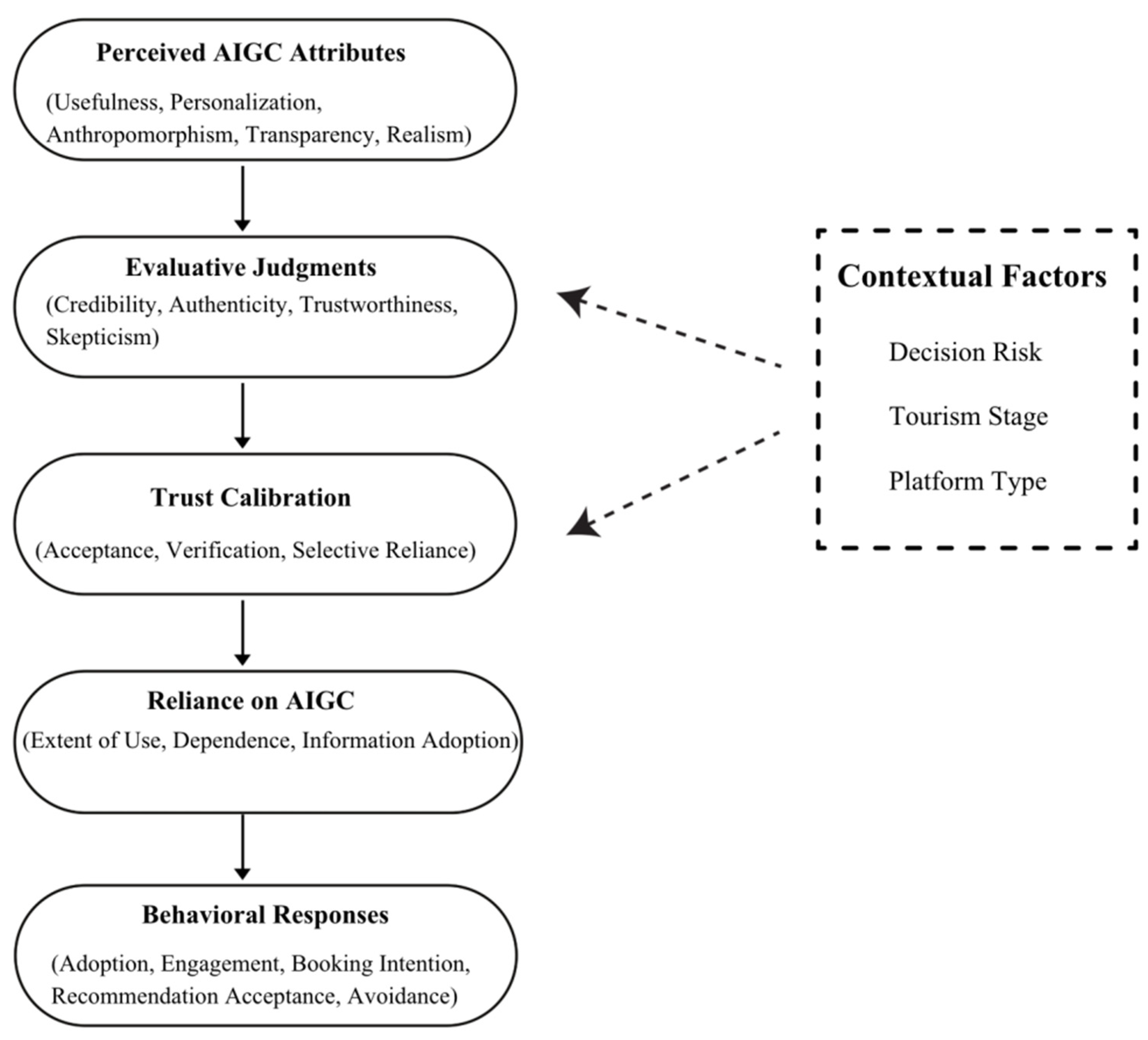
Accordingly, the framework proposes an attribute–evaluation–trust calibration–response sequence that provides a structured basis for synthesizing the literature. Importantly, this sequence is not intended as a rigid causal model, but as an integrative process lens that captures how different strands of research relate to one another. By linking AIGC attributes, evaluative judgments, trust dynamics, and behavioral outcomes, the framework addresses the fragmentation identified in prior studies. It enables a more coherent explanation of tourist responses to AIGC.
In this sense, the framework serves both as a coding structure for organizing the reviewed studies and as a conceptual bridge between the literature review and the subsequent analysis. It allows the review to move beyond descriptive mapping toward a more integrated understanding of how tourists evaluate AIGC as a dynamic, context-sensitive process. The proposed framework is illustrated in Figure 1, which represents the central theoretical contribution of this review by integrating previously fragmented constructs into a unified process-oriented model of tourist evaluation and response.

3. Methodology

3.1. Review Design

This study adopts a systematic literature review (SLR) approach to ensure a transparent, rigorous, and replicable synthesis of existing research on AI-generated content in tourism and hospitality. This systematic review was conducted in accordance with the Preferred Reporting Items for Systematic Reviews and Meta-Analyses (PRISMA 2020; File S1) guidelines to enhance transparency and methodological rigor throughout the review process. The review was not prospectively registered in a public review registry. The review process follows established SLR procedures, including structured database selection, predefined inclusion and exclusion criteria, and systematic screening and analysis of relevant studies. A systematic review is appropriate because the literature on tourism AIGC has expanded rapidly but remains fragmented across contexts, constructs, and methodological approaches. Existing studies examine a wide range of issues, including AI-generated destination content, conversational travel assistance, recommendation environments, authenticity, trust, transparency, adoption, and behavioral responses, yet these contributions are not sufficiently integrated into a coherent explanation of how tourists evaluate and use AI-generated content [18,19,38]. The aim of the present review is therefore not only to summarize prior work, but also to organize an emergent field around the evaluative processes through which tourists interpret, trust, and rely on AIGC.
The review focuses specifically on consumer-facing AIGC rather than on AI applications in tourism more broadly. This scope follows the conceptual distinction outlined in Section 2, treating AIGC as a communicative and representational output encountered by tourists through digital interfaces rather than as a back-end operational system. Accordingly, the review examines how prior studies have addressed AIGC attributes, tourist evaluation, trust and reliance, authenticity, and downstream behavioral responses in tourism and hospitality settings [1,2,4,16].
Methodologically, the review follows a structured process involving database searching, study selection, staged screening, data extraction, and qualitative synthesis. The review is informed by established guidance on literature review design and reporting, with emphasis on transparency, replicability, and conceptual clarity [18,19]. This review design is also consistent with broader guidance on the purpose, structure, and methodological positioning of review articles in management and business research [39,40]. Because the included studies vary considerably in research design, context, and theoretical framing, the analytical strategy is interpretive rather than meta-analytic. The review, therefore, combines systematic identification procedures with descriptive mapping and thematic synthesis in order to clarify how tourist responses to AIGC have been conceptualized and examined across the literature. This approach enables a comprehensive yet structured synthesis of a rapidly evolving and conceptually diverse research field, supporting the development of an integrated process-oriented understanding of tourist evaluation and reliance on AIGC.

3.2. Search Strategy and Selection Criteria

The literature search was conducted using Scopus and the Web of Science Core Collection (WoS) as the two primary databases. These databases were selected because they provide broad coverage of high-quality, peer-reviewed publications across tourism, hospitality, marketing, information systems, and related interdisciplinary fields in which research on AI-generated content is currently emerging [41]. Their use is also consistent with prior review-based work in tourism and hospitality research [18,19,38], thereby supporting the rigor and comparability of the review.
The search strategy was designed to identify studies addressing generative AI content and closely related consumer-facing manifestations within tourism and hospitality settings. To do so, the search string combined two groups of terms: one related to AIGC and generative AI, and the other related to tourism and hospitality contexts. The AIGC-related terms included “AI-generated content,” “AIGC,” “generative AI,” “GenAI,” and “ChatGPT,” reflecting the range of labels currently used in the literature. These were paired with tourism-related terms such as “tourism,” “travel,” and “hospitality” to anchor the search in the focal domain.
The representative search string was as follows:
(“AI-generated content” OR “AIGC” OR “generative AI” OR “GenAI” OR “ChatGPT” OR “large language model” OR “LLM” OR “AI-generated image” OR “AI-generated video” OR “conversational AI” OR “multimodal AI”) AND (“tourism” OR “travel” OR “hospitality” OR “destination” OR “hotel” OR “tourist”).
The expanded terms were used to avoid over-reliance on ChatGPT as a single entry point and to capture broader forms of consumer-facing AIGC, including text-based, conversational, visual, video-based, and multimodal outputs.
The search was applied to titles, abstracts, and keywords/topic fields, depending on the database interface. The search period was limited to the period between January 2023 and March 2026, corresponding to the period in which consumer-facing generative AI became prominent in tourism and hospitality scholarship. The strategy was intentionally inclusive at the identification stage to account for the evolving and overlapping terminology in this emerging field. Terms such as “ChatGPT” were included not to restrict the review to a specific tool, but because they frequently serve as entry points for broader forms of generative AI in tourism and hospitality research [1,2]. In this review, “ChatGPT” was used as a search keyword rather than as software for screening, coding, or analysis; therefore, no specific ChatGPT version was used in the review process.
To ensure conceptual consistency, explicit inclusion and exclusion criteria were applied. Studies were included if they met all of the following conditions:
(1) They were peer-reviewed journal articles;
(2) They addressed consumer-facing or consumer-relevant forms of AIGC, such as AI-generated text, images, videos, chatbot outputs, recommendation summaries, or related generated tourism content;
(3) They were situated in tourism, travel, or hospitality contexts; and
(4) They examined at least one concept relevant to the review’s analytical focus, including tourist evaluation, credibility, trust, authenticity, reliance, verification, recommendation acceptance, or related behavioral responses.
Only studies published in English were included.
Studies were excluded if they focused solely on back-end AI systems such as pricing, forecasting, operational optimization, or logistics without direct consumer exposure to generated content; if they were purely technical or engineering-oriented without substantive discussion of tourist interpretation or response; if they were situated in non-tourism contexts; or if they were non-peer-reviewed outputs such as conference abstracts, editorials, dissertations, book reviews, or book chapters. In addition, studies that mentioned AI only incidentally or referred to it in a broad sense without substantive engagement with generative content were excluded.
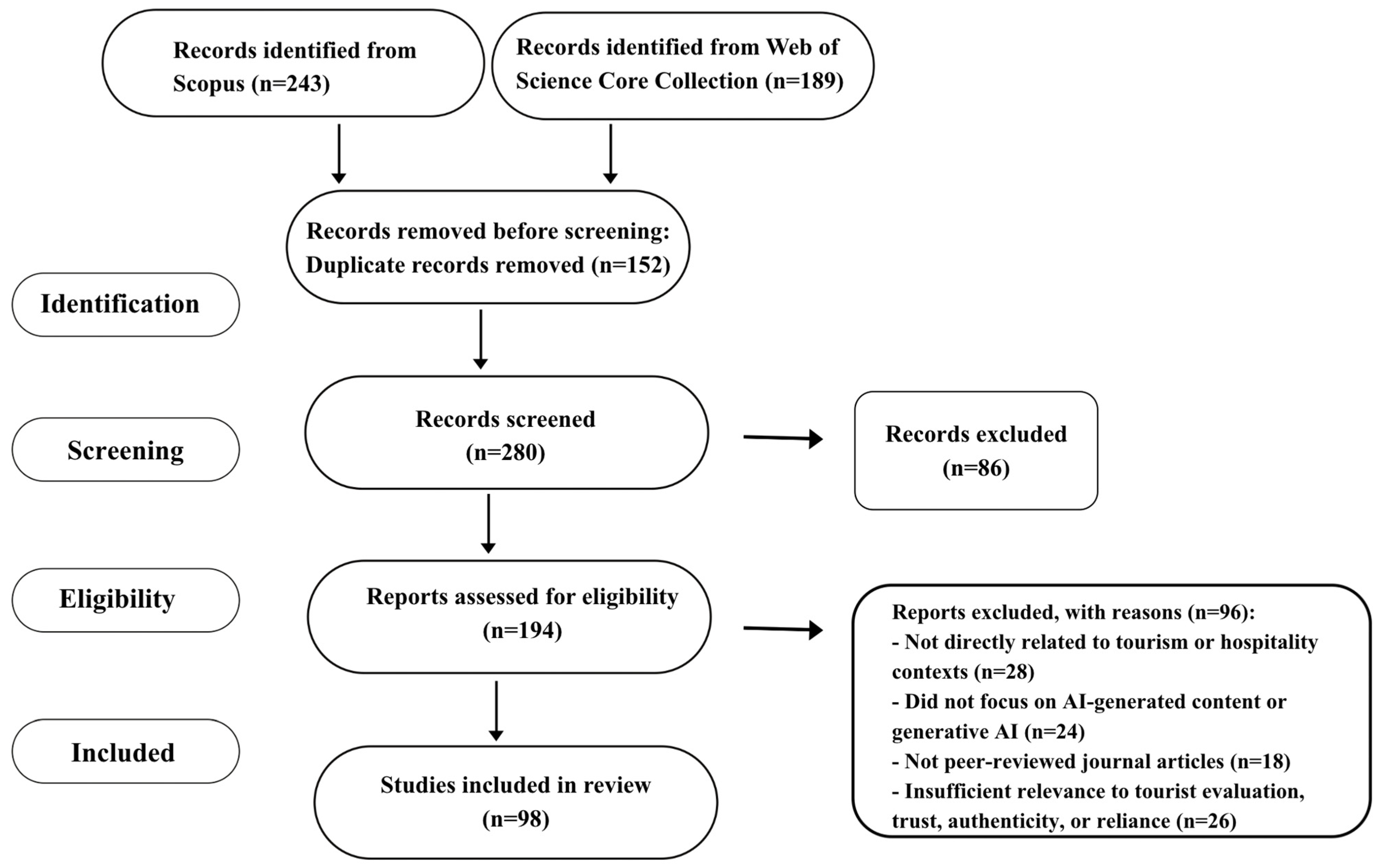
Using this search strategy and selection logic, the database search identified 243 records from Scopus and 189 records from the Web of Science Core Collection, yielding 432 records in total. The key elements of the search process, along with the inclusion and exclusion criteria applied in the review, are summarized in Table 1.

3.3. Screening Process

The screening process followed a transparent and staged procedure to ensure consistency, replicability, and to reduce selection bias. Specifically, it was conducted in multiple stages, including title and abstract screening, full-text assessment, and final eligibility verification. Duplicate records identified across databases were removed prior to substantive screening. In total, 152 duplicate records were removed, leaving 280 records for title-and-abstract screening. The screening process was conducted in a staged and consensus-based manner. The first author conducted the initial title-and-abstract screening and full-text assessment. The second author then checked the inclusion and exclusion decisions, with particular attention to borderline cases. When eligibility was uncertain at the title-and-abstract stage, the record was retained for full-text assessment to reduce the risk of premature exclusion. Any disagreements or ambiguous cases were discussed by both authors until consensus was reached.
During the title-and-abstract screening stage, records were excluded when they clearly fell outside the tourism, travel, or hospitality domain; focused on non-generative AI technologies; addressed back-end or operational systems without consumer-facing generated outputs; or lacked substantive relevance to tourist evaluation, trust, authenticity, reliance, or related behavioral responses. Because terminology in this field remains evolving and sometimes inconsistent, records were retained for full-text assessment whenever the abstract suggested potential alignment with the study’s inclusion criteria. At this stage, 86 records were excluded, and 194 full-text articles were retained for eligibility assessment.
During the full-text screening stage, the retained articles were read in full and evaluated against the inclusion and exclusion criteria described above. Studies were excluded if they did not sufficiently address consumer-facing AIGC, if the tourism or hospitality context was too peripheral, if the article focused primarily on technical system design, or if the discussion of AI-generated content was too limited to support meaningful inclusion in the review. Following this stage, 96 articles were excluded, leaving 98 studies in the final sample.
The full screening workflow is summarized in Figure 2, which reports the number of records identified, duplicates removed, records screened, full-text articles assessed, full-text articles excluded, and studies included in the final review. The study selection process is presented in Figure 2 using a PRISMA-style flow diagram to enhance transparency and clarity in reporting the review procedure.
To improve reporting transparency and ensure consistency with the final review sample, Table 2 presents a summary of the 98 studies included in the systematic review, including authors, publication year, study title, journal/source, study characteristics, and corresponding reference numbers.

3.4. Coding and Synthesis

Following full-text screening, the final set of 98 eligible studies was subjected to structured data extraction and qualitative coding. The purpose of this step was to ensure that the subsequent synthesis was grounded in systematically recorded evidence rather than an impressionistic reading. For each included article, the extraction process recorded bibliographic information, the tourism or hospitality context, the type of AIGC examined, the theoretical framing, the research design, the sample characteristics, and the focal constructs.
To improve coding transparency and reliability, the coding process was conducted in two stages. First, the first author extracted descriptive information from all included studies, including publication year, research context, AIGC modality, theoretical lens, research design, focal constructs, and key findings. Second, the thematic coding categories were reviewed by both authors and refined through discussion. A pilot coding of a subset of included studies was used to check whether the coding categories were sufficiently clear, mutually understandable, and consistently applicable. Ambiguous cases, such as studies involving both conversational AI and recommendation outputs, were discussed until consensus was reached. Because the review adopted a qualitative thematic synthesis rather than a meta-analytic design, the emphasis was placed on transparent category development, consensus checking, and clear documentation of coding decisions.
The coding process was guided by the preliminary synthesis framework introduced in Section 2. Specifically, the review organized the literature around four broad analytical domains: (1) perceived AIGC attributes, (2) evaluative judgments, (3) trust and reliance calibration, and (4) behavioral responses. Within these domains, more specific codes were used to capture constructs such as usefulness, transparency, anthropomorphism, personalization, credibility, authenticity, skepticism, verification, recommendation acceptance, adoption, booking intention, and avoidance. The purpose of coding was not to impose a rigid model on the literature, but to provide a structured and comparable basis for analyzing how different studies conceptualize tourist responses to AIGC across contexts.
The analysis combined descriptive mapping with thematic synthesis to support both systematic organization and theoretical integration. First, the coded studies were examined descriptively to identify publication patterns, tourism contexts, AIGC modalities, research methods, sample profiles, and theoretical foundations. Second, thematic synthesis was used to identify recurring patterns in how prior research explains tourists’ evaluations of AIGC, particularly in relation to trust, authenticity, reliance, and downstream outcomes. Importantly, the synthesis process moved beyond descriptive aggregation to identify underlying conceptual linkages across studies, enabling the development of an integrated process-oriented understanding of tourist responses to AIGC. This approach enabled moving from a descriptive overview of the final sample to a more integrative account of how tourist responses to AIGC have been understood across the literature [18,19]. Table 3 presents the coding framework used to structure the descriptive analysis and thematic synthesis of the 98 included studies.

4. Results

4.1. Overview of the Literature

The final sample of 98 studies shows that research on consumer-facing AIGC in tourism and hospitality is relatively recent and rapidly expanding. Although earlier AI-in-tourism scholarship addressed automation, recommender systems, and smart tourism technologies more broadly, focused research on AIGC as a consumer-visible representational and decision-support phenomenon emerged only with the diffusion of generative AI tools, especially from 2023 onward [1,2,18]. Within the final sample, publications are concentrated in the period January 2023 to March 2026, indicating that tourism AIGC research is still in an early but fast-growing stage. This pattern suggests that the field has moved quickly from broad recognition of generative AI’s relevance to a more focused investigation of tourist evaluation, trust, the use of recommendations, authenticity, and behavioral responses.
Across the 98 studies, research is concentrated in several interrelated tourism and hospitality contexts. A substantial share of the sample examines destination representation and tourism marketing, where AIGC is used to generate destination narratives, promotional messages, tourism imagery, and video-based communication intended to shape pre-travel expectations and destination appeal [2,4,12]. A second major stream concerns trip planning and decision support, including itinerary generation, route planning, tourism information search, travel assistance, and recommendation-based decision-making [1,41,53,54,57,87,92,94]. A third cluster addresses platform-mediated review and recommendation environments, where AI-generated content coexists with user-generated reviews, expert recommendations, and interface-level signals that influence how tourists interpret and compare information sources [3,16]. A smaller but clearly growing stream concerns hospitality and service communication, including customer-facing support and AI-assisted interaction in hospitality settings [14,20,44,51,59,93,97,99].
The final sample also indicates that AIGC research in tourism is unevenly distributed across content modalities. Text-based AIGC remains the dominant form studied, including destination descriptions, recommendation texts, itinerary suggestions, AI-generated summaries, and chatbot responses [1,11,20,50,55,58,81,88]. A second group of studies focuses on AI-generated visual content, especially destination images and tourism videos, where issues such as vividness, realism, originality, trustworthiness, and authenticity become central [4,12,14,76]. A third stream addresses conversational and chatbot-based outputs that combine information provision with simulated interaction, recommendation behavior, and quasi-social guidance [1,15,16]. Compared with these three streams, multimodal and platform-integrated forms of AIGC remain less extensively examined, suggesting that the literature is still more developed for text-heavy and conversational applications than for fully integrated multimodal tourism interfaces.
With respect to research design, the final sample is methodologically diverse but increasingly concentrated in a limited set of dominant empirical approaches. Survey-based empirical studies are common, especially in work examining trust, usefulness, authenticity judgments, continuance intention, recommendation acceptance, and adoption-related responses [15,16]. Experimental and comparative designs are also increasingly prominent, particularly in studies comparing AI-generated with human-generated content or manipulating disclosure, transparency, and recommendation cues [3,13]. In addition, the final sample includes a smaller set of conceptual, review-based, and perspective-oriented contributions, which were especially important in the early stage of tourism AIGC scholarship because they framed the relevance of generative AI to tourism communication, marketing, service interaction, and governance implications [1,18,19,82,104]. Overall, the methodological profile of the sample shows stronger development in perception and stated intention than in observed, longitudinal, or behaviorally tracked reliance.
The sample profile also reveals that most studies rely on general categories such as tourists, travelers, customers, online users, or potential consumers rather than highly specialized tourism segments. Many studies examine responses to hypothetical or experimentally presented travel content rather than actual reliance behavior in real travel situations [1,15]. As a result, the literature currently provides stronger evidence on how tourists perceive and evaluate AIGC than on how they verify, accept, reject, or recalibrate their reliance during actual tourism journeys.
Theoretical foundations are similarly diverse but insufficiently integrated. Across the final sample, studies draw on perspectives related to trust and credibility, technology acceptance, anthropomorphism, authenticity and representation, and broader theories of consumer judgment and information processing [12,35,36,37]. While this diversity reflects the field’s interdisciplinary nature, it also suggests that cumulative explanation remains limited. In summary, the final sample portrays tourism AIGC research as a rapidly growing but still formative body of work, characterized by strong empirical momentum, concentration in a few dominant tourism contexts, and uneven conceptual integration. Table 4 summarizes the descriptive profile of the final sample and highlights the main publication, contextual, methodological, and theoretical patterns observed across the 98 reviewed studies.
While these patterns provide a descriptive overview of the field, they do not yet explain how tourist responses to AIGC unfold as a connected evaluative process. The following section, therefore, synthesizes the literature in line with the process-oriented framework proposed in Section 2.3.
To provide a more transparent and quantitative description of the reviewed dataset, the 98 included studies were further summarized by publication year, research context, AIGC modality, research design, and main construct/theme. Table 5 shows the quantitative profile of the final sample. The results indicate that the literature is concentrated in 2024 and 2025, while a smaller but visible number of studies appeared between January and March 2026. They also show that conversational, chatbot-based, and LLM-based AIGC remain the dominant modality, while visual, video-based, and multimodal forms of AIGC are still less frequently examined.
As shown in Table 5, more than half of the reviewed studies were published in 2025, confirming the rapid recent growth of AIGC-related tourism research. In terms of research context, recommendation and review environments represent the largest group, followed by trip planning and destination marketing. This pattern suggests that current research is concentrated in contexts where tourists actively compare information, evaluate recommendations, or form pre-travel expectations. Representative studies in these contexts include trip planning and decision-support research [43,46,53,57,65,77], recommendation and review-related studies [22,28,47] and destination marketing or representation studies [45,49,60]. Hospitality and service communication studies also form a visible substream, covering hotel review management, guest communication, customer-facing AI support, and hospitality loyalty or service-recovery issues [24,25,44,59,68,97,99]. The modality distribution further shows the dominance of conversational, chatbot, and LLM-based AIGC, whereas visual, video-based, and multimodal AIGC remain comparatively underexplored. This pattern is reflected in studies of chatbot-based travel assistance and decision-making [5,9,54,56,66], as well as a smaller but growing body of work on visual, video-based, and broader multimodal or framework-oriented applications [4,14,18,62,76]. Methodologically, the sample contains a substantial number of qualitative, mixed, review-based, conceptual, and perspective-oriented studies, indicating that the field is still developing its conceptual and methodological foundations. This is also evident in the presence of conceptual, framework-building, and perspective-oriented studies that address broader issues of responsible AI, authenticity, branding, and tourism governance [18,19,33,67,82,104]. The most frequently coded themes are adoption, intention, experience, engagement, personalization, recommendation, trust, and credibility, while reliance, verification, transparency, and authenticity remain less extensively examined.

4.2. Integrative Synthesis

Building on the process-oriented framework proposed in Section 2.3, the reviewed literature can be synthesized as a sequence through which tourists interpret, evaluate, and respond to consumer-facing AIGC in tourism contexts. Specifically, perceived AIGC attributes serve as initial cues that shape evaluative judgments, which, in turn, inform trust calibration and ultimately guide behavioral responses under specific contextual conditions.

4.2.1. Perceived AIGC Attributes as Evaluative Cues

A consistent pattern across the reviewed literature is that tourists do not respond to AIGC as an undifferentiated technological output. Instead, they attend to specific attributes that shape their initial interpretation of the content, its production, and whether it warrants further consideration. These attributes function as early-stage perceptual cues that precede broader judgments of credibility, authenticity, trustworthiness, and reliance.
One important group of attributes concerns perceived competence, usefulness, and informational adequacy. AIGC is often evaluated on whether it appears knowledgeable, coherent, contextually relevant, and capable of providing useful tourism information [1,3,11]. In tourism settings, where travelers often seek concise yet actionable guidance, content that appears structured, specific, and situationally relevant may be granted greater initial legitimacy before factual verification.
A second set of attributes relates to anthropomorphism, humanness, and social presence, especially in conversational or recommendation-oriented settings. These cues matter because they influence whether tourists interpret AIGC as merely a functional tool or as a source capable of providing advice, empathy, guidance, and quasi-social communication [1,15,16]. Studies on AI-mediated recommendation and travel planning suggest that such cues can increase engagement and acceptance. However, they may also alter the basis on which tourists assign credibility and responsibility to the generated output.
A third cluster concerns transparency, disclosure, and explainability. These are not simple message characteristics; rather, they shape the interpretive conditions under which AIGC is encountered. Tourists may use disclosure labels and transparency cues to determine whether content is AI-generated, how accountable the source appears to be, and whether additional scrutiny is warranted [16,17]. The reviewed studies suggest that such cues do not operate uniformly. In some circumstances, they increase perceived honesty and control; in others, they trigger skepticism or concern about synthetic persuasion.
Finally, the literature suggests that surface fluency and representational richness are influential in tourism contexts. Tourists often respond to how polished, vivid, emotionally evocative, or realistic AIGC appears, using these cues as proxies for informational quality or source capability [4,12,14]. These findings indicate that the literature indicates that AIGC attributes can be broadly grouped into competence-related, social-source, and visibility-related categories. These perceived attributes matter because they form the basis for tourists’ progression from initial exposure to more consequential judgments about whether AI-generated content is believable, dependable, and worthy of decision weight. These attributes do not directly determine behavioral outcomes; rather, they function as heuristic cues that initiate the evaluative processes through which tourists assess credibility, authenticity, and trustworthiness.

4.2.2. Evaluative Judgments: Credibility and Authenticity

At this stage, tourists move from initial perception to interpretive evaluation, assessing whether AIGC is both credible and experientially authentic. While credibility relates to informational reliability and believability, authenticity reflects the extent to which content appears genuine, contextually appropriate, and experientially meaningful. The reviewed literature suggests that AIGC is typically evaluated through both dimensions simultaneously, although they do not always align.
A central theme in the literature is representational fit. Tourists appear sensitive to whether AI-generated narratives, visuals, or itineraries correspond with their expectations of a destination or experience. Content may be judged inauthentic when it appears overly polished, generic, culturally flattened, or detached from the local specificity of “real” tourism experiences [12,13]. In this sense, authenticity is closely tied to the perceived congruence between generated representations and imagined lived realities.
A second theme concerns source-related authenticity. Even when AIGC appears coherent and persuasive, tourists may question whether the content can be meaningfully attributed to a credible or experience-based source. This issue becomes particularly salient when AIGC simulates voice, storytelling, companionship, or travel guidance. Ambiguous authorship may weaken authenticity by making content appear detached from accountable or experiential sources, even when its informational value remains high [1,13].
The literature also indicates that evaluative judgments are modality-sensitive. Visual AIGC, such as destination images and videos, is often evaluated on realism, vividness, and potential exaggeration, raising concerns about fabricated authenticity or over-enhanced representations [4,12,14]. By contrast, text-based AIGC is more frequently assessed on narrative plausibility, contextual relevance, and recommendation credibility. These differences suggest that credibility and authenticity judgments are shaped not only by content quality but also by how content is presented and consumed.
Importantly, credibility and authenticity may reinforce one another in some cases but diverge in others. Content may be perceived as useful and credible without being experienced as authentic, or conversely, may appear emotionally engaging while lacking sufficient reliability for decision-making. This distinction helps explain why favorable evaluations do not necessarily translate into strong reliance on AIGC. Instead, these evaluative judgments serve as a basis for tourists’ subsequent calibration of their trust and reliance, as discussed in the following section.

4.2.3. Trust Calibration and Reliance Formation

Following evaluative judgments, tourists do not simply accept or reject AIGC; they dynamically calibrate their trust and reliance based on perceived risk, task relevance, and contextual cues. Drawing on insights from trust in automation research, trust is better understood as a context-sensitive and adaptive process rather than a static outcome [35,36].
Trust formation typically begins with assessments of competence, credibility, and informational adequacy. Tourists evaluate whether AIGC appears reliable enough to support planning, whether it demonstrates contextual understanding, and whether its outputs are coherent and actionable [1,3,16]. However, initial confidence does not automatically translate into unconditional reliance. Instead, tourists adjust their reliance based on the perceived stakes and uncertainties of the decision context.
A recurring pattern in the literature is the risk of reliance asymmetry, in which both overreliance and underreliance may occur. Overreliance may arise when highly fluent, personalized, or authoritative outputs reduce critical scrutiny, leading tourists to accept recommendations without sufficient verification. In contrast, underreliance may occur when tourists remain hesitant to assign decision weight to AI-generated content despite its potential utility [13,16]. These patterns highlight the importance of calibration rather than simple trust maximization.
Within this process, disclosure and transparency function as key calibration triggers. When tourists are informed that content is AI-generated, disclosure makes the artificial origin salient and prompts users to reinterpret the message, adjust expectations, and reconsider its reliability [16,17]. However, the effect of disclosure is not uniform. In some cases, it enhances perceived honesty and control; in others, it increases skepticism or concern about synthetic persuasion. Similarly, transparency and explainability help users manage uncertainty by providing insight into how outputs are generated, enabling more selective and context-dependent reliance.
The literature further suggests that trust calibration is co-produced through active verification behaviors. Tourists often cross-check AI-generated content against alternative sources, including reviews, official information, and prior knowledge, particularly as they move from exploratory stages to more consequential decisions, such as booking or destination selection [13,15,16]. These behaviors indicate that reliance is not passive, but actively constructed through ongoing evaluation and boundary-setting.
Overall, these findings suggest that trust in AIGC operates as a dynamic mechanism that mediates between evaluative judgments and behavioral responses. Rather than directly determining outcomes, trust calibration shapes the extent to which AIGC can exert influence on decision-making, thereby linking perceptions and evaluations to actual behavioral responses in tourism contexts.

4.2.4. Behavioral Responses and Contextual Conditions

The final stage of the process is reflected in behavioral responses, which represent how tourists act upon AIGC after evaluating its credibility, authenticity, and trustworthiness. The reviewed literature indicates that tourist evaluations of AIGC shape a range of downstream responses, from immediate engagement with content to more consequential decision-related behaviors. One prominent category concerns adoption- and use-related intentions, including willingness to interact with AIGC-enabled tools, to continue using AI-assisted travel services, or to accept AI-supported recommendations [15,16]. However, these adoption-oriented outcomes often capture only the most general level of response.
A second and more analytically significant category involves reliance-related responses. Reliance refers to the extent to which tourists allow AI-generated outputs to influence planning, evaluation, and final decision-making. It may take the form of accepting AI-generated itineraries, prioritizing AI recommendations over alternative sources, reducing the effort of information search, or incorporating generated content directly into booking or destination choice decisions [1,15]. The literature also highlights decision-support outcomes, such as increased decision confidence, reduced uncertainty, and greater perceived planning efficiency, as well as market-facing outcomes, including booking intention, visit intention, engagement, and acceptance of recommendations [4,16].
Importantly, downstream responses also include corrective and defensive behaviors, not only positive acceptance. These include verification, source comparison, selective task allocation, withdrawal of reliance, and avoidance of AI-generated recommendations, especially when content is perceived as misleading, manipulative, hallucinatory, or experientially inauthentic [13,16]. This suggests that tourists’ responses to AIGC should be understood through layered evaluative and behavioral processes rather than single measures of acceptance.
Across these findings, the literature consistently points to the importance of contextual moderators. Tourist responses to AIGC vary across decision stages, task risk, platform environments, content modalities, and consumer characteristics such as prior AI familiarity, digital literacy, and tourism expertise [15,16]. Governance and platform conditions also matter, especially where transparency, source accountability, and disclosure norms shape the legitimacy of AI-generated content. Table 6 presents a process-oriented synthesis of the reviewed literature, summarizing how perceived attributes, evaluative judgments, trust calibration, and behavioral responses are analytically connected. Taken together, these findings demonstrate that tourist responses to AIGC are best understood as a structured evaluative process rather than isolated reactions, thereby providing a foundation for the theoretical integration developed in the following discussion.

4.3. Modality-Specific Differences in Tourist Evaluation of AIGC

Although the reviewed studies are united by their focus on consumer-facing AIGC, the synthesis also shows that different AIGC modalities activate different evaluative concerns. Treating AIGC as a single homogeneous category risks obscuring important differences between text-based outputs, conversational agents, recommendation summaries, and visual or video-based content. Therefore, this section further differentiates the reviewed evidence by modality in order to clarify how tourist evaluation varies across forms of AIGC.
Text-based AIGC, including destination descriptions, itinerary suggestions, and AI-written travel information, is mainly evaluated through perceived usefulness, informativeness, coherence, and contextual relevance. In this modality, tourists appear to focus primarily on whether the generated content reduces search effort, supports planning, and provides sufficiently specific information for decision-making. However, text fluency can also create a risk of misplaced confidence when plausible language masks factual uncertainty or limited local knowledge.
Conversational and chatbot-based AIGC involves a more interactive evaluation process. Unlike static text, chatbot or LLM-based travel assistance is often assessed through responsiveness, perceived competence, social presence, and anthropomorphic cues. These features may strengthen engagement and provisional trust, but they may also blur the boundary between tool-like assistance and quasi-social advice. As a result, tourists may rely on conversational AIGC not only because the information appears useful, but also because the interaction feels responsive, personalized, and socially fluent.
Recommendation summaries and platform-based AIGC occupy a different evaluative position because they are often embedded within review, booking, or comparison environments. In these cases, tourists evaluate AIGC in relation to other information sources, such as user-generated reviews, expert advice, official destination information, or platform ratings. Reliance is therefore more comparative and selective. Tourists may use AI-generated summaries to simplify information overload, but they may still cross-check key claims before making high-commitment decisions such as booking, route selection, or destination choice.
Visual and video-based AIGC raises stronger concerns about authenticity, realism, and representational fit. Generated images and tourism videos may enhance destination appeal through vividness and esthetic quality, but they also create risks of over-idealization, cultural flattening, or representational distortion. Compared with text-based outputs, visual AIGC more directly shapes imagination, expectation formation, and destination image. This makes authenticity and local cultural specificity especially important evaluative criteria in visual and video-based tourism contexts.
These modality-specific patterns suggest that tourist evaluation of AIGC cannot be fully explained through a single general acceptance model. Text-based AIGC is often judged through usefulness and informational adequacy; conversational AIGC through responsiveness and social presence; recommendation summaries through comparison and verification; and visual or video AIGC through realism, authenticity, and representational appropriateness. This distinction strengthens the process-oriented framework by showing that the relative importance of perceived attributes, evaluative judgments, trust calibration, and reliance varies across AIGC modalities.

5. Discussion

5.1. Integrating the Findings

This study advances the literature on AI-generated content in tourism by demonstrating that tourist responses to consumer-facing AIGC are best understood as a connected evaluative process rather than as a set of isolated reactions. Across the final sample, tourists first attend to salient AIGC attributes, such as perceived competence, personalization, transparency, anthropomorphic cues, and representational richness, and then form broader judgments concerning credibility, authenticity, and trustworthiness. These judgments shape when, how, and to what extent AI-generated content is relied upon in tourism decision-making. In this sense, reliance is not simply an outcome of favorable perception but the practical expression of evaluation under conditions of uncertainty [16,35,36]. These findings support and extend the process-oriented framework proposed in Section 2.3, demonstrating that tourist responses to AIGC unfold through sequential and interdependent stages of attribute perception, evaluative judgment, trust calibration, and behavioral response.
This process-oriented interpretation helps explain why findings in the literature often appear mixed. The same AIGC output may generate positive behavioral responses when competence and experiential fit align, yet provoke skepticism when fluency is accompanied by weak transparency, low source clarity, or poor representational fit. Likewise, authenticity and trust may reinforce one another in some cases but diverge in others. Tourists may perceive AIGC as useful without regarding it as authentic, or may find it vivid and emotionally engaging without considering it reliable enough for consequential decisions [12,13,14]. The review, therefore, suggests that no single factor drives tourist response, but rather the configuration of content attributes, evaluative judgments, and contextual conditions that support calibrated reliance.
The findings also indicate that tourism is a particularly revealing context for studying AIGC because tourism consumption is both informational and symbolic. Tourists rely on mediated representations to reduce uncertainty, but they also use them to imagine places, experiences, and meanings before travel occurs. This makes the evaluation of AIGC in tourism more than a question of technological acceptance. It is also a question of whether generated content appears believable, experientially appropriate, and worthy of decision weight across different stages of the tourist journey [2,4,15]. In this respect, tourism highlights the broader importance of understanding AI-generated content not only as information but also as representation, persuasion, and quasi-social guidance.
More broadly, this process-oriented perspective extends existing research by shifting the focus from isolated constructs to the dynamic relationships through which tourist evaluation unfolds. Rather than treating attributes, trust, or authenticity as independent predictors of behavior, the findings suggest that these elements operate as interdependent stages within a broader evaluative process. This perspective contributes to a more integrated theoretical understanding of human–AI interaction in tourism. It highlights the need to conceptualize tourist responses as dynamic and context-dependent processes rather than static reactions.

5.2. Theoretical Implications

This study makes four main theoretical contributions to the literature on tourism and artificial intelligence, corresponding to the key stages of the process-oriented framework proposed in Section 2.3. Importantly, beyond consolidating prior findings, the review critically repositions existing AIGC research by identifying underlying conceptual fragmentation, theoretical inconsistencies, and methodological limitations that have constrained cumulative knowledge development in this emerging field.
First, at the attribute and evaluation stages, the review advances a process-based conceptualization of tourist evaluation of AIGC by shifting the focus from isolated constructs to the dynamic relationships through which responses unfold. Prior research has largely examined attributes, trust, authenticity, or behavioral outcomes as independent predictors of tourist response [15,16], resulting in a fragmented and variable-centered understanding of AIGC effects. In contrast, this review demonstrates that perceived AIGC attributes and evaluative judgments are analytically interconnected and operate as sequential stages within a broader evaluative process. By reframing tourist response as a progression from perceived attributes to evaluative judgments, the study not only integrates previously disconnected constructs but also challenges the prevailing tendency to treat AIGC effects as linear and static. This perspective contributes to the literature by advancing a more relational, process-oriented, and mechanism-based understanding of human–AI interaction in tourism contexts.
Second, at the trust calibration stage, the review reconceptualizes trust as a dynamic calibration mechanism rather than a static outcome. While prior studies often position trust as a favorable response or as part of adoption intention models [16], such approaches overlook the context-dependent and adaptive nature of trust in AI-mediated environments. The findings demonstrate that tourists actively regulate their reliance on AIGC in response to decision stakes, perceived risk, task relevance, and contextual cues. Drawing on trust in automation research [35,36], the concept of calibrated reliance captures both confidence and boundary-setting in the use of AI-generated content. This reconceptualization challenges static trust assumptions embedded in technology acceptance models and extends tourism research by emphasizing that trust is not merely accumulated, but continuously adjusted in response to situational demands and perceived uncertainty.
Third, within the evaluative judgment stage, the review further establishes authenticity as a distinct and indispensable analytical dimension in tourism AIGC research. Although credibility and trust have been widely examined, authenticity has often been treated as a secondary or context-specific construct [12,14], leading to conceptual ambiguity regarding its role in tourist evaluation. The findings demonstrate that tourists evaluate AIGC not only in terms of informational reliability but also in terms of whether the content appears genuine, contextually appropriate, and experientially meaningful. Crucially, authenticity may align with or diverge from credibility, which helps explain inconsistencies in prior findings where favorable perceptions do not translate into actual reliance. By explicitly distinguishing authenticity from credibility and trust, this review clarifies their respective roles and highlights the need for more theoretically precise treatment of evaluative constructs in tourism AIGC research.
Fourth, at the behavioral response stage, the review identifies reliance as the critical bridge between evaluation and behavior, thereby extending beyond traditional adoption-based perspectives. Existing models frequently focus on willingness to use AIGC, but provide limited insight into how AI-generated outputs shape actual planning and decision-making processes [1,16]. By foregrounding reliance—defined as the extent to which tourists allow AIGC to influence their judgments and actions—the study shifts attention from general acceptance to context-dependent use. This distinction is particularly important in tourism, where the appropriateness of reliance varies across decision stages and risk levels. The findings therefore challenge the assumption that adoption implies usage equivalence and instead emphasize selective, staged, and calibrated engagement with AIGC.
The synthesis therefore shows that these contributions extend the literature on tourism AIGC by offering a more integrated, process-oriented, and context-sensitive theoretical framework. More importantly, the review highlights that existing research has been constrained by static conceptualizations, fragmented constructs, and limited attention to dynamic evaluative processes. Addressing these limitations provides a stronger foundation for future empirical research examining how these mechanisms operate across different tourism contexts, technologies, and user groups. In doing so, the study contributes to advancing a more dynamic, mechanism-based, and context-sensitive understanding of tourist–AIGC interaction.
Table 7 summarizes the main trust calibration mechanisms identified across the reviewed studies. However, while Table 7 provides a structured synthesis of trust calibration mechanisms, it remains primarily descriptive and does not fully capture the dynamic interactions, contextual contingencies, and theoretical tensions underlying tourist reliance on AIGC. To address this limitation, this study advances a critical research agenda framework that integrates existing insights with future research directions.
However, while Table 5 provides a structured synthesis of trust calibration mechanisms identified in the literature, it remains primarily descriptive and reflects a broader limitation within existing AIGC research, namely a tendency to catalog mechanisms without sufficiently theorizing their dynamic interactions, contextual contingencies, and underlying conceptual tensions. As a result, current knowledge remains fragmented and lacks a coherent framework for explaining how these mechanisms jointly shape tourist reliance on AIGC.
To address these limitations, this study advances a critical research agenda framework that moves beyond descriptive synthesis to systematically identify key theoretical gaps, unresolved tensions, and priority areas for future research.
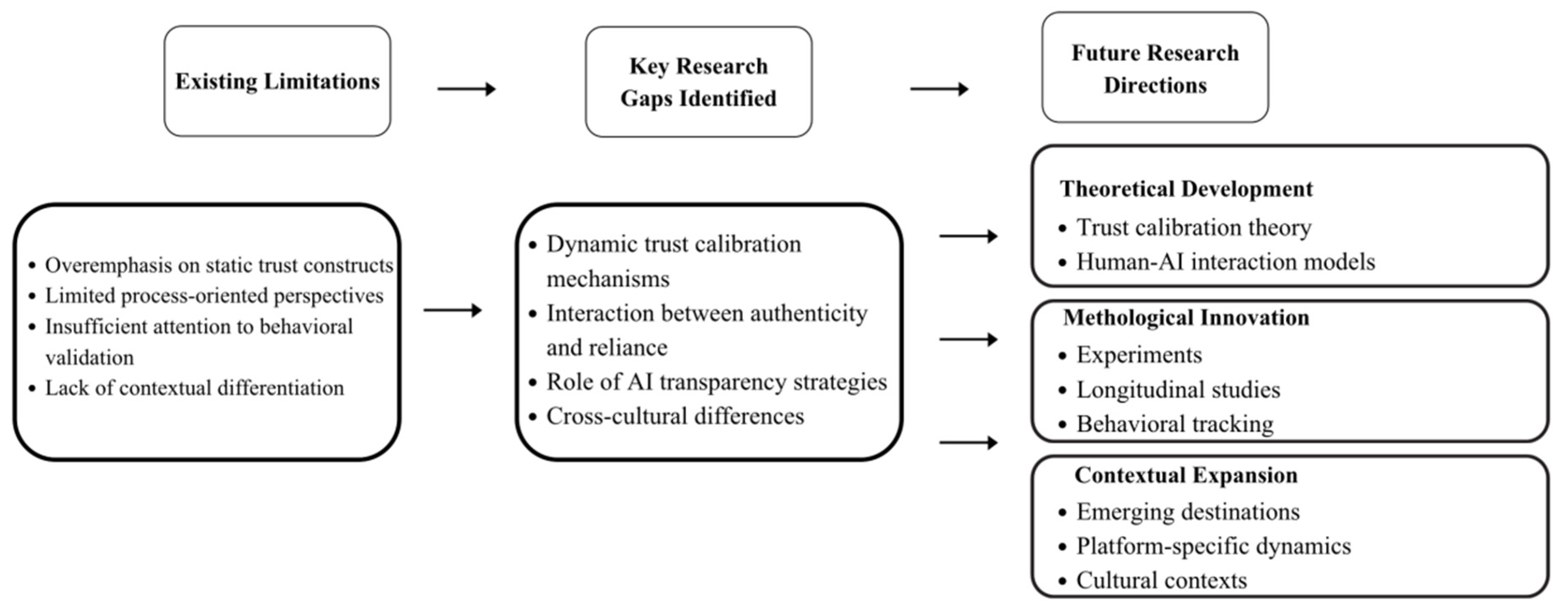
Figure 3 summarizes the main research agenda emerging from the review, focusing on theoretical clarification, methodological development, and contextual expansion in tourism AIGC research. Rather than merely summarizing prior findings, the framework repositions current knowledge by identifying how key mechanisms remain under-theorized, weakly integrated, and insufficiently examined across different decision contexts.
Specifically, the framework highlights the need to move beyond static and adoption-oriented perspectives toward dynamic, process-oriented, and context-sensitive approaches that better capture how tourists interpret, evaluate, and rely on AI-generated content. It further emphasizes three priority directions for advancing the field: (1) theory development to refine conceptual clarity and integrate fragmented constructs, (2) methodological innovation to capture temporal and behavioral dynamics, and (3) contextual expansion to address variations across platforms, cultures, and tourism settings.
By linking identified limitations to concrete research directions, the framework provides a theoretically grounded and forward-looking roadmap that contributes to both conceptual advancement and empirical development in tourism AIGC research.

5.3. Practical Implications

The review also has practical implications for tourism platforms, destination marketers, and hospitality managers. First, organizations using AIGC should not assume that fluency, speed, and personalization automatically generate trust. While these attributes can increase engagement and perceived usefulness, they may also heighten the risk of overreliance or skepticism if tourists perceive the content as overly synthetic, weakly grounded, or insufficiently transparent [13,16]. Tourism organizations should therefore evaluate AIGC not only for persuasive effectiveness, but also for credibility, authenticity, and suitability to the decision task.
Second, the findings suggest that disclosure, transparency, and explainability should be designed strategically rather than treated as generic compliance features. In some contexts, disclosure may enhance legitimacy by making AI involvement visible; in others, it may trigger suspicion, undermine perceived authenticity, or increase resistance. This means that AIGC design should align with task risk, the platform environment, and user expectations. For example, low-risk inspiration contexts may tolerate lighter disclosure, whereas recommendation, route planning, or booking-related contexts may require stronger transparency and easier opportunities for verification [16,17].
Third, the review indicates that AIGC may be most useful when positioned as decision support rather than decision replacement. Tourism businesses should consider where AI-generated outputs are appropriate for inspiration, search support, summarization, itinerary generation, or hospitality communication, while preserving opportunities for cross-checking and human oversight in higher-risk decisions. This is particularly relevant for destination marketing interfaces, recommendation environments, and hospitality communication systems, where responsible use of AIGC depends on balancing convenience with credibility and experiential fit [3,4,15]. From a sustainability practice perspective, the findings suggest that destination organizations, tourism platforms, and hospitality providers should not treat AIGC only as a marketing efficiency tool. Instead, AIGC should be governed as part of responsible and sustainable digital tourism communication. This requires clear AI disclosure, careful verification of generated claims, attention to cultural and destination authenticity, and mechanisms that help tourists distinguish between inspirational content and decision-critical information. Such practices can reduce misinformation, support informed tourist choices, and strengthen the role of AIGC as a tool for sustainable tourism development.

5.4. Limitations and Future Research

This review has several limitations. First, it focuses specifically on consumer-facing AIGC in tourism and hospitality, meaning that broader AI applications in forecasting, operations, revenue management, or back-end service systems fall outside its scope. Second, the review is limited to English-language peer-reviewed journal articles and therefore does not capture conference papers, industry reports, or non-English publications that may also contribute to this developing field. Third, because the literature remains recent and methodologically uneven, the synthesis reflects a body of work that is still consolidating in terms of theory, methods, and terminology.
Beyond these scope-related constraints, the review also reveals deeper structural limitations within the existing literature, including fragmented conceptualizations, limited process-oriented theorization, and a reliance on cross-sectional and perception-based evidence. These limitations indicate that current knowledge remains insufficiently equipped to explain how tourists dynamically evaluate and rely on AIGC in real-world decision contexts.
Building on the critical research agenda framework proposed in Figure 3, future research should therefore move beyond incremental extensions of existing constructs and instead address the underlying theoretical and empirical gaps shaping this field.
First, future research should explicitly examine evaluative tensions and trade-offs inherent in AIGC use. Existing studies often treat constructs such as credibility, authenticity, usefulness, and trust as independent and uniformly positive drivers of response. However, the findings of this review suggest that these dimensions may interact in complex and sometimes conflicting ways. In particular, tensions such as credibility versus authenticity, fluency versus accuracy, and personalization versus perceived manipulation require systematic investigation. Examining these tensions would allow future research to move beyond linear models toward a more nuanced understanding of how AIGC simultaneously generates both value and risk in tourism decision-making. A particularly important theoretical tension concerns AI fluency and local cultural authenticity. Generative AI can produce highly fluent, persuasive, and esthetically appealing tourism content, but such fluency does not necessarily indicate cultural accuracy, place specificity, or experiential authenticity. Future research should therefore examine when AI-generated narratives, images, or videos enhance destination imagination and when they flatten local meanings, reproduce generic representations, or weaken tourists’ sense of place-based authenticity. This issue is especially important for cultural, heritage, and emerging destinations, where tourism representation is closely connected to local identity, symbolic meaning, and visitor expectations. Future research should also differentiate more clearly among AIGC modalities. Text-based travel advice, conversational chatbots, AI-generated review summaries, synthetic destination images, and AI-generated videos may trigger different forms of evaluation, skepticism, and reliance. For example, text-based AIGC may mainly raise concerns about usefulness and factual accuracy, whereas visual and video-based AIGC may more directly shape destination image, perceived realism, and authenticity judgments. Treating these modalities as a single category may obscure important differences in how tourists evaluate, trust, verify, or resist AI-generated tourism content.
Second, more attention is needed to trust calibration as a dynamic and context-dependent mechanism. Rather than conceptualizing trust as a static outcome, future studies should investigate how trust evolves across different decision stages and how tourists regulate reliance through verification, comparison, and selective use. Longitudinal and process-tracing approaches would be particularly valuable in capturing how reliance is formed, adjusted, and reassessed over time, especially in high-stakes tourism decisions such as booking and destination choice.
Third, the field would benefit from methodological diversification and stronger behavioral evidence. Much of the current literature relies on survey-based and intention-focused designs, which provide limited insight into actual usage and decision behavior. Future research should incorporate experimental, longitudinal, and real-world data approaches, including behavioral tracking, field studies, and platform-based analytics, to better capture how tourists interact with AIGC in practice rather than in hypothetical settings.
Fourth, future research should expand its focus on contextual and boundary conditions. Tourist responses to AIGC are likely to vary across platform environments, destination types, travel purposes, and user characteristics such as AI familiarity, digital literacy, and tourism expertise. In addition, governance conditions, including transparency, disclosure practices, and platform regulation, are likely to shape how AIGC is interpreted and relied upon. Systematic examination of these contextual factors would help move the field beyond generalized claims toward a more precise understanding of when and how AIGC supports or undermines tourism decision-making.
Taken together, these directions suggest that future research should move toward a more integrative, mechanism-based, and context-sensitive research agenda. By linking evaluative tensions, trust calibration processes, methodological innovation, and contextual variability, the proposed framework provides a theoretically grounded roadmap for advancing tourism AIGC research beyond descriptive synthesis toward cumulative theory-building and robust empirical testing.

5.5. Summary

This review synthesized the emerging literature on consumer-facing AIGC in tourism and hospitality by focusing on four linked elements: perceived AIGC attributes, evaluative judgments, trust and reliance calibration, and downstream behavioral responses. The findings show that tourist response to AIGC is not a simple matter of acceptance or rejection. Rather, it is a layered process in which tourists interpret generated content, assess its credibility and authenticity, calibrate their trust, and decide whether and to what extent to rely on it under specific contextual conditions.
Overall, the review suggests that AIGC has become an increasingly important part of the tourism information environment, but that its effects depend on the alignment among content attributes, user expectations, platform cues, and decision demands. By clarifying these relationships, the study contributes to a more coherent understanding of how tourists respond to AI-generated tourism content and provides a foundation for future theory development and empirical research in this rapidly evolving domain. Importantly, the review also highlights that AIGC can contribute to sustainable digital tourism when it is used transparently, responsibly, and in ways that support authentic destination representation and informed tourist decision-making.

Supplementary Materials

The following supporting information can be downloaded at: https://www.mdpi.com/article/10.3390/su18126149/s1, File S1: PRISMA 2020 checklist [110].

Author Contributions

Conceptualization, Y.S. and N.H.B.Z.; methodology, Y.S.; formal analysis, Y.S.; investigation, Y.S.; data curation, Y.S.; writing—original draft preparation, Y.S.; writing—review and editing, Y.S. and N.H.B.Z.; supervision, N.H.B.Z.; project administration, Y.S. All authors have read and agreed to the published version of the manuscript.

Funding

This research received no external funding.

Data Availability Statement

No new data were created or analyzed in this study. Data sharing is not applicable to this article.

Conflicts of Interest

The authors declare no conflicts of interest.

References

  1. Wong, I.A.; Lian, Q.L.; Sun, D. Autonomous travel decision-making: An early glimpse into ChatGPT and generative AI. J. Hosp. Tour. Manag. 2023, 56, 253–263. [Google Scholar] [CrossRef] [Scilit]
  2. Zhang, Y.; Prebensen, N.K. Co-creating with ChatGPT for tourism marketing materials. Ann. Tour. Res. Empir. Insights 2024, 5, 100124. [Google Scholar] [CrossRef] [Scilit]
  3. Guttentag, D.A.; Litvin, S.W.; Teixeira, R. Human vs. AI: Can ChatGPT improve tourism product descriptions? Curr. Issues Tour. 2025, 28, 3601–3619. [Google Scholar] [CrossRef] [Scilit]
  4. Seo, I.T.; Liu, H.; Li, H.; Lee, J.S. AI-infused video marketing: Exploring the influence of AI-generated tourism videos on tourist decision-making. Tour. Manag. 2025, 110, 105182. [Google Scholar] [CrossRef] [Scilit]
  5. Kim, M.; Lee, S.M. ChatGPT as a digital dining companion: Examining AI perceptions and consumer loyalty in restaurant recommendations. Int. J. Hum. Comput. Interact. 2026, 1–24. [Google Scholar] [CrossRef] [Scilit]
  6. Choi, J.; Kwon, O. Impact of socio-economic characteristics on the use and effectiveness of generative AI in the tourism sector: The digital divide perspective. J. Smart Tour. 2025, 5, 82–94. [Google Scholar] [CrossRef] [Scilit]
  7. Chakraborty, D. Revolutionizing travel: The impact of generative AI on personalization and efficiency in the tourism industry. Indian J. Mark. 2024, 54, 8–24. [Google Scholar] [CrossRef] [Scilit]
  8. Chen, M.Y.; Kuo, F.K.; Hsiao, K.L. From content to conversation: Explaining adoption of on-device generative AI tour guides. Int. J. Hum. Comput. Interact. 2025, 1–19. [Google Scholar] [CrossRef] [Scilit]
  9. Bouziane, K.; Bouziane, A. Facilitating cross-cultural translation with ChatGPT in Moroccan travel agencies: A user satisfaction study. EDPACS 2026, 71, 1–19. [Google Scholar] [CrossRef] [Scilit]
  10. Paül i Agustí, D. The concentrated city: Effects of AI-generated travel advice on the spatial distribution of tourists. Urban Sci. 2025, 9, 268. [Google Scholar] [CrossRef] [Scilit]
  11. Zhang, J.J.; Wang, Y.W.; Ruan, Q.; Yang, Y. Digital tourism interpretation content quality: A comparison between AI-generated content and professional-generated content. Tour. Manag. Perspect. 2024, 53, 101279. [Google Scholar] [CrossRef] [Scilit]
  12. Bui, H.T.; Filimonau, V.; Sezerel, H. AI-thenticity: Exploring the effect of perceived authenticity of AI-generated visual content on tourist patronage intentions. J. Destin. Mark. Manag. 2024, 34, 100956. [Google Scholar] [CrossRef] [Scilit]
  13. Christensen, J.; Hansen, J.M.; Wilson, P. Understanding the role and impact of generative artificial intelligence (AI) hallucination within consumers’ tourism decision-making processes. Curr. Issues Tour. 2025, 28, 545–560. [Google Scholar] [CrossRef] [Scilit]
  14. Egger, R.; Yu, J. The impact of real-time hyper-personalisation in AI-generated tourism images. J. Hosp. Tour. Technol. 2026, 17, 761–778. [Google Scholar] [CrossRef] [Scilit]
  15. Park, Y.E.; Son, H. AI recommendation vs. crowdsourced recommendation vs. travel expert recommendation: The moderating role of consumption goal on travel destination decision. PLoS ONE 2025, 20, e0318719. [Google Scholar] [CrossRef] [Scilit] [PubMed]
  16. Wong, J.W.C.; Lai, I.K.W.; Lin, Y. The perceived reliability and adoption intention towards human-generated content vs. AI-generated content for travel planning: A moderating role of travel persona. J. Travel Tour. Mark. 2025, 42, 461–478. [Google Scholar] [CrossRef] [Scilit]
  17. Wang, Y.; Miao, H.; Xiong, M.; Wang, Y. Do word-of-mouth-based conversational AI recommendations enhance tourism consumers’ acceptance? The moderating role of transparency. Curr. Issues Tour. 2026, 29, 1936–1955. [Google Scholar] [CrossRef] [Scilit]
  18. Dogru, T.; Line, N.; Mody, M.; Hanks, L.; Abbott, J.A.; Acikgoz, F.; Assaf, A.; Bakir, S.; Berbekova, A.; Bilgihan, A. Generative artificial intelligence in the hospitality and tourism industry: Developing a framework for future research. J. Hosp. Tour. Res. 2025, 49, 235–253. [Google Scholar] [CrossRef] [Scilit]
  19. Carvalho, I.; Ivanov, S. ChatGPT for tourism: Applications, benefits and risks. Tour. Rev. 2024, 79, 290–303. [Google Scholar] [CrossRef] [Scilit]
  20. Han, H.; Kim, S.; Hailu, T.B.; Al-Ansi, A.; Loureiro, S.M.C.; Kim, J.J. ChatGPT use in hospitality and tourism: A multi-analytic approach. Asia Pac. J. Tour. Res. 2025, 30, 983–998. [Google Scholar] [CrossRef] [Scilit]
  21. Miao, L.; Yang, F.X. Text-to-image AI tools and tourism experiences. Ann. Tour. Res. 2023, 102, 103642. [Google Scholar] [CrossRef] [Scilit]
  22. Zhang, H.; Xiang, Z.; Zach, F.J. Generative AI vs. humans in online hotel review management: A task-technology fit perspective. Tour. Manag. 2025, 110, 105187. [Google Scholar] [CrossRef] [Scilit]
  23. Fan, N.; Li, X.; Liu, C.; Fan, Z.P. The power of AI-generated content: Evidence from the peer-to-peer accommodation market. J. Travel. Res. 2026, 65, 1519–1538. [Google Scholar] [CrossRef] [Scilit]
  24. Fakfare, P.; Manosuthi, N.; Lee, J.S.; Han, H.; Jin, M. Customer word-of-mouth for generative AI: Innovation and adoption in hospitality and tourism. Int. J. Hosp. Manag. 2025, 126, 104070. [Google Scholar] [CrossRef] [Scilit]
  25. Wang, P.Q. Personalizing guest experience with generative AI in the hotel industry: There’s more to it than meets a Kiwi’s eye. Curr. Issues Tour. 2025, 28, 527–544. [Google Scholar] [CrossRef] [Scilit]
  26. Tedjakusuma, A.P.; Kulachai, W. ChatGPT as a real-time travel companion: During-trip support and tourist satisfaction. Tour. Hosp. 2026, 7, 20. [Google Scholar] [CrossRef] [Scilit]
  27. Tedjakusuma, A.P.; Liu, L.W.; Eunike, I.J.; Silalahi, A.D.K. Rethinking information quality: How trust in ChatGPT shapes destination visit intentions. Tour. Hosp. 2025, 6, 178. [Google Scholar] [CrossRef] [Scilit]
  28. Park, J.E.; Fan, A.; So, K.K.F. Enhancing the effectiveness of generative AI travel recommendations: Balancing source credibility and cognitive load. J. Hosp. Tour. Res. 2025, 10963480251401822. [Google Scholar] [CrossRef] [Scilit]
  29. Wisker, Z.L.; Myshkina, I.; Alani, N.H. Trust, try, buy, and belong: How does AI create a loyalty loop in hotels? Tour. Hosp. 2025, 6, 276. [Google Scholar] [CrossRef] [Scilit]
  30. Kim, T.; Kim, M.J.; Promsivapallop, P. Investigating the influence of generative AI’s credibility and utility on travel consumer behaviour and recommendations through the lens of personal innovativeness. Curr. Issues Tour. 2025, 28, 2220–2224. [Google Scholar] [CrossRef] [Scilit]
  31. Seyfi, S.; Kim, M.J.; Lee, C.; Jo, Y.; Zaman, M. Exploring functional and psychological barriers to generative AI adoption for travel: A cross-cultural study. J. Travel Res. 2026, 65, 1567–1587. [Google Scholar] [CrossRef] [Scilit]
  32. Tunca, S.; Ersoy, A. Tripolar sentiment toward generative AI in hospitality marketing: Legitimacy, herd dynamics, and managerial implications. J. Hosp. Mark. Manag. 2026, 35, 287–317. [Google Scholar] [CrossRef] [Scilit]
  33. Singu, H.B.; Chakraborty, D.; Troise, C.; Camilleri, M.A.; Bresciani, S. Responsible AI for trustworthy tourism: A framework for mitigating ambiguity and anxiety with generative AI. Technol. Forecast. Soc. Change 2026, 223, 124407. [Google Scholar] [CrossRef] [Scilit]
  34. Zhu, S.; Song, M.; Duan, Y. Emotional arousal: How artificial intelligence-generated content influences tourism decision-making. Tour. Recreat. Res. 2025, 50, 1639–1650. [Google Scholar] [CrossRef] [Scilit]
  35. Lee, J.D.; See, K.A. Trust in automation: Designing for appropriate reliance. Hum. Factors 2004, 46, 50–80. [Google Scholar] [CrossRef] [Scilit] [PubMed]
  36. Hoff, K.A.; Bashir, M. Trust in automation: Integrating empirical evidence on factors that influence trust. Hum. Factors 2015, 57, 407–434. [Google Scholar] [CrossRef] [Scilit] [PubMed]
  37. Foroughi, B.; Vu, H.T.M.; Thaichon, P. Building trust for sustained generative AI travel adoption. Tour. Rev. 2026, 81, 718–754. [Google Scholar] [CrossRef] [Scilit]
  38. Rather, R.A. AI-powered ChatGPT in the hospitality and tourism industry: Benefits, challenges, theoretical framework, propositions and future research directions. Tour. Recreat. Res. 2025, 50, 652–662. [Google Scholar] [CrossRef] [Scilit]
  39. Palmatier, R.W.; Houston, M.B.; Hulland, J. Review articles: Purpose, process, and structure. J. Acad. Mark. Sci. 2018, 46, 1–5. [Google Scholar] [CrossRef] [Scilit]
  40. Snyder, H. Literature review as a research methodology: An overview and guidelines. J. Bus. Res. 2019, 104, 333–339. [Google Scholar] [CrossRef] [Scilit]
  41. Paul, J.; Criado, A.R. The art of writing a literature review: What do we know and what do we need to know? Int. Bus. Rev. 2020, 29, 101717. [Google Scholar] [CrossRef] [Scilit]
  42. Jin, J.H.; Han, J.S. A phenomenological study on the experience of searching for tourism information following the emergence of ChatGPT: Focused on the uncanny valley theory. Sustainability 2025, 17, 355. [Google Scholar] [CrossRef] [Scilit]
  43. Li, S.; Han, R.; Fu, T.; Chen, M.; Zhang, Y. Tourists’ behavioural intentions to use ChatGPT for tour route planning: An extended TAM model including rational and emotional factors. Curr. Issues Tour. 2025, 28, 2119–2135. [Google Scholar] [CrossRef] [Scilit]
  44. Jeong, N.; Lee, J. An aspect-based review analysis using ChatGPT for the exploration of hotel service failures. Sustainability 2024, 16, 1640. [Google Scholar] [CrossRef] [Scilit]
  45. Quintana Gómez, Á. Generative engine optimization (GEO) and brand visibility in AI-generated tourism recommendations: An exploratory analysis. Prism. Soc. 2026, 21–38. [Google Scholar] [CrossRef] [Scilit]
  46. Nicolau, J.L. When ChatGPT designs your trip: How GenAI adds a cognitive layer to smart tourism. J. Smart Tour. 2025, 5, 137–151. [Google Scholar] [CrossRef] [Scilit]
  47. Huang, G.I.; Wong, I.A.; Zhang, C.J.; Liang, Q. Generative AI inspiration and hotel recommendation acceptance: Does anxiety over lack of transparency matter? Int. J. Hosp. Manag. 2025, 126, 104112. [Google Scholar] [CrossRef] [Scilit]
  48. Zhao, H.; Yuan, B.; Liu, Y.; Liao, Y. Unlocking co-creation in travel: How generative AI sparks Aha moments and the behavioral outcome. J. Hosp. Tour. Manag. 2026, 66, 101396. [Google Scholar] [CrossRef] [Scilit]
  49. Li, C.; Cao, Q.; Hua, S.; Tao, C.W. When AI takes the wheel: The effectiveness of AI versus human-generated content in tourism marketing. J. Vacat. Mark. 2025, 13567667251393512. [Google Scholar] [CrossRef] [Scilit]
  50. Al-Romeedy, B.S.; Alharethi, T. ChatGPT as an emerging digital travel advisor: Insights into AI usefulness, usability, and consumer decision behavior. J. Theor. Appl. Electron. Commer. Res. 2025, 21, 6. [Google Scholar] [CrossRef] [Scilit]
  51. Abou-Shouk, M.; Abdelhakim, A.S.; Elgarhy, S.D.; Rabea, A.; Abdulmawla, M. ChatGPT usage intention for tourism and hospitality customers. Tour. Recreat. Res. 2026, 51, 533–550. [Google Scholar] [CrossRef] [Scilit]
  52. Han, H.; Kim, S.; Hailu, T.B.; Al-Ansi, A.; Loureiro, S.M.C.; Kim, J.J. Determinants of approach behavior for ChatGPT and their configurational influence in the hospitality and tourism sector: A cumulative prospect theory. Int. J. Contemp. Hosp. Manag. 2025, 37, 113–139. [Google Scholar] [CrossRef] [Scilit]
  53. Arora, N.; Manchanda, P.; Aggarwal, A.; Maggo, V. Tapping generative AI capabilities: A study to examine continued intention to use ChatGPT in travel planning. Asia Pac. J. Tour. Res. 2025, 30, 1303–1322. [Google Scholar] [CrossRef] [Scilit]
  54. Kim, J.H.; Kim, J.; Kim, C.; Kim, S. Do you trust ChatGPTs? Effects of the ethical and quality issues of generative AI on travel decisions. J. Travel Tour. Mark. 2023, 40, 779–801. [Google Scholar] [CrossRef] [Scilit]
  55. Xu, H.; Law, R.; Lovett, J.; Luo, J.M.; Liu, L. Tourist acceptance of ChatGPT in travel services: The mediating role of parasocial interaction. J. Travel Tour. Mark. 2024, 41, 955–972. [Google Scholar] [CrossRef] [Scilit]
  56. Kim, J.H.; Kim, J.; Park, J.; Kim, C.; Jhang, J.; King, B. When ChatGPT gives incorrect answers: The impact of inaccurate information by generative AI on tourism decision-making. J. Travel Res. 2025, 64, 51–73. [Google Scholar] [CrossRef] [Scilit]
  57. Luo, X.; Xu, D.; Li, Y.; Wan, L.C. Advancing information search through GenAI: The roles of search type, travel motive and GenAI customization level. Int. J. Contemp. Hosp. Manag. 2025, 37, 1725–1743. [Google Scholar] [CrossRef] [Scilit]
  58. Pham, H.C.; Duong, C.D.; Nguyen, G.K.H. What drives tourists’ continuance intention to use ChatGPT for travel services? A stimulus-organism-response perspective. J. Retail. Consum. Serv. 2024, 78, 103758. [Google Scholar] [CrossRef] [Scilit]
  59. Morosan, C. Evaluating generative AI’s role in enhancing hotel guests’ purchase intentions. Int. J. Hosp. Tour. Adm. 2026, 1–27. [Google Scholar] [CrossRef] [Scilit]
  60. Lv, L.; Liang, Y.; Chen, S.; Liu, G.G.; Liao, J. Good deeds deserve good outcomes: Leveraging generative artificial intelligence to reduce tourists’ avoidance of ethical brands embracing stigmatized groups. Ann. Tour. Res. 2025, 110, 103889. [Google Scholar] [CrossRef] [Scilit]
  61. Ali, W.; Kasturiratne, D.; Ameer, I.; Bhaskar, S. Generative AI in digital engagement: A quasi-experimental study of tourist sentiment. Serv. Ind. J. 2026, 1–31. [Google Scholar] [CrossRef] [Scilit]
  62. Yang, L.; Leung, X.Y.; Xiong, W. Authenticity in the age of generative AI: Reimagining host-guest relations in travel planning. J. Travel Res. 2026, 00472875261420609. [Google Scholar] [CrossRef] [Scilit]
  63. Seyfi, S.; Kim, M.J.; Nazifi, A.; Murdy, S.; Vo-Thanh, T. Understanding tourist barriers and personality influences in embracing generative AI for travel planning and decision-making. Int. J. Hosp. Manag. 2025, 126, 104105. [Google Scholar] [CrossRef] [Scilit]
  64. Jia, S.J.; Chi, O.H.; Chi, C.G. Unpacking the impact of AI vs. human-generated review summary on hotel booking intentions. Int. J. Hosp. Manag. 2025, 126, 104030. [Google Scholar] [CrossRef] [Scilit]
  65. De Cicco, R.; Francioni, B.; Dini, M.; Curina, I.; Filieri, R.; Cioppi, M. Generative AI and human advice: User perceptions, intentions, and behavior across pre-visit and on-site travel stages. J. Travel Res. 2025, 00472875251364222. [Google Scholar] [CrossRef] [Scilit]
  66. Raza, S.H.; Anwar, M.N.; Kumar, J.; Ogadimma, E.C.; Zaman, U.; Shah, A.A. Can smart mobile applications attract travellers? Exploring catenation between digital tourism entrepreneurs’ use of artificial intelligence generative chatbots for interactive marketing communication and virtual reality. J. Creat. Commun. 2025, 20, 383–401. [Google Scholar] [CrossRef] [Scilit]
  67. Loureiro, S.; Bilro, R.G.; Guerreiro, J.; Lee, M.J.; Han, H. ChatGPT coolness-desirable framework for tourism and hospitality. J. Travel Res. 2025, 00472875251380185. [Google Scholar] [CrossRef] [Scilit]
  68. Fakfare, P.; Manosuthi, N.; Lee, J.S.; Han, H.; Jin, M. Exploring the drivers of hospitality and tourism customer loyalty for generative artificial intelligence (AI): A multi-analytic approach. Curr. Issues Tour. 2025, 1–21. [Google Scholar] [CrossRef] [Scilit]
  69. Chakraborty, D. Generative AI (GAI) adoption in hotels and resorts: Understanding competitive advantage using longitudinal and multi-group study. Curr. Issues Tour. 2025, 1–20. [Google Scholar] [CrossRef] [Scilit]
  70. Zhao, H.; Yuan, B.; Zhang, B.; Liao, Y. Navigating generative AI use in tourism and hospitality: How trust and ethics shape human-machine information interaction of practitioners. Tour. Rev. 2026, 1–23. [Google Scholar] [CrossRef] [Scilit]
  71. Ali, L.; Ali, F.; Alotaibi, S. Beyond the hype: Evaluating the impact of generative AI on brand authenticity, image, and consumer behavior in the restaurant industry. Int. J. Hosp. Manag. 2025, 131, 104318. [Google Scholar] [CrossRef] [Scilit]
  72. Suasapha, A.H. Will generation Z use ChatGPT for tourism recommendations. Tour. Hosp. Manag. 2025, 31, 483–491. [Google Scholar] [CrossRef] [Scilit]
  73. Morini-Marrero, S.; Ramos-Henriquez, J.M.; Bilgihan, A. Analyzing the concordance and consistency of AI and human ratings in hospitality reviews. J. Hosp. Tour. Technol. 2025, 16, 937–965. [Google Scholar] [CrossRef] [Scilit]
  74. Kim, M.J.; Kang, S.E.; Hall, C.M.; Kim, J.S.; Promsivapallop, P. Unveiling the impact of ChatGPT on travel consumer behaviour: Exploring trust, attribute, and sustainable-tourism action. Curr. Issues Tour. 2025, 28, 1191–1196. [Google Scholar] [CrossRef] [Scilit]
  75. Saghier, E.G.; Selem, K.M.; Zekry, M.S. A user-centered design approach to GAI-powered mobile apps: Cognitive aspects of visitor awareness toward tourism activities. J. Hosp. Tour. Insights 2026, 9, 864–881. [Google Scholar] [CrossRef] [Scilit]
  76. Song, M.; Wang, Y.; Guo, R.; Law, R. When city landmarks meet AI design: The impact of AI painting on the travel intentions of consumers. Asia Pac. J. Tour. Res. 2025, 30, 1082–1102. [Google Scholar] [CrossRef] [Scilit]
  77. Seyfi, S.; Gorji, A.S.; Vo-Thanh, T.; Zaman, M. Travel virtual assistant or untrusted advisor? Developing a typology of resistance to AI-generated travel advice. Int. J. Tour. Res. 2025, 27, e70082. [Google Scholar] [CrossRef] [Scilit]
  78. Alizadeh, H.; Nazarpour Kashani, H.; Masoumi, F.; Yousefli, A.; Namazi, Y.; Saberian, H. Halal tourism and ChatGPT: The effect of value co-creation. J. Islam. Mark. 2026, 17, 2395–2419. [Google Scholar] [CrossRef] [Scilit]
  79. Battour, M.; Salaheldeen, M.; Anwar, I.; Ratnasari, R.T.; Hamid, A.A.; Mady, K. Integrating ChatGPT in halal tourism: Impact on tourist satisfaction, e-WoM and revisit intention. J. Islam. Mark. 2025, 16, 2781–2805. [Google Scholar] [CrossRef] [Scilit]
  80. Ren, R.; Xu, Y.; Yao, X.; Cole, S.T. Whose journey matters? Investigating identity biases in large language models (LLMs) for travel planning assistance. Curr. Issues Tour. 2025, 1–32. [Google Scholar] [CrossRef] [Scilit]
  81. Hassan, H.; Magdy, A. Building consumer trust in the ChatGPT’s era: Insights from the hospitality industry. Tour. Hosp. Res. 2025, 14673584251343264. [Google Scholar] [CrossRef] [Scilit]
  82. Mellors, J. ChatGPT and the tourist trail: Pathway to overtourism or sustainable travel? Curr. Issues Tour. 2025, 1–4. [Google Scholar] [CrossRef] [Scilit]
  83. Shen, H.; Yu, J. Beyond the screen: Navigating trans-parasocial relationships with AI travel influencers. J. Hosp. Tour. Res. 2025, 10963480251391402. [Google Scholar] [CrossRef] [Scilit]
  84. Bui, H.T.; Filimonau, V.; Sezerel, H. Exploring value co-creation and co-destruction between consumers and generative artificial intelligence (GAI) in travel. Tour. Manag. Perspect. 2025, 58, 101392. [Google Scholar] [CrossRef] [Scilit]
  85. Yhee, Y.; Koo, C. Seeing AI as human or machine? Effects of transparency, valence, and readability on review summary helpfulness. Tour. Manag. 2026, 113, 105305. [Google Scholar] [CrossRef] [Scilit]
  86. Koçak, B.B. How AI-generated messages impact consumer behavior in the tourism industry. J. Theor. Appl. Electron. Commer. Res. 2026, 21, 67. [Google Scholar] [CrossRef] [Scilit]
  87. Borrero-Domínguez, C.; Escobar-Rodríguez, T. Factors influencing ChatGPT adoption for trip planning. Tour. Manag. Stud. 2025, 21, 1–17. [Google Scholar] [CrossRef] [Scilit]
  88. Demir, M.; Demir, Ş.Ş. Is ChatGPT the right technology for service individualization and value co-creation? Evidence from the travel industry. J. Travel Tour. Mark. 2023, 40, 383–398. [Google Scholar] [CrossRef] [Scilit]
  89. Carvalho, I.; Loureiro, S.M.C.; Ivanov, S.; Björk, P.; Seyitoğlu, F. Beyond human touch: Evaluating the effectiveness of AI, human, and hybrid-generated tourism promotional texts. J. Hosp. Tour. Insights 2025, 8, 3804–3824. [Google Scholar] [CrossRef] [Scilit]
  90. Choi, H.; Park, E. ChatGPT and travel: Examining the relationship between choice attributes, positive emotions, satisfaction, and behavioral intention. Int. J. Tour. Res. 2026, 28, e70200. [Google Scholar] [CrossRef] [Scilit]
  91. Stergiou, D.P.; Nella, A. ChatGPT and tourist decision-making: An accessibility-diagnosticity theory perspective. Int. J. Tour. Res. 2024, 26, e2757. [Google Scholar] [CrossRef] [Scilit]
  92. Batouei, A.; Nikbin, D.; Foroughi, B. Acceptance of ChatGPT as an auxiliary tool enhancing travel experience. J. Hosp. Tour. Insights 2025, 8, 2744–2763. [Google Scholar] [CrossRef] [Scilit]
  93. Kekäläinen, T.; Heinonen-Kemppi, J.; Pesonen, J.; Sthapit, E.; Garrod, B. Generative AI chatbot prompting for excellent customer service in tourism. Serv. Mark. Q. 2026, 1–23. [Google Scholar] [CrossRef] [Scilit]
  94. Kan, T.; Ku, E.C. Enhancing joint decision-making and innovation: The impact of ChatGPT on like-minded itineraries with unfamiliar travel companions. J. Res. Interact. Mark. 2025, 20, 675–693. [Google Scholar] [CrossRef] [Scilit]
  95. Mai, S.; Liu, Z. Generative AI and the tourist experience: Reconfiguring en-route and post-trip value co-creation and co-destruction. Curr. Issues Tour. 2026, 1–17. [Google Scholar] [CrossRef] [Scilit]
  96. Xu, H.; Li, X.; Lovett, J.C.; Cheung, L.T. ChatGPT for travel-related services: A pleasure-arousal-dominance perspective. Tour. Rev. 2025. [Google Scholar] [CrossRef] [Scilit]
  97. Yaşar, E.; Yayla, E. How well can ChatGPT manage service failures? Anu. Tur. Soc. 2025, 37, 305–334. [Google Scholar] [CrossRef] [Scilit]
  98. Solomovich, L.; Abraham, V. Exploring the influence of ChatGPT on tourism behavior using the technology acceptance model. Tour. Rev. 2026, 81, 378–395. [Google Scholar] [CrossRef] [Scilit]
  99. Düz, B.; Kavak, M. How does AI perform as a tour guide? A user-based assessment through the ChatGPT tour guide performance model at Gordion. J. Hosp. Tour. Technol. 2026, 17, 779–800. [Google Scholar] [CrossRef] [Scilit]
  100. Sun, D.; Wong, I.A.; Xiong, X.; Li, S. When cutting edge meets silver tongue: Understanding the word-of-machine effect on travel decisions. Tour. Manag. 2026, 112, 105271. [Google Scholar] [CrossRef] [Scilit]
  101. Liu, G.G.; Lv, L.; Meng, L.L.; Tao, J. Beyond algorithms: How socio-technical antecedents drive social-exchange outcomes in AI travel planning personalization. J. Retail. Consum. Serv. 2026, 89, 104607. [Google Scholar] [CrossRef] [Scilit]
  102. Kumar, S.; Malhotra, D. Dark side of generative AI in tourism: A stressor-strain-outcome perspective using a mixed-methods approach. Tour. Recreat. Res. 2025, 1–14. [Google Scholar] [CrossRef] [Scilit]
  103. Zhang, H.; Zhang, Z.; Liu, S.; Li, C. Artificial intelligence-generated or user-generated content: The influence of episodic future thinking on age-related pre-travel information preference. J. Hosp. Tour. Technol. 2026, 1–27. [Google Scholar] [CrossRef] [Scilit]
  104. Jung, H.; Sharma, A.; Nicolau, J.L. GenAI in tourism: Who wins, who loses? Tour. Manag. 2026, 114, 105357. [Google Scholar] [CrossRef] [Scilit]
  105. Rejón-Guardia, F.; Molinillo, S.; Anaya-Sánchez, R. AI hallucinations in tourism: How errors impact consumer trust and recommendation acceptance. J. Consum. Behav. 2026, 25, 923–938. [Google Scholar] [CrossRef] [Scilit]
  106. Wang, X.; Gui, C.; Yang, J.; Deng, A. Why reject ChatGPT? Prompt strategy as keys to mitigate perceived creativity differences in tourism recommendation. Tour. Rev. 2026, 1–24. [Google Scholar] [CrossRef] [Scilit]
  107. Xinlin, J.; Wenting, L.; Shah, K.A.M.; Na, M.; Shah Alam, S. Transforming hospitality decision-making: The impact of generative AI on cognitive alignment and adaptive intelligence. J. Qual. Assur. Hosp. Tour. 2025, 1–35. [Google Scholar] [CrossRef]
  108. Tosyali, H.; Tosyali, F.; Coban-Tosyali, E. Role of tourist-chatbot interaction on visit intention in tourism: The mediating role of destination image. Curr. Issues Tour. 2025, 28, 511–526. [Google Scholar] [CrossRef] [Scilit]
  109. Bingöl, S. Uniqueness versus superficial accuracy: The perceived accuracy of GPTs for travel decision-making. J. Vacat. Mark. 2026, 13567667261416507. [Google Scholar] [CrossRef] [Scilit]
  110. Page, M.J.; McKenzie, J.E.; Bossuyt, P.M.; Boutron, I.; Hoffmann, T.C.; Mulrow, C.D.; Shamseer, L.; Tetzlaff, J.M.; Akl, E.A.; Brennan, S.E.; et al. The PRISMA 2020 statement: An updated guideline for reporting systematic reviews. BMJ 2021, 372, n71. [Google Scholar] [CrossRef] [Scilit]
Figure 1. A process-oriented synthesis framework of tourist responses to AI-generated content (AIGC) in tourism and hospitality.
Sustainability 18 06149 g001
Figure 2. PRISMA flow diagram of the study selection process.
Sustainability 18 06149 g002
Figure 3. A critical research agenda framework for AI-generated content in tourism.
Sustainability 18 06149 g003
Table 1. Search strategy and study selection criteria.
ComponentDescription
Review focusConsumer-facing AI-generated content (AIGC) in tourism and hospitality, with emphasis on tourist evaluation, trust, authenticity, reliance, and related behavioral outcomes.
Databases searchedScopus; Web of Science Core Collection.
Search periodJanuary 2023 to March 2026.
Search fieldsTitle, abstract, and keywords/topic fields, depending on the database search interface.
Core search termsAIGC-related terms were combined with tourism-related terms. AIGC terms included “AI-generated content”, “AIGC”, “generative AI”, “GenAI”, “ChatGPT”, “large language model”, “LLM”, “AI-generated image”, “AI-generated video”, “conversational AI”, and “multimodal AI”. Tourism terms included “tourism”, “travel”, “hospitality”, “destination”, “hotel”, and “tourist”.
Search logicThe search strategy combined generative AI terms with tourism and hospitality terms to identify studies examining consumer-visible or consumer-relevant AIGC in tourism-related settings.
Document types retained at the search stageArticle; Review Article.
LanguageEnglish.
Initial records identifiedScopus (n = 243); Web of Science Core Collection (n = 189); Total (n = 432).
Duplicates removedDuplicate records across databases were identified and removed after merging the search results (n = 152).
Records screenedAfter duplicate removal, 280 records remained for title-and-abstract screening.
Title and abstract screening exclusionsRecords were excluded when they clearly fell outside tourism/hospitality, did not focus on generative AI/AIGC, lacked a consumer-facing focus, or were otherwise irrelevant to the review scope (n = 86).
Full-text assessment194 full-text articles were assessed for eligibility.
Full-text exclusionsFull-text articles were excluded when they did not sufficiently address consumer-facing AIGC in tourism/hospitality, did not engage with evaluative or decision-related constructs relevant to the review, or fell outside the final conceptual scope (n = 96).
Final sample98 studies were included in the final review.
Inclusion criteria(1) Published in peer-reviewed journals; (2) written in English; (3) situated in tourism, travel, or hospitality contexts; (4) focused on generative AI, ChatGPT, AIGC, or AI-generated content; (5) examined consumer-facing, tourist-facing, or user-facing applications, perceptions, evaluations, or responses.
Exclusion criteria(1) Non-tourism contexts (e.g., education, healthcare, accounting, journalism, law); (2) non-generative AI studies; (3) purely technical, algorithmic, or systems-development papers without consumer relevance; (4) employee-only or operations-only studies not aligned with the review focus; (5) conference papers, editorials, notes, book chapters, or other ineligible publication types.
Review outputThe final sample formed the basis for descriptive mapping, coding, thematic synthesis, and the development of the integrative process model.
Table 2. Summary of the 98 studies included in the systematic review.
No.AuthorsTitleYearJournal/SourceStudy CharacteristicsRef. No.
1Kim M.; Lee S.-M.ChatGPT as a Digital Dining Companion: Examining AI Perceptions and Consumer Loyalty in Restaurant Recommendations2026International Journal of Human–Computer InteractionRestaurant recommendation context; ChatGPT recommendation system; AI perceptions and consumer loyalty[5]
2Choi J.; Kwon O.Impact of Socio-Economic Characteristics on the Use and Effectiveness of Generative AI in the Tourism Sector: The Digital Divide Perspective2025Journal of Smart TourismTourism sector adoption context; generative AI tools; digital divide and usage effectiveness[6]
3Wisker Z.L.; Myshkina I.; Alani N.H.S.Trust, Try, Buy, and Belong: How Does AI Create a Loyalty Loop in Hotels?2025Tourism and HospitalityHotel context; AI-enabled services; trust, purchase intention, and brand loyalty[29]
4Jin J.-H.; Han J.-S.A Phenomenological Study on the Experience of Searching for Tourism Information Following the Emergence of ChatGPT: Focused on the Uncanny Valley Theory2025Sustainability (Switzerland)Tourism information search context; ChatGPT; user experience and uncanny valley perceptions[42]
5Li S.; Han R.; Fu T.; Chen M.; Zhang Y.Tourists’ behavioural intentions to use ChatGPT for tour route planning: an extended TAM model including rational and emotional factors2025Current Issues in TourismTour route planning context; ChatGPT; behavioral intention and extended TAM[43]
6Jeong N.; Lee J.An Aspect-Based Review Analysis Using ChatGPT for the Exploration of Hotel Service Failures2024Sustainability (Switzerland)Hotel review analysis context; ChatGPT; service failure exploration and aspect-based summarization[44]
7Quintana-Gómez Á.Generative Engine Optimization (GEO) and Brand Visibility in AI-Generated Tourism Recommendations: An Exploratory Analysis; [Generative Engine Optimization (GEO) y visibilidad de marcas en recomendaciones turísticas generadas por IA: un análisis exploratorio]2026Prisma SocialAI-generated tourism recommendation context; generative AI search/recommendation systems; brand visibility and GEO[45]
8Chakraborty D.Revolutionizing Travel: The Impact of Generative AI on Personalization and Efficiency in the Tourism Industry2024Indian Journal of MarketingTravel app context; generative AI content; personalization, efficiency, and intention to use[7]
9Chen M.-Y.; Kuo F.-K.; Hsiao K.-L.From Content to Conversation: Explaining Adoption of On-Device Generative AI Tour Guides2025International Journal of Human–Computer InteractionCultural heritage guiding context; on-device generative AI tour guide; adoption and satisfaction[8]
10Bouziane K.; Bouziane A.Facilitating cross-cultural translation with ChatGPT in Moroccan travel agencies: a user satisfaction study2026EDPACSTravel agency translation context; ChatGPT; cross-cultural translation and user satisfaction[9]
11Zhang H.; Xiang Z.; Zach F.J.Generative AI vs. humans in online hotel review management: A Task-Technology Fit perspective2025Tourism ManagementOnline hotel review management context; generative AI vs. human responses; task-technology fit and effectiveness[22]
12Paül i Agustí D.The Concentrated City: Effects of AI-Generated Travel Advice on the Spatial Distribution of Tourists2025Urban ScienceUrban tourism advisory context; AI-generated travel advice; spatial distribution of tourists[10]
13Tedjakusuma A.P.; Kulachai W.ChatGPT as a Real-Time Travel Companion: During-Trip Support and Tourist Satisfaction2026Tourism and HospitalityDuring-trip support context; ChatGPT travel companion; tourist satisfaction[26]
14Tedjakusuma A.P.; Liu L.-W.; Eunike I.J.; Silalahi A.D.K.Rethinking Information Quality: How Trust in ChatGPT Shapes Destination Visit Intentions2025Tourism and HospitalityDestination recommendation context; ChatGPT; information quality, trust, and visit intention[27]
15Nicolau J.L.When ChatGPT Designs Your Trip: How GenAI Adds a Cognitive Layer to Smart Tourism2025Journal of Smart TourismSmart tourism planning context; GenAI trip design; cognitive support in travel planning[46]
16Seo, IT; Liu, HB; Li, HY; Lee, JSAI-infused video marketing: Exploring the influence of AI-generated tourism videos on tourist decision-making2025Tourism ManagementTourism video marketing context; AI-generated video; tourist decision-making[4]
17Fan, NY; Li, X; Liu, C; Fan, ZPThe Power of AI-Generated Content: Evidence From the Peer-to-Peer Accommodation Market2026Journal of Travel ResearchPeer-to-peer accommodation context; AI-generated listing/content; market impact and consumer response[23]
18Fakfare, P; Manosuthi, N; Lee, JS; Han, H; Jin, MCustomer word-of-mouth for generative AI: Innovation and adoption in hospitality and tourism2025International Journal of Hospitality ManagementHospitality and tourism customer context; generative AI; word-of-mouth and innovation adoption[24]
19Wong, IA; Lian, QL; Sun, DNAutonomous travel decision-making: An early glimpse into ChatGPT and generative AI2023Journal of Hospitality And Tourism ManagementTravel planning context; ChatGPT/generative AI; autonomous decision-making[1]
20Zhang, YZ; Prebensen, NKCo-creating with ChatGPT for tourism marketing materials2024Annals of Tourism Research Empirical InsightsTourism marketing context; ChatGPT; co-creation of marketing materials[2]
21Zhang, JJ; Wang, YW; Ruan, Q; Yang, YDigital tourism interpretation content quality: A comparison between AI-generated content and professional-generated content2024Tourism Management PerspectivesDigital tourism interpretation context; AI-generated vs. professional content; perceived content quality[11]
22Huang, GI; Wong, IA; Zhang, CJ; Liang, QLGenerative AI inspiration and hotel recommendation acceptance: Does anxiety over lack of transparency matter?2025International Journal of Hospitality ManagementHotel recommendation context; generative AI; transparency anxiety and recommendation acceptance[47]
23Zhao, HR; Yuan, BC; Liu, YZ; Liao, YJUnlocking co-creation in travel: How generative AI sparks Aha Moments and the behavioral outcome2026Journal of Hospitality And Tourism ManagementTravel co-creation context; generative AI; aha moments and behavioral outcomes[48]
24Li, CX; Cao, Q; Hua, S; Tao, CWWhen AI takes the wheel: The effectiveness of AI versus human-generated content in tourism marketing2025Journal Of Vacation MarketingTourism marketing context; AI-generated vs. human-generated content; effectiveness and travel intention[49]
25Wang, PQPersonalizing guest experience with generative AI in the hotel industry: there’s more to it than meets a Kiwi’s eye2025Current Issues In TourismHotel guest experience context; generative AI; personalization and guest experience enhancement[25]
26Al-Romeedy, BS; Alharethi, TChatGPT as an Emerging Digital Travel Advisor: Insights into AI Usefulness, Usability, and Consumer Decision Behavior2025Journal of Theoretical And Applied Electronic Commerce ResearchDigital travel advisor context; ChatGPT; usefulness, usability, and consumer decision behavior[50]
27Abou-Shouk, M; Abdelhakim, AS; Elgarhy, SD; Rabea, A; Abdulmawla, MChatGPT usage intention for tourism and hospitality customers2026Tourism Recreation ResearchTourism and hospitality customer context; ChatGPT; usage intention[51]
28Han, HS; Kim, S; Hailu, TB; Al-Ansi, A; Loureiro, SMC; Kim, JJDeterminants of approach behavior for ChatGPT and their configurational influence in the hospitality and tourism sector: a cumulative prospect theory2025International Journal of Contemporary Hospitality Management Hospitality and tourism user context; ChatGPT; approach behavior and configurational determinants[52]
29Arora, N; Manchanda, P; Aggarwal, A; Maggo, VTapping generative AI capabilities: a study to examine continued intention to use ChatGPT in the travel planning2025Asia Pacific Journal of Tourism ResearchTravel planning context; ChatGPT; continuance intention[53]
30Christensen, J; Hansen, JM; Wilson, PUnderstanding the role and impact of Generative Artificial Intelligence (AI) hallucination within consumers’ tourism decision-making processes2025Current Issues In TourismTourism decision-making context; generative AI/ChatGPT; hallucination effects and misinformation concerns[13]
31Kim, JH; Kim, J; Kim, C; Kim, SDo you trust ChatGPTs? Effects of the ethical and quality issues of generative AI on travel decisions2023Journal of Travel & Tourism MarketingTravel decision context; ChatGPT; trust, ethical issues, and quality perceptions[54]
32Xu, H; Law, R; Lovett, J; Luo, JM; Liu, LTourist acceptance of ChatGPT in travel services: the mediating role of parasocial interaction2024Journal of Travel & Tourism MarketingTravel services context; ChatGPT; tourist acceptance and parasocial interaction[55]
33Kim, JH; Kim, J; Park, J; Kim, C; Jhang, J; King, BWhen ChatGPT Gives Incorrect Answers: The Impact of Inaccurate Information by Generative AI on Tourism Decision-Making2025Journal of Travel ResearchTourism decision-making context; ChatGPT; inaccurate information and decision impact[56]
34Luo, XY; Xu, D; Li, Y; Wan, LCAdvancing information search through GenAI: the roles of search type, travel motive and GenAI customization level2025International Journal of Contemporary Hospitality ManagementTourist information search context; GenAI/ChatGPT; search type, travel motive, and customization[57]
35Pham, HC; Duong, CD; Nguyen, GKHWhat drives tourists’ continuance intention to use ChatGPT for travel services? A stimulus-organism-response perspective2024Journal of Retailing And Consumer ServicesTravel services context; ChatGPT; continuance intention and S-O-R mechanism[58]
36Morosan, CEvaluating Generative AI’s Role in Enhancing Hotel Guests’ Purchase Intentions2026International Journal of Hospitality & Tourism AdministrationHotel purchase context; generative AI; purchase intention and trust in AI[59]
37Seyfi, S; Kim, MJ; Lee, C; Jo, Y; Zaman, MExploring Functional and Psychological Barriers to Generative AI Adoption for Travel: A Cross-Cultural Study2026Journal of Travel ResearchTravel adoption context; generative AI; functional and psychological barriers[31]
38Guttentag, DA; Litvin, SW; Teixeira, RHuman vs. AI: can ChatGPT improve tourism product descriptions?2025Current Issues In TourismTourism product description context; ChatGPT vs. human content; content effectiveness[3]
39Lv, LX; Liang, YH; Chen, SY; Liu, GG; Liao, JCGood deeds deserve good outcomes: Leveraging generative artificial intelligence to reduce tourists’ avoidance of ethical brands embracing stigmatized groups2025Annals of Tourism Research Ethical tourism brand context; generative AI; reduced brand avoidance and ethical communication[60]
40Wong, JWC; Lai, IKW; Lin, YPThe perceived reliability and adoption intention towards human-generated content vs. AI-generated content for travel planning: a moderating role of travel persona2025Journal of Travel & Tourism Marketing Travel planning context; human-generated vs. AI-generated content; reliability and adoption intention[16]
41Ali, W; Kasturiratne, D; Ameer, I; Bhaskar, SGenerative AI in digital engagement: a quasi-experimental study of tourist sentiment2026Service Industries Journal Tourist sentiment context; generative AI; digital engagement and sentiment response[61]
42Dogru, T; Line, N; Mody, M; Hanks, L; Abbott, J; Acikgoz, F; Assaf, A; Bakir, S; Berbekova, A; Bilgihan, A; Dalton, A; Erkmen, E; Geronasso, M; Gomez, D; Graves, S; Iskender, A; Ivanov, S; Kizildag, M; Lee, M; Lee, W; Luckett, J; Mcginley, S; Okumus, F; Onder, I; Ozdemir, O; Park, H; Sharma, A; Suess, C; Uysal, M; Zhang, TTGenerative Artificial Intelligence in the Hospitality and Tourism Industry: Developing a Framework for Future Research2025Journal of Hospitality & Tourism ResearchHospitality and tourism industry context; generative AI; conceptual framework for future research[18]
43Yang, LY; Leung, XY; Xiong, WAuthenticity in the Age of Generative AI: Reimagining Host-Guest Relations in Travel Planning2026Journal of Travel ResearchTravel planning context; generative AI; authenticity and host-guest relations[62]
44Tunca, S; Ersoy, ATripolar sentiment toward generative AI in hospitality marketing: legitimacy, herd dynamics, and managerial implications2026Journal Of Hospitality Marketing & ManagementHospitality marketing context; generative AI; sentiment, legitimacy, and herd dynamics[32]
45Seyfi, S; Kim, MJ; Nazifi, A; Murdy, S; Vo-Thanh, TUnderstanding tourist barriers and personality influences in embracing generative AI for travel planning and decision-making2025International Journal of Hospitality ManagementTravel planning and decision-making context; generative AI; barriers and personality influences[63]
46Jia, SZJ; Chi, OH; Chi, CGUnpacking the impact of AI vs. human-generated review summary on hotel booking intentions2025International Journal of Hospitality ManagementHotel booking context; AI vs. human-generated review summaries; booking intention and trust[64]
47De Cicco, R; Francioni, B; Dini, M; Curina, I; Filieri, R; Cioppi, MGenerative AI and Human Advice: User Perceptions, Intentions, and Behavior Across Pre-visit and On-site Travel Stages2025Journal of Travel ResearchTravel stage context; generative AI and human advice; user perceptions, intentions, and behavior[65]
48Raza, SH; Anwar, MN; Kumar, J; Ogadimma, EC; Zaman, U; Shah, AACan Smart Mobile Applications Attract Travellers? Exploring Catenation Between Digital Tourism Entrepreneurs’ Use of Artificial Intelligence Generative Chatbots for Interactive Marketing Communication and Virtual Reality2025Journal of Creative CommunicationsTravel marketing app context; generative AI chatbots and VR; traveler attraction and interactive communication[66]
49Han, HS; Kim, S; Hailu, TB; Al-Ansi, A; Loureiro, SMC; Kim, JJChatGPT use in hospitality and tourism: a multi-analytic approach2025Asia Pacific Journal of Tourism ResearchHospitality and tourism information context; ChatGPT; tourist behavior and multi-analytic assessment[20]
50Loureiro, SMC; Bilro, RG; Guerreiro, J; Lee, MJ; Han, HChatGPT Coolness-Desirable Framework for Tourism and Hospitality2025Journal of Travel ResearchTourism and hospitality branding context; ChatGPT; coolness, desirability, and attitude formation[67]
51Carvalho, I; Ivanov, SChatGPT for tourism: applications, benefits and risks2024Tourism ReviewTourism application context; ChatGPT; applications, benefits, and risks[19]
52Fakfare, P; Manosuthi, N; Lee, JS; Han, H; Jin, MExploring the drivers of hospitality and tourism customer loyalty for generative artificial intelligence (AI): a multi-analytic approach2025Current Issues In TourismHospitality and tourism customer context; generative AI; loyalty drivers and multi-analytic assessment[68]
53Singu, HB; Chakraborty, D; Troise, C; Camilleri, MA; Bresciani, SResponsible AI for trustworthy tourism: A framework for mitigating ambiguity and anxiety with generative AI2026Technological Forecasting and Social ChangeTrustworthy tourism context; generative AI; ambiguity, anxiety, and responsible AI framework[33]
54Chakraborty, DGenerative AI (GAI) adoption in hotels and resorts: understanding competitive advantage using longitudinal & multi-group study2025Current Issues In TourismHotels and resorts context; generative AI adoption; competitive advantage and firm outcomes[69]
55Zhao, HR; Yuan, BC; Zhang, BN; Liao, YJNavigating generative AI use in tourism and hospitality: how trust and ethics shape human–machine information interaction of practitioners2026Tourism ReviewTourism and hospitality practitioner context; generative AI; trust, ethics, and human–machine information interaction[70]
56Ali, L; Ali, F; Alotaibi, SBeyond the hype: Evaluating the impact of generative AI on brand authenticity, image, and consumer behavior in the restaurant industry2025International Journal of Hospitality ManagementRestaurant industry context; generative AI; brand authenticity, image, and consumer behavior[71]
57Suasapha, AHWILL GENERATION Z USE CHATGPT FOR TOURISM RECOMMENDATIONS?2025Tourism and Hospitality Management-CroatiaTourism recommendation context; ChatGPT; Generation Z adoption intention[72]
58Morini-Marrero, S; Ramos-Henriquez, JM; Bilgihan, AAnalyzing the concordance and consistency of AI and human ratings in hospitality reviews2025Journal of Hospitality And Tourism TechnologyHospitality review evaluation context; AI vs. human ratings; concordance and consistency analysis[73]
59Kim, MJ; Kang, SE; Hall, CM; Kim, JS; Promsivapallop, PUnveiling the impact of ChatGPT on travel consumer behaviour: exploring trust, attribute, and sustainable-tourism action2025Current Issues In TourismTravel consumer behavior context; ChatGPT; trust, attributes, and sustainable-tourism action[74]
60Saghier, EG; Selem, KM; Zekry, MSA user-centered design approach to GAI-powered mobile apps: cognitive aspects of visitor awareness toward tourism activities2026Journal of Hospitality And Tourism Insights Tourism activity app context; GAI-powered mobile applications; visitor awareness and user-centered design[75]
61Song, MM; Wang, YC; Guo, R; Law, RWhen city landmarks meet AI design: the impact of AI painting on the travel intentions of consumers2025Asia Pacific Journal of Tourism ResearchDestination marketing context; AI painting; travel intention[76]
62Seyfi, S; Gorji, AS; Vo-Thanh, T; Zaman, MTravel Virtual Assistant or Untrusted Advisor? Developing a Typology of Resistance to AI-Generated Travel Advice2025International Journal of Tourism ResearchTravel advice context; AI-generated travel assistant; resistance typology[77]
63Park, JE; Fan, AL; So, KKFEnhancing the Effectiveness of Generative AI Travel Recommendations: Balancing Source Credibility and Cognitive Load2025Journal of Hospitality & Tourism ResearchTravel recommendation context; generative AI; source credibility and cognitive load[28]
64Kim, T; Kim, MJ; Promsivapallop, PInvestigating the influence of generative AI’s credibility and utility on travel consumer behaviour and recommendations through the lens of personal innovativeness2025Current Issues In TourismTravel consumer behavior context; generative AI; credibility, utility, and recommendation intention[30]
65Alizadeh, H; Kashani, HN; Masoumi, F; Yousefli, A; Namazi, Y; Saberian, HHalal tourism and ChatGPT: the effect of value co-creation2026Journal Of Islamic MarketingHalal tourism context; ChatGPT; value co-creation[78]
66Battour, M; Salaheldeen, M; Anwar, I; Ratnasari, RT; Hamid, AA; Mady, KIntegrating ChatGPT in halal tourism: impact on tourist satisfaction, e-WoM and revisit intention2025Journal Of Islamic MarketingHalal tourism context; ChatGPT; tourist satisfaction, e-WOM, and revisit intention[79]
67Ren, RP; Xu, YW; Yao, X; Cole, STWhose journey matters? Investigating identity biases in large language models (LLMs) for travel planning assistance2025Current Issues In TourismTravel planning context; LLMs; identity bias in travel assistance[80]
68Hassan, H; Magdy, ABuilding consumer trust in the ChatGPT’s era: Insights from the hospitality industry2025Tourism And Hospitality ResearchHospitality trust context; ChatGPT; consumer trust formation[81]
69Mellors, JChatGPT and the tourist trail: pathway to overtourism or sustainable travel?2025Current Issues In TourismTourism flow management context; ChatGPT; overtourism versus sustainable travel[82]
70Foroughi, B; Vu, HTM; Thaichon, PBuilding trust for sustained generative AI travel adoption2026Tourism ReviewTravel planning context; generative AI; trust and sustained adoption[37]
71Shen, HW; Yu, JBeyond the Screen: Navigating Trans-Parasocial Relationships With AI Travel Influencers2025Journal of Hospitality & Tourism ResearchAI travel influencer context; generative AI; trans-parasocial relationships[83]
72Bui, HT; Filimonau, V; Sezerel, HExploring value co-creation and co-destruction between consumers & generative artificial intelligence (GAI) in travel2025Tourism Management Perspectives Travel assistance context; generative AI; value co-creation and co-destruction[84]
73Yhee, Y; Koo, CSeeing AI as human or machine? Effects of transparency, valence, and readability on review summary helpfulness2026Tourism Management Review summary context; AI-generated summaries; transparency, valence, readability, and helpfulness[85]
74Koçak, BBHow AI-Generated Messages Impact Consumer Behavior in the Tourism Industry2026Journal of Theoretical And Applied Electronic Commerce ResearchTourism consumer behavior context; AI-generated messages; source disclosure and behavioral response[86]
75Borrero-Dominguez, C; Escobar-Rodriguez, TFactors Influencing ChatGPT Adoption for Trip Planning2025Tourism & Management StudiesTrip planning context; ChatGPT; adoption factors, trust, and continuance[87]
76Demir, M; Demir, SSIs ChatGPT the right technology for service individualization and value co-creation? evidence from the travel industry2023Journal of Travel & Tourism Marketing Travel service context; ChatGPT; service individualization and value co-creation[88]
77Carvalho, I; Loureiro, SMC; Ivanov, S; Björk, P; Seyitoglu, FBeyond human touch: evaluating the effectiveness of AI, human, and hybrid-generated tourism promotional texts2025Journal of Hospitality And Tourism InsightsTourism promotional text context; AI vs. human vs. hybrid-generated content; effectiveness comparison[89]
78Choi, H; Park, EChatGPT and Travel: Examining the Relationship Between Choice Attributes, Positive Emotions, Satisfaction, and Behavioral Intention2026International Journal of Tourism ResearchTravel decision context; ChatGPT; choice attributes, emotions, satisfaction, and behavioral intention[90]
79Stergiou, DP; Nella, AChatGPT and Tourist Decision-Making: An Accessibility-Diagnosticity Theory Perspective2024International Journal of Tourism Research Tourist decision-making context; ChatGPT; accessibility-diagnosticity perspective[91]
80Batouei, A; Nikbin, D; Foroughi, BAcceptance of ChatGPT as an auxiliary tool enhancing travel experience2025Journal of Hospitality And Tourism InsightsTravel experience context; ChatGPT; auxiliary tool acceptance[92]
81Kekäläinen, T; Heinonen-Kemppi, J; Pesonen, J; Sthapit, E; Garrod, BGenerative AI Chatbot Prompting for Excellent Customer Service in Tourism2026Services Marketing Quarterly Tourism customer service context; generative AI chatbot prompting; service quality improvement[93]
82Kan, TC; Ku, ECSEnhancing joint decision-making and innovation: the impact of ChatGPT on like-minded itineraries with unfamiliar travel companions2025Journal of Research In Interactive MarketingJoint itinerary planning context; ChatGPT; decision-making with unfamiliar travel companions[94]
83Mai, ST; Liu, ZMGenerative AI and the tourist experience: reconfiguring en-route and post-trip value co-creation and co-destruction2026Current Issues In TourismTourist experience context; generative AI; en-route and post-trip value co-creation/co-destruction[95]
84Xu, H; Li, X; Lovett, JC; Cheung, LTOChatGPT for travel-related services: a pleasure-arousal-dominance perspective2025Tourism Review Travel-related services context; ChatGPT; pleasure-arousal-dominance and continuance behavior[96]
85Yasar, E; Yayla, EHOW WELL CAN CHATGPT MANAGE SERVICE FAILURES?2025Anuario Turismo y SociedadHotel service failure context; ChatGPT; service failure management capability[97]
86Solomovich, L; Abraham, VExploring the influence of ChatGPT on tourism behavior using the technology acceptance model2026Tourism Review Tourism behavior context; ChatGPT; TAM-based adoption and trust[98]
87Düz, B; Kavak, MHow does AI perform as a tour guide? A user-based assessment through the ChatGPT tour guide performance model at Gordion2026Journal of Hospitality And Tourism Technology Tour guide context; ChatGPT; user-based performance assessment[99]
88Sun, DN; Wong, IA; Xiong, XL; Li, SNWhen cutting edge meets silver tongue: Understanding the word-of-machine effect on travel decisions2026Tourism ManagementTravel decision context; AI recommendations; word-of-machine effect[100]
89Liu, GG; Lv, LX; Meng, LL; Tao, JYBeyond algorithms: How socio-technical antecedents drive social-exchange outcomes in AI travel planning personalization2026Journal of Retailing And Consumer Services AI travel personalization context; AI travel planning systems; socio-technical antecedents and exchange outcomes[101]
90Kumar, S; Malhotra, DDark side of generative AI in tourism: a stressor-strain-outcome perspective; using a mixed-methods approach2025Tourism Recreation Research Tourism risk context; generative AI; dark side, distrust, and negative outcomes[102]
91Zhang, H; Zhang, ZH; Liu, SJ; Li, CXArtificial intelligence-generated or user-generated content: the influence of episodic future thinking on age-related pre-travel information preference2026Journal of Hospitality And Tourism Technology Pre-travel information context; AI-generated vs. user-generated content; age-related information preference[103]
92Jung, H; Sharma, A; Nicolau, JLGenAI in tourism: Who wins, who loses?2026Tourism Management Tourism industry context; GenAI; stakeholder impacts and conceptual implications[104]
93Rejón-Guardia, F; Molinillo, S; Anaya-Sánchez, RAI Hallucinations in Tourism: How Errors Impact Consumer Trust and Recommendation Acceptance2026Journal of Consumer BehaviourTourism planning context; AI hallucinations; consumer trust and recommendation acceptance[105]
94Wang, XH; Gui, CL; Yang, JQ; Deng, AMWhy reject ChatGPT? Prompt strategy as keys to mitigate perceived creativity differences in tourism recommendation2026Tourism ReviewTourism recommendation context; ChatGPT; prompt strategy, perceived creativity, and acceptance[106]
95Xinlin, J., Wenting, L., Shah, K. A. M., Na, M., & Shah Alam, S.Transforming Hospitality Decision-Making: The Impact of Generative AI on Cognitive Alignment and Adaptive Intelligence2025Journal of Quality Assurance In Hospitality & TourismHospitality decision-making context; generative AI; cognitive alignment and adaptive intelligence[107]
96Tosyali, H; Tosyali, F; Coban-Tosyali, ERole of tourist-chatbot interaction on visit intention in tourism: the mediating role of destination image2025Current Issues In Tourism Tourist-chatbot interaction context; chatbot; destination image and visit intention[108]
97Egger, R; Yu, JNThe impact of real-time hyper-personalisation in AI-generated tourism images2026Journal of Hospitality And Tourism TechnologyTourism image context; AI-generated tourism images; hyper-personalisation and user response[14]
98Bingöl, SUniqueness versus superficial accuracy: The perceived accuracy of GPTs for travel decision-making2026Journal of Vacation Marketing Travel decision-making context; GPT systems; perceived accuracy and superficial accuracy[109]
Table 3. Coding framework used in the review.
Coding DomainMain Coding ItemsPurpose of the Review
Bibliographic and descriptive informationAuthor(s); year; journal; database sourceTo describe the publication profile of the final sample.
Tourism/hospitality contextDestination marketing; trip planning; recommendation environment; hospitality communication; hotel service; restaurant recommendation; tourism platform useTo identify where consumer-facing AIGC has been studied in tourism and hospitality.
AIGC modalityText; chatbot/conversational AI; image; video; recommendation summary; multimodal outputTo classify the main forms of AIGC examined in the literature.
Target actorTourist; traveler; customer; hotel guest; platform userTo capture whose perceptions, evaluations, and responses are being studied.
Research designSurvey; experiment; comparative study; conceptual paper; review article; qualitative inquiry; mixed methodsTo assess the methodological profile of the final sample.
Theoretical lensTrust/credibility; technology acceptance; anthropomorphism; parasocial interaction; authenticity; consumer judgment; information processingTo identify the conceptual foundations used to explain tourist response to AIGC.
Perceived AIGC attributesUsefulness; competence; informativeness; personalization; transparency; disclosure; explainability; anthropomorphism; realism; vividnessTo capture the main attributes through which tourists initially interpret AIGC.
Evaluative judgmentsCredibility; authenticity; trustworthiness; reliability; skepticism; perceived fit; perceived realismTo record how tourists evaluate AIGC as information and representation.
Trust and relianceTrust formation; trust calibration; selective reliance; verification; source comparison; cross-checkingTo identify how evaluation is translated into confidence and use decisions.
Behavioral responsesAdoption intention; continuance intention; recommendation acceptance; booking/visit intention; engagement; avoidanceTo capture the main downstream responses associated with tourist interaction with AIGC.
Boundary conditions/moderatorsDecision stage; task risk; platform context; modality; user expertise; AI familiarity; governance conditionsTo record the conditions under which tourist responses vary.
Main findingKey empirical or conceptual contribution of each articleTo support cross-study comparison and thematic synthesis.
Synthesis outputAssignment to descriptive and thematic categoriesTo link coded studies to the results and discussion sections.
Table 4. Descriptive profile of the final sample (n = 98).
DimensionPattern Observed in the 98-Study SampleDescriptive Interpretation
Publication windowAll included studies were published between January 2023 and March 2026.Research on consumer-facing AIGC in tourism and hospitality is recent and still in a formative stage.
Publication trendThe sample is concentrated in 2024 and 2025, while the studies published between January and March 2026 suggest that research on tourism AIGC continues to grow.The field is expanding rapidly as generative AI tools are adopted for tourism-related applications.
Core domainAll retained studies are situated in tourism, travel, or hospitality contexts.The final sample is tightly aligned with the review’s domain focus rather than AI research in general.
Most common research contextsThe most frequent contexts are destination marketing and representation, trip planning and decision support, platform-mediated review/recommendation environments, and hospitality communication/service interaction.Research is concentrated where tourists encounter digital representations before or during decision-making.
Destination marketing and representationA large subset examines destination narratives, promotional texts, AI-generated images, videos, and destination communication.AIGC is often studied as a representational and persuasive tool shaping pre-travel expectations.
Trip planning and decision supportA substantial subset focuses on itinerary generation, route planning, information search, recommendation use, and comparative decision-making.AIGC is increasingly positioned as a planning aid and decision-support mechanism.
Recommendation and review environmentsSeveral studies examine AI-generated summaries, recommendation interfaces, hotel review management, and source comparison.This stream highlights how AIGC interacts with or competes against other tourism information sources.
Hospitality communicationA smaller but growing group addresses hotel communication, restaurant recommendation, guest interaction, and customer-facing AI assistance.Hospitality uses of AIGC are emerging, but remain less developed than destination and planning applications.
Dominant AIGC modalitiesThe most studied forms are text-based AIGC, followed by chatbot/conversational outputs, with visual AIGC receiving increasing attention.The literature is still more developed for text-heavy and conversational forms than for fully multimodal tourism applications.
Text-based AIGCIncludes destination descriptions, itineraries, recommendations, summaries, and AI-written tourism content.Text remains the dominant form of consumer-facing AIGC in the sample.
Conversational AIGCIncludes ChatGPT-based assistance, tourism advice, interactive recommendations, and travel guidance.This modality is important because it combines information delivery with quasi-social interaction.
Visual AIGCIncludes AI-generated tourism images and videos, especially in destination promotion and representational studies.Visual AIGC is closely linked to authenticity, realism, and destination image concerns.
Research designsThe sample includes survey studies, experiments, comparative studies, and a smaller set of conceptual/review-based papers.The field is methodologically diverse but concentrated in a few dominant empirical designs.
Most common empirical approachSurvey-based studies are especially common in work on trust, usefulness, authenticity, continuance intention, and adoption-related outcomes.Much of the current evidence is based on perceptions and intentions.
Growing empirical approachExperimental and comparative designs are increasingly evident, especially in AI-versus-human comparisons and in manipulations of disclosure/transparency.The field is moving toward more mechanism-oriented testing.
Typical focal actorsMost studies focus on tourists, travelers, hospitality customers, guests, online users, or potential consumers.The literature is strongly consumer-oriented, though often based on general rather than highly segmented samples.
Typical response variablesCommon focal outcomes include trust, credibility, authenticity, usefulness, acceptance of recommendations, continuance intention, booking/visit intention, and engagement.The sample is more developed in terms of evaluation and intention than in observed real-world behavior.
Dominant theoretical lensesFrequent lenses include trust/credibility, technology acceptance, anthropomorphism, parasocial interaction, authenticity, and consumer judgment.Theoretical diversity is high, but integration across perspectives remains limited.
Overall sample profileThe 98-study sample reflects a rapidly growing but conceptually uneven body of work concentrated in a few high-visibility tourism settings and dominant evaluative constructs.The field is sufficiently developed for thematic synthesis, but still fragmented enough to justify an integrative review.
Table 5. Quantitative summary of the included studies.
DimensionCategoryNumber of StudiesPercentage
Publication year202388.2%
Publication year20242525.5%
Publication year20255051.0%
Publication yearJanuary–March 20261515.3%
Research contextRecommendation/review environment3434.7%
Research contextTrip planning and decision support1919.4%
Research contextDestination marketing and representation1717.3%
Research contextHospitality/service communication1414.3%
Research contextGeneral tourism/hospitality AI context1414.3%
AIGC modalityConversational/chatbot or LLM-based AIGC6263.3%
AIGC modalityVisual/image AIGC1313.3%
AIGC modalityText-based AIGC1010.2%
AIGC modalityRecommendation summaries/systems77.1%
AIGC modalityGeneral/multimodal GenAI44.1%
AIGC modalityVisual/video AIGC22.0%
Research designQualitative/mixed/review-based3232.7%
Research designConceptual/review/perspective2929.6%
Research designSurvey/quantitative1414.3%
Research designOther/unspecified empirical1212.2%
Research designExperiment/comparative1111.2%
Main construct/themeAdoption/intention/acceptance5960.2%
Main construct/themeExperience/engagement/co-creation5758.2%
Main construct/themePersonalization/recommendation3636.7%
Main construct/themeTrust/credibility3434.7%
Main construct/themeAuthenticity/realism2828.6%
Main construct/themeTransparency/disclosure1919.4%
Main construct/themeReliance/verification/resistance1818.4%
Note: Categories under publication year, research context, AIGC modality, and research design were coded as dominant categories for each article. Main constructs/themes were coded as non-mutually exclusive categories because one article could address more than one construct.
Table 6. Process-oriented synthesis of tourist evaluation of AIGC.
StageKey ConstructsWhat the Literature ShowsImplication for Tourist Evaluation
Perceived AIGC attributesUsefulness; informational adequacy; personalization; anthropomorphism; social presence; transparency; disclosure; realism; representational richnessTourists rely on observable attributes as initial cues to interpret what AIGC is, how it was generated, and whether it appears credible or worth further consideration. These cues shape first impressions but do not directly determine decision outcomes.AIGC attributes function as heuristic signals that trigger subsequent evaluative judgments rather than directly driving behavior.
Evaluative judgments (credibility and authenticity)Credibility; reliability; trustworthiness; informational accuracy; authenticity; representational fit; experiential plausibility; source legitimacyTourists assess AIGC on both informational credibility and experiential authenticity. These dimensions may reinforce or diverge from one another, depending on content modality, representational fit, and perceived source characteristics.Tourist evaluation is multidimensional, requiring both credible information and authentic representation before further reliance can be placed on it.
Trust calibration and reliance formationTrust; reliance; overreliance; underreliance; disclosure effects; transparency; explainability; verification; cross-checking; selective relianceTrust is dynamically calibrated rather than statically formed. Tourists adjust their reliance on AIGC depending on perceived risk, task demands, and contextual cues. Disclosure and transparency act as calibration triggers, while verification behaviors actively shape reliance decisions.Trust operates as a context-sensitive mechanism that regulates the extent of AIGC’s influence on decision-making.
Behavioral responses and contextual conditionsAdoption; engagement; recommendation acceptance; booking intention; visit intention; decision confidence; selective use; avoidance; verification behavior; boundary conditions (task risk, decision stage, platform environment, user expertise)Tourist responses range from acceptance and engagement to selective reliance, verification, and avoidance. Outcomes depend on how evaluative judgments and trust calibration interact with contextual conditions such as task risk, platform cues, and user characteristics.Behavioral outcomes are not direct effects of AIGC exposure but the result of a multi-stage evaluative and trust calibration process shaped by context.
Table 7. Trust calibration mechanisms in tourism AIGC.
Trust Calibration MechanismHow It Appears in the Reviewed LiteratureFunction in Tourist Response to AIGCTypical Implications
Disclosure of AI involvementLabels, notices, or explicit indication that content is AI-generatedMakes the artificial origin of content visible and prompts tourists to reconsider how much weight should be given to the messageCan increase perceived transparency, but may also trigger skepticism, persuasion awareness, or reduced authenticity
Transparency cuesInformation about the source, generation process, or AI role behind the contentReduces opacity and helps users interpret the basis of generated outputsSupports more informed evaluation, but may not always increase trust if it highlights uncertainty or artificiality
ExplainabilityExplanations of why a recommendation, suggestion, or output was generatedHelps users understand the logic behind AI outputs and judge whether reliance is appropriateMay strengthen calibrated confidence when concise and relevant, but can increase cognitive burden if too technical or excessive
Verification behaviorCross-checking with reviews, official websites, destination pages, or other sourcesAllows tourists to regulate reliance rather than passively accept AIGCOften used in higher-risk or later-stage decisions where consequences are greater
Source comparisonComparison of AI-generated content with user-generated content, expert advice, or institutional informationHelps tourists evaluate the relative trustworthiness of AIGC versus alternative information sourcesSupports selective reliance and reduces blind dependence
Selective task allocationUsing AIGC for inspiration or early planning, but not for final booking or high-risk decisionsReflects context-dependent reliance rather than global acceptance or rejectionSuggests that tourists differentiate between low-risk and high-risk uses of AIGC
Perceived competenceJudgments of usefulness, accuracy, fluency, coherence, and relevanceForms the initial basis for provisional trust in AIGC outputsStrong competence cues may promote trust, but can also contribute to overreliance if not critically examined
Anthropomorphic and social cuesHumanlike language, conversational tone, perceived empathy, virtual assistant framingEncourages users to interpret AIGC as a quasi-social source rather than as a neutral toolCan increase engagement and trust, but may also blur source boundaries and create misplaced confidence.
Perceived authenticityJudgments that generated content feel real, experientially fitting, or representationally appropriate.Supports trust when AIGC is perceived as aligned with the imagined or expected tourism experienceWeak authenticity can reduce reliance even when the content appears informative.
Algorithm aversion/skepticismReluctance to rely on AI-generated recommendations or distrust of synthetic contentFunctions as a counterweight that limits or reduces trust in AIGCMay reduce adoption and reliance even where AI support is objectively useful
Overreliance riskAcceptance of AIGC without sufficient checking or critical judgmentIndicates trust that exceeds the appropriate level for the task or the content qualityParticularly problematic in booking, route planning, safety-related, or high-stakes decisions
Underreliance riskDismissing or avoiding AIGC even when it offers useful supportIndicates trust that remains below the level warranted by the system’s actual utilityMay limit the value of AIGC in low-risk or efficiency-enhancing contexts
Contextual fit of relianceAlignment between trust level and decision stage, task risk, and platform environmentRepresents the ideal outcome of trust calibrationCalibrated reliance is most likely when tourists match confidence in AIGC to the stakes of the situation.
Experience feedback/post-use reassessmentRe-evaluation of trust after interaction, recommendation use, or post-trip comparisonAllows prior reliance decisions to shape future confidence in AIGCCan strengthen or weaken future reliance depending on whether the AI-supported experience was satisfactory
Disclaimer/Publisher’s Note: The statements, opinions and data contained in all publications are solely those of the individual author(s) and contributor(s) and not of MDPI and/or the editor(s). MDPI and/or the editor(s) disclaim responsibility for any injury to people or property resulting from any ideas, methods, instructions or products referred to in the content.