Tourist Evaluation and Reliance on AI-Generated Content for Sustainable Digital Tourism: A Process-Oriented Systematic Review


Abstract
1. Introduction
1.1. The Rise of AIGC in Tourism
1.2. Why Tourist Evaluation Matters
1.3. Research Gaps
1.4. Research Objective and Question
1.5. Structure of the Paper
2. Literature Review
2.1. Defining AIGC in Tourism
2.2. Tourist Evaluation of AIGC
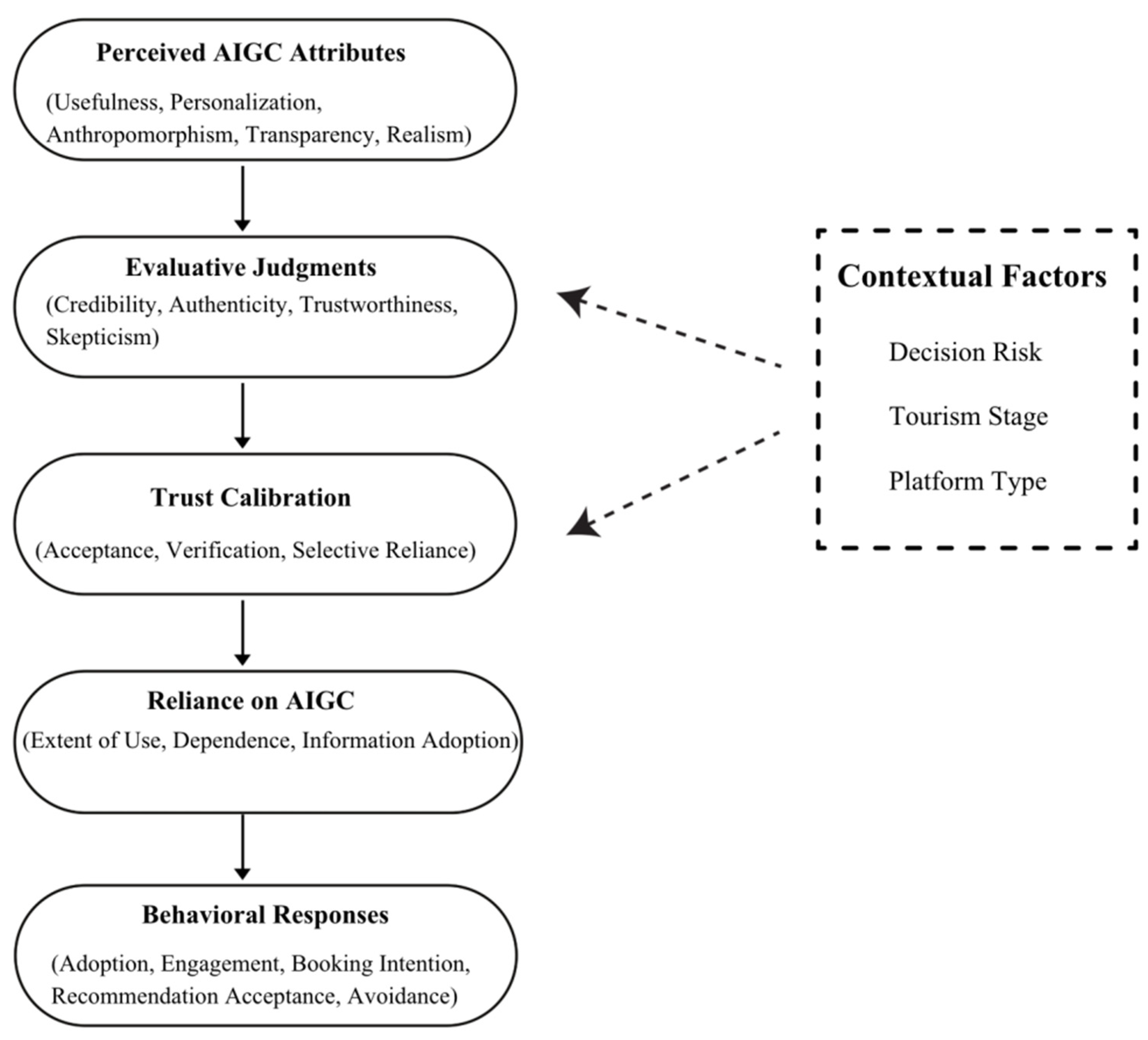
2.3. Preliminary Synthesis Framework
3. Methodology
3.1. Review Design
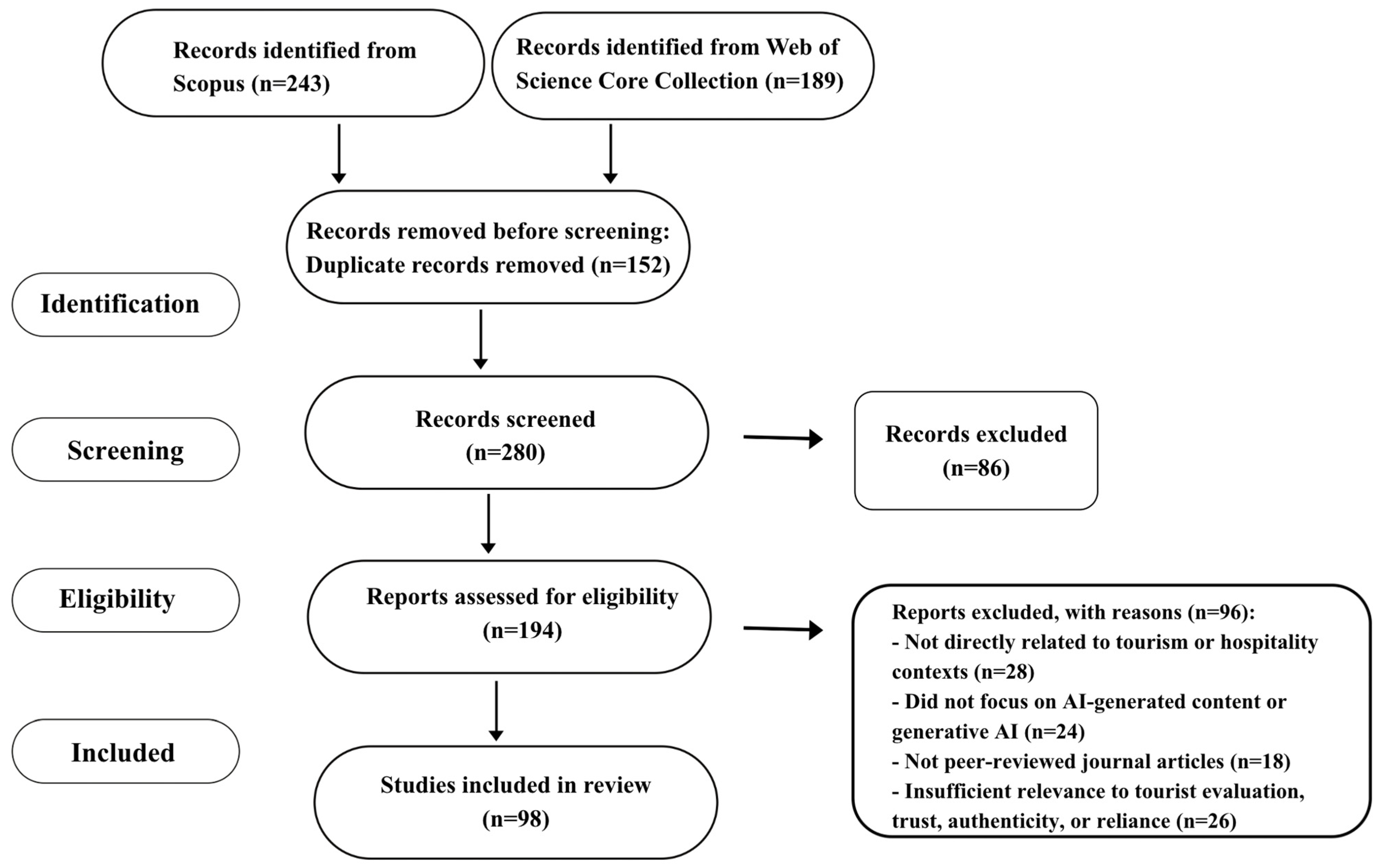
3.2. Search Strategy and Selection Criteria
3.3. Screening Process
3.4. Coding and Synthesis
4. Results
4.1. Overview of the Literature
4.2. Integrative Synthesis
4.2.1. Perceived AIGC Attributes as Evaluative Cues
4.2.2. Evaluative Judgments: Credibility and Authenticity
4.2.3. Trust Calibration and Reliance Formation
4.2.4. Behavioral Responses and Contextual Conditions
4.3. Modality-Specific Differences in Tourist Evaluation of AIGC
5. Discussion
5.1. Integrating the Findings
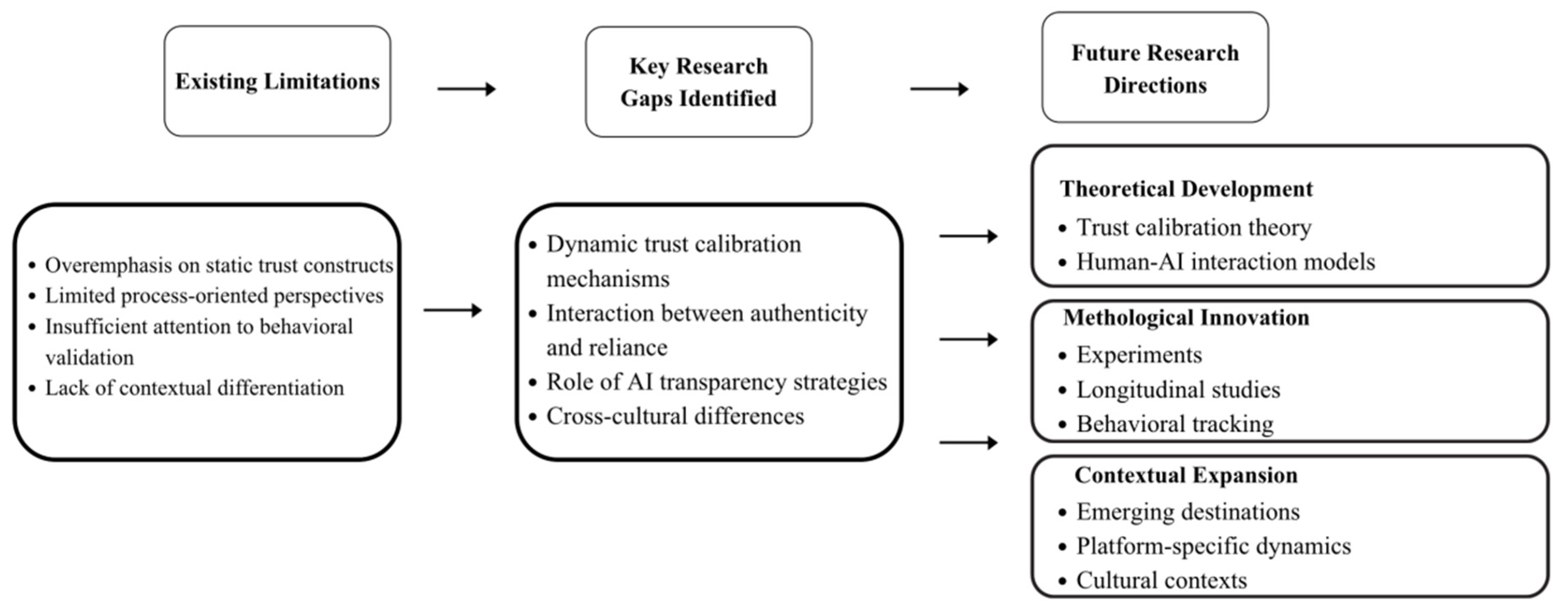
5.2. Theoretical Implications
5.3. Practical Implications
5.4. Limitations and Future Research
5.5. Summary
Supplementary Materials
Author Contributions
Funding
Data Availability Statement
Conflicts of Interest
References
- Wong, I.A.; Lian, Q.L.; Sun, D. Autonomous travel decision-making: An early glimpse into ChatGPT and generative AI. J. Hosp. Tour. Manag. 2023, 56, 253–263. [Google Scholar] [CrossRef] [Scilit]
- Zhang, Y.; Prebensen, N.K. Co-creating with ChatGPT for tourism marketing materials. Ann. Tour. Res. Empir. Insights 2024, 5, 100124. [Google Scholar] [CrossRef] [Scilit]
- Guttentag, D.A.; Litvin, S.W.; Teixeira, R. Human vs. AI: Can ChatGPT improve tourism product descriptions? Curr. Issues Tour. 2025, 28, 3601–3619. [Google Scholar] [CrossRef] [Scilit]
- Seo, I.T.; Liu, H.; Li, H.; Lee, J.S. AI-infused video marketing: Exploring the influence of AI-generated tourism videos on tourist decision-making. Tour. Manag. 2025, 110, 105182. [Google Scholar] [CrossRef] [Scilit]
- Kim, M.; Lee, S.M. ChatGPT as a digital dining companion: Examining AI perceptions and consumer loyalty in restaurant recommendations. Int. J. Hum. Comput. Interact. 2026, 1–24. [Google Scholar] [CrossRef] [Scilit]
- Choi, J.; Kwon, O. Impact of socio-economic characteristics on the use and effectiveness of generative AI in the tourism sector: The digital divide perspective. J. Smart Tour. 2025, 5, 82–94. [Google Scholar] [CrossRef] [Scilit]
- Chakraborty, D. Revolutionizing travel: The impact of generative AI on personalization and efficiency in the tourism industry. Indian J. Mark. 2024, 54, 8–24. [Google Scholar] [CrossRef] [Scilit]
- Chen, M.Y.; Kuo, F.K.; Hsiao, K.L. From content to conversation: Explaining adoption of on-device generative AI tour guides. Int. J. Hum. Comput. Interact. 2025, 1–19. [Google Scholar] [CrossRef] [Scilit]
- Bouziane, K.; Bouziane, A. Facilitating cross-cultural translation with ChatGPT in Moroccan travel agencies: A user satisfaction study. EDPACS 2026, 71, 1–19. [Google Scholar] [CrossRef] [Scilit]
- Paül i Agustí, D. The concentrated city: Effects of AI-generated travel advice on the spatial distribution of tourists. Urban Sci. 2025, 9, 268. [Google Scholar] [CrossRef] [Scilit]
- Zhang, J.J.; Wang, Y.W.; Ruan, Q.; Yang, Y. Digital tourism interpretation content quality: A comparison between AI-generated content and professional-generated content. Tour. Manag. Perspect. 2024, 53, 101279. [Google Scholar] [CrossRef] [Scilit]
- Bui, H.T.; Filimonau, V.; Sezerel, H. AI-thenticity: Exploring the effect of perceived authenticity of AI-generated visual content on tourist patronage intentions. J. Destin. Mark. Manag. 2024, 34, 100956. [Google Scholar] [CrossRef] [Scilit]
- Christensen, J.; Hansen, J.M.; Wilson, P. Understanding the role and impact of generative artificial intelligence (AI) hallucination within consumers’ tourism decision-making processes. Curr. Issues Tour. 2025, 28, 545–560. [Google Scholar] [CrossRef] [Scilit]
- Egger, R.; Yu, J. The impact of real-time hyper-personalisation in AI-generated tourism images. J. Hosp. Tour. Technol. 2026, 17, 761–778. [Google Scholar] [CrossRef] [Scilit]
- Park, Y.E.; Son, H. AI recommendation vs. crowdsourced recommendation vs. travel expert recommendation: The moderating role of consumption goal on travel destination decision. PLoS ONE 2025, 20, e0318719. [Google Scholar] [CrossRef] [Scilit] [PubMed]
- Wong, J.W.C.; Lai, I.K.W.; Lin, Y. The perceived reliability and adoption intention towards human-generated content vs. AI-generated content for travel planning: A moderating role of travel persona. J. Travel Tour. Mark. 2025, 42, 461–478. [Google Scholar] [CrossRef] [Scilit]
- Wang, Y.; Miao, H.; Xiong, M.; Wang, Y. Do word-of-mouth-based conversational AI recommendations enhance tourism consumers’ acceptance? The moderating role of transparency. Curr. Issues Tour. 2026, 29, 1936–1955. [Google Scholar] [CrossRef] [Scilit]
- Dogru, T.; Line, N.; Mody, M.; Hanks, L.; Abbott, J.A.; Acikgoz, F.; Assaf, A.; Bakir, S.; Berbekova, A.; Bilgihan, A. Generative artificial intelligence in the hospitality and tourism industry: Developing a framework for future research. J. Hosp. Tour. Res. 2025, 49, 235–253. [Google Scholar] [CrossRef] [Scilit]
- Carvalho, I.; Ivanov, S. ChatGPT for tourism: Applications, benefits and risks. Tour. Rev. 2024, 79, 290–303. [Google Scholar] [CrossRef] [Scilit]
- Han, H.; Kim, S.; Hailu, T.B.; Al-Ansi, A.; Loureiro, S.M.C.; Kim, J.J. ChatGPT use in hospitality and tourism: A multi-analytic approach. Asia Pac. J. Tour. Res. 2025, 30, 983–998. [Google Scholar] [CrossRef] [Scilit]
- Miao, L.; Yang, F.X. Text-to-image AI tools and tourism experiences. Ann. Tour. Res. 2023, 102, 103642. [Google Scholar] [CrossRef] [Scilit]
- Zhang, H.; Xiang, Z.; Zach, F.J. Generative AI vs. humans in online hotel review management: A task-technology fit perspective. Tour. Manag. 2025, 110, 105187. [Google Scholar] [CrossRef] [Scilit]
- Fan, N.; Li, X.; Liu, C.; Fan, Z.P. The power of AI-generated content: Evidence from the peer-to-peer accommodation market. J. Travel. Res. 2026, 65, 1519–1538. [Google Scholar] [CrossRef] [Scilit]
- Fakfare, P.; Manosuthi, N.; Lee, J.S.; Han, H.; Jin, M. Customer word-of-mouth for generative AI: Innovation and adoption in hospitality and tourism. Int. J. Hosp. Manag. 2025, 126, 104070. [Google Scholar] [CrossRef] [Scilit]
- Wang, P.Q. Personalizing guest experience with generative AI in the hotel industry: There’s more to it than meets a Kiwi’s eye. Curr. Issues Tour. 2025, 28, 527–544. [Google Scholar] [CrossRef] [Scilit]
- Tedjakusuma, A.P.; Kulachai, W. ChatGPT as a real-time travel companion: During-trip support and tourist satisfaction. Tour. Hosp. 2026, 7, 20. [Google Scholar] [CrossRef] [Scilit]
- Tedjakusuma, A.P.; Liu, L.W.; Eunike, I.J.; Silalahi, A.D.K. Rethinking information quality: How trust in ChatGPT shapes destination visit intentions. Tour. Hosp. 2025, 6, 178. [Google Scholar] [CrossRef] [Scilit]
- Park, J.E.; Fan, A.; So, K.K.F. Enhancing the effectiveness of generative AI travel recommendations: Balancing source credibility and cognitive load. J. Hosp. Tour. Res. 2025, 10963480251401822. [Google Scholar] [CrossRef] [Scilit]
- Wisker, Z.L.; Myshkina, I.; Alani, N.H. Trust, try, buy, and belong: How does AI create a loyalty loop in hotels? Tour. Hosp. 2025, 6, 276. [Google Scholar] [CrossRef] [Scilit]
- Kim, T.; Kim, M.J.; Promsivapallop, P. Investigating the influence of generative AI’s credibility and utility on travel consumer behaviour and recommendations through the lens of personal innovativeness. Curr. Issues Tour. 2025, 28, 2220–2224. [Google Scholar] [CrossRef] [Scilit]
- Seyfi, S.; Kim, M.J.; Lee, C.; Jo, Y.; Zaman, M. Exploring functional and psychological barriers to generative AI adoption for travel: A cross-cultural study. J. Travel Res. 2026, 65, 1567–1587. [Google Scholar] [CrossRef] [Scilit]
- Tunca, S.; Ersoy, A. Tripolar sentiment toward generative AI in hospitality marketing: Legitimacy, herd dynamics, and managerial implications. J. Hosp. Mark. Manag. 2026, 35, 287–317. [Google Scholar] [CrossRef] [Scilit]
- Singu, H.B.; Chakraborty, D.; Troise, C.; Camilleri, M.A.; Bresciani, S. Responsible AI for trustworthy tourism: A framework for mitigating ambiguity and anxiety with generative AI. Technol. Forecast. Soc. Change 2026, 223, 124407. [Google Scholar] [CrossRef] [Scilit]
- Zhu, S.; Song, M.; Duan, Y. Emotional arousal: How artificial intelligence-generated content influences tourism decision-making. Tour. Recreat. Res. 2025, 50, 1639–1650. [Google Scholar] [CrossRef] [Scilit]
- Lee, J.D.; See, K.A. Trust in automation: Designing for appropriate reliance. Hum. Factors 2004, 46, 50–80. [Google Scholar] [CrossRef] [Scilit] [PubMed]
- Hoff, K.A.; Bashir, M. Trust in automation: Integrating empirical evidence on factors that influence trust. Hum. Factors 2015, 57, 407–434. [Google Scholar] [CrossRef] [Scilit] [PubMed]
- Foroughi, B.; Vu, H.T.M.; Thaichon, P. Building trust for sustained generative AI travel adoption. Tour. Rev. 2026, 81, 718–754. [Google Scholar] [CrossRef] [Scilit]
- Rather, R.A. AI-powered ChatGPT in the hospitality and tourism industry: Benefits, challenges, theoretical framework, propositions and future research directions. Tour. Recreat. Res. 2025, 50, 652–662. [Google Scholar] [CrossRef] [Scilit]
- Palmatier, R.W.; Houston, M.B.; Hulland, J. Review articles: Purpose, process, and structure. J. Acad. Mark. Sci. 2018, 46, 1–5. [Google Scholar] [CrossRef] [Scilit]
- Snyder, H. Literature review as a research methodology: An overview and guidelines. J. Bus. Res. 2019, 104, 333–339. [Google Scholar] [CrossRef] [Scilit]
- Paul, J.; Criado, A.R. The art of writing a literature review: What do we know and what do we need to know? Int. Bus. Rev. 2020, 29, 101717. [Google Scholar] [CrossRef] [Scilit]
- Jin, J.H.; Han, J.S. A phenomenological study on the experience of searching for tourism information following the emergence of ChatGPT: Focused on the uncanny valley theory. Sustainability 2025, 17, 355. [Google Scholar] [CrossRef] [Scilit]
- Li, S.; Han, R.; Fu, T.; Chen, M.; Zhang, Y. Tourists’ behavioural intentions to use ChatGPT for tour route planning: An extended TAM model including rational and emotional factors. Curr. Issues Tour. 2025, 28, 2119–2135. [Google Scholar] [CrossRef] [Scilit]
- Jeong, N.; Lee, J. An aspect-based review analysis using ChatGPT for the exploration of hotel service failures. Sustainability 2024, 16, 1640. [Google Scholar] [CrossRef] [Scilit]
- Quintana Gómez, Á. Generative engine optimization (GEO) and brand visibility in AI-generated tourism recommendations: An exploratory analysis. Prism. Soc. 2026, 21–38. [Google Scholar] [CrossRef] [Scilit]
- Nicolau, J.L. When ChatGPT designs your trip: How GenAI adds a cognitive layer to smart tourism. J. Smart Tour. 2025, 5, 137–151. [Google Scholar] [CrossRef] [Scilit]
- Huang, G.I.; Wong, I.A.; Zhang, C.J.; Liang, Q. Generative AI inspiration and hotel recommendation acceptance: Does anxiety over lack of transparency matter? Int. J. Hosp. Manag. 2025, 126, 104112. [Google Scholar] [CrossRef] [Scilit]
- Zhao, H.; Yuan, B.; Liu, Y.; Liao, Y. Unlocking co-creation in travel: How generative AI sparks Aha moments and the behavioral outcome. J. Hosp. Tour. Manag. 2026, 66, 101396. [Google Scholar] [CrossRef] [Scilit]
- Li, C.; Cao, Q.; Hua, S.; Tao, C.W. When AI takes the wheel: The effectiveness of AI versus human-generated content in tourism marketing. J. Vacat. Mark. 2025, 13567667251393512. [Google Scholar] [CrossRef] [Scilit]
- Al-Romeedy, B.S.; Alharethi, T. ChatGPT as an emerging digital travel advisor: Insights into AI usefulness, usability, and consumer decision behavior. J. Theor. Appl. Electron. Commer. Res. 2025, 21, 6. [Google Scholar] [CrossRef] [Scilit]
- Abou-Shouk, M.; Abdelhakim, A.S.; Elgarhy, S.D.; Rabea, A.; Abdulmawla, M. ChatGPT usage intention for tourism and hospitality customers. Tour. Recreat. Res. 2026, 51, 533–550. [Google Scholar] [CrossRef] [Scilit]
- Han, H.; Kim, S.; Hailu, T.B.; Al-Ansi, A.; Loureiro, S.M.C.; Kim, J.J. Determinants of approach behavior for ChatGPT and their configurational influence in the hospitality and tourism sector: A cumulative prospect theory. Int. J. Contemp. Hosp. Manag. 2025, 37, 113–139. [Google Scholar] [CrossRef] [Scilit]
- Arora, N.; Manchanda, P.; Aggarwal, A.; Maggo, V. Tapping generative AI capabilities: A study to examine continued intention to use ChatGPT in travel planning. Asia Pac. J. Tour. Res. 2025, 30, 1303–1322. [Google Scholar] [CrossRef] [Scilit]
- Kim, J.H.; Kim, J.; Kim, C.; Kim, S. Do you trust ChatGPTs? Effects of the ethical and quality issues of generative AI on travel decisions. J. Travel Tour. Mark. 2023, 40, 779–801. [Google Scholar] [CrossRef] [Scilit]
- Xu, H.; Law, R.; Lovett, J.; Luo, J.M.; Liu, L. Tourist acceptance of ChatGPT in travel services: The mediating role of parasocial interaction. J. Travel Tour. Mark. 2024, 41, 955–972. [Google Scholar] [CrossRef] [Scilit]
- Kim, J.H.; Kim, J.; Park, J.; Kim, C.; Jhang, J.; King, B. When ChatGPT gives incorrect answers: The impact of inaccurate information by generative AI on tourism decision-making. J. Travel Res. 2025, 64, 51–73. [Google Scholar] [CrossRef] [Scilit]
- Luo, X.; Xu, D.; Li, Y.; Wan, L.C. Advancing information search through GenAI: The roles of search type, travel motive and GenAI customization level. Int. J. Contemp. Hosp. Manag. 2025, 37, 1725–1743. [Google Scholar] [CrossRef] [Scilit]
- Pham, H.C.; Duong, C.D.; Nguyen, G.K.H. What drives tourists’ continuance intention to use ChatGPT for travel services? A stimulus-organism-response perspective. J. Retail. Consum. Serv. 2024, 78, 103758. [Google Scholar] [CrossRef] [Scilit]
- Morosan, C. Evaluating generative AI’s role in enhancing hotel guests’ purchase intentions. Int. J. Hosp. Tour. Adm. 2026, 1–27. [Google Scholar] [CrossRef] [Scilit]
- Lv, L.; Liang, Y.; Chen, S.; Liu, G.G.; Liao, J. Good deeds deserve good outcomes: Leveraging generative artificial intelligence to reduce tourists’ avoidance of ethical brands embracing stigmatized groups. Ann. Tour. Res. 2025, 110, 103889. [Google Scholar] [CrossRef] [Scilit]
- Ali, W.; Kasturiratne, D.; Ameer, I.; Bhaskar, S. Generative AI in digital engagement: A quasi-experimental study of tourist sentiment. Serv. Ind. J. 2026, 1–31. [Google Scholar] [CrossRef] [Scilit]
- Yang, L.; Leung, X.Y.; Xiong, W. Authenticity in the age of generative AI: Reimagining host-guest relations in travel planning. J. Travel Res. 2026, 00472875261420609. [Google Scholar] [CrossRef] [Scilit]
- Seyfi, S.; Kim, M.J.; Nazifi, A.; Murdy, S.; Vo-Thanh, T. Understanding tourist barriers and personality influences in embracing generative AI for travel planning and decision-making. Int. J. Hosp. Manag. 2025, 126, 104105. [Google Scholar] [CrossRef] [Scilit]
- Jia, S.J.; Chi, O.H.; Chi, C.G. Unpacking the impact of AI vs. human-generated review summary on hotel booking intentions. Int. J. Hosp. Manag. 2025, 126, 104030. [Google Scholar] [CrossRef] [Scilit]
- De Cicco, R.; Francioni, B.; Dini, M.; Curina, I.; Filieri, R.; Cioppi, M. Generative AI and human advice: User perceptions, intentions, and behavior across pre-visit and on-site travel stages. J. Travel Res. 2025, 00472875251364222. [Google Scholar] [CrossRef] [Scilit]
- Raza, S.H.; Anwar, M.N.; Kumar, J.; Ogadimma, E.C.; Zaman, U.; Shah, A.A. Can smart mobile applications attract travellers? Exploring catenation between digital tourism entrepreneurs’ use of artificial intelligence generative chatbots for interactive marketing communication and virtual reality. J. Creat. Commun. 2025, 20, 383–401. [Google Scholar] [CrossRef] [Scilit]
- Loureiro, S.; Bilro, R.G.; Guerreiro, J.; Lee, M.J.; Han, H. ChatGPT coolness-desirable framework for tourism and hospitality. J. Travel Res. 2025, 00472875251380185. [Google Scholar] [CrossRef] [Scilit]
- Fakfare, P.; Manosuthi, N.; Lee, J.S.; Han, H.; Jin, M. Exploring the drivers of hospitality and tourism customer loyalty for generative artificial intelligence (AI): A multi-analytic approach. Curr. Issues Tour. 2025, 1–21. [Google Scholar] [CrossRef] [Scilit]
- Chakraborty, D. Generative AI (GAI) adoption in hotels and resorts: Understanding competitive advantage using longitudinal and multi-group study. Curr. Issues Tour. 2025, 1–20. [Google Scholar] [CrossRef] [Scilit]
- Zhao, H.; Yuan, B.; Zhang, B.; Liao, Y. Navigating generative AI use in tourism and hospitality: How trust and ethics shape human-machine information interaction of practitioners. Tour. Rev. 2026, 1–23. [Google Scholar] [CrossRef] [Scilit]
- Ali, L.; Ali, F.; Alotaibi, S. Beyond the hype: Evaluating the impact of generative AI on brand authenticity, image, and consumer behavior in the restaurant industry. Int. J. Hosp. Manag. 2025, 131, 104318. [Google Scholar] [CrossRef] [Scilit]
- Suasapha, A.H. Will generation Z use ChatGPT for tourism recommendations. Tour. Hosp. Manag. 2025, 31, 483–491. [Google Scholar] [CrossRef] [Scilit]
- Morini-Marrero, S.; Ramos-Henriquez, J.M.; Bilgihan, A. Analyzing the concordance and consistency of AI and human ratings in hospitality reviews. J. Hosp. Tour. Technol. 2025, 16, 937–965. [Google Scholar] [CrossRef] [Scilit]
- Kim, M.J.; Kang, S.E.; Hall, C.M.; Kim, J.S.; Promsivapallop, P. Unveiling the impact of ChatGPT on travel consumer behaviour: Exploring trust, attribute, and sustainable-tourism action. Curr. Issues Tour. 2025, 28, 1191–1196. [Google Scholar] [CrossRef] [Scilit]
- Saghier, E.G.; Selem, K.M.; Zekry, M.S. A user-centered design approach to GAI-powered mobile apps: Cognitive aspects of visitor awareness toward tourism activities. J. Hosp. Tour. Insights 2026, 9, 864–881. [Google Scholar] [CrossRef] [Scilit]
- Song, M.; Wang, Y.; Guo, R.; Law, R. When city landmarks meet AI design: The impact of AI painting on the travel intentions of consumers. Asia Pac. J. Tour. Res. 2025, 30, 1082–1102. [Google Scholar] [CrossRef] [Scilit]
- Seyfi, S.; Gorji, A.S.; Vo-Thanh, T.; Zaman, M. Travel virtual assistant or untrusted advisor? Developing a typology of resistance to AI-generated travel advice. Int. J. Tour. Res. 2025, 27, e70082. [Google Scholar] [CrossRef] [Scilit]
- Alizadeh, H.; Nazarpour Kashani, H.; Masoumi, F.; Yousefli, A.; Namazi, Y.; Saberian, H. Halal tourism and ChatGPT: The effect of value co-creation. J. Islam. Mark. 2026, 17, 2395–2419. [Google Scholar] [CrossRef] [Scilit]
- Battour, M.; Salaheldeen, M.; Anwar, I.; Ratnasari, R.T.; Hamid, A.A.; Mady, K. Integrating ChatGPT in halal tourism: Impact on tourist satisfaction, e-WoM and revisit intention. J. Islam. Mark. 2025, 16, 2781–2805. [Google Scholar] [CrossRef] [Scilit]
- Ren, R.; Xu, Y.; Yao, X.; Cole, S.T. Whose journey matters? Investigating identity biases in large language models (LLMs) for travel planning assistance. Curr. Issues Tour. 2025, 1–32. [Google Scholar] [CrossRef] [Scilit]
- Hassan, H.; Magdy, A. Building consumer trust in the ChatGPT’s era: Insights from the hospitality industry. Tour. Hosp. Res. 2025, 14673584251343264. [Google Scholar] [CrossRef] [Scilit]
- Mellors, J. ChatGPT and the tourist trail: Pathway to overtourism or sustainable travel? Curr. Issues Tour. 2025, 1–4. [Google Scholar] [CrossRef] [Scilit]
- Shen, H.; Yu, J. Beyond the screen: Navigating trans-parasocial relationships with AI travel influencers. J. Hosp. Tour. Res. 2025, 10963480251391402. [Google Scholar] [CrossRef] [Scilit]
- Bui, H.T.; Filimonau, V.; Sezerel, H. Exploring value co-creation and co-destruction between consumers and generative artificial intelligence (GAI) in travel. Tour. Manag. Perspect. 2025, 58, 101392. [Google Scholar] [CrossRef] [Scilit]
- Yhee, Y.; Koo, C. Seeing AI as human or machine? Effects of transparency, valence, and readability on review summary helpfulness. Tour. Manag. 2026, 113, 105305. [Google Scholar] [CrossRef] [Scilit]
- Koçak, B.B. How AI-generated messages impact consumer behavior in the tourism industry. J. Theor. Appl. Electron. Commer. Res. 2026, 21, 67. [Google Scholar] [CrossRef] [Scilit]
- Borrero-Domínguez, C.; Escobar-Rodríguez, T. Factors influencing ChatGPT adoption for trip planning. Tour. Manag. Stud. 2025, 21, 1–17. [Google Scholar] [CrossRef] [Scilit]
- Demir, M.; Demir, Ş.Ş. Is ChatGPT the right technology for service individualization and value co-creation? Evidence from the travel industry. J. Travel Tour. Mark. 2023, 40, 383–398. [Google Scholar] [CrossRef] [Scilit]
- Carvalho, I.; Loureiro, S.M.C.; Ivanov, S.; Björk, P.; Seyitoğlu, F. Beyond human touch: Evaluating the effectiveness of AI, human, and hybrid-generated tourism promotional texts. J. Hosp. Tour. Insights 2025, 8, 3804–3824. [Google Scholar] [CrossRef] [Scilit]
- Choi, H.; Park, E. ChatGPT and travel: Examining the relationship between choice attributes, positive emotions, satisfaction, and behavioral intention. Int. J. Tour. Res. 2026, 28, e70200. [Google Scholar] [CrossRef] [Scilit]
- Stergiou, D.P.; Nella, A. ChatGPT and tourist decision-making: An accessibility-diagnosticity theory perspective. Int. J. Tour. Res. 2024, 26, e2757. [Google Scholar] [CrossRef] [Scilit]
- Batouei, A.; Nikbin, D.; Foroughi, B. Acceptance of ChatGPT as an auxiliary tool enhancing travel experience. J. Hosp. Tour. Insights 2025, 8, 2744–2763. [Google Scholar] [CrossRef] [Scilit]
- Kekäläinen, T.; Heinonen-Kemppi, J.; Pesonen, J.; Sthapit, E.; Garrod, B. Generative AI chatbot prompting for excellent customer service in tourism. Serv. Mark. Q. 2026, 1–23. [Google Scholar] [CrossRef] [Scilit]
- Kan, T.; Ku, E.C. Enhancing joint decision-making and innovation: The impact of ChatGPT on like-minded itineraries with unfamiliar travel companions. J. Res. Interact. Mark. 2025, 20, 675–693. [Google Scholar] [CrossRef] [Scilit]
- Mai, S.; Liu, Z. Generative AI and the tourist experience: Reconfiguring en-route and post-trip value co-creation and co-destruction. Curr. Issues Tour. 2026, 1–17. [Google Scholar] [CrossRef] [Scilit]
- Xu, H.; Li, X.; Lovett, J.C.; Cheung, L.T. ChatGPT for travel-related services: A pleasure-arousal-dominance perspective. Tour. Rev. 2025. [Google Scholar] [CrossRef] [Scilit]
- Yaşar, E.; Yayla, E. How well can ChatGPT manage service failures? Anu. Tur. Soc. 2025, 37, 305–334. [Google Scholar] [CrossRef] [Scilit]
- Solomovich, L.; Abraham, V. Exploring the influence of ChatGPT on tourism behavior using the technology acceptance model. Tour. Rev. 2026, 81, 378–395. [Google Scholar] [CrossRef] [Scilit]
- Düz, B.; Kavak, M. How does AI perform as a tour guide? A user-based assessment through the ChatGPT tour guide performance model at Gordion. J. Hosp. Tour. Technol. 2026, 17, 779–800. [Google Scholar] [CrossRef] [Scilit]
- Sun, D.; Wong, I.A.; Xiong, X.; Li, S. When cutting edge meets silver tongue: Understanding the word-of-machine effect on travel decisions. Tour. Manag. 2026, 112, 105271. [Google Scholar] [CrossRef] [Scilit]
- Liu, G.G.; Lv, L.; Meng, L.L.; Tao, J. Beyond algorithms: How socio-technical antecedents drive social-exchange outcomes in AI travel planning personalization. J. Retail. Consum. Serv. 2026, 89, 104607. [Google Scholar] [CrossRef] [Scilit]
- Kumar, S.; Malhotra, D. Dark side of generative AI in tourism: A stressor-strain-outcome perspective using a mixed-methods approach. Tour. Recreat. Res. 2025, 1–14. [Google Scholar] [CrossRef] [Scilit]
- Zhang, H.; Zhang, Z.; Liu, S.; Li, C. Artificial intelligence-generated or user-generated content: The influence of episodic future thinking on age-related pre-travel information preference. J. Hosp. Tour. Technol. 2026, 1–27. [Google Scholar] [CrossRef] [Scilit]
- Jung, H.; Sharma, A.; Nicolau, J.L. GenAI in tourism: Who wins, who loses? Tour. Manag. 2026, 114, 105357. [Google Scholar] [CrossRef] [Scilit]
- Rejón-Guardia, F.; Molinillo, S.; Anaya-Sánchez, R. AI hallucinations in tourism: How errors impact consumer trust and recommendation acceptance. J. Consum. Behav. 2026, 25, 923–938. [Google Scholar] [CrossRef] [Scilit]
- Wang, X.; Gui, C.; Yang, J.; Deng, A. Why reject ChatGPT? Prompt strategy as keys to mitigate perceived creativity differences in tourism recommendation. Tour. Rev. 2026, 1–24. [Google Scholar] [CrossRef] [Scilit]
- Xinlin, J.; Wenting, L.; Shah, K.A.M.; Na, M.; Shah Alam, S. Transforming hospitality decision-making: The impact of generative AI on cognitive alignment and adaptive intelligence. J. Qual. Assur. Hosp. Tour. 2025, 1–35. [Google Scholar] [CrossRef]
- Tosyali, H.; Tosyali, F.; Coban-Tosyali, E. Role of tourist-chatbot interaction on visit intention in tourism: The mediating role of destination image. Curr. Issues Tour. 2025, 28, 511–526. [Google Scholar] [CrossRef] [Scilit]
- Bingöl, S. Uniqueness versus superficial accuracy: The perceived accuracy of GPTs for travel decision-making. J. Vacat. Mark. 2026, 13567667261416507. [Google Scholar] [CrossRef] [Scilit]
- Page, M.J.; McKenzie, J.E.; Bossuyt, P.M.; Boutron, I.; Hoffmann, T.C.; Mulrow, C.D.; Shamseer, L.; Tetzlaff, J.M.; Akl, E.A.; Brennan, S.E.; et al. The PRISMA 2020 statement: An updated guideline for reporting systematic reviews. BMJ 2021, 372, n71. [Google Scholar] [CrossRef] [Scilit]



| Component | Description |
|---|---|
| Review focus | Consumer-facing AI-generated content (AIGC) in tourism and hospitality, with emphasis on tourist evaluation, trust, authenticity, reliance, and related behavioral outcomes. |
| Databases searched | Scopus; Web of Science Core Collection. |
| Search period | January 2023 to March 2026. |
| Search fields | Title, abstract, and keywords/topic fields, depending on the database search interface. |
| Core search terms | AIGC-related terms were combined with tourism-related terms. AIGC terms included “AI-generated content”, “AIGC”, “generative AI”, “GenAI”, “ChatGPT”, “large language model”, “LLM”, “AI-generated image”, “AI-generated video”, “conversational AI”, and “multimodal AI”. Tourism terms included “tourism”, “travel”, “hospitality”, “destination”, “hotel”, and “tourist”. |
| Search logic | The search strategy combined generative AI terms with tourism and hospitality terms to identify studies examining consumer-visible or consumer-relevant AIGC in tourism-related settings. |
| Document types retained at the search stage | Article; Review Article. |
| Language | English. |
| Initial records identified | Scopus (n = 243); Web of Science Core Collection (n = 189); Total (n = 432). |
| Duplicates removed | Duplicate records across databases were identified and removed after merging the search results (n = 152). |
| Records screened | After duplicate removal, 280 records remained for title-and-abstract screening. |
| Title and abstract screening exclusions | Records were excluded when they clearly fell outside tourism/hospitality, did not focus on generative AI/AIGC, lacked a consumer-facing focus, or were otherwise irrelevant to the review scope (n = 86). |
| Full-text assessment | 194 full-text articles were assessed for eligibility. |
| Full-text exclusions | Full-text articles were excluded when they did not sufficiently address consumer-facing AIGC in tourism/hospitality, did not engage with evaluative or decision-related constructs relevant to the review, or fell outside the final conceptual scope (n = 96). |
| Final sample | 98 studies were included in the final review. |
| Inclusion criteria | (1) Published in peer-reviewed journals; (2) written in English; (3) situated in tourism, travel, or hospitality contexts; (4) focused on generative AI, ChatGPT, AIGC, or AI-generated content; (5) examined consumer-facing, tourist-facing, or user-facing applications, perceptions, evaluations, or responses. |
| Exclusion criteria | (1) Non-tourism contexts (e.g., education, healthcare, accounting, journalism, law); (2) non-generative AI studies; (3) purely technical, algorithmic, or systems-development papers without consumer relevance; (4) employee-only or operations-only studies not aligned with the review focus; (5) conference papers, editorials, notes, book chapters, or other ineligible publication types. |
| Review output | The final sample formed the basis for descriptive mapping, coding, thematic synthesis, and the development of the integrative process model. |
| No. | Authors | Title | Year | Journal/Source | Study Characteristics | Ref. No. |
|---|---|---|---|---|---|---|
| 1 | Kim M.; Lee S.-M. | ChatGPT as a Digital Dining Companion: Examining AI Perceptions and Consumer Loyalty in Restaurant Recommendations | 2026 | International Journal of Human–Computer Interaction | Restaurant recommendation context; ChatGPT recommendation system; AI perceptions and consumer loyalty | [5] |
| 2 | Choi J.; Kwon O. | Impact of Socio-Economic Characteristics on the Use and Effectiveness of Generative AI in the Tourism Sector: The Digital Divide Perspective | 2025 | Journal of Smart Tourism | Tourism sector adoption context; generative AI tools; digital divide and usage effectiveness | [6] |
| 3 | Wisker Z.L.; Myshkina I.; Alani N.H.S. | Trust, Try, Buy, and Belong: How Does AI Create a Loyalty Loop in Hotels? | 2025 | Tourism and Hospitality | Hotel context; AI-enabled services; trust, purchase intention, and brand loyalty | [29] |
| 4 | Jin J.-H.; Han J.-S. | A Phenomenological Study on the Experience of Searching for Tourism Information Following the Emergence of ChatGPT: Focused on the Uncanny Valley Theory | 2025 | Sustainability (Switzerland) | Tourism information search context; ChatGPT; user experience and uncanny valley perceptions | [42] |
| 5 | Li S.; Han R.; Fu T.; Chen M.; Zhang Y. | Tourists’ behavioural intentions to use ChatGPT for tour route planning: an extended TAM model including rational and emotional factors | 2025 | Current Issues in Tourism | Tour route planning context; ChatGPT; behavioral intention and extended TAM | [43] |
| 6 | Jeong N.; Lee J. | An Aspect-Based Review Analysis Using ChatGPT for the Exploration of Hotel Service Failures | 2024 | Sustainability (Switzerland) | Hotel review analysis context; ChatGPT; service failure exploration and aspect-based summarization | [44] |
| 7 | Quintana-Gómez Á. | Generative Engine Optimization (GEO) and Brand Visibility in AI-Generated Tourism Recommendations: An Exploratory Analysis; [Generative Engine Optimization (GEO) y visibilidad de marcas en recomendaciones turísticas generadas por IA: un análisis exploratorio] | 2026 | Prisma Social | AI-generated tourism recommendation context; generative AI search/recommendation systems; brand visibility and GEO | [45] |
| 8 | Chakraborty D. | Revolutionizing Travel: The Impact of Generative AI on Personalization and Efficiency in the Tourism Industry | 2024 | Indian Journal of Marketing | Travel app context; generative AI content; personalization, efficiency, and intention to use | [7] |
| 9 | Chen M.-Y.; Kuo F.-K.; Hsiao K.-L. | From Content to Conversation: Explaining Adoption of On-Device Generative AI Tour Guides | 2025 | International Journal of Human–Computer Interaction | Cultural heritage guiding context; on-device generative AI tour guide; adoption and satisfaction | [8] |
| 10 | Bouziane K.; Bouziane A. | Facilitating cross-cultural translation with ChatGPT in Moroccan travel agencies: a user satisfaction study | 2026 | EDPACS | Travel agency translation context; ChatGPT; cross-cultural translation and user satisfaction | [9] |
| 11 | Zhang H.; Xiang Z.; Zach F.J. | Generative AI vs. humans in online hotel review management: A Task-Technology Fit perspective | 2025 | Tourism Management | Online hotel review management context; generative AI vs. human responses; task-technology fit and effectiveness | [22] |
| 12 | Paül i Agustí D. | The Concentrated City: Effects of AI-Generated Travel Advice on the Spatial Distribution of Tourists | 2025 | Urban Science | Urban tourism advisory context; AI-generated travel advice; spatial distribution of tourists | [10] |
| 13 | Tedjakusuma A.P.; Kulachai W. | ChatGPT as a Real-Time Travel Companion: During-Trip Support and Tourist Satisfaction | 2026 | Tourism and Hospitality | During-trip support context; ChatGPT travel companion; tourist satisfaction | [26] |
| 14 | Tedjakusuma A.P.; Liu L.-W.; Eunike I.J.; Silalahi A.D.K. | Rethinking Information Quality: How Trust in ChatGPT Shapes Destination Visit Intentions | 2025 | Tourism and Hospitality | Destination recommendation context; ChatGPT; information quality, trust, and visit intention | [27] |
| 15 | Nicolau J.L. | When ChatGPT Designs Your Trip: How GenAI Adds a Cognitive Layer to Smart Tourism | 2025 | Journal of Smart Tourism | Smart tourism planning context; GenAI trip design; cognitive support in travel planning | [46] |
| 16 | Seo, IT; Liu, HB; Li, HY; Lee, JS | AI-infused video marketing: Exploring the influence of AI-generated tourism videos on tourist decision-making | 2025 | Tourism Management | Tourism video marketing context; AI-generated video; tourist decision-making | [4] |
| 17 | Fan, NY; Li, X; Liu, C; Fan, ZP | The Power of AI-Generated Content: Evidence From the Peer-to-Peer Accommodation Market | 2026 | Journal of Travel Research | Peer-to-peer accommodation context; AI-generated listing/content; market impact and consumer response | [23] |
| 18 | Fakfare, P; Manosuthi, N; Lee, JS; Han, H; Jin, M | Customer word-of-mouth for generative AI: Innovation and adoption in hospitality and tourism | 2025 | International Journal of Hospitality Management | Hospitality and tourism customer context; generative AI; word-of-mouth and innovation adoption | [24] |
| 19 | Wong, IA; Lian, QL; Sun, DN | Autonomous travel decision-making: An early glimpse into ChatGPT and generative AI | 2023 | Journal of Hospitality And Tourism Management | Travel planning context; ChatGPT/generative AI; autonomous decision-making | [1] |
| 20 | Zhang, YZ; Prebensen, NK | Co-creating with ChatGPT for tourism marketing materials | 2024 | Annals of Tourism Research Empirical Insights | Tourism marketing context; ChatGPT; co-creation of marketing materials | [2] |
| 21 | Zhang, JJ; Wang, YW; Ruan, Q; Yang, Y | Digital tourism interpretation content quality: A comparison between AI-generated content and professional-generated content | 2024 | Tourism Management Perspectives | Digital tourism interpretation context; AI-generated vs. professional content; perceived content quality | [11] |
| 22 | Huang, GI; Wong, IA; Zhang, CJ; Liang, QL | Generative AI inspiration and hotel recommendation acceptance: Does anxiety over lack of transparency matter? | 2025 | International Journal of Hospitality Management | Hotel recommendation context; generative AI; transparency anxiety and recommendation acceptance | [47] |
| 23 | Zhao, HR; Yuan, BC; Liu, YZ; Liao, YJ | Unlocking co-creation in travel: How generative AI sparks Aha Moments and the behavioral outcome | 2026 | Journal of Hospitality And Tourism Management | Travel co-creation context; generative AI; aha moments and behavioral outcomes | [48] |
| 24 | Li, CX; Cao, Q; Hua, S; Tao, CW | When AI takes the wheel: The effectiveness of AI versus human-generated content in tourism marketing | 2025 | Journal Of Vacation Marketing | Tourism marketing context; AI-generated vs. human-generated content; effectiveness and travel intention | [49] |
| 25 | Wang, PQ | Personalizing guest experience with generative AI in the hotel industry: there’s more to it than meets a Kiwi’s eye | 2025 | Current Issues In Tourism | Hotel guest experience context; generative AI; personalization and guest experience enhancement | [25] |
| 26 | Al-Romeedy, BS; Alharethi, T | ChatGPT as an Emerging Digital Travel Advisor: Insights into AI Usefulness, Usability, and Consumer Decision Behavior | 2025 | Journal of Theoretical And Applied Electronic Commerce Research | Digital travel advisor context; ChatGPT; usefulness, usability, and consumer decision behavior | [50] |
| 27 | Abou-Shouk, M; Abdelhakim, AS; Elgarhy, SD; Rabea, A; Abdulmawla, M | ChatGPT usage intention for tourism and hospitality customers | 2026 | Tourism Recreation Research | Tourism and hospitality customer context; ChatGPT; usage intention | [51] |
| 28 | Han, HS; Kim, S; Hailu, TB; Al-Ansi, A; Loureiro, SMC; Kim, JJ | Determinants of approach behavior for ChatGPT and their configurational influence in the hospitality and tourism sector: a cumulative prospect theory | 2025 | International Journal of Contemporary Hospitality Management | Hospitality and tourism user context; ChatGPT; approach behavior and configurational determinants | [52] |
| 29 | Arora, N; Manchanda, P; Aggarwal, A; Maggo, V | Tapping generative AI capabilities: a study to examine continued intention to use ChatGPT in the travel planning | 2025 | Asia Pacific Journal of Tourism Research | Travel planning context; ChatGPT; continuance intention | [53] |
| 30 | Christensen, J; Hansen, JM; Wilson, P | Understanding the role and impact of Generative Artificial Intelligence (AI) hallucination within consumers’ tourism decision-making processes | 2025 | Current Issues In Tourism | Tourism decision-making context; generative AI/ChatGPT; hallucination effects and misinformation concerns | [13] |
| 31 | Kim, JH; Kim, J; Kim, C; Kim, S | Do you trust ChatGPTs? Effects of the ethical and quality issues of generative AI on travel decisions | 2023 | Journal of Travel & Tourism Marketing | Travel decision context; ChatGPT; trust, ethical issues, and quality perceptions | [54] |
| 32 | Xu, H; Law, R; Lovett, J; Luo, JM; Liu, L | Tourist acceptance of ChatGPT in travel services: the mediating role of parasocial interaction | 2024 | Journal of Travel & Tourism Marketing | Travel services context; ChatGPT; tourist acceptance and parasocial interaction | [55] |
| 33 | Kim, JH; Kim, J; Park, J; Kim, C; Jhang, J; King, B | When ChatGPT Gives Incorrect Answers: The Impact of Inaccurate Information by Generative AI on Tourism Decision-Making | 2025 | Journal of Travel Research | Tourism decision-making context; ChatGPT; inaccurate information and decision impact | [56] |
| 34 | Luo, XY; Xu, D; Li, Y; Wan, LC | Advancing information search through GenAI: the roles of search type, travel motive and GenAI customization level | 2025 | International Journal of Contemporary Hospitality Management | Tourist information search context; GenAI/ChatGPT; search type, travel motive, and customization | [57] |
| 35 | Pham, HC; Duong, CD; Nguyen, GKH | What drives tourists’ continuance intention to use ChatGPT for travel services? A stimulus-organism-response perspective | 2024 | Journal of Retailing And Consumer Services | Travel services context; ChatGPT; continuance intention and S-O-R mechanism | [58] |
| 36 | Morosan, C | Evaluating Generative AI’s Role in Enhancing Hotel Guests’ Purchase Intentions | 2026 | International Journal of Hospitality & Tourism Administration | Hotel purchase context; generative AI; purchase intention and trust in AI | [59] |
| 37 | Seyfi, S; Kim, MJ; Lee, C; Jo, Y; Zaman, M | Exploring Functional and Psychological Barriers to Generative AI Adoption for Travel: A Cross-Cultural Study | 2026 | Journal of Travel Research | Travel adoption context; generative AI; functional and psychological barriers | [31] |
| 38 | Guttentag, DA; Litvin, SW; Teixeira, R | Human vs. AI: can ChatGPT improve tourism product descriptions? | 2025 | Current Issues In Tourism | Tourism product description context; ChatGPT vs. human content; content effectiveness | [3] |
| 39 | Lv, LX; Liang, YH; Chen, SY; Liu, GG; Liao, JC | Good deeds deserve good outcomes: Leveraging generative artificial intelligence to reduce tourists’ avoidance of ethical brands embracing stigmatized groups | 2025 | Annals of Tourism Research | Ethical tourism brand context; generative AI; reduced brand avoidance and ethical communication | [60] |
| 40 | Wong, JWC; Lai, IKW; Lin, YP | The perceived reliability and adoption intention towards human-generated content vs. AI-generated content for travel planning: a moderating role of travel persona | 2025 | Journal of Travel & Tourism Marketing | Travel planning context; human-generated vs. AI-generated content; reliability and adoption intention | [16] |
| 41 | Ali, W; Kasturiratne, D; Ameer, I; Bhaskar, S | Generative AI in digital engagement: a quasi-experimental study of tourist sentiment | 2026 | Service Industries Journal | Tourist sentiment context; generative AI; digital engagement and sentiment response | [61] |
| 42 | Dogru, T; Line, N; Mody, M; Hanks, L; Abbott, J; Acikgoz, F; Assaf, A; Bakir, S; Berbekova, A; Bilgihan, A; Dalton, A; Erkmen, E; Geronasso, M; Gomez, D; Graves, S; Iskender, A; Ivanov, S; Kizildag, M; Lee, M; Lee, W; Luckett, J; Mcginley, S; Okumus, F; Onder, I; Ozdemir, O; Park, H; Sharma, A; Suess, C; Uysal, M; Zhang, TT | Generative Artificial Intelligence in the Hospitality and Tourism Industry: Developing a Framework for Future Research | 2025 | Journal of Hospitality & Tourism Research | Hospitality and tourism industry context; generative AI; conceptual framework for future research | [18] |
| 43 | Yang, LY; Leung, XY; Xiong, W | Authenticity in the Age of Generative AI: Reimagining Host-Guest Relations in Travel Planning | 2026 | Journal of Travel Research | Travel planning context; generative AI; authenticity and host-guest relations | [62] |
| 44 | Tunca, S; Ersoy, A | Tripolar sentiment toward generative AI in hospitality marketing: legitimacy, herd dynamics, and managerial implications | 2026 | Journal Of Hospitality Marketing & Management | Hospitality marketing context; generative AI; sentiment, legitimacy, and herd dynamics | [32] |
| 45 | Seyfi, S; Kim, MJ; Nazifi, A; Murdy, S; Vo-Thanh, T | Understanding tourist barriers and personality influences in embracing generative AI for travel planning and decision-making | 2025 | International Journal of Hospitality Management | Travel planning and decision-making context; generative AI; barriers and personality influences | [63] |
| 46 | Jia, SZJ; Chi, OH; Chi, CG | Unpacking the impact of AI vs. human-generated review summary on hotel booking intentions | 2025 | International Journal of Hospitality Management | Hotel booking context; AI vs. human-generated review summaries; booking intention and trust | [64] |
| 47 | De Cicco, R; Francioni, B; Dini, M; Curina, I; Filieri, R; Cioppi, M | Generative AI and Human Advice: User Perceptions, Intentions, and Behavior Across Pre-visit and On-site Travel Stages | 2025 | Journal of Travel Research | Travel stage context; generative AI and human advice; user perceptions, intentions, and behavior | [65] |
| 48 | Raza, SH; Anwar, MN; Kumar, J; Ogadimma, EC; Zaman, U; Shah, AA | Can Smart Mobile Applications Attract Travellers? Exploring Catenation Between Digital Tourism Entrepreneurs’ Use of Artificial Intelligence Generative Chatbots for Interactive Marketing Communication and Virtual Reality | 2025 | Journal of Creative Communications | Travel marketing app context; generative AI chatbots and VR; traveler attraction and interactive communication | [66] |
| 49 | Han, HS; Kim, S; Hailu, TB; Al-Ansi, A; Loureiro, SMC; Kim, JJ | ChatGPT use in hospitality and tourism: a multi-analytic approach | 2025 | Asia Pacific Journal of Tourism Research | Hospitality and tourism information context; ChatGPT; tourist behavior and multi-analytic assessment | [20] |
| 50 | Loureiro, SMC; Bilro, RG; Guerreiro, J; Lee, MJ; Han, H | ChatGPT Coolness-Desirable Framework for Tourism and Hospitality | 2025 | Journal of Travel Research | Tourism and hospitality branding context; ChatGPT; coolness, desirability, and attitude formation | [67] |
| 51 | Carvalho, I; Ivanov, S | ChatGPT for tourism: applications, benefits and risks | 2024 | Tourism Review | Tourism application context; ChatGPT; applications, benefits, and risks | [19] |
| 52 | Fakfare, P; Manosuthi, N; Lee, JS; Han, H; Jin, M | Exploring the drivers of hospitality and tourism customer loyalty for generative artificial intelligence (AI): a multi-analytic approach | 2025 | Current Issues In Tourism | Hospitality and tourism customer context; generative AI; loyalty drivers and multi-analytic assessment | [68] |
| 53 | Singu, HB; Chakraborty, D; Troise, C; Camilleri, MA; Bresciani, S | Responsible AI for trustworthy tourism: A framework for mitigating ambiguity and anxiety with generative AI | 2026 | Technological Forecasting and Social Change | Trustworthy tourism context; generative AI; ambiguity, anxiety, and responsible AI framework | [33] |
| 54 | Chakraborty, D | Generative AI (GAI) adoption in hotels and resorts: understanding competitive advantage using longitudinal & multi-group study | 2025 | Current Issues In Tourism | Hotels and resorts context; generative AI adoption; competitive advantage and firm outcomes | [69] |
| 55 | Zhao, HR; Yuan, BC; Zhang, BN; Liao, YJ | Navigating generative AI use in tourism and hospitality: how trust and ethics shape human–machine information interaction of practitioners | 2026 | Tourism Review | Tourism and hospitality practitioner context; generative AI; trust, ethics, and human–machine information interaction | [70] |
| 56 | Ali, L; Ali, F; Alotaibi, S | Beyond the hype: Evaluating the impact of generative AI on brand authenticity, image, and consumer behavior in the restaurant industry | 2025 | International Journal of Hospitality Management | Restaurant industry context; generative AI; brand authenticity, image, and consumer behavior | [71] |
| 57 | Suasapha, AH | WILL GENERATION Z USE CHATGPT FOR TOURISM RECOMMENDATIONS? | 2025 | Tourism and Hospitality Management-Croatia | Tourism recommendation context; ChatGPT; Generation Z adoption intention | [72] |
| 58 | Morini-Marrero, S; Ramos-Henriquez, JM; Bilgihan, A | Analyzing the concordance and consistency of AI and human ratings in hospitality reviews | 2025 | Journal of Hospitality And Tourism Technology | Hospitality review evaluation context; AI vs. human ratings; concordance and consistency analysis | [73] |
| 59 | Kim, MJ; Kang, SE; Hall, CM; Kim, JS; Promsivapallop, P | Unveiling the impact of ChatGPT on travel consumer behaviour: exploring trust, attribute, and sustainable-tourism action | 2025 | Current Issues In Tourism | Travel consumer behavior context; ChatGPT; trust, attributes, and sustainable-tourism action | [74] |
| 60 | Saghier, EG; Selem, KM; Zekry, MS | A user-centered design approach to GAI-powered mobile apps: cognitive aspects of visitor awareness toward tourism activities | 2026 | Journal of Hospitality And Tourism Insights | Tourism activity app context; GAI-powered mobile applications; visitor awareness and user-centered design | [75] |
| 61 | Song, MM; Wang, YC; Guo, R; Law, R | When city landmarks meet AI design: the impact of AI painting on the travel intentions of consumers | 2025 | Asia Pacific Journal of Tourism Research | Destination marketing context; AI painting; travel intention | [76] |
| 62 | Seyfi, S; Gorji, AS; Vo-Thanh, T; Zaman, M | Travel Virtual Assistant or Untrusted Advisor? Developing a Typology of Resistance to AI-Generated Travel Advice | 2025 | International Journal of Tourism Research | Travel advice context; AI-generated travel assistant; resistance typology | [77] |
| 63 | Park, JE; Fan, AL; So, KKF | Enhancing the Effectiveness of Generative AI Travel Recommendations: Balancing Source Credibility and Cognitive Load | 2025 | Journal of Hospitality & Tourism Research | Travel recommendation context; generative AI; source credibility and cognitive load | [28] |
| 64 | Kim, T; Kim, MJ; Promsivapallop, P | Investigating the influence of generative AI’s credibility and utility on travel consumer behaviour and recommendations through the lens of personal innovativeness | 2025 | Current Issues In Tourism | Travel consumer behavior context; generative AI; credibility, utility, and recommendation intention | [30] |
| 65 | Alizadeh, H; Kashani, HN; Masoumi, F; Yousefli, A; Namazi, Y; Saberian, H | Halal tourism and ChatGPT: the effect of value co-creation | 2026 | Journal Of Islamic Marketing | Halal tourism context; ChatGPT; value co-creation | [78] |
| 66 | Battour, M; Salaheldeen, M; Anwar, I; Ratnasari, RT; Hamid, AA; Mady, K | Integrating ChatGPT in halal tourism: impact on tourist satisfaction, e-WoM and revisit intention | 2025 | Journal Of Islamic Marketing | Halal tourism context; ChatGPT; tourist satisfaction, e-WOM, and revisit intention | [79] |
| 67 | Ren, RP; Xu, YW; Yao, X; Cole, ST | Whose journey matters? Investigating identity biases in large language models (LLMs) for travel planning assistance | 2025 | Current Issues In Tourism | Travel planning context; LLMs; identity bias in travel assistance | [80] |
| 68 | Hassan, H; Magdy, A | Building consumer trust in the ChatGPT’s era: Insights from the hospitality industry | 2025 | Tourism And Hospitality Research | Hospitality trust context; ChatGPT; consumer trust formation | [81] |
| 69 | Mellors, J | ChatGPT and the tourist trail: pathway to overtourism or sustainable travel? | 2025 | Current Issues In Tourism | Tourism flow management context; ChatGPT; overtourism versus sustainable travel | [82] |
| 70 | Foroughi, B; Vu, HTM; Thaichon, P | Building trust for sustained generative AI travel adoption | 2026 | Tourism Review | Travel planning context; generative AI; trust and sustained adoption | [37] |
| 71 | Shen, HW; Yu, J | Beyond the Screen: Navigating Trans-Parasocial Relationships With AI Travel Influencers | 2025 | Journal of Hospitality & Tourism Research | AI travel influencer context; generative AI; trans-parasocial relationships | [83] |
| 72 | Bui, HT; Filimonau, V; Sezerel, H | Exploring value co-creation and co-destruction between consumers & generative artificial intelligence (GAI) in travel | 2025 | Tourism Management Perspectives | Travel assistance context; generative AI; value co-creation and co-destruction | [84] |
| 73 | Yhee, Y; Koo, C | Seeing AI as human or machine? Effects of transparency, valence, and readability on review summary helpfulness | 2026 | Tourism Management | Review summary context; AI-generated summaries; transparency, valence, readability, and helpfulness | [85] |
| 74 | Koçak, BB | How AI-Generated Messages Impact Consumer Behavior in the Tourism Industry | 2026 | Journal of Theoretical And Applied Electronic Commerce Research | Tourism consumer behavior context; AI-generated messages; source disclosure and behavioral response | [86] |
| 75 | Borrero-Dominguez, C; Escobar-Rodriguez, T | Factors Influencing ChatGPT Adoption for Trip Planning | 2025 | Tourism & Management Studies | Trip planning context; ChatGPT; adoption factors, trust, and continuance | [87] |
| 76 | Demir, M; Demir, SS | Is ChatGPT the right technology for service individualization and value co-creation? evidence from the travel industry | 2023 | Journal of Travel & Tourism Marketing | Travel service context; ChatGPT; service individualization and value co-creation | [88] |
| 77 | Carvalho, I; Loureiro, SMC; Ivanov, S; Björk, P; Seyitoglu, F | Beyond human touch: evaluating the effectiveness of AI, human, and hybrid-generated tourism promotional texts | 2025 | Journal of Hospitality And Tourism Insights | Tourism promotional text context; AI vs. human vs. hybrid-generated content; effectiveness comparison | [89] |
| 78 | Choi, H; Park, E | ChatGPT and Travel: Examining the Relationship Between Choice Attributes, Positive Emotions, Satisfaction, and Behavioral Intention | 2026 | International Journal of Tourism Research | Travel decision context; ChatGPT; choice attributes, emotions, satisfaction, and behavioral intention | [90] |
| 79 | Stergiou, DP; Nella, A | ChatGPT and Tourist Decision-Making: An Accessibility-Diagnosticity Theory Perspective | 2024 | International Journal of Tourism Research | Tourist decision-making context; ChatGPT; accessibility-diagnosticity perspective | [91] |
| 80 | Batouei, A; Nikbin, D; Foroughi, B | Acceptance of ChatGPT as an auxiliary tool enhancing travel experience | 2025 | Journal of Hospitality And Tourism Insights | Travel experience context; ChatGPT; auxiliary tool acceptance | [92] |
| 81 | Kekäläinen, T; Heinonen-Kemppi, J; Pesonen, J; Sthapit, E; Garrod, B | Generative AI Chatbot Prompting for Excellent Customer Service in Tourism | 2026 | Services Marketing Quarterly | Tourism customer service context; generative AI chatbot prompting; service quality improvement | [93] |
| 82 | Kan, TC; Ku, ECS | Enhancing joint decision-making and innovation: the impact of ChatGPT on like-minded itineraries with unfamiliar travel companions | 2025 | Journal of Research In Interactive Marketing | Joint itinerary planning context; ChatGPT; decision-making with unfamiliar travel companions | [94] |
| 83 | Mai, ST; Liu, ZM | Generative AI and the tourist experience: reconfiguring en-route and post-trip value co-creation and co-destruction | 2026 | Current Issues In Tourism | Tourist experience context; generative AI; en-route and post-trip value co-creation/co-destruction | [95] |
| 84 | Xu, H; Li, X; Lovett, JC; Cheung, LTO | ChatGPT for travel-related services: a pleasure-arousal-dominance perspective | 2025 | Tourism Review | Travel-related services context; ChatGPT; pleasure-arousal-dominance and continuance behavior | [96] |
| 85 | Yasar, E; Yayla, E | HOW WELL CAN CHATGPT MANAGE SERVICE FAILURES? | 2025 | Anuario Turismo y Sociedad | Hotel service failure context; ChatGPT; service failure management capability | [97] |
| 86 | Solomovich, L; Abraham, V | Exploring the influence of ChatGPT on tourism behavior using the technology acceptance model | 2026 | Tourism Review | Tourism behavior context; ChatGPT; TAM-based adoption and trust | [98] |
| 87 | Düz, B; Kavak, M | How does AI perform as a tour guide? A user-based assessment through the ChatGPT tour guide performance model at Gordion | 2026 | Journal of Hospitality And Tourism Technology | Tour guide context; ChatGPT; user-based performance assessment | [99] |
| 88 | Sun, DN; Wong, IA; Xiong, XL; Li, SN | When cutting edge meets silver tongue: Understanding the word-of-machine effect on travel decisions | 2026 | Tourism Management | Travel decision context; AI recommendations; word-of-machine effect | [100] |
| 89 | Liu, GG; Lv, LX; Meng, LL; Tao, JY | Beyond algorithms: How socio-technical antecedents drive social-exchange outcomes in AI travel planning personalization | 2026 | Journal of Retailing And Consumer Services | AI travel personalization context; AI travel planning systems; socio-technical antecedents and exchange outcomes | [101] |
| 90 | Kumar, S; Malhotra, D | Dark side of generative AI in tourism: a stressor-strain-outcome perspective; using a mixed-methods approach | 2025 | Tourism Recreation Research | Tourism risk context; generative AI; dark side, distrust, and negative outcomes | [102] |
| 91 | Zhang, H; Zhang, ZH; Liu, SJ; Li, CX | Artificial intelligence-generated or user-generated content: the influence of episodic future thinking on age-related pre-travel information preference | 2026 | Journal of Hospitality And Tourism Technology | Pre-travel information context; AI-generated vs. user-generated content; age-related information preference | [103] |
| 92 | Jung, H; Sharma, A; Nicolau, JL | GenAI in tourism: Who wins, who loses? | 2026 | Tourism Management | Tourism industry context; GenAI; stakeholder impacts and conceptual implications | [104] |
| 93 | Rejón-Guardia, F; Molinillo, S; Anaya-Sánchez, R | AI Hallucinations in Tourism: How Errors Impact Consumer Trust and Recommendation Acceptance | 2026 | Journal of Consumer Behaviour | Tourism planning context; AI hallucinations; consumer trust and recommendation acceptance | [105] |
| 94 | Wang, XH; Gui, CL; Yang, JQ; Deng, AM | Why reject ChatGPT? Prompt strategy as keys to mitigate perceived creativity differences in tourism recommendation | 2026 | Tourism Review | Tourism recommendation context; ChatGPT; prompt strategy, perceived creativity, and acceptance | [106] |
| 95 | Xinlin, J., Wenting, L., Shah, K. A. M., Na, M., & Shah Alam, S. | Transforming Hospitality Decision-Making: The Impact of Generative AI on Cognitive Alignment and Adaptive Intelligence | 2025 | Journal of Quality Assurance In Hospitality & Tourism | Hospitality decision-making context; generative AI; cognitive alignment and adaptive intelligence | [107] |
| 96 | Tosyali, H; Tosyali, F; Coban-Tosyali, E | Role of tourist-chatbot interaction on visit intention in tourism: the mediating role of destination image | 2025 | Current Issues In Tourism | Tourist-chatbot interaction context; chatbot; destination image and visit intention | [108] |
| 97 | Egger, R; Yu, JN | The impact of real-time hyper-personalisation in AI-generated tourism images | 2026 | Journal of Hospitality And Tourism Technology | Tourism image context; AI-generated tourism images; hyper-personalisation and user response | [14] |
| 98 | Bingöl, S | Uniqueness versus superficial accuracy: The perceived accuracy of GPTs for travel decision-making | 2026 | Journal of Vacation Marketing | Travel decision-making context; GPT systems; perceived accuracy and superficial accuracy | [109] |
| Coding Domain | Main Coding Items | Purpose of the Review |
|---|---|---|
| Bibliographic and descriptive information | Author(s); year; journal; database source | To describe the publication profile of the final sample. |
| Tourism/hospitality context | Destination marketing; trip planning; recommendation environment; hospitality communication; hotel service; restaurant recommendation; tourism platform use | To identify where consumer-facing AIGC has been studied in tourism and hospitality. |
| AIGC modality | Text; chatbot/conversational AI; image; video; recommendation summary; multimodal output | To classify the main forms of AIGC examined in the literature. |
| Target actor | Tourist; traveler; customer; hotel guest; platform user | To capture whose perceptions, evaluations, and responses are being studied. |
| Research design | Survey; experiment; comparative study; conceptual paper; review article; qualitative inquiry; mixed methods | To assess the methodological profile of the final sample. |
| Theoretical lens | Trust/credibility; technology acceptance; anthropomorphism; parasocial interaction; authenticity; consumer judgment; information processing | To identify the conceptual foundations used to explain tourist response to AIGC. |
| Perceived AIGC attributes | Usefulness; competence; informativeness; personalization; transparency; disclosure; explainability; anthropomorphism; realism; vividness | To capture the main attributes through which tourists initially interpret AIGC. |
| Evaluative judgments | Credibility; authenticity; trustworthiness; reliability; skepticism; perceived fit; perceived realism | To record how tourists evaluate AIGC as information and representation. |
| Trust and reliance | Trust formation; trust calibration; selective reliance; verification; source comparison; cross-checking | To identify how evaluation is translated into confidence and use decisions. |
| Behavioral responses | Adoption intention; continuance intention; recommendation acceptance; booking/visit intention; engagement; avoidance | To capture the main downstream responses associated with tourist interaction with AIGC. |
| Boundary conditions/moderators | Decision stage; task risk; platform context; modality; user expertise; AI familiarity; governance conditions | To record the conditions under which tourist responses vary. |
| Main finding | Key empirical or conceptual contribution of each article | To support cross-study comparison and thematic synthesis. |
| Synthesis output | Assignment to descriptive and thematic categories | To link coded studies to the results and discussion sections. |
| Dimension | Pattern Observed in the 98-Study Sample | Descriptive Interpretation |
|---|---|---|
| Publication window | All included studies were published between January 2023 and March 2026. | Research on consumer-facing AIGC in tourism and hospitality is recent and still in a formative stage. |
| Publication trend | The sample is concentrated in 2024 and 2025, while the studies published between January and March 2026 suggest that research on tourism AIGC continues to grow. | The field is expanding rapidly as generative AI tools are adopted for tourism-related applications. |
| Core domain | All retained studies are situated in tourism, travel, or hospitality contexts. | The final sample is tightly aligned with the review’s domain focus rather than AI research in general. |
| Most common research contexts | The most frequent contexts are destination marketing and representation, trip planning and decision support, platform-mediated review/recommendation environments, and hospitality communication/service interaction. | Research is concentrated where tourists encounter digital representations before or during decision-making. |
| Destination marketing and representation | A large subset examines destination narratives, promotional texts, AI-generated images, videos, and destination communication. | AIGC is often studied as a representational and persuasive tool shaping pre-travel expectations. |
| Trip planning and decision support | A substantial subset focuses on itinerary generation, route planning, information search, recommendation use, and comparative decision-making. | AIGC is increasingly positioned as a planning aid and decision-support mechanism. |
| Recommendation and review environments | Several studies examine AI-generated summaries, recommendation interfaces, hotel review management, and source comparison. | This stream highlights how AIGC interacts with or competes against other tourism information sources. |
| Hospitality communication | A smaller but growing group addresses hotel communication, restaurant recommendation, guest interaction, and customer-facing AI assistance. | Hospitality uses of AIGC are emerging, but remain less developed than destination and planning applications. |
| Dominant AIGC modalities | The most studied forms are text-based AIGC, followed by chatbot/conversational outputs, with visual AIGC receiving increasing attention. | The literature is still more developed for text-heavy and conversational forms than for fully multimodal tourism applications. |
| Text-based AIGC | Includes destination descriptions, itineraries, recommendations, summaries, and AI-written tourism content. | Text remains the dominant form of consumer-facing AIGC in the sample. |
| Conversational AIGC | Includes ChatGPT-based assistance, tourism advice, interactive recommendations, and travel guidance. | This modality is important because it combines information delivery with quasi-social interaction. |
| Visual AIGC | Includes AI-generated tourism images and videos, especially in destination promotion and representational studies. | Visual AIGC is closely linked to authenticity, realism, and destination image concerns. |
| Research designs | The sample includes survey studies, experiments, comparative studies, and a smaller set of conceptual/review-based papers. | The field is methodologically diverse but concentrated in a few dominant empirical designs. |
| Most common empirical approach | Survey-based studies are especially common in work on trust, usefulness, authenticity, continuance intention, and adoption-related outcomes. | Much of the current evidence is based on perceptions and intentions. |
| Growing empirical approach | Experimental and comparative designs are increasingly evident, especially in AI-versus-human comparisons and in manipulations of disclosure/transparency. | The field is moving toward more mechanism-oriented testing. |
| Typical focal actors | Most studies focus on tourists, travelers, hospitality customers, guests, online users, or potential consumers. | The literature is strongly consumer-oriented, though often based on general rather than highly segmented samples. |
| Typical response variables | Common focal outcomes include trust, credibility, authenticity, usefulness, acceptance of recommendations, continuance intention, booking/visit intention, and engagement. | The sample is more developed in terms of evaluation and intention than in observed real-world behavior. |
| Dominant theoretical lenses | Frequent lenses include trust/credibility, technology acceptance, anthropomorphism, parasocial interaction, authenticity, and consumer judgment. | Theoretical diversity is high, but integration across perspectives remains limited. |
| Overall sample profile | The 98-study sample reflects a rapidly growing but conceptually uneven body of work concentrated in a few high-visibility tourism settings and dominant evaluative constructs. | The field is sufficiently developed for thematic synthesis, but still fragmented enough to justify an integrative review. |
| Dimension | Category | Number of Studies | Percentage |
|---|---|---|---|
| Publication year | 2023 | 8 | 8.2% |
| Publication year | 2024 | 25 | 25.5% |
| Publication year | 2025 | 50 | 51.0% |
| Publication year | January–March 2026 | 15 | 15.3% |
| Research context | Recommendation/review environment | 34 | 34.7% |
| Research context | Trip planning and decision support | 19 | 19.4% |
| Research context | Destination marketing and representation | 17 | 17.3% |
| Research context | Hospitality/service communication | 14 | 14.3% |
| Research context | General tourism/hospitality AI context | 14 | 14.3% |
| AIGC modality | Conversational/chatbot or LLM-based AIGC | 62 | 63.3% |
| AIGC modality | Visual/image AIGC | 13 | 13.3% |
| AIGC modality | Text-based AIGC | 10 | 10.2% |
| AIGC modality | Recommendation summaries/systems | 7 | 7.1% |
| AIGC modality | General/multimodal GenAI | 4 | 4.1% |
| AIGC modality | Visual/video AIGC | 2 | 2.0% |
| Research design | Qualitative/mixed/review-based | 32 | 32.7% |
| Research design | Conceptual/review/perspective | 29 | 29.6% |
| Research design | Survey/quantitative | 14 | 14.3% |
| Research design | Other/unspecified empirical | 12 | 12.2% |
| Research design | Experiment/comparative | 11 | 11.2% |
| Main construct/theme | Adoption/intention/acceptance | 59 | 60.2% |
| Main construct/theme | Experience/engagement/co-creation | 57 | 58.2% |
| Main construct/theme | Personalization/recommendation | 36 | 36.7% |
| Main construct/theme | Trust/credibility | 34 | 34.7% |
| Main construct/theme | Authenticity/realism | 28 | 28.6% |
| Main construct/theme | Transparency/disclosure | 19 | 19.4% |
| Main construct/theme | Reliance/verification/resistance | 18 | 18.4% |
| Stage | Key Constructs | What the Literature Shows | Implication for Tourist Evaluation |
|---|---|---|---|
| Perceived AIGC attributes | Usefulness; informational adequacy; personalization; anthropomorphism; social presence; transparency; disclosure; realism; representational richness | Tourists rely on observable attributes as initial cues to interpret what AIGC is, how it was generated, and whether it appears credible or worth further consideration. These cues shape first impressions but do not directly determine decision outcomes. | AIGC attributes function as heuristic signals that trigger subsequent evaluative judgments rather than directly driving behavior. |
| Evaluative judgments (credibility and authenticity) | Credibility; reliability; trustworthiness; informational accuracy; authenticity; representational fit; experiential plausibility; source legitimacy | Tourists assess AIGC on both informational credibility and experiential authenticity. These dimensions may reinforce or diverge from one another, depending on content modality, representational fit, and perceived source characteristics. | Tourist evaluation is multidimensional, requiring both credible information and authentic representation before further reliance can be placed on it. |
| Trust calibration and reliance formation | Trust; reliance; overreliance; underreliance; disclosure effects; transparency; explainability; verification; cross-checking; selective reliance | Trust is dynamically calibrated rather than statically formed. Tourists adjust their reliance on AIGC depending on perceived risk, task demands, and contextual cues. Disclosure and transparency act as calibration triggers, while verification behaviors actively shape reliance decisions. | Trust operates as a context-sensitive mechanism that regulates the extent of AIGC’s influence on decision-making. |
| Behavioral responses and contextual conditions | Adoption; engagement; recommendation acceptance; booking intention; visit intention; decision confidence; selective use; avoidance; verification behavior; boundary conditions (task risk, decision stage, platform environment, user expertise) | Tourist responses range from acceptance and engagement to selective reliance, verification, and avoidance. Outcomes depend on how evaluative judgments and trust calibration interact with contextual conditions such as task risk, platform cues, and user characteristics. | Behavioral outcomes are not direct effects of AIGC exposure but the result of a multi-stage evaluative and trust calibration process shaped by context. |
| Trust Calibration Mechanism | How It Appears in the Reviewed Literature | Function in Tourist Response to AIGC | Typical Implications |
|---|---|---|---|
| Disclosure of AI involvement | Labels, notices, or explicit indication that content is AI-generated | Makes the artificial origin of content visible and prompts tourists to reconsider how much weight should be given to the message | Can increase perceived transparency, but may also trigger skepticism, persuasion awareness, or reduced authenticity |
| Transparency cues | Information about the source, generation process, or AI role behind the content | Reduces opacity and helps users interpret the basis of generated outputs | Supports more informed evaluation, but may not always increase trust if it highlights uncertainty or artificiality |
| Explainability | Explanations of why a recommendation, suggestion, or output was generated | Helps users understand the logic behind AI outputs and judge whether reliance is appropriate | May strengthen calibrated confidence when concise and relevant, but can increase cognitive burden if too technical or excessive |
| Verification behavior | Cross-checking with reviews, official websites, destination pages, or other sources | Allows tourists to regulate reliance rather than passively accept AIGC | Often used in higher-risk or later-stage decisions where consequences are greater |
| Source comparison | Comparison of AI-generated content with user-generated content, expert advice, or institutional information | Helps tourists evaluate the relative trustworthiness of AIGC versus alternative information sources | Supports selective reliance and reduces blind dependence |
| Selective task allocation | Using AIGC for inspiration or early planning, but not for final booking or high-risk decisions | Reflects context-dependent reliance rather than global acceptance or rejection | Suggests that tourists differentiate between low-risk and high-risk uses of AIGC |
| Perceived competence | Judgments of usefulness, accuracy, fluency, coherence, and relevance | Forms the initial basis for provisional trust in AIGC outputs | Strong competence cues may promote trust, but can also contribute to overreliance if not critically examined |
| Anthropomorphic and social cues | Humanlike language, conversational tone, perceived empathy, virtual assistant framing | Encourages users to interpret AIGC as a quasi-social source rather than as a neutral tool | Can increase engagement and trust, but may also blur source boundaries and create misplaced confidence. |
| Perceived authenticity | Judgments that generated content feel real, experientially fitting, or representationally appropriate. | Supports trust when AIGC is perceived as aligned with the imagined or expected tourism experience | Weak authenticity can reduce reliance even when the content appears informative. |
| Algorithm aversion/skepticism | Reluctance to rely on AI-generated recommendations or distrust of synthetic content | Functions as a counterweight that limits or reduces trust in AIGC | May reduce adoption and reliance even where AI support is objectively useful |
| Overreliance risk | Acceptance of AIGC without sufficient checking or critical judgment | Indicates trust that exceeds the appropriate level for the task or the content quality | Particularly problematic in booking, route planning, safety-related, or high-stakes decisions |
| Underreliance risk | Dismissing or avoiding AIGC even when it offers useful support | Indicates trust that remains below the level warranted by the system’s actual utility | May limit the value of AIGC in low-risk or efficiency-enhancing contexts |
| Contextual fit of reliance | Alignment between trust level and decision stage, task risk, and platform environment | Represents the ideal outcome of trust calibration | Calibrated reliance is most likely when tourists match confidence in AIGC to the stakes of the situation. |
| Experience feedback/post-use reassessment | Re-evaluation of trust after interaction, recommendation use, or post-trip comparison | Allows prior reliance decisions to shape future confidence in AIGC | Can strengthen or weaken future reliance depending on whether the AI-supported experience was satisfactory |
Disclaimer/Publisher’s Note: The statements, opinions and data contained in all publications are solely those of the individual author(s) and contributor(s) and not of MDPI and/or the editor(s). MDPI and/or the editor(s) disclaim responsibility for any injury to people or property resulting from any ideas, methods, instructions or products referred to in the content. |
© 2026 by the authors. Licensee MDPI, Basel, Switzerland. This article is an open access article distributed under the terms and conditions of the Creative Commons Attribution (CC BY) license.
Share and Cite
Su, Y.; Zakaria, N.H.B. Tourist Evaluation and Reliance on AI-Generated Content for Sustainable Digital Tourism: A Process-Oriented Systematic Review. Sustainability 2026, 18, 6149. https://doi.org/10.3390/su18126149
Su Y, Zakaria NHB. Tourist Evaluation and Reliance on AI-Generated Content for Sustainable Digital Tourism: A Process-Oriented Systematic Review. Sustainability. 2026; 18(12):6149. https://doi.org/10.3390/su18126149
Chicago/Turabian StyleSu, Yaxin, and Nor Hidayati Binti Zakaria. 2026. "Tourist Evaluation and Reliance on AI-Generated Content for Sustainable Digital Tourism: A Process-Oriented Systematic Review" Sustainability 18, no. 12: 6149. https://doi.org/10.3390/su18126149
APA StyleSu, Y., & Zakaria, N. H. B. (2026). Tourist Evaluation and Reliance on AI-Generated Content for Sustainable Digital Tourism: A Process-Oriented Systematic Review. Sustainability, 18(12), 6149. https://doi.org/10.3390/su18126149