1. Introduction
Reducing carbon intensity has become a central objective in the transition toward sustainable economic systems, particularly in economies where production structures remain closely tied to fossil fuels. Meanwhile, the expansion of renewable energy and improvements in energy efficiency are widely recognized as key drivers of environmental performance. These factors alone do not fully explain variations in emissions efficiency across countries or over time. Increasingly, attention has shifted toward the institutional environment within which economic and energy decisions are made, highlighting the role of governance in shaping environmental outcomes [
1].
From an institutional perspective, governance influences environmental performance through its impact on regulatory enforcement, policy credibility, and resource allocation. In resource-dependent economies, these channels are particularly important because environmental progress depends not only on cleaner technology adoption but also on the capacity of institutions to redirect economic activity away from carbon-intensive sectors. Strong governance can facilitate the implementation of environmental regulations, reduce inefficiencies associated with administrative weaknesses, and support the adoption of cleaner technologies [
2]. Conversely, weak institutional structures may undermine policy effectiveness, delay energy transitions, and allow carbon-intensive production patterns to persist [
3,
4]. Despite these theoretical expectations, empirical evidence remains inconclusive. Some studies find that improvements in governance are associated with better environmental outcomes [
5], while others suggest that institutional strengthening may initially coincide with higher emissions, reflecting expansionary economic effects or structural dependence on carbon-intensive sectors [
6]. This uncertainty suggests that the environmental impact of governance is likely conditional rather than uniform.
This issue is particularly relevant in the context of Saudi Arabia, a resource-dependent economy historically characterized by strong reliance on hydrocarbon-based production. In recent times, the country has experienced substantial economic and institutional transformation, especially following the introduction of Vision 2030 in 2016 [
7]. These reforms aim to diversify the economy, strengthen governance frameworks, and promote the adoption of renewable energy. While these changes represent a significant shift in policy direction, their implications for environmental efficiency remain insufficiently understood. In particular, it is unclear whether improvements in governance translate directly into lower carbon intensity, or whether their effectiveness depends on the broader structural transformation process.
Existing empirical studies on Saudi Arabia and similar resource-dependent economies have largely focused on the relationship between energy consumption, economic growth, and carbon emissions, with limited attention to the institutional dimension. Where governance is considered, it is typically examined in the context of economic performance rather than environmental efficiency. Consequently, two important gaps remain. First, there is limited empirical evidence linking governance quality directly to carbon intensity as a measure of emissions efficiency. Second, little is known about whether the environmental effectiveness of governance evolves, particularly in the presence of large-scale structural reforms. Against this background, this study investigates the dynamic relationship between governance quality and carbon intensity in Saudi Arabia over the period 2002–2024. The analysis incorporates key structural determinants, including renewable energy, capital formation, oil rents, and foreign direct investment, while also accounting for institutional change through a post-2016 reform indicator and its interaction with governance. This framework allows the analysis to examine whether governance exerts a direct influence on environmental outcomes or whether its impact depends on the broader policy and economic environment shaped by Vision 2030 reforms.
This study contributes to the literature in several ways. First, it shifts attention from aggregate emissions to carbon intensity, thereby focusing on emissions efficiency rather than emission volume alone and providing a more precise assessment of sustainability performance in a hydrocarbon-dependent economy. Second, the study advances the environmental governance literature by examining governance within a dynamic institutional framework that allows its environmental role to vary across reform periods rather than assuming a constant effect over time. The findings suggest that governance does not exert a uniformly significant independent effect; instead, its contribution to reducing carbon intensity becomes more evident when combined with broader structural reforms, highlighting the importance of policy context. Third, by focusing on Saudi Arabia, the analysis provides evidence from a major resource-dependent economy undergoing large-scale structural transformation under Vision 2030, a context that remains relatively underexplored in the environmental governance literature. Finally, by distinguishing between short-run and long-run dynamics, the study shows that governance improvements may initially coincide with higher carbon intensity during transitional adjustment periods but contribute to environmental improvement over time. Together, these findings provide new insights into the evolving role of institutional quality in supporting decarbonization in economies historically dependent on hydrocarbon-based growth.
The remainder of the paper is structured as follows.
Section 2 reviews the relevant literature.
Section 3 outlines the materials and methods.
Section 4 presents empirical results.
Section 5 discusses the findings.
Section 6 concludes with policy implications.
2. Literature Review
The relationship between economic activity and environmental outcomes has been widely examined in the environmental economics literature, with particular emphasis on the roles of energy consumption, structural transformation, and technological change. Early contributions, often framed within the Environmental Kuznets Curve hypothesis, suggest that environmental degradation follows a non-linear trajectory as economies develop, reflecting shifts in production structure and energy use [
8]. While this framework highlights the importance of structural change, subsequent research has shown that energy-use composition, rather than income alone, is central to understanding emissions dynamics [
9,
10].
In this context, increasing attention has been directed toward carbon intensity as a measure of environmental efficiency. Unlike aggregate emissions, carbon intensity captures the emissions embedded in economic output, providing a more precise indication of how efficiently economies generate growth relative to their environmental impact [
11,
12]. Empirical evidence suggests that the expansion of renewable energy plays a key role in reducing carbon intensity, although its effectiveness depends on the scale and timing of deployment [
13,
14,
15]. At the same time, investment dynamics remain critical. In resource-dependent economies, capital formation is often concentrated in energy-intensive sectors, reinforcing carbon-intensive production patterns and slowing the transition toward cleaner growth [
9,
16,
17].
Beyond economic and energy-related factors, a growing strand of the literature emphasizes the importance of institutional quality in shaping environmental outcomes. Institutional theory suggests that governance affects performance through its influence on policy implementation, regulatory enforcement, and coordination across economic actors [
10,
18,
19]. In the environmental domain, stronger governance is generally expected to improve environmental quality by enhancing compliance with regulations and facilitating the adoption of cleaner technologies [
4,
10,
20]. Empirical studies provide some support for this view, showing that better governance is associated with lower emissions and improved environmental performance [
21,
22,
23].
From a broader institutional perspective, environmental outcomes are shaped not only by technological progress and energy composition, but also by the quality of governance structures that influence policy implementation, regulatory credibility, and long-term investment incentives [
24]. Institutional economics emphasizes that effective governance reduces coordination failures and improves the capacity of states to manage structural transformation processes [
25]. In the environmental context, stronger institutions may facilitate the transition toward cleaner production systems by supporting policy consistency, reducing regulatory uncertainty, and improving enforcement capacity [
1,
26]. Still, these effects may differ substantially across resource-dependent economies, where institutional reforms often interact with existing carbon-intensive production structures.
However, the relationship between governance and environmental outcomes is not uniformly established. Several studies highlight that governance improvements may have heterogeneous or even opposing effects, particularly in the short run [
27,
28]. In developing and resource-dependent economies, institutional strengthening may initially support economic expansion, leading to increased energy consumption and higher emissions intensity [
3,
18,
21]. This suggests that governance operates through multiple channels, some of which may reinforce carbon-intensive activity before structural adjustments take place. As a result, the environmental impact of governance cannot be assumed to be linear or immediate.
An additional limitation of the existing literature is the tendency to treat governance as a time-invariant determinant of environmental performance. Most empirical studies estimate average effects, implicitly assuming that the relationship between governance and emissions remains stable over time [
29,
30,
31]. This assumption may be restrictive in economies undergoing significant structural transformation, where institutional reforms and policy shifts can alter both economic incentives and the effectiveness of governance. In such contexts, the impact of governance may depend on the broader policy environment rather than operating independently.
This issue is particularly relevant for resource-dependent economies, where environmental outcomes are closely tied to the structure of production and the degree of diversification. The resource dependence literature highlights how reliance on natural resource rents can reinforce carbon-intensive economic structures and delay the adoption of cleaner technologies. At the same time, structural reforms aimed at diversification can reshape both economic activity and institutional effectiveness, creating the conditions under which governance may play a more meaningful role in environmental improvement [
20,
32].
Taken together, the literature suggests that the environmental role of governance is unlikely to be uniform across institutional and economic settings. In resource-dependent economies, the effectiveness of governance may depend on whether institutional reforms are accompanied by broader structural transformation capable of reducing reliance on carbon-intensive sectors. This conditional perspective remains underexplored in the existing literature, particularly in single-country time-series analyses that examine how governance interacts with long-term reform processes.
Despite these insights, two important gaps remain in the literature. First, there is limited empirical evidence linking governance directly to carbon intensity, particularly in single-country settings where structural dynamics can be observed more clearly. Second, existing studies rarely account for the possibility that the effect of governance is conditional on structural reforms or varies across time horizons. This gap is important because governance may not affect emissions efficiency directly; its effect may depend on whether institutional capacity is connected to investment redirection, renewable energy deployment, and structural diversification. As a result, the empirical literature provides limited insight into how institutional quality interacts with structural transformation in shaping emissions efficiency.
Research Hypothesis
H1. Governance quality is associated with lower carbon intensity over the long run.
H2. Renewable energy development is associated with lower carbon intensity.
H3. Capital formation and oil dependence are associated with higher carbon intensity in resource-dependent economies.
H4. The environmental role of governance becomes more pronounced during the post-2016 reform period.
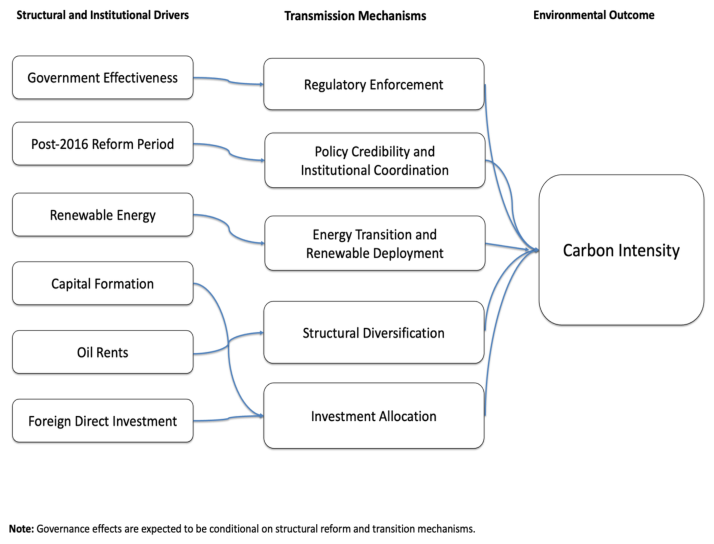
The conceptual framework in
Figure 1 underlies the hypothesized relationship between governance quality, structural reform, renewable energy transition, and carbon intensity. These hypotheses guide the subsequent empirical analysis using the ARDL framework.
3. Materials and Methods
3.1. Data Sources and Variables
This study employs annual time-series data for Saudi Arabia from 2002 to 2024, constrained by the availability of governance indicators and the construction of a balanced sample. All variables are drawn from internationally standardized databases to ensure temporal consistency and comparability across the study period. The final sample is restricted to years for which all variables are jointly available. Observations with missing values were excluded to preserve a balanced time-series structure. No interpolation or artificial smoothing procedures were applied, thereby avoiding distortion of the original statistical properties of the data. Economic and environmental variables are obtained from the World Development Indicators database of the World Bank (
https://databank.worldbank.org/source/world-development-indicators, accessed on 2 November 2025), while governance is proxied using data from the Worldwide Governance Indicators database published by the World Bank (
https://info.worldbank.org/governance/wgi/, accessed on 2 November 2025).
The dependent variable is carbon intensity, defined as carbon dioxide emissions relative to economic output. This measure is preferred over aggregate emissions because it captures the environmental efficiency of production and allows for an assessment of whether institutional improvements are associated with cleaner growth rather than reduced economic activity. Governance quality is proxied by government effectiveness, which reflects the quality of public services, administrative capacity, and the credibility of policy implementation. Government effectiveness is obtained from the Worldwide Governance Indicators database and ranges from approximately −2.5 to +2.5, with higher values indicating stronger institutional effectiveness. The study does not construct a composite governance index; therefore, no weighting scheme is applied. This indicator is particularly relevant in the present context, as the analysis focuses on the role of institutional effectiveness in supporting environmental regulation, implementing structural reforms, and facilitating the transition toward a lower-carbon economy.
The model includes several control variables associated with structural determinants of carbon intensity. Renewable energy is measured using renewable electricity output and reflects progress toward cleaner energy production. Gross capital formation is included to account for investment dynamics and changes in productive capacity that may influence emissions intensity. Oil rents represent structural dependence on hydrocarbon revenues, while foreign direct investment (FDI) reflects external capital inflows and potential technological spillovers. Detailed variable definitions, measurements, and data sources are provided in
Appendix A. To account for structural change in the institutional–environment relationship, the specification incorporates a post-2016 dummy variable, which takes the value of one from 2016 onward and zero otherwise. This variable reflects a shift in the policy and institutional environment associated with major reform initiatives. In addition, an interaction term between governance and the post-2016 period is included to examine whether the effectiveness of governance in shaping environmental outcomes changes under a different policy regime.
3.2. Model Specification
The empirical specification is designed to examine both the direct and conditional effects of governance on carbon intensity. The baseline model evaluates the relationship between governance quality and carbon intensity while controlling for renewable energy, capital formation, oil dependence, and foreign direct investment. The extended specification additionally incorporates a post-2016 reform dummy and an interaction term between governance and the reform period to assess whether the environmental role of governance changes under structural transformation.
The baseline empirical model is specified as follows:
where, in Equation (1), CI_t denotes carbon intensity, GOV_t represents governance quality, REN_t denotes renewable energy, CAP_t is gross capital formation, OIL_t represents oil rents, and FDI_t denotes foreign direct investment.
To capture potential regime-dependent effects, the extended specification is defined as
where, in Equation (2), POST_t is the post-2016 dummy variable, and the interaction term (GOV × POST)_t captures whether the effect of governance on carbon intensity changes following structural reforms.
3.3. ARDL Estimation
The analysis is based on annual data covering the period 2002–2024, resulting in a relatively small sample size. The ARDL framework remains appropriate in this context because it is specifically designed for small-sample time-series settings and can accommodate regressors of mixed orders of integration [
33]. Nevertheless, the findings should be interpreted with appropriate caution, given the limited degrees of freedom and the relatively weak statistical significance of some coefficients.
The empirical procedure proceeds in four stages. First, descriptive statistics and correlation analysis are used to examine the distributional properties of the variables and their initial associations. Second, the order of integration is assessed using Augmented Dickey–Fuller and Phillips–Perron unit root tests [
34]. Third, the existence of a long-run relationship among the variables is tested using the ARDL bounds testing approach. If the computed F-statistic exceeds the upper critical bound, the null hypothesis of no cointegration is rejected. Finally, conditional on cointegration, the long-run coefficients and short-run dynamics are estimated through the error-correction representation of the ARDL model. The corresponding error-correction model (ECM) can be expressed as
where, in Equation (3), Δ denotes first differences, ECT_{t−1} represents the lagged error-correction term derived from the long-run relationship, and λ measures the speed of adjustment toward equilibrium. A negative and statistically significant coefficient on the error-correction term indicates convergence to the long-run equilibrium following short-run deviations.
Model adequacy is evaluated using standard diagnostic tests. Serial correlation is examined using the Breusch–Godfrey LM test, heteroskedasticity is assessed using the Breusch–Pagan test, and residual normality is evaluated using the Jarque–Bera statistic. Structural stability is further examined using the supF test, allowing for the detection of potential regime shifts in the estimated relationship.
4. Results
4.1. Descriptive Statistics
The descriptive statistics in
Table 1 indicate moderate variation across variables. Carbon intensity exhibits relatively low dispersion, suggesting a stable emissions structure over time. Capital and oil rents display higher variability, reflecting fluctuations in investment activity and resource dependence. Renewable energy shows pronounced positive skewness, indicating its recent and uneven expansion. Governance remains centered near zero with limited variation, suggesting gradual institutional changes. The distributional properties support the presence of structural shifts rather than extreme volatility.
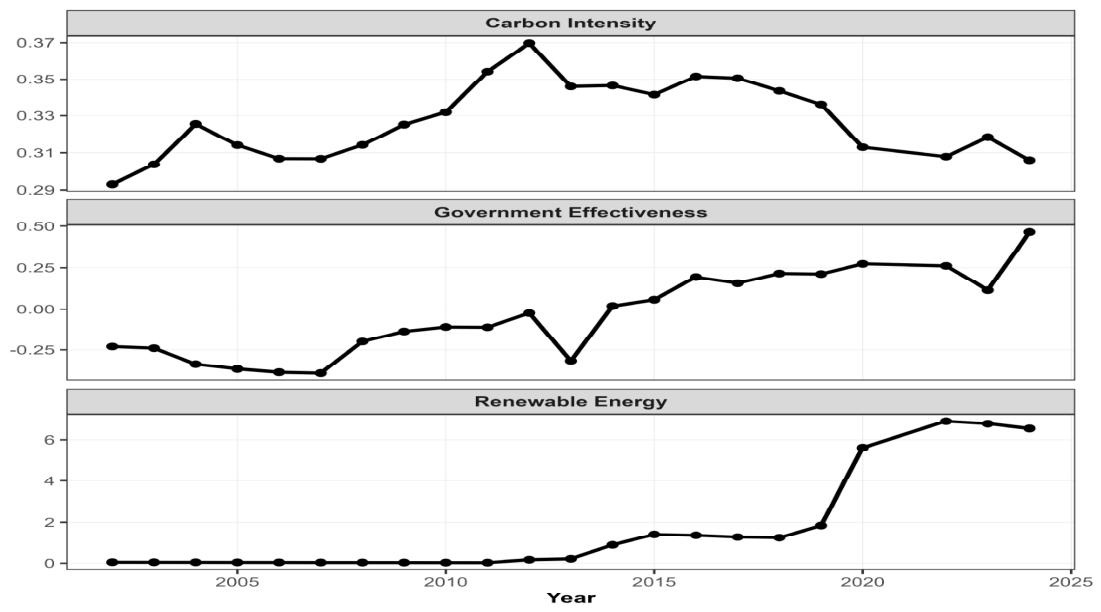
The graphical evidence in
Figure 2 reveals distinct structural patterns across variables. Carbon intensity exhibits a rising trend up to 2011–2012, followed by a gradual decline, suggesting a partial shift away from carbon-intensive activity in the later period. Governance quality improves consistently over time, with a noticeable upward shift after the mid-2010s, indicating strengthening institutional capacity. In contrast, renewable energy remains negligible for most of the sample and only increases sharply after 2019, reflecting its late but accelerated deployment. These patterns collectively suggest that recent improvements in institutional quality and energy diversification coincide with a moderation in carbon intensity, supporting the specification of regime-dependent effects in the empirical model.
Figure 2. Trends in Carbon Intensity, Governance Quality, and Renewable Energy in Saudi Arabia (2002–2024).
4.2. Correlation Matrix
The correlation matrix in
Table 2 indicates a strong positive association between capital and carbon intensity, suggesting that investment activity is closely linked to emissions intensity. Governance is positively correlated with renewable energy and capital, but negatively associated with oil rents, reflecting a structural shift toward diversification. Renewable energy is negatively correlated with carbon intensity, consistent with its role in reducing emissions. The absence of excessively high correlations suggests no evidence of severe multicollinearity.
4.3. Variance Inflation Factor (VIF)
The VIF results in
Table 3 indicate that multicollinearity is not a major concern in the model. All variables fall below conventional thresholds, although governance exhibits a moderately higher value, likely reflecting its association with structural transformation variables. Overall, the model specification remains statistically stable.
4.4. Stationarity Tests
The stationarity properties of the variables are examined using both Augmented Dickey–Fuller (ADF) and Phillips–Perron (PP) tests. In
Table 4, the unit root results indicate that most variables are non-stationary in levels but become stationary after first differencing, suggesting integration of order one. For some variables, including governance and foreign direct investment, the evidence is mixed across tests, indicating potential integration of order zero or one. Importantly, no variable is integrated of order two, satisfying the key requirement for the ARDL bounds testing approach and supporting its application in the subsequent analysis.
4.5. ARDL Cointegration and Long-Run Results
The bounds test in
Table 5 rejects the null hypothesis of no cointegration, indicating the presence of a stable long-run relationship among the variables. This supports the use of the ARDL framework and supports the estimation of long-run and short-run dynamics. In
Table 6, the long-run results indicate that capital formation significantly increases carbon intensity, reflecting persistent structural dependence on carbon-intensive investment. Renewable energy reduces carbon intensity, although its effect remains limited due to its relatively recent expansion. Governance does not exert an independent long-run effect; however, its interaction with the reform period is negative and weakly significant, suggesting that institutional effectiveness appears to strengthen under structural transformation.
4.6. Short-Run Dynamics and Error-Correction Results
To assess the stability of the results, an alternative dynamic specification including the first difference in governance is estimated. This specification serves as a robustness check for the short-run governance channel. In
Table 7, the error-correction term is negative and statistically significant across both specifications, indicating the presence of a stable long-run equilibrium. The estimated adjustment coefficients indicate that approximately 57–61% of short-run disequilibrium is corrected within one period, reflecting a relatively rapid convergence process. The baseline ECM adopts a parsimonious structure, focusing primarily on the speed of adjustment due to the limited sample size. In contrast, the alternative specification reveals a statistically significant short-run effect of governance. The positive coefficient on the change in governance suggests that short-run improvements in institutional quality are associated with increased carbon intensity, likely reflecting expansionary economic effects during the transition phase. Over time, governance becomes more environmentally effective under reform conditions in reducing emissions intensity, as indicated by the long-run interaction results.
4.7. Diagnostic and Stability Tests
The diagnostic results in
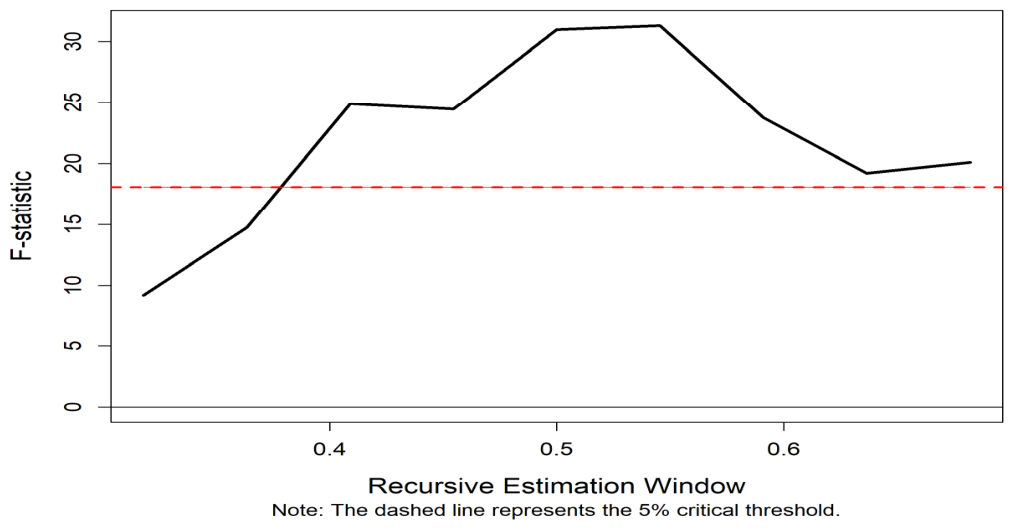
Table 8 indicate that the model is generally well-specified. The Breusch–Pagan test fails to reject the null hypothesis of homoskedasticity in both specifications, suggesting that heteroskedasticity is not a concern. Similarly, the Jarque–Bera test indicates that residuals are approximately normally distributed. However, the Breusch–Godfrey test reveals evidence of serial correlation in the baseline ECM specification and weak evidence in the alternative model. To address this issue, heteroskedasticity-robust standard errors are employed, improving the robustness of statistical inference. The results suggest that the model remains econometrically adequate despite evidence of structural instability. This supports the use of a regime-dependent specification rather than a constant-parameter framework.
Figure 3 visually indicates the presence of structural instability, consistent with the supF test reported in
Table 8.
5. Discussion
The results point to a clear structural feature of the Saudi economy: carbon intensity remains persistent and closely tied to the underlying production structure. The relatively large and statistically significant error-correction term indicates rapid convergence toward a long-run equilibrium that remains structurally carbon-intensive. This suggests that short-term fluctuations appear insufficient to substantially alter the emissions profile; instead, the dominant driver remains the composition of economic activity. These results should not be interpreted as evidence that governance automatically reduces carbon intensity. Rather, they suggest that governance becomes environmentally relevant when institutional capacity is linked to structural transformation, investment reallocation, and energy-system change.
A central finding of the analysis is that governance, when considered in isolation, does not exhibit a statistically significant long-run effect on carbon intensity. The result suggests that improvements in administrative quality or policy effectiveness do not automatically translate into environmental gains in a resource-dependent setting. In earlier periods, institutional improvements may have supported economic expansion without altering the energy mix, thereby leaving emissions intensity largely unchanged [
15]. The interaction between governance and the post-2016 period provides more informative evidence. The estimated coefficient is negative and marginally significant, suggesting that the effect of governance may have shifted following the reform phase. This interpretation is broadly consistent with Hypothesis 4, which proposed that the environmental role of governance becomes more pronounced during the post-reform period. This is consistent with the idea that governance becomes more relevant for environmental outcomes when it is aligned with broader structural reforms, rather than acting as an independent driver [
29,
30]. The short-run dynamics reinforce this interpretation. The positive and statistically significant coefficient on changes in governance in the alternative specification suggests that improvements in governance are associated with higher carbon intensity in the short run. This pattern is consistent with transition dynamics: institutional improvements may initially facilitate investment and economic activity in existing sectors, many of which remain energy intensive. Over time, the direction of this effect appears to depend on whether structural policies redirect economic activity toward less carbon-intensive production.
The role of renewable energy remains limited over the sample period. Although the coefficient is negative, its statistical significance is weak, reflecting the small scale of renewable deployment for most of the period. The data show that meaningful expansion in renewable energy occurs only in the later years, which restricts its influence in the estimation. This suggests that the transition toward cleaner energy has not yet reached a scale sufficient to materially affect emissions efficiency at the aggregate level. The observed relationships may also be influenced by external factors not explicitly modeled in the analysis, including global energy prices, technology costs, and broader macroeconomic conditions. These factors may affect both renewable energy deployment and investment decisions. Although the estimated relationship remains weak, the negative coefficient direction remains broadly consistent with Hypothesis 2.
Capital formation emerges as the most consistent determinant of carbon intensity. The positive and statistically significant coefficient indicates that investment continues to be concentrated in carbon-intensive sectors. This aligns with the structure of a resource-dependent economy, where capital accumulation is closely linked to energy-intensive production and infrastructure. In this context, increases in investment reinforce existing emissions patterns rather than shifting the economy toward cleaner production. Oil rents and foreign direct investment do not show statistically significant direct effects. This does not imply that they are unimportant, but rather that their influence may operate through indirect channels. Oil rents likely shape the structure of the economy and the allocation of investment, while the environmental impact of FDI depends on its sectoral composition rather than its aggregate volume. The absence of strong direct effects in the model reflects these more complex transmission mechanisms. This finding is consistent with Hypothesis 3, which anticipated that investment expansion in a resource-dependent economy would reinforce carbon-intensive production structures.
Finally, the insignificance of the post-2016 dummy variable on its own suggests that structural change cannot be captured as a simple shift in levels. Instead, the results indicate that changes in environmental outcomes are linked to how institutions and economic structure interact over time. The evidence does not support a discrete break in carbon intensity, but it does suggest a gradual change in the relationship between governance and emissions following the reform period. Overall, the findings do not support a simple view in which better governance directly reduces carbon intensity. Instead, they indicate that the environmental role of governance depends on the broader economic context, particularly the direction of structural transformation. In the absence of changes in the composition of investment and energy use, institutional improvements alone appear insufficient to alter the emissions trajectory. The findings contribute to the environmental governance literature by suggesting that institutional quality alone may be insufficient to improve emissions efficiency unless it is connected to broader structural transformation processes. Rather than operating as a uniform determinant, governance appears to become environmentally relevant when institutional reforms are aligned with diversification strategies, renewable energy expansion, and reduced dependence on carbon-intensive production structures. This conditional interpretation extends existing research on governance and environmental performance in resource-dependent economies.
6. Conclusions
This study examines the relationship between governance quality and carbon intensity in Saudi Arabia within a resource-dependent economic structure. The results show that carbon intensity remains closely tied to the composition of economic activity, with limited evidence of structural change over most of the sample period. Capital formation emerges as a consistent driver of higher emissions intensity, indicating that investment continues to be concentrated in energy-intensive sectors. A key finding is that governance does not exhibit a statistically significant independent effect on carbon intensity. This suggests that improvements in institutional quality, on their own, are insufficient to alter environmental outcomes in an economy where production remains heavily dependent on fossil fuels. There is, however, weak evidence that the effect of governance becomes more favorable in the post-2016 reform period, as indicated by the negative interaction term. While this result is not strong, it points to a possible shift in how institutional quality operates when aligned with broader structural changes. These findings imply that the environmental role of governance is conditional rather than direct. Institutional improvements appear to matter less in isolation and more in terms of how they interact with the direction of economic transformation. In earlier periods, governance improvements may have facilitated expansion within existing sectors, thereby reinforcing carbon-intensive activity. In contrast, under a reform-oriented policy framework, institutions may play a more supportive role in enabling cleaner growth, although the current evidence remains limited.
From a policy perspective, the results suggest that strengthening governance should not be treated as a standalone strategy for reducing emissions intensity. More specifically, environmental governance should be integrated into industrial diversification strategies through carbon-linked investment screening, stronger institutional coordination for renewable energy deployment, and monitoring of energy-intensive sectors. Policies aimed solely at expanding renewable energy capacity may be insufficient unless accompanied by institutional mechanisms capable of redirecting investment and production toward lower-carbon activities. Without a corresponding shift in the composition of investment and energy use, institutional improvements are unlikely to generate substantial environmental gains. In particular, the positive association between capital formation and carbon intensity highlights the need to redirect investment toward low-carbon sectors, including renewable energy, energy efficiency, and cleaner industrial processes. The limited impact of renewable energy in the estimation further indicates that its current scale is insufficient to influence aggregate emissions efficiency. This underscores the importance of accelerating deployment at a level that can meaningfully alter the energy mix. At the same time, the absence of a significant effect from foreign direct investment suggests that policy should focus not only on attracting capital, but also on its sectoral allocation and technological content. Largely, the findings indicate that sustainability outcomes in resource-dependent economies depend on the alignment between institutional quality and structural transformation. Governance may support environmental improvement when it is embedded within a broader strategy aimed at reducing reliance on carbon-intensive production.
This study nevertheless has several limitations. The relatively small sample size may constrain statistical precision, and the estimated interaction effects should therefore be interpreted with appropriate caution. In addition, the single-country focus and use of aggregate data limit the ability to capture broader cross-country or sector-specific dynamics. Future research could extend this analysis using sectoral data or a panel of resource-dependent economies to examine whether the conditional governance effect identified here generalizes across different institutional and energy-transition contexts.
Author Contributions
Conceptualization, K.I. and M.M.; methodology, K.I.; software, K.I.; validation, K.I. and M.M.; formal analysis, K.I.; investigation, K.I.; resources, K.I.; data curation, M.M.; writing—original draft preparation, K.I.; writing—review and editing, K.I. and M.M.; visualization, M.M.; supervision, K.I.; project administration, K.I.; funding acquisition, M.M. All authors have read and agreed to the published version of the manuscript.
Funding
This research was funded by Taif University Researchers Supporting Project number (TURSP-HC2026/15), Taif University, Saudi Arabia.
Institutional Review Board Statement
Not applicable.
Informed Consent Statement
Not applicable.
Data Availability Statement
The datasets used and analyzed during the current study are available from the corresponding author upon reasonable request.
Acknowledgments
The authors would like to acknowledge the Deanship of Graduate Studies and Scientific Research, Taif University, for funding this work.
Conflicts of Interest
The authors declare no conflicts of interest.
Appendix A. Variable Definitions, Measurements, and Data Sources
| Variable | Definition and Measurement | Expected Sign | Source |
| Carbon Intensity | CO2 emissions relative to economic output; proxy for emissions efficiency | Dependent variable | World Development Indicators (World Bank) |
| Governance | Government effectiveness index measuring institutional quality, public service effectiveness, and policy implementation capacity; ranges approximately from −2.5 to +2.5 | Negative/Conditional | Worldwide Governance Indicators (World Bank) |
| Renewable Energy | Renewable electricity output as a share of total energy or electricity generation | Negative | World Development Indicators (World Bank) |
| Capital Formation | Gross capital formation as a percentage of GDP | Positive | World Development Indicators (World Bank) |
| Oil Rents | Oil rents as a percentage of GDP, capturing dependence on hydrocarbon revenues | Positive | World Development Indicators (World Bank) |
| Foreign Direct Investment (FDI) | Net foreign direct investment inflows as a percentage of GDP | Ambiguous | World Development Indicators (World Bank) |
| Post-2016 Reform Period | Dummy variable equal to 1 for years after 2016 and 0 otherwise, capturing the structural reform period associated with Vision 2030 | Negative | Author construction |
| Governance × Post-2016 | Interaction term between governance and the post-2016 reform dummy | Negative/Conditional | Author construction |
References
- Young, O.R.; Guttman, D.; Qi, Y.; Bachus, K.; Belis, D.; Cheng, H.; Lin, A.; Schreifels, J.; Van Eynde, S.; Wang, Y.; et al. Institutionalized Governance Processes: Comparing Environmental Problem Solving in China and the United States. Glob. Environ. Change 2015, 31, 163–173. [Google Scholar] [CrossRef]
- Moe, E.; Røttereng, J.-K.S. The Post-Carbon Society: Rethinking the International Governance of Negative Emissions. Energy Res. Soc. Sci. 2018, 44, 199–208. [Google Scholar] [CrossRef]
- Abdelkawy, N.A.; Alzuwaidi, L. Institutional Quality, Energy Efficiency, and Natural Gas: Explaining CO2 Emissions in the GCC, 2000–2023. Sustainability 2025, 17, 6746. [Google Scholar] [CrossRef]
- Mahmood, H. Natural Resource Rents and Carbon Intensity Nexus in Saudi Arabia: Disaggregated Analyses. Int. J. Energy Econ. Policy 2025, 16, 1–7. [Google Scholar] [CrossRef]
- Lo, K. How Authoritarian Is the Environmental Governance of China? Environ. Sci. Policy 2015, 54, 152–159. [Google Scholar] [CrossRef]
- Belaïd, F.; Mikayilov, J.I.; Apeaning, R. Can Efficiency Offset Emissions Stemming from Urban Growth? Prospects for Saudi Buildings. J. Environ. Manag. 2025, 393, 127174. [Google Scholar] [CrossRef]
- Alyousif, M.; Belaid, F.; Almubarak, N.; Almulhim, T. Mapping Saudi Arabia’s Low Emissions Transition Path by 2060: An Input-Output Analysis. Technol. Forecast. Soc. Change 2025, 211, 123920. [Google Scholar] [CrossRef]
- Grossman, G.M.; Krueger, A.B. Economic Growth and the Environment. Q. J. Econ. 1995, 110, 353–377. [Google Scholar] [CrossRef]
- Kahouli, B.; Hamdi, B.; Miled, K. Exploring the Interplay between Renewable Energy, Agriculture, Clean Technologies, Natural Resources, and Environmental Sustainability. Energy Strategy Rev. 2026, 64, 102057. [Google Scholar] [CrossRef]
- Saba, C.S.; Uche, E.; Shaddady, A. Sustainable Governance, Digital Transformation, and Environmental Sustainability in Africa’s Decade of Action. Curr. Opin. Environ. Sustain. 2026, 80, 101629. [Google Scholar] [CrossRef]
- Ali, A.; Qadir, S.A.; Shahid, M.; Islam, M.T.; Baig, F.; Islam, A. Accelerating Electric Mobility: A Distance-Metric Approach to Policy Assessment and Reform. Multimodal Transp. 2026, 5, 100310. [Google Scholar] [CrossRef]
- Wu, G.; Ren, Y.; Yang, B.; Sun, L.; Li, J.; Shi, R. A Sustainable Assessment Framework for Cross-Regional Ecological Governance: Integrating Socio-Ecological System and Complex Network Approaches. Socioecon. Plan. Sci. 2026, 105, 102477. [Google Scholar] [CrossRef]
- Bruelisauer, S.; Villar, G.; Oberlack, C. Sustainability Governance Diversifies: Unpacking Private-Sector Governance Strategies in Coffee and Cocoa Value Chains. World Dev. 2026, 202, 107350. [Google Scholar] [CrossRef]
- Hazarika, B.; Singh, A. Unlocking SDG Potentials through the Synergy of Public Spending and Governance: A District Level Analysis in Assam. World Dev. Sustain. 2026, 8, 100276. [Google Scholar] [CrossRef]
- Kamboj, P.; Bhatt, Y.; Xu, X.; Alswaina, F.; Shetty, P.K.; Arora, A.; Hejazi, M. Pathways to Decarbonizing Land Transport in Saudi Arabia: An Integrated Assessment of Technologies and Policy Interventions. Energy Clim. Change 2026, 7, 100245. [Google Scholar] [CrossRef]
- Wang, L.; Jin, S. Governance Effect of Digital Washing on Corporate Sustainable Growth. J. Clean. Prod. 2026, 554, 148056. [Google Scholar] [CrossRef]
- You, C.; Chen, S.; Wang, H. Growth vs. Sustainability: Economic Development and Environmental Governance in Transition Periods Policy. Econ. Model. 2026, 156, 107433. [Google Scholar] [CrossRef]
- Attah, E.Y.; Onalo, S.M.; Obi-Anike, H.O.; Ndubuisi-Okolo, P.U. Institutional Reforms, Agricultural Export Diversification, and Resilience to External Shocks: A Pathway to Sustainable Growth in Nigeria. Dev. Sustain. Econ. Financ. 2025, 8, 100095. [Google Scholar] [CrossRef]
- Pourebrahim, M.; Moosavian, S.F.; Hosseini, S.M. The Green Power Market: Sustainable Policy for Achieving Green Development and Renewable Energy Synergies. Energy Convers. Manag. X 2026, 30, 101718. [Google Scholar] [CrossRef]
- Fan, G.; Zhang, J.; Chen, Z.; Asutosh, A.T.; Li, Y.; Song, G.; Wu, W.; Men, Z. Study on the Sustainability, Resilience and Co-Governance of Rural Biomass Energy Systems: Based on an Integrated Perspective of Ecology-Community-Culture-Technology. Biomass Bioenergy 2026, 212, 109314. [Google Scholar] [CrossRef]
- Donkor, M.; Kong, Y.; Manu, E.K. Natural Resource Abundance, Governance, and Government Expenditure: Empirical Insights from Environmental Sustainability. Sustain. Dev. 2025, 33, 733–757. [Google Scholar] [CrossRef]
- Hossain, I.; Haque, A.K.M.M.; Masud, A.A. Mapping Urban Nature-Based Solutions and Environmental Sustainability in South Asia: A Social–Ecological–Technological Systems Perspective on Research Trends, Governance Gaps and Policy Pathways. Nat.-Based Solut. 2026, 9, 100326. [Google Scholar] [CrossRef]
- Jie, G.; Tianhe, J. Progressing through Strategic Concessions: Infrastructure-Induced Resettlement and Sustainable Governance in Rural China. Phys. Chem. Earth Parts ABC 2026, 143, 104365. [Google Scholar] [CrossRef]
- Robinson, J.; Acemoglu, D. Why Nations Fail: The Origins of Power, Prosperity, and Poverty; Crown Publishers: New York, NY, USA, 2012. [Google Scholar]
- North, D.C. Institutions, Institutional Change and Economic Performance; Political Economy of Institutions and Decisions; Cambridge University Press: Cambridge, UK, 1990. [Google Scholar]
- Stern, D.I. The Rise and Fall of the Environmental Kuznets Curve. World Dev. 2004, 32, 1419–1439. [Google Scholar] [CrossRef]
- Khan, S.; Ullah, S.; Nobanee, H. ICT Diffusion, E-Governance, and Sustainability in the Digital Era. Sustain. Futur. 2024, 8, 100272. [Google Scholar] [CrossRef]
- Handoyo, S. Public Governance and National Environmental Performance Nexus: Evidence from Cross-Country Studies. Heliyon 2024, 10, e40637. [Google Scholar] [CrossRef]
- Elkebti, O.A.M.; Khalifa, W.M.S. Assessing the Saudi and Middle East Green Initiatives: The Role of Environmental Governance, Renewable Energy Transition, and Innovation in Achieving a Regional Green Future. Sustainability 2025, 17, 5307. [Google Scholar] [CrossRef]
- Hassan, A.; Ibrahim, R.L.; Raimi, L.; Omokanmi, O.J.; Senathirajah, A.R.B.S. Balancing Growth and Sustainability: Can Green Innovation Curb the Ecological Impact of Resource-Rich Economies? Sustainability 2025, 17, 4579. [Google Scholar] [CrossRef]
- Hassan, S.U.; Basumatary, J.; Goyari, P. Impact of Governance and Effectiveness of Expenditure on CO2 Emission (Air Pollution): Lessons from Four BRIC Countries. Manag. Environ. Qual. Int. J. 2024, 35, 1721–1743. [Google Scholar] [CrossRef]
- Byrne, M.J.; John, M.; Biswas, W. Regulatory Gaps and Ghost Indicators in Australian Alumina Production: The Case for Standardized Sustainability Reporting and Policy Reform. Extr. Ind. Soc. 2026, 25, 101763. [Google Scholar] [CrossRef]
- Pesaran, M.H.; Shin, Y.; Smith, R.J. Bounds Testing Approaches to the Analysis of Level Relationships. J. Appl. Econom. 2001, 16, 289–326. [Google Scholar] [CrossRef]
- Phillips, P.C.B.; Perron, P. Testing for a Unit Root in Time Series Regression. Biometrika 1988, 75, 335–346. [Google Scholar] [CrossRef]
| Disclaimer/Publisher’s Note: The statements, opinions and data contained in all publications are solely those of the individual author(s) and contributor(s) and not of MDPI and/or the editor(s). MDPI and/or the editor(s) disclaim responsibility for any injury to people or property resulting from any ideas, methods, instructions or products referred to in the content. |