1. Introduction
To achieve sustainable and low-carbon development, China has vigorously pursued green transformation. If pollution is neglected, it will become progressively worse, leading to a decline in consumption and a reduction in intergenerational welfare levels. To help pay for the costs associated with achieving low-emission and other nature-related goals, corporations can choose to issue green bonds. From this perspective, green finance plays a vital role in facilitating the transition toward a greener and more sustainable growth path. Within this context, green bonds, a key component of the climate finance ecosystem, are instrumental in advancing the low-carbon transition of industries.
As defined by the China Green Bond Standard Committee, green bonds are securities issued following legal procedures, aimed specifically at financing green industries, projects, or activities that meet predefined criteria. These bonds are committed to repaying the principal and interest as per the agreement. The funds raised through green bonds are exclusively allocated to qualified green projects, distinguishing them from traditional bonds by their environmental focus. In China, the proceeds from green bond issuances predominantly support initiatives that enhance corporate energy efficiency, prevent pollution, and facilitate sustainable transitions and upgrades.
Since 2016, China’s green bond market has expanded rapidly, making the country one of the world’s largest green bond issuers. In 2024, aligned global green bond issuance reached US
$671.7 billion, with the United States accounting for US
$84.7 billion, followed by Germany (US
$73.3 billion) and China (US
$68.9 billion) [
1]. This paper focuses on heavy-polluting enterprises as issuers, specifically examining whether green bond issuance affects these firms’ financial performance.
To better achieve the dual goals of “carbon peaking” and “carbon neutrality,” China has introduced numerous policy measures to guide and encourage sustainable practices, including incentivizing enterprises to issue green bonds. As a result, an increasing number of firms have utilized this financial instrument in recent years to support green project development, including those in heavy-polluting industries that would otherwise be reluctant to issue green bonds, thereby reducing corporate pollution levels and promoting sustainable development. Geographically, both the frequency of issuances and the number of issuing companies are primarily concentrated in the southeastern coastal regions. The issuances in the northern region are mainly concentrated in the Beijing, Hebei, and Shandong provinces. In the southern region, they are primarily concentrated in Guangdong and Zhejiang provinces. These provinces are characterized by strong economic foundations and high economic vitality.
This paper makes three contributions to the existing literature:
This paper complements the growing literature on green bond pricing, greenium, investor reactions, ESG signalling, and green innovation by shifting attention to issuer-side short-term accounting profitability. Prior studies mainly examine whether green bonds reduce financing costs, improve market valuation, promote ESG performance, or stimulate green innovation. These outcomes are important, but they do not directly reveal whether issuing firms experience short-term accounting profitability pressure after entering green bond issuer status. A lower yield, a positive announcement return, or improved ESG performance may coexist with temporary margin compression and operational adjustment. This paper therefore examines a distinct firm-level outcome: short-term post-issuance profitability dynamics among listed heavy-polluting issuers.
This paper focuses on China’s listed heavy-polluting firms, a policy-relevant group facing both green-transition pressure and substantial transformation costs. This setting allows us to examine whether green financing instruments generate short-term accounting trade-offs for firms in high-emission sectors.
This paper examines heterogeneity across ownership, region, and industry, and adds a DuPont-style mechanism analysis to distinguish whether the observed ROE decline is more closely related to margin pressure, operating efficiency, or leverage structure.
The remainder of this paper is organized into five sections.
Section 2 provides a literature review, while
Section 3 formulates hypotheses.
Section 4 details the data collection methods and variables, elaborates on the sources of sample data, identifies relevant variables, and provides a descriptive statistical analysis.
Section 5 presents empirical results, including model testing and analyses, robustness checks, and heterogeneity analyses. Finally,
Section 6 summarizes the findings, suggests recommendations for future practice, discusses potential policy implications, and identifies areas for further research.
2. Literature Review
2.1. Influence of Green Bonds
2.1.1. Financial Performance and Comparison with Traditional Bonds
Green bonds are fixed-income instruments designed to fund projects that contribute to climate change mitigation or broader environmental sustainability goals, thereby channelling capital toward environmentally beneficial investments [
2,
3]. Existing research examines green bonds from several perspectives, including financial performance, market reaction to issuance, and pricing dynamics.
Empirical studies report that green bonds display distinct pricing features compared to conventional bonds. For example, green bonds, especially those rated between AA and BBB, often trade at slightly tighter spreads than comparable non-green bonds from the same issuers [
4]. This pricing premium appears more pronounced among financial and corporate green bonds relative to those issued by government-related entities, indicating that investors may place higher value on the environmental commitments signalled by certain private issuers.
Green bonds have shown stronger performance during periods of elevated economic and climate policy uncertainty. Research finds that green bonds outperform traditional bonds as hedging instruments under such conditions, particularly for portfolios with high carbon exposure [
5]. Other studies find that green bond issuance depends on both internal factors, such as firm profitability and environmental initiatives, and external factors, including macroeconomic conditions and policy incentives [
6].
In the primary market, Gianfrate and Perianalyze the green bonds using propensity score matching. They examine 121 European green bonds and find that these bonds offer a pricing advantage of about 18 basis points at issuance compared to similar non-green bonds. This yield differential remains significant after controlling for bond maturity, issuance size, and other factors. The results indicate that green bond issuance can reduce firms’ financing costs while supporting environmental goals. Therefore, green bonds are an attractive financing tool for firms focused on sustainability [
2].
In the secondary market, scholars confirm the existence of a “greenium,” meaning green bonds trade at lower yields than comparable conventional bonds [
3]. This yield advantage is most apparent for investment-grade green bonds that comply with established governance standards, such as third-party certification and transparent post-issuance reporting. About 70% of the reviewed studies report a negative yield differential in the secondary market, with the greenium typically between −1 and −9 basis points [
3]. However, the relative performance of green bonds over time appears to be inconsistent. Green bond premium declines as the market matures [
7]. While green bonds may offer initial financial benefits, their long-term risk-adjusted performance converges with that of traditional bonds, potentially limiting their appeal as superior investment vehicles in the long run.
2.1.2. Market and Investor Responses
The issuance of green bonds often generates positive market reactions and brings several strategic benefits to issuing firms. Green bond announcements are associated with significant stock price increases, with a cumulative abnormal return of 1.4% over a 21-day event window [
8,
9,
10]. This effect is more pronounced for first-time issuers, indicating an “investor attention” mechanism, where increased media coverage and visibility improve stock liquidity and attract institutional investors, particularly those with long-term horizons such as pension funds and investment advisors.
Certified green bonds are more likely to receive favourable market responses, as third-party certification reduces information asymmetry and signals credible environmental commitment [
9]. Green bond issuance also contributes to longer-term sustainability outcomes. Firms tend to improve their ESG performance following issuance, suggesting that funds are allocated to substantive environmental initiatives rather than symbolic efforts [
8].
2.1.3. Pricing and Spillover Effects
Green bonds exhibit distinct pricing dynamics compared to conventional bonds, particularly when distinguishing between labelled and unlabelled instruments. Unlabelled green bonds, those without formal certification, tend to offer higher yields than their labelled counterparts, despite having similar characteristics. Labelled green bonds are associated with yield discounts of 24 to 36 basis points, and investors are willing to accept lower returns in exchange for greater credibility and reduced information asymmetry [
11].
Although green bonds generally yield less at issuance than conventional bonds, the extent of this pricing differential varies across studies depending on sample composition and methodological design. Recent global evidence confirms that green bonds are typically issued at tighter spreads, particularly when supported by certification and transparent reporting. Bonds with clearer environmental disclosures tend to be more favourably priced by investors, underscoring the importance of governance standards [
12].
Green bond valuations are also influenced by broader market dynamics. Return spillovers from fixed-income and currency markets to green bond markets have been observed, with green bond prices responding to movements in U.S. Treasury yields and exchange rates. However, the reverse effect is limited, suggesting that while green bonds are affected by macro-financial shocks, they exert minimal influence on traditional markets [
13].
Recent research also emphasizes that financial intermediation and financial stress can shape firms’ real outcomes. Kyriazis, Dimitriadis, and Theodossiou (2026), for example, examine whether banking intermediaries can crowd out promising high-tech successors from a financial-stress perspective [
14]. Their study highlights the broader point that financing channels can affect firm investment opportunities and performance under financial frictions [
14]. Our paper differs from this literature in three respects. First, we focus on labelled green bonds rather than banking intermediation. Second, we examine heavy-polluting listed firms rather than high-tech firms. Third, instead of studying credit crowding-out under financial stress, we examine short-term issuer-side profitability dynamics during green transformation.
Taken together, this strand of literature shows that green bonds may generate financial market benefits through lower financing costs, greenium, favourable announcement effects, improved disclosure credibility, and stronger investor recognition. However, most of these studies examine green bonds from the perspective of bond pricing, capital-market valuation, investor response, or environmental signalling. These outcomes are not equivalent to realized accounting profitability after issuance. In particular, a favourable market reaction or a lower yield at issuance does not necessarily imply that green project implementation is costless for the issuer. For firms in high-emission sectors, green bond proceeds may be associated with compliance expenditures, certification and reporting requirements, equipment upgrading, and operational adjustment. Therefore, the short-term issuer-side profitability consequences of green bond issuance remain an empirically relevant but less emphasized question.
2.2. Connection Between Green Bonds and Heavy-Polluting Industry
China’s accelerated transition from a high-pollution to a low-carbon economy places its heavy-polluting sectors, such as energy, chemicals, and mining, at the forefront of green finance innovation and reform [
15]. This context motivates the selection of Chinese listed companies, especially heavy-polluting enterprises, as the focus of this study. The analysis examines how green development and sustainable growth affect corporate performance, with a particular emphasis on return on equity (ROE). Theoretically, the direction of this impact is uncertain, underscoring the need for empirical investigation.
Green bonds have become a key financial instrument for funding environmental transformation in high-emission industries. This section reviews how green bond issuance influences the financial performance, particularly ROE, of listed firms in these sectors.
2.2.1. Innovation, Regulation, and Long-Term Profitability
The literature suggests that green bonds enable heavy-polluting firms to pursue low-carbon innovation and enhance compliance with environmental regulations, which can improve long-term profitability. Researchers find that green bonds help Chinese firms finance transitions that increase operational efficiency and reduce the costs of environmental non-compliance [
15]. Other studies show that greater green bond issuance is associated with statistically significant reductions in carbon emission intensity, especially in less developed regions, suggesting potential for broad-based efficiency gains [
16].
Moreover, the existing literature highlights the positive performance effects of green bonds, especially for environmentally friendly firms, through increased productivity, reduced debt, and enhanced profitability [
17]. Green finance is also linked to both higher quality and quantity of firm innovation [
18], raising firm market valuation through improved environmental practices [
19]. Additionally, empirical studies show that green bond policies stimulate green innovation, economic growth, and allocative efficiency in green projects [
20]. Furthermore, the issuance of green bonds can improve the cost-efficiency of capital allocation while lowering financing costs for firms [
21]. These findings suggest a long-run profitability advantage, although they may overlook accompanying short-term financial pressures.
Recent evidence supports the profitability-enhancing role of green bonds through firm-level innovation. Scholars find that green bond issuance in China significantly boosts corporate innovation, which mediates the effect on firm value [
22]. Another article reports that environmental performance improvements linked to green bond adoption are often rewarded with favourable market sentiment, suggesting reputational and valuation-based benefits that may enhance ROE over time [
23]. They also emphasize the role of environmental subsidies in amplifying green bond effectiveness, particularly by supporting research and development among heavy-polluting firms [
23].
Researchers add that green bond issuance triggers peer effects, encouraging non-issuing firms within the same industry to adopt sustainable practices, thereby contributing to systemic environmental and financial improvements [
24]. Other researchers distinguish between exclusive and mixed bond issuers, noting that firms that issue only green bonds tend to have higher ESG scores, lower financing costs, and reduced carbon emissions, indicators aligned with long-term financial stability and profitability [
12].
2.2.2. Financial and Compliance Costs of Green Bond Issuance
Despite their long-term potential, green bonds impose substantial short-term costs on issuers, especially those in capital-intensive and pollution-heavy sectors. These costs are twofold: regulatory and operational. On the regulatory side, firms face stringent disclosure and reporting standards under green bond frameworks, including third-party certification, environmental impact assessments, and periodic post-issuance reports [
25]. These pre- and post-issuance requirements raise verification costs and necessitate rigorous approval processes, ultimately increasing financing costs.
Operationally, green transformation necessitates high capital outlays. Researchers emphasize that investing in cleaner production systems, upgrading equipment, and restructuring supply chains incurs significant expenses that may suppress near-term profitability [
26]. In particular, the substantial R&D investments and supply-chain reconfigurations required to meet green standards typically have long development cycles, which may depress short-term profits [
27]. Firms often face temporary disruptions to production and inefficiencies during the transition, exacerbating financial strain. Studies have analyzed the role of green credit, an instrument closely tied to green bonds, and observe that while it incentivizes green innovation, it also introduces financing constraints that limit short-term financial flexibility and dampen ROE [
28].
2.2.3. Context-Dependent ROE Outcomes and Policy Implications
In sum, green bonds offer a strategic vehicle for heavy-polluting enterprises to align with national and global sustainability goals while building long-term competitive advantage through innovation, ESG improvement, and regulatory compliance. However, these advantages may not always outweigh the short-term financial strain caused by compliance and transformation expenditures. As a result, the net impact on ROE remains context-dependent, varying by sector, region, and firm-level commitment to sustainability.
This study contributes to the ongoing literature by empirically evaluating whether the financial returns of green bond issuance in China’s heavy-polluting sectors are sufficient to offset their associated costs. Through a focus on ROE as a key performance indicator, this research aims to show the trade-offs involved in green financing for high-emission industries.
Overall, prior research suggests that green bonds may generate long-term benefits through lower financing costs, ESG improvement, green innovation, productivity gains, and environmental performance. At the same time, the literature on heavy-polluting firms indicates that green transformation may require substantial upfront investment, certification and disclosure costs, compliance expenditures, production-line upgrading, and operational adjustment. These two strands imply that green bond issuance may involve an intertemporal trade-off. Potential long-term environmental and valuation benefits may coexist with short-term accounting profitability pressure. This trade-off is particularly relevant for heavy-polluting firms, because their transition costs are likely to be more immediate and more capital-intensive than those of cleaner firms. This paper therefore focuses on short-term profitability dynamics following first green bond issuance, rather than on long-term environmental outcomes, greenium, or bond-level pricing effects.
This focus also distinguishes our study from bond-level heterogeneity research. Issuance amount, maturity, coupon rate, certification, external review, and use-of-proceeds composition are important moderators of green bond effects, but they address a different question: How bond design conditions the issuer-level effect. This study instead examines the extensive-margin event of first green bond issuance and its association with short-term firm-level profitability.
3. Hypotheses
Although we suspect that a negative effect in the near term is most sensible for heavy-polluting firms, given that the cost increase to reduce pollution is likely the highest among such firms (relative to other firms that are not heavy polluters) and more likely to outweigh any potential gains in the near term, we do not know for sure and cannot quantify the average effect without empirical verification.
Each direction would also have different interpretations and policy implications. If green bond issuance has no effect on heavy-polluting firms, it could be reasonably inferred that the firms are engaging in “greenwashing,” or that the positive effects exactly offset the negative effects. Greenwashing refers to the practice whereby firms exaggerate or mislead stakeholders through ESG disclosures, substituting symbolic actions for substantive ESG performance in order to achieve higher ESG ratings and economic benefits. Such strategic behaviour distorts ESG ratings and creates information asymmetry, thereby misleading stakeholders, including investors and consumers, and ultimately affecting market decisions and the firm’s sustainable development outcomes [
29,
30]. However, the existing literature suggests that consumers are capable of discerning the authenticity of corporate social responsibility (CSR) efforts, such as environmental protection initiatives. If such efforts are perceived as insincere, they can, in fact, harm firms’ brand value [
31]. Moreover, considering the subjects of our study are China-listed heavy-polluting enterprises, they are likely to face more stringent regulatory oversight and public scrutiny when they signal their commitment to pollution reduction by issuing green bonds. Environmental regulations, such as China’s New Environmental Protection Law (new EPL) implemented in 2015, play a significant role in shaping corporate behaviour beyond profitability. A study demonstrates that the new EPL enhances the ESG performance of high-polluting firms more significantly than low-polluting ones, with cross-industry common ownership facilitating ESG improvements in low-polluting firms [
32]. These findings indicate that regulatory pressure leads to different responses among firm types. Heavy-polluting firms may be more likely to prioritize environmental investments over short-term profits when issuing green bonds. In other words, greenwashing will likely be even more costly to the firm than maintaining the status quo. Consequently, a neutral effect (implying greenwashing or perfectly offsetting factors) is unlikely.
Green bond issuance might have a positive effect on the profitability of heavy-polluting firms. From a cost perspective, Flammer’s research indicates that while issuing green bonds enhances a firm’s market reputation and environmental image, the direct issuance costs are not significantly different from those of traditional bonds [
33]. Similarly, Zerbib’s study, which compares the pricing differences between green bonds and conventional bonds, finds that the yield differential is minimal, suggesting that there is virtually no difference in the issuance costs between green bonds and traditional bonds [
34]. Moving to any potential revenue effect, given that China’s green bond market only began to develop in 2016, consumers may not yet fully understand the implications of a firm issuing green bonds. Furthermore, there is no indication that Chinese consumers prefer products from greener companies, so significant revenue gains from green bond issuance are improbable.
Therefore, the most plausible scenario is a negative impact: heavy-polluting firms genuinely using green bond proceeds to reduce pollution would incur substantial new costs with minimal short-term revenue upside. Empirical evidence suggests that green bond issuance significantly enhances green innovation in China’s energy industry by alleviating financing constraints, yet such investments may involve substantial upfront costs that could strain short-term profitability [
35]. Similarly, green bonds have been shown to promote green innovation by reducing financial risks and increasing R&D investment, but the high initial costs of these innovation-driven projects may negatively impact short-term financial performance [
36]. Indeed, these firms have not yet curbed their emissions, implying that additional greening efforts are particularly costly. Hence, we propose our first hypothesis:
H1. Heavy-polluting firms experience a short-term decline in profitability following green bond issuance.
We also expect the magnitude of the green bond effect to differ by firm characteristics. First, state-owned enterprises (SOEs) may experience a more pronounced impact than non-SOEs, as they face greater government intervention and are more influenced by policy shocks [
37,
38], making them more willing to sacrifice profit to achieve policy targets. Prior studies underscore the need to distinguish SOEs from non-SOEs when analyzing such impacts [
39,
40]. Therefore, we have the following hypothesis:
H2a. The post-issuance profitability decline is more pronounced among SOEs than among non-SOEs.
Incorporating the heterogeneity of firms’ geographical distribution is equally important. Different regions possess varying market sizes, levels of economic development, and levels of infrastructure development. Some studies indicate that enterprises in coastal regions are more concerned about global warming due to their increased susceptibility to the direct effects of climate change, such as rising sea levels [
41]. For China, the coastal cities are predominantly located in the eastern regions. Therefore, we add the following hypothesis:
H2b. The post-issuance profitability decline is more pronounced among firms located in eastern China than among firms located in central and western China.
Finally, even among heavy-polluting industries, we should allow for different treatment effects across industries. Hence, we propose the following:
H2c. Post-issuance profitability dynamics vary across heavy-polluting industries.
4. Data and Methodology
4.1. Definition of the Variables
Return on equity (ROE) is chosen as the dependent variable to evaluate corporate profitability. It was proposed as a predictive indicator of company bankruptcy, underscoring its importance in evaluating financial health and performance [
42,
43]. However, ROE may be affected by leverage, equity base, accounting treatment, and business cycles. Therefore, we also use return on asset (ROA) as an alternative profitability measure in the robustness checks and conduct a DuPont-style mechanism analysis to distinguish whether the observed ROE decline is associated with net profit margin, total asset turnover, or leverage structure. In this study,
is employed to represent the performance of company
in year
. As for the explanatory variable,
equals 1 for firm-year observations after a firm’s first green bond issuance and 0 otherwise. For never-issuing firms, the variable remains 0 throughout the sample.
Following conventional practice, company-specific control variables include company size (Size), financial leverage (Lev), cash flow ratio (Cashflow), the growth rate of operating revenue (Growth), interdependent director ratio (Indep), the size of board (Board), top 10 shareholders’ shareholding ratio (Top10), the ratio of the shareholding proportion of the second to tenth largest shareholders to that of the largest shareholder (Balance3), and years of company listed (ListAge) [
44,
45].
When analyzing the effect of green bond issuance on the profitability of heavy-polluting firms, the inclusion of these control variables aims to reduce omitted variable bias [
46]. Firm size, capital turnover, and ownership structure are incorporated to increase model accuracy. This approach improves identification of the relationship between green bond issuance and firm profitability, allowing for more accurate causal inference.
Company size is measured as the logarithm of total assets, which effectively captures changes in scale and is commonly used in market performance studies [
45]. Similarly, the logarithm is applied to board size and years since listing. These transformations help reduce data volatility and improve normality, supporting robust statistical inference and comparability with the existing literature. Other variables are obtained directly from financial statements. Variable definitions and calculation methods are provided in
Table 1.
4.2. Sample and Data Source
We select our sample data from the China Stock Market & Accounting Research Database (CSMAR) (
https://data.csmar.com, accessed on 1 March 2024) from 2011 to 2020. CSMAR compiles data from official sources such as the China Securities Regulatory Commission (CSRC), the Shanghai and Shenzhen Stock Exchanges (SSE and SZSE), and listed companies’ financial reports, ensuring the data’s reliability. COVID-19 and the subsequent reopening or recovery period generated large, heterogeneous, and persistent shocks to firms’ revenues, sales, employment, asset growth, balance sheets, liquidity, leverage, and default risk [
47]. Since these variables are closely related to ROE, ROA, cash flow, leverage, and revenue growth, including 2021–2023 could confound the estimated post-issuance profitability dynamics with pandemic-related financial disruptions and post-pandemic adjustment [
48]. Given the potential distortions caused by the COVID-19 pandemic, we excluded the 2021–2023 sample. We acknowledge that post-2020 dynamics are important and leave them for future research.
In preparing the dataset, we removed observations with missing values and firms that were delisted. We also applied an annual winsorization at the 1st and 99th percentiles to mitigate the influence of extreme values, thereby ensuring robust results. For heavy-polluting industries, we followed the “Guidelines on Industry Classification of Listed Companies” and the relevant literature [
49,
50] to classify 20 industries as heavy-polluting. Detailed industry codes and corresponding industry names for these 20 industries are provided in
Appendix A,
Table A1. After these processing steps, the final dataset comprised 9269 observations.
4.3. Methodology and Model Setting
The difference-in-differences (DID) method is employed to explore the effect of green bond issuance on corporate profitability. Green bond issuance is a voluntary corporate financing decision rather than an externally assigned policy shock. Therefore, we do not characterize the empirical setting as a natural experiment. Instead, we use the staggered-adoption difference-in-differences estimator proposed by Callaway and Sant’Anna to estimate group-time average treatment effects around firms’ first green bond issuance. This estimator is appropriate for settings with multiple time periods and variation in treatment timing, as firms first issue green bonds in different years [
51]. The identifying assumptions are no anticipation, overlap, and conditional parallel trends. Under these assumptions, the estimator compares issuing firms after first issuance with never-issuing or not-yet-issuing firms, conditional on observed firm-level covariates, firm fixed effects, and year fixed effects. Because issuance decisions may still be correlated with unobserved time-varying firm characteristics, the estimates should be interpreted as treatment-on-the-treated estimates under the maintained assumptions rather than as effects from randomized or externally assigned treatment.
After data filtering and processing, excluding the data from 2021 to 2023, which showed abnormal fluctuations due to COVID-19, we obtain an unbalanced panel dataset of 1377 heavy-polluting, A-share listed companies from 2011 to 2020. To mitigate imbalance in observable covariates, the estimation procedure follows Callaway and Sant’Anna using the Sant’Anna and Zhao doubly robust DID estimator based on stabilized inverse probability weighting [
51,
52]. Following the standard difference-in-differences specification with unit and time fixed effects, we do not include a separate intercept in the regression equation, as the fixed effects absorb all mean differences across units and time. Therefore, the CSDID estimator computes group-time average treatment effects using the following regression model for each group
at time
:
In this model,
is the dependent variable, representing the return on equity of firm
in year
. The subscript
denotes the period relative to the year of treatment.
is the core explanatory variable.
is the group-time average treatment effect. It measures the causal effect of the treatment for the group first treated in period
at time
, compared to what would have happened if this group had not received the treatment [
51].
represents a vector of control variables, which may vary by unit and time, and their associated coefficients
.
denotes the year dummy variables. Year and individual dummy variables allow for dual fixed effects, effectively controlling for both time and individual effects, thereby reducing endogeneity issues and improving the accuracy of the estimates [
53].
is the random disturbance term.
5. Empirical Analysis
5.1. Descriptive Analysis
Prior to conducting the empirical regression analysis, this study conducts a descriptive statistical analysis of the variables.
Table 2 shows the descriptive statistics based on 9269 observations. The mean
is 0.0702, meaning the average sample
is about 7% per year. The mean of the core variable
is 0.0113, indicating that 1.13% of firm-year observations are in the post-issuance state. This reflects the fact that green bond issuance among listed heavy-polluting firms remains rare. Accordingly, the empirical estimates should be interpreted as local to firms that choose to issue green bonds, rather than as average effects for all heavy-polluting firms. For control variables, the mean Size is 22.22, and the median is 22.02, showing little disparity and no major skewness. Top10, representing the share held by the top ten shareholders, has a maximum of 0.910, meaning some own up to 91% of shares. ListAge, measuring years listed, has a mean of 2.119 and a median of 2.398, suggesting no serious skewness in firm age distribution.
5.2. Weibull Hazard Diagnostic for Pre-Issuance Profitability and Issuance Timing
A fundamental assumption of this method is the exogeneity of the differential policy shocks. However, when analyzing the effect of corporate green bond issuance on firm profitability, it is important to acknowledge that the issuance of green bonds is a voluntary corporate action, which could introduce potential endogeneity. To be more specific, firms may self-select into issuance based on profitability, financing needs, ESG strategy, regulatory pressure, political connections, or investment cycles. To examine whether pre-issuance profitability predicts the timing of first green bond issuance, we estimate a Weibull hazard model in which the event is the first issuance of green bonds, and ROE is included as a predictor [
54,
55]. In this test, ROE is treated as the independent variable, while the dependent variable is a time variable marking the final year of green bond issuance. If the coefficient of ROE is not statistically significant, it would indicate that variations in ROE do not explain the issuance of green bonds, thereby suggesting the absence of reverse causality in the original model specification.
The results of this analysis are shown below (
Table 3). The coefficients of ROE (with t-values in parentheses) are insignificant regardless of whether control variables are included, indicating that green bond issuance is not influenced by changes in ROE. Therefore, in this study, profitability (ROE) has no observable effect on the decision to issue green bonds. This diagnostic does not prove that green bond issuance is totally exogenous, since firms may still select into issuance based on unobserved characteristics. However, considering that no evidence showing pre-issuance ROE predicts the timing of first green bond issuance in our sample, we can interpret that the issuance of green bonds can be treated as an exogenous event in the analysis, thus satisfying the exogeneity assumption required for the application of the DID method in this study.
The coefficients of ROE are insignificant regardless of whether control variables are included. This indicates that, in our sample, we do not find observable evidence that pre-issuance ROE predicts the timing of first green bond issuance. This diagnostic should be interpreted narrowly. It does not prove random assignment or full exogeneity, nor does it rule out selection on unobserved time-varying firm characteristics. Rather, it provides supplementary evidence against one specific reverse-causality concern that firms issue green bonds mainly because of systematically declining pre-issuance profitability. Accordingly, this diagnostic is used together with the pre-treatment event-study coefficients, firm and year fixed effects, observed firm-level controls, the CSDID estimator, and robustness checks. The DID estimates are interpreted as treatment-on-the-treated effects under the maintained assumptions of no anticipation, overlap, and conditional parallel trends.
5.3. Empirical Results
We employ the CSDID method to conduct model-based analysis of the data. This empirical approach enhances the clarity and precision of our findings, thereby enabling a more robust interpretation of the extent to which the issuance of green bonds impacts the profitability of heavy-polluting firms. The results are shown in
Table 4. The Simple average treatment effect (Simple ATT) reflects the average treatment effect of the treated. This indicator reflects the extent to which the issuance of green bonds by heavy-polluting enterprises affects their profitability: Pre_avg represents the average treatment effect before the treatment behaviour occurs, which should not be and is not significant. Post_avg represents the average treatment effect after the treatment behaviour occurs. CAverage is the average treatment effect for each period across all groups. GAverage is the average treatment effect for each group over all periods.
We adopt a stepwise inclusion of control variables in the model analysis to ensure its robustness. The final column of the Table presents the results of the fully specified model. From these results, we can observe that the issuance of green bonds by heavy-polluting enterprises leads to a 4.9 percentage point decrease in ROE. In addition, regardless of the changes in the control variable set, the average treatment effect before the treatment (Pre_avg) is not significant at the 1% level, whereas the average treatment effect after the treatment (Post_avg) is significant at the 1% level. This suggests that there are no significant differences among heavy-polluting enterprises before the issuance of green bonds. However, after the issuance of green bonds, there were significant differences between heavy-polluting enterprises that issued green bonds and those that did not, with the issuance having a negative effect on firm profitability.
The average treatment effect for each period across all groups or cohorts (CAverage) and the average treatment effect for each group or cohort over all periods (GAverage) are also consistently significantly negative. Therefore, we can conclude that the issuance of green bonds by heavy-polluting enterprises has a significantly negative effect on firms’ profitability. Furthermore, based on the descriptive statistics, where the mean ROE is 0.0702, we conclude that the issuance of green bonds reduces the profitability of these heavy-polluting firms by nearly two-thirds per year for the four years following the issuance. This significant decrease in profitability highlights the substantial short-term financial cost associated with green bond issuance for these firms. This finding validates hypothesis H1.
5.4. Validation of Dynamic Parallel Trends
The dynamic parallel trend test aims to verify that both the treatment and control groups exhibit similar dynamic trends before and after policy implementation. Conducting this test enhances the credibility and validity of the DID estimation results. Scholars and experts stress the importance of verifying dynamic parallel trends, noting that without this confirmation, DID estimations may be biased [
56]. The equation for the dynamic parallel trend test is as follows.
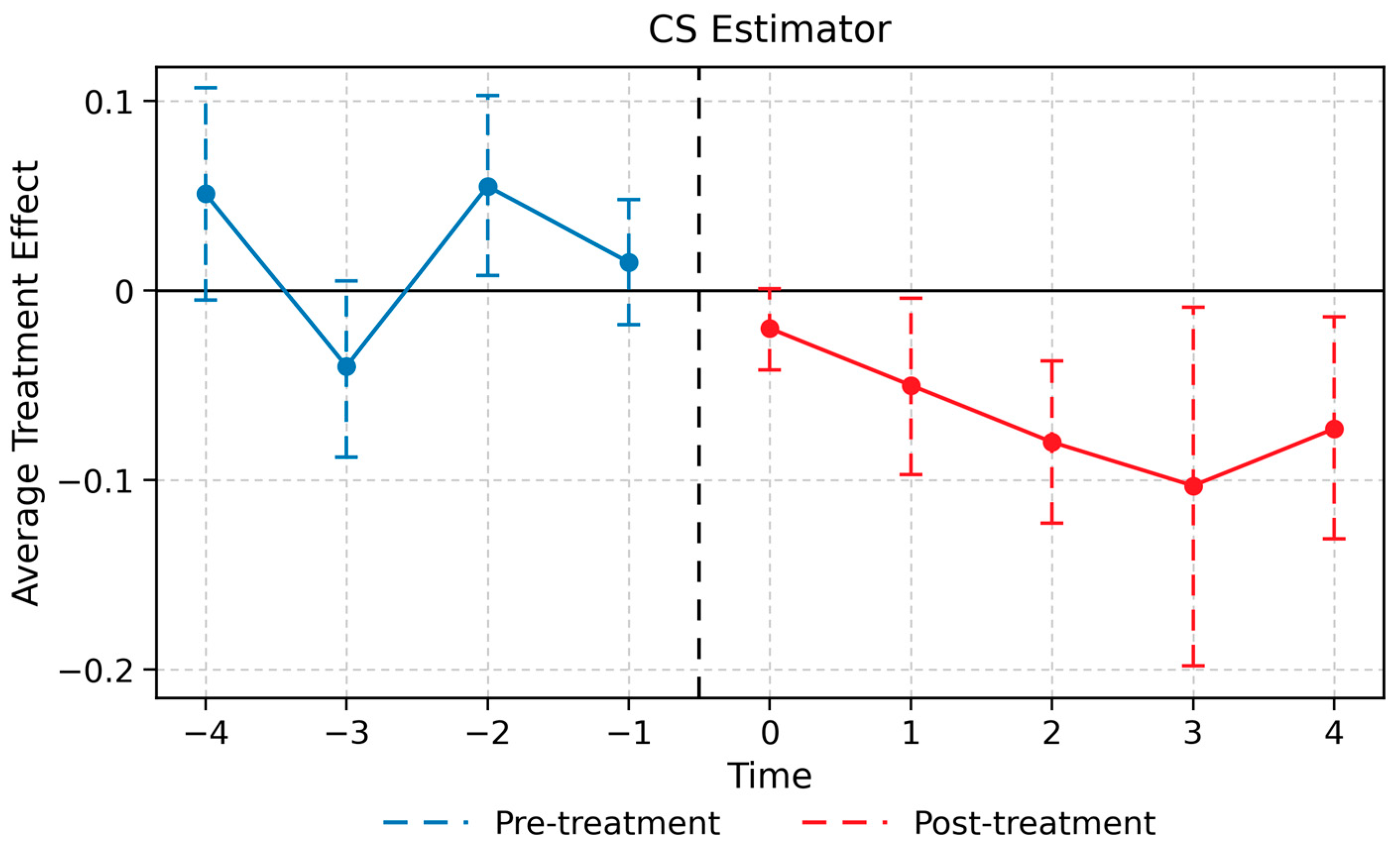
Figure 1 presents the parallel trend test results for the CSDID model. We have estimated four leads and four post-treatment effects around the treatment period,
. The horizontal axis in the Figure marks
as the period when the treatment effect occurs, with pre- and post-treatment periods to the left and right, respectively. The four pre-issuance coefficients are statistically insignificant, suggesting that issuing firms and comparison firms do not exhibit clear differential ROE trends before issuance. This evidence addresses the concern that future issuers may have already experienced a systematic decline in profitability before issuing green bonds.
After the treatment, as indicated by the red line, the confidence intervals of the average treatment effect do not include zero and are persistently negative. This indicates that there are significant differences between the treatment group and the control group post-treatment. In other words, after issuing green bonds, the issuer’s profitability declines significantly. The parallel trend test is passed, which also confirms the reliability and validity of the conclusions obtained in the previous section.
5.5. Mechanism Analysis: A DuPont-Style Decomposition of ROE
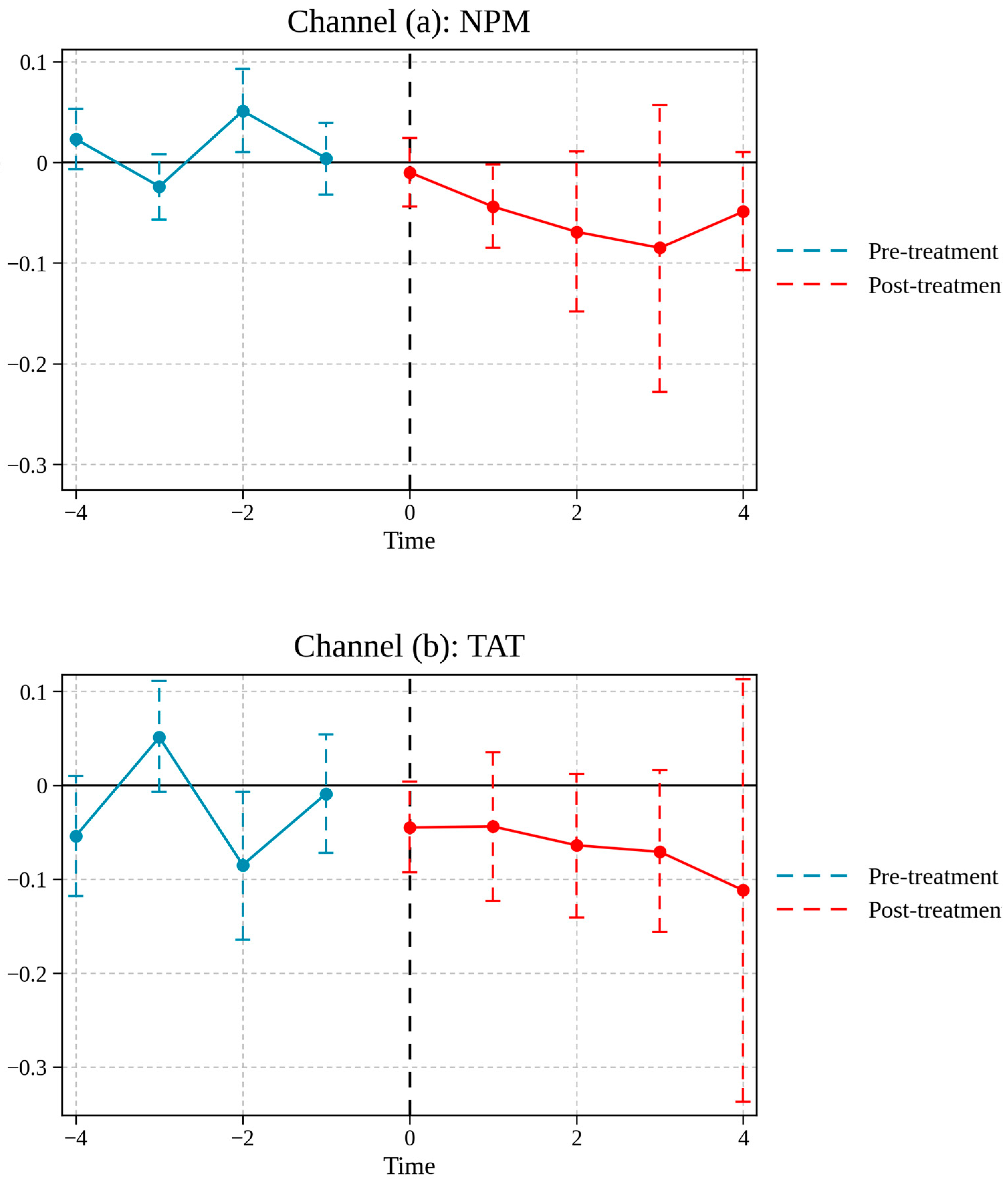
To provide additional evidence on the channels behind the post-issuance decline in ROE, we conduct a DuPont-style decomposition focusing on net profit margin and total asset turnover. Net profit margin captures margin pressure and cost-side effects, while total asset turnover captures asset utilization and operational-efficiency adjustments. This analysis helps distinguish whether the observed ROE decline is more closely related to margin compression or reduced operating efficiency after green bond issuance.
Figure 2 reports the event-study estimates for the two components. The pre-issuance coefficients are generally close to zero, suggesting no clear differential pre-treatment trends in these channels. After green bond issuance, the estimates for net profit margin become predominantly negative, indicating that the ROE decline is primarily associated with margin compression. This pattern is consistent with the interpretation that green transformation may generate short-term cost pressure through green project investment, environmental compliance, certification, and operational adjustment.
The estimates for total asset turnover are also mostly negative after issuance, providing suggestive evidence that issuing firms may experience temporary declines in asset utilization or operating efficiency during the post-issuance adjustment period. This may occur when firms upgrade production lines, restructure supply chains, or invest in green projects whose revenue benefits are realized only gradually.
Overall, the DuPont-style decomposition suggests that the short-term decline in ROE is driven mainly by margin pressure and, to a lesser extent, operational adjustment.
5.6. Robustness Checks
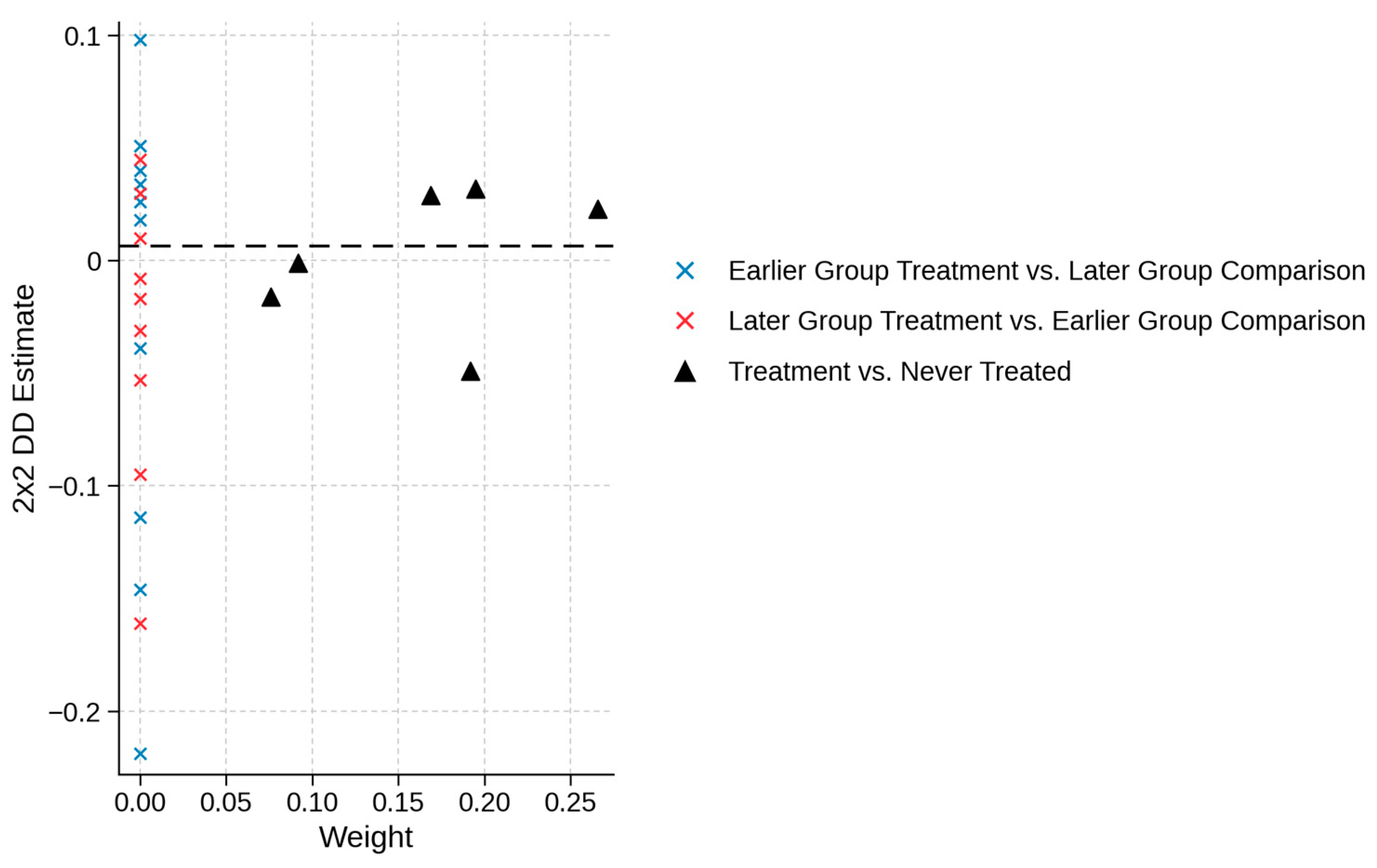
We conduct several robustness and diagnostic checks to assess the stability of the main estimates. First, we report a treatment-timing decomposition to examine whether the estimates are driven by potentially problematic comparisons between earlier- and later-treated cohorts. The results indicate that most of the identifying variation comes from comparisons between issuing firms and never-treated firms [
57]. Second, we replace the dependent variable, control variables, and comparison group. The estimates remain broadly consistent with the main results.
The results of these tests are presented in
Figure 3. Each marker represents one such 2×2 comparison plotted against its weight, and the dashed line marks the resulting aggregate estimate.The comparison between later treatment and earlier comparison groups accounts for only 0.5% of our results. The overwhelming majority of the estimation results (98.9%) come from comparisons between the treatment group and the never-treated control group. In this group, time-varying heterogeneity is unlikely to occur, indicating the robustness of the treatment effect. Additionally, we conducted robustness tests by replacing the dependent variables, control variables, and control groups, respectively. The results of these tests are presented in
Table 5, showing consistent statistical significance across all specifications. These checks support the stability of the main empirical pattern, although they do not eliminate all concerns about selection into green bond issuance.
5.7. Heterogeneous Analysis
Given that China operates under a socialist market economy system and our study focuses on Chinese enterprises, significant differences in analysis outcomes might exist between SOEs and non-SOEs. To explore this, we conduct a heterogeneity analysis to test Hypothesis 2a. After retaining all control variables and fixed effects, we divide the sample into two complementary groups for regression analysis: state-owned enterprises and non-state-owned enterprises.
Table 6 presents these CSDID model analysis results. The first column shows the overall sample regression results, the second column is dedicated to SOEs, and the third column is dedicated to non-SOEs.
From the simple average treatment effect perspective, both SOEs and non-SOEs are negatively affected by the issuance of green bonds. This finding aligns with existing research, which suggests that issuing green bonds involves higher issuance costs [
8]. Additionally, companies may face opportunity costs when they allocate resources to projects funded by green bonds, potentially neglecting other more profitable ventures [
4]. For SOEs, the negative effect is greater than that for non-SOEs. This is likely a result of the fact that SOE managers are more willing to adhere to policy requirements even when doing so might damage their firms’ profitability, given that many SOE managers’ performance evaluation is not necessarily tied to profit maximization. In the case of reducing emissions or pollution, SOEs likely face stricter environmental regulations and policy pressures than non-SOEs. This may compel them to undertake more environmental investments and rectifications after issuing green bonds, resulting in higher short-term costs and lower profit.
Indeed, the existing literature points out that the government and regulatory agencies impose higher environmental standards and expectations on SOEs [
58,
59]. Non-SOEs, on the other hand, may face less direct policy pressure, or their managers’ evaluation/compensation might be more closely aligned with profit maximization than SOE managers, leading to fewer environmental investments and adjustments after issuing green bonds, which results in a smaller decline in profit. An alternative explanation is that SOEs are less efficient than non-SOEs even when both are trying to achieve the same environmental goals.
The statistical significance level of SOEs is lower than that for non-SOEs. SOEs are typically larger in scale and more diversified in their business operations. The effect of green bond issuance may be mitigated by the performance of other business segments. Additionally, SOEs often enjoy government policy protection and support, which can mute the effect significance of green bond issuance on corporate profitability. In contrast, non-SOEs are generally smaller in scale and more focused in their business activities, making the effect of green bond issuance on their performance more direct and significant.
Overall, empirical results partially validate H2a. The estimated economic magnitude of the effect on SOEs by the issuance of green bonds is greater than that of the non-SOEs, but with lower statistical significance.
Next, we also perform regional heterogeneity analysis and industry heterogeneity analysis.
Table 7 presents the heterogeneity analysis based on regional distribution. Geographically, heavy-polluting enterprises are divided into two groups: those in the eastern region and those in the central and western regions. The Table shows that average treatment effects are negative and significant for enterprises in both regions. However, the significance level of the average treatment effect is higher for heavy-polluting enterprises in the eastern region.
Intuitively, given that the eastern region has a higher level of economic development compared to the central and western regions, firms in the eastern region are increasingly focusing more on corporate social responsibility, such as environmental protection, relative to their peers from less wealthy regions. Consequently, the number and frequency of green bond issuances are higher in the eastern region, leading to a more significant and stronger effect. The regional results are consistent with H2b, but should be interpreted cautiously because regional differences may also reflect differences in local financial markets, regulatory intensity, and industrial composition. The impact of green bond issuance on corporate performance is greater for heavy-polluting enterprises located in the eastern (wealthier) region than for those in the central and western regions.
Table 8 presents the industry distribution analysis. According to the data, heavy-polluting enterprises can be categorized into three sectors: mining, manufacturing, and fossil-fuel power (such as electricity generation using coal). The sample data are predominantly concentrated in the manufacturing sector. Due to the relatively small number of issuances by enterprises in the other two sectors, their treatment effects are not statistically significant.
The insignificant estimates for mining and fossil-fuel power should not be interpreted as evidence that green bond issuance has no profitability cost in these sectors. Rather, the estimates are imprecise because treated observations in these sectors are limited. Manufacturing firms account for the majority of observations and may face more immediate production-line upgrading, supply-chain adjustment, R&D, and compliance costs after green bond issuance. Fossil-fuel power firms, by contrast, may have larger capital bases, longer project cycles, more regulated revenue structures, or stronger policy support, which can dilute or delay the short-term ROE effect.
6. Conclusions and Implications
In an era of increasing green bond issuance, examining its profitability effect in heavy-polluting enterprises can help policymakers and market participants quantify the cost of the green transition. This study examines short-term profitability dynamics following first green bond issuance among China’s listed heavy-polluting firms from 2011 to 2020. Using a staggered-adoption DiD framework based on Callaway and Sant’Anna proposed in 2021, we find that issuing firms experience an average post-issuance ROE decline of approximately 4.9 percentage points during the four years following issuance, relative to comparison firms. The estimate is economically substantial relative to the sample mean ROE, but it should not be interpreted as firms literally sacrificing a fixed share of profitability. Because green bond issuance is a voluntary corporate financing decision, the estimates are interpreted as treatment-on-the-treated effects under the assumptions of no anticipation, overlap, and conditional parallel trends.
The DuPont-style mechanism analysis suggests that the post-issuance ROE decline is mainly associated with lower net profit margins and, to a lesser extent, lower asset turnover. This pattern is consistent with short-term margin pressure and operational adjustment during green transformation. However, because the available data do not consistently include project-level green investment, certification costs, or detailed use-of-proceeds information, the mechanism analysis should be interpreted as suggestive rather than as formal mediation evidence.
Multiple robustness checks were then performed to ensure the model’s robustness. These included: 1. Heterogeneity of treatment effects: Testing for the presence of heterogeneous treatment effects within the sample to determine the robustness of the results; 2. Replacement of the dependent variable: Recalculating the model’s average treatment effect by replacing the original dependent variable ROE with ROA, while keeping all other model settings unchanged; 3. Replacement of control variables: Recalculating the model’s average treatment effect by substituting the original set of control variables with alternative ones, keeping all other model settings unchanged; 4. Replacement of the comparison group: Recalculating the model’s average treatment effect by replacing the original comparison group (never treated) with a new comparison group (not yet treated), while keeping all other model settings unchanged; and 5. group comparison analysis: Conducting separate group comparison analyses based on ownership (state-owned vs. non-state-owned), region (eastern vs. central/western), and industry sectors to examine the heterogeneity of firms. These robustness checks confirm the observed significant negative effect of green bond issuance on corporate performance.
Furthermore, the results of the firm heterogeneity analysis on corporate performance are also noteworthy. First, the negative effect of green bond issuance on corporate profitability is more pronounced for heavy-polluting SOEs compared to non-SOEs. Second, the negative effect of green bond issuance on corporate performance is more salient for heavy-polluting enterprises located in eastern China (a relatively wealthier region) compared to those in central and western China (relatively poorer regions). Lastly, a subgroup analysis based on industry heterogeneity was carried out. The findings show that green bond issuance has a significant negative effect on the profitability of heavy-polluting enterprises in the manufacturing sector, but is statistically insignificant in the mining and fossil-fuel power sectors, likely due to the small number of issuances.
For policymakers, the good news is that our results are consistent with the notion that heavy-polluting enterprises that issue green bonds are indeed making an observable effort and sacrificing profit to achieve their stated environmental goals. At the very least, our results do not support the claim of widespread greenwashing among heavy-polluting issuers in China. The not-so-good news is that two-thirds of annual profits for at least four years is a sizeable cost. Whether such a cost is too steep should be considered by policymakers when deciding the pace of green transition in heavy-polluting industries. More empirical research is needed to quantify the social benefits derived from the firms’ (and in turn their shareholders’) sacrifices.
In contrast, our results can hardly be construed as good news to investors or shareholders of the heavy-polluting firms issuing green bonds. Any sacrifice of profitability is a direct reduction in shareholder return, and in turn applies negative pressure on valuation. The fact that SOE issuers experience a more pronounced hit to their profits is not surprising but concerning, given that SOEs are often sizable employers in their local economies.
Market participants might view the issuance of green bonds by heavy-polluting firms as a negative signal and might treat the potential issuance of green bonds as an overhang weighing down on valuation. Hence, in future research, it would be important to assess the profit effect of green bond issuance in other less-polluting industries, so we can empirically assess the weight of the overall overhang on China’s equities market more broadly.
Policymakers should focus on ways to help alleviate the profit effect on the issuing industries, given that greater cost might translate into unemployment pressure and other social challenges.
This study focuses on short-term profitability dynamics. A longer post-issuance window is difficult to estimate reliably in the current sample because China’s green bond market expanded mainly after 2016 and the main sample ends in 2020. Future research using longer post-issuance data could examine whether green investments eventually generate productivity gains, financing-cost reductions, or reputational benefits that offset the initial profitability pressure. Future work could also examine whether governments reward green bond issuers through procurement contracts, subsidies, or preferential project access, and whether bond-level characteristics such as issuance amount, maturity, coupon rate, certification, external review, and use-of-proceeds composition affect firm outcomes.
Author Contributions
Conceptualization, Y.C. and Y.D.W.; methodology, Y.C., Y.Q. and Y.D.W.; software, Y.C.; validation, Y.C., M.F., Y.Q. and Y.D.W.; formal analysis, Y.C.; investigation, Y.C., M.F., Y.Q. and Y.D.W.; resources, Y.C., M.F., Y.Q. and Y.D.W.; data curation, Y.C.; writing—original draft preparation, Y.C., Y.Q. and Y.D.W.; writing—review and editing, Y.C., M.F., Y.Q. and Y.D.W.; visualization, Y.C.; supervision, Y.Q. and Y.D.W.; project administration, Y.C., M.F., Y.Q. and Y.D.W. All authors have read and agreed to the published version of the manuscript.
Funding
This research received no external funding.
Institutional Review Board Statement
Not applicable.
Informed Consent Statement
Not applicable.
Data Availability Statement
Acknowledgments
The authors have reviewed and edited the output and take full responsibility for the content of this publication.
Conflicts of Interest
The authors declare no conflicts of interest.
Appendix A
Table A1.
Codes and names of heavy-polluting industries.
Table A1.
Codes and names of heavy-polluting industries.
| Code of Heavy-Polluting Industry | Name of Heavy-Polluting Industry |
|---|
| B06 | Coal Mining and Washing |
| B07 | Oil and Gas Extraction |
| B08 | Mining and Processing of Ferrous Metal |
| B09 | Mining and Processing of Nonferrous Metal |
| B10 | Mining and Processing of Nonmetal Minerals |
| C13 | Agricultural and Sideline Food Processing |
| C15 | Wine, Beverage, and Refined Tea Manufacturing |
| C17 | Textile |
| C19 | Leather, Fur, Feather and its Products and Footwear |
| C22 | Paper and Paper Products |
| C25 | Petroleum Processing, Coking and Nuclear Fuel Processing |
| C26 | Chemical Raw Materials and Chemical Products Manufacturing |
| C27 | Pharmaceutical Manufacturing |
| C28 | Chemical Fiber |
| C29 | Rubber and Plastic Products |
| C30 | Non-mental Mineral Product |
| C31 | Ferrous Metal Smelting and Rolling Processing |
| C32 | Nonferrous Metal Smelting and Rolling Processing |
| C33 | Metal Products Manufacturing |
| D44 | Electricity and Heat Production and Supply |
References
- Climate Bonds Initiative. Sustainable Debt Global State of the Market 2024; Climate Bonds Initiative: London, UK, 2025; pp. 1–40. [Google Scholar]
- Gianfrate, G.; Peri, M. The Green Advantage: Exploring the Convenience of Issuing Green Bonds. J. Clean. Prod. 2019, 219, 127–135. [Google Scholar] [CrossRef]
- MacAskill, S.; Roca, E.; Liu, B.; Stewart, R.A.; Sahin, O. Is There a Green Premium in the Green Bond Market? Systematic Literature Review Revealing Premium Determinants. J. Clean. Prod. 2021, 280, 124491. [Google Scholar] [CrossRef]
- Hachenberg, B.; Schiereck, D. Are Green Bonds Priced Differently from Conventional Bonds? J. Asset Manag. 2018, 19, 371–383. [Google Scholar] [CrossRef]
- Dong, X.; Xiong, Y.; Nie, S.; Yoon, S.-M. Can Bonds Hedge Stock Market Risks? Green Bonds Vs Conventional Bonds. Financ. Res. Lett. 2023, 52, 103367. [Google Scholar] [CrossRef]
- Lin, B.; Su, T. Green Bond Vs Conventional Bond: Outline the Rationale Behind Issuance Choices in China. Int. Rev. Financ. Anal. 2022, 81, 102063. [Google Scholar] [CrossRef]
- Kanamura, T. Are Green Bonds Environmentally Friendly and Good Performing Assets? Energy Econ. 2020, 88, 104767. [Google Scholar] [CrossRef]
- Flammer, C. Green Bonds: Effectiveness and Implications for Public Policy. Environ. Energy Policy Econ. 2020, 1, 95–128. [Google Scholar] [CrossRef]
- Baulkaran, V. Stock Market Reaction to Green Bond Issuance. J. Asset Manag. 2019, 20, 331–340. [Google Scholar] [CrossRef]
- Tang, D.Y.; Zhang, Y. Do Shareholders Benefit from Green Bonds? J. Corp. Financ. 2020, 61, 101427. [Google Scholar] [CrossRef]
- Hyun, S.; Park, D.; Tian, S. Pricing of Green Labeling: A Comparison of Labeled and Unlabeled Green Bonds. Financ. Res. Lett. 2021, 41, 101816. [Google Scholar] [CrossRef]
- Zhou, D.; Kythreotis, A. Why Issue Green Bonds? Examining Their Dual Impact on Environmental Protection and Economic Benefits. Humanit. Soc. Sci. Commun. 2024, 11, 1761. [Google Scholar] [CrossRef]
- Reboredo, J.C.; Ugolini, A. Price Connectedness Between Green Bond and Financial Markets. Econ. Model. 2020, 88, 25–38. [Google Scholar] [CrossRef]
- Kyriazis, N.A.; Dimitriadis, K.A.; Theodossiou, P. Can Banking Intermediates Crowd Out Their High-Tech Promising Successors? A Financial Stress Perspective. Int. J. Financ. Econ. 2026, 1–18. [Google Scholar] [CrossRef]
- Lin, L.; Hong, Y. Developing a Green Bonds Market: Lessons from China. Eur. Bus. Organ. Law Rev. 2022, 23, 143–185. [Google Scholar] [CrossRef]
- Pang, H.; Wu, C.; Zhang, L. The Impact of Green Bond Issuance on Carbon Emission Intensity and Path Analysis. PLoS ONE 2024, 19, e0304364. [Google Scholar] [CrossRef]
- Li, R.; Liu, Z.; Gan, K. Impact of Cities’ Issuance of Green Bonds on Local Firm Performance: Evidence from China. Oper. Res. 2024, 24, 38. [Google Scholar] [CrossRef]
- Chen, F.; Zeng, X.; Guo, X. Green Finance, Climate Change, and Green Innovation: Evidence from China. Financ. Res. Lett. 2024, 63, 105283. [Google Scholar] [CrossRef]
- Dowell, G.; Hart, S.; Yeung, B. Do Corporate Global Environmental Standards Create or Destroy Market Value? Manag. Sci. 2000, 46, 1059–1074. [Google Scholar] [CrossRef]
- Lee, C.-C.; Wang, F.; Chang, Y.-F. Towards Net-Zero Emissions: Can Green Bond Policy Promote Green Innovation and Green Space? Energy Econ. 2023, 121, 106675. [Google Scholar] [CrossRef]
- Bongaerts, D.; Schoenmaker, D. Liquidity and Clientele Effects in Green Debt Markets. J. Corp. Financ. 2024, 86, 102582. [Google Scholar] [CrossRef]
- Khurram, M.U.; Xie, W.; Mirza, S.S.; Tong, H. Green Bonds Issuance, Innovation Performance, and Corporate Value: Empirical Evidence from China. Heliyon 2023, 9, e14895. [Google Scholar] [CrossRef] [PubMed]
- Wei, L.; Liu, Z.; Cao, P.; Zhang, H. Environmental Subsidies and Green Innovation: The Role of Environmental Regulation and Chief Executive Officer Green Background. Clean. Technol. Environ. Policy 2025, 27, 389–402. [Google Scholar] [CrossRef]
- Song, Y.; Ren, T.; Zhang, M. Does the Issuance of Green Bonds Promote Green Practices Among Peer Companies? Evidence from China’s Listed Companies. J. Clean. Prod. 2024, 477, 143899. [Google Scholar] [CrossRef]
- Dorfleitner, G.; Utz, S.; Zhang, R. The Pricing of Green Bonds: External Reviews and the Shades of Green. Rev. Manag. Sci. 2022, 16, 797–834. [Google Scholar] [CrossRef]
- Ahmad, H.; Yaqub, M.; Lee, S.H. Environmental-, Social-, and Governance-Related Factors for Business Investment and Sustainability: A Scientometric Review of Global Trends. Environ. Dev. Sustain. 2024, 26, 2965–2987. [Google Scholar] [CrossRef]
- Leung, T.Y.; Sharma, P. Differences in the Impact of R&D Intensity and R&D Internationalization on Firm Performance—Mediating Role of Innovation Performance. J. Bus. Res. 2021, 131, 81–91. [Google Scholar] [CrossRef]
- Zhang, Z.; Duan, H.; Shan, S.; Liu, Q.; Geng, W. The Impact of Green Credit on the Green Innovation Level of Heavy-Polluting Enterprises—Evidence from China. Int. J. Environ. Res. Public Health 2022, 19, 650. [Google Scholar] [CrossRef]
- Zhang, D. Subsidy Expiration and Greenwashing Decision: Is There a Role of Bankruptcy Risk? Energy Econ. 2023, 118, 106530. [Google Scholar] [CrossRef]
- Zhang, D. Does Green Finance Really Inhibit Extreme Hypocritical ESG Risk? A Greenwashing Perspective Exploration. Energy Econ. 2023, 121, 106688. [Google Scholar] [CrossRef]
- Alhouti, S.; Johnson, C.M.; Holloway, B.B. Corporate Social Responsibility Authenticity: Investigating Its Antecedents and Outcomes. J. Bus. Res. 2016, 69, 1242–1249. [Google Scholar] [CrossRef]
- Li, M.; Tang, J.; Wu, D. Beyond Borders and Industries: How Cross-Ownership Drives ESG Performance in China’ Low-Polluting Firms After Environmental Regulation. Energy Econ. 2025, 148, 108670. [Google Scholar] [CrossRef]
- Flammer, C. Corporate Green Bonds. J. Financ. Econ. 2021, 142, 499–516. [Google Scholar] [CrossRef]
- Zerbib, O.D. The Effect of Pro-Environmental Preferences on Bond Prices: Evidence from Green Bonds. J. Bank. Financ. 2019, 98, 39–60. [Google Scholar] [CrossRef]
- Dong, H.; Zhang, L.; Zheng, H. Green Bonds: Fueling Green Innovation or Just a Fad? Energy Econ. 2024, 135, 107660. [Google Scholar] [CrossRef]
- Dong, X.; Yu, M. Green Bond Issuance and Green Innovation: Evidence from China’s Energy Industry. Int. Rev. Financ. Anal. 2024, 94, 103281. [Google Scholar] [CrossRef]
- Bai, C.-E.; Lu, J.; Tao, Z. The Multitask Theory of State Enterprise Reform: Empirical Evidence from China. Am. Econ. Rev. 2006, 96, 353–357. [Google Scholar] [CrossRef]
- Shleifer, A.; Vishny, R.W. Politicians and Firms. Q. J. Econ. 1994, 109, 995–1025. [Google Scholar] [CrossRef]
- Qiang, Q. Corporate Governance and State-Owned Shares in China Listed Companies. J. Asian Econ. 2003, 14, 771–783. [Google Scholar] [CrossRef]
- Iwasaki, I.; Ma, X.; Mizobata, S. Ownership Structure and Firm Performance in Emerging Markets: A Comparative Meta-Analysis of East European EU Member States, Russia and China. Econ. Syst. 2022, 46, 100945. [Google Scholar] [CrossRef]
- Hallegatte, S.; Green, C.; Nicholls, R.J.; Corfee-Morlot, J. Future Flood Losses in Major Coastal Cities. Nat. Clim. Change 2013, 3, 802–806. [Google Scholar] [CrossRef]
- Ohlson, J.A. Financial Ratios and the Probabilistic Prediction of Bankruptcy. J. Account. Res. 1980, 18, 109–131. [Google Scholar] [CrossRef]
- Aebi, V.; Sabato, G.; Schmid, M. Risk Management, Corporate Governance, and Bank Performance in the Financial Crisis. J. Bank. Financ. 2012, 36, 3213–3226. [Google Scholar] [CrossRef]
- Cui, X.; Wang, P.; Sensoy, A.; Nguyen, D.K.; Pan, Y. Green Credit Policy and Corporate Productivity: Evidence from a Quasi-Natural Experiment in China. Technol. Forecast. Soc. Change 2022, 177, 121516. [Google Scholar] [CrossRef]
- Rajan, R.G.; Zingales, L. What Do We Know About Capital Structure? Some Evidence from International Data. J. Financ. 1995, 50, 1421–1460. [Google Scholar] [CrossRef]
- Wooldridge, J.M. Introductory Econometrics: A Modern Approach, 7th ed.; Cengage Learning: Boston, MA, USA, 2019. [Google Scholar]
- Guerrieri, V.; Lorenzoni, G.; Straub, L.; Werning, I. Macroeconomic Implications of COVID-19: Can Negative Supply Shocks Cause Demand Shortages? Am. Econ. Rev. 2022, 112, 1437–1474. [Google Scholar] [CrossRef]
- Chetty, R.; Friedman, J.N.; Stepner, M.; Opportunity Insights Team. The Economic Impacts of COVID-19: Evidence from a New Public Database Built Using Private Sector Data. Q. J. Econ. 2024, 139, 829–889. [Google Scholar] [CrossRef] [PubMed]
- China Securities Regulatory Commission. Guidelines on Industry Classification of Listed Companies. Available online: https://www.csrc.gov.cn/csrc_en/c102030/c1371087/content.shtml (accessed on 16 March 2024).
- Shi, J.; Yu, C.; Li, Y.; Wang, T. Does Green Financial Policy Affect Debt-Financing Cost of Heavy-Polluting Enterprises? An Empirical Evidence Based on Chinese Pilot Zones for Green Finance Reform and Innovations. Technol. Forecast. Soc. Change 2022, 179, 121678. [Google Scholar] [CrossRef]
- Callaway, B.; Sant’Anna, P.H.C. Difference-in-Differences with Multiple Time Periods. J. Econom. 2021, 225, 200–230. [Google Scholar] [CrossRef]
- Sant’Anna, P.H.C.; Zhao, J. Doubly Robust Difference-in-Differences Estimators. J. Econom. 2020, 219, 101–122. [Google Scholar] [CrossRef]
- de Chaisemartin, C.; D’Haultfœuille, X. Two-Way Fixed Effects Estimators with Heterogeneous Treatment Effects. Am. Econ. Rev. 2020, 110, 2964–2996. [Google Scholar] [CrossRef]
- Li, Y.; Yu, C.; Shi, J.; Liu, Y. How Does Green Bond Issuance Affect Total Factor Productivity? Evidence from Chinese Listed Enterprises. Energy Econ. 2023, 123, 106755. [Google Scholar] [CrossRef]
- Beck, T.; Levine, R.; Levkov, A. Big Bad Banks? The Winners and Losers from Bank Deregulation in the United States. J. Financ. 2010, 65, 1637–1667. [Google Scholar] [CrossRef]
- Bertrand, M.; Duflo, E.; Mullainathan, S. How Much Should We Trust Differences-In-Differences Estimates? Q. J. Econ. 2004, 119, 249–275. [Google Scholar] [CrossRef]
- Goodman-Bacon, A. Difference-in-Differences with Variation in Treatment Timing. J. Econom. 2021, 225, 254–277. [Google Scholar] [CrossRef]
- Zhang, B.; Bi, J.; Yuan, Z.; Ge, J.; Liu, B.; Bu, M. Why Do Firms Engage in Environmental Management? An Empirical Study in China. J. Clean. Prod. 2008, 16, 1036–1045. [Google Scholar] [CrossRef]
- Wang, Y.; Shen, N. Environmental Regulation and Environmental Productivity: The Case of China. Renew. Sustain. Energy Rev. 2016, 62, 758–766. [Google Scholar] [CrossRef]
| Disclaimer/Publisher’s Note: The statements, opinions and data contained in all publications are solely those of the individual author(s) and contributor(s) and not of MDPI and/or the editor(s). MDPI and/or the editor(s) disclaim responsibility for any injury to people or property resulting from any ideas, methods, instructions or products referred to in the content. |