Article

Linkages Between Ecosystem Multifunctionality, Microbial Network and Carbon Metabolism During Mine Tailings Vegetation Succession

1
Key Laboratory of Comprehensive Utilization of Tailings Resources of Shaanxi Province, School of Chemical Engineering and Modern Materials, Shangluo University, Shangluo 726000, China
2
Engineering Research Center for Mineral Resources Clean and Efficient Conversion and New Materials of Shaanxi Province, Shangluo University, Shangluo 726000, China
3
Qinling Ecological Environment Research Institute, Shangluo University, Shangluo 726000, China
*
Author to whom correspondence should be addressed.
Sustainability 2026, 18(12), 6106; https://doi.org/10.3390/su18126106 (registering DOI)
Submission received: 9 May 2026 / Revised: 9 June 2026 / Accepted: 10 June 2026 / Published: 13 June 2026

Abstract

Tailings remediation alleviates ecosystem degradation and protects species. To conserve terrestrial biodiversity and address sustainability challenges while achieving economic growth, numerous researchers have devoted efforts to monitoring ecological functions and optimizing community structures. This study investigates the microbial characteristics and functional diversity across ecological succession stages of tailings. Selecting three typical restoration stages, including biological crust, moss, and grassland stages, we adopt 16S rRNA and ITS gene amplification, Illumina high-throughput sequencing, spectroscopy, and network correlation analysis to explore the responses of soil multifunctionality index, microbial communities, and carbon metabolism during tailings restoration. The experimental results indicate that the functional diversity index increases with ecological succession and is significantly correlated with the bacterial genera Rubrobacter and Arenimicrobium, whereas no significant correlation is observed with dominant fungi. The network interactions among bacterial communities are gradually strengthened along the succession process. In terms of carbon metabolic functions, the relative abundances of galactose, starch, and sucrose metabolism pathways increase obviously with restoration progression, while inositol phosphate metabolism, peroxisome metabolism, retinol metabolism, glyoxylate and dicarboxylate metabolism, and xenobiotics metabolism exhibit no significant variations. These findings provide novel empirical evidence for explaining microbe-mediated ecological succession in tailing ecosystems and highlight the necessity of multi-perspective analysis for ecological restoration. Policy and practical implications emphasize that the application of specific microorganisms and their interspecific interactions to promote iron tailings ecological restoration should fully consider the spatiotemporal heterogeneity of tailings areas. This study deepens the understanding of differential microbial responses at different tailings restoration stages and provides actionable insights for balancing mining economic development and terrestrial ecosystem conservation.

1. Introduction

Tailings accumulation resulting from continuous industrial development is one of the critical environmental issues faced in ecological restoration efforts of mining regions worldwide [1,2]. One of the typical mining solid waste pollutants is iron tailings, which threaten soil structure, vegetation colonization and regional ecosystem stability by releasing heavy metals and toxic substances during stockpiling, weathering and rainfall leaching. For instance, heavy metal contamination degraded soil fertility and hindered seed germination; toxic substances restrained plant root growth; and accumulated pollutants broke local ecological balance and reduced biological diversity [3,4,5]. Tailings contamination significantly alters the community structure and metabolic functions of soil microorganisms. It disturbed microbial composition, hindered nutrient cycling and carbon sequestration, and interfered with heavy metal transformation metabolism [6,7,8]. In China, numerous mining areas are facing severe ecological degradation and environmental risks due to the large quantity and wide distribution of tailings ponds in these regions [9,10].
Many regulatory strategies developed for the ecological restoration of mine tailings rely on microorganisms to improve soil physicochemical properties, nutrient cycling and carbon metabolism [11,12]. Previous research has focused on the isolation and functional verification of dominant microbial strains during the restoration process [13,14]. However, ecological restoration is a complex process that involves synergistic metabolism, interactive regulation, and environmental adaptation among different microbial groups [15,16]. Clarifying the variations in soil ecological functions during different successional stages can provide theoretical guidance for the restoration of degraded mining ecosystems. Thus, it is necessary to elucidate the response mechanisms of community structure and functions during ecological succession, so as to provide a scientific basis for the construction of efficient and stable tailings restoration technologies [17,18].
Tailings succession supports important ecological functions, including nutrient cycling, carbon metabolism, and ecological stability. Carbon metabolism is a key process that drives material cycling and community succession in restored areas. Some studies indicated that ecological succession in tailings exerted pronounced impacts on soil nutrients and microbial community structure, and modulated core soil metabolic processes [19,20]. However, the dynamic patterns and driving mechanisms of carbon metabolism functions during tailings ecological succession are still not clear.
At present, next-generation sequencing (NGS) has been widely used to explore community structure changes in extreme environments, such as amplicon sequencing used for analyzing species composition and diversity, and metagenomic sequencing for revealing community function and metabolic potential [21,22]. These techniques provide a new perspective on studying microbial diversity and carbon metabolism in tailings.
Key information required for revealing the intrinsic mechanisms of tailings ecological restoration includes the succession characteristics of microbial communities at different remediation stages and their functional adaptive changes in the tailings environment. Although numerous studies have investigated microbial diversity during tailings restoration [11,12,13], few have focused on the community structure and carbon metabolism functions of prokaryotic and eukaryotic microorganisms in tailings at different ecological restoration stages [23,24]. This study targeted three typical restoration succession stages of tailings in southern Shaanxi to explore bacterial and fungal community structure and carbon transformation functions via high-throughput sequencing, spectral analysis and bioinformatics. Distinctively, it systematically uncovers microenvironmental dynamic patterns along restoration progression, offering innovative theoretical reference and practical guidance for regional tailings ecological remediation and sustainable development.

2. Materials and Methods

2.1. Tailings Soil Samples

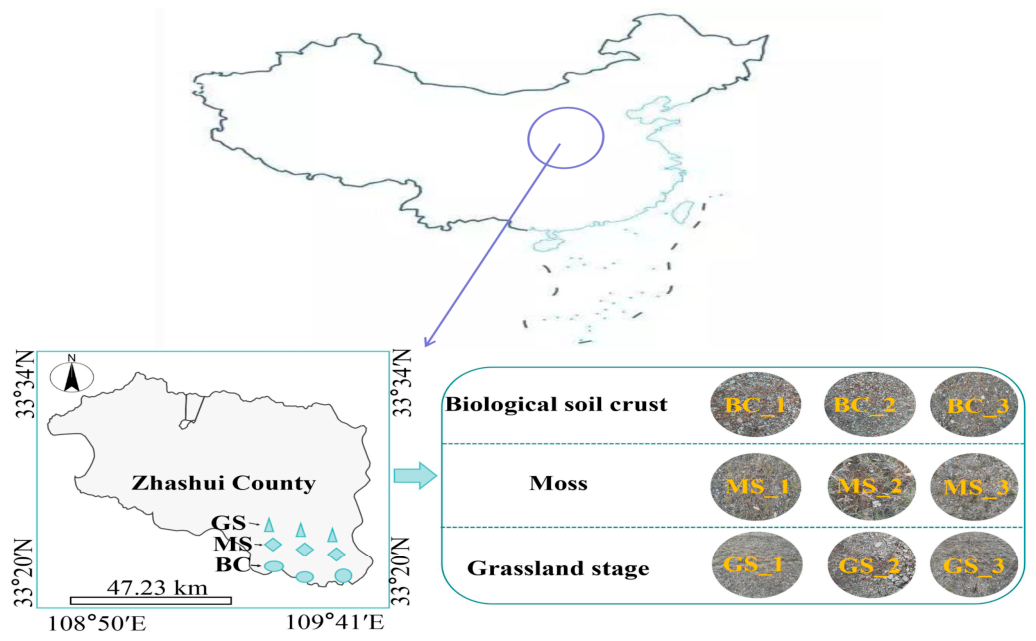
Tailings soil samples were collected from the ecological restoration area of siderite mining sites in Zhashui County (109°10′ E, 33°50′ N), Shaanxi Province, China. Sampling was carried out across three typical successional stages of tailings restoration, which were classified according to dominant vegetation types and surface coverage, including biological crust (BC), moss (MS) and grassland (GS). Sites were selected to have consistent tailings substrate, elevation, slope, and no obvious human disturbance to reduce environmental heterogeneity. The sampling layout is shown in Figure 1. At each stage, three sampling points were established along the diagonal of a 10 m × 10 m plot (10 m spacing). After removing surface impurities such as stones and leaves, a sterilized shovel was vertically inserted into the soil to a depth of 20 cm. Three soil cores were separately collected as individual samples at each sampling point. A total of nine independent samples were obtained across three restoration stages. Samples were sealed in a sterile bag, stored at 0–4 °C, and labeled as BC_1, BC_2, BC_3, MS_1, MS_2, MS_3, GS_1, GS_2, and GS_3, respectively. Sampling was finished on 8 January 2025.

2.2. Physicochemical Analysis of Tailings Soil

Physicochemical parameters, including organic matter (OM), ammonium nitrogen (NH4+-N), available phosphorus (AP), available potassium (AK), pH, and salt content were measured conforming to the technical standards for soil analysis [25,26,27,28]. Specifically, OM was measured with the K2Cr2O7-H2SO4 oxidation method. NH4+-N, AP and AK were extracted with KCl, NaHCO3 and NH4Ac solutions respectively, then quantified via ultraviolet spectrophotometry. pH and salinity were determined using a pH meter and a conductivity-salinity meter respectively. Briefly, for pH measurement, 10.0 g of soil was mixed with 25 mL of CO2-free deionized water, shaken at 180 rpm for 30 min, and then allowed to stand for 1 h before measurement with a pH meter. Soil salinity was determined on the same soil suspension.

2.3. Evaluation of Multifunctional Indices of Tailings Soil

With reference to studies exploring the correlation between soil physicochemical properties and ecological functions, ecological function diversity was quantified using a multifunctional index [29,30,31]. Soil fertility (OM), nutrient indicators (NH4+-N, AP, AK), and salinity-alkalinity parameters (pH, salt content) were selected as variables to construct the multifunctional index (MI). Dimensionless conversion of the physicochemical parameters was performed using the formulas below:
X ¯ = 1 n i = 1 n xi
x = X / X ¯
x = X ¯ / X
y = i = 1 m x i
M I = i = 1 3 y i
where X represents the mean values of each physicochemical parameter, x’ are the dimensionless values of OM, NH4+-N, AP and AK, x’’ are the dimensionless values of pH and salinity, y’ is the comprehensive index of fertility and nutrients, MI is the functional diversity index of tailings soil.

2.4. XPS Analysis

Semi-quantitative analysis of the chemical composition and relative contents of C, N, and O in tailings soil was performed using X-ray photoelectron spectroscopy (XPS, Thermo Scientific K-Alpha, Thermo Fisher Scientific, Manchester, UK). A survey scan was first performed to confirm the elemental composition of the samples and their preliminary distribution traits. Thereafter, high-resolution scans were focused on the characteristic peak regions of C1s (280~295 eV), N1s (394~405 eV), and O1s (525~540 eV), which enabled the accurate acquisition of data on the chemical states and peak areas of the target elements.

2.5. FTIR Spectra

The compositional traits of organic matter in tailings soil were characterized using Fourier Transform Infrared Spectroscopy (FTIR), Thermo Fisher Scientific, Dreieich, Germany. With OMNIC software (v9.2), spectral baseline correction was conducted, and the areas of characteristic peaks at 1420, 1536, 1630, 2850, and 2920 cm−1 were quantified. For the organic matter decomposition index (OMDI), calculation was performed according to the formula:
OMDI   =     rA 2850   +   rA 2920   rA 1630
where rA2850 and rA2920 represent the characteristic peak areas of aliphatic organic matter, rA1630 represents the characteristic peak area of aromatic organic matter.

2.6. 16S rRNA Gene Sequencing and Gene Functional Annotation

Genomic DNA was isolated from 0.5 g tailings soil samples using the Soil DNA Kit (Shanghai, China) according to the manufacturer’s instructions. To amplify the V4–V5 regions of the bacterial 16S rRNA gene, PCR was carried out with the universal primers 515F (5′-GTGCCAGCMGCCGCGGTAA-3′) and 806R (5′-GGACTACHVGGGTWTCTAAT-3′), yielding raw sequencing data. Following data quality filtering, taxonomic classification of the bacterial community was determined. Functional genes and metabolic pathways were predicted using the KEGG database and PICRUSt2 (v2.5.0) software. For fungal community analysis, PCR amplification was performed with the ITS1F/ITS2R primer pair, with sequences as follows: ITS1F: 5′-CTTGGTCATTTAGAGGAAGTAA-3′ and ITS2R: 5′-GCTGCGTTCTTCATCGATGC-3′. This study generated the original sequencing data submitted to the NCBI website (https://www.ncbi.nlm.nih.gov/) (accessed on 3 May 2026), accession number for PRJNA1461223.

2.7. Statistical Analysis

One-way ANOVA was adopted to compare diversity indices across tailing soils at different succession stages, which is valid for distinguishing intergroup discrepancies. Pearson correlation analysis via R software (v4.6.0) was applied to quantify linear associations between microbial communities and soil properties.

3. Results and Discussion

3.1. Multifunctional Indices Varied with Ecological Restoration

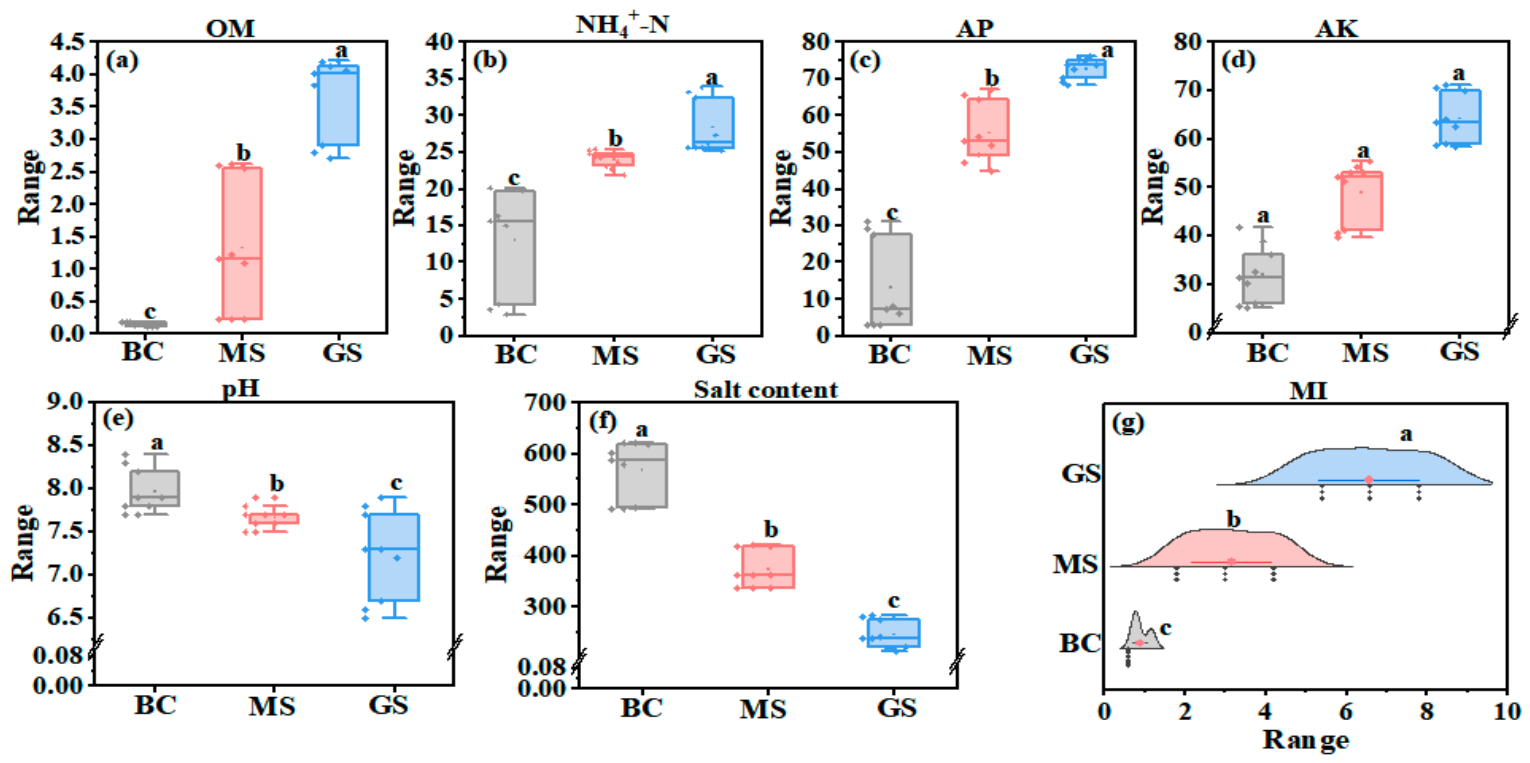
Figure 2 and Table 1 show the physicochemical properties of tailings soil at different stages of ecological restoration. As shown in Figure 2, the dispersion of OM content in tailings soil was minimal in the BC stage and maximal in the MS stage with the box height of 0.2 and 2.5, respectively, while NH4+-N content showed the reverse trend, being highest in the BC stage (15) and lowest in the MS stage (5). The box heights of AP in the BC, MS, and GS stages were 10, 20, and 10, respectively. For pH, the corresponding values in these three stages were 0.5, 0.3, and 1.0. The dispersion of salt content was the same in the BC and MS stages, while it was the smallest in the GS stage.
Numerous studies have demonstrated that tailings biological soil crusts serve as pivotal surface coverings during the early stage of tailings ecological restoration. Despite a monotonous vegetation composition and homogeneous sources of organic matter, the diverse microbial communities harbored within the BC stage contribute substantially to initial nutrient accumulation and microenvironmental regulation [32,33,34]. The variations in the dispersion of physicochemical indicators observed in this study reveal both the relative scarcity of organic matter in BC-stage tailings soil and the capacity of functional microbial communities to participate in ecological restoration via diverse pathways. In the MS stage, mosses exhibit uniform coverage and can stabilize NH4+-N and pH through photosynthesis and respiration [35]. Meanwhile, mosses are predominantly distributed in patches, leading to heterogeneous enrichment of organic matter across local regions and consequently a relatively high dispersion [36]. In the GS stage, herbaceous plants possess deep root systems that facilitate the uniform utilization and release of available phosphorus [37]. These roots also promote the homogeneous movement of salts, mitigating salt accumulation and thereby diminishing the spatial heterogeneity of both AP and salt content [38]. Conversely, during the GS stage, nutrient cycling is both rapid and variable in rate, leading to marked fluctuations in soil pH.
In general, the physicochemical properties (except for AK) of tailing soils varied significantly among the three ecological restoration stages. Nutrients and fertility were highest in the GS stage and lowest in the BC stage. Salinity and alkalinity were highest in the BC stage, followed by the MS stage, and lowest in the GS stage. Specifically, the OM content (g/kg) in the MS (1.326 ± 1.032) and GS (3.651 ± 0.644) stages was 8-fold and 23-fold higher than that in the BC (0.155 ± 0.036) stage, respectively. NH4+-N content (mg/kg) in the MS (23.954 ± 1.190) and GS (28.373 ± 3.667) stages were more than 1-fold and 5-fold higher than those in the BC (13.071 ± 7.350) stage, respectively. The AP content (mg/kg) in the MS (55.308 ± 8.300) and GS (72.719 ± 2.891) stages was 4-fold and 5-fold higher than that in the BC (13.179 ± 12.296) stage, respectively. The pH in the MS (7.7) and GS (7.2) stages decreased by 3.8% and 9.3% compared with that in the BC (8.0) stage, respectively. The salt content in the MS (373.3) and GS (245.8) stages decreased by 34.2% and 56.7% compared with that in the BC (567.5) stage, respectively. Thus, during the succession of tailings from the biological crust and moss stages to the grassland stage, the organic matter and salt contents were most effectively increased and decreased, respectively, which is conducive to the ecological restoration of the tailings area. MI evaluates the comprehensive service capacity and restoration potential of tailings ecosystems through the integration of tailings soil’s multi-dimensional functional characteristics, including physical, chemical, and biological properties [31]. The functional diversity index of tailings soil in the MS (3.15) and GS (6.57) stages was 3.5-fold and 7.3-fold higher than that in the BC (0.90) stage, respectively (Figure 2g), indicating that the multi-functionality of tailings soil was closely associated with the succession process by increasing the content of OM, NH4+-N, and AP, coupled with decreasing pH and salt content.

3.2. Differences in Carbon-Containing Functional Groups and Enrichment of Basic Elements in Tailings Soil During Restoration Stages

3.2.1. Carbon-Containing Functional Groups

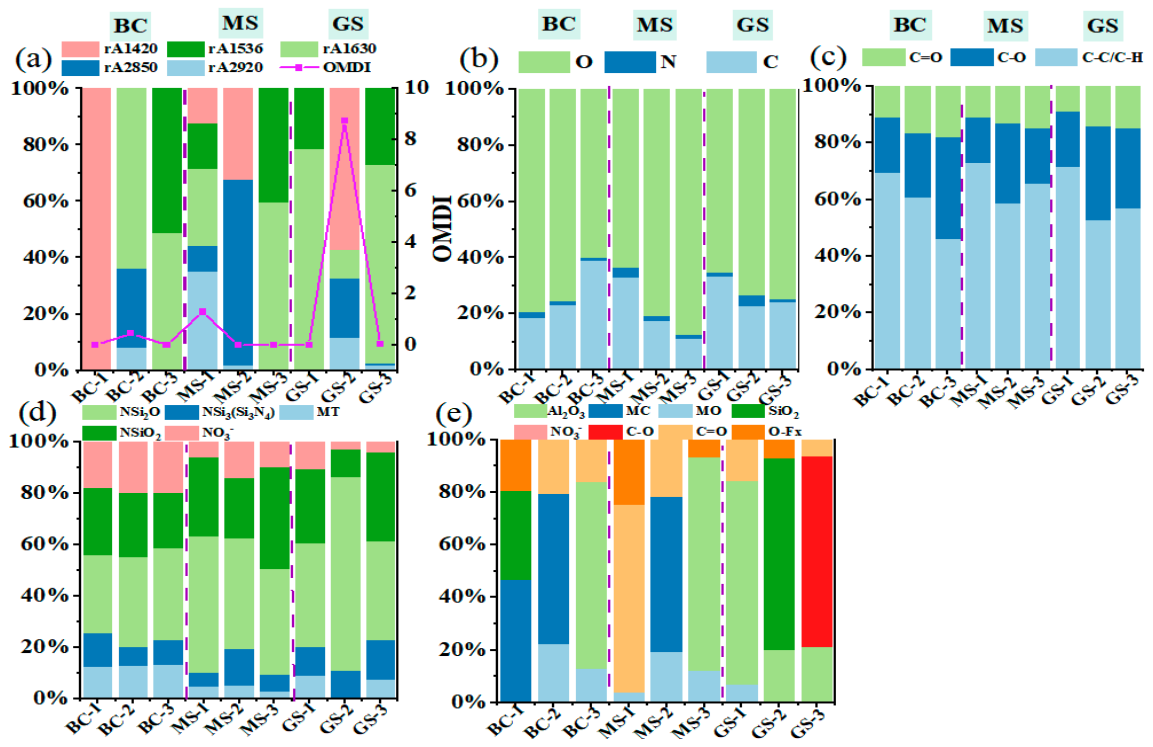
For exploring the structural characteristics of organic substances in tailings soil, ground soil samples were scanned by Fourier transform infrared spectroscopy (FTIR). Carbon-bearing functional moieties were identified according to characteristic absorption peaks, so as to elaborate on the formation pathway and functional roles of soil organic matter. Variations in the organic components of tailings soil were evaluated by analyzing the functional groups associated with the wavenumbers 1420, 1536, 1630, 2850 and 2920 cm−1 (Table 2, Figure 3a).
The BC-1 sample was dominated by rA1420, accounting for nearly 100%, which indicated that it was composed of a single aliphatic structure (Figure 3a). In the BC-2 sample, the proportions of rA1630 (0.54) and rA2850 (0.24) increased. Higher values of rA1536 (1.63) and rA1630 (5.93) were detected in BC-3. MS-1 showed relatively diverse functional group composition. Therefore, BC-2 organic matter consisted of aromatic and aliphatic structures, and aromatic functional groups dominated in BC-3. The organic functional groups of tailings soil transformed from aliphatic to aromatic structures during the BC stage.
Specifically, the proportions of rA1420, rA2850, and rA2920 (corresponding to aliphatic groups) as well as rA1536 and rA1630 (corresponding to aromatic groups) were 0.12, 0.09, 0.35, 0.16, and 0.27, respectively, forming a coexistence pattern of aliphatic and aromatic functional groups. In MS-2, aliphatic functional groups became predominant, with the proportion of rA2850 (66%) being significantly higher than that in other samples. In MS-3, the combined proportion of rA1536 and rA1630 exceeded 99%, which was consistent with both the types and proportions in BC-3. On the whole, there was greater diversity in the functional groups of organic matter in MS-stage samples relative to the BC stage.
The OMDI reflects the organic matter decomposition and utilization by microorganisms in the environment, as well as its residual status, thereby quantifying the transformation trend of organic matter during ecological restoration [39,40]. The OMDI values in MS-1 (1.29) and GS-2 (8.75) were significantly higher than those of other sample, indicating a stronger ability for organic matter decomposition in the tailings soil during these two stages (Figure 3a). In contrast, the OMDI values of MS-2 (0), MS-3 (0.001), as well as GS-1 (0.003) and GS-3 (0.03) were relatively low, suggesting that organic matter decomposition proceeded relatively slowly in these stages. Collectively, these results demonstrated that the OMDI did not increase continuously with the ecological succession stages of tailings. Organic matter decomposition was promoted at certain phases of the moss and grassland stages (MS-1 and GS-2), whereas it showed no significant improvement and was even inhibited at the biological crust stage, along with other phases of these two stages.

3.2.2. Elemental Composition-XPS Analysis

The variations in the contents of C, N, and O within tailings soil were elucidated through XPS characterization, encompassing both the survey scans and high-resolution spectra of C1s, O1s, and N1s (Figure 3b–e, Table 3).
In tailings soil, C and N are indicative of organic matter decomposition and microbial activity, while O denotes the oxidation or residues of organic matter. Among all samples, oxygen accounted for the highest proportion, reaching or exceeding 80% (Figure 3b). This observation can plausibly be ascribed to two main considerations. Firstly, the tailings area is enriched in metal oxides and silicates, which are inherently oxygen-rich and act as the dominant oxygen source [41]. On the other hand, during the ecological restoration process, the cell structures and metabolic products of biological crusts, mosses, and herbaceous plants also contribute to the oxygen content [42]. The C content showed a decreasing trend of BC stage > GS stage > MS stage. The C proportion was significantly higher in the BC-3 sample, potentially due to biological crusts being cemented by microorganisms and organic matter, where microbial cells and their secreted organic substances are rich in carbon [43]. The C proportion in the MS stage was generally lower than that in the BC stage, as the moss stage is in the early phase of ecological restoration with a limited total biomass. Compared with the MS stage, the GS stage exhibited a higher carbon proportion, but it was still lower than that in BC-3. The underlying reason is that despite the enhanced biomass of herbaceous plants (including plant residues, root exudates, and soil organic matter), the microbial organic matter in the biological crust stage is more enriched due to factors such as low carbon turnover rate [44]. N accounted for the lowest proportion among all stages less than 10%. Numerous previous studies have reported low nitrogen levels in tailing soils [45]. In this study, the overall nitrogen proportion remained consistently low, with only a slight increase observed in partial samples such as BC-3 and MS-1. This suggests that in the early ecological restoration stages (BC and MS), biological crusts and mosses possessed limited N-fixing ability; even when progressing to the grassland stage, the N requirement of herbaceous plants was still restricted by the soil nitrogen pool [45]. Overall, carbon accumulation gradually increased with the succession of plant communities in tailings ecological restoration, whereas nitrogen acted as a limiting factor.
The highest C/N values were observed in the GS stage (24.52–24.93, mean = 24.73), which were higher than those in the MS stage (8.63–10.40, mean = 9.45) and the BC stage (8.37–32.5, mean = 9.45) (Table 3). As reported by Li et al. [46], in the GS stage, large amounts of organic matter remained, the nitrogen cycle rate was slow, and the C accumulation rate exceeded that of N. This was consistent with the significant increase in C/N values from the BC stage to the GS stage in this study.
The average proportion of C-C/C-H groups was 58.87%, 65.89% and 60.52% in the BC, MS and GS stage (Figure 3c). For C-O groups, the corresponding average proportions were 26.15 (BC stage), 21.33 (MS stage), and 27.01 (GS stage). Regarding C=O groups, the average proportions were 14.98 (BC stage), 12.78 (MS stage), and 12.47 (GS stage), respectively. As documented in the prior literature, biological crusts are predominantly composed of cyanobacteria and lichens [47]. The organic matter of these organisms is rich in oxidized functional groups (C-O, C=O) [48]. Concurrently, the intense microbial decomposition activity during this stage leads to more robust oxidation reactions [49], a phenomenon that contributes to the elevated proportions of C-O and C=O groups, whereas the fraction of inert C-C/C-H groups remains relatively low. Mosses are dominated by inert carbon fractions (alkanes and lipids) and exhibit robust water retention capacity, which effectively alleviates the oxidative decomposition of organic matter [50]. In this study, the proportion of C-C/C-H groups increased remarkably, whereas the proportions of C-O and C=O groups decreased, which was consistent with previous reports. In the grassland (GS) stage, the complex composition of organic matter and elevated microbial activity facilitate the oxidation of organic matter. Thus, the proportion of C-O groups increased, whereas that of C=O groups decreased correspondingly.
In general, the proportions of NSiO2 and NSi2O remained relatively high across all three stages (Figure 3d). Specifically, these two nitrogen-containing groups were more prevalent in the MS and GS stages than in the BC stage, as this trend was likely driven by enhanced binding between nitrogenous moieties and soil minerals during the MS and GS stages [51]. The fraction of NO3-N was higher in the BC stage than in the MS and GS stages. This observation indicated that although microbial nitrogen fixation was robust in the BC stage, the limited organic matter content constrained NSiO2 formation, thereby favoring the accumulation of NO3-N.
Figure 3e revealed that the tailings soil was rich in tailings-derived components (Al2O3, SiO2). Additionally, organic C-O and C=O groups constitute a substantial proportion across all samples. This indicated that during ecological restoration of the iron tailings area, organic matter-associated functional groups (carboxyl, hydroxyl, and ether bonds) had formed via microbial metabolic processes.

3.3. Microbial Community Shifts in Tailings Soil Throughout Ecological Restoration

3.3.1. Bacterial Community

Nine tailings soil samples from different ecological restoration stages were selected for 16S rRNA gene amplicon sequencing. For BC, MS and GS stage, the number of clean reads ranged from 57,908 to 84,064, 73,111 to 99,496, and 59,770 to 66,467 respectively, with corresponding sequence lengths ranging from 200 to 321 bp, 200 to 336 bp, and 203 to 341 bp and a mean sequence length of approximately 256 bp. These results confirmed that the sequencing quality met the requirements for subsequent bacterial community analysis [52,53].
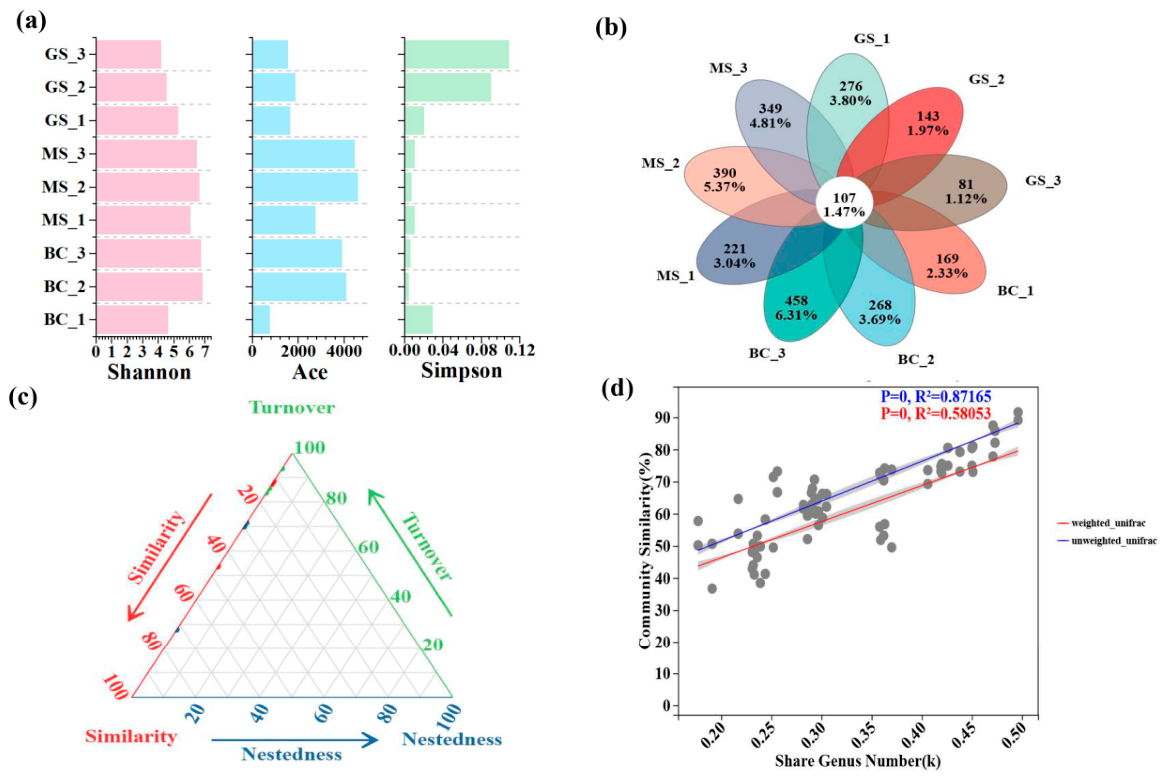
The ACE, Simpson, and Shannon indices were used to compare the richness, evenness, and diversity of bacterial communities across different ecological restoration stages in the tailing area [54]. The maximum Ace and Simpson indices were recorded in the MS (3884) and GS (0.072) stages, respectively (Figure 4a). This result indicated that the MS stage harbored the highest bacterial species richness, whereas the GS stage displayed the strongest dominance of key species within its bacterial community. Notably, the Shannon index was higher in the MS stage (6.33) than in the GS stage (4.59), which demonstrated that the MS stage sustained the optimal species diversity and evenness of the bacterial community. In contrast, the grassland (GS) stage exhibited relatively low species diversity.
The number of OTUs shared across the three stages was 107, accounting for 1.47% of the total OTUs and thus representing the core species conserved throughout the ecological restoration process (Figure 4b).
Notably, each stage harbored a substantial number of unique OTUs. Specifically, BC_3 exhibited the highest richness of unique OTUs (458, 6.31%), followed by MS_2 (390, 5.37%), while GS_1 also contained a considerable proportion of unique OTUs (276, 3.80%). These findings collectively demonstrated significant species differentiation in microbial communities among the BC, MS and GS stages. Furthermore, the overlap of OTUs among samples within the same stage indicated that the microbial community structure remained relatively stable during each distinct phase of ecological restoration. OTU-based ternary plot analysis revealed that all samples clustered in the region characterized by high turnover and low nestedness/similarity (Figure 4c). This finding indicated that community dissimilarities among the three stages were primarily driven by species turnover rather than nestedness or similarity. Shared community similarity analysis revealed that the number of species co-occurring between MS and GS was greater than that between BC and GS, indicating an increase in the number of shared species across different stages (Figure 4d), which elevated the overlap of community structures and consequently enhanced inter-stage similarity. During the transition from the BC to MS stage, species composition underwent greater shifts, characterized by a higher turnover of species. The influence of species presence on community similarity was far greater than that of species abundance. As succession progressed from the MS to the GS stage, differences in species abundance gradually became apparent. However, overall, community similarity was still primarily driven by species presence.
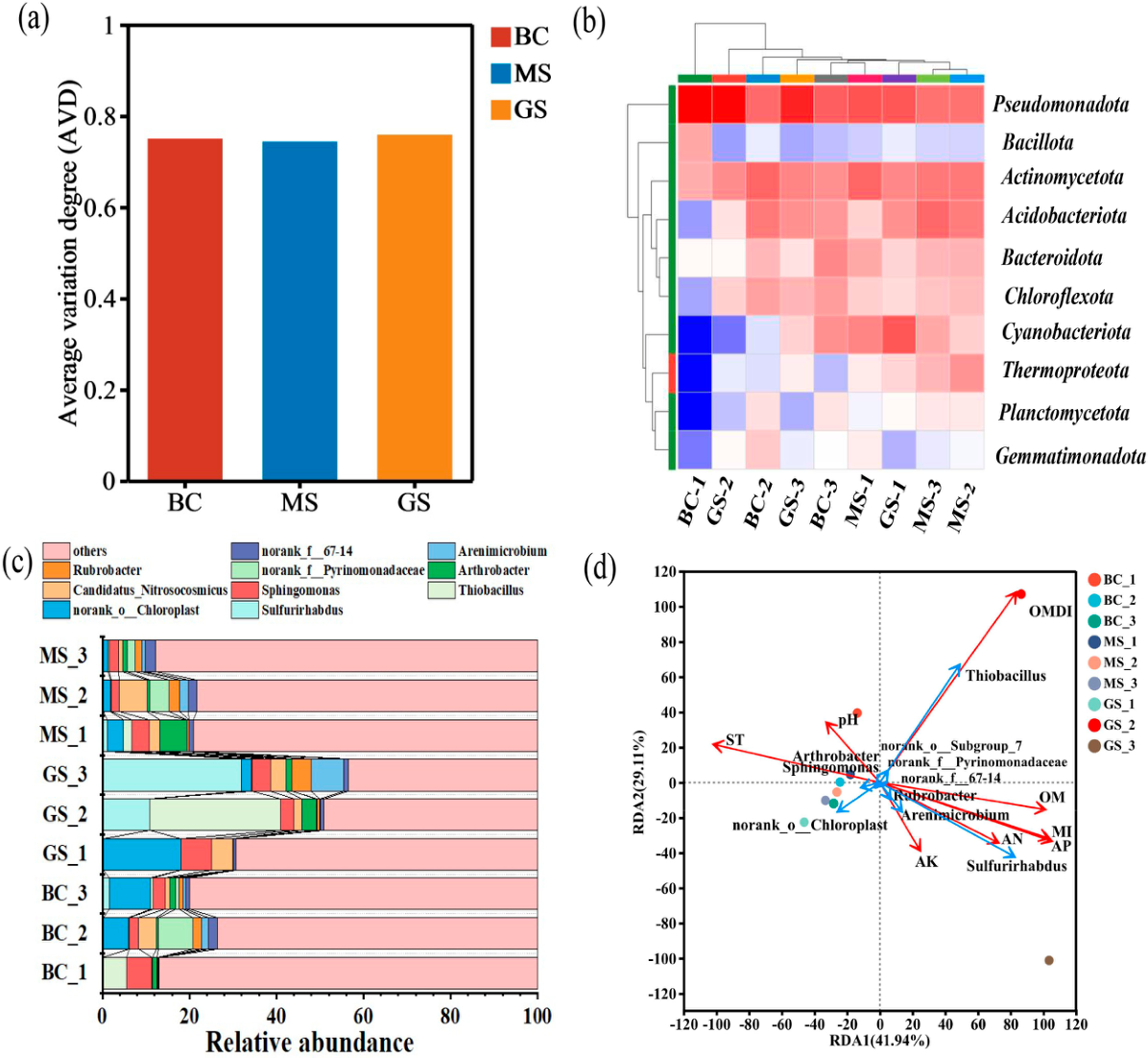
Figure 5a revealed no significant variation in the AVD index among the three stages with values between 0.7 and 0.8, indicating that the microbial communities in the BC, MS, and GS stages exhibit comparable internal species compositions, with no significant divergence in their stability levels. This was consistent with the result from Figure 4b, which demonstrated substantial OTU overlap among samples within the same stage. The comparable AVD indices across the three stages indicated that the microbial community maintained a dynamically adjusted state from BC to GS stage.
At the phylum level, Pseudomonadota dominated in all samples with higher relative abundances in the BC (36.62%) and GS (42.40%) stages compared to the MS stage (20.36%) (Figure 5b). As the second most dominant phylum, Actinomycetota exhibited greater relative abundance in the GS (18.28%) stage than in the BC (11.88%) and MS (12.81%) stages. Previous studies have reported that Pseudomonadota was predominantly heterotrophic bacteria involved in nutrient cycling, and Actinomycetota specialized in decomposing complex organic matter [55]. This may explain the composition of the dominant bacteria in the GS stage of the present study. Notably, Cyanobacteriota peaked in GS_1 (23.70%), while Thermoproteota was relatively abundant in BC_2 (7.18%) and MS_2 (11.27%). Zhu et al. [56] reported that Cyanobacteriota mediated carbon and nitrogen fixation via photosynthesis and Chang et al. [57] reported that Thermoproteota, tolerant to drought and extreme pH, was typical bacterium in the extreme environment.
At the genus level, in general, the others taxon accounted for an overwhelmingly high relative abundance in most samples, typically exceeding 50% and even nearing 90% (Figure 5c). This pattern suggested low diversity among the dominant taxa in these microbial communities, with the majority of microorganisms presented at low abundance levels. Specifically, microbial community composition differed substantially across samples in the BC stage. For the MS, microbial taxa exhibit relatively low and uniformly distributed abundances, with no distinct dominant taxa emerging.
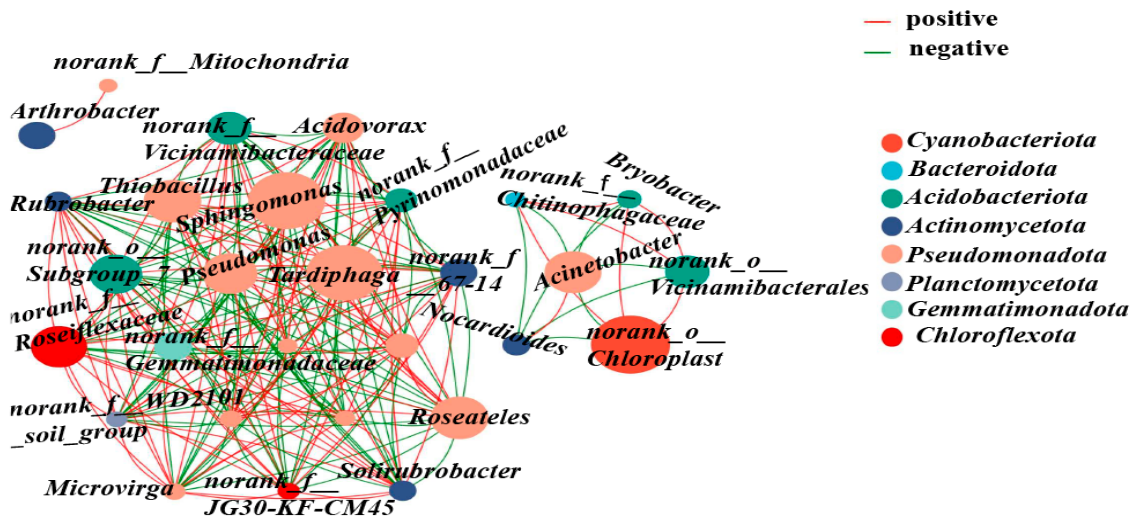
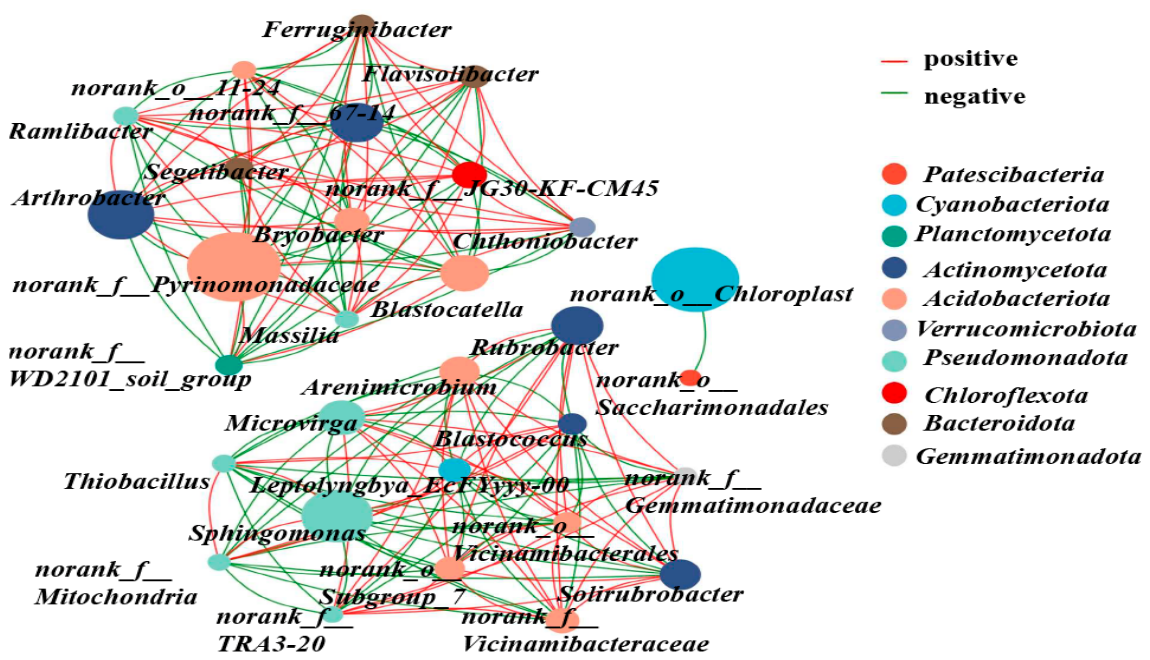
Network correlation analyses of the top 30 dominant genera in the crust, moss, and grassland stages are shown in Figure 6, Figure 7 and Figure 8. The core species in the BC stage could be divided into 2 modules, connected by 226 lines (Figure 6).
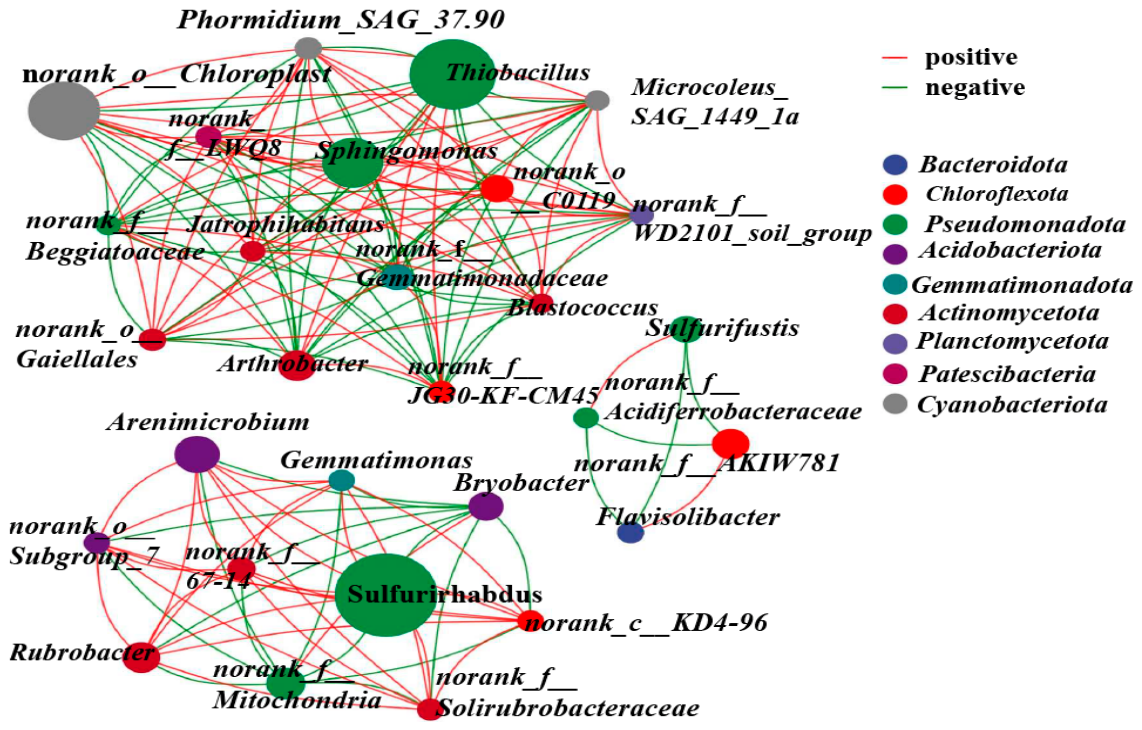
The core species in both the MS (Figure 7) and GS (Figure 8) stages could be divided into 3 modules, with 183 and 252 connecting lines, respectively. The negative correlations within bacterial communities were observed as 51.33%, 49.33%, and 47.22% in the BC, MS, and GS stages, respectively, indicating that mutualistic interactions among microorganisms were enhanced from the biological crust to the grassland stage, which may be attributed to the shift in core genera [58].
Concurrently, our findings revealed that among the environmental variables, OMDI and MI were correlated with the dominant bacterial genera (Figure 5d). A significant positive correlation was observed between Thiobacillus and OMDI. Moreover, the positive correlation between Sulfurirhabdus, Rubrobacter, Arenimicrobium and MI increased sequentially.

3.3.2. Fungal Community

Analysis of the diversity indices revealed that there was no significant change in the Shannon index from the BC, MS to GS stages. Notably, both the Ace and Simpson indices decreased slightly in sequence. These findings suggest that both the community richness and evenness of fungi were reduced. The relative abundances of the fungal community at the phylum and genus levels are shown in Figure 9.
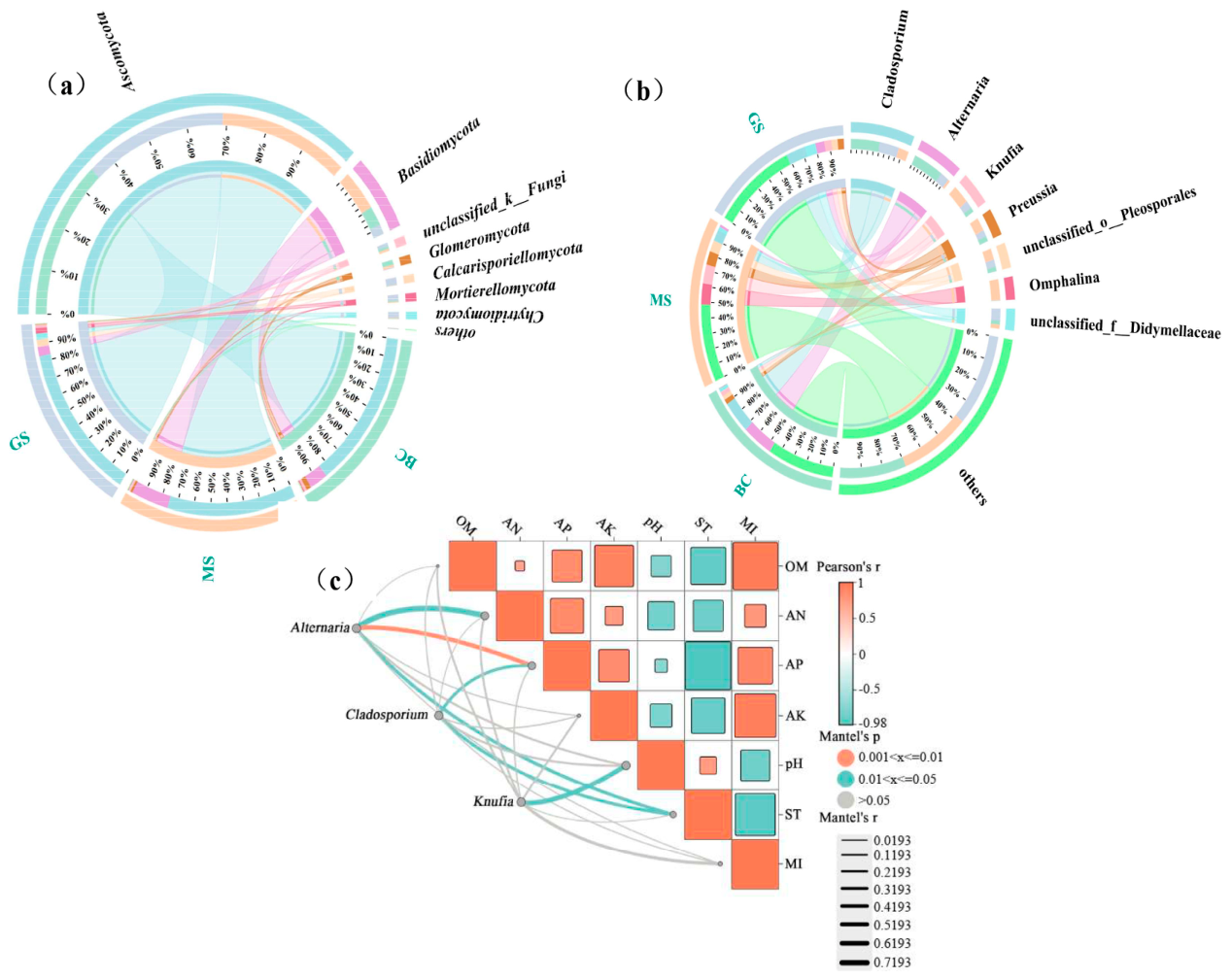
At the phylum level, Ascomycota, Basidiomycota, and Glomeromycota were the dominant phyla in all tailing soils (Figure 9a). Among them, Ascomycota accounted for more than 75% of the relative abundance across the three stages, whereas the abundances of Basidiomycota and Glomeromycota were affected by vegetation: the abundance of Basidiomycota was significantly increased in the moss stage, whereas the abundance of Glomeromycota was significantly decreased in the tailing soils of the grassland stage.
The dominant genera (Figure 9b) were Cladosporium, Alternaria, and Knuia in all tailing soil samples. The abundance of Preussia was significantly higher in the moss stage (MS) than in the biological crust (BC) and grassland (GS) stages, whereas the abundance of Omphalina was lower, which could be attributed to the microhabitat and organic matter content provided by the moss. Additionally, vegetation succession significantly affected the composition of the fungal community: the abundance of Cladosporium in the BC stage was significantly higher than that in the MS stage, but the herbs significantly increased the proliferation of unclassified_f_Didymellaceae.
The associations between environmental factors and the distribution of the main fungal taxa involved in ecological restoration (including Alternaria and Cladosporium) as well as the organic-matter-degrading fungus Knufia were investigated (Figure 9c). According to the Mantel test and Pearson’s correlation coefficient analysis, the abundance of Alternaria was strongly positively correlated with available phosphorus (AP) (Mantel’s r = 0.72, p ≤ 0.01), while it was significantly negatively correlated with soil salinity and ammonium nitrogen (AN) (p ≤ 0.05). The abundance of Cladosporium showed a moderate correlation with environmental factors (Mantel’s r = 0.11–0.21), and was mainly negatively correlated with available phosphorus and soil salinity. The abundance of Knufia exhibited a weak correlation with environmental factors (Mantel’s r < 0.2), and was only strongly negatively correlated with pH. Furthermore, despite the fact that dominant fungi are considered to drive the ecological succession of tailings soil [59], the Mantel test results indicated that the distribution of these dominant fungi had no significant overall correlation with environmental factors. Li et al. [60] analyzed the composition and structure of microbial communities in tailings restoration, revealing that ecological functional diversity in tailings areas was driven by key functional microorganisms rather than dominant microbiota.

3.4. Specificity of Carbon Transformation Functions in Tailings Soil During Ecological Restoration

3.4.1. Bacterial Carbon Metabolic Function

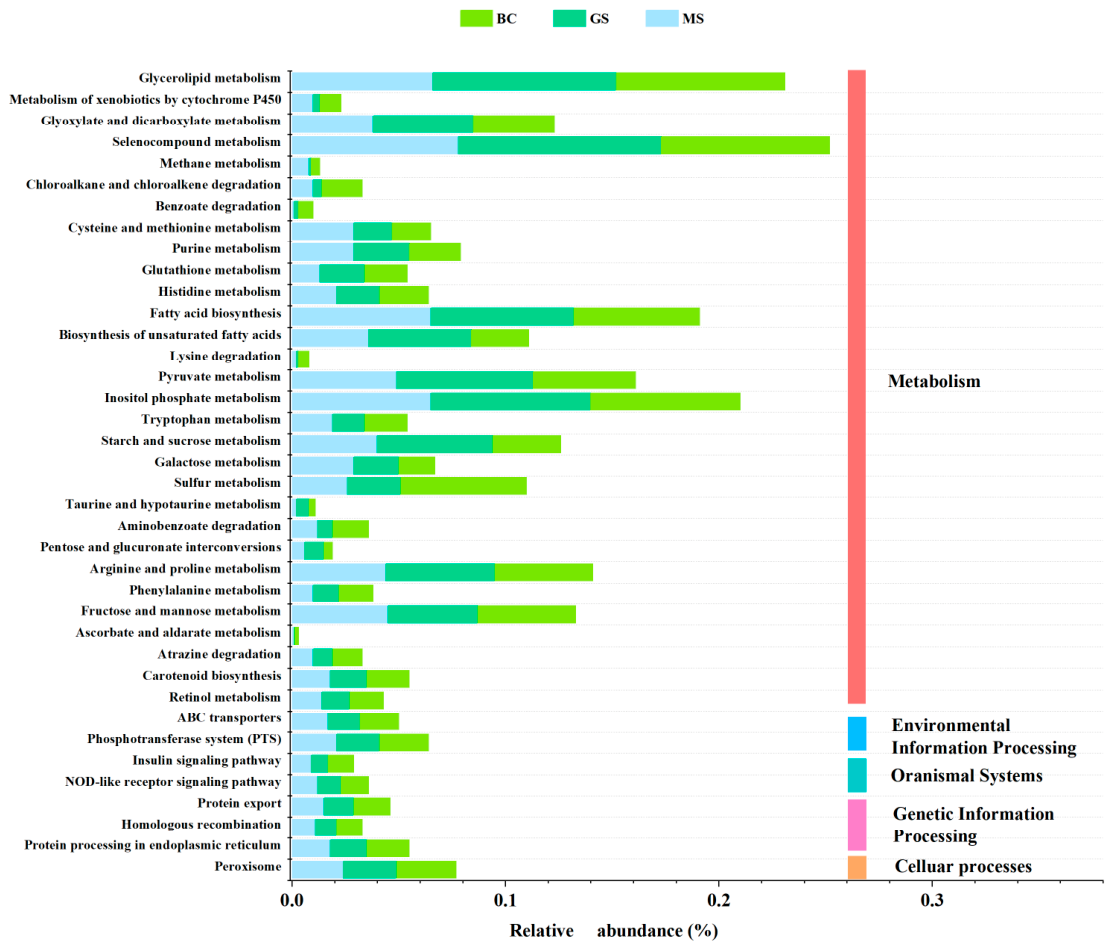
To further explore the changes in carbon metabolic functions across the three successional stages of the iron tailings ecological restoration zone, 29 distinct functional pathways of bacteria in the third category are presented in Figure 10. Most of these pathways were classified as metabolism in the first category, which demonstrated that bacteria exert diverse mediating effects during succession, with their influence focused on intracellular metabolic processes.
Most of the functional abundances involved in the functional pathways followed the trend of BC > MS > GS (Figure 10), and these functions were mainly associated with cellular basal metabolism, substance transport, signal regulation and xenobiotic degradation. These reactions serve as the basis for the shifts in microbial communities during the ecological succession of tailings and are beneficial to cellular growth and metabolism [61]. In contrast, the abundance of the galactose metabolism pathway related to carbon source supplementation increased from 0.017% in the MS to 0.029% in the BC. The abundance of the starch and sucrose metabolism pathway also increased, which was conducive to enhancing the organic carbon storage during the ecological restoration of tailings [62].
Additionally, the abundances of glycerolipid and selenocompound metabolism pathways in GS both increased by 0.02% compared with those in MS, which suggested that glycerolipids and selenium were the core substances for the succession of iron tailings ecological restoration areas to the grassland stage. In GS, the third most abundant functional pathway was inositol phosphate metabolism, with a relative abundance of 0.075%, and the high expression of this pathway was conducive to the activation and utilization of phosphorus [63]. Another unanticipated finding of this study was that there were no significant differences in the relative abundances of peroxisome, retinol metabolism, glyoxylate and dicarboxylate metabolism, and metabolism of xenobiotics by cytochrome P450 across the three succession stages, indicating that the microbial communities all possessed a strong stress resistance capacity during the ecological restoration of tailings. From the perspective of ecological functions, the tendency of ecological succession in tailings toward a healthy state was likely ascribed to the regulatory effects of specific functional pathways, which enabled a more efficient coupling of microbial carbon metabolism with stress resistance processes [64].

3.4.2. Fungal Carbon Metabolic Function

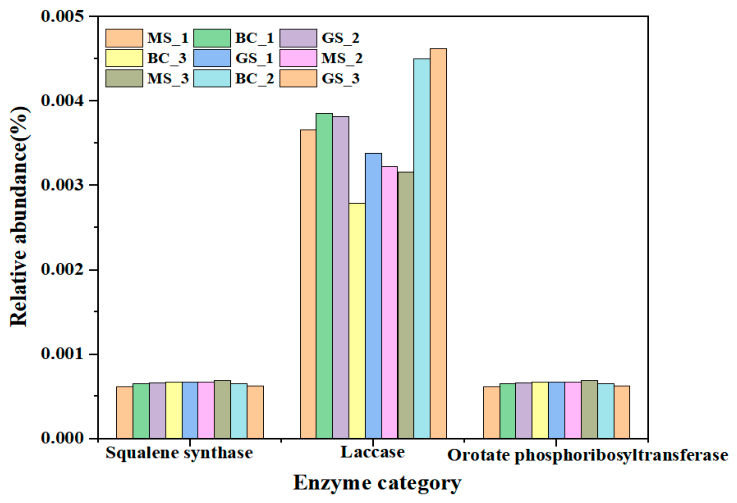
The core enzymes involved in the fungus-specific metabolic pathways of carbon cycling are shown in Figure 11. The results revealed a disparity in the abundance of functional enzymes involved in phenolic degradation (Laccase), terpenoid synthesis (Squalene synthase), and pyrimidine synthesis (Orotate phosphoribosyltransferase) among the three successional stages of BC, MS, and GS. In particular, the relative abundance of Laccase exceeded 0.0028 across all samples, whereas the relative abundances of Orotate phosphoribosyltransferase and Squalene synthase were all below 0.001. This finding aligns with the changing trends in the functional characteristics of soil microorganisms during the successional process. Consequently, a large abundance of Laccase is required to participate in the transformation processes such as lignin degradation during the ecological succession of tailings. Orotate phosphoribosyltransferase and squalene synthase separately enhance pyrimidine and ergosterol synthesis to support the more complex metabolic demands of microbial communities. Jin et al. [65] investigated the diversity of soil bacterial and fungal communities during mine ecological restoration, and found that the distribution patterns and dominant fungal groups exerted decisive effects on soil functions.

4. Conclusions

4.1. Main Findings and Research Contributions

Based on tailing soil samples collected from three typical restoration stages (biological crust, moss, and grassland) in southern Shaanxi Province, China, this study characterizes microbial community traits and soil functional diversity across tailings ecological succession. Given the evident stage-dependent divergence in soil properties and microbial metabolism during natural restoration, we adopt high-throughput sequencing, spectroscopic detection and co-occurrence network analysis to explore how microbial communities and carbon metabolic functions respond to progressive tailings remediation. The main findings are summarized as follows:
  • This study confirms a continuous rising trend of soil functional diversity alongside tailings ecological succession, which is significantly correlated with bacterial genera Rubrobacter and Arenimicrobium, while irrelevant to dominant fungal taxa.
  • Co-occurrence network analysis reveals gradually intensified interspecific interactions within bacterial communities over the succession process.
  • With advancing restoration, carbon metabolism related to galactose, starch and sucrose is distinctly enriched, whereas pathways including inositol phosphate, peroxisome, retinol, glyoxylate-dicarboxylate and xenobiotics metabolism remain statistically stable.
  • Practical implications highlight targeted microbial inoculation for tailings restoration needs to fully account for site spatiotemporal heterogeneity, supporting coordinated sustainable development between mine economy and terrestrial ecosystem protection.
This study contributes primarily in three aspects. First, it systematically clarifies the variation characteristics of soil multifunctionality, microbial community and carbon metabolism across three typical tailings restoration stages (biological crust, moss and grassland), providing basic data and a research framework for subsequent tailings restoration and sustainable remediation research. Second, this study innovatively combines high-throughput sequencing, spectroscopic testing and microbial co-occurrence network analysis to reveal the correlation between core beneficial bacteria (Rubrobacter, Arenimicrobium) and soil functional diversity during ecological succession of tailings. Finally, it clarifies the differentiated variation rules of various carbon metabolic pathways along restoration succession, offers practical suggestions for targeted microbial-assisted tailings remediation, and supplies empirical support to coordinate mine economic development and terrestrial ecosystem protection toward sustainable development.

4.2. Implications, Limitations and Future Research

Based on the empirical findings of microbial succession and soil functional evolution in tailings ecosystems, this study proposes targeted practical strategies and future research prospects for ecological restoration and sustainable management of iron tailings. Tailings ecological restoration is critical to mitigating ecosystem degradation and maintaining terrestrial biodiversity, and the microenvironmental and microbial variations across distinct restoration stages fundamentally determine the effectiveness of in situ remediation. This study confirms that soil multifunctionality during tailings succession is tightly associated with core bacterial genera Rubrobacter and Arenimicrobium, and microbial interaction networks are progressively strengthened from the biological crust stage to moss and grassland stages. The coordinated coupling of microbial carbon metabolism and stress resistance processes serves as the core driving force for the progressive ecological succession of tailings ecosystems. These results highlight the great potential of utilizing functional microorganisms and their interspecific interactions to facilitate targeted and efficient ecological restoration of iron tailings, providing novel microbially mediated restoration ideas for degraded mining land remediation.
Despite the valuable findings, current research on tailings ecological succession still faces inherent limitations in methodological perspectives and research scales. Existing studies mostly adopt static and short-term observation with limited variable selection, which fails to fully reveal the long-term dynamic evolutionary characteristics of tailings ecosystems under the combined interference of natural succession and human activities. Consistent with the deficiencies of previous studies, this work also has certain limitations in the exploration of carbon metabolic mechanisms. First, the relevant analysis is conducted based on sampling data from nine field sites without long-term continuous monitoring, which may cause potential deviations in the interpretation of microbial and functional variation rules during restoration. Second, this study adopts only 16S rRNA and ITS amplicon sequencing to characterize carbon metabolic functions, while metagenomic sequencing is not incorporated, which may fail to capture the detailed functional genes and underlying microscopic mechanisms governing soil carbon cycling in tailings habitats.
Accordingly, future research should focus on overcoming the above limitations to supplement and improve the theoretical system of tailings ecological restoration. Subsequent studies are suggested to fully consider the spatiotemporal heterogeneity of tailings restoration areas, including distinguishing the short-term primary improvement stage and the medium-long-term community stability construction stage, so as to enhance the comprehensiveness and accuracy of ecological mechanism exploration. Furthermore, long-term in situ field monitoring and metagenomic sequencing technology should be combined to systematically analyze the multi-dimensional influencing factors of microbial succession and carbon metabolic variation. Such improved research methods can further deepen the understanding of microbe-driven ecological succession mechanisms, and provide more comprehensive and reliable theoretical support for balancing mine economic development, terrestrial ecosystem protection, and the sustainable restoration of degraded tailings land.

Author Contributions

Conceptualization, H.L.; methodology, H.L.; validation, H.L., X.Z.; formal analysis, H.L.; investigation, H.L., F.L., X.Z.; resources, H.L., F.L.; data curation, H.L., X.Z., K.M., M.L.; writing original draft preparation, H.L.; writing review and editing, K.M.; visualization, H.L.; supervision, H.L.; funding acquisition, H.L. All authors have read and agreed to the published version of the manuscript.

Funding

This work was supported by the Shaanxi Provincial Department of Education Scientific Research Project (No.25JK0439), Doctoral Research Projects of Shangluo University (No.23SKY022).

Institutional Review Board Statement

Not applicable.

Informed Consent Statement

Not applicable.

Data Availability Statement

The datasets generated and/or analysed during the current study are available in the NCBI BioProject repository, PRJNA1461223.

Acknowledgments

We sincerely appreciate all those who contributed to the refinement of this manuscript.

Conflicts of Interest

The authors declare no conflicts of interest.

References

  1. Verbuyst, B.R.; Pakostova, E.; Paktunc, D.; Bain, J.G.; Finfrock, Y.Z.; Saurette, E.M.; Ptacek, C.J.; Blows, D.W. Microbiological and geochemical characterization of As-bearing tailings and underlying sediments. J. Hazard. Mater. 2024, 466, 133554. [Google Scholar] [CrossRef]
  2. Lottermoser, B.G. Sulfidic Mine Wastes. In Mine Wastes; Springer: Berlin/Heidelberg, Germany, 2010; pp. 43–117. [Google Scholar] [CrossRef]
  3. Mileusnić, M.; Mapani, B.S.; Kamona, A.F.; Ružičić, S.; Mapaure, I.; Chimwamurombe, P.M. Assessment of agricultural soil contamination by potentially toxic metals dispersed from improperly disposed tailings, Kombat mine, Namibia. J. Geochem. Explor. 2014, 144, 409–420. [Google Scholar] [CrossRef]
  4. Nawab, J.; Khan, S.; Shah, M.T.; Khan, K.; Huang, Q.; Ali, R. Quantification of heavy metals in mining affected soil and their bioaccumulation in native plant species. Int. J. Phytoremediat. 2015, 17, 801–813. [Google Scholar] [CrossRef]
  5. Kumar, A.; Maiti, S. Assessment of potentially toxic heavy metal contamination in agricultural fields, sediment, and water from an abandoned chromite-asbestos mine waste of Roro hill, Chaibasa, India. Environ. Earth Sci. 2015, 74, 2617–2633. [Google Scholar] [CrossRef]
  6. Zhang, T.R.; Wu, Z.Q.; Ge, L.Q.; Wu, S.L.; Liu, Y.J.; Bougoure, J.J.; Southam, G.; Chan, T.S.; Lu, Y.R.; Haw, S.C.; et al. Organic matter amendment and plant colonization drive mineral weathering, organic carbon sequestration, and water−stable aggregation in magnetite Fe ore tailings. Environ. Sci. Technol. 2019, 53, 13720–13731. [Google Scholar] [CrossRef]
  7. Qi, X.; Xiao, S.; Chen, X.; Ali, I.; Gou, J.; Wang, D.; Zhu, B.; Zhu, W.; Shang, R.; Han, M. Biochar-based microbial agent reduces U and Cd accumulation in vegetables and improves rhizosphere microecology. J. Hazard. Mater. 2022, 436, 129147. [Google Scholar] [CrossRef] [PubMed]
  8. Liu, Q.; Chen, Z.; Tang, J.; Luo, J.; Huang, F.; Wang, P.; Xiao, R. Cd and Pb immobilisation with iron oxide/lignin composite and the bacterial community response in soil. Sci. Total Environ. 2022, 802, 149922. [Google Scholar] [CrossRef] [PubMed]
  9. Xing, B.; Ouyang, M.Z.; Graham, N.; Yu, W.Z. Enhancement of phosphate adsorption during mineral transformation of natural siderite induced by humic acid: Mechanism and application. Chem. Eng. J. 2020, 393, 124730. [Google Scholar] [CrossRef]
  10. Zhang, J.K.; Li, P.; Guan, X.D.; Chang, Q.Q.; Zhang, H.L.; Han, Y.W.; Li, Q.; Xiong, J.C.; Wang, H.J.; Yang, Y.M.; et al. Bioleaching ion-unexchangeable rare earth in ion-adsorption type rare earth waste tailing. Sep. Purif. Technol. 2024, 348, 127691. [Google Scholar] [CrossRef]
  11. Sun, W.M.; Xiao, E.Z.; Häggblom, M.; Krumins, V.; Dong, Y.R.; Sun, X.X.; Li, F.B.; Wang, Q.; Li, B.Q.; Yan, B. Bacterial survival strategies in an alkaline tailing site and the physiological mechanisms of dominant phylotypes as revealed by metagenomic analyses. Environ. Sci. Technol. 2018, 52, 13370–13380. [Google Scholar] [CrossRef]
  12. Cuaxinque-Flores, G.; Hernandez-Flores, G.; Talavera-Mendoza, O.; Martínez-Miranda, V.; Martínez-Romero, E.; Aguirre-Noyola, J.L.; Rosas-Guerrero, V. Molecular and geochemical basis of microbially induced carbonate precipitation for treating acid mine drainage: The case of a novel Sporosarcina genomospecies from mine tailings. J. Hazard. Mater. 2024, 476, 135005. [Google Scholar] [CrossRef]
  13. Li, Z.; Wu, S.L.; Yi, Q.; Liu, Y.J.; Wang, J.; Nguyen, T.A.H.; Ma, Y.Y.; You, F.; Chan, T.S.; Klein, A.; et al. Arbuscular mycorrhizal fungi drive organo-mineral association in iron ore tailings: Unravelling microstructure at the submicron scale by synchrotron-based FTIR and STXM-NEXAFS. Environ. Sci. Technol. 2023, 57, 21779–21790. [Google Scholar] [CrossRef] [PubMed]
  14. Dong, H.; Huang, L.; Zhao, L.D.; Zeng, Q.; Liu, X.; Sheng, Y.; Shi, L.; Wu, G.; Jiang, H.; Li, F.; et al. A critical review of mineral-microbe interaction and co-evolution: Mechanisms and applications. Natl. Sci. Rev. 2022, 9, 128. [Google Scholar] [CrossRef]
  15. Wu, S.; Liu, Y.; Southam, G.; Robertson, L.; Chiu, T.H.; Cross, A.T.; Dixon, K.W.; Stevens, J.C.; Zhong, H.; Chan, T.S.; et al. Geochemical and mineralogical constraints in iron ore tailings limit soil formation for direct phytostabilization. Sci. Total Environ. 2019, 651, 192–202. [Google Scholar] [CrossRef]
  16. Wang, X.; Li, Y.; Wei, Y.; Meng, H.S.; Cao, Y.Z.; Lead, J.R.; Hong, J.P. Effects of fertilization and reclamation time on soil bacterial communities in coal mining subsidence areas. Sci. Total Environ. 2020, 739, 139882. [Google Scholar] [CrossRef] [PubMed]
  17. Long, Z.J.; Zhu, H.; Wu, Y.H.; Bing, H.J.; Ma, Z.J.; Yu, D.M.; Zhang, W.W. Bio-accessibility and mobilization dynamics of soil vanadium during a 48-year vegetation restoration in a vanadium titano-magnetite tailings reservoir. Sci. Total Environ. 2024, 906, 167507. [Google Scholar] [CrossRef]
  18. Jin, C.Y.; Yang, J.Q.; Chen, B.J.; Qu, G.F.; Li, H.L.; Wu, F.H.; Liu, X.X.; Liu, Y.; Kuang, L.R.; Li, J.Y. Soilization utilization of solid waste: Ecological regulation of phosphorus tailings-based soil with physicochemical improvement and Bacillus cereus-addition. Environ. Res. 2023, 236, 116856. [Google Scholar] [CrossRef]
  19. Schaller, J.; Faucherre, S.; Joss, H.; Obst, M.; Goeckede, M.; Planer-Friedrich, B.; Peiffer, S.; Gilfedder, B.; Elberling, B. Silicon increases the phosphorus availability of Arctic soils. Sci. Rep. 2019, 9, 449. [Google Scholar] [CrossRef]
  20. Teng, Z.D.; Zhu, J.; Shao, W.; Zhang, K.Y.; Li, M.; Whelan, M.J. Increasing plant availability of legacy phosphorus in calcareous soils using some phosphorus activators. J. Environ. Manag. 2020, 256, 109952. [Google Scholar] [CrossRef] [PubMed]
  21. Luo, Z.H.; Huang, N.; Li, Q.; Chen, N.; Tang, L.Y.; Liao, B.; Yang, T.T.; Huang, L.N. Genome-resolved metagenomics reveals depth-related patterns of microbial community structure and functions in a highly stratified, AMD overlaying mine tailings. J. Hazard. Mater. 2023, 447, 130774. [Google Scholar] [CrossRef]
  22. Korzhenkov, A.A.; Toshchakov, S.V.; Bargiela, R.; Gibbard, H.; Ferrer, M.; Teplyuk, A.V.; Jones, D.L.; Kublanov, I.V.; Golyshin, P.N.; Golyshina, O.V. Archaea dominate the microbial community in an ecosystem with low-to-moderate temperature and extreme acidity. Microbiome 2019, 7, 11. [Google Scholar] [CrossRef]
  23. Ferreira, A.D.; Zem, T.M.S.; Barcellos, D.; Nóbrega, G.N.; Queiroz, H.M.; Otero, X.L.; Bernardino, Â.F.; Ferreira, T.O. Assessment of the potential of microbial consortium for the reclamation of mine tailings containing potentially toxic elements. J. Environ. Chem. Eng. 2024, 12, 112399. [Google Scholar] [CrossRef]
  24. Khan, H.; Akbar, W.A.; Shah, Z.; Rahim, H.U.; Taj, A.; Alatalo, J.M. Coupling phosphate-solubilizing bacteria (PSB) with inorganic phosphorus fertilizer improves mungbean (Vigna radiata) phosphorus acquisition, nitrogen fixation, and yield in alkaline-calcareous soil. Heliyon 2022, 8, e09081. [Google Scholar] [CrossRef]
  25. American Public Health Association; American Water Works Association; Water Environment Federation. Standard Methods for the Examination of Water and Wastewater, 23rd ed.; American Public Health Association: Washington, DC, USA, 2017. [Google Scholar]
  26. Nelson, D.W.; Sommers, L.E. Total carbon, organic carbon, and organic matter. In Methods of Soil Analysis, Part 2: Chemical and Microbiological Properties; Page, A.L., Ed.; American Society of Agronomy: Washington, DC, USA, 1982; pp. 539–579. [Google Scholar]
  27. Olsen, S.R.; Cole, C.V.; Watanabe, F.S.; Dean, L.A. Estimation of Available Phosphorus in Soils by Extraction with Sodium Bicarbonate; USDA Circular 939; US Government Printing Office: Washington, DC, USA, 1954. [Google Scholar]
  28. Page, A.L.; Miller, R.H.; Keeney, D.R. Methods of Soil Analysis. Part 2: Chemical and Microbiological Properties, 2nd ed.; American Society of Agronomy: Washington, DC, USA, 1982. [Google Scholar]
  29. Zhang, Q.; Liu, Z.Y.; Yang, A.; Han, Z.L.; Zhang, J.; Yang, Z.Y.; Zhang, J.; Zang, Y.X.; Hu, G.L.; Li, Q.Q.; et al. Distance and wind direction dependent patterns of soil multifunctionality around an open-pit coal mine in an arid region. J. Environ. Manag. 2026, 408, 129897. [Google Scholar] [CrossRef]
  30. Li, W.X.; He, E.K.; Van Gestel, C.A.M.; Peijnenburg, W.J.G.M.; Chen, G.Q.; Liu, X.R.; Zhu, D.; Qiu, H. Pioneer plants enhance soil multifunctionality by reshaping underground multitrophic community during natural succession of an abandoned rare earth mine tailing. J. Hazard. Mater. 2024, 472, 134450. [Google Scholar] [CrossRef] [PubMed]
  31. Sun, H.X.; Yao, J.; Ma, B.; Knudsen, T.S.; Yuan, C.Y. Siderite’s green revolution: From tailings to an eco-friendly material for the green economy. Sci. Total Environ. 2024, 914, 169922. [Google Scholar] [CrossRef]
  32. Navas Romero, A.L.; Herrera Moratta, M.A.; Fernández-Maldonado, V.; Martínez Carretero, E.; Mazza, G.; Rodriguez, R. Impact of soil biological crusts on the sustainability of arid ecosystems in central-western argentina: Their influence on nutrient dynamics and soil properties. Sustainability 2024, 16, 10468. [Google Scholar] [CrossRef]
  33. Bhattacharyya, S.S.; Furtak, K. Soil-plant-microbe interactions determine soil biological fertility by altering rhizospheric nutrient cycling and biocrust formation. Sustainability 2023, 15, 625. [Google Scholar] [CrossRef]
  34. Lu, Y.; Liu, Z.K. Moss-induced changes in soil C/N/P and CEC: An Integrated Spectral Perspective. Sustainability 2025, 17, 8348. [Google Scholar] [CrossRef]
  35. Niu, J.P.; Yang, K.; Tang, Z.J.; Wang, Y.T. Relationships between soil crust development and soil properties in the desert region of north China. Sustainability 2017, 9, 725. [Google Scholar] [CrossRef]
  36. Zechmeister, H.G.; Möslinger, L.; Korjenic, A.; Streit, E.; Sulejmanovski, A.; Frank, P.N.; Hummel, E. Viability of living moss for indoor green walls: A study on temperature, humidity, and irrigation. Sustainability 2023, 15, 15625. [Google Scholar] [CrossRef]
  37. Cai, X.L.; Luo, W.J.; Liu, C.C.; Chen, J.; Zhang, L.; Cheng, A.Y.; He, Z.Q.; Wang, S.J. Impacts of bedrocks on vegetation carbons in typical karst areas: A Case study in puding county, southwest China. Sustainability 2024, 16, 9429. [Google Scholar] [CrossRef]
  38. Ma, Y.X.; Xu, Z.J. Construction of low-carbon land use and management system in coal mining areas. Sustainability 2023, 15, 12486. [Google Scholar] [CrossRef]
  39. Qu, X.J.; Guo, J.H.; Zi, H.Y.; Kuzyakov, Y.; Zhu, B.; Li, X.G. Forest conversion alters microbial decomposition of soil organic matter. Appl. Soil Ecol. 2025, 214, 106336. [Google Scholar] [CrossRef]
  40. Chen, Q.; Zhou, Z.Y.; Cai, S.L.; Lv, M.Q.; Yang, Y.H.; Luo, Y.C.; Jiang, H.; Liu, R.; Cao, T.T.; Yao, B.; et al. Spatial-temporal variation of soil organic matter decomposition potential in China. Soil Tillage Res. 2024, 235, 105898. [Google Scholar] [CrossRef]
  41. Li, A.S.; Li, P.G.; Xu, H.; Zhang, Z.Z.; Liao, Q.; Yang, W.C.; Li, Q.Z.; Si, M.Y.; Hu, N.; Li, G.Y.; et al. Enhanced synergistic mineralization of uranium, arsenic, and cadmium in uranium tailings pond wastewater through bio-oxidation of Arsenic (III) by Brevundimonas spp. Process Saf. Environ. Prot. 2026, 212, 108906. [Google Scholar] [CrossRef]
  42. Zhang, Z.J.; Zhang, Q.W.; Garcia-Meza, J.V.; Wu, Z.B.; Meng, D.L.; Xia, L. Synergistic effects of peat and MICP for copper tailings remediation: Metal immobilization, nutrient retention, and microbial regulation. J. Hazard. Mater. 2026, 502, 141028. [Google Scholar] [CrossRef]
  43. Zuo, J.F.; Lin, Y.C.; Xie, X.; Yan, X.M.; Zhu, B.; Han, H.J.; Tian, S.L.; Ning, P.; Huang, J.H. Effect of plant growth and organic matter improvement on substrate properties and microbial community structure in copper tailings. Ecol. Eng. 2025, 219, 107649. [Google Scholar] [CrossRef]
  44. Tan, J.Q.; Wang, Z.; Luo, M.; Fang, L.C.; Hou, J.; Song, S.X.; García Meza, J.V.; Xia, L. Microbial-mediated carbon acquisition drives phosphorus turnover within soil initial development in oligotrophic tailing sites. Bioresour. Technol. 2025, 435, 132946. [Google Scholar] [CrossRef]
  45. Gao, H.B.; Guo, Z.H.; Huang, F.L.; Li, S.K.; He, X.; Fernio, J.U.; Lv, W.; Zhou, L.; Du, S.Y.; Shen, M.; et al. Core microbiota with antimonite oxidation coupled nitrogen fixation traits persist in the rhizosphere of pioneer plants in antimony tailings. Environ. Res. 2025, 285, 122586. [Google Scholar] [CrossRef]
  46. Li, M.T.; Sui, X.Y.; Wu, X.H.; He, J.S.; Wang, J.C.; Liao, Q.Y.; Wang, J.; Wang, W.; Qin, X.X.; Wang, R.J.; et al. Vegetation restoration improves phosphorus content and availability in tailings slag. J. Environ. Manag. 2025, 393, 127102. [Google Scholar] [CrossRef]
  47. Hou, L.H.; Li, D.Y.; Wan, S.H.; Liao, K.J.; Tao, Y.; Chen, L.Z. Enhanced lead-zinc tailing remediation by inoculating cyanobacteria to induce biological soil crusts. Algal Res. 2025, 90, 104103. [Google Scholar] [CrossRef]
  48. She, S.J.; Tao, Y.; Zhu, J.; Ye, W.Y.; Hou, L.H.; Fu, Y.J.; Chen, L.Z. Spatial distribution and succession of microbial communities in biological soil crusts as affected by microtopography factors in the granite tailing areas of Macheng, China. Catena 2024, 247, 108532. [Google Scholar] [CrossRef]
  49. Wu, C.; Wu, Y.H.; Pan, J.H.; Lv, Y.T.; Li, W.C.; Hu, M.; Wang, J.; Su, S.M.; Zou, Q.; Xue, S.G. Evolution and role of manganese-transforming bacterial microorganisms during natural manganese-tailing succession. J. Environ. Sci. 2026, 164, 516–525. [Google Scholar] [CrossRef]
  50. Zhang, R.; Wang, Z.R.; Huang, H.Y.; Song, J.J.C.; Wang, M.L.; Xu, H. Assessment about bioindicator capacity of acrocarpous moss Campylopus schmidii exposed to abandoned pyritic tailings. J. Environ. Manag. 2022, 317, 115471. [Google Scholar] [CrossRef]
  51. Robertson, L.M.; Wu, S.L.; You, F.; Saha, N.; Southam, G.; Chan, T.S.; Huang, L.B. Transforming iron ore tailings into technosols: Highly biodegradable plant mulch accelerates mineral weathering and organo-mineral association. Appl. Soil Ecol. 2026, 222, 107012. [Google Scholar] [CrossRef]
  52. Ferreira, L.D.; Lima, H.S.; de Castro, A.G.; de Carvalho, K.B.; Silva, W.M.; Prado, I.G.D.; de Assis, I.R.; Aniceto, D.; Kasuya, M.C.M.; de Paula, S.O.; et al. Microbial community structure and nitrogen cycling in an area affected by the tailings dam collapse under a rehabilitation process. Appl. Soil Ecol. 2025, 209, 106045. [Google Scholar] [CrossRef]
  53. Lang, T.; Hussain, M.; Ishfaq, M.; Shakoor, N.; Tam, N.F.Y.; Li, X.Y.; Pan, M.; Zhu, Z.J.; Xin, S.; Zhou, H.C. Mercury-induced alterations in soil microbiome: A potential for microbiome stewardship to remediate contaminated soils. J. Clean. Prod. 2025, 512, 145717. [Google Scholar] [CrossRef]
  54. Muñoz-Maluenda, C.M.; Moya-Pérez, J.M.; Navarro-Cano, J.A.; Esteve, M.A. Comparative assessment of restored mine tailings based on an integrative ecological quality index. Environ. Sustain. Indic. 2026, 30, 101134. [Google Scholar] [CrossRef]
  55. Zhou, L.; Zhu, S.C.; Wu, J.S.; Wang, W.J.; Zhao, Z.H.; Hao, X.L.; Wang, J.W.; Yu, W.B.; Li, Y.Y.; Liang, J.L. Co-inoculation of arbuscular mycorrhizal fungi and rhizobia reshapes microbial ecology and nutrient metabolism to rehabilitate iron ore tailings. Environ. Res. 2026, 299, 124325. [Google Scholar] [CrossRef] [PubMed]
  56. Zhu, S.X.; Mao, H.; Yang, X.Q.; Zhao, W.; Sheng, L.Y.; Sun, S.X.; Du, X.W. Resilience mechanisms of rhizosphere microorganisms in lead-zinc tailings: Metagenomic insights into heavy metal resistance. Ecotoxicol. Environ. Saf. 2025, 292, 117956. [Google Scholar] [CrossRef]
  57. Chang, L.C.; Su, X.K.; Hu, W.Z.; Fang, Y.; Liu, J.; Li, J.T.; Huang, L.N.; Shu, W.S. Genomic insights into adaptation and microevolution of two novel non-AOA Nitrososphaeria, Acidarchaeum fankouense and Thermosulfuris yongpingense, in acid mine drainage ecosystems. Syst. Appl. Microbiol. 2026, 49, 126711. [Google Scholar] [CrossRef]
  58. Asemaninejad, A.; Spiers, G.; Beckett, P.; Mykytczuk, N.; Basiliko, N. Vertical stratification of mine tailings microbial communities along geochemical gradients one decade after organic cover application. Appl. Soil Ecol. 2026, 219, 106815. [Google Scholar] [CrossRef]
  59. Li, Y.Y.; Huang, T.; Zeng, W.H.; Jin, R.Z.; Wu, Y.; Chen, Z.P.; Cheng, Q.J.; Yu, X.L.; Luo, X.L.; Wu, G.X.; et al. Expanded species diversity of fungi in metalliferous mine tailings ponds and their potential ecological roles revealed by PacBio sequencing. J. Hazard. Mater. 2026, 501, 140690. [Google Scholar] [CrossRef]
  60. Li, Y.B.; Sun, X.X.; Zhang, M.M.; Khan, A.; Sun, W.M. Dominant role of rare bacterial taxa rather than abundant taxa in driving the tailing primary succession. J. Hazard. Mater. 2024, 462, 132807. [Google Scholar] [CrossRef]
  61. Wen, S.F.; Yang, X.R.; Han, Z.; Zhang, C.L.; Du, W.L.; Chen, Y.; Hou, X.L. Synergistic effects of Klebsiella grimontii and phosphate tailings on lead speciation in soil and growth of Cynodon dactylon. J. Environ. Chem. Eng. 2026, 14, 122774. [Google Scholar] [CrossRef]
  62. Chen, Y.P.; Cai, S.S.; Zhang, P.H.; Sun, C.J.; Huang, D.; Zhang, M.Z.; Tian, S.N. Effects of soil covering on bacterial communities and C/N functional genes during phytoremediation of copper tailings. Ecotoxicol. Environ. Saf. 2026, 309, 119639. [Google Scholar] [CrossRef]
  63. Jin, C.Y.; Liu, X.X.; Chen, B.J.; Qu, G.F.; Tian, Y.X.; Wu, F.H.; Yang, J.Q.; Xu, R.; Ning, P. Improvement of ecological structure and function in phosphorus tailings-based soils through phosphorus-solubilizing bacteria inoculation and magnetic field treatment. J. Environ. Chem. Eng. 2025, 13, 115239. [Google Scholar] [CrossRef]
  64. Chang, X.Y.; Wang, Y.B.; Zhang, Z.Y.; Gao, Z.Y.; Geng, H.P. Integrated remediation and ecological rehabilitation of mine tailings, mining-impacted soils and acid mine drainage: Technology and decision frameworks. Miner. Eng. 2026, 244, 110275. [Google Scholar] [CrossRef]
  65. Jin, J.Y.; Zhao, D.Y.; Wang, J.P.; Wang, Y.H.; Zhu, H.; Wu, Y.H.; Fang, L.C.; Bing, H.J. Fungal community determines soil multifunctionality during vegetation restoration in metallic tailing reservoir. J. Hazard. Mater. 2024, 478, 135438. [Google Scholar] [CrossRef] [PubMed]
Figure 1. The map showed the sampling locations of tailings soils in 9 ecological restoration area in Zhashui County, Shaanxi Province, China (BC_1, BC_2, BC_3, MS_1, MS_2, MS_3, GS_1, GS_2 and GS_3 refer to three individual samples from the biological crust, moss and grassland stages respectively).
Sustainability 18 06106 g001
Figure 2. Physicochemical properties of tailings soil. (ag): organic matter (OM), NH4+-N, available phosphorus (AP), available potassium (AK), pH, salt content, and multifunctional index (MI) of tailings soil. Different lowercase letters represent significant differences (p < 0.05) in the physicochemical properties of tailing soil among different ecological restoration stages (BC: biocrust stage, MS: moss stage, GS: grassland stage). For panel (g), the horizontal line denotes the confidence interval, and the red dot indicates the mean value of each group.
Sustainability 18 06106 g002
Figure 3. The chemical properties of tailings soil (FTIR spectrum (a), XPS of survey spectrum (b), C1s (c), N1s (d), and O1s (e).)). BC_1, BC_2, BC_3, MS_1, MS_2, MS_3, GS_1, GS_2 and GS_3 referred to three individual samples from the biological crust, moss and grassland stages respectively. Purple lines were used to separate samples from different ecological restoration stages of tailings.
Sustainability 18 06106 g003
Figure 4. Diversity indices (a), OUT (b), ternary plot analysis (c) and shared community similarity analysis (d) of bacterial communities in tailings soil. BC_1, BC_2, BC_3, MS_1, MS_2, MS_3, GS_1, GS_2 and GS_3 referred to three individual samples from the biological crust, moss and grassland stages respectively.
Sustainability 18 06106 g004
Figure 5. Average variation degree (a), phylum level (b), genus level (c) and RDA analysis (d) of bacterial communities in tailings soil. BC_1, BC_2, BC_3, MS_1, MS_2, MS_3, GS_1, GS_2 and GS_3 referred to three individual samples from the biological crust, moss and grassland stages respectively.
Sustainability 18 06106 g005
Figure 6. The network correlation analyses of the 30 most dominant bacterial genera in the crust (BC) stages.
Sustainability 18 06106 g006
Figure 7. The network correlation analyses of the 30 most dominant bacterial genera in the moss (MS) stages.
Sustainability 18 06106 g007
Figure 8. The network correlation analyses of the 30 most dominant bacterial genera in the grass (GS) stages.
Sustainability 18 06106 g008
Figure 9. The fungal community at the phylum (a) and genus (b) levels, and the correlation between dominant genera and tailings properties by Mantel’s test (c). BC, MS and GS each consist of three individual samples.
Sustainability 18 06106 g009
Figure 10. Differences in potential functions among the BC, MS and GS stages. The figure only showed the functions with abundance over 0.01%. BC, MS and GS each consist of three individual samples.
Sustainability 18 06106 g010
Figure 11. The abundances of core enzymes involved in the fungus-specific metabolic pathways in carbon cycling. BC_1, BC_2, BC_3, MS_1, MS_2, MS_3, GS_1, GS_2 and GS_3 referred to three individual samples from the biological crust, moss and grassland stages respectively.
Sustainability 18 06106 g011
Table 1. Physicochemical properties of tailings soil at different stages.
Restoration
Stage
Tailings SoilOM
(g/kg)
NH4+-N
(mg/kg)
AP
(mg/kg)
AK
(mg/kg)
pHSalt Content
(mg/kg)
MI
BC-10.196 ± 0.001 d3.608 ± 0.712 e3.043 ± 0.003 d31.484 ± 1.124 f8.3 ± 0.1 a589.9 ± 11.0 a0.737 ± 0.005 g
BCBC-20.154 ± 0.020 d15.667 ± 0.654 d7.148 ± 1.094 d38.950 ± 2.710 e7.8 ± 0.1 b620.0 ± 1.5 a0.800 ± 0.029 g
BC-30.116 ± 0.004 d19.937 ± 0.197 c29.345 ± 1.704 c25.640 ± 0.520 g7.8 ± 0.1 b492.5 ± 1.2 b1.154 ± 0.006 g
MS-10.229 ± 0.002 d24.803 ± 0.436 b47.144 ± 2.181 b40.530 ± 0.790 e7.8 ± 0.1 b420.0 ± 1.8 c2.008 ± 0.055 f
MSMS-21.157 ± 0.073 c24.295 ± 1.142 b53.127 ± 1.114 b52.160 ± 0.870 d7.6 ± 0.1 c362.5 ± 1.0 d3.126 ± 0.124 e
MS-32.592 ± 0.028 b22.763 ± 0.888 b65.654 ± 1.370 a54.210 ± 1.100 d7.6 ± 0.1 c337.5 ± 1.0 e4.321 ± 0.006 d
GS-12.808 ± 0.105 b25.648 ± 0.036 b69.204 ± 1.054 a58.720 ± 0.380 c7.8 ± 0.1 b280.0 ± 3.4 f5.121 ± 0.076 c
GSGS-24.010 ± 0.180 a26.296 ± 1.025 b73.939 ± 1.392 a63.290 ± 0.840 b7.3 ± 0.1 d240.0 ± 1.4 g6.550 ± 0.025 b
GS-34.13 ± 0.075 a33.17 ± 0.720 a75.01 ± 1.309 a70.54 ± 0.670 a6.6 ± 0.1 e217.5 ± 3.3 h8.051 ± 0.062 a
The lowercase letters indicated significant differences at p < 0.05, where letter order corresponds to mean value magnitude (a > b > c > d > e > f > g).
Table 2. The FTIR spectrum of tailings soil at different stages of ecological restoration.
Tailings SoilBC-1BC-2BC-3MS-1MS-2MS-3GS-1GS-2GS-3
rA29200.083.000.430.030.081.31/0.020.17
rA2850/0.741.59/3.152.29//0.05
rA1630/2.304.55.97/1.122.457.685.76
rA1536/1.36/1.63//2.525.202.17
rA142065.821.01//1.516.20///
Table 3. The peak areas corresponding to each functional group in the tailings soil by XPS characterization.
CNO
Binding Energy (eV)Atomic (%)Binding Energy (eV)Atomic (%)Binding Energy (eV)Atomic (%)C/N
BC-1284.8014.86402.380.85532.4484.2917.48
BC-2285.2833.13400.333.63532.4663.249.13
BC-3284.6623.20401.311.54531.7275.2615.06
MS-1284.8933.59400.411.37532.2065.0424.52
MS-2285.0317.78399.991.71532.0880.5110.40
MS-3285.0722.96399.803.71531.9373.336.19
GS-1284.8939.00398.011.20532.0859.8032.50
GS-2284.9911.39400.921.32532.0087.298.63
GS-3284.9124.43402.580.98532.0374.5924.93
Disclaimer/Publisher’s Note: The statements, opinions and data contained in all publications are solely those of the individual author(s) and contributor(s) and not of MDPI and/or the editor(s). MDPI and/or the editor(s) disclaim responsibility for any injury to people or property resulting from any ideas, methods, instructions or products referred to in the content.