Article

Analysis of the Mechanisms and Heterogeneity of How Diversified Ecological Compensation Methods Affect the Livelihood Resilience of Rural Households in Sandy Areas
College of Economics and Management, Inner Mongolia Agricultural University, Hohhot 010010, China
*
Author to whom correspondence should be addressed.
Sustainability 2026, 18(12), 6105; https://doi.org/10.3390/su18126105 (registering DOI)
Submission received: 16 May 2026 / Revised: 6 June 2026 / Accepted: 10 June 2026 / Published: 13 June 2026

Abstract

Ecologically fragile areas typically overlap with impoverished zones, rendering them susceptible to a vicious cycle of ecological degradation and poverty aggravation. Reasonable and diversified ecological compensation methods are closely associated with improved livelihood resilience among rural households in sandy areas. Building on this, we take three leagues and cities in Inner Mongolia with severe sandy desertification as the study area. OLS regression and mediating effect models are employed to examine the impact of diversified ecological compensation methods on the livelihood resilience of rural households in sandy areas, as well as the underlying mechanisms and heterogeneity. The results demonstrate that (1) diversified ecological compensation methods exert a significant positive effect on the livelihood resilience of rural households in sandy areas; (2) perceived fairness and livelihood diversity mediate the association between diversified ecological compensation methods and the livelihood resilience of rural households in sandy areas; (3) the effects of diversified ecological compensation methods on the livelihood resilience of rural households in sandy areas vary significantly across compensation modalities, beneficiary groups, and regions. Specifically, capacity-building compensation exerts a significantly stronger effect than direct-transfer compensation; poverty-alleviated households benefit more than general households; and the effects are significantly stronger in western Inner Mongolia than in eastern Inner Mongolia. Therefore, in optimizing ecological compensation policies in sandy areas, it is suggested to enhance the embedding depth of industrial and technical compensation, and to explore differentiated compensation pathways based on regional market capacity and household group characteristics, thereby promoting sustainable livelihood development for rural households in sandy areas.

1. Introduction

With the victory in the nationwide poverty alleviation campaign, China has made historic strides in eradicating absolute poverty, and rural household livelihoods have improved significantly. However, the completion of nationwide poverty alleviation does not imply that the risk of returning to poverty has been eliminated; deep-seated vulnerabilities persist in livelihood risk governance for rural households in ecologically fragile areas [1]. As a vital component of terrestrial ecosystems, arid and semi-arid regions are both ecologically fragile areas and sensitive to global environmental change [2]. Sandy lands play a crucial ecological role in these regions. Due to harsh natural environments, water scarcity, sparse vegetation, and severe land desertification in sandy areas, rural households remain heavily dependent on natural resources for their livelihoods, with limited income sources and weak risk resilience. Consequently, they are easily trapped in a vicious cycle of ecological degradation and poverty aggravation. The sandy area belt of northern China spans Inner Mongolia, straddling the transitional zone on both sides of the Heihe-Tengchong Line (Hu Line). These areas constitute the core of the national ecological security barrier, yet are characterized by low population density and relatively underdeveloped economies [3]. As of 2020, the average disposable income of rural households in Inner Mongolia’s sandy areas was 27% lower than the regional average [4]. Consequently, rural households in sandy areas have become a key focus of China’s efforts to advance common prosperity in rural areas. The 2026 Central Document No. 1 calls for ensuring that large-scale returns to poverty do not occur; comprehensively advancing the Three-North Shelterbelt Program; promoting project implementation methods such as workfare programs; and consolidating and expanding achievements in desertification prevention and control. The Sustainable Development Goals (SDGs) adopted by the United Nations in 2015 established 17 development goals and 169 specific targets across three dimensions—social, economic, and ecological—providing a core framework for regional ecological governance and the sustainable development of household livelihoods [5]. Against this backdrop, how to scientifically measure and enhance the livelihood resilience of rural households in sandy areas, as well as effectively prevent and mitigate the risk of returning to poverty, has become a key focus of academic research. As a core concept characterizing the ability of households or individuals to cope with external shocks, livelihood resilience provides a cutting-edge analytical perspective and theoretical foundation for achieving these research objectives and for the precise monitoring of households at risk of returning to poverty.
Livelihood resilience is defined as the capacity of households or individuals to avoid impoverishment and maintain their developmental trajectories in the face of various external shocks [6]. A substantial body of research worldwide has focused on developing livelihood resilience assessment frameworks, yielding diverse methodological approaches. Quandt adopted the concept of sustainable livelihoods and used livelihood capital to measure livelihood resilience, developing the Household Livelihood Resilience Approach (HLRA) [7]. Fan et al. [8] expanded on Quandt’s work by incorporating psychological capital into livelihood capital, forming a comprehensive measurement model encompassing six capital dimensions. Speranza et al. [9] proposed a framework for measuring livelihood resilience centered on buffering capacity, self-organizing capacity, and learning capacity. This approach places greater emphasis on human agency and provides a more comprehensive portrayal of household livelihood resilience, making it widely adopted in the literature. Moreover, research on the determinants of livelihood resilience has been multifaceted. Regarding external risk shocks, climate change [10], disaster risks [11,12], and meteorological disasters [13] pose direct threats to the livelihood resilience of farmers and herders. Regarding individual and household characteristics, livelihood strategy choices [14,15] and digital literacy [16,17] significantly influence resilience levels. Regarding external policy interventions, institutional arrangements such as national policies [18], poverty alleviation relocation programs [19], government transfer payments [8,20], and ecological compensation [21] are closely linked to livelihood resilience. Among these factors, policy interventions serve as a key lever for enhancing livelihood resilience among rural households in sandy areas due to their adjustability. However, existing studies have largely focused on evaluating single policy instruments, with insufficient systematic examination of diversified policy portfolios.
Among these policy interventions, ecological compensation policies are the most representative institutional arrangements in ecologically fragile areas. Ecological compensation serves as both an incentive mechanism and a balancer for social equity. It motivates rural households in sandy areas to actively participate in ecological governance and desertification prevention and control [22]. It also provides direct income sources, effectively improving livelihood levels. Additionally, it guides households to optimize their livelihood strategies, thereby further enhancing their livelihood status [23,24]. As research has deepened, scholars have increasingly focused on the underlying linkages between ecological compensation and livelihood resilience [21]. However, most existing studies are limited to assessing the livelihood effects of a single ecological compensation model. Research on diversified ecological compensation methods and their impact mechanisms and heterogeneity regarding household livelihood resilience in sandy areas remains scarce. Therefore, it is necessary to further explore the mechanisms through which diversified ecological compensation methods affect the livelihood resilience of rural households in sandy areas.
Based on the above analysis, this study has the following objectives. The general objective is to reveal the impact mechanisms of diversified ecological compensation methods on the livelihood resilience of rural households in sandy areas and to conduct heterogeneity analysis. Specific objectives include: (1) examining the overall effect of diversified ecological compensation methods on the livelihood resilience of rural households in sandy areas; (2) identifying the mediating roles of perceived fairness and livelihood diversity; and (3) comparing effect heterogeneity across compensation modalities, household types, and eastern and western regions. It is worth noting that the study area is located in the sandy areas of Inner Mongolia, where local ecological compensation practices primarily center on forest ecological compensation. Given the complexity of sandy ecosystems and the trend toward diversified ecological compensation policies, the term “ecological compensation” is used hereafter for analytical consistency.
The main marginal contributions of this study are as follows: (1) grounded in sustainable livelihood theory, it incorporates diversified ecological compensation methods into the livelihood resilience analysis framework, thereby broadening the research perspective on policy effect evaluation; (2) the introduction of perceived fairness and livelihood diversity as mediating variables reveals the transmission pathways of policy effects; and (3) based on cross-regional household survey data from the sandy areas of Inner Mongolia, it conducts heterogeneity analysis across three dimensions—compensation modalities, household types, and eastern and western regions—providing empirical evidence for the formulation of differentiated compensation policies.

2. Theoretical Analysis and Research Hypotheses

2.1. Conceptual Definitions

2.1.1. Diversified Ecological Compensation Methods

The “multifaceted” nature of ecological compensation encompasses collaborative participation among multiple stakeholders, integration of diverse funding sources, a diversified combination of methods, and coordinated support across multiple policies. This study primarily focuses on the diversified combination of methods. Diversified ecological compensation methods, as the practical vehicle for ecological compensation policies, specifically refer to: overcoming the limitations of traditional single-mode compensation; adopting differentiated and combined strategies tailored to the characteristics and development needs of different ecologically fragile areas; and ultimately achieving both ecological conservation and the sustainable development of livelihoods for rural households in these areas. Following Liu et al. [25] and Yu et al. [26], diversified ecological compensation methods are categorized into direct-transfer compensation and capacity-building compensation. Direct-transfer compensation includes financial and in-kind compensation, which addresses short-term livelihood constraints by providing rural households with monetary funds and material goods, such as public welfare forest ecological compensation, Grain for Green compensation, and forest land expropriation compensation. Capacity-building compensation includes technical and industrial compensation, which is aimed at enhancing the self-development capacity of rural households and emphasizes long-term empowerment and sustainable development, such as technical training, industrial support, and ecological restoration industry projects.

2.1.2. Livelihood Resilience

The term “resilience” first appeared in physics; subsequently, Holling [27] introduced the concept of resilience into ecology, defining it as a system’s ability to absorb and respond to disturbances before its structure changes. Through further development, resilience thinking has been integrated into rural household livelihood research. This has shifted the perspective toward the ability of households to maintain and improve their livelihood levels while coping with disturbances in socio-ecological systems [28]. Given the practical challenges facing sustainable livelihood development in sandy areas, we draw on the research of Speranza et al. [9] and Fan et al. [8] to develop a livelihood resilience framework comprising buffering capacity, self-organizing capacity, and learning capacity. In this context, “buffering capacity”—characterized by five major types of livelihood capital—refers to the ability of rural households in sandy areas to adapt to or withstand external risks and maintain livelihood stability by utilizing their endowment of livelihood resources [9]. “Self-organizing capacity” emphasizes the impact of social institutions, power, and social networks on livelihood resilience, reflecting the ability of rural households in sandy areas to effectively leverage external social institutions and their own resources to withstand risks in the face of external shocks. Learning capacity refers to the ability of rural households in sandy areas to actively acquire new knowledge and skills and apply them to their livelihood activities, as well as their information acquisition capacity [9].

2.2. Research Hypotheses

2.2.1. Impact Mechanisms of Diversified Ecological Compensation Methods on the Livelihood Resilience of Rural Households in Sandy Areas

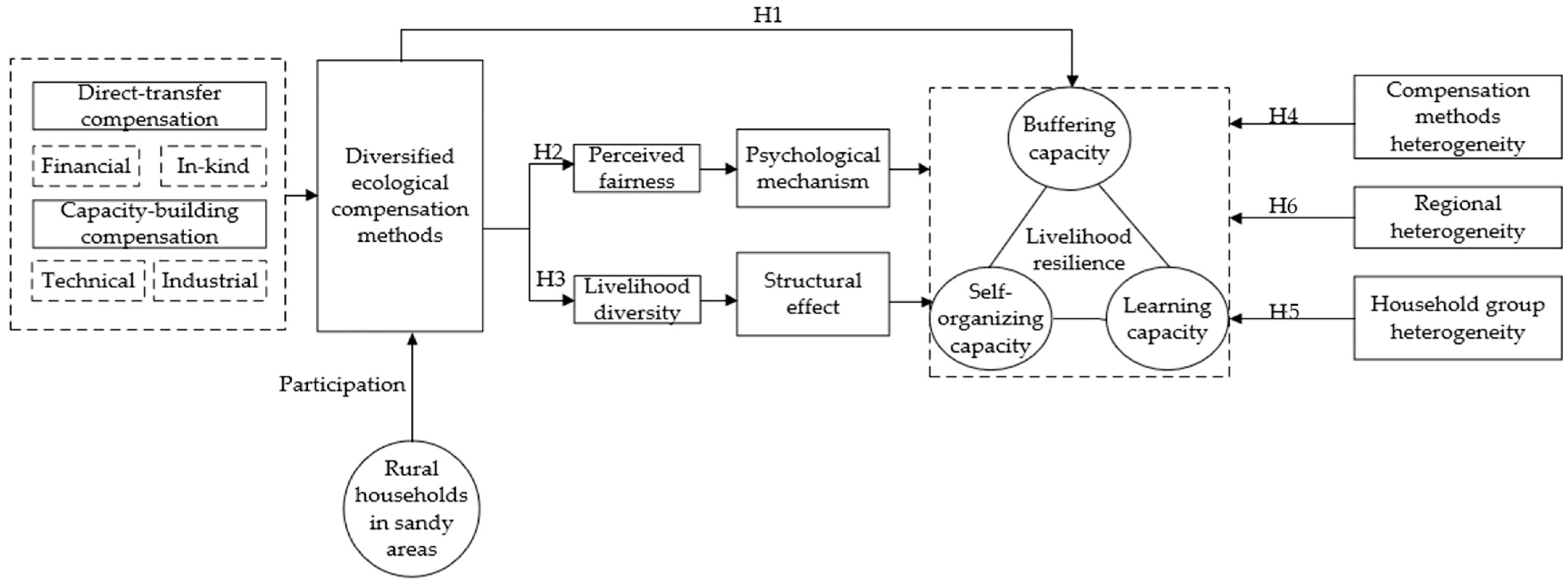
From the theoretical perspective of livelihood resilience, the enhancement of livelihood resilience is constrained by two bottlenecks: external structural barriers to sustainable development [6] and subjective psychological barriers that erode intrinsic motivation for upward mobility [29]. As a typical area where ecological degradation and livelihood poverty are intertwined, the development constraints confronting rural households in sandy areas exhibit distinct regional characteristics. In terms of structural barriers, sandy areas suffer from scarce natural capital and weak human capital, and rural households remain heavily reliant on fragile agriculture and animal husbandry. Consequently, these households face limited income diversification and lack risk resilience. In terms of psychological barriers, the intertwining of long-term poverty and ecological degradation has exacerbated the psychological vulnerability of rural households in sandy areas. These households often adopt a wait-and-see or skeptical attitude toward external policy interventions, with a widespread mentality of passivity and welfare dependency that creates significant psychological barriers to development. Therefore, diversified ecological compensation methods employ differentiated tool combinations to address these dual development constraints: direct-transfer compensation directly supplements livelihood capital, while capacity-building compensation broadens livelihood options and optimizes policy understanding, thereby enhancing the livelihood resilience of rural households in sandy areas, as illustrated in Figure 1.
Existing research on ecological compensation and rural household livelihoods primarily focuses on the direct effects of policies on capital stock and income levels, or treats fairness merely as a subjective perception after policy implementation. Few studies examine the value of fairness from a governance structure perspective, and there is limited research combining classical behavioral theory to explore policy transmission pathways. However, Stimulus-Organism-Response (SOR) theory provides a mature analytical framework for examining the relationships among external policies, individual psychology, and livelihood status. The theory posits that external stimuli influence individuals’ psychological states, such as cognition and emotion, which in turn drive their behavioral responses [30]. This is highly consistent with the research logic of this paper: ecological compensation (external policy stimulus)—perceived fairness (organism)—livelihood resilience (development outcome). Meanwhile, in international PES research, fairness has been endowed with deeper connotations. It is regarded as a structural element permeating institutional design, determining the social acceptance of compensation projects and the willingness of rural households to participate. Therefore, incorporating distributive, procedural, and interactional fairness into the top-level design of ecological compensation is crucial for enhancing overall policy effectiveness [31]. Following this approach, we categorize perceived fairness into three dimensions: distributive fairness, procedural fairness, and interactional fairness.
Distributive fairness refers to individuals’ evaluation of benefit distribution outcomes—specifically, rural households’ assessment of whether compensation standards align with their ecological contributions [32]. Rural households in sandy areas bear opportunity costs associated with initiatives such as the Grain-for-Green Program. Diversified ecological compensation methods can offset these current losses through direct-transfer compensation and enhance future income expectations through capacity-building compensation, ensuring that perceived long-term benefits are addressed and thereby improving distributive fairness. Procedural fairness focuses on decision-making participation and transparency [32]. Due to geographical constraints, rural households in sandy areas are often marginalized in policy implementation. Diversified ecological compensation methods necessitate the establishment of communication channels by local governments, transforming rural households from passive recipients into active participants. As a result, procedural fairness is recognized, and policy trust—a key element of psychological capital—is accumulated. Interactional fairness manifests as an evaluation of the attitudes and behaviors of implementers [32]. Diversified ecological compensation methods involve coordinating the distribution of various types of benefits and providing follow-up services, requiring continuous interaction between policy implementers and rural households. When rural households feel respected, cared for, and assured that commitments are fulfilled, their psychological security increases, and interactional fairness is enhanced. As equity theory suggests, the positive motivational role of perceived fairness influences individual attitudes and behaviors. Rural households with higher levels of perceived fairness demonstrate greater initiative in development, actively explore livelihood development pathways, and thereby enhance their livelihood resilience.
According to sustainable livelihood theory, in contexts of vulnerability—such as when rural households are affected by natural disasters or major health shocks—the quantity and structure of their livelihood capital are directly affected, leading to reduced income or increased expenditures. In response, these households adjust their asset structure, seek policy support, and modify their livelihood strategies to optimize livelihood outcomes. These optimized outcomes, in turn, feed back into livelihood capital. Throughout this process, optimizing livelihood strategies is critical to overcoming structural barriers [21]. The livelihood dilemma of rural households in sandy areas is essentially a strategic lock-in under capital constraints: scarce natural capital limits production diversification, while insufficient human capital hinders off-farm employment. The interaction of these dual constraints results in highly homogeneous livelihood activities and an undiversified income structure, leaving rural households without alternative coping buffers when confronted with external shocks [33]. Diversified ecological compensation methods, through measures such as financial and in-kind compensation, skills training, and employment assistance, can directly enhance the financial, human, and social capital reserves of rural households in sandy areas. This effectively broadens the scope of non-forestry livelihood options and promotes the transition toward diversified livelihood models. Meanwhile, the core rationale of this policy lies in restricting forest resource exploitation to compensate rural households for opportunity cost losses. The objective reality of restricted resource development compels rural households in sandy areas to break away from reliance on traditional forestry-based livelihoods, thereby driving the restructuring and optimization of livelihood strategies. Consequently, diversified ecological compensation methods enhance the livelihood diversity of rural households in sandy areas.
Livelihood diversity positively affects the livelihood resilience of rural households in sandy areas. First, from a sustainability perspective, the process by which rural households in sandy areas transition to non-forestry, skill-intensive livelihood models is essentially a process of continuous livelihood capital accumulation. This accumulation significantly affects the buffering capacity of rural households in sandy areas. Second, livelihood diversity shapes the social interaction patterns and organizational participation behavior of rural households in sandy areas, thereby significantly affecting their self-organizing capacity. Finally, shifting from pure agricultural employment to off-farm employment requires rural households in sandy areas to integrate into non-farm work environments. This drives them to learn new skills and knowledge, enhancing their learning capacity. Moreover, the diversification of livelihood portfolios among rural households in sandy areas not only broadens income sources but also effectively reduces risk exposure, thereby steadily enhancing livelihood resilience at the structural level.
In summary, diversified ecological compensation methods affect the livelihood resilience of rural households in sandy areas through perceived fairness and livelihood diversity. Based on this analysis, we propose the following hypotheses:
H1: 
Diversified ecological compensation methods exert a significant positive effect on the livelihood resilience of rural households in sandy areas.
H2: 
Diversified ecological compensation methods enhance perceived fairness among rural households in sandy areas, thereby improving their livelihood resilience.
H3: 
Diversified ecological compensation methods stimulate the exploration of livelihood diversity among rural households in sandy areas, thereby enhancing their livelihood resilience.

2.2.2. Heterogeneity Analysis of Diversified Ecological Compensation Methods on Rural Household Livelihood Resilience in Sandy Areas

(1) Heterogeneity analysis of diversified ecological compensation methods. According to sustainable livelihood theory, the sustainable development of livelihoods depends on fostering the endogenous development capabilities of rural households. If external policies merely provide short-term resource injections without enhancing self-accumulation capabilities, it will be difficult to alleviate the low-level equilibrium trap [34]. Although direct-transfer compensation can increase the livelihood capital of rural households in sandy areas in the short term and alleviate opportunity costs resulting from ecological conservation, such compensation is inherently intermittent and temporary. Overreliance on direct-transfer compensation tends to entrench the welfare dependency of rural households and may even trigger the risk of returning to poverty after policy withdrawal [25]. In contrast, capacity-building compensation reshapes the livelihood skills and resource acquisition networks of rural households through investment in human capital and the expansion of social capital, guiding them to transition from single-crop or pastoral production to diversified operations, thereby enhancing their capacity for sustainable development. Consequently, capacity-building compensation exerts a stronger effect on the livelihood resilience of rural households in sandy areas than direct-transfer compensation.
(2) Heterogeneity analysis of different ecological compensation groups. The theory of initial livelihood capital endowment differences suggests that the marginal effects of external policy interventions are constrained by an individual’s initial capital stock; when rural households face capital scarcity, an equivalent injection of external resources yields greater marginal improvements [5]. Due to the cumulative effects of long-term poverty, poverty-alleviated households generally have lower livelihood capital endowments than general households, leaving their livelihoods in a low-level, fragile state. Diversified ecological compensation methods, by filling capital gaps and addressing livelihood deficiencies, can help these households improve their livelihood capital stock, generating relatively significant marginal improvements. In contrast, general households have relatively ample initial capital stocks, leaving limited room for marginal improvement [35]. Consequently, diversified ecological compensation methods exert a stronger effect on the livelihood resilience of poverty-alleviated households than on general households.
(3) Heterogeneity analysis across ecological compensation regions. The impact of diversified ecological compensation methods is influenced by the coupling between production systems and ecosystems, resulting in spatial heterogeneity across different regions. Taking western Inner Mongolia (represented by Ordos City) as an example, this area serves as an economic highland with strong fiscal capacity and mature market mechanisms. Diversified ecological compensation methods can be integrated with various ecological value realization pathways, including photovoltaic sand control, specialty sand industries, and eco-tourism. Rural households in these areas have more diversified livelihood models, and the marginal effects of ecological compensation are most pronounced. Eastern Inner Mongolia (represented by Chifeng City and Tongliao City) is located in the heartland of the Horqin Sandy Land and the farming-pastoral ecotone. Rural households in these areas remain heavily dependent on traditional crop farming and animal husbandry. The ecological industry is dominated by traditional sand control and under-forest economy, with shorter industrial chains and lower marketization. Additionally, some regions face dual-target constraints between ecological protection and grain production, resulting in relatively insufficient conversion efficiency of compensation resources. Consequently, the marginal effects of ecological compensation are comparatively weaker.
Therefore, this paper proposes the following hypothesis:
H4: 
The effects of ecological compensation methods on the livelihood resilience of rural households in sandy areas vary by method type, with capacity-building compensation exerting a stronger effect than direct-transfer compensation.
H5: 
The effects of diversified ecological compensation methods on the livelihood resilience of rural households in sandy areas vary across household groups, with the effect on poverty-alleviated households being stronger than that on general households.
H6: 
The effects of diversified ecological compensation methods on the livelihood resilience of rural households in sandy areas exhibit spatial heterogeneity across regions, with the effect being stronger in western Inner Mongolia than in eastern Inner Mongolia.

3. Research Data and Methods

3.1. Data Source

The research data are derived from field surveys conducted by the research team during 2024–2025 across three areas in the Inner Mongolia Autonomous Region—Ordos, Chifeng, and Tongliao—where sandy desertification is particularly severe. The study areas were selected for the following reasons: First, Ordos City is situated in the Kubuqi Desert, representing the western sandy areas of Inner Mongolia; Chifeng City lies at the southern edge of the Horqin Sandy Land, and the agro-pastoral transition zone at the northern foot of the Yanshan Mountains; and Tongliao City is located in the heart of the Horqin Sandy Land. Together, Chifeng and Tongliao represent the eastern sandy areas of Inner Mongolia. Collectively, these areas constitute a west-to-east gradient of China’s northern sandy belt, serving as an ecological security barrier for northern China. Moreover, the extensive tree and shrub cover in these areas provides a solid resource foundation for research on diversified ecological compensation methods. Second, all study areas are priority regions during the transition from poverty alleviation to rural revitalization in China. The high short-term poverty alleviation rates may trigger risks of large-scale returns to poverty, making the livelihood resilience of rural households an urgent concern.
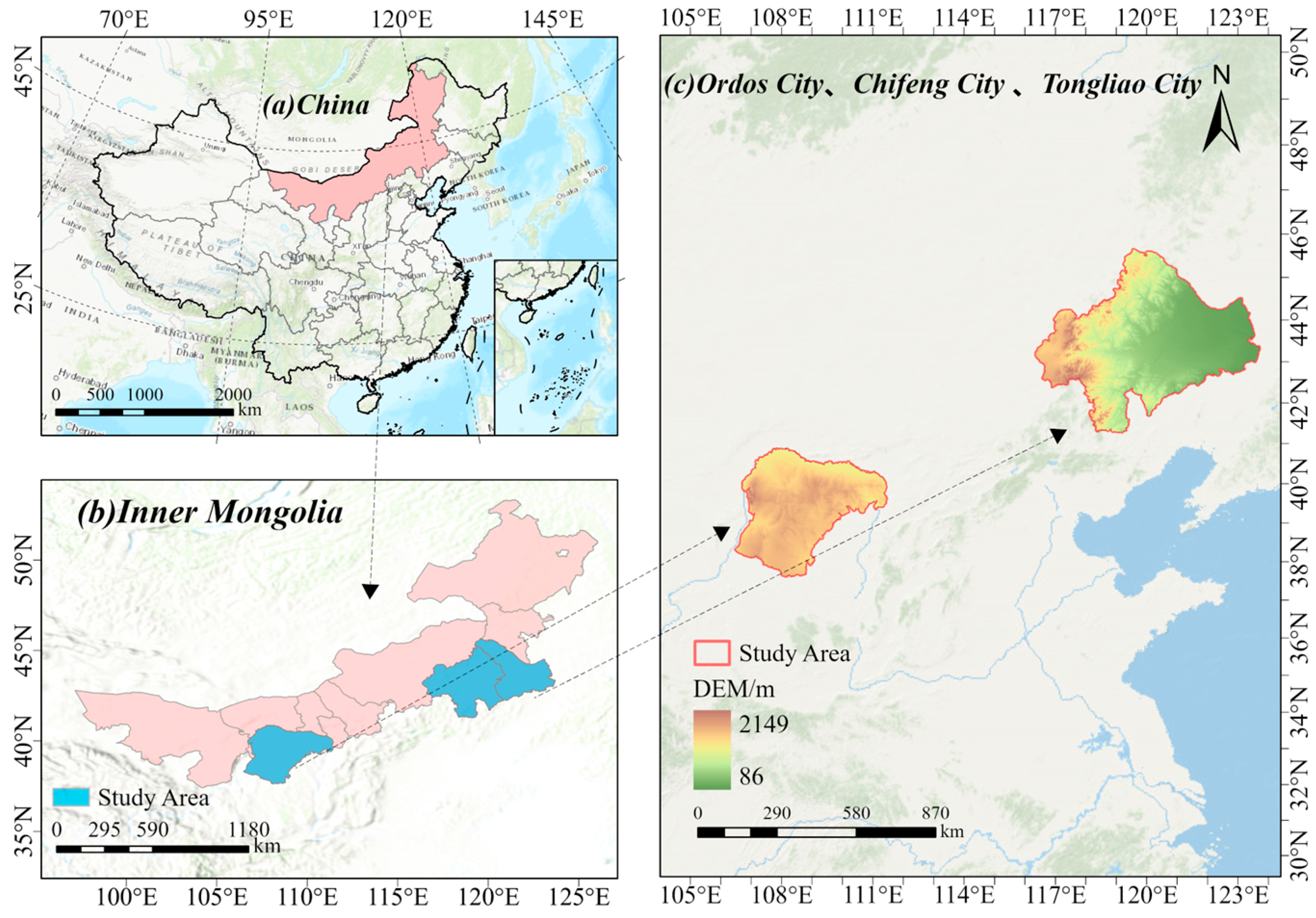
To ensure the scientific rigor of the research data, a stratified random sampling method was employed. The survey utilized a stratified sampling framework organized by “league (city)–county (banner)–township–village–household.” First, based on natural conditions and the intensity of ecological compensation, eight banners and counties under the jurisdiction of Ordos, Chifeng, and Tongliao were selected as sampling units; second, townships were categorized into large and small strata based on sandy desertification area and forest cover, ensuring similar economic levels and demographic characteristics within each stratum; subsequently, 2–3 townships were randomly selected from each stratum, 2–3 villages were selected from each township, and 10–20 rural households were selected from each village for the survey, ultimately yielding 1203 valid responses. The specific study area is shown in Figure 2.
To ensure the reliability and validity of the questionnaire, reliability and validity tests were conducted. The Cronbach’s alpha coefficients for the three dimensions of the perceived fairness scale—distributive fairness, procedural fairness, and interactional fairness—all exceeded 0.7, indicating good internal consistency and high reliability. The Kaiser–Meyer–Olkin (KMO) value was 0.7387, exceeding the 0.7 threshold, and Bartlett’s test of sphericity was significant at the p < 0.001 level, rejecting the null hypothesis of variable independence. Overall, the data are suitable for subsequent empirical analysis.
Table 1 presents the individual and household characteristics of the survey respondents. The sample comprises 1203 rural households in sandy areas. Male respondents constitute the majority (76.81%), with a mean age of approximately 56 years. The age distribution is concentrated in the 50–70 bracket (64.84%). Overall educational attainment is relatively low, with junior high school and below as the dominant group (82.46%), and college or above representing only 6.40%. Household labor size is generally small; 58.19% of households have two or fewer laborers, and the average is approximately 2.56 persons per household. This demographic composition largely aligns with the reality in rural areas of Inner Mongolia’s sandy areas, where young and middle-aged labor has out-migrated, and remaining household heads are predominantly middle-aged and elderly males. However, this also implies that the conclusions of this study may be more applicable to middle-aged and elderly male household heads. Gender and age composition may influence rural households’ willingness to participate in policies, evaluations of perceived fairness, decisions regarding livelihood diversification, and pathways of resilience accumulation. Therefore, caution is warranted when generalizing these conclusions to female-led households, young farmers, or regions dominated by off-farm employment.

3.2. Variable Selection and Assessment

3.2.1. Dependent Variable

The dependent variable in this study is the livelihood resilience of rural households in sandy areas. Drawing on the definition provided earlier and the research of Speranza et al. [9], Quandt [7], and Fan et al. [8], this study constructs a livelihood resilience framework comprising buffering capacity, self-organizing capacity, and learning capacity. The specific indicators are presented in Table 2. To avoid subjective weighting bias, the entropy weighting method is employed to objectively determine weights, and a composite index model is used to calculate livelihood resilience scores. The specific procedure is as follows:
First, Owing to considerable discrepancies in the type, unit, and magnitude of the evaluation indicators, the extreme value method was utilized to homogenize and normalize the data.
X i j = X i j X m i n X m a x X m i n            
where X i j signifies the raw data of the j -th indicator for the i -th rural household in sandy areas, and X i j indicates the standardized value of X i j . X m a x and X m i n denote the maximum and minimum values of the j -th indicator, respectively.
Second, the entropy weighting method is employed to determine indicator weights.
P i j = X i j i = 1 n X i j        
e j = 1 l n n i = 1 n p i j ln ( p i j )        
W j = 1 e j j = 1 n ( 1 e j )              
In Equation (2), P i j signifies the proportion of the j -th indicator for the i -th rural household in sandy areas; in Equation (3), e j indicates the entropy value of the j -th indicator, and n denotes the sample size; in Equation (4), W j represents the weight of the j -th indicator.
Third, a composite index model is employed to calculate the livelihood resilience of rural households in sandy areas.
S i = j = 1 n w j × X i j          
In Equation (5), S i signifies the livelihood resilience of the i -th rural household in sandy areas.
As shown in Table 2, the total weights of buffering capacity, self-organizing capacity, and learning capacity in the livelihood resilience index are 72.58%, 6.88%, and 20.53%, respectively. Within buffering capacity, forest land area (0.2304), livestock holdings (0.1118), and group membership (0.1356) are the primary contributors. This weight structure is intrinsically consistent with the theoretical framework of Speranza et al. [9]: buffering capacity is directly represented by the five major types of livelihood capital in this framework, and differences in capital stock constitute the core material basis for rural households to withstand external risk shocks. In the sandy area sample, capital-related indicators exhibit high variation due to significant differences in possession among rural households, and are therefore assigned higher weights by the entropy weighting method; subjective indicators, in contrast, have lower weights due to concentrated sample distribution and limited variation. This reflects that, in the ecologically fragile context of sandy areas, differences in capital endowment represent the primary real-world constraint determining the differentiation of livelihood resilience.

3.2.2. Mediating Variable

The mediating variables in this study are perceived fairness and livelihood diversity. With regard to perceived fairness, drawing on the research of Bu et al. [36] and taking into account the study area’s actual conditions and the research subjects, nine indicators across three dimensions were selected. The perceived fairness of rural households in sandy areas was calculated using the entropy weighting method and the composite index method. The weights of these indicators were determined using the same entropy weighting method as in Table 2 (see Equations (1)–(4)). The specific indicators are presented in Table 3. Regarding livelihood diversity, drawing on existing literature and the study region [23], rural household livelihood strategies were categorized into four types: agricultural livelihoods (crop farming, forestry, and animal husbandry), labor-based livelihoods, wage-based livelihoods, and subsidy-dependent livelihoods. The Simpson index was used to measure livelihood diversity among rural households; a higher value indicates greater diversity in livelihood strategies [37]. The specific formula is as follows:
S i = 1 j = 1 N P i j 2                          
In Equation (6), S i represents the livelihood diversity of the i -th rural household in sandy areas, N denotes the number of livelihood types (with a maximum value of 4), and P i j is the proportion of the j -th livelihood type in the total income of the i -th rural household.

3.2.3. Explanatory Variable and Control Variables

The explanatory variable in this study is the manner in which rural households in sandy areas participate in ecological compensation. Based on the definition of diversified ecological compensation methods outlined above, as well as the research of Liu et al. [25] and Zhou et al. [38], the compensation methods in which rural households in sandy areas actually participate are categorized into four types: financial compensation (direct cash or subsidies), in-kind compensation (production inputs such as seedlings and agricultural machinery), technical compensation (technical training and guidance), and industrial compensation (industrial support and project-driven initiatives). This variable is scored on a scale from 0 to 4. Here, “0” indicates that rural households in sandy areas did not participate in any type of ecological compensation, while values “1” to “4” correspond to participation in 1 to 4 of the aforementioned compensation methods, respectively. Higher values indicate greater diversification of ecological compensation methods received. In current ecological compensation practices in Inner Mongolia’s sandy areas, different compensation methods are complementary rather than mutually exclusive. Rural households in these areas often simultaneously receive financial and in-kind compensation, or participate in industrial support projects following technical training. Therefore, the “number of compensation types” reflects both the breadth of policy resources accessed by rural households and the depth of policy engagement.
Following Wang et al. [23] and Fan et al. [8], this study selected agricultural output value, land transfer, household consumption, household size, risk attitude, head of household age, and gender as control variables. Risk attitude was measured using a single item: “If you have a certain amount of surplus funds, would you be willing to invest them in high-risk but potentially high-return business activities?” Respondents answering “willing” were assigned a value of 1 (risk seekers), and those answering “unwilling” were assigned a value of 0 (risk averse). The specific variables are summarized in Table 4.

3.3. Model Construction

3.3.1. Main Effect Model Specification

To examine the effect of diversified ecological compensation methods on the livelihood resilience of rural households in sandy areas, the following baseline regression model is constructed:
L R i = α 0 + α 1 D F E C i + α 2 C o n t r o l s i j + ε 1          
In Equation (7), L R i represents the livelihood resilience of the i -th rural household in sandy areas; D F E C i indicates the status of participation of the i -th rural household in sandy areas in diversified ecological compensation methods; C o n t r o l s i j denotes the j -th control variable of the i -th rural household in sandy areas; α 0 is the constant term; α 1 and α 2 are coefficients to be estimated; and ε 1 is the random disturbance term.

3.3.2. Mediating Effect Model Specification

To examine the mechanisms through which diversified ecological compensation methods affect the livelihood resilience of rural households in sandy areas, this study constructs the following mediation model using the stepwise regression method proposed by Wen et al. [39], and tests the transmission mechanism using the Sobel test and Bootstrap sampling.
M e d i a t o r i = β 0 + β 1 D F E C i + β 2 C o n t r o l s i j + ε 2        
L R i = γ 0 + γ 1 D F E C i + γ 2 M e d i a t o r i + γ 3 C o n t r o l s i j + ε 3          
In Equations (8) and (9), M e d i a t o r i represents the mediating variables, namely perceived fairness and livelihood diversity; β 0 and γ 0 are constant terms; β 1 ,   β 2 , γ 1 , γ 2 , and γ 3 are coefficients to be estimated; and ε 2 and ε 3 are random disturbance terms.

4. Results and Analysis

4.1. Baseline Regression Analysis

To avoid potential multicollinearity interference with the estimation results, this study conducted a variance inflation factor (VIF) test on the model. Generally, a VIF below 10 indicates no severe multicollinearity among the variables. The results show that the VIF values for all explanatory variables range between 1 and 2, with a mean VIF of 1.13, which is well below the critical threshold; thus, the model specification is reliable.
As can be seen from the baseline regression results of Model 1 in Table 5, the estimated coefficient of diversified ecological compensation methods is significantly positive at the 1% level, consistent with H1. Furthermore, Models 2 to 4 in Table 5 present the estimated effects of diversified ecological compensation methods on the buffering capacity, self-organizing capacity, and learning capacity of rural households in sandy areas. The results indicate that diversified ecological compensation methods are significantly positively associated with buffering capacity, self-organizing capacity, and learning capacity. Moreover, the coefficient magnitudes exhibit a gradient characteristic: buffering capacity > learning capacity > self-organizing capacity.

4.2. Addressing Endogeneity

Given that the above OLS estimation is based on cross-sectional data, it is difficult to completely exclude interference from sample self-selection and reverse causality. This section employs PSM and the instrumental variable (IV) approach to test and alleviate potential endogeneity issues as much as possible.
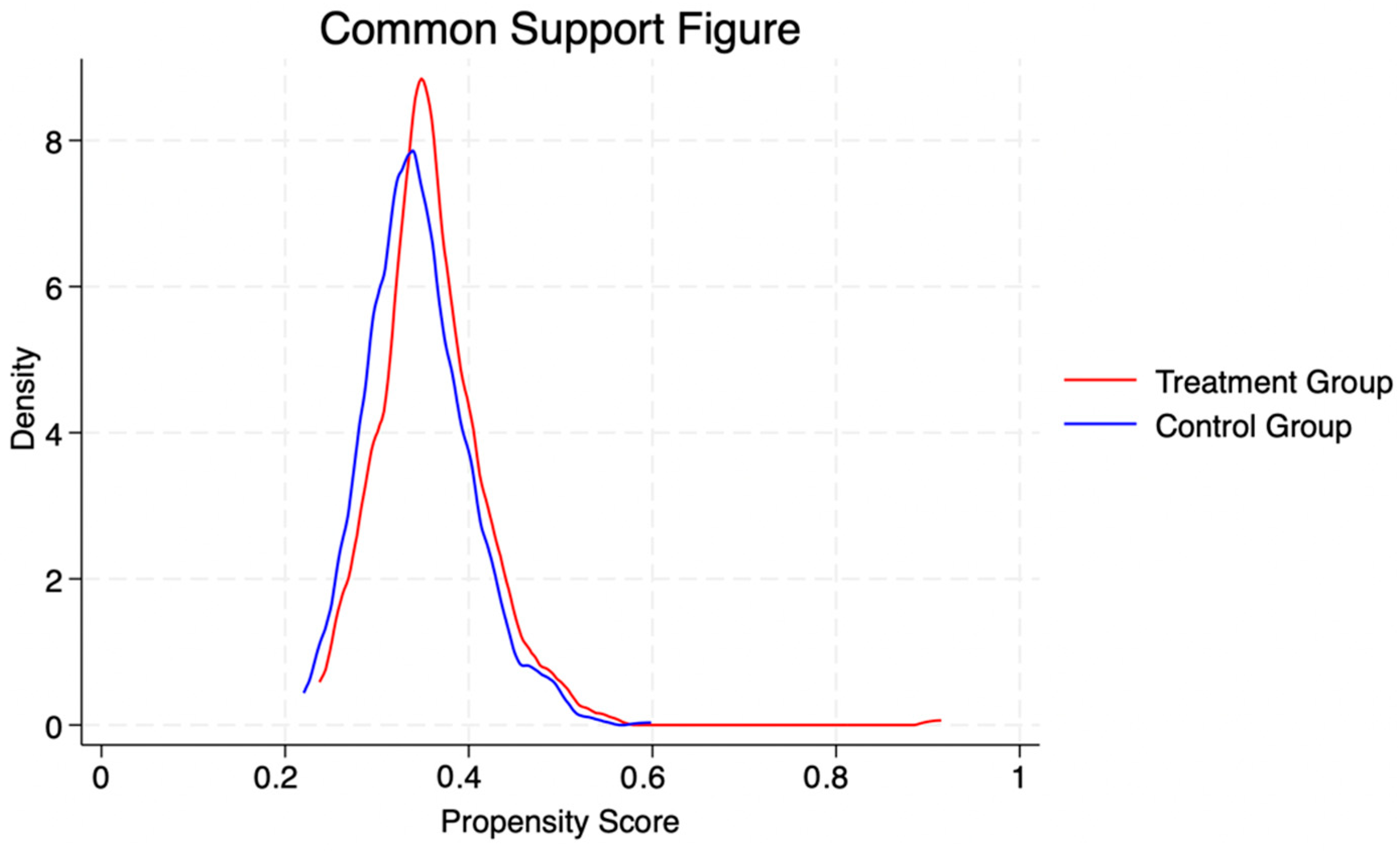
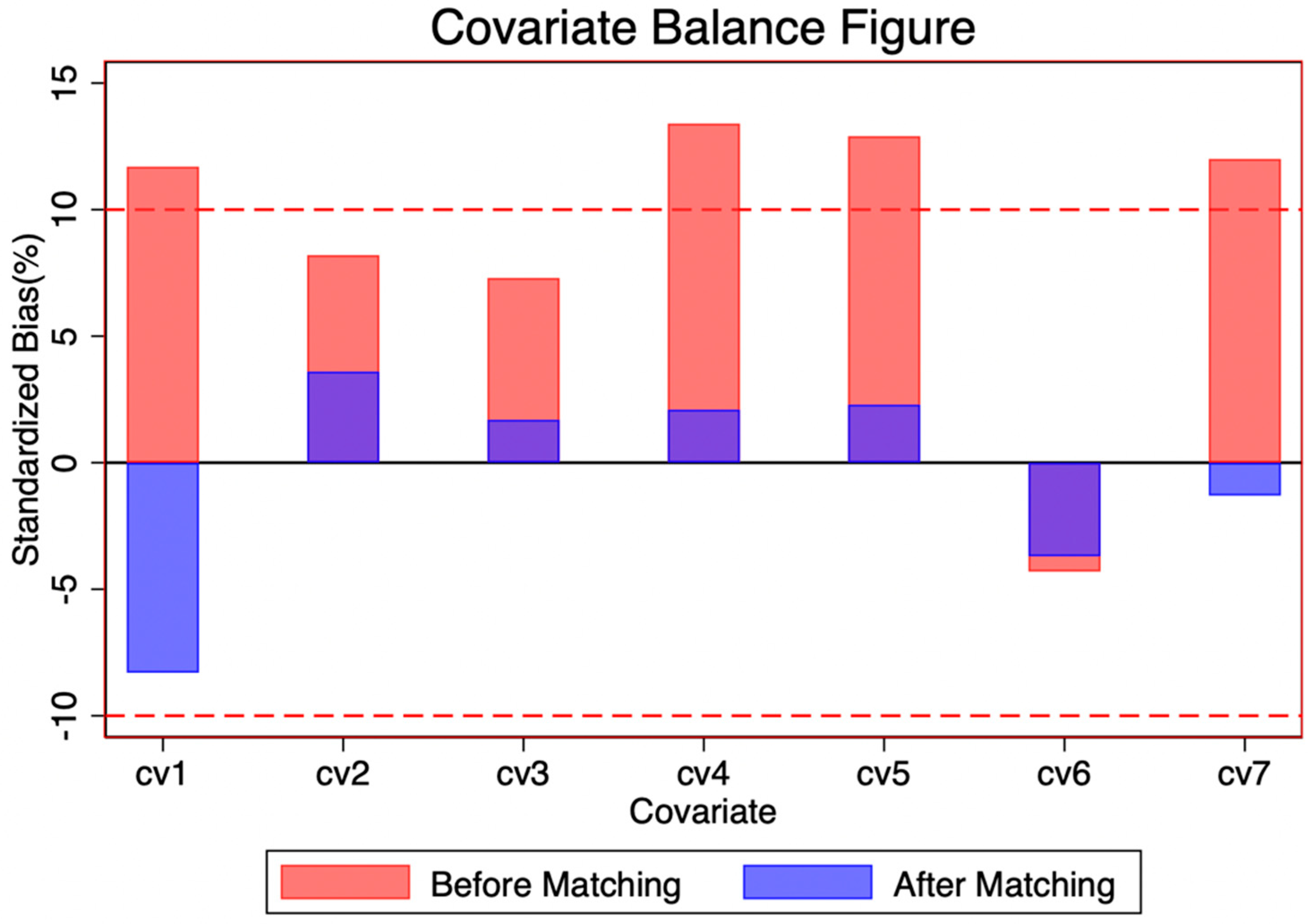
(1) PSM analysis. To mitigate potential endogeneity issues arising from self-selection of the sample, this paper employs propensity score matching (PSM) to conduct robustness tests. The treatment group comprises rural households participating in two or more ecological compensation methods; the control group comprises those participating in fewer than two. This threshold follows Liu et al. [25] and their identification criteria for “diversified” ecological compensation. It also reflects the policy practice context: a single method cannot capture the institutional connotation of diversified ecological compensation, whereas combinations of two or more methods demonstrate the depth and breadth of policy resource integration. Prior to matching, the treatment and control groups exhibited systematic differences in covariates. After matching, the standardized mean differences for all covariates fell below 10%. The mean bias decreased to 6.9%, and the median bias to 4.6%, meeting the balance criteria. The common support test indicates that the propensity score distributions of the treatment and control groups overlap well. Only a few samples fall outside the common support region. The matching quality is reliable. For detailed results, please see Appendix A. Table 6 reports the average treatment effect (ATT) under different matching strategies. The results show that the ATT remains stable within the 0.05–0.06 range and is statistically significant at the 1% level. This indicates that the baseline regression results are robust.
(2) Instrumental Variable Approach. To ensure the reliability of the findings, we employ the instrumental variable (IV) approach to alleviate endogeneity issues such as reverse causality. We use the geographic distance from rural households to township governments as the instrumental variable for two-stage least squares (2SLS) estimation. On the one hand, in Inner Mongolia’s sandy areas, policy information dissemination, technical training organization, and industrial compensation project applications are mainly conducted through township governments. Rural households living farther away face higher information acquisition costs and transaction costs. Their probability of participating in diversified ecological compensation is lower, satisfying the relevance condition of the instrumental variable. On the other hand, given the reality that Inner Mongolia’s sandy areas are vast and sparsely populated with highly dispersed villages, township governments primarily undertake the administrative affairs and policy implementation of ecological compensation, while market opportunities, agricultural product transactions, and public services such as healthcare and education are mainly provided by county towns and higher-level centers. Therefore, the geographic distance from rural households to township governments is not directly associated with livelihood resilience. To verify the exogeneity of the aforementioned instrumental variable, we employed an indirect test by controlling for the endogenous variable: if the instrumental variable affects livelihood resilience only through participation in diversified ecological compensation, then the direct effect of the instrumental variable on livelihood resilience should become insignificant after controlling for the endogenous variable. As shown in the regression results of Model 5 in Table 7, before controlling for diversified ecological compensation methods, the distance to township governments has a significant negative association with livelihood resilience; as shown in the regression results of Model 6 in Table 7, after controlling for the endogenous variable, the estimated coefficient for this distance becomes insignificant, indicating that the instrumental variable affects livelihood resilience only through participation in diversified ecological compensation, thereby satisfying the exclusion restriction condition. Model 7 in Table 7 reports the first-stage estimation results. The estimated coefficient for the distance from rural households to township governments is −0.0714, significant at the 1% level. This indicates a negative correlation between this distance and diversified ecological compensation. Model 8 in Table 7 reports second-stage estimates. The coefficient on the core explanatory variable is 0.0272, remaining statistically significant at the 1% level and directionally consistent with the baseline regression results. Additionally, the Cragg-Donald Wald F statistic is 577, exceeding the threshold of 16.38 and indicating no weak instrument problem. Meanwhile, the Kleibergen-Paap rk LM statistic rejects the null hypothesis at the 1% significance level, suggesting instrument validity.

4.3. Robustness Checks

(1) Alternative measurement of the dependent variable. Principal component analysis (PCA) was employed to recalculate the livelihood resilience of rural households in sandy areas, so as to eliminate estimation bias arising from different measurement methods. As shown in Model 9 of Table 8, the effect of diversified ecological compensation methods on the livelihood resilience of rural households in sandy areas remains positive and statistically significant, consistent with the baseline regression results.
(2) 1% winsorization. Given that the survey sample may contain outliers, all variables were winsorized at the 1% level at both tails to mitigate the impact of outliers on the estimation results. As shown in Model 10 of Table 8, the estimation results are largely consistent with the baseline regression results, indicating that the model is robust.
(3) Alternative sample. Given that rural households under 20 or over 70 years of age may lack awareness of diversified ecological compensation methods, resulting in potential estimation bias, these observations were excluded. The results in Model 11 of Table 8 show a regression coefficient of 0.0268, which is positive and significant at the 1% level, consistent with the baseline regression results.

4.4. Impact Mechanism Analysis

The above results suggest a significant positive association between diversified ecological compensation methods and the livelihood resilience of rural households in sandy areas. What, then, are the possible transmission mechanisms underlying this association? This study examines the mechanisms through which diversified ecological compensation methods influence the livelihood resilience of rural households in sandy areas from two dimensions: perceived fairness and livelihood diversity.
Model 12 of Table 9 shows that diversified ecological compensation methods are significantly positively associated with the perceived fairness of rural households in sandy areas. Model 13 of Table 9 reports the results when perceived fairness is included in the regression model examining the association between diversified ecological compensation methods and the livelihood resilience of rural households in sandy areas. The results indicate that both diversified ecological compensation methods and perceived fairness are significantly positively associated with the livelihood resilience of rural households in sandy areas at the 1% significance level. Furthermore, the Sobel test yields a Z-statistic of 9.9314, which far exceeds 2.58 and is significant at the 1% level. The Bootstrap test with 1000 replications yields a 95% confidence interval of (0.1749, 0.2238). This indicates that perceived fairness significantly mediates the association between diversified ecological compensation methods and the livelihood resilience of rural households in sandy areas, consistent with the direction predicted by H2.
Model 14 of Table 9 shows that diversified ecological compensation methods are significantly positively associated with the livelihood diversity of rural households in sandy areas. Model 15 of Table 9 reports the results when livelihood diversity is included in the regression model examining the association between diversified ecological compensation methods and the livelihood resilience of rural households in sandy areas. The results indicate that both diversified ecological compensation methods and livelihood diversity are significantly positively associated with the livelihood resilience of rural households in sandy areas at the 1% significance level. The Sobel test yields a Z-statistic of 2.7639, which exceeds 2.58 and is significant at the 1% level. The Bootstrap test with 1000 replications yields a 95% confidence interval of (0.0011, 0.0376). This indicates that livelihood diversity significantly mediates the association between diversified ecological compensation methods and the livelihood resilience of rural households in sandy areas, consistent with the direction predicted by H3.

4.5. Heterogeneity Analysis

4.5.1. Heterogeneity Based on Compensation Methods

To identify the differential effects of various compensation methods on the livelihood resilience of rural households in sandy areas, this study decomposed diversified ecological compensation methods into four types—financial, in-kind, technical, and industrial—and conducted separate regressions. The results are presented in Table 10. All four compensation methods exert significant positive effects on livelihood resilience, but a clear gradient exists in the magnitude of these effects: industrial compensation has the strongest effect, followed by technical compensation, financial compensation, and in-kind compensation, confirming H4. One possible explanation is that industrial compensation, through operational projects such as deep processing of forest products and under-forest economies, provides rural households with sustained income streams and opportunities to accumulate market-oriented experience. Although the coefficient for technical compensation is lower than that for industrial compensation, its effect remains stronger than that of direct-transfer compensation, suggesting that skills training yields long-term returns on human capital investment. This is particularly true in specialized areas such as sandy-area ecological restoration techniques and water-saving irrigation, where technical proficiency directly determines the room available for livelihood transition. In contrast, the effects of financial and in-kind compensation are relatively weak; while these forms of compensation can increase the buffering capacity of rural households in the short term, they are insufficient to achieve sustainable livelihood improvement. It should be noted that the aforementioned differences reflect statistical associations between rural households participating in different types of compensation and livelihood resilience. Participants in industrial and technical compensation may possess relatively higher levels of human capital or social capital, and self-selection effects may partially contribute to the differences in coefficients.

4.5.2. Heterogeneity Based on Household Groups

To examine the impact of diversified ecological compensation methods on the livelihood resilience of different household groups, this study categorized rural households into poverty-alleviated households and general households. As shown in Models 20 and 21 of Table 11, diversified ecological compensation methods exert significant positive effects on the livelihood resilience of both poverty-alleviated households and general households; however, the effect on poverty-alleviated households is significantly larger than that on general households, confirming H5. This indicates that poverty-alleviated households are more responsive to diversified compensation, with livelihood systems exhibiting higher dependence on external policy inputs and more pronounced marginal improvement effects. In contrast, general households, endowed with relatively ample initial capital and diversified income sources, experience partially diluted incremental effects from compensation.

4.5.3. Heterogeneity Based on Regions

To identify differences in the effects of diversified ecological compensation methods across different regions, this paper divides the sample into western and eastern Inner Mongolia for comparison. Models 22 and 23 in Table 11 show that the coefficients of diversified ecological compensation methods are significantly positive in both regions. This indicates a positive association between diversified ecological compensation methods and the livelihood resilience of rural households in sandy areas in both eastern and western Inner Mongolia. However, differences in the magnitude of subsample regression coefficients cannot be directly equated with differences in statistical significance. To address this, Model 24 reports the results of the full-sample interaction term model: with the eastern region as the reference group, the interaction term coefficient for the western region is 0.0117, which is significantly positive at the 1% level. This indicates that the compensation effect in the western region is significantly higher than that in the eastern region, validating H6. Ordos City serves as the core area of Kubuqi Desert restoration. Since the 1990s, large-scale ecological restoration has been implemented there. After more than three decades of governance, the city has established diversified pathways for realizing ecological value, including photovoltaic sand control, specialty sand industries, and eco-tourism. Industrial support capacity and infrastructure are relatively well-developed. In this context, diversified ecological compensation—particularly industrial and technical compensation—can be deeply integrated with the existing market system. Rural households possess strong resource transformation capabilities, enabling them to convert compensation inputs into sustainable livelihood capital. By contrast, the eastern region exhibits prominent farming-pastoral ecotone characteristics. Agricultural output accounts for a higher share of household income, and rural households remain more heavily dependent on traditional crop farming and animal husbandry. The ecological industry is dominated by traditional sand control and an under-forest economy, with shorter industrial chains and a lower degree of marketization. Consequently, even when receiving the same types of compensation, rural households in the east lack market channels and skill foundations to convert compensation resources into non-agricultural livelihood capital. The marginal conversion efficiency of compensation is therefore lower.

5. Discussion

Inner Mongolia Autonomous Region serves as the core area of the ecological security barrier in northern China, facing a vicious cycle of ecological degradation and poverty aggravation. Based on micro-level survey data from 1203 rural households in sandy areas across Ordos City, Chifeng City, and Tongliao City, this study reveals the impact mechanisms and heterogeneity of diversified ecological compensation methods on the livelihood resilience of rural households in sandy areas, providing micro-level evidence for promoting sustainable development among rural households in these regions. Due to the cross-sectional nature of the data, the following discussion reflects only the statistical relationships between variables at a specific point in time. Against the broader backdrop of ecological governance in global arid and semi-arid regions, the findings of this study resonate with current international academic discussions on payments for ecosystem services (PES) and the sustainability of rural livelihoods.
Baseline regression results indicate a significant positive association between diversified ecological compensation methods and the livelihood resilience of rural households in sandy areas. This finding echoes Guan et al. [21]. Unlike that study, however, this research further reveals how livelihood resilience changes under diversified compensation structures with each additional participation method. Meanwhile, this finding responds to the call by Chen et al. [40] for ecological compensation evaluation to shift from “compensation intensity” to “compensation structure.” Notably, the association between diversified ecological compensation methods and the three dimensions of livelihood resilience among rural households in sandy areas exhibits a gradient characteristic: buffering capacity > learning capacity > self-organizing capacity. This finding engages with the research of Aschinger et al. [41] on smallholder farmers in southeastern Kenya. Aschinger et al. similarly found that buffering capacity is relatively prominent among smallholder farmers in arid regions, while self-organizing capacity and learning capacity are constrained by limited community connectivity and insufficient training. They attribute this gradient to a resource prioritization logic under climate adaptation pathways. However, Aschinger et al. focused on climate variability contexts, whereas this study examines sandy areas under ecological compensation policy interventions. This reveals an asymmetric association between the degree of compensation diversification and resilience dimensions, supplementing empirical evidence for evaluating ecological compensation policy effects.
Mechanism analysis results indicate that perceived fairness plays a significant mediating role in the association between diversified ecological compensation methods and livelihood resilience. This finding can be understood from the perspective of environmental justice theory: when compensation methods expand from a single monetary payment to a combination of financial, in-kind, technical, and industrial compensation, the coordinated distribution of these diverse tools, the allocation of benefits, and follow-up services objectively require local governments to establish more transparent procedural arrangements and interactive feedback mechanisms. This implies that diversified compensation is associated not only with improved distributive outcomes for rural households but may also create conditions for reshaping power dynamics between rural households and policy implementers through procedural transparency and standardized interaction. A comparative study by Adhikari et al. [31] on the design of global PES schemes indicates that environmental compensation programs incorporating distributive, procedural, and interactional fairness into their top-level design tend to generate higher levels of social acceptance and willingness to participate. However, existing literature primarily explores pathways to environmental justice from the perspectives of institutional design or macro-governance. This study utilizes micro-level perception data from rural households to extend this theoretical expectation to the individual psychological level, revealing a statistical association in which perceived fairness serves as an indicator of policy embedding depth. Furthermore, this finding aligns with the expectations of organizational justice theory: in situations where external interventions disrupt existing livelihood balances, perceived fairness serves as a crucial psychological bridge linking policy provision to individual responses [32].
Regarding livelihood diversity, it also plays a significant mediating role in the association between diversified ecological compensation methods and livelihood resilience. This finding is directionally consistent with research conclusions on reallocating production factors through fiscal transfer payments to enhance livelihood resilience [8]. Folke et al. [42] argue that transformative resilience is not about maintaining the stability of existing systems, but rather involves the potential to break path dependence and achieve structural reorganization. Based on the above cross-sectional data findings, there is a significant positive association between diversified ecological compensation methods and both livelihood diversity and livelihood resilience among rural households. This result is consistent with the expected direction of transformative resilience theory, which emphasizes breaking path dependence and achieving structural reorganization. If this association exhibits temporal persistence, it implies that diversified compensation may create conditions for the potential reorganization of livelihood models among rural households in sandy areas. This holds important implications for ecologically fragile areas that frequently face “dual exposure” to ecological and economic risks.
Heterogeneity analysis reveals differentiated patterns across three dimensions: compensation methods, household types, and regions. Industrial and technical compensation exhibits a stronger association with livelihood resilience than financial and in-kind compensation. This is directionally consistent with Alix-Garcia et al. [24], who found that technical training enhances long-term income stability in Mexican PES projects. The association is stronger for poverty-alleviated households than for general households, consistent with the theory of initial livelihood capital endowment. The association is also stronger in the western region than in the eastern region, possibly reflecting differences in market embeddedness and governance stages. Based on the static association patterns presented in the heterogeneity analysis, if the differentiated design of compensation policies can be continuously embedded in local market systems and governance foundations, the principle of differentiated policy implementation may have long-term applicability. It should be noted that the coefficient gradients observed in the heterogeneity analysis reflect conditional associations at the group level. Rural households participating in industrial and technical compensation may not be randomly assigned; they may inherently possess higher human capital, entrepreneurial motivation, or resource transformation capabilities. Therefore, the above differences should not be directly interpreted as the “net treatment effects” of different compensation types, but rather understood as statistical associations resulting from the combined effects of existing policy screening and household self-selection.

6. Conclusions and Suggestions

6.1. Conclusions

Based on micro-level survey data from 1203 rural households in sandy areas across Ordos City, Chifeng City, and Tongliao City in the Inner Mongolia Autonomous Region, this study measured the livelihood resilience of rural households. Based on these calculations, this study examined the impact of diversified ecological compensation methods on the livelihood resilience of rural households in sandy areas. The main conclusions are as follows:
(1) Diversified ecological compensation methods have a positive effect on the livelihood resilience of rural households in sandy areas. Moreover, diversified compensation has significant positive effects on the buffering capacity, self-organizing capacity, and learning capacity dimensions of livelihood resilience.
(2) Diversified ecological compensation methods are significantly positively associated with perceived fairness and livelihood diversity among rural households. Perceived fairness and livelihood diversity play a significant mediating role in the association between diversified ecological compensation methods and the livelihood resilience of rural households in sandy areas. These findings are consistent with the expected directions of sustainable livelihood theory and the SOR framework.
(3) The enhancement effects of diversified ecological compensation methods on the livelihood resilience of rural households in sandy areas vary across compensation methods, household groups, and regions. Regarding compensation methods, all four types exert significant positive effects on livelihood resilience, but a clear gradient exists in the magnitude of these effects: industrial compensation > technical compensation > financial compensation > in-kind compensation. Regarding household groups, the effect on poverty-alleviated households is significantly stronger than that on general households. Regarding regions, the effect of diversified ecological compensation methods is stronger in western Inner Mongolia than in eastern Inner Mongolia.

6.2. Suggestions

Based on the above conclusions, the following policy recommendations are proposed:
(1) Reflections on compensation structure. Given that industrial and technical compensation exhibit a significantly stronger association than financial and in-kind compensation, policy optimization may consider enhancing the embedding depth of these compensation types by integrating resources with business projects, such as the under-forest economy and eco-tourism. Meanwhile, given the relatively scattered distribution of rural households in sandy areas, convenient skills training platforms can be established to foster learning capacity. Furthermore, transparency in policy implementation and interactive feedback mechanisms may be positively associated with improvements in perceived fairness. It should be noted that the above directions are proposed based on statistical associations from cross-sectional data; project costs, implementation cycles, and long-term effects have not yet been evaluated and require verification through pilot evaluation and cost–benefit analysis.
(2) Preliminary implications for differentiated compensation. For poverty-alleviated households, it may be advisable to maintain a certain proportion of financial and in-kind compensation to secure immediate livelihoods, while for general households, market-based compensation forms such as industrial equity shares and cooperative dividends may be explored. Spatially, areas with relatively mature market infrastructure, such as Kubuqi, may explore industrial integration pathways, while less marketized areas, such as Horqin, may prioritize compensation projects aligned with existing agricultural capabilities, ensuring the match between compensation forms and rural households’ current capabilities.
(3) Reflections on compensation stability. As an important component of government transfer payments, the continuous implementation of ecological compensation is positively associated with improvements in the livelihood resilience of rural households in sandy areas. It is recommended to establish a dynamic evaluation and long-term tracking mechanism for ecological compensation policies. Through 3–5 years of panel data tracking rural households, we can continuously monitor changes in livelihood resilience after compensation withdrawal, identify dynamic optimal compensation levels and exit thresholds, and thereby provide more forward-looking decision-making evidence for positioning ecological compensation policies as a “stable mechanism for promoting sustainable livelihood development.”

6.3. Limitations

Although this study explores the mechanisms and heterogeneity of the impact of diversified ecological compensation methods on the livelihood resilience of rural households in sandy areas, the following limitations remain. First, regarding the generalizability of the findings, the study is conducted in ecologically fragile sandy areas of northern China, and the generalizability of its conclusions remains to be examined. Future research could incorporate different countries and various types of ecological regions to enhance the study’s generalizability. Second, regarding causal identification, this study conducts empirical analysis based on single-period cross-sectional survey data. This data structure cannot observe the temporal sequence of variables, making it difficult to fully avoid potential interference from reverse causality and unobservable heterogeneity. Although this study employed propensity score matching and the instrumental variable approach to mitigate sample self-selection and reverse causality biases, thereby enhancing the reliability of the estimates, it remains unable to capture the long-term dynamic evolution of the relationship between ecological compensation and livelihood resilience, and it cannot identify the lag and persistence of policy effects. Future research could construct 3–5 years of panel data for rural households to conduct dynamic causal analysis, thereby further enhancing the robustness of research conclusions. Furthermore, both the explanatory and mediating variables in this study are derived from self-reports in the same questionnaire. The perceived fairness indicators directly involve subjective evaluations of ecological compensation policies, which may introduce common method bias and lead to an overestimation of the mediating effect. Future research could employ multi-time-point measurements, incorporate objective policy archival data, or use data from different sources for cross-validation. Finally, this study reduces diversified ecological compensation methods to categorical indicators, failing to capture differences among various compensation types in terms of input intensity, duration, and long-term livelihood transformation capacity. Future research that constructs a multidimensional weighted compensation index based on continuous variables—such as compensation amounts, training hours, and income generated through industrial development—will reveal the impact of diversified ecological compensation on livelihood resilience with greater precision.

Author Contributions

Conceptualization, M.G.; Data curation, M.G.; Investigation, M.G.; Writing—original draft, M.G. and Q.B.; Visualization, M.G.; Supervision, Q.B.; Funding acquisition, Q.B.; Project administration, Q.B.; Formal analysis, M.G.; Validation, M.G.; Writing—review and editing, Q.B. All authors have read and agreed to the published version of the manuscript.

Funding

This research was funded by Revealing the List and Taking Command Project of Inner Mongolia Autonomous Region OF FUNDER, grant number 2024JBGS0005-5. Science and Technology Innovation Team Construction Special Project of the Basic Scientific Research Business Expenses of Universities Directly under Inner Mongolia Autonomous Region OF FUNDER, grant number BR231301. The APC was funded by Revealing the List and Taking Command Project of Inner Mongolia Autonomous Region OF FUNDER, grant number 2024JBGS0005-5.

Institutional Review Board Statement

The study was conducted in accordance with the Declaration of Helsinki, and the protocol was approved by the Ethics Committee of Inner Mongolia Agricultural University (Approval No.: NNDKY2024008) on 10 March 2024.

Informed Consent Statement

Informed consent was obtained from all subjects involved in the study.

Data Availability Statement

The data presented in this study are available on request from the corresponding author. The data are not publicly available due to ongoing related research projects within the research group. Premature disclosure of the data may lead to overlaps in research progress and could compromise the integrity of subsequent in-depth studies.

Conflicts of Interest

The authors declare no conflicts of interest.

Appendix A

Figure A1. Common support figure.
Sustainability 18 06105 g0a1
Figure A2. Covariate balance figure.
Sustainability 18 06105 g0a2
Table A1. Covariate Balance Before and After PSM.
VariableStd. Bias Before (%)Std. Bias After (%)t-Statistic After Matchingp-Value After Matching
Agricultural output value11.7−8.3−1.240.22
Land transfer8.23.60.520.61
Household consumption7.31.70.240.81
Household size13.42.10.300.76
Risk attitude12.92.30.470.64
Age−4.3−3.7−0.530.60
Gender12.0−1.3−0.200.85

References

  1. Yang, W.; Sun, Y. China’s Anti-Poverty Governance and Rural Households’ Livelihood Transformation: Historical Review and Reform Prospects. Economist 2022, 34, 97–106. [Google Scholar]
  2. You, Q.; Xu, B. The vegetation-climate quantitative relationship and characteristics in arid and semi-arid region of northern China. J. Desert Res. 2023, 43, 274–287. [Google Scholar]
  3. Morán Uriel, J.; Camerin, F.; Córdoba Hernández, R. Urban Horizons in China: Challenges and Opportunities for Community Intervention in a Country Marked by the Heihe–Tengchong Line. In Diversity as Catalyst: Economic Growth and Urban Resilience in Global Cityscapes; Siew, G., Allam, Z., Cheshmehzangi, A., Eds.; Springer: Singapore, 2024; pp. 105–125. [Google Scholar]
  4. Sa, R.; Zhao, Y.; Geng, X.; Wang, Y.; Gao, G. Sustainability assessment of the human-earth system in the sandy areas of Inner Mongolia from 2000 to 2020. J. Desert Res. 2025, 45, 71–82. [Google Scholar]
  5. Seran, K.; Rotimi, J.; Le, A. Decision making support tool for renewable energy prioritization to achieve sustainable development goals (SDGs): Conceptual framework. Energy Environ. Sustain. 2025, 1, 100044. [Google Scholar] [CrossRef]
  6. Barrett, C.; Constas, M. Toward A Theory of Resilience for International Development Applications. Proc. Natl. Acad. Sci. USA 2014, 111, 14625–14630. [Google Scholar] [CrossRef]
  7. Quandt, A. Measuring livelihood resilience: The household livelihood resilience approach (HLRA). World Dev. 2018, 107, 253–263. [Google Scholar] [CrossRef]
  8. Fan, Y.; Cong, S. The Effect of Financial Transfer Payment on Rural Livelihood Resilience: Promoting or Restraining. Chin. Rural Econ. 2024, 40, 125–148. [Google Scholar]
  9. Speranza, C.; Wiesmann, U.; Rist, S. An indicator framework for assessing livelihood resilience in the context of social ecological dynamics. Glob. Environ. Chang. 2014, 28, 109–119. [Google Scholar] [CrossRef]
  10. Yan, D.; Yang, X.; Sun, W. How do ecological vulnerability and disaster shocks affect livelihood resilience building of farmers and herdsmen: An empirical study based on CNMASS data. Front. Environ. Sci. 2022, 10, 998527. [Google Scholar] [CrossRef]
  11. Pratiwi, N.; Karuniasa, M.; Suroso, D. Self-organization and crop insurance to enhance livelihood resilience: A case of rice farmers in Cirebon Regency, Indonesia. ASEAN J. Community Engag. 2018, 2, 1–14. [Google Scholar] [CrossRef]
  12. Gao, S.; Cheng, W.; Tang, J. The Livelihood Resilience of Rural Households in Old Revolutionary BaseAreas from the Perspective of Risk Shocks: An Example of the Taihang OldRevolutionary Base Area. Chin. Rural Econ. 2024, 40, 107–125. [Google Scholar]
  13. Li, Y.; Huai, J.; Zhang, X. Factors influencing farmers’ livelihood resilience in the Loess Plateau on the background of meteorological disasters and the COVID-19. J. Arid Land Resour. Environ. 2023, 37, 54–62. [Google Scholar]
  14. Zhai, B.; Wang, Y.; Zhu, F.; Yi, T.; Xin, K. Differences in Livelihood Resilience of Farm Households in the Yellow River Basin under the Background of Livelihood Strategies and Its Influencing Factors: Taking Henan Province as an Example. Econ. Geogr. 2024, 44, 156–165. [Google Scholar]
  15. Xie, S.; Nie, L.; Tian, W.; Huang, M.; Qiao, H. Construction and Empirical Study of Livelihood Resilience Evaluation Index System for Rural Households in Tourist Areas of Mountanous Regions in China-A Case Study of Enshi Prefecture Hubei Province. J. Southwest Univ. Nat. Sci. Ed. 2024, 46, 131–143. [Google Scholar]
  16. Yi, F. Digital Skills, Livelihood Resilience and Sustainable Poverty Reduction in Rural Areas. J. South China Agric. Univ. Soc. Sci. Ed. 2021, 20, 1–13. [Google Scholar] [CrossRef]
  17. Zhang, X.; Yang, J. Farmers’ Individual Capital, ICT Adoption and Livelihood Resilience. J. Xi’an Jiaotong Univ. Soc. Sci. 2024, 44, 145–155. [Google Scholar]
  18. Hak, S.; McAndrew, J.; Neef, A. Impact of government policies and corporate land grabs on Indigenous people’s access to common lands and livelihood resilience in Northeast Cambodia. Land 2018, 7, 122. [Google Scholar] [CrossRef]
  19. Qin, L. Study on the Livelihood Resilience Measurement and Influencing Factors of Relocated Poverty-Alleviation Households in Guizhou Province: A Case Study of Xiashi Community, Houchang Town. Master’s Thesis, Guizhou University, Guiyang, China, 2022. [Google Scholar]
  20. Li, Z.; Wu, F. Can Fiscal Transfers Improve the Quality of Poverty Alleviation? Based on the Theory of Livelihood Resilience and the Data of CFPS. Issues Agric. Econ. 2020, 41, 65–76. [Google Scholar]
  21. Guan, M.; Bao, Q.; Zhang, H. The Influence of Ecological Compensation Policy for Public Welfare Forests on Consolidating the Livelihood Resilience of Rural Households Lifted out of Poverty. Issues For. Econ. 2026, 46, 203–213. [Google Scholar]
  22. Wunder, S. Payments for Environmental Services: Some Nuts and Bolts; CIFOR Occasional Paper No. 42; Center for International Forestry Research: Bogor, Indonesia, 2005. [Google Scholar]
  23. Wang, B.; Lin, Y.; Ren, L.; Sun, G.; Gao, J. The Impact of Ecological Compensation Policies for Public Welfare Forests on the Livelihood Strategies and Income of Forest Farmers. Issues For. Econ. 2023, 43, 200–208. [Google Scholar]
  24. Alix-Carcia, J.; Sims, K.; Yanez-Pagans, P. Only one tree from each seed? Environmental effectiveness and poverty alleviation in Mexico’s payments for ecosystem services program. Am. Econ. J. Econ. Policy 2015, 7, 1–40. [Google Scholar] [CrossRef]
  25. Liu, G.; Zhou, Y.; Ge, Y. Does Diversified Ecological Compensation Alleviate the Relative Poverty of Farmers in the Area of Ecological Conservation Redline Areas. China Rural Surv. 2023, 44, 161–180. [Google Scholar]
  26. Yv, H.; Yang, J. Multi-Scenario Analysis of Forest Horizontal Ecological Compensation Methods Based on Economic-Ecological Two-Dimensional Perspective: A case study of Chongqing. Sci. Technol. Manag. Res. 2025, 45, 107–118. [Google Scholar]
  27. Holling, C. Resilience and stability of ecological systems. Annu. Rev. Ecol. Syst. 1973, 4, 1–23. [Google Scholar] [CrossRef]
  28. Wei, P. Research on the Assessment of Rural Household Livelihood Resilience and Optimization Strategies in the Gan-Nan Region under the Context of Rural Revitalization. Master’s Thesis, Shenzhen University, Shenzhen, China, 2022. [Google Scholar]
  29. Mickelson, K.; Williams, S. Perceived stigma of poverty and depression: Examination of interpersonal and intrapersonal mediators. J. Soc. Clin. Psychol. 2008, 27, 903–930. [Google Scholar] [CrossRef]
  30. Mehrabian, A.; Russell, J.A. An Approach to Environmental Psychology; MIT Press: Cambridge, MA, USA, 1974. [Google Scholar]
  31. Adhikari, B.; Boag, G. Designing payments for ecosystem services schemes: Some considerations. Curr. Opin. Environ. Sustain. 2013, 5, 72–77. [Google Scholar] [CrossRef]
  32. Colquitt, J.A. On the Dimensionality of Organizational Justice: A Construct Validation of a Measure. J. Appl. Psychol. 2001, 86, 386–400. [Google Scholar] [CrossRef] [PubMed]
  33. Li, W.; Xu, R.; Lin, H.; Jin, Z. Mechanisms of China’s grassland ecological subsidy-re reward policy on herders’ livelihood and its optimization. China Popul. Resour. Environ. 2025, 35, 154–164. [Google Scholar]
  34. Wang, Y.; Tang, L.; Wang, W.; Wang, J.; Zheng, L. Driving Mechanism of Rural Households’ Livelihood Resilience and Its Environmental Effects. Resour. Environ. Yangtze Basin 2023, 32, 665–677. [Google Scholar]
  35. Wang, W.; Lan, Y.; Wang, X. Impact of livelihood capital endowment on poverty alleviation of households under rural land consolidation. Land Use Policy 2021, 109, 105608. [Google Scholar] [CrossRef]
  36. Bu, S.; Wang, Q.; Yang, X.; Su, Y.; Li, J. Dynamic impact of ecological justice on farmers’ livelihood resilience in nature-based tourism destination of Huangshan district, Anhui province. Acta Geogr. Sin. 2025, 80, 217–235. [Google Scholar]
  37. Simpson, E. Measurement of Diversity. Nature 1949, 163, 688. [Google Scholar] [CrossRef]
  38. Zhou, Y.; Cheng, C. Effects of diversified compensation methods on the green transformation of agricultural production in national key ecological functional areas. Resour. Sci. 2025, 47, 417–429. [Google Scholar]
  39. Wen, Z.; Ye, B. Analyses of Mediating Effects: The Development of Methods and Models. Adv. Psychol. Sci. 2014, 22, 731–745. [Google Scholar] [CrossRef]
  40. Chen, J.; Hong, Y.; Huang, G.; Yang, X.; Liu, X.; Liu, Y. Research Progress on the Effect of Forest Ecological Compensation Policy and Its Influencing Factors. Issues For. Econ. 2022, 42, 477–489. [Google Scholar]
  41. Aschinger, R.; Boillat, S.; Ifejika Speranza, C. Smallholder livelihood resilience to climate variability in South-Eastern Kenya, 2012–2015. Front. Sustain. Food Syst. 2023, 7, 1070083. [Google Scholar] [CrossRef]
  42. Campbell, D. Environmental change and the livelihood resilience of coffee farmers in Jamaica: A case study of the Cedar Valley farming region. J. Rural. Stud. 2021, 81, 220–234. [Google Scholar] [CrossRef]
Figure 1. Impact mechanism of diversified ecological compensation methods on livelihood resilience of rural households in sandy areas.
Sustainability 18 06105 g001
Figure 2. Study area and sampling.
Sustainability 18 06105 g002
Table 1. Individual and household characteristics of survey respondents.
Statistical Index Category Frequency Mean
Gender 1 = Male9240.7681
0 = Female279
AgeUnder 40 years 7255.9958
40–50 years (inclusive) 275
50–70 years (inclusive) 780
Over 70 years 76
Education LevelNo formal schooling762.7997
Primary school378
Junior high school534
High
school/Technical secondary school
138
Bachelor’s degree or above77
Household labor endowment2 persons and below 7002.5636
3 persons 262
4 persons 146
5 persons 40
6 persons and above55
Table 2. Livelihood resilience indicator system.
CategoryVariableVariable WeightsMeanVariable Definition
Buffering capacityNatural capitalCultivated land area0.050138.7420Household’s existing
cultivated land area (mu)
Forest land area0.2304109.1848 Household’s existing forest
land area (mu)
Land quality0.00163.86871 (Very poor); 2 (Poor); 3 (Average); 4 (Good);
5 (Very good)
Human capitalHousehold labor endowment0.01042.5636Number of able-bodied
workers in the household
(persons)
Your education level0.00462.79971 (No formal schooling); 2 (Primary school);
3 (Junior high school); 4 (High
school/Technical secondary school);
5 (Bachelor’s degree or above)
Health status of you and your
family members
0.00683.5287 1 (Presence of long-term ill or disabled
members); 2 (Presence of frequently ill
members); 3 (Presence of occasionally ill
members); 4 (Members rarely fall ill); 5 (All
members are very healthy)
Physical capitalHousing quality0.0184145.6956 Living space (m2)
Livestock holdings0.111848.0981Number of livestock owned by the household (head)
Farm machinery ownership0.05151.2278 Number of household agricultural machines (units)
Social capitalReciprocal social expenses0.03560.4398 Reciprocal social expenses (10,000 CNY)
Road access0.00294.0249 1 (Very poor); 2 (Poor); 3 (Average); 4 (Good);
5 (Very good)
Group membership0.13560.1704Party membership: Yes = 1; No = 0
Financial capitalAnnual household income0.03199.4761Annual household income (10,000 CNY)
Household savings0.030112.5567 Household savings (10,000 CNY)
Ease of obtaining a loan when
needed
0.00413.9717 1 (Very difficult); 2 (Difficult); 3 (Average);
4 (Easy); 5 (Very easy)
Self-organizing capacityTrust in neighbors0.00924.4073 1 (Very poor); 2 (Poor); 3 (Average); 4 (Good);
5 (Very good)
Trust in local officials0.00334.3317 1 (Very poor); 2 (Poor); 3 (Average); 4 (Good);
5 (Very good)
Policy awareness0.00613.6725 Policy understanding: 1 = very poor; 2 = poor; 3 = moderate; 4 = good; 5 = very good
Social participation0.05024.9027Frequency of participation in
community or
village-organized activities
(times)
Learning capacityInformation acquisition capacity 0.00303.7390 Media exposure frequency (TV, radio, Internet): 1 = never; 2 = low; 3 = moderate; 4 = high; 5 = very high
Investment in children’s education0.06491.1645 Investment in children’s education (10,000 CNY)
Off-farm skills training participation0.04721.3267 Agricultural/vocational skills training frequency (times)
Access to knowledge exchange channels0.09020.3084 Access to agricultural extension services: Yes = 1; No = 0
Note: 1 mu ≈ 0.0667 hectares.
Table 3. Perceived fairness indicator system.
CategoryVariableVariable WeightsMean
Distributive fairnessYou think the forest ecological compensation standard can offset your forest protection investment0.19533.1496
You think the forest ecological compensation amount can offset your forest land losses0.16623.2993
You think the forest ecological compensation policy is fair0.15253.4497
Procedural fairnessThe forest ecological compensation policy formulation process solicits your opinions0.10443.7498
The calculation and distribution process of forest ecological compensation is open and transparent0.05444.0499
If you have objections to compensation, you can react and appeal through formal channels0.08233.8994
Interactional fairnessWhen publicizing relevant policies, village committee members communicate with you politely, sincerely, openly, and frankly0.05893.9992
When you have questions about the forest ecological compensation policy, village committee members can answer patiently and accurately0.05604.0998
Village committee members actively listen to your individual needs0.12304.1995
Note: Rated from 1 to 5: 1 = strongly disagree; 2 = disagree; 3 = neutral; 4 = agree; 5 = strongly agree.
Table 4. Explanation and description of variables.
Variable TypeVariable DefinitionMeanStandard Deviation
Dependent VariableLivelihood resilienceCalculated using the composite index method0.1853 0.0858
Explanatory VariableDiversified ecological compensation methodsTypes of ecological compensation received (types)1.07311.0237
Mediating VariablePerceived fairnessCalculated using the composite index method0.64970.1460
Livelihood diversityCalculated using the Simpson index method0.27420.2137
Control VariablesAgricultural output valueProportion of agricultural output value to total household income (%)0.57030.3740
Land transferWhether land is transferred (yes = 1; no = 0)0.2776 0.4480
Household consumptionAmount of household consumption expenditure (10,000 CNY)3.8297 4.3217
Household sizeNumber of people eating together (persons)2.98671.4299
Risk attitudeRisk preference = 1; risk aversion = 00.1471 0.4659
AgeHead of household age (years)55.9958 10.2963
Gender1 = Male; 0 = Female.0.7681 0.4222
Table 5. Baseline regression results of diversified ecological compensation methods on the livelihood resilience of rural households in sandy areas.
VariablesModel 1Model 2Model 3Model 4
Livelihood ResilienceBuffering CapacitySelf-Organizing CapacityLearning Capacity
Diversified ecological compensation methods0.0266 ***0.0184 ***0.0029 ***0.0053 ***
(0.0020)(0.0017)(0.0004)(0.0012)
Agricultural output value−0.0195 ***0.0173 ***−0.0009−0.0358 ***
(0.0055)(0.0047)(0.0011)(0.0033)
Land transfer0.0090 **0.0046−0.00060.0051 *
(0.0045)(0.0038)(0.0009)(0.0027)
Household consumption0.0060 ***0.0058 ***0.0004 ***−0.0003
(0.0005)(0.0004)(0.0001)(0.0003)
Household size0.0065 ***0.0030 **0.0007 **0.0029 ***
(0.0016)(0.0013)(0.0003)(0.0009)
Risk attitude0.0295 ***0.0220 ***0.00070.0068 ***
(0.0044)(0.0037)(0.0009)(0.0026)
Age−0.0013 ***−0.0049 ***0.0000−0.0008 ***
(0.0044)(0.0002)(0.0000)(0.0001)
Gender−0.00240.00440.0007−0.0078 ***
(0.0048)(0.0041)(0.0009)(0.0029)
Constant0.1914 ***0.0614 ***0.0225 ***0.1065 ***
(0.0144)(0.0122)(0.0028)(0.0086)
Observations1203120312031203
R20.360.330.080.16
Note: ***, **, and * denote statistical significance at the 1%, 5%, and 10% levels, respectively. Robust standard errors are in parentheses.
Table 6. PSM regression results.
Matching MethodTreatment GroupControl GroupTreatment Effect Standard Error
1:1 matching0.21940.16370.0558 ***0.0066
1:4 matching0.21940.16630.0531 ***0.0057
Radius matching0.21900.16860.0503 ***0.0053
Kernel matching0.21940.16820.0513 ***0.0053
Note: *** denote statistical significance at the 1% levels.
Table 7. Two-stage least squares (2SLS) estimation results.
VariablesModel 5Model 6Model 7Model 8
Exogeneity TestFirst StageSecond Stage
Diversified ecological compensation methods/0.0262 ***/0.0272 ***
/(0.0025)/(0.0029)
Instrumental Variable−0.0019 ***−0.0001−0.0714 ***/
(0.0002)(0.0003)(0.0030)/
Control VariablesYesYesYesYes
Observations1203120312031203
R20.300.360.38530.3610
Note: *** denote statistical significance at the 1% levels. Robust standard errors are in parentheses.
Table 8. Results of robustness test.
VariablesModel 9Model 10Model 11
Principal Component Analysis (PCA)1% WinsorizationAlternative Sample
Diversified ecological compensation methods0.2115 ***0.0261 ***0.0268 ***
(0.0141)(0.0020)(0.0020)
Control VariablesYesYesYes
Observations120312031127
R20.350.370.34
Note: *** denote statistical significance at the 1% levels. Robust standard errors are in parentheses.
Table 9. Analysis of the mediating effect test results for perceived fairness and livelihood diversity.
VariableModel 12Model 13Model 14Model 15
Perceived FairnessLivelihood ResilienceLivelihood DiversityLivelihood Resilience
Diversified ecological compensation methods0.0453 ***0.0176 ***0.0261 ***0.0255 ***
(0.0038)(0.0019)(0.0057)(0.0020)
Perceived fairness/0.1994 ***//
/(0.0137)//
Livelihood diversity///0.0194 **
///(0.0099)
Sobel Z9.9314 ***2.7639 ***
Bootstrap confidence interval(0.1749, 0.2238)(0.0011, 0.0376)
Control VariablesYesYesYesYes
Observations1203120312031203
R20.160.460.110.36
Note: ***, ** denote statistical significance at the 1%, 5% levels, respectively. Robust standard errors are in parentheses.
Table 10. Heterogeneity analysis results of different ecological compensation methods.
VariableLivelihood Resilience
Model 16Model 17Model 18Model 19
Financial compensation0.0401 ***
(0.0041)
In-kind compensation 0.0325 ***
(0.0060)
Technical compensation 0.0416 ***
(0.0045)
Industrial compensation 0.0696 ***
(0.0075)
Control VariablesYesYesYesYes
Observations1203120312031203
R20.320.290.320.32
Note: *** denote statistical significance at the 1% levels. Robust standard errors are in parentheses.
Table 11. Heterogeneity analysis results of different household groups and regions.
VariableModel 20Model 21Model 22Model 23Model 24
Poverty-Alleviated HouseholdsGeneral HouseholdsEasternWesternWestern × Eastern
Diversified ecological compensation methods0.1366 *** 0.0093 ***0.0218 ***0.0275 ***0.0219 ***
(0.0051)(0.0025)(0.0026)(0.0039)(0.0026)
Diversified ecological compensation methods × Western////0.0117 ***
////(0.0042)
Control VariablesYesYesYesYesYes
Observations4008038233801203
R20.710.330.36 0.660.41
Note: *** denote statistical significance at the 1% levels. Robust standard errors are in parentheses.
Disclaimer/Publisher’s Note: The statements, opinions and data contained in all publications are solely those of the individual author(s) and contributor(s) and not of MDPI and/or the editor(s). MDPI and/or the editor(s) disclaim responsibility for any injury to people or property resulting from any ideas, methods, instructions or products referred to in the content.