Article

Actions and Methods for Achieving Industry 5.0-Driven Lean Manufacturing Transformation: A Strategic Roadmap

1
Institute of Foreign Languages and Tourism, Quanzhou Preschool Education College, Quanzhou 362000, China
2
College of Artificial Intelligence and Transportation Engineering, Fujian University of Technology, Fuzhou 350118, China
3
Institute of Industrial Engineering, College of Management, Fujian University of Technology, Fuzhou 350118, China
*
Author to whom correspondence should be addressed.
Sustainability 2026, 18(12), 6103; https://doi.org/10.3390/su18126103 (registering DOI)
Submission received: 30 April 2026 / Revised: 2 June 2026 / Accepted: 9 June 2026 / Published: 13 June 2026

Abstract

Although Industry 4.0 has successfully advanced lean manufacturing through digitalization and automation, its primary focus on operational efficiency leaves emerging strategic priorities—human-centricity, sustainability, and resilience—outside its original scope. The Industry 5.0 agenda explicitly elevates these three pillars, creating new potential to drive lean transformation. However, how Industry 5.0 can systematically drive lean manufacturing transformation remains unclear. To address this knowledge gap, this study develops a strategic roadmap. First, a content-centric literature review identifies 12 key enablers for Industry 5.0-driven lean manufacturing. Second, Fuzzy Interpretive Structural Modeling (FISM) and expert opinions determine hierarchical relationships among the enablers and construct a multi-level structural model. Third, Matrices d’Impacts Croisés Multiplication Appliquée à un Classement (MICMAC) analysis evaluates the driving power and dependence of each enabler. Finally, a strategic roadmap is developed based on expert synthesis. The findings reveal that “government regulation and incentives” and “employee skill training” are the most critical enablers, while “value chain design and improvement” and “resource input and return” are the most complex and difficult to develop. The roadmap highlights the mediating role of “stakeholder participation and collaboration.” Importantly, the roadmap addresses potential tensions in lean implementation—such as the carbon footprint trade-off of frequent small-batch transport—by embedding sustainability assessment into value chain design and technology governance. This study offers a practical guide for manufacturers to prioritize investments and sequence actions toward lean transformation in the Industry 5.0 era. The main contribution of this study is a strategic roadmap that explains how Industry 5.0 can enable lean manufacturing transformation through prioritized actions and hierarchical enablers, while reconciling efficiency with sustainability and resilience goals. This roadmap offers a practical guide for manufacturers and policymakers to sequence investments and actions toward lean transformation in the Industry 5.0 era.

1. Introduction

The wave of Industry 4.0, centered on smart manufacturing, has driven the digital and intelligent transformation of the manufacturing industry, and has also significantly promoted the development of lean manufacturing [1,2,3]. Although Industry 4.0 has achieved remarkable gains in efficiency and automation, it has been frequently criticized for being excessively “techno-centric,” often prioritizing technological integration at the expense of worker empowerment, skill development, and well-being. With the rapid development of technology and the continuous changes in social demands, the concept of Industry 5.0 has gradually come into view, posing new requirements and challenges for the development of manufacturing. Industry 5.0 is not merely a continuation and upgrade of Industry 4.0; it further emphasizes the importance of human-centricity, sustainable development, and resilience, aiming to achieve harmonious coexistence between manufacturing, society, and the environment [4,5]. Against this backdrop, lean manufacturing is also facing an urgent need for transformation. Lean manufacturing has always been committed to eliminating waste, optimizing processes, and enhancing value. Driven by Industry 5.0, its connotation and implementation methods will undergo profound changes. Industry 5.0 requires lean manufacturing to pay more attention to employee skill improvement and career development while ensuring efficient production, so as to achieve optimal human–machine collaboration [6,7]. Meanwhile, sustainable development has become a core consideration in Industry 5.0, and the transformation of lean manufacturing must formulate more stringent and innovative strategies in reducing resource consumption and environmental pollution [8]. Furthermore, while improving equipment availability through real-time data monitoring and predictive maintenance, enterprises need to further consider how to reduce the negative environmental impact of production and achieve resource recycling [9,10]. Therefore, how Industry 5.0 can promote the lean production transformation of manufacturing has gradually become a focus of discussion in both academia and industry.
The rise of Industry 5.0 has brought unprecedented opportunities and driving forces for lean production in manufacturing. This new industrial paradigm emphasizes the deep integration of humans and technology, sustainable development, and high responsiveness to social needs. It thereby injects new vitality and development directions into lean manufacturing [6,10]. The human–machine collaboration model advocated by Industry 5.0 greatly enhances the flexibility and adaptability of the production process. Through advanced sensor technology and artificial intelligence algorithms, it can more precisely respond to various changes in production, reduce production interruptions and waste, and further optimize process efficiency in lean manufacturing [11]. In addition, the distributed manufacturing model promoted by Industry 5.0 helps break the limitations of traditional centralized production, achieve localized production and personalized customization, enabling lean manufacturing to better meet diverse consumer demands while reducing energy consumption and carbon emissions in transportation [9,11]. However, as an emerging concept, the exploration and research on Industry 5.0 are still in the preliminary stage, resulting in relatively few research findings and a lack of systematicity. In other words, we know which technologies of Industry 5.0 can promote lean manufacturing transformation. However, there is currently a severe lack of explanation on how to achieve lean manufacturing transformation in the context of Industry 5.0. The existing lean manufacturing models, developed under the efficiency- and technology-centric logic of Industry 4.0, inherently lack the frameworks to systematically incorporate human-centric factors such as workforce empowerment, stakeholder collaboration, and ethical considerations. Consequently, simply updating these models with new Industry 5.0 technologies would be insufficient to address the evolved priorities of the new paradigm. A fundamentally new strategic roadmap is urgently needed—one that reinterprets lean principles through the integrated lenses of human-centricity, sustainability, and resilience, and provides actionable guidance for manufacturing enterprises to navigate this paradigm shift.
In summary, although existing literature has conducted research on the promoting role of Industry 5.0 in the development of lean manufacturing at specific technical levels, the contributions of previous studies were conceptually fragmented and primarily qualitative in nature, making it difficult to comprehensively explain how Industry 5.0 drives the transformation and development of lean manufacturing. However, a lack of understanding of how to drive lean manufacturing transformation in the context of Industry 5.0 will weaken the ability of Industry 5.0 to address pervasive issues in lean manufacturing transformation, such as environmental pollution, technology utilization, social conflicts, and economic costs. Therefore, to fill this critical research gap, this study attempts to answer the following research questions:
RQ1. What are the enablers of Industry 5.0-driven lean manufacturing?
RQ2. What is the strategic roadmap for achieving Industry 5.0-driven lean manufacturing transformation for both firms and policymakers, and how do the identified enablers interact hierarchically and causally to drive this process?
To address these questions, this study first conducts a content-centric collection, analysis, and synthesis of existing literature to identify the key enablers of Industry 5.0 for achieving lean manufacturing. Second, the Fuzzy Interpretative Structural Modeling (FISM) and the Matrices d’Impacts Croisés Multiplication Appliquée à un Classement (MICMAC) are used to analyze expert opinions on the interrelationships among the key enablers and to conduct hierarchical classification, thereby establishing a fuzzy interpretive structural model and a driving power and dependence analysis diagram for each enabler. Finally, by integrating the results of FISM and MICMAC, expert judgment is used to explain the contextual relationships among the enablers and to develop a strategic roadmap, which visualizes the strategic actions and methods necessary for Industry 5.0-driven lean manufacturing transformation.
This study offers a novel, systematic integration of Industry 5.0 and lean manufacturing transformation. The key enablers and strategic roadmap derived from this research will provide important guidance and scientific basis for enterprise managers and government policymakers in their management and decision-making processes. Therefore, this study aims to identify the factors driving the development of lean manufacturing under Industry 5.0 and to develop a strategic roadmap. By doing so, Industry 5.0 stakeholders can apply advanced information and technology, correctly address the enablers, and thereby better promote the development of lean manufacturing under resource constraints.
The remainder of this paper is organized as follows: Section 2 presents the literature review, mainly introducing Industry 5.0 and lean manufacturing and elaborating on the key enablers for achieving lean manufacturing through Industry 5.0; Section 3 introduces the method; Section 4 describes the development of the strategic roadmap and discusses the research results; and finally, Section 5 provides the conclusions and future research directions.

2. Literature Review

2.1. Industry 5.0 and Lean Manufacturing

In the context of lean manufacturing, Industry 5.0 places greater emphasis on collaborative work between humans and machines, promoting the integration of human innovation capabilities and smart technologies in the production process, thereby improving the flexibility and sustainability of lean production [6,12]. The core principles of lean production, such as Kaizen and waste reduction, have been enhanced under the framework of Industry 5.0. For example, using human–machine collaboration to optimize workflows can achieve higher flexibility and customization of production lines while maintaining efficient resource utilization [8,11]. Through technologies such as advanced sensors, artificial intelligence, and big data analytics, workers can respond more accurately, avoid waste in production, and make adjustments based on real-time feedback, thereby enhancing the effectiveness of lean production [10]. Second, the application of technologies in Industry 5.0, especially the Internet of Things and machine learning, helps further promote the refined management of Lean Six Sigma, making production processes more precise and efficient, thereby further driving the implementation of lean production [13,14]. By integrating Industry 5.0 technologies, manufacturing enterprises can achieve higher levels of customized production and shorter production cycles, thereby reducing inventory and logistics costs and promoting the deepening of lean production concepts [9,15].
In summary, Industry 5.0 provides new impetus for lean production in the manufacturing industry by strengthening human–machine collaboration, improving production flexibility, and promoting efficient resource utilization. However, the current state of research does not clearly guide enterprises on how to leverage Industry 5.0 enablers to promote lean manufacturing transformation. Therefore, this study is committed to proposing a specific strategic roadmap, based on Industry 5.0 enablers, to explain the development strategies for driving lean manufacturing transformation in the context of Industry 5.0, ultimately promoting the development of the manufacturing industry and achieving sustainable development goals.

2.2. Influencing Factors of Industry 5.0-Driven Lean Manufacturing

Industry 5.0 does not exist to replace Industry 4.0 but rather serves as a further complement to it. Alvarez-Aros et al. [16] also pointed out that many technologies of Industry 4.0 are still used in Industry 5.0. Therefore, when exploring the Industry 5.0 enablers for achieving lean manufacturing, this study also refers to the Industry 4.0 literature on lean manufacturing. To systematically identify and reduce the enablers, a literature search was conducted in relevant academic databases. A comprehensive set of keywords covering the core concepts of Industry 4.0/5.0 (including related technologies and paradigms), lean manufacturing (including its core practices and principles), and enabling factors (such as drivers, determinants, and critical success factors) was developed. The search string was iteratively refined through test searches to balance recall and precision.
Duplicate records were removed using reference management software. Articles were then screened according to the following inclusion criteria: (i) focus on manufacturing industry contexts; (ii) explicit discussion of at least one factor claimed to enable or drive lean manufacturing in the context of Industry 4.0 or Industry 5.0. Exclusion criteria were: (i) conference papers, book chapters, editorials, or non-academic reports; (ii) studies focusing exclusively on service or non-manufacturing sectors; (iii) articles where lean or Industry 4.0/5.0 were mentioned only in passing without substantive analysis of enabling factors.
The screening process proceeded in two phases. First, titles and abstracts were independently assessed by three researchers. Articles that did not meet the inclusion criteria were removed. Disagreements between the three researchers were resolved through discussion. Second, the full text of the remaining articles was retrieved and examined against the same criteria. A total of 58 articles satisfied all inclusion requirements and were retained for factor extraction.
From these 58 articles, all distinct factors described as enabling or driving lean manufacturing under Industry 4.0 or Industry 5.0 were extracted using open coding. Three researchers performed the extraction independently, reading each article and recording verbatim descriptions of factors together with their definitions as stated in the source. A total of 82 unique factors were identified initially. Coding disagreements were discussed until consensus was reached.
To condense the 82 factors, an affinity clustering (thematic grouping) procedure was applied. Factors expressing identical or near-identical concepts—for example, “government subsidies”, “public financial support”, and “state-level incentives”—were merged into a single factor. Factors that appeared in fewer than three of the 58 articles and were judged not central to the Industry 5.0-lean manufacturing nexus were removed. The remaining candidate factors were then examined through an iterative comparative analysis, assessing each for conceptual clarity, distinctiveness from other factors, and direct relevance to the three core pillars of Industry 5.0: human-centricity, sustainability, and resilience. This process resulted in a final set of 12 enablers, which are introduced in detail below. Notably, lean practices such as just-in-time delivery and small-batch transport can sometimes conflict with environmental sustainability goals (e.g., increased carbon emissions from more frequent trips). Addressing such trade-offs requires integrating sustainability metrics into lean decision-making. In the proposed roadmap, enablers such as continuous value chain design (A4) and technology integration and governance (A5) provide mechanisms to evaluate and mitigate these unintended environmental consequences.
(1)
Training employees’ skills to understand and use new technologies (A1)
The successful implementation of lean manufacturing is inseparable from employees’ understanding and participation. The implementation of lean manufacturing mainly relies on employees’ proficiency in new technologies, further optimizing the production process through digital means, thereby improving production efficiency and flexibility [17]. With the rise of Industry 4.0, the integration of lean manufacturing and information technology has become a key factor in improving the competitiveness of manufacturing enterprises. The introduction of information technology (such as Lean Six Sigma, ERP systems, cloud computing, and big data analytics) can not only enhance the visualization and transparency of production processes but also help enterprises maintain flexibility in mass customization and rapid response to market changes [18,19]. To adapt to these changes, employees must master the methods of using new technologies, which requires systematic training and continuous learning [7,20]. Therefore, training employees’ skills to understand and use new technologies is one of the key factors for the successful implementation of lean manufacturing.
(2)
Stakeholder participation and collaboration (A2)
Employee participation and pressure from stakeholders can drive enterprises to adopt the ISO 14001 standard [21]. This standardized environmental management system not only helps reduce waste but also improves resource utilization efficiency [22]. Second, through stakeholder participation practices, enterprises can better transition to a circular economy. This transition not only improves resource efficiency but also achieves higher sustainability through lean manufacturing principles [23,24]. In addition, cross-functional team collaboration can promote the integration of lean manufacturing and environmental sustainability, thereby improving overall operational performance [25,26,27].
(3)
Customer-oriented personalized and customized product services (A3)
The diversification and personalization of customer demands require manufacturers to possess higher flexibility and to be able to adjust production processes according to different customer needs. This flexibility is highly consistent with the “pull production” concept in lean manufacturing, which can help enterprises reduce inventory, lower resource waste, and improve customer response speed [28]. Through flexible production planning and personalized services, enterprises can better adapt to rapidly changing market demands, thereby enhancing competitiveness [29,30]. In lean manufacturing, by reducing unnecessary waste in the production process, resources can be maximized to meet customers’ personalized needs, thus providing efficient and value-added services [31]. For example, customized products can provide consumers with a higher sense of satisfaction, thereby increasing brand loyalty and market share. Customer-oriented personalized and customized product services not only help enterprises enhance customer stickiness but also improve their innovation capability and market adaptability. This process is highly consistent with the principles of continuous improvement and value maximization in lean production [32].
(4)
Continuous design and improvement of value chain development (A4)
The core concept of continuous design and improvement of the value chain is to ensure that the production system is always in an efficient operating state through continuous feedback loops and iterative optimization. This concept is highly aligned with the goals of lean manufacturing, as lean manufacturing emphasizes improving production efficiency and quality through Kaizen, standardized work, and the elimination of unnecessary steps [33,34]. By introducing lean thinking at the value chain design stage, enterprises can better manage quality fluctuations [35]. They can also ensure that each link eliminates variation and defects as much as possible. This improves overall product quality. In lean supply chains, the concept of continuous design and improvement is reflected in using Sustainable Value Stream Mapping (SVSM) or Circular Value Stream Mapping to analyze not only the efficiency of the entire supply chain but also its environmental performance, including energy consumption and material recovery [36]. SVSM extends traditional VSM by tracking metrics such as carbon footprint, waste generation, and recyclability, thereby aligning lean practices with circular economy principles. Through this method, enterprises can identify non-value-added parts of the supply chain and make timely adjustments, thereby improving the responsiveness and cost-effectiveness of the entire supply chain [37,38]. By introducing lean thinking at the value chain design stage, enterprises can better manage quality fluctuations in the process and ensure that each link eliminates variation and defects as much as possible, thereby improving overall product quality [39].
(5)
Technology integration and governance (A5)
The digital transformation of lean manufacturing not only improves the transparency of the production process but also promotes the seamless connection of information flow and material flow. Through technologies such as cloud computing and blockchain, more efficient data sharing and real-time collaboration can be achieved, reducing inventory backlogs and shortening production cycles, which is highly aligned with the core goals of lean manufacturing [40]. Specifically, blockchain enhances lean manufacturing by providing immutable traceability of materials and components across the supply chain. This traceability enables enterprises to track resource loops—such as recycled content, reusable packaging, or returned products—without the need for redundant inspections or batch-level reconciliations. By reducing information asymmetry and eliminating non-value-added verification steps, blockchain supports lean principles of waste reduction and process efficiency while simultaneously enabling circular resource recovery. The integration of lean manufacturing and Industry 4.0 technologies promotes production automation and intelligence, optimizes production line layouts, and reduces unnecessary inventory and waste [41]. With the support of environmental protection technologies and information technology, lean manufacturing can better achieve optimal resource allocation and energy conservation and emission reduction [42]. For example, through the combination of lean supply chain management and green technologies, enterprises can effectively reduce energy consumption and waste generation, thereby promoting environmental sustainability while achieving economic benefits [43].
(6)
Regulatory systems and incentive policies for governments or enterprises to adopt best practices (A6)
In the process of promoting lean manufacturing, appropriate regulatory systems and incentive policies adopted by governments and enterprises can effectively guide resource allocation, improve production processes, and enhance enterprise competitiveness. By formulating relevant regulations and policies, the government can promote the popularization of lean manufacturing [44]. For example, policies such as providing financial subsidies, tax incentives, and technical support help reduce the initial costs of implementing lean manufacturing for enterprises and increase the acceptance and implementation rate of lean manufacturing among small and medium-sized enterprises [45,46]. Lean manufacturing is not only the application of technology but also a cultural transformation. When implementing lean manufacturing, enterprises often need to establish a lean culture and cultivate a sense of full participation [47,48]. Through incentive measures provided by the government, such as technical training, innovation funding support, and infrastructure improvement, enterprises can gradually achieve digital transformation and efficiency improvement [49]. Therefore, government policy support can help enterprises overcome cost pressures, improve technical capabilities, and promote the establishment of a lean culture [50]. Meanwhile, through self-innovation and continuous improvement of lean practices, enterprises can also achieve more efficient production operations driven by incentive policies [51].
(7)
Transformation of mindset in corporate strategy and governance (A7)
The adjustment of corporate strategy will directly affect the implementation effect of lean production. On the one hand, leadership support and strategic orientation are prerequisites for the successful implementation of lean production. On the other hand, lean production itself needs to be deeply embedded in the company’s culture, forming a mindset of continuous improvement and efficiency pursuit [52,53]. At the strategic level, lean production needs to align with the company’s long-term goals and development direction, ensuring that the optimization of each link brings overall value enhancement [54]. In addition, the corporate governance structure determines decision-making efficiency, resource allocation, and cultural dissemination. In the transformation of governance structure, more enterprises are beginning to emphasize empowerment and participation, reducing hierarchical decision-making models, so that employees can more actively engage in lean improvement activities [55]. By empowering employees and promoting rapid decision-making responses, enterprises can respond more flexibly to market changes and improve overall productivity [56]. Only under the dual drive of strategy and governance can lean production truly be internalized as a core competitiveness of the enterprise, promoting its sustainable development and innovation.
(8)
Deep transformation of business models (A8)
Lean manufacturing essentially pursues improved efficiency, waste reduction, and optimized resource utilization, and achieving this goal often depends on deep business model transformation. The transformation of business models, especially the integration of digital transformation and sustainable development concepts, can effectively support the implementation of lean manufacturing [57,58,59]. Digital technologies can help enterprises more accurately identify waste in the production process, optimize production processes, and improve resource utilization efficiency. For example, strengthening lean manufacturing practices through digital technologies such as the Internet of Things and big data analytics can reduce waste caused by information delays or inaccuracies in the production process [60,61,62]. Second, the combination of lean production and corporate cultural transformation can enhance employees’ sense of participation and responsibility, thereby promoting the smooth implementation of lean production methods [63]. Therefore, through digital transformation, the integration of sustainable development concepts, and the support of cultural transformation, enterprises can not only promote production efficiency improvements but may also bring sustainable development business opportunities.
(9)
Enhancing resource input and returns in the process of socio-economic transition (A9)
Resource input includes not only capital but also human, technological, and managerial support. These inputs determine the success level of lean manufacturing implementation, and their returns are reflected in aspects such as improved production efficiency, reduced costs, and enhanced product quality [64]. In the socio-economic transformation, enterprises need to support the implementation of lean manufacturing through cultural change and management innovation, helping employees better understand the value of lean and consciously eliminate waste in their work [65]. At the same time, the implementation of lean production should not be merely the introduction of technology but should be integrated with the enterprise’s strategic goals and aligned with sustainable development objectives, thereby achieving more efficient resource utilization and stronger economic returns [66,67]. Green-Lean Six Sigma practices can enable enterprises to strike a balance between resource utilization and operational efficiency while achieving dual economic and environmental returns. Moreover, by eliminating waste, simplifying processes, and optimizing resource allocation, the lean management model can bring sustainable economic returns to enterprises and enhance their adaptability to change [68]. In summary, by strengthening the resource input and return mechanism in the process of socio-economic transformation, enterprises can achieve more efficient resource allocation, continuous cost savings, and stronger market competitiveness through lean manufacturing.
(10)
Detecting the degree of transformation and maturity enhancement of Industry 5.0 and lean paradigm (A10)
Industry 5.0 promotes a human-centric production model, emphasizing employee participation and decision-making capabilities at work, which enables lean production to gain higher-level innovation and customization capability support in practice [12,69]. Therefore, Industry 5.0 provides more tools and methods to support lean production, further enhancing the flexibility and adaptability of lean manufacturing. Through the integration of smart technologies, such as artificial intelligence, big data analytics, and the Internet of Things, problems in the production process can be identified more accurately, and production plans and operational strategies can be adjusted in real time, thereby further improving the transparency and responsiveness of the production process [9]. In the Industry 5.0 environment, the application of Lean Six Sigma tools has also been further deepened. The combination of Lean Six Sigma and Industry 5.0 can provide more precise optimization models, dynamically adjusting the efficiency of each link in the production process through real-time data flow and analytical support, thus promoting improvements in sustainability and quality control for manufacturing enterprises [11].
(11)
Enterprises’ resilience thinking and risk management capabilities (A11)
Resilience thinking not only focuses on recovering from production process disruptions but also encompasses the long-term strategic vision of enterprises when facing various external challenges. This mindset emphasizes flexibility, adaptability, and rapid response, which aligns with the core concepts of lean manufacturing that emphasize waste elimination, process streamlining, and efficiency improvement [70]. For example, when facing supply chain disruptions, resilient enterprises can not only maintain production continuity but also use disruption points to adjust and optimize existing processes, thereby creating more value for the future [71]. Second, enhancing risk management capabilities enables enterprises to flexibly adjust production strategies without sacrificing efficiency and to quickly take countermeasures when emergencies occur, thus maintaining the stability and efficiency of the manufacturing process [72]. For example, through technical means such as “emergency reserves” or “demand forecasting models,” enterprises can predict and avoid potential risks in the supply chain without increasing excessive inventory. This effective risk management under the lean framework not only ensures the stability of the production process but also improves the enterprise’s ability to cope with future uncertainties [73]. Resilient enterprises can often quickly resume production after supply chain disruptions while improving overall efficiency through adjustments to production models [74]. Therefore, through resilience thinking and risk management, enterprises can better cope with unforeseen disruptions in the production process, optimize resource allocation, and thereby improve overall manufacturing efficiency.
(12)
Balancing sustainable performance (A12)
Lean manufacturing can positively impact sustainable performance by improving resource utilization efficiency, reducing environmental burdens, and enhancing corporate social responsibility. However, achieving this balance requires the integration of multiple factors, especially support in areas such as lean culture, green supply chain management, and leadership [49]. Green Supply Chain Management is an important bridge between lean manufacturing and sustainable performance. By combining lean manufacturing with green supply chain, enterprises can achieve maximum resource utilization and minimal environmental impact [75]. Therefore, green supply chain management plays a crucial mediating role in achieving the balance between lean manufacturing and sustainable performance [76]. Small and medium-sized enterprises (SMEs) often face limited resources and insufficient funds. However, through lean manufacturing, they can effectively improve resource use efficiency. At the same time, they can enhance their market competitiveness. Through lean manufacturing, SMEs can not only improve their own economic performance but also make positive contributions at the environmental and social levels [77].
The above consists of 12 key enabling factors from A1 to A12. These factors are not only closely related to the three core pillars of Industry 5.0, but each also carries specific sustainable connotations. To clearly display the corresponding Industry 5.0 pillar, key references, and sustainable meaning for each enabling factor, the above information is summarized in Table 1.

3. Methodology

Interpretive Structural Modeling (ISM) is a well-established decision support technique that explores complex systems and problems in a structured manner [78]. It identifies the relationships among elements in a system through expert knowledge, represents these relationships in matrix form, and ultimately generates a multi-level structural model. This method helps decision-makers and researchers better understand and explore the overall structure and internal logic of complex systems, thereby enabling more effective strategy formulation to solve problems [79,80,81].
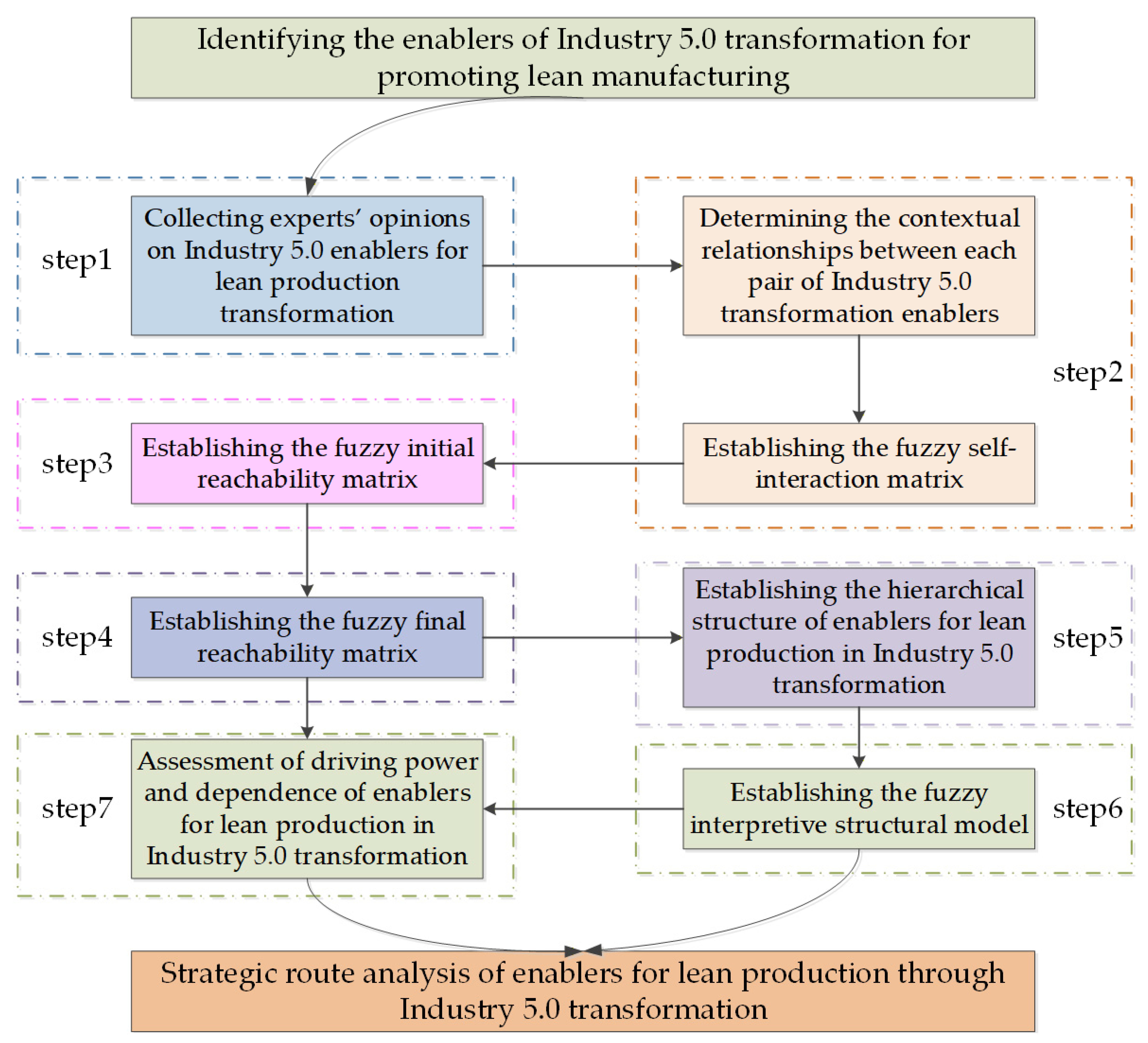
Currently, research related to Industry 5.0 is still at an exploratory stage, and the potential mechanisms for achieving Industry 5.0 transformation remain largely unexplored. Therefore, ISM can serve as a valuable technique for the exploratory analysis of this phenomenon to support the current research [82]. However, ISM has two main limitations when used for strategic roadmapping. The first is the knowledge bias and subjectivity of experts or the inequality in expert participation in decision-making. The second is that ISM has a weakness in explaining the identified contextual relationships, as it cannot explain the strength of the relationships among factors. To address these two limitations, the Fuzzy-ISM (FISM) method is adopted. It quantifies the interactions among factors and their hierarchical representation. This helps obtain the hierarchical structure of factors in a more intuitive manner [83]. At the same time, MICMAC is combined to visualize and compare the enabling role and dependence of factors. Figure 1 explains the basic steps of FISM implemented in this study, which have been widely recognized and applied in the ISM literature [84,85,86].

3.1. Collecting Expert Opinions

To apply Fuzzy ISM, this study relies on expert judgments to assess the contextual relationships among the enablers of Industry 5.0 driven lean manufacturing. Accordingly, we assembled a panel of experts with substantial practical and theoretical expertise in lean production and Industry 5.0 transformation. The panel members were identified and selected following established protocols for expert elicitation to reduce potential bias and ensure reproducibility [87]. Each expert rated the directional influence between every pair of the 12 enablers using a fuzzy linguistic scale.
In accordance with the expert selection protocol, 16 experts who might understand and be concerned about Industry 4.0/5.0 transformation were identified. The basic information of the experts is shown in Table 2. We contacted these experts and asked them to complete a simple self assessment to measure their familiarity with Industry 5.0 transformation. Based on the assessment, 4 were identified as unqualified experts, of whom 2 showed a lack of awareness of the Industry 5.0 concept, 1 emphasized a lack of awareness of lean production related concepts, and 1 claimed an inability to fully commit to all expert panel meetings. Finally, we screened 12 experts to form the expert panel. These 12 experts, consisting of 4 females and 8 males, possess extensive practical and teaching experience in the fields of Industry 4.0/5.0 transformation and lean production in the manufacturing industry. The expert panel was composed of 2 professors in lean production, 1 professor in modern manufacturing, 1 associate professor in the advanced research field of innovation and digital economy, 3 heads of production and operations departments, and 5 heads of IE departments. These 12 experts actively participated in the meetings, jointly discussing and determining the interconnections among the various enablers.

3.2. Establishing the Fuzzy Relationship Matrix

Triangular fuzzy linguistic terms are used to express the strength of interactions among the enablers, which helps describe the uncertainty in expert judgments. Therefore, this study uses triangular fuzzy numbers to fuzzify the questionnaire results, and judges the relationship strength among Industry 5.0 enablers by constructing a fuzzy relationship matrix, as shown in Table 3.

3.3. Establishing the Fuzzy Initial Reachability Matrix

According to the definition of triangular fuzzy numbers, the data in Table 3 are defuzzified to obtain the fuzzy initial reachability matrix O, as shown in Table 4.

3.4. Establishing the Final Reachability Matrix

Using Equation (1) as the criterion, the threshold value is determined by considering values on both sides, where μ and σ are the mean and standard deviation of the initial matrix O, respectively, and a suitable threshold value of 5.75 is finally determined. The choice of λ = 5.75 follows the established practice of setting the threshold at the mean plus one standard deviation of the initial reachability matrix, which balances the retention of meaningful inter-enabler relationships against the exclusion of weak or spurious connections. To ensure the robustness of the resulting structure against the specific threshold value, a sensitivity analysis was performed by examining plausible variations in λ around this baseline. The sensitivity analysis confirmed that the key findings are robust within a reasonable range of threshold adjustments. When λ is varied moderately above or below the selected value of 5.75, the overall hierarchical structure remains largely unchanged. While minor shifts between adjacent levels may occur for a few intermediate enablers, these do not alter their fundamental role as dependent factors nor affect the strategic roadmap’s sequencing logic. Substituting this threshold into Equation (2), when the factor value in the initial matrix O exceeds the threshold, it is assigned a value of 1; otherwise, it is assigned a value of 0. The adjacency matrix A is thus obtained, as shown in Table 5.
λ = α + β
A = 1 , a i j λ 0 , a i j λ , i , j = 1,2 , , 12
where α is the mean of all elements in the initial fuzzy reachability matrix O, β is the standard deviation of all elements in O, and λ is the threshold used to determine the elements of the adjacency matrix.
The adjacency matrix A is substituted into Equation (3) to obtain the multiplication matrix B, and then the final reachability matrix R is obtained through successive multiplication iterations of the multiplication matrix B. By using Equations (4) and (5), the driving power (Di) and dependence value (Ri) of each factor are calculated from the row sum and column sum of the reachability matrix, respectively, as shown in Table 6.
B = A + I
D i = i = 1 n T i j ( i = 1 , 2 , 3 , , n )
R j = i = 1 n T i j ( j = 1 , 2 , 3 , , n )

3.5. Establishing the Hierarchy Levels

This study adopts a cause-first hierarchical extraction rule to partition the reachability matrix for the enablers of Industry 5.0 promoting lean production. During each iteration, the factors that satisfy Q(Si) = A(Si) are classified into the current lowest level (i.e., the factor that was extracted first is located at the bottom of the model, representing fundamental factors with weak dependency and strong driving force). According to this rule, in the first round, Level 6 (A1, A6) is extracted; after removal, in the second round, Level 5 (A7, A8, A10) is extracted, and this process continues in subsequent layers. The final reachability matrix R is hierarchically processed. The decomposition result of the first-level influencing factors is shown in Table 7, and the hierarchical processing continues downward until completion. The final hierarchical processing result is:
L1 = {4, 9}; L2 = {5}; L3 = {3, 11}; L4 = {2, 12}; L5 = {7, 8, 10}; L6 = {1, 6};

3.6. Constructing the Interpretive Structural Model

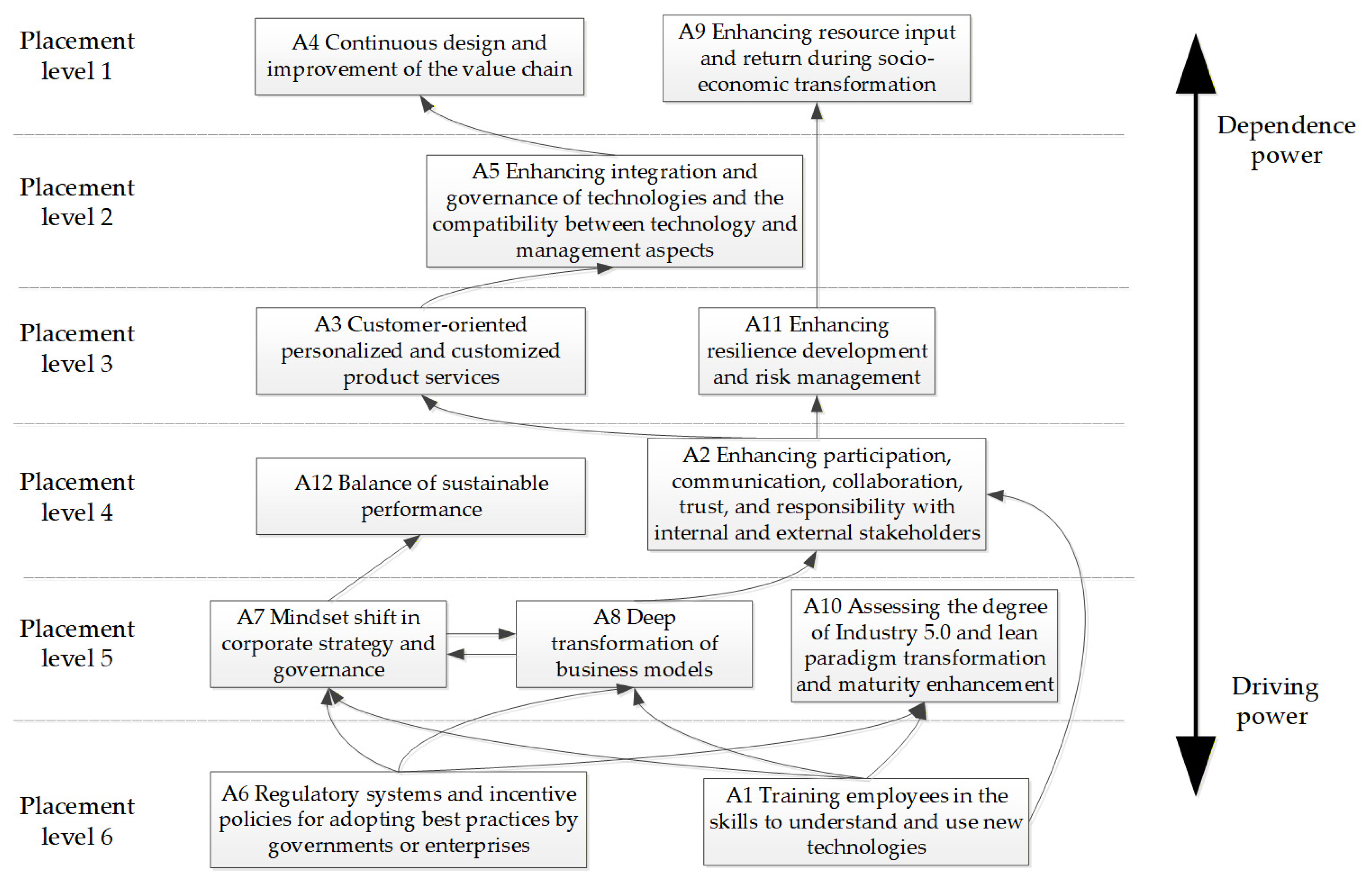
Based on the reachability matrix in Table 4 and the partitioned levels, a multi-level hierarchical structure model of the enablers for Industry 5.0 promoting lean manufacturing is further constructed, thereby identifying the hierarchical levels and vector relationships of each factor and reflecting the action pathways among the enablers, as shown in Figure 2.

3.7. Driving Power and Dependence Analysis

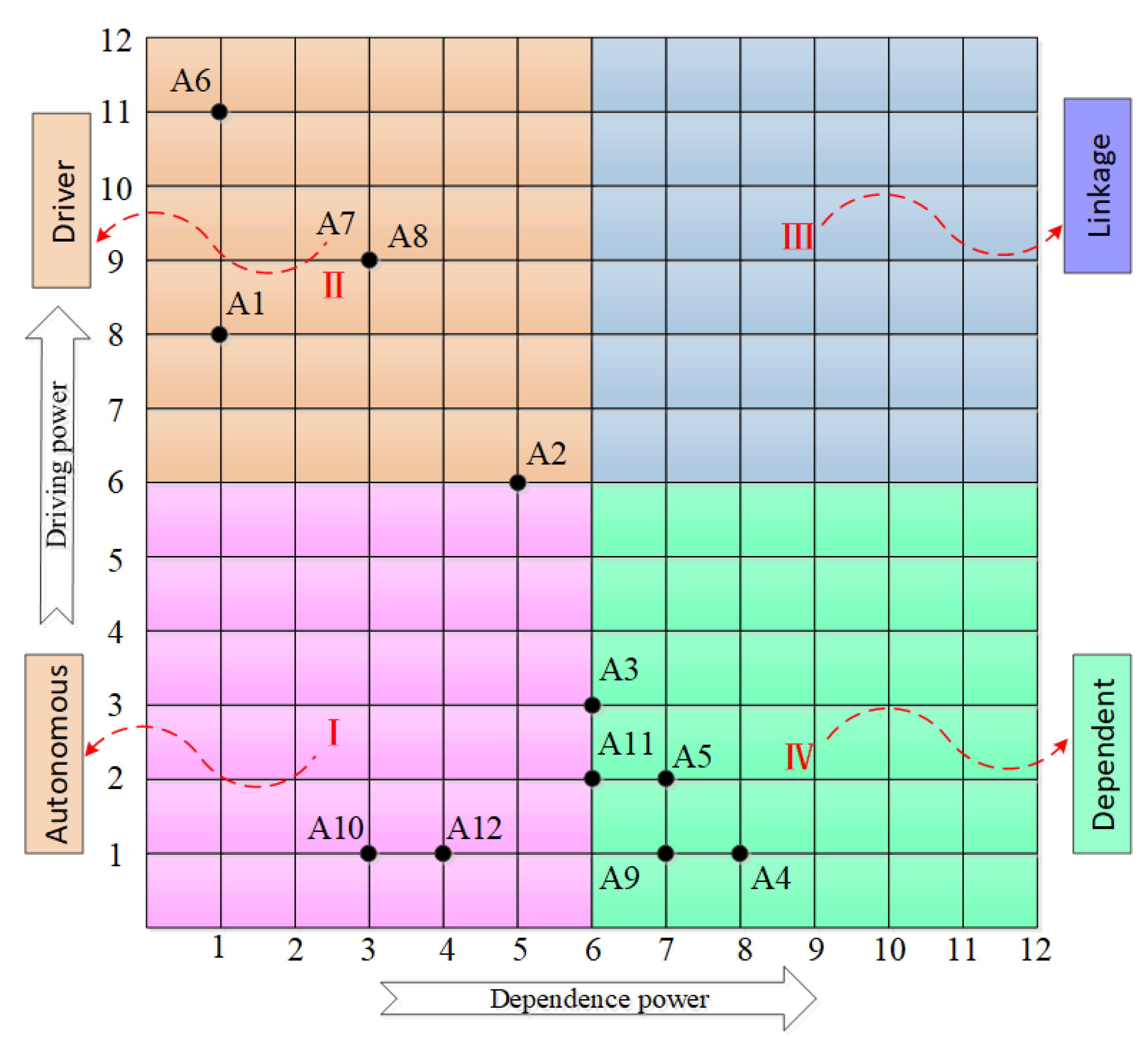
MICMAC is a comparative classification and evaluation tool that classifies variables according to their driving power and dependence. It serves as a methodological complement to ISM, using the driving power and dependence values determined in the final reachability matrix (Table 6) to identify and visualize key enablers and dependence relationships in a complex system. MICMAC analysis involves classifying factors into four quadrants, forming a Cartesian coordinate system that includes autonomous, driving, linkage, and dependent quadrants [88]. Factors with weak driving power and weak dependence are classified in the autonomous quadrant, which includes A10 and A12; factors in this quadrant have relatively low importance and low strategic priority. The driving quadrant consists of factors with strong driving power and weak dependence; A1, A2, A6, A7, and A8 are the driving factors in this study. These factors have relatively high importance and should be prioritized in the implementation process. Factors with strong driving power and strong dependence are placed in the linkage quadrant. Finally, factors in the dependent quadrant have weak driving power and strong dependence, including A3, A4, A5, A9, and A11. The implementation of these factors depends on the driving effect of other factors. Figure 3 presents the MICMAC analysis results for the enablers of lean production in the manufacturing industry in the context of Industry 5.0 transformation.

4. Results and Discussion

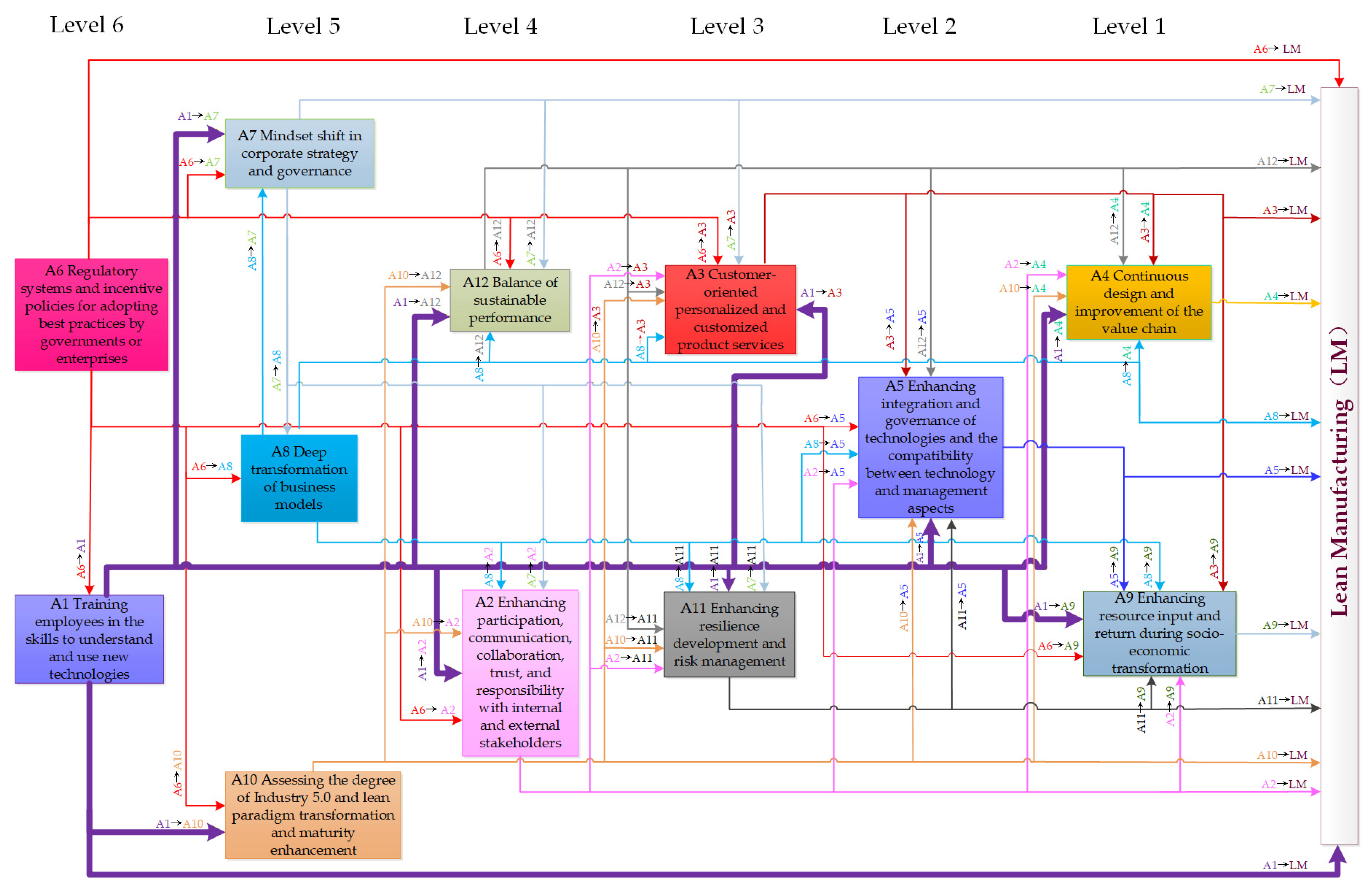
This study identified 12 enablers of Industry 5.0 transformation, each of which plays a unique role in lean manufacturing transformation and is crucial for achieving lean production goals in the manufacturing industry. The FISM-MICMAC analysis model was then used to identify the causal relationships among these enablers and determine their priority relationships. The research results are mainly presented in Figure 2 and Figure 3, demonstrating how to optimally achieve lean production goals driven by Industry 5.0 transformation in the manufacturing industry and realize the expected lean production value. Although the findings provide important insights into the definition of the enablers, their roles in lean production, and their development sequence, there is a lack of explanation regarding the links between these enablers. This is a recognized limitation of the ISM method. It cannot explain the direct links between each pair of enablers [82,83]. Therefore, this study utilized expert opinions collected during expert meetings to develop an Interpretive Logic-knowledge base (ILB) that explains the direct relationships among the enablers. By combining the ISM results with the ILB, a “strategic roadmap for achieving lean production in the manufacturing industry under Industry 5.0 transformation” was developed, as shown in Figure 4. Based on the synthesis of experts’ practical opinions and industry experience, Table 8 further operationalizes these relationships by providing concrete, actionable steps for each enabler toward lean manufacturing transformation. In this roadmap, the hierarchical position of each enabler corresponds to the position level identified in Figure 2, and the direct relationships represented by vector arrows correspond to the contextual relationships determined in Table 6. In order to facilitate understanding, the strategic roadmap highlights key driving enablers and uses color-coded arrows from left to right to depict their influence paths. For example, blue bold arrows originating from A1 point to A7, A10, A12, A2, A3, A11, A5, A4, and A9, indicating that employee skill training directly supports strategic transformation, maturity detection, sustainable performance, stakeholder collaboration, customer-centric customization, resilience thinking, value chain design, and resource returns. It should be noted that only the outgoing arrows from A1 are shown in bold as an illustrative example of how a foundational enabler propagates through the system. The influence paths of other driving enablers follow a similar logic. Furthermore, for ease of understanding, the following Table 9 lists the alphanumeric codes and short names of these elements used in this section.
Figure 2 and Figure 3 jointly reveal that Industry 5.0 transformation can achieve lean production goals in the manufacturing industry through various highly interrelated factors and complex procedures. The overall results indicate A6 (Regulatory system) is the most critical enabler of Industry 5.0, as it is positioned at the sixth level and in the driving quadrant, possessing the highest driving power, and is the direct enabler of nine lean manufacturing functions including A7 (Mindset transformation in strategy and governance), A8 (Business model transformation), and A10 (Transformation and maturity detection). This finding is consistent with the view of Poma et al. [89], which emphasizes the important role of government in regulating and supporting digital industrial transformation. Standardized and regulated regulatory systems and incentive policies (A6) can drive enterprises to incorporate the concepts of lean manufacturing and Industry 5.0 into strategic planning and governance, prompting enterprises to value sustainable development and efficiency improvement, and realize the transformation from traditional management thinking to innovative and efficient management models (A7). At the same time, by formulating and promoting lean manufacturing standards and establishing regular audit and evaluation mechanisms, the progress and maturity of enterprises in Industry 5.0 and lean manufacturing can be systematically monitored (A10), thereby driving enterprises to achieve new lean manufacturing models. In addition, providing financial incentives and technical support (A6) to reduce training costs and increase training opportunities can systematically enhance employees’ ability to understand and apply new technologies (A1), and the establishment of technical support and industry alliances can promote inter-enterprise cooperation and experience exchange, accelerate business model innovation and transformation (A8), thereby ensuring the effective promotion and practice of technological innovation within enterprises. This finding supports the research of Moraes et al. [8], which shows that governments and enterprises can jointly promote the development of lean manufacturing by establishing scientific regulatory systems and implementing effective incentive policies.
Importantly, A6 (Regulatory system) plays a pivotal role in closing the gap between traditional lean manufacturing’s focus on operational efficiency and Industry 5.0’s emphasis on social sustainability. First, A6 redefines the objective function of lean practices by internalizing social and environmental externalities through regulatory mandates (e.g., carbon emission caps, extended producer responsibility) and incentive policies (e.g., tax credits for workforce upskilling or social compliance). This shifts lean transformation from a purely cost-driven logic to a value-driven one that incorporates worker well-being, skill development, and community impact as core performance indicators. Second, A6 operationalizes social sustainability by aligning it with tangible economic benefits, such as subsidies for employee training (A1) or rewards for stakeholder participation (A2), thereby transforming social sustainability from a compliance burden into a source of competitive advantage. Third, A6 embeds social metrics into corporate governance (A7) and business model transformation (A8) through mandatory sustainability reporting and ethical guidelines, ensuring that social considerations become measurable, auditable, and manageable dimensions of lean operations. Finally, A6 enables a just transition by rewarding firms that adopt human-centric technologies (e.g., collaborative robots) and process designs that simultaneously enhance efficiency and social outcomes, thereby reconciling the inherent trade-offs between lean efficiency and social sustainability. Thus, A6 is not merely an external support condition but the foundational governance mechanism that bridges the two paradigms.
A1 (Employee skill training) is also one of the important enablers, which is indispensable for achieving Industry 5.0 transformation and serves as the fundamental guarantee for enterprises to realize lean manufacturing. By providing lean manufacturing-related training to improve employees’ skills and knowledge levels, valuable technical insights and suggestions can be provided in the decision-making process, thereby promoting the transformation of enterprises from traditional management models to more innovative, efficient, and technology-oriented management models (A7). At the same time, this improvement in technical capabilities enables enterprises to apply and integrate new technologies more effectively, and to more accurately detect and evaluate the implementation effect and maturity of lean manufacturing (A10), thus continuously improving and optimizing production processes, and enhancing the overall technological maturity and competitiveness of enterprises [90]. The research by Eriksson et al. [12] also pointed out that through systematic skill training, employees can more quickly identify and solve problems in the production process during actual operations, thereby driving enterprises to achieve higher operational efficiency and competitiveness under the lean manufacturing framework.
A7 (Mindset transformation in strategy and governance), A8 (Business model transformation), and A10 (Transformation and maturity detection) are at the fifth level of Figure 4, and they are crucial for achieving lean manufacturing transformation under the Industry 5.0 framework. Lean manufacturing emphasizes optimizing enterprise operations by eliminating waste and improving efficiency and quality. Introducing lean manufacturing thinking at the corporate strategy and governance level means shifting from the traditional cost-driven and economies-of-scale mindset to a value stream and customer-oriented management model [91]. This transformation stimulates deep thinking on business models and their redesign and optimization (A8), to better respond to market demands, optimize supply chains, enhance customer experience and market competitiveness, thus promoting the balance of sustainable performance (A12), and at the same time strengthening stakeholder participation and collaboration (A2). This business model transformation further supports the transformation of corporate strategy and governance mindset (A7), jointly driving the continuous improvement and development of enterprises in the market. This finding also supports the research of Ivanov [90], which states that the principles of Industry 5.0 require adjustments to existing business model designs, while committing to developing new business models.
Strengthening internal and external stakeholder participation, communication, collaboration, trust, and responsibility (A2) can promote information sharing and collaborative decision-making, improve production efficiency and resource utilization, enhance supply chain flexibility and reliability, and thereby promote the development of lean manufacturing. Figure 4 shows that A2 (Stakeholder participation and collaboration) is the key enabler for A3 (Customer-oriented personalized services) and A11 (Resilience thinking and risk management). Specifically, active stakeholder participation and effective communication (A2) enable enterprises to more accurately understand customer needs, thereby developing highly personalized and customized products and services (A3). This customer-centric strategy not only meets diverse customer needs but also enhances customer satisfaction and loyalty [92]. At the same time, effective communication and collaboration among stakeholders (A2) can promote the rapid flow and sharing of information, helping enterprises to identify and respond to potential risks early, thereby enhancing corporate resilience thinking and risk management capabilities (A11). The development of this resilience thinking and the enhancement of risk management capabilities further ensure the sustainable development of enterprises in an uncertain environment. Therefore, comprehensive stakeholder participation and effective management play a key role in promoting the implementation and optimization of lean manufacturing [17].
The enablers at the third level of the structural model include A3 (Customer-oriented personalized services) and A11 (Resilience thinking and risk management). They make important contributions to promoting the strengthening of A5 (Technology integration and governance), enhancing A9 (Resource input and returns), and the development of A4 (Value chain design and improvement). A3, by accurately grasping customer needs, prompts enterprises to integrate multiple technologies to collect and analyze customer data, thereby driving technology integration (A5) and improving the efficiency of resource allocation (A9). At the same time, A11 can enhance enterprises’ ability to cope with risks, provide stability guarantees for technology integration and governance (A5), and thus ensure the sustainable/long-term stability of resource input and returns (A9), ultimately driving enterprises to continuously optimize and improve their value chains (A4) and achieve lean manufacturing development goals. This finding is consistent with the research of Rossini et al. [93].
A5 (Technology integration and governance), A4 (Value chain design and improvement), and A9 (Resource input and returns) are respectively at the first and second levels of the structural model, and they are all placed in the dependent quadrant in Figure 3, indicating that they have the lowest driving power and do not significantly drive other factors of Industry 5.0; however, their critical role in achieving the development of lean manufacturing cannot be ignored. Among them, A5 is essential because it helps improve technological synergy and efficiency in the production process, enhance product quality and production flexibility [94], thereby driving enterprises to reduce costs and improve the efficiency of resource input and returns (A9). At the same time, continuous value chain optimization and innovation (A4) enables enterprises to continuously enhance the added value of products and services [95], and achieve cost-effectiveness through optimized resource utilization, thus promoting the continuous development and innovation of enterprises in a dynamic market environment. In addition, effective resource input and returns (A9) ensure the efficiency and sustainability of enterprises in resource use, which should be understood beyond generic economic benefits to specifically include measurable resource recovery rates (e.g., percentage of materials reclaimed from production scrap, end-of-life product take-back rates, and recycled content ratio) and the development of closed-loop value chains. A closed-loop value chain, in this context, refers to a system where waste outputs from one process are deliberately reintegrated as inputs into another process or returned to the original production cycle, thereby reducing dependency on virgin raw materials and minimizing environmental burden. For example, in lean-driven Industry 5.0 settings, resource returns can be operationalized through remanufacturing, component reuse, or material recapture loops that are monitored via digital product passports and real-time material flow tracking. By explicitly linking A9 to resource recovery rates and closed-loop performance, manufacturers can move beyond traditional cost–benefit logic and align lean transformation with circular economy principles, thereby maximizing economic and social benefits [96] and promoting corporate sustainable development and the establishment of competitive advantage. The combination of these strategies can effectively promote the application and effectiveness of lean manufacturing concepts in practice, thereby promoting overall efficiency, innovation, and sustainable development in the manufacturing industry. These findings are consistent with previous studies, emphasizing the important role of technology integration and value chain optimization for digitally driven lean manufacturing transformation [97,98,99].
While the proposed strategic roadmap (Figure 4) and actionable steps (Table 8) provide a structured pathway, their real-world implementation faces several challenges. Resource constraints are a key barrier. SMEs often lack funds for A1 (Employee skill training) or administrative capacity to access government incentives A6 (Regulatory system). This can trap them in a cycle: without A1, A5 (Technology integration and governance) and A4 (Value chain design and improvement) lag, yet without gains from A5 and A4, training investments are hard to justify. Larger firms also face trade-offs between long-term transformation (e.g., A8 (Business model transformation)) and short-term pressures, potentially delaying A9 (Resource input and returns). Sector differences matter. In discrete manufacturing (automotive, electronics), A3 (Customer-oriented personalized services) strongly drives A5 and A4. In process industries (chemicals, steel), A11 (Resilience thinking and risk management) and A12 (Balancing sustainable performance) may need earlier emphasis. Low-tech sectors struggle with basic digital literacy (A1), while high-tech firms face bottlenecks in A5 and A2 (Stakeholder participation and collaboration). Organizational culture also impedes transformation. Risk aversion, siloed departments, or command-and-control traditions can block A7 (Mindset transformation in strategy and governance) even when A6 and A1 are in place. Without psychological safety, A2 and A8 weaken, fragmenting the enabler cascade. A10 (Transformation and maturity detection) is another difficulty. Many manufacturers lack standardized Industry 5.0 metrics, leading to over- or under-estimation of progress, especially for SMEs. Additionally, lean practices like just-in-time can conflict with environmental goals (e.g., higher emissions from small-batch transport). Although the roadmap embeds sustainability assessment into A4 and A5, resolving such trade-offs requires real-time data and cross-functional decisions, often absent in early adopters. Without deliberate management, firms may revert to traditional lean metrics (cost, lead time) and neglect sustainability and resilience.
Finally, recognizing these challenges refines the roadmap’s application. Resource-constrained firms can start with low-cost enablers: A2 (Stakeholder participation and collaboration) using free digital tools and modular A1 (Employee skill training) via open resources, before investing in capital-intensive A5 or A8. For process or low-tech sectors, the hierarchy can be reweighted (e.g., elevating A11 or A12). Governments should supplement A6 (Regulatory system) with technical assistance and sector-specific maturity frameworks A10 (Transformation and maturity detection). Companies should form cross-functional “lean-green-resilience” teams to pilot A4 and A5 on a small scale. Future research should validate these adaptive strategies.

5. Conclusions

By integrating and improving the FISM and MICMAC analysis, this study systematically identifies 12 key enablers for Industry 5.0-driven lean manufacturing transformation, develops a hierarchical strategic roadmap, and reveals the causal dependency relationships and implementation pathways among the factors. The findings not only fill the theoretical gap concerning how Industry 5.0 systematically drives lean manufacturing transformation, but also provide an operational framework for the manufacturing industry to achieve sustainable development in the new industrialization process, particularly by clarifying the time windows and resource allocation priorities for policymakers and enterprises through the hierarchical development sequence.

5.1. Theoretical Implications

This study advances manufacturing transformation at three levels by constructing an integrated driving framework of Industry 5.0 and lean manufacturing. First, a systematic theoretical model is established to explain Industry 5.0-driven lean manufacturing transformation. Different from the fragmented discussions of single-technology effects in Industry 4.0 research, this study identifies a multi-level causal network formed by 12 enablers (Figure 2). This framework incorporates the human-centric, sustainability, and resilience goals of Industry 5.0 into a unified system, addresses the theoretical deficiency of “neglecting socio-technical system synergy” in Industry 4.0 research, and provides mechanistic explanations for how human–machine collaboration enhances lean flexibility. Second, this study compensates for the algorithmic limitations of FISM through expert retrospective validation and, based on this, develops a strategic roadmap for achieving lean production under Industry 5.0. The strategic roadmap (Figure 4) reveals the evolutionary logic of Industry 5.0-driven lean manufacturing: on the human-centric dimension, employee skills (A1), A2, and customer customization (A3) form a closed loop of value co-creation; on the sustainability dimension, A2, A4, A6, A7, A8, A9, A10, and A12 construct an eco-efficiency mechanism; on the resilience dimension, A5, A6, A7, A8, A9, and A11 enhance the system’s ability to resist disturbances. It provides valuable insights for lean manufacturing to achieve the three goals of Industry 5.0: human-centricity, sustainability, and resilience.

5.2. Practical Implications

At the corporate strategic decision-making level, the roadmap (Figure 4) identifies the regulatory system (A6) and employee skills (A1) as priority investment areas. When government tax incentives (A6) are combined with corporate training investment (A1), the efficiency of technology integration (A5) is improved, thereby shortening the resource input-return cycle (A9). Enterprises need to reconstruct their KPI system to incorporate stakeholder collaboration (A2) into executive performance evaluation and enhance the predictive capability of resilience management (A11) for supply chain disruptions through digital twin technology. At the operational execution level, dependent factors require differentiated development. For example, the automotive manufacturing industry can leverage customized services (A3) to drive technology integration (A5), achieving a reduction in modular production line changeover time; electronic contract manufacturers need to strengthen risk management (A11) to ensure resource returns (A9) and establish alternative supplier response mechanisms in the event of chip shortages. At the policy-making level, governments need to innovate regulatory tools: establishing an Industry 5.0 maturity assessment standard (A10). Through innovation funds, they can guide business model transformation (A8), for instance, by funding distributed manufacturing projects to achieve regional industrial chain synergy. Meanwhile, a transformation monitoring platform should be established to track the effect of policy transmission and avoid resource misallocation.
In conclusion, this study has yielded noteworthy and valuable insights, summarizing the key findings as follows:
(1)
This study advances beyond fragmented Industry 4.0 analyses—which primarily focused on efficiency and isolated technology applications—by systematically identifying 12 enablers and their hierarchical causal relationships for Industry 5.0-driven lean manufacturing transformation.
(2)
It explicitly integrates the three core pillars of Industry 5.0—human-centricity, sustainability, and resilience—into a unified strategic roadmap, addressing the theoretical gap left by prior efficiency- and technology-centric frameworks.
(3)
Unlike previous studies that treat human factors, environmental performance, and supply chain adaptability separately, this roadmap reveals how enablers such as employee training, stakeholder collaboration, and risk management jointly support all three goals.
(4)
The combined FISM-MICMAC approach demonstrates that “government regulation and incentives” and “employee skill training” are the most critical driving enablers, while value chain design and resource returns are dependent factors that require prior activation.
(5)
The proposed strategic roadmap sequences actions and investments, providing manufacturers and policymakers with a practical guide to reconcile lean efficiency with human-centric, sustainable, and resilient outcomes under Industry 5.0.

5.3. Limitations and Future Research

Although this study offers a novel, systematic integration to construct a strategic roadmap for Industry 5.0 driven lean manufacturing transformation, several limitations remain to be addressed. First, the research relies on expert panel judgment to construct the fuzzy interpretive structural model, which may affect the generalizability of the conclusions. Future research can expand the geographical distribution and industry coverage of experts to enhance the cross-cultural adaptability of the model. Second, the expert panel did not directly include front line workers or union representatives, although the selected experts regularly interact with them. Future research will directly engage front line workers and union representatives through case studies or surveys to validate and refine the roadmap from an operational perspective. Third, the study focuses on the identification of enablers and hierarchical relationships, but is insufficient in terms of the strength of interactions and time lag effects among factors. Future research can develop empirically based weight assessment methods, such as establishing structural equation models through large scale enterprise surveys. At the content level, this study does not fully explore implementation obstacles in the transformation. The compatibility conflicts between Industry 5.0 technologies (e.g., collaborative robots, digital twins) and traditional lean tools (e.g., Kanban management, standardized work) need to be analyzed urgently, especially the technological retrofitting costs and organizational culture resistance faced by SMEs. Future research can construct an “obstacle driver” dual dimension matrix to identify key pain points for enterprises of different sizes and develop phased implementation pathways. Moreover, while the current study focuses on Industry 5.0 driven lean manufacturing transformation with emphasis on human centricity, sustainability, and resilience, the integration of circular economy principles remains an important avenue for future research. The enablers identified in this study could serve as building blocks for a circular transition. Future work will explicitly model circular economy outcomes (e.g., material circularity, product life extension, and waste to resource loops) and examine how Industry 5.0 technologies can synergize with lean practices to accelerate circular industrial transformation.

Author Contributions

Conceptualization, C.-Y.W. and C.-H.H.; methodology, C.-Y.W., D.-X.Z. and M.-Q.H.; software, Z.-J.J.; validation, C.-Y.W. and D.-X.Z.; formal analysis, M.-Q.H.; investigation, C.-Y.W., D.-X.Z. and Z.-J.J.; resources, C.-Y.W. and C.-H.H.; data curation, Z.-J.J.; writing—original draft preparation, C.-Y.W.; writing—re view and editing, C.-Y.W. and D.-X.Z.; visualization, D.-X.Z.; supervision, C.-Y.W. and C.-H.H.; project administration, C.-Y.W. and C.-H.H. All authors have read and agreed to the published version of the manuscript.

Funding

This research received no external funding.

Institutional Review Board Statement

Ethical review and approval were waived for this study by Institution Committee due to Legal Regulations (The Ethical Review of Biomedical Research Involving Humans issued by the National Health Commission of the People’s Republic of China).

Informed Consent Statement

Informed consent for participation was obtained from all subjects involved in the study.

Data Availability Statement

The original contributions presented in this study are included in the article. Further inquiries can be directed to the corresponding author.

Conflicts of Interest

The authors declare no conflicts of interest.

References

  1. Wagner, T.; Herrmann, C.; Thiede, S. Industry 4.0 impacts on lean production systems. Procedia Cirp 2017, 63, 125–131. [Google Scholar] [CrossRef]
  2. Silvestri, L.; Gallo, T.; Silvestri, C. Which tools are needed to implement Lean Production in an Industry 4.0 environment? A literature review. Procedia Comput. Sci. 2022, 200, 1766–1777. [Google Scholar] [CrossRef]
  3. Kassem, B.; Callupe, M.; Rossi, M.; Rossini, M.; Portioli-Staudacher, A. Lean 4.0: A systematic literature review on the interaction between lean production and industry 4.0 pillars. J. Manuf. Technol. Manag. 2024, 35, 821–847. [Google Scholar] [CrossRef]
  4. Alojaiman, B. Technological Modernizations in the Industry 5.0 Era: A Descriptive Analysis and Future Research Directions. Processes 2023, 11, 1318. [Google Scholar] [CrossRef]
  5. Coelho, P.; Bessa, C.; Landeck, J.; Silva, C. Industry 5.0: The arising of a concept. Procedia Comput. Sci. 2023, 217, 1137–1144. [Google Scholar] [CrossRef]
  6. De Souza, R.O.; Ferenhof, H.A.; Forcellini, F.A. Industry 4.0 and Industry 5.0 from the Lean perspective. Int. J. Manag. Knowl. Learn 2022, 11, 145–155. [Google Scholar] [CrossRef]
  7. Suleiman Almazrouei, S.A.; AlBalushi, M.; Hilmi, M.F. Employees’ perception of lean management maturity and its impact on their innovative behaviours. Int. J. Qual. Reliab. Manag. 2025, 42, 2047–2067. [Google Scholar] [CrossRef]
  8. Moraes, A.; Carvalho, A.M.; Sampaio, P. Lean and Industry 4.0: A review of the relationship, its limitations, and the path ahead with Industry 5.0. Machines 2023, 11, 443. [Google Scholar] [CrossRef]
  9. Fani, V.; Bucci, I.; Rossi, M.; Bandinelli, R. Lean and industry 4.0 principles toward industry 5.0: A conceptual framework and empirical insights from fashion industry. J. Manuf. Technol. Manag. 2024, 35, 122–141. [Google Scholar] [CrossRef]
  10. Narkhede, G.B.; Pasi, B.N.; Rajhans, N.; Kulkarni, A. Industry 5.0 and sustainable manufacturing: A systematic literature review. Benchmarking Int. J. 2025, 32, 608–635. [Google Scholar] [CrossRef]
  11. Rahardjo, B.; Wang, F.K.; Lo, S.C.; Chu, T.H. A sustainable innovation framework based on lean six sigma and industry 5.0. Arab. J. Sci. Eng. 2024, 49, 7625–7642. [Google Scholar] [CrossRef]
  12. Eriksson, K.M.; Olsson, A.K.; Carlsson, L. Beyond lean production practices and Industry 4.0 technologies toward the human-centric Industry 5.0. Technol. Sustain. 2024, 3, 286–308. [Google Scholar] [CrossRef]
  13. Gdoura, R.; Houssin, R.; Dhouib, D.; Coulibaly, A. Design for lean 5.0: Integrating lean requirements and parameters into production systems in an industry 5.0 context. Concurr. Eng. 2025, 33, 236–256. [Google Scholar] [CrossRef]
  14. Cuevas, C.; Mira-Solves, I.; Verdu-Jover, A. Industry 5.0’s pillars and Lean Six Sigma: Mapping the current interrelationship and future research directions. Int. J. Product. Perform. Manag. 2025, 74, 1347–1364. [Google Scholar] [CrossRef]
  15. Waheed, A.; Alharthi, M.; Khan, S.Z.; Usman, M. Role of industry 5.0 in leveraging the business performance: Investigating impact of shared-economy on firms’ performance with intervening role of i5. 0 technologies. Sage Open 2022, 12, 21582440221094608. [Google Scholar] [CrossRef]
  16. Alvarez-Aros, E.L.; Bernal-Torres, C.A. Technological competitiveness and emerging technologies in industry 4.0 and industry 5.0. An. Acad. Bras. Ciências 2021, 93, e20191290. [Google Scholar] [CrossRef] [PubMed]
  17. Valamede, L.S.; Akkari, A.C.S. Lean 4.0: A new holistic approach for the integration of lean manufacturing tools and digital technologies. Int. J. Math. Eng. Manag. Sci. 2020, 5, 851. [Google Scholar] [CrossRef]
  18. Sartal, A.; Llach, J.; Vázquez, X.H.; de Castro, R. How much does lean manufacturing need environmental and information technologies? J. Manuf. Syst. 2017, 45, 260–272. [Google Scholar] [CrossRef]
  19. Paneerselvam, N.; Muhammad, N.A.; Azhan, A.M.; Muhammad, N. Analyzing critical success factors in Lean Six Sigma training. Int. J. Product. Perform. Manag. 2024, 74, 1400–1424. [Google Scholar] [CrossRef]
  20. Sreedharan V, R.; Sunder M, V.; Madhavan, V.; Gurumurthy, A. Development of lean six sigma training module: Evidence from an emerging economy. Int. J. Qual. Reliab. Manag. 2020, 37, 689–710. [Google Scholar] [CrossRef]
  21. ISO 14001:2026; Environmental Management Systems—Requirements with Guidance for Use. ISO: Geneva, Switzerland, 2026.
  22. Chen, P.K.; Lujan-Blanco, I.; Fortuny-Santos, J.; Ruiz-de-Arbulo-López, P. Lean manufacturing and environmental sustainability: The effects of employee involvement, stakeholder pressure and ISO 14001. Sustainability 2020, 12, 7258. [Google Scholar] [CrossRef]
  23. Papagiannakis, G.; Voudouris, I.; Lioukas, S.; Kassinis, G. Environmental management systems and environmental product innovation: The role of stakeholder engagement. Bus. Strategy Environ. 2019, 28, 939–950. [Google Scholar] [CrossRef]
  24. Fobbe, L.; Hilletofth, P. Moving toward a circular economy in manufacturing organizations: The role of circular stakeholder engagement practices. Int. J. Logist. Manag. 2023, 34, 674–698. [Google Scholar] [CrossRef]
  25. Longoni, A.; Cagliano, R. Cross-functional executive involvement and worker involvement in lean manufacturing and sustainability alignment. Int. J. Oper. Prod. Manag. 2015, 35, 1332–1358. [Google Scholar] [CrossRef]
  26. Sunder, M.V. Lean six sigma project management–a stakeholder management perspective. TQM J. 2016, 28, 132–150. [Google Scholar] [CrossRef]
  27. Adhi, A.B.; Muslim, F. Development of stakeholder engagement strategies to improve sustainable construction implementation based on lean construction principles in Indonesia. Sustainability 2023, 15, 6053. [Google Scholar] [CrossRef]
  28. Hong, P.C.; Yang, M.G.; Dobrzykowski, D.D. Strategic customer service orientation, lean manufacturing practices and performance outcomes: An empirical study. J. Serv. Manag. 2014, 25, 699–723. [Google Scholar] [CrossRef]
  29. Gao, J.; Yao, Y.; Zhu, V.C.; Sun, L.; Lin, L. Service-oriented manufacturing: A new product pattern and manufacturing paradigm. J. Intell. Manuf. 2011, 22, 435–446. [Google Scholar] [CrossRef]
  30. Romero, D.; Rossi, M. Towards circular lean product-service systems. Procedia CIRP 2017, 64, 13–18. [Google Scholar] [CrossRef]
  31. Gülyaz, E.; van der Veen, J.A.; Venugopal, V.; Solaimani, S. Towards a holistic view of customer value creation in Lean: A design science approach. Cogent Bus. Manag. 2019, 6, 1602924. [Google Scholar] [CrossRef]
  32. Bakås, O.; Aspelund, A.; Moen, Ø. Customer-oriented manufacturing as a resilience strategy for Norwegian small international manufacturers. In Small and Medium Sized Enterprises and the COVID-19 Response; Edward Elgar Publishing: Northampton, MA, USA, 2022; pp. 346–366. [Google Scholar]
  33. Agus, A.; Shukri Hajinoor, M. Lean production supply chain management as driver towards enhancing product quality and business performance: Case study of manufacturing companies in Malaysia. Int. J. Qual. Reliab. Manag. 2012, 29, 92–121. [Google Scholar] [CrossRef]
  34. Anderson, D.M. Design for Manufacturability: How to Use Concurrent Engineering to Rapidly Develop Low-Cost, High-Quality Products for Lean Production; Productivity Press: New York, NY, USA, 2020. [Google Scholar]
  35. Jimenez, G.; Santos, G.; Sá, J.C.; Ricardo, S.; Pulido, J.; Pizarro, A.; Hernández, H. Improvement of Productivity and Quality in the Value Chain through Lean Manufacturing—A case study. Procedia Manuf. 2019, 41, 882–889. [Google Scholar] [CrossRef]
  36. Gargalo, C.L.; Pereda Pons, E.; Barbosa-Povoa, A.P.; Carvalho, A. A lean approach to developing sustainable supply chains. Sustainability 2021, 13, 3714. [Google Scholar] [CrossRef]
  37. Perez, C.; de Castro, R.; Simons, D.; Gimenez, G. Development of lean supply chains: A case study of the Catalan pork sector. Supply Chain Manag. Int. J. 2010, 15, 55–68. [Google Scholar] [CrossRef]
  38. de Sousa Jabbour, A.B.L.; Carlos Omodei Junior, J.; José Chiappetta Jabbour, C. Extending lean manufacturing in supply chains: A successful case in Brazil. Benchmarking Int. J. 2014, 21, 1070–1083. [Google Scholar] [CrossRef]
  39. Santos, J.; Wysk, R.A.; Torres, J.M. Improving Production with Lean Thinking; John Wiley & Sons: Hoboken, NJ, USA, 2015. [Google Scholar]
  40. Saraswat, P.; Agrawal, R.; Rane, S.B. Technological integration of lean manufacturing with industry 4.0 toward lean automation: Insights from the systematic review and further research directions. Benchmarking Int. J. 2024, 32, 1909–1941. [Google Scholar] [CrossRef]
  41. Lakshmanan, R.; Nyamekye, P.; Virolainen, V.M.; Piili, H. The convergence of lean management and additive manufacturing: Case of manufacturing industries. Clean. Eng. Technol. 2023, 13, 100620. [Google Scholar] [CrossRef]
  42. Buhaya, M.I.; Metwally, A.B.M. The interplay between digital technologies and sustainable performance: Does lean manufacturing matter? Sustainability 2024, 16, 10002. [Google Scholar] [CrossRef]
  43. Fan, J.; Mehmood, S.; Hussain, I.; Nazir, S.; Basit, A. Transport infrastructure environmental performance: The role of stakeholders, technological integration, government policies and lean supply chain management. Front. Environ. Sci. 2023, 11, 1322466. [Google Scholar] [CrossRef]
  44. Abobakr, M.A.; Abdel-Kader, M.; Elbayoumi, A.F. Integrating S-ERP systems and lean manufacturing practices to improve sustainability performance: An institutional theory perspective. J. Account. Emerg. Econ. 2023, 13, 870–897. [Google Scholar] [CrossRef]
  45. Thanki, S.J.; Thakkar, J. Status of lean manufacturing practices in Indian industries and government initiatives: A pilot study. J. Manuf. Technol. Manag. 2014, 25, 655–675. [Google Scholar] [CrossRef]
  46. Mofolasayo, A.; Young, S.; Martinez, P.; Ahmad, R. How to adapt lean practices in SMEs to support Industry 4.0 in manufacturing. Procedia Comput. Sci. 2022, 200, 934–943. [Google Scholar] [CrossRef]
  47. Kuesten, C.L. Going Lean: How the Best Companies Apply Lean Manufacturing Principles to Shatter Uncertainty, Drive Innovation, and Maximize Profits by Stephen A. Ruffa. J. Prod. Innov. Manag. 2009, 26, 685–687. [CrossRef]
  48. Mathiyazhagan, K.; Gnanavelbabu, A.; Agarwal, V. A framework for implementing sustainable lean manufacturing in the electrical and electronics component manufacturing industry: An emerging economies country perspective. J. Clean. Prod. 2022, 334, 130169. [Google Scholar] [CrossRef]
  49. Iranmanesh, M.; Zailani, S.; Hyun, S.S.; Ali, M.H.; Kim, K. Impact of lean manufacturing practices on firms’ sustainable performance: Lean culture as a moderator. Sustainability 2019, 11, 1112. [Google Scholar] [CrossRef]
  50. Panizzolo, R.; Garengo, P.; Sharma, M.K.; Gore, A. Lean manufacturing in developing countries: Evidence from Indian SMEs. Prod. Plan. Control 2012, 23, 769–788. [Google Scholar] [CrossRef]
  51. Trotta, V.; Fernandez Aguirre, J.M. Lean Manufacturing Mitigates Barriers to Improve Environmental Performance: Mapping Current Research and Establish Future Research Agenda. 2022. Available online: https://www.politesi.polimi.it/handle/10589/209314 (accessed on 8 June 2026).
  52. Alves, A.C.; Dinis-Carvalho, J.; Sousa, R.M. Lean production as promoter of thinkers to achieve companies’ agility. Learn. Organ. 2012, 19, 219–237. [Google Scholar] [CrossRef]
  53. Pakdil, F.; Leonard, K.M. Implementing and sustaining lean processes: The dilemma of societal culture effects. Int. J. Prod. Res. 2017, 55, 700–717. [Google Scholar] [CrossRef]
  54. Yamamoto, Y.; Bellgran, M. Fundamental mindset that drives improvements towards lean production. Assem. Autom. 2010, 30, 124–130. [Google Scholar] [CrossRef]
  55. Norani, N.; Md Deros, B.; Abd Wahab, D.; Ab Rahman, M.N. Managing change in lean manufacturing implementation. Adv. Mater. Res. 2011, 314, 2105–2111. [Google Scholar] [CrossRef]
  56. Saraswati, R.S.; Yadiati, W.; Suharman, H.; Soemantri, R. Corporate governance, intellectual capital, and organizational culture: Their influence on lean manufacturing and firm value. Cogent Bus. Manag. 2024, 11, 2382335. [Google Scholar] [CrossRef]
  57. Pearce, A.; Pons, D. Implementing lean practices: Managing the transformation risks. J. Ind. Eng. 2013, 2013, 790291. [Google Scholar] [CrossRef]
  58. Sony, M. Industry 4.0 and lean management: A proposed integration model and research propositions. Prod. Manuf. Res. 2018, 6, 416–432. [Google Scholar] [CrossRef]
  59. Caldera, H.T.S.; Desha, C.; Dawes, L. Transforming manufacturing to be ‘good for planet and people’, through enabling lean and green thinking in small and medium-sized enterprises. Sustain. Earth 2019, 2, 4. [Google Scholar] [CrossRef]
  60. Duarte, S.; Cruz-Machado, V. Modelling lean and green: A review from business models. Int. J. Lean Six Sigma 2013, 4, 228–250. [Google Scholar] [CrossRef]
  61. Balocco, R.; Cavallo, A.; Ghezzi, A.; Berbegal-Mirabent, J. Lean business models change process in digital entrepreneurship. Bus. Process Manag. J. 2019, 25, 1520–1542. [Google Scholar] [CrossRef]
  62. Rossini, M.; Cifone, F.D.; Kassem, B.; Costa, F.; Portioli-Staudacher, A. Being lean: How to shape digital transformation in the manufacturing sector. J. Manuf. Technol. Manag. 2021, 32, 239–259. [Google Scholar] [CrossRef]
  63. Ciliberto, C.; Szopik-Depczyńska, K.; Tarczyńska-Łuniewska, M.; Ruggieri, A.; Ioppolo, G. Enabling the Circular Economy transition: A sustainable lean manufacturing recipe for Industry 4.0. Bus. Strategy Environ. 2021, 30, 3255–3272. [Google Scholar] [CrossRef]
  64. Henao, R.; Sarache, W.; Gómez, I. Lean manufacturing and sustainable performance: Trends and future challenges. J. Clean. Prod. 2019, 208, 99–116. [Google Scholar] [CrossRef]
  65. Alves, J.R.X.; Alves, J.M. Production management model integrating the principles of lean manufacturing and sustainability supported by the cultural transformation of a company. Int. J. Prod. Res. 2015, 53, 5320–5333. [Google Scholar] [CrossRef]
  66. Farrukh, A.; Mathrani, S.; Sajjad, A. Green-lean-six sigma practices and supporting factors for transitioning towards circular economy: A natural resource and intellectual capital-based view. Resour. Policy 2023, 84, 103789. [Google Scholar] [CrossRef]
  67. Sasso, R.A.; Filho, M.G.; Ganga, G.M.D. Synergizing lean management and circular economy: Pathways to sustainable manufacturing. Corp. Soc. Responsib. Environ. Manag. 2025, 32, 543–562. [Google Scholar] [CrossRef]
  68. Bai, C.; Satir, A.; Sarkis, J. Investing in lean manufacturing practices: An environmental and operational perspective. Int. J. Prod. Res. 2019, 57, 1037–1051. [Google Scholar] [CrossRef]
  69. Arcidiacono, G.; Antonacci, A.; Antony, J. The r-evolution of Lean Six Sigma from Industry 4.0 to Society 5.0: Excellence 5.0. Int. J. Qual. Reliab. Manag. 2025, 42, 2328–2349. [Google Scholar] [CrossRef]
  70. Gius, D.; Mieszala, J.C.; Panayiotou, E.; Poppensieker, T. Value and Resilience Through Better Risk Management; McKinsey & Company: New York, NY, USA, 2018; pp. 43–53. [Google Scholar]
  71. Chari, A.; Despeisse, M.; Johansson, B.; Morioka, S.; Gohr, C.F.; Stahre, J. Resilience compass navigation through manufacturing organization uncertainty–a dynamic capabilities approach using mixed methods. CIRP J. Manuf. Sci. Technol. 2024, 55, 375–389. [Google Scholar] [CrossRef]
  72. Wachter, C.; Beckschulte, S.; Hinrichs, M.P.; Sohnius, F.; Schmitt, R.H. Strategies for Resilient Manufacturing: A Systematic Literature Review of Failure Management in Production. Procedia CIRP 2024, 130, 1393–1402. [Google Scholar] [CrossRef]
  73. Niu, Y.; Werle, N.; Cohen, M.; Cui, S.; Deshpande, V.; Ernst, R.; Huchzermeier, A.; Tsay, A.A.; Wu, J. Restructuring Global Supply Chains: Navigating Challenges of the COVID-19 Pandemic and Beyond. Manuf. Serv. Oper. Manag. 2025, 27, 1025–1036. [Google Scholar] [CrossRef]
  74. Shishodia, A.; Sharma, R.; Rajesh, R.; Munim, Z.H. Supply chain resilience: A review, conceptual framework and future research. Int. J. Logist. Manag. 2023, 34, 879–908. [Google Scholar] [CrossRef]
  75. Awan, F.H.; Dunnan, L.; Jamil, K.; Mustafa, S.; Atif, M.; Gul, R.F.; Guangyu, Q. Mediating role of green supply chain management between lean manufacturing practices and sustainable performance. Front. Psychol. 2022, 12, 810504. [Google Scholar] [CrossRef]
  76. Thawornsujaritkul, T.; Boonnual, C. The Impact of Lean Management on Sustainable Performance: The Moderating Role of Employee Performance in the Steel Industry. J. Ecohumanism 2024, 3, 2116–2132. [Google Scholar] [CrossRef]
  77. Anwar, A.; Jamil, K.; Idrees, M.; Atif, M.; Ali, B. An empirical examination of SMEs sustainable performance through lean manufacturing. Knowl. Process Manag. 2023, 30, 289–299. [Google Scholar] [CrossRef]
  78. Ghobakhloo, M.; Iranmanesh, M.; Mubarak, M.F.; Mubarik, M.; Rejeb, A.; Nilashi, M. Identifying industry 5.0 contributions to sustainable development: A strategy roadmap for delivering sustainability values. Sustain. Prod. Consum. 2022, 33, 716–737. [Google Scholar] [CrossRef]
  79. Singhal, D.; Tripathy, S.; Jena, S.K. Sustainability through remanufacturing of e-waste: Examination of critical factors in the Indian context. Sustain. Prod. Consum. 2019, 20, 128–139. [Google Scholar] [CrossRef]
  80. Gardas, B.B.; Raut, R.D.; Narkhede, B. Determinants of sustainable supply chain management: A case study from the oil and gas supply chain. Sustain. Prod. Consum. 2019, 17, 241–253. [Google Scholar] [CrossRef]
  81. Ching, N.T.; Ghobakhloo, M.; Iranmanesh, M.; Maroufkhani, P.; Asadi, S. Industry 4.0 applications for sustainable manufacturing: A systematic literature review and a roadmap to sustainable development. J. Clean. Prod. 2022, 334, 130133. [Google Scholar] [CrossRef]
  82. Ghobakhloo, M.; Iranmanesh, M.; Morales, M.E.; Nilashi, M.; Amran, A. Actions and approaches for enabling Industry 5.0-driven sustainable industrial transformation: A strategy roadmap. Corp. Soc. Responsib. Environ. Manag. 2023, 30, 1473–1494. [Google Scholar] [CrossRef]
  83. Wang, W.; Liu, X.; Qin, Y.; Huang, J.; Liu, Y. Assessing contributory factors in potential systemic accidents using AcciMap and integrated fuzzy ISM-MICMAC approach. Int. J. Ind. Ergon. 2018, 68, 311–326. [Google Scholar] [CrossRef]
  84. Ghobakhloo, M. Industry 4.0, digitization, and opportunities for sustainability. J. Clean. Prod. 2020, 252, 119869. [Google Scholar] [CrossRef]
  85. Ghobakhloo, M.; Iranmanesh, M.; Grybauskas, A.; Vilkas, M.; Petraitė, M. Industry 4.0, innovation, and sustainable development: A systematic review and a roadmap to sustainable innovation. Bus. Strategy Environ. 2021, 30, 4237–4257. [Google Scholar] [CrossRef]
  86. Vimal, K.E.K.; Churi, K.; Kandasamy, J. Analysing the drivers for adoption of Industry 4.0 technologies in a functional paper–cement–sugar circular sharing network. Sustain. Prod. Consum. 2022, 31, 459–477. [Google Scholar] [CrossRef]
  87. Hertzum, M. Expertise seeking: A review. Inf. Process. Manag. 2014, 50, 775–795. [Google Scholar] [CrossRef]
  88. Yang, Z.; Lin, Y. The effects of supply chain collaboration on green innovation performance: An interpretive structural modeling analysis. Sustain. Prod. Consum. 2020, 23, 1–10. [Google Scholar] [CrossRef]
  89. Poma, L.; Shawwa, H.A.; Maini, E. Industry 4.0 and big data: Role of government in the advancement of enterprises in Italy and UAE. Int. J. Bus. Perform. Manag. 2020, 21, 261–289. [Google Scholar] [CrossRef]
  90. Ivanov, D. The Industry 5.0 framework: Viability-based integration of the resilience, sustainability, and human-centricity perspectives. Int. J. Prod. Res. 2023, 61, 1683–1695. [Google Scholar] [CrossRef]
  91. Jasti, N.V.K.; Kodali, R. Lean production: Literature review and trends. Int. J. Prod. Res. 2015, 53, 867–885. [Google Scholar] [CrossRef]
  92. Marodin, G.A.; Saurin, T.A. Implementing lean production systems: Research areas and opportunities for future studies. Int. J. Prod. Res. 2013, 51, 6663–6680. [Google Scholar] [CrossRef]
  93. Rossini, M.; Costa, F.; Tortorella, G.L.; Valvo, A.; Portioli-Staudacher, A. Lean Production and Industry 4.0 integration: How Lean Automation is emerging in manufacturing industry. Int. J. Prod. Res. 2022, 60, 6430–6450. [Google Scholar] [CrossRef]
  94. Huang, Z.; Jowers, C.; Kent, D.; Dehghan-Manshadi, A.; Dargusch, M.S. The implementation of Industry 4.0 in manufacturing: From lean manufacturing to product design. Int. J. Adv. Manuf. Technol. 2022, 121, 3351–3367. [Google Scholar] [CrossRef]
  95. Dossou, P.E.; Torregrossa, P.; Martinez, T. Industry 4.0 concepts and lean manufacturing implementation for optimizing a company logistics flows. Procedia Comput. Sci. 2022, 200, 358–367. [Google Scholar] [CrossRef]
  96. Chavez, R.; Yu, W.; Jacobs, M.; Wong, C.Y. Does digitalization enhance the effects of lean production on social performance? Int. J. Oper. Prod. Manag. 2024, 44, 1192–1216. [Google Scholar] [CrossRef]
  97. Mrugalska, B.; Wyrwicka, M.K. Towards lean production in industry 4.0. Procedia Eng. 2017, 182, 466–473. [Google Scholar] [CrossRef]
  98. Shahin, M.; Chen, F.F.; Bouzary, H.; Krishnaiyer, K. Integration of Lean practices and Industry 4.0 technologies: Smart manufacturing for next-generation enterprises. Int. J. Adv. Manuf. Technol. 2020, 107, 2927–2936. [Google Scholar] [CrossRef]
  99. Ghobakhloo, M.; Iranmanesh, M.; Foroughi, B.; Tirkolaee, E.B.; Asadi, S.; Amran, A. Industry 5.0 implications for inclusive sustainable manufacturing: An evidence-knowledge-based strategic roadmap. J. Clean. Prod. 2023, 417, 138023. [Google Scholar] [CrossRef]
Figure 1. Methodological framework combining FISM and MICMAC analysis.
Sustainability 18 06103 g001
Figure 2. Six-level hierarchical structure of enablers for Industry 5.0-driven lean manufacturing.
Sustainability 18 06103 g002
Figure 3. Driving power and dependence power matrix of the 12 enablers.
Sustainability 18 06103 g003
Figure 4. Strategic roadmap for achieving Industry 5.0-driven lean manufacturing.
Sustainability 18 06103 g004
Table 1. Summary of enablers for Industry 5.0-driven lean manufacturing.
CodeEnablerI5.0 Pillar(s)ReferencesSustainability Implication
A1Training employees’ skills to understand and use new technologiesHuman-centricity[7,17,18,19,20]Enables just transition to green/digital jobs; empowers workers to identify energy/material savings, reducing social inequality and environmental footprint.
A2Stakeholder participation and collaborationHuman-centricity, Sustainability[22,23,24,25,26,27]Co-designs circular material flows and shared sustainability targets; transforms lean into multi-actor governance for environmental and social legitimacy.
A3Customer-oriented personalized and customized product servicesHuman-centricity[28,29,30,31,32]Avoids overproduction; enables product-as-a-service models that incentivize durability, repairability, and recyclability, decoupling value from material throughput.
A4Continuous design and improvement of value chain developmentSustainability[33,34,35,36,37,38,39]Embeds circular economy into process design, moving from incremental efficiency to systemic environmental regeneration.
A5Technology integration and governanceResilience[40,41,42,43]Enables real-time tracking of carbon, water, energy, and social compliance; turns data into action for ecological impact reduction and responsible automation.
A6Regulatory systems and incentive policiesSustainability,
Resilience
[44,45,46,47,48,49,50,51]Internalizes externalities via carbon-adjusted credits, circular economy mandates, or green subsidies; shifts business case from cost reduction to ecological regeneration.
A7Transformation of mindset in corporate strategy and governanceSustainability,
Resilience
[52,53,54,55,56]Redefines success via triple bottom line; embeds sustainability into capital allocation, performance evaluation, and long-term investment.
A8Deep transformation of business modelsSustainability,
Resilience
[57,58,59,60,61,62,63]Shifts from selling products to outcomes; turns waste elimination into revenue, aligning economic incentives with environmental stewardship.
A9Enhancing resource input and returns in socio-economic transitionSustainability,
Resilience
[64,65,66,67,68]Reinterprets resources to include natural and social capital; measures returns as eco-efficiency, emission reduction, and societal well-being.
A10Detecting transformation and maturity enhancementSustainability[9,11,12,69]Incorporates sustainability indicators (lifecycle carbon, circular material rate, social equity) into maturity assessment, benchmarking progress toward I5.0.
A11Enterprises’ resilience thinking and risk management capabilitiesResilience[70,71,72,73,74]Addresses climate, resource scarcity, and social instability risks; diversifies energy sources, builds recycled-material buffers, and fosters community relations.
A12Balancing sustainable performanceSustainability[49,75,76,77]Manages trade-offs among environmental, social, and economic objectives; extends value stream mapping to include environmental and social value streams.
Table 2. Basic information of the interviewed experts.
Expert IDAffiliationRole/TitleYears of Industrial/Academic Experience
E1AcademiaProfessor, Lean Production18
E2AcademiaProfessor, Operations Management20
E3AcademiaProfessor, Manufacturing15
E4AcademiaProfessor, Digital Economy and Innovation14
E5IndustryProduction and Operations Manager15
E6IndustryProduction and Operations Manager12
E7IndustryProduction and Operations Manager10
E8IndustryIndustrial Engineering Manager11
E9IndustryIndustrial Engineering Manager9
E10IndustryIndustrial Engineering Manager14
E11IndustryIndustrial Engineering Manager15
E12IndustryIndustrial Engineering Manager10
Table 3. Fuzzy relation matrix.
FuzzificationA1A2A3A4A5A6A7A8A9A10A11A12
A1035321201311
0.0005.2506.7505.7505.5004.0004.0005.1254.1256.2503.7504.625
098888687877
A2103330103333
5.5000.0006.1256.6256.1255.5005.7505.2504.8756.0005.6254.875
909999888898
A3100131001212
6.8754.7500.0006.6256.5004.0006.3754.7504.6255.1254.6254.125
990998998886
A4112022203333
4.8754.5005.8750.0006.0005.1255.8755.0005.6255.6255.3755.250
899098888888
A5211202002222
5.3756.1255.8756.2500.0005.2505.2505.7505.3756.3755.1255.750
899908787888
A6101210302342
5.0005.7505.3756.5005.7500.0006.2506.0006.7506.5006.2506.125
999990999999
A7143211004143
5.7506.6256.0005.8755.8756.1250.0008.2506.3755.8756.0006.375
999999099999
A8132212503144
5.7506.0005.2505.7505.1255.7507.7500.0006.8756.1256.1256.000
999999909778
A9110321200133
4.0004.7504.6255.6255.6255.2505.8756.0000.0005.2505.0005.125
799898990887
A10111321200003
5.5004.6254.5005.5004.8755.0005.2504.7505.5000.0005.2505.250
889899999078
A11210211103201
5.0005.1254.1254.7504.7504.7504.8755.6255.6254.6250.0005.625
999879999907
A12111120203320
4.2504.0003.8755.1254.6254.8755.1255.7505.0004.7505.7500.000
889999999990
Table 4. Initial reachability matrix O.
DefuzzificationA1A2A3A4A5A6A7A8A9A10A11A12
A10.005.756.585.585.174.334.004.384.045.753.924.21
A25.170.006.046.216.044.834.924.425.295.675.885.29
A35.634.580.005.546.174.335.134.584.545.044.544.04
A44.634.835.630.005.675.045.294.335.545.545.465.42
A55.135.385.295.750.005.084.084.584.795.465.045.25
A65.004.925.135.835.250.006.085.005.926.176.425.71
A75.256.546.005.635.295.380.005.756.465.296.336.13
A85.256.005.425.585.045.587.250.006.294.715.716.00
A94.004.924.545.545.544.755.635.000.004.755.335.04
A104.834.544.835.505.295.005.424.584.830.004.085.42
A115.335.044.384.924.254.924.964.885.885.210.004.54
A124.424.334.635.045.214.635.384.925.675.585.580.00
Table 5. Adjacency matrix A.
A1A2A3A4A5A6A7A8A9A10A11A12
A1011000000100
A2001110000010
A3000010000000
A4000000000000
A5000100000000
A6000100101110
A7011000011011
A8010000101001
A9000000000000
A10000000000000
A11000000001000
A12000000000000
Table 6. Final reachability matrix R.
A1A2A3A4A5A6A7A8A9A10A11A12Driving Power
A11111100011108
A20111100010106
A30011100000003
A40001000000001
A50001100000002
A601111111111111
A70111101110119
A80111101110119
A90000000010001
A100000000001001
A110000000010102
A120000000000011
Dependence Power156871337364
Table 7. Hierarchical Decomposition of enablers in the First Round.
Enabler SiReachability Set R(Si)Antecedent Set Q(Si)Intersection A(Si) = R ∩ Q
A11, 2, 3, 4, 5, 9, 10, 1111
A22, 3, 4, 5, 9, 111, 2, 6, 7, 82
A33, 4, 51, 2, 3, 6, 7, 83
A441, 2, 3, 4, 5, 6, 7, 84
A54,51, 2, 3, 5, 6, 7, 85
A62, 3, 4, 5, 6, 7, 8, 9, 10, 11, 1266
A72, 3, 4, 5, 7, 8, 9, 11, 126, 7, 87, 8
A82, 3, 4, 5, 7, 8, 9, 11, 126, 7, 87, 8
A991, 2, 6, 7, 8, 9, 119
A10101, 6, 1010
A119, 111, 2, 6, 7, 8, 1111
A12126, 7, 8, 1212
Table 8. Actionable steps for each Industry 5.0 enabler towards lean manufacturing transformation.
EnablerMICMAC QuadrantActionable Steps
A1 Employee skill trainingDriving
  • Conduct skills gap analysis focusing on digital literacy, data analytics, and collaborative robot operation.
  • Develop modular upskilling programs that combine online learning with on-the-job training.
  • Establish a certification pathway and continuous learning incentives tied to lean performance metrics.
A2 Stakeholder participation and collaborationDriving
  • Create cross functional and cross organizational lean councils involving suppliers, customers, and internal teams.
  • Deploy a digital platform for real time visibility of demand, inventory, and production status across the supply chain.
  • Run joint value stream mapping workshops at least biannually to identify waste and co design improvements.
A3 Customer-oriented personalized servicesDependent
  • Implement modular product architectures to enable late point differentiation.
  • Integrate online configurators directly with production scheduling and material requirement planning systems.
  • Establish closed loop feedback mechanisms from customers to design and production teams.
A4 Value chain design and improvementDependent
  • Apply value stream mapping at the extended supply chain level, not only within factory gates.
  • Use lifecycle assessment tools to identify and re-move non-value-added nodes with high environmental impact.
  • Embed “design for lean and recyclability” rules into product development gate reviews.
A5 Technology integration and governanceDependent
  • Standardize data interfaces across legacy equipment, new cobots, and IT systems (ERP/MES).
  • Establish clear governance policies for data ownership, ethical AI use, and cybersecurity.
  • Prioritize open, interoperable IIoT platforms over vendor locked proprietary solutions.
A6 Regulatory systemDriving
  • Develop national or regional Industry 5.0 maturity assessment standards with clear KPIs for lean, human centricity, and resilience.
  • Provide targeted innovation funds, tax breaks, or low interest loans for SMEs investing in lean digital transformation.
  • Facilitate industry alliances and knowledge sharing platforms to disseminate best practices.
  • Link incentive schemes to verifiable outcomes such as waste reduction, energy efficiency improvement, or employee upskilling rates.
A7 Mindset transformation in strategy and governanceDriving
  • Integrate Industry 5.0 metrics (e.g., human centricity, supply chain resilience, circularity) into executive balanced scorecards.
  • Conduct leadership workshops to shift focus from pure cost volume logic to value stream and customer-oriented thinking.
  • Empower shop floor teams with decision making authority in kaizen activities and problem solving.
A8 Business model transformationDriving
  • Redesign product offerings as Product Service Systems where value is delivered through performance or outcomes.
  • Pilot distributed or localized manufacturing models to enable mass customization and reduce logistics waste.
  • Develop circular revenue models such as leasing, re-manufacturing, or take back schemes.
  • Align business model innovation with sustainability reporting standards.
A9 Resource input and returnsDependent
  • Link lean budget allocation to circular economy ROI models that account for long term resource savings.
  • Deploy real time dashboards tracking material, energy, and labor productivity per unit of output.
  • Introduce internal carbon pricing or resource efficiency funds to guide investment decisions.
A10 Transformation and maturity detectionAutonomous
  • Adopt or co-develop an Industry 5.0 readiness index covering technological, human, and sustainability dimensions.
  • Conduct annual self-assessments involving cross-departmental audits and external benchmarking.
  • Use maturity assessment results to publish a public improvement roadmap and track progress over time.
A11 Resilience thinking and risk managementDependent
  • Build digital twin-based simulations to model disruption scenarios (supplier failure, demand surge, logistics breakdown).
  • Implement multi-sourcing strategies and maintain dynamic emergency buffers based on risk analytics.
  • Establish rapid response protocols and cross-functional crisis teams with clear escalation paths.
A12 Balancing sustainable performanceAutonomous
  • Integrate ESG metrics into daily lean management boards (e.g., waste per unit, CO2 per order, water intensity).
  • Run dedicated kaizen events focused specifically on environmental waste streams such as energy, water, and scrap.
  • Publish an annual integrated report that links lean operational gains to environmental and social outcomes.
Table 9. List of enablers with codes and short names.
CodeShort Name
A1Employee skill training
A2Stakeholder participation and collaboration
A3Customer-oriented personalized services
A4Value chain design and improvement
A5Technology integration and governance
A6Regulatory system
A7Mindset transformation in strategy and governance
A8Business model transformation
A9Resource input and returns
A10Transformation and maturity detection
A11Resilience thinking and risk management
A12Balancing sustainable performance
Disclaimer/Publisher’s Note: The statements, opinions and data contained in all publications are solely those of the individual author(s) and contributor(s) and not of MDPI and/or the editor(s). MDPI and/or the editor(s) disclaim responsibility for any injury to people or property resulting from any ideas, methods, instructions or products referred to in the content.