Article

How Does E-Commerce Development Affect Urban Low-Carbon Transition: New Insights from China’s E-Commerce Demonstration Pilot Zones

School of Business, Xiangtan University, Xiangtan 411105, China
*
Author to whom correspondence should be addressed.
Sustainability 2026, 18(12), 6098; https://doi.org/10.3390/su18126098 (registering DOI)
Submission received: 10 April 2026 / Revised: 9 June 2026 / Accepted: 11 June 2026 / Published: 13 June 2026
(This article belongs to the Special Issue Innovation and Low Carbon Sustainability in the Digital Age)

Abstract

Carbon reduction is an urgent challenge for developing nations that balance socioeconomic development and climate mitigation in global low-carbon control. As a key digital economy means, e-commerce development enables urban low-carbon transition. In this context, drawing on a Chinese panel dataset covering 283 cities during 2006–2022, and taking the National E-commerce Demonstration City Pilot Policy (NEDCP) as a quasi-natural experiment, we use a multi-stage difference-in-differences (DID) strategy to detect how NEDCP affects urban carbon emissions. The results reveal that the NEDCP greatly reduces carbon emissions at an urban scale, which remains robust through a series of robustness tests. Mechanism analysis focuses on three channels, which includes boosting energy efficiency, advancing the digital economy, and promoting green innovation. Heterogeneity tests show that these benefits are more strongly evident in cities with a higher openness, a larger population, better economic conditions, and a stronger innovation capacity. The spatial spillover effect test shows that the NEDCP not only promotes local carbon reduction, but also promotes carbon reduction in neighboring areas. These findings offer theoretical insights for enhancing the NEDCP’s environmental benefits, and a practical guide for differentiated low-carbon development strategies, especially for prioritizing logistics and innovation support and refining green e-commerce standards.

1. Introduction

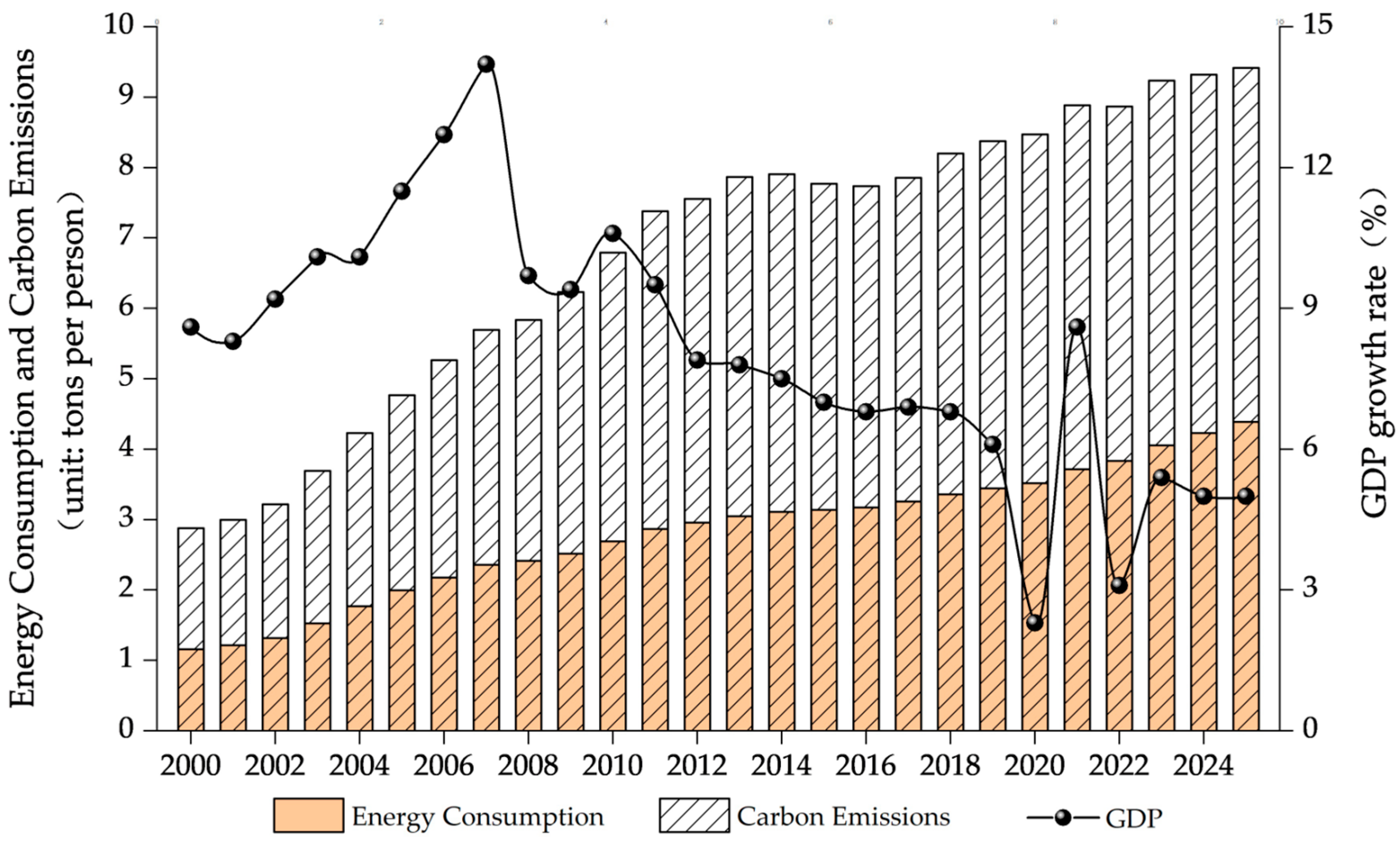
Greenhouse gas emissions are driving global environmental degradation. For major developing nations, in particular, strengthening environmental governance has become a crux for high-quality development [1]. As a chief developing nation worldwide, China attains remarkable economic progression since the reform and opening-up, relying on a development model that heavily relies on factors and energy inputs. This model, however, has resulted in severely excessive energy use and worsening environmental pollution, making carbon emission governance a core focus of national development. The 20th National Congress of the Communist Party of China has clearly identified carbon peaking and carbon neutrality as major national strategies, reflecting the government’s strong priority on this issue. Statistics from China Today published in September 2017 show that urban areas account for nearly 90% of China’s total carbon emissions, with clear regional gaps. This highlights the urgent need to strengthen urban carbon emission management and control (as shown in Figure 1). The Chinese government has further formalized the dual carbon goals as national strategies, issuing a dedicated guideline to build the 1+N policy system and clarify core emission reduction targets, exhibiting its firm commitment to global low-carbon governance. In academia, scholars also have conducted wide studies on China’s carbon emission reduction, exploring how emission abatement is affected by industrial structure upgrading, energy usage, environmental regulation, and digital economy development [2]. Cities are the main spatial carriers of energy consumption and the key area for carbon emission governance. Thus, exploring effective urban low-carbon transition paths is critical to advancing national emission reduction and achieving the dual carbon goals [3]. And, yet, Chinese low-carbon transition is now at a critical stage, facing such bottlenecks as an energy mix dominated by high-carbon fossil fuels, the industrial reliance on energy-intensive and high-carbon industries, the fragmented implementation of low-carbon policies, and the long-standing dilemma of balancing economic growth and carbon control [4,5]. Although the existing research has created rich findings and established a solid theoretical basis for practical work, breaking these bottlenecks to advance urban low-carbon transition is key in order for China to meet its international climate commitments and achieve the dual carbon goals. Meanwhile, it can also offer useful experience for other developing economies that face the same trade-off between growth and pollution reduction, help improve the coherence and effectiveness of China’s urban low-carbon governance, and provide practical references for the Global South to explore context-specific low-carbon paths, meaning that this study exhibits critical practical and theoretical implications [6,7].
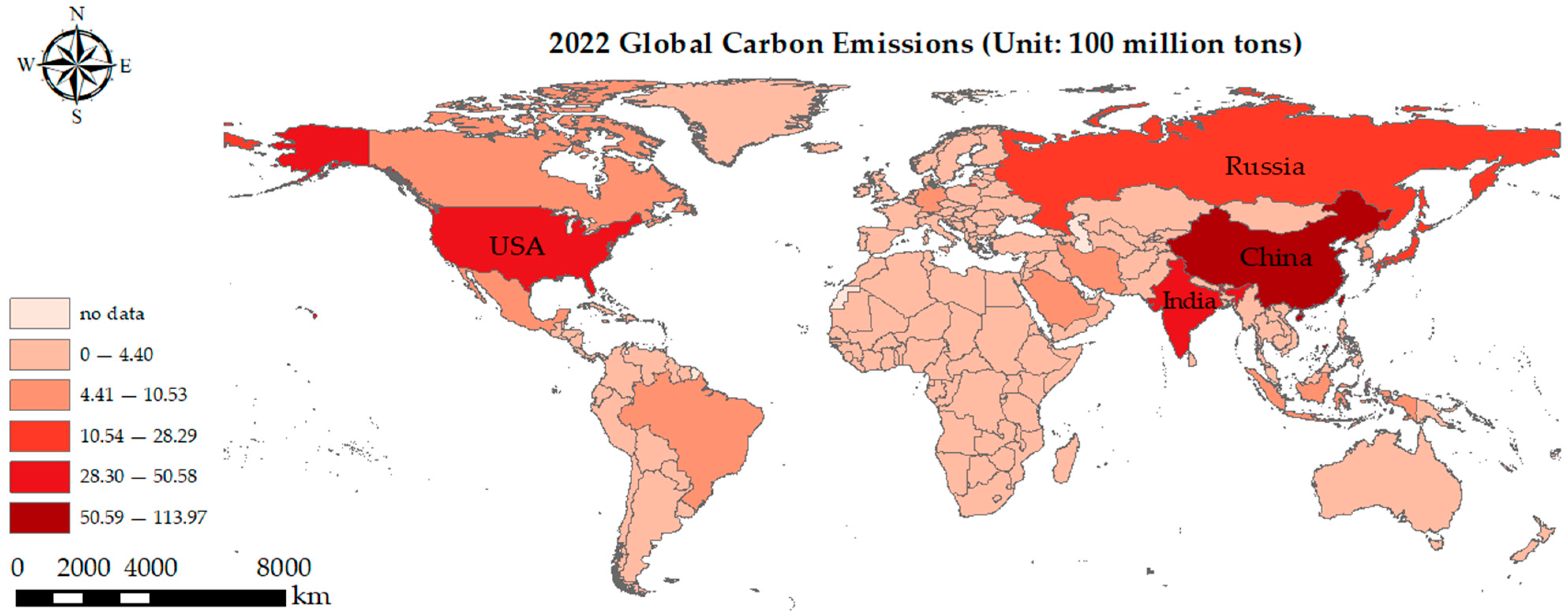
From a practical view, carbon emissions are affected by many factors—the institutional factor is especially critical. To be specific, institutional economists argue that institutional arrangements are the core of environmental governance, as they can effectively guide low-carbon development and curb carbon emissions in a targeted manner. Thus, the deep integration of the digital economy and real economy has created new opportunities for urban low-carbon transition [8]. E-commerce, the typical and vigorous segment of the digital economy, has become a core motivator for carbon emission reduction at the city level [9]. It reshapes the whole industrial chain of production, circulation, and consumption by breaking spatial barriers and improving resource allocation efficiency, and offers multiple feasible carbon reduction paths, which includes optimizing logistics systems, accelerating industrial transformation and upgrading, and guiding green consumption patterns [10,11]. Against the backdrop of low-carbon transition driven by digital economy progress, many countries have rolled out targeted policies to boost the standardized and large-scale development of e-commerce. China is no exception, as a major developing nation and the largest carbon emitter (as shown in Figure 2). Then, China formally launched the NEDCP in 2009, and expanded the pilot scope in 2011, 2014, and 2017, eventually covering 70 cities nationwide. The policy has built four supporting systems covering logistics and distribution, electronic payment, and credit systems, as well as security authentication, forming a complete system for policy innovation and industrial application. In practice, pilot cities have shown clear low-carbon transformation potential, drawing close government attention and prompting efforts to further realize the policy’s emission reduction potential. Existing studies preliminarily confirm the positive correlation between e-commerce development and carbon reduction, yet remain insufficient in comprehensive as well as thorough empirical tests toward the causal relation the NEDCP exerts upon urban low-carbon transition. Therefore, what is the NEDCP’s actual net effect on urban carbon emissions? What heterogeneous features does the NEDCP exhibit across different areas? What are its specific carbon reduction transmission mechanisms? Answering these questions can clarify how e-commerce pilot policies promote low-carbon transition, provide preliminary empirical evidence and targeted policy references for integrating the digital economy and green development in high-quality progress, and further enrich the theoretical framework of how digitalization can facilitate sustainable low-carbon development at an urban scale [12,13].
Taking the NEDCP scheme as a quasi-natural test, and adopting a panel dataset covering 283 prefecture-level cities across China over 2006–2022, the study uses a multi-stage DID strategy to empirically disclose how the policy affects urban low-carbon transition and its transmission channels. This study makes three innovations corresponding to existing studies. To be specific, firstly, it fully detects the impact of e-commerce policies on urban carbon emissions, offering clear empirical evidence for the policy’s carbon reduction effect. Secondly, it uses a multi-stage DID framework to evaluate the staggered policy effects of e-commerce pilots, overcoming the methodological limitations of conventional static policy assessments. Thirdly, it further explores the underlying mechanisms through which e-commerce policies affect carbon emissions, including energy usage efficiency, digital economy advance, and green innovation, while conducting wide heterogeneity and robustness tests.
The structure for this work of research is arranged as follows: To be precise, Section 2 systematically reviews related studies as well as recognizes crucial research gaps. Section 3 establishes the analytical framework for the theory as well as puts forward the corresponding research assumptions. Section 4 presents the empirical estimation results as well as implements the relevant analysis together with the discussion. Section 5 displays and examines the empirical findings. Section 6 concludes the research.

2. Literature Review

Existing studies have broadly detected the link involving e-commerce development and low-carbon transition at an urban scale. To be specific, we present a literature overview from three dimensions, creating a theoretical basis for subsequent empirical testing, and identifying the research gaps to clarify this study’s academic contribution.

2.1. Investigation into the Measurement and Influencing Factors for Carbon Emissions

Massive greenhouse gas emissions have worsened global warming and ecological degradation, making carbon emission abatement a core focus of global climate governance [1,6,7]. Therefore, how to measure the scale of carbon emissions has gradually become a key issue in academia. To be specific, a mature appraisal system has been created, with mainstream methods including the Intergovernmental Panel on Climate Change (IPCC) emission factor inventory, EDGAR geo-raster calculation, input–output analysis, and satellite remote sensing, offering data support for carbon emission evaluation [14,15,16,17]. Accordingly, using the above measurement methods lays a data basis for exploring the influencing factors of carbon emissions [18]. Existing studies have systematically examined the factor influencing carbon emissions at both the macro and micro scales, establishing a multi-dimensional analytical framework [19]. At the macro level, four core factors are widely discussed: energy, industrial structure, green innovation, and policy-institutional factors [2,20]. In terms of energy factors, Kousar et al. [21] conducted an analysis using the panel econometric model on data spanning 2000–2023 across the world’s top five green leader nations, verifying that renewable energy deployment greatly mitigates environmental degradation. However, adopting the panel cointegration test and the data from G7 countries over 1990–2022, Yilanci et al. [22] verified that renewable energy usage presents a positive correlation with carbon emissions in the short term, but, in the long term, the carbon reduction effect of renewable energy is restricted by economic development. As for institutional and policy factors, using a DID technique and the dataset from 285 Chinese cities spanning 2006–2019, Ji et al. [23] confirmed that, to some extent, environmental regulatory policies achieve notable carbon abatement effects. Conversely, based on a panel threshold model and a dataset from 30 OECD countries spanning 2000–2020, Li et al. [24] found that environmental regulations exhibit an inverted U-shaped effect on carbon emissions. Regarding the industrial structure, using a time-varying fixed-effects model and a dataset from 30 Chinese provinces over 2002–2021, Zheng et al. [25] conducted an empirical analysis and found a clear link between the industrial structure and carbon emissions. When it comes to technological innovation, Zhu et al. [26] conducted an analysis using a spatial Durbin model framework on data spanning 2006–2022 across 278 prefecture-level cities in China, revealing a clear link between technological innovation and carbon emissions. At the micro level, the firm scale, low-carbon philosophy and corporate investment behavior are widely-concerned core factors influencing carbon emissions [27]. To be specific, using a panel threshold model on data spanning 2012–2021 across Chinese listed manufacturing enterprises, Wang et al. [28] conducted an analysis, and revealed a clear link between firm size and carbon emissions. Jang et al. [29] conducted an analysis using a structural equation model framework on field questionnaire survey data spanning 407 employee samples from Malaysian public sectors, verifying a relation between employees’ low-carbon cognition and carbon emissions. Corporate low-carbon investment behavior is also verified to exert obvious inhibitory effects on carbon emissions in existing micro empirical studies [30,31].

2.2. Investigation into the Economic and Environmental Effects for E-Commerce Advancement

As a critical pillar of the digital economy policy framework, the economic and environmental effects for e-commerce advancement have obtained increasing academic attention [32]. Existing studies explore this topic along two dimensions: the economic effects and the environmental effects. For economic effects, the existing studies summarize four impacts, involving economic growth (GDP), income distribution, market transaction efficiency, and the regional economic balance. Among them, GDP and income distribution are regarded as the two core economic influences [33,34,35]. In terms of the impact on GDP, Wahiba [36] conducted an analysis using a dynamic panel data model on data over 1997–2021 across 10 major e-commerce markets, revealing that e-commerce and digitalization mutually stimulate GDP growth. From the income distribution view, using a panel econometric model and county-level data spanning 2011–2018 across rural China, Ma and Komatsu [37] conducted an empirical test, revealing that e-commerce reduces income inequality in less-developed counties but widens it in developed ones. Apart from the above two core effects, e-commerce also exerts positive functions in other economic dimensions. It effectively elevates market transaction efficiency by lowering search costs, reducing information asymmetry, and fostering a cross-regional arbitrage ability [38,39]. Furthermore, it helps advance a balanced economic growth by narrowing inter-regional growth gaps and promoting growth convergence across provinces [40,41]. For environmental effects, existing studies explore this topic along three core dimensions: sulfur dioxide (SO2), nitrogen oxides (NOx), and solid waste. In terms of the impact on SO2 emissions, using a dynamic panel model and a prefecture-level dataset across China over 2006–2018, Chen and Yan [42] conducted an analysis, and revealed that e-commerce development greatly reduces SO2 emissions. From the perspective of effects on NOx emissions, Li et al. [43] conducted an analysis using a staggered difference-in-differences model on data spanning 2014–2021 across Chinese prefecture-level cities, confirming that e-commerce expansion effectively curbs NOx pollution. Except for the pollution indicators mentioned above, the growth of e-commerce also exerts obvious impacts on solid waste generation and disposal. It reshapes the production structure of urban solid waste and solves new practical difficulties for regional ecological environmental governance [44,45].

2.3. Investigation into the Theoretical and Practical Application for DID Technique

In empirical studies on e-commerce policies’ low-carbon effects, the DID framework and its extensions have evolved with advances in causal inference [46]. At present, three mainstream and mature DID-based empirical identification strategies have been widely adopted in relevant studies, namely, conventional DID, multi-stage DID and spatial DID [47,48,49]. In early policy evaluation, scholars primarily used the conventional DID model for quasi-natural experiment analysis. Lv et al. [50] adopted the conventional DID model to investigate prefecture-level city panel data spanning 2009–2020 in China, confirming that pilot policies significantly reduce urban carbon emissions. As causal identification developed, researchers turned to multi-period DID, with two-way fixed effects (TWFE) becoming the dominant baseline. Liu et al. [51] employed the TWFE-based multi-stage DID method on a nationwide city-level panel dataset covering 2005–2021, verifying that low-carbon city pilot policies effectively curb carbon emission. However, in staggered DID settings with treatment effect heterogeneity—where policy impacts differ across cohorts and time periods—the traditional TWFE estimator suffers from severe bias due to improper weighting and contaminated control groups [52]. To address this, scholars developed a suite of heterogeneity-robust DID methods [53,54]. These optimized heterogeneity-robust estimation methods can revise irrational weight assignment rules, mitigate disturbances caused by invalid control samples, accurately distinguish differentiated policy effects across different periods and research objects, and acquire more reliable estimation results for policy effects [55]. As a leading robust estimator, did_imputation is widely used in low-carbon policy research. Braghieri et al. [56] adopted the did imputation approach for robustness verification when analyzing panel data from 775 U.S. colleges during 2004–2006 amid the staggered rollout of Facebook, and verified that social media adversely affected college students’ mental health. Additionally, Goodman–Bacon decomposition is commonly used to diagnose and decompose TWFE bias. Lyu et al. [57] adopted Goodman–Bacon decomposition combined with staggered DID to explore city-level panel data covering 2005–2019, demonstrating that neglecting treatment effect heterogeneity will underestimate the actual carbon reduction efficacy of policies. Given that many policies exhibit a clear geographic correlation and cross-regional spillovers, scholars developed the spatial DID model. Zeng et al. [58] used the spatial DID model to study urban panel data from 2006–2017 across China, concluding that low-carbon city pilot policies exhibit prominent positive spatial spillover effects on green total factor energy efficiency among adjacent regions.
Against this backdrop, the existing literature exhibits three major limitations: First, few studies systematically explore the impact of e-commerce policies on carbon emissions, leaving the causal link insufficiently understood. Second, it is rare for research to adopt the multi-stage DID technique to analyze e-commerce policies, lacking the rigorous causal identification of policy effects. Third, existing studies fail to examine the underlying mechanisms, leaving the transmission pathways of carbon reduction unexplored. Drawing on the methodology of Zhou et al. [59], this study addresses these gaps by improving the measurement of carbon emissions at the city level, clarifying multi-channel mechanisms, and conducting comprehensive heterogeneity and robustness tests.

3. Theoretical Analysis

3.1. Institutional and Historical Context of NEDCP Scheme

This study is theoretically grounded in institutional economics and factor allocation theory, two mainstream analytical frameworks widely adopted in environmental economics and digital policy research. Institutional theory explains that hierarchical pilot policies shape local governance incentives and constrain micro-agent behaviors via institutional design, which lays the institutional foundation for green low-carbon governance. Factor allocation theory indicates that digital economy policies represented by e-commerce demonstration initiatives can break cross-regional factor flow barriers, simplify circulation links, and improve energy and resource utilization efficiency. These two theoretical perspectives collectively validate the rationality of this study’s empirical model construction, core variable selection, and research hypothesis deduction.
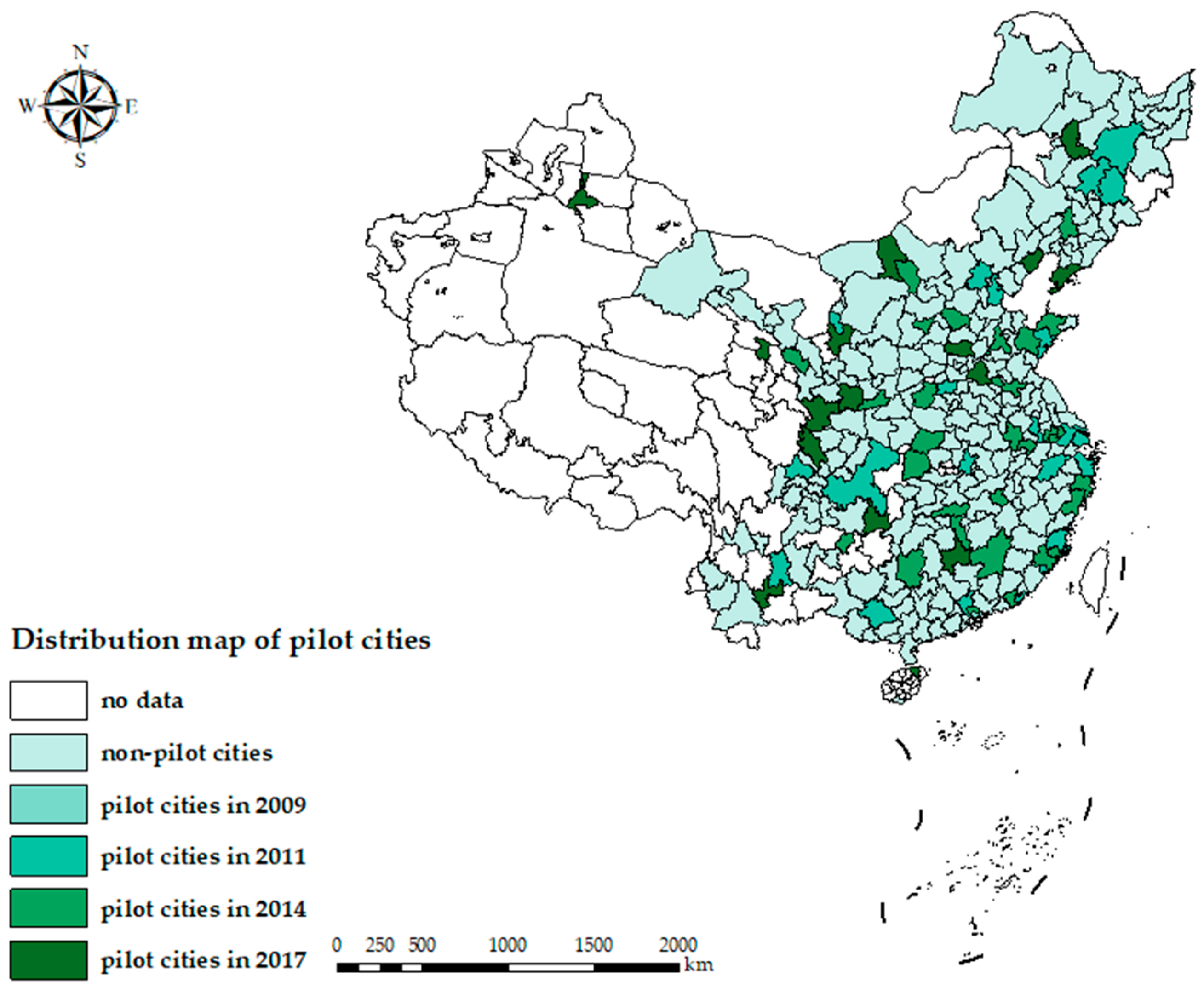
Against the severe global climate emergency and the urgent need for low-carbon development, balancing the digital economy and green growth has increasingly become a core global policy and research focus. As a core part of the digital economy, e-commerce facilitates low-carbon transition by breaking geographical restrictions, streamlining circulation links, and optimizing resource allocation. Global e-commerce platforms have promoted green logistics, digital supply chains, and green consumption, forming a coordinated development pattern of digitalization and low-carbon progress. To align with this trend, promote the integration of the digital and real economy, and explore sustainable urban development paths, China launched the NEDCP in 2009 with Shenzhen as the first pilot city for the innovative practice of having an e-commerce infrastructure, industrial integration, and policy support. The policy was rolled out in batches in 2011, 2014, and 2017, covering 70 cities nationwide with diverse economic and resource endowments (as shown in Figure 3). Guided by the principles of pilot innovation and demonstration promotion, the NEDCP has created four supporting systems including logistics distribution, electronic payment, credit services, and security authentication, forming a complete operational and diffusion framework. Pilot regions have launched targeted measures such as cost reduction, green logistics, intelligent scheduling, and green consumption incentives, which verify the carbon reduction potential of e-commerce. Over the past decade, Chinese e-commerce industry has achieved remarkable growth. As the core carriers of digital development, the NEDCP scheme has optimized industrial structures, improved resource efficiency, and formed a benign synergy of digital empowerment, industrial upgrading, and carbon abatement, offering a practical guide for nationwide low-carbon urban transformation.

3.2. Research Hypotheses

Theoretically, as a pivotal institutional innovation that empowers the real economy through digital development, the NEDCP significantly drives urban low-carbon transition via multiple routes, such as optimizing resource allocation, propelling industrial upgrading, and spurring green innovation. By lowering transaction costs, elevating circulation efficiency, and guiding the formation of green production and consumption models, the policy constructs a positive feedback cycle of policy incentives–technological innovation–structural optimization–carbon emission reduction, and ultimately exerts a pronounced suppressive impact on urban carbon emission [13]. Specifically, the NEDCP achieves direct carbon emission reduction through industrial digital transformation and intelligent urban governance, while also indirectly boosting low-carbon transition by fostering digital economy development and refining low-carbon institutional frameworks—forging a mutually reinforcing dynamic between policy implementation and urban low-carbon transformation throughout this process. With the progressive advancement of the NEDCP, the continuous maturation of the e-commerce ecosystem will further strengthen cities’ endogenous capacity for low-carbon transformation, and this positive feedback between policy implementation and urban green development will effectively advance the sustained high-quality development of the urban green economic system. Drawing on this theoretical foundation, this study proposes the corresponding research hypotheses:
Hypothesis 1 (H1).
The NEDCP exerts a pronounced suppressive impact on urban carbon emissions and delivers a notable driving effect on city-level low-carbon transition.
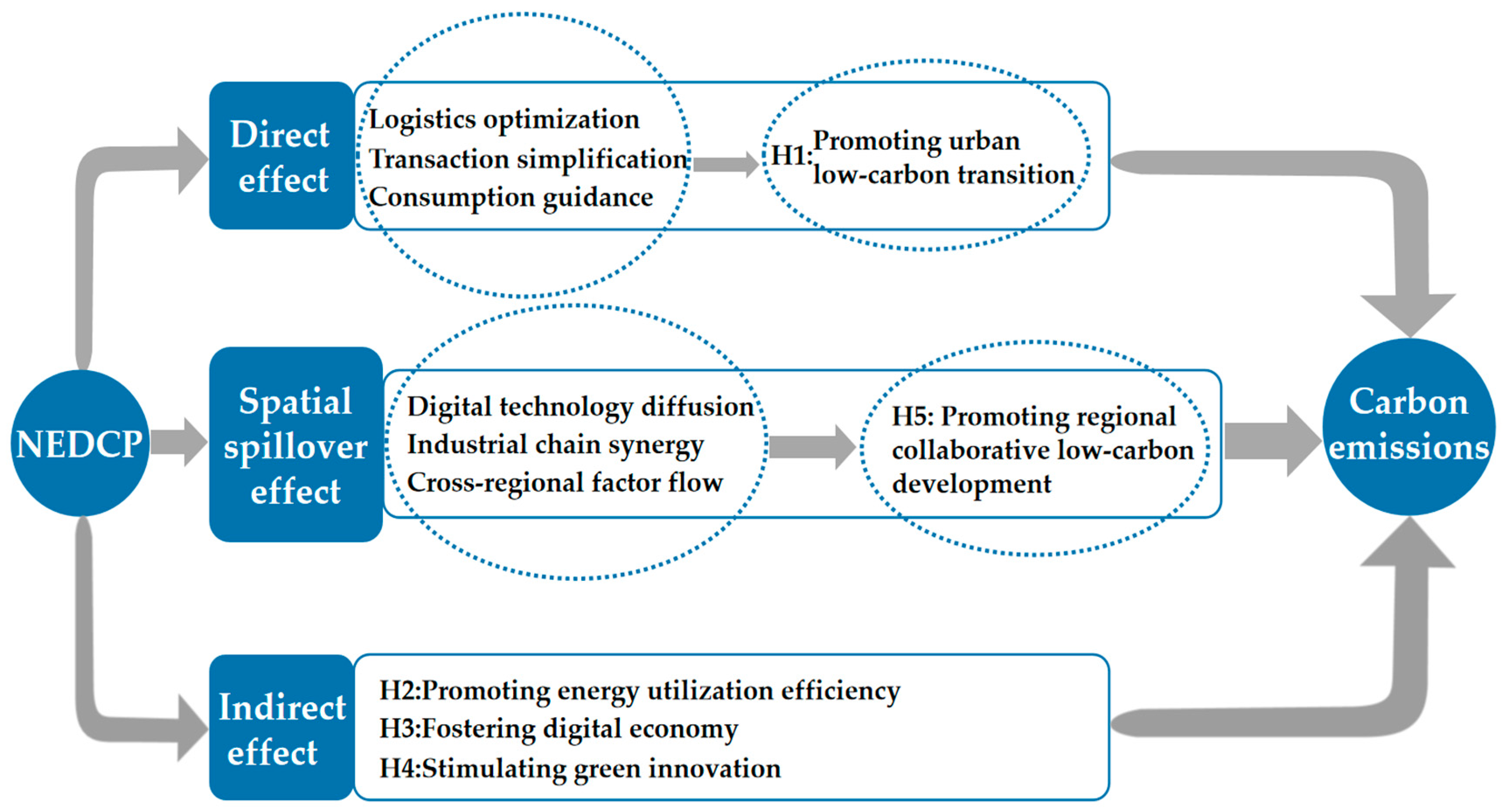
The NEDCP promotes urban low-carbon transition not only through direct effects such as optimizing logistics and reducing circulation links but also through three core paths: enhancing urban energy utilization efficiency, nurturing digital economy advancement, and driving green technology innovation. These paths interact and complement each other, forming a multi-dimensional policy effect transmission mechanism.
First, the NEDCP improves urban energy utilization efficiency and lays a foundation for low-carbon transition by optimizing resource allocation and enhancing energy conservation [12]. For one thing, the progress of the e-commerce industry has propelled the integration as well as sharing of logistics resources. Through intelligent scheduling and centralized distribution, the empty load ratio of transportation has been reduced, and the energy consumption per unit of goods has been decreased. For example, the centralized warehousing and unified distribution model adopted by e-commerce platforms can reduce transportation mileage by 20% to 30% compared with traditional scattered distribution, thereby reducing carbon emissions from the transportation sector. For another, e-commerce-driven enterprise digital transformation has achieved the optimization of production processes. Through data analysis and demand prediction, enterprises can accurately arrange production plans, avoid overproduction and resource waste, and improve energy utilization efficiency. In addition, the popularization of digital offices and online communication has reduced the demand for traditional office supplies and transportation, indirectly reducing energy use. Based on such analysis, we propose the corresponding research hypotheses:
Hypothesis 2 (H2).
The NEDCP facilitates urban low-carbon transformation by enhancing urban energy utilization efficiency.
Next, the NEDCP facilitates the advancement of the digital economic ecosystem and delivers a core driving force for urban low-carbon transformation. The digital economy, with its high permeability and scale effect, can deeply integrate with traditional industries, promote industrial structure upgrading, and drive the shift of economic growth patterns from high-carbon orientation toward low-carbon development [60]. Specifically, the progress of the digital economy has facilitated the expansion of low-carbon industries including information technology, digital services, and smart manufacturing, and curtailed the development space of high-energy-consumption and high-emission sectors through structural optimization. In the meantime, digital technologies such as massive data, and machine learning, as well as IoT have been widely applied in energy management, environmental monitoring, and pollution control, enhancing the accuracy and operational efficiency of low-carbon governance. For instance, the deployment of digital monitoring systems in industrial parks can realize the real-time monitoring of enterprise emissions and the timely adjustment of production strategies, achieving the targeted pollution abatement. On such a basis, we propose the corresponding research hypotheses:
Hypothesis 3 (H3).
The NEDCP promotes urban low-carbon transition via facilitating the advancement of the digital economy.
Third, the NEDCP stimulates urban green innovation activities and provides technological support for low-carbon transition. Policy incentives such as financial subsidies, tax preferences, and institutional guarantees provided by pilot cities have effectively reduced research expenses and uncertainties associated with corporate green innovation, stimulating the enthusiasm of enterprises for green technological R&D activities. For one thing, e-commerce platforms have become an important channel for the popularization and commercialization of green products, expanding the market demand for green innovation achievements and forming a demand–pull mechanism for green innovation. On the other hand, the data resources accumulated by e-commerce platforms can provide support for enterprises’ green innovation, helping enterprises accurately grasp the market demand for green products and improve the relevance and effectiveness of innovation. In addition, the initiative has boosted the communication and collaboration of green technologies across firms, expedited the popularization and application of green innovation outputs, and formed a synergistic innovation effect [61]. Based on such an analysis, the present research proposes the corresponding research hypotheses:
Hypothesis 4 (H4).
The NEDCP stimulates urban low-carbon transformation by incentivizing urban green innovation activities.
Furthermore, the establishment of NEDCP cities is not limited to promoting low-carbon transition within the city itself. Through cross-regional factor mobility, digital technology spillovers, and the integrated development of industrial chains, the low-carbon effect brought by the NEDCP will gradually radiate to surrounding cities and produce obvious spatial linkage effects. Specifically, pilot cities share mature green logistics models, digital governance experiences, and low-carbon industrial standards with adjacent areas, effectively narrowing regional carbon gaps and accelerating cross-city resource synergy. Such spillovers are amplified by regional market integration and intergovernmental cooperation mechanisms, strengthening the diffusion of low-carbon practices. Moreover, cross-border industrial linkages and a shared digital infrastructure further consolidate these spatial effects. As a result, neighboring cities can replicate and adapt successful low-carbon pathways with lower trial costs. That is to say, the implementation of the NEDCP not only helps cut down local carbon emissions but also drives the low-carbon transformation of neighboring regions through positive spatial spillover effects, forming a regional collaborative low-carbon development pattern [62].
Hypothesis 5 (H5).
The NEDCP produces significant positive spatial spillover effects on urban low-carbon transition; that is, this policy can cut down carbon emissions in adjacent cities and promote collaborative low-carbon development among regions.
In brief, based on the analysis mentioned above, we can summarize the impacts for the NEDCP scheme on urban low-carbon transformation, as exhibited in Figure 4.

4. Study Design

4.1. Econometric Model Specification

This research empirically investigates the causal influence of the NEDCP upon the urban carbon emission intensity at the prefecture-level city scale. Considering the staggered rollout timing of NEDCP pilot cities, we define the implementation start years for the four NEDCP batches as 2009, 2011, 2014, and 2017, respectively. Traditional DID estimation may lead to regression bias when applied to phased pilot policies [63]. Therefore, taking into account the quasi-natural experimental features of the NEDCP, we adopt a multi-period DID approach to accurately capture the causal impact of this policy upon urban carbon emissions at the city scale [64]. The corresponding model formulation is presented below:
Cenm = μ + γ × NE_DIDnm + θ × Controlnm + δn + ηm + εnm
Within Equation (1), subscripts m and n represent the year as well as each city, respectively. All variables integrated within the framework are clearly specified as follows: First, the dependent variable Cenm stands for urban carbon emissions, which is obtained by taking the natural logarithm of the total yearly carbon emissions in tons across each city. Second, the core independent variable associated with the NEDCP is NE_DIDnm, and is built by combining policy dummies with time dummies. Third, Controlnm denotes a group of city-level control variables, including economic development (pgdp), industrial composition (indus), fiscal expenditure (fiscal), trade openness (open), population density (dens), and financial advancement (finan). The coefficients μ, γ, and θ are regression estimation parameters in Model (1). Specifically, coefficient γ captures the net causal influence of the NEDCP upon urban carbon emission levels: notably, a negative γ signifies that the NEDCP restrains urban carbon emissions, whereas a positive γ suggests that the policy fails to achieve emission reduction. Furthermore, δn controls for the city fixed effect (ID FE), while ηm accounts for the year fixed effect (Time FE). The term εnm represents the stochastic disturbance term of the model.

4.2. Variable Selection

4.2.1. Dependent Variable: Urban Carbon Emissions (Ce)

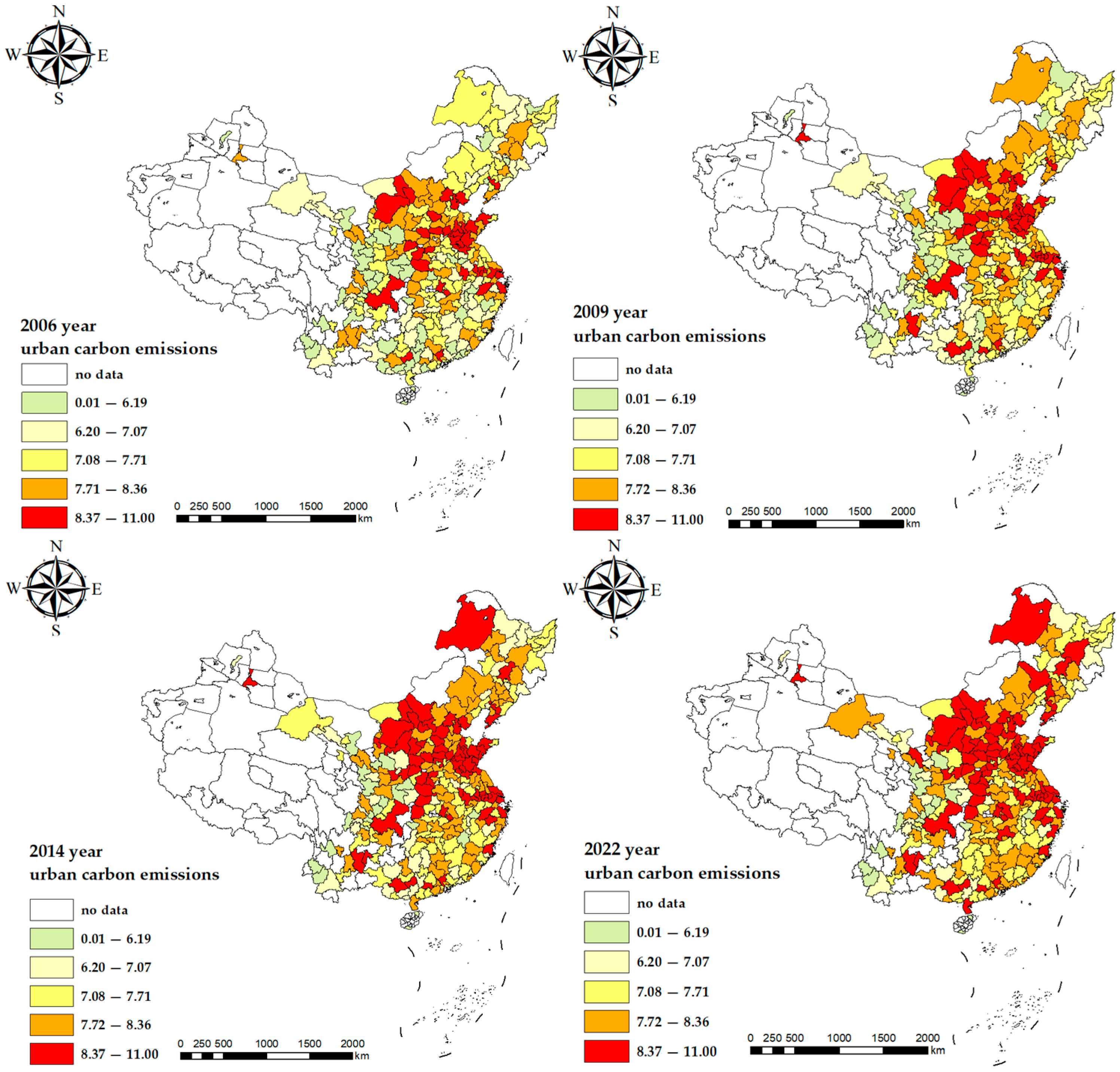
Theoretically speaking, total urban carbon emissions serve as the core outcome indicator for evaluating the low-carbon transition performance, which can comprehensively reflect the overall carbon reduction effect of urban policies and align with the research objective of identifying the NEDCP’s environmental impact. Empirical analysis relies on consistent, accessible, and reliable indicators to measure the core dependent variable. Consequently, this paper selects urban carbon emissions (Ce) as the dependent variable for empirical analysis [65]. Urban carbon emissions are proxied by the total annual carbon emissions (million tons) of each prefecture-level city, with raw data sourced from EDGAR. To ensure data comparability and mitigate heteroscedasticity, we process the raw data as follows: linear interpolation is applied to supplement missing values for individual cities in specific years, and the total carbon emissions are subjected to a natural logarithmic transformation to generate lnCe. This indicator enables a clearer depiction of urban carbon emission patterns across geographic space and provides a robust empirical basis for evaluating the NEDCP’s low-carbon performance (as shown in Figure 5).

4.2.2. Core Independent Variable: National E-Commerce Demonstration City Policy (NEDCP)

Theoretically, the NEDCP serves as a national staggered quasi-natural experiment that meets the requirements for identifying causal relationships in policy evaluation. It directly drives e-commerce development and affects urban low-carbon transition, making it the most appropriate core explanatory variable. To date, the Chinese government has approved four batches of e-commerce demonstration cities. Given a sample period ranging from 2006 to 2022, this paper includes all four cohorts of pilot cities across the empirical analysis, with implementation years specified as 2009, 2011, 2014, and 2017, respectively. Conventional DID methods face challenges in distinguishing the treatment group from the control group for phased pilot policies, which fails to capture the true policy effect. Therefore, we adopt the multi-period DID approach to accurately address how the NEDCP scheme affects carbon emissions across city-level dimensions. Firstly, the policy dummy indicator (PD) is constructed according to the NEDCP implementation status: PD = 1 for cities included in the four batches of NEDCP pilots (67 cities in total), and PD = 0 for cities outside pilot scope. Second, we design the time dummy indicator (TD) by taking the policy approval year as the starting point: TD = 1 for the base year and all subsequent years, and TD = 0 for the years before policy launch. The key explanatory variable NE_DID represents the interaction term of PD and TD, which we integrate into Model (1) to quantify the net impact of the NEDCP on urban carbon emissions. It should be noted that, after excluding three cities, we ultimately incorporate 67 prefecture-level pilot cities into the empirical analysis to ensure the integrity and reliability of the sample data. Specifically, Yiwu and Wujiaqu are county-level cities and thus excluded. Tongren was classified as a county-level city before 2011 and later upgraded to a prefecture-level city, resulting in inconsistent statistical data, so it is also eliminated from the sample.

4.2.3. Control Variables

Urban carbon emission levels are jointly shaped by the NEDCP and a series of urban characteristic factors. To isolate the pure policy effect and reduce estimation bias, six control factors are introduced into Model (1). Economic development level (pgdp): This is quantified as the per capita gross domestic product (yuan) of each city, which captures the influence of the regional economic scale upon carbon emission levels. Industrialization level (indus): This is reflected by the share that the secondary industry’s added value occupies across the local gross domestic product, which mirrors the influence exerted by the industrial structure toward carbon emissions, as the secondary industry serves as the dominant generator of energy use as well as carbon emission outputs. Population density (dens): This is computed as the ratio of the urban permanent population to the city’s administrative area (persons per square kilometer), which mirrors the influence of population agglomeration on energy use efficiency and carbon emission efficiency. Financial development (finan): This is measured by the proportion of year-end aggregate deposits as well as credits from financial institutions relative to the GDP, which reflects the support capability of the financial system for low-carbon advancement. Fiscal support (fiscal): This is reflected by the share of the fiscal outlay on science and technology within the total public expenditure, which embodies the role of government fiscal input in promoting low-carbon technological innovation as well as urban emission abatement. Economic openness (open): This is evaluated by the proportion of the overall import and export volume relative to the regional GDP, reflecting the effect of overseas trade and global technology spillovers on urban carbon emissions.

4.3. Source and Handling of Data

The sample period is determined based on theoretical rationality and policy consistency. First, 2006 is chosen as the starting point because it marks the initial formation of the Chinese e-commerce industry system and the availability of unified city-level panel data for core variables. Data before 2006 are incomplete, suffer from inconsistent statistical standards, and cannot support a balanced panel analysis. Second, 2022 is selected as the endpoint to cover the full implementation cycle of the four batches of the NEDCP (2009–2017) and to ensure sufficient post-policy observation periods for identifying dynamic policy effects. Meanwhile, city-level carbon emission data from EDGAR and official statistical yearbooks are available on a consistent basis up to 2022.
Empirical testing requires a comprehensive, consistent, and high-quality dataset. To construct the panel dataset covering 2006–2022, we match the NEDCP pilot list with prefecture-level cities’ datasets, and, finally, obtain a balanced panel sample covering 283 prefecture-level cities throughout mainland China after data cleaning. The primary data sources are as follows: (1) urban carbon emission statistics are obtained from the EDGAR database; (2) the NEDCP pilot information is derived from official National Development and Reform Commission releases; and (3) the data for control variables originate from the China City Statistical Yearbook, China Energy Statistical Yearbook, and Economy Prediction System (EPS) Database. Data processing follows strict empirical standards to ensure reliability. To be specific, first, missing values for individual variables in specific years are supplemented using linear interpolation. Second, all absolute indicators are transformed using natural logarithms to mitigate the impact of extreme values and heteroscedasticity. Third, the final dataset includes 4811 city-year observations, which are used for the subsequent regression analysis. Table 1 provides summary statistics for every variable.

5. Research Findings and Discussion

5.1. Benchmark Regression Analysis

To empirically verify the net effect of the NEDCP on urban carbon emissions, our research carries out regression analysis by sequentially introducing control variables alongside fixed effects. Furthermore, to address the potential estimation bias arising from the heterogeneous treatment effects in staggered DID designs, we adopt the heterogeneity-robust did_imputation estimator proposed by Borusyak et al. as our core benchmark model for empirical analysis [53]; the results are displayed in Table 2.
Column (1) displays the estimation outcomes of the TWFE model without incorporating control indicators. The estimated coefficient of the key explanatory indicator NE_DID is −0.062 (1% significance), which preliminarily indicates that the NEDCP generates a significant inhibitory effect upon urban carbon emissions. Column (5) presents the model estimation results of the TWFE framework including all control factors. The coefficient of NE_DID amounts to −0.059 (1% significance), suggesting that the implementation of the NEDCP lowers urban carbon emissions by approximately 5.9% on average relative to non-pilot cities. Column (8), as the core benchmark result, adopts the heterogeneity-robust did_imputation estimator to address the staggered DID estimation bias. This empirical specification accounts for the heterogeneous policy implementation timing across different research units and effectively avoids the estimation pitfalls embedded in conventional TWFE under a staggered treatment design. The coefficient of NE_DID is −0.071, remaining significantly negative at the 1% level. In terms of the environmental implication, given the standard deviation of NE_DID is 0.337 and the standard deviation of urban carbon emissions stands at 0.953, the policy coefficient of −0.071 translates into an approximate 3.1% reduction in the standard deviation of urban carbon emissions, reflecting a meaningful carbon-reduction benefit brought by the NEDCP. The remaining columns adopt alternative regression specifications, including the ordinary panel model without fixed effects, and the model only controlling for city fixed effects—Column (2) with the ordinary panel regression with per capita carbon emissions as the explained indicator, and Column (7) with the re-estimation with per capita carbon emissions as the explained indicator under varied fixed-effect combinations, all of which further validate the robustness of the core conclusion. Overall, the baseline regression results strongly support Hypothesis (H1), suggesting that the NEDCP significantly advances urban low-carbon transformation, which is also verified by Ni et al. [66].
In terms of the control variables, the industrialization level (indus) shows a significantly positive coefficient, consistent with theoretical expectations. As an important contributor to energy use and carbon emissions, the secondary industry substantially raises urban carbon emissions. The population density (dens) is positive in Columns (3) and (4) but negative in Columns (6) and (7), reflecting its dual effect: population agglomeration increases total emissions via a higher energy demand, yet reduces per capita emissions through scale effects and optimized resource allocation. Fiscal support (fiscal) yields a significantly negative coefficient, indicating that government fiscal investment in science and technology effectively promotes green innovation and carbon mitigation.
This baseline finding carries key theoretical and practical implications. Theoretically, it validates the causal nexus between digital economy policies and urban low-carbon governance, enriching the theoretical framework of institutional innovation for carbon abatement. Practically, it implies that the NEDCP acts as an effective policy instrument for urban emission reduction, offering a robust empirical contribution to Chinese dual carbon targets. For policymakers, steadily expanding e-commerce pilot programs can serve as a core measure to advance urban low-carbon transition.

5.2. Parallel Trend Test and Placebo Test

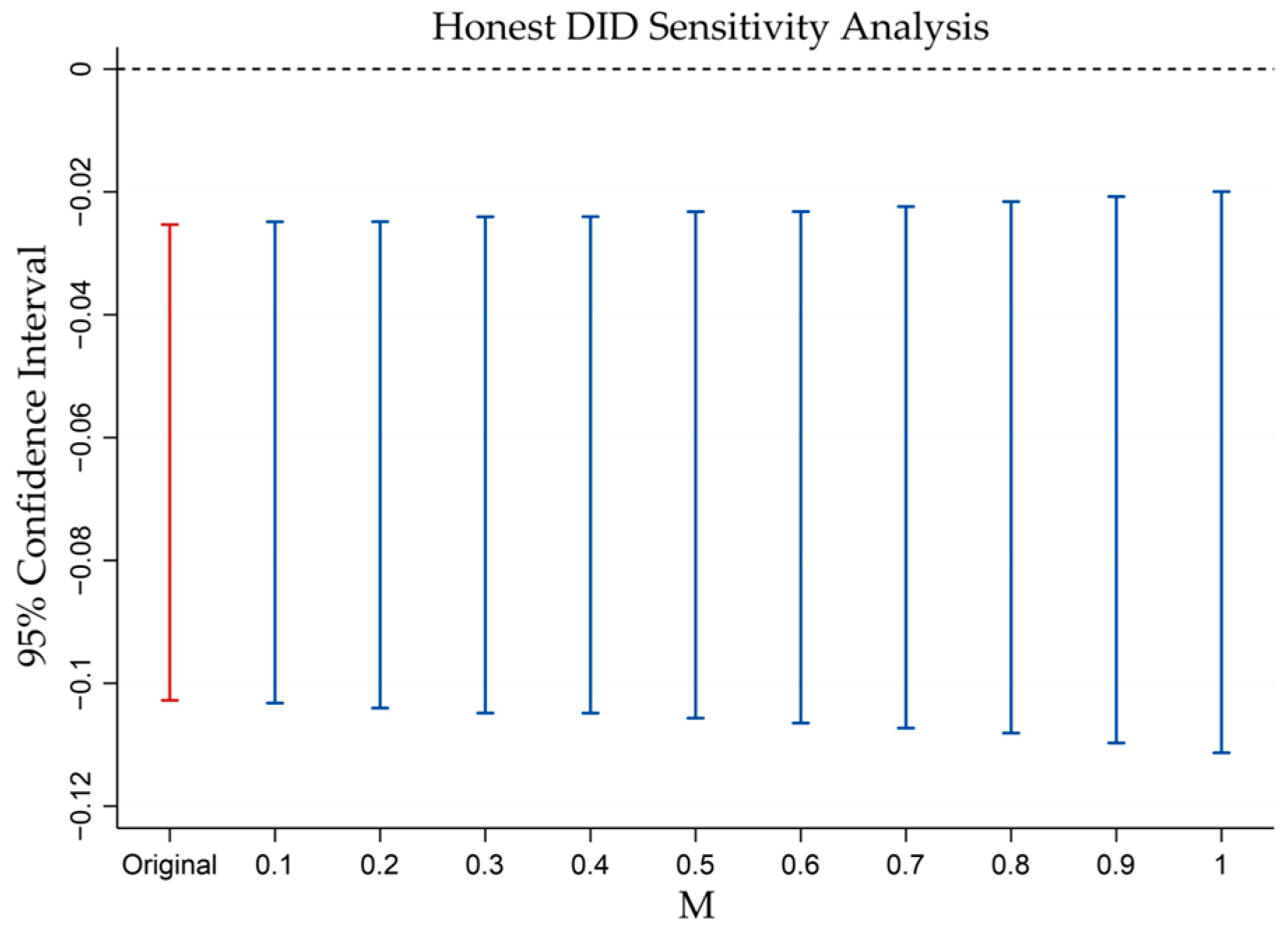
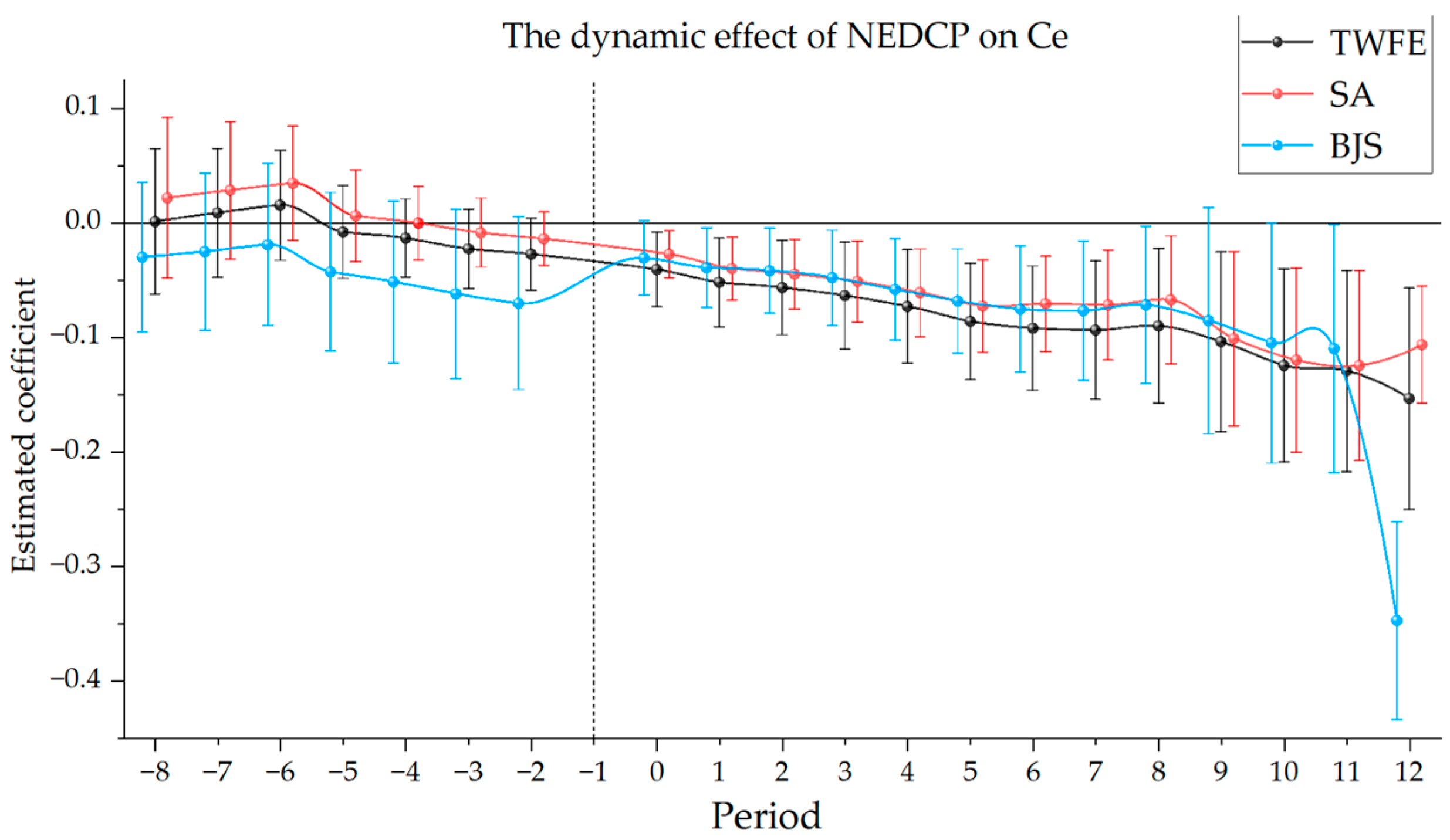
First, to verify the parallel trend premise, the core prerequisite of the DID framework, our research adopts three estimation methods. The first approach is the event study method. Furthermore, in response to concern that the conventional TWFE estimator may suffer from estimation bias in staggered DID settings with heterogeneous treatment effects, we further adopt the heterogeneity-robust estimator proposed by Sun and Abraham [54] (hereafter, the SA estimator) and the did_imputation estimator proposed by Borusyak et al. [53] (hereafter, the BJS estimator) as heterogeneity-robust specifications for rigorous parallel trend identification and the primary methods of the parallel trend test. We combine the estimation results of the three approaches into Figure 6. The findings indicate that nearly all pre-policy coefficients across the three estimators are statistically insignificant and fluctuate around zero, with only a marginal 10%-level significance detected in the pre-2 period of the BJS estimator. No systematic pre-existing trend in carbon emissions is observed across all specifications, which indicates that the carbon emission trajectories show no obvious disparity between the treatment and control cities prior to policy enactment, thereby verifying the validity of the parallel trend hypothesis. After policy implementation, the coefficients from all three estimators are significantly negative, with the emission reduction effect gradually increasing over time, suggesting that the low-carbon effect of the NEDCP has a sustained cumulative characteristic. To further alleviate the potential interference of minor deviations from the parallel trend assumption on our estimates, we conduct the honest DID test developed from Rambachan and Roth [67], which adopts the relative pre-trend deviation constraint to construct robust confidence intervals. The results are presented in Figure 7. Specifically, under the baseline scenario, the 95% confidence interval of the policy effect is [−0.103, −0.025], which is significantly negative. Even when allowing for a maximum relative deviation of 1 from the parallel trend assumption, the corresponding 95% confidence interval remains [−0.111, −0.020], entirely below zero. This indicates our core conclusion that the NEDCP significantly helps to cut down urban carbon emissions, remains robust, and does not reverse even when the parallel trend assumption deviates to a certain extent.
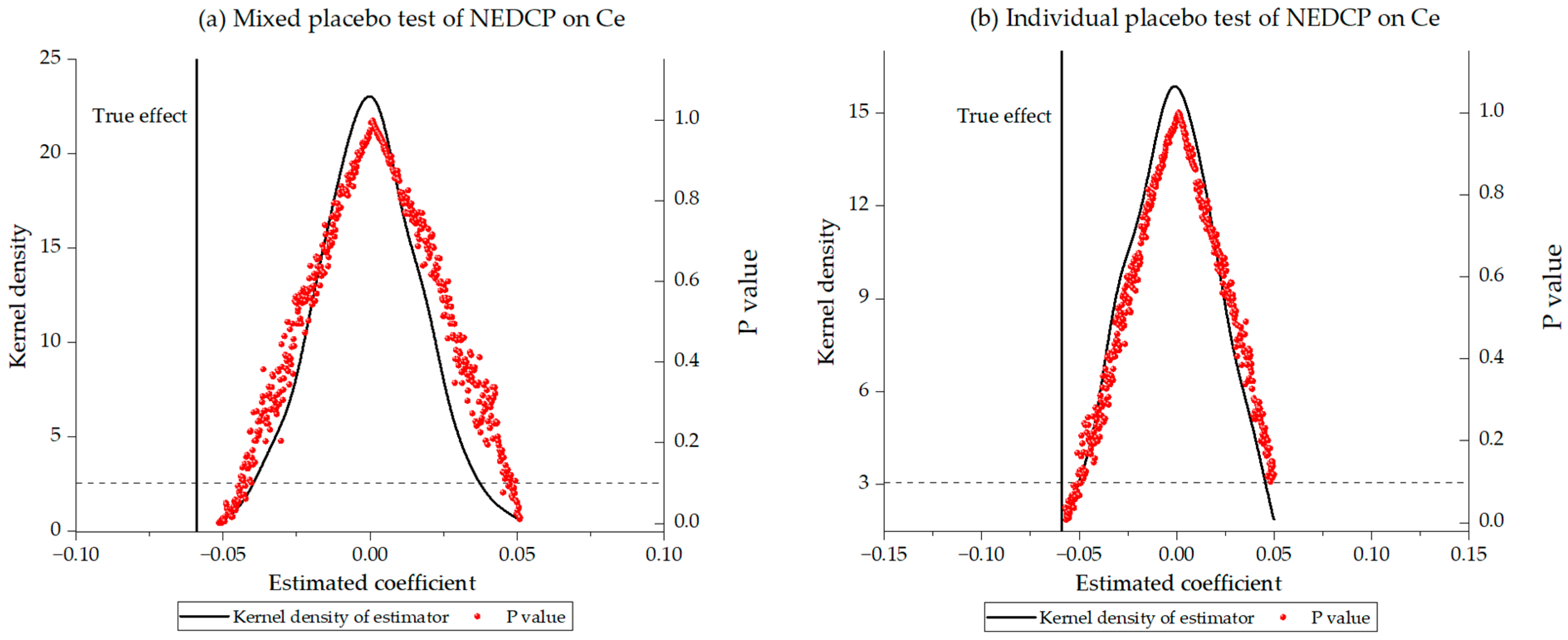
Second, we perform two sets of placebo tests to alleviate the potential interference from unobservable confounding factors on our baseline estimation outcomes. First, following the standard practice, we conduct a mixed placebo test, where we randomly select 67 cities from the full sample as fake pilot cities, and arbitrary assign their policy implementation years within the sample period. We repeat the randomization process for 500 rounds, re-estimating the benchmark model each time to obtain the empirical distribution of placebo coefficients. The results are presented in Figure 8a. We can see that the distribution of the placebo coefficients is roughly centered at zero, following a normal distribution. In contrast, the true baseline coefficient of the NEDCP (−0.059) is located far in the left tail of the spread, with almost none of the placebo coefficients reaching this magnitude. To further enhance the stringency of the placebo test, we conduct an individual-level placebo test, where we only randomly select the fake pilot cities while keeping the real policy implementation years unchanged. This stricter test helps to alleviate the interference of time trends and other time-varying confounding factors. We also repeat this process 500 times, with the empirical outcomes presented in Figure 8b. Similar to the mixed placebo test, the placebo coefficients from the individual-level test are also concentrated around zero, and the true policy impact is still obviously divergent from the placebo distribution. These results strongly indicate that the significant emission reduction impact detected in the benchmark regression is not caused by random chance or omitted variables, but genuinely results from the implementation of the NEDCP, further verifying the robustness of our core findings.

5.3. Robustness Analysis

To guarantee the reliability and generalizability of the research conclusions, we carry out eight robustness checks including CSDID estimation, PSM-DID, the replacement of the dependent variable, adjustment of the sample period, lagged control variables, the modification of the sample scope, and double machine learning (DML). Moreover, instrumental variable estimation is further adopted merely as supplementary robustness evidence. All related results are reported in Table 3.
Column (1) presents the CSDID estimator developed by Callaway and Sant’Anna [48], which addresses the staggered DID estimation bias from heterogeneous treatment effects by constructing group-time average treatment effects using only never-treated units as valid controls. Unlike the conventional TWFE estimator, this approach effectively circumvents the negative weighting problem that can arise in staggered treatment settings, ensuring positive estimation contributions from each treatment group-time cohort. The coefficient of the estimated treatment effect of the NEDCP on urban carbon emissions (denoted as NE_DID) is −0.047, statistically significant at the 5% level, which aligns closely with our baseline findings and supports the robustness of the core policy effect after accounting for treatment effect heterogeneity.
Column (2) reports the PSM-DID estimation to alleviate the sample self-selection bias arising from the inherent disparities across pilot and non-pilot cities, following an approach proposed by Xu et al. [63]. The results show that the estimated parameter of NE_DID is −0.030, which is statistically significant at the 1% level. This finding indicates that, after removing the inherent discrepancies across the treated and reference units, the NEDCP still exerts a substantial emission cutting influence, which is fully consistent with the baseline results.
Column (3) adopts carbon intensity as the explained variable (carbon emissions per unit GDP) to test the sensitivity of the outcome measurement. NE_DID yields a significantly negative coefficient at the conventional 5% significance level; this proves the NEDCP effectively reduces the urban carbon emission intensity and validates the robustness of the core findings.
Column (4) adjusts the sample period to 2009–2019 to avoid disturbances from the 2008 global financial turmoil and the 2020 coronavirus outbreak. The NE_DID coefficient stays statistically negative at the 1% significance level, indicating that the policy impact is not driven by extreme events.
Column (5) lags all control variables by one period to alleviate any potential reverse causality between the control variables and carbon emissions. NE_DID yields a markedly negative coefficient at the 1% statistical threshold, reducing the interference of reverse causality and supporting the stability of the results.
Column (6) modifies the sample scope by excluding municipalities, sub-provincial cities, and provincial capitals to alleviate the impact of administrative hierarchy advantages. The NE_DID coefficient remains statistically negative at the 1% significance level, verifying that the carbon abatement impact persists in non-priority administrative cities.
Column (7) implements the DML approach to mitigate the model misspecification bias caused by flexible functional forms of covariates and further rule out the interference of unobserved confounding factors. The estimated coefficient of NE_DID is significantly negative at the 1% level, which is highly consistent with the baseline result and verifies the reliability of the policy effect.
To further address potential endogeneity concerns, we conduct two instrumental variable (IV) estimations. Given that the selected instrumental variables may fail to strictly satisfy the exclusion restriction due to unobserved long-term urban development factors, IV regression results only serve as auxiliary supportive evidence. Following Luo et al. [68], Column (7) uses the interaction of the urban river density and post-policy time dummy (IV_1); in terms of relevance, a higher river density facilitates waterborne logistics development and supports e-commerce industry agglomeration, which promotes the implementation of the NEDCP; in terms of exogeneity, river density is a time-invariant natural geographic endowment, and time-varying confounders are absorbed by fixed effects. Following Huang et al. [69], Column (8) adopts the stricter historical IV (IV_2), the interaction of the post-policy time dummy and count of post offices in 1984; in terms of relevance, it predicts e-commerce adoption; in terms of exogeneity, as historical data from 1984, it exerts no direct effect on carbon emissions in the sample period. The two-stage least squares (2SLS) coefficients of NE_DID are −0.091 (1% significance) and −0.070 (1% significance). The Kleibergen–Paap rk LM statistic rejects under-identification and the Cragg–Donald Wald F statistic rules out weak instrument bias in both specifications. Collectively, these IV tests provide supplementary robustness evidence supporting the conclusion that the NEDCP reduces urban carbon emissions.
Finally, to assess the magnitude of the potential bias in the multi-period DID estimates under the TWFE framework, this study follows Goodman–Bacon’s decomposition approach [55]. The analysis decomposes the overall TWFE estimator into three 2 × 2 DID components: (1) early-treated cities versus late-treated cities; (2) late-treated cities versus early-treated cities; and (3) pilot cities versus non-pilot cities. The decomposition results are summarized in Table 4.
The comparison of late-treated against early-treated cities yields a coefficient of 0.015 with a relatively small weight of 3.8%, indicating a negligible contribution to the overall estimate. In contrast, the pilot versus non-pilot comparison dominates the decomposition, with a coefficient of −0.067 and a weight of 93.2%. This dominant weight suggests that the baseline estimate is primarily driven by the cleanest policy contrast, and that the core finding remains robust even after accounting for heterogeneous treatment effects across cohorts.
Overall, all robustness checks consistently verify that the coefficients for NE_DID remain significantly negative, suggesting the stable and credible emission-inhibiting effect of the NEDCP on urban carbon emissions. Theoretically, these robustness checks enhance causal identification and consolidate the theoretical foundation for digital-e-commerce-driven urban low-carbon transition. Practically, they suggest the stable emission-reduction effect of the NEDCP and support its continued expansion as a key tool for China’s dual carbon goals.

5.4. Policy Uniqueness Test

Within the sample interval, other parallel pilot initiatives may also influence urban carbon emissions, which could result in an overestimation of the NEDCP’s emission mitigation impact. To disentangle the net causal effect for the NEDCP, this study introduces five relevant pilot policy dummy variables into the benchmark model, including new energy demonstration city pilot policies (energy_did), national innovative city pilot policies (innovative_did), renewable energy building application demonstration policies (renewable_did), green finance reform and innovation pilot zones (greenfinan_did), and low-carbon city pilot policies (lc_did), with the estimation results shown in Table 5.
The regression results show that, when sequentially introducing each of the five policies, the coefficient of NE_DID stays notably negative at the 1% or 5% thresholds, with magnitudes varying from −0.048 to −0.059, which is little changed from the benchmark result (−0.059). When all five policies are included simultaneously, the NE_DID coefficient is −0.037 (1% significant), which still accords with the baseline outcome in terms of the sign and statistical significance. This reveals that carbon reduction effect of the NEDCP is not confounded by other parallel policies, and the policy itself has a unique role in promoting urban low-carbon transition.
After substituting the original dependent variable with per capita carbon emissions (lnpce) and nesting the five aforementioned policy covariates into the regression specification, the coefficient of NE_DID is −0.050 (1% significant), maintaining the same sign and significance as the benchmark result. Among the other policies, the coefficients of innovative_did (−0.093) and greenfinan_did (−0.132) are significantly negative, revealing that national innovative city pilot schemes and green finance reform alongside innovation trial zones also contribute to advancing carbon emission reduction, which accords with the findings from prior studies.

5.5. Heterogeneity Analysis

Given the substantial cross-city disparities in opening-up level, population scale, economic development level, and innovation capacity among Chinese cities, the carbon reduction effect of the NEDCP may exhibit heterogeneous characteristics. This study conducts a heterogeneity analysis from four dimensions—the opening-up attribute, population scale attribute, economic development attribute, and urban innovation attribute—with the outcomes shown in Table 6.
In terms of the opening-up attribute, cities are grouped into high-opening-up cities and low-opening-up cities according to the degree of economic openness. The estimation results indicate that the NE_DID coefficient for high-opening-up cities is −0.0656 (5% significant), with 2414 observations, while the coefficient for low-opening-up cities is −0.0362 (insignificant), with 2397 observations. This indicates that emission reduction impact of the NEDCP is highly prominent in cities with high openness, while the policy influence lacks statistical significance in cities with low openness. To account for this heterogeneous policy effect, high-openness cities have more frequent foreign trade exchanges, more mature market-oriented mechanisms, and better access to international advanced digital technology and the green development experience, which can better integrate e-commerce development with international low-carbon development concepts and realize efficient carbon emission reduction. In contrast, low-opening-up cities are restricted by insufficient foreign trade links, a lagging digital technology introduction, and imperfect market mechanisms, which prevents the full release of the carbon mitigation potential embedded in e-commerce-related policies.
Regarding the population attributes, cities are classified into large-scale and non-large-scale cities based on the resident population size. The findings demonstrate that the NE_DID coefficient for large cities is −0.0646 and significant at the 1% level, with 3791 observations, while the coefficient for non-large cities is 0.0137 (insignificant), with 1020 observations. This indicates that the NEDCP’s carbon abatement effect is only statistically valid among large cities. The underlying mechanism is that large cities have a more complete digital infrastructure, more sound logistics systems, and stronger industrial agglomeration effects, which can better utilize the strengths of e-commerce in enhancing resource distribution and fostering green innovation. Conversely, small- and medium-sized cities frequently face development limits, including an inadequate infrastructure and insufficient industrial backing, restricting policy efficiency.
With regard to the economic development attributes, cities are classified into high-economic-development cities and low-economic-development cities on the basis of the per capita GDP. The empirical outcomes indicate that the estimated coefficient of NE_DID among high-economic-development cities is −0.0503 (significant at the 5% level), whereas the corresponding coefficient for low-economic-development cities is −0.0356 (statistically insignificant). These findings confirm that the NEDCP generates a pronounced carbon mitigation effect in high-economic-development cities, whereas its policy influence lacks statistical significance in low-economic-development cities. The fundamental reason is that high-economic-development cities possess adequate financial backing, cutting-edge technological R&D capacities, and a well-established industrial framework, which can offer robust material and technological support for advancing e-commerce practices, together with driving low-carbon transition. Conversely, low-economic-development cities are constrained by scarce financial resources, and an irrational industrial composition, together with deficient technological innovation capacities. These drawbacks hinder the deep integration between e-commerce and low-carbon transformation, preventing the policy’s carbon reduction potential from being fully unlocked.
In terms of the urban innovation attribute, cities fall into high-innovation-level and low-innovation-level clusters according to urban green innovation scales. The empirical findings indicate that the NE_DID coefficient for high-innovation-level cities is −0.0486 (5% significant), with 2414 observations, while the coefficient for low-innovation-level cities is −0.0363 (insignificant), with 2397 observations. This heterogeneous outcome demonstrates that the carbon reduction benefits brought by the NEDCP are considerably more pronounced in high-innovation cities, while the policy fails to generate a statistically meaningful carbon abatement effect among low-innovation counterparts. One plausible explanation is that high-innovation-level cities hold robust green technology research and development capabilities, abundant innovation talents, and active innovation activities, which can effectively match with the e-commerce policy, facilitate the transformation and commercialization of green innovation achievements through e-commerce platforms, and form a synergy of e-commerce development and green innovation to achieve carbon emission reduction. However, low-innovation-level cities are restricted by insufficient innovation resources, weak green technology R&D capabilities, and the slow transformation of innovation achievements, which make it impossible to form an effective synergy with e-commerce policies, and, thus, the carbon mitigation effect of this policy proves to be not statistically significant.
The heterogeneity results yield important theoretical and practical implications. They reveal the spatiotemporal disparities in policy effects conditioned on urban endowment characteristics, and underscore the need for differentiated, targeted low-carbon governance strategies rather than a uniform one-size-fits-all policy paradigm.

5.6. Transmission Channel Analysis

Building on the benchmark regression results confirming the NEDCP’s significant carbon abatement effect, this section further explores the policy’s potential impact paths from three key dimensions: energy utilization efficiency (energy), digital economy development (digital), and green innovation (green). Specifically, energy utilization efficiency is measured by the GDP output per unit of energy consumption. For digital economy development, we construct a comprehensive index incorporating multiple dimensions: employment in information transmission, computer services and software industries, internal R&D expenditure, patent grants, telecommunication business revenue, year-end mobile phone subscribers, and the digital inclusive finance index. Green innovation is proxied by the number of green invention patent applications. Following Huang et al. [70], to establish the stability of the transmission mechanisms, we also stratify the NE_DID variable into two subgroups according to the percentiles of each mechanism variable, the low subgroup (falling below the 40th percentile) and the high subgroup (exceeding the 60th percentile), to comprehensively examine how the NEDCP influences carbon abatement at the city level. Table 7 summarizes the above estimation results.
First, as illustrated in Column (1), regarding the impact of the NEDCP on the energy utilization efficiency, the estimated coefficient of NE_DID reaches 0.0193 and remains statistically positive at the 1% significance level, which implies that the implementation of the NEDCP can significantly improve the urban energy utilization efficiency. Furthermore, Column (2) reports the grouping regression results for urban carbon emissions: the coefficient of NE_DID_high is −0.0709, significantly negative at the 1% level, whereas the coefficient of NE_DID_low is 0.0083 and shows no statistical significance. In other words, the higher the energy utilization efficiency, the larger the carbon abatement benefits of the NEDCP for cities.
Second, in terms of the digital economy as illustrated in Column (3), the regression coefficient of NE_DID is 0.0099, which is significantly positive at the 1% level. This finding demonstrates that the NEDCP strongly promotes the growth of the urban digital economy. Column (4) further presents the grouped estimation results for carbon emissions: the coefficient of NE_DID_high is −0.0578 and statistically significant at the 1% level, while the coefficient of NE_DID_low is 0.0421 and lacks statistical significance. This demonstrates that cities with a sounder pre-existing digital economy gain stronger carbon mitigation effects from the policy.
Third, regarding the green innovation mechanism as illustrated in Column (5), the estimated coefficient of NE_DID is 0.0392, showing a significantly positive association at the 1% significance level. This result reveals that the NEDCP effectively stimulates urban green innovation activities. Column (6) presents the subsample regression results for carbon emissions: the coefficient of NE_DID_high is −0.0700 and highly significant at the 1% level, whereas the coefficient of NE_DID_low is −0.0391 and statistically insignificant. This means that, the more advanced a city’s green innovation capability is, the more pronounced the carbon abatement effect of the NEDCP becomes.
Accordingly, these findings enrich the theoretical framework of digital empowerment for green development, while underscoring the practical implications for prioritizing these key dimensions to amplify the NEDCP’s carbon abatement effect.

5.7. Further Extended Analysis

5.7.1. Spatial Spillover Effects Analysis

The traditional multi-period DID model ignores the spatial interdependence between regions, which might result in biased assessments of policy impacts. Accordingly, this paper further adopts spatial econometric approaches to investigate the spatial spillover effects of the NEDCP upon urban low-carbon transformation, so as to fully identify the overall impact of the policy implementation.
Specifically, referring to the weight matrix setting of Xu et al. [71], we construct two spatial weight matrices based on the geographic coordinates of sample cities, a binary distance matrix (W1) with a 1000 km threshold and an inverse distance squared matrix (W2), both of which are row-standardized to meet the requirements of spatial econometric estimation. On this basis, we adopt Global Moran’s I statistic to examine the spatial autocorrelation features of urban carbon emissions during 2006–2022. The results show that the Moran’s I statistic for urban carbon emissions remains positive and statistically valid at the 1% level throughout the sample period, indicating that China’s urban carbon emissions exhibit prominent positive spatial clustering characteristics, which provides a necessary premise for the subsequent spatial regression analysis. Given the confirmed spatial autocorrelation of urban carbon emissions, we adopt a spatial autoregressive (SAR) specification embedded with Urban-Time TWFE for regression estimation. Meanwhile, we split policy influence into direct influence, indirect influence, and overall influence, so as to accurately identify the local carbon reduction influence and spatial spillover influence brought by the NEDCP. Table 8 shows the estimated results.
As shown in Table 8, the NE_DID estimate stays statistically negative under the 1% significance threshold across both spatial weight matrices, consistent with the baseline results and confirming the NEDCP’s robust carbon abatement effect. The spatial correlation coefficient ρ is significantly positive in both specifications, implying the obvious spatial dependence in urban carbon emissions, whereby local low-carbon development delivers emission-reduction benefits to neighboring cities. Effect decomposition shows that the direct, indirect, and total effects of the NEDCP are entirely significantly negative at the 1% level. The significant direct impact verifies the policy’s emission reduction role in pilot cities, while the negative indirect effect confirms notable spatial spillovers: the NEDCP promotes low-carbon development in adjacent cities through experience diffusion, resource flow, and industrial chain linkages. The aggregate outcome further reveals that incorporating spatial dependence amplifies the NEDCP’s overall carbon mitigation capacity, offering credible empirical evidence in favor of Hypothesis 5 (H5).
The spatial spillover effect is mainly formed through three channels. First, reproducible low-carbon governance practices originating from pilot cities diffuse to peripheral regions through intergovernmental cooperation and cross-region industrial deployment, reducing policy trial costs and accelerating the low-carbon transformation of adjacent areas. In addition, the digital infrastructure, green technologies, and high-quality factors concentrated in pilot cities radiate geographically to the surrounding regions, generating resource spillovers and improving their low-carbon development capacity. Third, the NEDCP-driven cross-regional expansion of e-commerce industrial chains facilitate the coordinated low-carbon upgrading of upstream and downstream industries, ultimately fostering a regional pattern of collaborative emission reduction. These spatial-based results deepen the theoretical mechanism concerning policy-led low-carbon transition and furnish reliable empirical grounds for formulating coordinated and differentiated low-carbon governance schemes across different regions.

5.7.2. Micro Evidence of NEDCP’s Impact on Urban Low-Carbon Transition

To further identify the microscopic effects of the NEDCP, we adopt the baseline regression framework and identification strategy proposed by Chen et al. [72]. Firm-level data are obtained from the China Stock Market & Accounting Research (CSMAR) Database, including 13,923 firm-year observations covering 1071 Chinese cities during 2010–2022, to evaluate the net effect of the NEDCP upon the firm-level carbon emission loss.
In the benchmark regression model, the dependent variable CP denotes the corporate carbon loss, which represents the degree of inefficient carbon emissions of enterprises. The core independent variable NE_DID serves as the policy dummy indicator of the NEDCP, which equals 1 if the city where the enterprise is located becomes a pilot city in the current year and thereafter, and 0 otherwise. To avoid an estimation deviation arising from the omitted variables, this paper introduces a set of control variables through gradual inclusion: Size represents the enterprise scale, measured by the logarithmic value of total assets; Lev denotes the gearing ratio, reflecting the corporate debt status and financial soundness of the enterprise; ROA refers to the return on total assets, measuring profitability; Fix is the proportion of fixed assets, characterizing the asset structure; Indep represents the ratio of independent directors, reflecting the corporate governance structure; Top1 stands for ownership concentration, measured by the shareholding ratio of the largest shareholder; Age is the number of years since the enterprise was established, capturing the life-cycle characteristics. The corresponding empirical outcomes are shown in Table 9.
Table 9 reports the regression outcomes based on the TWFE model with standard errors clustered by city. The coefficient of NE_DID is significantly negative at the 5% level across all specifications, indicating that the implementation of the NEDCP significantly reduces the corporate carbon loss in pilot cities. Most control variables show the expected signs and statistical significance, supporting the reliability of the estimation results.
This micro-level evidence confirms that the NEDCP can effectively curb inefficient firm-level carbon emissions and steer enterprises toward low-carbon transformation, while providing support for urban low-carbon transition at the aggregate level. Furthermore, it consolidates the causal linkage between macro policy implementation and micro corporate low-carbon behaviors.

6. Conclusions and Policy Recommendations

E-commerce, an essential pillar for the digital economy, has greatly reshaped global industrial chains and created new paths for urban low-carbon transition in the context of global climate governance. However, it remains critical to clarify if e-commerce policies can properly promote regional carbon reduction. In this context, by creating a 2006–2022 dataset from 283 Chinese cities, taking the NEDCP scheme as a quasi-natural experiment, this study adopts a multi-period DID strategy to detect how e-commerce advance affects urban carbon emissions. The results show that the NEDCP greatly inhibits urban carbon emissions, which remains stable after a variety of robust tests. Mechanism tests reveal that the NEDCP achieves carbon emission reduction by boosting the energy usage efficacy, advancing the digital economy progress, and enhancing green innovation. Heterogeneity tests disclose that policy-driven carbon reduction effects perform more notably in cities featuring a higher economic openness, larger population scale, better economic growth, and stronger innovation capacity. This study enriches the research on digital economy policies’ environmental regulation benefits, and offers empirical references for advancing the green transition of the emerging market, especially the execution of Chinese dual carbon goals. Therefore, we present the following policy suggestions.
First, the authorities should accelerate urban carbon emission reduction through systematic policy coordination and institutional reform. To be precise, cities should create a unified low-carbon governance framework to address policy fragmentation. Carbon reduction indicators should be incorporated into the urban high-quality development assessment, and cross-sector and cross-region policy coordination should be enhanced. A unified urban carbon accounting, monitoring, and statistics system should be built to eliminate data-sharing barriers. In terms of the energy structure, efforts should focus on increasing the share of wind, solar, and other clean energy, and strengthening the relevant technology R&D and infrastructure. A balanced model of economic growth and carbon control should be explored to realize the coordinated development of high-quality economic growth and low-carbon transition. Moreover, the NEDCP scheme should be closely coordinated with low-carbon city, green finance, and innovation pilot plans to form synergistic governance and avoid fragmented implementation.
Second, enhance e-commerce development and fully unleash its carbon reduction benefits by consolidating policy foundations and expanding pilot dividends in a differentiated way. Specifically, for governments, they should improve the logistics, payment, credit, and security authentication systems for e-commerce pilot cities, and prioritize digital infrastructure and green logistics. Meanwhile, the authorities should promote intelligent logistics scheduling and centralized distribution to reduce empty load rates and energy consumption, encourage green consumption through e-commerce platforms, and use e-commerce to drive the digital transformation for traditional industries while avoiding overproduction. Following the heterogeneity results, the expansion for NEDCP pilot areas should prioritize cities with a high openness, large population, strong economy, and high innovation capacity. For underdeveloped cities, the authorities should actively improve supporting conditions first to ensure policy effectiveness, and promote the diffusion of mature experience and models from pilot areas to non-pilot areas, aiming to realize the large-scale replication of carbon reduction effects.
Third, governments should implement differentiated carbon reduction strategies based on urban heterogeneity to enhance the pertinence and operability for e-commerce development. To be specific, given the findings that the carbon reduction effects for the NEDCP are shown to be more significant in cities with a high openness, large population, advanced economy, and strong innovation capacity, targeted policies and tools should be adopted. For high-opening-up cities, local governments should deepen international cooperation in the digital economy and low-carbon advancement, introduce global green logistics and digital technologies, support cross-border e-commerce systems, and amplify synergistic emission reduction effects. In low-opening-up cities, it is crucial that we enhance foreign trade aids, expand cross-border e-commerce trades, improve digital facilities and market mechanisms, and enhance the technology application capacity. For large-population cities, local governments should promote the integration of e-commerce and green innovation, upgrade intelligent low-carbon logistics, expand green consumption markets, and maximize the benefits of agglomeration. In small- and medium-sized cities, it is essential that we create a targeted digital infrastructure, develop characteristic e-commerce, and form regional shared logistics systems. For economically developed cities, the authorities should boost the fiscal investment in green technology and e-commerce upgrading, and build digital-low-carbon integration demonstration zones. In underdeveloped cities, it is critical that we offer more financial and policy support, promote industrial transformation, and improve green innovation systems. For high-innovation cities, governments should facilitate cooperation between e-commerce platforms and research sectors to create green innovation networks, and form a whole research-application market chain. In low-innovation cities, it is imperative that we introduce more innovation resources, build service platforms, and perform green technology training for improving e-commerce policies.
Fourth, enhance core transmission channels and improve carbon reduction effects through targeted multi-channel synergy. With that being the case, based on the three empirically suggestive paths concerning energy utilization efficiency, digital economy development, and green innovation, governments should promote coordinated development to form an emission reduction synergy. Specifically, governments should optimize logistics integration and transportation routes; promote the digital sector to improve energy efficiency and lower energy consumption; vigorously foster the digital economy; advance the deep integration of artificial intelligence, Internet of Things, and traditional sectors; improve the accuracy of low-carbon governance in energy management and environmental monitoring; strengthen green innovation support through fiscal subsidies and tax incentives; expand green product market demand through e-commerce platforms; and promote green technology sharing and application. Moreover, the authorities should create a coordination system between the NEDCP and new energy, innovation, and green finance policies to avoid policy conflicts, and enhance the synergy between the government and the market to maximize the overall carbon reduction benefits.
Although the findings for this study are rich, there are certain limitations, which also provide clear paths for subsequent studies. First, although firm-level data are used, the heterogeneous effects across different industries, ownership types, and regions have not been fully explored, which can be further examined in the future. Second, this study fails to fully disclose the benefits for the NEDCP with other relevant policies, which deserves further in-depth investigation by creating a policy collaborative index system.


Author Contributions

Conceptualization, J.H. and X.X.; methodology, J.H. and Y.Y.; data curation, X.X.; formal analysis, J.H. and Y.Y.; writing—original draft preparation, J.H.; writing—review and editing, Y.Y. and X.X.; funding acquisition, X.X. All authors have read and agreed to the published version of the manuscript.

Funding

This research was funded by the Hunan Youth Talent Support Program (Xiangcaixingzhi [2022] 25) and the Hunan Province Graduate Excellent Course (Xiangjiaotong [2022] 357).

Institutional Review Board Statement

Not applicable.

Informed Consent Statement

Not applicable.

Data Availability Statement

The datasets and computer programs used in this study are available from the corresponding author upon reasonable request.

Acknowledgments

We sincerely appreciate the hard work and valuable comments from the editorial team and anonymous reviewers. We would also like to thank Ming Li, Zhibin Hu, and Xin Shu, and others for their assistance. Any errors in this paper are entirely our responsibility.

Conflicts of Interest

The authors declare no conflicts of interest.

References

  1. Hanif, I.; Raza, S.M.F.; Gago-de-Santos, P.; Abbas, Q. Fossil fuels, foreign direct investment, and economic growth have triggered CO2 emissions in emerging Asian economies: Some empirical evidence. Energy 2019, 171, 493–501. [Google Scholar] [CrossRef]
  2. Pan, X.; Guo, S. Decomposition analysis of regional differences in China’s carbon emissions based on socio-economic factors. Energy 2024, 303, 131932. [Google Scholar] [CrossRef]
  3. Peng, Y.; Bai, X. Experimenting towards a low-carbon city: Policy evolution and nested structure of innovation. J. Clean. Prod. 2018, 174, 201–212. [Google Scholar] [CrossRef]
  4. Wang, C.; Engels, A.; Wang, Z. Overview of research on China’s transition to low-carbon development: The role of cities, technologies, industries and the energy system. Renew. Sustain. Energy Rev. 2018, 81, 1350–1364. [Google Scholar] [CrossRef]
  5. Panagiotopoulou, V.C.; Paraskevopoulou, A.; Stavropoulos, P. Urban and Industrial Energy Usage and Consumption. In Encyclopedia of Renewable Energy, Sustainability and the Environment; Rahimpour, M.R., Ed.; Elsevier: Amsterdam, The Netherlands, 2024; pp. 21–32. [Google Scholar] [CrossRef]
  6. Gao, R.; Li, W.; Zeng, Q. Synergistic effects of new energy and low-carbon pilot dual policies on pollution and carbon reduction: A causal analysis based on double machine learning. Energy Rep. 2025, 14, 2435–2450. [Google Scholar] [CrossRef]
  7. Zhou, K.L.; Yang, J.N.; Yin, H.; Ding, T. Multi-scenario reduction pathways and decoupling analysis of China’s sectoral carbon emissions. iScience 2023, 26, 108404. [Google Scholar] [CrossRef] [PubMed]
  8. Yang, X.; Wang, H.; Yan, T.; Cao, M.; Han, Y.; Pan, Y.; Feng, Y. The road to inclusive green growth in China: Exploring the impact of digital-real economy integration on carbon emission efficiency. J. Environ. Manag. 2024, 370, 122989. [Google Scholar] [CrossRef]
  9. Lachapelle, U.; Burke, M.; Brotherton, A.; Leung, A. Parcel locker systems in a car dominant city: Location, characterisation and potential impacts on city planning and consumer travel access. J. Transp. Geogr. 2018, 71, 1–14. [Google Scholar] [CrossRef]
  10. Kumareswaran, K.; Ranasinghe, S.; Jayasinghe, G.Y.; Dassanayake, K.B. Systematic review on liquid organic waste (LOW) characteristics, processing technologies, and their potential applications: Towards circular economy and resource efficiency. J. Clean. Prod. 2024, 447, 141286. [Google Scholar] [CrossRef]
  11. Park, J. Information and communication technology in shaping urban low carbon development pathways. Curr. Opin. Environ. Sustain. 2018, 30, 133–137. [Google Scholar] [CrossRef]
  12. Di, L.; Qiu, Z.P. Can e-commerce reduce urban CO2 emissions? Evidence from National E-commerce Demonstration Cities policy in China. Environ. Sci. Pollut. Res. 2023, 30, 58553–58568. [Google Scholar] [CrossRef] [PubMed]
  13. Zhang, R.; Liu, H.; Xie, K.; Xiao, W.; Bai, C. Toward a low carbon path: Do E-commerce reduce CO2 emissions? Evidence from China. J. Environ. Manag. 2024, 351, 119805. [Google Scholar] [CrossRef]
  14. Li, W.Y.; Li, Q.Y.; Zhang, C.B.; Jin, S.K.; Wang, Z.H.; Huang, S.; Deng, S.H. The Quantification of Carbon Emission Factors for Residential Buildings in Yunnan Province. Buildings 2024, 14, 880. [Google Scholar] [CrossRef]
  15. Wang, M.; Cai, B. A two-level comparison of CO2 emission data in China: Evidence from three gridded data sources. J. Clean. Prod. 2017, 148, 194–201. [Google Scholar] [CrossRef]
  16. Wu, K.Y.; Yang, T.G.; Wei, X.Y. Does the structure of intersectoral embedded carbon flow network matter to carbon reduction in China? J. Clean. Prod. 2019, 229, 1026–1037. [Google Scholar] [CrossRef]
  17. Thorpe, A.K.; Green, R.O.; Thompson, D.R.; Brodrick, P.G.; Chapman, J.W.; Elder, C.D.; Irakulic-Loitxate, I.; Cusworth, D.H.; Ayasse, A.K.; Duren, R.M.; et al. Attribution of individual methane and carbon dioxide emission sources using EMIT observations from space. Sci. Adv. 2023, 9, eadh2391. [Google Scholar] [CrossRef]
  18. Ji, J.; Li, C.; Ye, X.; Song, Y.; Lv, J. Analysis of the Spatial and Temporal Evolution of China’s Energy Carbon Emissions, Driving Mechanisms, and Decoupling Levels. Sustainability 2023, 15, 15843. [Google Scholar] [CrossRef]
  19. Zhu, B.; Ye, S.; Wang, P. Exploring the Drivers of Energy Consumption-Related CO2 Emissions in China: A Multiscale Analysis. Energy Effic. 2019, 12, 1027–1039. [Google Scholar] [CrossRef]
  20. Tshiaba, S.M.; Liao, G. An Expanded STIRPAT Model Analysis of China’s Carbon Neutrality Pathways. Sci. Rep. 2025, 15, 44319. [Google Scholar] [CrossRef]
  21. Kousar, S.; Pervaiz, A.; Ahmed, F. Do Structural Transformations in the Energy Sector Help to Achieve Decarbonization? Evidence from the World’s Top Five Green Leaders. Energies 2024, 17, 4600. [Google Scholar] [CrossRef]
  22. Altın, H. The impact of energy efficiency and renewable energy consumption on carbon emissions in G7 countries. Int. J. Sustain. Eng. 2024, 17, 134–142. [Google Scholar] [CrossRef]
  23. Ji, K.Y.; Kong, X.Y.; Leung, C.K.; Shum, K.L. Navigating Sustainability Through Environmental Regulations: Assessing the Effects of Command-and-Control and Market-Incentive Policies on Carbon Emissions in China. Sustainability 2025, 17, 2559. [Google Scholar] [CrossRef]
  24. Li, D.; Li, Y.; Liu, K.; Liu, D. The nonlinear impact of heterogeneous environmental regulations on corporate carbon emissions: A perspective based on internal and external governance. Front. Earth Sci. 2025, 13, 1631176. [Google Scholar] [CrossRef]
  25. Zheng, Y.L.; Wang, M.Q.; Ma, X.H. The Dynamic Relationship Between Industrial Structure Upgrading and Carbon Emissions: New Evidence from Chinese Provincial Data. Sustainability 2024, 16, 10118. [Google Scholar] [CrossRef]
  26. Zhu, X.L.; Che, J.N.; Niu, X.G.; Cao, N.N.; Liu, M.Y. Study on the effect of technological innovation on carbon emission intensity in 278 prefecture-level cities in China. Sci. Rep. 2025, 15, 14917. [Google Scholar] [CrossRef] [PubMed]
  27. Cole, M.A.; Elliott, R.J.R.; Okubo, T.; Zhou, Y. The Carbon Dioxide Emissions of Firms: A Spatial Analysis. J. Environ. Econ. Manag. 2013, 65, 290–309. [Google Scholar] [CrossRef]
  28. Wang, Q.; Sun, T.T.; Li, R.R. Does larger scale enhance carbon efficiency? Assessing the impact of corporate size on manufacturing carbon emission efficiency. Humanit. Soc. Sci. Commun. 2024, 11, 993. [Google Scholar] [CrossRef]
  29. Jang, N.L.M.; Kamil, N.L.M.; Yusoff, M. How does ethical climate attract employees’ low-carbon behaviour? The role of environmental passion and green mindfulness. J. Manag. Organ. 2024, 31, 103–121. [Google Scholar] [CrossRef]
  30. Li, Y.; Chen, H.; Liu, J. Impact of climate policy uncertainty on corporate green investment: Examining the moderating role of financing constraints. Front. Mar. Sci. 2024, 11, 1456079. [Google Scholar] [CrossRef]
  31. Atif, M.; Alam, M.S.; Islam, M.S. Firm-level energy and carbon performance: Does sustainable investment matter? Bus. Strategy Environ. 2023, 32, 2275–2295. [Google Scholar] [CrossRef]
  32. Cao, X.G.; Deng, M.; Li, H.K. How does e-commerce city pilot improve green total factor productivity? Evidence from 230 cities in China. J. Environ. Manag. 2021, 289, 112520. [Google Scholar] [CrossRef] [PubMed]
  33. Cheba, K.; Kiba-Janiak, M.; Baraniecka, A.; Kołakowski, T. Impact of external factors on e-commerce market in cities and its implications on environment. Sustain. Cities Soc. 2021, 72, 103032. [Google Scholar] [CrossRef]
  34. Fan, J.; Tang, L.; Zhu, W.; Zou, B. The Alibaba effect: Spatial consumption inequality and the welfare gains from e-commerce. J. Int. Econ. 2018, 114, 203–220. [Google Scholar] [CrossRef]
  35. Bhatnagar, P. Electronic Commerce, Trade and Development. Dev. Policy Rev. 1999, 17, 281–291. [Google Scholar] [CrossRef]
  36. Wahiba, N.F. Digitalisation and Economic Growth: The Role of E-Commerce. Int. J. Econ. Financ. Issues 2026, 16, 9–16. [Google Scholar] [CrossRef]
  37. Ma, X.X.; Komatsu, S. Impact of e-commerce on income inequality: Evidence from rural China based on cross-county panel data. J. Appl. Econ. 2024, 27, 2397340. [Google Scholar] [CrossRef]
  38. Subramanian, H.; Overby, E. Electronic commerce, spatial arbitrage, and market efficiency. Inf. Syst. Res. 2017, 28, 97–116. [Google Scholar] [CrossRef]
  39. Paraskevas, J.-P.; Pan, X.; Elking, I.; Park, K.H. Bridging the digital divide in online retailing: The effect of a strategic focus on e-commerce fulfillment offerings. J. Retail. Consum. Serv. 2024, 78, 103687. [Google Scholar] [CrossRef]
  40. Wu, Y.H.; Wang, H.S.; Guo, D.Q.; Li, Y.; Zhang, H.; Shan, T.Y. Spatio-temporal evolution and convergence patterns of E-commerce development in China: Regional disparities and policy implications. PLoS ONE 2025, 20, e0330066. [Google Scholar] [CrossRef] [PubMed]
  41. Ma, S.Z.; Lin, Y.C.; Pan, G.J. Does Cross-Border E-Commerce Contribute to the Growth Convergence? An Analysis Based on Chinese Provincial Panel Data. J. Glob. Inf. Manag. 2021, 29, 86–111. [Google Scholar] [CrossRef]
  42. Chen, W.T.; Yan, W.T. Impact of internet electronic commerce on SO2 pollution: Evidence from China. Environ. Sci. Pollut. Res. 2020, 27, 25801–25812. [Google Scholar] [CrossRef]
  43. Song, L.; Yuan, J.; Li, T. Harmonizing digital trade for sustainable stride: Unveiling the industrial pollution reduction effect of China’s cross-border E-commerce comprehensive pilot zones. J. Environ. Manag. 2024, 370, 122834. [Google Scholar] [CrossRef]
  44. Cai, Y.; Li, X.; Liu, Z. The nexus between e-commerce growth and solid-waste emissions in China: Open the pathway of green development of e-commerce. Front. Environ. Sci. 2022, 10, 963264. [Google Scholar] [CrossRef]
  45. Lin, G.; Chang, H.; Li, X. Integrated environmental impacts and C-footprint reduction potential in treatment and recycling of express delivery packaging waste. Resour. Conserv. Recycl. 2022, 179, 106078. [Google Scholar] [CrossRef]
  46. Roth, J.; Sant’Anna, P.H.C.; Bilinski, A.; Poe, J. What’s trending in difference-in-differences? A synthesis of the recent econometrics literature. J. Econom. 2023, 235, 2218–2244. [Google Scholar] [CrossRef]
  47. Ashenfelter, O.; Card, D. Using the longitudinal structure of earnings to estimate the effect of training programs. Rev. Econ. Stat. 1985, 67, 648–660. [Google Scholar] [CrossRef]
  48. Callaway, B.; Sant’Anna, P.H.C. Difference-in-differences with multiple time periods. J. Econom. 2021, 225, 200–230. [Google Scholar] [CrossRef]
  49. Dubé, J.; Legros, D.; Thériault, M.; Des Rosiers, F. A spatial Difference-in-Differences estimator to evaluate the effect of change in public mass transit systems on house prices. Transp. Res. Part B Methodol. 2014, 64, 24–40. [Google Scholar] [CrossRef]
  50. Lv, Q.; Lv, T.; Li, C.; Wang, C.; Shi, J.; Xie, J. The Impact Mechanism of the Low-Carbon Pilot Policy on Urban Carbon Emissions in China. Sustainability 2024, 16, 9510. [Google Scholar] [CrossRef]
  51. Shu, J.X.; Peng, J.J.; Zhang, J. The impact of low-carbon city pilot policy on carbon emission intensity: Evidence from China using a multi-period difference-in-differences model. Front. Environ. Sci. 2025, 12, 1488526. [Google Scholar] [CrossRef]
  52. Baker, A.C.; Larcker, D.F.; Wang, C.C.Y. How much should we trust staggered difference-in-differences estimates? J. Financ. Econ. 2022, 144, 370–395. [Google Scholar] [CrossRef]
  53. Borusyak, K.; Jaravel, X.; Spiess, J. Revisiting Event Study Designs: Robust and Efficient Estimation. Rev. Econ. Stud. 2024, 91, 3253–3285. [Google Scholar] [CrossRef]
  54. Sun, L.; Abraham, S. Estimating dynamic treatment effects in event studies with heterogeneous treatment effects. J. Econom. 2021, 225, 175–199. [Google Scholar] [CrossRef]
  55. Goodman-Bacon, A. Difference-in-differences with variation in treatment timing. J. Econom. 2021, 225, 254–277. [Google Scholar] [CrossRef]
  56. Braghieri, L.; Levy, R.; Makarin, A. Social media and mental health. Am. Econ. Rev. 2022, 112, 3660–3693. [Google Scholar] [CrossRef]
  57. Lyu, J.; Liu, T.; Cai, B.; Qi, Y.; Zhang, X. Heterogeneous effects of China’s low-carbon city pilots policy. J. Environ. Manag. 2023, 344, 118329. [Google Scholar] [CrossRef]
  58. Zeng, S.B.; Jin, G.; Tan, K.Y.; Liu, X. Can low-carbon city construction reduce carbon intensity? Empirical evidence from low-carbon city pilot policy in China. J. Environ. Manag. 2023, 332, 117363. [Google Scholar] [CrossRef]
  59. Qi, S.; Pang, L.; Li, X.; Huang, L. The dynamic connectedness in the carbon-clean energy-climate policy-green finance-innovation system. Energy Econ. 2025, 143, 108241. [Google Scholar] [CrossRef]
  60. He, X.F.; Ma, D.N.; Tang, L.W. How E-Commerce Drives Low-Carbon Development: An Empirical Analysis from China. Sustainability 2025, 17, 8818. [Google Scholar] [CrossRef]
  61. Wang, H.; Wang, Y.; Zhang, F.; Xiong, J.; Ding, X. Impact of Cross-Border E-Commerce Policy on Urban Green Development Performance: Evidence from Prefecture-Level Cities in China. Front. Sustain. Cities 2026, 8, 1670955. [Google Scholar] [CrossRef]
  62. Gao, D.; Tan, L.F.; Chen, Y. Unlocking Carbon Reduction Potential of Digital Trade: Evidence from China’s Comprehensive Cross-border E-Commerce Pilot Zones. Sage Open 2025, 15, 1–16. [Google Scholar] [CrossRef]
  63. Xu, X.P.; Fu, Y.Q.; Meng, Q.Q.; Hu, J.R. Identifying the Impact of Climate Policy on Urban Carbon Emissions: New Insights from China’s Environmental Protection Tax Reform. Sustainability 2025, 17, 7898. [Google Scholar] [CrossRef]
  64. Xu, X.; Yan, Y.; Hu, J. Identifying the Impact of Cross-border E-commerce on Urban Entrepreneurship: New Insights from China’s Cross-border E-commerce Comprehensive Pilot Zone. J. Theor. Appl. Electron. Commer. Res. 2026, 21, 42. [Google Scholar] [CrossRef]
  65. Zhao, Z.J. How e-commerce development affects urban carbon emissions: Evidence from China. Highlights Bus. Econ. Manag. 2024, 41, 597–601. [Google Scholar] [CrossRef]
  66. Ni, L.; Wen, H.W.; Ding, X.Y. Impact of digital trade policy on regional carbon efficiency: A quasi-experimental study in China. Sci. Rep. 2024, 14, 28871. [Google Scholar] [CrossRef]
  67. Rambachan, A.; Roth, J. A More Credible Approach to Parallel Trends. Rev. Econ. Stud. 2023, 90, 2555–2591. [Google Scholar] [CrossRef]
  68. Luo, J.; Xu, X.; Liu, L. Identifying the Impact of Green Fiscal Policy on Urban Carbon Emissions: New Insights from the Energy Saving and Emission Reduction Pilot Policy in China. Sustainability 2025, 17, 7632. [Google Scholar] [CrossRef]
  69. Huang, D.; Yang, F.; Wang, D.; Yin, K. Exploring the Impacts of the Digital Economy on Carbon Emissions: Lessons from 268 Cities in China. Sustainability 2024, 16, 7974. [Google Scholar] [CrossRef]
  70. Huang, J.B.; Wang, Y.J.; Luan, B.J.; Zou, H.; Wang, J. The energy intensity reduction effect of developing digital economy: Theory and empirical evidence from China. Energy Econ. 2023, 128, 107193. [Google Scholar] [CrossRef]
  71. Xu, X.P.; Yi, B. New insights into the impact of local corruption on China’s regional carbon emissions performance based on the spatial spillover effects. Sustainability 2022, 14, 15310. [Google Scholar] [CrossRef]
  72. Chen, S.J.; Mao, H.; Sun, J.Q. Low-Carbon City Construction and Corporate Carbon Reduction Performance: Evidence from a Quasi-Natural Experiment in China. J. Bus. Ethics 2022, 180, 125–143. [Google Scholar] [CrossRef]
Figure 1. Changes in China’s GDP growth rate, energy usage, and carbon emissions over 2000–2025 (data source: China Statistical Yearbook).
Sustainability 18 06098 g001
Figure 2. Global carbon emissions distribution in 2022 (data source: Emissions Database for Global Atmospheric Research).
Sustainability 18 06098 g002
Figure 3. Spatial layout figure of NEDCP.
Sustainability 18 06098 g003
Figure 4. The theoretical framework for NEDCP on carbon emissions.
Sustainability 18 06098 g004
Figure 5. Spatial–temporal patterns of urban carbon emissions in China in 2006–2022.
Sustainability 18 06098 g005
Figure 6. Parallel trend tests.
Sustainability 18 06098 g006
Figure 7. Honest DID sensitivity analysis.
Sustainability 18 06098 g007
Figure 8. Placebo tests.
Sustainability 18 06098 g008
Table 1. Descriptive statistics.
SymbolDescriptionTotal SamplePilot CitiesNon-Pilot Cities
NMeanStdVIFMeanStdMeanStd
CeUrban carbon emissions48117.6590.9538.2450.8387.4770.912
NE_DIDNEDCP scheme48110.1310.3371.420.5520.4970.0000.000
pgdpPer capita GDP481110.5280.7131.5210.9280.66310.4040.682
indusIndustrial structure48110.3770.0771.560.3730.0700.3790.079
densPopulation density48115.7220.9591.536.3060.8875.5400.907
finanFinancial development48110.2090.0831.760.2640.1040.1920.066
fiscalFiscal expenditure level48110.1770.0361.270.1800.0360.1770.036
openEconomic openness48110.0180.0261.280.0300.0340.0140.021
Note: N represents the total sample observations. Std indicates the standard deviation of each variable. VIF stands for the variance inflation factor. A VIF value below 10 suggests no serious multicollinearity issue exists in the model.
Table 2. Results of baseline regression for NEDCP on urban carbon emissions.
Indicator(1)(2)(3)(4)(5)(6)(7)(8)
NE_DID−0.062 ***−0.235 ***0.322 ***−0.037 ***−0.059 ***−0.081 ***−0.090 ***−0.071 ***
(−5.92)(−6.61)(7.95)(−3.26)(−5.25)(−6.92)(−7.71)(−2.57)
pgdp 0.544 ***0.460 ***0.301 ***0.0020.296 ***0.118 ***−0.009
(31.23)(23.27)(51.72)(0.11)(49.59)(5.84)(−0.18)
indus 3.630 ***1.988 ***0.339 ***0.451 ***0.378 ***0.251 ***0.511 **
(22.11)(10.66)(4.68)(5.18)(5.09)(2.76)(2.48)
dens −0.173 ***0.207 ***0.185 ***0.067 *−0.444 ***−0.508 ***0.089
(−13.32)(13.99)(5.16)(1.92)(−12.07)(−13.86)(0.80)
finan 1.088 ***0.714 ***0.849 ***−0.1530.775 ***0.203 **−0.096
(6.72)(3.88)(11.96)(−1.61)(10.64)(2.05)(−0.42)
fiscal −2.092 ***1.421 ***−0.131−0.389 ***−0.870 ***−1.238 ***−0.173
(−6.57)(3.93)(−1.15)(−3.29)(−7.43)(−10.02)(−0.57)
open −1.134 **−2.111 ***0.2760.667 **0.990 ***1.171 ***0.403
(−2.55)(−4.18)(1.02)(2.52)(3.56)(4.24)(0.49)
_cons7.667 ***2.797 ***0.477 **3.147 ***7.177 ***7.966 ***10.447 ***
(2939.32)(15.01)(2.25)(14.61)(22.81)(36.06)(31.81)
ID FEYesNoNoYesYesYesYesYes
Time FEYesNoNoNoYesNoYesYes
ControlNoYesYesYesYesYesYesYes
R20.9740.3320.3060.9720.9740.9630.965
N48114811481148114811481148114811
Note: t-value are presented within parentheses. With relatively high precision, significance at 1%, 5%, as well as 10% levels is represented by ***, **, and *, respectively.
Table 3. Robustness check findings for NEDCP’s influence upon carbon emissions.
VariableCSDIDPSM-DIDCarbon
Intensity
2009–2019Lagged
Control
Modify SampleDMLIV_1IV_2
(1)(2)(3)(4)(5)(6)(7)(8)(9)
NE_DID−0.047 **−0.030 ***−0.023 **−0.038 ***−0.051 ***−0.060 ***−0.059 ***−0.091 ***−0.070 ***
(−1.97)(−2.98)(−2.91)(−3.56)(−4.70)(−4.24)(−2.65)(−3.42)(−2.64)
_cons7.553 ***6.777 ***7.284 ***7.163 ***6.918 ***
(20.42)(29.83)(20.05)(23.17)(19.41)
ControlYesYesYesYesYesYesYesYesYes
ID FEYesYesYesYesYesYesYesYesYes
Time FEYesYesYesYesYesYesYesYesYes
R20.97960.95670.98620.97900.97260.00610.02220.0238
KP-rk-LM 55.6947.98
CD-Wald-F 5435.1844.30
N479438594811311345284301481148114811
Note: t-value are presented within parentheses. With relatively high precision, significance at 1% and 5% levels is represented by *** and **, respectively.
Table 4. Outcomes of the Goodman–Bacon decomposition.
Treatment GroupControl GroupEstimated CoefficientWeight
Early-treatedLater-treated−0.0010.03
Later-treatedEarly-treated0.0150.038
Pilot citiesNon-pilot cities−0.0670.932
Table 5. Outcomes of policy uniqueness test for NEDCP on urban carbon emissions.
Indicator(1)(2)(3)(4)(5)(6)(7)
NE_DID−0.048 ***−0.048 ***−0.056 ***−0.059 ***−0.058 ***−0.037 ***−0.050 ***
(−3.94)(−4.18)(−5.05)(−5.31)(−5.08)(−2.97)(−3.86)
energy_did−0.032 ** −0.031 **−0.080 ***
(−2.13) (−2.07)(−5.08)
innovative_did −0.081 *** −0.079 ***−0.093 ***
(−4.08) (−3.96)(−4.53)
renewable_did −0.037 *** −0.041 ***−0.047 ***
(−3.03) (−3.29)(−3.63)
greenfinan_did −0.074 *** −0.073 ***−0.132 ***
(−3.68) (−3.61)(−6.30)
lc_did 0.0010.0070.007
(0.02)(0.62)(0.59)
_cons7.037 ***7.089 ***7.294 ***7.069 ***7.177 ***7.000 ***9.973 ***
(21.91)(22.52)(23.03)(22.40)(22.64)(21.60)(29.67)
ID FEYesYesYesYesYesYesYes
Time FEYesYesYesYesYesYesYes
ControlYesYesYesYesYesYesYes
R20.97600.97610.97600.97600.97600.97620.9681
N4811481148114811481148114811
Note: t-value are presented within parentheses. With relatively high precision, significance at 1% as well as 5% levels is represented by *** and **, respectively.
Table 6. Heterogeneity findings for NEDCP’s influence upon carbon emissions.
VariableOpennessPopulation EconomyInnovation
High_OpenLow_OpenHigh_PoLow_PoHigh_EcLow_EcHigh_InnoLow_Inno
(1)(2)(3)(4)(5)(6)(7)(8)
NE_DID−0.0656 ** −0.0362 −0.0646 *** 0.0137 −0.0503 **−0.0356−0.0486 **−0.0363
(−2.53)(−0.75)(−2.79)(0.14)(−2.12)(−0.61)(−2.13)(−0.50)
_cons8.1505 *** 6.3000 ***6.9141 *** 8.0364 *** 7.4896 ***6.7595 ***7.8914 ***6.4378 ***
(9.43)(5.00)(8.04)(5.45)(6.97)(6.32)(8.61)(5.63)
ID FEYesYesYesYesYesYesYesYes
Time FEYesYesYesYesYesYesYesYes
ControlYesYesYesYesYesYesYesYes
R20.97200.97090.97260.96630.97450.96130.97800.9621
F statistic3.350.863.070.863.051.581.762.11
N24142397379110202414239724142397
Note: t-value are presented within parentheses. With relatively high precision, significance at 1% as well as 5% levels is represented by *** and **, respectively.
Table 7. Outcomes of mechanism testing for NEDCP on urban carbon emissions.
VariableEnergy EfficiencyDigital EconomyGreen Innovation
(1) Energy(2) Ce(3) Digital(4) Ce(5) Green(6) Ce
NE_DID0.0193 *** 0.0099 *** 0.0392 ***
(13.46) (5.72) (15.06)
NE_DID_high −0.0709 *** −0.0578 *** −0.0700 ***
(−7.32) (−6.31) (−7.74)
NE_DID_low 0.0083 0.0421 −0.0391
(0.54) (0.85) (−0.86)
_cons−0.5998 *** 7.1026 *** −0.2417 *** 7.1909 *** −0.5564 *** 7.1364 ***
(−10.95)(21.29)(−3.86)(21.72)(−8.60)(21.49)
ID FEYesYesYesYesYesYes
Time FEYesYesYesYesYesYes
ControlYesYesYesYesYesYes
R20.87930.97600.95590.97600.82680.9760
N481148114811481148114811
Note: t-value are presented within parentheses. With relatively high precision, significance at 1% level is represented by ***.
Table 8. Outcomes of spatial regression for NEDCP on urban carbon emissions.
VariableW1W2
(1)(2)(3)(4)(5)(6)(7)(8)
CoefficientIndirectDirectTotalCoefficientIndirectDirectTotal
NE_DID−0.051 ***−0.178 ***−0.051 ***−0.229 ***−0.046 ***−0.050 ***−0.048 ***−0.097 ***
(−5.78)(−6.87)(−5.61)(−6.71)(−5.13)(−4.56)(−4.96)(−4.80)
ρ0.779 *** 0.524 ***
(51.81) (30.58)
R20.554 0.535
Log-Lik2336.975 2370.586
ControlYesYesYesYesYesYesYesYes
ID FEYesYesYesYesYesYesYesYes
Time FEYesYesYesYesYesYesYesYes
N48114811481148114811481148114811
Note: t-value are presented within parentheses. With relatively high precision, significance at 1% level is represented by ***.
Table 9. Baseline regression outcomes of NEDCP on firm-level carbon performance.
Variable(1)(2)(3)(4)(5)
NE_DID−0.0565 **−0.0591 **−0.0591 **−0.0570 **−0.0572 **
(−2.05)(−2.18)(−2.18)(−2.08)(−2.09)
Size −0.0619−0.0626−0.0615−0.0621
(−1.49)(−1.38)(−1.38)(−1.39)
Lev −0.3709 ***−0.3695 **−0.3728 **−0.3960 ***
(−2.58)(−2.53)(−2.56)(−2.68)
ROA −0.0449−0.0225−0.0328
(−0.12)(−0.06)(−0.08)
Fix −0.0873−0.0851−0.0959
(−0.71)(−0.68)(−0.76)
Indep −0.1500−0.1528
(−0.54)(−0.55)
Top1 −0.2283−0.1856
(−0.88)(−0.71)
Age 0.1840
(1.23)
_cons2169.591 ***2171.162 ***2171.200 ***2171.310 ***2170.784 ***
(140,000)(2379.42)(2208.66)(2224.16)(2294.87)
ID FEYesYesYesYesYes
Time FEYesYesYesYesYes
ControlNoYesYesYesYes
R20.67890.67950.67950.67960.6796
N13,92313,92313,92313,92313,923
Note: t-value are presented within parentheses. With relatively high precision, significance at 1% and 5% levels is represented by *** and **, respectively.
Disclaimer/Publisher’s Note: The statements, opinions and data contained in all publications are solely those of the individual author(s) and contributor(s) and not of MDPI and/or the editor(s). MDPI and/or the editor(s) disclaim responsibility for any injury to people or property resulting from any ideas, methods, instructions or products referred to in the content.