Article

Ceramization as an Alternative for Reducing Contaminant Mobility in Coal Mining-Impacted River Sediments


by
Silvia Sartor Roseng
1,
Élia Maria Raposo Fernandes
2,
Manuel J. Ribeiro
3,
Lisandro Simão
4,
Eduardo Junca
1,
Grasiele Amoriso Benedet
1,
Emily Saviatto
1,
Alexandre Zaccaron
1,5 and
Fabiano Raupp-Pereira
1,*
1
Post-Graduate Program in Materials Science and Engineering—PPGCEM, University of the Extreme South of Santa Catarina—UNESC, Criciúma 88806-000, SC, Brazil
2
CISAS—Center for Research and Development in Agrifood Systems and Sustainability, Polytechnic Institute of Viana do Castelo, Rua Escola Industrial e Comercial de Nun’Álvares, 4900-347 Viana do Castelo, Portugal
3
ProMetheus-Research Unit in Materials, Energy and Environment for Sustainability, Polytechnic Institute of Viana do Castelo, Rua Escola Industrial e Comercial de Nun’Álvares, 4900-347 Viana do Castelo, Portugal
4
Postgraduate Program in Environmental Technology—PPGTA, Ribeirão Preto University—UNAERP, Ribeirão Preto 14096-900, SP, Brazil
5
Post-Graduate Program on Environmental Sciences—PPGCA, University of the Extreme South of Santa Catarina—UNESC, Criciúma 88806-000, SC, Brazil
*
Author to whom correspondence should be addressed.
Sustainability 2026, 18(12), 6048; https://doi.org/10.3390/su18126048 (registering DOI)
Submission received: 8 April 2026 / Revised: 1 June 2026 / Accepted: 6 June 2026 / Published: 12 June 2026

Abstract

This study evaluates the characteristics and environmental behavior of river sediments impacted by coal mining in the southern coal region of Santa Catarina, Brazil. Sediments accumulated in mining-affected rivers represent an environmental liability due to the presence of potentially toxic elements and their limited management options. In this context, ceramization is investigated as an alternative strategy for reducing contaminant mobility through thermal treatment of sediments collected at four sampling points (PU1–PU4) along the Urussanga River. Initially, leaching and solubilization tests were performed to assess the mobility of chemical elements, and the raw sediments were further characterized by chemical, mineralogical, and thermal analyses. Subsequently, ceramic specimens were produced from the sediments and subjected to thermal treatment at 1100 °C. After firing, the specimens were re-evaluated through leaching and solubilization assays to verify changes in contaminant mobility after the ceramization process. The results showed that raw sediments exhibited aluminum, iron, and manganese concentrations in the solubilized extract that exceeded regulatory thresholds, particularly for iron, which reached up to 21.91 mg/L. After thermal treatment, a substantial reduction in the solubility of these elements was observed, with concentrations falling below the established limits at all sampling points. This reduction in mobility is likely associated with physicochemical transformations occurring during firing, including matrix densification and the incorporation of elements into less soluble phases, as reported in previous ceramic processing studies. Overall, the findings demonstrate that ceramization represents a promising strategy for reducing contaminant mobility in coal mining-impacted river sediments, offering a viable and environmentally friendly alternative for sediment management and valorization.

1. Introduction

The Urussanga River Watershed, located in the southern region of the state of Santa Catarina, Brazil, constitutes an important environmental and socioeconomic system, which is responsible for water supply, agricultural support, and the maintenance of regional ecosystems [1]. However, intense mining activities, particularly those related to coal extraction, have significantly contributed to environmental degradation in the region [2,3,4]. The Urussanga River is formed by the confluence of the Carvão and Maior rivers, tributaries historically subjected to the influence of coal mining activities [5], which have contributed to long-term environmental impacts in the watershed. Coal mining is recognized as one of the main sources of environmental contamination due to the generation of acid mine drainage (AMD), characterized by low pH values (typically <3) and high concentrations of potentially toxic metals such as iron, manganese, aluminum, and zinc, which can compromise the quality of water, sediments, and adjacent aquatic ecosystems [6,7]. These contaminants may persist in the environment for long periods, affecting biodiversity and posing risks to human health, agricultural productivity, and all activities dependent on water supply.
Sediments play a fundamental role in the dynamics of contaminants in aquatic environments, acting simultaneously as reservoirs and secondary sources of pollution. Due to their high adsorption capacity, sediments accumulate metals originating from mining, industrial, and urban activities, often exhibiting concentrations significantly higher than those observed in the water column [8,9]. However, changes in environmental conditions, such as variations in pH and redox potential, may promote the remobilization of these metals, increasing their bioavailability and ecotoxicological effects [8]. In areas impacted by coal mining, sediments frequently present elevated levels of iron, manganese, lead, cadmium, and zinc, which are commonly associated with environments influenced by acid mine drainage and may indicate increased environmental risk related to metal mobility [7,10].
In addition to acting as contaminant reservoirs, sediments may contribute to the ongoing degradation of aquatic ecosystems by releasing metals under environmental conditions favorable to their mobilization. Acid mine drainage enhances the dissolution and transport of metals, facilitating their incorporation into sediments and increasing their environmental persistence [11]. These processes may lead to water quality deterioration, biodiversity loss, and impairment of multiple water uses, including agricultural irrigation and human consumption. Furthermore, the deposition of contaminated sediments may promote their redistribution during extreme hydrological events, expanding the impacted area and hindering natural environmental recovery processes [12].
Therefore, strategies aimed at stabilizing and immobilizing contaminants present in sediments become essential to mitigate environmental impacts. Among the available alternatives, the ceramization process has emerged as an efficient technology for the inertization of potentially toxic metals. During thermal treatment, contaminants may become associated with less soluble crystalline or glassy structures within the ceramic matrix, potentially reducing their mobility and bioavailability [13,14]. Studies have demonstrated that the sintering of contaminated materials can effectively immobilize metals such as lead, cadmium, zinc, and copper through their incorporation into stable crystalline phases and glassy structures, thereby reducing leaching and environmental risks [15,16]. This process occurs due to the formation of stable aluminosilicate networks and the physical encapsulation of contaminants, which limit their release even under adverse environmental conditions [14].
Beyond its environmental remediation potential, ceramization represents an approach aligned with the principles of the circular economy, enabling the valorization of contaminated materials as alternative raw materials for the production of ceramics with technological and construction applications. Recent studies have shown that incorporating contaminated materials into ceramic products can result in high immobilization efficiency of these contaminants, simultaneously contributing to the reduction in environmental liabilities and the development of sustainable solutions [17,18].
In this context, the present study aims to evaluate the potential use of sediments from the Urussanga River, impacted by coal mining, as an alternative raw material in ceramic processes, with emphasis on assessing changes in contaminant mobility after thermal treatment. To this end, physicochemical and environmental characterization of the sediments was carried out, along with the assessment of contaminant behavior after thermal processing, in order to investigate the potential of ceramization to reduce the environmental mobility of potentially toxic elements and its feasibility as a sustainable alternative for the management and valorization of contaminated sediments. Although the inertization of pollutants in ceramic materials is a well-established approach in the literature, the innovation of this work lies in its application to the specific context of the study region. By generating technical–scientific evidence at a local scale, the study directly contributes to understanding the potential to valorize locally available materials, thereby supporting strategic decision-making to improve local sustainability, particularly in waste management and the development of materials with lower environmental impact.

2. Materials and Methods

2.1. Study Area

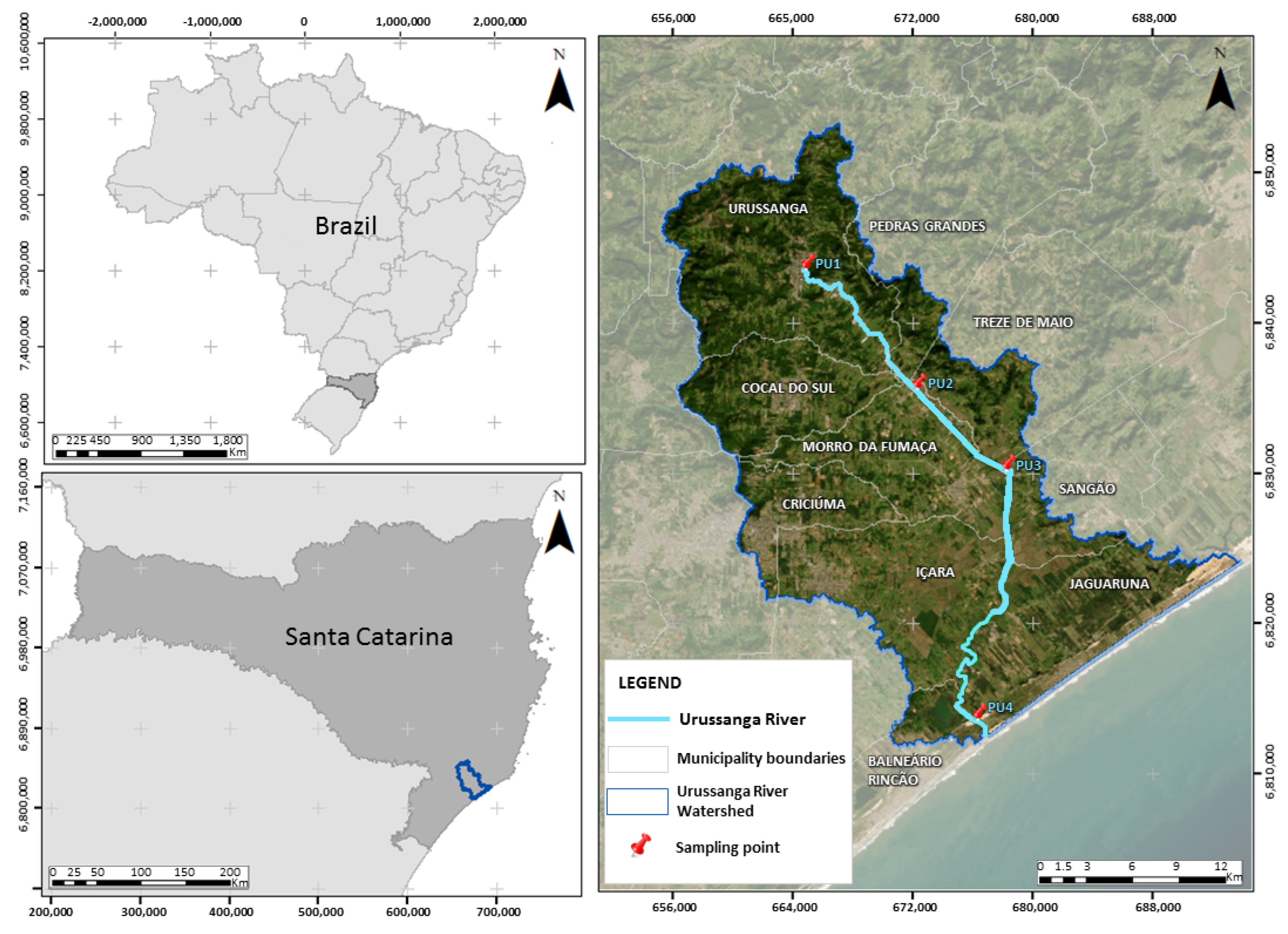
The study area comprises the Urussanga River Watershed (URW) (Figure 1), located in the southeastern region of the state of Santa Catarina, Brazil, between the parallels 28°26′ S and 28°49′ S and the meridians 49°25′ W and 49°06′ W, covering an area of approximately 580 km2. The watershed is situated between the Araranguá and Tubarão River Watersheds and encompasses, totally or partially, nine municipalities: Criciúma, Cocal do Sul, Içara, Jaguaruna, Morro da Fumaça, Pedras Grandes, Sangão, Treze de Maio, and Urussanga. The Urussanga River is formed by the confluence of the Carvão and Maior rivers, in the municipality of Urussanga, and its main right-bank tributaries include the América, Caeté, Cocal, Ronco d’Água, and Linha Anta rivers, while the left bank is characterized by the Barro Vermelho, Areia, and Varjedo rivers. The Carvão and Maior rivers are historically associated with coal mining activities in the southern Santa Catarina coal basin and have been reported in previous studies as watercourses influenced by acid mine drainage (AMD), contributing to changes in water and sediment quality due to the mobilization of potentially toxic elements [19,20,21].
Four sediment sampling stations were defined based on the environmental and hydrosedimentological characteristics of distinct and representative reaches of the Urussanga River, aiming to adequately capture the spatial variability of the fluvial system. These reaches span an approximate length of 43.50 km, encompassing different environmental conditions and potential levels of anthropogenic influence along the watershed (Figure 1).
Sampling point PU1 was established in the Upper Course (Headwaters), at the confluence of the Carvão and Maior rivers, which significantly contribute to the pollutant load, particularly due to acid drainage associated with coal mining activities. Point PU2 is located in the Upper–Middle Course (Upper Transition Reach), characterized by the onset of more pronounced anthropogenic influence, with increasing urban presence and intensification of rural activities. Point PU3 is situated in the Middle Course, characterized as a zone of anthropogenic influence, where urban, industrial, and mining activities predominate, representing an area under higher environmental pressure. Finally, point PU4 is located in the Lower Course (Downstream/Mouth), representing the final portion of the fluvial system, where cumulative impacts along the watershed are integrated.
At each sampling station (PU1 to PU4), sediments were collected using a Birge–Ekman dredge at five positions distributed transversely across the channel, from the central region to the margins, in order to ensure spatial representativeness of the deposited material. For each cross-section, five subsamples were obtained and subsequently transported to the laboratory, where they were homogenized and quartered, resulting in a representative composite sample for each sampling point. This procedure minimized local variability and ensured greater reliability in the characterization of the analyzed sediments.

2.2. Characterization of the Sediments

In order to evaluate the potential changes in contaminant mobility after thermal treatment through the ceramization process, the collected sediments were subjected to an integrated set of physicochemical, mineralogical, and thermal analyses, aiming to understand their composition, behavior during heating, and the potential transformations associated with the stabilization of potentially toxic elements.
The quantitative chemical analysis of the studied samples was performed using X-ray fluorescence spectrometry (XRF) in an Epsilon 3XLE Panalytical spectrometer (PANalytical B.V., Almelo, The Netherlands), employing fused bead preparation and loss on ignition at 1000 °C. The oxides of the chemical elements, in their most stable forms, were investigated through mineralogical characterization in the different fractions, determined by X-ray diffraction (XRD) using a diffractometer (Bruker, D-5000, Billerica, MA, USA) with Cu Kα radiation (λ = 1.54 Å), operating at 40 kV and 30 mA, within a 2θ range of 2 to 72° and a scanning speed of 2°/min. Phase quantification was performed by Rietveld refinement [22], using selected Powder Diffraction File (PDF) cards.
To evaluate the thermal behavior of the samples, differential thermal analysis and thermogravimetric analysis (DTA/TG) were carried out using a simultaneous analyzer (TA Instruments, model SDT Q600, New Castle, DE, USA). The tests were conducted at a heating rate of 10 °C min−1, from room temperature (~25 °C) up to 1100 °C, for the studied fractions under a synthetic air atmosphere.
To evaluate the environmental behavior of contaminants present in the studied sediments, leaching and solubilization tests were performed on the raw sediments in accordance with the procedures established by NBR 10005 [23] (leaching test) and NBR 10006 [24] (solubilization test). Prior to testing, the samples were dried, disaggregated, and homogenized to ensure representative sampling.
For the leaching test [23], the extraction procedure was carried out using an acidic extraction solution under standardized conditions. The leaching process was conducted over 18 h, resulting in a leachate extract volume of 500 mL, with a final extract pH of 4.87. After extraction, the leachate was filtered through a glass fiber filter prior to chemical analysis.
For the solubilization test [24], the procedure was performed using reagent water at a solid-to-liquid ratio of 1:4 (250 g of sediment to 1 L of reagent water). The suspension was mechanically agitated for 5 min and subsequently maintained at rest for 7 days to allow solubilization equilibrium. After the extraction period, the solubilized extract was collected for analysis.
The concentrations of potentially toxic elements in both leachate and solubilized extracts were determined by Inductively Coupled Plasma Optical Emission Spectrometry (ICP-OES). The results are expressed as concentrations (mg/L) and interpreted according to the limits established by NBR 10004 [25] for waste classification.

2.3. Ceramization of the Sediments

In order to evaluate the feasibility of using the sediments in a ceramic matrix, a ceramization process was carried out, followed by environmental analysis after firing. For sample preparation, each sample was dried in a drying chamber (with air circulation, DeLeo (Porto Alegre, RS, Brazil)) at 60 ± 5 °C. After drying, approximately 500 g of each sampling point was subjected to milling (laboratory jar mill) for 5 min in order to disaggregate larger agglomerates.
Subsequently, test specimens were prepared to evaluate their environmental behavior after firing. Initially, the powder was moistened to 7% moisture content and granulated to ensure moisture homogenization. Then, using a uniaxial pressing method (460 kgf/cm2), eight specimens measuring 50 × 50 × 4 mm3 were produced for each sample.
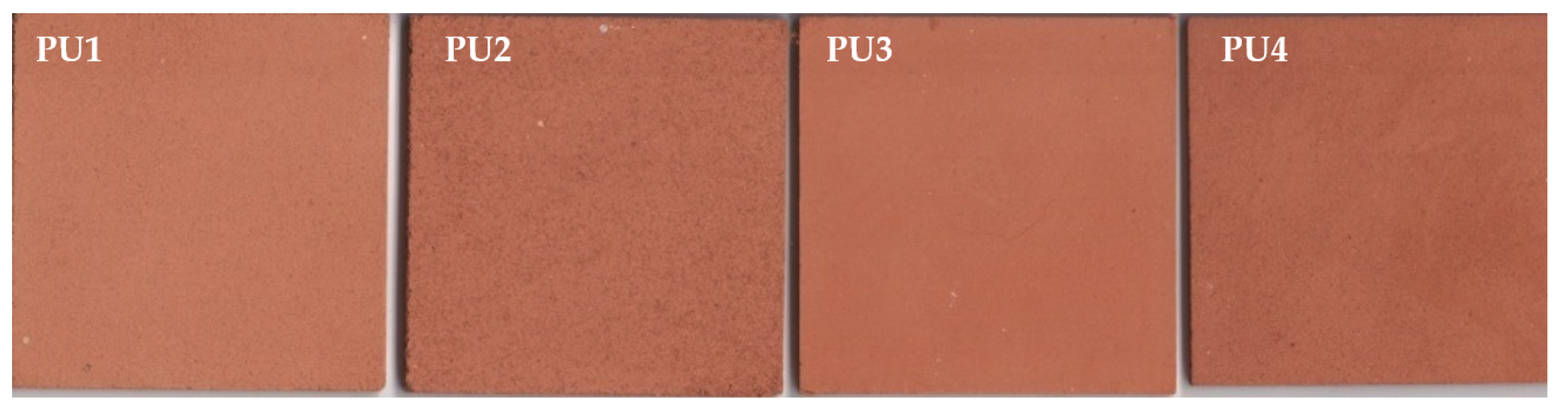
After pressing, the specimens were dried in a drying chamber (electric resistance, DeLeo No. 2211, Type 8) at 100 °C ± 5 °C for 24 h. After moisture removal, the specimens were fired in a muffle furnace (Jung J200, Blumenau, SC, Brazil) at 1100 °C, with a heating rate of 1.5 °C/min and a dwell time of 20 min. The fired samples obtained can be observed in Figure 2.
In order to evaluate the changes in contaminant mobility after thermal treatment, leaching and solubilization tests were carried out after thermal treatment, in accordance with the procedures established by ABNT NBR 10005 [23] and NBR 10006 [24]. Priority was given to the analysis of parameters that exhibited values exceeding the limits established by NBR 10004 [25] in the raw sediments, indicating potential environmental risk. The preparation of the ceramized samples followed the same procedures adopted for the raw samples, including drying, disaggregation, homogenization, and standardized preparation prior to the leaching and solubilization tests.
This approach enables the assessment of the potential effectiveness of the ceramization process in reducing the environmental mobility of contaminants. The observed reduction in the mobility of potentially toxic elements after thermal treatment may be associated with the formation of less soluble and more stable mineralogical environments, as reported in previous studies. Previous studies show that firing ceramics promotes densification and the formation of crystalline and/or vitreous phases, which can immobilize contaminants and reduce their environmental availability [26,27,28].

3. Results and Discussion

The chemical characteristics of the samples collected in all sampling points, presented in Table 1, predominantly indicate the presence of silica (SiO2), which may be associated with the occurrence of quartz, particularly at points PU1, PU2, and PU3. The presence of alumina (Al2O3), in turn, when combined with SiO2, forms aluminosilicates, which can be classified as hydrated (clay minerals) or anhydrous (feldspars) [29,30]. Alkaline oxides (K2O + Na2O) and alkaline earth oxides (CaO + MgO), referred to as fluxing oxides in ceramic applications [31,32], may be associated with the presence of feldspars. Potassium, in particular, showed a decreasing trend from PU1 to PU4.
Chromophore oxides (Fe2O3 + TiO2) have a strong influence on the coloration of ceramic products [33]. Specifically, iron is responsible for reddish tones in ceramic materials, while titanium contributes to orange hues [34]. Regarding iron, its presence may be directly linked to the influence of coal mining and the anthropogenic input of iron-rich wastes (such as pyrite). The increase in iron content from PU1 to PU4 may be associated with the reactivity between clay minerals and iron. The iron content increase observed from upstream to downstream river samples seems to be in agreement with the tones presented by the fired samples, that is, a less reddish tone in PU1 and a more reddish one in PU4 (Figure 2).
Finally, the loss on ignition (LOI), whose content is related to the dehydroxylation of clay minerals, oxidation of organic matter, and decomposition of carbonates, sulfides, and hydroxides, among others, showed an increasing trend from PU1 to PU4. This suggests a higher prevalence of anhydrous minerals such as quartz and feldspars in upstream regions, while finer particles, including clay minerals and organic matter, tend to accumulate toward downstream environments due to sediment sorting and downstream fining processes [35,36].
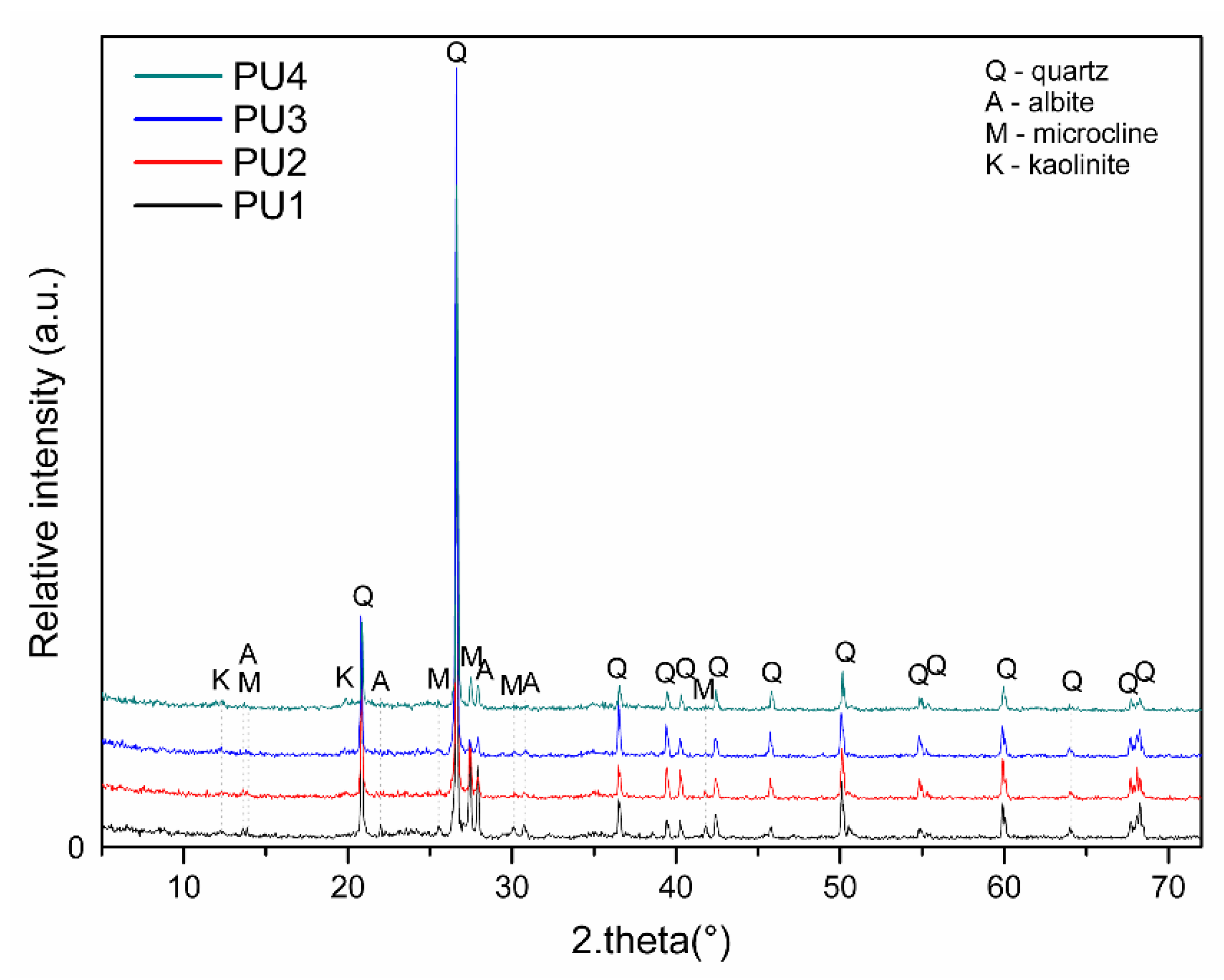
The oxides of the chemical elements identified by XRF analysis (Table 1), in their most stable forms, are present in the crystalline phases (Figure 3). The presence of quartz (SiO2—PDF card no. 04-007-0522) is observed, and, as suggested by the occurrence of fluxing oxides, feldspars such as albite (NaAlSi3O8—PDF card no. 00-009-0466) and microcline (KAlSi3O8—PDF card no. 00-022-0687) were also identified. Additionally, as indicated by the oxide composition, clay minerals such as kaolinite (Al2O3·2SiO2·2H2O—PDF card no. 00-014-0164) were detected.
Table 2 presents the contents of each mineral identified at the different sampling points. It was observed that the combined feldspar content in the PU1 sampling point reached approximately 22%, with quartz being predominant (~70%), indicating a strong presence of sandy material, likely associated with quartz–feldspathic rocks, and a relatively low content of clay minerals (kaolinite ~7.5%). In the subsequent sampling points, a decrease in feldspar content (13%, 9%, and 7.5%) and an increase in clay minerals (9.66%, 15.87%, and 37.65%) were evident. Quartz showed a slight increase from PU1 to PU2 (70% to 77%), stabilized at PU3 (75%), and then decreased significantly at PU4 (54.75%). Overall, the results indicated a predominance of sandy fractions, with notable mineralogical variations, especially at PU1 (feldspars) and PU4 (clay minerals).
It is important to highlight that the mineral assemblage identified in the sediments is consistent with siliciclastic fluvial systems and reflects both the geological background and sediment transport dynamics along the watershed. Once in the watercourse, the flow tends to carry finer materials downstream, depositing them closer to the river mouth, while coarser particles remain in the upstream sections. In this context, quartz and feldspars are predominantly found in the upper reaches, whereas clay minerals and organic matter are more concentrated toward the downstream regions [37].
The observed variation in chemical and mineralogical composition along the sampling points may also reflect differences in the degree of weathering along the river course. In general, upstream sediments tend to be less weathered, while downstream materials are more altered, showing enrichment in finer fractions and secondary minerals. This interpretation is consistent with typical weathering trends reported in the literature [38,39,40] and supports the differences observed among samples PU1 to PU4.
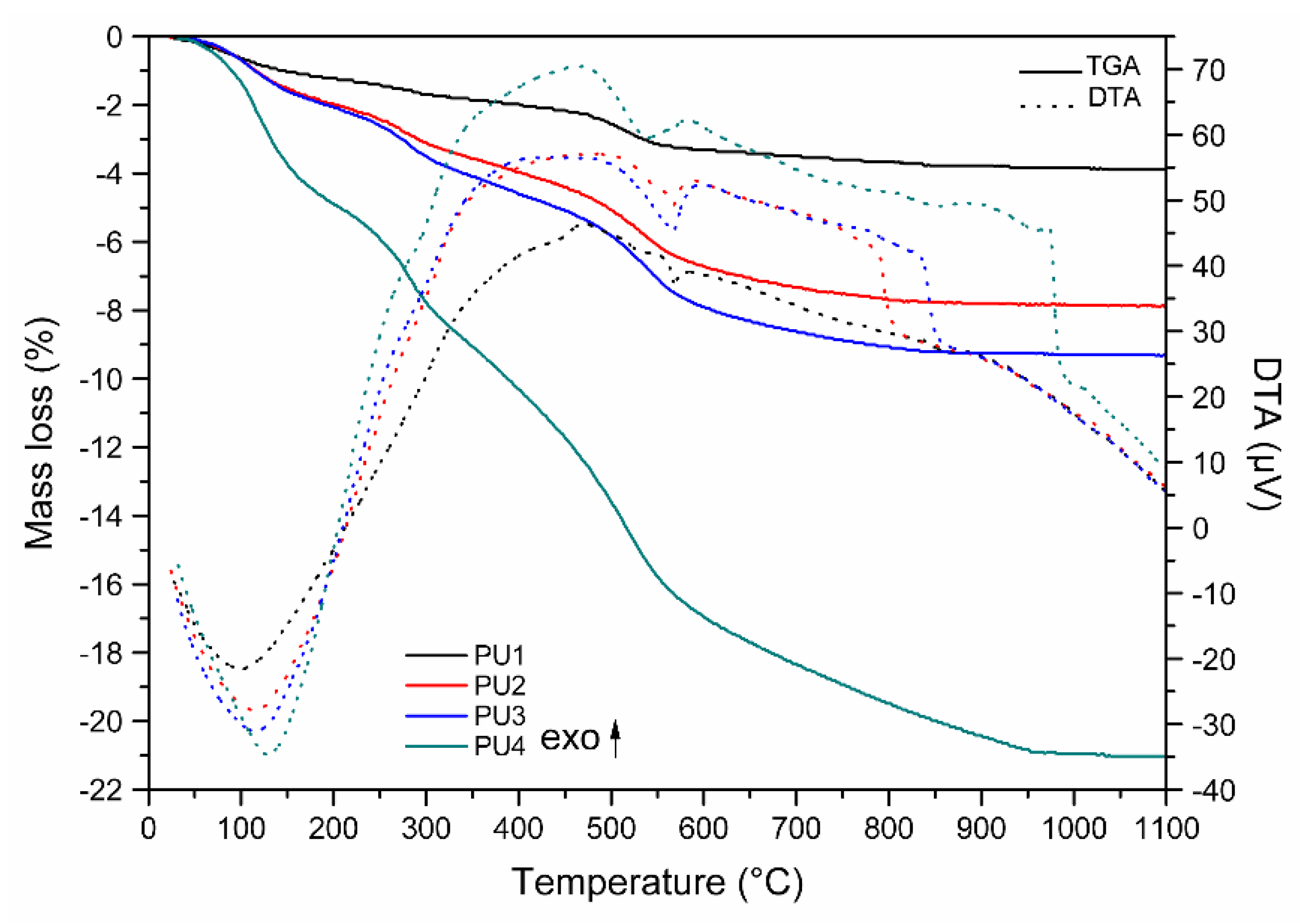
The thermal analysis of the samples (Figure 4) showed that up to ~150 °C, a slight mass loss occurred for PU1, PU2, and PU3, and a more pronounced loss was observed for PU4, which is associated with free and adsorbed moisture, as well as the evaporation of physically adsorbed water from pores and grain surfaces [41,42,43].
Around 250 °C (see TG curves), the loss of volatile organic matter and the degradation of light organic compounds present in the sediments began [44]. In sample PU1, this organic matter was less present, while in the other samples, i.e., PU2, PU3, and PU4, the combustion of the organic component also began around 250 °C but extended much later, at ~810 °C, ~850 °C, and ~970 °C, respectively.
In the temperature range of 400–650 °C, dehydroxylation of clay minerals (such as kaolinite) occurred, with the release of structural hydroxyl groups [45]. Finally, for the PU4 sample, in the temperature range of 900–1000 °C, a small exothermic peak appeared due to the crystallization of primary mullite [46].
To assess the toxicity of the sediment in its raw form, leaching tests were conducted (Table 3). For all four sampling points analyzed, none of the parameters showed concentrations exceeding the maximum limits established by NBR 10004 [25].
The sediment from site PU4 presented the lowest value for dry solids, while the sediments from sites PU1 and PU2 presented the highest values, suggesting that the observed trend in the values obtained may be related to the particle size of the sediments. Sediment particle size and dry solids (dry bulk density) typically follow an inverse pattern. Because of their high porosity and water retention, finer-grained sediments (clay/silt) have lower dry solid densities. In other words, a fixed volume of dry, fine silt has a low dry bulk density because it has more pore space and fewer solids. Conversely, because of their better packing and consequently reduced porosity, coarser-grained sediments (sand and gravel) have higher dry solid densities. This means that the weight of dry solids per unit volume decreases as particle size decreases and their capacity to hold water increases. The results obtained for dry solids seem to be supported by the results for organic matter, which showed an inverse trend, with values increasing from the most upstream to the most downstream location from 3.0 to 15.6%, respectively (Table 1). The values found for both parameters, dry solids and organic matter, appear to be related to the particle size of the sediments and are consistent with those obtained in the study by Joensuu (2018) [47].
Considering the solubilization test (Table 4), among the parameters analyzed in the raw sediment extract, all four sampling points showed aluminum, iron, and manganese concentrations above the maximum limits established by the technical standard NBR 10004 [25], with 0.20 mg/L, 0.30 mg/L, and 0.10 mg/L, respectively.
The results obtained for the solubilized extracts of sediments from points PU1, PU2, PU3, and PU4 suggest the influence of coal mining activities, particularly due to the elevated concentrations of iron, aluminum, manganese, and sulfates—elements typically associated with acid mine drainage (AMD). Although Fe, Al, and Mn are naturally present in river sediments, their elevated solubilized concentrations, combined with the historical mining context of the watershed and the occurrence of sulfate-rich waters, support the interpretation of a contribution from AMD-related processes. This phenomenon primarily occurs through the oxidation of sulfide minerals, such as pyrite (FeS2), when exposed to oxygen and water during mining activities, leading to the formation of sulfuric acid and the subsequent release of metals and metalloids previously immobilized within the mineral matrix [48,49]. The high concentrations of iron (up to 21.91 mg/L) and aluminum (up to 3.20 mg/L), both far exceeding the limits established by NBR 10004 [25], are well-documented characteristics of environments impacted by coal mining, where acidification significantly increases the solubility of these elements and promotes their mobilization into the aqueous phase [50,51]. Similarly, the elevated manganese concentrations observed indicate geochemical conditions favorable to mineral dissolution under acidic environments, with this element often used as an indicator of acid mine drainage impact.
The highest concentration of chloride for samples in downstream river stretches (PU3 and PU4) seems to indicate its origin is due to both the mixing of river water with seawater (seawater intrusion), which has a high chloride concentration, and anthropogenic activities [52].
In environments affected by acid mine drainage (AMD), the oxidation of sulfide minerals, particularly pyrite (FeS2), promotes sulfuric acid generation and the subsequent dissolution of Fe-bearing secondary phases, increasing the mobility of iron and sulfate species in sediments and aquatic systems [53,54]. Elevated concentrations of aluminum may be associated with the destabilization and partial dissolution of aluminosilicates and clay minerals, especially kaolinite, under acidic conditions, where proton-promoted weathering enhances Al release into solution [55,56]. Similarly, manganese mobility is commonly linked to the dissolution of Mn-bearing oxides and hydroxides under acidic and reducing conditions, being widely recognized as an indicator of AMD influence in coal mining environments [54,57].
After thermal treatment, the same sampling points exhibited concentrations below the regulatory limits, indicating the effectiveness of the process in immobilizing iron, as shown in Table 5. This behavior is likely associated with the formation of stable, low-solubility phases, as reported for ceramic systems subjected to high-temperature treatment, in addition to possible physical encapsulation within the ceramic matrix. The oxidation of Fe2+ to Fe3+ during firing may also have contributed to this reduction, since oxidized forms are less mobile in aqueous environments [58].
Similarly to iron, aluminum, and manganese concentrations in the solubilized extract also decreased after thermal treatment, falling below the limits established by NBR 10004 [25]. This behavior can be attributed to the formation of thermally stable phases, such as aluminosilicates in the case of aluminum (e.g., mullite) and spinels in the case of manganese (e.g., MnFe2O4), both of which exhibit low solubility in aqueous media. In addition, the thermal oxidation of Mn2+ to higher oxidation states (Mn3+ or Mn4+) contributes to reducing its mobility. Finally, the physical encapsulation of these elements within the glassy ceramic matrix acts as a barrier to leaching, reinforcing the effectiveness of ceramization as a pollutant immobilization technique [59,60,61].
The kaolinite identified in the raw sediments would be expected to undergo, according to well-established ceramic transformation pathways, dehydroxylation during heating, initially forming metakaolinite, followed by structural rearrangement into spinel-type transitional phases and primary mullite at temperatures above approximately 950–1000 °C, accompanied by the generation of amorphous silica [62,63,64]. Simultaneously, feldspathic phases such as albite and microcline undergo partial melting, contributing to the development of an aluminosilicate glassy phase, which is widely recognized as a key mechanism in the densification of ceramic bodies and contaminant immobilization [65,66].
These thermodynamically stable crystalline and amorphous phases exhibit low solubility and are known to reduce contaminant mobility through mechanisms of structural incorporation, ionic substitution, and physical encapsulation within the ceramic matrix [67,68]. In this context, the reduction in Fe, Al, and Mn concentrations observed in the solubilized extracts after firing is likely associated with their incorporation into mullite, aluminosilicate glassy phases, and Fe/Mn-bearing crystalline structures formed or stabilized during thermal treatment. Nevertheless, these phases should be interpreted as probable products of ceramization inferred from mineralogical composition and thermal behavior, since direct post-firing phase characterization was not performed in the present study.
The results obtained in this study, which demonstrate a significant reduction in the leaching and solubilization of potentially toxic elements in river sediments impacted by coal mining after thermal treatment, are consistent with previous works on the incorporation of mining residues into ceramic matrices. In particular, recent studies have shown that the incorporation of coal tailings into clay ceramics, combined with appropriate firing conditions, results in materials classified as non-hazardous, indicating effective stabilization of potentially toxic elements [69]. This behavior is associated with the densification of the ceramic matrix and the physicochemical interactions that occur during firing, which contribute to the retention of contaminants within the structure [70,71,72,73]. Although differences in raw materials and processing conditions limit direct comparisons, similar environmental performance has been widely reported for ceramic systems incorporating wastes. These studies consistently demonstrate the effective immobilization of potentially toxic elements after thermal treatment, highlighting ceramization as a viable strategy for both waste valorization and environmental risk mitigation [74].
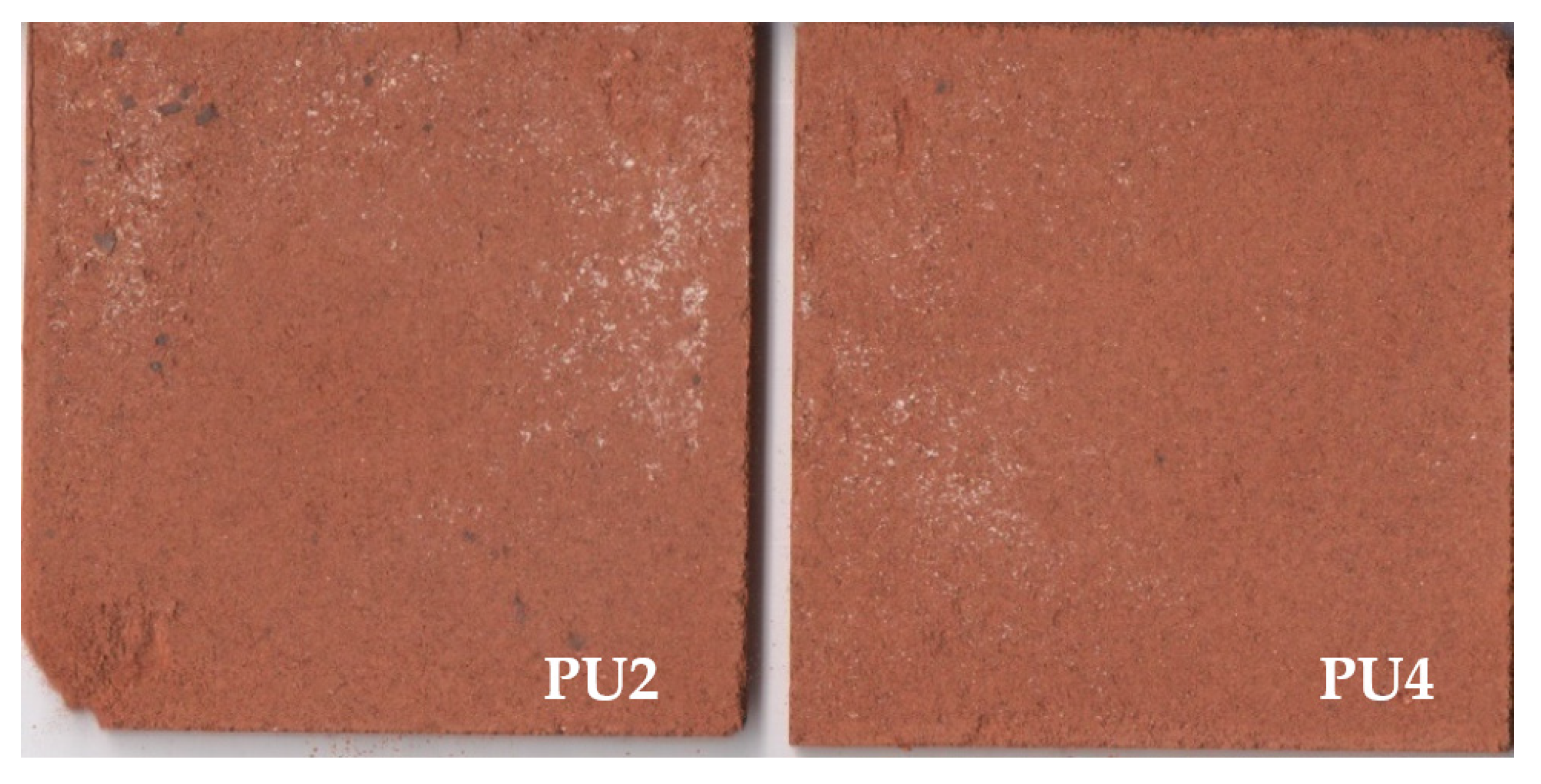
A noteworthy aspect in the visual analysis of the samples was the appearance of whitish stains on the ceramic surface, a phenomenon characterized as efflorescence. Figure 5 presents selected samples in which efflorescence was more pronounced in order to better illustrate the phenomenon. This effect is related to the presence of soluble salts in the raw material, which, even after the firing stage, remain active and migrate from the interior of the piece to the surface due to moisture action and subsequent evaporation. The main salts involved in this process include compounds of potassium, sodium, and magnesium, commonly present in clay minerals or introduced through contamination during processing [75].
Although often treated as merely a visual defect, efflorescence represents a significant ceramic pathology, capable of compromising the durability and microstructural integrity of the product over time. The crystallization of these salts on the surface or within the material (sub-efflorescence) may generate localized stresses, microcracks, and gradual degradation of the material, directly affecting the final product quality [76,77].
It is essential to highlight that efflorescence appeared naturally in the PU2 and PU4 samples, without any external stimulus or additional testing, occurring solely due to the natural moisture in the air absorbed by the specimens. It is believed that efflorescence could potentially occur in all samples if subjected to specific experimental procedures. However, further investigation into soluble salts in the samples and dedicated efflorescence testing is necessary. It is well established that processes such as raw material aging and control of firing temperature can help minimize efflorescence-related issues [78]. Specifically, raw material aging promotes partial dissolution and redistribution of soluble salts, as well as improved homogenization and stabilization of the clay matrix, reducing the availability of alkali and alkaline earth ions responsible for efflorescence [79]. In addition, proper control of firing temperature—including adequate heating rates, soaking time, and peak temperature—enhances densification and promotes the incorporation of these soluble species into stable crystalline or glassy phases, thereby limiting their migration to the surface during service [80].
It should be emphasized that the present study was not intended to develop or optimize ceramic formulations, but rather to evaluate the inertization of compounds and to provide a preliminary assessment of their potential application in ceramic matrices. In this context, the results indicate initial feasibility from an environmental perspective, demonstrating the stabilization of potentially soluble constituents. Nevertheless, further studies are required to properly define formulations, as well as to control processing parameters and evaluate technological, mechanical, and durability properties, in order to consolidate the applicability of the material in ceramic systems.

4. Conclusions

The evaluated sediments exhibited a predominantly quartz–feldspathic composition, with the presence of clay minerals such as kaolinite, consistent with silicate materials typically found in fluvial systems impacted by anthropogenic activities. Thermal analysis confirmed characteristic transformations of clay minerals, indicating the suitability of these sediments for ceramic processing.
Solubilization tests revealed high concentrations of Fe, Al, and Mn, which were associated with acid mine drainage, highlighting their potential environmental risk due to high mobility under acidic conditions. After thermal treatment, a significant reduction in the mobility of these elements was observed, with concentrations falling below regulatory limits.
These results demonstrate that ceramization is a viable strategy for the inertization of contaminated sediments, while also enabling their use as alternative raw materials in the ceramic industry. The observed reduction in the solubilized concentrations of Fe, Al, and Mn suggests effective stabilization during thermal treatment, likely associated with densification and the formation of less soluble phases commonly reported in ceramic systems subjected to firing. Further studies are recommended to optimize formulations and evaluate performance under industrial conditions.

Author Contributions

Conceptualization: S.S.R. and A.Z. Methodology: S.S.R., A.Z. and F.R.-P. Software: E.S. Validation: É.M.R.F., M.J.R., L.S. and E.J. Formal analysis: É.M.R.F., M.J.R. and G.A.B. Investigation: S.S.R. and A.Z. Resources: F.R.-P. Data curation: A.Z. Writing—original draft preparation: A.Z. Writing—review and editing: É.M.R.F., M.J.R., L.S. and E.J. Visualization: F.R.-P. Supervision: A.Z. and F.R.-P. Project administration: F.R.-P. Funding acquisition, F.R.-P. All authors have read and agreed to the published version of the manuscript.

Funding

CNPq/Brazil: process numbers 408799/2022-6 (APL Mineral Project), 381236/2023-4 (S.S.R.), 403702/2023-2 (L.S.), 381504/2023-9 (G.A.B.), 380935/2023-6 (E.S.), 382057/2024-4 (A.Z.), and 306897/2022-9 (F.R.-P.); FAPESC/Brazil: process numbers 00003335/2025 (G.A.B.), 00003338/2025 (E.S.), and 00002794/2025 (A.Z.).

Institutional Review Board Statement

Not applicable.

Informed Consent Statement

Not applicable.

Data Availability Statement

Data are contained within the article.

Acknowledgments

The authors are grateful to the Coordination for Higher Education Improvement (CAPES), Foundation for Research Support of Santa Catarina (FAPESC), National Council for Scientific and Technological Development (CNPq), and Financier of Studies and Projects (FINEP).

Conflicts of Interest

The authors declare no conflicts of interest.

References

  1. Virtuoso, J.C.; de Menezes, C.T.B.; de Assunção, V.K. As Dinâmicas de Poder Na Apropriação Dos Recursos Hídricos: Estudo de Caso Da Bacia Hidrográfica Do Rio Urussanga, SC. Gaia Sci. 2020, 14, 634–649. [Google Scholar] [CrossRef]
  2. Volpato, S.B.; de Menezes, C.T.B.; da Silva, J.V.F. Recuperação Ambiental de Ecossistemas Aquáticos Em Regiões Estuarinas: Estudos Aplicados Para o Tratamento de Sedimentos Contaminados Pela Drenagem Ácida de Mina Na Bacia Hidrográfica Do Rio Urussanga, Santa Catarina. Eng. Sanit. Ambient. 2016, 22, 313–316. [Google Scholar] [CrossRef]
  3. Schnack, C.E.; de Menezes, C.T.B.; Ceni, G.; Munari, A.B. Qualidade Da Água No Estuário Do Rio Urussanga (SC, Brasil): Um Ambiente Afetado Pela Drenagem Ácida de Mina. Rev. Bras. Biociências 2018, 16, 98–106. [Google Scholar]
  4. Alexandre, N.Z. Diagnóstico Ambiental Da Região Carbonífera de Santa Catarina: Degradação Dos Recursos Naturais. Rev. Tecnol. Ambiente 1999, 5, 35–53. [Google Scholar]
  5. Ladwig, N.I.; Tonetto, G. Paisagem, Rios e Comunidades: Caminhos Do Rio Carvão e Rio Maior, Urussanga, Santa Catarina. Caminhos Geogr. 2024, 25, 193–208. [Google Scholar] [CrossRef]
  6. Chen, D.; Feng, Q.; Li, W.; Song, Y.; Zhao, C. Effects of Acid Drainage from Abandoned Coal Mines on the Microbial Community of Shandi River Sediment, Shanxi Province. Int. J. Coal Sci. Technol. 2021, 8, 756–766. [Google Scholar] [CrossRef]
  7. Makwinja, A.A.; Chikanda, F.; Maneya, G.J.; Kikuchi, R.; Mufalo, W.; Ishida, A.; Otake, T. Geochemical Characterization and Potential Impact of Coal Mine Drainage on River Water Quality at Selected Coal Mines in the Livingstonia Coalfield, Malawi. Appl. Geochem. 2026, 196, 106636. [Google Scholar] [CrossRef]
  8. Equeenuddin, S.M.; Tripathy, S.; Sahoo, P.K.; Panigrahi, M.K. Metal Behavior in Sediment Associated with Acid Mine Drainage Stream: Role of PH. J. Geochem. Explor. 2013, 124, 230–237. [Google Scholar] [CrossRef]
  9. Gómez-Álvarez, A.; Valenzuela-García, J.L.; Meza-Figueroa, D.; de la O-Villanueva, M.; Ramírez-Hernández, J.; Almendariz-Tapia, J.; Pérez-Segura, E. Impact of Mining Activities on Sediments in a Semi-Arid Environment: San Pedro River, Sonora, Mexico. Appl. Geochem. 2011, 26, 2101–2112. [Google Scholar] [CrossRef]
  10. Wu, L.; Yue, W.; Wu, J.; Cao, C.; Liu, H.; Teng, Y. Metal-Mining-Induced Sediment Pollution Presents a Potential Ecological Risk and Threat to Human Health across China: A Meta-Analysis. J. Environ. Manag. 2023, 329, 117058. [Google Scholar] [CrossRef]
  11. Huang, Y.; Lu, P.; Zhang, F.; Chen, H.; Zhang, W.; Lin, L.; Xu, H.; Ding, H.; Cheng, T. Characteristics of Iron-Sulfur Metabolism and Acid-Producing Microorganisms in Groundwater Contaminated by Acid Mine Drainage in Closed Coal Mines. Groundw. Sustain. Dev. 2024, 27, 101372. [Google Scholar] [CrossRef]
  12. Lecomte, K.L.; Yaciuk, P.A.; Sarmiento, A.M.; Borrego, J.; Nieto, J.M. Geochemistry of Sediment Precipitated during Acid Mine Drainage-Seawater Interaction. Implications for Metal Mining Impacts on Estuarine Systems. Chem. Geol. 2025, 684, 122794. [Google Scholar] [CrossRef]
  13. Ardit, M.; Zanelli, C.; Conte, S.; Molinari, C.; Cruciani, G.; Dondi, M. Ceramisation of Hazardous Elements: Benefits and Pitfalls of the Inertisation through Silicate Ceramics. J. Hazard. Mater. 2022, 423, 126851. [Google Scholar] [CrossRef]
  14. Liu, T.; Xie, Y.; Guo, X.; Zhang, J.; Zhu, L.; Luo, Z.; Tang, Y.; Lu, A. The Role and Stabilization Behavior of Heavy Metal Ions in Eco-Friendly Porous Semi-Vitrified Ceramics for Construction Application. J. Clean. Prod. 2021, 292, 125855. [Google Scholar] [CrossRef]
  15. Yang, R.; Wang, Z.; Wang, Z.; Wang, X.; Zeng, H.; Wang, J.; Cen, Q.; Zhou, T.; Li, B.; Liu, Z. Properties and Heavy Metals Immobilization Mechanism of Glass-Ceramics Derived from Lead Zinc Slag and Red Mud. Chem. Eng. J. 2025, 508, 161156. [Google Scholar] [CrossRef]
  16. Li, C.; Song, B.; Chen, Z.; Liu, Z.; Yu, L.; Zhi, Z.; Zhao, Y.; Wei, H.; Song, M. Immobilization of Heavy Metals in Ceramsite Prepared Using Contaminated Soils: Effectiveness and Potential Mechanisms. Chemosphere 2023, 310, 136846. [Google Scholar] [CrossRef]
  17. Li, B.; Jian, S.; Zhu, J.; Lv, Y.; Gao, X.; Huang, J. Immobilization Enhancement of Heavy Metals in Lightweight Aggregate by Component Regulation of Multi-Source Solid Waste. Chemosphere 2023, 344, 140389. [Google Scholar] [CrossRef]
  18. Ke, G.; Zeng, W.; Liu, J.; Li, Y.; Yang, R.; Dong, S.; Shu, Q.; Chen, T.; Huang, W.; Li, W. Metal Transformation, Immobilization, and Risks in Ceramsite Production via Co-Sintering of Metal-Contaminated Soil and Coal Gangue. Fuel 2025, 401, 135830. [Google Scholar] [CrossRef]
  19. Cardoso, A.T.; Fan, F.M. Mining’s Legacy: Unraveling the Impacts of Acid Mine Drainage on the Rivers and Streams of the Santa Catarina Coal Region, Brazil. Geochim. Bras. 2024, 38, e-24002. [Google Scholar] [CrossRef]
  20. Silva, L.F.O.; de Vallejuelo, S.F.O.; Martinez-Arkarazo, I.; Castro, K.; Oliveira, M.L.S.; Sampaio, C.H.; de Brum, I.A.S.; de Leão, F.B.; Taffarel, S.R.; Madariaga, J.M. Study of Environmental Pollution and Mineralogical Characterization of Sediment Rivers from Brazilian Coal Mining Acid Drainage. Sci. Total Environ. 2013, 447, 169–178. [Google Scholar] [CrossRef]
  21. Trein, H.A. A Implicação Antrópica Na Qualidade Dos Recursos Hídricos Subterrâneos Da Bacia Hidrográfica Do Rio Urussanga, SC. Doctoral Dissertation, Universidade Estadual Paulista, Rio Claro, Brazil, 2008. [Google Scholar]
  22. Rietveld, H.M. A Profile Refinement Method for Nuclear and Magnetic Structures. J. Appl. Crystallogr. 1969, 2, 65–71. [Google Scholar] [CrossRef]
  23. ABNT NBR 10005; Procedimento Para Obtenção de Extrato Lixiviado de Resíduos Sólidos. Associação Brasileira de Cerâmica: Rio de Janeiro, Brazil, 2004.
  24. ABNT NBR 10006; Procedimento Para Obtenção de Extrato Solubilizado de Resíduos Sólidos. Associação Brasileira de Normas Técnicas: Rio de Janeiro, Brazil, 2004.
  25. ABNT NBR 10004; Resíduos Sólidos-Classificação. Associação Brasileira de Normas Técnicas: Rio de Janeiro, Brazil, 2004.
  26. Liu, L.; Dai, J.; Zhang, Z.; Liu, S.; Sun, Y. Mechanism and Prediction of Cr and Zn Immobilization from Industrial Residues by Glass-Ceramics. ACS EST Eng. 2021, 1, 1323–1332. [Google Scholar] [CrossRef]
  27. Vieira, C.M.F.; Monteiro, S.N. Incorporation of Solid Wastes in Red Ceramics: An Updated Review. Matéria 2009, 14, 881–905. [Google Scholar] [CrossRef][Green Version]
  28. Santana, S.S.; Paskocimas, C.A.; Andrade, J.C.S. Influence of the Incorporation of Electroplating Sludge from the Industrial Pole of Manaus on the Technological Properties of Red Ceramics. Mater. Res. 2025, 28, e20240561. [Google Scholar] [CrossRef]
  29. Moreno-Maroto, J.M.; Alonso-Azcárate, J. What Is Clay? A New Definition of “Clay” Based on Plasticity and Its Impact on the Most Widespread Soil Classification Systems. Appl. Clay Sci. 2018, 161, 57–63. [Google Scholar] [CrossRef]
  30. Lira, H.L.; Neves, G.A. Feldspatos: Conceitos, Estrutura Cristalina, Propriedades Físicas, Origem e Ocorrências, Aplicações, Reservas e Produção. Rev. Eletrônica Mater. Process. 2013, 8, 110–117. [Google Scholar]
  31. Riella, H.G.; Franjndlich, E.U.d.C.; Durazzo, M. Caracterização e Utilização de Fundentes Em Massas Cerâmicas. Cerâmica Ind. 2002, 7, 33–36. [Google Scholar]
  32. de Mascheville Lengler, H.C.; Vicenzi, J.; Bergmann, C.P. Caracterização Comparativa de Fundentes Para Emprego Na Indústria Cerâmica. Cerâmica Ind. 2009, 14, 14–23. [Google Scholar]
  33. Mapuna, E.C.N.; Aye, B.A.; Ntouala, R.F.D.; Ndjigui, P.-D.; Bilong, P. Mineralogical, Geochemical, and Physicomechanical Features of the Mbalmayo Lateritic Clays (Southern Cameroon) for Potential Use as Raw Materials in the Making of Fired Bricks. Arab. J. Geosci. 2023, 16, 671. [Google Scholar] [CrossRef]
  34. Freitas, R.A. Análise de Misturas e Caracterização de Matéria Prima Para a Indústria Da Cerâmica Vermelha. Master’s Thesis, Universidade Estadual do Norte Fluminense Darcy Ribeiro–UENF, Campos dos Goytacases, Brazil, 2013. [Google Scholar]
  35. Pan, B.; Pang, H.; Zhang, D.; Guan, Q.; Wang, L.; Li, F.; Guan, W.; Cai, A.; Sun, X. Sediment Grain-Size Characteristics and Its Source Implication in the Ningxia–Inner Mongolia Sections on the Upper Reaches of the Yellow River. Geomorphology 2015, 246, 255–262. [Google Scholar] [CrossRef]
  36. Frings, R.M. Downstream Fining in Large Sand-Bed Rivers. Earth-Sci. Rev. 2008, 87, 39–60. [Google Scholar] [CrossRef]
  37. Que, W.; Yi, L.; Wu, Y.; Li, Q. Analysis of Heavy Metals in Sediments with Different Particle Sizes and Influencing Factors in a Mining Area in Hunan Province. Sci. Rep. 2024, 14, 20318. [Google Scholar] [CrossRef]
  38. Arfania, H.; Bashir, S.; Aktar, A.; Kayler, Z.E. Phosphorus Legacy and Equilibrium Dynamics in up and Downstream Sediments of Lake Urmia. Int. J. Environ. Sci. Technol. 2025, 22, 13377–13392. [Google Scholar] [CrossRef]
  39. Goldberg, K.; Humayun, M. The Applicability of the Chemical Index of Alteration as a Paleoclimatic Indicator: An Example from the Permian of the Paraná Basin, Brazil. Palaeogeogr. Palaeoclimatol. Palaeoecol. 2010, 293, 175–183. [Google Scholar] [CrossRef]
  40. Shao, J.; Yang, S.; Li, C. Chemical Indices (CIA and WIP) as Proxies for Integrated Chemical Weathering in China: Inferences from Analysis of Fluvial Sediments. Sediment. Geol. 2012, 265–266, 110–120. [Google Scholar] [CrossRef]
  41. Comin, A.B.; Zaccaron, A.; de Souza Nandi, V.; Inocente, J.M.; Muller, T.G.; Dal Bó, A.G.; Bernardin, A.M.; Peterson, M. Measurement of Apparent Sintering Activation Energy for Densification of Clays. Clay Miner. 2021, 56, 299–305. [Google Scholar] [CrossRef]
  42. Acchar, W.; Dultra, E.J.V.; Segadães, A.M. Untreated Coffee Husk Ashes Used as Flux in Ceramic Tiles. Appl. Clay Sci. 2013, 75–76, 141–147. [Google Scholar] [CrossRef]
  43. de Los Santos Valladares, L.; Ccamapaza, J.L.; Valencia-Bedregal, R.A.; Borja-Castro, L.E.; Velazquez-Garcia, J.; Nimalika Perera, D.H.; Ionescu, A.; Arvidsson, D.; Barnes, E.P.; Newton, P.; et al. Physical and Chemical Characterization of Sediments from an Andean River Exposed to Mining and Agricultural Activities: The Moquegua River, Peru. Int. J. Sediment Res. 2022, 37, 780–793. [Google Scholar] [CrossRef]
  44. de Almeida, R.N.H.M.; Mozeto, A.A.; Zara, L.F.; Rosa, A.H.; Rocha, J.C.; Romão, L.P.C.; Junior, É.S. Extração de Matéria Orgânica Aquática Por Abaixamento de Temperatura: Uma Metodologia Alternativa Para Manter a Identidade Da Amostra. Quim. Nov. 2003, 26, 208–212. [Google Scholar] [CrossRef][Green Version]
  45. Findoráková, L.; Šestinová, O.; Hančuľák, J.; Fedorová, E.; Špaldon, T. Thermal and Spectral Characterization of Bottom Sediment from the Water Reservoir Ružín No.1 in Eastern Slovakia. Procedia Earth Planet. Sci. 2015, 15, 839–843. [Google Scholar] [CrossRef][Green Version]
  46. Manoharan, C.; Sutharsan, P.; Dhanapandian, S.; Venkatachalapathy, R.; Asanulla, R.M. Analysis of Temperature Effect on Ceramic Brick Production from Alluvial Deposits, Tamilnadu, India. Appl. Clay Sci. 2011, 54, 20–25. [Google Scholar] [CrossRef]
  47. Joensuu, M.; Pilditch, C.A.; Harris, R.; Hietanen, S.; Pettersson, H.; Norkko, A. Sediment Properties, Biota, and Local Habitat Structure Explain Variation in the Erodibility of Coastal Sediments. Limnol. Oceanogr. 2018, 63, 173–186. [Google Scholar] [CrossRef]
  48. Akcil, A.; Koldas, S. Acid Mine Drainage (AMD): Causes, Treatment and Case Studies. J. Clean. Prod. 2006, 14, 1139–1145. [Google Scholar] [CrossRef]
  49. Blowes, D.W.; Ptacek, C.J.; Jambor, J.L.; Weisener, C.G.; Paktunc, D.; Gould, W.D.; Johnson, D.B. The Geochemistry of Acid Mine Drainage. In Treatise on Geochemistry; Holland, H.D., Turekian, K.K., Eds.; Elsevier: Amsterdam, The Netherlands, 2014; pp. 131–190. [Google Scholar]
  50. Nordstrom, D.K. Mine Waters: Acidic to Circmneutral. Elements 2011, 7, 393–398. [Google Scholar] [CrossRef]
  51. Hudson-Edwards, K.A.; Jamieson, H.E.; Lottermoser, B.G. Mine Wastes: Past, Present, Future. Elements 2011, 7, 375–380. [Google Scholar] [CrossRef]
  52. Kaushal, S.S.; Shelton, S.A.; Mayer, P.M.; Kellmayer, B.; Utz, R.M.; Reimer, J.E.; Baljunas, J.; Bhide, S.V.; Mon, A.; Rodriguez-Cardona, B.M.; et al. Freshwater Faces a Warmer and Saltier Future from Headwaters to Coasts: Climate Risks, Saltwater Intrusion, and Biogeochemical Chain Reactions. Biogeochemistry 2025, 168, 31. [Google Scholar] [CrossRef]
  53. Jambor, J.L.; Blowes, D.W.; Ritchie, A.I.M. Environmental Aspects of Mine Wastes; Mineralogical Association of Canada: Ottawa, ON, Canada, 2003; Volume 31. [Google Scholar]
  54. Younger, P.L.; Banwart, S.A.; Hedin, R.S. Mine Water; Environmental Pollution; Springer: Dordrecht, The Netherlands, 2002; Volume 5. [Google Scholar]
  55. Nordstrom, D.K. Acid Rock Drainage and Climate Change. J. Geochem. Explor. 2009, 100, 97–104. [Google Scholar] [CrossRef]
  56. Gensemer, R.W.; Playle, R.C. The Bioavailability and Toxicity of Aluminum in Aquatic Environments. Crit. Rev. Environ. Sci. Technol. 1999, 29, 315–450. [Google Scholar] [CrossRef]
  57. Cravotta, C.A. Dissolved Metals and Associated Constituents in Abandoned Coal-Mine Discharges, Pennsylvania, USA. Part 1: Constituent Quantities and Correlations. Appl. Geochem. 2008, 23, 166–202. [Google Scholar] [CrossRef]
  58. Xu, G.; Zou, J.; Li, G. Stabilization/Solidification of Heavy Metals in Sludge Ceramsite and Leachability Affected by Oxide Substances. Environ. Sci. Technol. 2009, 43, 5902–5907. [Google Scholar] [CrossRef]
  59. Lin, H.; Zhang, P.; Zeng, L.; Jiao, B.; Shiau, Y.; Li, D. Preparation of Glass-Ceramics via Cosintering and Solidification of Hazardous Waste Incineration Residue and Chromium-Containing Sludge. ACS Omega 2021, 6, 23723–23730. [Google Scholar] [CrossRef]
  60. Jee, H.K.; Kim, H.N.; Park, J.H. Immobilization of Manganese in Solution and Soil Contaminated with Trivalent Chromium Using Biochars. Appl. Biol. Chem. 2024, 67, 118. [Google Scholar] [CrossRef]
  61. Wang, J.; Han, F.; Yang, B.; Xing, Z.; Liu, T. A Study of the Solidification and Stability Mechanisms of Heavy Metals in Electrolytic Manganese Slag-Based Glass-Ceramics. Front. Chem. 2022, 10, 989087. [Google Scholar] [CrossRef]
  62. Kingery, W.D.; Bowen, H.K.; Uhlmann, D.R. Introduction to Ceramics, 2nd ed.; Wiley-Interscience: New York, NY, USA, 1976. [Google Scholar]
  63. Carty, W.M.; Senapati, U. Porcelain-Raw Materials, Processing, Phase Evolution, and Mechanical Behavior. J. Am. Ceram. Soc. 1998, 81, 3–20. [Google Scholar] [CrossRef]
  64. Sanz, J.; Madani, A.; Serratosa, J.M.; Moya, J.S.; Aza, S. Aluminum-27 and Silicon-29 Magic-Angle Spinning Nuclear Magnetic Resonance Study of the Kaolinite-Mullite Transformation. J. Am. Ceram. Soc. 1988, 71, C418–C421. [Google Scholar] [CrossRef]
  65. Iqbal, Y.; Lee, W.E. Fired Porcelain Microstructures Revisited. J. Am. Ceram. Soc. 1999, 82, 3584–3590. [Google Scholar] [CrossRef]
  66. Menezes, R.R.; Ferreira, H.S.; Neves, G.A.; Lira, H.d.L.; Ferreira, H.C. Use of Granite Sawing Wastes in the Production of Ceramic Bricks and Tiles. J. Eur. Ceram. Soc. 2005, 25, 1149–1158. [Google Scholar] [CrossRef]
  67. Andreola, F.; Barbieri, L.; Corradi, A.; Lancellotti, I. CRT Glass State of the Art. J. Eur. Ceram. Soc. 2007, 27, 1623–1629. [Google Scholar] [CrossRef]
  68. Liao, C.-Z.; Tang, Y.; Lee, P.-H.; Liu, C.; Shih, K.; Li, F. Detoxification and Immobilization of Chromite Ore Processing Residue in Spinel-Based Glass-Ceramic. J. Hazard. Mater. 2017, 321, 449–455. [Google Scholar] [CrossRef]
  69. Rebelo, W.B.; Zaccaron, A.; Saviatto, E.; Olivo, E.F.; Acordi, J.; Raupp-Pereira, F.; Ribeiro, M.J. Valorization of the Residual Fraction of Coal Tailings: A Mineral Circularity Strategy for the Clay Ceramic Industry in the Carboniferous Region of Santa Catarina, Southern Brazil. Materials 2024, 17, 2131. [Google Scholar] [CrossRef]
  70. Zhao, S.; Wen, Q.; Zhang, X.; Liu, B.; Zhang, S. Migration, Transformation and Solidification/Stabilization Mechanisms of Heavy Metals in Glass-Ceramics Made from MSWI Fly Ash and Pickling Sludge. Ceram. Int. 2021, 47, 21599–21609. [Google Scholar] [CrossRef]
  71. Liao, C.; Tang, Y.; Liu, C.; Shih, K.; Li, F. Double-Barrier Mechanism for Chromium Immobilization: A Quantitative Study of Crystallization and Leachability. J. Hazard. Mater. 2016, 311, 246–253. [Google Scholar] [CrossRef]
  72. Pinakidou, F.; Katsikini, M.; Paloura, E.C. Immobilization of Pb in Vitrified and Devitrified Industrial Wastes: Evaluation of Structural Stability Using XAFS Spectroscopies. J. Non-Cryst. Solids 2021, 563, 120804. [Google Scholar] [CrossRef]
  73. Conte, S.; Molinari, C.; Ardit, M.; Mantovani, L.; Tribaudino, M.; Cruciani, G.; Dondi, M.; Zanelli, C. Hazardous Element Inertisation in Vitrified Silicate Ceramics: Effect of Different Matrices. J. Hazard. Mater. 2024, 474, 134657. [Google Scholar] [CrossRef]
  74. Suárez-Macías, J.; Terrones-Saeta, J.M.; Iglesias-Godino, F.J.; Corpas-Iglesias, F.A. Retention of Contaminants Elements from Tailings from Lead Mine Washing Plants in Ceramics for Bricks. Minerals 2020, 10, 576. [Google Scholar] [CrossRef]
  75. Nhabih, H.T.; Arat, K.K.; Haidi, A.S. Methods of Processing Efflorescence of Clay Brick. Int. J. Sci. Eng. Sci. 2020, 3, 48–56. [Google Scholar]
  76. Andrés, A.; Díaz, M.C.; Coz, A.; Abellán, M.J.; Viguri, J.R. Physico-Chemical Characterisation of Bricks All through the Manufacture Process in Relation to Efflorescence Salts. J. Eur. Ceram. Soc. 2009, 29, 1869–1877. [Google Scholar] [CrossRef]
  77. Ribeiro, A.G.; Silva, F.A.N.; Azevedo, A.C.; Lopes, F.A.F.; Delgado, J.M.P.Q. The Effect of Soluble Mineral Salts in Ceramic Brick Masonry. Int. J. Civ. Eng. 2020, 18, 685–699. [Google Scholar] [CrossRef]
  78. Menezes, R.R.; Ferreira, H.S.; Neves, G.A.; Ferreira, H.C. Sais Solúveis e Eflorescência Em Blocos Cerâmicos e Outros Materiais de Construção-Revisão. Cerâmica 2006, 52, 37–49. [Google Scholar] [CrossRef]
  79. Lu, P.; Li, Y.; Zhao, B.; Huang, Y.; Liu, L.; Liu, W. A Novel Process Strategy for Efflorescence Control of Ceramsites Sintered from High-Sulfur Kiln Slag. Crystals 2025, 15, 366. [Google Scholar] [CrossRef]
  80. Rahaman, M.N. Ceramic Processing and Sintering, 2nd ed.; CRC Press: Boca Raton, FL, USA, 2017. [Google Scholar]
Figure 1. Location of the Urussanga River Watershed in southern Santa Catarina, Brazil, and the location of the four sampling points.
Sustainability 18 06048 g001
Figure 2. Images of the fired ceramic bodies prepared exclusively with the studied sediments.
Sustainability 18 06048 g002
Figure 3. X-ray diffraction patterns of sediments from the different sampling points.
Sustainability 18 06048 g003
Figure 4. Differential thermal analysis and thermogravimetric analysis (DTA/TG) of sediments from the different sampling points.
Sustainability 18 06048 g004
Figure 5. Efflorescence occurrence observed in PU2 and PU4 samples, where this physicochemical phenomenon naturally occurred.
Sustainability 18 06048 g005
Table 1. Chemical characterization of sediments at different sampling points obtained by XRF.
SampleOxides (%)
SiO2Al2O3K2ONa2OFe2O3TiO2CaOMgOP2O5LOI
PU177.410.14.50.73.50.40.2<0.1<0.13.0
PU277.37.82.50.65.30.40.2<0.1<0.15.9
PU375.88.41.80.45.70.50.1<0.10.17.1
PU459.611.91.60.69.40.50.30.40.215.6
LOI: loss on ignition.
Table 2. Quantitative mineral composition of the sediments at the different sampling points obtained by Rietveld refinement.
MineralsContent (wp%)
PU1PU2PU3PU4
Quartz70.4177.0675.0254.74
Microcline18.3910.256.956.32
Albite3.653.032.161.29
Kaolinite7.559.6615.8737.65
Table 3. Results of the leachate extract from the four sampling points’ sediments in their raw form.
ParameterPU1PU2PU3PU4Limit
Arsenic (mg/L)0.105<0.001<0.001<0.0011.0
Barium (mg/L)<0.001<0.0010.210.2470.0
Cadmium (mg/L)<0.0001<0.0001<0.0001<0.00010.5
Chromium (mg/L)<0.001<0.001<0.001<0.0015.0
Fluoride (mg/L)<0.10<0.10<0.10<0.10150.0
Lead (mg/L)<0.0010.02<0.001<0.0011.0
Mercury (mg/L)<0.001<0.001<0.001<0.0010.1
Selenium (mg/L)<0.001<0.001<0.001<0.0011.0
Silver (mg/L)<0.001<0.001<0.001<0.0015.0
Benzene (µg/L)<2.00<2.00<2.00<2.002.0
Suspended solids (%)NDNDNDND-
Dry solids (%)71.6475.3866.5422.10-
ND—not detected (no suspended solids were detected in the sample).
Table 4. Results of the solubilized extract from the four sampling points’ sediments in their raw form.
ParameterPU1PU2PU3PU4Limit
Aluminum (mg/L)2.831.460.553.200.20
Arsenic (mg/L)<0.001<0.001<0.001<0.0010.01
Barium (mg/L)<0.001<0.0010.0420.0560.7
Cadmium (mg/L)<0.0001<0.0001<0.0001<0.00010.005
Chromium (mg/L)<0.0010.028<0.001<0.0010.05
Copper (mg/L)<0.005<0.005<0.005<0.0052.0
Iron (mg/L)4.200.468.9621.910.30
Lead (mg/L)<0.001<0.001<0.001<0.0010.01
Manganese (mg/L)1.110.150.550.430.10
Mercury (mg/L)<0.001<0.001<0.001<0.0010.001
Selenium (mg/L)<0.001<0.001<0.001<0.0010.01
Silver (mg/L)<0.001<0.001<0.001<0.0010.05
Sodium (mg/L)16.242.950.6513.00200.0
Zinc (mg/L)0.08<0.010.030.025.0
Surfactants (mg/L)<0.01<0.10<0.100.110.5
Sulfates (mg/L)4725112131250
Nitrate (mg/L)<0.01<0.100.140.1810.0
Phenols (mg/L)<0.002<0.002<0.002<0.0020.01
Fluoride (mg/L)<0.1<0.1<0.11.11.5
Chlorides (mg/L)46.5025.03111.50131.40250.0
Marked in red are the parameters above the limits established by the standard.
Table 5. Comparative analysis of aluminum, iron, and manganese parameters based on the solubilization test according to ABNT NBR 10004:2004 [25] for different sampling points, considering both raw material and after the ceramization process.
Parameters
(mg/L)
PU1PU2PU3PU4Limit
AluminumRaw2.831.460.553.200.2
1100 °C0.130.080.070.06
IronRaw4.200.468.9621.910.3
1100 °C0.110.130.250.11
ManganeseRaw1.110.150.550.430.1
1100 °C<0.01<0.01<0.01<0.01
Marked in red are the parameters above the limits established by the standard.
Disclaimer/Publisher’s Note: The statements, opinions and data contained in all publications are solely those of the individual author(s) and contributor(s) and not of MDPI and/or the editor(s). MDPI and/or the editor(s) disclaim responsibility for any injury to people or property resulting from any ideas, methods, instructions or products referred to in the content.