Article

Evolution Characteristics and Potential Source Area Analysis of Atmospheric Particulate Matter in the Cities of Xinjiang


1
Xinjiang Laboratory of Lake Environment and Resources in Arid Zone, College of Geographic Science and Tourism, Xinjiang Normal University, Urumqi 830054, China
2
Information Institute of the Ministry of Emergency Management of the People’s Republic of China, Beijing 100029, China
*
Author to whom correspondence should be addressed.
Sustainability 2026, 18(12), 6046; https://doi.org/10.3390/su18126046 (registering DOI)
Submission received: 10 May 2026 / Revised: 4 June 2026 / Accepted: 9 June 2026 / Published: 12 June 2026
(This article belongs to the Section Air, Climate Change and Sustainability)

Abstract

Xinjiang experiences frequent dust storms, posing significant challenges to regional ecological security and public health. Based on the China High-resolution and High-quality Near-surface Air Pollutants (CHAP) dataset and ground monitoring data, this paper adopts the Potential Source Contribution Function (PSCF) to analyze the spatiotemporal characteristics of atmospheric particulate matter across Xinjiang and typical cities and to identify potential source regions and contribution intensities. The results show that (1) PM2.5 and PM10 concentrations are elevated in southern Xinjiang but reduced in the north, and particulate pollution in most areas has generally decreased. (2) Northern Xinjiang cities have high PM2.5 in winter, while southern Xinjiang cities keep persistently high PM10 levels. (3) The PM2.5/PM10 ratio is above 0.35 in northern cities, where pollution is dominated by fine particles affected mainly by human activities; southern Xinjiang is dominated by coarse particles from natural sources. (4) Particulate matter in Urumqi mainly comes from the northern Tianshan Mountains, with winter WPSCF over 0.9. Pollutants in Kashgar originate from both long-distance cross-border dust transmission and local emissions. These findings are of great significance for the sustainable development of Xinjiang and urban agglomerations along the Belt and Road.

1. Introduction

As a key factor affecting the regional environment, the dynamic changes in atmospheric particulate matter are closely related to ecological security and sustainable development. The spatiotemporal evolution characteristics, transport patterns, and pollution formation mechanisms of atmospheric pollutants have become hot topics in environmental research. Based on satellite remote sensing products from multiple sources combined with AI-based inversion algorithms, scholars worldwide have constructed long-term global and regional concentration datasets of PM2.5 and PM10, systematically revealing the spatial differentiation characteristics and interannual variation trends of particulate matter concentrations [1,2,3]. In arid regions, particulate matter can further intensify local warming and amplify the regional warming–drying trend, posing a serious threat to the stability of oasis ecosystems [4]. The compound pollution formed by the superposition of long-distance transport and local emissions has significantly altered the atmospheric environment in arid areas of Northwest China and can easily trigger regional heavy-pollution weather events [5,6]. Central Asian westerlies constitute the main long-range transport pathway for Xinjiang, with prominent impacts on Kashgar and the Pamir Plateau [7].
Affected by global climate change, rising temperatures and decreasing precipitation have intensified the process of desertification, leading to significant fluctuations in the intensity and frequency of dust events in recent years [5,8]. Existing studies have shown that dust emission and cross-border air mass transport are the dominant factors causing abnormally high regional PM10 concentrations [9,10]. The analysis of dust sources and transport pathways generally employs methods such as the backward trajectory model, potential source contribution function (PSCF), and concentration-weighted trajectory (CWT) analysis [6,11,12]. By comparing the particulate pollution characteristics between arid and urban areas, Al Kafy et al. and Jiang et al. found that air pollution in arid urban areas is driven by both natural dust and human activities [13,14]. In summary, existing studies have accumulated substantial progress in the spatiotemporal distribution of particulate matter, identification of transport pathways, and source apportionment methods.
Xinjiang is located in the arid region of northwest China and the hinterland of the Eurasian continent, serving as the core area of the Silk Road Economic Belt [15,16]. Featuring a dry climate with scarce rainfall, sparse vegetation cover, abundant loose surface materials, and extensive sand source areas, this region is one of the regions with frequent dust storm events in China [5,17]. Atmospheric particulate pollution affects the quality of the regional ecological environment and threatens residents’ health. With the advancement of the Belt and Road Initiative and the accelerated urbanization in Xinjiang, the problem of atmospheric particulate pollution has become increasingly severe. Existing studies on atmospheric particulate matter in Xinjiang mostly focus on individual cities and lack long-term systematic comparative analyses of typical cities across northern and southern Xinjiang. Moreover, Xinjiang has a vast territory with obvious spatial differentiation in terrain and climate, and the existing research still lacks sufficient understanding of regional pollution differences between northern and southern Xinjiang, seasonal variation patterns of atmospheric particulate matter, as well as the mechanisms of dust events’ effects on particulate matter and cross-border pollutant transport.
Accordingly, based on the CHAP dataset and ground monitoring observations, this study uses long-term data (2003–2024) to systematically compare the spatiotemporal evolution of PM2.5 and PM10 across six typical cities in northern and southern Xinjiang. It focuses on inter-regional pollution disparities and seasonal variations in the two pollutants. This work further identifies potential pollutant source regions for different seasons and quantifies the contributions of local emissions and transboundary transport in Urumqi and Kashgar. The findings provide scientific references for regional air quality governance and support air quality improvement and sustainable urban development in Xinjiang.

2. Materials and Methods

2.1. Study Region Overview

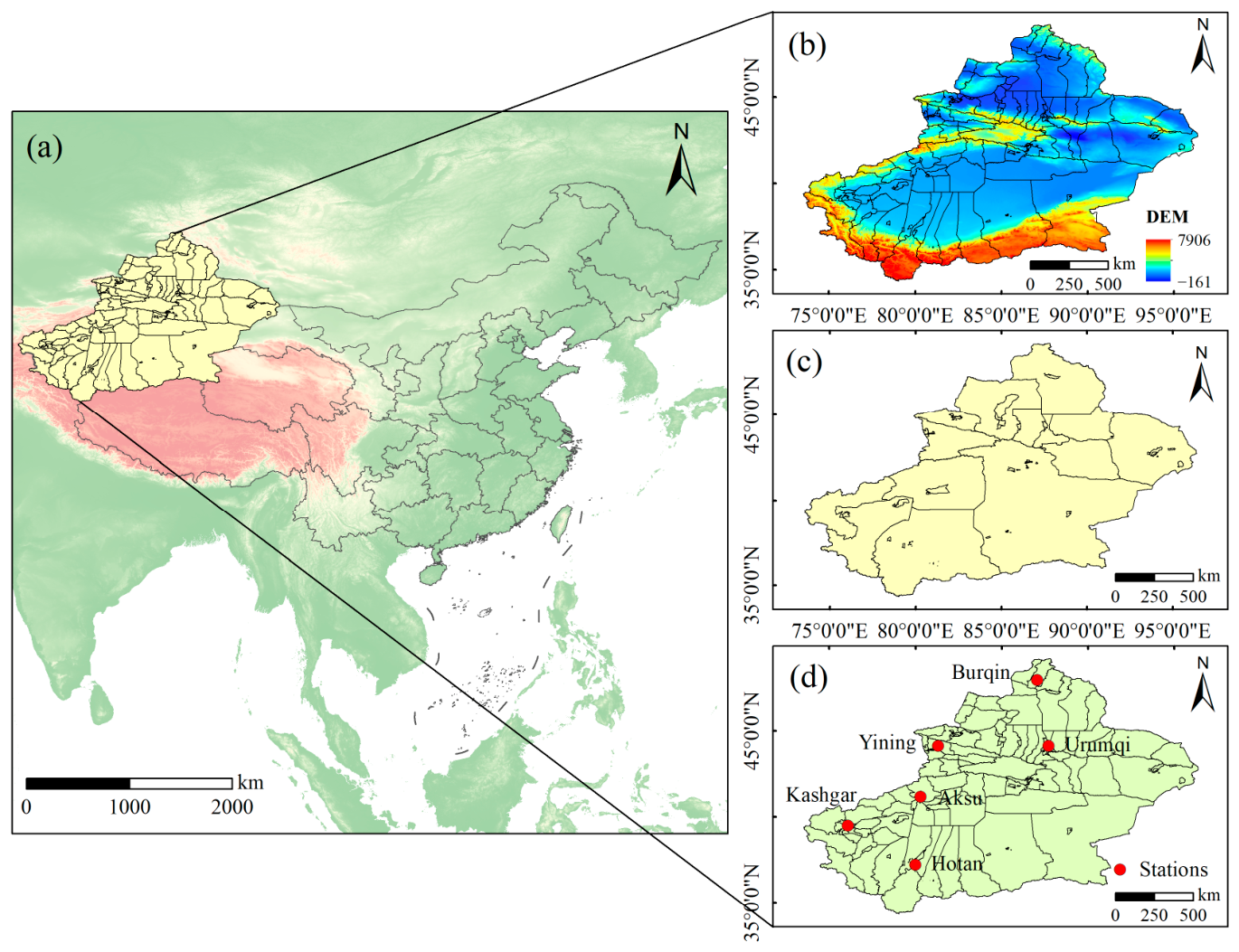
Xinjiang Uygur Autonomous Region (73°40′–96°23′ E, 34°25′–49°10′ N) is located in the arid zone of Northwest China and the hinterland of the Eurasian continent. Covering a total area of approximately 1.66 million km2, it ranks as China’s largest provincial-level administrative region (Figure 1; Figure 1 is produced using the standard base map bearing approval number GS (2024) 06500). The overall terrain presents a typical pattern of “Three Mountains Enclosing Two Basins”. Stretching across the central part of the region, the Tianshan Mountains divide Xinjiang into two major natural geographical units: northern Xinjiang and southern Xinjiang. Northern Xinjiang covers the Junggar Basin, the southern foot of the Altai Mountains, and the northern slope of the Tianshan Mountains, with a temperate continental arid and semi-arid climate characterized by long and cold winters. Southern Xinjiang is dominated by the Tarim Basin, surrounded by the Tianshan, Kunlun, and Altun Mountains. The annual average precipitation is less than 100 mm. The Taklamakan Desert, covering an area of about 330,000 km2, occupies most of the basin. It has abundant surface sand sources and is one of the core areas with frequent dust events in China [18]. The fragile ecological environment and frequent dust events in the arid region pose severe challenges for the mitigation of atmospheric particulate pollution in this area.

2.2. Dataset

2.2.1. CHAP Dataset

The China High-resolution and High-quality Near-surface Air Pollutants Dataset (CHAP) is a high-resolution and high-precision dataset containing multiple air pollutant concentrations. It is established based on artificial intelligence approaches and incorporates multi-type datasets, consisting of ground-level observations, satellite remote sensing records, atmospheric reanalysis products, and pollutant emission inventories. This dataset includes air pollutants such as PM2.5, PM10, SO2, and NO2, covering the whole of China with a spatial resolution of 1 km and a monthly temporal resolution, and a time span from 2003 to 2023. In this study, PM2.5 and PM10 mass concentration data from 2003 to 2023 were used to analyze their spatial distribution characteristics.

2.2.2. Air Quality Station Observation Data

The PM2.5 and PM10 concentration data used in this study were obtained from the China National Environment Monitoring Center (URL: https://air.cnemc.cn:18007 accessed on 15 April 2025). All pollutants were monitored automatically. One valid data record was collected every hour with 24 h continuous daily monitoring. A minimum of 12 valid hourly mean values per day was required to derive valid daily mean values. This study selected the period from 1 January 2015 to 31 December 2024 as the research time frame. According to the standard meteorological seasonal division, the monitoring data were divided into spring (March–May), summer (June–August), autumn (September–November), and winter (December–February next year). The seasonal variation characteristics and dominant influencing factors of atmospheric pollutants in six regions, namely Burqin, Yining, Urumqi, Aksu, Hotan, and Kashgar, were systematically analyzed. The distribution of monitoring stations is presented in Figure 1d.

2.2.3. GDAS Data

The Global Data Assimilation System (GDAS) reanalysis data are provided by the National Centers for Environmental Prediction (NCEP) of the United States. They are obtained by assimilating various meteorological observation data. These meteorological indicators cover barometric pressure, ambient temperature, and relative humidity, together with wind velocity and wind azimuth; the dataset features 1° × 1° grid spacing and six-hourly temporal sampling intervals. The dataset can be obtained from https://www.ready.noaa.gov/data/archives/gdas1 (accessed on 27 January 2026). In this study, GDAS data from 2022 to 2024 were used to drive the model for pollutant source analysis.
The three datasets span different time periods due to data accessibility and their respective research contents. Specifically, the CHAP dataset (2003–2023), a gridded raster product, is adopted to explore long-term regional background trends across Xinjiang. The ground monitoring data (2015–2024) consist of in situ observations for analyses of typical cities. The GDAS meteorological reanalysis dataset (2022–2024) is applied for trajectory modeling to identify potential source areas over recent years. Although these datasets are used for different research contents, their time ranges all fall within the overall study period.

2.3. Method

2.3.1. Trend Analysis

As a nonparametric statistic for trend quantification, the Theil–Sen median estimator can resist observational biases and abnormal values, which makes it widely applied to explore temporal variations in prolonged sequential datasets [19,20,21,22]. This study combines this approach with the Mann–Kendall (M–K) test to assess the significance of the detected trends.
The Theil–Sen median trend is calculated as follows:
β = m e a n x j x i j i , 1 < i < j n
where xi and xj are the sample values of year i and year j, n is the sample size of the time series. β > 0 indicates an upward trend, while β < 0 indicates a downward trend.
Let X = (x1, x2, ......, xn) be a time series with sample size n, and the statistic S is the M–K correlation coefficient:
S = i = 1 n 1 j = i + 1 n s i g n ( x i x j )
where xi and xj denote the sample values in years i and j, respectively.
s i g n ( x i x j ) = 1 ...... x i x j > 0 0 ...... x i x j = 0 1 ... x i x j < 0
The variance Var(S) and the ZC statistic are then computed as follows:
V a r ( S ) = n ( n 1 ) ( 2 n + 5 ) 18
Z c = S 1 V a r ( S ) ...... S > 0 0 .................. S = 0 S + 1 V a r ( S ) ...... S < 0
The larger the value of |ZC|, the more significant the variation trend. |ZC| > 1.96 indicates the trend is significant at the p < 0.05 level, and |ZC| > 2.58 denotes significance at the p < 0.01 level.
This study combines Theil–Sen median trend estimation with Mann–Kendall (M–K) significance verification to systematically characterize the dynamic trends of PM2.5 and PM10 in the study area from 2003 to 2023.

2.3.2. Dust Identification

In this study, the exceedance of the National Ambient Air Quality Standard Grade II (150 μg/m3) in daily mean PM10 concentration is used as the threshold. The regional background value is represented by the median PM10 concentration over the 15 days before and after the exceedance day. A dust event is defined as a day on which the daily mean PM10 concentration minus the regional background value exceeds 150 μg/m3 [23,24,25]. The formula is as follows:
C m n D u s t = D C m n D u s t R B m n
CmnDust: Dust contribution at site m during dust event (μg/m3);
DCmnDust: Daily average PM10 concentration measured at site m during dust event (μg/m3);
RBmn: Regional background value calculated at site m during dust event (μg/m3).
In this study, the PM2.5/PM10 ratio method is employed to distinguish the types of pollution sources and to assess their impacts on the study area [26,27]. When the PM2.5/PM10 ratio exceeds 0.35, anthropogenic sources dominate; otherwise, natural dust sources are considered to have a greater influence [27,28,29].
However, calculating regional background PM10 concentrations using a fixed ±15-day moving window may cause biases when consecutive dust events take place, as prior dust episodes can elevate background pollutant levels. This limitation is notable in southern Xinjiang due to frequent dust activities. To reduce the impact of extreme values, we adopted the median rather than the arithmetic mean. Nonetheless, this approach tends to underestimate net dust contributions during long-lasting dust events. For future research, dynamic window strategies or references from dust-free intervals are recommended.

2.3.3. Pollutant Source Apportionment

The Potential Source Contribution Function (PSCF) serves as an approach to pinpoint potential source regions via air-mass trajectory analysis. The PSCF value is determined by the ratio of polluted trajectories mij to the total trajectories nij passing through grid cell ij. A higher PSCF value indicates a greater probability that air masses from this grid affect the air quality of the receptor site, as shown in Equation (7) [30,31]:
P S C F i j = m i j n i j
where mij is the number of polluted trajectories in grid (i, j), and nij is the total number of trajectories in grid (i, j).
When air masses stay briefly in a grid, nij is small, causing large uncertainty. Thus, the weighted Potential Source Contribution Function (WPSCF) is introduced to reduce errors, as shown in Equation (8):
W P S C F = W i j × P S C F i j
where Wij is the weight coefficient for grid (i, j), related to the total number of trajectories nij in the grid, as shown in Equation (9):
W i j = 1.00 ........... n i j > 80 0.70...20 < n i j 80 0.42...10 < n i j 20 0.05 .......... n i j 10
This study used GDAS meteorological data and the TrajStat (Version 1.5.6) plugin in MeteoInfo software (Version 4.0.4) to perform PSCF calculation and analysis. The backward simulation was configured for 72 h [32], which fully covers pollutant transport from surrounding regions to key cities in Xinjiang. Shorter durations may fail to capture long-range transboundary contributions, whereas longer ones will increase trajectory errors. The trajectory arrival height was set to 500 m above ground. This setting eliminates disturbances from urban constructions and planetary boundary layer turbulence and faithfully represents the transport features of the near-surface atmosphere. Trajectories were clustered using the Euclidean distance algorithm based on air-mass direction and transport distance seasonally into five categories. The grid resolution was 0.5° × 0.5°, and the study domain covered 60–100° E, 20–50° N. We adopted weights following Equation (9) to reduce the uncertainty of grids with low trajectory frequencies. The target sites were Urumqi (87.36° E, 43.45° N) and Kashgar (76.18° E, 39.29° N). Backward trajectory simulations were conducted on daily hourly air mass trajectories from 2022 to 2024 by season, and the PSCF method was applied to identify potential source region analysis of PM2.5 and PM10 pollution.

3. Results and Discussion

3.1. Spatial Distribution of Particulate Matter

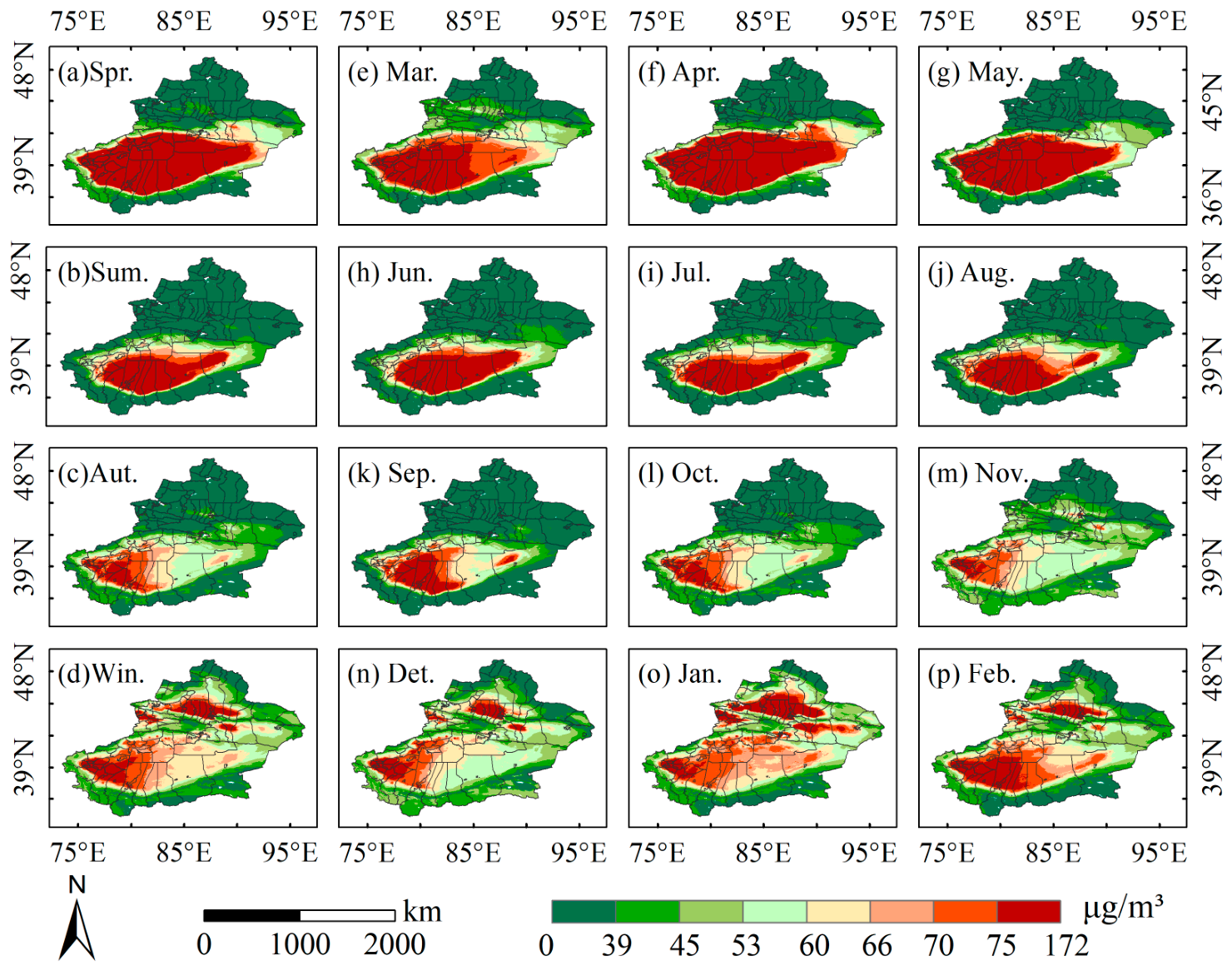
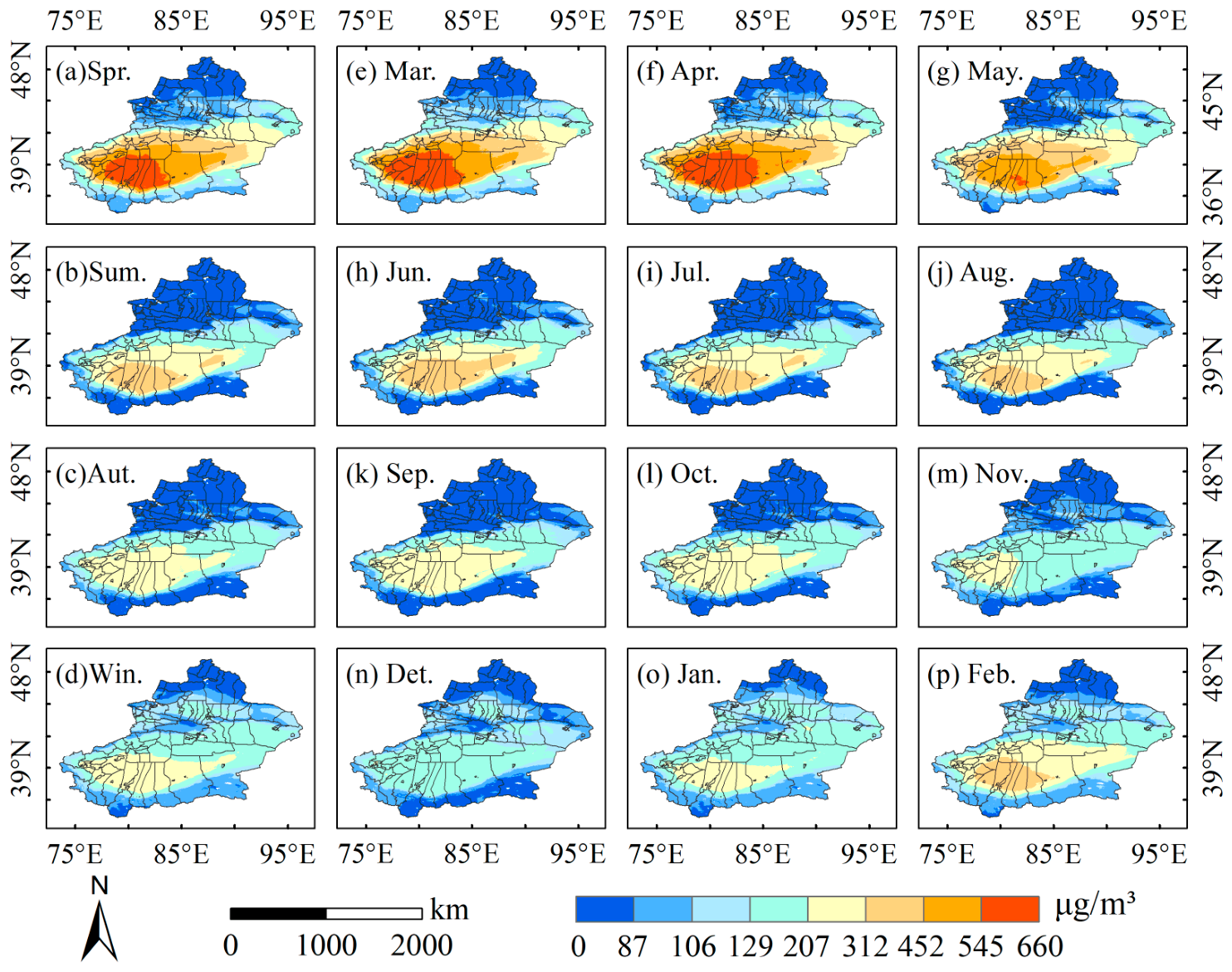
PM2.5 concentrations in Xinjiang are higher in spring and winter and lower in summer and autumn (Figure 2; Same approval number as Figure 1), with a spring average PM2.5 concentration of 66 μg/m3. Pollution is more severe in southern Xinjiang, which may be related to its arid climate and bare land surface [33]. Affected by prevailing wind direction, arid climate, low precipitation, and sparse vegetation, PM2.5 concentrations exceeded 70 μg/m3 in 54% of South Xinjiang, making spring the season with the highest PM2.5 concentrations across Xinjiang. From March (e) to April (f), the PM2.5 concentrations in Ruoqiang, Qiemo, and Yuli counties of eastern South Xinjiang increased significantly, a trend that was likely driven by dust events. The average PM2.5 concentrations in summer and autumn were 43 μg/m3 and 44 μg/m3, respectively. In winter, zones with elevated PM2.5 levels primarily cluster within the urban piedmont belt of the northern Tianshan and cities including Kashgar in western southern Xinjiang, whose seasonal mean PM2.5 concentrations reach 69 μg/m3 and 97 μg/m3, respectively. The PM2.5 concentration in central Urumqi even exceeded 130 μg/m3. This may be attributed to increased pollutant emissions during the heating season. As shown in the distribution maps of January (o) and February (p), the PM2.5 levels in this urban agglomeration and parts of western South Xinjiang remained consistently above 75 μg/m3.
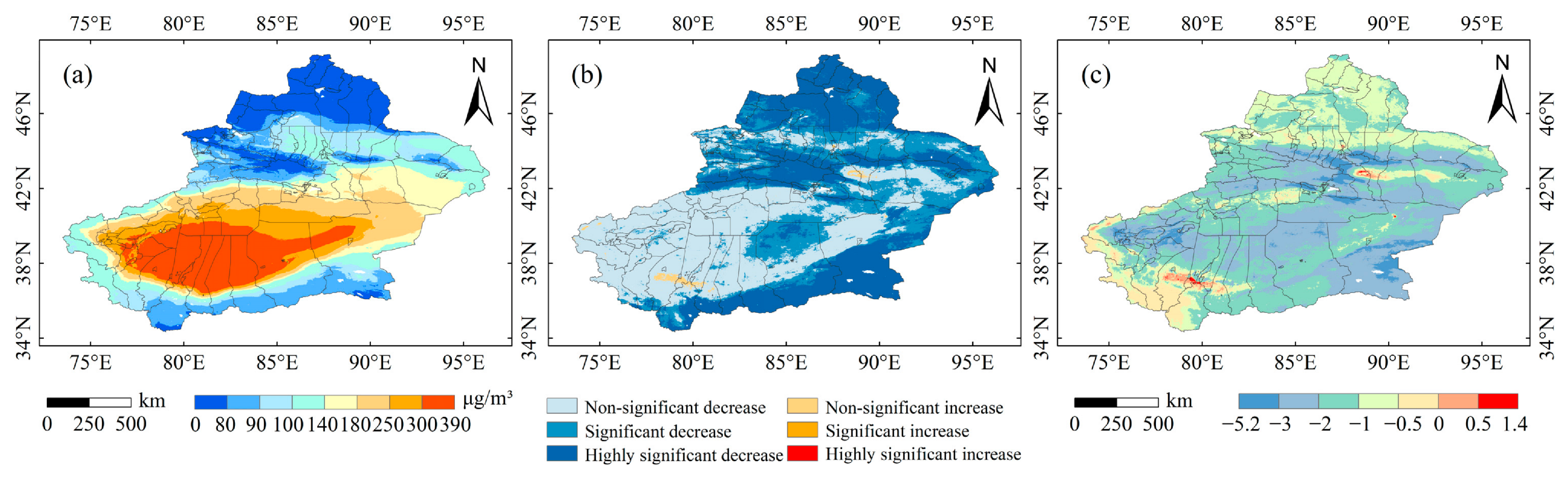
Further analysis of the spatial distribution characteristics of annual average PM2.5 concentrations (Figure 3a; Same approval number as Figure 1) showed that areas with PM2.5 mass concentrations higher than 75 μg/m3 accounted for 21.81% of the total area of Xinjiang, and there was a significant regional difference in PM2.5 levels between South Xinjiang and North Xinjiang. The annual average PM2.5 mass concentration in most parts of North Xinjiang was below 40 μg/m3. High-value areas were limited and mainly distributed around Urumqi and Changji, with concentrations ranging from 50 to 70 μg/m3. By contrast, the annual average concentration in most areas of South Xinjiang exceeded 50 μg/m3. The highest value was recorded in Hotan, in the southwestern Tarim Basin, exceeding 100 μg/m3.
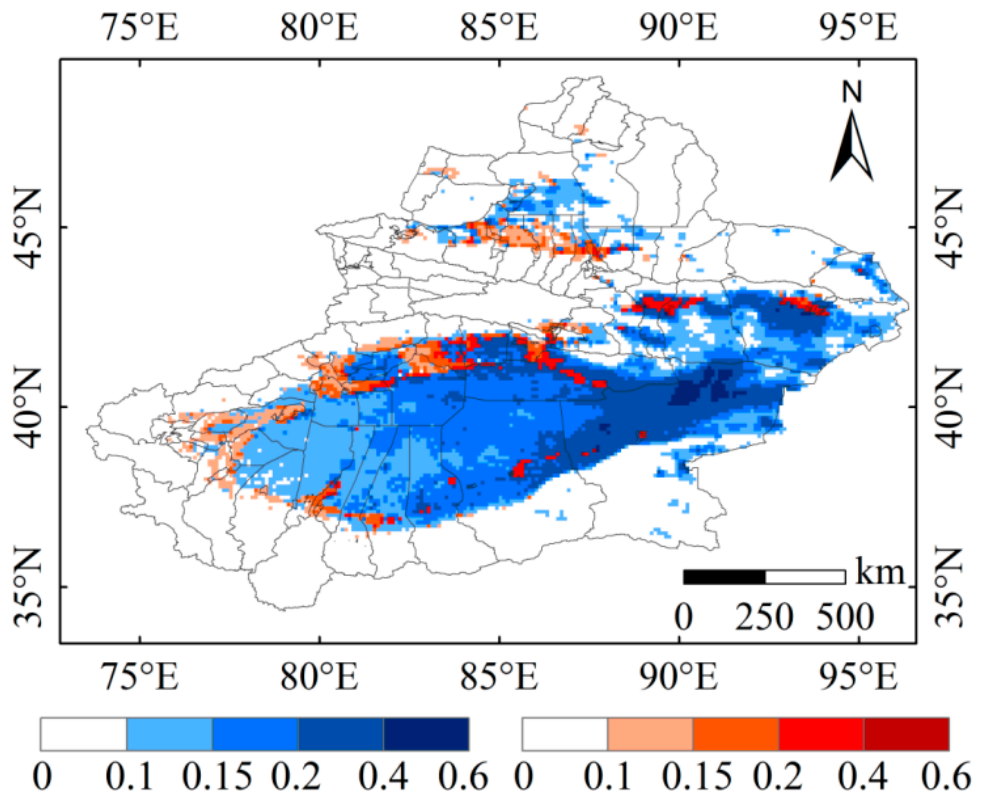
As shown in Figure 3b, based on the Theil–Sen slope estimation, areas with a decreasing trend of PM2.5 concentrations in Xinjiang were far larger than those with an increasing trend, indicating a favorable improvement in air quality. Areas with an extremely significant decreasing trend (p < 0.01, |ZC| > 2.58) accounted for 56.72% of Xinjiang’s total area and were mainly distributed in the Tianshan Mountains and the northern Junggar Basin. Regions with an increasing trend presented scattered patches along the southern margin of the Tarim Basin and around Urumqi. The trend rate ranged from 0 to 0.4% in parts of the southern Tarim Basin, while the rate around Urumqi was slightly higher, with a maximum of 0.85%.
The spatial distribution of PM10 in Xinjiang (Figure 4; Same approval number as Figure 1) shows a pattern of high concentrations in the south and low concentrations in the north. The regional average PM10 concentration peaks in spring at 248 μg/m3. High-concentration areas in Hotan Prefecture even reach 552 μg/m3, as incomplete surface snowmelt and vegetation restoration, loose surface soil, and unstable atmospheric conditions aggravate sand particle emission and dust transport [34,35]. In summer, particulate matter concentrations dropped across most of Xinjiang, though severe pollution remained in parts of South Xinjiang; for example, the concentration in Hotan still hit 354 μg/m3 in June (h). PM10 concentrations decreased further in autumn, with a regional average of 133 μg/m3. In winter, PM10 levels rose most markedly in Urumqi and its surrounding areas along the Tianshan Mountains. This trend is closely associated with stable meteorological conditions in winter. Temperature inversion layers significantly restrain the vertical diffusion of atmospheric pollutants, further aggravating pollutant accumulation near the surface.
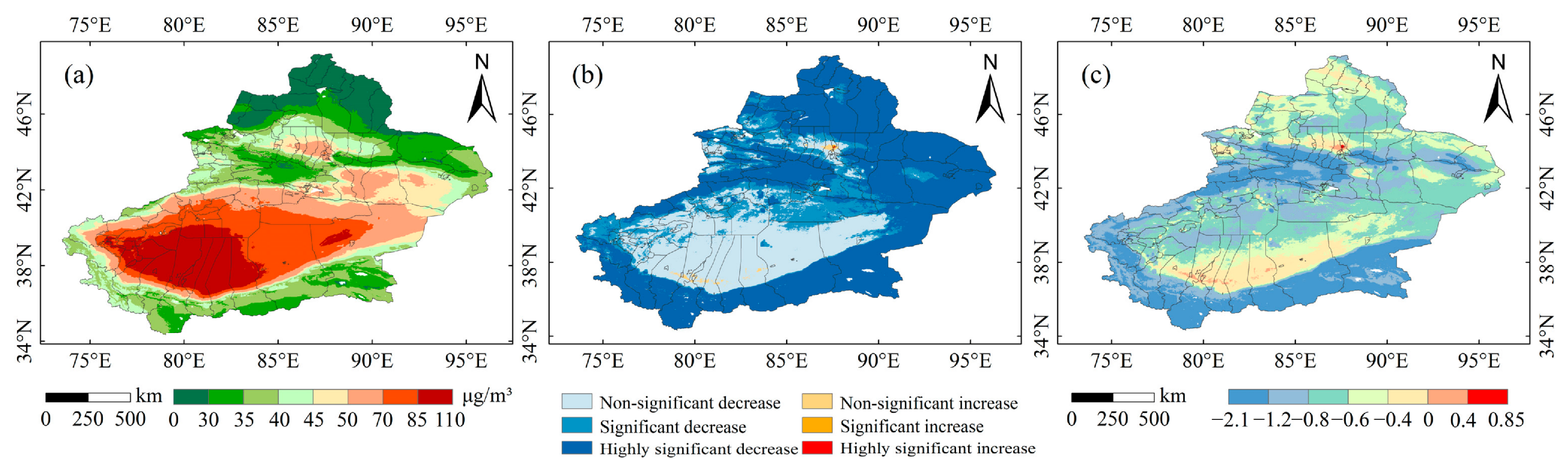
Figure 5b,c (Same approval number as Figure 1) indicated that during 2003–2023, areas with significant decreases in PM10 concentrations (p < 0.05, |ZC| > 1.96) across Xinjiang were mainly concentrated at the southern foot of the Altai Mountains, the western Tianshan Mountains, and the Kunlun Mountains. The annual change rate along the southern Altai Mountains ranged from −0.5% to −1.2%. Areas with an increasing trend were small in scope, mainly covering Hotan, Turpan, and parts of the Kizilsu Kirghiz Autonomous Prefecture. This trend indicates that particulate pollution control has achieved remarkable results in most areas of Xinjiang, while some regions still face pressures from dust activities and local emissions.

3.2. Spatiotemporal Variations in Particulate Matter in Major Arid Urban Areas

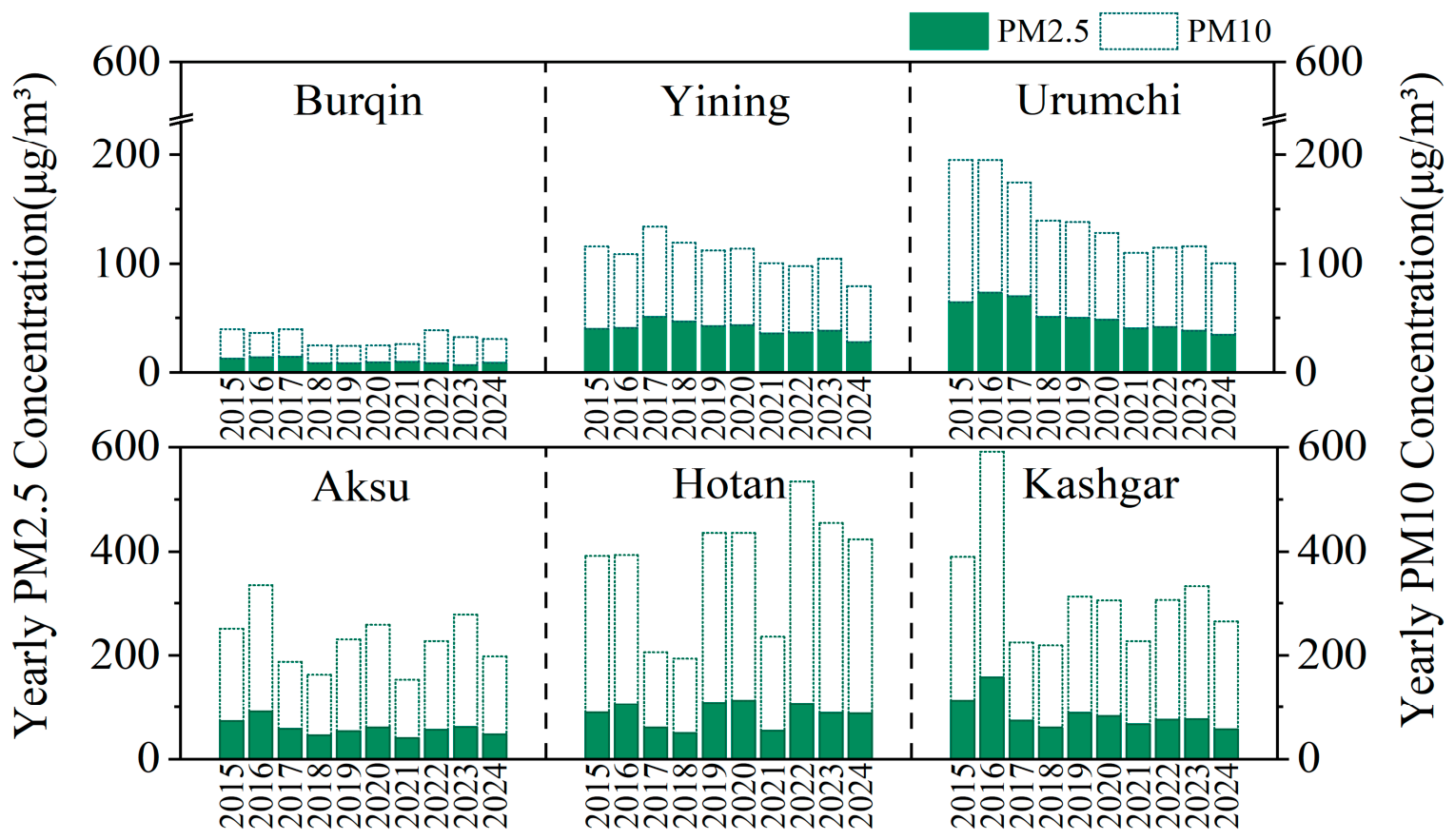
Further analysis is made on the variation characteristics of PM2.5 and PM10 in six typical cities of Xinjiang (Figure 6). Northern Xinjiang’s Burqin, Yining, and Urumqi generally maintained relatively low particulate matter concentrations. Among them, Burqin consistently showed low levels of PM2.5 and PM10, with annual averages below 15 μg/m3 and 30 μg/m3, respectively. Yining presented a moderate pollution level with slight interannual variation. As the core city of Northern Xinjiang, Urumqi recorded relatively higher particulate concentrations, with average PM2.5 and PM10 concentrations of 51 μg/m3 and 91 μg/m3, respectively. Aksu, Hotan, and Kashgar in Southern Xinjiang exhibited average PM2.5 concentrations of approximately 85 μg/m3. Greatly affected by dust activities, their PM10 concentrations reached around 250 μg/m3, which were much higher than the corresponding PM2.5 levels. Particulate matter concentrations in various cities in Northern Xinjiang showed a decreasing trend, especially in Urumqi, where the trend was more obvious, reflecting remarkable achievements in air pollution control. In contrast, particulate matter concentrations in cities in Southern Xinjiang exhibited significant interannual fluctuations and remained at relatively high levels. However, in 2024, PM concentrations in most of these cities decreased compared with previous years, indicating an overall improving trend in air quality.
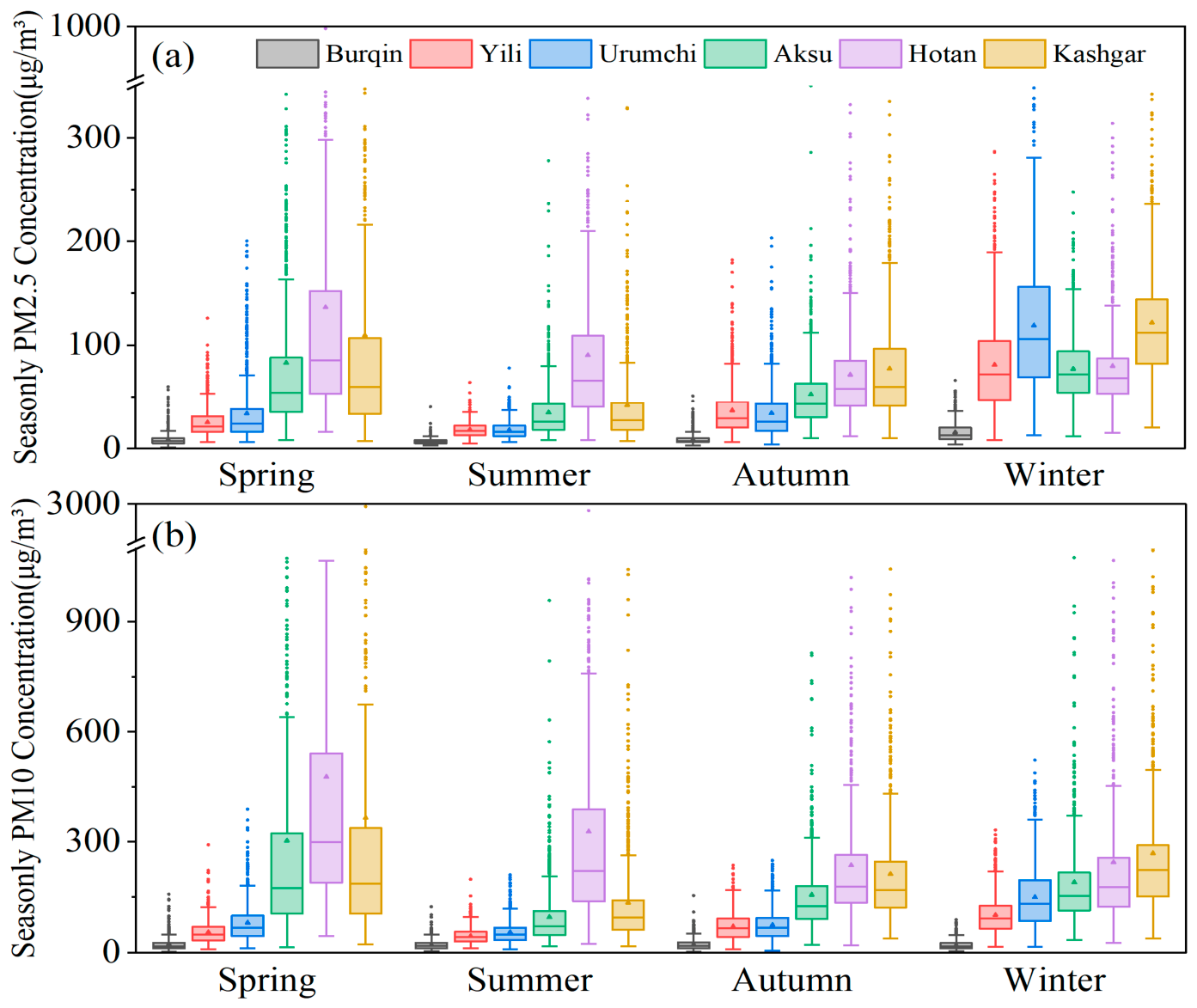
As shown in Figure 7, regarding the seasonal variations in PM2.5 and PM10 concentrations in typical Xinjiang cities from 2015 to 2024, Hotan recorded PM2.5 concentrations above 85.5 μg/m3 in over 50% of spring periods, with the maximum PM10 concentration reaching about 299 μg/m3, which were markedly higher than those in other cities. Among Northern Xinjiang cities, Urumqi had a relatively high average seasonal PM2.5 concentration of approximately 24 μg/m3. In summer and autumn, particulate matter concentrations generally declined across all cities, narrowing the concentration difference between Southern and Northern Xinjiang. In winter, PM2.5 concentrations rose further in all cities, particularly in Urumqi, where concentrations exceeded 106 μg/m3 for half of the period and peaked at 397 μg/m3.

3.3. Impact of Dust Events on Particulate Matter Concentrations

Days with daily average PM10 concentrations exceeding the standard due to dust events were defined as dust periods, and the remaining days were classified as non-dust periods. Further analysis of the impacts of dust activities on urban particulate matter concentrations (Table 1) indicated that the influence of dust activities differed substantially across cities. Hotan was affected most severely by dust events. The annual proportion of dust-affected days reached 14.04%, with the average PM10 concentration during dust periods as high as 772 μg/m3, and an extreme value of 1104 μg/m3 was recorded in 2022. Aksu and Kashgar were also markedly affected by dust events. Their annual proportions of dust-affected days were 7.0% and 9.22%, respectively, while the average PM10 concentrations on dust-affected days were 627 μg/m3 and 734 μg/m3.
In contrast, cities in Northern Xinjiang were generally less affected by dust events. Urumqi had an annual dust-affected day ratio of 1.42%, with an average PM10 concentration of 324 μg/m3 on dust-affected days. Yining showed an even weaker dust influence, with an annual ratio of merely 0.41%. No dust-affected days were recorded in Burqin County during the observation period from 2015 to 2024, indicating that the region was barely affected by dust activities.
In terms of interannual variation, except for Yining and Burqin County, with no dust-affected days detected, the proportions of dust-affected days in the remaining four cities all decreased to relatively low levels during 2017–2018. Thereafter, the proportions for Hotan, Kashgar, and Aksu in Southern Xinjiang rebounded rapidly and stayed at a persistently high level, showing strong temporal synchronization with the periods of elevated PM10 concentrations on dust-affected days. This phenomenon further indicates that dust activities act as the dominant factor driving extreme PM10 pollution in Southern Xinjiang cities. The notable drop in dust-affected days during 2017–2018 is mainly driven by strict nationwide emission control policies in China [36]. In comparison, the rebound of dust-affected days after 2019 is associated with deficient winter precipitation induced by La Niña, which reduces soil moisture and vegetation coverage across dust source areas [37].
A comparative analysis of particulate matter concentrations during dust and non-dust periods in six major cities of Xinjiang from 2015 to 2024 (Table 2) indicated that dust events exerted significant effects on both PM2.5 and PM10 concentrations across all cities.
During dust periods, the average PM10 concentration was approximately 4.4 times that during non-dust periods, and the PM2.5 concentration was about 4.0 times higher, revealing that dust was the primary source of PM10 pollution in urban areas of Xinjiang. Among the six cities, Kashgar and Hotan recorded the highest pollutant concentrations during dust periods, with PM2.5 concentrations of 252 μg/m3 and 224 μg/m3, and PM10 concentrations reaching 865 μg/m3 and 854 μg/m3, respectively. These two cities were the most severely affected by dust events. Even during non-dust periods, their pollutant concentrations remained at the highest levels. This is likely associated with their high pollutant concentrations, which were driven not only by dust activities but also by their location on the edge of the Taklamakan Desert, which led to high annual background pollution levels. Furthermore, the basin terrain hindered the diffusion of air pollutants, and the superposition of these multiple factors resulted in persistently high pollution levels. In comparison, Yining had the lowest PM10 concentration (266 μg/m3) during dust periods. In terms of the concentration increase ratio of dust periods relative to non-dust periods, Yining showed the largest PM2.5 amplification (4.47 times), while Aksu had the smallest (3.54 times). For PM10, Kashgar exhibited the highest amplification ratio (5.76 times).
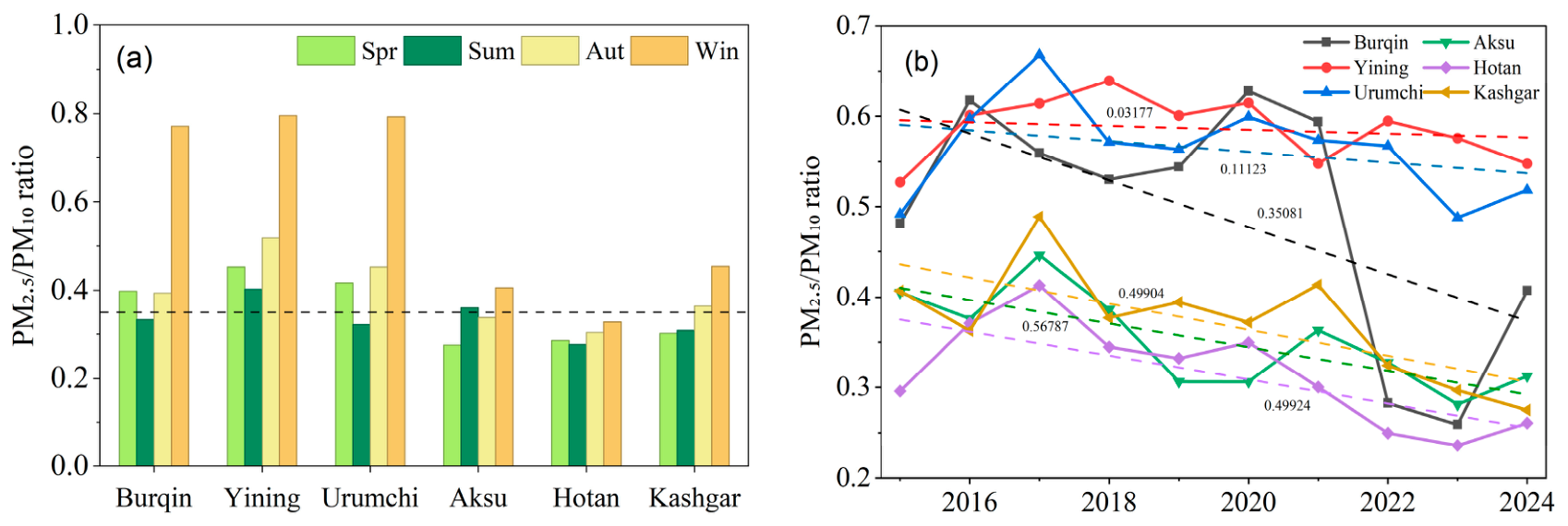
An investigation into the PM2.5/PM10 ratio across major cities for varying seasons and years (Figure 8) reveals higher ratio values in winter, alongside relatively lower readings during spring and summer.
The PM2.5/PM10 ratios in Burqin County, Yining, and Urumqi of northern Xinjiang were generally high, all above 0.35, and even exceeded 0.7 in winter. This indicated that fine particulate matter occupied a large proportion of total particulate matter in these cities, with anthropogenic emissions contributing significantly. The PM2.5/PM10 ratios in Aksu, Kashgar, and Hotan of southern Xinjiang were generally low, staying below 0.35 in most seasons with slight seasonal differences. This suggested that particulate pollution in these regions was dominated by coarse PM10, and natural dust sources played a dominant role.
The overall PM2.5/PM10 ratio in major cities of Xinjiang presented a declining trend from 2015 to 2024, implying a growing impact of coarse particulate matter. Northern Xinjiang cities had relatively higher PM2.5/PM10 ratios, where fine particles accounted for a considerable share and were markedly influenced by anthropogenic emissions. By comparison, southern Xinjiang cities had lower ratios, dominated by coarse particles with natural dust as the primary contributor. This may be attributed to the rapid expansion of energy-related facilities [38]; large-scale construction projects generate substantial fugitive dust and thereby elevate PM10 concentrations. In addition, dust events drive up PM10 concentrations without a synchronous rise in PM2.5, further reducing the PM2.5/PM10 ratio. Future studies should incorporate localized activity data to achieve more accurate analysis.
Further analysis of the occurrence frequency of different dust sources in Xinjiang (Figure 9; Same approval number as Figure 1) showed that high-incidence areas of natural dust sources were mainly distributed within the Tarim Basin. This was highly consistent with the persistently high PM10 concentrations and long-term PM2.5/PM10 ratios below 0.35 in Aksu, Hotan, and Kashgar of southern Xinjiang, indicating that natural dust was the dominant factor driving coarse particulate pollution in southern Xinjiang.
In contrast, high-incidence areas of anthropogenic dust sources were concentrated along the northern slope of the Tianshan Mountains, mainly around Urumqi and Changji. This was consistent with the generally high PM2.5/PM10 ratios (above 0.35) and the notable increase in winter PM2.5 concentrations in this region, reflecting the substantial contribution of human activities such as agricultural cultivation, animal husbandry, and urban construction to fine particulate pollution [39]. In the marginal areas of the Taklamakan Desert, natural and anthropogenic dust sources presented an alternating zonal distribution, indicating that natural and anthropogenic sources dominated different regions spatially.

3.4. Potential Pollution Source Analysis

Based on GDAS meteorological reanalysis data, this study used MeteoInfo software (Version 4.0.4) to conduct seasonal cluster analysis of 72 h backward air mass trajectories at daily and hourly temporal resolutions for Urumqi (87.36° E, 43.45° N) and Kashgar (76.18° E, 39.29° N) from 2022 to 2024. Combined with PM2.5 and PM10 concentration datasets, the Potential Source Contribution Function (PSCF) was applied to identify potential particulate matter source regions and corresponding contribution intensities across seasons. To minimize statistical uncertainty, weighted PSCF results are referred to as WPSCF. In this study, regions with WPSCF values of 0.3–0.4 are defined as lightly polluted areas; areas with WPSCF values ranging from 0.4 to 0.5 are classified as moderately polluted areas; and regions with WPSCF values exceeding 0.5 correspond to heavily polluted areas [40].
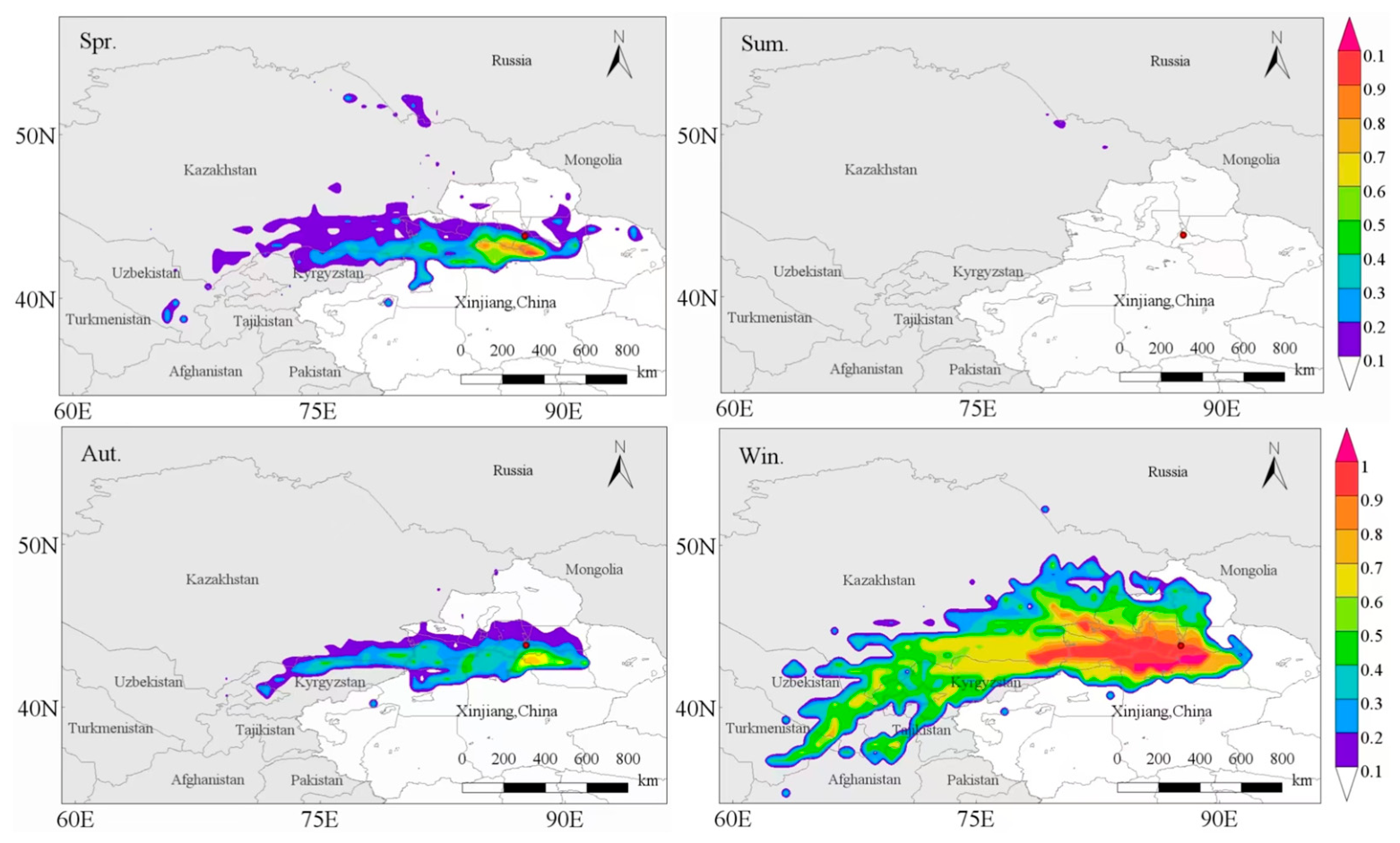
In spring, affected by the circulation of mid-latitude frontal zones and the eastward movement of the Central Asian low trough, the air mass transport over Urumqi is predominantly governed by long-distance westward (33.36%) and northwestward (46.06%) airflow pathways (Table 3) [41]. Potential source areas showed a zonal belt-like distribution (Figure 10), mainly covering the urban agglomeration on the northern slope of the Tianshan Mountains (WPSCF > 0.5, high contribution intensity), as well as southeastern Kazakhstan and northern Kyrgyzstan (WPSCF < 0.4, low contribution intensity). Summer trajectories clustered largely in the west-northwest direction, with the dominant pathway accounting for 36.87%. The transport distance was relatively short, and potential source areas presented a weak contribution (WPSCF < 0.2). Autumn airflow was mainly controlled by west-northwest to northwest pathways (62.91%), together with local southeastern air masses. Potential source areas extended westward to southwestern Kazakhstan and northern Kyrgyzstan, with a spatial pattern similar to that in spring. West–southwest cross-border transport was absolutely dominant in winter, accounting for 49.59%, with a much longer transport distance. High-contribution regions were concentrated within the urban cluster located along the northern piedmont of the Tianshan Mountains (WPSCF > 0.9). This region features a high urbanization rate, concentrated industrial clusters, and large energy consumption, which further aggravate atmospheric pollutant emissions [42,43]. The maximum WPSCF value in southeastern Kazakhstan surpassed 0.7, indicating an obvious increase in pollution contribution. The findings are highly consistent with the aforementioned phenomenon that anthropogenic activities lead to prominent increases in winter PM2.5 concentrations in Urumqi.
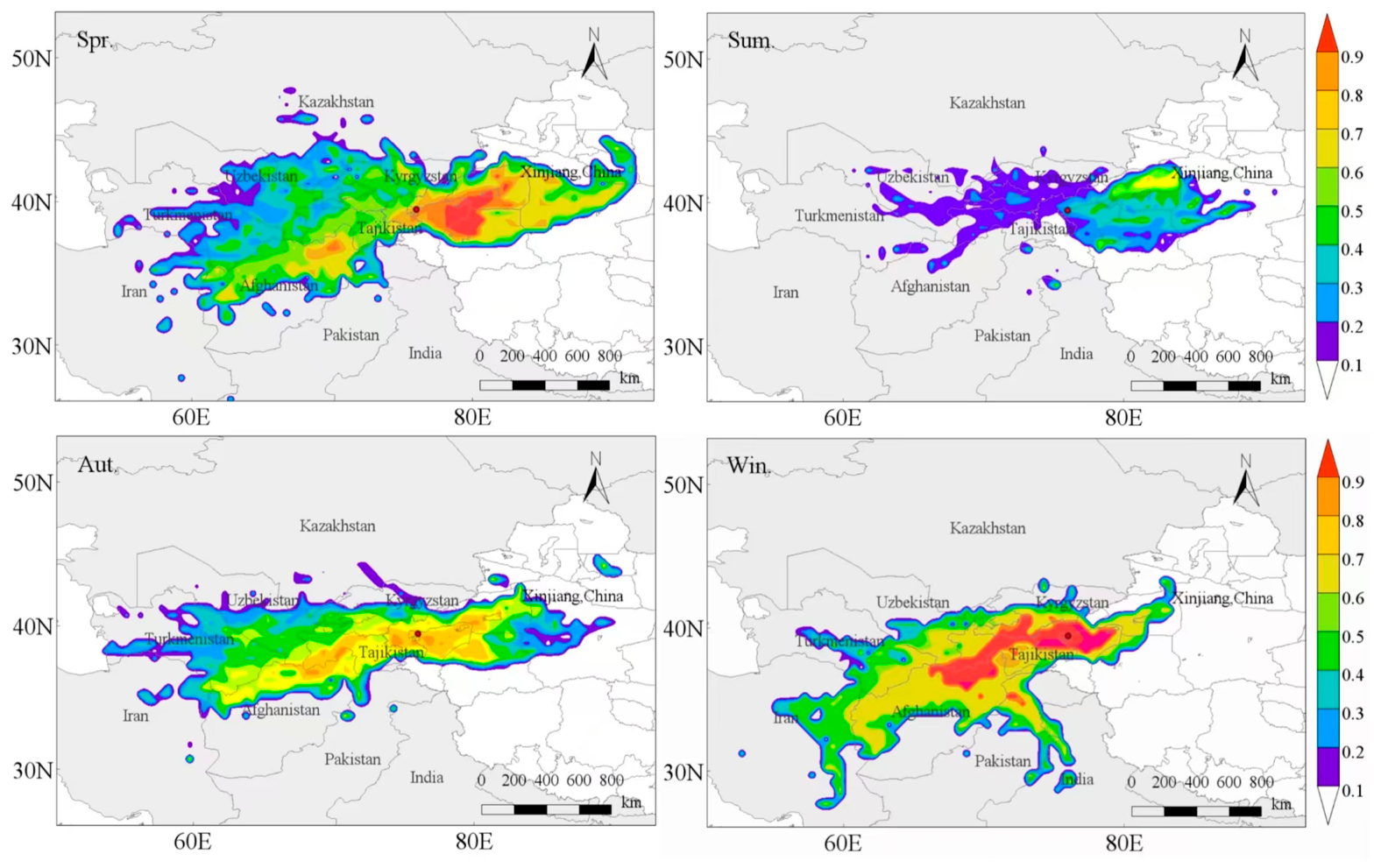
Air mass transport over Kashgar in spring was dominated by northeastern (38.53%) and southwestern (25.85%) pathways (Table 4). Short-range cross-border airflow from the northeast corresponded to a PM10 concentration of 391 μg·m−3. Potential source areas covered an extensive range, with extremely high contributions within Xinjiang, where the maximum WPSCF value reached 0.9 (Figure 11) [44]. This result is consistent with the generally elevated PM10 concentrations in Kashgar during spring, indicating that pollutants mainly originate from dust source regions inside the Tarim Basin. Air mass origins shifted toward the west (46.93%) and east (46.79%) in summer, with transport dominated by short-range patterns. Potential source contributions primarily came from local and intra-Xinjiang regions, while the influence of external sources weakened, with most WPSCF values ranging from 0.1 to 0.2. This pattern is consistent with the seasonal characteristics of weakened dust activity and enhanced vegetation sand-fixation capacity. The eastern trajectory pathway accounted for 53.15% in autumn, and the westward cross-border pathway accounted for 34.98%. WPSCF values of external source areas rose from 0.3 in summer to 0.8, indicating a substantial pollution contribution. In winter, prevailing westerly winds make long-range cross-border transport from the west-southwest direction dominant again, accounting for 71.63% [7]. Pollutant concentrations reached the annual peak, with the most prominent cross-border contribution. Northeastern Afghanistan showed the highest contribution level (WPSCF > 0.9). Local and intra-Xinjiang source regions maintained persistent impacts, forming a high-pollution period characterized by the superposition of internal and external pollution sources.

4. Conclusions

Based on CHAP data and ground-based monitoring data, this study revealed the spatiotemporal evolution characteristics of atmospheric particulate matter in Xinjiang and its typical cities and analyzed the impact of dust activity on urban ambient particulate matter concentrations. The main conclusions are as follows:
(1)
In Xinjiang, PM2.5 and PM10 concentrations exhibit a seasonal pattern characterized by higher levels in spring and winter and lower levels in summer and autumn. In spring, the mean PM10 concentration reaches 248 μg/m3. From 2003 to 2023, 56.72% of Xinjiang’s area exhibited a highly significant decreasing trend in PM2.5 (p < 0.01), while localized increases were observed in the southern margin of the Tarim Basin and the surrounding areas of Urumqi.
(2)
In Urumqi (northern Xinjiang), winter PM2.5 concentrations exceeded 106 μg/m3 on more than 50% of days. In the southern Xinjiang cities of Aksu, Hotan, and Kashgar, dust activity leads to persistently elevated PM10 levels, with annual mean concentrations around 250 μg/m3.
(3)
In Hotan, dust-affected days account for 14.04% of the year on average, with the mean PM10 concentration reaching 772 μg/m3 during dust episodes. During dust episodes, PM10 and PM2.5 levels are 4.4 and 4.0 times higher than in non-dust periods. Northern Xinjiang cities have PM2.5/PM10 ratios mostly >0.35 (anthropogenic-dominated), while southern cities show ratios < 0.35 (dust-dominated).
(4)
In winter, transboundary transport contributes notably to air pollution in Urumqi, with high PSCF values covering northern Xinjiang cities and southeastern Kazakhstan. In spring, Kashgar is significantly affected by pollution sources within Xinjiang (WPSCF reaching 0.9).
These findings provide a scientific basis for precise source apportionment of air pollution in Xinjiang and coordinated air quality management in the urban agglomeration of the core area of the Belt and Road Initiative. It is recommended that cities in northern Xinjiang implement joint winter emission-reduction strategies, while cities in southern Xinjiang integrate desertification prevention and control with transboundary dust mitigation and establish an early warning system adapted to climate change simultaneously.

Author Contributions

Conceptualization, X.Z. and J.L.; methodology, X.Z. and J.L.; software, X.Z.; validation, X.Z. and S.W.; formal analysis, X.Z.; resources, F.W.; data curation, X.Z., and S.W.; writing—original draft preparation, X.Z.; writing—review and editing, X.Z., J.L., and F.W.; visualization, X.Z.; supervision, J.L.; project administration, J.L.; funding acquisition, J.L. All authors have read and agreed to the published version of the manuscript.

Funding

This research was funded by the Youth Doctoral Program under the Tianchi Elite Introduction Plan of the Xinjiang Uygur Autonomous Region Talent Development Fund, the Natural Science Foundation of the Xinjiang Uygur Autonomous Region (2023D01B51), the Doctoral Research Foundation of Xinjiang Normal University (No. XJNUZBS2443), and the S&T Innovation and Development Project of Information Institution of Ministry of Emergency Management (Project No.2024506).

Institutional Review Board Statement

Not applicable.

Informed Consent Statement

Not applicable.

Data Availability Statement

This study utilized PM2.5 and PM10 data from the China High Air Pollutants (CHAP) dataset. The data are publicly accessible via the National Tibetan Plateau Data Center, with the PM2.5 subset available at https://doi.org/10.5281/zenodo.3539349 (accessed on 15 April 2025) and the PM10 subset at https://doi.org/10.5281/zenodo.3752465 (accessed on 15 April 2025). The ambient air quality monitoring station data were derived from the China National Environment Monitoring Center (https://air.cnemc.cn:18007; accessed on 15 April 2025). The GDAS data were sourced from the Global Data Assimilation System provided by the National Centers for Environmental Prediction (NCEP) and are available at https://doi.org/10.5065/dwyz-q852 (accessed on 11 July 2025).

Conflicts of Interest

The authors declare no conflicts of interest.

Abbreviations

The following abbreviations are used in this manuscript:
CHAPChina High Air Pollutants
GDASGlobal Data Assimilation System
M–KMann–Kendall
PSCFPotential Source Contribution Function

References

  1. Wei, J.; Li, Z.; Lyapustin, A.; Sun, L.; Peng, Y.; Xue, W.; Su, T.; Cribb, M. Reconstructing 1-km-resolution high-quality PM2.5 data records from 2000 to 2018 in China: Spatiotemporal variations and policy implications. Remote Sens. Environ. 2021, 252, 112136. [Google Scholar] [CrossRef]
  2. Wei, J.; Li, Z.; Xue, W.; Sun, L.; Fan, T.; Liu, L.; Su, T.; Cribb, M. The China High PM10 dataset: Generation, validation, and spatiotemporal variations from 2013 to 2019 across China. Environ. Int. 2021, 146, 106290. [Google Scholar] [CrossRef] [PubMed]
  3. Van Donkelaar, A.; Hammer, M.; Bindle, L.; Brauer, M.; Brook, J.R.; Garay, M.J.; Hsu, N.C.; Kalashnikova, O.V.; Kahn, R.A.; Lee, C.; et al. Monthly Global Estimates of Fine Particulate Matter and Their Uncertainty. Environ. Sci. Technol. 2021, 55, 15287–15300. [Google Scholar] [CrossRef] [PubMed]
  4. Gan, Y.; Zhang, Z.; Chu, W.; Ding, J. Assessment and prediction of dust emissions, deposition and radiation forcing in Central Asia. Atmos. Chem. Phys. 2026, 26, 3881–3900. [Google Scholar] [CrossRef]
  5. Zhang, Y.F.; Chen, X.Y.; Zhao, F.T.; Xia, Q.R.; Xing, H.C.; Du, M.D. Aerosol spatiotemporal dynamics, source analysis and influence mechanisms over typical drylands. Geosci. Front. 2025, 16, 101958. [Google Scholar] [CrossRef]
  6. Liu, C.; Zhang, T.H.; Lu, B.Q.; Zheng, G.Z.; Liu, X.Y.; Gao, Y.; Chen, Y.; Li, X. Multiple models used to deconstruct the characteristics of atmospheric particles in arid region of Northwest China. Front. Environ. Sci. 2022, 10, 945658. [Google Scholar] [CrossRef]
  7. Li, H.L.; He, Q.; Zhao, Q.W. Transport pathways and potential source regions of PM10 in Kashgar, Xinjiang, China. J. Desert Res. 2021, 41, 62–70. [Google Scholar]
  8. Wei, Y.; Li, Z.; Zhang, Y.; Li, K.; Chen, J.; Peng, Z.; Hu, Q.; Goloub, P.; Ou, Y. The Effects of Local Pollution and Transport Dust on Aerosol Properties in Typical Arid Regions of Central Asia. Atmosphere 2022, 13, 729. [Google Scholar] [CrossRef]
  9. Liu, X.; Amonov, M.; Turner, J.R. Quantifying dust contribution to particulate matter in Central Asia: Insights from the elemental composition of PM2.5 and PM10 in Uzbekistan. Atmos. Pollut. Res. 2026, 17, 102781. [Google Scholar] [CrossRef]
  10. Filonchyk, M. Characteristics of the severe dust storm events in Central Asia. Atmos. Res. 2023, 282, 106518. [Google Scholar]
  11. Zhang, H.; Zhang, Z.; Lin, W.; Lin, G.; Luo, C.; Fang, T.; Luo, N.; Cai, M.; Wang, L.; Yan, B.; et al. Disentangling seasonal dynamics and transboundary transport of PAHs in a coastal monsoon city. Atmos. Res. 2026, 330, 108613. [Google Scholar] [CrossRef]
  12. Zhao, S.P.; Yu, Y.; Qin, D.H.; Yin, D.Y.; Dong, L.X.; He, J.J. Analyses of regional pollution and transportation of PM2.5 and ozone in the city clusters of Sichuan Basin, China. Atmos. Pollut. Res. 2019, 10, 374–385. [Google Scholar] [CrossRef]
  13. Al Kafy, A.; Ibrahim, W.M.; Al Baky, A.; Bahiru, T.K. Trends and oscillation characteristics of hourly PM2.5 levels in arid environment using wavelet coherence and lagged correlation. Sci. Rep. 2026, 16, 6827. [Google Scholar] [CrossRef]
  14. Jiang, B.; Cai, Y.; Shi, Y.; Zhai, Q.; Huang, H.; Peng, L.; Zhan, J. Characterization, sources, and driving factors of particulate matter (PM) pollution in a desert hinterland city: Insights from Hotan, China. J. Environ. Sci. 2026, 161, 209–219. [Google Scholar] [CrossRef] [PubMed]
  15. Li, Z.; Wang, Y.; Xu, Z.; Cao, Y. Characteristics and sources of atmospheric pollutants in typical inland cities in arid regions of central Asia: A case study of Urumqi city. PLoS ONE 2021, 16, e0249563. [Google Scholar] [CrossRef] [PubMed]
  16. Yang, Y.; Chang, W. Analysis of Spatial and Temporal Distribution and Changes in Extreme Climate Events in Northwest China from 1960 to 2021: A Case Study of Xinjiang. Sustainability 2024, 16, 4960. [Google Scholar] [CrossRef]
  17. Li, C.; Ling, X.; Liu, W.; Tang, Z.; Zhuang, Q.; Fang, M. Long-Term Spatiotemporal Variability and Source Attribution of Aerosols over Xinjiang, China. Remote Sens. 2025, 17, 2207. [Google Scholar] [CrossRef]
  18. Guan, Q.Y.; Yang, Y.Y.; Luo, H.P.; Zhao, R.; Pan, N.H.; Lin, J.K.; Yang, L.Q. Transport pathways of PM10 during the spring in northwest China and its characteristics of potential dust sources. J. Clean. Prod. 2019, 237, 117746. [Google Scholar] [CrossRef]
  19. Huang, N.; Wang, L.; Song, X.-P.; Black, T.A.; Jassal, R.S.; Myneni, R.B.; Wu, C.; Wang, L.; Song, W.; Ji, D.; et al. Spatial and temporal variations in global soil respiration and their relationships with climate and land cover. Sci. Adv. 2020, 6, eabb8508. [Google Scholar] [CrossRef]
  20. Pernov, J.B.; Beddows, D.; Thomas, D.C.; Dall’Osto, M.; Harrison, R.M.; Schmale, J.; Skov, H.; Massling, A. Increased aerosol concentrations in the High Arctic attributable to changing atmospheric transport patterns. npj Clim. Atmos. Sci. 2022, 5, 62. [Google Scholar] [CrossRef]
  21. Fan, M.; Xu, J.; Yu, W.; Chen, Y.; Wang, M.; Dai, W.; Wang, Y. Recent Tianshan warming in relation to large-scale climate teleconnections. Sci. Total Environ. 2023, 856, 159201. [Google Scholar] [CrossRef] [PubMed]
  22. Wang, Y.; Xiao, J.; Ma, Y.; Ding, J.; Chen, X.; Ding, Z.; Luo, Y. Persistent and enhanced carbon sequestration capacity of alpine grasslands on Earth’s Third Pole. Sci. Adv. 2023, 9, eade6875. [Google Scholar] [CrossRef] [PubMed]
  23. Escudero, M.; Stein, A.F.; Draxler, R.R.; Querol, X.; Alastuey, A.; Castillo, S.; Avila, A. Source apportionment for African dust outbreaks over the Western Mediterranean using the HYSPLIT model. Atmos. Res. 2011, 99, 518–527. [Google Scholar] [CrossRef]
  24. Cuspilici, A.; Monforte, P.; Ragusa, M.A. Study of Saharan dust influence on PM10 measures in Sicily from 2013 to 2015. Ecol. Indic. 2017, 76, 297–303. [Google Scholar] [CrossRef]
  25. Guan, Q.; Luo, H.; Pan, N.; Zhao, R.; Yang, L.; Yang, Y.; Tian, J. Contribution of dust in northern China to PM10 concentrations over the Hexi corridor. Sci. Total Environ. 2019, 660, 947–958. [Google Scholar] [CrossRef]
  26. Marcazzan, G.M.; Ceriani, M.; Valli, G.; Vecchi, R. Source apportionment of PM10 and PM2.5 in Milan (Italy) using receptor modelling. Sci. Total Environ. 2003, 317, 137–147. [Google Scholar] [CrossRef]
  27. Sugimoto, N.; Shimizu, A.; Matsui, I.; Nishikawa, M. A method for estimating the fraction of mineral dust in particulate matter using PM2.5-to-PM10 ratios. Particuology 2016, 28, 114–120. [Google Scholar] [CrossRef]
  28. Akyüz, M.; Çabuk, H. Meteorological variations of PM2.5/PM10 concentrations and particle-associated polycyclic aromatic hydrocarbons in the atmospheric environment of Zonguldak, Turkey. J. Hazard. Mater. 2009, 17, 13–21. [Google Scholar] [CrossRef]
  29. Zhou, X.; Cao, Z.; Ma, Y.; Wang, L.; Wu, R.; Wang, W. Concentrations, correlations and chemical species of PM2.5/PM10 based on published data in China: Potential implications for the revised particulate standard. Chemosphere 2016, 144, 518–526. [Google Scholar] [CrossRef]
  30. Fan, W.; Qin, K.; Xu, J.; Yuan, L.; Li, D.; Jin, Z.; Zhang, K. Aerosol vertical distribution and sources estimation at a site of the Yangtze River Delta region of China. Atmos. Res. 2019, 217, 128–136. [Google Scholar] [CrossRef]
  31. Wang, Y.Q.; Zhang, X.Y.; Draxler, R.R. TrajStat GIS-based software that uses various trajectory statistical analysis methods to identify potential sources from long-term air pollution measurement data. Environ. Model. Softw. 2009, 24, 938–939. [Google Scholar] [CrossRef]
  32. Li, M.; Huang, X.; Zhu, L.; Li, J.; Song, Y.; Cai, X.; Xie, S. Analysis of the transport pathways and potential sources of PM10 in Shanghai based on three methods. Sci. Total Environ. 2012, 414, 525–534. [Google Scholar] [CrossRef]
  33. Li, J.L.; Zhong, Y.T.; Dong, Y.X.; Cai, H.Y.; Tao, R. Long-term variation trends and short-term elevation events of PM10 and PM2.5 mass concentrations at Akedala station. Arid Land Geogr. 2026, 49, 47–55. [Google Scholar] [CrossRef]
  34. Han, L.J.; Tsunekawa, A.; Tsubo, M. Effect of frozen ground on dust outbreaks in spring on the eastern Mongolian Plateau. Geomorphology 2011, 129, 412–416. [Google Scholar] [CrossRef]
  35. Ebrahimi Khusfi, Z.; Khosroshahi, M.; Roustaei, F.; Mirakbari, M. Spatial and seasonal variations of sand-dust events and their relation to atmospheric conditions and vegetation cover in semi-arid regions of central Iran. Geoderma 2020, 365, 114225. [Google Scholar] [CrossRef]
  36. Rupakheti, D.; Yin, X.; Rupakheti, M.; Zhang, Q.; Li, P.; Rai, M.; Kang, S. Spatio-temporal characteristics of air pollutants over Xinjiang, northwestern China. Environ. Pollut. 2021, 284, 117236. [Google Scholar] [CrossRef]
  37. Xi, X. On the geomorphic, meteorological, and hydroclimatic drivers of the unusual 2018 early summer salt dust storms in Central Asia. J. Geophys. Res. Atmos. 2023, 128, e2022JD038089. [Google Scholar] [CrossRef]
  38. Xinhua News Agency. Plan to Invest 50 Billion Yuan to Launch the Construction of Burqin Multi-Energy Complementary Energy Base. 2022. Available online: https://xjdrc.xinjiang.gov.cn/xjfgw/c108307/202204/8562cb0de7f047d8bcdc61ad5e1f311b.shtml (accessed on 3 June 2026).
  39. Fan, H.; Zhao, C.; Yang, Y.; Yang, X. Spatio-Temporal Variations of the PM2.5/PM10 Ratios and Its Application to Air Pollution Type Classification in China. Front. Environ. Sci. 2021, 9, 692440. [Google Scholar] [CrossRef]
  40. Ren, B.; Xie, P.; Xu, J.; Li, A.; Tian, X.; Hu, Z.; Huang, Y.; Li, X.; Zhang, Q.; Ren, H.; et al. Use of the PSCF method to analyze the variations of potential sources and transports of NO2, SO2, and HCHO observed by MAX-DOAS in Nanjing, China during 2019. Sci. Total Environ. 2021, 772, 146865. [Google Scholar] [CrossRef]
  41. Li, H.H.; Zhang, Y.H.; Zhao, L.; Aireti, M.; An, D. Comparative analysis of two heavy precipitation phases in spring in Urumqi based on microwave radiation data. Desert Oasis Meteorol. 2021, 15, 54–61. [Google Scholar]
  42. Ma, W.; Ding, J.; Wang, R.; Wang, J. Drivers of PM2.5 in the urban agglomeration on the northern slope of the Tianshan Mountains, China. Environ. Pollut. 2022, 309, 119777. [Google Scholar] [CrossRef] [PubMed]
  43. Cheng, K.; He, Y.; Zhong, Y.; Li, X.; Li, S.; Ayitken, M. Source apportionment and health risk assessment of PM2.5-bound elements on winter pollution days in industrial cities on the northern slope of Tianshan Mountain, China. J. Environ. Manag. 2024, 351, 119838. [Google Scholar] [CrossRef]
  44. Hu, Q.; Wang, H.; Goloub, P.; Li, Z.; Veselovskii, I.; Podvin, T.; Li, K.; Korenskiy, M. The characterization of Taklamakan dust properties using a multiwavelength Raman polarization lidar in Kashi, China. Atmos. Chem. Phys. 2020, 20, 13817–13834. [Google Scholar] [CrossRef]
Figure 1. Overview of the study area. (a) Map of China; (b) Standard elevation map; (c) Prefecture-level administrative boundaries; (d) Distribution of meteorological stations.
Sustainability 18 06046 g001
Figure 2. Spatial distribution of monthly and seasonal variations in PM2.5 in Xinjiang.
Sustainability 18 06046 g002
Figure 3. Spatial distribution of annual mean PM2.5 concentrations and variation trends in Xinjiang from 2003 to 2023. (a) Annual average PM2.5 concentration; (b) Significance of PM2.5 temporal trend; (c) Slope of PM2.5 temporal trend.
Sustainability 18 06046 g003
Figure 4. Spatial distribution of monthly and seasonal variations in PM10 in Xinjiang.
Sustainability 18 06046 g004
Figure 5. Spatial distribution of annual mean PM10 concentrations and variation trends in Xinjiang from 2003 to 2023. (a) Annual average PM10 concentration; (b) Significance of PM10 temporal trend; (c) Slope of PM10 temporal trend.
Sustainability 18 06046 g005
Figure 6. Annual mean concentrations of PM2.5 and PM10 during (2015–2024).
Sustainability 18 06046 g006
Figure 7. Seasonal average concentrations of PM2.5 and PM10 (2015–2024). (a) Seasonal average concentrations of PM2.5; (b) Seasonal average concentrations of PM10.
Sustainability 18 06046 g007
Figure 8. Seasonal and annual PM2.5/PM10 ratios of major cities in Xinjiang (2015–2024). (a) Seasonal PM2.5/PM10 ratios; (b) Annual PM2.5/PM10 ratios.
Sustainability 18 06046 g008
Figure 9. Spatial distribution of dust frequency in Xinjiang from 2003 to 2024.
Sustainability 18 06046 g009
Figure 10. Seasonal potential source analysis of PM2.5 in Urumqi (2022–2024).
Sustainability 18 06046 g010
Figure 11. Seasonal potential source analysis of PM2.5 in Kashgar (2022–2024).
Sustainability 18 06046 g011
Table 1. PM10 concentrations and proportions of dust-affected days in major cities of Xinjiang (2015–2024).
YearBurqinYiningUrumqi
PM10 Concentration/(μg/m3)Proportion of Dust-Affected Days%PM10 Concentration/(μg/m3)Proportion of Dust-Affected Days%PM10 Concentration/(μg/m3)Proportion of Dust-Affected Days%
2015-0.0 2150.6 372 3.0
2016-0.0 2540.3 400 3.3
2017-0.0 2830.8 333 0.6
2018-0.0 2990.6 306 0.3
2019-0.0 2520.8 264 0.6
2020-0.0 -0.0 281 1.4
2021-0.0 2800.6 288 0.6
2022-0.0 -0.0 315 1.4
2023-0.0 2750.6 260 1.4
2024-0.0 -0.0 427 1.6
YearAksuHotanKashgar
PM10 Concentration/(μg/m3)Proportion of Dust-Affected Days%PM10 Concentration/(μg/m3)Proportion of Dust-Affected Days%PM10 Concentration/(μg/m3)Proportion of Dust-Affected Days%
2015489 7.4 780 14.0 742 11.2
2016829 10.4 673 19.2 1345 19.2
2017324 0.3 -0.0 276 0.3
2018-0.0 274 0.3 464 0.3
2019551 9.6 802 20.3 645 10.4
2020785 11.2 876 17.8 797 11.2
20211212 0.5 760 2.2 808 1.6
2022516 10.4 1104 24.1 664 16.2
2023758 13.4 875 23.0 858 12.9
2024588 6.8 801 19.5 741 9.0
Table 2. Comparison of PM10 and PM2.5 Concentrations during dust and non-dust periods in major cities of Xinjiang (2015–2024).
StationPM10PM2.5
Concentration/(μg/m3)Dust Period/Non-Dust Period (%)Concentration/(μg/m3)Dust Period/Non-Dust Period (%)
Dust PeriodNon-Dust PeriodDust PeriodNon-Dust Period
Burqin-21 --10 -
Yining266 68 392 174 39 447
Urumqi352 86 410 182 49 372
Aksu313 119 263 163 46 354
Hotan854 158 540 224 53 422
Kashgar865 150 576 252 61 412
Table 3. Cluster analysis results of backward trajectories in Urumqi (2022–2024).
SeasonTrajectory Serial NumberDirectionPassing AreaNumber of TrajectoriesTrajectory Proportion (%)Trajectory Length
(km)
Mean Concentration (μg/m3)
PM2.5PM10
Spring1ENECJ, UQ13013.06 285.82 39.30 92.44
2WKZ, YL, BT, CJ, UQ35433.36 1206.93 28.33 69.37
3NWKZ, YL, KM, CJ, UQ26324.91 1088.35 19.28 63.39
4NWKZ, YL, TC, CJ, UQ22421.15 871.97 19.79 71.02
5NNERU, MN, AT, CJ, UQ807.52 738.74 19.29 69.28
Summer1WNWKZ, BT, SH, CJ, UQ40736.87 892.44 11.69 36.52
2NNWKZ, KM, CJ, UQ25022.64 899.77 13.26 41.11
3ENEAT, CJ, UQ494.44 411.44 13.73 46.67
4WNWKZ, BT, KM, CJ, UQ22820.65 1291.86 11.99 36.44
5NNWKZ, KM, CJ, UQ17015.40 649.47 13.59 44.06
Autumn1WNWKZ, YL, KM, CJ, UQ40537.09 1203.33 23.28 52.54
2WNWKZ, KM, CJ, UQ28225.82 1217.30 16.19 43.70
3NNWKZ, KM, CJ, UQ16114.74 612.58 23.58 57.50
4NKM, CJ, UQ16415.02 350.67 24.10 62.79
5SETP, UQ807.33 176.96 44.53 85.71
Winter1WNWKZ, BT, KM, CJ, UQ25334.94 1132.68 77.47 109.57
2WNWKZ, KM, CJ, UQ658.98 712.43 63.48 89.58
3WKZ, YL, BY, UQ11215.47 794.70 111.52 157.11
4ESETP, UQ476.49 220.62 93.66 135.55
5WSWUZ, KG, YL, CJ, UQ24734.12 1620.10 90.26 130.71
Direction abbreviations: W (West); E (East); N (North); S (South); NE (Northeast); NW (Northwest); SW (Southwest); SE (Southeast). Region abbreviations: KZ (Kazakhstan); KG (Kyrgyzstan); UZ (Uzbekistan); TJ (Tajikistan); TM (Turkmenistan); AF (Afghanistan); IR (Iran); RU (Russia); MN (Mongolia); XJ (Xinjiang); YL (Yili); CJ (Changji); UQ (Urumqi); KM (Karamay); BT (Bortala); TC (Tacheng); AT (Altay); SH (Shihezi); BY (Bayingolin); TP (Turpan); AK (Aksu); KS (Kashgar); HT (Hotan).
Table 4. Cluster analysis results of backward trajectories in Kashgar (2022–2024).
SeasonTrajectory Serial NumberDirectionPassing AreaNumber of TrajectoriesTrajectory Proportion (%)Trajectory Length
(km)
Mean Concentration (μg/m3)
PM2.5PM10
Spring1ENEAK, KS41038.53467.03105.85 391.00
2WSWIR, AF, TJ, KS27825.851657.5763.89 240.97
3WNWUZ, KG, KS10710.06658.1887.70 333.39
4WTM, UZ, KG, KS1019.121218.0763.73 226.22
5WNWUZ, KZ, KG, KS17916.451386.50 42.98 166.32
Summer1NNWKG, KS716.43401.3822.56 84.63
2ENEAK, KS25222.83415.4155.04 192.90
3WUZ, TJ, KG, KS40436.591067.7124.76 95.09
4WTJ, KS11310.24632.6136.84 133.66
5ESETJ, KS26423.91403.0631.59 116.38
Autumn1ESEHT, KS12811.72395.8452.69 174.70
2WTM, UZ, TJ, KS38234.981603.6950.31 160.06
3NWKZ, KG, KS12511.451276.8446.22 168.38
4EKS817.42330.6550.99 174.00
5EAK, KS37634.43368.4759.03 205.89
Winter1WSWIR, TM, UZ, TJ, KS33146.041702.50 115.60 390.65
2EKS17524.34279.90 131.94 491.25
3WSWUZ, TJ, KS7410.29910.71123.61 347.05
4SWAF, TJ, KS11015.30 1008.61114.32 311.48
5NNWKZ, KG, KS294.031122.20 182.48 424.10
Disclaimer/Publisher’s Note: The statements, opinions and data contained in all publications are solely those of the individual author(s) and contributor(s) and not of MDPI and/or the editor(s). MDPI and/or the editor(s) disclaim responsibility for any injury to people or property resulting from any ideas, methods, instructions or products referred to in the content.