2. Methodological Approach
2.1. Research Design
This study adopted a mixed-methods research design for the review that integrates a structured narrative literature review with illustrative case studies to examine human factors across SAE Levels 0–5 and their system-level impacts on road transportation, with a focus on nonlinear transitions from assistance to autonomy in AVs. The literature review provides a synthesis of existing knowledge on the risks associated with human factors, their system-level implications, and their nonlinearity. The case studies contextualise these findings with real-world evidence of how human–automation interactions influence safety, traffic operations, infrastructure, and governance. This dual approach ensures that the study addresses both theoretical constructs and practical implications, providing insights grounded in empirical observation.
The analytical approach adopted in this study is specifically oriented toward identifying nonlinear patterns and transition points across SAE Levels 0–5. Rather than treating each level independently, the analysis examines how shifts in human roles and system capabilities produce discontinuous changes in risk, performance, and system dependencies, enabling identification of critical phases in the transition from assistance to autonomy.
2.2. Literature Review
2.2.1. Identification of Studies
The literature review followed a structured narrative review process aimed at retrieving the literature on human-factor studies at SAE Levels 0 to 5 and the system-level effects on road transport. The process involved using databases such as Scopus, Web of Science, Google Scholar and institutional repositories, including those of SAE International and the NHTSA. The identified keywords included combinations of vehicle automation, vehicle-assistance systems, self-driving vehicles, human-factor studies, SAE levels of automation, driver behaviour, road safety, and traffic flow. The process enabled the retrieval of an initial pool of identified records. In this regard, 1376 articles were identified from the Scopus and Web of Science databases, and 223 documents from other databases, including Google Scholar, for a total of 1599 documents collected from the databases listed above.
2.2.2. Screening
Following the identification step, duplicate records were removed in RStudio (2026.04.0+526) using the Biblioshiny package. After removing the duplications, 1188 articles (1107 from WoS and Scopus) underwent a screening process. The screening was conducted using the titles and abstracts of the reviewed articles to exclude those that did not relate to vehicle automation, human factors, or system-level results in transportation.
2.2.3. Eligibility, Inclusion and Exclusion Criteria
In the eligibility phase, full-text articles were evaluated against predefined inclusion and exclusion criteria using the PICOSO framework. The inclusion criteria include:
Population (P): Drivers, passengers, and operators interacting with SAE Level 0–5 automation systems.
Intervention (I): Vehicle automation technologies, including driver assistance, supervisory automation, conditional automation, and highly automated systems.
Comparison (C): Where available, comparisons across SAE levels or between conventional and automated driving.
Outcomes (O): Human-factor outcomes (workload, situational awareness, trust, misuse, and takeover performance) and system-level impacts (road safety, traffic flow, infrastructure, and governance).
Study Design (S): Empirical studies, field operational tests, simulations, surveys, and review articles.
Other (O): Studies reporting real-world incidents, pilot deployments, or regulatory analyses relevant to human factors and transportation systems.
The exclusion criteria were studies that did not provide sufficient data on human factors or system-level outcomes or that focused exclusively on technical vehicle performance.
2.2.4. Inclusion and Addressing of Bias
The studies that met the review’s criteria were selected. This final set of articles represented a range of SAE levels and research contexts, encompassing controlled experimental studies, real-world observations and reviews. The selected studies provided information for review on driver engagement, interactions between humans and automation systems, and considerations related to safety and operational impacts. The bias was minimised through the adoption of a transparent, structured narrative review method, including predefined search strategies, explicit inclusion and exclusion criteria, and systematic screening procedures. Further, multiple databases, including Scopus and WoS, were searched to ensure comprehensive coverage. Moreover, although the narrative synthesis involved interpretive analysis, the use of a structured analytical framework enhanced consistency and transparency. However, potential sources of bias, including publication and selection bias, are acknowledged and are considered a limitation of the study.
2.2.5. Data Extraction and Synthesis
Each study was then subjected to a formal data extraction and analysis process. Studies were coded for SAE level of automation, role of human, predominant human-factor risk, and observed system-level outcome. Data were analysed for patterns across different SAE levels to understand trends, nonlinear relationships, and points of transition in the process of advancing to higher levels of automation. This synthesis has enabled the construction of a cross-level model that illustrates the links among AVs, human factors, and the effects of road transport systems.
Table 1 presents a summary of the literature sources. Overall, 101 documents, including peer-reviewed research articles (67.33%), books (8.91%), book chapters (5.94%), conference proceedings (1.98%), working papers (0.99%), and technical reports/web/newspaper/articles (14.85%) were used for the review and analysis.
2.3. Case Studies
2.3.1. Case Selection Criteria
The case studies were designed to provide empirical grounding for the literature review findings, illustrating how human-factor challenges at different SAE levels manifest in real-world contexts. Case studies were selected based on (1) clear identification of SAE automation level (Levels 2–4, with illustrative Level 5 references), (2) availability of data on human interaction, system engagement, and operational outcomes, (3) relevance to system-level transportation outcomes, including safety, traffic operations, infrastructure demands, and governance or regulatory responses, and (4) contextual diversity, including geographic location, road type, and traffic environment.
2.3.2. Case Study Contexts
Four representative case studies were selected for analysis. These include Tesla Autopilot crashes on public roads and in mixed-traffic conditions in the USA, Waymo early pilot deployment in the urban environment in Phoenix, USA, NIO autonomous pilot tests on Chinese urban/suburban roads, and regulatory investigations and policy reports across the globe.
Table 2 presents the case study context and rationale for their selection.
The characteristics and specificity of the case studies are:
Level 2–3 Automated Vehicle Incidents: Public road crashes involving Tesla Autopilot and similar systems, highlighting driver disengagement, misuse, and delayed takeover interventions.
Level 4 Pilot Deployments: Waymo operations under urban pilot programs in Phoenix, USA, demonstrating reduced driver intervention, infrastructure dependencies, and interaction with mixed traffic.
International Pilot Programs: NIO autonomous vehicle testing on urban and suburban Chinese roads, illustrating regulatory and infrastructure challenges in diverse operational environments.
Regulatory and Policy Case Studies: Government and industry reports examining how authorities have responded to AV deployment, focusing on safety, liability, and system-level governance implications.
2.3.3. Analytical Approach for Cases
Each case study was analysed structurally to address (1) automation level and system description, such as the SAE classification, operational design domain, and vehicle capabilities, (2) human role and behaviour, including driver/passenger engagement, vigilance, trust, and response during automation intervention, (3) system-level impacts such as effects on safety, traffic operations, infrastructure utilisation, and governance or regulatory measures, and (4) alignment with the literature in terms of comparative assessment against patterns and trends identified in the literature review, highlighting corroborations and discrepancies.
2.4. Integration of Literature and Case Studies
Findings from the literature review and case studies were triangulated to develop a unified understanding of human factors across SAE Levels 0–5 and their impacts on transportation systems. This integration enabled the identification of dominant human-factor risks at each level, the assessment of system-level consequences for safety, traffic flow, infrastructure, and governance, and the recognition of critical transition points and nonlinearities in the progression toward highly automated vehicles. Furthermore, theoretical insight, practical relevance and evidence-based recommendations for the human-centred and system-aware deployment of automated vehicles were drawn from the integrated analysis.
The authors declare that AI-powered writing assistance tools such as ChatGPT-4 and ChatGPT-5 were employed for improving the linguistic structure of the paper and increasing its readability. Furthermore, Scispace AI platform was employed to aid in retrieving the literature. However, substantive aspects of the study, such as conceptualisation, data analysis, and conclusions, were conceived, reviewed and evaluated by the authors themselves.
3. Results from Literature Review
3.1. Human-Factor Dimension Classification Across the Automation Continuum
In order to perform a systematic examination of the nonlinear transition in the journey towards autonomy, the human factors that have been assessed within the literature [
60,
61,
62] are classified into four main dimensions.
Cognitive Factors: This category entails human information processing when automated, which includes workload, situational awareness, vigilance maintenance, and the onset of poor OOTL performance in extended monitoring tasks.
Behavioural Factors: This is a measure of active human behaviour change due to the use of technology, which includes driver adaptation, risk compensation, and the tendency to undertake NDRA.
Trust-Related Factors: This involves psychological adjustment processes by the operator, highlighting the risks of over-trusting (automation complacency/misuse) or distrust (disuse), as well as the necessary mechanisms for proper trust calibration.
Operational Factors: This involves the human–machine performance interface, which includes takeover performance (times and quality), interactions within mixed-traffic flows, and HMI compliance by the driver.
This section directly addresses RQ1 by synthesising how human roles systematically evolve from active control to passive monitoring, and how cognitive, behavioural, trust, and operational dimensions reconfigure across the SAE spectrum.
3.2. Human-Factor Patterns Across SAE Levels
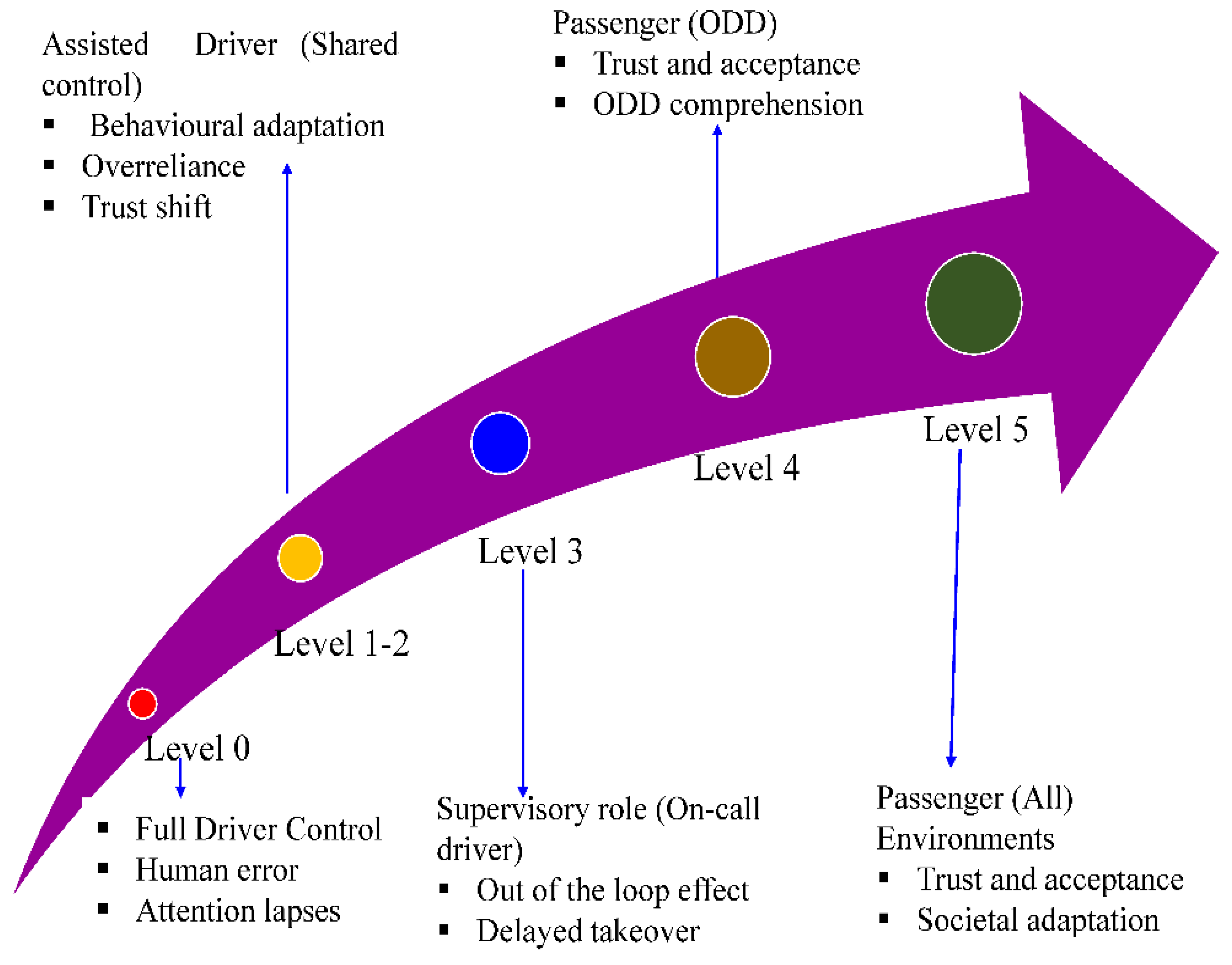
Figure 1 illustrates the levels of automation, ranging from no automation to full automation, and the pattern of human factors across SAE levels, which are discussed in the following subsections.
3.2.1. SAE Level 0: No Automation
SAE Level 0 involves a complete dynamic driving task accomplished by the human driver with no support from automated driving systems. The literature consistently identifies that human error is recognised as a significant cause of road traffic crashes at SAE Level 0, including lapses in attention, decision-making, and risk-taking [
3,
4,
5,
27]. Driver engagement is high; however, performance is highly variable and sensitive to contextual factors, such as fatigue, distraction, and environmental complexity [
11,
63].
At the system level, limitations manifest as relatively high crash rates, unstable traffic flow, and increased infrastructure stress, especially in busy traffic conditions [
43,
64]. Traditional vehicles remain heavily reliant on the human element, resulting in variable safety performance levels [
65]. Hence, human-related issues at this level concentrate largely on education, training, licensing, and enforcement to improve the situation [
66,
67].
3.2.2. SAE Levels 1–2: Driver Assistance and Partial Automation
SAE Levels 1 and 2 encompass driver-assistance and partial automation features, including adaptive cruise control, lane-keeping assistance, and steering support. Despite these capabilities of performing certain control functions, the driver is still expected to monitor the environment and have full control over the vehicle [
68,
69].
Level 1 automation implies assistive control, while the human driver maintains total control over the driving task. Therefore, the importance of human factors does not decrease, whereas behavioural changes might emerge in a slight overreliance on automation. Accordingly, Level 1 automation contributes only marginally to operational efficiency and ease of use, but does not change the human-driven driving environment [
3,
5,
13,
15].
Level 2 automation involves driver supervision while maintaining responsibility for interventions. This entails a decrease in vigilance and the development of over-trust, along with delayed reactions to dangerous situations. Thus, Level 2 automation poses risks of increased crash rates due to possible driver disengagement or the need to take control, causing instability in a mixed-traffic environment and creating problems for traffic enforcement and regulation [
9,
17,
68].
It has been found that these automation systems influence driver behaviour in terms of speed choices, the maintenance of distance between vehicles, and vigilant driving [
15]. More importantly, they introduce risks associated with overreliance and misplaced trust, as drivers may overestimate system capabilities [
8,
13]. Real-world incidents involving Tesla Autopilot illustrate how misuse and reduced driver attention can undermine safety in Level 2 systems [
70,
71].
Overall, system-level outcomes at these levels (SAE Levels 1 and 2) are mixed. Under favourable conditions, partial automation can improve traffic flow and operational efficiency. However, variability in driver engagement, behavioural adaptation, and system misuse can increase traffic instability and crash frequency and severity [
34,
72]. Although infrastructure requirements remain largely unchanged, governance and enforcement become more complex because control is shared between human drivers and automated systems [
73].
3.2.3. SAE Level 3: Conditional Automation
In SAE Level 3 AVs, the system is capable of undertaking the entire dynamic driving task within specified conditions. However, the human driver has to take over control after the system requests. This aspect has raised critical human-factor issues. At this level, out-of-the-loop performance issues arise. This comprises reduced situational awareness, delayed or inappropriate takeover responses, and cognitive overload during control transitions [
9,
10,
17].
Level 3 drivers often misjudge system capabilities or over-trust automation, increasing the likelihood of delayed intervention during unexpected events [
21,
74,
75]. The case studies conducted on highways and city streets clearly demonstrate the system’s potential domain error in conditions that exceed system assumptions, particularly when the driver’s attention is diverted [
68,
76].
At the system level, the safety risks associated with Level 3 automation are nonlinear. This variability in takeover may affect traffic, leading to increased odds of accidents compared to when humans control the vehicles, in addition to adding complexity to traffic management systems [
34,
77]. Infrastructure requirements need expansion and improvement, including the need for clearer road markings, digital signage, and connectivity to support system awareness [
78]. Governance frameworks face persistent challenges in clearly delineating responsibility and liability between human drivers and automated systems [
79,
80].
3.2.4. SAE Level 4: High Automation
SAE Level 4 AVs operate autonomously within defined operational design domains (ODDs), with no expectation of human intervention under those conditions. Therefore, the focus of human factors has moved from the actual driving task to trust, acceptance, and understanding in relation to the operating domain [
20,
81,
82,
83]. However, such an operation requires good infrastructure, adequate road signs, detailed high definition (HD) mapping, and good communication infrastructure [
78,
84]. Human-driven traffic interactions remain a significant area of challenge [
85].
In terms of system-level problems, the potential advantages offered by Level 4 automation include decreased crash occurrence, optimised traffic flow, and optimised routes in a closed environment [
34,
73]. However, the increased reliance on the readiness of infrastructure, as well as the challenges in governance related to the certification of ODD, operation, and trust, becomes paramount [
80].
3.2.5. SAE Level 5: Full Automation
SAE Level 5 is fully automated, and the vehicle can drive in all conditions and environments with no human intervention. At SAE Level 5, the human driver no longer exists in the driving role but instead assumes the role of a passenger, and the human error-related risks associated with driving are significantly reduced [
20,
61,
73].
Concerns related to human factors are largely centred on trust, acceptability, and user adaptation rather than vehicle control [
1,
82]. Safety issues expand to software integrity, security, and overall infrastructure connectivity [
84,
86,
87].
In evaluating SAE Level 5 systems, a clear distinction must be maintained between active empirical evidence and predictive analysis, as fully autonomous Level 5 fleets are not yet widely operational on public roadways. Current insights are heavily derived from conceptual assumptions regarding complete system-operated dynamics, which presume the total elimination of human-centric driving control and complete reliance on user acceptance and psychological adaptation [
1,
21]. Concurrently, long-range forecasting studies, deployment predictions, and macroscopic simulation models indicate that when human-error constraints are fully bypassed, system-level gains can theoretically be unlocked [
73,
84].
Under this paradigm, vehicles can operate in all types of environments, roads, and geography, without any human participation at all. The conventional driver’s cockpit changes completely, whereby the occupant of the vehicle becomes solely a passenger. There will be remarkable operational efficiencies, which include improved traffic pattern flows, fewer emissions due to efficient car acceleration, and decreased car accidents due to human speeding, tiredness, or being intoxicated [
20,
61,
73].
However, these prospective macro-level projections remain independent of contemporary evidence-based findings, which are strictly bounded to lower, active automation tiers where human operators remain integral to the control loop or where operation is confined to highly regulated operational design domains (ODDs) [
17,
24]. Removing ODD constraints completely at Level 5 represents an unprecedented socio-technical shift. Therefore, current analysis at this tier must be framed as a socio-technical hypothesis regarding future risk reconfiguration and institutional governance rather than as an observation of current operational reality [
20,
80].
However, until mixed-traffic interactions can be empirically validated at scale without human fallback options, Level 5 remains a definitive horizon goal rather than an active baseline for human-factor deployment metrics.
The results indicate a nonlinear transition, revealing distinct phases in the evolution of human factors and system-level impacts across SAE Levels 0–5. Rather than a steady progression of improvement, the findings indicate a pattern of risk escalation, peak instability, and subsequent system reconfiguration as automation increases [
10,
17,
60,
61]. In particular, intermediate levels of automation (Levels 2–3) emerge as a critical transition zone characterised by elevated human-factor risks and system-level complexity, while higher levels (Levels 4–5) reflect a shift toward infrastructure- and governance-dependent performance [
1,
35,
62].
3.3. System-Level Implications of Vehicle Automation
Findings from the literature on human factors and transportation studies in the development of AVs across SAE levels revealed that the implications of automation extend beyond the driver’s performance to the entire road system. Variations in human involvement, trust, and supervisory responsibility may cascade through traffic networks, with consequences for safety, efficiency, and regulatory needs. The literature highlights several interrelated system-level consequences that emerge across the automation spectrum, which are discussed in the following subsections.
To operationally clarify the “nonlinear transition” framework, this study defines nonlinear behaviour as a trajectory where overall transport system safety and human error risks do not scale proportionally or monotonically with technological advancement; instead, risk follows an inverted-U path [
1,
17]. The first critical inflection point occurs at the boundary between Level 1 and Level 2, where physical, tactical vehicle operations are automated, but safety accountability remains entirely human [
24]. This structural arrangement creates the “risk apex” at SAE Levels 2–3 [
17,
20]. This phase is the peak risk zone because it demands continuous, highly focused passive supervision from a human driver [
17]. This task runs directly counter to human cognitive architectures, which are optimised for active, closed-loop feedback [
24]. The second inflection point occurs between Level 3 and Level 4, where the system finally assumes fallback accountability, abruptly dropping human-factor operational risks while shifting the risk landscape toward system-centric infrastructure dependencies [
73,
84].
By defining this inverted-U trajectory, these findings directly resolve RQ2 and RQ3 by demonstrating how the cognitive “risk apex” at intermediate tiers cascades outward to disrupt macroscopic traffic network safety, efficiency, and regulatory enforcement.
3.3.1. Nonlinear Safety Risk
Safety risk does not increase or decrease linearly with automation. At Level 0–1, vehicles are driven fully by humans, and crashes are generally caused by driver error, including lapses in attention, judgment, and risk-taking [
3,
5]. At intermediate levels, specifically at SAE 2–3, safety risks peak due to the shared control paradigm, in which drivers supervise automation but may experience diminished situational awareness, cognitive overload, or delayed responses when takeover is necessary [
17,
75,
88]. In contrast, Levels 4–5 significantly reduce human-error-related crashes, as control shifts to fully autonomous systems; however, operational safety increasingly depends on system reliability, infrastructure quality, and institutional oversight [
84,
89].
3.3.2. Mixed-Traffic Complexity
The challenge of human factors significantly increases in mixed-traffic environments where conventional and AVs coexist. Variability in driver behaviour and reaction time, along with system capabilities, progressively increases cognitive load on human drivers, especially during supervisory tasks in Level 2–3 automation [
34,
90]. Even Level 4 vehicles can encounter operational difficulties in such settings, as interactions with non-AVs introduce uncertainty and require effective sensing, communication, and contingency management strategies [
86].
3.3.3. Shift of Responsibility
Automation represents a progressive shift in responsibility from individual drivers to institutional actors, including vehicle manufacturers, regulators, and automated mobility service operators [
91,
92]. Essentially, the roles of governance, regulatory frameworks, and infrastructure readiness become central to sustaining system safety and public trust. The actual implementation of this shift requires socio-technical integration beyond technical solutions, such as defining liability in mixed-traffic incidents, certifying operational design domains, and establishing monitoring and enforcement protocols for automated systems.
3.4. Cross-Level Synthesis
Building on the system-level implications of vehicle automation outlined in
Section 3.2, the following section develops a cross-level synthesis that integrates findings across SAE automation levels. Moving beyond examining each level in isolation, this synthesis focuses on how human factors, system dependencies, and risk profiles interact and evolve across transitions between levels.
Peak Human-Factor Risk at Intermediate Levels: Integrating findings across SAE automation levels reveals that human-factor risks are highest at intermediate levels, specifically at Levels 2 and 3. As mentioned before, in these steps, drivers are placed in supervisory roles, where they must maintain constant attention while the system executes complex driving tasks. This sets up conditions for miscalibrated trust, attentional lapses, and delayed takeover responses [
17,
75]. This structural vulnerability constitutes a “risk apex”, a critical socio-technical inflection point where the physical, tactical control of the vehicle is executed by software, yet absolute legal and safety accountability remains entirely with the human monitor. Because the human operator is structurally removed from continuous physical control, they experience an inverted-U risk trajectory where system-level instability peaks sharply. Risk escalates significantly at these intermediate boundaries because the shared-control paradigm demands passive monitoring, which runs counter to human cognitive architectures optimised for active, closed-loop feedback loops.
Critical Transition Dynamics: Transitions between levels include nonlinear changes in human attention, trust, and system-level risk. Both the shift from fully engaged drivers to supervisory roles (Level 1 to Level 3) and from supervisory to fully autonomous systems (Levels 3 and 4) warrant recalculations of both human behaviour and system design [
9,
88]. Ineffective management would likely increase the safety and operational risks.
Evolving System-Level Dependencies: The dependencies of road transportation systems evolve progressively as automation advances. For lower levels, safe operation remains intimately dependent on the skill and vigilance of the individual driver. For higher levels (4 and 5), safety and effective operational performance become progressively dependent on more institutional forms of governance, infrastructure readiness, and technological reliability [
84,
89]. These dependencies underline socio-technical integration that extends beyond individual vehicles.
Amplification in Mixed-Traffic Environments: Human-factor risks at intermediate levels (2 and 3) become more critical in a mixed-traffic environment where conventional and partially automated vehicles coexist. Variability in driver behaviour and the performance of automated systems (Levels 4 and 5) increases the operational complexity of driving tasks and cognitive load on human drivers [
34,
86,
90]. Effective planning, design, and management strategies are required to mitigate these risks.
Responsibility and Accountability Shifts: With advances in automation, responsibility is progressively shifting from individual drivers to institutional actors, including manufacturers, regulators, and operators of automated mobility services. This shift requires robust regulatory frameworks, effective mechanisms of certification, and transparent means of communication to ensure safety and maintain public confidence [
9,
92].
Collectively, these system-level effects support the interpretation of automation as following a nonlinear risk trajectory, rather than a monotonic improvement in safety and efficiency. Initial gains associated with driver assistance may be offset by increased instability at intermediate levels, where human–automation interaction is most fragile. Beyond this point, with the increase in automation, the reliance on human performance is reduced. However, concurrently, dependencies on infrastructure systems, regulatory frameworks, and technological robustness are increased. This evolving pattern emphasises the importance of managing automation as a system-wide transition instead of a vehicle-level innovation.
3.5. Case Study Analysis
The selected case studies are examined as empirical illustrations in the transition from assistance to autonomy. Rather than representing isolated events, these cases reveal how human-factor challenges manifest differently across automation levels, often intensifying during transitional stages where control is shared or ambiguously defined. They provide real-world evidence of the nonlinear dynamics and system-level risks identified in the literature.
3.5.1. Level 2–3 Automation and Crash Risk: Tesla Autopilot
Tesla’s Autopilot function is an SAE Level 2 automated driving system, which incorporates cruise control as well as lane-keeping technology that always needs to be monitored by a human driver. Real-world studies, as well as accidents involving this type of system, have demonstrated that inattention, misuse, disengagement, and overreliance on this technology are issues that can lead to a high risk of road accidents [
46,
89,
93,
94]. The involvement of the human factor in this type of system often results in late control, a lack of situational awareness, and reduced system trust [
17,
75].
At the system level, the implications go beyond isolated events. A shared responsibility for oversight between a human operator and the automated system complicates law implementation, responsibility, and insurance, thereby making legal accountability a challenge [
88,
92,
94]. The Tesla Autopilot example illustrates the need for well-defined operational design boundaries, an appropriate driver-tracking solution, and supervision at a regulatory level for managing intermediate-level automation-related dangers.
3.5.2. Level 4 Pilot Deployment: Waymo in Phoenix, USA
Level 4 pilot projects conducted by Waymo in Phoenix, USA, demonstrate that AVs can operate within specified ODDs with minimal human involvement in activities such as driving [
20,
90,
95,
96,
97,
98]. At Level 4, human-factor concerns shift from control to monitoring and understanding.
It has been found through field studies that the number of events associated with human error has been significantly reduced. However, infrastructure readiness, including lane marking, sensor-compatible signs, and communication infrastructure, is essential for system performance [
86,
96,
98]. This includes interactions between traffic flow, other vehicles on the road, pedestrians, and cyclists, which require advanced system design and management. This highlights the importance of system automation and infrastructure in relation to human factors [
34,
82].
3.5.3. Level 4 Pilot Deployment: NIO in China
NIO’s autonomous testing in Chinese urban and suburban areas operates at Level 4 autonomy in specific ODDs. Like Waymo’s self-driving test, the trust, monitoring, and limitations of the system are fundamental considerations in assessing human factors [
20,
86].
The results of the NIO deployment show that network-level factors can be a barrier to flexibility. This is because the overall performance of the network also depends on the underlying infrastructure. By contrast, interaction with human-driven traffic and pedestrian traffic involves design methods related to movement and decision-making models. This underlines the importance of integrating automation and human factors [
34,
81,
83,
99].
3.5.4. Regulatory Responses to AV Deployment
The regulatory frameworks for AV technology vary across nations. They also vary according to the risks associated with the SAE levels and the prevailing human factors. Evaluation within the regulatory framework has highlighted the realisation that the prevailing legal systems in countries often introduce delays in regulating the technology [
91,
92]. For instance, the regulatory system governing the control and regulation of Level 2–3 and Level 4 vehicles in the USA and the regulatory requirements for the same in Chinese technology allow experimentation permitted under the conditional permit system. On the other hand, the requirements and standards set by the ODD must be followed by Chinese technology [
86,
89]. These contrasts underscore the necessity of institutional readiness alongside technological capability for safe deployment.
3.6. Comparative Analysis and Critical Insights Across SAE Levels
Analysis of the literature and case studies indicates that human-factor challenges and their system-level effects vary systematically across SAE Levels 0–5, following a nonlinear pattern with critical transition points at intermediate levels.
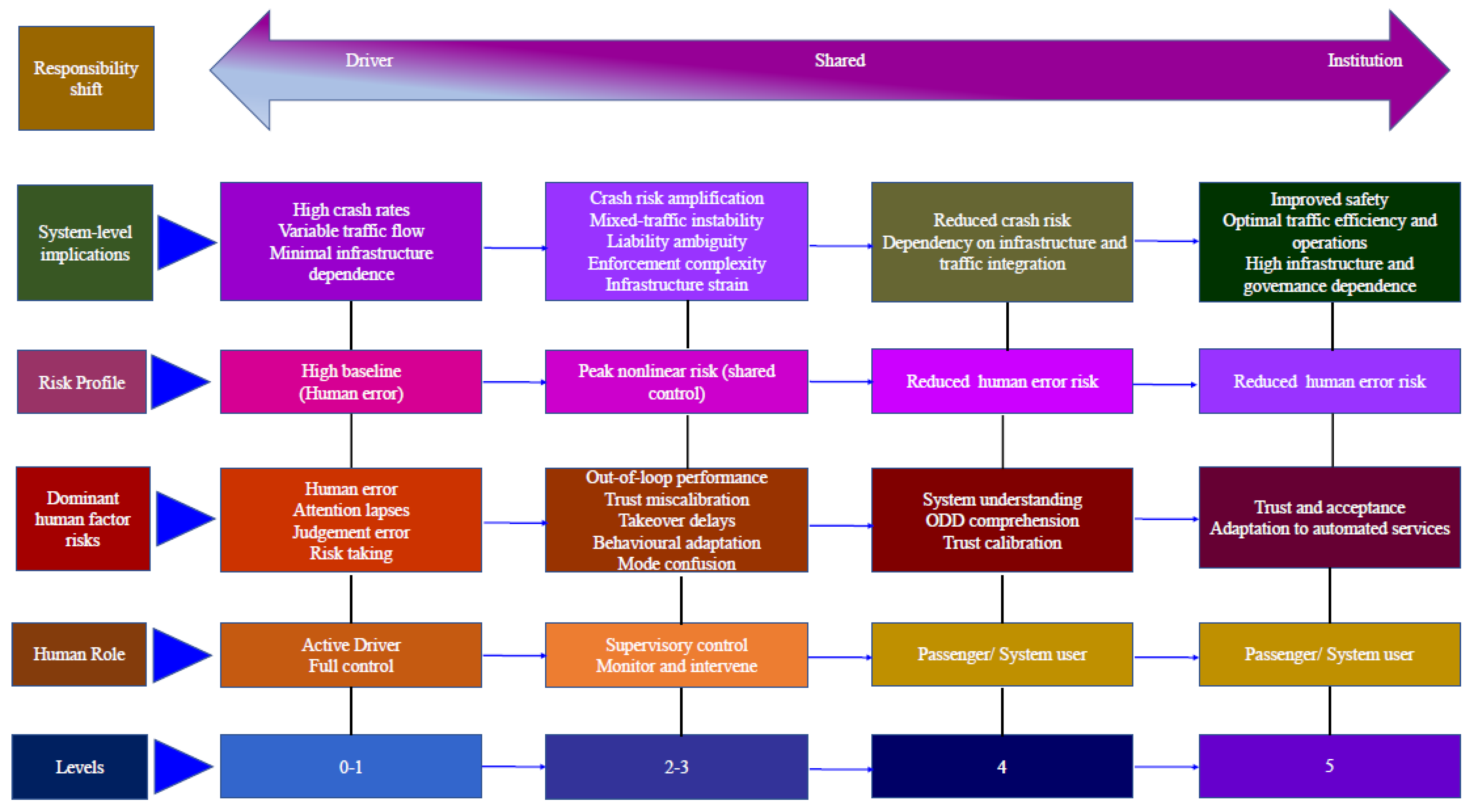
Table 3 provides a cross-level synthesis of human factors, system-level implications, and responsibility distribution across the different levels of automation.
At lower levels of automation (SAE Levels 0–1), driving remains predominantly human-centred, with risks largely stemming from behavioural limitations such as inattention and decision-making errors. These contribute to variable but relatively predictable system performance. As automation increases to SAE Levels 2–3, a critical transition emerges characterised by supervisory control and intensified human–machine interaction. At this stage, system instability increases due to out-of-the-loop performance, delayed interventions, cognitive overload, and misaligned trust, resulting in an enhanced risk profile, particularly in mixed-traffic conditions. At higher levels (SAE Levels 4–5), direct human involvement in vehicle control is significantly reduced, lowering human-error-related risks but increasing reliance on system design, infrastructure readiness, and institutional governance.
As illustrated in
Figure 2, this progression reflects a nonlinear concentration of human-factor risk, with a pronounced peak at SAE Levels 2–3. At higher levels of automation, human roles shift toward oversight, trust, and system understanding, while responsibility for safety becomes increasingly institution-centred. These system-level outcomes result from an interplay between human behaviour and automation capabilities, which is then impacted further by traffic patterns, infrastructure development, and policy regimes in alignment with the notion of socio-technical systems.
Thus, the findings show a nonlinear reallocation of risk and responsibility at different automation levels, contrary to the expectation of steady progress toward increased safety. Even as human factors continue to play an important role at all levels of automation, they are becoming increasingly complex. Effective deployment of automated vehicles, therefore, depends on managing transitional discontinuities, particularly at intermediate levels, while implementing multi-level interventions that support trust calibration, behavioural adaptation, and system-wide integration [
17,
20,
91].
Moreover, the progression from driver assistance to full autonomy exposes three intersecting macro-trajectories across the SAE spectrum. First, the evolution of human roles follows a definitive path of spatial and cognitive detachment, transforming the human from an active, hands-on operator (Levels 0–1) to an on-call supervisory monitor (Levels 2–3), and ultimately to a passive system passenger entirely removed from operational tasks (Levels 4–5). Second, risks systematically shift from direct, individual behavioural errors (such as driver inattention and poor judgment at lower levels) to human–machine interaction errors at intermediate levels (mode confusion and delayed takeover tracking), before crystallising into technical system faults at higher levels. Third, system-level dependencies progressively increase in scale and complexity; while low-level vehicle safety rests almost entirely on individual driver vigilance, high-level automation shifts safety performance dependencies completely onto the surrounding socio-technical infrastructure, requiring continuous high-definition mapping, ubiquitous connectivity, and rigid institutional ODD certifications.
4. Discussion
This study examined the transition from driver assistance to full autonomy as a nonlinear socio-technical process, an interpretation strongly supported by the findings. Drawing on a synthesis of the human-factor literature across SAE Levels 0–5 and case study analyses, the study identified the dominant risks at each level and examined how these propagate to system-level safety, operational, and governance outcomes. Rather than demonstrating steady improvements in safety and performance, the results revealed structural discontinuities across automation levels, with intermediate stages introducing heightened human-factor risks and system instability.
Based on cross-level patterns revealed from the literature and observed in the case studies, SAE Levels 2–3, in particular, as mentioned previously, emerge as a critical transition zone, where supervisory demands exceed human cognitive capabilities, leading to degraded performance and increased system vulnerability. This “risk apex” challenges the prevailing assumption that incremental automation inherently improves safety. While higher degrees of automation decrease dependency on the human factor, they increase dependency on other systems such as infrastructure, design, and governance, reinforcing the need to view automation as embedded within a broader socio-technical system.
These findings align with theoretical perspectives on human–automation interaction, out-of-the-loop performance, behavioural adaptation and risk compensation, and socio-technical transitions, which explain the nonlinear dynamics in AVs. These frameworks collectively illustrate how cognition, behaviour, and trust interact with automation technologies, shaping both vehicle-level performance and wider system outcomes [
9,
12,
13,
68,
100,
101].
Moreover, the findings contest linear models of automation adoption and underscore that the evolution from assistance to autonomy is not merely technological but fundamentally socio-technical. Managing this transition requires explicit attention to critical transition points, particularly where human and automated control intersect, and to coordinated adaptation across human behaviour, system design, infrastructure, and regulatory frameworks.
Nevertheless, the following subsections examine critical aspects of the nonlinear transition to vehicle automation, including human factors, trust and behavioural adaptation, system-level impacts, safety challenges, operational performance, and strategic transitions across automation levels.
4.1. Human Factors, Cognitive Load, and Out-of-the-Loop Performance
Automated driving systems operating at SAE Levels 2 through 3 impose a unique and severe cognitive paradox, generating a workload asymmetry where drivers must continuously monitor partially automated systems while maintaining constant readiness to resume manual control [
9,
12]. This control configuration triggers out-of-the-loop (OOTL) performance deficits, characterised by delayed reaction times, attention degradation, and a profound loss of situational awareness [
9,
12]. According to human–automation interaction theory, supervisory automation fundamentally alters the operator’s perceptual–comprehending–projecting process, drastically increasing the time required to re-establish operational awareness during control anomalies [
17]. Human cognitive architectures are inherently poorly suited for such prolonged, passive monitoring tasks; consequently, severe vigilance decrements occur rapidly over long trips, frequently manifesting within the first 15 to 30 min of automated travel [
1,
102].
This cognitive disengagement is strongly supported by empirical data. Previous benchmark simulation-based and field tests reveal a dramatic quantitative difference between human response capabilities during automation transitions. In the case of an alert, active driver functioning within Level 0–1 automation, the emergency evasive action response time would be less than 1.0 s [
103,
104], whereas in the case of a supervisory driver working with Level 2 or 3 automation, the takeover response time ranges from 1.5 to 3.5 s [
104,
105]. Such quantitative delays are due to the critical decrease in situational awareness as a consequence of disengagement from continuous, closed-loop manual control [
17]. Earlier simulations and observations confirm this phenomenon, showing that supervisory drivers are much slower and more inconsistent when supervising Level 2–3 automation as compared to constantly driving manually [
17,
24].
Crucially, crash analysis examples and naturalistic studies using the telemetry of Tesla Autopilot present direct empirical evidence for these human-factor vulnerabilities, exemplifying that human error risk is at its highest exactly at these intermediary SAE levels [
17,
75]. In reality, there is a cumulative effect of deterioration of operator behaviour as they experience the consistent performance of their vehicle system for weeks or months, resulting in gradual behavioural adaptations that move from temporary situational distraction to systematic automation complacency [
1,
21]. There is thus a transformation in how the operator’s mind functions, from being actively ready to being profoundly disengaged such that he becomes wholly unprepared for unexpected edge cases [
17,
24]. The overlap of these structural vulnerabilities at certain transition points suggests that, based on Tesla Autopilot crash data, there is likely to be a sudden, nonlinear increase in crash risk [
1,
24]. This is because the disengaged human operator would not return to the operational loop swiftly enough to understand the evolving environmental threat, thereby turning regular fallback requirements into critical safety situations [
17,
75].
Conversely, at SAE Level 4, the requirement for continuous human supervision is removed, substantially reducing OOTL-related takeover demands during normal operation. While residual human-factor risks may persist in boundary or fallback situations where intervention is requested outside expected engagement conditions, these events are comparatively rare due to strict system operational design domain (ODD) constraints.
Therefore, such a risk profile is not characterised by a linear development through levels of automation. On the contrary, this reflects a nonlinear degradation effect resulting from the system’s design, environmental demands, and operator states, which follows an inverted-U risk pattern [
1,
24]. Altogether, the above three human factors contribute to the primary mechanism that distinguishes levels of automation, serving as a behavioural basis of the proposed conceptual risk framework presented in
Section 5.
4.2. Technological Countermeasures: Driver Monitoring and Adaptive Intervention Systems
Given that supervisory automation (Levels 2–3) exposes severe human cognitive limitations, mitigating the risk apex requires active technological intervention rather than sole reliance on driver vigilance [
17,
20]. Robust Driver Monitoring Systems (DMSs) serve as an essential socio-technical bridge during this transitional automation phase [
20]. Advanced DMS architectures utilise interior infrared cameras and real-time eye-tracking algorithms to continuously monitor driver gaze vector distribution, saccadic movements, and eyelid closure profiles [
17,
24]. By identifying prolonged off-road glances, microsleep patterns, or cognitive distraction, the vehicle can algorithmically compute an instantaneous takeover-readiness assessment [
24].
If system ODD boundaries are reached while the driver’s readiness metric is insufficient, the vehicle deploys closed-loop adaptive warning systems [
24]. Rather than using rigid, static alarms, which often exacerbate driver panic or mode confusion, adaptive HMIs scale their intervention dynamically based on urgency [
1,
24]. They utilise multi-modal, staged alert sequences (shifting from subtle ambient visual indicators to high-frequency directional auditory alerts and localised haptic seat-belt or steering-wheel vibrations), customised to the proximity of the threat and the driver’s current cognitive state [
17,
24]. Integrating these adaptive monitoring frameworks would ensure that trust calibration is managed technologically, smoothing the nonlinear risk discontinuities inherent in shared-control driving environments [
20,
21].
4.3. Trust, Automation Comprehension, and Behavioural Adaptation
At Levels 2–5, trust and understanding of automation capabilities become important considerations from a human-factor perspective. Theoretical frameworks of behavioural adaptation and risk compensation suggest that drivers’ adaptation to automation capabilities may influence their behaviour and occasionally precipitate risky behaviour when overconfidence in automation capabilities arises [
1,
101]. The pilot testing of Level 4 automation systems implemented in companies like Waymo and NIO indicates that automation capability requires proper calibration of trust to ensure safety and reliability [
81,
83]. Additionally, there is evidence that improper trust calibration can lead to unsafe behaviour and delayed interventions, as well as overconfidence, consistent with predictions from human–automation interaction and behavioural adaptation theories.
4.4. System-Level Implications and Mixed-Traffic Complexity
System-level outcomes are influenced by automation levels, traffic heterogeneity, and infrastructure readiness. In SAE Levels 2–3, there are large variations in the average values of speed, gap acceptance, and compliance related to interactions with mixed traffic and the emergence of risks [
34,
86]. In SAE Level 4 systems, the risk related to driver error decreases and becomes dependent on the integrity of infrastructure support and operational coordination [
86,
90]. Socio-technical systems theory emphasises that these risks are emergent properties of interactions among human behaviour, automation capabilities, traffic dynamics, and institutional frameworks [
91,
92].
4.5. Human Factors and Safety Challenges
Challenges related to safety vary across SAE levels. In Levels 0–1, risks are driver-centric and can be handled by skill, awareness, and training. Levels 2–3 pose the most significant human-factor risk due to supervisory control issues, out-of-the-loop errors, over-trust, and behavioural adaptation, as seen in the Tesla Autopilot case study [
17,
75]. Levels 4–5 pose risks associated with system trust and understanding the operating conditions through system compliance and infrastructure sufficiency [
20,
81,
83]. In alignment with human–automation interaction and behavioural adaptation theories, it is observed that system design and reliability affect driver behaviour concerning safety. This emphasises the necessity for automation-level-specific mitigation strategies based on SAE levels.
4.6. Operational and System-Level Observations
Interactions between human behaviour, automation capability, traffic dynamics, and system governance influence operational systems. For example, Levels 2–3 are the most vulnerable to traffic instability phenomena associated with mixed-traffic conditions [
34,
86]. Although Levels 4–5 decrease the need for human operator involvement, they need high infrastructure sophistication, strict adherence to ODD, and optimised system operation for stable performance [
90]. User interface characteristics, warning durations, system handover, and perceived system reliability interactively influence system reliability, affecting corresponding behavioural responses affecting both vehicle- and network-level outcomes.
4.7. Automation Pathways and Strategic Discontinuities
Automation is a nonlinear process, and there are discontinuities in going for full automation at the points Level 1 → 2–3 and Level 3 → 4 in terms of cognitive needs, trust calibration, behavioural change, and infrastructure support. Therefore, transition management is essential with the gradual implementation of solutions based on learning cycles, adaptive governance structures, observation, and training practices to facilitate a smooth transition [
100]. For instance, Levels 2–3 require adaptive HMIs, supervision support, and driver monitoring, while Level 4 necessitates infrastructure readiness, ODD compliance, and operational coordination. Governance mechanisms must evolve to manage liability, certification, and public trust, underscoring the interdependence of human factors and systemic requirements.
5. Integrated Conceptual Framework
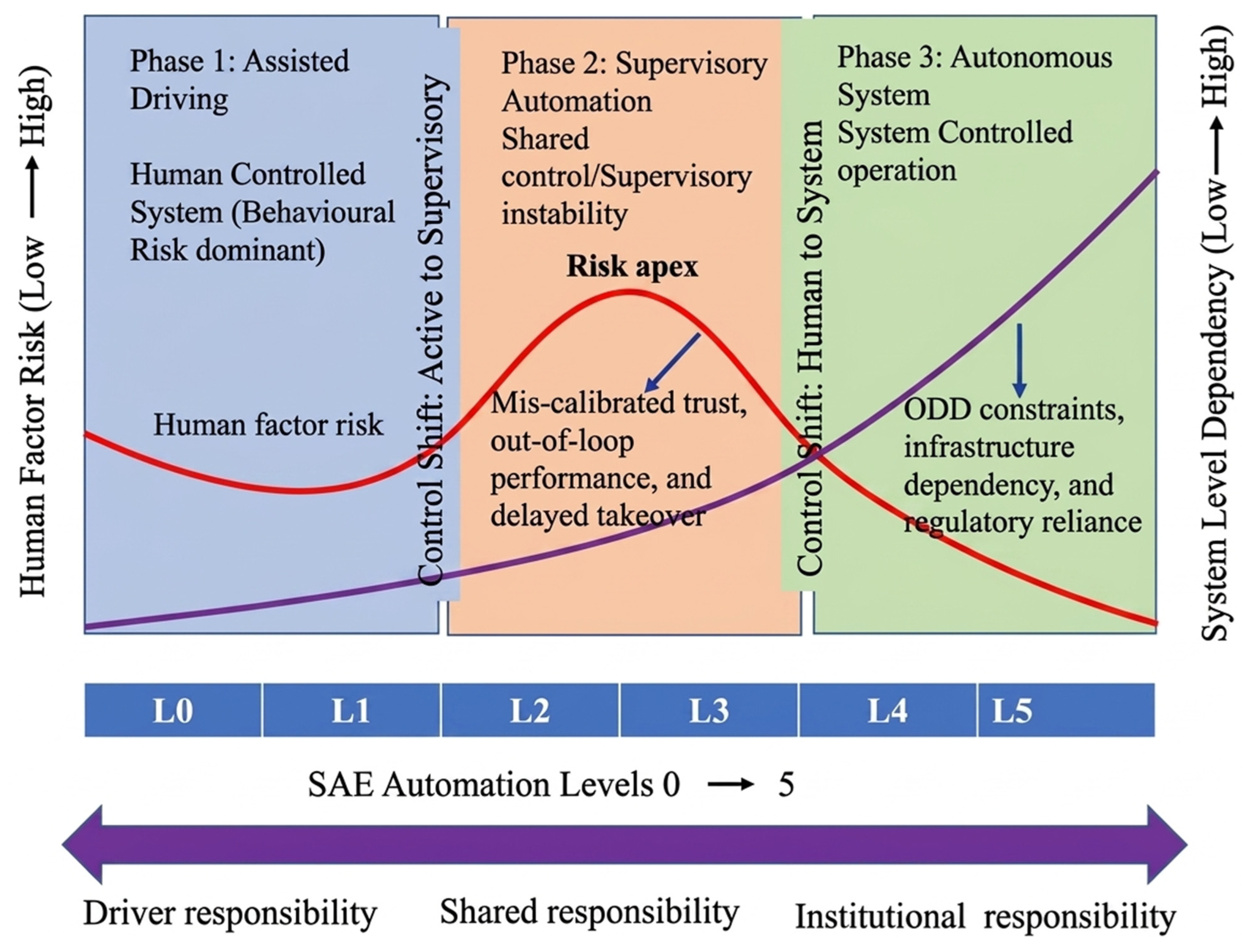
In direct alignment with RQ4, this section synthesises the preceding human factors and system-level analysis into a conceptual framework illustrating how risk and system dependency evolve across SAE Levels 0–5 (
Figure 3). The framework conceptualises a nonlinear, phase-dependent transition in automation in which human-factor risk and system-level dependency exhibit opposing trajectories across increasing automation levels.
As illustrated in
Figure 3, the transition from driver assistance to full automation is structured into three phases: (1) assisted driving (SAE Levels 0–1), (2) supervisory automation with shared control and instability (SAE Levels 2–3), and (3) autonomous system operation with institutional and infrastructure dependency (SAE Levels 4–5). This progression reflects a redistribution of control authority from the driver to the system, accompanied by a corresponding shift in responsibility from individual to institutional actors.
The framework further distinguishes two interacting trajectories, human-factor risk (red curve) and system-level dependency (purple curve), which evolve in opposite directions across SAE levels.
In the first phase, corresponding to SAE Levels 0–1, the human driver retains primary responsibility for the dynamic driving task, with automation providing only limited assistance. Human-factor risks in this phase are largely direct and behaviourally driven, including lapses in attention, decision-making errors, and risk-taking behaviour.
At the system level, outcomes such as crash rates and traffic flow variability are closely tied to human performance, resulting in relatively predictable but suboptimal system behaviour. While driver-assistance systems may influence behaviour through adaptation, they do not fundamentally alter the human-centred nature of risk. This phase is characterised by stability in system structure, albeit constrained by inherent human limitations.
Transitioning to SAE Levels 2–3 implies a significant shift from active human control to passive supervision over the operation of autonomous driving systems (
Figure 3). This transition introduces a nonlinear escalation in human-factor risk, driven by the cognitive and behavioural demands of monitoring automated systems while remaining prepared to intervene.
Human-factor issues in this phase include, but are not limited to, out-of-the-loop performance, decreased situational awareness, delays in take-over actions, and overestimation or underestimation of a vehicle’s capabilities. Unlike the previous phase, risks here are not solely attributable to human limitations but arise from the interaction between human cognition and system design.
At the system level, these human–automation mismatches are amplified in mixed-traffic environments, leading to disproportionate safety risks, increased traffic instability, and governance challenges. The coexistence of human-driven and partially automated vehicles introduces variability and unpredictability, making this phase the most critical zone of instability across the automation spectrum. Accordingly, SAE Levels 2–3 constitute a “risk apex”, where the combination of shared control and imperfect human–system coordination produces the highest overall vulnerability in road transportation systems.
In the final phase, encompassing SAE Levels 4–5, the role of the human shifts away from the driving task toward that of a passenger or system user (
Figure 3). This transformation reduces human error risk because all processes will run automatically under certain conditions.
However, the lower participation of humans cannot be regarded as an improvement factor for the efficiency of the whole system. Instead, risk is reconfigured rather than eliminated, shifting from human performance limitations to dependencies on system reliability, infrastructure readiness, and institutional governance.
At the system level, safe and efficient operation increasingly depends on factors such as high-definition mapping, connectivity, regulatory oversight, and operational design domain management. This phase is therefore characterised by a transition from human-centred risk to system-centred dependency, requiring robust socio-technical integration to ensure reliability and public trust.
Integrated Interpretation
Collectively, the framework with the three-phase system demonstrates that the progression from assisted to autonomous driving is not a linear improvement in safety or performance, but a structured shift characterised by risk escalation, peak instability, and subsequent system reconfiguration across distinct phases. Rather than a continuous evolutionary path, the transition shows discontinuities and shifting risk profiles.
Specifically, a risk apex is identified at intermediate levels (SAE 2–3), where the human–automation interaction is most unstable, highlighting the need to actively manage transitional dynamics rather than treating them as incremental improvements. As automation increases further, certain human-factor risks decline, but broader system-level dependencies and complexities continue to increase.
This pattern indicates that the transition from assistance to autonomy is fundamentally nonlinear and systemic. Human-factor risk remains relatively stable at low automation, rises sharply in the supervisory phase, and then decreases at higher automation levels, while overall system interdependence increases in parallel (
Figure 3).
Accordingly, the safe and effective deployment of automated vehicles depends not only on technological advancement but also on the coordinated development of infrastructure, governance frameworks, operational strategies, and aligned human, technical, and institutional systems. In particular, the supervisory phase represents a critical point of vulnerability due to the complexity and unpredictability of human–system interaction, requiring targeted management to fully realise the benefits of automation in transport.
6. Policy and Deployment Implications and Governance Recommendation
This section details the policy, deployment, and governance frameworks required to navigate the vehicle automation landscape. This is structured into two primary aspects: the macro-level, multi-dimensional implications of vehicle automation across human, infrastructural, and operational domains, and targeted governance schemes, specifically focusing on an adaptive ODD certification framework and a dual-tier licensing schema. They are presented in the following subsections.
6.1. Macro-Level Multi-Dimensional Implications of Vehicle Automation
The findings indicate that the transition to automated driving has wide-ranging and interdependent implications for safety, operations, infrastructure, governance, and deployment strategy, with impacts that vary significantly across levels of automation rather than improving uniformly over time.
Safety and human factors: The nonlinear risk profile, with peak risk occurring at SAE Levels 2–3, reflects the complexity of supervisory driving and human–automation interaction during partial automation. Safety assessment, therefore, needs to extend beyond technical performance to include supervisory workload, trust calibration, and behavioural adaptation, consistent with out-of-the-loop performance and behavioural adaptation theories [
12,
101].
Operations and traffic management: Intermediate automation levels introduce high operational instability due to mixed-traffic conditions and inconsistent human–system interaction. This increases variability in traffic flow and crash risk, requiring targeted interventions such as improved HMI design, takeover assistance systems, and traffic management strategies that explicitly account for human–automation interaction [
9,
34].
Infrastructure requirements: Higher automation levels (Levels 4–5) shift the main constraint from human performance to infrastructure readiness. Safe operation depends on robust digital infrastructure, clearly defined ODDs, and stable environmental conditions. This requires progressive infrastructure digitalisation, standardisation, and environmental monitoring to reduce uncertainty and support reliable system performance.
Governance and institutional responsibility: The higher levels of automation and consequent shifting of responsibility from individual drivers to institutional actors necessitate governance frameworks that should address liability, operational accountability, and public trust within a socio-technical systems perspective to ensure that regulation evolves alongside technological capability [
91,
100].
Deployment pathways and transition points: Key discontinuities occur between SAE Levels 1–2/3 and 3–4, where system complexity and risk profiles change significantly. Deployment strategies should therefore be phased and adaptive, incorporating driver monitoring, adaptive HMIs, and targeted training to manage supervisory demands during transitional stages.
Trust and behavioural adaptation: Levels 2–3 are particularly sensitive to over-trust and misuse of automation. Effective mitigation requires transparent system feedback, clear communication of system limitations, and reliable takeover alerts to align user behaviour with actual system capability [
13,
101].
System integration and high automation readiness: At SAE Levels 4–5, successful deployment depends on integrating automated vehicles with infrastructure and traffic management systems. This would reduce reliance on human intervention while maintaining safety within defined ODD constraints and ensuring operational consistency.
Integrated socio-technical coordination: The effective deployment requires coordinated alignment across human, technological, and institutional systems. Priorities include reducing cognitive load through interface design and training, managing trust through transparent feedback, ensuring infrastructure and ODD readiness, and implementing governance frameworks capable of addressing transitional discontinuities. Together, these elements support a phased, systems-based approach to the safe and effective deployment of automation.
6.2. Targeted Governance Schemes: Adaptive ODD Certification and Dual-Tier Licensing
Operationalising a safe deployment pathway across the nonlinear risk trajectory requires two targeted regulatory mechanisms: ODD certification and aviation-inspired dual-tier licensing [
1,
17]. First, infrastructure authorities must move away from static vehicle type-approvals and adopt an adaptive ODD certification framework [
73]. Under this scheme, municipal traffic management systems dynamically broadcast infrastructure readiness metrics (e.g., real-time lane-marking visibility, micro-weather severity, and communication network latency) to travelling vehicles [
73,
84]. If the infrastructure readiness drops below a calculated safe threshold, the local governance framework mandates a temporary restriction of the vehicle’s functional boundary—systematically disabling Level 2 or Level 3 operational activation in high-risk zones and thereby preventing the onset of passive driver fatigue and systemic edge-case failures in environments unsuitable for shared control [
17,
84].
Second, to mitigate chronic automation complacency and the out-of-the-loop performance deficits detailed in
Section 4.1, licensing frameworks must be structurally bifurcated [
21,
24]. Regulatory bodies should implement a dual-tier driver licensing schema [
1]. Tier-1 licenses would cover traditional manual operations (SAE Levels 0–1). Tier-2 certification would serve as a mandatory endorsement for operating vehicles equipped with conditional or supervisory automation (SAE Levels 2–3) [
17]. This specialised curriculum moves beyond basic vehicle manoeuvring to train operators via high-fidelity driving simulators specifically on closed-loop manual re-entry profiles, mode awareness, and automated failure-recovery strategies, ensuring the human operator’s cognitive baseline is matched to the unique demands of supervisory control [
24].
7. Conclusions, Contributions, Limitations, and Future Research
7.1. Conclusions
This study examined the evolution of human roles across SAE Levels 0–5, identified level-specific human-factor risks, analysed their impacts on safety and transport systems, determined critical nonlinear risk transition points, and developed an integrated socio-technical framework with practical policy and deployment implications. Analysis indicates that human factor-related risks are nonlinear and peak at intermediate levels of automation (Levels 2–3) for supervisory controls, cognitive demands, out-of-the-loop performance risks, and behavioural adaptation. Higher levels (Levels 4–5) imply a human role focused on trust and understanding, on functioning within limits and accepting systems. Increasingly, safe operations rely on institutional governance and infrastructural preparedness. System-level outcomes are inherently the domain where human factors with automation capabilities interact with traffic variability, as well as regulatory environments that establish the relevance of the socio-technical systems framework. Further, it emerges that the transition towards full automation forms a nonlinear phenomenon with pronounced discontinuities existing across Levels 1 → 2–3 and 3 → 4 that require step-wise implementation, adaptation, trust-sensitive HMI design, and infrastructures that enable smooth adoption for fully AVs.
It also shows a systemic change in the roles of human beings, from SAE Levels 0 to 5, where vehicles are controlled through supervisory control monitoring, to the passive user level, accompanied by the redistribution of responsibility from drivers to institutions. Moreover, system effects arise from the risks associated with human factors, including increased crash danger, traffic instability in mixed-traffic environments, dependence on infrastructure, and regulatory system complexity. Evidently, intermediate SAE Levels 2–3 pose the greatest challenges for mixed-traffic road transportation systems, whereas higher automation levels shift the focus of risk management toward infrastructure readiness and institutional governance.
7.2. Theoretical and Practical Contributions, Including Contributions to Sustainable Urban Mobility
This study contributes to both theory and practice. Firstly, it contributes to theory by integrating human–automation interaction theory, out-of-the-loop performance theory, and behavioural adaptation/risk compensation theory under one umbrella. In this way, it has assisted in developing a comprehensive framework for understanding human factors across various levels of SAE and the differing safety and performance implications they have. Secondly, through holistic examination of human factors across different levels, it provides a comprehensive mapping of risks, consequences, and intervention requirements across all levels of SAE, while identifying nonlinear risks and critical points in the risk. Moreover, the study provides evidence-based insights on automation pathways, challenging the assumption of linear progression to full automation and emphasising the importance of phased deployment and multi-level interventions that address the interdependencies among human, technological, and institutional subsystems. Furthermore, it offers a framework that enables understanding of human-factor risks vis-à-vis system-level dependence across different levels of automation.
The study also has practical applications that include providing important guidelines for vehicle design, such as adaptive HMI and takeover support, for road transportation in terms of traffic management in a mixed-traffic setting, and for infrastructure engineering in ODD requirements and digital roads. Also, it can assist with governance regarding policy, liability structures, and trust.
This study also bridges the critical gap between cognitive human-factor engineering and macro-level sustainable transport planning. By formalising the nonlinear, inverted-U risk profile of automated vehicle transitions, this study establishes that long-term transport sustainability cannot be achieved through technological optimisation alone; it requires socio-technical equilibrium. The structural findings contribute to urban and infrastructure sustainability across three distinct dimensions:
Environmental and Operational Sustainability: By identifying and mitigating the chaotic takeover dynamics characteristic of SAE Levels 2–3, this study provides transport managers with frameworks to prevent micro-congestion, erratic vehicle tracking, and localised emission surges, thereby preserving the smooth operational throughput of transit networks.
Infrastructural Longevity and Resilience: The proposed adaptive ODD certification framework shifts the safety burden of vehicle automation from isolated onboard sensors to a cooperative vehicle-to-infrastructure (V2I) digital ecosystem. This ensures that smart infrastructure adapts dynamically to real-world edge cases, reducing systemic operational failures and maximising asset utilisation.
Social and Institutional Governance: True equity and sustainability in future smart cities rest on clear frameworks of public trust, liability calibration, and specialised operator readiness. The dual-tier licensing schema detailed herein ensures that human capability is systematically matched to supervisory automation demands, preventing automation complacency and safeguarding public welfare during complex transitional deployment phases.
Moreover, the paper provides an analytical blueprint for a phased, systems-based deployment pathway, ensuring that the integration of automated vehicles reinforces, rather than disrupts, the environmental, structural, and institutional dimensions of sustainable urban development.
7.3. Limitations and Future Research
However, this study has several limitations. First, the scope of the literature review primarily relies on published studies and documented case analyses, which may underrepresent emerging or proprietary data from ongoing AV deployments. Furthermore, the selected case studies are centred on the United States of America and China, which constrains the generalisability of the findings based on the traffic patterns and mental perceptions of automation across the world.
Future research should include cross-cultural studies to examine the effect and role of the interaction between human factors and automation from a geographical and cultural perspective. Longitudinal studies should be conducted to examine adaptation and changes in behaviour and trust during interactions with partially and fully automated vehicles. Modelling and simulation studies should be carried out to examine the integration of human factors and traffic heterogeneity. Furthermore, investigating the integration and relationship between AVs and intelligent infrastructure, as well as examining the design and development of policies and plans to ensure the safe and scalable integration of AVs, is essential. Moreover, further research should also examine the adaptive and context-aware designs of the HMI to mitigate the effects on cognitive load and reduce the impact of “out-of-the-loop” performance errors.