Article

Factors Associated with Adoption of Grazing Management Plans and Management Intensive Grazing Patterns on U.S. Cow-Calf Operations


by
Merri E. Day
1,*,
Dustin L. Pendell
2,3,
Phillip A. Lancaster
3,4 and
Francisco J. Abello
5
1
Department of Agricultural Economics, Texas A&M AgriLife Extension Service, Canyon, TX 79015, USA
2
Department of Agricultural Economics, Kansas State University, Manhattan, KS 66506, USA
3
Beef Cattle Institute, Kansas State University, Manhattan, KS 66506, USA
4
Department of Clinical Sciences, Kansas State University College of Veterinary Medicine, Manhattan, KS 66506, USA
5
Department of Agricultural Economics, Texas A&M AgriLife Extension Service, Vernon, TX 76384, USA
*
Author to whom correspondence should be addressed.
Sustainability 2026, 18(12), 5999; https://doi.org/10.3390/su18125999
Submission received: 23 April 2026 / Revised: 18 May 2026 / Accepted: 7 June 2026 / Published: 11 June 2026
(This article belongs to the Section Social Ecology and Sustainability)

Abstract

A key principle of the United States Roundtable for Sustainable Beef framework is striving for continuous improvement in grazing management operations, which includes a goal of having 385 million acres covered by written grazing management plans by 2050. However, the adoption of written grazing management plans (GMPs) is lagging behind expectations. The objectives of this analysis are to examine indicators of the adoption of GMPs and grazing patterns. Additionally, we examine the economic benefits associated with the adoption of GMPs and intensive grazing patterns. A National Grazing Management Survey was conducted during the summer of 2024, distributed electronically to cow-calf producers through cooperation with state membership associations. Producers were asked about operational demographics and grazing management. Respondents were provided definitions for the GMP hierarchy (no GMP, mental GMP, written GMP, written GMP with annual evaluation) and grazing patterns (continuous, rotational, adaptive multi-paddock). Respondents were also asked to rank GMP objectives, categorized as “economic” or “environmental”, in order of importance. Binary logit models were employed to examine the indicators of adoption of written GMPs and intensive grazing patterns. Findings indicate that producers utilizing intensive grazing patterns are more likely to adopt a written GMP, and producers with larger herd sizes are more likely to prioritize economic objectives. Results also indicate that producers who adopt a written GMP are more likely to earn positive returns over off-farm feed costs than those who do not adopt a GMP, providing evidence of the potential economic benefits associated with GMPs.

1. Introduction

Livestock grazing plays a critical role in maintaining the ecological integrity of grasslands while supporting the economic viability of beef production in the United States. According to the USDA-National Agricultural Statistics Service [1], grazing is the primary method of maintaining grasslands, contributing to essential ecosystem services like soil health, water quality, forage resources, and wildlife habitat. With proper stocking rates and grazing frequency, grazing systems can improve soil health and water-holding capacity, leading to increased forage productivity and cattle weight gains [2,3].
To support sustainable grazing practices, the USDA Natural Resource Conservation Service promotes the use of a grazing management plan (GMP), which provides a structured framework for managing forage, water resources and livestock [4]. A GMP should follow strategies that result in the desired societal, environmental, and economic outcomes [5]. The United States Roundtable for Sustainable Beef (USRSB) set a lofty goal of having 385 million acres covered by written GMPs by 2050 [6], underscoring the importance of formal planning to improve the management of grazing operations.
Despite the potential benefits, the adoption of a written GMP remains limited. Many producers rely on mental GMPs, and there is little evidence to demonstrate that a formalized GMP will directly provide economic and ecological advantages. This gap in the literature presents a challenge for industry stakeholders and policymakers who seek to promote the adoption of GMPs. Previous research by Tang et al. [7] found that factors such as operational size, land ownership, and geographic location influence the adoption of GMPs, but few studies have examined the adoption of written GMPs and their relationship to grazing intensity and economic outcomes.
Intensive grazing patterns, such as rotational grazing and adaptive multi-paddock grazing, have been shown to improve productivity and profitability, particularly for larger operations due to economies of scale [8,9]. These grazing systems also offer environmental benefits such as improved soil health, reduced soil erosion, and improved forage productivity. However, research shows that less than half of U.S. cow-calf producers have adopted such intensive grazing practices [9,10].
There is a significant literature gap surrounding the factors associated with the adoption of written GMPs and intensive grazing patterns among U.S. cow-calf producers. This study seeks to address this gap by: (1) examining producer and operation characteristics that influence the adoption of grazing management plans and intensive grazing patterns, (2) exploring the prioritization of GMP objectives, whether economic or environmental, by producer and operation characteristics, and (3) assessing the economic benefits associated with the adoption of GMPs and intensive grazing patterns. By providing empirical evidence on the factors that influence the adoption of GMPs and intensive grazing patterns, this study contributes to the broader goal of promoting sustainable and profitable grazing systems for the U.S. cow-calf industry.

2. Materials and Methods

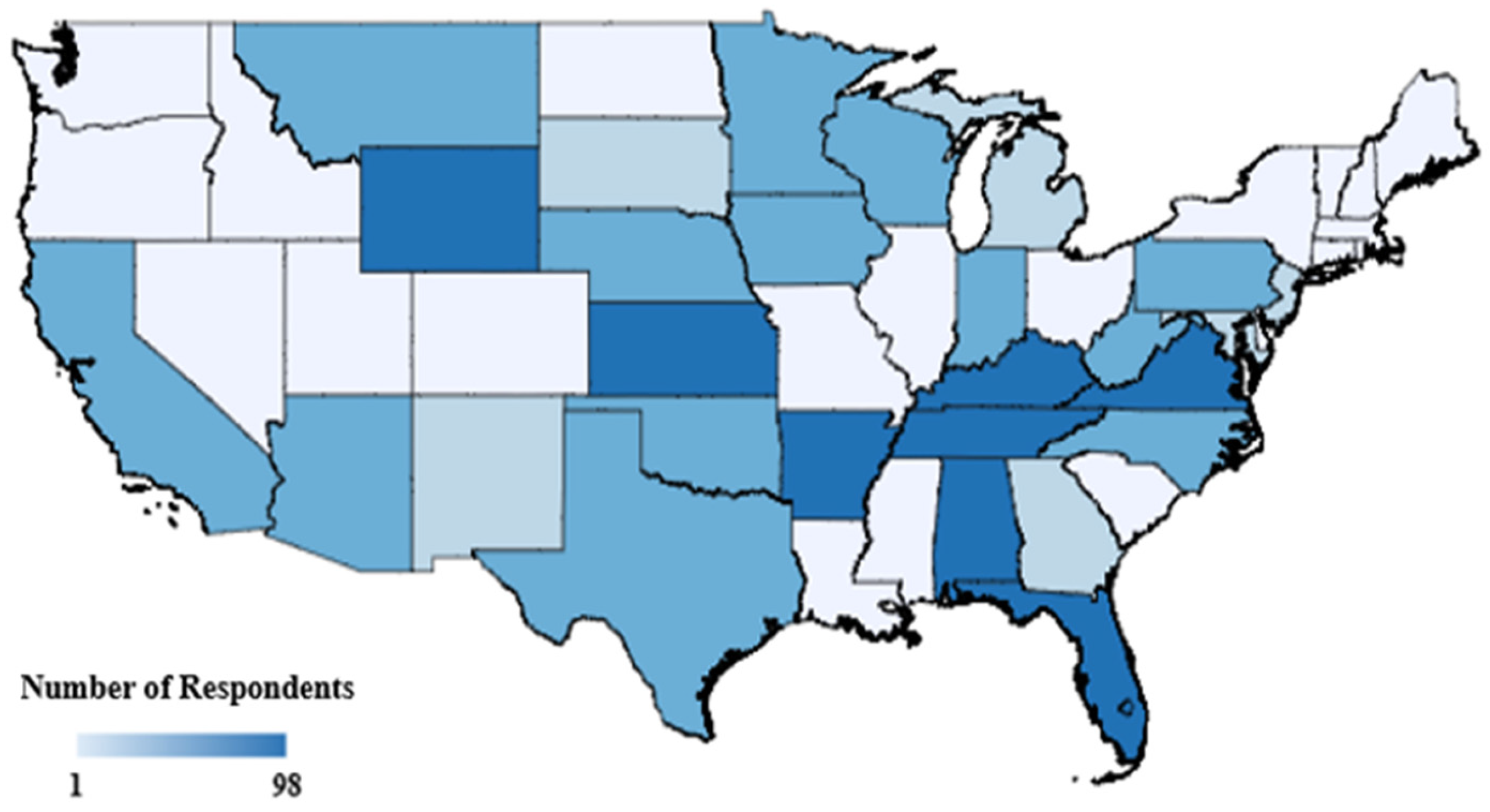
Data used in this study were collected from a National Grazing Management Survey (Supplementary Materials), which was distributed electronically to U.S. cow-calf producers through cooperation with state livestock membership associations (e.g., state cattlemen’s associations, grazing associations, etc.). This survey was determined to be exempt by the Kansas State University Institutional Review Board (Proposal #IRB-12097). The survey was open between 12 June 2024 and 6 August 2024, and garnered 509 responses. After excluding respondents who did not graze cattle, have a cow-calf operation, did not provide essential information, the final sample consisted of 226 valid responses across the United States. The number of survey respondents by state is displayed in Figure 1.
The survey was designed to capture a comprehensive profile of operation characteristics, basic economics, and grazing management practices. Questions covered producer demographics (e.g., experience, education,), operation characteristics (e.g., land ownership, herd size, operation acreage), economics (e.g., annual income, annual feed costs), and grazing management strategies (e.g., type of GMP, grazing patterns, stocking density). Respondents were asked to identify their GMP hierarchy, categorized into four levels: no GMP, mental GMP, written GMP, and written GMP with annual evaluation. Grazing patterns were also classified into three categories: continuous, rotational, and adaptive multi-paddock. Respondents were provided with the definitions of mental and written GMPs, and continuous, rotational, and adaptive multi-paddock grazing to ensure consistency among responses.
To assess producer priorities, survey respondents were asked to rank GMP objectives based on their importance. These objectives were categorized into two groups: economic (e.g., production efficiency and profitability) and environmental (e.g., soil and forage health, water quality, and wildlife habitat). This allowed for an analysis of how operational and producer characteristics influence the prioritization of GMP goals. The survey also collected information on grazing management training, participation in government conservation programs, and the use of risk-management tools. Although these variables may be associated with GMP adoption or the prioritization of goals, they were excluded from the final analysis due to missingness or a lack of response.
While a hierarchy of GMPs is of interest in this study, the primary purpose of this analysis to isolate factors associated with specific thresholds rather than modeling the full joint ordering of outcomes. The analytical framework employed binary logit models, a well-established approach in the literature [7,11,12], to estimate the likelihood of producers adopting grazing management plans and grazing patterns. Specifically, binary logit models were used to examine the adoption of GMPs, the adoption of written GMPs, the prioritization of economic vs. environmental objectives, and the adoption of intensive grazing practices. Independent variables evaluated in the logit models are described in Table 1.
The utility function received by producer i from choosing alternative j can be represented as:
U i j = V i j + ε i j ,   and i = 1 , ,   N   ,
where V i j is the deterministic component of the utility function, and ε i j , is the error term or random component of the utility function. The probability that producer i will choose alternative j can be derived from:
Prob V i k + ε i k < V i j + ε i j ;   k C i ,
where C i is the producer’s choice set, defined as: C i = j , k = {Adopt a GMP, Not adopt a GMP}, C i = j , k = {Adopt a written GMP, Adopt a mental GMP}, C i = j , k = {Prioritize economic objectives, Prioritize environmental objectives}, or C i = j , k = {Adopt intensive grazing practices, Not adopt intensive grazing practices}. Assuming V i j is linear in parameters, the probability of producer i choosing alternative j can be written as:
Prob { j   is   chosen } = P r ( x i β k + ε i k < x i β j + ε i j ) = P r [ ε i k ε i j < x i ( β j β k ) ] = Pr ( ϵ i < x i α ) = F ( x i α ) ,
where x i is a vector of observed characteristics for producer i, ϵ i = ε i k ε i j is the random error, α = β j β k represents parameters to be estimated, and F ( x i α ) is the cumulative distribution function which gives the probability that j is chosen over k. We assume ϵ i follows a logistic distribution and employ binary logit models to evaluate characteristics that influence the adoption of GMPs among U.S. cow-calf producers.
Binary logit models are also employed to examine the economic benefits associated with the GMP hierarchy, where the outcome of interest is the probability that a producer would earn positive returns over off-farm feed costs. Returns over off-farm feed costs are estimated using the median of reported income ranges and reported off-farm feed costs. Respondents who did not provide income or off-farm feed costs were excluded from this portion of the analysis.

3. Results and Discussion

Table 1 reports the descriptive statistics for producers and operation demographics. While 69% of respondents indicate they have a mental GMP, 9% and 10% indicate they have a written GMP and a written GMP with annual evaluation, respectively. More than 80% of respondents indicate the use of intensive grazing practices, such as rotational grazing or adaptive multi-paddock grazing. Of the GMP users, 31% prioritized economic objectives and 69% indicated environmental priorities. Nearly half of the respondents are considered small cow-calf producers (20–49 head), and 40% operate less than 100 acres. More than half of the respondents indicate that all of their grazing acres are privately owned. Only 30% of respondents who reported off-farm feed costs are estimated to have positive returns over off-farm feed costs.
Operations are classified as “South” or “non-South” with regions classified following the U.S. Census Bureau, and most respondents are in the Southern U.S. (82%). The collapse of geography to “South” or “non-South” is due to the limited sample size; however, this could mask meaningful heterogeneity among operations in the West, Midwest, Southeast, Northwest, and Northeast. Geographic classification in this study is a coarse proxy for regional differences, as participation in the survey could be correlated with unobserved characteristics.
Table 2 reports the marginal effects from the logit models for the adoption of a GMP, written GMP, and intensive grazing patterns. Results indicate that producers with smaller herd sizes, more grazing acres, and those utilizing intensive grazing patterns are more likely to adopt a GMP. Producers with larger herds (50–199 head and >200 head) are less likely to adopt a GMP with probabilities that are 12.7% and 34.8% lower, respectively, compared to those with herd sizes of 20–49 head. Producers managing larger grazing acres (>500 acres) are more likely to adopt a GMP, with a 37.9% higher probability compared to those managing <100 grazing acres. This could indicate that producers’ decisions to adopt a GMP are not simply driven by scale but may also be influenced by characteristics not observed in this study. The use of rotational or adaptive multi-paddock grazing is associated with a greater likelihood of adopting a GMP compared to the implementation of continuous grazing.
Among the producers who use a GMP, those with 10–19 years of experience are 20.6% less likely to adopt a written GMP compared to those with <10 years of experience. Additionally, implementing intensive grazing patterns is associated with an increased likelihood of adopting a written GMP. However, being located in the Southern U.S. is associated with a lower probability of adopting a written GMP compared to other regions, which could indicate a need for increased producer education and awareness to address regional barriers.
Adopting intensive grazing patterns is also influenced by herd size and the type of GMP. There is a 10.6% higher probability that producers with a herd size of 50–199 head will adopt intensive grazing than those managing small herds. Further, producers who utilize a written/evaluated GMP are 27.5% more likely to adopt intensive grazing compared to those who utilize a mental GMP, suggesting that formal planning in the form of a GMP supports more advanced grazing practices. One motivation for producers to implement formal planning is the desire to ensure appropriate stocking densities, as noted in Likins et al. [5].
Table 3 presents the results from the logit models examining the prioritization of economic objectives and the likelihood of achieving positive returns over off-farm feed costs. Respondents who reported using a GMP and provided income or feed cost information (N = 201) were included in the analyses of economic objectives and returns over off-farm feed costs, respectively. Results indicate that larger herd size is associated with the prioritization of economic goals. Tang et al. [7] found that smaller operators were more likely to prioritize environmental objectives. The probability of prioritized economic objectives increases by 20.1% and 34.4% for herds of 50–199 head and >200 head, respectively. Interestingly, annually evaluated written GMPs are associated with a lower probability of prioritizing economic objectives. While the estimated relationships between variables are directionally consistent with expectations, results should be interpreted with caution as the overall model fit is only marginally significant (Prob > Chi2 = 0.0911).
Feed costs were reported as a range, and the median of the range selected by the producer was used as a proxy for actual feed costs. Results indicate that a mental GMP is associated with 23.2% higher likelihood of earning positive returns over off-farm feed costs than no GMP. A written GMP and annually evaluated written GMP are associated with 36.1% and 33.0% higher likelihood of earning positive returns over off-farm feed costs, respectively, compared to no GMP (Table 3).
Using the upper and lower bounds of the ranges for feed costs instead of the median value produced similar trends. In using the lower bounds, a mental GMP is associated with 14.2% higher likelihood of earning positive returns over off-farm feed costs than no GMP. A written GMP and an annually evaluated written GMP are associated with a 21.8% and 19.5% higher likelihood of earning positive returns over off-farm feed costs, respectively, compared to no GMP. In using the upper bounds, a mental GMP is associated with an 11.7% higher likelihood of earning positive returns over off-farm feed costs than no GMP. A written GMP and an annually evaluated written GMP are associated with a 26.1% and 22.0% higher likelihood of earning positive returns over off-farm feed costs, respectively, compared to no GMP. These findings were robust across sensitivity analyses when using the bounds of the reported income ranges, lending support to the value of GMPs.

4. Conclusions

The objectives of this research were to: (1) examine the characteristics of cow-calf producers that influence the adoption of grazing management plans and intensive grazing patterns, (2) examine the characteristics of cow-calf producers associated with grazing management plan objectives, and (3) examine the economic benefits associated with the adoption of grazing management plans and intensive grazing patterns. Previous surveys would suggest that cow-calf producers with larger herds are more likely to have a GMP [13]. Our findings indicate that producers’ decisions to adopt a GMP are influenced by factors other than scale. Our findings also suggest that producers managing larger herds may be less concerned about a lack of resources and more concerned about potential economic losses. Although larger operations are often well-positioned to take advantage of economies of scale, there is also the potential for greater losses. Additionally, the cow-calf operation is more likely to represent the primary family income for larger operations, resulting in a greater emphasis on economic objectives.
Proper grazing management coupled with good record-keeping in the form of a written GMP may extend the grazing season and reduce off-farm feed costs. Our study emphasizes that a formal GMP supports advanced grazing practices and has the potential to increase profit margins over off-farm feed costs. Our findings also suggest that there are some regional barriers to the adoption of GMPs and that there may be factors, economic or otherwise, not included in this study that impact producers’ decisions to adopt a formal GMP. However, our findings may be most applicable to producers with other characteristics in common rather than the general population of producers.
While this study includes general adoption indicators, there may be more nuanced motivations that could provide additional insight into the adoption of intensive grazing practices. More detailed inquiry provides an opportunity for expanded data collection in the future. Findings from this study suggest that there may be opportunities to support the adoption of GMPs and intensive grazing practices through targeted outreach such as cost-share programs, incentive-based frameworks, or technical assistance. Such interventions may be especially helpful for producers with limited resources.

Supplementary Materials

The following supporting information can be downloaded at: https://www.mdpi.com/article/10.3390/su18125999/s1, The full National Grazing Management Survey is included in the Supplementary Materials.

Author Contributions

Conceptualization, M.E.D., D.L.P. and P.A.L.; Methodology, M.E.D., D.L.P. and P.A.L.; Validation, M.E.D., D.L.P., P.A.L. and F.J.A.; Formal Analysis, M.E.D., D.L.P., P.A.L. and F.J.A.; Investigation, M.E.D., D.L.P., P.A.L. and F.J.A.; Resources, M.E.D., D.L.P., P.A.L. and F.J.A.; Data Curation, M.E.D. and D.L.P.; Writing—Original Draft Preparation, M.E.D.; Writing—Review & Editing, M.E.D., D.L.P., P.A.L. and F.J.A.; Visualization, M.E.D., D.L.P., P.A.L. and F.J.A.; Supervision, M.E.D., D.L.P., P.A.L. and F.J.A.; Project Administration, D.L.P., P.A.L. and F.J.A.; Funding Acquisition, D.L.P., P.A.L. and F.J.A. All authors have read and agreed to the published version of the manuscript.

Funding

This research was funded by the National Cattlemen’s Beef Association, Beef Checkoff grant number 2345.

Institutional Review Board Statement

The study was conducted in accordance with the Declaration of Helsinki, and approved by the Institutional Review Board of Kansas State University (Protocol #IRB-12097, 28 February 2024).

Informed Consent Statement

Participant consent was waived due to the survey being anonymous and deemed exempt by the Institutional Review Board of Kansas State University.

Data Availability Statement

Data can be requested from the authors.

Conflicts of Interest

The authors declare no conflicts of interest.

References

  1. U.S. Department of Agriculture, National Agricultural Statistics Service. 2017 Census of Agriculture: United States Summary and State Data; United States Department of Agriculture, National Agricultural Statistics Service: Washington, DC, USA, 2019.
  2. Briske, D.D.; Derner, J.D.; Brown, J.R.; Fuhlendorf, S.D.; Teague, W.R.; Havstad, K.M.; Gillen, R.L.; Ash, A.J.; Willms, W.D. Rotational grazing on rangelands: Reconciliation of perception and experimental evidence. Rangel. Ecol. Manag. 2008, 61, 3–17. [Google Scholar] [CrossRef]
  3. Jennings, J.; Beck, P.A.; Gadberry, S. 126 Developing a Grazing Management Plan That Matches Forage Systems to the Nutrient Needs of Cattle. J. Anim. Sci. 2016, 95, 62. [Google Scholar] [CrossRef]
  4. U.S. Department of Agriculture, Natural Resources Conservation Service (USDA-NRCS). Conservation Planning Activity: Grazing Management Plan; United States Department of Agriculture, Natural Resource Conservation Service: Washington, DC, USA, 2022.
  5. Likins, J.M.; Goodwin, D.J.; Anderson, D.P. A Review and Exploration of the Socioeconomic Benefits of Written Grazing Management Plans; USRSB Technical Report; U.S. Roundtable for Sustainable Beef: Centennial, CO, USA, 2024. [Google Scholar]
  6. U.S. Roundtable for Sustainable Beef (USRSB). Beef Industry Sustainability Framework. 2022. Available online: https://www.usrsb.org/Media/USRSB/Docs/usrsbgoalsandtargets_supportingdocument_2022.pdf (accessed on 1 February 2026).
  7. Tang, M.; Aherin, C.K.; Pendell, D.L.; Johnson, M.D.; McDonald, A.; Lancaster, P.A. Grazing management plan adoption and objective prioritization in US cow-calf and stocker operations. J. Agric. Appl. Econ. 2024, 56, 310–328. [Google Scholar] [CrossRef]
  8. Beck, P.A.; Stewart, C.B.; Sims, M.B.; Gadberry, M.S.; Jennings, J.A. Effects of stocking rate, forage management, and grazing management on performance and economics of cow–calf production in Southwest Arkansas1. J. Anim. Sci. 2016, 94, 3996–4005. [Google Scholar] [CrossRef] [PubMed]
  9. Wang, T.; Teague, W.R.; Park, S.C.; Bevers, S. Evaluating long-term economic and ecological consequences of continuous and multi-paddock grazing—A modeling approach. Agric. Syst. 2018, 165, 197–207. [Google Scholar] [CrossRef]
  10. Gurda, A.; Renz, M.; Brink, G. Defining Mob Grazing in the Upper Midwestern United States. J. Ext. 2018, 56, 11. [Google Scholar] [CrossRef]
  11. Adamowicz, W.; Boxall, P.; Williams, M.; Louviere, J. Stated preference approaches for measuring passive use values: Choice experiments and contingent valuation. Am. J. Agric. Econ. 1998, 80, 64–75. [Google Scholar] [CrossRef]
  12. Lusk, J.L.; Roosen, J.; Fox, J.A. Demand for beef from cattle administered growth hormones or fed genetically modified corn: A comparison of consumers in France, Germany, the United Kingdom, and the United States. Am. J. Agric. Econ. 2003, 85, 16–29. [Google Scholar] [CrossRef]
  13. U.S. Department of Agriculture-Animal and Plant Health (USDA-APHIS). Beef Cow-Calf Management Practices in the United States, 2017 (No. 782.0520); USDA-APHIS–VS-CEAH–NAHMS: Fort Collins, CO, USA, 2020.
Figure 1. National Grazing Management Survey respondents by state. Darker colored states indicate more respondents.
Sustainability 18 05999 g001
Table 1. Descriptive statistics for producer and operation demographics included in logit models.
VariableObs.MeanStd. Dev.MinMaxDescription
GMP hierarchy:
No GMP2260.120.32010/1; indicates that no GMP is used
Mental GMP2260.690.46010/1; indicates mental GMP is used (some idea in mind)
Written GMP2260.090.28010/1; indicates written GMP is used
Evaluated GMP2260.100.30010/1; indicates written GMP with annual evaluation is used
Intensive grazing practices2260.820.39010/1; indicates adoption of intensive grazing practices (rotational grazing, adaptive multi-paddock grazing)
GMP Objectives:
Economic2000.310.46010/1; indicates that economic objectives are prioritized in GMP
Environmental2000.690.46010/1; indicates that environmental objectives are prioritized in GMP
Experience:
Less than 10 years2260.270.44010/1; indicates less than 10 years of experience as primary decision maker
10–19 years2260.260.44010/1; indicates 10–19 years of experience as primary decision maker
20–29 years2260.180.39010/1; indicates 20–29 years of experience as primary decision maker
30–39 years2260.110.32010/1; indicates 30–39 years of experience as primary decision maker
40 years or more2260.180.38010/1; indicates more than 40 years of experience as primary decision maker
Education:
Completed high school
or GED equivalent
2260.070.25010/1; indicates primary decision maker has completed high school or GED equivalent
Some college or
vocational program
2260.250.44010/1; indicates primary decision maker has completed some college or vocational program
Bachelor’s degree2260.340.47010/1; indicates primary decision maker has completed Bachelor’s degree
Beyond bachelor’s degree2260.340.47010/1; indicates primary decision maker has completed education beyond Bachelor’s degree
Herd size:
20–49 head2260.450.50010/1; indicates herd size of 20–49 head of cattle
50–199 head2260.390.49010/1; indicates herd size of 50–199 head of cattle
200 or more head2260.160.37010/1; indicates herd size of 200 head of cattle or more
Operation size:
Less than 100 acres2260.400.49010/1; indicates grazing operation is less than 100 acres
100–499 acres2260.380.49010/1; indicates grazing operation is 100–499 acres
More than 500 acres2260.220.42010/1; indicates grazing operation is more than 500 acres
Private2260.550.50010/1; indicates that 100% of grazing acres are privately owned
South 12260.820.38010/1; indicates operation is located in the South
Positive Return2010.300.46010/1; indicates that producer is estimated to earn positive returns over off-farm feeding costs
Notes: 1 Region assignment follows the U.S. Census Bureau. Due to limited sample size, operations are classified as South or non-South in this analysis. South includes the following states: AL, AR, FL, GA, KY, LA, MS, NC, OK, SC, TN, TX, VA, WV, MD.
Table 2. Marginal effects from logit models for adoption of a grazing management plan, adoption of a written grazing management plan, and adoption of intensive grazing patterns among cow-calf producers.
Adoption of GMPAdoption of Written GMPAdoption of Intensive Grazing Patterns
VariableMarginal EffectStd. Err.Marginal EffectStd. Err.Marginal EffectStd. Err.
Experience: 10–19 years−0.0090.053−0.206 **0.0800.0950.065
Experience: 20–29 years−0.0180.060−0.1240.0800.1010.076
Experience: 30–39 years−0.0090.073−0.0630.0890.1140.094
Experience: 40 years or more0.1030.079−0.1240.0880.0650.071
Education: Some college or vocational program −0.0060.0770.0590.137−0.0480.115
Education: Bachelor’s degree0.0500.086−0.0220.1330.0670.120
Education: Beyond Bachelor’s degree0.0160.0820.1110.130−0.0570.118
Herd size: 50–199 head−0.127 **0.057−0.0020.1020.106 *0.062
Herd size: 200 head or more−0.348 ***0.1020.1970.140−0.00010.120
Operation size: 100–499 acres0.0810.053−0.0230.0940.0260.059
Operation size: more than 500 acres0.379 ***0.109−0.0780.1380.1080.116
Private −0.0100.0390.0260.0610.0740.051
Intensive 0.156 ***0.0400.383 **0.180--
South--−0.147 **0.066−0.0210.084
Adopt GMP----0.182 ***0.057
Adopt written/evaluated GMP----0.275 **0.127
Model FitWald Chi2(13) = 36.90Wald Chi2(14) = 18.86Wald Chi2(15) = 37.68
Prob > Chi2 = 0.0004Prob > Chi2 = 0.1703Prob > Chi2 = 0.0010
Obs. 226200226
Notes: * p < 0.10, ** p < 0.05, *** p < 0.01. Reference groups for each categorical variable are as follows: Experience: Less than 10 years; Education: Completed high school or GED equivalent; Herd size: 20–49 head; Operation size: Less than 100 acres.
Table 3. Marginal effects from logit models for prioritizing economic objectives in GMP and estimated positive returns over off-farm feed costs among cow-calf producers.
Prioritize Economic ObjectivesEstimated Positive Return over Off-Farm Feed Costs
VariableMarginal EffectStd. Err.Marginal EffectStd. Err.
Experience: 10–19 years0.0520.0850.0620.098
Experience: 20–29 years−0.1030.0960.184 *0.102
Experience: 30–39 years−0.267 **0.1320.0170.116
Experience: 40 years or more−0.1410.0990.0010.106
Education: Some college or vocational program 0.1680.1700.0410.138
Education: Bachelor’s degree0.1520.173−0.1760.134
Education: Beyond Bachelor’s degree0.0490.175−0.229 *0.132
Herd size: 50–199 head0.201 **0.0810.304 ***0.081
Herd size: 200 head or more0.344 ***0.1330.334 **0.140
Operation size: 100–499 acres−0.1060.0870.0500.088
Operation size: more than 500 acres−0.1850.134−0.0340.143
Private −0.0050.0670.0180.069
Intensive0.1510.104−0.0920.090
South0.00040.0890.0370.097
Mental GMP--0.232 **0.091
Written GMP0.0100.0930.361 ***0.130
Evaluated GMP−0.209 *0.1100.330 **0.152
Model FitWald Chi2(16) = 23.93Wald Chi2(17) = 35.45
Prob > Chi2 = 0.0911Prob > Chi2 = 0.0054
Obs. 200201
Notes: * p < 0.10, ** p < 0.05, *** p < 0.01. Reference groups for each categorical variable are as follows: Experience: Less than 10 years; Education: Completed high school or GED equivalent; Herd size: 20–49 head; Operation size: Less than 100 acres.
Disclaimer/Publisher’s Note: The statements, opinions and data contained in all publications are solely those of the individual author(s) and contributor(s) and not of MDPI and/or the editor(s). MDPI and/or the editor(s) disclaim responsibility for any injury to people or property resulting from any ideas, methods, instructions or products referred to in the content.