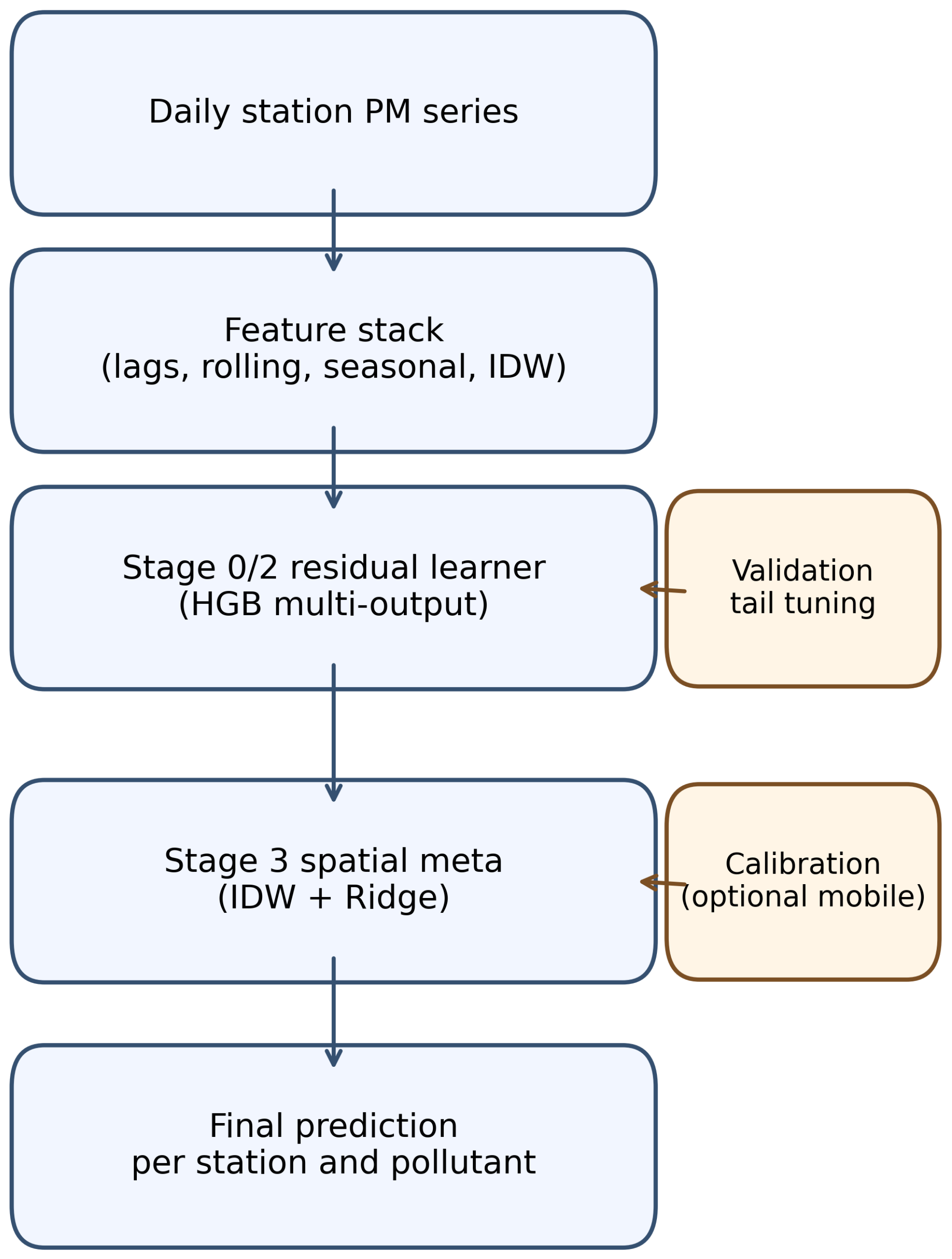
Figure 1.
Architecture overview of the Advanced Stage 0–3 pipeline. Blue boxes represent data-processing and modelling stages, tan side boxes represent validation or calibration inputs, and arrows indicate the direction of data flow.
Figure 1.
Architecture overview of the Advanced Stage 0–3 pipeline. Blue boxes represent data-processing and modelling stages, tan side boxes represent validation or calibration inputs, and arrows indicate the direction of data flow.
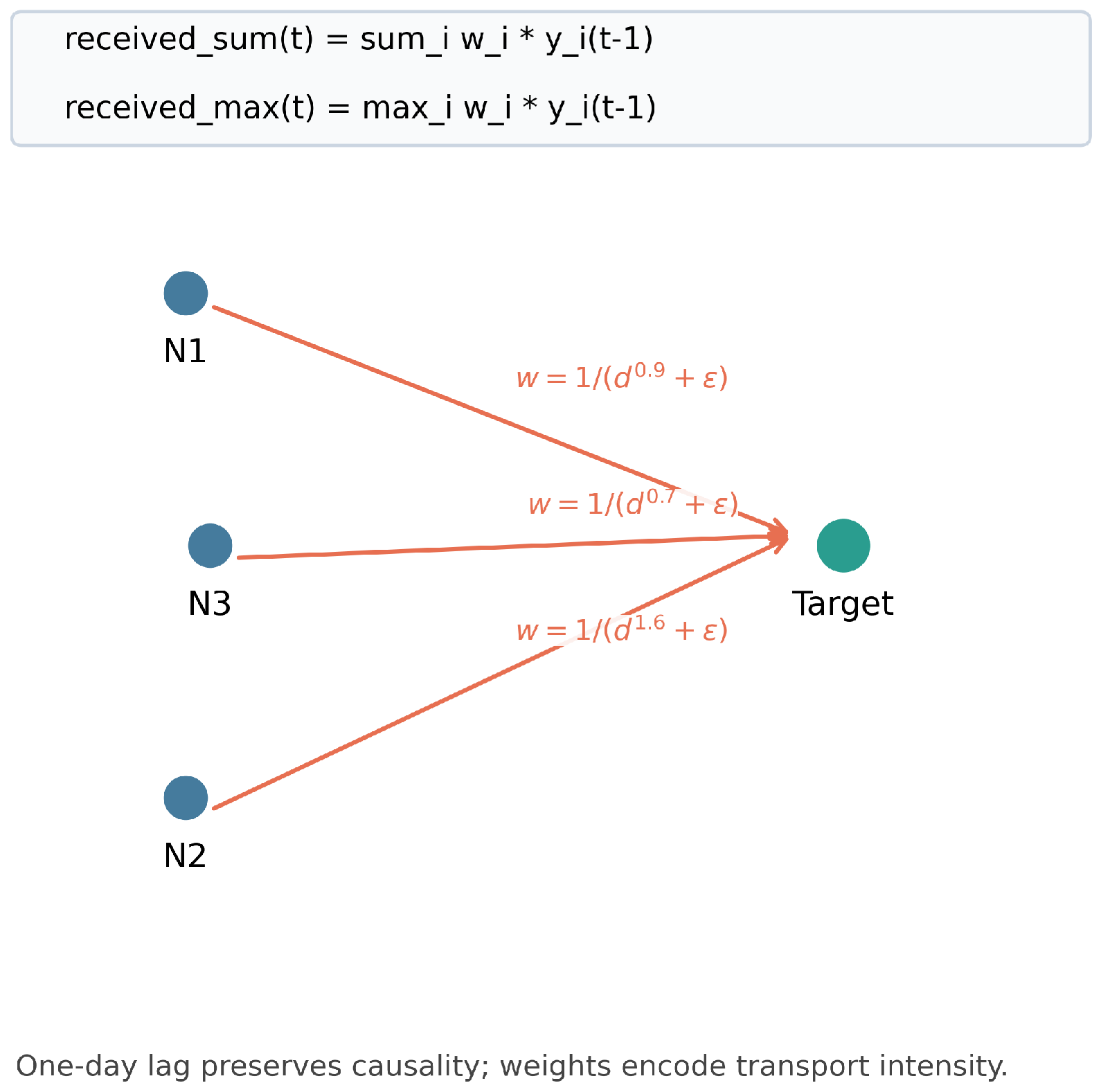
Figure 2.
Received–from–neighbour transport features (received_sum and received_max). Blue nodes denote neighbouring stations, the green node denotes the target station, orange arrows denote directed transport contributions, and the equations show one-day-lagged inputs − .
Figure 2.
Received–from–neighbour transport features (received_sum and received_max). Blue nodes denote neighbouring stations, the green node denotes the target station, orange arrows denote directed transport contributions, and the equations show one-day-lagged inputs − .
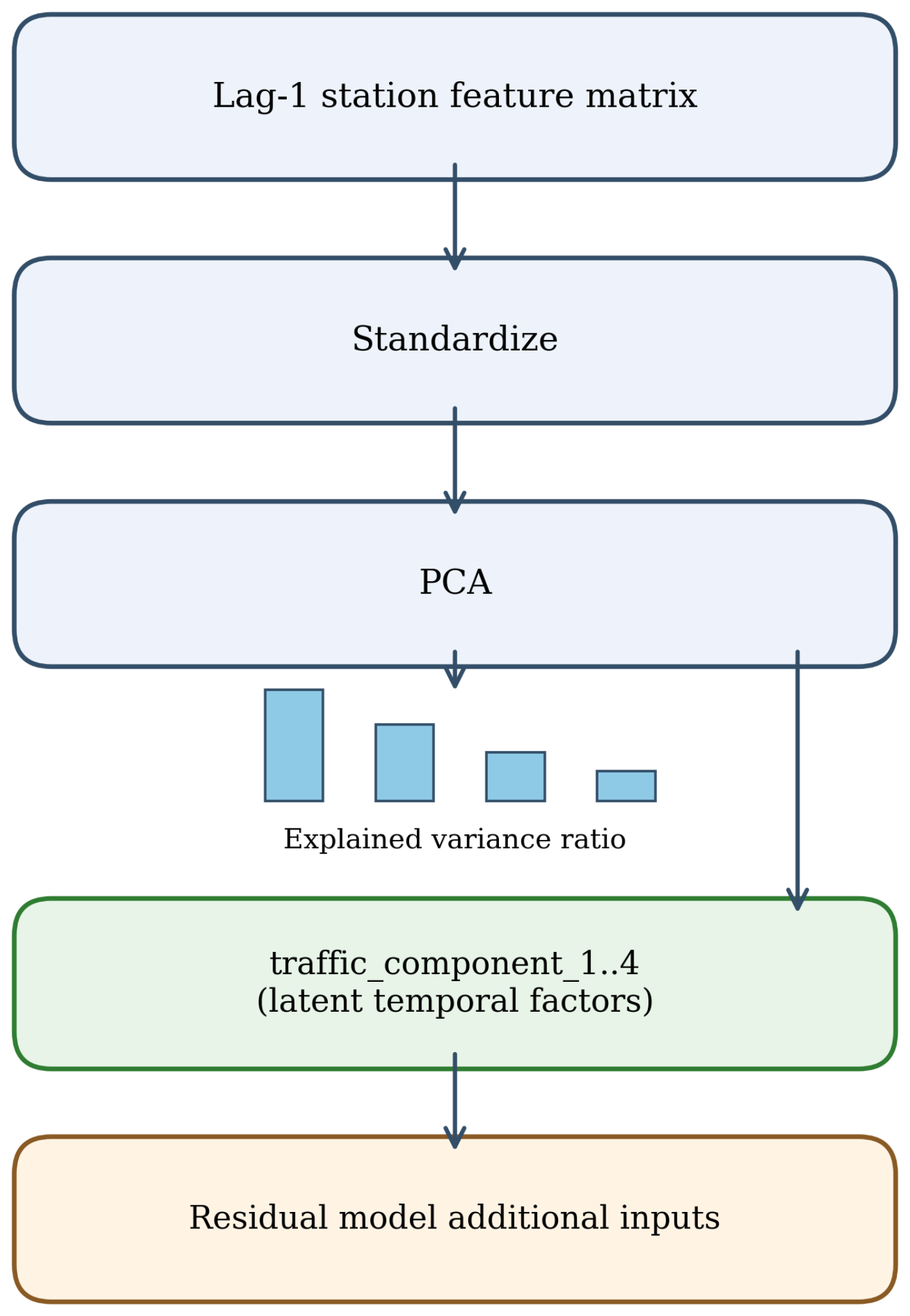
Figure 3.
Construction of PCA latent temporal factors from lagged multi-station features. Blue boxes show preprocessing, the green box contains the retained traffic-component features, the tan box marks the residual-model inputs, and arrows show the transformation sequence.
Figure 3.
Construction of PCA latent temporal factors from lagged multi-station features. Blue boxes show preprocessing, the green box contains the retained traffic-component features, the tan box marks the residual-model inputs, and arrows show the transformation sequence.
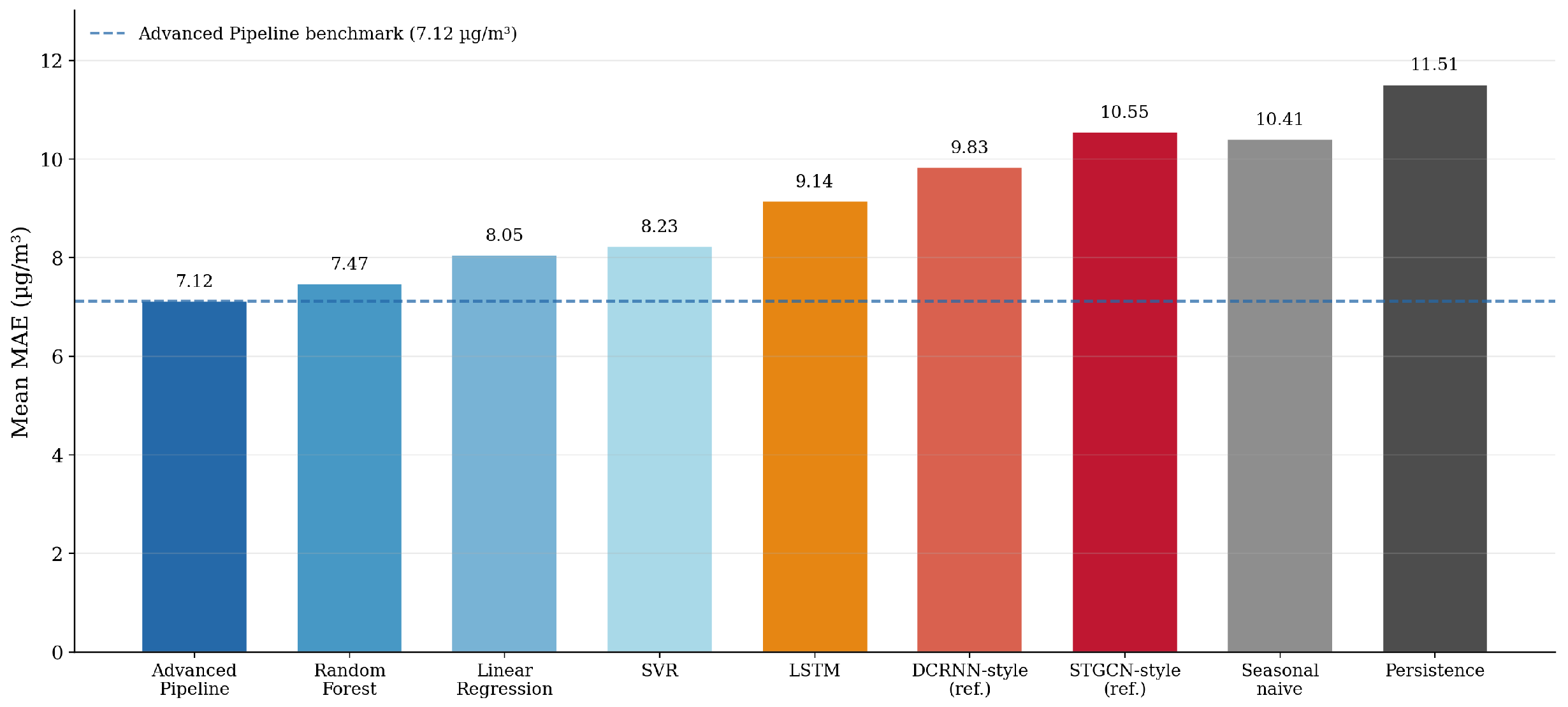
Figure 4.
Task A overall MAE comparison across models. Bars are coloured by model family, with blue tones for the proposed/tabular models, orange/red tones for neural and graph-inspired models, and grey tones for simple reference baselines. The dashed blue line marks the Advanced Pipeline benchmark MAE; units are g/m3.
Figure 4.
Task A overall MAE comparison across models. Bars are coloured by model family, with blue tones for the proposed/tabular models, orange/red tones for neural and graph-inspired models, and grey tones for simple reference baselines. The dashed blue line marks the Advanced Pipeline benchmark MAE; units are g/m3.
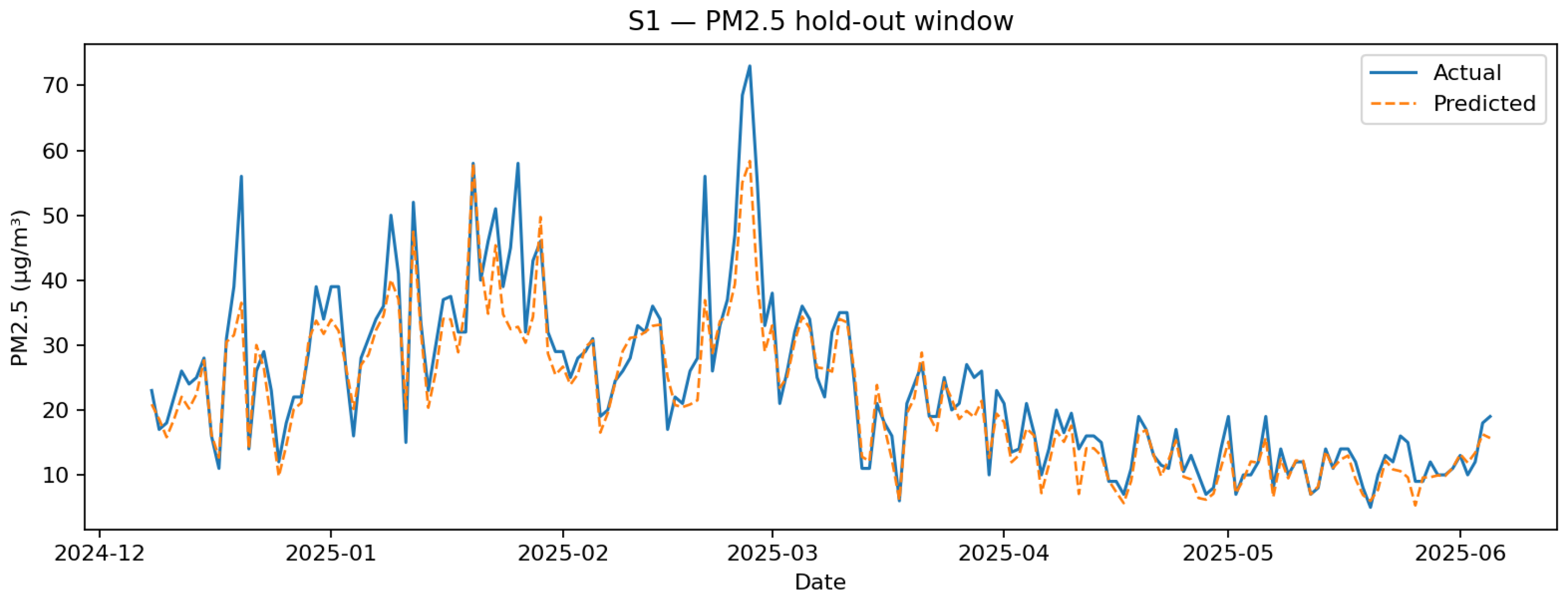
Figure 5.
Task A sample 30-day recursive forecast vs. actual values for Station S1 (PM2.5).
Figure 5.
Task A sample 30-day recursive forecast vs. actual values for Station S1 (PM2.5).
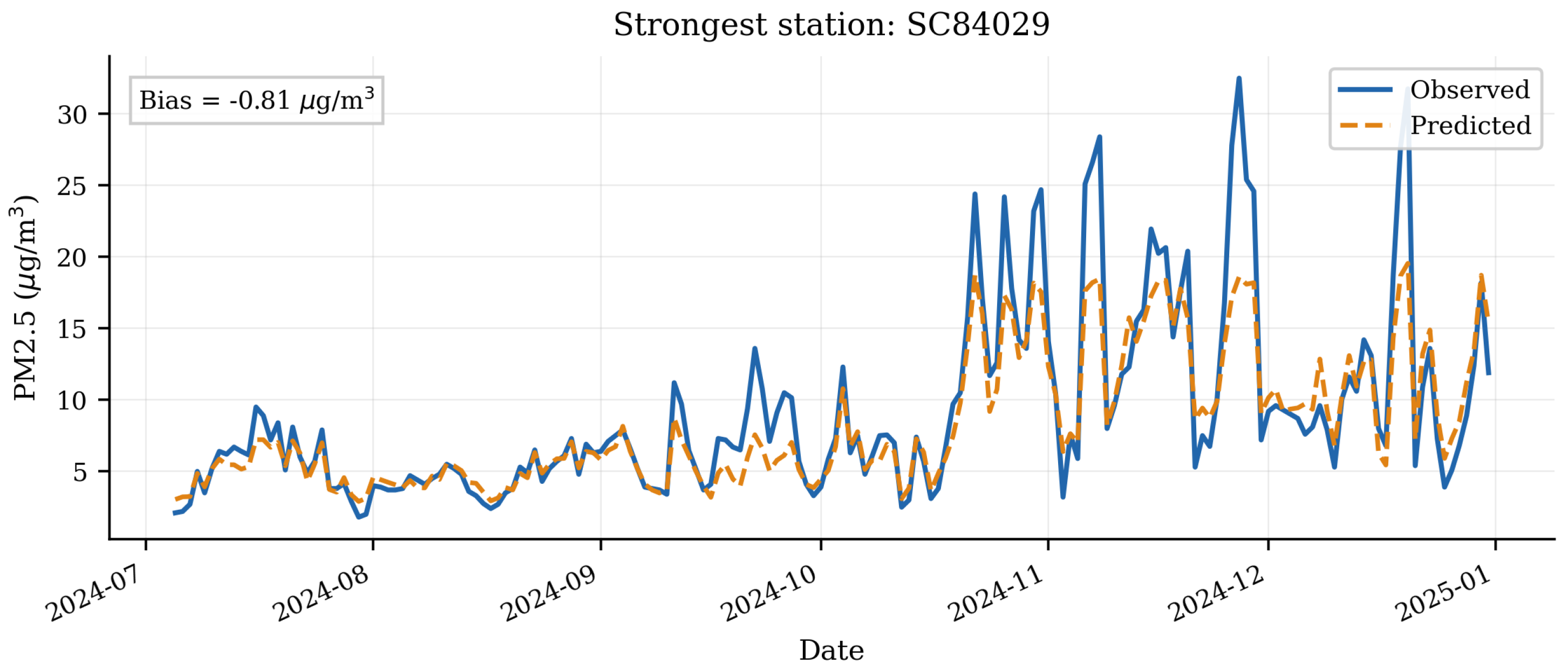
Figure 6.
Task B spatial estimation at the strongest city-scale station (SC84029): sample predictions vs. observed hold-out values. Negative values, where shown on axes or annotations, use the mathematical minus sign −.
Figure 6.
Task B spatial estimation at the strongest city-scale station (SC84029): sample predictions vs. observed hold-out values. Negative values, where shown on axes or annotations, use the mathematical minus sign −.
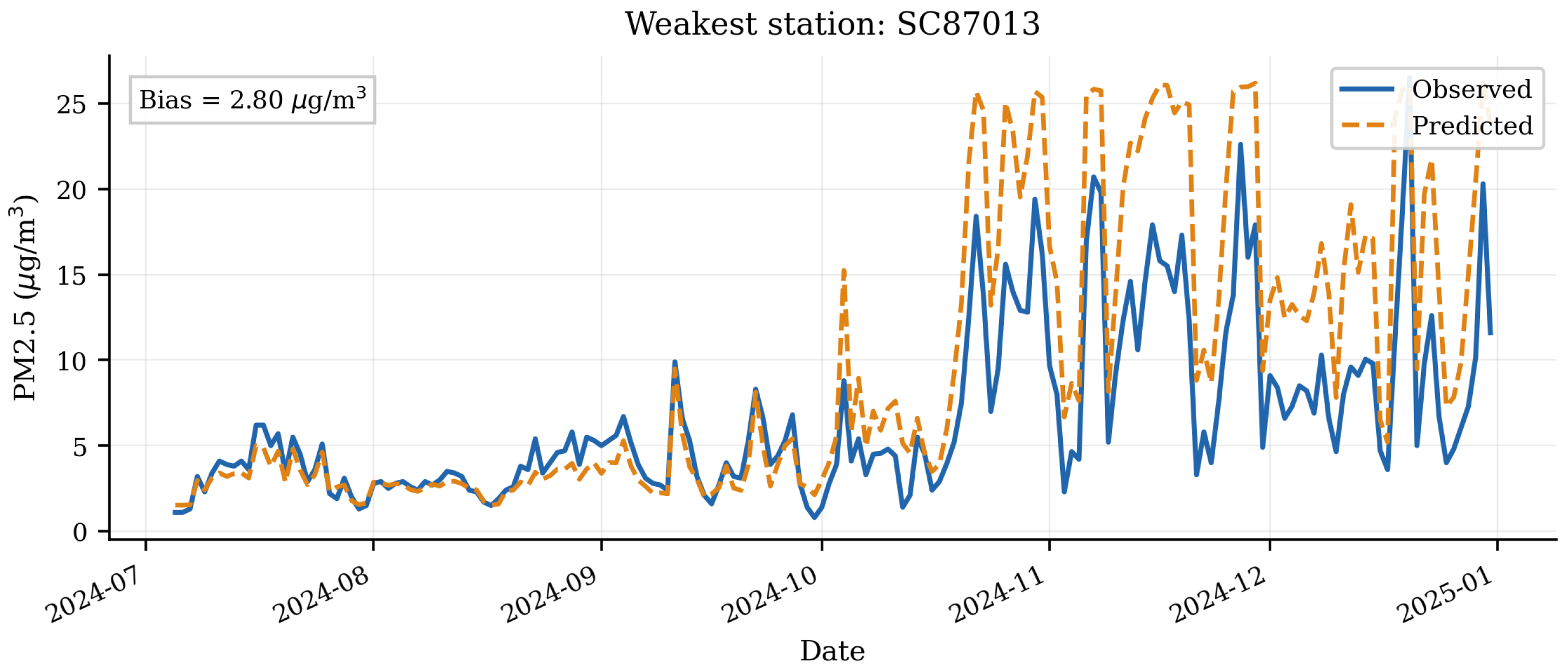
Figure 7.
Task B spatial estimation at the weakest city-scale station (SC87013): sample predictions vs. observed hold-out values.
Figure 7.
Task B spatial estimation at the weakest city-scale station (SC87013): sample predictions vs. observed hold-out values.
Figure 8.
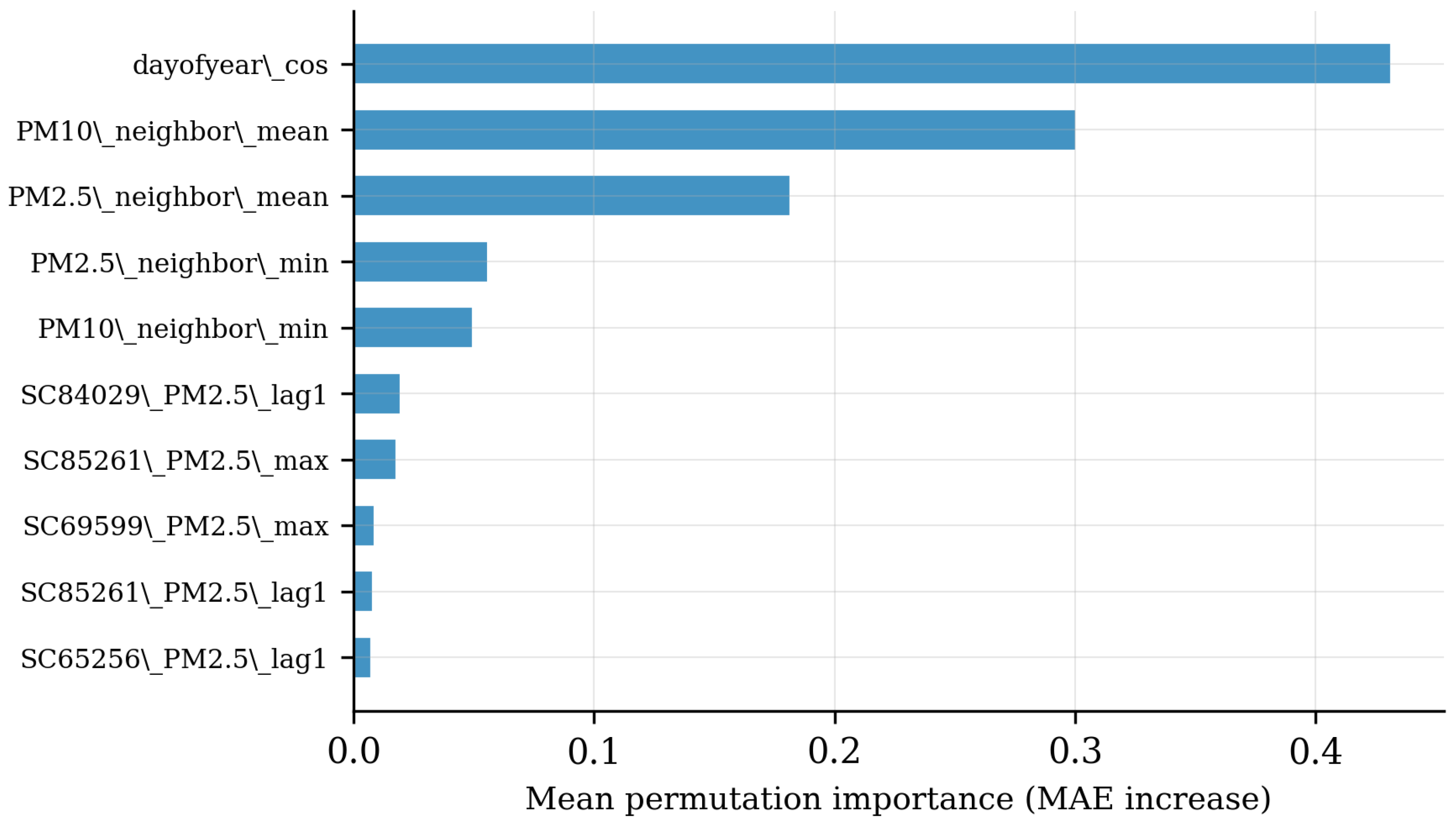
Top features by permutation importance, baseline entry. Bar length represents the mean MAE increase after permutation; the bar colours distinguish the ranked features for readability.
Figure 8.
Top features by permutation importance, baseline entry. Bar length represents the mean MAE increase after permutation; the bar colours distinguish the ranked features for readability.
Figure 9.
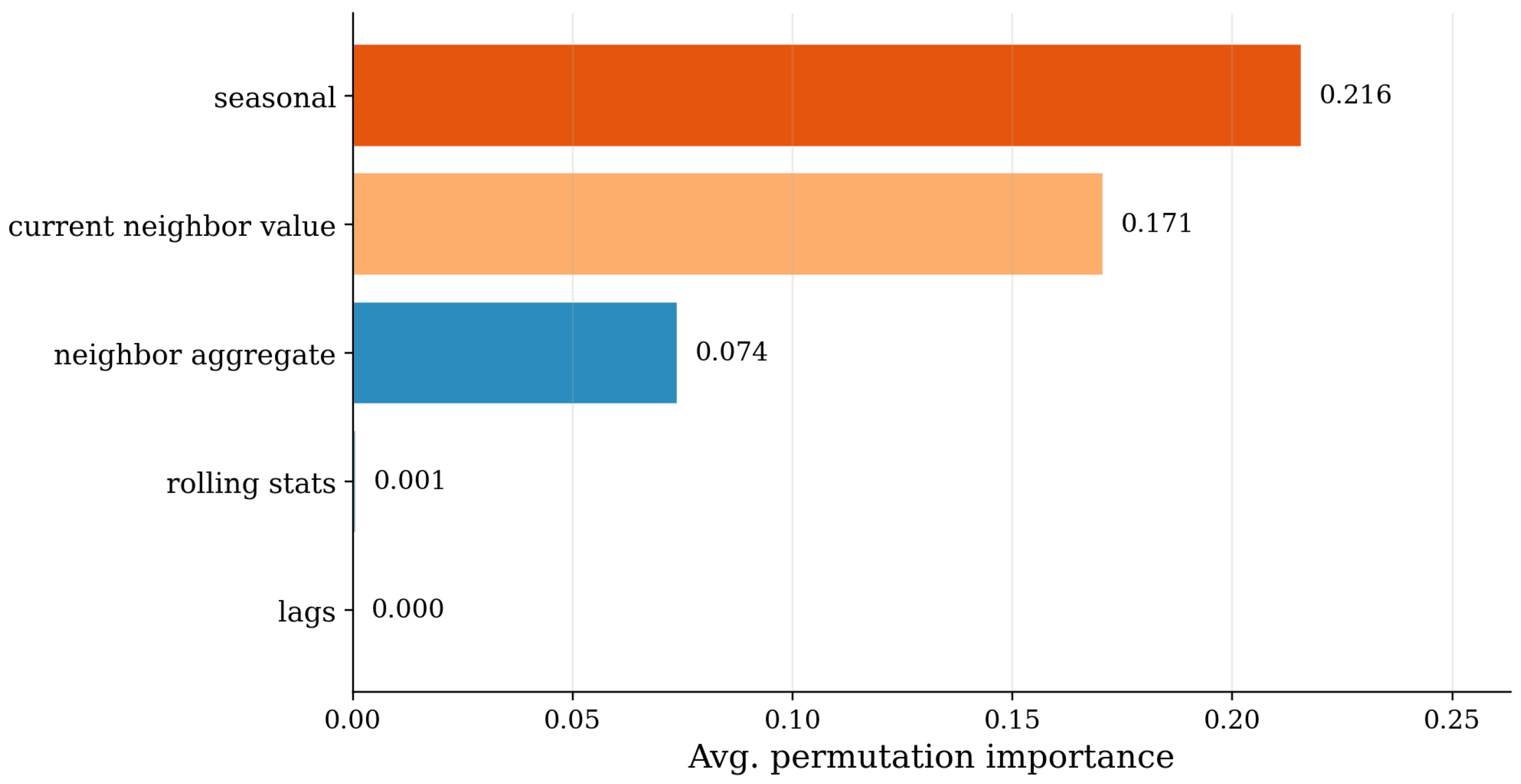
Feature influence by category, baseline entry. Bar colours identify feature categories, and bar length represents average permutation importance; seasonal and neighbour-based categories dominate.
Figure 9.
Feature influence by category, baseline entry. Bar colours identify feature categories, and bar length represents average permutation importance; seasonal and neighbour-based categories dominate.
Figure 10.
PCA of feature importance patterns across tasks, baseline entry. Green markers denote individual station–pollutant tasks projected into the first two principal components.
Figure 10.
PCA of feature importance patterns across tasks, baseline entry. Green markers denote individual station–pollutant tasks projected into the first two principal components.
Figure 11.
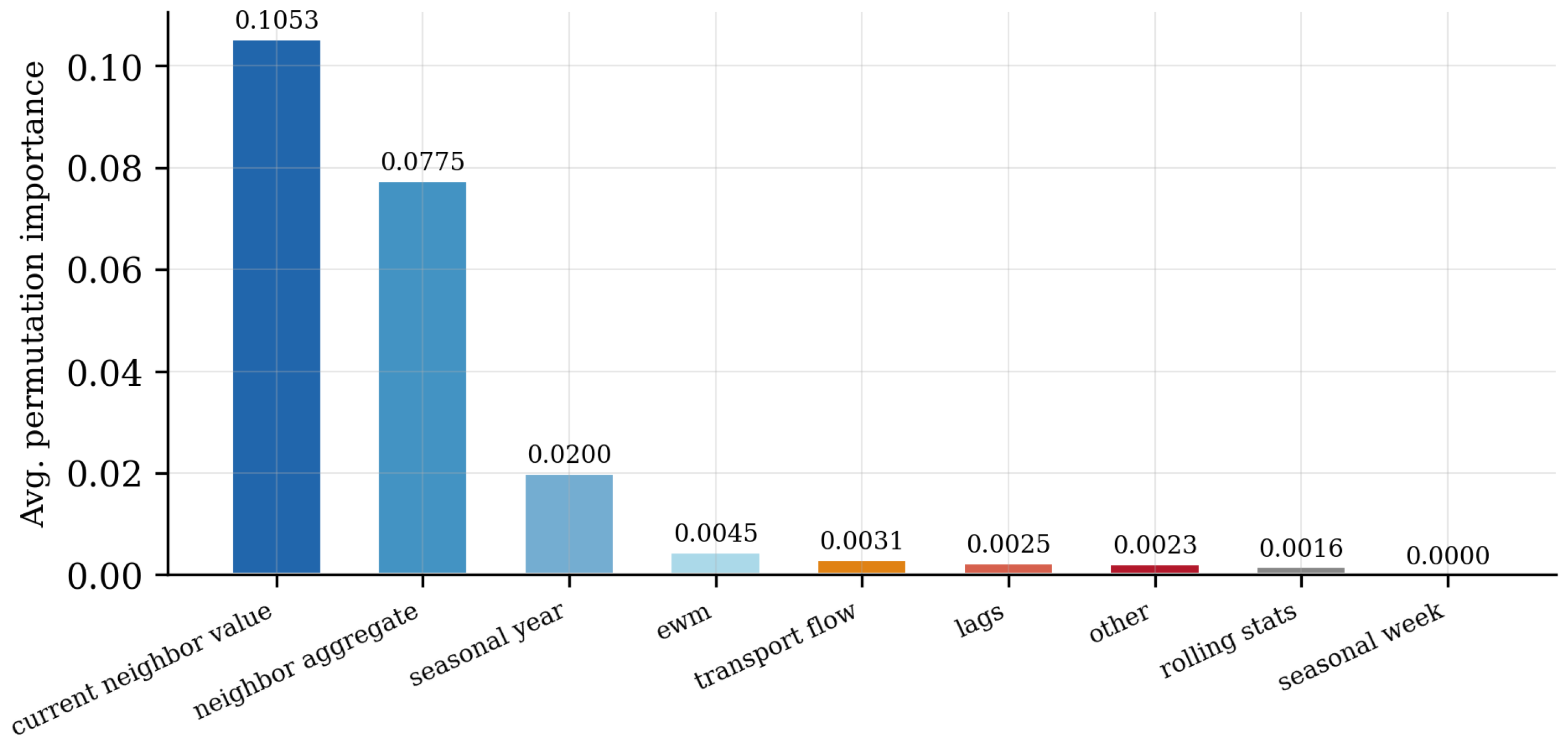
Feature influence by category, advanced entry. Bar colours identify feature categories, and bar length represents average permutation importance; neighbour aggregates remain dominant and transport flow contributes positively.
Figure 11.
Feature influence by category, advanced entry. Bar colours identify feature categories, and bar length represents average permutation importance; neighbour aggregates remain dominant and transport flow contributes positively.
Figure 12.
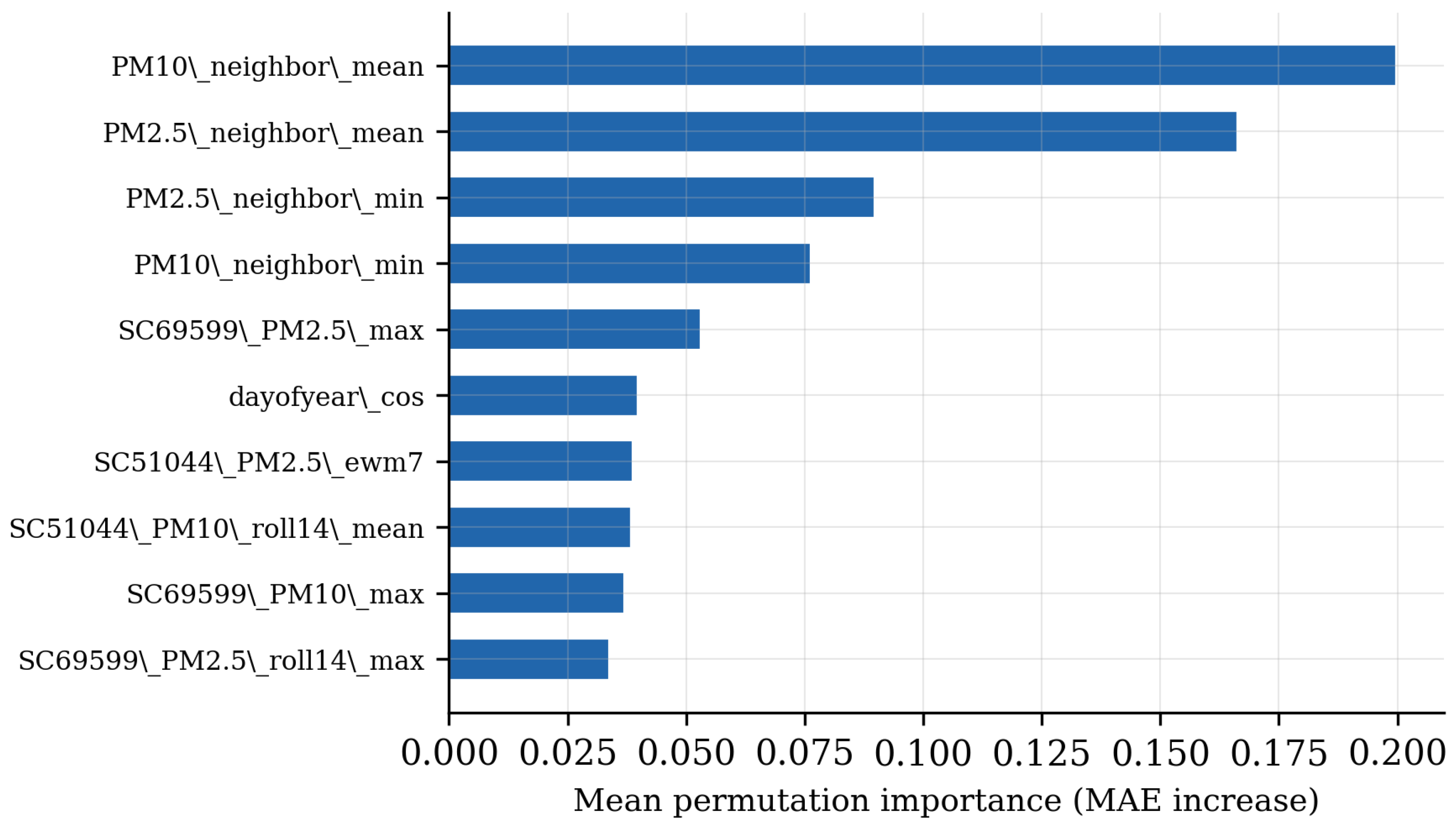
Top features by permutation importance, advanced entry. Blue bars denote the ranked engineered features, with bar length proportional to mean MAE increase after permutation.
Figure 12.
Top features by permutation importance, advanced entry. Blue bars denote the ranked engineered features, with bar length proportional to mean MAE increase after permutation.
Figure 13.
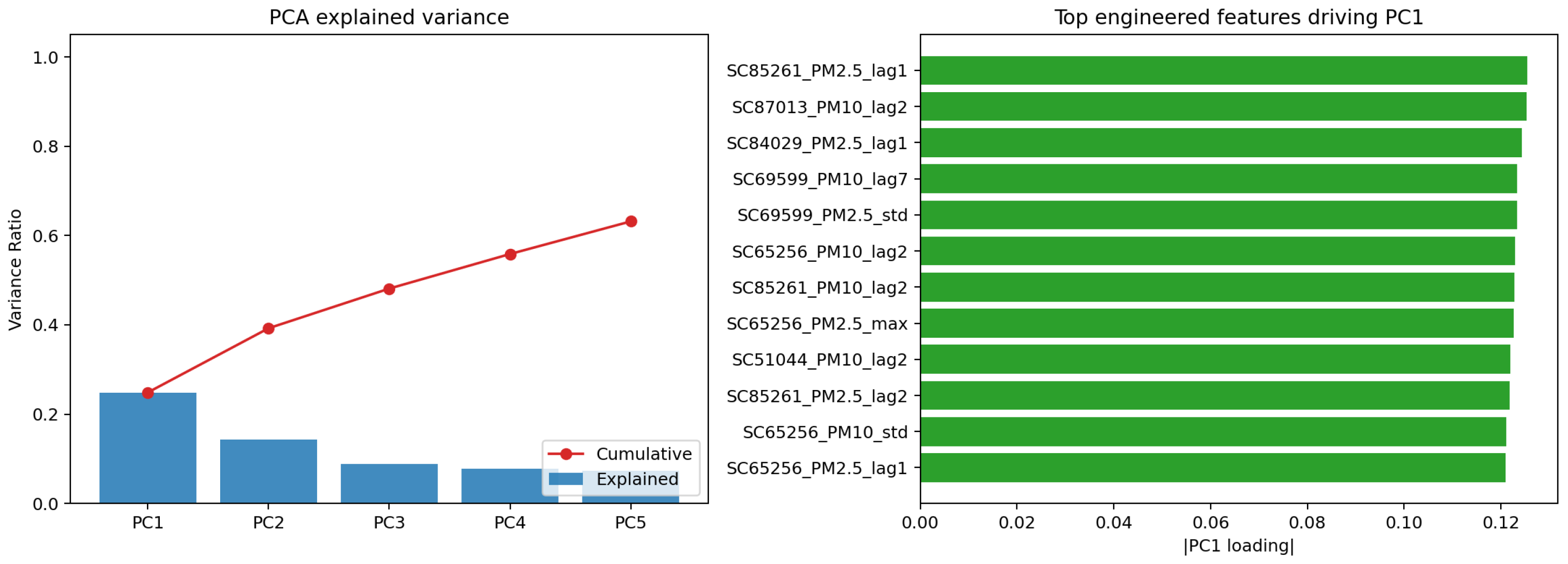
PCA of feature importance patterns across tasks, advanced entry. Green markers denote individual station–pollutant tasks projected into the first two principal components.
Figure 13.
PCA of feature importance patterns across tasks, advanced entry. Green markers denote individual station–pollutant tasks projected into the first two principal components.
Figure 14.
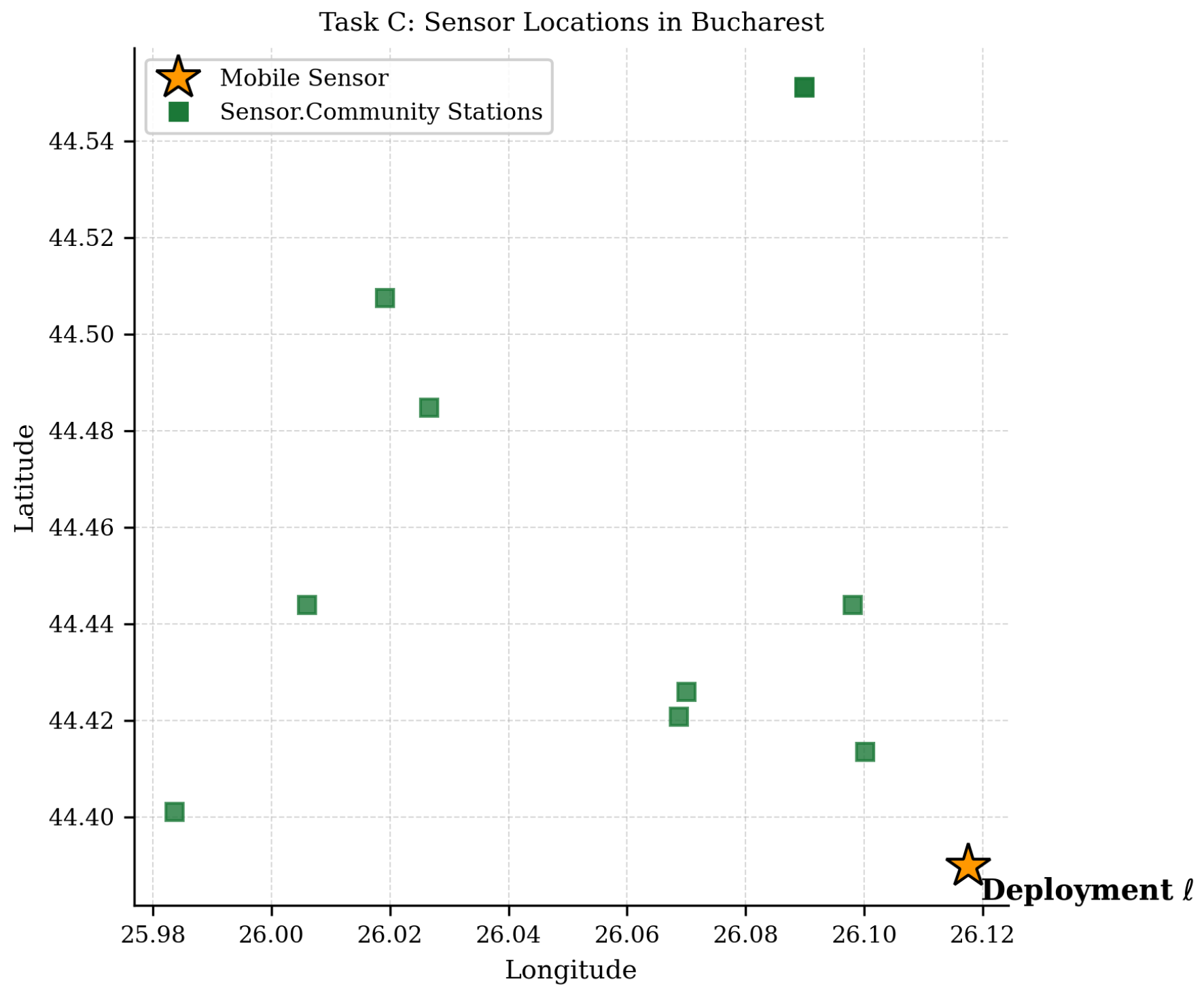
Task C spatial map showing the mobile deployment location ℓ, the classic S1–S4 stations, and the Sensor.Community stations used for city-scale transfer.
Figure 14.
Task C spatial map showing the mobile deployment location ℓ, the classic S1–S4 stations, and the Sensor.Community stations used for city-scale transfer.
Figure 15.
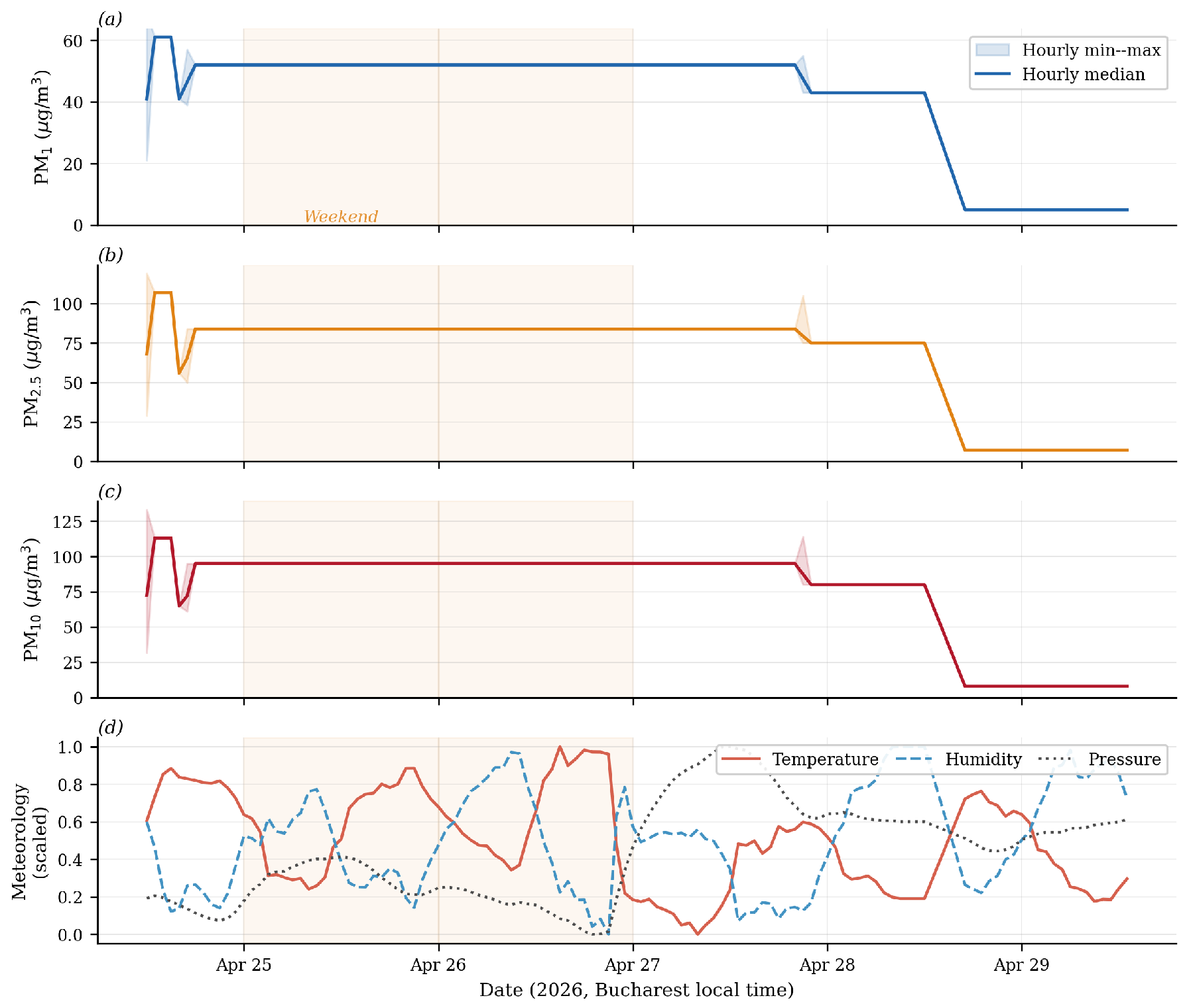
PM time series and meteorological conditions at deployment site ℓ over the measurement window (24–29 April 2026, Bucharest local time). (a) PM1; (b) PM2.5; (c) PM10; (d) min–max-normalised meteorology. Solid blue, orange, and red lines show hourly median PM concentrations, translucent bands show hourly min–max ranges, the solid red meteorology line shows temperature, the dashed blue line shows relative humidity, and the dotted grey line shows barometric pressure. Orange-shaded columns indicate weekend days (Saturday–Sunday). The sharp PM decline on 28 April coincides with a pressure recovery following the 26–27 April trough.
Figure 15.
PM time series and meteorological conditions at deployment site ℓ over the measurement window (24–29 April 2026, Bucharest local time). (a) PM1; (b) PM2.5; (c) PM10; (d) min–max-normalised meteorology. Solid blue, orange, and red lines show hourly median PM concentrations, translucent bands show hourly min–max ranges, the solid red meteorology line shows temperature, the dashed blue line shows relative humidity, and the dotted grey line shows barometric pressure. Orange-shaded columns indicate weekend days (Saturday–Sunday). The sharp PM decline on 28 April coincides with a pressure recovery following the 26–27 April trough.
Figure 16.
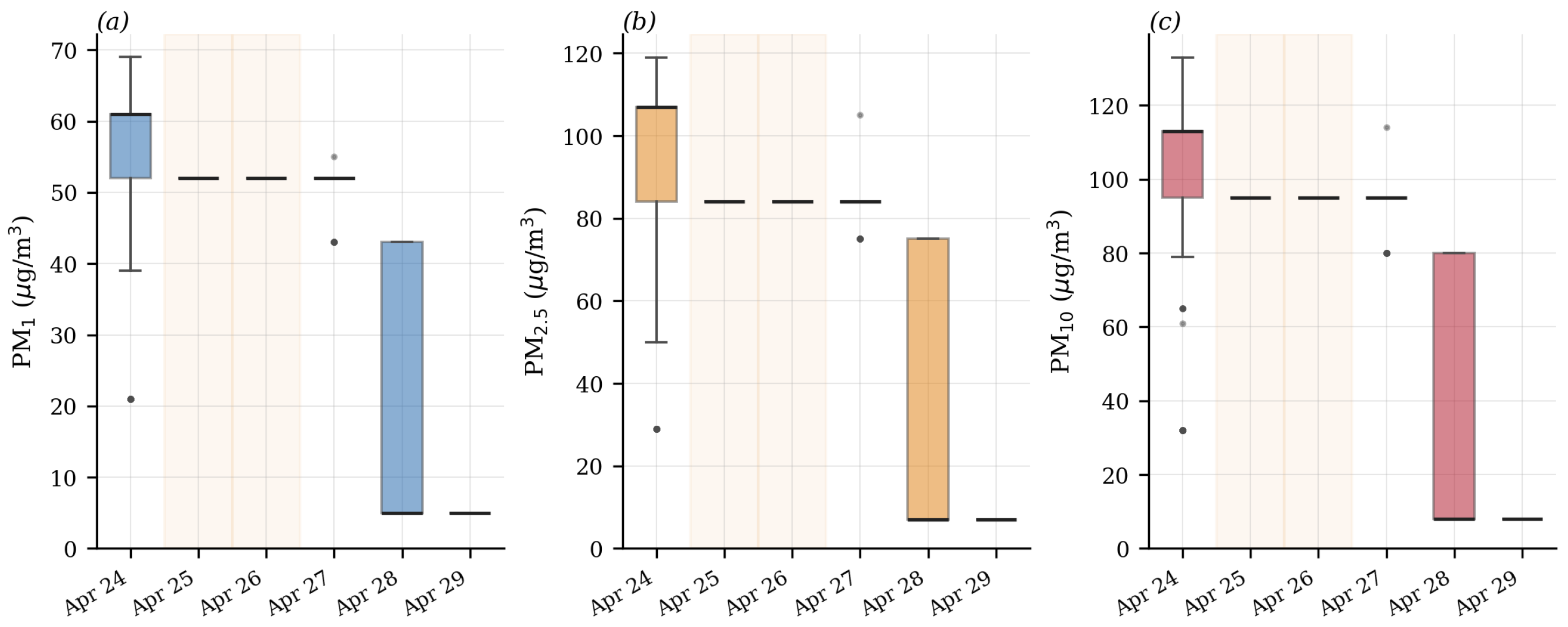
Daily box plots of PM readings at site ℓ. (a) PM1; (b) PM2.5; (c) PM10. Blue, orange, and red boxes identify the three pollutant channels, box centres mark medians, boxes show interquartile ranges, whiskers show non-outlier ranges, dots mark outliers, and orange-shaded columns mark weekend days. The elevated, low-variance readings on days 2–4 contrast sharply with the post-frontal drop on day 5.
Figure 16.
Daily box plots of PM readings at site ℓ. (a) PM1; (b) PM2.5; (c) PM10. Blue, orange, and red boxes identify the three pollutant channels, box centres mark medians, boxes show interquartile ranges, whiskers show non-outlier ranges, dots mark outliers, and orange-shaded columns mark weekend days. The elevated, low-variance readings on days 2–4 contrast sharply with the post-frontal drop on day 5.
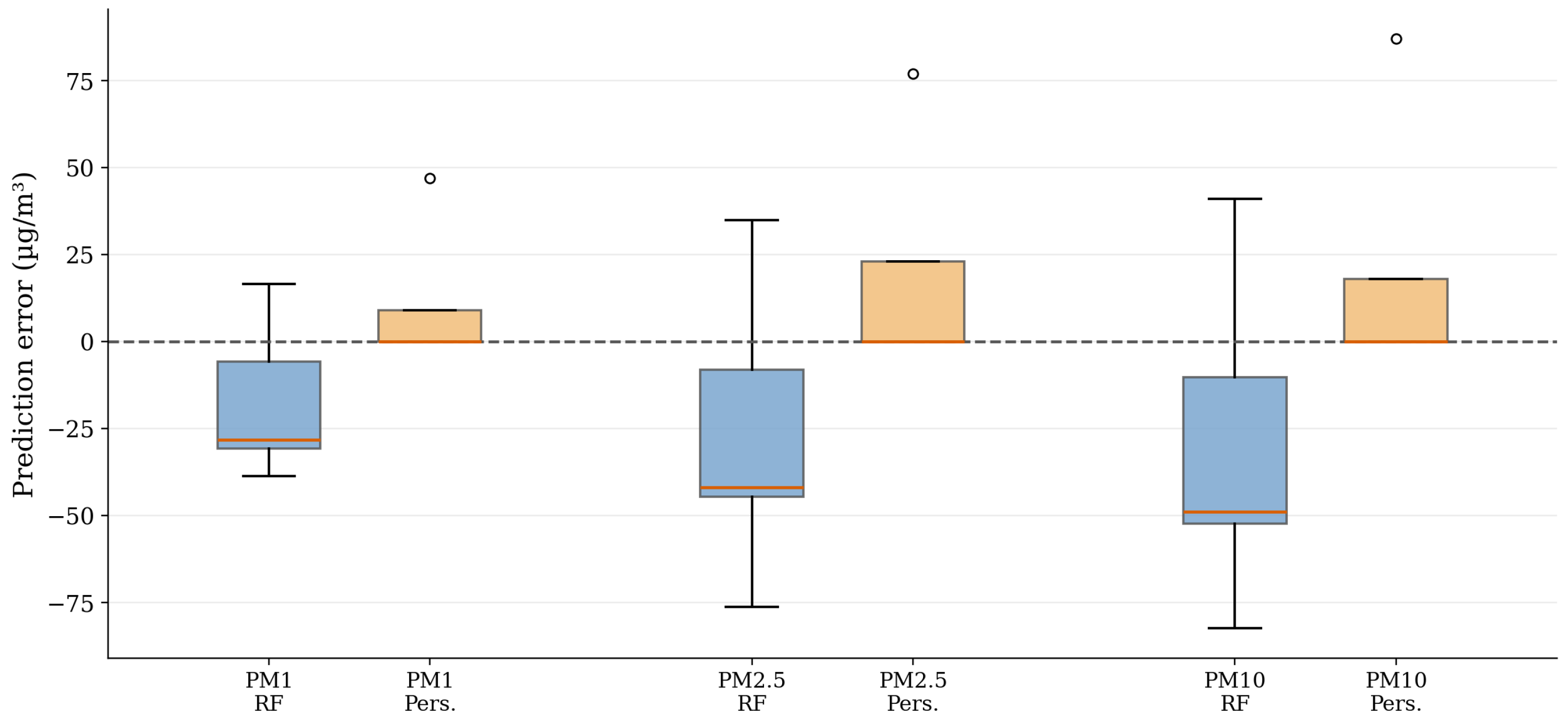
Figure 17.
Task C daily prediction error distribution for the historical-transfer Random Forest (RF) and the one-day-ahead online persistence predictor (Pers.). Blue boxes show RF errors, orange boxes show persistence errors, circles show outlying daily errors, and the dashed horizontal line marks zero prediction error.
Figure 17.
Task C daily prediction error distribution for the historical-transfer Random Forest (RF) and the one-day-ahead online persistence predictor (Pers.). Blue boxes show RF errors, orange boxes show persistence errors, circles show outlying daily errors, and the dashed horizontal line marks zero prediction error.
Table 1.
Classic network station metadata.
Table 1.
Classic network station metadata.
| Station | Location | Lat. | Lon. |
|---|
| S1 | Aleea Politehnicii | 44.4437 | 26.0519 |
| S2 | Strada Pirotehniei | 44.4393 | 26.0493 |
| S3 | Strada Valea Calugareasca | 44.4106 | 26.1106 |
| S4 | Strada Soldat Ion Ciocodeica | 44.3869 | 26.1194 |
Table 2.
Mobile sensor deployment summary.
Table 2.
Mobile sensor deployment summary.
| Parameter | Value |
|---|
| Field deployment | 6 calendar days at uncovered outdoor location ℓ |
| Sampling frequency | Approximately five-minute readings |
| Pollutants | PM1, PM2.5, PM10 |
| Weather conditions | Highly variable (includes a weekend) |
| Reference at ℓ | None; no co-located EPA FRM/FEM or equivalent reference monitor |
Table 3.
City imputation ablation (top-10 transfer, 180-day hold-out, split-aware statistics).
Table 3.
City imputation ablation (top-10 transfer, 180-day hold-out, split-aware statistics).
| Imputation | Mean MAE | Mean | Median |
|---|
| Linear (split-aware) | 5.0512 | 0.5198 | 0.6287 |
| Hybrid (split-aware) | 4.0234 | 0.6871 | 0.7289 |
Table 4.
Summary of the four pipeline stages and the capabilities added at each stage.
Table 4.
Summary of the four pipeline stages and the capabilities added at each stage.
| Stage | What It Adds |
|---|
| Stage 0 (Base residual) | Advanced feature stack (lags, rolling statistics, seasonal encoding, transport
features); multi-output HistGradientBoosting predicting seasonal residuals. |
| Stage 1 (Transfer eval.) | Evaluates the Stage 0 pipeline under leave-one-station-out on the classic
four-station network. |
| Stage 2 (Tuning) | Randomised hyperparameter search on Stage 0 using TimeSeriesSplit; selects the
best configuration on a validation tail. |
| Stage 3 (Spatial blend) | Adds a RidgeCV spatial interpolation meta-learner on top of Stage 2 residual
predictions; blends base and interpolated outputs. |
Table 5.
Per-station MAE for all Task A models (mean across 5 rolling subsets, g/m3).
Table 5.
Per-station MAE for all Task A models (mean across 5 rolling subsets, g/m3).
| Model | Pollutant | S1 | S2 | S3 | S4 |
|---|
| Advanced Pipeline | PM1 | 4.489 | 3.756 | 5.698 | 6.413 |
| PM2.5 | 7.287 | 4.612 | 7.201 | 11.071 |
| PM10 | 9.179 | 4.958 | 8.442 | 12.284 |
| Random Forest | PM1 | 4.711 | 3.909 | 5.993 | 6.864 |
| PM2.5 | 7.656 | 4.827 | 7.489 | 11.792 |
| PM10 | 9.423 | 5.304 | 8.744 | 12.917 |
| Linear Regression | PM1 | 5.548 | 3.256 | 6.296 | 7.757 |
| PM2.5 | 8.929 | 4.019 | 7.782 | 13.588 |
| PM10 | 11.325 | 4.380 | 9.103 | 14.669 |
| SVR | PM1 | 6.150 | 3.113 | 6.132 | 7.593 |
| PM2.5 | 10.190 | 3.773 | 7.668 | 13.375 |
| PM10 | 12.970 | 4.103 | 8.986 | 14.714 |
| LSTM | PM1 | 5.567 | 3.574 | 7.792 | 8.870 |
| PM2.5 | 9.177 | 4.447 | 9.765 | 15.723 |
| PM10 | 11.589 | 4.829 | 11.228 | 17.144 |
| DCRNN-style (ref.) | PM1 | 6.196 | 3.860 | 8.002 | 9.445 |
| PM2.5 | 10.239 | 4.650 | 10.094 | 16.964 |
| PM10 | 13.059 | 5.266 | 11.619 | 18.538 |
| STGCN-style (ref.) | PM1 | 6.495 | 3.963 | 9.058 | 9.767 |
| PM2.5 | 11.006 | 4.952 | 11.364 | 18.154 |
| PM10 | 13.968 | 5.386 | 12.883 | 19.600 |
| Seasonal naïve | PM1 | 6.840 | 4.730 | 8.630 | 10.070 |
| PM2.5 | 10.790 | 5.540 | 11.240 | 16.830 |
| PM10 | 13.120 | 6.090 | 12.580 | 18.410 |
| Persistence | PM1 | 7.520 | 5.190 | 9.480 | 11.230 |
| PM2.5 | 12.030 | 6.110 | 12.510 | 18.460 |
| PM10 | 14.470 | 6.830 | 13.970 | 20.340 |
Table 6.
Task A MAE dispersion across station×pollutant cells (median and IQR).
Table 6.
Task A MAE dispersion across station×pollutant cells (median and IQR).
| Model | Median MAE | IQR |
|---|
| Advanced Pipeline | 6.807 | 3.755 |
| Random Forest | 7.177 | 4.018 |
| Linear Regression | 7.770 | 4.403 |
| SVR | 7.631 | 5.261 |
| LSTM | 9.023 | 5.936 |
| DCRNN-style (ref.) | 9.769 | 6.016 |
| STGCN-style (ref.) | 10.386 | 6.936 |
| Seasonal naïve | 10.430 | 6.385 |
| Persistence | 11.630 | 7.045 |
Table 7.
Task A RMSE and summary for fitted tabular baselines (mean across rolling splits). Negative values reflect the difficulty of variance-normalised scoring on short 30-day recursive forecast windows.
Table 7.
Task A RMSE and summary for fitted tabular baselines (mean across rolling splits). Negative values reflect the difficulty of variance-normalised scoring on short 30-day recursive forecast windows.
| Model | RMSE | |
|---|
| Random Forest | 9.337 | −1.156 |
| Linear Regression | 10.165 | −1.679 |
| SVR | 10.443 | −1.066 |
Table 8.
Task B city-scale sensitivity variants on the ten-station network.
Table 8.
Task B city-scale sensitivity variants on the ten-station network.
| Variant | Mean MAE | Mean RMSE | Mean | Median |
|---|
| Full same-day feature set | 3.921 | 6.655 | 0.698 | 0.741 |
| Current-neighbour only | 3.864 | 6.655 | 0.694 | 0.739 |
| Lagged-only | 5.706 | 9.152 | 0.458 | 0.473 |
| Seasonal-only | 6.766 | 10.071 | 0.282 | 0.424 |
Table 9.
Top features by permutation importance, baseline entry (mean MAE increase on hold-out set).
Table 9.
Top features by permutation importance, baseline entry (mean MAE increase on hold-out set).
| Feature | Importance |
|---|
| dayofyear_cos | 0.4316 |
| PM10_neighbor_mean | 0.3005 |
| PM2.5_neighbor_mean | 0.1821 |
| PM2.5_neighbor_min | 0.0561 |
| PM10_neighbor_min | 0.0501 |
Table 10.
Top features by permutation importance, advanced entry (mean MAE increase on hold-out set).
Table 10.
Top features by permutation importance, advanced entry (mean MAE increase on hold-out set).
| Feature | Importance |
|---|
| PM10_neighbor_mean | 0.1999 |
| PM2.5_neighbor_mean | 0.1664 |
| PM2.5_neighbor_min | 0.0899 |
| PM10_neighbor_min | 0.0765 |
| SC69599_PM2.5_max | 0.0533 |
Table 11.
Advanced-pipeline ablation on city-scale Task B.
Table 11.
Advanced-pipeline ablation on city-scale Task B.
| Configuration | Mean MAE | Mean RMSE | Mean |
|---|
| Baseline | 3.918 | 6.644 | 0.699 |
| Advanced raw | 3.886 | 6.599 | 0.704 |
| Advanced selected | 3.860 | 6.544 | 0.720 |
| Advanced pruned | 3.861 | 6.625 | 0.714 |
Table 12.
Field deployment site metadata.
Table 12.
Field deployment site metadata.
| Parameter | Value |
|---|
| Location | South Bucharest (uncovered site) |
| Latitude | 44.390° N |
| Longitude | 26.118° E |
| Deployment dates | 24–29 April 2026 |
| Total days | 6 (4 full days + 2 partial boundary days) |
| Sampling interval | ≈5 min |
| Total readings | 767 |
Table 13.
Daily summary statistics of PM readings at site ℓ (raw mobile sensor, g/m3).
Table 13.
Daily summary statistics of PM readings at site ℓ (raw mobile sensor, g/m3).
| Day | Weekday | PM1 | PM2.5 | PM10 |
|---|
| Median | Std | Median | Std | Median | Std |
|---|
| 1 | Fri | 61.0 | 14.6 | 107.0 | 29.0 | 113.0 | 29.9 |
| 2 | Sat | 52.0 | <0.1 | 84.0 | <0.1 | 95.0 | <0.1 |
| 3 | Sun | 52.0 | <0.1 | 84.0 | <0.1 | 95.0 | <0.1 |
| 4 | Mon | 52.0 | 2.8 | 84.0 | 3.6 | 95.0 | 5.1 |
| 5 | Tue | 5.0 | 18.6 | 7.0 | 33.3 | 8.0 | 35.2 |
| 6 | Wed | 5.0 | <0.1 | 7.0 | <0.1 | 8.0 | <0.1 |
Table 14.
Task C exploratory prediction estimates at site ℓ.
Table 14.
Task C exploratory prediction estimates at site ℓ.
| Method | Pollutant | n | Pearson r | 95% CI | | MAE | Bias |
|---|
| Hist. RF | PM1 | 6 | 0.663 | [−0.223, 0.999] | 0.094 | 23.995 | −18.091 |
| Online pers. | PM1 | 5 | 0.649 | [0.250, 1.000] | 0.295 | 11.200 | 11.200 |
| Hist. RF | PM2.5 | 6 | 0.432 | [−0.972, 0.997] | 0.461 | 40.582 | −27.942 |
| Online pers. | PM2.5 | 5 | 0.660 | [0.250, 1.000] | 0.295 | 20.000 | 20.000 |
| Hist. RF | PM10 | 6 | 0.351 | [−0.983, 0.994] | 0.637 | 45.946 | −31.697 |
| Online pers. | PM10 | 5 | 0.651 | [0.250, 1.000] | 0.151 | 21.000 | 21.000 |