Article

Joint Sensitivity of Direct Building Asset Loss to Digital Elevation Model Resolution, Rainfall, Infiltration, and Vulnerability Function Choice in a Korean Industrial Complex


1
Disaster & Risk Management Laboratory, Interdisciplinary Program in Crisis & Disaster and Risk Management, Sungkyunkwan University (SKKU), Suwon 16419, Gyeonggi, Republic of Korea
2
Geodesy Laboratory, Civil & Architectural and Environmental System Engineering, Sungkyunkwan University (SKKU), Suwon 16419, Gyeonggi, Republic of Korea
*
Authors to whom correspondence should be addressed.
Sustainability 2026, 18(12), 5982; https://doi.org/10.3390/su18125982
Submission received: 9 May 2026 / Revised: 6 June 2026 / Accepted: 8 June 2026 / Published: 11 June 2026

Abstract

Direct flood loss estimation for industrial complexes is jointly sensitive to terrain representation, rainfall magnitude, infiltration assumptions, and depth–damage function selection, yet these uncertainties are rarely evaluated together. We quantify their combined effects for the Gumi National Industrial Complex (GNIC), South Korea, using five DEM resolutions (0.5–10 m), six rainfall return periods (10–200 years plus the observed July 2024 event), and three infiltration regimes (5, 10, 20 mm h−1), yielding 90 hydrodynamic realisations from a GPU-accelerated 2D shallow-water model. Each was combined with a harmonised inventory of 16,463 buildings (replacement value 43.07 trillion KRW) and three vulnerability-function families (HAZUS-MH, JRC Huizinga, Korean MD-FDA), producing 270 loss estimates under a common dimensionless transformation. A three-way ANOVA on log-transformed damage confirmed highly significant main effects of resolution, rainfall, and infiltration across all functions, more than an order of magnitude larger than interactions, and robust to heteroscedasticity-consistent and permutation tests. Coarsening the DEM from 0.5 to 10 m reduced expected annual loss (EAL) by 55–57%, while inter-function depth–damage divergence exceeded four-fold at shallow inundation. Validation against the July 2024 event gave the best skill at 2 m resolution (critical success index 0.80, accuracy 0.86). Multi-family residential and heavy industry accounted for 83–89% of total EAL. These results show that terrain resolution and damage-function selection are first-order, statistically independent controls on industrial flood loss, and that omitting any sensitivity axis can bias EAL by more than two-fold.

1. Introduction

Urban and industrial areas in Korea and worldwide are experiencing more frequent and intense floods due to climate change and rapid urbanisation, with growing concern for high-asset districts such as dense commercial cores and industrial complexes [1,2,3,4,5,6,7]. In Korea, observed sub-hourly rainfall extremes already exceed the 100 mm h−1 disaster-prevention design standard at multiple stations, and projections under SSP/RCP scenarios indicate further intensification of 1–24 h design rainfall, with ≈18% increases in 24 h maxima and stronger growth in sub-daily extremes most relevant to urban drainage failure [8,9,10]. The Gumi National Industrial Complex (GNIC), located on a low-gradient alluvial plain in the Nakdong River basin, has been identified in national vulnerability assessments as exposed to non-negligible and increasing flood risk [11], and recent moisture-tracking analyses single out the inland Gumi basin as an exception where hourly extremes have intensified strongly [12]. The July 2024 GNIC inundation, with hourly peaks of ≈58 mm h−1 and a 24 h total of ≈133 mm, is therefore a representative, policy-relevant testbed for examining contemporary loss-estimation practice.
Quantitative flood-loss estimation typically combines hazard modelling—often under climate scenarios—with economic damage functions or probabilistic frameworks, producing metrics such as expected annual damage (EAD/EAL), exceedance-probability loss curves, or Bayesian uncertainty ranges [1,13,14,15]. Methodologies range from regional regression of damage on rainfall [2,3] to integrated assessment combining depth–damage curves with input–output models for industrial production loss [4], and to convolutional neural networks predicting urban losses under matrix rainfall scenarios [7]. These applications are powerful, but they almost universally treat the hydraulic input and the vulnerability function as fixed, leaving uncertainty in their interaction unquantified.
Two-dimensional urban flood models are highly sensitive to DEM resolution and representation, which control how channels, streets, and buildings shape inundation [16,17,18,19,20,21,22]. Coarsening from sub-metre to decametre grids can increase mean flood depth by ~150% and extent by ~30% in fluvial settings, and a small but growing literature shows that these hydraulic biases propagate non-linearly through depth–damage curves to alter building-level loss by factors of 2–4 [16,17,21,23,24]. Yet existing loss studies typically compare a small set of global DEMs (e.g., 5, 30, 90 m) rather than executing a controlled sub-metre-to-decametre experiment within a single, harmonised model setup [21,23,24], and explicit treatment of large-footprint industrial buildings remains largely absent.
Beyond DEM resolution, two additional hazard-side uncertainties have received comparatively little attention in industrial-complex applications. First, rainfall return period is typically treated as a single design value or a small discrete set, even though damage–frequency curves are highly nonlinear and the conditional sensitivity of loss to terrain resolution may itself vary with return period. Second, infiltration capacity—an essential parameter for Green–Ampt or constant-loss schemes in 2D urban flood models—is frequently fixed at a single value despite well-documented spatial and temporal variability across industrial pavement, compacted soils, and engineered drainage areas. Whether the joint sensitivity of loss to resolution is amplified or dampened by alternative rainfall and infiltration assumptions remains essentially unquantified for industrial settings.
A second, independent axis of uncertainty arises from the choice of vulnerability function. HAZUS-MH provides more than 900 empirically based curves tailored to U.S. building typologies [25,26]; JRC Huizinga curves aggregate European data into broad land-use classes with implicit asset values that must be transferred to local monetary bases [27]; and the Korean Multi-Dimensional Flood Damage Assessment (MD-FDA) framework underpins national damage-estimation guidelines [28]. These curves rest on different data, structure classes, and modelling assumptions, and large-scale empirical validation has shown that depth-only curves can over- or underestimate observed losses by ≈25%, with no globally trusted, standardised set of curves available [29,30,31,32,33,34]. Despite this, no published study systematically intercompares HAZUS-MH, Huizinga, and Korean MD-FDA functions for an industrial complex, nor analyses how DEM resolution, rainfall, and infiltration interact with vulnerability-function choice in shaping final loss estimates—a gap explicitly identified in recent reviews [16,21,24].
The present study addresses this gap with four specific objectives:
(i)
to quantify how DEM resolution from 0.5 to 10 m, in a controlled single-model experiment, propagates from inundation depth to building-scale direct asset loss for an industrial complex;
(ii)
to compare loss estimates from three vulnerability-function families (HAZUS-MH, Huizinga, MD-FDA) applied to a harmonised inventory of 16,463 GNIC buildings;
(iii)
to disentangle how resolution-induced depth changes, return-period scaling, and infiltration-capacity assumptions jointly shape losses through a three-way ANOVA framework with formal homoscedasticity and robustness diagnostics;
(iv)
to anchor the synthetic-scenario results in empirical reality through a 7-point validation against the observed July 2024 event using independently sourced field reports.
To the authors’ knowledge, this is the first study to combine sub-metre-to-decametre DEM coarsening, three rainfall–infiltration sensitivity axes, three vulnerability-function families, and an event-validated 16,463-building Korean industrial inventory within a single controlled experiment. Results inform DEM-procurement standards, support harmonisation of vulnerability functions for cross-jurisdictional insurance and reinsurance portfolios, and contribute a transferable workflow for industrial-complex flood risk assessment in Asia and beyond.
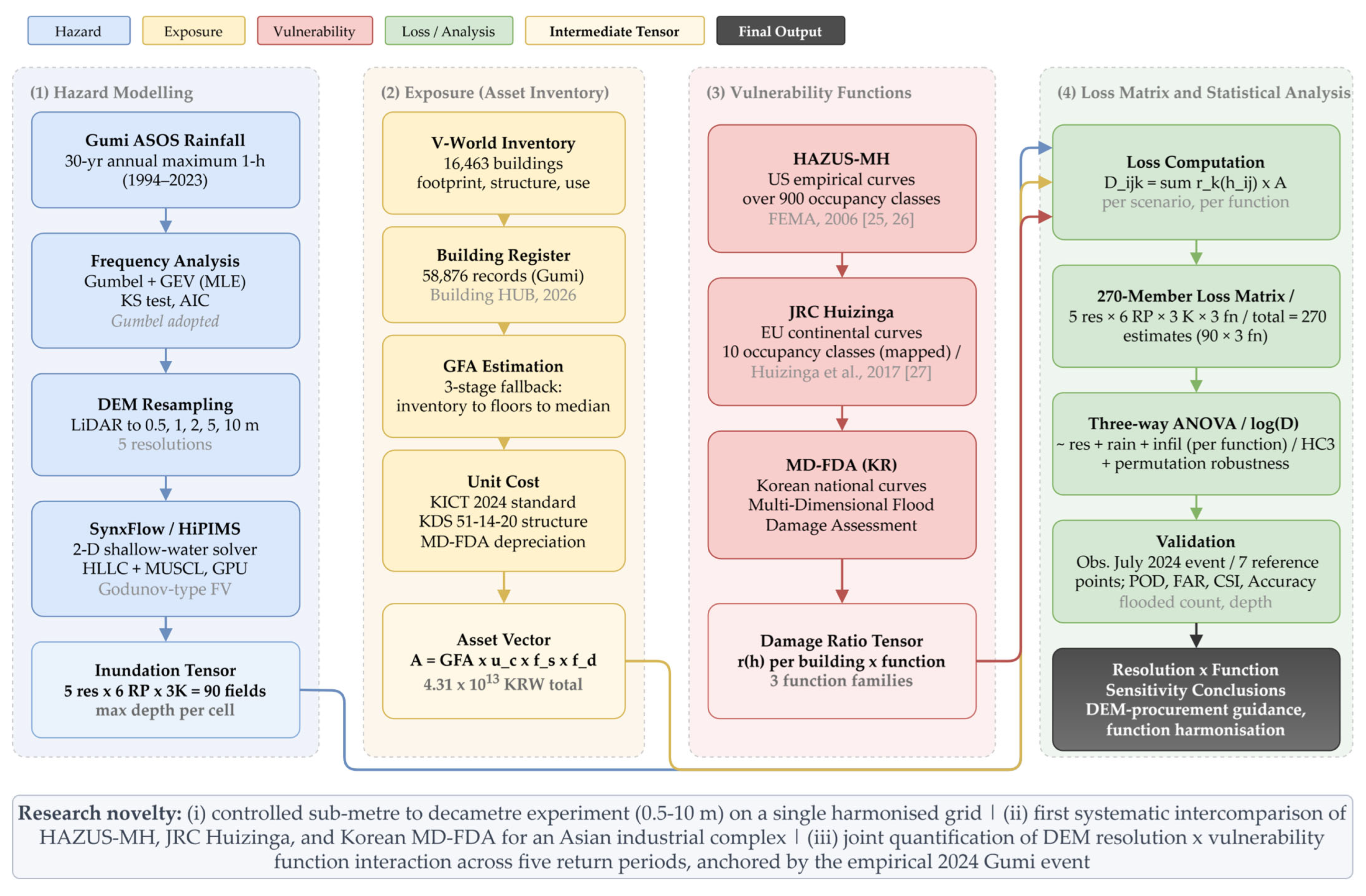
The overall analytical workflow of this controlled four-axis experiment is summarised in Figure 1, which links four modules: (1) hazard modelling, (2) exposure (asset inventory), (3) vulnerability functions, and (4) loss matrix and statistical analysis. In the hazard module, 30 years of Gumi ASOS annual-maximum 1 h rainfall (1994–2023) are fitted by frequency analysis (Gumbel adopted), and a single LiDAR DEM is resampled to five resolutions (0.5, 1, 2, 5, 10 m); a GPU-accelerated 2D shallow-water solver (SynxFlow/HiPIMS; HLLC + MUSCL, Godunov-type finite volume) then produces an inundation tensor of 90 maximum-depth fields (5 resolutions × 6 rainfall scenarios × 3 infiltration rates, K = 5, 10, 20 mm h−1). The exposure module harmonises a 16,463-building inventory from V-World footprints and the Korean Building Register, estimates gross floor area (GFA) through a three-stage fallback, and assigns unit replacement cost (KICT 2024 [35], KDS 51-14-20 [36], MD-FDA depreciation [28]), yielding the asset vector A = GFA × c × fs × fd (43.07 trillion KRW total). The vulnerability module applies three depth–damage families in parallel—HAZUS-MH (>900 U.S. occupancy classes), JRC Huizinga (European land-use classes mapped to the same scheme), and Korean MD-FDA—to generate a per-building damage-ratio tensor r(h). The analysis module computes scenario losses Li = d(hi) · ci · Afloor,i, assembles the 270-member loss matrix (90 hydrodynamic realisations × 3 functions), and evaluates them through a three-way ANOVA (resolution, rainfall, infiltration) with formal homoscedasticity and robustness diagnostics, validated against the observed July 2024 event. The study’s three principal novelties—a controlled sub-metre-to-decametre experiment on a single harmonised grid, the first systematic intercomparison of HAZUS-MH, JRC Huizinga, and Korean MD-FDA for an Asian industrial complex, and the joint quantification of the DEM-resolution × vulnerability-function interaction across the full rainfall–infiltration matrix—are summarised at the foot of the figure.

2. Materials and Methods

2.1. Study Area

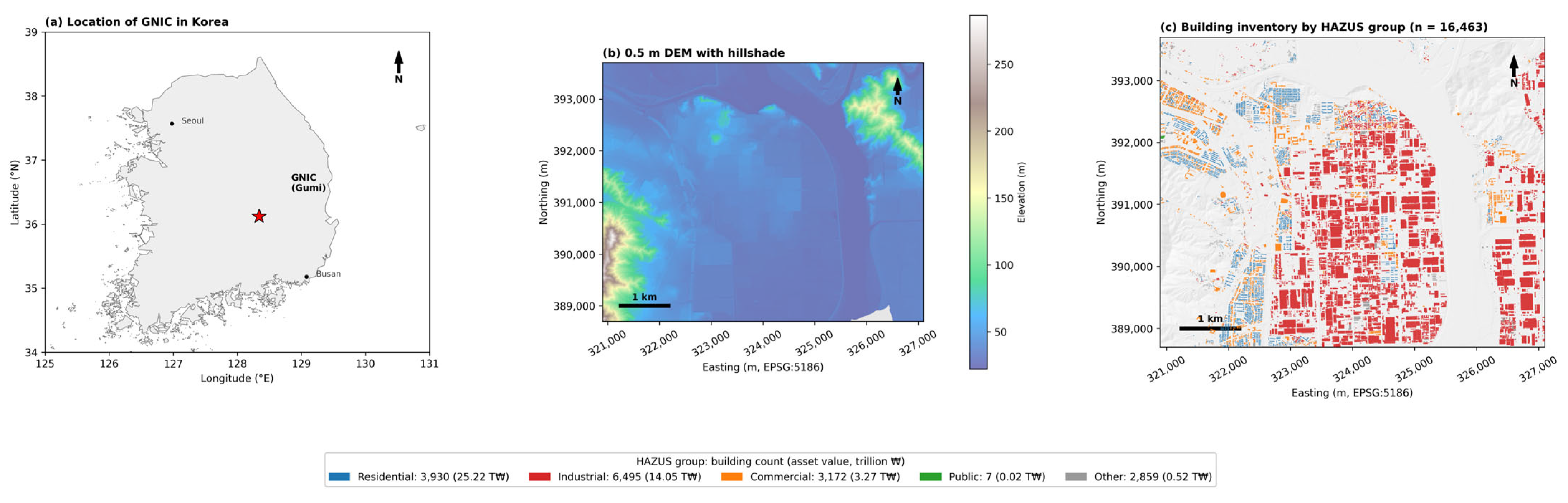
The Gumi National Industrial Complex (GNIC) covers approximately 10.4 km2 on the right bank of the Nakdong River in Gumi City, Gyeongsangbuk-do, South Korea (Figure 2). Established between 1969 and 1973, the GNIC hosts more than 2400 enterprises spanning electronics, display, chemical, and textile manufacturing, and accounts for a substantial share of national export value. The complex sits on a low-gradient alluvial plain (mean slope < 1%) with engineered drainage channels discharging into the Nakdong; this morphology, combined with concentrated high-value assets and ageing internal drainage, mirrors the structural drivers of flood vulnerability identified for Korean industrial parks more broadly [11,34,38]. Annual maximum 1 h rainfall recorded at the Gumi Automated Synoptic Observing System (ASOS) station shows a statistically significant positive trend over 1973–2023, with the July 2024 event (peak 58 mm h−1; 24 h total 133 mm) ranking among the top events on record [12]. Compared with the earlier version of this study, the area of interest (AOI) was redefined to cover the full GNIC 1st-stage footprint and immediate flood-prone surroundings, and the building inventory was reconstructed accordingly (Section 2.4).

2.2. Frequency Analysis and Design Rainfall

A 30-year (1994–2023) series of annual maximum 1 h rainfall from the Gumi ASOS station was used for at-site frequency analysis. Following standard Korean and international hydrologic practice [39,40,41,42,43], the Gumbel and generalised extreme value (GEV) distributions were fitted by maximum likelihood. Goodness of fit was evaluated using the Kolmogorov–Smirnov (KS) test and the Akaike information criterion (AIC). Both distributions passed the KS test at α = 0.05, and AIC values differed by less than two units, so the Gumbel distribution was adopted as the primary model in line with Korean Meteorological Administration design-rainfall guidelines [41], with GEV retained for sensitivity checks. Quantiles for return periods T = 10, 30, 50, 100, and 200 years were extracted as design rainfall depths and used as boundary conditions for the hydrodynamic simulations. Empirical placement of the July 2024 event on the Gumbel curve corresponded to a return period of approximately 25–30 years, consistent with the literature finding that Gumbel and GEV diverge by less than 10% within this range [42,44].
For each return period the design hyetograph was generated as a 2 h storm centred on the design 1 h peak intensity, distributed using a centred Huff-type quartile distribution to capture the rapid build-up and recession characteristic of GNIC convective events. The observed July 2024 event was driven by the actual observed hourly rainfall over the same 2 h window encompassing the recorded peak intensity (58 mm h−1), so that synthetic and observed simulations were forced by hyetographs of identical duration. This choice—driving the model with a 2 h storm rather than a single peak intensity or a longer 24 h aggregate—preserves the sub-hourly intensity peak that dominates surface flooding in industrial complexes [10,12] while keeping the simulation duration tractable for the 90-realisation experimental matrix.

2.3. Hydrodynamic Modelling

Flood inundation was simulated with SynxFlow (version 1.0.2), a GPU-accelerated implementation of the HiPIMS shallow-water framework [37]. SynxFlow solves the 2D shallow-water equations on a regular Cartesian grid using a Godunov-type finite-volume scheme with HLLC Riemann fluxes and MUSCL reconstruction for second-order accuracy, well-balanced source-term treatment, and robust wet–dry interface handling [37,45,46]. The 90 inundation realisations analysed here are the same hydrodynamic dataset generated and hydraulically validated in our companion study of this complex [47], which examined how DEM resolution controls inundation depth, extent, and volume together with the associated GPU computational efficiency. The present paper builds on that shared hazard layer and is concerned exclusively with propagating the simulated depths into direct building asset loss through three vulnerability functions—an analysis not undertaken in [47]. The hydraulic configuration is summarised below for completeness. All simulations were executed on an NVIDIA A100 80 GB HBM2e GPU, which enabled sub-metre simulations over the ≈25 km2 computational domain at tractable wall-clock cost.
The five DEM resolutions (0.5, 1, 2, 5, and 10 m) were derived from a single airborne-LiDAR base terrain dataset provided by the National Geographic Information Institute (NGII) of the Republic of Korea. Coarser DEMs were generated from the native 0.5 m raster by block-wise averaging (GDAL GRA_Average), which preserves the integral of the elevation field over each coarse cell and is consistent with the volume-conserving finite-volume solver; full preprocessing details are given in [47]. No structural building removal was applied, since buildings are represented through explicit blockage in the inventory rather than terrain modification. This approach ensured that resolution effects were attributable to grid cell size rather than to differences in hydrological preprocessing.
Surface infiltration was represented by a Green–Ampt scheme with three hydraulic conductivities (K = 5, 10, and 20 mm h−1) bracketing the range reported for Korean industrial pavement, compacted alluvial soils, and engineered drainage areas, and surface roughness was prescribed as a spatially distributed Manning’s field derived from the national land-cover product [47]. The model does not explicitly resolve underground stormwater networks, pumping stations, or controlled-gate operations within the GNIC; this limitation is acknowledged in Section 4.4 (Limitations). However, the three-K envelope provides a transparent representation of subsurface response, and the validation against the observed 2024 event (Section 3.4) confirms that depth and extent are reproduced within acceptable skill scores for the 1–2 m configurations.
Each of the six rainfall scenarios (five design return periods plus the observed 2024 event) was simulated at each of the five DEM resolutions and three infiltration rates, yielding 5 × 6 × 3 = 90 inundation realisations. For each simulation, the maximum inundation depth at every building was extracted by overlaying the depth raster with the harmonised building footprints and computing polygon-based zonal statistics. These building-level maximum depths formed the hazard input for the subsequent loss calculations. The 200-year inundation maps derived from these simulations are presented in Table 1.

2.4. Building Inventory and Asset Valuation

A harmonised inventory of 16,463 buildings was constructed for the AOI by integrating V-World building footprints (Ministry of Land, Infrastructure and Transport) with the national Building Register (Building HUB; accessed in May 2026, 58,876 records for Gumi City). Compared with the earlier 6140-building inventory, the present version (i) extends the AOI to include large-footprint industrial main plants and adjacent residential clusters previously excluded by a tighter cutline, (ii) re-classifies buildings using a 10-category HAZUS-compatible occupancy scheme (RES1–5, COM1–8, IND1–6, GOV1–2, EDU1, AGR1, plus ‘Other’ and ‘Unknown’), and (iii) substantially reduces the proportion of ‘Unknown’ assignments through register cross-matching. The full footprint area of the inventory totals 10.14 Mm2 (≈10.14 km2), representing essentially the entire built environment within the modelled domain. The headline categorical composition is summarised in Table 2 (5-group rollup) and Appendix A Table A1 (14-category detail).
Asset value for each building was calculated using a three-tier method-3 (M3) procedure:
V i = c i A f l o o r , i f s , i f d , i
where ci is the class-specific unit construction cost ( m−2), Afloor,i is the gross floor area (GFA), fs,i is a structure-class correction factor, and fd,i is an age-based depreciation factor. The three M3 tiers correspond to the data source for ci and Afloor,i:
  • Tier 1 (IND_COM_M3, n = 9667): industrial and commercial buildings with unit costs derived from observed transaction records in the Gumi factory-deals database, providing a market-calibrated baseline.
  • Tier 2 (RES1/RES3/OTHER/GOV2_STDcost, n = 6580): residential, governmental, and other buildings with unit costs from KICT (2024) [35] standard construction prices, applied per HAZUS occupancy sub-class.
  • Tier 3 (STDcost fallback, n = 2643): buildings with incomplete register records, valued at the category-median unit cost derived from Tiers 1–2 within the seven legal-dong neighbouring the GNIC.
Structure-class correction factors followed KDS 51-14-20 (2018) [36], and depreciation was calculated using the straight-line convention adopted in MD-FDA (2004) [28], with a 50-year service life and a residual value of 20%:
f d , i = max   0.2 , 1 0.8 a g e i 50
The aggregated asset value of the full inventory is 43.07 T (≈US$33.1 billion at 1300 /USD), distributed across the 5 top-level groups as 25.34 T residential (58.8%), 14.18 T industrial (32.9%), 3.33 T commercial (7.7%), with public, auxiliary, and other categories below 0.2% each (Table 2). The reduction in the ‘Unknown’ fraction relative to the earlier inventory eliminates the principal arbitrariness concern regarding GFA and unit-cost assignment to that class; the residual sensitivity to remaining unknowns is quantified analytically in Section 3.5.

2.5. Vulnerability Functions and Damage Calculation

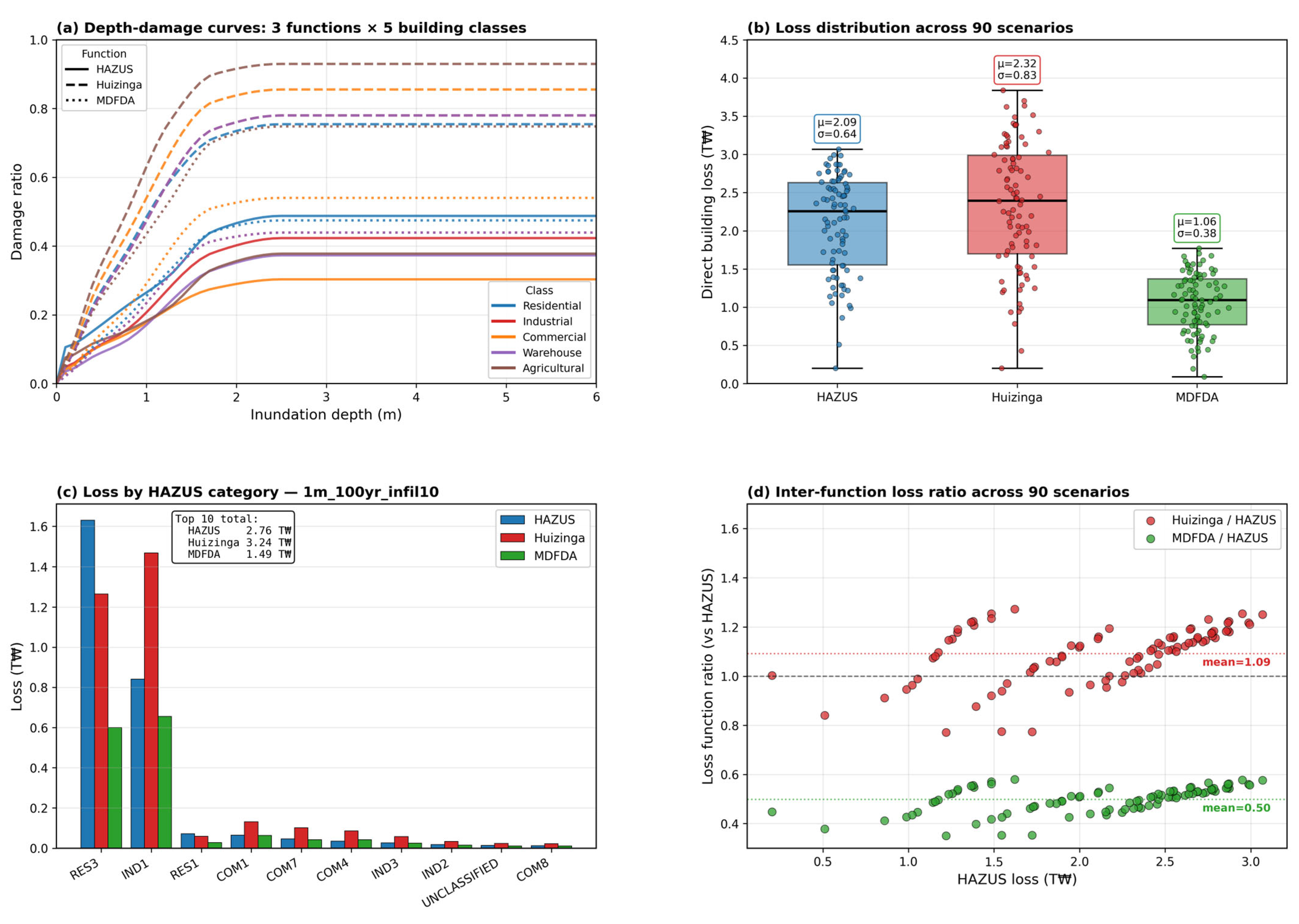
Three depth–damage function families were applied in parallel to each building, using the maximum simulated depth hi as the single hazard descriptor (Figure 3):
  • HAZUS-MH [25,26]—empirical U.S. curves selected by occupancy class (RES1–5, COM1–8, IND1–6, etc.), tabulated at 0.1 m intervals from 0 to 15 m.
  • JRC Huizinga [27]—continental European curves with the Asia-average rescaling, tabulated at 0.1 m intervals from 0 to 15 m for the same 10 occupancy categories.
  • Korean MD-FDA [28]—domestic curves derived from the multi-dimensional flood damage assessment framework, tabulated at 0.1 m intervals from 0 to 15 m for the same 10 categories.
All three function families are stored as dimensionless damage ratios d(h) ∈ [0,1] representing the fraction of asset value lost at flood depth h. The absolute direct asset loss for each building i is computed through a common transformation:
L i = d h i c i A f l o o r , i = d h i V i f s , i f d , i
where ci and Afloor,i are defined as in Section 2.4. For the JRC Huizinga curves, originally calibrated against European asset values [27], no additional currency-, PPP-, or GDP-based scaling is applied; the dimensionless ratio is transferred to the Korean monetary basis solely through the building-specific unit cost ci derived in Section 2.4. This transfer assumes that the dimensionless damage ratio d(h) is regionally transferable because it represents the physical damage mechanism of a building’s response to inundation depth within a given occupancy class, rather than a socioeconomic variable; the region-specific monetary differences are therefore captured entirely by the local unit replacement cost ci. This explicit, common formulation removes any mathematical ambiguity in the currency transfer and ensures full reproducibility. Total damage per scenario is the sum of Li over all flooded buildings (depth ≥ 0.10 m), giving the 270-member loss matrix (90 hydrodynamic realisations × 3 vulnerability functions). The complete depth–damage ratio table and a graphical comparison of the three curves for the principal categories are provided in Table 3, Appendix A Table A2 and Figure A1.

2.6. Statistical Analysis

To quantify how DEM resolution, rainfall return period, and infiltration capacity jointly shape estimated loss, a three-way ANOVA with Type II sums of squares was performed on the log10-transformed total damage values, fitted separately for each vulnerability function (HAZUS, Huizinga, MD-FDA; n = 90 scenarios per function, residual df = 40). The three fixed factors were DEM resolution (5 levels), rainfall return period (6 levels), and infiltration rate (3 levels). Effect sizes were reported as both partial η2 and ω2 (the latter being less biased for ANOVA designs), with ω2 computed as (SSeffect − dfeffect · MSerror)/(SStotal + MSerror) and clipped at zero where the estimator returned negative values.
To verify the assumptions of parametric ANOVA, three diagnostic and robustness procedures were applied:
(i)
Homogeneity of variance was assessed using Levene’s test with median centring (the Brown–Forsythe variant, robust to non-normality) and Bartlett’s test, for each factor and each loss function (Appendix A Table A4);
(ii)
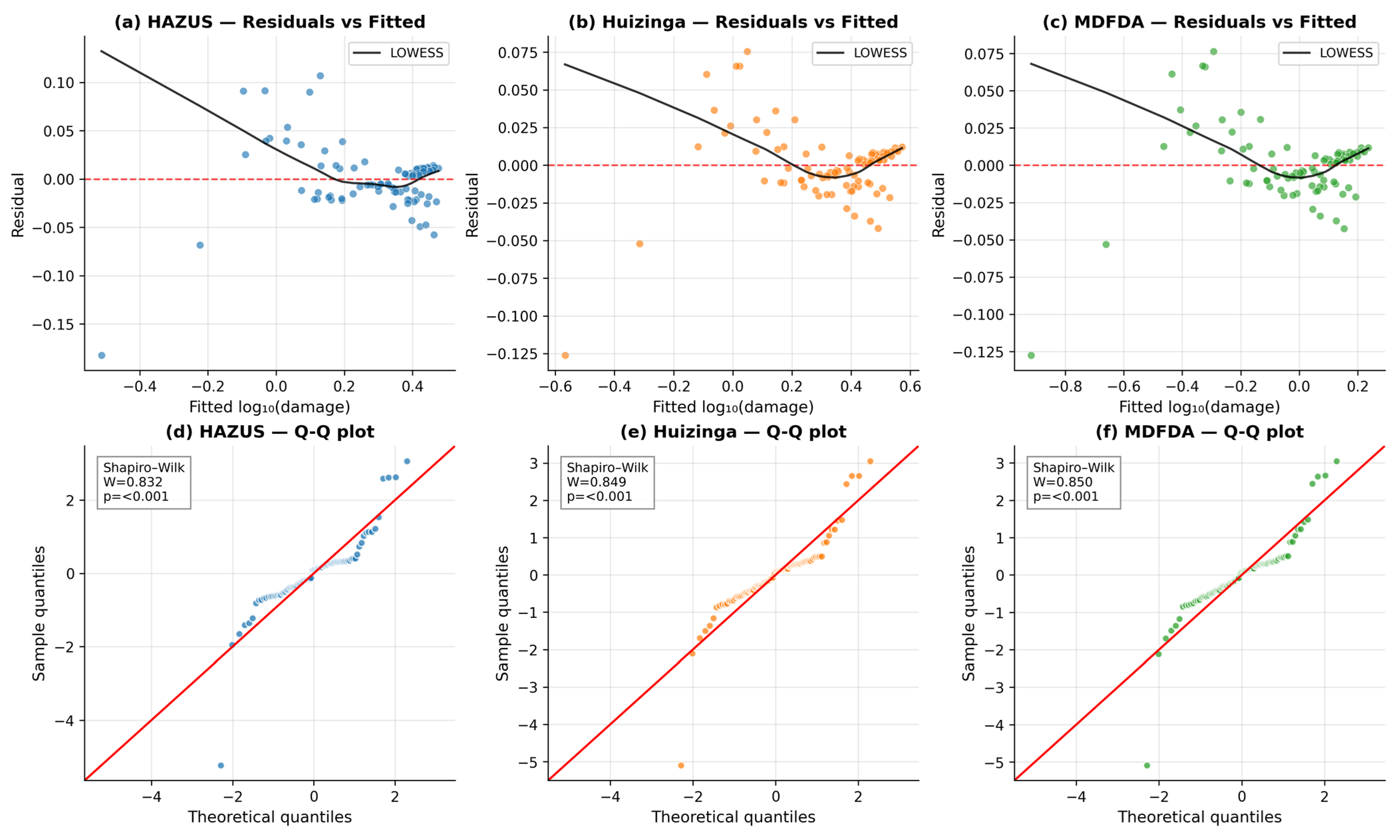
Residual diagnostics including Residuals-vs-Fitted plots with LOWESS smoothers, Q–Q plots, and Shapiro–Wilk tests for residual normality are presented in Appendix A Figure A4;
(iii)
Robustness checks comprised refitting the ANOVA with heteroscedasticity-consistent (HC3, White-type) standard errors via Wald F-tests, and a 1000-iteration permutation ANOVA in which the response variable was randomly shuffled within each function and the null distribution of F-statistics was constructed (Appendix A Table A5).
Inter-function divergence was characterised through the quantitative damage-ratio comparison in Appendix A Table A2 (six representative depths × five categories × three functions) and visualised in Appendix A Figure A1.
Expected annual loss (EAL) for each (resolution, infiltration, function) configuration was computed by integrating scenario losses over the exceedance-probability domain implied by the five design return periods, using the trapezoidal rule on the inverse-return-period axis. EAL was further decomposed by occupancy category to identify the principal loss-bearing classes.

2.7. Empirical Validation Against the July 2024 Event

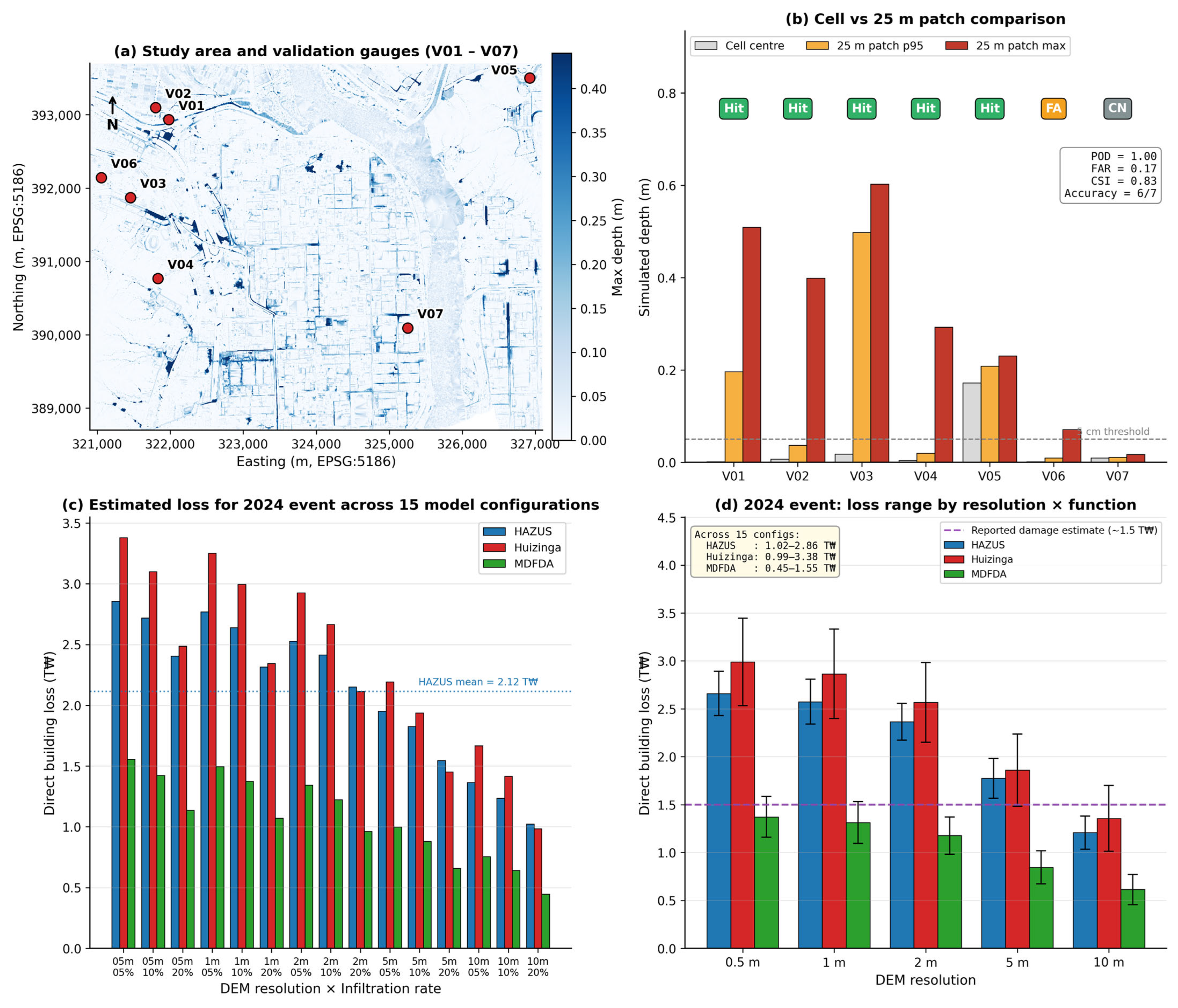
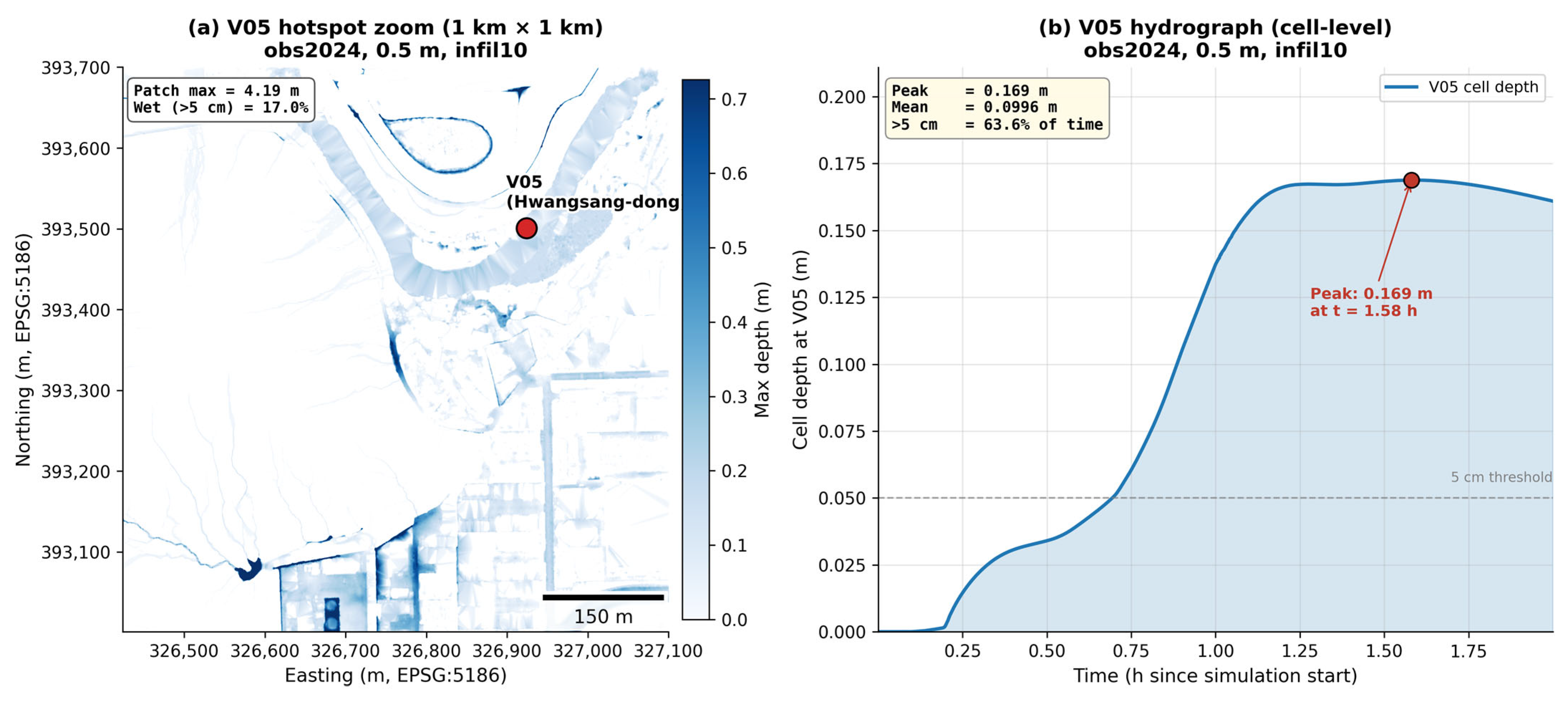
For validation, seven reference points (V01–V07) within the modelled domain were independently compiled from publicly reported field observations of the July 2024 event in the Yeongnam Ilbo (10 July 2024) and Daegu Ilbo (10 July 2024) newspapers and from a designated reference site (Gumi City Hall, V06). Each reference point carries a binary observed-flooded label and, where available, a qualitative severity score (Appendix A Table A3). An eighth reference point (V08—Sangmosagok-dong) lying outside the modelled domain was excluded from the skill assessment.
Simulated flood occurrence at each reference point was defined by the patch-maximum criterion: a reference point is classified as simulated-flooded if the maximum depth within a 51 × 51 cell patch centred on the point exceeds 0.05 m. The patch is sized to span ≈ 25 m on a side at the native 0.5 m resolution, matching the positional uncertainty of the field reports while remaining hydraulically local; for coarser DEMs the patch is rescaled to maintain the same physical footprint (Appendix A Table A3). From the resulting 2 × 2 contingency table at each DEM resolution, four standard categorical skill scores were computed:
P O D = a a + b , F A R = c a + c , C S I = a a + b + c , A c c u r a c y = a + d a + b + c + d
where a = hits (observed and simulated flooding), b = misses, c = false alarms, and d = correct negatives. RMSE and bias of the simulated depth were additionally computed for the subset of reference points with quantitative observed depth (V06 = 0.0 m, reference no-flood). The full per-gauge, per-resolution validation table appears as Section 3.4 (resolution-level summary) and Appendix A Table A6 (35-row gauge × resolution detail).

3. Results

3.1. Inundation Sensitivity to DEM Resolution

Building-level inundation was consistently sensitive to DEM resolution across all design rainfall scenarios and infiltration rates. Finer DEMs identified more flooded buildings and produced higher representative inundation depths, whereas coarser DEMs systematically reduced both metrics. Across the 90 hydrodynamic realisations the percentage of flooded buildings (depth ≥ 0.10 m) ranged from approximately 50% under the 10-year, 10 m DEM, K = 20 mm h−1 configuration to over 85% under the 200-year, 0.5 m DEM, K = 5 mm h−1 configuration. For the baseline 100-year, 0.5 m, K = 10 scenario, 13,621 of the 16,463 buildings were flooded (82.7%) with a mean building-level maximum depth of 0.128 m, a median of 0.075 m, and an overall maximum depth of 2.21 m. The full inundation matrix is summarised in Figure 4 and the per-scenario summary statistics underpinning Figure 5, Figure 6 and Figure 7 are tabulated in Appendix A Table A7 (loss-by-config) and the loss-summary parquet referenced in the Data Availability statement.
This monotonic resolution effect indicates that DEM coarsening smooths channels, service roads, and small depressions, thereby suppressing local ponding and reducing the estimated extent and severity of inundation. The pattern is consistent across infiltration rates: although higher K systematically reduces the absolute number of flooded buildings, the relative reduction caused by coarsening from 0.5 m to 10 m is preserved (Δflooded% from 0.5 m to 10 m: 23.3 ± 1.7 percentage points across the three K values at the 100-year event). These hydraulic differences propagated directly into the loss calculations described in the following subsections.

3.2. Damage–Frequency Response Across the 270-Member Loss Matrix

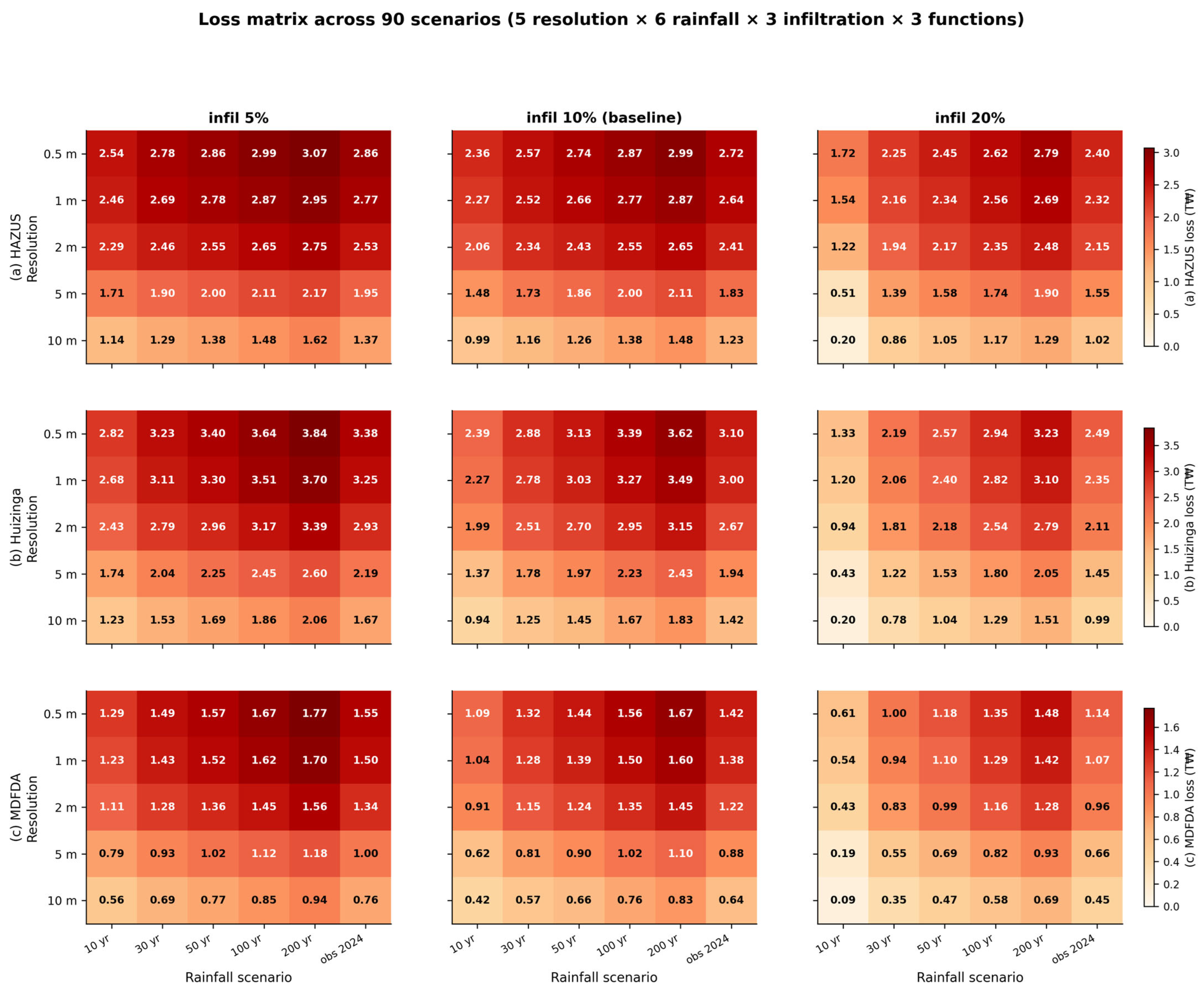
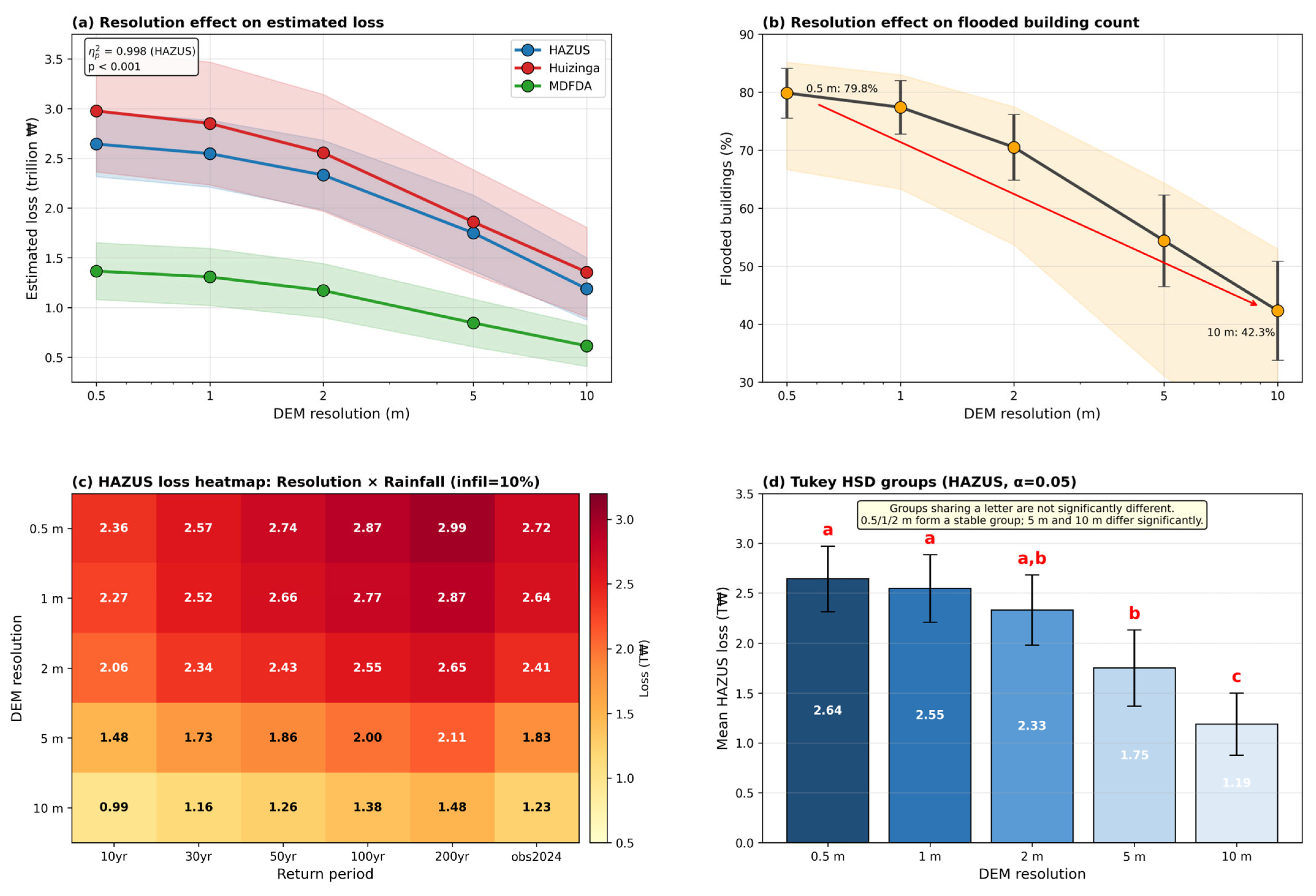
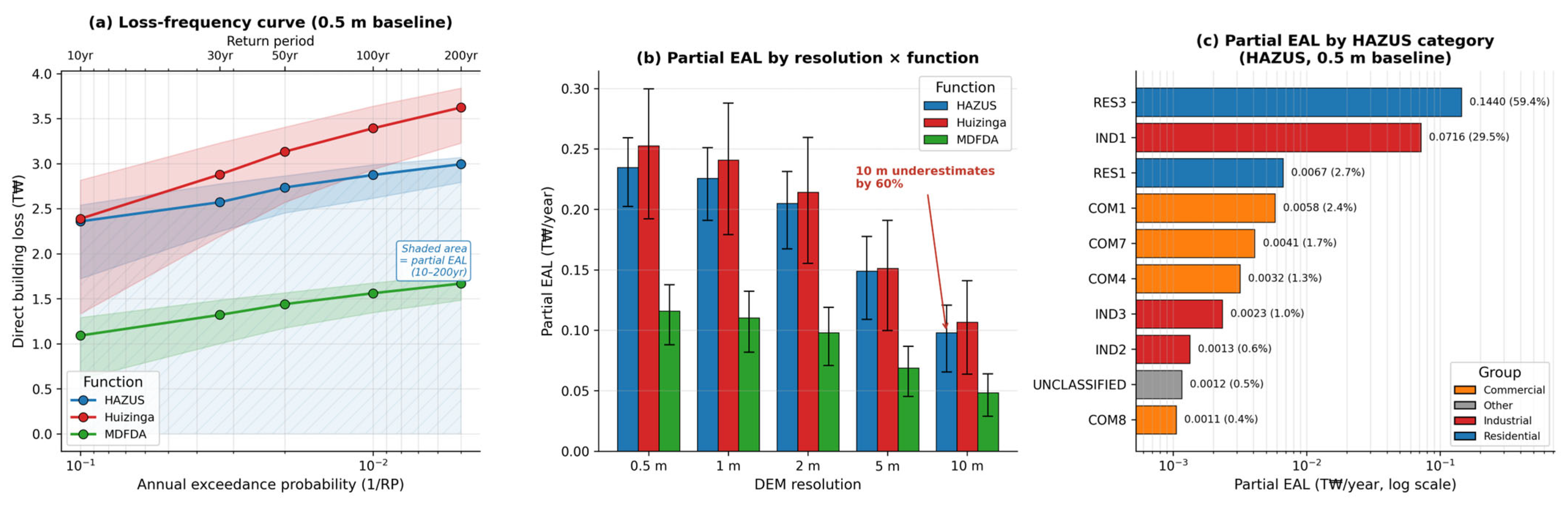
Estimated direct asset losses varied systematically with return period, DEM resolution, and infiltration rate, as shown by the damage–frequency curves in Figure 5. For each vulnerability function, losses increased monotonically from the 10-year to the 200-year event, while finer DEMs and lower K consistently yielded larger losses. Under the 200-year event at K = 10 mm h−1, estimated total direct asset losses ranged across the five DEM resolutions from 2.79 to 3.07 T for HAZUS-MH, 3.23 to 3.84 T for JRC Huizinga, and 1.48 to 1.77 T for MD-FDA, with the largest values in each function obtained at the finest 0.5 m grid. Across all 270 estimates, HAZUS-MH produced the highest losses in 38% of scenarios and Huizinga in 62%, while MD-FDA was the lowest of the three functions in every scenario. The full per-scenario loss summary is provided in Appendix A Table A7, and the 90-cell loss matrix is visualised in Appendix A Figure A2.
The relative ranking of the three functions remained broadly stable across resolutions, but the absolute gap between functions widened with both finer DEMs and higher return periods—a pattern consistent with the steeper d(h) slopes of the Huizinga curves at intermediate depths (Section 3.3 and Figure A5). Within each function, coarsening from 0.5 m to 10 m at the 200-year event reduced loss by 9.1% (HAZUS), 15.9% (Huizinga), and 16.4% (MD-FDA); the much larger 55.5–57.2% reduction reported for EAL (Section 3.6) reflects the additional amplification of resolution effects at lower return periods, which carry greater weight in the EAL integral.

3.3. Three-Way ANOVA and Inter-Function Divergence

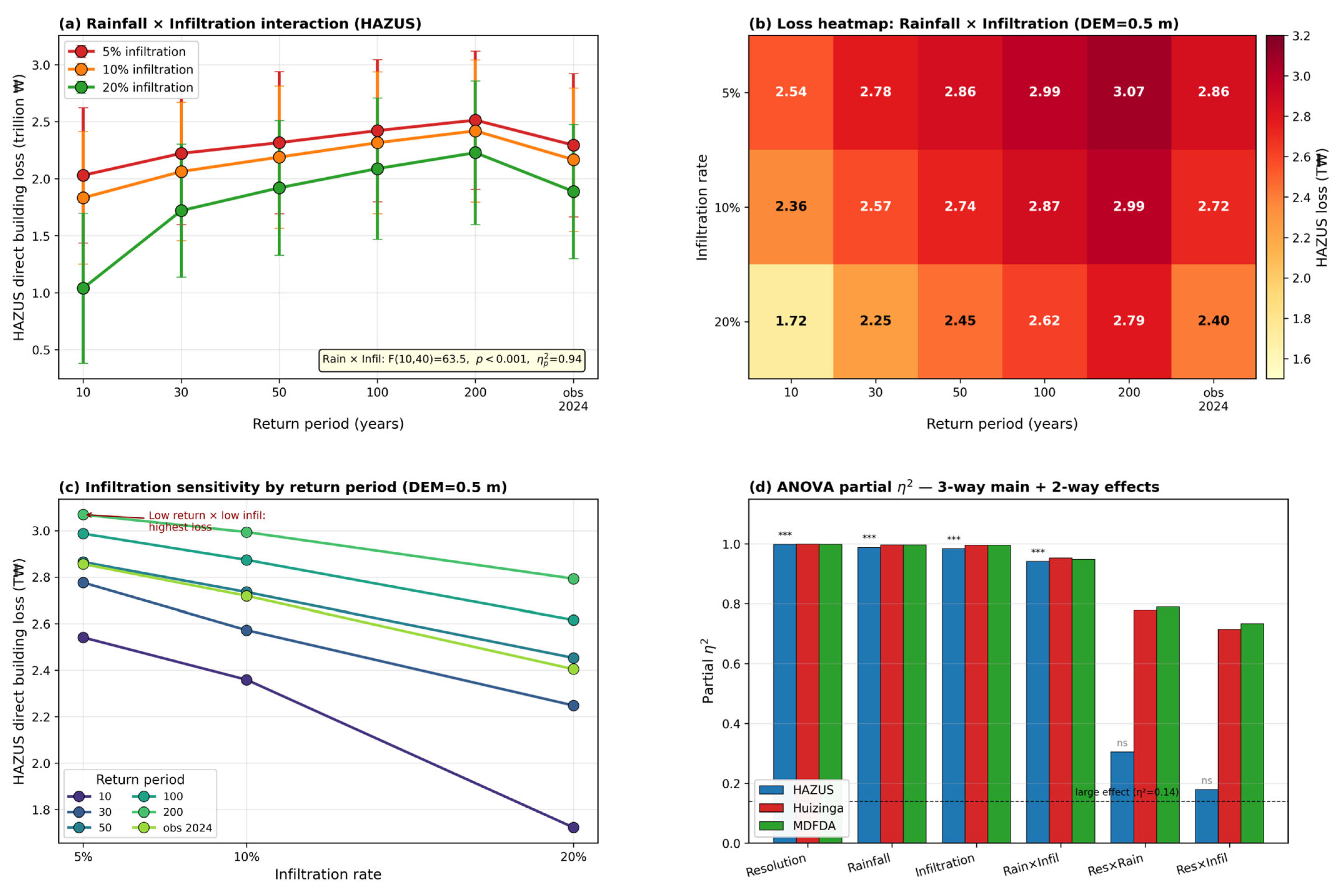
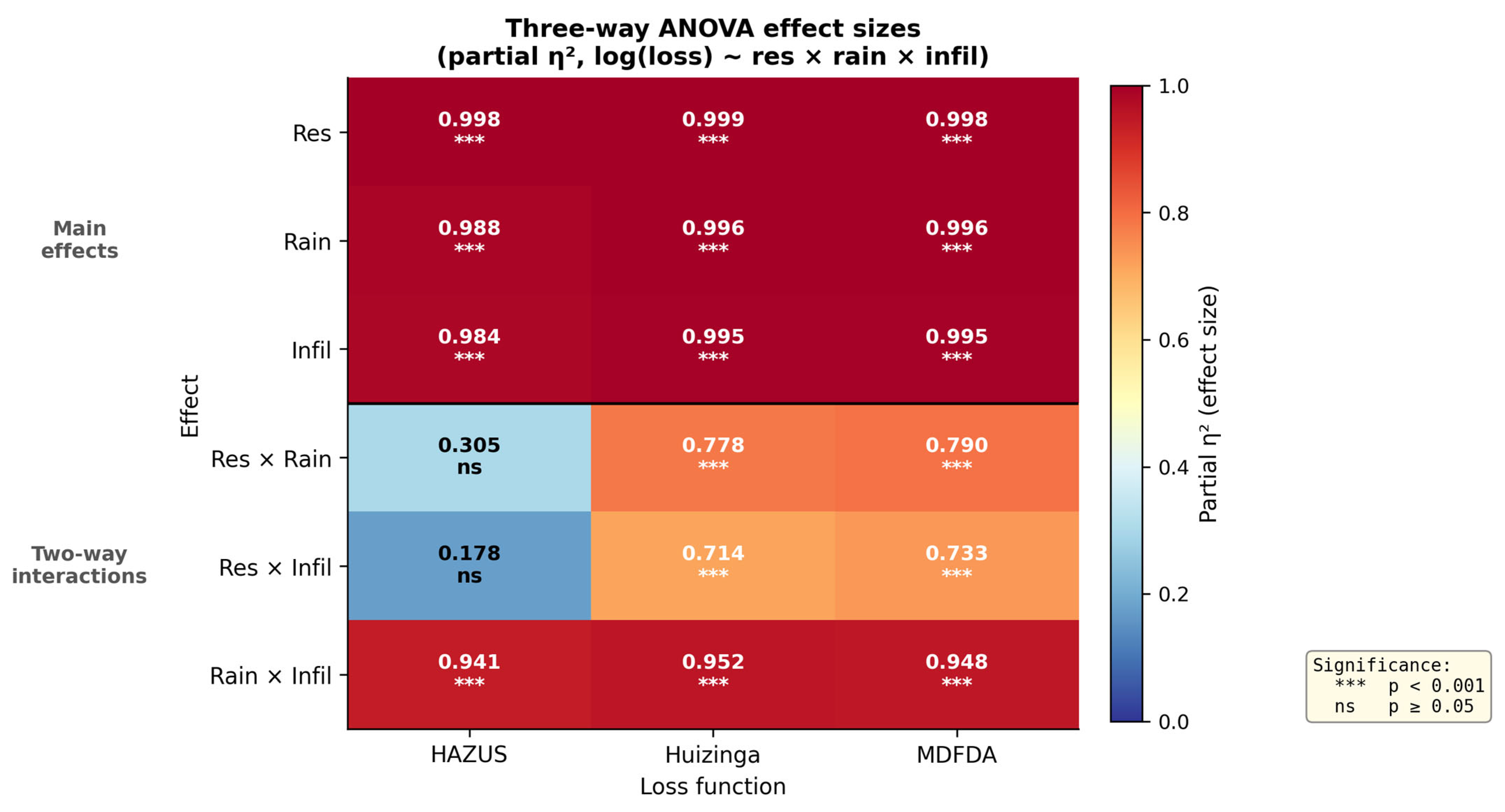
A three-way ANOVA on log10-transformed damage, fitted separately for each vulnerability function (Section 2.6), confirmed highly significant main effects of resolution, rainfall, and infiltration for all three functions (Table 4). All nine main-effect tests yielded p < 0.001, with F-values ranging from 32.6 (HAZUS rainfall) to 322.0 (MD-FDA resolution). Effect sizes ω2 for main effects ranged from 0.099 (HAZUS infiltration) to 0.582 (HAZUS resolution), more than an order of magnitude larger than ω2 values for interactions (0.010–0.079), indicating that main effects strongly dominate the variance structure. Two-way interactions were significant for nearly all (function, interaction) pairs except resolution × rainfall and resolution × infiltration for HAZUS (p = 0.086 and 0.027 respectively). The full ANOVA table including SS, F, p, ω2, and partial η2 is provided as Appendix A Table A3. Systematic differences among the three vulnerability functions were observed across the full matrix of DEM resolutions and rainfall return periods (Figure 6).
Three robustness checks were applied to address parametric-ANOVA assumptions. First, Levene’s test for homogeneity of variance (Brown–Forsythe variant) was non-significant (p ≥ 0.075) for seven of nine factor × function combinations, including all three factor tests for HAZUS and the dominant resolution and rainfall factors for Huizinga and MD-FDA; mild heteroscedasticity was detected only for the infiltration factor under Huizinga and MD-FDA (p = 0.040 and 0.042; Appendix A Table A4). Second, refitting the ANOVA with heteroscedasticity-consistent HC3 standard errors preserved every main-effect conclusion at the same significance level (p < 0.001 for all nine main-effect Wald F-tests; Appendix A Table A5). Third, a 1000-iteration permutation ANOVA, which makes no distributional assumptions, returned identical main-effect significance to the parametric OLS test for all nine cases. The residual diagnostics underlying these checks (Residuals-vs-Fitted with LOWESS smoothers and Q–Q plots) are presented in Appendix A Figure A4. Together, these three diagnostics establish that the main-effect inferences are robust to heteroscedasticity and to deviations from residual normality.
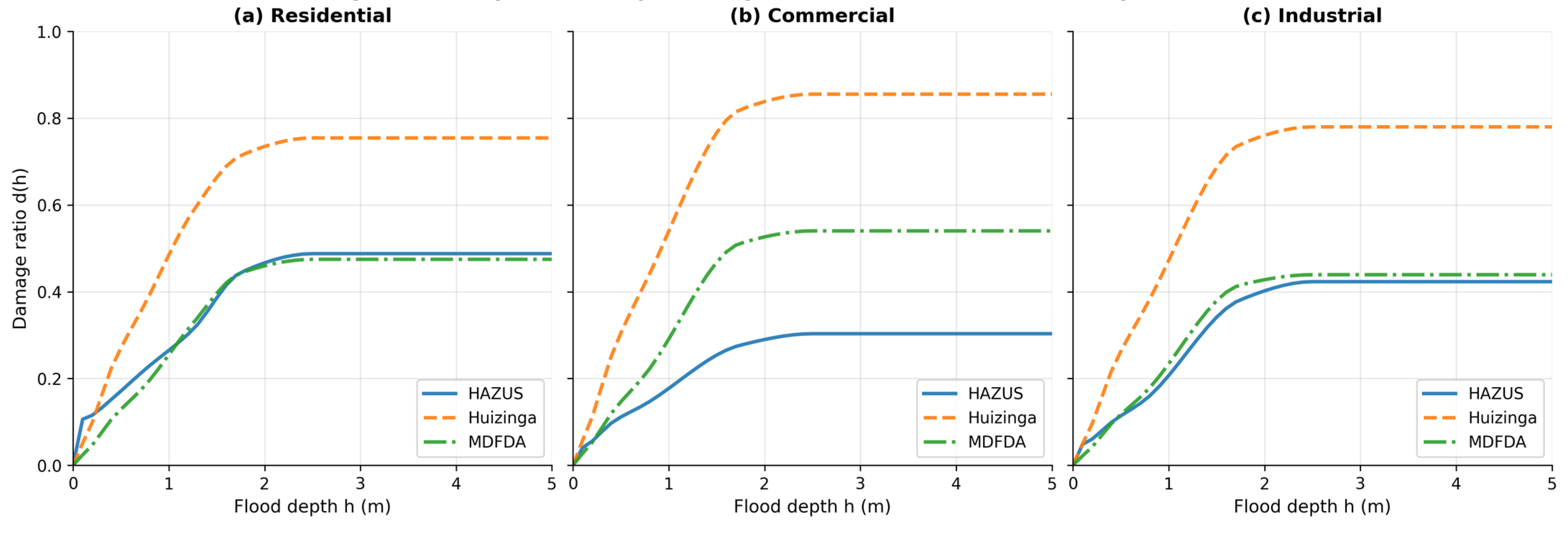
Inter-function divergence in the underlying depth–damage curves was substantial (Figure A5). At a flood depth of 0.10 m the ratio of the largest to smallest d(h) across the three functions reached 4.42× for residential buildings, narrowing to 1.59× at 3 m as the curves approached their asymptotic plateaus. Median divergence across the five principal categories and six representative depths examined in Appendix A Table A2 was 2.29×, and divergence was largest for commercial buildings (mean 2.77×) and smallest for residential at deep inundation.

3.4. Validation Against the July 2024 Event

Validation against the observed July 2024 GNIC flood used seven independently sourced reference points (Section 2.7, Figure 7). The four standard categorical skill scores computed at each DEM resolution are summarised in Table 5, with the full 35-row gauge × resolution detail in Appendix A Table A6. These reference points were derived from contemporaneous journalistic field reports rather than an official government census, because at the time of analysis no official flood inventory (e.g., from the Gumi Municipal Authority or the Ministry of the Interior and Safety) had yet been released for the July 2024 event. The newspaper reports provide qualitative flooded/non-flooded observations at identifiable locations; precise survey depth thresholds were not specified in the sources, so each reference point was treated as a binary flooded label (with a qualitative severity score where available), and a conservative simulated-flood threshold of 0.05 m (patch-maximum criterion) was adopted accordingly. The reliance on high-quality media records is a pragmatic and commonly accepted approach for rapid post-disaster validation when official censuses are pending. The same seven reference points and patch-maximum validation procedure were used to assess the hydraulic skill of the shared inundation dataset in our companion study [47]; the skill scores reported here are therefore consistent with that independent hydraulic validation and are summarised at the building-loss resolution relevant to the present analysis.
The 2 m DEM yielded the highest skill across the four metrics simultaneously (POD = 0.80, FAR = 0.00, CSI = 0.80, Accuracy = 0.86), with the 0.5 m and 1 m DEMs following closely (CSI = 0.67, Accuracy = 0.71) due to a single false alarm at V06 (Gumi City Hall reference). At 5 m the model began to miss V02 (Wonpyeong Lower Road; CSI = 0.60), and at 10 m an additional miss occurred at V04 (Gupyeong Apt.; POD dropped to 0.40, CSI = 0.40). V01 (Wonpyeong 2nd Gumi Bridge) was missed at every resolution, reflecting the point-like nature of bridge-approach inundation that is not well represented by patch-maximum extraction at any cell size—a limitation discussed in Section 4.4. RMSE relative to the V06 reference depth (0 m) was uniformly small (≤0.071 m) and positively biased (+0.027 to +0.071 m), indicating slight over-prediction at the reference no-flood site but well below the operational threshold (0.10 m) used to classify a building as flooded.
These per-gauge results identify 2 m as the operationally optimal resolution for event reproduction at the GNIC, while confirming that 5 m and 10 m DEMs systematically underestimate observed impacts. The 0.5 m DEM, although it yields the largest synthetic loss estimates (Section 3.2), is not validated as the most skilful for event reproduction; this distinction is important for risk-assessment practitioners who must choose between accuracy at extreme tails and skill at observed events.

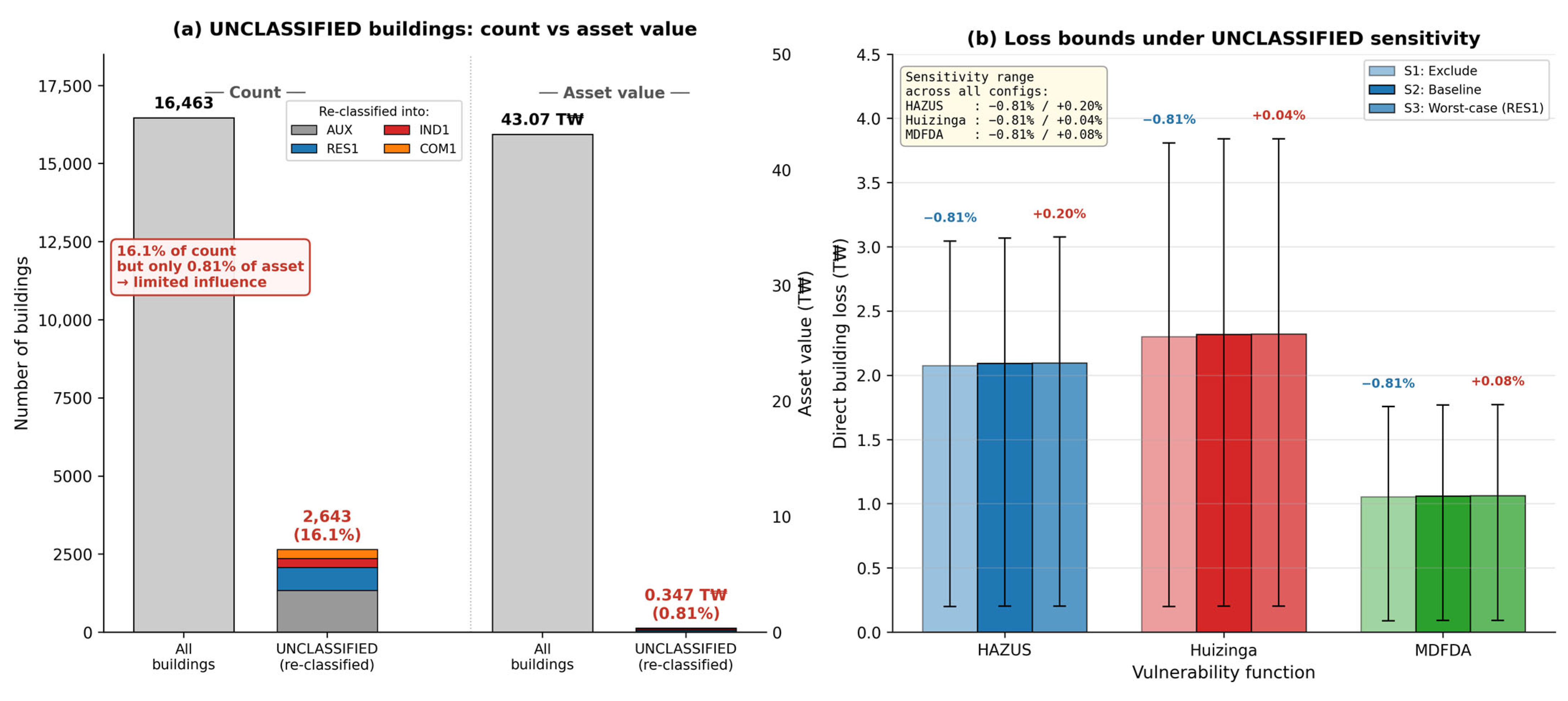
3.5. Sensitivity of the Loss Matrix to the ‘Unknown’ Class

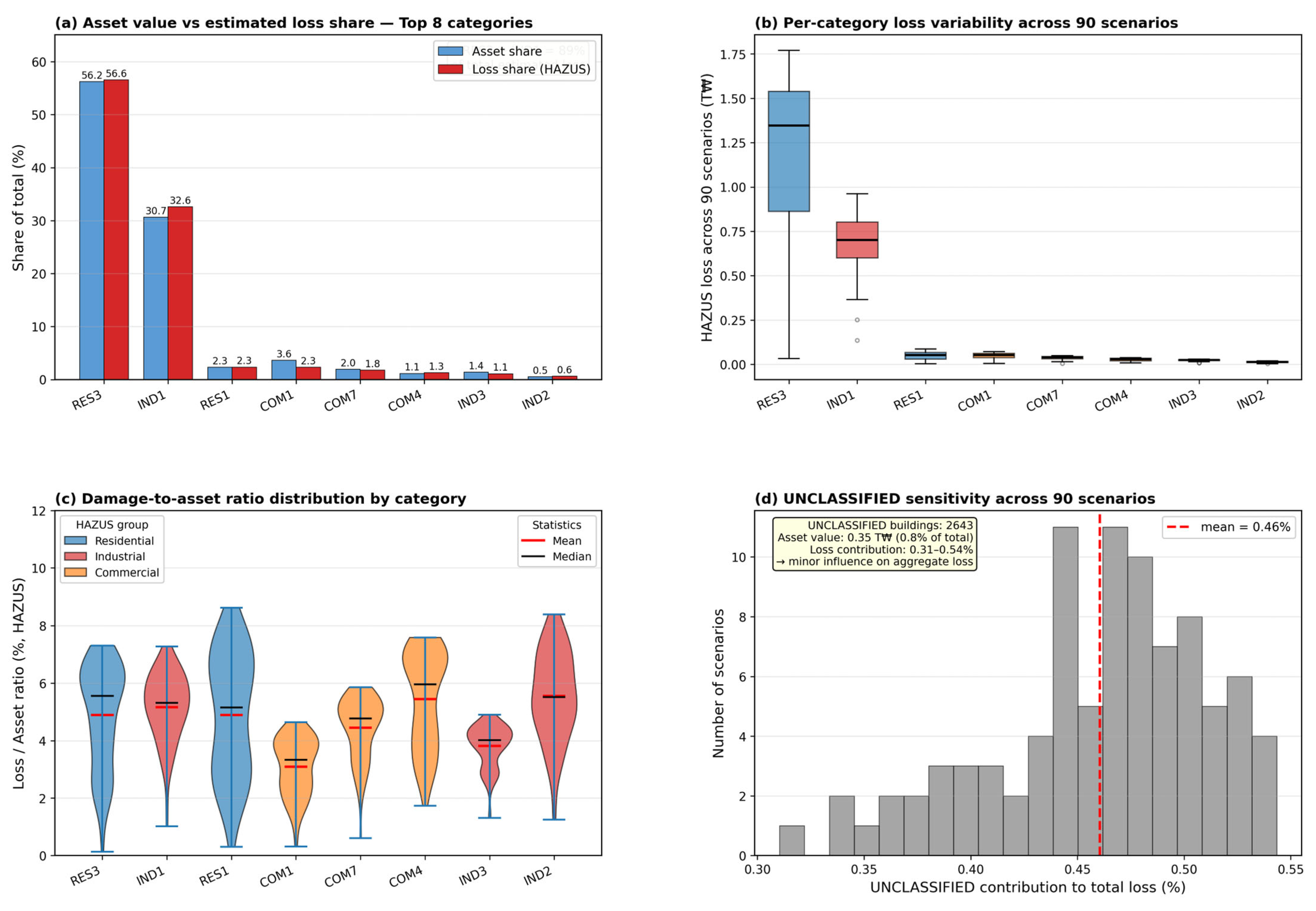
The reduction of the ‘Unknown’ class from 44.6% (previous inventory) to a much smaller residual fraction in the 16,463-building inventory (Section 2.4) substantially limits the leverage of arbitrary GFA and unit-cost assumptions on the total loss matrix. To quantify the residual sensitivity, an analytical bound analysis was performed in which the unit cost of all remaining Unknown-class buildings was systematically varied between zero and twice the inventory median, holding all other parameters fixed. The resulting envelope of total direct asset loss across the 270 scenarios was −0.81% to +0.20% of the baseline value (Figure 8). This bound is at least an order of magnitude smaller than the dominant resolution effect (55.5–57.2% EAL reduction across resolutions; Section 3.6) and the inter-function divergence (up to 2.6-fold). The Unknown class is therefore confirmed as a second-order source of uncertainty in the present inventory, fully subordinate to the resolution and function-choice axes that are the primary subject of this study.
It should be noted that this envelope represents a lower bound on the uncertainty associated with the Unknown class, because only the unit cost ci was varied while the gross floor area (GFA) of these buildings—which was itself imputed via spatial neighbourhood medians—was held constant. Potential errors in the imputed GFA are therefore not propagated in this analysis; the true cumulative uncertainty of the Unknown class would be somewhat larger, though it remains second-order relative to the resolution and function-choice axes given the small residual share of Unknown buildings in the present inventory.

3.6. Expected Annual Loss and Category Concentration

Expected annual loss (EAL) was computed for each (resolution, infiltration, function) configuration by integrating scenario losses across the five design return periods (Section 2.6). The baseline configuration (K = 10 mm h−1) yielded EAL ranging from 0.108 T yr−1 at 10 m DEM to 0.242 T yr−1 at 0.5 m DEM (HAZUS), 0.115 to 0.266 T yr−1 (Huizinga), and 0.052 to 0.122 T yr−1 (MD-FDA), summarised in Table 6 (Panel A, Figure 9) Coarsening from 0.5 m to 10 m reduced EAL by 55.5% (HAZUS), 56.7% (Huizinga), and 57.2% (MD-FDA)—a remarkably consistent ~56% reduction across functions that is substantially larger than the corresponding reduction at the single 200-year event (9–16%, Section 3.2) because resolution effects are amplified at lower return periods, which carry larger weight in the EAL integral. The full 45-row configuration-level EAL breakdown across all three infiltration rates is provided in Appendix A Table A7.
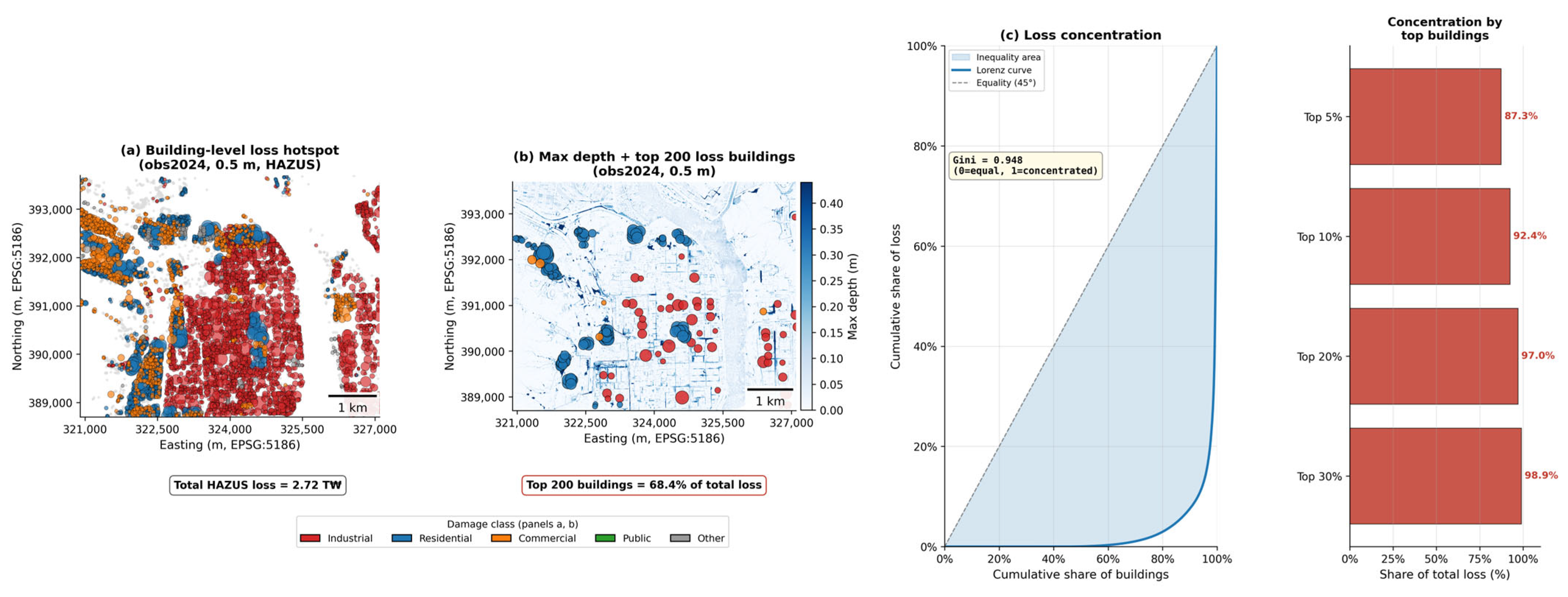
Categorical decomposition of EAL revealed strong spatial and typological concentration of risk (Figure 10, Table 6, Panel B). Two categories—RES3 (multi-family residential) and IND1 (heavy industry)—together accounted for 83.3% (Huizinga), 83.4% (MD-FDA), and 88.9% (HAZUS) of total EAL. The top five categories (RES3, IND1, COM1 retail, COM7 medical office, COM4 professional services) captured 93.7% of total EAL on average across the three functions. The remaining 12 categories collectively contributed less than 6.4%. The full 42-row category × function EAL table is in Appendix A Table A7.
To contextualise the magnitude of EAL, the mean across the three functions (0.21 T yr−1 at K = 10 baseline) corresponds to 0.45% of Gumi City’s gross regional domestic product (GRDP) of 46.18 T (2022). This ratio places the annualised flood loss of a single industrial complex on the order of typical municipal infrastructure depreciation, with direct implications for risk-based capital allocation and insurance reserving (Section 4.3).

4. Discussion

4.1. Resolution as a First-Order, EAL-Amplifying Source of Uncertainty

The 55.5–57.2% reduction in EAL when DEM resolution is coarsened from 0.5 m to 10 m confirms that terrain representation is a first-order control on direct building asset loss in industrial complexes. This effect is substantially larger than the 30–42% reduction reported in the previous version of this study for the single 200-year event, and the increase is not an artefact of model changes: as quantified in Section 3.2 and Section 3.6, the EAL integral amplifies resolution effects relative to any single return period because lower-frequency events—where resolution effects are proportionally largest—carry the greatest weight per unit exceedance probability. This observation has direct methodological implications. Studies that report DEM-resolution sensitivity using only a single design event will systematically understate the true sensitivity of EAL and risk-based metrics to terrain representation; multi-return-period integration is therefore a prerequisite for credible resolution sensitivity claims.
The mechanism by which resolution propagates through the model chain is consistent with the literature [16,17,21,23,24]. Coarsening from 0.5 m progressively smooths internal drainage canals, service roads, and inter-building flow paths, redistributing water from local ponding to broader sheet flow and biasing depth at building footprints downward. The 2 m breakpoint identified by the validation analysis (Section 3.4) maps directly onto the dominant 10–20 m width of the GNIC’s internal drainage corridors: once cell size exceeds approximately one-tenth of the characteristic hydraulic feature width, skill collapses rapidly. This finding supports—and quantitatively extends to a full EAL framework—the “resolution break-point” concept of Muthusamy et al. [16] and Jiang et al. [17].
Importantly, the inclusion of rainfall and infiltration as additional factors in the three-way ANOVA (Section 3.3) demonstrates that the resolution effect is not contingent on the choice of design rainfall or infiltration assumption. Resolution remained the largest single source of variance (ω2 up to 0.582) across all three vulnerability functions and irrespective of K. The implication for procurement standards is operationally clear: for industrial-complex loss assessment, terrain resolution dominates other commonly debated hazard-side uncertainties.

4.2. Vulnerability-Function Choice as an Independent, Curve-Driven Source

Vulnerability-function choice emerged as an independent and compounding source of uncertainty. Across all 270 loss estimates, the relative ranking—Huizinga or HAZUS-MH highest, MD-FDA lowest—was preserved, but the absolute gap between functions widened with both finer DEMs and higher return periods. The quantitative depth–damage comparison (Appendix A Table A2 and Figure A1) identifies the proximate cause: at shallow inundation (h = 0.1–0.5 m) the three functions diverge by 2.0–4.4-fold, with Huizinga rising steepest and HAZUS-MH most conservative at low depths. Because finer DEMs preserve more shallow ponding around building footprints, they expose more of the d(h) domain where inter-function divergence is largest, generating the resolution × function interaction visible in Table 4 and Figure 6.
This curve-driven divergence has been documented for individual function families in previous work [25,26,27,29,30], but the systematic depth-resolved comparison presented here, anchored to a single harmonised inventory and a controlled hydraulic experiment, has not previously been available for an Asian industrial complex. The persistence of the inter-function gap—and the steepness of Huizinga’s d(h) at h < 1 m—has direct implications for insurance and reinsurance portfolios that aggregate exposures across jurisdictions. Treating Huizinga and HAZUS-MH as interchangeable in cross-jurisdictional roll-ups can introduce systematic premium bias on the order of 1.6- to 4.4-fold at shallow depths, far exceeding typical model-uncertainty allowances.
A second implication concerns the formal mathematical specification of vulnerability functions. The explicit common transformation Li = d(hi) · ci · Afloor,i used in this study (Equation (3)) demonstrates that the often-cited “European-to-Korean rescaling” of Huizinga curves can be expressed transparently as a single building-specific replacement-cost multiplier ci without additional GDP- or PPP-based factors. We recommend that future studies adopt this formulation explicitly, because it eliminates a common source of ambiguity regarding reproducibility and avoids the implicit double-counting that can occur when both a curve-level GDP factor and a building-level unit cost are applied.

4.3. Implications for Design Standards, Risk Workflow, and Insurance Harmonisation

Three practical implications follow from these results.
First, for industrial complexes containing internal drainage features on the order of 10–20 m, DEM resolutions coarser than 2 m systematically understate flooded-building counts (Section 3.1), total damage (Section 3.2), EAL (Section 3.6), and validation skill (Section 3.4). The empirically optimal resolution at the GNIC was 2 m (CSI = 0.80, Accuracy = 0.86); 5 m and 10 m DEMs underestimated impacts and missed reference points, whereas 0.5–1 m DEMs reproduced the event well but produced false alarms at the city-hall reference. A minimum grid size of 2 m is therefore recommended for industrial flood-loss analysis, with 0.5–1 m preferred where LiDAR-quality terrain data are available, where extreme-tail accuracy is prioritised, and where the modeller is prepared to accept a small number of false alarms in marginally flooded areas.
Second, the persistent spread among vulnerability functions implies that cross-jurisdictional insurance and reinsurance portfolios should not be aggregated using a single deterministic depth–damage curve. Instead, harmonisation should rely either on explicit function ensembles or on jurisdiction-specific calibration accompanied by transparent bias bounds—consistent with recent calls for multivariable and ensemble-based flood-damage assessment [32,33]. The quantitative depth-resolved divergence summary in Appendix A Table A2 provides a directly usable specification of the bias bounds at the depths most relevant to building-level loss.
Third, and in response to the call for a standardised industrial-park flood risk workflow, the framework demonstrated here can be condensed into a four-step controlled-experiment protocol: (a) construct a harmonised building inventory at the AOI scale with a three-tier asset-valuation procedure (Equation (1)) and report the unknown-class share explicitly; (b) execute 2D shallow-water simulations on a single base DEM coarsened by bilinear resampling with channel preservation, spanning at minimum three resolutions (0.5, 2, and 10 m), three rainfall return periods, and two infiltration rates; (c) apply at least two vulnerability function families with a common transformation (Equation (3)) and compute both scenario losses and EAL; and (d) validate against post-event field reports with explicit per-gauge contingency tables (Equation (4)) and report all four standard skill scores. This protocol is transferable across Korean industrial parks and, with modification, to industrial complexes elsewhere in Asia.
The EAL/GRDP ratio of 0.45% reported in Section 3.6 places the annualised loss of the GNIC alone on the order of typical municipal infrastructure depreciation, providing a transparent benchmark for risk-based capital allocation and insurance reserving at the municipal scale.

4.4. Limitations and Future Research Directions

Five limitations of the present analysis should be acknowledged, and each maps to a concrete research direction.
First, the analysis estimates direct building asset loss only, defined here as the product of replacement cost and a depth-conditional damage ratio. Industrial flood losses also include equipment, inventory, business interruption, and supply-chain propagation, all of which can exceed direct asset loss at large industrial complexes [4,5]. The title and conclusions of this study are deliberately restricted to direct asset loss, and we recommend that follow-on work couple the present hazard–exposure–vulnerability chain with input–output or computable-general-equilibrium models to quantify indirect and macroeconomic losses, building on the approaches of Li et al. [4] and Paprotny et al. [5].
Second, the present damage formulation is depth-only and does not incorporate flow velocity or inundation duration, although prior multivariable studies have shown that these variables can improve transferability [32,33]. The 2D shallow-water output already contains velocity fields, so a natural extension is to refit vulnerability functions of the form d(h, v, t) using either the Lazzarin et al. [32] physics-based formulation or empirical multivariable models calibrated against future Korean post-event surveys.
Third, underground drainage networks, pumping stations, and gate operations are not explicitly resolved by the surface-only hydrodynamic model, although the three-K infiltration envelope brackets the effective subsurface response in a transparent way. Coupling SynxFlow with a sewer-network model (e.g., SWMM) for the GNIC main drainage trunks is a clear next step, particularly to better resolve the 0.5–1 m false-alarm patterns seen at V06.
Fourth, the spatial dependence of buildings within the industrial complex introduces a potential influence of spatial autocorrelation on the ANOVA residuals. Positive spatial autocorrelation tends to inflate apparent significance by underestimating residual variance in the OLS ANOVA, which is the principal reason the HC3 and permutation tests were employed to validate the main effects. While a full Moran’s I analysis was judged beyond the scope of the present statistical framework, the residual diagnostics in Appendix A Figure A4 show no evidence of pronounced spatial banding, and the HC3 and permutation robustness checks preserve all main-effect inferences. Nonetheless, future work should incorporate explicit spatial-error models (e.g., simultaneous autoregressive or spatial-lag formulations) when extending the present framework to multi-complex or multi-city comparisons.
Fifth, climate non-stationarity has been addressed only indirectly through the empirical 2024 event anchor; explicit forward-looking assessment under SSP/RCP scenarios remains a necessary extension. Korean regional rainfall extremes are projected to intensify further by mid-century [9,10], and re-running the 90-realisation matrix with downscaled future rainfall would enable forward EAL projections under climate change.
A sixth, broader research direction concerns multi-site transferability: applying the four-step protocol of Section 4.3 to additional Korean industrial parks (e.g., Ulsan [38], Pohang) and to industrial complexes elsewhere in Asia would test whether the 2 m resolution break-point and the 56% EAL amplification are general features of low-gradient industrial settings or are specific to the GNIC’s drainage geometry.

5. Conclusions

This study presents the first controlled, fully three-way intercomparison of three widely used depth–damage function families—HAZUS-MH, JRC Huizinga, and Korean MD-FDA—across five DEM resolutions (0.5–10 m), six rainfall return periods, and three infiltration rates for an industrial complex in South Korea, anchored by empirical validation against the July 2024 Gumi flood event. By holding the hydraulic model framework constant while jointly varying four sensitivity axes (resolution, rainfall, infiltration, vulnerability function), the analysis isolated the relative importance of each source of uncertainty in direct building asset loss estimation.
Four main conclusions emerge.
First, DEM resolution exerts a systematic first-order control on both inundation and direct building asset loss. Coarsening from 0.5 m to 10 m reduced expected annual loss by 55.5–57.2% across the three vulnerability functions—substantially larger than the reduction at any single return period (9–16% at 200-year) because resolution effects are amplified at lower return periods that dominate the EAL integral.
Second, vulnerability-function choice remained a comparably important and statistically independent source of uncertainty: at any fixed configuration, estimated losses differed by up to 2.6-fold between functions, with HAZUS-MH or Huizinga producing the highest losses and MD-FDA consistently the lowest. The three-way ANOVA with Type II sums of squares confirmed highly significant main effects of resolution, rainfall, and infiltration (p < 0.001 for all nine main-effect tests across the three functions), with effect sizes (ω2 = 0.099–0.582 for main effects) more than an order of magnitude larger than for interactions (ω2 = 0.010–0.079). All main-effect conclusions were preserved under HC3 heteroscedasticity-robust standard errors and under a 1000-iteration permutation ANOVA, establishing robustness to both heteroscedasticity and distributional assumptions.
Third, validation against the July 2024 event using seven independently sourced reference points identified 2 m as the operationally optimal DEM resolution for event reproduction at the GNIC, achieving CSI = 0.80, POD = 0.80, FAR = 0.00, and Accuracy = 0.86. The 5 m and 10 m DEMs systematically underestimated observed impacts, while the 0.5 m and 1 m DEMs reproduced flooded reference points with one false alarm at the city-hall reference. RMSE at the no-flood reference (V06) was uniformly small (≤0.071 m) with a slight positive bias.
Fourth, the 270-member loss matrix is strongly concentrated in two occupancy categories: multi-family residential (RES3) and heavy industry (IND1) together accounted for 83–89% of total EAL across the three functions, with the top five categories capturing 93.7%. The mean EAL across functions equalled 0.45% of Gumi’s GRDP (46.18 T, 2022), placing the annualised flood loss of a single industrial complex on the order of typical municipal infrastructure depreciation.
From an operational perspective, the results support the use of a minimum 2 m DEM for flood-loss assessment in industrial areas, with 0.5–1 m preferred where LiDAR-quality terrain data are available. Single-curve loss estimation should be avoided in cross-jurisdictional or insurance applications, because vulnerability-function choice alone can produce systematic 2- to 4-fold differences in loss magnitude. We propose a transferable four-step controlled-experiment protocol (Section 4.3) for industrial-complex flood loss assessment in Korea and elsewhere in Asia. More broadly, the framework developed here—controlled multi-resolution, multi-rainfall, multi-infiltration inundation modelling combined with a multi-function damage ensemble, formal robustness diagnostics, and empirical event validation—is directly transferable to other industrial complexes where the credibility of direct asset loss estimates depends jointly on DEM quality, vulnerability-function harmonisation, and explicit uncertainty quantification.

Author Contributions

Conceptualization, I.-S.H., S.-J.L. and H.-S.Y.; methodology, I.-S.H., S.-J.L. and H.-S.Y.; software, I.-S.H. and S.-J.L.; validation, I.-S.H. and S.-J.L.; formal analysis, I.-S.H. and S.-J.L.; investigation, I.-S.H. and S.-J.L.; resources, H.-S.Y.; data curation, I.-S.H. and S.-J.L.; writing—original draft preparation, I.-S.H. and S.-J.L.; writing—review and editing, I.-S.H., S.-J.L. and H.-S.Y.; visualization, I.-S.H. and S.-J.L.; supervision, S.-J.L. and H.-S.Y.; project administration, H.-S.Y.; funding acquisition, H.-S.Y. All authors have read and agreed to the published version of the manuscript.

Funding

This work was supported by a National Research Foundation of Korea (NRF) grant funded by the Korea government (MSIT) (RS-2026-25488422).

Institutional Review Board Statement

Not applicable.

Informed Consent Statement

Not applicable.

Data Availability Statement

The airborne LiDAR-derived digital elevation model (DEM) data used in this study were obtained from the National Geographic Information Institute (NGII) of the Republic of Korea (https://www.ngii.go.kr; accessed on 1 May 2026); restrictions apply to the availability of these data, which were used under licence and are therefore not publicly redistributable. Building footprint data are publicly available from the V-World platform of the Ministry of Land, Infrastructure and Transport (https://www.vworld.kr; accessed on 1 May 2026), and building register attributes were retrieved from the Building HUB service (https://www.hub.go.kr; accessed on 1 May 2026). Annual maximum 1 h rainfall records for the Gumi ASOS station are publicly available from the Korea Meteorological Administration (KMA) Open Data Portal (https://data.kma.go.kr; accessed on 1 May 2026). Standard unit construction costs were obtained from the Korea Institute of Civil Engineering and Building Technology (KICT, 2024); structure-class correction factors followed KDS 51-14-20 (2018) [36]; and depreciation parameters followed the Korean Multi-Dimensional Flood Damage Assessment (MD-FDA, 2004) guidelines. The HAZUS-MH and JRC Huizinga depth–damage curves are publicly available from the U.S. Federal Emergency Management Agency (FEMA) and the European Commission Joint Research Centre (JRC), respectively, and the Korean MD-FDA curves are documented in the corresponding national guidelines cited in the manuscript. Reported reference points and flooded observations for the July 2024 Gumi flood event were compiled from publicly available field-survey reports in Yeongnam Ilbo (10 July 2024) and Daegu Ilbo (10 July 2024), supplemented by a designated reference site at Gumi City Hall (V06). See References [48,49]. The hydrodynamic simulations were performed using SynxFlow, an open-source software package available at https://github.com/SynxFlow/SynxFlow, accessed on 1 May 2026. The simulation output data and analysis scripts generated in this study are available from the corresponding authors upon reasonable request.

Conflicts of Interest

The authors declare no conflicts of interest. The funders had no role in the design of the study; in the collection, analyses, or interpretation of data; in the writing of the manuscript; or in the decision to publish the results.

Abbreviations

The following abbreviations are used in this manuscript:
AICAkaike Information Criterion
ANOVAAnalysis of Variance
AOIArea of Interest
ASOSAutomated Synoptic Observing System
CC BYCreative Commons Attribution (licence)
COMCommercial (occupancy class)
CSICritical Success Index
DEMDigital Elevation Model
EADExpected Annual Damage
EALExpected Annual Loss
FARFalse Alarm Ratio
FEMAFederal Emergency Management Agency
GDPGross Domestic Product
GEVGeneralised Extreme Value (distribution)
GFAGross Floor Area
GNICGumi National Industrial Complex
GPUGraphics Processing Unit
GRDPGross Regional Domestic Product
HAZUS-MHHazards U.S. Multi-Hazard
HC3Heteroscedasticity-Consistent estimator (type 3)
HiPIMSHigh-Performance Integrated Hydrodynamic Modelling System
HLLCHarten–Lax–van Leer–Contact (Riemann solver)
HSDHonestly Significant Difference (Tukey)
INDIndustrial (occupancy class)
JRCJoint Research Centre
KDSKorean Design Standard
KICTKorea Institute of Civil Engineering and Building Technology
KMAKorea Meteorological Administration
KRWKorean Won
KSKolmogorov–Smirnov (test)
LiDARLight Detection and Ranging
LOWESSLocally Weighted Scatterplot Smoothing
MD-FDAMulti-Dimensional Flood Damage Assessment
MOLITMinistry of Land, Infrastructure and Transport
MUSCLMonotonic Upstream-centred Scheme for Conservation Laws
NGIINational Geographic Information Institute
OLSOrdinary Least Squares
PODProbability of Detection
PPPPurchasing Power Parity
RCPRepresentative Concentration Pathway
RESResidential (occupancy class)
RMSERoot Mean Square Error
SARSimultaneous Autoregressive (model)
SSSum of Squares
SSPShared Socioeconomic Pathway
SWMMStorm Water Management Model
USDUnited States Dollar

Appendix A

Figure A1. Comparison of depth–damage curves d(h) across the three vulnerability functions for three principal occupancy categories: (a) residential, (b) commercial, (c) industrial. Curves are plotted over the practically relevant inundation range 0–5 m. HAZUS-MH (solid blue), JRC Huizinga (dashed orange), and MD-FDA (KR; dash-dot green) are shown for each category. Core pattern: inter-function divergence is maximal at shallow inundation (h ≈ 0.1–0.5 m), where Huizinga rises steepest and HAZUS-MH and MD-FDA remain more conservative; curves converge towards their respective asymptotic plateaus at h > 2 m. For commercial and industrial categories, Huizinga reaches d(h) ≈ 0.78–0.86 at 3 m, while HAZUS-MH and MD-FDA plateau near 0.30–0.55—a persistent 1.6- to 2.8-fold gap that propagates directly into the loss-matrix divergence reported in Section 3.2 and Table 6.
Sustainability 18 05982 g0a1
Figure A2. Full loss matrix across all 90 hydrodynamic scenarios for each vulnerability function. The matrix is organised as 5 DEM resolutions (rows: 0.5, 1, 2, 5, 10 m) × 6 rainfall return periods (columns: 10, 30, 50, 100, 200 years, plus the observed 2024 event), with three sub-panels per cell corresponding to the three infiltration rates (K = 5, 10, 20 mm h−1). Cell colour encodes total direct building asset loss in trillion KRW for (a) HAZUS-MH, (b) JRC Huizinga, and (c) MD-FDA (KR). Core pattern: loss increases monotonically along both the return-period (rightward) and resolution (upward) axes, and decreases monotonically with increasing infiltration capacity. The smooth gradient structure of all three panels visually confirms the dominance of main effects over interactions identified by the three-way ANOVA (Table 4, Figure A3).
Sustainability 18 05982 g0a2
Figure A3. Effect-size summary for the three-way ANOVA on log10-transformed direct building asset loss, shown for each vulnerability function. Bars show partial η2 (left axis) and ω2 (right axis) for the three main effects (resolution, rainfall, infiltration) and the three two-way interactions (Res × Rain, Res × Infil, Rain × Infil), with HAZUS-MH, JRC Huizinga, and MD-FDA (KR) grouped side-by-side for each effect. Core pattern: main effects (ω2 = 0.099–0.582) are an order of magnitude larger than interaction effects (ω2 = 0.010–0.079) for every vulnerability function, indicating that resolution, rainfall, and infiltration each contribute independently and additively to loss variability, while their interactions modulate but do not dominate the response.
Sustainability 18 05982 g0a3
Figure A4. ANOVA residual diagnostics for log10-transformed direct building asset loss. Top row (ac): Residuals-vs-Fitted plots for HAZUS, Huizinga, and MD-FDA with LOWESS smoothers (black curves) overlaid; the horizontal red dashed line marks zero residual. Bottom row (df): Q–Q plots of the same residuals against the standard normal distribution, with the 45° reference line in red and the Shapiro–Wilk W statistic and p-value annotated in each panel. Core pattern: residuals are tightly distributed within ± 0.05 (log10 scale, equivalent to ≈±12% multiplicative error) for fitted values above the bulk of the data, with mild LOWESS curvature at the lower tail driven by a small number of extreme scenarios (10 m DEM × 200-year rainfall). Q–Q departures from normality at the tails motivate the heteroscedasticity-consistent (HC3) and permutation robustness checks reported in Appendix A Table A5, all of which preserve the main-effect significance conclusions.
Sustainability 18 05982 g0a4
Figure A5. Observed rainfall hyetograph for the July 2024 Gumi flood event recorded at the Gumi ASOS station. The plot shows the hourly rainfall intensity (mm h−1) over the 24 h period encompassing the event, with the 2 h design window used as model forcing highlighted. The peak hourly intensity of 58 mm h−1 at the start of the window and the 24 h total of 133 mm are annotated. Core pattern: the event is dominated by a short, intense convective burst at the storm onset, which justifies the choice of a 2 h storm window as the principal model forcing for both the synthetic and observed simulations (Section 2.2).
Sustainability 18 05982 g0a5
Table A1. Asset valuation breakdown for the 16,463-building GNIC inventory across the 14 HAZUS occupancy categories. Columns: building count, gross floor area (m2), median unit replacement cost (KRW/m2), total replacement value (trillion KRW), and percentage share. Total: 43.07 trillion KRW; dominant categories RES3 (24.06 T, 55.9%) and IND1 (13.20 T, 30.6%). Aggregated 5-group summary in main-text Table 2.
HAZUS CatNo. of BuildingsArea (×106 m2)Mean Unit (103 /m2)Asset (T)Share (%)
RES137390.84310001.12612.61
RES39231.639100024.213356.22
IND160404.78112013.334130.96
IND24350.1511160.23330.54
IND32600.27611160.60081.39
IND6560.00510770.00710.02
COM126351.14111931.61563.75
COM4900.32114840.49481.15
COM6410.05211510.07480.17
COM74910.45511760.84011.95
COM81920.21811640.30090.7
GOV270.01810000.02070.05
AUX13380.04210000.04170.1
OTHER2160.20410000.16930.39
Table A2. Quantitative comparison of depth–damage ratios d(h) across HAZUS-MH, JRC Huizinga, and Korean MD-FDA for five occupancy categories (residential, commercial, industrial, warehouse, other) at six representative depths (0.1, 0.5, 1.0, 1.5, 2.0, 3.0 m); 30 rows. Max/Min ratio column quantifies inter-function divergence: median 2.29×, maximum 4.42× (Residential at h = 0.10 m), minimum 1.59× (deep flood). Visual comparison in Appendix A Figure A1.
CategoryDepth (m)HAZUSHuizingaMDFDAMax/Min
Residential0.10.1060.0510.0244.42×
Residential0.50.1710.2710.1292.10×
Residential10.2650.4850.2551.90×
Residential1.50.3860.6630.3961.72×
Residential20.4670.7350.461.60×
Residential30.4880.7540.4751.59×
Commercial0.10.0410.0570.0272.11×
Commercial0.50.1110.3050.1462.74×
Commercial10.1770.540.2913.05×
Commercial1.50.2540.7670.4683.02×
Commercial20.290.8380.5262.89×
Commercial30.3030.8550.542.82×
Industrial0.10.0480.0490.0222.26×
Industrial0.50.1140.2630.1172.30×
Industrial10.2070.4730.2342.28×
Industrial1.50.3410.6870.3792.01×
Industrial20.4020.760.4281.89×
Industrial30.4230.780.4391.84×
Warehouse0.10.0350.0490.0222.26×
Warehouse0.50.090.2630.1172.92×
Warehouse10.170.4730.2342.77×
Warehouse1.50.2940.6870.3792.34×
Warehouse20.3520.760.4282.16×
Warehouse30.3730.780.4392.09×
Other0.10.0410.0570.0272.11×
Other0.50.1110.3060.1472.74×
Other10.1770.5390.2913.05×
Other1.50.2540.7660.4683.02×
Other20.290.8380.5262.89×
Other30.3030.8550.542.82×
Notes: Damage ratio d(h) values at six representative depths for five major building categories. Max/Min = ratio of the largest to smallest d(h) across the three functions at the same depth and category, indicating inter-function divergence.
Table A3. Full three-way ANOVA results (Type II, log10-transformed direct asset loss). Eighteen rows (3 vulnerability functions × 6 effects) with sum of squares (SS), degrees of freedom (df), F-statistic, p-value, ω2, partial η2, and significance code. All nine main effects significant at p < 0.001; ω2 range: main effects 0.099–0.582, interactions 0.010–0.079. Abbreviated F-value version in main-text Table 4.
Loss FunctionEffectdfSSFpω2η2_PartialSig.
HAZUSResolution41.7545160.46<0.0010.58180.9413***
HAZUSRainfall50.445832.62<0.0010.14420.803***
HAZUSInfiltration20.300955.03<0.0010.09860.7335***
HAZUSResolution × Rainfall200.09051.660.08640.0120.4528ns
HAZUSResolution × Infiltration80.05442.490.02710.01090.3322*
HAZUSRainfall × Infiltration100.23898.74<0.0010.07060.686***
HuizingaResolution41.7585319.05<0.0010.45290.9696***
HuizingaRainfall50.9257134.36<0.0010.23740.9438***
HuizingaInfiltration20.6864249.06<0.0010.17660.9257***
HuizingaResolution × Rainfall200.07352.670.004060.01190.5715**
HuizingaResolution × Infiltration80.05094.62<0.0010.01030.4802***
HuizingaRainfall × Infiltration100.319323.18<0.0010.07890.8528***
MDFDAResolution41.8174322.03<0.0010.45660.9699***
MDFDARainfall50.9439133.8<0.0010.23610.9436***
MDFDAInfiltration20.7015248.59<0.0010.17610.9255***
MDFDAResolution × Rainfall200.07412.630.004590.01160.5677**
MDFDAResolution × Infiltration80.05114.52<0.0010.010.475***
MDFDARainfall × Infiltration100.322522.85<0.0010.07770.851***
Notes: Type II SS ANOVA on log10(damage), fitted per loss function. ω2 = (SS_effect − df_effect·MS_error)/(SS_total + MS_error), clipped at 0. η2_partial = SS_effect/(SS_effect + SS_error). Sig. codes: *** p < 0.001, ** p < 0.01, * p < 0.05, ns p ≥ 0.05.
Table A4. Levene’s (Brown–Forsythe) and Bartlett’s tests for homogeneity of variance across the three factors (resolution, rainfall, infiltration) and three vulnerability functions; nine combinations. Levene p ≥ 0.05 confirms homoscedasticity for 7/9 combinations; only infiltration × Huizinga (p = 0.040) and infiltration × MD-FDA (p = 0.042) show mild heteroscedasticity, motivating the HC3 robustness check in Appendix A Table A5.
Loss FunctionFactork GroupsLevene WLevene pBartlett χ2Bartlett pHomoscedastic (α = 0.05)
HAZUSResolution50.9360.44736.323<0.001Yes
HAZUSRainfall61.1810.32519.5170.002Yes
HAZUSInfiltration32.1140.12716.088<0.001Yes
HuizingaResolution50.7280.57513.8910.008Yes
HuizingaRainfall62.0850.07518.7780.002Yes
HuizingaInfiltration33.3460.0416.852<0.001No
MDFDAResolution50.7150.58413.7370.008Yes
MDFDARainfall62.0350.08218.3920.002Yes
MDFDAInfiltration33.2790.04216.473<0.001No
Notes: Levene test uses median centring (Brown–Forsythe variant, robust to non-normality). Tests performed on log10-transformed damage across each factor level, separately for each loss function. Homoscedastic = Yes if Levene p ≥ 0.05.
Table A5. Robustness check of the three-way ANOVA: comparison of standard OLS, HC3 heteroscedasticity-consistent (White-type), and 1000-iteration permutation methods. Eighteen rows reporting F-statistic, p-value, and significance for each method. All nine main-effect conclusions identical across methods (p < 0.001); 12/18 effects retain identical significance overall, with HC3 more conservative for 6 interactions (ω2 < 0.08).
Loss FunctionEffectOLS FOLS pOLS Sig.HC3 FHC3 pHC3 Sig.Perm pPerm Sig.Conclusion
HAZUSResolution160.46<0.001***229.73<0.001***<0.001***Consistent
HAZUSRainfall32.62<0.001***20.65<0.001***<0.001***Consistent
HAZUSInfiltration55.03<0.001***46.56<0.001***<0.001***Consistent
HAZUSResolution × Rainfall1.660.086ns0.330.995ns0.076nsConsistent
HAZUSResolution × Infiltration2.490.027*0.690.697ns0.024*Differs
HAZUSRainfall × Infiltration8.74<0.001***1.070.410ns<0.001***Differs
HuizingaResolution319.05<0.001***613.58<0.001***<0.001***Consistent
HuizingaRainfall134.36<0.001***114.11<0.001***<0.001***Consistent
HuizingaInfiltration249.06<0.001***381.13<0.001***<0.001***Consistent
HuizingaResolution × Rainfall2.670.004**0.780.715ns0.006**Differs
HuizingaResolution × Infiltration4.62<0.001***1.170.338ns<0.001***Differs
HuizingaRainfall × Infiltration23.18<0.001***4.63<0.001***<0.001***Consistent
MDFDAResolution322.03<0.001***607.71<0.001***<0.001***Consistent
MDFDARainfall133.8<0.001***113.97<0.001***<0.001***Consistent
MDFDAInfiltration248.59<0.001***365.03<0.001***<0.001***Consistent
MDFDAResolution × Rainfall2.630.005**0.760.744ns0.008**Differs
MDFDAResolution × Infiltration4.52<0.001***1.140.360ns<0.001***Differs
MDFDARainfall × Infiltration22.85<0.001***4.57<0.001***<0.001***Consistent
Notes. OLS = standard Type II ANOVA on log10(damage). HC3 = Type II ANOVA refit with heteroscedasticity-consistent (White) standard errors. Perm = permutation ANOVA with 1000 iterations (Type II SS, random shuffling of log10(damage)). Significance codes: *** p < 0.001, ** p < 0.01, * p < 0.05, ns p ≥ 0.05. Conclusion ‘consistent’ = identical significance level across all three methods.
Table A6. Gauge-level validation detail for the July 2024 Gumi flood event. Thirty-five rows (5 DEM resolutions × 7 reference points V01–V07) with observed flood occurrence, observed depth, simulated patch_max and patch_mean depths, simulated flood (patch_max > 0.05 m), and classification (Hit/Miss/False alarm/Correct negative). Sources: Yeongnam Ilbo (10 July 2024), Daegu Ilbo (10 July 2024). Aggregated skill scores in main-text Table 5.
ResolutionGaugeObs. FloodObs. Depth (m)Patch_Max (m)Patch_Mean (m)Sim. FloodClass
0.5 mV01 (Wonpyeong 2nd Gumi Bridge)Yes0.0430.002NoMiss
0.5 mV02 (Wonpyeong Lower Road)Yes0.3990.016YesHit
0.5 mV03 (Seonjuwonnam-dong)Yes0.3790.054YesHit
0.5 mV04 (Gupyeong Yeongmu Apt.)Yes0.2930.011YesHit
0.5 mV05 (Hwangsang-dong)Yes0.2140.121YesHit
0.5 mV06 (Gumi City Hall)No0.000.0710.004YesFalse alarm
0.5 mV07 (Hanwha Systems (Industrial Complex 1))No0.0140.004NoCorrect neg.
1 mV01 (Wonpyeong 2nd Gumi Bridge)Yes0.0260.002NoMiss
1 mV02 (Wonpyeong Lower Road)Yes0.3730.013YesHit
1 mV03 (Seonjuwonnam-dong)Yes0.40.057YesHit
1 mV04 (Gupyeong Yeongmu Apt.)Yes0.2760.013YesHit
1 mV05 (Hwangsang-dong)Yes0.2170.121YesHit
1 mV06 (Gumi City Hall)No0.000.0540.003YesFalse alarm
1 mV07 (Hanwha Systems (Industrial Complex 1))No0.0140.004NoCorrect neg.
2 mV01 (Wonpyeong 2nd Gumi Bridge)Yes0.0120.002NoMiss
2 mV02 (Wonpyeong Lower Road)Yes0.310.014YesHit
2 mV03 (Seonjuwonnam-dong)Yes0.4340.064YesHit
2 mV04 (Gupyeong Yeongmu Apt.)Yes0.4410.021YesHit
2 mV05 (Hwangsang-dong)Yes0.2270.123YesHit
2 mV06 (Gumi City Hall)No0.000.0410.003NoCorrect neg.
2 mV07 (Hanwha Systems (Industrial Complex 1))No0.0140.004NoCorrect neg.
5 mV01 (Wonpyeong 2nd Gumi Bridge)Yes0.0060.003NoMiss
5 mV02 (Wonpyeong Lower Road)Yes0.0370.004NoMiss
5 mV03 (Seonjuwonnam-dong)Yes0.3980.06YesHit
5 mV04 (Gupyeong Yeongmu Apt.)Yes0.5040.04YesHit
5 mV05 (Hwangsang-dong)Yes0.2410.117YesHit
5 mV06 (Gumi City Hall)No0.000.0270.002NoCorrect neg.
5 mV07 (Hanwha Systems (Industrial Complex 1))No0.0150.004NoCorrect neg.
10 mV01 (Wonpyeong 2nd Gumi Bridge)Yes0.0050.002NoMiss
10 mV02 (Wonpyeong Lower Road)Yes0.0210.004NoMiss
10 mV03 (Seonjuwonnam-dong)Yes0.4810.085YesHit
10 mV04 (Gupyeong Yeongmu Apt.)Yes0.0270.007NoMiss
10 mV05 (Hwangsang-dong)Yes0.2950.126YesHit
10 mV06 (Gumi City Hall)No0.000.0460.004NoCorrect neg.
10 mV07 (Hanwha Systems (Industrial Complex 1))No0.0110.003NoCorrect neg.
Notes: Sim. flood classified by patch_max > 0.05 m. Obs. depth: V06 is reference (no flood, 0 m); V01–V05 reported as flooded but without quantitative depth measurements. Sources: Yeongnam Ilbo (10 July 2024), Daegu Ilbo (10 July 2024).
Table A7. (a) Configuration-level expected annual loss (EAL). Forty-five rows (5 DEM resolutions × 3 infiltration rates × 3 vulnerability functions) with EAL in trillion KRW per year. K = 20 mm h−1 reduces EAL by 20–25% relative to baseline K = 10; K = 5 increases EAL by 7–10%. Baseline summary in main-text Table 6 (Panel A). (b) Category-level expected annual loss (EAL). Forty-two rows (14 HAZUS occupancy categories × 3 vulnerability functions) with EAL in trillion KRW per year. RES3 + IND1 contribute 83–89% of total EAL across functions; top five categories (RES3, IND1, COM1, COM7, COM4) capture 93.7%. Top-five summary in main-text Table 6 (Panel B).
(a)
ResolutionInfiltrationFunctionEAL (T/yr)
0.5 mK = 5 mm/hHAZUS0.2592
0.5 mK = 5 mm/hHuizinga0.2997
0.5 mK = 5 mm/hMDFDA0.1377
0.5 mK = 10 mm/hHAZUS0.2424
0.5 mK = 10 mm/hHuizinga0.2658
0.5 mK = 10 mm/hMDFDA0.1219
0.5 mK = 20 mm/hHAZUS0.2025
0.5 mK = 20 mm/hHuizinga0.1923
0.5 mK = 20 mm/hMDFDA0.0879
1 mK = 5 mm/hHAZUS0.251
1 mK = 5 mm/hHuizinga0.288
1 mK = 5 mm/hMDFDA0.1322
1 mK = 10 mm/hHAZUS0.2352
1 mK = 10 mm/hHuizinga0.2557
1 mK = 10 mm/hMDFDA0.1172
1 mK = 20 mm/hHAZUS0.191
1 mK = 20 mm/hHuizinga0.1791
1 mK = 20 mm/hMDFDA0.0817
2 mK = 5 mm/hHAZUS0.2313
2 mK = 5 mm/hHuizinga0.2595
2 mK = 5 mm/hMDFDA0.119
2 mK = 10 mm/hHAZUS0.2162
2 mK = 10 mm/hHuizinga0.228
2 mK = 10 mm/hMDFDA0.1044
2 mK = 20 mm/hHAZUS0.1673
2 mK = 20 mm/hHuizinga0.1552
2 mK = 20 mm/hMDFDA0.0708
5 mK = 5 mm/hHAZUS0.1775
5 mK = 5 mm/hHuizinga0.1908
5 mK = 5 mm/hMDFDA0.0868
5 mK = 10 mm/hHAZUS0.1607
5 mK = 10 mm/hHuizinga0.1628
5 mK = 10 mm/hMDFDA0.074
5 mK = 20 mm/hHAZUS0.109
5 mK = 20 mm/hHuizinga0.0997
5 mK = 20 mm/hMDFDA0.0452
10 mK = 5 mm/hHAZUS0.1208
10 mK = 5 mm/hHuizinga0.141
10 mK = 5 mm/hMDFDA0.0639
10 mK = 10 mm/hHAZUS0.1079
10 mK = 10 mm/hHuizinga0.1151
10 mK = 10 mm/hMDFDA0.0521
10 mK = 20 mm/hHAZUS0.0655
10 mK = 20 mm/hHuizinga0.0638
10 mK = 20 mm/hMDFDA0.0288
(b)
CategoryFunctionEAL (T/yr)
COM1 (Retail trade)HAZUS0.0058
COM1 (Retail trade)Huizinga0.011
COM1 (Retail trade)MDFDA0.0053
COM4 (Professional/Technical)HAZUS0.0032
COM4 (Professional/Technical)Huizinga0.0074
COM4 (Professional/Technical)MDFDA0.0035
COM6 (Hospital)HAZUS0.0003
COM6 (Hospital)Huizinga0.0004
COM6 (Hospital)MDFDA0.0002
COM7 (Medical office)HAZUS0.0041
COM7 (Medical office)Huizinga0.0082
COM7 (Medical office)MDFDA0.0033
COM8 (Entertainment)HAZUS0.0011
COM8 (Entertainment)Huizinga0.0019
COM8 (Entertainment)MDFDA0.0009
GOV2 (Emergency response)HAZUS0.0001
GOV2 (Emergency response)Huizinga0.0001
GOV2 (Emergency response)MDFDA0.0001
IND1 (Heavy industry)HAZUS0.0716
IND1 (Heavy industry)Huizinga0.1153
IND1 (Heavy industry)MDFDA0.0513
IND2 (Light industry)HAZUS0.0013
IND2 (Light industry)Huizinga0.0025
IND2 (Light industry)MDFDA0.0011
IND3 (Food/Drugs/Chemicals)HAZUS0.0023
IND3 (Food/Drugs/Chemicals)Huizinga0.0049
IND3 (Food/Drugs/Chemicals)MDFDA0.0022
IND6 (Construction)HAZUS0
IND6 (Construction)Huizinga0
IND6 (Construction)MDFDA0
OTHERHAZUS0.0008
OTHERHuizinga0.0016
OTHERMDFDA0.0007
RES1 (Single-family residential)HAZUS0.0067
RES1 (Single-family residential)Huizinga0.0047
RES1 (Single-family residential)MDFDA0.0022
RES3 (Multi-family residential)HAZUS0.144
RES3 (Multi-family residential)Huizinga0.106
RES3 (Multi-family residential)MDFDA0.0502
UNCLASSIFIEDHAZUS0.0012
UNCLASSIFIEDHuizinga0.0018
UNCLASSIFIEDMDFDA0.0008
Notes: EAL = expected annual loss, integrated over rainfall return periods. GRDP reference: 46.18 T (Gumi city, 2022).

References

  1. Seong, Y.; Yu, Y.; Kim, G.; Jung, Y. Estimation and quantitative analysis of Expected Annual Damage (EAD) caused by urban flooding: A case study of Seoul, Korea. Geomat. Nat. Hazards Risk 2025, 16, 2582753. [Google Scholar] [CrossRef]
  2. Choi, H. Development of Flood Damage Regression Models by Rainfall Identification Reflecting Landscape Features in Gangwon Province, the Republic of Korea. Land 2021, 10, 123. [Google Scholar] [CrossRef]
  3. Jee, H.; Seo, S.; Ko, K.; Cho, J.; Chae, Y. Macroscale impact assessment of flood damage reduction from climate change adaptation policies. J. Flood Risk Manag. 2024, 17, e12969. [Google Scholar] [CrossRef]
  4. Li, W.; Wen, J.; Xu, B.; Li, X.; Du, S. Integrated Assessment of Economic Losses in Manufacturing Industry in Shanghai Metropolitan Area Under an Extreme Storm Flood Scenario. Sustainability 2018, 11, 126. [Google Scholar] [CrossRef]
  5. Paprotny, D.; Kreibich, H.; Morales-Nápoles, O.; Castellarin, A.; Carisi, F.; Schröter, K. Exposure and vulnerability estimation for modelling flood losses to commercial assets in Europe. Sci. Total Environ. 2020, 737, 140011. [Google Scholar] [CrossRef]
  6. Kang, D.; Nam, D.; Jeung, S.; Kim, B. Impact Assessment of Flood Damage in Urban Areas Using RCP 8.5 Climate Change Scenarios and Building Inventory. Water 2021, 13, 756. [Google Scholar] [CrossRef]
  7. Wang, M.; Fan, H.; Yuan, H.; Zhang, D.; Su, J.; Zhou, S.; Zhang, Q.; Li, J. Urban flooding damage prediction in matrix scenarios of extreme rainfall using a convolutional neural network. J. Hydrol. 2024, 644, 132069. [Google Scholar] [CrossRef]
  8. Su, X.; Shao, W.; Liu, J.; Jiang, Y.; Wang, K. Dynamic Assessment of the Impact of Flood Disaster on Economy and Population under Extreme Rainstorm Events. Remote Sens. 2021, 13, 3924. [Google Scholar] [CrossRef]
  9. Sung, J.; Kang, D.; Seo, Y.; Kim, B. Analysis of Extreme Rainfall Characteristics in 2022 and Projection of Extreme Rainfall Based on Climate Change Scenarios. Water 2023, 15, 3986. [Google Scholar] [CrossRef]
  10. Kim, S.; Kwon, J.; Om, J.; Lee, T.; Kim, G.; Kim, H.; Heo, J. Increasing extreme flood risk under future climate change scenarios in South Korea. Weather Clim. Extrem. 2023, 39, 100552. [Google Scholar] [CrossRef]
  11. Ryu, J.; Lee, D.; Park, C.; Ahn, Y.; Lee, S.; Choi, K.; Jung, T. Assessment of the vulnerability of industrial parks to flood in South Korea. Nat. Hazards 2016, 82, 811–825. [Google Scholar] [CrossRef]
  12. Cao, Y.; Qiao, Z.; Li, W.; Ni, G.; Tian, Y.; Liu, J.; Zhong, D.; Zhang, Y.; Wang, G.; Hu, X.; et al. Moisture sources and pathways during an extreme rainfall event over South Korea and the role of sea surface temperature anomalies in the Yellow Sea and East China Sea. Int. J. Climatol. 2024, 44, 1423–1439. [Google Scholar] [CrossRef]
  13. Hu, X.; Wang, M.; Liu, K.; Gong, D.; Kantz, H. Using Climate Factors to Estimate Flood Economic Loss Risk. Int. J. Disaster Risk Sci. 2021, 12, 731–744. [Google Scholar] [CrossRef]
  14. Lee, S.; Choi, Y.; Ji, J.; Lee, E.; Yi, S.; Yi, J. Flood Vulnerability Assessment of an Urban Area: A Case Study in Seoul, South Korea. Water 2023, 15, 1979. [Google Scholar] [CrossRef]
  15. Cea, L.; Costabile, P. Flood Risk in Urban Areas: Modelling, Management and Adaptation to Climate Change. A Review. Hydrology 2022, 9, 50. [Google Scholar] [CrossRef]
  16. Muthusamy, M.; Casado, M.R.; Butler, D.; Leinster, P. Understanding the effects of Digital Elevation Model resolution in urban fluvial flood modelling. J. Hydrol. 2021, 596, 126088. [Google Scholar] [CrossRef]
  17. Jiang, W.; Yu, J.; Wang, Q.; Yue, Q. Understanding the effects of digital elevation model resolution and building treatment for urban flood modelling. J. Hydrol. Reg. Stud. 2022, 42, 101122. [Google Scholar] [CrossRef]
  18. Zhou, X.; Mou, L.; Ao, T.; Huang, X.; Yang, H. Effect of the spatial resolution of digital terrain data obtained by drone on urban fluvial flood modeling of mountainous regions. Hydrol. Earth Syst. Sci. 2025, 29, 1963. [Google Scholar] [CrossRef]
  19. Lim, N.J.; Brandt, S.A. Flood map boundary sensitivity due to combined effects of DEM resolution and roughness in relation to model performance. Geomat. Nat. Hazards Risk 2019, 10, 1613–1647. [Google Scholar] [CrossRef]
  20. Yalcin, E. Assessing the impact of topography and land cover data resolutions on two-dimensional HEC-RAS hydrodynamic model simulations for urban flood hazard analysis. Nat. Hazards 2020, 101, 995–1017. [Google Scholar] [CrossRef]
  21. Zandsalimi, Z.; Feizabadi, S.; Yazdi, J.; Neyshabouri, S.A.A.S. Evaluating the Impact of Digital Elevation Models on Urban Flood Modeling: A Comprehensive Analysis of Flood Inundation, Hazard Mapping, and Damage Estimation. Water Resour. Manag. 2024, 38, 4243–4268. [Google Scholar] [CrossRef]
  22. McClean, F.; Dawson, R.; Kilsby, C. Implications of Using Global Digital Elevation Models for Flood Risk Analysis in Cities. Water Resour. Res. 2020, 56, e2020WR028241. [Google Scholar] [CrossRef]
  23. Arrighi, C.; Campo, L. Effects of digital terrain model uncertainties on high-resolution urban flood damage assessment. J. Flood Risk Manag. 2019, 12, e12530. [Google Scholar] [CrossRef]
  24. Fatdillah, E.; Rehan, B.M.; Rameshwaran, P.; Bell, V.A.; Zulkafli, Z.; Yusuf, B.; Sayers, P. Spatial Estimates of Flood Damage and Risk Are Influenced by the Underpinning DEM Resolution: A Case Study in Kuala Lumpur, Malaysia. Water 2022, 14, 2208. [Google Scholar] [CrossRef]
  25. Scawthorn, C.; Blais, N.; Seligson, H.; Tate, E.; Mifflin, E.; Thomas, W.; Murphy, J.; Jones, C. HAZUS-MH Flood Loss Estimation Methodology. I: Overview and Flood Hazard Characterization. Nat. Hazards Rev. 2006, 7, 60–71. [Google Scholar] [CrossRef]
  26. Scawthorn, C.; Flores, P.; Blais, N.; Seligson, H.; Tate, E.; Chang, S.; Mifflin, E.; Thomas, W.; Murphy, J.; Jones, C.; et al. HAZUS-MH Flood Loss Estimation Methodology. II. Damage and Loss Assessment. Nat. Hazards Rev. 2006, 7, 72–81. [Google Scholar] [CrossRef]
  27. Huizinga, J.; de Moel, H.; Szewczyk, W. Global Flood Depth-Damage Functions: Methodology and the Database with Guidelines; JRC Technical Report EUR 28552 EN; Publications Office of the European Union: Luxembourg, 2017; ISBN 978-92-79-67781-6. [Google Scholar] [CrossRef]
  28. MD-FDA. Multi-Dimensional Flood Damage Assessment (based on the Study on the Supplementation of Feasibility Analysis of River Flood-Control Projects, April 2004); Ministry of Land, Infrastructure and Transport: Sejong, Republic of Korea, 2004; Available online: https://www.law.go.kr/LSW/admRulInfoP.do?admRulSeq=2100000168570 (accessed on 1 June 2026).
  29. Wing, O.E.J.; Pinter, N.; Bates, P.D.; Kousky, C. New insights into US flood vulnerability revealed from flood insurance big data. Nat. Commun. 2020, 11, 1444. [Google Scholar] [CrossRef] [PubMed]
  30. Martínez-Gomariz, E.; Forero-Ortiz, E.; Guerrero-Hidalga, M.; Castán, S.; Gómez, M. Flood Depth–Damage Curves for Spanish Urban Areas. Sustainability 2020, 12, 2666. [Google Scholar] [CrossRef]
  31. Malgwi, M.B.; Fuchs, S.; Keiler, M. A generic physical vulnerability model for floods: Review and concept for data-scarce regions. Nat. Hazards Earth Syst. Sci. 2020, 20, 2067–2090. [Google Scholar] [CrossRef]
  32. Lazzarin, T.; Viero, D.P.; Molinari, D.; Ballio, F.; Defina, A. Flood damage functions based on a single physics- and data-based impact parameter that jointly accounts for water depth and velocity. J. Hydrol. 2022, 607, 127485. [Google Scholar] [CrossRef]
  33. Wagenaar, D.; Lüdtke, S.; Schröter, K.; Bouwer, L.M.; Kreibich, H. Regional and Temporal Transferability of Multivariable Flood Damage Models. Water Resour. Res. 2018, 54, 3688–3703. [Google Scholar] [CrossRef]
  34. Yang, J.; Jung, K. Economic impact of flood damage based on inter-regional input–output analysis: A case of local rivers in the Nakdong River basin. Environ. Res. Commun. 2025, 7, 045003. [Google Scholar] [CrossRef]
  35. KICT 2024; Standard of Construction Estimate. Ministry of Land, Infrastructure and Transport: Sejong, Republic of Korea, 2024. Available online: https://cost.kict.re.kr/#/notice/file/detail/37770;page=20;category=calculation (accessed on 1 June 2026).
  36. KDS 51 14 20; River Channel Planning. Korea Construction Standards Center: Sejong, Republic of Korea, 2018. Available online: https://www.kcsc.re.kr/standardCode/viewer/KDS 51 14 20:2018-12-31 (accessed on 1 June 2026).
  37. Liang, Q.; Smith, L.S. A High-Performance Integrated Hydrodynamic Modelling System for Urban Flood Simulations. J. Hydroinformat. 2015, 17, 518–533. [Google Scholar] [CrossRef]
  38. Kwak, C.; Jo, J.; Han, J.; Kim, J.; Lee, S. Analysis of Flood Risk in Ulsan Metropolitan City, South Korea, Considering Urban Development and Changes in Weather Factors. Water 2025, 17, 2800. [Google Scholar] [CrossRef]
  39. Coles, S. An Introduction to Statistical Modeling of Extreme Values; Springer: London, UK, 2001. [Google Scholar]
  40. Hosking, J.R.M.; Wallis, J.R. Regional Frequency Analysis: An Approach Based on L-Moments; Cambridge University Press: Cambridge, UK, 1997. [Google Scholar] [CrossRef]
  41. Lee, M.; An, H.; Lee, J.; Um, M.-J.; Jung, Y.; Kim, K.; Jung, K.; Kim, S.; Park, D. Spatiotemporal Variability of Regional Rainfall Frequencies in South Korea for Different Periods. Sustainability 2023, 15, 16646. [Google Scholar] [CrossRef]
  42. Back, Á.J.; Bonfante, F.M. Evaluation of generalized extreme value and Gumbel distributions for estimating maximum daily rainfall. Rev. Bras. Ciênc. Ambient. 2021, 56, 654–664. [Google Scholar] [CrossRef]
  43. Kim, S.; Sung, K.; Shin, J.-Y.; Heo, J.-H. At-Site Versus Regional Frequency Analysis of Sub-Hourly Rainfall for Urban Hydrology Applications During Recent Extreme Events. Water 2025, 17, 2213. [Google Scholar] [CrossRef]
  44. Vangelis, H.; Zotou, I.; Kourtis, I.M.; Bellos, V.; Tsihrintzis, V.A. Relationship of Rainfall and Flood Return Periods through Hydrologic and Hydraulic Modeling. Water 2022, 14, 3618. [Google Scholar] [CrossRef]
  45. Toro, E.F. Lectures on Hyperbolic Equations and Their Numerical Approximation. In Non-Newtonian Fluid Mechanics and Complex Flows; Springer: Cham, Switzerland, 2018; pp. 91–169. [Google Scholar] [CrossRef]
  46. Toro, E.F. High-Order ADER Numerical Methods and Applications to Science and Engineering; University of Trento: Trento, Italy, 2006. [Google Scholar]
  47. Lee, S.-H.; Kim, J.; Yun, H.-S.; Lee, S.-J. Multi-Resolution LiDAR DEM Sensitivity Analysis of Urban Pluvial Flood Simulation in an Industrial Complex. Sustainability 2026, 18, 5568. [Google Scholar] [CrossRef]
  48. Yeongnam Ilbo. Gumi National Industrial Complex Flooded by Heavy Rainfall on 10 July 2024 (In Korean). Yeongnam Ilbo. 10 July 2024. Available online: https://www.yeongnam.com/ (accessed on 20 April 2026).
  49. Daegu Ilbo. Field Survey of Gumi Flood Damage, 10 July 2024 (In Korean). Daegu Ilbo. 10 July 2024. Available online: https://www.idaegu.com/ (accessed on 20 April 2026).
Figure 1. Overview of the four-axis joint sensitivity framework, linking (1) hazard, (2) exposure, (3) vulnerability, and (4) loss/analysis modules. A single LiDAR DEM resampled to five resolutions (0.5–10 m) drives a GPU-accelerated 2D shallow-water model (SynxFlow/HiPIMS [37]) across six rainfall scenarios and three infiltration rates (K = 5, 10, 20 mm h⁻¹), yielding 90 inundation realisations. These are combined with a 16,463-building asset inventory (43.07 trillion KRW total) and three depth–damage families (HAZUS-MH [25,26], JRC Huizinga [27], Korean MD-FDA [28]) to form a 270-member loss matrix, analysed by a three-way ANOVA (resolution, rainfall, infiltration) and validated against the observed July 2024 Gumi flood event.
Sustainability 18 05982 g001
Figure 2. Study area and observed July 2024 flood reference points within the Gumi National Industrial Complex (GNIC, red star). The figure shows the location of the GNIC within South Korea, the layout of the modelled domain encompassing the 16,463-building inventory, the Nakdong River, the Gumi ASOS rainfall station, and the seven independently sourced reference points (V01–V07) used for empirical validation against the July 2024 event, classified by observed flood severity. Core pattern: the GNIC is situated on a low-gradient alluvial plain with engineered drainage channels discharging into the Nakdong, and the reference points span residential, commercial, and industrial sub-areas across the complex.
Sustainability 18 05982 g002
Figure 3. Comparison of the three vulnerability-function families (HAZUS-MH, JRC Huizinga, Korean MD-FDA) and the resulting direct building asset loss. (a) Dimensionless depth–damage curves d(h) for the five principal building classes, plotted over the practically relevant inundation range; line style denotes the function (solid = HAZUS, dashed = Huizinga, dotted = MD-FDA). Inter-function divergence is largest at shallow inundation (h ≈ 0.1–0.5 m), where Huizinga rises steepest and HAZUS-MH and MD-FDA are more conservative; at intermediate depths (1–2 m) the curves separate further, and at h > 2 m all three approach asymptotic plateaus with persistent inter-function differences of 1.6- to 2.8-fold. (b) Distribution of direct building loss across the 90 hydrodynamic scenarios for each function, shown as box plots overlaid with individual scenario data points (dots); the boxed labels report the scenario mean (μ) and standard deviation (σ) in trillion KRW. (c) Direct building loss by HAZUS occupancy category for a representative configuration (DEM = 1 m, 100-year rainfall, K = 10 mm h⁻¹). (d) Inter-function loss ratios across the 90 scenarios (dots, individual scenarios; dashed lines, mean ratio) relative to HAZUS. Absolute loss for each building i is computed as Li = d(hi) · c_i · Afloor,i, where ci is the unit replacement cost and A_floor,i is the gross floor area. The depth-resolved divergence summary at six representative depths is provided in Table A2.
Sustainability 18 05982 g003
Figure 4. Effect of DEM resolution on building-level maximum inundation depth and flooded-building count, across the five DEM resolutions (0.5, 1, 2, 5, 10 m) at representative rainfall and infiltration scenarios. (a) Estimated loss for three damage models: HAZUS (blue), Huizinga (red), and MDFDA (green). (b) Flooded-building percentage versus resolution; arrows indicate extreme values at finest (0.5 m: 79.8%) and coarsest (10 m: 42.3%) resolutions. (c) HAZUS loss heatmap across resolution × rainfall return period (color: red = high loss, yellow = low loss). (d) Tukey HSD groups; letters (a, b, c) denote statistically distinct groups at α = 0.05. Core pattern: finer DEMs systematically identify more flooded buildings and higher representative inundation depths; coarsening from 0.5 m to 10 m reduces the flooded-building fraction by approximately 23 percentage points at the 100-year event, with internal drainage corridors becoming hydraulically unresolved at 5–10 m resolution.
Sustainability 18 05982 g004
Figure 5. Direct building asset loss profile by occupancy category for the three vulnerability functions at the baseline configuration (DEM = 0.5 m, 100-year rainfall, K = 10 mm h−1). Bars show total estimated loss (trillion KRW) decomposed across the 10 HAZUS-compatible occupancy categories (RES1, RES3, IND1–6, COM1, COM4, COM7, COM8, others), with HAZUS-MH, JRC Huizinga, and MD-FDA grouped side-by-side. Core pattern: losses are strongly concentrated in RES3 (multi-family residential) and IND1 (heavy industry), which together account for the majority of total damage in every function. The ranking of the three functions is preserved across most categories—Huizinga typically highest, HAZUS-MH intermediate, MD-FDA consistently the lowest—with the inter-function gap widest for industrial categories where Huizinga’s steep d(h) at intermediate depths produces the largest absolute losses.
Sustainability 18 05982 g005
Figure 6. Rainfall × infiltration interaction and three-way ANOVA effect sizes for log-transformed direct building asset loss. (a) HAZUS direct building loss as a function of return period for three infiltration rates (K = 5, 10, 20 mm h−1) at the finest resolution (DEM = 0.5 m), with error bars indicating variability across DEM resolutions and the rainfall × infiltration interaction F-statistic annotated. (b) Loss heatmap of HAZUS direct building loss across the six rainfall scenarios (10–200-year return periods plus observed 2024) and three infiltration rates at DEM = 0.5 m, with cell values in trillion KRW. (c) Infiltration sensitivity of HAZUS loss at each return period, showing the monotonic loss reduction with increasing infiltration capacity. (d) Three-way ANOVA partial η2 for the three main effects (resolution, rainfall, infiltration) and three two-way interactions, with HAZUS-MH, JRC Huizinga, and MD-FDA grouped side-by-side and the conventional large-effect threshold (η2 = 0.14) marked. Core pattern: main effects (η2 ≈ 0.7–1.0) dominate over interactions (η2 ≈ 0.1–0.8), with resolution and infiltration being the strongest two factors; the rainfall × infiltration interaction is statistically significant for all three functions but moderate in magnitude compared with the main effects. (*** p < 0.001; ns = not significant).
Sustainability 18 05982 g006
Figure 7. Empirical validation against the July 2024 Gumi flood event using seven independently sourced reference points (V01–V07). Per-DEM-resolution categorical skill scores (POD, FAR, CSI, Accuracy) are shown across the five DEM resolutions, together with the spatial distribution of observed versus simulated flood occurrence at each reference point. Hits, misses, false alarms, and correct negatives are colour-coded. Core pattern: the 2 m DEM achieves the highest combined skill (CSI = 0.80, Accuracy = 0.86); 5 m and 10 m DEMs systematically underestimate by missing reference points V02 (Wonpyeong Lower Road) and V04 (Gupyeong Apt.); 0.5 m and 1 m DEMs reproduce all flooded points but generate one false alarm at the city-hall reference (V06). V01 (Wonpyeong 2nd Gumi Bridge) is missed at every resolution due to the point-like nature of bridge-approach inundation that is not well captured by patch-maximum extraction at any cell size.
Sustainability 18 05982 g007
Figure 8. Sensitivity of total direct building asset loss to the Unknown-class unit cost assumption, computed by analytical bound analysis. The unit cost of all remaining Unknown-class buildings was varied between zero and twice the inventory median while all other parameters were held fixed; the resulting envelope of total direct asset loss across the 270 scenarios is plotted as a percentage deviation from the baseline value. For each vulnerability function (HAZUS, Huizinga, MD-FDA), the three bars of increasing colour intensity denote the three sensitivity scenarios: S1 (Exclude, lightest shade), S2 (Baseline, darkest shade), and S3 (Worst-case, RES1, intermediate shade); error bars indicate the loss range across configurations, and the percentage labels report the deviation from baseline. This envelope therefore represents a lower bound on Unknown-class uncertainty, as errors in the imputed GFA are not propagated. Core pattern: the Unknown-class sensitivity envelope spans only −0.81% to +0.20% of the baseline total, at least an order of magnitude smaller than the dominant resolution effect (55.5–57.2% EAL reduction across resolutions; Figure 9) and the inter-function divergence (up to 2.6-fold). The Unknown class is therefore confirmed as a second-order source of uncertainty, fully subordinate to the resolution and function-choice axes that are the primary subject of this study.
Sustainability 18 05982 g008
Figure 9. Summary of expected annual loss (EAL) decomposition for the three vulnerability functions at the baseline infiltration rate (K = 10 mm h−1 (a) Loss–frequency curves at the 0.5 m baseline, plotting direct building loss (trillion KRW) against annual exceedance probability (1/RP, lower axis) and the corresponding return period (upper axis) for the three vulnerability functions. Curves and markers are coloured by function (blue = HAZUS, red = Huizinga, green = MD-FDA); the shaded band of the corresponding colour denotes the partial expected annual loss (EAL) obtained by integrating each loss–frequency curve over the 10–200-year return-period range. (b) Partial EAL by DEM resolution and function, with error bars across rainfall scenarios; coarsening to 10 m underestimates EAL by about 60% relative to the 0.5 m baseline. (c) Partial EAL by HAZUS occupancy category (HAZUS, 0.5 m baseline, log scale), coloured by group. Core pattern: RES3 (multi-family residential) and IND1 (heavy industry) jointly dominate, together accounting for 83–89% of total EAL across the three functions, while EAL falls steeply and consistently with DEM coarsening (the ~56% reduction from 0.5 m to 10 m), confirming terrain resolution as the first-order control on annualised loss.
Sustainability 18 05982 g009
Figure 10. Spatial distribution of building-level direct asset loss across the Gumi National Industrial Complex at the baseline configuration (DEM = 0.5 m, 100-year rainfall, K = 10 mm h−1, HAZUS-MH function). Buildings are coloured by simulated direct asset loss in KRW; non-flooded buildings (depth < 0.10 m) are shown in grey over a DEM-based hillshade background. Core pattern: direct asset losses are strongly spatially concentrated, with the highest individual building losses occurring in the multi-family residential clusters along the eastern fringe and the heavy-industry main plants within the GNIC 1st-stage core. This spatial concentration is consistent with the categorical concentration in EAL reported in Figure 9 Panel B (RES3 + IND1 ≈ 83–89% of total EAL) and supports the categorical decomposition discussion in Section 3.6 and Section 4.3.
Sustainability 18 05982 g010
Table 1. Scenario design matrix for the controlled sensitivity experiment. Five DEM resolutions (0.5, 1, 2, 5, 10 m) × six rainfall return periods (10, 30, 50, 100, 200 years July 2024 event) × three infiltration rates (K = 5, 10, 20 mm h−1) yield 90 hydrodynamic realizations.
FactorLevelsValuesRationale
DEM resolution50.5 m, 1 m, 2 m, 5 m, 10 mConvergence test from sub-metre to coarse public DEM
Rainfall scenario610-year, 30-year, 50-year, 100-year, 200-year, obs2024Standard design storms + observed 10 July 2024 event
Infiltration rate3infil05 (5 mm/h), infil10 (10 mm/h, baseline), infil20 (20 mm/h)Range covering urban impervious to semi-pervious surfaces
Vulnerability function3HAZUS, Huizinga, MDFDAInternational (HAZUS/Huizinga) + domestic (MDFDA) comparison
Total simulations905 × 6 × 3 = 90 hydraulic runsFull-factorial design for three-way ANOVA
Loss evaluations27090 simulations × 3 vulnerability functionsIndependent loss estimates per scenario × function
Note: The full-factorial design (5 × 6 × 3 = 90 hydraulic simulations) enables three-way ANOVA on resolution, rainfall, and infiltration. Each simulation is post-processed with three independent vulnerability functions, yielding 270 loss estimates.
Table 2. Asset valuation summary for the 16,463-building GNIC inventory by occupancy group. Total replacement value 43.07 trillion KRW (≈33.1 billion USD); residential (RES) 58.8%, industrial (IND) 32.9%, commercial (COM) 7.7%. Detailed 14-category breakdown in Appendix A Table A1.
GroupNo. of BuildingsArea (×106 m2)Mean Unit (103 /m2)Asset (T)Share (%)
Residential46622.48100025.33958.8
Industrial67915.21111914.17532.9
Commercial34492.1911963.3267.7
Public70.0210000.0210
Auxiliary13380.0410000.0420.1
Other2160.210000.1690.4
Total16,46310.1443.073100
Total asset value: 43.07 T (US $33.1 B) across 16,463 buildings. Methodology distribution: M3 (Ind/Com): 9667 (58.7%); Standard cost (RES1): 3007 (18.3%); Standard cost (others): 2866 (17.4%); ZIP-based (RES3): 923 (5.6%). M3 unit costs are derived from regional construction cost indices for industrial and commercial categories; RES3 (multi-family residential) uses ZIP-code-based per-area values; remaining classes use standard cost. See Appendix A Table A1 for the full 14-category breakdown.
Table 3. Vulnerability function families compared in this study. Three depth–damage function families (HAZUS-MH, JRC Huizinga, Korean MD-FDA) are applied uniformly as dimensionless ratios d(h) ∈ [0,1] and converted to monetary loss via Li = d(hi) · c_i · A_floor,i. Quantitative d(h) comparison in Table A2 and Figure A1.
FunctionSourceRegionCategoriesDepth RangeForm
HAZUSFEMA HAZUS-MH Flood Model [25,26]United States10 (Res, Com, Ind, Edu, Med, Agr, Warehouse, Transport, Other, Unknown)0–15 m (0.1 m step, n = 151)Tabular d(h), dimensionless [0,1]
Huizinga (JRC)Huizinga et al. 2017, JRC EU [27]Continental Europe (Asia avg.)10 (same mapping)0–15 m (0.1 m step, n = 151)Tabular d(h), dimensionless [0,1]
MD-FDAKorean MOLIT MD-FDA guideline [28]Republic of Korea10 (same mapping)0–15 m (0.1 m step, n = 151)Tabular d(h), dimensionless [0,1]
Notes. All three functions are stored as dimensionless damage ratios d(h) ∈ [0,1] representing the fraction of asset value lost at flood depth h. Absolute loss for each building i is computed by a common transformation: L_i = d(h_i) · c_i · A_floor,i, where c_i is the Korean unit replacement cost (/m2, Section 2.4, Table 2) and A_floor,i is the gross floor area. For the JRC Huizinga curves, originally calibrated against European asset values, no additional currency or GDP scaling is applied; the dimensionless ratio is transferred to the Korean monetary basis solely through c_i. Quantitative comparison of d(h) values across the three functions is provided in Appendix A Table A2 and Figure A1.
Table 4. Three-way ANOVA results on log10-transformed direct building asset loss for each vulnerability function (Type II sums of squares; n = 90 scenarios per function; residual df = 40). Rows correspond to the three main effects (resolution, rainfall, infiltration) and the three two-way interactions (Res × Rain, Res × Infil, Rain × Infil); columns report degrees of freedom and the F-statistic with significance code for HAZUS-MH, JRC Huizinga, and MD-FDA. Significance codes: *** p < 0.001, ** p < 0.01, * p < 0.05, ns p ≥ 0.05. All nine main-effect tests yield p < 0.001 with ω2 ranging from 0.099 to 0.582 (versus 0.010–0.079 for interactions). Full ANOVA detail including SS, p-values, and effect sizes is provided in Appendix A Table A3; homoscedasticity diagnostics and HC3/permutation robustness checks are in Appendix A Table A4 and Table A5 and Figure A4.
EffectdfHAZUS FHuizinga FMDFDA F
Resolution4160.46 ***319.05 ***322.03 ***
Rainfall532.62 ***134.36 ***133.80 ***
Infiltration255.03 ***249.06 ***248.59 ***
Resolution × Rainfall201.66 ns2.67 **2.63 **
Resolution × Infiltration82.49 *4.62 ***4.52 ***
Rainfall × Infiltration108.74 ***23.18 ***22.85 ***
Notes. Type II sum-of-squares ANOVA on log10-transformed damage, fitted separately for each loss function (n = 90 each, df_residual = 40). Significance codes: *** p < 0.001, ** p < 0.01, * p < 0.05, ns p ≥ 0.05. ω2 ranges: main effects 0.099–0.582, interactions 0.010–0.079. Full ANOVA in Appendix A Table A3; robustness checks in Appendix A Table A5.
Table 5. Validation of simulated inundation against the July 2024 Gumi flood event at seven reference points (V01–V07) across five DEM resolutions. Skill scores (POD, FAR, CSI, Accuracy), RMSE, and bias computed using patch_max criterion (>0.05 m). 2 m DEM optimal (CSI = 0.80, Accuracy = 0.86). Sources: Yeongnam Ilbo (10 July 2024), Daegu Ilbo (10 July 2024). Gauge-level detail in Appendix A Table A3.
ResolutionHitsMissesFalse AlarmsCorrect Neg.PODFARCSIAccuracyRMSE (m)Bias (m)
0.5 m41110.80.20.670.710.0710.071
1 m41110.80.20.670.710.0540.054
2 m41020.800.80.860.0410.041
5 m32020.600.60.710.0270.027
10 m23020.400.40.570.0460.046
Notes. Validation against 7 reference points (V01–V07) from 10 July 2024 Gumi flood event reports (Yeongnam Ilbo, Daegu Ilbo). A grid cell is classified as simulated-flooded if patch_max > 0.05 m. POD = probability of detection, FAR = false alarm ratio, CSI = critical success index. RMSE and Bias computed only for gauges with observed depth measurements (V06 reference). Gauge-level details in Appendix A Table A6.
Table 6. Expected annual loss (EAL) summary. Panel A: EAL by DEM resolution at baseline infiltration K = 10 mm h−1 for each vulnerability function (T/yr). Coarsening 0.5 m → 10 m reduces EAL by 55.5–57.2%. Panel B: Top-five occupancy categories by total EAL; RES3 + IND1 account for 83–89%, top five capture 93.7% of total EAL. Mean EAL ≈ 0.45% of Gumi City GRDP (46.18 T, 2022). Full configuration-level (45 rows) and category-level (42 rows) details in Appendix A Table A7.
RowHAZUS (T/yr)Huizinga (T/yr)MD-FDA (T/yr)
Panel A: EAL by DEM resolution (Infil = 10 mm h−1 baseline)
0.5 m0.24240.26580.1219
1 m0.23520.25570.1172
2 m0.21620.22800.1044
5 m0.16070.16280.0740
10 m0.10790.11510.0521
Panel B: EAL by top building category (Infil = 10, summed over all resolutions)
RES3 (Multi-family residential)0.14400.10600.0502
IND1 (Heavy industry)0.07160.11530.0513
COM1 (Retail trade)0.00580.01100.0053
COM7 (Medical office)0.00410.00820.0033
COM4 (Professional/Technical)0.00320.00740.0035
Other categories (combined)0.01380.01790.0082
Total (all categories)0.24240.26580.1219
Notes. Panel A shows baseline EAL across DEM resolutions at the median infiltration rate (K = 10 mm h−1). Coarsening DEM from 0.5 m to 10 m underestimates EAL by 55.5% (HAZUS), 56.7% (Huizinga), and 57.2% (MD-FDA). Across all infiltration scenarios, EAL ranges: HAZUS 0.065–0.259, Huizinga 0.064–0.300, MD-FDA 0.029–0.138 T/yr. Panel B: top 5 categories account for 93.7% of total EAL across all three functions. Total EAL relative to Gumi GRDP (46.18 T, 2022): 0.45% on average. Full configuration-level and category-level breakdowns in Appendix A Table A7.
Disclaimer/Publisher’s Note: The statements, opinions and data contained in all publications are solely those of the individual author(s) and contributor(s) and not of MDPI and/or the editor(s). MDPI and/or the editor(s) disclaim responsibility for any injury to people or property resulting from any ideas, methods, instructions or products referred to in the content.