Article

Urban–Rural Integration and Agricultural Ecological Product Value Realization Coupling Measurement and Space–Time Analysis


School of Economics and Management, Fujian Agriculture and Forestry University, Fuzhou 350002, China
*
Authors to whom correspondence should be addressed.
Sustainability 2026, 18(12), 5980; https://doi.org/10.3390/su18125980
Submission received: 17 April 2026 / Revised: 23 May 2026 / Accepted: 4 June 2026 / Published: 11 June 2026
(This article belongs to the Section Sustainable Urban and Rural Development)

Abstract

This study investigates the coupling relationship between urban–rural integration and the value realization efficiency of agricultural ecological products in China. Based on panel data from 30 provinces from 2012 to 2022, the SBM-GML model is used to measure agricultural ecological product value realization efficiency, and the entropy method is used to measure urban–rural integration. The coupling coordination model, Dagum Gini coefficient, kernel density estimation, and Markov chain analysis are then used to examine the spatiotemporal pattern, regional differences, dynamic evolution, and convergence characteristics of the coupling system. The results show that urban–rural integration and agricultural ecological product value realization improved overall, but regional disparities remain significant. The coupling coordination level presents a clear spatial gradient, with the eastern region performing better than the central, western, and northeastern regions. Regional disparities continue to widen, mainly due to inter-regional differences and trans-variation density. The Markov chain results show strong path dependence and spatial spillover effects, while the convergence analysis indicates limited long-term convergence. This study provides an integrated framework for understanding the interaction between urban–rural integration and ecological value realization. It also highlights China’s mixed pathway of government guidance, market participation, factor flow, and ecological value transformation, offering policy implications for coordinated regional development and ecological product value realization.

1. Introduction

Achieving sustainable development has become a central challenge for the global community, particularly in the context of climate change, resource constraints, and ecological degradation. Across both developed and developing economies, from European Union member states to Southeast Asian nations, policymakers grapple with reconciling economic growth with environmental sustainability while addressing persistent urban–rural divides. According to European Foundation for the Improvement of Living and Working Conditions (2023) [1], urban–rural connectivity is a key dimension of territorial cohesion, requiring integrated policy approaches that recognize the interdependence between urban and rural areas. Similarly, the Asian Development Bank (2024) [2] highlights that emerging economies in Asia face particularly acute challenges as they simultaneously pursue poverty alleviation, energy security, and carbon reduction targets amid deepening development gaps. Agricultural ecological products play a critical role in linking ecosystem services with socioeconomic development, and promoting their value realization has become a key pathway toward green development.
At the global level, urban–rural integration and ecological value realization represent converging policy priorities. Ecosystem service-based approaches to new urban–rural relationships have gained traction internationally, with research focusing on mapping and assessment methods for territorial planning purposes [3] (pp. 31–51). In China, these two concepts have been elevated to national strategic priorities. Urban–rural integration refers to the process of eliminating structural barriers between urban and rural areas to enable the bidirectional flow and optimal allocation of production factors such as labor, capital, land, and technology. This process enhances resource allocation efficiency and promotes coordinated regional development. Ecological product value realization refers to the process through which ecosystem services, including provisioning, regulating, and cultural services, are converted into economic and social benefits via market transactions, policy interventions, or institutional arrangements. These two processes are inherently interconnected: factor flows facilitate the development of ecological products, and ecological value realization reshapes factor allocation in return.
The strategic significance of these two concepts extends beyond national boundaries, reflecting broader international trends in rural development and ecological governance. Developed countries have undergone similar transitions in their pursuit of balanced urban–rural development. Germany’s municipal consolidation strategies provide insights into how institutional reforms can promote functional integration between urban and rural areas, moving beyond passive adjustment to active restructuring [4] (p. 121). France implemented industrial decentralization strategies to redistribute economic activities from the Paris region to rural territories, complemented by territorial planning that enhanced rural infrastructure and services, with post-industrial towns serving as important sites for revitalization efforts [5] (p. 534). Compared with Germany and France, China’s model shows a more government-coordinated and factor-flow-driven logic. Germany emphasizes functional urban–rural integration through spatial planning, municipal restructuring, infrastructure coordination, and public service provision, while France pays more attention to agricultural multi-functionality, geographical indications, local quality products, and rural landscape value. In China, rural revitalization, urban–rural integration, ecological civilization construction, and ecological product value realization policies jointly promote the flow of capital, technology, land, and talent. At the same time, market mechanisms such as green finance, ecological compensation, ecological product trading, and green agricultural branding support the transformation of ecological resources into economic value. This forms a mixed pathway of government guidance, market participation, factor flow, and ecological value transformation.
At the national level, this mixed pathway is reflected in the interaction between urban–rural integration and ecological product value realization. By promoting the bidirectional flow of labor, capital, land, and technology, China’s urban–rural integration aims to reduce institutional barriers and address the long-standing urban–rural dual structure. Urban–rural integration channels capital, technology, talent, infrastructure, and market access into rural areas. These factor flows can improve green agricultural production, ecological monitoring, product processing, logistics, and market access, thereby supporting the transformation of ecological resources into ecological assets and economic value. In turn, ecological product value realization can increase rural income, create new employment opportunities in ecological agriculture, rural tourism, and green food processing, and attract further capital, talent, and technology back to rural areas. This forms a feedback process of factor flow, ecological value transformation, income growth, and factor reallocation.
Understanding how these two systems interact, how their coupling evolves, and what drives regional disparities therefore holds significant implications for policy design and institutional innovation—both in China and across other developing economies navigating similar transitions.
Existing studies have explored the pathways linking urban–rural integration and ecological value realization from multiple perspectives. At the spatial level, research emphasizes land consolidation and suburban planning [6,7] (pp. 172, 175–182). At the social level, studies highlight farmer welfare and social capital mechanisms [8,9] (pp. 1457–1457, 1940). From an economic perspective, innovative supply chains connect rural ecological industries with urban green consumption [10]. These studies collectively demonstrate the diverse pathways toward integration [11,12] (pp. 2201–2216, 2029–2043). Scholars have further developed theoretical frameworks emphasizing value co-creation, where factor flows generate market demand [13], ecological value follows the “resource-asset-capital” model [14,15] (pp. 172, 175–182), and multi-stakeholder participation ensures benefit distribution [16] (pp. 2366–2380). Empirical evidence confirms that ecological product value realization can promote farmers’ income growth and narrow the urban–rural gap [17,18] (pp. 31–43, 2169–2183), though significant regional differences exist [19] (p. 102953).
Despite these advances, most existing studies treat urban–rural integration and ecological value realization as separate systems, with limited attention to their dynamic coupling relationship and spatiotemporal evolution. Three gaps remain. First, the conceptual linkage between factor-driven urban–rural integration and ecological value realization lacks sufficient clarification. Second, quantitative studies often rely on single methods, lacking an integrated framework combining efficiency measurement, coupling analysis, and dynamic evolution. Third, empirical evidence on regional disparities and convergence patterns of this coupling relationship remains scarce.
To address these gaps, this study develops an analytical framework conceptualizing urban–rural integration, driven by factor flows, and agricultural ecological product value realization as two interrelated systems with mutual feedback mechanisms. Within this framework, ecological capital is treated as a production factor, with a conceptual distinction between ecological capital input and agricultural output flow providing the theoretical foundation for the efficiency measurement approach employed in this study.
This study aims to clarify the theoretical linkage between the two systems, develop an integrated analytical framework, and provide empirical evidence on spatiotemporal patterns, regional disparities, and convergence characteristics in China.

2. Materials and Methods

2.1. Data Sources

To ensure data continuity and comparability, this study uses panel data from 30 provincial-level regions in mainland China from 2012 to 2022. Tibet is excluded due to the limited availability and continuity of several key indicators, while Hong Kong, Macao, and Taiwan are excluded because their administrative systems and statistical standards differ from those of mainland provinces. The data mainly includes two factors: the value of agricultural ecological products and the level of urban–rural integration.
Land coverage data of the value of agricultural ecological products comes from China Land CoverDataset (CLCD), which was developed by a research team led by Professor Yang Jie and Professor Huang Xin of Wuhan University. CLCD was constructed using 335,709 Landsat images and built using Google Earth Engine (GEE) data sets, providing complete ecosystem service value data with a resolution of 30 m covering the whole of China. Net primary productivity (NPP) data comes from MODIS products (500 m resolution) downloaded from GBE. Precipitation data were sourced from the ERA5-Land data set released by the European Union and the European Center for Medium-Term Weather Forecasting (ECMWF). Land cover, net primary productivity (NPP) and precipitation grid data are all aggregated to the provincial level using ArcGIS10.8.1. The data on the planting area and unit net profit of grain crops are from the China Statistical Yearbook and the National Agricultural Product Cost-effectiveness Data Compilation. The data of other input elements, namely diesel, fertilizer, pesticides, agricultural films, etc., are all from the Chinese Statistical Yearbook, the Chinese Rural Statistical Yearbook, the EPS database and the Wind database, etc. Some of the missing data are filled by linear interpolation.
In terms of urban–rural integration, the panel data of 30 Chinese provinces (autonomous regions and municipalities directly under the Central Government, excluding Tibet, Hong Kong, Macao and Taiwan) from 2012 to 2022 were analyzed. The data mainly comes from the China Macroeconomic Database, China’s Urban and Rural Construction Database, and China’s City Number in the EPS data platform. According to the library and the statistical yearbooks and communiques of each province. Fewer missing values were supplemented using linear interpolation method, and the Stata 16.0 entropy value method is used for system index measurement. This study utilizes the entropy weight method in Stata 16.0 software to analyze the index system. In order to maintain the measurement equivalence and ensure the consistency of the units between variables, the following normalization methods are adopted for positive and negative indicators, respectively:
  X ij   = X ij min   ( x j ) max   ( x j )   min   ( x j )    
  X ij = max   ( x j )     X ij max   ( x j )   min   ( x j )

2.2. Indicator Construction

2.2.1. Urban–Rural Integration

Urban–rural integration is a comprehensive process that aims to remove structural barriers between urban and rural areas, promote the bidirectional flow and optimal allocation of production factors such as labor, capital, land, and technology, and support coordinated regional development. Based on the meaning of urban–rural integration and the availability of provincial panel data, this paper constructs the urban–rural integration index from five dimensions: population, space, economy, society, and ecological and living environment. Specifically, the population dimension mainly reflects differences in population mobility, employment structure, and educational opportunities between urban and rural areas; the spatial dimension reflects infrastructure connectivity, transportation conditions, and spatial land use; the economic dimension reflects differences in income, consumption, and industrial structure; the social dimension reflects public services and social security; and the ecological and living-environment dimension reflects environmental governance, public sanitation facilities, and ecological livability. To improve comparability across provinces and years, ratio indicators and per capita indicators are used where possible, and all indicators are standardized before applying the entropy method.
In the ecological and living-environment integration dimension, public toilets per 10,000 residents are used as a proxy for public sanitation facilities and living-environment improvement. This indicator does not directly measure natural ecological quality, but reflects the supply of basic sanitation facilities and the improvement of the rural living environment [20]. China’s rural human settlement improvement policies and the Rural Revitalization Strategic Plan both regard toilet renovation, domestic sewage treatment, waste treatment, and village environmental improvement as important tasks for building ecologically livable rural areas. Therefore, it is retained in the index system.
Indicators for Measuring Urban–Rural Integration are presented in Table 1.

2.2.2. Efficiency of Agricultural Ecological Product Value Realization

Agricultural ecological products refer to ecosystem-based products derived from agricultural systems, encompassing material supply, regulating services, and cultural services [21] (pp. 39–45). The value realization of such products is the process through which these ecosystem services are converted into economic and social benefits via market transactions, policy interventions, or institutional arrangements.
The core variable of this study is the efficiency of realizing the value of agricultural ecological products, which measures how effectively various input factors, including land, labor, capital, water resources, and ecological capital, are transformed into desired economic outputs while minimizing undesired environmental outputs. This paper incorporates ecological capital into the input system because ecosystem services provide environmental support and resource foundations for agricultural production. Existing studies have treated ecological capital as a production factor and included it in the extended Cobb–Douglas production function framework [22,23] (pp. 77–81, 1784–1796). Production function methods have also been used to evaluate the contribution of ecosystem services to agricultural output [24]. At the same time, this paper distinguishes ecological capital input from agricultural economic output to avoid double counting between ecological value and output indicators [25] (pp. 7577–7586). Therefore, the value realization efficiency of agricultural ecological products measures how traditional inputs, such as land, labor, capital, and water resources, together with ecological capital, are transformed into agricultural economic output under environmental constraints. A higher efficiency value indicates higher resource use efficiency and sustainability in the process of ecological product value realization.
Based on this conceptual framework, input indicators include land input, labor input, capital input, water resources input and ecological value; economic output is regarded as the expected output, while pollution emissions are regarded as non-expected outputs [26,27] (pp. 26234–26250, 144643). Land input is calculated using each province’s sown area; labor input is measured by the number of workers in agriculture, forestry, animal husbandry and fisheries. Capital investment includes fixed asset investment in agriculture, forestry, animal husbandry and fishery, total power of agricultural machinery, and consumption of fertilizers, pesticides and agricultural plastic films. Water resources input is measured by the irrigated agricultural area of each province. Ecological value is calculated using a dynamic equivalence factor approach that takes into account net primary productivity (NPP), precipitation, the average net profit per unit of grain crop area, and the coefficient of social development factors [27] (p. 144643). The output index is based on the total output value of agriculture, forestry, animal husbandry and fisheries in each province. Non-expected outputs include carbon emissions from the agricultural sector and agricultural pollution emissions. Agricultural carbon emissions are measured based on the consumption and carbon emission coefficients of six major carbon sources such as diesel and fertilizers [28] (p. 8170). Agricultural non-point source pollution is characterized by fertilizer nitrogen (phosphorus) loss, pesticide ineffective utilization, and agricultural film residue [29] (pp. 1683–1705).
The SBM-GML model within the data envelopment analysis framework can be employed to measure the efficiency of ecological product value realization for each province [30] (pp. 498–509) (Table 2).

2.2.3. Realization Calculation of Agricultural Ecological Product Value

The ecological value of agricultural products is calculated using the dynamic equivalent factor method, following previous studies on ecosystem service valuation and agricultural ecological value accounting [31,32] (pp. 253–260, 1243–1254). Agricultural ecological products include provisioning, regulating, supporting, and cultural services. Since provisioning services, such as food and raw material production, are already reflected in the economic output of agriculture, forestry, animal husbandry, and fishery, this paper only calculates the ecological value of regulating, supporting, and cultural services. These services include gas regulation, climate regulation, environmental purification, hydrological regulation, soil conservation, nutrient cycling, biodiversity maintenance, and aesthetic landscape.
(1)
Dynamic correction of equivalent factors
First, the basic equivalent factors are adjusted by net primary productivity and precipitation to reflect regional and temporal differences in ecological conditions.
A E S V j , i t = V j × W j , i t
For services related to vegetation growth and ecosystem productivity:
W 1 , i t = N P P i t N P P t
For hydrological regulation:
W 2 , i t = P i t P t
where A E S V j , i t is the adjusted equivalent factor of ecological service j in province i and year t ; V j is the basic equivalent factor; N P P i t is net primary productivity; N P P t is the national average NPP in year t ; P i t is precipitation; and P t is the national average precipitation.
(2)
Standard equivalent value
Second, the economic value of one standard equivalent factor is calculated using the average net profit of major grain crops.
D = 1 T t = 1 T m = 1 M S m t F m t
where D is the value of one standard equivalent factor; S m t is the share of the sown area of grain crop m in year t ; and F m t is the average net profit per unit area of grain crop m . The main grain crops include rice, wheat, maize, soybean, and potato.
(3)
Theoretical agricultural ecological value
Third, the theoretical agricultural ecological value is calculated by combining the adjusted equivalent factors, land area, and standard equivalent value.
E S V i t = j = 1 8 A i t × A E S V j , i t × D
where E S V i t is the theoretical agricultural ecological value of province i in year t ; A i t is the agricultural land area; A E S V j , i t is the adjusted equivalent factor of ecological service j ; and D is the value of one standard equivalent factor.
(4)
Social development correction
Finally, because the theoretical ecological value does not fully reflect social development, purchasing power, and willingness to pay, this paper uses the social development coefficient to adjust it.
E S V i t r = E S V i t y i t
y i t = 1 1 + e ( 1 / E i t 3 )
where E S V i t r is the realized agricultural ecological value; y i t is the social development coefficient; E i t is the Engel coefficient; and e is the base of the natural logarithm.
The adjusted ecological value E S V i t r is used as the ecological capital input in the SBM-GML model.

2.3. Methods

To systematically examine the coupling relationship, this study adopts a three-step analytical framework. First, the SBM-GML model is used to measure the efficiency of ecological product value realization. Second, the entropy method and coupling coordination model are employed to evaluate the interaction between urban–rural integration and ecological value realization. Third, spatial and dynamic analyses, including the Dagum Gini coefficient, kernel density estimation, and Markov chain, are applied to explore regional disparities and evolutionary patterns.

2.3.1. SBM-GML Model

The model is used to measure the coupling and coordination level of the value realization of agricultural ecological products. In this model, each region, such as China’s 30 provinces, autonomous regions and municipalities directly under the Central Government, excluding Tibet, Hong Kong, Macao and Taiwan, are regarded as a decision-making unit (DMU). Each DMU contains input (x), expected output (y) and non-expected output (b). By constructing to include expected output and non-expected output. The production possibility set of expected output can measure the value realization level of ecological products. This is for the follow-up dynamic evolutionary analysis provides data. The overall level of ecological product value realization is measured using a weighted summation method, and ecological product value realization index is constructed.
P i = [ ( x t , y t , b t ) | x t k = 1 m z kt x kt , y t k = 1 m z kt y kt , b t k = 1 m z kt b kt ]
In addition, based on the GML index proposed by Oh [33] (pp. 183–197), this study analyzes the cyclical changes in the value realization index of ecological products. The index effectively overcomes the non-transmission and linear limitations of the traditional ML index, and provides a scientific tool for measuring the dynamic changes in ecological product value transformation. Specifically, the GML index greater than 1 indicates an increase in the level of ecological products value realization. On the contrary, it means that the value of ecological products has decreased or the efficiency has decreased. Decomposition of GML index. It measures not only the changes in technological efficiency, but also the changes in technological progress, in order to study the dynamic evolution of the value realization of ecological products. It provides an crucial way.
GML t + 1 t = 1 + S v G ( x t , y t ,   g ) 1 + S v G ( x t + 1 , y t + 1 , b t + 1 ,   g )
GML t + 1 t = EC t + 1 t × TC t + 1 t
where G M L represents the ecological products value realization index from period to t + 1 period. If this value exceeds 1, it indicates an increase in the level of ecological products value realization. On the contrary, it signifies that the value realization level of ecological products have decreased. EC is technical efficiency change index, reflecting variations in resource utilization efficiency at a given technical level. TC is the index of technological progress change, measuring the contribution of technological advancement to the improvement of the value of ecological products.

2.3.2. Entropy Method

In order to comprehensively and objectively measure the level of urban–rural integration reflected by the flow of urban and rural factors, this paper draws on the comprehensive evaluation method of multiple indicators and adopts the entropy value method to weight the relevant indicators. The entropy value method objectively determines the weight of the indicator by measuring the degree of change in each indicator, which effectively avoids the subjective deviation caused by artificial weighting. This makes it particularly suitable for multi-faceted and cross-regional panel data analysis. In the research of urban–rural integration, the entropy value method is widely used to quantify the contribution of various indicators to the overall performance of the system [34] (pp. 1–16). In addition, the entropy value method shows strong adaptability and information extraction ability when processing complex multi-source data, improves the efficiency of data utilization, and supports the measurement of composite systems such as urban–rural integration [35] (pp. 102–113). In view of this, this study employs the entropy value method to weight the mobility index of urban and rural factors, and constructs the urban–rural integration index through weighting and summing. The calculation formula is as follows:
P i = i = 1 n W j Z ij
where P i is the urban–rural integration index of province i ; W j is the weight of indicator j; Z i j is the standardized value of indicator j for province i .

2.3.3. Coupling Coordination Model

The coupling coordination model is commonly used to measure the interaction between socioeconomic and ecological systems. It has been applied in studies of economic development and environmental coordination, urbanization and eco-environment interaction, and city sustainability [36] (pp. 105–112). In this study, urban–rural integration and the value realization efficiency of agricultural ecological products are regarded as two equally important systems. Urban–rural integration supports ecological value realization through factor flow, infrastructure, and public services, while ecological product value realization can promote rural income growth and further support urban–rural integration. Therefore, following previous coupling coordination studies, this paper sets α   =   β   =   0 .5 [37,38,39] (pp. 127–133, 185–193, 120453). The calculation process is as follows:
A   = 2 U 1 × U 2 U 1 + U 2
B = α U 1 + β U 2
C = A × B
where A represents the coupling degree, which reflects the interaction between urban–rural integration and the value realization efficiency of agricultural ecological products. B is the coordination index, which reflects the overall development level of the two systems. C is the coupling coordination degree; a higher value indicates a higher level of coordination. U 1 represents the level of urban–rural integration, and U 2 represents the efficiency of agricultural ecological product value realization. The parameters α and β are the contribution coefficients of the two systems, and α   +   β = 1.

2.3.4. Dagum Gini Coefficient

In order to identify regional differences and their sources, this study draws on the methods of Chen and Zhou and uses the Dagum Gini coefficient to measure the difference between the degree of urban–rural integration and the efficiency of value realization of agricultural ecological products [40] (pp. 5–9). The calculation formula is as follows:
G = j = 1 k h = 1 k i = 1 n j r = 1 n k Y ji Y jr 2 n 2 Y ¯
G jj = 1 2 Y ¯ j i = 1 n j r = 1 n h Y ji Y jr n j 2
G j h = i = 1 n j r = 1 n h Y ji Y h r n j n h Y ¯ j + Y ¯ h
G w = j = 1 k G jj P j S j
G nb = j = 2 k h = 1 j 1 G j h P j S h + P h S j D j h
G t = j = 2 k h = 1 j 1 G j h P j S h + P h S j 1 D j h
G = Gw + Gnb + Gt
where denotes the overall Gini coefficient; G j j represents the intra-regional Gini coefficient of region j ; G j h represents the inter-regional Gini coefficient between regions j and h ; G w measures intra-regional disparities; G n b measures inter-regional disparities; G t represents the transvariation (overlapping) density between regions; k is the number of regions; n is the total number of provinces; Y j i represents the coupling level between urban–rural integration and ecological product value realization efficiency for province i in region j ; Y is the overall mean coupling level. Additional parameters include: P j = n j n , S j = n j Y ¯ j n Y ¯ , D j h = d j h P j h d j h + P j h , j = 1 , 2 , , k , which measure the mutual influence of coupling levels between regions j and h .

2.3.5. Kernel Density Estimation

Kernel density estimation is a non-parametric method used to identify the distribution characteristics of the degree of coupling between urban multi-integration and the value of agricultural ecological products. According to the research of Dong Bingrui et al. [27] (p. 144643), the Kernel density function is expressed as:
f ( x )   =   1 / nh   i = 1 n K { ( Xi x / h }
where K { · } is the kernel density function (Gaussian kernel in this study) and h is the bandwidth parameter.

2.3.6. Markov Model

The traditional Markov chain is used to examine the dynamic evolution of the coupling coordination level between urban–rural integration and agricultural ecological product value realization. The spatial Markov chain further introduces the spatial lag term to consider the influence of neighboring provinces. Due to the uneven spatial distribution of agricultural resources, ecological conditions, and factor flows, the coupling level of one province may be related to nearby provinces. Therefore, spatial relations are considered in the analysis of spatiotemporal evolution.
This study uses the quartile method to divide the coupling coordination degree into four levels: low level, relatively low level, relatively high level, and high level. These four levels are denoted as State I, State II, State III, and State IV. The transition probability matrix is then constructed to analyze the transition of coupling levels from year t to year t + 1.
For the spatial Markov chain, the spatial lag value is calculated as follows:
Lag ij = j = 1 n W ij C jt
where Lag ij represents the spatial lag value of province i in year t , C jt represents the coupling coordination degree of province j in year t , and W ij is the spatial weight matrix. This paper uses a contiguity-based adjacency matrix. If province i and province j share a common boundary, W ij = 1; otherwise, W ij = 0. The diagonal elements are set to zero, and the matrix is row-standardized before calculation:
W ij = 1 ,   if   province   i   and   province   j   share   a   common   boundary 0 ,   otherwise
W ii = 0
W i j * = W ij j = 1 n W i j
The adjacency matrix is used because neighboring provinces usually have closer links in factor flow, policy diffusion, ecological governance, and agricultural production.

2.3.7. Sigma Convergence Model

This study uses the coefficient of variation to test the degree of discreteness of the coupling of urban multi-integration and the value realization of agricultural ecological products (COU). The formula is as follows:
σ t = 1 N i = 1 N lnC it lnC t ¯ 2
C V t = 1 N i = 1 N C it C t ¯ 2 / C O U t ¯
where σ t represents the standard deviation of the logarithmic value of urban–rural integration and agricultural ecological product value realization coupling at time t , C V t represents the coefficient of variation in the coupling between urban–rural integration and agricultural ecological product value realization at time t , N represents the number of provinces, C t ¯ represents the mean value of the coupling between urban–rural integration and agricultural ecological product value realization at time t , C t ¯ is the mean value of the coupling for time t .

3. Results

3.1. Spatiotemporal Characteristics Analysis

3.1.1. Temporal Characteristics

In order to clearly demonstrate how the flow of urban and rural factors interacts and evolves with the value of agricultural ecological products, this section examines the dynamic trend and evolution of urban and rural factors flows and its coupling and coordination from 2012 to 2022.
First of all, it analyzes the time trend of urban–rural integration, focusing on the changes in the flow scale and allocation efficiency of key factors, including resources, labor force, and capital, between urban and rural areas from 2012 to 2022. This helps to reveal the dynamic changes in multi-city integration and its intrinsic driving factors. Secondly, the time changes in the realization of the value of ecological products are examined to identify changes in different years or stages in the transformation of the value of ecological products and the main driving forces behind them. Finally, the change in the degree of coupling between urban–rural integration and the realization of the value of ecological products over time is examined. The annual coupling coordination from 2012 to 2022 is calculated, and the annual coupling level is divided into three levels: low coupling, medium coupling, and high coupling. Based on the changes in the coupling index and the dynamic evolution shown by the estimation of Kernel density, it can not only visually show the overall trend of the coordinated development of the coupling relationship from low-level coordination to high-level, but also finely depict the distribution and transfer of each coupling type at different time nodes, thus deeply revealing the interaction between the two. The dynamic evolution law of the inter-level.

3.1.2. Spatial Distribution

From a spatial perspective, this section examines the provincial distribution of the coupling coordination degree between urban–rural integration and agricultural ecological product value realization. The coupling coordination degree is calculated based on the two subsystems and is used to reflect the coordinated development level between them. Since urban–rural integration and agricultural ecological product value realization have different regional foundations, the spatial distribution of their coupling coordination degree can better show the combined regional pattern of the two systems.
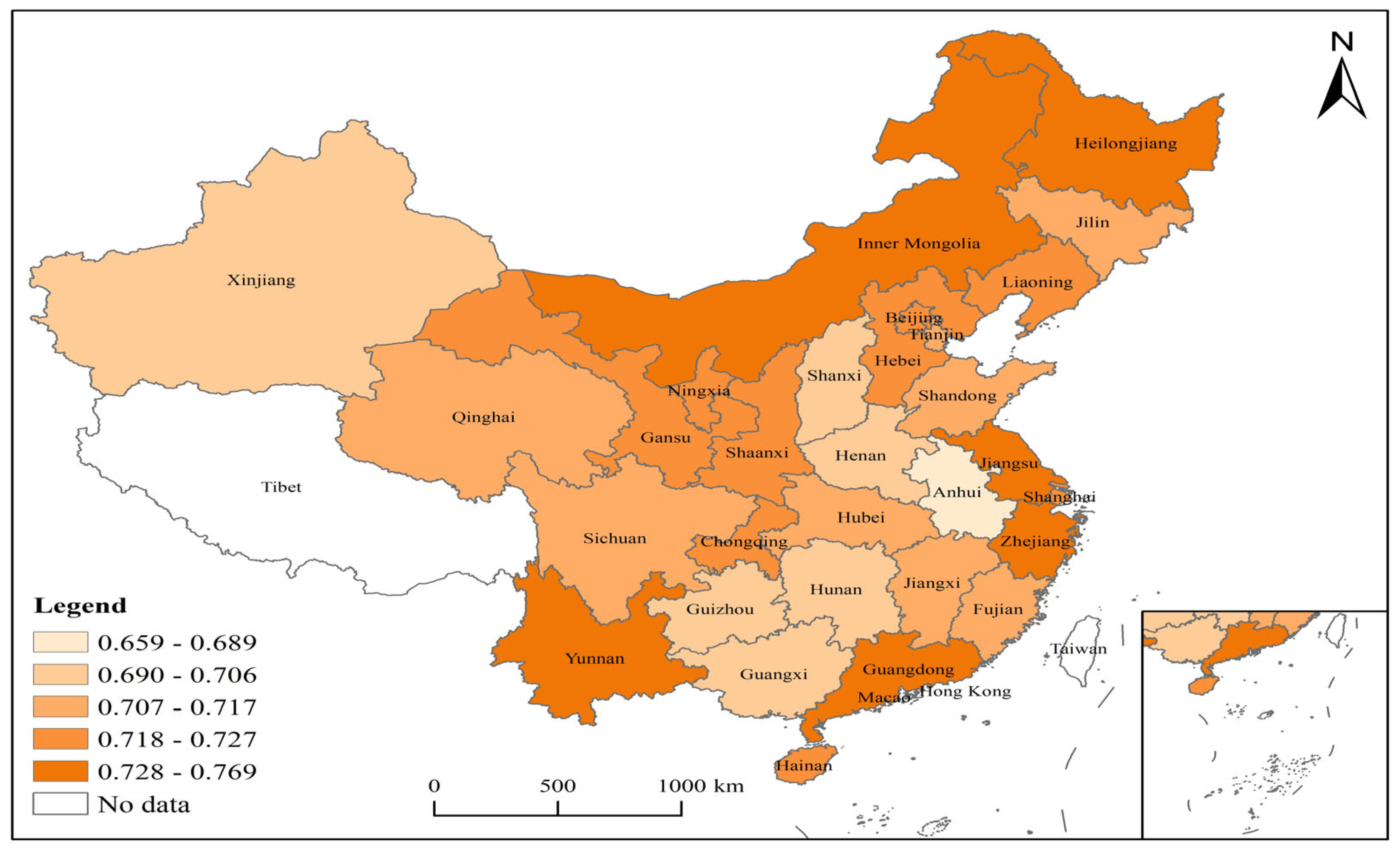
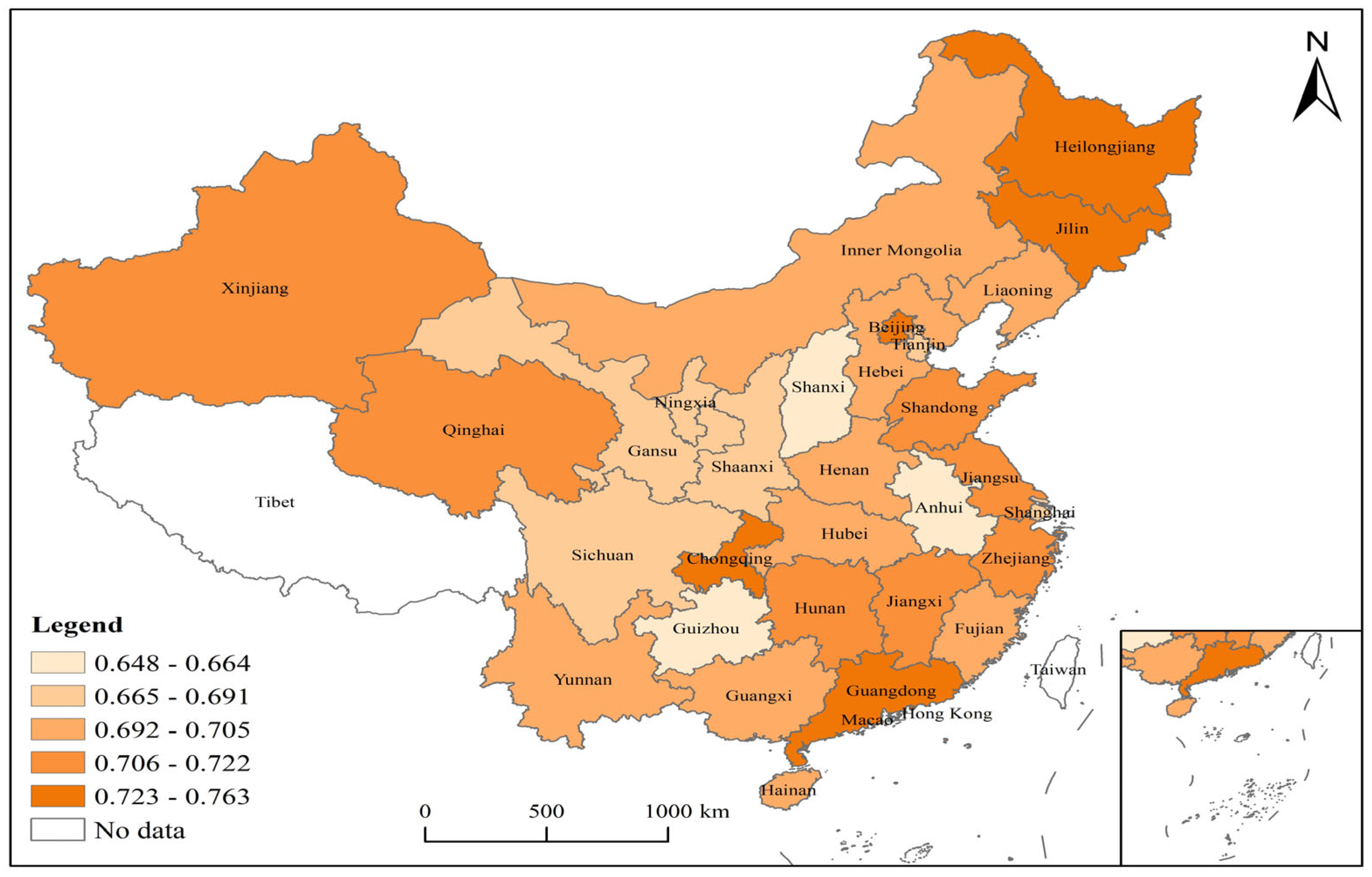
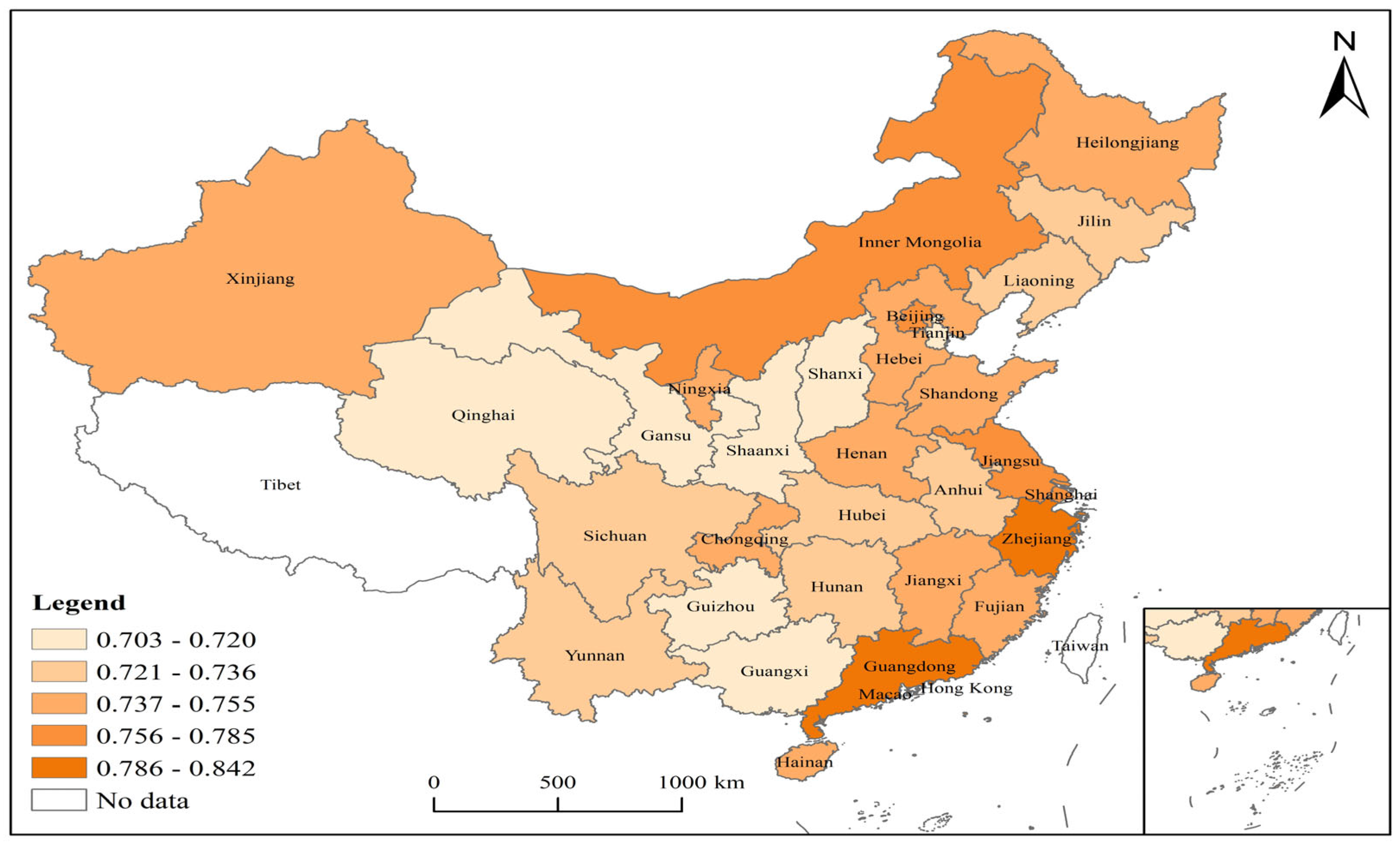
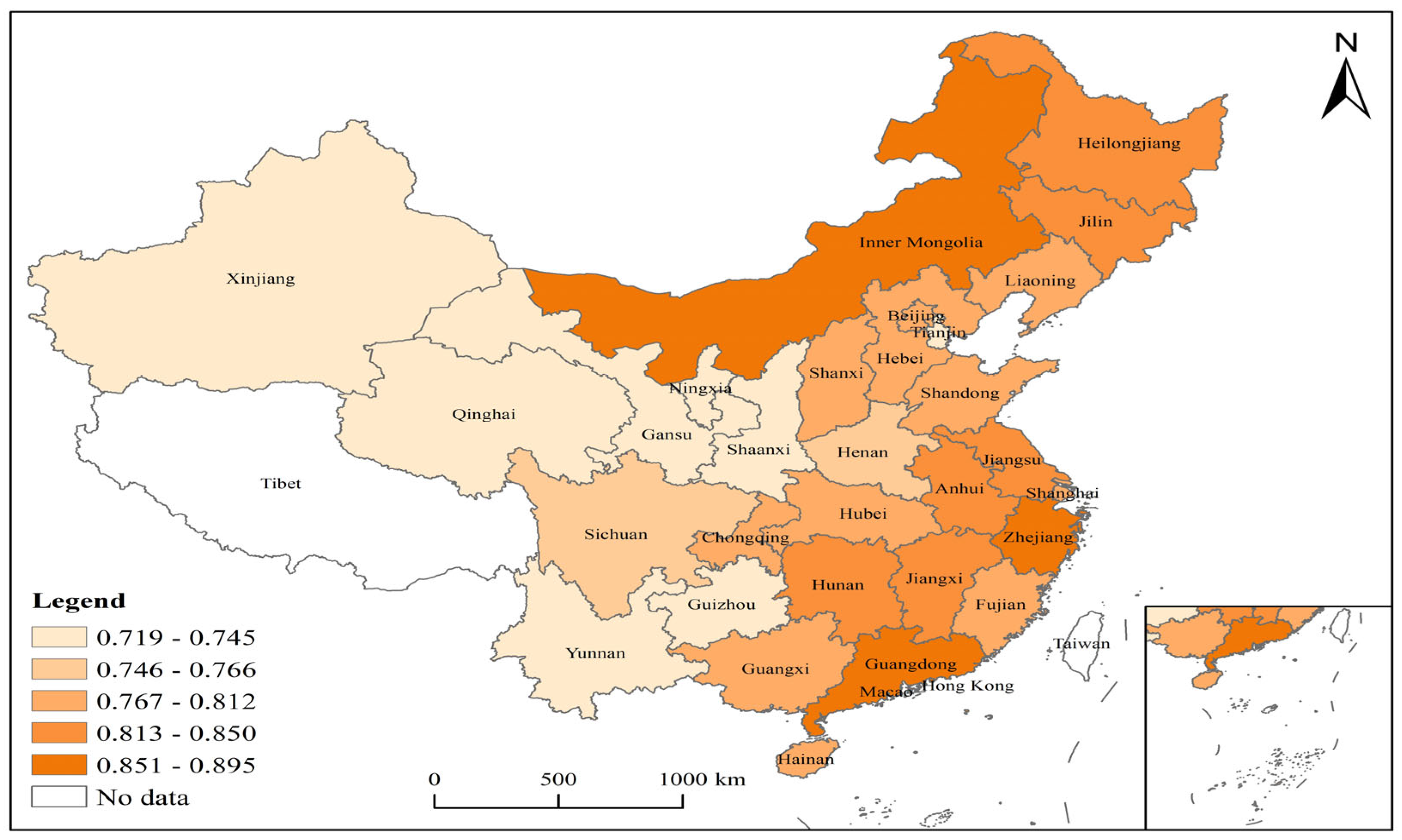
To present the spatial evolution more clearly, this study maps the coupling coordination degree in 2012, 2015, 2018, and 2022, as shown in Figure 1, Figure 2, Figure 3 and Figure 4.
Figure 1, Figure 2, Figure 3 and Figure 4 shows that the coupling coordination degree increased during the study period, but clear spatial differences remained. In 2012 and 2015, high-value areas were mainly distributed in several eastern coastal provinces and some northeastern provinces. By 2018 and 2022, the overall level increased, and the high-value areas expanded to more provinces. However, some western and inland provinces still remained at relatively low levels. This spatial pattern indicates that the coupling relationship between urban–rural integration and agricultural ecological product value realization has improved over time, but regional imbalance still exists.

3.2. Regional Analysis

3.2.1. Results of the Gini Coefficient

Reports the national Gini coefficient, within-region differences, between-region differences, and contribution rates for 2012–2022 are presented in Table 3.
The Gini coefficient measured the national overall Gini coefficient, regional differences, interregional differences and page contribution rate from 2012 to 2022, respectively. Generally speaking, the national overall Gini coefficient from 2012 to 2022 showed a fluctuating upward trend, from 0.0184 in 2012 to 0.0347 in 2022, indicating that regional differences are gradually widening. From 2013 to 2015, the coupling and coordination were relatively strong, with the Gini coefficient between 0.0150 and 0.0265, and the Gini coefficient reached a low level in 2015, reflecting the stage effect of the regional coordination policy during this period. After 2019, the coordination level has declined. The Gini coefficient continued to be higher than 0.0270 in 2019–2020, and reached a peak of 0.0347 in 2022, indicating the acceleration of regional differentiation. This model is closely related to the uneven flow of production factors between regions and the regional heterogeneity of the realization of the value of ecological products.
At the level of regional differences, the internal differences between the four major regions are significant. The internal differences in the eastern region continued to be high, with the average Gini coefficient of 0.0198, but in 2022, the Gini coefficient dropped sharply to 0.0138, which may be due to the enhanced coordination of major urban areas like the Yangtze River Delta and the Pearl River Delta, and has since stabilized in the range of 0.013–0.025. This indicates that mature areas have strong resilience. The central region fluctuates most violently, with the Gini coefficient fluctuating between 0.0087 and 0.0307, and peaking in 2021, indicating that there are structural limitations in its urban–rural integration process. The internal differences in the western region continued to widen, from 0.0159 in 2012 to 0.0286 in 2020, an increase of more than 50% compared with 2019. This closely correlates with the implementation of the pilot project for realizing the value of ecological products, which exacerbate the differences in the transformation capacity of provinces under the constraints of ecological protection. In the northeast region, although the overall difference is still low, it has soared from 0.0087 in 2018 to 0.0280 in 2022, an increase of up to 221%, highlighting the increasingly serious challenges facing the transformation of old industrial areas. Overall, the contribution rate of regional differences to the total differences is on the rise, with the western and central regions becoming the main sources of regional differentiation.
The differences between regions show an obvious trend of accelerated polarization. From 2012 to 2022, the disparity between the eastern and northeast regions widened from 0.0312 to 0.0512, an increase of 64.1%: the difference between the west and the northeast also expanded from 0.0106 in 2018 to 0.0452 in 2022. The difference between the central and western regions shows the characteristics of “trough reversal”, rising from a low of 0.0106 in 2015 to 0.0253 in 2022, which is mainly affected by the uneven implementation of national food security rules and ecological product pilot policies.
The dominance of super-variable density continues to be strengthened. Its contribution rate rose from 49% in 2012 to 79% in 2022, which exceeds the growth rate of regional differences, indicating that the multi-speed development contradictions within the region have gone beyond geographical division to become the dominant imbalance force. This differentiation reflects three major problems. First of all, the unclear ecological rights and interests have led to a high variation density in the northeast region, reaching 0.028 in 2022. Secondly, the uneven coverage of digital infrastructure has exacerbated the gap between the subregional units in the central and western regions, and the insufficient policy coverage has caused the “center-edge” development differentiation in the province. The data shows that institutional obstacles can explain regional division more effectively than spatial distance, highlighting the need to establish a unified national ecological market to break the administrative restrictions on the flow of factors and rebuild the mechanism for coordinating regional development.

3.2.2. Kernel Density Estimation Results

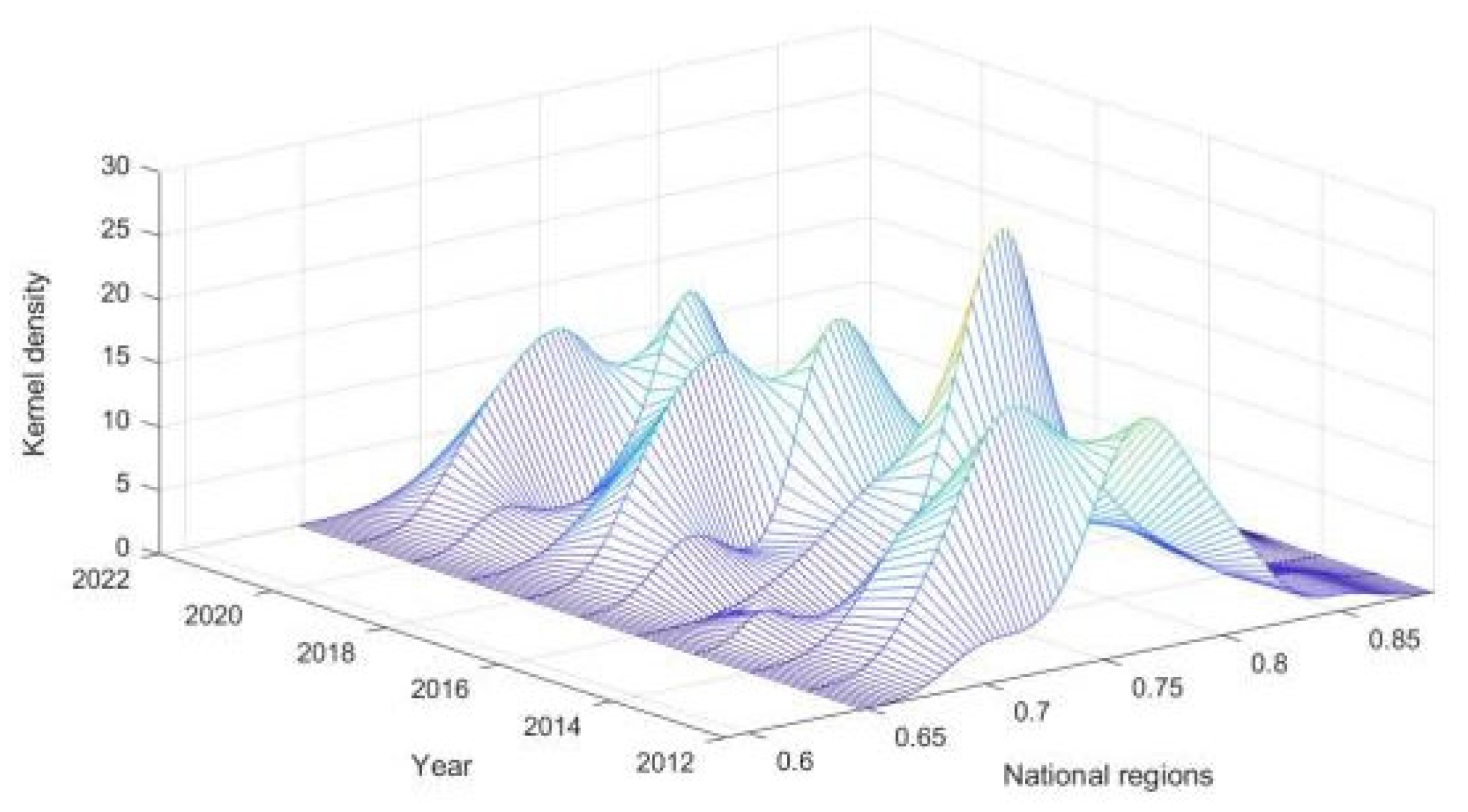
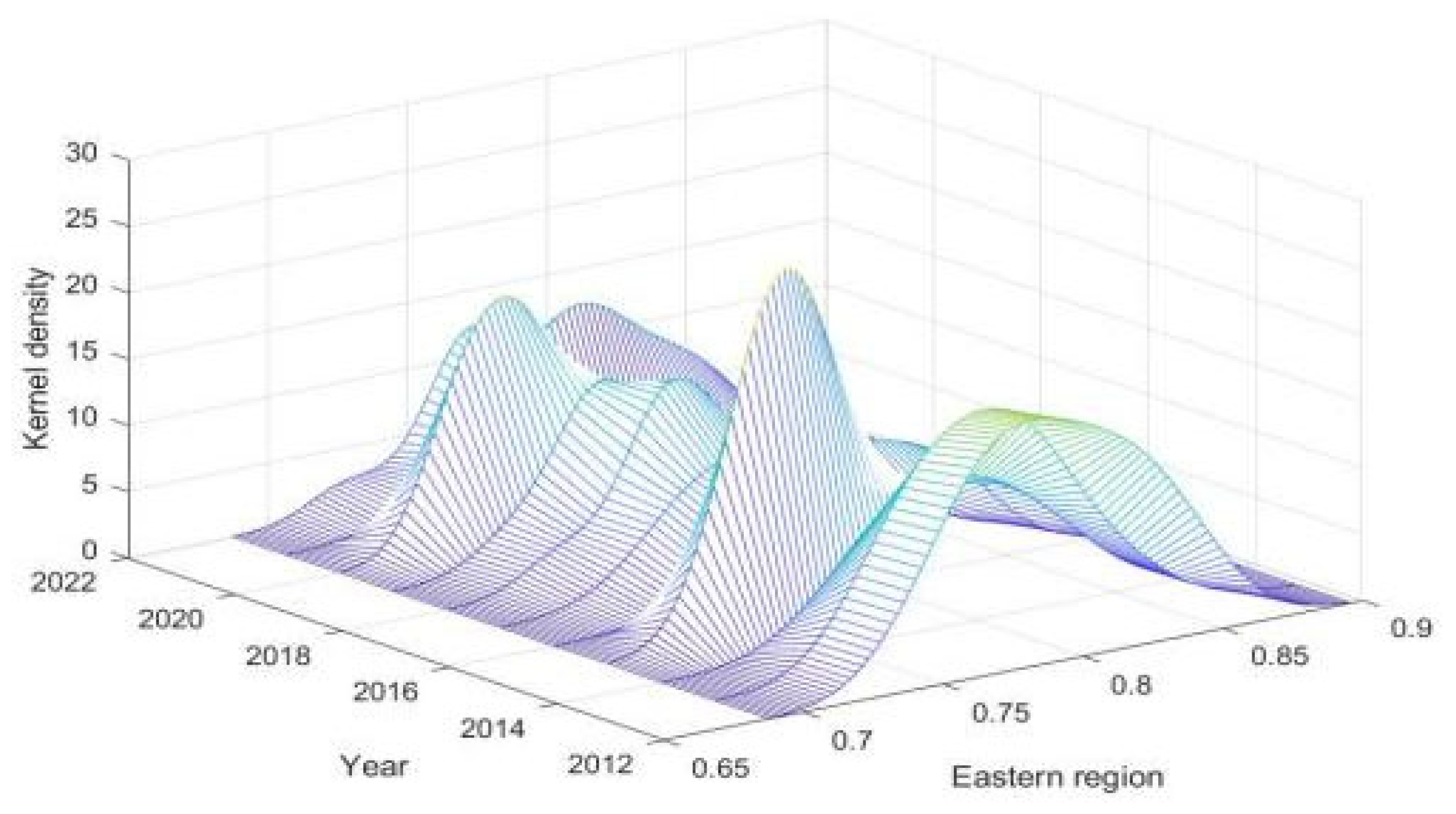
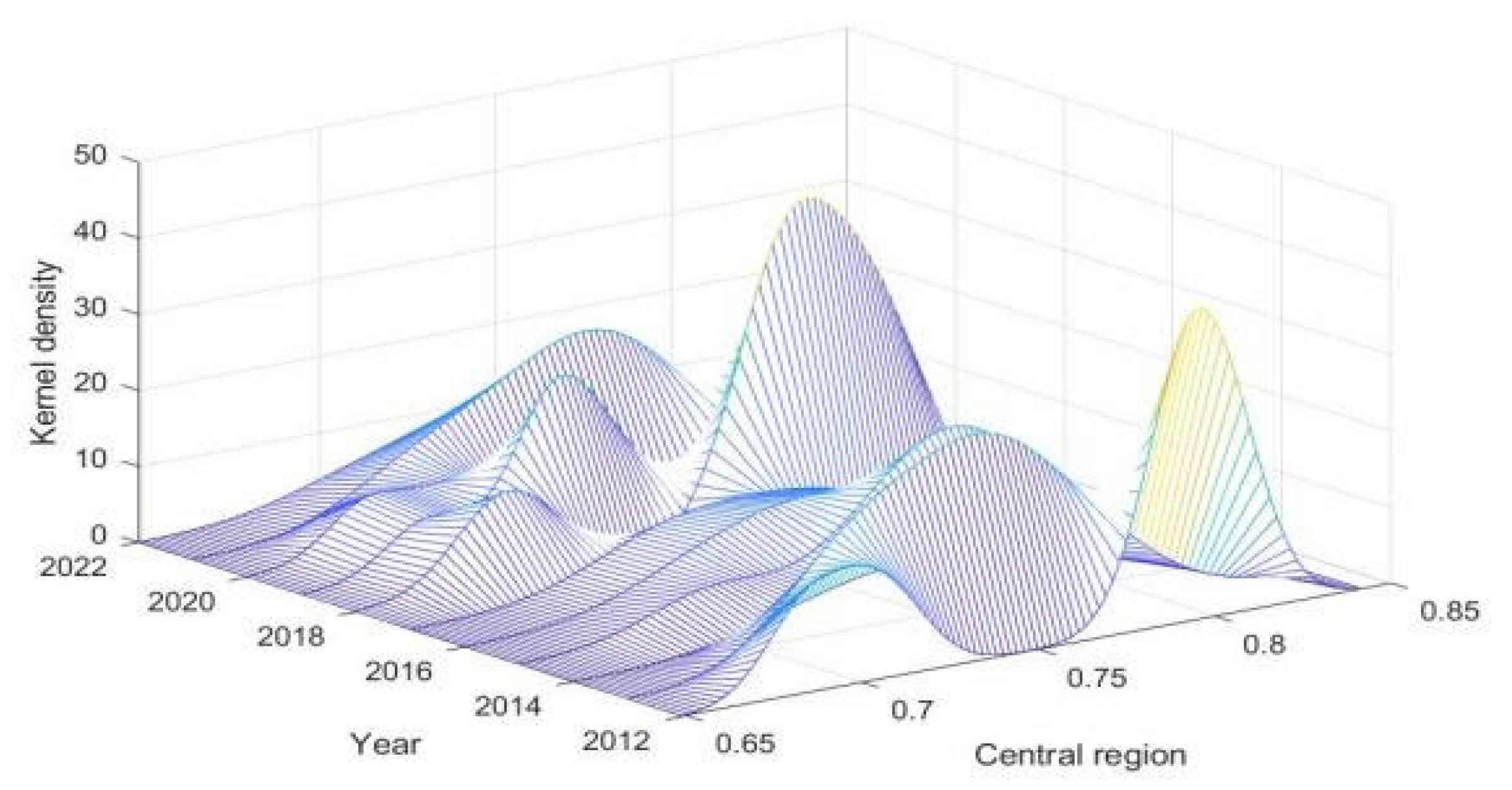
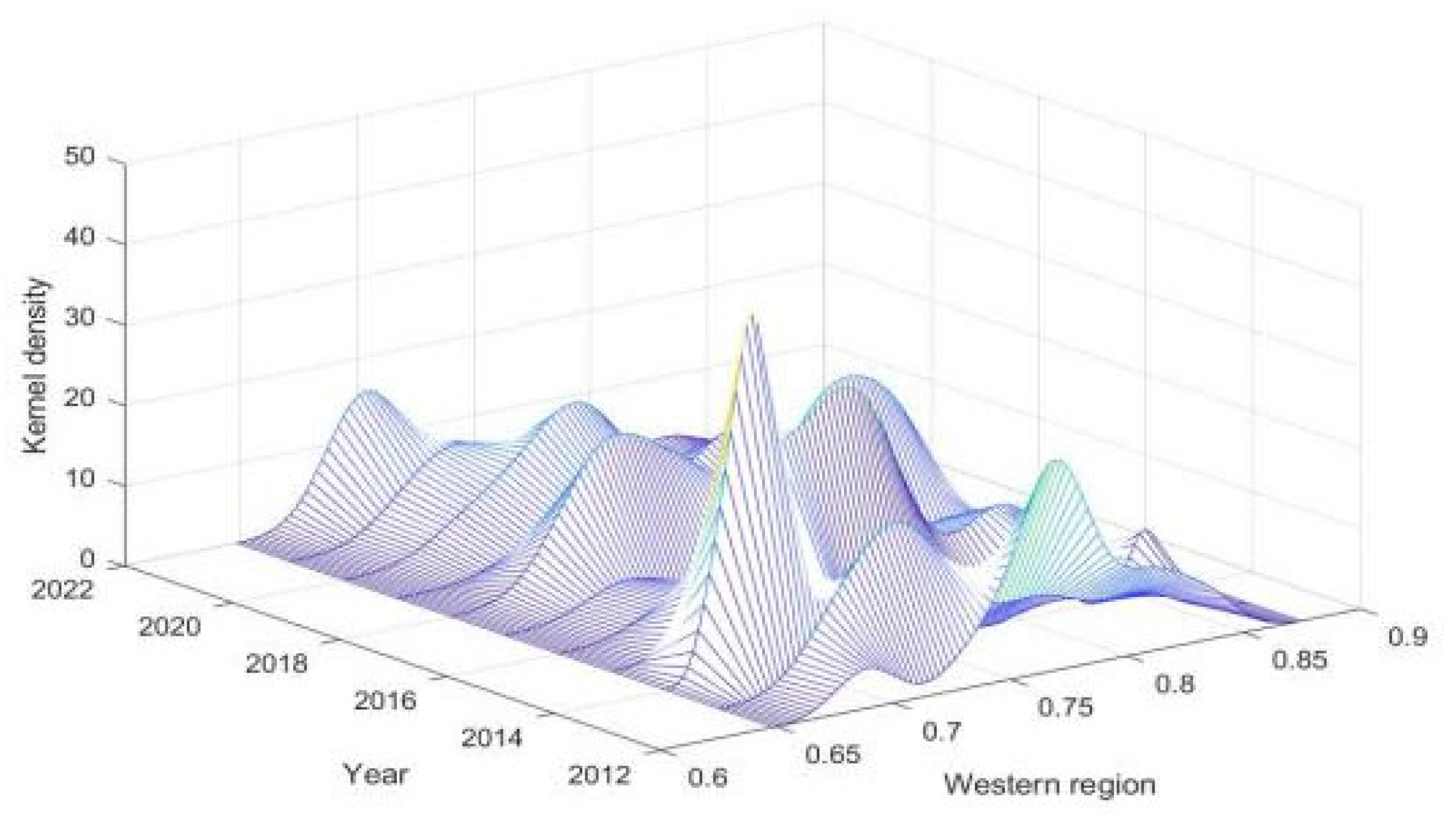
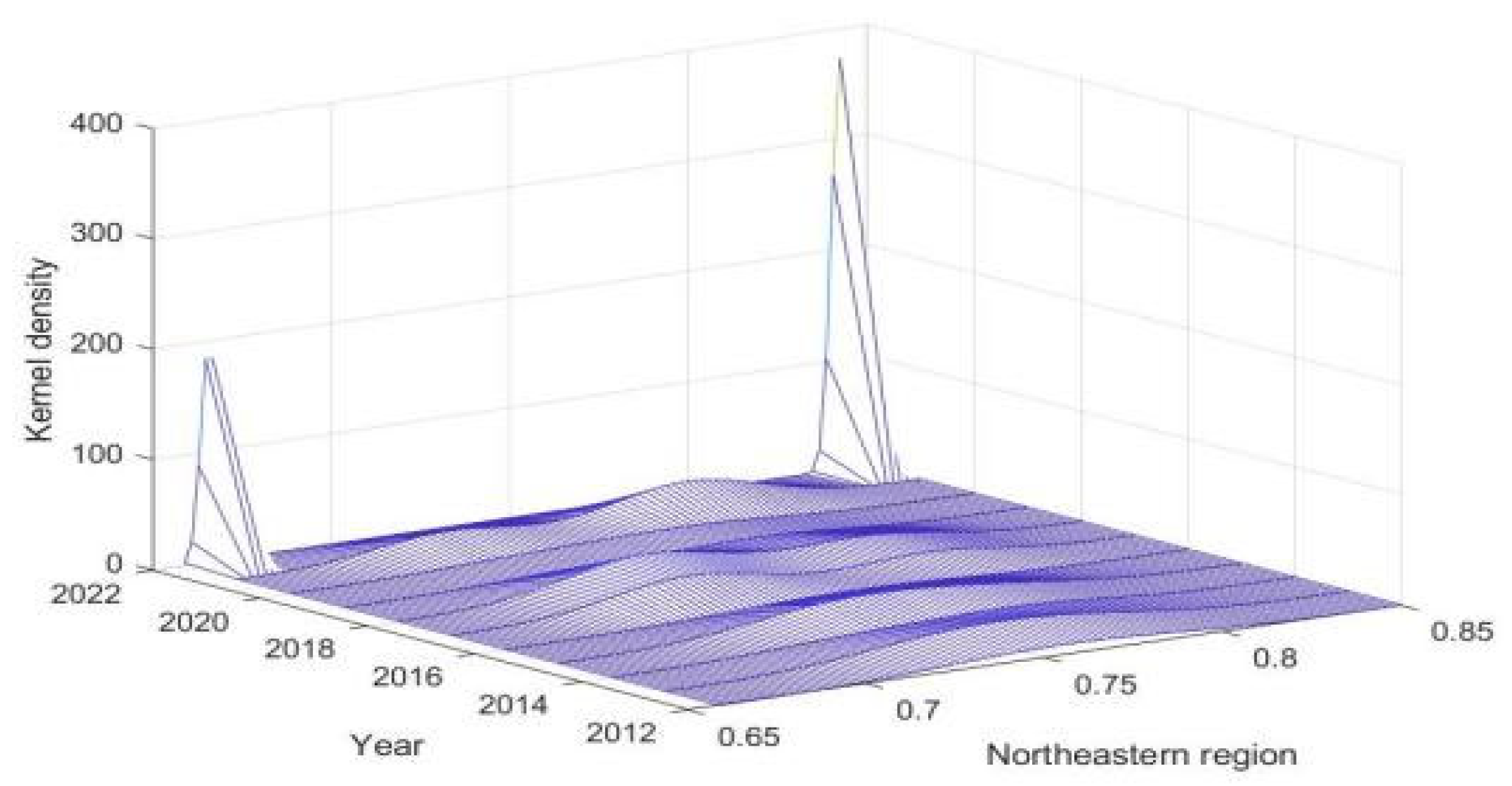
In order to further reveal the spatial-temporal evolution characteristics of urban–rural integration and the value of ecological products, this study employs the three-dimensional Kernel density estimation method. Through the estimation and analysis of Kernel density in the whole country and the eastern, central, western and northeastern regions, we demonstrate the spatial distribution patterns of coordinated urban–rural coupling across different areas. The Kernel density diagram reveals the spatial distribution and density evolution of the coupling level, and clearly shows the changes in the coordination of urban–rural integration and ecological value transformation. These visualization results help to identify regional differences in coupling patterns and changing trends at different stages of development. The following Figure 5, Figure 6, Figure 7, Figure 8 and Figure 9 demonstrates the estimation of Kernel density in the country and major regions.
This paper uses the three-dimensional Kernel density estimation (KDE) method to further reveal the time dynamic changes in China’s urban–rural integration and the coupling and coordination of agricultural ecological transformation efficiency. Figure 5, Figure 6, Figure 7, Figure 8 and Figure 9 shows the national and four major regional coupling and coordinated distribution patterns based on KDE.
(1)
Kernel density estimation of the coupling synergy between national urban–rural integration and agricultural ecological transformation efficiency. As shown in Figure 5, the results of the three-dimensional Kernel density diagram indicate that the national coupling coordination shows the stage characteristics of “fluctuating growth and multi-peak evolution”. Between 2012 and 2016, most of the coupling values were concentrated in the range of 0.65–0.75, with a single peak distribution and a small regional difference. Between 2018 and 2022, the density peak moved to 0.80–0.85, and secondary peaks appeared. The distribution pattern changed from a single peak to “the main peak is prominent and the right tail is extended”. This change shows that while the high-level areas are accelerating, the catch-up in low-level areas is weak, and the regional absolute gap is widening.
(2)
Kernel density estimation of coupling synergy between urban–rural integration and agricultural ecological transformation efficiency across four major regions. The examination of the Kernel density maps of four regions, respectively, shows that between 2012 and 2022, the coupling coordination of urban–rural integration and the efficiency of agricultural ecological transformation showed obvious gradient changes. The eastern region maintained a leading position throughout the period, and the coupling value is mainly concentrated in the high-level range of 0.75 to 0.90, which reflects the crucial role of its urban–rural coordination in promoting the transformation of ecological values. The coupling level in the western region is relatively low, and most of its coupling values are between 0.65 and 0.80. The Kernel density distribution is relatively flat, indicating that there are significant differences within the region and the ecological transformation dynamics are weak. The persistent gap between the east and the west and the differences between the east and the west confirm the law of urban–rural-ecological coordination on either side of the “Hu Huanyong Line”, which is closely related to the differences in infrastructure, technological investment and policy support. The fluctuations in the central region are more significant than those in the northeast region. The shift in the peak position and the change in density height indicate that the coupling coordination shows a more dynamic evolution over time. The existence of multiple peaks indicates that each region is at a different stage of development, with a certain degree of internal differences, rather than tending to a single trajectory. These characteristics provide important clues for the subsequent analysis of internal differences in the central region and the key factors affecting coupling coordination. By contrast, the northeastern region’s kernel shows a relatively stable distribution pattern from 2012 to 2022, with limited shifts in shape or position, indicating that the dynamic evolution of the degree of coupling synergy in the northeast region is relatively stable and less volatile in the time series. This relative stability also implies limited scope for further improvement or upgrading, indicating that the system may operate at a stage close to a stable level and lacks strong endogenous power to achieve major breakthroughs.

3.2.3. Markov Chain Analysis

In the process of analyzing the dynamic evolution of urban–rural integration and ecological product value coupling, this paper adopts the Markov chain model to examine transition probability and evolutionary path between different coupling states. This section will introduce the transfer probability matrix obtained based on the traditional Markov chain model and the spatial Markov chain model. By analyzing the transfer probability between I, II, I and I states under different spatial lag conditions, the model helps to identify the inherent fluidity, stability and spatial dependence in the coupling process. The following table lists the transfer probability and its corresponding observation frequency, thus clarifying the influence of the spatial adjacency effect on the evolution of the coupling level.
The Markov chain transition probability matrix is presented in Table 4.
As shown in the table, this study sets the traditional non-lag space lag type and constructs a transfer probability matrix of different levels from t to t + 1. This matrix is used to reveal the influence of geospatial proximity on the dynamic evolution of the coupled development between urban–rural integration and the value realization of agricultural ecological products. This study constructs the traditional Markov chain and the spatial Markov chain to describe the evolution law of this coupling with spatial changes. The cumulative value of the coupling index between urban–rural integration and agricultural ecological product value is divided into four levels: I, II, III, and IV.
(1)
Traditional Markov chain analysis of the coupled development between urban–rural integration and agricultural ecological product value: First, the internal mobility of urban–rural integration and agricultural ecological product value is relatively weak: in the transfer probability matrix of 1, II, III, and I levels, the values of diagonal elements are higher than those of non-diagonal elements. The diagonal values are 0.3976, 0.3418, 0.2857 and 0.5738, respectively, indicating that the club convergence characteristics of the four regions 1, III, and I have strong stability. That is to say, over time, the probability of regional transfer is low, reflecting the strong path dependence and self-locking effect. Secondly, the transition probabilities between different groups of urban–rural integration and the value realization level of agricultural ecological products are similar. The probability of transferring from the low-level group to the medium–low level group is 0.3253, the probability of transferring from the low-level group to the medium–high-level group is 0.3291, and the probability of transferring from the medium–high-level group to the high-level group is 0.4156. This shows that the urban–rural integration and the value realization system of agricultural ecological products have significant state dependence, and the regional differences are still obvious. Third, the low-coupling area, classified as category I, shows strong instability. The probability of maintaining the status quo is only 39.76%, but the probability of downgrading to the second category is 32.53%. In contrast, the third category area showed an obvious upward trend, with a 41.56% probability of transitioning to the fourth category. It is worth noting that the highly coupled region shows significant sustainability, and the probability of self-sustainability is as high as 57.38%, which also indicates that there is an overall imbalance in system development.
(2)
Analysis of the spatial Markov chain of urban–rural integration and the value of agricultural ecological products: Compared with the traditional Markov chain, the transfer probability in the spatial Markov chain has changed significantly. The introduction of the spatial lag effect reveals the geographical dependence of coupled evolution. A low level of neighborhood environment may exacerbate regional development traps. The region in this environment, the first category of spatial lag, has a self-sustaining probability of 42.86%, but the probability of transitioning to the fourth category is almost zero. On the contrary, high-level neighbors generate significant spatial spillover effects. The transfer probability of the third category area adjacent to the fourth type area is 42.86%, which is higher than the 41.56% in the traditional model. At the same time, the probability of self-sustaining in the fourth category area rose to 75%, forming a double effect of high-level solidification and strong radiation. In a medium-coupled neighbor environment represented by the third-class region with spatial lag, the probability of transfer from the third-class region to the fourth-class region increased to 56%. This result highlights the catalytic effect of spatial interaction on gradient breakthrough.
Judging from the dynamic convergence trend, there are two mechanisms in the system: on the one hand, there is a tendency for medium-coupled areas to move steadily to higher levels. There is a general tendency of convergence to a higher level in the third type of region. Especially in the case of spatial interaction, the transfer probability has increased by 14.44 percentage points, which is consistent with the characteristics of conditional convergence. Development stagnation in low-level regions and sustainable development in high-level regions: this model may exacerbate the risk of polarization of regional differentiation. This difference is more significant in the spatial dimension. There are only four observation points in low-level clusters, and there are no upward transformation cases, while the radiation range of high-level clusters is still limited.

3.3. Convergence Analysis of the Coupling Between Urban–Rural Integration and Ecological Product Value Realization

When analyzing the convergence of urban–rural integration and the coupling of ecological product value, this study employs the Sigma convergence method to evaluate the trend of differences between the country and regions from 2012 to 2022. By calculating the Sigma value, we quantified the regional differences in the degree of coupling and judged that these differences tend to converge or diverge over time. The following results show the Sigma values of the country and the four major regions in the east, central, west and northeast, reflecting the dynamic evolution of the regional gap between urban–rural integration and the coupling level of ecological product value. A Sigma convergence analysis of the coupling between urban–rural integration and ecological product value realization (2012–2022) is presented in Table 5.
Based on the results of Sigma convergence from 2012 to 2022, the coupling level of urban–rural integration and the value realization of ecological products show significant regional differences and dynamic evolution patterns. Throughout the country, this disparity continues to intensify. The value rose from 0.0338 in 2012 to 0.0610 in 2022, an increase of 80.5%, indicating that the absolute differences in the region did not show a convergent trend. This trajectory shows a pattern of fluctuation and expansion: after a brief decline to 0.0283 during the policy window period in 2015, the regional gap began to widen rapidly from 2020, rising from 0.0520 in 2020 to 0.0610 in 2022. This indicates that external shocks may exacerbate regional disparities, and the peak in 2022 reflects the lack of an effective convergence mechanism at the national level.
The four major regions show a hierarchical spatial structure with obvious differentiation. The northeast region fell into a deepening polarization trap, and its Sigma value rose from 0.0611 to 0.1036, an increase of 69.6%. In 2022, the Sigma value in the region was 69.8% higher than the national average, indicating that there was a serious internal division in the ecological coordination between urban and rural areas during the transformation of the old industrial base. The central region shows the most obvious convergence pattern, and its Sigma value continues to be lower than the national average. In 2021, the value dropped to 0.0191, the lowest point in all regions. This result reflects the institutional effectiveness of the “Central Rise” strategy in promoting the flow of urban and rural factors. Sigma values in the eastern and western regions fluctuate unevenly and vary. The Sigma value in the eastern region rose from a low of 0.0214 in 2012 to 0.0538 in 2022. This growth shows that in more developed areas, there is a new implicit differentiation within urban–rural integration. The Western region’s Sigma value has consistently exceeded the national average since 2016, reflecting the long-term development pressure of ecologically fragile areas.
The fluctuation of the Sigma value from 2012 to 2022 clearly shows the effectiveness of policy interventions. In 2015, the national urban–rural development gap dropped sharply to 0.0283, and the northeast region also dropped to a record low of 0.0209. This turning point coincides with the key implementation stage of the National New Urbanization Plan, which confirms the short-term convergence effect of the national urban–rural coordinated development strategy. However, after 2020, the national urban–rural development gap has entered the expansion stage again: the Sigma value in the northeast region rose from 0.0644 to 0.1036, and the Sigma value in the western region rose from 0.0354 to 0.0565, highlighting the region under major public crises. Significant spatial heterogeneity of toughness. Notably, the central region has maintained a continuous low volatility, and its Sigma value will be maintained at 0.0317 in 2022, further demonstrating the robustness of its urban multi-ecological coordinated development system.

4. Discussion

4.1. Theoretical Contributions

This study expands the theoretical understanding of the coupling relationship between urban–rural integration and agricultural ecological product value realization. First, grounded in the “Two Mountains Theory,” it elucidates the link between ecological value and economic development within urban–rural integration, highlighting how regional trajectories, policy interventions, and technological innovations shape cross-regional differences. Second, by emphasizing spatial lag effects and geographical proximity, it enriches regional coordinated development theory, the interplay between positive radiation effects in high-level regions and development traps in low-level regions reveals how spatial dependence influences coupling evolution. Third, drawing on spatial economics, it shows that disparities in ecological value realization are fundamentally constrained by institutional conditions, with institutional heterogeneity exacerbating regional fragmentation. Finally, by introducing dual-mechanism dynamic convergence analysis, it uncovers the development rigidity of low-coupling regions and the self-sustainability of high-coupling regions, extending convergence theory and highlighting interactions among policy intervention, spatial dynamics, and regional differences.

4.2. Understanding the Coupling Mechanisms

A central question raised in the introduction concerns how the two systems interact, how their coupling evolves, and what drives regional disparities. The empirical findings provide systematic evidence addressing these questions.
First, regarding interaction mechanisms, the results reveal a bidirectional feedback loop. Urban–rural integration facilitates ecological value realization by channeling capital, technology, and talent into rural areas, while successful ecological value realization creates new economic opportunities that attract further factor inflows. This virtuous cycle is most evident in regions where both systems achieve high coupling levels. More specifically, ecological value realization can be understood through the “resource–asset–capital” pathway. Ecological resources provide the basis for agricultural production. Through value accounting, certification, property-right arrangements, and policy support, these resources can become ecological assets and then generate economic returns through ecological compensation, green finance, carbon trading, eco-label certification, ecological agriculture, rural tourism, and green agricultural brands [41,42] (pp. 47–53). Lishui, Zhejiang Province, China, Costa Rica’s payment for ecosystem services program, and Australia’s carbon farming programs provide examples of how ecological resources can be transformed into economic returns through valuation, compensation, branding, and carbon credit mechanisms [43] (pp. 712–724).
Second, regarding evolution, kernel density estimation and Markov chain analyses reveal strong path dependence. Low-coupling regions tend to remain at low levels, while high-coupling regions demonstrate self-sustaining characteristics, a pattern reflecting “club convergence.” Spatial Markov chain results further show that geographical proximity plays a critical role: regions adjacent to high-coupling neighbors are more likely to transition upward.
Third, regarding regional disparities, Dagum Gini coefficient decomposition identifies inter-regional differences as the dominant source of overall disparity. Mechanism analysis reveals that agricultural technological progress, industrial diversification, and labor misallocation mitigation serve as key transmission channels, operating differentially across regions, technological progress plays a more prominent role in the eastern region, while industrial diversification and labor reallocation are more critical in the central and western regions.

4.3. Drivers of Regional Disparities

Three additional layers explain regional disparities. Institutional heterogeneity affects the transformation of ecological resources into economic value through fiscal support, financial regulation, and policy pilots. Spatial spillover effects also matter: high-coupling regions may generate positive radiation effects, while low-coupling regions tend to form “low-level traps.” Initial endowment conditions further deepen regional differences. In the western region, provinces such as Yunnan have rich ecological resources and better conditions for ecological agriculture and tourism, while provinces such as Gansu face ecological fragility, water shortage, and weaker agricultural infrastructure. These differences are closely related to regional ecological functions, resource constraints, and uneven policy support [44] (pp. 186–201). In the northeast, Heilongjiang has a strong agricultural base, but the region also faces pressure from old industrial base transformation, population outflow, and weak factor attraction. These differences partly explain the widening internal gaps in the western and northeastern regions.

4.4. International Comparisons and Policy Implications

International comparisons reveal that developing countries such as Mexico and Brazil face inadequate market systems for ecological products and fragmented policy implementation, while developed countries such as Germany and Japan, despite mature ecological governance systems, still exhibit imperfections in urban–rural benefit-sharing mechanisms. China has adopted a more coordinated approach, combining institutional coordination, technological empowerment, and market-oriented mechanisms.
The findings yield several policy implications. First, given strong path dependence and spatial spillover effects, policies should adopt regionally coordinated approaches rather than isolated interventions. Second, institutional heterogeneity matters: policies should tailor fiscal support and financial regulation to local conditions. Third, region-specific strategies, emphasizing technological progress in the east and industrial diversification in the central and west, are warranted.

4.5. Limitations and Future Research

This study acknowledges several limitations that warrant further investigation. First, the coupling coordination degree model employed in this study follows the traditional formulation While this model has been widely applied in coupling research, recent studies have identified potential methodological concerns, including the subjective determination of contribution coefficients (α, β) and the interpretational ambiguity of coupling degree intervals [45] (pp. 357–366). In the present study, α and β are both set to 0.5 under the assumption that urban–rural integration and agricultural ecological product value realization are equally important within the coupled system. Although this assumption is reasonable given the conceptual symmetry of the two systems, alternative weight configurations may yield slightly different coordination indices. Future research could adopt improved models that reduce coefficient subjectivity through mathematical optimization [45] (pp. 357–366), or conduct sensitivity analyses across different coefficient scenarios to test the robustness of the findings.
Second, there are still limitations in ecological value accounting and spatial scale. The agricultural ecological value is measured from a broad agricultural perspective and does not further distinguish forests, farmland, wetlands, grassland, and other ecosystem types. Previous studies have shown that ecosystem service values differ across ecosystem types, such as farmland, forest, grassland, wetland, and water bodies [32]. This may affect the accuracy of ecological value accounting to some extent. In addition, although the CLCD land-cover data have a spatial resolution of 30 m, they are aggregated to the provincial level to match the provincial socioeconomic data. This treatment helps maintain consistency between ecological and socioeconomic variables, but it may also mask county-level differences within the same province. Future studies can use ecosystem-specific value coefficients and county-level or grid-level data to examine more detailed spatial heterogeneity and value differences among ecosystem types.
Third, this study does not further quantify the effects of specific policy tools and market mechanisms on the coupling coordination degree. In practice, the value realization of ecological products may be affected by carbon credits, eco-label products, green finance, ecological compensation, and ecological product trading platforms. Due to the limited availability and comparability of long-term provincial data, these market-related variables are not included in the empirical model. Future studies can include indicators such as carbon trading, eco-label certification, green finance, and ecological product transactions to examine how market mechanisms affect the coupling relationship.

5. Conclusions and Recommendations

5.1. Research Conclusions

This study focuses on the spatial and temporal pattern, dynamic evolution and convergence analysis of the coupling between urban–rural factors flows and the value of agricultural ecological products, systematically examines the coupling relationship between the two and its dynamic evolution process. The research adopts multi-dimensional methods, including the Gini coefficient, three-dimensional Kernel density estimation and Markov chain. The main findings are as follows:
First of all, there is a significant imbalance in the distribution of urban and rural factor flows and the realization of the value of ecological products. The analysis based on the Gini coefficient shows that between 2012 and 2022, the national and regional gap between urban–rural integration and the value of ecological products has widened. Particularly, the western and northeast regions showed significant spatial differences. This finding is consistent with the existing evidence. For example, Zhou, J.N.; Qin, F.C.; Liu, J.; Zhu, G.L. and Zou, W. [46] (pp. 166–176) also pointed out the imbalance in urban and rural development in China, which highlights the persistent imbalance in China’s urban and rural development. However, this study further reveals the institutional obstacles that cause this difference by introducing fine space–time analysis. For example, the integration of digital technology and biotechnology in the eastern region has accelerated the process of urban–rural integration, while the western and northeastern regions are still facing the double pressure of ecological protection and agricultural transformation. Compared with previous studies that mainly describe regional inequality at the macro level, this study emphasizes microspatial differences and provides more practical suggestions for policy design. More importantly, this study reveals a bidirectional feedback loop between the two systems: urban–rural integration facilitates ecological value realization by channeling capital, technology, and talent into rural areas, while successful ecological value realization creates new economic opportunities that attract further factor inflows, forming a virtuous cycle, a dynamic that is most evident in regions where both systems achieve high coupling levels.
Secondly, the dynamic evolution of the coupling level reveals the widening of the regional gap. The Kernel density estimate shows that the national and regional coupling levels show a fluctuating upward trend and a pattern of multi-peak evolution. The high-coupling area develops faster, while the low-coupling area is relatively lagging behind, and the gap widens over time. The central region shows more active and fluctuating evolutionary characteristics, while the northeast region shows a relatively stable but stagnant coupling performance, lacking significant breakthroughs.
Third, the spatial lag effect significantly affects the change in the coupling level. The comparison between the traditional Markov chain and the spatial Markov chain reveals the key role of spatial dependence. The low-coupling area that lacks the support of the highly coupled neighboring region shows strong path dependence and locking effect, so it is difficult to develop upwards. On the contrary, highly coupled areas show strong self-sustainability, forming spatial clusters with high coupling levels. This result expands the concepts of “path dependence” and “locking” from the field of spatial economics to the field of urban–rural integration and ecological value realization, and shows that geographical proximity has a significant impact on regional differences.
Fourth, dynamic convergence analysis reveals convergence rather than long-term convergence. Sigma convergence analysis shows that the regional gap in 2015 has narrowed in the short term, but the overall difference between urban–rural integration and the realization of the value of ecological products has not shown a long-term convergence trend. Especially in the northeast and west, the gap will widen again after 2020. This shows that, despite the fact that policy interventions have achieved some results, structural and institutional imbalances have not been fundamentally addressed.

5.2. Policy Recommendations

First, spatial differentiation and precise regional intervention measures should be implemented. The results of Sigma convergence analysis clearly show that the coupling level in the western and northeast regions is significantly low, while the Markov chain analysis confirms the existence of the spatial lag effect, that is, low-coupling areas are more likely to fall into the mutually reinforcing development trap. Therefore, policy design should abandon the “one-size-fits-all” approach and implement precise intervention in subdivision classification. For low-coupling areas such as the west and northeast, we should focus on strengthening infrastructure investment, establishing a targeted ecological compensation mechanism [47] (p. 452), and promoting green finance, focusing on breaking its development bottlenecks. At the same time, we should give full play to the spatial radiation effect of highly coupled areas through cross-regional matching projects, technology sharing and institutional cooperation, and help low-coupled areas break the negative spatial lock and achieve coordinated upgrading.
Second, build a dual-drive urban–rural integration path based on element activation and industrial upgrading. The measurement results show that the level of urban–rural integration is a key factor in coupling and coordination, which mainly depends on the free flow and effective allocation of production factors. Similarly, enhancing the efficiency of the value of ecological products requires strong industrial support. On the one hand, the reform should further facilitate the market-oriented reform of key elements such as land, capital and talents, eliminate institutional barriers, encourage the flow of urban capital and technology to rural areas, and promote the transformation of rural ecological resources into assets. On the other hand, the ecological position should be transformed into industrial advantages. The central and western regions should learn from the successful model of “technology empowerment + ecological industrialization” in the eastern region, vigorously develop emerging industries such as digital agriculture, ecological tourism [48] (p. 92), and health industry, and realize the mutual promotion of ecological protection and industrial development.
Third, establish a long-term institutional framework with strong adaptability, enhance regional resilience, and maintain the sustainable improvement of urban–rural coupling. In addition to stabilizing the regional development pattern, deeper institutional reform is also needed from the source. Key progress should be made in the value accounting of ecological products, unified market standards and sustainable investment and financing mechanisms, so as to provide institutional guarantees for the mutual promotion of urban–rural integration and ecological value realization. In view of the convergent characteristics of the coupling relationship identified in this study, the policy system must be continuously monitored and adjusted. Therefore, based on the coupling measurement framework constructed in this study, a dynamic monitoring platform should be established to regularly evaluate the effectiveness of policies, especially the progress of low-coupling areas and the stability of high-coupling areas, so as to form a stable and long-term institutional mechanism.

Author Contributions

Conceptualization, C.H. and B.D.; methodology, C.H. and B.D.; software, C.H. and B.D.; validation, C.H. and B.D.; formal analysis, C.H. and B.D.; resources, B.X.; data curation, C.H.; writing—original draft preparation, C.H. and B.D.; writing—review and editing, C.H. and B.D.; visualization, B.X. and L.L.; supervision, B.X. and L.L. All authors have read and agreed to the published version of the manuscript.

Funding

This research was funded by National Social Science Foundation of China, grant number 19BGL087.

Institutional Review Board Statement

Not applicable.

Informed Consent Statement

Not applicable.

Data Availability Statement

The data used to support the findings of this study are available from the corresponding author upon request.

Conflicts of Interest

The authors declare that they have no conflicts of interest.

References

  1. European Foundation for the Improvement of Living and Working Conditions. Bridging the Rural-Urban Divide: Addressing Inequalities and Empowering Communities; Publications Office of the European Union: Luxembourg, 2023. [Google Scholar] [CrossRef]
  2. Asian Development Bank. Key Indicators for Asia and the Pacific 2024; ADB: Manila, Philippines, 2024; Available online: https://www.adb.org/publications/key-indicators-asia-and-pacific-2024 (accessed on 1 June 2026).
  3. Rovai, M.; Galli, F.; Henke, R.; Loupa-Ramos, I.; Partidario, M.R. Assessing Ecosystem Services in Rural-Urban Linkages: The Role of Mapping for Territorial Planning Purposes. In Role of Ecosystem Services in Enabling Rural-Urban Synergies: A European Perspective; Springer Nature: Cham, Switzerland, 2025; pp. 31–51. [Google Scholar]
  4. Kallert, A.; Dudek, S. The Rural Consolidation State. A Critical Examination of Municipal Consolidation Strategies in Bavaria, Germany. Polit. Geogr. 2025, 121, 103379. [Google Scholar] [CrossRef]
  5. Merylova, I.; Zinkevych, O.; Bordun, M.; Zinkevych, A.; Rabenseifer, R. Proposals for Revitalizing Urban Post-Industrial Areas: A Case Study of a French Town. E3S Web Conf. 2024, 534, 01015. [Google Scholar] [CrossRef]
  6. Feng, Y.; Yang, Q. Key Research Fields and Basic Directions of Chinese Rural-Land Comprehensive Consolidation in Transitional Period. Trans. Chin. Soc. Agric. Eng. 2014, 30, 175–182. [Google Scholar] [CrossRef]
  7. Mou, L.; Li, H.; Rao, Y. Identification and Spatial Characterization of Suburban Areas in Chengdu. Appl. Geogr. 2024, 172, 103428. [Google Scholar] [CrossRef]
  8. Du, Y.; Wang, J.; Li, J. How Can Ecological Product Value Realization Sustainably Enhance the Well-Being of Farmers? A Case Study of Xingyuan Village in China. Forests 2024, 15, 1457. [Google Scholar] [CrossRef]
  9. Wei, R.; Peng, Z.; Wang, C.; He, W.; Cai, Q.; Li, Z.; He, P. Research on the Path of Realizing the Value of Ecological Products—Taking the Sustainable Development of Rural Areas as the Goal. Sustainability 2025, 17, 1940. [Google Scholar] [CrossRef]
  10. Cheng, C.; Jin, Y.; Guo, J.; Chen, W. An Observation over the Rural-Urban Re-Connecting Process Based on the Alternative Food Network (AFN) in China: From the Perspective of Social Capital. Habitat Int. 2022, 130, 102708. [Google Scholar] [CrossRef]
  11. Sun, J.; Lu, Y. Mechanism and Optimization Path of Comprehensive Land Consolidation Oriented Urban-Rural Integration. J. Nat. Resour. 2023, 38, 2201–2216. [Google Scholar] [CrossRef]
  12. Zhu, X.; Jia, X. Explanation of the Mechanism of Value Realization of Ecological Products Using Property Rights Theory: Logical Mechanism and Policy Implications. J. Nat. Resour. 2024, 39, 2029–2043. [Google Scholar] [CrossRef]
  13. Yin, J.; Zhao, L. The Value Expression and Driving Factors of Rural Spatial Ecological Products: A Case Study of B&Bs in Jiangsu and Zhejiang Provinces, China. Land 2024, 13, 270. [Google Scholar] [CrossRef]
  14. Wang, H.; Luo, J.; Tian, L.; Liu, J.; Gan, Y.; Han, T. “Realization–Feedback” Path of Ecological Product Value in Rural Areas from the Perspective of Capital Recycling Theory: A Case Study of Zhengjiabang Village in Changyang County, China. Sustainability 2023, 15, 13905. [Google Scholar] [CrossRef]
  15. Li, C.; Ma, T. Realizing the Value of Rural Ecological Products under the Perspective of “Resource-Asset-Capital”: A Field Study Based on Shicha Village in Haikou City. J. Nat. Resour. 2024, 39, 1940–1955. [Google Scholar] [CrossRef]
  16. Wang, J.; Li, J. Value Co-Creation: The Income-Growth Mechanism of Ecological Product Value Realization for Farmers. J. Nat. Resour. 2025, 40, 2366–2380. [Google Scholar] [CrossRef]
  17. Yao, J.; Zhu, J.; Jiang, H.; Li, X. Research on the Path of Urban-Rural Integration in Ecological Areas Based on the Realization of the Value of Ecological Products. J. Nat. Resour. 2023, 38, 2169–2183. [Google Scholar] [CrossRef]
  18. Kong, F.; Cui, M.; Xu, C.; Lu, Y.; Shen, Y. Impact of the Realization of Values of Forest Ecological Products on the Urban-Rural Gap in Zhejiang Province. Sci. Silvae Sin. 2023, 59, 31–43. [Google Scholar] [CrossRef]
  19. Zhan, L.; Wang, S.; Xie, S.; Zhang, Q.; Qu, Y. Spatial Path to Achieve Urban-Rural Integration Development: Analytical Framework for Coupling the Linkage and Coordination of Urban-Rural System Functions. Habitat Int. 2023, 142, 102953. [Google Scholar] [CrossRef]
  20. World Health Organization. Progress on Household Drinking Water, Sanitation and Hygiene 2000–2020: Five Years into the SDGs; World Health Organization: Geneva, Switzerland, 2021. [Google Scholar]
  21. Yang, X.; Yin, C. The Concept Connotation and Value Realization Pathway of Agro-Ecological Products. Chin. J. Agric. Resour. Reg. Plan. 2022, 43, 39–45. [Google Scholar] [CrossRef]
  22. Yan, L.; Zhang, Y.; Deng, Y. Ecological Capital and Its Valuation of Green Agriculture. China Popul. Resour. Environ. 2009, 19, 77–81. [Google Scholar] [CrossRef]
  23. Shi, M.; Chen, L.; Wang, J. Analysis on Concept and Accounting Framework of the Quaternary Industry of Ecological Products. J. Nat. Resour. 2023, 38, 1784–1796. [Google Scholar] [CrossRef]
  24. Grammatikopoulou, I.; Chatzimichael, K.; Sylla, M.; La Notte, A.; Zurbaran Nucci, M.; Paracchini, M.L. The Contribution of Ecosystem Services in Agricultural Production: An Application of the Production Function Approach; Publications Office of the European Union: Luxembourg, 2024. [Google Scholar] [CrossRef]
  25. Li, H.; Chen, S.; Lin, J. Analysis of Ecological Resource Valuation System Coupling Ecological Capital and Social Capital. Acta Ecol. Sin. 2022, 42, 7577–7586. [Google Scholar] [CrossRef]
  26. Ye, B.; Song, H.; Tian, Z.; Ni, J.; Bei, J.; Wang, J.; Zhang, H. A Method for Estimating Output Elasticity of Input Factors in Cobb-Douglas Production Function and Measuring Agricultural Technological Progress. IEEE Access 2021, 9, 26234–26250. [Google Scholar] [CrossRef]
  27. Dong, B.; Chen, L.; Zhang, Y.; Xie, B. How Does Green Credit Supply Enhance the Efficiency of Forestry Ecological Development? Taking the Perspective of Ecological Total Factor Productivity. J. Clean. Prod. 2025, 488, 144643. [Google Scholar] [CrossRef]
  28. Yin, F.; Liang, Q. Quantitative Analysis of Agricultural Carbon Emissions and Absorption from Agricultural Land Resources in Shaanxi Province from 2010 to 2022. Sustainability 2024, 16, 8170. [Google Scholar] [CrossRef]
  29. Zhuo, D.; Yuan, C.; Liu, L.; Yu, H. A National Assessment of the Effect of Intensive Agro-Land Use Practices on Nonpoint Source Pollution Using Emission Scenarios and Geo-Spatial Data. Environ. Sci. Pollut. Res. 2018, 25, 1683–1705. [Google Scholar] [CrossRef]
  30. Tone, K. A Slacks-Based Measure of Efficiency in Data Envelopment Analysis. Eur. J. Oper. Res. 2001, 130, 498–509. [Google Scholar] [CrossRef]
  31. Costanza, R.; d’Arge, R.; de Groot, R.; Farber, S.; Grasso, M.; Hannon, B.; Limburg, K.; Naeem, S.; O’Neill, R.V.; Paruelo, J.; et al. The Value of the World’s Ecosystem Services and Natural Capital. Nature 1997, 387, 253–260. [Google Scholar] [CrossRef]
  32. Xie, G.; Zhang, C.X.; Zhang, L.; Chen, W.; Li, S. Improvement of the Evaluation Method for Ecosystem Service Value Based on Per Unit Area. J. Nat. Resour. 2015, 30, 1243–1254. [Google Scholar] [CrossRef]
  33. Oh, D.H. A Global Malmquist-Luenberger Productivity Index. J. Prod. Anal. 2010, 34, 183–197. [Google Scholar] [CrossRef]
  34. Zhou, M.; Li, S.L. Coupling Coordination and Driving Factors of Farmland Transfer and Urban–Rural Integration Development in China. J. Agric. Resour. Environ. 2024, 43, 40. [Google Scholar] [CrossRef]
  35. Chen, H.T.; Xiao, Y.Y. Coupling Coordination Effects of Digital Economy, Ecological Protection, and Urban–Rural Integrated Development: An Empirical Test Based on Provincial Panel Data. J. Northwest AF Univ. Soc. Sci. Ed. 2024, 24, 102–113. [Google Scholar] [CrossRef]
  36. Liu, Y.B.; Li, R.D.; Song, X.F. Analysis of the Coupling Degree between Urbanization and Ecological Environment in China. J. Nat. Resour. 2005, 20, 105–112. [Google Scholar] [CrossRef]
  37. Li, Y.F.; Li, Y.; Zhou, Y.; Shi, Y.; Zhu, X. Investigation of a Coupling Model of Coordination between Urbanization and the Environment. J. Environ. Manag. 2012, 98, 127–133. [Google Scholar] [CrossRef]
  38. He, J.; Wang, S.; Liu, Y.; Ma, H.; Liu, Q. Examining the Relationship between Urbanization and the Eco-Environment Using a Coupling Analysis: Case Study of Shanghai, China. Ecol. Indic. 2017, 77, 185–193. [Google Scholar] [CrossRef]
  39. Li, W.; Yi, P. Assessment of City Sustainability: Coupling Coordinated Development among Economy, Society and Environment. J. Clean. Prod. 2020, 256, 120453. [Google Scholar] [CrossRef]
  40. Chen, B.; Zhou, S. Regional Characteristics and Evolution Trends of the Development Level of China’s Digital Economy. Stat. Decis. 2024, 40, 5–9. [Google Scholar] [CrossRef]
  41. General Office of the Communist Party of China Central Committee; General Office of the State Council. Opinions on Establishing and Improving the Value Realization Mechanism of Ecological Products; General Office of the Communist Party of China Central Committee: Beijing, China; General Office of the State Council: Beijing, China, 2021.
  42. Bao, X.B.; Zhu, X.Y. Value Realization of Agricultural Ecological Products: Dilemmas, Paths, and Mechanisms. Contemp. Econ. Manag. 2023, 45, 47–53. [Google Scholar] [CrossRef]
  43. Pagiola, S. Payments for Environmental Services in Costa Rica. Ecol. Econ. 2008, 65, 712–724. [Google Scholar] [CrossRef]
  44. Fan, J. Draft of Major Function Oriented Zoning of China. Acta Geogr. Sin. 2015, 70, 186–201. [Google Scholar] [CrossRef]
  45. Shen, L.; Huang, Y.; Huang, Z.; Lou, Y.; Ye, G.; Wong, S.-W. Improved Coupling Analysis on the Coordination between Socio-Economy and Carbon Emission. Ecol. Indic. 2018, 94, 357–366. [Google Scholar] [CrossRef]
  46. Zhou, J.N.; Qin, F.C.; Liu, J.; Zhu, G.L.; Zou, W. Measurement, Spatial-Temporal Evolution and Influencing Mechanism of Urban-Rural Integration Level in China from a Multidimensional Perspective. China Popul. Resour. Environ. 2019, 29, 166–176. [Google Scholar]
  47. Shu, P. Legal Synergy in Realizing the Value of Ecological Products under the Strategy of Rural Revitalization. Adv. Soc. Sci. 2024, 13, 452. [Google Scholar]
  48. Wang, X. Analysis on the Path of Promoting Rural Revitalization by Realizing the Value of Agricultural Ecological Products. Sustain. Dev. 2023, 13, 92. [Google Scholar] [CrossRef]
Figure 1. Spatial distribution of the coupling coordination degree in 2012.
Sustainability 18 05980 g001
Figure 2. Spatial distribution of the coupling coordination degree in 2015.
Sustainability 18 05980 g002
Figure 3. Spatial distribution of the coupling coordination degree in 2018.
Sustainability 18 05980 g003
Figure 4. Spatial distribution of the coupling coordination degree in 2022.
Sustainability 18 05980 g004
Figure 5. Kernel density estimation for China, 2012–2022.
Sustainability 18 05980 g005
Figure 6. Kernel density estimation for the eastern region, 2012–2022.
Sustainability 18 05980 g006
Figure 7. Kernel density estimation for the central region, 2012–2022.
Sustainability 18 05980 g007
Figure 8. Kernel density estimation for the western region, 2012–2022.
Sustainability 18 05980 g008
Figure 9. Kernel density estimation for the northeastern region, 2012–2022.
Sustainability 18 05980 g009
Table 1. Indicators for Measuring Urban–Rural Integration.
DimensionIndicatorDefinition/DescriptionAttribute
Population integrationUrbanization rateUrban population/total population (%)+
Urban–rural population density differenceUrban population density/rural population density (%)
Urban–rural employment structure differenceShare of secondary–tertiary employment/share of primary employment (%)+
Share of population receiving minimum subsistence allowances(Urban + rural recipients)/total permanent population
Share of higher-education studentsNumber of expected graduates from regular higher-education institutions/total permanent population+
Spatial integrationPrivate vehicle ownership (10,000 units)Vehicles (10,000 units)+
Passenger turnover100 million passenger-km+
Built-up area per capitaBuilt-up area/permanent population+
Urban spatial expansionSown crop area/built-up area (%)
Information capacityTotal postal service volume+
Road network densityUrban road area per capita+
Economic integrationPer capita GDPUrban per capita GDP/rural per capita GDP
Urban–rural income disparity coefficientUrban per capita income/rural per capita income
Urban–rural disposable income ratioUrban disposable income per capita/rural disposable income per capita
Dual economy coefficient(Primary industry output/primary employment)/(secondary–tertiary output/secondary–tertiary employment)
Urban–rural consumption gapUrban household consumption/rural household consumption (%)
Transportation and communication expenditure gapUrban expenditure/rural expenditure (%)
Social integrationEducation expenditureLocal government education expenditure/general public budget expenditure (billion yuan)+
Urban–rural medical care expenditure ratioUrban per capita healthcare expenditure/rural per capita healthcare expenditure (%)
Pension insurance coverage%+
Unemployment insurance coverage%+
Culture, sports and media expenditure shareGovernment spending on culture, sports, and media/general public budget expenditure (billion yuan)+
Urban–rural cultural and entertainment expenditure ratioUrban household cultural expenditure/rural household cultural expenditure (%)
Public library collections per capitaVolumes+
Ecological and living-environment integrationForest coverage%+
Harmless waste treatment rate%+
Public toilets per 10,000 residentsNumber of public toilets/permanent population × 10,000+
Ecological carrying capacityPer capita urban green space (m2/person)+
Waste treatment efficiencyUtilized industrial solid waste/total industrial solid waste+
Per capita environmental protection expenditureEnvironmental protection expenditure/permanent population+
Notes: “+” and “−” indicate positive and negative indicators, respectively. The data are mainly from the China Statistical Yearbook, China Rural Statistical Yearbook, China Urban–Rural Construction Statistical Yearbook, China City Statistical Yearbook, EPS database, and provincial statistical yearbooks and statistical bulletins. Missing values are filled by linear interpolation. Public toilets per 10,000 residents are used to reflect the supply of public sanitation facilities and the improvement of the living environment, rather than natural ecological quality itself.
Table 2. Indicators for Measuring the Efficiency of Agricultural Ecological Product Value Realization.
CategorySubcategoryBasic IndicatorSpecific IndicatorUnit
InputInput indicatorsLand inputSown area of crops10,000 ha
Labor inputEmployees in agriculture, forestry, animal husbandry, and fishery10,000 persons
Capital inputFixed asset investment in agriculture, forestry, animal husbandry, and fishery100 million yuan
Total power of agricultural machinery10,000 kW
Pure fertilizer consumption10,000 tons
Pesticide use10,000 tons
Agricultural plastic film use10,000 tons
Water resource inputIrrigated agricultural area100 million m3
Ecological valueEcological value (regulating, supporting, cultural services)100 million yuan
OutputDesirable outputEconomic outputTotal agricultural, forestry, animal husbandry, and fishery output value100 million yuan
Undesirable outputPollution outputAgricultural carbon emissions10,000 tons
Agricultural non-point source pollution10,000 tons
CategorySubcategoryBasic IndicatorSpecific IndicatorUnit
InputInput indicatorsLand inputSown area of crops10,000 ha
Table 3. Reports the national Gini coefficient, within-region differences, between-region differences, and contribution rates for 2012–2022.
YearOverall GiniWithin-Region DifferencesBetween-Region DifferencesWithinBetween
EasternCentralWesternNortheastEast–
Central
East–
West
East–NortheastCentral–WestCentral–NortheastWest–Northeast
20120.01840.01770.01220.01590.01700.02140.02980.03120.01650.01850.01840.00430.0092
20130.01670.00920.01980.01290.00890.01640.01180.01910.01720.01950.01790.00460.0056
20140.02650.01740.02420.01970.02430.02220.02280.03500.02430.03300.02790.00660.0092
20150.01500.01370.00870.01000.01410.01200.01320.02400.01060.02190.01770.00350.0087
20160.02540.01950.01660.02470.02370.02540.03100.03080.02250.02230.02540.00640.0113
20170.02220.02180.01260.01280.02150.02010.02420.03510.01500.02530.02070.00520.0135
20180.02090.02540.00900.01510.00870.02520.02780.02700.01330.01060.01360.00530.0106
20190.02760.02190.02850.01900.02560.02960.02740.03390.02530.03060.02440.00760.0098
20200.02750.02310.01960.02860.02420.02470.00380.04050.02880.03030.03060.00660.0146
20210.02280.01380.03070.01060.00960.02670.01970.02280.02360.02430.00110.00640.0078
20220.03470.01380.02920.01750.02800.02690.02070.05120.02530.04520.04160.00780.0190
Table 4. Markov Chain Transition Probability Matrix.
Spatial Lag Typet/(t + 1)State IState IIState IIIState IVObservations
TraditionalNo LagI0.39760.32530.20480.072383
II0.22780.34180.32910.101379
III0.09090.20780.28570.415677
IV0.09840.08200.24590.573861
SpatialII0.42860.31430.14290.114335
II0.31580.26320.36840.052619
III0.33330.16670.41670.083312
IV0.00000.25000.00000.75004
III0.43330.33330.20000.033330
II0.30770.34620.30770.038526
III0.05260.21050.31580.421119
IV0.08330.08330.08330.750012
IIII0.29410.29410.35290.058817
II0.19050.42860.19050.190521
III0.00000.16000.28000.560025
IV0.15790.10530.10530.631619
IVI0.00001.00000.00000.00001
II0.00000.30770.53850.153813
III0.09520.28570.19050.428621
IV0.07690.03850.46150.423126
Table 5. Sigma Convergence Analysis of the Coupling Between Urban–Rural Integration and Ecological Product Value Realization (2012–2022).
YearNationalEastern RegionCentral RegionWestern RegionNortheastern Region
20120.03380.02140.03360.02950.0611
20130.03050.02300.01610.03650.0366
20140.04710.03490.04450.05340.0697
20150.02830.02570.02680.01810.0209
20160.04450.03440.03020.04430.0443
20170.04110.03860.03850.02480.0307
20180.04040.04730.01810.02850.0285
20190.05000.05370.03710.04560.0667
20200.05200.04600.05640.03540.0644
20210.04310.02850.01910.05820.0686
20220.06100.05380.03170.05650.1036
Disclaimer/Publisher’s Note: The statements, opinions and data contained in all publications are solely those of the individual author(s) and contributor(s) and not of MDPI and/or the editor(s). MDPI and/or the editor(s) disclaim responsibility for any injury to people or property resulting from any ideas, methods, instructions or products referred to in the content.