Assessing Skills Gaps and Capacity Needs for Climate-Resilient Natural Resource and Sustainable Land Management in the Northern Cape, South Africa


Abstract
1. Introduction
2. Materials and Methods
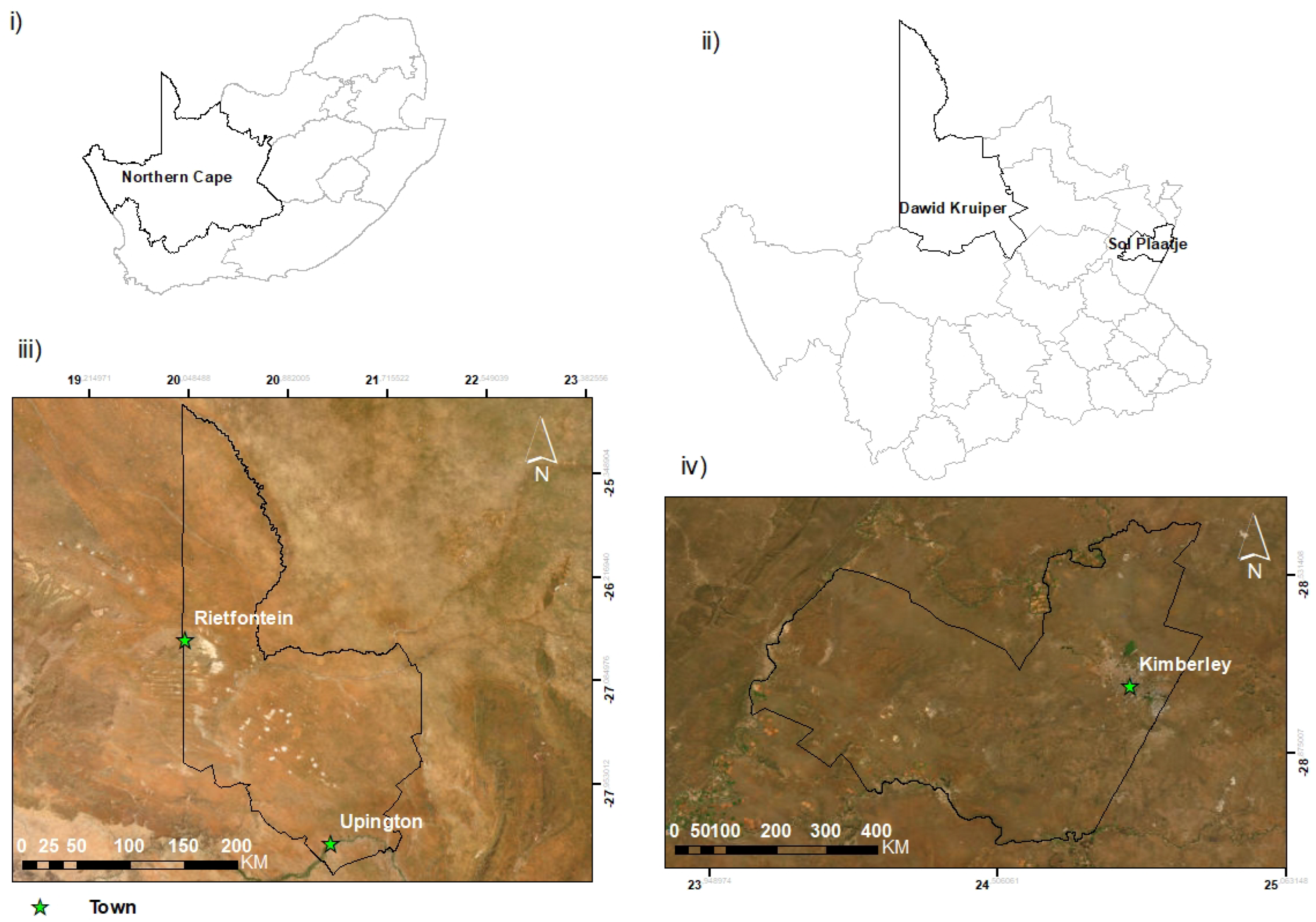
2.1. Study Area
2.2. Stakeholder Identification and Engagement
2.3. Data Collection Methods
- Sustainable land management and restoration
- Climate resilience strategies
- Soil Resource Management
- Geographic Information Systems (GIS) and remote sensing
- Water conservation and irrigation
- Policy awareness and environmental governance
- Sustainable agriculture
2.4. Data Analysis
- Frequency distributions and percentages were calculated in SPSS to summarise response patterns across all variables and determine the prevalence of identified skills gaps and training priorities.
- Mean proficiency scores were computed per competency domain to determine overall skill levels and relative competency performance among respondents.
- Comparative analysis across stakeholder groups was conducted using cross-tabulation functions to identify variations in technical capacity, knowledge levels, and perceived training needs between respondent categories.
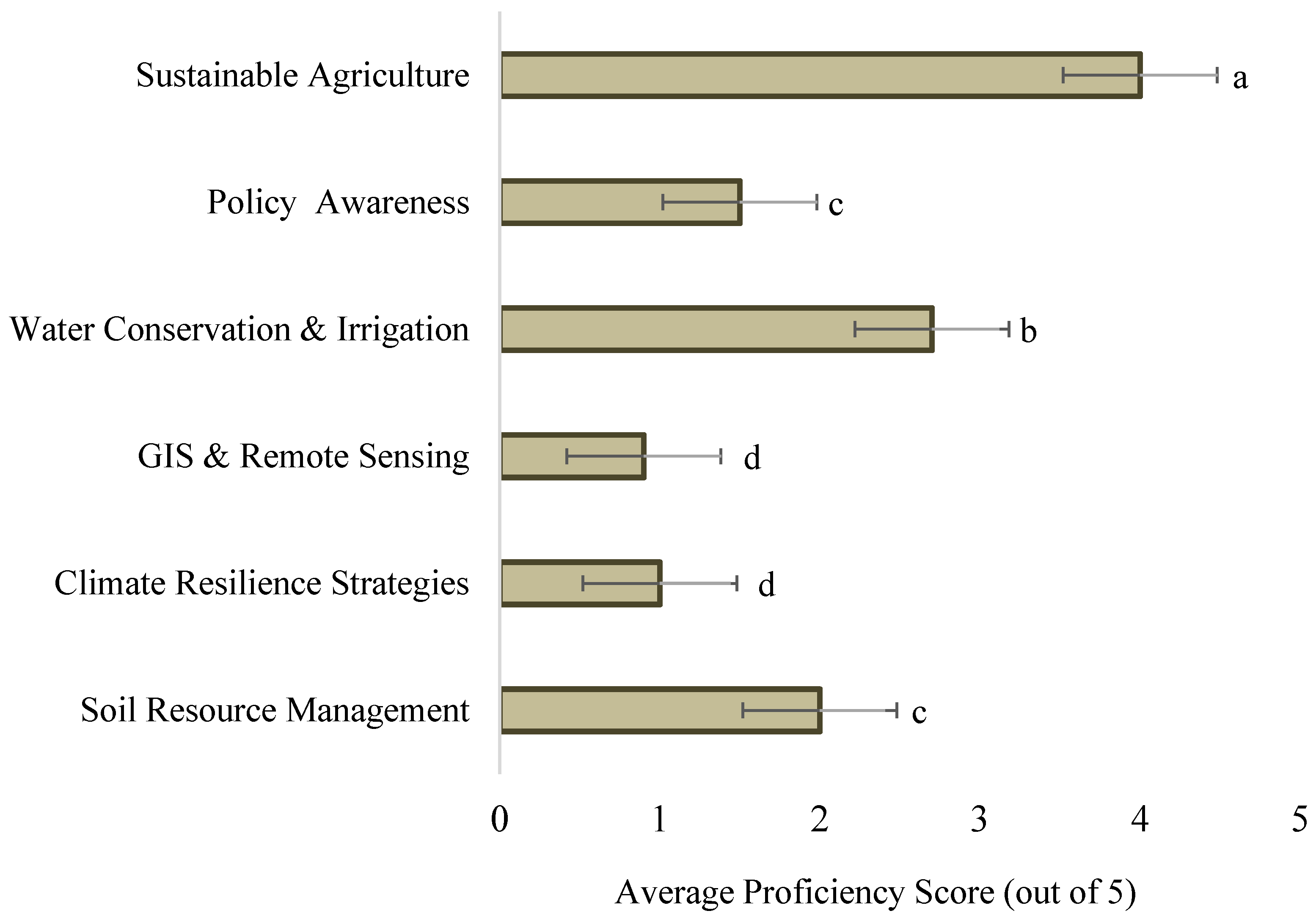
- Stakeholder existing skills proficiency in key areas was assessed using a 5-point Likert scale, where 0 indicated no knowledge, values closer to 1 represented limited knowledge, and 5 indicated advanced knowledge.
- Weighted score aggregations were generated to rank skills gaps from most critical to least critical based on aggregated proficiency indices derived from individual competency scores.
- Composite proficiency indices were developed by aggregating related competency variables within thematic domains to facilitate comparative interpretation of broader capacity-development requirements.
- Results were visualised using bar charts, clustered column charts, and comparative profile graphs developed in Excel and SPSS to enhance interpretability and support presentation of comparative findings across stakeholder groups and competency domains.
3. Results
3.1. Existing Skills Proficiency in Key Areas
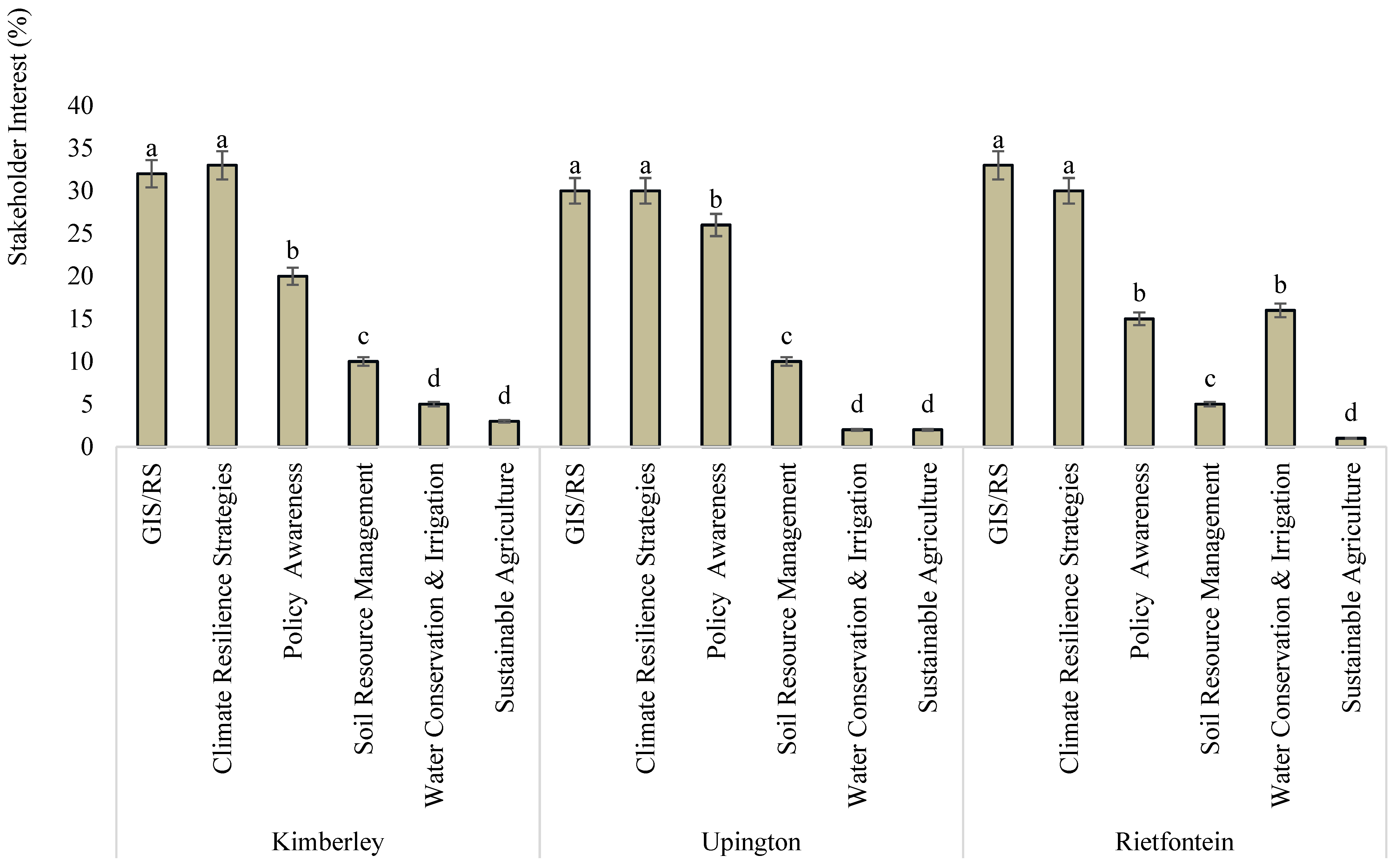
3.2. Stakeholder Interests in Capacity Building
3.3. Barriers to Skills Development
4. Discussion
4.1. Skills Gaps and Their Implications for NRM and SLM
4.2. Regional Challenges and Variability in Training Needs
4.3. Barriers to Skills Development
5. Conclusions
Author Contributions
Funding
Institutional Review Board Statement
Informed Consent Statement
Data Availability Statement
Acknowledgments
Conflicts of Interest
References
- Faling, W.; Tempelhoff, J.W.; van Niekerk, D. Rhetoric or action: Are South African municipalities planning for climate change? Dev. S. Afr. 2012, 29, 241–257. [Google Scholar] [CrossRef]
- Du Preez, C.C.; Van Huyssteen, C.W. Threats to soil and water resources in South Africa. Environ. Res. 2020, 183, 109015. [Google Scholar] [CrossRef]
- Dube, K. Nature-based tourism resources and climate change in southern Africa: Implications for conservation and development sustainability. In Protected Areas and Tourism in Southern Africa; Routledge: London, UK, 2022; pp. 161–174. [Google Scholar]
- Malongweni, S.O.; Mrubata, K.; van Tol, J.; Abd Elbasit, M.A.; Harebottle, D.M. Consequences of invasive prosopis (mesquite) on vegetation, soil health, biodiversity, and compliance of management practices in South African rangelands: A review. Grasses 2025, 4, 2. [Google Scholar] [CrossRef]
- Bahta, Y.T.; Myeki, V.A. The impact of agricultural drought on smallholder livestock farmers: Empirical evidence from Northern Cape, South Africa. Agriculture 2022, 12, 442. [Google Scholar] [CrossRef]
- Chari, M.M.; Hamandawana, H.; Zhou, L. Using geostatistical techniques to map adaptive capacities of resource-poor communities to climate change: A case study of Nkonkobe Local Municipality, Eastern Cape Province, South Africa. Int. J. Clim. Change Strateg. Manag. 2018, 10, 670–688. [Google Scholar] [CrossRef]
- Reid, H.; Faulkner, L.; Weisel, A. The Role of Community-Based Natural Resource Management in Climate Change Adaptation in Ethiopia; International Institute for Environment and Development: London, UK, 2013. [Google Scholar]
- Mondal, S.; Palit, D. Challenges in natural resource management for ecological sustainability. In Natural Resources Conservation and Advances for Sustainability; Elsevier: Amsterdam, The Netherlands, 2022; pp. 29–59. [Google Scholar]
- Novelli, M. Tourism and Development in Sub-Saharan Africa: Current Issues and Local Realities; Routledge: London, UK, 2015. [Google Scholar] [CrossRef]
- Favretto, N.; Dougill, A.J.; Stringer, L.C.; Afionis, S.; Quinn, C.H. Links between climate change mitigation, adaptation and development in land policy and ecosystem restoration projects: Lessons from South Africa. Sustainability 2018, 10, 779. [Google Scholar] [CrossRef]
- Liu, H.Y.; Jay, M.; Chen, X. The role of nature-based solutions for improving environmental quality, health and well-being. Sustainability 2021, 13, 10950. [Google Scholar] [CrossRef]
- National Planning Commission. National Development Plan 2030: Our Future—Make It Work; Government Printing Works: Pretoria, South Africa, 2012. Available online: https://www.gov.za/sites/default/files/gcis_document/201409/ndp-2030-our-future-make-it-workr.pdf (accessed on 17 December 2025).
- Department of Forestry, Fisheries and the Environment (DFFE). National Climate Change Response White Paper; Government of South Africa: Pretoria, South Africa, 2011. Available online: https://www.dffe.gov.za/sites/default/files/legislations/national_climatechange_response_whitepaper.pdf (accessed on 7 December 2025).
- Mutengwa, C.S.; Mnkeni, P.; Kondwakwenda, A. Climate-smart agriculture and food security in Southern Africa: A review of the vulnerability of smallholder agriculture and food security to climate change. Sustainability 2023, 15, 2882. [Google Scholar] [CrossRef]
- Mpala, T.A.; Simatele, M.D. Climate-smart agricultural practices among rural farmers in Masvingo District of Zimbabwe: Perspectives on mitigation strategies to drought and water scarcity for improved crop production. Front. Sustain. Food Syst. 2024, 7, 1298908. [Google Scholar] [CrossRef]
- Chisadza, B.; Gwate, O.; Musinguzi, S.P.; Mpofu, N.; Macherera, M.; Dube, T. Resilient agriculture in semi-arid Zimbabwe: Adaptation strategies and influencers among smallholder farmers. Discov. Agric. 2025, 3, 76. [Google Scholar] [CrossRef]
- International Labour Organization (ILO). Guidelines for a Just Transition Towards Environmentally Sustainable Economies and Societies for All; ILO: Geneva, Switzerland, 2023; Available online: https://www.ilo.org/sites/default/files/wcmsp5/groups/public/@ed_emp/@emp_ent/documents/publication/wcms_886544.pdf (accessed on 7 December 2025).
- Sibiya, N.P.; Das, D.K.; Vogel, C.; Mazinyo, S.P.; Zhou, L.; Kalumba, M.A.; Sithole, M.; Adom, R.K.; Simatele, M.D. Overcoming bureaucratic resistance: An analysis of barriers to climate change adaptation in South Africa. Climate 2023, 11, 145. [Google Scholar] [CrossRef]
- Islam, K.R.; Ragab, R.R.A.; Septian, R.T. Strengthening coastal cities and building climate resilience against climate change: Policy pathways for the Global South. Public Policy J. 2025, 6, 174–193. [Google Scholar] [CrossRef]
- Eelager, M.P.; Dalbanjan, N.P.; Madihalli, S.; Madar, M.; Agadi, N.P.; Korganokar, K.; Kiran, B.K. Pathways to a sustainable future: Exploring the synergy between sustainability and circular economy. Sustain. Futur. 2025, 10, 101208. [Google Scholar] [CrossRef]
- Van Aardt, A.C. Vegetation Ecology of the Putative Palaeo-Kimberley and Palaeo-Modder Rivers and Their Catchments, Free State, South Africa. Ph.D. Thesis, University of the Free State, Bloemfontein, South Africa, 2015. [Google Scholar]
- Mabin, A. Labour, capital, class struggle and the origins of residential segregation in Kimberley, 1880–1920. J. Hist. Geogr. 1986, 12, 4–26. [Google Scholar] [CrossRef]
- Hendler, P. The history of spatial planning and land use in South Africa. Urban Land Pap. Ser. 2015, 1, 21–33. [Google Scholar]
- Pululu, M.S.; Lobina, P.G.; Tabukeli, R.M. The Upper Orange River water resources affected by human interventions and climate change. Hydrol. Curr. Res. 2015, 6, 1000212. [Google Scholar] [CrossRef]
- Petja, B.M.; Nesamvuni, E.; Nkoana, A. Using geospatial information technology for rural agricultural development planning in the Nebo Plateau, South Africa. J. Agric. Sci. 2014, 6, 10–18. [Google Scholar] [CrossRef]
- Olatoye, T.A.; Fru, R.N. A review towards enhancing geospatial technologies in South African rural education. J. Cult. Values Educ. 2024, 7, 190–210. [Google Scholar] [CrossRef]
- Breetzke, G.; Eksteen, S.; Pretorius, E. Web-based GIS: A practical answer to the implementation of GIS education into resource-poor schools in South Africa. J. Geogr. 2011, 110, 148–157. [Google Scholar]
- Aggarwal, I.; Aggarwal, A. Integrating geospatial information systems for sustainable rural development. In Harnessing Geospatial Information Systems for Sustainable Economic and Regional Development; IGI Global Scientific Publishing: Hershey, PA, USA, 2026; pp. 55–70. [Google Scholar]
- Puppala, H.; Peddinti, P.R.; Tamvada, J.P.; Ahuja, J.; Kim, B. Barriers to the adoption of new technologies in rural areas: The case of unmanned aerial vehicles for precision agriculture in India. Technol. Soc. 2023, 74, 102335. [Google Scholar] [CrossRef]
- Sanders, S. An Investigation into the State of Environmental Education and the Use of Technology in Environmental Education in Gauteng, South Africa. Master’s Thesis, University of Johannesburg, Johannesburg, South Africa, 2018. [Google Scholar]
- Modise, J. Arid Land Adversity: Navigating Socioeconomic, Environmental and Governance Challenges in the Northern Cape Province; BP International: London, UK, 2024; pp. 1–368. [Google Scholar]
- Goodchild, M.F. Citizens as sensors: The world of volunteered geography. GeoJournal 2007, 69, 211–221. [Google Scholar] [CrossRef]
- Mulla, D.J. Twenty five years of remote sensing in precision agriculture: Key advances and remaining knowledge gaps. Biosyst. Eng. 2013, 114, 358–371. [Google Scholar] [CrossRef]
- Wolfert, S.; Ge, L.; Verdouw, C.; Bogaardt, M.J. Big data in smart farming—A review. Agric. Syst. 2017, 153, 69–80. [Google Scholar] [CrossRef]
- Morton, J.F. The impact of climate change on smallholder and subsistence agriculture. Proc. Natl. Acad. Sci. USA 2007, 104, 19680–19685. [Google Scholar] [CrossRef]
- Lal, R. Food security in a changing climate. Ecohydrol. Hydrobiol. 2013, 13, 8–21. [Google Scholar] [CrossRef]
- Intergovernmental Panel on Climate Change (IPCC). Climate Change 2022: Impacts, Adaptation and Vulnerability; Contribution of Working Group II to the Sixth Assessment Report of the Intergovernmental Panel on Climate Change; Cambridge University Press: Cambridge, UK, 2022. [Google Scholar]
- Reid, H.; Huq, S.; Murray, L.A.; Watson, C. Community-Based Adaptation to Climate Change; International Institute for Environment and Development: London, UK, 2009. [Google Scholar]
- Cousins, B. What is a ‘smallholder’? Class-analytic perspectives on small-scale farming and agrarian reform in South Africa. In Reforming Land and Resource Use in South Africa; Routledge: London, UK, 2010; pp. 102–127. [Google Scholar]
- Lal, R. Soil carbon sequestration impacts on global climate change and food security. Science 2004, 304, 1623–1627. [Google Scholar] [CrossRef]
- Lal, R. Restoring soil quality to mitigate soil degradation. Sustainability 2015, 7, 5875–5895. [Google Scholar] [CrossRef]
- Food and Agriculture Organization of the United Nations (FAO). The State of the World’s Land and Water Resources for Food and Agriculture (SOLAW)—Managing Systems at Risk; FAO: Rome, Italy, 2011. [Google Scholar]
- Pretty, J.; Toulmin, C.; Williams, S. Sustainable intensification in African agriculture. Int. J. Agric. Sustain. 2011, 9, 5–24. [Google Scholar] [CrossRef]
- Bryan, E.; Deressa, T.T.; Gbetibouo, G.A.; Ringler, C. Adaptation to climate change in Ethiopia and South Africa: Options and constraints. Environ. Sci. Policy 2009, 12, 413–426. [Google Scholar] [CrossRef]
- Davis, K.; Sulaiman, R. The new extensionist: Roles and capacities to strengthen extension and advisory services. J. Int. Agric. Ext. Educ. 2014, 21, 6–18. [Google Scholar] [CrossRef]
- Knowler, D.; Bradshaw, B. Farmers’ adoption of conservation agriculture: A review and synthesis of recent research. Food Policy 2007, 32, 25–48. [Google Scholar] [CrossRef]
- Food and Agriculture Organization of the United Nations (FAO). Building a Common Vision for Sustainable Food and Agriculture: Principles and Approaches; FAO: Rome, Italy, 2014. [Google Scholar]
- Reed, M.S. Stakeholder participation for environmental management: A literature review. Biol. Conserv. 2008, 141, 2417–2431. [Google Scholar] [CrossRef]



| Stakeholder Group | Number of Participants | Percentage (%) |
|---|---|---|
| Community Leaders and Members | 48 | 60 |
| Farmers and Land Users | 5 | 6.2 |
| Government Officials | 15 | 18.8 |
| NGO Representatives | 7 | 8.8 |
| Environmental Consultants | 5 | 6.2 |
| Total | 80 | 100 |
| Town | Stakeholder Category | GIS/RS (%) | Climate Resilience Strategies (%) | Policy Awareness (%) | Soil Resource Management (%) | Water Conservation & Irrigation (%) | Sustainable Agriculture (%) |
|---|---|---|---|---|---|---|---|
| Kimberley | Community Members | 12 b | 28 b | 22 b | 18 b | 14 b | 12 b |
| Farmers and Land Users | 7 c | 42 a | 36 a | 25 a | 30 a | 38 a | |
| NGOs | 18 b | 12 c | 20 b | 16 b | 10 c | 8 c | |
| Government Officials | 40 a | 5 d | 12 c | 15 b | 8 c | 4 d | |
| Environmental Consultants | 23 b | 13 c | 10 c | 26 a | 18 b | 18 b | |
| Upington | Community Members | 9 d | 18 b | 28 b | 16 b | 18 b | 20 b |
| Farmers and Land Users | 9 d | 54 a | 42 a | 68 a | 25 a | 35 a | |
| NGOs | 15 c | 8 c | 20 b | 2 c | 15 c | 10 c | |
| Government Officials | 38 a | 6 c | 2 c | 2 c | 10 c | 5 d | |
| Environmental Consultants | 29 b | 14 b | 8 c | 12 b | 12 c | 30 a | |
| Rietfontein | Community Members | 10 c | 25 b | 30 a | 20 b | 29 ab | 15 b |
| Farmers and Land Users | 6 c | 44 a | 32 a | 35 a | 38 a | 40 a | |
| NGOs | 18 b | 10 c | 22 b | 12 c | 20 b | 8 c | |
| Government Officials | 42 a | 5 c | 10 c | 15 b | 5 c | 5 c | |
| Environmental Consultants | 24 b | 16 b | 6 c | 18 b | 8 c | 32 a |
| Barrier | Stakeholders Affected (%) |
|---|---|
| Limited access to training programs | 50 |
| High costs of specialized training | 78 |
| Lack of digital infrastructure (for GIS & remote sensing) | 83 |
| Limited government support & funding | 80 |
| Language and literacy barriers | 55 |
Disclaimer/Publisher’s Note: The statements, opinions and data contained in all publications are solely those of the individual author(s) and contributor(s) and not of MDPI and/or the editor(s). MDPI and/or the editor(s) disclaim responsibility for any injury to people or property resulting from any ideas, methods, instructions or products referred to in the content. |
© 2026 by the authors. Licensee MDPI, Basel, Switzerland. This article is an open access article distributed under the terms and conditions of the Creative Commons Attribution (CC BY) license.
Share and Cite
Malongweni, S.O.; Harebottle, D.M. Assessing Skills Gaps and Capacity Needs for Climate-Resilient Natural Resource and Sustainable Land Management in the Northern Cape, South Africa. Sustainability 2026, 18, 5978. https://doi.org/10.3390/su18125978
Malongweni SO, Harebottle DM. Assessing Skills Gaps and Capacity Needs for Climate-Resilient Natural Resource and Sustainable Land Management in the Northern Cape, South Africa. Sustainability. 2026; 18(12):5978. https://doi.org/10.3390/su18125978
Chicago/Turabian StyleMalongweni, Siviwe Odwa, and Douglas M. Harebottle. 2026. "Assessing Skills Gaps and Capacity Needs for Climate-Resilient Natural Resource and Sustainable Land Management in the Northern Cape, South Africa" Sustainability 18, no. 12: 5978. https://doi.org/10.3390/su18125978
APA StyleMalongweni, S. O., & Harebottle, D. M. (2026). Assessing Skills Gaps and Capacity Needs for Climate-Resilient Natural Resource and Sustainable Land Management in the Northern Cape, South Africa. Sustainability, 18(12), 5978. https://doi.org/10.3390/su18125978