


Abstract
Across semi-arid and environmentally vulnerable regions, intensifying climate pressures, land degradation, and resource scarcity are placing growing demands on institutions, communities, and land users. However, the knowledge and technical skills required to respond effectively remain uneven and often poorly aligned with local needs. This study presents a comparative skills audit in Kimberley, Upington, and Rietfontein in the Northern Cape, identifying capacity gaps, stakeholder-specific training priorities, and structural barriers in natural resource and sustainable land management. Using questionnaires, semi-structured interviews, participatory site visits, and multi-stakeholder consultations, competencies were assessed across GIS and remote sensing, climate resilience, soil and land restoration, water conservation, sustainable agriculture, and policy literacy. Results show significant disparities in skills proficiency. GIS and remote sensing (0.8) and climate resilience strategies (1.0) were weakest, while policy literacy (1.5) and soil management (2.0) were also limited. Sustainable agriculture (4.0) and water conservation (2.8) showed relatively stronger capacity. Training needs varied by stakeholder, with government prioritizing geospatial tools and governance, and farmers emphasizing climate adaptation and resource management. Key barriers include limited digital infrastructure (83%), insufficient government support (80%), high training costs (78%), and contextual mismatches (50%). Integrated, place-based capacity development is essential to strengthen adaptive governance and long-term resilience.
1. Introduction
The intensifying impacts of climate change are reshaping socio-ecological systems across the globe, with semi-arid and arid regions facing disproportionate risks [1,2,3,4]. In Northern Cape, South Africa’s largest and sparsely populated province, the convergence of rising temperatures, recurrent droughts, land degradation, and socio-economic inequality presents profound challenges for sustainable land management and climate resilience [4]. The province’s climatic profile, characterized by low and highly variable rainfall, renders key sectors such as livestock farming, dryland agriculture, and mining particularly vulnerable to climate variability and long-term climatic shifts [5]. Against this backdrop, skills development emerges not merely as a policy instrument, but as a foundational pillar for building adaptive capacity, enhancing ecological stewardship, and enabling inclusive green growth [6]. Sustainable land management (SLM) and natural resource management (NRM) are widely recognized as a critical strategy for combating desertification, preserving biodiversity, and sustaining rural livelihoods in dryland environments [6,7,8]. In the Northern Cape, land degradation driven by overgrazing, invasive species, mining activities, and prolonged drought undermines ecosystem services and exacerbates rural poverty. Climate projections indicate increased frequency and severity of extreme heat events and drought conditions in southern Africa, intensifying pressures on already fragile landscapes [5,9,10,11]. Therefore, the transition to climate-resilient land-use systems requires a workforce equipped with technical, ecological, and adaptive skills that align with environmental sustainability and socio-economic transformation objectives.
Skills development for sustainable land and climate resilience encompasses formal education, vocational training, indigenous knowledge integration, and community-based learning. South African policy frameworks such as the National Development Plan 2030 emphasize the centrality of human capital development in achieving environmental sustainability and economic inclusion [12]. Furthermore, the National Climate Change Response White Paper underscores the need for capacity-building initiatives that strengthen local adaptive responses and promote low-carbon development pathways [13]. However, translating these policy ambitions into localized, context-responsive skills programmes in provinces like the Northern Cape remains uneven and underexplored in scholarly literature. In rural Northern Cape communities, many of which rely on communal rangelands and small-scale farming, adaptive capacity is closely tied to access to extension services, climate information, financial instruments, and technical training. Empirical studies in southern Africa suggest that targeted training in rangeland management, water conservation technologies, renewable energy systems, and climate-smart agriculture significantly enhances household-level adaptive capacity and reduces vulnerability [14,15,16]. The trainings also foster more locally appropriate and socially legitimate land-use practices [1].
The Northern Cape’s economic structure, anchored in agriculture and mining also presents unique opportunities for green skills development. The rapid growth of geospatial analysis projects in the province supports South Africa’s shift toward spatially informed decision-making and increases demand for technical skills in system installation, maintenance, environmental monitoring, and land rehabilitation [6]. Linking climate adaptation strategies with spatially guided interventions can simultaneously address unemployment and environmental degradation, particularly among youth and marginalized rural populations. Such an integrated approach reflects global calls for “just transitions” that balance decarbonization with social equity [17]. Despite these opportunities, systemic constraints persist. Limited institutional capacity, spatial isolation of rural communities, educational disparities, and resource limitations hinder the effective rollout of comprehensive skills programmes. Furthermore, climate resilience initiatives often remain project-based and externally driven, lacking sustained local ownership and long-term monitoring [18,19]. Addressing these gaps requires coordinated multi-level governance, stronger partnerships between higher education institutions, researchers, community representatives, traditional authorities, civil society organizations, environmental practitioners, and policymakers, as well as context-sensitive curriculum reform [13].
Skills development can serve as a transformative lever for advancing NRS, SLM and climate resilience in the Northern Cape. According to Eelager et al. [20], strengthening locally grounded skills ecosystems is essential to enabling climate vulnerable regions to navigate climate uncertainty, restore degraded landscapes, and pursue inclusive sustainable development in line with national and global climate commitments. This study therefore aims to assess existing skills gaps in NRM and SLM within both rural and municipal settings, focusing on three towns in the Northern Cape: Kimberley (Sol Plaatje Local Municipality) and Upington and Rietfontein (Dawid Kruiper Local Municipality). The study engages a range of stakeholders, including local community members and leaders, farmers and land users, government officials, non-governmental organization representatives, and environmental consultants, to identify priority skills development needs in areas such as climate resilience, land restoration, geospatial applications, water-use optimization and policy implementation. By working with these stakeholders, the study seeks to enhance climate resilience and promote ecological sustainability across the province. The goal is to integrate these thematic domains into a holistic understanding of the intersections between human capital development, ecological stewardship, and institutional capacity. This has the potential to advance the argument that climate resilience in the Northern Cape is not solely a matter of infrastructure or technology, but includes knowledge systems, governance structures, and community empowerment. Strengthening NRM skills is essential for restoring degraded landscapes, safeguarding water and soil resources, fostering inclusive green growth, and ensuring that the province navigates climate uncertainty with adaptive strength and social equity.
2. Materials and Methods
2.1. Study Area
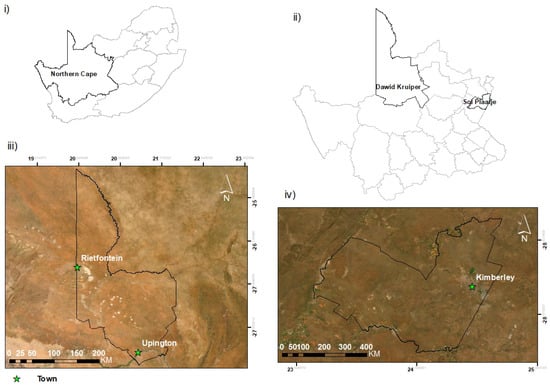
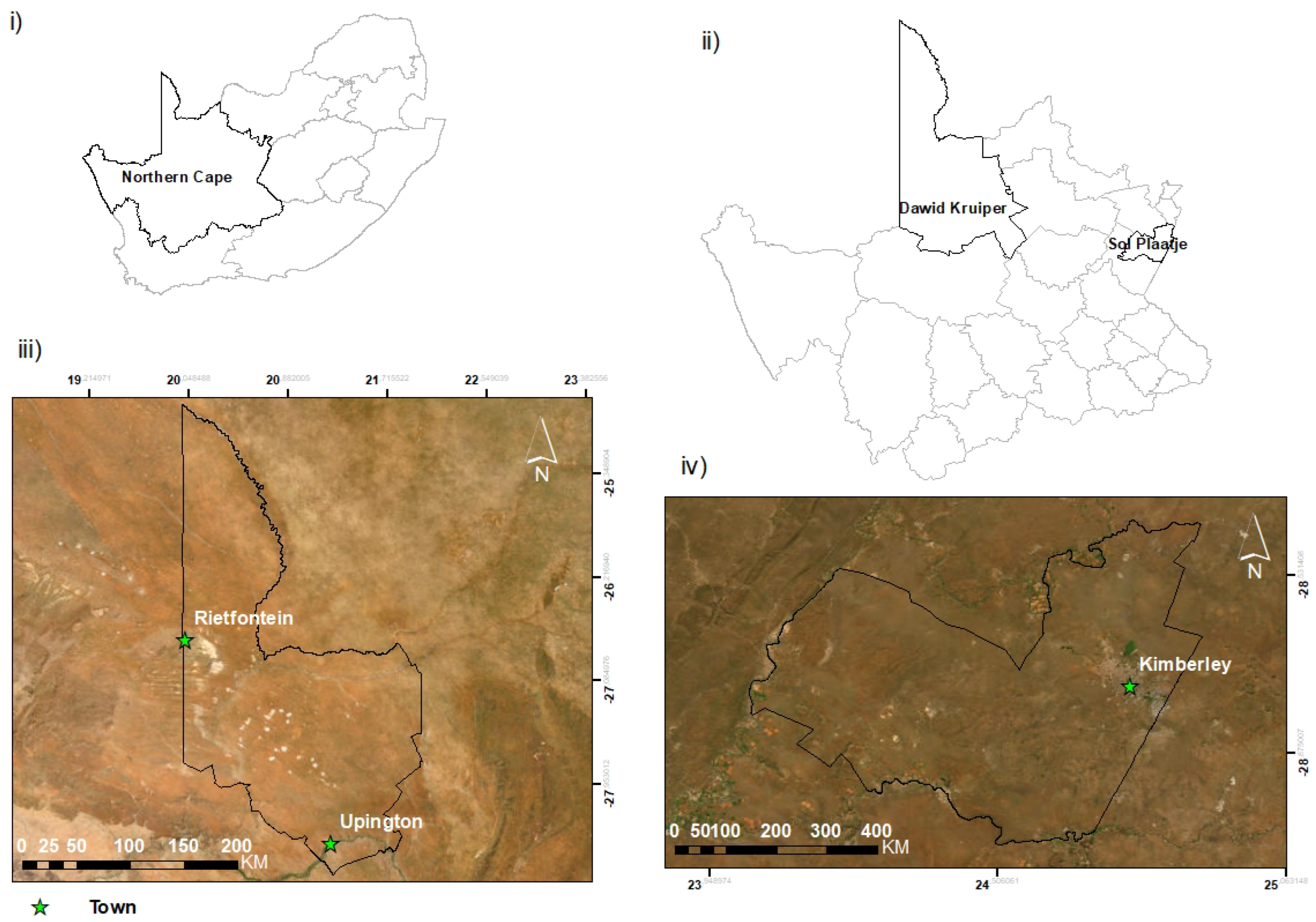
The research was conducted in Kimberley, Upington, and Rietfontein, three towns situated within the Northern Cape Province of South Africa, a region characterized by semi-arid to arid climatic conditions (Figure 1). Kimberley (28°43′ S, 24°45′ E) is the capital of the Northern Cape and lies within the Sol Plaatje Local Municipality of the Frances Baard District. The town forms a socio-economic and administrative hub with a semi-arid climate featuring hot, dry summers and mild, dry winters, and its surrounding plains and pans reflect typical Karoo-Karoo mosaic landscapes [21]. Kimberley’s history of urban development, mining, and peripheral agricultural activities situates it as a key centre for land-use interactions and resource governance in the region [22,23]. Upington (28°26′ S, 21°15′ E) in the Dawid Kruiper Local Municipality within the ZF Mgcawu District, is located along the northern banks of the Orange River. It is embedded in a desert context with hot desert (BWh) climatic conditions and notable temperature extremes. The presence of the Orange River supports extensive irrigated agriculture, particularly viticulture and fruit production, creating a strong interface between natural resource management and agricultural livelihoods [24]. Upington’s role as a commercial and agricultural centre amplifies its importance in regional water security and climate adaptive strategies. Rietfontein (26°44′ S, 20°01′ E) is a rural settlement in the Dawid Kruiper Local Municipality, ZF Mgcawu District, near the Namibia border. It exemplifies remote, low-density settlement patterns and operates as a border post community with livelihoods largely dependent on communal land and pastoral practices [4]. The region experiences low and highly variable rainfall and pervasive wind-driven erosion, influencing land degradation dynamics and local resource use.
Figure 1.
Study location (i) province where the study was conducted, (ii) local municipality within the province where the study was carried out, (iii,iv) specific towns (green star) within the municipalities where the study took place.
Collectively, these sites represent a gradient of socio-environmental contexts from rural-peri-urban-urban communal landscapes across two local municipalities. Their selection was informed by their differentiated roles within natural resource use, governance, and land management systems, which are central to evaluating training needs in sustainable land management, natural resource governance, and climate resilience within semi-arid ecosystems.
2.2. Stakeholder Identification and Engagement
A total of 80 respondents were identified using purposive sampling of entities directly involved in land restoration, sustainable agriculture, biodiversity conservation, climate adaptation, and environmental policy implementation. These included farmers and land users, community members, local government officials, non-Governmental Organizations (NGOs), environmental consultants and/or researchers (Table 1). Respondents were engaged through local agricultural and conservation organizations and government agencies responsible for environmental management and rural development.
Table 1.
Stakeholder Representation in the Study.
The sample size of 80 respondents was determined by the low population density of the study area and the limited number of stakeholders actively involved in natural resource and sustainable land management across the three selected towns in the Northern Cape. Given the purposive sampling approach, the study prioritized information-rich participants, and the sample size is consistent with established qualitative research practice where smaller samples are sufficient to reach thematic saturation and ensure analytical depth. The observed imbalance between stakeholder groups reflects the actual distribution and accessibility of relevant actors in the study sites, with community members and land users forming the largest and most directly engaged group, while institutional and technical stakeholders are comparatively fewer and less accessible. Despite this uneven distribution, the sample remains adequate to capture the key perspectives required to address the study objectives.
2.3. Data Collection Methods
Structured questionnaires were used to collect quantitative data on existing skills, knowledge gaps, previous training participation, and capacity-building needs. The questionnaires focused on the following themes:
- Sustainable land management and restoration
- Climate resilience strategies
- Soil Resource Management
- Geographic Information Systems (GIS) and remote sensing
- Water conservation and irrigation
- Policy awareness and environmental governance
- Sustainable agriculture
The questionnaires were administered both in-person and online, ensuring broad participation across different stakeholder groups.
2.4. Data Analysis
Data analysis was conducted using a descriptive statistical framework to provide a systematic and comprehensive assessment of existing competencies, institutional capacity constraints, and priority training needs among stakeholders involved in natural resource management and sustainable land management initiatives. Data derived from structured questionnaires were coded and analysed using IBM SPSS Statistics (version 29.0), with Microsoft Excel (Microsoft 365) used for data entry, preprocessing, and visual presentation of results. Questionnaire responses were initially captured and organised in Microsoft Excel, where each questionnaire item was assigned a predefined variable name and numerical code based on the study coding framework. A deductive–inductive hybrid approach was applied for organisation and tracking of codes, where initial coding was guided by the study’s predefined thematic domains (skills proficiency, training needs, institutional capacity, land-use practices, climate resilience, and policy implementation), while allowing additional themes to emerge inductively from the data.
Coding was conducted independently by two coders to enhance analytical reliability. Both coders first familiarised themselves with the transcripts through repeated reading before applying initial open codes to segments of text. A shared codebook was developed through iterative comparison of independently generated codes, and discrepancies were resolved through discussion and consensus. This process ensured consistency in code application and reduced subjective bias in theme generation. Inter-coder reliability was assessed using percentage agreement across coded segments, which exceeded the acceptable threshold for qualitative agreement prior to final theme consolidation. Following coding, related codes were grouped into categories and further refined into overarching themes through iterative review, comparison, and refinement. Final themes were derived based on recurrence, relevance to the research objectives, and conceptual coherence across stakeholder groups. This structured approach ensured that the qualitative findings were both reproducible and systematically derived from the dataset. Closed-ended responses, including Likert-type scale items and categorical variables, were converted into numerical values to facilitate statistical processing and subsequent importation into SPSS for analysis.
Prior to analysis, data cleaning procedures were conducted in Excel, including verification of completeness, removal of duplicate entries, standardisation of categorical variables, and consistency checks across all survey responses. Verification of completeness involved systematic screening of all questionnaire records to identify missing fields, incomplete responses, and partially completed questionnaires. Duplicate entries were identified through cross-referencing respondent identification numbers and demographic information, after which replicated, records were removed to prevent duplication bias within the dataset. Standardisation of categorical variables was undertaken by harmonising response categories and coding structures for variables such as stakeholder group, institutional affiliation, gender, and geographic location to ensure consistency in statistical classification. Consistency checks were further performed by comparing related responses across questionnaire sections to identify logical discrepancies, coding inconsistencies, and anomalous entries, which were subsequently corrected through verification against the original survey instruments prior to final analysis in SPSS.
The proficiency levels captured using a structured Likert-type scale were subsequently converted into numerical scores for statistical analysis. The scoring system enabled the quantification of perceived competency levels, allowing comparison across stakeholder groups and thematic areas. The following analytical steps were applied:
- Frequency distributions and percentages were calculated in SPSS to summarise response patterns across all variables and determine the prevalence of identified skills gaps and training priorities.
- Mean proficiency scores were computed per competency domain to determine overall skill levels and relative competency performance among respondents.
- Comparative analysis across stakeholder groups was conducted using cross-tabulation functions to identify variations in technical capacity, knowledge levels, and perceived training needs between respondent categories.
- Stakeholder existing skills proficiency in key areas was assessed using a 5-point Likert scale, where 0 indicated no knowledge, values closer to 1 represented limited knowledge, and 5 indicated advanced knowledge.
- Weighted score aggregations were generated to rank skills gaps from most critical to least critical based on aggregated proficiency indices derived from individual competency scores.
- Composite proficiency indices were developed by aggregating related competency variables within thematic domains to facilitate comparative interpretation of broader capacity-development requirements.
- Results were visualised using bar charts, clustered column charts, and comparative profile graphs developed in Excel and SPSS to enhance interpretability and support presentation of comparative findings across stakeholder groups and competency domains.
The proficiency ranking system was designed to identify priority capacity development areas by transforming subjective self-assessments into structured comparative indices. This approach allowed for the identification of dominant skills gaps at both individual and stakeholder-group levels, thereby supporting targeted interpretation of training needs.
3. Results
3.1. Existing Skills Proficiency in Key Areas
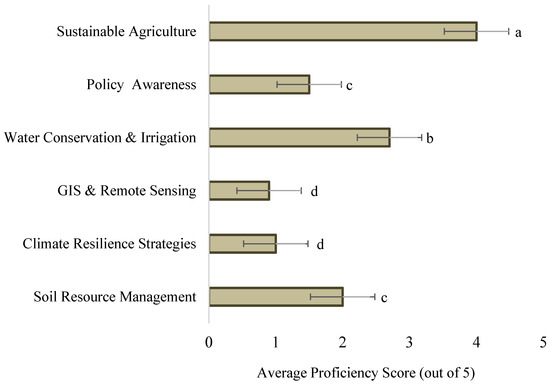
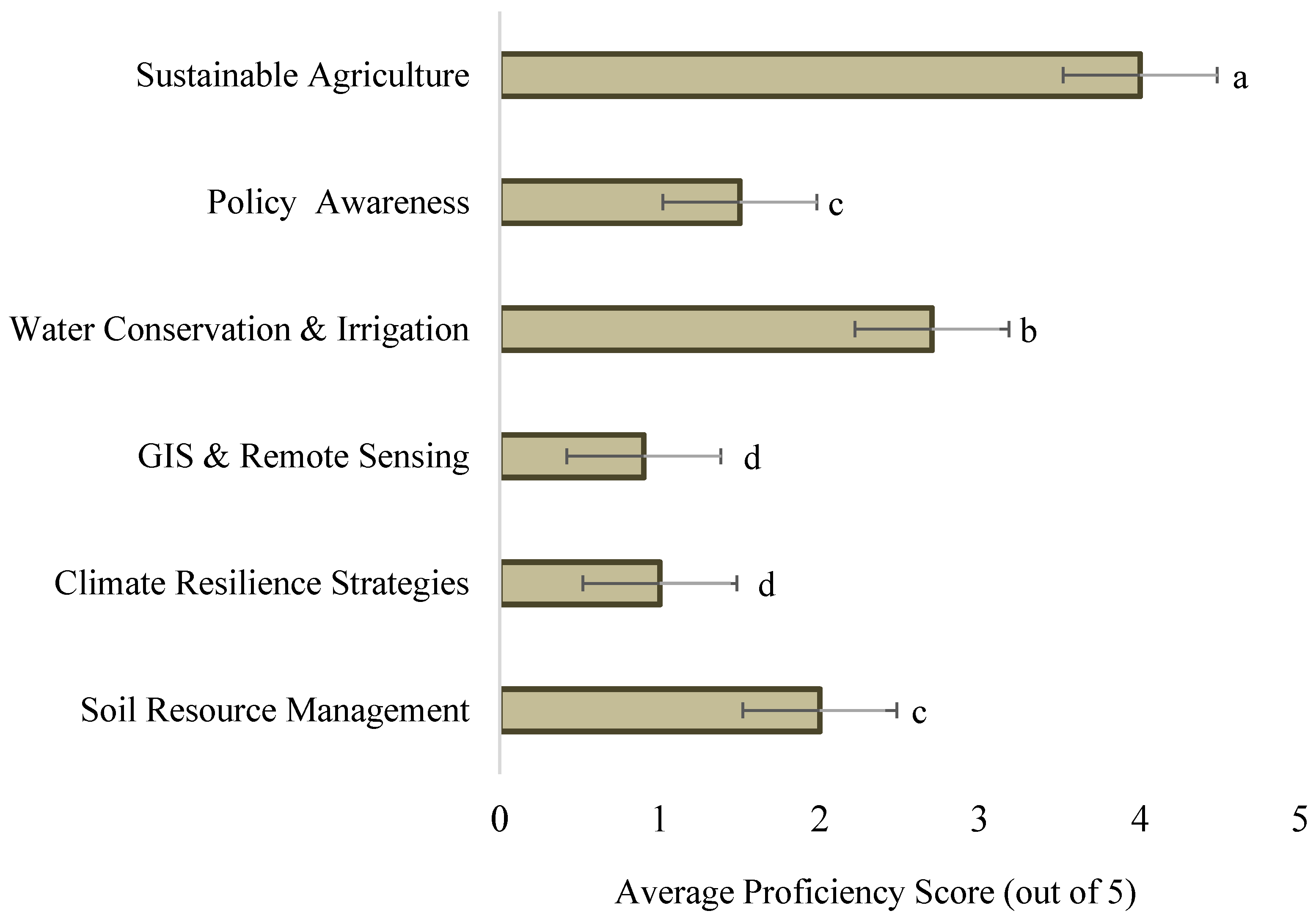
The stakeholders rated their proficiency in key NRM, SLM and climate resilience skills on a Likert scale (Figure 2). GIS and Remote Sensing (0.8) and Climate Resilience Strategies significantly (1) had the lowest average proficiency scores than other skills (p ≤ 0.05), indicating a severe knowledge gap in mapping and land monitoring. Policy Awareness (1.5) and soil resource management (2) also had significantly lower proficiency scores than sustainable agriculture (4), water conservation and irrigation (2.8), suggesting a need for capacity-building in climate adaptation and policy frameworks. Sustainable Agriculture was among the significantly stronger areas, where most of the stakeholders indicated the highest skills proficiency.
Figure 2.
Stakeholder existing skills proficiency in key areas (different letters indicate significant differences at p ≤ 0.05).
3.2. Stakeholder Interests in Capacity Building
Analysis of stakeholder interests in capacity-building priorities across the three towns revealed statistically significant differences among stakeholder groups (p ≤ 0.05) (Table 2). Interest in GIS and remote sensing was consistently highest among government officials across all sites. In contrast, policy awareness and climate-resilient strategies attracted greater interest from farmers and land users in Kimberley and Upington. In Rietfontein, these themes generated broader engagement, with significant interest expressed by farmers, land users, community members, and local leaders.
Table 2.
Skills gaps training needs (%) identified by stakeholders across the study sites.
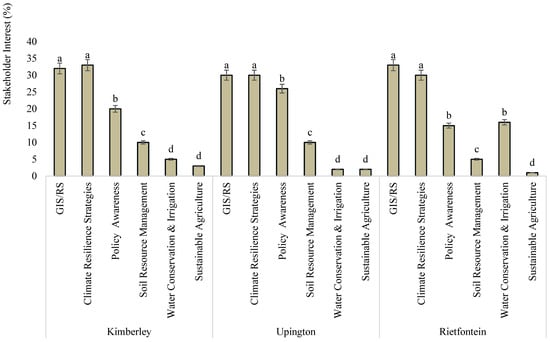
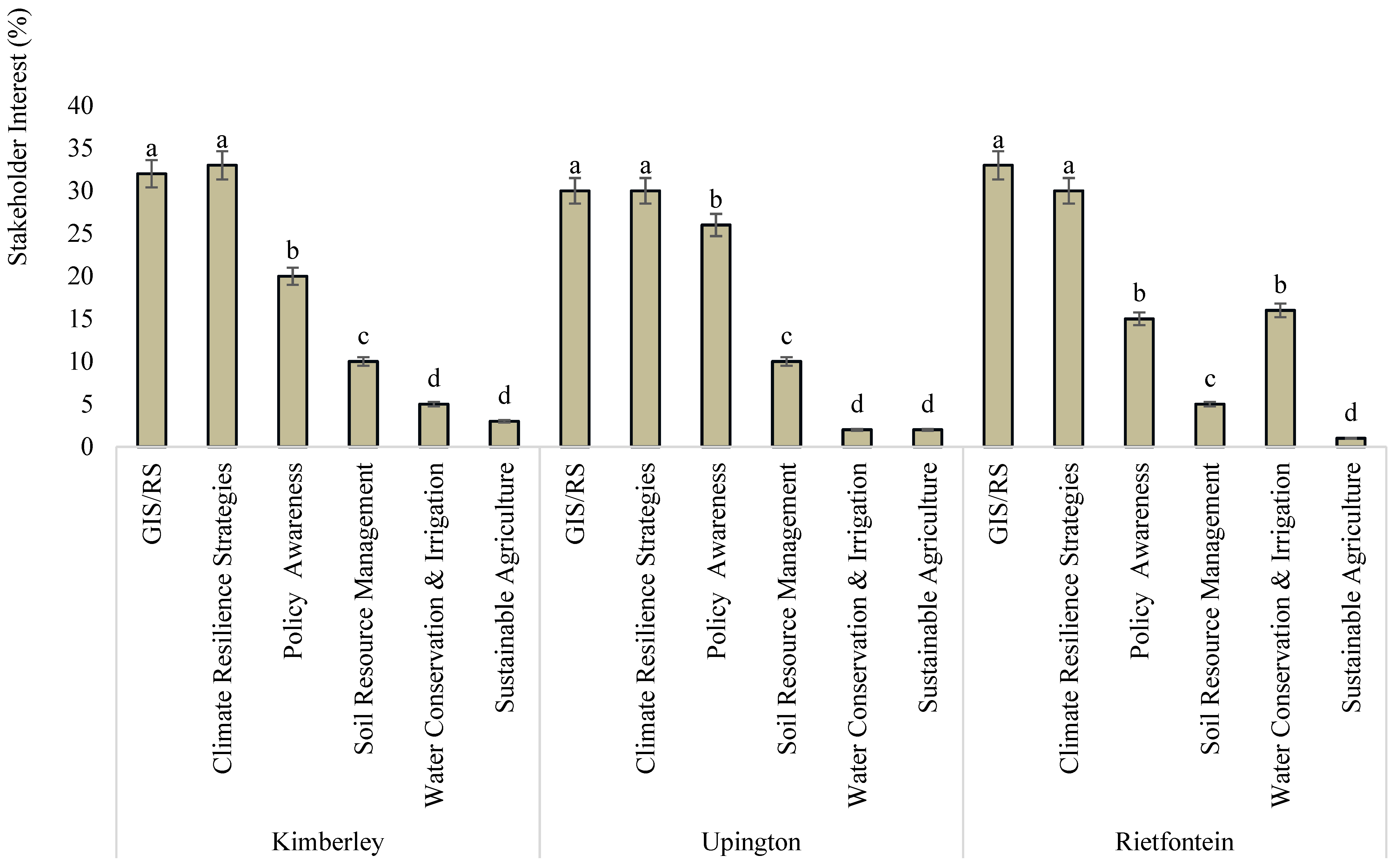
Across the three towns, distinct patterns in capacity-building priorities were observed (Figure 3). GIS and remote sensing and (32% for Kimberley and Rietfontein and 30% for Upington) climate resilience strategies (33% for Kimberley and 30% for Upington and Rietfontein) were consistently prioritized across the three towns, with Kimberley, Upington, and Rietfontein showing significantly (p ≤ 0.05) greater interest in these skills compared with other skills gaps. In both Kimberley and Upington, water conservation and irrigation (5% for Kimberley and 2% for Upington) and sustainable agriculture (3% for Kimberley and 2% for Upington) were ranked significantly lower than all other skills, making them the lowest-priority capacity needs in these towns. In contrast, Rietfontein displayed a slightly different pattern with only sustainable agriculture (1%) ranking as the significantly lowest priority. Stakeholders in Rietfontein showed significantly greater interest in water conservation and irrigation (16%) than those in Kimberley and Upington. Unlike Kimberley and Upington, stakeholders in Rietfontein expressed greater interest in water conservation and irrigation than in soil resource management and sustainable agriculture; however, this interest did not differ significantly from that in policy awareness and land governance within the town.
Figure 3.
Comparative capacity-building (regional training) priority interests across the study sites (different letters indicate significant differences at p ≤ 0.05).
3.3. Barriers to Skills Development
Stakeholders reported multiple barriers limiting their ability to acquire effective skills in natural resource management and sustainable land management (Table 3). From a purely descriptive numerical perspective, the most frequently cited constraint was the lack of digital infrastructure to support GIS and remote sensing applications (83%). This constraint was reported more frequently than any other limiting factor. Limited government support and inadequate funding were the second most cited barriers (80%). Participants indicated that financial constraints restricted both the availability of training opportunities and their ability to attend such programmes (50%). Where individuals attended training at their own expense, the high cost of specialised courses (78%) was reported as a significant obstacle. Limited access to training programmes, particularly in remote areas, further constrained participation. Even when opportunities were available, associated travel and registration costs were described as prohibitive, especially for specialised technical training. Language and literacy barriers (55%) were also noted. Most participants reported greater proficiency in Afrikaans, whereas many training programmes were facilitated in English by external providers.
Table 3.
Barriers to skills development in natural resource management (NRM) and sustainable land management (SLM).
4. Discussion
4.1. Skills Gaps and Their Implications for NRM and SLM
Stakeholders demonstrated significantly lower proficiency in geospatial and analytical skills, specifically GIS and remote sensing and climate resilience strategies, compared to other skill domains. This finding aligns with broader empirical evidence from Southern Africa, where technical capacity constraints in spatial analytics and resilience planning are widely documented [25,26]. Specifically, Olatoye and Fru [26] note that insufficient familiarity with geospatial technologies limits effective decision-making in rural climate adaptation planning. In the Northern Cape and similar arid regions, such skills are often under-prioritised in formal education and professional training, partly because GIS and climate modelling require specialised training in expensive and less widely available software applications in rural and peri-urban settings [27]. This pattern reflects structural challenges in many African communities where higher-order technical fields are less integrated into mainstream professional development pathways [28]. This is further reflected in global capacity assessments which highlight that, despite the increasing importance of spatial data for environmental planning, access to and use of remote sensing remains constrained by limited technical skills and inadequate training opportunities [27,29]. In South Africa specifically, university curricula and extension services have historically emphasised conventional agricultural and water management practices, with less emphasis on advanced spatial analytics [30].
Sustainable agriculture significantly had the highest proficiency score, followed by water conservation and irrigation. This is consistent with the findings of Mpala and Simatele [15] who observed that smallholder communities and agricultural extension networks in Southern Africa tend to prioritise sustainable agronomic practices and water management due to their immediate relevance for food security and livelihoods. Sustainable agriculture frequently features in local training programs and extension services, making it more familiar to stakeholders [14]. Similarly, water conservation and irrigation practices have received considerable attention through government and NGO training initiatives, especially given recurrent droughts in the region [31]. These factors may contribute to higher self-reported proficiency in these domains compared to more specialised technical skills. There were no significant differences in proficiency between policy awareness and soil resource management. Both domains had moderate scores, which suggests that basic understanding of environmental policy and soil stewardship is relatively widespread among respondents. This may stem from national policy emphasis legislative frameworks, such as the National Climate Change Response White Paper and soil conservation policies, which has been widely disseminated through extension services [13]. Furthermore, basic soil resource management is often embedded in agricultural training programs and is considered essential knowledge for land managers [14]. The comparable proficiency scores may thus reflect shared exposure to these foundational topics through formal and informal training channels. Overall, the highly practical and livelihood-oriented skills outperformed the advanced technical competencies. This points to a need for targeted capacity-building interventions in geospatial and resilience planning domains. Strengthening these competencies through formal training and institutional support could enhance adaptive capacity and evidence-based planning at local and regional scales by enabling local communities to optimize land use, track drought patterns, and improve irrigation efficiency. The lack of GIS skills and climate resilience strategies prevents local communities from making data-driven decisions to protect rangelands and water resources.
4.2. Regional Challenges and Variability in Training Needs
The findings reveal clear stakeholder-specific patterns in capacity-building priorities across Kimberley, Upington, and Rietfontein. Across all three towns, GIS and remote sensing training attracted predominantly government officials, indicating a strong institutional demand for spatial decision-support tools. This trend aligns with the broader literature highlighting the growing reliance of public sector institutions on geospatial technologies for land-use planning, environmental monitoring, and climate adaptation planning [26,32]. The heightened interest among government officials may reflect increasing policy pressure to adopt evidence-based planning tools and digital governance frameworks. Conversely, farmers and land users in Kimberley and Rietfontein, as well as NGOs in Upington, demonstrated comparatively lower interest in GIS and remote sensing. This may be explained by disparities in technical capacity, perceived accessibility, and immediate applicability. Previous studies have shown that while geospatial technologies offer substantial benefits for agricultural decision-making, uptake among smallholder or land-based practitioners is constrained by limited technical literacy and resource availability [33,34]. Thus, the lower expressed interest does not necessarily reflect irrelevance, but rather structural and contextual barriers to adoption.
Climate resilience strategies attracted substantial interest among farmers and land users across the three study sites. This pattern is consistent with evidence that primary producers are the most directly affected by climate variability and extreme events. The agricultural sector’s vulnerability to drought, temperature increases, and rainfall variability has been widely documented [35,36,37]. As a result, farmers’ strong interest in climate resilience training reflects lived experience with climatic shocks and a reasonable need for adaptation tools. However, NGOs and government officials in rural (Rietfontein) and peri-urban (Upington) localities showed comparatively lower interest in climate resilience strategies, and in Kimberley (urban), NGOs and environmental consultants expressed less interest relative to farmers, respectively. One possible explanation is that institutional actors may perceive climate resilience as already integrated into existing mandates or frameworks, thereby reducing the urgency for additional training. Alternatively, institutional actors may prioritize technological or policy-oriented competencies over practice-based adaptation strategies. Nonetheless, the comparatively lower NGO interest is noteworthy, given that they often play key roles in climate adaptation facilitation [38]. This suggests potential misalignment between institutional programmes and grassroots adaptation needs. Policy awareness emerged as an area of high interest among farmers across all three towns. This is consistent with findings that regulatory compliance, land reform processes, water licensing, and environmental legislation directly affect farming operations in South Africa [39]. Farmers’ demand for policy literacy may reflect increasing regulatory complexity and the need to align farm-level practices with national frameworks such as climate adaptation policies and sustainable land management guidelines. Enhanced policy awareness may improve adaptive capacity by strengthening farmers’ ability to access state support, subsidies, and risk-management mechanisms [6].
Soil resource management similarly attracted strongest interest from farmers and land users across the sites, with no significant difference between farmers and environmental consultants in Kimberley. This convergence suggests shared recognition of soil degradation risks in semi-arid systems. Lal [40,41] emphasise that soil restoration and management are central to climate resilience and agricultural sustainability, particularly in drylands where soil organic matter decline directly threatens productivity. Farmers’ prioritisation of soil management is therefore consistent with livelihood dependency, while environmental consultants’ comparable interest in Kimberley likely reflects professional engagement with land degradation assessments. NGOs in Rietfontein and both NGOs and government officials in Upington showed comparatively lower interest in soil resource management. This may reflect institutional distance from direct soil management practices. It also suggests that soil management is perceived primarily as an operational rather than strategic or advocacy-oriented issue, even though sustainable land management is central to broader environmental governance objectives. Water conservation and irrigation training elicited strong interest from farmers and land users across all sites, reinforcing the centrality of water security in arid regions. In Kimberley and Upington, NGOs and government officials showed the least interest, while in Rietfontein it was government officials and environmental consultants who expressed lower demand. Given the Northern Cape’s water scarcity challenges, farmers’ strong interest is expected and aligns with literature emphasizing irrigation efficiency and water management as key adaptation strategies in water-limited environments [42]. Notably, in Rietfontein, interest in water conservation and irrigation was considerably higher relative to the other two towns, suggesting heightened local awareness of water stress or irrigation dependency. This variation underscores the importance of site-specific hydrological and agricultural contexts in shaping training priorities. Sustainable agriculture consistently attracted strongest interest from farmers and land users across all towns, while NGOs showed least interest, and government officials showed comparatively lower demand in Rietfontein. This aligns with evidence that sustainable agriculture is directly tied to livelihood security and productivity enhancement in African drylands [43]. Pretty et al. [43] argue that sustainable intensification practices are adopted when they simultaneously improve resilience and yields. The relatively lower comparative interest observed in Upington and Rietfontein may indicate existing baseline exposure to sustainable agriculture training or greater urgency around other climate-related skills.
When comparative priority interests were assessed within each town, Kimberley and Upington respondents demonstrated significantly higher overall interest in GIS and remote sensing and climate resilience strategies relative to other skills. This suggests increasing recognition of the importance of spatial analytics and adaptive planning in semi-arid systems where climate variability is pronounced. The growing emphasis on climate risk mapping and environmental monitoring in South Africa supports this interpretation [44]. The elevated demand may therefore reflect institutional and cross-sector awareness that data-driven decision-making is becoming central to land and climate governance. This also reflects a broader global shift toward digital and spatially enabled governance [32]. Water conservation and irrigation ranked lowest in Kimberley and both water conservation and sustainable agriculture ranked lowest in Upington. In Rietfontein, sustainable agriculture ranked lowest, and water conservation and irrigation attracted comparatively strong interest relative to the other towns. This is because acute water scarcity and drought vulnerability in this desert town elevate water conservation and irrigation as more immediate and pressing training priorities. At the same time, farmers’ strong and consistent interest in climate resilience, soil management, water conservation, sustainable agriculture, and policy awareness underscores their frontline exposure to environmental and regulatory pressures.
4.3. Barriers to Skills Development
The findings indicate that the most significant barrier to skills development in NRM and SLM across the study sites is the lack of adequate digital infrastructure to support GIS and remote sensing applications. This constraint affected the majority of stakeholders and was consistently ranked as the most limiting factor. In rural and semi-arid regions, digital exclusion remains a structural challenge, limiting the effective uptake of geospatial technologies that require reliable internet connectivity, appropriate hardware, and technical support systems. Without foundational digital infrastructure, even highly motivated stakeholders, particularly government officials who expressed strong interest in GIS and remote sensing, are unable to translate training into practical application. This aligns with broader literature emphasizing that technological adoption in environmental governance is contingent not only on skills, but also on enabling infrastructure and institutional readiness [32,34]. The second most prominent barrier identified was limited government support and funding. Stakeholders indicated that while skills development is often recognized as important, financial and institutional backing remains insufficient. In South Africa, fiscal constraints, competing service delivery priorities, and administrative capacity limitations frequently affect the implementation of environmental and agricultural support programs [12]. Limited public investment in extension services, training subsidies, and technical support restricts stakeholders’ ability to participate in specialized programs, particularly those related to advanced technologies such as remote sensing. The erosion or under-capacitation of agricultural extension services in parts of sub-Saharan Africa has been widely recognised as a constraint to agricultural innovation and sustainable land management uptake [45]. Consequently, even when training opportunities exist, they are not always systematically supported through coordinated policy frameworks or sustained funding streams. Closely linked to limited government support is the high cost of specialized training, which emerged as the third most significant barrier. Training in geospatial technologies and advanced environmental management often involves registration fees, travel expenses, software licensing, and consultancy costs. For farmers and land users who already operate with limited budgets, these costs can be prohibitive. Knowler and Bradshaw [46] highlight financial constraints as a central factor limiting participation in capacity-building initiatives. Respondents further noted that when they seek advice independently from consultants who are more familiar with their local environmental conditions, this consultation is frequently self-funded, increasing the economic burden. These dynamics underscore the inequity between institutional stakeholders, who may have budget allocations for professional development, and individual land users, who must absorb training costs personally.
Limited access to training programs was ranked as the least significant barrier. Stakeholders acknowledged that training opportunities do occur; however, they are not always appropriately designed or contextually grounded. This nuance is important because physical availability of training does not equate to accessibility in practical or socio-cultural terms. Language and literacy barriers, although ranked lower overall, revealed deeper structural challenges. Many training sessions are facilitated in English by trainers from outside the region, while a significant proportion of respondents are more comfortable with Afrikaans. Research on adult education and agricultural extension emphasizes that language congruence and contextual relevance are critical for effective knowledge transfer [47]. When training content is delivered in a language that is not the participants’ primary medium of comprehension, retention and practical application are compromised. Furthermore, facilitators unfamiliar with local socio-ecological conditions may struggle to contextualize examples to semi-arid farming systems, thereby limiting perceived relevance. This mismatch between externally designed training programs and local realities reflects broader critiques of top-down capacity-building models in environmental governance. Sustainable land management interventions are most effective when they incorporate local knowledge systems, participatory approaches, and context-specific adaptation strategies [48]. When training providers are disconnected from community livelihoods, cultural norms, and environmental conditions, stakeholders may perceive programs as generic or misaligned with their lived experiences. Even where stakeholders attend such programs, the need to subsequently consult locally knowledgeable experts indicates that formal training does not fully meet their practical needs. Taken together, the identified barriers illustrate that capacity development in NRM and SLM is shaped by intersecting infrastructural, financial, institutional, and socio-linguistic factors. The predominance of digital infrastructure constraints highlights the foundational role of connectivity and technological ecosystems in enabling modern environmental management tools. Limited government support and high training costs reflect systemic funding and institutional challenges that disproportionately affect individual land users. Meanwhile, language dynamics and contextual mismatches reveal that accessibility extends beyond physical availability to include cultural and epistemic relevance. Addressing these barriers therefore requires a multi-layered approach: investment in rural digital infrastructure, strengthened public support mechanisms for training subsidies, integration of locally grounded extension models, and multilingual, context-sensitive training delivery. Without such systemic adjustments, efforts to promote NRM and SLM competencies may remain uneven and inequitable across stakeholder groups.
5. Conclusions
The findings indicate that stakeholders demonstrated the highest skills proficiency in sustainable agriculture, followed by water conservation and irrigation, highlighting stronger practical knowledge in these areas across the study sites. In contrast, GIS and remote sensing, together with climate resilience strategies, represented the weakest areas of competency, while policy awareness and soil resource management also reflected notable skills gaps. Government officials primarily identified the need for training in GIS and remote sensing, whereas farmers and land users expressed greater demand for training in climate resilience, policy awareness, soil resource management, water conservation, irrigation, and sustainable agriculture. Spatial differences were also evident, with Kimberley and Upington showing greater interest in GIS and climate resilience, while in Rietfontein, farmers, community members, and environmental consultants demonstrated similar levels of interest and proficiency in sustainable agriculture and water conservation practices. These findings underscore the urgent need for a strategically coordinated and context-responsive approach to capacity development in NRM and SLM across the study sites. Substantial deficits persist in GIS and remote sensing, climate resilience strategies, policy awareness, and soil resource management. These gaps are particularly concerning in arid regions where spatial monitoring, adaptive planning, and regulatory literacy are central to long-term sustainability and climate adaptation. The uneven distribution of competencies suggests that technical, analytical, and governance-oriented capacities require deliberate strengthening. Stakeholder-specific patterns further highlight the differentiated nature of capacity needs. Institutional actors exhibit demand for advanced geospatial and decision-support tools, while farmers and land users prioritize applied resilience, land stewardship, and policy-related competencies. Such divergence reinforces the importance of tailored, rather than uniform, training frameworks. At the same time, the consistency of interest in climate resilience and geospatial technologies across sites reflects a shared recognition of emerging environmental risks and the need for more sophisticated management tools. The persistence of structural barriers reveals that skills development is embedded within broader socio-economic and institutional systems. Without reliable technological infrastructure and sustained public investment, efforts to enhance technical competencies are unlikely to achieve meaningful or lasting impact. Moreover, the linguistic and contextual relevance of training provision remains essential to ensuring that knowledge transfer translates into practical application. Effective capacity development therefore requires more than the provision of courses; it demands enabling conditions that address affordability, accessibility, institutional coordination, and socio-cultural appropriateness. Overall, the study demonstrates that strengthening NRM and SLM outcomes in these arid and/or semi-arid environments depends on an integrated model of capacity enhancement that bridges technological innovation with grounded, practice-oriented knowledge systems. Building resilience and sustainable land stewardship will require investments that simultaneously close digital and analytical skill gaps, reinforce policy literacy, and support locally relevant adaptation strategies. By aligning stakeholder-specific needs with systemic support mechanisms, capacity-building interventions can move beyond fragmented training efforts toward a coherent framework that advances environmental sustainability, climate resilience, and equitable resource governance. These findings provide an evidence base to inform policy formulation, institutional planning, and practical interventions aimed at strengthening capacity development in NRM and SLM. Future research should evaluate the effectiveness of the proposed interventions and assess their applicability and scalability across comparable semi-arid environments and socio-ecological conditions.
Author Contributions
Conceptualization, S.O.M.; Methodology, S.O.M.; Formal analysis, S.O.M.; Resources, D.M.H.; Data curation, S.O.M.; Writing—original draft, S.O.M.; Project administration, D.M.H.; Funding acquisition, D.M.H. All authors have read and agreed to the published version of the manuscript.
Funding
This research was supported by the Global Environment Facility (GEF) under Project ID 10179: “Mainstreaming Sustainable Land Management (SLM) for Large-Scale Impact in the Grazing Lands of Limpopo and Northern Cape provinces in South Africa.” The project is implemented through the International Union for Conservation of Nature (IUCN), in collaboration with the Department of Forestry, Fisheries and the Environment (DFFE) and the Department of Agriculture, Land Reform and Rural Development (DALRRD), South Africa.
Institutional Review Board Statement
The study was conducted in accordance with the Declaration of Helsinki and approved by the Senate Research Ethics Committee (SREC) (protocol code SREC 03b40/2025, 8 April 2025).
Informed Consent Statement
Participation in the study was based on verbal consent. All stakeholders involved form part of the project and were informed of the study and its purpose prior to participation. It was clearly indicated that those who did not wish to participate, or did not consent to the use of their data, could opt out. The dataset used therefore only includes information from participants who were aware of and consented to the use of their data for research purposes.
Data Availability Statement
The data presented in this study are available on request from the corresponding author due to the inclusion of stakeholder consultation data.
Acknowledgments
We would like to express our sincere gratitude to the stakeholders who participated in this study, including farmers, community members, local leaders, government officials, and representatives from NGOs. Their insights and contributions were invaluable in assessing the skills gaps in natural resource management and climate resilience in the Northern Cape. We extend our appreciation to the Dawid Kruiper Municipality and stakeholders from Kimberley, Upington, and Rietfontein for their support and collaboration throughout the research process. Lastly, we acknowledge the contributions of Mohamed Abd Elbasit, Bryan Miennies, Amanda Masana, Phumlani Zwane, and Kaya Mrubata for their support in developing questionnaires, conducting field visits, facilitating community outreach, and demonstrating dedication and commitment to this project.
Conflicts of Interest
The authors declare no conflicts of interest.
References
- Faling, W.; Tempelhoff, J.W.; van Niekerk, D. Rhetoric or action: Are South African municipalities planning for climate change? Dev. S. Afr. 2012, 29, 241–257. [Google Scholar] [CrossRef] [Scilit]
- Du Preez, C.C.; Van Huyssteen, C.W. Threats to soil and water resources in South Africa. Environ. Res. 2020, 183, 109015. [Google Scholar] [CrossRef] [Scilit]
- Dube, K. Nature-based tourism resources and climate change in southern Africa: Implications for conservation and development sustainability. In Protected Areas and Tourism in Southern Africa; Routledge: London, UK, 2022; pp. 161–174. [Google Scholar]
- Malongweni, S.O.; Mrubata, K.; van Tol, J.; Abd Elbasit, M.A.; Harebottle, D.M. Consequences of invasive prosopis (mesquite) on vegetation, soil health, biodiversity, and compliance of management practices in South African rangelands: A review. Grasses 2025, 4, 2. [Google Scholar] [CrossRef] [Scilit]
- Bahta, Y.T.; Myeki, V.A. The impact of agricultural drought on smallholder livestock farmers: Empirical evidence from Northern Cape, South Africa. Agriculture 2022, 12, 442. [Google Scholar] [CrossRef] [Scilit]
- Chari, M.M.; Hamandawana, H.; Zhou, L. Using geostatistical techniques to map adaptive capacities of resource-poor communities to climate change: A case study of Nkonkobe Local Municipality, Eastern Cape Province, South Africa. Int. J. Clim. Change Strateg. Manag. 2018, 10, 670–688. [Google Scholar] [CrossRef] [Scilit]
- Reid, H.; Faulkner, L.; Weisel, A. The Role of Community-Based Natural Resource Management in Climate Change Adaptation in Ethiopia; International Institute for Environment and Development: London, UK, 2013. [Google Scholar]
- Mondal, S.; Palit, D. Challenges in natural resource management for ecological sustainability. In Natural Resources Conservation and Advances for Sustainability; Elsevier: Amsterdam, The Netherlands, 2022; pp. 29–59. [Google Scholar]
- Novelli, M. Tourism and Development in Sub-Saharan Africa: Current Issues and Local Realities; Routledge: London, UK, 2015. [Google Scholar] [CrossRef] [Scilit]
- Favretto, N.; Dougill, A.J.; Stringer, L.C.; Afionis, S.; Quinn, C.H. Links between climate change mitigation, adaptation and development in land policy and ecosystem restoration projects: Lessons from South Africa. Sustainability 2018, 10, 779. [Google Scholar] [CrossRef] [Scilit]
- Liu, H.Y.; Jay, M.; Chen, X. The role of nature-based solutions for improving environmental quality, health and well-being. Sustainability 2021, 13, 10950. [Google Scholar] [CrossRef] [Scilit]
- National Planning Commission. National Development Plan 2030: Our Future—Make It Work; Government Printing Works: Pretoria, South Africa, 2012. Available online: https://www.gov.za/sites/default/files/gcis_document/201409/ndp-2030-our-future-make-it-workr.pdf (accessed on 17 December 2025).
- Department of Forestry, Fisheries and the Environment (DFFE). National Climate Change Response White Paper; Government of South Africa: Pretoria, South Africa, 2011. Available online: https://www.dffe.gov.za/sites/default/files/legislations/national_climatechange_response_whitepaper.pdf (accessed on 7 December 2025).
- Mutengwa, C.S.; Mnkeni, P.; Kondwakwenda, A. Climate-smart agriculture and food security in Southern Africa: A review of the vulnerability of smallholder agriculture and food security to climate change. Sustainability 2023, 15, 2882. [Google Scholar] [CrossRef] [Scilit]
- Mpala, T.A.; Simatele, M.D. Climate-smart agricultural practices among rural farmers in Masvingo District of Zimbabwe: Perspectives on mitigation strategies to drought and water scarcity for improved crop production. Front. Sustain. Food Syst. 2024, 7, 1298908. [Google Scholar] [CrossRef] [Scilit]
- Chisadza, B.; Gwate, O.; Musinguzi, S.P.; Mpofu, N.; Macherera, M.; Dube, T. Resilient agriculture in semi-arid Zimbabwe: Adaptation strategies and influencers among smallholder farmers. Discov. Agric. 2025, 3, 76. [Google Scholar] [CrossRef] [Scilit]
- International Labour Organization (ILO). Guidelines for a Just Transition Towards Environmentally Sustainable Economies and Societies for All; ILO: Geneva, Switzerland, 2023; Available online: https://www.ilo.org/sites/default/files/wcmsp5/groups/public/@ed_emp/@emp_ent/documents/publication/wcms_886544.pdf (accessed on 7 December 2025).
- Sibiya, N.P.; Das, D.K.; Vogel, C.; Mazinyo, S.P.; Zhou, L.; Kalumba, M.A.; Sithole, M.; Adom, R.K.; Simatele, M.D. Overcoming bureaucratic resistance: An analysis of barriers to climate change adaptation in South Africa. Climate 2023, 11, 145. [Google Scholar] [CrossRef] [Scilit]
- Islam, K.R.; Ragab, R.R.A.; Septian, R.T. Strengthening coastal cities and building climate resilience against climate change: Policy pathways for the Global South. Public Policy J. 2025, 6, 174–193. [Google Scholar] [CrossRef] [Scilit]
- Eelager, M.P.; Dalbanjan, N.P.; Madihalli, S.; Madar, M.; Agadi, N.P.; Korganokar, K.; Kiran, B.K. Pathways to a sustainable future: Exploring the synergy between sustainability and circular economy. Sustain. Futur. 2025, 10, 101208. [Google Scholar] [CrossRef] [Scilit]
- Van Aardt, A.C. Vegetation Ecology of the Putative Palaeo-Kimberley and Palaeo-Modder Rivers and Their Catchments, Free State, South Africa. Ph.D. Thesis, University of the Free State, Bloemfontein, South Africa, 2015. [Google Scholar]
- Mabin, A. Labour, capital, class struggle and the origins of residential segregation in Kimberley, 1880–1920. J. Hist. Geogr. 1986, 12, 4–26. [Google Scholar] [CrossRef] [Scilit]
- Hendler, P. The history of spatial planning and land use in South Africa. Urban Land Pap. Ser. 2015, 1, 21–33. [Google Scholar]
- Pululu, M.S.; Lobina, P.G.; Tabukeli, R.M. The Upper Orange River water resources affected by human interventions and climate change. Hydrol. Curr. Res. 2015, 6, 1000212. [Google Scholar] [CrossRef]
- Petja, B.M.; Nesamvuni, E.; Nkoana, A. Using geospatial information technology for rural agricultural development planning in the Nebo Plateau, South Africa. J. Agric. Sci. 2014, 6, 10–18. [Google Scholar] [CrossRef] [Scilit]
- Olatoye, T.A.; Fru, R.N. A review towards enhancing geospatial technologies in South African rural education. J. Cult. Values Educ. 2024, 7, 190–210. [Google Scholar] [CrossRef] [Scilit]
- Breetzke, G.; Eksteen, S.; Pretorius, E. Web-based GIS: A practical answer to the implementation of GIS education into resource-poor schools in South Africa. J. Geogr. 2011, 110, 148–157. [Google Scholar]
- Aggarwal, I.; Aggarwal, A. Integrating geospatial information systems for sustainable rural development. In Harnessing Geospatial Information Systems for Sustainable Economic and Regional Development; IGI Global Scientific Publishing: Hershey, PA, USA, 2026; pp. 55–70. [Google Scholar]
- Puppala, H.; Peddinti, P.R.; Tamvada, J.P.; Ahuja, J.; Kim, B. Barriers to the adoption of new technologies in rural areas: The case of unmanned aerial vehicles for precision agriculture in India. Technol. Soc. 2023, 74, 102335. [Google Scholar] [CrossRef] [Scilit]
- Sanders, S. An Investigation into the State of Environmental Education and the Use of Technology in Environmental Education in Gauteng, South Africa. Master’s Thesis, University of Johannesburg, Johannesburg, South Africa, 2018. [Google Scholar]
- Modise, J. Arid Land Adversity: Navigating Socioeconomic, Environmental and Governance Challenges in the Northern Cape Province; BP International: London, UK, 2024; pp. 1–368. [Google Scholar]
- Goodchild, M.F. Citizens as sensors: The world of volunteered geography. GeoJournal 2007, 69, 211–221. [Google Scholar] [CrossRef] [Scilit]
- Mulla, D.J. Twenty five years of remote sensing in precision agriculture: Key advances and remaining knowledge gaps. Biosyst. Eng. 2013, 114, 358–371. [Google Scholar] [CrossRef] [Scilit]
- Wolfert, S.; Ge, L.; Verdouw, C.; Bogaardt, M.J. Big data in smart farming—A review. Agric. Syst. 2017, 153, 69–80. [Google Scholar] [CrossRef] [Scilit]
- Morton, J.F. The impact of climate change on smallholder and subsistence agriculture. Proc. Natl. Acad. Sci. USA 2007, 104, 19680–19685. [Google Scholar] [CrossRef] [Scilit]
- Lal, R. Food security in a changing climate. Ecohydrol. Hydrobiol. 2013, 13, 8–21. [Google Scholar] [CrossRef] [Scilit]
- Intergovernmental Panel on Climate Change (IPCC). Climate Change 2022: Impacts, Adaptation and Vulnerability; Contribution of Working Group II to the Sixth Assessment Report of the Intergovernmental Panel on Climate Change; Cambridge University Press: Cambridge, UK, 2022. [Google Scholar]
- Reid, H.; Huq, S.; Murray, L.A.; Watson, C. Community-Based Adaptation to Climate Change; International Institute for Environment and Development: London, UK, 2009. [Google Scholar]
- Cousins, B. What is a ‘smallholder’? Class-analytic perspectives on small-scale farming and agrarian reform in South Africa. In Reforming Land and Resource Use in South Africa; Routledge: London, UK, 2010; pp. 102–127. [Google Scholar]
- Lal, R. Soil carbon sequestration impacts on global climate change and food security. Science 2004, 304, 1623–1627. [Google Scholar] [CrossRef] [Scilit]
- Lal, R. Restoring soil quality to mitigate soil degradation. Sustainability 2015, 7, 5875–5895. [Google Scholar] [CrossRef] [Scilit]
- Food and Agriculture Organization of the United Nations (FAO). The State of the World’s Land and Water Resources for Food and Agriculture (SOLAW)—Managing Systems at Risk; FAO: Rome, Italy, 2011. [Google Scholar]
- Pretty, J.; Toulmin, C.; Williams, S. Sustainable intensification in African agriculture. Int. J. Agric. Sustain. 2011, 9, 5–24. [Google Scholar] [CrossRef] [Scilit]
- Bryan, E.; Deressa, T.T.; Gbetibouo, G.A.; Ringler, C. Adaptation to climate change in Ethiopia and South Africa: Options and constraints. Environ. Sci. Policy 2009, 12, 413–426. [Google Scholar] [CrossRef] [Scilit]
- Davis, K.; Sulaiman, R. The new extensionist: Roles and capacities to strengthen extension and advisory services. J. Int. Agric. Ext. Educ. 2014, 21, 6–18. [Google Scholar] [CrossRef] [Scilit]
- Knowler, D.; Bradshaw, B. Farmers’ adoption of conservation agriculture: A review and synthesis of recent research. Food Policy 2007, 32, 25–48. [Google Scholar] [CrossRef] [Scilit]
- Food and Agriculture Organization of the United Nations (FAO). Building a Common Vision for Sustainable Food and Agriculture: Principles and Approaches; FAO: Rome, Italy, 2014. [Google Scholar]
- Reed, M.S. Stakeholder participation for environmental management: A literature review. Biol. Conserv. 2008, 141, 2417–2431. [Google Scholar] [CrossRef] [Scilit]

Disclaimer/Publisher’s Note: The statements, opinions and data contained in all publications are solely those of the individual author(s) and contributor(s) and not of MDPI and/or the editor(s). MDPI and/or the editor(s) disclaim responsibility for any injury to people or property resulting from any ideas, methods, instructions or products referred to in the content. |
© 2026 by the authors. Licensee MDPI, Basel, Switzerland. This article is an open access article distributed under the terms and conditions of the Creative Commons Attribution (CC BY) license.