


The Impact of Digital Leadership on Organizational Innovation in China’s Baijiu Industry: The Mediating Function of Employees’ Digital Capabilities


Abstract
1. Introduction
2. Literature Review
2.1. Digital Leadership
2.2. Organizational Learning
2.3. Employee Digital Capabilities
2.4. Organizational Innovation
3. Hypotheses Development
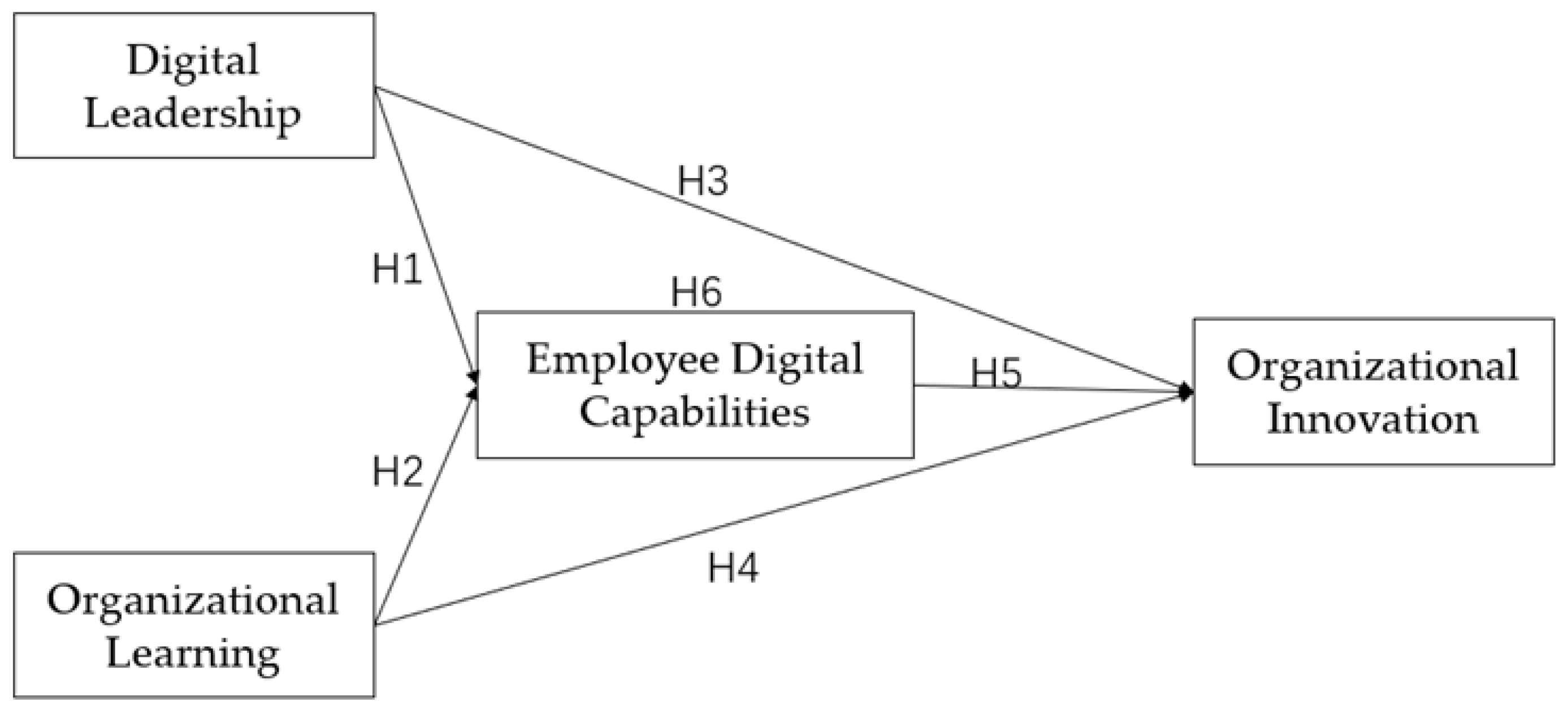
3.1. Digital Leadership and Employee Digital Capabilities
3.2. Organizational Learning and Employee Digital Capabilities
3.3. Digital Leadership and Organizational Innovation
3.4. Organizational Learning and Organizational Innovation
3.5. Employee Digital Capabilities and Organizational Innovation
3.6. Mediating Effect of Employee Digital Capabilities
4. Research Design and Methodology
4.1. Data Collection
4.2. Variable Measurement
5. Data Analysis and Discussion of Results
5.1. Reliability and Validity Analysis
5.2. Hypothesis Testing
6. Conclusions
6.1. Discussion and Implications
6.2. Limitations and Future Research
Author Contributions
Funding
Institutional Review Board Statement
Informed Consent Statement
Data Availability Statement
Conflicts of Interest
References
- Peng, B. Digital leadership: State governance in the era of digital technology. Cult. Sci. 2021, 5, 210–225. [Google Scholar] [CrossRef]
- March, J.; Simon, H. Organizations; Wiley: New York, NY, USA, 1958. [Google Scholar]
- Sheninger, E.C. Digital Leadership: Changing Paradigms for Changing Times, 2nd ed.; A Joint Publication of Corwin ICLE; Corwin: Thousand Oaks, CA, USA, 2019. [Google Scholar]
- Dery, K.; Sebastian, I.M.; Vander Meulen, N. The digital workplace is key to digital innovation. MIS Q. Exec. 2017, 16, 135–152. [Google Scholar]
- Oberer, B.; Erkollar, A. Leadership 4.0: Digital leaders in the age of industry 4.0. Int. J. Organ. Leadersh. 2018, 7, 404–412. [Google Scholar] [CrossRef]
- Tian, H.N.; Sun, M.L.; Wang, L.J. How digital leadership promotes enterprise green innovation: A study based on SEM and fsQCA. Sci. Technol. Prog. Policy 2023, 40, 54–65. [Google Scholar]
- Hambrick, D.C.; Mason, P.A. Upper echelons: The organization as a reflection of its top managers. Acad. Manag. Rev. 1984, 9, 193–206. [Google Scholar] [CrossRef]
- Neely, B.H.; Lovelace, J.; Cowen, A.P.; Hiller, N.J. Metacritiques of upper echelons theory: Verdicts and recommendations for future research. J. Manag. 2020, 46, 1029–1062. [Google Scholar] [CrossRef]
- Yao, D.M.; Zhao, H.X. Digital leadership and employees’ digital creativity-A moderated chain mediation model. J. Hubei Univ. Technol. 2023, 38, 7–11+61. [Google Scholar]
- Benitez, J.; Arenas, A.; Castillo, A.; Esteves, J. Impact of digital leadership capability on innovation performance: The role of platform digitization capability. Inf. Manag. 2022, 59, 103590. [Google Scholar] [CrossRef]
- Wu, X.F.; Liu, H.Y.; Rebiguli, B. Digital leadership research at home and abroad: A review and future prospects based on bibliometric analysis. West Forum Econ. Manag. 2025, 36, 80–97. [Google Scholar]
- Chen, G.Q.; Liu, W. An empirical study on the effect of environment on exploratory learning, exploitatory learning and the balance between the two types of learning. China Soft Sci. 2017, 3, 99–109. [Google Scholar]
- Hoe, S.L. Information technology and organizational learning-managing behavioral change in the digital age. Learn. Organ. 2021, 28, 569–571. [Google Scholar] [CrossRef]
- Hanelt, A.; Bohnsack, R.; Marz, D.; Antunes, C. A systematic review of the literature on digital transformation: Insights and implications for strategy and organizational change. J. Manag. Stud. 2021, 58, 1159–1197. [Google Scholar] [CrossRef]
- Lin, H.F.; Shang, R. The paradoxical effects of organizational routines on organizational innovation. Nankai Bus. Rev. 2020, 23, 62–74. [Google Scholar]
- Elidjen; Mihardjo, L.W.W.; Rukmana, R.A.N. Intervening role of innovation management on relationship between digital leadership and dynamic capability accelerated by collaboration. Int. J. Innov. Creat. Change 2019, 6, 249–264. [Google Scholar]
- Mazzei, M.J.; Noble, D. Big data dreams: A framework for corporate strategy. Bus. Horiz. 2017, 60, 405–414. [Google Scholar] [CrossRef]
- Nadkarni, S.; Prügl, R. Digital transformation: A review, synthesis and opportunities for future research. Manag. Rev. Q. 2021, 71, 233–341. [Google Scholar] [CrossRef]
- Schwarzmuller, T.; Broosi, P.; Duman, D.; Welpe, I.M. How does the digital transformation affect organizations? Key themes of change in work design and leadership. Manag. Rev. 2018, 29, 114–138. [Google Scholar] [CrossRef]
- Bach, C.; Sulíková, R. Leadership in the context of a new world: Digital leadership and industry 4.0. Manag. Glob. Transit. 2021, 19, 209–226. [Google Scholar]
- Chen, J.; Hu, N.; Yuan, Y.N. The impact of digital leadership on corporate sustainable development performance: The role of organizational agility and digital culture. J. Yantai Univ. 2025, 38, 109–119. [Google Scholar]
- Besson, P.; Rowe, F. Strategizing information systems-enabled organizational transformation: A transdisciplinary review and new directions. J. Strat. Inf. Syst. 2012, 21, 103–124. [Google Scholar] [CrossRef]
- Amelda, B.; Alamsjah, F.; Elidjen, E. Does the digital marketing capability of Indonesian banks align with digital leadership and technology capabilities on company performance? Commit. J. 2021, 15, 9–17. [Google Scholar]
- Zhu, J.; Zhang, B.; Xie, M.; Cao, Q. Digital leadership and employee creativity: The role of employee job crafting and person-organization fit. Front. Psychol. 2022, 13, 827057. [Google Scholar] [CrossRef] [PubMed]
- Wasono, L.W.; Furinto, A. The effect of digital leadership and innovation management for incumbent telecommunication company in the digital disruptive era. Int. J. Eng. Technol. 2018, 7, 125–130. [Google Scholar] [CrossRef]
- Verma, S.; Singh, V.; Bhattacharyya, S. Do big data driven HR practices improve HR service quality and innovation competency of SMEs. Int. J. Organ. Anal. 2020, 29, 950–973. [Google Scholar] [CrossRef]
- Xia, Y.H.; Liu, X.Y.; Wang, X.L.; Deng, H.; Han, C.L.; Liu, Z.; Tsai, S.B. The power of role models in a team: The impact of lead entrepreneur’s digital leadership on digital entrepreneurial success. Inf. Process. Manag. 2023, 60, 103498. [Google Scholar] [CrossRef]
- Huber, G.P. Organizational learning: The contributing processes and the literatures. Organ. Sci. 1991, 2, 88–115. [Google Scholar] [CrossRef]
- Argyris, C.; Schon, D. Organizational Learning: A Theory of Action Perspective; Addison-Wesley: Reading, MA, USA, 1978. [Google Scholar]
- Saki, S.; Shakiba, H.; Savari, M. Study of the relationship between the organizational learning and organizational innovation at university of Tehran. E J. Organ. Learn. Leadersh. 2013, 11, 1–18. [Google Scholar]
- Liang, F.; Li, S.W.; Sun, R. The influence of organizational learning on organizational innovative performance from the perspective of SOR. J. Manag. Sci. 2017, 30, 63–74. [Google Scholar]
- Lai, H.B.; Le, Y. A study of the impact of digital transformation on firm performance-based on the mediating role of organizational learning. China Price J. 2023, 4, 121–124. [Google Scholar]
- Ma, W.C.; Li, X.Z.; Zhang, G.Y. Analysis of the knowledge graph of the study and research of foreign industry-university-research cooperative organizations. Sci. Technol. Manag. Res. 2017, 37, 119–125. [Google Scholar]
- Shen, B.; Lu, Y.F.; Wu, T. The impact of organizational learning on knowledge innovation: Mediated by organizational unlearning. Manag. Rev. 2020, 32, 135–145. [Google Scholar]
- Farias-Gaytan, S.; Aguaded, I.; Ramirez-Montoya, M.S. Transformation and digital literacy: Systematic literature mapping. Educ. Inf. Technol. 2022, 27, 1417–1437. [Google Scholar] [CrossRef]
- Stone, D.L.; Deadrick, D.L.; Lukaszewski, K.M.; Johnson, R. The influence of technology on the future of human resource management. Hum. Resour. Manag. Rev. 2015, 25, 216–231. [Google Scholar] [CrossRef]
- Wilson, H.J.; Daugherty, P.R. Collaborative intelligence: Humans and AI are joining forces. Harv. Bus. Rev. 2018, 96, 114–123. [Google Scholar]
- Thomas, S.; Kureshi, S.; Suggala, S.; Mendonca, V. HRM 4.0 and the shifting landscape of employer branding. In Human & Technological Resource Management (HTRM): New Insights into Revolution 4.0; Emerald Publishing Limited: Leeds, UK, 2020; pp. 37–51. [Google Scholar]
- Garmann-Johnsen, N.F.; Helmersen, M.; Eikebrokk, T.R. Employee-driven digitalization in healthcare: Codesigning services that deliver. Health Policy Technol. 2020, 9, 247–254. [Google Scholar] [CrossRef]
- Yang, K.; Li, K. Data empowerment enhances digital literacy. Enter. Manag. 2022, 10, 101–103. [Google Scholar]
- Liu, X.F. The impact of digital literacy on the consumption level of Chinese residents’ households-Considering the mediating effects of social networks and income levels. J. Commer. Econ. 2024, 09, 48–52. [Google Scholar]
- Xu, Y. Adapting to the development of digital economy to achieve high-quality full employment and decent work—China’s digital skill development strategy and prospects for the new era. Educ. Vocat. 2023, 3, 59–67. [Google Scholar]
- Xia, Q.H.; Lou, H.Y. Simulation of business model innovation based on business model rigidity: Comparison between traditional and internet firms. Syst. Eng.-Theory Pract. 2018, 38, 2776–2792. [Google Scholar]
- Schumpeter, J.; Backhaus, U. The theory of economic development. In Joseph Alois Schumpeter; Kluwer Academic Publishers: Dordrecht, The Netherlands, 1934; pp. 61–116. [Google Scholar]
- Chuang, L.M.; Lee, Y.P. Toward sustainable development: The causes and consequences of organizational innovation. Sustainability 2023, 15, 8017. [Google Scholar] [CrossRef]
- Hage, J.T. Organizational innovation and organizational change. Annu. Rev. Sociol. 1999, 25, 597–622. [Google Scholar] [CrossRef]
- Damanpour, F.; Sanchez-Henriquez, F.; Chiu, H.H. Internal and external sources and the adoption of innovations in organizations. Br. J. Manag. 2018, 29, 712–730. [Google Scholar] [CrossRef]
- Rajapathirana, R.P.J.; Hui, Y. Relationship between innovation capability, innovation type, and firm performance. J. Innov. Knowl. 2018, 3, 44–55. [Google Scholar] [CrossRef]
- Sahyaja, C.; Rao, S. New leadership in the digital era-A conceptual study on emotional dimensions in relation with intellectual dimensions. Int. J. Civil. Eng. Technol. 2018, 9, 738–747. [Google Scholar]
- Wade, M.; Obwegeser, N. How to choose the right digital leader for your company. MIT Sloan Manag. Rev. 2019, 60, 1–4. [Google Scholar]
- Morgeson, F.P.; Derue, D.S.; Karam, E.P. Leadership in teams: A functional approach to understanding leadership structures and processes. J. Manag. 2010, 26, 5–39. [Google Scholar] [CrossRef]
- Sandell, S. Digital Leadership: How Creativity in Business Can Propel Your Brand & Boost Your Results; Book Baby: Pennsauken, NJ, USA, 2013. [Google Scholar]
- Prince, K.A. Digital Leadership: Transitioning into the Digital Age. Doctoral Dissertation, James Cook University, North Queensland, Australia, 2018. [Google Scholar]
- Xie, P.; Ma, L.; Wei, Y.Y.; Qiao, X.T. Digital leadership and organizational innovation: Role of digital platform capabilities and environmental competitiveness. Res. Econ. Manag. 2023, 44, 129–144. [Google Scholar]
- Lyson, Z.L.; Khosrowshahi, F. A taxonomy of digital leadership in the construction industry. J. Constr. Manag. Econ. 2021, 39, 565–578. [Google Scholar]
- Brix, J. Ambidexterity and organizational learning: Revisiting and reconnecting the literatures. Learn. Organ. 2019, 5, 337–351. [Google Scholar] [CrossRef]
- Liu, E.L.; Song, Y.N. Knowledge inertia, organizational learning and firm innovation performance. Soc. Sci. 2023, 3, 93–99. [Google Scholar]
- Magesa, M.M.; Jonathan, J. Conceptualizing digital leadership characteristics for successful digital transformation: The case of Tanzania. Inf. Technol. Dev. 2021, 28, 777–796. [Google Scholar] [CrossRef]
- Zhao, W.D.; Wu, J.H.; Wang, Y. The moderating effect of knowledge inertia on the relationship between organizational learning and employee-organization fit. J. Ind. Eng. Eng. Manag. 2012, 26, 7–14. [Google Scholar]
- He, X.B.; Zhu, D.Y.; Gao, Y.Q. Two dimensions of sharing leadership and enterprise innovation performance. Stud. Sci. Sci. 2020, 38, 747–758. [Google Scholar]
- Bass, B.M. Two decades of research and development in transformational leadership. Eur. J. Work. Organ. Psychol. 1999, 8, 9–32. [Google Scholar] [CrossRef]
- Wang, T.; Lin, X.; Sheng, F. Digital leadership and exploratory innovation: From the dual perspectives of strategic orientation and organizational culture. Front. Psychol. 2022, 13, 902693. [Google Scholar] [CrossRef]
- Niu, S.; Park, B.I.; Jung, J.S. The effects of digital leadership and ESG management on organizational innovation and sustainability. Sustainability 2022, 14, 15639. [Google Scholar] [CrossRef]
- Sagbas, M.; Oktaysoy, O.; Topcuoglu, E.; Kaygin, E.; Erdogan, F.A. The mediating role of innovative behavior on the effect of digital leadership on intrapreneurship intention and job performance. Behav. Sci. 2023, 13, 874. [Google Scholar] [CrossRef]
- Schoemaker, P.J.H.; Heaton, S.; Teece, D. Innovation, dynamic capabilities, and leadership. Calif. Manag. Rev. 2018, 61, 15–42. [Google Scholar] [CrossRef]
- Schweitzer, J. Leadership and innovation capability development in strategic alliances. Leadersh. Organ. Dev. J. 2014, 35, 442–469. [Google Scholar] [CrossRef]
- Li, Y.P.; Miao, L. The structural dimensions of enterprise digital leadership and its impact: A study of grounded theory in the Chinese context. Wuhan Univ. J. 2020, 73, 125–136. [Google Scholar]
- Porfírio, J.A.; Carrilho, T.; Felício, J.A.; Jardim, J. Leadership characteristics and digital transformation. J. Bus. Res. 2021, 124, 610–619. [Google Scholar] [CrossRef]
- Costa, M.D.P.B.; Cabral, J.E.D.O. The relationship knowledge, learning, innovation and competitive advantage: A conceptual model. Int. J. Technol. Knowl. Soc. 2010, 6, 21–36. [Google Scholar] [CrossRef]
- Dodgson, M. Organizational learning: A review of some literatures. Organ. Stud. 1993, 14, 375–394. [Google Scholar] [CrossRef]
- Easterby-Smith, M.; Antonacopoulou, E.; Simm, D.; Lyles, M. Constructing contributions to organizational learning: Argyris and the next generation. Manag. Learn. 2004, 35, 371–380. [Google Scholar] [CrossRef]
- Hung, R.Y.Y.; Lien, B.Y.H.; Yang, B.; Wu, C.M.; Kuo, Y.M. Impact of TQM and organizational learning on innovation performance in the high-tech industry. Int. Bus. Rev. 2011, 20, 213–225. [Google Scholar] [CrossRef]
- Li, X.N. Research on innovation capability and driving force of transformation and upgrading of private enterprises-based on the case of Golden Monkey Group. Financ. Theory Teach. 2021, 4, 61–67. [Google Scholar]
- Lin, S.; Huang, P.L. The discussion of organizational learning mechanism in organizational innovation. Sci. Manag. Res. 2004, 22, 23–27. [Google Scholar]
- Lu, Q.C.; Liang, L.L.; Jia, F. How strategic learning impacts organizational innovation-based on a dynamic capabilities perspective. J. Manag. World 2018, 34, 109–129. [Google Scholar]
- Aqeela, M.S.F.; Victor, L.D. Impact of knowledge inertia on organizational innovation: Mediating role of organizational learning. J. Stud. Manag. Plan. 2017, 3, 164–174. [Google Scholar]
- Guo, W. Relational research of knowledge heterogeneity and organizational learning and innovation performance of the company. Sci. Sci. Manag. S. T 2016, 37, 118–125. [Google Scholar]
- Kanter, R.M. When a thousand flowers bloom: Structural, collective and social conditions for innovation in organization. Res. Organ. Behav. 1988, 10, 169–211. [Google Scholar]
- Zhao, H.M.; Yu, H.; Lin, Y.L. A study on the impact of perceived digital work context on employee performance among highly skilled employees-based on career regenerative mediation analysis. Prod. Res. 2024, 12, 98–103. [Google Scholar]
- Cheng, C.P.; Hsu, P.C. The correlation between employee information literacy and employee creativity. Qual. Quant. 2015, 49, 221–234. [Google Scholar] [CrossRef]
- Mancha, R.; Shankaranarayanan, G. Making a digital innovator: Antecedents of innovativeness with digital technologies. Inform. Technol. People 2021, 34, 318–335. [Google Scholar] [CrossRef]
- Noruzy, A.; Dalfard, V.M.; Azhdari, B.; Nazari-Shirkouhi, S.; Rezazadeh, A. Relations between transformational leadership, organizational learning, knowledge management, organizational innovation, and organizational performance: An empirical investigation of manufacturing firms. Int. J. Adv. Manuf. Technol. 2013, 64, 1073–1085. [Google Scholar] [CrossRef]
- Xie, P.; Ma, L.; Wei, Y.Y. Research on the influence mechanisms of digital technology training on employee digital creativity. J. Ind. Eng. Eng. Manag. 2025, 40, 1–13. [Google Scholar]
- Li, H. Research on the transformation mechanism of organizational learning capabilities, open innovation performance: A case study of knowledge intensive service enterprises. J. Beijing Jiaotong Univ. 2019, 2, 89–97. [Google Scholar]
- Zeike, S.; Bradbury, K.; Lindert, L.; Pfaff, H. Digital leadership skills and associations with psychological well-being. Int. J. Nmental Res. Public Health 2019, 16, 2628. [Google Scholar] [CrossRef]
- Cortellazzo, L.; Bruni, E.; Zampieri, R. The role of leadership in a digitalized world: A review. Front. Psychol. 2019, 10, 1938–1958. [Google Scholar] [CrossRef]
- Shin, J.; Mollah, M.A.; Choi, J. Sustainability and organizational performance in South Korea: The effect of digital leadership on digital culture and employees’ digital capabilities. Sustainability 2023, 15, 2027. [Google Scholar] [CrossRef]
- Sinkula, J.M.; Baker, W.E.; Noordewier, T.A. Framework for market. Based organizational learning: Linking Values, Knowledge, and Behavior. J. Acad. Mark. Sci. 1997, 25, 305–318. [Google Scholar] [CrossRef]
- Proksch, D.; Rosin, A.F.; Stubner, S.; Pinkwart, A. The influence of a digital strategy on the digitalization of new ventures: The mediating effect of digital capabilities and a digital culture. J. Small Bus. Manag. 2021, 62, 1–29. [Google Scholar] [CrossRef]
- Nylén, D.; Holmström, J. Digital innovation strategy: A framework for diagnosing and improving digital product and service innovation. Bus. Horiz. 2015, 58, 57–67. [Google Scholar] [CrossRef]
- Knight, G.A.; Cavusgil, S.T. Innovation, organizational capabilities, and the Born-Global Firm. J. Int. Bus. Stud. 2004, 35, 124–141. [Google Scholar] [CrossRef]
- Waheed, A.; Miao, X.M.; Waheed, S.; Ahmad, N.; Majeed, A. How new HRM practices, organizational innovation, and innovative climate affect the innovation performance in the IT industry: A moderated-mediation analysis. Sustainability 2019, 11, 621. [Google Scholar] [CrossRef]
- Jarvis, C.B.; Mackenzie, S.; Podsakoff, P.A. Critical review of construct indicators and measurement model misspecification in marketing and consumer research. J. Consum. Res. 2003, 30, 199–218. [Google Scholar] [CrossRef]
- Kock, N. Common method bias in PLS-SEM: A full collinearity assessment approach. Int. J. e-Collab. 2015, 11, 1–10. [Google Scholar] [CrossRef]
- Fornell, C.; Larcker, D.F. Evaluating structural equation models with unobservable variables and measurement error. J. Mark. Res. 1981, 18, 39–50. [Google Scholar] [CrossRef]
- Dijkstra, T.K.; Henseler, J. Consistent partial least squares path modeling. MIS Q. 2015, 39, 297–316. [Google Scholar] [CrossRef]
- Gold, A.; Malhotra, A.; Segars, A. Knowledge management: An organizational capabilities perspective. J. Manag. Inform. Syst. 2001, 18, 185–214. [Google Scholar] [CrossRef]
- Teo, T.; Noyes, J. An assessment of the influence of perceived enjoyment and attitude on the intention to use technology among pre-service teachers: A structural equation modeling approach. Comp. Edu. 2011, 57, 1645–1653. [Google Scholar] [CrossRef]
- Clark, L.; Watson, D. Constructing validity: Basic issues in objective scale development. Psychol. Assess. 1995, 7, 309–319. [Google Scholar] [CrossRef]
- Kline, R.B. Principles and Practice of Structural Equation Modeling; Guilford Press: New York, NY, USA, 2011. [Google Scholar]
- Hair, J.F.; Sarstedt, M.; Hopkins, L.; Kuppelwieser, V.G. Partial least squares structural equation modeling (PLS-SEM): An emerging tool in business research. Eur. Bus. Rev. 2014, 26, 106–121. [Google Scholar] [CrossRef]
- Hayes, A.F.; Rockwood, N.J. Regression-based statistical mediation and moderation analysis in clinical research: Observations, recommendations, and implementation. Behav. Res. Ther. 2017, 98, 39–57. [Google Scholar] [CrossRef]
- Hesse, A. Digitalization and leadership-how experienced leaders interpret daily realities in a digital world. In Proceedings of the 51st Hawaii International Conference on System Sciences, Hilton Waikoloa Village, HI, USA, 3–6 January 2018; pp. 1854–1863. [Google Scholar]
- Reuer, J.J.; Klijn, E.; van den Bosch, F.A.J.; Volberda, H.W. Bringing corporate governance to international joint ventures. Glob. Strat. J. 2011, 1, 54–66. [Google Scholar] [CrossRef]

| Description | Frequency | Percent | |
|---|---|---|---|
| Gender | male | 212 | 68.6 |
| female | 97 | 31.4 | |
| Age | Under 20 years old | 18 | 5.8 |
| 21 to 30 years old | 49 | 15.9 | |
| 31 to 40 years old | 78 | 25.2 | |
| 41 to 50 years old | 92 | 29.8 | |
| Over 51 years old | 72 | 23.3 | |
| Education | College education or below | 140 | 45.3 |
| Undergraduate course | 80 | 25.9 | |
| master | 64 | 20.7 | |
| doctoral | 25 | 8.1 | |
| Position | General Employee | 118 | 38.2 |
| Grassroots Managers | 93 | 30.1 | |
| Middle managers | 83 | 26.9 | |
| senior management | 15 | 4.9 | |
| Total | 309 | 100% | |
| Observed Variable | Factor Loadings | VIF (<3) | Cronbach’s α | Rho A | CR | AVE | |
|---|---|---|---|---|---|---|---|
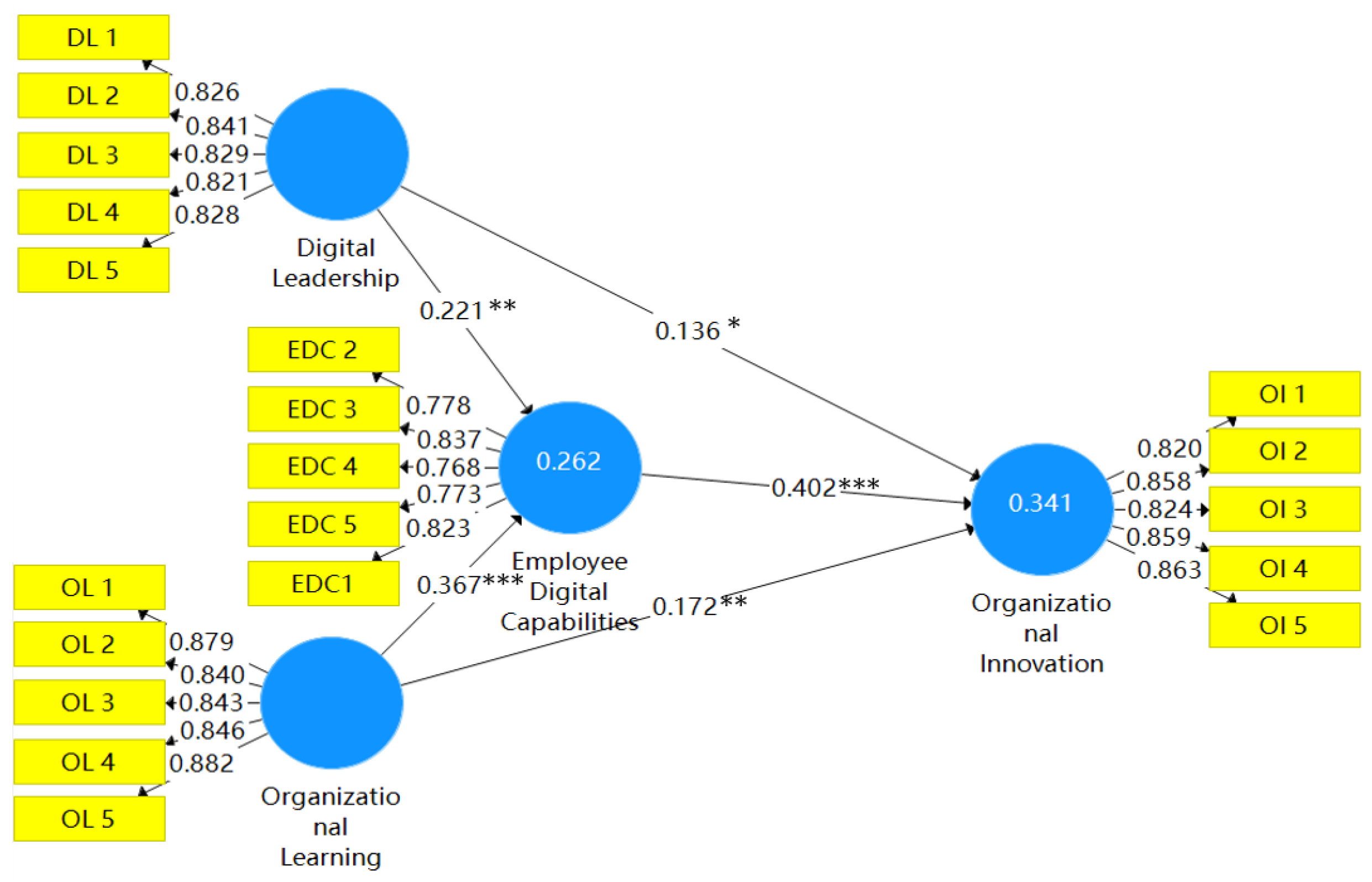
| Digital Leadership (DL) | DL1 | 0.826 | 2.191 | 0.886 | 0.889 | 0.917 | 0.687 |
| DL2 | 0.841 | 2.284 | |||||
| DL3 | 0.829 | 2.180 | |||||
| DL4 | 0.821 | 1.997 | |||||
| DL5 | 0.828 | 2.026 | |||||
| Organizational learning (OL) | OL1 | 0.879 | 2.731 | 0.911 | 0.914 | 0.933 | 0.737 |
| OL2 | 0.840 | 2.328 | |||||
| OL3 | 0.843 | 2.434 | |||||
| OL4 | 0.846 | 2.335 | |||||
| OL5 | 0.882 | 2.844 | |||||
| Employee Digital Capabilities (EDC) | EDC1 | 0.823 | 2.030 | 0.855 | 0.859 | 0.896 | 0.634 |
| EDC2 | 0.778 | 1.888 | |||||
| EDC3 | 0.837 | 2.178 | |||||
| EDC4 | 0.768 | 1.852 | |||||
| EDC5 | 0.773 | 1.890 | |||||
| Organizational Innovation (OI) | OI1 | 0.820 | 2.084 | 0.900 | 0.902 | 0.926 | 0.714 |
| OI2 | 0.858 | 2.356 | |||||
| OI3 | 0.824 | 2.139 | |||||
| OI4 | 0.859 | 2.551 | |||||
| OI5 | 0.863 | 2.549 |
| DL | OL | EDC | OI | |
|---|---|---|---|---|
| DL | 0.829 | |||
| OL | 0.485 | 0.858 | ||
| EDC | 0.399 | 0.474 | 0.796 | |
| OI | 0.380 | 0.428 | 0.537 | 0.845 |
| DL | OL | EDC | OI | |
|---|---|---|---|---|
| DL | ||||
| OL | 0.537 | |||
| EDC | 0.456 | 0.538 | ||
| OI | 0.423 | 0.470 | 0.606 |
| R Square | R Square Adjusted | F Square | Q Square | ||
|---|---|---|---|---|---|
| DL | 0.020 | 0.051 | |||
| OL | 0.030 | 0.140 | |||
| EDC | 0.262 | 0.257 | 0.181 | 0.163 | |
| OI | 0.341 | 0.335 | 0.238 | ||
| Relationship | O | M | SD | t-Values | p-Values | Result | ||
|---|---|---|---|---|---|---|---|---|
| Direct Effect | H1 | DL → EDC | 0.221 | 0.222 | 0.064 | 3.461 | 0.001 | Supported |
| H2 | OL → EDC | 0.367 | 0.370 | 0.063 | 5.859 | 0.000 *** | Supported | |
| H3 | EDC → OI | 0.402 | 0.404 | 0.059 | 6.775 | 0.000 *** | Supported | |
| H4 | DL → OI | 0.136 | 0.137 | 0.062 | 2.202 | 0.028 | Supported | |
| H5 | OL → OI | 0.172 | 0.172 | 0.060 | 2.857 | 0.004 | Supported | |
| Paths | t-Values | p-Values | 2.5% | 97.5% | Decision | |
|---|---|---|---|---|---|---|
| DL → EDC → OI | 0.089 | 3.009 | 0.003 | 0.036 | 0.149 | partial mediation |
| OL → EDC → OI | 0.148 | 4.462 | 0.000 | 0.092 | 0.219 | partial mediation |
Disclaimer/Publisher’s Note: The statements, opinions and data contained in all publications are solely those of the individual author(s) and contributor(s) and not of MDPI and/or the editor(s). MDPI and/or the editor(s) disclaim responsibility for any injury to people or property resulting from any ideas, methods, instructions or products referred to in the content. |
© 2026 by the authors. Licensee MDPI, Basel, Switzerland. This article is an open access article distributed under the terms and conditions of the Creative Commons Attribution (CC BY) license.
Share and Cite
Liu, H.; Du, Y.; Xu, Y.; Niu, S. The Impact of Digital Leadership on Organizational Innovation in China’s Baijiu Industry: The Mediating Function of Employees’ Digital Capabilities. Sustainability 2026, 18, 5967. https://doi.org/10.3390/su18125967
Liu H, Du Y, Xu Y, Niu S. The Impact of Digital Leadership on Organizational Innovation in China’s Baijiu Industry: The Mediating Function of Employees’ Digital Capabilities. Sustainability. 2026; 18(12):5967. https://doi.org/10.3390/su18125967
Chicago/Turabian StyleLiu, Huifang, Yang Du, Yueqi Xu, and Sijian Niu. 2026. "The Impact of Digital Leadership on Organizational Innovation in China’s Baijiu Industry: The Mediating Function of Employees’ Digital Capabilities" Sustainability 18, no. 12: 5967. https://doi.org/10.3390/su18125967
APA StyleLiu, H., Du, Y., Xu, Y., & Niu, S. (2026). The Impact of Digital Leadership on Organizational Innovation in China’s Baijiu Industry: The Mediating Function of Employees’ Digital Capabilities. Sustainability, 18(12), 5967. https://doi.org/10.3390/su18125967

