Article

The Impact of Intelligent Manufacturing on Green Total Factor Productivity in the Lithium Industry: A Dual Perspective Based on Intrinsic Motivation Incentives and Extrinsic Pressure Drives

1
School of Economics and Management, Jiangxi University of Science and Technology, Ganzhou 341000, China
2
Business School, Jiangxi University of Science and Technology, Nanchang 330013, China
3
School of Economics and Management, Leshan Normal University, Leshan 614000, China
*
Author to whom correspondence should be addressed.
Sustainability 2026, 18(12), 5955; https://doi.org/10.3390/su18125955
Submission received: 23 March 2026 / Revised: 7 June 2026 / Accepted: 8 June 2026 / Published: 10 June 2026

Abstract

Intelligent manufacturing has become a new driving force for the comprehensive green transformation and development of the lithium industry, representing both an intrinsic requirement and a strategic direction for promoting high-quality development in the sector. This study examines whether intelligent manufacturing can effectively enhance the green total factor productivity of the lithium industry from the dual perspectives of internal motivation and external pressure, based on relevant data from Chinese A-share listed lithium companies between 2010 and 2023. The study finds that: (1) Intelligent manufacturing can significantly enhance the green total factor productivity of the lithium industry. (2) Heterogeneity analysis indicates that the level of regional environmental regulations and the intensity of green competition within the industry are positively correlated with the extent of improvement in the lithium industry’s green total factor productivity. (3) Mechanism analysis reveals that intelligent manufacturing influences green total factor productivity through two pathways: green technological innovation and ESG disclosure. Furthermore, the intrinsic incentive effect of green technological innovation is stronger than the extrinsic pressure driven by ESG disclosure. (4) Further analysis reveals that the “Intelligent Manufacturing Pilot Project” policy and the “Comprehensive Green Transformation of Economic and Social Development” policy provide strong support and driving force for the intelligent manufacturing and green development of the lithium industry.

1. Introduction

Driven by the global energy transition and the “Dual carbon” goals, green and low-carbon development has become a key direction for manufacturing industry worldwide [1]. As the core driving force of the Fourth Industrial Revolution, intelligent manufacturing is reshaping global economic and social structures [2]. In recent years, intelligent manufacturing has developed rapidly on a global scale. China has also made intelligent manufacturing a primary focus in its efforts to build a manufacturing powerhouse, accelerating the application and promotion of intelligent manufacturing technologies to enhance the level of intelligence level of manufacturing industry [3]. As a vital strategic emerging manufacturing industry, the lithium industry finds extensive applications in new energy vehicles [4] and energy storage [5], playing a crucial role in safeguarding national security, protecting national strategic interests, and advancing energy transition and green development [6]. With the rapid growth of the global new energy vehicle market, the demand for lithium, as a key raw material, will also show explosive growth [4]. However, while the lithium industry is developing rapidly, it also faces challenges such as resource shortages, high energy consumption, low utilization rates, and significant pollutant emissions, making it difficult to meet the requirements of sustainable development [7]. Even the current public still doubts the “green attributes” of the lithium industry, which is largely due to the confusion of the environmental costs of different processes [8]. Compared with traditional fossil energy mining, there are indeed problems of vegetation damage, water consumption and carbon emissions in the process of some lithium mining and extraction. However, the environmental impacts of different development modes are very different [9], so the whole lithium industry cannot be directly labeled as “non-green”. From the perspective of the whole industry chain, as the core raw material of the new energy industry, the environmental impact of the lithium production process should eventually serve the value of lithium in the clean energy transformation; that is, the energy storage and power battery industry supported by lithium resources can greatly reduce the use of fossil energy and carbon emissions throughout the whole life cycle [10], making an irreplaceable contribution to the global green transformation. By introducing intelligent manufacturing technologies, the lithium industry can achieve intelligent control and optimization of production processes, thereby improving resource utilization efficiency and reducing energy consumption and pollutant emissions [5]. Intelligent manufacturing offers new solutions for the green development of the lithium industry. Consequently, how to enhance the green total factor productivity of the lithium industry and achieve high-end, intelligent, green, efficient development, has become a critical issue that urgently needs to be addressed.
Current research on the relationship between intelligent manufacturing and green total factor productivity is limited [11,12], with most studies focusing on the impact of intelligent manufacturing on total factor productivity [13]. The academic community generally agrees that intelligent manufacturing primarily enhances total factor productivity by promoting technological innovation [14], optimizing resource allocation [15], strengthening environmental protection [16], and fostering the development of industrial chain ecosystems [17]. However, existing literature on intelligent manufacturing and productivity suffers from the following shortcomings: First, most studies focus on the manufacturing industry as a whole [18], with very few addressing the lithium industry, a unique industry that simultaneously possesses the attributes of being a “core raw material for energy transition” and a source of “high pollution from extraction and processing”. Consequently, these studies struggle to address the practical needs of the lithium industry’s green transition under the “Dual Carbon” goals. Second, existing studies predominantly examine the direct impact of intelligent manufacturing on production efficiency [2], with insufficient discussion of the dual mechanisms involving green innovation as an internal transmission pathway and ESG pressures as an external constraint pathway. Consequently, they fail to fully elucidate the logical mechanism through which intelligent manufacturing influences the green total factor productivity of the lithium industry. Third, existing calculations of green total factor productivity largely fail to account for the lithium industry’s unique pollution emission characteristics [19], resulting in inaccurate estimates that do not reflect the industry’s actual conditions. It is necessary to further explore the influence mechanism and path of intelligent manufacturing on green total factor productivity of strategic emerging lithium industry, which is very important in the field of global new energy competition and national strategic security in the future. Furthermore, as a core upstream industry supporting the development of the new energy sector, the pace of the lithium industry’s green transition directly determines the overall rhythm of China’s energy transition. At the same time, both the mining and processing stages of the lithium industry are highly energy-intensive and emission-heavy, making the need for green transformation far more urgent than in general manufacturing. Currently, listed companies in the lithium industry are undergoing a phase of rapid adoption of intelligent upgrades, yet the impact of intelligent manufacturing on their green production efficiency has not yet been empirically verified. Therefore, constructing a unique analytical model for the lithium industry can both address the practical needs of industrial development and address the shortcomings of existing research.
The article’s marginal contributions are as follows: First, theoretically, it attempts to integrate intelligent manufacturing and the green total factor productivity (GTFP) of the lithium industry into a unified analytical framework, extending the concept of green total factor productivity from the broad manufacturing industry to the specific lithium resource industry, thereby enriching academic research on the green transition of resource-based industries. Second, from the dual perspectives of internal motivation and external pressure driven by intelligent manufacturing of enterprises, this study innovatively analyzes the “causal association” between intelligent manufacturing and green total factor productivity of lithium resource industry, which enriches the research on the driving factors of green total factor productivity. Third, from a regional and industry macroperspective, this study thoroughly investigates the varying impacts of intelligent manufacturing on the green total factor productivity of the lithium industry under different levels of environmental regulation and industry-wide green competition. This research not only addresses the practical demands of resource-based industry transformation under the “Dual carbon” goals but also provides theoretical support and practical guidance for sustainable pathways in global lithium resource development.

2. Theoretical Analysis and Research Hypotheses

2.1. Intelligent Manufacturing and Green Total Factor Productivity

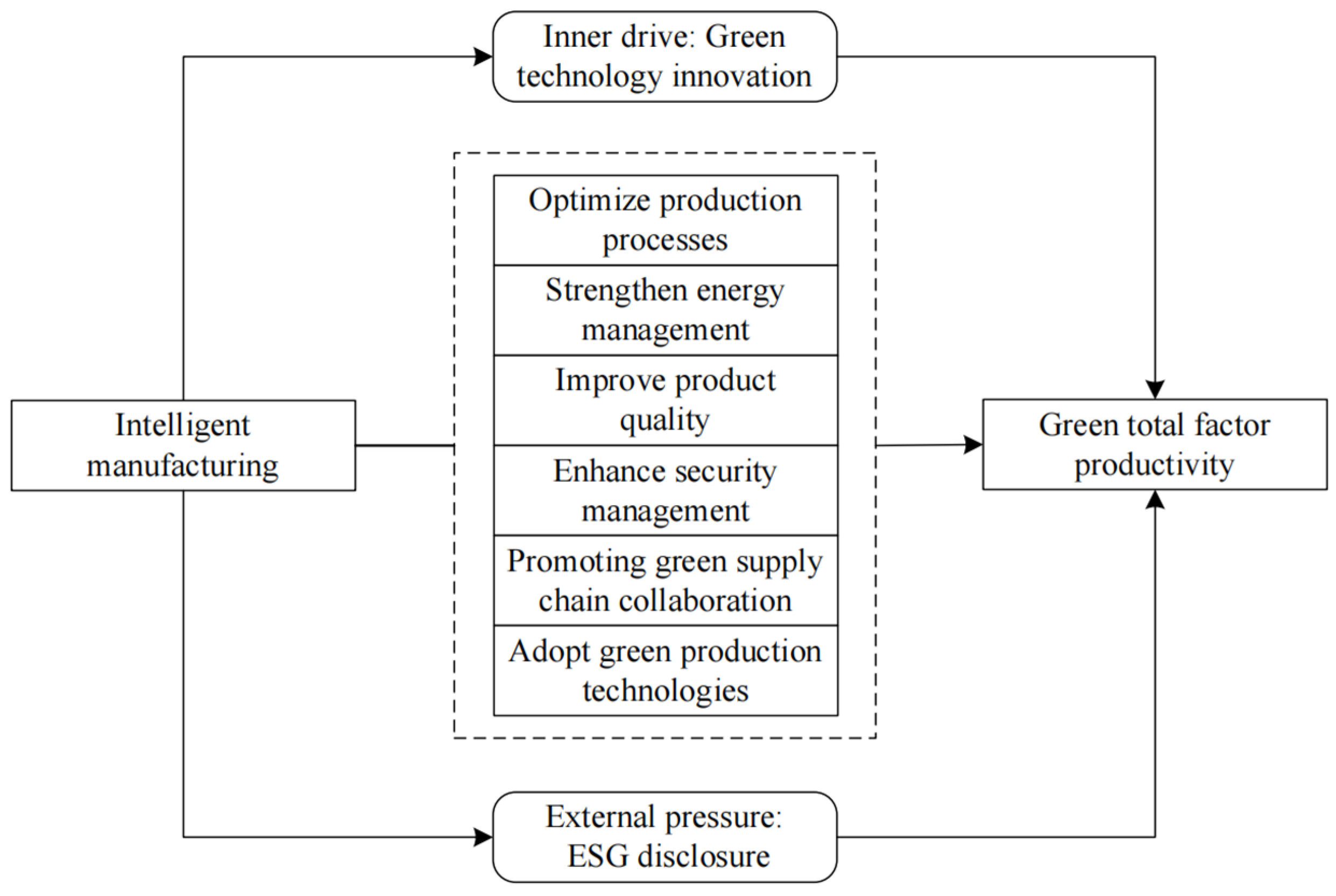
Intelligent manufacturing impacts the green total factor productivity of the lithium industry through optimizing production processes, enhancing energy management, improving product quality, strengthening safety controls, promoting green supply chain collaboration, and adopting green production technologies [20] (as shown in Figure 1). In optimizing production processes, establishing industrial big data systems, introducing industrial robots, and building smart logistics systems, all of which are part of intelligent manufacturing IoT platforms, enterprises enable end-to-end digital and intelligent processes across the lithium industry chain, supporting highly efficient operations [21]. In enhancing energy management, intelligent systems enable real-time monitoring of energy consumption, pinpointing high-energy-consumption stages to achieve efficient resource utilization [22]. For product quality improvement, smart inspection systems conduct real-time quality checks, reducing defect rates, increasing raw material utilization, and minimizing resource waste and subsequent rework energy consumption [23]. To strengthen safety management, a three-dimensional safety network integrating “people, equipment, and environment” is established to promptly detect hazards, prevent production interruptions and resource wastage caused by accidents, and indirectly boost green total factor productivity [24]. To promote green supply chain collaboration, a Lithium Industry Digital Alliance is spearheaded to jointly build a supply chain coordination platform with upstream and downstream enterprises [25]. This enables real-time sharing of order, inventory, and logistics data, driving supply chain efficiency improvements across regional enterprises. Regarding the adoption of green production technologies, advanced equipment and techniques such as MVR evaporators have been introduced to achieve “zero discharge” of wastewater and exhaust gases, thereby reducing energy consumption and pollution [26].
Hypothesis 1 (H1). 
Intelligent manufacturing can enhance the green total factor productivity of the lithium industry.

2.2. Intelligent Manufacturing, Green Technological Innovation, and Green Total Factor Productivity

Intelligent manufacturing enhances green total factor productivity through green technological innovations across the entire lithium industry chain (as shown in Figure 1). These include promoting energy-saving technological innovations, optimizing processes and equipment, improving resource recycling, and strengthening environmental monitoring. In terms of energy-saving technological innovation, intelligent manufacturing leverages sensors and data acquisition systems to establish energy management platforms [3]. It adopts technologies such as “waste heat recovery + intelligent voltage regulation” to reduce energy consumption per unit and boost green total factor productivity. In process and equipment optimization, innovations like the “green membrane method” for lithium batteries involve developing separators compatible with low-temperature hot pressing processes [21]. This reduces energy consumption in the hot pressing stage of cell production while boosting manufacturing efficiency. Additionally, intelligent manufacturing facilitates equipment upgrades, enabling precise control and efficient operation that effectively extends equipment lifespan and improves overall line operational efficiency [22]. For resource recycling, intelligent manufacturing enables precise identification and sorted recovery of production waste and scrap [27]. Combined with green technological innovations, this enhances lithium resource recovery rates, thereby boosting green total factor productivity. In environmental monitoring, intelligent technologies such as online flue gas monitoring and acid mist treatment systems enable real-time tracking of pollutant emissions during production [28]. This safeguards the green sustainable development of lithium enterprises, reduces pollution control costs and environmental risks, and indirectly boosts green total factor productivity.
Hypothesis 2 (H2). 
Intelligent manufacturing stimulates the intrinsic motivation for green technological innovation, thereby enhancing the green total factor productivity of the lithium industry.

2.3. Intelligent Manufacturing, ESG Disclosure, and Green Total Factor Productivity

Against the backdrop of the global green transition and the widespread adoption of ESG principles, the lithium industry faces increasing pressure to disclose ESG information. Intelligent manufacturing can leverage this pressure to drive improvements in the industry’s green total factor productivity by optimizing production processes and enhancing resource utilization efficiency (as shown in Figure 1). Regarding greening production processes, to meet ESG disclosure requirements, lithium resource companies must demonstrate environmental performance, prompting them to adopt intelligent manufacturing technologies to optimize production methods [29]. In terms of enhancing resource utilization efficiency, ESG disclosure pressures require lithium resource companies to leverage intelligent manufacturing to build “5G + smart factories,” enabling real-time monitoring of water, electricity, and gas consumption [30]. This facilitates reductions in per-unit resource consumption and carbon emissions by lithium resource enterprises. Regarding quality control system optimization, superior product quality is a key manifestation of fulfilling ESG social responsibilities and a critical factor in enhancing corporate competitiveness [30]. Lithium resource companies can leverage intelligent manufacturing technologies to improve product quality, thereby reducing resource wastage and cost increases caused by quality issues. Regarding enhanced safety management, ESG scrutinizes production safety protocols. Intelligent manufacturing supports lithium industry safety management by minimizing production disruptions and resource losses from accidents. For instance, AR glasses deployed in lithium production can automatically detect risks like unsecured hardhats or abnormal equipment temperatures, reducing accident rates, ensuring production continuity, and boosting green total factor productivity.
Hypothesis 3 (H3). 
Intelligent manufacturing drives the improvement of green total factor productivity in the lithium industry through the external pressure of corporate ESG disclosure.

3. Research Design

3.1. Sample Selection and Data Sources

This study examines Chinese A-share listed companies in the lithium industry from 2010 to 2023, with data primarily sourced from authoritative databases including the China Stock Market & Accounting Research Database (CSMAR), the China Industry Economy Statistical Yearbook, the China Environment Statistical Yearbook and the “Global and China Lithium Battery Industry Development Research Report”. To mitigate statistical bias and ensure conclusion reliability, the initial sample underwent the following adjustments: (1) exclusion of samples labeled as ST or *ST; (2) samples with missing data were excluded; and (3) continuous variables underwent truncated processing at the 1% and 99% percentiles. The sample reduction observed in the various regression models is due to missing data for certain indicators in some years for the firms; this will not fundamentally affect the robustness of the study’s conclusions.

3.2. Variable Description

  • Dependent variable: Green Total Factor Productivity (GTFP)
This study adopts the non-direct SBM-ML index to measure the green total factor productivity (GTFP) of the lithium industry, following the methodologies of scholars such as Zheng et al. (2025) [31], Chen and Hibiki (2022) [32], and Li and Chen (2021) [33]. Labor, capital, and energy inputs are measured respectively by the number of enterprise employees, net fixed assets, and energy consumption. Expected output and unexpected output are measured by enterprise operating revenue and “three industrial wastes”, respectively.
2.
Explanatory variable: Intelligent Manufacturing (IM)
Existing research has not yet established a unified standard for measuring intelligent manufacturing. Most studies at both the macro and micro levels use the installation density or utilization rate of industrial robots to characterize the level of intelligent manufacturing development. These indicators are readily available and directly reflect the core characteristics of intelligent upgrades in manufacturing production processes, making them highly relevant to the focus of this study on the impact of intelligent upgrades in the lithium industry’s production sector on green productivity. Therefore, following the approach of scholars such as Wang and Sun (2025) [34] and Kuang et al. (2024) [35], this paper uses industrial robot utilization as an indicator, measured using Wang and Dong (2020) [36] industrial robot penetration rate.
3.
Control Variable: Intelligent Manufacturing (IM)
To mitigate the bias caused by omitted variables in estimation results and enhance the identification of causal relationships, this study employs the following control variables. Among them, firm size (Size) is represented by the natural logarithm of total assets; profitability (Roa) is expressed as return on assets; capital structure (Cs) is calculated as total liabilities divided by total assets; management salary (Salary) is represented by the logarithm of total management salary; enterprise growth (Growth) is represented by the revenue growth rate; the proportion of independent directors (Indr) is calculated as the number of independent directors divided by the total number of board members; the proportion of institutional investor holdings (Lnv) is represented by the shareholding percentage of institutional shareholders; the scale of liabilities (Lia) is represented by the logarithm of total liabilities; and the age of the listed company (Age) is represented by the logarithm of the number of years since listing.

3.3. Model Specifications

To examine the mechanism by which intelligent manufacturing in the lithium industry affects green total factor productivity (GTFP), the following benchmark model is constructed:
GTFP it = a + β IM it + γ Controls it + φ i + μ t + ε it
Among these, the dependent variable GTFPit denotes the green total factor productivity of lithium industry for firm i in year t; the explanatory variable IMit represents the industrial robot penetration rate of listed companies in the lithium sector for firm i in year t; and β indicates the impact effect of intelligent manufacturing on the green total factor productivity of the lithium industry. Controlsit denotes a set of control variables comprising firm size, profitability, and firm listing age; φi, μt, and εit represent individual fixed effects, time fixed effects, and random disturbance terms, respectively. Unless otherwise specified, standard errors are clustered at the firm level. Descriptive statistics for key variables are presented in Table 1.

4. Empirical Results and Analysis

4.1. Baseline Regression Results

The results of the baseline regression are shown in Table 2. In Column (1), which controls only for core variables, the estimated coefficient for IM is 0.027 and is significant at the 1% level. This indicates that, holding other influencing factors constant, a one-unit increase in the penetration rate of industrial robots is associated with an average increase of 2.7 percentage points in the green total factor productivity of lithium companies, suggesting that there is potential for growth in the green transformation of the lithium industry in the future. To further test the robustness of the results, Column (2) includes a series of basic control variables reflecting corporate governance characteristics, such as firm size, profitability, and the proportion of independent directors. The estimated coefficient for intelligent manufacturing shows little change compared to Column (1); while the value decreases slightly, it remains at 0.023. This indicates that the positive effect of intelligent manufacturing on the green total factor productivity of lithium firms still holds after controlling for these variables, providing preliminary support for the core research hypothesis of this paper. Column (3) further incorporates year-specific and firm-specific fixed effects. To ensure the reliability of statistical inferences, Column (4) additionally employs firm-level cluster-robust standard errors, and it is found that the IM estimated coefficient in Column (4) remains unchanged from that in Column (3). It is evident that the estimated coefficients for intelligent manufacturing are all significantly positive at the 1% level, indicating that intelligent manufacturing has a significant positive impact on the improvement of green total factor productivity in the lithium industry, thereby confirming Hypothesis 1.

4.2. Endogeneity Test

  • Replacement Core Variable Measurement Method
First, following Zheng et al. (2025)’s methodology [31], we remeasured the green total factor productivity (GTFPddf) of the lithium industry, the dependent variable, using the DDF-ML index. The test results are shown in Column (1) of Table 3. Second, drawing on Fan et al. (2025)’s large language model methodology [37], we remeasured the core explanatory variable, the intelligent manufacturing level of the lithium industry (IMlv), with results presented in Column (2) of Table 3. Following these replacements, the estimated coefficients for the core explanatory variables (GTFPddf, IMlv) exhibited consistent directions and significance levels with the benchmark regression results, confirming the robustness of our conclusions. Furthermore, we extracted keywords related to intelligent manufacturing from the annual reports of A-share listed companies in the lithium industry, including industrial internet, smart sensing, digital twins, intelligent warehousing, machine learning, and flexible production. By constructing a standardized comprehensive intelligent manufacturing index (IMI*) based on the frequency of these keywords, we replaced the core explanatory variables with this index and re-estimated the baseline regression model. The results in Table 3, Column (3), show that neither the signs nor the significance levels of the core explanatory variables have changed substantially, and the research conclusions remain robust.
Last, following the research approach of Wu and Yao (2023) [38], this paper uses 5G coverage as an instrumental variable to examine the direct impact of smart manufacturing on the growth of total factor productivity in the lithium industry. After progressively incorporating channel variables that may influence green total factor productivity—such as regional digital infrastructure, innovation capacity, logistics efficiency, and environmental monitoring—the analysis reveals (with test results omitted for the sake of brevity and structural coherence) that the direction and significance of the estimated coefficient for the core explanatory variable—intelligent manufacturing—remained unchanged, with only a slight decrease in the magnitude of the coefficient. This indicates that, aside from influencing green total factor productivity through intelligent manufacturing, 5G coverage has no other significant channels of influence, further validating the appropriateness of selecting 5G coverage as an instrumental variable for intelligent manufacturing. On the one hand, the implementation of intelligent manufacturing in the lithium industry relies on the support of local information infrastructure; however, 5G infrastructure itself does not directly affect the production processes or green output of lithium enterprises. It only influences firms’ green total factor productivity by enabling intelligent upgrades at the production end, thereby logically satisfying the requirement of exclusivity. On the other hand, decision-making regarding intelligent manufacturing implementation among lithium resource enterprises exhibits a pronounced herd effect, making them susceptible to the influence of other lithium enterprises in the same region that have adopted intelligent manufacturing. As shown in Column (4) of Table 3, the K-P LM statistic significantly rejects the null hypothesis at the 1% level, and the K-P Wald F-statistic is far greater than 10, indicating that the instrumental variables satisfy the exogeneity condition and do not suffer from weak instrumental variable problems. Even when accounting for endogeneity issues arising from reverse causality, the coefficient for intelligent manufacturing in the lithium industry remains significantly positive, supporting the conclusions drawn from the baseline regression.
2.
Eliminate sample selection bias
To account for potential sample selection bias arising from firms excluded from the panel data calculations, the selection equation employs firm inclusion in the sample as the dependent variable (Sele). This equation incorporates the firm’s degree of inefficient investment (Ininvest) alongside a set of baseline control variables from the benchmark regression. The test results are presented in Column (1) of Table 4. The estimated coefficient for the degree of inefficient investment (Ininvest) is significantly negative at the 1% level, indicating that the exclusion of this variable from the study sample aligns with theoretical expectations. In the outcome equation, the green total factor productivity (GTFP) of the lithium industry was used as the dependent variable. The inverse Mills ratio (IMR) calculated from the selection equation was introduced to correct for sample selection bias. The test results are shown in Column (2) of Table 4. The estimated coefficient for IMR remains significantly positive at the 1% level, indicating that after controlling for sample selection bias, intelligent manufacturing can markedly enhance the green total factor productivity of the lithium industry.
3.
Control for omitted variable bias
To control for omitted variable bias, the approach typically involves adding more observable control variables and higher-dimensional unobservable fixed effects. Considering that the lithium industry’s intelligent manufacturing and green total factor productivity may be simultaneously influenced by additional control variables such as institutional investor ownership ratios and firm listing age, as well as the dual effects of industry heterogeneity among lithium resource firms and macro-policy changes across different cities, the benchmark regression model was extended to include these potentially omitted additional control variables, along with industry fixed effects and a combined fixed effect for city and year. The test results are presented in Column (3) and Columns (4)–(5) of Table 4, respectively. It is evident that after controlling for omitted variable bias, the direction and significance of the estimated coefficient for intelligent manufacturing in the lithium industry align with the results from the benchmark regression.

4.3. Robustness Test

  • Eliminate the impact of special events and outliers
① Exclude special events. The short-term impact of the pandemic emergency may affect the implementation progress of intelligent manufacturing in the lithium industry and the improvement of green total factor productivity. Therefore, years affected by the COVID-19 pandemic emergency are excluded. ② Exclude special samples. Samples that do not align with the fundamental characteristics of the lithium industry are excluded, retaining only enterprises whose primary business involves core lithium industry segments such as lithium resource mining, lithium salt processing, and lithium battery materials. Thus, samples of enterprises solely engaged in lithium product trading or cross-sector operations where lithium business constitutes less than 10% of their operations are excluded. As shown in Columns (1)–(2) of Table 5, the estimated coefficient for intelligent manufacturing remains significantly positive at the 1% level, indicating the robustness of the benchmark regression results.
2.
Sensitivity analysis
To avoid the influence of omitted variables on the core explanatory variables in the benchmark regression, this study further conducted sensitivity analysis on the benchmark regression using the two-parameter method referenced from Zheng et al. (2025) [31] and Oster (2019) [39]. The test results are shown in Table 6. The adjusted coefficient of the core explanatory variable is significantly positive and remains within the 95% confidence interval; δ = 1.783 > 1, passing the sensitivity analysis test. Thus, the benchmark regression conclusions are robust.

4.4. Heterogeneity Analysis

  • Heterogeneity analysis based on regional environmental planning intensity
Driven by the low-carbon transition, lithium enterprises possess an inherent motivation to pursue profit maximization. The higher the intensity of regional environmental regulations, the greater the external oversight imposed on lithium resource companies during production. Under this external pressure, enterprises will intensify their efforts in autonomous green technological innovation and implement intelligent manufacturing to maximize corporate profits. As shown in Columns (1) and (2) of Table 7, within the high-intensity regional environmental regulation group, intelligent manufacturing demonstrates a superior effect on enhancing the green total factor productivity of the lithium industry compared to the low-intensity regional environmental regulation group.
2.
Heterogeneity analysis based on industry green competitiveness intensity
As competition intensifies in the green transformation of the lithium industry, the herd mentality will pose significant challenges to lithium enterprises that have yet to achieve smart manufacturing. As green competition intensifies, lithium enterprises will increasingly emulate and innovate, prioritizing efficient resource utilization and production waste recycling. This will foster a green and intelligent development trajectory to meet environmental standards, reduce ecological impacts, and ultimately enhance green total factor productivity. As shown in Columns (3) and (4) of Table 7, within the high-intensity green competition group of the lithium industry, the effect of intelligent manufacturing on boosting total factor productivity is greater than that observed in the low-intensity green competition group.
3.
Heterogeneity analysis based on the position of different economies in the lithium industry chain
China is the world’s largest market in terms of the scale of lithium resource development, processing, and end-use applications, and it is also the major economy advancing the pace of industrial intelligent transformation and green transition the fastest. China’s experience in developing its lithium industry can serve as a model for the transformation of similar industries worldwide. Building on this, we further discuss the differences in institutional contexts across countries to verify the universality of our conclusions. For underdeveloped resource-exporting economies that are rich in upstream lithium resources but lack a strong industrial foundation, the role of intelligent and green transformation in boosting the green total factor productivity (TFP) of the lithium industry will be constrained by inadequate local infrastructure and incomplete institutional frameworks. The resulting improvement may be weaker than that in developed economies that possess advanced processing technologies in the downstream lithium sector, as developed economies have a higher starting point for intelligent transformation and more efficient factor allocation. As shown in Columns (5) and (6) of Table 7, across different groups of lithium industry chain positions, developed economies with advanced downstream processing technologies achieve greater improvements in total factor productivity than resource-exporting developing economies that are rich in upstream lithium resources but lack a robust industrial foundation.

5. Analysis of the Mechanism of Influence

Existing research generally finds that companies’ green development initiatives are driven by both internal demands for technological upgrades and external compliance and disclosure requirements. However, in the lithium industry—a specialized resource-based sector—the underlying logic behind these two factors differs fundamentally. On the one hand, as a core upstream segment of the new energy industry chain, the lithium industry is inherently a technology-intensive resource sector. From lithium mining to processing and refining, and on to waste recycling, cost reduction, efficiency improvements, and green upgrades at every stage are highly dependent on technological breakthroughs. Green technological innovation serves as the core endogenous driver for companies to directly improve green total factor productivity at the production end; on the other hand, ESG disclosure in the current lithium industry remains in its early stages. Most disclosures consist primarily of qualitative descriptions, and some companies even engage in “greenwashing” practices. A unified disclosure standard covering the entire industrial chain that is quantifiable and verifiable has yet to be established. Consequently, its actual driving effect on enterprises’ total factor productivity is relatively limited, and its significance is weaker than that of green technological innovation. This study incorporates and compares these two factors to identify the key levers for lithium companies to enhance their total factor productivity, thereby providing more targeted guidance for future policy formulation and corporate strategic decision-making.

5.1. Green Technology Innovation

Green technological innovation, as a crucial intrinsic motivator for accelerating intelligent manufacturing in the lithium industry, is a key component in comprehensively enhancing green total factor productivity. This study incorporates the number of green invention patent applications (Npatents) and patent quality (Qpatent) as instrumental variables into the regression. The test results are presented in Column (1) and Column (2) of Table 8. The estimated coefficient for intelligent manufacturing is significantly positive, indicating that intelligent manufacturing can empower and enhance the green total factor productivity of the lithium industry through the channel of green innovation technologies. Hypothesis 2 is thus confirmed.

5.2. ESG Disclosure

Better ESG disclosure encourages stakeholders to place greater emphasis on communication with enterprises, compelling lithium companies to enhance their green technology development and drive the implementation and adoption of intelligent manufacturing. This, in turn, elevates the green total factor productivity of the lithium industry. This study incorporates analyst attention (Analyst) and stakeholder green attention (Gattention) as instrumental variables in the regression. The test results are presented in Columns (3) and (4) of Table 8. The estimated coefficient for intelligent manufacturing is significantly positive, indicating that intelligent manufacturing can indeed leverage external pressure from ESG disclosure to compel lithium enterprises to accelerate green development and enhance green total factor productivity. Hypothesis 3 is thus confirmed.
Comparing the estimated coefficients in Column (2) and Column (4) of Table 8 reveals that, relative to the external pressure from ESG disclosure, the internal drive of green technological innovation exerts a stronger effect on improving green total factor productivity.

6. Further Analysis

6.1. Evaluation of the Supporting Role of Intelligent Manufacturing Pilot Project Policies

In 2015, China launched a pilot demonstration initiative for intelligent manufacturing aimed at accelerating the development of a manufacturing powerhouse. Did this exogenous policy play a supportive role in enhancing the green total factor productivity of the lithium industry? This paper utilizes the Intelligent Manufacturing Pilot Demonstration Project (IMP) as a quasi-natural experiment, constructing a single-point difference-in-differences model. The test results are presented in Column (1) and Column (2) of Table 9. Under a series of strict controls, the estimated coefficient for the Intelligent Manufacturing Pilot Demonstration Program (IMP) is significantly negative, while the interaction term between IMP and IM yields a significantly positive coefficient. This indicates that the IMP policy can provide robust support through enterprise intelligent manufacturing (IM), thereby empowering and driving the improvement of green total factor productivity (GTFP) in the lithium industry.

6.2. Evaluation of the Guiding Role of Policies for Comprehensive Green Transformation in Economic and Social Development

Guided by the carbon peak and carbon neutrality goals, can policy designs accelerating the comprehensive green transformation of economic and social development serve as a driving force for the lithium industry’s full-scale green transition? This study employs the Green Transformation Policy (GTP) for economic and social development as a quasi-natural experiment, constructing a multi-period difference-in-differences model. The test results are presented in Columns (3) and (4) of Table 9. Under a series of strict controls, the estimated coefficient for the interaction term between GTP and IM is significantly positive. This indicates that the Green Transformation Policy (GTP) for economic and social development can indeed drive comprehensive green transformation, thereby enhancing the effect of intelligent manufacturing on improving the green total factor productivity of the lithium industry.

7. Conclusions, Limitations and Implications

7.1. Conclusions

This paper conducts an in-depth analysis of the mechanism through which intelligent manufacturing influences the green total factor productivity of the lithium industry, examining both the internal drivers and external pressures generated by intelligent manufacturing. The study finds that intelligent manufacturing can significantly enhance the green total factor productivity of the lithium industry. Heterogeneity analysis indicates that regional environmental regulations and the intensity of green competition within the industry are positively correlated with improvements in the lithium industry’s green total factor productivity. Mechanism analysis reveals that intelligent manufacturing enhances green total factor productivity through two pathways: green technological innovation and ESG disclosure. The internal driving force of green technological innovation proves more effective than the external pressure exerted by ESG disclosure. Further analysis indicates that policies supporting intelligent manufacturing pilot projects provide strong support for the development of intelligent manufacturing in lithium enterprises, while policies promoting a comprehensive green transition in economic and social development play a leading role in driving the green development of these enterprises.

7.2. Limitations

  • Through which channels does intelligent manufacturing directly influence the total factor productivity of the lithium industry?
This paper uses 5G coverage as an instrumental variable to measure the direct impact of intelligent manufacturing on the improvement of the lithium industry’s total factor productivity. After sequentially controlling for channel variables that may affect green total factor productivity, such as regional digital infrastructure, innovation capacity, logistics efficiency, and environmental monitoring, we find that the direction and significance of the estimated coefficient for the core explanatory variable, intelligent manufacturing, remain unchanged. only the magnitude of the coefficient showed a slight decrease. This indicates that, aside from influencing green total factor productivity through intelligent manufacturing, 5G coverage has no other significant channels of influence, further validating the appropriateness of selecting 5G coverage as an instrumental variable for intelligent manufacturing. However, further exclusionary tests are needed to examine other potential variables that may affect green total factor productivity.
2.
Adaptive discussion based on the specific Chinese context and differences among economies.
China is the world’s largest market in terms of the scale of lithium resource development, processing, and end-use applications, and it is also the major economy that is advancing the pace of industrial intelligent transformation and green transition the fastest. China’s experience in the development of the lithium industry can serve as a typical reference for the transformation of similar industries globally. Building on this, we further discuss the differences in institutional backgrounds across countries and conduct an analysis of the heterogeneity in the positions of the lithium industry chain across different economies to verify the generalizability of the conclusions. Research findings: Among the different groups of economies based on their position in the lithium industry chain, developed economies with advanced downstream lithium-processing technologies exhibit a greater increase in total factor productivity than resource-exporting, less developed economies that are rich in upstream lithium resources but have weak industrial foundations.
3.
Discussion on data availability and endogeneity issues.
The current study is constrained by publicly available macro-level data; there remains a lack of long-term tracking data at the micro-enterprise level. Furthermore, it is difficult to achieve a detailed breakdown of matched data regarding 5G base station construction and intelligent manufacturing applications in certain sub-sectors, which may have some impact on the precision of the estimates. Furthermore, although this study mitigates core endogeneity issues through the instrumental variables method, there is a bidirectional causal relationship between 5G network construction and regional industrial green transition. Moreover, it is difficult to completely rule out the interference of other unobserved omitted variables; therefore, there is room for further refinement of the relevant estimation results.

7.3. Implications

  • Strengthen differentiated regulation and competition guidance to activate external drivers for green development
Based on the positive correlation between regional environmental regulations, industry-wide green competition, and green total factor productivity, implement a combined strategy of “differentiated approaches + competitive incentives.” On the one hand, establish tiered environmental regulatory standards tailored to each region’s ecological carrying capacity and lithium industry development foundation. Moderately raise environmental entry thresholds for lithium-rich areas and ecologically sensitive zones, strengthening precise controls over carbon emissions and pollutant discharges. On the other hand, amplify the positive effects of green competition by establishing green technology competitions for the lithium industry and publishing green development rankings. Encourage enterprises to engage in technological rivalry in areas such as intelligent low-carbon smelting and waste battery recycling. Simultaneously, incorporate environmental performance as a key criterion for market access and project approvals, using competitive mechanisms to drive enterprises to accelerate their green transformation.
2.
Focus on synergistic efforts through dual pathways to strengthen the green empowerment mechanism for intelligent manufacturing
To leverage the core driving force of green technological innovation and the auxiliary pressure effect of ESG disclosure, an integrated empowerment system combining internal and external drivers will be established. Priority support will be given to lithium enterprises upgrading their R&D systems through intelligent manufacturing, encouraging the development of smart laboratories and digital twin factories. Focus will be placed on key technologies such as low-energy extraction and battery material recycling, with policy incentives including additional tax deductions for R&D expenses and accelerated intellectual property protection to strengthen intrinsic green innovation momentum. Simultaneously, refine ESG disclosure standards for the lithium industry, requiring enterprises to collect, trace, and publish environmental data in real time through intelligent manufacturing systems. Establish a linkage mechanism between ESG ratings and financing incentives via securities markets and industry associations to amplify external oversight pressure, thereby fostering a virtuous cycle of “innovation-driven development and standardized disclosure.”
3.
Enhance policy coordination and synergy to unleash the combined effectiveness of pilot initiatives and transformation policies
Amplify the synergistic effects of intelligent manufacturing pilot programs and green transition policies by establishing a “support + traction” policy matrix. In the intelligent manufacturing sector, expand the coverage of pilot projects to include upstream and downstream enterprises in the lithium industry chain. Prioritize subsidies for equipment upgrades such as smart sensors and intelligent energy consumption control systems, while promoting integrated “intelligent manufacturing and green production” scenarios. In the green transition domain, designate the lithium industry as a key cultivation target within the national green manufacturing system. Offer incentives such as tax reductions and green credit interest subsidies to enterprises certified as green factories or green supply chains. Simultaneously, establish a dynamic policy effectiveness evaluation mechanism to ensure resources are directed toward lithium enterprises demonstrating significant improvements in green total factor productivity, thereby precisely converting policy dividends into momentum for the industry’s green development.
4.
Encouraging multi-stakeholder collaboration to build a multi-party governance framework for green development
To establish a multi-party governance system and promote the green transformation of the lithium industry, it is essential to encourage collaboration among various stakeholders, including government regulatory agencies, financial institutions, and key enterprises in the industrial chain. First, regarding government regulatory authorities, differentiated support policies should be formulated based on the various stages of development within the lithium industry chain. For regions reliant on resource exports, the focus should be on improving subsidies for intelligent manufacturing infrastructure to lower the barriers to digital transformation. For regions with advanced high-end processing capabilities, the emphasis should be on establishing cross-enterprise data-sharing platforms to break down data barriers during the transition, while simultaneously improving regulatory standards for the lithium industry’s green transformation to compel enterprises to achieve green upgrades through intelligent manufacturing. Second, financial institutions should introduce specialized credit products tailored to the intelligent manufacturing upgrades required at different stages (such as lithium mining and lithium salt processing) and explore financing models that use intelligent equipment and digital technology patents as collateral to reduce the financing costs of corporate transformation. Finally, core enterprises within the industrial chain should take the initiative to lead the establishment of collaborative intelligent manufacturing platforms. These platforms should drive small and medium-sized supporting enterprises to complete their digital transformation collectively. By leveraging smart technologies to precisely match supply and demand, they can reduce unnecessary energy consumption and resource waste across the entire industrial chain, thereby amplifying the positive effects of improving green total factor productivity.

Author Contributions

All authors conceived and designed the experiments; J.L.: methodology, validation, investigation, formal analysis, data curation, visualization, and writing—original draft; Z.C.: methodology, validation, formal analysis and writing—review and editing; Q.Y.: conceptualization, methodology, writing—review and editing, supervision, and project administration; J.Z.: writing—review and editing. All authors have read and agreed to the published version of the manuscript.

Funding

This research was supported by the National Social Science Fund of China (Grant No. 25XGL038).

Institutional Review Board Statement

Not applicable.

Informed Consent Statement

Not applicable.

Data Availability Statement

The data and materials will be made available on from the corresponding author upon reasonable request.

Conflicts of Interest

All authors have no conflicts of interest with respect to any other parties.

References

  1. Joshi, S.; Sharma, M. Intelligent algorithms and methodologies for low-carbon smart manufacturing: Review on past research, recent developments and future research directions. IET Collab. Intell. Manuf. 2024, 6, e12094. [Google Scholar] [CrossRef]
  2. Barari, A.; de Sales Guerra Tsuzuki, M.; Cohen, Y.; Macchi, M. Intelligent manufacturing systems towards industry 4.0 era. J. Intell. Manuf. 2021, 32, 1793–1796. [Google Scholar] [CrossRef]
  3. Xu, Z.; Pan, R. Effects of intelligent manufacturing on the high-quality development of manufacturing industry: The mediating role of green technology innovation. Sci. Rep. 2024, 14, 26145. [Google Scholar] [CrossRef]
  4. Vega-Muratalla, V.O.; Ramírez-Márquez, C.; Lira-Barragán, L.F.; Ponce-Ortega, J.M. Review of lithium as a strategic resource for electric vehicle battery production: Availability, extraction, and future prospects. Resources 2024, 13, 148. [Google Scholar] [CrossRef]
  5. Loeza-Mejía, C.I.; José-Guzmán, I.O.; Cruz-Salazar, J.; Sánchez-DelaCruz, E. Sustainable innovation in the lithium industry through data science: Perspectives and challenges. Clean Technol. Environ. Policy 2025, 27, 2701–2714. [Google Scholar] [CrossRef]
  6. Gardiner, N.J.; Jowitt, S.M.; Sykes, J.P. Lithium: Critical, or not so critical? Geoenergy 2024, 2, geoenergy2023-045. [Google Scholar] [CrossRef]
  7. Reyes, C.; Castillo, E.; Orellana, L.F.; Del Real, I. Mining in the lithium triangle: A multifaceted approach towards resource development in the face of climate, governance, and socio-environmental challenges. Extr. Ind. Soc. 2025, 24, 101761. [Google Scholar] [CrossRef]
  8. Chaudary, M.S.A. Lithium dreams, local struggles: Navigating the geopolitics and socio-ecological costs of a low-carbon future. Energy Res. Soc. Sci. 2025, 121, 103952. [Google Scholar] [CrossRef]
  9. Mousavinezhad, S.; Nili, S.; Fahimi, A.; Vahidi, E. Environmental impact assessment of direct lithium extraction from brine resources: Global warming potential, land use, water consumption, and charting sustainable scenarios. Resour. Conserv. Recycl. 2024, 205, 107583. [Google Scholar] [CrossRef]
  10. Mishrif, A.; Khan, A. Clean energy transition through the sustainable exploration and use of lithium in oman: Potential and challenges. Sustainability 2023, 15, 15173. [Google Scholar] [CrossRef]
  11. Liu, Y.; Zuo, Y. Implementing intelligent manufacturing policies to increase the total factor productivity in manufacturing: Transmission mechanisms through construction of industrial chains. Int. J. Prod. Econ. 2025, 279, 109468. [Google Scholar] [CrossRef]
  12. Salman, M. Green manufacturing under geopolitical uncertainty: The role of artificial intelligence, environmental policy, and information in European car makers. Qual. Quant. 2026, 1–31. [Google Scholar] [CrossRef]
  13. Torres-Treviño, L.; Escamilla-Salazar, I.; González-Ortíz, B. On developing a green and intelligent manufacturing system. Expert Syst. Appl. 2024, 243, 122876. [Google Scholar] [CrossRef]
  14. Morariu, C.; Morariu, O.; Răileanu, S.; Borangiu, T. Machine learning for predictive scheduling and resource allocation in large scale manufacturing systems. Comput. Ind. 2020, 120, 103244. [Google Scholar] [CrossRef]
  15. Atieh, A.M.; Cooke, K.O.; Osiyevskyy, O. The role of intelligent manufacturing systems in the implementation of Industry 4.0 by small and medium enterprises in developing countries. Eng. Rep. 2023, 5, e12578. [Google Scholar] [CrossRef]
  16. Daareyni, A.; Pagone, E.; Thayapararajah, S.; Mokhtarian, H.; Tosello, G.; Flores Ituarte, I. Intelligent manufacturing paradigms: Linking design optimization and sustainability in large-area additive manufacturing. Int. J. Adv. Manuf. Technol. 2025, 1–10. [Google Scholar] [CrossRef]
  17. Gupta, P.; Krishna, C.; Rajesh, R.; Ananthakrishnan, A.; Vishnuvardhan, A.; Patel, S.S.; Kapruan, C.; Brahmbhatt, S.; Kataray, T.; Narayanan, D.; et al. Industrial internet of things in intelligent manufacturing: A review, approaches, opportunities, open challenges, and future directions. Int. J. Interact. Des. Manuf. (IJIDeM) 2022, 1–23. [Google Scholar] [CrossRef]
  18. Li, H. Artificial intelligence, green transition and green total factor productivity in enterprises. Sci. Rep. 2025, 15, 33248. [Google Scholar] [CrossRef]
  19. Ruberti, M. Pathways to greener primary lithium extraction for a really sustainable energy transition: Environmental challenges and pioneering innovations. Sustainability 2024, 17, 160. [Google Scholar] [CrossRef]
  20. Khang, A.; Akhai, S. Green intelligent and sustainable manufacturing: Key advancements, benefits, challenges, and applications for transforming industry. In Machine Vision and Industrial Robotics in Manufacturing; CRC Press: Boca Raton, FL, USA, 2024; pp. 405–417. [Google Scholar]
  21. Lee, M.F.R. A review on intelligent control theory and applications in process optimization and smart manufacturing. Processes 2023, 11, 3171. [Google Scholar] [CrossRef]
  22. Koul, P. Green manufacturing in the age of smart technology: A comprehensive review of sustainable practices and digital innovations. J. Mater. Manuf. 2025, 4, 1–20. [Google Scholar]
  23. Hassan, N.M.; Hamdan, A.; Shahin, F.; Abdelmaksoud, R.; Bitar, T. An artificial intelligent manufacturing process for high-quality low-cost production. Int. J. Qual. Reliab. Manag. 2023, 40, 1777–1794. [Google Scholar] [CrossRef]
  24. Kim, J.H.; Park, J.H. Application of Digital Twin in Intelligent Manufacturing Workshop Safety Supervision. J. Manuf. Syst. 2023, 66, 123–132. [Google Scholar]
  25. Camarinha-Matos, L.M.; Rocha, A.D.; Graça, P. Collaborative approaches in sustainable and resilient manufacturing. J. Intell. Manuf. 2024, 35, 499–519. [Google Scholar] [CrossRef]
  26. Junaidi, M.U.M.; Ullah, A.; Mohd Amin, N.H.; Rabuni, M.F.; Amir, Z.; Adnan, F.H.; Nafiat, N.; Roslan, A.H.; Othman, M.F.H.; Noor Bakry, N.L. The Potential of Zero Liquid Discharge for Sustainable Palm Oil Mill Effluent Management in Malaysia: A Techno-Economic and ESG Perspective. Sustainability 2025, 17, 10665. [Google Scholar] [CrossRef]
  27. Vijay Kumar, V.; Shahin, K. Artificial intelligence and machine learning for sustainable manufacturing: Current trends and future prospects. Intell. Sustain. Manuf. 2025, 2, 10002. [Google Scholar] [CrossRef]
  28. Munshi, A. Adaptive control mechanisms for intelligent manufacturing systems. Tech. Sci. Integr. Res. 2025, 1, 3–6. [Google Scholar]
  29. Berry, C. The paradox of green growth: Challenges and opportunities in decarbonizing the lithium-ion supply chain. In Critical Minerals, the Climate Crisis and the Tech Imperium; Springer Nature Switzerland AG: Cham, Switzerland, 2023; pp. 107–123. [Google Scholar]
  30. Soberón Bravo, E. Governance on lithium mining shareholdings: Expanding Environment, Social and Governance (ESG) indicators to economic regulation and raw material politics. Miner. Econ. 2023, 36, 333–347. [Google Scholar] [CrossRef]
  31. Zheng, Z.P.; Hou, Y.X.; Liu, X.Y.; Cao, Y.P. Can corporate digital transformation boost green total factor productivity?—Perspectives based on intrinsic motivation and extrinsic pressure. Shanghai J. Econ. 2025, 89–102. (In Chinese) [Google Scholar]
  32. Chen, G.; Hibiki, A. Can the carbon emission trading scheme influence industrial green production in China? Sustainability 2022, 14, 15829. [Google Scholar] [CrossRef]
  33. Li, Y.; Chen, Y. Development of an SBM-ML model for the measurement of green total factor productivity: The case of pearl river delta urban agglomeration. Renew. Sustain. Energy Rev. 2021, 145, 111131. [Google Scholar] [CrossRef]
  34. Wang, W.; Sun, Y.X. Intelligent manufacturing and new quality productive forces—A perspective based on the total factor productivity of strategic emerging industries and future industries. Mod. Econ. Sci. 2025, 47, 34–51. (In Chinese) [Google Scholar]
  35. Kuang, J.S.; Yang, K.Y.; Shi, X.F.; Yao, Y.F. Spatial effect of provincial artificial intelligence development on green total factor productivity. Econ. Geogr. 2024, 44, 144–154. (In Chinese) [Google Scholar]
  36. Wang, Y.Q.; Dong, W. How the rise of robots has affected China’s labor market: Evidence from China’s listed manufacturing firms. Econ. Res. J. 2020, 55, 159–175. (In Chinese) [Google Scholar]
  37. Fan, H.; Liu, X.; Fuh, J.Y.H.; Lu, W.F.; Li, B. Embodied intelligence in manufacturing: Leveraging large language models for autonomous industrial robotics. J. Intell. Manuf. 2025, 36, 1141–1157. [Google Scholar] [CrossRef]
  38. Wu, Q.; Yao, Y.X. Firm digital transformation and supply chain configuration: Centralization or diversification. China Ind. Econ. 2023, 8, 99–117. (In Chinese) [Google Scholar]
  39. Oster, E. Unobservable Selection and Coefficient Stability. J. Bus. Econ. Stat. 2019, 37, 187–204. [Google Scholar] [CrossRef]
Figure 1. The mechanism of intelligent manufacturing’s impact on green total factor productivity in the lithium industry.
Sustainability 18 05955 g001
Table 1. Descriptive statistics for primary variables.
Variable NamesVariable SymbolsMeanStandard DeviationMinimum ValueMaximum Value
Green total factor productivityGTFP1.4590.7960.6864.965
Intelligent manufacturingIM0.0080.00400.034
Basic
Control variables
Enterprise sizeSize24.5691.31921.97328.390
ProfitabilityRoa0.0350.074−0.3040.224
Capital structureCs0.4630.2170.0651.047
Management compensationSalary16.0510.79614.25618.261
Enterprise growthGrowth0.2460.598−0.7773.648
Proportion of independent directorsIndr0.4130.0590.3660.628
Extra
Control variable
Institutional investor shareholding ratioLnv0.4720.2570.0030.982
Debt sizeLia23.4631.68919.72227.876
Company listing ageAge2.5760.73603.813
Table 2. Baseline regression estimation results.
Variables(1)
GTFP
(2)
GTFP
(3)
GTFP
(4)
GTFP
IM0.027 ***0.023 ***0.007 ***0.007 *** 1
(0.001)(0.001)(0.001)(0.003)
Control variablesnoisisis
Year fixed effectsnonoisis
Corporate fixed effectsnonoisis
Constant term0.741 ***1.832 ***1.235 ***−1.235
(0.030)(0.202)(0.449)(0.820)
N10,76610,76610,76610,766
R20.1120.1420.6630.663
1 Column (4) shows the cluster-robust standard errors at the firm level; all subsequent analyses use these standard errors; *** indicates significance at the 1% level.
Table 3. Replacing core variable measures and considering reverse causality.
Variables(1)
GTFPddf
(2)
GTFP
(3)
GTFP
(4)
GTFP
IM0.005 ** 1 0.046 ***0.046 ***
(0.003) (0.018)(0.018)
IMlv 0.159 ***
(0.036)
IMI* 0.167 ***
(0.043)
Control variablesisisisis
Year fixed effectsisisisis
Corporate fixed effectsisisisis
K-P LM values 161.383 ***
K-P wald F values 71.284
N10,76610,35110,00910,009
R20.7570.6190.632−0.047
1 In the table, *** indicates significance at the level of 1%, and ** indicates significance at the level of 5%.
Table 4. Exclude sample selection and control for omitted variables.
Variables(1)
Sele
(2)
GTFP
(3)
GTFP
(4)
GTFP
(5)
GTFP
IM 0.007 ***0.006 **0.005 * 10.007 **
(0.002)(0.002)(0.002)(0.002)
IMR 0.705 ***
(0.173)
Ininvest0.879 ***
(0.304)
Control variablesisisisisis
Year fixed effectisisisisis
Corporate fixed effectsisisisisis
Extra control variablesnonoisisis
Industry fixed effectsnononoisis
City and year combined fixed effectsnonononois
Constant term8.661 ***3.396 ***−1.220−0.905−0.091
(1.154)(0.950)(0.751)(0.725)(0.850)
N13,548976410,71810,71810,015
R20.29440.6690.6500.6690.753
1 In the table, *** indicates significance at the level of 1%, and ** indicates significance at the level of 5%, * indicates significance at the 10% level.
Table 5. Eliminate the impact of special events and special samples.
Variables(1)
GTFP
(2)
GTFP
IM0.006 *** 10.014 ***
(0.001)(0.002)
Control variablesisis
Year fixed effectsisis
Corporate fixed effectsisis
Constant term0.2820.001
(0.422)(0.702)
N87899607
R20.5420.603
1 In the table, *** indicates significance at the level of 1%.
Table 6. Sensitivity analysis.
Test MethodsCriteria for JudgmentActual Calculation ResultsWhether or Not
(1)β* (Rmax,δ) ∈ [0.001–0.009] 1β* (Rmax,δ) = 0.002is
(2)δ > 1δ = 1.783is
1 In the table, β* represents the coefficient of the core explanatory variable after correcting for omitted variable bias.
Table 7. The heterogeneous impact of intelligent manufacturing on green total factor productivity.
Variable(1)
GTFP
High Intensity
Regional Environmental Regulation
(2)
GTFP
Low Intensity
Regional Environmental Regulation
(3)
GTFP
High Intensity
Green Competition in the Industry
(4)
GTFP
Low Intensity
Green Competition in the Industry
(5)
GTFP
Economies with a High Position in the Industrial Chain
(6)
GTFP
Economies with a Low Position in the Industrial Chain
IM0.010 **0.006 * 10.007 ***−0.0010.009 ***0.001
(0.005)(0.002)(0.002)(0.003)(0.003)(0.002)
Control variablesisisisisisis
Year fixed effectsisisisisisis
Corporate fixed effectsisisisisisis
Constant term−0.984−0.9981.337 **0.0281.478 **0.026
(1.304)(0.818)(0.528)(1.058)(0.686)(1.237)
N375310,9427415723396399402
R20.7040.6510.5490.8560.7130.928
Fisher’s permutation test0.000 ***0.000 ***0.000 ***
1 In the table, *** indicates significance at the level of 1%, and ** indicates significance at the level of 5%, * indicates significance at the 10% level.
Table 8. Testing the mechanism of intelligent manufacturing’s impact on green total factor productivity.
Variables(1)
Npatents
(2)
Qpatent
(3)
Analyst
(4)
Gattention
IM0.008 ***1.525 ***0.043 * 10.037 **
(0.001)(0.443)(0.022)(0.019)
Control variablesisisisis
Year fixed effectsisisisis
Corporate fixed effectsisisisis
Constant term0.924 **257.455 ***135.507 ***19.752 ***
(0.136)(84.037)(6.724)(5.132)
N10,83610,837709510,836
R20.8010.7800.7720.662
1 In the table, *** indicates significance at the level of 1%, and ** indicates significance at the level of 5%, * indicates significance at the 10% level.
Table 9. Testing the supporting and guiding role of policies.
Variables(1)
GTFP
(2)
GTFP
(3)
GTFP
(4)
GTFP
IMP*IM0.038 ***0.037 ***
(0.003)(0.003)
IMP1.400 ***1.401 ***
(0.125)(0.125)
GTP*IM 0.008 * 10.008 *
(0.005)(0.005)
GTP 0.400 **0.399 **
(0.169)(0.169)
IM0.0030.0020.0050.003
(0.002)(0.002)(0.002)(0.002)
Control variablesnoisnois
Year fixed effectsisisisis
Corporate fixed effectsisisisis
Constant term1.398 ***−0.5771.364 ***−0.971
(0.087)(0.706)(0.099)(0.730)
N10,76610,76610,76610,766
R20.6640.6680.6420.646
1 In the table, *** indicates significance at the level of 1%, and ** indicates significance at the level of 5%, * indicates significance at the 10% level.
Disclaimer/Publisher’s Note: The statements, opinions and data contained in all publications are solely those of the individual author(s) and contributor(s) and not of MDPI and/or the editor(s). MDPI and/or the editor(s) disclaim responsibility for any injury to people or property resulting from any ideas, methods, instructions or products referred to in the content.