1. Introduction
The modern food industry is faced with increasingly pronounced requirements to simultaneously provide a high level of food safety and quality, preserve the nutritional value of products, and reduce the negative impacts of production processes on the environment. Sustainable food processing has thus become one of the central issues of modern food science and industrial practice. Approaches that contribute to a more rational use of water and energy, reduction in waste, better utilization of raw materials and by-products, and more reliable control of quality and safety of food products are highlighted. The topic of sustainable food processing is inextricably linked with the concepts of circular economy, resource efficiency, and modern analytical control [
1,
2]. Importance of this area is given by the fact that food losses and waste are one of the important challenges of modern food systems. In the Food Waste Index Report 2024, UNEP emphasizes the need for a more accurate measurement of food waste and the strengthening of activities aimed at reducing it, while the FAO indicates that the transition to more circular models of food production and processing, although it promises significant benefits in terms of sustainability, must at the same time be accompanied by a careful assessment of safety risks, including contaminants, antimicrobial resistance, and other dangers associated with the recirculation of resources [
1,
2]. Sustainability in the food sector cannot be reduced only to the ecological component, but must also include technological feasibility, health safety, and standardized product quality. Within such a development framework, green extraction technologies occupy a special place. Their importance stems from the ability to enable efficient extraction of bioactive and functional compounds from plant matrices and food by-products with reduced use of conventional organic solvents, shorter process time, and lower overall environmental burden. A review by Martins et al. pointed out that modern green approaches focus on the least dangerous and most sustainable extraction methods, especially in the context of the valorization of food waste, microalgae, and lignocellulosic biomass [
3]. Such technologies are important not only because of their environmental benefits, but also because of their role in the development of products with more added value and support for circular food systems [
4]. Natural fermentation takes on a new meaning in modern food science. Although it is a traditional form of processing, its modern value is reflected in its ability to contribute to food preservation, improve sensory properties, increase the bioavailability of certain nutritional and bioactive components, and develop products with functional characteristics. Fermentation is recognized as a low-impact processing strategy, especially when viewed in relation to sustainability, reducing the need for intensive technological interventions and the valorization of raw materials and by-products [
5,
6,
7]. Neither green extraction nor fermentation can be adequately evaluated without reliable chemical analysis. Analytical approaches make it possible to determine the composition of the product, the content of bioactive components, oxidation stability, the presence of contaminants, as well as the authenticity and consistency of the final formulations [
8,
9,
10]. Chemical analysis is not only the final control step, but the basic validation mechanism of sustainable food processes. It enables technological innovations to be evaluated on the basis of measurable indicators of quality and safety, and not only on the basis of declarative sustainability. Based on the above, this article aims to present and analyze the key directions of sustainable food processing, with a special focus on three interrelated aspects: (i) green extraction technologies as a sustainable method of extracting valuable ingredients, (ii) natural fermentation as a biotechnological and functionally relevant approach to food processing, and (iii) chemical analysis as a basis for assessing the quality, stability, safety, and standardization of products. Special attention is focused on their mutual connections, on the possibilities of reducing waste and increasing resource efficiency, as well as on their contribution to the development of innovative food products in accordance with the principles of sustainability [
1,
2,
3,
4,
5,
6,
7,
8,
9,
10].
The search strategy was designed to make the selection process more transparent and to directly respond to reviewers’ request for a clearer review protocol. The literature was searched on Scopus, Web of Science, PubMed, ScienceDirect, MDPI, SpringerLink, and Google Scholar databases, with priority given to peer-reviewed articles, review papers, and institutional reports relevant to sustainable food processing. The search covered mainly the period of 2020–2026, while earlier sources were retained only when they provided underlying concepts, reporting guidelines, or established analytical principles. Inclusion criteria were: direct relevance to green extraction, fermentation, by-product valorization, analytical validation, or circular food systems; publication in peer-reviewed journals or recognized institutional sources; a clear methodological or conceptual contribution; and relevance to food quality, safety, sustainability, or industrial application. Exclusion criteria were: papers outside the context of food processing, studies without a clear methodological description, sources focused only on pharmaceutical or non-food matrices, duplicate records, and articles that did not contribute to the integrated framework of this review. After reviewing titles, abstracts, and full texts, the final literature base was organized thematically into five groups: sustainable food systems context, green extraction technology, fermentation applications, analytical quality validation, and integration/future perspectives. Evidence quality was assessed narratively, taking into account recency, journal quality, relevance to food systems, methodological clarity, presence of quantitative indicators, and consistency with other studies. Because the included studies were heterogeneous in terms of matrix type, processing conditions, analytical methods, and scope, a meta-analysis was not appropriate; instead, the review uses a comparative synthesis and indicative quantitative ranges where the literature allows such a comparison.
2. Methods
The methodological approach is focused on the identification, selection, critical analysis and thematic synthesis of sources that deal with green extraction technologies, natural fermentation, and chemical analysis as interconnected components of sustainable food systems. The review focused on works related to technological, analytical, and sustainable aspects of food processing, including valorization of by-products, reduction in the use of conventional solvents, improvement of functional properties of products, quality and safety control, as well as wider connection with the principles of circular economy and resource efficiency. Special emphasis is placed on the recent literature that reflects contemporary research trends in the field of sustainable food processing technologies, with the inclusion of earlier references in cases where they were necessary for the theoretical foundation of basic concepts, methodological approaches or technological principles. In this way, a combination of topicality and conceptual foundation of the review is ensured. The analysis of the selected literature was carried out through thematic grouping and comparative interpretation of the content. The literature is systematized in several interconnected units: sustainable food processing as a development framework of modern food systems; green extraction technologies and their technological, ecological, and functional properties; natural fermentation as a strategy to improve the quality, stability, and valorization of raw materials; chemical analysis as a basis for validating product quality, safety and authenticity; and the integration of technological and analytical approaches into a unique model of sustainable food processing. Such an organization made it possible to present the literature not only descriptively, but also through the interconnection of findings, the identification of common patterns and the identification of key limitations, strengths, and development directions. The methodological approach applied in this article enabled the construction of a synthetic and conceptually coherent review, in which sustainable food processing is considered as a multidimensional system in which technological innovation, by-product valorization, and analytical validation act as interdependent elements.
3. Sustainable Food Processing as a Framework for Modern Food Systems
Sustainable food processing cannot be seen only as a set of individual technological solutions, but as a broader system framework aimed at more rational use of resources, reduction in waste and losses, and increase in overall efficiency of food systems. Modern approaches to food processing increasingly rely on the principles of the circular economy, which include extending the life cycle of resources, reusing by-products, reducing emissions and developing processes with less impact on the environment [
2,
11,
12]. The issue of food losses and waste is of importance in this context. Losses occur at different stages of the value chain, from primary production and storage to processing, distribution, and consumption, where each lost kilogram of food simultaneously represents a loss of water, energy, labor, land, and other inputs invested in its production. Reducing food loss and food waste is not only an economic or logistical goal, but also one of the key conditions for building sustainable food systems. Food processing increasingly includes technologies that enable better utilization of the raw material base and valorization of by-products. Instead of the linear model “take-produce-discard”, the modern food sector is gradually moving towards models in which residues from the processing of plant and animal raw materials are used as a source of bioactive compounds, functional ingredients, dietary fibers, natural colors, antioxidants, and other products with higher added value [
4,
11,
13,
14]. Such an approach not only contributes to reducing waste, but also to strengthening the economic sustainability of the food industry through the development of new market-relevant products. An overview of the main sustainable approaches, their benefits, and challenges is presented in
Table 1.
The concept of circularity in the food sector must be harmonized with food safety requirements. Circular solutions, although they bring significant benefits in terms of resource efficiency and sustainability, can open up new issues related to contaminants, physical hazards, antimicrobial resistance, and the transfer of unwanted substances through recirculated material flows [
2]. This means that the circular economy in the food sector cannot be successful without a strong reliance on analytical control and risk assessment. Sustainable food processing is not only a question of “greener” technologies, but a question of establishing a balance between resource efficiency, waste reduction, technological feasibility, market value, and product safety. This balance is the basis for understanding why green extraction, natural fermentation, and chemical analysis are interconnected and why they need to be viewed as part of the same development paradigm of modern food systems [
2,
4,
8].
The food industry is under multiple pressures from regulatory bodies, markets, and consumers to reduce its environmental footprint, improve production transparency, and maintain a high level of food quality and safety. Expectations are no longer limited to the final product, but also to the way it is obtained, including energy and water consumption, type of solvents used, level of emissions, management of by-products and opportunities for recycling, or reuse of resources [
11,
12]. This trend further encourages the transition from conventional process models to more sustainable and technologically sophisticated approaches. Within this framework, sustainability in the food industry takes on at least three interrelated meanings. First, it implies ecological sustainability; that is, reducing the negative effects of processing on the environment. Second, it involves economic viability, as new processes must be sufficiently efficient and industrially applicable to justify investment and enable competitiveness. Third, it relates to health and social sustainability, since products must remain safe, standardized, and acceptable to consumers. Sustainable food processing is a multidimensional concept and not just a technical matter of choosing a processing method. The contemporary literature indicate that processes that enable lower consumption of resources, shorter process time, more selective extraction of functional components, and better preservation of nutritional properties of products are singled out as important directions. Green extraction technologies become an important part of the sustainable transformation of the food industry, because they simultaneously respond to the requirements of efficiency, quality, and reduction in the use of harmful chemicals. Recent research emphasize that such methods have the potential to improve the sustainability of production chains and support circular processing models, especially when applied to food by-products and raw materials rich in bioactive compounds [
3,
4,
13].
Expectations regarding “cleaner” and less intensive bioprocesses are growing, which is why fermentation is coming back to the fore. Although it is a traditionally known process, modern science values fermentation as a sustainable platform for the development of functional food, improving product stability and transforming raw materials of lower market value into products with higher functional and market value [
5,
6,
7,
15]. In this way, fermentation becomes an important link between biotechnology, nutritional functionality, and sustainable processing. Industrial requirements do not end at technological innovation. The more complex the processes and the more diverse the raw materials, the greater the need for reliable chemical and microbiological control. The modern sustainable food industry relies on advanced analytical approaches that enable the assessment of composition, authenticity, oxidative stability, contamination, and product consistency [
2,
8,
9,
10]. Without such analytical support, sustainability would remain a declarative goal and not a truly measurable and industrially applicable category. Although green extraction, fermentation, and chemical analysis are often viewed as separate topics, their true value only becomes clear when viewed in an integrated manner. Green extraction enables the efficient extraction of bioactive and functional compounds from raw materials and by-products at a lower environmental cost [
3,
4,
13,
14]. Fermentation can transform raw materials, improve the nutritional profile, increase the bioavailability of certain components, and improve the microbiological stability of the product [
5,
6,
7,
15,
16,
17,
18]. Chemical analysis, on the other hand, allows the effects of these processes to be objectively measured, compared, and standardized [
8,
9,
10]. A sustainable process is not necessarily a quality process if there are no reliable data on what happens to bioactive components, oxidative stability, contaminants, or microbiological status of the product during processing. A product may have a high nutritional or functional value, but, without a sustainable technological approach, its wider industrial application remains limited. The modern concept of sustainable food processing implies simultaneous consideration of process efficiency, chemical safety, nutritional functionality, and the possibility of valorization of by-products [
2,
8,
9].
It is especially important to emphasize that such integration opens up space for the development of new products with higher functional and market value (
Table 1). For example, the by-products of the processing of fruits, vegetables, cereals, or oilseeds can be used first as raw materials for the extraction of valuable compounds, then as a substrate for fermentation processes, and then they can be evaluated by chemical and microbiological analyzes to confirm safety and quality [
4,
7,
13,
14]. This approach supports the principles of the circular economy, reduces pressure on resources, and strengthens the innovation potential of the food industry. The integration of these approaches is not only a technological possibility, but also a strategic direction for the development of modern food systems. The modern concept of sustainable food processing is being developed, in which technological innovation, by-product valorization, and analytical validation act as interdependent elements of the same process.
4. Green Extraction Technologies in Food Processing
Green extraction in the food industry implies a set of technological approaches aimed at the efficient extraction of valuable compounds from natural and food matrices with minimal consumption of energy, water, and chemicals, as well as with a reduced burden on the environment. In contrast to conventional extraction methods, which often rely on larger amounts of organic solvents, longer process duration, and higher thermal exposure, green extraction technologies aim for a more selective, faster, and environmentally friendly extraction of bioactive components, including polyphenols, flavonoids, carotenoids, anthocyanins, dietary fibers, and other functional ingredients [
3,
13,
19]. The special importance of these technologies stems from their ability to contribute to the sustainable transformation of the food industry at multiple levels. First, they allow reducing the use of toxic or hard-to-degrade solvents. Second, they can shorten the process time and reduce energy consumption compared to classical procedures. Third, they open up the possibility to turn agro-food by-products, such as peels, seeds, pomace, pulp, and other residues, into a source of highly valuable bioactive compounds, thus directly supporting the principles of circular economy and waste reduction [
4,
13,
14,
20]. The contemporary literature show that ultrasound-assisted extraction, microwave extraction, supercritical fluid extraction, as well as the application of deep eutectic and natural deep eutectic solvents are among the most important green extraction approaches [
3,
21,
22,
23,
24]. Although these methods are often presented as inherently sustainable, their actual sustainability depends on a number of factors, including the type of matrix, required pretreatment, energy consumption per unit of product, scalability, and safety of the final extract. The efficiency of extraction must not be evaluated solely on the basis of yield, but also on the basis of a wider technological and ecological context. The main characteristics of the most important green extraction technologies, including their mechanisms, advantages, limitations, and typical food applications, are shown in
Table 2. For the food industry, this method is attractive because it can be applied to a wide range of raw materials and by-products, including fruit peels, leaves, seeds, plant residues, and other biomass rich in phenolic and antioxidant components. In addition to increasing the yield, ultrasound often contributes to the preservation of thermolabile components, precisely because the extraction can be carried out at lower temperatures and in a shorter time.
The effectiveness of ultrasound-assisted extraction (UAE) strongly depends on process parameters, including frequency, intensity, treatment time, temperature, solid–liquid ratio, and the nature of the matrix, as well as precise optimization of the process for each specific raw material and target component [
3,
21]. Microwave extraction (MAE) is based on the rapid heating of the matrix and solvent due to the interaction of electromagnetic waves with polar molecules and ions. For sustainable food processing, MAE is important because it offers the possibility of process intensification without necessarily increasing process complexity. Fast energy transfer and short extraction time can be useful both from the aspect of economic efficiency and from the aspect of reducing the total process load, especially when the method is used for the valorization of food residues and by-products [
13,
19,
20]. The limitations of MAE are related to the possibility of thermal degradation of sensitive compounds, the need for careful control of process conditions, and the fact that the efficiency of the method depends on the dielectric properties of the solvent and matrix. Its real advantage comes to the fore only when the process is adapted to the type of raw material, the target compound, and the planned food application of the extract. Supercritical fluid extraction (SFE), especially when supercritical carbon dioxide is used, is considered one of the most promising green technologies for obtaining highly pure extracts from plant and food materials. The main advantage of this method is the possibility of selective extraction with minimal solvent residues, which is important in food, nutraceutical, and pharmaceutical applications [
22]. Because CO
2 is non-toxic, non-flammable, and easily removed from the final product, SFE is often cited as an example of a technology that simultaneously supports the quality, safety, and environmental friendliness of the process. Contemporary reviews show that SFE is effectively used for the extraction of lipophilic components, aromas, essential oils, carotenoids, and other valuable ingredients from plant residues and food by-products [
20,
22]. This method not only contributes to reducing the use of organic solvents, but also to the valorization of raw materials that would often end up as waste in a linear system. The main limitation of SFE remains the relatively high capital cost of the equipment and the technical complexity of the process, especially when working under high pressures and in situations where it is necessary to use co-solvents for the extraction of more polar compounds. That is why this method, although technologically very attractive, cannot automatically be considered the most sustainable in any case. Its advantage is greatest where it can be justified by high extract value, high selectivity of the process, and requirements for low residual solvent content.
Deep eutectic solvents (DES) and natural deep eutectic solvents (NADES) have gained a special place in the green food extraction literature in recent years. Their attractiveness stems from the fact that they are often described as systems of lower toxicity, better biodegradability, and with a broad ability to dissolve various biomolecules [
23,
24]. They are interesting in the context of sustainable processing and valorization of agro-industrial by-products, because they enable the targeted extraction of bioactive components from complex matrices with a potentially smaller ecological footprint [
23,
24,
25]. Their importance for the food industry increases when they are used for the extraction of polyphenols, anthocyanins, proteins, polysaccharides, and other valuable components from fruit pomace, citrus peels, berry residues, and other agro-food residues. The valorization of citrus by-products is relevant, which stands out in the recent literature as an example of a sustainable connection of extraction, nutritional value, and the development of new ingredients for food application [
25]. It is especially important to maintain a critical approach with the DES/NADES system. Although they are often presented as “natural” and therefore implicitly safe, their viscosity, difficult separation of the extract, the need for additional dilution, and issues of toxicological assessment in specific applications still represent a challenge. The mere fact that a solvent is classified as NADES does not automatically mean that the process is industrially optimal or regulatory simple for food use. One of the most important advantages of green extraction technologies is their ability to support the valorization of by-products and residues from the food industry. Instead of treating peels, seeds, pulp, pomace, or other residues exclusively as waste, modern approaches consider them as secondary raw materials rich in biologically active and functionally relevant compounds [
14,
20]. Such an approach contributes not only to waste reduction, but also to the development of new ingredients for functional foods, natural preservatives, nutritional supplements, and other products with higher added value. It is precisely in this segment of sustainable processing that it is important to emphasize the connection between extraction and concrete food application. The valorization of citrus by-products is a good example of how food residues can be turned into a source of nutritionally and technologically valuable components for new formulations [
25]. In the same way, research on functional herbal formulations and composite flours show that sustainable processing does not end at extraction, but continues through the development of specific products with improved nutritional, phytochemical, and technological properties [
26]. Green extraction should not be seen exclusively as a laboratory method of obtaining extracts, but as part of a broader strategy of the sustainable design of food systems. Its value is greatest when it is connected with the actual application of the obtained fractions in food and when it contributes to the development of innovative and market-relevant products. Although all described methods have significant potential, their industrial value does not depend only on the extraction yield, but on a wider set of criteria: energy consumption, equipment requirements, availability and price of solvents, scalability, process safety, quality of the final extract, and market value of the product [
13,
14,
19]. The sustainability of extraction technologies must not be assessed in isolation, but through a combination of technical, economic, and environmental indicators.
Table 2.
(a) Comparison of major green extraction technologies used in food systems. (b) Indicative quantitative and scale-up criteria for major green extraction technologies.
Table 2.
(a) Comparison of major green extraction technologies used in food systems. (b) Indicative quantitative and scale-up criteria for major green extraction technologies.
| (a) |
| Technology | Main Extraction Mechanism | Main Advantages | Main Limitations | Typical Food-Related Applications |
| Ultrasound-assisted extraction (UAE) | Acoustic cavitation and enhanced mass transfer | Reduced extraction time, lower solvent use, mild temperatures | Sensitivity to matrix and operating conditions | Polyphenols, pigments and antioxidants from plant materials and by-products |
| Microwave-assisted extraction (MAE) | Rapid dielectric heating of matrix and solvent | Fast extraction, lower solvent consumption, efficient recovery | Risk of thermal degradation; dependence on dielectric properties | Phenolics, pectin, carotenoids and functional ingredients |
| Supercritical fluid extraction (SFE) | Solubilization in supercritical fluids, mainly CO2 | High selectivity, low solvent residues, high-purity extracts | High equipment cost and high-pressure operation | Essential oils, aromas, lipophilic compounds and carotenoids |
| DES/NADES-based extraction | Tailored solvent systems with hydrogen-bonding networks | Tunable properties, lower toxicity potential, suitability for by-products | High viscosity, extract recovery challenges, scale-up issues | Polyphenols, anthocyanins, proteins and polysaccharides from agri-food residues |
| (b) |
| Technology | Indicative Extraction Time | Typical Solvent/Energy Advantage | Key Quantitative Indicators | Evidence Note |
| UAE | 5–60 min | Often reduces solvent volume and extraction time compared with maceration | Yield, total phenolics, antioxidant activity, kWh/kg extract, solvent-to-solid ratio | Ranges vary strongly by matrix, particle size and acoustic intensity [21,27,28,29,30,31,32,33,34,35,36] |
| MAE | 2–30 min | Rapid dielectric heating can shorten extraction and lower solvent use | Recovery rate, temperature profile, degradation markers, energy per batch | Best suited to matrices and solvents with suitable dielectric properties [19,27,28] |
| SFE | 30–180 min | Very low residual solvent when CO2 is used; high selectivity for lipophilic fractions | Pressure, temperature, CO2 flow, co-solvent %, extract purity | Capital cost and pressure operation remain major scale-up barriers [22,29] |
| DES/NADES extraction | 10–120 min | Potentially lower toxicity and tunable solvent systems | Viscosity, water content, recovery efficiency, toxicological suitability | Food use still requires stronger safety, recovery and regulatory validation [23,24,30] |
No green extraction method can be universally declared the best. UAE and MAE often offer speed and efficiency, but require careful optimization to avoid degrading sensitive components (
Table 2). SFE offers a very clean and selective process, but is capital-intensive. DES and NADES show great potential, especially in combined systems and waste valorization, but still require additional standardization, safety assessments, and better developed solvent recovery and reuse models [
21,
22,
23,
24]. For the food industry, the most important message is not to necessarily completely replace conventional extractions, but to develop smarter, target-optimized and functionally justified extraction strategies that will enable better utilization of raw materials, lower burden on the environment, and obtain stable and safe extracts for further use in food. This is why green extraction should be seen as part of an integrated system of sustainable processing, and not as an isolated technological innovation. That integrated approach becomes especially important when it is connected with natural fermentation and advanced chemical analysis, which represents the next logical step in this work.
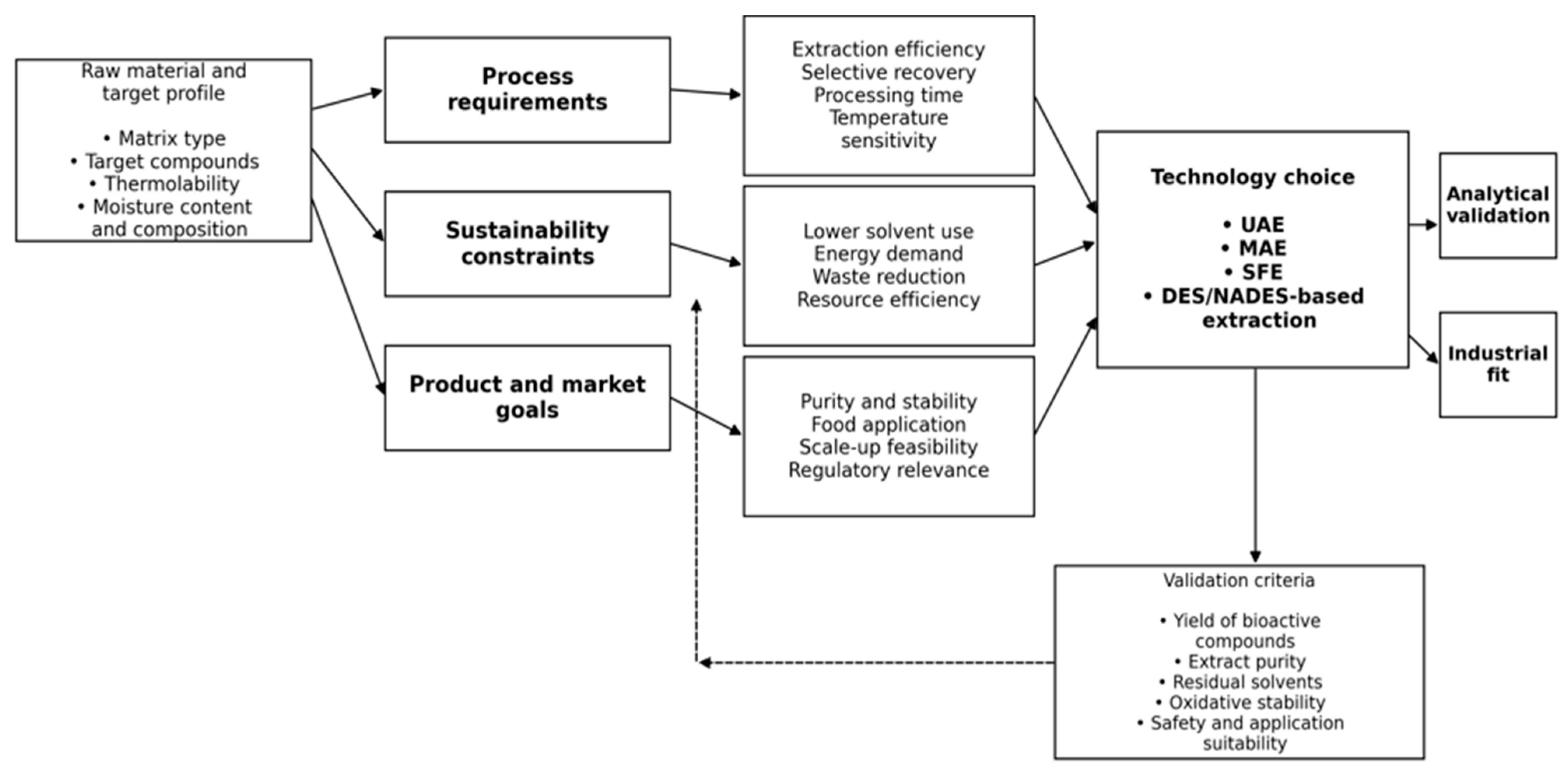
Given that no single green extraction technology represents the universal best solution, it is useful to briefly outline the key factors that guide the choice of appropriate technology in food systems.
Figure 1 shows a conceptual decision model showing how feedstock properties, process requirements, sustainability constraints, and product goals jointly influence the choice of extraction technology, as well as its subsequent analytical verification.
The choice of green extraction technology should not be based on extraction yield alone. It should consider the interrelationship of matrix characteristics, target compounds, process efficiency, environmental constraints, and intended food application. In this sense, analytical validation remains necessary to confirm that the chosen extraction procedure provides a result that is safe, stable, and relevant for industrial application.
5. Natural Fermentation as a Low-Impact Processing Strategy
To make the fermentation section more specific, fermentation should be evaluated through specific food matrices, not just general benefits. In cereals and legumes, lactic acid fermentation can reduce anti-nutritive factors and improve mineral bioavailability, while in fruit pomace it can release or transform phenolic compounds and support the creation of functional ingredients. In dairy by-products and plant protein systems, fermentation can improve texture, acidity, and sensory acceptance, but can also increase safety risks if the microbial ecology is not controlled. These risks include batch-to-batch variability, biogenic amines, mycotoxins, spoilage organisms, and inconsistent metabolite profiles. For this reason, fermentation should be treated as a viable processing strategy only when the choice of microorganisms, fermentation time, temperature, pH evolution, and safety indicators are clearly monitored [
31].
Natural fermentation represents one of the oldest forms of food processing, but its contemporary importance far exceeds the historical and traditional dimension. Fermentation is viewed as a sustainable biotechnological platform that enables the transformation of raw materials into products of greater nutritional, functional and market value, with relatively low process intensity and the possibility of reducing the use of additives and aggressive technological interventions [
5,
6,
7,
15]. This is the reason why fermentation occupies an important place in contemporary discussions about sustainable food processing. Spontaneous fermentation brings a greater degree of variability, because the composition of the microbiota, the course of metabolic changes, and the final quality of the product depend on numerous factors, including the raw material, temperature, duration of the process, and hygienic-technological conditions. In the context of sustainability, fermentation is interesting because it can be applied to a wide range of raw materials and by-products, including grains, legumes, fruits, vegetables, milk, whey, beer wort, and other agro-food residues [
7,
15,
18]. In this way, fermentation not only contributes to the conservation and stabilization of food, but also opens up space for the valorization of materials that would otherwise have a lower market value or end up as waste. The main effects of natural fermentation on quality, safety, and sustainability are shown in
Table 3. One of the most important advantages of fermentation is its ability to modify the chemical composition of food in a way that can increase its nutritional and functional value. The contemporary literature emphasize that fermentation can increase the content or bioavailability of polyphenols, peptides, gamma-aminobutyric acid, and other components related to the functional quality of food [
5,
17,
18,
31].
The application of fermentation in plant matrices is interesting, where the recent literature increasingly indicates its importance for the development of plant-based and clean-label products [
17,
18]. Fermentation can help alleviate unwanted sensory notes, improve texture, increase functional properties, and improve the nutritional quality of plant products, which makes it relevant not only for traditional fermented products, but also for a new generation of sustainable food formulations. Fermentation is traditionally seen as a method of extending the shelf life of food, primarily thanks to the lowering of pH, the production of organic acids, the competitive action of beneficial microbiota, and the creation of unfavorable conditions for the development of spoilage and certain pathogens. Fermentation represents an important low-impact approach to food stabilization, especially in systems that seek to reduce the use of synthetic preservatives and high-intensity processing treatments. Although such processes can yield products of high authenticity and a rich sensory profile, they also carry potential risks if not adequately controlled. The possibility of the presence of undesirable microorganisms, the creation of biogenic amines, mycotoxins, or other harmful metabolites, as well as oscillations in quality between production batches [
16,
31,
32] is particularly indicated. The safety of fermented products must be monitored through microbiological monitoring, chemical analysis, and process validation, and not assumed just because the product is “natural” or “traditional”. Modern approaches increasingly insist on combining traditional knowledge with more precise tools for fermentation management, including the monitoring of pH, water activity, organic acids, microbial succession, and metabolic changes.
In addition to its classical role in food processing, fermentation is gaining an important role in the valorization of food by-products and residues. Modern research directions show that different biomasses of lower market value can be used as fermentation substrates for the production of functional ingredients, organic acids, aromas, enzymes, bioactive metabolites or new food formulations [
7,
15,
18]. Thus, fermentation moves from the framework of “canning” to the broader framework of creating additional value and supporting circular models of food production. This approach is important for a sustainable food industry, as it allows material streams that would otherwise be waste to be turned into useful intermediates or final products. Examples from the recent literature include the use of beer wort, plant residues, and other agro-food by-products as fermentation substrates, achieving benefits from both the aspect of waste reduction and the aspect of economic utilization of resources. Fermentation proves to be a technological connection between sustainability, innovation, and the development of products with more added value. Although fermentation has great potential as a sustainable and functional technology, its application in industrial conditions still requires careful balancing between authenticity, efficiency, safety, and standardization.
6. Role of Chemical Analysis in Sustainable Food Processing
Analytical methods do not only confirm whether the product meets the final quality specifications, they also determine whether the purportedly sustainable process has preserved or improved the target compounds without introducing unacceptable risks to safety or authenticity. For industrial transfer, the analytical plan should therefore be selected before scaling, and not after product development is complete. A practical analytical framework should link target compounds, contaminants, shelf life markers, authenticity markers, and process control indicators to validated methods and decision thresholds.
In modern sustainable food processing, chemical analysis plays a central role, because it enables the effects of technological processes to be objectively evaluated, compared, and standardized. Without analytical confirmation, claims about preservation of bioactive components, improved stability, or reduced risk remain at the level of conjecture. That is the reason why chemical analysis cannot be seen as a final control step, but as an integral part of the development, optimization, and validation of sustainable food processes. This is important in the context of green extraction technologies and fermentation. During extraction, it is necessary to confirm whether the target compounds are really isolated in sufficient quantity, whether their functionality is preserved, and whether undesirable substances are present in the extract, including solvent residues, degradation products, or co-extracted contaminants [
8,
9,
33]. In fermentation, on the other hand, it is necessary to monitor not only changes in the nutritional and bioactive profile, but also chemical indicators of stability and safety, including organic acids, biogenic amines, oxidative changes, and the possible presence of harmful metabolites [
8,
16,
32]. Chemical analysis is the basis for connecting the sustainability of the process with the actual quality and safety of the final product.
The main analytical objectives in sustainable food processing, together with their technological relevance, are shown in
Table 4. One of the basic tasks of chemical analysis in sustainable food processing is the determination of the content and stability of bioactive compounds. Depending on the type of matrix and technological process, the subject of analysis can be polyphenols, flavonoids, anthocyanins, carotenoids, vitamins, peptides, organic acids, and other functional components [
8,
33]. These analyzes are crucial for assessing whether a certain green extraction method is really effective and whether fermentation leads to an increase, preservation, or degradation of the bioactive potential of the product. Modern analytical approaches for these purposes include chromatographic and spectrometric methods, including HPLC, LC–MS/MS, GC–MS, as well as various spectrophotometric approaches, while foodomics further expands the possibility of comprehensive characterization of complex food systems [
33,
34]. These analyzes are significant for products obtained from by-products or secondary raw materials, where the composition is often more heterogeneous than for standardized primary raw materials. In such cases, analytical control serves not only to confirm the presence of desirable components, but also to enable comparison of different extraction methods, fermentation conditions, and storage methods. In this way, chemical analysis becomes a tool for rational process optimization, and not just a means for final quality confirmation. This is of particular importance in systems where sustainable technology is expected to simultaneously provide functional value and stable product quality.
Oxidation stability monitoring is one of the most important segments of chemical assessment of food quality, especially for products rich in fat, sensitive plant extracts, and functional formulations containing bioactive compounds prone to degradation. Oxidation directly affects sensory quality, nutritional value, shelf life, and, in some cases, the formation of undesirable or potentially harmful products [
33,
35]. In the assessment of sustainable food processes, one cannot talk about the quality of the product without analyzing its oxidation stability. In practice, various indicators are used to assess oxidative stability, including peroxide number, anisidine number, TBARS, free fatty acids, changes in the content of natural antioxidants and correlation analyzes between chemical and sensor parameters. Such indicators are especially important when evaluating whether “greener” processing technologies really lead to a product that remains stable during storage and distribution, and not only at the time of laboratory characterization. In addition to the assessment of useful components, chemical analysis is also crucial for the detection of contaminants and process-related risks. In modern food systems, this includes pesticides, veterinary drugs, mycotoxins, packaging-derived contaminants, polycyclic aromatic hydrocarbons, PFAS, pyrrolizidine alkaloids and other undesirable substances. This aspect is especially important when by-products, alternative raw materials, or fermentation systems with greater biological and chemical complexity are included in the production.
The more heterogeneous the raw material base and the more innovative the process, the greater the need for a reliable analysis of possible chemical hazards. Sustainability and circularity must not lead to the “spillover” of risk from one part of the chain to another. Chemical analysis functions as a safeguard mechanism that allows sustainable innovation to remain compatible with regulatory and health requirements. In addition to safety and nutritional quality, chemical analysis plays a growing role in confirming the authenticity and traceability of products. This is especially important for fermented products, functional formulations and extracts obtained from secondary raw materials, because the market value of such products often depends precisely on their declared naturalness, origin, composition and technological procedure. In the era of clean-label products, natural extracts and functional foods, analytical confirmation becomes important from a scientific, regulatory and market point of view. Authentication methods enable confirmation of the origin of the raw material, verification of the presence or absence of specific ingredients, control of possible counterfeits, and assessment of compliance between the declaration and the actual composition of the product [
8,
10,
34]. This means that the chemical analysis is not only used to show “how much of something there is”, but also to confirm that the product is really what it claims to be. Such a role is of importance in sustainable and innovative food solutions, where consumer trust is often closely linked to the transparency of the production process. When all of the above is taken into account, it becomes clear that chemical analysis is not only an auxiliary component of sustainable food processing, but its basic validation infrastructure. It allows green extraction technologies to be evaluated not only according to yield, but also according to the purity, selectivity, and stability of the extract [
8,
9,
33]. It allows fermentation to be evaluated not only through tradition and sensory acceptability, but also through bioactive profile, stability, and chemical safety. It enables process sustainability not to be reduced to a declarative goal, but to be measurable, comparable, and industrially justified [
2,
8]. Sustainable food processing in the modern sense implies the integration of technology and analytics. Only when green extraction, natural fermentation and advanced chemical analysis are viewed as interconnected elements of the same system, it becomes possible to develop food products that are innovative, safe, functional, and sustainable [
8,
9,
10,
33,
34,
35].
7. Integration of Sustainable Processing and Analytical Quality Validation
Modern sustainable food processing cannot be based only on reducing the consumption of energy, water or solvents. Although these are important goals, they are not sufficient in themselves to justify a new technology if the final product does not meet the requirements of safety, stability, sensory quality, and nutritional value. Sustainability in the food industry must be seen as a balance between ecological, technological, and qualitative criteria. Green extraction technologies make full sense only if they manage to preserve or improve the functional properties of the extracted components, with an acceptable purity and stability profile at the same time [
3,
13,
19,
22]. Fermentation has full technological value only when its positive effects on the nutritional profile, shelf life, or sensory characteristics are confirmed by microbiological and analytical quality validation. Sustainable technology is not an end in itself, but a means for the development of safe, high-quality, and market-relevant food products. In modern food systems, increasing emphasis is placed on an integrated approach in which process innovation and analytical validation are developed in tandem. Such an approach enables decisions on the choice of technology to be based not only on theoretical viability, but also on real data on efficiency, stability, safety, and reproducibility of the process [
8,
9,
10,
33,
34,
35].
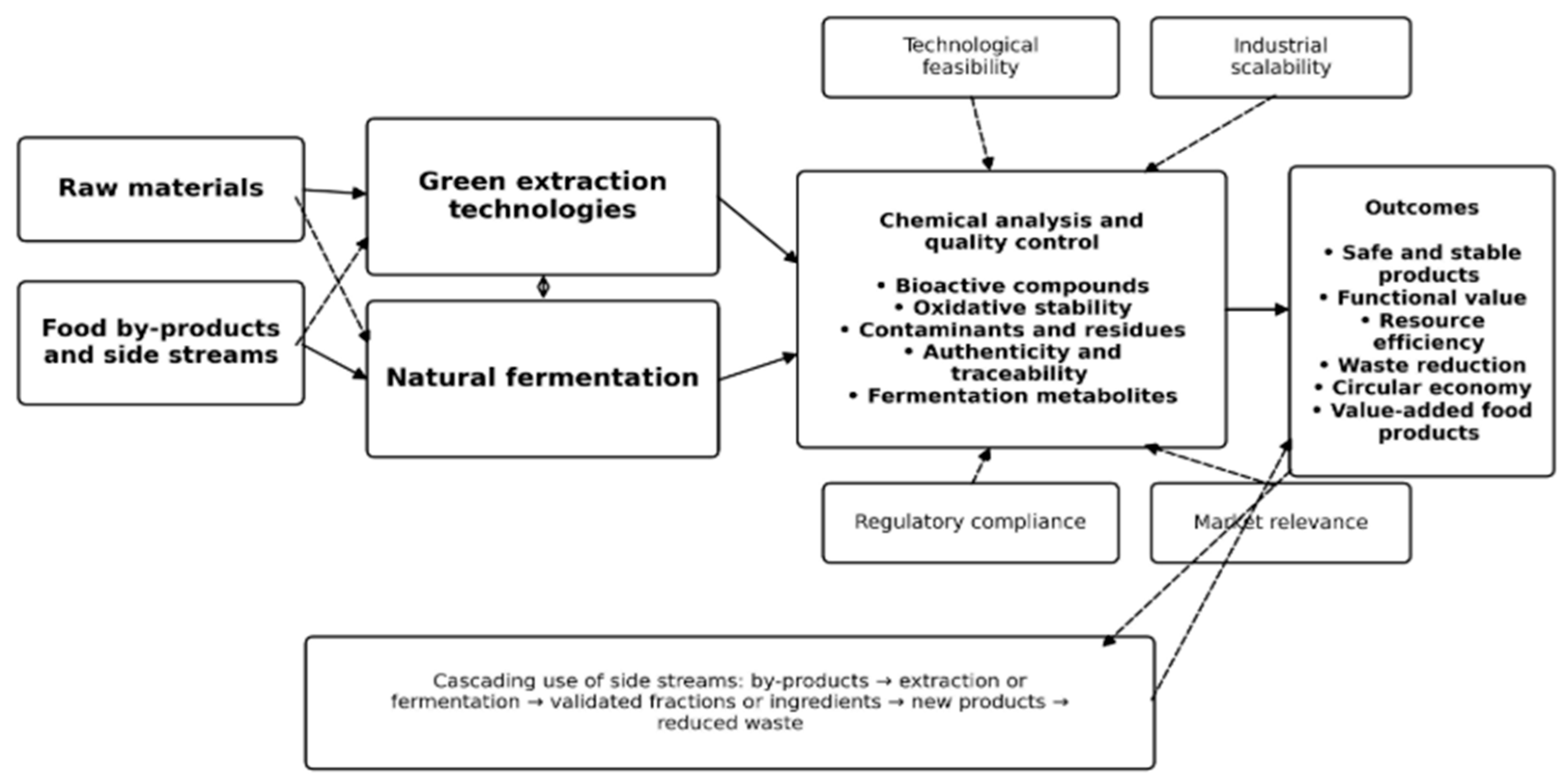
Given that the key arguments of this review work are based on the interdependence of process innovation, by-product valorization, and analytical validation, it is useful to summarize these relationships through an integrated conceptual framework.
Figure 2 shows that green extraction technologies and natural fermentation do not function as isolated approaches, but as complementary processing pathways whose real viability depends on chemical confirmation of product quality, safety, stability, and technological relevance.
As shown in
Figure 2, sustainable food processing should be understood as a systemic model and not as a set of separate technological interventions. In this model, raw materials and side streams from the food system enter the processes of green extraction or fermentation, while chemical analysis plays the role of a central layer of validation that confirms whether the obtained fractions or products are really safe, stable, authentic, and functionally valuable. Such integration creates conditions for the development of food products with higher functional and market value, while simultaneously supporting waste reduction, circularity, and more efficient use of resources.
One of the most important points of connection between green extraction, fermentation, and chemical analysis is the valorization of by-products and residues from the food industry. Instead of viewing such material flows exclusively as waste, contemporary sustainable approaches increasingly treat them as secondary raw materials for obtaining extracts, functional ingredients, fermentation substrates, and new products with higher functional and market value [
4,
13,
14,
18,
20,
25]. This direction of development directly supports the principles of circular economy and more efficient use of resources. This means that, for example, fruit pomace, peel, seeds, beer wort, or other agro-food residues can first be used to extract polyphenols, antioxidants, fibers, or pigments using green extraction methods. After that, the remaining biomass can serve as a substrate for fermentation processes or as a component of new formulations. Such a cascading approach increases the overall efficiency of raw material utilization and reduces the amount of material that ends up as waste. At the same time, chemical analysis enables the composition, safety, and functional value of the obtained fractions to be confirmed at each stage [
8,
9,
33]. It is important to emphasize that the valorization of by-products is not automatically sustainable just because it reduces waste. Its real sustainability depends on whether the processes are energetically acceptable, whether the extracts have a stable and safe chemical profile, whether there is a real possibility of industrial application, and whether the overall balance of resources justifies process intervention. Such systems require a combined view that links technological efficiency and analytical verification.
The integration of sustainable processes and analytical quality validation is important in the development of new value-added products. In the modern food industry, there is a growing interest in products that are not only nutritionally acceptable, but also offer additional functional properties, a clean-label profile, a lower ecological footprint and greater transparency of production [
8,
10,
26,
31]. It is in this space that green extraction and fermentation can act complementary: extraction enables the extraction of targeted bioactive components, while fermentation can transform the matrix, improve bioavailability, and develop desirable sensory properties [
17,
18,
21,
26,
31]. Chemical analysis then confirms that such effects are real, measurable and stable over time [
8,
33,
34,
35]. This approach is particularly relevant for the development of functional beverages, natural preservatives, herbal formulations, extracts for food fortification, fermented ingredients, and products obtained from secondary raw materials [
20,
25,
26]. The success of such products depends on whether the development process is carried out interdisciplinarily. It is not enough to show a high content of one bioactive component; it is also necessary to prove safety, stability, sensory acceptability, process re-productivity, and regulatory compliance [
8,
9,
10,
35]. One of the key messages of this paper is that green extraction, natural fermentation, and chemical analysis should not be seen as three separate research directions. When considered in isolation, they provide partial solutions: extraction may be effective, but without confirmation of stability; fermentation can be functionally interesting, but without safety control; chemical analysis can provide precise data, but without a wider technological context [
8,
9,
10,
33]. It is only by connecting them that a sustainable food processing model emerges that has both scientific and industrial meaning. Such an integrated model enables the transition from a linear way of thinking to a systemic approach, in which raw material, process, by-product, quality, and safety are viewed as parts of a unique value chain. In this framework, chemical analysis is not only a control mechanism, but a process design tool; fermentation is not only a traditional technique, but a platform for biotransformation and valorization; and green extraction is not only an alternative to organic solvents, but part of a strategy for more efficient and sustainable use of resources [
3,
7,
13,
18,
27,
28,
29,
30,
36,
37,
38].
8. Challenges and Research Gaps
The main challenges are the limited comparability of published studies, frequent absence of life cycle assessment, lack of harmonized indicators for reducing solvent and energy consumption, as well as insufficient reporting of scaling costs. Many studies show promising extraction yields or fermentation effects under laboratory conditions, but fewer provide data on reproducibility, economic feasibility, safety under industrial conditions, regulatory acceptance, or long-term stability of the pro-extract. Another gap is the weak connection between analytical results and sustainability claims: a product may be produced by a greener process, but this does not automatically mean that it is more stable, safer, or more acceptable to consumers.
Although progress in the field of sustainable food processing is significant, numerous challenges continue to limit the wider industrial application of green extraction technologies and fermentation approaches. One of the main problems is that much of the literature is still based on laboratory or pilot studies, while data on industrial scaling, process economics, long-term product stability, and regulatory aspects are much more modest. The gap between the high extraction yield reported under experimental conditions and actual process viability is pronounced when energy, equipment costs, solvent recovery, and process reproducibility are considered. In fermentation, the main challenges are related to the standardization of spontaneous processes, control of microbiological variability, management of unwanted metabolites, and balancing between authenticity and reproducibility [
15,
16,
32]. Although natural fermentation has great potential for the development of innovative and locally specific products, its wider industrial application requires more reliable control, monitoring, and validation models. This is crucial in systems involving alternative raw materials and by-products, where the chemical and microbiological profiles may be more complex and less predictable. An additional challenge is the need for a more precise and integrated analytical framework. In many studies, the focus on a limited number of indicators still dominates, while the real assessment of the sustainable value of new processes requires broader analytical platforms that include bioactive profile, stability, contaminants, authenticity, traceability and sensory implications [
8,
9,
10,
33,
34,
35]. Future research should focus less on the isolated presentation of “successful methods” and more on the development of validated, interoperable, and industrially applicable systems that link quality, safety, and sustainability. The future development of this area will probably go in the direction of deeper integration of processes and analytics. This includes combining green extraction methods with fermentation platforms, greater use of foodomics and high-resolution analytics, development of real-time monitoring and digital process management systems, as well as better inclusion of life cycle thinking principles in sustainability assessment. Just such a direction can enable the transition from individual technological innovations to truly sustainable food systems.
10. Conclusions
Sustainable food processing represents one of the most important development directions of the modern food industry, because it responds to the simultaneous demands for reducing the environmental burden, more rational use of resources, improving food safety, and preserving its nutritional and functional value. In this framework, this work has shown that green extraction technologies, natural fermentation, and chemical analysis should not be seen as separate technological or research directions, but as interconnected elements of a unique system of sustainable food processing. Literature analysis indicates that green extraction technologies have significant potential for efficient extraction of bioactive compounds from plant raw materials and food by-products with reduced use of conventional solvents and lower overall process load. Their value is expressed in the context of the valorization of residues and side streams from the food industry, where they can contribute to the development of ingredients and formulations with more added value. Natural fermentation is confirmed as a low-impact biotechnological strategy that can improve nutritional quality, improve sensory characteristics, extend shelf life, and enable functional transformation of raw materials of lower market value. This article also emphasizes that none of these approaches can be evaluated solely through technological efficiency or declarative sustainability. The key place in this sense belongs to chemical analysis, which represents the basic mechanism of validating sustainable processes. It enables an objective assessment of the content of bioactive components, oxidation stability, the presence of contaminants, authenticity, and standardization of the product, thus linking technological innovation with demonstrable quality and safety. Without such analytical support, sustainability would remain a theoretical or promotional concept rather than a truly measurable and industrially applicable category. A important conclusion of this article is that the future of sustainable food processing does not depend only on the development of individual “green” methods, but on their integration into broader, functional, and validated systems. Such systems should link extraction, fermentation, valorization of by-products, quality control, and safety assessment within a single logic of circular economy and technological sustainability. It is this integrated approach that opens up space for the development of new food products that are innovative, safe, nutritionally valuable, and market relevant at the same time.
The literature still show important limitations. Many studies remain at the laboratory or pilot level, while data on industrial scaling, economic feasibility, regulatory challenges, and long-term product stability are still insufficient. Future research should therefore provide more comparable quantitative criteria, including extraction yield, solvent reduction, energy consumption, fermentation time, microbiological safety, retention of bioactive compounds, cost estimates, and life cycle indicators. Such data would allow sustainable processing methods to be compared not only as promising concepts, but also as practical industrial options.
In general, sustainable food processing will not be determined only by how green a method works, but by how successfully it combines environmental acceptability, technological efficiency, safety, quality, and real applicability of the product. In this sense, the integration of green extraction, natural fermentation, and analytical quality validation offers a more powerful framework than any single technology considered separately.