Identification of Landslides in the Hilly Areas of Eastern China Using High-Resolution GF-2 Images and Deep Learning Models


Abstract
1. Introduction
2. Data and Methods
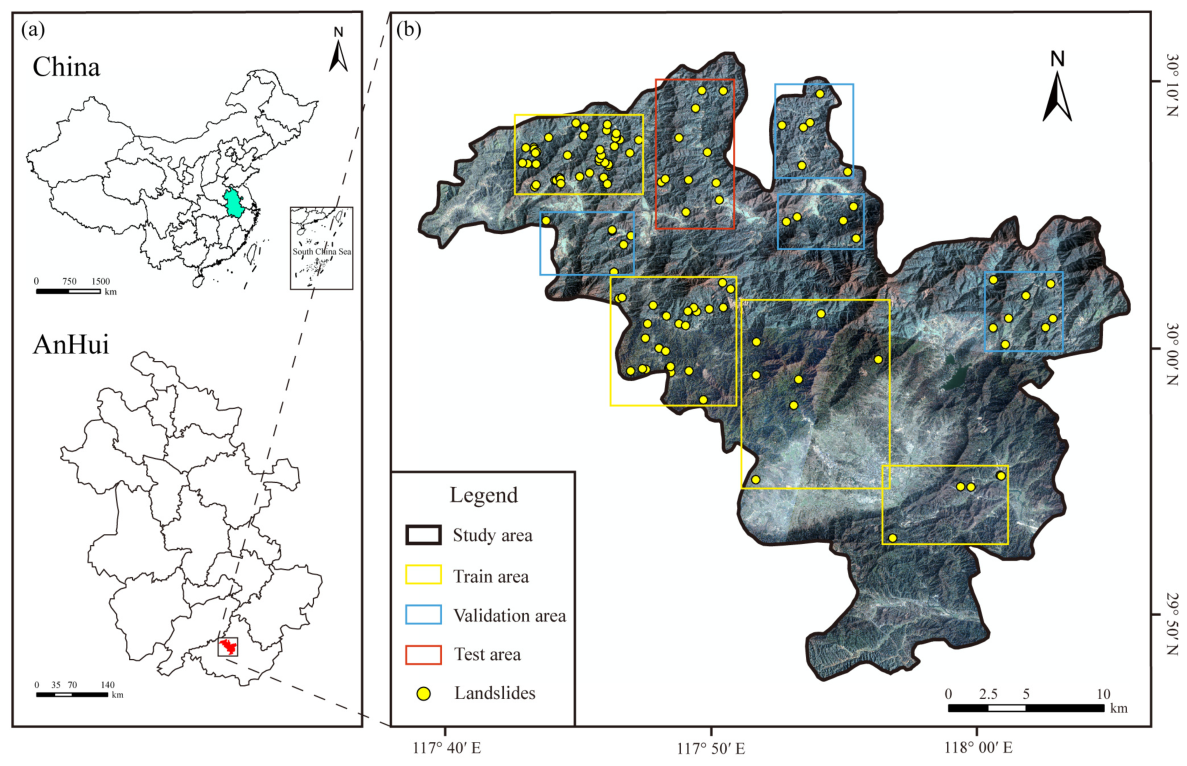
2.1. Study Area
2.2. Data Sources and Technical Strategy
2.2.1. Remote Sensing Images
2.2.2. Conditional Factor Data
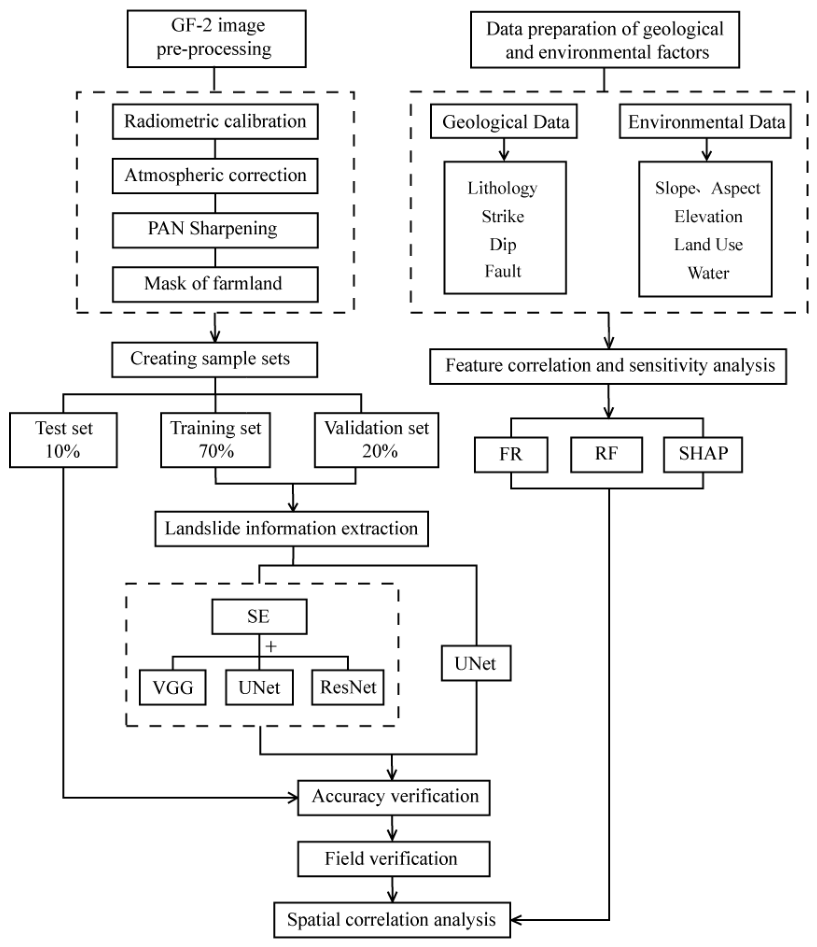
2.2.3. Technical Strategy
2.3. Data Processing
2.3.1. Image Preprocessing
2.3.2. Sample Dataset Construction
2.4. CNN Model and Validation
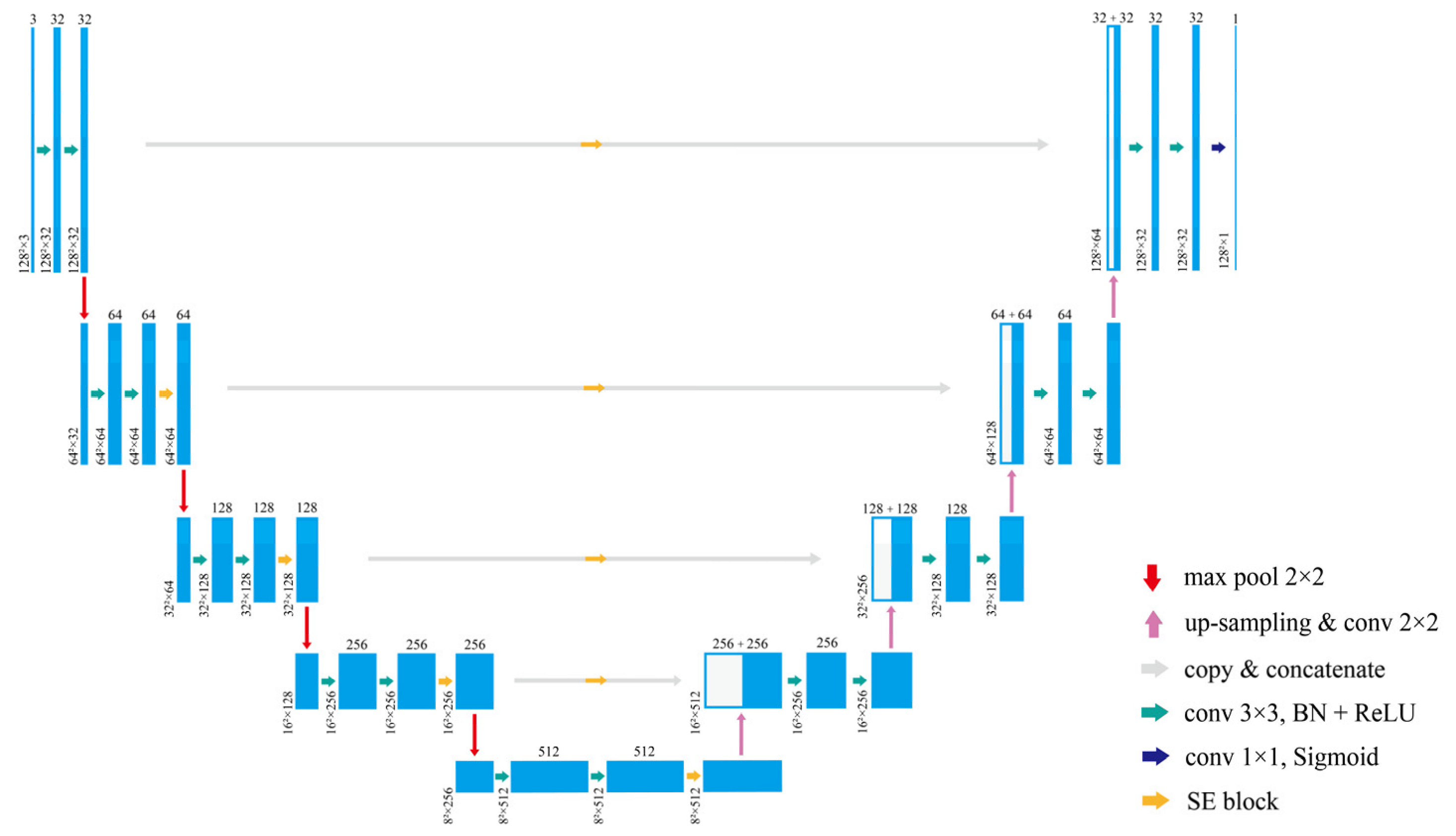
2.4.1. Network Models
- (1)
- SE
- (2)
- SE-CNNs
2.4.2. Hyperparameter Tuning
2.4.3. Accuracy Evaluation
3. Results and Evaluation
3.1. UNet-SE Results
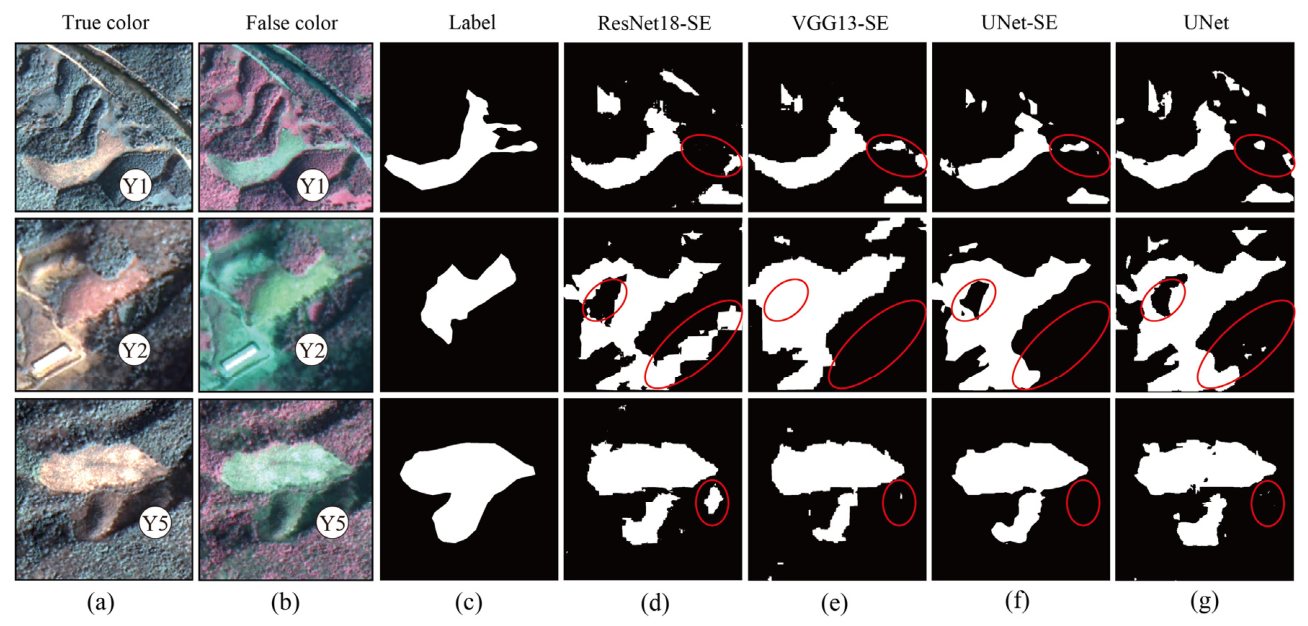
3.2. Comparative Validation of Methods on the Study Area
3.3. Transfer Regional Comparison
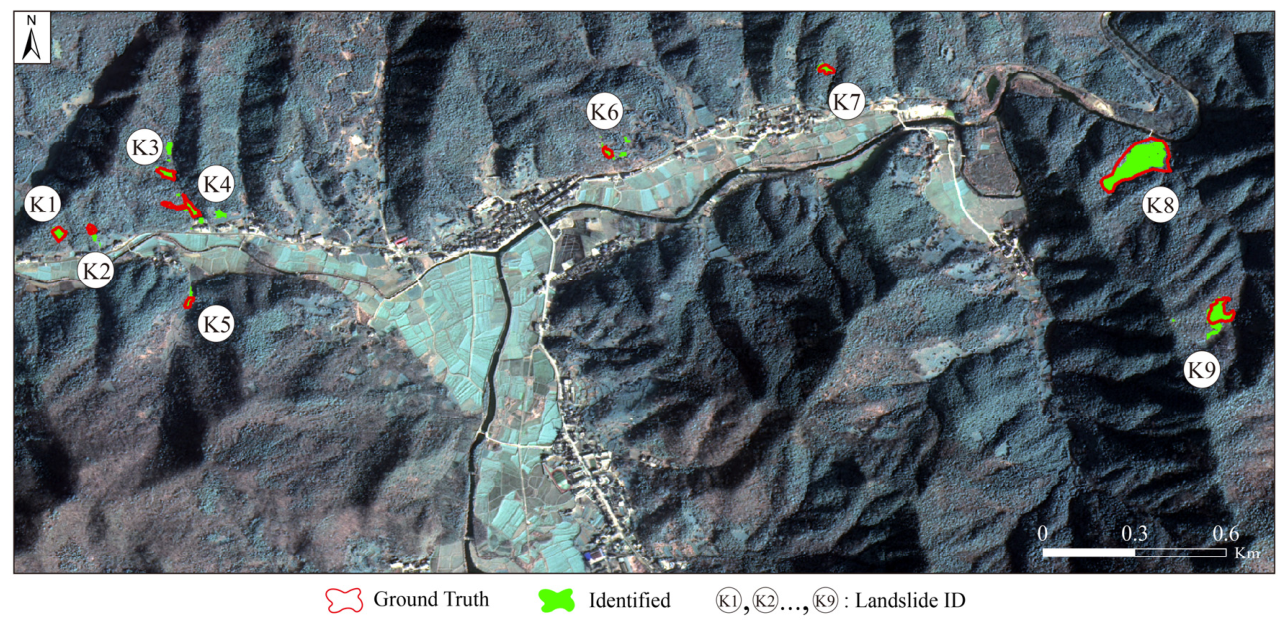
3.3.1. Cross-Regional Validation in Kecun
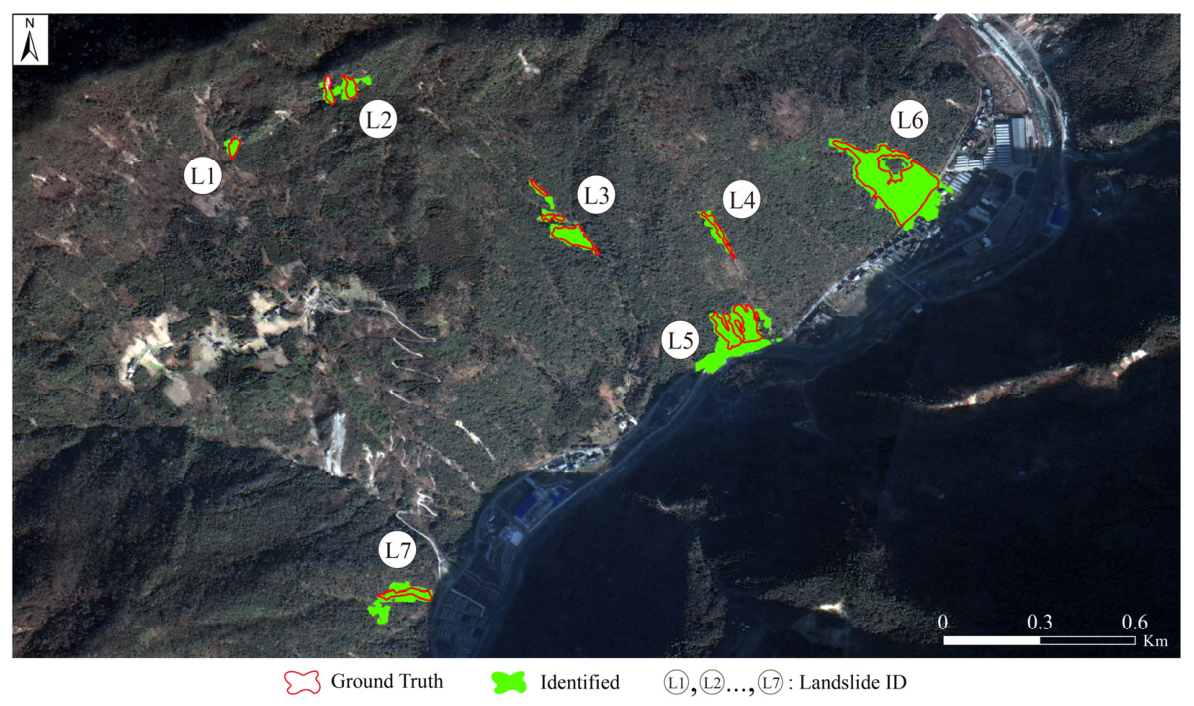
3.3.2. Cross-Regional Validation in Lushan
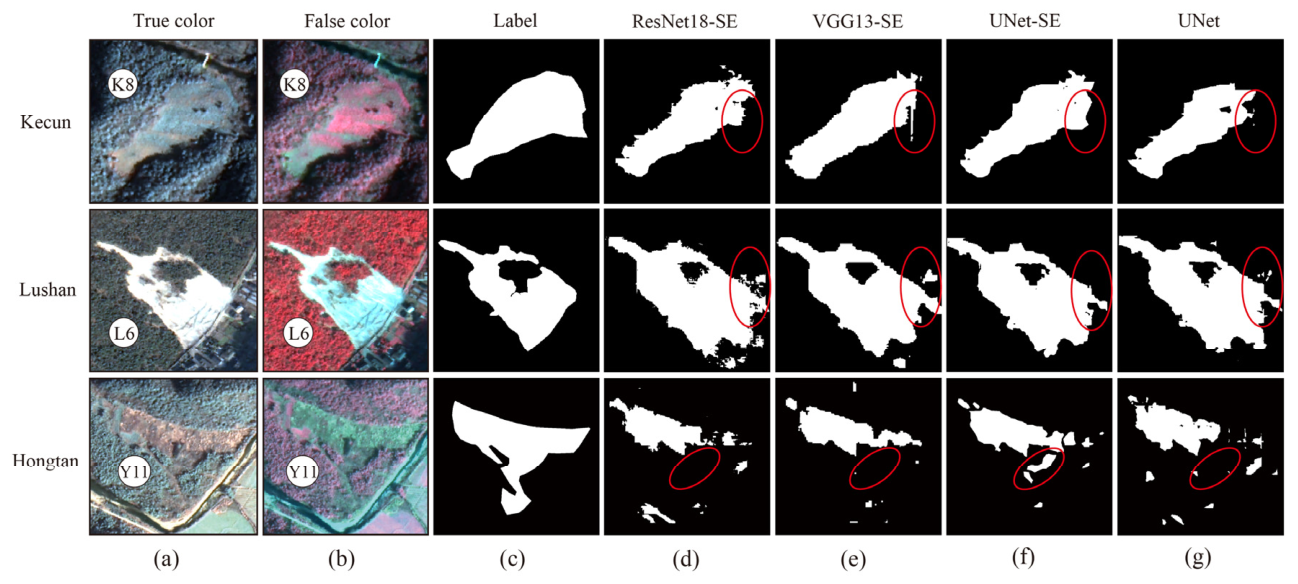
3.3.3. Comparative Validation and Analysis
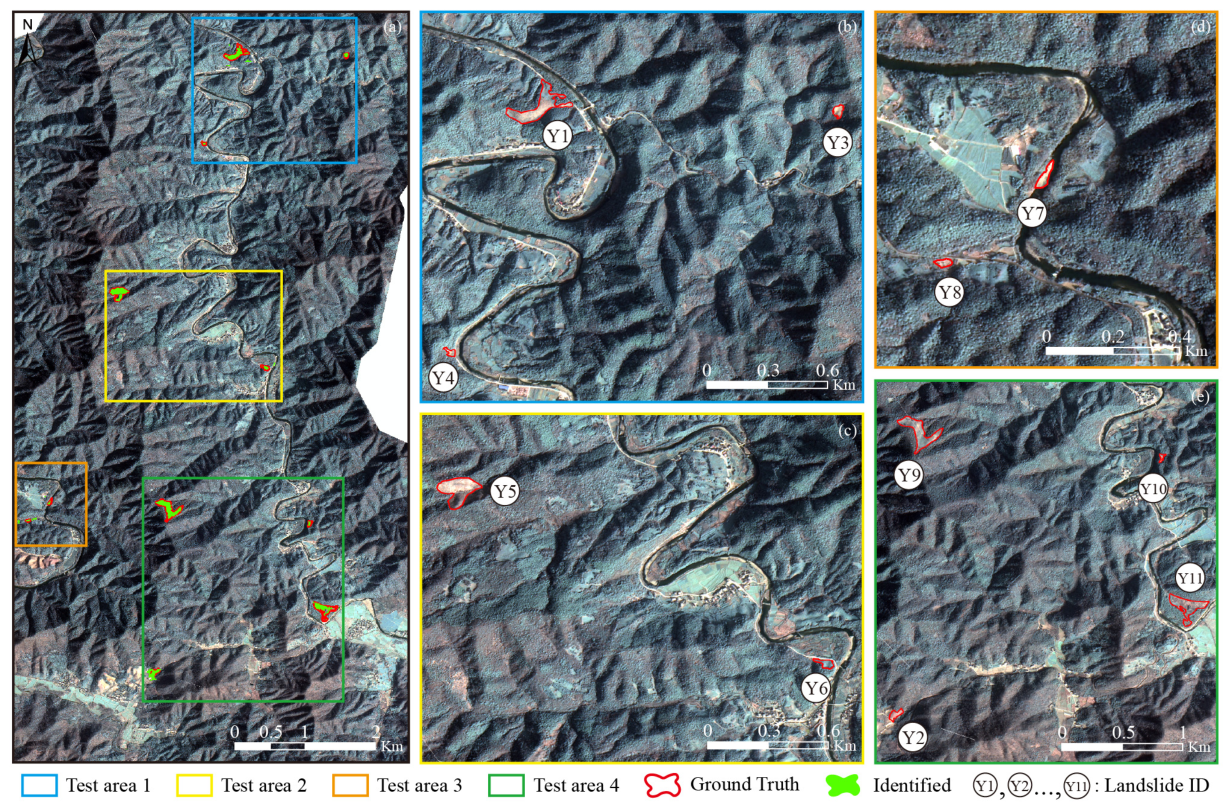
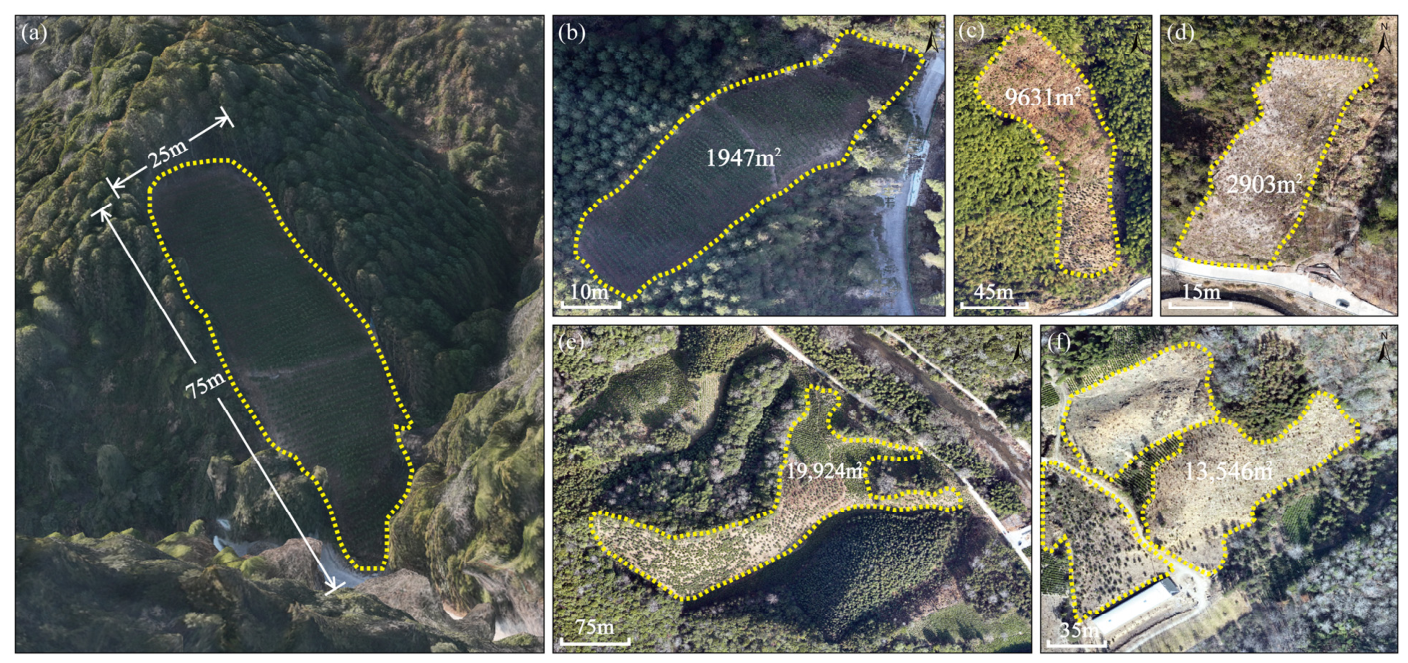
3.4. Field Validation
4. Correlation Analysis of Conditional Factors
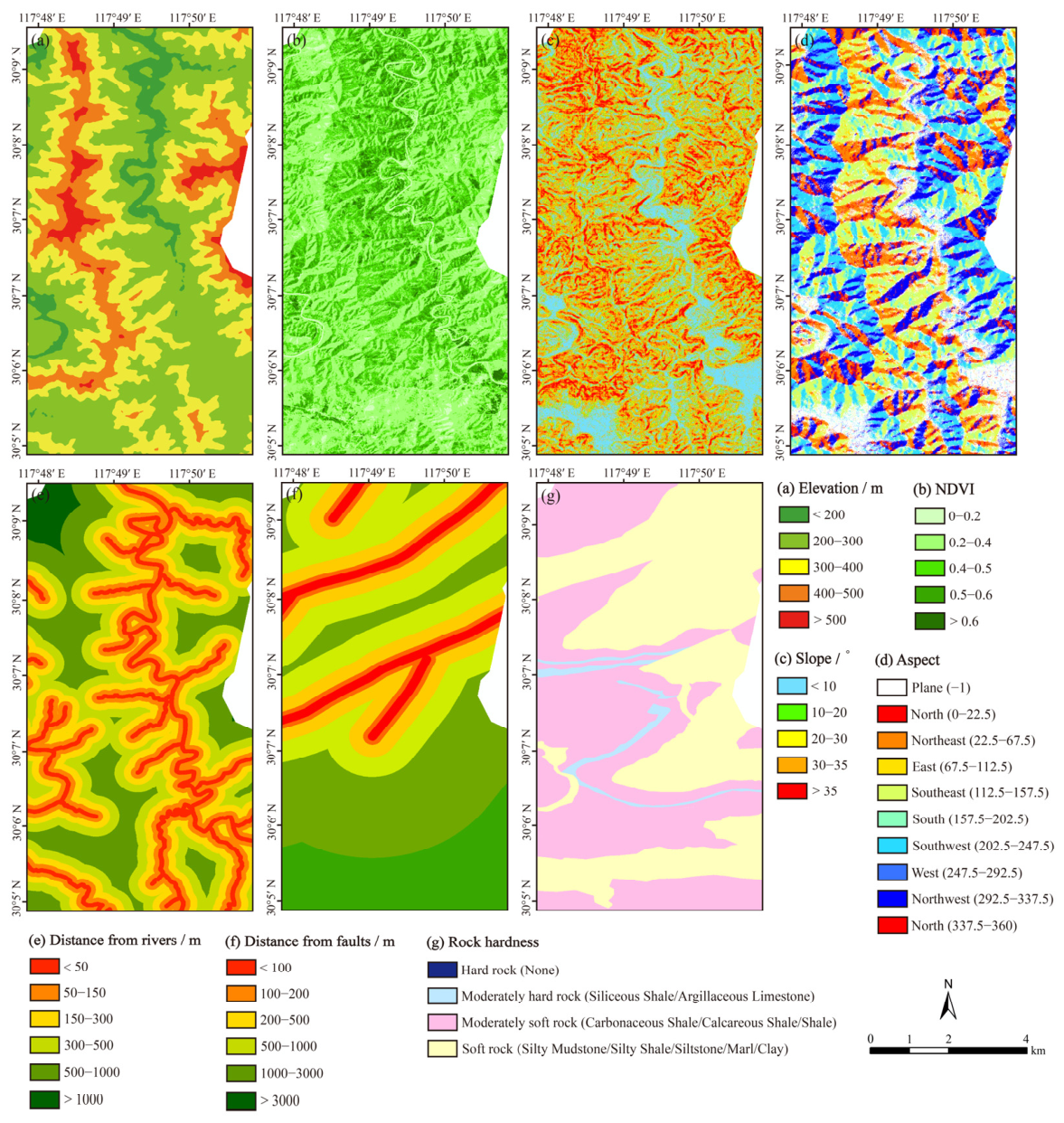
4.1. Extraction of Conditional Factors
4.2. Correlation Analysis
4.2.1. Probability Analysis Using FR
- (1)
- Environmental factors
- (2)
- Geological factors
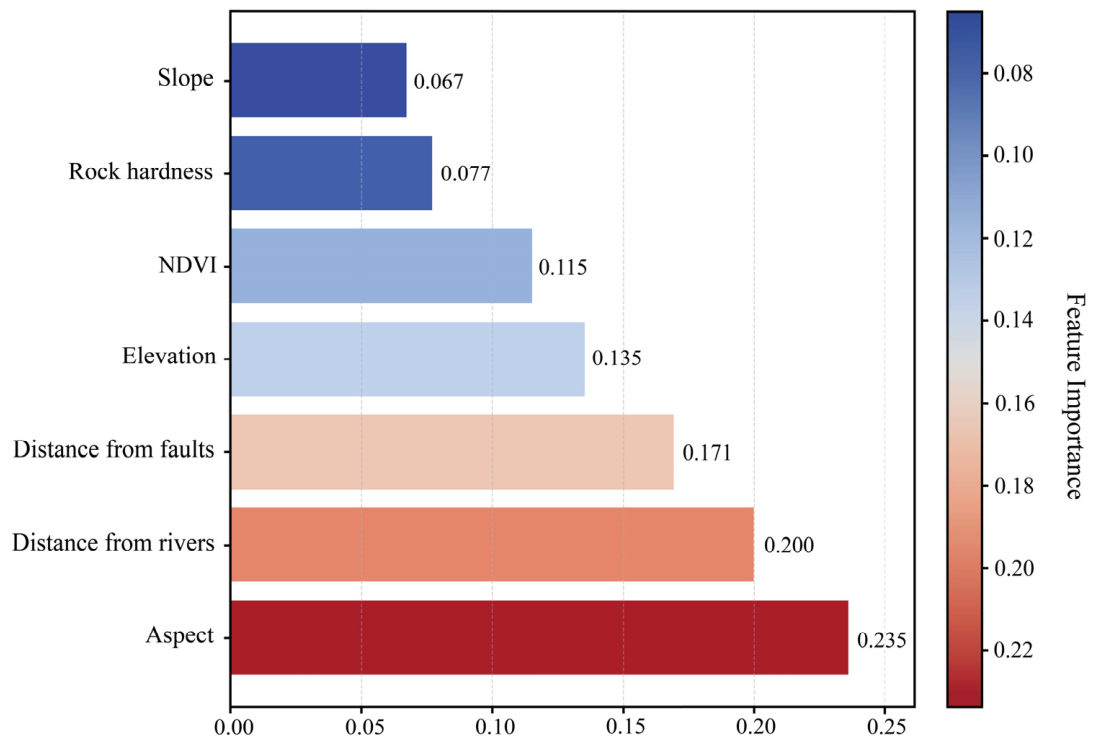
4.2.2. Importance Analysis Using RF
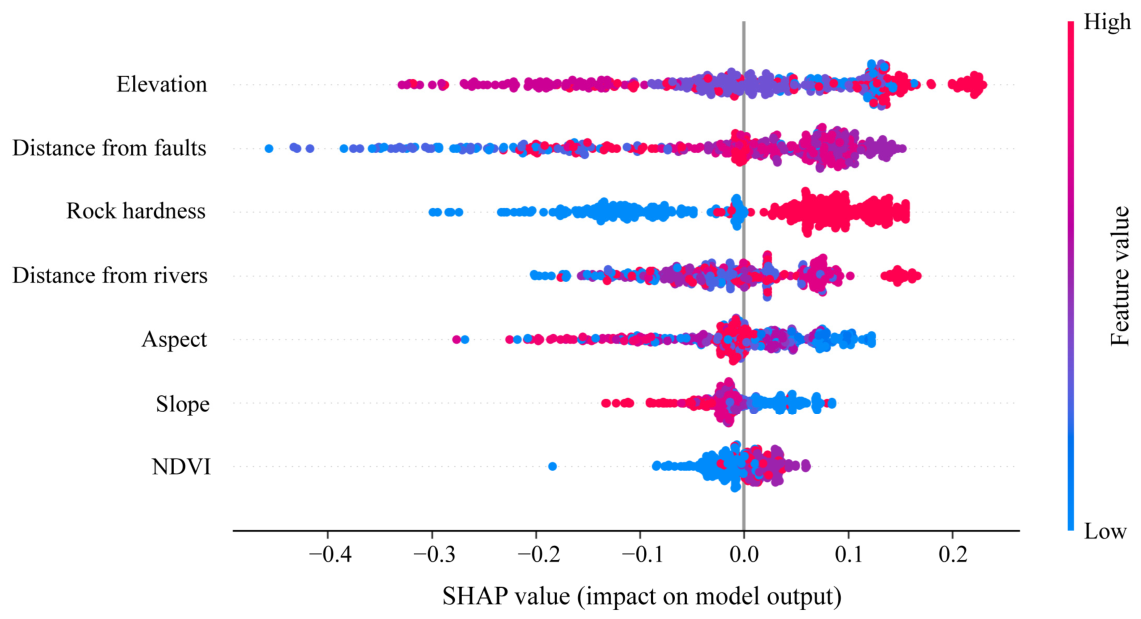
4.2.3. Sensitivity Analysis Using SHAP
5. Discussion
5.1. CNNs + SE Model Performance of Landslide Identification
5.2. Cross-Regional Generalization Ability
5.3. Landslide Controlling Conditions and Sustainability Implications
6. Conclusions
Author Contributions
Funding
Institutional Review Board Statement
Informed Consent Statement
Data Availability Statement
Conflicts of Interest
References
- Qu, Y.; Xing, H.F.; Sun, L.; Shi, X.; Huang, J.F.; Ao, Z.R.; Chang, Z.X.; Li, J.J. Integrating Sentinel-2A imagery, DEM data, and spectral feature analysis for landslide detection via fully convolutional networks. Landslides 2025, 22, 335–352. [Google Scholar] [CrossRef]
- Yu, L.C.; Huang, H.X.; Yan, C.H.; Yan, C.; Guo, S.L. Early warning system for landslide of gentle Piedmont slope based on displacement velocity, factor of safety, and effective rainfall threshold. Int. J. Disaster Risk Reduct. 2025, 118, 105232. [Google Scholar] [CrossRef]
- Xu, Y.L.; Ouyang, C.J.; Xu, Q.S.; Wang, D.P.; Zhao, B.; Luo, Y.T. CAS Landslide Dataset: A Large-Scale and Multisensor Dataset for Deep Learning-Based Landslide Detection. Sci. Data 2024, 11, 12. [Google Scholar] [CrossRef] [PubMed]
- Wang, D.F.; Liu, L.; Luo, C.; Wen, X.H.; Li, Y.X.; Ren, D.Y.; Tang, W. Application of multi-source remote sensing technologies in identification and evolution mechanism analysis of creep landslides: A case study of Shibatai landslide in Wenchuan earthquake area. Front. Earth Sci. 2025, 13, 1498028. [Google Scholar] [CrossRef]
- Aspaas, A.; Lacroix, P.; Sena, C.; Kristensen, L.; Langet, N.; Renard, F. Creep bursts on the Aknes landslide, Norway: Detection, characterization and possible mechanisms. J. Geophys. Res.-Earth Surf. 2024, 129, e2024JF007733. [Google Scholar] [CrossRef]
- Chen, L.C.; Xiang, X.K.; Wen, H.J.; Xiao, J.F.; Song, C.H.; Zhou, X.Z.; Yu, J.Y. Improve unsupervised Learning-based landslides detection by band ratio processing of RGB optical images: A case study on rainfall-induced landslide clusters. Geomat. Nat. Hazards Risk 2024, 15, 2363406. [Google Scholar] [CrossRef]
- Coluzzi, R.; Perrone, A.; Samela, C.; Imbrenda, V.; Manfreda, S.; Pace, L.; Lanfredi, M. Rapid landslide detection from free optical satellite imagery using a robust change detection technique. Sci. Rep. 2025, 15, 4697. [Google Scholar] [CrossRef]
- Rossi, G.; Tanteri, L.; Tofani, V.; Vannocci, P.; Moretti, S.; Casagli, N. Multitemporal UAV surveys for landslide mapping and characterization. Landslides 2018, 15, 1045–1052. [Google Scholar] [CrossRef]
- Li, J.B.; Tian, Y.; Chen, J.; Wang, H. Rock crack recognition technology based on deep learning. Sensors 2023, 23, 5421. [Google Scholar] [CrossRef]
- Fang, C.Y.; Fan, Y.M.; Zhong, H.; Lombardo, L.; Tanyas, H.; Wang, X. A novel historical landslide detection approach based on LiDAR and lightweight attention U-Net. Remote Sens. 2022, 14, 4357. [Google Scholar] [CrossRef]
- Alimohammadlou, Y.; Tanyu, B.F.; Abbaspour, A.; Delamater, P.L. Automated landslide detection model to delineate the extent of existing landslides. Nat. Hazards 2021, 107, 1639–1656. [Google Scholar] [CrossRef]
- Pawluszek, K.; Marczak, S.; Borkowski, A.; Tarolli, P. Multi-aspect analysis of object-oriented landslide detection based on an extended set of LiDAR-derived terrain features. ISPRS Int. J. Geo-Inf. 2019, 8, 321. [Google Scholar] [CrossRef]
- Uemoto, J.; Moriyama, T.; Nadai, A.; Kojima, S.; Umehara, T. Landslide detection based on height and amplitude differences using pre- and post-event airborne X-band SAR data. Nat. Hazards 2019, 95, 485–503. [Google Scholar] [CrossRef]
- Wang, Y.; Liu, D.J.; Dong, J.; Zhang, L.; Guo, J.C.; Liao, M.S.; Gong, J.Y. On the applicability of satellite SAR interferometry to landslide hazards detection in hilly areas: A case study of Shuicheng, Guizhou in Southwest China. Landslides 2021, 18, 2609–2619. [Google Scholar] [CrossRef]
- Zhang, R.; Zhao, X.; Dong, X.J.; Dai, K.; Deng, J.; Zhuo, G.C.; Yu, B.; Wu, T.T.; Xiang, J.M. Potential landslide identification in Baihetan reservoir area based on C/L-band synthetic aperture radar data and applicability analysis. Remote Sens. 2024, 16, 1591. [Google Scholar] [CrossRef]
- Yang, S.; Li, D.Y.; Liu, Y.J.; Xu, Z.H.; Sun, Y.Q.; She, X.J. Landslide Identification in Human-Modified Alpine and Canyon Area of the Niulan River Basin Based on SBAS-InSAR and Optical Images. Remote Sens. 2023, 15, 1998. [Google Scholar] [CrossRef]
- Li, D.F.; Tang, X.C.; Tu, Z.H.; Fang, C.Y.; Ju, Y.Z. Automatic Detection of Forested Landslides: A Case Study in Jiuzhaigou County, China. Remote Sens. 2023, 15, 3850. [Google Scholar] [CrossRef]
- Peters, S.; Liu, J.X.; Keppel, G.; Wendleder, A.; Xu, P.L. Detecting Coseismic Landslides in GEE Using Machine Learning Algorithms on Combined Optical and Radar Imagery. Remote Sens. 2024, 16, 1722. [Google Scholar] [CrossRef]
- Sivasankar, T.; Ghosh, S.; Joshi, M. Exploitation of optical and SAR amplitude imagery for landslide identification: A case study from Sikkim, Northeast India. Environ. Monit. Assess. 2021, 193, 386. [Google Scholar] [CrossRef]
- Xun, Z.Y.; Zhao, C.Y.; Kang, Y.; Liu, X.J.; Liu, Y.Y.; Du, C.Y. Automatic extraction of potential landslides by integrating an optical remote sensing image with an InSAR-derived deformation map. Remote Sens. 2022, 14, 2669. [Google Scholar] [CrossRef]
- Cai, J.H.; Zhang, L.; Dong, J.; Dong, X.J.; Li, M.H.; Xu, Q.; Liao, M.S. Detection and characterization of slow-moving landslides in the 2017 Jiuzhaigou earthquake area by combining satellite SAR observations and airborne Lidar DSM. Eng. Geol. 2022, 305, 106730. [Google Scholar] [CrossRef]
- Khadka, D.; Zhang, J.; Sharma, A. Geographic object-based image analysis for landslide identification using machine learning on Google Earth Engine. Environ. Earth Sci. 2025, 84, 92. [Google Scholar] [CrossRef]
- Saha, S.; Saha, A.; Hembram, T.K.; Mandal, K.; Sarkar, R.; Bhardwaj, D. Prediction of spatial landslide susceptibility applying the novel ensembles of CNN, GLM and random forest in the Indian Himalayan region. Stoch. Environ. Res. Risk Assess. 2022, 36, 3597–3616. [Google Scholar] [CrossRef]
- Hu, Q.; Zhou, Y.; Wang, S.X.; Wang, F.T.; Wang, H.J. Improving the accuracy of landslide detection in “off-site” area by machine learning model portability comparison: A case study of Jiuzhaigou Earthquake, China. Remote Sens. 2019, 11, 2530. [Google Scholar] [CrossRef]
- Aslam, B.; Magsoom, A.; Khalil, U.; Ghorbanzadeh, O.; Blaschke, T.; Farooq, D.; Tufail, R.F.; Suhali, S.A.; Ghamisi, P. Evaluation of Different Landslide Susceptibility Models for a Local Scale in the Chitral District, Northern Pakistan. Sensors 2022, 22, 3107. [Google Scholar] [CrossRef]
- Li, Y.; Wang, P.; Feng, Q.L.; Ji, X.H.; Jin, D.J.; Gong, J.H. Landslide detection based on shipborne images and deep learning models: A case study in the Three Gorges Reservoir Area in China. Landslides 2023, 20, 547–558. [Google Scholar] [CrossRef]
- Kaushal, A.; Gupta, A.K.; Sehgal, V.K. A semantic segmentation framework with UNet-pyramid for landslide prediction using remote sensing data. Sci. Rep. 2024, 14, 30071. [Google Scholar] [CrossRef]
- Liu, D.F.; He, M.J.; Huang, B.; Dong, Q.; Liu, S.Q. Global landslide mapping using Tibetan Plateau landslide dataset and improved YOLOX. Earth Sci. Inform. 2025, 18, 313. [Google Scholar] [CrossRef]
- Wei, R.L.; Ye, C.M.; Sui, T.B.; Zhang, H.J.; Ge, Y.G.; Li, Y. A feature enhancement framework for landslide detection. Int. J. Appl. Earth Obs. Geoinf. 2023, 124, 103521. [Google Scholar] [CrossRef]
- Ghorbanzadeh, O.; Blaschke, T.; Gholamnia, K.; Meena, S.R.; Tiede, D.; Aryal, J. Evaluation of different machine learning methods and deep-learning convolutional neural networks for landslide detection. Remote Sens. 2019, 11, 196. [Google Scholar] [CrossRef]
- Wu, L.; Liu, R.; Ju, N.P.; Zhang, A.; Gou, J.S.; He, G.L.; Lei, Y.Z. Landslide mapping based on a hybrid CNN-transformer network and deep transfer learning using remote sensing images with topographic and spectral features. Int. J. Appl. Earth Obs. Geoinf. 2024, 126, 103612. [Google Scholar] [CrossRef]
- Wang, C.H.; Lin, Q.G.; Wang, L.B.; Jiang, T.; Su, B.D.; Wang, Y.J.; Mondal, S.K.; Huang, J.L.; Wang, Y. The influences of the spatial extent selection for non-landslide samples on statistical-based landslide susceptibility modelling: A case study of Anhui Province in China. Nat. Hazards 2022, 112, 1967–1988. [Google Scholar] [CrossRef]
- Lin, T.T.; Lin, X.X.; Wan, L.; Guan, S.S.; Teng, F. Combined Monitoring Methods for Potential Landslides Using MRS and TEM. J. Environ. Eng. Geophys. 2019, 24, 225–236. [Google Scholar] [CrossRef]
- Sun, Y.Q.; Li, D.Y.; Miao, F.S.; She, X.J.; Yang, S.; Xie, X.X. Effects of Weak Bedding Plane, Fault, and Extreme Rainfall on the Landslide Event of a High Cut-Slope. Sensors 2022, 22, 6790. [Google Scholar] [CrossRef]
- Liu, Y.; Yuan, A.Y.; Bai, Z.G.; Zhu, J.L. GIS-based landslide susceptibility mapping using frequency ratio and index of entropy models for She County of Anhui Province, China. Appl. Rheol. 2022, 32, 22–33. [Google Scholar] [CrossRef]
- Wang, B.; Liu, J.; Liu, G.P.; Gao, P.; Anwar, S.; Wu, Z.Y.; Li, M.X.; Li, D.Y. Spatiotemporal analysis and threshold modeling of rainfall-induced geological disasters in Anhui Province. Front. Earth Sci. 2025, 13, 1541242. [Google Scholar] [CrossRef]
- Ding, C.; Feng, G.C.; Liao, M.S.; Tao, P.J.; Zhang, L.; Xu, Q. Displacement history and potential triggering factors of Baige landslides, China revealed by optical imagery time series. Remote Sens. Environ. 2021, 254, 112253. [Google Scholar] [CrossRef]
- Fang, C.Y.; Fan, X.M.; Wang, X.; Nava, L.; Zhong, H.; Dong, X.J.; Qi, J.X.; Catani, F. A globally distributed dataset of coseismic landslide mapping via multi-source high-resolution remote sensing images. Earth Syst. Sci. Data 2024, 16, 4817–4842. [Google Scholar] [CrossRef]
- Chen, L.; Ma, Y.; Lian, Y.; Zhang, H.; Yu, Y.M.; Lin, Y.Z. Radiometric normalization using a pseudo-invariant polygon features-based algorithm with contemporaneous Sentinel-2A and Landsat-8 OLI imagery. Appl. Sci. 2025, 13, 2525. [Google Scholar] [CrossRef]
- Feng, L.; Wang, Y.; Lang, L. Landslide identification using remote sensing images and DEM based on convolutional neural network: A case study of loess landslide. Remote Sens. Nat. Resour. 2022, 34, 224–230. [Google Scholar]
- Chen, F.; Yu, B.; Li, B. A practical trial of landslide detection from single-temporal Landsat8 images using contour-based proposals and random forest: A case study of national Nepal. Landslides 2018, 15, 453–464. [Google Scholar] [CrossRef]
- Qin, S.W.; Guo, X.; Sun, J.B.; Qiao, S.S.; Zhang, L.S.; Yao, J.Y.; Cheng, Q.S.; Zhang, Y.Q. Landslide detection from open satellite imagery using distant domain transfer learning. Remote Sens. 2021, 13, 3383. [Google Scholar] [CrossRef]
- Liu, Q.; Wu, T.T.; Deng, Y.H.; Liu, Z.H. SE-YOLOv7 landslide detection algorithm based on attention mechanism and improved loss function. Land 2023, 12, 1522. [Google Scholar] [CrossRef]
- Pan, B.; Shi, X.J. Fusing Ascending and Descending Time-Series SAR Images with Dual-Polarized Pixel Attention UNet for Landslide Recognition. Remote Sens. 2023, 15, 5619. [Google Scholar] [CrossRef]
- Dang, K.B.; Giang, T.L.; Dang, V.B.; Phan, T.T.; Truong, Q.H.; Ngo, V.L.; Do, T.H.; Dang, N.V.; Forino, G. Deep learning models integrating multi-sensor and -temporal remote sensing to monitor landslide traces in Vietnam. Int. J. Disaster Risk Reduct. 2024, 105, 104391. [Google Scholar] [CrossRef]
- Sun, Q.; Li, C.; Xiong, T.; Gui, R.; Han, B.; Tan, Y.L.; Guo, A.Q.; Li, J.F.; Hu, J. Automatic Landslide Detection in Gansu, China, Based on InSAR Phase Gradient Stacking and AttU-Net. Remote Sens. 2024, 16, 3711. [Google Scholar] [CrossRef]
- Wang, J.X.; Zhang, Q.T.; Xie, H.; Chen, Y.Y.; Sun, R. Enhanced Dual-Channel Model-Based with Improved Unet++ Network for Landslide Monitoring and Region Extraction in Remote Sensing Images. Remote Sens. 2024, 16, 2990. [Google Scholar] [CrossRef]
- Chen, H.S.; He, Y.; Zhang, L.F.; Yao, S.; Yang, W.; Fang, Y.M.; Liu, Y.X.; Gao, B.H. A landslide extraction method of channel attention mechanism U-Net network based on Sentinel-2A remote sensing images. Int. J. Digit. Earth 2023, 16, 552–577. [Google Scholar] [CrossRef]
- Li, C.; Yi, B.J.; Gao, P.; Li, H.; Sun, J.X.; Chen, X.Y.; Zhong, C. Valuable clues for DCNN-based landslide detection from a comparative assessment in the Wenchuan earthquake area. Sensors 2021, 21, 5191. [Google Scholar] [CrossRef] [PubMed]
- Liu, T.; Chen, T.; Niu, R.; Plaza, A. Landslide detection mapping employing CNN, ResNet, and DenseNet in the Three Gorges Reservoir, China. IEEE J. Sel. Top. Appl. Earth Obs. Remote Sens. 2021, 14, 11417–11428. [Google Scholar] [CrossRef]
- Bhuvaneswari, T.; Sekar, R.C.G.; Selvi, M.C.; Rubavathi, J.J.; Kaviyaa, V. Robust deep learning for accurate landslide identification and prediction. Dokl. Earth Sci. 2024, 518, 1700–1708. [Google Scholar] [CrossRef]
- Yang, J.; Ding, M.; Huang, W.; Li, Z.; Zhang, Z.; Wu, J.; Peng, J. A generalized deep learning-based method for rapid co-seismic landslide mapping. IEEE J. Sel. Top. Appl. Earth Obs. Remote Sens. 2024, 17, 16970–16983. [Google Scholar] [CrossRef]
- Sun, H.; Yang, S.G.; Wang, R.; Yang, K.X. Study on a landslide segmentation algorithm based on improved high-resolution networks. Appl. Sci. 2024, 14, 6459. [Google Scholar] [CrossRef]
- Wang, C.; Chen, T.; Plaza, A. MFE-ResNet: A new extraction framework for land cover characterization in mining areas. Future Gener. Comput. Syst. 2023, 145, 550–562. [Google Scholar] [CrossRef]
- Chen, X.R.; Zhao, C.Y.; Xi, J.B.; Lu, Z.; Ji, S.P.; Chen, L.Q. Deep Learning Method of Landslide Inventory Map with Imbalanced Samples in Optical Remote Sensing. Remote Sens. 2022, 14, 5517. [Google Scholar] [CrossRef]
- Zhu, H.; Yang, S.W.; Song, J.X.; Li, X.K.; Wang, W.J.; Li, Z.F. A KAN-UNet identification method based on multi-source remote sensing data integration for potential landslide hazards in the Loess Plateau. Landslides 2026. [Google Scholar] [CrossRef]
- Wang, J.C.; Wang, Z.H.; Peng, L.Y.; Qian, C.Z.H. Landslide recognition based on machine learning considering terrain feature fusion. ISPRS Int. J. Geo-Inf. 2024, 13, 306. [Google Scholar] [CrossRef]
- Yang, Z.Q.; Xu, C. Efficient Detection of Earthquake-Triggered Landslides Based on UNet++: An Example of the 2018 Hokkaido Eastern Iburi (Japan) Mw = 6.6 Earthquake. Remote Sens. 2022, 14, 2826. [Google Scholar] [CrossRef]
- Abbaszadeh Shahri, A.; Spross, J.; Johansson, F.; Larsson, S. Landslide susceptibility hazard map in southwest Sweden using artificial neural network. Catena 2019, 183, 104225. [Google Scholar] [CrossRef]
- Senthilkumar, H.; Selvaraj, E.N. GIS-based frequency ratio and Shannon entropy modeling for landslide susceptibility mapping: A case study in Kundah Taluk, Nilgiris District, India. Open Geosci. 2025, 17, 20220757. [Google Scholar] [CrossRef]
- Arabameri, A.; Karimi-Sangchini, E.; Pal, S.C.; Saha, A.; Chowdhuri, I.; Lee, S.; Bui, D.T. Novel Credal Decision Tree-Based Ensemble Approaches for Predicting the Landslide Susceptibility. Remote Sens. 2020, 12, 3389. [Google Scholar] [CrossRef]
- Naik, D.L.; Kiran, R. A Novel Sensitivity-Based Method for Feature Selection. J. Big Data 2021, 8, 128. [Google Scholar] [CrossRef]
- Habib, B.; Khursheed, F. Performance Evaluation of Machine Learning Models for Distributed Denial of Service Attack Detection Using Improved Feature Selection and Hyper-Parameter Optimization Techniques. Concurr. Comput. Pract. Exp. 2022, 34, e7299. [Google Scholar] [CrossRef]
- Habib, B.; Khursheed, F. Time-Based DDoS Attack Detection Through Hybrid LSTM-CNN Model Architectures: An Investigation of Many-to-One and Many-to-Many Approaches. Concurr. Comput. Pract. Exp. 2024, 36, e7996. [Google Scholar] [CrossRef]
- Shapley, L.S. A value for n-person games. In Contributions to the Theory of Games II; Princeton University Press: Princeton, NJ, USA, 1953; Volume 2. [Google Scholar]
- Tu, L.P.; Chen, M.Q.; Leng, P.; Liu, S.W.; Liu, M.E.; Luo, W.; Mao, Y.Q. Improving Landslide Susceptibility Assessment Through Non-Landslide Sampling Strategies. Land 2025, 14, 2059. [Google Scholar] [CrossRef]
- Wang, M.; Ding, W.; Liu, M.; Liu, Z.; Liu, X.; Wen, Y.; Li, H. Improved UCTransNet by integrating pyramid kernel interaction with triplet attention for identifying multi-scale landslides from GF-2 imagery. Remote Sens. 2026, 18, 492. [Google Scholar] [CrossRef]
- Hegde, V.B.; Girisha, S.; Shetty, D.K.; Sughosh, P.; Maddodi, B.S.; Savitha, G.; Balakrishnan, J.M. A comparative study of loss functions and attention mechanisms in landslide semantic segmentation using U-Net. Sci. Rep. 2026, 16, 2102. [Google Scholar] [CrossRef]
- Hu, W.J.; Sun, G.T.; Zeng, X.Q.; Tong, B.; Wang, Z.H.; Wu, X.Y.; Song, P. Hierarchical cross attention achieves pixel precise landslide segmentation in submeter optical imagery. Sci. Rep. 2025, 15, 21933. [Google Scholar] [CrossRef]
- Zhang, R.X.; Zhu, W.; Fan, B.D.; He, Q.; Zhan, J.W.; Wang, C.S.; Zhang, B.C. MB-Net: A network for accurately identifying creeping landslides from wrapped interferograms. Int. J. Appl. Earth Obs. Geoinf. 2024, 135, 104300. [Google Scholar] [CrossRef]
- Paul, K.; Bhattacharya, P.; Misra, S. Frictional control on accelerating creep during the slow-to-fast transition of rainfall-induced catastrophic landslides. J. Geophys. Res. Earth Surf. 2024, 129, e2023JF007213. [Google Scholar] [CrossRef]
- Luino, F.; De Graff, J.; Biddoccu, M.; Faccini, F.; Freppaz, M.; Roccati, A.; Ungaro, F.; D’Amico, M.; Turconi, L. The role of soil type in triggering shallow landslides in the Alps (Lombardy, Northern Italy). Land 2022, 11, 1125. [Google Scholar] [CrossRef]
- Abbaszadeh Shahri, A.; Malehmir, A.; Juhlin, C. Soil Classification Analysis Based on Piezocone Penetration Test Data—A Case Study from a Quick-Clay Landslide Site in Southwestern Sweden. Eng. Geol. 2015, 189, 32–47. [Google Scholar] [CrossRef]
- Zhuang, J.Q.; Wang, Z.P.; Zhan, J.W.; Zhu, Y.; Chen, S.Y.; Chang, L.; Dou, J.; Hu, W.; Guo, X.J.; Peng, J.B. Evolution and Failure Mechanisms of Water-Induced Landslide Sliding Zones. Eng. Geol. 2025, 360, 108477. [Google Scholar] [CrossRef]
- Liang, C.Y.; Zhang, H.; Wang, T. Red Clay/Mudstone Distribution, Properties and Loess-Mudstone Landslides in the Loess Plateau, China. Environ. Earth Sci. 2022, 81, 386. [Google Scholar] [CrossRef]



| Data | Source | Resolution | Date |
|---|---|---|---|
| Panchromatic images | https://data.cresda.cn, accessed on 17 April 2026 | 0.8 m | 12 March 2024 |
| Multispectral images | https://data.cresda.cn, accessed on 17 April 2026 | 3.2 m | 12 March 2024 |
| Basin boundaries | https://www.tianditu.gov.cn, accessed on 17 April 2026 | - | - |
| Digital elevation model | https://search.asf.alaska.edu/, accessed on 17 April 2026 | 12.5 m | 2006–2011 |
| Land use data | http://www.tianditu.gov.cn, accessed on 17 April 2026 | 30 m | 2020 |
| Geological data | https://www.ngcc.cn, accessed on 17 April 2026 | - | - |
| Area | Models | Precision | Recall | F1-Score | Kappa | IoU |
|---|---|---|---|---|---|---|
| Kecun | ResNet18-SE | 0.745 | 0.751 | 0.748 | 0.704 | 0.597 |
| VGG13-SE | 0.709 | 0.756 | 0.731 | 0.684 | 0.577 | |
| UNet | 0.761 | 0.689 | 0.723 | 0.678 | 0.566 | |
| UNet-SE | 0.784 | 0.755 | 0.769 | 0.730 | 0.625 | |
| Lushan | ResNet18-SE | 0.674 | 0.850 | 0.752 | 0.676 | 0.602 |
| VGG13-SE | 0.641 | 0.881 | 0.742 | 0.659 | 0.590 | |
| UNet | 0.679 | 0.840 | 0.751 | 0.675 | 0.601 | |
| UNet-SE | 0.693 | 0.854 | 0.765 | 0.694 | 0.620 | |
| Hongtan | ResNet18-SE | 0.847 | 0.604 | 0.705 | 0.637 | 0.545 |
| VGG13-SE | 0.890 | 0.651 | 0.752 | 0.694 | 0.603 | |
| UNet | 0.861 | 0.634 | 0.731 | 0.667 | 0.575 | |
| UNet-SE | 0.911 | 0.685 | 0.782 | 0.730 | 0.642 |
| No. | Area (m2) | Slope (°) | Aspect | Lithology | Dip Direction | Rock Sample | XPL (×20) |
|---|---|---|---|---|---|---|---|
| Y1 | 19,924 | 30–45 | NE | Silty mudstone | + |  | 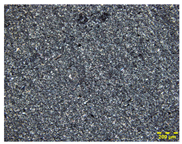 |
| Y2 | 13,546 | 25–30 | SW, SE | Calcareous mudstone | + | 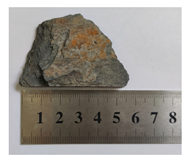 |  |
| Y4 | 1191 | 40 | SE | Silty mudstone | + |  |  |
| Y11 | 21,627 | 35 | SE | Calcareous shale | + |  |  |
| Factor | Level | Ratio of Landslides | Ratio of Domain | FR |
|---|---|---|---|---|
| Elevation | <200 | 0.156 | 0.059 | 2.652 |
| 200–300 | 0.395 | 0.443 | 0.891 | |
| 300–400 | 0.065 | 0.320 | 0.204 | |
| 400–500 | 0.384 | 0.146 | 2.629 | |
| >500 | 0.000 | 0.032 | 0.000 | |
| NDVI | 0–0.2 | 0.007 | 0.033 | 0.223 |
| 0.2–0.4 | 0.425 | 0.516 | 0.824 | |
| 0.4–0.5 | 0.372 | 0.281 | 1.324 | |
| 0.5–0.6 | 0.181 | 0.150 | 1.208 | |
| >0.6 | 0.014 | 0.021 | 0.679 | |
| Slope/° | <10 | 0.298 | 0.221 | 1.344 |
| 10–20 | 0.122 | 0.098 | 1.247 | |
| 20–30 | 0.122 | 0.117 | 1.039 | |
| 30–35 | 0.358 | 0.428 | 0.836 | |
| >35 | 0.100 | 0.135 | 0.741 | |
| Aspect | North | 0.020 | 0.067 | 0.296 |
| Northeast | 0.256 | 0.120 | 2.133 | |
| East | 0.068 | 0.036 | 1.890 | |
| Southeast | 0.123 | 0.145 | 0.848 | |
| South | 0.064 | 0.057 | 1.131 | |
| Southwest | 0.159 | 0.155 | 1.025 | |
| West | 0.004 | 0.046 | 0.080 | |
| Northwest | 0.009 | 0.152 | 0.056 | |
| Plane | 0.297 | 0.221 | 1.343 | |
| Distance from rivers/m | <50 | 0.046 | 0.110 | 0.416 |
| 50–150 | 0.231 | 0.196 | 1.180 | |
| 150–300 | 0.120 | 0.235 | 0.508 | |
| 300–500 | 0.360 | 0.227 | 1.584 | |
| 500–1000 | 0.244 | 0.209 | 1.165 | |
| >1000 | 0.000 | 0.023 | 0.000 | |
| Distance from faults/m | <100 | 0.031 | 0.059 | 0.528 |
| 100–200 | 0.003 | 0.059 | 0.049 | |
| 200–500 | 0.028 | 0.174 | 0.162 | |
| 500–1000 | 0.484 | 0.257 | 1.885 | |
| 1000–3000 | 0.344 | 0.285 | 1.209 | |
| >3000 | 0.110 | 0.166 | 0.658 | |
| Rock hardness | Hard rock | 0.000 | 0.000 | 0.000 |
| Moderately hard rock | 0.000 | 0.027 | 0.000 | |
| Moderately soft rock | 0.238 | 0.487 | 0.488 | |
| Soft rock | 0.762 | 0.487 | 1.567 |
Disclaimer/Publisher’s Note: The statements, opinions and data contained in all publications are solely those of the individual author(s) and contributor(s) and not of MDPI and/or the editor(s). MDPI and/or the editor(s) disclaim responsibility for any injury to people or property resulting from any ideas, methods, instructions or products referred to in the content. |
© 2026 by the authors. Licensee MDPI, Basel, Switzerland. This article is an open access article distributed under the terms and conditions of the Creative Commons Attribution (CC BY) license.
Share and Cite
Cui, X.; Zheng, S.; An, Y.; Cai, W.; Xu, J. Identification of Landslides in the Hilly Areas of Eastern China Using High-Resolution GF-2 Images and Deep Learning Models. Sustainability 2026, 18, 5803. https://doi.org/10.3390/su18125803
Cui X, Zheng S, An Y, Cai W, Xu J. Identification of Landslides in the Hilly Areas of Eastern China Using High-Resolution GF-2 Images and Deep Learning Models. Sustainability. 2026; 18(12):5803. https://doi.org/10.3390/su18125803
Chicago/Turabian StyleCui, Xiangyu, Shuo Zheng, Yanfei An, Weijia Cai, and Jinlong Xu. 2026. "Identification of Landslides in the Hilly Areas of Eastern China Using High-Resolution GF-2 Images and Deep Learning Models" Sustainability 18, no. 12: 5803. https://doi.org/10.3390/su18125803
APA StyleCui, X., Zheng, S., An, Y., Cai, W., & Xu, J. (2026). Identification of Landslides in the Hilly Areas of Eastern China Using High-Resolution GF-2 Images and Deep Learning Models. Sustainability, 18(12), 5803. https://doi.org/10.3390/su18125803