Systematic Review

Territorial Brand in Cross-Border Tourism: A Systematic Literature Review (2000–2025)

by
Douglas André Roesler
,
Giovana Goretti Feijó Almeida
* and
Paulo Almeida
CiTUR, Projeto FAST-Agenda ATT-PRR, Polytechnic University of Leiria, 2411-901 Leiria, Portugal
*
Author to whom correspondence should be addressed.
Sustainability 2026, 18(11), 5781; https://doi.org/10.3390/su18115781 (registering DOI)
Submission received: 2 April 2026 / Revised: 13 May 2026 / Accepted: 22 May 2026 / Published: 5 June 2026

Abstract

Contemporary tourism has firmly established itself as a strategic driver of socioeconomic development, particularly in peripheral regions such as cross-border territories. Thus, the aims are to systematically analyze the scientific literature on cross-border tourism in order to examine how dimensions associated with territorial brand emerge within this field. The research was conducted through a Systematic Literature Review, following the PRISMA protocol, associated with content analysis, from which a set of categories emerged a posteriori. This review identifies recurring dimensions and promising conceptual overlaps, suggesting that the territorial brand may be a useful framework for interpreting the dynamics of cross-border tourism. It is concluded that cross-border tourism and territorial branding are more than isolated fields; rather, they constitute interdependent dimensions that mutually reinforce one another. This study contributes to the theory of border tourism by demonstrating how territorial brand operates as one of the structuring elements in the integration, competitiveness, and sustainability of cross-border destinations, highlighting patterns that remain underexplored in the literature.

1. Introduction

Cross-border tourism has increasingly been recognized as a complex social, cultural, and economic phenomenon rooted in interactions between neighboring countries and communities [1,2,3,4]. In such contexts, border territories are shaped by dynamic processes of circulation, exchange, and complementarity, particularly where physical, legal, and cultural barriers are mitigated through cooperation mechanisms [5,6,7]. Within this configuration, cross-border tourism has gained increasing prominence as a field characterized by multiple stakeholders, functional integration across national boundaries, and the articulation of shared territorial systems [8,9,10]. Operationally, emerging cross-border tourism involves the convergence of various stakeholders—including visitors, managers, and attractions—within a unified functional space that transcends national borders, thereby integrating two or more countries [8,11]. In this context, the organization and projection of these territories become central dimensions for their competitiveness and legitimacy, opening space for approaches related to the symbolic and strategic management of places. Simultaneously, the discipline of territorial branding has emerged as a methodology that facilitates the articulation of physical, symbolic, and institutional resources in the construction of the uniqueness and strategic projection of territories [12,13,14,15].
Despite the growing body of research on cross-border tourism and the consolidation of territorial brand studies in regional development, these fields have largely evolved in parallel. To date, there is no systematic synthesis that explicitly connects cross-border tourism dynamics with the conceptual and analytical framework of territorial brand. This lack of integration limits the understanding of how symbolic, institutional, and governance-related dimensions interact in shaping cross-border destinations. As a result, the literature remains fragmented, preventing the consolidation of a coherent analytical perspective that bridges these domains. This gap is the main justification for this study.
In light of this gap, this study aims to systematically analyze the scientific literature on cross-border tourism in order to examine how dimensions associated with territorial brand emerge within this field. To guide the review process, the study addresses the following research question:
How does the literature on cross-border tourism reflect, explicitly or implicitly, elements related to territorial brand?
Additionally, this review explores a complementary question:
Which conceptual and thematic patterns can be identified in the literature that contribute to understanding the relationship between cross-border tourism and territorial brand?
These questions guide all stages of the review process, including the search, selection, analysis, and interpretation of studies.
Thus, this study seeks to contribute to the field by identifying patterns, categories, and conceptual convergences across the literature, with particular attention to their dialog with the Territorial Brand in Regional Development (TBRD) framework [12]. The research is motivated by the need to advance an integrated understanding of territorial brand, cross-border governance, and tourism dynamics. In this sense, it can offer analytical and methodological insights that may inform future research and territorial planning practices in border areas.
The article is organized in the following manner: subsequent to this introduction, the theoretical framework is presented in three parts: (i) differences between the concepts of transnational and cross-border, (ii) cross-border tourism, and (iii) the theoretical framework of territorial brand in regional development. In the subsequent section, the methodology employed is delineated, grounded in a Systematic Literature Review [16] adhering to the PRISMA protocol [17] in conjunction with Content Analysis [18]. The ensuing portion of the discourse encompasses the presentation of results and discussion, culminating in a comprehensive elaboration on the conclusions and implications of the study.

2. Theoretical Framework

The theoretical framework is founded upon the works of various authors who have explored the phenomenon of tourism in cross-border contexts. These include Oliveira [19], among others. The objective of this framework is to meticulously compile, assess, and distill the extant scientific evidence pertaining to territorial dynamics within border regions.
Nevertheless, the theoretical framework employed is the perspective proposed by Almeida [12,20,21] on “territorial brand in regional development,” since this author introduces a unique approach that allows for its direct application to the analysis of cross-border territories. Contrary to conventional place branding models, e.g., Anholt [22], which prioritize communication and market positioning strategies, Almeida’s [12] approach notably integrates regional development as a foundational axis. This integration is imperative for comprehending the intricacies inherent in border regions. Accordingly, the theoretical framework of Almeida [12,20], as deliberated in Section 2.3., constitutes the central conceptual basis of the research and guides the critical reading of the other contributions enshrined within the theoretical framework.

2.1. Transnational and Cross-Border: Differences and Similarities

It is evident that the terms transnational and cross-border possess significant conceptual distinctions, particularly within the framework of regional integration and cooperation, with a focus on border territories [23,24]. Despite their frequent interchangeability, these terms operate on distinct geographical scales and are associated with specific institutional approaches. The term “cross-border” denotes the geographical and functional dimension in which activities or resources traverse a common political border between neighboring countries.
Its primary focus is on territorial proximity, mobility between neighboring localities, and the management of shared assets such as rivers, watersheds, or contiguous protected areas [25,26]. Transnational cooperation, on the other hand, refers to collaboration between countries on a broader regional or macro-regional scale, not necessarily linked to immediate neighbors. The term encompasses initiatives that are intended to address common problems and challenges experienced by a group of nations, irrespective of their territorial contiguity [26,27].
Therefore, cross-border cooperation is primarily manifested at the local level, encompassing municipalities, provinces, or contiguous regions that are geographically proximate. Transnational cooperation, conversely, functions on a more expansive scale, encompassing macro-regions that may incorporate a considerable number of countries connected by geographical basins, economic corridors, or extensive territorial networks [28,29].
Cross-border cooperation is a concept that is broadly concerned with addressing immediate administrative and operational dysfunctions in a transnational context. These dysfunctions may include instances of double taxation, labor mobility across national borders, and the divergence of local laws and regulations among different jurisdictions. Transnational cooperation, conversely, necessitates high-level political coordination, encompassing multilateral agreements aimed at integrating transportation systems, logistics networks, and, in certain instances, consolidating large-scale regional identities [30].
According to Pirlone et al. [31], Qiao et al. [32], and Selier et al. [33], both cross-border and transnational initiatives employ tourism as a catalyst for economic development, institutional cooperation, and the formation of new territorial identities. Physical connectivity plays a central role in both models due to its ability to enable the movement of people, goods, and services. This transformation of peripheral or isolated areas into spaces for encounter, interaction, and co-development has been previously documented [34,35,36].
Therefore, while the cross-border phenomenon is centered on the resolution of immediate frictions and the promotion of development along the contact line between neighboring territories, the transnational phenomenon entails the establishment of large-scale cooperation networks, thereby enabling entire nations to articulate and integrate their economic, environmental, and institutional potentials.

2.2. Cross-Border Tourism

The concept of “cross-border tourism” is not limited to the simplified idea of “tourism that crosses a border.” This complex socio-spatial phenomenon pertains to the manner in which tourism gives rise to, fortifies, or contends with borders as processes (bordering), encompassing more than merely static physical delimitations [25,27].
In this scenario, tourism is profoundly entwined with processes of bordering, ordering, and othering, that is, the production of boundaries, territorial ordering, and the construction of otherness. This helps elucidate why cross-border destinations can function simultaneously as integrative and exclusionary spaces [37,38]. Drawing upon this procedural understanding of borders, cross-border tourism can be conceptualized as an intricate tapestry of mobilities, institutional frameworks, and discursive narratives that collectively (re)produce the border region as both a destination and a political–cultural space. This conceptualization articulates the complex dynamics of displacement, regulation, and territorial discourses [32,39].
In the domain of cross-border tourism governance, a number of recurrent obstacles have been identified. These include a lack of intergovernmental coordination, institutional misalignment, conflicts of interest, administrative limitations, and a scarcity of resources [26,40,41]. The presence of these structural weaknesses renders the administration of border regions a particularly intricate undertaking. Effectual collaboration in such regions is contingent upon a confluence of factors, including multi-local arrangements, disparate legislative and administrative capacities.
From an applied perspective, research by Trogisch and Fletcher [42] advances the notion that cross-border destinations necessitate integrated models of planning, marketing, and management, underpinned by stable and continuous mechanisms of interinstitutional cooperation. Such arrangements serve to reduce coordination costs while fortifying the predictability integral to the consolidation of long-term joint projects.
In turn, tourist flows have the potential to intensify social interaction, promote the circulation of knowledge, and generate other economic and cultural connections. However, the extent to which this potential is realized depends directly on the quality of public policies and existing governance mechanisms. In this sense, communication and marketing networks have the potential to reinforce functional, institutional, and ideational integration in peripheral regions. However, this can only be achieved if they are supported by consistent coordination, collaborative efforts, and lasting public support [9,24,43].
The construction of a sustainable cross-border destination image in peripheral regions underscores the perceptual, communicational, and symbolic processes aimed at presenting the territory “as one,” despite the existence of political borders [32,39,44]. The utilization of data derived from “trave logs” and network analyses to delineate border tourism hotspots and regional connectivity patterns has emerged as a pertinent instrument for elucidating the empirical organization of the “border tourism space.” This methodology has unveiled significant insights into flows, centralities, and zones of interaction.
Cross-border tourism is thus understood as a relational and multiscalar field; it is not limited to the movement of tourists, but also involves institutions, narratives, identities, and asymmetries that shape the social and political life of border regions [37,45]. From this perspective, the primary challenges associated with its development pertain to governance, interinstitutional coordination, the capacity for articulation among social actors, and the legitimacy to structure joint tourism products in cross-border territories [40,43].
As stated in the opening remarks of this theoretical framework, while Section 2.1 and Section 2.2 have synthesized contributions from numerous authors on tourism and cross-border dynamics, the present section is devoted to the theoretical framework that underpins the research: the perspective of territorial brand in regional development, which was developed by Almeida during the period 2018–2025 [12,13,20,21].
Accordingly, the theoretical basis for the critical reading of the contributions presented in the preceding sections, as well as the foundation for the analysis proposed in this study, is Almeida’s [12] concept of “territorial brand in regional development” (TBRD).

2.3. Definition and Scope of Concept “Territorial Brand in Regional Development”

The perspective of territorial brand in regional development (TBRD) posits the territorial brand as a strategic development device that transcends the conventional functions of communication and promotion [12]. In the context of regional development, Almeida [12] defines the territorial brand as a cultural product, thereby shifting the focus from the logo or slogan to incorporate values, repertoires, and symbolic disputes that structure the territory. In this approach, culture is conceptualized as a power structure [46], thereby rendering territorial brand a domain of mediations and identity negotiations that directly impact regional development processes.
The sociopolitical arrangement in question is one that organizes shared meanings, coordinates actors, and guides material and immaterial investments toward territorial cohesion and prosperity. Rather than “assigning” a label to the territory, this arrangement functions as a means of achieving the aforementioned goals. TBRD constructs territorial identity in relation to tangible assets (economic, environmental, cultural, institutional) and governance capacity, thereby projecting it into narratives and decisions that reconfigure trajectories [13,21]. This procedure even extends to creating typologies for the aforementioned type of brand [15].
This formulation finds its initial basis in Almeida [12]. In that work, the author systematizes the inseparable relationship between territorial identity, governance, and regional development. The author suggests that the territorial brand constitutes a symbolic-institutional structure capable of influencing the distribution of power, collective capacities, and future directions, especially in territories subject to socioeconomic transformations. According to the author, the territorial brand functions as a developmental apparatus, founded on representations, practices, and instruments that orient collective choices and political mediators.
With the passage of time, Almeida [13] fortifies this concept with empirical evidence that territorial brands function as articulations of power relations, thereby engendering effects on representation, reputation, and urban-regional dynamics. This underscores their structural nature, in addition to their communicational nature. Empirical research with Brazilian cities suggests that territorial brand emerges from intricate territorial configurations among institutions, social actors, and discourses. This finding reinforces the original thesis that territorial brand is part of the infrastructure of regional development, extending beyond the notion of a purely rhetorical surface [12].

2.4. Foundations and Theoretical Differentiation

The perspective of TBRD theory [12] is distinguished by the following characteristics: First, it internalizes regional development as the core of the analysis. Second, it articulates different scales (local, regional, (inter)national, and others) in chains of decision-making and effects.
Thirdly, governance and identity are to be integrated as endogenous variables, not merely external ones. Fourthly, narratives are to be connected to instruments such as plans, budgets, projects, and regulations. By virtue of these methods, the inherent limitations of predominantly communicational models are overcome, while a critical dialog with classic place branding [22] is maintained, without reducing it.
In the original formulation [12], the theoretical differentiation of TBRD stems from the understanding that territorial brands cannot be analyzed in isolation from productive, institutional, and symbolic structures because these elements are inherently interconnected. The author meticulously demonstrates that territorial narratives function as both products and producers of development trajectories, with a particular focus on the themes of legitimacy, conflicts, and interinstitutional coordination.
The consolidation of this model [12,13] is strengthened on three fronts:
  • Territorial brands are inherently imbued with power relations, and the dispute over meanings is not a peripheral concern but rather a central aspect that influences regional development. In this regard, various actors interpret, activate, and resist the territorial brand in unequal ways, thereby unveiling institutional and symbolic asymmetries [12].
  • The territorial brand functions as a symbolic infrastructure for development [13], generating a reputation founded on practices, policies, and results. This, in turn, reinforces the “performance–reputation” mechanism, a theoretical framework initially proposed in 2018.
  • TBRD acknowledges the limitations of communication strategies in the absence of governance, instruments, and institutional capacities [13,15]. Consequently, the discrepancy between rhetoric and practice engenders “hollow” or performative brands [47]. Conversely, regions that formulate identity, governance, and mechanisms engender consequences of cohesion and competitiveness.
In consideration of this scenario, the TBRD theory [12] posits a departure from the prevailing communication paradigm of place branding. As postulated by author, the conceptual framework of place branding is posited as a fundamental analytical category in the examination of regional development. This category operates at the nexus of public policy, territorial identity, networks of actors, and territorial economies. Furthermore, from the perspective of territorial brands, image is not neutral but is rather mediated by narratives, interests, and asymmetries [13,48]. Consequently, the analysis of images of the territory can be utilized to reveal the power relations that permeate the construction of the territorial brand and its public legitimation.

3. Methodology

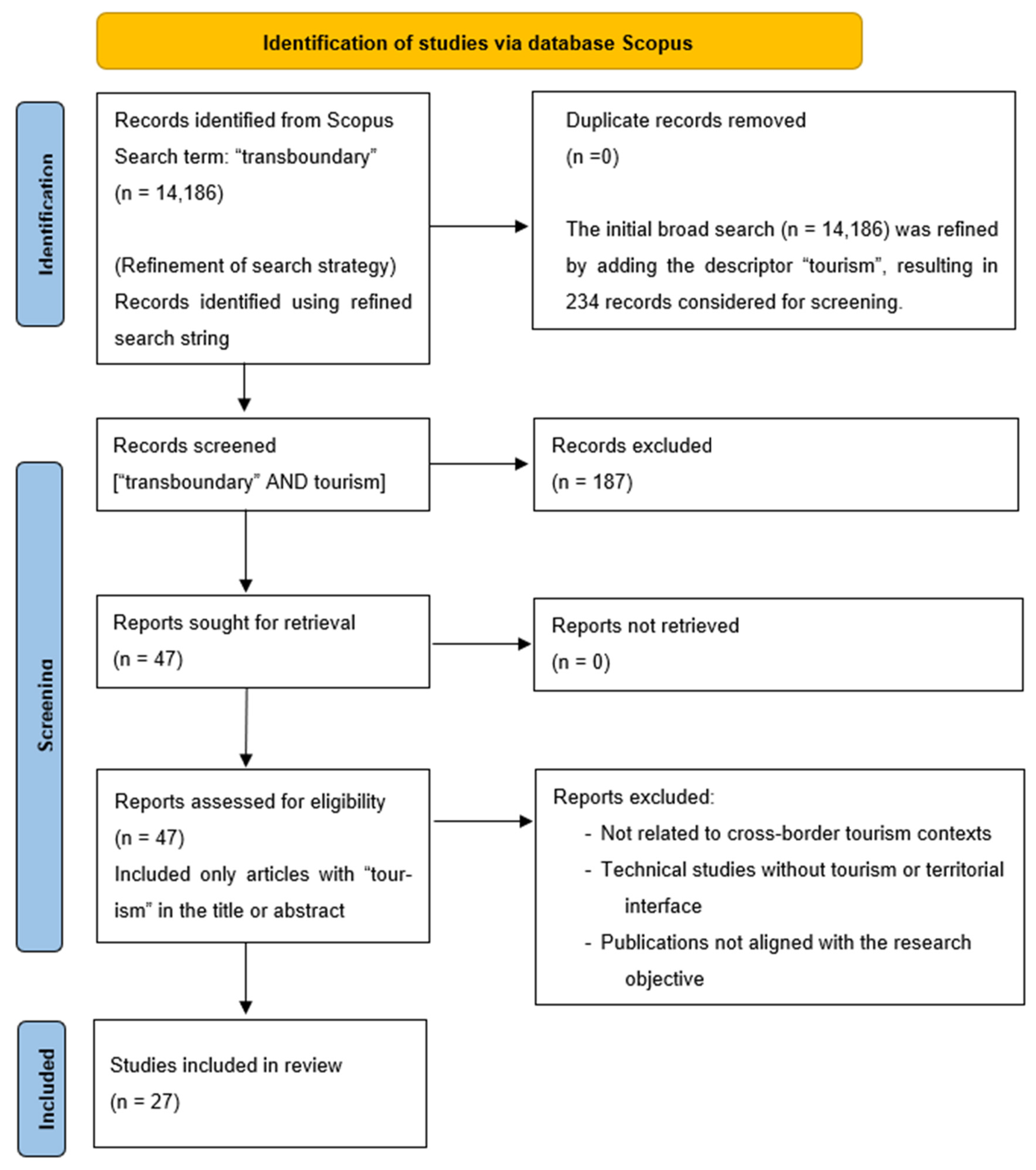
The present study employs the Systematic Literature Review method, which entails a meticulously planned research approach aimed at the systematic collection, evaluation, and synthesis of all extant evidence pertaining to the subject of territorial brand in the context of cross-border tourism [16]. The research approach adopted in this study is qualitative-quantitative in nature, utilizing the PRISMA methodology to map scientific production in the Scopus database between the years 2000 and 2025 (Figure 1). The initial Scopus search was designed to identify potential explicit relationships between cross-border tourism and territorial brand.
In pursuit of this objective, direct combinations were established between the descriptors “transboundary,” “tourism,” “territorial brand*,” and “place brand*.” The results indicated an absence of studies that concurrently employ these keywords, suggesting a dearth of scientific production that directly addresses territorial brand in the context of cross-border tourism.
The search strategy was intentionally designed with a focused scope to identify studies explicitly situated within cross-border contexts, using the term “transboundary” as the primary descriptor in the Scopus database. This approach prioritizes terminological consistency and ensures the inclusion of studies grounded in border-related spatial dynamics. However, it is acknowledged that alternative expressions—such as “border tourism,” “cross-border tourism,” or related place branding terminologies—may not be fully captured by this strategy.
Consequently, the final corpus of studies reflects a more restrictive search design, which may have limited the inclusion of certain relevant contributions. This limitation is recognized as an inherent trade-off between specificity and comprehensiveness, and it should be considered when interpreting the findings of this review.
In light of the aforementioned scenario, the search was refined by commencing with the broad term “transboundary” (14,186 results), which was then associated with “tourism” (234 results). The results were subsequently filtered to include only articles with “tourism” in the title or abstract (47 articles). The paucity of scholarship that explicitly addressed the concept of territorial brand warranted a comprehensive analysis of the 47 articles under consideration. Following the application of predetermined eligibility criteria, a final corpus of 27 articles was assembled for the purposes of this study. A comprehensive review of the literature revealed that studies published in peer-reviewed journals indexed in Scopus that addressed cross-border tourism were included in the analysis. Conversely, articles that did not deal with cross-border contexts, purely technical studies with no interface with tourism or territorial dynamics, and publications that did not fit the research objective were excluded from the study.
The study selection process was conducted by the authors, who screened titles and abstracts according to predefined eligibility criteria. Subsequently, full-text articles were assessed for inclusion. Any disagreements between the researchers were resolved through discussion and consensus.
The inclusion criteria considered studies published in peer-reviewed journals indexed in Scopus that addressed cross-border tourism contexts. Exclusion criteria comprised studies not related to tourism, purely technical works without territorial or socio-spatial implications, and publications that did not align with the research objective.
To ensure analytical consistency, the screening and interpretation of studies were discussed collectively by the authors. Data extraction was performed systematically using a structured framework, focusing on key elements such as study objectives, methodologies, main findings, and conceptual dimensions related to territorial dynamics. The categorization process followed an inductive approach, allowing themes to emerge from the data during the content analysis stage.
The content analysis followed the stages proposed by Bardin [18], including pre-analysis, exploration of the material, and treatment of results. In the pre-analysis phase, the selected studies were subjected to a comprehensive reading to identify recurring concepts and thematic patterns.
During the exploration stage, an open coding process was conducted, in which relevant excerpts related to territorial, symbolic, institutional, and social dimensions were identified and coded. These codes were not predefined but emerged inductively from the literature.
Subsequently, codes with conceptual proximity were grouped into broader analytical categories. This process, guided by semantic similarity and recurrence across studies, resulted in the identification of six categories: brand, image, identity, destination, territory, and social actors.
The unit of analysis corresponded to conceptual excerpts related to territorial dynamics identified within each study, including references to identity, image, governance, territorial organization, and social actors. Codes were assigned to these excerpts based on their semantic content and analytical relevance to the research questions.
The aggregation of codes into categories was guided by both conceptual proximity and recurrence across the corpus, considering not only the frequency of occurrence but also the interpretative relevance of the concepts within each study. This iterative process allowed for the identification of stable thematic patterns, which supported the consolidation of the six analytical categories.
The consistency of categorization was ensured through iterative comparison and discussion among the authors, allowing for the refinement and validation of the analytical structure (Figure 1).
In addition to the descriptive analysis, a qualitative synthesis of the findings was also performed, allowing for the interpretation of convergences, divergences, and conceptual patterns in light of the TBRD theoretical framework [49].
The research period corresponds to July 2025 to January 2026.

4. Results

A comprehensive examination of these 27 studies enabled the identification of emergent dimensions, including symbolic, identity, institutional, and territorial aspects, which engage in direct discourse with the four axes of the “Territorial Brand in Regional Development”—TBRD Matrix [49]. This identification process occurred a posteriori. Therefore, despite the fact that the specific term “territorial brand” is not utilized within the existing body of research on cross-border tourism, the findings of these studies demonstrate elements that exhibit a high degree of conceptual convergence with the theoretical underpinnings of this construct. This substantiates the analytical approach that has been adopted.
As detailed in Table 1, the 28 selected publications are organized by the elements that guide the analysis and discussion of the results of this study.
As presented in Table 1, six categories were identified a posteriori (brand*, image, identity, destination, territory, and social actors), emerging from the inductive analysis of the reviewed literature. These categories reflect recurring dimensions within cross-border tourism studies, particularly related to territorial dynamics, governance, and symbolic processes.
It is important to emphasize that the analytical categories identified in this study were derived inductively from the reviewed literature, following a structured content analysis process (as detailed in the methodology), and were not predefined based on the TBRD framework [12]. Rather than being guided by a prior theoretical model, the categorization process allowed patterns to emerge directly from the empirical corpus. Accordingly, the present review does not aim to compare or test competing theoretical perspectives directly, but rather to identify recurring patterns within the empirical corpus.
Nevertheless, the corpus reflects the presence of multiple theoretical perspectives that have traditionally framed cross-border tourism studies, including destination image, place branding, governance approaches, border studies, and regional development. These perspectives do not appear as structured theoretical frameworks in all cases, but are reflected through recurring themes such as identity construction, territorial representation, institutional coordination, and socio-spatial dynamics.
Only in a subsequent analytical stage were these emergent categories examined in relation to the Territorial Brand in Regional Development (TBRD) framework [12,48]. In this sense, the relationship identified between the categories and the TBRD dimensions [48] should be understood as an interpretative approximation, rather than as a process of theory testing or validation.
In this context, the contribution of the TBRD framework [49] lies not in replacing these perspectives, but in offering an integrative lens that articulates these dimensions within a single analytical structure. While existing approaches tend to address identity, governance, image, or territorial development in a fragmented manner, TBRD provides a relational framework that connects these elements as part of a broader territorial system, without implying theoretical dominance or prior structuring of the analysis.

5. Discussion

The scientific production identified in the study results may be understood as revealing conceptual and operational patterns that go beyond isolated descriptions and allow for an integrated reading in light of the Territorial Brand in Regional Development framework (TBRD, [48]). Despite the paucity of studies that explicitly address territorial brand, the subject emerges recurrently in works focused on cross-border governance, natural resource management, tourist mobility, institutional cooperation, and residents’ perceptions [29,51,57].
A close reading of the corpus suggests that territorial brand in cross-border tourism contexts may be interpreted as shaped by structural factors such as administrative integration, regulatory asymmetries, shared governance capacity, ecological sustainability, and infrastructural conditions, as evidenced in studies that address these dimensions, including Cerić & Więckowski [49], Cruz et al. [53], and Qiao et al. [32]. Although these studies do not explicitly refer to territorial brand, they highlight underlying processes that are consistent with its conceptual dimensions.
Therefore, even in the absence of an explicit designation, the concept of a territorial brand emerges as an indirect consequence of territorial dynamics that influence the identity, visibility, attractiveness, and legitimacy of cross-border destinations.
Moreover, research on residents’ perceptions and sociocultural values [53,55,59] has yielded pertinent findings. Daye et al. [29] posit that the territorial brand functions not solely as an economic instrument in the cross-border context, but also as a symbolic and ecological product that is sustained by community ties, identity narratives, and conservation practices. Concurrent research concentrating on environmental sustainability and ecosystem services indicates that environmental integrity constitutes a pivotal element of the reputation and competitiveness of shared territories, such as borders [32,33,56]. Therefore, the period under scrutiny discloses a fragmented yet convergent field in which the territorial brand is less of an isolated object and more of an interdependent phenomenon of governance and relations of power [12]. This may indicate that its consolidation in cross-border tourism is contingent upon broader institutional, environmental, and cultural alignments. This fragmentation should not be understood merely as a limitation, but as an inherent characteristic of cross-border tourism studies. It reflects the multiplicity of territorial contexts, governance arrangements, and socio-spatial configurations that resist unified analytical frameworks. Rather than pointing to a need for immediate theoretical consolidation, this diversity suggests that the field is still in a process of conceptual maturation, where different dimensions—such as identity, governance, and sustainability—are explored in a dispersed and context-dependent manner.
A subsequent examination of the extant literature may be understood as a landscape characterized by substantial methodological heterogeneity (Table 1). This heterogeneity encompasses qualitative methodologies that prioritize the assessment of perceptions and governance [29,51]. Trillo Santamaría & Paül Carril [51] explored the application of quantitative methods to the assessment of satisfaction, attitudes, and territorial preferences. This research aligns with the studies conducted by Trišić et al. [56,59] and Ferreira [57], who employed similar methodologies to investigate related topics. As Giergiczny et al. [55] note, there has been a recent surge in the use of advanced analytical-computational models focused on networks, ecosystem services, and economic integration [30,32,54,60]. Notwithstanding the heterogeneity of the data, the table manifests persistent lacunae: a reliance on incomplete or asymmetric data [30,54] and a challenge in generalizing due to the mercurial nature of political and institutional contexts [37]. As Anisiewicz [62] notes, there is a dearth of comparative studies that simultaneously integrate governance, identity, and sustainability as structuring dimensions of the territorial brand in cross-border areas. Accordingly, the methodological landscape displays progress in terms of depth and technical sophistication. However, it also may indicate a necessity for integrated and longitudinally consistent approaches that enable the comprehension of the convergence (or collision) of environmental, institutional, and social processes in the formation of emerging territorial brands within the cross-border reality.
In consideration of the prevailing theoretical framework, we highlight that Almeida [48], who proposes a matrix that delineates the role of the territorial brand in regional development around four interconnected axes, thereby constituting the TBRD matrix (Territorial Brand in Regional Development) [12]. A meticulous examination of the empirical categories that have been discerned in the extant literature on the subject of cross-border tourism—namely brand, image, identity, destination, territory, and social actors—suggests a possible conceptual correspondence with the four axes proposed by the author. This finding serves to substantiate the applicability and explanatory power of these categories within this particular corpus.
The category “brand” is consistent with the “Brand” axis of the TBRD matrix [48] insofar as it encompasses symbolic disputes and narrative legitimation mechanisms, as observed in studies such as those by Trillo Santamaría & Paül Carril [51] and Daye et al. [29]. The categories “territory” and “destination” correspond, respectively, to the axes ‘Territories’ and “Strategic Articulations,” thereby reflecting the material, ecological, and institutional basis that underpins border management and the organization of tourism networks, as demonstrated by Cyargeenka & Więckowski [25], Cruz et al. [53] and Qiao et al. [32], providing support for this assertion. Meanwhile, the concepts of “identity,” “image,” and “social actors” are part of the “Dual Territoriality” axis (expression of interactions between sociocultural values, perceptions, and community agency) of the TBRD matrix [48]. As Almeida [48] notes, the evidence for this is evident in the studies by Giergiczny et al. [37], Trišić et al. [55,58], and Santasusagna Riu et al. [50]. Thus, the six axes emerging from the literature review in this study converge on the microvariables predicted in the TBRD matrix [48]. Almeida’s [48] study may be understood as that the international literature on cross-border tourism presents patterns that appear conceptually aligned with (symbolic, territorial, social, and strategic) that underpins the construction of territorial brands in regional development contexts [12].
The observed alignment between the emergent categories and the TBRD [12,48] dimensions suggest a potential conceptual compatibility, indicating that the framework may offer a useful lens for interpreting cross-border tourism dynamics at the intersection of identity, governance, and territorial development. However, this alignment should not be interpreted as evidence of theoretical generalization or broad applicability beyond the scope of the analyzed studies. The TBRD matrix transcends the scope of regional development studies in (inter)national contexts, progressing to a framework that inherently encompasses cross-border tourism. This domain is characterized by multiscale complexity, symbolic disputes, and institutional interdependence.
The observed alignment indicates that international studies on borders, even without explicit reference to Almeida’s [48] matrix, operate with exactly the same structural dimensions as those provided by the TBRD model [12]. In this sense, the findings may support the analytical relevance of the “territorial brand in regional development” [12] as a cross-cutting interpretative framework. Rather than positioning territorial brand as a central or deterministic element, it may be better understood as a relevant analytical dimension for interpreting tourism dynamics in border regions. In essence, this conversion of the TBRD matrix [48] into an analytical instrument endows it with the capacity to organize investigations concerning cross-border tourism, regional integration, environmental governance, and cooperation policies. This facilitates our comprehension of the manner in which actors, narratives, flows, and materialities articulate to produce territorial brands in shared spaces. Accordingly, territorial brand may play a role in shaping processes of integration, competitiveness, and sustainability in cross-border contexts. However, this relationship remains context-dependent and requires further empirical investigation. This theory is capable of engaging in dialog with other fields, including those pertaining to borders, sustainability, tourism, and territorial identity. This engagement serves to reinforce the theory’s status as an original contribution to the understanding of complex territorial systems, such as borders.
In light of the findings of the review, it is evident that a portion of the territorial dynamics observed in cross-border regions aligns with the concept of “generic or commodity territorial brand,” as proposed by Almeida and Cardoso [15]. This paper posits that there are territories whose brand does not emerge from a consolidated identity, but rather from broad, functional, and pragmatic frameworks. Examples of these frameworks include sustainable destination, smart cities, strategic digital city, compact city, and others. These frameworks are employed to avoid symbolic conflicts between social groups that have divergent views of space.
A synthesis of the studies examined in Table 1 led to different findings. First, in cross-border contexts, the absence of a consensual territorial identity has been shown to be a significant factor [37]. Additionally, the presence of institutional asymmetries has been identified as a salient element in these contexts [49]. As Cruz et al. [53] note, the prevalence of technical–instrumental solutions [32,54] has prompted territories to adopt generic narratives that serve as “minimum compromises” between various actors.
It can therefore be posited that this may be interpreted as consistent with the notion of generic territorial brands’ cross-border areas being regarded as generic brands, as Almeida and Cardoso [15] have previously asserted. The authors suggest that such designations are broad enough to accommodate multiple imaginaries (environmental, tourist, geopolitical, etc.) without producing direct identity disputes.
Finally, the present study suggests a relationship between territorial brand and cross-border tourism. This relationship is evidenced by the recurrence of symbolic, identity, territorial, and institutional dimensions in the studies that were analyzed. This illustrates that territorial brand is not a marginal element in border regions; rather, it may be interpreted as a relevant analytical dimension for understanding tourism dynamics. This phenomenon functions concurrently as a mechanism for symbolic mediation, a tool for institutional coordination, and a strategy for enhancing the international visibility of shared territories. Although social actors may not explicitly acknowledge it, the territorial brand may be interpreted as emerging indirectly from the interaction of symbolic, institutional, and territorial dynamics identified in the literature, as delineated in the TRbrand Classification Model [15]. This model illustrates how brands can operate even in territories lacking a consensual identity [15]. In this sense, the findings of this review align with the TBRD matrix [48], thereby reinforcing the notion that, within cross-border contexts, the territorial brand functions as a structuring element of the relationships between territories, actors, and development strategies.

6. Conclusions

The present systematic review of the literature achieved its objective of analyzing scientific production pertaining to the concept of territorial brand within the context of cross-border tourism for the period spanning from 2000 to 2025.
The research endeavored to map the evolution of the topic, revealing that, although studies that explicitly utilize the term “territorial brand” are scarce, the concept has repeatedly been addressed by the literature through the lenses of the symbolic, identity, territorial, and institutional dimensions that are directly associated with it. In this sense, the review identifies recurring dimensions and promising conceptual overlaps, suggesting that territorial brand may serve as a useful framework for interpreting cross-border tourism dynamics. Within this perspective, the framework may function as a mechanism for symbolic mediation, a tool for interinstitutional coordination, and a reference for enhancing the visibility of shared territories.
The reviewed studies do not explicitly refer to territorial brand; however, they consistently highlight dimensions such as identity, image, territory, and social actors. From a conceptual perspective, this recurrence may be interpreted as indicative of underlying processes that are compatible with the notion of territorial brand [12,48], even when not explicitly articulated in the analyzed literature.
This model elucidates how territories with fragmented identities or divergent interests tend to adopt broad narratives from the perspective of “generic territorial brands” to circumvent symbolic conflicts. Similarly, the findings align with the four analytical axes of the TBRD Matrix [48], indicating that the construction of territorial brand in cross-border spaces is contingent upon the articulation between territory, social actors, symbolic logic, and strategic connections. Therefore, this review substantiates the hypothesis that cross-border tourism and territorial brand are not discrete fields, but rather interdependent dimensions that reinforce each other. Consequently, territorial brand may play a relevant role in shaping processes of integration, competitiveness, and sustainability in cross-border contexts, although this relationship requires further empirical investigation.
This study suggests the applicability of the TBRD Matrix [49] to a field for which it was not originally designed: cross-border tourism. This reinforces the status of the TBRD Matrix as a robust theoretical framework for territorial analyses at multiple territorial scales [48].
The scope of this study is inherently constrained by the paucity of research that explicitly employs the terminology “territorial brand” in conjunction with “cross-border tourism” within the Scopus database. This limitation necessitates the utilization of related categories, such as image and identity, to address the research gap.
Additionally, the preponderance of studies conducted in Europe and select South American territories may circumscribe the generalizability of the findings to regions with disparate governance structures and border regimes. It is therefore recommended that subsequent research expand the territorial scope and deepen the relationship between territorial brand, cross-border governance, and sustainability in order to further consolidate the understanding of the role of territorial brands in shared areas.

Supplementary Materials

The following supporting information can be downloaded at: https://www.mdpi.com/article/10.3390/su18115781/s1, PRISMA 2020 checklist.

Author Contributions

Conceptualization, D.A.R., G.G.F.A. and P.A.; methodology, D.A.R. and G.G.F.A.; validation, D.A.R., G.G.F.A. and P.A.; formal analysis, D.A.R., G.G.F.A. and P.A.; investigation, D.A.R. and G.G.F.A.; resources, D.A.R., G.G.F.A. and P.A.; data curation, D.A.R. and G.G.F.A.; writing—original draft preparation, D.A.R., G.G.F.A. and P.A.; writing—review and editing, D.A.R., G.G.F.A. and P.A.; visualization, D.A.R., G.G.F.A. and P.A.; supervision, G.G.F.A. and P.A.; funding acquisition, G.G.F.A. and P.A. All authors have read and agreed to the published version of the manuscript.

Funding

This research was funded by CiTUR, Projeto FAST-Agenda ATT-PRR, Portugal grant Projeto FAST 2026.

Institutional Review Board Statement

Not applicable.

Informed Consent Statement

Not applicable.

Data Availability Statement

The original contributions presented in this study are included in the article/Supplementary Material. Further inquiries can be directed to the corresponding author.

Conflicts of Interest

The authors declare no conflicts of interest.

References

  1. Ferreira, M.J.; Fraga, N.C. Conurbação transfronteiriça e o turismo na tríplice fronteira: Foz do Iguaçu (Br), Ciudad del Este (Py) e Puerto Iguazú (Ar). Rosa Dos. Ventos 2013, 5, 460–475. [Google Scholar]
  2. Lovelock, B.; Boyd, S. Impediments to a cross-border collaborative model of destination management in the Catlins, New Zealand. Tour. Geogr. 2006, 8, 143–161. [Google Scholar] [CrossRef]
  3. Peng, H.; Zhang, J.; Liu, Z.; Lu, L.; Yang, L. Network analysis of tourist flows: A cross-provincial boundary perspective. Tour. Geogr. 2016, 18, 561–586. [Google Scholar] [CrossRef]
  4. Gillen, J. Tourism geopolitics: Roots and branches. Tour. Geogr. 2025, 27, 631–641. [Google Scholar] [CrossRef]
  5. Aharon, M.K.; Alfasi, N. The geographical aspect of place branding: Interactions between place brands in the spatial hierarchy. Appl. Geogr. 2022, 139, 102650. [Google Scholar] [CrossRef]
  6. Tomazzoni, E.L.; dos Santos Junior, J.J.; de Souza Cavalcante, J.; da Silva, A.C. Gestão do Turismo Nas Perspectivas da Governança, da Regionalização e do Desenvolvimento; Universidade de São Paulo–EACH/USP: São Paulo, Brazil, 2023; Volume 6. [Google Scholar] [CrossRef]
  7. Ye, I.Q.; Zare, S. Tourism mobility (in)justice: Exploring lived experiences of cross-border tourists. Ann. Tour. Res. 2026, 118, 104166. [Google Scholar] [CrossRef]
  8. Boonchai, P.; Freathy, P. Cross-border tourism and the regional economy: A typology of the ignored shopper. Curr. Issues Tour. 2020, 23, 626–640. [Google Scholar] [CrossRef]
  9. Makkonen, T.; Williams, A. Cross-border tourism and innovation system failures. Ann. Tour. Res. 2024, 105, 103735. [Google Scholar] [CrossRef]
  10. Zabielska, I.I.; Klimach, A.; Dawidowicz, A. Identification of factors influencing cooperation between border towns in different border traffic regimes. Appl. Geogr. 2026, 186, 103841. [Google Scholar] [CrossRef]
  11. Oliveira, P. Territorial governance and sustainable development in peripherical regions: Economic and institutional challenges. Tour. Hosp. Int. J. 2020, 15, 119–141. [Google Scholar] [CrossRef]
  12. Almeida, G.G.F. Marca Territorial Como Produto Cultural do Desenvolvimento Regional. Doctoral Thesis, University of Santa Cruz do Sul, Santa Cruz do Sul, Brazil, 2018. Available online: http://hdl.handle.net/11624/2246 (accessed on 1 April 2026).
  13. Almeida, G.G.F. Estrategias de marca territorial en la representación y reputación de territorios en el ámbito del desarrollo regional. EURE–Rev. Estud. Urbano Reg. 2023, 49, 146. [Google Scholar] [CrossRef]
  14. Almeida, G.G.F.; Almeida, P. The influence of destination image within the territorial brand on regional development. Cogent Soc. Sci. 2023, 9, 2233260. [Google Scholar] [CrossRef]
  15. Almeida, G.G.F.; Cardoso, R. Territorial brand typologies and regional development dynamics. Sustainability 2022, 14, 6823. [Google Scholar]
  16. Paul, J.; Criado, A.R. The art of writing literature reviews. Int. Bus. Rev. 2020, 29, 101717. [Google Scholar] [CrossRef]
  17. Page, M.J.; McKenzie, J.E.; Bossuyt, P.M.; Boutron, I.; Hoffmann, T.C.; Mulrow, C.D.; Shamseer, L.; Tetzlaff, J.M.; Akl, E.; Brennan, S.E.; et al. The PRISMA 2020 statement: An updated guideline for reporting systematic reviews. BMJ 2021, 372, n71. [Google Scholar] [CrossRef] [PubMed]
  18. Bardin, L. Análise de Conteúdo; Edições: São Paulo, Brazil, 2011; p. 70. [Google Scholar]
  19. Oliveira, F.M.; Arcêncio, R.; Arcoverde, M.A.M.; Fronteira, I. Are the neglected tropical diseases under control in the tri-border region between Brazil, Argentina, and Paraguay? J. Infect. Dev. Ctries. 2022, 16, 547–556. [Google Scholar] [CrossRef]
  20. Almeida, G.G.F. Territorial brand. In Elgar Encyclopedia of City and Place Branding; Oliveira, E., Sevin, E., Björner, E., Eds.; Edward Elgar: Cheltenham, UK, 2025; Available online: https://www.elgaronline.com/display/book/9781035319640/9781035319640.xml (accessed on 15 February 2026).
  21. Almeida, G.G.F. Territorial brand as a public governance strategy: Cases of Brazil and Portugal. Adm. Sci. 2025, 15, 273. [Google Scholar] [CrossRef]
  22. Anholt, S. Competitive Identity: The New Brand Management for Nations, Cities and Regions; Palgrave Macmillan: New York, NY, USA; Cromwell Press: Trowbridge, UK, 2007. [Google Scholar]
  23. Anisiewicz, R. Conditions for development of the entrepreneurial ecosystem in tourism in the border area of the European union: The example of the tri-border area of Poland–Belarus–Ukraine. Sustainability 2021, 13, 13595. [Google Scholar] [CrossRef]
  24. Więckowski, M. How border tripoints offer opportunities for transboundary tourism development. Tour. Geogr. 2023, 25, 310–333. [Google Scholar] [CrossRef]
  25. Cyargeenka, A.; Wieckowski, M. Expanding transboundary tourist space–The growing significance of the Augustów Canal. Balt. J. Health Phys. Act. 2020, 12, 139–148. [Google Scholar] [CrossRef]
  26. Selezneva, E.V.; Rotanova, I.N. A transboundary environmental and tourism cluster in Western Altai: Recreational and geographic substantiation. IOP Conf. Ser. Earth Environ. Sci. 2021, 670, 012058. [Google Scholar] [CrossRef]
  27. Anokhin, A.Y.; Kropinova, E.G.; Spiriajevas, E. Developing geotourism with a focus on geoheritage in a transboundary region: The case of the Curonian Spit, a UNESCO site. Balt. Reg. 2021, 13, 112–128. [Google Scholar] [CrossRef]
  28. Khmeleva, G.A.; Kurnikova, M.V.; Nedelka, E.; Tóth, B.I. Determinants of Sustainable Cross-Border Cooperation: A Structural Model for the Hungarian Context Using the PLS-SEM Methodology. Sustainability 2022, 14, 893. [Google Scholar] [CrossRef]
  29. Daye, M.; Wang, Y.; Charman, K.; Suzhikova, B. Exploring local stakeholders’ views on the prospects of China’s Belt & Road Initiative on tourism development in Kazakhstan. Curr. Issues Tour. 2020, 23, 1948–1962. [Google Scholar] [CrossRef]
  30. Ponkina, E.V.; Ryabov, I.Y.; Polosin, G.V.; Lobova, S.V. Assessing integration of agricultural markets in the transboundary region of the Great Altai. Spat. Econ. 2025, 21, 33–62. [Google Scholar] [CrossRef]
  31. Pirlone, F.; Sotgia, Z.; Spadaro, I.; Ugolini, P. The cross border Agenda 21 as a governance tool. WIT Trans. Ecol. Environ. 2012, 155, 243–254. [Google Scholar]
  32. Qiao, R.; Li, J.; Liu, X.; Li, M.; Lei, D.; Li, Y.; Wu, K.; Du, P.; Ye, K.; Hu, J. Coupling effect of key factors on ecosystem services in border areas: A study of the Pu’er region, Southwestern China. PeerJ 2024, 12, e17015. [Google Scholar] [CrossRef]
  33. Selier, S.A.J.; Slotow, R.; Di Minin, E. The influence of socioeconomic factors on the densities of high-value cross-border species, the African elephant. PeerJ 2016, 4, e2581. [Google Scholar] [CrossRef]
  34. Gunya, A.N. Modern trends in mountain regional study: Border transformation and comparative analysis (on the example of Alps and Caucasus). In Proceedings of the International Conference; Geoinformatical and Cartographical Security of Ecological, Economic and Social Aspects of Sustainable Development; Moscow University Press: Moscow, Russia, 2019; Volume 25, pp. 229–245. [Google Scholar] [CrossRef]
  35. Cheaito, K.A.B.; Freixo, A.D. The Threat in the Hemisphere: The Securitization Movement in the Triple Frontier and the Case of Hezbollah. Middle East Crit. 2025, 34, 771–790. [Google Scholar] [CrossRef]
  36. Stoffelen, A.; Dallen, J. Timothy Bordering, ordering and othering through tourism: The tourism geographies of borders. Tour. Geogr. 2023, 25, 1974–1992. [Google Scholar] [CrossRef]
  37. Giergiczny, M.; Valasiuk, S.; Yakubouski, M.; Kowalewski, M.; Maskiewicz, J.; Angelstam, P. Attitudes toward Conservation of the Transboundary Białowieża Forest among Ecotourism Businesses in Poland and Belarus. Land 2023, 12, 1150. [Google Scholar] [CrossRef]
  38. Morales Martinez, E.D.; Costa de Oliveira, T.M. Políticas cooperativas de segurança e combate ao crime organizado na Tríplice Fronteira. J. Iber. Lat. Am. Res. 2021, 27, 125–142. [Google Scholar] [CrossRef]
  39. Stoffelen, A.; Ioannides, D. Cross-border tourism governance: Opportunities and challenges. In Handbook on Tourism Governance; Saarinen, J., Hall, C.M., Eds.; Edward Elgar Publishing: Cheltenham, UK, 2025; pp. 116–129. [Google Scholar] [CrossRef]
  40. Trišić, I.; Privitera, D.; Štetić, S.; Petrović, M.D.; Radovanović, M.M.; Maksin, M.; Šimičević, D.; Stanić Jovanović, S.; Lukić, D. Sustainable tourism to the part of transboundary UNESCO biosphere reserve “Mura-Drava-Danube”. A case of Serbia, Croatia and Hungary. Sustainability 2022, 14, 6006. [Google Scholar] [CrossRef]
  41. Trogisch, L.; Fletcher, R. Fortress tourism: Exploring dynamics of tourism, security and peace around the Virunga transboundary conservation area. J. Sustain. Tour. 2022, 30, 352–371. [Google Scholar] [CrossRef]
  42. Novotný, L. Assessing the role of rural tourism in fostering cross-border integration within the EU: A case study of the Czech-German-Polish borderland. J. Rural. Stud. 2025, 114, 103529. [Google Scholar] [CrossRef]
  43. Maldonado-López, B.; Ledesma-Chaves, P.; Gil-Cordero, E. Cross-border destination image for sustainable tourism development in peripheral areas. J. Travel Tour. Mark. 2024, 41, 614–639. [Google Scholar] [CrossRef]
  44. Stoffelen, A. A review of tourism and bordering processes: Launching the Annals of Tourism Research Curated Collection on tourism and territorial borders. Ann. Tour. Res. 2024, 105, 103728. [Google Scholar] [CrossRef]
  45. Williams, R. Cultura; Paz e Terra: Rio de Janeiro, Brazil, 2000. [Google Scholar]
  46. Almeida, G.G.F.; Jiménez-Caballero, J.L.; Almeida, P. Artificial tourism destinations: Rethinking smart tourism from floating resorts and projected/futuristic tourism constructions. In Proceedings of the ICASF Congress, Abu Dhabi, United Arab Emirates, 9–11 December 2025. [Google Scholar]
  47. Almeida, G.G.F.; Almeida, P. Images of territory in the power relations from territorial brand: An intercultural discussion. GeoJournal 2024, 89, 20. [Google Scholar] [CrossRef]
  48. Almeida, G.G.F. Unraveling Power Relations: An Analytical Matrix for Territorial Brands. Sustainability 2024, 16, 2795. [Google Scholar] [CrossRef]
  49. Cerić, D.; Wieckowski, M. Establishing transboundary tourist space in the Baltic Sea region. Balt. J. Health Phys. Act. 2020, 12, 149–157. [Google Scholar] [CrossRef]
  50. Santasusagna Riu, A.; Galindo Caldes, R.; Tort Donada, J. Furthering internal border area studies: An analysis of dysfunctions and cooperation mechanisms in the water and river management of Catalonia, Aragon and the Valencian Community (Spain). Sustainability 2019, 11, 4499. [Google Scholar] [CrossRef]
  51. Santamaría, J.M.T.; Carril, V.P. La Reserva de la Biosfera Meseta Ibérica com a espai natural protegit transfronterer: Eina de conservació o marca promocional? Doc. D’anàlisi Geogràfica 2018, 64, 493–508. [Google Scholar] [CrossRef]
  52. Gorgoń, J.; Piasecka, J.; Głogowska, M.; Długosz, J.; Sitko, K.; Krzyżak, J.; Janota, P.; Martín-Lerones, P.; Barrientos, F. New Approach to Identifying Barriers and Potentials in Peripheral and Less-Known Areas Using a Multi-Criteria Analytical Matrix. Sustainability 2024, 16, 9386. [Google Scholar] [CrossRef]
  53. Cruz, M.M.; Sánchez, F.J.; Suárez, V.M. Application of protection features to a biosphere reserve for the control and development of tourist activities: The case of the Gêres–Xurés park. Land 2024, 13, 1725. [Google Scholar] [CrossRef]
  54. Chen, H.; Lu, C.; Wang, Y.; An, L. Competitiveness evaluation and cooperation network analysis of tourist attractions from the perspective of co-opetition in the Yangtze River Delta (YRD). Sustainability 2024, 16, 834. [Google Scholar] [CrossRef]
  55. Trišić, I.; Nechita, F.; Milojković, D.; Štetić, S. Sustainable tourism in protected areas—Application of the prism of sustainability model. Sustainability 2023, 15, 5148. [Google Scholar] [CrossRef]
  56. Ivanova, I.Y.; Shakirov, V.A.; Maysyuk, E.P.; Ivanov, R.A. Directions for transition to low-carbon energy in the Baikal-Khuvsgul transboundary territory: Background, conditions, effects. Energy Syst. Res. 2022, 5, 20–33. [Google Scholar] [CrossRef]
  57. Ferreira, D.I.R.; Sánchez-Martín, J.M. Agricultural landscapes as a basis for promoting Agritourism in cross-border Iberian regions. Agriculture 2022, 12, 716. [Google Scholar] [CrossRef]
  58. Trišić, I.; Štetić, S.; Privitera, D. The importance of nature-based tourism for sustainable development-A report from the selected biosphere reserve. J. Geogr. Inst. Jovan Cvijic SASA 2021, 71, 203–209. [Google Scholar] [CrossRef]
  59. Lisboa, M.T.; Morínigo Martínez, F.E. Path dependence in the Tri-Border Area. Can. J. Lat. Am. Caribb. Stud./Rev. Can. Des. ÉTudes Lat.-Américaines Caraïbes 2021, 46, 196–221. [Google Scholar] [CrossRef]
  60. Flores, N.; Saldeño Madero, Y.; Torres Parra, C.A.; Fasolino, I.; Rondón Quintana, H.A. Multi-Criteria Approach for Prioritizing and Managing Public Investment in Urban Spaces: A Case Study in the Triple Frontier. Sustainability 2021, 13, 3345. [Google Scholar] [CrossRef]
  61. Михайлoва, Е. Theorizing on cross-border governance: From emergence of the concept to its current understanding. Гoсударственнoе Управление. Электрoнный Вестник (Электрoнный журнал) 2014, 46, 51–66. [Google Scholar]
  62. Anisiewicz, R. Tourist assets of the cross-border railway line Brest–Włodawa–Chełm. Pr. Kom. Geogr. Komun. PTG 2020, 23, 19–31. [Google Scholar] [CrossRef]
Figure 1. PRISMA 2020 flow diagram of study selection process.
Sustainability 18 05781 g001
Table 1. Studies on cross-border tourism and territorial brand (2000–2025).
Autor
(Year)
Purpose of
the Study
MethodologyKey
Findings
ImplicationsCategories
a posteriori
Daye et al.
[29]
Assess perceptions of the Belt and Road Initiative (BRI) in Kazakhstan.Qualitative (interviews/snowball sampling).Strong economic support, but fear of loss of autonomy and dilution of the local brand.Need for bottom-up engagement of citizens.Brand, social actors
Cyargeenka & Więckowski [25]Analyze changes in the Augustów Canal (Poland–Belarus).Historical analysis, statistics, and fieldwork.The visa waiver has boosted tourism; the canal is a destination of global importance.Improvements needed in Belarusian road infrastructure.Destination, territory
Cerić & Więckowski
 [50]
Investigate the tourist area in the Baltic Sea region.Quantitative (Interreg reports 2007–2013).Establishment of cross-border space depends on EU funds; leaders are countries from the “former bloc.”Transportation integration is vital to regional identity.Territory, destination, actors, identity.
Santasusagna Riu et al. [51]Analyze dysfunctions in watershed management (Spain).Focus groups with 84 public managers.Conflicts of jurisdiction and double taxation between water agencies.“River contracts are promising tools for joint management.Actors, territory, destiny
Gunya
 [34]
Compare trends in mountain studies (Alps vs. Caucasus).Comparative analysis and interviews with experts.Shift in perspective from natural borders to social/geopolitical constructs.Need for transdisciplinary knowledge transfers.Image, identity, destination
Santamaría & Carril [51]Investigate whether the Meseta Ibérica Reserve is about conservation or marketing.Qualitative (semi-structured interviews).The discourse focuses more on tourism/branding than on real environmental protection.The risk of creating “regions on paper” without genuine social participation.Brand, territory, destination
Pirlone et al.
 [30]
Defining Agenda 21 as a governance tool (Italy–France).Cognitive research and questionnaires.Identifying “applicability thresholds” for good practices in waste and energy.Creation of Cross-Border Action Plans (CBPs).Territory, brand, identity atores
Gorgoń et al.
 [52]
Identify barriers to cultural tourism in peripheral areas.Multicriteria analytical matrix (8 pilot cases).The uniqueness of heritage is a potential; lack of accessibility is the biggest barrier.It subsidizes management plans in lesser-known destinations.Actors, identity, territory
Cruz et al.
 [53]
Analyze control and development in the Gêres-Xurés Park.Geographic study and comparative regulatory analysis.Asymmetry: Portugal has more robust management; Spain focuses on public–private partnerships.Importance of calculating load capacity post pandemic.Territory, destination, image
Qiao et al.
 [32]
Quantifying the coupling effect on ecosystem services (China).BN-GIS Model (90 simulated scenarios).Bioinvasion and transboundary pests are critical risks to food and biodiversity.Intensive monitoring is necessary where negative couplings occur.Territory, actors, identity
Chen et al.
 [54]
Assess competitiveness and cooperation network (Yangtze Delta).Modified Gravity Model and SNA (Ucinet 6.0).Attractions in Shanghai/Suzhou have strong gravity; the network is stable but uneven.The government must remove administrative barriers to regional integration.Actors, identity, territory
Giergiczny et al.
 [37]
Assessing attitudes towards the conservation of the Białowieża Forest.Ordered Logit Model and PL-BY Interviews.Residents in Belarus support protection; in Poland, there is opposition due to ties with the timber industry.In Poland, “timber” rhetoric outweighs the economic interests of tourism.Actors, identity, territory
Trišić et al.
 [55]
Measuring resident satisfaction with sustainable tourism (Serbia–Croatia).Quantitative (Sustainability Prism Model—PoS).Sociocultural and ecological dimensions are the most valued by residents.Residents should be actively integrated into the planning process.Brand, image, identity, territory
Więckowski
 [24]
Analyze tri-border points as tourism opportunities.Spatiotemporal analysis and scalar dimensions.Tripoints are geographical curiosities that function as integration hubs.It proposes a spatial planning model in 4 concentric zones.Brand, image, territory, actors
Ivanova et al.
 [56]
Studying the transition to low-carbon energy (Russia–Mongolia).Technical and economic feasibility of renewables.High solar potential; heat pumps can eliminate coal burning.Decarbonization is vital for sustainable tourism in national parks.Image, identity, territory
Ferreira
 [57]
Investigating agricultural landscapes to promote agritourism (Iberia).439 interviews; parametric/non-parametric tests.The landscapes of Dehesa/Montado are preferred for leisure.Create territorial brands based on products (olive oil, cheese).Territory, image, brand
Trišić et al.
 [40]
Measuring sustainable tourism in the Mura–Drava–Danube Reserve.Quantitative (1295 residents in 3 countries).The sociocultural dimension was valued most highly; the institutional dimension was valued least.Protected areas function as a single spatial unit for tourism.Territory, brand, actors, destination
Ponkina et al.
 [30]
Evaluate the integration of agricultural markets in the Greater Altai region.Granger causality and cross-correlation.Overall integration is weak; grain and meat markets are the most connected.There is an urgent need to modernize logistics and customs infrastructure.Territory, actors, identity
Trišić et al.
 [58]
To analyze the importance of nature tourism in the Gornje Podunavlje National Park.Quantitative (205 residents).Residents value sociocultural and institutional dimensions above economic ones.Nature tourism should be the primary activity for self-financing.Identity, brand, territory
Selezneva & Rotanova [26]To propose an environmental and tourism cluster in Western Altai.SWOT analysis and analysis of natural/touristic potential.High potential for a continuous cross-border cluster.Zoning as the basis of the tourism management model.Brand, identity, actors, destiny
Anokhin et al. [27]Develop geotourism with a focus on geoheritage (Curlândia).Route design methodology and algorithm.Creation of the “Chronicle of the Baltic Chronicle” trail to educate tourists.Improving health and well-being through the esthetics of geoheritage.Territory, brand, identity, atores
Anisiewicz
 [23]
Conditions of the entrepreneurial ecosystem in the PL-BY-UA triplex.Qualitative and quantitative (interviews with actors).Access to EU funds has strengthened infrastructure, but the border remains a barrier.Revitalizing tourism depends on new physical bridges across the Bug River.Identity, brand, destiny
Lisboa
 [59]
To study path dependence at the border.Historical and social.Institutions and past memories shape current cooperation.Overcoming historical trajectories for greater integration.Image, identity, territory
Morales Martinez [38]Analyze security policies in the Tri-Border Area.Analysis of cooperation policies.The need for interagency cooperation against organized crime.Security is the foundation for economic and tourism development.Actors, destiny, territory
Oliveira et al.
 [19]
Assessing neglected tropical diseases in the Tri-Border Area.Public health statistics.Diseases remain a challenge in areas of high mobility.Health surveillance must be cross-border and coordinated.Actors, destiny, territory
Villegas Flores et al. [60]Prioritize public investment in urban infrastructure.Multicriteria approach (MOVES).Ciudad del Este requires urgent accessibility improvements.The USCI Index guides public spending in a technical and transparent way.Territory, actors,
Mikhailova
 [61]
Analyze border festivals (Ukraine–Russia–Belarus).Qualitative/Geopolitical.Festivals have changed their function: from integration to symbols of tension.Culture as a tool of territorial diplomacy.Identity, actors, territory
Source: Authors’ elaboration based on data retrieved from the Scopus database
Disclaimer/Publisher’s Note: The statements, opinions and data contained in all publications are solely those of the individual author(s) and contributor(s) and not of MDPI and/or the editor(s). MDPI and/or the editor(s) disclaim responsibility for any injury to people or property resulting from any ideas, methods, instructions or products referred to in the content.