Review

The Role of Livestock in Circular Agriculture and Waste Valorisation

1
Estação Zootécnica Nacional, Instituto Nacional de Investigação Agrária e Veterinária, Quinta da Fonte Boa, 2005-424 Vale de Santarém, Portugal
2
Centre for Research and Development in Agrifood Systems and Sustainability, Instituto Politécnico de Viana do Castelo, Rua da Escola Industrial e Comercial Nun’Alvares 34, 4900-347 Viana do Castelo, Portugal
*
Author to whom correspondence should be addressed.
Sustainability 2026, 18(11), 5780; https://doi.org/10.3390/su18115780 (registering DOI)
Submission received: 24 April 2026 / Revised: 23 May 2026 / Accepted: 26 May 2026 / Published: 5 June 2026
(This article belongs to the Section Sustainable Food)

Abstract

Circular agriculture has emerged as a promising framework for addressing the inefficiencies and environmental pressures associated with conventional food production systems. Within this context, livestock systems can play a transformative role by enabling waste valorisation, enhancing nutrient recycling, and improving overall resource-use efficiency. This review critically examines the multifunctional role of livestock in circular agriculture, with a particular focus on their capacity to convert non-human-edible biomass, such as crop residues, agro-industrial by-products, and food waste, into high-value animal-sourced foods. Drawing on the recent literature, the analysis explores how livestock systems can be reconfigured to utilise non-human-edible biomass, including crop residues, agro-industrial by-products, and food waste, thereby reducing competition between feed and food while enhancing sustainability outcomes. The findings highlight that livestock can function as biological upcycles, converting low-value materials into high-quality animal products, while also contributing to closed nutrient loops through manure management and integration with crop production. Additional benefits include the generation of renewable energy through anaerobic digestion and improved economic resilience through diversified outputs. However, the extent of these benefits depends on system design, management practices, and regional context. Despite their potential, circular livestock systems face challenges related to greenhouse gas emissions, regulatory constraints, economic feasibility, and knowledge gaps. These challenges highlight the need for a systems-based evaluation that accounts for environmental, economic, and social dimensions. The study concludes that livestock can contribute meaningfully to sustainable food system transitions when aligned with circular principles, but their role must be critically assessed to avoid burden-shifting and unintended environmental impacts.

1. Introduction

Modern agriculture faces a profound challenge: how to produce sufficient, nutritious food for a growing global population while minimising environmental degradation and resource depletion [1,2]. Over recent decades, agricultural systems have largely followed a linear model of production, characterised by the extraction of finite resources, their transformation into food and feed, and the eventual generation of waste [3,4]. This “take–make–dispose” approach has contributed to significant inefficiencies, including nutrient losses, accumulation of organic waste, greenhouse gas (GHG) emissions, and increasing pressure on land, water, and energy resources [5,6]. In response, the concept of circular agriculture has emerged as a promising framework to reconcile food production with environmental sustainability [4].
Circular agriculture is rooted in the broader principles of the circular economy, aiming to close nutrient loops, reduce waste, and optimise the use of biomass [3,7]. Rather than viewing agricultural by-products and waste streams as liabilities, circular systems seek to reintegrate them into productive cycles, thereby enhancing resource efficiency and reducing environmental burdens [5,8]. In this context, livestock production, often criticised for its environmental footprint, can play a pivotal and transformative role [9]. By converting low-value or non-human-edible biomass into high-quality animal products such as meat, milk, and eggs, livestock systems have the potential to enhance resource efficiency and contribute to more sustainable food systems [10,11].
Historically, livestock have been integral to agricultural cycles. Traditional mixed farming systems relied on the close integration of crops and animals, whereby crop residues were used to feed livestock and manure was returned to the soil to maintain fertility [12,13]. However, the intensification and specialisation of agriculture during the twentieth century led to a progressive decoupling of crop and livestock systems [14]. This separation has resulted in pronounced nutrient imbalances: regions with intensive livestock production frequently experience manure surpluses and associated environmental risks, while crop-dominated regions rely heavily on synthetic fertilisers [15,16]. Reintegrating these systems is a central objective of circular agriculture and represents a critical opportunity to restore ecological balance and improve nutrient cycling efficiency [14].
One of the central debates in sustainable food systems concerns the concept of food–feed competition, which refers to the use of human-edible crops for animal feeding [17,18]. Critics argue that feeding cereals and soybeans to livestock is an inefficient use of resources, as it diverts food that could otherwise be consumed directly by humans [19,20]. However, this perspective does not fully account for the unique biological capabilities of livestock. Ruminants, such as cattle and sheep, can digest fibrous materials, including grass, crop residues, and by-products that are inedible to humans, converting them into nutrient-dense foods [9,10,18]. Similarly, monogastric animals such as pigs and poultry can utilise a wide range of agro-industrial by-products, thereby reducing reliance on primary feed crops [17,21]. From a circular perspective, the key is not to eliminate livestock, but to optimise their role as recyclers of biomass [15,18].
Waste valorisation is a central component of circular agriculture and refers to the process of transforming waste materials into valuable products [3,22]. In livestock systems, this includes the use of agro-industrial by-products as feed, the recycling of food waste where regulations permit, and the management of manure for nutrient recovery and energy production [18,23,24]. For example, by-products from the food and biofuel industries, such as brewers’ grains, oilseed meals, and whey, can be efficiently incorporated into animal diets, thereby reducing both feed costs and the environmental burdens associated with waste disposal [25,26]. In addition, livestock manure, when properly managed, represents a valuable source of nutrients for crop production and can be utilised in anaerobic digestion systems to produce biogas, a renewable energy source [27,28].
Despite these potential benefits, livestock production remains a subject of intense scrutiny due to its environmental impacts [24,29]. The sector is associated with GHG emissions, particularly methane from enteric fermentation in ruminants and nitrous oxide from manure management [30,31]. It also contributes to land-use change, water consumption, and biodiversity loss in certain contexts [6,32,33]. However, these impacts are highly variable and depend on production systems, management practices, and regional conditions [32]. Importantly, circular approaches to livestock production can help mitigate many of these concerns by improving resource efficiency, reducing waste, and enhancing the integration of crop and livestock systems [14,18].
In the EU, the transition toward more sustainable and circular agricultural systems is strongly supported by policy initiatives such as the European Green Deal and the Farm to Fork Strategy [34,35]. These frameworks emphasise the need to reduce nutrient losses, promote organic farming, enhance animal welfare, and decrease reliance on external inputs [8,18,26,36,37]. Within this policy landscape, livestock systems are increasingly expected to contribute to sustainability goals by adopting circular practices. This includes better integration with crop production, improved manure management, and the use of alternative feed resources such as agro-industrial by-products [8,18,26].
In some regions, particularly within the European Union, policy initiatives such as the European Green Deal and the Farm to Fork Strategy actively promote transitions to-ward more circular and resource-efficient agricultural systems [36,37]. These frameworks provide important examples of policy approaches supporting nutrient recycling, waste reduction, and sustainable livestock production [8,36]. However, the applicability and im-plementation of such strategies vary considerably across regions depending on regulatory capacity, infrastructure, agricultural structure, and socio-economic conditions [36,37].
However, the transition to circular livestock systems (CLSs) is not without challenges. Regulatory constraints, particularly regarding the use of food waste in animal feed, can limit the implementation of certain waste valorisation strategies [21,38]. Concerns about biosecurity and food safety are paramount, especially in the context of disease transmission [38]. Additionally, the variability in the nutritional composition of by-products can complicate feed formulation and require advanced knowledge and technologies [39]. Economic factors, such as the cost of infrastructure for manure processing or biogas production, also play a significant role in determining the feasibility of circular practices [28,40].
Furthermore, societal perceptions of livestock production are evolving. Increasing awareness of environmental and ethical issues has led to growing scrutiny of animal agriculture, particularly intensive systems [41,42]. While circular agriculture offers a pathway to improve sustainability, it also requires transparent communication and public trust [43]. Demonstrating that livestock can be part of a solution, rather than solely a problem, is essential for the long-term viability of the sector [44].
Given these considerations, there is a clear need to critically examine the role of livestock within circular agricultural systems. Understanding how different species, production systems, and management practices contribute to waste valorisation and resource efficiency is essential for designing sustainable food systems. Moreover, evaluating the environmental, economic, and social implications of these approaches can help identify best practices and inform policy development.
While previous reviews have addressed specific aspects of circular livestock production, such as food waste recycling, feed–food competition, or manure management individually, fewer studies have integrated these pathways within a unified circular agriculture framework. This review adopts a systems-oriented perspective that links biomass valorisation, nutrient cycling, renewable energy generation, and socio-economic considerations across livestock systems. In doing so, it aims to provide a more holistic understanding of the opportunities, trade-offs, and implementation challenges associated with CLSs.
This review aims to provide a systems-based analysis of the role of livestock within circular agriculture, with particular emphasis on livestock as biological upcyclers and integrators of waste valorisation pathways. This review contributes to the circular agriculture literature by moving beyond a general overview of livestock sustainability to critically examine how livestock can function within circular food systems. Specifically, it synthesises and compares the main livestock-related valorisation pathways, use of non-human-edible biomass, agro-industrial by-products, food waste recycling, manure nutrient recovery, and anaerobic digestion, while evaluating their environmental, economic, regulatory, and social trade-offs. By identifying the conditions under which these pathways can contribute to resource efficiency without shifting environmental burdens, the review provides an integrated framework for assessing when and how circular livestock systems can work in practice.

2. Concept of Circular Agriculture

Circular agriculture is an approach to food production that seeks to maximise resource efficiency, minimise waste, and close nutrient and energy loops within agricultural systems [45,46]. It represents a shift away from the conventional linear model, where inputs are used to produce outputs that eventually become waste, toward a regenerative system in which outputs are continuously reintegrated as inputs [47]. This concept is grounded in the broader framework of the circular economy, adapted specifically to the biological and ecological processes that underpin agriculture [44,48].
At its core, circular agriculture is based on three key principles: reducing external inputs, recycling biomass, and restoring natural systems [47]. First, it aims to reduce dependence on finite and environmentally costly inputs such as synthetic fertilisers, imported feed, and fossil fuels [48]. Second, it emphasises the recycling of nutrients and organic matter through the reuse of agricultural by-products, food waste, and manure [7]. Third, it seeks to maintain and enhance soil health, biodiversity, and ecosystem services, ensuring the long-term sustainability of production systems [47,49].
A central feature of circular agriculture is the concept of closing nutrient cycles, particularly for essential elements such as nitrogen (N), phosphorus (P), and potassium (K). In conventional systems, these nutrients are often lost through processes such as leaching, volatilisation, runoff, and waste disposal, leading to environmental problems including water pollution and GHG emissions [50]. Circular systems aim to retain these nutrients within the production cycle by reusing organic residues and integrating crop and livestock systems [51]. For example, manure produced by livestock can be applied to agricultural land as a natural fertiliser, reducing the need for synthetic inputs while improving soil structure and fertility, enhancing nutrient availability and soil organic matter [52,53].
Another important aspect of circular agriculture is the efficient use of biomass, especially in relation to the concept of food–feed competition. In linear systems, a significant proportion of crops suitable for human consumption (such as cereals and soybeans) is used as animal feed, raising concerns about inefficiency and food security [54]. Circular agriculture challenges this model by prioritising the use of non-edible biomass for livestock feeding. This includes crop residues (e.g., straw, husks), agro-industrial by-products (e.g., bran, pulp, distillers’ grains), and surplus or unsold food that cannot be directly consumed by humans [55,56]. By doing so, livestock act as biological converters, transforming low-value materials into high-quality protein and other animal products [54,56].
The concept also promotes the integration of agricultural subsystems, particularly crop and livestock production. In highly specialised and industrialised systems, these components are often geographically and functionally separated, resulting in inefficiencies and environmental imbalances [57]. Circular agriculture encourages their reintegration, allowing for synergies such as the use of livestock manure to fertilise crops and the use of crop residues to feed animals [58]. This integrated approach not only improves nutrient cycling but also enhances resilience by diversifying farm outputs and reducing reliance on external inputs [50,59].
Energy use is another critical dimension of circular agriculture. Traditional agricultural systems are heavily dependent on fossil fuels for machinery, fertiliser production, and transportation. Circular systems aim to recover and reuse energy from agricultural waste streams, for instance, through anaerobic digestion of manure and organic residues to produce biogas, a renewable energy that can be used on-farm or fed into the grid, contributing to reduced GHG emissions and improved energy self-sufficiency. Anaerobic digestion harnesses microbial breakdown of organic materials, converting biomass such as manure, crop residues and other wastes into methane-rich biogas that can be combusted for heat, electricity or upgraded to biomethane for use as a transport fuel or grid injection, thereby replacing fossil energy sources and closing energy loops in agricultural systems. Adoption of biogas technologies within circular agriculture not only enhances energy self-sufficiency at farm and regional levels but also complements nutrient recycling when digestate is returned to soils as organic fertiliser [59,60].
Importantly, circular agriculture is not a one-size-fits-all model but rather a flexible framework that can be adapted to different environmental, economic and social contexts. Its implementation depends on factors such as climate, soil type, farm structure and available technologies, all of which influence how circular principles are applied in practice and which strategies are most appropriate for particular settings [61,62]. Recent literature emphasises that circular agricultural models are highly context-specific and adapted to local needs, with diversity in approaches ranging from small rural farms to industrial operations, reflecting variations in socio-economic conditions, resource availability, infrastructure and cultural practices [62]. As a result, in some regions traditional practices such as integrated crop–livestock systems or extensive grazing already exhibit elements of circularity, whereas in others substantial investments in infrastructure and management innovations—such as nutrient recovery technologies or precision resource flows—are required to achieve meaningful circular transitions [61,62].
In Europe, circular agriculture is increasingly emphasised within sustainability strategies. EU frameworks like the Green Deal and Farm to Fork Strategy promote reduced nutrient loss, organic matter recycling, and lower dependence on external agricultural inputs [63]. The Farm to Fork Strategy explicitly sets targets such as reducing nutrient losses by at least 50% and fertiliser use by at least 20% by 2030, positioning circularity and sustainable nutrient management at the core of EU agricultural policy [63,64]. These initiatives recognise that improving the circularity of agricultural systems, including better integration of nutrient cycles and waste streams, is essential for addressing contemporary challenges such as climate change, biodiversity loss, and resource scarcity [63,65]. However, transitioning to circular agriculture faces challenges, as regulations limiting certain waste and by-products in animal feed, protecting food safety and animal health, hinder some waste valorisation pathways [66]. Additionally, collecting, processing, and redistributing agro-industrial by-products is costly and complex, especially where infrastructure is limited, creating adoption barriers, particularly for smaller-scale producers [66]. There are also knowledge and technological barriers, such as gaps in expertise, access to innovation and extension services, which further constrain the uptake of circular practices within farming communities [63].
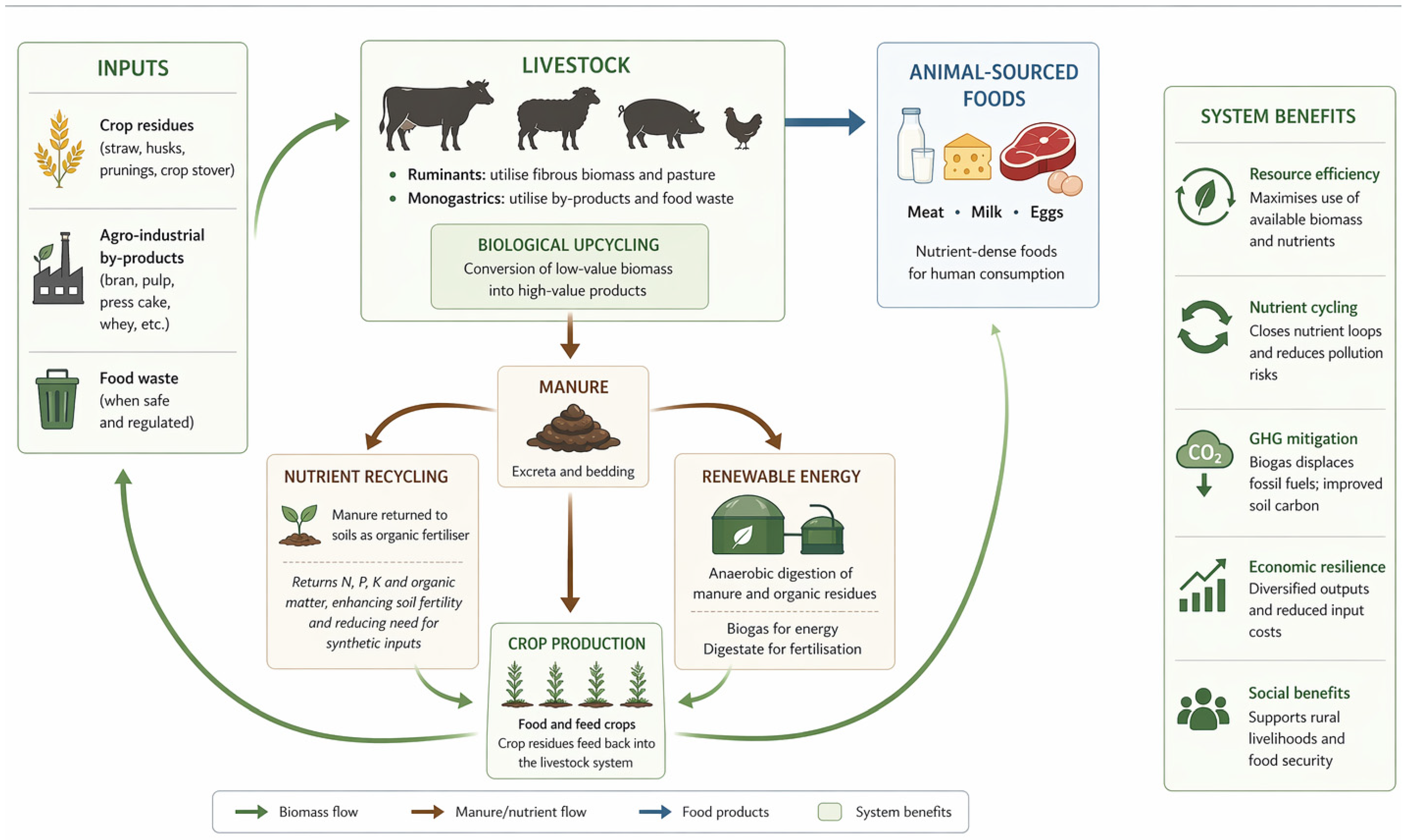
Despite these challenges, circular agriculture offers a holistic, systems-based approach to improving food production sustainability. By emphasising resource efficiency, nutrient recycling and system integration, it provides a conceptual foundation for re-thinking the role of livestock and other agricultural components in interconnected agricultural landscapes [62,67]. In circular frameworks, farms are viewed as interconnected systems in which outputs from one process become valuable inputs for another, such as integrating crop and livestock production to recycle nutrients and reduce external input dependency [62]. This systems perspective underpins the design of closed-loop farming models and integrated organic or agroecological practices, which have been shown to enhance resource utilisation, reduce waste and improve resilience across food systems [68,69]. In this context, livestock production can be re-evaluated not only in terms of its environmental impacts but also in terms of its potential contributions to circularity. Understanding the principles of circular agriculture is therefore essential for assessing how animal production systems can be redesigned to better align with sustainability goals. The concept is represented in Figure 1.

3. Role of Livestock in Circular Systems

This section examines the systemic functions of livestock within circular agricultural systems, focusing on their role in nutrient cycling, land-use efficiency, and crop–livestock integration. Livestock play a central and diverse role in circular agriculture, acting as biological converters, nutrient recyclers and integrators of agricultural subsystems. While animal production is often associated with environmental pressures, within a circular framework, it can significantly enhance resource efficiency by transforming materials that would otherwise be wasted into valuable food products and organic resources [70]. In circular bioeconomy systems, livestock can upcycle non-human-edible biomass such as crop residues, grass from marginal lands and agro-industrial by-products into nutrient-dense animal-sourced foods. Understanding this role, therefore, requires a shift in perspective from viewing livestock primarily as competitors for human-edible resources, to recognising their potential as key agents in biomass valorisation and nutrient cycling that support more integrated, sustainable agricultural systems [70,71].
One of the most important contributions of livestock in circular systems is their ability to convert non-human-edible biomass into high-quality, nutrient-dense foods. A large proportion of global agricultural biomass (such as grasslands and crop residues) is not directly consumable by humans [70]. Livestock, particularly ruminants (such as cattle, sheep, and goats), possess specialised digestive systems that enable them to break down fibrous plant materials through microbial fermentation in the rumen, allowing them to utilise resources (such as pasture, hay and straw) materials that would otherwise have limited or no direct value for human nutrition [70]. By feeding on low-opportunity-cost biomass that is unsuitable for human consumption, ruminants can convert these inputs into nutrient-dense foods like meat and milk without directly competing with humans for edible crops, supporting both food supply and resource-efficient production within circular agricultural frameworks [70,72].
Monogastric animals, including pigs and poultry, also play a significant role in circular systems, albeit in different ways. These species are highly efficient at converting feed into meat and eggs and can utilise a wide range of feed ingredients within circular food systems [73]. In circular approaches, diets for pigs and poultry are increasingly formulated to include low-opportunity-cost feed materials, crop residues and other human-inedible ingredients, reducing reliance on conventional cereals while capturing nutrients that would otherwise be lost [73,74]. For example, pigs are well-suited to use former food products and food processing residues as feed inputs, which can help retain nutrients in the food chain and decrease the environmental footprint associated with the cultivation of primary feed crops [74]. Similarly, poultry diets can incorporate by-products as sustainable feed components [73]. By integrating these alternative feed sources into monogastric diets, livestock helps reduce demand for land-intensive feed crops such as maize and soybean, alleviating pressure on land use and reducing the environmental footprint of feed production within circular agriculture frameworks [73,74].
Livestock also contribute to circular systems by enabling the productive use of marginal lands that are unsuitable for crop cultivation. Grasslands, which account for a large portion of the world’s terrestrial surface, often cannot be used for arable farming due to soil, climate or topographical constraints, yet support a range of biomass that can be converted into food through grazing livestock [75,76]. Grazing livestock can utilise forage on these lands, thereby increasing overall land-use efficiency without direct competition with crop production, and can deliver multiple ecosystem services, including supporting biodiversity and contributing to soil carbon pools under appropriate management regimes [77,78]. Research has also shown that mixed grazing systems can enhance plant diversity and soil carbon sequestration in grasslands, illustrating how livestock grazing (when managed sustainably) can maintain ecosystem structure and function on marginal terrains [79]. Well-managed grazing, particularly within integrated landscape approaches, therefore contributes to circular agriculture by linking biomass production on marginal lands with food production and ecosystem service delivery.
The integration of livestock into agricultural systems also enhances system resilience and diversification. Mixed farming systems that combine crop and animal production are generally more robust in the face of economic and environmental variability because they spread risk across multiple enterprises and reduce reliance on a single output [59,80]. Livestock provide multiple outputs (such as meat, milk, eggs and manure), and in some contexts even draft power, while offering flexibility in resource use, for example, by converting surplus crop residues into animal products or using animal outputs to support crop growth [81]. This means that crop failures can be partially offset by livestock production, and surplus biomass from one part of the system can be redirected to another, increasing the overall stability of the farm [59,81]. Such interconnectedness and diversity of outputs is a key attribute of mixed crop–livestock systems and is recognised as a pathway to improved resilience, food security and livelihood stability under variable climatic and market conditions [59,80].
However, the extent to which livestock contribute positively to circular agriculture depends heavily on management practices and system design. In systems where animals are fed large quantities of human-edible feed or where manure and nutrient flows are not effectively recycled, the potential benefits of circularity can be substantially diminished [66,73]. Research shows that optimising livestock systems for circularity involves strategies such as prioritising non-human-edible feed resources (e.g., crop residues and agro-industrial by-products), improving feed efficiency to reduce waste and emissions, enhancing manure management to capture nutrients and energy, and strengthening the integration between crop and animal production to close nutrient loops and increase system efficiency [73,75,76]. These integrated approaches enhance resource use within farming systems and help unlock the environmental and economic advantages of circular livestock production while minimising trade-offs associated with conventional, linear livestock models [75,76].
It is also important to recognise that different livestock species offer complementary roles within circular systems. Ruminants are particularly valuable for utilising fibrous biomass and maintaining grassland ecosystems, while monogastrics excel in converting concentrated feed and by-products into high-quality protein with relatively high efficiency. A balanced combination of species can therefore maximise the use of available resources and improve the overall sustainability of the system.

4. Livestock as Biological Upcyclers

This section focuses specifically on livestock as biological upcyclers, emphasising the physiological and nutritional mechanisms through which animals convert non-human-edible biomass into nutrient-dense foods. A key concept within circular agriculture is the idea of livestock as biological upcyclers, meaning their ability to transform low-value, non-human-edible biomass into high-value, nutrient-dense food products [82,83]. Unlike simple recycling, which often maintains the same level of value, upcycling increases the nutritional and economic value of resources [70]. In this sense, livestock, through their unique physiological and metabolic processes, serve as natural bioconversion systems that upgrade materials otherwise unsuitable for human consumption [54,82].
Previous studies have shown that livestock systems based primarily on grasslands, crop residues, and agro-industrial by-products can generate positive net contributions to human-edible protein supply, whereas systems heavily dependent on cereal-based feeds may result in net protein losses and increased feed–food competition [8,21,83,84].
A substantial proportion of global agricultural biomass consists of materials that humans cannot digest or efficiently utilise. These include lignocellulosic plant materials such as grasses, crop residues (e.g., straw, maize stove), and by-products from food and biofuel industries [82,83]. Without livestock, much of this biomass would either remain underutilised or require alternative disposal methods, some of which may have environmental costs [70,83]. By incorporating these materials into animal feeding systems, livestock effectively recover value from waste streams, contributing to both food production and waste reduction [54,82].
Ruminant animals, such as cattle, sheep and goats, are particularly effective biological upcyclers due to their specialised digestive system. The rumen hosts a complex microbial ecosystem capable of breaking down cellulose and hemicellulose (components of plant cell walls that are indigestible to humans) through the synergistic activity of bacteria, protozoa and fungi [82,83]. Anaerobic microbial fermentation of these fibrous materials yields volatile fatty acids, which serve as the primary energy source for the host animal [84,85]. In addition, the rumen microbiota synthesises microbial protein from non-protein nitrogen and feed components, contributing substantially to the animal’s amino acid supply and ultimately to meat and milk protein production [84,86]. As a result, ruminants can convert low-quality forages and other fibrous biomass into high-quality protein, milk and other products, effectively upgrading the nutritional value of the original biomass [84,85].
Monogastric animals, including pigs and poultry, also play an important role as biological upcyclers, although their mechanisms differ. While they cannot digest high-fibre materials to the same extent as ruminants, they are highly efficient at converting concentrated feedstuffs and by-products into animal protein [87,88]. Pigs, for example, have traditionally been fed kitchen scraps and food waste, reflecting their omnivorous diet, and they can utilise a wide range of agro-industrial residues such as whey, distillers’ grains and surplus bakery products as alternative feed ingredients [74,89]. The inclusion of former food products (defined as food intended for human consumption but no longer suitable for that purpose) in pig diets can maintain growth performance and support sustainable nutrient reuse within the food system [74]. Poultry can similarly incorporate various by-products and agro-industrial co-products into their diets, contributing to efficient use of available resources and aligning with circular agriculture principles [87,88].
The concept of livestock as biological upcyclers is closely linked to their net contribution to the human-edible protein supply. When animals are fed primarily on resources that humans cannot consume, such as crop residues and by-products, their metabolism can result in a net gain of edible protein available to people. Some livestock systems, therefore, contribute positively to human protein supply when they minimise competition with foods that humans could otherwise eat directly [90]. In contrast, systems that rely heavily on human-edible grains can increase feed–food competition and reduce the overall efficiency of protein production from agricultural biomass [90]. Consequently, maximising the upcycling potential of livestock involves carefully selecting feed resources that do not compete directly with human food supplies, aligning with strategies to reduce feed–food competition and enhance food security in sustainable food systems [90].
Beyond protein production, livestock also upcycle biomass into a range of other valuable outputs. Animal-sourced foods such as milk and eggs provide essential nutrients, including bioavailable calcium, vitamins and high-quality protein, and meat delivers energy and a balanced spectrum of essential amino acids crucial for human nutrition [54,91,92]. In addition to edible outputs, livestock produce by-products such as hides, wool and feathers that can be transformed into textiles, biomaterials and industrial products, enhancing the overall value derived from biomass and supporting diversified value chains [93].
However, the efficiency of livestock as biological upcyclers is influenced by several factors, including feed composition, animal genetics, management practices and overall system design. Systems that rely heavily on human-edible feed or fail to utilise by-products effectively may not achieve true upcycling benefits and can increase competition between feed and food resources [94,95]. Moreover, practical and regulatory constraints limit the use of certain waste streams, particularly those related to food safety and disease prevention. For example, although the use of food waste in animal feed has potential sustainability benefits, concerns regarding pathogen transmission, variability in nutrient composition and biosecurity risks have led to strict regulations or outright bans in many regions [96,97]. These constraints highlight the importance of appropriate processing, risk mitigation strategies and policy frameworks when integrating waste streams into livestock feeding systems.
Environmental considerations also play a critical role in evaluating the upcycling function of livestock. While the conversion of waste biomass into food provides clear resource efficiency benefits, it must be balanced against the environmental impacts associated with animal production, including GHG emissions, land use and nutrient losses [44,98]. Consequently, the net sustainability of livestock systems depends on both their ability to utilise non-human-edible resources and their environmental footprint [17]. Assessing livestock as biological upcyclers, therefore, requires a systems-level perspective, commonly employing tools such as life cycle assessment (LCA) to quantify environmental impacts alongside resource efficiency and nutritional outputs [99,100].
Despite these challenges, the concept of livestock as biological upcyclers provides a powerful framework for rethinking their role in sustainable food systems. Rather than being viewed solely as resource-intensive, livestock can be recognised for their capacity to enhance the value of existing biomass, reduce waste, and contribute to nutrient cycling. This perspective is essential for designing agricultural systems that are both productive and environmentally responsible.
The sustainability implications of using non-human-edible biomass in livestock systems differ substantially among species, production stages, and regional contexts. Ruminants are uniquely capable of converting fibrous biomass from grasslands, crop residues, and agro-industrial by-products into human-edible food products, particularly in grazing-based and mixed crop–livestock systems [9,10,11,21]. However, the extent of this upcycling advantage declines when ruminant diets contain high proportions of cereal-based concentrates, which can increase food–feed competition and reduce net protein contribution [18,19,83]. In contrast, pigs and poultry generally rely more heavily on concentrated feed inputs, including cereals and soybean meal, but may efficiently utilise certain agro-industrial by-products and processed food waste streams where regulations permit [38,73,74].
Cross-species differences are central to assessing the circularity potential of livestock systems. Ruminants have the greatest capacity to use fibrous non-human-edible biomass, including grasslands, crop residues, and rough agro-industrial by-products, which can reduce food–feed competition and support production on marginal land [9,10,11,70,72,76]. However, this upcycling advantage must be weighed against enteric methane emissions and the need for effective manure and grazing management [30,31,75,98,99]. Pigs have lower capacity to utilise highly fibrous biomass but are well suited to valorising former food products, bakery residues, food-processing by-products, and some food waste streams, provided that strict processing, traceability, and biosecurity controls are in place [39,74,90,96,97,101,102,103,104]. Poultry generally show high feed conversion efficiency and lower enteric methane emissions, but their circularity potential is more constrained by their reliance on nutritionally concentrated feeds and by the technical limits of replacing cereals and soybean meal with by-products without compromising performance [9,73,88]. Mixed crop–livestock systems offer a broader circular strategy by linking feed-resource recovery, manure recycling, nutrient redistribution, and crop production, but their implementation depends on land availability, labour, infrastructure, nutrient balance, and coordination between crop and livestock enterprises [38,58,59,70,75]. Thus, circular livestock strategies should not be evaluated as a single model; their benefits and constraints differ substantially among ruminant, pig, poultry, and integrated crop–livestock systems.
Environmental outcomes also vary considerably across production systems. Intensive monogastric systems may achieve high feed conversion efficiencies and lower methane emissions per unit product, yet often depend more strongly on external feed resources and imported protein crops [17,30]. Grazing and mixed crop–livestock systems may support improved nutrient cycling and reduced reliance on human-edible feeds, although environmental performance remains highly sensitive to land-use practices, productivity levels, and manure management efficiency [38,58,59]. Consequently, the suitability of circular livestock strategies depends not only on the presence of biomass recycling pathways but also on how feed resources, nutrient flows, infrastructure, and environmental trade-offs are managed within specific regional and production contexts.

5. Waste Valorisation Pathways in Livestock Systems

A cornerstone of circular agriculture is the concept of waste valorisation, which refers to transforming materials traditionally considered waste into valuable resources. In livestock systems, waste valorisation encompasses feed by-products, food waste, manure, and energy recovery, allowing farms to reduce environmental impact, enhance resource efficiency, and improve economic sustainability. These pathways illustrate how livestock can be integrated into circular systems as biological upcyclers and nutrient recyclers.
A wide range of biomass streams can be valorised within livestock systems, each with distinct nutritional characteristics and operational constraints. Table 1 provides a structured overview of the main categories of feed resources used in CLSs.
To complement the general overview of biomass resource categories presented in Table 1. Table 2 provides a comparative synthesis of the main waste valorisation pathways in CLSs, highlighting their environmental benefits, implementation requirements, regulatory considerations, and operational constraints.

5.1. Agro-Industrial By-Products in Feed

One of the most widespread and effective waste valorisation strategies is the use of agro-industrial by-products as livestock feed. These materials are generated by food processing, beverage production and biofuel industries and include products such as brewers’ grains, whey from dairy processing, oilseed cakes from oil extraction, and fruit and vegetable pulp [38,101]. The incorporation of these by-products into animal diets can reduce reliance on conventional feed resources, improve resource efficiency and contribute to circular agricultural systems by retaining nutrients within the food chain [38,102]. In addition, the nutritional composition of many agro-industrial by-products (often rich in protein, fibre or energy) makes them suitable feed ingredients for both ruminant and monogastric livestock when appropriately processed and formulated [23,101].
By incorporating these by-products into animal diets, farms can achieve multiple benefits. Resource efficiency is improved, as materials that would otherwise require disposal are converted into high-value animal products [38,102]. Cost reduction can be realised, since feed represents a major proportion of livestock production costs, and the use of by-products can reduce dependence on conventional feed grains [38,103]. Also, environmental benefits arise from diverting by-products away from waste streams, thereby reducing landfill use, methane emissions from decomposition, and the overall carbon footprint of food systems [23,102].
Ruminants, pigs and poultry can all utilise agro-industrial by-products to varying degrees. Ruminants are particularly efficient at processing fibrous by-products such as beet pulp and brewers’ spent grains due to their ability to ferment structural carbohydrates in the rumen [101]. In contrast, monogastric animals such as pigs and poultry are more efficient at converting energy- and protein-dense residues into meat, eggs and other products [38]. Appropriate diet formulation is essential to ensure nutritional balance, maximise productivity and maintain animal health while effectively utilising these alternative feed resources [101,102].

5.2. Food Waste Recycling

Food waste, including household scraps and surplus food from retail and processing, represents an important feed resource in circular systems, particularly for pigs and, to a lesser extent, poultry [73,104]. This practice reflects traditional feeding systems in which pigs consumed kitchen waste, aligning with circular principles of nutrient reuse [74].
The use of processed food waste can improve resource efficiency, reduce reliance on conventional feed, and lower environmental burdens associated with waste disposal, without compromising animal performance when properly managed [105]. However, strict treatment and regulation are required to mitigate biosecurity risks, including pathogen transmission, necessitating processes such as heat treatment and controlled handling [66,104].
Key considerations for using food waste in livestock diets include ensuring safety, understanding nutrient variability and complying with legal requirements. Before food waste can be included in animal diets, it must generally undergo heat treatment or fermentation to eliminate potential pathogens and reduce the risk of disease transmission; inadequate processing has historically been linked to outbreaks of diseases such as foot-and-mouth disease and African swine fever, which have driven restrictive regulations in many regions [106,107]. Nutritional assessment is also critical because food waste is heterogeneous and its nutrient composition can vary widely; without proper analysis and diet formulation, diets may be unbalanced, impairing animal performance or health [108,109]. Finally, legal and regulatory compliance is essential: many jurisdictions restrict the use of untreated food waste in livestock feed to guard against biosecurity risks, and specific requirements (e.g., heat processing standards for swill used in pig diets) are enforced under animal health and feed safety laws to prevent the spread of pathogens [106,107].
By recycling food waste, farms can reduce landfill loads, decrease GHG emissions, and recover nutrients, while simultaneously supplying cost-effective feed. This approach exemplifies the dual benefit of environmental mitigation and resource recovery.

5.3. Manure Management and Nutrient Recycling

Manure is the primary waste output of livestock systems and a key resource for nutrient recycling and soil fertility when managed appropriately. Applying manure directly to croplands spreads essential nutrients such as N, P and K across fields, functioning as a natural fertiliser that can replace or supplement synthetic inputs and improve soil health by increasing organic matter and soil microbial activity [110]. Another common treatment is composting, an aerobic process in which microorganisms decompose manure into a more stable, nutrient-rich amendment that reduces pathogen levels and odours while enhancing soil structure and nutrient availability [111,112]. Finally, anaerobic digestion breaks down manure in the absence of oxygen to produce biogas, a renewable energy source, while generating a nutrient-rich digestate that can be used as a biofertiliser, helping close nutrient loops and reduce dependence on synthetic fertilisers [113,114]. Livestock manure, rather than being a waste, can be transformed into valuable inputs for crop production and energy systems within circular agricultural frameworks. Effective manure management closes nutrient loops by returning N, P, and K to agricultural soils. It also prevents pollution from runoff and reduces reliance on non-renewable inputs, aligning livestock production with circular agriculture principles.
Although manure recycling represents one of the central nutrient recovery pathways in circular livestock systems, its environmental benefits depend strongly on management practices and regional nutrient balance [52,75,115]. Improper manure storage, handling, or land application may contribute to ammonia volatilisation, nitrous oxide emissions, nitrate leaching, phosphorus runoff, eutrophication, and water contamination [16,115,116]. In regions with high livestock densities, nutrient production may exceed local crop nutrient demand, creating nutrient surpluses and increasing the risk of secondary pollution despite the circular reuse of manure [15,114,117].
Additional concerns relate to the presence of antibiotics, veterinary pharmaceuticals, pathogens, and antimicrobial resistance genes in manure-amended systems [118,119]. These contaminants may persist during storage and land application, potentially affecting soil microbial communities and contributing to the environmental dissemination of antimicrobial resistance [118]. Consequently, manure recycling should not be viewed as inherently sustainable simply because nutrients are recirculated. Effective nutrient management planning, manure treatment technologies, regulatory oversight, and regionally adapted application strategies are essential to minimise environmental and biosecurity risks while maintaining the circularity benefits of nutrient recovery [52,75,120].

5.4. Energy Recovery

Livestock waste streams (including manure, slurry and other organic residues) can be converted into renewable energy, adding another important dimension to waste valorisation within circular agricultural systems.
One of the most widely adopted technologies is anaerobic digestion, a microbial process that decomposes organic matter in the absence of oxygen to produce biogas, a mixture rich in methane that can be used to generate electricity, heat or vehicle fuel, thereby substituting fossil energy sources and enhancing energy self-sufficiency on farms [115,116]. Capturing methane through anaerobic digestion also mitigates GHG emissions that would otherwise be released directly into the atmosphere from unmanaged manure and slurry decomposition [115,117]. In addition to its energy value, the digestate left after fermentation remains nutrient-rich and can be applied to agricultural land as a biofertiliser, returning organic matter and plant nutrients such as N and P to soils and contributing to soil fertility while reducing reliance on synthetic fertilisers [118,119].
Studies have reported that anaerobic digestion of livestock manure can substantially reduce methane emissions associated with manure storage while simultaneously generating renewable energy and nutrient-rich digestate suitable for agricultural application [26,27,120].
Despite its potential contribution to renewable energy generation and nutrient recovery, the sustainability and economic viability of anaerobic digestion systems remain highly context-dependent [26,27,120]. The feasibility of biogas production is strongly influenced by operational scale, feedstock availability and consistency, transport logistics, infrastructure access, and capital investment requirements [121,122]. Small- and medium-scale livestock farms may face particular challenges due to high installation and maintenance costs, limited technical capacity, and insufficient biomass supply to ensure stable digester performance [41,123,124]. In many cases, the economic viability of anaerobic digestion systems depends heavily on subsidies, energy pricing policies, and access to regional energy infrastructure [125].
Additional limitations relate to digestate management and nutrient balance. Although digestate can contribute to nutrient recycling and partially substitute synthetic fertilisers, excessive application may still contribute to nutrient surpluses, ammonia emissions, nitrate leaching, and phosphorus runoff in regions with high livestock densities [16,115]. Furthermore, the environmental performance of anaerobic digestion systems depends strongly on methane capture efficiency, biogas upgrading technologies, storage conditions, and assumptions regarding avoided fossil energy use and waste treatment pathways [120,122]. Consequently, anaerobic digestion should not be considered a universally applicable mitigation strategy, but rather a context-specific technology whose sustainability outcomes depend on integrated environmental, economic, and infrastructural conditions.
These processes demonstrate how livestock waste can be transformed from an environmental burden into a source of renewable energy and fertile soil amendments, supporting the circular economy’s aims of resource recovery and emissions reduction. Energy recovery exemplifies the concept of waste-to-resource transformation, a central tenet of circular agriculture.

5.5. Integrated Waste Valorisation Systems

The greatest benefits in circular livestock systems (CLSs) are realised when individual valorisation pathways are combined within farm or regional systems rather than implemented in isolation [117,123]. Integrated systems link feed recovery, livestock production, manure treatment, nutrient recycling, and renewable energy generation so that outputs from one process become inputs for another [70,75,117,123]. Such integration can improve resource efficiency, reduce dependence on external inputs, and support closed nutrient loops between crop and livestock systems [38,59,70,75]. However, its success depends on coordination among farms, processors, infrastructure providers, and regulatory authorities, as well as adequate logistics, processing capacity, and compliance with feed safety and environmental regulations [66,120,121]. Therefore, integrated valorisation systems represent the operational expression of circular livestock principles, while also illustrating the logistical, economic, and governance challenges associated with circularity [103,120,121].

5.6. Challenges and Considerations

Despite the clear benefits of waste valorisation in CLSs, several challenges and considerations must be addressed to implement these pathways effectively.
Ensuring feed safety and quality is essential because heterogeneous by-products and food waste streams vary widely in composition and can harbour pathogens, chemical residues or contaminants if not carefully monitored and processed before inclusion in animal diets [103].
Logistical challenges arise from the collection, storage and transport of by-products, food waste and manure, which can be labour-intensive, costly and technically complex, particularly when maintaining feed quality and preventing spoilage over time [121].
Regulatory compliance is a significant constraint: policies governing feed safety, manure application, and bioenergy production differ across jurisdictions and often restrict the use of certain waste streams in livestock feed to mitigate risks such as disease transmission, necessitating stringent certification, traceability and treatment protocols [66].
Finally, there are environmental trade-offs to consider. Although upcycling can reduce waste and avoid emissions associated with landfill or incineration, livestock systems still generate greenhouse gases and other pollutants, and assessments that consider the full life cycle (including emissions from processing, transport and conversion) are needed to avoid burden-shifting and ensure net environmental benefits [122].
Addressing these challenges requires technological innovation, training, and supportive policies, but the potential benefits in sustainability and circularity are substantial.

6. Economic and Social Implications

Beyond environmental sustainability, livestock systems in circular agriculture have significant economic and social implications. By valorising waste streams, recycling nutrients, and producing multiple outputs, CLSs can enhance farm profitability, create employment opportunities, and support rural communities. However, successful implementation requires investment, infrastructure, and supportive policies.

6.1. Economic Benefits of Circular Livestock Systems

Beyond environmental sustainability, livestock systems within circular agriculture have significant economic and social implications. By valorising waste streams, recycling nutrients, and generating multiple outputs, CLSs can enhance farm profitability, create employment opportunities, and strengthen rural economies. However, their successful implementation depends on adequate investment, infrastructure, and supportive policy frameworks [44,123].
CLSs can generate both direct and indirect economic benefits for farmers and agribusinesses. One of the most immediate advantages is the reduction in feed costs. Feed represents the largest single expense in livestock production, and the utilisation of agro-industrial by-products, crop residues, and safely processed food waste can significantly reduce reliance on conventional feed grains such as wheat and soybean meal. Studies have shown that incorporating by-products such as brewers’ grains, whey, and oilseed cakes into livestock diets can lower input costs while maintaining or even improving animal productivity, provided that diets are properly formulated [23,24].
In addition to cost savings, CLSs create new revenue streams. Manure and other organic residues can be processed into organic fertilisers or used in anaerobic digestion systems to produce biogas. This not only offsets on-farm energy use but can also generate income through the sale of electricity, heat, or biomethane. Recent research highlights that integrating anaerobic digestion into livestock systems can significantly improve farm profitability while simultaneously reducing GHG emissions [28,125]. These diversified outputs allow farms to move beyond single-product systems and develop more resilient business models.
Improved resource efficiency is another key economic benefit. By integrating crop and livestock systems, farms can optimise the use of available biomass, reduce waste, and increase productivity per unit of land. Circular systems enable nutrients to be reused within the farm, decreasing dependence on external inputs such as synthetic fertilisers and purchased feed. This enhanced efficiency contributes to long-term economic resilience, particularly in the face of volatile input prices and market uncertainty [44,126].
Furthermore, CLSs offer opportunities for market differentiation. As consumer awareness of environmental sustainability and ethical production increases, there is a growing demand for livestock products that are produced with reduced environmental impact. Products labelled as sustainably produced, circular, or low waste can command price premiums and improve market access. Evidence suggests that consumers are increasingly willing to pay more for environmentally friendly food products, particularly when transparency and certification schemes are in place [126,127]. This creates incentives for producers to adopt circular practices and communicate their sustainability credentials effectively.

6.2. Rural Development and Employment

CLSs also have important social implications, particularly in rural areas, where they contribute to employment generation, community resilience, and capacity building. The transition towards circular agriculture often increases labour demand due to the integration of activities such as feed recovery, nutrient recycling, manure management, and bioenergy production. Compared with highly specialised, industrial systems, circular and mixed farming systems tend to be more labour-intensive and can therefore stimulate rural employment and support local economic development [128,129]. Empirical analyses of circular economy transitions in agriculture also indicate that the adoption of recycling practices and secondary resource use can create new employment opportunities across agricultural value chains, including processing, logistics, and energy sectors [130]. In addition, technologies such as anaerobic digestion associated with livestock systems generate both temporary and permanent jobs in construction, operation, and maintenance, while also supporting new entrepreneurial activities linked to energy and fertiliser production [131].
Beyond job creation, CLSs contribute to enhanced community resilience. By diversifying outputs (such as meat, milk, eggs, organic fertilisers, and renewable energy) farms reduce their dependence on single income sources and become less vulnerable to market volatility and environmental shocks. Mixed crop–livestock systems, a core component of circular agriculture, are less sensitive to price fluctuations and input dependency, thereby improving economic stability at both farm and community levels [129]. Moreover, circular systems promote local resource use and internal nutrient cycling, which reduces reliance on external inputs and strengthens the adaptive capacity of rural production systems under conditions of climate and economic uncertainty [64].
The implementation of circular livestock practices also drives skill development and knowledge transfer in rural areas. Circular systems require technical competencies in areas such as feed formulation using by-products, nutrient management, and the operation of technologies such as anaerobic digestion. This shift fosters the development of new knowledge networks, encourages farmer learning, and supports the emergence of more knowledge-intensive agricultural systems. Evidence from circular agriculture initiatives shows that such transitions are associated with the development of new skills, particularly among younger farmers and rural workers, and can enhance participation and empowerment within rural communities [131]. At the same time, the transition involves broader social change, including new forms of collaboration, organisation, and knowledge exchange across the agricultural value chain, which are essential for the successful implementation of circular systems [64].

6.3. Policy and Institutional Support

The economic and social benefits of CLSs are strongly influenced by policy frameworks, which can either facilitate or constrain their adoption. Public policies play a central role in shaping the economic feasibility of circular practices, particularly through financial incentives, regulatory structures, and knowledge support systems.
Financial support mechanisms, including subsidies and targeted incentives, are critical for promoting the adoption of circular technologies and practices in livestock systems. Investments in renewable energy infrastructure, such as anaerobic digestion plants, manure processing technologies, and sustainable feed innovations, often require substantial upfront capital. Policy instruments such as grants, feed-in tariffs, and rural development funding can significantly improve the economic viability of these systems and reduce financial risk for farmers. Evidence from European agricultural policy frameworks indicate that targeted subsidies under programmes such as the Common Agricultural Policy (CAP) have been instrumental in supporting bioenergy adoption and nutrient recycling initiatives within livestock systems [28,132].
At the same time, regulations and standards are essential to ensure that circular livestock practices are implemented safely and sustainably. Policies governing feed safety, manure application, waste handling, and environmental protection help prevent risks related to contamination, disease transmission, and nutrient pollution. However, overly complex regulatory frameworks or high compliance costs can act as barriers, particularly for small-scale producers with limited financial and administrative capacity. Studies have shown that strict regulations on the use of food waste in animal feed, while necessary for biosecurity, can limit the adoption of circular feeding practices and reduce opportunities for waste valorisation [21,132]. Achieving an appropriate balance between risk management and innovation is therefore crucial for enabling circular transitions in livestock systems.
In addition to financial and regulatory measures, research and extension services play a vital role in facilitating the uptake of circular livestock practices. Governmental and institutional support through advisory services, farmer training programmes, and knowledge transfer initiatives enhances the capacity of producers to implement new technologies and management strategies. Access to reliable information on feed formulation using by-products, nutrient management, and energy recovery systems is particularly important for ensuring both economic efficiency and environmental performance. Research has demonstrated that strong agricultural knowledge and innovation systems significantly improve adoption rates of sustainable practices and support the dissemination of best practices across farming communities [133,134].

6.4. Challenges and Limitations

Despite their potential benefits, CLSs face several economic and social challenges that can limit their adoption and scalability. One of the primary constraints is the requirement for substantial capital investment. Infrastructure associated with circular practices (such as anaerobic digestion plants, manure processing facilities, and feed treatment technologies) often involves high upfront costs, which can be prohibitive for many farmers, particularly smallholders. Evidence suggests that while such investments can yield long-term economic and environmental benefits, the initial financial burden and uncertainty regarding returns remain significant barriers to adoption [28,134].
In addition to financial constraints, knowledge gaps represent a major challenge. The implementation of circular livestock practices requires specialised expertise in areas such as feed formulation using by-products, nutrient management, and the operation of bioenergy systems. Farmers with limited access to training, advisory services, or technical support may struggle to adopt these practices effectively. Studies highlight that insufficient knowledge transfer and weak agricultural innovation systems can significantly hinder the uptake of sustainable and circular approaches, particularly among small-scale or less-experienced producers [133,134].
Market access also poses an important limitation. While CLSs can produce environmentally sustainable products, access to premium markets that reward such practices is uneven. Farmers in developing regions, or those operating within conventional supply chains, may not benefit from price premiums due to limited certification schemes, weak market infrastructure, or low consumer awareness. As a result, the economic incentives for adopting circular practices may be insufficient, reducing their attractiveness despite potential environmental gains [135,136].
Regulatory barriers further complicate the implementation of CLSs. Legal restrictions related to feed safety, particularly the use of food waste in animal diets, as well as regulations governing manure management and renewable energy production, can limit the extent to which waste valorisation strategies are applied. Although these regulations are essential for safeguarding public and animal health, they can also impose administrative burdens and restrict innovation if not carefully designed. For example, strict controls on swill feeding in many regions have reduced opportunities for recycling food waste into livestock feed, despite its potential sustainability benefits [21,132].

6.5. Social Acceptance and Perception

The societal dimension plays a crucial role in shaping the success and acceptance of circular livestock practices. Public perception of livestock systems strongly influences market demand, particularly as consumers become increasingly aware of environmental sustainability and ethical production issues. Consumer awareness and understanding of how livestock contribute to circularity (through waste upcycling, nutrient recycling, and reduced resource use) can positively affect acceptance and purchasing behaviour. Studies indicate that consumers are more likely to support livestock products perceived as environmentally sustainable, especially when clear information and credible labelling are provided [127,137]. Improving transparency and communication regarding circular practices is therefore essential to enhance consumer trust and market uptake.
Animal welfare considerations also represent a central societal concern. While CLSs aim to improve resource efficiency, it must also ensure that animal health and welfare are not compromised. Consumers and regulatory bodies increasingly demand high welfare standards, and failure to meet these expectations can undermine the social acceptability of livestock production systems. Research shows that animal welfare is a key determinant of consumer attitudes towards animal-based food products, often interacting with environmental concerns in shaping purchasing decisions [138,139]. Consequently, CLSs must balance efficiency gains with ethical livestock management practices to maintain legitimacy and public support.
Community engagement is another critical factor influencing the long-term viability of CLSs. The integration of local knowledge, participatory decision-making, and stakeholder involvement enhances the relevance and acceptance of circular practices at the local level. Engaging farmers, communities, and other stakeholders in the design and implementation of circular systems can improve adoption rates and foster a sense of ownership and trust. Evidence suggests that inclusive and participatory approaches to agricultural innovation strengthen social acceptance and facilitate the successful transition to more sustainable and resilient food systems [133,140,141]. Furthermore, demonstrating tangible local benefits (such as employment opportunities, improved soil fertility, or renewable energy generation) can reinforce community support and ensure the durability of circular livestock initiatives.

7. Discussion

The literature is broadly consistent in recognising that livestock can contribute to circular agriculture when animals utilise non-human-edible biomass, recycle nutrients through manure, and are integrated with crop production systems [17,44,119]. However, the extent of these benefits remains uncertain and highly dependent on system design, regional context, and assessment methodology [38,122]. In particular, life cycle assessment plays a central role in evaluating CLSs, but results are sensitive to methodological choices, especially regarding system boundaries, allocation procedures, and the treatment of co-products and waste streams [122,134]. System boundaries determine whether upstream feed production, transport, manure storage, avoided waste treatment, and co-product use are included. Allocation methods also strongly influence outcomes, especially when agro-industrial by-products, food waste, manure, biogas, and digestate generate multiple outputs such as animal products, biogas, digestate, and recycled feed materials [134]. Similarly, assumptions regarding transport distances, processing energy, avoided landfill emissions, substitution of synthetic fertilisers, and digestate management can change whether a system appears environmentally beneficial or merely shifts burden across impact categories [122,141]. Therefore, CLSs should not be evaluated only by the presence of resource recycling, but by whether they deliver net environmental benefits across multiple impact categories.
Several central trade-offs should therefore be recognised when evaluating circular livestock systems. First, the use of fibrous non-human-edible biomass, such as grass, crop residues, and agro-industrial by-products, can reduce food–feed competition and improve resource-use efficiency, particularly in ruminant systems [9,10,11,18,19,83]. However, this does not eliminate the methane emissions associated with enteric fermentation, meaning that biomass upcycling must be assessed together with emission mitigation strategies and overall system productivity [29,30,98,99]. Second, food waste-to-feed pathways can reduce disposal burdens, recover nutrients, and lower demand for conventional feed crops, especially in pig and poultry systems [39,73,74,104,106]. However, their implementation depends on strict processing, traceability, biosecurity control, and regulatory approval to prevent pathogen transmission and feed safety risks [66,97,98,106,107]. Third, anaerobic digestion can improve energy recovery, reduce methane losses from manure storage, and produce nutrient-rich digestate [26,27,76,77,113,114,115,116,117,118,119]. Nevertheless, its viability is strongly constrained by farm scale, capital investment, infrastructure access, stable feedstock supply, and the capacity to manage digestate without creating regional nutrient surpluses [16,41,119,120,121,122]. These examples illustrate that circularity does not automatically guarantee sustainability; rather, the benefits of circular livestock systems depend on whether resource recovery pathways are implemented under appropriate technical, regulatory, economic, and environmental conditions [101,121,139].
Although circular livestock systems are frequently associated with improved resource efficiency and waste valorisation, their environmental and economic performance varies substantially across production systems and management conditions. Quantitative evidence reported in the literature indicates that the sustainability outcomes of circular livestock strategies depend strongly on feed sourcing, nutrient management, infrastructure availability, and methodological assumptions used in system evaluation. To synthesise these findings, Table 3 summarises representative quantitative indicators associated with major circular livestock pathways and the key factors influencing their performance.
A critical consideration in evaluating CLSs is that circularity benefits are highly context-dependent and may involve important environmental and economic trade-offs [17,128]. Although ruminants can reduce food–feed competition by converting fibrous biomass and other non-human-edible resources into animal products [17,18], these systems may still generate substantial CH4 emissions through enteric fermentation [28,30]. Consequently, improvements in biomass utilisation do not automatically translate into lower overall environmental impacts, particularly when GHG emissions are considered. Similarly, the incorporation of food waste and former food products into livestock feed can reduce disposal burdens and reliance on conventional feed crops [22,39], but these practices require strict traceability, pathogen control, and regulatory oversight to minimise biosecurity risks [17,24,66].
Trade-offs are also evident in nutrient recycling and energy recovery pathways. Manure application can reduce dependence on synthetic fertilisers and improve soil fertility [52,75], yet excessive or poorly managed applications may contribute to nutrient surpluses, ammonia volatilisation, nitrate leaching, and water pollution [16,115]. Anaerobic digestion provides opportunities for renewable energy generation and nutrient recovery [26,27], but its economic and environmental performance depends strongly on infrastructure availability, operational scale, transport logistics, and the effective utilisation of digestate [16,127]. In some cases, the energy and emissions associated with processing, storage, and transportation of by-products or waste streams may offset part of the anticipated circularity gains [124,128]. As such, CLSs should not be assumed to be inherently sustainable; rather, their performance must be evaluated using systems-based approaches that consider environmental, economic, and social dimensions simultaneously [17,120,129].
The concept of circular agriculture reframes livestock systems from being primarily resource-intensive to potentially resource-efficient components of sustainable food systems [17,18,21]. Within this framework, livestock function not merely as consumers of biomass but as active agents of upcycling, nutrient recycling, and system integration [21,70,72]. This perspective challenges conventional narratives and highlights the conditions under which livestock can contribute positively to sustainability outcomes [17,140]. Importantly, circularity does not necessarily imply environmental neutrality, as some strategies may improve resource efficiency while simultaneously generating other environmental burdens [135,136]. Evaluating CLSs, therefore, requires avoiding burden-shifting, where improvements in one sustainability dimension (e.g., waste reduction or feed efficiency) may lead to unintended increases in impacts elsewhere, such as GHG emissions, energy use, or nutrient pollution [115,135,140].
Available evidence suggests that circular livestock systems are most likely to achieve positive sustainability outcomes when they minimise reliance on human-edible feed resources, integrate efficient nutrient recycling pathways, and operate within locally adapted infrastructure and management conditions [17,18,22,37,58,122].
As summarised in Table 4, the sustainability performance of circular livestock strategies depends strongly on system design, feed sourcing, infrastructure availability, and management practices [17,126]. Although many circular approaches improve resource efficiency and reduce waste, they may also generate important environmental, economic, or regulatory trade-offs [120,122]. For example, the use of fibrous biomass in ruminant systems can reduce food–feed competition [18,22], but may still be associated with substantial methane emissions from enteric fermentation [29,31]. Similarly, food waste recycling can contribute to nutrient recovery and landfill reduction [24,38], yet requires strict biosecurity controls, traceability systems, and regulatory oversight [21,28,66]. These examples demonstrate that circularity benefits are highly context-dependent and should be evaluated using systems-based approaches that consider the potential for burden-shifting across environmental and socio-economic dimensions [120,122].
An important consideration when evaluating CLSs is their strong dependence on regional and production-system context [17,34,37]. The feasibility, environmental performance, and economic viability of circular practices differ substantially between intensive industrial livestock regions, mixed crop–livestock systems, and smallholder farming systems [37,59,61]. In highly intensive livestock regions, nutrient surpluses, manure concentration, and infrastructure demands may complicate the implementation of effective nutrient recycling strategies, despite greater technological capacity and investment potential [14,15,115]. In contrast, mixed crop–livestock systems often facilitate more efficient nutrient cycling and biomass integration through closer spatial integration of crops and animals [12,58,119]. Smallholder systems may already incorporate elements of circularity through low external input use and biomass reuse, but frequently face constraints related to infrastructure, access to technology, market integration, and regulatory support [58,59,122]. Consequently, circular livestock strategies cannot be considered universally transferable, and their sustainability outcomes depend strongly on local environmental, socio-economic, and institutional conditions [37,61,128].
Livestock act as biological upcyclers by converting low-value or non-human-edible biomass into nutrient-dense food products [18,22,70]. Ruminants, owing to their specialised digestive systems, are particularly effective at utilising fibrous materials such as pasture, crop residues, and agro-industrial by-products [9,10,72], whereas monogastric species such as pigs and poultry efficiently convert more concentrated by-products and permissible food-waste streams [38,73,74]. This functional complementarity across species enables a broader utilisation of available biomass and supports more efficient resource use [70,71]. However, the extent of this benefit depends critically on feed composition; systems that rely heavily on human-edible feed inputs undermine the upcycling advantage and intensify food–feed competition [18,19,83].
To facilitate comparison across livestock species and production systems, Table 5 summarises the main characteristics of ruminant, pig, poultry, and mixed crop–livestock systems within circular agriculture frameworks, highlighting differences in feed resource utilisation, upcycling potential, food–feed competition, greenhouse gas emissions, nutrient recycling capacity, and key operational constraints.
The role of livestock in nutrient recycling further reinforces their potential contribution to circular systems [14,50,51]. Manure represents a key pathway for returning essential nutrients, including N, P, and organic matter, to agricultural soils, thereby reducing reliance on synthetic fertilisers and improving soil health [55,56,76]. When integrated effectively with crop production, livestock systems can contribute to closing nutrient loops and enhancing agroecosystem resilience [58,59,72]. Nevertheless, these benefits are highly context-dependent. Poor manure management can lead to nutrient losses, water pollution, and GHG emissions [5,16,115], indicating that circularity is not inherently achieved but must be actively managed [120,122].
Waste valorisation pathways, including the use of agro-industrial by-products, food waste, and energy recovery technologies, further illustrate the transformative potential of CLSs [23,24,38]. By redirecting materials that would otherwise be discarded, these systems can reduce environmental burdens while improving economic efficiency through lower input costs and diversified revenue streams [24,27,103]. Integrated systems, in which crop residues feed livestock, manure fertilises crops, and organic waste is converted into energy, exemplify the systemic synergies central to circular agriculture [62,64,72]. At the same time, the feasibility of such integration depends on logistical, technological, and regulatory conditions, which vary widely across regions and production systems [41,63,135].
Despite these advantages, significant challenges and trade-offs remain [70,120]. Livestock production continues to be associated with GHG emissions, particularly methane from enteric fermentation and nitrous oxide from manure management [29,31]. While circular approaches can mitigate some of these impacts, they do not eliminate them, and in some cases may shift environmental burdens rather than reduce them overall [17,120,122]. In addition, variability in by-product availability and quality, regulatory restrictions on waste use, and biosecurity concerns limit the scalability of certain circular practices [38,39,66]. Economic barriers, including high capital investment requirements for infrastructure such as anaerobic digestion, further constrain adoption, particularly among small-scale producers [28,41,122]. Social and institutional factors, including consumer perceptions, animal welfare concerns, and policy frameworks, also play a decisive role in shaping the feasibility of CLSs [41,126,142].
Also, despite the potential circularity benefits associated with livestock systems, important environmental and ethical concerns remain. Livestock production continues to contribute significantly to greenhouse gas emissions, particularly methane from enteric fermentation and nitrous oxide from manure management [27,28,29]. In addition, poorly managed nutrient recycling systems may result in nitrogen and phosphorus losses, ammonia volatilisation, eutrophication, and water pollution [138,139]. Circular feeding strategies may reduce dependence on conventional feed crops, but food–feed competition can persist when livestock systems rely heavily on cereals and soybean-based feeds [18,19,93]. Furthermore, increasing demand for livestock products may continue to exert pressure on land use and biodiversity in some production systems [6,30,42].
Additional challenges relate to animal welfare and biosecurity. Intensification strategies designed to improve feed efficiency and resource use may not always align with high animal welfare standards, and public concern regarding livestock production systems remains substantial [37,39,132]. Similarly, the use of food waste and former food products in animal feed can improve resource efficiency but also introduces risks related to pathogen transmission, traceability, and feed safety, requiring strict regulatory oversight and monitoring systems [20,23,65]. These considerations highlight that circular livestock systems should not be viewed as universally sustainable solutions, but rather as context-dependent strategies whose benefits and limitations must be critically evaluated across environmental, economic, and social dimensions.
Consequently, CLSs should not be viewed as a universal solution but rather as a context-dependent strategy with significant potential when appropriately designed. Their effectiveness depends on aligning feed resources with non-human-edible biomass, optimising nutrient management, integrating crop and livestock production, and adopting enabling technologies. Equally important are supportive policy environments, access to knowledge and training, and market structures that reward sustainable practices.
Beyond their environmental implications, CLSs offer broader societal benefits [17,70]. By enhancing resource efficiency, reducing waste, and generating renewable energy, they contribute to climate mitigation and resource conservation [27,28,143]. At the same time, their integration into farming systems can support rural development by creating employment, diversifying income streams, and facilitating knowledge transfer [41,128,130]. These multidimensional contributions highlight the importance of adopting a systems perspective when evaluating livestock within sustainable agriculture [33,67,120].
The transition towards CLSs requires not only technological innovation but also systemic change in how agricultural systems are organised, managed, and valued. Recognising both the opportunities and limitations of livestock within circular frameworks is essential for developing balanced, realistic pathways towards sustainable food systems.
Several unresolved questions remain. Further research is needed to identify the conditions under which CLSs achieve genuine reductions in greenhouse gas emissions, land use, nutrient losses, and external input dependency. More comparative assessments are also needed across ruminant, pig, poultry, and mixed crop–livestock systems using harmonised life cycle assessment assumptions. Particular attention should be given to feed sourcing, regional nutrient balances, transport logistics, biosecurity requirements, economic feasibility, and the long-term agronomic value of digestate and recycled nutrients. Addressing these uncertainties is essential for moving beyond general claims of circularity toward evidence-based guidance for sustainable livestock system design.

8. Future Perspectives and Innovations

The transition of livestock systems toward circular agriculture presents significant opportunities for innovation and systemic improvement. As global populations rise and environmental pressures intensify, livestock must increasingly function not only as producers of food but also as biological upcyclers, nutrient recyclers, and drivers of sustainable resource use. Advancements in technology, feed development, and policy support will be essential to realise this potential.
Precision livestock farming offers considerable promise by enabling real-time monitoring of animal health, growth, and feed efficiency. Sensors and automated systems can optimise feed allocation, improve nutrient utilisation, and reduce waste while simultaneously enhancing animal welfare. This approach allows farmers to fine-tune diets to individual animals, minimising methane and N emissions and improving the overall efficiency of circular systems.
Innovations in feed resources also have transformative potential. Novel sources such as insect-based protein, microalgae, and pre-treated food waste can expand the range of non-human-edible biomass converted into high-quality animal products. Insects, for example, efficiently transform organic waste into protein suitable for pigs, poultry, and aquaculture, while microalgae can provide nutrient-rich supplements and even utilise nutrient streams from livestock waste, closing multiple loops simultaneously. These feed innovations not only reduce reliance on conventional grains but also increase the overall sustainability and resilience of livestock production.
Manure and other livestock residues can be further valorised through energy and nutrient recovery technologies. Anaerobic digestion converts manure into biogas for electricity, heat, or vehicle fuel, while the residual digestate serves as a nutrient-rich fertiliser for crops. Emerging nutrient recovery systems can extract N, P, and K from waste streams, creating standardised fertilisers that reduce environmental pollution and add economic value. Coupled with renewable energy integration, these approaches transform waste streams into productive resources, reinforcing the circularity of livestock systems.
Digital tools and data-driven decision-making will play an increasing role in optimising circular livestock production. Platforms that track by-product availability, monitor nutrient flows, and predict environmental and economic outcomes enable precision management at farm and regional scales. LCA and predictive modelling help evaluate trade-offs between emissions, productivity, and economic performance, guiding informed decisions and improving system resilience.
Policy and institutional support will be essential to scale these innovations. Incentives such as subsidies, tax benefits, or premium pricing for sustainably produced livestock products can encourage adoption. Standards and certification schemes enhance consumer confidence, while research and extension services provide the technical guidance necessary for implementation. Combined with education and awareness campaigns, such frameworks can bridge the gap between technological potential and practical adoption, ensuring CLSs are economically viable, environmentally responsible, and socially acceptable.
CLSs also align closely with global sustainability and climate objectives. By improving feed efficiency, recycling nutrients, and generating renewable energy, they contribute to GHG mitigation, resource efficiency, and food security. Future research and innovation should focus on expanding feed options, improving manure and nutrient management, evaluating trade-offs through LCAs, and exploring economic and social feasibility.

9. Conclusions

Livestock can play an important role in circular agriculture when systems are designed to maximise the use of non-human-edible biomass, improve nutrient recycling, and reduce waste generation across food production chains. Ruminants are particularly valuable for converting fibrous biomass and utilising marginal lands, whereas pigs and poultry can contribute through the valorisation of agro-industrial by-products and certain food waste streams where regulations permit. However, the sustainability benefits of CLSs are not automatic and depend strongly on management practices, feed sourcing strategies, infrastructure availability, and regional context.
For CLSs to contribute effectively to sustainable food systems, several conditions are essential. These include reducing reliance on human-edible feed crops, improving manure and nutrient management, ensuring effective biosecurity and traceability systems for waste-derived feeds, supporting economically viable waste valorisation technologies, and strengthening integration between crop and livestock production. Equally important are enabling policy frameworks, technical support systems, and market incentives that facilitate the adoption of circular practices while minimising unintended environmental trade-offs.
Importantly, circularity should not be interpreted as inherently sustainable. Some circular strategies may improve resource efficiency while simultaneously increasing greenhouse gas emissions, nutrient losses, energy demand, or logistical complexity. Evaluating CLSs therefore requires systems-based approaches capable of identifying potential burden-shifting across environmental, economic, and social dimensions.
Future research should prioritise harmonised life cycle assessment methodologies, comparative analyses across livestock species and production systems, and a better understanding of regional variability in circularity performance. Further work is also needed to evaluate the long-term agronomic value of recycled nutrients and digestates, optimise feed resource allocation, improve methane mitigation strategies, and assess the economic and social feasibility of circular livestock transitions under different policy and infrastructure conditions.
Overall, livestock should not be viewed solely as contributors to environmental pressures, but rather as potentially important components of integrated circular food systems when appropriately managed and evaluated within broader sustainability frameworks.

Author Contributions

Conceptualisation, F.M.; methodology, F.M.; formal analysis, F.M.; writing—original draft preparation, F.M., M.J. and J.S.; writing—review and editing, F.M., M.J. and J.S.; supervision, F.M. All authors have read and agreed to the published version of the manuscript.

Funding

This research received no external funding.

Institutional Review Board Statement

Not applicable.

Informed Consent Statement

Not applicable.

Data Availability Statement

No new data were created or analysed in this study. Data sharing does not apply to this article.

Acknowledgments

To the Foundation for Science and Technology (FCT, Portugal) for financial support to CISAS UIDB/05937/2020 and UIDP/05937/2020.

Conflicts of Interest

The authors declare no conflicts of interest.

References

  1. Food and Agriculture Organization of the United Nations. The State of Food and Agriculture 2022: Leveraging Automation in Agriculture for Transforming Agrifood Systems; Food and Agriculture Organization of the United Nations: Rome, Italy, 2022. [Google Scholar]
  2. Willett, W.; Rockström, J.; Loken, B.; Springmann, M.; Lang, T.; Vermeulen, S.; Garnett, T.; Tilman, D.; DeClerck, F.; Wood, A.; et al. Food in the Anthropocene: The EAT–Lancet Commission on Healthy Diets from Sustainable Food Systems. Lancet 2019, 393, 447–492. [Google Scholar] [CrossRef]
  3. European Commission. A New Circular Economy Action Plan for a Cleaner and More Competitive Europe; European Commission: Brussels, Belgium, 2020; pp. 1–20. [Google Scholar]
  4. Parodi, A.; Valencia-Salazar, S.; Loboguerrero, A.M.; Martínez-Barón, D.; Murgueitio, E.; Vázquez-Rowe, I. The Sustainable Transformation of the Colombian Cattle Sector: Assessing Its Circularity. PLoS Clim. 2022, 1, e0000074. [Google Scholar] [CrossRef]
  5. Uwizeye, A.; de Boer, I.J.M.; Opio, C.I.; Schulte, R.P.O.; Falcucci, A.; Tempio, G.; Teillard, F.; Casu, F.; Rulli, M.; Galloway, J.N.; et al. Nitrogen Emissions along Global Livestock Supply Chains. Nat. Food 2020, 1, 437–446. [Google Scholar] [CrossRef]
  6. Poore, J.; Nemecek, T. Reducing Food’s Environmental Impacts through Producers and Consumers. Science 2018, 360, 987–992. [Google Scholar] [CrossRef]
  7. Jurgilevich, A.; Birge, T.; Kentala-Lehtonen, J.; Korhonen-Kurki, K.; Pietikäinen, J.; Saikku, L.; Schösler, H. Transition towards Circular Economy in the Food System. Sustainability 2016, 8, 69. [Google Scholar] [CrossRef]
  8. Velasco-Muñoz, J.F.; Mendoza, J.M.F.; Aznar-Sánchez, J.A.; Gallego-Schmid, A. Circular economy implementation in the agricultural sector: Definition, strategies and indicators. Resour. Conserv. Recycl. 2021, 170, 105618. [Google Scholar] [CrossRef]
  9. Mottet, A.; de Haan, C.; Falcucci, A.; Tempio, G.; Opio, C.; Gerber, P. Livestock: On Our Plates or Eating at Our Table? A New Analysis of the Feed/Food Debate. Glob. Food Sec. 2017, 14, 1–8. [Google Scholar] [CrossRef]
  10. Wilkinson, J.M. Re-Defining Efficiency of Feed Use by Livestock. Animal 2011, 5, 1014–1022. [Google Scholar] [CrossRef]
  11. Van Kernebeek, H.R.J.; Oosting, S.J.; Van Ittersum, M.K.; Bikker, P.; De Boer, I.J.M. Saving Land to Feed a Growing Population: Consequences for Consumption of Crop and Livestock Products. Int. J. Life Cycle Assess. 2016, 21, 677–687. [Google Scholar] [CrossRef]
  12. Russelle, M.P.; Entz, M.H.; Franzluebbers, A.J. Reconsidering Integrated Crop–Livestock Systems in North America. Agron. J. 2007, 99, 325–334. [Google Scholar] [CrossRef]
  13. Bonaudo, T.; Bendahan, A.B.; Sabatier, R.; Ryschawy, J.; Bellon, S.; Leger, F.; Magda, D.; Tichit, M. Agroecological Principles for the Redesign of Integrated Crop–Livestock Systems. Eur. J. Agron. 2014, 57, 43–51. [Google Scholar] [CrossRef]
  14. Billen, G.; Lassaletta, L.; Garnier, J. A Biogeochemical View of the Global Agro-Food System: Nitrogen Flows Associated with Protein Production, Consumption and Trade. Glob. Food Sec. 2014, 3, 209–219. [Google Scholar] [CrossRef]
  15. Boerger, V.; Bojic, D.; Bosc, P.; Clark, M.; Dale, D.; England, M.; Hoogeveen, J.; Koo-Oshima, S.; Mejias Moreno, P.; Muchoney, D. The State of the World’s Land and Water Resources for Food and Agriculture–Systems at Breaking Point; Synthesis Report 2021; Food and Agriculture Organization of the United Nations: Rome, Italy, 2021. [Google Scholar]
  16. Zhang, X.; Davidson, E.A.; Mauzerall, D.L.; Searchinger, T.D.; Dumas, P.; Shen, Y. Managing Nitrogen for Sustainable Development. Nature 2015, 528, 51–59. [Google Scholar] [CrossRef] [PubMed]
  17. Van Hal, O.; De Boer, I.J.M.; Muller, A.; De Vries, S.; Erb, K.-H.; Schader, C.; Gerrits, W.J.J.; Van Zanten, H.H.E. Upcycling Food Leftovers and Grass Resources through Livestock: Impact of Livestock System and Productivity. J. Clean. Prod. 2019, 219, 485–496. [Google Scholar] [CrossRef]
  18. Schader, C.; Muller, A.; Scialabba, N.E.-H.; Hecht, J.; Isensee, A.; Erb, K.-H.; Smith, P.; Makkar, H.P.S.; Klocke, P.; Leiber, F. Impacts of Feeding Less Food-Competing Feedstuffs to Livestock on Global Food System Sustainability. J. R. Soc. Interface 2015, 12, 20150891. [Google Scholar] [CrossRef] [PubMed]
  19. Shepon, A.; Eshel, G.; Noor, E.; Milo, R. The Opportunity Cost of Animal Based Diets Exceeds All Food Losses. Proc. Natl. Acad. Sci. USA 2018, 115, 3804–3809. [Google Scholar] [CrossRef] [PubMed]
  20. Cassidy, E.S.; West, P.C.; Gerber, J.S.; Foley, J.A. Redefining Agricultural Yields: From Tonnes to People Nourished per Hectare. Environ. Res. Lett. 2013, 8, 034015. [Google Scholar] [CrossRef]
  21. zu Ermgassen, E.K.H.J.; Phalan, B.; Green, R.E.; Balmford, A. Reducing the Land Use of EU Pork Production: Where There’s Swill, There’s a Way. Food Policy 2016, 58, 35–48. [Google Scholar] [CrossRef]
  22. Mirabella, N.; Castellani, V.; Sala, S. Current Options for the Valorization of Food Manufacturing Waste: A Review. J. Clean. Prod. 2014, 65, 28–41. [Google Scholar] [CrossRef]
  23. Salemdeeb, R.; Zu Ermgassen, E.K.H.J.; Kim, M.H.; Balmford, A.; Al-Tabbaa, A. Environmental and Health Impacts of Using Food Waste as Animal Feed: A Comparative Analysis of Food Waste Management Options. J. Clean. Prod. 2017, 140, 871–880. [Google Scholar] [CrossRef]
  24. Food and Agriculture Organization of the United Nations. World Livestock: Transforming the Livestock Sector through the Sustainable Development Goals. In World livestock: Transforming the Livestock Sector Through the Sustainable Development Goals; Food and Agriculture Organization of the United Nations: Rome, Italy, 2018; ISBN 9251308837. [Google Scholar]
  25. Dou, Z.; Toth, J.D.; Westendorf, M.L. Food Waste for Livestock Feeding: Feasibility, Safety, and Sustainability Implications. Glob. Food Secur. 2018, 17, 154–161. [Google Scholar] [CrossRef]
  26. Makkar, H.P.S. Feed Demand Landscape and Implications of Food-Not Feed Strategy for Food Security and Climate Change. Animal 2018, 12, 1744–1754. [Google Scholar] [CrossRef]
  27. Holm-Nielsen, J.B.; Al Seadi, T.; Oleskowicz-Popiel, P. The Future of Anaerobic Digestion and Biogas Utilization. Bioresour. Technol. 2009, 100, 5478–5484. [Google Scholar] [CrossRef]
  28. Scarlat, N.; Dallemand, J.-F.; Fahl, F. Biogas: Developments and Perspectives in Europe. Renew. Energy 2018, 129, 457–472. [Google Scholar] [CrossRef]
  29. Crippa, M.; Solazzo, E.; Guizzardi, D.; Monforti-Ferrario, F.; Tubiello, F.N.; Leip, A. Food Systems Are Responsible for a Third of Global Anthropogenic GHG Emissions. Nat. Food 2021, 2, 198–209. [Google Scholar] [CrossRef] [PubMed]
  30. Tubiello, F.N.; Rosenzweig, C.; Conchedda, G.; Karl, K.; Gütschow, J.; Xueyao, P.; Obli-Laryea, G.; Wanner, N.; Qiu, S.Y.; Barros, J. De Greenhouse Gas Emissions from Food Systems: Building the Evidence Base. Environ. Res. Lett. 2021, 16, 065007. [Google Scholar] [CrossRef]
  31. Gerber, P.J.; Steinfeld, H.; Henderson, B.; Mottet, A.; Opio, C.; Dijkman, J.; Falcucci, A.; Tempio, G. Tackling Climate Change Through Livestock: A Global Assessment of Emissions and Mitigation Opportunities; Food and Agriculture Organization of the United Nations: Rome, Italy, 2013; ISBN 925107920X. [Google Scholar]
  32. Hayek, M.N.; Harwatt, H.; Ripple, W.J.; Mueller, N.D. The Carbon Opportunity Cost of Animal-Sourced Food Production on Land. Nat. Sustain. 2021, 4, 21–24. [Google Scholar] [CrossRef]
  33. Change, I.C. Mitigation of Climate Change, Contribution of Working Group III to the Fifth Assessment Report of the Intergovernmental Panel on Climate Change; Cambridge University Press: Cambridge, UK, 2014; Volume 1454, p. 147. [Google Scholar]
  34. European Commission. Farm to Fork Strategy: For a Fair, Healthy and Environmentally-Friendly Food System, Communication from the Commission to the European Parliament, the Council, the European Economic and Social Committee and the Committee of the Regions; Food and Agriculture Organization of the United Nations: Rome, Italy, 2020; Volume 381, pp. 1–9. [Google Scholar]
  35. Commission, E.-E. The European Green Deal; Brussels European Commission: Brussels, Belgium, 2019. [Google Scholar]
  36. Volkov, A.; Morkūnas, M. Uneven Transitions Toward Circular Agriculture in the EU: Regulatory Drivers, Structural Barriers, and the Role of Policy Implementation Heterogeneity. Sustainability 2025, 18, 379. [Google Scholar] [CrossRef]
  37. Riccaboni, A.; Neri, E.; Trovarelli, F.; Pulselli, R.M. Sustainability-Oriented Research and Innovation in ‘Farm to Fork’ Value Chains. Curr. Opin. Food Sci. 2021, 42, 102–112. [Google Scholar] [CrossRef]
  38. Pinotti, L.; Luciano, A.; Ottoboni, M.; Manoni, M.; Ferrari, L.; Marchis, D.; Tretola, M. Recycling Food Leftovers in Feed as Opportunity to Increase the Sustainability of Livestock Production. J. Clean. Prod. 2021, 294, 126290. [Google Scholar] [CrossRef]
  39. Westendorf, M.L. Food Waste as Animal Feed: An Introduction. In Food Waste to Animal Feed; Wiley: Hoboken, NJ, USA, 2000; pp. 3–16. [Google Scholar]
  40. Meyer-Aurich, A.; Schattauer, A.; Hellebrand, H.J.; Klauss, H.; Plöchl, M.; Berg, W. Impact of Uncertainties on Greenhouse Gas Mitigation Potential of Biogas Production from Agricultural Resources. Renew. Energy 2012, 37, 277–284. [Google Scholar] [CrossRef]
  41. Godfray, H.C.J.; Aveyard, P.; Garnett, T.; Hall, J.W.; Key, T.J.; Lorimer, J.; Pierrehumbert, R.T.; Scarborough, P.; Springmann, M.; Jebb, S.A. Meat Consumption, Health, and the Environment. Science 2018, 361, eaam5324. [Google Scholar] [CrossRef]
  42. Clark, M.A.; Domingo, N.G.G.; Colgan, K.; Thakrar, S.K.; Tilman, D.; Lynch, J.; Azevedo, I.L.; Hill, J.D. Global Food System Emissions Could Preclude Achieving the 1.5 and 2 C Climate Change Targets. Science 2020, 370, 705–708. [Google Scholar] [CrossRef]
  43. de Boer, J.; Aiking, H. Considering How Farm Animal Welfare Concerns May Contribute to More Sustainable Diets. Appetite 2022, 168, 105786. [Google Scholar] [CrossRef] [PubMed]
  44. Van Zanten, H.H.E.; Herrero, M.; Van Hal, O.; Röös, E.; Muller, A.; Garnett, T.; Gerber, P.J.; Schader, C.; De Boer, I.J.M. Defining a Land Boundary for Sustainable Livestock Consumption. Glob. Chang. Biol. 2018, 24, 4185–4194. [Google Scholar] [CrossRef] [PubMed]
  45. Geissdoerfer, M.; Savaget, P.; Bocken, N.M.P.; Hultink, E.J. The Circular Economy—A New Sustainability Paradigm? J. Clean. Prod. 2017, 143, 757–768. [Google Scholar] [CrossRef]
  46. Moraga, G.; Huysveld, S.; Mathieux, F.; Blengini, G.A.; Alaerts, L.; Van Acker, K.; de Meester, S.; Dewulf, J. Circular Economy Indicators: What Do They Measure? Resour. Conserv. Recycl. 2019, 146, 452–461. [Google Scholar] [CrossRef]
  47. Velenturf, A.P.M.; Purnell, P. Principles for a Sustainable Circular Economy. Sustain. Prod. Consum. 2021, 27, 1437–1457. [Google Scholar] [CrossRef]
  48. Kirchherr, J.; Reike, D.; Hekkert, M. Conceptualizing the Circular Economy: An Analysis of 114 Definitions. Resour. Conserv. Recycl. 2017, 127, 221–232. [Google Scholar] [CrossRef]
  49. Tamburini, G.; Bommarco, R.; Wanger, T.C.; Kremen, C.; Van Der Heijden, M.G.A.; Liebman, M.; Hallin, S. Agricultural Diversification Promotes Multiple Ecosystem Services without Compromising Yield. Sci. Adv. 2020, 6, eaba1715. [Google Scholar] [CrossRef]
  50. van de Vlasakker, P.C.H.; Tonderski, K.; Metson, G.S. A Review of Nutrient Losses to Waters From Soil- and Ground-Based Urban Agriculture—More Nutrient Balances Than Measurements. Front. Sustain. Food Syst. 2022, 6, 842930. [Google Scholar] [CrossRef]
  51. Shrivastava, V.; Laasri, I. Nutrient Recovery Strategies and Agronomic Performance in Circular Farming: A Comprehensive Review. Nitrogen 2025, 6, 80. [Google Scholar] [CrossRef]
  52. Ghorbani, M. Recycled Nitrogen for Regenerative Agriculture: A Review of Agronomic and Environmental Impacts of Circular Nutrient Sources. Agronomy 2025, 15, 2503. [Google Scholar] [CrossRef]
  53. Iqbal, A.; Ali, I.; Yuan, P.; Khan, R.; Liang, H.; Wei, S.; Jiang, L. Combined Application of Manure and Chemical Fertilizers Alters Soil Environmental Variables and Improves Soil Fungal Community Composition and Rice Grain Yield. Front. Microbiol. 2022, 13, 856355. [Google Scholar] [CrossRef]
  54. Food and Agriculture Organization of the United Nations. The Role of Livestock in Circular Bioeconomy Systems; FAO: Rome, Italy, 2025; ISBN 978-92-5-140091-3. [Google Scholar]
  55. Dou, Z.; Toth, J.D.; Pitta, D.W.; Bender, J.S.; Hennessy, M.L.; Vecchiarelli, B.; Indugu, N.; Chen, T.; Li, Y.; Sherman, R. Proof of Concept for Developing Novel Feeds for Cattle from Wasted Food and Crop Biomass to Enhance Agri-Food System Efficiency. Sci. Rep. 2022, 12, 13630. [Google Scholar] [CrossRef] [PubMed]
  56. Shah, A.M.; Zhang, H.; Shahid, M.; Ghazal, H.; Shah, A.R.; Niaz, M.; Naz, T.; Ghimire, K.; Goswami, N.; Shi, W. The Vital Roles of Agricultural Crop Residues and Agro-Industrial by-Products to Support Sustainable Livestock Productivity in Subtropical Regions. Animals 2025, 15, 1184. [Google Scholar] [CrossRef] [PubMed]
  57. Ghimire, S.; Wang, J.; Fleck, J.R. Integrated Crop-Livestock Systems for Nitrogen Management: A Multi-Scale Spatial Analysis. Animals 2021, 11, 100. [Google Scholar] [CrossRef] [PubMed]
  58. Nave, R.L.G. Sustainable Forage Production in Crop–Livestock Systems. Agronomy 2025, 15, 657. [Google Scholar] [CrossRef]
  59. Shanmugam, P.M.; Sangeetha, S.P.; Prabu, P.C.; Varshini, S.V.; Renukadevi, A.; Ravisankar, N.; Parasuraman, P.; Parthipan, T.; Satheeshkumar, N.; Natarajan, S.K.; et al. Crop–Livestock-Integrated Farming System: A Strategy to Achieve Synergy between Agricultural Production, Nutritional Security, and Environmental Sustainability. Front. Sustain. Food Syst. 2024, 8, 1338299. [Google Scholar] [CrossRef]
  60. Ellacuriaga, M.; García-Cascallana, J.; Gómez, X. Biogas Production from Organic Wastes: Integrating Concepts of Circular Economy. Fuels 2021, 2, 144–167. [Google Scholar] [CrossRef]
  61. Hilmi, Y.S.; Tóth, J.; Gabnai, Z.; Király, G.; Temesi, Á. Farmers’ Resilience to Climate Change through the Circular Economy and Sustainable Agriculture: A Review from Developed and Developing Countries. Renew. Agric. Food Syst. 2024, 39, e15. [Google Scholar] [CrossRef]
  62. Guerrero-Villegas, W.; Rosero-Rosero, M.; Layana-Bajana, E.-M.; Villares-Villafuerte, H. Circular Agriculture Models: A Systematic Review of Academic Contributions. Sustainability 2025, 17, 7146. [Google Scholar] [CrossRef]
  63. Heyl, K.; Ekardt, F.; Roos, P.; Garske, B. Achieving the Nutrient Reduction Objective of the Farm to Fork Strategy. An Assessment of CAP Subsidies for Precision Fertilization and Sustainable Agricultural Practices in Germany. Front. Sustain. Food Syst. 2023, 7, 1088640. [Google Scholar] [CrossRef]
  64. Silvius, J.; Hoogstra, A.G.; Candel, J.J.L.; de Olde, E.M.; de Boer, I.J.M.; Termeer, C.J.A.M. Determining the Transformative Potential of Circular Agriculture Initiatives. Ambio 2023, 52, 1968–1980. [Google Scholar] [CrossRef]
  65. Acs, S.; Costa Leite, J.; Sanyé-Mengual, E.; Caivano, A.; Catarino, R.; Druon, J.-N.; Di Marcantonio, F.; De Jong, B.; Guerrero, I.; Gurría, P.; et al. Towards Sustainable Food Systems: Developing a Monitoring Framework for the EU. Front. Sustain. Food Syst. 2025, 8, 1502081. [Google Scholar] [CrossRef]
  66. Dou, Z.; Dierenfeld, E.S.; Wang, X.; Chen, X.; Shurson, G.C. A Critical Analysis of Challenges and Opportunities for Upcycling Food Waste to Animal Feed to Reduce Climate and Resource Burdens. Resour. Conserv. Recycl. 2024, 203, 107418. [Google Scholar] [CrossRef]
  67. Praveen, K.; Abinandan, S.; Venkateswarlu, K.; Megharaj, M. Synergy of Eco-Innovation with on-Farm Practices Enhances Circularity beyond Conventional Nutrient Recovery Framework. Resour. Conserv. Recycl. 2024, 208, 107735. [Google Scholar] [CrossRef]
  68. Yue, Q.; Guo, P.; Wu, H.; Wang, Y.; Zhang, C. Towards Sustainable Circular Agriculture: An Integrated Optimization Framework for Crop-Livestock-Biogas-Crop Recycling System Management under Uncertainty. Agric. Syst. 2022, 196, 103347. [Google Scholar] [CrossRef]
  69. Selvan, T.; Panmei, L.; Murasing, K.K.; Guleria, V.; Ramesh, K.R.; Bhardwaj, D.R.; Thakur, C.L.; Kumar, D.; Sharma, P.; Digvijaysinh Umedsinh, R.; et al. Circular Economy in Agriculture: Unleashing the Potential of Integrated Organic Farming for Food Security and Sustainable Development. Front. Sustain. Food Syst. 2023, 7, 1170380. [Google Scholar] [CrossRef]
  70. McAllister, T.A.; Becquet, P.; Amon, B.R.; Tag, L.; Lee, M.R.F. Role of Livestock in Circular Bioeconomy Systems. Anim. Front. 2025, 15, 7–15. [Google Scholar] [CrossRef]
  71. Márquez-Moreno, J.; Sánchez-Martín, Á.; Pérez-Dalí, S.M.; Rodríguez-López, C.; Campos, P.; Moreno-Robles, A.; Souza-Alonso, P.; López-Nuñez, R.; de la Rosa, J.M. Feedstock and Transformation Processes Drive the Valorization of Agro-Livestock Waste for a Circular Agriculture. Waste Manag. 2026, 210, 115243. [Google Scholar] [CrossRef]
  72. Kebreab, E.; Pressman, E.M.; Meo-Filho, P.; Lucas, K.R.G. Review: Sustainable Ruminant Production: Circular Systems, Nutrition, and Methane Mitigation. Animal 2026, 101772. [Google Scholar] [CrossRef]
  73. Bikker, P.; Jansman, A.J.M. Review: Composition and Utilisation of Feed by Monogastric Animals in the Context of Circular Food Production Systems. Animal 2023, 17, 100892. [Google Scholar] [CrossRef]
  74. Pinotti, L.; Ferrari, L.; Fumagalli, F.; Luciano, A.; Manoni, M.; Mazzoleni, S.; Govoni, C.; Rulli, M.C.; Lin, P.; Bee, G.; et al. Review: Pig-Based Bioconversion: The Use of Former Food Products to Keep Nutrients in the Food Chain. Animal 2023, 17, 100918. [Google Scholar] [CrossRef]
  75. Sadeghpour, A.; Afshar, R.K. Livestock Manure: From Waste to Resource in a Circular Economy. J. Agric. Food Res. 2024, 17, 101255. [Google Scholar] [CrossRef]
  76. Su, J.; Xu, F.; Zhang, Y. Grassland Biodiversity and Ecosystem Functions Benefit More from Cattle than Sheep in Mixed Grazing: A Meta-Analysis. J. Environ. Manag. 2023, 337, 117769. [Google Scholar] [CrossRef]
  77. Pergola, M.; De Falco, E.; Cerrato, M. Grassland Ecosystem Services: Their Economic Evaluation through a Systematic Review. Land 2024, 13, 1143. [Google Scholar] [CrossRef]
  78. Jacobo, E.J.; Martínez Ortiz, U.J.; Cotroneo, S.M.; Rodríguez, A.M. Adaptive Grazing of Native Grasslands Provides Ecosystem Services and Reduces Economic Instability for Livestock Systems in the Flooding Pampa, Argentina. Sustainability 2024, 16, 4229. [Google Scholar] [CrossRef]
  79. Zhu, X.; Tan, D.; Li, Y.; Shao, C.; Yan, R.; Zhou, W.; Xin, X. Grass-Livestock Interaction: A Critical Review of Current Research Progress. Front. Sustain. Food Syst. 2024, 8, 1378058. [Google Scholar] [CrossRef]
  80. Baker, E.; Bezner Kerr, R.; Deryng, D.; Farrell, A.; Gurney-Smith, H.; Thornton, P. Mixed Farming Systems: Potentials and Barriers for Climate Change Adaptation in Food Systems. Curr. Opin. Environ. Sustain. 2023, 62, 101270. [Google Scholar] [CrossRef]
  81. Zhuo, N.; Hu, W.; Fu, J.; Ji, C.; Yao, Y.; Li, B.; Shen, Y.; Zhu, Q. Integrated Crop–Livestock System and Farm Resilience Enhancement: Evidence from Ecological Rice–Duck Farming System in China. Int. Food Agribus. Manag. Rev. 2025, 28, 35–60. [Google Scholar] [CrossRef]
  82. Sandström, V.; Chrysafi, A.; Lamminen, M.; Troell, M.; Jalava, M.; Piipponen, J.; Siebert, S.; van Hal, O.; Virkki, V.; Kummu, M. Food System By-Products Upcycled in Livestock and Aquaculture Feeds Can Increase Global Food Supply. Nat. Food 2022, 3, 729–740. [Google Scholar] [CrossRef]
  83. Govoni, C.; Ottoboni, M.; Manoni, M.; Pinotti, L.; Rulli, M.C. Upcycling Former Food Products in Livestock Diets: A One Health Approach to Prevent Resource-Depleting Farming Systems. Resour. Conserv. Recycl. 2025, 223, 108536. [Google Scholar] [CrossRef]
  84. Fu, R.; Han, L.; Li, Q.; Li, Z.; Dai, Y.; Leng, J. Studies on the Concerted Interaction of Microbes in the Gastrointestinal Tract of Ruminants on Lignocellulose and Its Degradation Mechanism. Front. Microbiol. 2025, 16, 1554271. [Google Scholar] [CrossRef]
  85. Weimer, P.J. Degradation of Cellulose and Hemicellulose by Ruminal Microorganisms. Microorganisms 2022, 10, 2345. [Google Scholar] [CrossRef]
  86. Urga; Wang, X.; Wei, H.; Zhao, G. Mechanisms and Applications of Gastrointestinal Microbiota–Metabolite Interactions in Ruminants: A Review. Microorganisms 2025, 13, 2880. [Google Scholar] [CrossRef]
  87. Lima, J.; Ingabire, W.; Roehe, R.; Dewhurst, R.J. Estimating Microbial Protein Synthesis in the Rumen—Can ‘Omics’ Methods Provide New Insights into a Long-Standing Question? Vet. Sci. 2023, 10, 679. [Google Scholar] [CrossRef]
  88. Georganas, A.; Giamouri, E.; Pappas, A.C.; Zoidis, E.; Goliomytis, M.; Simitzis, P. Utilization of Agro-Industrial By-Products for Sustainable Poultry Production. Sustainability 2023, 15, 3679. [Google Scholar] [CrossRef]
  89. Ababor, S.; Tamiru, M.; Alkhtib, A.; Wamatu, J.; Kuyu, C.G.; Teka, T.A.; Terefe, L.A.; Burton, E. The Use of Biologically Converted Agricultural Byproducts in Chicken Nutrition. Sustainability 2023, 15, 14562. [Google Scholar] [CrossRef]
  90. Paié-Ribeiro, J.; Pinheiro, V.; Guedes, C.; Gomes, M.J.; Teixeira, J.; Teixeira, A.; Outor-Monteiro, D. From Waste to Sustainable Animal Feed: Incorporation of Olive Oil By-Products into the Diet of Bísaro Breed Pigs. Sustainability 2025, 17, 3174. [Google Scholar] [CrossRef]
  91. Hennessy, D.P.; Shalloo, L.; van Zanten, H.H.E.; Schop, M.; De Boer, I.J.M. The Net Contribution of Livestock to the Supply of Human Edible Protein: The Case of Ireland. J. Agric. Sci. 2021, 159, 463–471. [Google Scholar] [CrossRef]
  92. Battheu-Noirfalise, C.; Mertens, A.; Froidmont, E.; Mathot, M.; Rouillé, B.; Stilmant, D. Net Productivity, a New Metric to Evaluate the Contribution to Food Security of Livestock Systems: The Case of Specialised Dairy Farms. Agron. Sustain. Dev. 2023, 43, 54. [Google Scholar] [CrossRef]
  93. Lee, M.R.F.; Ledgard, S.; Cypriano, L.; Woodgate, S.; Becquet, P. Circular Bioeconomy: Animal by-Products from Livestock Carcass Processing. Anim. Front. 2025, 15, 20–29. [Google Scholar] [CrossRef]
  94. Ledgard, S.; Lee, M.R.F.; Meo Zilio, D.; Becquet, P. Aspects of a Circular Bioeconomy: A Note on Milk and Egg Byproducts. Anim. Front. 2025, 15, 30–37. [Google Scholar] [CrossRef]
  95. te Pas, M.F.W.; Veldkamp, T.; de Haas, Y.; Bannink, A.; Ellen, E.D. Adaptation of Livestock to New Diets Using Feed Components without Competition with Human Edible Protein Sources—A Review of the Possibilities and Recommendations. Animals 2021, 11, 2293. [Google Scholar] [CrossRef]
  96. Long, W.; Zhu, X. Upcycling of Food Waste and Food Processing By-Products into Animal Feed Is Not a Panacea. Nat. Food 2025, 6, 835–836. [Google Scholar] [CrossRef]
  97. Malenica, D.; Kass, M.; Bhat, R. Sustainable Management and Valorization of Agri-Food Industrial Wastes and By-Products as Animal Feed: For Ruminants, Non-Ruminants and as Poultry Feed. Sustainability 2022, 15, 117. [Google Scholar] [CrossRef]
  98. Banasaz, S.; Ferraro, V. Keratin from animal by-products: Structure, characterization, extraction and application—A review. Polymers 2024, 16, 1999. [Google Scholar] [CrossRef]
  99. Grossi, G.; Goglio, P.; Vitali, A.; Williams, A.G. Livestock and Climate Change: Impact of Livestock on Climate and Mitigation Strategies. Anim. Front. 2019, 9, 69–76. [Google Scholar] [CrossRef]
  100. Rotz, C.A. Environmental sustainability of livestock production. Meat Muscle Biol. 2020, 4, 1–18. [Google Scholar] [CrossRef]
  101. de Vries, M.; de Boer, I.J.M. Comparing Environmental Impacts for Livestock Products: A Review of Life Cycle Assessments. Livest. Sci. 2010, 128, 1–11. [Google Scholar] [CrossRef]
  102. Mirzaei-Aghsaghali, A.; Maheri-Sis, N. Nutritive Value of Some Agro-Industrial by-Products for Ruminants-A Review. World J. Zool. 2008, 3, 40–46. [Google Scholar]
  103. Shurson, G.C. “What a Waste”—Can We Improve Sustainability of Food Animal Production Systems by Recycling Food Waste Streams into Animal Feed in an Era of Health, Climate, and Economic Crises? Sustainability 2020, 12, 7071. [Google Scholar] [CrossRef]
  104. Shurson, G.C.; Pelton, R.E.O.; Yang, Z.; Urriola, P.E.; Schmitt, J. Environmental Impacts of Eco-Nutrition Swine Feeding Programs in Spatially Explicit Geographic Regions of the United States. J. Anim. Sci. 2022, 100, skac356. [Google Scholar] [CrossRef]
  105. Boumans, I.J.M.M.; Schop, M.; Bracke, M.B.M.; de Boer, I.J.M.; Gerrits, W.J.J.; Bokkers, E.A.M. Feeding Food Losses and Waste to Pigs and Poultry: Implications for Feed Quality and Production. J. Clean. Prod. 2022, 378, 134623. [Google Scholar] [CrossRef]
  106. Wang, Y.; Rassler, S.; Stefanovski, D.; Bender, J.; Deutsch, J.; Chen, T.; Cui, Z.; Dou, Z. Evidence of Animal Productivity Outcomes When Fed Diets Including Food Waste: A Systematic Review of Global Primary Data. Resour. Conserv. Recycl. 2024, 203, 107411. [Google Scholar] [CrossRef]
  107. Shurson, G.C.; Dierenfeld, E.S.; Dou, Z. Rules Are Meant to Be Broken—Rethinking the Regulations on the Use of Food Waste as Animal Feed. Resour. Conserv. Recycl. 2023, 199, 107273. [Google Scholar] [CrossRef]
  108. Dame-Korevaar, A.; Boumans, I.J.M.M.; Antonis, A.F.G.; van Klink, E.; de Olde, E.M. Microbial Health Hazards of Recycling Food Waste as Animal Feed. Future Foods 2021, 4, 100062. [Google Scholar] [CrossRef]
  109. Goldáraz-Salamero, N.; Blanc, S.; Sierra-Perez, J.; Brun, F. From Food Loss and Waste to Feed: A Systematic Review of Life Cycle Perspectives in Livestock Systems. Int. J. Life Cycle Assess. 2025, 30, 1586–1606. [Google Scholar] [CrossRef]
  110. Soycan Önenç, S. Use of Food Waste in Animal Nutrition. In Animal Feeds and Additives; Kırkpınar, F., Açıkgöz, Z., Eds.; IntechOpen: London, UK, 2025; ISBN 978-1-83634-574-9. [Google Scholar]
  111. Rayne, N.; Aula, L. Livestock Manure and the Impacts on Soil Health: A Review. Soil Syst. 2020, 4, 64. [Google Scholar] [CrossRef]
  112. Nieto-Cantero, J.; García-López, A.M.; Recena, R.; Quintero, J.M.; Delgado, A. Recycling Manure as Vermicompost: Assessing Phosphorus Fertilizer Efficiency and Effects on Soil Health Under Different Soil Management. J. Soil Sci. Plant Nutr. 2025, 25, 5046–5061. [Google Scholar] [CrossRef]
  113. Pajura, R. Composting Municipal Solid Waste and Animal Manure in Response to the Current Fertilizer Crisis—A Recent Review. Sci. Total Environ. 2024, 912, 169221. [Google Scholar] [CrossRef] [PubMed]
  114. Kadam, R.; Jo, S.; Lee, J.; Khanthong, K.; Jang, H.; Park, J. A Review on the Anaerobic Co-Digestion of Livestock Manures in the Context of Sustainable Waste Management. Energies 2024, 17, 546. [Google Scholar] [CrossRef]
  115. Martín-Sanz-Garrido, C.; Revuelta-Aramburu, M.; Santos-Montes, A.M.; Morales-Polo, C. A Review on Anaerobic Digestate as a Biofertilizer: Characteristics, Production, and Environmental Impacts from a Life Cycle Assessment Perspective. Appl. Sci. 2025, 15, 8635. [Google Scholar] [CrossRef]
  116. Alengebawy, A.; Ran, Y.; Osman, A.I.; Jin, K.; Samer, M.; Ai, P. Anaerobic Digestion of Agricultural Waste for Biogas Production and Sustainable Bioenergy Recovery: A Review. Environ. Chem. Lett. 2024, 22, 2641–2668. [Google Scholar] [CrossRef]
  117. Tapparo, D.C.; Favretto, R.; da Silva, J.F.F.; Gasparetto, T.C.; Cé, A.; do Amaral, A.C.; Cantão, M.E.; Steinmetz, R.L.R.; Antes, F.G.; Fongaro, G.; et al. Sustainable Anaerobic Co-Digestion of Swine Manure and Animal by-Products: Unravelling Biogas Production, Microbial Dynamics, and Nutrient-Rich Digestate Potential. Environ. Technol. 2026, 47, 866–879. [Google Scholar] [CrossRef]
  118. Romio, C.; Ward, A.J.; Møller, H.B. Characterization and Valorization of Biogas Digestate and Derived Organic Fertilizer Products from Separation Processes. Front. Sustain. Food Syst. 2024, 8, 1415508. [Google Scholar] [CrossRef]
  119. Brás, I.; Ferreira, J.; Vilarinho, C.; Teixeira, J.C. Valorisation of forest and agriculture residual biomass: Environmental performance through life cycle assessment. Sustainability 2024, 16, 630. [Google Scholar] [CrossRef]
  120. Adnane, I.; Taoumi, H.; Lahrech, K.; Fertahi, S.E.; Ghodbane, M. From Waste to Resource: Biogas and Digestate Valorization Strategies for Sustainable Energy and Agriculture. Biomass Bioenergy 2025, 200, 108006. [Google Scholar] [CrossRef]
  121. Rajeh, C.; Saoud, I.P.; Kharroubi, S.; Naalbandian, S.; Abiad, M.G. Food loss and food waste recovery as animal feed: A systematic review. J. Mater. Cycles Waste Manag. 2021, 23, 1–17. [Google Scholar] [CrossRef]
  122. Nath, P.C.; Ojha, A.; Debnath, S.; Sharma, M.; Nayak, P.K.; Sridhar, K.; Inbaraj, B.S. Valorization of Food Waste as Animal Feed: A Step towards Sustainable Food Waste Management and Circular Bioeconomy. Animals 2023, 13, 1366. [Google Scholar] [CrossRef]
  123. Siddique, S.; Grassauer, F.; Arulnathan, V.; Sadiq, R.; Pelletier, N. A Review of Life Cycle Impacts of Different Pathways for Converting Food Waste into Livestock Feed. Sustain. Prod. Consum. 2024, 46, 310–323. [Google Scholar] [CrossRef]
  124. Buckwell, A.; Nadeu, E. What Is the Safe Operating Space for EU Livestock; Rise Foundation: Brussels, Belgium, 2018; pp. 1–108. [Google Scholar]
  125. United Nations Department of Economic and Social Affairs. Circular Agriculture for Sustainable Rural Development. UN/DESA Policy Brief No. 105. United Nations. 2021. Available online: https://desapublications.un.org/policy-briefs/undesa-policy-brief-105-circular-agriculture-sustainable-rural-development (accessed on 23 April 2026).
  126. Rehl, T.; Müller, J. Life Cycle Assessment of Biogas Digestate Processing Technologies. Resour. Conserv. Recycl. 2011, 56, 92–104. [Google Scholar] [CrossRef]
  127. Doyeni, M.O.; Stulpinaite, U.; Baksinskaite, A.; Suproniene, S.; Tilvikiene, V. The effectiveness of digestate use for fertilization in an agricultural cropping system. Plants 2021, 10, 1734. [Google Scholar] [CrossRef] [PubMed]
  128. Grunert, K.G.; Hieke, S.; Wills, J. Sustainability Labels on Food Products: Consumer Motivation, Understanding and Use. Food Policy 2014, 44, 177–189. [Google Scholar] [CrossRef]
  129. Slade, P. If You Build It, Will They Eat It? Consumer Preferences for Plant-Based and Cultured Meat Burgers. Appetite 2018, 125, 428–437. [Google Scholar] [CrossRef] [PubMed]
  130. Helgason, K.S.; Iversen, K.; Julca, A. UN/DESA Policy Brief# 105: Circular Agriculture for Sustainable Rural Development; United Nations: Ney York, NY, USA, 2022. [Google Scholar]
  131. Erdiaw-Kwasie, M.O.; Abunyewah, M.; Owusu-Ansah, K.K.; Baah, C.; Alam, K.; Basson, M. Circular Economy and Agricultural Employment: A Panel Analysis of EU Advanced and Emerging Economies. Environ. Dev. Sustain. 2025, 27, 10469–10496. [Google Scholar] [CrossRef]
  132. Rasimphi, T.; Tinarwo, D.; Mulaudzi, S. Biogas and the Circular Economy: Rethinking Rural Employment in Limpopo, South Africa. Energy Sustain. Dev. 2025, 89, 101882. [Google Scholar] [CrossRef]
  133. Scott, A.; Blanchard, R.; Heeren, N. The role of anaerobic digestion in reducing dairy farm greenhouse gas emissions. Sustainability 2021, 13, 2612. [Google Scholar] [CrossRef]
  134. Klerkx, L.; Jakku, E.; Labarthe, P. A Review of Social Science on Digital Agriculture, Smart Farming and Agriculture 4.0: New Contributions and a Future Research Agenda. NJAS Wagening. J. Life Sci. 2019, 90–91, 1–16. [Google Scholar] [CrossRef]
  135. Ingram, J.; Maye, D. What Are the Implications of Digitalisation for Agricultural Knowledge? Front. Sustain. Food Syst. 2020, 4, 66. [Google Scholar] [CrossRef]
  136. International Energy Agency. Outlook for Biogas and Biomethane: Prospects for Organic Growth; OECD Publishing: Paris, France, 2020. [Google Scholar]
  137. Food and Agriculture Organization of the United Nations. The State of Food and Agriculture 2021: Making Agrifood Systems More Resilient to Shocks and Stresses; Food and Agriculture Organization of the United Nations: Rome, Italy, 2021. [Google Scholar]
  138. Hartmann, C.; Siegrist, M. Consumer Perception and Behaviour Regarding Sustainable Protein Consumption: A Systematic Review. Trends Food Sci. Technol. 2017, 61, 11–25. [Google Scholar] [CrossRef]
  139. Alonso, M.E.; González-Montaña, J.R.; Lomillos, J.M. Consumers’ Concerns and Perceptions of Farm Animal Welfare. Animals 2020, 10, 385. [Google Scholar] [CrossRef]
  140. Clark, B.; Stewart, G.B.; Panzone, L.A.; Kyriazakis, I.; Frewer, L.J. A Systematic Review of Public Attitudes, Perceptions and Behaviours towards Production Diseases Associated with Farm Animal Welfare. J. Agric. Environ. Ethics 2016, 29, 455–478. [Google Scholar] [CrossRef]
  141. Pigford, A.-A.E.; Hickey, G.M.; Klerkx, L. Beyond Agricultural Innovation Systems? Exploring an Agricultural Innovation Ecosystems Approach for Niche Design and Development in Sustainability Transitions. Agric. Syst. 2018, 164, 116–121. [Google Scholar] [CrossRef]
  142. Meijboom, F.L.B.; Staman, J.; Pothoven, R. From Blind Spot to Crucial Concept: On the Role of Animal Welfare in Food System Changes towards Circular Agriculture. J. Agric. Environ. Ethics. 2023, 36, 14. [Google Scholar] [CrossRef]
  143. Khoshnevisan, B.; Duan, N.; Tsapekos, P.; Awasthi, M.K.; Liu, Z.; Mohammadi, A.; Angelidaki, I.; Tsang, D.C.W.; Zhang, Z.; Pan, J.; et al. A critical review on livestock manure biorefinery technologies: Sustainability, challenges, and future perspectives. Renew. Sustain. Energy Rev. 2021, 135, 110033. [Google Scholar] [CrossRef]
Figure 1. Conceptual framework of livestock within circular agriculture systems. Livestock convert non-human-edible biomass (e.g., crop residues, agro-industrial by-products, and food waste) into animal-sourced foods, while manure is recycled as fertiliser and used for renewable energy production. The integration of crop and livestock systems closes nutrient loops and enhances resource-use efficiency, generating environmental, economic, and social benefits.
Sustainability 18 05780 g001
Table 1. Overview of major categories of biomass resources used in circular livestock systems, including representative examples, their primary nutritional contributions, and key limitations affecting their utilisation. These feed resources play a central role in reducing feed–food competition and enhancing resource efficiency through waste valorisation.
CategoryCommon ExamplesPrimary Nutritional ContributionMain ChallengesKey
References
Crop ResiduesWheat straw; maize stover; sugarcane bagasseFermentable fibre (energy source for ruminants)High lignin content; low digestibility; often requires pre-treatment[17]
Agro-industrial By-productsDistillers’ grains (DDGS); soybean hulls; citrus pulpHigh-quality protein and digestible energyLogistical constraints; high moisture content (perishability); price volatility[18,22]
Food Surplus and Retail WasteBread and bakery waste; fruit and vegetable rejectsSoluble carbohydrates; vitaminsStrict sanitary regulations; variable composition; pathogen risk[18,23]
Former Food Products (FFPs)Processed food no longer intended for human consumptionHigh energy density (cooked starches and fats)De-packaging requirements; traceability issues; lipid oxidation[36],
Emerging Feed SourcesInsect meal (reared on organic waste); seaweedConcentrated amino acids; bioactive compoundsScaling limitations; consumer acceptance; regulatory barriers[24]
Table 2. Comparative overview of major waste valorisation pathways in circular livestock systems, including implementation requirements, environmental benefits, and operational constraints.
Valorisation PathwayTypical Biomass InputsSuitable Livestock SystemsRequired
Processing
Infrastructure
Main Safety or Regulatory ConcernsPotential
Environmental
Benefits
Main
Implementation Barriers
Crop residue utilisationStraw, maize stover, sugarcane bagassePrimarily ruminantsPhysical or chemical pre-treatment may improve digestibilityLimited nutritional qualityReduces feed–food competition and biomass wasteHigh lignin content; transport and storage costs
Agro-industrial by-product feedingBrewers’ grains, citrus pulp, oilseed meals, wheyRuminants, pigs, poultryDrying, preservation, ration balancingVariable nutrient composition and spoilage risksReduces industrial waste and conventional feed demandLogistical complexity and seasonal availability
Food waste recyclingBakery waste, retail food surplus, processed food residuesMainly pigs and poultryHeat treatment, sorting, traceability systemsBiosecurity risks and strict feed regulationsReduces landfill disposal and recovers nutrientsRegulatory restrictions and pathogen concerns
Anaerobic digestionManure, slurry, organic residuesIntegrated livestock systemsBiogas digesters and nutrient management systemsDigestate management requirementsRenewable energy production and methane captureHigh capital investment and scale dependency
Manure recycling and compostingLivestock manure and bedding materialsAll livestock systemsComposting facilities and nutrient management planningNutrient runoff and ammonia emissionsNutrient recycling and improved soil fertilityTransport costs and nutrient balance management
Table 3. Representative quantitative indicators reported for circular livestock systems in the literature.
Circularity
Indicator
Representative FindingsMain Influencing
Factors
Key
References
Human-edible feed conversion efficiencyRuminants can produce human-edible protein while consuming primarily non-human-edible biomass; efficiency declines substantially when cereal inclusion increasesFeed composition; grazing intensity; livestock species[9,18,21]
Net protein contributionSome pasture-based and by-product-fed livestock systems achieve positive net protein contribution, whereas grain-intensive systems may generate net protein lossesFeed–food competition; protein digestibility; feed sourcing[17,18,83]
Nutrient recovery through manure recyclingLivestock manure can partially substitute synthetic fertilisers and recycle significant quantities of N and P back to croplandManure management practices; crop integration; nutrient balance[52,75,115]
Methane emissions from ruminantsEnteric methane remains one of the major environmental burdens in ruminant systems despite circular feed utilisation strategiesFeed digestibility; productivity; methane mitigation technologies[28,30]
GHG mitigation through anaerobic digestionAnaerobic digestion can reduce methane emissions from manure storage while generating renewable energy and digestate for nutrient recyclingDigester scale; biomass availability; digestate management[26,27,124]
Fossil-energy substitution through biogasBiogas systems can partially offset fossil fuel use at farm level and contribute to on-farm energy self-sufficiencyInfrastructure; energy demand; operational efficiency[26,27,125]
Economic benefits of by-product feedingAgro-industrial by-products and food waste streams may reduce feed costs, which often represent the largest production expense in livestock systemsBy-product availability; transport costs; processing requirements[22,25,39,103]
Circularity performance variabilityEnvironmental outcomes differ substantially depending on system boundaries, allocation methods, transport assumptions, and regional contextLCA methodology; regional infrastructure; management practices[120,128]
Table 4. Main opportunities, trade-offs, and contextual suitability of circular livestock strategies.
Circular
Strategy
Main Circularity
Benefit
Key Trade-Offs/RisksMost Suitable Livestock
Systems
Main Limiting FactorsConditions for
Effective
Implementation
Use of crop residues and fibrous biomassReduces food–feed competition and valorises non-human-edible biomassMethane emissions and lower feed efficiency in ruminantsRuminantsBiomass quality and digestibilityAppropriate grazing and feed management
Agro-industrial by-product feedingReduces waste and dependence on conventional feed cropsVariable nutrient composition and transport impactsRuminants, pigs, poultrySeasonal availability and logisticsFeed formulation and regional processing infrastructure
Food waste recyclingNutrient recovery and landfill reductionBiosecurity, traceability, and regulatory restrictionsMainly pigs and poultryStrict feed safety regulationsHeat treatment and monitoring systems
Manure recycling to croplandNutrient cycling and reduced synthetic fertiliser useNutrient surpluses, ammonia volatilisation, runoffAll livestock systemsLand availability and nutrient balanceIntegrated crop–livestock management
Anaerobic digestionRenewable energy production and methane captureHigh capital costs and scale dependencyIntensive and mixed livestock systemsInfrastructure and investment requirementsStable biomass supply and digestate utilisation
Integrated crop–livestock systemsClosed nutrient loops and diversified productionIncreased management complexityMixed farming systemsKnowledge and coordination requirementsRegional integration and technical support
Table 5. Comparative characteristics of major livestock systems in circular agriculture frameworks.
System TypeMain Feed
Resources
Upcycling
Potential
Food–Feed CompetitionEnvironmental ConcernsNutrient
Recycling
Potential
Constraints
Limitations
Circular
Strategies
Ruminants (cattle, sheep, goats)Grasslands, crop residues, fibrous by-productsHigh for fibrous non-human-edible biomassGenerally lower when pasture- and residue-basedCH4 emissions from enteric fermentation; land-use impactsHigh-throughput manure recycling and grazing integrationCH4 mitigation challenges; lower feed conversion efficiencyGrassland utilisation, crop residue valorisation, integrated crop–livestock systems
PigsAgro-industrial by-products, former food products, processed food wasteModerate to high for food waste and concentrated by-productsModerate, depending on cereal inclusionManure emissions; nutrient surpluses in intensive systemsHigh when manure is integrated with cropping systemsBiosecurity and food waste regulations; feed safety concernsFood waste recycling, by-product valorisation
PoultryConcentrated feeds, oilseed meals, industrial by-productsModerate for high-value by-productsOften higher due to cereal dependenceFeed-related emissions; manure concentration issuesModerate through manure reuseDependence on high-quality feed inputs; limited fibre utilisationEfficient protein production using industrial co-products
Mixed crop–livestock systemsCombination of crop residues, pasture, by-products, and on-farm biomassHigh due to integrated resource flowsLower due to internal biomass cyclingVariable depending on management intensityVery high due to closed nutrient loopsGreater management complexity; infrastructure requirementsIntegrated nutrient cycling, diversified circular systems
Disclaimer/Publisher’s Note: The statements, opinions and data contained in all publications are solely those of the individual author(s) and contributor(s) and not of MDPI and/or the editor(s). MDPI and/or the editor(s) disclaim responsibility for any injury to people or property resulting from any ideas, methods, instructions or products referred to in the content.