Article

The Impact of Low-Carbon City Pilots on Environmental and Economic Performance: A Pathway to a Win–Win Outcome

School of Economics, Inner Mongolia University of Finance and Economics, Hohhot 010070, China
*
Author to whom correspondence should be addressed.
Sustainability 2026, 18(11), 5762; https://doi.org/10.3390/su18115762 (registering DOI)
Submission received: 16 March 2026 / Revised: 16 April 2026 / Accepted: 29 April 2026 / Published: 5 June 2026
(This article belongs to the Special Issue Innovation in Low-Carbon Economic Growth and Sustainable Development)

Abstract

Implementing low-carbon city pilot policies is a crucial strategic initiative for achieving global carbon neutrality goals and serves as a key lever for promoting a comprehensive green transformation of the economy and society. This study selects panel data from 272 Chinese cities between 2006 and 2023 to construct a staggered difference-in-differences (DID) model. It systematically investigates the impact of low-carbon pilot policies on environmental quality and economic growth, as well as their underlying mechanisms. The findings reveal that: (1) The implementation of low-carbon pilot policies not only reduces environmental pollution but also fosters economic growth, achieving a dual benefit of environmental improvement and economic advancement; (2) These policies promote environmental and economic gains by increasing investment in technological innovation and optimizing industrial structures; (3) Heterogeneity analysis indicates that the environmental improvement effect is stronger in non-resource-based cities and those with lower fiscal pressure, whereas the economic growth effect is more pronounced in resource-based cities and those facing higher fiscal pressure; (4) Low-carbon pilot policies generate significant spatial spillover effects. The implementation of policies in one locality positively influences the environmental quality and economic development of neighboring cities. The conclusions provide empirical evidence and policy references for promoting coordinated regional green development globally and achieving the synergy between ecological preservation and economic prosperity.

1. Introduction

Human society now faces a severe and urgent challenge: global climate change. There is a growing international consensus on the need to peak carbon emissions and ultimately reach carbon neutrality. Since the United Nations Framework Convention on Climate Change came into force, the global climate governance system has continuously evolved, with over 130 countries now proposing carbon neutrality targets [1]. This wave of green and low-carbon transition is profoundly reshaping global industrial landscapes and competitive dynamics. Numerous countries have elevated green development to a strategic level, emphasizing the need for institutional innovation and policy-driven initiatives to facilitate energy transitions and economic structural optimization. As a major global economy and carbon emitter, China, through initiatives like its low-carbon urban pilot initiative, is actively seeking a new route for a mutually beneficial relationship between economic growth and ecological preservation [2]. The low-carbon pilot policy is not only a crucial policy instrument for fulfilling China’s national climate targets (capping carbon emissions by 2030 and reaching carbon neutrality by 2060), but also a core strategy for local green economic transformation [3]. By employing a multi-dimensional policy toolkit including fiscal incentives, financial support, industrial guidance, and technological innovation, it offers a valuable case study for the global exploration of synergies between economic growth and ecological preservation.
However, economic growth and ecological preservation have long been viewed as a trade-off. Traditional economic theory posits that environmental regulation, as an external constraint, can increase production costs, reduce resource allocation efficiency, and potentially negatively impact economic growth [4]. Achieving energy savings and emission reductions while maintaining stable economic growth—exploring a “win-win” pathway—is a central question for both academia and policymakers. Therefore, systematically evaluating the environmental and economic effects of low-carbon pilot policies holds significant theoretical importance and practical value for refining the institutional framework for ecological civilization and promoting high-quality economic and social development.
Existing literature has extensively examined the socio-economic impacts of low-carbon city pilot policies. On one hand, numerous studies focus on the policies’ environmental effects, demonstrating their significant role in reducing carbon emissions, improving carbon emission efficiency, and enhancing regional air quality [5]. On the other hand, research has also explored their influence on productivity, industrial upgrading, and economic development from a socio-economic perspective [6]. However, the current literature has several limitations: First, few studies simultaneously test both the environmental and economic dividends of low-carbon pilot policies within a unified analytical framework [7]. Second, heterogeneity analysis is often confined to regional or city-size dimensions, with insufficient examination of structural factors like resource endowments and fiscal pressure [8]. Third, while some research addresses the spatial correlation of the policy, the mechanisms of spatial spillover effects and their magnitude on neighboring cities remain underexplored.
Accordingly, this study aims to make several contributions: First, it integrates environmental improvement and economic growth into a unified analytical framework to test whether low-carbon pilot policies can achieve a synergistic win-win outcome. Second, it deconstructs the policy’s mechanisms from the dual perspectives of technological innovation investment and industrial structure optimization. Third, it examines the heterogeneity of policy effects by distinguishing between resource-based and non-resource-based cities, and between cities with high and low fiscal pressure. Fourth, it employs spatial econometric methods to test the existence of spillover effects on neighboring cities [9]. This research seeks to answer the following key questions: Can low-carbon pilot policies simultaneously achieve the dual dividends of environmental improvement and economic growth? What are the underlying mechanisms? How do policy effects differ across city types? Do the policies generate spatial spillover effects? Answering these questions will not only deepen theoretical understanding of the relationship between environmental regulation and economic development but also provide empirical evidence and policy references for promoting coordinated regional green development.
This study makes several significant contributions to the literature on low-carbon policy evaluation and sustainable urban development. Theoretically, it advances the understanding of the environmental regulation–economic growth nexus by moving beyond the traditional trade-off perspective. Unlike previous studies that often treat environmental quality and economic performance as conflicting objectives, our integrated analytical framework demonstrates that well-designed low-carbon policies can achieve a win–win outcome, challenging the conventional wisdom that environmental regulation necessarily harms economic growth. Methodologically, by employing a staggered DID model combined with mediation analysis and spatial econometric techniques, we provide a more comprehensive assessment of policy effects than single-outcome studies. Practically, our findings offer actionable insights for policymakers. The identified heterogeneity by resource endowment and fiscal pressure suggests that a one-size-fits-all approach is suboptimal; instead, differentiated strategies tailored to local conditions are essential for maximizing policy effectiveness. Moreover, the documented spatial spillover effects imply that low-carbon policies generate positive externalities beyond administrative boundaries, providing a strong rationale for establishing inter-regional collaborative governance mechanisms. These contributions not only fill critical gaps in the existing literature but also provide empirical evidence that can inform the design of low-carbon policies in China and other countries pursuing carbon neutrality goals.
The remainder of this paper is structured as follows. Section 2 presents the theoretical analysis and develops the research hypotheses. Section 3 describes the data sources, variable definitions, and empirical models. Section 4 reports the baseline regression results, robustness checks, mechanism analysis, heterogeneity analysis, and spatial spillover effects. Section 5 concludes the study with a summary of key findings and corresponding policy implications.

2. Theoretical Analysis and Research Hypotheses

2.1. Direct Effects of Low-Carbon Pilot Policies on Environmental Pollution and Economic Growth

Firstly, we analyze the impact of low-carbon pilot policies on environmental pollution. As a key institutional arrangement for advancing carbon neutrality goals, a primary objective of these pilot policies is to reduce environmental pollution. From a regulatory constraint perspective, the policy creates a forcing mechanism through instruments like carbon emission allowance allocations and environmental access standards, compelling high-emission enterprises to internalize environmental compliance costs, thereby reshaping their production functions [10]. From an energy structure perspective, the pilot policies mandate optimizing the energy mix and improving energy efficiency. Governments increase support for clean energy development, effectively reducing corporate R&D costs and facilitating low-carbon innovation [11]. Research indicates that pilot cities have made significant progress in green technology innovation and clean energy investment, leading to a notable reduction in pollutant emissions [12]. From a consumption-side perspective, the policies promote nationwide actions for energy conservation and carbon reduction, enhancing residents’ environmental awareness and shifting their consumption habits towards low-carbon models. These mechanisms collectively contribute to lowering pollutant emissions.
Notably, the effectiveness of low-carbon policies in reducing pollution may be influenced by firms’ perceptions of policy uncertainty. Li et al. (2026) [13] find that firm-perceived economic policy uncertainty significantly increases corporate greenwashing risk, as firms facing uncertain regulatory environments may resort to superficial environmental practices rather than substantive emission reductions. This insight underscores the importance of policy credibility and consistency. By providing clear, long-term regulatory signals, well-designed low-carbon pilot policies can reduce such uncertainty, thereby fostering genuine environmental improvement rather than symbolic compliance. Based on the above analysis, Hypothesis H1a is proposed.
H1a. 
The implementation of low-carbon pilot policies can reduce environmental pollution.
Secondly, we analyze the impact of low-carbon pilot policies on economic growth. Scholars suggest that low-carbon policies can foster economic growth alongside environmental improvement by increasing the share of green industries, promoting technological innovation, and accelerating the energy structure transition [14]. From a long-term growth perspective, low-carbon city development drives enterprises towards green product R&D and the realization of economies of scale. The emergence of new business forms and demands can also attract foreign investment in clean technologies, thereby enhancing urban economic resilience and adaptability [15]. From a human capital perspective, pilot policies incentivize skill-biased technological progress and the green transformation of industrial structures, attracting human capital inflows and thus strengthening economic resilience [16]. From a job creation perspective, while causing “brown unemployment” in polluting firms, pilot policies also generate “green jobs” in cleaner enterprises, ultimately producing a net positive employment spillover effect at the city level [17].
Furthermore, the dynamic design of supporting climate policies can amplify the economic benefits of low-carbon pilots. Ji and Wang (2026) [18] demonstrate, through a CGE-based analysis of China‘s national carbon Emissions Trading Scheme (ETS), that a phased expansion strategy minimizing economic disruptions, with early expansions yielding more significant reductions in economic losses. This finding suggests that the gradual rollout of complementary market-based instruments can enhance the overall economic performance of low-carbon policy packages. Based on the above analysis, Hypothesis H1b is proposed.
H1b. 
The implementation of low-carbon pilot policies can promote economic growth.

2.2. Indirect Effects of Low-Carbon Pilot Policies on Environmental Pollution and Economic Growth

Beyond their direct effects, low-carbon pilot policies also operate through indirect channels. Technological innovation, as a core driver of economic development, can accelerate the advancement and diffusion of environmental protection technologies, thereby reducing pollution emissions, enhancing production efficiency, and fostering green innovation and sustainable growth. Low-carbon pilot policies empower urban low-carbon innovation by reshaping the regional innovation ecosystem.
Recent evidence highlights the role of institutional ownership structures in driving green innovation. Li et al. (2026) [19] demonstrate that green common institutional ownership—where institutional investors hold shares in multiple peer firms while integrating environmental considerations into their investment strategies—significantly enhances enterprises’ energy-saving technological innovation. They find that this effect operates through improving the innovation efficiency of both human and financial resources. Moreover, green common institutional ownership with stronger network power and longer investment horizons exerts more pronounced effects on energy-saving innovation. This evidence supports our argument that government R&D investment, as an institutional mechanism, can effectively stimulate green technological innovation, complementing the policy-driven mechanisms discussed above.
In the dimension of institutional supply, the policy constructs a tripartite support system of “fiscal subsidies—green finance—industrial park platforms,” significantly improving the allocation efficiency of innovation factors [20]. In the dimension of market cultivation, by shaping consumer preferences towards low-carbon products, the policy forces enterprises to engage in green technology R&D, stimulating their innovation momentum [21]. In the dimension of collaborative networks, the policy promotes deep integration among government, industry, universities, research institutes, and financial institutions, forming a closed-loop innovation chain [22]. Green technology innovation not only directly reduces the intensity of pollutant emissions but also enhances the quality of economic growth by improving production efficiency and resource utilization, thereby achieving a win-win outcome for the environment and the economy [23].
A related concern is that policy uncertainty may undermine the effectiveness of such policies by encouraging firms to engage in strategic greenwashing rather than substantive green innovation. Li et al. (2026) [13] find that perceived policy uncertainty significantly increases enterprise greenwashing risk by raising financial risk and tightening financing constraints. This insight underscores the importance of policy credibility and consistency. By providing clear, long-term regulatory signals, well-designed low-carbon pilot policies can reduce such uncertainty, thereby fostering genuine green innovation rather than symbolic compliance. Based on the above analysis, Hypothesis H2a is proposed.
H2a. 
Low-carbon pilot policies can reduce environmental pollution and promote economic growth by increasing investment in technological innovation.
Furthermore, low-carbon city policies also induce industrial structure upgrading effects. By implementing measures such as phasing out outdated production capacities and setting energy consumption limits, the policies strengthen emission reduction constraints on polluting firms. Concurrently, incentive policies enhance the competitive advantage of cleaner industries, accelerating the market exit of polluters [24]. The industrial structure acts as a converter of natural resources; its optimization can both improve environmental quality and release a “structural dividend,” ultimately enhancing economic resilience. Low-carbon pilot policies guide resources towards green industries and low-carbon technology-intensive sectors, promoting a green economic transition [25]. During this process of industrial structure optimization, resource use efficiency and technological innovation capacity improve alongside the rise of green industries. Traditional economic growth models gradually shift towards a green, low-carbon, innovation-driven model. This structural change enhances the quality, not just the speed, of economic growth. Based on the above analysis, Hypothesis H2b is proposed.
H2b. 
Low-carbon pilot policies can reduce environmental pollution and promote economic growth by optimizing the industrial structure.

2.3. Spatial Spillover Effects of Low-Carbon Pilot Policies

Low-carbon pilot policies can not only directly impact the implementing regions but also influence the environmental and economic performance of surrounding areas through spatial spillover effects. From the perspective of pollution transfer blockage, environmental policies, while improving local environmental quality, also reduce the amount of pollution spilling over into neighboring regions [26]. From the knowledge and technology diffusion perspective, the experience gained by pilot cities in promoting green technologies and applying clean energy can spread to surrounding cities through inter-regional cooperation and technology transfer, leading to regional environmental improvements. From the policy demonstration and competition perspective, the implementation of pilot policies can incentivize neighboring regions to adopt similar environmental measures through demonstration effects, potentially fostering a “race to the top” in environmental governance [27]. These mechanisms collectively suggest that the environmental benefits of the policy may transcend administrative boundaries. Based on the above analysis, Hypothesis H3a is proposed.
H3a. 
Low-carbon pilot policies have a spatial spillover effect on environmental improvement, meaning that local policy implementation can also reduce environmental pollution in neighboring areas.
Spatial spillover effects on economic growth are also plausible. From the factor mobility perspective, pilot policies often focus on improving green infrastructure networks, facilitating connections between transport modes, and promoting the integration of markets for people, goods, and information [28]. From the industrial synergy perspective, green technology innovation and the development of green industries in pilot cities can guide neighboring regions toward a low-carbon economic transition, thereby enhancing the growth potential of the entire regional economy. From the innovation diffusion perspective, the low-carbon development experiences and technological achievements of pilot cities can spread to surrounding cities through spatial linkages, fostering regional green transformation and economic development [29]. It is also important to note that low-carbon pilot policies do not operate in isolation. China has implemented multiple concurrent climate policies during the study period, most notably the national carbon Emissions Trading Scheme (ETS). Ji and Wang (2026) [18] provide a dynamic rollout plan of China‘s national carbon ETS using a CGE-based analysis, showing how the scheme is progressively being expanded to cover additional sectors beyond the initial power sector. Their findings indicate that a phased expansion strategy minimizes economic disruptions and that early expansions yield more significant reductions in economic losses. Understanding the dynamic interactions between the low-carbon urban pilot initiative and the national ETS is crucial for fully interpreting the spatial spillover effects documented in this study. While our DID design with city and year fixed effects absorbs common time trends, future research could explicitly model the complementarities or trade-offs between these concurrent policies. Based on the above analysis, Hypothesis H3b is proposed.
H3b. 
Low-carbon pilot policies have a spatial spillover effect on economic growth, meaning that local policy implementation can also promote economic growth in neighboring areas.

2.4. Policy Background of China’s Low-Carbon Pilot Policy

China‘s low-carbon urban pilot initiative was officially launched by the National Development and Reform Commission (NDRC) in three batches. The first batch was announced in July 2010, covering five provinces (Guangdong, Liaoning, Hubei, Shaanxi, Yunnan) and eight cities (Tianjin, Chongqing, Shenzhen, Xiamen, Hangzhou, Nanchang, Guiyang, Baoding). The second batch was launched in December 2012, expanding to include 18 additional cities, including Beijing, Shanghai, Nanjing, and Wuhan. The third batch was initiated in January 2017, adding 27 cities, such as Shenyang, Dalian, Changchun, and Chengdu. In total, 51 cities were officially designated as low-carbon pilot cities by the central government. However, following the national guidelines, many other cities voluntarily implemented similar low-carbon measures during the study period, resulting in 115 cities being identified as low-carbon pilot cities in our sample.
The policy has three primary objectives. First, to reduce carbon emission intensity by promoting energy efficiency and the adoption of renewable energy. Second, to foster green technology innovation by encouraging R&D in low-carbon technologies. Third, to establish replicable low-carbon development models that can be scaled up to other cities across China.
To achieve these objectives, the policy employs a multi-dimensional toolkit of instruments, including: (i) carbon emission intensity targets assigned to each pilot city; (ii) fiscal subsidies and tax incentives for clean energy projects and energy-efficient equipment; (iii) green finance support, such as preferential loans for low-carbon enterprises; (iv) industrial restructuring requirements, including phasing out high-polluting, high-energy-consuming industries; and (v) the establishment of carbon emission trading platforms in selected pilot cities. These instruments collectively create a policy environment that incentivizes low-carbon transitions at the city level.
Understanding this policy background is crucial for interpreting our empirical findings. The phased rollout of the policy across three batches allows us to employ a staggered difference-in-differences design, which compares outcomes between early-adopting and late-adopting cities over time. Moreover, the variation in policy implementation intensity and the set of instruments used across different cities and time periods provides the identifying variation necessary for causal inference.

3. Research Design

3.1. Data Sources

This study utilizes panel data from 272 prefecture-level cities in China over the period 2006–2023, comprising 4896 observations. Data were sourced from the China Statistical Yearbook, China City Statistical Yearbook, and various local statistical yearbooks and bulletins [30]. Missing data points were filled using linear interpolation or mean imputation to maintain a balanced panel. Less than 5% of observations (198 out of 4896) had missing values in any variable. Missing values were concentrated in Open (1.2%) and Hcap (0.8%), with no missing values in Lc, SO2, Smoke, or Economic. Thus, the imputation was applied only to a small fraction of control variables and is unlikely to distort the main estimates. The year 2006 was chosen as the starting point to cover a sufficient pre-policy period for reliable parallel trend testing.
As of 2023, there are 293 prefecture-level cities in China (excluding municipalities directly under the central government and autonomous prefectures). Our study selected 272 cities, representing 92.8% of all prefecture-level cities. The excluded 21 cities had missing data for more than 20% of the study period or experienced major administrative changes during 2006–2023. Among the 272 selected cities, 115 cities were designated as low-carbon pilot cities during the sample period (42.28% of the sample), while the remaining 157 cities (57.72%) served as the control group. The proportion of pilot cities increased stepwise over time: 0% during 2006–2009 (pre-policy period), 24.63% during 2010–2011 (first batch), 32.35% during 2012–2016 (second batch), and 42.28% during 2017–2023 (third batch), after which it remained stable.

3.2. Variable Selection

3.2.1. Dependent Variables: Environmental Pollution and Economic Growth

Environmental Pollution. To accurately capture urban environmental quality, following established research [31], this study selects sulfur dioxide (SO2) and industrial smoke and dust (Smoke) emissions as indicators of air pollution. The natural logarithms of their annual emissions are used.
Economic Growth. The natural logarithm of Gross Domestic Product (GDP) for each city is used to measure economic growth, reflecting the overall scale and development level of the urban economy. We use the natural logarithm of GDP (rather than the growth rate of GDP) for two main reasons. First, our staggered DID model estimates the average treatment effect on the level of economic output, which is standard in policy evaluation literature [32]. Second, the logarithmic transformation normalizes the skewed distribution of city GDP and allows the coefficient to be interpreted as an approximate percentage effect, facilitating comparison across cities of different sizes. Using the growth rate (first difference) would capture short-term fluctuations rather than the sustained policy effect over the study period.

3.2.2. Core Explanatory Variable: Low-Carbon Pilot Policy (Lc)

To accurately identify the causal effect of the low-carbon pilot policy, this study treats it as a quasi-natural experiment. A dummy variable, Lc = Treat ∗ Time, is constructed. Treat equals 1 for cities designated as low-carbon pilots and 0 otherwise. Time equals 1 for years after the policy implementation and 0 otherwise. The coefficient represents the core Average Treatment Effect on the Treated (ATT), capturing the net impact of the low-carbon pilot policy on environmental pollution and economic growth. Among the 272 cities in the sample, 115 were designated as low-carbon pilots in batches during the sample period, forming the treatment group, while the remaining 157 cities serve as the control group.

3.2.3. Mechanism Variables: Investment in Technological Innovation and Industrial Structure

Investment in Technological Innovation (Rd). Measured by the ratio of a city’s annual science expenditure to its local general budget expenditure, reflecting the local government’s commitment to technological innovation. We employ a relative measure (the ratio of science expenditure to local budget expenditure) rather than an absolute measure (e.g., the natural logarithm of science expenditure) because absolute spending is highly correlated with city size (population and GDP). The relative measure captures the intensity of local government commitment to technological innovation, controlling for scale effects. This approach is consistent with existing studies on urban innovation and environmental policy [33]. A city with a larger budget naturally spends more on science in absolute terms; the ratio better reflects policy priority and fiscal effort.
Industrial Structure (Ind). Following the relevant literature [34], this study uses the industrial structure upgrading index, defined as the ratio of value-added by the tertiary industry to that of the secondary industry, to characterize the region’s industrial composition.

3.2.4. Control Variables

Following established research [35], this study selects several control variables to account for other factors potentially influencing environmental pollution and economic growth.
Financial Development Level (Fin): The ratio of year-end financial institution deposit and loan balances to regional GDP. Openness Level (Open): The ratio of actual utilized foreign direct investment to regional GDP. Urbanization Level (Urban): Measured by the annual urbanization rate of the city. Human Capital Level (Hcap): Measured by the ratio of students enrolled in regular institutions of higher education to the year-end total population. Population Size (Pop): The natural logarithm of the city’s registered population. We acknowledge that industrial capital is also an important determinant of GDP. However, city-level capital stock data are not publicly available for the full sample period (2006–2023). Population size (Pop) serves as a proxy for market scale and labor supply, and is highly correlated with capital stock. Future research using alternative datasets could incorporate industrial capital directly.
The descriptive statistics in Table 1 reveal substantial variation in both dependent and independent variables, which is favorable for empirical identification. The mean value of Lc is 0.282, indicating that 28.2% of the city-year observations fall within the post-policy period. SO2 emissions range from 0.693 to 13.115 (log scale), and Smoke emissions range from 2.398 to 15.458, demonstrating considerable cross-city heterogeneity in pollution levels. Similarly, the control variables exhibit wide ranges (e.g., Fin from 0.588 to 21.301; Open from 0.000 to 0.029), confirming the diversity of economic and structural conditions across Chinese cities, which supports the applicability of our staggered DID approach.

3.3. Model Specification

3.3.1. Baseline Regression Model

This study employs a staggered Difference-in-Differences (DID) model for empirical analysis. Following the approach of Bertrand et al. (2004) [36], the baseline regression model is specified as:
Y i t = α 1 + β 1 L c i t + γ 1 X i t + μ t + ν i + ϵ i t
where Y i t represents the environmental pollution or economic growth indicator for city i in year t; L c i t is the core explanatory variable; X i t is the vector of control variables; μ t and ν i are time and city fixed effects, respectively; and ϵ i t is the random error term. The coefficient β 1 measures the average treatment effect of the policy on the treated cities.

3.3.2. Mediation Effect Model

To examine the underlying mechanisms, this study employs a two-step mediation approach following Jiang [37]. Step 1 regresses Y on Lc to establish the total effect. Step 2 regresses M on Lc to test whether the policy affects the mechanism variable. Mediation is supported if Lc significantly affects both Y and M. The influence of M on Y is discussed based on existing literature and economic theory, rather than formally tested in a third regression.
Y i t = α 1 + β 1 L c i t + γ 1 X i t + μ t + ν i + ϵ i t
M i t = α 2 + β 2 L c i t + γ 2 X i t + μ t + ν i + ϵ i t
Here, M i t represents the mediating variable (investment in technological innovation, Rd, or industrial structure, Ind).

3.3.3. Spatial Effect Model

To examine the spatial spillover effects of low-carbon pilot policies on environmental pollution and economic growth, this study introduces a Spatial Durbin Model (SDM) based on the baseline regression. Following Liu and Zhou (2024) [38], the model is specified as:
Y i t = α 4 + β 4 L c i t + ρ W Y i t + ω W L c i t + γ 4 X i t + μ t + ν i + ϵ i t
W represents the spatial weight matrix based on inverse geographical distance (standardized). ρ is the spatial autoregressive coefficient, indicating the influence of the dependent variable in neighboring regions on the local region. ω is the spatial effect coefficient of the core explanatory variable, reflecting the impact of local policy implementation on neighboring regions.

4. Empirical Results and Analysis

4.1. Baseline Regression Results

Based on the staggered DID model, the baseline regression identifies the impact of low-carbon pilot policies on environmental pollution and economic growth. The results, including control variables and city/year fixed effects, are presented in Table 2. Columns (1) and (2) show that the estimated coefficients for the low-carbon pilot policy (Lc) are −0.233 and −0.166, respectively, both significantly negative at the 1% level. This indicates that the implementation of the policy significantly reduced SO2 and Smoke emissions, supporting Hypothesis H1a. This reduction may be attributed to the policy’s promotion of green technology applications and its increase in environmental investment and regulation. Column (3) shows that the coefficient for Lc is 0.475, significantly positive at the 1% level, indicating that the policy significantly promoted GDP growth, supporting Hypothesis H1b. This growth likely stems from the policy’s role in fostering green industries, supporting green finance, and driving innovation and industrial transformation, thereby injecting new momentum into the economy.
The coefficients for the control variables provide meaningful economic insights. Financial development (Fin) is negatively associated with both SO2 and Smoke, consistent with the view that a well-developed financial sector facilitates green investment. However, the effect is stronger for SO2 (−0.603) than for Smoke (−0.064), suggesting that financial development is more effective at reducing emissions from industrial sources. The openness level (Open) exhibits a positive coefficient for SO2 (26.653) but a negative coefficient for Smoke (−11.419). This divergence likely reflects two opposing forces: increased trade openness may attract pollution-intensive industries, raising SO2 emissions, while simultaneously facilitating technology transfer for particulate control, reducing Smoke emissions. Urbanization (Urban) also shows divergent effects: it reduces SO2 emissions (−3.646) but increases Smoke emissions (0.843). This is plausible because urbanization promotes energy structure optimization and cleaner production, which primarily reduces SO2, while construction activities associated with urbanization may temporarily increase particulate matter (Smoke). Human capital (Hcap) and population size (Pop) exhibit consistent signs across columns, with Hcap significantly reducing SO2 but slightly increasing Smoke, and Pop reducing both pollutants. These patterns confirm that the models are correctly specified and that the observed coefficient differences reflect genuine economic mechanisms rather than statistical artifacts. We have verified the absence of severe multicollinearity. The mean variance inflation factor (VIF) is 1.37, and all individual VIF values are below 2 (see Table A1 in Appendix A). The Pearson correlation matrix (Table A2 in Appendix A) further confirms that no pairwise correlation exceeds 0.8.

4.2. Parallel Trend Test

A key identifying assumption of the staggered Difference-in-Differences (DID) model is the parallel trend assumption. This requires that, prior to the implementation of the low-carbon pilot policy, the trends in environmental pollution and economic growth between the treatment group and the control group were consistent. Following the approach of Beck et al. (2010) [39], this study employs an event study method by incorporating a series of dummy variables into Model (1) to construct Model (5). This model is used to investigate the dynamic impact of the low-carbon pilot policy on environmental pollution and economic growth.
In this model, l denotes the number of years relative to the implementation year of the low-carbon pilot policy. The coefficient β l is the key parameter of interest, capturing the impact of the policy on environmental pollution and economic growth in year l. The variable L c i , t l is a policy dummy variable, where negative values of l indicate the years before policy implementation, positive values indicate years after implementation, and l = 0 represents the year of implementation. Let s i be the year when city i implemented the low-carbon pilot policy. If t s i = l , then L c i , t l takes the value of 1; otherwise, it is 0. To avoid multicollinearity, the period immediately preceding the policy implementation (i.e., l = −1) is omitted as the baseline. The model is specified as follows:
Y i t = α 3 + l = 4 7 β l L c i , t l + γ 4 X i t + μ t + ν i + ϵ i t
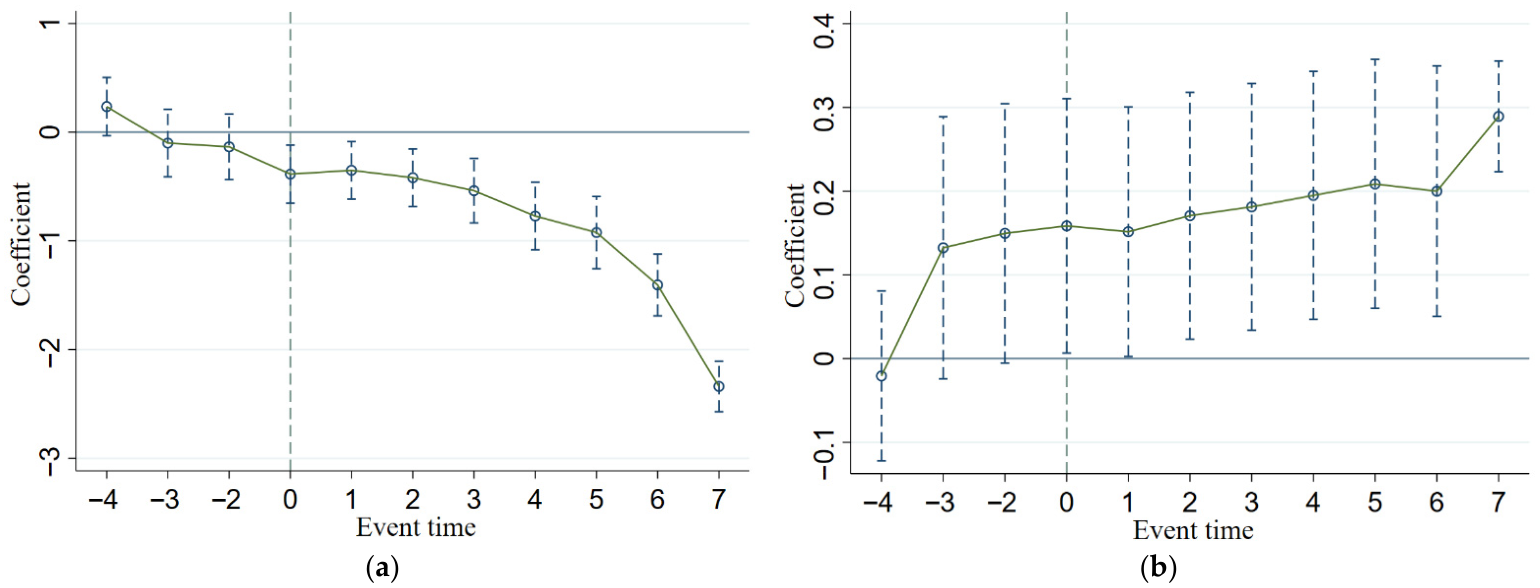
The results of the parallel trend test are presented in Figure 1a,b. In the pre-policy period (l < 0), the estimated coefficients β l fluctuate around zero and are not statistically significant. This indicates that there were no significant systematic differences in the trends of environmental pollution and economic growth between the treatment and control groups prior to the policy implementation, thereby satisfying the parallel trend assumption.
As shown in the results, for environmental pollution (Figure 1a), the coefficients exhibit a slight downward trend from t-4 to t-2; for economic growth (Figure 1b), the coefficients exhibit a slight upward trend from t-4 to t-2. This phenomenon can be explained by policy anticipation effects. In the context of China‘s low-carbon city pilot policy, the anticipation effect arises because the central government announced the policy guidelines and selection criteria well before the official implementation dates. Cities that were later designated as pilots—anticipating their selection—may have begun implementing preparatory measures before the official announcement, including adjusting industrial structures, increasing green investment, setting internal emission reduction targets, or piloting low-carbon technologies on a small scale. Such anticipation behavior is well documented in policy evaluation studies and is recognized as a common phenomenon when policies are publicly announced prior to implementation [40]. The direction of the pre-trends is also theoretically consistent with anticipation effects. The observed slight downward trend in environmental pollution among eventual pilot cities suggests that these cities began reducing emissions in preparation for policy requirements. Similarly, the slight upward trend in economic growth may reflect early investments in green industries that stimulated local economic activity even before full policy rollout. These patterns align with the logic of strategic behavior under policy anticipation.
Importantly, anticipation effects would bias our estimates downward (i.e., make it harder to find significant policy effects). To see why, note that if control cities also anticipated future policy and adjusted their behavior, the difference-in-differences estimator would capture only the incremental effect beyond anticipation. Thus, our finding of significant policy effects despite the presence of anticipation suggests that our main results are conservative estimates of the true policy impact.
Given the presence of pre-existing trends in the pre-policy periods, we conduct a sensitivity analysis following Rambachan and Roth (2023) [41]. This approach assesses how sensitive our DID estimates are to deviations from perfect parallel trends by constructing confidence sets under different restrictions on the magnitude of post-treatment violations relative to pre-treatment deviations (Mbar). As reported in Appendix A Table A4, for Mbar up to 2.5 times the pre-trend deviation, the 95% confidence intervals for both SO2 and Economic outcomes still exclude zero. These results confirm that our main findings remain robust despite the presence of pre-existing trends in the pre-policy periods, further strengthening the credibility of our causal inference.

4.3. Robustness Checks

4.3.1. Instrumental Variable (IV) Estimation

To further address potential endogeneity concerns, we employ an instrumental variable (IV) approach. Following the existing literature, we use river density as an instrument for the low-carbon pilot policy. River density is measured as the total length of rivers within a city‘s administrative area divided by the city’s land area (km/km2).
The choice of this instrument is justified on two grounds. First, relevance: historically, cities with higher river density were more likely to develop into industrial and commercial hubs due to lower transportation costs, making them more suitable candidates for pilot programs. Second, exogeneity: river density is a natural geographical feature that is not directly influenced by economic activities or policy interventions. It affects environmental pollution and economic growth only through its influence on policy selection, satisfying the exclusion restriction.
The IV estimation results are reported in Table A4 in Appendix A. The first-stage F-statistic is 32.47, well above the conventional threshold of 10, rejecting weak instrument concerns. The second-stage results show that the low-carbon pilot policy continues to significantly reduce SO2 and Smoke emissions and promote economic growth, with coefficients comparable to the baseline estimates. These results confirm that our main findings are robust to endogeneity concerns.

4.3.2. Goodman-Bacon Decomposition

Since the timing of low-carbon pilot policy implementation varies across cities, different treatment groups have different policy start years. Recent econometric literature has shown that the traditional two-way fixed effects (TWFE) estimator can produce biased estimates in staggered difference-in-differences settings when treatment effects are heterogeneous across time or units, due to potential “negative weighting” issues.
To address this concern, we follow Goodman-Bacon and conduct a Bacon decomposition to reassess the policy effects [42]. The Bacon decomposition breaks down the TWFE estimate into weighted averages of four comparison groups: (i) treated vs. never-treated; (ii) early-treated vs. late-treated; (iii) late-treated vs. early-treated; (iv) treated vs. already-treated. If the “treated vs. never-treated” comparisons dominate the weight, the TWFE estimate is reliable. If “late-treated vs. early-treated” comparisons have excessive weight, the estimate may be seriously biased due to heterogeneous treatment effects.
Table A5 in the Appendix A reports the Bacon decomposition results. The key findings are as follows: Treated vs. never-treated comparisons account for 82.70% of the total weight, with a treatment effect of 0.878. Early-treated vs. late-treated comparisons account for 12.50% of the weight. Late-treated vs. early-treated (the potentially problematic group) account for only 2.30% of the weight, indicating minimal bias. The overall weighted estimate is 0.223, which is very close to our baseline DID estimate (e.g., −0.233 for SO2 in Table 2). These results demonstrate that the TWFE estimator provides reliable estimates in our setting and that the baseline findings are not severely distorted by heterogeneous treatment effects.

4.3.3. Propensity Score Matching-Difference-in-Differences (PSM-DID)

To mitigate potential sample selection bias, the PSM-DID method was applied. Three matching methods (radius matching, nearest neighbor matching, and Mahalanobis matching) were used to construct a refined control group for the treated cities. The results in Table 3 show that, regardless of the matching method, the coefficients for the policy on environmental pollution remain significantly negative and on economic growth significantly positive, confirming the robustness of the main findings.

4.3.4. Placebo Test

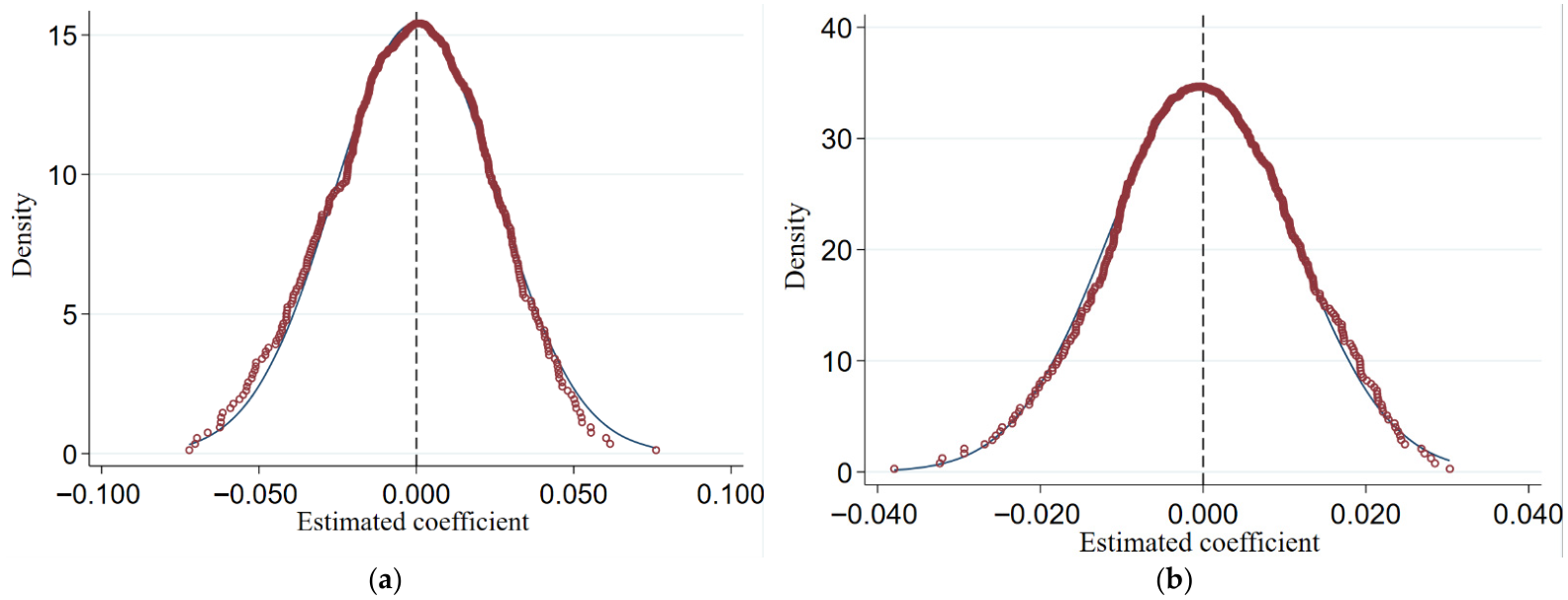
To rule out the influence of unobservable factors, a placebo test was conducted by randomly assigning the treatment status and pseudo-policy timing 500 times. Figure 2a,b show that the distribution of the randomly generated coefficients centers around zero and follows a normal distribution. The actual estimated coefficients from the baseline regression (−0.233 and 0.475) lie far outside this distribution, indicating that the policy effects are not driven by chance factors.

4.3.5. Generalized Method of Moments (GMM)

Considering the potential dynamic nature of environmental pollution and economic growth, the lagged dependent variables were included, and the System GMM estimator was employed. The results in Table 4 show that the coefficients for the low-carbon pilot policy remain significant after controlling for dynamic effects and potential endogeneity. The AR(2) test confirms the validity of the model specification.

4.3.6. Entropy Balancing (EB)

Entropy Balancing was used to achieve higher-order moment balance (mean, variance) of covariates between the treatment and control groups. The results in Table 5 show that after adjusting for the first, second, and third moments, the significance and direction of the policy effects remain unchanged, further confirming robustness.

4.3.7. Double/Debiased Machine Learning (DDML)

To address potential model specification errors in traditional parametric models, the Double/Debiased Machine Learning (DDML) method was applied using a Random Forest algorithm with different sample splitting ratios. The results in Table 6 show that, regardless of the sample split, the coefficients for the policy remain significantly negative for environmental pollution and significantly positive for economic growth, confirming robustness.

4.3.8. Other Robustness Checks

Additional checks included: replacing dependent variables (using industrial wastewater discharge for pollution, per capita GDP for growth), altering the study period (2014–2019 to exclude COVID-19 pandemic disruptions), excluding provincial capital city samples, and winsorizing extreme values at the 1% level. The results in Table 7 show that the core conclusions remain substantively unchanged, indicating high robustness of the findings.

4.4. Mechanisms Analysis

4.4.1. Investment in Technological Innovation (Rd)

To explore the mechanisms, this study follows the two-step mediation approach proposed by Dell M [37]. Step 1 establishes the total effect of the low-carbon pilot policy on the outcome variables (Table 2, column (3) for economic growth; columns (1)–(2) for environmental pollution). Step 2 tests whether the policy significantly affects the proposed mechanism variable. Column (1) of Table 8 shows that the low-carbon pilot policy has a significant positive coefficient (0.392, p < 0.01) on investment in technological innovation (Rd), indicating that the policy significantly boosts technological innovation investment. The influence of Rd on environmental pollution and economic growth is well established in economic theory—technological progress reduces emission intensity and enhances productivity. Therefore, Hypothesis H2a is supported.

4.4.2. Industrial Structure (Ind)

Similarly, the mediating role of industrial structure (Ind) is tested using the two-step approach. Step 1 again refers to the total effects reported in Table 2. Column (1) of Table 9 shows that the low-carbon pilot policy has a significant positive coefficient (0.015, p < 0.01) on Ind, indicating that the policy significantly optimizes the industrial structure (increasing the ratio of tertiary to secondary industry). The theoretical link between industrial structure upgrading and environmental/economic outcomes is well established in the literature (e.g., structural dividends, cleaner production). Hence, Hypothesis H2b is supported.

4.5. Heterogeneity Analysis

4.5.1. Heterogeneity by Resource Endowment

To examine whether policy effects vary by resource endowment, the sample was divided into resource-based and non-resource-based cities according to China’s National Sustainable Development Plan for Resource-Based Cities. The results in Table 10 show that the pollution reduction effect (SO2 and Smoke) of the policy is stronger (larger absolute coefficient) in non-resource-based cities, while the economic growth effect is stronger (larger coefficient) in resource-based cities. Fisher’s permutation test confirms the significant difference between groups. This may be because resource-based cities’ economies rely on traditional industries, where the low-carbon policy acts as a forced mechanism for growth through technological upgrading. In contrast, non-resource-based cities have more flexible industrial structures, allowing environmental regulations to yield faster emission reduction results.

4.5.2. Heterogeneity by Fiscal Pressure

Following Yuan et al. (2025) [43], fiscal pressure was measured as (fiscal expenditure—fiscal revenue)/GDP, and the sample was split into high and low fiscal pressure groups. The results in Table 11 show that the environmental improvement effect is stronger in cities with low fiscal pressure, while the economic growth effect is stronger in cities with high fiscal pressure. This suggests that ample fiscal resources facilitate investment in environmental governance, whereas high fiscal pressure may force cities to seek more efficient growth pathways during low-carbon transition to generate revenue (“opening up new sources”).

4.6. Further Analysis: Spatial Spillover Effects

4.6.1. Construction of the Spatial Weight Matrix and Model Specification

To identify the spatial spillover characteristics of the policy, this study constructs a spatial econometric model for analysis. The primary task in spatial econometric modeling is to establish a spatial weight matrix. Given that the impact of the low-carbon pilot policy on environmental pollution and economic growth can be observed by various surrounding cities, its spatial effects are not limited to immediately adjacent cities but may also extend to other non-adjacent cities. Based on this, and following the approach of Wang et al. (2023) [44], this study employs a geographical distance weight matrix ( W i j ) to measure the spatial effects between cities. Here, d i j represents the distance calculated based on the longitude and latitude coordinates of cities i and j. The spatial weight matrix W i j is defined as follows:
W i j = { 1 d i j i j 0 i = j

4.6.2. Spatial Autocorrelation Test and Model Applicability Test

First, the global Moran’s I index is used to test for spatial autocorrelation in the low-carbon pilot policy, environmental pollution, and economic growth, in order to verify the existence of spatial dependence. The calculation formula is:
Moran’s   I = n i = 1 n   j = 1 n   w i j x i x ¯ x j x ¯ i = 1 n   j = 1 n   w i j i = 1 n   ( x i x ¯ ) 2
where n represents the 272 selected cities, w i j is the spatial weight, x i and x j are the observed values of the variable, and x ¯ is its mean. The Moran’s I index ranges from [−1,1], with a larger absolute value indicating a stronger degree of spatial correlation.
The results are presented in Table 12. From 2006 to 2023, the global Moran’s I indices for the low-carbon pilot policy, environmental pollution, and economic growth all pass the 1% significance test and are significantly positive. The positive Moran’s I for the low-carbon pilot policy indicates that neighboring cities tend to implement the policy, forming spatial clustering effects. The positive Moran’s I for environmental pollution suggests that cities with high pollution levels are typically geographically clustered. The positive Moran’s I for economic growth implies that economically developed cities are likely to be adjacent to other relatively developed cities, exhibiting positive spatial autocorrelation. In other words, the spatial distribution of “high-high” clusters and “low-low” clusters is more likely than a random distribution. These results confirm the presence of global spatial autocorrelation in the low-carbon pilot policy, environmental pollution, and economic growth.
Before estimating the model parameters, LM tests are conducted to evaluate the Spatial Autoregressive Model (SAR) and the Spatial Error Model (SEM). The results indicate that the p-values for both the SEM and SAR models are significant. Therefore, the Spatial Durbin Model (SDM), which combines the features of both, is selected for the analysis. Table 13 reports the corresponding regression results.
As shown in Table 13, the estimated coefficients for the low-carbon pilot policy (Lc) on SO2, Smoke, and Economic growth are −0.257, −0.499, and 0.133, respectively, all statistically significant. This reaffirms that the implementation of the low-carbon pilot policy reduces environmental pollution and promotes economic growth. The coefficients for the spatial lag terms of the policy (W × Lc) are −1.4228, −1.1374, and 0.433, respectively, all statistically significant. This indicates that the low-carbon pilot policy generates significant policy spillover effects: local implementation of the policy reduces environmental pollution and promotes economic growth in neighboring areas. The coefficients for the spatial lag terms of environmental pollution (W × SO2, W × Smoke) are 0.8680 and 0.8864, respectively, both significantly positive, suggesting that environmental pollution in neighboring regions exacerbates local environmental pollution. The coefficient for the spatial lag term of economic growth (W × Economic) is 0.9923, significantly positive, indicating that economic growth in neighboring regions has a positive promotional effect on local economic growth.

4.6.3. Decomposition of Spatial Effects

To more accurately measure the spatial spillover effects of the low-carbon pilot policy on environmental pollution and economic growth, this study employs the partial differential decomposition method. This approach decomposes the total effect of the policy into direct effects, indirect effects (i.e., spatial spillover effects), and total effects. The results are presented in Table 14.
The direct effects of the low-carbon pilot policy on environmental pollution (SO2, Smoke) are negative, while the direct effect on economic growth (Economic) is positive. This indicates that implementing the policy reduces local environmental pollution and promotes local economic growth, consistent with the baseline regression results. The indirect effects of the policy on environmental pollution are negative, and the indirect effect on economic growth is positive. This confirms the existence of spatial spillover effects: local policy implementation positively influences both environmental improvement and economic development in spatially correlated cities.
We acknowledge that the indirect effects (−10.6357 for SO2 and −10.4372 for Smoke) appear substantially larger than the direct effects (−0.140 and −0.0888). However, this is not uncommon in spatial econometric models using an inverse-distance weight matrix, because the indirect effect captures the cumulative impact on all neighboring cities combined, rather than the average impact per neighbor. Given that each city in our sample has multiple neighbors (often dozens), the aggregated spillover across the entire urban network can be large in magnitude. Similar patterns have been reported in existing spatial spillover studies on environmental policies. Therefore, the magnitude of the indirect effects is plausible and does not indicate model misspecification. A plausible explanation for these spillovers is that the policy facilitates the diffusion of green technologies and the optimization of industrial structures, thereby improving pollution levels in other cities within the region. Furthermore, by enhancing regional cooperation and promoting industrial development, it stimulates economic growth in neighboring areas. Thus, Hypothesis H3 is validated.

5. Conclusions and Policy Implications

This study makes three significant contributions to the literature on low-carbon policy evaluation. Theoretically, it moves beyond the traditional trade-off perspective by demonstrating that well-designed low-carbon policies can achieve a win-win outcome, challenging the conventional wisdom that environmental regulation necessarily harms economic growth. Methodologically, it employs a multi-method analytical framework (staggered DID, mediation analysis, spatial Durbin model) to provide a comprehensive assessment of policy effects, including direct, indirect, and spatial spillover channels. Practically, the findings offer actionable insights for differentiated policy design based on city heterogeneity and for establishing inter-regional collaborative governance mechanisms.
Using panel data from 272 Chinese cities (2006–2023) and employing staggered DID, mediation effect, and spatial Durbin models, this study systematically investigates the impact and mechanisms of low-carbon pilot policies on environmental pollution and economic growth. The main conclusions are: (1) Baseline regressions and various robustness checks confirm that implementing low-carbon pilot policies not only reduces pollutant emissions and improves environmental quality but also promotes economic growth, achieving a win-win outcome. (2) Regarding mechanisms, these policies facilitate environmental improvement and economic growth by increasing investment in technological innovation and optimizing industrial structure. (3) Heterogeneity analysis reveals that environmental improvement effects are stronger in non-resource-based cities and cities with lower fiscal pressure, while economic growth effects are more pronounced in resource-based cities and cities facing higher fiscal pressure. (4) Significant spatial spillover effects exist: local policy implementation positively influences the environmental quality and economic development of neighboring cities.
Our findings extend the existing literature in several important ways. First, the win-win outcome documented here is consistent with recent studies on China‘s low-carbon city pilots (Wang & Xia, 2026 [12]; Xu et al., 2026 [5]; Lyu & Liu, 2026 [6]). However, unlike previous work that focused primarily on average treatment effects, we explicitly test and confirm spatial spillover effects, showing that local policy implementation benefits neighboring cities’ environmental quality and economic development. This finding adds a new dimension to the understanding of low-carbon policies as regional public goods. Second, our heterogeneity analysis reveals that the economic growth effect is significantly stronger in resource-based cities than in non-resource-based cities. This contrasts with Lyu & Liu (2026) [6], who reported weaker effects for resource-dependent regions. The difference likely stems from our longer study period (2006–2023), which captures the full adjustment process of resource-based cities, and the inclusion of later policy batches (2017) that specifically targeted industrial restructuring. Third, while Feng et al. (2020) [26] documented spatial spillovers of environmental regulations on air pollution, our study is among the first to demonstrate that low-carbon pilot policies generate positive spillovers on both environmental and economic outcomes simultaneously, suggesting a virtuous cycle of regional green development.
Several limitations should be acknowledged. First, our analysis relies on city-level aggregate data, which may mask heterogeneous responses at the firm or household level. Future research using micro-level data could uncover the underlying behavioral mechanisms. Second, city-level capital stock data are not publicly available for the full study period. Although we use population size as a proxy for market scale and labor supply, the omission of direct capital measures remains a data constraint. Third, China has implemented multiple concurrent policies during the study period (e.g., innovative city pilots, smart city pilots, carbon emissions trading schemes). While our DID design with city and year fixed effects absorbs time-invariant unobservables and common time trends, we cannot completely rule out potential interactions with these concurrent policies. Fourth, our findings are derived from the Chinese context, which has a unique institutional and economic environment; generalizability to other countries, particularly those with different political systems or levels of development, requires further investigation.
Based on the limitations and findings of this study, several avenues for future research are worth pursuing. First, researchers could employ firm-level or household-level survey data to examine the micro-mechanisms through which low-carbon pilot policies affect pollution and economic growth, such as changes in production technology, energy efficiency, or consumption behavior. Second, extending the study period beyond 2023 would allow an assessment of the long-term dynamic effects and potential policy fatigue. Third, cross-country comparative studies could help identify the institutional, economic, and geographical conditions under which low-carbon pilot policies are most effective, thereby informing international policy transfer. Fourth, the role of digital transformation (e.g., big data, artificial intelligence, smart city infrastructure) in amplifying or moderating the effects of low-carbon policies deserves systematic investigation, as digital technologies are increasingly integrated into environmental governance. Finally, future research could explore the potential unintended consequences of low-carbon pilots, such as carbon leakage across regions or regressive distributional effects on vulnerable populations.
Based on the findings, the following policy implications are proposed for global policymakers.
First, systematically expand pilot programs and deepen policy coverage. Countries worldwide can draw on this experience to design and scale up similar low-carbon regional pilot initiatives tailored to their own development stages and national contexts. It is recommended that national development strategies clearly outline pathways for low-carbon transition, integrate more eligible smaller cities and regions into such policy frameworks, and strengthen dynamic evaluation and upgrade mechanisms for existing pilots to prevent policy inertia and symbolism.
Second, strengthen innovation-driven development and industrial transformation to build long-term mechanisms. Governments should increase fiscal investment and financial support for green and low-carbon technologies, potentially establishing dedicated low-carbon innovation funds and encouraging collaborative R&D among firms, universities, and research institutions. Crucially, carbon emission intensity should be integrated as a key constraint indicator for industrial access, accelerating the green transformation of traditional industries and fostering industrial clusters for low-, zero-, and even negative-carbon technologies. This ensures policy benefits shift from short-term stimulus to long-term drivers.
Third, implement differentiated policy designs to enhance targeted governance. Given the observed heterogeneity in policy effects, countries must consider regional structural differences when advancing low-carbon transitions. For regions with flexible industrial structures and ample fiscal resources, stricter environmental regulations can be implemented to create leading green zones. For regions dependent on resource-based industries or facing high fiscal pressure, complementary transition assistance policies are necessary. These may include special development funds, support for alternative industries, and increased targeted transfer payments for low-carbon initiatives to alleviate the cost pressures of green transition and prevent economic deceleration due to environmental constraints.
Fourth, establish inter-regional collaborative governance mechanisms to amplify spatial spillover effects. Countries should encourage the formation of cooperative networks like “low-carbon city clusters” or “green economic belts” between pilot cities and their surrounding regions. This involves co-building markets for green technology trading and carbon emission allowances, as well as ecological compensation mechanisms, to facilitate the cross-regional flow of low-carbon policies, technologies, and experiences. Incorporating the promotion of coordinated regional emission reduction and shared growth into the evaluation systems of local governments or regional cooperation organizations can help break down administrative barriers. This fosters a pattern of regional green development where pilots lead, neighbors follow, and all progress together, contributing significantly to the achievement of global sustainable development goals.


Author Contributions

Methodology, X.M.; Software, Z.W.; Formal analysis, Z.W.; Writing—original draft, Z.W.; Writing—review and editing, Z.W.; Supervision, X.M.; Funding acquisition, X.M. All authors have read and agreed to the published version of the manuscript.

Funding

This research was funded by the Ministry of Education of the People’s Republic of China, grant numbers 23XJA790002 and 21XJC790009; the Natural Science Foundation of Inner Mongolia, grant numbers 2024LHMS07003 and 2024MS07016; and the Postgraduate Research Innovation Project of Inner Mongolia Autonomous Region, grant number NCYX2025-007.

Institutional Review Board Statement

Not applicable.

Informed Consent Statement

Not applicable.

Data Availability Statement

The data presented in this study are available from publicly accessible sources. The datasets supporting the findings of this research were derived from the China Statistical Yearbook, China City Statistical Yearbook, China Statistical Yearbook on High Technology Industry, and local statistical yearbooks and bulletins. Detailed information on data sources and processing procedures is provided in the main text. Further inquiries can be directed to the corresponding author.

Conflicts of Interest

The authors declare no conflicts of interest. The funders had no role in the design of the study; in the collection, analyses, or interpretation of data; in the writing of the manuscript; or in the decision to publish the results.

Appendix A

Table A1. Variance Inflation Factor (VIF) for Independent Variables.
VariableVIF1/VIF
Lc1.080.923382
Fin1.610.622027
Open1.130.888569
Urban1.410.709181
Hcap1.910.524796
Pop1.100.908956
Mean VIF1.37
Table A2. Pearson Correlation Matrix of Key Variables.
VariableEconomicSO2SmokeLcFinOpenUrbanHcapPop
Economic1
SO2−0.154 ***1
Smoke−0.0140.754 ***1
Lc0.308 ***−0.190 ***−0.116 ***1
Fin0.342 ***−0.279 ***−0.167 ***0.231 ***1
Open0.218 ***0.128 ***0.086 ***0.0000.025 *1
Urban0.525 ***−0.0090.028 **0.217 ***0.362 ***0.164 ***1
Hcap0.511 ***−0.0010.026 *0.190 ***0.579 ***0.272 ***0.457 ***1
Pop−0.049 ***0.108 ***0.116 ***0.0060.031 **0.100 ***−0.161 ***0.142 ***1
Table A3. Parallel trends sensitivity analysis.
MbarRelative Magnitude of ViolationEstimated ATT95% CI
SO2EconomicSO2Economic
0.00Perfect parallel trends (baseline)−0.2330.475[−0.329, −0.137][0.434, 0.516]
0.5050% of pre-trend deviation−0.2210.468[−0.318, −0.124][0.426, 0.510]
1.00Same as pre-trend deviation−0.2050.459[−0.305, −0.105][0.416, 0.502]
1.501.5 times pre-trend deviation−0.1880.448[−0.291, −0.085][0.404, 0.492]
2.002.0 times pre-trend deviation−0.1700.436[−0.275, −0.065][0.391, 0.481]
2.502.5 times pre-trend deviation−0.1520.423[−0.260, −0.044][0.376, 0.470]
Table A4. Instrumental Variable (IV) Estimation Results.
(1)(2)(3)
First-StageSecond-StageSecond-Stage
VariableLcSO2Economic
River Density0.423 ***
(0.074)
Lc −0.298 ***0.412 ***
(0.061)(0.038)
X′YESYESYES
City FEYESYESYES
Year FEYESYESYES
First-stage F-statistic32.47
N489648964896
Table A5. Goodman-Bacon Decomposition Results.
Comparison GroupWeightTreatment Effect
Treated vs. Never-treated0.82700.878
Early-treated vs. Late-treated0.12500.215
Late-treated vs. Early-treated0.0230−0.042
Treated vs. Already-treated0.02500.186
Overall Weighted Estimate0.223

References

  1. Antonoglou, A.N. United Nations Environment Programme and Its Contribution to the Field of Energy. Master’s Thesis, Democritus University of Thrace, Komotini, Greece, 2025. [Google Scholar]
  2. Xu, D.; Li, J.; Sheng, C. Carbon Peaking and Carbon Neutrality in China: Theory and Practice; Springer: Berlin/Heidelberg, Germany, 2025. [Google Scholar]
  3. Wang, Y.; Song, Q.; He, J.; Qi, Y. Developing low-carbon cities through pilots. Clim. Policy 2015, 15, S81–S103. [Google Scholar] [CrossRef]
  4. Palmer, K.; Oates, W.E.; Portney, P.R. Tightening environmental standards: The benefit-cost or the no-cost paradigm? J. Econ. Perspect. 1995, 9, 119–132. [Google Scholar] [CrossRef]
  5. Xu, L.; Wang, S.; Yu, H. Does China’s Low-carbon urban pilot initiative Effectively Reduce Carbon Emissions? A Dual Perspective on Carbon Emissions and Efficiency. Systems 2026, 14, 170. [Google Scholar] [CrossRef]
  6. Lyu, J.; Liu, C. Evaluation of the role mechanism and effectiveness of low-carbon city pilot policies on industrial structure upgrading. Int. J. Low.-Carbon Technol. 2026, 21, ctag017. [Google Scholar] [CrossRef]
  7. Zhao, R.; Jiang, Y.; Wang, X.; Wei, X. Does green transportation affect carbon emission efficiency? Evidence from a quasi-experimental study in China. J. Environ. Manag. 2024, 370, 122815. [Google Scholar] [CrossRef]
  8. Liu, Y.; Deng, W.; Wen, H.; Li, S. Promoting green technology innovation through policy synergy: Evidence from the dual pilot policy of low-carbon city and innovative city. Econ. Anal. Policy 2024, 84, 957–977. [Google Scholar] [CrossRef]
  9. Elhorst, J.P. Spatial Econometrics: From Cross-Sectional Data to Spatial Panels; Springer: Berlin/Heidelberg, Germany, 2014. [Google Scholar]
  10. Nooseng, M.; Du, D. Impacts of green finance policy on enterprise low-carbon transformation. Financ. Res. Lett. 2025, 87, 108874. [Google Scholar] [CrossRef]
  11. Liu, G.; Xie, R. How the coupling of green finance and green technology innovation affect synergistic effect of pollution and emission carbon reduction: Evidence from China. arXiv 2025, arXiv:2510.09707. [Google Scholar] [CrossRef]
  12. Wang, Y.; Xia, Z. Synergistic Enhancement of Low-Carbon City Policies and National Big Data Comprehensive Experimental Zone Policies on Green Total Factor Productivity: Evidence from Pilot Cities in China. Sustainability 2026, 18, 936. [Google Scholar] [CrossRef]
  13. Li, G.; Ma, Q.; Alghafes, R.; Aliani, K. Firm-perceived economic policy uncertainty and corporate greenwashing: Evidence from China. Econ. Change Restruct. 2026, 59, 46. [Google Scholar] [CrossRef]
  14. Deuskar, C.; Murray, S.; Molano, J.S.L.; Khan, I.A.; Maria, A. Banking on Cities: Investing in Resilient and Low-Carbon Urbanization; World Bank: Washington, DC, USA, 2025. [Google Scholar]
  15. Deshayes, E.; Francis, L.; Chelleri, L. European cities’ barriers to carbon neutrality: Identifying Vicious Circles hampering effective implementation. Front. Sustain. Cities 2026, 8, 1669471. [Google Scholar] [CrossRef]
  16. Zhou, Q.; Qi, Z. Urban economic resilience and human capital: An exploration of heterogeneity and mechanism in the context of spatial population mobility. Sustain. Cities Soc. 2023, 99, 104983. [Google Scholar] [CrossRef]
  17. Liu, Y.; Dong, L.; Fang, M.M. Advancing ‘Net Zero Competition’ in Asia-Pacific under a dynamic era: A comparative study on the carbon neutrality policy toolkit in Japan, Singapore and Hong Kong. Glob. Public Policy Gov. 2023, 3, 12–40. [Google Scholar] [CrossRef]
  18. Ji, C.J.; Wang, X. Dynamic Rollout Plan of China National Carbon Emissions Trading Scheme: A CGE-Based Analysis. FinTech Sustain. Innov. 2026, 2, A4. [Google Scholar] [CrossRef]
  19. Li, G.; Fu, B.; Ma, Q.; He, T.; Guo, B. Green common institutional ownership and energy-saving technological innovation: Evidence from China. Appl. Econ. 2026, 1–18. [Google Scholar] [CrossRef]
  20. Deng, Q.; Long, Y.; Nie, R. Dynamic Assessment and Configurational Analysis of Regional Green Innovation Ecosystem Competitiveness in China: An AEROBC Framework. J. Clean. Prod. 2025, 514, 145669. [Google Scholar] [CrossRef]
  21. Potter, C.; Bastounis, A.; Hartmann-Boyce, J.; Stewart, C.; Frie, K.; Tudor, K.; Bianchi, F.; Cartwright, E.; Cook, B.; Rayner, M.; et al. The effects of environmental sustainability labels on selection, purchase, and consumption of food and drink products: A systematic review. Environ. Behav. 2021, 53, 891–925. [Google Scholar] [CrossRef]
  22. Shi, T.; Liu, W.; Xu, J. Pledge to green: The green innovation effect of intellectual property pledge financing pilot policy. Appl. Econ. 2025, 57, 4710–4722. [Google Scholar] [CrossRef]
  23. Shan, Z.; Han, X.; Zhang, Z. Environmental regulation and firm productivity: Evidence from China’s new energy industry. Eurasian Bus. Rev. 2025, 15, 871–906. [Google Scholar] [CrossRef]
  24. Wang, Z.; Sun, X.; Zhang, G. Structural dividends and economic growth in China. Zb. Rad. Ekon. Fak. Rij. 2018, 36, 355–372. [Google Scholar]
  25. Ding, Y.; Bi, C.; Sun, P. Low carbon constraints, innovation driven and carbon neutral technological innovation: Empirical evidence based on multiple policy combinations. Sci. Rep. 2025, 15, 22912. [Google Scholar] [CrossRef]
  26. Feng, T.; Du, H.; Lin, Z.; Zuo, J. Spatial spillover effects of environmental regulations on air pollution: Evidence from urban agglomerations in China. J. Environ. Manag. 2020, 272, 110998. [Google Scholar] [CrossRef]
  27. Zhang, X.; Guo, Z.; Zhang, H. Assessing the environmental governance impact of China’s ecological civilization demonstration zones policy. Environ. Impact Assess. Rev. 2026, 116, 108098. [Google Scholar] [CrossRef]
  28. Wang, Y.; Xu, Z.; Liang, J. Impact of transportation hubs on urban economic resilience: Evidence from national comprehensive transportation hub cities. Transp. Res. Part A Policy Pract. 2026, 203, 104751. [Google Scholar] [CrossRef]
  29. Ren, Y.; Yu, J.; Zhang, G.; Yu, Y. Towards low-carbon development through innovation: Empirical evidence from China. Cities 2024, 152, 105197. [Google Scholar] [CrossRef]
  30. Guo, D.; She, J. China Statistical Yearbook; National Bureau of Statistics of China: Beijing, China, 2023.
  31. Yang, Z.; Gao, W.; Li, J. Can economic growth and environmental protection achieve a “win–win” situation? Empirical evidence from China. Int. J. Environ. Res. Public Health 2022, 19, 9851. [Google Scholar] [CrossRef] [PubMed]
  32. Angrist, J.D.; Pischke, J.S. Mostly Harmless Econometrics: An Empiricist’s Companion; Princeton University Press: Princeton, NJ, USA, 2009. [Google Scholar]
  33. Liu, J.; Xu, F.; Lv, Y. How an emission trading system affects carbon emissions? Evidence from the urban agglomeration in the Middle Reaches of the Yangtze River, China. Ecol. Indic. 2024, 160, 111865. [Google Scholar] [CrossRef]
  34. Liu, L.; Yang, Y.; Liu, S.; Gong, X.; Zhao, Y.; Jin, R.; Duan, H.; Jiang, P. A comparative study of green growth efficiency in Yangtze River Economic Belt and Yellow River Basin between 2010 and 2020. Ecol. Indic. 2023, 150, 110214. [Google Scholar] [CrossRef]
  35. Ouyang, X.; Shao, Q.; Zhu, X.; He, Q.; Xiang, C.; Wei, G. Environmental regulation, economic growth and air pollution: Panel threshold analysis for OECD countries. Sci. Total Environ. 2019, 657, 234–241. [Google Scholar] [CrossRef]
  36. Bertrand, M.; Duflo, E.; Mullainathan, S. How much should we trust differences-in-differences estimates? Q. J. Econ. 2004, 119, 249–275. [Google Scholar] [CrossRef]
  37. Dell, M. The persistent effects of Peru’s mining mita. Econometrica 2010, 78, 1863–1903. [Google Scholar] [CrossRef]
  38. Renjie, B.; Wang, S. Environmental Taxes, Technological Innovation, and Carbon Productivity: A Spatial Mediation Analysis of Regional Spillover Effects. Sustainability 2026, 18, 1815. [Google Scholar] [CrossRef]
  39. Beck, T.; Levine, R.; Levkov, A. Big bad banks? The winners and losers from bank deregulation in the United States. J. Financ. 2010, 65, 1637–1667. [Google Scholar] [CrossRef]
  40. Malani, A.; Reif, J. Interpreting pre-trends as anticipation: Impact on estimated treatment effects from tort reform. J. Public Econ. 2015, 124, 1–17. [Google Scholar] [CrossRef]
  41. Rambachan, A.; Roth, J. A more credible approach to parallel trends. Rev. Econ. Stud. 2023, 90, 2555–2591. [Google Scholar] [CrossRef]
  42. Goodman-Bacon, A. Difference-in-differences with variation in treatment timing. J. Econom. 2021, 225, 254–277. [Google Scholar] [CrossRef]
  43. Liu, Z.; Gao, M.; Shi, W. New-type urbanization policy and climate transition: Evidence from a quasi-natural experiment of 2302 counties in China. Sustain. Cities Soc. 2025, 134, 106934. [Google Scholar] [CrossRef]
  44. Wang, H.; Su, X.; Liu, J.M. The spatial spillover effect of logistics and manufacturing co-agglomeration on regional economic resilience: Evidence from China’s provincial panel data. Sustainability 2023, 15, 8208. [Google Scholar] [CrossRef]
Figure 1. (a) Parallel trend test: Environmental pollution. (b) Parallel trend test: Economic growth.
Sustainability 18 05762 g001
Figure 2. (a) Placebo test: Environmental pollution. (b) Placebo test: Economic growth.
Sustainability 18 05762 g002
Table 1. Descriptive statistics.
VariableSymbolNMeanMinMedianMax
Environmental PollutionSO248969.8230.6939.95113.115
Smoke48969.3792.3989.49015.458
Economic GrowthEconomic489610.5047.92210.50112.764
Low-Carbon Pilot PolicyLc48960.2820.0000.0001.000
Financial Development LevelFin48962.3870.5882.07321.301
Degree of Opening UpOpen48960.0020.0000.0020.029
Urbanization LevelUrban48960.3760.0750.3251.000
Human Capital LevelHcap48960.0180.0000.0100.185
Population ScalePop48965.8883.7695.9307.380
Investment in Technological InnovationRd48960.0150.0000.0100.207
Industrial StructureInd48960.4090.1120.4030.805
Table 2. Outcomes for baseline regression.
(1)(2)(3)
VariablesSO2SmokeEconomic
Lc−0.233 ***−0.166 ***0.475 ***
(0.049)(0.037)(0.021)
Fin−0.603 ***−0.064 ***0.231 ***
(0.110)(0.023)(0.042)
Open26.653 ***−11.419 *−0.105
(8.959)(6.358)(3.472)
Urban−3.646 ***0.843 ***1.485 ***
(0.401)(0.104)(0.158)
Hcap−28.706 ***2.829 ***16.750 ***
(3.653)(0.874)(1.538)
Pop−2.962 ***0.283 ***2.438 ***
(0.218)(0.025)(0.098)
City FEYESYESYES
Year FEYESYESYES
R20.6690.2940.872
N489648964896
Note: * p < 0.10, ** p < 0.05, *** p < 0.01. The same below.
Table 3. PSM-DID Regression Results.
(1)(2)(3)(4)(5)(6)
Matching MethodRadiusNearest NeighborMahalanobisRadiusNearest NeighborMahalanobis
VariableSO2Economic
Lc−0.234 ***−0.397 ***−0.281 ***0.474 ***0.508 ***0.525 ***
(0.049)(0.075)(0.043)(0.021)(0.031)(0.019)
X′YESYESYESYESYESYES
City FEYESYESYESYESYESYES
Year FEYESYESYESYESYESYES
R20.6690.7020.7200.8730.9070.916
N489119782660489119782660
Table 4. System GMM Regression Results.
(1)(2)
VariableSO2Economic
Lc−0.207 ***0.059 ***
(0.057)(0.012)
L.SO20.973 ***
(0.012)
L.Economic 0.933 ***
(0.005)
X′YESYES
City FEYESYES
Year FEYESYES
N48964896
Table 5. Entropy Balancing Regression Results.
(1)(2)(3)(4)(5)(6)
Moment Adjustment1st2nd3rd1st2nd3rd
VariableSO2Economic
Lc−0.372 ***−0.202 ***−0.176 ***0.496 ***0.437 ***0.431 ***
(0.051)(0.050)(0.051)(0.019)(0.018)(0.018)
X′YESYESYESYESYESYES
City FEYESYESYESYESYESYES
Year FEYESYESYESYESYESYES
N489648964896489648964896
R20.6460.6880.6800.8910.9080.907
Table 6. DDML Regression Results.
(1)(2)(3)(4)(5)(6)
Auxiliary/Main Sample1:21:41:71:21:41:7
VariableSO2Economic
Lc−0.245 ***−0.268 ***−0.257 ***0.476 ***0.486 ***0.480 ***
(0.055)(0.059)(0.057)(0.023)(0.024)(0.024)
X′YESYESYESYESYESYES
City FEYESYESYESYESYESYES
Year FEYESYESYESYESYESYES
N489648964896489648964896
Table 7. Alternative Specifications and Samples.
(1)(2)(3)(4)(5)(6)(7)(8)
Alternative DVPeriod ChangeExcluding CapitalsWinsorizingAlternative DVPeriod ChangeExcluding CapitalsWinsorizing
VariableSO2Economic
Lc−0.262 ***−0.169 ***−0.181 ***−0.233 ***0.498 ***0.423 ***0.491 ***0.475 ***
(0.062)(0.041)(0.051)(0.049)(0.020)(0.020)(0.023)(0.021)
X′YESYESYESYESYESYESYESYES
City FEYESYESYESYESYESYESYESYES
Year FEYESYESYESYESYESYESYESYES
N48963808444648964896380844464896
Table 8. Mediating Effect of Investment in Technological Innovation (Rd).
(1)
VariableRd
Lc0.392 ***
(0.050)
Rd
X′YES
City FEYES
Year FEYES
N4896
Table 9. Mediating Effect of Investment in Technological Innovation (Ind).
(1)
VariableInd
Lc0.015 ***
(0.003)
Ind
X′YES
City FEYES
Year FEYES
N4896
Table 10. Heterogeneity Analysis: Resource-Based vs. Non-Resource-Based Cities.
(1)(2)(3)(4)(5)(6)
VariableSO2SmokeEconomicSO2SmokeEconomic
City TypeResource-Based CitiesNon-Resource-Based Cities
Lc−0.0930.0410.551 ***−0.314 ***−0.142 ***0.447 ***
(0.063)(0.059)(0.026)(0.066)(0.047)(0.028)
X′YESYESYESYESYESYES
City FEYESYESYESYESYESYES
Year FEYESYESYESYESYESYES
R20.6990.3120.8700.6690.3380.882
N205220522052284428442844
Test for Coefficient Difference (p-value)0.000 ***0.000 ***0.000 ***0.000 ***0.000 ***0.000 ***
Table 11. Heterogeneity Analysis: Cities with Low vs. High Fiscal Pressure.
(1)(2)(3)(4)(5)(6)
VariableSO2SmokeEconomicSO2SmokeEconomic
Low Fiscal PressureHigh Fiscal Pressure
Lc−0.230 ***−0.173 ***0.410 ***−0.001−0.0780.617 ***
(0.048)(0.049)(0.020)(0.048)(0.056)(0.038)
X′YESYESYESYESYESYES
City FEYESYESYESYESYESYES
Year FEYESYESYESYESYESYES
R20.6990.3120.8700.6690.3380.882
N205220522052284428442844
Test for Coefficient Difference (p-value)0.000 ***0.000 ***0.000 ***0.000 ***0.000 ***0.000 ***
Table 12. Moran’s I Index Results, 2006–2023.
(1)(2)(3)(4)
YearSO2SmokeEconomicLc
Moran’s I
20060.0458 ***0.0790 ***0.1758 ***0.1018 ***
20070.0342 ***0.0694 ***0.1760 ***0.1018 ***
20080.0379 ***0.0705 ***0.1756 ***0.1018 ***
20090.0339 ***0.0660 ***0.1781 ***0.1018 ***
20100.0315 ***0.0510 ***0.1809 ***0.1018 ***
20110.0597 ***0.0689 ***0.1816 ***0.1018 ***
20120.0671 ***0.0746 ***0.1810 ***0.0694 ***
20130.0619 ***0.0786 ***0.1827 ***0.0694 ***
20140.0693 ***0.0753 ***0.1855 ***0.0694 ***
20150.0679 ***0.0677 ***0.1910 ***0.0694 ***
20160.0517 ***0.0466 ***0.1954 ***0.0694 ***
20170.0377 ***0.0384 ***0.1989 ***0.0535 ***
20180.0389 ***0.0252 ***0.2021 ***0.0535 ***
20190.0352 ***0.0292 ***0.2041 ***0.0535 ***
20200.0421 ***0.0333 ***0.2061 ***0.0535 ***
20210.0302 ***0.0260 ***0.2077 ***0.0535 ***
20220.0119 ***0.0251 ***0.2068 ***0.0535 ***
20230.0148 ***0.0101 ***0.2074 ***0.0535 ***
Table 13. Spatial Durbin Model (SDM) Regression Results.
Variable(1)(2)(3)
SO2SmokeEconomic
Lc−0.257 ***−0.499 ***0.133 ***
(0.0354)(0.0409)(0.0039)
W × L c −1.4228 ***−1.1374 ***0.433 ***
(0.2675)(0.3085)(0.0098)
W × Y 0.8680 ***0.8864 ***0.9923 ***
(0.0298)(0.0258)(0.0017)
Variance (sigma2_e)0.7793 ***1.0393 ***0.0039 ***
(0.0158)(0.0211)(0.0001)
X′YESYESYES
City FEYESYESYES
Year FEYESYESYES
N489648964896
Table 14. Decomposition of Spatial Effects from the SDM.
Effect(1)(2)(3)
SO2SmokeEconomic
Direct Effect−0.140 ***−0.0888 **0.414 ***
(0.0323)(0.0364)(0.0066)
Indirect Effect−10.6357 ***−10.4372 ***7.5865 ***
(3.1183)(3.6944)(1.4361)
Total Effect−10.6497 ***−10.5261 ***7.6278 ***
(3.1148)(3.6886)(1.4415)
X′YESYESYES
City FEYESYESYES
Year FEYESYESYES
N489648964896
Disclaimer/Publisher’s Note: The statements, opinions and data contained in all publications are solely those of the individual author(s) and contributor(s) and not of MDPI and/or the editor(s). MDPI and/or the editor(s) disclaim responsibility for any injury to people or property resulting from any ideas, methods, instructions or products referred to in the content.