1. Introduction
1.1. Sustainability Entrepreneurship Context
Rapid technological, economic, and social changes are transforming higher education systems and entrepreneurial ecosystems worldwide. Long-term economic growth and societal resilience in this shifting environment are now largely dependent on innovation and sustainability. Universities are under growing pressure to equip their students with the cognitive abilities necessary to manage uncertainty, recognize opportunities, and solve challenging social and environmental issues. As a result, universities now prioritize fostering creative and entrepreneurial thinking.
Growing interest has been shown in sustainability-oriented entrepreneurship as a way to create economic value while concurrently addressing environmental and social issues [
1,
2]. To align business creation with global sustainability goals, sustainable entrepreneurs find and seize opportunities that support social welfare, environmental preservation, and economic viability [
3]. This study takes a triple bottom line approach to sustainability, which is generally understood through three interconnected pillars: social, environmental, and economic sustainability [
4]. While environmental sustainability concentrates on safeguarding natural resources, minimizing ecological harm, and preserving the integrity of ecological systems, social sustainability refers to the advancement of human well-being, equity, quality of life, and social inclusion. Supporting long-term economic viability, value creation, and development without jeopardizing social or environmental well-being is known as economic sustainability [
4]. Since the dependent variable, sustainability entrepreneurial intention, reflects students’ intention to engage in entrepreneurial endeavors that generate social and/or environmental value while also contributing to economic development, the social and environmental dimensions are given special attention in this study. As a result, the study is situated at the intersection of social, environmental, and economic sustainability rather than concentrating on a single aspect.
The goal of this study is not to provide a thorough predictive model of sustainability entrepreneurial intention. Instead, it offers initial evidence for a single theoretically defined cognitive pathway that could help explain how innovation-oriented thinking is linked to sustainability entrepreneurial intention through entrepreneurial mindset. By incorporating innovative mindset, entrepreneurial mindset, and sustainability entrepreneurial intention into a cognitive mediation framework, this study provides an incremental and mechanism-focused contribution rather than asserting strong conceptual novelty. The study specifically looks at whether entrepreneurial mindset serves as a proximal cognitive mechanism that links innovative mindset to sustainability entrepreneurial intention among UAE university students.
Understanding the factors that influence sustainability entrepreneurial intention, especially among university students, has become more crucial as sustainability is incorporated into institutional and national strategies [
5].
Previous studies have found a number of factors that influence entrepreneurial intention, such as contextual, motivational, and cognitive aspects [
6,
7]. The Theory of Planned Behavior and other intention-based models highlight how attitudes, perceived behavioral control, and social norms influence entrepreneurial choices [
6]. Other elements that have been demonstrated to affect entrepreneurial intention in sustainability contexts include environmental consciousness and sustainability values [
8,
9]. Nevertheless, despite these developments, the cognitive processes by which more general innovation-oriented thinking translates into sustainability entrepreneurial intention have received little attention.
1.2. Innovative and Entrepreneurial Mindsets
The significance of cognitive processes in influencing entrepreneurial behavior, especially opportunity recognition, proactiveness, and adaptability, has been repeatedly highlighted in entrepreneurship research [
7,
10]. Accordingly, the idea of mindset has become a crucial psychological concept in this stream that explains how people see, understand, and react to ambiguous situations [
10]. In recent literature, two important cognitive constructs—innovative mindset and entrepreneurial mindset—have drawn more attention.
An innovative mindset demonstrates a person’s creativity, openness to experimentation, and cognitive flexibility when solving problems [
11]. Strong innovation-oriented thinkers are more likely to question accepted wisdom, come up with original concepts, and find unusual answers to challenging issues. According to recent research, having innovative skills boosts people’s confidence in overcoming uncertainty and seizing new opportunities, which is strongly linked to entrepreneurial intention [
12,
13].
An entrepreneurial mindset, on the other hand, is a more action-oriented cognitive framework that is marked by proactiveness, resilience, opportunity recognition, and goal-directed behavior [
14]. In uncertain times, it helps people to assess opportunities, gather resources, and turn ideas into entrepreneurial action. Research shows that an entrepreneurial mindset is crucial in determining entrepreneurial intentions, especially for college students who are exposed to experiential learning and entrepreneurship education [
15,
16].
From a cognitive standpoint, entrepreneurial mindset is a proximal cognitive mechanism that directly affects entrepreneurial outcomes, whereas innovative mindset can be thought of as a distal cognitive capability [
7]. This hierarchical relationship implies that while an entrepreneurial mindset helps turn these ideas into practical entrepreneurial intentions, innovation-oriented thinking may improve people’s capacity to come up with ideas. Despite this theoretical connection, there is still a shortage of empirical research on this hierarchical cognitive relationship, especially when it comes to sustainability entrepreneurship.
1.3. Hypotheses Development
1.3.1. Innovative Mindset and Entrepreneurial Mindset
Cognitive skills focused on innovation are essential for developing entrepreneurial thinking and identifying opportunities. People who have a strong innovative mindset are more likely to solve problems creatively, reframe obstacles as opportunities, and investigate novel ways to create value [
11,
12]. The development of aspects of an entrepreneurial mindset, such as proactiveness, opportunity recognition, and adaptive decision-making, is directly supported by these cognitive tendencies [
7,
14].
Innovation becomes even more important in sustainability contexts because social and environmental problems frequently call for creative and flexible solutions [
1,
3]. By framing sustainability challenges as business opportunities, innovation-oriented thinking helps people develop their entrepreneurial cognitive orientation. Additionally, new research shows that by encouraging experimentation, creativity, and opportunity recognition, innovation-driven learning environments improve students’ entrepreneurial cognition [
13,
15]. Based on this theoretical logic, innovative mindset is expected to positively influence entrepreneurial mindset. Hence, we hypothesize that:
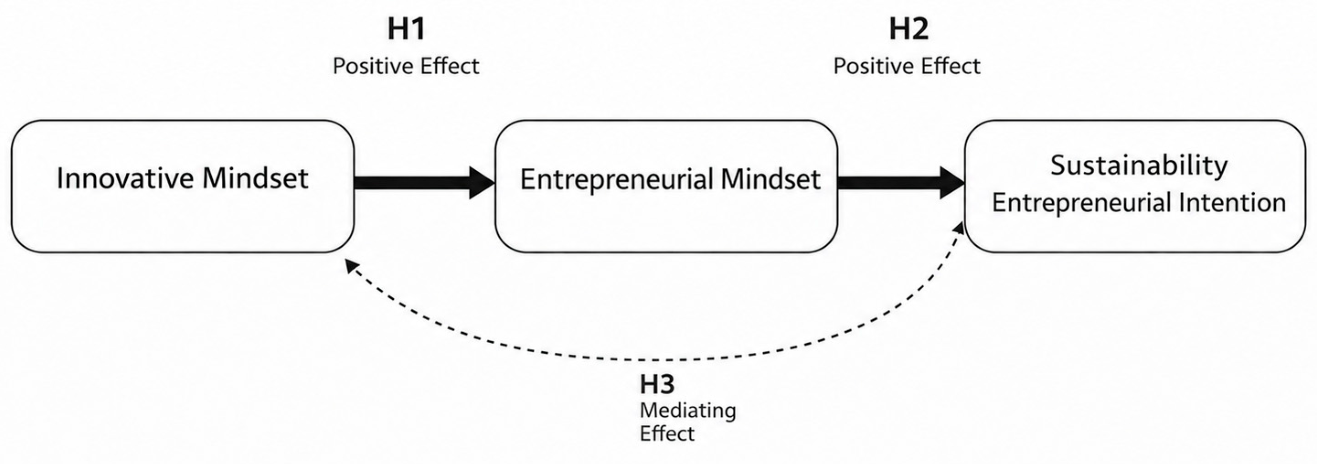
H1. Innovative mindset positively influences entrepreneurial mindset.
1.3.2. Entrepreneurial Mindset and Sustainability Entrepreneurial Intention
Entrepreneurial mindset is recognized as one of the most immediate predictors of entrepreneurial behaviour [
6], as it directly impacts entrepreneurial intentions [
14,
16] by enhancing the ability to recognize opportunities, risk assessment and entrepreneurial action [
14]. In the context of sustainability entrepreneurship, the entrepreneurial mindset encourages individuals to view social and environmental challenges as opportunities to generate value [
1,
2] and enables them to develop innovative solutions that integrate social, economic, and environmental objectives [
1]. Empirical studies have shown that entrepreneurial competencies, such as proactiveness and opportunity recognition, are among the most important factors that shape students’ entrepreneurial intentions with regard to sustainability-related entrepreneurship [
8,
9], and that experiential learning is an important mechanism through which higher education institutions can strengthen the entrepreneurial mindset [
14]. We thus hypothesize that:
H2. Entrepreneurial mindset positively influences sustainability entrepreneurial intention.
1.3.3. The Mediating Role of Entrepreneurial Mindset
Although an innovative mindset fosters creativity and idea generation, it may not have a direct impact on entrepreneurial intention. Alternatively, more proximal entrepreneurial cognitive mechanisms may be used by innovation-oriented cognitive capacities [
7]. According to a hierarchical cognitive viewpoint, an entrepreneurial mindset enables people to convert these opportunities into entrepreneurial intentions, while an innovative mindset serves as the basis for opportunity generation. This mechanism is especially relevant to sustainability entrepreneurship, where it takes not only innovation but also opportunity recognition, resource mobilization, and strategic action to turn creative ideas into successful businesses [
3,
14]. Prior research suggests that cognitive traits influence entrepreneurial outcomes indirectly through entrepreneurial cognition [
7,
10]. Furthermore, research on sustainability competencies highlights that to successfully tackle sustainability issues, innovation needs to be supplemented by entrepreneurial skills [
11,
13]. This mediating mechanism is further supported by educational research, which shows that entrepreneurship education converts creativity into entrepreneurial intention while innovation-oriented learning fosters creativity [
15]. Thus, it is anticipated that the relationship between innovative mindset and sustainability entrepreneurial intention will be mediated by entrepreneurial mindset. We therefore hypothesize that:
H3. Entrepreneurial mindset mediates the relationship between innovative mindset and sustainability entrepreneurial intention.
1.4. Theoretical Positioning and Conceptual Framework
In response to growing calls in the field of sustainability entrepreneurship research, this study offers mechanism-based explanations of how cognitive capacities influence sustainability-oriented entrepreneurial behavior instead of static, direct-effect intention models [
17,
18,
19]. Although the Theory of Planned Behavior (TPB) has served as the foundation for a large body of research on sustainability entrepreneurial intention (SEI) [
6], more recent studies emphasize the significance of upstream cognitive skills like innovation orientation, adaptive reasoning, and opportunity reframing in influencing entrepreneurial cognition and intention formation [
2,
3,
20].
The current study extends this perspective and integrates innovation-related and entrepreneurial cognition by conceptualizing innovative mindset as a distal cognitive capability associated with entrepreneurial mindset, which is positioned as a more proximal cognitive mechanism related to sustainability entrepreneurial intention. Cognitive intention theory, which postulates that broader cognitive orientations may be connected to intention through more direct cognitive mechanisms, is consistent with the hierarchical placement of distal and proximal cognitive orientations [
7]. In light of this, the study suggests a mediated cognitive framework that links innovative mindset to sustainability entrepreneurial intention through entrepreneurial mindset. This method expands on previous research and addresses calls for more integrative models of sustainability entrepreneurship that go beyond traditional intention-based frameworks by combining capability-based and cognitive perspectives [
17,
21,
22].
The proposed model is based on the theoretical ground that entrepreneurial mindset functions as a more proximal cognitive mechanism linked to sustainability entrepreneurial intention, whereas innovative mindset represents a distal cognitive capability. However, the suggested IM → EM → SEI pathway is tested as a theoretically defined pattern of association rather than as proof of a confirmed temporal or causal cognitive process because the study uses a cross-sectional design.
The study’s conceptual model, shown in
Figure 1, shows the proposed connections between sustainability entrepreneurial intention, innovative mindset, and entrepreneurial mindset. According to the model, innovative mindset and entrepreneurial mindset are positively correlated, and entrepreneurial mindset is positively correlated with sustainability entrepreneurial intention and acts as a mediator in the relationship between innovative mindset and sustainability entrepreneurial intention. This layered cognitive perspective offers a theoretical foundation for investigating the potential relationship between university students’ sustainability-oriented entrepreneurial intention and innovation-oriented cognition. The study is thus in line with more general sustainable development priorities, especially SDGs 4, 8, and 12.
The remainder of this article is organized as follows.
Section 2 describes the materials and methods, including the research design, sample, and data collection, measurement of constructs, and data analysis procedures.
Section 3 presents the results, including preliminary data screening, reliability analysis, measurement model assessment, higher-order construct specification, structural model testing, mediation analysis, and coefficient of determination.
Section 4 discusses the findings in relation to recent sustainability entrepreneurial intention literature and highlights the theoretical, educational, policy, and practical implications of the study.
Section 5 outlines the study’s limitations and proposes directions for future research. Finally,
Section 6 concludes the article by summarizing the main findings and contributions of the proposed hierarchical cognitive model.
2. Materials and Methods
2.1. Research Design
This study examines the connections between IM, EM, and SEI using a quantitative, cross-sectional research design. Innovative mindset is positioned as a distal cognitive capability that indirectly influences sustainability entrepreneurial intention through entrepreneurial mindset, a proximal cognitive mechanism, according to the study’s hierarchical cognitive framework. Since the study’s objective is to statistically test theoretically derived predictive relationships among latent cognitive constructs, a quantitative approach is appropriate. In line with prior entrepreneurship intention research, the cross-sectional design allows for the recording of students’ cognitive orientations and sustainability entrepreneurial intentions at a particular moment in time. Using SmartPLS version 4, partial least squares structural equation modeling (PLS-SEM) was employed to test the suggested relationships and mediation effect. When investigating complex relationships between latent constructs, mediation effects, and relatively small to medium sample sizes, PLS-SEM is especially appropriate for exploratory and prediction-oriented research [
23,
24]. Because it does not require rigorous assumptions of multivariate normality, it is also suitable for behavioral and entrepreneurial research.
PLS-SEM allows the measurement and structural models to be evaluated simultaneously, which improves the study’s analytical rigor. While the structural model assessment assesses path coefficients, explanatory power, predictive relevance, and mediation effects, the measurement model assessment looks at construct reliability, convergent validity, and discriminant validity [
23,
24]. Additionally, the statistical significance of the suggested direct and indirect relationships was evaluated using bootstrapping techniques, offering a solid foundation for assessing the mediation model [
24,
25]. Thus, by facilitating systematic construct validation, theory-based hypothesis testing, and accurate estimation of the relationships among the study variables, the chosen methodology enhances the study’s rigor.
2.2. Sample and Data Collection
Data was gathered from university students in the United Arab Emirates (UAE) using a self-administered online questionnaire. Because they are in a crucial phase of career exploration and the formation of entrepreneurial intentions, university students were chosen as the target population for this study. The convenience sampling method used was non-probability. The survey was disseminated via student networks and course platforms, among other institutional communication channels. The study’s goal was explained to the participants, and participation was completely voluntary. Before completing the questionnaire, informed consent was acquired, and all answers were gathered anonymously. 163 valid responses were kept for analysis after data screening procedures, which included checks for missing data and irregular response patterns. There were about 400 students from one university in the United Arab Emirates who were accessible. Approximately 40.8% of this accessible population was represented by the final sample of 163 respondents. Although the sample was not intended to be nationally representative, this proportion shows respectable coverage of the immediate sampling frame. Therefore, rather than being applicable to all university students or young entrepreneurs in the United Arab Emirates, the results should be interpreted as exploratory and context-specific.
According to Kock and Hadaya (2018) [
26], rather than depending only on set guidelines, sample-size adequacy in PLS-SEM should be assessed in relation to model complexity, statistical power, and the minimum observed path coefficient. The sample size of 163 respondents was deemed appropriate for model estimation due to the relatively straightforward structure of the suggested model, which consists of three latent constructs and a small number of structural paths. However, the sample remains modest for detecting small effects due to the relatively small EM → SEI path. The findings should therefore be interpreted with caution.
Table 1 displays the respondents’ demographic details.
The suggested IM → EM → SEI pathway should be viewed as a theoretically defined association rather than proof of causal or temporal ordering because of the cross-sectional design. Longitudinal research is necessary to ascertain whether innovative mindset precedes the development of entrepreneurial mindset and subsequently sustainability entrepreneurial intention over time, even though the model is based on cognitive entrepreneurship theory.
2.3. Measurement of Constructs
Multi-item scales modified from earlier validated studies in the literature on entrepreneurship, innovation, and sustainability were used to measure each construct [
23,
24,
25]. A five-point Likert scale, with 1 representing “strongly disagree” and 5 representing “strongly agree,” was used to record the responses. Opportunity recognition, proactivity, autonomy, and risk-taking are among the cognitive orientations linked to entrepreneurial behavior that are reflected in the multifaceted concept of entrepreneurial mindset. The five dimensions of innovativeness, need for achievement, risk-taking, autonomy, and proactiveness were used to operationalize EM, consistent with prior studies. These dimensions reflect people’s capacity to spot opportunities, show initiative, and pursue entrepreneurial endeavors in the face of uncertainty. Strong content validity and alignment with earlier empirical research were ensured by the adaptation of measurement items from well-known entrepreneurial mindset and entrepreneurial orientation scales, specifically referencing Jung and Lee (2020) and the seminal work of Lumpkin and Dess (1996) [
9,
27].
Innovative mindset refers to the cognitive tendencies toward creativity, adaptability, open-mindedness, and flexible problem-solving, which is a fundamental ability that helps people to recognize opportunities and think innovatively. The construct was initially operationalized with five dimensions (resilience, diversity, mental strength, perfectionism, and collaboration) based on Sidhu et al. (2016) [
28], but the perfectionism and collaboration dimensions were excluded during measurement model evaluation due to discriminant validity issues and unstable factor loadings in line with the recommended PLS-SEM procedures [
23]; only the dimensions with acceptable reliability and validity were retained in the final construct.
Sustainability entrepreneurial intention is defined as a person’s intention to start a new venture that creates economic value and responds to an environmental or social problem [
29], and the scale was measured by six items adapted from Ndofirepi (2022) that have been widely used in sustainability entrepreneurship research [
29]. The sustainability entrepreneurial intention construct was operationalized to acknowledge the economic logic of entrepreneurial activity while also reflecting students’ intention to engage in entrepreneurial activities that generate social and/or environmental value.
2.4. Data Analysis Procedure
PLS-SEM was used to analyze the data in two steps: measurement model evaluation and structural model assessment. The following criteria were used to evaluate the measurement model: Cronbach’s alpha and composite reliability (≥0.70) for internal consistency reliability; average variance extracted (AVE ≥ 0.50) for convergent validity; and heterotrait–monotrait ratio (HTMT) for discriminant validity. Path coefficients (β), statistical significance (
p-values) through bootstrapping, coefficient of determination (R
2), and mediation analysis (indirect effects) were used to assess the structural model. All proposed relationships were evaluated for significance using bootstrapping with 5000 resamples [
23]. Research ethics were followed in this study, and participation was voluntary, with informed consent obtained prior to answering the survey, and all responses were anonymous for academic research purposes only. The data presented in this study are available from the corresponding author upon reasonable request. No generative artificial intelligence (GenAI) tools were involved in the planning, execution, analysis, or interpretation of this study, and only minor language editing and reference formatting were performed using AI tools.
3. Results
3.1. Preliminary Data Screening and Assumption Testing
Before conducting the structural model analysis, a number of preliminary diagnostics were conducted to determine whether the dataset was appropriate for multivariate analysis, including assessment of univariate and multivariate outliers, normality, linearity, homoscedasticity, and multicollinearity.
3.1.1. Outlier Assessment
Standardized Z-scores were used to evaluate univariate outliers. Observations with absolute Z-values higher than 3.29 were identified as possible outliers in accordance with widely recognized thresholds in behavioral research. This criterion was surpassed in three cases. A thorough examination revealed that every value did not represent data entry errors and was within the acceptable response ranges of the corresponding scales. All cases were kept for analysis due to the small percentage of flagged cases and their minimal impact on the overall distribution. Mahalanobis distance was used to analyze multivariate outliers based on the three composite construct variables that were part of the analytical model. Potential multivariate outliers were found in cases where the Mahalanobis distance values exceeded the chi-square critical value of 16.27 (df = 3, p < 0.001). Since there were no multivariate outliers found during the screening, every case was kept for further examination.
3.1.2. Normality Assessment
Skewness and kurtosis were used to analyze the distributional characteristics of the composite variables based on the descriptive statistics (n = 163). Skewness (−0.287) and kurtosis (0.155) in EM were both well within the acceptable range of ±2. Additionally, IM showed acceptable kurtosis (0.571) and skewness (−0.369). The moderate negative skewness (−0.934) that SEI displayed is still within acceptable bounds. Its kurtosis value (2.148) showed a marginally peaked distribution, slightly exceeding the widely used ±2 guideline. These results do not show significant departures from normality and are deemed acceptable for further analysis due to the sufficient sample size (n > 150) and the fact that deviations were small and confined to a single construct.
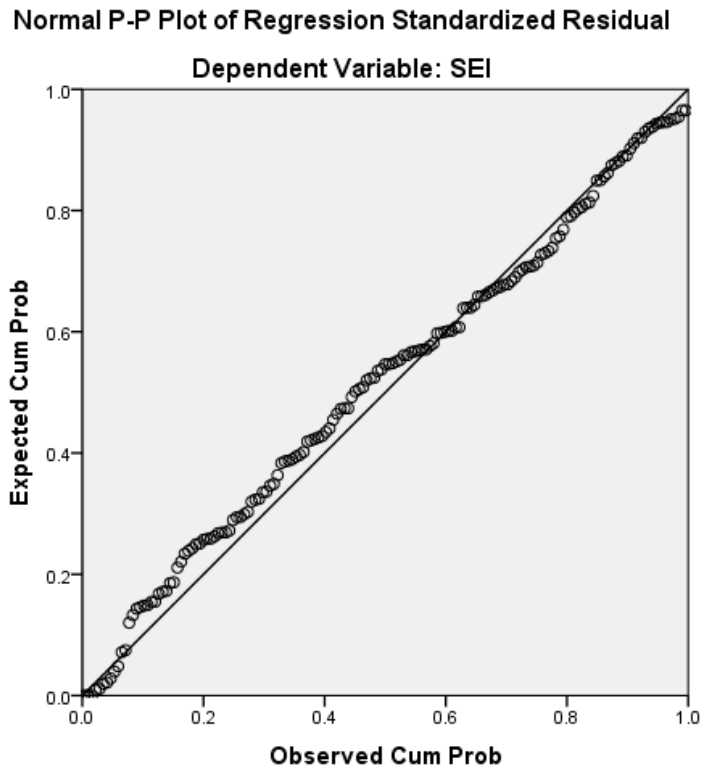
To assess linearity and homoscedasticity, scatterplots of standardized residuals against standardized predicted values were visually examined. The residuals displayed a random distribution with no noticeable systematic patterns or funnel-shaped dispersion, suggesting that the homoscedasticity and linearity assumptions were adequately met. A normal probability–probability (P–P) plot was also used to analyze the residuals’ distribution. The standardized residuals closely follow the diagonal reference line, as shown in
Figure 2, indicating that there are no significant deviations from normality and that the residuals approximate a normal distribution. The robustness of the estimation results is further supported by this diagnostic inspection, even though PLS-SEM does not require rigorous normality assumptions [
23].
3.1.3. Multicollinearity Assessment
As a first measure of multicollinearity, bivariate correlations were investigated. There were no issues with multicollinearity because the correlation between EM and IM was strong and acceptable (r = 0.73,
p < 0.001), and it did not exceed the suggested threshold of 0.80. Multicollinearity was assessed using correlation coefficients and variance inflation factors (VIF). The intercorrelations among the predictor variables were below the commonly accepted threshold of 0.80, indicating no excessive correlation between constructs. In addition, all VIF values were well below the recommended cutoff value of 5 [
25]. Specifically, the VIF values for EM and IM were both 2.137, confirming that multicollinearity does not pose a concern for the regression analysis. The correlation between EM and IM was acceptable, and all VIF values were well below the critical threshold, confirming that multicollinearity is not a concern.
Table 2 presents the results of multicollinearity diagnostics and correlation analysis.
3.2. Descriptive Statistics and Correlation Analysis
Descriptive statistics and Pearson correlation coefficients were computed to provide an initial overview of the relationships among the study constructs and to assess their distributional properties.
Table 3 presents the descriptive statistics and correlation matrix for all constructs.
The descriptive statistics indicate that respondents reported moderate to relatively high levels across all constructs. IM recorded the highest mean (M = 3.95, SD = 0.59), followed by EM (M = 3.87, SD = 0.64), while SEI showed a moderately high mean (M = 3.78, SD = 0.76). These findings suggest that participants generally exhibit strong innovation-oriented and entrepreneurial cognitive tendencies, alongside a favorable orientation toward sustainability-related entrepreneurial activities. The observed standard deviations indicate acceptable variability, suggesting sufficient dispersion in responses to support further multivariate analysis.
The correlation analysis offers preliminary information about the connections between the constructs. EM and IM were found to have a strong, statistically significant positive correlation (r = 0.73, p < 0.01). This finding suggests that individuals with higher levels of innovation-oriented cognitive capabilities—such as creativity, adaptability, and openness to new ideas—are more likely to demonstrate stronger entrepreneurial cognitive orientations, including proactiveness, autonomy, and opportunity recognition. This result offers preliminary support for the proposed theoretical assumption that innovative mindset acts as an upstream cognitive driver of entrepreneurial mindset. In contrast, the relationships between SEI and both IM (r = 0.05, p > 0.05) and EM (r = 0.09, p > 0.05) were not statistically significant.
These results show that, at the bivariate level, neither innovative nor entrepreneurial mindsets show a direct linear association with sustainability entrepreneurial intention. This pattern is especially significant from a theoretical standpoint. The lack of significant direct correlations raises the possibility that cognitive abilities have an indirect or mediated impact on sustainability-oriented entrepreneurial intention rather than a direct one. In particular, although IM and EM seem to be closely related, the degree to which innovation-oriented cognition is converted into entrepreneurial cognitive orientation may determine how IM and SEI are related. Crucially, at this point in the analysis, multicollinearity is not an issue because all inter-construct correlations stayed below the suggested cutoff of 0.80. This demonstrates that the dataset is appropriate for further structural equation modeling. Overall, these initial results offer preliminary empirical support for the suggested hierarchical cognitive framework and support additional research employing PLS-SEM to look at both direct and mediated relationships between the constructs.
3.3. Reliability Analysis
The measurement scales’ internal consistency reliability was evaluated using Cronbach’s alpha. All first-order constructs showed acceptable reliability, as shown in
Table 4, with alpha values above the suggested threshold of 0.70 [
23]. The need for achievement (α = 0.792), risk-taking (α = 0.864), autonomy (α = 0.743), and proactiveness (α = 0.761) were among the entrepreneurial mindset dimensions that demonstrated satisfactory reliability. In a similar line, the innovative mindset dimensions—resilience (α = 0.786), diversity (α = 0.810), mental strength (α = 0.858), and collaboration (α = 0.812)—showed appropriate internal consistency. Moreover, the SEI construct showed a high degree of reliability (α = 0.882). A Cronbach’s alpha of 0.627 was obtained for the IM-Perfectionism subscale. This value was deemed appropriate for exploratory research due to the small number of items and the known sensitivity of Cronbach’s alpha to shorter scales. The sub-scale was kept for additional analysis. All constructs showed acceptable internal consistency, surpassing the suggested cutoff of 0.70. Despite having a lower value (α = 0.627), the IM–Perfectionism dimension was kept at this point because of its exploratory nature and acceptable theoretical relevance.
Table 4 presents the reliability results for all constructs.
3.4. Measurement Model Assessment
3.4.1. Convergent Validity and Reliability
The measurement model was assessed using PLS-SEM in SmartPLS after the initial reliability assessment. The evaluation assessed indicator reliability, internal consistency reliability, and convergent validity in accordance with the guidelines for reflective measurement models [
23]. Outer loadings were used to assess indicator reliability; values above 0.70 were regarded as ideal, while loadings between 0.60 and 0.70 were accepted when they were backed by sufficient construct validity and reliability. Composite reliability (CR) and Cronbach’s alpha were used to evaluate internal consistency reliability; values above the suggested threshold of 0.70 indicated satisfactory reliability. The average variance extracted (AVE) was used to assess convergent validity; values greater than 0.50 indicate that the construct explains more than half of the variance of its indicators [
30]. The measurement model’s suitability for further structural model analysis is supported by the assessment’s findings, which show that the retained constructs have adequate reliability and convergent validity.
Using established PLS-SEM techniques, the reflective measurement model was evaluated [
25]. Using outer loadings, indicator reliability was first investigated. Indicators with loadings between 0.40 and 0.70 were assessed based on their contributions to composite reliability and average variance extracted (AVE), while those with loadings below 0.40 were eliminated during the first refinement stage. Indicators in this intermediate range were only kept when convergent validity and construct-level reliability were still deemed acceptable. The process of refinement was carried out iteratively. In the dimensions of innovative mindset, a number of low-loading indicators were eliminated. The IM-Perfection and IM-Collaboration dimensions continued to have issues, according to later evaluations of convergent and discriminant validity. In particular, IM-Collaboration displayed discriminant validity issues with IM-Resilience, whereas IM-Perfection demonstrated unstable discriminant validity with multiple HTMT confidence intervals exceeding allowable limits. Consequently, the final first-order measurement model did not include these two dimensions.
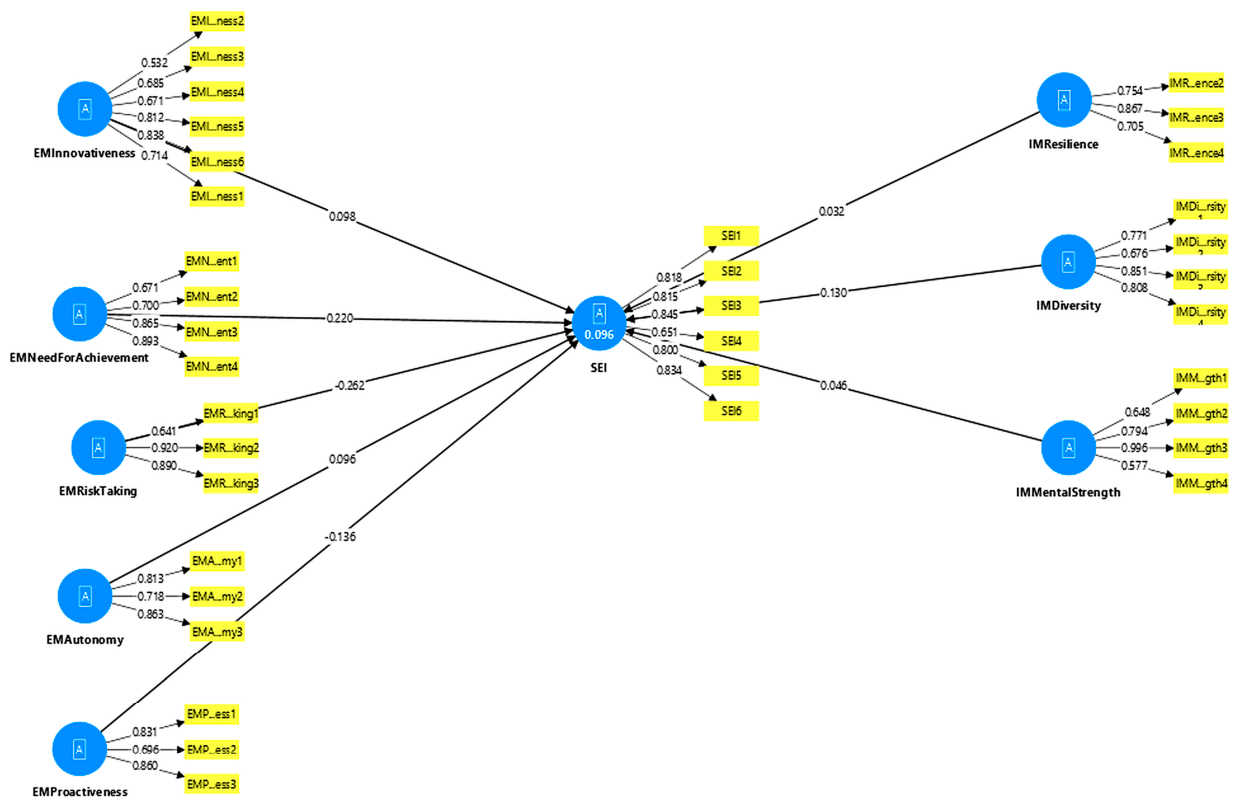
Following refinement, the final model’s retained indicators were above 0.70, and all of them exceeded acceptable thresholds. The entrepreneurial mindset dimensions (autonomy, innovativeness, need for achievement, proactiveness, and risk taking), the innovative mindset dimensions (diversity, mental strength, and resilience), and the sustainability entrepreneurial intention were all retained in the final first-order model.
3.4.2. Internal Consistency Reliability
Cronbach’s alpha and composite reliability (rho_c) were used to evaluate internal consistency reliability. Composite reliability was given priority over Cronbach’s alpha in accordance with current PLS-SEM guidelines [
23]. All of the retained constructs showed acceptable reliability, as
Table 5 illustrates. Composite reliability values exceeded the suggested threshold of 0.70, ranging from 0.821 to 0.912. All first-order constructs retained showed satisfactory internal consistency, with Cronbach’s alphas ranging from 0.731 to 0.884.
3.4.3. Convergent Validity
Average variance extracted (AVE) was used to evaluate convergent validity. With AVE values ranging from 0.512 to 0.683, all retained constructs surpassed the suggested threshold of 0.50 [
30]. These findings confirm sufficient convergent validity, as each construct accounted for more than half of the variance in its indicators. All constructs met the required thresholds, confirming convergent validity.
Table 5 presents the results of the measurement model assessment.
3.4.4. Discriminant Validity
The heterotrait–monotrait ratio of correlations (HTMT) was used to assess discriminant validity [
25]. All HTMT values in the final first-order model fell below the cautious 0.90 threshold. Additionally, HTMT inference was evaluated using bootstrapping with 5000 resamples. The retained constructs’ satisfactory discriminant validity was confirmed by the fact that none of the 95 percent confidence intervals contained the value 1.00. A statistically sound and conceptually sound first-order measurement model was produced by eliminating the IM-Perfection and IM-Collaboration dimensions, which also addressed previous discriminant validity issues.
3.4.5. Collinearity Diagnostics
Variance inflation factors (VIF) were used to evaluate the collinearity of indicators. Multicollinearity was not an issue in the final first-order measurement model, as all VIF values ranged from 1.255 to 2.715 and stayed below the suggested cutoff value of 5 [
23]. A data-driven and theory-guided approach was used in the indicator refinement process. Only when supported by statistical evidence and without compromising conceptual clarity were indicators and dimensions eliminated. The final first-order model preserved theoretically significant and empirically unique constructs appropriate for Stage 2 higher-order modeling.
Figure 3 represents the measurement model.
3.5. Stage 2: Higher-Order Construct and Structural Model Assessment
3.5.1. Higher-Order Construct Specification
Using the two-stage method suggested for reflective–reflective higher-order constructs, a hierarchical component model was estimated to capture the multifaceted nature of innovative and entrepreneurial mindsets [
23,
24,
25]. In Stage 2, the higher-order constructs were indicated by latent variable scores from the validated first-order constructs.
The risk-taking dimensions’ loading onto the higher-order entrepreneurial mindset construct fell below suggested thresholds for reflective higher-order modeling, despite the fact that it showed acceptable reliability and convergent validity at the first-order level. Risk-taking was therefore removed from the second-order entrepreneurial mindset construct while maintaining its validated first-order measurement properties in Stage 1, in accordance with the guidelines of the hierarchical component model. In contrast to the higher-order innovative mindset construct, which included diversity, mental strength, and resilience, the final higher-order entrepreneurial mindset construct included autonomy, inventiveness, drive for success, and initiative.
It is methodologically appropriate to exclude a lower-order dimension from the second-order specification when it does not sufficiently contribute to the higher-order latent variable, as long as its first-order measurement properties remain sound [
23,
30]. Therefore, while maintaining its validated measurement properties at Stage 1, the risk-taking dimension was removed from the second-order entrepreneurial mindset construct in accordance with two-stage HCM procedures in PLS-SEM. This method complies with accepted standards for reflective-reflective higher-order modeling while maintaining measurement integrity. Risk Taking was removed from the second-order entrepreneurial mindset construct due to insufficient higher-order loading.
Table 6 represents the Higher order construct loadings.
3.5.2. Higher-Order Measurement Model Results
The reliability of the indicator was evaluated by looking at higher-order loadings. All remaining higher-order loadings surpassed acceptable thresholds once risk-taking was eliminated from the second-order entrepreneurial mindset construct. The reliability and convergent validity of the higher-order constructs were supported by composite reliability and AVE values, which also satisfied suggested criteria.
Table 7 presents the higher order reliability and convergent validity.
3.5.3. Structural Model Results and Hypothesis Testing
The structural model was assessed by bootstrapping the structural model with 5000 resamples.
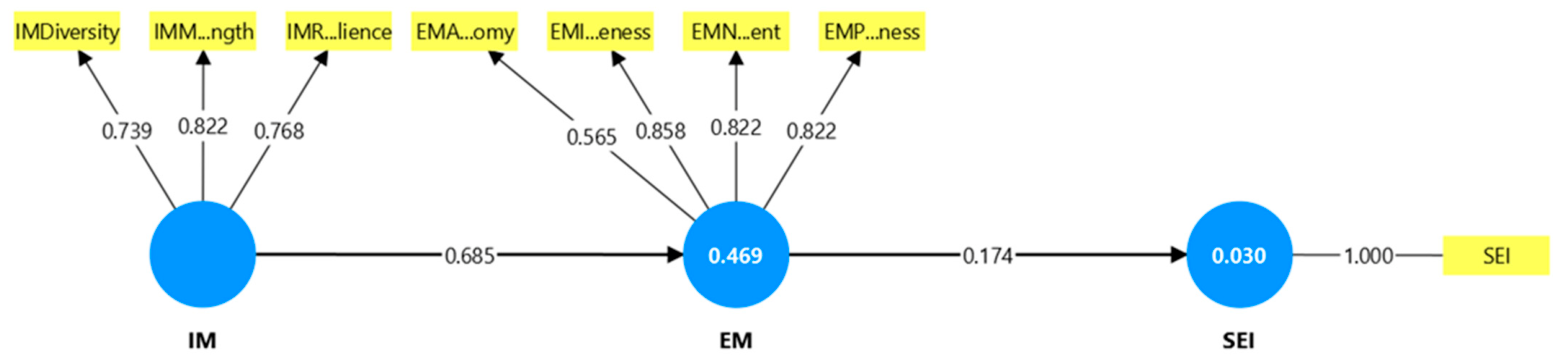
Table 8 displays the findings. Innovative mindset was found to have a strong and statistically significant positive effect on entrepreneurial mindset, as predicted by H1 (β = 0.685, t = 13.003,
p < 0.001). According to this research, individuals are more likely to develop entrepreneurial cognitive orientations, such as proactiveness, autonomy, inventiveness, and achievement motivation, if they possess stronger innovation-oriented cognitive abilities, such as openness to diversity, resilience, and mental strength. H1 is therefore supported.
Furthermore, the results validate H2, which assumed a positive relationship between sustainability entrepreneurial intention and entrepreneurial mindset. A positive and statistically significant correlation was found between sustainability entrepreneurial intention and entrepreneurial mindset (β = 0.174, t = 2.648,
p = 0.008). This relationship should be interpreted as statistically significant but practically modest because of its modest magnitude. This implies that while entrepreneurial mindset alone explains only a small portion of sustainability entrepreneurial intention, students with stronger entrepreneurial cognitive orientations may be more likely to report such an intention. Thus, H2 is endorsed. While acknowledging that the model should be understood as a theoretically specified pattern of association rather than proof of a verified causal process, the findings collectively offer preliminary empirical support for the suggested hierarchical cognitive model connecting innovative mindset, entrepreneurial mindset, and sustainability entrepreneurial intention. The higher-order measurement model is shown in
Figure 4, and the structural model results are shown in
Table 8.
3.5.4. Mediation Analysis
The indirect effect was investigated using a bootstrapping procedure with 5000 resamples in PLS-SEM to test H3, which hypothesized that entrepreneurial mindset mediates the relationship between innovative mindset and sustainability entrepreneurial intention. The findings show that innovative mindset has a positive and statistically significant indirect impact on sustainability entrepreneurial intention through entrepreneurial mindset (β = 0.119, t = 2.510,
p = 0.012). This research implies that by encouraging entrepreneurial cognitive orientations that convert innovation capabilities into entrepreneurial intentions, an innovative mindset indirectly supports sustainability entrepreneurial intention. The results offer empirical support for the suggested mediation mechanism since the indirect effect is statistically significant. These results suggest that an important cognitive mechanism connecting innovation-oriented thinking to sustainability-focused entrepreneurial intentions is the entrepreneurial mindset. As a result, H3 is validated, indicating that entrepreneurial mindset plays a mediating role in the relationship between innovative mindset and sustainability entrepreneurial intention.
Table 9 presents the mediation results.
3.5.5. Coefficient of Determination (R2)
The R
2 values for the endogenous constructs are shown in
Table 10. According to Hair et al. (2022), the model had moderate explanatory power, explaining 46.9% of the variance in entrepreneurial mindset (R
2 = 0.469) [
23]. Sustainability entrepreneurial intention, on the other hand, had a low explained variance (R
2 = 0.030), meaning that the model only explained 3% of the variance in SEI. This indicates that the model has limited explanatory relevance in relation to students’ intentions to pursue sustainable entrepreneurship and reflects weak explanatory power. Because SEI is probably impacted by additional value-based, motivational, contextual, and educational factors that are not included in the current model, this result should be interpreted cautiously.
4. Discussion
4.1. Principal Findings and Relation to Recent SEI Literature
This study examined a layered cognitive model in which university students’ SEI is influenced by their IM, which in turn shapes their EM. Our results demonstrate that EM positively predicts SEI (though only slightly), IM significantly predicts EM, and EM mediates the relationship between IM and SEI. These findings are consistent with recent research highlighting that sustainable entrepreneurship typically results from multi-stage cognitive and motivational processes rather than from singular traits [
21]. According to systematic research, distal cognitive traits like creativity and mindset indirectly contribute to the significant variance in SEI that is explained by constructs like attitude, perceived behavioral control, and social norms [
21].
4.2. Innovative Mindset as a Foundation for Sustainability Cognition
According to the strong IM → EM connection, innovation-oriented cognition, which includes adaptability, creativity, and resilience, serves as a fundamental framework for entrepreneurial cognition. This is in line with research on sustainability that demonstrates that, when paired with encouraging cognitive frameworks, innovative skills are important motivators of green and sustainable entrepreneurial behaviors [
31]. Furthermore, studies on the intention of green entrepreneurs consistently find that innovativeness is an antecedent of intention, frequently interacting with environmental consciousness [
32]. These findings are further supported by the current results, which demonstrate that innovativeness does not directly influence intention but rather does so indirectly through its impact on the entrepreneurial mindset.
4.3. Entrepreneurial Mindset Predicts SEI, but Explains Modest Variance
Despite the statistically significant relationship between SEI and entrepreneurial mindset, the variance explained in sustainability entrepreneurial intention was low (R
2 = 0.030). This result suggests that while entrepreneurial mindset is positively correlated with SEI, it only accounts for a small percentage of its variance. This pattern is in line with recent research on sustainability entrepreneurship, which indicates that integrating both cognitive and proximal motivational factors is frequently necessary for SEI models to have greater explanatory power [
21]. For instance, SEI research frequently employs extensions of the Theory of Planned Behavior (TPB) that include perceived behavioral control, environmental values, sustainability attitudes, and social norms. These extensions typically offer more comprehensive explanatory coverage [
32,
33]. In forming sustainability-oriented entrepreneurial intentions, these studies emphasize the significance of sustainability education, social support, environmental awareness, and perceived feasibility. As a result, the current study’s modest R
2 should be recognized as a limitation while also being interpreted as theoretically consistent with the multideterminant nature of SDG-related entrepreneurial intentions. Accordingly, even though there was a significant and positive relationship between entrepreneurial mindset and SEI, the small effect size indicates that students’ sustainability entrepreneurial intention is unlikely to be adequately explained by entrepreneurial mindset. Despite the statistical significance of the proposed relationships, the low R
2 value and the size of the EM → SEI relationship suggest limited practical significance. Therefore, rather than strong evidence of predictive relevance, the results should be interpreted as preliminary evidence of association. To better reflect the complexity of SEI formation, future models should include more contextual, educational, motivational, and value-based predictors.
4.4. Mediation Mechanism: Cognitive Pathway to SEI
The important mediated path (IM → EM → SEI) shows that an entrepreneurial mindset is how IM affects SEI. This finding is consistent with recent research that suggests individual dispositions indirectly influence SEI by first influencing internal frameworks like attitudes and control perceptions [
21,
33]. This mediation effect emphasizes how important it is to think of SEI as a cognitively layered phenomenon rather than one that is directly influenced by separate traits. It follows that innovative thinking-enhancing interventions will be more successful when they encourage an entrepreneurial perspective on sustainability opportunities.
4.5. Reconsidering Risk-Taking in Sustainability Mindsets
Risk-taking was excluded from the Stage 2 model due to insufficient loadings on the higher-order entrepreneurial mindset construct. Rather than undermining its theoretical relevance, this finding aligns with emerging evidence suggesting that risk-related dispositions may not consistently integrate with entrepreneurial cognition in sustainability contexts, particularly among student populations. Recent studies indicate that cognitive drivers of entrepreneurship—such as opportunity recognition, innovation, and entrepreneurial cognition—tend to exhibit stronger explanatory power than traditional personality traits like risk propensity in predicting entrepreneurial intentions [
21]. In sustainability-oriented entrepreneurship, decision-making is often shaped by broader contextual and institutional factors, including policy support, social norms, and perceived environmental impact, which may weaken the direct role of individual risk-taking tendencies.
Furthermore, sustainability entrepreneurship is inherently characterized by mission-driven and impact-oriented logic, where perceived risks are reframed as opportunities for value creation rather than purely financial uncertainty. As a result, the integrative role of risk-taking within higher-order cognitive constructs may be weakened when modeled reflectively, particularly in early-stage or student samples where experiential exposure to real entrepreneurial risk remains limited.
In this context, the removal of risk-taking from the higher-order EM construct should be interpreted as a construct-refinement outcome rather than as evidence that risk-taking is irrelevant to sustainability entrepreneurship. Risk-related dispositions may operate indirectly or depend on contextual conditions, particularly among student samples where perceived support, sustainability knowledge, and feasibility perceptions may be more salient than generalized risk propensity. This suggests that conventional entrepreneurial mindset constructs may require contextual refinement when applied to sustainability-oriented entrepreneurship.
4.6. Educational and Policy Implications
The results have important ramifications for policy and education focused on sustainability. According to recent research, entrepreneurship education that incorporates sustainability content improves students’ perceptions of their behavioral control and intention [
29,
33,
34,
35,
36]. Programs should therefore combine the development of innovative skills with sustainability frameworks that make environmental opportunity, viability, and value alignment clear. Additionally, social and normative influences should be addressed by educational institutions (e.g., peers, family, and organizational support), which have been demonstrated to influence SEI in a variety of settings [
32]. The results support agendas for sustainable development in terms of policy (e.g., SDG 4, SDG 8, SDG 12) by illustrating how educational and cognitive interventions can encourage young people to think like sustainable entrepreneurs.
4.7. Theoretical Implications
This study makes several significant contributions to the field of sustainability entrepreneurship research. By putting forth and providing empirical evidence for a hierarchical cognitive pathway (IM → EM → SEI), it first advances the SEI literature. The Theory of Planned Behavior (TPB) tradition’s direct-effects modeling, which positions attitudes, perceived behavioral control, and subjective norms as the main determinants of intention, continues to dominate a large portion of the SEI evidence base. The current study, on the other hand, emphasizes mechanism-based cognition and demonstrates how innovation-oriented cognition functions upstream by enhancing entrepreneurial cognition prior to intention formation. This is consistent with recent SEI reviews and trend analyses that advocate for better theorization of “how” cognitive resources translate into sustainability intention, mediation testing, and process explanations rather than treating predictors as stand-alone drivers.
Second, the results improve how entrepreneurial mindset is conceptualized in sustainability contexts. The higher-order level’s omission of risk-taking raises the possibility that student samples’ sustainability-oriented cognition may not fully map onto traditional entrepreneurial dimensions. This is in line with recent research that suggests risk-taking may function indirectly via cognitive processes (e.g., self-efficacy, attitudes, and opportunity beliefs) and may depend on supportive circumstances and context. Concepts like opportunity recognition, adaptive cognition, and resilience are often highlighted in sustainability entrepreneurship as being more crucial for transforming sustainability issues into business opportunities.
Third, rather than being a sign of a weakness in the model, the modest explained variance in SEI (R2 = 0.030) should be interpreted as theoretical insight. According to a recent meta-analysis of SEI research, intentions are usually more strongly influenced by proximal normative and motivational mechanisms than by distal cognitive tendencies alone. These mechanisms include sustainability attitudes and values, feasibility (perceived behavioral control), and social support. This helps explain why mindset-only models typically produce lower R2 for SEI when important TPB-based components are excluded and supports a more integrated cognitive–motivational perspective in sustainability entrepreneurship theory. Overall, the results place the entrepreneurial mindset as the closest cognitive mechanism that converts innovation orientation into sustainability-oriented intention and the innovative mindset as a fundamental sustainability-enabling capability.
4.8. Practical Implications
Since the model only accounts for a small percentage of the variance in sustainability entrepreneurial intention, the practical implications of the findings should be interpreted with caution. However, academic institutions, entrepreneurship educators, legislators, and ecosystem actors looking to promote sustainability-oriented entrepreneurship can all benefit from the findings.
From an educational standpoint, the results indicate that to promote sustainability entrepreneurial intention, entrepreneurship education should not only focus on general mindset development. Instead, combining innovation-oriented cognitive skills like creativity, resilience, adaptive thinking, and opportunity reframing with the development of an entrepreneurial mindset may be beneficial for university programs. Students should be able to connect sustainability problem-solving with venture feasibility assessment and identify social and environmental challenges as possible entrepreneurial opportunities through applied learning activities. This aligns with recent studies indicating that university students’ intentions to pursue sustainable entrepreneurship can be strengthened through organized opportunity-identification experiences [
5,
19]. Moreover, the results imply that contextual supports could enhance students’ cognitive personalities and reinforce SEI formation from a policy and ecosystem standpoint. Furthermore, recent research highlights the importance of institutional, educational, and economic ecosystem supports in shaping entrepreneurial intentions and reinforcing key intention drivers [
3,
5,
21]. Practical ecosystem actions include expanding access to financing, incubation, and mentoring mechanisms focused on sustainability within university and regional ecosystems; raising awareness of market opportunities related to sustainability through sector-based and challenge-based programs; and strengthening institutional legitimacy for green and sustainable ventures through policy signaling, recognition, and procurement pathways. Overall, ecosystem-level support is likely to serve as crucial complementary conditions that make sustainability entrepreneurship feel more viable, desirable, and socially acceptable because cognition alone explains only a small portion of SEI.
5. Limitations and Future Research
5.1. Limitations
Several limitations should be acknowledged. First, even though the sample size of 163 respondents was adequate to estimate the suggested PLS-SEM model, it is still small and restricts the findings’ statistical power and wider generalizability. Additionally, the sample was not nationally representative because it was selected from university students within a particular study context. Therefore, rather than being applicable to all college students or young entrepreneurs, the results should be viewed as exploratory and context-specific. Second, it is difficult to make temporal or causal inferences about the suggested IM → EM → SEI pathway because of the cross-sectional design. Despite the model’s theoretical foundation in a cognitive framework, the results should be understood as correlations between constructs rather than proof of a proven causal or developmental process. Therefore, to confirm the directionality of the suggested relationships, longitudinal or experimental research is required. Third, the low R2 value for SEI shows that the model only accounts for a small percentage of the variance in sustainability entrepreneurial intention. This implies that only a portion of the factors influencing students’ sustainability entrepreneurial intention are captured by innovative and entrepreneurial mindsets. The model’s limited explanatory power may have resulted from the exclusion of important motivational, contextual, and sustainability-related predictors, such as sustainability attitudes and values, subjective norms, perceived behavioral control, perceived feasibility and desirability, environmental concern, entrepreneurial self-efficacy, institutional support, and prior entrepreneurial exposure. Fourth, the constructs were reflectively modeled in the study. Future research may take into account formative or mixed measurement approaches, especially for complex sustainability-related cognition constructs where indicators may represent different dimensions rather than interchangeable manifestations of the same underlying construct, even though this approach is consistent with the chosen measurement strategy.
5.2. Future Research Directions
This study should be expanded upon in a number of ways by future research. To improve statistical power, external validity, and generalizability, larger, more varied, multi-institutional, probability-based samples are first required. Determining whether the suggested IM → EM → SEI pathway varies across institutional and cultural settings would also be aided by comparative studies across various universities, nations, and sustainability policy contexts. Second, by combining cognitive factors with motivational and contextual predictors, future research should create more thorough models of sustainability entrepreneurial intention. Stronger hybrid cognitive-motivational models of SEI may be developed by adding Theory of Planned Behavior variables, such as sustainability attitudes, subjective norms, perceived behavioral control, and perceived feasibility. Third, future studies should look at potential moderators like awareness of sustainability policies, ecosystem support, prior entrepreneurial exposure, and education about sustainability entrepreneurship. These variables could influence how strongly innovative mindset, entrepreneurial mindset, and sustainability entrepreneurial intention are related. Lastly, longitudinal research is required to look at how students’ perspectives and aspirations for sustainable entrepreneurship change over time. Beyond intention-based results, future research should look at behavioral indicators like green innovation, sustainability-focused entrepreneurial activity, or the start of sustainable businesses.
6. Conclusions
This study investigated a theoretically defined cognitive pathway linking innovative mindset, entrepreneurial mindset, and sustainability entrepreneurial intention among university students in the UAE. The results offer initial evidence in favor of the suggested IM → EM → SEI pathway. In particular, entrepreneurial mindset was positively correlated with sustainability entrepreneurial intention and mediated the relationship between innovative mindset and sustainability entrepreneurial intention. Additionally, innovative mindset was positively correlated with entrepreneurial mindset. These results support a layered cognitive explanation and address calls in the SEI literature to investigate mechanisms beyond static direct-effect models that could link upstream cognitive abilities to sustainability-oriented intentions.
The robust IM → EM relationship implies that students’ development of entrepreneurial cognition may be linked to innovation-oriented cognition, which includes creativity, resilience, adaptive thinking, and opportunity reframing. This is consistent with research on sustainability entrepreneurship that emphasizes the cognitive capacity to identify and reframe environmental and social challenges as opportunities for entrepreneurship [
1,
2,
9].
The results should, however, be interpreted with caution. Even though there was a statistically significant relationship between EM and SEI, the effect size was small and the model only partially explained the variance in SEI. As a result, the study should not be interpreted as offering a thorough predictive model of sustainability entrepreneurial intention.
Instead, it advances knowledge of one potential cognitive mechanism that connects innovation-oriented cognition to sustainability-oriented entrepreneurial intention, adding to the body of literature. Further motivational, value-based, educational, and contextual predictors, such as sustainability attitudes, perceived feasibility, perceived behavioral control, subjective norms, environmental values, institutional support, and prior entrepreneurial exposure, should be included in future research, according to the modest explanatory power.
From a practical perspective, mindset development should not be the only strategy used by academic institutions and policymakers to support SDGs 4, 8, and 12. Rather, they should incorporate innovation-oriented capability development with sustainability values, feasibility-building projects, normative support, and applied opportunity-recognition experiences that enable students to make the connection between sustainable entrepreneurial action and social and environmental challenges.
Author Contributions
Conceptualization, N.R. and A.M.; methodology, A.M.; software, N.R.; validation, N.R., A.M. and F.A.Q.; formal analysis, N.R.; investigation, A.M.; resources, M.A.; data curation, N.R.; writing—original draft preparation, A.M., F.A.Q. and M.A.; writing—review and editing, N.R.; visualization, N.R. All authors have read and agreed to the published version of the manuscript.
Funding
This research received no external funding.
Institutional Review Board Statement
The study was conducted in accordance with the Declaration of Helsinki, and approved by the Institutional Review Board of Abu Dhabi University Ethical Approval Committee (protocol code COB-96 and date of approval: 25 February 2026).
Informed Consent Statement
Informed consent was obtained from all subjects involved in the study.
Data Availability Statement
Due to ethical and privacy concerns, the data used in this study are not publicly accessible; however, the corresponding author may make them available upon reasonable request.
Conflicts of Interest
The authors declare no conflicts of interest.
Abbreviations
The following abbreviations are used in this manuscript:
| EM | Entrepreneurial Mindset |
| IM | Innovative Mindset |
| SEI | Sustainability Entrepreneurial Intention |
| UAE | United Arab Emirates |
References
- Cohen, B.; Winn, M.I. Market imperfections, opportunity and sustainable entrepreneurship. J. Bus. Ventur. 2007, 22, 29–49. [Google Scholar] [CrossRef]
- Shepherd, D.A.; Patzelt, H. The new field of sustainable entrepreneurship: Studying entrepreneurial action linking “what is to be sustained” with “what is to be developed”. Entrep. Theory Pract. 2011, 35, 137–163. [Google Scholar] [CrossRef]
- Hörisch, J.; Kollat, J.; Brieger, S.A. What influences environmental entrepreneurship? A multilevel analysis of the determinants of entrepreneurs’ environmental orientation. Small Bus. Econ. 2017, 48, 47–69. [Google Scholar] [CrossRef]
- Purvis, B.; Mao, Y.; Robinson, D. Three pillars of sustainability: In search of conceptual origins. Sustain. Sci. 2019, 14, 681–695. [Google Scholar] [CrossRef]
- Vuorio, A.M.; Puumalainen, K.; Fellnhofer, K. Drivers of entrepreneurial intentions in sustainable entrepreneurship. Int. J. Entrep. Behav. Res. 2018, 24, 359–381. [Google Scholar] [CrossRef]
- Ajzen, I. The theory of planned behavior. Organ. Behav. Hum. Decis. Process. 1991, 50, 179–211. [Google Scholar] [CrossRef]
- Schlaegel, C.; Koenig, M. Determinants of entrepreneurial intent: A meta–analytic test and integration of competing models. Entrep. Theory Pract. 2014, 38, 291–332. [Google Scholar] [CrossRef]
- Krueger, N.F., Jr.; Reilly, M.D.; Carsrud, A.L. Competing models of entrepreneurial intentions. J. Bus. Ventur. 2000, 15, 411–432. [Google Scholar] [CrossRef]
- Lumpkin, G.T.; Dess, G.G. Clarifying the entrepreneurial orientation construct and linking it to performance. Acad. Manag. Rev. 1996, 21, 135–172. [Google Scholar] [CrossRef] [PubMed]
- Ploum, L.; Blok, V.; Lans, T.; Omta, O. Toward a validated competence framework for sustainable entrepreneurship. Organ. Environ. 2018, 31, 113–132. [Google Scholar] [CrossRef] [PubMed]
- Wathanakom, N.; Khlaisang, J.; Songkram, N. The study of the causal relationship between innovativeness and entrepreneurial intention among undergraduate students. J. Innov. Entrep. 2020, 9, 15. [Google Scholar] [CrossRef]
- Daspit, J.J.; Fox, C.J.; Findley, S.K. Entrepreneurial mindset: An integrated definition, a review of current insights, and directions for future research. J. Small Bus. Manag. 2023, 61, 12–44. [Google Scholar] [CrossRef]
- Zherdeva, A.; Madi, I.; Alzankawi, A.; McQuillan, D.; Morales, L. Developing entrepreneurial mindset through sustainability-informed entrepreneurial education. Ir. J. Manag. 2024, 43, 59–70. [Google Scholar] [CrossRef]
- Wattanaphak, N.; Kantabutra, S. Cultivating a corporate sustainability mindset: A model and future research directions. Clean. Logist. Supply Chain 2025, 16, 100247. [Google Scholar] [CrossRef]
- Supriandi, S.; Arisanti, I. The influence of growth mindset, self-efficacy, and innovative environment on entrepreneurial intentions. RIGGS J. AI Digit. Bus. 2026, 4, 2749–2758. [Google Scholar]
- Jan, S.Q.; Junfeng, J.; Iqbal, M.B.; Raza, A.; Naz, M.; Bhatt, T.K. The impact of entrepreneurial ecosystems and sustainable digital innovation on business performance. Front. Sustain. 2025, 6, 1485680. [Google Scholar] [CrossRef]
- Ike, O.O.; Okwuchukwu, E.I.; Eyisi, D.C. Enhancing economic sustainability through entrepreneurial alertness as a mediator. Discov. Psychol. 2025, 5, 56. [Google Scholar] [CrossRef]
- Nguyen, T.T.; Phan, H.T. Entrepreneurship environments and entrepreneurial intention-the role of self efficacy and role model. Int. J. Eng. Bus. Manag. 2024, 16, 18479790241275925. [Google Scholar] [CrossRef]
- Schaltegger, S.; Wagner, M. Sustainable entrepreneurship and sustainability innovation: Categories and interactions. Bus. Strategy Environ. 2011, 20, 222–237. [Google Scholar] [CrossRef]
- Srivastava, M.; Shivani, S.; Dutta, S. Antecedents of sustainability-oriented entrepreneurial intentions: A comprehensive model. Sustain. Dev. 2024, 32, 1774–1791. [Google Scholar] [CrossRef]
- Soria-Barreto, K.; Novoa-Hernández, P. A systematic mapping and meta-analysis on sustainable entrepreneurial intention. Acta Psychol. 2025, 250, 105733. [Google Scholar] [CrossRef] [PubMed]
- Valencia-Arias, A.; Londoño-Celis, W.; Palacios Moya, L.; Iparraguirre Sanchez, G.K.; Cardona-Acevedo, S.; Rodríguez-Correa, P.A. Determinants of sustainable entrepreneurial intention in Colombian and Peruvian University students: A theory of planned behaviour approach. Discov. Sustain. 2025, 6, 662. [Google Scholar] [CrossRef]
- Hair, J.F.; Hult, G.T.M.; Ringle, C.M.; Sarstedt, M. A Primer on Partial Least Squares Structural Equation Modeling (PLS-SEM); Sage: Thousand Oaks, CA, USA, 2022. [Google Scholar]
- Sarstedt, M.; Ringle, C.M.; Hair, J.F. Partial least squares structural equation modeling. In Handbook of Market Research; Springer International Publishing: Cham, Switzerland, 2021; pp. 587–632. [Google Scholar]
- Henseler, J.; Ringle, C.M.; Sarstedt, M. A new criterion for assessing discriminant validity in variance-based structural equation modeling. J. Acad. Mark. Sci. 2015, 43, 115–135. [Google Scholar] [CrossRef]
- Kock, N.; Hadaya, P. Minimum sample size estimation in PLS-SEM: The inverse square root and gamma-exponential methods. Inf. Syst. J. 2018, 28, 227–261. [Google Scholar] [CrossRef]
- Jung, E.; Lee, Y. College students’ entrepreneurial mindset: Educational experiences override gender and major. Sustainability 2020, 12, 8272. [Google Scholar] [CrossRef]
- Sidhu, I.; Singer, J.; Suoranta, M.; Johnsson, C. Introducing Berkeley Method of Entrepreneurship—A game-based teaching approach. Technol. Innov. Manag. Rev. 2016, 6, 5–17. [Google Scholar]
- Ndofirepi, T.M. Predicting the sustainability-oriented entrepreneurship intentions of business school students: The role of individualistic values. Soc. Sci. 2022, 12, 13. [Google Scholar] [CrossRef]
- Becker, J.M.; Klein, K.; Wetzels, M. Hierarchical latent variable models in PLS-SEM: Guidelines for using reflective-formative type models. Long Range Plan. 2012, 45, 359–394. [Google Scholar] [CrossRef]
- Al-Mamary, Y.H.; Singh, H.P. Modeling sustainable entrepreneurship and green economic growth: The role of policy, digital innovation, resource efficiency, infrastructure, entrepreneurial intentions, and innovative capacity. Next Res. 2025, 2, 100859. [Google Scholar] [CrossRef]
- Utami, T.L. Green Entrepreneurial Intention: Impact of Environmental Awareness, Innovativeness, and Social Support. In Proceedings of the ASEAN School of Business Network International Conference 2024, Yoyakarta, Indonesia, 8–10 August 2024; Volume 1, pp. 566–578. [Google Scholar]
- Asad, M.; Fryan, L.H.; Shomo, M.I. Sustainable entrepreneurial intention among university students: Synergetic moderation of entrepreneurial fear and use of artificial intelligence in teaching. Sustainability 2025, 17, 290. [Google Scholar] [CrossRef]
- Yasir, N.; Xiaohong, Q.; Yi, S.; Ying, W.; Samad, S.; Alhitmi, H.K.; Braithwaite, R.R. Environmental and sociological factors shape sustainable entrepreneurial intentions among Pakistani university students. Sci. Rep. 2025, 15, 39293. [Google Scholar] [CrossRef] [PubMed]
- Valencia-Arias, A.; Palacios-Moya, L.; Londoño-Celis, W.; Ipaguirre Sanchez, K. Sustainable entrepreneurial intention: A research trends and agenda. Sustain. Environ. 2024, 10, 2362512. [Google Scholar] [CrossRef]
- Tsaknis, P.A.; Sahinidis, A.G. The power of knowledge in shaping entrepreneurial intentions: Entrepreneurship education in sustainability. Sustainability 2025, 17, 6785. [Google Scholar] [CrossRef]
| Disclaimer/Publisher’s Note: The statements, opinions and data contained in all publications are solely those of the individual author(s) and contributor(s) and not of MDPI and/or the editor(s). MDPI and/or the editor(s) disclaim responsibility for any injury to people or property resulting from any ideas, methods, instructions or products referred to in the content. |