Article

Developing a Hybrid Conceptual Framework for Sustainability Transitions in Tourism and Hospitality: Evidence from the Saudi Arabia Vision


by
Karam Zaki
1,2,*,
Ahmed K. Elnagar
3,4,
Wagih M. E. Salama
5,*,
Mohamed Ahmed Suliman
5,
Tamer Mohamed Abdel Ghani
5 and
Alaa Raslan
2
1
Department of Business Administration, College of Science and Humanities, Shaqra University, Dawadmi 17452, Saudi Arabia
2
Department of Hotel Studies, Faculty of Tourism and Hotels, Fayoum University, Fayoum 63514, Egypt
3
Administrative and Financial Sciences, Applied College, Taibah University, Madinah 41461, Saudi Arabia
4
Department of Hotel Management, Faculty of Tourism and Hotels, Suez Canal University, Ismailia 41522, Egypt
5
Department of Social Studies, College of Arts, King Faisal University, Al-Ahsa 31982, Saudi Arabia
*
Authors to whom correspondence should be addressed.
Sustainability 2026, 18(11), 5724; https://doi.org/10.3390/su18115724
Submission received: 16 April 2026 / Revised: 20 May 2026 / Accepted: 1 June 2026 / Published: 4 June 2026
(This article belongs to the Section Economic and Business Aspects of Sustainability)

Abstract

Since launching the Saudi Vision 2030, it has witnessed a reflective sustainability action (SA) transformation. However, robust theoretical models investigating the multifaceted catalysts and consequences of SA in this less-developed country are still lacking in investigation. This lag prompted us to advance and validate a composite framework integrating multiple theories (e.g., institutional theory, the resource-based view (RBV), stakeholder theory, dynamic capabilities theory, and contingency theory) elucidating how policy direction (PD), market incentives (MIs), and knowledge collaboration (KC) stimulate SA adoption encompassing its environmental practices (EPs), social practices (SPs), and circular economy practices (CEPs). The investigation also probes how SA thereafter drives sustainable performance outcomes. A machine-learning approach using the PLS-SEM facility was applied based on 400 questionnaires targeted at managerial positions working in the tourism and hospitality segment based in Saudi Arabia. The findings reveal that all the proposed relationships were supported, providing strong empirical support for the proposed sustainability framework in the Saudi tourism and hospitality context. Institutional pressure and the governance/regulatory environment also showed a significant impact on environmental practices, sustainable performance, and circular economy practices, whereas cost efficiency, competitive advantage, customer demand for sustainability, and knowledge collaboration also demonstrated a positive impact on sustainability actions and outcomes. Furthermore, robust analysis shows that larger firms respond more strongly to MI in terms of cost efficiency, competitive advantage, and customer demand, while CEP produces a modest improvement in hotels compared with restaurants. Our model develops a theoretical synthesis beyond fragmented views. It also provides tangible guidance for industry leaders and regulators in driving strategic alignment with the SDGs and in developing a resilient, situational model that promotes regenerative tourism in high-growth, vulnerable destinations.

1. Introduction

A sustainable and regenerative transformation of the travel and hospitality placed leaders under pressure to abandon extraction-based models in favor of sustainability actions (SAs) that restore ecosystems and support communities [1,2]. As tourism acts as a cornerstone of Saudi Arabia’s maturity agenda, the national economy must fulfill these strategic aspirations. Under Vision 2030, Saudi Arabia endeavors to reshape a global tourism powerhouse, making the industry a prime mover of its non-oil revenue growth [3,4].
The Kingdom’s tourism and hospitality industry has historically been anchored in religious tourism, particularly the accommodation of Hajj and Umrah pilgrims, yet it is rapidly evolving to encompass leisure, heritage, and eco-tourism experiences [5,6]. The government has implemented institutional reforms and governance initiatives to achieve its sustainability goals through the implementation of Vision 2030 and its associated Vision realization programs [7]. Environmentally sustainable practices and socially responsible services drive hospitality firms to adapt their business operations because customers now prefer these practices while market competition rewards businesses that create sustainable product differences [8]. A fragmented understanding of driver interactions remains despite the existence of multiple factors that work together to produce sustainable corporate outcomes through their unified operation [9]. Although multi-theory models are starting to appear in sustainable tourism research, there are some limitations in the integrative models that the current model overcomes. The three evaluation models [10] do not include theories of strategic management like RBV or institutional theory and therefore are only applicable to the competitive dynamics of the firm level [11]. The research of [12] brought together stakeholder and dynamic capabilities theories to study SDG engagement in hotel chains, but did not include institutional theory, which means they were unable to explain how macro-level policy regimes influence firm behavior. The research of [13] combined institutional, stakeholder, and dynamic capabilities theories but narrowly considered only social sustainability institutionalization and failed to involve RBV to explain the heterogeneity of the performance and a contingency theory lens to capture moderating conditions. The research of [14] used five theories: stakeholder, legitimacy, RBV, NRBV, and dynamic capabilities, but they changed legitimacy theory to institutional theory and did not include policy direction as a theory, which ignored the state-led transformation dynamics found in non-Western settings. In particular, in the Saudi context, two studies [13,15] used two-theory combinations of RBV and dynamic capabilities and institutional pressures, stakeholder governance mechanisms and contingency factors that are key to Vision 2030’s sustainability agenda remain unexplored. Notably, Zaki et al. [4] investigated the sustainability actions in Saudi tourism by adopting a “hybrid model” of policy direction, market incentives, and knowledge collaboration, which, however, lacked theoretical foundations. To our knowledge, the present study is the first to combine all five theoretical layers-institutional theory, contingency theory, dynamic capabilities, stakeholder theory and RBV-within a single hierarchical framework, which uniquely captures the entire causal chain from macro-level policy drivers to firm-level performance outcomes under the specific conditions of a non-Western, state-led sustainability transition [16,17,18].
The existing research about sustainable tourism and hospitality practices creates a comprehensive yet fragmented academic field. It has investigated how institutional pressures (IPs) affect environmental management practices [19]. How SAs provide businesses with competitive advantages (CAs) is elucidated in the research of [20]. Recently, hospitality firms used and benefited from circular economy practices (CEPs) [21]. It has demonstrated that stakeholder participation is essential for companies to succeed in sustainability reporting [22]. The literature used single theoretical frameworks and developed-country research settings to generate most of their outputs which creates essential knowledge gaps about how different theoretical frameworks combine to explain sustainability changes in Saudi Arabia and other emerging markets [23]. However, previous frameworks fail to display how internal and external drivers of policy direction (PD), market incentives (MIs), and knowledge collaboration (KC) work together to ease the transition of SAs which determine the various desired outcomes of sustainable performance [12,13,14,15,23,24].
This paper aims to introduce and experimentally validate an integrated conceptual framework that sheds light on the multifaceted pathways through PD, MI and KC which drive SA and sustainable performance in the tourism and hospitality industry in Saudi Arabia given the country’s ambitious Vision 2030 transition. Our research dives into the ways that environmental and social sustainability issues, which are internal and external drivers, interact with one another through several theoretical mechanisms (i.e., resource dependency theory, organizational ecology, resource-based theory, stakeholder theory, institutional theory) in driving environmental, social and circular economy (CE) activities and, in doing so, enhance environmental, financial and reputation-related outcomes.
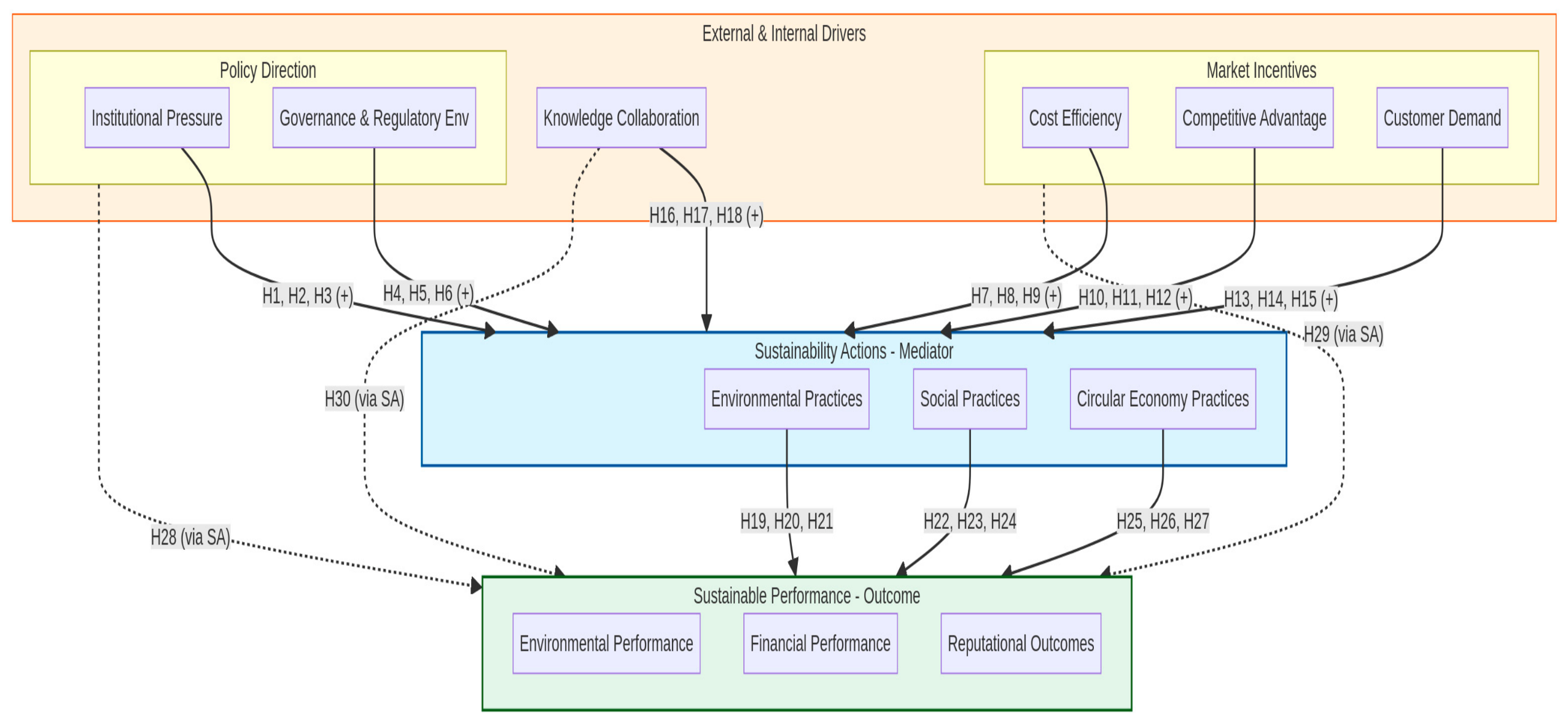
This study unravels existing research gaps through the development of a hybrid conceptual framework for SA transformation in the Saudi tourism and hospitality sector, which is illustrated in Figure 1. Our framework uses five theoretical traditions as a base, which include institutional theory and resource-based view (RBV) and stakeholder theory and dynamic capabilities theory and contingency theory to explain how organizations implement SA. The framework develops three major internal driving forces which include PD and MI and KC and three external drivers of cost efficiency (CE), CA, and customer demands (CDs) that lead to the execution of three SA categories which include environmental practices (EPs) and social practices (SPs) and CEP. The proposed SA will lead to sustainable performance results which will affect three areas of performance which are environmental performance and financial performance (FP) and reputational outcomes (ROs). The framework establishes SA as the linking element which connects the antecedent drivers with sustainable performance outcomes consistent with [24].
Unlike prior studies focusing on only one or a limited number of two combined theories to describe sustainability, here, the proposed multi-theory framework integrates several theories using hierarchy logic in explaining the transition process toward sustainability. Specifically, we adopted institutional theory to explain how external institutions and policies push firms to comply with sustainability expectations via PD. Simultaneously, stakeholder theory explains MIs triggered by society and other stakeholders that influence firms’ expectations for sustainable development. Further, this transformation process is enabled by dynamic capabilities theory. Therefore, we suggest that the firms must “Sense, Seize and Reconfigure” related knowledge and resources by KC and engaging in SA. The RBV of the firm emphasizes that these sustainability-oriented capabilities can be strategic advantages, helping organizations achieve enhanced sustainable performance (e.g., environmental and social performance). Lastly, as a cross-level boundary condition, contingency theory is introduced to answer the research question: Why would the relationship between macro-level institutional pressure, organizational resources and sustainable outcomes vary in strength for different contexts, such as organization size, tourism sub-sector, level of exposure to the global tourism environment and regulatory bodies and organizational culture? Overall, instead of summing up individual theories in parallel, we presented an explanatory system that integrates theories hierarchically to reveal a process, linking institutional factors in the macro-environment to firm-level sustainable performance outcomes via organizations’ capacities and their sustainability actions at both the meso- and micro-levels.
Taken together, this study delivers two major types of contributions which result in both theoretical and practical benefits for its audience. Based on theoretical contributions to sustainability studies and hospitality, this study introduces and validates a sequential hierarchical framework encompassing institutional theory, stakeholder theory, dynamic capabilities theory, RBV and contingency theory in explaining the Saudi hospitality firms’ transformation towards sustainability under the unique context of the state-led economic diversification project. Rather than testing a limited selection of these theories as isolated or combined theories as prior models, this research conceptualizes how macro-level institutional pressures coupled with market demands, together with dynamic capabilities arising from them, gradually become embedded into sustainability behaviors to realize sustainable performance.
Practically, an action plan (Section 5.2) is evidenced from our empirical investigations. This study suggests that sustainability in Saudi Arabia’s hospitality sector is most effective when positioned as a strategic investment that drives efficiency, competitiveness, and improved FP, rather than solely as a regulatory obligation. While the governance frameworks associated with Vision 2030 offer a robust institutional basis, their practical effects depend on firms’ managerial capacity to convert external pressures into operational changes, particularly in energy management, resource conservation, and customer-oriented SA. The results also underscore the importance of knowledge-sharing, notably through industry/academic partnerships and coordinated sector platforms, as a key facilitator of CEP adoption, underscoring the need for integrated, multi-stakeholder approaches that are sensitive to firm size and sub-sector characteristics.

2. Literature Review

2.1. Theoretical Underpinnings and Hypotheses Development

To improve conceptual clarity, the theoretical argument is organized progressively from macro-level institutional and stakeholder drivers to firm-level capability development and sustainability performance consequences. We explored a clear logic of theoretical integration, with institutional theory and stakeholder theory serving as parallel macro-level drivers (PD; MI) to create external pressures; RBV and dynamic capabilities as parallel micro-level mechanisms to convert resources and learning into SA (environmental, social, circular practices); and contingency theory as a cross-level moderator to condition multiple paths. Theories are mapped on each construct and theoretical lens. Institutional theory explains relationships between PD and H1–H6 (SA). Stakeholder theory and RBV explain relationships between MI and H7–H15 (SA) due to the competitive market incentives. Dynamic capabilities theory explains relationships between KC and H16–H18 (SA), whereas the mediating role of H28–H30 is also explained. Additionally, RBV explains relationships between H19–H27 (SA) and performance outcome. Contingency theory, a more context-specific theory, explains potential different outcomes due to various organizational contexts.
Based on the above foundations, theoretical relationships are conceived as hierarchical and sequential and not parallel. The model thus postulates that sustainability transformation starts with macro-level institutional, and stakeholder demands, moves through organizational sensing and capability development processes, and finishes with performance outcomes produced using strategic resources and practices geared towards sustainability. Macro-level, exogenous drivers are provided by institutional theory [25,26] that creates the structural conditions within which firms operate, by means of policy directives and regulatory pressures. The degree to which these institutional pressures are translated into organizational actions, however, depends on internal and external contextual factors as suggested by contingency theory [27]. If institutional pressures are perceived as strategically salient, firms will use dynamic capabilities-sensing, seizing and transforming capacities [28,29]-to reconfigure their resource base. Relational governance mechanisms based on the stakeholder theory [30] shape the deployment of these capabilities; collaborative engagement with government, local communities, and tourists will dictate which sustainability actions are prioritized and how they are carried out. Finally, on the outcome side of the model, the RBV [31,32] is used to explain that firms with valuable, rare and inimitable sustainability-related resources, when mobilized and aligned with stakeholder expectations through dynamic capabilities, can deliver superior sustainability performance. This sequential chain of macro-level institutional pressure–contingency–dynamic capabilities–stakeholder relations–firm resources is especially relevant for the Saudi Arabia Vision 2030, in which the state-driven transformation process poses a unique institutional shock that requires coordinated organizational responses at all five theoretical levels [33,34].
Institutional theory provides the foundational rationale for understanding why organizations adopt sustainability practices because it shows how institutions, through their regulatory activities and professional organizations and industry benchmarks, affect what organizations must do to remain compliant with institutional standards [35,36]. The Saudi Arabian tourism and hospitality industry faces IP from three different sources, which include government requirements that establish Vision 2030 regulations and industry certification standards that businesses must fulfill and the increasing international tourism organization requirements for sustainability compliance that businesses need to meet to enter different markets [22]. Ref. [25]’s seminal institutional framework suggests that organizations operating within the same field tend to converge toward similar practices as a response to shared institutional environments which leads to increased regulatory compliance in sectors that experience intense regulatory oversight [37]. Tourism and hospitality research shows that companies that experience high levels of regulatory and normative pressure will establish environmental management systems and report their sustainability achievements [19]. The Saudi framework for Vision 2030 includes ESG reporting requirements and green certification standards to create an institutional framework that governs how organizations address sustainability issues [38]. The PD construct of the proposed framework receives direct guidance from institutional theory because its IPs and governance and regulatory environment (GRE) dimensions describe how external coercive and normative forces drive the adoption of EPs, SPs, and CEPs [39].
The RBV complements the institutional perspective by directing attention to the internal organizational resources and capabilities that enable firms to translate external pressures into sustainable CA [23]. The RBV which brings together Barney’s [31] foundational proposition about VRIO resource requirements for sustainable CA asserts that sustainability functions as a strategic resource when organizations develop unique competencies through sustainability practices which go beyond their compliance obligations [20]. The hospitality industry has scholars who use RBV to prove that companies with unique environmental abilities which include their special green technologies and sustainability-trained employees and eco-certified supplier relationships achieve better environmental and financial results than their competitors [40]. The RBV shows strong importance in Saudi Arabia because the country experiences quick capital development for sustainable tourism projects while the government promotes green technology through the Vision 2030 program. The proposed framework uses the RBV to explain how MIs develop through sustainability investments which generate resource-based returns that drive organizations to implement environmental and social initiatives and circular economy operations [8]. The theory establishes a link between SA and FP and RO because sustainable resource management gives companies enduring market advantages [41].
Stakeholder theory requires companies to sustain ties with all their stakeholders, which encompasses customers and employees and investors and regulators and communities because these stakeholders establish expectations that determine how organizations execute their strategies and achieve their goals [42]. The tourism and hospitality industry faces unique stakeholder pressure because it operates in local communities and depends on natural resources while providing services to customers who want sustainable solutions [43]. The results of studies show that stakeholder pressure from both upstream actors, which includes regulators and suppliers, and downstream actors, which includes customers and civil society, predicts hotels’ sustainability commitments and their adoption of CEP [43]. Vision 2030 social sustainability targets which Saudi Arabia uses to build its tourism development policies create a more intricate process for managing stakeholder relationships in the country because these targets include local employment and cultural heritage protection and community empowerment [44]. The framework establishes stakeholder theory implementation through two components, which are CDS that belong to MIs and SPs that exist within SA because stakeholders will drive socially responsible tourism practice adoption through their demands that organizations will respond to. Organizations establish their sustainable performance development through stakeholder theory because positive stakeholder relationships generate relational capital that leads to financial gains from sustainability commitments [45].
The dynamic capabilities theory [18,28], as discussed in [29], introduces a new approach to RBV which examines how organizations use their core abilities to perceive environmental shifts and identify market chances and modify their resource distribution throughout unpredictable business situations [46]. Dynamic capabilities function as crucial elements for sustainability transformation because organizations need to develop ongoing resource adjustment skills which enable them to meet upcoming regulatory changes and market developments and technological advancements but need to possess actual green resources [46]. The empirical research conducted in Saudi Arabia demonstrates that dynamic capabilities which include sensing and absorptive and innovative capacities serve as crucial factors which determine sustainability success and resilience during crisis and post-crisis situations [47]. The dynamic capabilities framework demonstrates how organizations acquire knowledge through inter-organizational learning to sustain operations because companies that work with their partners and competitors and research organizations to share knowledge gain better skills which help them lead sustainable practices [24]. Dynamic capabilities theory functions as the basis for the KC construct within the framework by showing how organizations which work together to create and share sustainability knowledge attain new adaptive capabilities for their EPs, SPs and CEPs [48]. The theory shows that SA acts as a mediating force because dynamic organizations use their sensory abilities to assess various driver stimuli and turn those assessments into actual practices through their ongoing sensing and reconfiguring activities [49].
Furthermore, the framework establishes contingency theory as its final support which states that organizations can only achieve effective sustainability performance when their SA matches their environmental technological and market requirements [50,51]. Contingency theory enables organizations to develop customized sustainability strategies based on their size and operational needs and customer requirements and technological resources and CAs instead of following universalist patterns which recommend a single best practice [52]. Contingency research in the hospitality and tourism industry has proven that different hotel types and customer characteristics and local institutional environments produce distinct results which influence the implementation and success of green practices because sustainability outcomes depend on both driver conditions and the surrounding context [52]. The Saudi tourism industry exhibits high contingency relevance because it includes various types of tourism operations which range from luxury urban hotels to eco-tourism ventures to religious hospitality establishments to emerging heritage tourism sites which each follow different resource and market and regulatory guidelines [53]. The hybrid design of the framework uses contingency theory to explain its theoretical foundations because multiple theories show that no single sustainability driver exists which applies across all organizations but institutional, resource-based, stakeholder and dynamic capability elements become more important depending on the specific organizational and contextual conditions [54]. The contingent view of the study emphasizes that researchers must conduct empirical tests for the proposed hypotheses across all types of companies and various sectors that exist in the Saudi tourism and hospitality market to reveal both boundary conditions and context-specific SA transformation patterns.

2.2. Hypotheses Development

2.2.1. The Link Between PD and SA

We designed PD as a multidimensional framework that contains two primary components. The institutional theory framework explains how external factors can influence organizations to implement three distinct types of SA which include EPs, SPs and CEPs [19]. Organizations in the hospitality industry experience IPs which include government coercive mandates and industry association normative expectations and peer organization mimetic forces that provide them with strong motivation to integrate sustainability into their business operations [37]. The research conducted in Saudi Arabia shows that two main factors which include IP and competitive pressure function as the main forces that drive organizations to adopt sustainable development practices and green innovation systems [39]. Research studies in different industries show that IPs which receive enforcement support and organizational commitment drive companies to establish environmental management systems [19]. The regulatory framework of Vision 2030 in Saudi Arabia establishes environmental standards and social responsibility requirements and circular economy objectives as an institutional environment that exerts strong coercive and normative pressure on organizations [38]. The GRE establishes informal governance standards which shape the institutional framework that determines how hospitality companies implement their SA [55]. The presence of strong governance frameworks causes positive effects on the relationship between sustainability commitment and practice adoption because they help businesses succeed in emerging markets which are developing their regulatory systems [55]. This institutional pathway is supported by empirical evidence from the hospitality sector, which shows that strong environmental legislation has a significant impact on the adoption of green practices by hotels [56,57]. The governance and regulatory environment (GRE) dimension reflects the quality, stability and transparency of the institutional framework, such as anti-corruption measures, policy consistency and the existence of sustainability-related legal protections [58]. A good governance environment reduces uncertainty, transaction costs and demonstrates the long-term commitment of the government to sustainability, which will make firms more likely to invest in environmental practices (H4) and social practices (H5). In Saudi Arabia, Vision 2030’s governance reforms, including the National Center for Environmental Compliance and the Saudi Green Initiative, are examples of how GRE can drive environmental sustainability and social action at the firm level [34]. However, while IP mainly works through coercive pressure, GRE has a wider institutional impact that creates an enabling environment for sustainability investments, where investments become more economically viable and strategically appealing due to trust, stability and predictability of enforcement. The research proposes the following hypotheses:
H1. 
Institutional pressure (IP) positively affects environmental practices (EPs).
H2. 
IP positively affects SPs.
H3. 
IP positively affects CEPs.
H4. 
GRE positively affects EPs.
H5. 
GRE positively affects SPs.
H6. 
GRE positively affects CEPs.

2.2.2. The Link Between MI and SA Link

The internal and external market-driven forces which drive sustainability adoption from MIs operate through three dimensions which include CE and CA and CDS. The RBV framework shows that companies receive economic incentives to adopt green practices through sustainability investments which produce energy cost savings and waste reduction and resource optimization [59]. The lodging industry research shows that environmental participation generates both cost reductions and revenue increases which boost profitability while CE functions as a market force that drives businesses to implement environmental and social performance [59]. The hospitality literature establishes a connection between SA and CA. Studies show that sustainability enhances both cost advantages and differentiation advantages. The study shows that sustainability improvements lead to better perceptual performance and higher revenue metrics which include average daily rate (ADR) and revenue per available room (RevPAR) [41]. Saudi Arabia’s tourism market, which grows rapidly and competes internationally, recognizes sustainability-based differentiation as an essential factor for achieving market positioning and sustaining long-term viability [13]. As travelers increasingly prioritize eco-friendly and socially responsible accommodation hotels face pressure to adopt visible and credible sustainability practices because CDS functions as an essential market signal. Research shows that CDS in the hospitality sector drives practice adoption through their preferences for green-certified properties and their willingness to join environmental programs and their growing social responsibility awareness [60]. Thus, the following hypotheses are proposed:
H7. 
Cost efficiency (CE) positively affects environmental practices (EPs).
H8. 
CE positively affects SPs.
H9. 
CE positively affects CEPs.
H10. 
Competitive advantage (CA) positively affects EPs.
H11. 
CA positively affects SPs.
H12. 
CA positively affects CEPs.
H13. 
Customer demand for sustainability (CDS) positively affects EPs.
H14. 
CDS positively affects SPs.
H15. 
CDS positively affects CEPs.

2.2.3. The Link Between KC and SA

The term KC defines how organizations share and create environmentally friendly knowledge with their partners and suppliers and research institutions and industry colleagues [9,61]. The dynamic capabilities theory establishes that companies need to establish their meta-capability to obtain and integrate and use outside knowledge so they can develop their adaptive skills which are essential for achieving full sustainability transformation [24,45]. KC supports sustainability practice adoption through multiple mechanisms because it enables organizations to exchange environmental management best practices while they gain access to sustainable technologies and certification programs and develop common operational guidelines for eco-friendly hospitality business activities [62]. The Saudi Arabian context relies on inter-organizational knowledge networks to develop sustainability capabilities through its government-industry partnerships in Vision 2030 and its university–industry projects on sustainable tourism and its worldwide hospitality chain knowledge transfer programs [46,54,55]. The research shows that organizations which practice open innovation together with knowledge-sharing activities gain better success in developing sustainability solutions which resolve both environmental and social issues [9]. The link between KC and CEPs becomes more evident because hospitality businesses cannot implement circular economy models without working together to recover resources and redesign supply chains and create value from waste [63]. KC helps organizations achieve social sustainability through its ability to enable industry participants to design communal understanding of local needs and cultural background and labor requirement standards [64]. Accordingly, the following hypotheses are projected:
H16. 
Knowledge Collaboration (KC) positively affects environmental practices (EPs).
H17. 
KC positively affects SPs.
H18. 
KC positively affects CEPs.

2.2.4. The Link Between SA and Sustainable Performance

The research predicts that SA, which includes EP and SP together with CEP will produce sustainable performance achievements across three areas which are environmental performance and FP and RO. The hospitality sustainability literature contains evidence which shows that SA is linked to firm performance, which has been studied extensively. The evidence base demonstrates that multiple performance dimensions show positive linkages with sustainability practices [24]. The research uses eco-efficiency theory together with RBV to show that organizations which invest in environmental management systems and energy efficiency solutions and water-saving initiatives and waste-reduction programs will achieve environmentally measurable results which also produce financial advantages that increase over time [40]. The research shows that hotels across different regions achieve better financial results through their EP, which depends on the investment size and type of investment [62]. EP enables organizations to achieve better RO because their environmental responsibility commitment through these practices builds brand equity and stakeholder trust with customers and investors and regulators whom they serve [45].
The SPs which includes local community engagement and fair labor standards and cultural heritage preservation and inclusive employment, have been proven to strengthen environmental performance by building an organizational sustainability culture which promotes environmental stewardship across all levels. Social sustainability practices help organizations maintain financial stability because these practices lead to better employee retention, which lowers turnover expenses, and enhances customer loyalty among travelers who care about social issues [65]. SPs led to RO because consumer evaluation of corporate social responsibility acts as a key factor that determines brand loyalty and positive word-of-mouth and customers who are willing to spend extra money. The hospitality industry needs to adopt CEP which includes resource recovery and waste reduction and circular supply chains and closed-loop production systems as a vital component of its sustainable business operations [21]. The research proves that organizations which implement circular economy principles will achieve higher sustainable-oriented innovation results, because stakeholder theory and institutional theory show that CEP leads to innovation progress [43]. Organizations can reduce their environmental footprint by switching from linear operational models to circular operational models which also enable them to cut operational costs through better resource management while their circular service models create additional revenue streams and their businesses gain market recognition as sustainable brands [66]. The theoretical and empirical foundations of the study serve as the basis for subsequent research hypotheses development.
H19. 
Environmental practices (EP) positively affect environmental performance.
H20. 
EP positively affects financial performance (FP).
H21. 
EP positively affects RO.
H22. 
Social practices (SPs) positively affect environmental performance.
H23. 
SP positively affects FP.
H24. 
SP positively affects RO.
H25. 
CEP positively affects environmental performance.
H26. 
CEP positively affects FP.
H27. 
CEP positively affects RO.

2.2.5. SA as a Mediator

The framework proposes SA as the primary way through which PD, MI, and KC accomplish their mission to boost sustainable performance. The existing sustainability literature supports mediation logic because it has shown through multiple studies that external and internal drivers lead to firm performance outcomes by way of specific organizational practices [24]. Corporate EP research shows that IP impacts performance because organizations need to implement actual practice changes which result from these pressures instead of maintaining their symbolic compliance [67]. Studies from Saudi Arabia and the larger MENA region reveal that governance and regulatory frameworks create environmental and FP effects by determining which sustainability practices organizations will implement [68]. SAs exist within dynamic capabilities because they function as organizations which successfully implement sensing and seizing and transforming capabilities through their driver signal conversion into actual organizational practices [48]. SA functions as a mediator because it shows how organizations build RO through established sustainable practice demonstrations instead of their sustainability commitment proclamations which lead to stakeholder trust and reputational capital development [43]. The mediation pathway from KC to SA and sustainable performance demonstrates dynamic capabilities logic because organizations must transform inter-organizational learning into practical applications before achieving performance results [24]. Based on these theoretical foundations, the following mediation hypotheses are proposed:
H28. 
SAs mediate the relationship between PD and sustainable performance.
H29. 
SAs mediate the relationship between MI and sustainable performance.
H30. 
SAs mediate the relationship between KC and sustainable performance.

3. Methods

3.1. Research Rationale and Participants

The study used a quantitative research design that tests the framework that establishes sustainable development through three elements of PD and MI and KC for the Saudi tourism and hospitality sector. We used a cross-sectional survey method to gather primary data from hotel and travel-agency managers who worked in the two major economic regions of Riyadh and the Eastern Province in Saudi Arabia. We selected these regions because of their strategic significance for the Kingdom’s tourism development programs and their active participation in Vision 2030 sustainability projects. These regions also represent the primary economic and administrative hubs driving sustainability transformation initiatives within the Saudi tourism and hospitality sector. However, the authors acknowledge that the exclusion of other tourism contexts, particularly religious tourism destinations such as Makkah and Madinah, may limit the broader generalizability of the findings due to their unique operational and sociocultural characteristics. We developed a structured questionnaire that used personal staff views and individual experiences to evaluate the proposed conceptual model.
The target population consisted of mid- to senior-level managers who are directly involved in strategic decision-making, sustainability implementation, or operational management. The research team consider these respondents to be highly knowledgeable informants who can provide accurate insights into the organization’s sustainability practices. A total of 600 questionnaires were distributed to collect data, but 400 questionnaires were returned and accepted as valid which resulted in a 67% response rate. We obtained 400 usable responses through purposive sampling methods. The purposive sampling method functions as an appropriate sampling technique for PLS-SEM studies because it prioritizes prediction and theory development along with managerial insights, yet it does not achieve statistical representativeness [69]. Accordingly, the findings should be interpreted with caution when generalizing to the entire Saudi tourism and hospitality sector, particularly across regions and tourism segments not represented in the current sample.
The study sample (Table 1) shows 73.2% of the participants (n = 293) are male and 42.0% (n = 168) of the sample belongs to the young age group which consists of people under 30 years old. Most respondents demonstrate extensive work experience because most individuals have 6 to 10 years (38.4%, n = 154) or more than 21 years (33.2%, n = 133) of professional time. Most participants provide educational credentials which include diploma (46.4%, n = 186) and college-level qualifications (28.0%, n = 112) for practice-oriented managerial work. The assistant general managers (42.0%, n = 168) and senior managers (37.2%, n = 149) form the largest organizational role group among the employees. The study sample demonstrates managerial expertise because they possess decision-making authority and relevant experience which enhances the study’s analytical strength.
The study sample size meets the “10-times rule” requirements but also exceeds the needs of subsequent statistical power analyses for PLS-SEM which provides sufficient statistical power for model estimation and hypothesis testing [70,71,72].
The survey required back-translation because most participants spoke Arabic as their main language which required back-translation to verify translated content accuracy and equivalence. Researchers selected initial items from previous studies which they translated from English to Arabic. Another specialist performed back-translation of the questionnaire from Arabic to English after the first expert completed his translation work. To validate the translation process, a high level of consistency between English versions is observed.

3.2. Research Design and Measures

Survey constructs were operationalized through adapted, validated instruments as depicted in Table 2, ensuring content validity and theoretical grounding. The PD reflects the level of influence Saudi Vision 2030 and public policies have on the sustainability behavior of organizations through institutional pressure and supportive governance/regulatory environment. IP is the coercive and strategic pressure exerted by Vision 2030 regulations and government expectations, and GRE is the overall legal, financial and administrative environment which creates pressure on firms to comply with sustainability regulation, incentives, reporting requirements and public-sector initiatives. MIs: Economic and competitive reasons for adopting sustainability, such as cost effectiveness, competitiveness, and demand by customers for sustainability. KC is the extent to which the organization develops its sustainability capacity through internal learning, employee training, knowledge management systems, collaboration across functions and with external partners such as other companies, academic partners and professional networks. SAs are the sustainability actions that the organization implements which are manifested in environmental practices, social practices and circular economy practices. Lastly, sustainable performance brings together the results of these actions in the form of environmental performance.
The measurement model comprises five higher-order constructs: first, PD, adopted from [7,55,61,73,74,75,76,77,78,79,80], is a multidimensional construct composed of IPs, with five items, and GRE, with ten items; second, MI, adopted from [42,79,80,81,82,83,84], is a multidimensional factor representing CE with three items, CA with five items, and CDS with four items; third, KC, which includes twelve items representing industry–academia partnerships, training and awareness, and knowledge-sharing systems, adopted from [45,61,79,80,81,82,84,85]; and fourth, SA, adopted from [78,79,80,81,82,86,87,88,89]. SA is a multidimensional factor composed of EPs with six items, SPs with four items, and CEPs with five items. Fifth, sustainable performance, adopted from [42,53,78,79,80,81,82,83,86,87,90,91], serves as the model outcome, a multidimensional factor comprising four items for each sub-factor environmental performance, FP, and RO resulting in 12 items. A five-point Likert scale from 1 to 5 is used. The instrument is developed in English—after many phrasing adjustments—and reviewed by academic and industry experts to guarantee face validity. A pilot test was conducted with a small group of 30 managers to confirm reliability and comprehension prior to full-scale data collection.

3.3. Data Collection Procedure

Researchers collected data for their study through a structured questionnaire which they distributed electronically and through direct distribution between January and February 2026. Respondents received information about the study’s confidentiality protections and their voluntary participation rights before they decided to take part in the research study. The survey design included multiple procedural solutions which controlled the effect of common method bias. The study used three methods which included randomizing questionnaire items and providing respondents with detailed instructions and creating psychological distance between prediction and result measurement [69]. The study implemented these measures to encourage participants to provide genuine responses while reducing their tendency to guess answers based on study relationships. The study relied on single-informant managerial responses because mid- and senior-level managers possess direct knowledge of organizational sustainability strategies, operational practices, and decision-making processes within tourism and hospitality firms. Their strategic involvement makes them appropriate key informants for evaluating sustainability transformation initiatives. Nevertheless, the authors acknowledge that self-reported sustainability assessments may be influenced by social desirability bias, whereby respondents could unintentionally overstate environmentally or socially responsible practices due to reputational considerations. To minimize this risk, respondents were assured of anonymity and confidentiality, and no personally identifiable information was collected during the survey process.

3.4. Analytical Strategy

The researchers conducted data analysis through Partial Least Squares Structural Equation Modeling (PLS-SEM) which they executed using the ADANCO 2.4 software platform that experts recognize as an effective tool for managing intricate hierarchical systems and research studies that require predictive analytics and handle datasets which do not follow standard distribution patterns [92]. The study requires PLS-SEM because researchers need to establish new theories and extend existing theoretical frameworks according to its recommendation for such research activities [93,94,95]. In this context, the predictive orientation of PLS-SEM aligns with data-driven analytical approaches often discussed within predictive modeling and “machine learning-oriented” research streams. However, the present study does not employ machine learning algorithms in the conventional artificial intelligence sense; instead, it utilizes the predictive capabilities of PLS-SEM, particularly through PLS predict procedures, to assess out-of-sample predictive performance. Considering the multidimensional structure of the constructs, a hierarchical component model (HCM) was estimated using the two-stage approach. To improve model structure and fit, a two-step latent variable approach was implemented: first-order factor scores were separated and afterwards used to assess the second-order model [96].
To establish analytical integrity, findings were vetted through rigorous sensitivity checking. The researchers evaluated collinearity through variance inflation factor (VIF) testing which revealed all results remained below the 3.3 threshold limit thus demonstrating no multicollinearity problems [97]. The full collinearity test confirmed that shared method variance did not present a major problem while researchers tested common method bias through this assessment. The PLS predict procedure served as the evaluation method to determine the model’s predictive validity while [98] identified this technique as the standard method to evaluate out-of-sample predictive performance in PLS-SEM. The complete set of procedures confirmed that the structural model achieved both statistical robustness and conceptual validity.

4. Results

Before turning to run our model, we implemented methods to handle ‘common method variance (CMV)’ by establishing participant anonymity protection and confidentiality, which resulted in their survey design that required dependent items to be answered before independent items. The research team achieved better questionnaire understanding through their pilot study. The researchers used the ‘Harman’s single factor’ method [99] to find that one factor explained 35.7% of the total variance, which showed that CMV had no major impact on the study. The results in Table 3 display collinearity VIF values which extend between 1.1 and 2.9, demonstrating that the study did not experience problems with common variance bias or multicollinearity [69]. Although the statistical assessments suggested that common method variance did not pose a substantial concern, the authors recognize that self-reported sustainability measures may still be partially affected by social desirability tendencies. However, the procedural remedies adopted during questionnaire design and data collection helped reduce the likelihood of systematic response inflation.

4.1. Measurement Model Assessment

The measurement model was assessed to examine the reliability and validity of its constructs before researchers conducted structural relationship testing. The researchers followed PLS-SEM guidelines to conduct their evaluation of indicator reliability internal consistency and convergent validity and discriminant validity. The results showed that all indicator loadings in Table 2 exceeded the 0.60 threshold, which indicates strong reliability because most items were loaded above 0.78.
The reflective measurement model evaluation process begins with outer loading assessment and significance testing of indicators. The second stage requires researchers to determine Cronbach’s alpha (α) and composite reliability (CR) values. The third stage requires researchers to establish convergent validity through average variance extracted (AVE) assessment and they need to establish discriminant validity through heterotrait–monotrait ratio (HTMT) assessment. The measurements used in this research achieved strong reliability according to Table 2 which shows loadings that range from 0.78 to 0.98. The 0.70 threshold serves as a common reference point for factor loadings, yet researchers should avoid discarding factors which possess loadings below this threshold unless their removal improves the overall reliability of the construct. The authors propose that researchers should keep communalities between the values of 0.60 and 0.70 a [94]. The values of α and CR and AVE exceed the cut-off values of 0.85 and 0.87 and 0.55, which indicates the measurements possess good reliability and convergent validity. The results demonstrate that all HTMT values (Table 3) for the constructs remain below the critical cut-off of 0.85 which established as the standard for proving discriminant validity [100].
The researchers assessed discriminant validity through the application of HTMT testing. The SA and sustainable performance pair reached their highest value through HTMT testing when the researchers measured HTMT at 0.84 while all other values in Table 3 stayed below the 0.90 limit [100]. The results show that researchers succeeded in testing their hypotheses because different constructs of the study could be measured as separate entities which established the basic requirements needed to demonstrate discriminant validity for all measurement models. Internal consistency reliability was assessed using α and CR. As presented in Table 2, all constructs demonstrated satisfactory reliability, with values exceeding the recommended threshold of 0.70 [70]. Composite reliability values ranged from 0.879 to 0.964, indicating a high level of internal consistency across all constructs. Convergent validity was established through the AVE. All constructs achieved AVE values above the threshold of 0.50, ranging from 0.610 to 0.811, confirming that each construct explains more than half of the variance of its indicators. These results suggest satisfactory convergence, strong psychometric properties, and further justifying its suitability to run path model assessment.

4.2. Hypothesized Model Estimation

The structural model was then assessed to examine the causal relationships between the construct in latent variables. Prior to this, it is a requirement to ensure that the construct is not prone to collinearity. There is something else, the VIF score, and this is the standard to be used in PLS-SEM to determine potential problems caused by multicollinearity [69,97]. In our study, it should be highlighted that there are VIF scores under 3.3, which can be thought of as being safe. Therefore, our predictors are good candidates because it means they do not overlap with each other too much and do not risk overestimating path coefficient paths. Supporting [92]’s role, the model’s strength is sustained by eluding multicollinearity, certifying that theorized links are not distorted.

4.3. Path Analysis

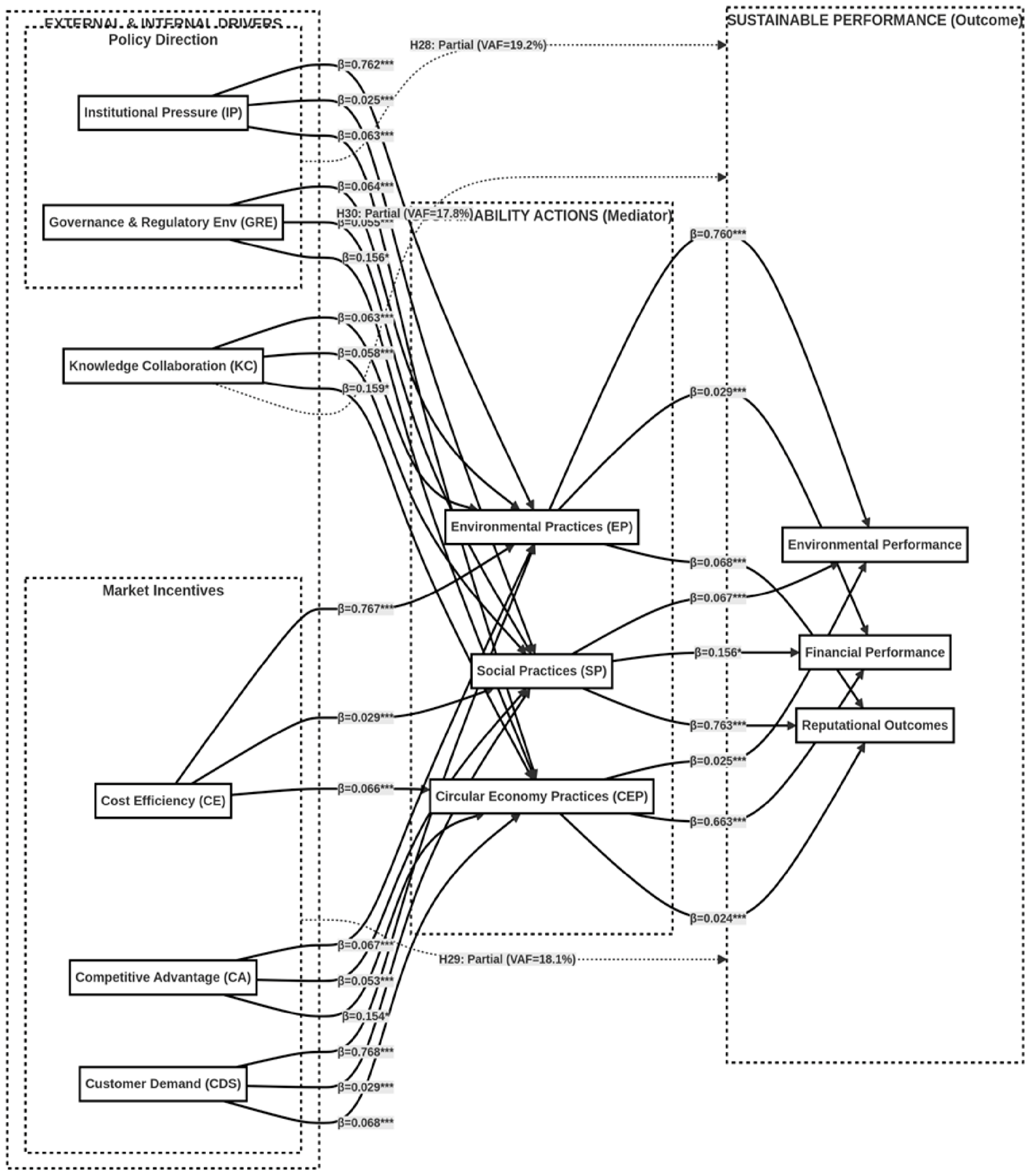
By resampling the sample with 5000 resamples and through bootstrapping to determine statistical significance, model hypotheses are supported by showing statistical significance in three dimensions of PD, MI and KC driving SA in achieving sustainable performance. Table 4 demonstrated that the proposed paths were statistically significant at a level of p < 0.001, indicating the robustness of our SEM model. It is important to note that the magnitude of the path coefficients varied across relationships, with some paths exhibiting comparatively small coefficients while remaining statistically significant. This outcome is consistent with PLS-SEM estimation under bootstrapping procedures, where significance levels are influenced not only by coefficient magnitude but also by sample size, standard errors, and model stability. Therefore, the interpretation of the structural relationships considered both statistical significance and practical effect size indicators (f2 values). The IP has played a significant role in shaping SA. It has its most important influence over the EP, with a positive coefficient and a magnitude of 0.762 (p < 0.001). It also positively affects the SP (β = 0.025, p < 0.001) and the CEP (β = 0.063, p < 0.001). GRE driver impact has the exact same results because GRE benefits all three sets of practices—EP, with a positive coefficient and a value of 0.064 (p < 0.001), SP, with a positive coefficient and a value of 0.055 (p < 0.001), CEP, with a positive coefficient and a value of 0.156 (p < 0.001). Therefore, according to the results, pressures exerted by the regulatory bodies along with existing governance mechanisms prove to be important factors determining how companies carry out their environmentally conscious operating practices.
Furthermore, the effect size assessment (f2) provided additional insight into the practical importance of structural relationships. Following established PLS-SEM guidelines, f2 values of approximately 0.02, 0.15, and 0.35 were interpreted as small, medium, and large effects, respectively. The findings indicate that several relationships, particularly those associated with environmental sustainability dimensions, demonstrated large explanatory effects, whereas a few paths linked to social practices and circular economy practices exhibited comparatively small effect sizes despite remaining statistically significant. This pattern suggests that some sustainability drivers exert stronger substantive influence than others within the proposed framework.
The MI framework showed that CE and CA and CDS all produced significant positive results which advanced SA. CE showed strong effects on EP with a β value of 0.767 while it had smaller but important impacts on SP with a β value of 0.029 and CEP with a β value of 0.066. CA applied similar effects which produced significant results for EP with a β value of 0.067 and SP with a β value of 0.053 and CEP with a β value of 0.154. The CDS element in this category produced the most substantial impacts which included its positive effects on EP that reached a β value of 0.768 and its positive results for SP with a β value of 0.029 and CEP with a β value of 0.068. The findings demonstrate that market-based drivers play an essential role in driving organizations toward sustainable practice implementation. SA received primary support from KC which emerged as a key SA driving force. The paths to EP (β = 0.063) and SP (β = 0.058) and CEP (β = 0.159) showed positive results which achieved statistical significance throughout the entire study at p < 0.001. The study demonstrates that information sharing between people leads to knowledge sharing which together with collaborative networks creates more effective sustainability capabilities. SA functioned as strong indicators, which predicted all three sustainable performance areas. EP brought about environmental performance improvement at a rate of 760 percent while they generated FP at a rate of 29 percent and RO at a rate of 68 percent. SP achieved significant effects, which reached environmental performance levels of 0.067 and FP levels of 0.156 and RO levels of 0.763. CEP produced positive effects across all outcome variables which included environmental performance at a β value of 0.025 and FP at a β value of 0.663 and RO at a β value of 0.024, which all reached significance at p < 0.001. Findings indicate that aligning operational practices with SA significantly boosts environmental performance, FP, and RO for firms.

4.4. Model Mediator Assessment

Table 5 highlights the model mediator evaluation, further revealing that SA partially mediated the effects of the three antecedent constructs on sustainable performance. PD showed a strong direct effect on sustainable performance (β = 0.761), accompanied by a significant indirect effect (β = 0.083), yielding a total effect of 0.842 and a VAF of 19.21%. MI similarly exhibited a partial mediation pattern, with an indirect effect of β = 0.040 (VAF = 18.12%). KC also demonstrated partial mediation (indirect effect β = 0.018; VAF = 17.81%). These results suggest that while PD, MI, and KC directly shape sustainable performance, a meaningful proportion of their influence operates indirectly through SA. These findings confirm that the three pillars of the model, MI and KC, act as complementary drivers of sustainability transformation, which in turn leads to improved performance outcomes.
The structural model (Figure 2) provided strong evidence for both its explanatory abilities and its predictive capabilities. The SA achieved an R2 value of 0.52 while sustainable performance attained an R2 value of 0.54 which demonstrated their ability to explain more than half of the observed data. MI demonstrated the strongest effect on SA while PD and KC produced a smaller effect according to the effect size results which showed all predictors had a modest to intermediate impact. The Q2 values of the Stone–Geisser method showed both constructs had predictive capability because SA obtained a value of 0.31 and sustainable performance reached a value of 0.33. The PLS predict assessment provided supportive evidence of the model’s predictive relevance and acceptable out-of-sample predictive capability. Given the explanatory and theory-development orientation of the present study, predictive assessment was treated as a complementary robustness evaluation rather than the principal analytical objective.

4.5. Robustness Tests and Multi-Group Analysis (MGA)

The structural model’s stability and generalizability required verification through multiple robustness tests (Table 6) which researchers conducted before they implemented multi-group analysis (MGA) to examine path relationship consistency between different subgroups. The model diagnostics included multicollinearity assessment through variance inflation factor (VIF) evaluation which showed all VIF values stayed below 3.3 the established cutoff thus proving that collinearity issues did not exist and the regression results remained precise. The full collinearity test confirmed that no construct exceeded the recommended cutoff in its assessment of common method bias which demonstrated that common method variance did not pose a risk to the study outcomes. The Stone–Geisser Q2 values obtained through blindfolding demonstrated predictive relevance because all endogenous constructs displayed Q2 values above zero which proved the model’s sufficient predictive ability. The PLS predict procedure further supported the model’s predictive relevance by indicating acceptable predictive capability across the endogenous constructs. In line with the exploratory and theory-building nature of the study, predictive assessment was used primarily as an additional robustness check supporting the structural model evaluation.
To test whether the structural relationships were consistent across different respondent groups, an MGA was conducted. MGA allows for the comparison of path coefficients across predefined subgroups, providing insights into potential moderating effects at the demographic or organizational level. The analysis examined group differences based on firm size, years of operation, and type of tourism/hospitality establishment. The MGA confirms the proposed model is robust, with most structural paths remaining stable throughout firm sizes. While MI’ influence on SA varied slightly, larger firms appeared more responsive to these pressures. Overall, the findings suggest the model holds, demonstrating strong generalizability for the tourism and hospitality industry in Saudi Arabia.

5. Discussion

The study results demonstrate strong empirical validation of the hybrid conceptual framework which shows that Saudi tourism and hospitality sector sustainability transformation results from PD and MI and KC working together to sustain their operations.
The results strongly validate the suggested sustainability framework in the Saudi tourism and hospitality context. All hypothesized relationships were significant, indicating that IP, GRE, MI, and KC are important antecedents of sustainability-related behavior and performance. In particular, the GRE and IP showed significant positive impacts on environmental practices, CEP and sustainable performance, indicating that the direction of policy and IS are key factors influencing the sustainability responses of organizations. Likewise, CE, CA and customer demand for sustainability were positively related to SAs and outcomes, highlighting the need for both economic and market-based drivers. KC also became a significant motivator, pointing to the importance of learning, partnership, and sharing knowledge to speed up the process of sustainability transition. The EP, SP and CEP (H1–H6) of organizations show positive relationships with IP and GRE according to institutional theory [25] which verifies that organizations adopt environmental management practices under regulatory and normative pressures [19]. The Vision 2030 institutional field shows great power in Saudi Arabia according to Alyahya et al. [39] and Badkook [38]. The pathways from CE and CA and CDS to all three SAs (H7–H15) show strong positive relationships which support RBV and stakeholder theory perspectives and demonstrate how sustainability brings economic benefits while meeting stakeholder requirements [41,42]. KC affects EP, SP and CEP (H16–H18) through dynamic capabilities which require inter-organizational learning and knowledge sharing for organizations to create adaptive sustainability abilities according to [24]. The mediation results (H28–H30) show that SAs intermediate the links between three driving forces and sustainable performance through their partial mediation because the VAF values range between 17.81% and 19.21%. The PD, MI and KC directly affect environmental performance and FP and RO, but most of their effect passes through sustainability practice implementation, which confirms that organizations must adopt practices instead of using symbolic compliance [24,67].
The structural model demonstrates strong empirical backing for the hybrid framework which contemporary sustainability transformation studies use as their most current foundation. The research shows that sustainability change consists of multiple dimensions which develop through system interactions between policy, market, and organizational capability elements according to broader transformation studies [101,102]. PD functions as the primary driving force which establishes regulatory requirements and demonstrates institutional allegiance and establishes governance conditions for industry transition according to national plans including Vision 2030 in the Saudi tourism and hospitality sector [4]. MI serves as the main practical factor which drives sustainability efforts because research shows that companies respond to three specific situations which include market competition and operational efficiency and changing consumer demands [103]. KC functions as a vital element which supports organizations by developing their abilities and enabling them to learn while sustainability practices spread according to research results which apply to both collaborative governance and innovation research [104,105].
The results show that SA functions as the main mediating factor which transforms outside pressures and internal drivers into tangible results for organizations according to EP, SP and CEP which create measurable performance gains from high-level sustainability drivers [106,107,108]. The MGA showed that larger organizations exhibit stronger reactions to MI (MI → SA, difference = 0.112, p = 0.041) which demonstrates that companies with abundant resources can utilize market-based sustainability opportunities better than their smaller counterparts while the circular practices found in hotels and restaurants exhibit only marginal differences between them (CEP → sustainable performance, difference = 0.063, p = 0.057). The hybrid conceptual framework functions as a valid context-sensitive model which demonstrates how external drivers through organizational practices lead to multiple sustainable performance outcomes in an emerging economy which undergoes fast changes because of Vision 2030 according to global sustainability transition frameworks and the hybrid model shows structural consistency with these frameworks.

5.1. Theoretical Contributions

This study makes several important theoretical contributions to the sustainability literature in tourism and hospitality by developing and empirically validating a hybrid conceptual framework that integrates five complementary theoretical perspectives—institutional theory [25], the RBV [31], stakeholder theory [109], dynamic capabilities theory [28], and contingency theory [50]—within a single explanatory model, thereby addressing the fragmented and siloed nature of prior research that has largely examined these mechanisms in isolation [23]. Unlike previous studies that have focused predominantly on developed-country contexts and single-theory approaches [19,41], the proposed framework advances theoretical integration by demonstrating how PD, MI, and KC collectively drive SAs—encompassing EP, SP, and CEP—which in turn mediate the relationship between these antecedents and multidimensional sustainable performance (environmental performance, FP, and RO), a mediation mechanism empirically supported by [24,67].
The study establishes a new theoretical framework for understanding sustainability practices in non-Western institutional contexts through its examination of Saudi Arabia’s Vision 2030 framework which describes an emerging resource-abundant economy that is undergoing rapid structural development. The research extends sustainability models through its development of contextual frameworks which fill existing gaps in the tourism and hospitality literature according to [3,4,9].

5.2. Practical Implications

Research results provide practical guidance (Table 7) which hospitality managers and policymakers, industry associations, and financial institutions should use to promote sustainability changes in Saudi Arabian tourism. Managers should view sustainability investments as strategic resources which create CAs for their businesses according to research findings showing that CE and CA positively impact SA (H7–H12), which supports RBV principles [40,41]. The managers should make energy efficiency and water conservation and waste reduction their focus while they use CDS (H13–H15) to attract eco-conscious travelers through certification programs and transparent product information. The mediation effects (H28–H30) show that external drivers alone cannot produce results because managers need to convert policy signals and collaborative knowledge into actions which they will implement [24]. The IP and governance factors (H1–H6) proved to have a positive impact on SA which shows the effectiveness of Vision 2030 regulatory framework [38,39]. The partial mediation results show that organizations need IP together with governance because those two elements function best when backed by capacity-building resources which include technical assistance and subsidized audits that particularly help smaller firms which need to comply with the MGA finding that larger firms respond more strongly to MIs (MI → SA, p = 0.041).
The link between KC and CEP (H18) shows that industry–academia partnerships supported by government funding will help accelerate circular economy implementation. Industry associations should use KC because it strongly affects SA (H16–H18) to create benchmarking platforms and collaborative training initiatives which enable peer learning while circular practices have greater impact in hotels than restaurants according to the marginal MGA finding (CEP → sustainable performance, p = 0.057), which shows that the hotel industry and restaurant industry need different operational guidance [24]. The positive connection between SA and FP (H20, H23, H26) and RO (H21, H24) proves to investors that green finance products like sustainability-linked loans [45] have financial value. A successful sustainability transformation needs multiple stakeholders to work together while regulatory frameworks and market systems and collaborative networks and company capabilities operate in total harmony. The practical recommendations outlined in Table 7 have been mapped against three- time horizons—immediate, short and medium—which both capture the urgency of Saudi Arabia’s Vision 2030 milestones and the differential readiness of tourism stakeholders to implement sustainability actions. Evidence of the benefits of investing in energy efficiency and water conservation, which include cost savings and a boost in competitive advantage, is particularly strong for hotel managers and leads to immediate investment in energy and water efficiency measures [57]. The short-term approach of third-party eco-certifications (e.g., Green Key, Earth Check) takes advantage of the market segment of environmentally aware tourists and the evidence of the signaling effect of certifications on room rates and occupancy rates [110]. The medium-term suggestion of “Green Teams” and digital idea-management platforms is an operationalization of the dynamic capabilities logic, where knowledge integration and organizational learning enable external policy and market drivers to be translated into firm-level sustainability action [4,29]. In terms of policy, the immediate barriers to SMEs’ uptake of environmental measures, namely financial and technical [111], are addressed through the introduction of a unified sustainability self-assessment portal on the Balady platform. The proposed Circular Tourism Innovation Cluster grant is a combination of both government and industry funding and fits with the research literature on the need for multi-actor collaboration in circular economy transitions [112]. The development of sub-sector specific guidelines (religious tourism accommodation, Red Sea luxury resort, desert eco-lodges and event-driven city hotels) directly addresses the marginal performance differences identified in the multi-group analysis for circular practices in hotel and restaurant contexts [14]. Investor-oriented green finance instruments, like a “Saudi Green Hospitality Loan” offering preferential rates for loans based on verified sustainability performance, are based on research showing that sustainability-linked lending improves risk-adjusted portfolio returns and firm-level environmental outcomes. Lastly, the action plan to create a permanent Saudi Tourism Sustainability Council reflects the collaborative form of governance that is central to stakeholder theory, which helps to generate common norms, mutual trust, and legitimacy among the various actors in the tourism sector [30].

5.3. Limitations and Future Research Directions

The study has theoretical and empirical benefits, but it contains multiple limitations that create research opportunities. The study uses a cross-sectional design which establishes present sustainability practices but lacks the capacity to determine causal links and study developmental changes because it needs approaches that observe sustainability drivers and mediating processes throughout Vision 2030 implementation. The sample presents strong evidence yet its focus on Riyadh and the Eastern Province restricts its ability to be applied to different regions of Saudi Arabia especially to new tourist areas like the Red Sea Project and AlUla, as well as religious tourism destinations such as Makkah and Madinah, which possess distinctive sustainability, governance, and operational contexts; future research should employ multi-regional sampling to capture geographic heterogeneity and improve the external validity of sustainability assessments across different tourism ecosystems within Saudi Arabia. Self-reported managerial perceptions may create assessment limitations associated with common method bias and social desirability tendencies, particularly when respondents evaluate their organizations’ sustainability practices and performance. Although the study implemented multiple procedural and statistical controls to mitigate these risks, future research should incorporate multi-source datasets and objective organizational indicators to further strengthen measurement robustness; future studies should include objective performance data from audited emissions reports and certified financial records to enhance perceptual measurement accuracy. The multi-group analysis examined contingency factors through exploratory methods yet future research should assess moderators using PLS-SEM interaction effects for firm size, and ownership structure, and sub-sector type. Cross-cultural comparative studies between Saudi Arabia and other Gulf Cooperation Council countries which face similar sustainability transitions will improve external validity. The study of dynamic capabilities for sustainability through case studies and managerial interviews will produce practical knowledge about their real-world application. The multi-group analysis shows that institutional pressure and market incentives have a stronger impact on the adoption of sustainability actions in larger firms, and that smaller firms have a lower adoption level of circular economy practices, although they are exposed to the same policies. From this pattern, it can be inferred that further research could be conducted using longitudinal designs to observe the changes in these firm-size contingencies over the course of the different stages of Vision 2030 implementation and qualitative case studies to gain qualitative insights into the reasons behind the underutilization of knowledge collaboration for circular practices among smaller firms. Further, the larger direct impact of customer demand on social practices than on environmental practices suggests a prioritization logic, which is interesting and should be explored in more detail, especially in terms of the cultural norms in the Saudi context and how these influence the salience of various stakeholder demands on different sustainability dimensions.

6. Conclusions

In conclusion, this integrated model adds a new contribution to contemporary studies and synthesizes multiple related theories that underpin this conceptualization. The institutional theory, resource-based view, stakeholder theory, dynamic capabilities theory, and contingency theory explain how SA changes occur in Saudi Arabia’s tourism and hospitality industry under Vision 2030. This model confirms that EP, SP and CEP emerge from the combined effects of PD and MIs and KC, which subsequently impact sustainable performance that includes environmental outcomes, financial outcomes and ROs. Our developed model establishes theoretical amalgamation that combines several disciplines while providing practical management and policy guidance and industry-connected support to implement national sustainability experiences. This hybrid model of 30 hypotheses delivers a solid context-specific base that supports SA ease of transformation and social equity and financial improvement in the evolving Saudi Arabian context.

Author Contributions

Conceptualization, K.Z., A.K.E. and A.R.; methodology, W.M.E.S., A.R., T.M.A.G. and M.A.S.; software, K.Z. and W.M.E.S.; validation, T.M.A.G., M.A.S. and W.M.E.S.; formal analysis, K.Z. and W.M.E.S.; investigation, A.K.E., A.R. and W.M.E.S.; resources, M.A.S., A.R. and T.M.A.G.; data curation, M.A.S.; writing—original draft preparation, K.Z. and A.K.E.; writing—review and editing, K.Z., W.M.E.S., A.R. and A.K.E.; visualization. A.R. and A.K.E.; supervision, K.Z. and A.R.; project administration, K.Z.; funding acquisition, W.M.E.S. All authors have read and agreed to the published version of the manuscript.

Funding

This research was funded by the Deanship of Scientific Research, Vice Presidency for Graduate Studies and Scientific Research, King Faisal University, Saudi Arabia, grant number KFU261578.

Institutional Review Board Statement

The study was conducted in accordance with the Declaration of Helsinki, and the protocol was approved by the Ethics Committee of Shaqra University (KFU261578) on 20 March 2026.

Informed Consent Statement

Informed consent was obtained from all subjects involved in this study.

Data Availability Statement

The data presented in this study are available on request.

Conflicts of Interest

The authors declare no conflicts of interest.

References

  1. Elnagar, A.K.; Derbali, A. The Importance of Tourism Contributions in Egyptian Economy. Int. J. Hosp. Tour. Stud. 2020, 1, 45–52. [Google Scholar] [CrossRef]
  2. Aragon-Correa, J.A.; Martin-Tapia, I.; De La Torre-Ruiz, J. Sustainability Issues and Hospitality and Tourism Firms’ Strategies: Analytical Review and Future Directions. Int. J. Contemp. Hosp. Manag. 2015, 27, 498–522. [Google Scholar] [CrossRef]
  3. Elnagar, A.K.; Aljuwaiber, A. The Nexus of Green Intellectual Capital and Sustainable Performance: Leadership Commitment and Knowledge Sharing as Influences. J. Intellect. Cap. 2026, 27, 110–138. [Google Scholar] [CrossRef]
  4. Zaki, K.; Alotaibi, R.; Raslan, A. From Desert Lands to Green Avenues: Understanding Sustainability Actions in the Saudi Arabian Tourism and Hospitality Sector Through Expert Perspectives. Sustainability 2026, 18, 2982. [Google Scholar] [CrossRef]
  5. Al-Dubai, S.A.; Alotaibi, K.O. Examining the Relationship between Board Characteristics and Financial Risk Disclosure: A Longitudinal Analysis Based on Agency Theory. Corp. Gov. Organ. Behav. Rev. 2023, 7, 137–151. [Google Scholar] [CrossRef]
  6. Aljuwaiber, A.; Elnagar, A.K. Predicting Pilgrim and Visitor Satisfaction Through Using Smartphone Applications at Holy Sites During COVID-19. Virtual Econ. 2022, 5, 91–108. [Google Scholar] [CrossRef] [PubMed]
  7. Alshuwaikhat, H.; Mohammed, I. Sustainability Matters in National Development Visions—Evidence from Saudi Arabia’s Vision for 2030. Sustainability 2017, 9, 408. [Google Scholar] [CrossRef]
  8. Walsh, P.R.; Dodds, R. Measuring the Choice of Environmental Sustainability Strategies in Creating a Competitive Advantage. Bus. Strat. Environ. 2017, 26, 672–687. [Google Scholar] [CrossRef]
  9. Al-Kwifi, O.S.; Abu Farha, A.; ElAlfy, A.; Almashayekhi, A.; Ahmed, Z.U. Exploring the Antecedents and Consequences of Sustainability Practices for Food Consumption and Production in the Hospitality Industry. Int. J. Contemp. Hosp. Manag. 2025, 37, 2652–2675. [Google Scholar] [CrossRef]
  10. Roodbari, H.; Zheng, Y.; Vatankhah, S.; Woods, S.; Laker, B. Extreme Context Exposure and Counterproductive Work Behaviour: The Role of Exhaustion, Authentic Leadership and Spirituality. Appl. Psychol. 2025, 74, e70044. [Google Scholar] [CrossRef]
  11. Dodds, R.; Manthé, E. Exploring the Shared Vulnerabilities of Tourist Ski Resorts and Small Islands Destinations—Applying Actor Network and Resource Dependence Theory. Sustainability 2026, 18, 4582. [Google Scholar] [CrossRef]
  12. Ruiz-Fernández, L.; Rienda, L.; Marco-Lajara, B. Hotel Chains and Sustainable Development: Degree of Internationalization, SDGs and Dynamic Capabilities as Drivers of Successful Performance. Environ. Dev. Sustain. 2024, 27, 25069–25085. [Google Scholar] [CrossRef]
  13. Alhemimah, A.; Ali, M.; Badghish, S.; Latan, H.; Lopes De Sousa Jabbour, A.B. The Interplay of Green Capabilities, Organizational Culture and Green Marketing Strategy to Explain Green Competitive Advantage. J. Econ. Adm. Sci. 2025. [Google Scholar] [CrossRef]
  14. Chidi, M.M. Green Dynamic Capabilities and Performance of Hospitality Firms in Selected Municipalities in Limpopo and Gauteng Provinces, South Africa: A Moderated Mediated Model. Ph.D. Thesis, University of Limpopo, Polokwane, South Africa, 2025. [Google Scholar]
  15. Abdou, A.H. Smarter Technologies, Innovation, and Managerial Capabilities Driving Hotel Sustainability: The Integration of Resource-Based View and Dynamic Capabilities Perspective. Tour. Hosp. 2025, 6, 252. [Google Scholar] [CrossRef]
  16. Dias, Á.; Zizka, L.; Bernard, S.; Singal, M.; Ho, J.A. Toward the Institutionalization of Social Sustainability. Ann. Tour. Res. 2026, 118, 104181. [Google Scholar] [CrossRef]
  17. Fu, X. Dissecting the Sustainable Tourist Experience: Sustainable Consumption Theory and Co-Creation Theory Approach. J. Hosp. Tour. Insights 2025, 8, 1803–1824. [Google Scholar] [CrossRef]
  18. Iriqat, R.A.; Shkairat, R.; Herzallah, A.M.; Elnagar, A.K. Enhancing Corporate Sustainability in SMEs through Smart Technologies: Supply Chain Flexibility and Agility as Mediator. Ind. Manag. Data Syst. 2025, 125, 2155–2177. [Google Scholar] [CrossRef]
  19. Wang, S.; Li, J.; Zhao, D. Institutional Pressures and Environmental Management Practices: The Moderating Effects of Environmental Commitment and Resource Availability. Bus. Strat. Environ. 2018, 27, 52–69. [Google Scholar] [CrossRef]
  20. Gutiérrez-Martínez, I.; Duhamel, F. Translating Sustainability into Competitive Advantage: The Case of Mexico’s Hospitality Industry. Corp. Gov. Int. J. Bus. Soc. 2019, 19, 1324–1343. [Google Scholar] [CrossRef]
  21. Jones, P.; Wynn, M.G. The Circular Economy, Natural Capital and Resilience in Tourism and Hospitality. Int. J. Contemp. Hosp. Manag. 2019, 31, 2544–2563. [Google Scholar] [CrossRef]
  22. Hamrouni, A.; Karaman, A.S.; Kuzey, C.; Uyar, A. Ethical Environment, Accountability, and Sustainability Reporting: What Is the Connection in the Hospitality and Tourism Industry? Tour. Econ. 2023, 29, 664–695. [Google Scholar] [CrossRef]
  23. Kruesi, M.A.; Bazelmans, L. Resources, Capabilities and Competencies: A Review of Empirical Hospitality and Tourism Research Founded on the Resource-Based View of the Firm. J. Hosp. Tour. Insights 2023, 6, 549–574. [Google Scholar] [CrossRef]
  24. López-Gamero, M.D.; Molina-Azorín, J.F.; Tarí, J.J.; Pertusa-Ortega, E.M. Interaction between Sustainability Practices and the Mediating Role of Hotel Performance. J. Sustain. Tour. 2024, 32, 1027–1052. [Google Scholar] [CrossRef]
  25. DiMaggio, P.J.; Powell, W.W. The Iron Cage Revisited: Institutional Isomorphism and Collective Rationality in Organizational Fields. Am. Sociol. Rev. 1983, 48, 147. [Google Scholar] [CrossRef]
  26. Scott, W.R. Institutions and Organizations: Ideas, Interests, and Identities; Sage Publications: New York, NY, USA, 2013. [Google Scholar]
  27. Donaldson, L. The Contingency Theory of Organizations; SAGE Publications: New York, NY, USA, 2001. [Google Scholar]
  28. Teece, D.J.; Pisano, G.; Shuen, A. Dynamic Capabilities and Strategic Management. Strateg. Manag. J. 1997, 18, 509–533. [Google Scholar] [CrossRef]
  29. Teece, D.J. Explicating Dynamic Capabilities: The Nature and Microfoundations of (Sustainable) Enterprise Performance. Strateg. Manag. J. 2007, 28, 1319–1350. [Google Scholar] [CrossRef]
  30. Freeman, R.E. Strategic Management: A Stakeholder Approach; Cambridge University Press: Cambridge, UK, 2010. [Google Scholar]
  31. Barney, J. Firm Resources and Sustained Competitive Advantage. J. Manag. 1991, 17, 99–120. [Google Scholar] [CrossRef]
  32. Hart, S.L. A Natural-Resource-Based View of the Firm. Acad. Manag. Rev. 1995, 20, 986. [Google Scholar] [CrossRef]
  33. Altuwaijri, A.E.; Klakattawi, H.S.; Alsaggaf, I.A. Advancing Saudi Vision 2030 for Sustainable Development: Modeling Influencing Factors on Adolescents’ Choice of STEM Careers Using Structural Equation Modeling, with a Comparative Analysis of Bahrain and Singapore. Sustainability 2025, 17, 2870. [Google Scholar] [CrossRef]
  34. Saudi Vision 2030. 2025. Available online: https://www.vision2030.gov.sa/en (accessed on 3 January 2026).
  35. DiMaggio, P.J.; Powell, W.W. The Iron Cage Revisited Institutional Isomorphism and Collective Rationality in Organizational Fields. In Advances in Strategic Management; Emerald (MCB UP): Bingley, UK, 2000; Volume 17, pp. 143–166. [Google Scholar]
  36. Earl, A.; Hall, C.M. Institutional Theory in Tourism and Hospitality; Routledge: Abingdon, UK, 2021. [Google Scholar]
  37. Delmas, M.; Blass, V.D. Measuring Corporate Environmental Performance: The Trade-offs of Sustainability Ratings. Bus. Strat. Environ. 2010, 19, 245–260. [Google Scholar] [CrossRef]
  38. Badkook, R.O. Environmental, Social, and Governance Sustainability Initiatives in Saudi Arabia: A Review. J. Appl. Financ. Bank. 2025, 15, 41–53. [Google Scholar] [CrossRef]
  39. Alyahya, M.; Aliedan, M.; Agag, G.; Abdelmoety, Z.H. Exploring the Link between Sustainable Development Practices, Institutional Pressures, and Green Innovation. Sustainability 2022, 14, 14312. [Google Scholar] [CrossRef]
  40. Haldorai, K.; Kim, W.G.; Garcia, R.L.F. Top Management Green Commitment and Green Intellectual Capital as Enablers of Hotel Environmental Performance: The Mediating Role of Green Human Resource Management. Tour. Manag. 2022, 88, 104431. [Google Scholar] [CrossRef]
  41. Pereira-Moliner, J.; Molina-Azorín, J.F.; Tarí, J.J.; López-Gamero, M.D.; Pertursa-Ortega, E.M. How Do Dynamic Capabilities Explain Hotel Performance? Int. J. Hosp. Manag. 2021, 98, 103023. [Google Scholar] [CrossRef]
  42. Camilleri, M.A. Special Issue: Corporate Sustainability and Stakeholder Management in Tourism and Hospitality. Sustain. Dev. 2022, 30, 407–408. [Google Scholar] [CrossRef]
  43. Gopalakrishna Pillai, S.; Arasli, F.K.; Haldorai, K.; Rahman, I. Unlocking Sustainable Performance through Circular Economy Principles. J. Hosp. Tour. Insights 2025, 8, 1970–1991. [Google Scholar] [CrossRef]
  44. Zaki, K. Enabling Hotel Circularity via Industry 4.0 Innovations for Enhanced Hotel Performance: Insights from Saudi Arabia and Egypt. J. Hosp. Tour. Insights 2025, 8, 915–936. [Google Scholar] [CrossRef]
  45. Singh, R.; Ps, S.; Bashir, A. Inclusion or Exclusion: Evaluation of Hotel Websites from an Accessibility Perspective. Tour. Hosp. Res. 2025, 25, 304–310. [Google Scholar] [CrossRef]
  46. Aladağ, Ö.F. Dynamic Capabilities in Hospitality And Tourism: A Review and Research Agenda. Kahramanmaraş Sütçü İmam Üniversitesi Sos. Bilim. Derg. 2023, 20, 432–443. [Google Scholar] [CrossRef]
  47. Wided, R. Achieving Sustainable Tourism with Dynamic Capabilities and Resilience Factors: A Post Disaster Perspective Case of the Tourism Industry in Saudi Arabia. Cogent Soc. Sci. 2022, 8, 2060539. [Google Scholar] [CrossRef]
  48. Wu, Y.; Hizam-Hanafiah, M.; Zhang, Y. The Mediating Role of Dynamic Capability between Sustainable Development and Competitive Advantage in Tourism Enterprises in Henan Province (China). Pr. Kom. Geogr. Przemysłu Pol. Tow. Geogr. 2024, 38, 69–94. [Google Scholar] [CrossRef]
  49. Correia, R.J.; Dias, J.G.; Teixeira, M.S. Dynamic Capabilities and Competitive Advantages as Mediator Variables between Market Orientation and Business Performance. J. Strategy Manag. 2021, 14, 187–206. [Google Scholar] [CrossRef]
  50. Lawrence, P.R.; Lorsch, J.W. Organization and Environment: Managing Differentiation and Integration; Division of Research, Graduate School of Business Administration, Harvard University: Cambridge, MA, USA, 1967. [Google Scholar]
  51. Mahmud, M.; Soetanto, D.; Jack, S. A Contingency Theory Perspective of Environmental Management: Empirical Evidence from Entrepreneurial Firms. J. Gen. Manag. 2021, 47, 3–17. [Google Scholar] [CrossRef]
  52. Fernández-Robin, C.; Celemín-Pedroche, M.S.; Santander-Astorga, P.; Alonso-Almeida, M.D.M. Green Practices in Hospitality: A Contingency Approach. Sustainability 2019, 11, 3737. [Google Scholar] [CrossRef]
  53. ElAlfy, A.; Elgharbawy, A.; Driver, T.R.; Ibrahim, A.-J. Sustainability Disclosure in the Gulf Cooperation Council (GCC) Countries: Opportunities and Challenges. Green Financ. 2025, 7, 40–82. [Google Scholar] [CrossRef]
  54. Imbrogiano, J.-P. Contingency in Business Sustainability Research and in the Sustainability Service Industry: A Problematization and Research Agenda. Organ. Environ. 2021, 34, 298–322. [Google Scholar] [CrossRef]
  55. Alharbi, K.M.S. The Impact of the 2030 Vision and Firm Characteristics on Corporate Social Responsibility Disclosure in Saudi Arabia. Ph.D. Thesis, Victoria University, Melbourne, Australia, 2021. [Google Scholar]
  56. Molina-Azorín, J.F.; Claver-Cortés, E.; Pereira-Moliner, J.; Tarí, J.J. Environmental Practices and Firm Performance: An Empirical Analysis in the Spanish Hotel Industry. J. Clean. Prod. 2009, 17, 516–524. [Google Scholar] [CrossRef]
  57. Singjai, K.; Winata, L.; Kummer, T.-F. Green Initiatives and Their Competitive Advantage for the Hotel Industry in Developing Countries. Int. J. Hosp. Manag. 2018, 75, 131–143. [Google Scholar] [CrossRef]
  58. Kaufmann, D.; Kraay, A.; Mastruzzi, M. The Worldwide Governance Indicators: Methodology and Analytical Issues. Hague J. Rule Law 2011, 3, 220–246. [Google Scholar] [CrossRef]
  59. Yenidogan, A.; Gurcaylilar-Yenidogan, T.; Tetik, N. Environmental Management and Hotel Profitability: Operating Performance Matters. Tour. Manag. Stud. 2021, 17, 7–19. [Google Scholar] [CrossRef]
  60. Smith, W.W.; Peesker, K.; Guttentag, D.; Kellershohn, J. Maintaining Hotels’ COVID-19 Protocols Post-Pandemic to Enhance Service for Guests with Autism: An Opportunity for Increased Accessible Tourism. In Post-COVID Tourism and Hospitality Dynamics; Apple Academic Press: New York, NY, USA, 2023; pp. 63–74. [Google Scholar]
  61. Liao, Z. Institutional Pressure, Knowledge Acquisition and a Firm’s Environmental Innovation. Bus. Strat. Environ. 2018, 27, 849–857. [Google Scholar] [CrossRef]
  62. Song, H.J.; Wei, W. Environmental Practices and Firm Performance in the Hospitality Industry: Does National Culture Matter? J. Hosp. Tour. Res. 2025, 49, 529–547. [Google Scholar] [CrossRef]
  63. De Martino, M.; Apicerni, V.; Gravagnuolo, A. Sustainable Hospitality and Tourism in the Anthropocene Era: The Need for a More Radical Shift of the Current Circular Economy Models. Int. J. Contemp. Hosp. Manag. 2025, 37, 57–75. [Google Scholar] [CrossRef]
  64. Elbelehy, C.; Crispim, J. Social Sustainability in the Hospitality and Tourism Supply Chains: What Can We Learn from Existing Research and What Remains Unexplored? J. Hosp. Tour. Insights 2025, 8, 3148–3176. [Google Scholar] [CrossRef]
  65. Almeida, M.D.M.; Bagur-Femenias, L.; Llach, J.; Perramon, J. Sustainability in Small Tourist Businesses: The Link between Initiatives and Performance. Curr. Issues Tour. 2018, 21, 1–20. [Google Scholar] [CrossRef]
  66. Rose, M. From Linear to Circular: A Study of Hospitality Industry’s Shift towards Sustainability. J. Inform. Educ. Res. 2025, 5, 1–15. [Google Scholar] [CrossRef]
  67. Shubham, S.; Charan, P.; Murty, L.S. Institutional Pressure and the Implementation of Corporate Environment Practices: Examining the Mediating Role of Absorptive Capacity. J. Knowl. Manag. 2018, 22, 1591–1613. [Google Scholar] [CrossRef]
  68. Ali, N.B.M.; Ali Hussin, H.A.A.; Mohammed, H.M.F.; Mohmmed, K.A.A.H.; Almutiri, A.A.S.; Ali, M.A. The Effect of Environmental, Social, and Governance (ESG) Disclosure on the Profitability of Saudi-Listed Firms: Insights from Saudi Vision 2030. Sustainability 2025, 17, 2977. [Google Scholar] [CrossRef]
  69. Kock, N. Common Method Bias in PLS-SEM: A Full Collinearity Assessment Approach. Int. J. E-Collab. 2015, 11, 1–10. [Google Scholar] [CrossRef]
  70. Hair, J.F.; Hult, G.T.M.; Ringle, C.M.; Sarstedt, M.; Danks, N.P.; Ray, S. An Introduction to Structural Equation Modeling. In Partial Least Squares Structural Equation Modeling (PLS-SEM) Using R; Classroom Companion: Business; Springer International Publishing: Cham, Switzerland, 2021; pp. 1–29. [Google Scholar]
  71. Zaki, K.; Elnagar, A.K. Unpacking Talent Management: A Moderated Mediation Analysis of Team Dynamics and Competitive Performance in Luxury Hotels. Empl. Relat. Int. J. 2025, 47, 48–77. [Google Scholar] [CrossRef]
  72. Ahmed, H.A.M.; Zaki, K.; Abdelghani, A.A.A.; Abdelfadel, T.A.; Abusalim, E.; Elnagar, A.K. Leveraging Corporate Social Responsibility for Sustainable Performance: The Mediating Roles of Green Organizational Culture and Employee Engagement under Regulatory Pressure. Geo J. Tour. Geosites 2025, 62, 1950–1970. [Google Scholar] [CrossRef]
  73. Kauppi, K.; Luzzini, D. Measuring Institutional Pressures in a Supply Chain Context: Scale Development and Testing. Supply Chain. Manag. Int. J. 2022, 27, 79–107. [Google Scholar] [CrossRef]
  74. Latif, B.; Mahmood, Z.; Tze San, O.; Mohd Said, R.; Bakhsh, A. Coercive, Normative and Mimetic Pressures as Drivers of Environmental Management Accounting Adoption. Sustainability 2020, 12, 4506. [Google Scholar] [CrossRef]
  75. Kauppi, K.; Hannibal, C. Institutional Pressures and Sustainability Assessment in Supply Chains. Supply Chain. Manag. Int. J. 2017, 22, 458–472. [Google Scholar] [CrossRef]
  76. Igwe, A.N.; Eyo-Udo, N.L.; Toromade, A.S.; Tosin, T. Policy Implications and Economic Incentives for Sustainable Supply Chain Practices in the Food and FMCG Sectors. J. Supply Chain. Sustain. 2024, 2, 23–36. [Google Scholar] [CrossRef]
  77. Masocha, R.; Fatoki, O. The Impact of Coercive Pressures on Sustainability Practices of Small Businesses in South Africa. Sustainability 2018, 10, 3032. [Google Scholar] [CrossRef]
  78. Alwadani, N.; Al-Shaer, H.; Albitar, K. The Impact of Internal Governance Mechanisms on Environmental Performance of Saudi Firms. Int. J. Account. Inf. Manag. 2024, 32, 40–57. [Google Scholar] [CrossRef]
  79. Sakshi; Shashi; Cerchione, R.; Bansal, H. Measuring the Impact of Sustainability Policy and Practices in Tourism and Hospitality Industry. Bus. Strat. Environ. 2020, 29, 1109–1126. [Google Scholar] [CrossRef]
  80. Qian, W.; Tilt, C.; Dissanayake, D.; Kuruppu, S. Motivations and Impacts of Sustainability Reporting in the Indo-Pacific Region: Normative and Instrumental Stakeholder Approaches. Bus. Strat. Environ. 2020, 29, 3370–3384. [Google Scholar] [CrossRef]
  81. Babu, D.E.; Kaur, A.; Rajendran, C. Sustainability Practices in Tourism Supply Chain. Benchmarking Int. J. 2018, 25, 1148–1170. [Google Scholar] [CrossRef]
  82. Ahmadi-Gh, Z.; Bello-Pintado, A. Why Is Manufacturing Not More Sustainable? The Effects of Different Sustainability Practices on Sustainability Outcomes and Competitive Advantage. J. Clean. Prod. 2022, 337, 130392. [Google Scholar] [CrossRef]
  83. Kwarteng, A.; Dadzie, S.A.; Famiyeh, S. Sustainability and Competitive Advantage from a Developing Economy. J. Glob. Responsib. 2016, 7, 110–125. [Google Scholar] [CrossRef]
  84. Milder, J.C.; Newsom, D.; Sierra, C.; Bahn, V. Reducing Tourism’s Threats to Biodiversity: Effects of a Voluntary Sustainability Standard and Training Program on 106 Latin American Hotels, Lodges and Guesthouses. J. Sustain. Tour. 2016, 24, 1727–1740. [Google Scholar] [CrossRef]
  85. Gericke, N.; Boeve-de Pauw, J.; Berglund, T.; Olsson, D. The Sustainability Consciousness Questionnaire: The Theoretical Development and Empirical Validation of an Evaluation Instrument for Stakeholders Working with Sustainable Development. Sustain. Dev. 2019, 27, 35–49. [Google Scholar] [CrossRef]
  86. Abdou, A.H.; Hassan, T.H.; El Dief, M.M. A Description of Green Hotel Practices and Their Role in Achieving Sustainable Development. Sustainability 2020, 12, 9624. [Google Scholar] [CrossRef]
  87. Voukkali, I.; Papamichael, I.; Loizia, P.; Zorpas, A.A. The Importance of KPIs to Calibrate Waste Strategy in Hospitality Sector. Energy Nexus 2023, 11, 100211. [Google Scholar] [CrossRef]
  88. Lin, M.S.; Zhang, H.; Luo, Y.; Li, Y. Environmental, Social, and Governance (ESG) Measurement in the Tourism and Hospitality Industry: Views from a Developing Country. J. Travel Tour. Mark. 2024, 41, 154–168. [Google Scholar] [CrossRef]
  89. Pham, Q.M.; Dhir, M.; Carrier Guillomet, T. How Do Corporate Charitable and Economic Social Responsibility Practices Help to Improve the Quality of Work Life for Employees? Worldw. Hosp. Tour. Themes 2022, 14, 300–311. [Google Scholar] [CrossRef]
  90. Ko, A.; Chan, A.; Wong, S.C.K. A Scale Development Study of CSR: Hotel Employees’ Perceptions. Int. J. Contemp. Hosp. Manag. 2019, 31, 1857–1884. [Google Scholar] [CrossRef]
  91. Sharma, R. Hospitality Sustainable Practices, a Global Perspective. Worldw. Hosp. Tour. Themes 2023, 15, 212–219. [Google Scholar] [CrossRef]
  92. Henseler, J.; Schuberth, F.; Lee, N.; Kemény, I. Why Researchers Should Be Cautious about Using PLS-SEM. Ind. Mark. Manag. 2025, 128, A8–A15. [Google Scholar] [CrossRef]
  93. Ringle, C.M.; Sarstedt, M.; Sinkovics, N.; Sinkovics, R.R. A Perspective on Using Partial Least Squares Structural Equation Modelling in Data Articles. Data Brief 2023, 48, 109074. [Google Scholar] [CrossRef]
  94. Sarstedt, M.; Hair, J.F.; Pick, M.; Liengaard, B.D.; Radomir, L.; Ringle, C.M. Progress in Partial Least Squares Structural Equation Modeling Use in Marketing Research in the Last Decade. Psychol. Mark. 2022, 39, 1035–1064. [Google Scholar] [CrossRef]
  95. Khalifa, G.S.A.; Derbali, A.M.S.; Herzallah, A.M.; Elshaer, A.M.; Elnagar, A.K. Greening Strategies: Interweaving Strategic Vigilance, Digital Transformation, and Corporate Strategic Foresight for Green Innovative Performance. Int. J. Hosp. Tour. Adm. 2025, 1–36. [Google Scholar] [CrossRef]
  96. Becker, J.-M.; Cheah, J.-H.; Gholamzade, R.; Ringle, C.M.; Sarstedt, M. PLS-SEM’s Most Wanted Guidance. Int. J. Contemp. Hosp. Manag. 2023, 35, 321–346. [Google Scholar] [CrossRef]
  97. Hair, J.F.; Black, W.C.; Babin, B.Y.; Anderson, R.E. Multivariate Data Analysis, 8th ed.; Springer International Publishing: Cham, Switzerland; Cengage: Boston, MA, USA, 2019. [Google Scholar]
  98. Shmueli, G.; Sarstedt, M.; Hair, J.F.; Cheah, J.-H.; Ting, H.; Vaithilingam, S.; Ringle, C.M. Predictive Model Assessment in PLS-SEM: Guidelines for Using PLSpredict. Eur. J. Mark. 2019, 53, 2322–2347. [Google Scholar] [CrossRef]
  99. Podsakoff, P.M.; MacKenzie, S.B.; Podsakoff, N.P. Sources of Method Bias in Social Science Research and Recommendations on How to Control It. Annu. Rev. Psychol. 2012, 63, 539–569. [Google Scholar] [CrossRef]
  100. Henseler, J.; Ringle, C.M.; Sarstedt, M. A New Criterion for Assessing Discriminant Validity in Variance-Based Structural Equation Modeling. J. Acad. Mark. Sci. 2015, 43, 115–135. [Google Scholar] [CrossRef]
  101. Carlisle, S.; Zaki, K.; Ahmed, M.; Dixey, L.; McLoughlin, E. The Imperative to Address Sustainability Skills Gaps in Tourism in Wales. Sustainability 2021, 13, 1161. [Google Scholar] [CrossRef]
  102. Geels, F. The Multi-Level Perspective on Sustainability Transitions: Background, Overview, and Current Research Topics 2024. Available online: https://www.cambridge.org/engage/coe/article-details/674dc3ed7be152b1d0aef5d8 (accessed on 5 January 2026).
  103. Zaki, K.; Shared, H. Modelling Sustainable Marketing with Retail Consumers’ Purchasing Intentions: Evidence from the MENA Region. Virtual Econ. 2023, 6, 25–43. [Google Scholar] [CrossRef] [PubMed]
  104. Ansell, C.K. Collaborative Governance as Creative Problem-Solving. In Enhancing Public Innovation by Transforming Public Governance; Torfing, J., Triantafillou, P., Eds.; Cambridge University Press: Cambridge, UK, 2016; pp. 35–53. [Google Scholar]
  105. Adams, R.; Jeanrenaud, S.; Bessant, J.; Denyer, D.; Overy, P. Sustainability-oriented Innovation: A Systematic Review. Int. J. Manag. Rev. 2016, 18, 180–205. [Google Scholar] [CrossRef]
  106. Elkington, J. Towards the Sustainable Corporation: Win-Win-Win Business Strategies for Sustainable Development. Calif. Manag. Rev. 1994, 36, 90–100. [Google Scholar] [CrossRef]
  107. Raslan, A.; Morsy, M.; Fayed, H.; Saad, H. Developing Best Practices to Achieve Sustainable Development in Hotels. Sustain. Bus. Soc. Emerg. Econ. 2024, 6, 431–444. [Google Scholar] [CrossRef]
  108. Raslan, A.; Zaki, K.; Fayed, H.; Saad, H.; Morsy, M. Bridging Insights for Sustainability: A Mixed-Methods Exploration of Best Practices in the Hotel Development Business. Int. J. Hosp. Tour. Syst. 2025, 18, 48–57. [Google Scholar] [CrossRef]
  109. Freeman, R.E. Strategic Management: A Stakeholder Approach; Pitman: Bath, UK, 1984. [Google Scholar]
  110. Martínez, P.; Rodríguez Del Bosque, I. CSR and Customer Loyalty: The Roles of Trust, Customer Identification with the Company and Satisfaction. Int. J. Hosp. Manag. 2013, 35, 89–99. [Google Scholar] [CrossRef]
  111. Roxas, B.; Coetzer, A. Institutional Environment, Managerial Attitudes and Environmental Sustainability Orientation of Small Firms. J. Bus. Ethics 2012, 111, 461–476. [Google Scholar] [CrossRef]
  112. Geissdoerfer, M.; Savaget, P.; Bocken, N.M.P.; Hultink, E.J. The Circular Economy—A New Sustainability Paradigm? J. Clean. Prod. 2017, 143, 757–768. [Google Scholar] [CrossRef]
Figure 1. Hierarchical hybrid conceptual framework integrating institutional theory, stakeholder theory, dynamic capabilities theory, RBV, and contingency theory within the Saudi Vision 2030 sustainability transformation context.
Sustainability 18 05724 g001
Figure 2. Structure model paths.
Sustainability 18 05724 g002
Table 1. Sample summary.
CategoryGroupProportionFrequency
GenderFemale26.8107
Male73.2293
Age<3042.0168
31–4022.891
41–5020.080
51+15.562
Experience0–515.662
6–1038.4154
11–2012.851
21+33.2133
EducationHigh school14.056
Diploma46.4186
College28.0112
Bachelor’s6.426
MSc.2.29
PhD.3.012
PositionGeneral Manager (GM)9.237
Assistant GM42.0168
Senior Management37.2149
Department Heads11.245
Supervisor0.42
Total 100%400
Table 2. Measurement model statistics.
ConstructDimensionsCodeItemsEstimateα, AVE, CR, VIF
Policy Direction (PD)Institutional Pressure (IP)IP1Saudi Vision 2030 regulations compel our organization to adopt sustainability practices in its operations.0.830.900, 0.725, 0.929, 2.224
IP2Governance frameworks established under Saudi Vision 2030 provide clear strategic direction for our sustainability efforts.0.86
IP3Our organization aligns its sustainability strategy with the pillars of Saudi Vision 2030 related to the tourism industry.0.94
IP4Pressure from government and regulatory bodies accelerates the pace of our sustainability transformation.0.78
IP5Our organization participates in government-led sustainability programs or national initiative frameworks.0.84
Governance and Regulatory Environment (CRE)GRE1Government regulatory requirements related to environmental standards strongly influence our sustainability decisions.0.800.900, 0.731, 0.964, 2.895
GRE2Financial incentives and subsidies provided by the government encourage our organization to invest in sustainable practices.0.79
GRE3Our organization actively monitors and complies with national tourism sustainability policies and standards.0.81
GRE4Public-sector governance bodies in Saudi Arabia regularly communicate sustainability expectations to our organization.0.98
GRE5The legal and regulatory environment in the tourism sector makes it essential for our organization to pursue sustainable transformation.0.77
GRE6National certification or accreditation systems related to sustainability guide our operational planning.0.90
GRE7Tax incentives and green financing mechanisms motivate our organization to implement sustainability initiatives.0.90
GRE8Sustainability-related reporting requirements set by regulatory authorities are consistently met by our organization.0.78
GRE9Our organization benefits from public-sector partnerships or collaborative governance initiatives for sustainability.0.86
GRE10The policy landscape in Saudi Arabia creates a supportive environment for integrating sustainability into core business practices.0.93
Market Incentives (MI)Cost Efficiency (CE)CE1Adopting sustainable practices reduces our organization’s operational costs (e.g., energy, water, waste management).0.760.900, 0.709, 0.879, 2.359
CE2Sustainability initiatives contribute to long-term cost savings that improve our financial performance.0.91
CE3Sustainability investments are justified by the return on investment through improved efficiency and reduced waste.0.85
Competitive Advantage (CA)CA1Our sustainability practices provide a CA over non-sustainable competitors in the tourism market.0.840.900, 0.710, 0.924, 2.335
CA2Sustainability-oriented positioning differentiates our organization from rivals and enhances market share.0.82
CA3Investment in sustainable practices positively influences our brand image and customer loyalty.0.83
CA4Our organization’s sustainability performance is increasingly used as a criterion by business partners and investors.0.82
CA5Our organization monitors competitor sustainability strategies to inform its own market positioning.0.90
Customer Demand for Sustainability (CDS)CDS1Our organization’s sustainability credentials attract a growing segment of environmentally conscious travelers.0.920.850, 0.704, 0.905, 2.189
CDS2Growing customer demand for eco-friendly services and products motivates our organization to expand sustainability initiatives.0.80
CDS3Customers’ willingness to pay a premium for sustainable hospitality services incentivizes our sustainability transformation.0.79
CDS4Market pressure from international tourism standards and sustainability certifications drives our adoption of green practices.0.84
Knowledge Collaboration (KC) KC1We develop active protocols with academia to be more sustainable0.710.950, 0.610, 0.949, 2.059
KC2Due to openness to academia, our sustainability attitude progressed.0.79
KC3We stay updated with the newest sustainability drifts due to mutual cooperation with academic parties.0.78
KC4We share sustainability data and KPIs with strategic partners.0.79
KC5As an employee, I am trained in environmental and sustainable actions.0.77
KC6We drive staff commitment in sustainability to take ownership of their role towards the green goals.0.79
KC7Workforce training/development have substantially enhanced our staff’s sustainable orientation.0.83
KC8Digital tools or databases are used to manage and share sustainability-related knowledge among staff.0.79
KC9Cross-functional teams in our corporation regularly collaborate to generate and share sustainability insights.0.78
KC10Industry associations and professional networks are leveraged to exchange sustainability knowledge with peers.0.77
KC11Internal knowledge-sharing platforms or systems are in place to disseminate sustainability best practices across departments.0.78
KC12Knowledge gained from collaborative sustainability projects is systematically integrated into operational processes.0.79
Sustainability Actions (SA)Environmental Practices (EPs)EP1Energy efficiency measures (e.g., LED lighting, smart tools) are implemented here to minimize the carbon footprint.0.900.920, 0.794, 0.959, 1.123
EP2We practice water conservation plans (e.g., low-flow fixtures, water recycling systems) in our daily operations.0.94
EP3Regular sustainability reviews are performed to track improvement and spot prospects for development.0.96
EP4We have implemented waste recycling actions to reduce their dark effects.0.83
EP5We have implemented green procurement strategies to prioritize our eco-certified suppliers and green products.0.87
EP6We measure and report the inside greenhouse gas emissions to meet our environmental orientations.0.84
Social Practices (SPs)SP1We conduct stakeholder commitment plans to address our social sustainability agenda.0.830.950, 0.722, 0.912, 2.882
SP2We engage in community progress initiatives (e.g., local staffing, social propaganda).0.86
SP3Our corporate culture ensures fair staffing practices and employee welfare.0.94
SP4We prioritize cultural integrity and respectful tourism.0.76
Circular Economy Practices (CEPs)CEP1We have adopted measures to prolong product lifespan and reduce single-use supplies in daily operations.0.840.950, 0.763, 0.941, 2.680
CEP2The circular economy norms of recycling, refurbishing, and repurposing materials/equipment are periodically executed.0.80
CEP3We always track and monitor corporate KPIs across sustainability components.0.93
CEP4We have embedded green food management, including waste reduction and organic resource recovery, into our corporate operations0.86
CEP5Our procurement and logistics policy highlights waste reduction and resources looping.0.93
Sustainable Performance (SP)Environmental PerformanceE1Measurable reduction in energy consumption and carbon emissions is witnessed due to sustainability programs.0.790.960, 0.736, 0.917, 2.875
E2Significant improvements in water and waste management efficiency are perceived as a result of sustainability programs.0.90
E3Our environmental certification mirrors our green transition.0.95
E4Our green transition reduces footprint in our operation.0.78
Financial Performance (FP)FP1Cost savings paired with our financial performance resulted from sustainability alignment. 0.860.940, 0.811, 0.945, 2.784
FP2Incorporating sustainability has unlocked new market occasions and revenue sources, strengthening our financial place.0.93
FP3Our resource efficiency gains driven by sustainability practices have improved our n
corporate’s financial solidity.
0.90
FP4Our sustainability commitments bring durable profitability and investor confidence.0.91
Reputational Outcomes (ROs)RO1Corporate reputation improves due to sustainability transition.0.850.900, 0.697, 0.902, 2.876
RO2Corporate image and brand equity in the tourism market have improved due to sustainability initiatives.0.84
RO3Corporate relationships with key stakeholders have improved due to our commitment to sustainability.0.82
RO4Corporate reputation has improved due to our marketing, publicity and notoriety of our sustainability efforts. 0.83
Table 3. Heterotrait–monotrait ratio (HTMT).
Construct12345
1 PD
2 MI0.71
3 KC0.680.74
4 SA0.760.820.79
5 sustainable performance (composite)0.690.780.750.84
Table 4. Structure model statistics.
HPathβpZ-ValueLCI 95%UCI 95%f2Decision
H1IP → EP0.7620.0013.3080.7130.8111.176
H2IP → SP0.0250.0004.2090.0150.0640.002
H3IP → CEP0.0630.0013.2250.0260.1070.011
H4GRE → EP0.0640.0011.2160.0710.0170.139
H5GRE → SP0.0550.0015.6620.1990.0990.001
H6GRE→CEP0.1560.0162.3710.2840.0270.054
H7CE → EP0.7670.0013.3080.7130.8111.160
H8CE → SP0.0290.0004.2090.0150.0640.023
H9CE → CEP0.0660.0013.2250.0260.1070.014
H10CA → EP0.0670.0011.2160.0710.0170.138
H11CA → SP0.0530.0015.6620.1990.0990.021
H12CA → CEP0.1540.0162.3780.2840.0270.056
H13CDS → EP0.7680.0013.3000.7130.8111.178
H14CDS → SP0.0290.0004.2050.0150.0640.019
H15CDS → CEP0.0680.0013.2200.0260.1070.018
H16KC → EP0.0630.0011.2190.0710.0170.138
H17KC → SP0.0580.0015.6600.1990.0990.077
H18KC → CEP0.1590.0162.3790.2840.0270.066
H19EP → environmental performance0.7600.0013.3070.7130.8111.179
H20EP → FP0.0290.0004.2080.0150.0640.082
H21EP → RO0.0680.0013.2270.0260.1070.078
H22SP → environmental performance0.0670.0011.2190.0710.0170.146
H23SP → FP0.1560.0162.3780.2840.0270.050
H24SP → RO0.7630.0013.3070.7130.8111.178
H25CEP → EP0.0250.0004.2060.0150.0640.085
H26CEP → FP0.6630.0013.3050.7130.8111.177
H27CEP → RO0.0240.0004.2040.0150.0640.081
Note: p < 0.001 denotes a significant value.
Table 5. Mediator statistics.
HPathDirect Effect
(Z-Value)
Indirect
Effect
(Z-Value)
Total ImpactVAF (%)DecisionFull Model
H28PD → SA → sustainable performance0.761 (30.32)0.083 * (11.42)0.84219.21Partial mediationSupport
H29MI → SA → sustainable performance0.024 (1.21)0.040 * (3.81)0.14518.12PartialSupport
H30KC → SA → sustainable performance0.067 (3.23)0.018 * (2.31)0.08517.81PartialSupport
Note: * denotes a significant value.
Table 6. MGA results.
Hypothesized PathGroup ComparisonPath Differencep-ValueSignificanceInterpretation
MI → SALarge vs. small firms0.1120.041SignificantLarger firms respond more strongly to MI
PD → SAHigh vs. low regulatory exposure0.0390.218Not significantRelationship consistent across groups
KC → SAHigh vs. low collaboration intensity0.0540.089MarginalKC effects slightly stronger in high-network firms
SA → sustainable performanceLarge vs. small firms0.0270.301Not significantSA influence outcomes similarly
CEP → sustainable performanceHotels vs. restaurants0.0630.057MarginalCEP practices more impactful in hotel operations
EP → sustainable performanceHigh vs. low experience firms0.0160.346Not significantStability of EP effects
Note: p < 0.05 indicates significant group differences (non-parametric MGA criteria).
Table 7. Strategic recommendations for stakeholders.
Stakeholder GroupStrategic RecommendationPriorityKey ActionsExpected Outcome
Hotel & Hospitality ManagersImplement energy efficiency, water conservation, and waste reduction programs that generate measurable cost savings while building green brand equity.ImmediateH7–H12 confirm CE and CA positively affect EP, SP, and CEP [40,41]Reduced operational costs; enhanced CA; improved FP and RO
Actively promote sustainability credentials through third-party certifications and transparent communication to attract sustainability-conscious travelers.ImmediateH13–H15 confirm CDS drives EP and SP [42]Increased occupancy among eco-conscious segments
Develop internal knowledge-sharing systems and cross-functional teams to translate external driver signals into implemented sustainability practices.ImmediateH28–H30 confirm SAs mediate model drivers–performance relationships [24,67]Stronger translation of PD and MI drivers into performance outcomes
Policymakers & Regulatory BodiesMaintain and strengthen Vision 2030’s regulatory architecture while adding technical assistance and capacity-building programs for smaller firms.Long-termH1–H6 validate IP and governance effects on SA [38,39]; MGA shows larger firms respond more strongly to MIsBroad-based sustainability adoption across firm sizes
Establish government-sponsored industry–academia partnerships and innovation clusters to accelerate circular economy adoption.Long-termH18 confirms KC positively affects CEP [24]Accelerated transition to circular models; localized sustainability innovations
Destination Management OrganizationsCreate structured knowledge-exchange platforms, benchmarking systems, and collaborative training programs for peer learning.Short-termH16–H18 confirm KC drives SA [45,61]Enhanced collective capability; diffusion of best practices across the sector
Develop sub-sector-specific guidance and toolkits for hotels, restaurants, and eco-tourism ventures based on contextual contingencies.Long-termMGA shows marginal difference for circular practices in hotels vs. restaurants (CEP → sustainable performance, difference = 0.063, p = 0.057) [52]More relevant and effective sustainability orientation
Investors & Financial InstitutionsDirect capital toward firms with verified environmental practices, social practices, and CEPs; develop green finance products with preferential rates.ImmediateH20, H23, H26 confirm positive links between SA and FP; H21, H24 confirm reputational benefits [43,45]Improved risk-adjusted returns; enhanced brand value of portfolio firms
Academic & Research InstitutionsConduct-applied, context-specific research on sustainability solutions tailored to Saudi Arabia’s tourism sub-sectors, including religious, leisure, and eco-tourism segments.ImmediateDynamic capabilities theory underpinning KC construct [24,28]Evidence-based guidance for managers and policymakers; localized knowledge generation
Industry AssociationsFacilitate collaborative governance initiatives that bring together government, firms, and civil society to co-create sustainability standards and reporting frameworks.Long-termStakeholder theory grounding for SP and RO [42,109]Shared sustainability norms; enhanced stakeholder trust and legitimacy
Disclaimer/Publisher’s Note: The statements, opinions and data contained in all publications are solely those of the individual author(s) and contributor(s) and not of MDPI and/or the editor(s). MDPI and/or the editor(s) disclaim responsibility for any injury to people or property resulting from any ideas, methods, instructions or products referred to in the content.