Developing a Hybrid Conceptual Framework for Sustainability Transitions in Tourism and Hospitality: Evidence from the Saudi Arabia Vision

 ,
,  ,
,  ,
,
Abstract
1. Introduction
2. Literature Review
2.1. Theoretical Underpinnings and Hypotheses Development
2.2. Hypotheses Development
2.2.1. The Link Between PD and SA
2.2.2. The Link Between MI and SA Link
2.2.3. The Link Between KC and SA
2.2.4. The Link Between SA and Sustainable Performance
2.2.5. SA as a Mediator
3. Methods
3.1. Research Rationale and Participants
3.2. Research Design and Measures
3.3. Data Collection Procedure
3.4. Analytical Strategy
4. Results
4.1. Measurement Model Assessment
4.2. Hypothesized Model Estimation
4.3. Path Analysis
4.4. Model Mediator Assessment
4.5. Robustness Tests and Multi-Group Analysis (MGA)
5. Discussion
5.1. Theoretical Contributions
5.2. Practical Implications
5.3. Limitations and Future Research Directions
6. Conclusions
Author Contributions
Funding
Institutional Review Board Statement
Informed Consent Statement
Data Availability Statement
Conflicts of Interest
References
- Elnagar, A.K.; Derbali, A. The Importance of Tourism Contributions in Egyptian Economy. Int. J. Hosp. Tour. Stud. 2020, 1, 45–52. [Google Scholar] [CrossRef]
- Aragon-Correa, J.A.; Martin-Tapia, I.; De La Torre-Ruiz, J. Sustainability Issues and Hospitality and Tourism Firms’ Strategies: Analytical Review and Future Directions. Int. J. Contemp. Hosp. Manag. 2015, 27, 498–522. [Google Scholar] [CrossRef]
- Elnagar, A.K.; Aljuwaiber, A. The Nexus of Green Intellectual Capital and Sustainable Performance: Leadership Commitment and Knowledge Sharing as Influences. J. Intellect. Cap. 2026, 27, 110–138. [Google Scholar] [CrossRef]
- Zaki, K.; Alotaibi, R.; Raslan, A. From Desert Lands to Green Avenues: Understanding Sustainability Actions in the Saudi Arabian Tourism and Hospitality Sector Through Expert Perspectives. Sustainability 2026, 18, 2982. [Google Scholar] [CrossRef]
- Al-Dubai, S.A.; Alotaibi, K.O. Examining the Relationship between Board Characteristics and Financial Risk Disclosure: A Longitudinal Analysis Based on Agency Theory. Corp. Gov. Organ. Behav. Rev. 2023, 7, 137–151. [Google Scholar] [CrossRef]
- Aljuwaiber, A.; Elnagar, A.K. Predicting Pilgrim and Visitor Satisfaction Through Using Smartphone Applications at Holy Sites During COVID-19. Virtual Econ. 2022, 5, 91–108. [Google Scholar] [CrossRef] [PubMed]
- Alshuwaikhat, H.; Mohammed, I. Sustainability Matters in National Development Visions—Evidence from Saudi Arabia’s Vision for 2030. Sustainability 2017, 9, 408. [Google Scholar] [CrossRef]
- Walsh, P.R.; Dodds, R. Measuring the Choice of Environmental Sustainability Strategies in Creating a Competitive Advantage. Bus. Strat. Environ. 2017, 26, 672–687. [Google Scholar] [CrossRef]
- Al-Kwifi, O.S.; Abu Farha, A.; ElAlfy, A.; Almashayekhi, A.; Ahmed, Z.U. Exploring the Antecedents and Consequences of Sustainability Practices for Food Consumption and Production in the Hospitality Industry. Int. J. Contemp. Hosp. Manag. 2025, 37, 2652–2675. [Google Scholar] [CrossRef]
- Roodbari, H.; Zheng, Y.; Vatankhah, S.; Woods, S.; Laker, B. Extreme Context Exposure and Counterproductive Work Behaviour: The Role of Exhaustion, Authentic Leadership and Spirituality. Appl. Psychol. 2025, 74, e70044. [Google Scholar] [CrossRef]
- Dodds, R.; Manthé, E. Exploring the Shared Vulnerabilities of Tourist Ski Resorts and Small Islands Destinations—Applying Actor Network and Resource Dependence Theory. Sustainability 2026, 18, 4582. [Google Scholar] [CrossRef]
- Ruiz-Fernández, L.; Rienda, L.; Marco-Lajara, B. Hotel Chains and Sustainable Development: Degree of Internationalization, SDGs and Dynamic Capabilities as Drivers of Successful Performance. Environ. Dev. Sustain. 2024, 27, 25069–25085. [Google Scholar] [CrossRef]
- Alhemimah, A.; Ali, M.; Badghish, S.; Latan, H.; Lopes De Sousa Jabbour, A.B. The Interplay of Green Capabilities, Organizational Culture and Green Marketing Strategy to Explain Green Competitive Advantage. J. Econ. Adm. Sci. 2025. [Google Scholar] [CrossRef]
- Chidi, M.M. Green Dynamic Capabilities and Performance of Hospitality Firms in Selected Municipalities in Limpopo and Gauteng Provinces, South Africa: A Moderated Mediated Model. Ph.D. Thesis, University of Limpopo, Polokwane, South Africa, 2025. [Google Scholar]
- Abdou, A.H. Smarter Technologies, Innovation, and Managerial Capabilities Driving Hotel Sustainability: The Integration of Resource-Based View and Dynamic Capabilities Perspective. Tour. Hosp. 2025, 6, 252. [Google Scholar] [CrossRef]
- Dias, Á.; Zizka, L.; Bernard, S.; Singal, M.; Ho, J.A. Toward the Institutionalization of Social Sustainability. Ann. Tour. Res. 2026, 118, 104181. [Google Scholar] [CrossRef]
- Fu, X. Dissecting the Sustainable Tourist Experience: Sustainable Consumption Theory and Co-Creation Theory Approach. J. Hosp. Tour. Insights 2025, 8, 1803–1824. [Google Scholar] [CrossRef]
- Iriqat, R.A.; Shkairat, R.; Herzallah, A.M.; Elnagar, A.K. Enhancing Corporate Sustainability in SMEs through Smart Technologies: Supply Chain Flexibility and Agility as Mediator. Ind. Manag. Data Syst. 2025, 125, 2155–2177. [Google Scholar] [CrossRef]
- Wang, S.; Li, J.; Zhao, D. Institutional Pressures and Environmental Management Practices: The Moderating Effects of Environmental Commitment and Resource Availability. Bus. Strat. Environ. 2018, 27, 52–69. [Google Scholar] [CrossRef]
- Gutiérrez-Martínez, I.; Duhamel, F. Translating Sustainability into Competitive Advantage: The Case of Mexico’s Hospitality Industry. Corp. Gov. Int. J. Bus. Soc. 2019, 19, 1324–1343. [Google Scholar] [CrossRef]
- Jones, P.; Wynn, M.G. The Circular Economy, Natural Capital and Resilience in Tourism and Hospitality. Int. J. Contemp. Hosp. Manag. 2019, 31, 2544–2563. [Google Scholar] [CrossRef]
- Hamrouni, A.; Karaman, A.S.; Kuzey, C.; Uyar, A. Ethical Environment, Accountability, and Sustainability Reporting: What Is the Connection in the Hospitality and Tourism Industry? Tour. Econ. 2023, 29, 664–695. [Google Scholar] [CrossRef]
- Kruesi, M.A.; Bazelmans, L. Resources, Capabilities and Competencies: A Review of Empirical Hospitality and Tourism Research Founded on the Resource-Based View of the Firm. J. Hosp. Tour. Insights 2023, 6, 549–574. [Google Scholar] [CrossRef]
- López-Gamero, M.D.; Molina-Azorín, J.F.; Tarí, J.J.; Pertusa-Ortega, E.M. Interaction between Sustainability Practices and the Mediating Role of Hotel Performance. J. Sustain. Tour. 2024, 32, 1027–1052. [Google Scholar] [CrossRef]
- DiMaggio, P.J.; Powell, W.W. The Iron Cage Revisited: Institutional Isomorphism and Collective Rationality in Organizational Fields. Am. Sociol. Rev. 1983, 48, 147. [Google Scholar] [CrossRef]
- Scott, W.R. Institutions and Organizations: Ideas, Interests, and Identities; Sage Publications: New York, NY, USA, 2013. [Google Scholar]
- Donaldson, L. The Contingency Theory of Organizations; SAGE Publications: New York, NY, USA, 2001. [Google Scholar]
- Teece, D.J.; Pisano, G.; Shuen, A. Dynamic Capabilities and Strategic Management. Strateg. Manag. J. 1997, 18, 509–533. [Google Scholar] [CrossRef]
- Teece, D.J. Explicating Dynamic Capabilities: The Nature and Microfoundations of (Sustainable) Enterprise Performance. Strateg. Manag. J. 2007, 28, 1319–1350. [Google Scholar] [CrossRef]
- Freeman, R.E. Strategic Management: A Stakeholder Approach; Cambridge University Press: Cambridge, UK, 2010. [Google Scholar]
- Barney, J. Firm Resources and Sustained Competitive Advantage. J. Manag. 1991, 17, 99–120. [Google Scholar] [CrossRef]
- Hart, S.L. A Natural-Resource-Based View of the Firm. Acad. Manag. Rev. 1995, 20, 986. [Google Scholar] [CrossRef]
- Altuwaijri, A.E.; Klakattawi, H.S.; Alsaggaf, I.A. Advancing Saudi Vision 2030 for Sustainable Development: Modeling Influencing Factors on Adolescents’ Choice of STEM Careers Using Structural Equation Modeling, with a Comparative Analysis of Bahrain and Singapore. Sustainability 2025, 17, 2870. [Google Scholar] [CrossRef]
- Saudi Vision 2030. 2025. Available online: https://www.vision2030.gov.sa/en (accessed on 3 January 2026).
- DiMaggio, P.J.; Powell, W.W. The Iron Cage Revisited Institutional Isomorphism and Collective Rationality in Organizational Fields. In Advances in Strategic Management; Emerald (MCB UP): Bingley, UK, 2000; Volume 17, pp. 143–166. [Google Scholar]
- Earl, A.; Hall, C.M. Institutional Theory in Tourism and Hospitality; Routledge: Abingdon, UK, 2021. [Google Scholar]
- Delmas, M.; Blass, V.D. Measuring Corporate Environmental Performance: The Trade-offs of Sustainability Ratings. Bus. Strat. Environ. 2010, 19, 245–260. [Google Scholar] [CrossRef]
- Badkook, R.O. Environmental, Social, and Governance Sustainability Initiatives in Saudi Arabia: A Review. J. Appl. Financ. Bank. 2025, 15, 41–53. [Google Scholar] [CrossRef]
- Alyahya, M.; Aliedan, M.; Agag, G.; Abdelmoety, Z.H. Exploring the Link between Sustainable Development Practices, Institutional Pressures, and Green Innovation. Sustainability 2022, 14, 14312. [Google Scholar] [CrossRef]
- Haldorai, K.; Kim, W.G.; Garcia, R.L.F. Top Management Green Commitment and Green Intellectual Capital as Enablers of Hotel Environmental Performance: The Mediating Role of Green Human Resource Management. Tour. Manag. 2022, 88, 104431. [Google Scholar] [CrossRef]
- Pereira-Moliner, J.; Molina-Azorín, J.F.; Tarí, J.J.; López-Gamero, M.D.; Pertursa-Ortega, E.M. How Do Dynamic Capabilities Explain Hotel Performance? Int. J. Hosp. Manag. 2021, 98, 103023. [Google Scholar] [CrossRef]
- Camilleri, M.A. Special Issue: Corporate Sustainability and Stakeholder Management in Tourism and Hospitality. Sustain. Dev. 2022, 30, 407–408. [Google Scholar] [CrossRef]
- Gopalakrishna Pillai, S.; Arasli, F.K.; Haldorai, K.; Rahman, I. Unlocking Sustainable Performance through Circular Economy Principles. J. Hosp. Tour. Insights 2025, 8, 1970–1991. [Google Scholar] [CrossRef]
- Zaki, K. Enabling Hotel Circularity via Industry 4.0 Innovations for Enhanced Hotel Performance: Insights from Saudi Arabia and Egypt. J. Hosp. Tour. Insights 2025, 8, 915–936. [Google Scholar] [CrossRef]
- Singh, R.; Ps, S.; Bashir, A. Inclusion or Exclusion: Evaluation of Hotel Websites from an Accessibility Perspective. Tour. Hosp. Res. 2025, 25, 304–310. [Google Scholar] [CrossRef]
- Aladağ, Ö.F. Dynamic Capabilities in Hospitality And Tourism: A Review and Research Agenda. Kahramanmaraş Sütçü İmam Üniversitesi Sos. Bilim. Derg. 2023, 20, 432–443. [Google Scholar] [CrossRef]
- Wided, R. Achieving Sustainable Tourism with Dynamic Capabilities and Resilience Factors: A Post Disaster Perspective Case of the Tourism Industry in Saudi Arabia. Cogent Soc. Sci. 2022, 8, 2060539. [Google Scholar] [CrossRef]
- Wu, Y.; Hizam-Hanafiah, M.; Zhang, Y. The Mediating Role of Dynamic Capability between Sustainable Development and Competitive Advantage in Tourism Enterprises in Henan Province (China). Pr. Kom. Geogr. Przemysłu Pol. Tow. Geogr. 2024, 38, 69–94. [Google Scholar] [CrossRef]
- Correia, R.J.; Dias, J.G.; Teixeira, M.S. Dynamic Capabilities and Competitive Advantages as Mediator Variables between Market Orientation and Business Performance. J. Strategy Manag. 2021, 14, 187–206. [Google Scholar] [CrossRef]
- Lawrence, P.R.; Lorsch, J.W. Organization and Environment: Managing Differentiation and Integration; Division of Research, Graduate School of Business Administration, Harvard University: Cambridge, MA, USA, 1967. [Google Scholar]
- Mahmud, M.; Soetanto, D.; Jack, S. A Contingency Theory Perspective of Environmental Management: Empirical Evidence from Entrepreneurial Firms. J. Gen. Manag. 2021, 47, 3–17. [Google Scholar] [CrossRef]
- Fernández-Robin, C.; Celemín-Pedroche, M.S.; Santander-Astorga, P.; Alonso-Almeida, M.D.M. Green Practices in Hospitality: A Contingency Approach. Sustainability 2019, 11, 3737. [Google Scholar] [CrossRef]
- ElAlfy, A.; Elgharbawy, A.; Driver, T.R.; Ibrahim, A.-J. Sustainability Disclosure in the Gulf Cooperation Council (GCC) Countries: Opportunities and Challenges. Green Financ. 2025, 7, 40–82. [Google Scholar] [CrossRef]
- Imbrogiano, J.-P. Contingency in Business Sustainability Research and in the Sustainability Service Industry: A Problematization and Research Agenda. Organ. Environ. 2021, 34, 298–322. [Google Scholar] [CrossRef]
- Alharbi, K.M.S. The Impact of the 2030 Vision and Firm Characteristics on Corporate Social Responsibility Disclosure in Saudi Arabia. Ph.D. Thesis, Victoria University, Melbourne, Australia, 2021. [Google Scholar]
- Molina-Azorín, J.F.; Claver-Cortés, E.; Pereira-Moliner, J.; Tarí, J.J. Environmental Practices and Firm Performance: An Empirical Analysis in the Spanish Hotel Industry. J. Clean. Prod. 2009, 17, 516–524. [Google Scholar] [CrossRef]
- Singjai, K.; Winata, L.; Kummer, T.-F. Green Initiatives and Their Competitive Advantage for the Hotel Industry in Developing Countries. Int. J. Hosp. Manag. 2018, 75, 131–143. [Google Scholar] [CrossRef]
- Kaufmann, D.; Kraay, A.; Mastruzzi, M. The Worldwide Governance Indicators: Methodology and Analytical Issues. Hague J. Rule Law 2011, 3, 220–246. [Google Scholar] [CrossRef]
- Yenidogan, A.; Gurcaylilar-Yenidogan, T.; Tetik, N. Environmental Management and Hotel Profitability: Operating Performance Matters. Tour. Manag. Stud. 2021, 17, 7–19. [Google Scholar] [CrossRef]
- Smith, W.W.; Peesker, K.; Guttentag, D.; Kellershohn, J. Maintaining Hotels’ COVID-19 Protocols Post-Pandemic to Enhance Service for Guests with Autism: An Opportunity for Increased Accessible Tourism. In Post-COVID Tourism and Hospitality Dynamics; Apple Academic Press: New York, NY, USA, 2023; pp. 63–74. [Google Scholar]
- Liao, Z. Institutional Pressure, Knowledge Acquisition and a Firm’s Environmental Innovation. Bus. Strat. Environ. 2018, 27, 849–857. [Google Scholar] [CrossRef]
- Song, H.J.; Wei, W. Environmental Practices and Firm Performance in the Hospitality Industry: Does National Culture Matter? J. Hosp. Tour. Res. 2025, 49, 529–547. [Google Scholar] [CrossRef]
- De Martino, M.; Apicerni, V.; Gravagnuolo, A. Sustainable Hospitality and Tourism in the Anthropocene Era: The Need for a More Radical Shift of the Current Circular Economy Models. Int. J. Contemp. Hosp. Manag. 2025, 37, 57–75. [Google Scholar] [CrossRef]
- Elbelehy, C.; Crispim, J. Social Sustainability in the Hospitality and Tourism Supply Chains: What Can We Learn from Existing Research and What Remains Unexplored? J. Hosp. Tour. Insights 2025, 8, 3148–3176. [Google Scholar] [CrossRef]
- Almeida, M.D.M.; Bagur-Femenias, L.; Llach, J.; Perramon, J. Sustainability in Small Tourist Businesses: The Link between Initiatives and Performance. Curr. Issues Tour. 2018, 21, 1–20. [Google Scholar] [CrossRef]
- Rose, M. From Linear to Circular: A Study of Hospitality Industry’s Shift towards Sustainability. J. Inform. Educ. Res. 2025, 5, 1–15. [Google Scholar] [CrossRef]
- Shubham, S.; Charan, P.; Murty, L.S. Institutional Pressure and the Implementation of Corporate Environment Practices: Examining the Mediating Role of Absorptive Capacity. J. Knowl. Manag. 2018, 22, 1591–1613. [Google Scholar] [CrossRef]
- Ali, N.B.M.; Ali Hussin, H.A.A.; Mohammed, H.M.F.; Mohmmed, K.A.A.H.; Almutiri, A.A.S.; Ali, M.A. The Effect of Environmental, Social, and Governance (ESG) Disclosure on the Profitability of Saudi-Listed Firms: Insights from Saudi Vision 2030. Sustainability 2025, 17, 2977. [Google Scholar] [CrossRef]
- Kock, N. Common Method Bias in PLS-SEM: A Full Collinearity Assessment Approach. Int. J. E-Collab. 2015, 11, 1–10. [Google Scholar] [CrossRef]
- Hair, J.F.; Hult, G.T.M.; Ringle, C.M.; Sarstedt, M.; Danks, N.P.; Ray, S. An Introduction to Structural Equation Modeling. In Partial Least Squares Structural Equation Modeling (PLS-SEM) Using R; Classroom Companion: Business; Springer International Publishing: Cham, Switzerland, 2021; pp. 1–29. [Google Scholar]
- Zaki, K.; Elnagar, A.K. Unpacking Talent Management: A Moderated Mediation Analysis of Team Dynamics and Competitive Performance in Luxury Hotels. Empl. Relat. Int. J. 2025, 47, 48–77. [Google Scholar] [CrossRef]
- Ahmed, H.A.M.; Zaki, K.; Abdelghani, A.A.A.; Abdelfadel, T.A.; Abusalim, E.; Elnagar, A.K. Leveraging Corporate Social Responsibility for Sustainable Performance: The Mediating Roles of Green Organizational Culture and Employee Engagement under Regulatory Pressure. Geo J. Tour. Geosites 2025, 62, 1950–1970. [Google Scholar] [CrossRef]
- Kauppi, K.; Luzzini, D. Measuring Institutional Pressures in a Supply Chain Context: Scale Development and Testing. Supply Chain. Manag. Int. J. 2022, 27, 79–107. [Google Scholar] [CrossRef]
- Latif, B.; Mahmood, Z.; Tze San, O.; Mohd Said, R.; Bakhsh, A. Coercive, Normative and Mimetic Pressures as Drivers of Environmental Management Accounting Adoption. Sustainability 2020, 12, 4506. [Google Scholar] [CrossRef]
- Kauppi, K.; Hannibal, C. Institutional Pressures and Sustainability Assessment in Supply Chains. Supply Chain. Manag. Int. J. 2017, 22, 458–472. [Google Scholar] [CrossRef]
- Igwe, A.N.; Eyo-Udo, N.L.; Toromade, A.S.; Tosin, T. Policy Implications and Economic Incentives for Sustainable Supply Chain Practices in the Food and FMCG Sectors. J. Supply Chain. Sustain. 2024, 2, 23–36. [Google Scholar] [CrossRef]
- Masocha, R.; Fatoki, O. The Impact of Coercive Pressures on Sustainability Practices of Small Businesses in South Africa. Sustainability 2018, 10, 3032. [Google Scholar] [CrossRef]
- Alwadani, N.; Al-Shaer, H.; Albitar, K. The Impact of Internal Governance Mechanisms on Environmental Performance of Saudi Firms. Int. J. Account. Inf. Manag. 2024, 32, 40–57. [Google Scholar] [CrossRef]
- Sakshi; Shashi; Cerchione, R.; Bansal, H. Measuring the Impact of Sustainability Policy and Practices in Tourism and Hospitality Industry. Bus. Strat. Environ. 2020, 29, 1109–1126. [Google Scholar] [CrossRef]
- Qian, W.; Tilt, C.; Dissanayake, D.; Kuruppu, S. Motivations and Impacts of Sustainability Reporting in the Indo-Pacific Region: Normative and Instrumental Stakeholder Approaches. Bus. Strat. Environ. 2020, 29, 3370–3384. [Google Scholar] [CrossRef]
- Babu, D.E.; Kaur, A.; Rajendran, C. Sustainability Practices in Tourism Supply Chain. Benchmarking Int. J. 2018, 25, 1148–1170. [Google Scholar] [CrossRef]
- Ahmadi-Gh, Z.; Bello-Pintado, A. Why Is Manufacturing Not More Sustainable? The Effects of Different Sustainability Practices on Sustainability Outcomes and Competitive Advantage. J. Clean. Prod. 2022, 337, 130392. [Google Scholar] [CrossRef]
- Kwarteng, A.; Dadzie, S.A.; Famiyeh, S. Sustainability and Competitive Advantage from a Developing Economy. J. Glob. Responsib. 2016, 7, 110–125. [Google Scholar] [CrossRef]
- Milder, J.C.; Newsom, D.; Sierra, C.; Bahn, V. Reducing Tourism’s Threats to Biodiversity: Effects of a Voluntary Sustainability Standard and Training Program on 106 Latin American Hotels, Lodges and Guesthouses. J. Sustain. Tour. 2016, 24, 1727–1740. [Google Scholar] [CrossRef]
- Gericke, N.; Boeve-de Pauw, J.; Berglund, T.; Olsson, D. The Sustainability Consciousness Questionnaire: The Theoretical Development and Empirical Validation of an Evaluation Instrument for Stakeholders Working with Sustainable Development. Sustain. Dev. 2019, 27, 35–49. [Google Scholar] [CrossRef]
- Abdou, A.H.; Hassan, T.H.; El Dief, M.M. A Description of Green Hotel Practices and Their Role in Achieving Sustainable Development. Sustainability 2020, 12, 9624. [Google Scholar] [CrossRef]
- Voukkali, I.; Papamichael, I.; Loizia, P.; Zorpas, A.A. The Importance of KPIs to Calibrate Waste Strategy in Hospitality Sector. Energy Nexus 2023, 11, 100211. [Google Scholar] [CrossRef]
- Lin, M.S.; Zhang, H.; Luo, Y.; Li, Y. Environmental, Social, and Governance (ESG) Measurement in the Tourism and Hospitality Industry: Views from a Developing Country. J. Travel Tour. Mark. 2024, 41, 154–168. [Google Scholar] [CrossRef]
- Pham, Q.M.; Dhir, M.; Carrier Guillomet, T. How Do Corporate Charitable and Economic Social Responsibility Practices Help to Improve the Quality of Work Life for Employees? Worldw. Hosp. Tour. Themes 2022, 14, 300–311. [Google Scholar] [CrossRef]
- Ko, A.; Chan, A.; Wong, S.C.K. A Scale Development Study of CSR: Hotel Employees’ Perceptions. Int. J. Contemp. Hosp. Manag. 2019, 31, 1857–1884. [Google Scholar] [CrossRef]
- Sharma, R. Hospitality Sustainable Practices, a Global Perspective. Worldw. Hosp. Tour. Themes 2023, 15, 212–219. [Google Scholar] [CrossRef]
- Henseler, J.; Schuberth, F.; Lee, N.; Kemény, I. Why Researchers Should Be Cautious about Using PLS-SEM. Ind. Mark. Manag. 2025, 128, A8–A15. [Google Scholar] [CrossRef]
- Ringle, C.M.; Sarstedt, M.; Sinkovics, N.; Sinkovics, R.R. A Perspective on Using Partial Least Squares Structural Equation Modelling in Data Articles. Data Brief 2023, 48, 109074. [Google Scholar] [CrossRef]
- Sarstedt, M.; Hair, J.F.; Pick, M.; Liengaard, B.D.; Radomir, L.; Ringle, C.M. Progress in Partial Least Squares Structural Equation Modeling Use in Marketing Research in the Last Decade. Psychol. Mark. 2022, 39, 1035–1064. [Google Scholar] [CrossRef]
- Khalifa, G.S.A.; Derbali, A.M.S.; Herzallah, A.M.; Elshaer, A.M.; Elnagar, A.K. Greening Strategies: Interweaving Strategic Vigilance, Digital Transformation, and Corporate Strategic Foresight for Green Innovative Performance. Int. J. Hosp. Tour. Adm. 2025, 1–36. [Google Scholar] [CrossRef]
- Becker, J.-M.; Cheah, J.-H.; Gholamzade, R.; Ringle, C.M.; Sarstedt, M. PLS-SEM’s Most Wanted Guidance. Int. J. Contemp. Hosp. Manag. 2023, 35, 321–346. [Google Scholar] [CrossRef]
- Hair, J.F.; Black, W.C.; Babin, B.Y.; Anderson, R.E. Multivariate Data Analysis, 8th ed.; Springer International Publishing: Cham, Switzerland; Cengage: Boston, MA, USA, 2019. [Google Scholar]
- Shmueli, G.; Sarstedt, M.; Hair, J.F.; Cheah, J.-H.; Ting, H.; Vaithilingam, S.; Ringle, C.M. Predictive Model Assessment in PLS-SEM: Guidelines for Using PLSpredict. Eur. J. Mark. 2019, 53, 2322–2347. [Google Scholar] [CrossRef]
- Podsakoff, P.M.; MacKenzie, S.B.; Podsakoff, N.P. Sources of Method Bias in Social Science Research and Recommendations on How to Control It. Annu. Rev. Psychol. 2012, 63, 539–569. [Google Scholar] [CrossRef]
- Henseler, J.; Ringle, C.M.; Sarstedt, M. A New Criterion for Assessing Discriminant Validity in Variance-Based Structural Equation Modeling. J. Acad. Mark. Sci. 2015, 43, 115–135. [Google Scholar] [CrossRef]
- Carlisle, S.; Zaki, K.; Ahmed, M.; Dixey, L.; McLoughlin, E. The Imperative to Address Sustainability Skills Gaps in Tourism in Wales. Sustainability 2021, 13, 1161. [Google Scholar] [CrossRef]
- Geels, F. The Multi-Level Perspective on Sustainability Transitions: Background, Overview, and Current Research Topics 2024. Available online: https://www.cambridge.org/engage/coe/article-details/674dc3ed7be152b1d0aef5d8 (accessed on 5 January 2026).
- Zaki, K.; Shared, H. Modelling Sustainable Marketing with Retail Consumers’ Purchasing Intentions: Evidence from the MENA Region. Virtual Econ. 2023, 6, 25–43. [Google Scholar] [CrossRef] [PubMed]
- Ansell, C.K. Collaborative Governance as Creative Problem-Solving. In Enhancing Public Innovation by Transforming Public Governance; Torfing, J., Triantafillou, P., Eds.; Cambridge University Press: Cambridge, UK, 2016; pp. 35–53. [Google Scholar]
- Adams, R.; Jeanrenaud, S.; Bessant, J.; Denyer, D.; Overy, P. Sustainability-oriented Innovation: A Systematic Review. Int. J. Manag. Rev. 2016, 18, 180–205. [Google Scholar] [CrossRef]
- Elkington, J. Towards the Sustainable Corporation: Win-Win-Win Business Strategies for Sustainable Development. Calif. Manag. Rev. 1994, 36, 90–100. [Google Scholar] [CrossRef]
- Raslan, A.; Morsy, M.; Fayed, H.; Saad, H. Developing Best Practices to Achieve Sustainable Development in Hotels. Sustain. Bus. Soc. Emerg. Econ. 2024, 6, 431–444. [Google Scholar] [CrossRef]
- Raslan, A.; Zaki, K.; Fayed, H.; Saad, H.; Morsy, M. Bridging Insights for Sustainability: A Mixed-Methods Exploration of Best Practices in the Hotel Development Business. Int. J. Hosp. Tour. Syst. 2025, 18, 48–57. [Google Scholar] [CrossRef]
- Freeman, R.E. Strategic Management: A Stakeholder Approach; Pitman: Bath, UK, 1984. [Google Scholar]
- Martínez, P.; Rodríguez Del Bosque, I. CSR and Customer Loyalty: The Roles of Trust, Customer Identification with the Company and Satisfaction. Int. J. Hosp. Manag. 2013, 35, 89–99. [Google Scholar] [CrossRef]
- Roxas, B.; Coetzer, A. Institutional Environment, Managerial Attitudes and Environmental Sustainability Orientation of Small Firms. J. Bus. Ethics 2012, 111, 461–476. [Google Scholar] [CrossRef]
- Geissdoerfer, M.; Savaget, P.; Bocken, N.M.P.; Hultink, E.J. The Circular Economy—A New Sustainability Paradigm? J. Clean. Prod. 2017, 143, 757–768. [Google Scholar] [CrossRef]



| Category | Group | Proportion | Frequency |
|---|---|---|---|
| Gender | Female | 26.8 | 107 |
| Male | 73.2 | 293 | |
| Age | <30 | 42.0 | 168 |
| 31–40 | 22.8 | 91 | |
| 41–50 | 20.0 | 80 | |
| 51+ | 15.5 | 62 | |
| Experience | 0–5 | 15.6 | 62 |
| 6–10 | 38.4 | 154 | |
| 11–20 | 12.8 | 51 | |
| 21+ | 33.2 | 133 | |
| Education | High school | 14.0 | 56 |
| Diploma | 46.4 | 186 | |
| College | 28.0 | 112 | |
| Bachelor’s | 6.4 | 26 | |
| MSc. | 2.2 | 9 | |
| PhD. | 3.0 | 12 | |
| Position | General Manager (GM) | 9.2 | 37 |
| Assistant GM | 42.0 | 168 | |
| Senior Management | 37.2 | 149 | |
| Department Heads | 11.2 | 45 | |
| Supervisor | 0.4 | 2 | |
| Total | 100% | 400 |
| Construct | Dimensions | Code | Items | Estimate | α, AVE, CR, VIF |
|---|---|---|---|---|---|
| Policy Direction (PD) | Institutional Pressure (IP) | IP1 | Saudi Vision 2030 regulations compel our organization to adopt sustainability practices in its operations. | 0.83 | 0.900, 0.725, 0.929, 2.224 |
| IP2 | Governance frameworks established under Saudi Vision 2030 provide clear strategic direction for our sustainability efforts. | 0.86 | |||
| IP3 | Our organization aligns its sustainability strategy with the pillars of Saudi Vision 2030 related to the tourism industry. | 0.94 | |||
| IP4 | Pressure from government and regulatory bodies accelerates the pace of our sustainability transformation. | 0.78 | |||
| IP5 | Our organization participates in government-led sustainability programs or national initiative frameworks. | 0.84 | |||
| Governance and Regulatory Environment (CRE) | GRE1 | Government regulatory requirements related to environmental standards strongly influence our sustainability decisions. | 0.80 | 0.900, 0.731, 0.964, 2.895 | |
| GRE2 | Financial incentives and subsidies provided by the government encourage our organization to invest in sustainable practices. | 0.79 | |||
| GRE3 | Our organization actively monitors and complies with national tourism sustainability policies and standards. | 0.81 | |||
| GRE4 | Public-sector governance bodies in Saudi Arabia regularly communicate sustainability expectations to our organization. | 0.98 | |||
| GRE5 | The legal and regulatory environment in the tourism sector makes it essential for our organization to pursue sustainable transformation. | 0.77 | |||
| GRE6 | National certification or accreditation systems related to sustainability guide our operational planning. | 0.90 | |||
| GRE7 | Tax incentives and green financing mechanisms motivate our organization to implement sustainability initiatives. | 0.90 | |||
| GRE8 | Sustainability-related reporting requirements set by regulatory authorities are consistently met by our organization. | 0.78 | |||
| GRE9 | Our organization benefits from public-sector partnerships or collaborative governance initiatives for sustainability. | 0.86 | |||
| GRE10 | The policy landscape in Saudi Arabia creates a supportive environment for integrating sustainability into core business practices. | 0.93 | |||
| Market Incentives (MI) | Cost Efficiency (CE) | CE1 | Adopting sustainable practices reduces our organization’s operational costs (e.g., energy, water, waste management). | 0.76 | 0.900, 0.709, 0.879, 2.359 |
| CE2 | Sustainability initiatives contribute to long-term cost savings that improve our financial performance. | 0.91 | |||
| CE3 | Sustainability investments are justified by the return on investment through improved efficiency and reduced waste. | 0.85 | |||
| Competitive Advantage (CA) | CA1 | Our sustainability practices provide a CA over non-sustainable competitors in the tourism market. | 0.84 | 0.900, 0.710, 0.924, 2.335 | |
| CA2 | Sustainability-oriented positioning differentiates our organization from rivals and enhances market share. | 0.82 | |||
| CA3 | Investment in sustainable practices positively influences our brand image and customer loyalty. | 0.83 | |||
| CA4 | Our organization’s sustainability performance is increasingly used as a criterion by business partners and investors. | 0.82 | |||
| CA5 | Our organization monitors competitor sustainability strategies to inform its own market positioning. | 0.90 | |||
| Customer Demand for Sustainability (CDS) | CDS1 | Our organization’s sustainability credentials attract a growing segment of environmentally conscious travelers. | 0.92 | 0.850, 0.704, 0.905, 2.189 | |
| CDS2 | Growing customer demand for eco-friendly services and products motivates our organization to expand sustainability initiatives. | 0.80 | |||
| CDS3 | Customers’ willingness to pay a premium for sustainable hospitality services incentivizes our sustainability transformation. | 0.79 | |||
| CDS4 | Market pressure from international tourism standards and sustainability certifications drives our adoption of green practices. | 0.84 | |||
| Knowledge Collaboration (KC) | KC1 | We develop active protocols with academia to be more sustainable | 0.71 | 0.950, 0.610, 0.949, 2.059 | |
| KC2 | Due to openness to academia, our sustainability attitude progressed. | 0.79 | |||
| KC3 | We stay updated with the newest sustainability drifts due to mutual cooperation with academic parties. | 0.78 | |||
| KC4 | We share sustainability data and KPIs with strategic partners. | 0.79 | |||
| KC5 | As an employee, I am trained in environmental and sustainable actions. | 0.77 | |||
| KC6 | We drive staff commitment in sustainability to take ownership of their role towards the green goals. | 0.79 | |||
| KC7 | Workforce training/development have substantially enhanced our staff’s sustainable orientation. | 0.83 | |||
| KC8 | Digital tools or databases are used to manage and share sustainability-related knowledge among staff. | 0.79 | |||
| KC9 | Cross-functional teams in our corporation regularly collaborate to generate and share sustainability insights. | 0.78 | |||
| KC10 | Industry associations and professional networks are leveraged to exchange sustainability knowledge with peers. | 0.77 | |||
| KC11 | Internal knowledge-sharing platforms or systems are in place to disseminate sustainability best practices across departments. | 0.78 | |||
| KC12 | Knowledge gained from collaborative sustainability projects is systematically integrated into operational processes. | 0.79 | |||
| Sustainability Actions (SA) | Environmental Practices (EPs) | EP1 | Energy efficiency measures (e.g., LED lighting, smart tools) are implemented here to minimize the carbon footprint. | 0.90 | 0.920, 0.794, 0.959, 1.123 |
| EP2 | We practice water conservation plans (e.g., low-flow fixtures, water recycling systems) in our daily operations. | 0.94 | |||
| EP3 | Regular sustainability reviews are performed to track improvement and spot prospects for development. | 0.96 | |||
| EP4 | We have implemented waste recycling actions to reduce their dark effects. | 0.83 | |||
| EP5 | We have implemented green procurement strategies to prioritize our eco-certified suppliers and green products. | 0.87 | |||
| EP6 | We measure and report the inside greenhouse gas emissions to meet our environmental orientations. | 0.84 | |||
| Social Practices (SPs) | SP1 | We conduct stakeholder commitment plans to address our social sustainability agenda. | 0.83 | 0.950, 0.722, 0.912, 2.882 | |
| SP2 | We engage in community progress initiatives (e.g., local staffing, social propaganda). | 0.86 | |||
| SP3 | Our corporate culture ensures fair staffing practices and employee welfare. | 0.94 | |||
| SP4 | We prioritize cultural integrity and respectful tourism. | 0.76 | |||
| Circular Economy Practices (CEPs) | CEP1 | We have adopted measures to prolong product lifespan and reduce single-use supplies in daily operations. | 0.84 | 0.950, 0.763, 0.941, 2.680 | |
| CEP2 | The circular economy norms of recycling, refurbishing, and repurposing materials/equipment are periodically executed. | 0.80 | |||
| CEP3 | We always track and monitor corporate KPIs across sustainability components. | 0.93 | |||
| CEP4 | We have embedded green food management, including waste reduction and organic resource recovery, into our corporate operations | 0.86 | |||
| CEP5 | Our procurement and logistics policy highlights waste reduction and resources looping. | 0.93 | |||
| Sustainable Performance (SP) | Environmental Performance | E1 | Measurable reduction in energy consumption and carbon emissions is witnessed due to sustainability programs. | 0.79 | 0.960, 0.736, 0.917, 2.875 |
| E2 | Significant improvements in water and waste management efficiency are perceived as a result of sustainability programs. | 0.90 | |||
| E3 | Our environmental certification mirrors our green transition. | 0.95 | |||
| E4 | Our green transition reduces footprint in our operation. | 0.78 | |||
| Financial Performance (FP) | FP1 | Cost savings paired with our financial performance resulted from sustainability alignment. | 0.86 | 0.940, 0.811, 0.945, 2.784 | |
| FP2 | Incorporating sustainability has unlocked new market occasions and revenue sources, strengthening our financial place. | 0.93 | |||
| FP3 | Our resource efficiency gains driven by sustainability practices have improved our n corporate’s financial solidity. | 0.90 | |||
| FP4 | Our sustainability commitments bring durable profitability and investor confidence. | 0.91 | |||
| Reputational Outcomes (ROs) | RO1 | Corporate reputation improves due to sustainability transition. | 0.85 | 0.900, 0.697, 0.902, 2.876 | |
| RO2 | Corporate image and brand equity in the tourism market have improved due to sustainability initiatives. | 0.84 | |||
| RO3 | Corporate relationships with key stakeholders have improved due to our commitment to sustainability. | 0.82 | |||
| RO4 | Corporate reputation has improved due to our marketing, publicity and notoriety of our sustainability efforts. | 0.83 |
| Construct | 1 | 2 | 3 | 4 | 5 |
|---|---|---|---|---|---|
| 1 PD | — | ||||
| 2 MI | 0.71 | — | |||
| 3 KC | 0.68 | 0.74 | — | ||
| 4 SA | 0.76 | 0.82 | 0.79 | — | |
| 5 sustainable performance (composite) | 0.69 | 0.78 | 0.75 | 0.84 | — |
| H | Path | β | p | Z-Value | LCI 95% | UCI 95% | f2 | Decision |
|---|---|---|---|---|---|---|---|---|
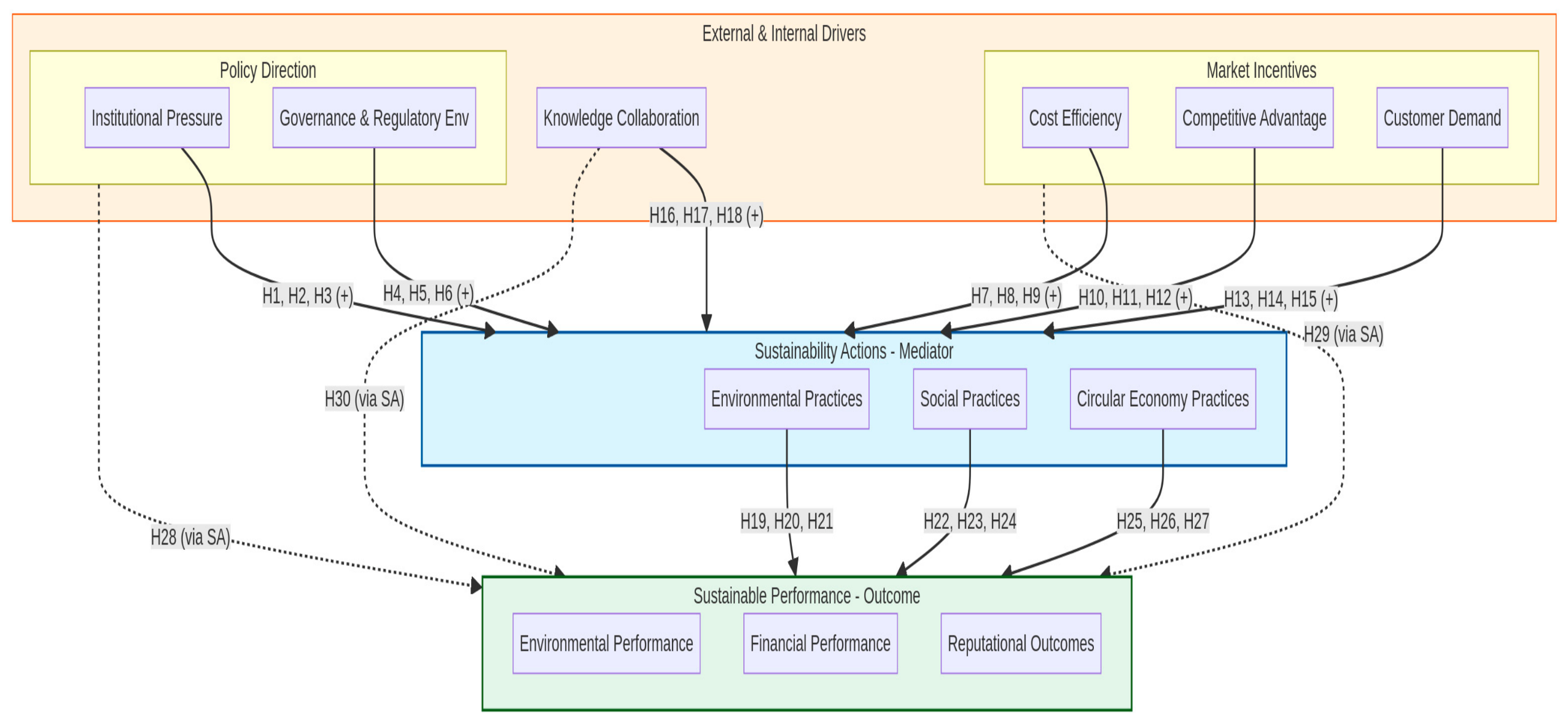
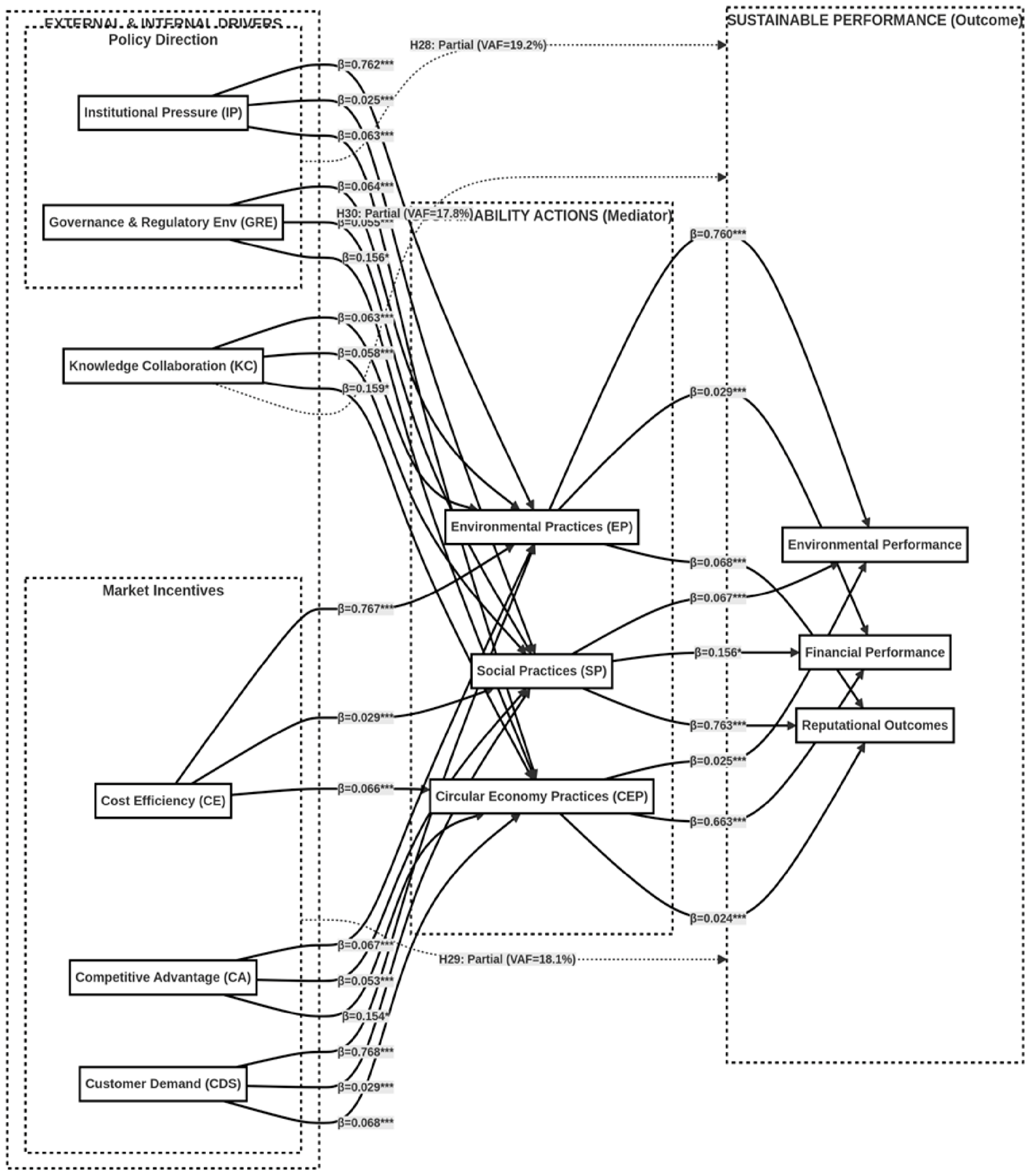
| H1 | IP → EP | 0.762 | 0.001 | 3.308 | 0.713 | 0.811 | 1.176 | √ |
| H2 | IP → SP | 0.025 | 0.000 | 4.209 | 0.015 | 0.064 | 0.002 | √ |
| H3 | IP → CEP | 0.063 | 0.001 | 3.225 | 0.026 | 0.107 | 0.011 | √ |
| H4 | GRE → EP | 0.064 | 0.001 | 1.216 | 0.071 | 0.017 | 0.139 | √ |
| H5 | GRE → SP | 0.055 | 0.001 | 5.662 | 0.199 | 0.099 | 0.001 | √ |
| H6 | GRE→CEP | 0.156 | 0.016 | 2.371 | 0.284 | 0.027 | 0.054 | √ |
| H7 | CE → EP | 0.767 | 0.001 | 3.308 | 0.713 | 0.811 | 1.160 | √ |
| H8 | CE → SP | 0.029 | 0.000 | 4.209 | 0.015 | 0.064 | 0.023 | √ |
| H9 | CE → CEP | 0.066 | 0.001 | 3.225 | 0.026 | 0.107 | 0.014 | √ |
| H10 | CA → EP | 0.067 | 0.001 | 1.216 | 0.071 | 0.017 | 0.138 | √ |
| H11 | CA → SP | 0.053 | 0.001 | 5.662 | 0.199 | 0.099 | 0.021 | √ |
| H12 | CA → CEP | 0.154 | 0.016 | 2.378 | 0.284 | 0.027 | 0.056 | √ |
| H13 | CDS → EP | 0.768 | 0.001 | 3.300 | 0.713 | 0.811 | 1.178 | √ |
| H14 | CDS → SP | 0.029 | 0.000 | 4.205 | 0.015 | 0.064 | 0.019 | √ |
| H15 | CDS → CEP | 0.068 | 0.001 | 3.220 | 0.026 | 0.107 | 0.018 | √ |
| H16 | KC → EP | 0.063 | 0.001 | 1.219 | 0.071 | 0.017 | 0.138 | √ |
| H17 | KC → SP | 0.058 | 0.001 | 5.660 | 0.199 | 0.099 | 0.077 | √ |
| H18 | KC → CEP | 0.159 | 0.016 | 2.379 | 0.284 | 0.027 | 0.066 | √ |
| H19 | EP → environmental performance | 0.760 | 0.001 | 3.307 | 0.713 | 0.811 | 1.179 | √ |
| H20 | EP → FP | 0.029 | 0.000 | 4.208 | 0.015 | 0.064 | 0.082 | √ |
| H21 | EP → RO | 0.068 | 0.001 | 3.227 | 0.026 | 0.107 | 0.078 | √ |
| H22 | SP → environmental performance | 0.067 | 0.001 | 1.219 | 0.071 | 0.017 | 0.146 | √ |
| H23 | SP → FP | 0.156 | 0.016 | 2.378 | 0.284 | 0.027 | 0.050 | √ |
| H24 | SP → RO | 0.763 | 0.001 | 3.307 | 0.713 | 0.811 | 1.178 | √ |
| H25 | CEP → EP | 0.025 | 0.000 | 4.206 | 0.015 | 0.064 | 0.085 | √ |
| H26 | CEP → FP | 0.663 | 0.001 | 3.305 | 0.713 | 0.811 | 1.177 | √ |
| H27 | CEP → RO | 0.024 | 0.000 | 4.204 | 0.015 | 0.064 | 0.081 | √ |
| H | Path | Direct Effect (Z-Value) | Indirect Effect (Z-Value) | Total Impact | VAF (%) | Decision | Full Model |
|---|---|---|---|---|---|---|---|
| H28 | PD → SA → sustainable performance | 0.761 (30.32) | 0.083 * (11.42) | 0.842 | 19.21 | Partial mediation | Support |
| H29 | MI → SA → sustainable performance | 0.024 (1.21) | 0.040 * (3.81) | 0.145 | 18.12 | Partial | Support |
| H30 | KC → SA → sustainable performance | 0.067 (3.23) | 0.018 * (2.31) | 0.085 | 17.81 | Partial | Support |
| Hypothesized Path | Group Comparison | Path Difference | p-Value | Significance | Interpretation |
|---|---|---|---|---|---|
| MI → SA | Large vs. small firms | 0.112 | 0.041 | Significant | Larger firms respond more strongly to MI |
| PD → SA | High vs. low regulatory exposure | 0.039 | 0.218 | Not significant | Relationship consistent across groups |
| KC → SA | High vs. low collaboration intensity | 0.054 | 0.089 | Marginal | KC effects slightly stronger in high-network firms |
| SA → sustainable performance | Large vs. small firms | 0.027 | 0.301 | Not significant | SA influence outcomes similarly |
| CEP → sustainable performance | Hotels vs. restaurants | 0.063 | 0.057 | Marginal | CEP practices more impactful in hotel operations |
| EP → sustainable performance | High vs. low experience firms | 0.016 | 0.346 | Not significant | Stability of EP effects |
| Stakeholder Group | Strategic Recommendation | Priority | Key Actions | Expected Outcome |
|---|---|---|---|---|
| Hotel & Hospitality Managers | Implement energy efficiency, water conservation, and waste reduction programs that generate measurable cost savings while building green brand equity. | Immediate | H7–H12 confirm CE and CA positively affect EP, SP, and CEP [40,41] | Reduced operational costs; enhanced CA; improved FP and RO |
| Actively promote sustainability credentials through third-party certifications and transparent communication to attract sustainability-conscious travelers. | Immediate | H13–H15 confirm CDS drives EP and SP [42] | Increased occupancy among eco-conscious segments | |
| Develop internal knowledge-sharing systems and cross-functional teams to translate external driver signals into implemented sustainability practices. | Immediate | H28–H30 confirm SAs mediate model drivers–performance relationships [24,67] | Stronger translation of PD and MI drivers into performance outcomes | |
| Policymakers & Regulatory Bodies | Maintain and strengthen Vision 2030’s regulatory architecture while adding technical assistance and capacity-building programs for smaller firms. | Long-term | H1–H6 validate IP and governance effects on SA [38,39]; MGA shows larger firms respond more strongly to MIs | Broad-based sustainability adoption across firm sizes |
| Establish government-sponsored industry–academia partnerships and innovation clusters to accelerate circular economy adoption. | Long-term | H18 confirms KC positively affects CEP [24] | Accelerated transition to circular models; localized sustainability innovations | |
| Destination Management Organizations | Create structured knowledge-exchange platforms, benchmarking systems, and collaborative training programs for peer learning. | Short-term | H16–H18 confirm KC drives SA [45,61] | Enhanced collective capability; diffusion of best practices across the sector |
| Develop sub-sector-specific guidance and toolkits for hotels, restaurants, and eco-tourism ventures based on contextual contingencies. | Long-term | MGA shows marginal difference for circular practices in hotels vs. restaurants (CEP → sustainable performance, difference = 0.063, p = 0.057) [52] | More relevant and effective sustainability orientation | |
| Investors & Financial Institutions | Direct capital toward firms with verified environmental practices, social practices, and CEPs; develop green finance products with preferential rates. | Immediate | H20, H23, H26 confirm positive links between SA and FP; H21, H24 confirm reputational benefits [43,45] | Improved risk-adjusted returns; enhanced brand value of portfolio firms |
| Academic & Research Institutions | Conduct-applied, context-specific research on sustainability solutions tailored to Saudi Arabia’s tourism sub-sectors, including religious, leisure, and eco-tourism segments. | Immediate | Dynamic capabilities theory underpinning KC construct [24,28] | Evidence-based guidance for managers and policymakers; localized knowledge generation |
| Industry Associations | Facilitate collaborative governance initiatives that bring together government, firms, and civil society to co-create sustainability standards and reporting frameworks. | Long-term | Stakeholder theory grounding for SP and RO [42,109] | Shared sustainability norms; enhanced stakeholder trust and legitimacy |
Disclaimer/Publisher’s Note: The statements, opinions and data contained in all publications are solely those of the individual author(s) and contributor(s) and not of MDPI and/or the editor(s). MDPI and/or the editor(s) disclaim responsibility for any injury to people or property resulting from any ideas, methods, instructions or products referred to in the content. |
© 2026 by the authors. Licensee MDPI, Basel, Switzerland. This article is an open access article distributed under the terms and conditions of the Creative Commons Attribution (CC BY) license.
Share and Cite
Zaki, K.; Elnagar, A.K.; Salama, W.M.E.; Suliman, M.A.; Abdel Ghani, T.M.; Raslan, A. Developing a Hybrid Conceptual Framework for Sustainability Transitions in Tourism and Hospitality: Evidence from the Saudi Arabia Vision. Sustainability 2026, 18, 5724. https://doi.org/10.3390/su18115724
Zaki K, Elnagar AK, Salama WME, Suliman MA, Abdel Ghani TM, Raslan A. Developing a Hybrid Conceptual Framework for Sustainability Transitions in Tourism and Hospitality: Evidence from the Saudi Arabia Vision. Sustainability. 2026; 18(11):5724. https://doi.org/10.3390/su18115724
Chicago/Turabian StyleZaki, Karam, Ahmed K. Elnagar, Wagih M. E. Salama, Mohamed Ahmed Suliman, Tamer Mohamed Abdel Ghani, and Alaa Raslan. 2026. "Developing a Hybrid Conceptual Framework for Sustainability Transitions in Tourism and Hospitality: Evidence from the Saudi Arabia Vision" Sustainability 18, no. 11: 5724. https://doi.org/10.3390/su18115724
APA StyleZaki, K., Elnagar, A. K., Salama, W. M. E., Suliman, M. A., Abdel Ghani, T. M., & Raslan, A. (2026). Developing a Hybrid Conceptual Framework for Sustainability Transitions in Tourism and Hospitality: Evidence from the Saudi Arabia Vision. Sustainability, 18(11), 5724. https://doi.org/10.3390/su18115724