Article

The Impact of Low-Carbon Transition on Accounting Conservatism of High-Carbon-Emission Enterprises: Evidence from China


School of Economics and Management, Shanghai Maritime University, Shanghai 201306, China
*
Author to whom correspondence should be addressed.
Sustainability 2026, 18(11), 5638; https://doi.org/10.3390/su18115638
Submission received: 5 May 2026 / Revised: 26 May 2026 / Accepted: 28 May 2026 / Published: 2 June 2026

Abstract

As climate change challenges intensify, the low-carbon transition has emerged as a fundamental structural transformation reshaping the global economic system and promoting sustainable development. In China, the “Dual Carbon” goals announced in September 2020 represent a landmark policy shift that imposes substantial environmental and regulatory pressure on high-carbon-emission enterprises. Against this backdrop, understanding how firms are adjusting their financial reporting practices to align with the low-carbon transition holds considerable significance for fostering their long-term sustainable development. Unlike previous studies that primarily attributed accounting conservatism to firm-specific risks or general economic uncertainty, this paper views the low-carbon transition as a structural institutional shock that reshapes firms’ external governance environment and information conditions, thereby offering a policy-driven explanation for accounting conservatism. Analysis using the Difference-in-differences method demonstrates that the low-carbon transition significantly enhances accounting conservatism among these enterprises (coefficient = 0.008, t = 4.13). Furthermore, mechanism analysis reveals that the low-carbon transition increases accounting conservatism through financing constraints and media attention. Heterogeneity analysis further indicates that the relationship between the low-carbon transition and accounting conservatism is more pronounced in non-state-owned enterprises, firms located in the eastern region, those facing intense industry competition, and companies with low levels of green innovation. Overall, the findings suggest that accounting conservatism is shaped not only by firm-level factors but also by large-scale institutional and policy transitions. By emphasizing that environmental regulation is a structural determinant of financial reporting behavior, this study extends the accounting conservatism literature. Furthermore, it demonstrates that improving financial reporting quality and risk identification capabilities enhances firms’ ability to address the challenges of the low-carbon transition, thereby fostering their long-term sustainable development.

1. Introduction

Since the Industrial Revolution, a surge in greenhouse gas emissions has led to global warming. The negative impacts of this warming on natural ecosystems and socioeconomic development are causing growing concern. An IPCC report warns that without control, global temperature increases could exceed 3 °C by the end of this century, potentially triggering irreversible ecological disasters. To address this global challenge, the international community adopted the Paris Agreement in 2015. Concurrently, China explicitly established the strategic goal of “peak carbon dioxide emissions by 2030 and strive to achieve carbon neutrality by 2060” (the “Dual Carbon” goals) in 2020. Following the 2024 issuance of the 2024 “Corporate Sustainability Disclosure Guidelines—Basic Guidelines (Trial)”, China has institutionalized the green and low-carbon transition as a national strategy and mandated that companies quantitatively disclose the financial impacts of climate-related risks. Consequently, the global economic system is undergoing structural and institutional reforms centered on transitioning to a low-carbon economy, and how firms can address climate risks by improving financial information quality is increasingly becoming a key issue in achieving long-term sustainable development.
Against this backdrop, enterprises—especially high-carbon-emission enterprises—are facing unprecedented pressure to transition and take responsibility for carbon information disclosure. As pillars of the national economy, high-carbon industries such as petrochemicals, steel, and non-ferrous metals play a crucial role, and the success of their transition directly impacts the achievement of the “Dual Carbon” goals [1]. However, the transition process is accompanied by multiple practical difficulties: massive capital investments and long payback periods squeeze short-term profits [2]; the internalization of carbon costs and compliance requirements increases operating expenses and regulatory burdens [3]; and shifts in consumer preferences, coupled with the reduction in fiscal subsidies, further intensify financial pressure and public scrutiny [4]. These challenges essentially reflect the dual pressures stemming from tighter corporate financing constraints and stronger external oversight. Enterprises must endure the immediate pains of transition while simultaneously building momentum for future competitiveness. Inevitably, such compounded pressures flow from business activities into financial standing, emerging as shifts in how assets, liabilities, and revenue are recognized within financial reports. This raises the central research question of this paper: Does the low-carbon transition affect the accounting conservatism of high-carbon-emission firms, and if so, how? This issue concerns not only adjustments to corporate financial reporting practices but also firms’ long-term sustainability within the context of the low-carbon transition.
Scholars have extensively explored the economic repercussions of the shift toward a low-carbon economy, with existing research falling into macro and micro perspectives, but research directly examining how the low-carbon transition affects corporate accounting conservatism remains limited. At the macro level, studies generally confirm that low-carbon policies positively influence regional innovation and industrial advancement [5]. However, it also notes potential issues, such as labor distribution imbalances that these policies may trigger [6]. At the micro level, the promotion theory based on the Porter Hypothesis argues that appropriately designed environmental regulations can enhance corporate competitiveness through innovation offsets and may even lower financing costs [7,8]. In contrast, the “cost theory” emphasizes the short-term pains of transition. It points out that carbon risks exacerbate operational and financial risks for firms, leading to performance decline and financing difficulties [9,10]. These differences highlight the dual nature of the low-carbon transition’s impact on businesses and provide a starting point for this paper’s exploration of its influence on corporate financial decision-making. At the same time, research on accounting conservatism has primarily focused on factors such as debt covenants, agency conflicts, and external oversight [11,12,13]. Studies have found that accounting conservatism can enhance investment efficiency, reduce financing costs, and mitigate operational risks [14,15]. A few studies have begun to examine the impact of climate risk on corporate accounting behavior. Still, the conclusions are inconsistent: some scholars argue that climate risk prompts firms to adopt more conservative accounting policies [16]. In contrast, other studies suggest that managers may reduce accounting conservatism to maintain market expectations or highlight long-term value [17,18]. Overall, while existing research has separately examined the economic consequences of low-carbon transition and the determinants of accounting conservatism, the link between the two has not yet been fully explored. Specifically, existing research lacks studies examining the microeconomic consequences of the low-carbon transition from the perspective of financial reporting quality, and pays little attention to the potential impact of changes in financial reporting behavior on firms’ long-term sustainable development; on the other hand, there is no consensus on the mechanisms by which the low-carbon transition affects corporate accounting conservatism. Therefore, whether the low-carbon transition alters firms’ accounting policy choices and, through which channels, it exerts its influence remains an issue worthy of further research.
Building on this foundation, our research seeks to fill a notable gap in existing scholarship by thoroughly examining how the low-carbon transition affects the accounting conservatism of carbon-intensive firms and shedding light on the fundamental factors that underpin this connection. This paper contends that the low-carbon transition is now thoroughly ingrained in the recognition and measurement procedures of business financial statements, rather than being limited to off-balance-sheet environmental information disclosure. The financing constraints and media attention brought about by the transition ultimately influence corporate accounting policy choices by altering the firm’s information environment and its contractual relationships with stakeholders. To this end, this paper employs the difference-in-differences method, treating the announcement of China’s “Dual Carbon” goals as an exogenous policy shock, to examine the causal effects of the low-carbon transition on the accounting conservatism of high-carbon-emission firms. This study selects China as its research setting primarily for the following reasons: First, as the world’s largest carbon emitter, China’s “Dual Carbon” policy objectives are highly binding and representative, providing an ideal quasi-natural experimental setting for identifying the impact of the low-carbon transition on corporate behavior. Second, China faces the dual challenges of economic development and energy conservation and emissions reduction, and its transition experience holds significant implications for other emerging economies. Third, China possesses a comprehensive industrial system and a rich sample of high-carbon industries, providing a solid data foundation for empirical research. The findings of this study are generally applicable across economies implementing carbon reduction policies; however, the specific mechanisms at play may be influenced by factors such as the maturity of capital markets, the institutional environment, and the level of media oversight. Therefore, further testing across different national institutional frameworks is necessary when applying these findings.
This study offers three principal contributions: First, it actively responds to the national “Dual Carbon” goals policy. While previous studies have primarily focused on the impact of the Kyoto Protocol and the Paris Agreement on high-carbon emitting enterprises within their own countries, this paper begins with an examination of the current state of China’s low-carbon transition, providing empirical evidence to help understand how micro-level entities in developing countries adapt to macro-level low-carbon transitions. Second, this study extends accounting conservatism research from the traditional perspectives of contracting and corporate governance into the new domain of environmental policy and corporate risk response. It reveals the critical role of financial reporting in conveying transition risks, thereby expanding the literature on accounting conservatism. Third, this study identifies and tests the dual transmission paths of financing constraints and media attention. It offers a more nuanced theoretical explanation for understanding the financial and economic consequences of corporate low-carbon transition. Furthermore, it provides a decision-making reference for regulatory authorities to refine relevant accounting standards and guide enterprises through a smooth transition.

2. Theoretical Analysis and Research Hypothesis

Low-carbon transition risks constitute a significant component of climate risks, primarily referring to the operational and financial challenges companies face as they transition to a low-carbon economy due to policy constraints, technological changes, and market shifts. Existing research has primarily focused on the economic consequences of low-carbon transition—such as its impact on corporate financing costs, investment decisions, corporate value, and operational performance [2,14,19,20,21,22]—while studies examining whether and how it affects the quality of corporate financial reporting, particularly accounting conservatism, remain relatively limited.
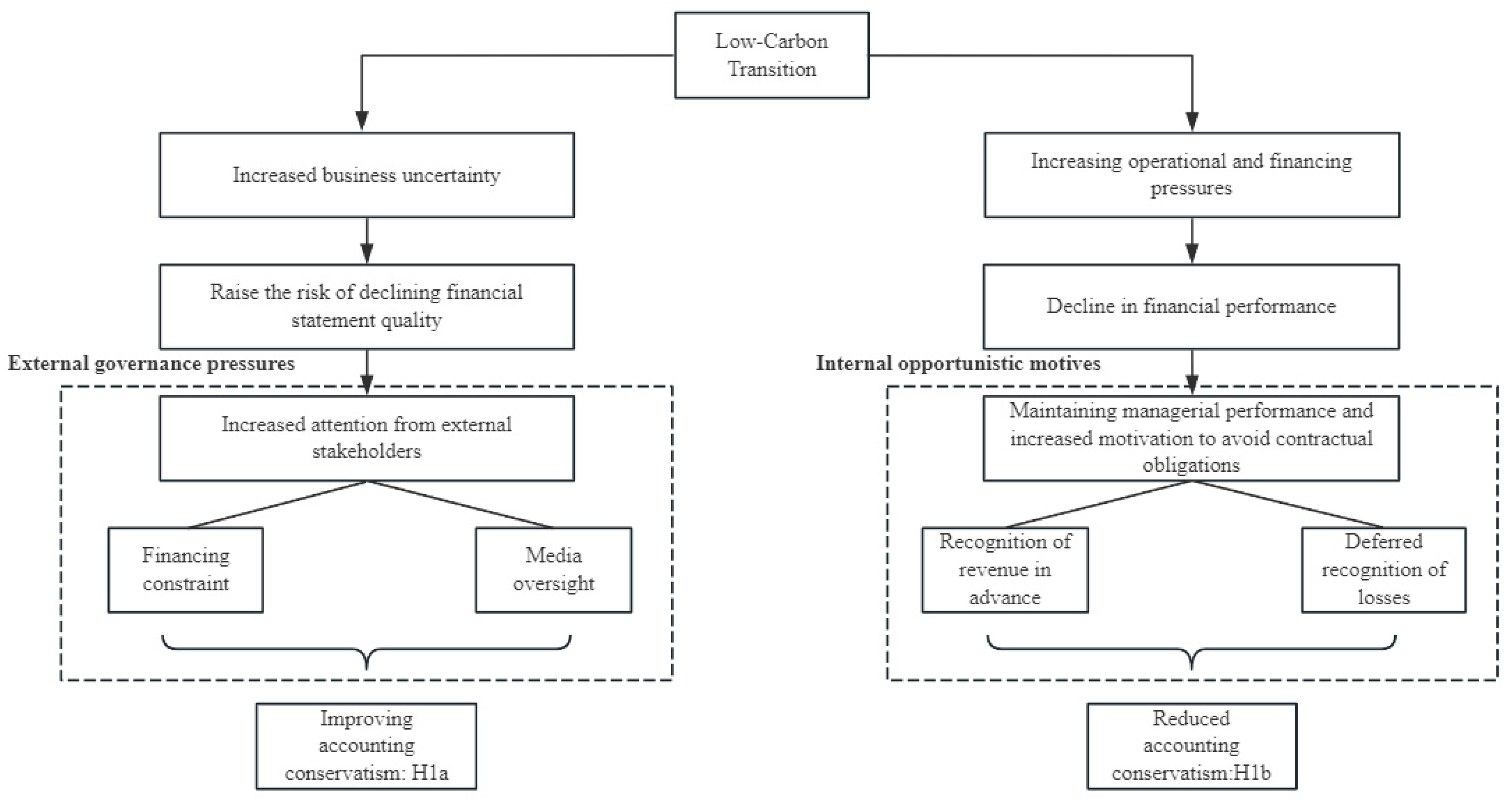
From a theoretical perspective, the impact of low-carbon transition on the accounting conservatism of high-carbon-emission firms is twofold. On the one hand, external stakeholders are particularly concerned about the decline in financial statement quality resulting from operational risks associated with low-carbon transition; they can promote firms to enhance accounting conservatism by strengthening external governance mechanisms, such as contractual arrangements, loan selection, and media oversight. On the other hand, transition risks may also induce short-term opportunistic behavior among management, thereby reducing accounting conservatism. Based on this, this paper analyzes the issue from two dimensions: “external governance pressures” and “internal opportunistic motives”, and proposes a competitive hypothesis (Figure 1).
First, from the perspective of external governance pressures, the low-carbon transition is often accompanied by high capital expenditures, costs associated with green technology R&D, and the need for adjustments to operational strategy [23,24]. At the same time, high-carbon-emission firms face greater regulatory pressure regarding carbon emissions, stranded-asset risks, and future cash-flow volatility [25,26]. These factors not only increase operational uncertainty for enterprises but also heighten the risk of financial statement misstatement and a decline in information quality. Given information asymmetry, when the risks associated with corporate transformation increase, external capital providers find it difficult to accurately assess a company’s true financial condition and prospects for transformation; consequently, they rely more heavily on accounting information to evaluate risks and protect their own interests [27,28]. According to contract theory, an increase in business risks heightens the problems of adverse selection and moral hazard faced by capital providers; therefore, creditors and investors typically mitigate potential losses through stricter contractual arrangements and governance mechanisms [11]. Specifically, the low-carbon transition increases uncertainty regarding firms’ future cash flows and asset values, leading creditors and shareholders to be more concerned that management may overestimate assets and earnings through aggressive accounting practices, thereby eroding their residual claims [29]. Accounting conservatism helps reduce information risks and agency costs in contract enforcement by recognizing losses promptly and curbing earnings overstatement, thereby protecting the interests of capital providers [30]. Consequently, capital markets often impose stricter requirements on the quality of corporate financial reporting through more rigorous debt covenant terms, more frequent disclosure requirements, and tighter financial covenants [31,32]. At the same time, in terms of loan selection mechanisms, creditors such as banks will reassess a company’s probability of default and debt-repayment capacity based on the transformation risks it faces, and will use screening methods such as credit allocation, interest rate pricing, and adjustments to credit terms to favor providing financing to companies with more robust financial reporting and more comprehensive risk disclosures [33,34,35,36]. This also means that, against the backdrop of the low-carbon transition, companies seeking to alleviate financing constraints and secure more favorable external financing terms will proactively adopt more conservative accounting recognition and measurement policies, thereby enhancing accounting conservatism [37]. Finally, from the perspective of external oversight mechanisms, as the “Dual Carbon” goals are advanced, government regulation, media scrutiny, and public attention are intensifying. Should a company be exposed for financial window-dressing, risk concealment, or “greenwashing”, it will face higher compliance costs, litigation risks, and reputational damage [20,38,39]. At the same time, information intermediaries such as auditors and analysts are paying increasing attention to corporate carbon risks and their financial implications, which further limits management’s ability to manipulate profits by exploiting information asymmetries [28]. Consequently, under the combined influence of multiple external governance forces, high-carbon-emission firms are more likely to enhance the credibility of their financial reporting, maintain trust in the capital markets, and reduce the costs of external accountability by improving accounting conservatism [36].
In summary, the operational risks arising from the low-carbon transition have led external stakeholders to express concerns about the quality of corporate financial statements. These concerns, through mechanisms such as contractual arrangements, loan selection, and media oversight, have intensified firms’ financing constraints, thereby prompting them to enhance accounting conservatism. Based on this, this paper proposes Hypothesis H1a:
H1a. 
The low-carbon transition will increase the accounting conservatism of high-carbon-emission enterprises.
Although the low-carbon transition may enhance accounting conservatism by intensifying external governance pressures, when the operational shocks and financing pressures resulting from the transition exceed what a firm can bear, short-sighted and opportunistic behavior by management often prevails, thereby undermining accounting conservatism. According to research on accounting conservatism, the selection of accounting policies depends not only on contractual requirements but also on management’s self-serving motives [11,40]. From a business perspective, during the low-carbon transition, companies often face high short-term compliance costs, technology upgrade costs, and organizational restructuring costs, which erode their profitability and significantly increase asset impairment and cash flow pressures [24,25]. For high-carbon-emission enterprises, their existing production methods, asset structures, and profit models are often deeply entrenched in high-carbon pathways, and the financial impact of the transition is typically more significant. In such circumstances, management may adopt more aggressive accounting practices—such as recognizing revenue early, delaying the recognition of impairment losses, adjusting bad debt provisions, or manipulating accruals—for the purpose of maintaining short-term performance, preserving their positions, securing stable compensation, or alleviating pressure from capital markets, thereby undermining accounting integrity [41].
From a financing perspective, the increasing pressure of financing constraints has also exacerbated this opportunistic tendency. The low-carbon transition has heightened financing constraints and made refinancing more difficult for high-carbon-emission firms. On the one hand, this may increase external capital providers’ demand for reliable accounting information; on the other hand, it may force management to rely more heavily on accounting policy flexibility to embellish their financial position to avoid triggering debt covenants or to lower barriers to external financing [17]. For example, management may temporarily mask the company’s true financial difficulties by adjusting depreciation policies, delaying the recognition of asset impairments, or reducing estimated liabilities [42,43]. At the same time, the capital markets’ focus on short-term performance and the effectiveness of corporate transformations may exacerbate management’s tendency toward short-termism, leading them to prioritize short-term survival over the quality of financial reporting [44].
In summary, the dual pressures on operations and financing stemming from the low-carbon transition weaken firms’ financial performance, thereby inducing and reinforcing opportunistic tendencies among management to maintain earnings and circumvent contractual obligations. By delaying the recognition of negative news, these firms conceal the risks associated with the transition, ultimately undermining accounting conservatism. Based on this, we propose the following Hypothesis H1b:
H1b. 
The low-carbon transition reduces accounting conservatism in high-carbon-emission enterprises.
Furthermore, these two approaches represent a theoretical tension regarding the impact of the low-carbon transition on accounting conservatism, with the outcome depending on the relative strength of external governance pressures versus management’s opportunistic motives. Given China’s institutional context, this paper anticipates that external governance mechanisms may play a stronger role. On the one hand, as the “Dual Carbon” goals have been elevated to a national strategy, regulatory authorities have continuously strengthened requirements for high-carbon enterprises on environmental information disclosure and emission-reduction responsibilities [45]. On the other hand, China’s corporate financing system remains highly dependent on bank credit, and creditors therefore place substantial reliance on the credibility and quality of firms’ financial information. Furthermore, media exposure to corporate “greenwashing” typically leads to regulatory intervention and high reputational costs, reducing the marginal benefits of pursuing short-term gains through information manipulation while substantially increasing the potential costs. Therefore, within China’s institutional context, we anticipate that external governance pressures may more effectively constrain management’s short-term opportunistic behavior, making the pathway where low-carbon transition enhances accounting conservatism (H1a) more likely to prevail.

3. Methodology

3.1. Sample and Data

The study utilizes Chinese A-share firms spanning 2015–2024 as its sample. Data preprocessing involved several steps: (1) removing observations with missing key variables; (2) excluding ST and *ST firms; (3) excluding the financial industry; (4) winsorizing continuous variables at the 1% and 99% percentiles. The final sample consisted of 4601 unique firms, yielding 28,073 firm-year observations. Variable data were obtained from the CSMAR and CNRDS databases.

3.2. Variable

3.2.1. Dependent Variable

Accounting Conservatism (CScore). Following previous research [46], we construct the C-score model to perform the calculation. The corresponding model is specified below:
EPS i , t P i , t 1 = β 0 + β 1 D i , t + β 2 R i , t + β 3 D i , t × R i , t + ε i , t
G S c o r e = β 2 = μ 0 + μ 1 S i z e + μ 2 M T B + μ 3 L E V
C S c o r e = β 3 = λ 0 + λ 1 S i z e + λ 2 M T B + λ 3 L E V
Model (1) is the Basu model. E P S i , t represents the earnings per share of company i during year t; P i , t 1 denotes the final stock price of firm i at the close of April in year t − 1; R i , t indicates the yearly stock return of company i for year t; D serves as a dummy variable that equals 1 when R i , t < 0, and 0 otherwise. In Model (1), β 2 represents the timeliness of earnings response to “good news.” β 2 + β 3 represents the timeliness of earnings response to “bad news.” β 3 captures the differential timeliness with which earnings reflect “bad news” relative to “good news.” Accounting conservatism is present if this value exceeds 0. Models (2) and (3) are extended models developed by Khan and Watts, which incorporate firm size (Size), market-to-book ratio (MTB), and leverage (LEV). By incorporating Model (2) and Model (3) into Model (1), the CScore is derived, a larger value of which signals a higher level of accounting conservatism.

3.2.2. Independent Variable

The primary independent variable centers on the “Dual Carbon” goals policy (Treat × Post). We define high-carbon-emission enterprises based on the nature of carbon emissions in their respective industries, specifically the industry’s carbon emissions and energy consumption levels. Drawing on the research by Liu et al. (2025) [47] and strictly aligning with China’s “Action Plan for Carbon Peaking by 2030”: The power, steel, non-ferrous metals, building materials, petrochemical, chemical, and construction sectors are explicitly identified as key high-carbon industries subject to national emission controls. The power sector was included in the first batch of the national carbon emissions trading market expansion plan, with subsequent phases gradually expanding to high-emission industries such as steel, cement, petrochemicals, chemicals, non-ferrous metals, and paper manufacturing. All industries listed in this paper are key targets for carbon market expansion. In summary, companies operating in the sectors listed below are deemed to have significant carbon footprints: petroleum and natural gas extraction; generation and distribution of electricity, heating, and fuel; manufacturing of metal goods; petroleum refining, coke production, and nuclear fuel fabrication; processing and rolling of ferrous metals; production of basic chemicals and chemical compounds; smelting and rolling of non-ferrous metals; manufacture of chemical fibers; production of non-metallic mineral products; construction of buildings; mining and dressing of non-ferrous metals; civil engineering projects; metal equipment, machinery maintenance; construction finishing services; extraction and preparation of non-metallic minerals; pulp and paper production; iron ore mining and metallurgy; and timber manufacturing with the creation of products from wood, bamboo, rattan, palm, and grass materials. All remaining enterprises are defined as low-carbon-emission firms. Treat serves as a dummy variable denoting treatment group membership: high-carbon-emission enterprises (treatment) take the value 1, while low-carbon-emission enterprises (control) take the value 0. Post is a time dummy capturing the implementation of the “Dual Carbon” goals, coded as 1 for years 2020 onward and 0 for years preceding 2020.

3.2.3. Control Variables

Other factors may influence how the low-carbon transition affects the accounting conservatism of companies with high carbon emissions. To address this, we refer to prior research [16,30]. This study selects the following control variables in Table 1: firm size (Size), book-to-market ratio (Bm), firm age (Age), Big Four Audit Firms (Big4), current ratio (Flowr), ownership concentration (Top1), proportion of independent directors (Idr), board size (Bds), executive shareholding (Exshare), duality of CEO and board chair (Dual), and equity multiplier (Stock).

3.3. Model Construction

To investigate how the low-carbon transition affects accounting conservatism among high-carbon-emission enterprises, the following baseline regression model is specified.
C S c o r e i , t = β 0 + β 1 T r e a t i × P o s t t + β n C o n t r o l s i , t + μ i + γ t + ε i , t
C S c o r e i , t is the dependent variable, accounting conservatism; T r e a t i × P o s t t denotes the independent variable; T r e a t i × P o s t t denotes the control variables; μ i is the firm fixed effect; γ t reflects the year fixed effect, and ε i , t is the random error component. If β 1 > 0, it means that the Treat × Post will promote accounting conservatism; otherwise, it has a negative influence. The results were clustered at the firm level.

3.4. Descriptive Statistics

Table 2 presents the descriptive statistics for the main variables used in this study. As shown, the CScore exhibits a minimum of −0.567, a maximum of 0.829, and a standard deviation of 0.118. This suggests that Chinese listed corporations differ significantly in their level of accounting conservatism. Descriptive statistics for the remaining variables all lie within reasonable ranges.

4. Results and Analysis

4.1. Baseline Regressions

In Table 3, Column (1) shows results without control variables. Once control variables are introduced, Column (2) reveals that this coefficient rises to 0.008, attaining statistical significance at the 1% level. These findings suggest that the low-carbon transition policy leads to a pronounced increase in accounting conservatism within high-carbon-emission firms, offering robust support for hypothesis H1a. It also suggests that changes in corporate accounting conservatism are influenced not only by the policy but also by other factors.

4.2. Robustness Checks

4.2.1. Parallel Trend Test

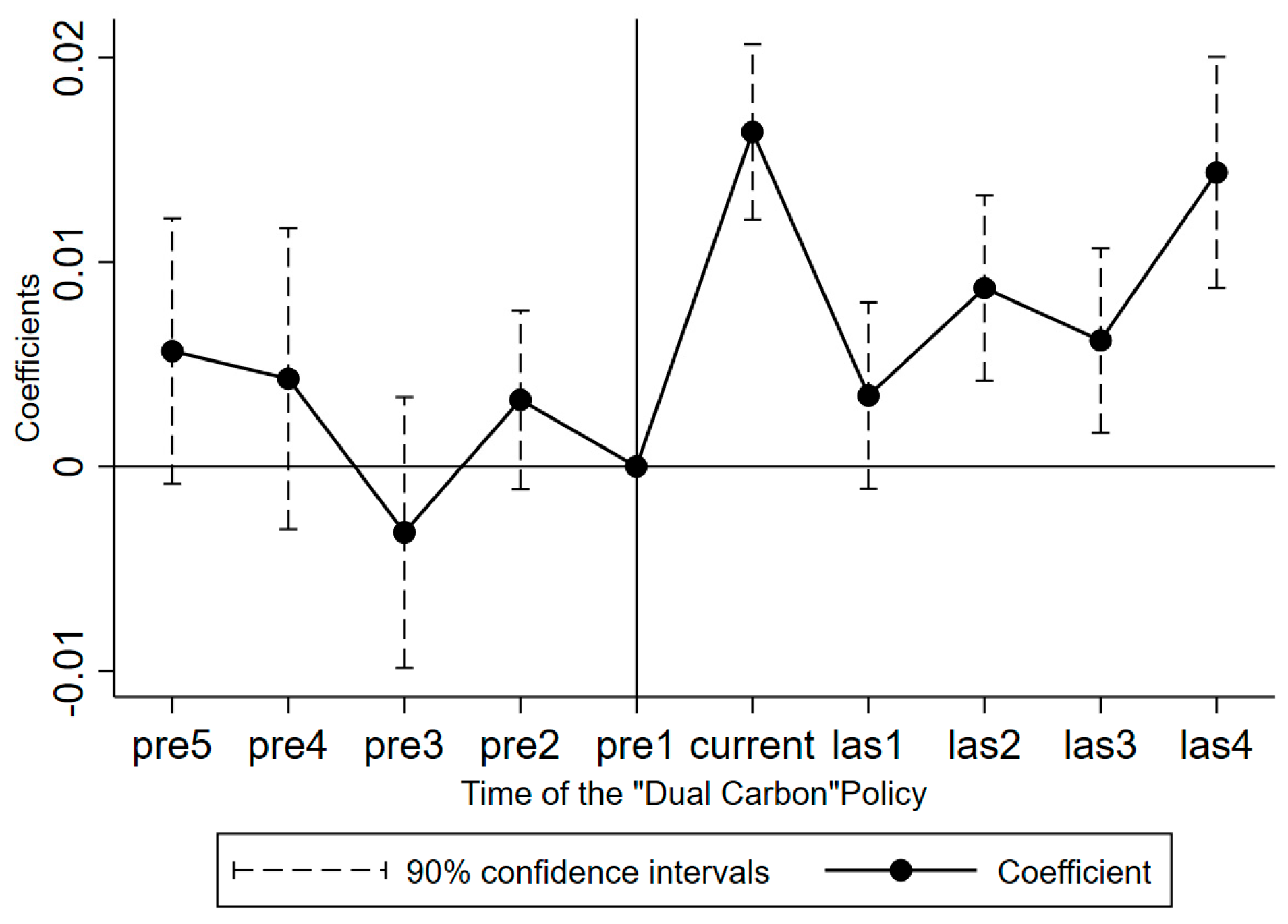
The parallel trends assumption must be met to apply a difference-in-differences model. Thus, a parallel trends test is carried out in this study. To avoid multicollinearity, the baseline year was set to one year before policy implementation. Drawing on Model (4), the regression test incorporates interaction terms between Treat and the following time indicators: the five years preceding policy implementation, the year of implementation itself, and the four subsequent years. As illustrated in Figure 2, the coefficients for the pre-policy period are not statistically significant, with their 90% confidence intervals encompassing zero, which is evidence that the parallel trends test holds.

4.2.2. Placebo Test

Time-Placebo Test
To examine whether changes in the dependent variable were caused by the implementation of other policies or the influence of firm-specific random variables, this study follows the approach in Dai et al. (2025) [48] by introducing a dummy variable for policy implementation, specifically, by setting the policy implementation date three years earlier, denoted as Treat × Post-false, and performing a regression on Equation (4). The results in Table 4 show that the estimated coefficient of Treat × Post-false fails the significance test at the 10% level. This indicates that there is no systematic difference in the time trends between firms in the treatment group and those in the control group, further confirming the reliability of the conclusion that low-carbon transition policies enhance the accounting conservatism of high-carbon-emission firms.
Spatial-Placebo Test
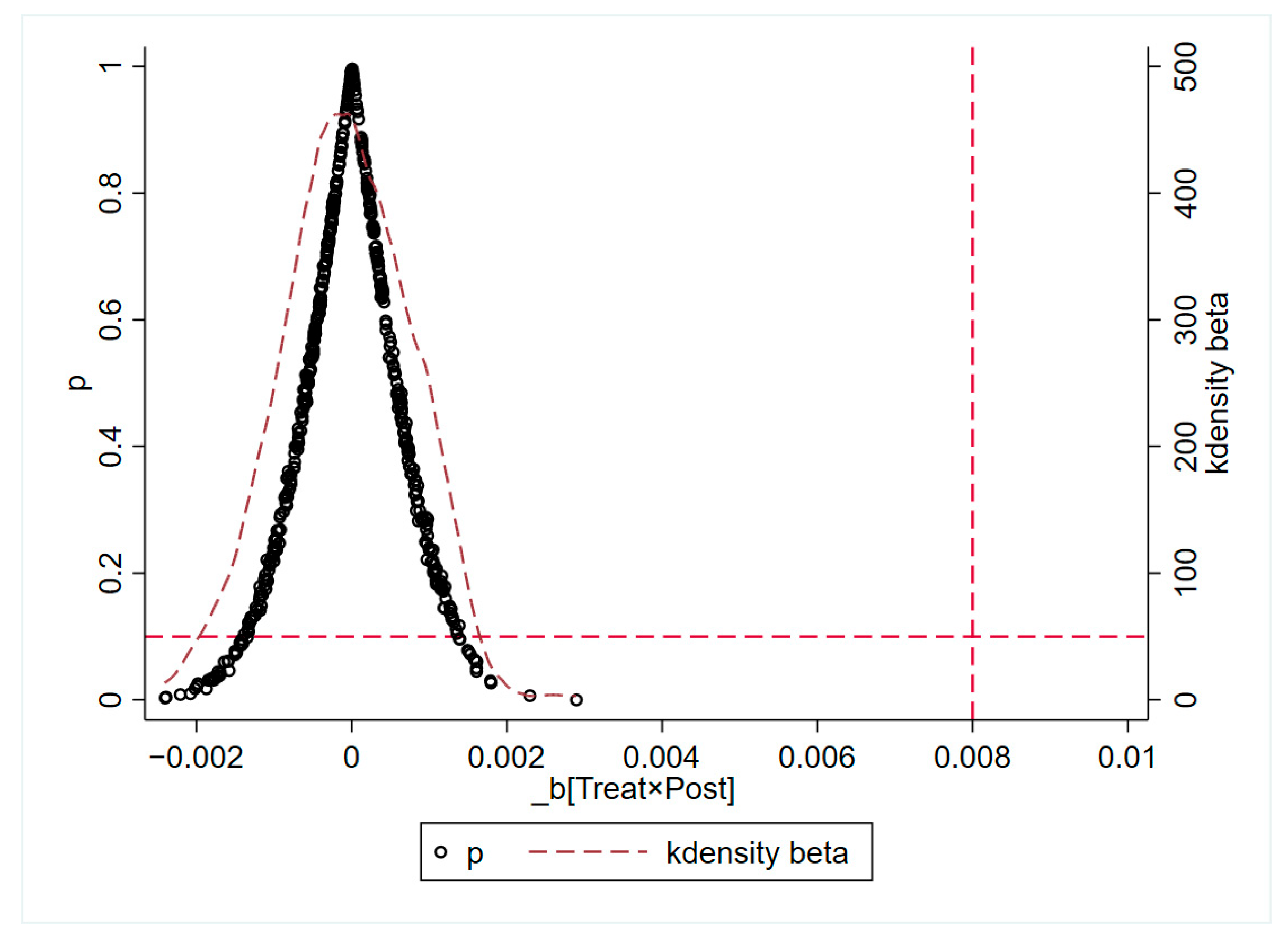
The treatment group is randomly assigned, and the regression is then carried out in accordance with Model (4), following the research methodology of earlier works [49]. After running the test 500 times, the resulting kernel density distribution is shown in Figure 3. The findings reveal that most p-values are over 0.1, while their associated coefficients tend to hover around zero. This eliminates the possibility that other policies or chance circumstances affected the study’s results, and the aforementioned research findings are still valid.

4.2.3. Alternative Accounting Conservatism Measure

In this robustness check, the dependent variable is changed from CScore to beta [50]. Table 4 shows that Treat × Post remains significantly positive when using Beta as the dependent variable at the 1% level, indicating that the core findings are unchanged. Given that China’s securities market developed relatively late, has limited market efficiency, and is susceptible to issues such as stock price asynchrony, noise trading, and insufficient information reflection, this paper further employs the accrual-cash flow model proposed by Ball and Shivakumar (2005) [51] to conduct robustness tests. The ACC is calculated as shown in Equation (5). The regression results show that the direction and significance of the coefficients for Treat × Post and ACC are consistent with the baseline results, further supporting the conclusions of this study.
A C C i , t = α 0 + α 1 D R i , t + β 0 C F O i , t + β 1 D R i , t × C F O i , t + ε i , t
In the Model (5), A C C i , t represents the total accruals for the current period; C F O i , t represents net cash flow from operating activities; D R i , t is a dummy variable that takes the value 1 when C F O i , t < 0, and 0 otherwise; β 0 reflects the relationship between accruals and positive operating cash flow; β 1 is the accounting conservatism coefficient, which measures the incremental sensitivity of accruals to negative operating cash flow relative to their sensitivity to positive operating cash flow; that is, β 1 > 0 indicates the presence of accounting conservatism.

4.2.4. Excluding the Impact of the COVID-19 Pandemic

Given that this period in 2020 coincided with the COVID-19 pandemic, which had a significant impact on corporate economic performance. To eliminate the potential confounding effects of the COVID-19 pandemic on the main regression results, this study further controls for relevant variables. Specifically, drawing on Yang and Wei (2025) [52], this study incorporates the natural logarithms of the number of new confirmed cases (Covid1) and new suspected cases (Covid2) within the firms’ cities as control variables into Model (4) for re-regression, thereby mitigating the impact of the COVID-19 pandemic on firms. As shown in Table 4, after incorporating the aforementioned control variables, the magnitude and significance level of the coefficient for the core explanatory variable (Treat × Post) remain largely consistent with the results of the main regression, indicating that the conclusions of this study are not driven by concurrent macroeconomic shocks.

4.2.5. Redefining the Criteria for Assigning Participants to Experimental and Control Groups

To address potential concerns regarding sector classification bias, we further adopt an official policy-based classification of high-carbon industries to ensure consistency with China’s carbon peaking regulatory framework. Specifically, high-carbon-emission enterprises are defined as those in the seven key emission-control sectors specified in the “Action Plan for Carbon Peaking by 2030”, namely the power, steel, non-ferrous metals, building materials, petrochemicals, chemical, and construction industries. The plan identifies these sectors as the primary targets for energy conservation, carbon reduction, and carbon emission control during the carbon peaking phase, serving as the authoritative basis for classifying high-carbon-emission industries in China. Upon re-running the regression analysis using the aforementioned high-carbon-emission-intensity industries, denoted as Treat × Post-replace, a comparison of the baseline regression results with the adjusted regression results (as shown in Column 5 of Table 4) reveals no significant changes in the signs or significance levels of the core variable coefficients; thus, the core research conclusions remain consistent.

4.3. Endogeneity Test

4.3.1. Heckman’s Two-Stage Method

To account for potential self-selection bias that could affect the estimation results, the Heckman two-stage model is employed as an additional remedy for endogeneity. Improvements in corporate ESG performance signal a firm’s heightened commitment to green technology innovation and its proactive pursuit of a green low-carbon transition [53]. Accordingly, the exogenous variable ESG performance (ESG) is introduced and used in the first-stage regression with Treat × Post. The estimated inverse Mills ratio (IMR) is then included in the baseline regression. As shown in Column (1) of Table 5, after controlling for selection bias, the main research findings remain unchanged.

4.3.2. Propensity Score Matching

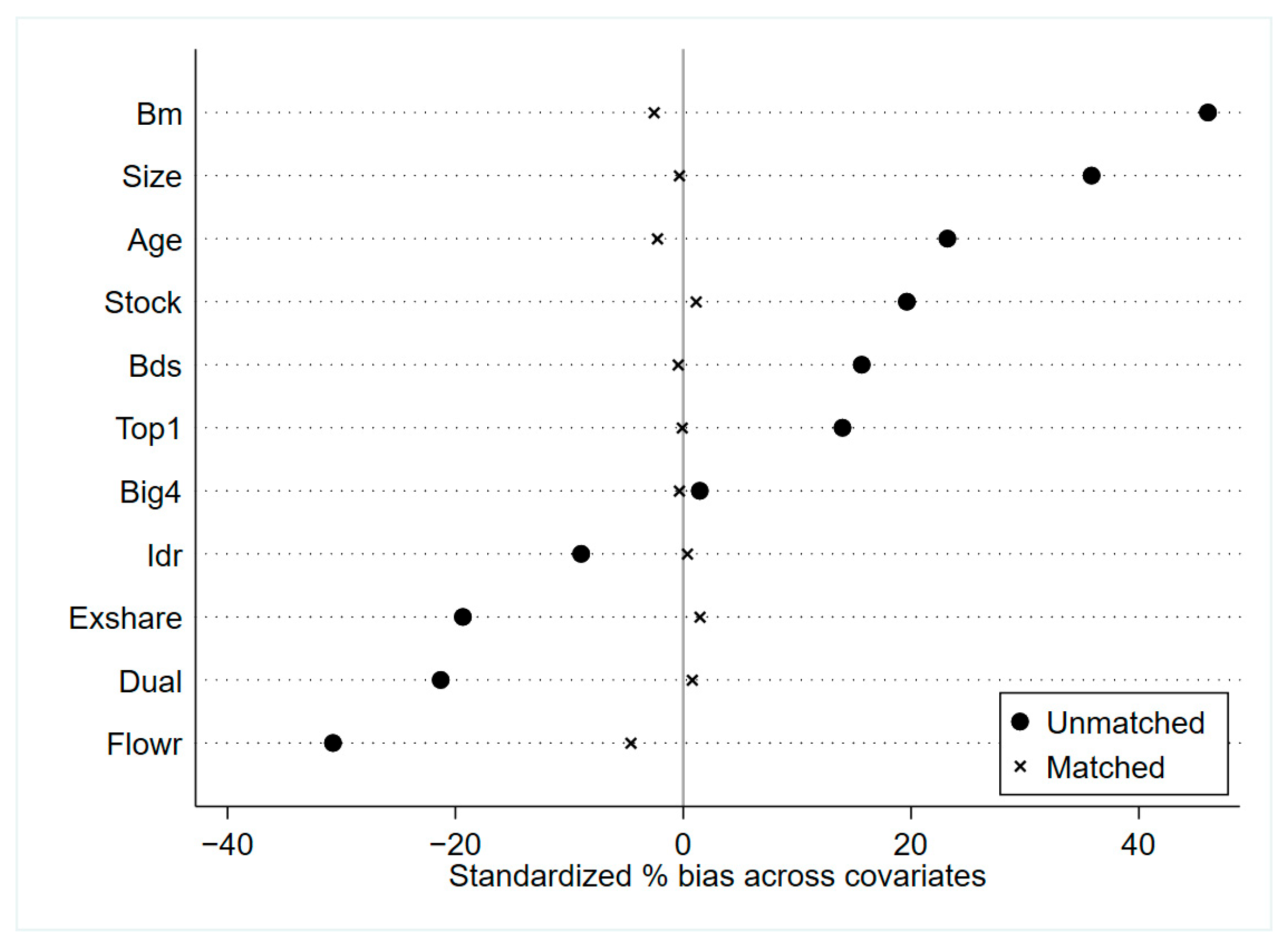
To account for the potential persistence of selection bias in the regression estimates, the propensity score matching approach is employed. Control variables drawn from Model (4) serve as covariates in the propensity score matching procedure. Propensity scores are subsequently estimated via a Logit model to facilitate matching for the treatment group. As shown in Figure 4, the standardized biases of the matched control variables are relatively small, indicating a good matching result. Based on the matched new sample, a regression analysis is conducted to examine the relationship between corporate low-carbon transition and accounting conservatism. From Column (2) of Table 5, the result shows that the low-carbon transition significantly enhances corporate accounting conservatism, reinforcing the robustness of the baseline regression model.

5. Further Analysis

5.1. Mechanism Tests

The empirical results presented earlier indicate that low-carbon transition enhances the accounting conservatism of high-carbon-emission firms. This section will examine, at the micro level, the underlying mechanisms through which low-carbon transition influences accounting conservatism in high-carbon-emission firms. As proposed in the theoretical analysis above, following the introduction of the “Dual Carbon” goals, the accounting conservatism of high-carbon-emission firms has significantly improved. Specifically, the low-carbon transition leads external stakeholders to pay greater attention to the quality of financial statements through channels such as contractual arrangements and loan selection, thereby intensifying a firm’s financing constraints. Consequently, to secure additional financing, firms enhance their accounting conservatism to signal sound corporate development to external stakeholders. Furthermore, increased media attention reduces the scope for profit manipulation, thereby enhancing accounting conservatism. With respect to financing constraints, the SA index (SA) and the cost of debt financing (Cost) are selected as proxy variables; regarding media attention (Media), the total volume of media coverage is used as a measure. Given that, in the realm of environmental responsibility, negative coverage typically reflects the media’s oversight role and environmental accountability [54], we further categorize media coverage into negative reports (Negative media) to examine whether media sentiment constitutes a differentiated transmission channel. The financing constraint indicator (SA) is constructed by the SA index approach [42], based on firm size (Size) and firm age (Age). The cost of debt financing (Cost) is calculated following Li and Liu (2021) [55], using the ratio of financial expenses to interest-bearing debt. Media attention is measured by Kong et al. (2013) [56]: Media = Ln(media coverage + 1); Negative media = Ln(negative media coverage + 1). All control variables remain identical to the baseline specification. Based on these variable specifications, this paper constructs the mediation model shown in Equation (6) for empirical testing.
M i , t = β 0 + β 1 T r e a t i × P o s t t + β n C o n t r o l s i , t + μ i + γ t + ε i , t
In Equation (6), M i , t represents the mediating variable, which is replaced successively by SA, Cost, Media, and Negative media. As shown in Columns (1)–(4) of Table 6, the interaction term (Treat × Post) exhibits a significantly positive association with both the SA index (SA), the cost of debt financing (Cost), media attention (Media), and negative media coverage (Negative media). These findings indicate that the low-carbon transition leads to notable increases in financing constraints and media attention, thereby high-carbon-emission enterprises reinforce accounting conservatism. These findings empirically validate our hypothesized transmission mechanisms.

5.2. Heterogeneity Analysis

5.2.1. Nature of Property Rights

To explore how the low-carbon transition differentially affects accounting conservatism across property rights structures, the sample is divided into state-owned and non-state-owned enterprises based on the grouping variable Soe. Table 7 displays the results of group regressions. Within China’s institutional framework, state-owned enterprises (SOEs) are effectively controlled by the central or local governments. While driving economic growth, SOEs also shoulder greater social responsibilities and face the issue of “soft budget constraints” [57]. They typically receive priority access to implicit government guarantees, such as subsidies for low-carbon transition and support for green projects, and their external financing capabilities are constrained by market forces to a lesser extent. Consequently, they possess inherent advantages in access to resources and policy support. Therefore, the marginal incentive effect of low-carbon transition policies on the accounting conservatism of SOEs is relatively limited. In contrast, non-state-owned enterprises lack implicit government guarantees and face stronger financing constraints and market competition pressures. As an important external regulatory signal, low-carbon transition policies not only raise environmental responsibility requirements but also intensify the capital market’s focus on corporate information quality and risk management capabilities. Against this backdrop, non-state-owned enterprises have a stronger incentive to improve accounting conservatism to mitigate information asymmetry and enhance the trust of external investors and creditors, thereby improving financing conditions and resource acquisition capabilities to adapt to the compliance requirements and market competition of the low-carbon transition. Furthermore, differences in regulatory enforcement and policy implementation amplify these ownership-based disparities. Macroeconomic policies such as credit tightening, environmental inspections, and industrial regulation are often enforced more strictly among non-state-owned enterprises. In contrast, state-owned enterprises are more likely to receive coordination and protection from local governments or be granted exemptions from enforcement. This “selective enforcement” results in systematic differences in the intensity with which identical policy shocks are transmitted across enterprises of different ownership types, thereby reinforcing the intrinsic motivation of non-state-owned enterprises to enhance accounting conservatism as a means of coping with external uncertainty.

5.2.2. Industry Competition Intensity

Consistent with prior approaches [47], the Herfindahl–Hirschman Index (HHI) serves as a proxy for industry competition intensity. Using the median HHI as the cutoff, the sample is divided into industries with high and low competitiveness. In Table 7, the reported regression results indicate that the effect of the low-carbon transition policy on corporate accounting conservatism is insignificant in less competitive industries; however, a significant positive effect emerges among firms operating in highly competitive environments.
Firms operating in highly competitive industries confront intensified market pressures and heightened survival challenges, and the low-carbon transition policy introduces additional external uncertainty. Such firms are consequently more inclined to strengthen the quality of information disclosure and mitigate risks through greater accounting conservatism, aiming to preserve or bolster market standing and competitive edge. By contrast, enterprises situated in less competitive industries typically enjoy more stable market positions and encounter fewer external pressures. Their responsiveness and adaptability to the policy remain relatively subdued, resulting in no substantial shift in accounting conservatism following the low-carbon transition.

5.2.3. Regional Differences

There are significant regional differences in China’s economic development, financial resource allocation, and policy implementation capacity; consequently, corporate responses to the “Dual Carbon” goals may also vary. Following the regional classification framework established by China’s National Bureau of Statistics, the sample is divided into two groups according to firm registration location. The Eastern region includes Beijing, Tianjin, Shanghai, Jiangsu, Zhejiang, Fujian, Shandong, Guangdong, and Hainan. At the same time, the Western territory covers Chongqing, Sichuan, Guizhou, Yunnan, Tibet, Shanxi, Gansu, Qinghai, Ningxia, Xinjiang, Inner Mongolia, and Guangxi. Separate regression analyses are run for each of these two regional groups.
As shown by the results of the regional regression analysis in Table 8, there are significant regional differences in the impact of low-carbon transition policies on corporate accounting conservatism. In the eastern region, the low-carbon transition has a significant positive impact on corporate accounting conservatism. This may be because the eastern region generally has a more mature financial resource allocation system, a more developed information intermediation environment, and more effective regulatory mechanisms, which facilitate the transmission of low-carbon transition policies to the corporate level through financing constraints, disclosure requirements, and external oversight channels, thereby promoting improvements in accounting conservatism. Conversely, in the western region, owing to disparities in financial resource allocation efficiency, information environment quality, and policy implementation capacity, policy signals may encounter frictions in their transmission to corporate behavior, such that policy effects are not fully realized.

5.2.4. Level of Green Innovation

For high-carbon-emission enterprises, actively pursuing technological advancements, such as clean energy research and development, is a crucial path to the low-carbon transition. Leveraging technological advantages, firms with strong green innovation capabilities can initiate the low-carbon transition at an earlier stage following the announcement of the “Dual Carbon” goals. On the other hand, by conveying to society and investors a positive signal that the enterprise actively fulfills its social responsibilities and responds to national low-carbon environmental policies, the motivation for the enterprise to enhance accounting conservatism to secure external investment is reduced. To capture the extent of corporate green innovation, we employ Ln (green invention patent count + 1) as a proxy indicator [58]. Drawing upon the median as our dividing line, the sample is split into two subgroups: those with high versus low levels of green innovation. Regression results presented in Columns (3)–(4) of Table 8 reveal that the coefficient for the interaction term Treat × Post is significantly positive only for firms with lower green innovation intensity, a pattern not mirrored among those with high green innovation.

6. Conclusions

This paper examines in depth whether and how the low-carbon transition affects the accounting conservatism of high-carbon-emission firms. Based on data from A-share-listed companies on the Shanghai and Shenzhen stock exchanges from 2015 to 2024, this study uses the announcement of China’s “Dual Carbon” goals as an exogenous event and employs a difference-in-differences approach for analysis. The findings reveal that the low-carbon transition significantly enhances the accounting conservatism of high-carbon-emission firms, a conclusion that holds across various robustness tests. Mechanism analysis indicates that increased financing constraints and heightened media attention serve as the transmission channels for these effects. Heterogeneity analysis reveals that this positive effect is more pronounced among non-state-owned enterprises, firms in the eastern region, those operating in highly competitive industries, and companies with lower levels of green innovation.
The core contributions of this paper are as follows: First, this study extends research on accounting conservatism from traditional perspectives grounded in agency theory and corporate governance into the novel domain of macro-level structural policy shocks associated with the low-carbon transition; second, this study identifies and empirically validates the dual transmission mechanism through which financing constraints and media attention operate; and third, using China as a case study, this study provides empirical evidence regarding how micro-level agents in emerging economies adapt to macro-level low-carbon transitions.
Several practical implications emerge from the findings of this study. First, to enhance the accounting conservatism of high-carbon-emission enterprises, regulators should establish more comprehensive climate-related financial disclosure rules that explicitly require companies to quantitatively disclose the following information in their financial statements: asset impairment risks (such as the recoverable amount and impairment losses of production equipment and specialized facilities), compliance costs (such as expenditures on carbon allowances, carbon taxes, environmental fines, and investments in green technological upgrades), exposure to stranded assets (such as the carrying value, remaining useful life, and estimated losses of fossil fuel-related assets that may be scrapped prematurely), and contingent liabilities (such as obligations related to land remediation and equipment dismantling). Second, corporate management should proactively strengthen carbon risk management and adopt more transparent and robust accounting practices. Specifically: regarding accounting policy selection, they should improve the timeliness of recognizing adverse events and avoid delaying the recognition of asset impairment losses or underestimating contingent liabilities to smooth profits; regarding disclosure, they should provide detailed explanations in the notes to the financial statements regarding the assumptions underlying the low-carbon transition, the sources of estimation uncertainty, and their potential impact on assets, liabilities, and profit or loss; In terms of strategic communication, robust financial reporting should serve as a key signal to stakeholders of the company’s commitment to and capacity for transformation, thereby transforming short-term financial pressures into long-term reputational capital that promotes sustainable development. Investors should monitor changes in the accounting conservatism of high-carbon companies and use this as a key reference for assessing their climate risk exposure and the quality of their risk management.
This study also has some limitations, which simultaneously point the way for future research. First, this study focuses solely on the impact of individual policies related to the “Dual Carbon” goals on accounting conservatism, which makes it difficult to fully rule out confounding effects from other concurrent policies (such as green finance policies) or changes in the macroeconomic environment. Future research could explore the interactions among multiple policies to more comprehensively assess the combined impact of policy portfolios. Second, this study focuses on Chinese A-share listed companies. Given that China is the world’s largest carbon emitter and a developing country, its institutional environment—namely, its bank-dominated financing system and substantial proportion of state-owned enterprises—is likely to differ from that of developed economies. Future research could adopt a cross-country comparative design to test the external validity of this study’s findings across different institutional contexts. Finally, this study focuses on accounting conservatism as a financial reporting characteristic. The low-carbon transition may also affect earnings management, transparency of information disclosure, and the quality of environmental reporting. Future research could broaden the scope of analysis to more comprehensively assess the impact of the low-carbon transition on the overall quality of corporate accounting information.

Author Contributions

Conceptualization, G.L. and S.S.; Data curation, S.S.; Writing—original draft, S.S. All authors have read and agreed to the published version of the manuscript.

Funding

This research received no external funding.

Institutional Review Board Statement

Not applicable.

Informed Consent Statement

Not applicable.

Data Availability Statement

The data used to support the findings of this study are available from the corresponding author upon request.

Conflicts of Interest

The authors declare no conflicts of interest.

References

  1. Shao, Y.; Deng, T.; Cheng, J.; Tian, W.; Ma, F. Have high-carbon companies overinvested in the transition to low-carbon operations? Gansu Financ. 2025, 68, 7–14. [Google Scholar]
  2. Li, G.; Tang, W. The Impact of Carbon Risk on Value Creation of High-Carbon-Emission Enterprises: Evidence from China. Sustainability 2025, 17, 9107. [Google Scholar] [CrossRef]
  3. Long, W.; Qu, X.; Yin, S. How Does Carbon Emissions Trading Policy Affect Accrued Earnings Management in Corporations? Evidence from China. Financ. Res. Lett. 2023, 55, 103840. [Google Scholar] [CrossRef]
  4. Li, J.; Gao, L.; Hu, X.; Jia, J.; Wang, S. Effects of Personal Carbon Trading Scheme on Consumers’ New Energy Vehicles Replacement Decision: An Economic Trade-off Analysis. Environ. Impact Assess. Rev. 2023, 101, 107108. [Google Scholar] [CrossRef]
  5. Acemoglu, D.; Aghion, P.; Bursztyn, L.; Hemous, D. The Environment and Directed Technical Change. Am. Econ. Rev. 2012, 102, 131–166. [Google Scholar] [CrossRef] [PubMed]
  6. Wang, C.; Wang, B.; Vu, T.N.A.; Xu, S.; Song, W.; Wang, Z.; Li, Z. Quantifying Inequalities in the Global Employment Landscape During the Low-Carbon Transition. Nexus 2026, 3, 100120. [Google Scholar] [CrossRef]
  7. Cheng, X.; Yu, Z.; Gao, J.; Liu, Y.; Jiang, S. Governance Effects of Pollution Reduction and Carbon Mitigation of Carbon Emission Trading Policy in China. Environ. Res. 2024, 252, 119074. [Google Scholar] [CrossRef]
  8. Porter, M.E.; van der Linde, C. Toward a New Conception of the Environment-Competitiveness Relationship. J. Econ. Perspect. 1995, 9, 97–118. [Google Scholar] [CrossRef]
  9. Chai, S.; Zhou, Q.; Ji, Q.; Liu, Z.; Liu, C.; Chu, W. Inhibition or Inducement? The Impact of Carbon Emissions Trading Scheme (ETS) on Corporate Earnings Management from the Perspective of Public Pressure. Int. Rev. Financ. Anal. 2025, 101, 104019. [Google Scholar] [CrossRef]
  10. Sun, H.; He, S.; Cheng, N.; Liu, Z. Climate Transition Risk and Enterprise Default Probability. Bus. Strategy Environ. 2024, 33, 8929–8945. [Google Scholar] [CrossRef]
  11. Watts, R.L. Conservatism in Accounting Part I: Explanations and Implications. Account. Horiz. 2003, 17, 207–221. [Google Scholar] [CrossRef]
  12. Lara, J.M.G.; Osma, B.G.; Penalva, F. Accounting Conservatism and Firm Investment Efficiency. J. Account. Econ. 2016, 61, 221–238. [Google Scholar] [CrossRef]
  13. Miao, Y.; Wan, T. How Does Financial Robustness Enhance the Product Market Competitiveness of New Retail Enterprises? The Moderating Role of External Supervision. Financ. Res. Lett. 2025, 85, 108091. [Google Scholar] [CrossRef]
  14. Zou, W.; Othman, A. The Impact of Accounting Conservatism on Enterprise Innovation Investment. Heliyon 2024, 10, e36106. [Google Scholar] [CrossRef]
  15. LaFond, R.; Watts, R.L. The Information Role of Conservatism. Account. Rev. 2008, 83, 447–478. [Google Scholar] [CrossRef]
  16. Ferdous, L.T.; Atawnah, N.; Yeboah, R.; Zhou, Y. Firm-Level Climate Risk and Accounting Conservatism: International Evidence. Int. Rev. Financ. Anal. 2024, 95, 103511. [Google Scholar] [CrossRef]
  17. Maha, K.; Haykel, Z. The Impact of Climate Risk on Accounting Conservatism: Evidence from Developing Countries. J. Appl. Account. Res. 2024, 25, 570–593. [Google Scholar]
  18. Li, S.; van Zijl, T.; Willett, R. The Valuation Demand for Accounting Conservatism: Evidence from Firm-Level Climate Risk Measures. China Financ. Rev. Int. 2024, 14, 694–718. [Google Scholar] [CrossRef]
  19. Gao, Y.; Saleh, N.M.; Abdullah, A.M.; Adznan, S. Corporate Climate Risk Disclosure and Financing Constraints: Evidence from China. Financ. Res. Lett. 2025, 85, 108184. [Google Scholar] [CrossRef]
  20. Liu, W.; Guo, Y.; Li, S. The Short-Term Pain and Long-Term Gain of Low-Carbon Policy for Corporate Financing. Econ. Anal. Policy 2026, 90, 834–850. [Google Scholar] [CrossRef]
  21. Shu, H.; Qi, W.; Zhou, T. Is Firms’ Low-Carbon Transition Conducive to Improving Maturity Mismatch of Investment and Financing? Borsa Istanb. Rev. 2025, 25, 1696–1704. [Google Scholar] [CrossRef]
  22. Tang, M.; Cheng, S.; Guo, W.; Ma, W.; Hu, F. Effects of Carbon Emission Trading on Companies’ Market Value: Evidence from Listed Companies in China. Atmosphere 2022, 13, 240. [Google Scholar] [CrossRef]
  23. Liu, Y.; Taghizadeh-Hesary, F.; Phoumin, H. Green Investment and Digital Innovation for a Low-Carbon Energy Transition. Sustain. Futur. 2025, 10, 101481. [Google Scholar] [CrossRef]
  24. Farrash, O.A.; Smolo, E.; Farrash, O.A.; Smolo, E. Green Investment and Corporate Profitability: Evidence from the Oil-Gas Sector in the GCC Region. Green Financ. 2025, 7, 610–633. [Google Scholar] [CrossRef]
  25. McGlade, C.; Ekins, P. The Geographical Distribution of Fossil Fuels Unused When Limiting Global Warming to 2 °C. Nature 2015, 517, 187–190. [Google Scholar] [CrossRef]
  26. Zhou, P.; Mo, L.; Tan, C.; Wu, H. Carbon Regulatory Risk Exposure in the Bond Market: A Quasi-Natural Experiment in China. China Econ. Rev. 2025, 92, 102423. [Google Scholar] [CrossRef]
  27. Yan, J.; Guo, Y.; Wen, F. Carbon Risk and the Cost of Equity Capital: Evidence from China. Int. Rev. Econ. Financ. 2025, 99, 103975. [Google Scholar] [CrossRef]
  28. Wang, H.; Ge, Y.; Du, D. Does Issuing Green Bonds Enhance Accounting Conservatism? Chin. Certif. Public Account. 2025, 7, 23–32. [Google Scholar] [CrossRef]
  29. Matsumura, E.M.; Prakash, R.; Vera-Muñoz, S.C. Firm-Value Effects of Carbon Emissions and Carbon Disclosures. Account. Rev. 2014, 89, 695–724. [Google Scholar] [CrossRef]
  30. Islam, F.; Bose, S.; Ying, S.X.; Shams, S. From Corporate Emissions to Financial Statements: Understanding Accounting Conservatism in the Wake of Carbon Risks. J. Contemp. Account. Econ. 2024, 21, 100500. [Google Scholar] [CrossRef]
  31. Ding, R.; Jacoby, G.; Liu, M.; Wang, T.; Wu, Z. Does Climate Risk Shape Firms’ Accounting Conservatism? J. Int. Financ. Mark. Inst. Money 2024, 97, 102081. [Google Scholar] [CrossRef]
  32. Yu, Z.; Luo, J.; Fan, J. Bank Loan Approval Standards and Firms’ Accounting Conservatism: Evidence from China. Res. Int. Bus. Financ. 2024, 67, 102100. [Google Scholar] [CrossRef]
  33. Ren, X.; Li, W.; Duan, K.; Urquhart, A. Carbon Risk and Debt Financing: An International Perspective. J. Int. Money Financ. 2025, 153, 103294. [Google Scholar] [CrossRef]
  34. Qiu, X.; Zhuang, Y.; Liu, X. Climate Risk and Corporate Debt Financing: Evidence from Chinese a-Share-Listed Firms. Sustainability 2025, 17, 3870. [Google Scholar] [CrossRef]
  35. Caragnano, A.; Mariani, M.; Pizzutilo, F.; Zito, M. Is It Worth Reducing GHG Emissions? Exploring the Effect on the Cost of Debt Financing. J. Environ. Manag. 2020, 270, 110860. [Google Scholar] [CrossRef]
  36. Ren, H. Sustainable development and accounting conservatism. J. Corp. Account. Financ. 2025, 36, 232–246. [Google Scholar] [CrossRef]
  37. Jadiyappa, N.; Emily Hickman, L. Creditors’ Bankruptcy Rights and Accounting Conservatism: Evidence from a Quasi-Natural Experiment. Br. Account. Rev. 2026, 58, 101574. [Google Scholar] [CrossRef]
  38. Bose, S.; Minnick, K.; Shams, S. Does Carbon Risk Matter for Corporate Acquisition Decisions? J. Corp. Financ. 2021, 70, 102058. [Google Scholar] [CrossRef]
  39. Li, G.; Li, Y. Will the Low-Carbon Transition of High-Carbon-Emission Enterprises Improve Real Earnings Management in the Context of Carbon Peaking and Carbon Neutrality Goals. Financ. Econ. Res. 2025, 40, 144–160. [Google Scholar]
  40. Kim, S.H.; An, Y. Does Economic Policy Uncertainty Affect Conservatism?: Evidence from Korea. Pac. Account. Rev. 2025, 37, 141–163. [Google Scholar] [CrossRef]
  41. Li, J.; Chen, J.; Zhang, P. Service Trade Innovation and Enterprise ESG Performance—Evidence from Listed Companies in Pilot Regions. Commer. Res. 2026, 2, 141–152. [Google Scholar] [CrossRef]
  42. Hadlock, C.J.; Pierce, J.R. New Evidence on Measuring Financial Constraints: Moving Beyond the KZ Index. Rev. Financ. Stud. 2010, 23, 1909–1940. [Google Scholar] [CrossRef]
  43. Ririmasse, D.; Tsitsianis, N.; Mitrou, E. Carbon Emissions, Carbon Reporting Channels and Corporate Debt: Evidence from Developed and Emerging Markets. Emerg. Mark. Financ. Trade 2025, 17, 101046. [Google Scholar] [CrossRef]
  44. Wu, J.; Gao, J.; Wu, F. Research on the Influence and Spatial Driving Effect of Pilot Free Trade Zone on Enterprises’ Low-carbon Transformation. Econ. Probl. 2025, 10, 119–129. [Google Scholar] [CrossRef]
  45. Zhao, Q.; Li, H. Does ESG Rating Promote Corporate Green Technology Innovation: Micro Evidence From Chinese Listed Companies. South China J. Econ. 2024, 2, 116–135. [Google Scholar] [CrossRef]
  46. Khan, M.; Watts, R.L. Estimation and Empirical Properties of a Firm-Year Measure of Accounting Conservatism. J. Account. Econ. 2009, 48, 132–150. [Google Scholar] [CrossRef]
  47. Liu, J.; Liao, Z.; Liu, T.; Geng, Y. Carbon Risk and Corporate Bankruptcy Pressure: Evidence from a Quasi-Natural Experiment Based on the Paris Agreement. Front. Environ. Sci. 2025, 13, 1537570. [Google Scholar] [CrossRef]
  48. Dai, J.; Yang, W.; Zhang, S. The Impact of Environmental Policy on the Performance of Listed Companies. J. Appl. Stat. Manag. 2025, 44, 1115–1127. [Google Scholar] [CrossRef]
  49. Xie, L.; Hui, S. Low-Carbon Transition Policy and Employment Structure: Evidence from China’s Low-Carbon City Pilot. Cities 2025, 162, 105985. [Google Scholar] [CrossRef]
  50. Basu, S. The Conservatism Principle and the Asymmetric Timeliness of Earnings1. J. Account. Econ. 1997, 24, 3–37. [Google Scholar] [CrossRef]
  51. Ball, R.; Shivakumar, L. Earnings quality in UK private firms: Comparative loss recognition timeliness. J. Account. Econ. 2005, 39, 83–128. [Google Scholar] [CrossRef]
  52. Yang, D.; Wei, X. Corporate Future Industry Layout and Audit Pricing. J. Audit Econ. 2025, 40, 52–63. [Google Scholar]
  53. Li, F.; Liu, J.; Liu, H. Institutions Empowerment for Sustainability: ESG Performance and Enterprise Green Innovation—Evidence from China. J. Environ. Manag. 2025, 388, 125947. [Google Scholar] [CrossRef]
  54. Gong, X.; Xu, X.; Xiong, X. Media sentiment and corporate risk-taking—Evidence based on machine learning and text analysis. Syst. Eng.-Theory Pract. 2024, 44, 1869–1895. [Google Scholar]
  55. Li, R.; Liu, L. Green Finance and Enterprises’ Green Innovation. Wuhan Univ. J. (Philos. Soc. Sci.) 2021, 74, 126–140. [Google Scholar] [CrossRef]
  56. Kong, D.; Liu, S.; Ying, Q. The Role of the Media in Corporate Affairs: Cleaning Up the Mess or Adding Fuel to the Fire? J. Manag. World 2013, 7, 145–162. [Google Scholar] [CrossRef]
  57. Maurel, M.; Pernet, T. New Evidence on the Soft Budget Constraint: Chinese Environmental Policy Effectiveness in SOE-Dominated Cities. Public Choice 2021, 187, 111–142. [Google Scholar] [CrossRef]
  58. Tang, X.; Wang, L.; Pan, L. Climate Risk and Adaptive Green Innovation: Evidence from China. China J. Account. Res. 2025, 18, 100446. [Google Scholar] [CrossRef]
Figure 1. Theoretical framework.
Sustainability 18 05638 g001
Figure 2. Parallel trend test.
Sustainability 18 05638 g002
Figure 3. Placebo test. Note: The dashed vertical line represents the actual estimate in column (2) of Table 3.
Sustainability 18 05638 g003
Figure 4. Balance test result.
Sustainability 18 05638 g004
Table 1. Variable definition table.
TypeVariableSymbolDefinition
Dependent variableAccounting conservatismCScoreCalculated using the C-score model developed by Khan and Watts (2009) [46]
Independent variableTreatment group dummy variableTreatIf the company is a High-carbon-emission enterprise, set to 1; otherwise, set to 0
Time dummy variablePostSet the value to 1 for the year the “Dual Carbon” goals were proposed and subsequent years; set it to 0 for earlier years
Control variablesFirm sizeSizeThe natural logarithm of the total assets of the enterprise
Book-to-market ratioBmTotal assets/market value
Firm ageAgeLn (current year − listing year + 1)
Whether audited by a Big Four firmBig4The company scores 1 if it is selected by one of the four major audit firms; otherwise, it scores 0
Current ratioFlowrCurrent assets/current liabilities
Ownership concentrationTop1Percentage of shares held by the largest shareholder in the listed company
Proportion of independent directorsIdrPercentage of independent directors on the board
Board sizeBdsLn (the number of board directors + 1)
Executive shareholdingExshareNumber of shares held by executives/Total outstanding shares
Duality of the CEO and the board chairDualSet to 1 if the chairman and the general manager are the same person; otherwise, set to 0
Equity multiplierStockTotal Assets/owner’s equity
Table 2. Descriptive statistics results.
VariableNMeanSDMinMax
CScore28,0730.0530.118−0.5670.829
Treat28,0730.2040.40301
Post28,0730.6450.47901
Treat × Post28,0730.1290.33601
Stock28,0732.0211.1681.05110.676
Dual28,0730.3240.46801
Size28,07322.3701.26119.97626.430
Bm28,0730.6300.2530.0761.261
Age28,0732.1890.8020.6933.466
Big428,0730.0620.24101
Flowr28,0732.5202.3280.24617.430
Top128,07332.73714.4937.79975.508
Idr28,07337.8315.30830.77057.140
Bds28,0732.2170.1731.7922.773
Exshare28,0730.0880.15200.689
Table 3. Results of baseline regression.
Variable(1)
CScore
(2)
CScore
Treat × Post0.0020.008 ***
(0.54)(4.13)
Stock 0.035 ***
(24.60)
Dual −0.001
(−0.58)
Size −0.053 ***
(−29.14)
Bm 0.031 ***
(9.65)
Age 0.004 *
(1.85)
Big4 −0.005
(−1.23)
Flowr −0.013 ***
(−23.84)
Top1 0.000 **
(2.54)
Idr −0.000
(−1.15)
Bds −0.018 ***
(−3.05)
Exshare 0.012 **
(2.14)
Constant0.052 ***1.204 ***
(140.39)(28.56)
IDYesYes
YearYesYes
N28,07328,073
R20.8340.886
adj. R20.8010.864
F0.292191.407
Notes: *, **, *** represent, respectively, the significance levels of 10%, 5%, 1%; t-statistics are reported in parentheses.
Table 4. Results of robustness checks.
Variable(1)
CScore
(2)
Beta
(3)
ACC
(4)
CScore
(5)
CScore
Treat × Post 2.607 ***0.086 ***0.008 ***
(12.83)(3.77)(4.16)
Treat × Post-false0.001
(0.50)
Treat × Post-replace 0.008 ***
(3.75)
Stock0.035 ***−0.113 *0.0090.035 ***0.035 ***
(24.59)(−1.88)(1.06)(24.59)(24.65)
Dual−0.001−0.203−0.005−0.001−0.001
(−0.56)(−1.33)(−0.28)(−0.59)(−0.57)
Size−0.052 ***−0.129−0.071 ***−0.053 ***−0.053***
(−28.97)(−0.87)(−3.21)(−29.14)(−29.16)
Bm0.031 ***3.625 ***0.0150.031 ***0.031 ***
(9.65)(10.20)(0.29)(9.64)(9.64)
Age0.0030.899 ***0.0200.004 *0.004 *
(1.58)(3.45)(0.50)(1.86)(1.79)
Big4−0.0050.2290.054−0.005−0.005
(−1.27)(0.55)(0.98)(−1.24)(−1.24)
Flowr−0.013 ***−0.0330.000−0.013 ***−0.013 ***
(−23.86)(−0.75)(0.01)(−23.83)(−23.81)
Top10.000 ***0.0000.0020.000 **0.000 **
(2.73)(0.01)(1.56)(2.54)(2.54)
Idr−0.0000.0170.000−0.000−0.000
(−1.19)(1.13)(0.09)(−1.15)(−1.14)
Bds−0.019 ***0.4150.049−0.018 ***−0.018 ***
(−3.12)(0.77)(0.53)(−3.06)(−3.03)
Exshare0.012 **0.1530.0830.012**0.012 **
(2.25)(0.25)(0.97)(2.15)(2.21)
Covid1 0.000
(0.18)
Covid2 0.000
(0.83)
Constant1.198 ***−1.3480.7551.204 ***1.203 ***
(28.43)(−0.39)(1.48)(28.55)(28.56)
IDYesYesYesYesYes
YearYesYesYesYesYes
N28,07328,07328,07328,07328,073
R20.8860.4690.2110.8860.886
adj. R20.8630.3640.0550.8640.863
F190.72522.9992.537164.192192.758
Notes: *, **, *** represent, respectively, the significance levels of 10%, 5%, 1%; t-statistics are reported in parentheses.
Table 5. Endogeneity test results.
Variable(1)
CScore
(2)
CScore
Treat × Post0.009 ***0.008 ***
(4.31)(3.97)
IMR0.012 **
(2.08)
Stock0.036 ***0.035 ***
(24.48)(24.59)
Dual−0.002−0.001
(−1.33)(−0.58)
Size−0.051 ***−0.053 ***
(−29.11)(−29.07)
Bm0.041 ***0.031 ***
(7.85)(9.64)
Age0.0030.004 *
(1.55)(1.92)
Big4−0.007 *−0.005
(−1.66)(−1.20)
Flowr−0.013 ***−0.013 ***
(−22.65)(−23.84)
Top10.000 ***0.000 **
(3.07)(2.50)
Idr−0.000−0.000
(−1.50)(−1.11)
Bds−0.018 ***−0.018 ***
(−2.97)(−3.06)
Exshare0.011 **0.012 **
(2.08)(2.14)
Constant1.143 ***1.206 ***
(27.53)(28.49)
IDYesYes
YearYesYes
N27,85328,048
R20.8880.886
adj. R20.8660.864
F176.523191.184
Notes: *, **, *** represent, respectively, the significance levels of 10%, 5%, 1%; t-statistics are reported in parentheses.
Table 6. Mechanism test results.
Variable(1)
SA
(2)
Cost
(3)
Media
(4)
Negative Media
Treat × Post0.010 ***0.174 **0.131 ***0.043 *
(3.35)(1.98)(4.34)(1.74)
Stock0.002 **0.083 ***−0.030 ***0.003
(2.45)(5.67)(−3.30)(0.41)
Dual−0.0000.086−0.024−0.005
(−0.14)(1.34)(−1.25)(−0.28)
Size0.023 ***0.0360.423 ***0.177 ***
(5.61)(0.45)(17.37)(8.70)
Bm−0.024 ***0.451 **−0.539 ***−0.375 ***
(−6.47)(2.55)(−12.15)(−9.66)
Age−0.060 ***−0.141−0.0190.084 ***
(−18.63)(−0.99)(−0.56)(2.95)
Big40.010 *−0.500−0.001−0.005
(1.83)(−1.56)(−0.02)(−0.10)
Flowr0.003 ***−0.161 ***0.000−0.002
(6.26)(−4.52)(0.02)(−0.54)
Top10.000−0.013 **−0.003 **−0.002
(1.43)(−2.49)(−2.48)(−1.50)
Idr0.0000.0100.004 *0.005 **
(0.94)(1.61)(1.88)(2.55)
Bds0.002−0.0720.0540.039
(0.26)(−0.20)(0.61)(0.53)
Exshare0.013 **0.771 **0.053−0.134 *
(2.46)(2.20)(0.62)(−1.95)
Constant−4.325 ***−1.066−6.559 ***−3.051 ***
(−46.93)(−0.53)(−11.54)(−6.48)
IDYesYesYesYes
YearYesYesYesYes
N28,07328,07328,07328,073
R20.9860.5250.8470.755
adj. R20.9830.4310.8160.707
F43.9599.52036.05517.047
Notes: *, **, *** represent, respectively, the significance levels of 10%, 5%, 1%; t-statistics are reported in parentheses.
Table 7. Group test results based on the nature of property rights and industry competition intensity.
Variable(1)
Non-State-Owned Enterprises
(2)
State-Owned Enterprises
(3)
High Industry Competition
(4)
Low Industry Competition
Treat × Post0.008 ***0.0000.015 ***0.004
(3.36)(0.10)(4.80)(1.44)
Stock0.042 ***0.025 ***0.038 ***0.033 ***
(18.01)(14.84)(13.29)(18.19)
Dual−0.000−0.003−0.001−0.000
(−0.15)(−1.29)(−0.68)(−0.06)
Size−0.055 ***−0.046 ***−0.061 ***−0.047 ***
(−25.43)(−12.51)(−23.32)(−16.63)
Bm0.037 ***0.013 *0.032 ***0.033 ***
(10.50)(1.77)(6.95)(6.90)
Age0.012 ***−0.011 *0.009 ***0.002
(5.09)(−1.92)(3.00)(0.61)
Big4−0.004−0.007−0.005−0.006
(−0.54)(−1.24)(−0.56)(−1.05)
Flowr−0.012 ***−0.017 ***−0.012 ***−0.014 ***
(−21.53)(−8.92)(−17.03)(−15.49)
Top10.000 **0.0000.0000.000
(2.07)(1.43)(0.94)(1.30)
Idr0.000−0.001 ***0.000−0.000 *
(1.08)(−2.58)(0.82)(−1.96)
Bds−0.008−0.027 ***−0.003−0.025 ***
(−1.10)(−2.91)(−0.27)(−3.03)
Exshare0.0080.0730.0080.013
(1.53)(1.28)(1.07)(1.62)
Constant1.182 ***1.168 ***1.306 ***1.118 ***
(23.43)(13.98)(21.51)(17.39)
IDYesYesYesYes
YearYesYesYesYes
N18,690830713,15513,759
R20.8930.8870.8840.898
adj. R20.8710.8670.8550.874
F157.52341.735100.34179.589
Notes: *, **, *** represent, respectively, the significance levels of 10%, 5%, 1%; t-statistics are reported in parentheses.
Table 8. Group test results based on region and level of green innovation.
Variable(1)
Eastern Region
(2)
Western Region
(3)
Low Level of Green Innovation
(4)
High Level of Green Innovation
Treat × Post0.008 ***0.0030.008 ***0.004
(3.23)(0.63)(3.38)(1.28)
Stock0.037 ***0.032 ***0.033 ***0.043 ***
(20.16)(8.66)(20.83)(12.50)
Dual−0.001−0.004−0.001−0.000
(−0.33)(−0.82)(−0.86)(−0.01)
Size−0.051 ***−0.054 ***−0.052 ***−0.057 ***
(−22.95)(−11.51)(−24.19)(−15.78)
Bm0.032 ***0.043 ***0.028 ***0.040 ***
(8.83)(4.26)(7.02)(6.95)
Age0.006 ***−0.0060.0030.006
(2.68)(−0.88)(1.19)(1.56)
Big4−0.002−0.015−0.005−0.005
(−0.46)(−1.53)(−0.99)(−0.77)
Flowr−0.012 ***−0.016 ***−0.013 ***−0.013 ***
(−20.85)(−9.50)(−21.33)(−11.54)
Top10.0000.0000.000 **0.000
(1.41)(1.00)(2.32)(1.12)
Idr−0.000−0.001 *−0.000−0.001 **
(−0.07)(−1.86)(−0.43)(−2.00)
Bds−0.014 **−0.018−0.017 **−0.029 ***
(−2.03)(−1.05)(−2.46)(−2.60)
Exshare0.011 *0.0120.011 *0.014
(1.83)(0.82)(1.78)(1.21)
Constant1.136 ***1.291 ***1.184 ***1.317 ***
(22.27)(11.58)(24.30)(14.60)
IDYesYesYesYes
YearYesYesYesYes
N19,864327520,6477420
R20.8900.8800.8830.926
adj. R20.8690.8580.8530.892
F130.55532.987135.88259.694
Notes: *, **, *** represent, respectively, the significance levels of 10%, 5%, 1%; t-statistics are reported in parentheses.
Disclaimer/Publisher’s Note: The statements, opinions and data contained in all publications are solely those of the individual author(s) and contributor(s) and not of MDPI and/or the editor(s). MDPI and/or the editor(s) disclaim responsibility for any injury to people or property resulting from any ideas, methods, instructions or products referred to in the content.