Empowering Communities on the Margins: Participatory Design in Environmental Education



Abstract
1. Introduction
2. Literature
3. Research Methodology
3.1. The Educational Framework for Sustainability Education
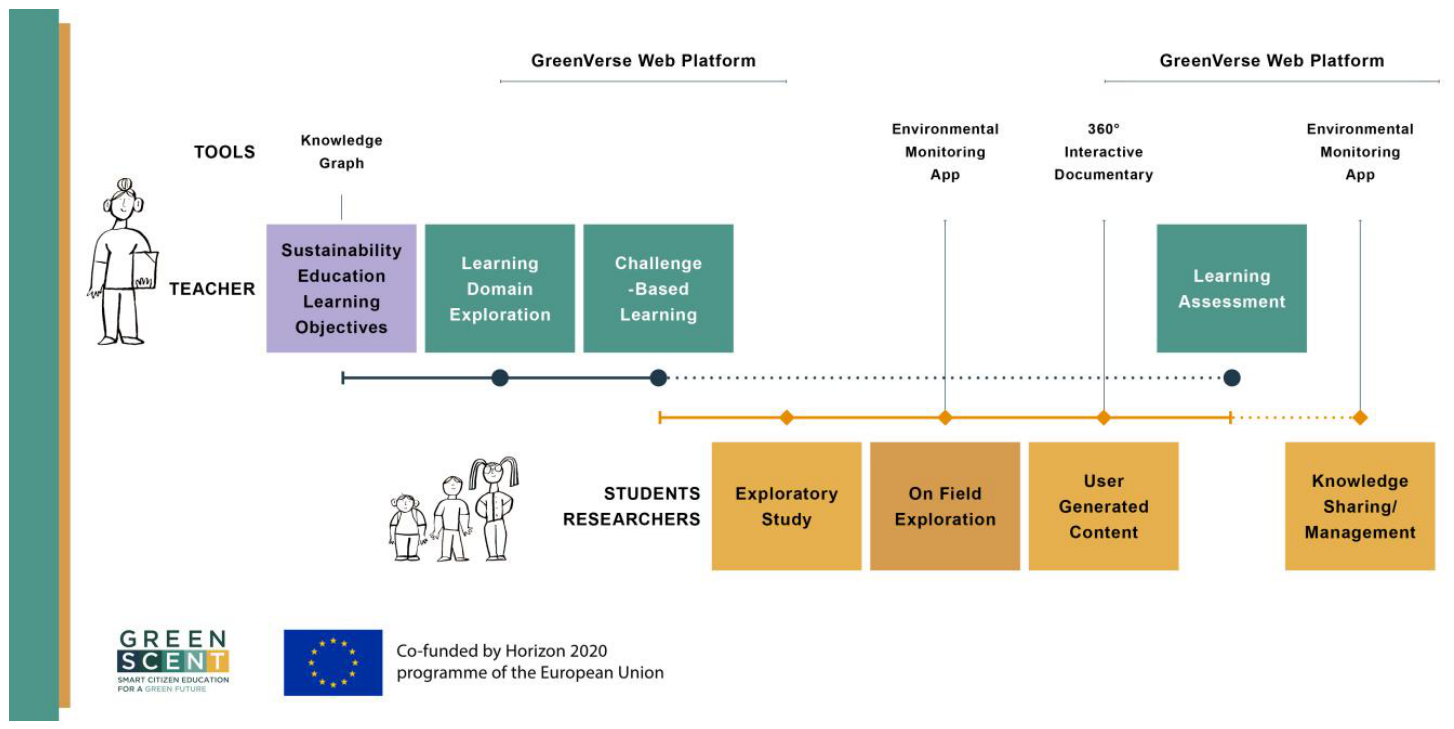
- Stage A—Strategy: We identify learning needs and objectives related to a specific learning domain based on one of the macro areas of the Green Deal.
- Stage B—Planning: We define the competencies the learner is expected to acquire in accordance with the learning objectives that characterise the selected domain.
- Stage C—Execution: We set up the entire practical educational experience and its corresponding expected outcomes, which will be conducted with the learners’ involvement.
- Stage D—Evaluation: We assess the learners’ learning performance by evaluating the learning outcomes developed during the educational activities proposed in the execution stage.
3.2. Procedure
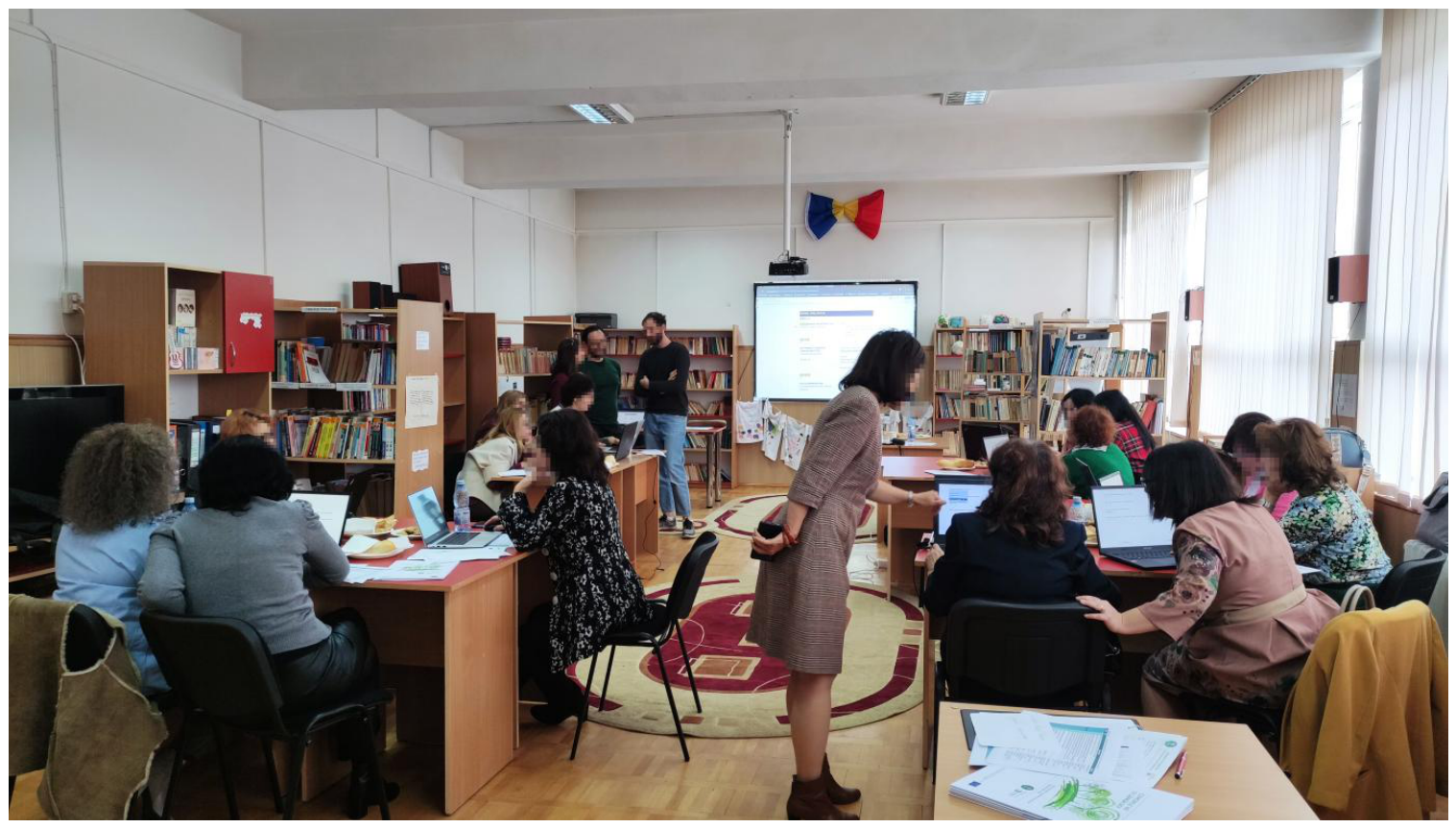
- A co-design workshop has been carried out as an exploratory and training session, only with educational managers and educators, to set the stages A and B and to understand the main contextual challenges and needs in Sustainability Education. The aim was to prepare them to conduct inclusive activities on environmental issues with their students in their local context. Methods and tools were provided by researchers to develop effective class orchestration, define educational challenges, and operationalise learning technologies to be inclusive.
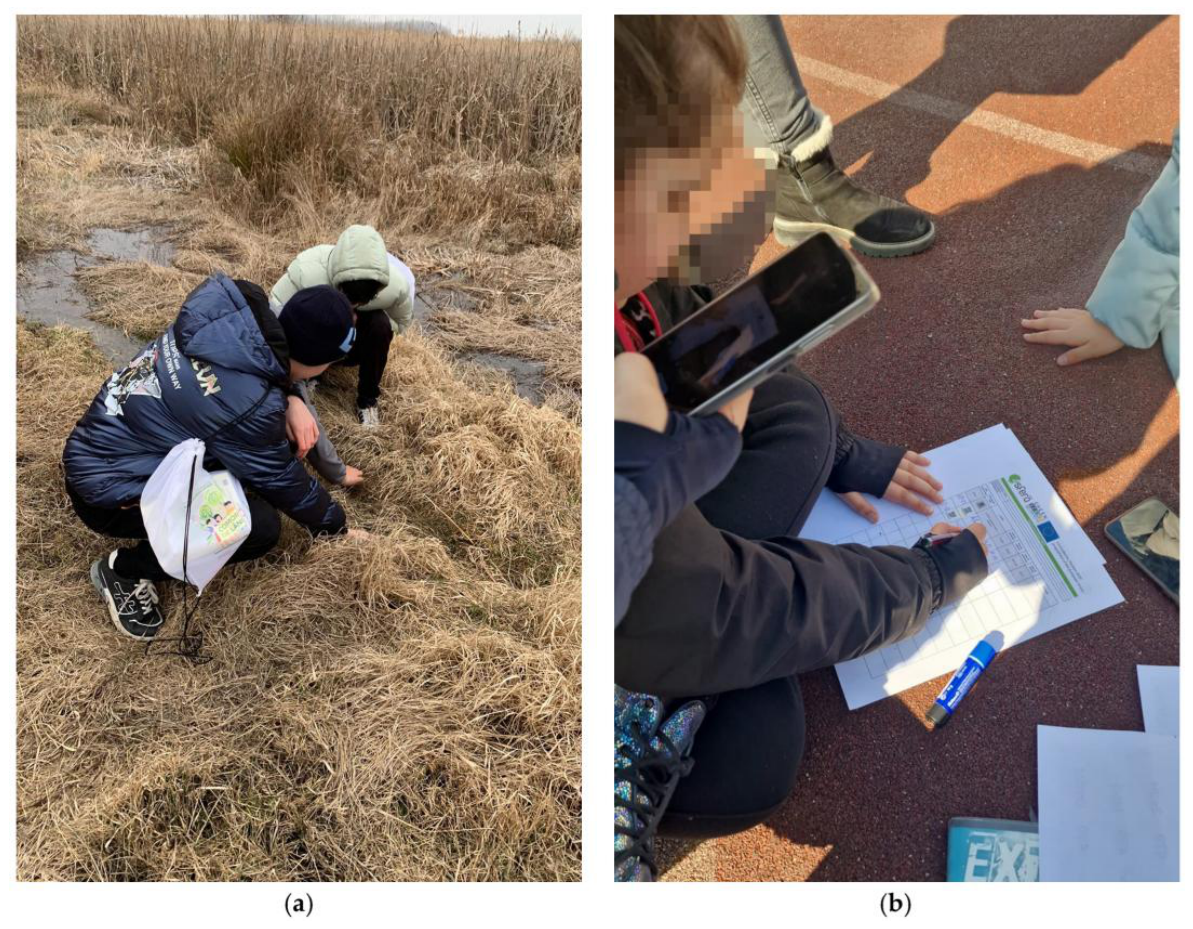
- An educational intervention, the CleanAir@School, set the stage for C and D, in which the educators tested and validated the effectiveness of the learning experiences, materials, and technologies (as structured during the co-design workshop) with their students in the ecological setting. The CleanAir@School objective is to involve the community in conducting air-quality measurements around schools and analysing the results obtained so that students, teachers, and parents become aware of environmental issues and how our habits, mainly mobility, influence them.
3.3. Participatory Design Workshop Methodology
- Basic knowledge acquisition about Sustainability Education by defining pro-environmental behaviours related to the Green Deal objectives.
- Understanding what the educational training kit (materials and digital technologies) might conceive and use for the proposed green education.
- Definition of learning assessment methods for evaluating the effectiveness and value of the activity.
- Selecting specific learning objectives and outcomes for Sustainability Education and green competencies on a specific Green Deal macro area using the GreenSCENT Competence Framework.
- Setting and exploring the proposed challenge and class orchestration by designing a dedicated class orchestration and adopting CleanAir@School.
- Acknowledging the learning assessment methods in accordance with the proposed learning objectives.
3.4. CleanAir@School Methodology
- Sensor placement and measurement strategies include educators collaborating with 4Sfera to choose key urban and busy areas with high traffic for air-quality assessments, using a nearby reference station to ensure accuracy.
- Exposure time refers to the period when participants await passive measurements from the samplers, during which they regularly check for damage or theft caused by external factors and learn about air pollution.
- Sensors and data collection involve educators and students resampling and sending these samples to 4Sfera’s laboratory for analysis.
- Data analysis and presentation are conducted using 4Sfera, which provides educators and students with an air-quality report to analyse data quantitatively and develop informative documents to raise awareness of air quality around the local communities.
3.5. Educators’ Voice Memos as Ethnographic Reflective Practice
4. Participatory Design Workshop
4.1. Context and Participants
- Define the Green Deal domain and learning objectives in relation to their needs by exploring the GreenSCENT Competence Framework—as a Knowledge Graph (https://publish.obsidian.md/greenscent/_START+HERE_ (accessed on 29 April 2026))—and selecting the competencies to evaluate their students’ learning performance.
- Understand the use of CleanAir@School to facilitate its implementation in the proposed class orchestration.
- Co-design and present several class orchestration frameworks—based on a common design challenge set up as a general quest to launch the activity—as potential use cases to be implemented as a pilot in their local context, based on a general common design challenge.
- Define a qualitative learning assessment to evaluate students’ performance against the green competencies selected in the first step.
4.2. Participant Profiling
4.3. Co-Design Output
5. CleanAir@Schools Implementation
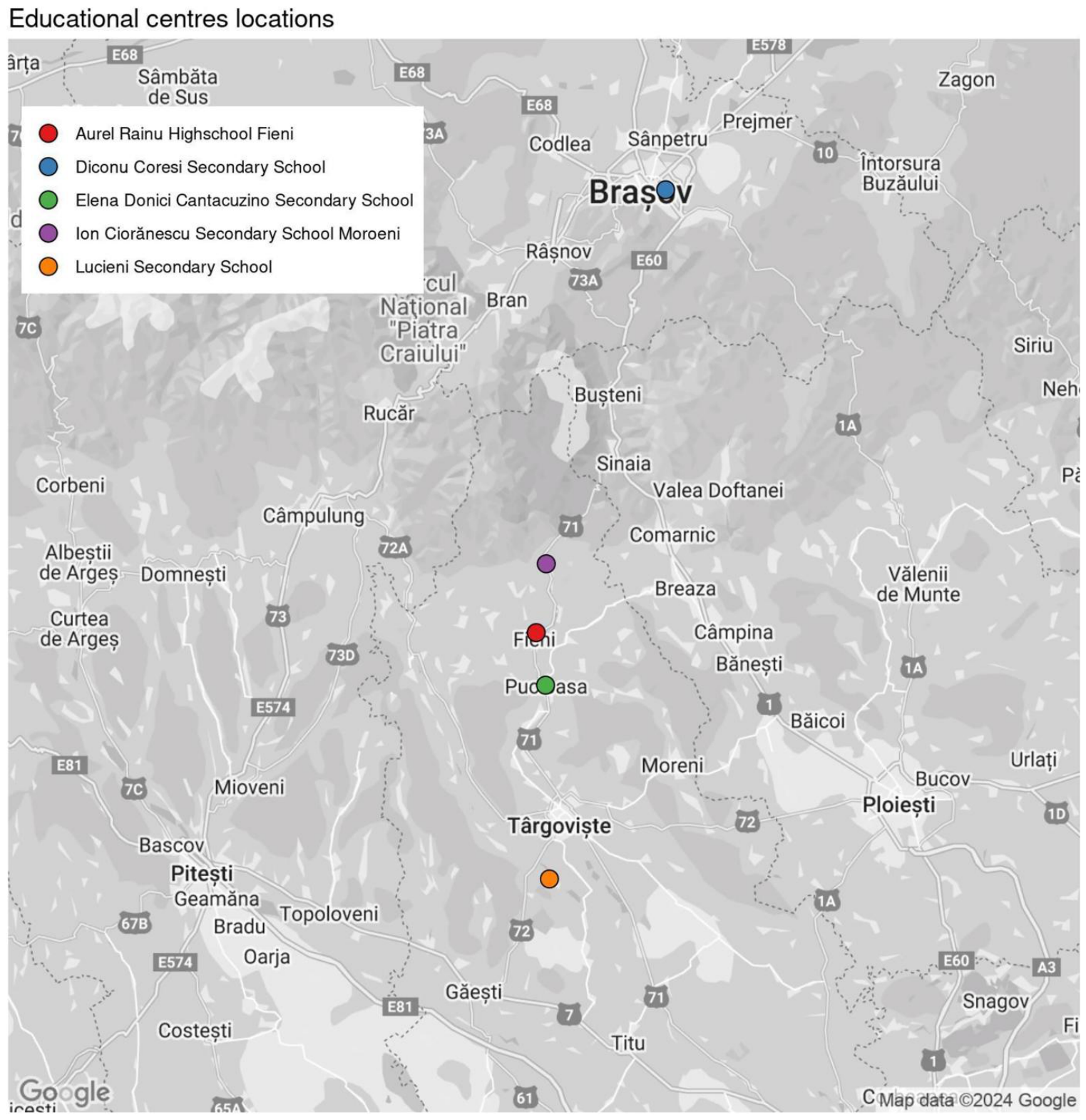
5.1. Context and Participants
5.2. Participant Profiling
- For exploring natural environments and biodiversity through concrete examples and hands-on activities;
- For getting engaged through digital materials and practical experiences.
- To get support in effectively using digital platforms to create accessible learning experiences in both digital and natural environments;
- A need emerged for clear guidance on learning outcomes, logistical support for transportation, and resource allocation to coordinate activities.
5.3. Implementation Plan
- Interior points in a classroom near the main traffic roads.
- Exterior points in the main playground.
- Point at the main entrance of the school.
- Urban background: Points from sources away from traffic.
- Urban traffic: Points near busy roads.
6. Results and Discussion
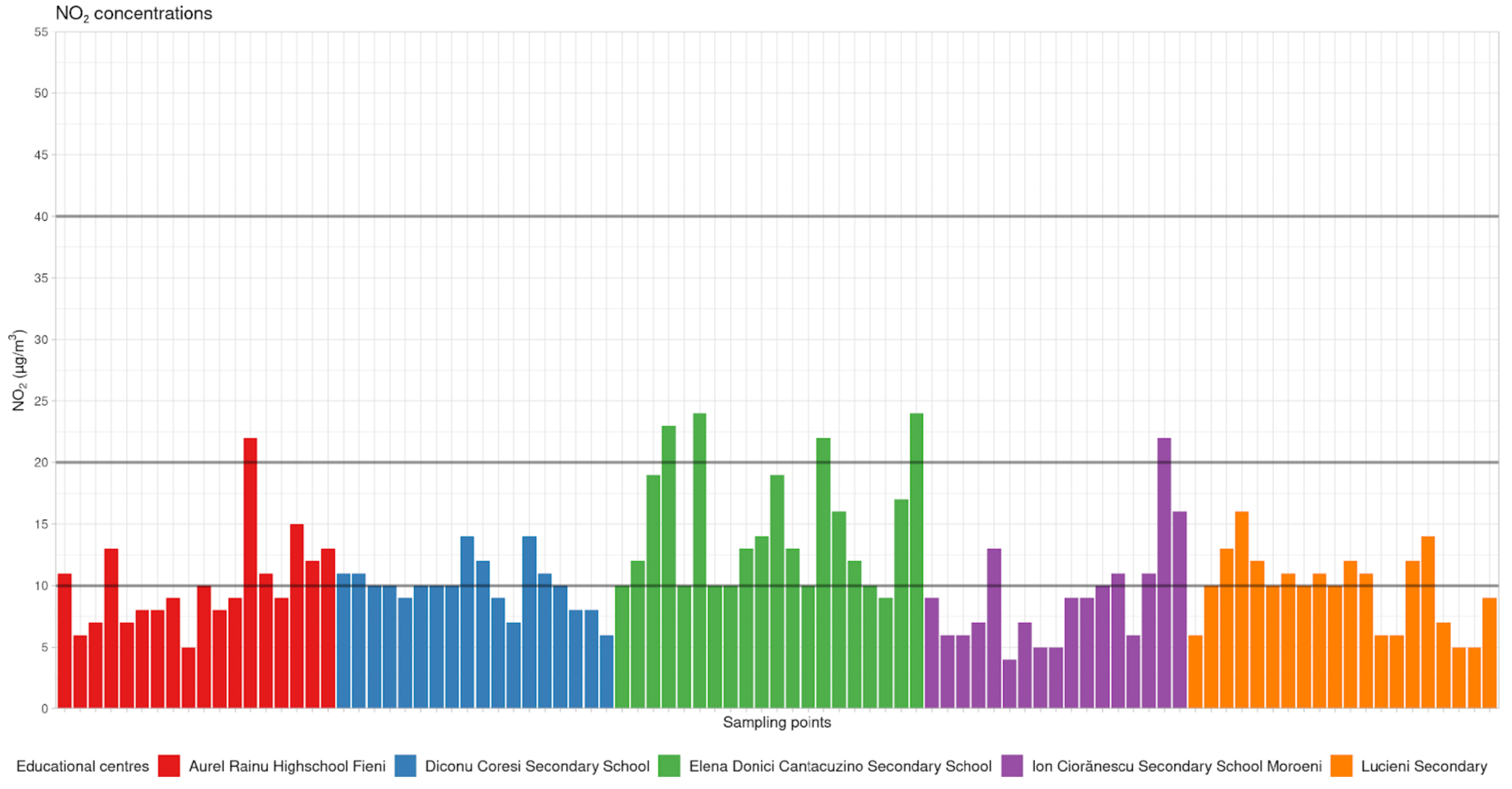
6.1. Air-Quality Data Analysis
6.2. Qualitative Findings: Educators’ Voice Memos
6.3. Discussion
7. Conclusions
Author Contributions
Funding
Institutional Review Board Statement
Informed Consent Statement
Data Availability Statement
Acknowledgments
Conflicts of Interest
References
- Hussain, S.; Sanders, E.B.-N.; Steinert, M. Participatory Design with Marginalized People in Developing Countries: Challenges and Opportunities Experienced in a Field Study in Cambodia. Int. J. Des. 2012, 6, 91–109. [Google Scholar]
- Giorgi, E.; Cattaneo, T.; Serrato Guerrero, K.P. The Principles of Design for Vulnerable Communities: A Research by Design Approach Overrunning the Disciplinary Boundaries. Buildings 2022, 12, 1789. [Google Scholar] [CrossRef]
- Kelley, D.; Kelley, T. Creative Confidence: Unleashing the Creative Potential Within Us All; Crown Business: New York, NY, USA, 2013; ISBN 978-0-385-34936-9. [Google Scholar]
- DiSalvo, C. Adversarial Design; The MIT Press: Cambridge, MA, USA, 2012; ISBN 978-0-262-30135-0. [Google Scholar]
- Bason, C. Design for Policy; Design for Social Responsibility Series; Gower: Farnham, UK; Burlington, VT, USA, 2014; ISBN 978-1-4724-1352-9. [Google Scholar]
- Costanza-Chock, S. Design Justice: Community-Led Practices to Build the Worlds We Need; Information Policy; The MIT Press: Cambridge, MA, USA, 2020; ISBN 978-0-262-04345-8. [Google Scholar]
- Pollini, A. Design in the Margins. Design Research for Regeneration and Care; Design Experience; ListLab: Trento-Barcellona, Italy, 2022. [Google Scholar]
- Wolfe, A.W. Dialogue and Deliberation as Agonistic Resistance: Designing Interactional Processes to Reconstitute Collective Identities. J. Deliberative Democr. 2018, 14, 5. [Google Scholar] [CrossRef]
- Arévalo, J. Uncertain Readiness: Process Design and Complexity Management in Peace Negotiations. Int. Stud. Rev. 2023, 26, viae006. [Google Scholar] [CrossRef]
- Badillo-Urquiola, K.; Shea, Z.; Agha, Z.; Lediaeva, I.; Wisniewski, P. Conducting Risky Research with Teens: Co-Designing for the Ethical Treatment and Protection of Adolescents. Proc. ACM Hum.-Comput. Interact. 2021, 4, 1–46. [Google Scholar] [CrossRef]
- Duarte, A.M.B.; Brendel, N.; Degbelo, A.; Kray, C. Participatory Design and Participatory Research: An HCI Case Study with Young Forced Migrants. ACM Trans. Comput.-Hum. Interact. 2018, 25, 1–39. [Google Scholar] [CrossRef]
- Vaughn, L.M.; Jacquez, F. Participatory Research Methods—Choice Points in the Research Process. J. Particip. Res. Methods 2020, 1, 1–14. [Google Scholar] [CrossRef]
- Fonder, A. How Do We Move Past Designer as Hero Dynamics? Dr. Christina N. Harrington Discusses the Power of Co-Design. Available online: https://www.core77.com/posts/112599/How-Do-We-Move-Past-Designer-as-Hero-Dynamics-Dr-Christina-N-Harrington-Discusses-the-Power-of-Co-Design (accessed on 31 March 2025).
- Harrington, C. The Forgotten Margins: What Is Community-Based Participatory Health Design Telling Us? Interactions 2020, 27, 24–29. [Google Scholar] [CrossRef]
- Harrington, C.; Erete, S.; Piper, A.M. Deconstructing Community-Based Collaborative Design: Towards More Equitable Participatory Design Engagements. Proc. ACM Hum.-Comput. Interact. 2019, 3, 1–25. [Google Scholar] [CrossRef]
- Fry, M.; Maxwell, K.; Eisenhauer, E.; Julius, S.; Kiessling, B.; Matsler, M.; Ollove, M.; Romanoski, S. Centering equity in the development of a community resilience planning resource. Clim. Risk Manag. 2023, 40, 1–11. [Google Scholar] [CrossRef]
- Chowkwanyun, M. Environmental Justice: Where It Has Been, and Where It Might Be Going. Annu. Rev. Public Health 2023, 44, 93–111. [Google Scholar] [CrossRef] [PubMed]
- McDonagh, S.A.; Caforio, A.; Pollini, A. The European Green Deal in Education: A Quest for Epistemological Rupture; Routledge Studies in Environmental Policy; Routledge: Abingdon, UK; New York, NY, USA, 2025; ISBN 978-1-032-79537-9. [Google Scholar]
- Hecht, B.; Wilcox, L.; Bigham, J.P.; Schöning, J.; Hoque, E.; Ernst, J.; Bisk, Y.; De Russis, L.; Yarosh, L.; Anjum, B.; et al. It’s Time to Do Something: Mitigating the Negative Impacts of Computing Through a Change to the Peer Review Process 2021. arXiv 2021. [Google Scholar]
- Pinto, N. Re-learning participatory design with marginalised communities: Resistance, Indigenous Youth and the Making of Pictograms. In Proceedings of the Participatory Design Conference 2024: Situated Actions, Doctoral Colloquium, PDC places, Communities, Sibu, Malaysia, 11 August 2024; ACM: New York, NY, USA, 2024; Volume 3, pp. 102–107. [Google Scholar]
- Anuyah, O.; Badillo-Urquiola, K.; Metoyer, R. Engaging the Discourse of Empowerment for Marginalized Communities Through Research and Design Participation. In Proceedings of the Extended Abstracts of the 2023 CHI Conference on Human Factors in Computing Systems, Hamburg, Germany, 19 April 2023; ACM: New York, NY, USA, 2023; pp. 1–7. [Google Scholar]
- Rappaport, J. The Power of Empowerment Language. Soc. Policy 1985, 2, 15–21. [Google Scholar]
- Dickinson, J.; Arthur, J.; Shiparski, M.; Bianca, A.; Gonzalez, A.; Erete, S. Amplifying Community-Led Violence Prevention as a Counter to Structural Oppression. Proc. ACM Hum.-Comput. Interact. 2021, 5, 1–28. [Google Scholar] [CrossRef]
- Pollini, A.; Giacobone, G.A. Rely on Available Resources: Designing Sustainability Education Technologies for Low Resources Scenarios. In For Nature/With Nature: New Sustainable Design Scenarios; Gambardella, C., Ed.; Springer Series in Design and Innovation; Springer Nature: Cham, Switzerland, 2024; Volume 38, pp. 761–781. ISBN 978-3-031-53121-7. [Google Scholar]
- Racadio, R.; Rose, E.J.; Kolko, B.E. Research at the Margin: Participatory Design and Community Based Participatory Research. In Proceedings of the 13th Participatory Design Conference: Short Papers, Industry Cases, Workshop Descriptions, Doctoral Consortium papers, and Keynote abstracts, Windhoek, Namibia, 6 October 2014; ACM: New York, NY, USA, 2014; Volume 2, pp. 49–52. [Google Scholar]
- Thompson, B.; Molina, Y.; Viswanath, K.; Warnecke, R.; Prelip, M.L. Strategies to Empower Communities to Reduce Health Disparities. Health Aff. 2016, 35, 1424–1428. [Google Scholar] [CrossRef]
- Pollini, A.; Giacobone, G.A. Designers’ Commitment Towards Sustainability: Climate Care as a Challenge for Design Education; Cumulus Association: Budapest, Hungary, 2024; pp. 1795–1810. [Google Scholar]
- Deal, A.; Crawshaw, A.F.; Carter, J.; Knights, F.; Iwami, M.; Darwish, M.; Hossain, R.; Immordino, P.; Kaojaroen, K.; Severoni, S.; et al. Defining Drivers of Under-Immunization and Vaccine Hesitancy in Refugee and Migrant Populations. J. Travel Med. 2023, 30, taad084. [Google Scholar] [CrossRef]
- Bouaddi, O.; Zbiri, S.; Belrhiti, Z. Interventions to Improve Migrants’ Access to Sexual and Reproductive Health Services: A Scoping Review. BMJ Glob. Health 2023, 8, e011981. [Google Scholar] [CrossRef]
- Lykes, M.B.; Hershberg, R.M.; Brabeck, K.M. Methodological Challenges in Participatory Action Research with Undocumented Central American Migrants. J. Soc. Action Couns. Psychol. 2011, 3, 22–35. [Google Scholar] [CrossRef]
- Concilio, G.; Costa, G.; Karimi, M.; Vitaller Del Olmo, M.; Kehagia, O. Co-Designing with Migrants’ Easier Access to Public Services: A Technological Perspective. Soc. Sci. 2022, 11, 54. [Google Scholar] [CrossRef]
- Plaza Del Pino, F.J.; Chraibi, G.; Molina-Gallego, B.; Humanes-García, M.; Sánchez-Ojeda, M.A.; Ugarte-Gurrutxaga, M.I. Access to the Health Care System of Undocumented Moroccan Migrant Slum Dwellers in Southern Spain: A Qualitative Study. Nurs. Rep. 2024, 14, 494–505. [Google Scholar] [CrossRef]
- Dushkova, D.; Ivlieva, O. Empowering Communities to Act for a Change: A Review of the Community Empowerment Programs towards Sustainability and Resilience. Sustainability 2024, 16, 8700. [Google Scholar] [CrossRef]
- Slesinger, I.; Yalaz, E.; Rizou, S.; Gibin, M.; Krasanakis, E.; Papadopoulos, S. Training in Co-Creation as a Methodological Approach to Improve AI Fairness. Societies 2024, 14, 259. [Google Scholar] [CrossRef]
- Banyuls, L.; Targa, J. Testing Air Quality with Schoolchildren. In The European Green Deal in Education; Routledge: London, UK, 2024; ISBN 978-1-003-49259-7. [Google Scholar]
- Cebrián Bernat, G.; Junyent Pubill, M. Competencias Profesionales En Educación Para La Sostenibilidad: Un Estudio Exploratorio de La Visión de Futuros Maestros. Ensciencias 2014, 32, 29–49. [Google Scholar] [CrossRef]
- Van Den Branden, K. Sustainable Education: Basic Principles and Strategic Recommendations. Sch. Eff. Sch. Improv. 2012, 23, 285–304. [Google Scholar] [CrossRef]
- Cebrián, G.; Junyent, M. Competencies in Education for Sustainable Development: Exploring the Student Teachers’ Views. Sustainability 2015, 7, 2768–2786. [Google Scholar] [CrossRef]
- Tomassi, A.; Falegnami, A.; Meleo, L.; Romano, E. The GreenSCENT Competence Frameworks. In The European Green Deal in Education; Routledge: London, UK, 2024; pp. 25–44. ISBN 978-1-003-49259-7. [Google Scholar]
- Falegnami, A.; Romano, E.; Tomassi, A. The Emergence of the GreenSCENT Competence Framework. In The European Green Deal in Education; Routledge: London, UK, 2024; pp. 204–216. ISBN 978-1-003-49259-7. [Google Scholar]
- Garito, M.A.; Caforio, A.; Falegnami, A.; Tomassi, A.; Romano, E. Shape the EU Future Citizen. Environmental Education on the European Green Deal. Energy Rep. 2023, 9, 340–354. [Google Scholar] [CrossRef]
- Scambia, L.; Tomassi, A.; Falegnami, A.; Tomassi, C.; Romano, E. Green Building Competences for the European Green Deal: A Knowledge Skills Attitudes Framework. Buildings 2026, 16, 978. [Google Scholar] [CrossRef]
- Chu, S.K.W.; Reynolds, R.B.; Tavares, N.J.; Notari, M.; Lee, C.W.Y. 21st Century Skills Development Through Inquiry-Based Learning; Springer: Singapore, 2017; ISBN 978-981-10-2479-5. [Google Scholar]
- Kolb, D.A. Experiential Learning: Experience as the Source of Learning and Development; Prentice-Hall: Englewood Cliffs, NJ, USA, 1984; ISBN 978-0-13-295261-3. [Google Scholar]
- Kolodner, J.L.; Camp, P.J.; Crismond, D.; Fasse, B.; Gray, J.; Holbrook, J.; Puntambekar, S.; Ryan, M. Problem-Based Learning Meets Case-Based Reasoning in the Middle-School Science Classroom: Putting Learning by Design(Tm) Into Practice. J. Learn. Sci. 2003, 12, 495–547. [Google Scholar] [CrossRef]
- Schön, D.A. The Reflective Practitioner; Routledge: London, UK, 2017; ISBN 978-1-351-88316-0. [Google Scholar]
- Papert, S.; Harel, I. Constructionism: Research Reports and Essays; Ablex Publishing Corporation: New York, NY, USA, 1991. [Google Scholar]
- Giacobone, G.A.; Pollini, A.; Urquiza, D.; Chouta, K. Participatory Design Methods for Sustainable Interaction Design: Co-Designing Digital Experiences for Sustainability Education. Univers. Access Inf. Soc. 2024, 24, 1945–1961. [Google Scholar] [CrossRef]
- Blevis, E. Design Challenge Based Learning (DCBL) and Sustainable Pedagogical Practice. Interactions 2010, 17, 64–69. [Google Scholar] [CrossRef]
- Gallagher, S.E.; Savage, T. Challenge-Based Learning in Higher Education: An Exploratory Literature Review. Teach. High. Educ. 2023, 28, 1135–1157. [Google Scholar] [CrossRef]
- Light, A. Ecologies of Subversion: Troubling Interaction Design for Climate Care. Interactions 2022, 29, 34–38. [Google Scholar] [CrossRef]
- Giacobone, G.A.; Pollini, A.; Caforio, A. User Stories, Motivation Forbehavioural Change and Educational Challenges. In The European Green Deal in Education; Routledge: London, UK, 2024; ISBN 978-1-003-49259-7. [Google Scholar]
- Jagtap, S. Co-Design with Marginalised People: Designers’ Perceptions of Barriers and Enablers. CoDesign 2022, 18, 279–302. [Google Scholar] [CrossRef]
- Pink, S. Doing Sensory Ethnography, 2nd ed.; Sage Publications: London, UK; Thousand Oaks, CA, USA, 2015; ISBN 978-1-4462-8759-0. [Google Scholar]
- Van Nes, F.; Abma, T.; Jonsson, H.; Deeg, D. Language Differences in Qualitative Research: Is Meaning Lost in Translation? Eur. J. Ageing 2010, 7, 313–316. [Google Scholar] [CrossRef]
- Braun, V.; Clarke, V. Using Thematic Analysis in Psychology. Qual. Res. Psychol. 2006, 3, 77–101. [Google Scholar] [CrossRef]
- Paciello, M.; Barresi, R.; Corbelli, G.; Pollini, A.; Caforio, A. Exploring How Implicit and Explicit Attitudes Relate to Pro-Environmental Behaviors: The Mediating Role of Environmental Moral Disengagement. Sustainability 2025, 17, 10011. [Google Scholar] [CrossRef]
- European Commission. Directorate General for Education, Youth, Sport and Culture. In Key Competences for Lifelong Learning; Publications Office of the European Union: Luxembourg, 2019. [Google Scholar]
- European Parliament, Council of the European Union. Directive 2008/50/EC of the European Parliament and of the Council of 21 May 2008 on ambient air quality and cleaner air for Europe. Off. J. Eur. Union 2008, 152, 1–44. Available online: https://eur-lex.europa.eu/eli/dir/2008/50/oj/eng (accessed on 27 May 2026).
- Del Vecchio, D.; Toomey, N.; Tuck, E. Placing photovoice: Participatory action research with undocumented migrant youth in the Hudson Valley. Crit. Quest. Educ. 2017, 8, 358–376. [Google Scholar]
- Platform for International Cooperation on Undocumented Migrants. Participatory Methods: The Inclusion of Undocumented Migrants in Healthcare and Beyond; PICUM Publications: Brussels, Belgium, 2022. [Google Scholar]
- Giaccardi, C.; Magatti, M. Natality, Individuation and Generative Social Action: From Amor Mundi to Social Generativity. In Individuation and Liberty in a Globalized World; Carpani, S., Ed.; Routledge: London, UK, 2022; p. 14. [Google Scholar]




| Time Schedule | Activity Description |
|---|---|
| 15 min before starting | Competence Assessment questionnaire ex-ante. |
| 8:20–8:30 WARM-UP & INTRODUCTION | Research general presentation; Workshop objectives and agenda. |
| 8:30–9:30 SUSTAINABILITY EDUCATION LEARNING OBJECTIVES | GreenSCENT Competence Framework presentation through the Knowledge Graph exploration. |
| 9:30–10.30 DIGITAL DEMONSTRATORS | Technology presentation and test:
|
| 10.30–10.50 | COFFEE BREAK |
| 10.50–12:30 INSTRUCTIONAL DESIGN 1/2 | Define the educational challenge. Ex. Challenge-based learning activity: “Make visible the invisible”. Create a use case scenario:
|
| 12:30–13:40 | LUNCH |
| 13.40–15:00 INSTRUCTIONAL DESIGN 2/2 | Define learning assessment according to the selected domain and learning objectives. |
| 15:00–15:50 USE CASES PRESENTATION & DISCUSSION | Get Feedback and open discussion on:
|
| After Closing | Competence Assessment questionnaire ex-post |
| Items | Definition |
|---|---|
| Organisation name | HIGH SCHOOL “AUREL RAINU” FIENI |
| Country | Romania |
| Project title | IMPACT OF AIR POLLUTION ON PLANTS IN THE FIENI AREA |
| Description of the learners | The project will involve 20 students from the lower secondary school specialising in mathematics and computer science, real profile, theoretical stream, aged between 14 and 17, who have studied physics, chemistry, biology, geography and information and communication technology. |
| EQF level | Level 4 |
| Pre-requisites | Students need a basic knowledge of physics, chemistry, biology, geography and information and communication technology. Skills required include working with the camera, using online filmmaking applications, and working in a team. |
| Challenge | NATURE EXPLORATION |
| Learning objectives | Identify air pollutants; identify indirect links between actions and impacts on biodiversity; demonstrate accountability even when the direct effect is not visible. |
| Learning methodologies | Inquiry-based Learning is guided by questions and the search for answers to them, involving inquiry-type activities in the study of science subjects. Students acquire a complex set of specific scientific investigation skills, such as:
|
| Understanding the process of scientific investigation | Faced with an unknown fact/phenomenon, scientists ask questions; use knowledge and questions to design and carry out scientific investigations; use investigations for different purposes; use mathematical and technological background as a tool for learning and communication; formulate logical explanations and arguments based on evidence; share information on results and procedures with the scientific community, etc. Familiarity with the process of scientific inquiry facilitates students’ acquisition, through their own effort, of both scientific knowledge and an understanding of how scientific knowledge progresses. Grounding lessons in Inquiry-based Learning involves a sequence of activities. These are presented below in an adapted version. Thus, students:
Foreseen implementation details imply a course/module duration of 10 weeks, with the following course schedule. Activities will be carried out flexibly, depending on the availability of the people involved, the season, the weather conditions and the structure of the school year. |
| Course Orchestration | Week 1: Giving students the challenge: Why do white spots appear on tree leaves after rain? Watch the documentary “Acid Rain” and identify the factors that can affect plants in the Fieni area. Weeks 2, 3 and 4: Investigation and exploration: (1) Observations made on the leaf cover of plants in the Fieni area; (2) taking photographs of affected leaves and unaffected leaves (with white spots or with numerous holes or other inconsistencies). Week 5: Analyse the photographs and draw conclusions based on indirect links between actions and impacts on biodiversity. Week 6: Making a map of the town of Fieni, marking the areas with affected and unaffected leafy plants. Produce a report specifying the links between air pollutants and pollution effects. Weeks 7, 8 and 9: Making a documentary film presenting the effects of pollution and proposing measures to reduce air pollution in Fieni, and presenting it at the local and regional levels. Week 10: Project evaluation and feedback. |
| Assessment methodology | The initial assessment will be completed after the film has been viewed via an online questionnaire, without supervision. The final evaluation will be carried out offline, without supervision, by producing a catalogue describing the impact of air pollution on plants. |
| School | Educators | Students |
|---|---|---|
| Aurel Rainu High School, Fieni | 1 (D) 2 (T) | 40 |
| Diaconu Coresi Secondary School, Fieni | 1 (D) 2 (T) | 31 |
| Ion Ciorănescu Secondary School, Moroeni | 1 (D) 1 (T) | 25 |
| Elena Donici Cantacuzino Secondary School no. 4, Pucioasa | 1 (D) 2 (T) | 34 |
| Lucieni Secondary School, Lucieni | 1 (D) 2 (T) 3 (T) | 35 |
| Total | 14 | 165 |
Disclaimer/Publisher’s Note: The statements, opinions and data contained in all publications are solely those of the individual author(s) and contributor(s) and not of MDPI and/or the editor(s). MDPI and/or the editor(s) disclaim responsibility for any injury to people or property resulting from any ideas, methods, instructions or products referred to in the content. |
© 2026 by the authors. Licensee MDPI, Basel, Switzerland. This article is an open access article distributed under the terms and conditions of the Creative Commons Attribution (CC BY) license.
Share and Cite
Pollini, A.; Giacobone, G.A.; Lungu, A.I. Empowering Communities on the Margins: Participatory Design in Environmental Education. Sustainability 2026, 18, 5619. https://doi.org/10.3390/su18115619
Pollini A, Giacobone GA, Lungu AI. Empowering Communities on the Margins: Participatory Design in Environmental Education. Sustainability. 2026; 18(11):5619. https://doi.org/10.3390/su18115619
Chicago/Turabian StylePollini, Alessandro, Gian Andrea Giacobone, and Adriana Ioana Lungu. 2026. "Empowering Communities on the Margins: Participatory Design in Environmental Education" Sustainability 18, no. 11: 5619. https://doi.org/10.3390/su18115619
APA StylePollini, A., Giacobone, G. A., & Lungu, A. I. (2026). Empowering Communities on the Margins: Participatory Design in Environmental Education. Sustainability, 18(11), 5619. https://doi.org/10.3390/su18115619