1. Introduction
Today, companies are incorporating environmental, social, and governance (ESG) practices into their strategies, from a sustainability perspective, to enhance profitability and corporate value by building trust among stakeholders, including shareholders and investors. Awareness of and adherence to ESG principles help companies establish a reputation for transparency in the eyes of investors [
1]. Companies may have to incur higher costs to integrate financial and non-financial information and to report it within an appropriate, standardized framework. Consequently, maintaining a transparent [
2], reliable, and sustainable structure within the ecosystem in which they operate may entail increasing operational and compliance costs [
3], which in turn could put pressure on profitability. In this context, it can be said that companies’ ESG strategies are shaped by the dynamics specific to the ecosystems in which they operate, and the impact of ESG practices on corporate profitability may vary depending on the strategies they pursue such as tax advantages [
4,
5,
6].
In the insurance sector, ESG has evolved from a standard corporate social responsibility initiative into a risk management element that directly impacts the balance of assets and liabilities forming the foundation of the business [
7]. ESG factors influence the profitability of insurance companies, which act as both investors and insurers, through numerous channels, including improved investment returns, increased customer interest via value-driven products, enhanced risk management capabilities, and reduced exposure to climate-related losses. Although the insurance sector holds a significant position within the economy and society and plays a key role in promoting the transition to a low-carbon economy [
8], studies examining the relationship between ESG factors and the performance of insurance companies [
9,
10] are still in their developmental stages. Studies that consider risk structures specific to the insurance sector, utilize current datasets, and integrate ranking perspectives from both causal and performance standpoints remain limited.
Companies operating in the insurance sector prioritize their ESG scores in terms of their reputation and financial sustainability [
11,
12,
13]. Linking companies’ sustainability performance to financial indicators is of critical importance for risk management in the insurance sector. Given the ecosystem characteristics of insurance companies, their exposure to direct ESG-related risks on both the investment and liability sides [
3] underscores the importance of ESG scores for the sector [
10].
The literature contains only a limited number of studies examining the effects of ESG scores on profitability specifically within the insurance sector [
3,
9,
14,
15]. While studies that rank insurance companies’ sustainability-focused performance using the CRISUS (criterion importance based on sum of squares) method are becoming increasingly common, applications that integrate objective criterion-weighting methods (CRISUS, MAXC, NMV) with the CRADIS (compromise ranking of alternatives from distance to ideal solution) method in such rankings remain within the Web of Science (WoS) and Scopus databases. The lack of integration of these methods into analyses that assess the impact of ESG investments on profitability indicates that the existing literature is limited in its ability to support strategic decision-making.
This study first examines the dynamic associations between ESG dimensions and profitability using data from 54 global insurance companies across 23 countries for the period 2015–2024, employing the system generalized method of moments (System GMM) estimator. Subsequently, criterion weights are calculated using the CRISUS, MAXC (maximum of criterion), and NMV (normalized maximum values) methods. Company rankings are determined using the CRADIS method based on the calculated criterion weights. Sensitivity analysis is conducted, and the resulting weighting scenarios are compared using the Spearman correlation coefficient. This approach, which combines System GMM estimates with multi-criteria decision-making methods, aims to provide strategic insights regarding ESG-focused performance evaluation for decision-makers and investors in the insurance sector.
To sharpen empirical focus, we state the following research hypotheses regarding the dynamic associations in the global insurance sector:
H1: Environmental scores are associated with the asset profitability (roa) of global insurance companies.
H2: Social scores are associated with asset profitability (roa) in global insurance companies.
H3: Corporate governance scores are positively associated with asset profitability (roa) in global insurance companies.
The study design begins with an introduction, followed by a review of the relevant literature. The third section, which explains the data and methodology, is followed by the fourth section, which presents the findings. The fifth section evaluates the results in the discussion, and the final section concludes the study.
2. Literature Review
The link between ESG performance and financial performance takes no single form; it may be direct or indirect through risk management, cost of capital, operational efficiency, or market perception [
16]. This relationship is not uniform across sectors or regions. In the energy sector, for example, environmental performance shows a more stable and positive correlation with financial indicators than social or governance dimensions do. Regionally, ESG practices appear strong in western China, moderate in the east, and weak in the central provinces [
17,
18,
19].
The literature on sustainable finance offers a continuously evolving body of academic knowledge that comprehensively examines the impact of ESG factors on corporate profitability and market value using various theoretical frameworks and analytical methods [
10,
20,
21]. Findings in the literature vary depending on the methodological approaches and contextual differences employed in studies examining the impact of ESG practices on corporate financial outcomes. The studies in the literature encompass positive relationships [
22,
23,
24,
25], negative relationships [
26,
27], and complex relationships [
28,
29,
30,
31] between ESG and performance. Additionally, the literature examines the moderating role of ESG investments on risk management and the probability of bankruptcy [
32,
33] and their effects within the framework of investor expectations [
34,
35] as separate categories. Below is a selection of studies related to this field.
As part of an effort to determine whether investors truly care about companies’ ESG performance and policies, a study using Bloomberg data [
36] found that U.S. investors were more concerned with governance than their European counterparts, yet less concerned with environmental information. The analysis also indicated that equity investors were more interested in broad-spectrum, non-financial information than bond investors. Analysts, in line with their roles, focused more on greenhouse gas emissions on the sell side and more on comprehensive datasets on the portfolio-management side. Pension funds and hedge funds showed greater interest in non-financial information than insurance companies. These findings indicate that environmental and governance aspects are receiving greater attention. A similar result was also present in the studies by Nogueira et al. [
37]. A survey of 98 insurance experts in Brazil found a linear relationship between company size and ESG risk insurance, and noted that this positively impacted operational ESG management. The findings of this study [
37] revealed that environmental and governance factors exerted a greater influence on the measurements. The development of insurance companies has a positive impact on ESG assets. As company size increases, greater progress is made in ESG risk insurance and operational ESG management [
38]. Consequently, in the studies by Eccles et al. [
32], emphasis was placed on the importance of companies correctly understanding and accepting the demand for non-financial information and taking action to provide the right information to the right customer accordingly.
In their study, Brogi et al. [
9] analyzed the relationships between ESG scores (comprising scores based on 16 environmental variables, 29 social variables, and 17 governance variables) and financial ratios using data from 107 U.S. insurance companies for the 2010–2018 period. This study is one of the first in the field to examine how insurance companies’ financial performance, solvency, and scale interact with ESG and its sub-dimensions—environmental, social, and governance. The study found that large, profitable, and highly solvent insurance companies exhibited a high level of ESG awareness. Notably, for insurance companies, profitability and scale were decisive factors in implementing ESG policies. The study concluded that asset profitability and capital levels positively influence ESG scores, while solvency has no such effect.
Aburto Barrera and Wagner [
39] conducted a bibliometric analysis using the Web of Science (WoS) database, covering 1731 studies from the 2003–2022 period. This study, a systematic literature review, examined the relationship of insurance companies’ risk management and investment processes with ESG factors. The study found that environmental issues related to climate change received greater attention. They found that the term “insurance” ranked first, with 37 mentions across 51 publications, while “climate change” ranked second, with 19 mentions. Sustainability, together with social and environmental concepts, was among the most frequently used terms. The study notes that publications on environmental factors appeared in nearly all of the years under consideration.
In their study, Di Tomasso and Mazzuca [
40] used case study methodology with 2011–2021 data from 56 insurance companies across 15 European countries to examine the impact of ESG ratings on the value of insurance companies, focusing on 210 announcements of ESG rating upgrades or downgrades (with the UK, Switzerland, Italy, and Germany accounting for 55% of the total) to examine the impact of ESG ratings on the value of insurance companies. The study, which emphasized that insurance companies play a critical role as financial actors in addressing climate change, found that changes in ESG ratings—whether positive or negative—had corresponding effects on stock prices.
In the study by Lee et al. [
13], the impact of bondholders’ preferences on ESG performance was examined. The study [
3] emphasized that due to the characteristics of the insurance industry ecosystem, insurance companies are exposed to direct ESG-related risks on both the asset and liability sides. A long-term investment strategy is crucial for profitability and for managing these risks. The strength of long-term investment, which develops based on insurance companies’ risk management preferences regarding their assets and liabilities, also necessitates that the companies with which they have relationships improve their environmental awareness, social responsibility, and governance practices. The study’s findings revealed that because insurance companies are a major investor group in bond markets, bond investors’ expectations and demands directly influence insurers’ ESG performance. The study emphasized the necessity for insurance companies to prioritize their ESG performance given institutional investors’ tendency to invest more in companies with high ESG scores.
In the study conducted by Giraldez-Puig et al. [
41], the relationship between bankruptcy risk and ESG discussions was examined using the System GMM method, based on data from 120 publicly traded companies in the insurance sector for the 2011–2022 period. ESG discussions in the insurance sector amplify bankruptcy risk, whereas ESG practices mitigate it. In particular, the governance dimension of ESG offsets the amplifying effect of ESG discussions on bankruptcy risk.
In their study, Sylos Labini et al. [
42] used the fixed effects method to analyze data from 167 insurance companies operating in various regions with complete data availability for the 2018–2022 period. They concluded that sustainability-based ESG practices positively affected the performance of insurance companies, particularly American insurers.
In the Tobar study [
14], the relationships between insurance companies’ ESG performance and corporate performance were examined using the System GMM method based on data from 31 insurance companies across 7 MENAT countries for the 2017–2022 period. Roa was used as the dependent variable to measure financial performance. The variables included in the study were corporate quality, company size, debt, revenue, annual GDP growth rate, and inflation. The study found that companies with high ESG scores exhibited higher performance. The effect of ESG on financial performance was non-linear for these insurance companies, with corporate quality acting as a moderating factor that strengthened the relationship between corporate performance and ESG practices. Based on the study’s findings, a performance level below 31.2% was identified as the threshold below which the company’s image and desirability may be negatively affected. However, higher ESG performance could reduce profitability by causing companies’ costs to rise uncontrollably. In another study, Tobar [
15], using the same period data and sample scope, analyzed the effects of audit quality on ESG performance using the applicable generalized least squares (FGLS) method. Based on the study’s findings, audit quality may have positive effects on ESG performance up to a threshold of 51.7%; above this threshold, it may have negative effects. Audit quality has a non-linear effect on the three sub-dimensions of ESG. Given the scope of the subject and the sample, the study emphasized that the compliance of databases used as ESG data sources with Islamic finance principles might be overlooked, thereby highlighting the necessity of developing an Islamic ESG framework. In light of the study’s findings, a phased approach is recommended to improve audit quality in insurance companies while avoiding both excessive and inadequate audit practices.
In their study, Doğan et al. [
21] examined the impact of ESG performance on short-term financial outcomes—specifically roa, roe, and trading volume—using panel quantile regression analysis and data from 2008 to 2023 for 139 Eurozone companies operating in high-emission sectors such as manufacturing, transportation, and mining. The study yielded differing results across these three distinct sectors. For manufacturing-focused companies, the ESG score is positively associated with roa and roe but negatively associated with trading volume. For transportation-focused companies, the ESG score constrains profitability due to compliance and regulatory costs. However, in energy-focused companies, unlike in the other two sectors, the ESG score contributes to reputational gains for weaker firms but has negative effects on stronger firms because of high capital intensity and long payback periods. The study’s results demonstrate that ESG scores can have varying effects across sectors.
In their study, Meral et al. [
10] examined the relationship between ESG and corporate performance using panel data analysis (SUR model) based on data from 81 global insurance companies (22 life and 59 non-life insurance companies) for the 2013–2022 period. The study found that high ESG scores had positive effects on financial performance. Higher asset profitability and return on investment contribute to the efficient management of expenses and claims.
Various studies analyzing ESG scores using CRADIS methods have been reported in the literature [
43,
44,
45,
46,
47,
48,
49,
50,
51]. However, only a limited number of studies have evaluated ESG scores using the CRADIS method employed in this study.
In their study, Biswas et al. [
52] developed the GC-CRADIS method to construct an optimal portfolio focused on market performance using companies included in the ESG index on the Bombay Stock Exchange in India. An analysis of the companies selected via the GC-CRADIS method found no significant relationship between ESG scores and stock performance.
In the study by Alici [
53], the financial sustainability of 30 airlines was examined using the LOPCOW-based CRADIS method based on 2023 data. The Altman Z-score was used to measure financial failure, while TAA scores were used to measure financial performance. The ESG scores of the companies were obtained from the Refinitiv database and included in the analysis. The criteria were prioritized as follows (from highest to lowest): financial failure > social performance > ESG score > financial performance > environmental performance > governance performance. Financial failure was identified as the most decisive factor, whereas governance performance was identified as the least. Southwest, Pegasus Airlines, and Japan Airlines ranked among the top three, while Gol Airlines, Capital A Berhad, and China Eastern ranked among the bottom three.
In their study into which factors insurance companies can consider to improve their sustainability performance, which insurance companies demonstrate superior performance compared to others, and whether an effective ESG framework is feasible in this context, Işık and Adalar [
12] examined the competitiveness of non-life insurance companies operating in Turkey based on 10 criteria across the three sub-dimensions of ESG using the intuitive fuzzy CRADIS (IF-CRADIS) method. The top 10 companies operating in the non-life insurance sector in 2021, which together accounted for 70.72% of premium production and 74.17% of total assets, were included in the analysis. ESG comprises three dimensions: the environmental dimension, which includes criteria related to resource use, emissions, and innovation; the social dimension, which includes criteria related to labor, human rights, community, and product responsibility; and the governance dimension, which includes criteria related to management, shareholders, and corporate social responsibility strategy. The study identified human rights, labor, and innovation as the criteria that contributed most to companies’ sustainability performance. Türkiye Sigorta had the highest ESG score, while Eureko Sigorta had the lowest.
In the study by Mao et al. [
54], the environmental impacts of automotive production within the scope of ESG and its three sub-dimensions were examined using a hybrid model. They utilized data from three traditional Chinese automakers (Changan, Geely, BYD) and three new energy vehicle companies (Xiaopeng, Leading Ideal, NIO), which collectively accounted for over 30% of the global vehicle market between 2009 and 2022. To demonstrate the predictive accuracy and robustness of decision-making in sustainable investments, they developed an integrated framework that combines advanced multi-criteria group decision-making methods: Fermatean fuzzy linguistic term sets (FFLTs) and the SWARA-based CRADIS method. The study found that Geely achieved the best performance, while Xiaopeng ranked the lowest.
Yaylalı et al. [
55], in their study examining the impact of internal audit on ESG performance, utilized the p,q,r-SFS and entropy-based CRADIS methods. The developed hybrid model enabled the formulation of investment strategies aimed at enhancing ESG performance through internal audits, while the study identified risk management effectiveness and environmental efficiency as key criteria.
In their study, Belke et al. [
56] utilized 2022 Refinitiv Eikon data for 8 beverage companies listed on the London Stock Exchange (data on 15 variables related to the three sub-dimensions of ESG and financial indicators). The researchers examined company performance rankings using the CRADIS method, which is based on an integrated weighting approach combining the CRISUS and MAXC objective criterion weighting methods. The study, which highlights to decision-makers the importance of presenting multidimensional financial and nonfinancial indicators through consistent, integrated performance measurement, identified innovation as the most effective criterion. The study’s findings confirmed that Diageo, Coca-Cola, and Britvic are industry leaders based on their ESG scores. The company Daniel Thwaites was also determined to have a low ranking due to its weak ESG performance.
The existing literature reports mixed findings regarding the impact of ESG on financial performance, with positive, negative, and non-linear effects observed. However, evidence regarding the global insurance industry is scattered. Most studies use standard regression methods or simple ranking methods. What is missing is a framework that addresses endogeneity in profitability dynamics and provides an objective, multidimensional performance ranking. This study fills that gap by combining a two-stage System GMM with an MCDM framework (CRISUS, MAXC, NMV, and CRADIS).
The multidimensional and context-sensitive nature of sustainability performance intersects with the circular economy (CE) paradigm, which is reshaping corporate strategies and financial outcomes.
The circular economy operates in contrast to the traditional “produce, consume, dispose” model. It aims to keep resources within the system for as long as possible, reduce waste, and reuse, recycle, and remanufacture products [
57,
58]. This is not merely an environmental policy, it is also a transformative process that affects companies’ costs, risk management, supply chain strategies, and long-term financial performance [
59,
60,
61]. Multiple disciplines come into play in the circular economy, which is why implementing it requires an ecosystem-based approach, one that includes all relevant stakeholders [
57]. Companies are at the heart of this shift. The CE has reshaped how businesses operate globally. The growing need for resource-efficient models, especially, is pushing firms toward circular business models [
62,
63].
It has been observed across various sectors that CE practices contribute to companies’ financial performance, such as roa, roe, and market value [
64,
65,
66,
67,
68,
69]. CE initiatives are based on resource efficiency, waste reduction, and sustainable business models. They are expected to increase resource efficiency in production, reduce energy and water consumption, improve waste management, develop recyclable product and service models, and align their supply chains with sustainability principles [
63]. These models have various effects on companies’ profitability and market value. The effects of the transition from a linear production–consumption model to a circular economy are evident in both the environment and the economy. A study of European manufacturing companies found that a one-point increase in the Circular Economy Index (CEI) increased return on investment, gross profit margin, and net profit margin. This suggests that CE activities positively affect corporate profitability [
70]. Companies that adopt cyclical strategies generally achieve higher market valuations. This is particularly evident in the food and healthcare sectors, as cyclical business models are associated with stronger market performance in these sectors [
64]. Financing decisions play a significant role in promoting long-term investments and internalizing environmental externalities [
71]. Green bonds and green sukuk [
72] help fund circular practices and address environmental costs, despite real structural barriers [
73]. This point is frequently emphasized in the ESG literature. The impact of sustainability practices on corporate performance is not uniform. This impact varies depending on the sector, country, information environment, quality of governance, and financial structure. For example, profitable companies are better able to make stronger ESG disclosures. On the other hand, misleading statements made through symbolic sustainability reporting undermine the reliability of ESG data. Furthermore, the stronger a company’s information environment, the more the potential negative effects of ESG practices on financial performance are mitigated [
74,
75,
76]. Incorporating ESG criteria into financial assessments provides a more transparent evaluation of sustainability efforts. This approach aligns financial performance with regenerative outcomes; it reduces systemic risk and enhances accountability [
77]. Despite the benefits of CE, small businesses in particular may find it difficult to adopt CE practices due to high initial costs and the potential for exposure to risk [
78]. While CE initiatives generally improve financial performance, diminishing returns emerge at very high levels of implementation. In other words, a balanced approach is essential to maximize benefits without over-utilizing resources [
70]. The transition to a circular economy offers companies significant financial and strategic advantages. Profitability, market value, and sustainability are increasing. However, adopting these practices requires careful consideration of the investment costs, risk management, and structural barriers. As companies navigate these challenges, integrating CE metrics into financial assessments enables them to gain a more comprehensive view of their sustainability efforts and their long-term economic impacts. The environmental score (env) we use in our study is not merely a standard ESG metric, it can also be interpreted as a proxy reflecting insurance companies’ efforts in resource efficiency and waste management as they transition to circular business models [
79,
80].
4. Results
4.1. Empirical Findings of the System GMM Method
The dataset, compiled to analyze the impact of ESG factors on firm performance, comprises a cross-sectional dimension of 54 firms (N = 54) and a 10-year time dimension spanning 2015–2024 (T = 10). This structure necessitates panel data analysis techniques because the dataset includes both cross-sectional and temporal dimensions. Accordingly,
Table 5 presents the System GMM estimation results, with roa as the dependent variable, which represents firm performance. To ensure scientific precision, statistical verifiability, and readability, we thoroughly edited the notation, presentation, and mathematical definitions across the empirical sections. All econometric equations now use unique coefficients, and equation numbering runs sequentially across sections to improve structural clarity. In addition, we refined the presentation of all empirical findings: the significance labels and reporting symbols in the estimation tables were carefully matched to their exact
p-values to avoid ambiguity or overly dense notation. The estimates obtained are intended to reveal the dynamic relationships between ESG factors (environmental, social, and governance) and firm performance.
The table presents roa as the dependent variable and reports the System GMM estimation results. According to the findings, the lagged dependent variable roa-1 is statistically significant (p = 0.036) and positive. This indicates that firm performance is dynamic and that past performance positively influences current performance.
Among the independent variables, the environmental (env) and social (soc) scores were both negatively associated with roa at a high level of statistical significance (p = 0.000 for each). This suggests that spending on environmental and social activities may raise costs and reduce profitability in the short-term. However, this negative relationship is not simply about higher costs. First, implementing ESG practices often increases short-term operational and compliance expenses, which immediately lowers asset profitability. Second, such projects typically require large upfront capital outlays and have long payback periods; therefore, financial gains accrue later and do not offset the initial outlay in the short run. Third, our sample covered 54 insurance companies from 23 countries. Local regulations differ, and stricter rules imply higher initial compliance costs. Hence, the short-term effect on profitability varies across regions. In contrast, the coefficient on the governance score (gov) was positive and statistically significant (p = 0.001), indicating that better corporate governance is associated with stronger firm performance. Similarly, the roe variable (p = 0.000) has a strong, positive, and statistically significant effect.
Turning to the control variables, the leverage ratio (lev) (p = 0.000) and firm size (mcap) (p = 0.011) had negative and statistically significant coefficients, suggesting that high debt levels and larger firm size may put pressure on asset profitability. Diagnostic tests assessing model validity confirmed the reliability of these estimates.
We also applied a two-step robust System GMM to perform the Hansen overidentification test. The robust model yielded a Hansen—
p-value of 0.036. Although this falls below the 0.05 threshold, the Hansen test is known to be volatile and can lose power in small cross-sectional settings [
119,
120]. Roodman [
119] shows that even when instrument proliferation is limited by collapsing, the behavior of the instrument blocks can still undermine the reliability of the test. The instrument count was capped at 15 for 54 groups. The AR(2) test was clean (−0.16,
), and the one-step Sargan test (12.40,
) supported the validity of the instruments. We therefore report the Hansen test result as a limitation; however, the stability and consistent diagnostics of the one-step System GMM make it our primary specification.
The Arellano–Bond AR(1) test result (−5.63; p = 0.000) indicates the presence of first-order autocorrelation, while the AR(2) test result (−0.16; p = 0.871) indicates the absence of second-order autocorrelation. The Sargan test p-value (p = 0.134) indicates that the instrumental variables are valid and that the model’s estimates are generally reliable.
The FE estimation results are presented in
Table 6.
The coefficient for the ∆roat-1 parameter was 0.097 for FE. Compared with the System GMM (0.134) results (0.097 < System GMM), these findings demonstrate that the System GMM estimator provides reliable estimates for the model used to examine the relationship between ESG factors and financial performance, specifically active profitability, in the global insurance sector. We further tested the sensitivity of our results to changes in the instrument structure. Alternative lag specifications, lag(2 3) and lag(2 4), were estimated. The direction of the coefficients remained largely unchanged. In some alternative lag structures, the Hansen test improved, but the AR(1) condition became weaker. Rather than relying on a single diagnostic test, we evaluated the AR(1) and AR(2) tests, the instrument count test, and overidentification tests jointly. We retained the original lag(2 2) specification for the main model because it passed all tests. We also compared the FE and System GMM results directly. The FE estimates point broadly in the same direction as the GMM findings. The lagged dependent variable was positive and significant in both models, consistent with a dynamic performance structure. Return on equity (roe) was strongly positive in both specifications, while leverage (lev) retained its negative and significant effect. Some ESG variables shifted in significance across the two methods, which is a natural consequence of using static rather than dynamic panel estimators.
4.2. Results of the NMV Method
The weight values for each criterion, calculated according to the procedural steps of the NMV method, are presented in
Table 7.
Based on the data in
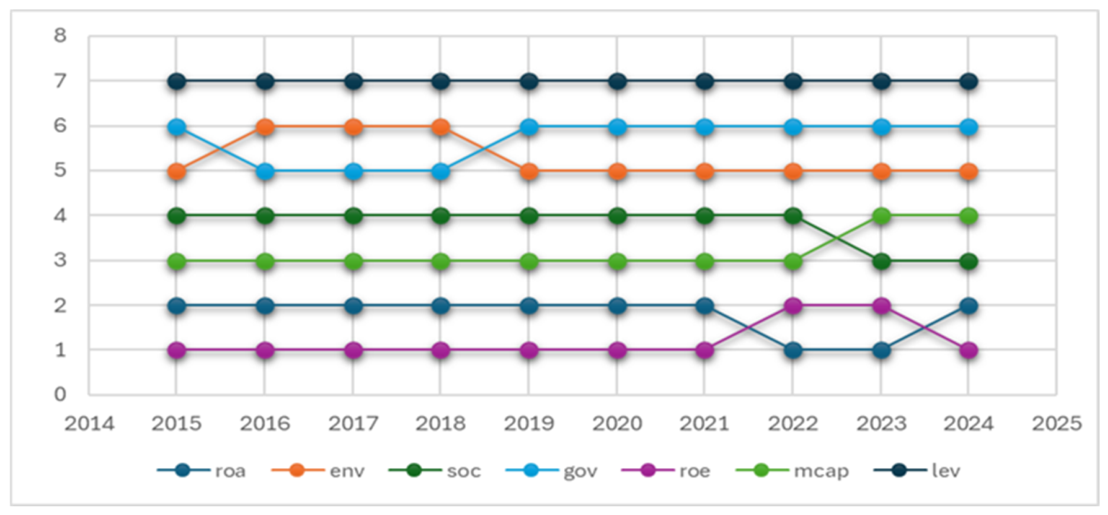
Table 7 for insurance companies over the 2015–2024 period, the most significant criterion is roe (average weight 0.273), and the least significant is lev (average weight 0.037). These finding highlights that return on equity plays a decisive role for these companies and indicates that the leverage ratio has a limited impact. While roe fluctuated between 0.17 and 0.31 from 2015 to 2021, it declined significantly in 2021 and returned to an upward trend in 2024. This situation significantly reflects the impacts of the COVID-19 pandemic on these companies. In contrast to roe, roa fluctuated between 0.19 and 0.25 during the 2015–2019 period but dropped to 0.17 in 2020, a 32% decline. Following the shock, it rebounded in 2021 with a 17.6% increase and has since followed a relatively stable trajectory.
Figure 1 shows an inverse correlation between roe and roa during 2020–2023, indicating that asset-based profitability predominated over capital-structure-based profitability in that period, whereas 2024 signaled a return to capital-structure-based profitability. The env variable data had an average weight of 0.09 and showed the highest increase in 2020, rising by 17.6%. The soc variable data had an average weight of 0.119 and showed the highest increase in 2022, rising by 8.21%. The gov variable data had an average weight of 0.097 and showed the highest increase in 2020, rising by 12.8%. The mcap variable data had an average weight of 0.136 and showed the highest increase in 2017, rising by 8.79%. The lev variable data had an average weight of 0.036 and showed the highest increase in 2020, rising by 11.22%. The years in which these variables experienced their greatest declines and the magnitudes of those declines are as follows: roa in 2020 by 32.2%, roe in 2022 by 38.93%, env in 2016 by 13.50%, soc in 2016 by 10.28%, gov in 2017 by 9.00%, mcap in 2021 by 20.84%, and lev in 2024 by 20.76%. Within the ESG score, the social dimension criterion had the most stable weight. Environmental criteria showed a relatively positive trend during the 2021–2022 period. The governance criterion, however, appeared to be the weakest component within ESG. The table data reveal that financial criteria remained the top priority for insurance companies across all relevant periods, while ESG criteria gained increasing importance, particularly after 2020, indicating that sustainability and corporate social responsibility had been integrated into decision-making processes. The criterion rankings derived from the NMV method results are presented in
Figure 1 below.
4.3. Integrated Results of the CRISUS and MAXC Methods
Table 8 presents the individual and integrated criterion weights derived by following the procedural steps of the CRISUS and MAXC methods.
Based on the integrated criterion weight values, the years 2017 and 2018 (1–3–4–6–2–5–7) shared the same ranking as 2023 and 2024 (1–4–3–6–2–5–7). During the 2015–2024 period, roa ranked first in 2015, 2019, 2022, and 2024, while it ranked second in 2020 and 2021. During 2015–2024, roe ranked second in 2016, 2019, 2022, and 2024; first in 2020 and 2021; and third in 2015. Lev consistently ranked last in all relevant years. Mcap ranked 5th in 2015, 2017, 2018, and 2019; 4th in 2021 and 2022; 6th in 2016; and 3rd in 2020. Among the ESG components, the gov criterion ranked 6th in 2015, 2017, 2018, 2019, 2020, 2021, 2023, and 2024, and 5th in 2016 and 2022. The soc criterion ranked 4th from 2015 to 2018; 3rd in 2019 and from 2021 to 2024; and 5th in 2020. The env variable ranked 2nd in 2015; 3rd in 2017 and 2018; 4th in 2019, 2020, 2023, and 2024; 5th in 2021; and 6th in 2022. According to
Table 8, the 10-year (2015–2024) average criterion weight values obtained using the integrated method represent a balance point between CRISUS and MAXC. Among the financial criteria, particularly roe and roa, the values from the integrated method approached MAXC’s average values, while for ESG and structural criteria (env, soc, gov, lev), they approached CRISUS’s average values. Across both methods and the integrated rankings, the ordering of the roa (1st), roe (2nd), and lev (7th) criteria remained unchanged based on the average criterion weight values for the period 2015–2024. The env criterion ranked 3rd in both the CRISUS and integrated rankings, while it ranked 5th in the MAXC ranking. In the soc category, CRISUS and the integrated ranking occupied 4th place, while MAXC occupied 3rd place. In the gov category, MAXC and the integrated ranking were in 6th place, while CRISUS was in 5th place. In the mcap category, the rankings differed: MAXC (4th), integrated (5th), and CRISUS (6th).
Spearman correlation analysis, performed under the assumption that the 2015–2024 data for the CRISUS, MAXC, and integrated results did not follow a normal distribution, showed a correlation exceeding 0.85 between the rankings produced by the two methods and the integrated rankings. These data indicate that the two methods and the integrated ranking results are largely consistent and produce similar performance scores for insurance companies, as they are based on the same financial and operational dynamics.
The integrated method produced a consistent ranking by balancing the differences between the two methods. The results of the integrated criteria weights for the 2015–2024 period generally reveal that profitability indicators, such as roa and roe, were among the top-ranked indicators. The fact that the leverage ratio ranked at the bottom suggests that companies have stabilized their debt obligations and have not demonstrated improvement on this criterion.
The weights of the criteria indicate that among the ESG sub-dimensions, the governance criterion remains stable, while the environmental and social criteria vary from year to year. This suggests that from the perspective of insurance companies, sustainability lags behind financial success. These findings indicate that while insurance companies maintain satisfactory levels of profitability, they fall short with respect to debt and corporate quality. In other words, no balance has not been established between companies’ ESG investments and their profitability, and the increasing debt burden has turned sustainability efforts into a financial-risk spiral.
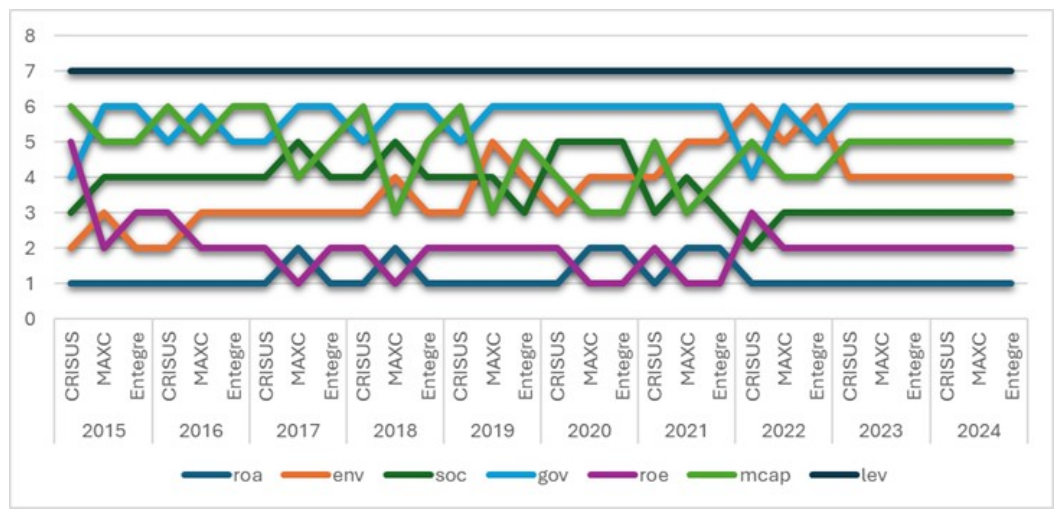
The comparative rankings of criteria based on the CRISUS, MAXC, and integrated method results are presented in
Figure 2.
As shown in
Figure 2, the differences between the rankings of the criteria produced by the CRISUS and MAXC methods were particularly pronounced for roa, roe, and market capitalization. When criterion rankings obtained by integrating both methods were examined, the integrated method yielded rankings similar to those produced by MAXC. The Lev criterion consistently ranked 7th and performed poorly across all three methods. In the CRISUS and MAXC methods, roe was generally among the top three, except in 2015, while roa was among the top two.
4.4. Results of the Integrated-CRADIS and NMV-CRADIS Methods
The integrated-CRADIS performance ranking scores, calculated by following the CRADIS method steps, are presented in
Table 9.
According to the results of the integrated CRADIS method, the only company to rank in the top 5 ten times during the 2015–2024 period was Admiral Group (United Kingdom). Similarly, Santam Ltd.(South Africa) appeared 6 times; OUTsurance Group Ltd. (South Africa), 5 times; Hartford Insurance Group (United States), 5 times; Ping An Insurance (China), 4 times; Gjensidige Forsikring (Norway), 4 times; Munich Re (Germany), 3 times; Fidelity National Financial (United States), Sampo (Finland), and Fubon Financial (Taiwan), 2 times each; and Zurich Insurance (Switzerland), Tryg (Denmark), PICC Property and Casualty (China), Grupo de Inversiones Suramericana (Colombia), AXA (France), and Arch Capital (Bermuda), 1 time each.
The only company to appear in the top five on nine occasions from 2015 to 2024 was CNA Financial Corp. (United States). Similarly, Great Eastern Holdings (Singapore) appeared 8 times, American Financial Group (United States) 5 times, and Momentum Group (South Africa) 5 times; China Taiping Insurance (Hong Kong) 4 times, Hanwha Corp. (South Korea) 4 times, New China Life Insurance (China) 4 times, and Hanover Insurance Group (United States) 3 times, Arch Capital (Bermuda), Discovery (South Africa), Everest Group (Bermuda), Great-West Lifeco (Canada), OUTsurance Group (South Africa), Sampo (Finland), Sanlam (South Africa), and ZIGUP (United Kingdom) each appeared once in the bottom five.
An analysis of the rankings of the relevant companies based on the data in
Table A2. revealed that only two companies achieved high, stable performance rankings, as indicated by their average rank scores and standard deviations. Zurich Insurance (Switzerland), with an average of 6.6 points and a standard deviation of 1.20, and Admiral Group (United Kingdom), with an average of 1.6 points and a standard deviation of 1.02, were identified as companies with high, stable performance and the lowest ranking variability. Four companies were found to have the lowest average rankings (all above 40) and standard deviations below 5, indicating stable rankings. These companies were Hanwha Corp (South Korea), Great Eastern Holdings (Singapore), Momentum Group (South Africa), and CNA Financial (United States). Among the companies with an average standard deviation of rankings above 15 and thus potentially considered risky were Bermuda-based Arch Capital (Bermuda), the South African OUTsurance Group, and U.S.-based Fidelity National Financial. Other insurance companies generally fell within the mid-range of rankings.
The NMV-CRADIS performance ranking scores, calculated by following the CRADIS method steps, are presented in
Table 10.
According to the results of the NMV-based CRADIS method, the only company to rank in the top 5 ten times during the 2015–2024 period was Admiral Group from the United Kingdom. Similarly, Zurich Insurance Group from Switzerland ranked 7 times; Ping An Insurance from China, South Africa’s Santam Ltd., and the United States’ Hartford Insurance Group, each 4 times; Norway’s Gjensidige Forsikring and South Africa’s OUTsurance Group Ltd., each 3 times; Bermuda’s Arch Capital, Finland’s Sampo Oyj, Germany’s Muenchener Rueckversicherungs-Gesellschaft in Munich, Fubon Financial Holding from Taiwan, Legal & General Group from the United Kingdom, and Fidelity National Financial Inc. from the United States 2 times; and finally, Tryg A/S from Denmark, AXA SA from France, and Powszechny Zaklad Ubezpieczen SA from Poland 1 time, were among the companies to have ranked in the top five. CNA Financial Corp, based in the United States, was the only company to have ranked in the top five nine times during the 2015–2024 period; similarly, among the companies that appeared in the bottom five over the past five years, Great Eastern Holdings from Singapore appeared 8 times; Momentum Group from South Africa and American Financial Group from the United States appeared 5 times; China Taiping Insurance from Hong Kong, Hanwha Corp from South Korea, and Hanover Insurance Group from the United States appeared 4 times; New China Life Insurance from China and OUTsurance Group from South Africa appeared 3 times; ZIGUP from the United Kingdom appeared twice; and Everest Group from Bermuda, Discovery from South Africa, and Helvetia Baloise Holding from Switzerland appeared once.
An analysis of the rankings of the relevant companies based on the data in
Table 10 revealed that only two companies exhibited performance rankings, considering their average rank scores and standard deviations. Zurich Insurance, based in Switzerland, with an average of 5.1 points and a standard deviation of 1.97, and Admiral Group, based in the United Kingdom, with an average of 1.3 points and a standard deviation of 0.64, were identified as the companies with high, stable performance and the lowest ranking variability. This category also included Munich Re (Germany), Cathay Financial (Taiwan), and Fubon Financial (Taiwan).
Among companies with averages above 40, the lowest threshold, and with standard deviations below 5 indicating a stable ranking, were South Korea’s Hanwha Corp, Singapore’s Great Eastern Holdings, South Africa’s Momentum Group, and U.S.-based CNA Financial. Among companies with average standard deviations exceeding 15 in the rankings and thus potentially considered risky were Bermuda-based Arch Capital, South African OUTsurance Group, and U.S.-based Fidelity National Financial. Other insurance companies generally fell within the middle ranks.
Sensitivity analyses applied within the scope of MCDM methods in the literature are generally focused on measuring the effects of changes in criterion weightings on rankings [
121,
122]. In studies aiming to demonstrate model robustness, the impact of changes in criterion importance levels is sought to be determined [
123,
124]. In determining ranking consistency for alternatives through criteria, criteria are subjected to changes at different rates within various scenarios [
123,
125].
In this study, sensitivity analysis was performed using 2015–2024 data from 54 companies, and 10-year averages were calculated. First, the average data were weighted using the integrated and NMV methods employed in the study. In both weighting methods, we identified the most dominant criterion (roa for the integrated method, roe for the NMV method). Over the 10 scenarios, weights were not generated randomly; a deterministic approach was followed [
124,
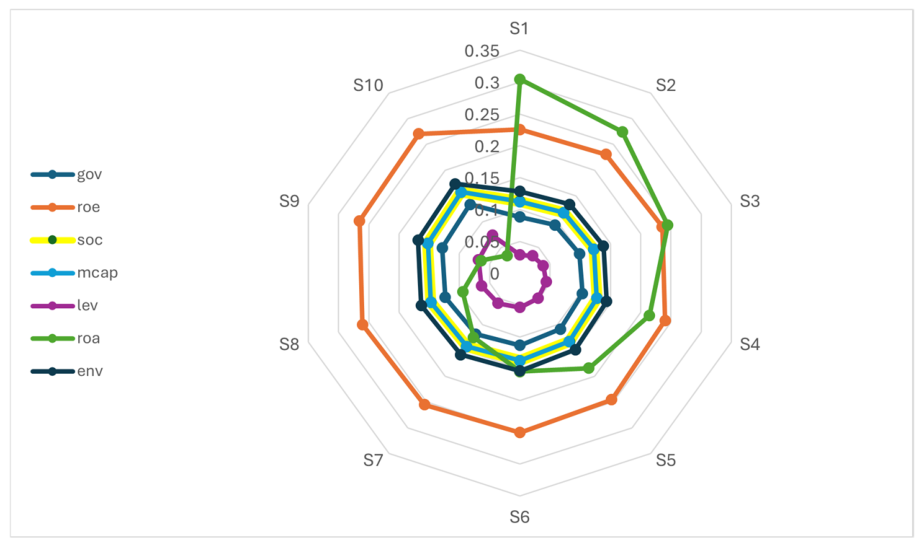
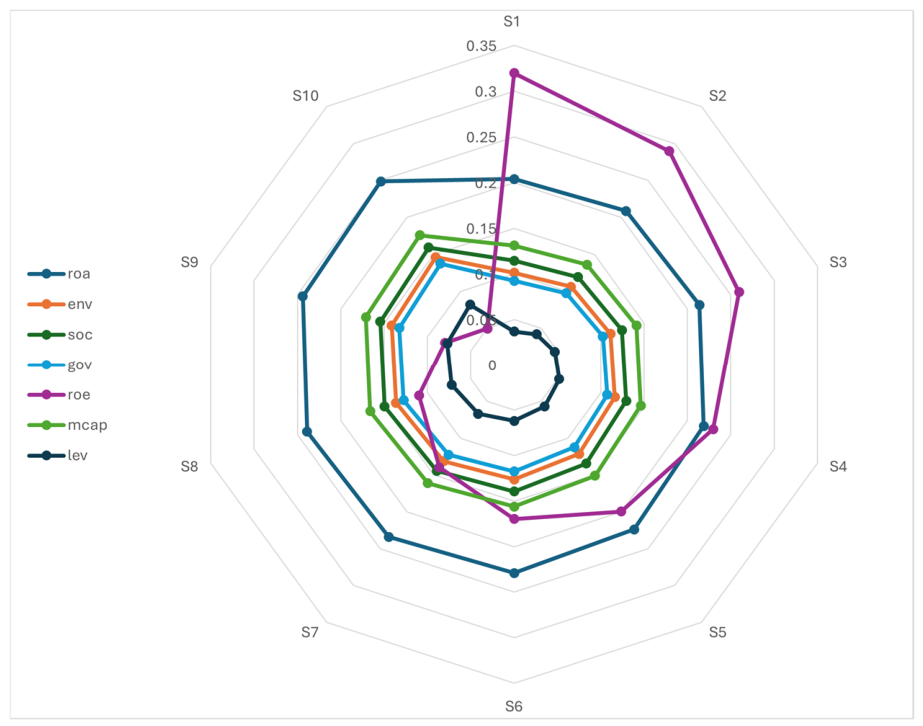
125]. From the baseline onward, the weight of the dominant criterion was reduced by 10% of its initial value in each step (a reduction of roughly 0.03). To satisfy the constraint that all weights sum to 1.0, the deducted amount was redistributed equally among the other six criteria, adding approximately 0.005 to each per scenario. This systematic erosion of the most influential financial parameter provides a clean test of the model’s stability. The data for scenarios conducted as part of the criterion-weighting methods are presented in
Figure 3 and
Figure 4.
In the sensitivity analysis, the relationships between the criterion weights of the integrated and NMV methods, as presented in
Appendix A.1 for 10 scenarios derived from 10-year averages, were determined using the Spearman’s rho correlation coefficient.
Given the sample size, the Shapiro–Wilk test was preferred to assess the normality of the data. SPSS (version 26.0) analysis indicated that the ranking results did not exhibit a normal distribution (
p < 0.05).
Table 11 presents the detailed findings on the stability of the rankings under different scenarios.
In the integrated method, the correlation coefficient, which dropped to 0.79 in Scenario 9, further decreased to 0.76 in Scenario 10. In contrast, the correlation coefficient in the NMV method did not fall below 0.93 across all scenarios. The findings reveal that the NMV method manages interactions among criteria more effectively, whereas the integrated method exhibits a sensitive and dynamic model structure. This indicates that the NMV method demonstrates robustness in sensitivity analyses; in other words, it is resilient to financial shocks and changes in weights with respect to model fit.
Appendix A.2 presents the alternative rankings of the integrated-CRADIS and NMV-CRADIS models, calculated based on criterion weight values for 10 different scenarios derived from 10-year averages. The relationships between the alternative rankings were analyzed using the Spearman’s rho coefficient. The analysis yielded statistically significant coefficients ranging from 0.942 to 0.994. This can be interpreted as evidence that the CRADIS method is robust against different weighting variations (MAXC, CRISUS, and NMV). Additionally, integrated-CRADIS and NMV-CRADIS methods produce similar rankings of alternatives. Upon examination of these rankings, Admiral Group PLC, Zurich Insurance Group AG, Ping An Insurance, and Muenchener Rueckversicherungs-Gesellschaft in Muenchen AG were identified as the top-performing companies in the scenarios calculated using the integrated-CRADIS and NMV-CRADIS methods. On the other hand, CNA Financial Corp, Great Eastern Holdings Ltd., and Hanwha Corp were the lowest-performing companies.
Overall, the preservation of rankings for the best and worst companies across both methods demonstrates that the model produces consistent and robust results. This indicates that the model’s outputs are stable in the face of changes in scenarios and methods.
5. Discussion
According to the GMM estimation results, the positive and significant coefficient of the lagged dependent variable indicates that operating profitability exhibits a dynamic structure. This finding demonstrates that past financial performance has a significant positive impact on current profitability; in other words, the past financial performance of insurance companies is important for predicting their future profitability. This finding supports the conclusion reported by Opoku et al. [
126] in their study using the System GMM method on data from 40 Ghanaian insurance companies for the 2012–2017 period, which stated that the performance level of insurance firms in the previous year is a significant predictor of the current level.
It was determined that the governance indicator and return on equity are positively related to financial performance. This finding is consistent with the studies by Sylods Labini et al. [
42], which demonstrate that ESG activities positively impact the performance of insurance companies. Furthermore, this result is similar to the studies by Giráldez-Puig et al. [
41], who noted that the governance dimension has a stabilizing effect on financial stability by reducing bankruptcy risk, as well as the studies by Meral et al. [
10] and Brogi et al. [
9], which found that high ESG scores have positive effects on financial performance in a study conducted on 81 global insurance companies.
Social and environmental indicators demonstrate a significant negative association with return on equity. This finding is consistent with the studies by Tobar [
14], who found that high-level ESG performance can have negative effects on profitability, and Giráldez-Puig et al. [
41], whose findings suggest that ESG-related issues increase the risk of bankruptcy.
Firm size and leverage ratio also have significant negative effects on asset profitability. This finding is consistent with the studies by Doğan [
127], Lee [
128], and Malik [
129], which indicate that profitability is negatively and significantly affected by the leverage ratio. Similarly, this finding is consistent with the results of Khadka [
130] and Kufo and Shtembari [
131], who found that firm size has a negative effect on return on assets.
In determining the nature of the interaction between companies’ ESG scores and financial metrics such as return on assets (roa), return on equity (roe), leverage ratio, and market value, structural characteristics, sector and regional factors, macroeconomic shocks and regulatory frameworks play a significant role [
17,
18,
132]. From the perspective of the trade-off theory [
133], the quality of a company’s ESG performance is effective in reducing the cost of capital by helping to mitigate both firm-specific and systematic risks [
134,
135]. It is known that companies with effective risk management mechanisms are able to manage their cash flows in a balanced and consistent manner and strengthen their financial performance [
136]. Improvements in the area of governance are particularly important. In line with agency theory [
133], by improving their governance performance, companies ensure the sustainability of profit and market value maximization. Thus, through robust ESG practices, companies can enhance their long-term value by improving corporate reputation, operational efficiency, and risk mitigation [
137]. Furthermore, through these ESG practices, companies can reduce their leverage ratio by promoting financial stability and increasing market value via enhanced investor confidence [
138]. The operational efficiency gains from ESG practices can have a positive impact on companies’ roa and roe ratios [
2,
10]. According to some studies, companies’ environmental and governance dimensions positively influence roa and roe variables through the efficient use of resources and robust governance structures [
139]. This demonstrates that ESG is a strategic tool capable of aligning sustainability with profitability [
5,
140,
141].
These observations line up with trade-off and agency theory. Neither framework works in every setting, but both help make sense of how ESG affects financial outcomes. Trade-off theory says that firms try to balance the tax benefits of debt against the costs—financial distress, for instance [
142,
143]. Bring ESG into the picture, and that balance shifts. Stronger environmental and governance performance lowers perceived risk, which in turn cuts the cost of capital [
134,
135]. We see this mechanism in developed markets like the UK [
144], though it may not hold as well in less stable places such as Tanzania [
145]. Agency theory, on the other hand, looks at conflicts between owners and managers [
146,
147]. Good governance—a key part of ESG—reduces those conflicts by lining up managers’ incentives with shareholders’ interests, which lowers agency costs. This logic works well in markets where ownership is widely dispersed [
148], but it may be less relevant where ownership structures differ, like in Jakarta [
149] or in family-run firms [
150]. Therefore, neither theory is universal. Taken together though, they still offer a useful way to think about how ESG influences roa, roe, leverage and market value, as long as you keep sectoral, regional and institutional differences in mind.
The integrated method, obtained by combining the CRISUS and MAXC methods for criterion weighting, produced weights close to those of the MAXC method for financial indicators and close to those of the CRISUS method for ESG components. Although the dominance of roa and roe weights relative to other criteria highlights profitability’s decisive role, the leverage ratio’s consistent last-place ranking with low weights across all years indicates that companies have been unable to stabilize their debt burden. Among the ESG sub-components, the governance dimension exhibited stable weight values, whereas the environmental and social dimensions showed variability across years. This situation indicates that over the years, insurance companies have faced challenges in converting investments in environmental and social sustainability into financial returns. According to the integrated method’s weighting findings, profitability remains a priority for insurance companies, while the issue of debt presents an operational constraint. Rather than implying a definitive value-destroying mechanism, the interplay between an increasing debt burden and intensive environmental or social expenditures suggests a short-term resource–allocation trade-off.
This dynamic indicates that extensive sustainability investments may initially act as cost-increasing factors, requiring careful liquidity management to avoid financial vulnerabilities during the transition. To ensure that these implications are methodologically sound, we treated our scenario-based sensitivity analysis (ten distinct weight-shift simulations) as an internal robustness check. The results confirm that the performance rankings and the identified financial-sustainability trade-offs remain stable, supporting the structural reliability of our conclusions.
6. Conclusions
Based on data from 2015 to 2024 for 54 global insurance companies across 23 countries, the association between ESG components and profitability—as a proxy for firm performance—was analyzed using the System GMM estimator. Criterion weights were determined using the objective weighting methods CRISUS and MAXC, and the results from both methods were integrated. Subsequently, the weighted values of the criteria were calculated using NMV, another objective weighting method. The performance rankings of the alternatives were determined using the CRADIS method based on weights from both the integrated and NMV methods. To measure the sensitivity of the alternatives’ rankings to changes in criterion weights, 10-year averages of data from 2015–2024 were used to calculate weights for the integrated and NMV methods. Based on the obtained weights, 10 scenarios were developed for each method. The weights assigned to criteria with high values (roa and roe) were reduced by 0.10 in each scenario. Within the resulting scenarios, CRADIS rankings were calculated separately for each method, and correlations between methods were analyzed using Spearman’s rho.
In the weighted analysis of the criteria, the findings of the NMV method indicate that based on the average weights for the 2015–2024 period, the most important criterion is return on equity, with a weight of 0.273. The leverage ratio was identified as the least important criterion, with a weight of 0.037. While the return on equity weight values declined in 2021, they began to recover in 2024. Return on assets reached its lowest weight value in 2020, a 32% decline from the previous year, and its highest weight value in 2022. A negative correlation was observed between the weight values of roe and roa over the 2020–2023 period. Significant progress was noted in the ESG sub-dimensions starting in 2020. While the social dimension emerged as a stable criterion, the governance criterion showed only limited progress. According to findings from the NMV method, financial criteria maintained their dominance in importance, while the impact of sustainability activities on decision-making processes continued to evolve within ESG sub-dimensions.
Using the integrated-CRADIS method, the most successful alternative in the rankings of insurance companies was determined to be the UK-based Admiral Group, while the alternative with the lowest performance was the US-based CNA Financial Corp. The UK-based Admiral Group and the Swiss-based Zurich Insurance were among the alternatives that stood out for their high performance and stable rankings. Hanwha Corp, Great Eastern Holdings, Momentum Group, and CNA Financial were notable for their stable rankings and low performance. Companies exhibiting a fluctuating trend in their rankings included Arch Capital, OUTsurance Group, and Fidelity National Financial. The remaining companies generally fell into the category of average-performing alternatives.
In the rankings of insurance companies generated by the NMV-CRADIS method, which were similar to those produced by the integrated-CRADIS method, the highest-ranked company was the UK-based Admiral Group, while the lowest-ranked was the U.S.-based CNA Financial Corp. The UK-based Admiral Group and the Swiss-based Zurich Insurance were companies with strong performance and stable rankings. Hanwha Corp, Great Eastern Holdings, Momentum Group, and CNA Financial were among the companies with the lowest performance in the latest rankings. Across rankings obtained using both methods, the UK-based Admiral Group performed best, while CNA Financial, Great Eastern Holdings, Hanwha Corp, and Momentum Group performed worst.
A sensitivity analysis using averages of data from 2015–2024 demonstrates that the NMV-CRADIS method exhibits robust resistance to financial shocks, with high correlation coefficients (>0.9336), whereas the integrated-CRADIS method exhibits a sensitive and dynamic structure (>0.7657). The hybrid MCDM model used in this study demonstrates that the outputs are robust to changes in scenario assumptions. To the best of our knowledge, the only study in the literature that combines the CRISUS and MAXC methods with the CRADIS method in an integrated format is the study conducted by Belke et al. [
56] within the beverage sector. The findings of this study, which indicate that the sensitivity analysis ensures the model’s internal consistency and resilience to rank reversal, are consistent with those of the aforementioned study.
Based on these findings, the following policy recommendations are offered for regulators, insurers, and policymakers:
Regulators should strengthen ESG disclosure standards specific to the insurance sector and develop globally comparable reporting frameworks. Methodological differences among ESG rating agencies currently create information asymmetry for investors. Sustainability reporting should therefore be transparent, verifiable, and aligned with international standards.
Insurance companies should treat ESG practices not merely as a reputational tool, but as a strategic management mechanism that supports long-term financial resilience. Given the positive impact of governance on financial performance, independent board structures, sustainability committees, and ESG-based risk management systems need to be reinforced.
The circular economy approach should be integrated into the insurance sector. The circular economy is built on reusing resources, reducing waste, expanding recycling, and developing sustainable production–consumption models. Insurers can play a role by offering green insurance products, supporting low-carbon investments, and building sustainable risk management models. As environmental pressures on the financial system grow, circular practices can enhance the sector’s long-term durability.
Since ESG investments may create cost pressures in the short run, companies should carry out their sustainability transformation within long-term financial planning. Findings show that environmental and social variables can negatively affect short-term roa. Hence, ESG investments should be phased in, operational costs managed carefully, and liquidity preserved.
Policymakers should expand tax incentives, sustainability-linked credit mechanisms, and green financing instruments to support sustainable insurance practices. Greater financial incentives for carbon reduction, climate risk management, digital insurance, and environmental sustainability would speed up the ESG transformation of companies.
ESG performance assessments should focus not only on aggregate scores but also on how individual ESG sub-dimensions affect financial performance. The findings indicate that governance supports financial performance, while environmental and social dimensions may create short-term cost pressures. Investors and rating agencies should therefore develop more detailed, component-based analysis models.
Digital transformation and ESG integration should go hand in hand in the insurance sector. Embedding AI, big data analytics, blockchain, and digital risk modeling into ESG processes can help manage climate risks, natural disasters, and social risks more effectively.
Excessive borrowing should be avoided when financing ESG investments. More balanced capital structures are needed. This study found that leverage has a negative effect on financial performance. Insurers are therefore advised to turn to alternative sources such as green bonds, sustainability-linked financing instruments, and ESG-themed investment funds.
For international insurance companies, harmonizing ESG regulations on a global scale is important. ESG practices may produce different outcomes across countries, which points to the need for international regulatory coordination. Common global standards for sustainable insurance should be developed.
Companies should strengthen their information environment. More transparent information sharing can reduce the negative effects of ESG practices on financial performance. Accordingly, firms should make sustainability reporting more transparent, improve investor communication, and enhance the accessibility of ESG data.
Risk management processes in the insurance sector should be restructured around ESG and sustainability criteria. Profitability and risk components differ during economic shock periods, so insurers need to develop sustainable risk analysis models.
Third-party verification mechanisms should be expanded to increase the credibility of ESG disclosures.
Insurance companies should evaluate their sustainability strategies not only through short-term financial indicators but also from a long-term corporate resilience perspective. System GMM findings show that past financial performance significantly affects current performance. This implies that the effects of ESG investments unfold over time and that sustainability practices matter for long-term financial stability.
Taken together, these recommendations aim to help align sustainability efforts with long-term financial resilience in the insurance sector.
This study has a few limitations. First, ESG ratings depend on self-reported corporate data. Some companies may engage in greenwashing or symbolic reporting, which can skew short-term cost–benefit assessments. Second, our sample covers 23 countries, from developing to developed economies, with very different regulatory and institutional settings. These cross-country differences may still affect roa and roe in ways our macro-level panel analysis cannot fully capture. Third, while our hybrid MCDM approach is robust, the deterministic nature of objective weighting makes it less suited for handling extreme uncertainty or vagueness in real-world sustainability data.
Future research could address these gaps in several ways. Methodologically, fuzzy MCDM frameworks like SF-VIKOR, SF-TOPSIS, or SF-CRADIS, combined with weighting methods such as CRITIC or MEREC, would improve the models’ ability to handle data uncertainty without necessarily changing the core rankings. Empirically, separating the insurance sector into life and non-life segments would help account for their different liability structures and investment horizons. Using alternative proxies for ESG and financial variables in the System GMM framework would also test how sensitive the current findings are to measurement choices. Theoretically, perspectives like the resource-based view (for internal capabilities) or legitimacy theory (for external compliance) could shed light on the mechanisms behind financial resilience. Finally, looking at how macroeconomic shocks or sudden regulatory changes affect the ESG–profitability link would show whether sustainable practices actually help buffer firms during market distress.